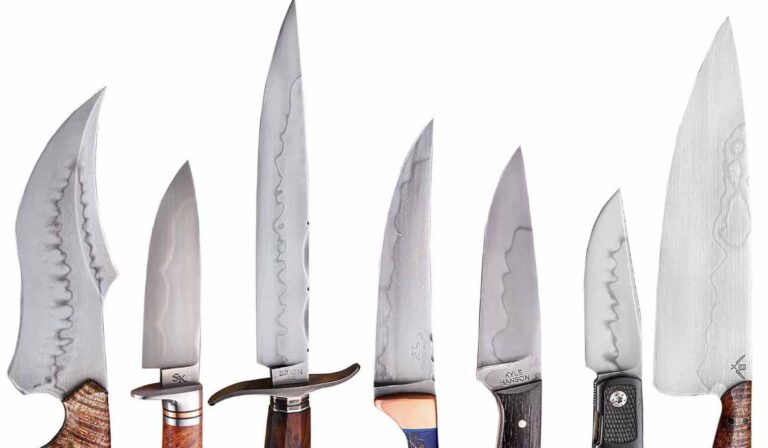
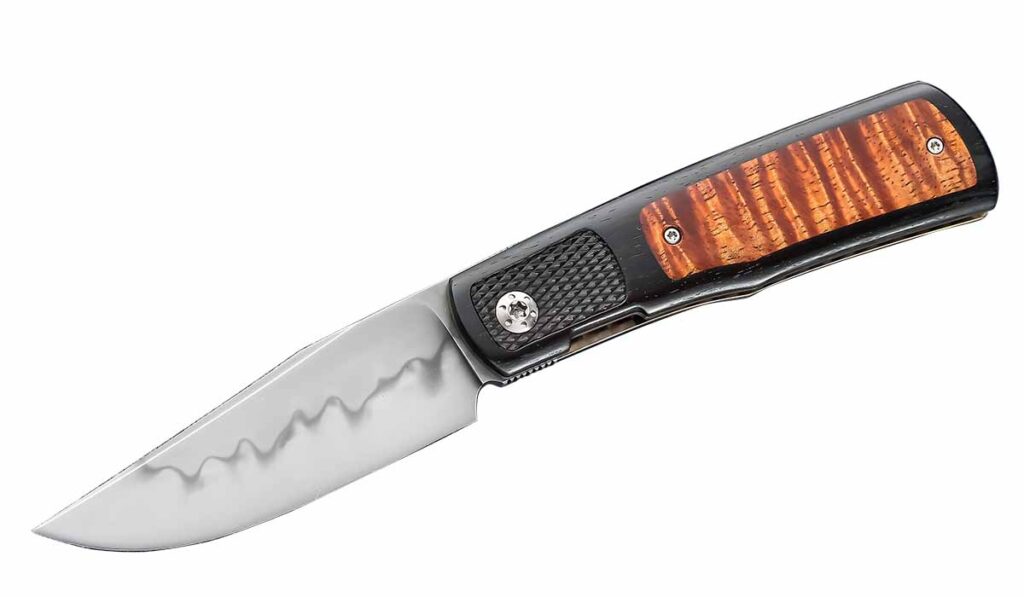
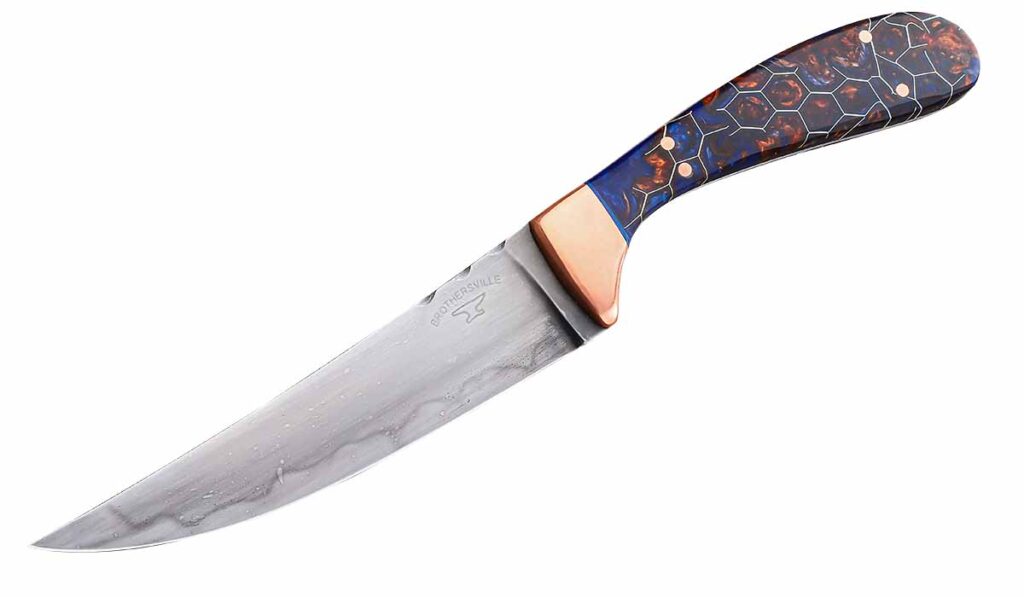
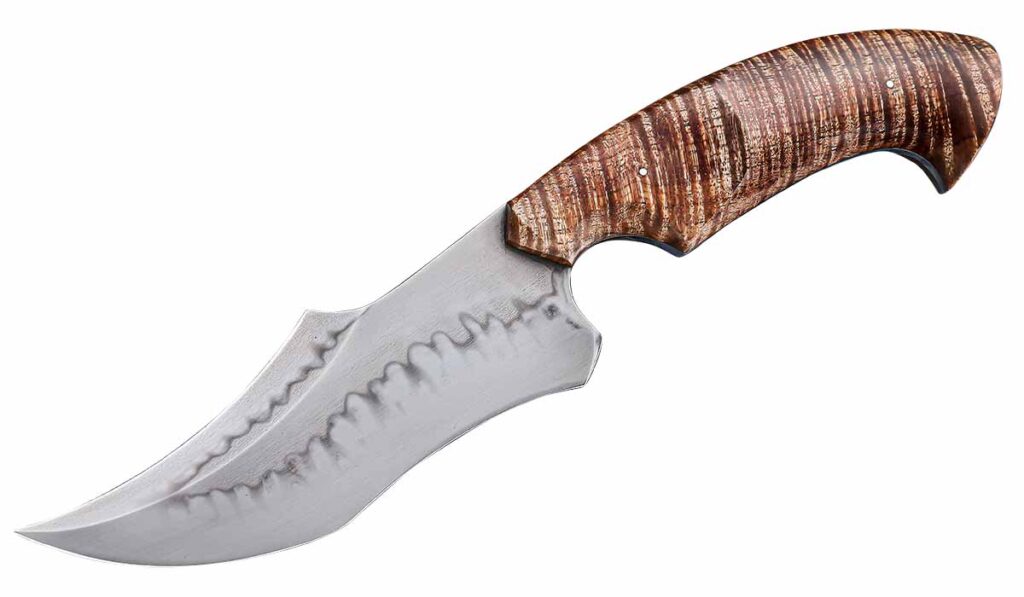
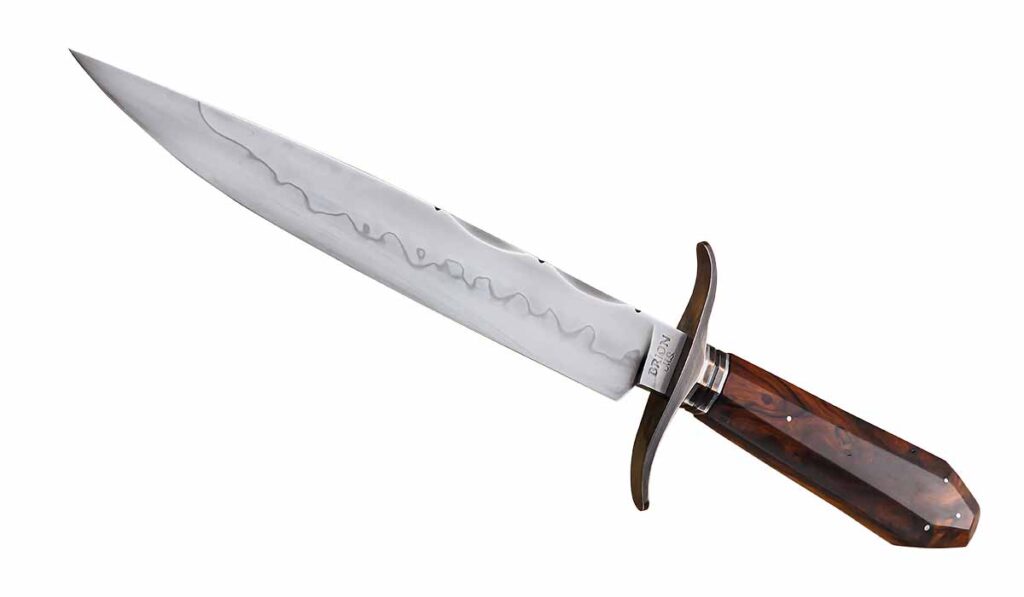
The often wavy hardening line running laterally and roughly midway from one end of the blade to the other on some knives is the hamon (pronounced ha-MOAN). Most if not all blades with genuine hamons are forged and differentially hardened. The wavy line serves as a demarcation point between the softer spine for toughness above and what extends down to a hardened edge for enhanced cutting below.
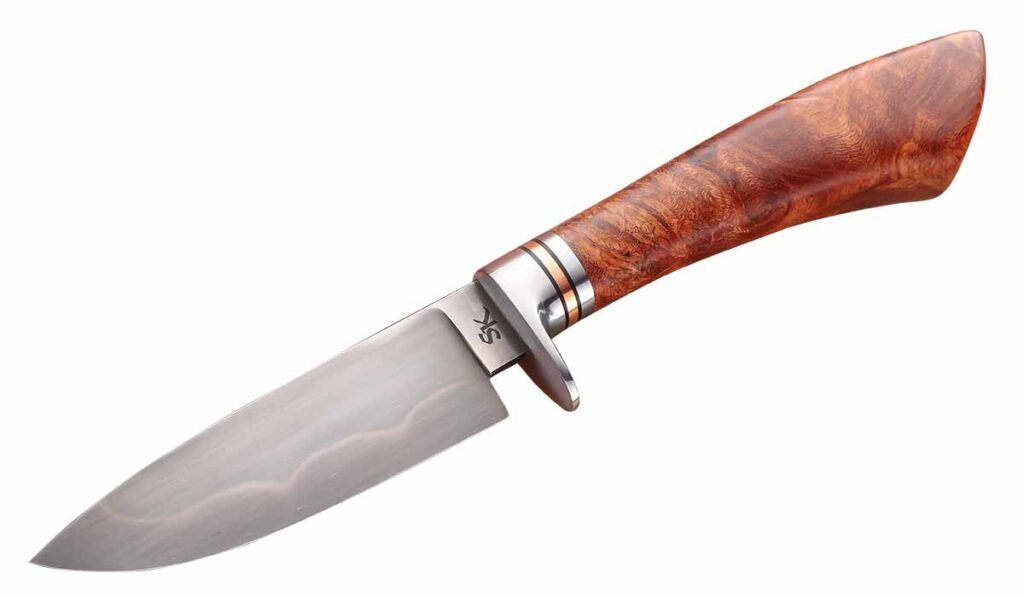
Steve Sando: Classic Hunter
Steve Sando used a coffee patina to color the hamon of the 4 3/8-inch blade of 26C3 carbon steel on his classic hunter. Steve’s differential hardening of the blade resulted in a Rockwell hardness of 62 HRC on the edge and 40 HRC on the spine. Blade grind: flat. Handle material: Afzelia wood. Overall length: 9 1/8 inches. (SharpByCoop image)
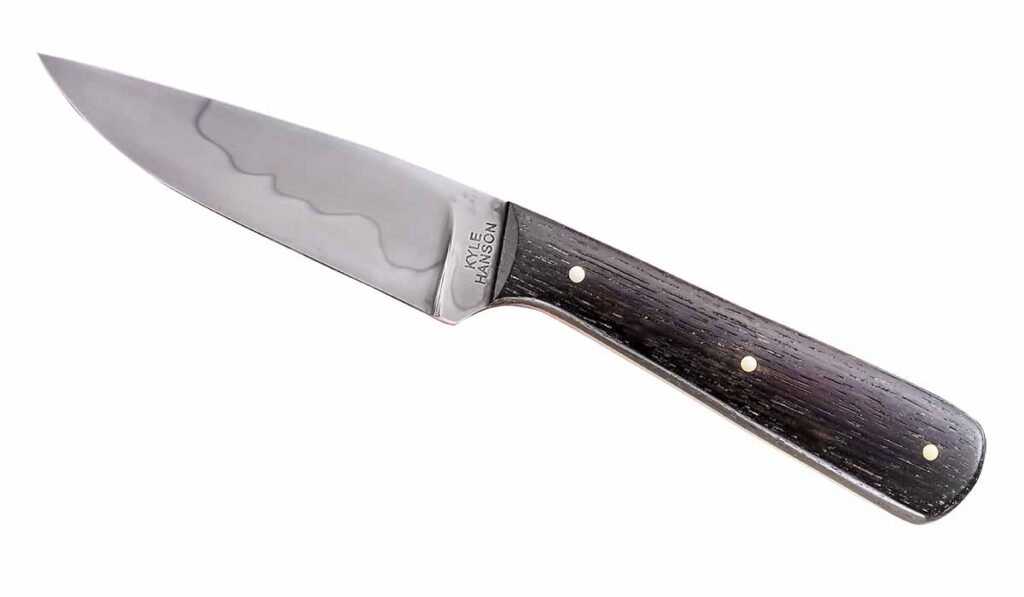
Kyle Hanson: Tapered Full Tang Hunter
Not merely W2 but “Oldass W2” tool steel is the canvas for the hamon on the blade of Kyle Hanson’s tapered-full-tang hunter. Handle material: 5,600-year-old bog oak. Overall length: 8.25 inches. A leather pouch sheath (not shown) by Kenny Rowe accompanies the knife. (SharpByCoop image)
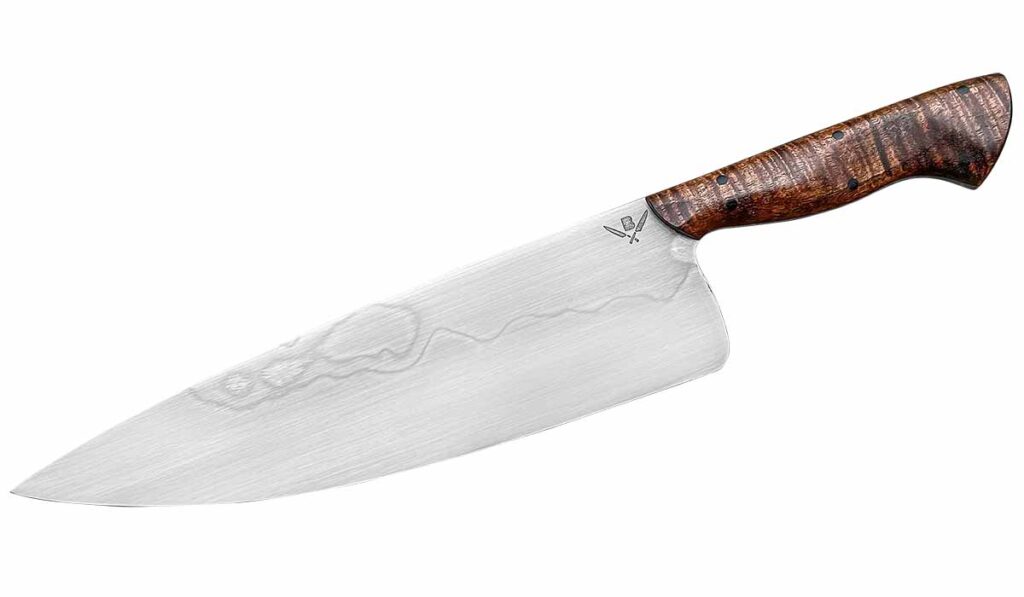
Geoffrey Baze: Chef’s Knife
ABS apprentice smith Geoffrey Baze opts for W2 tool steel to showcase the hamon on the 9.5-inch blade of his chef’s knife. The contoured bird’s beak handle is Tasmanian blackwood. (Jocelyn Frasier image edit)
John Doyle: Dress Classic Gunstock Model
While not unheard of, folders with blades sporting hamons are not all that common. John Doyle does the deed on his Dress Classic Gunstock Model with pocket clip. The 3.25-inch blade is W2 tool steel and the handle frame is African blackwood with koa inserts. Lock: linerlock. Liners: jeweled, anodized titanium. Closed length: 4.125 inches. (SharpByCoop image))
Peter Pruyn: Boning Knife
Like many makers who differentially harden their blades, Peter Pruyn used the clay-coating method for his small boning knife. The 5-inch blade is flat ground from 1095 carbon steel. The blueberry crumble resin-based scales are from Voodoo Resins and the bolster is copper. Overall length: 10.5 inches. Peter’s price for a similar knife: $450. (SharpByCoop image)
Eliott Robinson: Fighter
An apprentice to ABS master smith Sam Lurquin, Eliott Robinson nails it with the hamon on his fighter’s upswept recurve blade of U10A carbon steel. The bird’s-beak handle is Tasmanian blackwood. Respective blade and overall lengths: 5 and 9.5 inches. A quality inlaid sheath (not shown) by Jeremy Guillaume completes the outfit. (SharpByCoop image)
Brion Tomberlin: Coffin-Handle Bowie
The hamon of ABS master smith Brion Tomberlin’s coffin-handle bowie dissects the 8.5-inch W2 tool steel blade almost perfectly. Blade grind: flat. Handle material: ironwood. Overall length: 13.25 inches. Brion’s price for a similar knife: $2,200. (SharpByCoop image)
Damascus steel is produced on a mass scale by some of the best in the business
Forging damascus steel for knives and ancillary products on a broad scale makes the beautiful and highly popular knife material readily accessible to the marketplace, and drives the creativity of custom and factory knifemakers. The availability of the resulting damascus knives is reaching new levels while bringing on innovation at the same time.
At Nichols Damascus, owner Chad Nichols touts his willingness to put together “laminates of any kind we can think of.” Nichols Damascus is busy with titanium and copper alloys, carbon and stainless steels.
“We have a pattern called Boomerang, and any configuration we make it in sells very well,” Chad commented, adding that he believes the popularity of the material has increased dramatically due to the internet and social media.
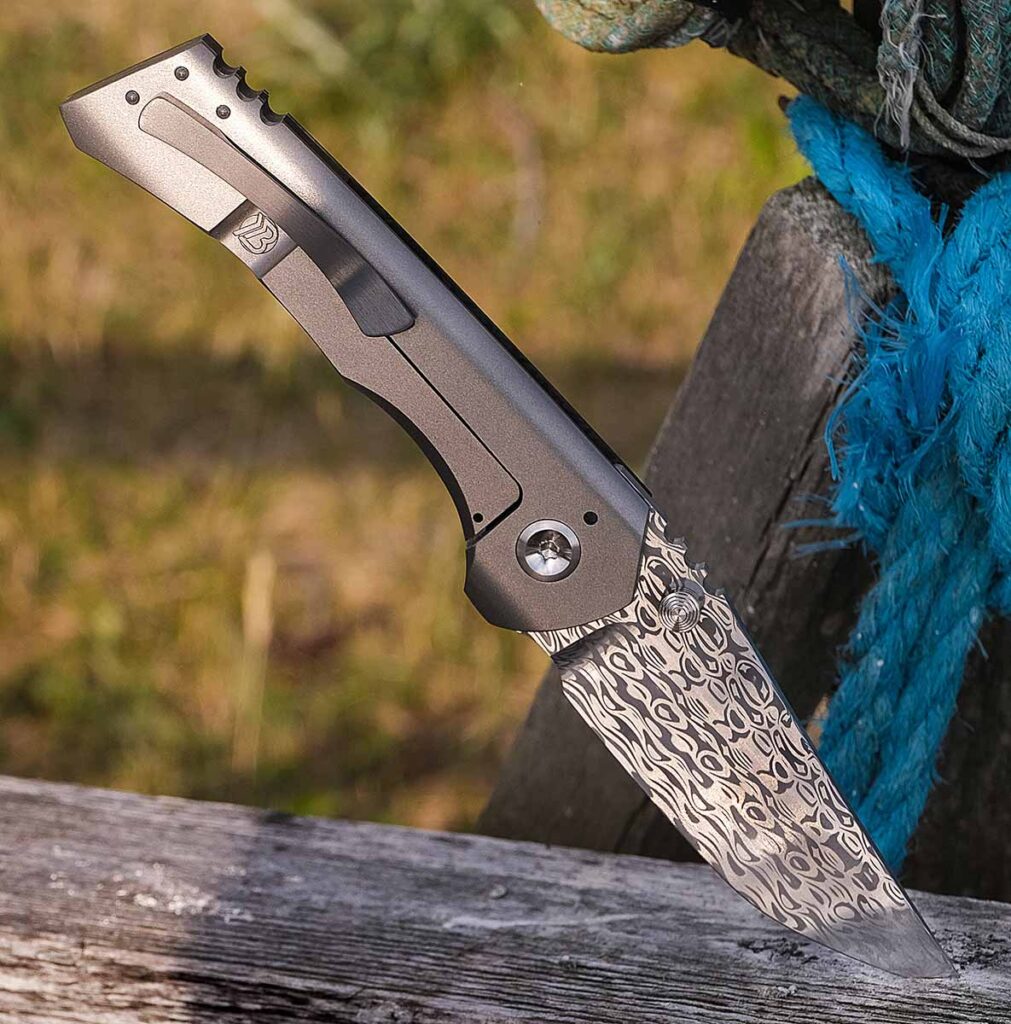
One of the latest patterns in Damasteel’s Dragon series, Svavner was used to create the blade steel for the Valyrian swords of the Targaryen family on HBO’s House of the Dragon. Brian Brown uses the steel here on one of his sporty folders. (Damasteel image)
He asserts that his forging operation charts its own course. “We’re just having a good time playing with hot stuff,” he smiled, “and we make a lot of core material. This is where we clad a homogeneous steel like Magna Cut with a damascus on the outside.”
WANTS & DESIRES MET A family-owned business situated just north of Sweden’s capital of Stockholm, Damasteel has focused for years on making top-quality steel for custom knifemakers, among other lines of business. “Over the last couple of years we have released our Dragon family of damascus patterns, culminating with the release of Svavner, which we launched alongside the release of HBO’s House of the Dragon,” noted owner and iron master Per Jarbelius. “They used our steel to create the Valyrian swords for the Targaryen family. It was an amazing project to get to work on.”
Damasteel has also just released Drakkar, a patterned steel in sheet form. It’s a first for the company and Jarbelius says it has been well received, emphasizing its nesting options with the ability to go from bar to sheet. A product line called Damacore has been available in DC18N and DC21R steel for a few years now and signaled a major expansion in the company’s repertoire. “It’s becoming even more popular as the number of san-mai offerings grows on the market,” Per noted. “We’re hoping to eventually be able to offer every pattern we do in both the DC18N and DC21R.”
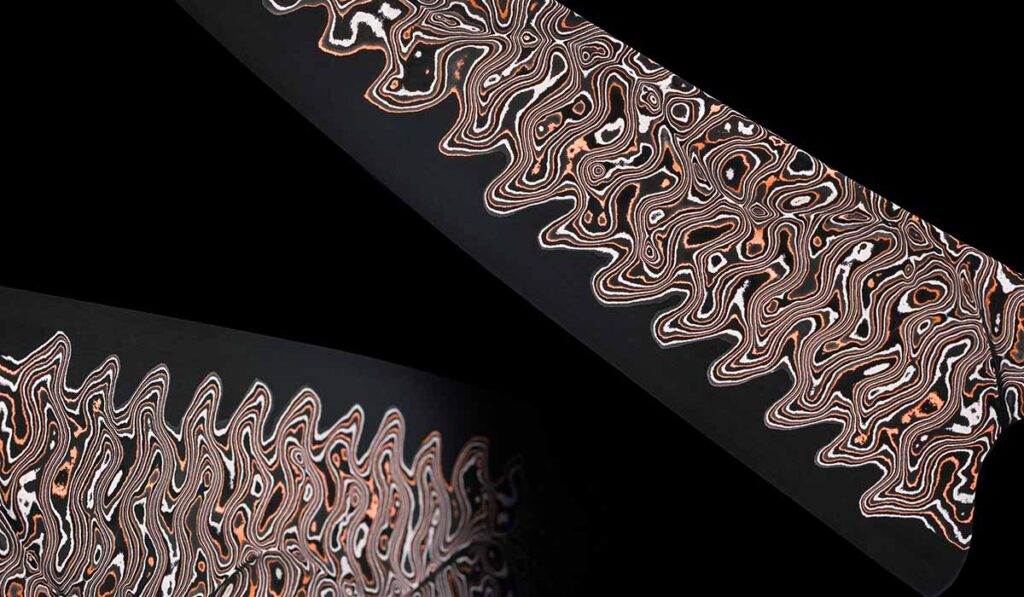
Among the most popular Baker Forge & Tool damascus patterns are the copper and bronze laminates. A current hot one is Elite CopperMai, a damascus blend of copper, 1084 carbon steel and pure nickel over a solid core of 80CrV2 carbon steel that creates either a chevron or a ripple pattern (the latter here on a knife by JB Blades). (Baker Forge & Tool image)
Philosophically, Jarbelius relates that Damasteel has always paid attention to the wants and desires of its market. “We make patterned and un-patterned stainless steel, and our priorities have always been performance and beauty,” he explained. “Our artistry is core to our identity, and we want to make patterns that connect with users on an emotional level. Research and development is a big part of what we do. But hearing from makers is equally important; we value the opportunity to get feedback from people using our steel.”
Damasteel further connects with its user community each year in hosting the Damasteel Chef Invitational, showcasing the talents of top-class culinary knifemakers. The evening event provides a glimpse inside the shops and workspaces of incredibly talented artisans. “It’s absolutely world class,” Per concluded. “It’s a great learning experience, too, for people who have never used our products. They can ask questions and connect with our team as well.”
Forging An Industry
Vegas Forge concentrates on the production of high-quality damascus steel in a variety of exotic patterns and alloy combinations. “In 2016, we opened our shop in Las Vegas and quickly discovered that many of our potential customers were extremely hesitant to use damascus steel again due to some bad experiences they had had in the past with other damascus steel companies or makers,” explained owner Jesse Harber.
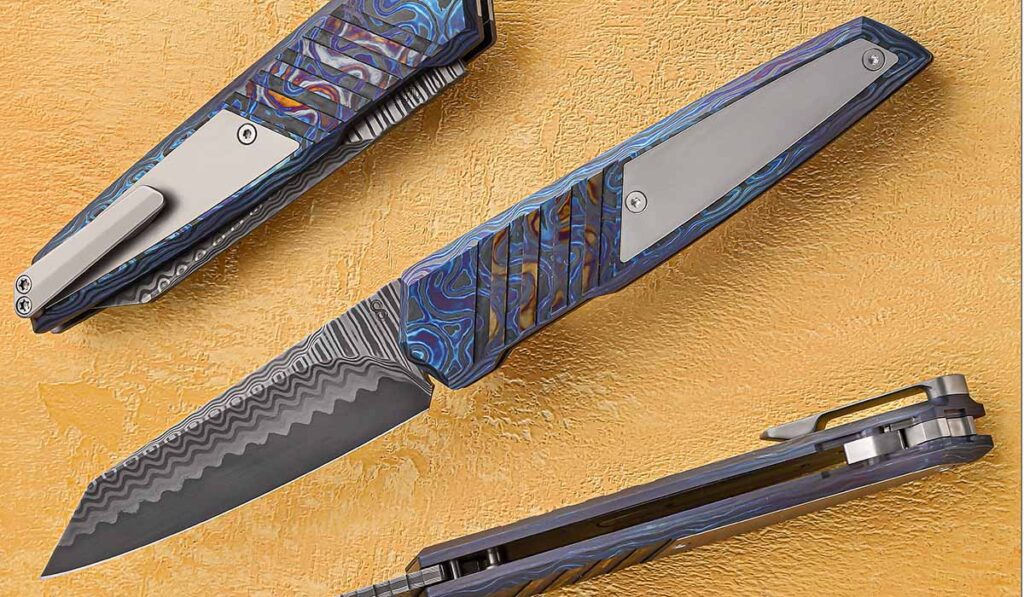
Damacore has been available in DC18N and DC21R steels for a few years now and signaled a major expansion in Damasteel’s repertoire. Persevere by Princeton Wong sports a 3.5-inch blade of Damacore DC18N handled in black Timascus™. Closed length: 4.625 inches. Princeton’s price for a similar knife: $2,700. (SharpByCoop image)
According to Harber, customer service is a watchword at Vegas Forge. Returning customer calls, handling inquiries, responding to emails, and delivering orders in a timely manner complete the full circle from outstanding damascus to overall satisfaction.
“Once we had solved that, we turned our focus on creating new, interesting patterns, new billet shapes and different alloy combinations,” Jesse advised. “In the beginning, we had 10 damascus patterns that we offered customers, all flat billets which are what knifemakers primarily use. Today, we offer 26 flat-billet damascus patterns. We offer most of those patterns in stainless or carbon damascus as well as titanium damascus and mokume gane. In addition, we have eight round-bar damascus patterns that we sell to customers who make things out of round bar like custom rings, pens, razors and such. We also make blocks of damascus in six different patterns for manufacturers of guns, golf putters and other products.”
The most recent patterns to emerge from Vegas Forge include Virus, Lytic, Forged Koa and one that is so recent that it remains unnamed thus far. Virus depicts what most people would think a virus looks like under a microscope—sporadic circles and lines that are “beautifully chaotic.” Lytic has the look of lytic DNA cycles under the microscope.
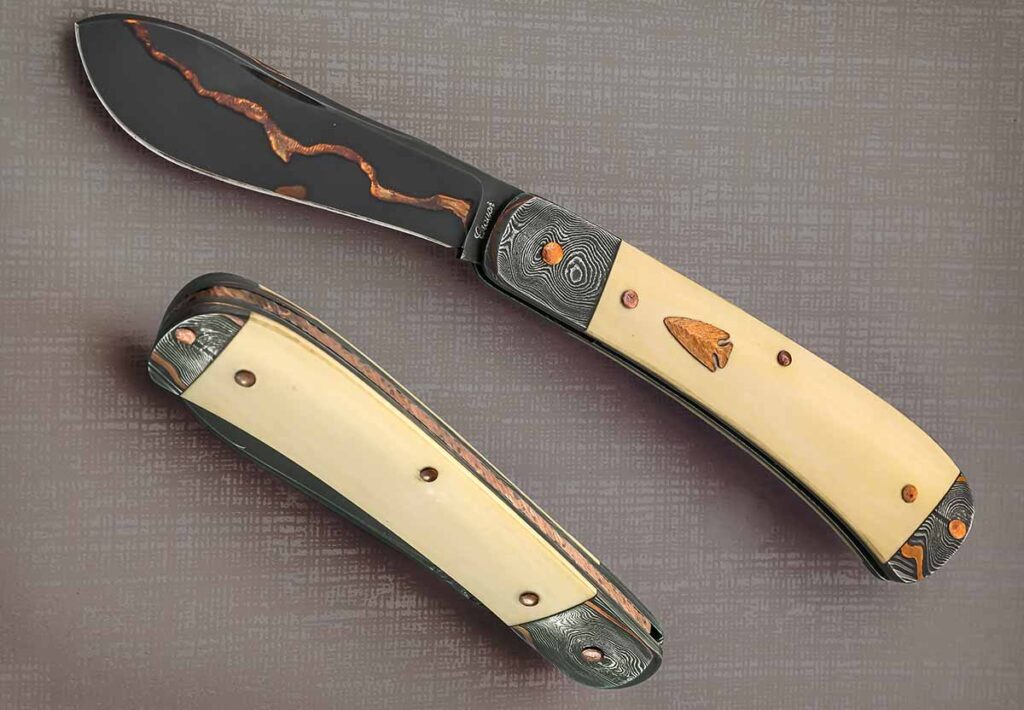
Baker Forge’s CopperMai was one of the first copper damascus steels to capture the imagination of custom knife enthusiasts. Bubba Crouch uses it on his trapper with an integral damascus frame and double-line antique Micarta® handle. Closed length: 4 inches. Bubba’s price for a similar knife: $3,000. (SharpByCoop image)
“Both of these patterns were created during the pandemic, so that’s where the inspiration—if you want to call it that—came from!” Harber laughed. “Forged Koa looks like a rare piece of twisted koa wood. It has multiple depths and contrasts to make it look like koa. It’s made by stacking 600-plus pieces of steel into a can and then lightly twisting it. As you grind into it, the pattern opens up and exposes all 600 layers, which is pretty spectacular.”
A few years ago, Vegas Forge began producing a titanium damascus that Harber dubbed Damtanium. The combination includes damascus with layers of Grade 2 and Grade 5 titanium. Almost simultaneously, the company introduced Zirmascus, an alloy of zirconium and titanium layers.
“We’re always trying out new steels in our san-mai damascus,” Jesse added. “San-mai is like damascus, but at the center of the damascus billet is a solid core. We have used Elmax, Magna Cut, and Nitro-V, to name a few.”
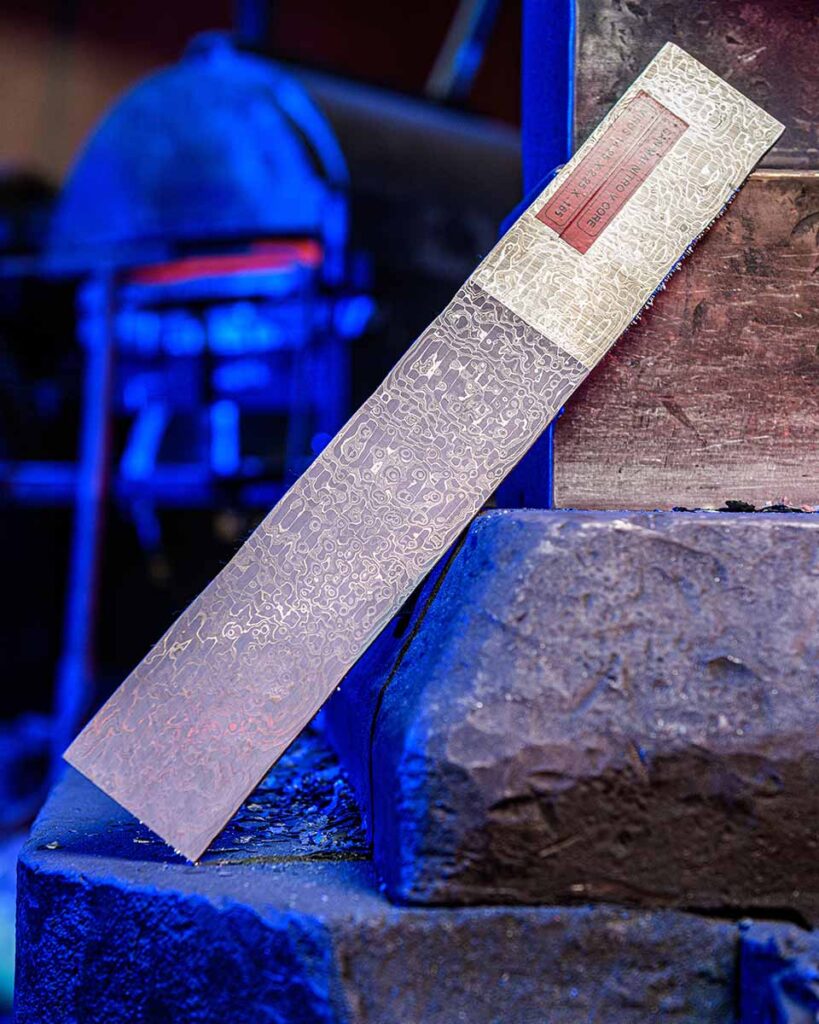
Jesse Harber said Vegas Forge uses its san-mai damascus to try out a number of stainless-steel cores, including Elmax, Magna Cut and Nitro-V, the latter shown here in bar form. (Vegas Forge image)
All this experimentation and innovation is the product of an expanding horizon and an imagination that isn’t inhibited or afraid to step into some uncharted territory. Harber thinks the future is bright at Vegas Forge, and the new product array has brought ever-increasing interest to the doorstep.
“In the beginning, the knife world kept us alive,” he declared. “We were getting no love from other industries. Today, the knife world still accounts for half our business. There isn’t another industry that we love more. We’ve attended hundreds of knife shows over the years, and there is no doubt that knife people are our people. We sell to a lot of custom knifemakers as well as larger manufacturers. I love the custom world, and I don’t even know how many custom knives we own at this point.”
Incorporating Copper And Bronze
Coy Baker founded Baker Forge & Tool in 2019 with a focus on damascus and san-mai. That bedrock quickly elevated to include non-ferrous laminate steels. Baker Forge is now an industry leader in copper and bronze laminated steels with dedicated distribution centers in the United States, Canada, the United Kingdom and Australia.
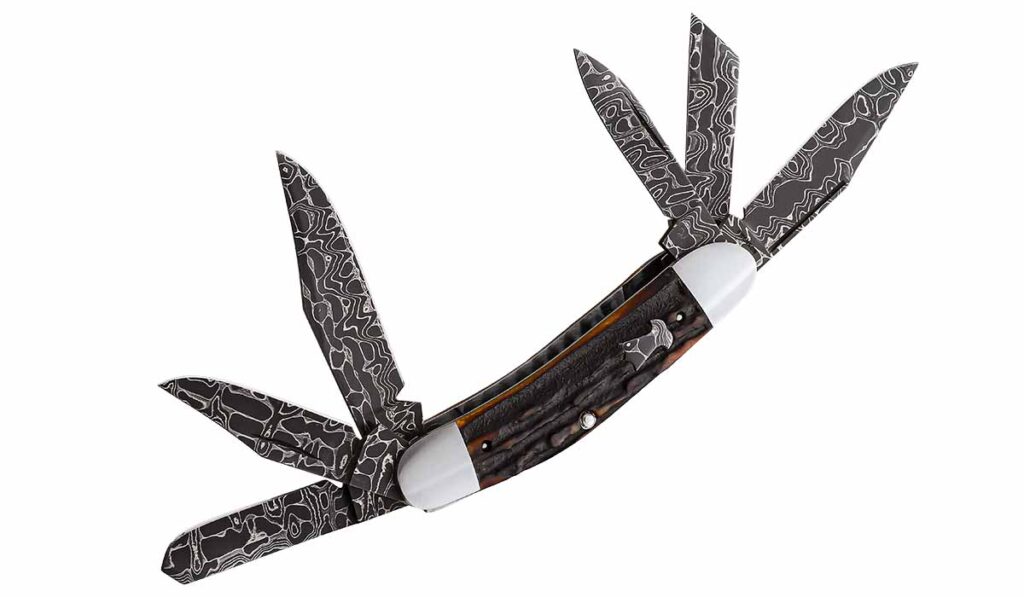
Chad Nichols Damascus offers a wide range of damascus patterns including the Intrepid on Luke Swenson’s six-blade stag sowbelly. Luke’s price for a similar knife: $4,000. (SharpByCoop image)
“Our current buying market is about 80 percent to the knifemaking industry, about a 50/50 split between retail custom makers and commercial knife companies,” Coy related. “We cut our teeth in the custom knifemaker market in the beginning and have slowly expanded into the commercial side. We aim to always be able to provide damascus steels to everyone from the hobby smith to the biggest knife companies.”
Among the most popular Baker Forge damascus patterns are the copper and bronze laminates. However, one-off custom runs generate real excitement. One trending steel group is Elite CopperMai, a damascus blend of copper, 1084 carbon steel, and pure nickel over a solid core of 80CrV2 carbon steel, creating either a ripple or chevron pattern.
“This layout is very appealing to customers due to the stark contrast between the layers and its ease of finishing,” Coy remarked. “We have been expanding into using new core steels in our laminates. Recently, we have used some Hitachi #2, which quickly became a crowd favorite for its edge-retention properties. Later this year we will be expanding into Apex Ultra steel and possibly some other stainless options.”
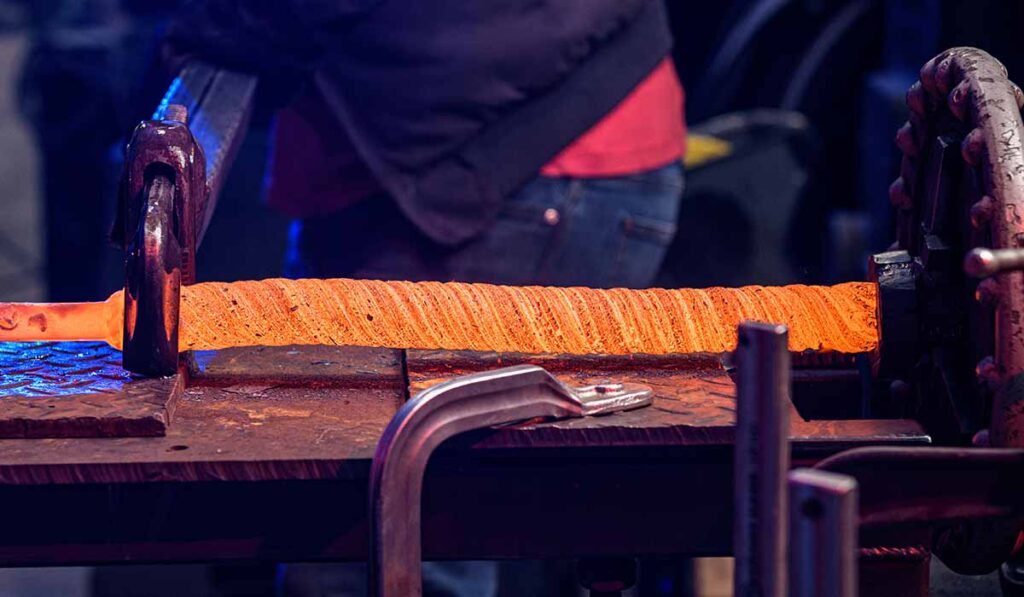
“Forged Koa looks like a rare piece of twisted koa wood,” Vegas Forge’s Jesse Harber explained. “It’s made by stacking 600-plus pieces of steel into a can and then lightly twisting it. As you grind into it, the pattern opens up and exposes all 600 layers, which is pretty spectacular. (Vegas Forge image)
This quick look inside the damascus steel industry offers a glimpse of past, present, and future. The tried and true, the cutting edge, and what will be are coming together to keep pattern steels fresh and exciting among makers, users and then the wider buying market.
Get a sneak peek at all the happening at the 2023 BLADE Show West.
Last year’s show was much better than expected and show officials are anticipating more of the same except more of it for BLADE Show West 2023’s encore appearance October 13-14 in Salt Lake City, Utah.
Set once again for the plush Salt Palace Convention Center in the heart of downtown, the show will host return engagements from most of last year’s leading exhibitors plus a large additional group of some of today’s best and brightest knifemakers, bladesmiths, knife companies, knife suppliers and others.
BEAT THE LINES! Get Your BLADE Show West Tickets Now!
Also in the offing is an entertaining slate of seminars highlighted by new ones conducted by BLADE Magazine Cutlery Hall-Of-Fame® member Devin “Hoss” Thomas, ABS journeyman smith Mardi Meshejian, knifemaker David Carver and AmeriBrade grinders, along with popular returnees conducted by the likes of Cutlery Hall-Of-Famer Steve Schwarzer and Squid Industries, the latter the balisong-festooned 4th Annual West Coast Flipping Championships.
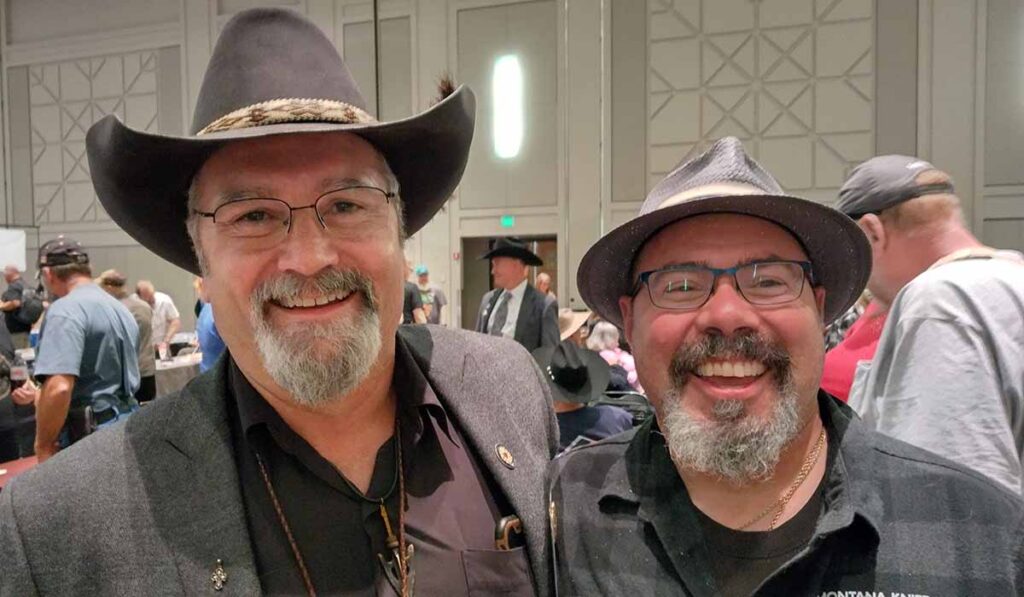
ABS master smith Shane Taylor (left) and knife guru Steven Garsson (right) needed no cheering up at last year’s show.
Drinking it all in will be knife enthusiasts from the local area, surrounding states and those even further afield eager to partake of the BLADE Show brand of knife show, Western style.
“The crowd was way more than I expected,” Cutlery Hall-Of-Famer Bill Ruple noted of last year’s event. Added award-winning maker Mike Tyre, “It was extremely busy. Both days were non-stop people.” Ruple and Tyre, along with an all-star cast of makers and other exhibitors, will be among those returning this year.
The Salt Palace Convention Center received high marks from attendees last year in terms of overall atmosphere, amenities and easy accessibility to most everything, including hotels, parking and restaurants. “The venue was excellent. My hotel was really upscale with great parking,” Tyre observed. “The show was a short walk across the street.” Chimed in ABS master smith Steven Koster, “The hotel and food were very convenient and easy to get to … The show venue was nice and easy to access.”
BLADE Show West Awards
At a time to be determined on show Friday, the custom knife and factory knife judging competitions will be held. Exhibitors wanting all the details on how to enter should read the competition rules supplied in their exhibitor packets.
BLADE Show West hosts two knife judging competitions: factory and custom. WE Knife won Best Folder and Best of Show in the factory judging last year with the Nitro Mini, a collaboration between WE and knifemaker Peter Cary. (SharpByCoop image)
Categories in the custom competition are: Best Hunter, Best Kitchen, Best Damascus, Best Slip Joint, Best Fixed Blade, Best Folder, Best Tactical, Best Of The Rest, Best M.A.C.K. and Best of Show. Categories in the factory competition are Best American Made, Best Imported, Best EDC, Best Fixed Blade, Best Folder and Best of Show.
All award winners will receive trophies and coverage in the BLADE Show West recap edition(s) of BLADE®. The winners will be announced at 8 p.m. on show Friday at the BLADE Show West Awards After Party.
Things To Do Around SLC
As noted, many outstanding restaurants and watering holes are within easy walking distance of the Salt Palace Convention Center. The area is also home to an energetic nightlife scene, national parks, museums and other attractions.
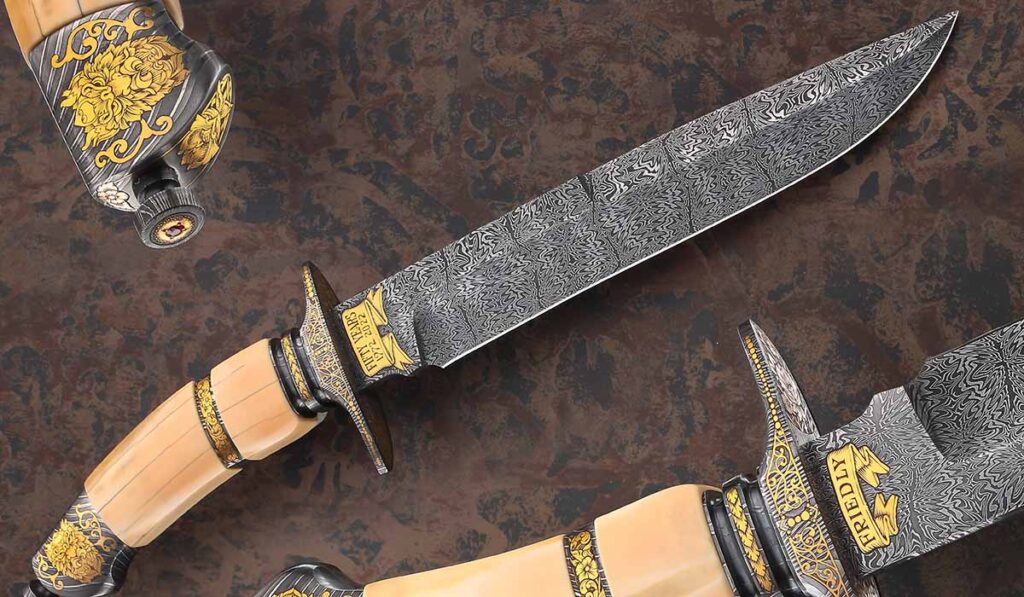
Dennis Friedly will be among the show’s top art knife exhibitors. His knife celebrating his 50th year of knifemaking in 2022 boasts a 9.5-inch blade of damascus forged by Tanner McFall, a guard of damascus by Robert Eggerling and an ancient ivory handle. Gil Rudolph is the engraver. Overall length: 16 inches. (SharpByCoop image)
Meanwhile, the latest in custom and factory knives and accessories, tomahawks, swords, multi-tools, knifemaking materials and equipment, vintage collectibles, knife swapping galore, old friends renewing acquaintances and new friendships waiting to be made—you get it all and more at BLADE Show West 2023.
FRIDAY, OCTOBER 13 1-to-2 p.m.: Fundamentals of Grinding AmeriBrade will provide a general overview on grinds, technique and different equipment. The class will be interactive and the AmeriBrade team will answer questions and demonstrate suggestions to address common issues. 2:30-to-4 p.m.: How Much to Charge for a Custom Knife Finding the right balance between charging too much and not enough for a knife can spell success or failure for any maker. If you want to learn what goes into the thought process of makers who set their prices properly, join BLADE Magazine Cutlery Hall-Of-Fame® member Devin “Hoss” Thomas for his seminar. 4:30-to-5:30 p.m.: It’s Not a Friction Folder: A Modern Interpretation American Bladesmith Society journeyman smith Mardi Meshejian will talk about his innovative folder design and construction inspired by traditional friction folders and straight razors.
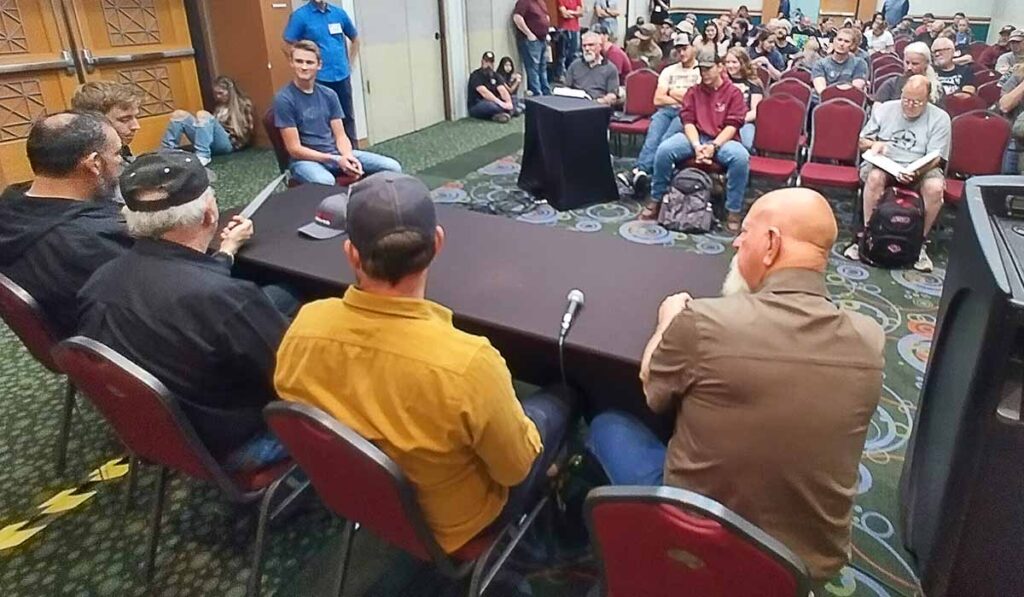
One of the best-attended seminars not just of BLADE Show West but all affiliated BLADE Shows is “Let The Pros Critique Your Knife.” ABS master smith Steve Schwarzer (right, seated at table) returns with a fresh batch of award-winning knifemakers to opine on the knives submitted by show goers for review. See seminar schedule for details.
SATURDAY, OCTOBER 14 12-to-1 p.m.: Let The Pros Critique Your Knife Cutlery Hall-Of-Famers Steve Schwarzer and Devin “Hoss” Thomas and award-winning makers Jared Oeser and Luke Swenson will examine the custom knife you bring and tell you what’s good about it, what’s not and how it can be made better. This will be a limited-seating event. Bring one knife only. Questions from attendees will be entertained throughout. 2-to-3 p.m.: Folder Design David Carver of Carver Knife Co. will teach techniques on making a folding knife that works well, looks good, and feels great in the hand and/or pocket. 4-to-6 p.m.: 4th Annual West Coast Flipping Championships Hosted by Squid Industries, the event will feature head-to-head/live balisong flipping in an elimination/bracket-style competition.
*All seminars and the flipping championships will be held in Meeting Room 150.
Sample of Top Exhibitors
A few of the exhibitors set to show their stuff at BLADE Show West ’23 include such outstanding custom makers and bladesmiths as: ABS master smiths Bill Burke, Murray Carter, Steven Koster, BLADE Magazine Cutlery Hall-Of-Fame® member Steve Schwarzer, Shane Taylor and Shayne Carter; Cutlery Hall-Of-Famer Bill Ruple; Dennis Friedly; Todd Begg; Jim Dunlap; Duane Dwyer; Gavin and Grant Hawk; Johnny Stout; Keanison Knives; Mike Tyre; Jared Oeser; Enrique Pena; Princeton Wong; Luke Swenson; Tim Robertson; and a host of others.
The custom knife section of the Salt Palace Convention Center was jampacked with knife nuts at BLADE Show West ’22. The same is expected this year to see gobs of fabulous knives such as those by BLADE Magazine Cutlery Hall-Of-Fame® member Steve Schwarzer. His Shark Knife sports a 4.25-inch blade of mosaic canister damascus and an ancient ivory handle in fishy motifs. (Jocelyn Frasier knife image)
Domestic and international factory knife and knife accessory exhibitors will include Artisan Cutlery; Boker USA; Bradford Knives; CobraTec; Cold Steel; CRKT; Emerson Knives, Inc.; Fox Knives; GiantMouse; Heretic Knives; Hogue Knives; Kizer; Kansept; LionSteel; Microtech; Pro-Tech; Reate Knives; Rosecraft Blades; SOG Knives; Spyderco; TOPS Knives; WE Knife; White River Knife & Tool; Wicked Edge Precision Sharpeners; and many more. Knifemaking suppliers set to exhibit include Damasteel; Evenheat Kiln; Knife & Gun Finishing Supplies; New Jersey Steel Baron; Nichols Damascus; Vegas Forge Damascus; and a number of others.
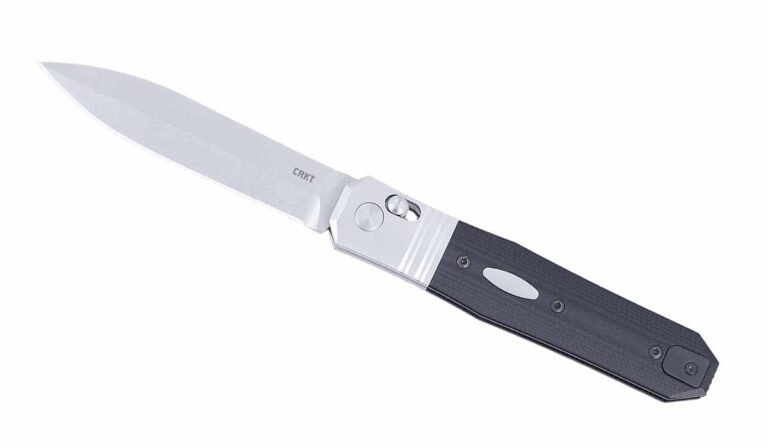
CRKT’s first MagnaCut blade and Ken Onion’s first crossbar lock the maker looks to come up aces.
As always, Columbia River Knife and Tool (CRKT) is innovating—and releasing its innovations—at a mind-boggling clip. The latest up for the Oregon-based company is a USA-made collaboration with another well-known knife concern, made with some top-notch material. It’s also a looker to boot.
Meet the Redemption, a sleek folder developed in conjunction with Hogue Knives and based on the legendary designer Ken Onion’s Deadman’s Hand custom. As a side note, the Onion’s custom takes its name from the cards Wild Bill Hickock supposedly held when shot—aces and eights. Living up to its inspiration and its own moniker, the Redemption has an Old-West gambler’s feel to its lines and profile.
Yet, made with cutting-edge steel—the first time CRKT has utilized CPM MagnaCut for a blade—it’s up on the times and offers contemporary performance. For those who might not know, MagnaCut is among the hottest blade steels, with exceptional toughness, wear resistance and corrosion resistance. To boot, its microstructure also makes edge management easy.
Redemption Mechanics
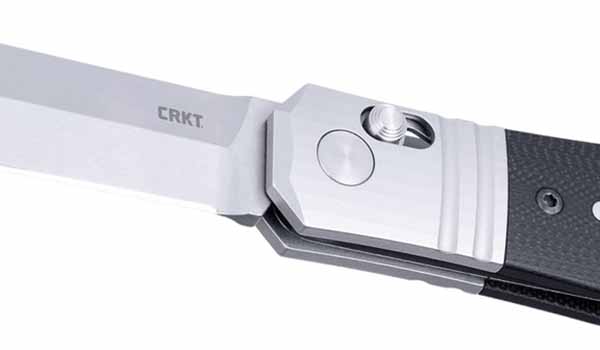
Another inaugural of the Redemption is its locking mechanism—at least for Onion. Hard to believe, but this is the first time the prolific designer has incorporated a crossbar lock into one of his creations. But it does broaden the knife’s appeal, not only offering silky-smooth deployment of the spear-point blade and a strong lockup but also making it ambidextrous. For the nimble and quick of hand, it opens the potential of fast deployment with a flick of the wrist.
Blade Points
In addition to using top-shelf steel, the CRKT Redemption has an interesting blade design. Stiletto-like, the 4.06-inch blade should prove a piercing pro, particularly with its fine tip. Nevertheless, the knife has enough edge for general cutting tasks and at .15-inches thick should have enough backbone to handle semi-rugged jobs, if your opportunities for perforation are limited. Overall, it is very reminiscent of the Deadman’s Hand’s blade, however, the CRKT knife has a stonewashed finish, whereas the custom had a high polish.
Handle Design
Not dead nuts, but the shape of the Redemption’s handle suggests a coffin handle—more so with the stainless-steel bolsters setting off the dark scale. To this end, CRKT has opted for G10 with nice texturing to it, giving the knife a measure of all-weather aptitude. The pocket clip is engineered for deep carry and is reversible, furthering the knife’s appeal to righties and lefties.
Final Cut
Clocking in with a $225 MSRP, the CRKT Redemption teeters on the premium end of the production knife price scale. But given the name behind its design, the materials the company has chosen and the fact it’s domestically made, it is by no means out of bounds. And given the knife is based on an Onion classic and has a wicked throwback look, it’s more than likely to catch the attention of more than one knife aficionado.
They complement one another in an easy, seamless union—blade and handle. One without the other means the knife is incomplete, or it isn’t a knife at all.
Along with the search for proper blade steel, appropriate handle material is the second critical element in the presentation, form, and function of the knife itself. Natural and synthetic handles play their roles. They bring utility and aesthetics to the package, and the maker’s choice sets the tone. Availability, cost, and maker’s preference fit into the equation when choosing the right handle material. And then, of course, the intended knife use weighs heavily.
In the end, it’s the eye of the artist that drives the visual element, and the job to be done by the user that directs his or her choice. The handle makes the knife complete.
At Masecraft Supply Company, co-owner Chris Hartman sees the supplier’s role as the facilitator. Never interfering with the artist’s concept, he views Masecraft as a provider of the palette. “We don’t advise what to use,” he reasons. “We are not big fans of, ‘You know what you should do …’ or telling a customer what to use, but more in supplying a wide variety of options to choose from. We are always willing to answer questions about our materials a customer may have, but it’s just not a good idea to advise what is right for them. That’s the maker’s choice.”
Knife Handle Material Trends
With that said, where is the market headed today? What does the landscape look like in terms of availability, trends, and timing?
“The majority seem to be sticking with composite laminates like G-10, canvas and linen Micarta, and Richlite,” Hartman says. “Natural materials like bone and horn seem to be in a continuing decline. Exotic woods still do well, but availability and pricing have become issues over the last two years.”
John Cammenga, vice president of operations at White River Knife & Tool, Inc., deals primarily in synthetic knife handle materials. He indicates that knifemakers who build hard-use models often lean toward durable synthetic handles and that the laminate trend holds up there as well, particularly with material available in a variety of colors.
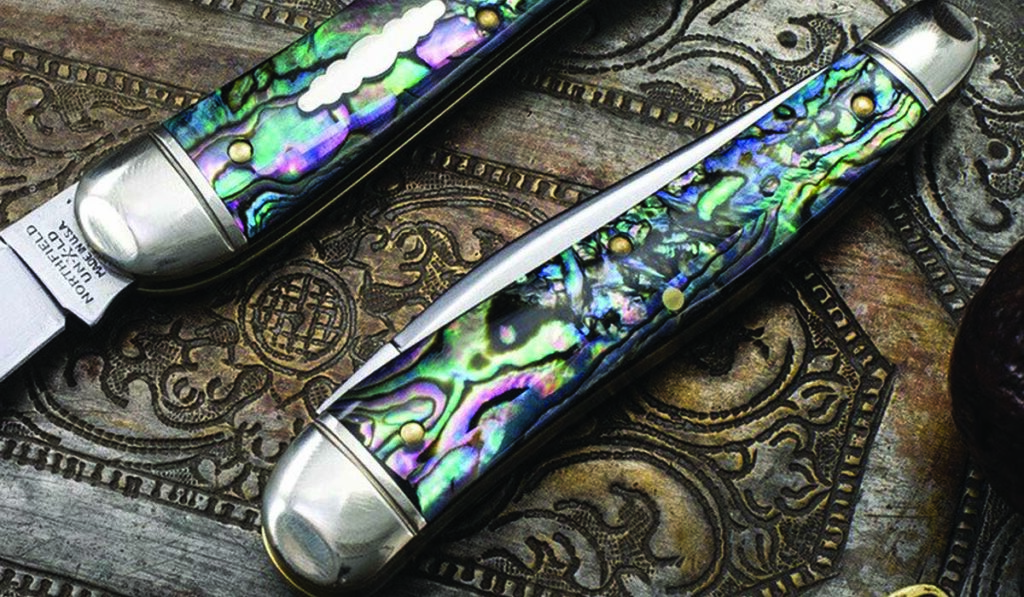
This Northfield UN-X-LD knife from Great Eastern Cutlery (GEC), which registered the trademark and uses it on premium GEC pocketknives, features ALVS (acrylic laminated veneer shell) handle scales from Masecraft Supply Company. The dazzling shell veneer consists of real shell and high-impact acrylic laminated together within the sheet.
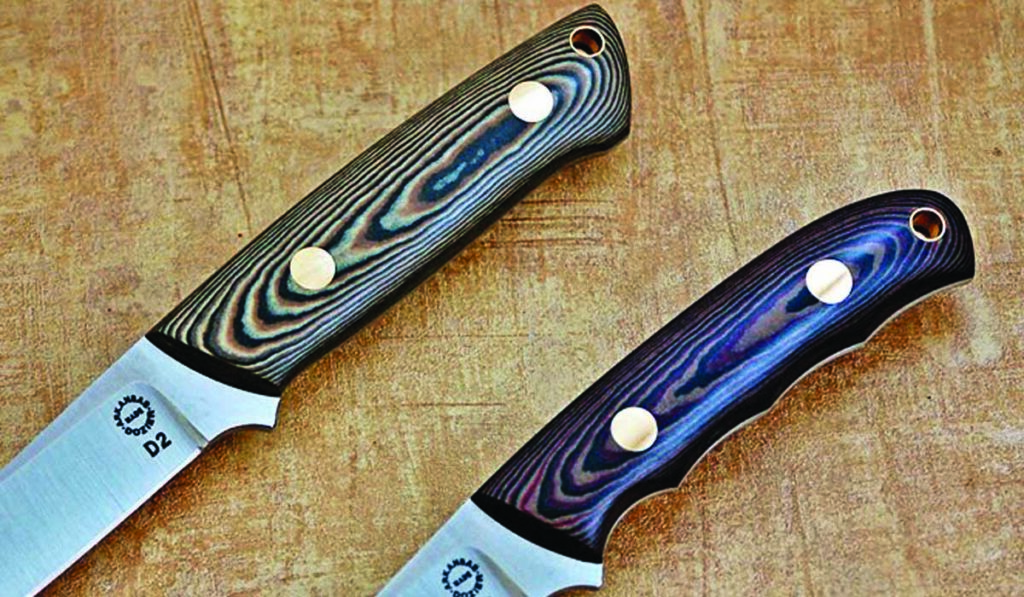
“The majority of our handle materials are synthetic,” Cammenga says, “and this is primarily due to stability and longevity. But many look great as well. Multi-color layers of fabric bonded with phenolic or polyester resin can have the look of wood, yet last much longer. Additionally, many of these are tackier when wet, giving the user additional hand purchase in tough weather or when processing game. Carbon fiber and G-10 are available in an ever-expanding array of colors and patterns and almost bulletproof when it comes to wear and tear.”
Choosing Knife Handle Material
The choice of materials, Cammenga explains, comes directly down to the proposed use of the knife. For hunting, fishing, camping or bushcraft, White River almost always recommends synthetic handle material. However, John still gives a nod to personal preference. Some users simply must have a natural handle, and the aesthetic factor comes into play there.
“It’s hard to beat the beauty of a highly figured burl!” he comments. “Some, such as desert ironwood burl, are not only beautiful but also extremely tough.”
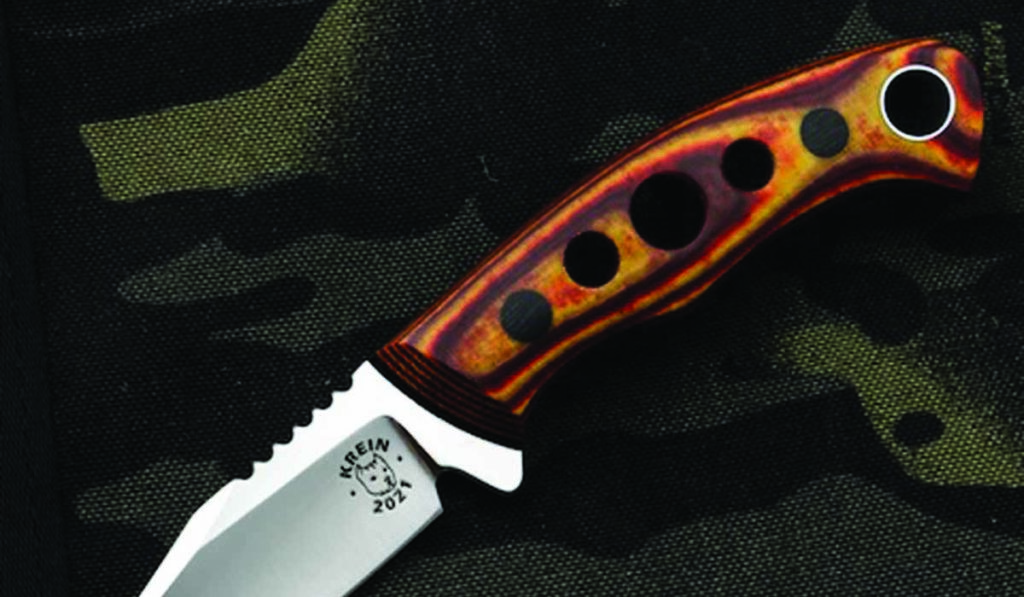
Tom Krein is an experienced custom knifemaker who worked for the great Bob Dozier and ran the custom shop for A.G. Russell Knives before embarking on his own venture during 30 years in the business. Making small utility and hunting knives primarily, he agrees that handle material choice relates to a few simple concepts.
Tom Krein’s “Mako” model features a Dion Damascus san mai steel blade with a copper-color stag handle.
“It comes down to the customer’s needs, willingness to care for the knife, aesthetics, and budget,” Krein relates. “Natural materials should hold up nicely with proper care assuming everything goes according to plan. Sometimes stuff happens—a knife falls into a sink of water, or it starts to rain while hunting, or your knife gets lost in the yard for a week. Synthetics hold up better when stuff goes south. For customers, I recommend getting what you like and learning how to take care of it. For knifemakers, I suggest picking the mind of another maker who uses the material you want so you can learn how to use it. Overall, we are a helpful bunch of people.”
Traditional handle materials and their innovative, eye-popping counterparts coexist at Santa Fe Stoneworks, a provider of materials to the art knife market since 1978. Santa Fe not only affixes those materials to its own knives, but also provides the service for Spyderco and Kershaw while doing private label work as well.
President Bill Wirtel leads the family business, and the company’s roster of natural handle materials includes the best of the best. “We work with factory knives and apply gemstones, exotic woods, shells like gold- and black-lip pearl, and fossils such as woolly mammoth tooth, tusk, bone, and petrified dinosaur bone,” he remarks.
As for Santa Fe’s synthetics, Fordite, a car paint overspray, Surfite surfboard overspray, and a cholla cactus-like material that is made in the shop have found favor with makers and buyers alike.
Material Mash Up
“We are looking for design and color, so we mix natural with manmade stone and epoxies,” Wirtel explains. “Our fossils are all stabilized so they work great for a handle material. We see hybrid materials gaining popularity as they provide the best of both natural and composite materials. Fordite and Surfite have been selling well. Our synthetic cholla cactus line that we make here, stabilizing it with different colored epoxies, is becoming a big seller as well. We also have mammoth tusk fusion. This is stabilized fragments of mammoth ivory that are fused together under immense pressure. The result is a beautiful and hard composite that is densely packed with mammoth ivory.”
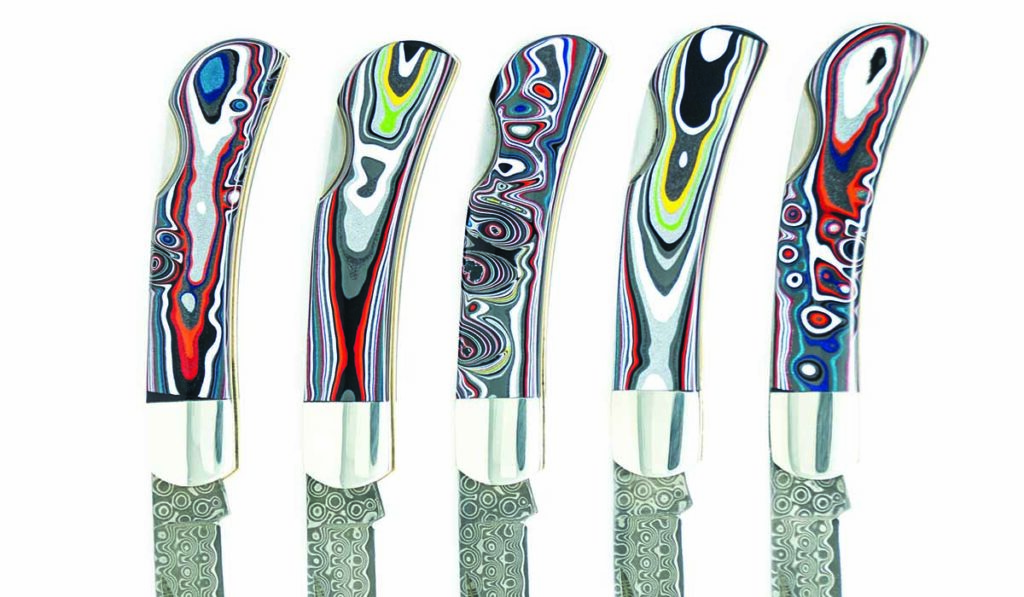
Fordite car paint handle material adds a fun flair to this series of Santa Fe Stoneworks 3-inch lock-back folders with damascus blades.
Fordite is an interesting option that comes from a surprising source. Also known as Detroit agate or motor agate, the material consists of pre-1985 automobile paint that hardened sufficiently to be cut and polished. It formed from enamel paint slag, which built up over the years in layers on the tracks and skids where cars were hand spray-painted. The buildup hardened in ovens intended to cure the paint on car bodies. After so much of that buildup, the brightly colored and layered paint had to be removed. Its allure caught on with some autoworkers who brought pieces home with them. From there, the beautiful Fordite material, which can be cut and polished into a spectacular look, found its way onto knife handles.
The Masecraft perspective is somewhat dictated by availability. “Sambar stag is not coming back,” Hartman stresses. “It has been banned by India for export since sometime around 2005, I believe, so that’s almost 20 years now, and I see no chance of this ever-changing. What’s still available out there now is it. Game over!”
“Black-lip, gold, and white mother-of-pearl all are still available,” he adds, “just not in larger size pieces as they were 20-50 years ago. They are overharvested and not as healthy as before. Demand for shell is down overall. It is not very tactical, and we seem to be in a tactical and bushcraft market for the last two decades. Shell tended to be more of a gentleman’s pocketknife material, so it’s not exactly the big trend right now.”
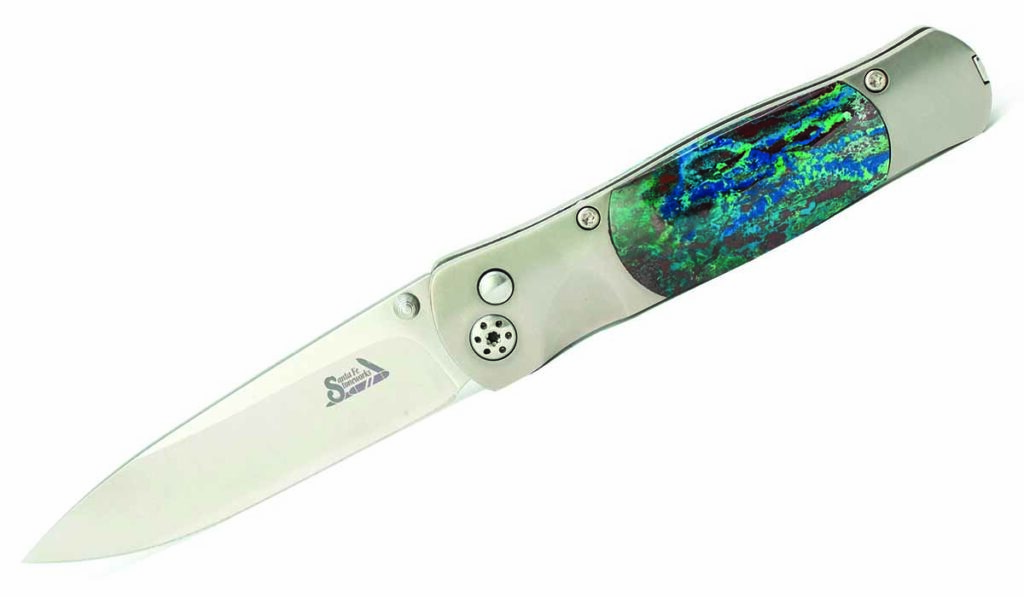
This Santa Fe Stoneworks El Rey model is handled in a spectacular turquoise/abalone/bronze hybrid gemstone and includes a mother-of-pearl button inlay.
“Many of the companies that used a lot of shell on knives are gone or simply don’t have the people who know how to work with it anymore,” Hartman adds. “Shell is still one of the most beautiful materials ever, so much so that it seems to be the hardest to reproduce in any type of synthetic alternative that even comes close to its natural beauty. We can come close, but there is still nothing like the real thing.”
Krein sees a swing toward synthetics and higher-end natural materials as well. “Right now, there is a huge push to find and use vintage Micartas,” he relates. “I’ve also seen G-10 usage go up a ton over the years. G-10 holds up to use extremely well, is relatively inexpensive, and machines and grinds easily. I’ve also noticed quite a few new businesses that specialize in exotic stabilized woods. Stag has always been a desired and quality knifemaking material, and with exceptional stag being much harder to find, it is even more desirable, particularly when done [harvested and finished] properly.”
Watching the high-end polymer Ultem begin to trend as a new synthetic handle material has been interesting for Krein, and his affinity for giraffe bone has not waned. It’s something he calls the “latest real pickup in natural materials.”
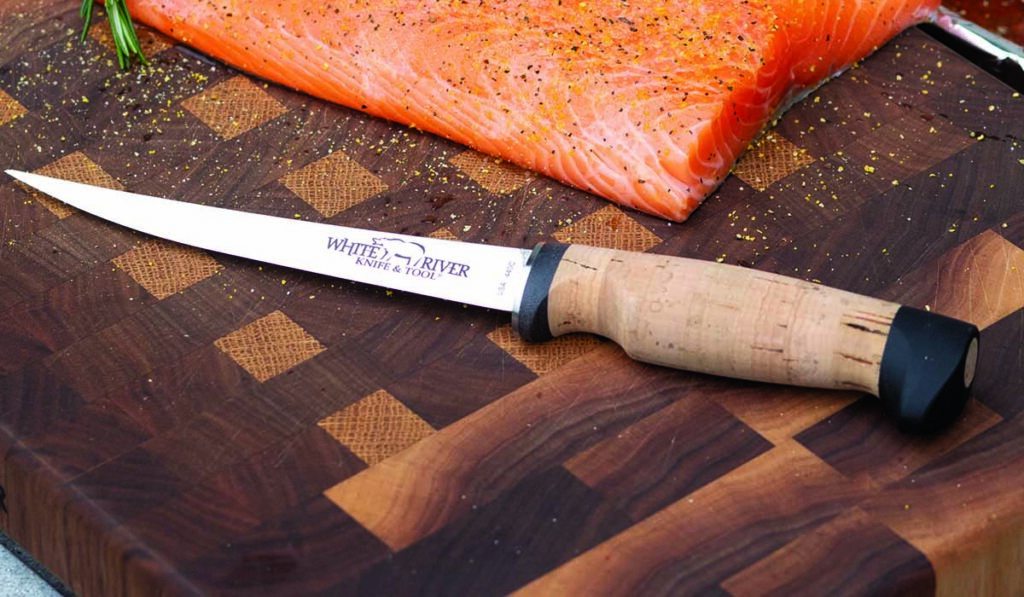
White River Knife & Tool purchases synthetic material made in the USA, so supply chain issues have not been a problem. The one material the company imports, cork, has increased in price, but its supply has been uninterrupted. White River’s Traditional Fillet knife incorporates a handle of imported cork for easy cleanup and a tight grip in slippery conditions.
“I often see new makers using very exotic materials,” Krein concludes. “These materials are costly and often not used anywhere close to their potential. I recommend that new makers learn to use simpler materials like Micarta to their full potential. This leaves funds available for other materials and equipment while allowing a new maker to develop their skills. Just because a knife has expensive materials doesn’t make it better or more interesting to me. It’s developing the skills to make simple materials look elegant that I appreciate.”
Those Hybrid Moments
Hybrid handle material is on the rise, and Cammenga is pleased with the growing popularity of marbled synthetics. “Right now, there is strong demand,” he notes. “This is true in both cloth/resin laminates and carbon-fiber/resin laminates. For those who want natural wood, bone or antler, acrylic ‘stabilized’ scales have been popular for quite some time. They provide the user with a natural material, which has been made tougher by introducing acrylic resin into the fibers. Currently the marbled look is in with almost all materials, but we have made several knife models using G-10 and rubber combinations, as well as others from polyester cloth and resins.”
Masecraft is keeping a close eye on the development of new materials, but the course is charted by ingenuity rather than discovery. “As far as new natural materials, that’s going to be extremely rare,” Hartman observes. “The earth is not really producing anything new, so unless we have not discovered it yet, the odds are low. More likely, some natural materials will disappear and become endangered, banned, or extinct. Human history tells us the availability of natural material will decrease while prices increase. You will see more hybrids of natural and synthetic combinations, and all kinds of new synthetics will continue to be introduced.”
Knifemaker Tom Krein says there’s a huge push to find and use vintage Micarta, such as on the handle of his pocket bowie model.
Supply often dictates how well demand is satisfied, and the inherent scarcity of some handle materials has been exacerbated by supply chain concerns in areas. Even as the COVID-19 pandemic has eased, the resilience of the supply chain remains an open question. Some suppliers and makers have faced shortages of stock items, while others have adapted, moved on to other, more readily available options, or simply been patient.
“I have been sourcing materials for over 44 years, and most of our suppliers know us and what we want,” Wirtel relates. “Obviously, we’ve had supply chain issues, but we have been able to work around them. We make our product to order, so we range in delivery time from a few weeks to a few months.”
Krein is positive regarding availability, saying, “There have been slight wait times for some synthetics, particularly Micarta, during the pandemic, but it seems like everything is back on track here. There has and will continue to be more demand for quality stag than availability. I’ve seen a bit less of quality exotic stabilized woods like exhibition-grade ironwood and Koa.”
While the supply chain phenomenon has been universal, Hartman is pragmatic. Going with the flow makes the Masecraft operation run as smoothly as possible. “There are supply chain issues with everything globally,” he observes. “I can’t think of anything on the planet that hasn’t been affected in some way, shape or form and that doesn’t have a price increase or isn’t in short supply, and it’s all things, countries, and markets.”
Dozier Knives produced this fixed blade with a Richlite handle from Masecraft Supply Company composed of approximately 65% Forest Stewardship Council (FSC)®-certified recycled paper and 35% phenolic resin.
“If you don’t have the chip, you can’t produce the car,” Hartman says. “If you don’t have OD Green dye, you can’t make OD Green G-10. If one key part is missing due to supply chain issues, the product simply cannot be made, and that is affecting all things.”
Staying domestic has been a problem solver for White River Knife & Tool, according to Cammenga. “Because White River purchases synthetic material made within the U.S., our supply chain has not been a problem. The one material we do import, cork, has increased in price, but our supply has been uninterrupted.”
Considering the handle-blade combination that makes the knife come together for the spectrum of customers and users, today’s material options appear more diverse than ever. Although some shortages in natural materials may never be plentiful again, fusions of natural and synthetic options open the door to creativity. And the imagination is always fertile ground for innovation.
If you spend time camping, you know the importance of proper tool selection for your excursions. The right kit makes a difference in how you enjoy your weekend woods getaway.
From batoning firewood to prepping dinner, these are the blades that will help you conquer the wild.
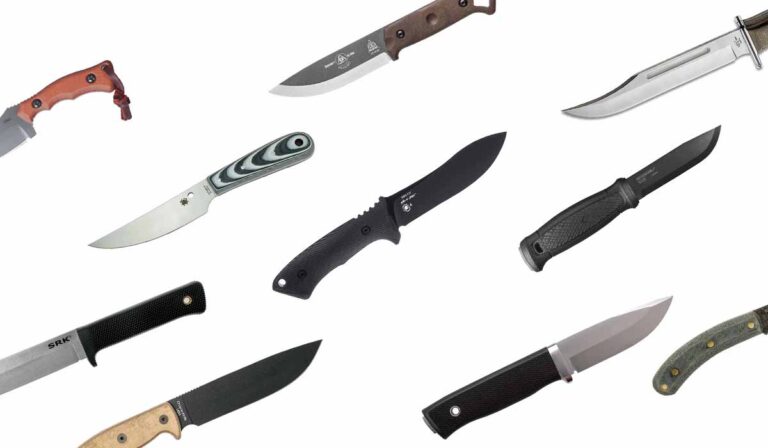
An important part of your gear should always include a camp knife of some sort. This multipurpose cutting tool takes on multiple roles in your camping trip and can handle the bulk of hard use when it comes to campsite tasks, campfire prep, processing food, and any other cutting task that comes up inside and outside of camp.
What Is A Camp Knife?
When you hear the word “camp knife”, what immediately comes to mind? Well, a rather larger fixed blade that has some heft to it. Which is partially true. Keep in mind not all camp knives are big, brawny choppers. And not all choppers can be camp knives either.
Blade: Camp knives have a proven blade shape. Nothing wild, but rather a design that can handle multiple tasks. Blade shapes like clip point, drop point, or even spear point.
Size: The knife also has to be of some length, around 7-8 inches is good. Such a blade length will facilitate tasks involving whittling, batoning firewood, chopping wood, or expediently slicing up food for cooking.
Handle: On the handle side, it’s important to have a handle shape that is very comfortable in your grip and incorporates design elements such as (but not limited to) finger grooves, palm swells, radiused edges, machined-in textures, and choils.
These features seat your hand better on the handle, making for a more comfortable user experience. Face it, if a handle isn’t comfortable you’re are not going to use the knife, regardless of how expensive it is or if it uses the best blade steel. Plus, as you are working, you want the handle to feel secure in your hand and not feel like it’s going to fly out. Therefore, such materials as G-10, micarta, and some molded thermoplastics are great choices for handle materials on camp knives.
Steel: What about blade steels? What about them? You have to remember the camp knife is a workhorse and you will probably have to sharpen the knife in camp. Carbon steel is still the steel of choice for this very reason of being easy to resharpen in the field.
1095 seems to be a factory favorite, found on outdoor knives, some fixed blade tactical, and EDC fixed blades. 1095 sharpens very easily but it’s not stainless so you will have to exercise extra care to make sure it’s dry as possible to prevent rust and stains.
Higher-end super stainless steels like S35VN are great and have the muscle to go the distance without frequent sharpening. Yet when it comes time to resharpen, you could end up investing a good deal of time.
To negate this, you can switch to a maintenance mode from resharpening mode, meaning, frequent honing will preserve the cutting edge. Something must be said for going old school, with carbon steel. There is a trade-off with frequent short-duration sharpening of blade steel that is softer and easier to manage, as opposed to spending a lot of time in the field sharpening a high-performance super stainless steel.
Now we have the basics out of the way, let’s dive further into some good examples of camp knives that might interest you.
TOPS Brakimo
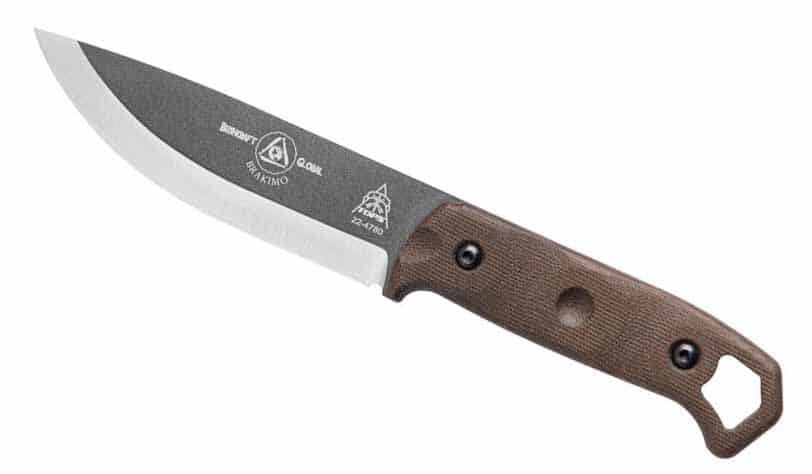
Designed by noted survival/outdoor expert Joe Flowers of Bushcraft Global, the TOPS BRAKIMO is as close to a do-it-all knife that can handle all tasks from whittling to cutting to chopping and baton work.
Its blade is 5 2/4-inches long and 0.190 inches thick and is made from 1095 carbon steel. The drop point shape gives plenty of belly to facilitate a broad range of tasks including but not limited to food prep. The modified Scandi grind is there for cutting performance as well as a thicker cross-section of the blade to promote strength in the blade. The handle is of OD green canvas micarta and has been finished to leave a “grip you back” quality to it. The edges have been chamfered for ultimate comfort, and there’s a divot for use with a bow drill. An extra-large lanyard hole allows you to use any cord diameter for a lanyard and possibly even attach it to a carabiner. Finishing out the Brakimo is a nice Kydex sheath that carries the knife at your side securely. A spring metal clip is the means to attach the sheath to your belt.
The Kydex sheath is nice although basic. But really in the end as long as it works, that’s all that matters.
MSRP: $169 Origin: USA
ESEE Expat Darien Machete
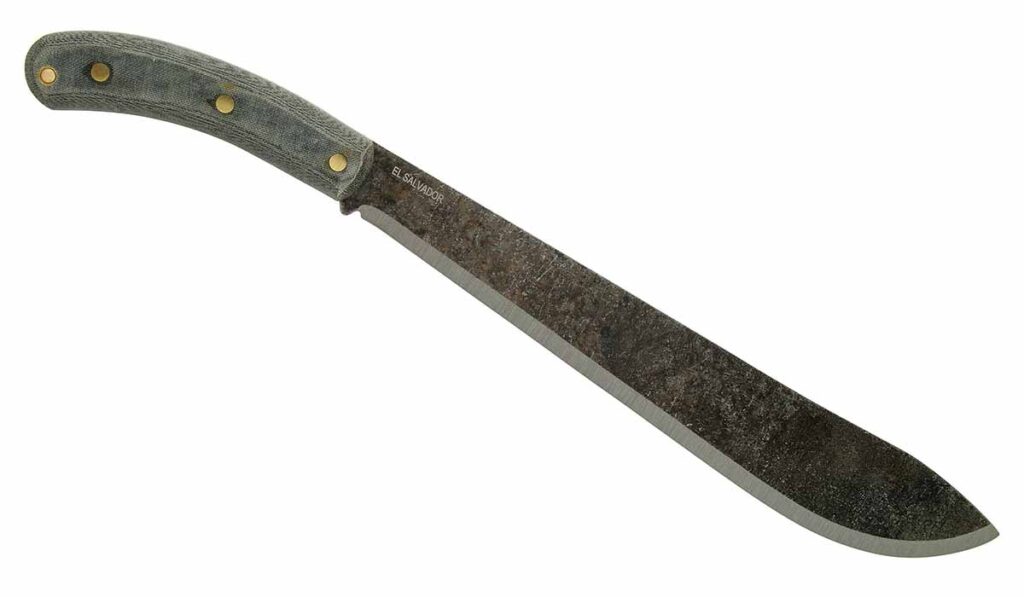
I know. This is a machete, but this is an article on camp knives. Truth is that machetes can be used in conjunction with camp knives. More so with the ESEE Expat Darien machete, this is also part machete and part knife as well.
Measuring a little over 18 inches, the Darien has a reach like any other machete, but it also has excellent balance and feels so agile in the hand that you can use it as a knife for whittling, chopping, batoning, and maybe some heavier cutting of camp food prep tasks. The blade is made from 1075 carbon steel and is very easy to resharpen in the field. At 0.094-inches thick, the blade stock is thin enough to be nimble and is thinner than most camp knives, which are at least ⅛-inch thick (0.125 inches).
The blade itself is a little over 12 inches, which is enough length to get work done. The handle is made from black micarta, which is a great choice because it’s a synthetic material that is dimensionally stable and has an excellent grip you back quality. The sheath is sewn canvas and is well made. An integrated belt look allows the Darien to be at your side whenever it is needed. Pair the Darien with a favorite full-blown camp knife and you have the ultimate combo!
MSRP: $121 Origin: El Salvador.
Spartan Blades Hersey Nessmuk
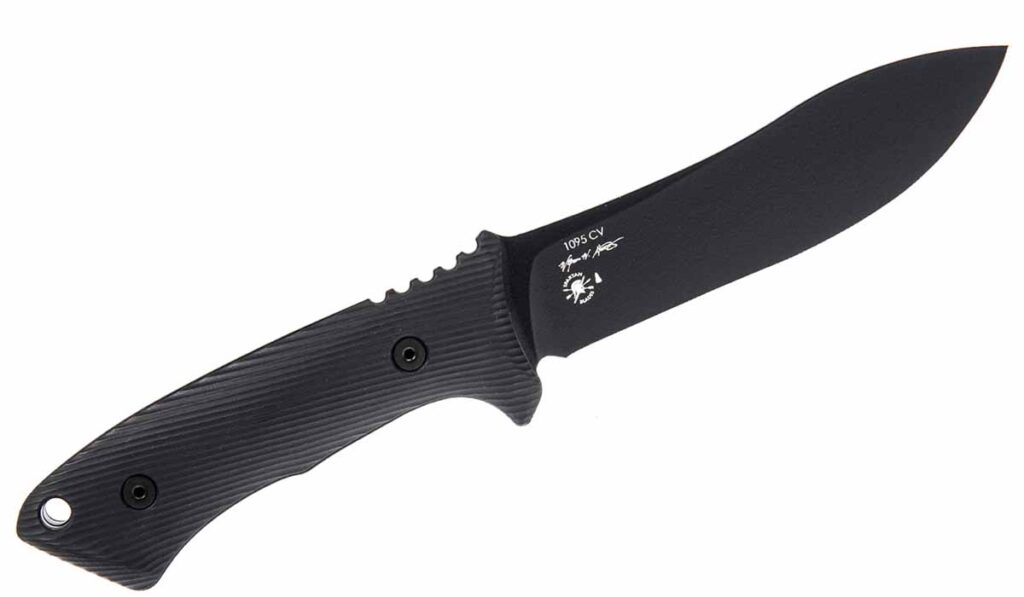
Spartan Blades made a name for itself as a top producer of high-end tactical and outdoor knives. It recently came out with a USA-made mid-grade line of professional use knives that are OEM’d by Kabar Knives in the Kabar factory in upstate NY. This series is known as the Silver line and offers enhanced features and value pricing. These are a step up from the company’s Bronze line of entry-level knives and a step down from its Gold line of elite, high-end knives. The Harsey Nessmuk was designed by knifemaker Bill Harsey to be a heavy-duty field companion on the hunt or at the campsite.
The Nessmuk skinner-inspired blade shape flares at the tip and is great for, well… skinning and slicing tasks. The 5-inch blade is big enough to get work done but short enough to not get in the way. 1095 carbon steel is used for the blade, and the high flat grind tapers allows it to slice cleanly and effectively. A black powder coating reduces glare and adds a layer of protection against corrosion.
One look at the handle design and you can tell it’s pure Harsey. Multiple features are integrated such as the lower hand guard, the palm swell in the middle, the traction notches at the thumb rest on the blade spine. There’s 3D machined texture for grip retention, all built into the black injection molded handles. Wrap your hand around the handle and you feel how secure and comfortable it is to grip, lending a feeling you can use the Spartan Harsey Nessmuk for extended periods.
It is a very well-thought-out design overall and meant for hard use in the great outdoors. The Harsey Nessmuk comes with an injection molded sheath with a thick webbing belt loop. An innovative retention feature locks the knife into the sheath, preventing it from coming out unless you want it to. There is a thumb button on the sheath you push up on as you grip the handle naturally to release the blade from the sheath. Not too many fixed blades have a feature like this and just rely on locking the sheath up around some part of the handle. When you insert the knife into the sheath, you will hear an audible click, indicating that the blade is locked. Very cool!
MSRP: $190 Origin: USA
Buck Knives General Pro
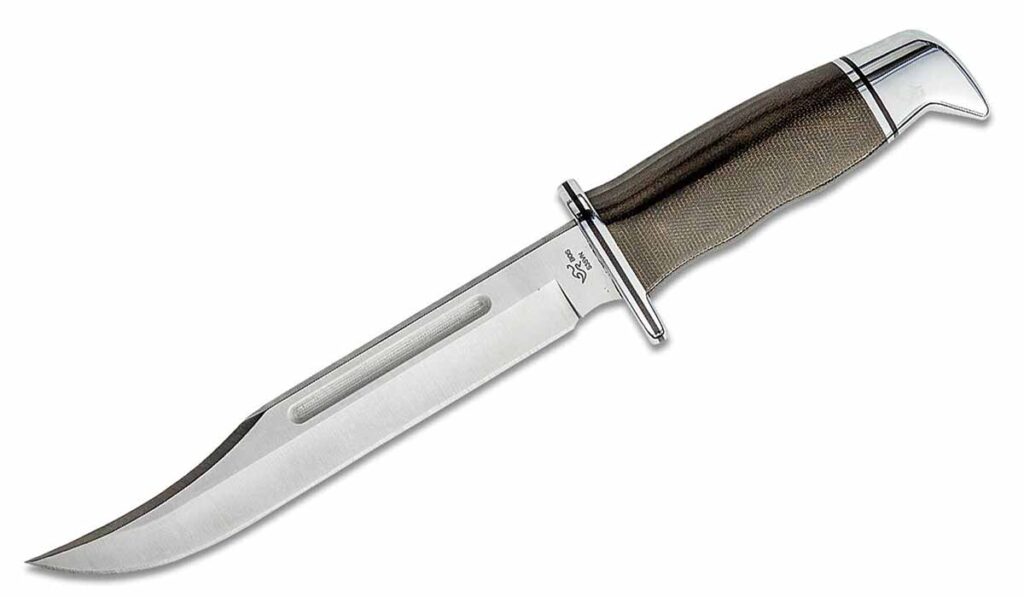
Any article talking about outdoor knives isn’t complete without a mention of a Buck knife. The company has been synonymous with the great outdoors since its inception. Its model 120 General Pro is one such knife, built to take whatever the great outdoors can dish up.
Crafted with a blade made from premium CPM S35VN stainless steel, the General Pro is built for hard use in all environments. Measuring a little over 7 inches in length, the clip point blade has a hollow grind, pronounced swedge, and a milled-in fuller, giving the knife its aggressive look. The handle is made from OD green canvas micarta for the ultimate all-weather grip.
The signature aluminum guard and pommel, present on all Buck fixed blades, cap off the handle’s construction and appearance. The General Pro excels at camp food prep, whittling, some chopping, and baton work for wood splitting. At 12 inches overall, it’s the perfect large fixed blade to have when you hit the great outdoors. It is accompanied with a sewn leather sheath, as is common with all Bucks.
The General Pro is the tonier model, but if it’s out of your price range, the General model offers the same design only with 420HC stainless steel blade, black phenolic handle and lower price.
MSRP: $128
Ontario RAT 7
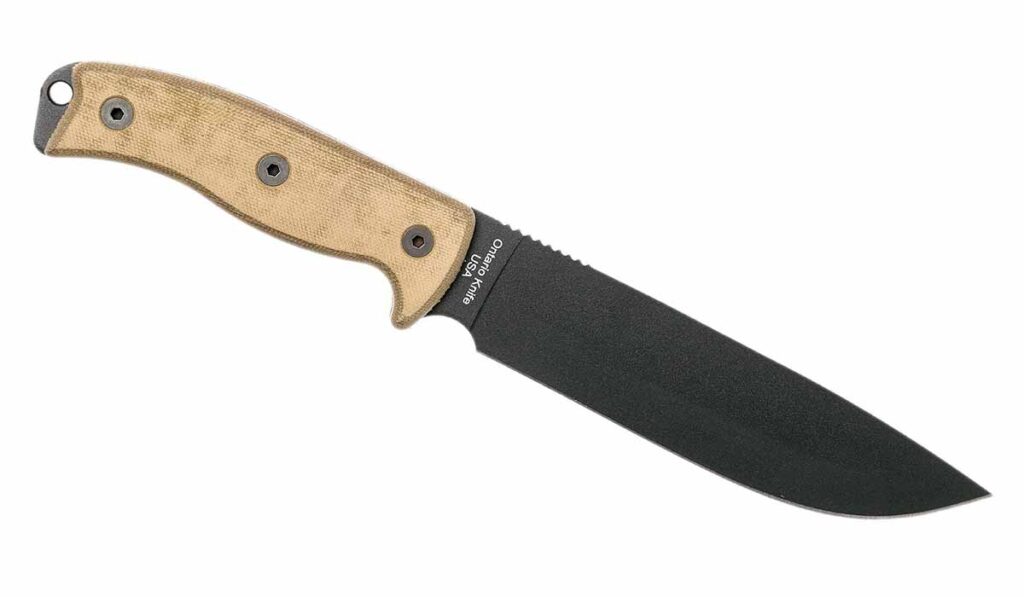
Ontario’s collaboration with Randall’s Adventure & Training has yielded a very highly successful series of folding and fixed-blade knives that are aimed solely at outdoor adventures. One such example is the RAT 7. The fixed blade is a larger knife that can handle all of your camp chores and some food prep. But tough work like chopping and batoning wood is what the RAT 7 is built for.
The 7-inch long, flat ground, drop point blade is ground from 1095 carbon steel and given an epoxy powder coating to keep rust and corrosion at bay. The handle is a tan canvas micarta, an excellent choice for outdoor knives because it is fully synthetic and is impervious to moisture, cracking, and gouging. The handle design itself incorporates an integral lower finger guard, an ergonomic curved gripping area, and an exposed pommel with a lanyard hole. There is also a forward choil at the tang so you can employ a choke grip for more control over the blade.
Each RAT 7 comes with a nylon belt sheath that features an exterior accessory pocket for storage of a sharpener, folding knife, or additional survival supplies.
MSRP: $135
CRKT Bugsy
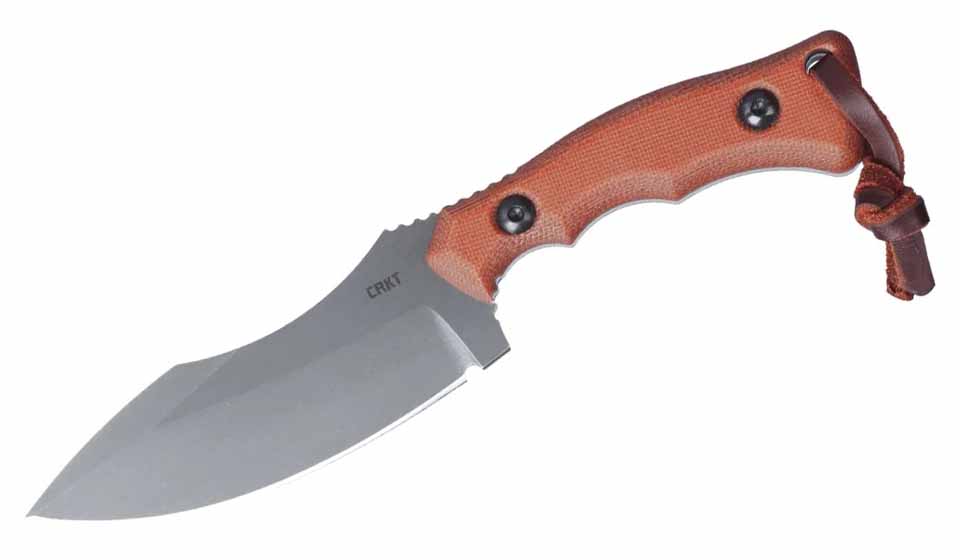
Designed by custom knifemaker and Discovery Channel’s Naked and Afraid star Kaila Cummings, the Bugsy is CRKT’s first USA-made fixed blade in the lineup. The knife receives its moniker from Cummings’s first appearance on the TV show when she received numerous big bites in the jungle in Colombia.
Featuring a 1095 carbon steel harpoon-style blade and a micarta handle, the Bugsy is as at home in the outdoors as it is an EDC fixed blade. With a blade length of a hair under 4 inches, the Bugsy is sized appropriately to take on most tasks inside camp or at home. Again, like some of the fixed blades discussed here, 1095 is used due to its low cost-to-performance ratio. It’s easy to resharpen in the field and offers reasonably good edge holding, which makes it a favorite amongst outdoor users.
The highly ergonomic handle showcases multiple finger grooves and an expanded butt end capture your hand to provide a secure, non-slip grip. Micarta is used due to its dimensional stability and excellent all-weather qualities—necessary for an outdoor use knife.
A leather fob is tied to the handle and acts as a handle extension for those with larger hands.
Accompanying each Bugsy is a high-quality leather sheath that holds the knife securely and at your side. There’s also a tactical version of Bugsy that features a black-coated, part-serrated blade and black G-10 handle. It comes with a black Kydex rig for belt carry.
MSRP: $200 Origin: USA
Fallkniven F1 Pro
For those not familiar with Fallkniven, it is a Swedish knife manufacturer with among the best-kept secrets in the production knife industry—its fixed blades. These tools are elegantly refined and yet sport blade and handle designs geared towards the practical. Like anything European, Fallknivens are a bit costly but are very worth it. You get what you pay for and then some.
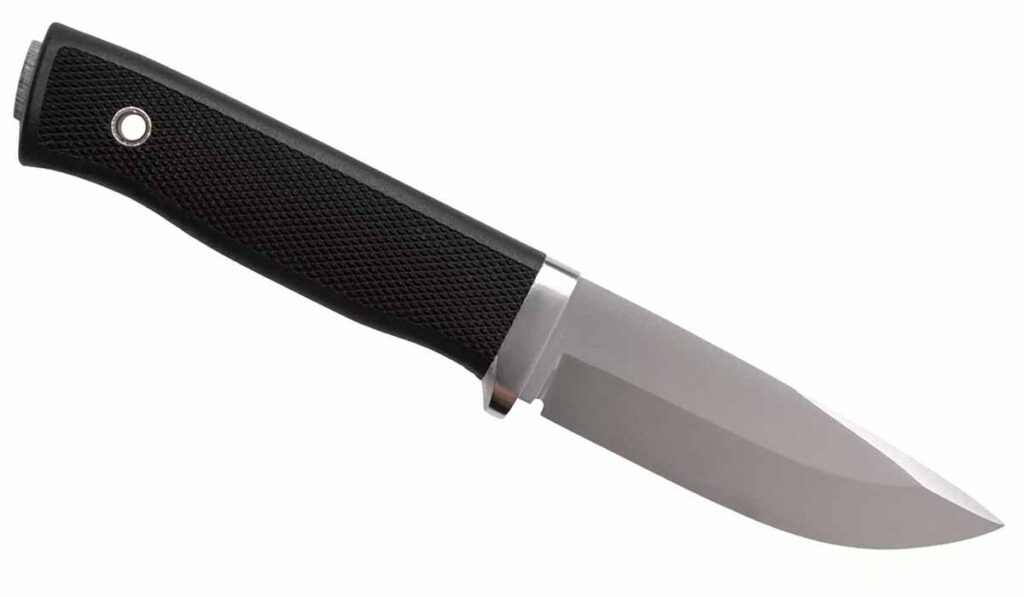
Fallkniven’s F1 Pro fixed blade is a straightforward utility done up to the next level. The drop point blade is 4 inches in length and is ground from premium high-end ELMAX stainless steel, ensuring edge longevity and durability.
The handle is made from a polymer called Thermorun, a molded material soft to the touch. It sports checkered texturing that grips your hand back regardless of weather conditions. Hot, cold, wet, or dry…the Thermorun handle ensures a sturdy, comfortable purchase.
With an overall length of 8 and ½ inches, the F1 Pro carries very well in its hybrid molded Zytel sheath with nylon webbing belt loop. A secondary button snap strap secures the handle in place.
MSRP: $408
Mora Garberg Carbon
One of the best values in high-quality fixed blades undoubtedly is Mora, another Swedish knife manufacturer. Mora’s knives are highly functional and well-designed, yet they sell at prices anyone can afford. They are what I recommend to folks who want a good quality knife without breaking the budget. Mora’s Garberg is one of the company’s larger knives and is designed and built for survival and camping.
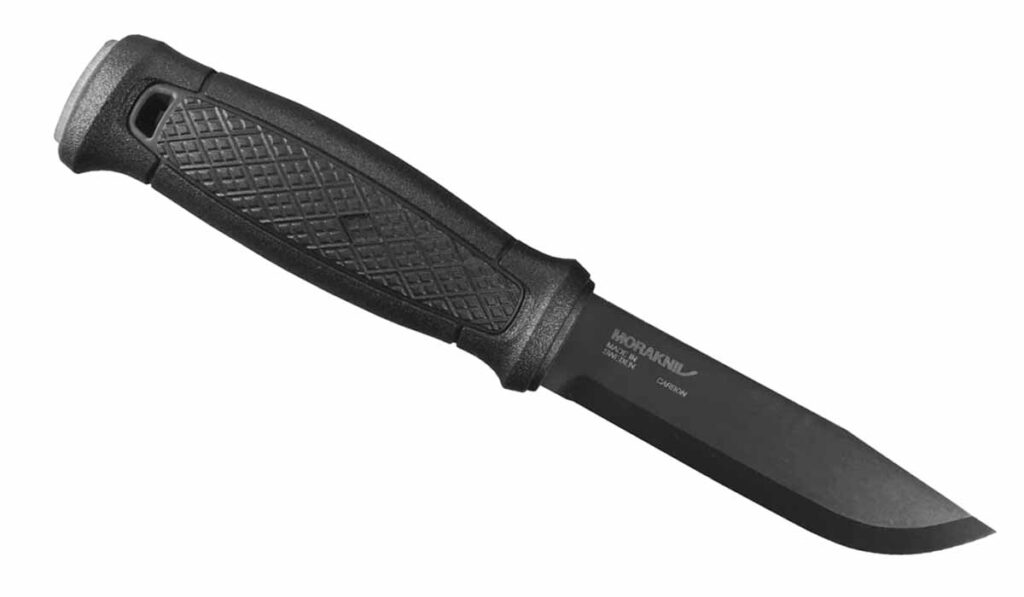
Starting with the blade, the modified clip point is made from carbon steel for ease of sharpening and is given a Scandi grind for optimum cutting performance and blade strength. The blade measures a hair over 4-inches long, which is enough to take care of most cutting tasks while being easy to carry. The blade is given a black coating to help protect it from corrosion since it isn’t stainless steel. The handle sports a full tang construction, the Garberg is the first Mora model to feature a full tang. This means the knife can withstand harder use than the other Mora knives.
The handle has a dual molded construction with molded Polyamide and hard rubber, for a durable and weather-resistant grip. The handle has rounded contours, which makes it easy on your hand for extended use. This handle design and construction is typical across the Mora knife line and is proven to be durable and comfortable in the long run. The sheath that accompanies the carbon steel Garberg is a nice leather sheath that protects the knife and allows the user to carry it conveniently.
MSRP: $130
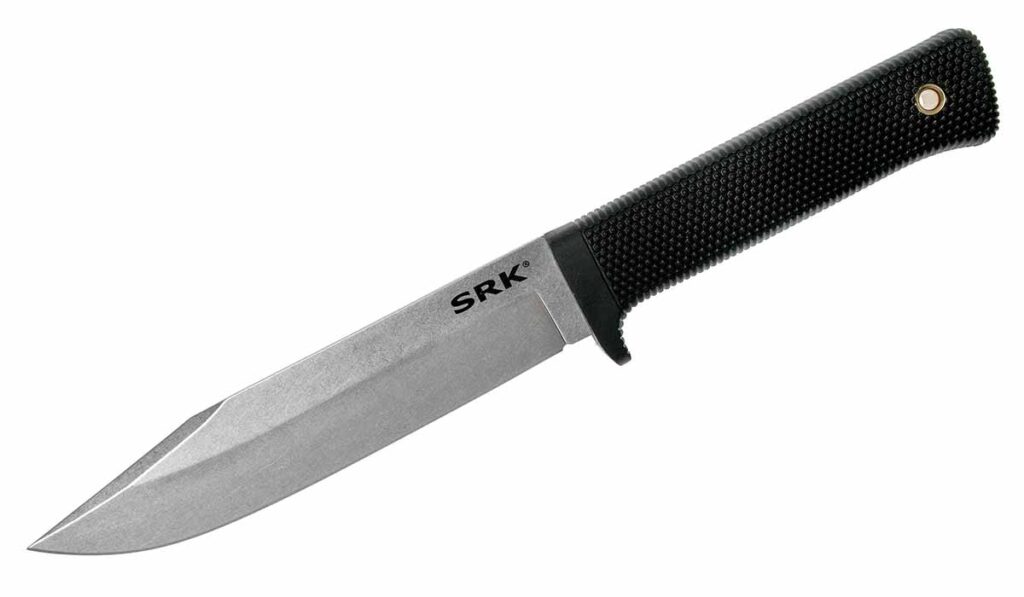
Cold Steel SRK
Those of you into knives for a while have heard of Cold Steel. It has been around for a long time and so have some of the company’s classic designs such as the SRK (Survival Rescue Knife). Don’t let the name fool you though, this knife also excels at camp chores as well as any cutting task indoors or out.
The 6-inch blade is ground from SK-5 carbon steel and given an epoxy coating to protect it from the elements. SK-5 is a Japanese steel that is roughly equal to 1080 carbon. The clip-point blade is straightforward, but pure utility all around. It can pierce, score, and slice its way through all your camp-cutting tasks.
The handle is a molded rubber-like material that Cold Steel calls Kray-Ex. It sports checkered texturing for the ultimate grip regardless of weather conditions. An integrated, lower hand guard prevents your hand from sliding forward. The handle color is available in black, tan, and OD green to suit your personal preferences and primary use environment. The overall length is a little over 10 inches, making this a larger fixed blade, and it’s ideal for hard-use applications. Each SRK comes with a molded Secure-Ex sheath which is very similar to Kydex, allowing the sheath to be form-fitting and securely carry the SRK without rattle.
MSRP: $62
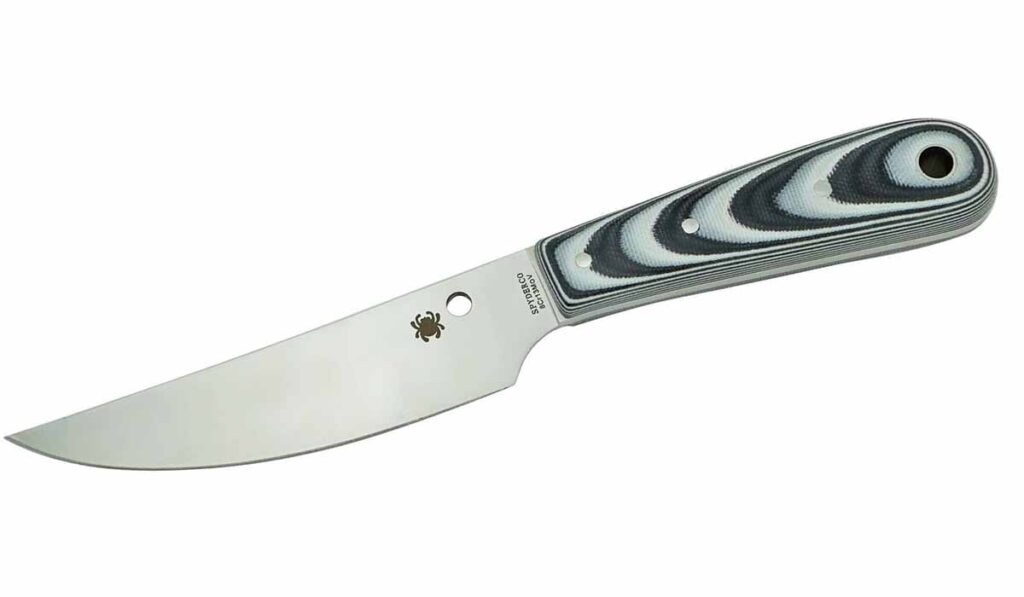
Spyderco Bow River
The Bow River from Spyderco is an affordable fixed blade in the SPYDERCO lineup that has great potential. Its trailing point blade style is highly adaptive to hunting, bird and trout, as well as general food prep in camp.
The blade is 4.4-inches long and is ground from 8Cr13MoV stainless steel, which is the Chinese equivalent of Japanese AUS-8 stainless. 8Cr13MoV is easy to sharpen out in the field and offers reasonable stain resistance. It’s a good middle-of-the-road production stainless steel, favored by quite a few production brands. The full flat grind ensures optimum cutting performance through a variety of foods and meats. The trailing point blade design offers a continuous blade belly that works excellently with food prep, facilitating ease of slicing motions. At an overall length of 8.1 inches, the Bow River is an excellent choice for a fixed blade that carries easily and won’t break the bank.
The handle is black and gray G-10, with alternating color layers that produce an interesting wood grain visual effect when the handle is contoured. The handle is rounded and contoured to lay in your hand easily and very comfortably. You can get a good grip on this shape, even though it lacks any texturing. Each Bow River comes with a sewn leather belt sheath that carries the knife, ready at hand for any task.
A year’s worth of hot hammering results in top results at the 2023 ABS awards in Atlanta.
The American Bladesmith Society held its annual awards program during the 42nd Annual BLADE Show, the largest knife event in the world, and bladesmiths came from far and wide to salute the art of the forged blade.
ABS master smith and ABS president Steve Dunn acted as master of ceremonies for the awards ceremony Friday night, June 2, in the BLADE Show’s host hotel, the Atlanta Renaissance Waverly.
Don Hastings Award
The first presentation was the Don Hastings Award, named in honor of one of the four founders of the ABS who was only the third American smith to forge damascus steel. Don served as ABS treasurer from 1976 until he died of cancer in 1986. This year’s recipient is Jim Crowell, who received his ABS master smith stamp in 1986, has earned an enviable record for his artistry in steel, and has long been a fine bladesmithing teacher and an excellent judge of those applying for bladesmith ratings within the Society.
W. W. Scagel Award
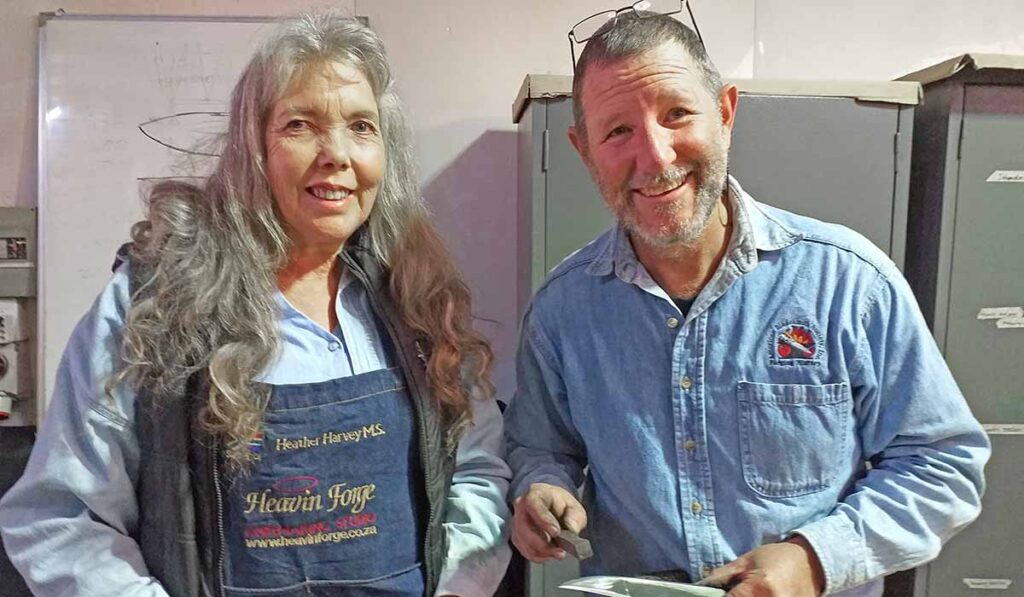
ABS master smiths Heather and Kevin Harvey won the W. W. Scagel Award for running their highly successful Heavin Forge Studio & Bladesmithing School in Belfast, South Africa. It was an especially momentous evening for Heather as she won the Margaret Moran Silver Slipper Award as well.
Next was the W. W. Scagel Award, named for BLADE Magazine Cutlery Hall-Of-Fame® member William Scagel, the first great American bladesmith of the 20th century who taught many the art of the forged blade. The recipients are ABS master smiths Heather and Kevin Harvey in recognition of their contributions in the field of teaching all about bladesmithing at their Heavin Forge Bladesmithing Studio & School in Belfast, South Africa.
Paul Burke was a Baltimore attorney who served on the ABS board of directors for many years, who obtained the Society’s tax-exempt status and was devoted to the ABS. The Paul Burke Award is named in his honor and was presented to ABS master smith and past ABS president, Greg Neely.
ABS Gold-Medal Knives
B. R. Hughes Award
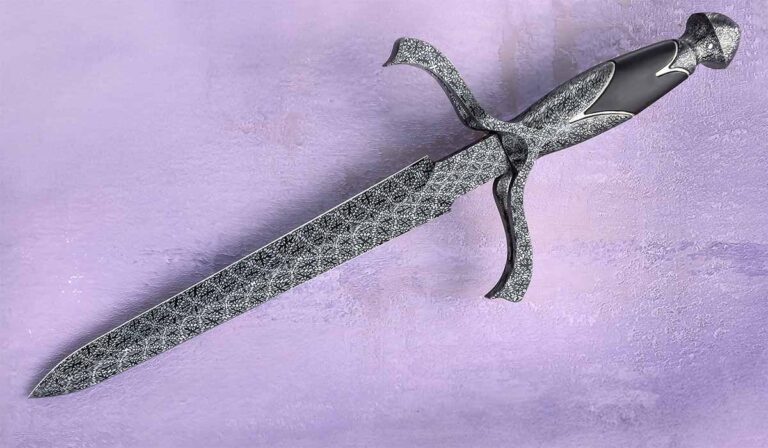
New ABS master smith Jackson Rumble won the B. R. Hughes Award for the top knife submitted by a successful ABS master smith applicant. The spectacular quillon dagger with an integral guard is from his set of five knives submitted for MS judging. The 9.5-inch blade and pommel are of a mosaic damascus of 1075 carbon and 15N20 nickel-alloy steels. Handle: African blackwood. Overall length: 15.5 inches. Jackson’s price for a similar knife: $10,000. (SharpByCoop knife image; image of Rumble and Neely by B. R. Hughes)
The B. R. Hughes Award for making the most outstanding knife submitted by an applicant attaining the rating of ABS master smith went to Australia’s Jackson Rumble. Erik McCright won the Joe Keeslar Award for making the top knife submitted by a new ABS journeyman smith.
Bill Moran Award
The Bill Moran Award is given for the best knife made in the Moran style and was presented to Matt Stagmer. Antique Bowie Knife Association Awards go to both an ABS master smith and ABS journeyman who make the finest bowie most representative of a 19th-century style. The MS award went to Josh Fisher and the JS to Mace Vitale.
Margaret Moran Silver Slipper Award
To augment her co-winning of the Scagel Award, Heather Harvey received the Margaret Moran Silver Slipper Award named in honor of Mrs. Margaret Moran, wife of Cutlery Hall-Of-Famer Bill Moran.
ABS Smith Ratings
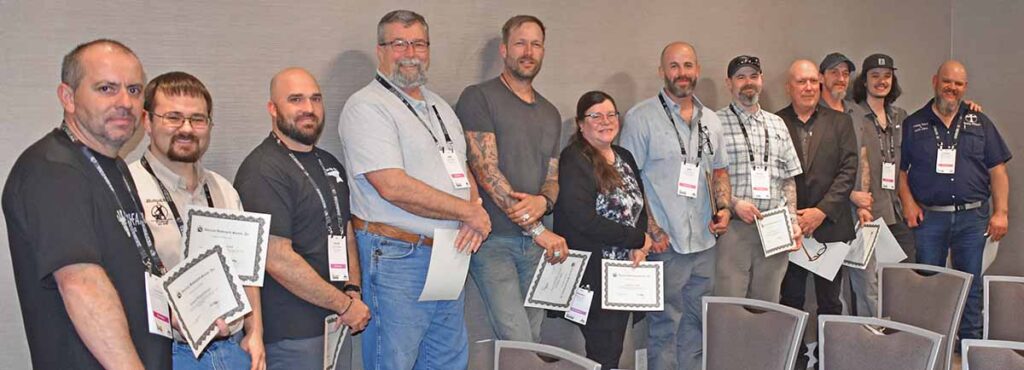
One of the happier groups of new ABS journeyman smiths you’re likely to see proudly display their JS certificates. There were 19 new JS’s in all. Here are 12 of them. For the full list, see the story.
Jackson Rumble was the only applicant to successfully earn the ABS master smith rating. Head Judge Greg Neely presented Jackson his certificate and stamp.
Those who successfully earned ABS journeyman smith ratings at the show were: Ismael Biegelmeier; Kevin Burgess; Jeff Davidson; Caleb L. French; Jacob Gaetz; James Ingram; Mike Johnson; Andrea Lisch, wife of ABS master smith David Lisch; Francois Mazieres; Erik McCright; Vicente Molina; Trevor Morgan, Jr.; Jim Quick; Jeff Royer; Brian Sellers; Camile Senegon; Jayden Simisky; Bill Thorne; and Henning Wilkinson. ABS master smith and head ABS journeyman smith judge James Rodebaugh made the certificate presentations. In other honors, Distinguished Service Awards were presented to Amanda Davis, photographer Eric Eggly of PointSeven and Jacob Lutz. ABS Chairman’s Awards were presented to Shanna Maust, Shane Maust and ABS master smith Brion Tomberlin.
And so dropped the curtain on another ABS awards program on the largest stage of the knife world!
Editor’s note: Along with Bill Moran, Don Hastings and Bill Bagwell, the author is a founding member of the ABS, and is also the only surviving one. He has served on the ABS board of directors longer than anyone in the Society’s 47-year history, and written a number of books and countless magazine and other stories on knives and also guns for over six decades. He is a Cutlery Hall-Of-Famer and, at 91, is without a doubt the oldest knife writer/knife magazine editorial staff member extant. His wife Carolyn has been editor of the American Bladesmith, the ABS Journal, for 23 years. Both are knife industry treasures beyond comparison.