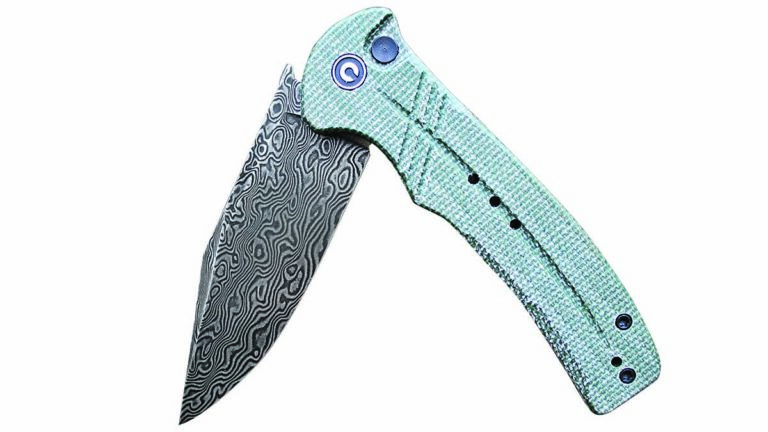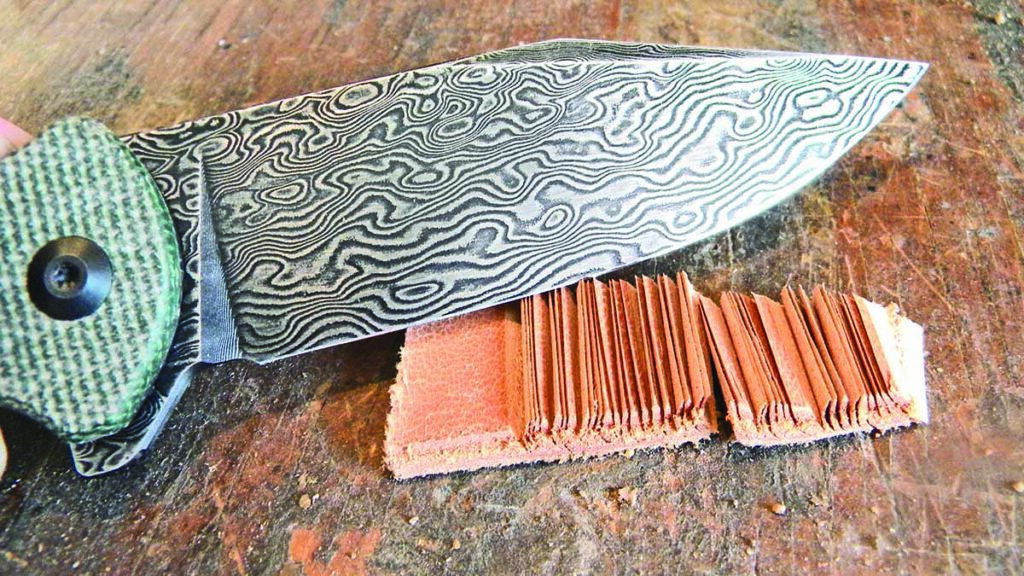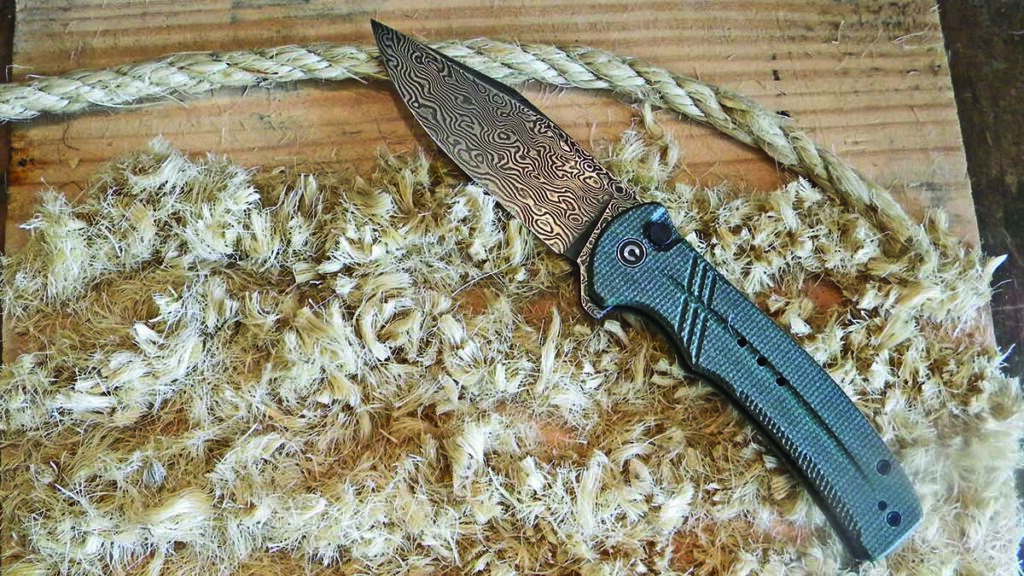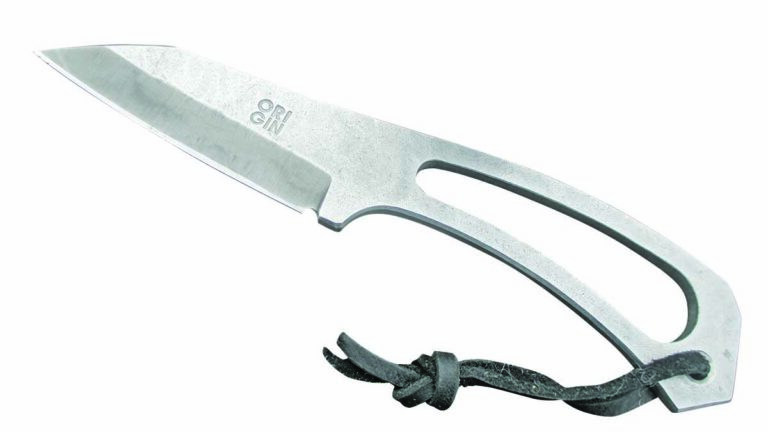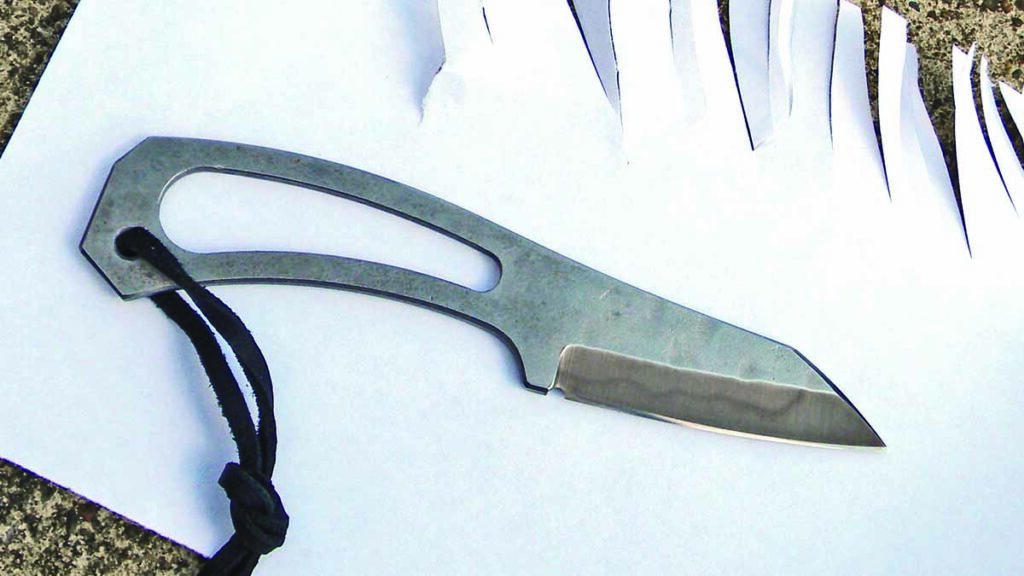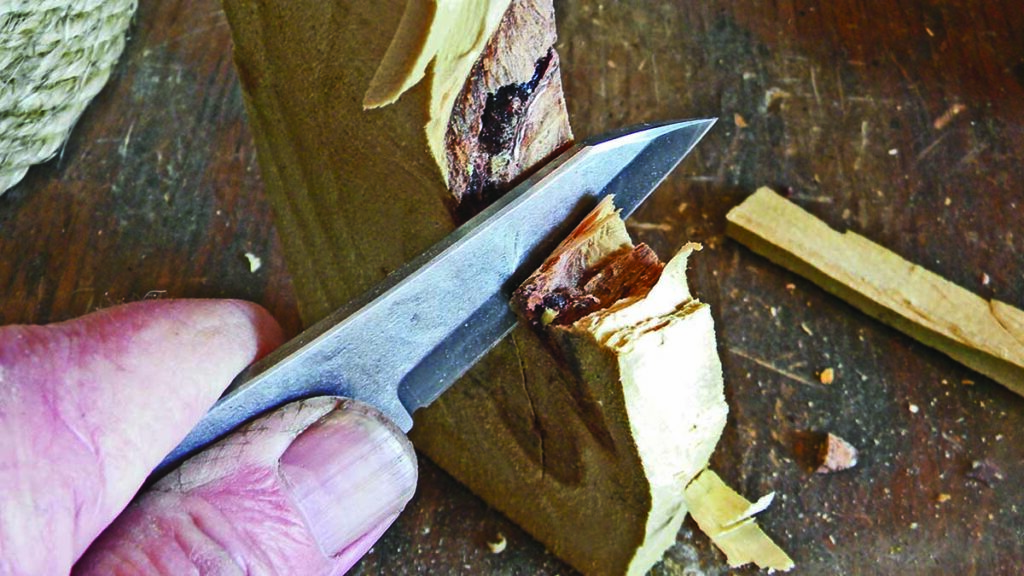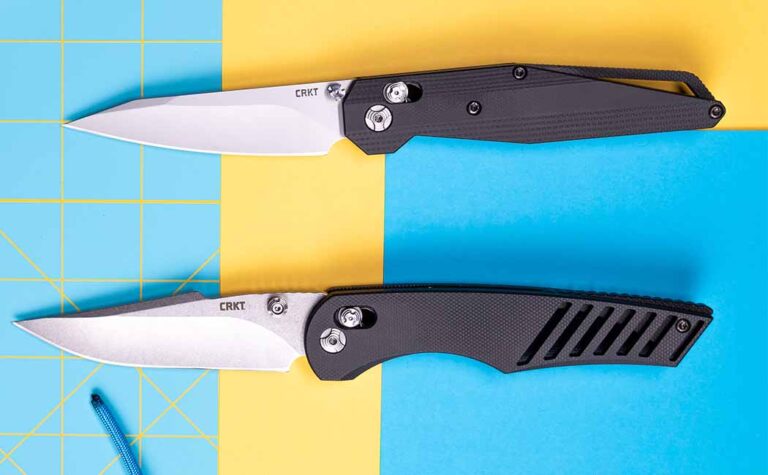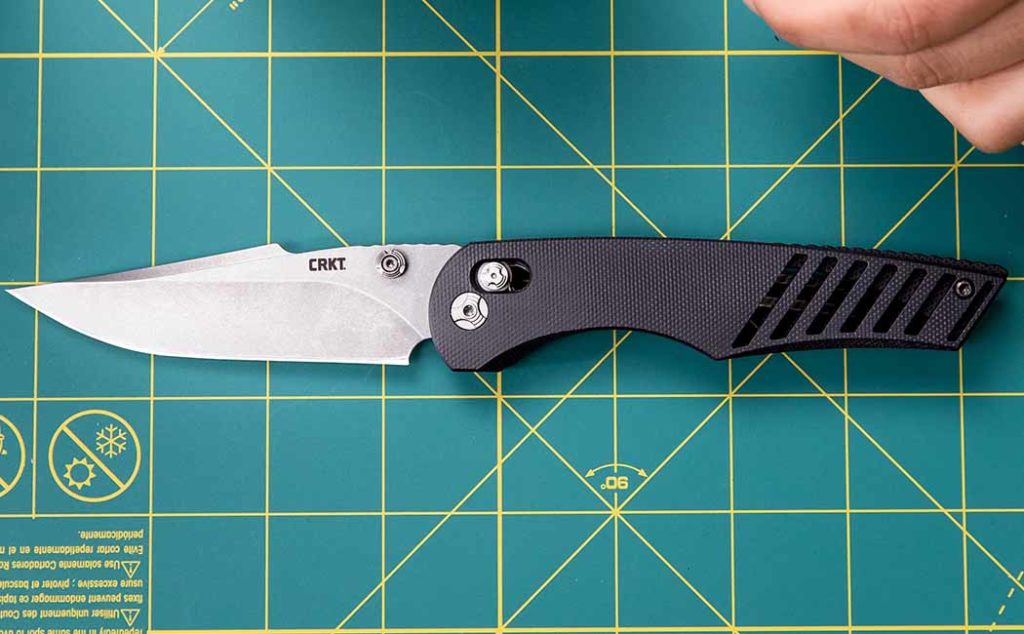
A sensational slip joint, Tim Britton’s Badger revives the Keen Kutter pattern with a ton of flare.
When ABS master smith Bruce Bump showed an old Keen Kutter penknife pattern to veteran knifemaker Tim Britton, Tim fell in love with it and immediately set to making his own iteration.
The blades are BG-42 stainless steel that, as Tim noted, has high ductility and holds an edge forever. He flat ground them on his “ancient” 18-inch, 200-pound Porter Cable disc sander. However, it’s the handle that really stands out. Consisting of stabilized diseased ash burl from Whistle in the Woods, the material looks synthetic but isn’t.
Tim Britton , 80, has been making knives since 1971 and has focused a lot in recent years on slip joints, with the Badger being the latest. He’s got about six antique pocketknife designs on his to-do list for this year, including a peanut and a copperhead. (knife image courtesy of Tim Britton)
“The light stuff in it looks like explosions,” Tim said. “I’ve never seen anything like it.” The projection on the spine fits right in between the user’s index and middle fingers and the groove on the underside cradles the latter for a comfortable, secure grip.
Calling it the Badger, Tim said he made 10 of them and had four or five at BLADE Show 2022.
Badger Spec Check Knife Name: Badger Maker: Tim Britton Blade Steel: BG-42 stainless Blade Grinds: Flat Handle Material: Stabilized diseased ash burl from Whistle in the Woods Closed Length: 3.5 inches Maker’s Price For A Similar Knife: $375
Visually Appealing Thanks To A Distinctive Rasp Pattern On The Blade And Attractive Handle, The Manzano Proves A Sharp Operator.
Old-school knives often have a classic look, and it’s even better when you can tell what the original material or tool was before it was transformed into a blade. When using recycled steel, more time is involved to prep the material for its new life. Can it be hardened, will it forge, will the steel take a polish?
Paul Gonzales did his homework in producing the Manzano Farrier Rasp Blade. There’s no doubt as to what the blade was before it became a knife.
Manzano Farrier Rasp Blade Edge Assessment
To assess the original edge, I sliced 20-pound-bond copy paper. The Manzano performed smoothly, making a zipping noise as it went through the paper. The knife’s weight made the push cuts easy to control.
As a final test, the author checked the edge once again on the copy paper. The Manzano didn’t skip a beat, slicing smoothly.
Heavy Cutting With The Manzano Farrier Rasp Blade
Next up, single-walled cardboard. At the start of the slice, the cardboard parted smoothly. The sliced strips crinkled from the grind bevels as the cut went deeper, maybe due a little bit to the rasp pattern in the steel. The Manzano’s sharp edge cut smoothly.
I used some dense foam left over from my Kydex press for the next test medium. I had great control over the slices using push cuts. The edge easily passed through the foam.
The author used the dead-blow hammer to baton the Manzano through a chunk of 2×10. The knife split the wood in two smacks with no excess shock transferred to the author’s hand, and then produced some nice kindling, too.
From there, on to 8-ounce leather. The Manzano was very aggressive skiving the material, producing nice crunching noises on each cut. The mirror-polished blade slid through the leather with ease. Paul did a nice job abrading the steel by the choil so there were no sharp edges where there shouldn’t be.
Firesticks were next. It was very simple to make smooth, fine curly-cues, as well as larger coarse ones. The handle is contoured perfectly for my hand for deeper cuts. The edge performed great while whittling wood.
The author checked the edge for toughness with the antler chop. Twenty hard whacks later and the edge and, therefore, the blade’s heat treatment, passed with flying colors.
For splitting larger wood I used a chunk of 2×10 and the dead-blow hammer. The Manzano parted the wood in two smacks with no excess shock transferred to my hand. The knife was very comfortable to use in this manner.
It was time for my favorite test material, sisal rope. Positioning half-inch sisal on my cutting board, I started with push cuts. The Manzano crunched its way to 200 cuts with no signs of stopping. That was plenty for my hand. There were no hot spots with the handle and the thumb notches were grippy but not sharp. This is a very comfortable knife to use—or did I already say that?
The Manzano crunched its way to 200 cuts in the half-inch rope with no signs of stopping. There were zero hot spots with the handle and the thumb notches were grippy but not sharp.
Time to stress the edge and check its toughness with the antler chop. I gave the medium 20 hard whacks, flinging chips all over my work bench. The results? The antler was chopped up and there was no damage to the edge. Kudos on the heat treatment.
Manzano Farrier Rasp Blade Edge Retention
Finally, it was time to return to the 20-pound bond paper. The Manzano didn’t skip a beat, slicing smoothly. I caught the paper with the choil/sharpening notch a few times, tearing it a bit. That was on me.
I Would
Bring the grind up closer to the spine for smoother slicing.
Final Cut
The Manzano is a great performer—classic looking all around and a very comfortable daily user. It’s made to cut.
Paul Gonzales warrants his knives against defects in materials and workmanship as long as the knives have not been abused. For more information contact Gonzales Blades 505-480-7982.
Manzano / Paul Gonzales Blade Length: 3.25 inches Blade Material: Farrier’s rasp Blade Temper: Differential Handle: Kirinite synthetic Handle Liners: White G-10 Handle Pins: Nickel silver Weight: 6 ounces Overall Length: 7.5 inches Sheath: Belt pouch design in 8-ounces leather Weight of Sheathed Knife: 8.5 ounces Maker’s Price: $200
While no longer required to keep lines of communication open, the utilitarian penknife continues to prove its EDC cred.
The penknife is a tool that has grown to fit our needs for centuries. It used to be an item that was in the pocket or purse of just about every individual alive, but today is easily confused with multi-tools and ‘Swiss Army’ knives.
The penknife is the ancient great-granddaddy of EDC knives, it was not just an EDC knife like we understand today in our assist-open or fixed blade defines knives, rather it was an edged tool that accomplished all daily chore-cutting, from maintaining writing utensils to working on small game.
History Of The Penknife
The original penknives were created to help maintain quill pens, the kind you see in movies made from feathers. These were called dip-pens, as they were dipped into ink to write with. The tips of these pens were shaped with penknives. As the quill lost its integrity from use, the tip was reshaped until it was depleted.
Though fairly modern, the Buck 375 Deuce closely resembles what most think of when it comes to a penknife. On one end a small pen blade (in this case a coping blade) and the other a clip point.
The penknife was small, usually only a few inches long with a fixed blade. They remained in their original form for much of history until the 1700s saw some variation as pencils began to appear on the scene, though in limited numbers. Interestingly, the knives excelled as the maintenance tool of the newer writing implement. Through World War 2 the penknife was considered the most functional and least wasteful means to sharpen a pencil. The British famously banned the use of mechanical pencil sharpeners in the war due to how quickly they consumed graphite and wood.
The last major leap forward in design changes came in the mid-1800s when penknives commonly become folders, where they remain today as a standard design element. These knives rarely had any kind of locking mechanism, and even today many are simply opened with a nail nick and held open with a slipjoint design. The pen blades were later combined with larger blades, usually, clip-points and the utility was expanded beyond simple maintenance functions.
Traditional Penknife Design Points
The penknife in its double-blade form became standardized into one of two categories, those being knives with blades mounted at each end of the grip and those with two blades mounted on one end. The latter is referred to commonly as a ‘trapper’ style, itself a design that has a following even today.
The penknife reached something of a crossroads in the modern era. Knives have always been used for regular tasks, however, as pocket knives changed they diverged from multi-tools. Penknives can fall into either category depending on who you ask, some consider any small, sub-3-inch folder to be a penknife, while others would happily call a Leatherman tool a glorified penknife.
The tool aspect is something that blurs the line today, the original utility was as a tool, but in adding more tools to create more function, it moves into a new category…or does it? As we are about to discuss, the penknife isn’t one particular thing. It is what we need it to be.
Practicality Of The Modern Penknife
Victorinox and its classic SD model set up the penknife as a multi-function tool as opposed to a task-oriented specialty item. Some would argue that a true penknife is simply that, a penknife and any added function beyond maintaining quills or pencils move it from this category. That is not something that has legs to stand on in the author’s opinion, as the entire original premise of the penknife has been thoroughly antiquated as quill pens fell out of use.
The Victorinox Classic SD is likely what comes to mind when talking modern penknives. Though, does the extra utility of the knife cross the line from pen to pocketknife?
The pen blade was functional for general use, but then again so was the larger blade. So what to keep? Many of these multi-function knives still carry two blades of different styles and lengths, however, nobody but perhaps a few dozen individuals worldwide are using modern penknives to maintain quill pens. The inclusion of pen blades on these knives is, as of 2023, purely ceremonial or simply a callback to what many see as a necessary feature. Adding things like scissors or a file was the first step in making these small knives functional for regular life, which was of course their original intent, but life changed beyond their utility.
As materials have evolved, so have the strength and utility of these small blades. Despite this, penknives are not for heavy lifting. It is beyond its role to pry, baton, or otherwise abuse these small knives, but it should be your expectation it hold up to regular use in a light-duty setting.
The penknife today should be thought of as a companion tool and that very much depends on what you do with your life. If you don’t want scissors in yours, they make a variety without. If you need a bottle opener, you’re covered. Hell, if you need a can opener, Boker makes a great replica Japanese version that includes one.
The penknife is the knife for your life, and even if you aren’t trimming feathers, you will certainly benefit from one of these clever little knives.
Traditional Style Penknife Options To Write Home About
Case & Sons Small Pen w/Stag Grip
Case has been making pen knives since time started. Well, probably not that long, but they have been the leader in the category for decades. Just about every hardware store across the country has a Case display hosting the company’s various small pocket knives, among them their famous penknives.
The knives are available in a variety of styles, however, the standout example of a penknife is their Small Pen with stag scales. The knife features two blades, one at each end, and it is just about as classic as you can imagine. It has one pen blade and the other a functionally designed clip point. Despite being a rather benign presentation compared to today’s advanced materials, you’ll never want for function with this old-school setup. For all light tasks you are covered, and to make it better, chances are your granddad carried this exact knife… or at least one very close to it.
MSRP: $106
Benchmade 317-1 Weekender
Benchmade manufactures a dizzying number of knives, however, each is very well thought out and of extremely high quality. While not exactly a penknife in the strictest sense, this modern twist has a bit of added function and pizzazz. The Weekender is designed as the perfect weekend companion and has features that make it great for light tasks. It is great for work on small fish or small game and is also equipped with a bottle opener, because let’s face it, you’re probably going to be killing beers more often than you’re going to be killing game.
The knife is finished in green micarta and bears flashy copper-colored accents. It has just the right amount of flair to match the rest of your daily gear but isn’t made of easily damaged materials. Think of this little guy as the ultimate modern penknife. It is the most expensive option listed here, but it is arguably the strongest and sharpest of the bunch. For what it’s worth, these are advantages of a small knife where cutting ability is limited and strength is lacking.
MSRP: $275
Schrade Old Timer
In the world of penknives, there is little room for variation except in price. These small knives are not designed for the strength of heavy work, and in some cases, they are made to a standard that more closely resembles their class in terms of cost.
The Shrade knife here retails at under $20, making it a fraction of the price of some on this list. It has a clip-point blade as well as a pen blade and a pair of small scissors. For the duty of a penknife, you don’t need to spend more and this will last you years if used accordingly. Light duty is something that needs to be stressed here, but at this low cost, you won’t be out much if you do break it. Shrade priced this right to be bought and used, and it makes a great gift or stocking stuffer for that hard-to-buy-for person in your life.
MSRP: $19
Hen & Rooster Stag Penknife
Hen & Rooster knives are great, medium-cost alternatives to Case or other penknife brands. The company is not as well known as the others on this list, but they make a great product that rivals all in quality and appearance.
Its stag-griped penknife is extremely simple and priced right for someone looking to have a nice knife with real materials as opposed to lookalikes or plastic stand-ins for antler. The knife features both clip point and pen blades and is exactly how you figure a penknife should look. Stag isn’t the only material offered for grips, and the company has a tremendous number of models and variants available.
MSRP: $45
Boker Historical Japanese Army Penknife
There is a long history of small utility knives integrated with other tools to make them just a bit more functional. This offering by Boker is a replica of a Japanese army penknife that has an integrated bottle and can opener. This penknife served to open rations and prepare food in the field and it is good for just about anything minor.
It is an exceedingly slim knife in all proportions, the single blade being just 2 inches. The blade folds into the steel frame, itself just slightly wider than the blade itself. History buffs may not be aware of this little tool, but they sure will love it when they open it. Boker has a winner here, and to boot, they also have a Japanese multitool and other historical knives should you want to start collecting modern replicas you can use in your daily life.
Rugged, Long-Lasting And Easy On The Eyes… G10 Might Just Be The Ultimate Knife Handle Material.
You often hear G10 lumped in with a variety of other materials, such as Micarta, glass-filled nylon, carbon fiber, and more. In this vein, you’ll also see misrepresentations such as ‘G10 Micarta’, this is generally incorrect despite being so close to right. This raises the question…
What The Hell Is G10 In The First Place?
G10 is its own material and is more or less a generic trade name for a subset of insulating fiberglass composite. Because it is a standard material used in both civilian and military manufacturing, it is very consistent and must meet certain standards to be called G10.
It is made in a similar way to Micarta, but instead of actual layers of cloth fabric being compressed, G10 uses glass cloth to achieve a similar result—a grainless, easily shaped material that is resistant to the elements and most chemicals.
It first appeared on the radar in the 1950s, but it arguably has seen the most use since 2000 and it has knives to thank for that.
G10 Usage And Properties
G10 is made colorful by alternating these glass cloth layers before it is heated and compressed. The original versions of this were a bit bland, and like Micarta, were developed to provide insulation barriers for electronics. G10 material is not common in electronics today, but in its day it was considered to be quite good at its job.
It is now primarily used for knife handles, gun grips and accessories, robotics, 3D printing, and in some aerospace roles. It has great strength-to-weight properties and is easily shaped, making it ideal for modern manufacturing techniques. Unlike Micarta, it won’t change color when wet and it doesn’t absorb water or chemicals. It is impervious to salt water, making it a great choice for any products that require a firm grip in maritime conditions.
Advantages Of G10
Durability is key to a knife handle. It is, after all, your interface with a sharp, dangerous tool. If you don’t trust your handle material, you don’t trust your knife, simple as that. G10 Gives you a lot to hang on to.
Very strong and light, it’s waterproof, corrosion-proof, and can be washed with normal cleaning products with no ill effect. On knives that are used for hunting or the outdoors, it isn’t bothered by blood, fat, or hasty cleaning methods.
If G10 is textured, it will provide a sure grip in all conditions. Don’t like that your grip is just a bit too textured and perhaps a bit sharp in places? Just take out some sandpaper and knock the edges off and then wipe it down with mineral oil. It will appear just as new.
G10 is just a rockstar material for knife handles because it does what we need it to do in all capacities from initial manufacture to end-use maintenance. G10 is a win-win material across the board and it shows.
Disadvantages Of G10
Due to the overwhelming amount of advantages G10 has over most other knife handle materials, the downsides are for the most part a personal matter. Some people don’t care for the appearance or texture of certain G10 products, and still, others don’t care for how widespread the material has become.
Wood, bone, and Micarta all have significant followings, but are less durable overall than G10 and are usually heavier. These materials do require regular maintenance unlike G10, but this is a relatively subjective thing at the end of the day.
GREAT G10 HANDLE KNIVES
Benchmade 15500-3 Meatcrafter
The Meatcrafter has been around for a few years, but it continues to undergo evolutions. This particular model features a razor-sharp blade using the company’s SelectEdge technology. The 15500–3 model is visually attractive and features green G10 grips with nice-looking accents.
The knife comes with a Boltaron sheath finished in high-visibility orange. The author has experience with the Meatcrafter series, and has found them extremely suitable for their niche. The blade profile is not especially thick, it borders on filet knife territory but is heavy-duty enough for working on large pieces of meat and big animals.
This knife isn’t meant for chopping or use on bone or camp chores. Rather it is for end processing of soft tissue only. The blade has a good degree of flex for boning, though not too much that it won’t give clean presentation cuts in the kitchen if you are trying to impress company. Though, the $370 price tag is impressive in its own right should your dish not wow your guests.
Tops Sky Marshall
Tops is known for making some of the most rugged and powerful cutting tools on the planet. Very few, if any, could be called under-engineered, rather it is just the opposite. Most Tops blades are thick, and heavy, and hold up to years of the worst abuse that their owners can put them through.
The Sky Marshall is one of those items in life you buy once and keep using. Barring being dropped into a lit forge, there is little that can deter the stout Sky Marshall. The knife has a tanto point and rear serration coupled with a daunting 1/4” spine. The knife is finished in all black with black G10 grips. It is both an attractive conversation piece and a hardcore tool. The blade profile has a lowered point and a specially contoured handle with a deep, secure finger choil to give it extra power when thrusting. The Sky Marshall retails at $210 and comes with a black Kydex belt sheath.
Tops Muley Combo
Another G10-handled set from Tops is the new Muley series, made specifically to address materials that are hard on blades when hunting. The Muley series is born to hunt and is best purchased in a set with a double sheath ($500), though each knife can be purchased separately should you wish. One is a standard knife while the other is a knife-handled saw with a gut hook meant for dealing with bone and cartridge.
The combo doesn’t take up much space and affords the owner a high amount of general utility when both weight and durability are concerned. The backcountry hunter doesn’t always get away with pack animals or 4-wheelers, so having multi-use tools is very important when ounces count. The dedicated saws take up room in the pack, and knives with gut hooks are a liability when splitting kindling or skinning. In this set, you get the best of all worlds and each is made of super-tough, easy-to-clean 154CM.
The G10 grips are meant to be stylish but also high-visibility thanks to their orange liners. As field tools, the Muley combo here is hard to beat, and the author looks forward to putting them to hard use in the coming years.
LT Wright Apex
LT Wright is a name synonymous with edged tool quality. The Apex is an interesting knife not just in construction, but in shape and cosmetics. It features black G10 grips with a striking bright green liner and a bright, saber-ground A2 steel blade packed nearly in a brown leather sheath.
The knife has a profile common to many working knives and resembles a Puuko in overall aesthetic, though, it has one interesting point worth touching on. The blade and the spine are reverse curved, giving the blade a deep belly and the handle a distinctive upturned profile reminiscent of traditional Japanese tanto and katana profiles.
This intriguing knife is excellent for just about any task from kitchen chores to outdoor labor, breaking down game, and as a regular EDC knife. The Apex is a fascinating product that deserves more than a second look, and for a decent retail price of just under $200, it won’t break the bank, either.
Toor Jank Shank
One of the more interesting knives released recently, the updated Toor Jank Shank is part EDC knife, part karambit, part self-defense tool, and all American made.
The knife is beefed up over the original release and is thicker in more places while more ergonomic in others. The most visually appealing variant on Toor’s site is a black blade with eye-catching white G10 grip panels.
The knife has an easy-to-maintain straight edge that can be used in many ways in conjunction with the finger ring or without. The tip is aggressive and will easily penetrate through most common clothing and jacket materials.
While not a true karambit in that it lacks the signature curve, it should translate easily for fans of the design while offering daily utility lacking in a hook-shaped tip. The Jank Shank retails at $195 and the included Kydex sheath is compatible with a variety of mounting interfaces.
Kizlyar Supreme Hammy
Hailing from Russia, the Hammy is a cute little blade that has a lovable little hamster engraved on it. While it is small, the Hammy lives up to its namesake—a tough, resourceful little animal that can pack several features into its cheeks… rather to say its small, easily carried profile.
The Hammy comes with bright orange G10 scales and is meant to be a highly visible working tool. The edge profile is designed for common cutting tasks and the handle is contoured for comfort in long periods of use.
The Hammy is the least costly of the bunch here at just $99, but it punches above its class and will probably be the knife in this group that you use the most daily basis. The Hammy comes with a multi-position leather sheath that also features a cute hamster motif.
Esee 5
The Esee 5 is not a new knife, but it is notable for being so rugged and storied that it just had to be mentioned here when talking G10.
There are many models in the Esee 5 line, but the stand out—visually and functionally—is the all-orange model complete with black-and-orange G10 grips. This knife has a highly functional grip texture, is visible in many different light conditions, and is remarkably easy to maintain.
The Esee 5 is a weatherproof machine and it is a popular choice for bush crafters, rescue crews, hunters, and many military personnel for its wide-ranging capabilities. The G10 grips on this knife are available in other colors as well, and due to its popularity, a wide range of other G10 options are available aftermarket through renowned retailer The Knife Connection. TKC makes a full range of G10 grips for most of the Esee line should you wish to change colors or make your trusted blade just a bit more yours.
The BLADE Magazine 2021 American Made Knife Of The Year®, The Case Marilla More Than Pulls Its Weight.
The BLADE Magazine 2021 American Made Knife Of The Year®, the Marilla from W.R. Case & Sons is a drop-point-blade EDC folder made for slicing and fine work. Aluminum framelock construction and CPM S35VN stainless blade steel result in a lightweight folder that doesn’t weigh your pocket down.
The Marilla opens fluidly via a flipper and closes positively. I really like the fact that the knife does not interfere with your hand when you reach into your pocket. That said, the Marilla must slice and dice to be an effective EDC.
How Sharp Is The Case Marilla
First, I like to do a quick sharpness test with copy paper. In full blade-length slices, the Marilla zipped through the stationery smoothly and with nary a snag. I could have sliced faster if I could have moved my fingers faster. The edge cut in outstanding fashion!
Heavy Cutting With The Marilla
Next up: double-walled cardboard. I used a push cut for a full blade-length slice. The Marilla was very aggressive parting the medium. The handle shape was a plus in controlling cut widths. The minimum curl of the sliced pieces was great.
The Marilla bit very aggressively while skiving a scrap piece of 8-ounce leather. It was very controllable on the thinness of the slices.
The Marilla bit very aggressively while skiving a scrap piece of 8-ounce leather. I could hear the crunching sound as the blade cut away. It was very controllable on the thinness of the slices and experienced no issues at all.
From there it was on to whittling firesticks. The edge made smooth cuts in the pine with a tight curl in the curly-cue. Thin curly-cues or thick, the Marilla kept the curls clean. The handle was very comfortable while making the deeper cuts, exhibiting no sharp edges in the wrong places to hurt my hand.
Marilla Edge Retention
To test edge holding, I like to use sisal rope. The Marilla crunched to 189 cuts before I felt the edge sliding a bit. Performance: excellent! The thumb notches helped in controlling the cuts. Again, the Marilla handle was comfortable even when I applied hard pressure to it.
Batonning The Marilla
To check the lock, I locked the knife open and batonned the blade into a piece of half-inch pine to make kindling. I hit the blade spine opposite the tip and middle and directly on top of the lock multiple times. The wood split with no problem and the lock stayed tight very well, maintaining 100 percent lockup throughout. There were no blade wobbles or looseness during opening, lockup or closing.
The final hurdle was the antler whack—wrist snapping the blade into an old whitetail deer horn to see if the edge would chip or roll. Thirty whacks later and the edge survived with no damage, indicating excellent heat treatment of the S35VN blade steel.
Report On The Case Marilla
The Marilla is an excellent EDC knife. It’s comfortable in the hand as well as the pocket. The blade stays sharp longer than most. It is a great choice for EDC.
I WOULD …
… prefer a hollow blade grind for keener slicing, though such a grind might compromise the blade steel.
As long as its knives are not abused, Case warrants them against defects. For more information, contact Case, attn: F. Feightner, Dept. BL2, 50 Owens Way, Bradford, PA 16701 800-523-6350 or 888-442-1932 [email protected], www.wrcase.com.
The Carabiners Knife Offers A Cool, Handy Way To Carry Your Everyday Knife.
The carabiner is most often associated with mountain climbing and rooted on the German word karabiner-haken, which roughly translates in English as “spring hook.” Spyderco brought the concept of adding a carabiner to a knife to prominence with its first Snap-It folder, the BLADE Magazine 1993 Overall Knife of the Year®.
In the years since, the carabiner knife concept has popped its head out of the foxhole from time-to-time, with Spyderco adding models to its line and other manufacturers following suit.
Simply stated, adding a carabiner to a knife offers an alternative way of carry. It’s a great way for a climber, camper or hiker to keep a knife handy, but what about the average everyday user? Is there a place for a carabiner cutter in your endeavors?
CRKT Compano Sheepsfoot
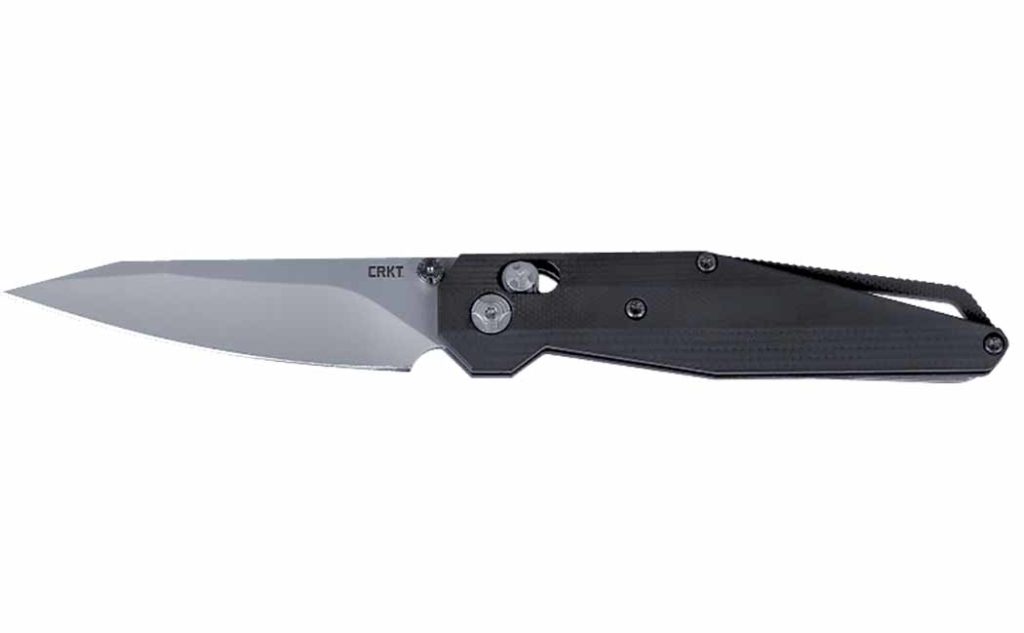
The Compano Sheepsfoot has a wicked-sharp blade that whipped through suede and paracord like butter. CRKT also offers the Compano in a drop-point version should you prefer a deeper-bellied blade.
The CRKT Compano Sheepsfoot is a sibling to the standard Compano drop-point model. Designed by Mike Bond of Honolulu, Hawaii, the Compano companions are designed as keychain knives with an edge. The folder’s cylindrical pivot is 1 inch in diameter—3/4 inch inside—with synthetic blue gear-like caps mounted to a stonewashed stainless-steel frame. The folder’s wicked little 1.44-inch blade opens by way of an oblong cutout and, interestingly, has a half-stop along the way. The handle has a generous-sized carabiner with a spring-loaded gate for capturing your key ring.
The svelte Compano Sheepsfoot can be clipped to a belt loop with no problem. The whole assemblage—Compano and keys, all on a keyring—can be carried loose in the pocket, too. I like the Compano not as a keychain knife but as a back-up, hideaway piece that can be clipped not just to a belt loop or toted loose in the pocket, but corded and worn as a neck knife as well.
Tests with the sheepsfoot blade were conclusive—the little rascal can cut! I laid out a flat of 4-inch suede and the blade sliced through it effortlessly. It liked paracord as well. In a self-defense situation with your index finger in the knife’s large pivot hole, the knife would be very difficult for a foe to dislodge. Regardless of how you plan to use this little mighty mite, I believe it would be money well spent.
CRKT COMPANO SHEEPSFOOT Blade length: 1.44 inches Blade steel: CPM S30V stainless Blade pattern: Sheepsfoot Handle material: Stonewashed stainless steel Lock: Non-locking slip joint Carry: Carabiner or in pocket Special features: Large finger-hole pivot Weight: 2.2 ounces Closed length: 3.25 inches Country of origin: China MSRP: $44
Kershaw Reverb XL
The Kershaw Reverb XL has a trailing-point blade the author found ideally geared for slicing. Notice there is no thumb stub or flipper tab for opening, with Kershaw opting instead for a finger groove to keep the Reverb snag-proof.
Kershaw makes no bones about the Reverb XL—it is made for the great outdoors. The slim 1-inch carabiner on the spine of the handle butt attaches to gear or a belt loop. A 1.5-inch pocket clip on the back handle slab can be used alternately. The Reverb XL has a sweeping trailing point or Persian-style blade with a gray finish. The blade thumbs open via a groove that follows the spine on both sides—no thumb studs or a flipper tab make it snag proof. The front slab is an attractive composite of black carbon fiber and blue G-10; the back slab is gray stainless with an interesting framelock cut completely inside the slab itself. The lock is accessed from the front slab via a cutout that exposes the lock spring.
The XL’s lock spring takes a little getting used to, but, once you get it, you get it. The knife’s extremely lightweight and won’t be a burden on any hiker, camper or climber. This is not a workhorse knife per se, rather an assistant for things like light meal prep and cutting rope or paracord. I tested it cutting sausage, paracord and 3/8-inch rappelling rope, all on a flat wood surface. The thin blade slices very well. Tough projects will leave you wanting more blade, but that’s not this knife’s design purpose. Keep it in its lane and it will serve you well.
KERSHAW REVERB XL Blade steel: 8Cr13MoV stainless Blade length: 3 inches Blade pattern: Trailing point Handle material: Carbon fiber, G-10, stainless steel Lock: Framelock Carry: Carabiner or blade-tip-up pocket clip Special features: Framelock, groove blade opener Weight: 2.31 ounces Closed length: 4.25 inches Country of origin: China MSRP: $53.95
DPx HEAT Hiker Stonewashed
The author found the DPx Gear HEAT Hiker brutish in both looks and action, whipping through this 3/8-inch rappelling rope with nice, clean cuts from the CPM S30V stainless steel blade. The HEAT Hiker has by far the largest, most accommodating carabiner of the review knives.
The DPx HEAT Hiker Stonewashed is an upscale version of the original DPx versions released in 2014. With White River Knife & Tool handling the manufacturing chores, DPx Gear ordered these up with premium CPM S30V stainless steel blades in a stonewashed finish. Other than that, all the knife’s popular trademark features—skeletonized carabiner handle, cap lifter on the lower blade spine and nifty Kydex breakaway neck sheath—are preserved for HEAT Hiker fans to enjoy. The Hiker blade is built on 0.16-inch-thick steel so you can bet it’s plenty stout, while still lightweight enough to make it a breeze to carry.
The curves on the integral handle fit the hand well, and cutting through 3/8-inch rappelling rope was as easy as eating puffed wheat for breakfast. The knife’s short blade will shave wood for fire starter and is limited only by its length. An area the Hiker truly excels in is its carry options. The gaping carabiner allows it to easily hook onto belt loops or gear, and its thin cross-section allows it to lay flat against the chest when worn as a neck knife. Can you say EDC? Designed by adventurist/journalist Robert Young Pelton, aka RYP, you can tell the HEAT Hiker had a lot of thought and experience behind its development.
DPx HEAT HIKER Blade steel: CPM S30V stainless Blade length: 2.5 inches Blade type: Drop point Handle material: Skeletonized steel Carry: Carabiner or Kydex neck sheath Special features: Bottle opener/breakaway sheath Weight: 2.15 ounces Overall length: 6.25 inches Country of origin: USA MSRP: $125
Fox Knives Ferox
Using the plain-edge portion, the 3.54-inch Bohler N690 stainless steel blade of the Fox Knives Ferox serves up some nice shavings from a block of wood.
The Fox Knives Ferox carabiner knife brings a couple of extra tools to the table, namely a set of Phillips and flat-head bit drivers along with a 2-inch extension. Designer Tommaso Rumici saw a need to add the two components because knife users often get caught flat-footed by not having screwdrivers on hand and end up using the tips of their knife blades—which is not only hazardous to the knife but can cause harm to the user as well.
The Ferox is a black-coated, mid-sized integral straight knife with a blade available in either a plain or partially serrated edge. The handle butt houses a round finger-sized carabiner 1 inch in inside diameter with a .5-inch spring gate. The scales are black G-10, grooved in the middle to house the Phillips and flat-head bits on either side. There are eight O-rings on the handle that serve to trap the bits until ready to use, and also to add purchase. The Ferox includes a black Kydex sheath with a Tek-Lok belt attachment.
There’s a lot to unpack here. The Ferox and its sheath weigh 9 ounces, which, in my opinion, is a little too much for hanging off a belt loop, though ideal for gear with a decent size strap or metal ring. The knife is very well made, and the blade sliced through 3/8-inch rappelling rope and took off firewood shavings from a wood block effortlessly. This is a heavy-duty knife for its size and the blade steel is praiseworthy.
The bit driver is an interesting addition. The drive extension must be kept track of separately as there is no place for it to attach to the sheath. While I think the bit driver is a handy addition—and it does work—I like the knife more for its other characteristics: it’s built like a tank, has excellent steel and cuts like a house afire. I’d opt for the plain-edge version to get even more slice out of the superb blade.
FOX KNIVES FEROX Designer: Tommaso Rumici Blade steel: Bohler N690 stainless Blade pattern: Drop point Blade length: 3.54 inches Handle material: Black G-10 Carry: Carabiner or sheath Special features: Integral design, flat-head and Phillips driver bits Weight: 5.29 ounces Overall length: 7.27 inches Country of origin: Italy MSRP: $299
New Limited Edition Swiss Army Knife Comes As A Result Of A Collaboration Between Off-White And Victorinox.
The Italian-based premium lifestyle brand Off-White has collaborated with venerable Swiss knifemaker Victorinox to make a Swiss Army knife for the brand’s Equipment project done with Korean brand Post Archive Faction.
The knife is gorgeous thanks to the white Corian scales with black silhouettes of the tools included in the knife. The Corian material is a composite of acrylic and a mix of natural materials, the majority of which are derived from bauxite. The piece is modeled after the story of Adam and Eve, and the silhouettes of the tools can be positioned to look like the collaboration’s design motif which is a fig leaf.
The knife itself is a gem, and only 3,000 are being made. There are both small and large blades, two sizes of screwdriver, and a bottle opener among many other tools you’d expect to see on a SAK of this size.
The whole construction is just 2.9 ounces in weight, and it is packed with features big and small. However, get ready to pay big for this knife due to its small production run.
Off-White ℅ Victorinox Knife Specs
Length: 3.7 inches
Height: .7 inches
Width: 1.6 inches
Weight: 2.9 ounces
Tools: Reamer, punch, and sewing awl, corkscrew, bottle opener, wood saw, large blade, 6mm screwdriver, can opener, wire stripper, 3mm screwdriver, small blade, key ring