Home Blog Page 91

Veronique Laurent Is Winning In A Man’s World

Veronique Laurent Has Become One Of The Most Accomplished Smiths In The World Even After Fighting Against Prejudice In Her Native Belgium.
I come from Texas where a knifemaker is more likely to wear boots and a cowboy hat than a suit and tie. In many parts of the world, it’s commonly assumed that a knifemaker is a man. 

This past March I caught up with American Bladesmith Society Master Smith Veronique Laurent at BLADE Show Texas in Fort Worth, Cowtown, USA. She had no boots or cowboy hat and her accent isn’t “Southern,” but she’s sure enough a bona fide knifemaker.  

Veronique comes from Brussels, Belgium, where French is the spoken language. Now, I don’t speak French, so out of respect I asked her how a non-French-speaking person should pronounce her name. 

Over here she’ll answer to the Americanized Veronica Lawrent, but the correct answer is more like Vehr-o-NIK-eh Law-ron, with the rolled R’s in the middle of each. In Belgium the people use the last name first, so she’s often just called “Laurent.”  Now that you can read her name in your head in a beautiful French accent, let’s move on to the interesting part of the story.

Veronique found her first career as a clerk at a Belgian TV station. She did cold metalworking as a hobby. While on holiday in France in 2004, she attended a knifemaking and blacksmithing event similar to a U.S. hammer-in. She later took a one-day knifemaking class with the Belgian Knife Society and never looked back. 

She became involved with the Society and learned more about knifemaking from the members of that community. The group eventually broke up but not before Veronique was well on her way.

In 2010, again in France, she attended a hammer-in that included ABS Master Smiths/BLADE Magazine Cutlery Hall-Of-Fame® members Joe Keeslar and Jay Hendrickson. In Belgium and France, a woman is not commonly accepted as a knifemaker. So it was that Veronique was pleased and surprised by the hospitality that Joe and Jay showed her, particularly with the respect they gave her as a craftsperson. 

For while a female knifemaker is a bit of an American rarity, being female isn’t an automatic gale-force headwind in the American knifemaking journey. In Europe, however, things are quite different. Veronique struggled to sell knives in Europe even as her skills advanced.  

“When a man came to my table and picked up a knife, he would ask me who the maker was,” she recalled. “When I said that I made the knife, he would then ask the person next to me who made the knife. Once he knew I was the knifemaker, he’d put the knife down and walk away. In Europe they don’t want to buy a knife from a woman.” She made it her goal to be a full-time maker, and her American contacts became even more important.

Becoming An ABS Master Smith

Laurent Blade Show
Veronique (left) makes a point as her fellow panel members—from right, ABS Journeyman Smith Lora Schwarzer and knifemakers Grace Horne and Abie Lyons—listen during the Women’s Bladesmith/Knifemaker Panel class of BLADE University at BLADE Show ’22.

After her contact with Keeslar, she journeyed to the 2013 BLADE Show and gained her ABS journeyman smith certification. She then began corresponding with ABS Master Smith John White, who encouraged her to learn to build takedown knives. 

“In 2015 I built my first takedown knife, and that same week I received the ABS email notification that John White had passed away,” she recalled. “I built all of my master smith test knives as takedowns in his memory.” 

Veronique pretty well blew away the crowd at the 2015 BLADE Show and gained her MS stamp. After the show, she and ABS Master Smith Jean-Louis Regel of France spent three weeks in Brazil learning advanced damascus techniques from ABS Master Smith Rodrigo Sfreddo.

“After I was a master smith, I began to ‘exist’ in Europe,” she noted. “I became a full-time knifemaker shortly after that.” Even with American renown and credibility, the headwinds of bias still were a challenge in her home country.  “People were rude, and it made me think ‘I will show you!’ Their bad attitude became my motivation,” she said. 

She began to work with Jean-Louis more and more (Jean-Louis also earned his MS in 2015). Because of bias, it was often assumed that he did her work for her, that he made her damascus or that she worked only in his shop. This was not the case. 

Though to Americans it makes sense that the two French-speaking master smiths must be connected, the real story is that Veronique and Jean-Louis each have their own shops in their hometowns. Their shops are roughly 375 miles apart, with Veronique in Belgium and Jean-Louis in France. The journey between them takes about eight hours. 

Even in Texas, where we measure trips in hours, not miles, an eight-hour trip is a “long haul” or a “far piece.” While the distance was significant, they covered it about once a month depending on workflow. Veronique says that she has better grinding and finishing tools in her shop, while Jean-Louis has a bigger shop with better damascus-making equipment.  

Veronique and Jean-Louis attended the International Custom Cutlery Exposition (now BLADE Show Texas) in Fort Worth in 2018, and each won multiple awards. 

“In all my trips to America, only one time has anyone set my knife down rudely like in Europe,” she noted. They joined The Knifemakers’ Guild on that trip also and spent a week learning bladesmithing from ABS Master Smith Rick Dunkerley.

Covid got in the way of travel plans and so Veronique and Jean-Louis were unable to return to America until this year’s BLADE Show Texas. As an American, it wouldn’t cross my mind to visit France regularly to try to sell knives, so I was curious why Veronique keeps coming back.  She explained that “Europe doesn’t like to ship big knives. It is very complicated and expensive. Sometimes you can ship a small letter opener or something, but it is very difficult.” 

Rather than fight the restrictions, it’s easier to travel over here and sell her work where it is in high demand. Another thing she does is make a “junior baby” model of each major piece. If she makes a dagger, she makes another small one. If she makes a big bowie, she makes a similar hunter. These smaller pieces tend to sell better in Europe than the big works.

Veronique Laurent’s Knives

Laurent bowie
Based on the Musso Bowie, Veronique’s Big Boy Bowie won Best Fighter at BLADE Show Texas. It has a 13-inch feather damascus blade of O2 and 45NCD16 tool steels with a riveted brass back. Parts of the guard are mirror polished, parts are stippled, and parts are engraved with raised flowers. The handle is ancient walrus ivory. Overall length: 18.5 inches. (SharpByCoop image)

Veronique had a good variety of knives at BLADE Show Texas that showcased her skills and versatility:  a large brass-backed bowie, a few elegant hunters and a folding dagger. 

“It was an honor to be asked to make a big bowie,” she observed. “It’s a man’s knife and it took many years for a man to trust that I could build a large bowie.”  

While she doesn’t build knives “to order,” she does keep a list of customers who are looking for a particular type of knife. “I don’t take orders. I want to be free!” she explained. She’d been asked to build a big bowie and did her research and came across the Musso Bowie. She built the Big Boy Bowie and it promptly won Best Fighter in Fort Worth.

Big Boy is highlighted by a feather damascus blade of O2 and 45NCD16 tool steels with a riveted brass back. The guard is O2 also. Parts of the guard are mirror polished, parts are stippled, and parts are engraved with raised flowers. 

“O2 steel is good because you can finish it many ways and it works well for the engraving,” Veronique explained.

The handle is ancient walrus ivory.  Also on her table was a fine damascus folding dagger that won the show’s custom judging award for Best Folding Knife. All the fittings, engraving, jewel settings, and display box are by Veronique.

So where does one go next when you’re already known worldwide?  

“I want to focus on engraving and filework,” she said. “I am also learning to make automatic folding knives from Rick Dunkerley.”  

Veronique is a strong woman and plays well at what is often a man’s game. She doesn’t take orders but builds a few major pieces in several categories each year. She prefers email communication from Americans because it is difficult to hear and translate over the phone. She’ll be at the major shows, but you’d better get there early as her work is in high demand.

For more information about Veronique Laurent and her knives e-mail her at [email protected].

Read More

The Rise And Growth Of Women Knifemakers

Women Bladesmiths Thrive And Continue To Shape The Knife Industry.

Women’s pocketknives? Can’t anyone buy any type of pocketknife?

Sure, but knives designed and marketed specifically for women are few and far between even among the big knifemakers.

Enter Brighten Knives, a small, upstart knife company based in Utah. Founded by Diane Carver and her daughters Kristy, Katie, and Kimi, Brighten has grown into a successful maker thanks to a strong vision and some good luck.

“We worked with [the Salt Lake Tribune],” Diane said. “They wrote an article about us because aside from being women’s knives, which is kind of a cool product, it was also a human-interest story where it was a mom and three daughters starting a knife company.

“It was unique and different. They put an article out and it kind of snowballed from there. A radio station picked up on it, and our Utah Senator Mike Lee even sent us a letter.”

All that good press, along with a Kickstarter that raised almost $14,000 (almost triple the initial $5,000 goal), and Brighten has been on a roll ever since. 

Brighten’s Inspirational line of knives all come in bright, bold colors.

The company is built on Diane’s decades of experience in the industry. She was the knife product manager for Browning for 17 years and has worked with Fox Knives, along with marketing* household cutlery for companies like Traeger. 

Diane’s experience in the industry is complemented by her daughters’ work. Kristy created all the original designs and colorways of the company’s knives. Kimi has worked in product development and sales, and Katie has a background in sales and writing as well.

As the quartet designed their knives the hard question to answer was: What exactly does a woman’s pocketknife look like?

“Being in the industry for so long I know that most women, and I don’t want to generalize because there are a lot of women that carry it in their pockets, but a lot of our pants are made where they can’t even hold a knife,” Diane said. “The one thing that we did that kind of separated us was including the case. The case comes with all of our knives no matter [the product line] so that you can throw it in your purse or your glove compartment.”

Brighten has two original lines of knives: the Inspirational line and the Not So Heavy Metal Series. They all come with a case that’s roughly the size of a wallet that is easily portable. Additionally, all of the knives are available in a smaller keychain variety. 

All of the blades are made from 8Cr13MoV stainless steel. For the larger varieties, the blades are between 2.5- and 2.56-inches long, and the keychain knives are between 1.6- and 1.65-inches long. The knives open with a thumb stud and feature a linerlock. 

The Inspirational line is the company’s original line of knives. Each blade is married to an aluminum handle resplendent in brightly colored designs. The blades all also have a different inspirational word on the steel, words like “Faith” and “Hope” and “Brave.”

“All of the designs on the knives and cases are originally designed by my daughter Kristy,” Diane said. “I know it’s kind of unusual to see words like “laugh” and “faith” and “love” on knives, but we wanted it to be something fun. On the packaging, there’s a quote that goes along with each one. One thing we’ve seen is people like purchasing them for specific things. Our Hope knife is a breast cancer knife, and the quote on it is ‘When the world says give up, hope whispers try one more time.’”



Diane’s market research showed there was a large segment that wanted more muted colors and streamlined designs. Enter the Not So Heavy Metal line. Every color is named after a popular rock-and-roll band or song. 

Brighten Blades Green Day
The knives in the Not So Heavy Metal line come in more muted, monochrome colorways with a steel bolster.

Diane laughed, mentioning the generational differences as her daughters recommended Green Day while she mentioned names like Purple Rain and Blue Oyster Cult.

“There was about 25 percent [of women] that said they were more of a minimalist and wanted more plain, solid-colored things,” Diane said. “We want Brighten to be the premier knife company for women and so we wanted something that would appeal to everyone. That’s how we came out with our Not So Heavy Metal line. We had a ton of fun naming the colors.”

The full-length knives retail for $29.99, and the keychain knives sell for $19.99. 

As Brighten Knives has continued to expand, the press and publicity around it has swelled. YouTubers such as Neeves Knives have reached out and produced content about Brighten, as have other digital creators. 

Carver said the goal is to make knives that are women-forward that take care in their design and construction rather than just slapping some pink scales on the side and calling it a day. She did speak positively about the Kershaw Chive and some of Spyderco’s knives but that she hadn’t seen any marketing directly for women from those factory makers.

There is also the Femme Fatale line of women’s pocketknives from Defense Divas which are marketed as spring-assisted self-protection knives. 

femme fatale knife
The Sneakerhead rescue folder is an example of the types of knives, both in terms of utility and style, made by Defense Divas.

While all of Brighten’s knives have a story and purpose behind their design there is one question Diane and her team get regularly: Can these knives be used in self-defense?”

“We have a lot of questions about whether these are self-defense knives,” Carver said. “Obviously, any knife can be used for self-defense in a pinch, but that’s not what these knives are designed for. They’re in a case in your bag. We are coming out with some designs for self-defense but that’s another story.”

That “another story” will feature self-defense videos made by the company featuring self-defense experts with military backgrounds. Everything is one step at a time as the company looks to grow and sustain itself going forward.

For now, the company started by a mother and her three daughters continues to grow and thrive, and make fun, exciting pocketknives for women.

Female Knifemaking Standout Audra Draper

Few women in the field are as accomplished as Audra Draper. The Wyomingite was the first woman to earn master smith status in the American Bladesmith Society back in 2000. Since then she’s made pretty much everything and, along with her husband Mike, taught countless new makers the craft of making knives.

“Back in the day it was hard to get people to acknowledge that yes, a girl can do this, too,” Draper said. “But now it’s not a big deal, people don’t react so crazy anymore and that helped, because if you’re a young girl and walk up to a knifemaker’s table at a show and tell them you want to make knives, you need them to react like ‘Sweet, what can I do to help you?’ which everyone does now.”

While Draper is as experienced as it comes, one thing has both eluded her and caused her very little concern: making knives specifically for women. She said that she just wants to make beautiful, functional knives that people will want.

She said the only key difference can be making knives with a smaller handle since a woman’s hands are usually smaller than a man’s.

draper turmoil
Audra Draper’s Turmoil is a beautiful damascus fixed blade. (Image: SharpByCoop)

“Most women that are interested in knives don’t want a woman-specific knife,” Draper said. “They just want what the guys are carrying. I’ve made some knives that I was so certain would be purchased by a woman, and a man buys them 99 percent of the time. The women are usually hunters and fishers or they want it for the kitchen. The only difference if you’re a woman or a man is maybe a smaller handle.”

She laughed thinking about the times she’d made knives designed for women utilizing materials like turquoise, and when they hit the table the piece was scooped up by a man. She stressed that knives are neither feminine nor masculine–they just are. 

And for young women interested in learning the craft she had one simple bit of advice–reach out and ask people to help.

“Just ask questions. Talk to people,” Draper said. “There’s plenty of info our there now and plenty of courses to take. I would highly recommend before buying expensive equipment to take a course with an established maker because that’s going to tell them right away if this is something they want to do.”

Young Women Shining In The Knifemaking World

Raegan Lee and Karis Fisher are two young makers establishing themselves in the world of bladesmithing. Lee, an Idaho native, is just 21 years old but has been making fixed-blade knives for years from CPM 154 stainless. Are these specific knives for women? No, but having an enthusiastic, creative woman making knives will help craft what a “woman’s knife” becomes.

“I want to get into folders, specifically slip joints,” Lee said when we talked at BLADE Show West. “That’s where I’m heading. To be one of those makers that can bring three knives to a show and sell out on a lottery is a great feeling. To really be known in the community would be a huge, huge thing.”

Raegan Lee’s “Cow Poke” with red fiber Micarta® handle. Her price: $200

Lee went on to say how important it is to have female makers creating knives and being mentors and examples for young artisans entering the field. She said Audra Draper was an inspiration for her.

“I think it’s extremely important,” Lee said. “I do knives most of the time, but I’m also an aluminum welder at an off-road company, and that’s also a male-dominated world. I just think there has to be one of us, and the rest of us can see [what’s possible]. The more we have the more it’ll be great for us.”

Fisher is the daughter of ABS master smith Josh Fisher. Even though just a recent high school grad, her fixed blades are stunning and show off her skill in the forge and with the hammer.

Karis Fisher hunter
A hunting knife with an ironwood handle made by Karis Fisher

For Fisher, the biggest way to grow the base of female makers is simply by exposing more people to the craft of bladesmithing. TV shows and numerous YouTube channels have certainly helped a lot in bringing knifemaking more into the mainstream in recent years, and Fisher said that can only help.

Fisher even said that if her dad wasn’t a successful smith she probably wouldn’t even know about knifemaking.

“I think not too many people really know that knifemaking’s out there,” Fisher said. “If more people knew about it, it might be more [popular]. Forged in Fire does quite a bit for it.”

Read More

The Navaja: A Spanish Gem

The Navaja Is A Sleek, Svelte Folder Originating From Spain Hundreds Of Years Ago. Today It Remains Popular In Both The Real And Digital Worlds.

The Navaja is one of the most interesting knives in the world. Its history can be pinpointed to the Andalusia region of southern Spain, and its growth and evolution since its creation more than 400 years ago has been well-documented. 

The History Of The Navaja

The first Navajas that resembled the modern version came to be in the 1600s. The name is derived from the Latin word “novacula” which means razor, and you can see the resemblance to a straight razor in its construction with the long, thin blade that folds away neatly into the handle.

The knife became popular during a period when, unless you were a nobleman, there were many restrictions on swords and other blades. This meant that the Navaja developed as a peasant’s knife and was used for all sorts of utility tasks. One thing that made using it a bit difficult was the fact that it didn’t lock when opened. Later Navajas would have locking mechanisms, but the first versions didn’t. Most notably the Navaja made a distinctive cracking/popping sound as the blade was opened, differentiating it from other knives.

Thanks to the steel innovations that allowed the knife to lock, the Navaja spread its wings and made its way out of Spain and to nearby countries like France. As the knife continued to evolve it was banned by rulers, then became a popular tool for rich and poor alike, and was used as a versatile combat knife. In fact, it became the knife of choice among muggers who would rob people in alleyways and other dark urban areas. Victims knew they were about to be robbed when they heard the unmistakable popping sound the Navaja made when a mugger opened it.

Roughly a century ago, the Navaja began to fall out of favor with knife lovers. However, it continues to endure thanks to a handful of makers crafting their versions, and, in an extremely modern twist, it has become a popular knife to use for players of the video game Counter-Strike: Global Offensive.

Kings County Tools Navaja-Style Knife

Navaja

A great modern representation of the Navaja is seen in this folder from Kings County Tools.

The blade is not just razor sharp but also razor thin. At three inches in length and just .25 inch wide, the stainless steel knife is excellent at precise, detailed tasks. The brass and steel handle is both handsome and provides an excellent grip while cutting.

Not quite a razor and not quite a penknife, this Navaja shows what the knife can be and how different it is from other folders on the market.

MSRP: $34.75

Castillo Knives Navaja

Castillo Navaja
Castillo Knives Navaja – Olive Wood Handle

A different interpretation of the Navaja comes from Spain-based Castillo Knives. Their Navaja is similar to contemporary lockback knives in many ways and is an all-rounder in every sense of the term. 

The blade is made from Sandvik 14C28N stainless steel and the handle comes in a variety of materials, from two types of Micarta® to four types of wood. Every version looks great, and the 3-inch straight-back blade has a small bit of deep jimping on the spine to aid in grip and force when cutting. Every knife comes with a leather pocket sheath and a 240-grit bonded ceramic sharpening stone.

All told, this 6.5-inch piece is a well-made gem.

MSRP: $109 (Micarta versions), $119 (wood versions)

Read More

Budget To Bang Combos: A Trio Of Great Hunting Knife Sets

When Hunting, One Knife Is Good But More Knives Are Better. These Knife Sets Can Help Make The Hunt Easier No Matter The Size Of The Game.

Each year hunting season rolls around there are experienced hunters and first-time hunters anxious to make their way into the field. Whether a bow hunter or a firearms hunter, one thing remains consistent between the two: They both need something to clean game and prepare it to be able to get it out of the field and home.

No one would argue that you don’t need a knife, but sure enough each hunter would back his choice of blade in a discussion led by the question “What do you use?”

This year, as usual, I found some likely candidates to add to the discussion of whose knife is better, though this time, instead of a single knife to tackle the project, let’s consider knife sets. They can’t get your game for you but we can put them through their paces to see if they can help make the most out of what you do get.

Gerber Moment

Gerber Moment
Here you get a good look at the size difference between the large Utility knife and small Finesse knife in the Gerber Moment. Sometimes a good picture is worth a thousand measurements. Blade and overall lengths: 3.625/3 and 8.625/7 inches. Blade and handle materials: 5Cr15MoV stainless and rubber overmold, glass-filled nylon

The Gerber Moment is a two-knife set. Of the test entries, this one is for the budget-minded hunters looking to spend the short dollar. It is made in China and the fit and finish is darn respectable considering each knife runs about $17.

The two knives were not hair-popping sharp out of the package, though it didn’t take long to up their edge games. Both the large utility knife and the small finesse model come with contoured rubber grips. 

The scales do not totally cover the full-tang handle design. A small perimeter of the tang is left exposed around the scales. At the rear of each tang are small oblong-shaped notches to serve as lanyard holes. They’re small holes at that, as you won’t get much more than paracord through them. As mentioned, the edges of the tang are proud of the scale but not so much as to cause any hot spots.

Both knives are drop-point designs, with the large knife being hollow ground and sporting a gut hook. The small Finesse is a full-flat-ground drop point. Texturing on the rubber grips helps provide a good, solid purchase. Of the two, as you would expect, the small detailing knife is pretty agile, though it isn’t like the large one is clumsy. To tote them both Gerber provides a dual-carry nylon belt sheath with plastic liner inserts.

Overall, the knives are quite well made. The design cleans up easy. After you do some work to bump up edge performance, you’ve got some users.

I have never been much for gut hooks. I remember when the Wyoming Knife was new and loads of hunters were sold for life on gut-hook knives. Even though I don’t use them, I can see how some hunters could like them. The gut hook on the Moment is pretty large.

I would have to give the set a thumbs up. It would be good for a hunter on a budget or one looking to try out different styles until finding one that suits him best.

MSRP: $34

Outdoor Edge Razor Guide Pak

razor guide pak
Some of the extra blades you get in the Outdoor Edge Guide Pak Razorbone include a selection of drop point, gut hook and boning/fillet patterns. All are neatly store in the waxed canvas roll. Blade steel: 420J2 stainless.

The Outdoor Edge Razor Guide Pak comes with two knives—the RazorBone and the RazorCape—along with a small bone saw. The knives take replaceable razor-blade-style inserts. Both are folders and come with multiple replacement blades. 

Outdoor Edge provides a boning/fillet-style blade along with a drop point and gutting blade for the RazorBone. For the RazorCape knife, you get two cape-blade inserts. Both have glass nylon and TPR rubber inlay handles.

A lockback system secures the blades in the open position. The handles don’t have a lot of cross-sectional contouring and the texturing on the rubber inserts provides some traction to your grip. There’s a thumb groove with jimping on the spine of the blade holder.

What worked well for me was the difference in thicknesses between the blade holder and the blade gave me a great lip to secure my handhold while executing a pinch grip. As I used the RazorBone in a butcher grip, the thin tip of the insert snaked through joints and kept me close to the bone so that I didn’t leave any of the good stuff behind. 

The RazorCape knife works well but has a large choil. I find such choils a waste of potential edge length. As if that isn’t bad enough on a hunting knife, they basically become a fur catcher. Both folders come with a pocket clip, though for me they are not pocket-carry-style knives. All the inserts come scalpel-sharp, so show them respect while handling them.

Lastly, the Flip n’ Zip saw works well but the anodized aluminum handle doesn’t do a lot for me. It makes a nice, thin package. A lockback system securely holds the blade in place. It’s just that the aluminum handle, even with CNC grooves, is thin and pretty slippery in my hands once things get wet. 

Also, the handle is so thin it makes it a bit difficult for my fat mitts to hold onto it. I would hate to try it with gloves on while the handle is covered in blood. The extra blades, all 420J2 stainless steel, are stored in a wax canvas roll. 

MSRP: $99

Knives Of Alaska Bobcat Combo

Alaska knives
Knives of Alaska includes a top-notch leather sheath with the Bobcat Combo. The sheath has the hallmarks of solid craftsmanship. (The author indicated he put the nick there.)

The set from Knives of Alaska (KOA) comes with the Alpha Wolf knife and the Bobcat Hatchet—hence, the Bobcat Combo. I’ve used the Alpha Wolf before. It’s a full-tang design made of D2 tool steel and a layered polymer handle. The handle contouring includes four finger grooves, with the index groove on the ricasso. It is a straightforward, fully flat-ground drop-point design.

The Alpha Wolf comes shaving sharp out of the box and has a general curve to the cutting edge. I have to say as a game knife it handles well and you can exert a great deal of control over the cutting edge with little effort. 

The design fits well in my meaty hand and the cuts get made where I need them without struggling. At the rear of the edge is a micro choil and, as usual, when the material being cut gets hung up there, it frustrates my workflow. I would say the only thing I would prefer is a bit of texturing to up the grip game.

As you can imagine, the Bobcat hatchet does things like splitting the sternum, cutting the pelvic bone and, if you want, it will bust out some of the tougher joints. It doesn’t have the heft of a full-size hatchet but as my buddy is fond of saying: if you put enough force behind anything you can make it fly. To me, it would be certainly neater than a chainsaw (don’t ask, it’s a drunken Canadian hunter thing). A gut hook is on the back.

A top-notch-made leather sheath carries the combo. I never reviewed a knife from KOA on which the leather wasn’t well executed. It’s a good combo and the Bobcat hatchet is such a neat tool I couldn’t resist using it in the kitchen as a small hand chopper. I know, somewhat sacrilegious, but it’s my kitchen. It’s a great set and as much of a trophy as the game you kill. 

MSRP: $209.99

There’s a wide range of knives here from budget to bang and represents only a small sampling of the tools available to hunters these days. If you’re going for the big game, don’t ruin the moment by struggling with a poorly crafted tool. Take the time to round out your kit with a good field-dressing knife set.

Read More

A Gentleman’s Game: 4 Classy Folding Hunting Knives

While Not As Plentiful As They Once Were, Quality Folding Hunters Can Still Be Had. These 4 Knives Meld The Robustness Of A Hunter With The Ease Of An EDC.

Folding knives have been used for hunting and skinning since they were first made. Today, the American knife industry has moved quite far in the direction of fixed blades for use in the field.

However, folding knives are seen in the pocket of just about every self-respecting individual these days and are still the top choice for daily use. Time and fashion being what they are, many pocket folders have become somewhat fragile and unsuitable for anything other than opening mail or packages. In short, they have lost their value as serious tools that can be used in the field as well as daily life. Nonetheless, luckily there are a number of very suitable hunting knives that fold and ride in the pocket.

The largest downside to folding hunters is they can be very difficult to clean and have the propensity to break under hard use. Folding knives promoted for hunting are, at least to me, a bit of an exaggeration in that they function but are much harder to get along with on big game. As a result, I try to limit my folders to small game where the weight of the animal has little bearing on blade stress.

Cleaning and maintaining a folding knife exposed to blood and other fluids is a challenge. The mechanical function of such knives can in many cases be impeded with fat, and likewise made dangerous if, for instance, a linerlock gets clogged up. 

Washing a folding hunter is easy in some respects, but the best method remains soaking it in hot water with dish soap to dissolve fats and blood. Rust and corrosion can easily occur internally, so you’ll need to oil the knife after soaking it to prevent corrosion.

Lastly, ergonomics and blade length create the most limits for the big game hunter. Because most folders are designed to lay flat against the body in the pocket, they tend to be thin in profile, which can fatigue the hand if you have a great deal of work to do. 

Since the blade fits in the handle, you’ll never really get as long a blade as you need for animals like deer without getting a handle that is proportionately as long. This makes for a degree of awkwardness in that you can only get more blade if you get more handle, and at that point a fixed blade is better.

Emerson Knives Market Skinner

Emerson Market Skinner

I have developed a great fondness for Emerson knives. In fact, as much as I love carrying fixed-blade Winklers, I have ended up going about much of my daily life with an Emerson in my pocket. Much of the utility for me comes down to how well it fits my hand. The Market Skinner is a well-balanced and very functional cutting/slashing knife that has a mixture of hunting and tactical features. 

The grip has a fine yet aggressive texture, and is easy to hold onto even when working with fatty meat. The blade has Emerson’s Wave Feature, thus allowing for instant opening coming out of the pocket.

I got to work in the kitchen on some small game and meat. The Market Skinner is designed to emulate the type of blade profiles used in old-world butcher shops to break down large cuts. Having spent the better part of my college years working for a high-end butcher shop, I had a good feel for what this type of knife could do.

For general use, the Emerson, above the others here, was probably the most functional for light-to-medium use. It was also by far the easiest to clean internally. Its open-handle design allows you to wash it easily. 

The added upward curve at the Wave on the spine allowed me to put a great amount of pressure on the blade to cut deeply. When covered in fat it was functional. However, the very fine handle material was hard to clean and pulled fiber from my rags. Not a huge deal, just something to be aware of.

While it is profiled as a hunting blade, the tactical features are there and the knife is easy to use thanks to how quick it opens. The clip is righthanded and very stiff. If you intend to carry it lefthanded, Emerson offers a service to drill and tap the other side for you.

MSRP: $267.95

Boker Hunter’s Knife Duo

Boker Knife Duo

Styled in the manner most favored by German and European sportsmen, the Boker Hunter’s Knife Duo is not just a functional piece of art but also a very rugged tool. It is so nice looking that you’ll want to make sure to keep it that way—meaning don’t toss it in your gear drawer after a hunt. 

Unlike the other test models, the Boker features two edged tools—one, a knife blade, the other a saw. In testing on a lamb rack, the saw performed extremely well and allowed me to make nice, even chops. The teeth are exceptionally aggressive, which is a positive for cutting bone, but they clog easily with fat and sinew.

The Hunter’s Knife Duo is made in Germany and the quality of each part is amazing. A notable feature is the real stag grip panels, a rarity on many production knives today. Care must be taken to not introduce this natural material to stress or harsh cleaning chemicals. Soap and water for cleanup is best, followed by a light coat of oil. In terms of mechanical function, this is a classic gentleman’s knife, slow to deploy and not designed with a day’s labor in mind. 

Equal parts showpiece and tool, the Boker is best on small-to-medium game. Since it has no pocket clip, it will likely ride in a belt pouch or simply in a pocket.

The only real problem is the shape and contour of the handle. If your hands have blood or fat on them, the grip tends to be slippery. This is a very slick knife and every metal part is as smooth as glass. Under such conditions sawing also can be slightly hazardous, as can cutting should your hands slip up onto the blade. That being said since a true gentleman is never in a hurry, the Boker is the perfect find for rabbits, pheasant, and turkey, preferably with a fine double gun in hand.

MSRP: $409

Case Kickstart Mid-Folding Hunter

The smallest of the test knives, the Case Kickstart Mid-Folding Hunter performed very well considering its size and blade length. This is in no way a knife you would want to have if you were trying to take down a deer; however, for small game, medium cuts like lamb or chicken, or out harvesting spices in the garden, the Case is perfectly capable. 

Like the Boker, it is a very, very slick knife—both visually and in terms of the limited amount of texture it has on the blade and grip. While it can be easy to work with, the knife is prone to slip or rotate in the hand.

In terms of cutting ability, it did just fine. The downward-swept blade lends itself to fine cuts, but very little else. The knife can be used and held like a pen. A full grip of the handle isn’t very safe. 

The lock mechanism is easy to use—a bit too easy. The blade can be unlocked and closed with almost no effort, which can present a dangerous situation if you aren’t careful. Of note is that the blade is assisted, and it opens incredibly fast. It also has a pocket clip for easy carry.

MSRP: $127.99

A.G. Russell Folding Gent’s Hunter II

A.G. Russell Folding Gent's Hunter II

In the vein of classic sport folders from the 1960s and ’70s, the A.G. Russell Folding Gent’s Hunter II is designed along clean lines and minimalist features. It came out of the box with a very sharp edge and a functional, ergonomic grip. Despite being a full-size knife, it is the lightest of the review folders, lighter even than the smaller Case.

Using and cleaning the A.G. Russell was about the same as the others. However, the wood panels required a coat of oil after I used soap on them to remove fat. The blade sliced meat very easily, and it was also rigid enough to approach some larger projects and game. While I’d probably take the Market Skinner if I knew I was working on an adult deer, the A.G. Russell would come in a close second, its only downside being that it got slippery when wet.

This knife is right on the money for a walking hunter going after rabbit or fowl. It’s very light and sharp and still maintains classic lines. Because it is so light, it seems to disappear in the pocket and, if carried daily, won’t draw any unwanted attention. It has “classy” written all over it.

MSRP: $85

Read More

First Look: Civivi Sinisys

The Civivi Sinisys Comes In Three Styles And All Are Excellent. This Classy Clip Point Would Make A Great Addition To Anyone’s Collection.

Sometimes simple is the way to go, and the Civivi Sinisys is elegant in its simplicity. This sharp clip point enters the EDC fray and stands out thanks to its sharp lines, multiple models, and ease of use.

The version above features a micarta handle scale and a satin-finished blade. There is also a more tactical version in all black with a G10 scale and a carbon fiber version with a damascus blade. This one and the tactical version have blades made from 14C28N, and all of the models have a stainless steel handle on the lock side of the knife to partner the scales on the presentation side.

The burlap micarta looks great, and the flipper is easy to use while feeling good in the hand. This version is the lightest of the three knives at 4.94 ounces, which is hefty compared to many other EDC knives. The other versions are a shade heavier at 5.02 ounces. 

The blade is long on all versions of the knife at 3.7 inches and is .12 inches thick. Closed, it’s 4.82 inches long, and the tip-up clip lets you carry it securely and discreetly in your pocket. 

Overall, the Civici Sinisys is a quality piece that will make any knife user or collector happy and proud to show it off.

MSRP: $78.20 (Micarta)/$75.90 (G10)/$117 (carbon fiber)

Read More

Seven Excellent Drop Point Knives

The Drop Point Blade Is One Of The Most Utilitarian Blade Styles. From Outdoor Knives To EDC Folders, The Drop Point Is The Way To Go.

The drop-point blade is perhaps the most useful shape for outdoor knives. It’s an excellent cutting tool and the point makes it good at puncturing too. Whether it’s cleaning a kill or just opening up a gift box, the drop point is an excellent all-rounder that any knife lover should have.

Ka-Bar/Becker Knife & Tool BK16 Short Becker

Ka-Bar/Becker Knife & Tool BK16 Short Becker
The wide drop-point blade of the KA-BAR/Becker BK16 has the ideal edge geometry to handle precise tasks like whittling.

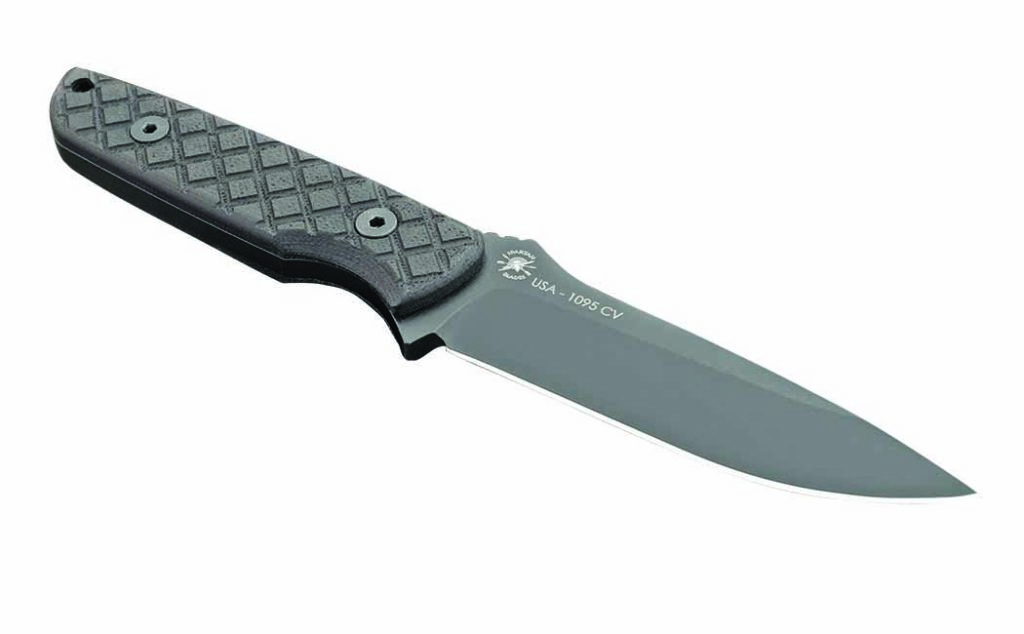
It is a midsize knife that is easy to carry, handle and use. The 4-inch blade of flat-ground 1095 Cro-Van steel can hold a respectable edge and sharpens quickly in the field. The black textured epoxy coating is non-glare and corrosion-resistant.

The Zytel handle is a typical Becker design—highly ergonomic with a palm swell that fills the hand nicely.  The handle edges are rounded to eliminate hot spots. Part of the tang is exposed for the lanyard hole. There’s also traction notches on the spine to choke up for added control. When you hold the BK16, notice how solid it feels. Even though one of the smaller knives in the line, it still feels capable of handling most cutting or camp tasks.

The sheath is a ballistic nylon with a rigid plastic liner. An accessory pouch holds a small lockblade folder or sharpener. The knife secures in the sheath via two button-snap nylon straps. The BK16 holds snugly inside the sheath with no rattling. Made in China, the sheath is of very good quality.

The BK16 is a workhorse. The drop-point shape is utility friendly and covers a broad range of general camp chores, from food prep to field dressing. The flat grind ensures optimum slicing.

The handle shape is classic Becker. A forward finger recess forms the lower guard and a palm swell mid-handle seats the hand comfortably. All edges are rounded for maximum comfort during prolonged use. The BK16 comes with two sets of scales: black Zytel and coyote tan. I opted for the tan. I love the contrast with the black blade.

I successfully batonned the knife through wood. The knife shrugged the task off and repeatedly came back for more. Whittling was easy. The ergonomic grip is comfortable and you’re able to use the exact pressure needed. The BK16 handles food prep with confidence.

If you need a compact fixed blade capable of tackling large tasks, the BK16 is it. Made in the USA, it has an MSRP of $132. 

Fallkniven F1 Pro

Fallkniven F1 Pro
The Fallkniven F1 Pro’s blade geometry makes baton work almost effortless.  

The Fallkniven F1 Pro features an extra-heavy-duty build and ELMAX high-performance stainless blade steel, which offers enhanced edge holding and toughness. With a 4-inch, convex-ground blade and 8.5-inch overall length, it is a formidable knife, weighing in at 6.1 ounces. 

The blade stock thickness is .19 inches, fairly thick for a knife this size. The full tang extends through the Thermorun rubber handle and is exposed on the butt for excellent torsional rigidity.

The handle sides feature a heavy checkering pattern for an excellent grip with wet or dry hands. The Thermorun material has a sort of a grip-you-back quality, similar to Kraton. The oblong handle shape rests in your grip comfortably so that you feel in control of the knife.

The sheath is well made of heavy-duty Zytel with a nylon webbing belt loop and button-snap retention strap. At first, the nylon webbing may seem a bit cheap but in reality it’s very smart. 

Why? The webbing allows the sheath to move freely at your side in case it gets snagged by branches, or to self-adjust when you are seated in a chair or a vehicle. Most rigid sheaths do not allow for this. Not to mention, the nylon webbing material is weather and moisture-resistant. 

The knife locks into the sheath via the guard as it engages a spring-loaded tab in the sheath’s side. This alone is enough to hold the knife inside, but securing the handle with the snap strap guarantees the knife stays put until you release it. The sheath’s bottom is open to allow moisture to escape and resist blade corrosion.

The F1 Pro and the BK16 are the heaviest-duty ones of the test bunch. The F1 Pro easily completed baton work. The thick blade stock and flat grind split wood like a wedge. For whittling, the convex edge has a ton of bite. It shaved off thick chunks of wood as I carved multiple stakes to a point. It made fast work of the task but, at the same time, was controllable and made precise cuts when needed. 

In some respects it worked as hard as a larger knife. In the kitchen, don’t dismiss the F1 Pro due to the thick blade. It slices vegetables with precision, proof this beast of a knife can handle delicate tasks as well.

There were no problems with the Thermorun handle. My hands got a bit sweaty during outdoor use and the handle never felt like it was going to slip in my hand. The checkered texturing is the right amount and not overly aggressive to your skin.

With an MSRP of $407.95, the F1 Pro ELMAX is one of the most expensive knives you will find in this class, but the chosen materials and highest quality of build offset the cost. You get what you pay for and this is a high-quality tool.

White River Knife & Tool Hunter

White River Knife & Tool Hunter
The blade of the White River Hunter is flat ground for optimal cutting performance, and the steel offers toughness and high edge-retention qualities. 

The White River Knife & Tool Hunter is a simple design, with a 3.5-inch drop-point blade paired with an ergonomic handle.  Blade steel is CPM S35VN high-performance stainless, and the handle comes in several material options. The 8.25-inch overall length is well-suited for field dressing and possible bushcraft use, too. 

The blade is flat ground for optimal cutting performance and the steel offers toughness and high edge-retention qualities. A polished finish makes the blade a snap to clean and also seals micropores, thus helping prevent rust. It’s kind of unusual to see a mirror polish on such a blade due to it being a labor-intensive finish; most such blades have either machine satin, stonewash, or even bead-blasted finishes.

A large finger recess helps index your grip, and a significant palm swell rests the knife in your hand comfortably. The butt has a bird’s beak pommel to prevent your hand from sliding backward.

As for handle material choices, they include three Micarta® flavors: natural burlap, black burlap, and black/OD green. Micarta is an excellent choice for an outdoor knife, as it is dimensionally stable and impervious to the elements and absorption of fluids. It also has a tactile feel that aids in grip retention in all conditions. 

We selected the natural burlap for the test, as it has a very organic appearance, almost a wood tone. The feel is akin to that of canvas Micarta. The sheath is formfitting Kydex, with a molded Kydex belt loop that accommodates belts up to 2 inches wide.

The cutting performance is superb. The knife is efficient and simple to maneuver. The flat-ground blade sails through meat and vegetables. Being a smaller fixed blade means it can be used for more delicate or intricate cutting.

I like the burlap Micarta. It’s very durable, looks great, and has a great in-hand feel. Burlap micarta isn’t common in production knives, so this is a bit rare—for now.

The shorter-length blade handles kitchen utility tasks well. Who knows—this knife might wind up in your kitchen pulling permanent duty when it’s not out with you in the woods. The White River Hunter retails for $180 for any of the handle material options. This is a really good price for a USA-made fixed blade with premium blade and handle materials. If you like refined fixed-blade hunters, the White River Hunter is for you.

Chris Reeve Knives Backpacker

Chris Reeve Backpacker
The Chris Reeve Backpacker handles like a dream. The knife is balanced perfectly and feels like an extension of your hand. It’s very predictable in use and is a slicer by nature. (Dexter Ewing image)

The newest fixed blade from Chris Reeve Knives, the Backpacker is for outdoorsmen and backpack hunters who want a fairly lightweight sheath knife that is quite usable with a smart design and high-end materials. 

It features a 4-inch drop-point blade hollow ground from CPM Magnacut, the latest of the high-performance stainless super steels. Magnacut reportedly has the best edge retention of any high-end blade steel. The Backpacker will go the distance with edge holding. A stonewash finish gives the blade a slight industrial look. Stonewash finishes do a good job of hiding scratches that occur during use.

The handle has a hollowed-out full tang, which helps keep weight to a minimum (3.8 ounces) and improves balance. The scales are canvas Micarta in black or natural. The Micarta is sculpted to provide placement of the hand and fingers, enhancing user comfort and blade control. 

Canvas Micarta has a grippy nature and seems to get better when your hands are wet, unlike other materials that may feel less tactile when wet. Two pairs of hex-head bolts secure the scales which are removable, resulting in a skeletonized fixed blade to further reduce weight and bulk. 

The integral guard formed by the blade’s height is a smart design I really like. It allows you to choke up on the handle for precise control, as well as keeping your hand in place.

The Backpacker comes with a Kydex sheath which locks around the lower portion of the exposed tang that forms the guard. It does not encompass the handle scales as most fixed-blade Kydex sheaths do. This is done on purpose so if you do decide to remove the scales and use the Backpacker skeletonized, the sheath will still work and lock on the knife for safe carry. 

A flat-head screw at the end allows you to fine-tune how tight the sheath locks onto the blade. Not many sheaths have this feature. The rivet spacing allows use of a large Tek-Lok belt fastener (the knife does not come with a provision for belt attachment, so it’s up to the buyer to supply such).

The Backpacker handles like a dream! The hollow grind slices easily. I used the knife to cut meats and vegetables. The cutting performance is predictable, efficient, and precise. It’s like driving a nice European sports car. 

Handle comfort is first class; I love the way the Micarta feels in-hand. It’s light as a feather for a fixed blade of its size, and no doubt the minimal weight does a lot to improve handling. When you choke-up on the handle with your thumb placed on the blade spine, you can feel how the ergonomics work to lock your grip on.

The Backpacker is a high-end, USA-made hunting/camping fixed blade. MSRP: $300. A CRK knife for $300 is a great price, actually, and you get a lot in return, including high-end materials and the company’s design and manufacturing/engineering expertise.

Buck 112 Ranger

Buck 112 Ranger
Buck 112 Ranger

Buck makes great knives, and this folder certainly is one of their best. The Ranger is a variation on the famous 110 Folding Hunter with a drop point instead of the original’s clip point.

The knife is beautiful with an ebony handle and ethically-sourced Crelicam ivory. While the handle is stunning, the star of the show is still the blade. Made from 420 HC stainless with a satin finish, the 3-inch blade is everything you would want in an EDC. With a thick belly and thick tip, the blade slices and punctures confidently.

The heat treat imbues the blade with excellent corrosion resistance and durability. It’s hardened to an HRC 58 so the knife can handle the wear and tear of everyday use with ease. This is a classy knife at a great price.

MSRP: $63.99

Benchmade Bugout

Benchmade BK-2
Benchmade BK-2

When it comes to drop point EDC knives the Benchmade Bugout is one of the most iconic. It was designed for outdoor use which makes it overpowered as an EDC for so many reasons.

There are many versions of the Bugout, and all are excellent, but for this piece we chose the BK-2 for its affordability in relation to other knives in the line.

The BK-2 is a fully blacked out version of the Bugout with a CF-Elite handled married to the CPM-S30V blade. The steel comes in a black Cerakote finish and is treated to a 58-60 HRC. The knife shines in large part thanks to its weight. At just 1.8 ounces, the BK-2 is so light and nimble in the air that it can feel like cutting with air.

It’s the Bugout. It’s great. It’s one of the highest-quality drop point knives on the market.

MSRP: $190

Kizer Drop Bear

Kizer Drop Bear

This knife was released over the summer and it is excellent. We have already written an in-depth review of the Drop Bear, and it’s worthy of a second mention.

The 154CM steel blade is meted to an aluminum handle. At 3.8 ounces it’s a substantial little knife that can handle the day-to-day tasks asked of it and can even be used as a kitchen knife in a pinch. 

The knife’s clutch lock, Kizer’s newly-adopted Axis-style lock, is fun to use and keeps the blade secure at all times. This is an excellent new addition to the world of drop point pocketknives.

MSRP: $158

Editor’s Note: Mike Abelson provided content for this piece.

Read More

Advertisement

Must Read Articles

Read this before you make a knife

Knifemaking 101 – Read This Before You Make a Knife

  by Wayne Goddard My experience has taught me that there's nothing like digging in and getting started. I've often said the hardest part of the...
how to forge damascus steel

How to Forge Damascus

Advertisement
Advertisement