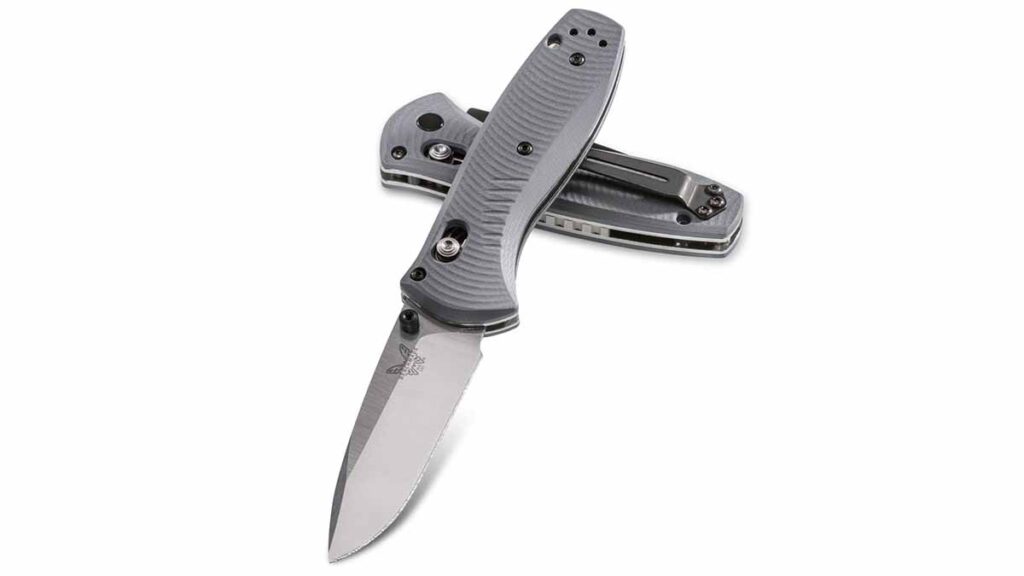
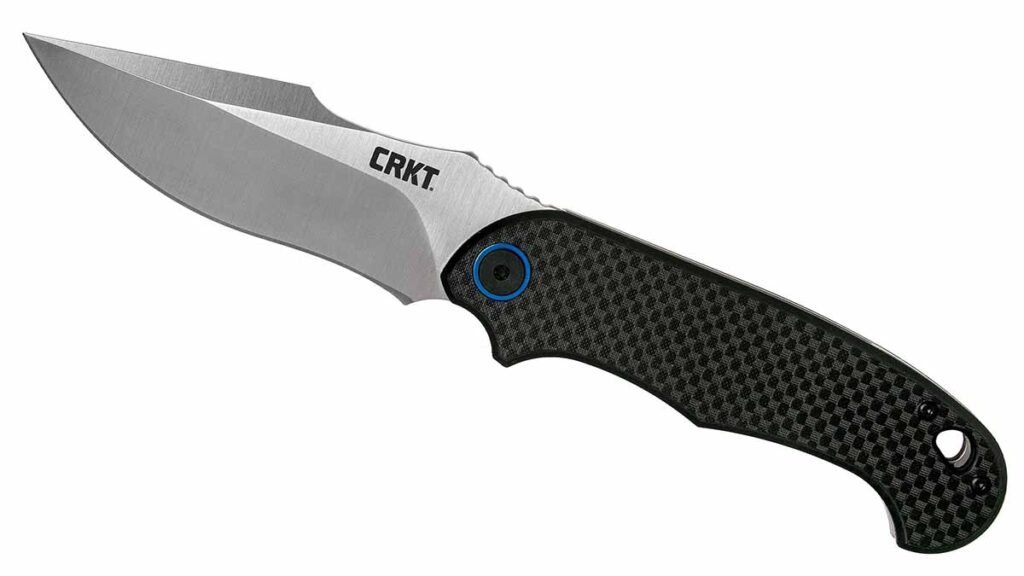
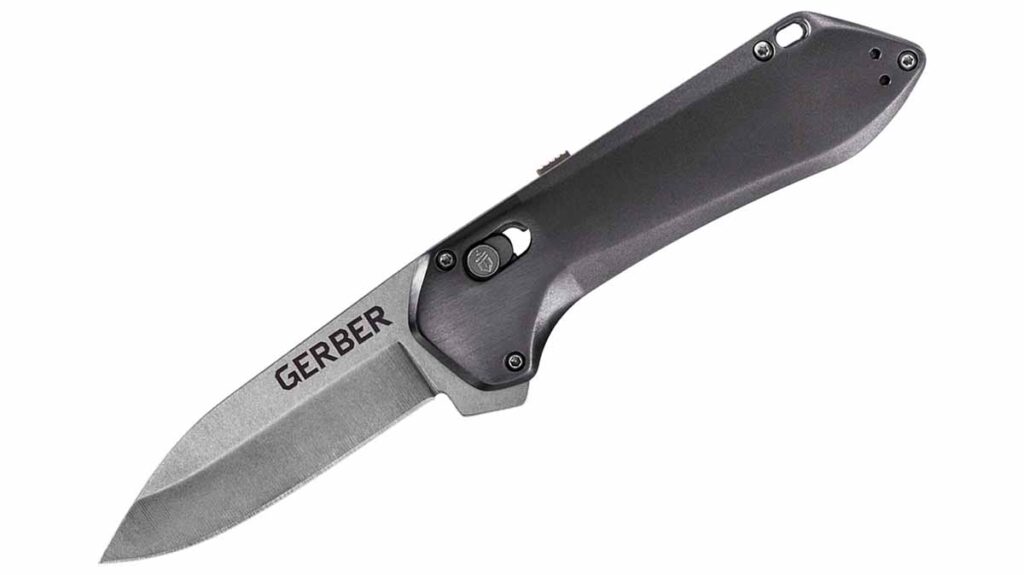
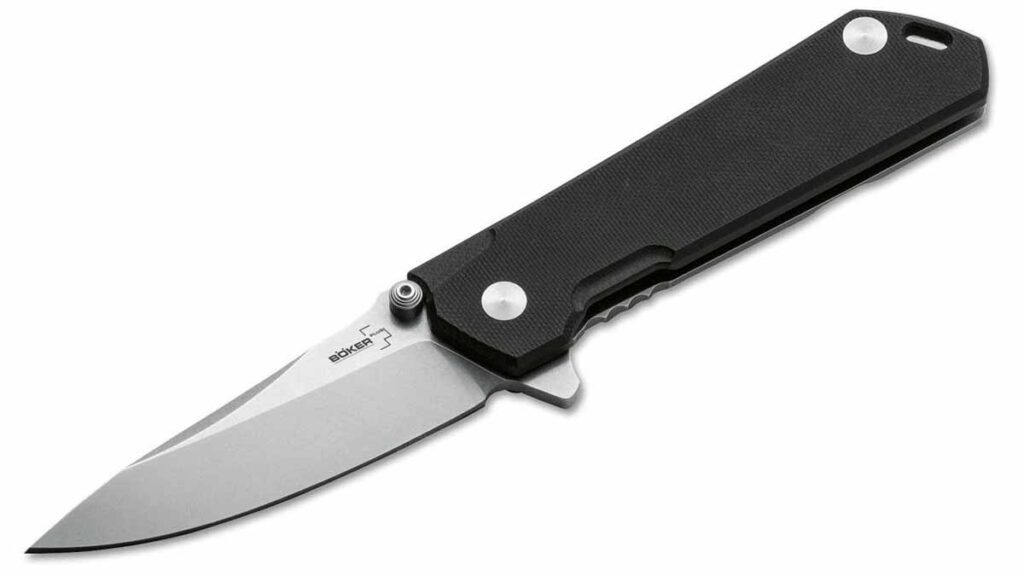
The CJRB Crag Is A Fairly-Priced Knife That Looks Great, Cuts Greats, And Is Absolutely Worth The Investment.
Lighter isn’t always better. As many makers produce more and more knives that are at or below two ounces in weight, a bigger, beefier folder can stand out and appeal to a different type of consumer. Enter the CJRB Crag.
This tactical folder looks cool and feels hefty in all the right ways at 6 ounces in weight. The 3.43-inch blade is flat ground and has a black PVD coating to help with corrosion resistance. It’s ready to rock and roll out of the box thanks to being treated to a 59-61 HRC. The cleaver-style blade is an excellent chopping tool. This knife was built to confidently chop and slice.
What makes it feel even more rugged than it is is the handle. The carbon fiber handle is incredibly light and allows for the weight to be allocated elsewhere in the construction.
What CJRB has done is create a knife that will stand up to intense use and done it to keep things affordable for the consumer. It’s a win/win all the way.
Three Knifemakers Take Us Into Their Shop To Show Us Their Process And How They Forge Steel Into Beautiful Blades.
How serious was Kirby Lambert about buying the necessary equipment to become a custom knifemaker?
“I dropped out of school at the University of Calgary to start my knifemaking career,” he began. “In order to purchase machinery, tools, and equipment I had to sell off the one thing I had that was worth any money—my 1969 440 Dodge Charger.
“My milling/drilling machine was one of the very first pieces of equipment I purchased at the beginning of my knifemaking career. It’s a Force International that was made for House of Tools, which is no longer in existence. I purchased it around 2002, and every knife I’ve made since that time has either been drilled and/or milled on it.
“Some of the most important and most-used pieces of machinery I have are my belt grinders,” Kirby continued. “My favorite is the TW-90 [the one with the yellow belt illustrated in one of the accompanying pictures]. Not only is it one of the most versatile grinders on the market, it’s also designed and made by my good friend, Travis Wuertz. This grinder does it all and then some. Not only do I use it for grinding bevels and the like, it comes with small wheel attachments and an incredible surface-grinding attachment, which is perfect when having limited shop space.”
Kirby bought his other TW-90 grinder from KMG many years ago and uses it often to this day.
One of the latest flipper folders from Kirby Lambert is the Raine in Damacore stainless damascus by Damasteel, a carboquartz handle, and Zircuti bolsters and clip. (SharpByCoop knife image)
“Another must-have tool for any folder maker is a tapping head,” he observed. “It allows you to tap and thread holes quickly and easily. I purchased the one I use from KBC Tool in the early 2000s. It’s mounted to a drill press that has some sentimental value. I got it from knifemaker Bill Schiller, who helped me out a lot when I was first getting started in the early 1990s. Sadly, Bill passed away in 2017.”
Lambert extolled the virtues of a good buffer for fine surface finishing.
“Another of the first tools I purchased that I still regularly use is my buffing unit. I bought it from Bill Schiller as well,” Kirby recalled. “He had done some modifications to it by machining heavier shafts/arbors. With a number of different wheels, buffers and compounds, I use this machine to achieve a variety of finishes on knife blades and parts.”
Kirby’s heat-treating oven is key for preparing the steel that goes into his blades—and it holds sentimental value as well.
“My Paragon oven was given to me by my dear friend and mentor, Brian Lyttle. I worked with Brian for a few years in his shop in Alberta before moving back to Saskatchewan to set up my own shop. If it weren’t for Brian, I would not be where I am today. He passed away in 2016,” Kirby lamented. “No matter how fancy the steel or materials, a knife doesn’t become a knife until it’s properly heat treated. It’s the most crucial step in knifemaking and is the moment the knife gets its soul.”
Mike Quesenberry
Mike made his 9-inch disc sander from sourced components—a 1-horsepower, 3-phase Leeson motor paired with the KBAC-24D VFD and a 9-inch flat steel disc.
A knifemaker since 2005, Mike Quesenberry received his ABS journeyman smith stamp at the 2009 BLADE Show. At the 2014 BLADE Show he earned his ABS master smith stamp and the coveted B.R. Hughes Award for the show’s best knife submitted by a master smith applicant. In a nutshell, Mike makes top-shelf stuff and has the shop to do it.
“A good grinder is essential for the knifemaker and the TW-90 is a great one,” he opined. “Travis Wuertz was the innovator with this style of grinder and has had countless copycats. It’s made with the best materials, motors and VFDs [variable frequency drives] on the market.
“The one invaluable accessory is the surface-grinding attachment. As knifemakers we are in constant need of making things flat, and this does it quickly and efficiently. I own two of these machines. The first one was out of the initial batch back in 2010 and is still going strong today. I can’t say enough positive things about the TW-90.
“If you’re looking to cut down on your hand-sanding time, the 9-inch disk sander is the answer. I made mine from sourced components—a 1-horsepower, 3-phase Leeson motor paired with the KBAC-24D VFD and a 9-inch flat steel disc. The stand is fully adjustable and the addition of the task lighting makes seeing a uniform scratch pattern a breeze. I use repositionable adhesive for the 9×11 sandpaper sheets and for the quarter-inch rubber backing, available from K&G supply. The bare steel disk gives crisp flats and the rubber backing allows higher-grit finishes and bevels blended to a zero edge.”
Keeping everything organized is key, and Mike considers his workbench the most valuable asset in the shop.
Mike Quesenberry forged this damascus double-lugged full integral with a tapered tang. The shaped blackwood scales are left proud and secured with domed Argentium pins. (Caleb Royer knife image)
“The efficiency and organization behind it save me countless hours. My wife, Antoinette, was a huge help in the construction of this bench. Without her it would have never looked this nice,” he noted. “The two side stands are made from Craftsman toolboxes with different drawer configurations. They sit on 2×6 frames, giving rigidity to the structure, but, most importantly, the screw or pin that falls off the bench has nowhere to go. I have found that a paper cutter is the most efficient way of processing strips of sandpaper, and I go through a lot of it. The granite surface plate with 120-grit paper is great for finishing flats.
“The most used part of my bench is the vise. It’s a small one—3-to-4 inches is ideal—and perfect for holding knife-sized work. The stand is built from 21/2- and 3-inch square tubing. It allows the vise to move in and out and up and down. Versatility is the key, allowing you to sit or stand and be comfortable no matter if you’re hand sanding or doing detailed filework. Hours spent at a workstation that is not ergonomic can be hard on the body. Take the time and build a friendly work environment—your body and productivity will thank you.”
Rick Eaton
A GRS engraving instructor since 2005, Rick has an engraving office desk station that includes a GRS GraverMach with Magnum and 901 Monarch handpieces, plus an 860 high-speed rotary handpiece.
Knifemaker Rick Eaton forges the blades for his exquisite art knives, so a dependable hydraulic press is a must.
“For forging damascus I use a Carlisle Imagination Xpress 25-ton hydraulic press made by Jeff Carlisle of Simms, Montana,” Rick stated, adding he doesn’t know if Carlisle still makes the presses or not. “I got this one in 1999 after starting to learn how to forge damascus from Shane Taylor and Steve Schwarzer at Shane’s family ranch. This press has given me 23 years of use with zero problems and I’ve made a whole lot of damascus with it. It has a two-stage pump so the hydraulics work fast. If you have one machine for forging damascus, this one is great. Dies are easy to make and changing them is fast when going to different operations.”
For cooking his steel, Eaton made his own heat-treating oven.
“It’s has a 20-inch outside diameter and about an 18-inch vertical interior diameter. It’s propane fired with forced air using a blower. I received guidance from Shane and Steve on how to build it back in 1999. It has castable refractory cement in the bottom with Kaowool insulated sides covered in more refractory cement. I’ve relined it multiple times—it’s about due for another one. It works great for large cans or stacks [of steel].”
One of Rick’s specialties is the interframe folder, which requires an extraordinary degree of precision to execute. For reducing and transferring his designs he relies on his pantograph.
The Roman Gold folder by Rick Eaton features a Roman-style mosaic damascus blade. The 18k-rose-gold-slab handle is full-relief carved and engraved with two scenes in the bulino style. (Eric Eggly/PointSeven knife image)
“I use a Gorton P2-3 pantograph, made about 1972, that I’ve owned since 1994. I do all my interframes and side-locks using it,” Rick noted. “The one issue with this pantograph is it only goes down to a 2:1 ratio, so my final templates are made at this size. For doing interframes I hand make a 4:1 template, then use this one to make a 2:1 template to cut the handle. This machine gives me the ability to remake an interframe pattern accurately and quickly. Any of my knives that are numbered were done with this, even though my high-end art models are not copied—they are all one-offs.”
Like Kirby Lambert and Mike Quesenberry before him, Rick is a big fan of the TW-90 belt grinder.
“For many of my grinding chores I use a Travis Wuertz TW-90 vertical/horizontal grinder with a 2-horsepower variable 220 motor. I can do just about anything with this grinder,” he commented. “It tracks real well and I love all the different attachments that you can get with it. It’s a top-of-the-line grinder.”
Rick not only does all the engraving on his art knives. He’s been a GRS engraving instructor since 2005.
“I have an engraving office desk station with a GRS GraverMach with Magnum and 901 Monarch handpieces, plus an 860 high-speed rotary handpiece. It has the GRS positioning vise on top of the satellite stand,” he stated. “I also use the Acrobat stand Leica A60 variable microscope, and for keeping the tools sharp it has a GraverHone with Apex sharpening system, all hooked up to a large air compressor out in the shop area. This is GRS’s top-of-the-line setup.”
The Dirk Has A Long, Exciting History And Has Been Used For Everything From Farming To War All Around The World.
The general definition of a dirk is that of a one-handed thrusting knife. Depending on region and style, it may be single-edged or double-edged. It also may or may not have a defined cross guard and pommel.
Dirk as a term is loosely associated with several Scottish and English regions. It is most commonly credited to the former, though no one really knows for sure, and it also has a long history of use across medieval Europe. It was a very important object to people in the Highlands of Scotland at an individual level and had significant ceremonial and practical uses.
Weapons Before The Dirk
As is common in the era of gunpowder in Europe, many types of knives and daggers owed their roots to the bollocks dagger and other stabbing weapons that originated hundreds of years prior when soldiers wore heavy armor. Contrary to popular belief, most swords are not like how you see in the movies. These stabbing and thrusting weapons seldom had what we’d expect as edges, rather they were made to parry and bludgeon. Maces, picks, and hammers were very common in this time, prized for their ability to bash and smash, where swords, while deadly, were not always the first choice.
These long, thin daggers were sometimes the choice when things got up close and personal, though even then the textile layers of armor were hard to penetrate. All that changed with gunpowder weapons causing a wide decline in armor use, and the dirk as we know it today was the product of that evolution. The dirk became something quite different than other edged weapons of the time and developed in its own way, largely apart from other European designs.
The Scottish were some of the first to begin independent development of swords and daggers alongside guns in the post-armor age along with strategies to fight against firearm-equipped soldiers. The heavily tribal Scottish Highlands were not especially invested in standardized firearm technology.
Guns did figure heavily into the culture, but the Scottish never developed a well-oiled machine akin to what the British developed when it came to battles. The Scottish had two primary tools for the battlefield, the broadsword and the targe (buckler), itself a small shield held in the weak hand. The combination of buckler and broadsword allowed the Highlander to easily kill British soldiers, usually armed with nothing more than a musket and bayonet.
They specialized in fast ambushes, often called a ‘Highland Charge’ where they wore virtually no protection of any kind and ran headlong at their enemy. If the enemy didn’t flee on sight, they would only have one shot at most before they had to fight hand-to-hand.
How The Dirk Developed
The dirk traces its lineage to the Scottish Highlands.
The dirks developed in the post-armor era became focused on all-purpose use, not just stabbing or bludgeoning. As a result, sharp, light-bladed swords and short-sword like knives and daggers became the norm.
Slashing through clothing wasn’t difficult and the Highlanders found themselves at a distinct advantage using these tactics. That is, until the Battle of Culloden in 1746.
Here the entirety of the Highlander army was soundly defeated by the British in a battle that lasted an hour. The British faced them on an open field and modified their tactics to anticipate the Highland Charge, resulting in a complete defeat of the Scottish Jacobite movement that had made an invasion into England a year earlier.
Dirks were common even after Culloden. The carrying of knives wasn’t necessarily seen as carrying arms in most cases, and dirks were something of a common, everyday tool for most people. They would be not only used for self-defense but also for regular tasks like eating, splitting kindling, and standard daily chores.
Dirks vs Daggers
Is the dirk a dagger? The short answer is yes and no, and that is because there is a great degree of ambiguity in the definition. A dirk is classically a large, single-bladed knife with a blade anywhere from 12 inches all the way up to 20 inches.
Naval dirks were commonly used for ship-to-ship fighting as they were short enough to be used in tight confines yet large enough to still be effective. Daggers at this time would have been primarily understood to be stabbing weapons, whereas the dirk was large enough and stout enough to be used in a primary slashing role.
Daggers are, by type, geared mostly for stabbing. Rarely do companies refer to any large, single-edged knives as ‘daggers’, but the dirk is often classified right alongside them by name in many laws.
The American dirk which evolved in the early 1700s, was almost always single-edged and was primarily used as a support knife alongside the tomahawk and rifle. It could be said that a significant and wide-ranging number of knife styles, including the Bowie, evolved directly from the Scottish dirk on the American frontier.
Daggers as stabbing knives were somewhat uncommon in America because they lacked general utility in the field at a time when larger camp knives and multi-purpose tools saved weight.
Is It Legal To Own A Dirk?
Unfortunately, Dirks have a wide legal definition across the board that often describes them as daggers or stabbing weapons. In many municipalities, this type of weapon is not legal to carry. There is a blurred line in this definition, as many places considered double-edge, stabbing weapons as the verboten item. As many historical dirks are single-edged, there could be room in these laws that skirts one definition or another.
4 Best Dirks Available Today
COLD STEEL SCOTTISH DIRK- $119.99
Cold Steel is well known for making some very durable and interesting products. They pay great attention to detail and their Scottish Dirk is no different. While it is not the most costly, it is a step above the rest, and it is affordable and backed by Cold Steel’s legendary standard of excellence. The Cold Steel Scottish Dirk is a working tool that does everything the historical versions did and then some. If you’re looking for a hard-use dirk, look no further.
Knife Specs
Overall Length: 18.38 inches
Blade Length: 13 inches
Weight: 1 pound
Blade Steel: 1055 Carbon
Handle Material: Rosewood
WINDLASS BONNIE SCOTTISH DIRK- $149.00
If you’re looking for a prettier dirk than the rest, Windlass makes some excellent historical replicas that reflect various periods of Scottish history. The Bonnie Scottish Dirk is reminiscent of the late stage of refinement on these weapons. It is ornate yet functional and is sure to be a conversation starter. While other companies tend to take some liberties, this is a very accurate replica of what may have been on the belts of Highland Warriors at the Battle of Culloden.
Knife Specs
Overall Length: 17.5 inches
Blade Length: 11.75 inches
Weight: 18 ounces
Blade Steel: 1055 Carbon Steel
Handle Material: Wood
WINDLASS EARLY SCOTTISH DIRK- $139.95
This product is a replica of some early dirks as they would have looked descending from the bullock dagger. A functional reproduction, this early replica features a more basic feature set as would’ve been seen a few hundred years prior to the Battle of Culloden. Although it has unrefined features, it is still not out of place for costuming or period reenacting.
Knife Specs
Overall Length: 21.25 inches
Blade Length: 15 inches
Weight: 16.2 ounces
Blade Steel: 1055 Carbon Steel
Handle Material: Hardwood
CAS IBERIA (LEGACY ARMS) SCOTTISH DIRK- $159.00
This dirk has some classic lines, but is all about function. It will not look odd at a cultural event, although it is made with a slight skew to the modern. The handle design is reminiscent not of the bullock dagger, but the earlier Rondel form characteristic of the late medieval era prior to the renaissance. While it is the most expensive so far on the list, it is right in the same price range as most common dirks. If you prefer this look over the more classic Scottish design, this is the one for you.
When It Comes To Tactical Pocketknives, These Five Blades That Are Worth Your Money And Your Time
The term “tactical knife” was created roughly 30 years ago to describe a specific-looking knife. In general, tactical knife has meant a non-reflective blade and a synthetic handle. However, over time the genre has grown to feature numerous looks and types of blades.
Today, tactical pocketknives are incredibly popular. Whether it’s a traditional flipper, an assisted opener, or even an OTF knife, the market has exploded and knife lovers are the biggest beneficiaries. Our list features five folders to show just how diverse the world of tactical pocketknives is today.
5 Best Tactical Pocketknives
The traditional pocketknife folds and easily slides away into your pocket, and there are many tactical pocketknives that fit that description. These five stand out from a crowded field.
Cold Steel Recon 1 Spear Point
Cold Steel Recon 1 Spear Point
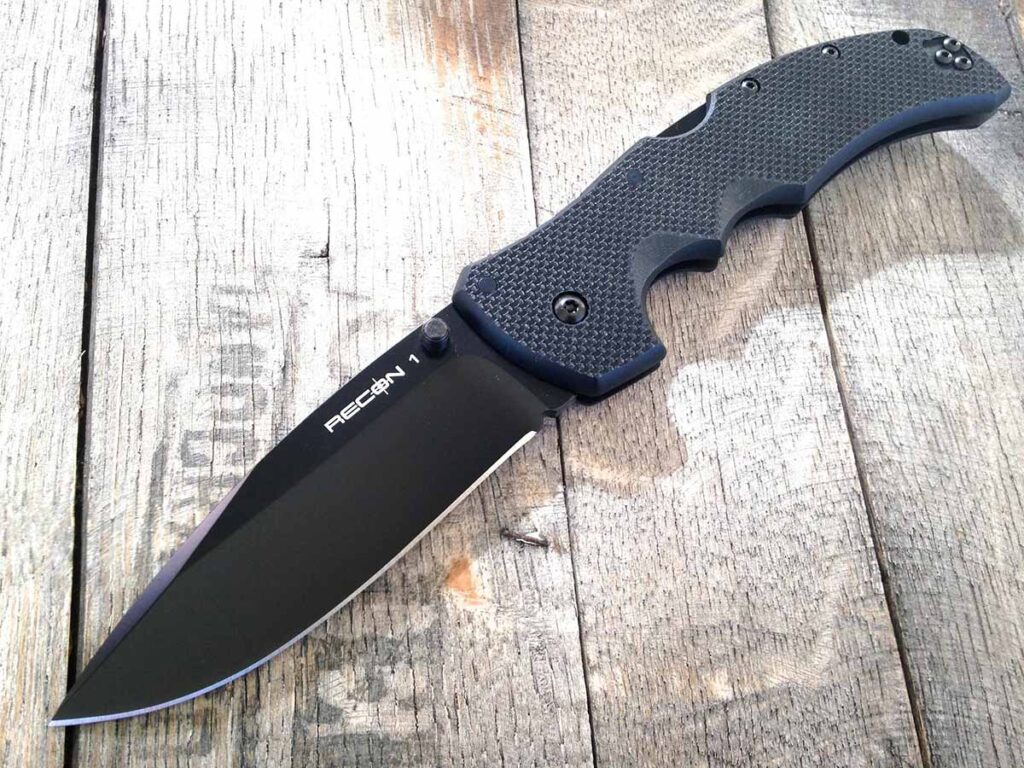
From one of the leaders in tactical knives comes the Recon 1 Spear Point. Cold Steel has made a knife popular with both first responders and civilians that is scalpel sharp and over-engineered to the point nearly everything has been thought of. The American S35VN blade has a DLC coating. The Tri-Ad lock is shock resistant and will keep you safe when deployed. The G-10 handle scales provide excellent grip.
Visually, the Recon 1 just looks cool. The all-black color scheme gives the knife a kinetic feel and encourages you to use it throughout your day.
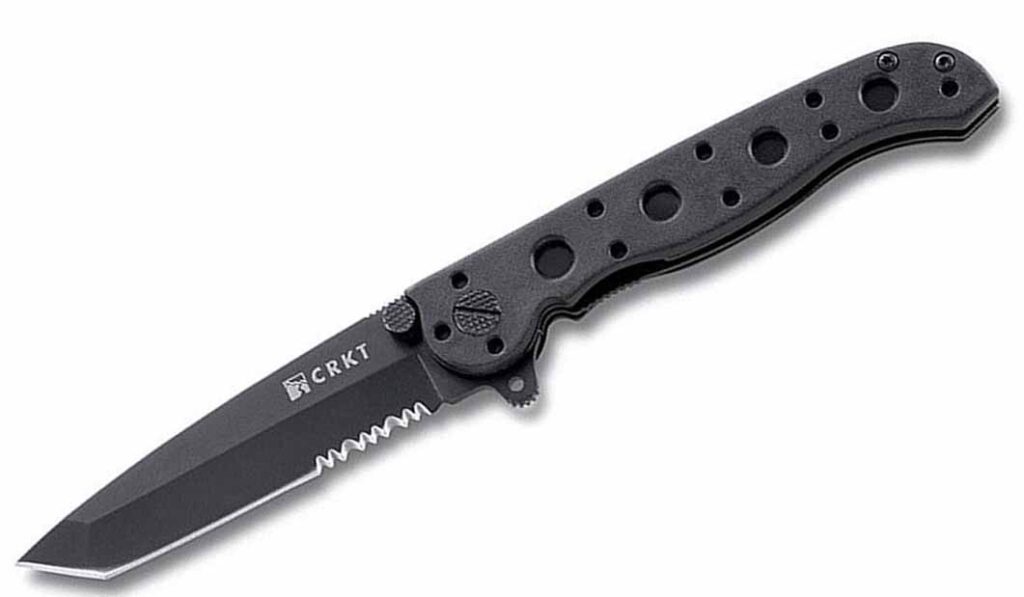
This Kit Carson-designed blade from CRKT is a versatile knife. The dual-grind tanto blade features a partial flat edge and partial Veff serrations. This gives you excellent cutting strength along with the ability to make different types of cuts in tight quarters.
The 1.4116 steel blade is Teflon-coated and connected to a G10 handle. The liner lock keeps the blade securely in place when open. Due to the knife’s open build, two Carson flippers can be incorporated into the piece to create a true hilt, a rarity in folding knives.
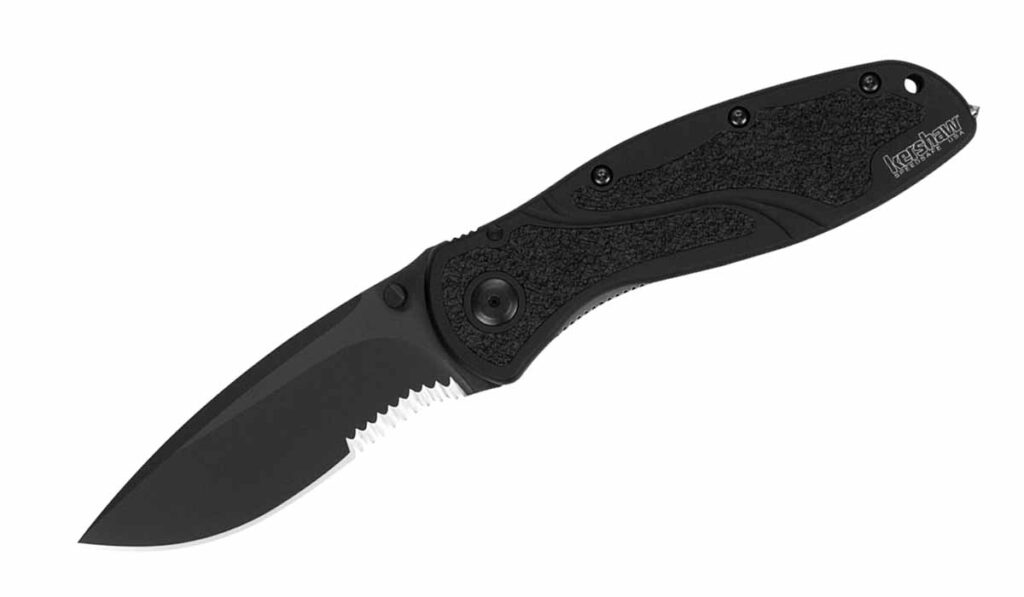
Light. Strong. Serrated. Those are just a few ways to describe this assisted folder from Kershaw. The all-black Blur is just under four ounces and is packed with features starting with the fast-moving assisted-opening mechanism.
The blade itself has a slight recurve, and in the recurve are a series of serrations to make the knife more multi-dimensional. The blade is finished in Cerakote to provide more durability and corrosion resistance. The carbide glassbreaker at the butt of the handle provides yet another way to use the Blur in your day-to-day.
This Ken Onion-designed knife is an excellent piece.
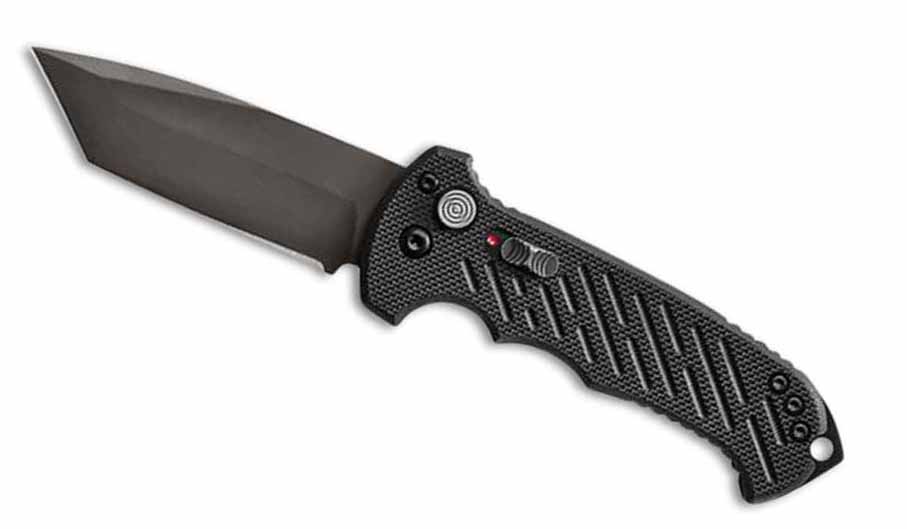
From Gerber Gear, this fully automatic folder is a rugged beast. The push button fires the stonewashed blade out at a high rate of speed, making using the knife that much easier and faster. It feels great in the hand thanks to a slightly higher weight that will give you the confidence to use the 06 in more intense situations.
The aluminum handle can hold up to the use and abuse of everyday life, and the long plain-edged blade makes cutting a breeze. The striking pommel with lanyard hole provides more use for the knife and allows you to travel with it easily.
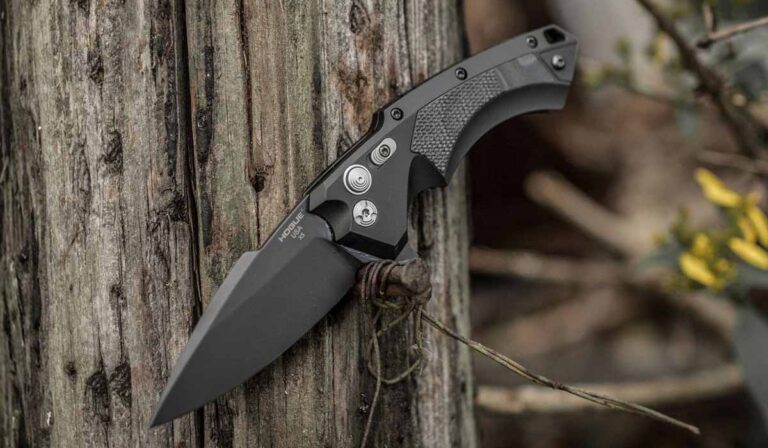
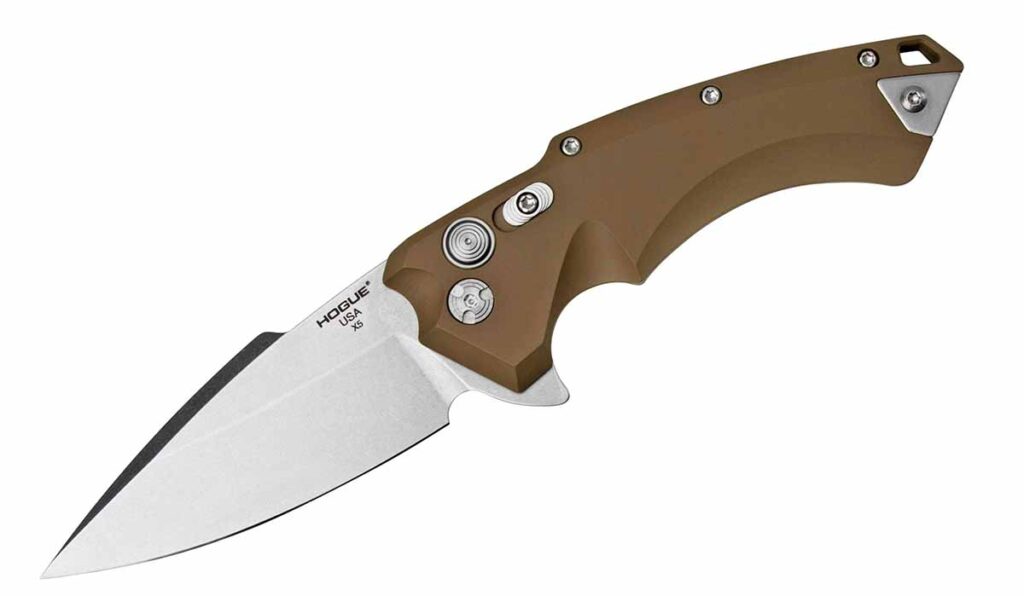
Coming in either a modified Wharncliffe or spear point blade style, the Hogue X5 is a cool, sexy knife. The flipper deploys the blade so fast you would think it is assisted, but it is a manual knife. The Cerakote finish on the blade looks great, and the aluminum handle can stand up to pretty much anything. The push-button lock lets you easily, and safely, close the knife one-handed, and the tip-up pocket clip allows for a deep, discrete carry.
Everything about this knife is cool and begging to be used. Hogue has made a tactical folder that is built well and is somehow even better than the sum of its parts.
Knifemakers Continue To Evolve Their Use Of Social Media Platforms To Promote Their Work And Expand Their Customer Base.
It’s been around a while now—long enough for an update on its relevance and impact on the knife industry. Meanwhile, social media in some ways remains a new frontier for both knifemakers and the market.
It isn’t unusual for those interested in buying an existing knife or commissioning one from a pro to use social media such as Instagram, Facebook, and other windows into the lives and work of custom makers. The media provide outreach and information on an unprecedented scale, and custom makers who take advantage of the opportunity to put themselves in front of the buying public take different approaches.
Some use video, others still photos. Some use music, others narration of what the viewer is seeing. Some allow the hum and whir of machines or the ring of the hammer to set the tone and convey the message. The answers to the questions of where and how to apply social media in their work lives vary among makers, but the involvement of social media in their marketing and sales efforts has become a regular part of their routine.
“Instagram broadens the customer base, and if you aren’t using it you are missing out on that client base,” related knifemaker/5th Special Forces veteran/BLADE® field editor Kim Breed (@kimbreed1911 on Instagram). “I was dead set against it, but my son Keith got me going and said that it was something I needed to do. You can target your audience with a hashtag, and then when someone searches for something in particular it will come up.”
Kim likes to use music as a backdrop for his videos and especially enjoys the rock band AC/DC (the band’s song “Thunderstruck” is among Kim’s favorites). Of course, there are other musical selections, and he ties the tune into what is happening on his Instagram and Reels posts.
“When I’m doing hand hammering or power hammering, I love AC/DC,” he smiled, “and sometimes I’ll use dramatic songs when I’m etching, or whatever. Instagram is easy. I can do it on my phone and post it in five minutes, and I’m sure you can do the same thing with Facebook.”
Since the social media surge, Kim has found that how-to video posts are more popular than pictures of knives alone. He also advocates frequent posting of relevant work in progress.
“I try to post something at least once a day,” he remarked, “and it may be something like etching damascus steel. I get good hits and feedback on that and anytime I post videos working with a milling machine or grinder so people can actually see me building a knife.”
Making Social Media Work For You
Isaiah Schroeder, whose forged gyuto was featured on page 82 of the October BLADE®, uses both Instagram and Facebook and publishes an email newsletter around once a month with his latest knives and prices. That way, everyone signed up for the newsletter gets it at the same time and has an equal chance to get one of his new knives. (SharpByCoop image)
Isaiah Schroeder uses both Instagram and Facebook with the handle @schroederknifeworks and has found a much wider audience than might otherwise have become familiar with his work. He is regularly in front of his followers with updates and information.
“I started doing my email newsletter [www.schroederknifeworks.com/newsletter] several years ago,” he commented, “mostly so that I don’t have to be completely dependent on Instagram’s algorithm to show my customers when my new work is available. With this newsletter, everybody who is signed up for it gets it at the same time and has an equal chance to get one of the knives. I do the whole thing myself using a service called Mailchimp, which just makes it easier to keep the list and format the content. My goal is to have one batch of knives per month and one newsletter per month.”
Schroeder uses Instagram primarily but cross-posts to Facebook when preparing social media input. He sees Instagram as a way to reach more people, and a gallery of his work conveys the quality of his knives and materials he uses. Recently, he has seen short videos take hold and is using these to reveal his shop work. The result has been dramatic.
“Instagram has been great for my business,” he smiled. “I’ve sold knives around the world because of it. I focus on cooking knives, and there is a large foodie presence on Instagram so that meshes well with my content.”
Isaiah also appreciates the free flow of information afforded by social media, everything from the knifemaking process to presentation to pricing. The volume of information at the fingertips of the viewer is incredible, and knowledge is buying power.
“I’m not too shy about posting my prices for the public to see,” he reasoned. “I’ve always wondered why some makers won’t post prices. It’s something people always ask about, so they clearly want to know. I’d rather make it known. Then people can have time to decide whether they think it’s worth it for them or not. I guess it might be different if I were selling through a retailer or making custom orders.”
Knifemakers Grow Their Brand
For his custom knives, Mike Vagnino indicated posting work in progress seems to get the best response and exposure regardless of whether they are still shots or videos. (Vagnino image)
Just getting a custom knife enterprise off the ground from a marketing perspective can be a huge challenge, and when custom knifemaker Mike Vagnino and business partner Patrick Ma kicked off Terrain 365, they immediately began looking for ways to raise their new company’s profile.
“Our primary source for promoting the business is social media, which has worked very well for us,” Mike explained. “Our goal, of course, is to sell knives by making people aware of our brand and drawing them to our website. Patrick handles our social media for Terrain 365, and the key seems to be posting often and consistently.”
While Mike emphasizes he is no social media expert, he acknowledges social media’s inclusion in a sales-and-marketing strategy will pay dividends.
“I use Instagram and Facebook primarily to promote my custom knives and any new projects I’m working on, not necessarily to generate immediate sales, but to keep my name out there. For my custom knives, posting work in process seems to get the best response and exposure regardless of whether they are still shots or videos. I choose not to speak during the video because I think what I’m showing is explanation enough—not because I think it’s more intriguing—although that may be the effect. Actually, I think telling a story might help if it’s interesting enough, but keeping the video short to match the people’s attention span nowadays is what I keep in mind.”
In promoting Terrain 365, Mike and Patrick have found that outdoor photos of the knives in action work best. Since their company is geared toward everyday carry knives and those that are ideal for use in the outdoor environment, their knives are constructed in rust-proof, non-magnetic materials. Take a look at Mike on Instagram @michaelvagnino.
Making First Impressions
David Lisch says Instagram may be the place many knife consumers see a maker’s work for the first time, so everything the maker posts should be first rate.
ABS master smith David Lisch issues both an endorsement and a warning when it comes to his use of social media.
“I have found that social media is both a blessing and a curse,” he observed. “It has been a struggle for me to find a balance. If you let it, social media can eat up so much of your time, time you could spend creating, making, and being in life. It is important to find the balance.”
Indeed, every opportunity carries a requirement for thorough evaluation and an awareness of the unintended consequences.
“I have focused my social media on Instagram primarily,” David added. “It is where I share my knowledge and sell my knives and meet my students. I have taken time to figure out what works for me and how to present myself. It might not seem like it at times, but I take Instagram very seriously.”
For those makers beginning to consider social media as an enhancement to their overall livelihood, Lisch provides a voice of experience and makes a few sound recommendations.
“My advice for knifemakers new to Instagram is to treat your feed like a portfolio page. This is the place people will see your work, maybe for the first time. It is your first chance to make an impression on a potential collector. Go in and clean up your feed on occasion and remove any stupid stuff.
“Keep it engaging,” Lisch continued. “Show work in progress as well as finished work. Use your storyline to keep folks up to date with what you are working on, or what is happening on a lighter side. Because your storyline is only up for 24 hours, it is self-cleaning. It is a great opportunity to have fun and connect with the folks interested in your life. Be yourself; do not try too hard to create content that is not you. Use hashtags and try different ones. Post to Reels, and if they are good they may go viral. As your audience grows, remember you are also a role model. If you are working, wear your safety gear. Be real.”
David can be found on https://www.instagram.com/davidlisch/. Click “Highlights” on his Instagram home page for his free video classes.
The social media phenomenon is sure to stay with makers into the future, and participating in the most effective ways will produce the desired benefits for them and their customers. True enough, getting involved may be a bit intimidating, but taking the plunge is becoming more of a necessity every day.
The Assisted-Opening Knife Is A Powerful Type Of Pocketknife Beloved By Blade Lovers Around The World. These 12 Stand Out From The Pack.
There are quite a few minor differences that separate various types of knives that are otherwise visually or externally indistinguishable. In the same vein as a sword is a sword or an axe is an axe, many people treat knives simply as a variation on a basic theme. In the case of assisted-opening knives, this has led to a great deal of confusion, and for the most part, a large amount of legal misunderstanding.
ORIGINS OF THE ASSISTED-OPENING KNIFE
The foundational designers of the assisted-opening knife modeled their mechanisms along very similar lines—mostly based on motorcycle kickstands. BLADE Magazine Cutlery Hall-Of-Fame® member Ken Onion is a well-known knife designer and was among the first to arrive at a mass-produced design.
While Onion was not the first, his basic design set the stage for what we have today. Before him, Cutlery Hall-Of-Famer Blackie Collins arrived at a design that was successful. There is a distinction at this point. Some assisted openers are described as “gravity knives” or “flick knives” and this is both true and false.
Some of the first successful gravity knife designs required the user to open the mechanism and the blade would slide down without spring assistance. Flick knives are generally undefined, but in general, require a flick of the wrist to deploy the blade either out the front or from the frame.
One of the most widely issued versions of this is from the Nazi German Air Force, where most aircrews in the Luftwaffe were given a type of out-the-front gravity knife. These became popular bring-back trophies and were oftentimes miscategorized as automatic or switchblade-style knives, and as flick knives.
The original German models never had a spring inside the mechanism. If they had, they would have qualified under modern law as an out-the-front automatic. This knife does deploy extremely quickly, often as fast as a spring-loaded variant.
These incorrect terms are bundled and grouped into the broad ‘bad knife’ generalization. The mechanical function of the assisted-opening knife is to finish opening the blade, not to deploy the blade on its own. This may seem like a minor thing but it is very important legally.
IS AN ASSISTED-OPENING KNIFE REALLY A SWITCHBLADE?
A relatively confusing aspect of this topic is what exactly constitutes a knife that falls into the dubious “switchblade” category, and what is an assisted-opening mechanism. The casual observer may not notice any difference in terms of function. In most cases, it appears that the blade simply pops out on its own from the handle.
The primary difference in this is that an automatic knife is self-actuated, usually with the push of a button. A knife that operates via an assisted-opening mechanism requires a person to start the opening process before the blade actuates and finishes opening itself.
This may seem like a trivial difference, but when it comes to skirting or working around restrictive laws, there is a great deal of importance that is occupied in that slight separation. We tend to see this in many cases where even cosmetic details can determine legality.
In 2009, there was a federal effort to clearly define and limit the number of restrictions that could be placed on knives that were determined to be of the open-assist and one-hand-opening variety, as opposed to those categorized directly as switchblades. 15 US Code 1224 Exemption 5 states that:
“A knife that contains a spring, detent, or other mechanism designed to create a bias toward closure of the blade and that requires exertion applied to the blade by hand, wrist, or arm to overcome the bias toward closure to assist in opening the knife.”
In other words, this defines an assisted opener as a knife that is designed to remain closed until acted upon, whereas a switchblade could thus be assumed to be a knife that is biased to remain open unless retained. These small variations in legalese are all we have that draw a line between what constitutes a legal assisted-opening knife and something reputedly “more inherently dangerous.”
HOW DO ASSISTED-OPENING KNIVES WORK?
As mentioned above in the legal definition of an assisted opener, the preeminent design feature is that the blade remains closed under a given mechanism until a force is applied to it. The mechanism necessary for a knife to accomplish this is quite complicated.
Not only must the blade be able to interact with an internal spring, but that spring also needs to generate enough pressure on a very small rotational axis to extend it to its final position and provide the energy to bypass the locking feature. This could be a linerlock or any number of locking mechanisms.
Because there are a tremendous number of functions being asked of this mechanism, they tend to become quite intricate, and for the most part, should not be disassembled by the owner. If something goes wrong with any type of assisted-opening knife, the owner should contact the manufacturer and get it repaired at the factory. Many of these mechanisms share more in common with watches and other fine pieces of machinery than they do with other knives.
There is a wide range of variation in terms of design from company to company. As a result, you will tend to see that, while assisted-opening knives are a general category, most manufacturers prefer to put their own spin on the terminology used to describe their product.
There isn’t a functional difference between what a company calls its design and what it accomplishes. What matters at the end of the day with assisted-opening knives is that they produce the same end result preceded by meeting the legal requirement of being an assisted opener. It doesn’t really matter if the mechanism is actuated by a thumb peg, flipper tab or wrist flick, the end result is the activation of the spring override forcing the blade to lock into the open position.
The basic design of most assisted-opening knives requires the blade to be manually opened at least 1/4-1/3 of its total travel before the spring takes over and opens it the rest of the way. This can be accomplished through numerous designs. The most common relies on an internal spring in the mechanism that resides on a cam, the latter interacting with the geometry of the rear of the blade surrounding the hinge pin.
Past a certain point, the shape of the parts allows the spring-loaded cam to interact with the gradual, declining angle of the back of the blade, thus forcing it open against the tension. Of course, this is just one way to describe how this works, and individual designers and companies will work around existing patents and models to create new ways to get the job done.
ARE ASSISTED-OPENING KNIVES LEGAL ACROSS THE BOARD?
The short answer to this is, yes, and no. In some states, it matters more how you carry the knife than what type of knife you were actually carrying. Michigan, for instance, allows the open carry of most knife types, regardless of features.
When it comes to carrying concealed, there are some murky definitions. In general, if a knife is visible, at least partially, such as in a front pocket, it is considered open carry. The vast majority of states allow everyday carry for assisted-opening knives. In fact, many states also allow the carrying of automatic knives as well.
Best Assisted-Opening Knives For The Money
While assisted-opening knives may not be for everyone, they are incredibly popular and made by manufacturers around the world. These dozen show off the breadth of models available on the market today.
Kershaw Cryo II
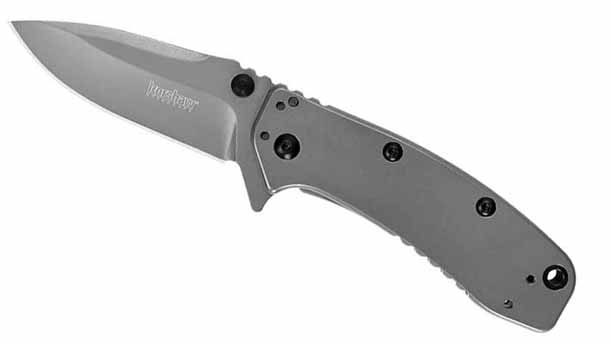
The Cryo II is a very clean, basic carry knife that features a smooth, curved edge without separation. The knife is slab-sided without texture; it can be slippery in the hands if wet or sweaty. The framelock mechanism is very strong and should provide years of reliable service for a very modest price.
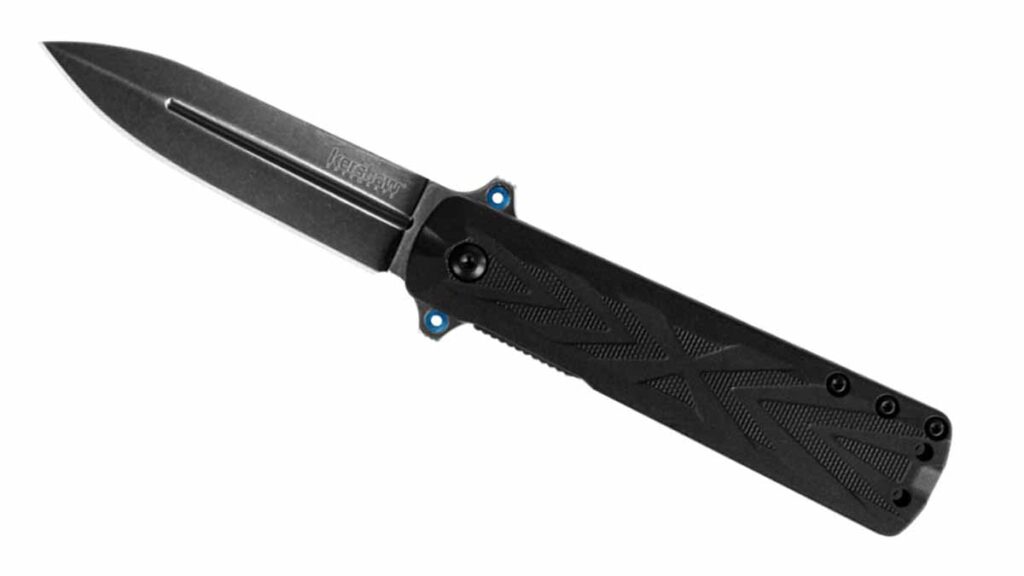
The Kershaw Barstow is a very affordable knife at a suggested retail price of under $40. It features a spearpoint blade and a black-washed finish. For being as inexpensive as it is, it is a true assisted-opening knife and affords the owner a great deal of function at a very low price. While not the highest-end model out there, this low-profile knife will be sure to please.
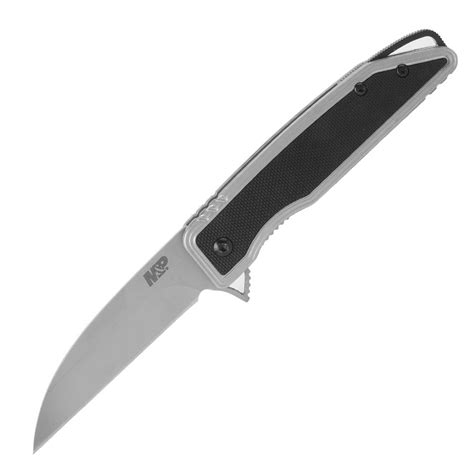
This attractive and very affordable knife bears the Smith & Wesson logo. Its sheepsfoot blade has a clean, straight edge. Despite its low price, this knife has a great degree of utility and is a welcome companion in the pocket or work bag. The blade profile lends itself to general work, and it shouldn’t draw attention when out in public.
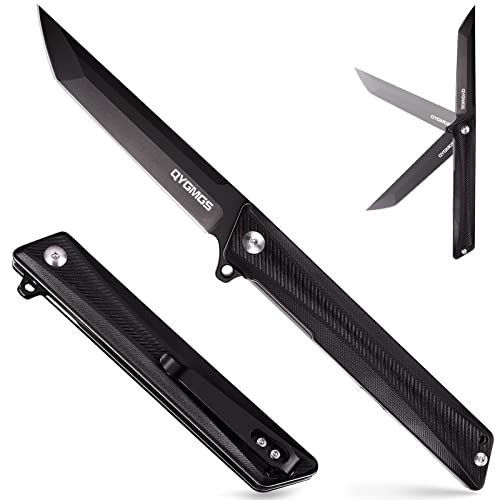
The ‘Amazon Special’ is fashionable and quite affordable. The tanto-style blade comes in serrated and plain-edged varieties. For being as inexpensive as it is, it has an impressive number of features that are extremely well thought out. The handle has an anti-slip texture and is machined from durable G10. The blade pivots on ceramic ball bearings. For being a Chinese import, it punches above its class.
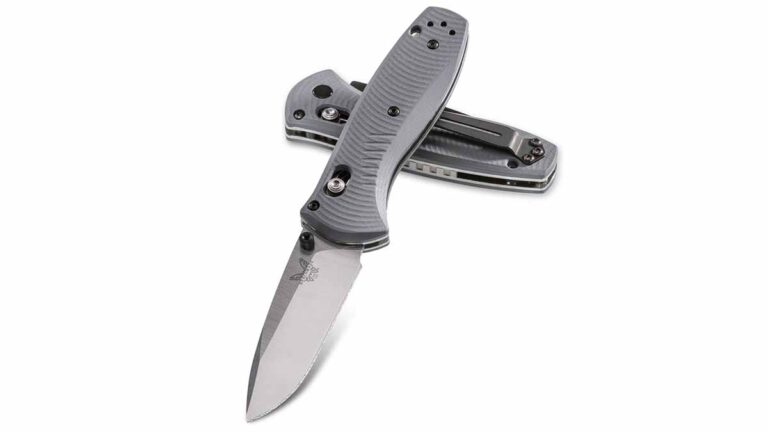
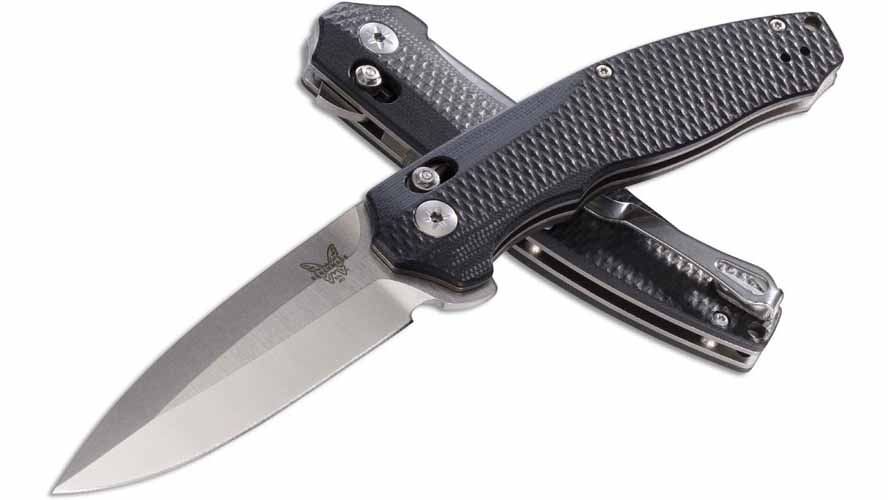
Moving up quite substantially in price is Benchmade’s 495 Vector. This is a symmetrical pocketknife that simply bleeds quality while being fairly low profile at the same time. If you prefer to carry a top-of-the-line design without drawing unwanted attention to yourself, this is going to be a top choice.
Another top-shelf choice from Benchmade, the Barrage has an aggressive, tactical look that features a plain-edge blade. While it certainly has that bad boy look, it is quite functional in terms of features and utility for cutting tasks at a relatively high cost compared to other assisted-opening folders. If you want top quality and want to look good doing it, this one is hard to beat.
P.S.D. stands for Particle Separation Device, and CRKT’s folder certainly lives up to the futuristic nomenclature. While the materials used in the construction of this knife are becoming more commonplace, it is hard to find them for this price point, and the PSD delivers a very nice, clean appearance for a relatively low cost. CRKT is well known for the quality and affordability of its edged tools, and the PSD is sure to be a favorite come the holidays.
The Gerber Highbrow is ambidextrous and features an easy-to-use sliding lock just under the spine next to the pivot. The edge is plain with a distinct, drop-point profile. At a price of around $50, it is affordable and makes for a good gift for that someone who is worth the extra few dollars around the holidays.
Boker Plus offers the Kihon designed in conjunction with custom knifemaker Lucas Burnley. Lucas is a hot tactical maker whose Japanese-inspired designs have garnered him worldwide acclaim.
The Kihon’s modified clip-point blade is a little over 3 inches long and made from D2 tool steel, long known for toughness and impact resistance. The blade is flat ground for exceptional cutting through a variety of media. A machined recess on the spine serves as a thumb rest to apply pressure and more control. Ambidextrous thumb studs double as the blade’s positive stop when open. A flipper tab offers quick, easy one-hand opening. Caged bearings in the pivot ensure smooth blade rotation.
The handle is a hybrid construction of a stainless steel framelock side mated with a textured OD green G-10 scale for weight reduction and grip enhancement. Gold-colored collars provide a classy visual touch to the pivot and handle screws. A large standoff is also anodized gold to match the other accents.
The lock side features a lockbar stabilizer disc to prevent blade overtravel. A neat wire pocket clip carries the closed knife blade tip up. The blade and steel lock side have a black stonewash finish for low glare and added corrosion resistance. However, the clip is not reversible for lefties. Milled-out oblong cavities in the handle’s lock side reduce weight.
The Kihon is a great EDC. The thumb rest relief helps control the blade, which provides enough length and belly to do most cutting chores. The action is smooth and predictable. Press the flipper, feel the tension load up and the blade propels to the open and locked position.
The assist mechanism performs like the Kershaw SpeedSafe originally designed by BLADE Magazine Cutlery Hall-Of-Fame® member Ken Onion. If you own any SpeedSafe knives then you know how the action is, and the Kihon is very similar in feel. There are no problems with handle comfort, either. The knife is easy to hold and there are no hot spots.
MSRP: $119.95
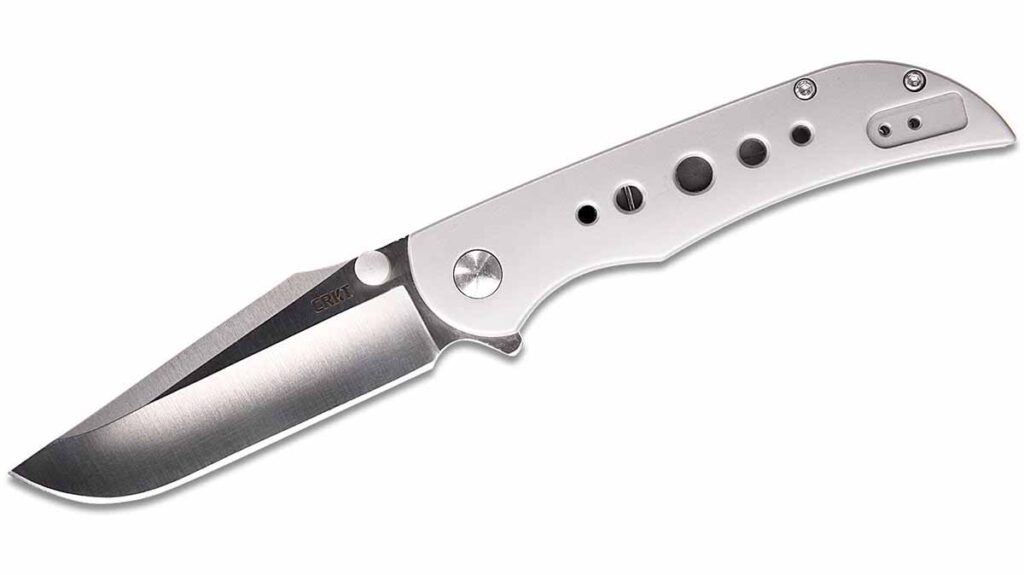
CRKT Oxcart
You may snicker at the Oxcart moniker but once you see the knife, you will clearly understand the name. The new entry from CRKT is somewhat of a dichotomy—the handle slab and blade stock thicknesses are what you would normally find on a large, heavy-duty folder, while the Oxcart is compact and slender.
Knifemaker Robert Carter is the designer. He is the son of maker Joe Pardue and grandson of Cutlery Hall-Of-Famer Mel Pardue, so the pedigree is impeccable. The modified clip-point blade is hollow ground from .16-inch-thick AUS-8 stainless steel. The blade is 3 inches, ideal for an EDC work knife. Large dual thumb studs provide purchase for rapid opening, and an extended flipper tab quickly deploys the blade. The blade rides on the Ikoma Korth Bearing System (IKBS) for ultra-smooth action.
The stainless-steel handle is .15 inches thick—about as thick as the blade. Drilled holes reduce weight and enhance aesthetics. A sturdy framelock secures the blade open with bank-vault lockup and zero play. A stabilizer prevents blade overtravel.
A large finger recess enables you to index your grip. The butt tapers to fit the heel of your palm. All handle edges are rounded for further comfort. The deep carry pocket clip positions the closed Oxcart blade tip up and is reversible for lefties. While the heavy-duty build gives the knife impressive heft at 4.7 ounces, it doesn’t weigh you down in the pocket.
As a work knife, the Oxcart shines. The hollow-ground blade bites hard and deep. It is a very efficient cutter. It’s so sharp we had to guard against nicking the wires inside the casing when stripping electrical wire. Due to the extra width of blade and handle, the Oxcart can be used hard without worry that the blade will break or the tip will snap.
One minor complaint with the compact grip: I found myself wanting a bit more to grasp when bearing down to cut through tough materials. However, it being a “compact big knife,” that would ruin the design philosophy. The assist mechanism is CRKT’s multi-wave torsion bar design that provides firm, fast action, with excellent detent closure. A semi-solid push on the flipper overcomes the detent, sending the blade to the locked position in one swift motion.
AUS-8 steel is well known in more moderately-priced knives as having a good balance of edge holding and ease of maintenance. No problems with the steel—it’s a solid performer. I also like how positive the framelock engages, so there are no worries about accidental unlocking. It’s very tight but easy to unlock when needed.
MSRP: $99.99.
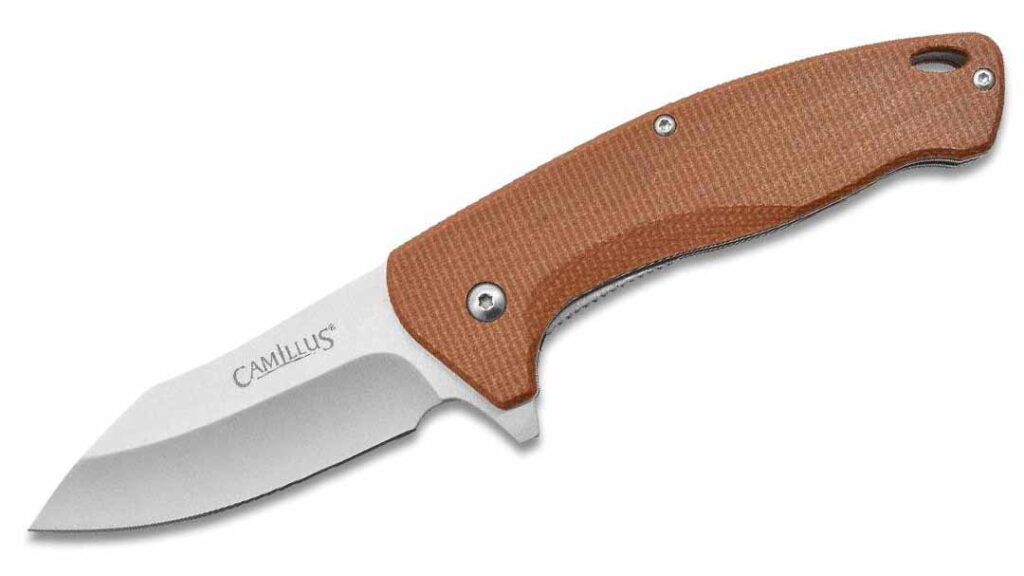
Camillus Arvo
The Camillus Arvo is the most value-conscious of the test group. The 3-inch drop-point blade is made from 420 stainless in a nice satin finish. The blade is utility friendly, with a defined tip for scoring tasks and a belly for most general cutting chores.
The flipper tab extends far enough to function equally as well as a single guard. The sole method of deployment is the flipper; the blade is devoid of thumb studs or discs for a streamlined appearance.
The handle features a typical construction method for tactical folders with dual stainless liners and scales of brown linen Micarta® for strength, high rigidity and dimensional stability, regardless of the elements. The linerlock release has a series of notches for purchase with your thumb when the blade is unlocked. A heavy-duty steel clip provides deep pocket carry of the closed knife in the blade-tip-up position.
The Arvo’s price point is very affordable, which appears to have resulted in a few “oversights.” First, the scales were not finished as smooth as I would have liked. The surface had a texture like peach fuzz from the linen in the Micarta. Don’t get me wrong—having a rougher finish on Micarta isn’t necessarily a bad thing, as the rougher texture aids in grip traction. Nonetheless, the surface finish could be improved.
Second, the edges of the blade spine and flipper tab are crisp. If you are into bushcraft knives, you know that a 90-degree spine is good for striking with a ferro rod to make sparks for fire. However, a 90-degree spine in an EDC folder creates unnecessary sharp corners. Luckily, these can be easily remedied with a metal file and gently rubbing the corners to soften them.
Finally, most flipper folders have the tab with traction notches on it for purchase. The Arvo has no such notches. Otherwise, the knife is a great size for EDC and the handle design is good and comfortable. I love the integral guard formed by the front of the handle at the pivot.
The assist mechanism works very well. Again, judging by the action, I’d say it’s similar to the SpeedSafe torsion-bar type. Deploying the blade is fast and easy. The action is smooth and swift, with the blade riding on Teflon washers. There are no bearings.
The low-end 420 stainless blade steel doesn’t hold an edge nearly as long as even the mid-grade stainless steels such as AUS-8, 8Cr13MoV and VG-10. However, the tradeoff is it’s easier to resharpen. Out-of-the-box sharpness is just OK. I’ve seen better on budget knives and I’ve seen worse. When I put my own edge on it, that’s when performance improved.
At its price point, the Arvo serves well as a work knife. It’s a great alternative to Zytel-handle locking folders and you get upgraded handle material with the Micarta. The hollow grind allows the blade to slice effectively and bite into materials easier. The edge dulls quickly depending on what you’re cutting, so you might benefit from carrying some sort of compact sharpener. And if you end up losing the Arvo, you can buy another one without breaking the bank.
The only thing I found as a slight issue with this particular sample is the blade was off-center a bit when closed. Given the low price, I am more forgiving of such things. However, it has no bearing on the action or cutting performance. The lockup is firm and sure.
There’s a lot of features going for this knife for the price: Micarta handle, deep carry pocket clip, flipper tab, assisted opening and open handle spine. Many of these features are found in knives priced way higher.
MSRP: $27.99
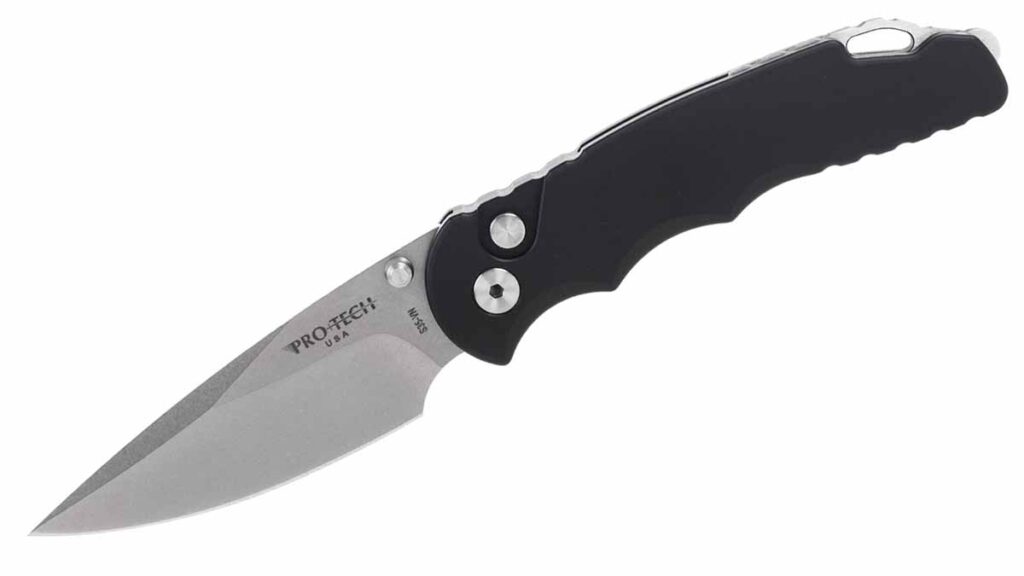
Pro-Tech TR-5 SA
Known widely for autos, Pro-Tech offers an assisted opener with the TR-5 SA. Essentially a scaled-down version of the company’s TR-4, it has tactical styling, superior materials and a distinctive spring-assist mechanism.
The 3.25-inch blade is CPM S35VN high-performance stainless. The modified drop-point pattern has flat-ground main bevels with a swedge added for a bit of attitude. A single thumb stud helps open the knife. The blade comes in a nice stonewash finish that hides scratches and helps resist corrosion.
The handle features rounded ends and a tapered design from pivot to butt. Several large finger grooves help seat your hand securely, along with a series of traction notches following the three finger grooves.
On the handle spine, traction notches are milled into the thumb rest for a non-slip grip. The handle spacer is milled from 416 stainless and also has traction notches to enhance grip. The end of the spacer protrudes a bit at the butt, forming a skull crusher pommel.
The handle slabs are T6-6061 aluminum given a Type III hard anodized black coat for scratch resistance and aesthetics. A deep carry pocket clip presents the closed knife blade tip up. When clipped in the pocket, none of the knife protrudes above the seam.
The handle feels very comfortable and instills user confidence, with no hot spots. Pro-Tech’s high standards for manufacturing excellence carry over into its base models with plain aluminum handles such as this one. The pivot screw and lock button sport spun finishes that reflect light in a refined manner. It’s such nice little touches that set Pro-Tech apart.
The assist mechanism is different from other assisted openers. For starters, it uses the same coil-spring design that drives the company’s automatics. If you’ve handled a Pro-Tech auto, you know it has a strong spring and a nice recoil. The same goes for the TR-5 SA.
There’s an additional component to the mechanism designed by award-winning maker Matthew Lerch: an unusual spring-loaded detent that holds the blade closed. The result is a strong detent that requires a firm push of the thumb stud to overcome; from there the coil spring takes over and drives the blade open. As a result, you get the legendary Pro-Tech action for those who cannot legally buy autos. The action is indeed the fastest of the featured assisted openers and, I believe, the fastest on the market.
Acclaimed Makers Tom Krein, Jerry Moen, And Ben Breda Take Us Into Their Workshops And Show Us How They Turn Steel Into Knives.
For Tom Krein, making the shop comfortable is a big step in being productive and efficient.
“While it might not be quite what you expect, I consider things like a restroom, central heat and air, and a full kitchen as things that keep me at the shop and productive,” he commented. “I’m often here 12-to-15 hours a day, and having these available makes me comfortable and able to work longer. While it’s probably not something that would immediately come to mind, I consider this setup one of my most useful tools.”
Since Tom’s shop is not at his home, these add-ons make a difference in time and travel. No doubt, the ability to work and then take a quick break improves the quality of his finished knives as well.
When hard at work, Tom utilizes several key pieces of equipment. A variable speed mini mill from Little Machine Shop is a workhorse.
Tom does his CNC work on his HAAS Super Mini Mill.
“I have two of these that are very similar,” he said. “I’ve used these to build many folders. They take a lot more time than a floor model Bridgeport, but they can get the work done. Now that I have the HAAS CNC, I mostly use these for precision drilling, deburring and counterboring.”
While working for long-time custom maker Bob Dozier in 1998, Tom bought a grinder from his employer.
“I actually got paid to put it together,” he smiled. “I grind on it day in and day out. It wasn’t cheap when I purchased it, but it has never let me down. I’ve literally ground thousands of blades on it.”
Dozier was also influential on another of Tom’s most important shop tools.
“Bob helped me build a variable speed buffer in 1998, too,” Tom said. “This is another machine that I use on every single knife multiple times. I don’t know how I would make knives without it. It is currently set up with a ¼-inch cardboard wheel on the left-hand side for sharpening and a deburring wheel on the right-hand side.”
Tom Krein gravitates more toward making folders these days, such as his Alpha model. (Whetstone Studio knife image)
Tom has been making custom knives for nearly 30 years, and he is gravitating more toward folders now due to a touch of arthritis in his hands, but continues to make some fixed blades. His signature materials are D2 tool steel—a preference he gleaned from Dozier—and NitroV stainless steel as well. He uses a lot of G-10 and Micarta® for handles along with stabilized koa, stag and mammoth.
Jerry Moen
The day-to-day grind in the custom knifemaker’s shop is typically only as productive as the maker’s tools will allow. Skill, investment of time, and precision in the finished product are heavily influenced by the function and quality of the tools, and what the available equipment will allow.
For veteran knifemaker Jerry Moen, his best offerings from the shop are homegrown to a great extent. After selling a large number of shop tools and pieces of equipment to custom knifemaker and friend Todd Begg a few years ago, he regularly employs his own creations from Moen Tooling.
The Moen Blade Grinding Fixture includes carbide file guide blade clamps, a rugged anodized coating, friction-free nylon gliding surface, dual handles and adjustable blade standoffs. Jerry demonstrates it here in conjunction with the Turbo Grind Evo3 at BLADE Show Texas 2022.
“I use the basic stuff in my shop when I’m making a knife,” Jerry began, “so there really isn’t anything special about those things. But the platen from Moen Tooling has been a game changer for many makers who have ordered it so far. I can’t thank Princeton Wong enough for his contribution to Moen Tooling, either. Princeton is a brilliant young engineer, and I first realized his talent at the Fort Worth Show when he won best new maker.”
The platen indexes the knife blade and virtually eliminates the problems with belt bumps and heat that go along with other such products. The result is better symmetry and a smoother grind. The grinding process is also cooler, allowing the maker to use finer belts and minimize the bump.
“I’m a user of all the grinding fixtures Jerry has produced,” commented custom maker Tom Overeynder. “Using the new platen and grinding fixtures will greatly jump start new makers as well as old timers in accomplishing more accurate grinds. The user can hog off stock and can do the most delicate jobs. Overall, I love it and highly recommend it to anyone interested in doing top drawer workmanship.”
Moen pairs his platen with two other indispensable pieces of shop equipment. The first is his functional Outlaw grinder, and he believes it is adequate for the jobs at hand. However, he is close to a deal with AmeriBrade to promote its products.
He has also developed the Moen Blade Grinding Fixture, which includes carbide file guide blade clamps, a rugged anodized coating, friction-free nylon gliding surface, dual handles and adjustable blade standoffs. The dovetailed clamps help with transitions and the fixture is well-suited for flat, hollow or small-wheel grinding.
“This fixture takes all the guesswork out of it,” Moen noted. “It’s all indexed perfectly, and you can set angles where you need them. It holds the blade and sets the bevel you put on it, and you can flip it from one side to the other and take it to a 1200-grit finish in 30 minutes.”
Jerry sold Princeton 25 percent of Moen Tooling some time ago, and the two have made an impressive team.
Jerry Moen makes fine folders such as this one in a lightning-strike carbon fiber handle and is founder of Moen Tooling. (Eric Eggly/PointSeven knife image)
“He can do CAD and has helped with the design on some of our new stuff,” Moen added. “I might be the one with imagination but I depend on the best people I can find for what I’m short at.”
Custom maker Bob Ohlemann has put the Moen platen and fixture system to work as well.
“These days, I spend about as much time teaching knifemaking as I do making my own knives,” Bob remarked. “Most of my ‘dress tactical linerlock’ students are established makers looking to expand their skill set and offer new products to their customers. One of the most important techniques students look to learn in my classes is how to create high-precision bevel grinds with beautiful sweeping plunges and reduce their time hand finishing blades. This is where the Moen Tools platen and fixture system excel.”
Ben Breda
American Bladesmith Society Journeyman Smith Ben Breda tackles the forging of custom knives with an array of proven shop tools and equipment.
He has been forging knives for 10 years and has been full time for six of those, specializing in chef’s knives, hunters , bowies and fighters. He uses premium handle materials such as wood burls, stag and ivory. When fully engaged making knives, Ben has John Perry handle broaches nearby.
“These are a must for properly fitting hidden-tang handles,” he explained. “They are very well built and make fitting handles effortless.”
Ben said his John Perry handle broaches are a must for properly fitting hidden-tang handles.
Ben’s variable-speed-head Bridgeport milling machine is in continual use, and for good reason.
“This machine allows the maker to fit guards quickly and accurately, which is a must in any knife shop,” he commented. “This machine was a Craigslist find and similar machines often come up for sale. They are pretty easy to find.”
Pounding away at a piece of steel is part of the process for Ben, and he depends on a 50-pound Little Giant Power Hammer to get the job done.
Ben Breda counts such majestic bowies as this one among his specialties.
“With this old mechanical hammer, the maker can break down large steel stock and damascus billets and forge blades with ease,” Ben noted. “I bought this hammer from a retired knifemaker and had it shipped to my shop.”
Ben identifies the Wuertz TW90 belt grinder as another of the most important tools in his shop.
“Blades can be ground to very precise dimensions with this,” he related, “as well as hardware shaping and, of course, sculpting knife handles. The machine can be used at slow speeds for wood and high speeds for grinding steel away fast. It comes with several attachments as well as a horizontal option, making it a very versatile machine. These grinders can be bought directly from the Wuertz machine company.”