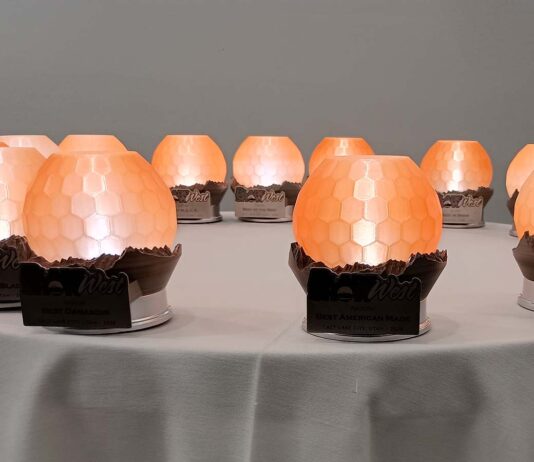
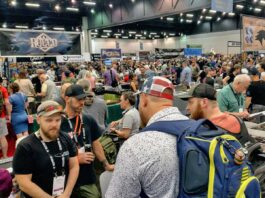
BLADE Show, the world’s largest knife show, has announced a major venue upgrade for its BLADE Show West exhibition. The 2021 event will take place at the Long Beach Convention Center in Long Beach, California, on Friday and Saturday, Oct. 8-9.
After months of searching for the best possible location for BLADE Show West, the BLADE Show staff unanimously concluded that Long Beach is the place to be.
“Many exhibitors and attendees who joined us in Portland, Oregon, for the past two West shows suggested ways we could improve on the experience. We listened and started looking for alternative locations. The Long Beach area has so much going for it that this was an easy decision,” said Alicia Newton, BLADE Show director.
“Foremost in our decision is the fact that Long Beach is knife-friendly in ways that many of the other venues we considered are not. Management at the Long Beach Convention Center has been easy to work with and is genuinely excited about adding our event to their calendar. Exhibitors can expect great show traffic and hassle-free transactions.”
Long Beach has all the amenities that show attendees and exhibitors value. It’s easy to navigate, there are plenty of hotel options, and a huge variety of dining and entertainment options can be found within walking distance of the convention center. Further, the size and layout of the convention center lends itself to expansion in future years.
Additional details, including lodging information, will be posted regularly at bladeshowwest.com during the coming weeks, so check back often.
Three blades with an Eastern design flair are zesty cutters
For many decades Asian knives, tools and swords languished in the cutlery industry, remembered most for blades brought back by U.S. service personnel who fought in the Pacific during World War II. Times have certainly changed, thanks in no small part to a highly accomplished custom knifemaker named Bob Lum.
Of Asian descent, Lum introduced the custom knife world to his “American” version of the Japanese tanto and leaf-shaped blades circa 1980. Through the balance of the ’80s, and later in the ’90s, Lum’s tanto design was rabidly embraced by a budding modern tactical knife crowd. The tanto has been a mainstay ever since. Other Asian blade styles, such as the bolo and kukri, have been embraced as well. My team and I look at three modern takes on the “Asian Equation” here and put these intriguing cutters through the paces.
CHAMP CHOPPER: Spyderco Lum Darn Dao
source: knifecenter.com
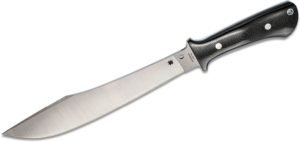
Designed by Lum before he passed away way too early in 2007, the Spyderco Lum Darn Dao is a full-tang Chinese dao-style knife. Overall length: 16.27 inches. The 10.63-inch blade is CPM 154 stainless steel with a flared tip and a swedge grind terminating at the clip on the spine. The 5.64-inch handle has a flared base and the black G-10 scales are ample, fully sculpted and highly polished. A handcrafted dark brown leather sheath with a thumb-break retention loop comes standard. Weight (minus the sheath): 17.89 ounces. MSRP: $649.95. This is a limited edition of one production run only.
The first thing we noticed about the Lum Darn Dao is that it’s not as cumbersome as it initially looks, and then we realized it’s just shy of 18 ounces, which is not that unwieldy as large knives go. The handle is an exercise in comfort—well sculpted all the way around.
The Lum Darn Dao has a deep V-grind, making it an excellent slicer. Sisal rope was a piece of cake. Full grinds like that of the Darn Dao slice and chop well, as the edge doesn’t encounter the hump of a ricasso when it goes about its work.
One inch seemed to be the Darn Dao’s magic number. Employing a basic hammer grip, we used the blade to cut through 1-inch sisal rope like it was butter. When we challenged it on an old phone book (remember those?) with diagonal full-force chops, it repeatedly sunk in an inch deep. For long-term use we’d opt for a rougher finish or texture on the G-10 grip, but all in all the Darn Dao chopped like a champ.
Specs: SPYDERCO LUM DARN DAO Blade length: 10.63 inches Blade steel: CPM 154 stainless Handle length: 5.64 inches Handle material: Sculpted G-10 Sheath: Leather belt carry Weight: 17.89 ounces Overall length: 16.27 inches Country of origin: Taiwan MSRP: $649.95
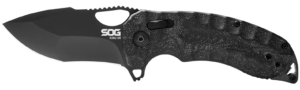
SHORT, WIDE HYBRID: SOG’s Kiku XR Blackout
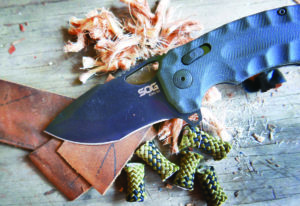
SOG’s Kiku XR Blackout is a mid-size folder 7.375 inches open and 4.3 inches closed. Designed by custom knifemaker Kiku Matsuda of Japan, the 3-inch black-coated blade of CTS-XHP stainless steel is a hybrid of the tanto style with some interesting twists. The main grind is recurved and there is a swedge grind on the spine that ends in a harpoon dip. The blade opens via a kidney-shaped hole in the blade or by an optional gimped flipper. The black handle has sculpted G-10 scales over black stainless steel liners, and SOG’s XR pull-down slide release unlocks the blade. On the rear is a blade-tip-up pocket clip. Weight: 5.19 ounces. MSRP: $189.95.
SOG’s Kiku XR Blackout has a hybrid version of the American tanto blade. The recurved portion of the main grind does a great job trapping leather and rope, and the tip finishes the job as it is pulled through.
The Kiku XR Blackout’s blade is shorter and wider than the traditional tanto pattern. We tested it first on 1.5-inch-wide harness leather, executing straight cuts and pull-throughs. The modified edge cut very well, though we almost ran out of blade while pulling upward through the leather strip.
Rope was much easier. The recurve of the blade trapped the rope, and the secondary grind from the dividing line—or yokoke—to the tip finished the job. It should be noted not all tantos have a yokoke; some simply sweep through upward to the tip. The cuts on 3/8-inch rappelling rope were clean as a whistle, while the edge tended to shred thicker 1-inch sisal. The handle was plenty comfortable and added to our cutting pleasure.
SPECS: SOG KIKU XR BLACKOUT Blade length: 3 inches Blade steel: CTS XHP stainless Blade type: Hybrid American tanto Handle material: Sculpted G-10 Special features: Multiple blade grinds Carry: Pocket clip, blade tip upWeight: 5.19 ounces Closed length: 4.375 inches Country of origin: Taiwan MSRP: $210.95
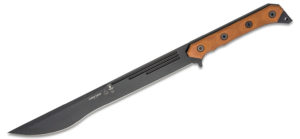
2-HAND HOSS: The TOPS CUMA Kage
photo source: knifecenter.com
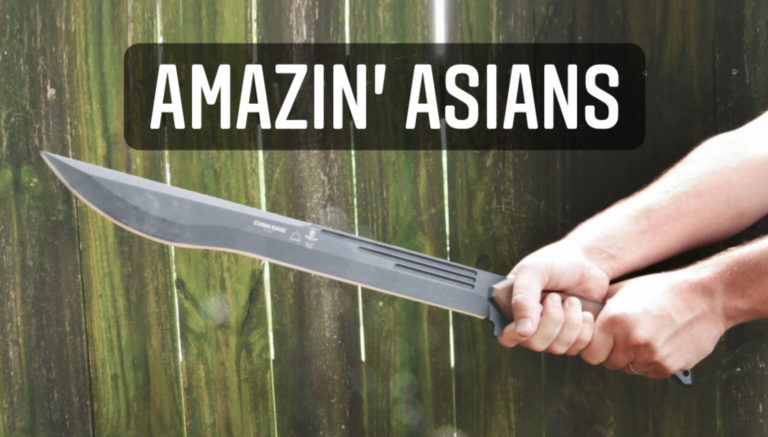
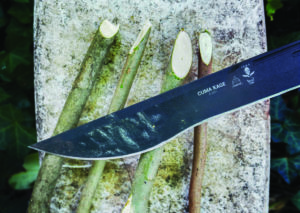
The TOPS CUMA Kage is a tour de force by martial arts guru Sijo Wayson Johnny Tsai. Overall length: 23.75 inches. The 15.5-inch blade of 1095 high carbon steel sports TOPS’ Black Traction Coating. The lengthy handle is 8.25 inches with Micarta scales sized for two-handed delivery. The blade is a hybrid straight sword pattern blended with 7 inches of kukri bulge at the tip to give it a bit of utility to go with its, ahem, badassery. It includes a full-length black Kydex sheath with a dangler/attachment ring. Weight: 31.5 ounces. MSRP: $360.
Using one hand or two, the author found the CUMA Kage cut brush equally well. However, as you might expect, you can take on much heavier tasks with it by using both hands.
To test the CUMA Kage for its utility billing, we took it outside for brush-clearing duty. We’ve always admired the kukri and have cleared an acre or two over the years with one, so this long send-up of the chopper intrigued me. We found out quickly we could use the CUMA Kage with one hand or two, which gives it a big leg up on its smaller cousin. The Micarta handle is well filled out and plenty grippy. One-handed we were able to easily whack through half-inch-thick green hardwood stalks and branches. Two-handed we sliced through stalks three-quarter of an inch with ease, and 1 inch as long as we had clearance to pull back for a full stroke. Though not the CUMA Kage’s original intent, it does have formidable utility.
Specs: TOPS CUMA KAGE Blade length: 15.5 inches Blade material: 1095 carbon steel Blade finish: Black Traction Coating Handle length: 8.25 inches Handle material: Micarta Special features: Kukri blade tip Sheath: Kydex w/leather dangler Weight: 31.5 ounces Overall length: 23.75 inches Country of origin: USA MSRP: $360
MELONIOUS ASSAULT
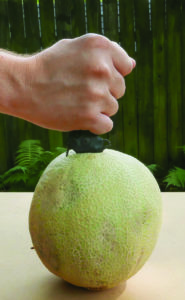
After testing the blades on a variety of fare, just for fun we took to the backyard to let them each have a go at a cantaloupe. Leading off with a reverse grip on the SOG Kiku XR, we stabbed the forlorn melon to the hilt. As stubby a version of the tanto as the Kiku XR’s blade may be, the cantaloupe’s pithy skin gave into the knife’s wishes quite easily.
The Kiku XR Blackout may have a shortened version of the American tanto blade style but it still likes to stab. Here it sinks to the hilt in the cantaloupe. The handle is chubby and comfortable, making the whole package work in harmony.
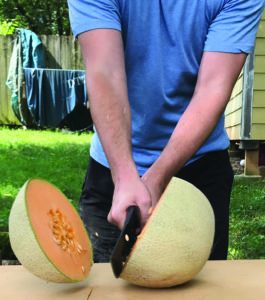
The author’s neighbor lowers the boom with the CUMA Kage. Short swords this size often are primarily geared toward combat, but the kukri-style tip gives the TOPS tool a welcome amount of utility.
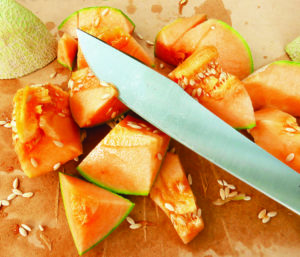
Next up the TOPS CUMA Kage tried the task of halving the cantaloupe in one fell swoop, which we captured in burst mode on my neighbor’s IPhone. Mission accomplished. Finally, we used the Lum Darn Dao to “prepare the meal” by using the blade in quick, rapid-fire chops. The sword’s deep V-grind—not unlike that of a chef’s knife—performed admirably.
Like an oversized chef’s knife, the Lum Darn Dao deftly whacked the cantaloupe into chunks with speed and style.
BEASTS of the EAST
While we often think of knives and swords of an Asian design in the context of combat and martial arts, it’s easy to forget that many Eastern blades were used for everyday utility as well. The tanto was an everyday carry by the Samurai class in Japan, and men and women alike carried a smaller version, the kaiken, aka kwaiken. The chisel grind was not typical on tantos as we see on some of them today, but on knives for culinary purposes. The Japanese kiridashi, which is rapidly gaining a toehold in the cutlery world, was also chisel ground and used for wood carving and marking.
The wicked Indian/Nepalese Kukri was employed in combat, but is primarily a tool for clearing land and is used widely for bush whacking today. Even the Indonesian karambit was considered a working knife by its users. If nothing else, the distinctiveness of Asian cutlery design has added richly to our knowledge base of cutlery and given us a plethora of modern-day knives to explore.
THREE FACTORY AXES TAKE THE CHOP, LIMB, TRIM, SHAVE AND STRIP TEST
BY JAMES MORGAN AYRES
We got snowed in one New Year’s in a rented cabin in the mountains. When I expressed concern about relying on electric heat in a remote cabin, the rental agent assured me that the electricity never went out. In any event, she said, “There was plenty of firewood for the fireplace and an axe. You’re an experienced outdoorsman. I’m sure you can cope.”
Of course, the electricity went out. I found about a cord of unsplit logs, each log 6-to-8 inches in diameter and 3 feet long. No split wood. No kindling. No axe. I batonned my ever-present Randall Model 1 around the edges of the logs to make kindling, and split enough wood to keep the fire going until the electricity came back on. Three days. I coped but every time I went to the wood pile, I wished I had an axe. Any of the axes in this field review would have been welcome.
Almost anything will chop softwood such as pine. For a proper challenge, we spent a day clearing madrone and oak at a friend’s property. Oak is a hardwood. Madrone is more fibrous and even tougher. We also split seasoned oak logs for our friend’s fireplace.
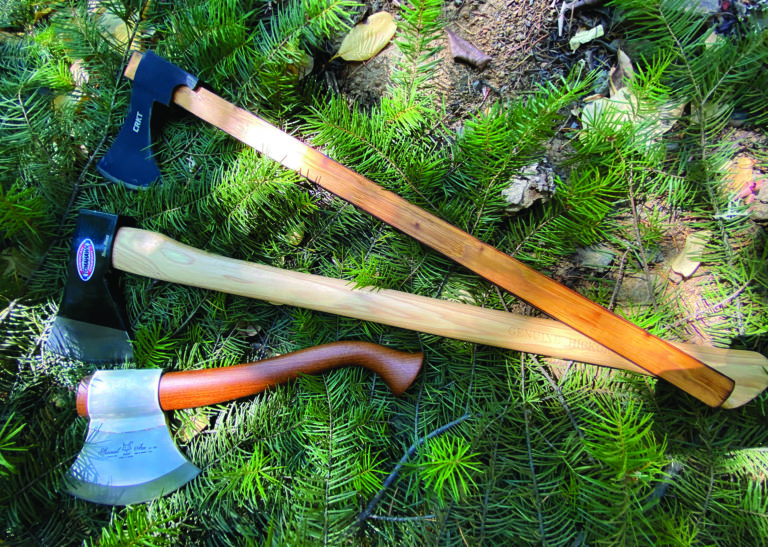
HIKING HACKER: The Fox Trekking Axe
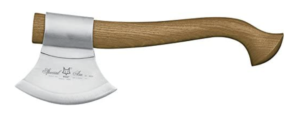
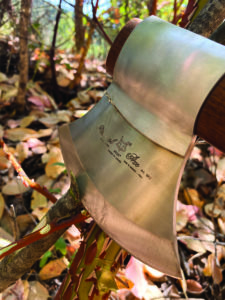
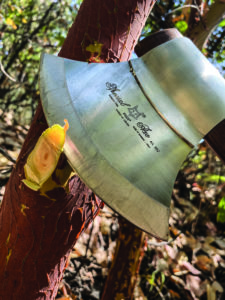
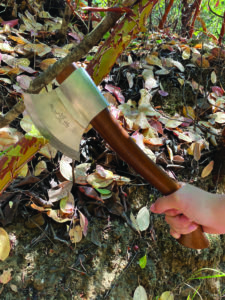
The Fox Trekking Axe is a terrific chopper for the backpacker, hunter or woods wanderer. Reminiscent of a medieval design, it’s light enough to keep in a rucksack and very well made.
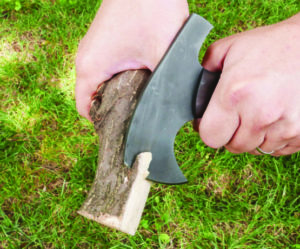
The thin blade came sharp enough to cut paper and kept its edge during a day’s work. Its good edge geometry and balance, comfortable and ergonomic handle—well, really, its overall efficient configuration, which I suspect was inspired by an old, well-proven design—enabled painless hours of chopping, limbing and trimming. The long edge worked well for stripping and shaving bark to make bare poles. I have no doubt that the Trekking Axe would serve to quickly erect a shelter against an incoming mountain snowstorm, or dress out and break down an elk carcass. With its long, almost knife-like edge, it could also skin out the elk.
The author opined that the Fox Trekking Axe would serve to dress out and break down an elk carcass, and, with its long, almost knife-like edge, it could also skin out the elk.
The author wrote that the Fox Trekking Axe is a well-designed, well- made tool he wouldn’t hesitate taking to the deep woods.
The thin blade, so efficient at taking down saplings and other work, tended to bind when chopped into the center of the seasoned oak logs. That’s a matter of geometry—the blade is not wedge shaped and won’t serve as a splitting maul, which is outside of its design envelope. A change in method overcame that limitation. By working around the edges and splitting off sections an inch or 3 thick, we were able to reduce logs to kindling.
Overall it’s a well-designed, well-made tool that I wouldn’t hesitate to take to the deep woods.
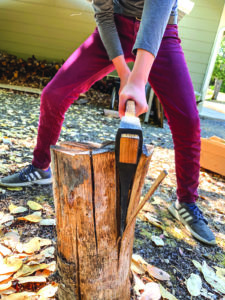
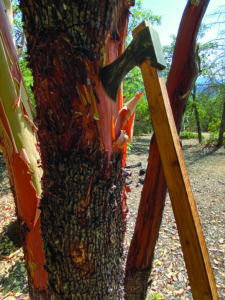
Good edge geometry and balance and a comfortable, ergonomic handle enabled painless hours of chopping, limbing and trimming with the Fox Trekking Axe. Here it chops the Ma- drone sapling with aplomb.
SPECS: FOX TREKKING AXE
CUTTING EDGE: 5.625” BLADE STEEL: 12C27 Swedish stainless HEAD WIDTH: 4.7” HEAD THICKNESS: .22” HEAD FINISH: Satin HANDLE MATERIAL: Sassafras (wood) WEIGHT: 13.8 ozs. OVERALL LENGTH: 13.8” COUNTRY OF ORIGIN: Italy MSRP: $104.95
THAT’S AN AXE: Cold Steel Trail Boss
Photo from KnifeCenter.com
I hefted the Cold Steel Trail Boss, chopped through a 3-inch madrone sapling with one swing and paraphrased Crocodile Dundee’s line: “That’s an axe.”
About the size of a traditional cruiser axe, the Trail Boss has a smooth, comfortable haft/handle in-between axe and tomahawk length. The long edge came sharp and stayed sharp. The head has good wedge-shaped geometry that made splitting the seasoned oak logs a breeze. Unlike a splitting axe, it was not too thick for general work. One whack to the center of the log and there were two split sections on the ground. It’s not a splitting maul or splitting axe but almost as efficient. While it has enough heft to split oak, it’s also light enough and balanced so that downing saplings could be done with full control and no danger of cutting through and swinging too far.
According to the author, the head’s well-designed geometry, the smooth, comfortable handle and overall good balance enabled the Cold Steel Trail Boss to perform almost as well as a full-sized axe.
Using the Cold Steel Trail Boss, the author chopped through a 3-inch madrone sapling with one swing. Paraphrasing the famed Crocodile Dundee line, he quipped, “That’s an axe.”
When limbing, it was easy to control for precise cuts, even when limbing with one hand. The haft is not as long as that of a full-sized axe, nor is the head as heavy. However, the head’s well-designed geometry, the smooth, comfortable handle and overall good balance enabled it to perform almost as well as one.
Thisisagood,all-aroundchopping tool—actually, an excellent all-around chopping tool.
SPECS: COLD STEEL TRAIL BOSS
CUTTING EDGE: 4.5” BLADE MATERIAL: 1055 spring steel HEAD WIDTH: 6.5” FINISH: Black HANDLE MATERIAL: Hickory WEIGHT: 2 lbs., 9.5 ozs. OVERALL LENGTH: 27” SHEATH: Not Included COUNTRY OF ORIGIN: Taiwan MSRP: $49.99
FRANKISHLY SPEAKING: CRKT Cimbri
Photo from CRKTknives.com
The CRKT Cimbri is an interesting design that, in my opinion, needs a bit of work to fulfill its potential. Modeled on a classic Frankish axe, with a nicely shaped head and a long handle, it is well balanced.
With a nicely shaped head and a long handle, the CRKT Cimbri is well balanced for such tasks as splitting oak logs.
Unfortunately, the edge wasn’t sharp out of the box and we test all knives, axes, tomahawks, swords, etc., as they come, so there’s a level playing field for all. The lack of a truly sharp edge required more force to chop through the saplings and impeded its penetration when splitting. Also, the thick coating on the carbon steel head caused it to drag in a cut. Even more unfortunate, and for some reason I do not understand, the haft is squared rather than oval or round. The acute edges of the haft/ handle not only were uncomfortable, they dug into our hands, producing blisters—in one instance breaking the skin of one of our testers’ palms.
The author stated he would round off the edges of the CRKT Cimbri’s squared-off haft.
Tuning up the edge would be a simple job, a matter of 20 or 30 minutes with a good stone. Reprofiling the haft wouldn’t be difficult, but I cannot understand why anyone would put a squared handle on an axe. Historical authenticity, perhaps?
SPECS: CRKT CIMBRI
BLADE LENGTH: 4.09” BLADE MATERIAL: 1055 spring steel HEAD THICKNESS: 1.26” FINISH: Manganese phosphate coating HANDLE MATERIAL: Tennessee hickory WEIGHT: 2 lbs., .8 oz. OVERALL LENGTH: 25.75” DESIGNER: Elmer Roush COUNTRY OF ORIGIN: Taiwan MSRP: $69.99
AUTHOR’S CHOICES
Which of the three would I choose if I were again snowed in and had only a stack of logs to burn? If I hiked in, the Trekking Axe would be my choice, no question. I’m too old to hump anything heavier in a rucksack filled with camping gear, food and ammunition. If I arrived by car or truck, the Trail Boss would be it. If I had only the Cimbri, I would use my belt knife as a draw knife to take off the corners of the handle and smooth it. That done, 20 minutes with a sharpening stone and I’d head for the wood pile.
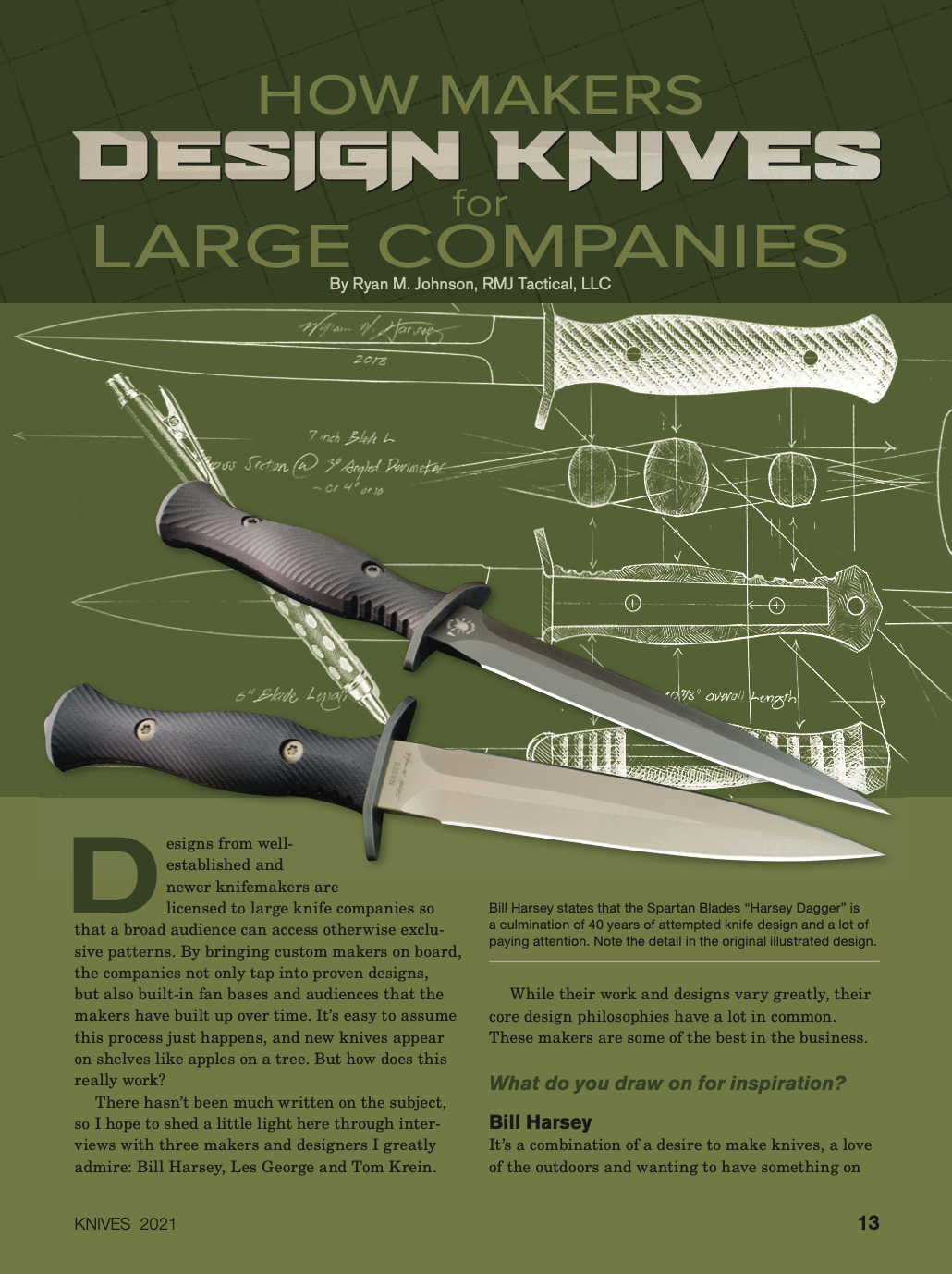
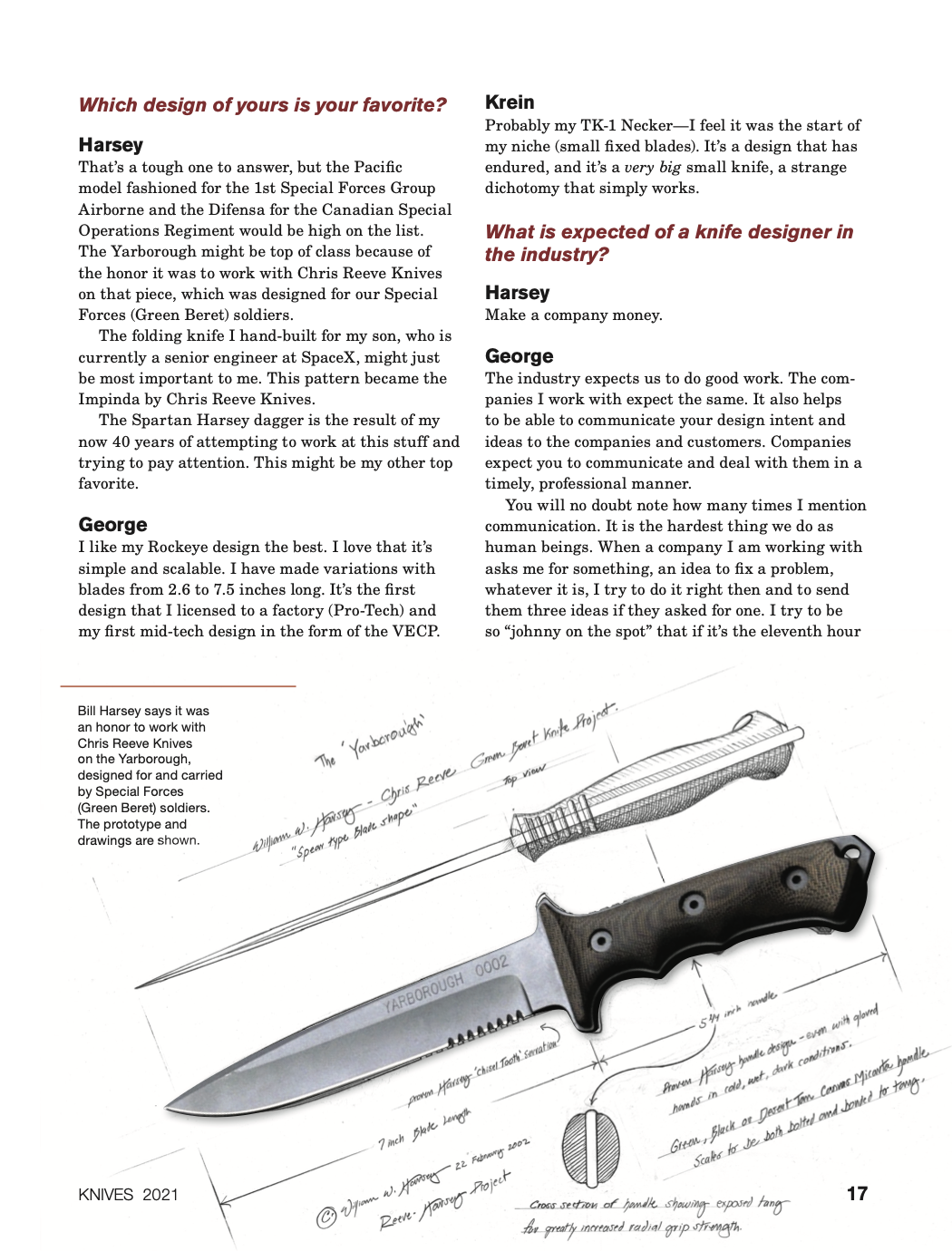
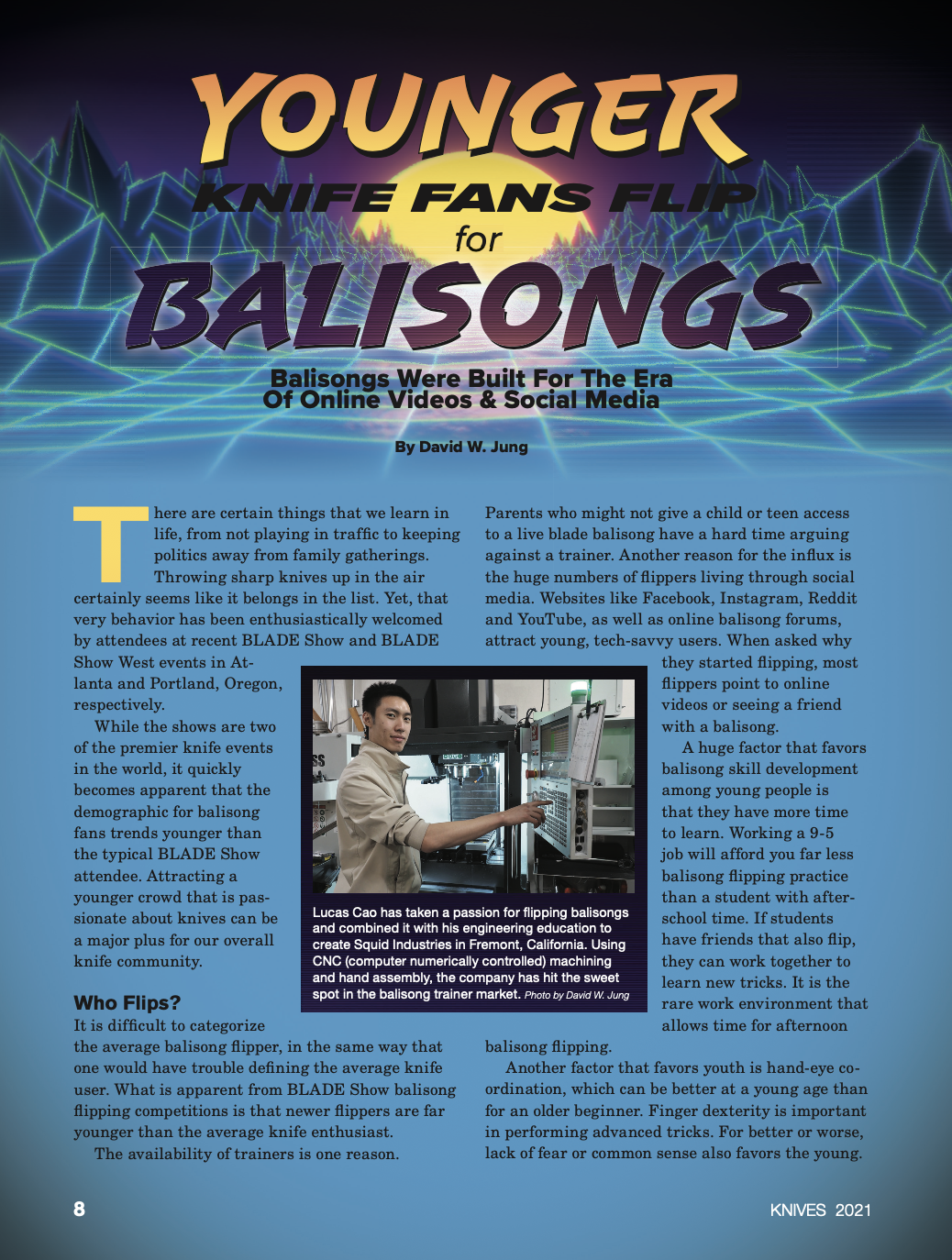
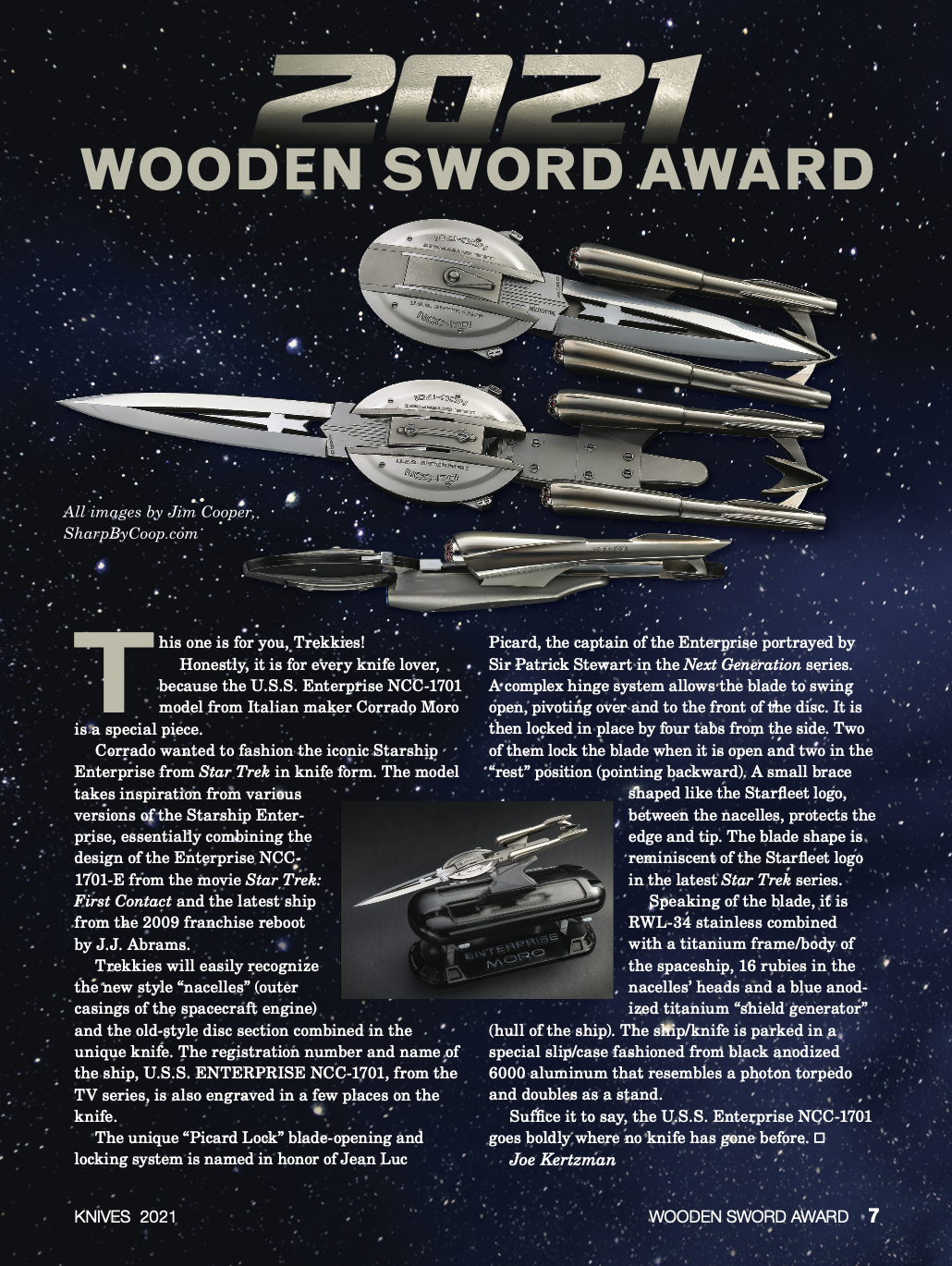
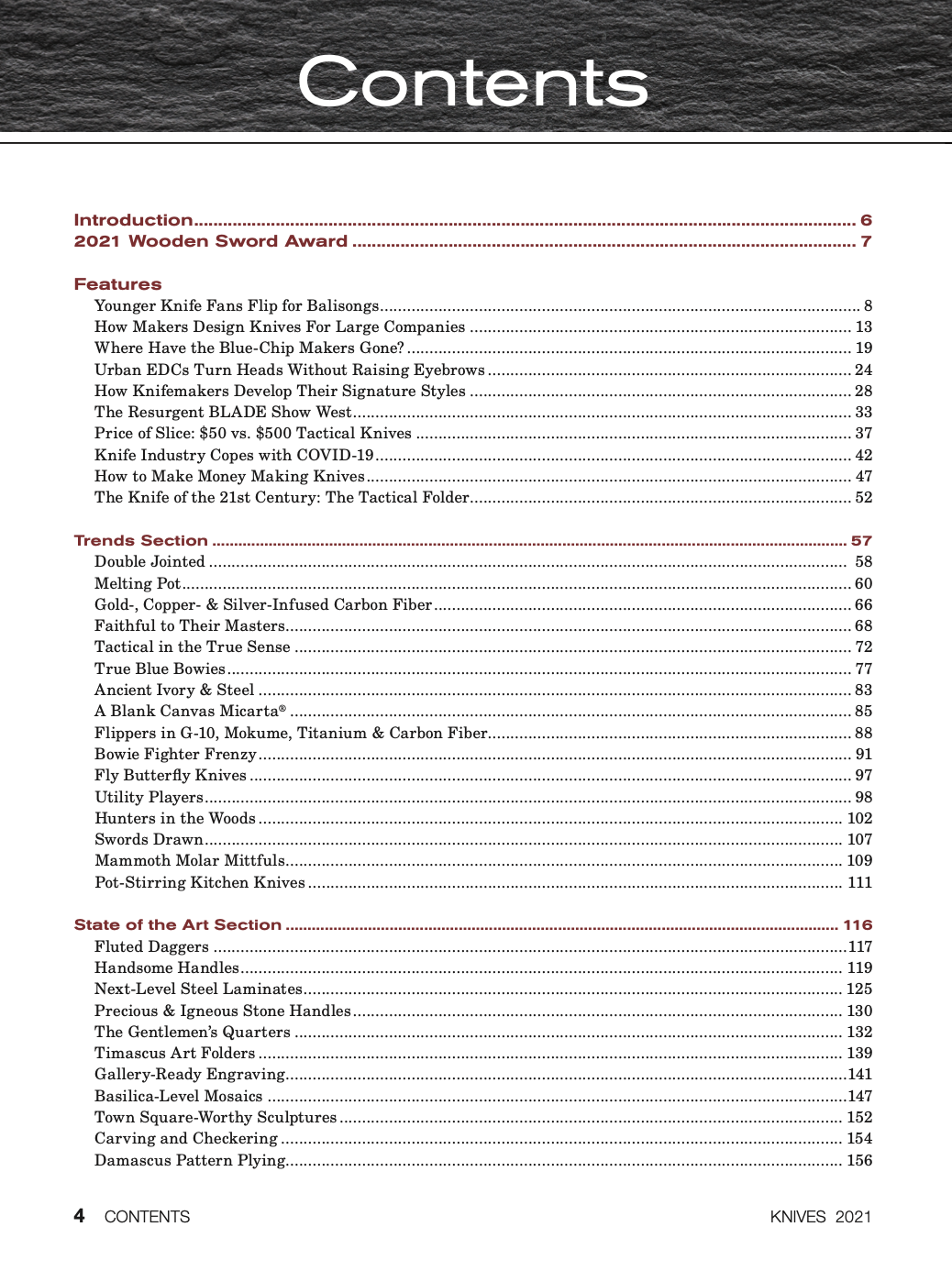
KNIVES 2021, presented by BLADE Magazine showcases blades of every class and style with more than 600 spectacular full-color images, from customs to factory knives.
Enthralling articles about balisongs, making money making knives, urban EDCs, tactical knives, knife designers and more.
The latest trends of flippers, daggers, chef knives, fighters and more.
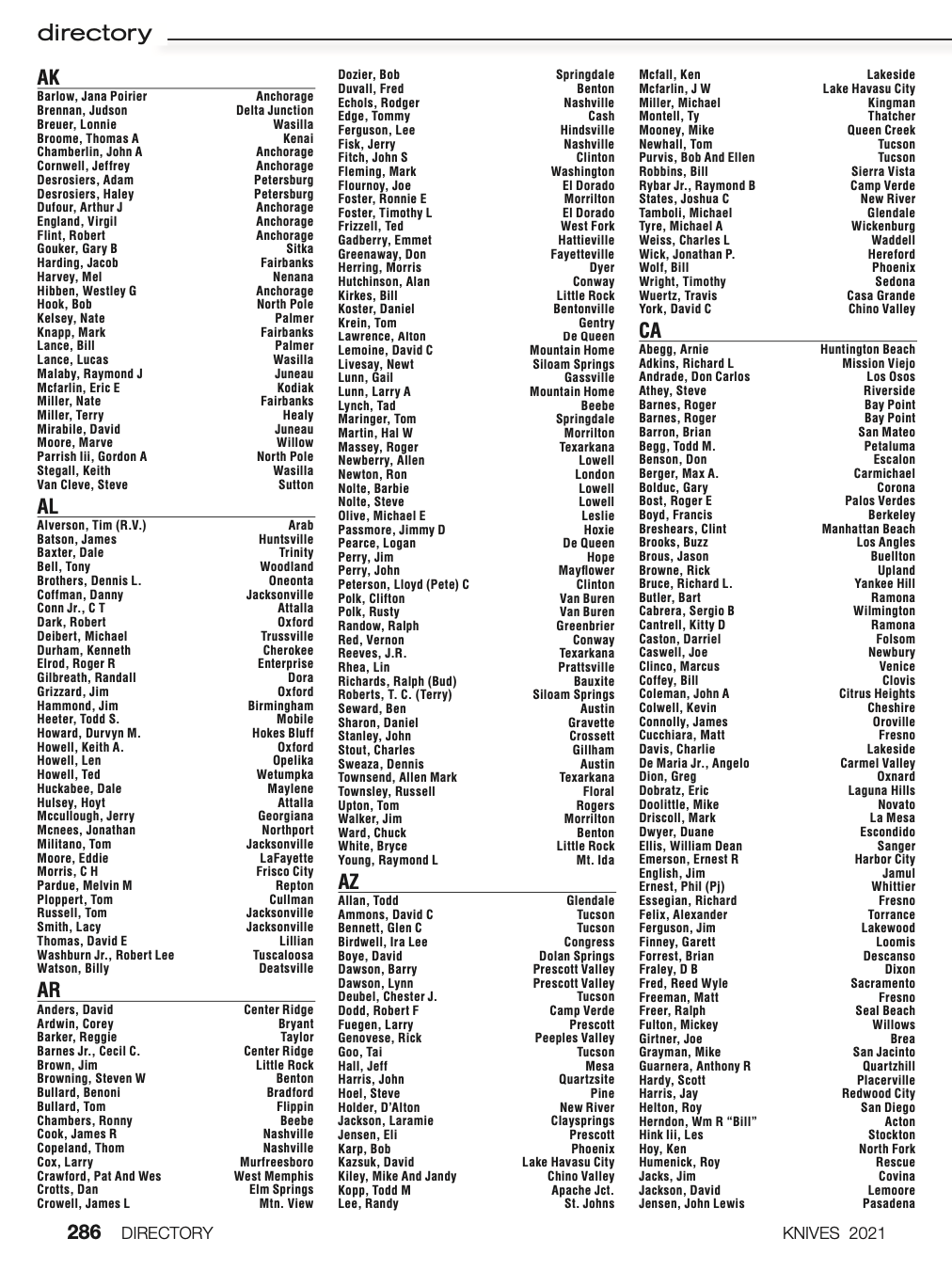
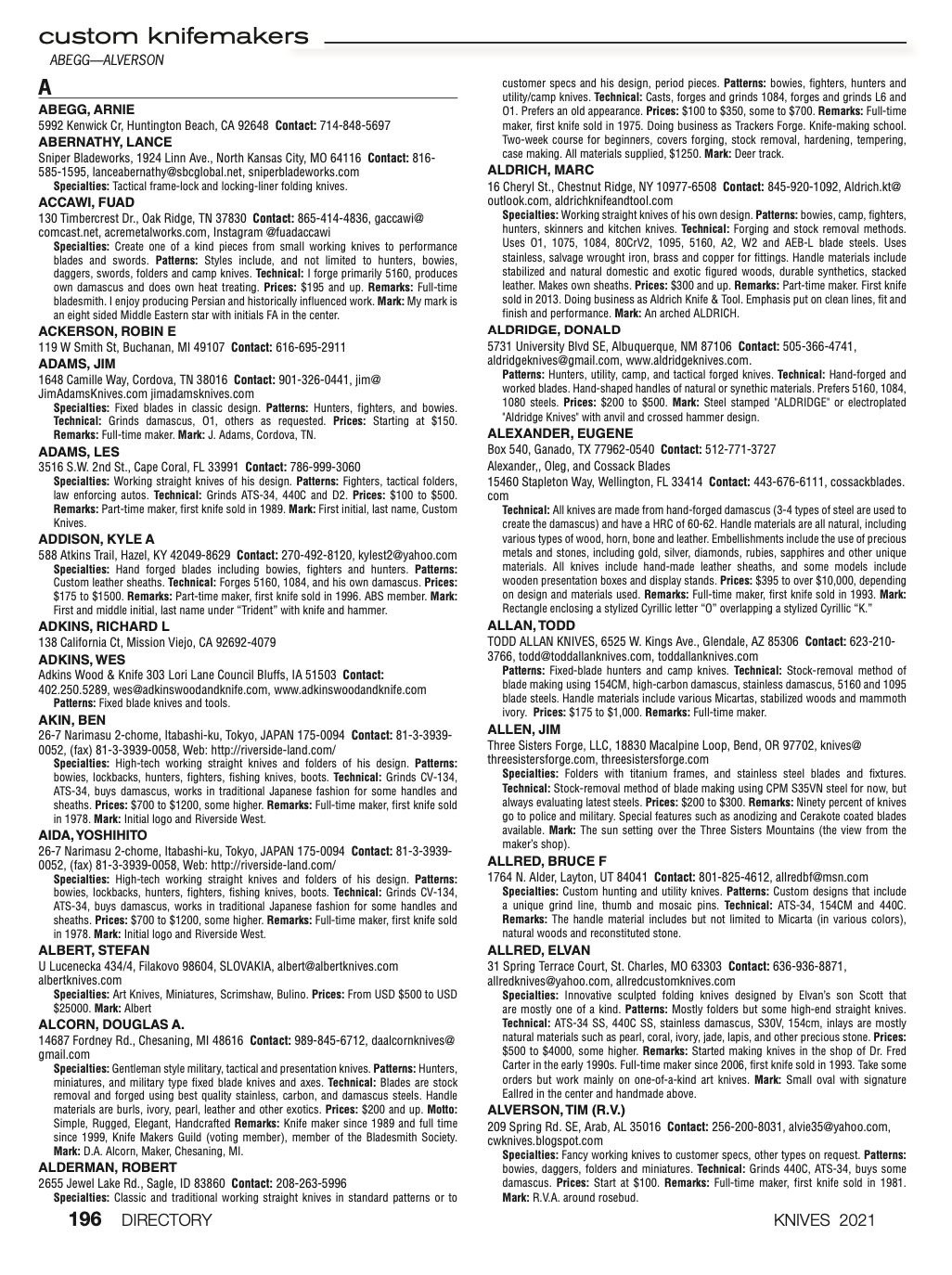
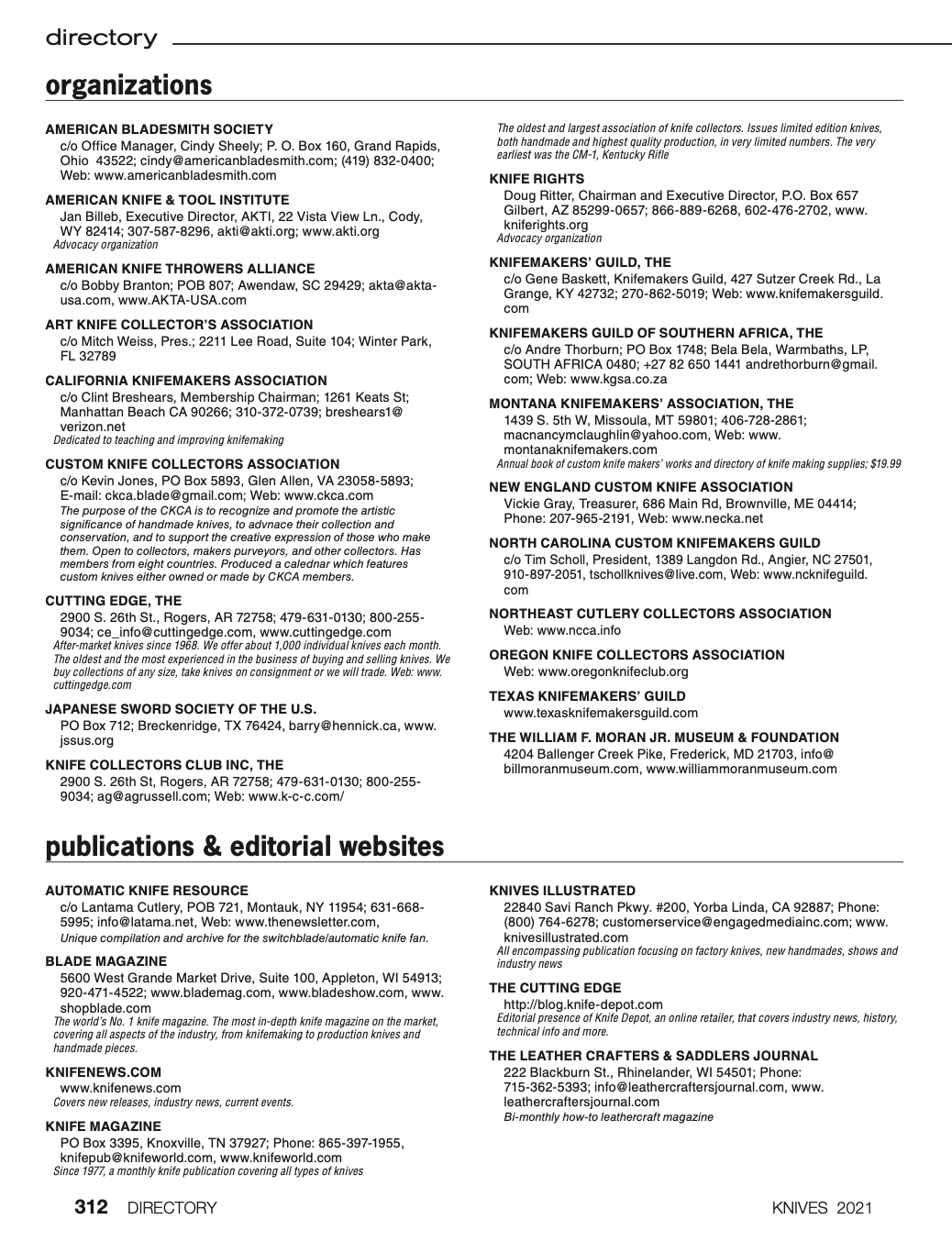
A comprehensive Custom Knifemaker Directory includes contact information, websites, specialties, materials, price ranges, tools, tang stamps and comments.
SMALL HATCHETS, HAWKS AND AXES ARE LIGHTWEIGHT AND VERSATILE
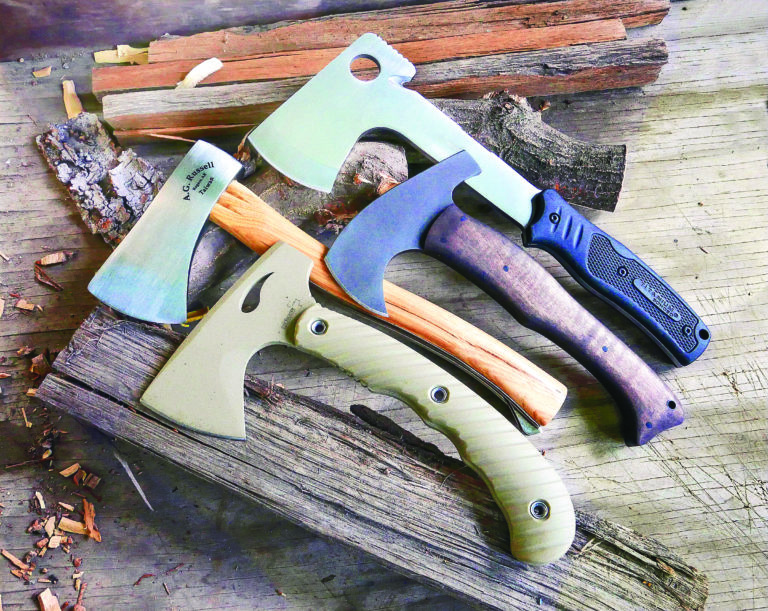
Four small, packable “hack-its” are convenient and can defy their size in terms of performance. Clockwise from top: Camillus/Western Blackriver Long Hatchet, Winkler Hunter Axe LT, Boker Plus Escape Hawk and A.G. Russell Pocket Safety Axe.
By Pat Covert
They’re small choppers that go by the names of hatchets, hawks and axes, so for simplicity’s sake let’s lump them into a group and call them hack-its, because that’s what they do for the most part.They hack.
The small choppers separate themselves from their bigger siblings largely because they are much more portable. Let’s take a look at four of the pint-size hack-its—all under a foot long—and explore their usefulness.
I tested each one on a variety of woods both hard and so, including the dreaded 6-inch privet log I use to gauge a chopper’s ability to bite into tough, seasoned materials. I also used the hack-its to cut 3/8-inch synthetic rope because if they will chop it, they’ll also cut the skin of meat and vegetables.
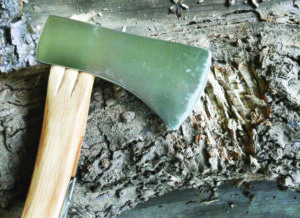
The weight of the chopper’s head and its placement on the handle makes a difference in its “bite-ability.” A big reason the Russell Pocket Safety Axe (left) bit into the privet log so well is because the hack-it simply has more weight at the point of attack.
A.G. Russell Pocket Safety Axe
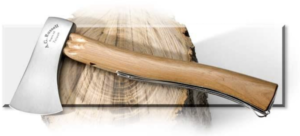
With much of its overall weight in the head, this is a very top-heavy hatchet—which can work to its advantage. Photo from agrussell.com
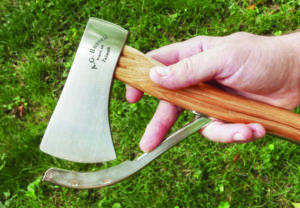
The A.G. Russell Pocket Safety Axe is a Marble’s design from circa the early 20th century. Marble took a small hatchet, 10.6 inches overall, and designed a fold-out metal shield in the handle to cover the bit in lieu of a sheath. Simply ingenious. The A.G. Russell version has a 4.5-inch 1070 spring steel head with a 2.4- inch cutting edge, and a typical old-school hammering base at the rear. The head has a distinctive three-slot mounting system Marble deemed superior to the standard oval style. The 8.8 inch handle is hickory and the whole kit and caboodle weighs 1 pound. Manufacturer’s suggested retail price: $79.95.
The fold-out blade shield of the Russell Pocket Safety Axe is pure wizardry, especially considering the design is well over 100 years old. You won’t be caught saying “Where did I put the sheath?” with this one.
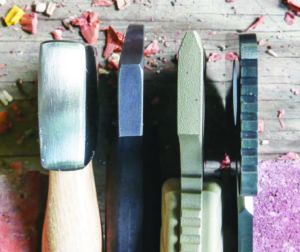
With much of its overall weight in the head, this is a very top-heavy hatchet—which can work to its advantage. In the bite test on the privet log, the Pocket Safety Axe finished first simply because the business end has a lot more weight (see the side-by-side comparison image on head thicknesses). Consequently, it chopped each test material well.
The bite of the A.G. Russell Pocket Safety Axe proved to be exceptional. The traditional, top-heavy hack-it took to the dreaded 6-inch privet log with gusto, sinking its teeth into the seasoned hardwood surprisingly well.
The fold-out bit shield has pluses and minuses. On the upside, it’s very convenient and there’s no sheath to keep up with. On the other hand, you have to pack it since there’s no belt-sheath option. Also, you’ll want to wear gloves for extended use, as the hinge mechanism in the handle can dig into the innerfingers. All in all, though, the Pocket Safety Axe is a stellar performer.
SPEC CHECK: A.G. RUSSELL POCKET SAFETY AXE
CUTTING EDGE: 2.4” BLADE MATERIAL: 1070 spring steel HEAD WIDTH: 4.5” HEAD THICKNESS: .7” at the thickest
BLADE COATING: None
HANDLE MATERIAL: Hickory
SPECIAL FEATURES: Metal blade cover in handle
CARRY: Pocket or pack
WEIGHT: 16 ozs.
OVERALL LENGTH: 10.6”
COUNTRY OF ORIGIN: Taiwan
MSRP: $79.95
Boker Plus Escape Hawk
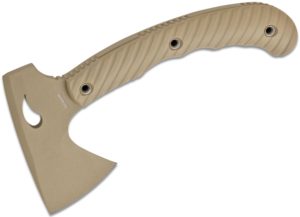
The Boker Escape Hawk is a hawk that thinks it’s a hatchet. Photo from knifecenter.com
Designed by Australian knifemaker/ designer Peter Fegan, the Boker Plus Escape Hawk is tactical in design. Hawks are primarily used for breaching and combat but can full other chores as well. Only 9 inches overall, the Escape Hawk has a 4.75-inch head of quarter inch-thick SK5 tool steel and a 2.56- inch cutting edge.The head has enough beard to be used for carving, and the curved 7-inch handle is adorned with nicely sculpted, diagonally grooved FRN ( berglass-reinforced nylon) scales. The butt can be used for hammering. The steel is protected throughout with a powder coat. A dual-strap Kydex sheath covers the head. MSRP: $189.95.
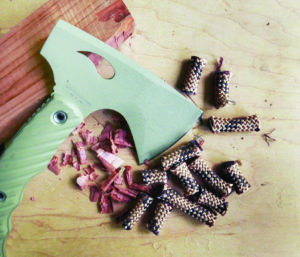
The Boker Plus Escape Hawk is a hatchet in disguise. The small hack-it’s 2.56-inch SK5 tool steel bit chopped rope in nice, clean lops, and hacked off nice-sized cedar tinder chips with ease.
Due to its small size, you won’t be doing much breaching with the Boker Escape Hawk, but the pint-sized hack proved its worth. The SK5 steel had plenty of hack, chopping rope in nice, clean cuts, and knocking out chunks of seasoned cedar for tinder. Though the bearded bit can be used for carving, the inward slant of the handle mounting to the head impedes its effectiveness for the purpose a tad. The handle has full-length scales—a bonus for freedom of grip—and the diagonal grooves afforded it the best purchase of the bunch. The Boker Escape Hawk is a hawk that thinks it’s a hatchet.
SPEC CHECK: BOKER PLUS ESCAPE HAWK
CUTTING EDGE: 2.56” BLADE MATERIAL: SK5 tool steel HEAD WIDTH: 4.75” HEAD THICKNESS: .25”
BLADE FINISH: Powder coating
HANDLE MATERIAL: FRN
SPECIAL FEATURES: Full-length sculpted scales
CARRY: Kydex sheath
WEIGHT: 13.1 ozs.
OVERALL LENGTH: 9”
COUNTRY OF ORIGIN: China
MSRP: $189.95
Camillus Western Blackriver Long Hatchet
The Blackriver will handle many chores around the camp, and the bonus firesteel and pouch on the sheath add value. Photo from Camillus.com
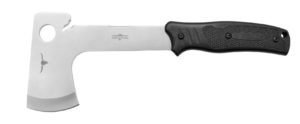
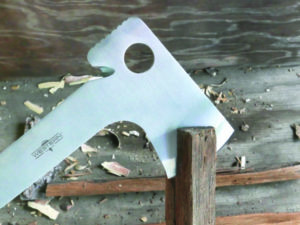
At 11.5 inches, the Western Blackriver Long Hatchet from Camillus is, indeed, the longest of the test hack-its. It sports a 4.5-inch-wide head with a 2.5-inch chopping edge. On the back side of the head is a gimped flat edge for hammering and a sharpened diagonal slot for cutting cord. The 9.5-inch handle has 5.25-inch black checkered rubber scales, and there is a shaving slot midway between the handle and the head. A ballistic nylon sheath with a firesteel pouch—with firesteel—is included. MSRP: $31.98.
The Western Blackriver Long Hatchet from Camillus is the batonner of the bunch. The thin bit cleaved into the tight hardwood grain like a thief in the night. Once the head was in, the final splitting was done by batonning the upper handle.
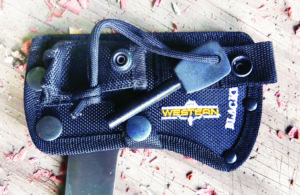
The Blackriver has the lightest head of the test group so it didn’t win the chopping wars, but its length and handle design give it a leg up on the others in some functions. The thin head is ideal for batonning, enhanced by the 4 inches of exposed steel below the bit, which can be used as a striking surface. The grip is very comfortable, the rubber scales aiding in impact absorption. The Blackriver will handle many chores around the camp, and the bonus firesteel and pouch on the sheath add value. It’s also by far the most affordable of the group.
The Camillus/Western Blackriver Long Hatchet has a pouch on its ballistic nylon sheath containing a firesteel. This is a nice added extra on a hack-it that is already able and affordable.
SPEC CHECK: CAMILLUS/WESTERN BLACKRIVER LONG HATCHET
CUTTING EDGE: 2.5” BLADE STEEL: 420 stainless HEAD WIDTH: 4.5” HEAD THICKNESS: .2”
BLADE COATING: Titanium bonded
HANDLE MATERIAL: Rubber
SPECIAL FEATURES: Firesteel included
CARRY: Ballistic nylon belt sheath
WEIGHT: 17 ozs.
OVERALL LENGTH: 11.5”
COUNTRY OF ORIGIN: China
MSRP: $31.98
Winkler Hunter Axe LT
The price is high but the Winkler is as close to a custom as you’ll get—plus, the sheath is a marvel in itself. Photo from WinklerKnives.com.
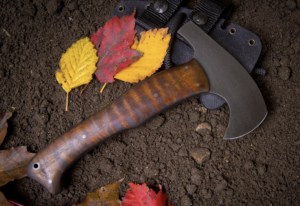
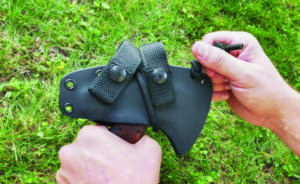
At only 9 inches long, the Winkler Hunter Axe LT is a small hack-it, but packs a full 19 ounces of weight—and that’s with a skeletonized handle tang. The Hunter Axe LT has a 3.5-inch-wide, bearded 80CrV2 carbon steel head with 2 inches of cutting edge, and there’s a hammering base out back. The steel thickness is a healthy .25 inch and is coated head to toe in Caswell black oxide. The scales are full-length, highly attractive curly maple. A padded Kydex sheath with nylon belt loops covers the head, and employs a shock-cord retention system for a quick draw. MSRP: $450.
The Winkler Hunter Axe LT turned out to be the best carver of the bunch due in no small part to the handle’s position in relation to the head and beard. The hand- some curly maple handle is comfortable to boot.
The Hunter Axe LT may be short but at 19 ounces is the heaviest of the test hack-its—a full 2 ounces more than its nearest rival. The LT almost won the bite contest but didn’t due in part to its weight being more equally distributed than the top-heavy Russell Pocket Safety Axe. The 80CrV2 steel chops extremely well and the Caswell finish is very tough. Though not a carving axe per se, the LT was our best candidate for the chore and would have performed even better with a lower grind angle on the lead edge. The price is high but the Winkler is as close to a custom as you’ll get—plus, the sheath is a marvel in itself.
SPEC CHECK: WINKLER HUNTER AXE LT
CUTTING EDGE: 2” BLADE MATERIAL: 80CrV2 carbon steel HEAD WIDTH: 3.5” HEAD THICKNESS: .28” BLADE COATING: Caswell black oxide HANDLE MATERIAL: Curly maple SPECIAL FEATURES: Skeletonized handle CARRY: Kydex belt sheath w/tension release WEIGHT: 19 ozs. OVERALL LENGTH: 9” COUNTRY OF ORIGIN: USA MSRP: $450
The Winkler Hunter Axe LT’s Kydex sheath has a bungee-style tension cord for quickly releasing the axe from its housing. The sheath as a whole is very well made—a Daniel Winkler trademark.
HAPPY HACKING!
Packable hack-its are limited only by their size. They are capable of building small shelters, chopping and splitting small- sized firewood, cutting rope to size, and a myriad of other small chores around the camp. When buying a small, packable chopper like one of these, first define your intended use for it. As you can see by the test bunch, each has its strong suits, and MSRPs vary widely. Choose wisely and happy hacking!
PROCEEDS BENEFIT WOUNDED WARRIOR OUTDOORS AND WILD SHEEP FOUNDATION
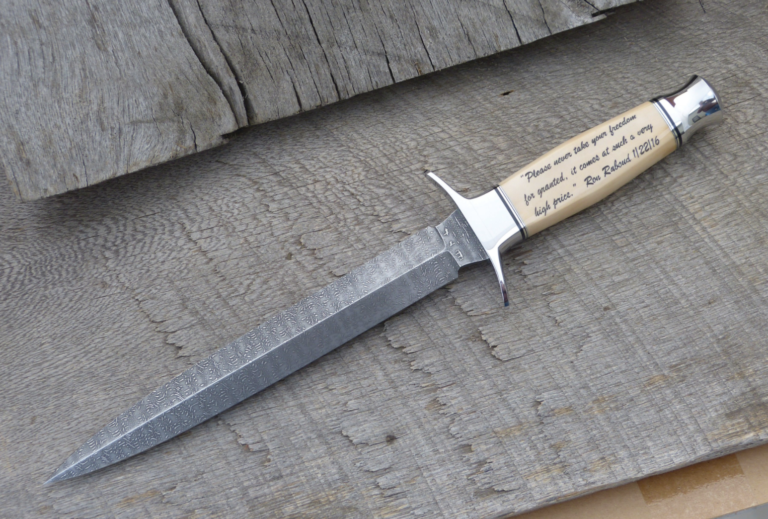
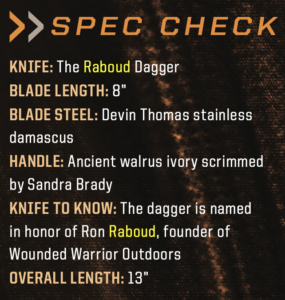
The Raboud Dagger by award-winning knifemaker Dennis Friedly sold for $50,000 at a live auction this last January, with proceeds from the sale benefitting both Wounded Warrior Outdoors, Inc., and the Wild Sheep Foundation.
Sponsored by Heritage Collectables, the knife was auctioned during the Wild Sheep Foundation (WSF) Show in Reno, Nevada.
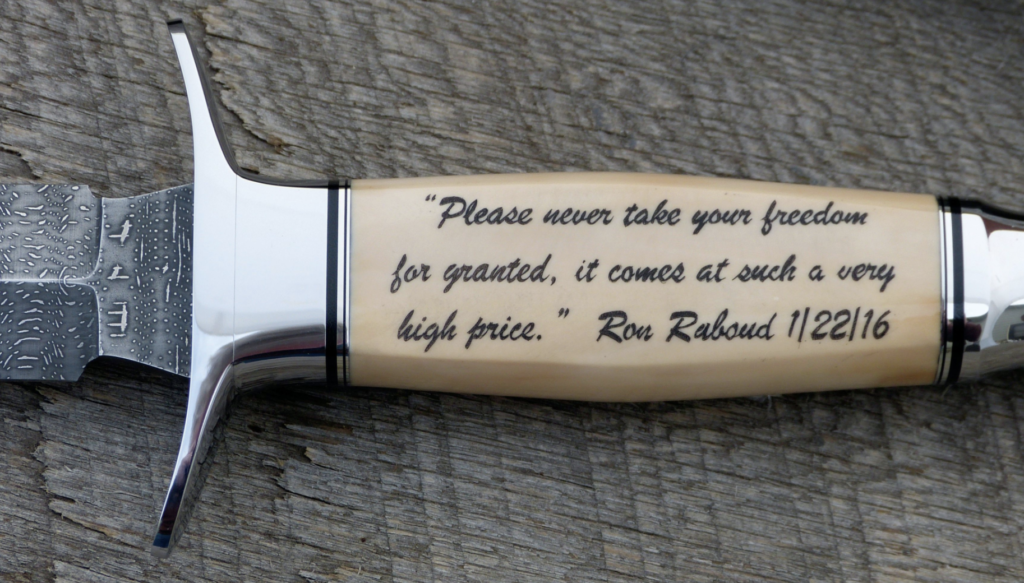
The dagger is named in honor of Ron Raboud, founder of Wounded Warrior Outdoors (WWO). The quote Sandra Brady scrimshawed on the handle is from the closing speech Raboud gave at the Wild Sheep Foundation Banquet in 2016.
“Wounded Warrior Outdoors is a non-profit charity providing recently wounded servicemen and women with therapeutic outdoor adventures across North America,” Dennis wrote. “WWO is a completely volunteer charity with no paid staff or needless overhead. It is an honor to work with these organizations.”
For more information contact Dennis Friedly, Dept. BL8, 12 Cottontail Lane E., Cody, WY 82414 307-527-6811 [email protected], friedlyknives.com. For more on WWO, visit woundedwarrioroutdoors.com. For more on WSF, visit wildsheepfoundation.org.
For the latest knives, knife news, trends and more visit blademag.com, BLADE®’s popular Instagram page @blade_magazine, and on Facebook and Twitter.
BLADE’s Cutlery Hall Of Fame Welcomed Five New Members In 2021 At Induction Ceremony In Atlanta.
BLADE Magazine Cutlery Hall-Of-Fame® member B.R. Hughes set a most appropriate tone for the Hall’s 2021 inductions early Saturday morning of the BLADE Show in the Kennesaw Room of the Renaissance Waverly Hotel.
“Over the years I’ve noticed one thing about the man and lady selected for the Cutlery Hall Of Fame,” said one of the co-founders of the American Bladesmith Society in his speech inducting Joe Keeslar. “They are not so interested in themselves so much as they are others.”
In addition to Keeslar, B.R.’s words apply equally well to the four other new inductees: Beverly and Billy Mace Imel, Jay Hendrickson and Jim Sornberger.
Joe Keeslar
Joe Keeslar
Speaking of Keeslar, along with Sornberger, Joe was voted into the Hall last year. However, since the pandemic canceled BLADE Show 2020, it also postponed their formal inductions until this year—none of which dulled Keeslar’s appreciation for B.R.’s speechifying ability.
“[BLADE® editor] Steve Shackleford contacted me last spring and told me I would be inducted into the Hall Of Fame … The first thing I did was call Mr. Hughes and asked him to do my induction speech. You can see why. I asked him to give his best $20 speech,” Joe deadpanned to laughter from the 60-or-so gathering of the inductees’ families and friends. “I think I’m going to have to give him a few dollars to make up for that.”
In his baritone voice and measured manner, B.R. outlined Joe’s early history as a United States Marine Corps veteran of the Vietnam War, marriage to Suzanne, making knives and also fine muzzleloading rifles, and getting his college degree. In 1989 Joe earned his ABS master smith rating and it was also about that time Suzanne, who, in her job as a professor at Murray State University, started taking her students to France in the summer to enhance their French language skills.
“Naturally, Joe had to build a shop over there so he could make knives, and he taught many Frenchmen how to make knives,” B.R. noted. “He also was asked to demonstrate at the Thiers Knife Show, the second largest knife show in France. This practice continued for years. He’s been a wonderful ambassador in preserving the art of bladesmithing.”
Joe went on to become chairman of the ABS, serving in the position longer than all but two others, ABS master smiths Bill Moran and Jim Batson, both members of the Cutlery Hall Of Fame. He’s taught knifemaking at the William F. Moran School of Bladesmithing, Haywood College, hammer-ins in Alabama, Arkansas, North Carolina and Ohio, played a lead role in the rapidly expanding ABS youth program, and taught classes for the first four years of BLADE University. He also authored two how-to books: Handles and Guards and Forging and Finishing the Brut de Forge Knife. Joe thanked three people in particular: Suzanne, their son, Kurt, and B.R.
“Suzanne and Kurt have given me so much over the years in terms of support,” he began, “but the thing they gave me most, they gave me time. Time is a special commodity. You can’t put it in a box or on a shelf and come back in a week and retrieve it. The time is gone. You have to use it when it’s available to you. They gave me time to be me, to do what I wanted to do, in this case the knives and some with the guns, too.”
He also credited B.R. for 30 years of friendship. “I trusted his judgment on the things that came up when I served on the ABS board of directors,” Joe said. “He was there as my mentor and savior, he was helping me decide on the things I needed to be involved in, understanding how the ABS works, what our goals are and all the things I needed to know.”
Jim Sornberger
Jim Sornberger
Cutlery Hall-Of-Famer Ken Onion gave the speech inducting Sornberger and outlined Jim’s pre-knife career, which was pretty impressive in its own right. “Guns, knives and tools were the things that molded Jim,” Onion began. “His grandfather gave him a Rudy Ruana knife when Jim joined the Boy Scouts, and his uncle in Redding, California, owned a gun shop with a large knife display. It was there Jim met Harry Morseth in the mid-fifties.”
Sornberger joined the Army in 1963 and became an advisor in Southeast Asia, moving around Vietnam, Cambodia, Thailand, Laos and other countries. After his discharge he joined law enforcement and shortly thereafter became a deputy with the Santa Clara sheriff’s office. From there he became an agent for a federally funded narcotics task force for several California counties, and later worked as a narcotics intelligence officer for military and other agencies in and out of the state.
Following a work-related injury, Jim focused on one of his lifelong loves—making jewelry—while recovering. One of the places that sold his jewelry asked him to make knives. He became a regular attendee and table holder at the San Jose gun show, where he met such storied knifemakers as D.E. Henry, Dave Pitt, Ron Richards and Bob Holt. They and others started a knife show—the Bay Area Knife Collectors Association Show—for which Jim wrote the bylaws. “BAKCA,” as it was known, enjoyed what Onion called “30 years of great shows and wonderful memories.”
Jim joined the Knifemakers’ Guild in 1976 and served on the board of directors, including a stint as vice president. By the late ’70s he’d won several awards for his knives, including his San Francisco-style dress bowies. In 1981 the industry was having quality control issues with 154CM stainless steel, so Bob Holt and Jim started H&S Supply and sold ATS-34 stainless in large quantities, as Onion noted, “essentially introducing it to the entire knife industry.”
Jim gave thanks to his two grandfathers for the time they spent with him and serving as his role models. “It’s really nice to be rewarded for something you’ve done a good part of your life and still enjoy doing—and I’m not quitting,” the 75-years-young Sornberger reassured the audience. “I’ve still got plenty of years left, I think.”
Indeed, for the man Onion called an encyclopedia of the history of the custom knife world, who continues to write for KNIFE Magazine and other outlets, and who travels worldwide, the best may yet still be to come.
Beverly & Billy Mace Imel
Beverly & Billy Mace Imel
Beverly and Billy Mace Imel served as secretary/treasurer on the Guild board of directors for 15 years and were rocks in terms of doing the behind-the-scenes work that was so important to the running of the organization. In fact, when Billy first started making knives in the early 1970s, Beverly did all the bookkeeping for Billy’s knifemaking operation and has ever since, the two celebrating their 61st wedding anniversary June 11. Notably, they are the first married couple to be inducted simultaneously into the Hall. (Cutlery Hall-Of-Famers, Mr. and Mrs. A.G. and Goldie Russell, were inducted separately.)
A tool-and-die maker by trade, Billy was inspired to make knives in 1972 before going on a hunt. He saw a Ted Dowell integral hunter and decided it would be a good knife for the trip, but it cost $100—too much for him to pay for a knife at the time. One thing led to another and Billy tried his hand at making knives, and soon discovered how much work it took to make a good one. Someone saw them and asked Billy how much he wanted for one. “Bill said he never thought about that but he wasn’t charging a hundred because that damn sure isn’t enough, so he said two hundred,” Jim Sornberger winked in his speech inducting the Imels.
Billy joined the Guild in 1973 and the Imels eventually exhibited at shows in Japan, Europe and elsewhere, basically doing everything together. In the process, Billy became one of the world’s best knifemakers. “In the mid ’70s there were several people I was really fascinated with who did a really good job on their knives, the fit, the finish, the detail and the sharp lines,” Sornberger recalled. “And Billy was No. 1 on my list.” A long-time member of the NRA, Billy also made knives for the speakers at the association’s annual convention, including one each for Presidents Ronald Reagan and George H.W. Bush.
In 1984 the Imels were elected Guild secretary/treasurer and Beverly in particular changed forever how the position would be viewed. “She was unbelievable,” Sornberger stressed. “This was in the day before portable phones and you didn’t have a stenographer to take notes, but no matter what we asked her during business meetings—How much did it cost? How many tables did we have? Who made a motion at this meeting?—Beverly had the answer. She’d just tell ya’, boom, who made the motion and who seconded it, and how she got all that stuff I’ll never know. She was the backbone of the Guild for 15 years.”
Regrettably, the Imels were unable to attend the ceremony but sent a heartfelt written thank you instead.
Jay Hendrickson
Jay Hendrickson
As inductor Johnny Perry noted, when Jay Hendrickson started making knives in Frederick, Maryland, in 1972, it wasn’t long before he learned there was another bladesmith in the neighborhood who just so happened to be the best in the world at it—Bill Moran. Jay met Moran, visited Bill’s shop now and again, and, through practice and dedication, became a bladesmith and joined the ABS.
Jay earned his ABS journeyman smith stamp in 1986—the same year being elected to the ABS board of directors—and his master smith stamp in 1989. Around that time, he was instrumental in establishing the William F. Moran School of Bladesmithing and also taught bladesmithing there, writing and illustrating the manuals used in some of the courses.
He was elected ABS chairman in 1991, succeeding the only chairman the ABS had ever known—Mr. Moran. In all, Jay served on the ABS board of directors from 1986-2018. He and his wife, Nancy, helped develop and coordinate the Bill Moran Hammer-In in 2003 in Frederick and kept it running for two more years before Mr. Moran’s passing in 2006.
Jay was co-chairman of the All-Forged-Blade Expo in Reno from 2003-07 and was instrumental in forming the William F. Moran Jr. Museum and Foundation in Frederick in 2006. He was president of it for 10 years, and today remains on its board of directors. The museum includes a number of Moran’s top knives, “a dressed-up version” of Moran’s knife shop and much more.
“All the effort Jay has put into the museum and foundation is immeasurable,” Johnny noted. “It required years and years of responsibility, but Jay bore it well and got the job done.”
The inductee gave special thanks to his wife, Nancy. “I wanted to thank her for all her help over the years, taking care of all the details, all the flight reservations, all the laundry, all the packing of suitcases. Sometimes when she gets tired she even lets me mow the lawn,” he said to audience laughter.
Jay went on to relate the story of when he was a kid shopping at a sporting goods store with his dad, who told the young Hendrickson to go pick something out for his birthday. Jay went to the magazine rack in the back of the store and saw the Gun Digest Book of Knives.
“I’d been making some knives, nothing big, but I’d been making them since I was a kid, and I looked at the book and it looked interesting,” he recalled. “And I looked down at the bottom and I see the names B.R. Hughes and Jack Lewis. Well, I didn’t know who these characters were but it didn’t matter, so I thumbed through it real quick and said this is a deal!”
Jay’s dad bought the book and Jay read it and told himself, “I can do this.” Looking at B.R. seated in the room, Jay remarked, “B.R., you helped me out a lot with that book and little did I know that one day I would get to meet you, serve on the ABS board with you, and over the years you would help me quite a lot with my knifemaking.
“I remember when B.R. got inducted into the Cutlery Hall Of Fame and he said something like he didn’t think he was worthy of this but he wasn’t going to give it back. Touché—the same with me.”




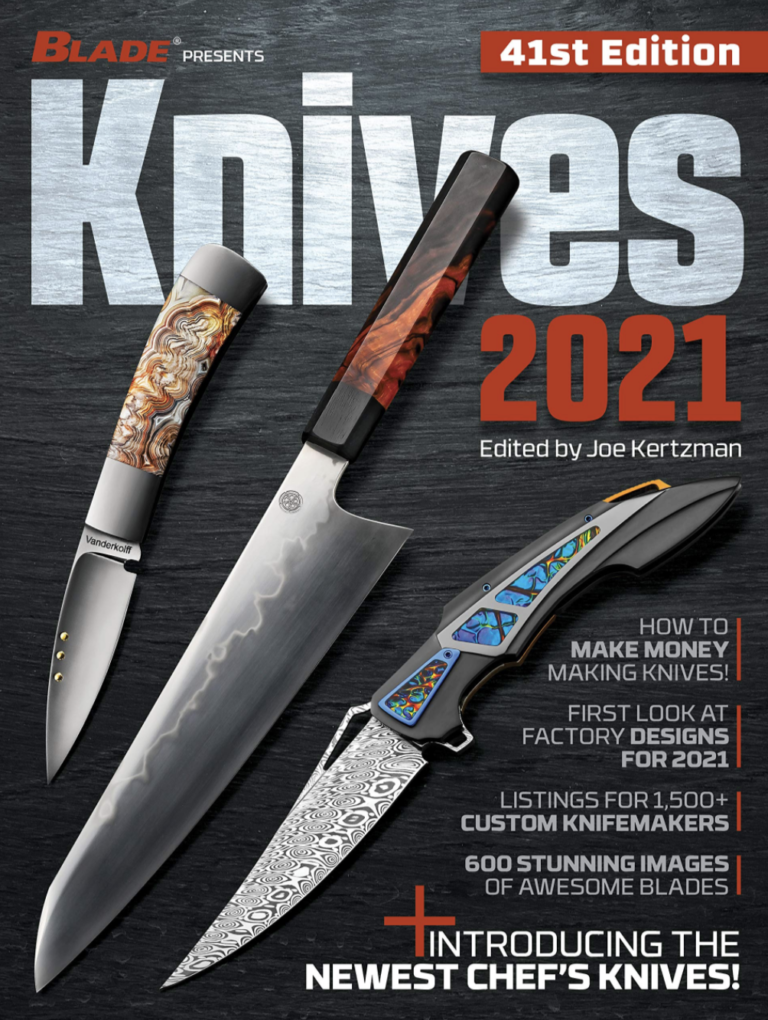
 KNIVES 2021, presented by BLADE Magazine showcases blades of every class and style with more than 600 spectacular full-color images, from customs to factory knives.