The Beauty Of Handmade Kitchen Knives

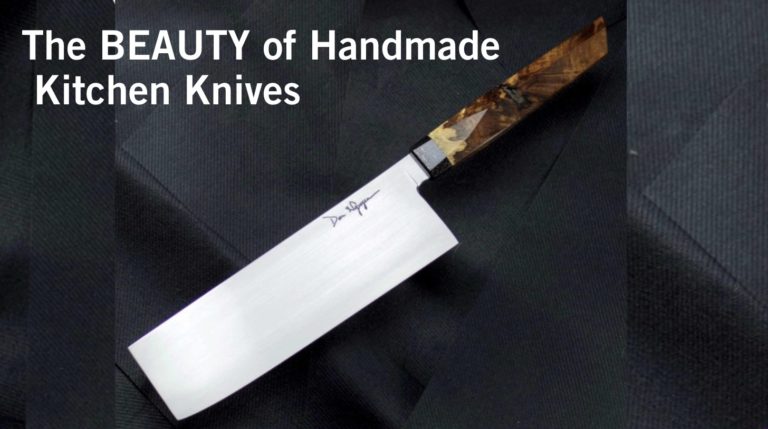
Handmade Kitchen Knives Reimagine What A Kitchen Knife Can Be

Don Nguyen didn’t know what he wanted from life when he was in college. An evening cooking at a friend’s apartment changed him forever. He was frustrated using his friend’s subpar, dull knives and wanted something better.

“It was that weird moment sharpening at a friend’s place where I said ‘I’m tired of this,’” Nguyen recalled. “I watched a bunch of YouTube videos, and those videos led me from sharpening to seeing Japanese makers make knives. I didn’t know what I wanted to do in life at that point so I was like OK, I want to do this. I dove in from there.”

Dive in he did, and now Nguyen has been making handmade kitchen knives, also commonly called custom kitchen knives, since 2017. He’s one of many makers entering the growing kitchen knife space and finding success.

Custom Kitchen Knife Advantage

Of course, the biggest difference between factory makers and custom makers is scale. A company like Wusthof can turn around hundreds of new knives every month. By contrast, Nguyen and his assistant complete a knife every one to two weeks. This allows for more delicate work when it comes to the actual knifemaking and makes getting different steels much easier.

Large Carbon Gyuto. Steel: 52100. Price: $3700

“Right now we’re probably averaging one knife every two weeks depending on the complexity, but we’re working on multiple knives at once so it’s hard to dictate how long a single knife takes,” Nguyen said. “I have an assistant and he helps me work on a bunch of stuff. We’re juggling projects all the time.

“I don’t have a lot of steel that I need to go through, and the steel choices I tend to use aren’t exotic steels. I go with 52100 for the most part for carbon steel knives. When I go with stainless I go with AEB-L or RWL-34. Those are fairly accessible. They’re usually in stock.”

Why Buy A Handmade Kitchen Knife?

When you talk to him, Nguyen’s passion is clear, and even with that passion, a big question remains: why should someone spend money on handmade kitchen knives instead of buying from a well-known factory maker?

He spoke honestly about how handmade kitchen knives won’t be for everyone, but for those who want them, they want only the best.

“Custom knives are made for a specific type of person,” Nguyen said. “They need to have food as their hobby. If they don’t like cooking all that much, they aren’t the intended audience for that. But if you love food, you follow it, buy books, read up on chefs, then you get into custom knives. Then you get knives in the [top] percentile of performance that are unique, made by someone you admire.”

Steel Sharpens Steel

As more makers enter the market, finding out ways to make your knives that are little bit better than your competitors has become the key to knifemaking. So much so that, according to Nguyen, many makers are working on what the knife does after it cuts the food.

“There’s a lot of interesting trends in knifemaking and the pursuit of the last 1 percent in performance,” Nguyen said. “A lot of makers now are working on food release. Being able to cut the food and having it pop off the [blade] without any effort at all. That’s a huge difference between a knife you buy off the shelf and a custom-made knife.”

Nguyen is one of the highly-skilled makers producing handmade kitchen knives. The below makers are also making exciting knives.

Best Handmade Kitchen Knife Makers

Mert Tansu

Nine-inch Damasteel gyuto in Heimskringla pattern. Price: $1,100

A former executive chef, Mert Tansu has been making remarkable kitchen knives in his native Australia for several years, learning to forge san-mai and damascus, and officially hung up his chef’s coat in 2018 to focus solely on making knives. 

His current knives are made in the Japanese tradition and fetch a tidy price, but the craftsmanship is clear from the moment you lay eyes on the blade.

Mareko Maumasi

4″ Phoenix Rising Mosaic Damascus Brute de Forge Bench Knife. Price: $650

Located in Washington state, Maumasi apprenticed under Bob Kramer, who we’ll talk about shortly, and makes multiple types of knives. He’s made many a wild damascus piece as well, and is a magician at working the steel to create exciting patterns.

“I think he’s one of the best makers out right now,” Nguyen said of Maumasi. “I talk with him all the time about business strategy, techniques, everything we’re going through.”

Bob Kramer

Meiji 10″ Chef’s Knives by Zwilling J.A. Henckels. Price: $379.99

He worked as a professional chef for a decade before asking himself “why can’t I and other chefs keep our knives sharp?” 

That question led him down the path to becoming one of the most accomplished makers of custom kitchen knives in the country. Kramer earned the title of ABS master smith in 1998, and since then he’s been “devoted … to the single-minded pursuit of crafting the perfect kitchen knife.”

His Kramer Knives not only turns out top-tier blades, but now features a small team to help keep the company strong and growing for decades to come. Additionally, his company has licensing agreements with a handful of major knife companies including Zwilling J.A. Henckels.

Andreas Kalani

The Dahlia. Price: $175

Andreas Kalani spent nearly a decade teaching himself the craft of knifemaking. He took his lumps and learned from his mistakes. Those years of trial and error have paid off as Kalani is now an accomplished knifemaker.

He makes beautiful Japanese-style knives as well as other kitchen utensils. Kalani even makes hunting knives and tools for skinning and processing your hunt. It all started with a dream for Kalani, and it has paid off handsomely thus far.

Will Brigham

Pattern-welded Sepharim Knife

Knives from Will Brigham are just as much art as they are kitchen tools. He specializes in pattern-welded damascus and mokume-gane knives. His sells his knives through his company, The Artificery, and he’s pushing hard to make the most distinctive damascus designs and highest-quality blades.

“Will Brigham is making crazy stainless steel damascus,” Nguyen said. “I think he’s kind  of the pioneer of modern stainless steel damascus.”

Read More

Best Rescue Knives [Field Tested]

0

What better knife to carry daily than one explicitly designed to save lives?

Why rescue knives as EDC? It’s more like “why not?” Life presents situations you don’t expect—an accident happens and there you are, right in the middle of it. It is therefore very important to be and stay prepared. Having a rescue knife within close reach can help when you need it most.

But who really carries a rescue knife daily? If you are a fireman, EMT or in law enforcement, it’s an easy answer. Remember the be and stay prepared motto. Even if not in a save-and-serve profession, you can have a rescue knife with you for times you need it most.

Victorinox Rescue Tool

It probably is no surprise that Victorinox makes a rescue knife. The company is well known for fashioning super handy pocketknives with all sorts of onboard tools that make work, play and life easier and more convenient—and in this case, safer, too.

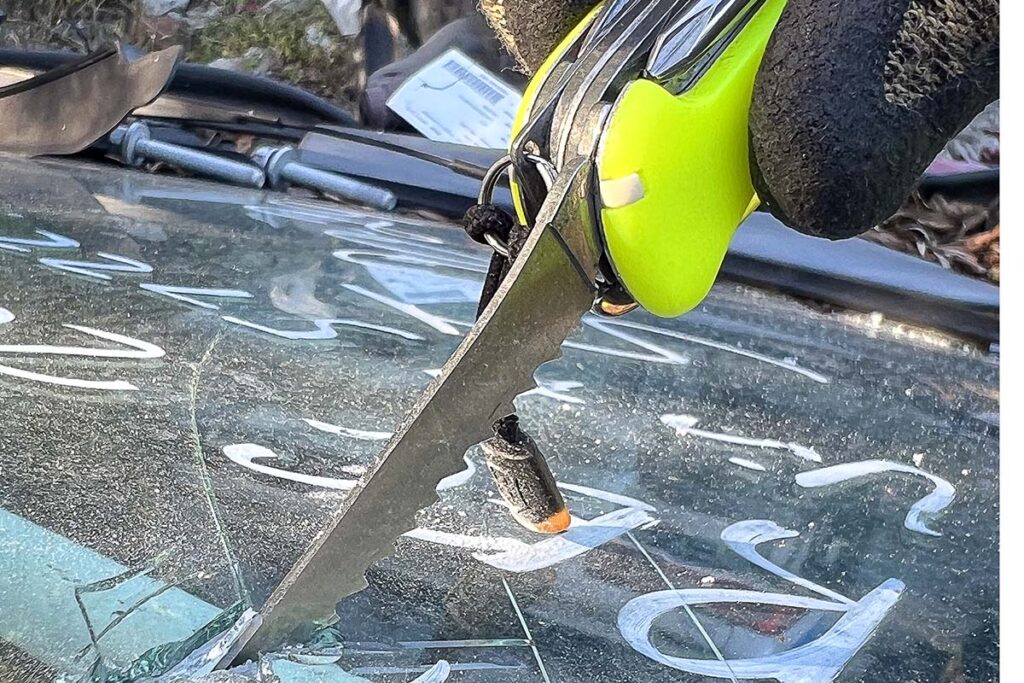
Victorinox Rescue Tool comes with a special saw that will cut through laminated vehicle glass
The Victorinox Rescue Tool comes with a special saw that will cut through laminated vehicle glass such as the kind used for windshields. The author said the saw grabbed on the pull stroke. “The saw possibly would have better results if the windshield were shattered first,” he noted, “but I couldn’t locate any shattered windshields on any of the test vehicles.”

At about 4.4 inches closed, the Victorinox Rescue Tool has a frame based on the largest knife the company makes. This is definitely not a pocketknife! It comes with a high quality sewn and riveted nylon sheath (more on it later).

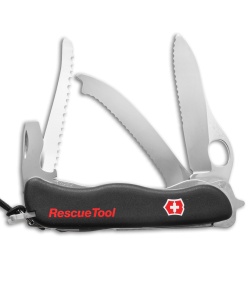
As with most Swiss Army knives, the Rescue Tool sports a variety of on-board tools: a partially serrated 3⅛-inch main blade with hole opener; bottle opener; flathead and Phillips screwdrivers; a combination can opener and small flathead screwdriver; a 3.25-inch semi-curved, fully serrated blade for cutting seatbelts; a specially designed 3.25-inch pull saw for cutting shatterproof glass; and a glass breaker. The latter two are removable. The polyamide scales come in high-visibility yellow for easy location in low light conditions, and the scales glow in the dark after being charged up by sunlight or artificial light. Fit and finish on the Rescue Tool is standard for Victorinox—perfect out of the box. The blades and tools are finished nicely in a full polish except for the saw blade, which is satin finished. Opening and closing action is smooth. The main partially serrated blade locks open via a linerlock as well.  

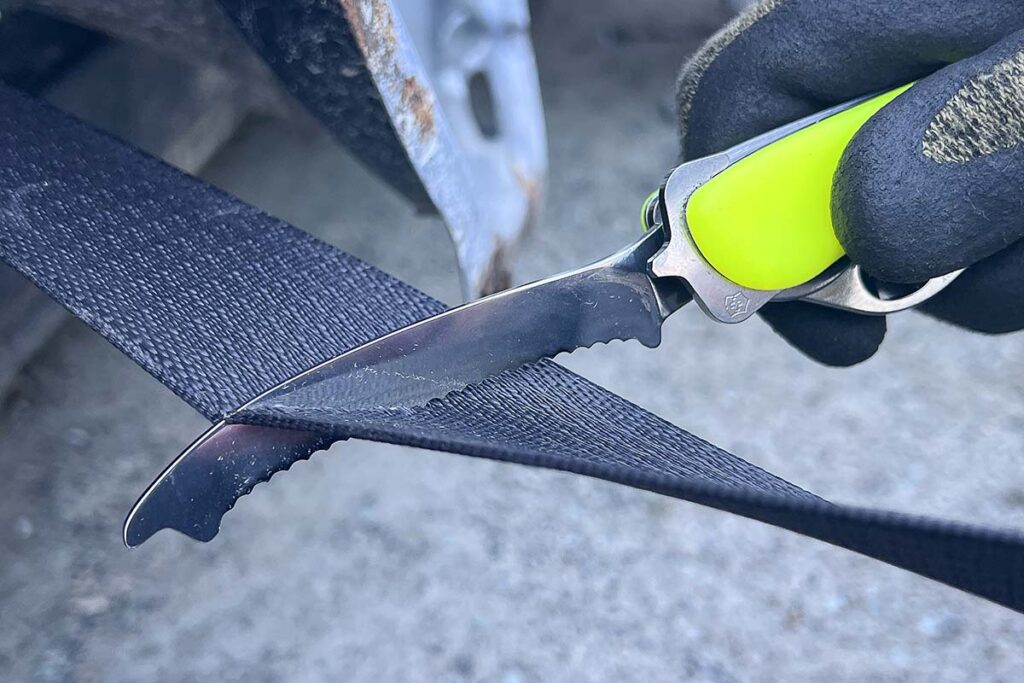
The seatbelt cutter is extremely effective. The rounded, dull blade tip extends slightly beyond the handle butt so you can deploy the blade with or without gloves. Work the blade under the seatbelt and, with one swift motion, pull and the blade slices clean through. The serration pattern is similar to one you might see on a steak knife, with evenly spaced teeth—simple yet very effective and extremely sharp out of the box.

seatbelt cutter blade of the Victorinox works
The fully serrated blunt tipped seatbelt cutter blade of the Victorinox works exceptionally well. It has plenty of aggressive bite to cleave through seatbelts in a hurry.

The partially serrated main blade is easy to deploy via the hole opener. The blade is unlike most if not all other partially serrated non-Victorinox patterns. The front 70 percent of the edge is serrated and the balance closest to the tang is plain for finer cutting. The serrations are more rounded at the tips than on the seatbelt cutter, presumably to allow the blade to cut evenly like a plain edge. I tested it on food, cardboard and manila rope, and it cut smoothly and aggressively.

Now for the disappointing part—the glass breaker. It was not effective at all. I could not get a side car window to shatter no matter how hard I hit it. I presume the failure is due to the breaker point being too big. In my experience, the most effective glass breakers are the ones that come to a point and are made of carbide, as with the balance of the review knives. The glass saw is effective, though it grabs a bit too much on the pull stroke. However, when I adjusted the pressure it worked. Country of origin: Switzerland. MSRP: $115.

Victorinox Swiss Army Knife Rescue Tool 54900

Victorinox Swiss Army Knife Rescue Tool 54900

$115.00
Prices accurate at time of publishing. Affiliate disclosure.

SOG Escape 2.0 ATK

The SOG Escape 2.0 ATK is the updated version of the original SOG Escape, a multipurpose rescue folder targeted at the serve and save pros. It features a 3.4-inch blade of AUS-8 stainless steel PVD coated black, a partially serrated edge, anodized aluminum handle, integrated/replaceable seatbelt/line cutter, and glass breaker. The blade sports ambidextrous thumb studs and a flipper for one-hand opening. The edge is serrated to tackle a plethora of cutting chores. The clip point shape is adaptable to a wide range of tasks and the defined point is great for scoring. The serrations provide extra slicing power when the going gets tough.

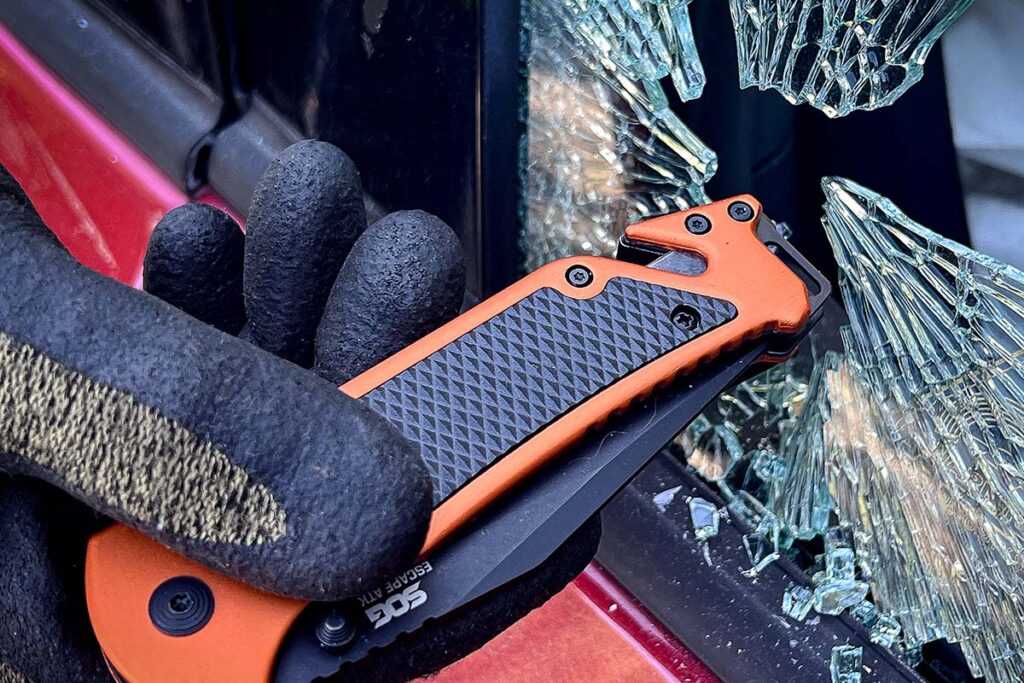
SOG Escape 2.0 ATK shatters a car
The author uses the SOG Escape 2.0 ATK to shatter a car window, both prior to (inset) and after the fact. Inset into the handle spacer, the glass breaker quickly shattered the side glass with a concentrated pop to the window’s lower corner.

The handle is cast aluminum with stainless steel liners. It comes in two colors: high visibility orange and OD green. The integrated slot at the butt houses a blade for cutting seatbelts, line and string without opening the knife. A glass breaker in the handle spacer quickly shatters side car windows. The breaker works very well. It quickly shattered the side glass with a concentrated pop to the lower corner of the window. The pocket clip is a fold-over, deep carry model. A spare seatbelt/line cutter blade stows safely beneath the textured panel handle inlay. Back out the two small Phillips screws securing the cover and you will see the blade underneath—it is simple to swap out.  Country of origin: China. MSRP: $54.95.

Sog Escape ATK Liner Lock Knife Orange/Black

Sog Escape ATK Liner Lock Knife Orange/Black

$49.91 $37.23
Prices accurate at time of publishing. Affiliate disclosure.

Kershaw Drivetrain

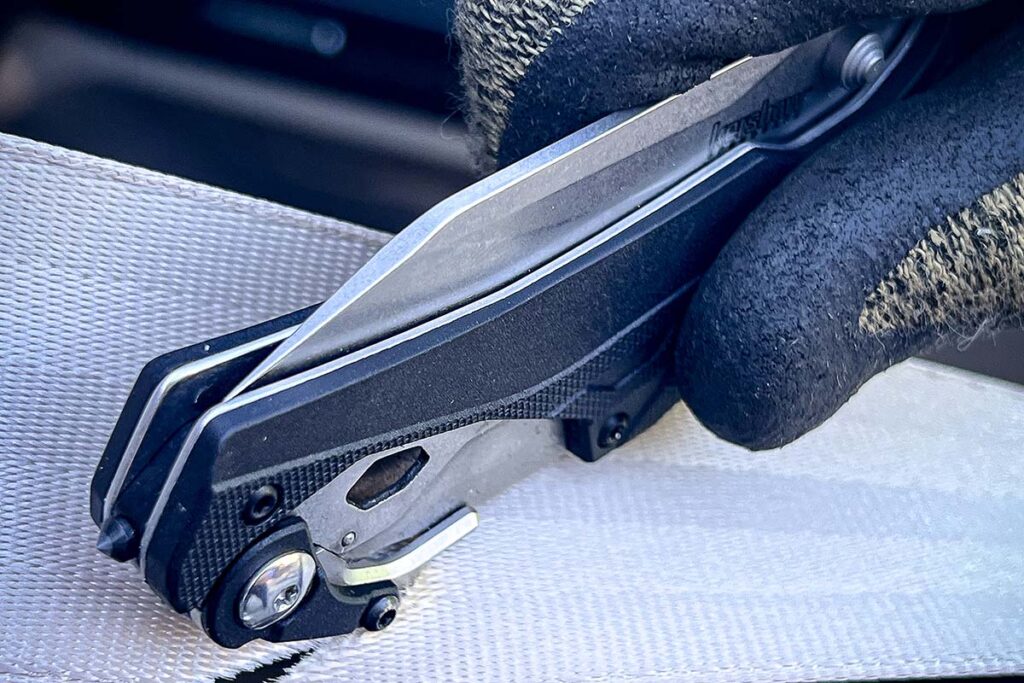
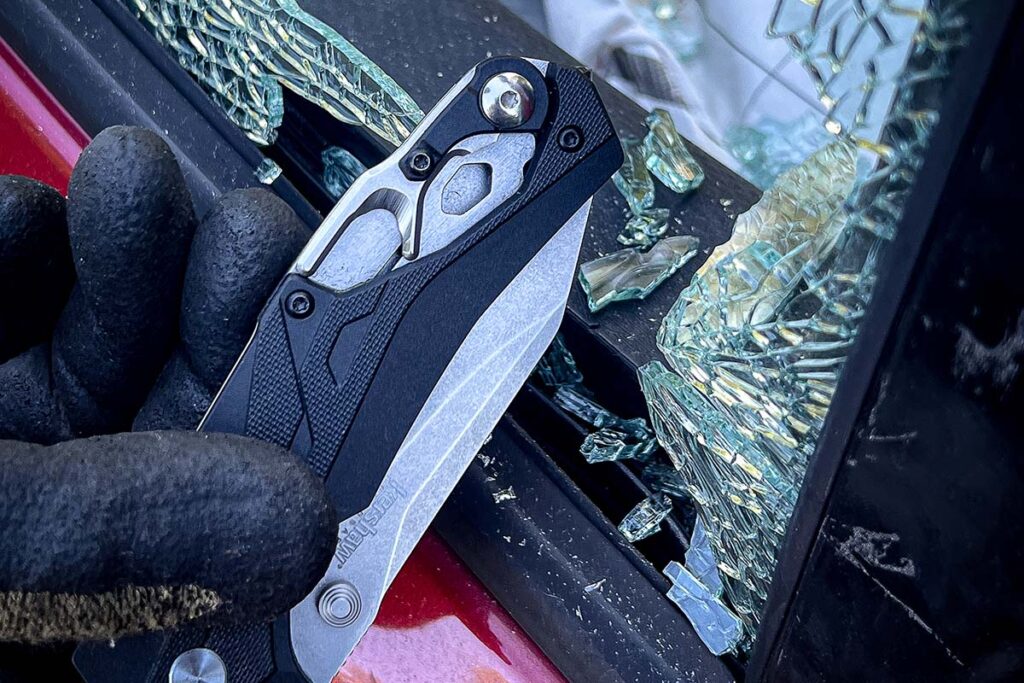
Kershaw’s Drivetrain rescue knife looks like any standard EDC linerlock folder. It has a stylish handle coupled with a very utility friendly blade—but that’s where the similarity ends. The presentation side of the handle butt boasts an integrated seatbelt cutter that folds out. A glass breaker is inserted into the end of the handle spacer. The 3.2-inch clip point blade has ambidextrous thumb studs and a flipper for one-hand opening enhanced by the company’s SpeedSafe assist mechanism. The blade is D2 tool steel for augmented edge holding and wear resistance, especially for the price point. The stonewash finish is attractive and hides scratches.

Kershaw Drivetrain cutting a seatbelt
The author indicated the fold-out locking seatbelt cutter of the Kershaw Drivetrain is the best of the test bunch. It’s a wide hook with a blunt tip leading edge for safety. Rest the handle spine on the seatbelt and pull. The handle guides the cutter to the belt and it cleaves very easily.

The handle is molded glass reinforced nylon with double stainless steel liners. The scales are textured and contoured for a nonslip, comfortable grip with no hot spots. The seatbelt cutter easily deploys with one hand and a separate linerlock holds it in place. When closed, the cutter is concealed within the lines of the handle profile and doesn’t get in the way. A steel pocket clip carries the closed knife blade tip up.

The blade is very utility friendly, from opening boxes and mail to cutting cardboard and plastic sheeting. Once locked open, it is extremely secure with no play.

Kershaw glass breaker works very well
The Kershaw glass breaker works very well. Situated at the end of the handle, a quick strike with it to the lower corner of the vehicle side window did the job.  

The seatbelt cutter works well. The hook tip is dull and rounded so you can work it under the seatbelt without inadvertently cutting yourself or the accident victim. The blade is ground on both sides to enhance sharpness. For best results, make your pull cut at an angle in relation to the seatbelt. Also, resting the handle spine on the seatbelt is a great way to “aim” the cutter. It bites in better that way and, when you feel it engage, give the handle a quick tug and it cleaves through effortlessly. It is a surprisingly effective seatbelt cutter! The glass breaker works very well, too. Country of origin: U.S. design, prototype and quality control, Chinese manufacture. MSRP: $69.59.

Utica’s Honor Rescue Knife

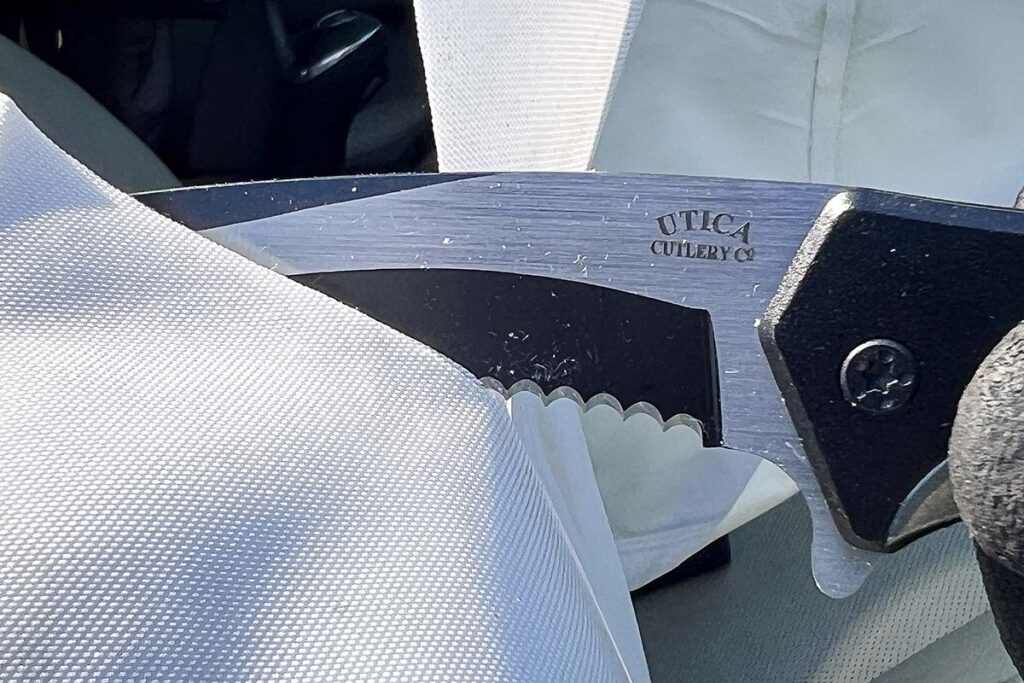
Utica’s Honor Rescue Knife is the least expensive of the test group. It packs a few features normally found on rescue knives, such as the integrated seatbelt cutter, glass breaker and a partially serrated, modified tanto blade. The 3-inch stainless steel blade’s partial serrations help rip through thicker materials. A two-tone finish adds character, with the bevels and spine black oxide coated and the flats satin finished. A flipper tab provides ambidextrous opening, and the blade rides effortlessly on bearings for ultra smooth action. The handle is aluminum with double stainless steel liners providing the backbone. A linerlock holds the blade open securely. A seatbelt cutter slot in the handle butt has two sharpened blades held in the scissor position to cleave seatbelts with a firm pull. The steel back spacer has an extended portion that tapers to a point, which serves as the glass breaker. 

The Utica tanto blade’s partial serrations help rip through thicker materials.

Like with the Victorinox Rescue Tool, the glass breaker on the Utica test model was ineffective. The point rounded off due to multiple hits to a side window and did not shatter it. The breaker needs a carbide point. A deep carry clip positions the closed knife blade tip down. Cost and feature wise, the Honor Rescue Knife is a great option without breaking the bank. Country of origin: China. MSRP: $32.97.

Final Cut

A final thought: Some prefer having a rescue knife for emergencies only as opposed to having one for both work and emergencies. You can get away with a relatively inexpensive rescue knife if you preserve it for emergency use exclusively. (Some high-end rescue knives cost as much as regular tactical folders, that is, several hundred dollars.) There’s nothing wrong with an inexpensive rescue knife as long as the manufacturing quality is there, the blade lock holds and the blade is sharp. If you are adept at doing so, sharpen the blade first before stowing it away; this way you know the blade is very sharp. And since you won’t be using it as an EDC, the sharp edge will be preserved. This works well if you have multiple vehicles in your family that you wish to outfit with rescue knives.  

Where To Keep Your Rescue Knife

Keeping a rescue knife in your vehicle is a great idea as it can help free you and others should you have an accident or happen upon one. However, give careful thought to where you stow the knife.

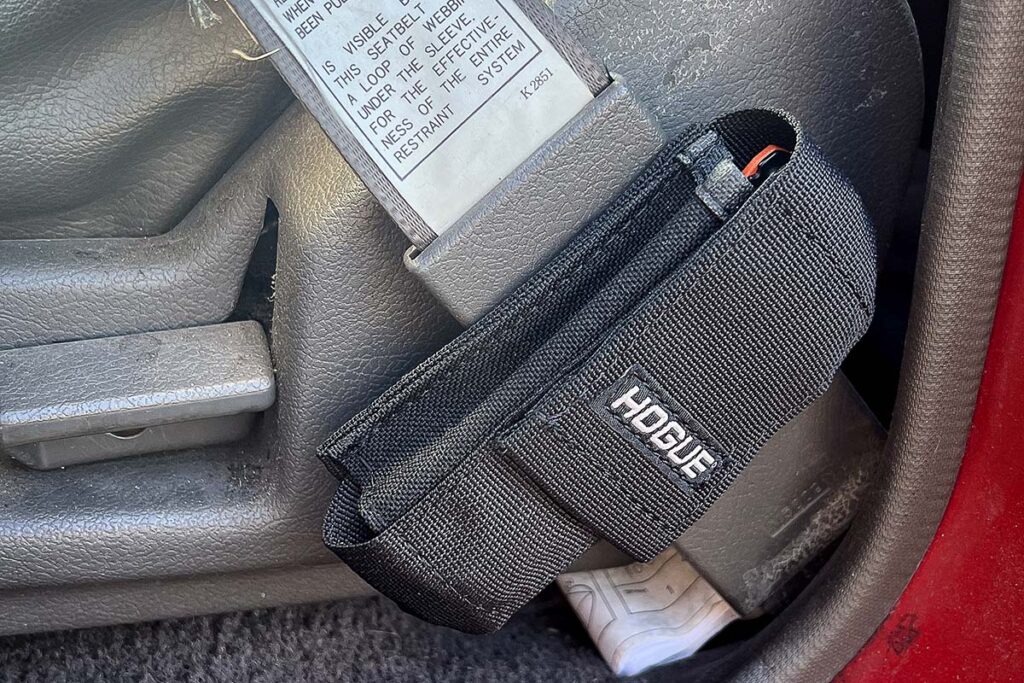
The author keeps his Hogue Trauma rescue folder in the sheath wrapped around the lower portion of the seatbelt anchor in between the seat and door of his truck.

Most assume a glovebox is a safe place and while not a wrong choice, it is a poor one. Why? For one, in an accident your seatbelt may not release because of the tension; in essence, you’re strapped to the driver’s seat and cannot lean over to access the glovebox. Worse, the vehicle could be upside down or on its side. In other words, have the knife placed securely within arm’s length.

I keep a Benchmade Auto Triage inside the sunglass holder in the roof of my car, just above the inside rearview mirror. It is secured shut with a latch so it won’t pop open on impact. I can easily reach it and remove it from the holder with my right hand. In my truck I keep a Hogue Trauma rescue folder in the sheath wrapped around the lower portion of the seatbelt anchor in between the seat and the door. It’s just enough room for me to access the knife with the door shut, and the knife is secured in that position and won’t move.

The worst place to keep the knife is in the center console cupholder. While it’s convenient to access, if you get rear ended or t-boned, the knife will go airborne and land way out of reach. Some vehicles may have a center console storage/armrest in the middle. Yeah, mine in each vehicle is a clutter catchall for receipts and other junk, but it’s another ideal location because the armrest lid latches shut and is within arm’s reach.

Read More Knife Reviews:

Remembering Hawaiian Knifemaker Keith Derrick Ouye

Remembering a dedicated craftsman of the Fujisaka lineage known for his tactical precision and collaborative artistry.

Keith Derrick Ouye, award-winning knifemaker of Honolulu, Hawaii, passed away on October 5. He was 80.

A stocky, happy guy well-liked by both knife enthusiasts and his knifemaking peers, Keith primarily made tactical knives, though he also built hunting knives to sell at local gun shows. In addition, he made fancy folders, often with fine engraving by Bruce Shaw, C.J. Cai or Lisa Tomlin. Keith exhibited his work at the BLADE Show and other top knife events over the years. Like many Hawaiian knifemakers, he was a student of BLADE Magazine Cutlery Hall-of-Fame® member Stanley Fujisaka.

Born in South Hilo, Hawaii, Keith lived in Hawaii Kai on the island of Oahu. “I spend most of my day working on my knives,” he wrote in his mini-bio on the Arizona Custom Knives website. “With assistance and guidance from Stan Fujisaka, I started to make fixed blades in early 2004. By the end of 2004, I also started making folders. I began making knives full-time in 2005.”

Keith was a big believer in sole authorship, noting “except for the screws, dowels, standoffs and pivots, I fabricate the rest of the knife myself.”

Remembering Others The Knife Industry Has Lost:

BLADE Show 2023: What To Expect In Atlanta

BLADE Show 2023 is just around the corner. Here’s what to look out for at the “World’s Greatest Knife Show!”

If the third time really is the charm, then BLADE Show 2023 is smack dab in the middle of charm’s way.

Why? Because it’s the third BLADE Show after the one that was cancelled in 2020 as a result of the pandemic, and most all travel restrictions instituted even as late as last year’s BLADE Show have been lifted. That means a full return of international knife exhibitors and fans in addition to all those domestic are expected to make the 42nd annual rendition of the world’s most important knife event the biggest and best ever.

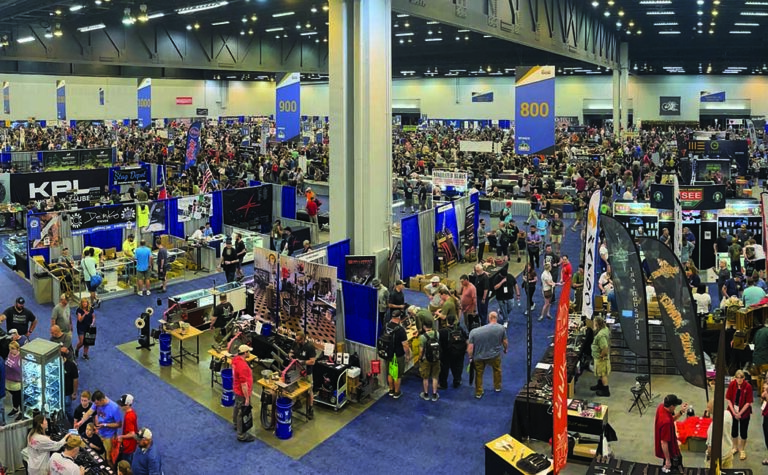
Sponsored by Smoky Mountain Knife Works, the BLADE Show is where more knives—new, old, custom, factory, etc.—are exhibited, bought and sold than at any other knife event. Almost 930 exhibitors* from every continent but Antarctica were scheduled to exhibit at press time, all bringing their latest and greatest knives and other edged tools, accessories, knifemaking supplies and more. Factory and custom knives, sharpeners, knife collections, knife purveyors and other cutlery entities too numerous to mention will showcase their wares as the world knife community makes the yearly pilgrimage to the Cobb Galleria Centre.

BLADE Show Overview

WHAT: BLADE Show
WHERE: Cobb Galleria Centre, Atlanta
WHEN: June 2-4
DAYS and TIMES:

  • Friday, 11 a.m.-6 p.m. (early bird ticket holders can enter at 10 a.m.)
  • Saturday, 9 a.m.-6 p.m.
  • Sunday, 9 a.m.-2 p.m.

Get Your BLADE Show Tickets

The latest, hottest custom knives, factory knife debuts, the educational knife instruction class schedule of BLADE University and action-packed free demos are among the sharp goodies awaiting hordes of show patrons. The BLADE Magazine 2023 Knife-Of-The-Year® Awards, the custom knife judging competition and the knife collection display judging competition are others. The ABS Knife Auction, formal inductions of the latest members of the BLADE Magazine Cutlery Hall Of Fame®, and some of the best knives the ABS and the Knifemakers’ Guild and unaffiliated makers in general have to offer are still others.

And don’t forget The Pit, the after-hours meeting place in and around the sunken bar of the host hotel, the Renaissance Atlanta Waverly, where show patrons and exhibitors will congregate into the wee hours beginning the night before the show through the end of the weekend to compare knives, swap lies and otherwise celebrate the year’s most momentous cutlery weekend.

BLADE University

Avail yourself of the latest knifemaking techniques and other trending sharp subjects during the 10th Annual BLADE University show Friday and Saturday.

Ed Flowler seminar
BLADE® field editor Ed Fowler will present the seminar “Seeking Safety In Knife Design” show Saturday at 1 p.m. in Room 107.

Sponsored by Work Sharp Sharpeners, BLADE University has the most extensive schedule of knife, knifemaking and other instruction held at any knife show. Among the highlight classes for 2023 are “CRKT Presents Q&A with Michael Walker” featuring the industry renowned creator of the linerlock; “Designing Kitchen Knives” and “How To Run A Successful Knifemaking Business” with chef’s knife maestro Bob Kramer; “Exploring the Performance of Pattern-Welded Steel,” with damascus forging legend Devin “Hoss” Thomas and his son, internet steel guru Larrin Thomas; and many more.

BLADE University Schedule

FRIDAY

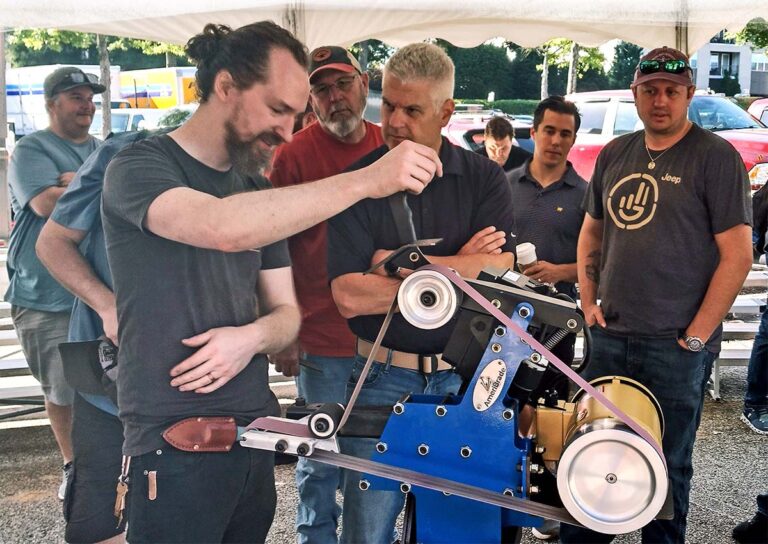
  • 8-9:30 a.m. Fundamentals of Grinding, The Courtyard. AmeriBrade and guest makers cover grinds, technique and different equipment.
  • 10-11 a.m. Exploring the Performance of Pattern-Welded Steel, Room 103. Devin and Larrin Thomas review their experiments on the strength, toughness and edge retention of damascus steel.
  • 10:30 a.m.-12 p.m. Designing Kitchen Knives, Room 104. ABS master smith Bob Kramer discusses considerations to ponder when designing kitchen knives.
  • 1-2 p.m. CRKT Presents Q&A with Michael Walker, Room 104. BLADE Magazine Cutlery Hall-Of-Fame® member Michael Walker answers questions on the linerlock he developed in 1981, the evolution of the many other locking systems he designed post-linerlock and more.
  • 1:30-2:30 p.m. Dancing with the Devil: Algorithms, SEO and Ecommerce, Room 103. Ben Petersen explains how to sell knives online and build your brand while navigating Google, Amazon and Meta.
  • 2-3 p.m. What’s Hot in Knife Steels, Room 103. Join representatives from Mike Norris Damascus, Nichols Damascus and Vegas Forge as they discuss today’s hottest steels and why those steels are so much in demand.
  • 3-4 p.m. Forging Ancient Materials and Why It’s Important Today, Room 107. Award-winning knifemaker Ilya Alekseyev and friends explore how and why practicing forging methods used by the craftsmen of old translates into modern materials.
  • 3:30-4:30 p.m. Hands-On Knife Sharpening, Room 113. Bring your knife or a borrowed one and learn the progression of shaping a bevel, sharpening and edge maintenance from the team at Work Sharp Sharpeners.
  • 4:30-5:30 p.m. Unlearning Bad Habits: My Unique Path to JS, Room 107. Matt Stagmer focuses on makers that have been in the craft for many years, and how becoming an ABS journeyman smith differs from someone learning those standards from day one.

SATURDAY

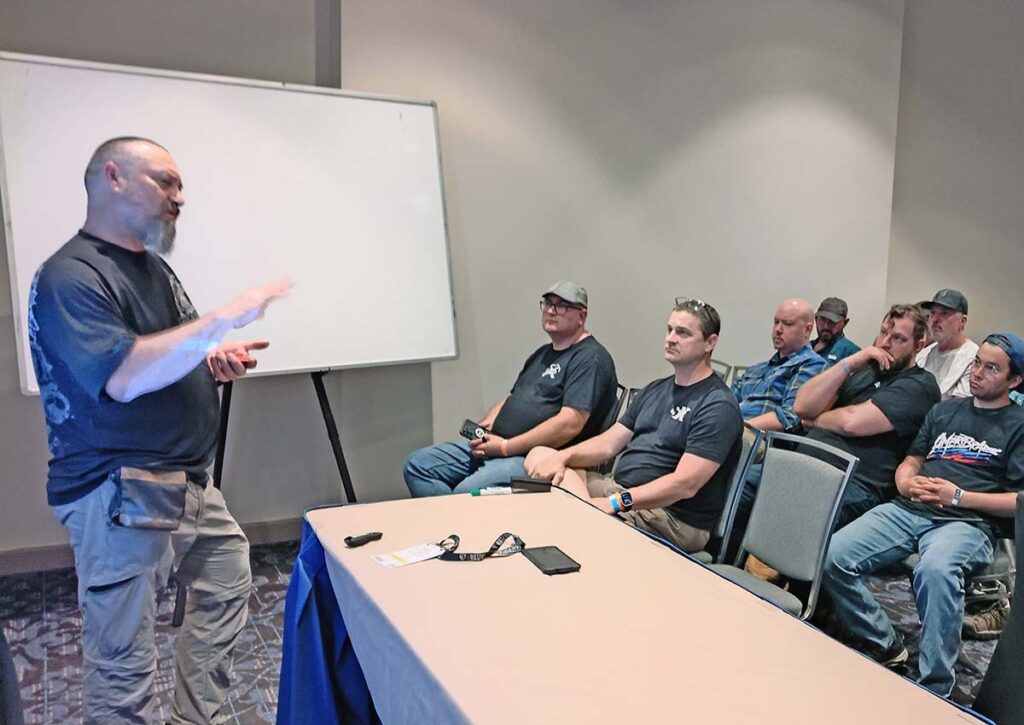
  • 8:30-9:30 a.m. Decorative Custom Knife Filework, Room 113. Knifemaker Kyle Daily of KHDaily Knives shows you his preferred files and the equipment he uses to make his five most popular filework patterns.
  • 8:45-9:45 a.m. How To Forge a Hunting Knife, The Courtyard. Using his propane forge, ABS master smith Timothy Potier demonstrates how to forge a full-tang drop-point hunter.
  • 9:30-11 a.m. How To Run a Successful Knifemaking Business, Room 104. ABS master smith Bob Kramer shares his 35 years of experience running a successful knifemaking business.
  • 9:45-10:45 a.m. Reproducing Traditional Pocketknives, Room 107. Tim Robertson covers patterning traditional slipjoints from original factory knives in detail, including methods of disassembly, correct scribing techniques and proper hole layout.
  • 11 a.m.-12 p.m. 3D Printing for Canister Patterns, Room 113. ABS master smith Steve Schwarzer and Ron Hardman show you how to use this game-changing advancement to forge patterns on a budget that were previously unthinkable.
  • 2-3 p.m. Let the Pros Critique Your Knife, Room 104. Award-winning knifemakers Lucas Burnley, Luke Swenson and Devin Thomas, and ABS master smiths David Lisch and Mike Quesenberry examine your knife, tell you what’s good about it, what’s not and how to make it better.
  • 2:15-3:15 p.m. Hands-On Knife Sharpening, Room 113. Bring your knife or a borrowed one and learn the progression of shaping a bevel, sharpening and edge maintenance from the team at Work Sharp Sharpeners.
  • 2:30-3:30 p.m. Writing for a Knife Publication, Room 107. Author/ABS apprentice smith Jason Fry and a panel of industry insiders share the tips and tricks it takes to get into the knife writing game.
  • 4-5 p.m. Folder Design, Room 104. David Carver of Carver Knife Co. teaches techniques on making a folding knife that works well, looks good and feels great in the hand/pocket.

Enroll In BLADE University Classe Now!

World Cutting Title

The BLADE Show World Championship Cutting Competitions will be conducted by BladeSports International (BSI) and held in The Courtyard, the parking lot of the host hotel, the Renaissance Atlanta Waverly, Saturday at 4:30 p.m.

At press time, contestants in both men’s and women’s divisions were scheduled to compete. Last year, James Clifton won the men’s division and Terri Lynn the women’s.

Knives Of The Year

The BLADE Magazine 2023 Knife-Of-The-Year® Awards will be announced and presented during the BLADE Magazine Awards ceremony Saturday night in The Pit.

The entries are limited to BLADE Show factory booth exhibitors, and will be on display show Friday and Saturday under glass in a special locked cabinet in the lobby. The winners will be announced on BLADE’s here after the awards presentation, and a list will be posted outside the show entrance Sunday morning.

The award categories are: Overall; American-Made; Imported; Most Innovative American Design; Most Innovative Imported Design; Best Buy Of the Year; Investor/Collector; Collaboration; Manufacturing Quality; Accessory; Kitchen; Publisher’s; and Industry Achievement.

Custom Knife Judging

Leading industry authorities will pick the best custom knives by BLADE Show exhibitors in the annual knife judging competition, with the winners announced during the BLADE Magazine Awards ceremony Saturday night in The Pit.

Rhea knife
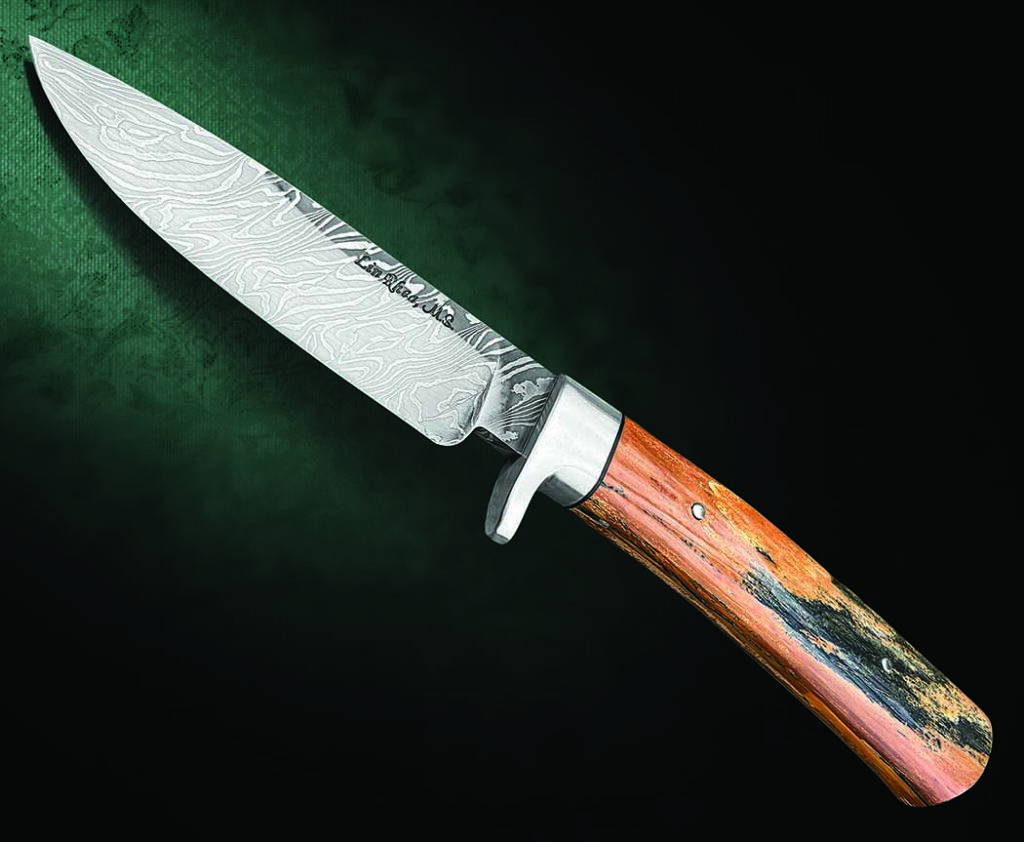
ABS master smith Lin Rhea will exhibit such forged wonders as his damascus hunter in mammoth ivory. (Jocelyn Frasier image edit)

The categories: Hugh Bartrug Best Of Show; Best Fixed Blade; Best Damascus; Best Kitchen Knife; Yvon Vachon Best Miniature; Best Art Knife; Best Fighter; Best Bowie; Best Handle Design; Best Tactical Folder; Best Utility Hunter; Best Folder; Most Innovative Design; Best Knife Collaboration; Best Sword; Best New Maker; Best Of The Rest; and a new BLADE Show category: Best M.A.C.K. (Machine Assisted Custom Knife).

The competition is open to the show’s custom knife exhibitors only. The winners will be announced on BLADE’s blademag.com website after the awards ceremony, and a list will be posted outside the show entrance Sunday morning.

Seminars & Demos

Seminars and demonstrations will be held in classrooms inside the Cobb Galleria or in The Courtyard, or under The Courtyard’s BLADE University tent. Admission is free to BLADE Show ticket holders.

Among the highlights will be “Knowledge Destroys Fear” presented by Ernest Emerson, CEO of Emerson Knives, Inc. Ernest will share the secrets of how Navy SEALs, Special Forces, Rangers and U.S. Marines conquer fear and thrive and prevail in the face of extreme life-threatening danger. Another highlight will be “Seeking Safety in Knife Design” with BLADE® field editor Ed Fowler. Ed will outline how to use knives efficiently and safely and what to look for in knives that cut effectively, do so without causing hot spots, and otherwise aren’t accidents waiting to happen in and of themselves.

Cutlery Hall Of Fame®

The BLADE Magazine Cutlery Hall Of Fame® will formally induct three new members at 8 a.m. show Saturday in the Kennesaw Room of the Renaissance Atlanta Waverly Hotel. (At press time, the new members had not been determined.) Tickets are required ahead of time for the ceremony, which includes a breakfast. Seating is limited. For ticket information, email [email protected].

Knife Colletions

Outstanding knife collections will be on display, with the best recognized via a judging competition. Last year’s winners: Larry Oden, Best of Show for “Buck Factory Production Knives of the 1960s.” Judges awards went to Gene Merritt for his “Yellowhorse” display of David Yellowhorse knives and Bruce Cannon for “Paul Bos: Alloys’ Greatest Ally.” Natalie Lindsey won the Youth Award for “Tinkerbell and Friends Put the Magic in BCCI and Buck Knives.”

Bali Championship

Top balisong flippers will vie for the title of “Grand Master” in the 7th Annual Battle for Bali-Champion sponsored and conducted by Blade HQ.

Bali awards
The 7th Annual Battle for Bali Champion conducted by Blade HQ will be Saturday in The Courtyard. Last year’s top finishers, from left: James Hill (3rd place), Leighton Gravely (first) and Moiz Khalil (second).

The top three finishers will receive prizes and all participants will get swag bags. The competition will be limited to 48 contestants.

BLADE Show ticket holders are invited to watch the competition in The Courtyard under the BLADE University Tent on show Saturday from noon to 2 p.m. Competitors will start flipping knives at 12:30 p.m.

BLADE Show Seminars And Events

SATURDAY

  • 8 a.m.: BLADE Magazine Cutlery-Hall-Of-Fame inductions, Kennesaw Room, Renaissance Atlanta Waverly Hotel: Buy Cutlery Hall Of Fame Tickets
  • 10-to-11:45 a.m.: ABS Knife Auction, Room 103
  • Noon-to-1 p.m.: Knowledge Destroys Fear—Ernest Emerson, Room 104
  • Noon-to-2 p.m.: 7th Annual Battle for Bali-Champion—Blade HQ, The Courtyard (the actual competition starts at 12:30 p.m.)
  • 1-to-2 p.m.: Seeking Safety in Knife Design—BLADE® field editor Ed Fowler, Room 107
  • 12-to-3 p.m.: Buck Collectors Club, Room 103
  • 4:30 p.m.: BLADE Show World Championship Cutting Competitions, conducted by BladeSports International in The Courtyard

Editor’s note: Microtech Knives and Heretic Knives are the presenting sponsors for BLADE Show 2023. RoseCraft Blades is The Pit sponsor. Work Sharp Sharpeners sponsors BLADE University. The other sponsors are Hogue Knives; Reate Knives; Nottingham Tactical; QSP Knife; Zac Brown’s Southern Grind; WE Knife; Glow Rhino; Columbia River Knife & Tool; and Artisan Cutlery.

Read More About The Blade Show:

12th Annual BLADE University Classes

Hone your cutlery acumen at the 12th Annual BLADE University

How to make and design knives, how to determine which steel for which knife, what to look for in proper damascus patterns and how to enhance their appearance and other incisive knife subjects will highlight the class schedule of the 12th Annual BLADE University.
Held in conjunction with the 44th Annual BLADE Show June 6-8 at the Cobb Galleria Centre in Atlanta, BLADE University will be sponsored by Work Sharp. Classes begin the Thursday before the show, June 5, and will run through Friday, June 6, and Saturday, June 7. All courses will be taught in the Cobb Galleria except one—Fundamentals of Grinding—which will convene under the tent in The Courtyard, aka the parking lot of the show’s host hotel, the Renaissance Atlanta Waverly.

BLADE University assembles some of the world’s best knifemakers, bladesmiths and other cutlery and steel professionals to teach a wide range of subjects for the knife user, knifemaker, knife hobbyist, knife entrepreneur, knife designer, and knife aficionado and novice alike. If you love knives or are just beginning to, BLADE University has a topic for you. The complete course schedule, with subjects, teachers, times and venues:

Thursday, June 5

In “Level Up Using Lasers, Ninjas and Other Cool Tools,” ABS master smith Neels van den Berg dives into how tools like laser engravers, digital design, and jigs and process design can streamline your workflow and enhance your work.
  • Material Conservation for the Forging Smith, Mareko Maumasi, 4 to 5 p.m., Room 104—Award-winning bladesmith Mareko Maumasi shares techniques and approaches he uses to reduce guesswork and material waste in the workshop. His approaches not only help the knifemaker’s material go further but also save time and money.

Friday, June 6

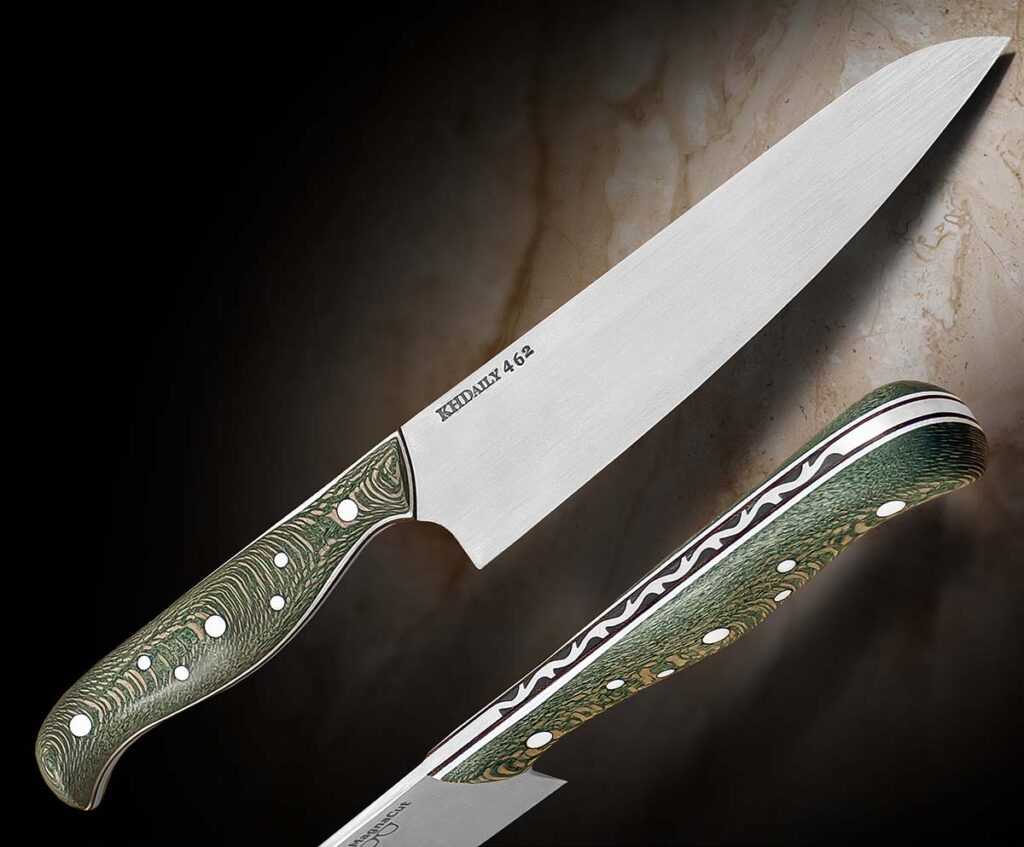
In “Elevating Your Handle Appearance: Spine Filework, Handle Shapes and Pin Placement,” knifemaker Kyle Daily shares his preferred files and specialized equipment for crafting his five most popular filework patterns, ensuring your knife not only looks exceptional but also feels comfortable and functional. (Jocelyn Frasier knife image)
  • Fundamentals of Grinding, AmeriBrade and guest grinders, 8 to 9:30 a.m., The Courtyard—AmeriBrade and guest makers provide a general overview on grinds, techniques and different equipment. The class is interactive and the team answers questions and demonstrates suggestions for common issues.
  • Deep Dive into Culinary Knives, Mareko Maumasi, 10 to 11:30 a.m., Room 103—Mareko Maumasi returns to help collectors and makers better understand the nuances of high-performance culinary knives. The class covers design aspects from blade tip to pommel, aiding collectors in making more informed knife-buying decisions, and makers in creating higher-quality and higher-performing culinary knives.
  • The Tom Brown Tracker Experience, Mathew Williams, 1 to 2 p.m., Room 107—Experienced woodsman and tracker Mathew Williams discusses the iconic Tom Brown Tracker knife, including the blade’s notable features, how the knife’s function can be of benefit to the user and more. Mathew even dispels some Hollywood myths concerning the TBT. This one’s for old-time fans and newcomers alike.
  • Take Damascus Etching to the Next Level, Baker Forge, 1:30 to 2:30 p.m., Room 103—Greyson Weltyk of Grey Blades and Jordon Berthelot of JB Blades teach step-by-step processes on how to enhance intricate patterns in damascus with Gator Piss etchant, including in-person demos with damascus knives. Subjects include proper cleaning prep, temperatures, stacking oxide techniques, sealing oxides and more. Receive in-depth looks at new product offerings from Gator Piss for etching stainless damascus and properly sealing damascus with nano-ceramic technology. Have the opportunity for Q&A with authorities about damascus etching.
  • Hands on Sharpening, Work Sharp, 3:30 to 4:30 p.m., Room 113—What happens when a knife goes dull? How do you know when to sharpen it? Bring your own knife or borrow a demo model and learn the progression of shaping a bevel, sharpening and edge maintenance from the team at Work Sharp. You get hands-on practice and experience sharpening your blade using a variety of sharpeners and abrasives, from whetstones to belts. (See under Saturday’s classes for an encore presentation.)
  • Leather Sheath Making Tips, Tricks & Tools, John Dennehy, 4:30 to 5:30 p.m., Room 107—Classes on sheath making are conducted at knife shows, social media and elsewhere. Unfortunately, some of the online demos are by those giving the wrong advice. John Dennehy shares the sheath-making tips he’s learned after working leather for almost 50 years, including leather selection, the tools he uses and why he uses them. He also covers the construction details he employs that experienced leather workers recognize immediately as the ones needed to produce a professional sheath.

Saturday, June 7

In “How to Select the Best Steel for Every Knife,” steel metallurgist Dr. Larrin Thomas talks about the factors that are important for different types of knives, such as cost, toughness, edge retention, sharpenability and corrosion resistance.
  • Elevating Your Handle Appearance: Spine Filework, Handle Shapes and Pin Placement, Kyle Daily, 8:30 to 9:30 a.m., Room 113—Enhance the appearance of your knife with distinctive features that go far beyond standard production models. Knifemaker Kyle Daily from KHDaily Knives guides you through the intricate art of filework on the spine, while also sharing insights into handle design and pin placement on the handle. Discover Kyle’s preferred files and specialized equipment for crafting his five most popular filework patterns, ensuring your knife not only looks exceptional but also feels comfortable and functional. From laying out your pattern to a step-by-step tutorial, this class provides the essential knowledge to achieve a professional and eye-catching finish. A Q&A session at the end ensures you leave with the skills and knowledge to take your knifemaking to the next level.
  • Demystifying Damascus, Mareko Maumasi, 9:30 to 11 a.m., Room 104—Mareko Maumasi completes his third straight day of teaching BLADE University classes with a most challenging one. He breaks the subject down in a way to help collectors gain a better appreciation for the knowledge and skill required to make unique damascus patterns, and to deepen the makers’ understanding of pattern design and composition.
  • The Cutting Edge, Nick Italiano, 9:45 to 10:45 a.m., Room 107—Nick Italiano, seasoned outdoorsman and host of the Raise The Flag Podcast, discusses the nuances of various blade grinds. From common everyday uses to survival situations, Nick covers several common grinds and their real-world function.
  • Level Up Using Lasers, Ninjas and Other Cool Tools, Neels van den Berg, 12:30 to 1:30 p.m., Room 113—Step up your knifemaking game with cutting-edge technology, unconventional techniques and insider secrets from ABS master smith Neels van den Berg. In this high-energy session dive into how laser engravers, digital design, and jigs and process design can streamline your workflow and improve your work. Plus, explore the mindset and discipline—the “ninja skills”—that separate good makers from great ones. Packed with real-world examples, practical insights and a touch of humor, this is a must-attend for makers looking to work smarter, not harder.
  • Designing Knives: Philosophy, Tools and Inspiration, Jens Anso, 2:15 to 3:15 p.m., Room 104—Award-winning knifemaker Jens Anso shares his approach to knife design, including how he thinks about form and function, the tools he uses and where he finds inspiration. With decades of experience in the industry, he’s developed a clear design philosophy that balances aesthetics, ergonomics and real-world usability. He explains his workflow, from sketching and CAD modeling, to prototyping and refining details. His goal is to provide insight into the design process and share practical takeaways for makers and enthusiasts who want to push their work further.
  • Hands on Sharpening, Work Sharp, 2:15 to 3:15 p.m., Room 113—What happens when a knife goes dull? How do you know when to sharpen it? Bring your own knife or borrow a demo model and learn the progression of shaping a bevel, sharpening and edge maintenance in this encore presentation from the team at Work Sharp. You get hands-on practice and experience sharpening your blade using a variety of sharpeners and abrasives, from whetstones to belts.
  • How to Select the Best Steel for Every Knife, Larrin Thomas, 4 to 5 p.m., Room 104—Both the makers and buyers of knives have many options for steels, but how do they know which ones to choose? Steel metallurgist Dr. Larrin Thomas talks about the factors that are important for different types of knives, such as cost, toughness, edge retention, sharpenability and corrosion resistance. Which steels are more optimal for a large chopper, a kitchen knife or a folder? For makers, the topics of forgeability, grindability, polishability and ease of heat treating are covered to choose steels that perform well and fit the knifemaking setup.

More classes were being determined at press time. For more information on them and on how to enroll in one or more of BLADE University’s classes, see our course offerings. There will be additional information on BLADE University in the June BLADE® and also in the BLADE Show Program, copies of which will be distributed for free at the BLADE Show.

More BLADE Show Information:

Heirlooms Of Time

Many Top Knifemakers Are Keeping Historic Styles And Methods Of Making Knives Alive Today.

Historical perspective is a relevant component in just about any undertaking. In the realm of cut, incorporating an appreciation of the past into the work of today brings another dimension to the custom knifemaker’s statement.

Interest in the knifemaking of a bygone era offers a window into the true artistry required to reproduce the knives of yesteryear, particularly with the absence of modern conveniences in the shop. Along with the interest in the historical knife, several custom makers bring famous designs, styles and patterns to life once again in tribute to those who have gone before.

The idea of the period piece blends old and new. “I’ve been making knives seriously since about 2002 when I took a class with the American Bladesmith Society in Washington, Arkansas,” related ABS master smith Lin Rhea. “Joe Keeslar and Greg Neely lit a fire under me and got me on my way. Since then the town of Washington has been like a second home, and I’ve even added to the personal connection between me and the area by interest in one of the town’s historical residents who was also a knifemaker. His name was James Black.”

A resident of Prattsville, Arkansas, Lin gained an appreciation for Black’s distinctive body of work*, using contrasting materials and techniques to create a bold, attractive look. “I’m grateful to get to know Mr. Black by studying his work,” Lin continued. “This intense study

Lin Rhea’s reproduction of the Carrigan Knife is based on a dress bowie James Black is thought to have made in the early 1830s in Washington, Arkansas. The original Carrigan includes a black walnut handle with coin silver pins and trim. The blade is about 6 inches long and the overall length is approximately 10.25 inches. (Whetstone Studio image)

led me to try to recreate one of his knives, the Carrigan Knife. The original knife, a guardless coffin-handled bowie, was made by Mr. Black in the early 1830s in Washington, Arkansas. I chose the Carrigan as my first attempt because of its less intimidating size; however, as is often the case I found it to be just as intimidating once I started into the project.”

The original Carrigan includes a black walnut handle providing a nice contrasting background to the coin silver pins and trim. The blade is about six inches long, and the overall length is approximately 10.25 inches. The full tang is virtually covered entirely by the walnut scales and the silver wrap.

When Rhea undertook his homage to Black and the Carrigan, he chose stabilized walnut, which he harvested himself several years ago, and trim in sterling silver. He forged the blade from 80CrV2 carbon steel and included at least 30 separate parts while attempting the same techniques used by Black nearly two centuries ago in fastening and assembling the finished knife.

“There is so much to be said about not only this knife but also Black’s work,” Lin concluded. “He was able to create a knife design utilizing only three materials yet impacting the knife world as few others could. His ability to arrange these materials into a functional, long-lasting, beautiful tool is only enhanced by the knowledge that he also built in other qualities like moisture resistance, logical assemblage and ergonomics. All of this was done in a historic setting without modern equipment and epoxies. In my opinion, his design is ingenious.”

Gold Rush Knives

Recently inducted into the BLADE Magazine Cutlery Hall of Fame® knifemaker Jim Sornberger has assimilated his gold and silversmith skill sets into custom knifemaking while helping introduce the modern world to the classic design, luster, and embellishment of the Gold Rush era and boomtown San Francisco of the mid-19th century.

 BLADE Magazine Cutlery Hall-Of-Fame® member Jim Sornberger’s interpretations of the Michael Price San Francisco/small dress bowie have won awards at various venues, including Best of Show at the 2019 International Custom Cutlery Exhibition in Fort Worth, Texas. This one features a blade in Vegas Forge stainless barstock AEBL and 412 stainless steels and san-mai damascus with a solid core. The guard and wrap handle are in Mike Sakmar mokumé barstock. Jim’s price for a similar knife: $3,500. (SharpByCoop image)
Jim Sornberger’s interpretations of the Michael Price San Francisco/small dress bowie have won awards at various venues, including Best of Show at the 2019 International Custom Cutlery Exhibition in Fort Worth, Texas. Jim’s price for a similar knife: $3,500. (SharpByCoop image)

“I’ve been making knives since 1975 with the help of the late Les Berryman, an early Guild member, and with some guidance from Bob Loveless, Herman Schneider and Barry Wood,” Jim recalled. “The last three signed for me to join The Knifemakers’ Guild.”

For Sornberger, the style, embellishment and decoration of the canes, jewelry and knives of the Gold Rush era are most appealing. “San Francisco from 1850 to 1904, the Gold Rush period, was one of the wealthiest cities in the world, attracting some of the greatest artists, jewelers, carvers, and engravers to ply their trade to a wealthy clientele. The work done in that period,” he opined, “rivals the best ever done.”

In the knifemaking genre, Michael Price and Will & Finck were among the most successful and prolific of the Gold Rush. Their work remains emblematic of the great migration to settle the American West, and the riches and ruin that were found with the experience.

“Price was Irish, and both cutlery firms hired workers who were English, German and possibly Scottish,” Sornberger explained. “Their dress knives are probably the most embellished American knives made in the 1800s-1900s. The dress knives had two common handles: an interesting, modified coffin shape and a more rounded, subtle taper shape. The blade shapes are spear-point dagger and San Francisco clip spear point.”

Sornberger is recognized as an authority on original San Francisco knives, as well as the magnificent gold quartz that was used so well by Gold Rush artisans. His modern interpretations of the Michael Price San Francisco/small dress bowie have won awards at various venues, including Best of Show at the 2019 International Custom Cutlery Exhibition in Fort Worth, Texas.

Jim’s dress fixed-blade bowie in the accompanying picture was made with Vegas Forge stainless barstock AEBL and 412 stainless steels, and san-mai damascus steel with a solid core. The guard and wrap handle are in Mike Sakmar mokumé barstock. Jim’s made such handles in gold and silver and nickel silver, also. The inlays are tortoise celluloid and California native gold/gold quartz.

According to Sornberger, the biggest challenge in his stunning creation was grinding the blade to show the distinctive pattern of the shell and the hardened core. The san-mai laminated blade was etched with ferric chloride, rinsed and color set with WD-40®.

The Frog Knife

“The style of Michael Price’s work is a really good canvas with flowing lines, and there is a lot you can do with it,” observed ABS master smith Jon Christensen, who is in his 22nd year of making knives. “I wouldn’t call my San Francisco-style knives replicas. I do like to keep to the original form and honor the style of the maker, though.”

The Frog Knife by Jon Christensen is a San Francisco-style dress bowie with a back story. “I had seen the Poppy Knife that Michael Price made and thought I would do my version,” he related. “I took the knife to the BLADE Show, and it didn’t find its owner. Then, the handle got ruined, and I just took the opportunity to rehandle it with the frogs and lily pads.” Overall length: 10 inches. (SharpByCoop image)

One of Christensen’s most evocative pieces to date is referred to simply as the Frog Knife. However, the piece is far from simple, and Jon manages to convey the spirit of the Michael Price style while also imprinting some of his own personality.

“I built the feathered damascus for the blade with 1080 and 15N20,” he advised. “It’s a canister damascus. I forged the bamboo leaves and placed them in the can, welded it up, reduced it, and feather cut it so it would produce feather-cutting smears and leaves, and form branches to look like a little grove of bamboo leaves.”

The 10-inch knife has a 5.5-inch blade and a frame and sheath incorporating 410 stainless steel. Christensen utilized the “canvas” of the handle to the fullest, carving the mammoth ivory into a pleasing vignette of frogs and lily pads.

“The handle has something of a back story,” he smiled. “I had seen the Poppy Knife that Michael Price made and thought I would do my version. I took the knife to the BLADE Show and it didn’t find its owner. Then, the handle got ruined, and I just took the opportunity to rehandle it with the frogs and lily pads.”

Christensen got his start making stock removal knives after a career as a horticulturist. He learned to forge while working with ABS master smith Ed Caffrey and visited with knifemaker Rick Eaton and ABS master smiths Shane Taylor and Wade Colter. Jon also makes San Francisco folding knives and enjoys swordmaking. Plans for the future include more period pieces.

Kimball Style

ABS master smith Josh Smith owes his little league baseball coach, ABS master smith Rick Dunkerley, credit with getting him started making knives about 30 years ago. From the beginning, Josh has appreciated the thought process and craftsmanship of custom makers from a bygone era.

“There’s something special about reproducing something that was built nearly 200 years ago,” he reasoned. “It’s easy to get lost in your thoughts while working on these knives, wondering what the makers were thinking about at the time. Was the knife going into battle? Was a rich man just wanting something unique? Was the maker just trying to be different and impress people? Were function and effectiveness of use the only factors that mattered? It’s really cool to think about.”

 Josh Smith’s dog-bone-handle dagger is a reproduction of a knife owned by Loring Kimball of Vicksburg, Mississippi, in the mid-1800s. The grip gets its name from its shape. “I never pretend to exactly reproduce these knives,” Josh noted. “I always put my own spin on the knife, trying to bring some of my style into it.” Overall length: 14.25 inches. (Eric Eggly/PointSeven image)
Josh Smith’s dog-bone-handle dagger is a reproduction of a knife owned by Loring Kimball of Vicksburg, Mississippi, in the mid-1800s. The grip gets its name from its shape. Overall length: 14.25 inches. (Eric Eggly/PointSeven image)

Josh has found the opportunity to consider historical context with a dagger in the distinctive dog-bone handle, recalling the mid-1800s when a gentleman named Loring Kimball of Vicksburg, Mississippi, owned several similar original pieces that were probably made by at least two different knifemakers in the New Orleans area. Knives in what many refer to as the Kimball style have been reproduced by a number of modern makers, mostly bladesmiths.

“The distinctive characteristic of the dog bone is clearly the shape of the handle,” Smith said, “but to me it’s more than that. The large domed pins and the flat facets on the handle provide such a neat look. One of the original Kimball daggers from the 1830s had silver wrapped around the butt of the handle and a small, thin silver guard. I never pretend to exactly reproduce these knives. I always put my own spin on the knife, trying to bring some of my style into it.”

Smith’s dog-bone dagger is fashioned from his own ladder pattern “W’s” damascus blade, African blackwood handle and 18k-gold pins and liners. The 9.5-inch blade is forged from 1080 carbon and 15N20 nickel-alloy steels, while a gold collar stretches over the back of the blade and bears the engraved name of the maker. Overall length: 14.25 inches.

“This particular knife was heavily influenced by Tim Hancock,” Josh said. “I feel Tim, Harvey Dean and James Batson are the three men who led the way in bringing these knives back to prominence, and Tim had the most influence on my construction of these knives. I love period pieces and definitely plan on doing more. There are so many incredible weapons from the past that would be fun to recreate.”

*While a number of top industry authorities attribute such original 19th-century pieces as the Carrigan Knife, Bowie No. 1 and others to Black, no knives with Black’s mark are known to exist.

Read More

Engraving: Edmonston Gives Bump’s Bowie A Bump

Bertram Edmonston IV overhauls his engraving resume on a Bruce Bump hideout bowie.

For the past decade, my career has primarily focused on engraving firearms, mostly Colts, Winchesters and custom 1911’s. A brief tour of my website shows the extent of the commissioned projects over the years. However, the number of significant knife-engraving commissions have been few.

In the summer of 2022, my wife, Jennifer, accepted a position with a Bechtel subsidiary located in the Pittsburgh, Pennsylvania, area. Being no stranger to relocation, I knew it would be the perfect opportunity to make a significant change in my career as an engraver.

The outline of the engraving takes shape
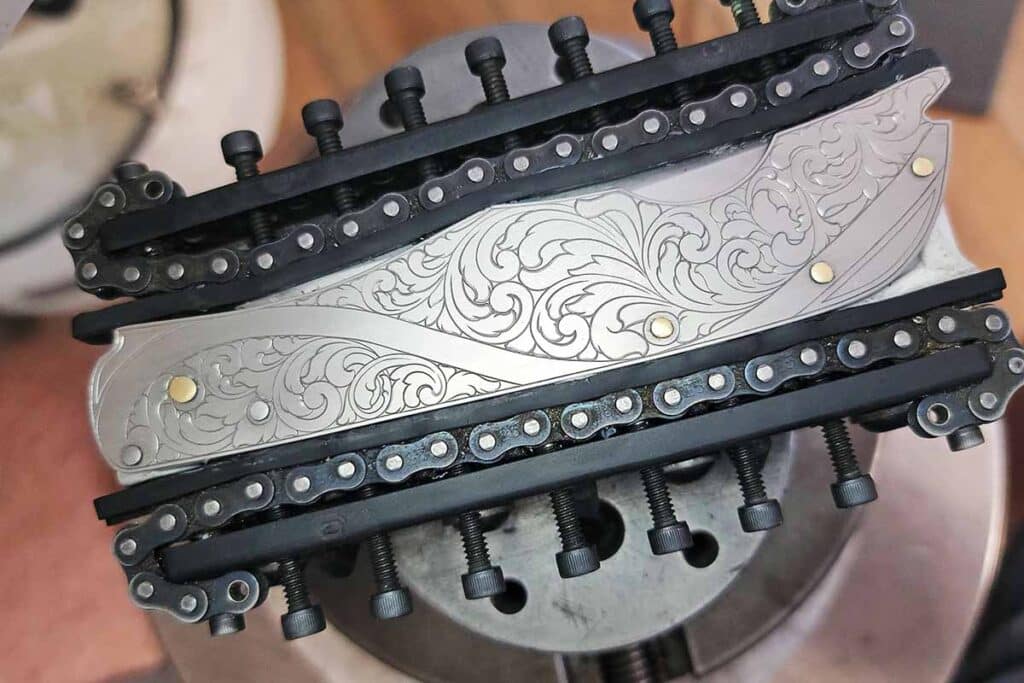
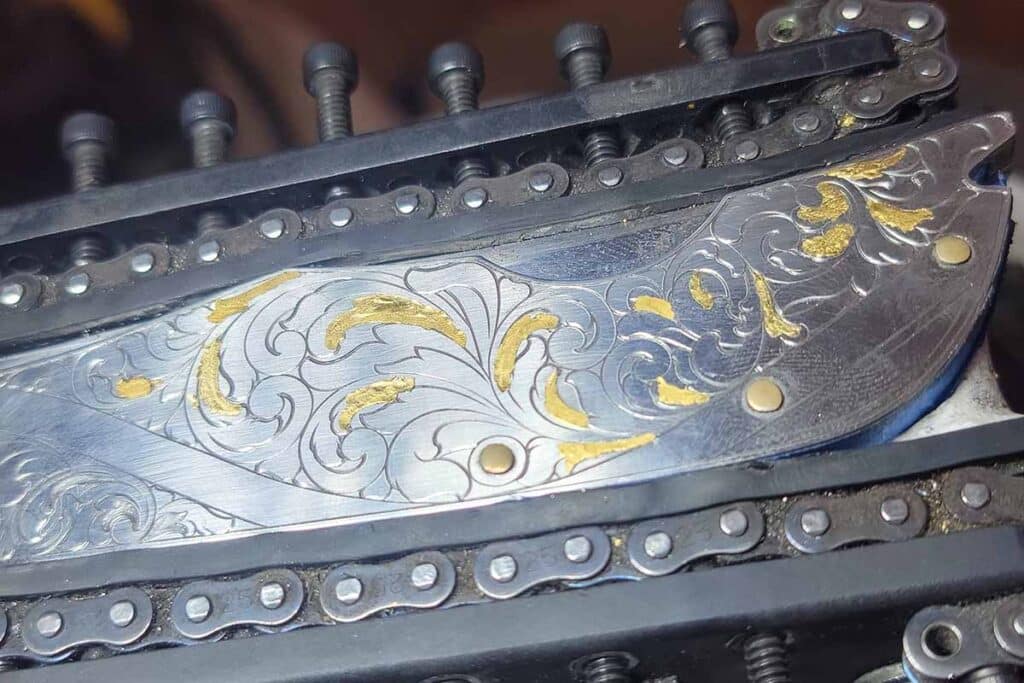
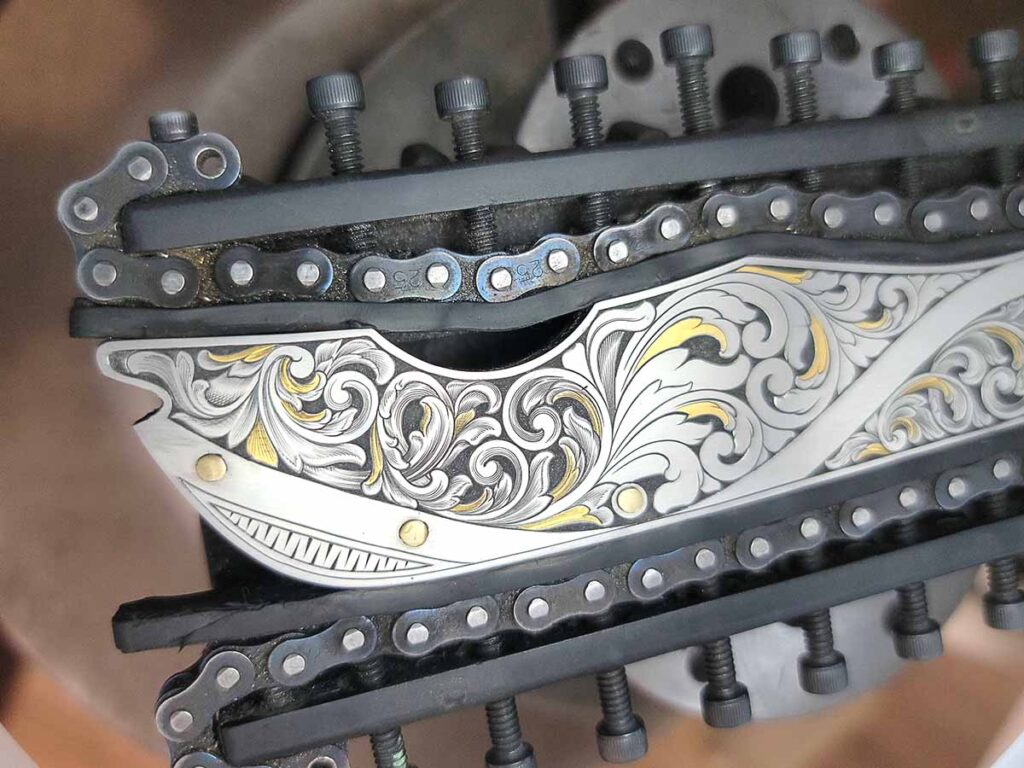
The outline of the engraving takes shape (below left). The jig holding the folder is a knifemakers contour vise from GRS Tools (see sidebar).

While still in Tennessee, ABS master smith Bruce Bump reached out to me to collaborate on one of his black powder percussion pistols. Bruce is a full-time bladesmith and obtained his master smith stamp in 2003.

Known for his bowies, daggers and combination black powder pistol knives—aka cut ’n shoots—he has an impressive list of accolades and award-winning creations spanning his illustrious career. In addition, he’s collaborated with many fine engravers, including his son, Brian. I was truly honored when Bruce reached out to me.

The Project

There are 23 inlays of 24k gold on each side of the folder
There are 23 inlays of 24k gold on each side of the folder. Sixteen have been set in the lower two-thirds of one side here (below). Polishing them flush came later.

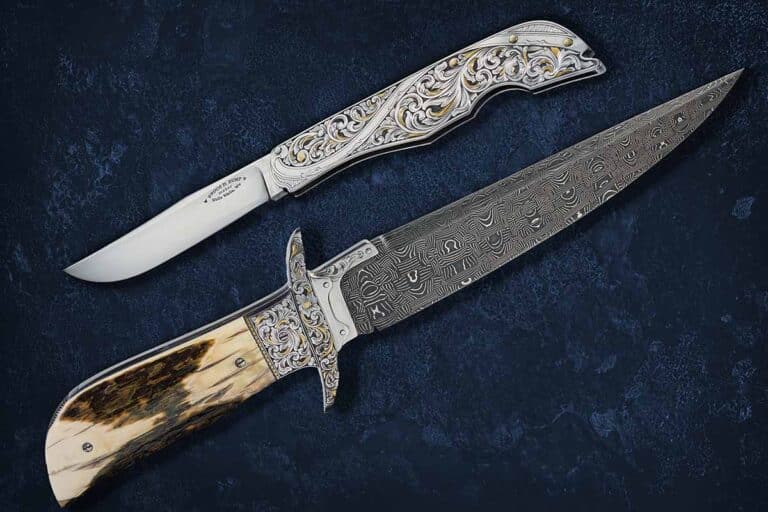
We had not met face to face but were familiar with each other’s work. We agreed to meet in person at a Nashville Arts in Metal knife show. During the meeting, he showed me one of his hideout bowies. The 15-inch knife in basketweave damascus steel immediately inspired me with its blend of high-end materials and fine craftsmanship.

Bruce forged the damascus from 1080 carbon and 15N20 nickel-alloy steels. The guard, bolster and handle frame are 416 stainless steel. The hidden slipjoint folder has a 1080 blade and 416 frame and stunning mammoth bark scales.

The locator pins on the folder presented a challenge
The locator pins on the folder presented a challenge, interrupting shading and flow of scroll.

Bruce informed me the customer wanted both knives engraved and would be contacting me to discuss ideas. It took about six months to happen due to my relocation and settling into our new home.

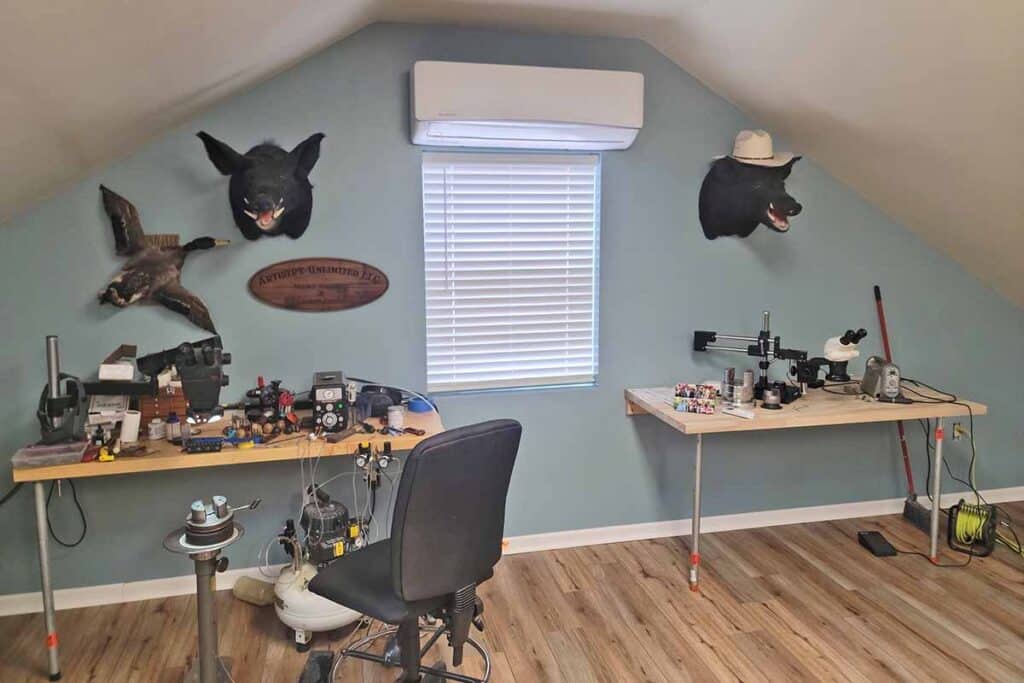
Building a studio was my first priority. It is in a loft space over a detached garage. The space was completely unfinished when we bought the property. Excluding hanging the drywall, I did the renovation. This involved insulation, flooring, painting, trim carpentry, and heating, ventilation and air conditioning. I went from a 140-square-foot shop inside my home to an entire building with about 1,600 square feet of space.

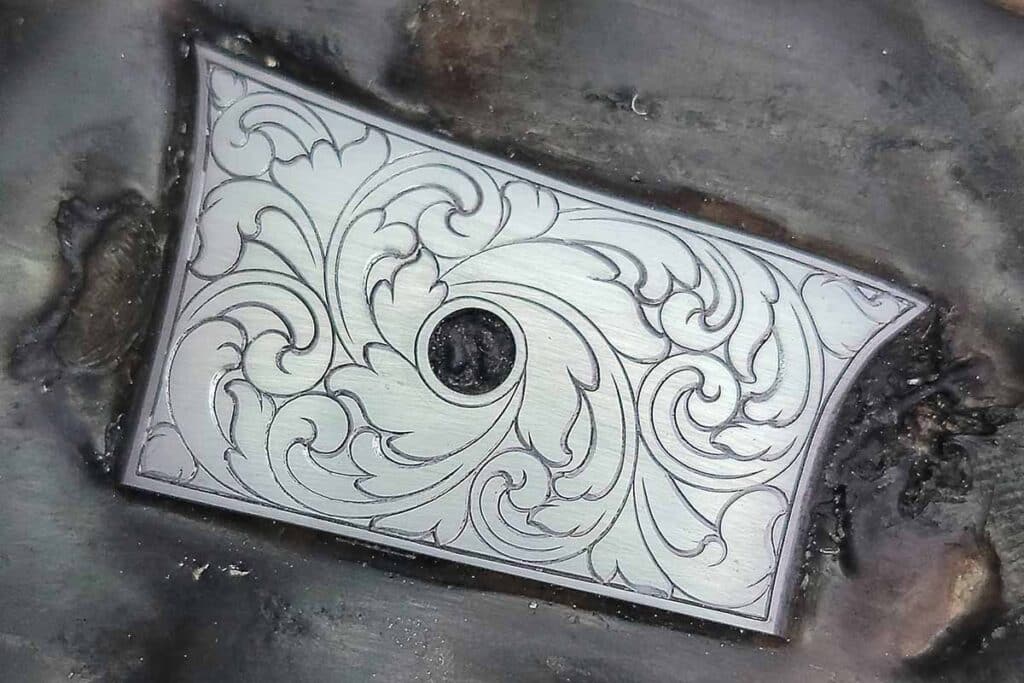
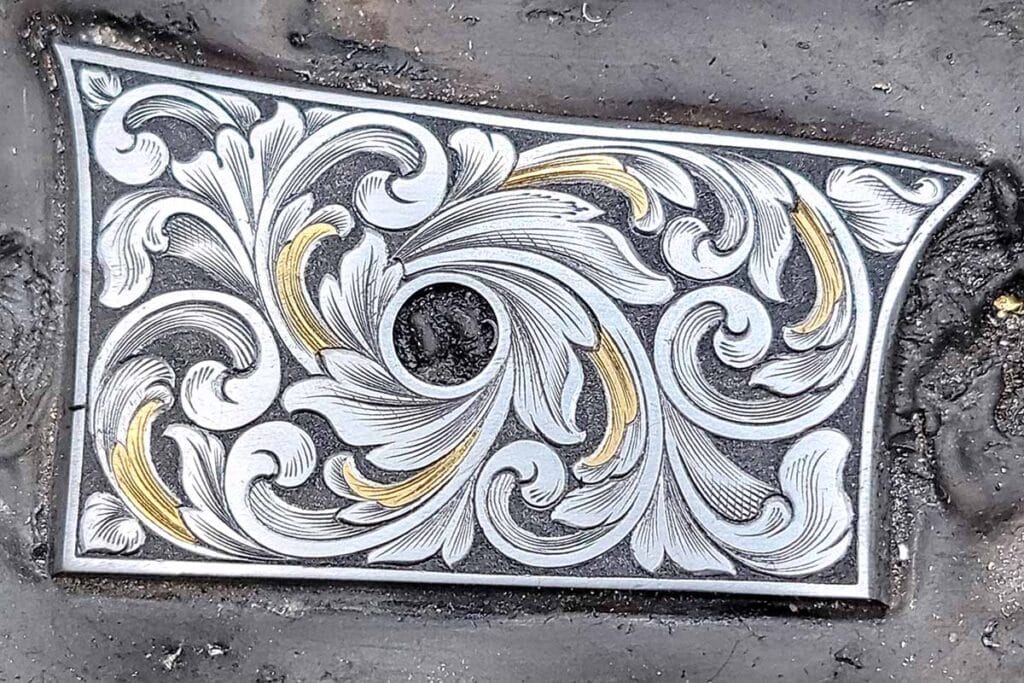
All the scroll is engraved.

Finally—I had the room to really pursue my artistic dreams! The studio is set up with specialized workstations for all the various tasks involved in creating art in metal. After a decade of working professionally as an engraver, I learned exactly what works best for me. The primary bench is set up for the majority of my engraving with everything in arms’ reach, facilitating a comfortable and efficient workflow. In addition, there are dedicated areas for design, assembly/disassembly, welding, jewelry making, stone setting and photography.

The Knife

When the hideout bowie arrived for engraving, I spent some time admiring and studying the knife before doing anything. The damascus blade immediately impressed me. Bruce forged the basketweave pattern blade using the accordion method in which he opens up the forge-welded billet, using a spear-type point in his large hydraulic press, creating an accordion-shaped slab of metal. The process reveals the repeating pattern along the length of the billet.

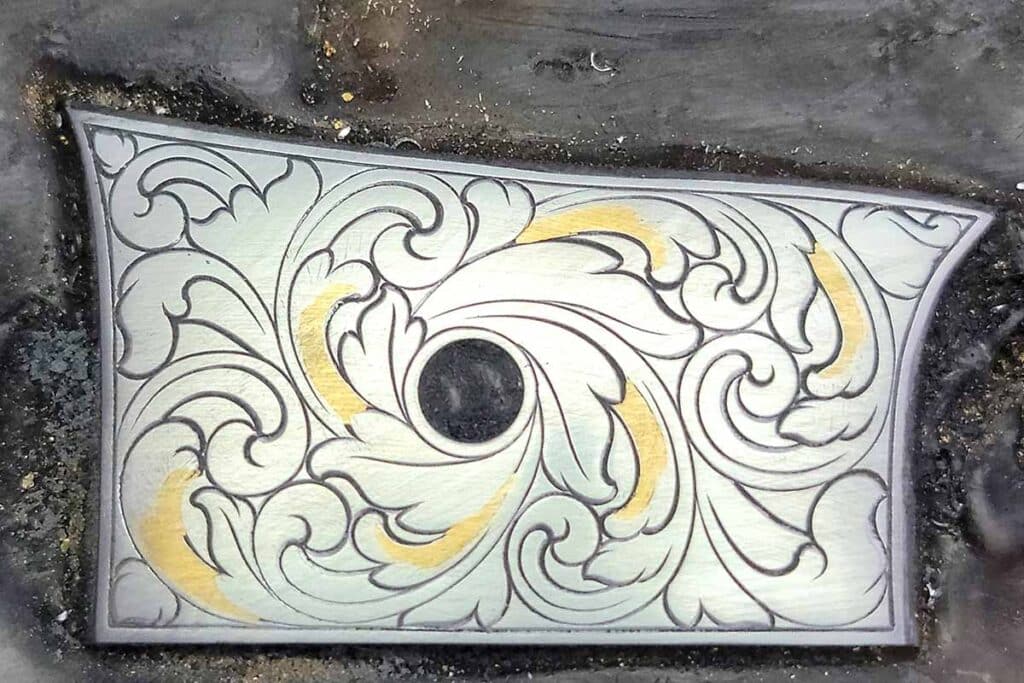
The inlays are prepared and the gold is set in the steel.

The construction of the hideout slipjoint folder is impressive as well. A flawless spring-loaded catch retains the folder inside the bowie handle. The folder has a series of small, raised pins that help locate it within the bowie handle. The pins would pose a unique challenge for me with the design and execution of the engraving.

Engraving

Much of my workflow is very old fashioned, involving traditional methods. I like to use pencil rubbings to create 1:1 outlines of the objects I’m about to engrave. The outlines are copied and duplicated to scale, allowing me to play around with the pencil to develop a pleasing composition.

The inlays are polished flush.

Most of the time I draw the design directly on the metal, including on Bruce’s bowie and folder. I prefer this method because I understand the scale of the item better. Once one side is engraved smoke prints are taken, and a transfer is made to mirror the design precisely.

The locator pins on the folder presented a challenge, interrupting shading and flow of scroll. The solution was to embrace the pins, making them part of a simple, flowing ribbon. The ribbon was then framed with larger, relief-engraved scroll. The scroll is accented with 24k-gold inlays in the leaf structure.

Bruce Bump earned his ABS master smith stamp in 2003.

There are 23 inlays on each side of the folder. There’s something magical about prime numbers and they seem to find a way into my artwork regularly. The engraving process for this style has five major stages:

Stage 1: All the scroll is engraved;
Stage 2: The inlays are prepared and the gold is set in steel;
Stage 3: The inlays are polished flush;
Stage 4: The scroll outlines are recut to make every line of the scroll perfectly crisp, and;
Stage 5: The background is carved away, textured to black, and the fine shading is engraved.

The author’s primary bench is set up for the majority of his engraving with everything in arms’ reach
The author’s primary bench is set up for the majority of his engraving with everything in arms’ reach, facilitating comfortable and efficient workflow. Elsewhere in his 1,600-square-foot studio are dedicated areas for design, assembly/disassembly, welding, jewelry making, stone setting and photography.

This process was repeated for the opposite side of the folder and then on the bowie knife guard and bolster. The bolster and guard also had either a pin or screw to contend with. In these areas I used them as an origin point. I also engraved the small screws to add the finishing touches to the knife.

For me, a brilliant new horizon appeared while collaborating with Bruce Bump.

More On Knifemaking:

Advertisement

Must Read Articles

Read this before you make a knife

Knifemaking 101 – Read This Before You Make a Knife

  by Wayne Goddard My experience has taught me that there's nothing like digging in and getting started. I've often said the hardest part of the...
how to forge damascus steel

How to Forge Damascus

Advertisement
Advertisement