William “Bill” Adams was a revered knife entrepreneur, author and Cutlery Hall-of-Fame member. Learn about his immense impact on the knife community.
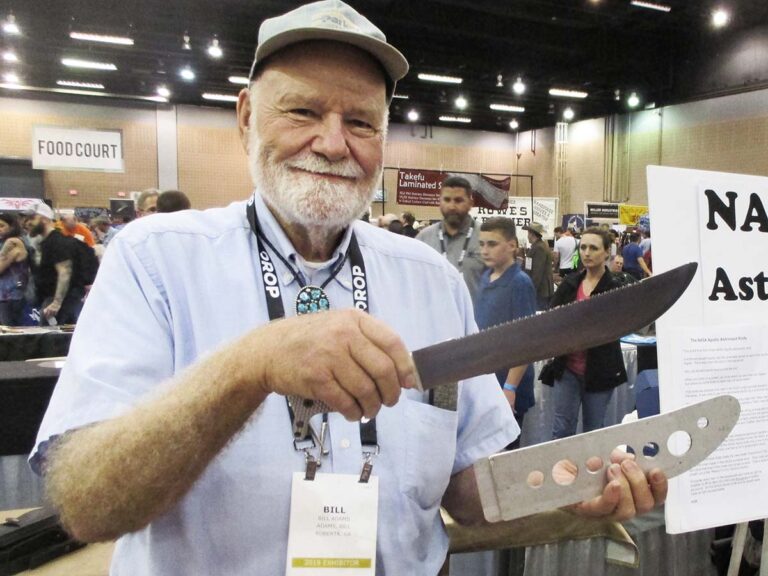
William Calhoun “Bill” Adams, knife entrepreneur, defender of all things knife, BLADE Magazine Cutlery Hall-of-Fame® member and invaluable friend of the knife community, passed away August 10. He was 87.
Known for his easy smile, snow white beard and amiable North Georgia drawl, Bill was liked and admired by many in the industry. He founded Atlanta Cutlery and, with Hank Reinhardt, co-founded Museum Replicas, both in Conyers, Georgia. Bill’s retail operations required him to travel the globe in search of the finest knives, swords and accouterments, including England, Ireland, Africa, India, parts of Central and South America, and all over the USA.
He served as president of the Antique Bowie Knife Association and helped found the Military Equipment and Weapons Collectors Association. He also helped found the Cutlery Collectors Legislative Committee, aka the CCLC, forerunner to today’s two leading pro-knife-legislation groups, Knife Rights and the American Knife & Tool Institute. In 1995, Bill was inducted into the Cutlery Hall of Fame.
He was a knowledgeable, gifted author, editing Sheffield Exhibition Knives and co-writing The Antique Bowie Knife Book, both of which are go-to guides for fans and aficionados of vintage Sheffield-made and antique bowies, respectively. He also was a dedicated knife collector, winning several awards for his wide-ranging collections at the BLADE Show. He retired to Roberta, Georgia, to live along the Flint River, where he enjoyed a quiet, peaceful and happy life.
He is survived by his sister-in-law Dee Anne Adams, his nephew David A. Adams and wife Cheryl, and dear friend and travel partner Elaine Barnes. The family wishes to express its thanks to Bill’s Roberta, Georgia, friends, especially Charles and Kate Rice, who cared for and treated him like family.
Remembering Others The Knife Industry Has Lost:
Betty Dowell, Driving Force Behind Knifemaker Ted Dowell, Passes
B. R. Hughes, Pioneering Writer And Bladesmithing Teacher, Passes Away
The American Knife and Tool Institute (AKTI) is running an auction to raise awareness of their fight to remove legislation banning the carry of certain knives as well as clarifying knife laws around the country.
The auction will run from August 19-21 and is being sponsored by some of the biggest names in American knives. The sponsors include such brands as Buck, Benchmade, Cobratec, CRKT, and more.
You can learn more about the auction here as well as other ways you can support the Institute’s work.
Ponder three markedly diverse examples of the quickest manual flippers.
When BLADE Magazine Cutlery Hall-of-Fame® member Kit Carson’s CRKT M16 design hit the shelves in 1999, it was a crapshoot in a rapidly growing field of modern tactical folders. To say the least, the M16 caught on like gangbusters and, well, here we are a quarter century later featuring the genre in BLADE®. Kit is no longer with us but his legacy is cemented in cutlery history as the popularizer of the modern-day flipper folder.
Bladerunners Systems (BRS) Khopesh
Not the fastest blade in the test stable due to its sheer weight, the Khopesh makes up for it by tackling larger chores such as lopping off quarter-inch slices of 2-inch-diameter summer sausage.
Bladerunners Systems KhopeshSpecs Blade length: 4” Blade steel: Bohler M390 stainless Blade pattern: Drop point Pivot: Ball bearing Handle material: Titanium, black G-10 Carry: Pocket clip Weight: 6 ozs. Closed length: 5” Country of origin: China MSRP: $196.95
Pros
Versatile Utility
Smooth Deployment
Ergonomic and Secure Grip
Cons
Heavy Weight
Slower Blade Deployment
At 9 inches open and 6.07 ounces, the Bladerunners Systems (BRS) Khopesh is the big bad wolf of the test bunch. The large stonewashed blade rolls out with ease thanks to a smooth ball bearing pivot. The flipper is the main mode of transportation for the blade, though it is pinch-able via three diagonal blade grooves to assist. The handle has V-shaped, bead-blasted titanium bolsters with silky rails housing a linerlock. A machined, reversible titanium pocket clip completes the package.
The Khopesh is a handful of knife. The flipper tab is easily accessed and plenty big for the fingertip to do its thing. The wide handle offers excellent grip for the remaining fingers and thumb. Even the inner pad of the palm offers support to purchase when flipping.
The Khopesh is over twice the heft of the two lightest review folders and, considering the weight, I didn’t expect the blade to fly out of the handle when using the flipper. However, I was delightfully surprised at how well the pivot added to the speed of deployment. With a bit of practice you can get quite proficient at it, and its size works to its advantage as the large handle aids in getting a good grip. The BRS entry won’t set any speed records for blade rollout but it’s fast enough for most applications.
A knife as large as the Khopesh also offers more utility advantages than a smaller one. The flipper folder is game for a lot of uses, whether cutting rope or preparing a meal on the go. I tested the blade on a chub of summer sausage and lopped off quarter-inch slices like a walk in the park.
Zero Tolerance 0990
The 0990 is small but don’t tell its 3.25-inch blade. It made quick work of slicing through paracord and 3/8-inch rappelling rope. Check out the clean, surgical cuts. That’s some mighty fine slicing!
Zero Tolerance 0990 Specs Blade length: 3.25” Blade steel: CPM 20CV stainless Blade pattern: Drop point Handle material: Carbon fiber, steel overlay Carry: Pocket clip Weight: 2.9 ozs. Closed length: 4.4” Special feature: Floating Bridge skeletonized frame Country of origin: USA MSRP: $330
Pros
Eye-Catching Design
Smooth and Fast Deployment
High-Quality Blade Material
Cons
Small Flipper Tab
Grip Comfort
Zero Tolerance pushes the design envelope with the 0990, a spinoff of its limited edition 0999. The 0990 is highly skeletonized to the point that even the blade stop—aka a floating bridge—is exposed. The 4.4-inch handle features a steel frame with black carbon fiber onlays. The blade secures open via a linerlock hidden by the carbon fiber on the front frame rail. The tip-up pocket clip can be reversed to the front. The blade operates on a KVT ball bearing pivot and can be flipper-activated or pinched open by its oblong cutout.
The ZT has a small tab that once fired flips the blade out in the blink of an eye. Practice makes perfect when using a flipper folder with a small tab or slim handle.
The 0990 is the most distinctive member of the test trio both design- and flipper-wise. When the blade is closed the flipper tab extends out under the floating bridge. When flipped, the blade tang revolves and snicks into place on the bridge, holding the blade rigid. It’s what blades normally do—you just get to see it happen. The flipper tab is small, so it helps to practice flipping it to become totally familiar with its location and action. Practice makes perfect. Once activated, the KVT ball-bearing does a great job of flinging the blade out post haste, and the whole system is tight as a drum.
The ZT flipper folder is a mid-sized EDC capable of small-to-medium tasks—from opening mail and packages, preparing snacks, even cutting paracord and 3/8-inch rappelling rope—and in a pinch will offer a welcome level of protection. I tested the blade on some rope and paracord and the CPM 20CV blade cut extremely well. Plus, the 0990 will definitely wow your friends on work breaks.
CobraTec Ghost
The CobraTec Ghost gets a boost in the utility department from its modified wharncliffe damascus blade. Note the clean slicing job it performed on skived leather.
CobraTec Ghost Frame Lock Specs Blade length: 3.75” Blade steel: Damascus Blade pattern: Modified wharncliffe Pivot: Ball bearing Handle material: Titanium Carry: Pocket clip Weight: 2.4 ozs. Closed length: 5” Special feature: Glass breaker Country of origin: USA MSRP: $199.99
Pros
Stylish Design
Lightweight and Compact
Surprising Versatility
Cons
Grip Challenges
CobraTec’s streamlined Ghost flipper folder has all the style and grace of a stiletto on steroids, eschewing a symmetrical dagger blade for a wicked modified wharncliffe with linerlock. The knife adds to its mystique with a damascus blade and skeletonized handle etched in a pattern complementing the blade steel. That’s a lot to digest but, all in all, it works. The blade engages exclusively by the flipper tab—even the latter is skeletonized—and swings out effortlessly on a ball-bearing pivot. Out back is a bead-blasted, tip-up pocket clip and there’s a lanyard hole and glass breaker in the butt.
Thanks in no small part to its ultra-slim profile and light weight, the knife is a speed demon. With little drag on its ball-bearing pivot, the blade literally flies out when flipped. I found the flipper tab easily accessible and the exposed framelock makes it easy to reload. The slim profile makes it harder to grip than a wider model but, as with any knife, practice and familiarity makes perfect. You can’t knock its looks, either. There’s something about damascus that just warms the soul.
Most knives this slender typically excel at jobs like self-defense and melon testing. That said, the tip extends the blade’s slicing ability beyond the standard symmetrical stiletto. I tested the blade by taking off strips of suede and was surprised at how well it performed for such a narrow pattern. I also gauged its penetrating prowess on a cantaloupe and it easily sank to the integral guard with every stab. The Ghost is not a working knife per se but its utility may surprise you.
BLADE Show’s home sharpens up for the event’s 45th Anniversary.
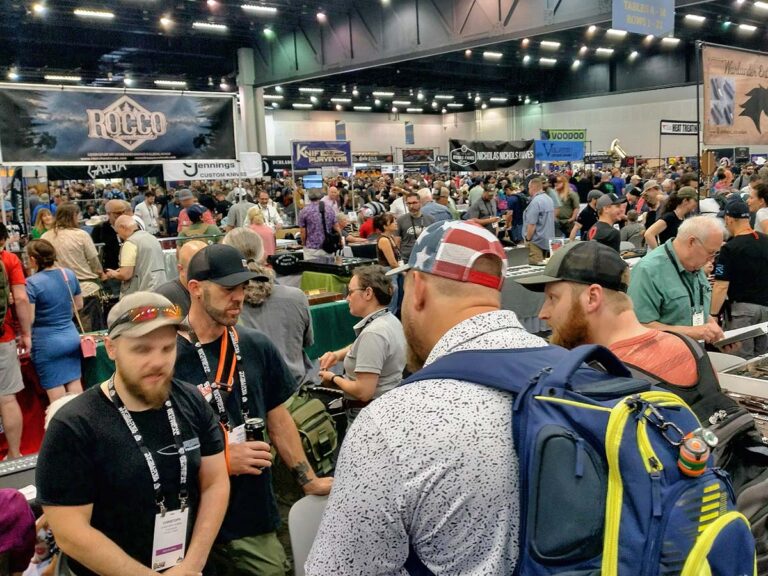
Longtime BLADE Show patrons, get ready for a brand-new venue. Calm your heart palpitations. The world’s largest knife show isn’t picking up stakes from Atlanta when it unsheathes its 45th iteration June 5-7. Simply put, the longtime home of our favorite edgy shindig is undergoing a massive $190 million facelift.
The Cobb Galleria Centre—now officially the Cobb Convention Center—is in the midst of a multi-year renovation to upgrade its facilities and amenities. While the project stretches into early 2027, it will be at its midway point when the BLADE Show doors open this June.
Diehard knifeaholics needn’t worry, the upgrade project won’t derail the aspects of the show you love. Factory knife debuts, the educational instruction of BLADE University (see sidebar) and action-packed demos still await show patrons. The BLADE Magazine 2025 Knife-Of-The-Year® Awards and the custom knife judging competition remain center stage. Furthermore, the American Bladesmith Society (ABS) will still name its latest master and journeyman smiths, and some of the best knives from the ABS, The Knifemakers’ Guild and unaffiliated makers will be on display in all their sharpest glory.
John Horrigan’s majestic fixed blade turned more than a few heads during the 2025 show. (Jocelyn Frasier image)
Additionally, the show floor welcomes more than 900 exhibitors from 35 countries, offering a global masterclass in modern cutlery. From the latest production folders and custom fixed blades to rare handle materials and high-tech shop equipment, the sheer volume of gear is staggering. All of this comes in the brand-new wrapper of the convention center, honing the BLADE Show to a razor’s edge.
The main exhibit hall and the ballroom—better known to the faithful as the Baller Room—are already complete. These renovations will immediately improve the show with new LED lighting, fixed concession outlets, renovated restrooms and an improved PA system. The Baller Room and lobby area also sport new wall coverings, chandeliers and carpet, while the rotunda has an entirely new look. While the show floor is unaffected, attendees will feel some impact. The renovation of the specialty shops and meeting rooms below and across from the main hall will run congruent to the show. This means BLADE University has a new campus. Look for classes in the newly constructed ballrooms just off the Renaissance Atlanta Waverly.
And for those who love the food, libation (lots of that), knife boasting and lie swapping of “The Pit”, that is slated to proceed unchecked. The sunken bar of the Waverly is untouched by hammers, saws or fresh sheetrock. Get your sleep so you can haunt it until cock’s crow.
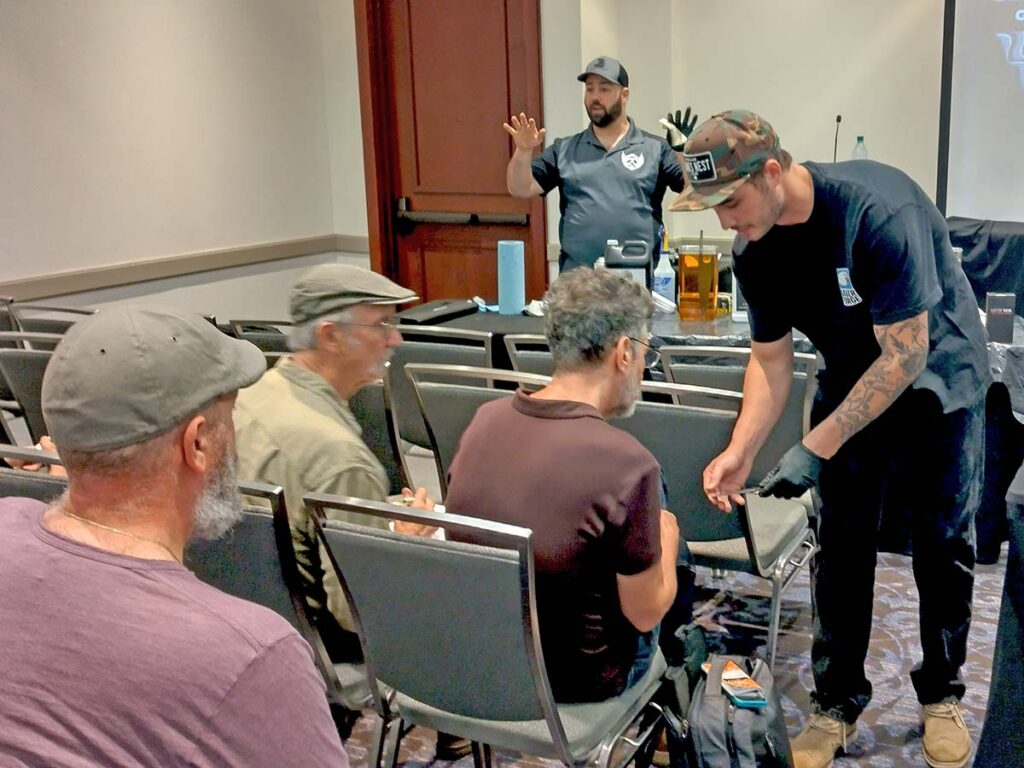
Jordan Berthelot discusses next-level damascus etching while Greyson Weltyk shows a student a result of the process during one of many BLADE University classes.
When the dust finally settles, the Cobb Convention Center will be a major boon. By 2027, showgoers can look forward to more than 50,000 square feet of new meeting rooms, event courtyards and indoor space. As the BLADE Show grows in global reach, its longtime home has the room to grow along with its marquee event.
Edge Of The World
Perhaps the most intriguing aspect of the BLADE Show in recent years is the global reach of the brothers and sisters of sharps. No one knife-specific event gathers more makers and companies from around the world—including the good ol’ U.S. of A—into one venue.
The outstanding international makers include: the CAS Brothers, Mauricio Daletzky and Javier Vogt (Argentina); Bertie Rietveld, Theuns Prinsloo, Henning Wilkinson and Neels van den Berg (South Africa); Franco de Souza, Rodrigo Sfreddo, Fabio Barros and Gus Cecchini (Brazil); Bruce Barnett (Australia); Kizer Cutlery, Reate and Ketuo (China); Koji Hara (Japan); Lionsteel, Alfredo Faccipieri, Fox Cutlery, Maniago Knife Makers (MKM) and Maserin (Italy); Damasteel (Sweden); Jens Anso (Denmark); Helle Knives (Norway); Jean-Louis Regel and Veronique Laurent (Belgium); Carlos Queiros (Portugal); Sergey Shirogorov (Russia); and Grace Horne (United Kingdom).
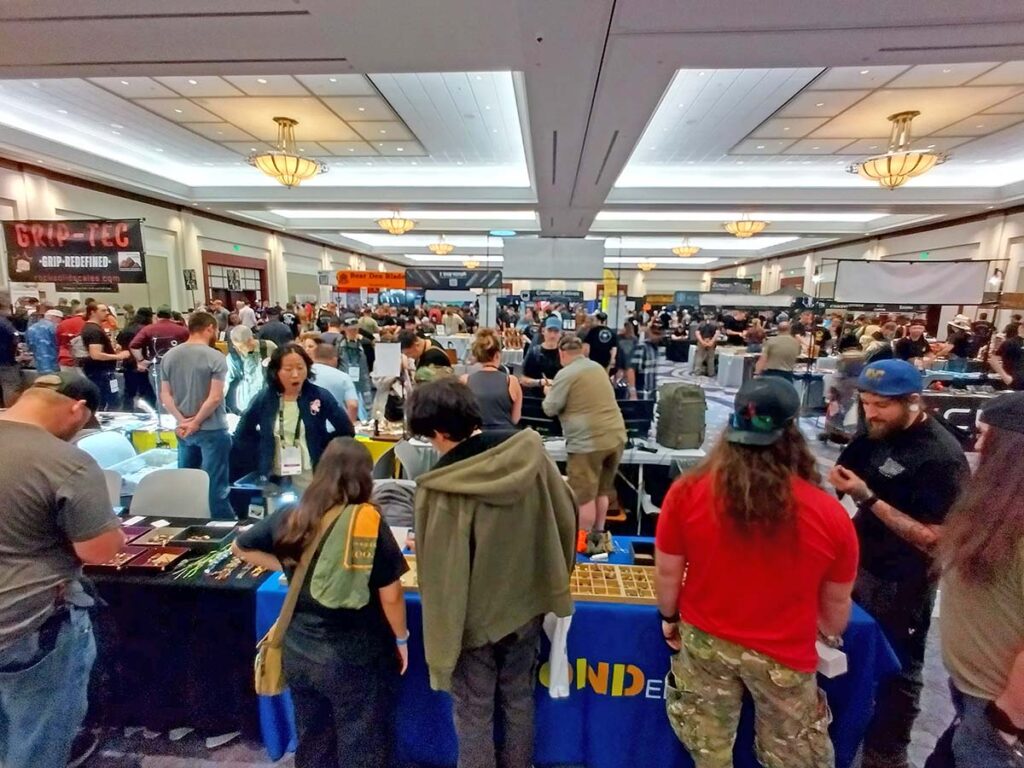
The Baller Room buzzed all three days of the show. The room comes with some notable improvements this year, including new carpet and wall coverings.
Some of the leading American exhibiting makers will be BLADE Magazine Cutlery Hall-Of-Fame® members Bill Ruple, Steve Schwarzer and Harvey Dean; ABS master smiths Mike Quesenberry, Shane Taylor, David Lisch, Jordan LaMothe, Josh and Karis Fisher, and Andrew Meers; slipjoint makers Stanley Buzek, Tom Ploppert, Luke Swenson and Tim Robertson; Allen Elishewitz; Les George; Walter Brend; Strider Knives; Hawk Knives; Vince Evans; factory companies Spyderco, Case, TOPS Knives, Chris Reeve Knives, Spartan Blades, Pro-Tech, Microtech, Kershaw, Squid Industries, KA-BAR and Heretic Knives; and many more.
Knives Of The Year
BLADE Magazine Knife-Of-The-Year® Awards is the factory knife industry’s highest honors, pitting the companies’ sharpest designs again each other. In an effort to keep the awards’ distinguished position and recognize the changing landscape of the industry, BLADE Show added a new category for this year.
New for the 2026 competition is the Best Slip Joint category, breaking off the traditional design from the Best Imported Folder and Best American Made Folder categories. This is the third new category added in as many years, with Best Of The Rest created in 2025 and the Automatic Knife Of The Year sponsored by PVK.com that debuted in 2024.
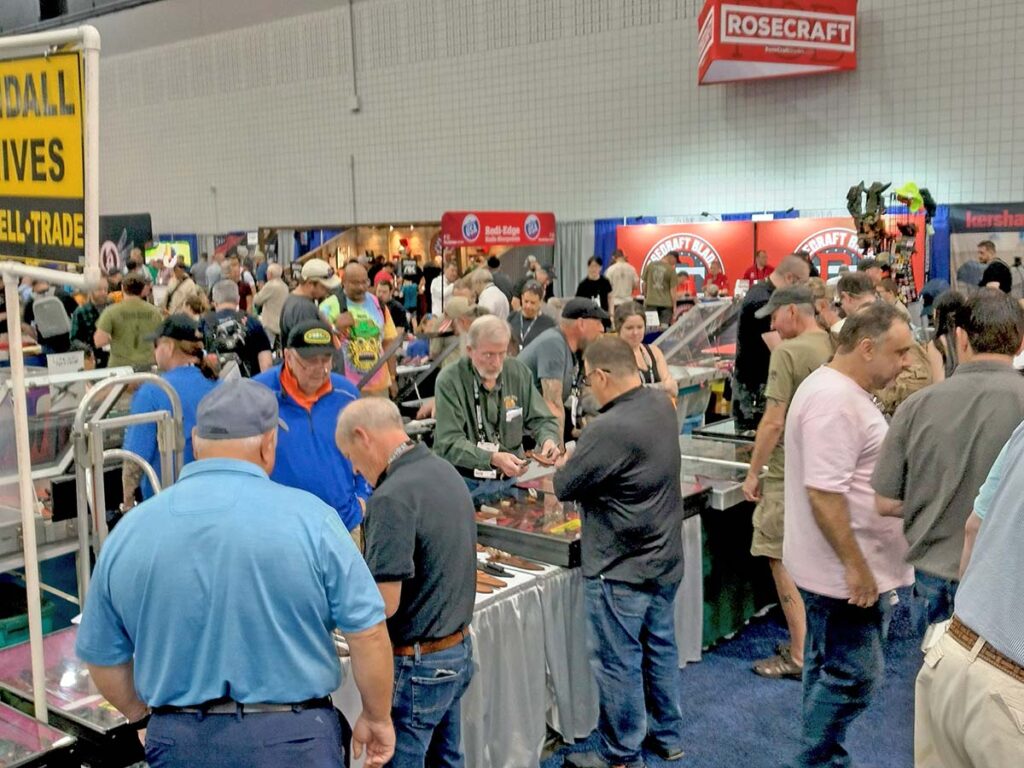
New knives aren’t the only draw in Atlanta. Antique Randall knives and their collectors were in abundance at the show.
As in the past, the entries are limited to BLADE Show factory booth exhibitors, all of whom received the rules well before the show outlining the new changes. Like last year, the winners will be announced and presented during the BLADE Magazine Awards Reception on Saturday at 8 p.m. in the room on the floor above The Pit. The winners will be listed on BLADE’s blademag.com website after the awards reception, and a list will be posted outside the show entrance Sunday morning.
BLADE University
Get current on the latest knifemaking techniques and other trending sharp subjects during the 13th Annual BLADE University on Thursday, Friday and Saturday. See the sidebar for a complete rundown of classes, days, times and instructors.
Sponsored by Work Sharp, BLADE University has the most extensive schedule of knife, knifemaking and other instruction held at any knife show. For enrollment and other information, visit https://bladeshow.com/show-info/classes.
Custom Knife Awards
Among the most testing custom knife competitions in the nation, the BLADE Show Custom Knife Awards is one of the most coveted honors in knifemaking. In a continuing effort to keep it the premier award in the handmade knives, the competition’s categories have been expanded. Best Slip Joint has been split into Best Single-Blade Slip Joint and Best Multi-Blade Slip Joint categories, allowing more subtlety in judging the nuanced class of knives.
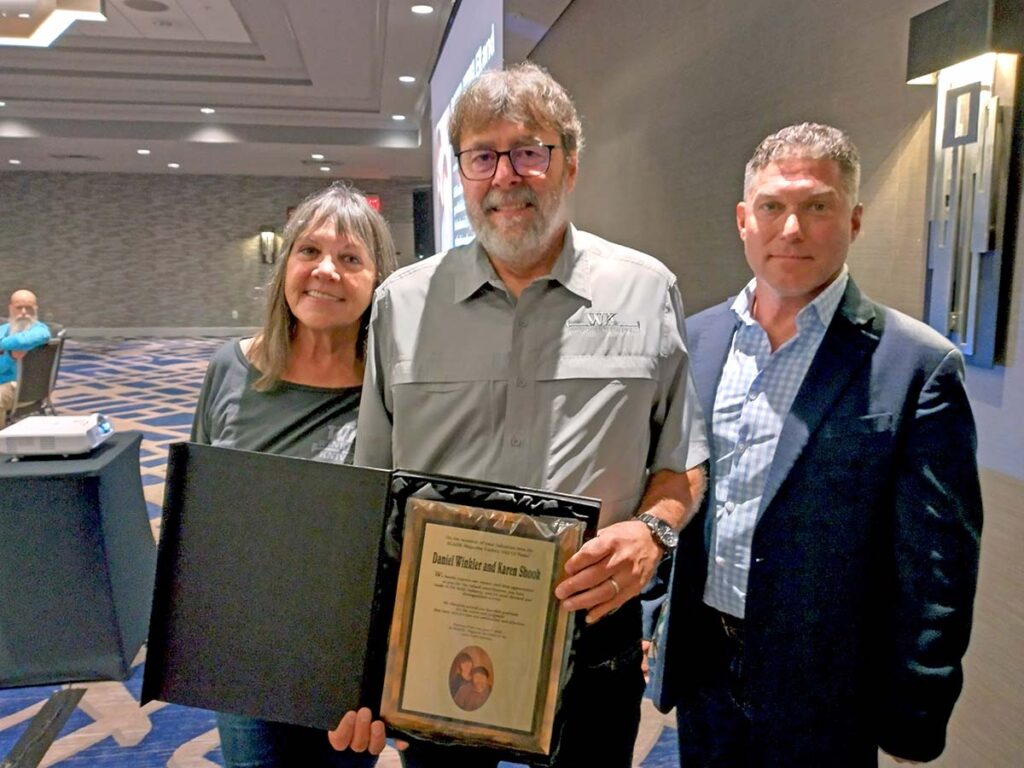
From left, Karen Shook and Daniel Winkler accept their Hall of Fame plaque after Kevin Holland (right) delivered their induction speech.
Leading industry authorities will pick the best custom knives by BLADE Show exhibitors in the annual knife judging competition, with the winners announced during the BLADE Magazine Awards Reception Saturday at 8 p.m.
The categories are: Best of Show; Best Art Knife; Best Bowie; Best Collaboration; Best Collaboration; Best Damascus; Best Fighter; Best Fixed Blade; Best Folder; Best Handle Design; Most Innovative Design; Best Kitchen Knife; Best M.A.C.K.; Best Miniature; Best New Maker; Best Single-Blade Slip Joint; Best Multi-Blade Slip Joint; Best Sword; Best Tactical Folder; Best Utility Hunter; Best of the Rest.
The competition is open to the show’s custom knife exhibitors only. The winners will be announced on BLADE’s blademag.com website after the awards ceremony, and a list will be posted outside the show entrance Sunday morning.
World Championship
The BLADE Show World Championship Cutting Competition will be conducted by BladeSports International (BSI) and held in The Courtyard, the parking lot of the host hotel, the Renaissance Atlanta Waverly, Saturday at 4:30 p.m. Attendance is free to BLADE Show ticketholders.
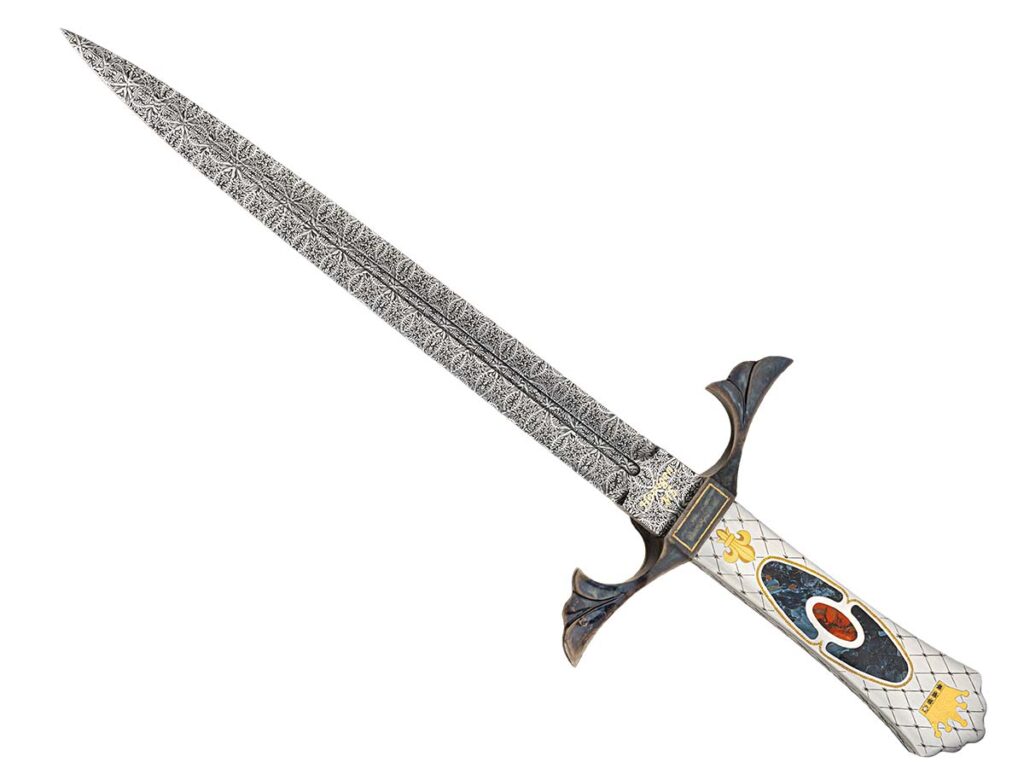
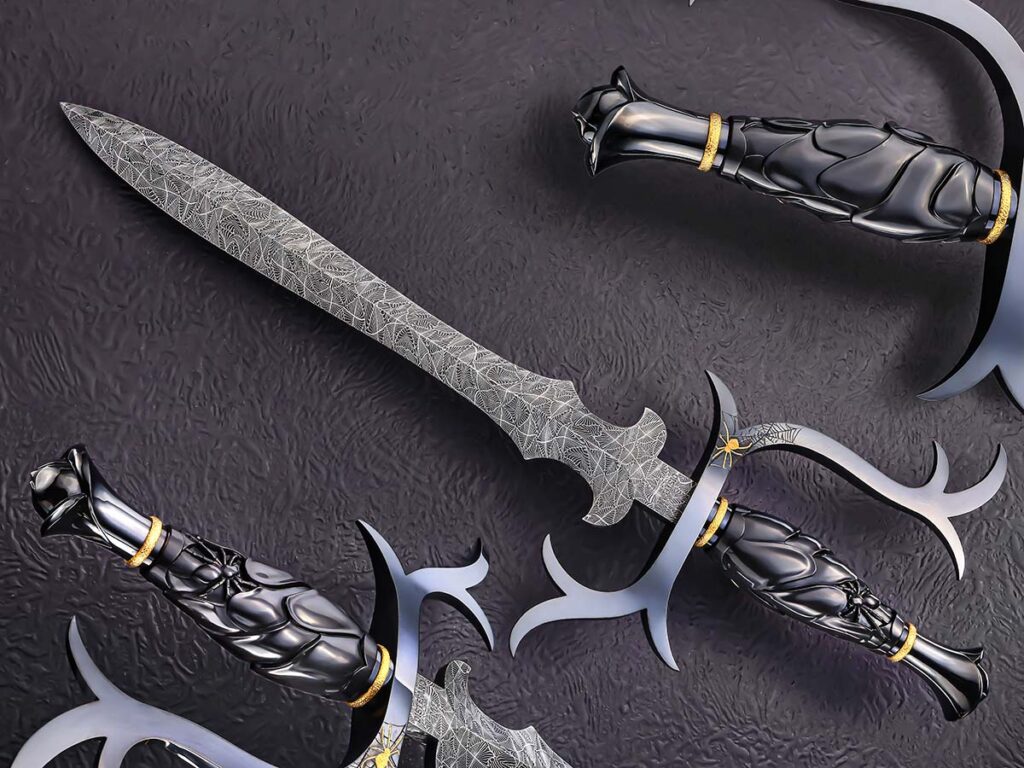
Paul DiStefano always produces stunning work, which certainly goes for his 14-inch spiderweb mosaic damascus-bladed dagger, which he brought to the BLADE Show. That’s a carved buffalo horn handle, by the way. (SharpByCoop image)
For a second year in a row the men’s and women’s divisions were won by a husband and wife: Mr. and Mrs. Ben and Sue Ann Propst. The championship results were as follows: Men’s Division: Ben Propst (Niagara Specialty Metals), world champion; 2nd: Donavon Phillips (Spyderco); 3rd: David Moore (Pops Knife Supplies); and 4th: James Clifton (Spyderco). Women’s Division: Sue Ann Propst (Niagara Specialty Metals), world champion; 2nd: Lauren Kalns; 3rd: Sara Maly (Pops Knife Supplies); and 4th: Jo Carothers (Carothers Performance Knives).
Bali Grand Master
Top balisong flippers will vie for the title of “Grand Master” in the 10th Annual Battle for Bali Champion sponsored and conducted by Blade HQ.
BLADE Show ticketholders are invited to watch the competition on the second floor above The Pit of the Renaissance Atlanta Waverly Hotel on show Saturday from 12:45 p.m. to 2 p.m. Competitors will start flipping knives at 1 p.m.
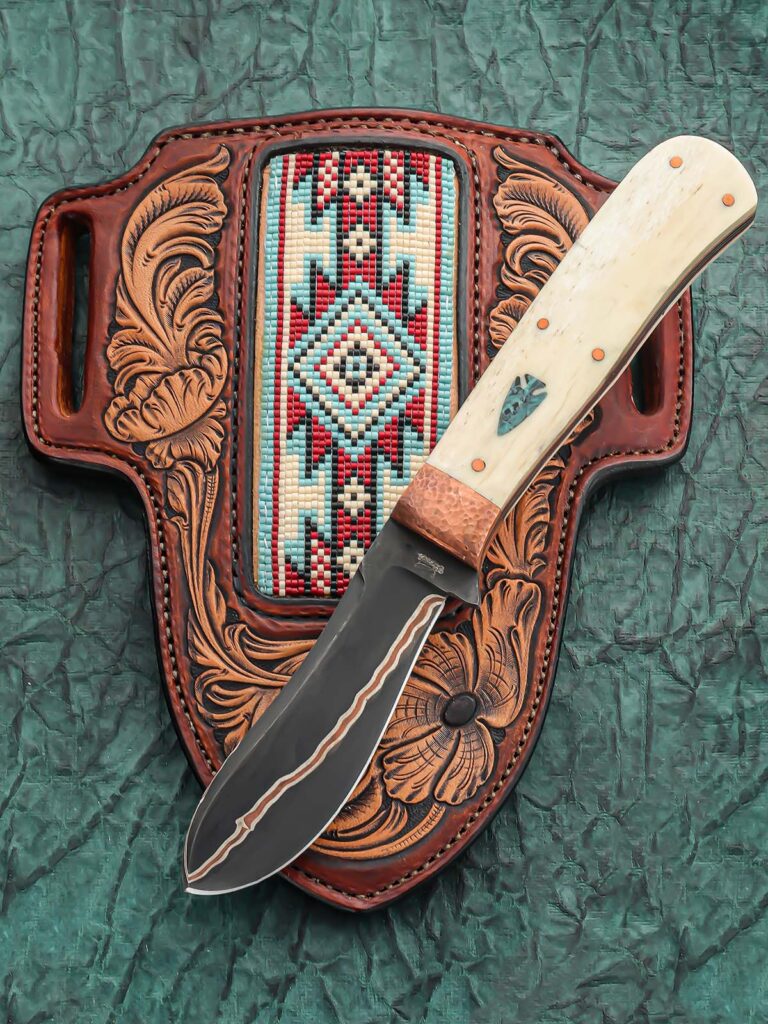
When it comes to slip joints, Bubba Crouch is a must-stop at BLADE Show. His skinner, with a 3 1/2-inch copper san mai blade, came complete with a sheath by Will Anderson, with beadwork done by Kelly Faulcorer. (SharpByCoop image)
The top three finishers will receive prizes and all participants will get swag bags. Brycen Nelson flipped his way to the top of the podium in the competition, Steve Ash placed second and Landon Morrison third.
Cutlery Hall Of Fame
The BLADE Magazine Cutlery Hall Of Fame® will formally induct its new members at 8 a.m. show Saturday in the Kennesaw Room of the Renaissance Atlanta Waverly Hotel. (At press time, the new members had not been determined. For updates, visit blademag.com.) Tickets are required ahead of time for the ceremony, which includes breakfast. Seating is limited. For ticket information, email [email protected].
What’s Next
The final BLADE Show-sponsored event for 2026 will be BLADE Show West, Oct. 9-10 at the Salt Palace Convention Center in Salt Lake City, Utah. For details, visit bladeshowwest.com. BLADE Show Texas 2027 will be March 12-13 at the Fort Worth Convention Center. Visit bladeshowtexas.com for more on it. And, of course, it’s never too late to start thinking about BLADE Show 2027 June 4-6 at the Cobb Convention Center in Atlanta. For details, visit bladeshow.com.
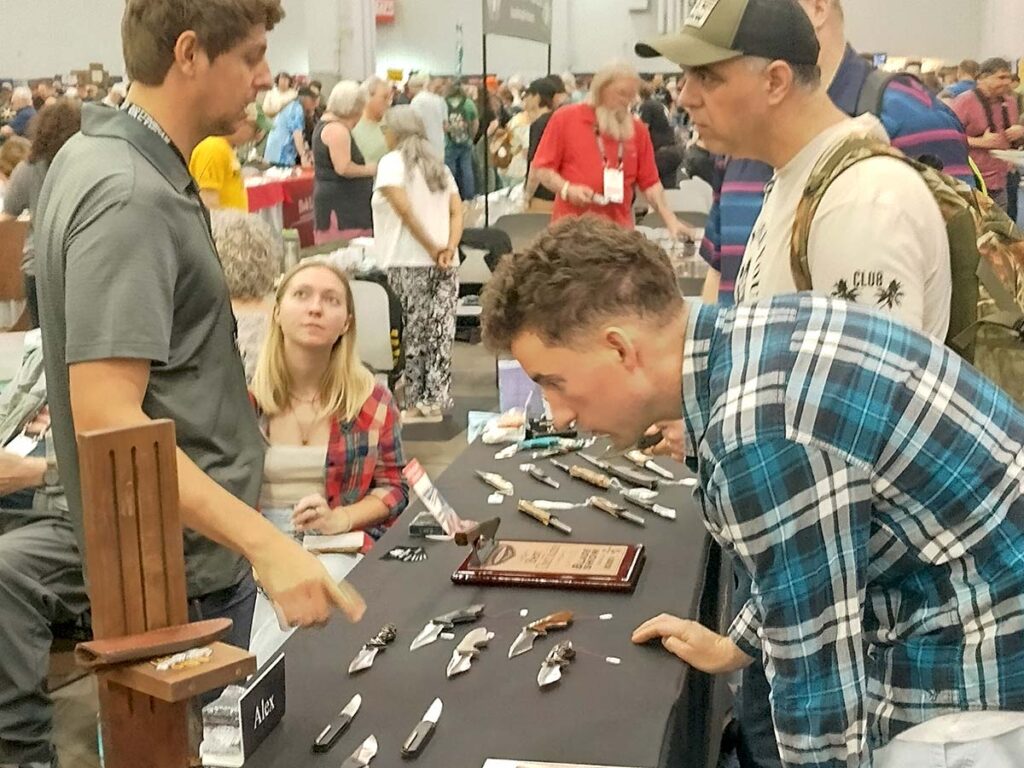
It’s easy to get mesmerized by knives at the BLADE Show, here at the table of Alex Hossom (left).
Editor’s note: Kizer Cutlery is The Pit sponsor. Work Sharp sponsors BLADE University. Nottingham Tactical is the lanyard sponsor. Hogue Knives is the housing sponsor. EKnives is the concessions sponsor. Vosteed is the Wi-Fi sponsor. The other sponsors are Heretic Knives, Reate Knives, Poikilo Blade, McNees Knives, Ketuo/Rike Knife, Artisan Cutlery/CJRB, Reate Knives and HORL Corporation.
CRKT’s first MagnaCut blade and Ken Onion’s first crossbar lock the maker looks to come up aces.
As always, Columbia River Knife and Tool (CRKT) is innovating—and releasing its innovations—at a mind-boggling clip. The latest up for the Oregon-based company is a USA-made collaboration with another well-known knife concern, made with some top-notch material. It’s also a looker to boot.
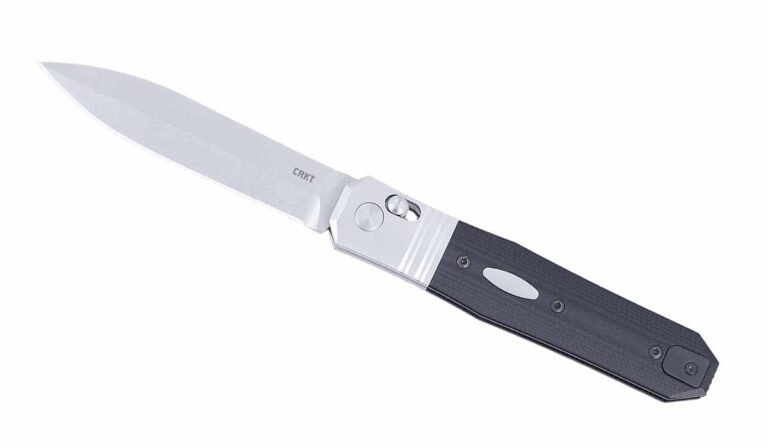
Meet the Redemption, a sleek folder developed in conjunction with Hogue Knives and based on the legendary designer Ken Onion’s Deadman’s Hand custom. As a side note, the Onion’s custom takes its name from the cards Wild Bill Hickock supposedly held when shot—aces and eights. Living up to its inspiration and its own moniker, the Redemption has an Old-West gambler’s feel to its lines and profile.
Yet, made with cutting-edge steel—the first time CRKT has utilized CPM MagnaCut for a blade—it’s up on the times and offers contemporary performance. For those who might not know, MagnaCut is among the hottest blade steels, with exceptional toughness, wear resistance and corrosion resistance. To boot, its microstructure also makes edge management easy.
Redemption Mechanics
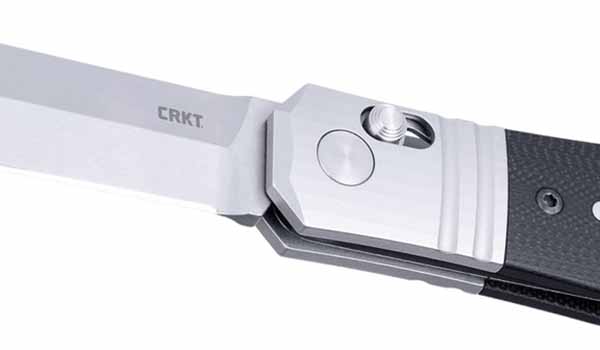
Another inaugural of the Redemption is its locking mechanism—at least for Onion. Hard to believe, but this is the first time the prolific designer has incorporated a crossbar lock into one of his creations. But it does broaden the knife’s appeal, not only offering silky-smooth deployment of the spear-point blade and a strong lockup but also making it ambidextrous. For the nimble and quick of hand, it opens the potential of fast deployment with a flick of the wrist.
Blade Points
In addition to using top-shelf steel, the CRKT Redemption has an interesting blade design. Stiletto-like, the 4.06-inch blade should prove a piercing pro, particularly with its fine tip. Nevertheless, the knife has enough edge for general cutting tasks and at .15-inches thick should have enough backbone to handle semi-rugged jobs, if your opportunities for perforation are limited. Overall, it is very reminiscent of the Deadman’s Hand’s blade, however, the CRKT knife has a stonewashed finish, whereas the custom had a high polish.
Handle Design
Not dead nuts, but the shape of the Redemption’s handle suggests a coffin handle—more so with the stainless-steel bolsters setting off the dark scale. To this end, CRKT has opted for G10 with nice texturing to it, giving the knife a measure of all-weather aptitude. The pocket clip is engineered for deep carry and is reversible, furthering the knife’s appeal to righties and lefties.
Final Cut
Clocking in with a $225 MSRP, the CRKT Redemption teeters on the premium end of the production knife price scale. But given the name behind its design, the materials the company has chosen and the fact it’s domestically made, it is by no means out of bounds. And given the knife is based on an Onion classic and has a wicked throwback look, it’s more than likely to catch the attention of more than one knife aficionado.
Top makers explain how they collaborate with knife companies.
The old cliché of the win-win holds a real grain of truth. Any successful partnership must be mutually beneficial, and in the knife industry the phenomenon of the collaboration has come to exemplify the upside of working together.
Years ago, a veteran custom knifemaker described his relationship with a major manufacturer as serving as the company’s research and development department. Such a description is accurate in that the manufacturer often relies on the custom maker for new design inspiration, from good looks to materials and mechanics. The collaboration has emerged in the last 35 years or so as an outstanding means of bringing innovation to the public and putting first-rate knives in the hands of the mass market.
The ins and outs, nuts and bolts, and give and take of the collaboration process raise questions for makers interested in striking deals of their own. A few comments from makers who have achieved great success on the collaboration frontier offer helpful insights.
“It goes both ways,” observed BLADE Magazine Cutlery Hall-of-Fame® member Bob Terzuola, who indicated he completed his firstfactory collaboration with fellow Cutlery Hall-of-Famer Sal Glesser and the design team at Spyderco in 1989. “You can go to the company or the company can come to you depending on your notoriety. If you are just starting out, you probably have to go to the company.”
On the business side of the ledger, Suzi Terzuola takes the lead and has demonstrated proficiency in making the deal work for everyone involved. Her flair for negotiation and finding the right blend of maker-manufacturer cooperation has been demonstrated through the years as Bob has worked not only with Spyderco but also the old Camillus, Boker, Fox, Pro-Tech, Tactile Knife Co. and others.
BLADE Magazine Cutlery Hall-of-Fame® member Bob Terzuola has done collaborations with many companies, including the Bob Terzuola ATCF Auto Ultimate from Pro-Tech, the BLADE Magazine 2022 Investor/Collector Knife Of The Year®. (Eric Eggly/PointSeven knife image)
“I was raised by parents with their own successful businesses,” Suzi observed, “and I saw Bob receiving passive income from Spyderco and Camillus, and of course passive income is how you survive after having only so many years to make knives. I began looking at the knife designs Bob had and tried to match the design to the company. Bob has patents lining the walls, and when he lends his name to a knife he should receive a signing bonus and a bonus against the royalties.”
In return for his design skill and the use of his name in promotions, Bob has certainly established himself as a leader among successful custom collaborators. His contribution to a company’s success has enhanced his reputation of excellence across the industry, while Suzi has forged a business posture that results in security for the future.
Knife Collaboration Contracts
The contract is the key component of a collaborative deal, and depending on the circumstances everything is negotiable. Although early agreements made among friends were sometimes done on a handshake, it has become a “best practice” to hammer out the terms of the collaboration on paper, invest in an attorney’s review, and formally memorialize the discussions. Standard royalties run roughly 5 percent of the price at which the company sells the knife.
The Terzuolas include a period of time in which the company is allowed to produce the knife; the period may be extended at maturity with the agreement of both parties. Further, there may be a requirement that the company produces a certain number of knives in a given time period, also renewable. Restrictions on wholesale pricing or discounts that affect royalties may also be negotiated.
For those considering a foray into collaborations, Bob and Suzi offer some advice: “If you’re a new maker, you shouldn’t just walk up to [the company’s] booth at a show. Make an appointment to see them because they are at the show to deal with customers. Approach a company with one or more finished designs. They want a package presented to them, a prototype or existing model, something they can hold in their hands, and in the case of a prototype it’s good to have as many innovations and design creations as you can—anything that will set the knife apart from other potential deals out there.”
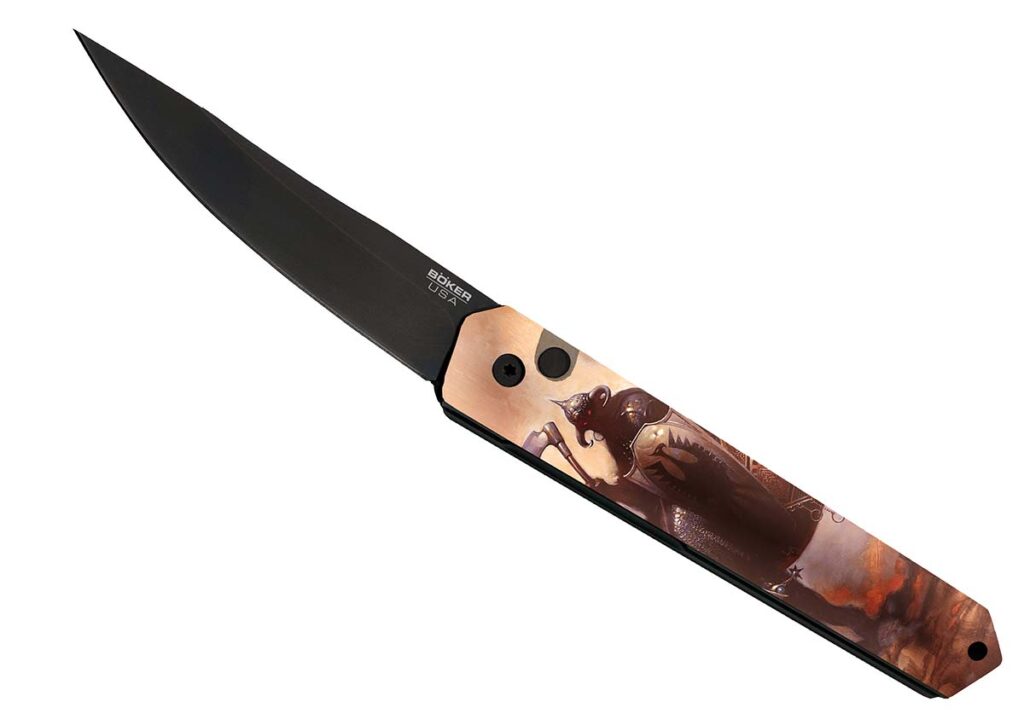
Lucas Burnley has designed several iterations of his Kwaiken for Boker, including the Kwaiken Auto Frazetta.
Suzi added that a higher profile in the industry can drive success.
“We are the R&D for a knife company,” she noted, “and when you approach them for a collaboration your social media resumé is very important.”
Making custom knives since 1994, Darriel Caston has concluded collaborations with numerous companies, including CRKT, Spyderco, Boker, V Nives, Kansept Knives and more.
“I’m prolific when it comes to designs,” he affirmed. “There are probably about 300 that I will never get to making. I’m an engineer by trade and my 3D drawings are almost ready for production, and that helps with the deals. They ask for STEP files [standardized 3D model data files for CAD and 3D printing] that can go right into machining. Sometimes we work with a prototype, and sometimes we work with a knife that I have been doing for quite a while.”
According to Darriel, one significant element of the collaboration is the retention of the rights to the design.
“Anybody who wants to do a collaboration must put footprints in the sand, get their work out there and show a story,” custom knifemaker Darriel Caston observed. One of his latest designs for CRKT is the blacked-out MinimalX framelock folder, an evolution of a knife originally made for SpaceX to commemorate a rocket launch.
“You never want to give up your design,” he warned. “I would license the design to the company usually up to four or five years, and the average is three years. After that, you can discuss if you want to continue if the relationship has been good for both parties. License the design and never sell it. If a company buys the design, then they own it forever. If it became their best seller, I could never make the knife again, and I would have to stay away from anything that looks like it.”
For Caston, every deal starts with a friendly conversation. As progress is made, attorneys draw up the contract. He sees the process as straightforward, whether dealing with an American manufacturer or a company headquartered in a foreign country.
“I find the knife community for the most part to be very honorable,” he commented. “I haven’t run into any bad juju. When you want to do a collaboration, I tell people they need to have a name and a track record of good designs with people following them on social media and stuff.”
Since his first collaboration—with Spyderco in 2015—Darriel can speak with confidence regarding the potential for success.
“It would be rare for someone to take a design to a company without a history or a footprint there. They look for your story,” he noted. “Anybody who wants to do a collaboration must put footprints in the sand, get their work out there and show a story. Then it becomes easier.”
Getting A Collab Off The Ground
Darriel Caston has concluded collaborations with several companies. “I’m prolific when it comes to designs,” he affirmed. “There are probably about 300 that I will never get to making.” Now discontinued, the Squarehead was one of his early collaborations with Spyderco.
Custom maker/U.S. Marine Corps veteran Les George found early collaboration success at the SHOT Show some years back. He approached Pro-Tech a decade ago, and the association has continued since then.
“I had just finished my first batch of VECP [Value Engineering Change Proposal] mid-tech knives,” he remembered, “and I thought it would be cool to see Pro-Tech make the knife in an automatic. So, I did the CAD work to change the knife to an automatic and walked up to their booth at the SHOT Show. I asked to speak to the owner, and Dave Wattenberg came over and shook my hand. I drew a big breath and told him, ‘My name is Les George and I am a knifemaker and I have a design I think would be a great knife for you to make as an auto and I already have the CAD done would you like to see it?’ I said that all as one sentence in one breath!”
Still, a pragmatic view of the collaboration landscape demands preparation and planning. A so-called “cold call” may not meet with success.
“It depends on the company whether a direct approach will work or not,” George conceded. “Don’t walk up to a company at the BLADE Show and tell them you’re a hot maker and they should pay you to make one of your designs. Instead, walk up, introduce yourself, and show them with CAD pictures, a 3D printed model, or a real knife, and tell them why you think it would be awesome to work with them on a production project.”
When it comes to her husband Bob’s collaborations, Suzi Terzuola takes the lead and has demonstrated proficiency in making the deal work for everyone involved. An example of several overseas Terzuola collaborations is the Clap from Italy’s Maniago Knife Makers.
Les sees the components of a particular collaboration deal varying. Of course, some of the structure depends on the negotiating skills of the parties. Commonly, the compensation may revolve around a percentage of dealer or distributor pricing on each unit, and particular deals may extend as long as each party is pleased with the progress.
“Collaborations should run as long as they are profitable,” Les remarked. “Companies don’t generally kill a successful project unless there is a capacity constraint issue or something else outside hindering it. Both parties can end the deal at any time with some allowances for production to finish with the things they have in progress already. Every contract I have ever seen gives one company the rights to exclusively make a particular model. My contracts have a provision that I can make as many customs of my models as I want. In the end, it would be counterproductive to license the same model to multiple companies. The maker would be competing with himself at that point, and it’s not helping the companies.”
Priming The Pump
Award-winning maker Lucas Burnley appreciates the help of friends in establishing a firm footing for collaboration.
“In general, I’m a big fan of pulling on my network,” he said. “If you have someone you can reach out to for an introduction, that’s always a strong move. If you don’t have someone to make an introduction, you might be able to ask around and at least figure out who you need to talk to. Regardless of how you get your foot in the door, I highly recommend going to a knife show and trying to set up a meeting in person.
“A design is only one part of a collaboration,” he continued, “so bring your ‘A’ game and think about what other value you can provide for the company. I was introduced to Boker by Jens Anso and Jesper Voxnaes, and Ken Onion put in a good word for me with Columbia River Knife & Tool. I’ll be forever grateful for those introductions and the relationships behind them. I’ve been able to pay it forward a few times, and hopefully I’ll be able to do it many more times in the years to come.”
Les George’s V14 dagger design for Spartan Blades was the BLADE Magazine 2014 Investor/Collector Knife Of The Year®.
In Burnley’s experience, contracts provide compensation most often in the form of monthly or quarterly royalties based on a percentage of sales. One-time lump sum payments are also seen; however, the income generated depends on the goals of the two parties involved.
“I want my designs to run until my grandkids are old enough to thank me for my good decisions,” he laughed. “If a model is selling, I want it to keep selling. On the flip side, I will routinely ask what models we can kill if they aren’t pulling their weight.
“One caveat here is that if a design is still in production, I want to get paid for it,” he concluded. “Some companies will offer a contract for a set period of time but have the option of continuing to produce the model. I view this as somewhat akin to a one-time payout. If it works for you great; just make sure you are paying attention.”
George specifically limits the number of companies he works with in order to give the relationships the priority he believes they deserve. Consistency, he says, is huge. Real, solid collaborations are not “get-rich-quick schemes.” He remembers getting his first collaboration check in 2014 totaling a whopping $6.
“A design is only one part of a collaboration,” Lucas Burnley observed, “so bring your ‘A’ game and think about what other value you can provide for the company.” His Tuna Compact framelock design for CRKT is one of his latest collaborations. “A design is only one part of a collaboration,” Lucas Burnley observed, “so bring your ‘A’ game and think about what other value you can provide for the company.” His Tuna Compact framelock design for CRKT is one of his latest collaborations.
Times change—and checks change with good business practices, commitment, follow through, and most of all a process from contract to design and product that proves profitable for everyone.
GiantMouse Releases New Set Of Sleek, Robust Folding Knives–the ACE Corta line–Made From Austrian Steel.
Stylish. Tough. Strong.
Those are just a few words to describe the newest folding knives released by GiantMouse. The ACE Corta Knife comes in three different styles and is as good as it gets when it comes to an EDC folder.
The showpiece is the blade, made of Böhler M390 stainless steel from Austria. Known as one of the ultra-premium stainless steel, martensitic steel is renowned for its and ease of sharpening. Essentially, it’ll take and keep an edge.
At 3.1 inches in length with a flat saber grind, the ACE Corta is a flipper inspired by GiantMouse’s limited-run GM6 knife.
The Natural Canvas version of the ACE Corta
The ACE Corta comes in three styles: a green-canvas-colored Micarta handle and a stonewashed finish on the blade, a natural-canvas-color Micarta handle with a satin finished blade and a black PVD finish blade itself with a black G10 laminate handle.
All three knives have an overall length of 7.3 inches, a handle length of 4.18 inches, and come in between 3.8-4 ounces in weight.
The knives open quickly and smoothly thanks to the ball-bearing pivot. They all have a wire clip so it can slide easily onto a belt, purse, or pocket. And each version of the knife has an MSRP of $195.
Given the engineering that has gone into the ACE Contra, the price should prove a value to most.
Editor’s Note: This article was written by Mike Ableson.