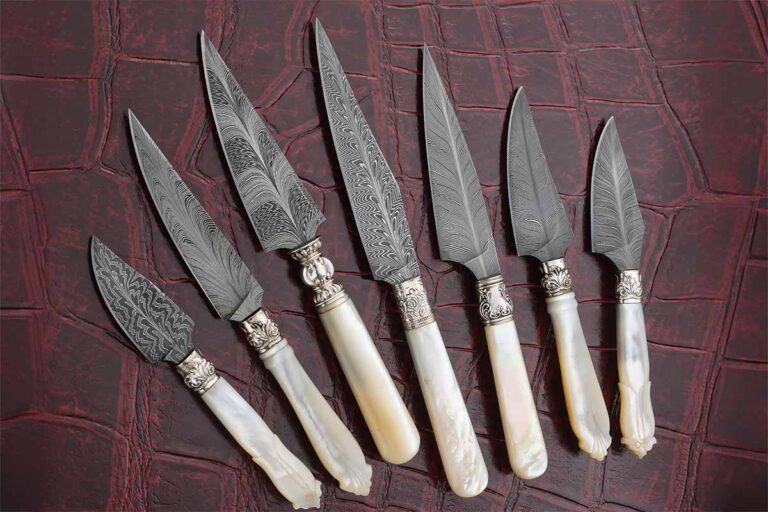
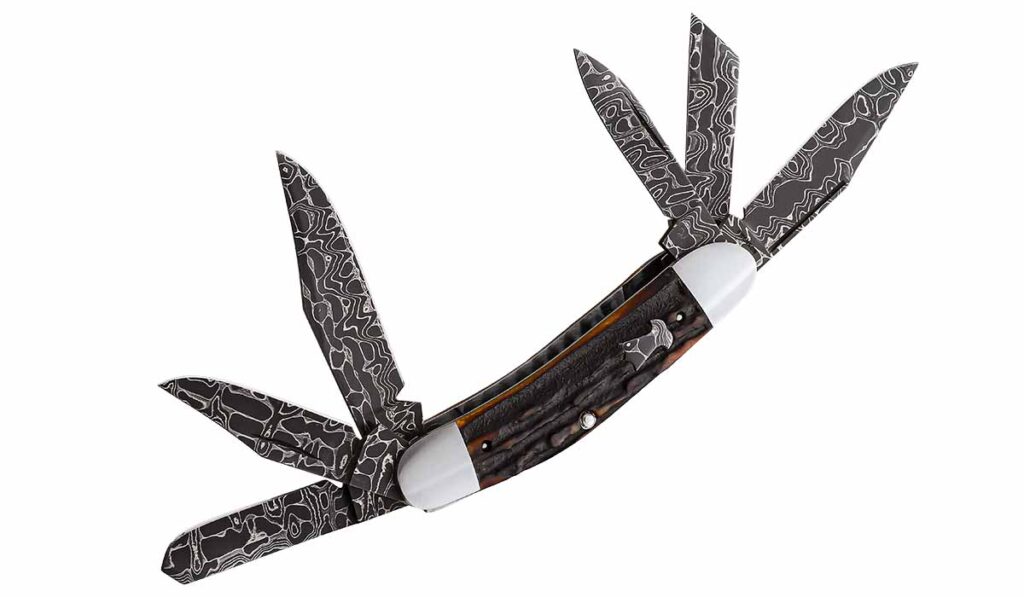
Kevin Casey feathers his cap with an outstanding array of custom throwback blades.
Kevin Casey may have hit on a great idea for knives with both a custom touch and an antique look and feel.
Taking some old yet inexpensive late 19th/early 20th-century dinner knives with mother-of-pearl handles and silver ferrules, he replaced the original blades with those forged of assorted patterns of his feather damascus. The result, the Little Feathers, went fast at the Solvang Show, with two selling individually and five going to one shrewd buyer.
Kevin Casey
Kevin said similar versions of the original antique knives are available on eBay, Etsy, at jewelry stores, flea markets and the like. He cleaned the insides of the ferrules with acetone before epoxying his damascus blades into them. He cleaned the ferrules with Flitz and a toothbrush, polished the handles and the knives basically were ready to go. He plans to do more like them in the future.
Little Feathers Specs Maker: Kevin Casey Model type: Dinner knives Blade lengths: 2.5 to 4.25” Blade material: Assorted patterns of feather damascus in 1080 carbon and 15N20 nickel-alloy steels w/a thin layer of pure nickel; depending on the pattern, the layer count ranges anywhere from 50 to 500 Handle material: Mother-of-pearl Ferrules: Silver Overall lengths: 6.5 to 8” Maker’s list price range for similar knives: $600 to $900 each
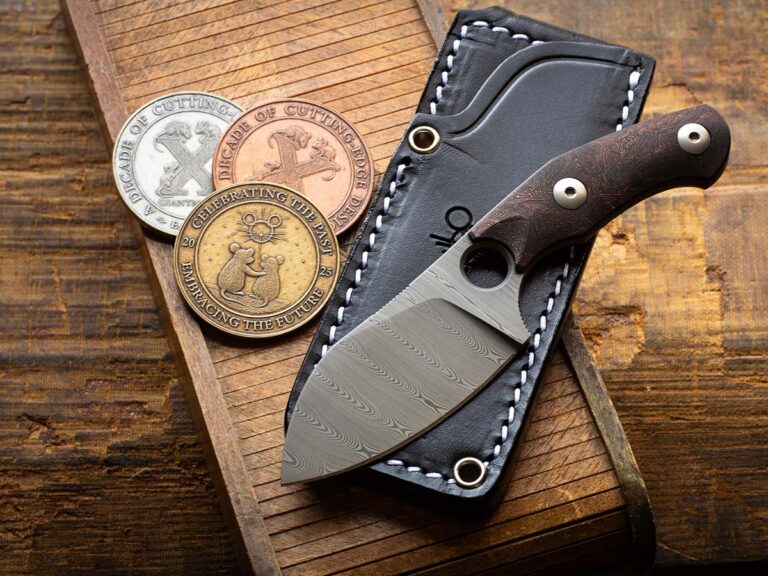
Built on collaboration, craftsmanship, and a no-compromise mindset, GiantMouse celebrates a decade of redefining what everyday carry can be.
GiantMouse Knives is hitting a major milestone in 2025—10 years of pushing the envelope in knife design, quality, and everyday adventure.
What started back in 2015 as a bold idea between a few passionate knife guys has grown into something much bigger. Over the past decade, GiantMouse has carved out a loyal following among collectors, adventurers, and EDC enthusiasts around the world—people who want tools that not only perform, but inspire.
From their iconic limited runs to reliable production models, GiantMouse has built its reputation on standout design, top-tier materials, and the kind of quality that makes a knife feel like it was made just for you.
“This anniversary is really about the people who’ve been with us since day one,” the company shared in a statement. “GiantMouse is for folks who demand quality, chase adventure, and believe their gear should tell a story. Ten years in, and we’re just getting warmed up.”
To celebrate, GiantMouse will be rolling out a year’s worth of anniversary content in 2025—including exclusive behind-the-scenes features, community shoutouts, and a look back at some of their most legendary designs. If you’ve ever carried a GiantMouse blade (or thought about it), this is a celebration you’ll want to be part of.
As Knife Technology Evolves, So Do Handle Materials. Whether Natural Or Synthetic, These Materials Are Helping Knife Aficionados Get A Grip.
From time to time, a new handle material—either natural or synthetic—surfaces. These days, a quartet of emerging options is making an impact, and several custom knifemakers have produced some excellent results with them.
Fat Carbon
“I think the popularity of fat carbon stems from the striking looks of the bright colors contrasting with carbon fiber,” noted knifemaker K.C. Gray. He uses Lava fat carbon fiber for the handle of his Queen Anne’s Revenge dress flipper folder. Closed length: 5.5 inches.
Those who have been around knives any time at all have heard the term carbon, but it’s usually associated with blade steel or well-known carbon fiber handle materials. In this case, however, carbon fiber has put on a little heft! The material known as fat carbon has found its way onto knife handles, and K.C. Gray is putting it to work.
“Fat carbon is a synthetic carbon fiber composite material with alternating layers of carbon fiber and a color layer,” he explained. “When ground or machined the contours reveal the different layers. It comes in a wide variety of colors and patterns: blues, purples, reds, oranges, and greens. I keep quite a bit of it on hand. It’s very popular with most of my customers, and I’m also quite fond of the knives I make for general sale.”
Gray usually brings his fat carbon in directly from a favorite supply house, and the demand for the material is brisk.
“I think the popularity of fat carbon stems from the striking looks of the bright colors contrasting with carbon fiber. It’s also very durable and quite strong, which doesn’t hurt either. Fat carbon is remarkably easy to work with. It has wonderful stability and as such, it cuts, grinds, machines, and polishes easily. It’s wise to employ a respirator when grinding or machining it. Carbon fiber is a health hazard if inhaled.”
K.C. says the introduction of fat carbon doesn’t pump up the cost of a knife, and the results make a foray into the fat worthwhile.
“The material is surprisingly inexpensive compared to a lot of other materials that have similar visual impact,” he related. “Combined with its ease of working, it doesn’t add much to the overall cost. I think it can be used in a wide variety of styles, from tactical folders to kitchen knives. Fat carbon has a color and pattern for just about anything.”
Westinghouse Micarta
As Chris Sharp noted, Westinghouse paper Micarta is an antique material. It can be found in many colors—here in white on Sharp’s single-blade trapper.
Gray also has produced knives with another synthetic handle material, antique Westinghouse paper Micarta®, as has Chris Sharp.
“A lot of this material comes from the electrical industry, old electrical boxes and transformers,” Sharp observed. “It’s a mix of materials. It was normally made from cotton, cork, fiberglass, and linen fabric with some sort of resin holding it together.”
Gray says antique Westinghouse paper Micarta is an old material. “When most people say ‘Westinghouse,’ they are referring to the vintage ivory paper Micarta. Through aging, it has developed a yellowish tone on the outside. Once contoured, it reveals the contrast between the creamy white interior and more yellow outer layer. There are, however, a great many other Westinghouse Micartas—brown, black, blue, red, and rag can be found.”
Sharp finds his Westinghouse paper Micarta readily available at knife shows and from suppliers, but he is always on the lookout because it can be found in some unusual places. The trick is to know where and what to look for.
“It is an antique material” Chris reiterated. “It was designed by George Westinghouse around 1910 to be used as an electrical insulator. It can be found in a lot of colors, but the old stuff was dependent on who made it and what material was available at the time. At the moment, what I’m getting from the local electrical company is a transparent green and brown. I always have some on hand, but I’m always trying to pick some up at every knife show. Also, there’s always somebody dropping some variation of this material off at my shop.”
The Westinghouse paper Micarta fills the bill on toughness, durability, and ease of working. “It’s pretty easy to work with and can be used on any knife design,” Sharp concluded. “I love working with it. The older stuff is in short supply, which can cause the price of the knife to go up—and people sometimes take advantage which, in turn, causes ridiculous pricing.”
TeroTuf
Matt Gregory sometimes uses TeroTuf in the core of both the knife handle and the sheath, overlaying carbon fiber cloth and then applying multiple layers of resin before smoothing and polishing. An example is with his CFST Battle Tanto in CPM 3V carbon blade steel. Overall length: 14.5 inches.
Another synthetic handle material gaining traction is TeroTuf, a composite of polyester resin and fabric. It is a relative of canvas Micarta but may hold some better characteristics. It has no phenolics and, compared to G-10, contains no glass fibers. What’s more, some users may find TeroTuf is more shock absorbent than the others.
“I use TeroTuf because it’s light, tough, waterproof, and easy to cut and shape,” custom maker Matt Gregory commented. “For the most part, I make a core out of it for stick-tang knives and sleeve the core with carbon fiber or similar material. I’m what you would call a hobbyist maker, I guess, although I’m awfully serious about how I build things. I’ve been making knives for 17 years but only make a handful per year.
“I love TeroTuf because it’s really easy to work with and machine, but it’s tough as nails and impervious to darn near anything you throw at it. Because it’s relatively lightweight, it makes a great core material. Much of what I make is neo-Japanese/American-styled stuff, and TeroTuf makes a fantastic tsuka, or handle core. I prefer it to wood. Many of my friends and fellow knifemakers have used it to great effect and have been influential in my explorations of the material, including Dan Keffeler, Ben Tendick, Nathan Carothers, and James Helm, to name a few.”
Matt sometimes uses TeroTuf in the core of both the knife handle and the sheath, overlaying carbon fiber cloth and then applying multiple layers of resin before smoothing and polishing.
Ringed Gidgee
From a shop standpoint, ringed gidgee is similar to desert ironwood but probably a bit less gummy. James Fleming uses it for the handle of his Frontier Gentleman’s Hunter. The 5-inch blade is Takefu Shiro2 core san-mai bar stock with multiple 22-layer laminations of Suminagashi Takefu steel.
On the natural side, ringed gidgee, a product of Australia, is making the rounds. James Fleming imports his ringed gidgee from @thetimberjoint on Instagram.
“It’s a natural hardwood in the acacia family of trees,” he said, “the same as koa. Ringed gidgee is a chatoyant brown and caramel color, and it can have some blond sapwood as well, much like desert ironwood.”
Keeping plenty of ringed gidgee in stock, Fleming considers it one of his go-to handle materials. It is user-friendly in any knife design.
“But it’s still wood, so I wouldn’t suggest it being used around salt water on a regular basis,” he advised. “It makes a great handle for outdoor knives, chef’s knives, hunting knives, and even folders.
“I think its popularity comes from the fact that it has everything a knifemaker looks for in a handle material,” James continued. “It has beautiful color that has a ton of depth because of the chatoyant nature of the deep curls. It’s rated as the third hardest wood in the world, which makes it extremely durable. Once the wood has properly dried, it is ready to be used, and there is no need for stabilizing due to its being a very dense hardwood.”
From a shop standpoint, ringed gidgee is similar to desert ironwood but probably a bit less gummy. According to Fleming, it cuts and drills easily but can be a bit of a challenge on a belt grinder.
“I suggest having a belt grinder with a VFD [variable frequency drive] to slow it down, and using a fresh belt,” he observed. “It polishes up extremely well during hand sanding and needs nothing more than a bit of beeswax and buff for the finish.”
From a cost standpoint, James acknowledges that ringed gidgee is classified as an exotic material, and that alone causes the price of a knife with it for the handle to escalate. However, it doesn’t approach the expense associated with the highest end of the exotic spectrum, such as mammoth ivory.
For a bit of an uncommon look and a potential conversation starter, these handle materials make the most of the opportunity. Chances are more will be seen of these up-and-comers.
Betty Dowell was the juggernaut that made Ted Dowell’s knifemaking business move.
Elizabeth “Betty” Ann Dowell, the driving force behind BLADE Magazine Cutlery Hall-of-Fame® member Ted Dowell, teacher, mother, grandmother and friend of the knife community for over half a century, passed away July 2. She was 93.
Most fittingly, she lived long enough to watch on Zoom as Ted was inducted into the Cutlery Hall of Fame June 5 at BLADE Show 2024.
Betty and Ted were married in 1953 and moved to Madras, Oregon, in 1954, where Betty was a part-time substitute teacher and homemaker raising three children: Scott, Lynn and Jeff. The family moved to Bend, Oregon, in 1964, where Betty became an accomplished substitute teacher in the Bend Public School System.
Ted, meanwhile, accepted a professorship at Central Oregon Community College, where he was dean of the mathematics department. He sold his first knife in 1967 and helped found the Knifemakers’ Guild in 1970, along with Cutlery Hall-of-Famer Bob Loveless writing the organization’s bylaws in the process. Ted also later served as Guild president.
Betty and Ted at the 2009 Knifemakers’ Guild Show in Louisville, Kentucky, the last of their 40 consecutive Guild Show appearances as an exhibiting team. Ted passed away in 2012.
Ted went full time making knives in 1974 and started TMD Knives in 1975. That same year the Dowells suffered the tragic loss of their son Scott, 19, in a car accident. Betty took the lead role in getting her family through such a trying time, as well as maintaining the knifemaking business.
As Jeff noted when he inducted his father at the Hall-of-Fame ceremony this past June, “My mom was galvanized and determined to have a family to take care of and a household to run, and she ran every bit of the business. [Dad made the knives] but everything else she did. She attended to every detail of the business. She had two kids to take care of and she had a grieving husband and a knifemaker and a business to support, and she did so for another 40 years.”
In fact, until the Dowells closed their knifemaking operation in 2010, Betty was the rock of TMD Knives, handling all of the purchasing, inventory management, accounting, correspondence, promotions, and travel logistics for the company. Her attention to detail and level of documentation of the business was as comprehensive and complete as possible.
Betty’s work accomplishments at TMD Knives and the Dowells’ ground-breaking efforts in getting the Guild established early on earned her the Guild’s coveted Nate Posner Award in 2015 for support “above and beyond” of the Guild and the custom knifemaking industry.
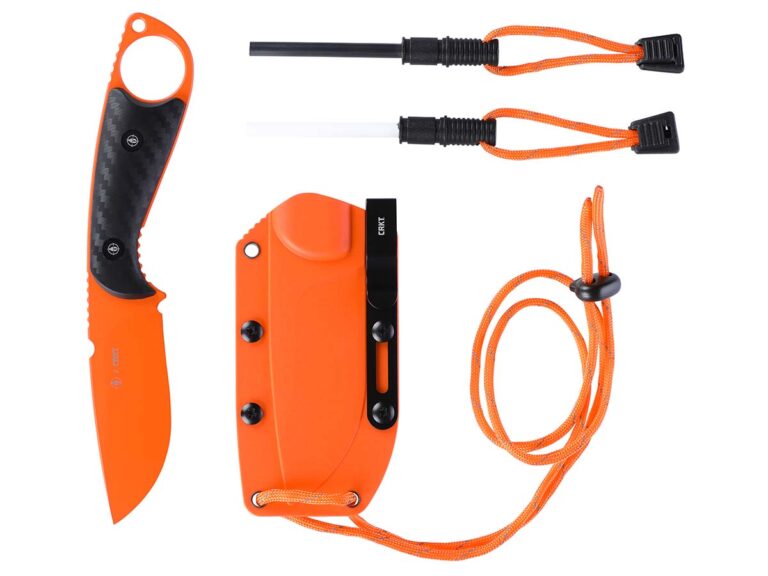
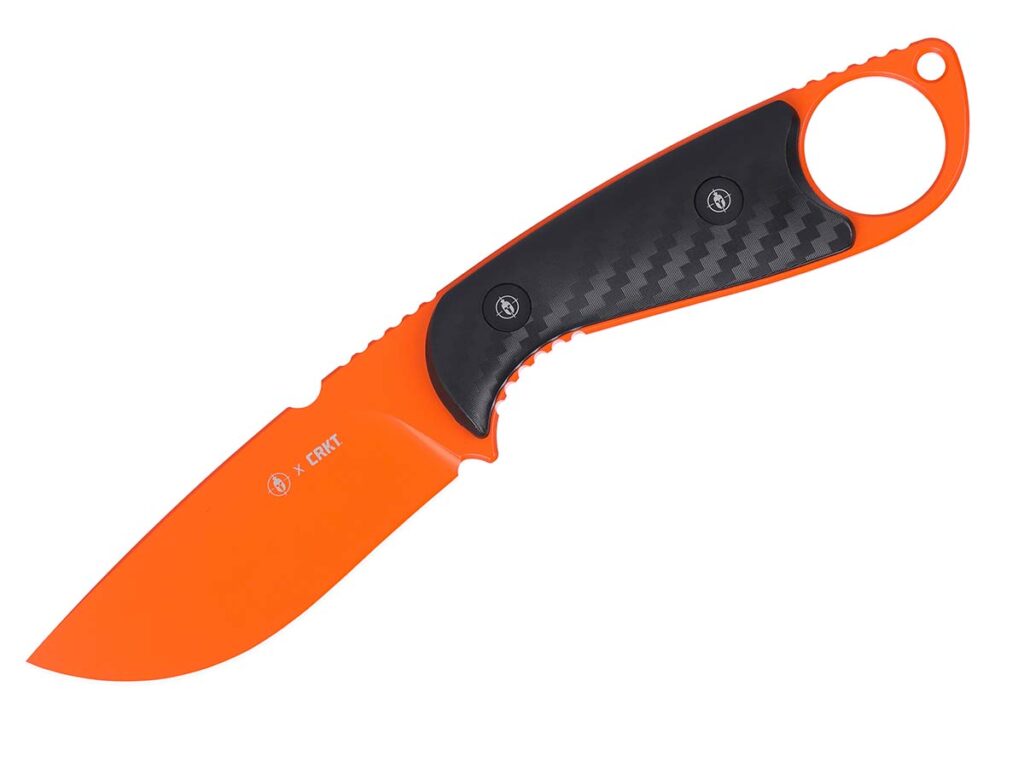
Designed with Spartan Precision Equipment, CRKT’s backcountry-ready Altai pairs 14C28N steel with an integrated fire rod and ceramic sharpener.
CRKT has teamed up with the shooting platform specialists at Spartan Precision Equipment to introduce a new backcountry fixed blade: the Altai. Named after Spartan founder Rob Gearing’s hunting excursions in Mongolia’s Altai Mountains, the knife integrates purpose-built field features directly into the cutting system and sheath setup.
Tailored for Field Processing
The Altai centers around a 3.53-inch plain-edge blade fashioned from 14C28N stainless steel. To withstand harsh outdoor environments, the steel is treated with a protective ceramic coating designed to bolster toughness and resist corrosion. The 0.13-inch thick blade is sized specifically to maintain maneuverability and control during game dressing, while jimping along the finger choil and spine provides positive tactile traction.
The knife features glass-reinforced nylon (GRN) handle scales textured with a carbon-fiber pattern, secured over custom pins bearing the Spartan head logo. High-visibility orange highlights run along the build, helping users spot the knife easily in dim light or deep cover. At the butt end, a ringed pommel allows for a fast draw—even when wearing thick gloves—and includes a lanyard hole for additional retention options.
Built-In Fire and Maintenance Kit
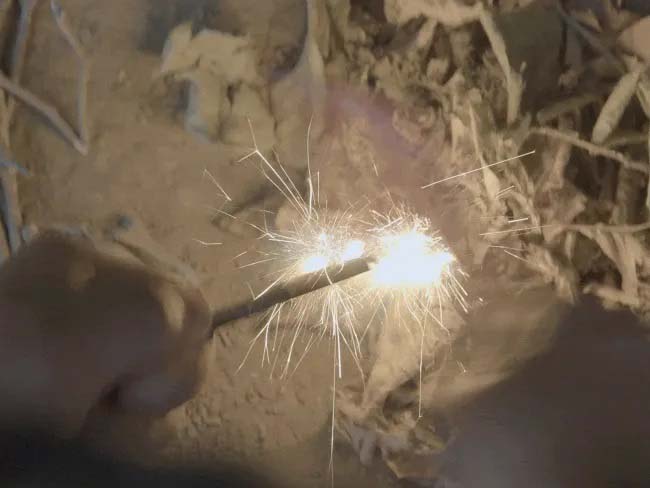
Rather than serving as a standalone cutter, the Altai incorporates essential survival and care tools into its carry rig. The knife’s spine includes a dedicated striking notch configured to work with an included magnesium alloy fire rod. For touch-ups during long trips, a ceramic sharpening rod is also housed directly alongside the blade.
Both maintenance accessories stow in the included molded thermoplastic sheath. Reflective orange paracord is used for the main lanyard as well as the pull tabs on the fire and ceramic rods, ensuring high visibility when working in low-light conditions.
At 8.0 inches in overall length and a weight of 3.6 ounces, the Altai offers a complete backcountry processing and field-maintenance package in a compact carry footprint.
Damascus steel is produced on a mass scale by some of the best in the business
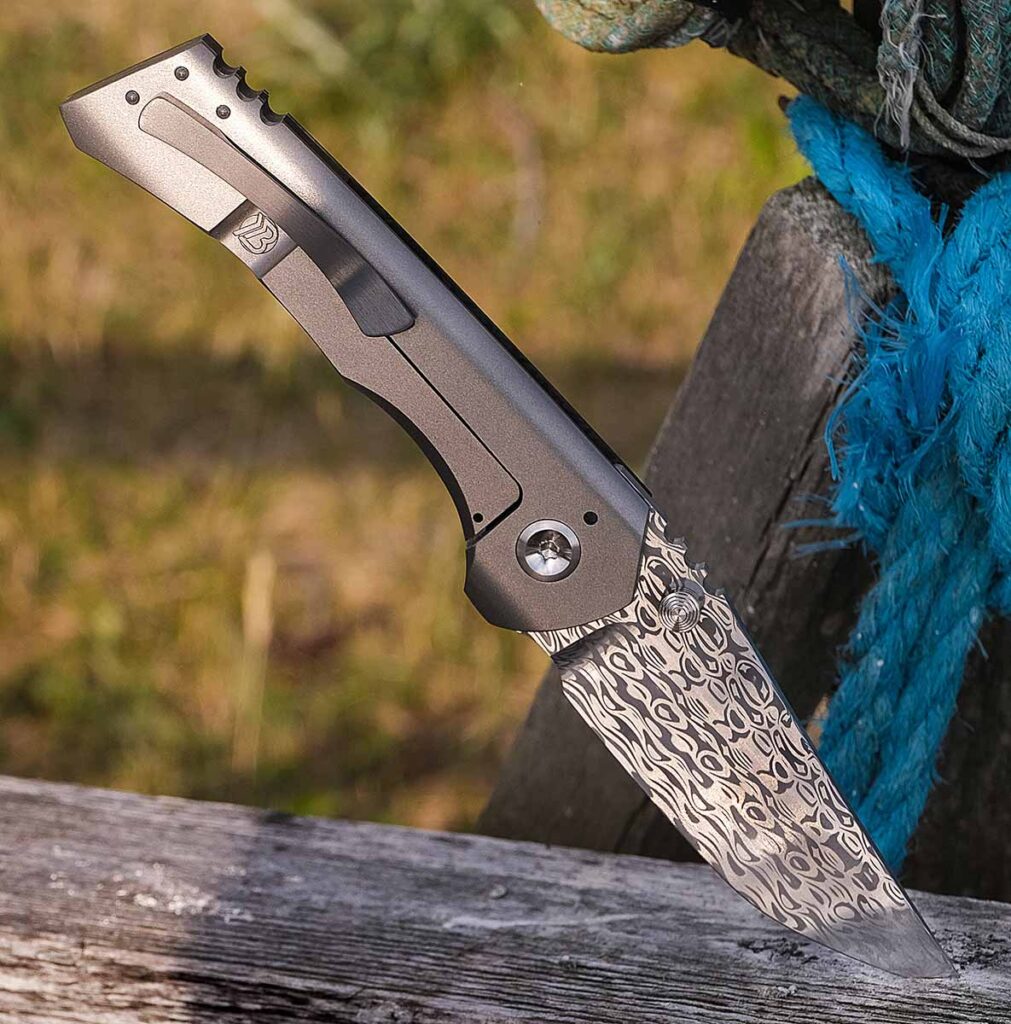
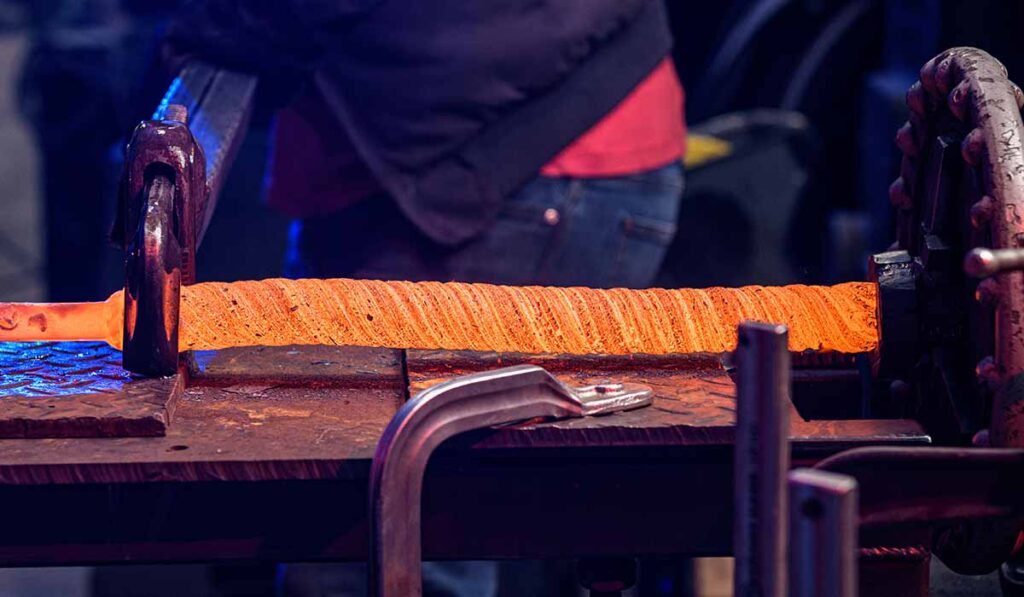
Forging damascus steel for knives and ancillary products on a broad scale makes the beautiful and highly popular knife material readily accessible to the marketplace, and drives the creativity of custom and factory knifemakers. The availability of the resulting damascus knives is reaching new levels while bringing on innovation at the same time.
At Nichols Damascus, owner Chad Nichols touts his willingness to put together “laminates of any kind we can think of.” Nichols Damascus is busy with titanium and copper alloys, carbon and stainless steels.
“We have a pattern called Boomerang, and any configuration we make it in sells very well,” Chad commented, adding that he believes the popularity of the material has increased dramatically due to the internet and social media.
One of the latest patterns in Damasteel’s Dragon series, Svavner was used to create the blade steel for the Valyrian swords of the Targaryen family on HBO’s House of the Dragon. Brian Brown uses the steel here on one of his sporty folders. (Damasteel image)
He asserts that his forging operation charts its own course. “We’re just having a good time playing with hot stuff,” he smiled, “and we make a lot of core material. This is where we clad a homogeneous steel like Magna Cut with a damascus on the outside.”
WANTS & DESIRES MET A family-owned business situated just north of Sweden’s capital of Stockholm, Damasteel has focused for years on making top-quality steel for custom knifemakers, among other lines of business. “Over the last couple of years we have released our Dragon family of damascus patterns, culminating with the release of Svavner, which we launched alongside the release of HBO’s House of the Dragon,” noted owner and iron master Per Jarbelius. “They used our steel to create the Valyrian swords for the Targaryen family. It was an amazing project to get to work on.”
Damasteel has also just released Drakkar, a patterned steel in sheet form. It’s a first for the company and Jarbelius says it has been well received, emphasizing its nesting options with the ability to go from bar to sheet. A product line called Damacore has been available in DC18N and DC21R steel for a few years now and signaled a major expansion in the company’s repertoire. “It’s becoming even more popular as the number of san-mai offerings grows on the market,” Per noted. “We’re hoping to eventually be able to offer every pattern we do in both the DC18N and DC21R.”
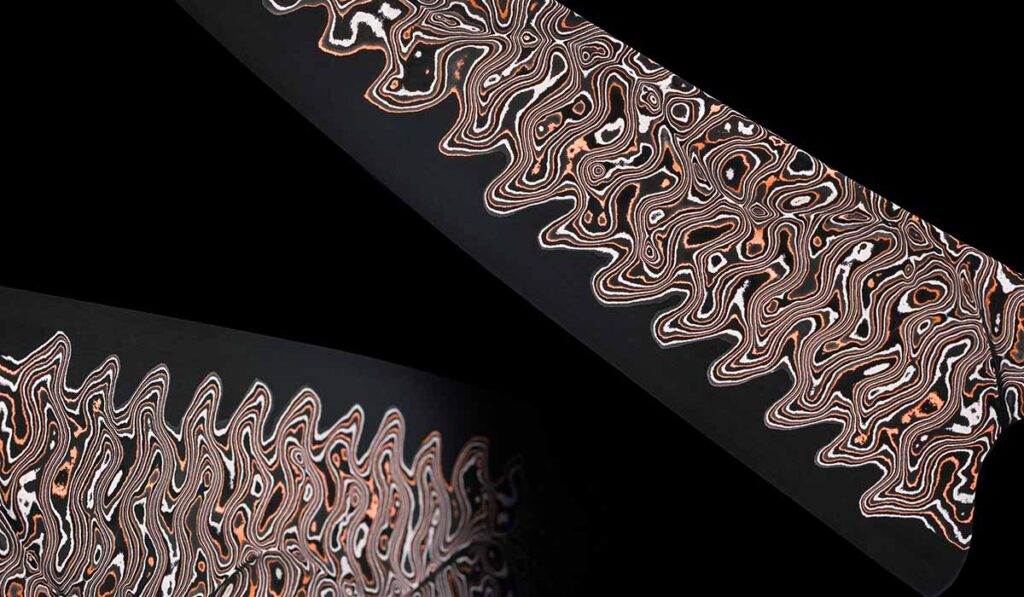
Among the most popular Baker Forge & Tool damascus patterns are the copper and bronze laminates. A current hot one is Elite CopperMai, a damascus blend of copper, 1084 carbon steel and pure nickel over a solid core of 80CrV2 carbon steel that creates either a chevron or a ripple pattern (the latter here on a knife by JB Blades). (Baker Forge & Tool image)
Philosophically, Jarbelius relates that Damasteel has always paid attention to the wants and desires of its market. “We make patterned and un-patterned stainless steel, and our priorities have always been performance and beauty,” he explained. “Our artistry is core to our identity, and we want to make patterns that connect with users on an emotional level. Research and development is a big part of what we do. But hearing from makers is equally important; we value the opportunity to get feedback from people using our steel.”
Damasteel further connects with its user community each year in hosting the Damasteel Chef Invitational, showcasing the talents of top-class culinary knifemakers. The evening event provides a glimpse inside the shops and workspaces of incredibly talented artisans. “It’s absolutely world class,” Per concluded. “It’s a great learning experience, too, for people who have never used our products. They can ask questions and connect with our team as well.”
Forging An Industry
Vegas Forge concentrates on the production of high-quality damascus steel in a variety of exotic patterns and alloy combinations. “In 2016, we opened our shop in Las Vegas and quickly discovered that many of our potential customers were extremely hesitant to use damascus steel again due to some bad experiences they had had in the past with other damascus steel companies or makers,” explained owner Jesse Harber.
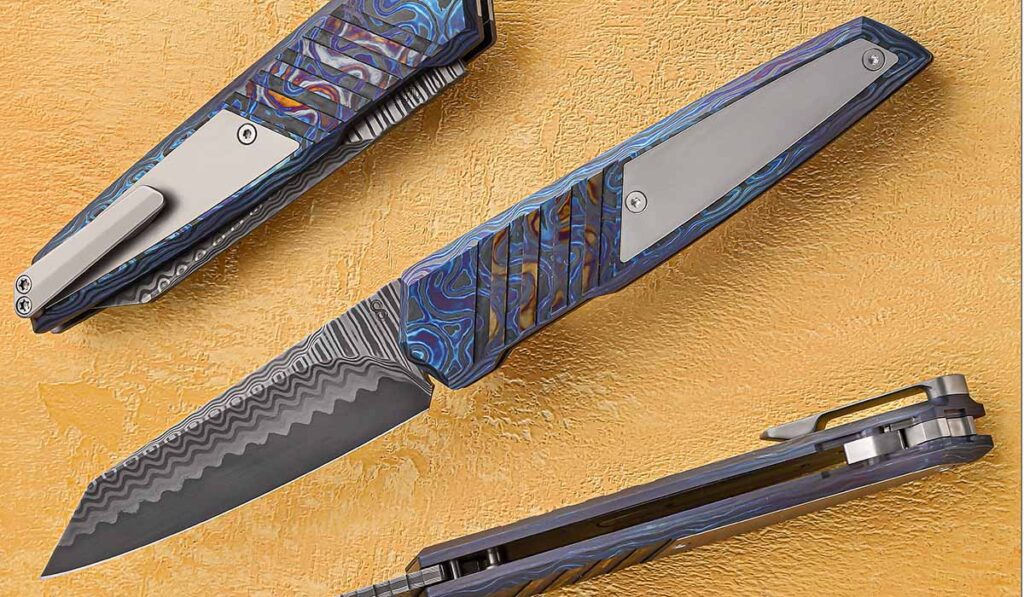
Damacore has been available in DC18N and DC21R steels for a few years now and signaled a major expansion in Damasteel’s repertoire. Persevere by Princeton Wong sports a 3.5-inch blade of Damacore DC18N handled in black Timascus™. Closed length: 4.625 inches. Princeton’s price for a similar knife: $2,700. (SharpByCoop image)
According to Harber, customer service is a watchword at Vegas Forge. Returning customer calls, handling inquiries, responding to emails, and delivering orders in a timely manner complete the full circle from outstanding damascus to overall satisfaction.
“Once we had solved that, we turned our focus on creating new, interesting patterns, new billet shapes and different alloy combinations,” Jesse advised. “In the beginning, we had 10 damascus patterns that we offered customers, all flat billets which are what knifemakers primarily use. Today, we offer 26 flat-billet damascus patterns. We offer most of those patterns in stainless or carbon damascus as well as titanium damascus and mokume gane. In addition, we have eight round-bar damascus patterns that we sell to customers who make things out of round bar like custom rings, pens, razors and such. We also make blocks of damascus in six different patterns for manufacturers of guns, golf putters and other products.”
The most recent patterns to emerge from Vegas Forge include Virus, Lytic, Forged Koa and one that is so recent that it remains unnamed thus far. Virus depicts what most people would think a virus looks like under a microscope—sporadic circles and lines that are “beautifully chaotic.” Lytic has the look of lytic DNA cycles under the microscope.
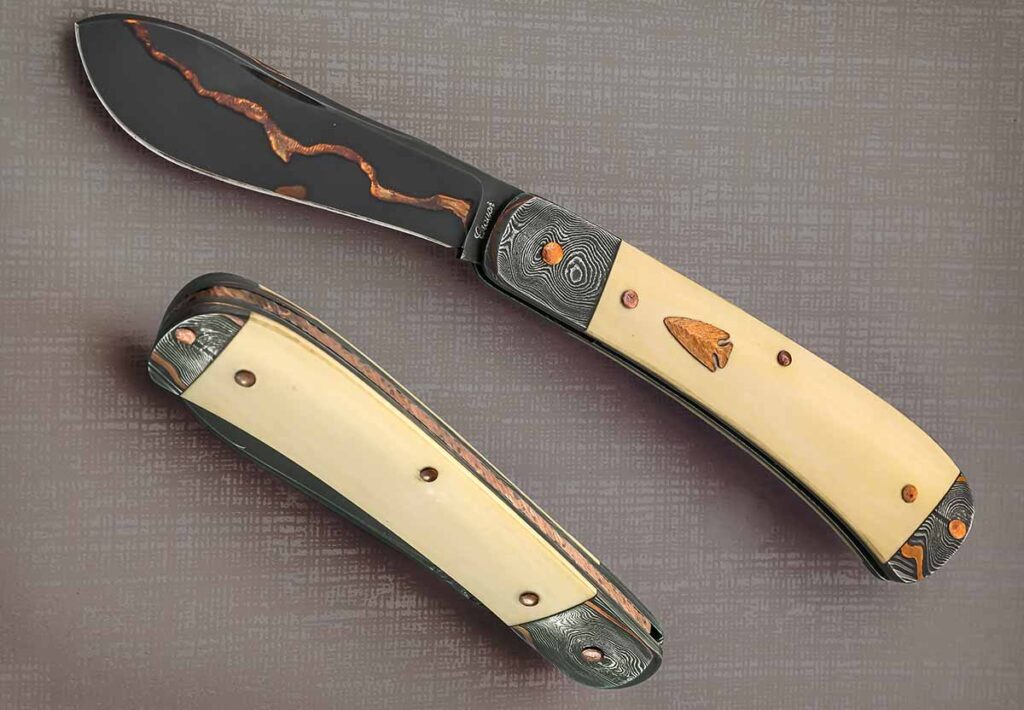
Baker Forge’s CopperMai was one of the first copper damascus steels to capture the imagination of custom knife enthusiasts. Bubba Crouch uses it on his trapper with an integral damascus frame and double-line antique Micarta® handle. Closed length: 4 inches. Bubba’s price for a similar knife: $3,000. (SharpByCoop image)
“Both of these patterns were created during the pandemic, so that’s where the inspiration—if you want to call it that—came from!” Harber laughed. “Forged Koa looks like a rare piece of twisted koa wood. It has multiple depths and contrasts to make it look like koa. It’s made by stacking 600-plus pieces of steel into a can and then lightly twisting it. As you grind into it, the pattern opens up and exposes all 600 layers, which is pretty spectacular.”
A few years ago, Vegas Forge began producing a titanium damascus that Harber dubbed Damtanium. The combination includes damascus with layers of Grade 2 and Grade 5 titanium. Almost simultaneously, the company introduced Zirmascus, an alloy of zirconium and titanium layers.
“We’re always trying out new steels in our san-mai damascus,” Jesse added. “San-mai is like damascus, but at the center of the damascus billet is a solid core. We have used Elmax, Magna Cut, and Nitro-V, to name a few.”
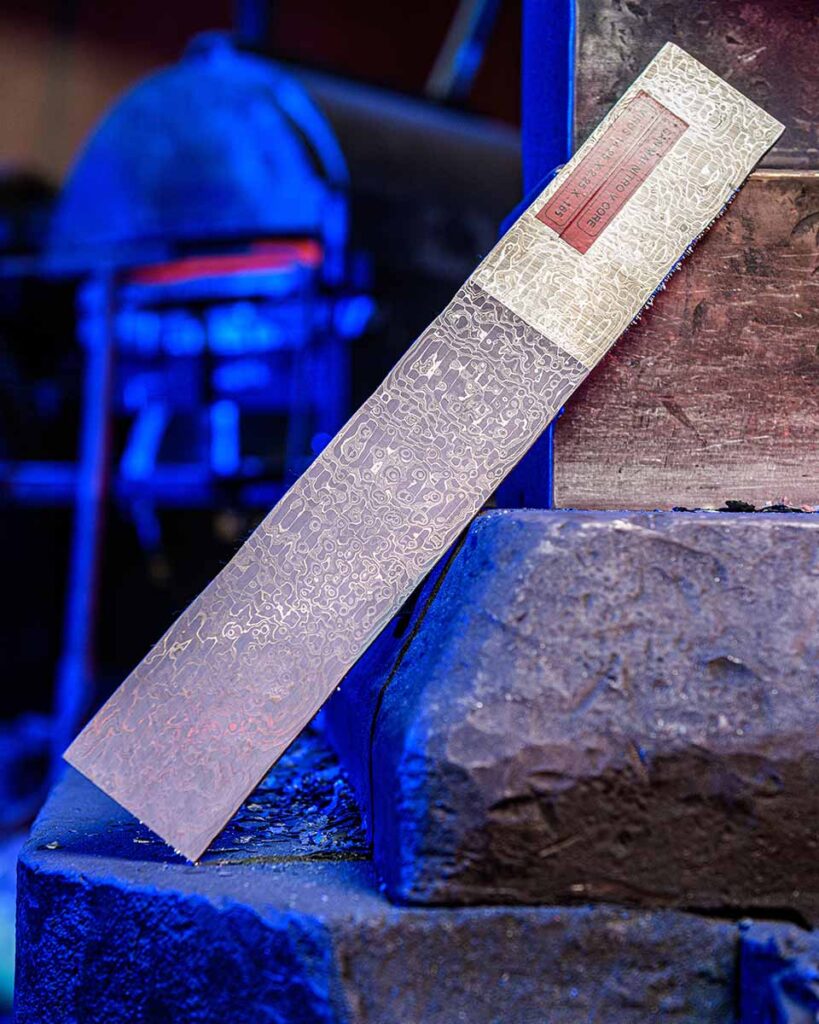
Jesse Harber said Vegas Forge uses its san-mai damascus to try out a number of stainless-steel cores, including Elmax, Magna Cut and Nitro-V, the latter shown here in bar form. (Vegas Forge image)
All this experimentation and innovation is the product of an expanding horizon and an imagination that isn’t inhibited or afraid to step into some uncharted territory. Harber thinks the future is bright at Vegas Forge, and the new product array has brought ever-increasing interest to the doorstep.
“In the beginning, the knife world kept us alive,” he declared. “We were getting no love from other industries. Today, the knife world still accounts for half our business. There isn’t another industry that we love more. We’ve attended hundreds of knife shows over the years, and there is no doubt that knife people are our people. We sell to a lot of custom knifemakers as well as larger manufacturers. I love the custom world, and I don’t even know how many custom knives we own at this point.”
Incorporating Copper And Bronze
Coy Baker founded Baker Forge & Tool in 2019 with a focus on damascus and san-mai. That bedrock quickly elevated to include non-ferrous laminate steels. Baker Forge is now an industry leader in copper and bronze laminated steels with dedicated distribution centers in the United States, Canada, the United Kingdom and Australia.
Chad Nichols Damascus offers a wide range of damascus patterns including the Intrepid on Luke Swenson’s six-blade stag sowbelly. Luke’s price for a similar knife: $4,000. (SharpByCoop image)
“Our current buying market is about 80 percent to the knifemaking industry, about a 50/50 split between retail custom makers and commercial knife companies,” Coy related. “We cut our teeth in the custom knifemaker market in the beginning and have slowly expanded into the commercial side. We aim to always be able to provide damascus steels to everyone from the hobby smith to the biggest knife companies.”
Among the most popular Baker Forge damascus patterns are the copper and bronze laminates. However, one-off custom runs generate real excitement. One trending steel group is Elite CopperMai, a damascus blend of copper, 1084 carbon steel, and pure nickel over a solid core of 80CrV2 carbon steel, creating either a ripple or chevron pattern.
“This layout is very appealing to customers due to the stark contrast between the layers and its ease of finishing,” Coy remarked. “We have been expanding into using new core steels in our laminates. Recently, we have used some Hitachi #2, which quickly became a crowd favorite for its edge-retention properties. Later this year we will be expanding into Apex Ultra steel and possibly some other stainless options.”
“Forged Koa looks like a rare piece of twisted koa wood,” Vegas Forge’s Jesse Harber explained. “It’s made by stacking 600-plus pieces of steel into a can and then lightly twisting it. As you grind into it, the pattern opens up and exposes all 600 layers, which is pretty spectacular. (Vegas Forge image)
This quick look inside the damascus steel industry offers a glimpse of past, present, and future. The tried and true, the cutting edge, and what will be are coming together to keep pattern steels fresh and exciting among makers, users and then the wider buying market.
Cutting Through the Costs: How Tariffs Are Reshaping the Global Knife Industry.
Tariffs. The simple mention of the word makes some folks tear their hair out. That’s not a problem for me because the word doesn’t upset me that much. Besides, most of my hair has already fallen out anyway.
As you know, a significant portion of American knife companies depend on China to manufacture some, most or all of their knives. As you also no doubt know, President Trump is addressing America’s tariff imbalance with other countries—including China—in no small part to help erase some of America’s $36 trillion debt. And, at press time, he was threatening to impose higher tariffs on China than any other country.
How will the President’s tariffs affect the knife industry? I asked one industry insider and he told me of a recent trip he made to China to talk business with those who make many of the knives for the company he represents.
He said the last time he went there was 2018 and he was amazed at all the changes in the interim. There wasn’t a bridge from Hong Kong to China seven years ago. Now there is one and they drove on it to the Chinese mainland. There are new superhighways all over with no cars on them.
“It’s crazy the money they’re spending on infrastructure,” he wrote. When he went to one city in 2018 there wasn’t a traffic light in sight. Now it’s a city of 2.6 million people with high rises everywhere.
“Maybe it was my imagination but the vibe wasn’t great,” he observed of the reception he received earlier this year. “A couple of factories seemed to blow me off. I used to get the golden carpet treatment. One of our guys who speaks Chinese said he was having a hard time getting answers from some of them. I think the tariffs have them scared.”
I wondered out loud if the Chinese manufacturers thought they’d gotten most all they could out of the company my friend works for and are looking at other revenue avenues.
“I don’t think so,” he wrote. “The other markets are small in comparison to the USA. The Chinese knife factories are so specialized that making knives is really all they know.”
He added that the big Chinese manufacturers are building factories in Vietnam to avoid the tariffs, though he predicted the President would close the Vietnam loophole soon if he hadn’t already by the time this story hits print. I asked if that would make it more economically feasible for those American companies who have knives made in China to have them made domestically, and he hit me with the cold, hard facts.
“Rough numbers: cost to make a folder in the USA, $100; cost to make the comparable folder in China, $25. Double the cost with tariffs and Chinese-made knives are still half priced,” he emphasized. “Knives are such a niche market and relatively low volume that even with automation it would be tough to match the price of knives made in China. Marketing, design and innovation can overcome that cost gap. Look at Benchmade. They are killing it.”
Concerning my earlier question of whether the Chinese manufacturers might be looking at other sources of revenue, he returned with a qualifier.
“I did see two factories that are now making manicure stuff like nail clippers. Ten years ago you would not have seen that. A knife factory was a knife factory. One factory was making Nite Ize® products, so I guess they are diversifying,” he wrote.
“One more thing,” he added. “I went to a big-name [Chinese] factory and the owner did not appear to be worried about tariffs. He is focused on making the best knife he can, so I think you could say the higher-end manufacturers aren’t as worried about tariffs.”
My insider friend, however, disagrees with that rationale.
“I think when the market goes bad even the billionaires slow down on impulse buys,” he opined.
On the domestic side, at least one U.S. company official says costs are increasing for steel and other knife materials even though the steel and materials are U.S. made. Meanwhile, by the time you read this, here’s hoping the President has been able to work out, or is well on his way to working out, deals with most if not all of the countries on which he imposed tariffs. Either way, as my insider friend summarized,
“The tariffs are going to have a big impact on our little industry!”