Hall-Of-Frame Handles

Frame Handles Remain Just As Useful In Making A Knife Today As It Was Centuries Ago.

Frame handle construction for knives has been around for centuries. Historical examples of many Eastern styles like the kard, khyber and yataghan often feature ornamented frame handles. Nineteenth-century knives attributed to James Black and some of the early American bowies also had frame handle construction. Though it’s been around a long time, the frame handle remains a viable modern construction method for today’s custom knifemakers.

There are many ways to crack the nut/skin the cat on frame handle construction. This article will walk through the frame handle process and point out particular problems and potential solutions for those who wish to pursue building a frame handled knife.

Why You Should Build A Frame Handle

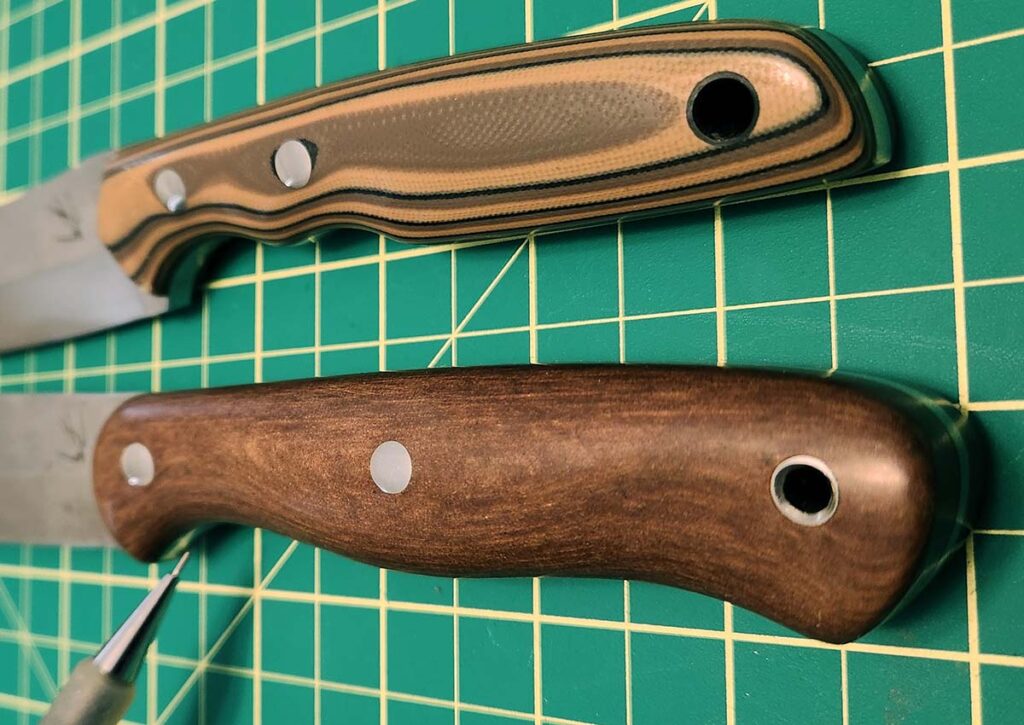
Frame handle construction is best defined as using a wrap-around “frame” to conceal the tang of a hidden tang knife. The first question many people ask regarding a frame handle construction is, “Why would you want to do it that way?”

My first thought goes back to the earlier days of the internet when forums were at their peak, and fine makers like ABS master smith Bruce Bump took the time to document “work in progress” (WIP) threads. Bruce had a fine frame handle WIP on the KnifeDogs.com forum in 2013, and the consensus at the time was that you build a frame handle for quite a few reasons, though the first one is “because you can!”

An exploded view shows an ABS journeyman smith Karl Andersen frame handle construction knife before assembly. (Karl Andersen image)

A frame handle is a much more complex build process than your standard full- or stick-tang knife. However, in addition to the show of skill by the maker, frame handle construction has a few distinct advantages that make the complexity worth the effort:

1. A frame handle allows for the look of a full tang, but with the guard-fitting techniques of a stick tang. For a forged stick-tang-knife design that needs a guard, a frame handle allows the use of full-tang-style handle construction;

2. A frame handle is a good way to use scales or slabs on a stick-tang knife. If you have a good set of stag or mammoth slabs, or if you have stabilized wood slabs that might be too fragile for through-tang construction, the frame handle allows you to use the materials on a stick-tang knife; and;

3. The use of a frame handle gives the maker another area to embellish the knife. Some frames are great for engraving, while others may highlight a damascus pattern. Either way, the frame makes the embellishment stand out in ways that are harder to accomplish on a full-tang knife.

How To Build A Frame Handle

At a basic level, the frame of a frame handle is a piece of material, usually metal, that wraps around a stick tang and mimics the look of a full-tang knife. This presents some challenges that have resulted in a few different creative solutions.  

•Challenge 1: The tang must fit inside the frame. Some makers insist on precision so there are no gaps and the fit is tight. Others concede that the handle will be held together with mechanical fasteners and sealed with epoxy, so a precise fit between the frame and the tang is not necessary.

•Challenge 2: All parts of the handle must be securely fastened together. I sat through a class with ABS master smith Mike Williams in which he admonished the students, “Don’t trust in the magic of chemistry” by putting your faith only in the strength of glue. Likewise, veteran bladesmith Jerry Fisk challenges makers to think ahead to what their knives might be like in 100 or 1,000 years, and recommends a mechanical connection that won’t fail over time.

One way to address this challenge is to use pins. If you pin the scales to the frame, pin the completed handle assembly to the tang and follow up with glue, there’s no opportunity for failure. Some choose to make all the pins visible as an artistic element, while others take advantage of hidden pins for all but the one through the tang. Another way is to use a threaded fastener. 

Bladesmith Salem Straub recently illustrated the technique on a frame handle WIP on his Instagram feed. Salem used a threaded fastener in an internal slot in the frame to mechanically lock all the parts together tightly. The handle material is relieved on the inside to accommodate the fastener.

Another way to use a threaded connection is to thread the end of the tang and use a fastener on the handle butt. An advantage of this approach is that the fastener itself can become part of the embellishment.

•Challenge 3 is the complex fit-up between all of the knife’s elements. Frame handle construction naturally doesn’t excuse a poor guard fit, but it also provides other places for gaps and misalignment. Once again, there are several potential solutions to alignment problems.

One is the use of alignment pins to make sure everything is secure. Pins on the end of the frame go through any spacers and into holes in the back of the guard so that each part indexes the same during assembly. Some makers, including Bruce Bump in the aforementioned epic WIP, advocate for leaving metal tabs on the end of the frame and fitting the tabs into similar holes on the back of the guard

. In both cases, there’s a mechanical connection that prevents the guard, spacers and frame from rotating out of alignment around the center axis of the handle. Either way, when you build a frame handle, the construction will require you to assemble and disassemble the knife repeatedly, so you’ll need some mechanical way to keep things lined up.

Another fit-up challenge is the overall requirement for clean-fitting joints with no gaps. It sounds simpler than it is, but two surfaces that are dead flat will join together without a gap. The challenge of a multi-piece frame handle with a guard and a few spacers is that you are creating a multitude of surface joints, and every single surface must be dead flat.

At a minimum, you’ll have a joint between the guard and frame, and also between the frame sides and the handle material. Any bump or wiggle on any surface and you’ll have a gap in the final product. Flatness comes in degrees. You can get a fairly flat surface on a platen, flatter on a disk, and still flatter on a surface plate or surface grinder. You have to make the joints as flat as you can with the tools you have available if you want a gap-free fit.   

I tend to prefer the look of a tapered tang on a full-tang knife, so I’ve started tapering the frame of my frame handles as well. Others stick with a full thickness frame, where the thickness closely matches that of the blade at the ricasso. Some add spacers between the tang and handle material, while others choose to go with the frame and handle slabs only.  

ABS master smith Mike Quesenberry used frame-handle construction on his dog-bone bowie. (Eric Eggly/PointSeven image)

Another fit challenge is presented by the frame itself. In order to adequately finish the visible surface of the frame, whether by simple polishing, bluing or etching, or by engraving, the frame must be 100 percent at final-grit finish prior to final glue up. 

Many makers learned to make a full-tang knife by finishing the front edge of the scales, gluing the knife together, shaping the scales down to the exposed tang, and then polishing the handle and the tang at the same time. That method will not work for a frame handle that needs to be blued or etched. Personally, I tend to use dummy pins to fit the entire handle assembly together, then grind the scales down to the frame. In his recent Instagram example, Salem Straub used small screws to hold the handle material to the frame.  

With regard to the relationship between the handle material and the frame itself, some choose to leave the material slightly proud of the frame for a “museum” or “heirloom” fit. Others prefer the material to fit flush to the tang. Less commonly, some makers round the frame and leave it slightly proud of the material. Whichever you choose, it is important that the fit be maintained consistently all the way around the frame, from the joint at the guard on the top all the way down to the joint at the guard on the bottom.

Once the profile is set, I polish the handle and the frame together down to final grit, and then apply any surface finish to the frame itself. Once all parts are 100 percent complete, they can be glued together as a final step.

When To Make A Frame Handle

So when should you try making a frame handle? In my mind, if you can make clean full- and stick-tang knives, you could be up to the challenge. If you have slabs of exceptional handle material that deserve more than a simple full-tang knife, a frame handle is a way to step up and put the materials on full display. If you have a knife in mind where the frame and guard need to be blued, damascus or engraved, a frame handle is the way to go.

A frame handle knife has its advantages, but the complexity of the construction presents plenty of challenges. As a skilled maker, you may choose to rise to the challenge of a frame handle just to show that you can.

BLADE Show 2024: Recap Of The World’s Greatest Knife Show

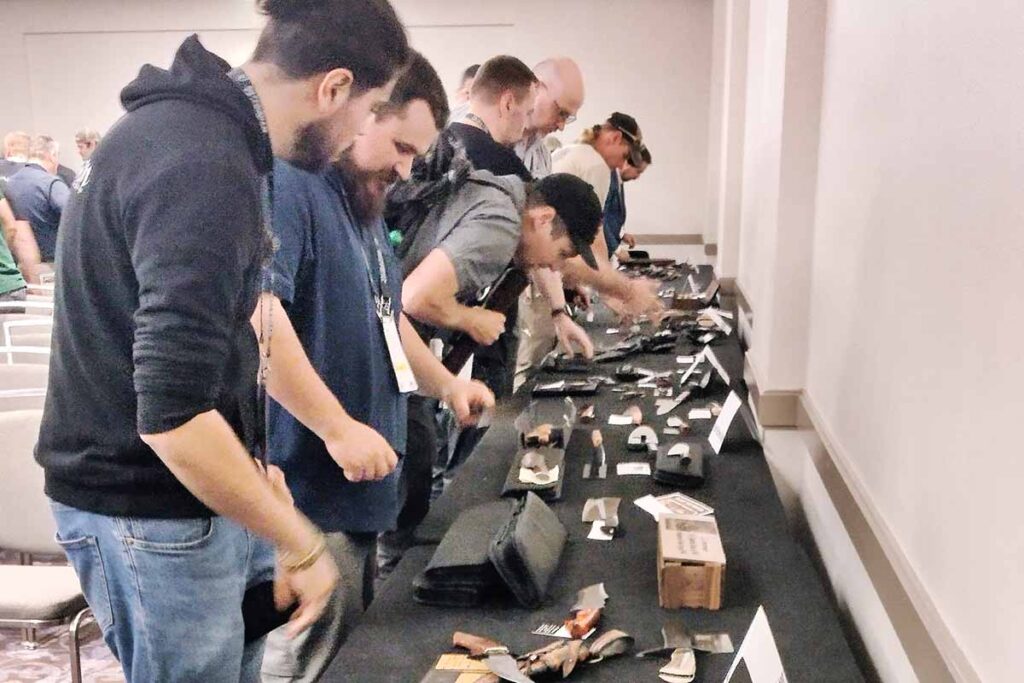
Knives and knife people go wall-to-wall at BLADE Show ’24.

Wall-to-wall attendance, dynamite knife sales, sensational award knives and much more made BLADE Show 2024 June 7-9 at the Cobb Galleria Centre in Atlanta one for the record books. However, it took custom knife purveyor Dave Ellis of exquisiteknives.com to put things into proper perspective.

The long-time BLADE Show exhibitor of Vista, California, sold out of knives and had yet another whiz-bang show, but he said it’s the intangibles that make the BLADE Show the dynamic event it is year in and year out.

“It was a great show and the sales were fantastic, but the main thing about the BLADE Show is the camaraderie, the old friends you see and talk to that make the show so special,” he said. “It’s really rewarding, and though the sales are great, the people are better.”

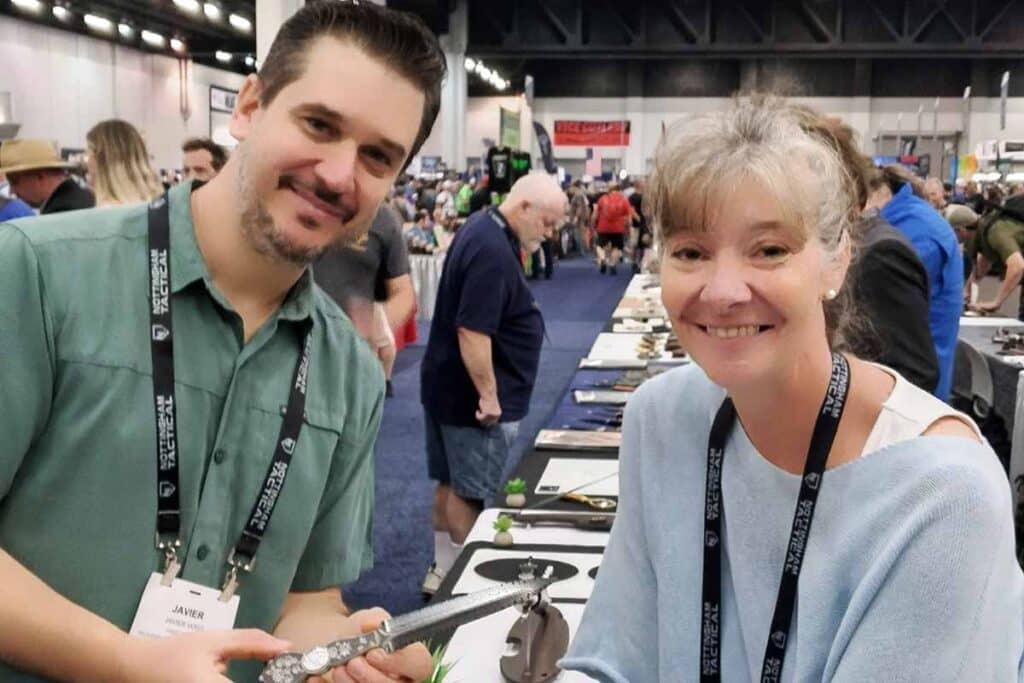
Argentina’s Javier Vogt and Belgium’s Veronique Laurent
Argentina’s Javier Vogt and Belgium’s Veronique Laurent represented two of the 35 countries providing exhibitors for BLADE Show ’24. The knife is one of Veronique’s art daggers.

Speaking of people, ABS master smith Harvey Dean said it was one of the best if not the best attended BLADE Shows he’s ever seen. “At past shows there would be dead times when the crowd would thin out a little bit before increasing again,” he noted. “This show seemed crowded the whole time.”
The factory section enjoyed heavy traffic as well and patrons seemed to be buying knives.

“The BLADE Show was fantastic,” said Curtis Iovito of Spartan Blades, whose company won its first-ever BLADE Magazine Overall Knife Of The Year® with the Bill-Harsey-designed Clandestina. “Sales were the highest we have ever seen.”

Charlie Ellis's Blade University class
Charlie Ellis (left foreground) was one of the guest makers providing BLADE University instruction in the AmeriBrade grinding seminar.

As usual, Saturday was the busiest day, though Friday was very good for three members of the South Texas Slipjoint Cartel in particular, with Luke Swenson selling out in the first hour and Toby Hill, who brought nine knives, selling out in the first two hours. Another Cartel alum, Enrique Pena, sold out as well. Along with Javier Garcia and Jared Oeser, Enrique also won Best Collaboration in the custom knife judging competition.

Brazilian ABS master smith Dionatam Franco de Souza said the show was very good for him, as he brought four knives and sold three, all in the high-dollar range. He also won Best Utility Hunter in the custom knife judging competition.

As with all shows, other reviews were mixed. One purveyor said some exhibitors said the crowd seemed down this year. On a scale of one to 10, ABS master smith Jordan LaMothe gave show attendance a five. He brought 14 knives and sold only three, all in the three and low-four-figure range, with two going to regular clients and one going to a new one. He said 20 percent of those who visited his table seemed to be buyers. Meanwhile, Jordan won yet another custom knife judging award, this time for Best Kitchen Knife.

Makers entered their knives in the custom knife judging competition
Makers entered their knives in the custom knife judging competition Friday afternoon.

If sales were down for some, part of the reason may be what one purveyor said is a slowdown in the sale of damascus knives. He attributed the slowdown to a “burning out” of demand due to a glut of the pattern-welded knives. While many current examples of damascus are outstanding, there’s just too many knives made from it and supply is outpacing demand, the purveyor observed. Replacing the damascus knives in demand are straight carbon steel knives with nice hamons, he added. How long the trend will last is anybody’s guess.

BLADE Show 2024 Highlights

To kick things off, a stout soul replete in Scottish kilt and playing the bagpipes led an energetic throng of patrons into the show hall Friday morning. Thousands of patrons were about to descend on the almost 1,000 exhibitors from 35 countries in the main show hall and Baller Room in the coming three days.

Meanwhile, BLADE University classes, which started the day before at 4 p.m. and earlier Friday morning, continued throughout the day and into Saturday. Friday afternoon witnessed the custom knife judging competition, with winners selected in 16 categories. The Knifemakers’ Guild announced its best knives of the BLADE Show and also named BLADE Magazine Cutlery Hall-of-Fame® member and BLADE editor Steve Shackleford winner of the Nate Posner Memorial Award in recognition of outstanding service in the promotion of handcrafted cutlery. The American Bladesmith Society held its awards ceremony after show closing Friday, including presenting Fabio Barros with his ABS master smith stamp and announcing 14 new journeyman smith awardees (for the names of all the new smiths, visit americanbladesmith.org, click on ABS News and Events and scroll to Congratulations to Our New Rated Smiths).

South African ABS master smith Neels van den Berg
South African ABS master smith Neels van den Berg presented his BLADE University class, Symmetrical Quillon Dagger 101.

Saturday started early with the BLADE Magazine Cutlery Hall-of-Fame breakfast/induction ceremony, with Ted Dowell, Don Fogg and Bill Harsey being formally inducted in the Kennesaw Room of the Renaissance Waverly Hotel. The 8th Annual Battle for Bali-Champion conducted by Blade HQ commenced at noon in a new venue—the second floor of the Renaissance—before a packed house, with Steven Ash taking the title followed by Corbin Lovins in second place and Seiji Brown in third.

Capping off Saturday was the BLADE Magazine Awards Presentation. Held at 8 p.m. in a new venue—also on the second floor of the Renaissance—the ceremony officially recognized the BLADE Magazine 2024 Knife-of-the-Year Awards® and the BLADE Show custom knife judging award winners.

On Sunday morning, the winners of the knife collection display judging were named. Gene Merritt won Best in Show for his David Yellowhorse First 25 Years display. Judges Awards went to Dale Eichberg for his display, Preproduction Buck Knives, and Brian Hugh for Buck Tactical Knives. The Youth Award went to Caleb Lindsey for Custom Knives by David Yellowhorse.

Upcoming Shows

Next up on the BLADE Show calendar is BLADE Show West, Oct. 4-5 in Salt Lake City, Utah. For more information, visit bladeshowwest.com. After that will be BLADE Show Texas, March 7-8, 2025, in Fort Worth, Texas (bladeshowtexas.com).

Patrons enjoy the 8th Annual Battle for Bali-Champion conducted by Blade HQ
Patrons enjoy the 8th Annual Battle for Bali-Champion conducted by Blade HQ in the event’s new venue on the second floor of the Renaissance Waverly Hotel.

As for next year’s BLADE Show, it returns to the Cobb Galleria Centre in Atlanta June 6-8. See you there!

More On BLADE Show:

Puukko Knives: Top Blades Of The Finn Folk

0

Today’s puukkos are knives you can trust in the great outdoors.

It’s a crisp, early winter morning. You wake and need to start a fire to get breakfast underway. As you exit your hut, your warm breath clouds the air. While you gather wood, you gaze out over your reindeer herd.

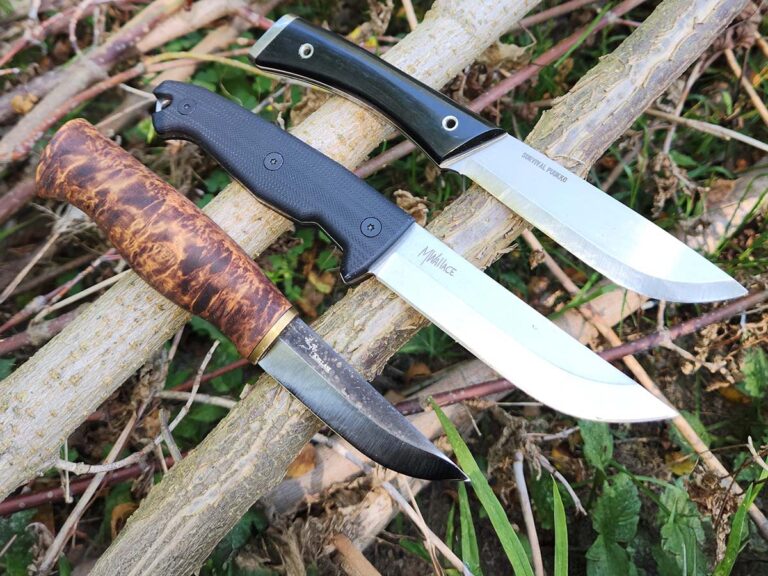
At least this story would be yours if you were a Sami, a traditional reindeer herder of Finland’s Lapland region. And a traditional Sami tool is the Finnish puukko-style knife, three versions of which are our test subjects this time.

Puukko Specs Comparison

Kellam HawkAPOC Wallace Large PuukkoCondor Tool & Knife Survival Puukko
Overall length (inches)7.5″9.25″8.5″
Blade length (inches)3″4.25″3.9″
Blade materialCarbon steel7Cr15MoV stainless1095 carbon
Handle materialQuilted birch burlG-10Black paper Micarta®
SheathLeatherLeatherKydex
MSRP$106.88$123.53$79
FinlandChinaEl Salvador

Condor Tool & Knife Survival Puukko

The Condor is a capable cutter but the stout grind tends to make creating thin slivers difficult.

Though called a puukko, the blade profile of the Condor Tool & Knife Survival Puukko follows more the pattern of a leuku, a bigger Scandinavian chopper. The grind is a stout Scandi and it arrived work ready right out of the box. While it cut very well, I would have liked to see it come with a bit more of a traditional higher grind.

An interesting feature is that the steel pommel is attached to the tang. I would say that would come from a Mors Kochanski* influence as he promoted such a design aspect as a striker plate. The blade is 1095 carbon steel, which will hold an edge well when heat treated properly. The scales are polished black paper Micarta® accented with white liners.

The Condor’s pommel is connected to the tang, which allows you to use the pommel as a striking plate. The white liners set off the black paper Micarta® scales. “Some say they don’t care if a knife is pretty just as long as it works,” the author observed. “Well, if it works it doesn't hurt if it’s pretty, too.”
The Condor’s pommel is connected to the tang, which allows you to use the pommel as a striking plate. The white liners set off the black paper Micarta® scales. “Some say they don’t care if a knife is pretty just as long as it works,” the author observed. “Well, if it works it doesn’t hurt if it’s pretty, too.”

I found the handle a bit small for my bear paw hands. The grip’s inward curved profile tends to bunch my fingers together. Add a smallish handle and it started crowding my grip, causing discomfort. (Keep in mind, my hand is over 4.5 inches wide.) Two stainless steel pins affix the scales to the tang, with the lanyard hole a bit too small for a paracord. The full leather pouch sheath is well made.

Designed by Joe Flowers, the Survival Puukko is a good, serviceable cutting tool. It is a clean knife design with tight fit and finish. One thing: before you buy it, be sure it fits your hand.

APOC Wallace Large Puukko

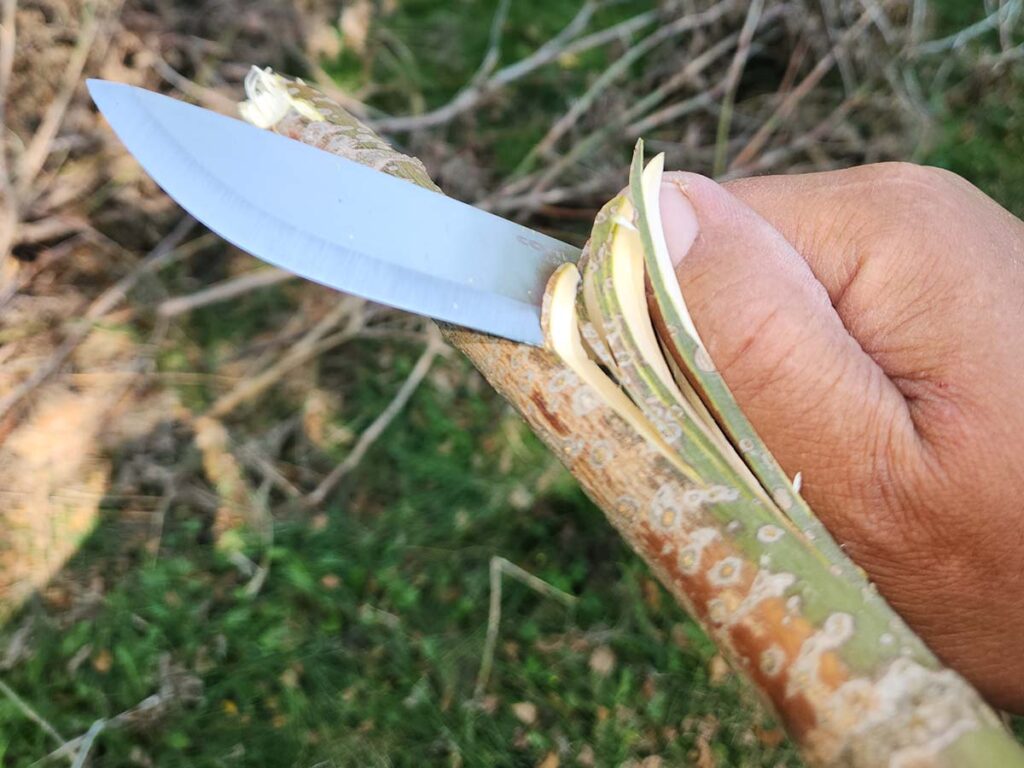
From this point, you can see the secondary bevel on the APOC. It’s not a Scandi grind but is still a good cutter.

Right out of the gate, I must say you get a lot for the price with the APOC Wallace Large Puukko. I would have expected a higher MSRP on this package. Having said that, let me roll out the high points.

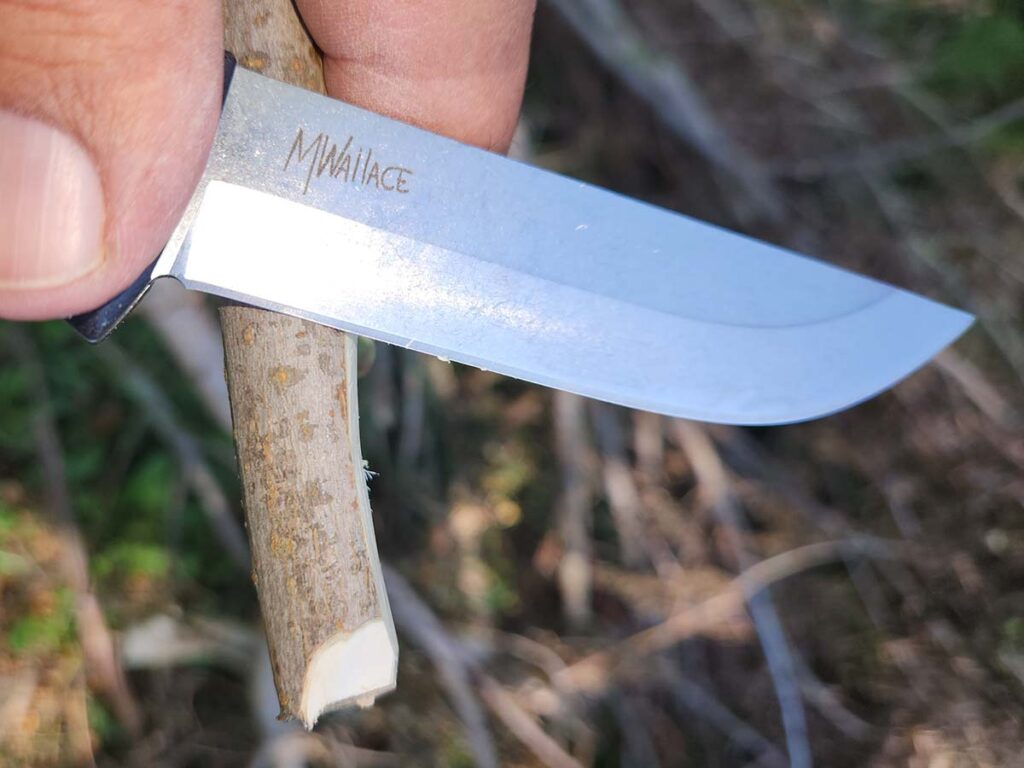
Designed by Mike Wallace, the knife is a good size for bushcraft. Handle ergonomics aren’t amazing but are pretty darn good. The textured black scales are trim so it’s a nice, nimble cutter. As profiles go, it is a dead-on use of the puukko. On the grind end of things, it is not a Scandi. The blade actually has a secondary bevel. However, since it has a high grind it remains an effective cutter.

The tang of the APOC is exposed at the lanyard hole, which allows the lanyard to nest into the handle material and stay out from underneath your grip.

The sheath is molded Kydex and then some, including a fire steel and a striking plate on the side. In testing the striking plate I found the belt clip gets in the way, and I could get sparks just fine using the blade spine. You have the choice of horizontal or vertical carry with the G-style belt clip.

If I had to pick a downside, I would go with the belt clip. For a bushcraft knife, you want more mobility and accommodation from your sheath if you’re wearing a backpack, getting in and out of a canoe or kayak, even something as simple as bending over. In the vertical position, I find the knife rides too high. To make carrying it easier I would add a belt loop or even a dangler, allowing the knife to ride lower.

As a cutting tool, it works and works well. I would have no problem putting the Wallace Large Puukko on my side for a walk into the woods.

Kellam Hawk Puukko

The high grind on the Kellam allows for great control, letting you hog off lots of material or make fine slivers.

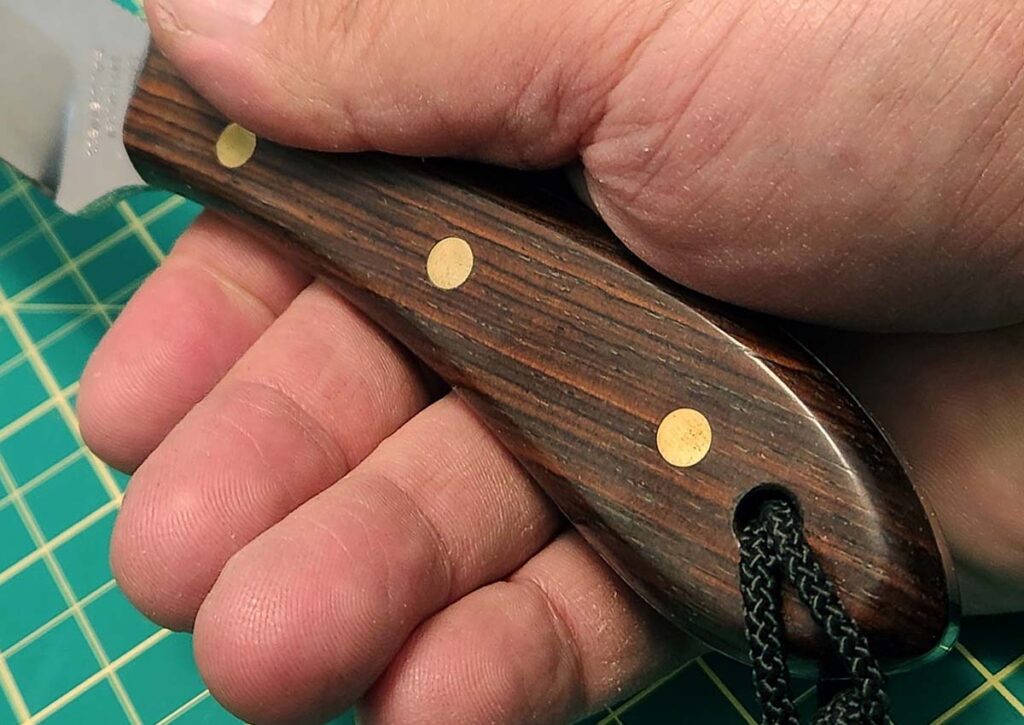
The Kellam Hawk is a perfect example of the traditional puukko design. A full leather pouch sheath with dangler loop makes it easy to carry. Scales are a quilted birch burl that has a dark stain to it. The handle is not polished, which leaves a nice textured matte finish that adds to the knife’s value. Because the Hawk is a stick-tang design, Kellam could shape the handle to perfection, and it did. As I write these words, I can’t resist just holding the knife for the feel of the handle. Then again, stick and hidden tangs are advantageous in that they are constructions that make it easier to fully sculpt a handle.

The blade is a carbon steel with a forged finish on the flats and a Scandi grind. Performance wise it is a capable cutter. Scandi edges excel at cutting wood but can have issues with other tasks. Cleaning an animal is one. If you bump a piece of bone with a Scandi edge, chances are the edge will chip.

A look along the contour of the Kellam’s grip shows how smoothly a handle’s lines can flow when using a hidden tang.

Light and quick, the Hawk will help you craft many things around the camp, making your time in the woods easier. Over my 23 years of writing reviews for knife magazines, I have never met a Kellam I didn’t like.

*An international bushcraft legend, Mors Kochanski (1940-2019) was an outdoor educator and survival instructor for almost half a century and is recognized by many as the godfather of modern bushcraft.

Check Out More Outdoor Knives:

Dagger: Custom And Production Buyer’s Guide (2023)

Daggers have a colorful past and a collectible present.

Early in history, warriors concluded they needed a stabbing weapon they could carry because using a sword, club or spear was not always convenient or practical. Daggers were developed to fill that role.

The exact origin of the word dagger has yet to be discovered. It is believed to come from the old French daque or old Italian daga. Dagger gained acceptance during the 14th century when knives with blades that come to a very sharp point became consistently distinguishable from swords.

In peacetime, daggers were often made from expensive materials and worn in ornate sheaths as part of formal dress. Doing so indicated status and wealth. However, daggers weren’t always for the wealthy.

Since daggers are stabbing weapons, they could also be made from bone or antler. This gave those who could not afford items made from metal an effective self-defense tool. 

Daggers For Self-Defense

Out of necessity, those who wore a knife in America in the 1800s would usually choose what today we call a bowie. Not only was this knife imposing when worn, it was also large enough to perform the day’s chores while the West was settled. As America became more civilized and cities became more commonplace, the days of wearing such a large knife in public became less acceptable. Self-defense was still at a premium, and small firearms and daggers replaced the large knife. A dagger had to be used at very close range to be effective. No wonder revolvers grew in popularity as the defensive weapon of choice.

Iconic Styles Of Daggers

Trench Knife

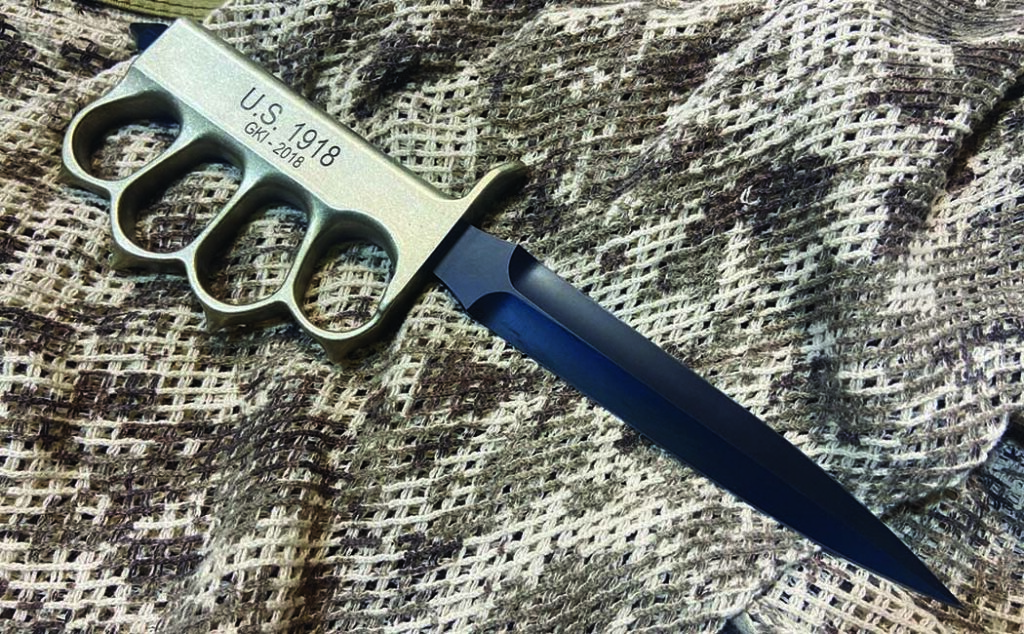
During World War I, close-quarters combat was a significant part of trench warfare, where enemy soldiers would fight in tight and narrow quarters in attempts to capture trenches. The best-known dagger of World War I is the 1918 knuckle knife. American weapons inventor Maj. Eugene McNary of the Air Expeditionary Force designed the knuckle knife. He incorporated the same spear-point blade design as the French M1916 Trench Dagger. In addition, McNary added the knuckles and skull crusher point on the handle butt to increase the knife’s lethality. The Landers, Frary & Clark Co. of New Britain, Connecticut, manufactured the knuckle knife. The handle is marked “U.S. 1918” and is maker-marked “L.F.&C.” 

Push Dagger

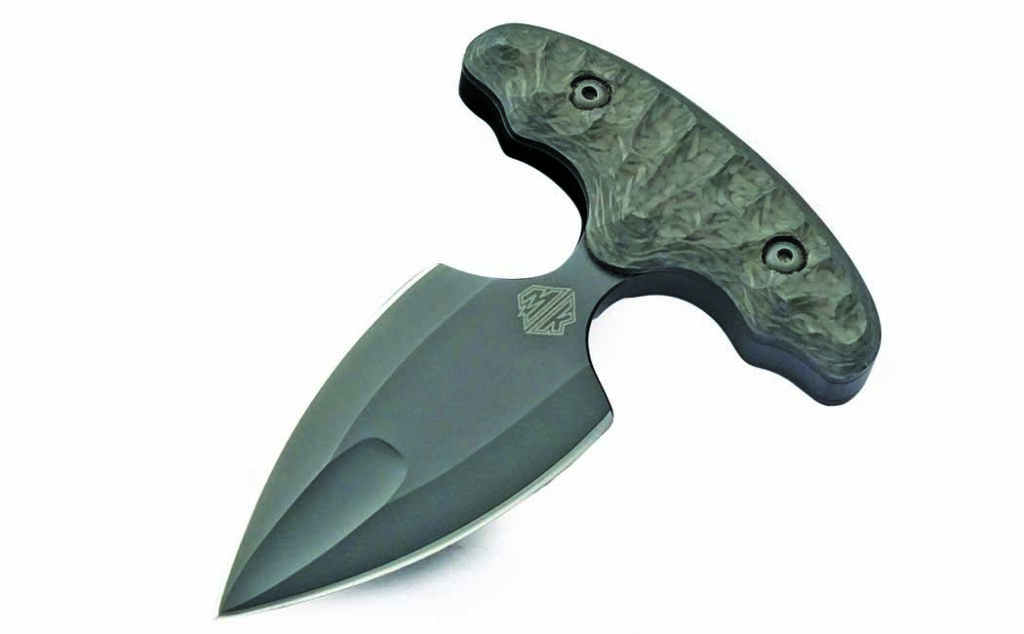
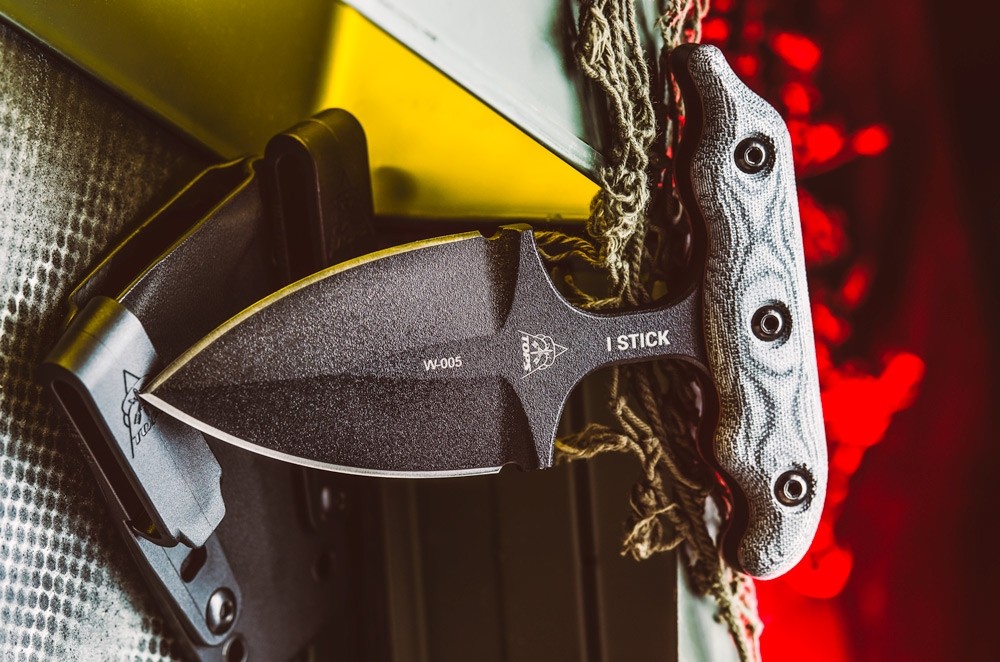
The push dagger is designed primarily as a last-resort weapon for close-quarters defense. While not generally utilized as a primary weapon, it does allow the user to carry it concealed and employ it one-handed, giving him the ability to manipulate the push dagger with one hand while using his off hand to help defend himself. The blade of a push dagger is shorter and broader than that of a standard dagger. In addition, the handle is longer horizontally/wider and thicker to give the user more leverage for pushing.

F-S DAGGER

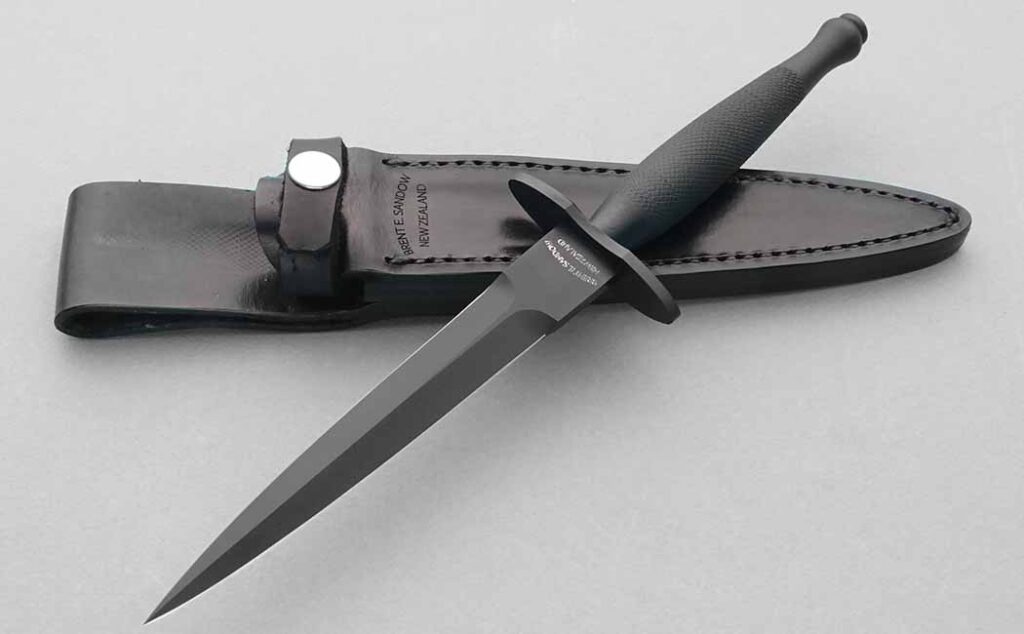
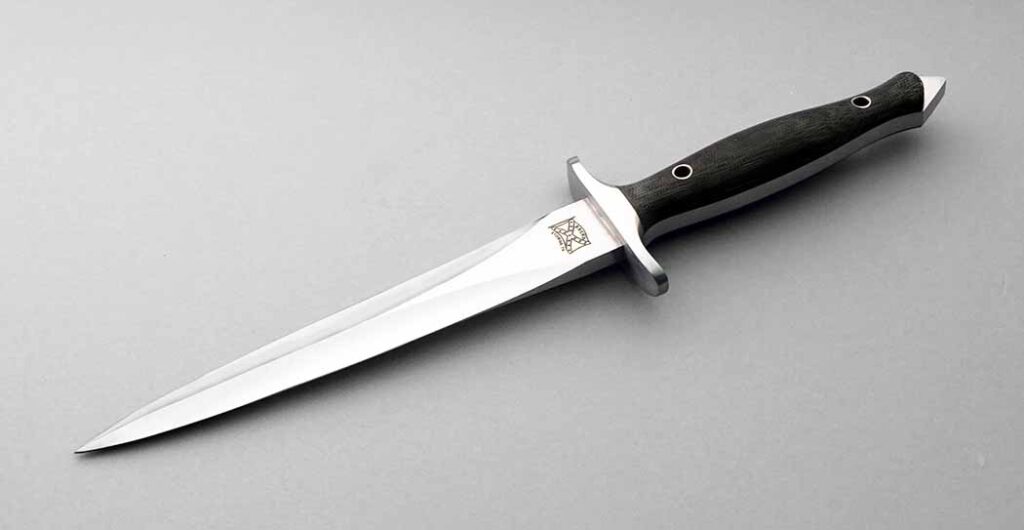
No dagger developed during World War II carries more lore or recognition than the one designed and developed by William Fairbairn and Eric Sykes. The Fairbairn-Sykes dagger can be used for slashing cuts. However, its acutely tapered and sharply pointed blade led the knife to be described as a stiletto, a weapon primarily designed for thrusting. In addition, the knife was configured for surprise attacks, with its slender blade quickly penetrating the ribcage. From 1940 to 1943, Fairbairn and Sykes developed three different patterns of the dagger.

Final Cut

In September 1983, I started taking the U.S. Army Infantry Officers Basic Course at Ft. Benning, Georgia. Traveling with me was the dagger I received as a present from my wife for being commissioned a second lieutenant.

Because of the knife’s reputation during the Vietnam War, it was a factory dagger I had wanted. I was excited to go on the first training exercise so I could finally put my knife through its paces. After cutting some 550 cord, I stuck my dagger in a tree while I tied the knot. I pulled the knife from the tree to find I had only a handle in my hand. I felt shocked, disappointed and angry all at the same time, as this legendary dagger was anything but. Upon closer inspection, I saw that the knife’s tang was 1 inch long and secured by glue in the handle. 

The lessons I learned that day were a) don’t believe the hype and b) only use daggers with full tangs. Please note that the custom knives featured in this article all have full tangs. The plus side to the catastrophic failure of my factory dagger is it made me realize I must research my future knife purchases more carefully.

In April 1984, I bought my first custom knife. I never purchased or used a factory knife again. When it comes to an infantryman and his knife, compromise elsewhere!

Custom Dagger Buyer’s Guide

Les Geroge: Model 1918 Trench Knife

George Trench Knife Dagger

U.S. Marine Corps veteran/custom knifemaker Les George has a fondness for classic U.S. military knives. In 2018, he created his version of the 1918 trench knife. Except for the cast brass handle, Les updated the materials, including a 6.75-inch blade of CPM S35VN stainless steel and a titanium tang nut, both of which have a black Cerakote® finish. As of this writing, he planned to do another limited run of the knife.

Model 1918 Trench Knife Specs
Maker: Les George
Blade Length: 6.75”
Blade Steel: CPM S35VN stainless
Blade Finish: Black Cerakote®
Handle Material: Cast brass w/titanium tang nut
Overall Length: 11.5”
Sheath: Made by George of leather
Maker’s Price: $425 (SharpByCoop knife image; image of Les George by Ronald S. Smith)

Paul McDanie:l Mako Push Dagger

McDaniel-Paul-Tactical-Push-Dagger

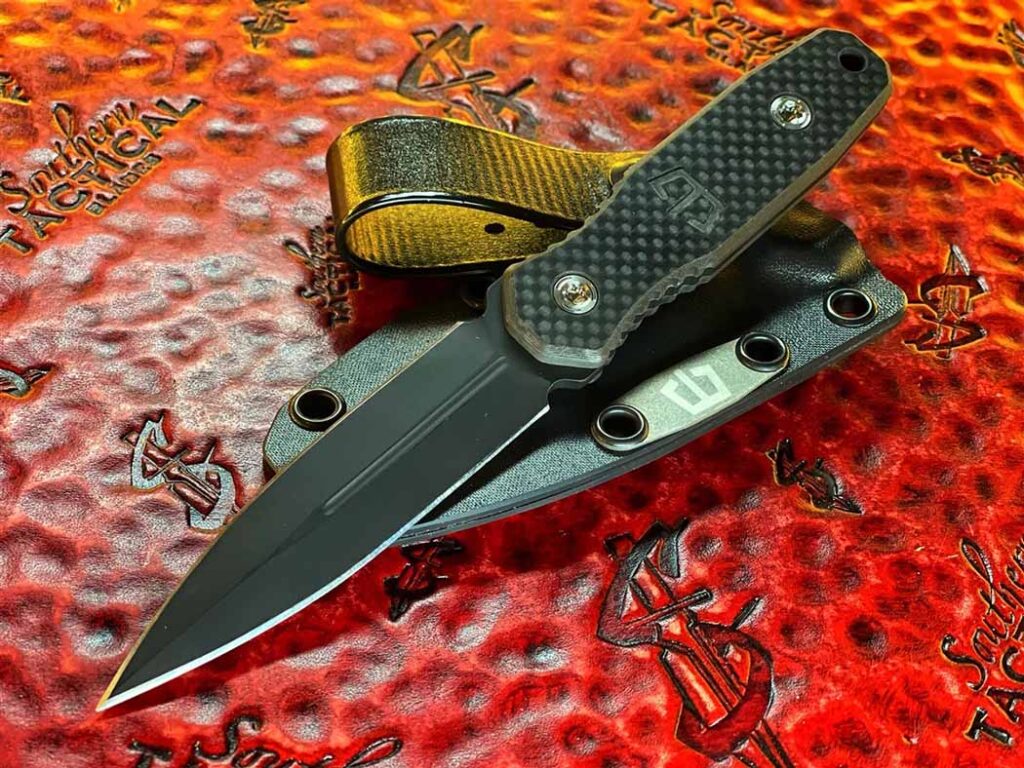
Custom knifemaker Paul McDaniel incorporates all the above-mentioned traits of the push dager in his Mako Push Dagger. The 3-inch double-edge blade is 80CrV2 carbon steel and has a fuller. The 3.75-inch handle is black, textured G-10. The accompanying custom-made Kydex sheath features multiple attachment points.

Mako Push Dagger Specs
Maker: Paul McDaniel
Blade Length: 3” w/full double edge
Blade Material: 80CrV2 carbon steel
Blade Finish: Black Cerakote®
Handle Material: Textured black G-10
Handle Width: 3.75”
Overall Length: 5.25”
Sheath: Made by McDaniel of Kydex w/leather straps
Maker’s Price: $365 (Robertson’s Custom Cutlery image)

Brent Sandow: Fairbairn-Sykes Dagger

Sandow-Fairbairn-Sykes

Maker Brent Sandow of New Zealand builds all three F-S dagger variants. The featured one has a 6.75-inch blade of D2 tool steel, a stainless steel guard, and a checkered handle. All the metal parts feature a flat-black Gun-Kote™ finish. In addition, Brent has slightly modified the knife by adding scalloping to the guard. The scalloping allows the user to index the knife. Indexing helps the user by providing a locating mark to help control the blade while maneuvering it*.

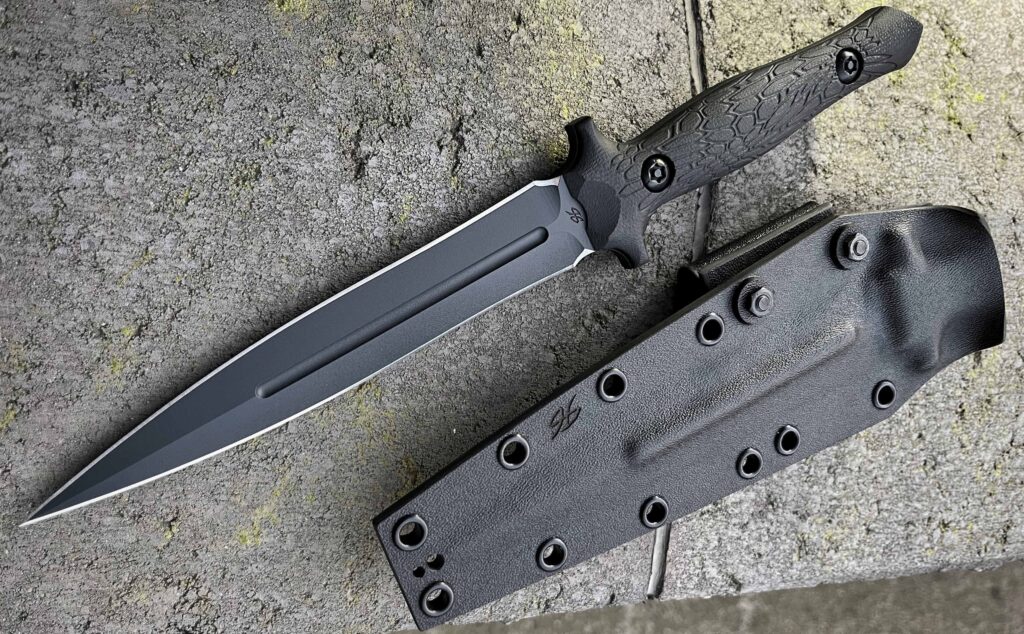
A version of the F-S dagger by maker Piotr Gosciniak of Poland sports a slightly shorter blade with a fuller down the center. Contrary to popular belief, a fuller is not a “blood groove.” Instead, it is a feature that reduces the knife’s weight and stiffens the blade. At the same time, it can help the maker provide a knife with enhanced balance. Piotr’s dagger features a 6.3-inch blade of 80CrV2 in black Cerakote. The black G-10 handle is laser-cut to enhance grip. For additional control, the knife has a scalloped guard.

Mako Push Dagger Specs
Maker: Paul McDaniel
Blade Length: 3” w/full double edge
Blade Material: 80CrV2 carbon steel
Blade Finish: Black Cerakote®
Handle Material: Textured black G-10
Handle Width: 3.75”
Overall Length: 5.25”
Sheath: Made by McDaniel of Kydex w/leather straps
Maker’s Price: $365 (Robertson’s Custom Cutlery image)

Piotr Gosciniak: Dagger

The texture of the black Micarta® handle enhances grip, particularly in a wet environment. The fuller reduces the blade’s weight while at the same time improves its strength. The thumb cutout provides extra stability during use.

Dagger Specs
Maker: Piotr Gosciniak
Blade Length: 6.3”
Blade Material: 80CrV2 carbon steel
Blade Finish: Black Cerakote®
Handle Material: Laser-cut-textured black G-10
Overall Length: 11.5”
Sheath:  Made by Gosciniak of Kydex
Maker’s Price: $425 (Piotr Gosciniak images)

Walter Brend: SF Dagger

Brend-Tactical-Dagger-Blade

The SF Dagger by Walter Brend features an 8-inch blade of D2 tool steel with a satin finish and Walter’s impeccable grind lines. Handle: black Micarta®. Guard: stainless steel. Special features: Full-tang construction, double edge, thong hole and a skullcrusher pommel. Overall length: 12.75 inches.

SF Dagger Specs
Maker: Walter Brend
Blade Length: 7”
Blade Steel: CTS XHP stainless
Blade Finish: Satin
Handle Material: Black Micarta®
Guard Material: Stainless steel
Overall Length: 12”
Sheath: Custom-made of leather
Maker’s Price: $2,800 (Robertson’s Custom Cutlery image)

Production Dagger Buyer’s Guide

Winkler Tactical Dagger

Winkler Tactical Dagger

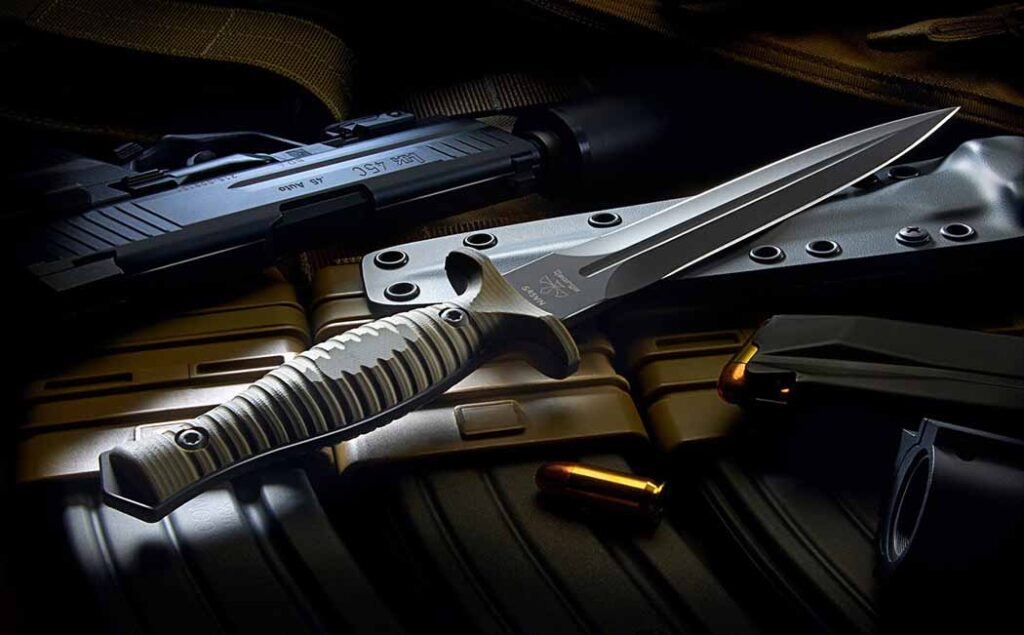
This tactical dagger from Winkler was designed for the military by people in the military. It isn’t a show knife for people looking to cosplay as their favorite action star. This is the real deal.

The 5.5-inch blade is 3/16-inch-thick 80CrV2 carbon steel with a black oxide Caswell finish and has a Rockwell hardness of 59-60 HRC. The blade is made for combat and will handle the abuse you throw at it. Both edges are ground to a razor edge.

A tapered tang runs through the entirety of the wasp sculpted canvas laminate handle to give you a strong, sturdy grip. The piece comes with a custom-lined Kydex sheath for secure carry. Made in the USA, the knife is an absolute winner.
WK Defense Dagger Specs
Maker: Winkler
Blade Length: 4.25″
Blade Steel: 80CrV2
Blade Finish: Black oxide no-glare finish
Handle Material: Black Canvas Laminate, Camo G10, Maple, Walnut, WASP
Overall Length: 8
Sheath: Lined Boltaron® Sheath
Maker’s Price: $325

Spartan Les George V14 Dagger

Spartan Les George V14 Dagger

Designed by award-winning knifemaker Les George, the V14 from Spartan Blades is about as high quality as it gets. A Marine veteran, Les knows what is needed from a dagger and puts it all into this one.

The V14 has a beefy 6.75-inch blade of symmetrically ground CPM S35VN stainless steel heat-treated to a Rockwell hardness of 58-60 HRC that provides great edge retention and durability. The handle is 3D-contoured black G-10 that wraps a full tang to provide a strong grip. This knife isn’t going anywhere in your hand, and the blade’s not going to snap in two when deployed. The Kydex sheath is MOLLE compatible.

George V1-14 Dagger
Maker: Spartan Blades
Blade Length: 6 3/4″
Blade Steel: CPM S45VN
Blade Finish: SpartaCoat – PVD – Tungsten DLC (Black) or ZrN (Flat Dark Earth)
Handle Material: 3D Contoured G10, Black or Green
Overall Length: 11 1/2″
Sheath: Kydex Sheath
Maker’s Price: $495

Blackside Customs P7 Dagger

Blackside Customs P7 Dagger

This piece from Blackside Customs is the smallest of the three knives on our list but no less functional. 

The 3.5-inch blade is CTS-XHP stainless steel with an OD green Cerakote® finish. The smaller size makes the P7 more feasible as an EDC if you prefer your standard carry to be a fixed blade. The G-10 grips are double-riveted to the tang for a comfortable grip when deployed.

The Kydex sheath lets you carry the knife easily and discreetly. The smaller blade means a lower weight. At just 3.5 ounces, almost three times lighter than the heaviest knife on this list, the P7 is a sleek piece that moves with grace and ease.

Phase 7 Dagger Specs
Maker: Blackside Customs
Blade Length: 3.5″
Blade Steel: CTS-XHP
Blade Finish: Black Cerakote®
Handle Material: Black G10
Overall Length: 7.35″
Sheath: Kydex Sheath w/ BSC Titanium Tag
Maker’s Price: $290

TOPS Knives I Stick

Tops I Stick side

The commendable quality of the TOPS Knives I Stick lies in its ability to live up to its advertised purpose. It excels in the task of sticking objects securely, and credit is due to the TOPS team for their rare commitment to truthful advertising.

The I Stick embodies the original intent behind the push dagger’s design, which is to protect the wielder by swiftly striking those who pose a threat. Possessing a generous blade length and an impressive thickness that instills a sensation of being able to puncture a shipping container, it undeniably proves its efficacy in defensive scenarios.

Featuring sharp edges on both sides, it surpasses the 3.5-inch blade measurement that could attract the attention of law enforcement officers seeking to find fault. Consequently, it may not be the ideal choice for individuals residing in states with stringent knife regulations. However, if you find yourself in a state with fewer restrictions or if you possess a weapons carry permit, the TOPS Knives I Stick presents itself as a formidable contender.

*Editor’s note: Though meant to be inferred from the author’s description, we might add that indexing enables the user to know by feel how the blade is oriented during use, an invaluable feature in situations where the user cannot see the blade for whatever reason.

I Stick
Maker: TOPS Knives
Blade Length: 3.50″
Blade Steel: 1075 RC 56-58
Blade Finish: Black Traction Coating
Handle Material: Black Canvas Micarta
Overall Length: 5.63″
Sheath: Black Kydex
Maker’s Price: $210

Editor’s Note: Michael Ableson contributed to this post.

Read More

Knife Carry: Useful EDC Blades With Useful Carry Systems

0

If you think carry systems are rote, you need to get a gander at these knives and their revolutionary ways to keep them on person.

The carry systems for EDC knives have evolved to offer you a seamless experience, with an array of different spins on pocket clips, sheaths, lanyards and more. This convenience benefits you by saving time, providing peace of mind, encouraging regular carry and increasing utility. The popularity of EDC knives has spurred innovation in design and materials, leading to a market rich with options catering to every preference and need.

The carry systems play a pivotal role in this dynamic, as they directly influence your experience and the practicality of the knife in everyday scenarios. The benefits of EDC knives extend beyond individual use; they represent a culture of preparedness and self-reliance that resonates with many, reflecting a broader trend toward function and efficiency in personal gear.

Big Idea Design TI Lookout Fixed Blade

The author tested the Big Idea Design TI Lookout on various everyday carry tasks, and it effortlessly handled wire, 550 paracord, nylon webbing and heavy leather.

TI Lookout Specs
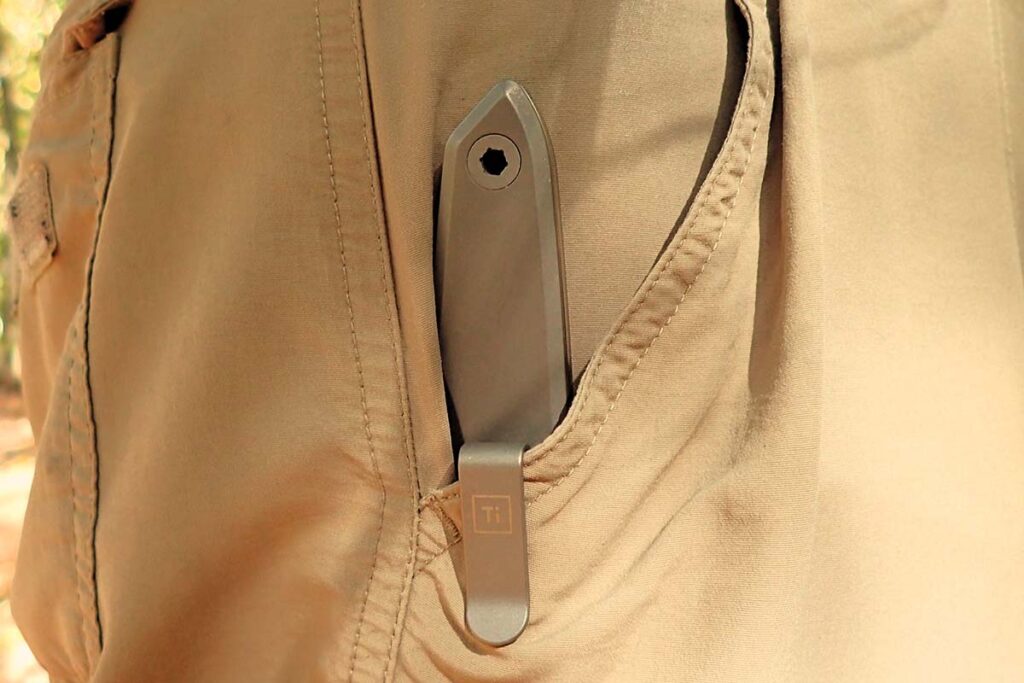
Carry: Two Kydex sheaths for left- and right-hand pocket carry, each equipped w/a titanium pocket clip
Blade Length: 2.2”
Blade Steel: M390 stainless
Blade Grind: Flat
Blade @Thickest: .12”
Blade Finish: Satin
Handle Scales: Grade 5 titanium
Overall Length: 6.2”
Country of Origin: China
MSRP: $200

Pros

  • Versatile Carry Options
  • Excellent EDC Performance
  • Stylish Design

Cons

  • Small Size

The TI Lookout Fixed Blade by Big Idea Design offers precision engineering and high-quality materials, making it an essential companion for everyday carry enthusiasts.

At the heart of the compact and robust knife is the M390 stainless blade steel, renowned for its superior edge retention and wear resistance. The premium material ensures that the TI Lookout maintains its razor-sharp edge through extensive use, reducing the need for frequent sharpening. The addition of Grade 5 titanium scales provides a sleek aesthetic and contributes to the knife’s lightweight yet durable construction.

The lanyard hole in the rear handle screw adds a functional touch, allowing for easy attachment and accessibility. The knife offers a perfect balance of control and cutting power.

The two included Kydex sheaths provide versatile carry options for lefties and righties. Each sheath is equipped with a titanium pocket clip that easily affixes inside a standard pocket or sunglass/device pocket found on many outdoor cargo pants. Consider it a gentleman’s fixed blade.

Big Idea Design TI Lookout fixed blade in sheath
The Big Idea Design TI Lookout fixed blade offers versatile EDC options with two sheaths for left- and right-hand carry, and comes with a titanium pocket clip for easy attachment to pockets or gear.

I put the TI Lookout through a range of EDC tasks, from cutting mundane materials to pushing it to the limits of the extremely aggressive, stabbing through light gauge metals. The knife thrived in this realm.

However, it dragged on thick, heavy-gauge cardboard. After slicing more cord, it remained sharp—it just got hung up a bit on cardboard. Wire, 550 paracord, nylon webbing and heavy leather succumbed to the keen edge.

In this writer’s humble opinion, the TI Lookout is not just a cutting tool but a statement piece reflecting the pinnacle of knife craftsmanship and material excellence.

TOPS Knives Quick Skin

TOPS Knives Quick Skin is a hunter’s EDC with a sheath
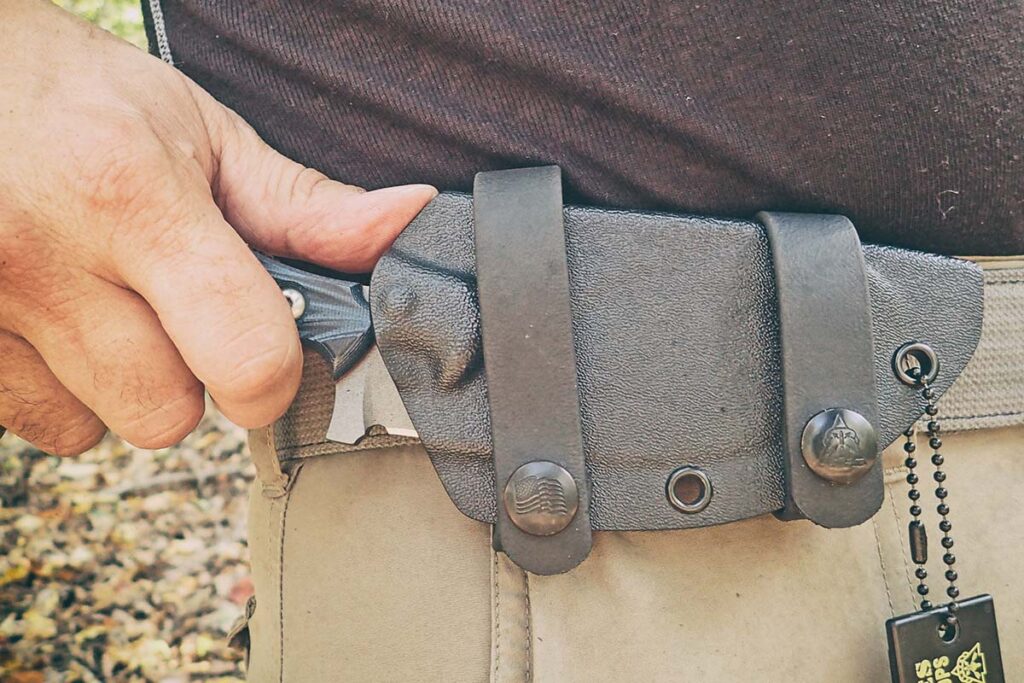
The TOPS Knives Quick Skin is a hunter’s EDC with a sheath for comfortable horizontal and other carry modes.

Quick Skin Specs
Carry: Kydex w/beta material loops allowing for appendix, vertical, horizontal or scout-style carry
Designer: Leo Espinoza
Blade Length: 3.5”
Blade Material: 1095 carbon steel
Blade Grind: Flat
Blade @Thickest: .19”
Blade Finish: Tungsten Cerakote™
Handle Material: Dragonfly Tread Micarta®
Overall Length: 7.13”
Country of Origin: USA
MSRP: $230

Pros

  • Efficient Skinning Design
  • High-Quality Construction
  • Versatile Carry Options

Cons

  • Specialized Use
  • Thick Blade Stock

The TOPS Knives Quick Skin marries master craftsmanship, elegance and utility.

Designed with the avid hunter in mind, it boasts an “all-belly” blade in a Rockwell hardness of 56-58 HRC that ensures fewer strokes are needed, making skinning quick and painless. It comes with a versatile Kydex sheath sporting beta material loops allowing for various carry positions, including appendix, vertical, horizontal or scout-style. Ultimately, the beta loops will clip to pack straps, keeping the blade easily accessible regardless of your adventure.

The shape of a blade dictates its purpose. The TOPS is designed for slicing and skinning. I opted for an appendix carry for comfort and a non-rib-jabber solution.

TOPS Quick Skin
The TOPS Quick Skin comes with a versatile Kydex sheath and beta loops for easy accessibility and multiple carry options, including appendix, vertical, horizontal and scout-style.

While all wild game was out of season in my region, food wasn’t. Knives with a deep belly thrive on food. The Quick Skin followed suit. Despite its thick blade stock, the knife successfully sliced bacon, peppers, onions and mushrooms. Later, I moved to slicing beef, pork and chicken equally well. Thanks to its sophisticated design and practical features, the Quick Skin is a standout choice for hunters seeking a top-tier skinner.

Reiff Knives Circadian Clip Point EDC Fixed Blade

Reiff Knives Circadian glided through wood to create copious curlicues
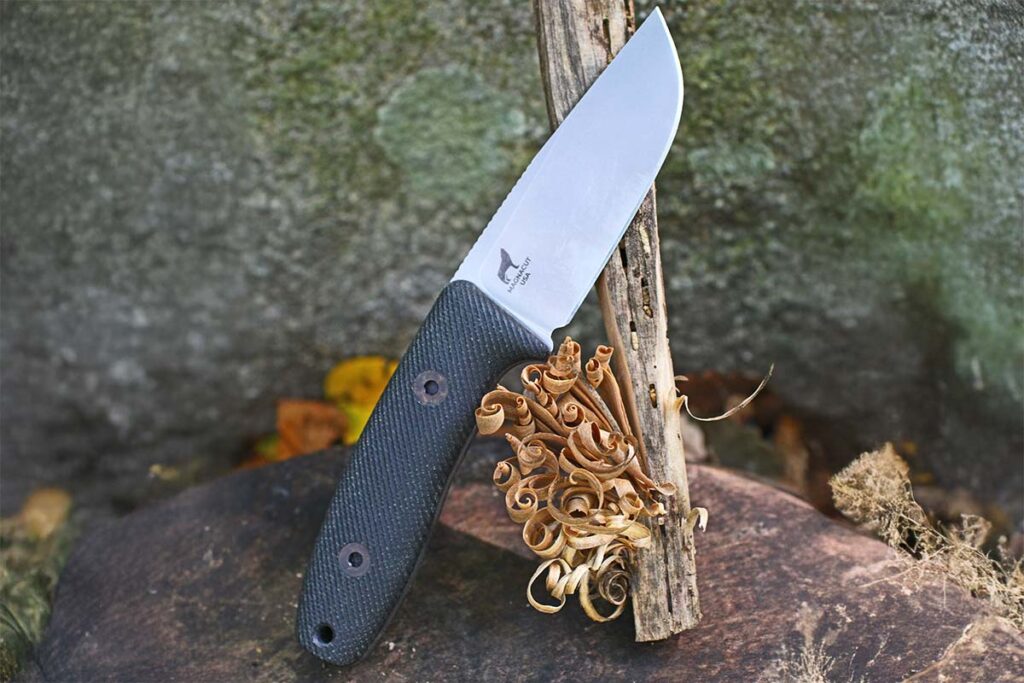
The Reiff Knives Circadian glided through wood to create copious curlicues.

Circadian Specs
Carry: Crazy horse leather pocket sheath and UltiClip 3.3 Slim attachment
Blade Length: 3.28”
Blade Steel: CPM MagnaCut stainless
Blade Grind: Flat saber
Blade @Thickest: .12”
Blade Finish: Stonewash
Blade Pattern: Clip point
Handle Material: Black canvas Micarta®
Overall Length: 7.25”
Country of Origin: USA
MSRP: $285

Pros

  • High-Quality Blade Steel
  • Woods-Worthy Performance
  • Lightweight Yet Sturdy

Cons

  • Expensive

With its superior craftsmanship, utility and CPM MagnaCut stainless blade steel, the Reiff Knives Circadian Clip Point EDC Fixed Blade is an ideal choice for outdoor enthusiasts and everyday carry.

The blade’s stonewash finish adds a rugged aesthetic and helps hide scratches and wear. The handle provides a secure grip even in wet conditions, and the ergonomic design ensures comfort during extended use. Weighing in at only 4.1 ounces, the Circadian offers a lightweight yet robust solution for various cutting tasks.

The knife has a premium, deep carry, crazy horse leather pocket sheath and UltiClip 3.3 Slim for versatile carrying options. Inside-the-pocket carry is popular for discreetly carrying fixed blades. It makes the knife unobtrusive and out of the view of the sheepish.

The Reiff Knives Circadian has a deep carry crazy horse leather pocket sheath and UltiClip 3.3 Slim for versatile carrying options. Inside-the-pocket carry is popular for discreetly carrying EDC fixed blades.

More importantly, it gives a release option, making it easier to free the secure grip from your pocket. The UltiClip 3.3 Slim offers a versatile and secure method for attaching the knife to various clothing or gear, enhancing practicality and convenience.

As well as the Reiff fits into the EDC world, it teeters on the line of woods-worthy EDC. I was in the northeast woodlands during the test, and the Circadian was on hand. The knife was tasked with splitting wood via baton and also a round or two of feathering. It didn’t disappoint. Fit finish and comfort are standard. The handle offers a full-hand grip and the blade is stout.

A.G. Russell Woodswalker

Woodswalker with two sheaths
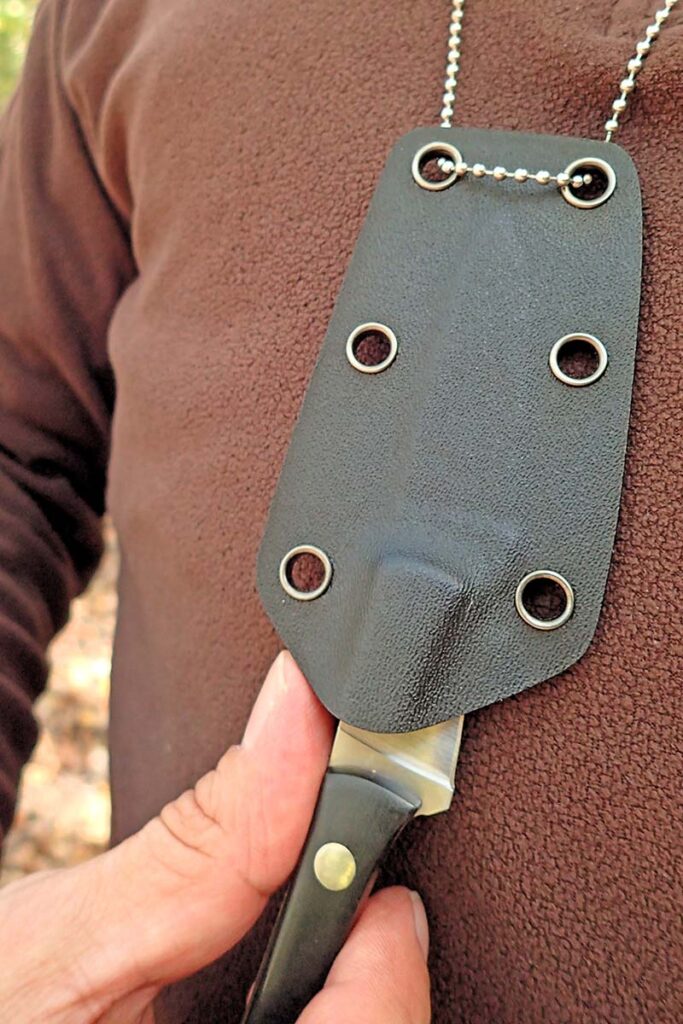
Choose between the original leather pocket sheath, designed to fit into a back or cargo pocket, or the Kydex® neck sheath for convenient carry with the A.G. Russell Woodswalker.

Woodswalker Specs
Carry: Leather pocket sheath that fits into a back or cargo pocket perfectly, or a Kydex neck sheath
Blade Length: 2 3/8”
Blade Steel: 8Cr13MoV stainless
Blade Grind: Flat
Blade @Thickest: 1/16”
Blade Finish: Satin
Handle Material: POM thermoplastic
Overall Length: 6”
Country of Origin: China
MSRP: $34.95 to $36.95

Pros

  • Lightweight and Compact
  • Durable Full-Tang Construction
  • Ergonomic Handle

Cons

  • Not a Heavy-Duty Knife

The A.G. Russell Woodswalker is a versatile, durable knife designed in the 1970s for the outdoorsman who values tradition and function. Crafted for the casual hunter, this lightweight, non-folding pocketknife is perfect for a tranquil morning in the wilderness.

Whether you’re pursuing small game like quail, squirrel, dove or rabbit, or preparing a meal in the great outdoors, the Woodswalker excels with its drop point blade in a Rockwell hardness of 57-59 HRC. Full-tang construction ensures stability and balance, while the handle provides a comfortable and secure grip. Measuring 6 inches overall and weighing a mere 1.2 ounces, it’s an unobtrusive addition to any hunter’s gear.

Choose between the leather pocket sheath, which fits into back or cargo pockets perfectly, or the Kydex® neck sheath for convenient carry. I used both but I hate my pockets weighing me down. The neck carry option suited me well.

The author preferred the neck carry option when toting the A.G. Russell Woodswalker.

The Woodswalker is the classic of the test batch of roughnecks. It’s been there and back—that’s why I spared it no quarter. In my usual neck of the woods, I wanted to make a small fire and selected hardwoods like oak and maple to craft feather sticks.

This one isn’t a splitter or chopper, so act accordingly. It feathered wood like a dream and felt like a zipper effortlessly gliding through wood. The most impressive feature that’s not mentioned in any product description is the sharp 90-degree spine, ideal for striking a ferro rod and showering sparks worthy of the 4th of July. This knife isn’t just a tool, it’s a trusty companion for all your outdoor adventures.

Read More Knife Reviews:

Kershaw Launch 13 Review: This Auto Makes Its Own Luck

0

An intriguing take on the wharncliffe design matted to a rock-solid action, the Launch 13 proves a cut above the rest.

Kershaw Knives’ Launch series of USA-made automatic knives has been a great seller for the company. Offering USA-made automatics in premium materials at a fraction of the price of what you can buy others in this class.

The Launch series is a collection of automatics of all sizes and all blade shapes, each is stirring. Their designs are modern and artistic in nature, adding a bit of excitement to your everyday carry rotation. One of the more intriguing designs is the Launch 13, which we will examine in closer detail here.

Launch 13 Blade

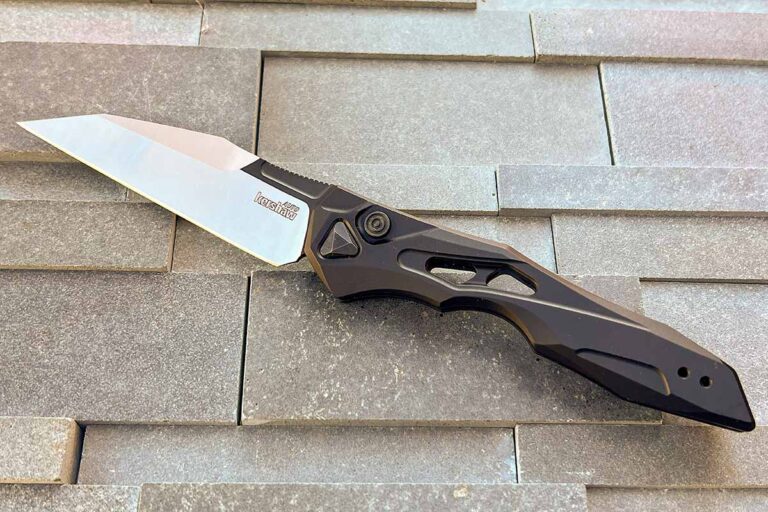
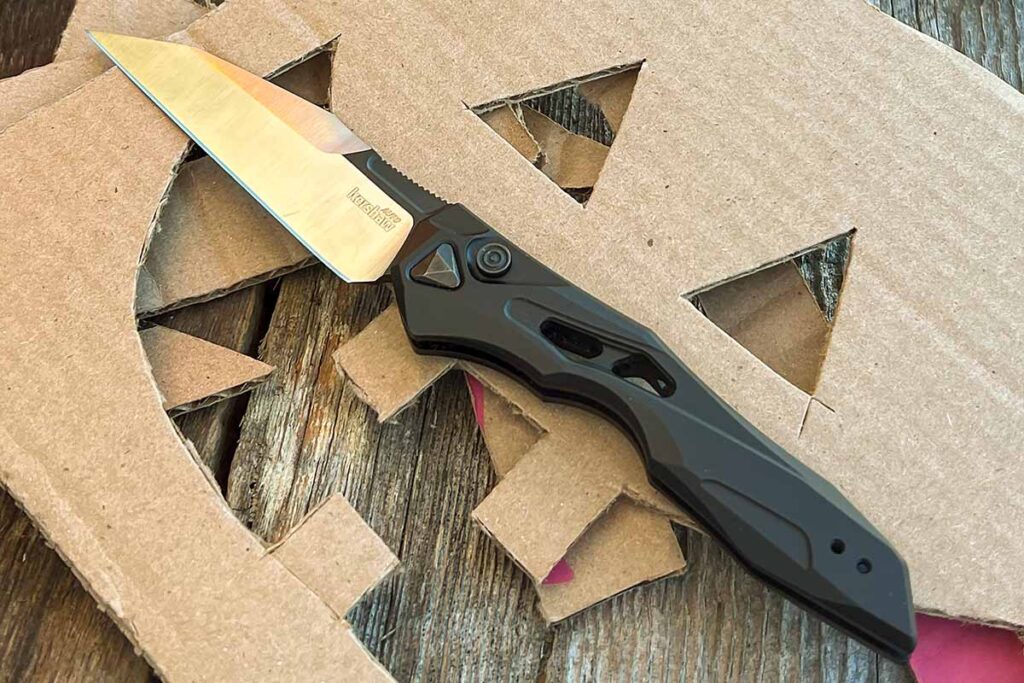
The Launch 13 is a slender design, with an angled wharncliffe blade. Most wharncliffes are straight, but the Launch 13’s blade is canted a bit to allow the easier use of the entire cutting edge while holding the handle at a natural angle.

Kershaw Launch Clip
Photo: Marty Stanfield

The blade itself measures 3.5-inches long and is ground from CPM154 stainless steel. This steel is a particle metallurgy version of 154CM, an alloy used widely in the knife industry and a long-time standard when it comes to high-end blade steels. 

The blade is flat ground and has a prominent swedge for a more aggressive appearance. The blade exhibits a two-tone finish, with the bevels and swedge having a satin finish look and the flats and spine black coated. 

The thumb rest portion of the blade spine has machined-in traction notches, which accommodate your thumb perfectly and provide a solid base in which to apply downward pressure on the blade to facilitate additional cutting power when needed.  

Launch 13 Handle

The futuristic-looking handle is machined from T6 6061 aircraft-grade aluminum that is both lightweight and strong. Perfect for knife handles. Kershaw gives the handle a black hard-coat anodized finish which provides the handle’s color, as well as boosts its scratch resistance. 

Launch 13 closed front
Photo: Marty Stanfield

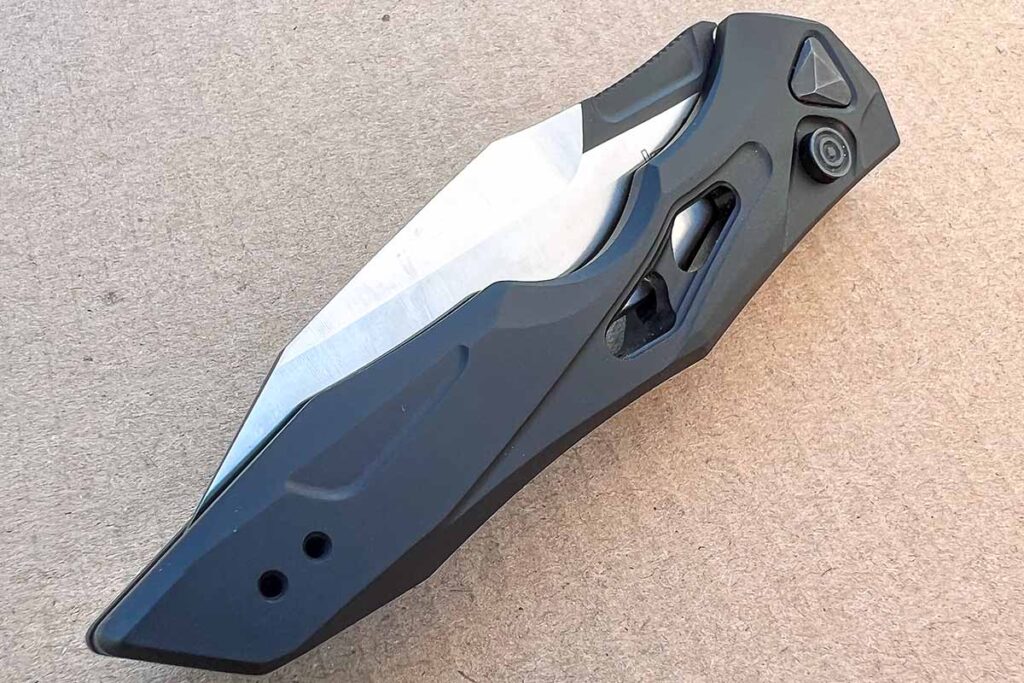
The handle measures 4.5 inches long. It has a tapered construction from the pivot to the butt end. This not only makes the Launch 13 carry very well in the pocket but helps it fit the hand comfortably. 

The large finger recess situated in the middle of the gripping area on the handle is where your middle finger locks in, and the rest of the fingers fall into place naturally. In hand, the feel is awesome. It’s very secure and confidence-inspiring, tackling all your cutting chores.

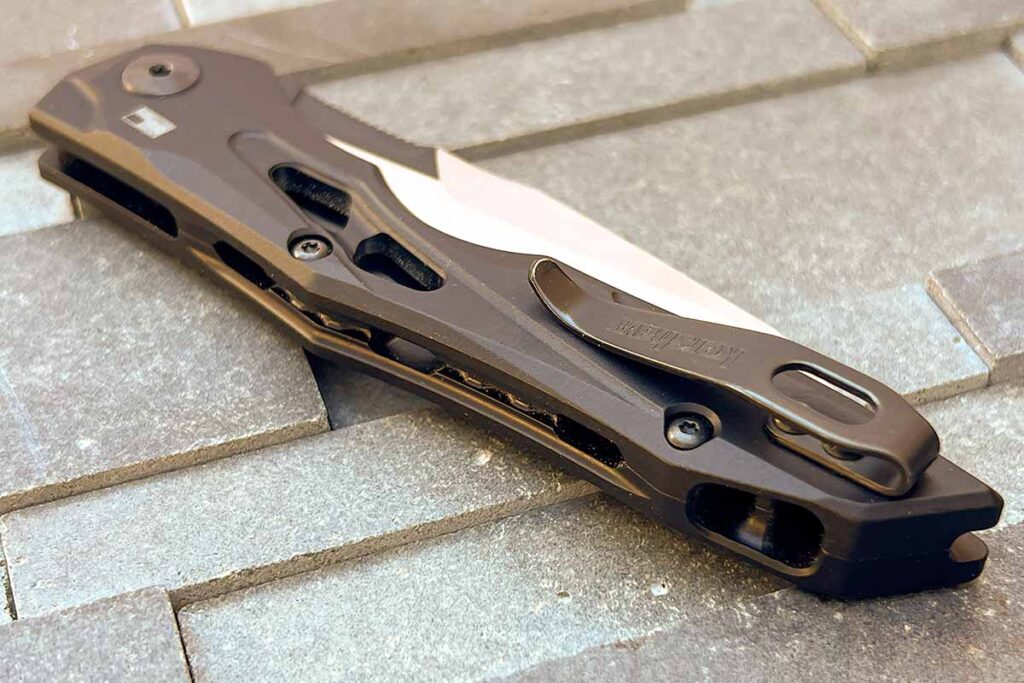
The handle sports a couple of cutouts that helps to further lighten the weight. Additionally, the handle’s spine also has a few holes in it. This not only contributes to the minimal weight of the handle but makes it easier to clean the inside of the handle with forced air or rinsing with tap water. 

The edges of the handle are chamfered nicely to soften the edges and eliminate hot spots. Finally, a steel deep carry-style pocket clip is affixed to the very end of the handle to carry the Launch 13 deep in the pocket.  A custom machined triangular pivot bolt and large lock button round out this overall stellar package. 

Cutting Profile

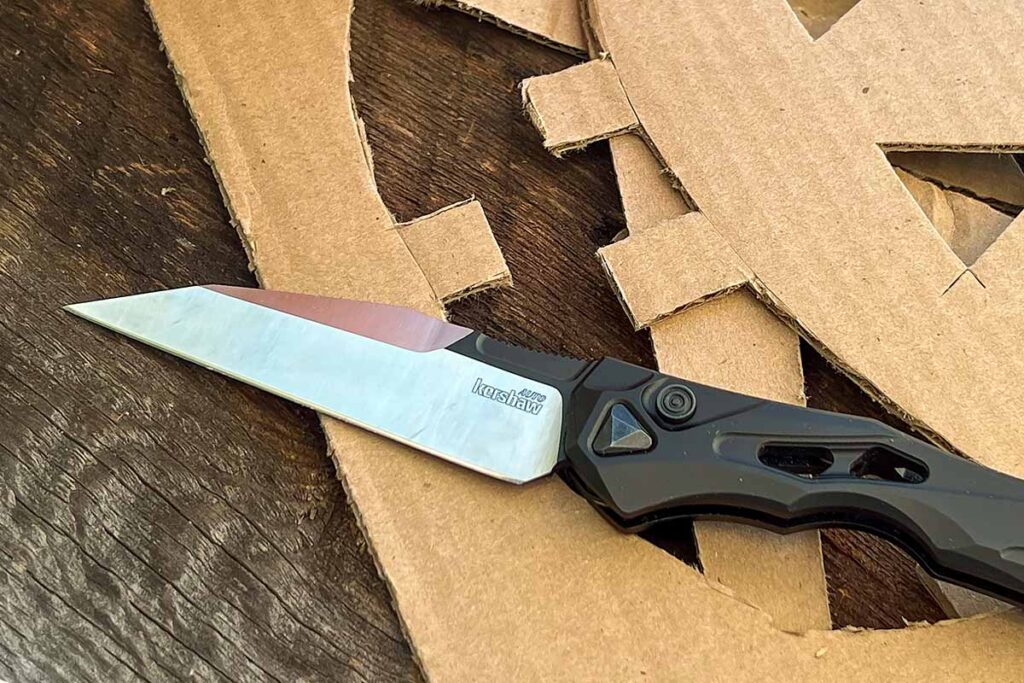
In use, the Launch 13 is a powerfully efficient cutting tool. The straight-line edge and defined point easily score material or efficiently cut through using a pull stroke. Furthermore, the straight-line cutting edge does well whittling and carving.

Kershaw Launch 1 cutting cardboard
Photo: Marty Stanfield

Thanks to the Launch 13’s grip ergonomics, the knife feels rock solid in your hand during use. It doesn’t feel like this one’s going to get away from you the longer you use it.

Another great characteristic of the design is the canted blade. It might look a bit weird but get the knife in your hand and use it, then you quickly see the design makes a lot of sense. It allows for a more natural wrist angle during use, something not a lot of other wharncliffe blade folders offer.

CPM154 holds an edge well, but not as long as CPM S30V. Still, it’s a great choice for this type of knife. The blade steel and the straight-line cutting edge both make resharpening easy when the time comes, given there’s no belly or recurve to negotiate with the sharpener.

As for tasks, the Launch 13 is a great work knife for those of you who make use of a knife regularly while on the job or while doing handyman chores around the house or homestead.

Launch 13 Action

When it comes time to put the blade into play, a simple press of the firing button releases the blade and the coil spring propels the blade to the fully open position. The action is fast and smooth, and concludes with a satisfying audible Click when fully open. The knife’s plunge lock is very strong at holding the blade open and there is zero play.

Launch carving carboard
Photo: Marty Stanfield

For a midsize folder, it’s very lightweight. Coming in at 2.4 ounces, the Launch 13 can be carried with you all day without weighing you down. You really do not feel the knife clipped to your pocket as you move around. It just disappears! This is a very nice gesture as most knife users do not like to carry all that bulk around. 

Final Cut

In conclusion, the Launch 13 from Kershaw Knives is an exciting-looking automatic folder, made in the USA with premium materials. What is the MSRP you ask? The answer: $225. 

Kershaw isn’t the first manufacturer you think of when it comes to high-quality USA-made automatic folders. But, with its Launch series in general and Launch 13 in particular, maybe it should be.

If you love automatic knives, check out the Launch 13. It’s a worthy addition to any collection. And it’s not afraid of work either! 

Launch 13 Specs:
Use: Everyday, Work, Tactical
Type: Automatic
Style: Pocketknife
Designer: Kershaw Originals
Blade Steel: CPM 154
Blade Style: Wharncliffe
Blade Edge: Plain
Opening Action: Automatic, Opens With Push button
Lock Type: Push-button lock
Pocketclip: Reversible deep-carry (right/left, tip-up)
Handle Color: Black
Country of Origin: Made in USA
MSRP: $225

Check Out Kershaw Knives For More Information.

More Knife Reviews:

Knife Handle: Why Handle Ergonomics Should Be Your Focus

How you exert control determines knife handle design.

After 19 years as an autoworker, 30 years as a traditional woodworker and what seems an entire life of being a knife nut, I have come to appreciate a properly formed tool handle. During any workday at the auto plant, I picked up and used tools over 500 times—to be precise, once every 43 seconds. After a while, I started to take notice and favor tools shaped in an ergonomic fashion that allow efficient, accurate manipulation.

How useful is your knife if you can’t hold it and can’t control the edge? Just look to the “Riddle of Steel” from the original Conan the Barbarian movie. Steel is nothing compared to the hand that wields it. Perhaps that is where I find my largest bane. I constantly hear custom makers and users alike talking about a “super steel” and how they would use no other steel or find those to be the best, yet the fact that the knife is a system gets left by the wayside. A knife should be considered a tool and, as such, a tool that is easy to use. That’s if you plan to use it. “Gucci knives” are exempt. The blade and handle working together and a properly heat-treated steel is part of that, so let’s get started with how to hold a knife.

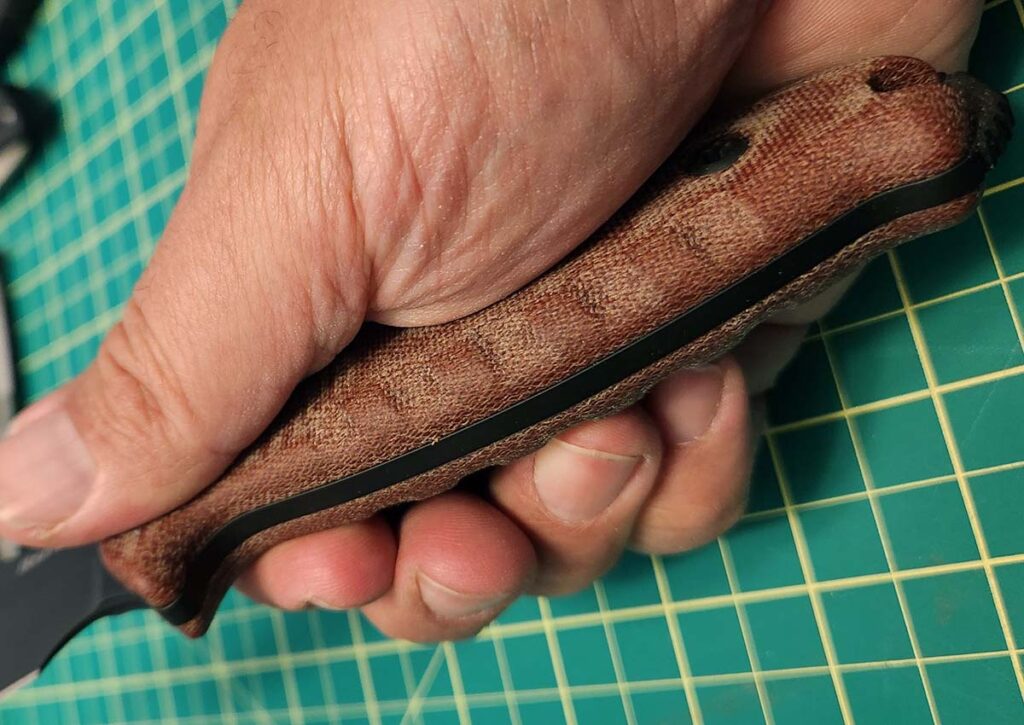
Two Diving Sparrow Knives prototypes. Follow the layering lines built into the material and you can see the flowing contours. The contours not only provide a place to grip but the subtle grooves give your fingers platforms to manipulate the knife in your hand

First off, I am not a human kinetics major so let me indulge myself and develop my own vocabulary for this section, along with some proper terms. The grip consists not only of just your hand but extends back farther through your wrist, forearm, elbow and all the way to the shoulder. Your arm works as a system and how your hand grasps an object will affect the positioning and strength exerted by your wrist and so on up the line.

3 Grip Functions

Starting with your hand, there are three functions of the grip I call selection, reaction and manipulation. Selection is when the hand selects or picks something up, often via the index finger and thumb. Usually, the intent of selection is to seek control over the object until it is firmly held within your grasp, resulting in a solid purchase. The group of muscles and body parts, that is, your index finger and thumb, are also the same group that normally exerts finite control for most people. Writing with pencil and paper is an example how over time humans have developed the index finger and thumb pinch for finer control. Watch any surgeon or chef use a cutting tool; specific direction is guided by the two main leaders of the band, the thumb and index finger.

The Grohmann knives survival model uses a flared teardrop handle, narrow at the front and wide at the back, to prevent the knife from slipping from your grip.

Reaction is best reflected in the act of catching an item, be it a ball or what have you. Your hand is prepared to catch and instantaneously selects the process of gripping the item based on how it enters your hand and what parts of your hand it touches first. A good example is when something small touches the center of your hand; your fingers surround it because it is already in the middle of your grip. If the item is touched to the outside, say just on your fingertips, your hand tries to react by drawing the item to the center and then closing the fingers.

How reaction works in the use of tools can be expressed as “for every action there is an equal and opposite reaction.” Without getting into a huge physics argument over string theory and the purity of the law as it applies to using a knife, it is a simple expression of how your body works. As the cut is made, your body exerts force. In turn, the item being cut provides resistance. To maintain control, your body must adjust your grip; in that that way you can manipulate the tool to continue cutting. Simply speaking, your reflexes kick in, something your mind has been honing all your life and now operates on a subconscious level.

The Cold Steel Republic uses texture on the handle belly to prevent slipping.

Manipulation is what I call a blend of selection and reaction. During your effort to control a tool while using it, you try to coordinate selection and reaction to manipulate it. Remember: how your hand works is mostly subconscious. The process seems inherently simple while using tools; you decide what you want to do. Therefore, the next step is to direct the tool. Your hand goes into a selection mode with the intent of gripping and directing the tool. As you use the tool, different forces often change and your grip must adjust. Taken altogether, I refer to this manipulation as the process of exerting force with a tool and reacting while trying to accomplish the task/directing the tool.

Knife Handle Shape

Ideally, a knife handle should be large enough to fill your hand yet small enough for your hand to grasp it. Given that you’re provided just enough volume to fill your grip, you might figure you could solve the shape issue by grabbing a ball of clay and mimicking the resulting shape. Alternatively, you could keep it simple and use the broom handle approach.

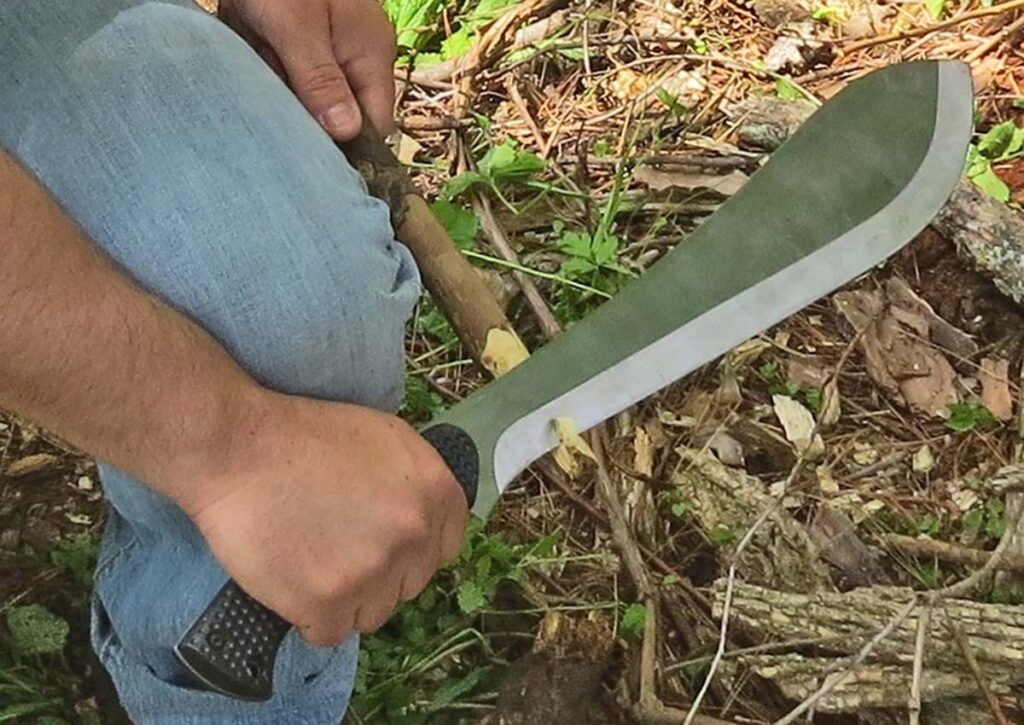
Fox uses a curved handle on its bolo-style machete to allow your hand some movement up and down the grip. “I tend not to like such a grip on smaller knives as it crams the fingers into a small area during use,” the author opined. “The flared back end prevents the hand from slipping off during a swing.

To optimize a handle, I use what I call the absence and presence method. Take, for example, a box-end wrench. The hole in the end of the box-end wrench fits around the nut. At the same time, the wrench has platforms designed to exert force on the flats of the nut to turn it. As the box-end wrench is to a nut, the hand is to a handle. A handle should be shaped to allow the hand to be able to grasp it, yet there should be enough handle to provide various platforms for the hand to exert pressure on to manipulate the knife itself. To achieve this, consider the knife’s purpose.

In shaping the handle, keep in mind first and foremost it must fit the hand. Secondly, it must have platforms/contours that provide places to push off from to control the edge, all the while being mindful not to create hot spots that might abrade the skin either via sharp surfaces or by simply rubbing against the handle.

Knife Handle Materials

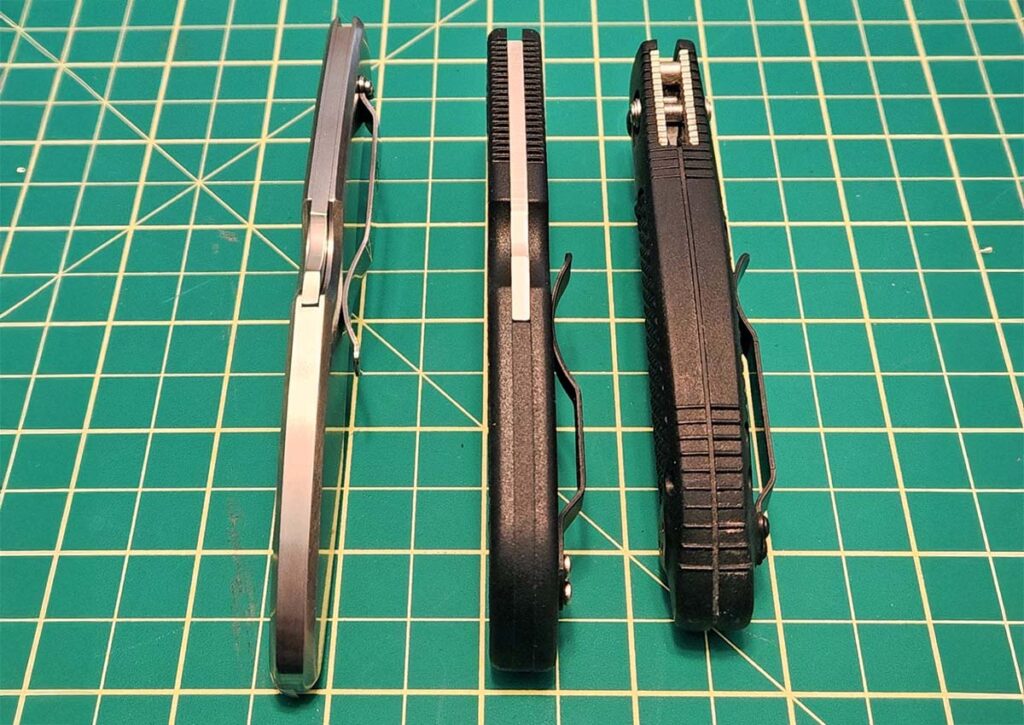
The trim profile of the Spyderco Police (left) allows manipulation for draw cuts, point use and especially lateral force. The Spyderco Endura (center) is a good midway thickness for an EDC. The Benchmade Griptilian (right) has a thicker handle and, like the Endura, scale texture. When using the Griptilian you will find lateral rolling in your hand a bit smoother because of the handle’s fullness.

There is a staggering array of available handle materials, including wood, G-10, carbon fiber, Kirinite and many more. Custom makers even employ rubber barn mats used for horses for cutting competition/chopper handles. Materials chosen correctly can enhance your grip or even overcome some shortfalls of certain handle designs. The use of materials is a large enough topic on its own; I cannot do it justice here. Let it be said, though, that a lot of it is influenced by design and structure.

A handle occupies a three-dimensional space, so forming it should take a three-dimensional approach that addresses the grip’s length, width and thickness. Fine points in design depend on the knife’s use. For instance, a chopper should have a natural stop at the handle butt to prevent your hand from sliding off while swinging, though the stop should not jam or create a rub point to irritate your hand.

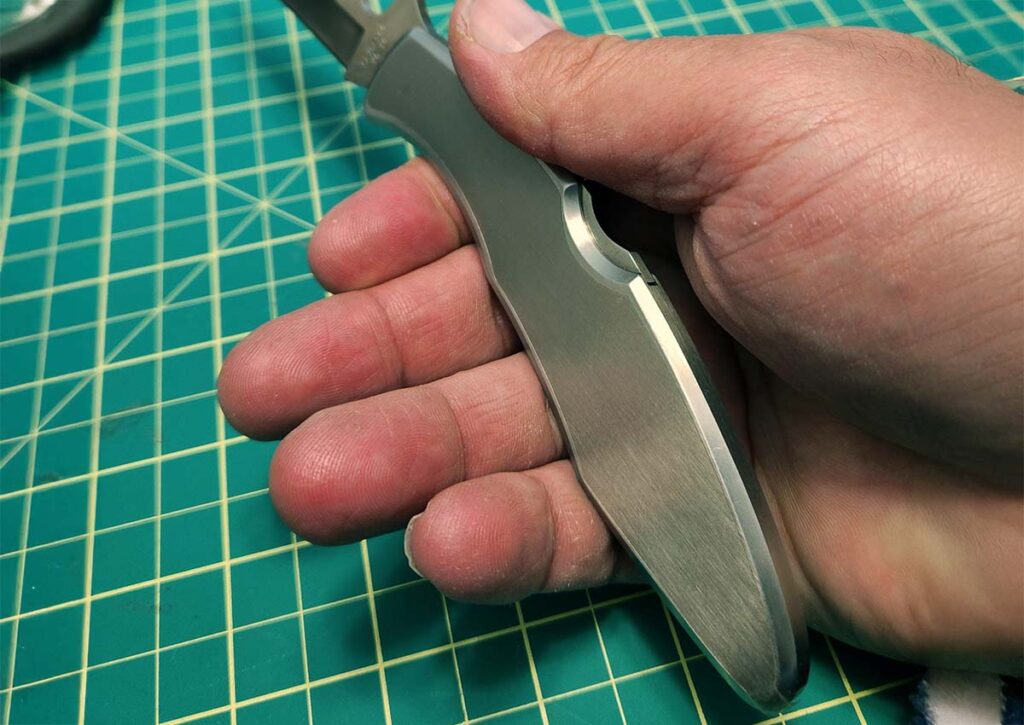
The trim handle of the Police enables it to sit nicely over the joints and in-between the pads of your fingers. The trim grip also enhances lateral knife control.

There are many fine points to look over in a handle but the major thing for me is that those finer points should get more consideration. For example, consider again a chopper. Too often I’ve seen chopper handles be too narrow. When a chopper strikes something solid, the energy from the impact travels through the chopper to your hand. A wider handle would distribute the force more evenly, preventing shock to your hand. If the handle is too narrow, the force will be concentrated on a small area. A wider handle will disperse the energy over a broader area, lessening the effect of the impact. In the end there is a fine balance because you do not want the handle to be so large that it’s difficult to hold. That’s why handle design tends to be a sticking point for me when not enough attention is paid to doing it properly.

There is way more information to cover about handles than I can cover in such a short article. I have only grazed the surface here. Creating a well-formed handle and covering common mistakes would take a chapter of a book. I could burn up a whole article on handle nomenclature alone. Hopefully, this will get you thinking more about the handle on your knife than just the latest super steel for the blade.

More On Knife Handles:

Advertisement

Must Read Articles

Read this before you make a knife

Knifemaking 101 – Read This Before You Make a Knife

  by Wayne Goddard My experience has taught me that there's nothing like digging in and getting started. I've often said the hardest part of the...
how to forge damascus steel

How to Forge Damascus

Advertisement
Advertisement