Hunting Knife Sheaths: The Constant Companion

The Correct Sheath Is Pivotal To The Complete Hunting Knife Package. A Good Sheath Can Keep Your Knives Safe And Sharp For Decades.

The Correct Sheath Is Pivotal To The Complete Hunting Knife Package. A Good Sheath Can Keep Your Knives Safe And Sharp For Decades.

For the hunter in the field, a dependable and durable hunting knife is indispensable equipment, and it follows that the sheath that holds the knife must be equally up to the task.

Secure carry, protection for the blade and handle, easy access, and the ability to stand up to the elements and hard use are essential. While there is a variety of sheaths available and each one contributes something to the equation, the sheathmakers themselves have come to eye-opening conclusions as to the making and deployment of the correct sheath for the hunting knife. Personal preference is still a prime mover, but the basics make the difference between cooperation and catastrophe in the field.

“The best style for a hunting knife sheath is whatever the hunter wants,” explained veteran sheathmaker Paul Long. “Personal preference is very important. However, the knife that would best be described as a hunter would be best suited in a deep seat pouch with a loop that would carry relatively high on the belt. In most cases the deep pouch would preclude the need for a retention strap. For a double-guard hunter, a drop-loop belt sheath would probably be best with a snap strap for secure retention.”

Depending on the style of the knife, the guard often dictates the best pouch configuration. “I favor the pouch-type sheath, and the hunting knife generally has a single guard as opposed to a double guard,” related sheathmaker Paul Lebatard, who also has found success with his custom knives through the years. “I make a lot of doubles, too. You would have to make a snap-type sheath with a keeper strap, but on hunting knives with single guards the pouch type is always best.”

Three different styles of pouch sheaths by Kenny Rowe, from left: regular pouch, plain leather; strap pouch, floral hand carved; and full flap pouch, full coverage gator. (Kenny Rowe image)

A sheathmaker for over 50 years, Chris Kravitt zeroes in on the personal preference perspective. “First and foremost, it’s a matter of the configuration of the knife, and then if more than one style will work it becomes a matter of personal preference,” he observed. “My preference is to go with the pouch because it is easier to draw and resheathe the knife without worrying about straps.”

At the same time, Kravitt acknowledges varying hunting knife construction and its influence in sheath form and function. “If a knife has a double guard, it isn’t going to work on a pouch sheath, and if you have a knife with an integral handle, possibly,” he said. “Certain things don’t lend themselves to the traditional style, like when the blade is the widest part of the knife or there is no bolster or ricasso extending beyond the edge.”

Kenny Rowe, owner of Rowe’s Leather in Hope, Arkansas, adds another option on the hunting knife sheath. “Ninety percent of these sheaths would be the pouch type because they cover most of the knife, and with the guard you can make a welt where the knife has some resistance coming in and out,” he noted. “Some sheaths will have a lid that has a snap on it, and that is as secure as you can get with the flap snapping over the front of the sheath.”

The consensus with the pouch sheath makes sense for all the reasons that the hunter encounters in the field. For its toughness and the ability to shape and mold the sheath as desired during the construction process, cowhide reigns supreme among sheath materials. Most sheathmakers use 7-to-9-ounce* vegetable-tanned cowhide.

Style Of Sheaths

The use of exotics such as ostrich, stingray, alligator, crocodile or other hides is a continuing option, though for the most part they are used as accents, often in the form of inlays, rather than adding any performance-related component to the sheath.

“Exotics are very useful in sheathmaking but primarily for aesthetics,” Long explained. “Elephant and shark are two that are tough enough to withstand very hard use and are usually built as an overlay on a vegetable-tanned base sheath. I work with various snakes, lizards, ostrich and many others.”

Ultimately, Chris Kravitt—here working on a sheath in his shop—stands by the individual perspective. “First and foremost,” he begins, “it’s a matter of the configuration of the knife, and then if more than one style will work it becomes a matter of personal preference.” (Chris Kravitt image)

As Kravitt noted, “The basic sheath is going to be cowhide 99 percent of the time, but for overlays and inlays my favorite is stingray, which is near bulletproof but more expensive and harder to work with—but great stuff. Ostrich leg or shin is very nice, and Malaysian horned frog has a very nice texture to it. Snakeskin is not very durable, but it’s fine when the knife and sheath are for show since it won’t hold up with regular use.”

Tooling and carving also provide style points and may be pleasing to the eye. However, neither actually contributes to the performance of the sheath in field use. “I occasionally do some tooling with stamps, but carving is a talent I don’t have,” Lebatard remarked. “Still, on almost every sheath I’ll put something in keeping with the theme of the knife, like a small deer. Someone might place an order and specify that they just want a bare, plain sheath, or they may want just their initials on it. That’s a good thing about leather. When it is wet it can be molded and stamped, and when it dries it will hold that impression.”

Tanning And Steel

Vegetable tanning is essential when the blade meets the sheath leather for an extended period. In contrast to chrome-tanned leather, a vegetable-tanned leather is not known to corrode or stain a blade left in the sheath for any length of time. That old admonition to store the knife itself separately from the sheath will then get a longer look.

“A lot of people say not to store knives in the sheaths, but as long as the sheath is made of good vegetable-tanned leather, I’ve never had a problem,” Lebatard noted. “I made a knife for a friend a few years ago and he didn’t want a sheath. He was going to get someone else to make the sheath for him. Several years later, he brought the knife to me and he had had it in a chrome-tanned leather sheath. It was nearly rusted through. The chrome-tanned leather is very corrosive.”

Kravitt has had similar experiences. “I hear so many people say not to store knives in leather sheaths, but I have kept knives in sheaths for years and never had a problem,” he recalled. “My sheaths are all vegetable tanned as opposed to chrome tanned. Chrome-tanned leather may have salts and other things in it.”

Drainage And Inserts

Waterproofing is another essential element, and in the construction itself there are questions surrounding drainage holes and inserts as well.

Most sheathmakers shy away from inserts since contact with the blade may dull the edge. After all, the welt and/or strap should suffice for a snug fit. Inserts in and of themselves may be judged to provide some measure of redundancy, but contribute little to the overall stability of the lockup or in protecting the knife itself. Long says, “Even the best inserts, being rigid, will do more harm to a blade than top grain leather.”

The different decorations Kenny Rowe offers with his sheaths include, from left: smooth; border tooled; basket weave; acorn and oak leaf hand carving; exotic skin overlay (gator); exotic skin inlay (beaver tail); and exotic skin full coverage (ostrich leg). (Kenny Rowe image)

At first glance it might appear that a drainage hole is a good idea to help maintain cleanliness and prevent the buildup of moisture or debris within the sheath. Not so fast!

“I do not ordinarily put a drain hole in my sheaths,” Long asserted. “Nor do I do any waterproofing of the interior of the sheath. Rather, I depend on the normal intelligence of my client to not go swimming with their sheath, and to at least try to clean the blood and guts off the blade before reinsertion.” 

Rowe agrees. “I don’t see any sense in it,” he commented. “I can count on one hand the number of sheaths I’ve made with drain holes in them, and I’ve been making sheaths for 35 years at least. The only time I would expect someone to have their sheath in really wet conditions would be if they accidentally rolled into a deep river or their boat sank. I wouldn’t expect someone to haul off into neck deep water with their hunting gear on. For debris, it’s easy enough to take a wire with a little hook in the end and just rake the sheath out, or blow it out with air, or stand it upside down and shake it or tap it on a table.”

Kravitt, on the other hand, will utilize a drain hole and an insert from time to time. Often, the insert itself is fashioned from leather to avoid additional friction against the knife edge. The employment of the drain hole is in direct response to the future use of the gear in the field.

“If I know the sheath will be used in harsher conditions, I think it should have a drain hole,” he remarked, “not just for draining moisture, but also removing debris—especially when the user has spent a lot of time in the woods.”

Sheathmakers do tend to rely on the owner of the product and of the hunting knife to exercise responsibility in the field. “Explain to the client, if they are a novice, about the ‘care and feeding of a leather sheath,’” Long smiled.

How To Care For A Hunting Sheath

The well-crafted sheath is the constant companion of the hunting knife, either in the field or a collector’s cabinet, and the best measure of the sheath’s contribution is its role in that partnership. For the sheath to function properly, owners must remember the fundamentals of hunting knife care. Keep both the knife and sheath clean. Wipe away moisture and other fluids. Maintain the surfaces as needed. Don’t put the knife away wet and expect the sheath to do more than expected.

Adhering to best practices will ensure long life for both the hunting knife and its all-important sheath.

*According to the Montana Leather Co. website (montanaleather.com), leather thickness is typically measured in ounces. For instance, an ounce of leather is equal to 1/64 inch. As a result, 7-to-9 ounce leather will be in the 1/8 inch range, give or take a few millimeters.

Read More

Knife Steel Alloys: A Down-And-Dirty Guide

0

We break down what common steel alloying elements add to a knife.

Alloy… in the knife world we hear the word often. Blade aficionados—many almost journeyman metallurgists in their own rights—pour over steel composition. Newbies to collecting and making, however, might be a bit perplexed over exactly what the material modification is all about.

With this in mind, we’ve boiled down what certain elements—when alloyed with iron—bring to the table for your knife. Now this isn’t a deep dive into the nitty-gritty of what each element does in a steel alloy, complete with phase diagrams and quenching charts. Honestly, if you need to cut to this quick, we recommend Larrin Thomas’ website KnifeSteelNerd.com. The son of BLADE Cutlery Hall of Fame member Devin Thomas and PhD metallurgist and material scientist, Thomas offers a much more in-depth look at steel from an engineer and knifemaker’s point of view.

What we have here is a quick and dirty guide to alloy elements and what they bring to a knife.

What An Alloy Is

If your high school chemistry class is a bit foggy right now, perhaps we should take a moment to do a quick review of exactly what constitutes an alloy. Quite simply, an alloy is a mixture of two or more elements, where at least one of the elements is a metal. Note alloys are mixtures, not compounds—the former is a physical combination, the latter a chemical. For a mixture, think of something like oil emulsified in vinegar to create a tasty salad topping, while a compound is two gases like hydrogen and water bonding together to form water.

Alloying elements is done to enhance the properties of a material. In the case of knife steel elements are combined to improve toughness, wear resistance, corrosion resistance or other factors. While we won’t delve that deep in this article, we’ll point alloys can be classified into two main types:

Substitutional Alloys: In these alloys, the atoms of one element replace or substitute for the atoms of another in the metal lattice. An example is brass, which is an alloy of copper and zinc.

Interstitial Alloys: In these alloys, smaller atoms fit into the spaces (interstices) between the larger metal atoms in the lattice. Steel, which is an alloy of iron and carbon, is an example of an interstitial alloy.

Since we’ve dusted off some of those long-lost materials lessons you learned, let’s get into the down-and-dirty of what each common alloying element brings to knife steel.

Knife Steel Alloy Elements

Carbon: This ingredient makes the difference between iron and steel; all steel will have some amount of carbon. It is the most important hardening element, but it makes hardness by combining with other elements. As a simple generalization, the amount of carbon in the steel tells you a lot about the quality of the steel. Low-carbon steel has 0.3% carbon or less, medium has between 0.4-0.7% and high-carbon steel is 0.8% and above, maxing out at around 1.2% carbon for knife steels. Up to a point, the higher the carbon content within the range, the harder the steel will get.

Chromium: Chromium combines with carbon to make chromium carbides, which are resistant to corrosion. Stainless steel knives will have chromium as a major ingredient, typically at a minimum of 12-13%. Chromium also increases the strength of a knife to a degree, but adding chromium in large amounts decreases toughness.

Cobalt: In small amounts, cobalt increases toughness.

Manganese: This changes the rate of hardening. Manganese in carbon steels yields “deeper” hardening, which requires a slower speed quench and gives a wider range of acceptable heat before quench. If added in high quantities, it can increase brittleness. Manganese makes steel etch dark in damascus.

Molybdenum: Adding this maintains the steel’s strength at high temperatures.

Nickel: Nickel adds toughness to steel. It also makes steel etch bright in damascus.

Nitrogen: This element is sometimes used as a substitute for carbon in steel.

Silicon: Silicon increases strength and removes oxygen from the metal while it is being formed. It’s typically present in small quantities in most steels.

Sulfur: This increases machinability but decreases toughness.

Tungsten: Adding this increases wear resistance and forms tungsten carbides that are very hard.

Vanadium: Vanadium leads to smaller grains within the steel. Vanadium carbides are very small and hard, which increases wear resistance and edge retention.

More On Knife Steel:

Utility Of The Knife Hole: Poking Into This Modern Design

0

From tactical rings to signature openers: analyzing the practical advantages of negative space in blade engineering.

The hole in the handle or blade, or anywhere in knife construction, has something to tell the user. But what is it trying to say or do?

It is eye-catching but the hole and/or ring and the science that goes along with it complement the visual and the practical in knife use. Aesthetics, mechanics and utility are factors. After all, the essence of the knife is in its use as a tool, and who wouldn’t mind a prettier profile at the same time?

Original Hole

The story of the hole in the blade cannot be told without including Spyderco and its legendary leader, BLADE Magazine Cutlery Hall-of-Fame® member Sal Glesser. In the decades since Spyderco introduced its iconic hole in the blade, the company has produced countless folders that characterize the ease of opening inherent in the hole itself.

The story of the hole in the blade cannot be told without Spyderco and its legendary leader, Sal Glesser. The BLADE Magazine 1990 Overall Knife of the Year®, the blade-hole-opening Endura is one of the company’s longest-running models.

Sal said he well remembers the inspiration to step out with his company’s blades.

“The Buck 110 and Gerber Folding Hunter were the watershed change to locking knives, in my opinion,” he recalled. “I purchased a Buck 110 when they first came out. As a young man I learned to open the Buck and Gerber lockers with one hand using my thumb, pushing on the side of the blade. I was working late in the shop one night, payables, payroll, etc., and I thought to try to figure out a way to modify a folding knife so that anyone could learn to open [it] with one hand more easily and more safely than the way I was doing it.”

From that single thought, Glesser went to work. He experimented with adding to the blade for leverage—studs, discs, hoods and other things—but found they got in the way when cutting or sharpening and could “wave” the knife open unintentionally when deploying.

“So I started taking things away from the blade to create purchase for the thumb,” Sal continued. “I first roughed up the side of the blade, which worked, but not very well. Then I drilled a dent into the blade. A dent on both sides became a hole.”

Eureka!

Sal plowed ahead, making a rough prototype using a Japanese folder and welding a piece of drilling rod to the spine of the blade to add height. He ground it down to the thickness of the blade and then drilled the hole to test his ease-of-opening theory.

“We applied for a patent claiming a ‘ledge’ created by the edge of the hole that could be used by the fleshy part of the thumb to urge the blade open with one hand,” Sal recalled. “I chose to use a round hole because it was easier to make and was easily identifiable.”

The rest, as they say, is history.

From the first blade-hole model in 1981, the Spyderco Worker, the distance from the center of the pivot to the hole was analyzed while the optimal size of the hole for the average thumb was measured. Enhanced trademark work was successful in securing the round shape since copies were notable with different shapes to get around the word “hole” in the original Spyderco patent language. Hence, the company introduced the hole into its fixed blades as an identifier “large enough to be cleaned and small enough to be noticed.”

Perfecting the hole for its primary purpose of easy opening meant leaving a certain amount of steel above the hole to compensate for the space. “Some steels that are more brittle could be broken through the hole if pried with hard enough,” Sal concluded. “But the truth be told, there are millions of Spyderco knives in the marketplace over the past almost 50 years and there have been very few that were broken.”

Where & Why Of Holes

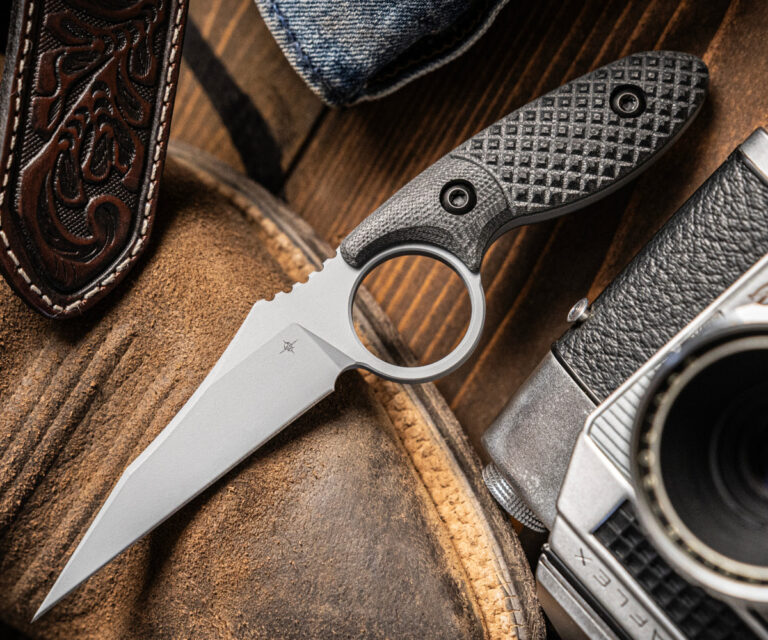
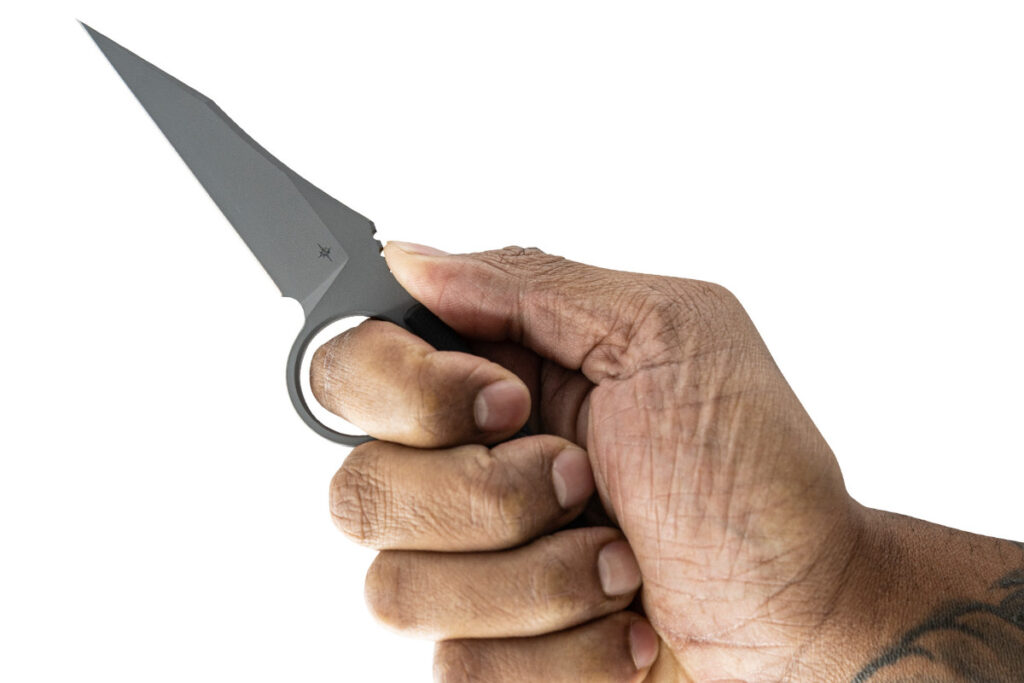
Toor Knives CEO Connor Toor says the hole/ring of the Cortano is between the handle and blade for several reasons, including deployment and retention, a tactile index for consistent hand placement, a lanyard attachment point, and an unmistakable visual signature. Another is the ability to choke up for precise cuts without losing control.

In overall perspective, the hole has its place in the fixed blade as well. The Toor Corporation Cortano sports the hole/ring for a simple reason according to CEO Connor Toor.

“A hole allows fast, ambidextrous one-handed deployment without extra hardware,” he explained, “and it keeps the blade profile clean and snag resistant. It also slightly reduces weight and manufacturing complexity compared with an added stud or thumb disc.”

The hole in the Cortano is located between handle and blade for several reasons, including deployment and retention, a tactile index for consistent hand placement, a lanyard attachment point, and an unmistakable visual signature that differentiates the knife. An added bonus, says Connor, is the ability of the user to choke up for precise cuts without losing positive control.

“We typically call it an ‘index/retention ring’ or simply the ‘deployment hole,’” Toor commented. “The concept is rooted in historic ring knife forms and modern karambit/utility designs more broadly, so while makers like Steve Likarich are part of that lineage, our design pulls from both traditional ring knives and contemporary tactical needs rather than a single source.

“Any aperture introduces stress concentration,” Connor continued, “but proper blade geometry, material selection and heat treatment mitigate that risk. We designed the Cortano so overall material thickness preserves strength around the hole. Real world testing and appropriate use show no practical durability issues when those engineering details are respected.”

Holes For Balance

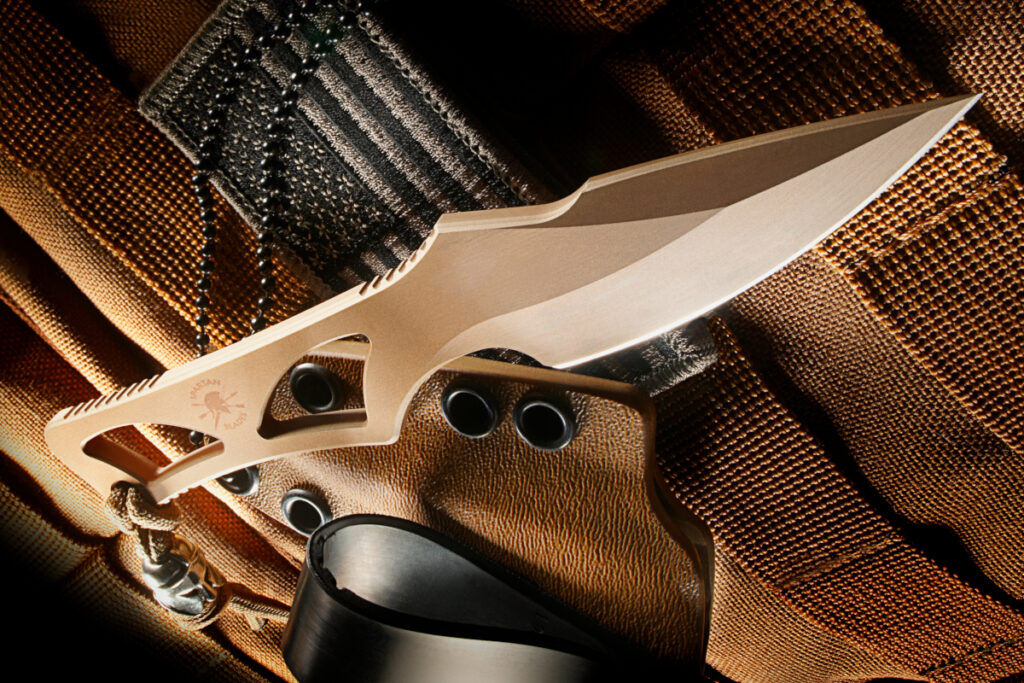
The Formido fixed blade from Spartan Blades comes with a series of grip holes, that, explains company president Curtis Iovito (inset), “primarily tune balance by reducing handle weight.”

The Formido fixed blade from Spartan Blades comes with a series of holes in the handle, and company president Curtis Iovito readily points to the advantages of the design.

“It’s primarily to tune balance by reducing handle weight,” he advised, “often to place the balance over the index finger. We’ll enlarge or shrink hidden holes under the scales to shift weight where it best serves the knife’s purpose. Looks can be a secondary benefit. Along with weight reduction, there are options for lashing or paracord wraps, and added indexing/traction without introducing weak corners. In some cases, they also enable spear mounting or other field attachments.”

Curtis adds that the parameters for the introduction of holes in the blade or body of the knife vary as to the designer’s objectives.

“There is no universal formula,” he related. Holes, however, must measure up to certain standards to “maintain strong ‘webs’ of material around fasteners and stress points, and scales must be clamped well to prevent lifting and contamination. Round holes are favored because they machine easily and avoid sharp internal corners that become stress risers during heat treat. Arched/rounded cutouts can add torsional strength as seen on our Enyo and Formido.”

Holes In Karambit

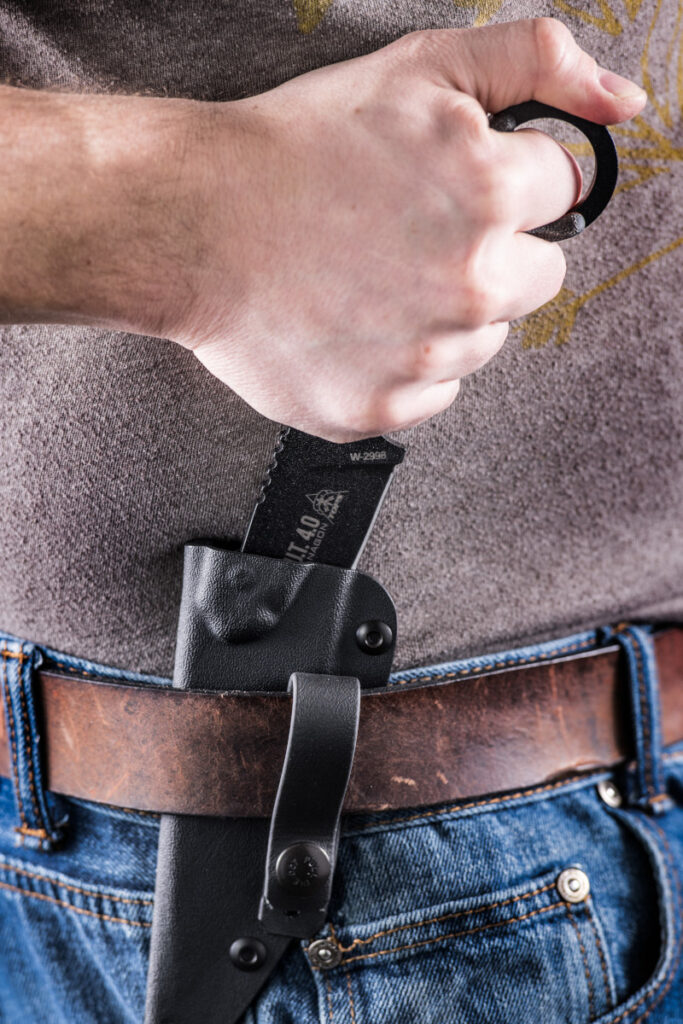
Designed by Joshua Swanagon, the TOPS Knives C.U.T. 4.0 is a hybrid karambit that combines the practicality of a utility knife with the defensive and combat features of a standard karambit. Its ringed handle is common to the pattern’s lineage while the utility drop-point blade is more of a traditional design element.

At TOPS Knives, the C.U.T. 4.0 is a hybrid karambit that combines the practicality of the utility knife with the defensive and combat features of the karambit. Its ringed handle is common to the karambit lineage while the utility drop-point blade is more of a traditional design element. The karambit hole itself is probably a derivative of agricultural use.

“It does seem to be the case that many karambits used in Asia were used as a tool first, cutting cane or other crops” said Craig Powell, TOPS general manager. “As a tool, the pinky is usually in the hole so that the knife can hang down from the hand while the user is picking up the harvest, and then it is swung back into the hand to use the cutting edge.

“I wouldn’t say there is a set rule on the size of the hole,” he added, “but too small makes it easy for fingers to get stuck, which can equal broken fingers or de-gloved fingers in situations where the knife can’t be dropped when needed. Too large makes the knife clunky to use and manipulate properly and too easy to drop. Definitely, there is a balance to be struck. The hole size we use for our karambits does vary somewhat with the overall size of the knife. Typically, the smaller the overall size, the less likely someone is going to use the knife while wearing gloves, so you can use a smaller hole to keep the overall profile of the knife smaller.”

The characteristic ring in the butt of the karambit adds versatility, and Iovito sees advantages in several areas.

“The ring allows rapid grip changes, secure retention of a short blade under stress, and manipulation without dropping the tool. On our CQB Tool, for example, the ring lets a user transition to a pistol grip in a pinch without discarding the blade. We use PEO Soldier [U.S. Army Program Executive Office] data on the average-gloved-finger size for reliable use with gloves. Our research points to about a 1 1/8-inch internal diameter as optimal—big enough for manipulation and glove use without binding, yet not so large that control gets sloppy or the blade flops on the finger. Too small risks pinching, circulation issues, and snagging; too large compromises indexing and retention.”

Michael Janich, special projects coordinator at Spyderco, agrees that the karambit has an agricultural lineage but adds that the island archipelagos of the Pacific, where the design developed, will often provide different cultural backgrounds to its story.

“After harvesting a bundle of vegetables, the handle was released, allowing the knife to hang from the pinky, freeing both hands to tie the bundle,” Janich reasoned. “In contrast, sheathing the knife every time was inefficient and would require the blade to be cleaned to prevent soiling the inside of the sheath. Logically and practically, this makes sense. Some stories of the origin of the karambit, though, suggest that it was developed primarily as a weapon.”

Arched/rounded handle cutouts can add torsional strength as seen on the Enyo by Spartan Blades.

As for the dimensions of the karambit and its characteristic hole, Janich points out that some tools defined as karambits of Southeast Asian origin do not even sport the hole. Nonetheless, the hole defines the karambit today.

“The karambit is not the only historical knife to have a ring,” Michael added. “The Japanese kunai was a trowel-like tool that had a ring at the end of the handle. The ring could be used to enhance grip retention. It also allowed the tool to be hung from a cord for easy transport or for the attachment of a lanyard. The Chinese martial arts also had daggers with butt-mounted rings. In some systems of kung fu, the rings had no specific purpose and only served as pommels. The bird and trout knife, first introduced by Marble’s, also had a pommel ring. Of integral construction, the handle portion of the knife was very narrow, so the ring provided both retention and grip stability.”

Attraction Of The Design

Universally in the world of knives, the hole or ring has its place, its moment, its degree of usefulness. Ultimately, the user chooses the tool that suits the task at hand, and the presence of the hole, for easy opening, control or enhanced utility, is always a candidate for deployment.

More Knife Reviews:

Stiletto Switchblade: Sharp And Controversial

There Are Few Knives More Controversial Than The Stiletto Switchblade. This Automatic Knife Is Outlawed In Numerous States And Countries.

Certain knives get the interest of lawmakers and not for good reasons. The stiletto switchblade is extremely controversial because owning one is completely outlawed in seven states and heavily restricted in another eight.

The stiletto endures because of its use in movies and television and because it opens unlike other types of knives.

Why Is The Stiletto Switchblade Banned?

In the states where the knife is completely outlawed, a big reason is due to the way the blade deploys. The blade flips out due to a button, or other assisted means, much faster than most knives that open with a nail nick or a thumb stud. This has earned it a classification as a “dangerous knife” in many states, thus leading to its ban or restriction.

This short video shows how quickly a stiletto can be opened.

Remember though, the stiletto is only banned or restricted in 16 states and is legal in states from coast to coast, between the borders, and even in Alaska. It’s just important to check your local knife laws to make sure they are allowed to be owned and carried.

What Even Is A Stiletto Switchblade?

A stiletto is a long, narrow blade used historically in Italy and around Europe with a needle point. It GAINED POPULARITY IN THE 15th century and was used by knights and assassins alike throughout the Middle Ages as a fixed-blade knife.

Stilettos evolved throughout the ages into well-honed COMBAT knives used throughout the world. In the 1950s, large numbers of switchblades began to be imported to America from Italy that featured a stiletto blade, and the name “Stiletto Switchblade” stuck over the ensuing decades.

The knives are still made in Italy and in other countries as well. 

Best Stiletto Switchblade To Buy

If you live in a state where it is legal to own a stiletto, there are many on the market today. HERE ARE A FEW NOTABLE EXAMPLES.

Timber Wolf Mosaic Damascus Stiletto

A beautiful and durable knife, this stiletto from Timber Wolf would be a great conversation starter with other knife lovers. 

The blade and the handle are both made from damascus steel with inlaid wood and brass pins accenting the handle. The BLADE is four inches when deployed and nine inches in total length. The brass liners and stud contrast nicely with the rich, dark color of the blade material.

Just be careful when closing the KNIFE. The double-edge BLADE means there’s no dull spine to push the knife closed so it’s important to be diligent in closing so you don’t slice your hand. 

Is this the most utilitarian stiletto? No. Is this a beautiful knife that you’ll want to show off to everyone you know? Absolutely.

MSRP: $61.99

PRO-TECH 720 Godson Auto Folder

This small, nimble knife won THE BLADE MAGAZINE 2014 Investor/Collector Knife Of The Year® and it’s easy to see why. PRO-TECH has made a versatile stiletto in the Godson that’s used by both military and civilian folks alike.

The stiletto-inspired blade is 3.15 INCHES OF 154CM STAINLESS STEEL ground to a spear point with a blasted finish. It OPENS via a push button from the 6061-T6 aluminum handle. 

It deploys in a flash and is an excellent self-defense knife or just as your regular EDC. There are no bells and whistles on this knife; it’s just well-constructed and well thought out to be one of the best and easiest-OPENING switchblades on the market. 

MSRP: $200

Kershaw Launch 8

From one of America’s biggest factory KNIFE COMPANIES, the Kershaw Launch 8 takes inspiration from the traditional stiletto and repackages it in a modern way. 

The blade of CPM 154 STEEL is corrosion resistant and holds its edge. The push button release and lock ALLOW for lightning fast deployment and a secure lock that keeps everything firm when open. The button is low profile to help prevent accidental deployment while in your pocket. The pocket clip is ambidextrous and can also be fitted so the knife carries tip up in your pocket.

The anodized aluminum handle with carbon fiber insert is strong and light. The whole piece weighs just 2.4 ounces. 

MSRP: $155.99

Viper-Tec VT Don Italian Stiletto OTF

This stiletto from Viper-Tec is the lone OTF (OUT-THE-FRONT) knife on the list and opens with a mechanism that both deploys the knife and brings it back into the handle. 

The blade itself is made from a ridiculously sharp stainless steel that is 3.75 inches long with a flat grind. The satin finish gives the blade a classy, elegant look, and the handle is available in both wood and marble.

At 5.25 inches in length when closed, it sits easily in a pocket or a bag. 

The Don Italian is a smart knife. Everything has been thought through to make an easy-to-use stiletto that can last you for years.

MSRP: $79.96

Read More
2024 BLADE Show West: Recap Of Salt Lake City Show

0

On election eve, BLADE Show West fetes its cutlery constituents.

With a presidential election looming and parts of the USA still in a state of shock after the natural disasters of Hurricanes Helene and Milton, it was a BLADE Show West unlike any other. However, knife people are a hearty lot and many turned out to enjoy the knives and cutlery camaraderie this past October at the Salt Palace Convention Center in Salt Lake City, Utah.

“The environment was good as usual, with lots of excitement,” wrote Jonathan McNees of McNees Knives.

Bladesmith Will Stelter displays his two-handed sword
Bladesmith Will Stelter displays his two-handed sword with a wildly undulating blade of mosaic damascus, and Francesca Ritchie holds the scabbard she made of deer hide overlaid with rayskin and hand-dyed American alligator. Francesca carved and underlaid the inside of the scabbard to form fit the curvature of the blade, the imprint of the latter you can see on the outside of the scabbard.

Eddie Johnson of CobraTec echoed Jonathan’s assessment. “As always, the environment was enthusiastic and filled with excitement to see and hold new merchandise,” he commented. “There is nothing like holding that knife you have seen pictures and videos of.”

There were custom and factory knife awards galore, the show’s popular “Let The Pros Critique Your Knife” seminar, the West Coast Flipping Championships conducted by Squid Industries, and much more.

As for those all-important knife and knife accessory sales, it was like most shows: some exhibitors did well, some didn’t and some did OK.

Families were a big part of the show.

“It was a great show,” Pro-Tech headman Dave Wattenberg exclaimed. “We did sell most everything that we brought, strong sales to both retail customers and dealers who attended. It’s very important to have both and this show did work well for retail and dealer dynamics.”

The Pro-Tech models that sold well were a mix.

“New models always do well—the Chaves collaboration did very well,” Dave noted. “Some oldie but goodie models—Godfathers, etc.—also did very well. Our TR-3 Integrity manual folder was a hot ticket for sure.

“We built an amazing group of show specials; they also did very well. It’s important to make some special pieces for the show, not just offer the same thing customers can buy anytime.”

Bladesmith Seth Lopez examines a show patron’s knife
Bladesmith Seth Lopez examines a show patron’s knife while custom knifemaker Shane Magnussen (left) and (from right) maker Jared Oeser and bladesmith Will Stelter look on in the popular show seminar, “Let The Pros Critique Your Knife.”

John Cammenga of another factory cutlery company, White River Knife & Tool, also was pleased with sales.

“We had a very good show,” he remarked. “We had great sales and a dealer took everything we didn’t sell. It’s nice to go home sold out!”

Ernest Emerson of Emerson Knives, Inc., was another who said it was a great show.

“We sold out, with the first day rivaling the BLADE Show in Atlanta,” he opined. Jonathan McNees said his company had a “really good show. We didn’t quite sell out but we brought a lot of knives, so I didn’t expect to. Our folders sold best, but again, that’s to be expected with our customer base.”

While CobraTec sold well, sales were off about 30 percent from their show average over the previous two years.

Gavin Hawk Hawk Knife Designs booth
Gavin Hawk (center, behind the table) makes another sale at the Hawk Knife Designs booth.

“Everyone was concerned over the current economy and its uncertainty with the election approaching,” Eddie Johnson wrote. Nonetheless, he said several CobraTec knives were “good movers, from the Enforcer OTF to the Raptor to the OTF Utility Knife to our Koonsman fixed blade.”

Custom maker Tobin Hill agreed with Johnson’s economy/election observation.

“Talking with other exhibitors, the general consensus was tighter pocketbooks due to economy worries and pre-election jitters,” he wrote. Tobin brought eight knives and sold three—two of his Hill Locks with the rear bolster release and a lockback whittler.

Who Attended BLADE Show West

Like show sales, attendees ran the gamut, from young and old, novice to sophisticated buyers and more.

The top three finishers in the West Coast Flipping Championships celebrate, front row from left: Madi “oximityy” Thomas (3rd), Banks “banksqro” Tracy (1st), and Max “balisongnerd” Wenham (2nd).

“The crowd seemed like a bigger percentage of experienced buyers versus the BLADE Show in Atlanta and BLADE Show Texas,” McNees observed. “We really enjoyed the local crowd. They were extremely friendly and receptive. We got lots of appreciation for coming out.”

The fact that it was the third straight year at the Salt Palace Convention Center seemed to help, too.

“It was good to see repeat customers, so I’m glad we’ve been at the same venue for a few years,” Cammenga wrote.

“There was a nice mix in demographics,” Johnson pointed out. “As always, it is great to see the entire family out enjoying the show. I had several sales to the younger generation with the supervision and guidance of their parents.” 

Banks “banksqro” Tracy shows his championship form.

“There was a very healthy mix of already established Pro-Tech enthusiasts as well as first time buyers,” Pro-Tech’s Wattenberg wrote. “It did feel like a smaller crowd than last year, but we did have customers to work with the entire time, so no complaints. I especially love the family atmosphere; there were so many nice people.”

“The crowd seemed an even mix of young and old, several families with kids,” Hill reported. “There were not many ‘sophisticated’ buyers or dealers.”

According to one industry professional, the fewer buyers and dealers than usual from the Eastern USA may have been due to the poor economy and also the aforementioned Hurricanes Helene and Milton that hit shortly before the show.

BLADE Show West Exhibitors

Shows are about contacts, not only among show attendees and exhibitors but among the exhibitors themselves, including factory knife companies and custom makers to broach possible collaborations and other knife deals.

Fixed blades and choppers were among the knives of the day.

“We made good contacts with other makers, including some prominent ones we had not previously met,” McNees wrote. “The size of the show was good for that.” Added Johnson, “The BLADE Show always gives us an opportunity to meet various designers and talk about collaborations.” Wattenberg agreed. “We had a few excellent conversations with makers,” he noted.

West Coast Flipping Championship

The 5th Annual West Coast Flipping Championships conducted by Squid Industries was another rousing packed-house event, with Squid providing cash prizes of $1,000 for first place, $500 for second and $250 for third.

Banks Tracy, aka banksqro, took home the title using a Squid Silver Krake Raken Tanto V3 balisong. Runnerup was Max Wenham, aka balisongnerd, who also used a Squid Silver Krake Raken Tanto V3 balisong. Madi Thomas, aka oximityy, took third with her Squid DT Red Krake Raken Tanto V3 balisong. The top three finishers also won prizes from the events’ gold sponsors.

BLADE® editor Steve Shackleford (left) and heat-treating legend Paul Bos (right)
Two Cutlery Hall of Famers enjoy each other’s company: BLADE® editor Steve Shackleford (left) and heat-treating legend Paul Bos (right).

BLADE SHOW WEST ’25

If you were there, you know; if you weren’t, you need to be. Make it so and plan now to attend next year’s BLADE Show West, Oct. 10-11, once again at the Salt Palace Convention Center in Salt Lake City.

More On The BLADE Shows:

Paring Knife: 4 Top Kitchen Tools

The Paring knife is there when you need it most, from big tasks to small. Here are options for every type of user.

Paring knives may often get overlooked in the kitchen for their flashy big brothers—chef’s knives—but like EDCs, they’re there when you need them most and there’s one for every type of user.

What Are Some Of The Best Paring Knives:

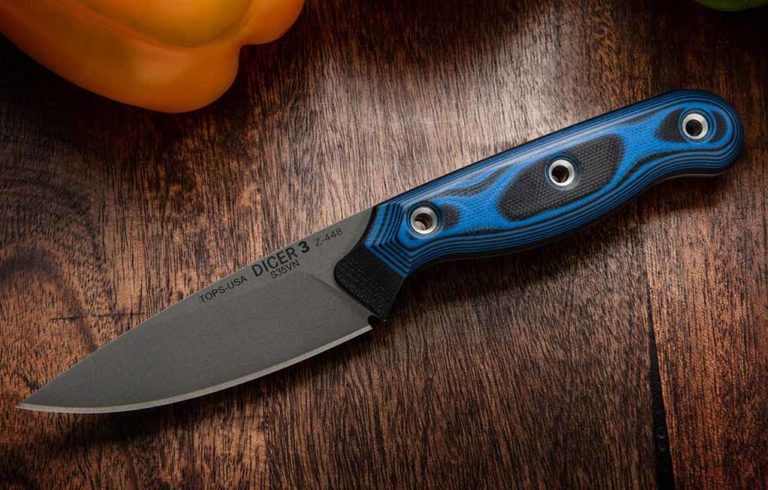
TOPS Knives Dicer

TOPS Knives embraces the paring knife market in conjunction with its Dicer line of kitchen knives. “We noticed, in the process of wanting to design a kitchen knife, that there were some amazing U.S.-made custom kitchen knives, but there weren’t many high-quality domestically made production kitchen knives,” TOPS spokesperson Jeremiah Heffelfinger observed. “This was a void that we were more than happy to fill, especially with the plan for a full line of kitchen knives in the near future.”

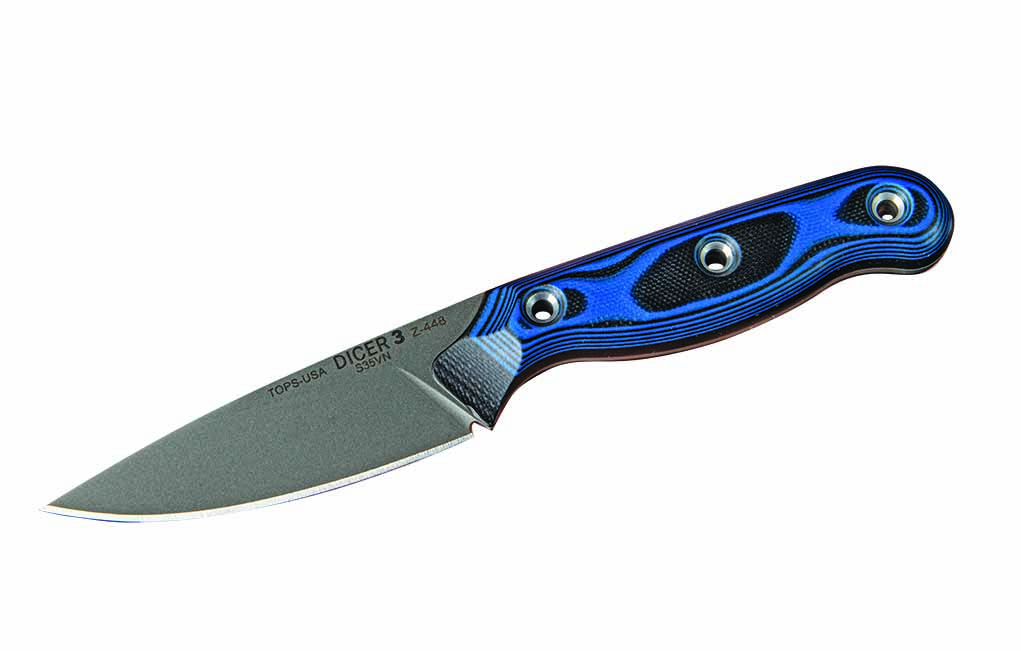
 The Dicer 3 has balance, a great blade steel—CPM S35VN stainless—ergonomics and looks.
The Dicer 3 has balance, a great blade steel—CPM S35VN stainless—ergonomics and looks.

A design contest between the staff of TOPS Knives in 2017 yielded the Dicer, an 8-inch chef’s knife. TOPS President Leo Espinoza designed a companion paring knife. The Dicer 3, released with the chef’s knife in 2019, that sports the same steel and handle material. The paring knife has become a popular offering as the company has filled out its culinary lineup, including bread and steak knives.

“The chef’s knife typically gets the majority of the attention, but for fine and detail tasks the paring knife can’t be beat,” the TOPS spokesperson advised. “It affords more control for tasks like peeling and trimming meat, fruit or vegetables.”

Heffelfinger said the Dicer 3 is a package that sports balance, a great steel, ergonomics and looks. When company officials designed the chef’s knife, they wanted it ground from CPM S35VN stainless steel, a material they carried over to the diminutive blade.

“We hadn’t seen many kitchen knives using S35VN and, having used the steel before on our Camp Creek hunting knife, we knew it would perform very well with great edge retention and durability,” he said. “Being a stainless steel, it is much less prone to corrosion and rust, making user maintenance just a little bit easier.”

The blade is flat ground to reduce friction in cuts, a .09-inch-thick steel that tapers to .032 inch near the tip, and sharpened to about 20 degrees to balance clean slices and durability when chopping, Heffelfinger added. It’s a blade described as a medium-to-heavy weight for a paring knife.

“We have a reputation for overbuilt hard-use tools that are able to hold up under extreme-use scenarios. We brought this philosophy with the full-tang design on every one of our Dicer line of knives,” he explained, “but we also wanted a classic feel and look for them, with a TOPS flair.”

He indicated knife enthusiasts have noticed that overbuilding and some have taken the blade far from the kitchen knife drawer.

“We have had a number of customers purchase the Dicer 3 to use as an EDC knife,” Heffelfinger said. “Due to the size of the blade, the S35VN stainless steel and smooth, contoured handles, they have attached a clip to the sheath and roll with it on their belt every day.”

Dicer 3 Specs
Designer: Leo Espinoza
Blade length: 3.5”
Blade steel: CPM S35VN stainless
Blade grind: Flat
Blade thickness at its thickest: .09”
Handle material: Black canvas Micarta® and Blue-black G-10
Handle thickness range: .1875 to .75”
Weight: 4.7 ozs.
Overall length: 7.88”
Sheath: Black Kydex
Country of origin: USA
MSRP: $200

Case Household Cutlery 3-Inch Clip Point

Sometimes it is best not to change the paring knife beloved by cooks through the decades, designs that have seen food crazes come and go: Jell-O salads, fondue pots, casseroles and avocado toast. Enter Case Knives’ Case Household Cutlery 3-inch clip point paring knife.

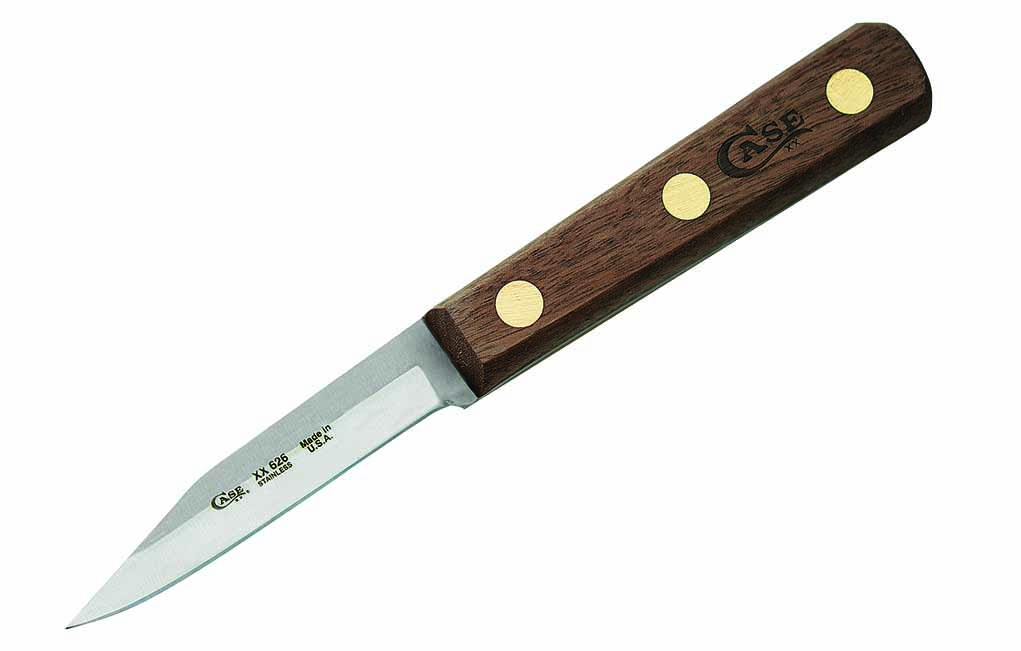
 Case has two paring knife blade styles: a spear and a clip point (shown here). “The clip-point version excels at chopping smaller food items because of its blade design and the blade edge, which mirrors the flat cutting surface when used correctly,” Case spokesperson Fred Feightner noted.
Case has two paring knife blade styles: a spear and a clip point (shown here). “The clip-point version excels at chopping smaller food items because of its blade design and the blade edge, which mirrors the flat cutting surface when used correctly,” Case spokesperson Fred Feightner noted.

“We use classic walnut wooden handles that have been used in millions of kitchens over time,” said Fred Feightner, Case senior marketing communications manager. “We purposely wanted these new kitchen knives to look, feel and perform like the Case household knives of old, and we feel our current offerings do just that very well.”

Case debuted the knife in 2012 while reintroducing its household line—in part by demand from its fans and also as a way to expand its brand and possibly place the knives with retailers who emphasized kitchen supplies.

Consumer advocates insisted on a simple handle design: a straight .5-inch-thick wooden handle, Feightner said. For the blade, the company turned to its Tru-Sharp™ surgical steel—the Case version of 420HC stainless—sabre ground and polished to a satin finish to resist the corrosion that can occur working around food.

The company has two paring knife blade styles. While the spear point slices and dices with ease, Feightner confided, “The clip-point version excels at chopping smaller food items because of its blade design and the blade edge, which mirrors the flat cutting surface when used correctly.”

It’s a knife Feightner says, despite its size, can hold up to kitchen tasks most anywhere. As he noted, “We think our paring knives are perfectly weighted so that intricate work is as easy as tougher jobs around the kitchen and at the barbecue pit.”

Household Cutlery 3-inch Clip Point Paring Knife Specs
Blade length: 3”
Blade steel: Tru-Sharp™ Stainless
Blade grind: Sabre
Handle material: Walnut
Handle thickness at its thickest: .5”
Overall length: 6.75”
Weight: 1.7 ozs.
Country of origin: USA
MSRP: $27.99

V Nives Emerald Paring Knife

Mike Vellekamp, owner and founder of V Nives, indicated his company has recently entered the world of kitchen knives, too. At his house, the 8-inch chef’s knife is most often used to prep food thrown in a wok or barbecued.

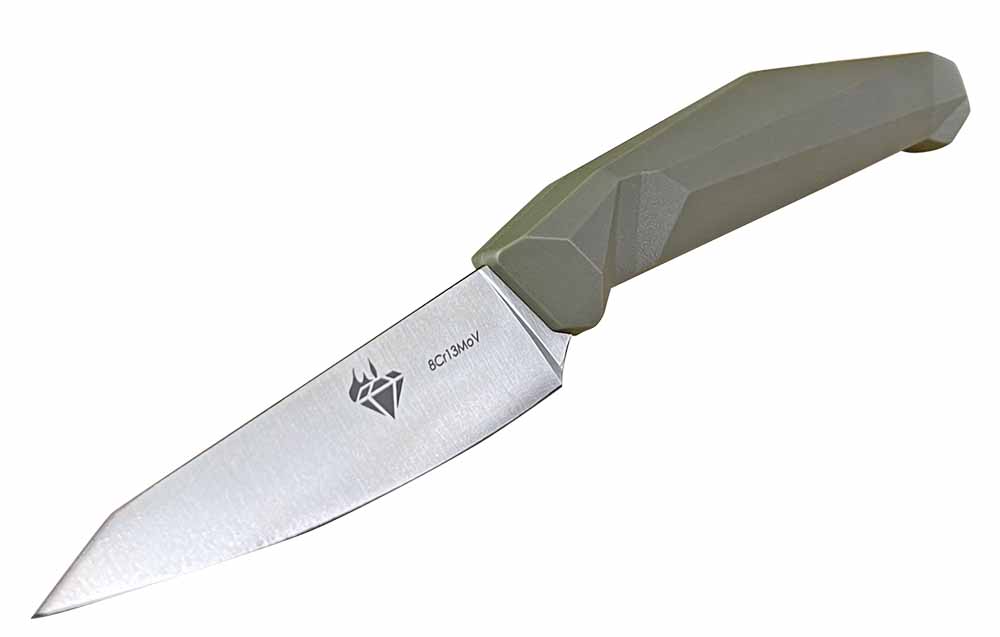
 The green handle—an exclusive color for V Nives—of the Emerald Paring Knife is injection molded around the blade tang.
The green handle—an exclusive color for V Nives—of the Emerald Paring Knife is injection molded around the blade tang.

“However, for day-to-day utility in the kitchen, the paring knife is definitely a must have,” Vellekamp said, adding the genre of blade is “optimal for intricate cutting, mincing, slicing and dicing fruits and veggies, deveining prawns/shrimp, and cutting herbs.”

And what V Nives offers won’t be the type of model found moldering in grandma’s cutlery drawer: the angular and green-hued Emerald Paring Knife. Vellekamp said it’s an example of a modern, innovative kitchen implement.

“DiaFire actually developed the knife,” Vellekamp said. “We have a close relationship with the brand, and we are the exclusive distributor for the Americas. We chose their kitchen products because of their dedication to innovation and quality.”

The Taiwan-made blade is 1/16-inch thick and flat ground from 8Cr13MoV stainless steel. “This is a great blade steel because it holds an edge very well for its intended uses, it’s highly corrosion resistant and it’s very easy to resharpen,” Vellekamp noted.

The green handle—an exclusive color for V Nives—is injection molded around the blade tang, making an ergonomic handle that runs between .417 to .645 inch thick. It’s a grip Vellekamp calls tough and light. And while he and other knife enthusiasts will tell you it’s a terrible way to treat your most important tool in the kitchen, the handle can survive a trip through the dishwasher if the, er, less knife enlightened put it there.

“These knives are a perfect example of high value at an affordable price,” Mike said, “and I believe it is a perfect complement to the modern kitchen.”

Emerald Paring Knife Specs
Blade length: 3.5”
Blade steel: 8Cr13MoV stainless
Blade grind: Flat
Blade thickness at its thickest: .059”
Handle material: Nylon and fiberglass injection molded
Handle thickness range: .417 to .647”
Weight: 4.25 ozs.
Overall length: 8.15”
Country of origin: Taiwan
MSRP: $42

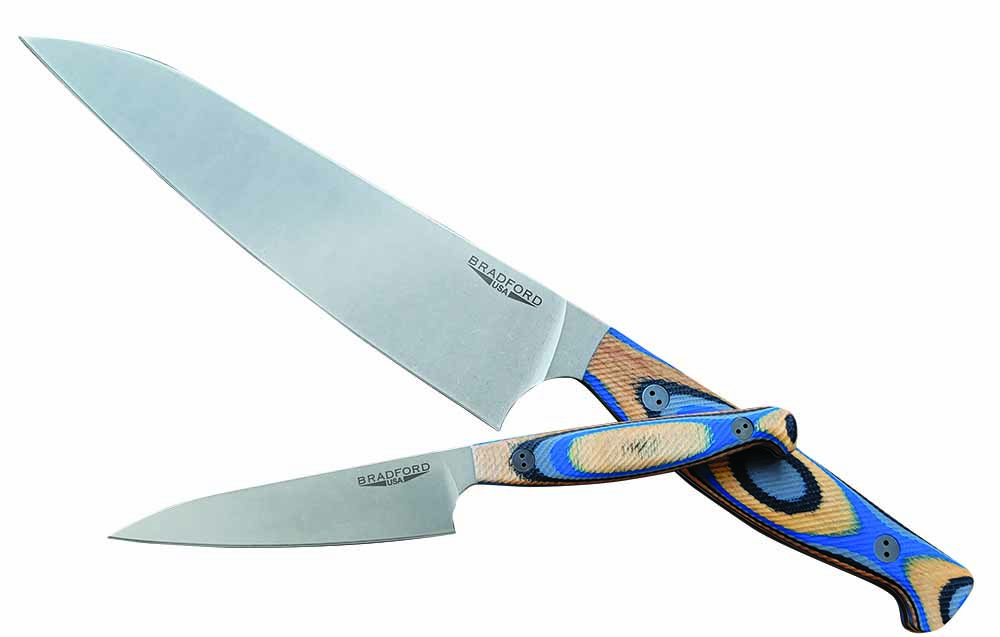
Bradford Knives Blue G-Wood Paring Knife

Brad Larkin of Bradford Knives said a wise knife collector once told him that any good chef’s knife needs a paring knife sidekick. As a result, he’s happy with the Washington state-based shop’s flagship paring knife.

 Brad Larkin of Bradford Knives said the handle of the company’s Blue G-Wood Paring Knife is designed to be held in a surgical-like pinch grip. He indicated the result is a lightweight knife focused on fine cutting.
Brad Larkin of Bradford Knives said the handle of the company’s Blue G-Wood Paring Knife is designed to be held in a surgical-like pinch grip. He indicated the result is a lightweight knife focused on fine cutting.

“It complements our chef’s knife so well and we do find that customers seem to enjoy a ‘set’ of kitchen knives as opposed to our EDC knives, which are very carefully built around specific daily uses,” Larkin explained. “In the kitchen you need to be ready for a quickly changing, dynamic environment, and our hope is that the paring and chef’s knives can accomplish these mission-critical chores.”

Over the years, Bradford has released different versions of its paring knife. Recently, the company issued a limited run of handles made from blue G-wood, a composite of G-10 and wood veneer. Stainless blade steel choices are edge-holding, corrosion-resistant AEB-L or tough M390.

Bradford, which is known more for its tactical and EDC models, returned to its culinary roots with the paring knife. The first edged tool it made was the Gatsby, a steak knife.

The company’s paring knife features thin blade geometry—just the way Bradford Knives prefers it. The .09-inch-thick blade has a distal taper. “Our process allows for a full flat grind. It does produce a very mild hollow-grind effect,” Larkin qualified, “but it is hardly worth mentioning.”

The handle is designed to be held in a surgical-like pinch grip. Larkin said the result is a lightweight knife focused on fine cutting, such as making fruit twists for cocktails, for instance, though it could be considered a medium-weight model compared to most paring knives.

“A paring knife can be the best for overall utility, especially considering our blade size is larger than the typical paring blade and it shares design elements with our chef’s knife,” he opined. “It’s a real slicer!”

Blue G-Wood Paring Knife Specs
Blade length: 3.8”
Blade steel: Choice of M390 or AEB-L stainless
Blade grind: Full-height flat
Blade thickness at its thickest: .09”
Handle material: Blue G-wood
Handle thickness range: .2 to .55”
Weight: 1.8 ozs.
Overall length: 7.5”
Country of origin: USA
MSRP: $129

What’s New: Top Knives—Damascus, Stainless Steel And More
0

Damascus, high-performance stainless and straight carbon steel standouts.

Always on the lookout for the new and exciting when it comes to edged gems, Blademag.com has collected a bevy of beautiful new knives hitting the market. This includes both custom and factory knives with a particular eye towards damascus, high-performance stainless and straight carbon steel standouts in this round.

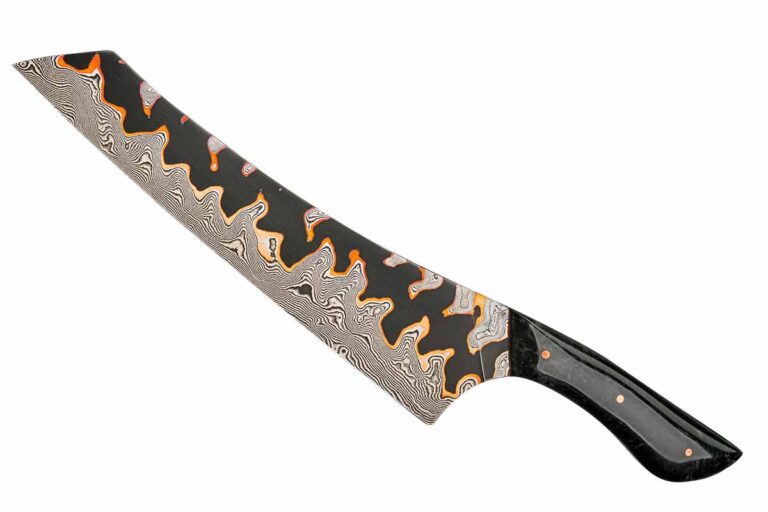
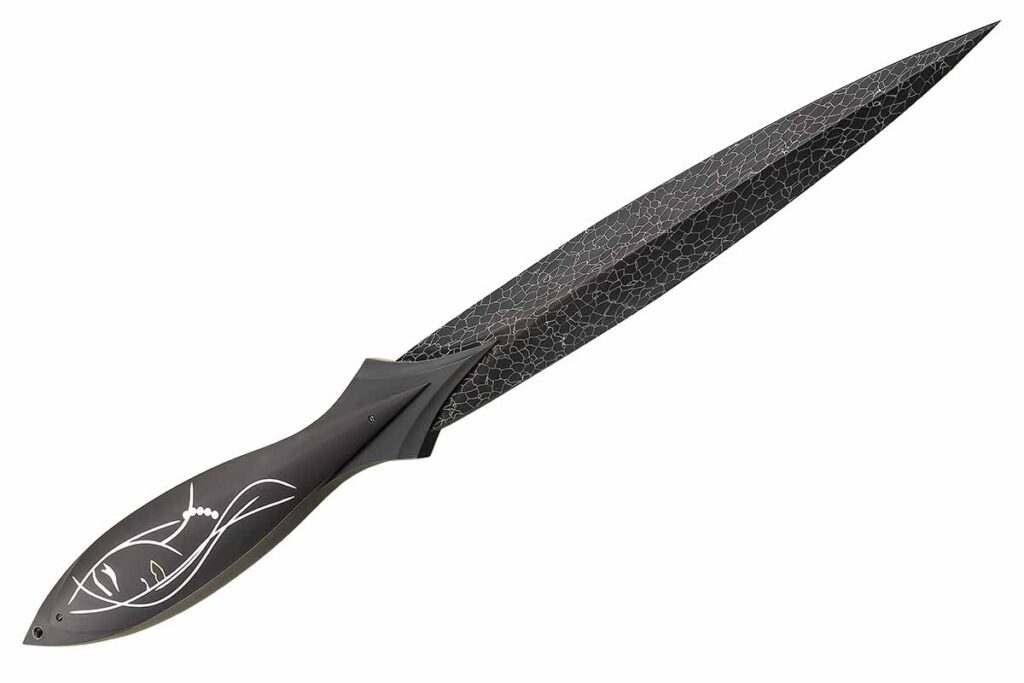
Bertie Rietveld: Flirt

Rietveld Knives Flirt

BLADE LENGTH: 7”
BLADE MATERIAL: Nebula damascus
BLADE GRIND: Hollow
FRAME MATERIAL: Zirconium
BOLSTER: Zirconium
ENGRAVING: Of fine silver by Bertie Rietveld
KNIFE TO KNOW: Stanhope lens in butt of handle
OVERALL LENGTH: 12”
MAKER’S PRICE FOR A SIMILAR KNIFE: $6,000
MAKER: Bertie Rietveld, rietveldknives.com (SharpByCoop image)


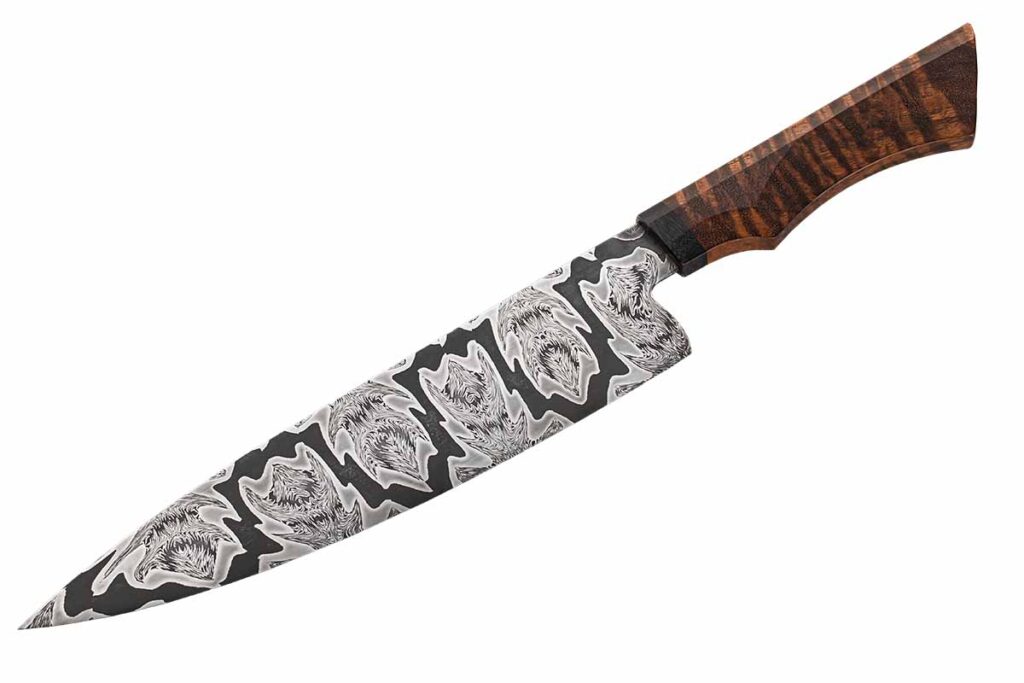
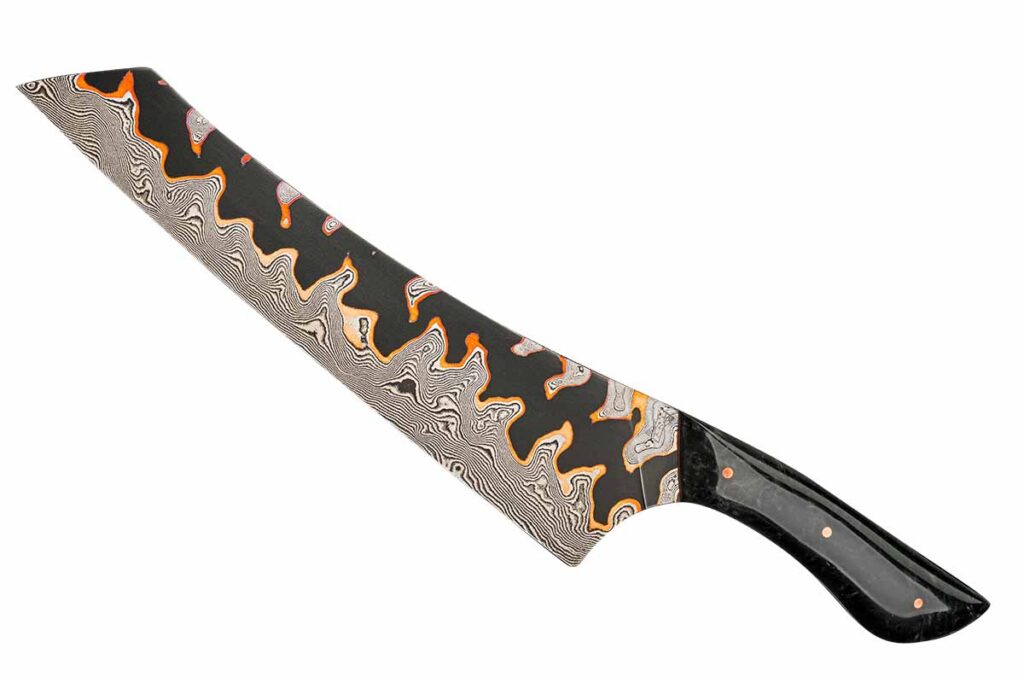
Keith Barthelmes: Serpent Chef’s Knife

Keith Barthelmes Serpent Chef

BLADE LENGTH: 9.5”
BLADE GRIND: Flat that tapers to a convex edge
BLADE MATERIAL: Serpent damascus of 1084 carbon and 15N20 nickel steels
HANDLE MATERIAL: Curly koa
BOLSTER: Black canvas Micarta®
OVERALL LENGTH: 15”
MAKER’S PRICE FOR A SIMILAR KNIFE: $1,600
KNIFE TO KNOW: Keith is an ABS apprentice smith and hopes to take his ABS journeyman smith test in two years
MAKER: Keith Barthelmes (Jocelyn Frasier image)


Matt Humphreys: Lockback Folder

Matt Humphreys Lockback Folder

BLADE LENGTH: 3.5”
BLADE MATERIAL: Damascus forged by Jim Poor
BLADE GRIND: Hollow
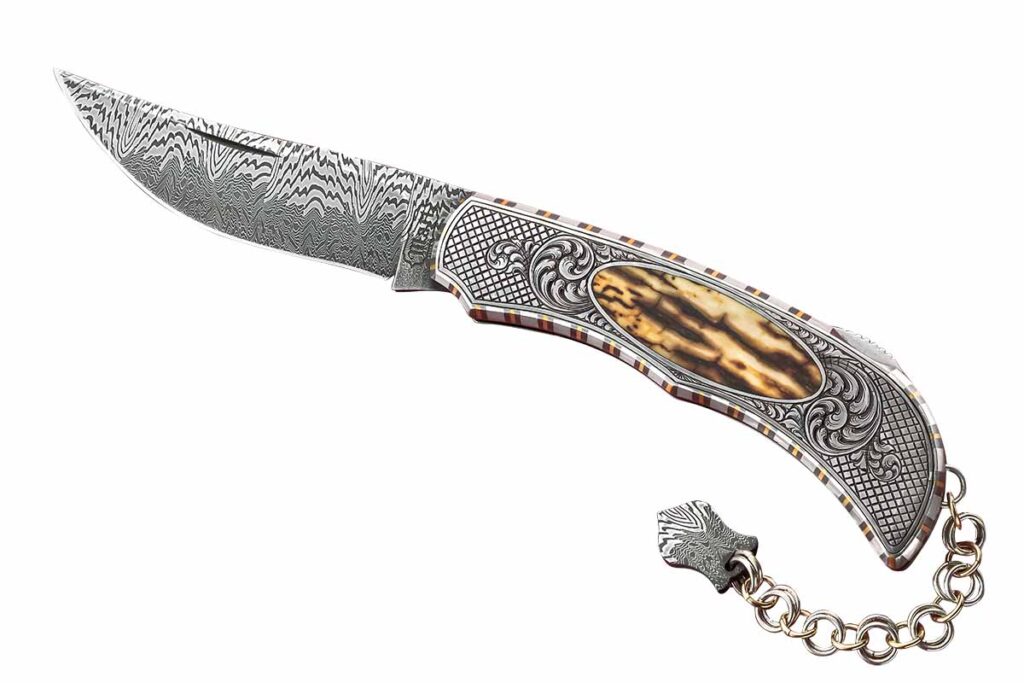
HANDLE MATERIAL: Ancient ivory inlay, 24k-gold and fine silver inlay, 14k-gold and sterling silver chain
FRAME MATERIAL: 4130 carbon steel
ENGRAVING: By Matt Humphreys
CLOSED LENGTH: 4.5”
MAKER’S PRICE FOR A SIMILAR KNIFE: $5,500
MAKER: Matt Humphreys, outlawwaterjetdesign.com (SharpByCoop image)


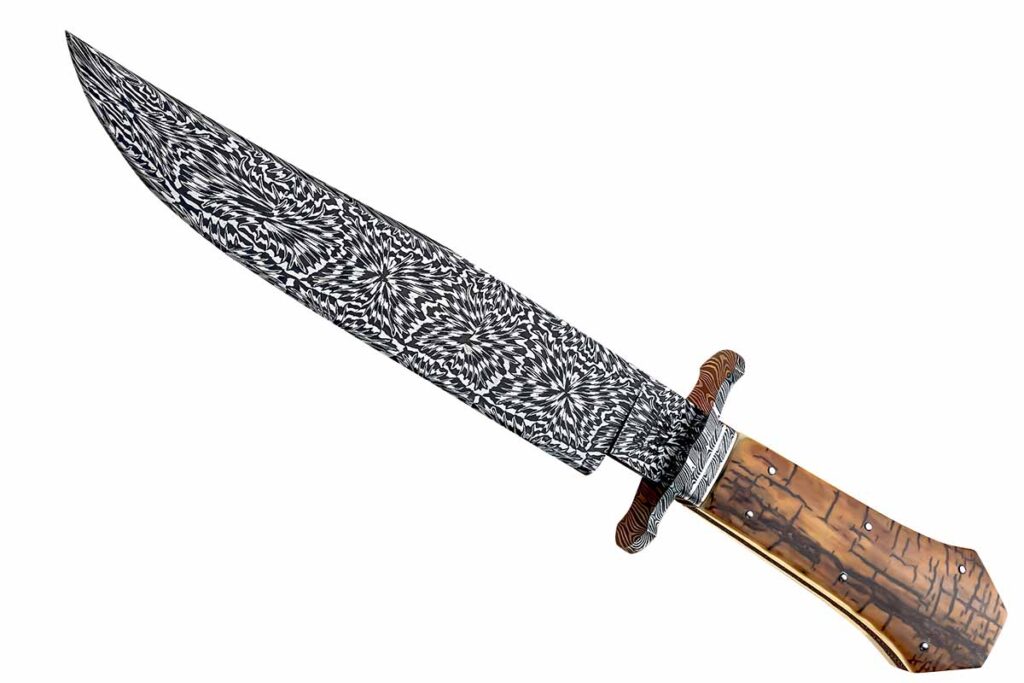
Shayne Carter: Coffin-handle Bowie

Shayne Carter Coffin-handle Bowie

BLADE LENGTH: 8.25”
BLADE MATERIAL: A mosaic explosion damascus pattern of 1084 carbon and 15N20 nickel-alloy steels
BLADE GRIND: Flat
HANDLE MATERIAL: Mammoth ivory
FRAME MATERIAL: Damascus
OVERALL LENGTH: 13.25”
MAKER’S PRICE FOR A SIMILAR KNIFE: $3,200
KNIFE TO KNOW: Shayne Carter is a master smith in the American Bladesmith Society (ABS)
MAKER: Shayne Carter, (SharpByCoop image)


CRKT: Monument 4001

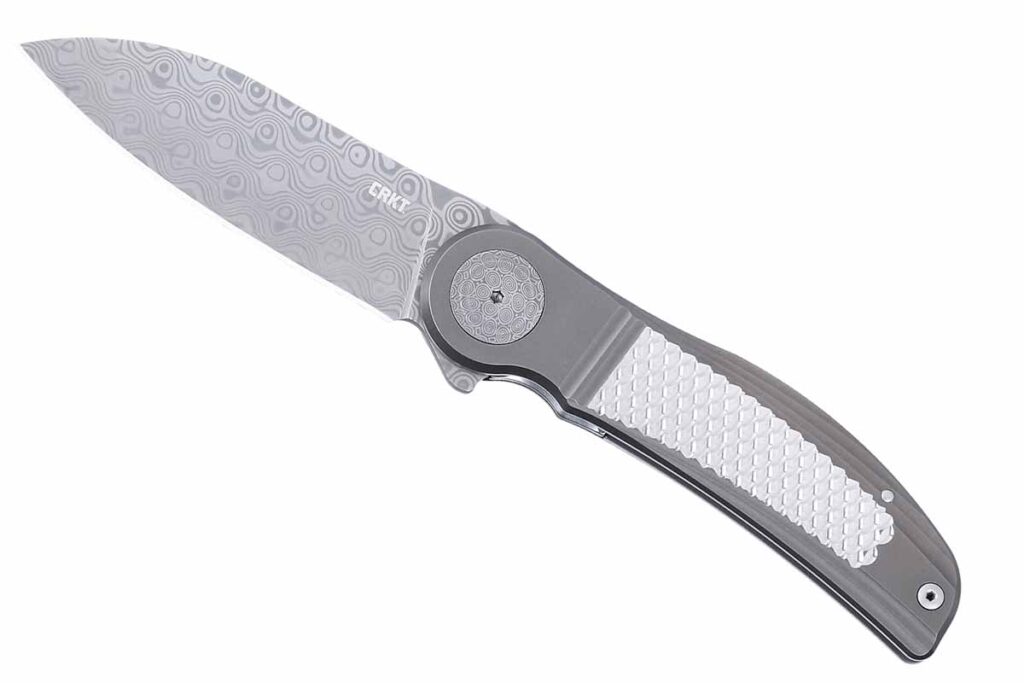
CRKT Monument 4001

DESIGNER: BLADE Magazine Cutlery Hall-Of-Fame® member Michael Walker
BLADE LENGTH: 3.07”
BLADE MATERIAL: Rose damascus by Damasteel
BLADE GRIND: Flat
BLADE PATTERN: Modified sheepsfoot
HANDLE: Titanium w/white dragon scale inlay
PIVOT: Damascus in a Bluetongue pattern by Damasteel
ACTION: IKBS ball bearings
LOCK: Linerlock
POCKET CLIP: Deep-carry design
WEIGHT: 3.9 ozs.
CLOSED LENGTH: 4.17”
COUNTRY OF ORIGIN: Italy
MSRP: $500
COMPANY: CRKT, crkt.com


TOPS Knives: Steel Eagle 105C

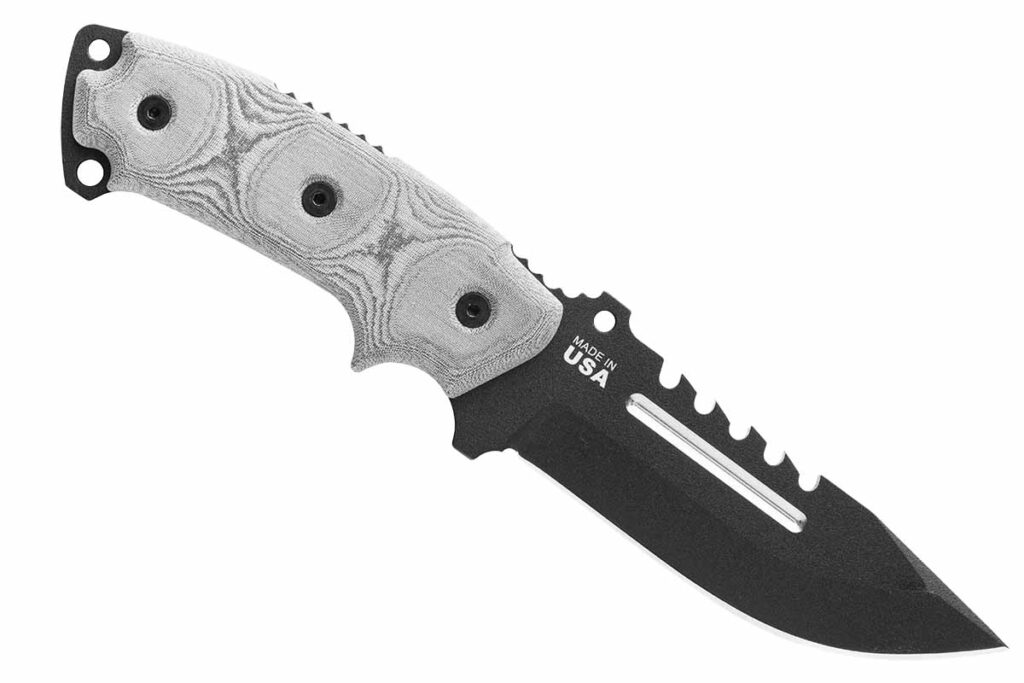
TOPS Steel Eagle 105C

BLADE LENGTH: 5.13”
BLADE MATERIAL: 1095 carbon steel
BLADE THICKNESS: .25”
BLADE FINISH: Black Traction Coating
HANDLE MATERIAL: Black linen Micarta®
WEIGHT: 15.3 ozs.
OVERALL LENGTH: 10.5”
SHEATH: Black Kydex w/rotating spring clip
WEIGHT W/SHEATH: 18.6 ozs.
MSRP: $240
KNIFE TO KNOW: Sawteeth, full-tang construction
COUNTRY OF ORIGIN: U.S.A.
COMPANY: TOPS Knives, topsknives.com


Spartan Blades: Poros

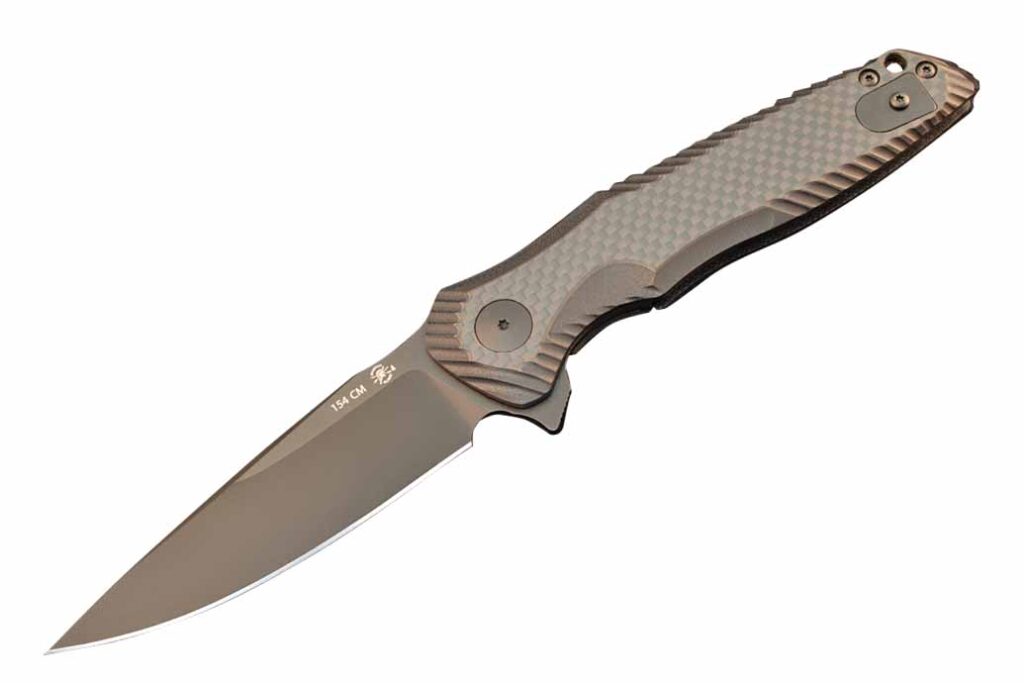
Spartan Blades Poros

DESIGNER: Curtis Iovito
KNIFE PATTERN: Flipper folder
BLADE LENGTH: 3.75”
BLADE Steel: 154CM stainless
BLADE GRIND: Flat
BLADE FINISH: Black titanium nitride coating
BLADE PATTERN: Drop point
PIVOT: Ikoma Korth Bearing System (IKBS)
HANDLE MATERIAL: Scalloped black G-10
LOCK: Linerlock
HARDWARE & LINER: Stainless steel w/electro-deposit powder coating
POCKET CLIP: Deep carry
WEIGHT: 5.28 ozs.
CLOSED LENGTH: 5.25”
MSRP: $180
COUNTRY OF ORIGIN: U.S.A.
MAKER: Spartan Blades, spartanbladesusa.com


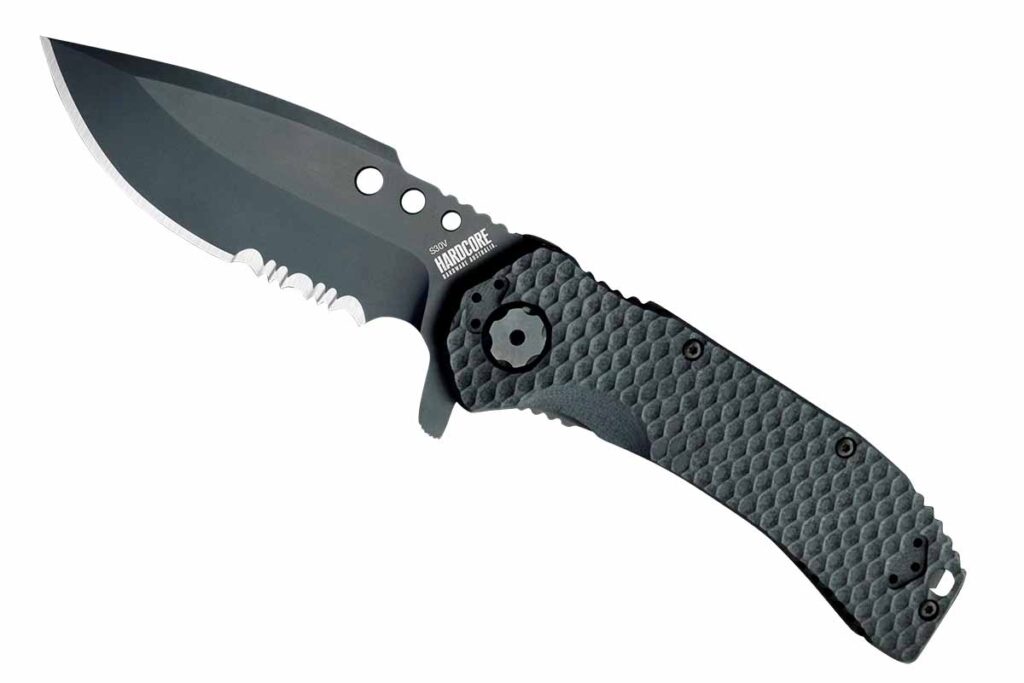
Hardcore Hardware: MILF-02PS

Hardcore Hardware MILF-02PS

KNIFE TYPE: Tactical flipper folder
BLADE LENGTH: 3.54”
BLADE STEEL: CPM S30V stainless
BLADE @ WIDEST: 1.18”
BLADE GRIND: Hollow
BLADE FINISH: PVD coated
WASHERS: Phosphor bronze
HANDLE MATERIAL: G-10
FRAME & LINER: 420J2 stainless
LOCK: Framelock
POCKET CLIP: Reversible tip up or down, ambidextrous
WEIGHT: 7.34 ozs.
CLOSED LENGTH: 5.51”
MSRP: $280
COUNTRY OF ORIGIN: Australia and Taiwan
COMPANY: Hardcore Hardware Australia, hardcorehardware.com.au


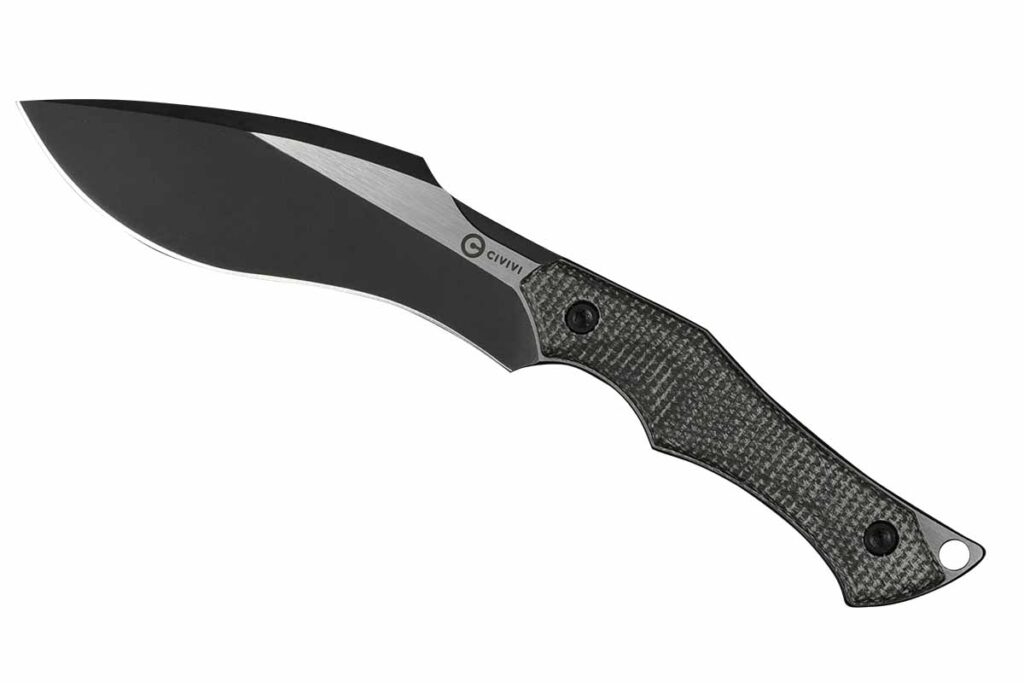
Civivi: Vaquita II

Civivi Vaquita II

DESIGNER: Nate Matlack
KNIFE TYPE: Fixed blade
BLADE LENGTH: 3.2”
BLADE Steel: Nitro-V stainless
BLADE GRIND: Flat
BLADE PATTERN: Kukri
BLADE FINISH: Black stonewash
HANDLE MATERIAL: Dark green canvas Micarta®
WEIGHT: 1.28 ozs.
OVERALL LENGTH: 6.23”
SHEATH: Black Kydex
COUNTRY OF ORIGIN: China
MSRP: $69.40
COMPANY: Civivi, civivi.com


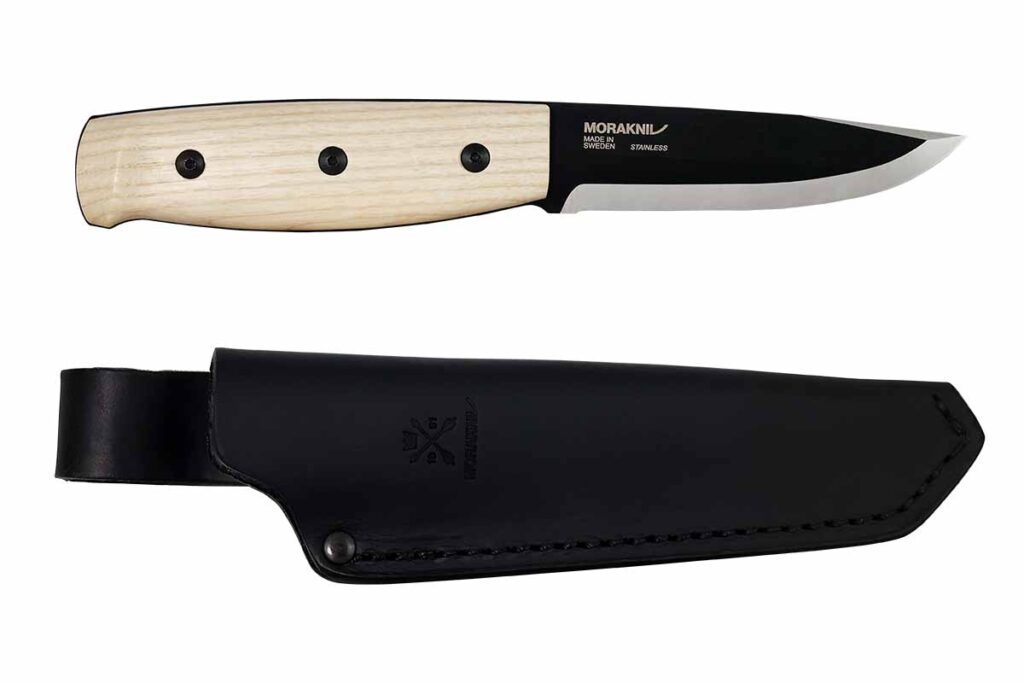
Morakniv: Bushcraft Knife

Morakniv Bushcraft

BLADE LENGTH: 4.05”
BLADE STEEL: Recycled Swedish stainless
BLADE THICKNESS: .098”
BLADE PATTERN: Drop point
HANDLE MATERIAL: Bright ash wood
CONSTRUCTION: Full tang
WEIGHT: 6.8 ozs.
OVERALL LENGTH: 8.38”
SHEATH: Vegetable-tanned leather w/belt loop; compatible with the Morakniv Dangler 10 w/button
KNIFE TO KNOW: Blade spine compatible w/a fire starter
MSRP: $240.07 (at press time rate of exchange)
COUNTRY OF ORIGIN: Sweden
COMPANY: Morakniv, industrialrev.com


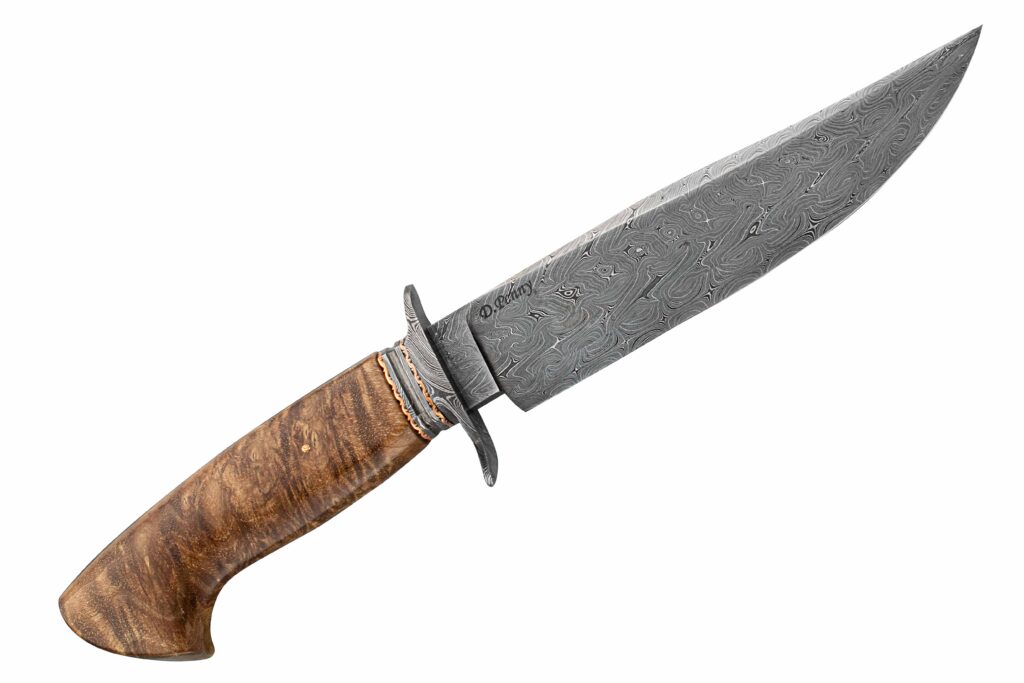
DP Custom Creations & Zero Down Forge: Fighter

DP Custom Fighter

BLADE LENGTH: 7.5”
BLADE STEEL: 300-layer, 4-bar, alternating twist damascu
BLADE GRIND: Flat
HANDLE: Blond claro walnut, thorn and vine accent copper spacers, and copper pin
FITTINGS: Twisted damascus guard and center spacer
OVERALL LENGTH: 12.5”
MAKER’S PRICE FOR A SIMILAR KNIFE: $1,100
KNIFE TO KNOW: Don Penny is an ABS apprentice smith
MAKER: DP Custom Creations & Zero Down Forge, (Jocelyn Frasier image)


Tony Cetani: Chef’s Knife

Tony Cetani Chef's Knife

BLADE LENGTH: 9”
BLADE STEEL: RipTide damascus by Baker Forge & Tool
BLADE GRIND: Flat
HANDLE MATERIAL: Amboyna burl w/copper pins and liners
OVERALL LENGTH: 14.25”
MAKER: Tony Cetani, HourGlass Knives, [email protected] (Baker Forge Studios image)


Check Out More Knife Drops:
Advertisement

Must Read Articles

Read this before you make a knife
Knifemaking 101 – Read This Before You Make a Knife

  by Wayne Goddard My experience has taught me that there's nothing like digging in and getting started. I've often said the hardest part of the...
how to forge damascus steel

How to Forge Damascus

Advertisement
Advertisement