Blade-o-philes from far and wide converged to cut in Fort Worth.
Knives and knifemakers with a worldly flair, a strong contingent of domestic cutlers, and makers and knife enthusiasts with a nod toward a promising future helped make BLADE Show Texas another entertaining way to start off the new knife show year.
Sweden’s Anders Hogstrom, South Africa’s Bertie Rietveld and Brazil’s Franco de Souza were among the overseas headliners, and BLADE Magazine Cutlery Hall-of-Fame® member Bill Ruple, Harvey Dean and Evan Nicolaides led the American charge, while 10-year-old Adam Storts of Duncan, Oklahoma, brought his special kind of fixed blades to the Fort Worth Convention Center March 6-8.
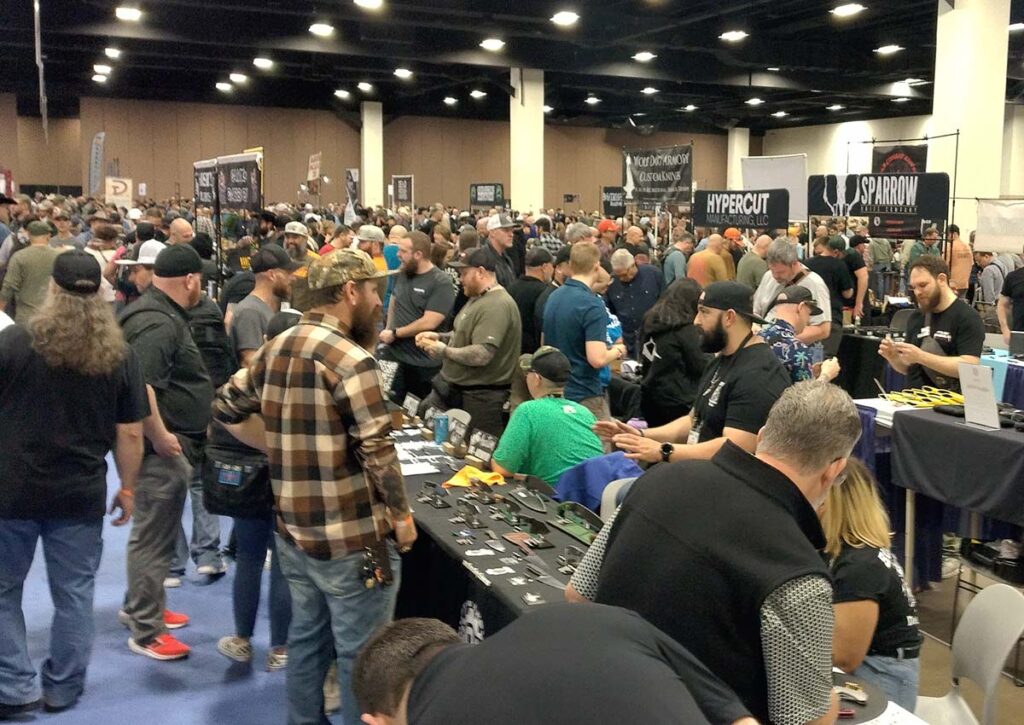
Knife fans and knives go wall-to-wall at BLADE Show Texas.
Adding to the youthful mix was knifemaker Tom Overeynder—not because he’s young but because he gave a knife to a happy 10-year-old knife enthusiast. (No word on whether the youngster gave Tom a penny in return; check out this story to learn more about the penny for a knife tradition). Meanwhile, the factory section was a beehive of activity throughout the show, drawing patrons of all ages.
Knife sales, the barometer of any show, were a mixed bag. Most of those who didn’t sell as well as they would have liked attributed much of it to an economy that was still in the throes of a downturn caused by inflation and lingering high prices for standard consumer goods and services. As a result of the economic uncertainty, many folks were understandably cautious about making large purchases. Exhibitors who did sell well, though, were upbeat.
FACTORY BEST IN SHOW/BEST IMPORTED The Poikilo Blade VK-Zen framelock folder has a 3.25-inch blade of Bohler M398 stainless steel with a “V” grind. Handle and pocket clip: titanium. Designer: Vulpex Knives. Closed length: 4.25 inches. Country of origin: China. It comes in four different configurations with MSRPs ranging from $380 to $700.
“I had a great show,” noted Jared Oeser. “I brought eight custom knives along with some productions and sold them all.” Business also seemed good for members of the South Texas Slipjoint Cartel, with Phil Jacobs selling 10 of the 14 knives he brought and Toby Hill selling eight of nine.
It was the first BLADE Show Texas for David Lisch and he liked what he saw. “It’s a great location and the size was good.” He brought 13 knives and sold 11, though only two to collectors. “The rest went to purveyors,” he noted, adding with a wink, “I was glad to have them there.” So was Paul DiStefano. “I brought eight knives and sold seven,” he wrote, “all of them to dealers and not individual collectors. I’m definitely not complaining about that.” Overeynder brought seven knives, selling four of his handmades and three out of his collection. “I also sold one a few days after the show to a guy who couldn’t be there,” he stated.
BLADE Show Texas Attendance
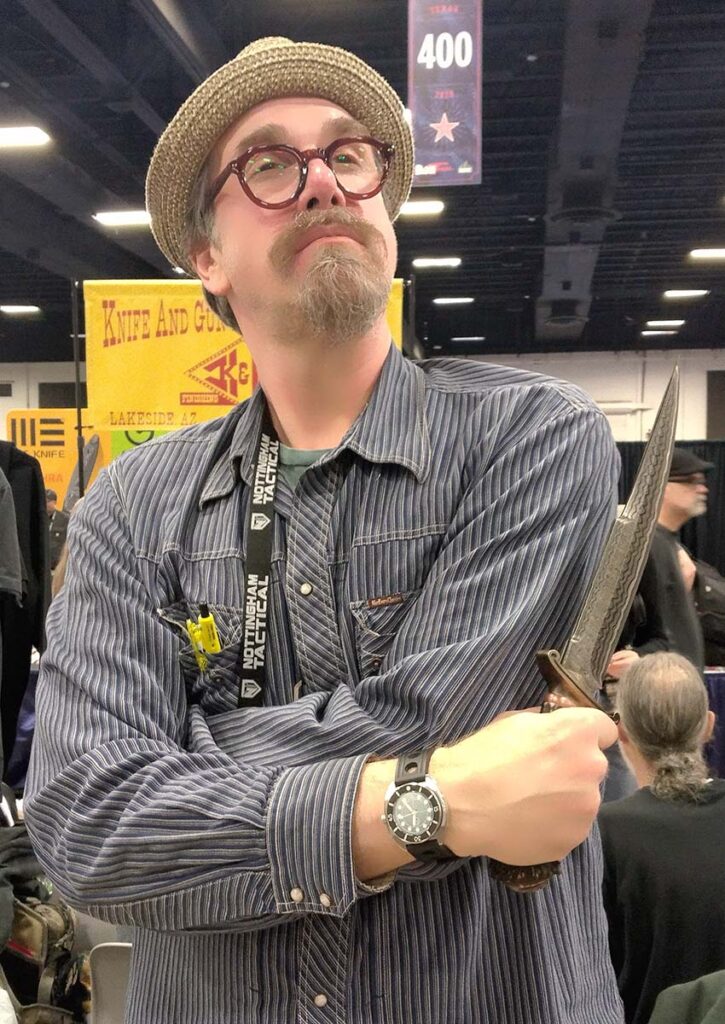
Sweden’s Anders Hogstrom appears pointedly pensive.
Show attendance graded out very well overall. “I think Saturday had more people than Friday. It seems like the local attendance in Texas is good,” Oeser observed. “I did meet new customers and friends, which was really great.” Overeynder indicated there was a “pretty constant flow of people,” agreeing with Oeser that Saturday had the most traffic, though noting it seemed to slow after 2 p.m. Considering the high number of exhibitors, Lisch said attendance was “just OK.” Added Andy Wang of Poikilo Blade, “Friday was moderately busy for us but Saturday we were packed almost the entire day.”
Josh Taylor brought seven pieces and sold two, including his award-winning sword cane and a fluted dagger. “I love BLADE Show Texas,” he wrote. “It was the first show I did in the BLADE Show world and I have been back four years in a row. Attendance seemed pretty solid considering the cold and the rain. My table was covered up with people for both days.”
“The attendance was all right. It seemed to be the same at what most shows are at, which from when I started going to shows seven years ago is slightly less,” DiStefano observed. Nonetheless, he indicated he enjoyed himself. “I thought the show was run extremely well and everyone involved was incredible! I for sure plan on coming back every single year. It was a great time.”
BLADE Show Texas Awards
The custom and factory knife judging competitions recognized an array of outstanding work. The custom knife judges were Michael Vagnino, Lin Rhea and Bill Burke, while the factory judges were Tom Krein, David Carver and Clayton Ensigner.
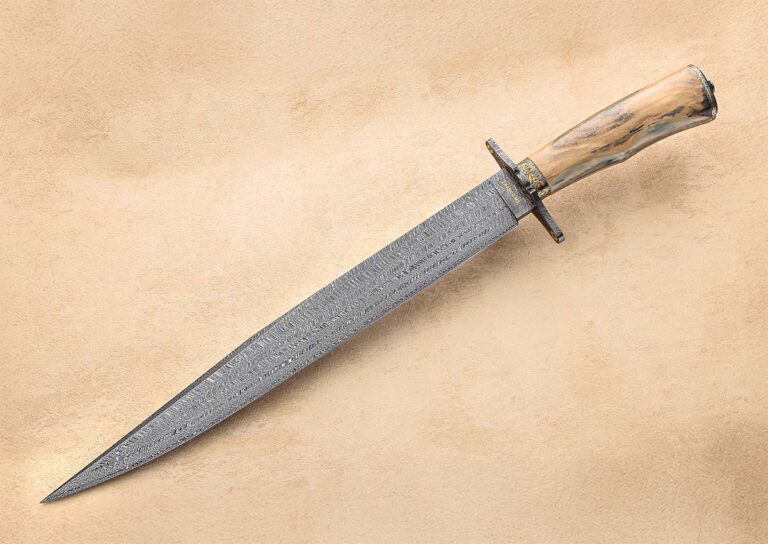
The custom winners were: Best in Show and Best Fighter: Franco de Souza; Best Folder and Best in Show Contender: Tom Overeynder; Best Art Knife: Paul DiStefano; Best Bowie: David Lisch; Best Damascus: Pedro Fornari; Best EDC: Evan Nicolaides; Best Hunter: Josh Fisher; Best Kitchen Knife: Luke Dellmyer and Richard Patterson; Best Slipjoint: Evan Nicolaides; Best M.A.C.K.: Jared Oeser; and Best of the Rest: Josh Taylor.
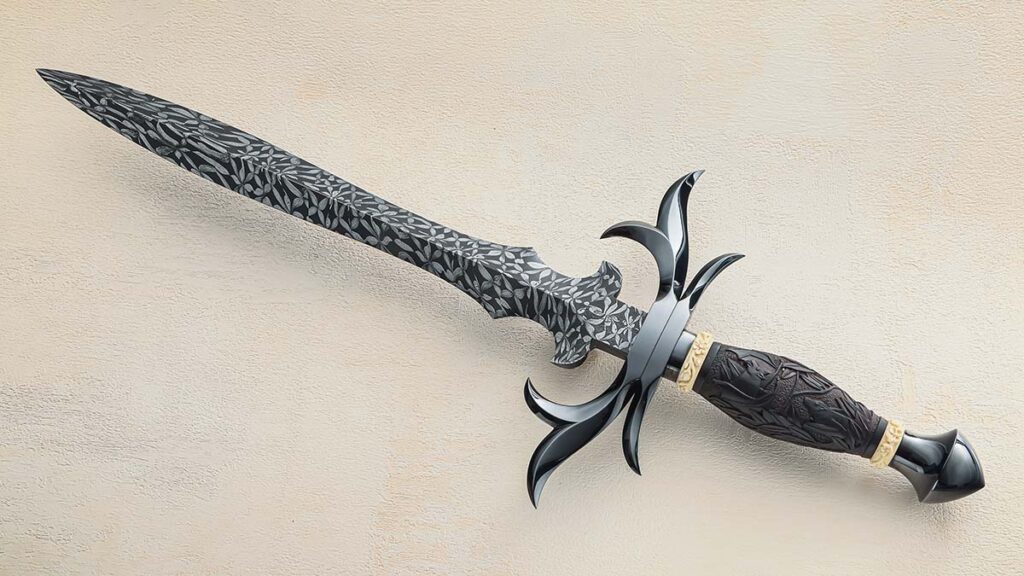
CUSTOM BEST ART KNIFE Paul DiStefano won for Megachiroptera with an 11.5-inch blade in a “mosaic damascus of with leaves,” a theme that carries over to the African blackwood handle carved as a eucalyptus tree abundant with eucalyptus leaves. Overall length: 17.5 inches.
The factory winners: Best in Show and Best Imported Knife: Poikilo Blade VK-Zen; Best American Made Knife: Dauntless Manufacturing Clifft; Best EDC: Dauntless Manufacturing Moss; Best Fixed Blade: QSP Viper; Best Folder: Pro-Tech/Vero Engineering Synapse Auto; and Best of the Rest: Vero Engineering Vortex TI Maintenance Kit.
The Newest Tactical Folder From Kershaw Looks Phenomenal And Is A Ton Of Fun To Use.
Yet again, Kershaw has produced an excellent piece with its new Outlier folding knife. Featuring a Blackwash hawkbill blade, the Outlier is excellent for tactical use. The knife is made from 8Cr13MoV steel, and the handle is made from glass nylon.
Kershaw Outlier in the closed position.
The large steel ring at the end of the karambit-designed handle allows you to use the knife in a forward or reverse grip. Great for slicing and cutting, the Outlier is a great utilitarian knife as well, especially when it comes to doing things like cutting rope or cardboard.
The Outlier has an assisted opening and a reversible pocket clip so you can easily take it with you on the go. At an MSRP of $57.59, Kershaw has hit another home run.
Editor’s Note: This article was written by Mike Ableson.
Rhidian Gatrill reproduces the folding Marble’s Safety Hunter in grand style.
Rhidian Gatrill not only satisfied a personal goal of reproducing the classic Marble’s Safety Hunter but also parlayed it into Best Hunter and Best of Show at the 2024 Oregon Knife Show.
He said he had always wanted to reproduce the clever old pattern with the folding catch piece that covers the tip of the closed blade. Not only does the catch piece enable the folder to have a blade longer than the handle, it also locks the blade of the slipjoint knife open. As Rhidian noted, “I just thought the mechanism was really cool, and it’s a big knife. I like big knives, but mostly it’s just the mechanism.”
He found a copy of the original Marble’s patent drawing dated May 19, 1903, on the internet and used it as a reference to make the knife. ABS master smith Tommy Gann forged the damascus specifically for the repro. “Tommy and I discussed a collaboration, and I figured if a master smith was going to make some damascus for me then it should be for a big bad knife, and so the Safety Hunter was definitely it. I sent him my drawing,” Rhidian wrote, “and he forged the steel to fit the blade and parts.”
Gatrill Safety Hunter Specs Knife: Marble’s Safety Hunter reproduction Maker: Rhidian Gatrill Blade length: 5” Blade steel: A lower-layer, four-bar Turkish twist damascus forged by ABS master smith Tommy Gann Swing guard: Same material as the blade and sculpted by Rhidian Action: Slipjoint construction w/half stop; blade tip catch piece doubles as a lock to lock the blade open Handle material: European red stag in a Coke bottle pattern Bolsters: Stainless steel fluted by the maker Closed length: 4.75” Rhidian’s price for a similar knife: $5,000 ($3,500-$4,000 if in straight stainless or carbon blade steel)
Don’t overlook small tactical fixed blades for everyday carry.
When most blade fans talk everyday carry (EDC) knives, they usually mean folders. The two main EDC advantages of folding knives are they are convenient to carry and, except for that pesky pocket clip, easy to conceal. Of course, while many overlook the clip, others know it indicates you are carrying a knife.
Folders are designed primarily for smaller everyday chores—opening a box, peeling fruit and so on. This is especially true of slipjoints, which rely on you cutting away from yourself—which you should always do with all knives—and a half-stop as a safety device. Granted, when slipjoints were popularized long ago, lockback, linerlock and framelock folders were unavailable. The problem with both slipjoints and lockbacks is most take two hands to open and close, which, if you are trying to cut something you simultaneously must hold, can be inconvenient at the very least.
The late 20th and early 21st centuries saw a boom in the commercial availability of manual folders that could be opened and closed with one hand. Utilizing the flipper opener and the roller bearing system made the blade deploy quickly and smoothly, often even quicker than an automatic. With the perfection of linerlocks and framelocks, unlocking and closing the manual folder with one hand was no longer a problem.
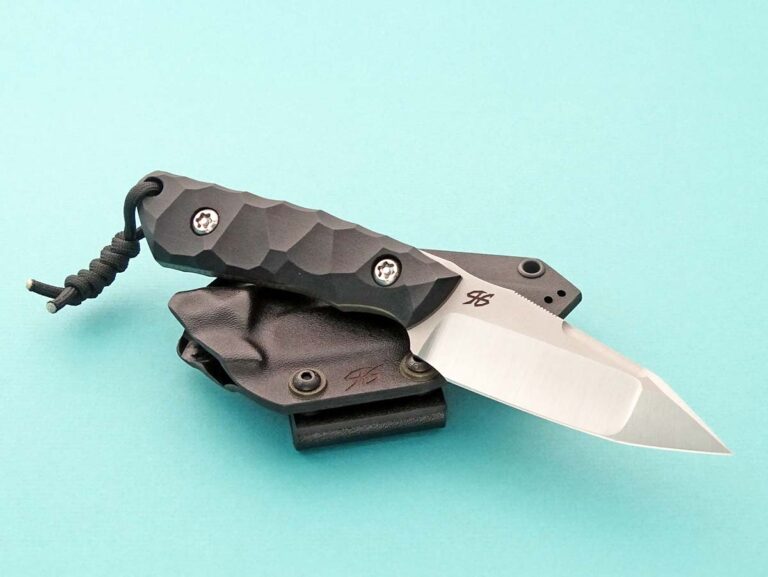
Kydex sheaths can be molded to fit the blade and, over time, will not deform, providing a safer carry option. Rafal Kolakowski uses Kydex® for the sheaths of his Ridgeline set of small tactical EDC fixed blades.
Even with these technical improvements, the folding knife still has its limitations. A small blade can do only so much before it bends or, in some cases, breaks. Some tactical folder makers tried to address this issue by making folders with 5-inch blades of 1/4-inch stock. This was done primarily for cosmetic reasons without addressing the folder’s primary weakness—the pivot. The very nature of the pivot means it must allow some side-to-side movement of the blade, no matter how slight. If the folder is used for an unintended purpose or put under undue force, the blade can be moved off-center.
On top of that, folding knives require more regular maintenance than fixed blades. Locking folders with back straps and slipjoints with backsprings collect dirt, lint, etc., during daily use and must be cleaned. What’s more, using a folding knife beyond its capabilities and failing to perform regular maintenance can affect its opening and closing ability. Lastly, a folder cannot do anything until you first deploy the blade.
Fixed-Blade Pros
Fixed blades, on the other hand, offer several advantages. As already suggested, larger fixed blades can do tasks that smaller blades either can’t perform or do so with difficulty.
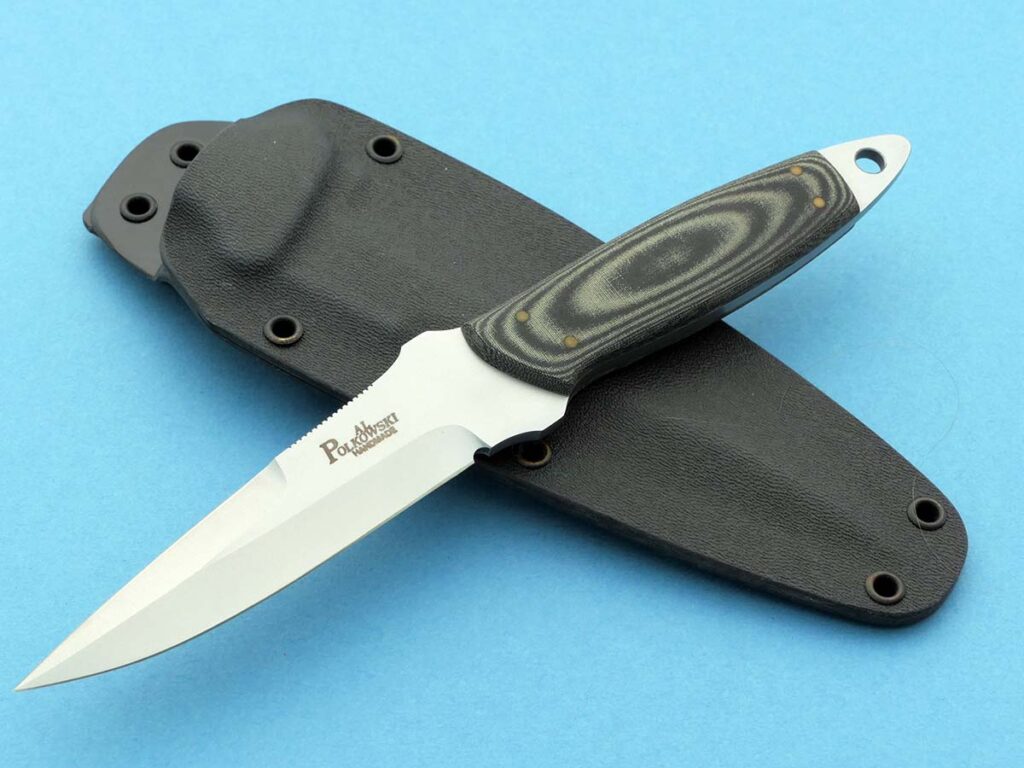
Finger/thumb serrations on the blade spine of Al Polkowski’s Boot Fighter help with controlling the knife in use.
One of the fixed blade’s most significant advantages is full-tang construction, providing added strength and durability. A full-tang fixed blade especially is better suited for heavy cutting and repeated hard use, and safer for use with a heavy load.
A fixed blade also has a superior mechanical advantage. Unlike the folding knife, there is zero chance of mechanical failure under stress. Locks and pivots can fail, especially when using the knife for tasks for which it is not intended.
Another advantage is the style and size of the blade. Fixed blades can feature longer and thicker blades that will perform better under the rigors of hard use.
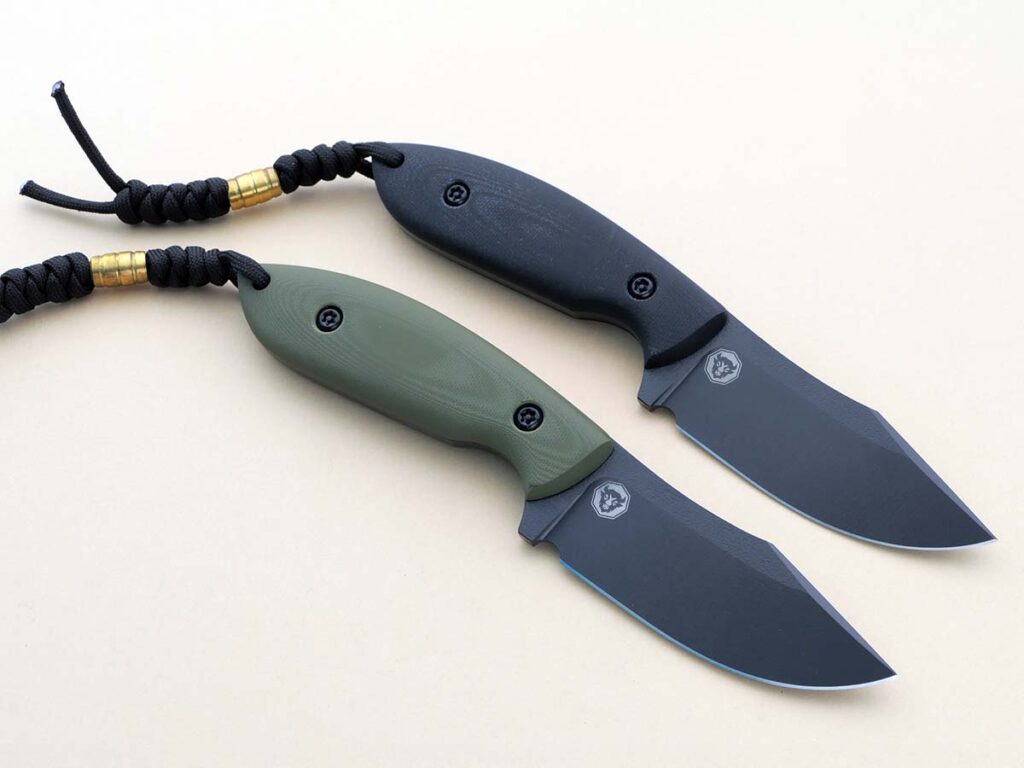
Full-tang fixed blades such as the Trailhead set by Tomasz Dziubinski are better suited for heavy cutting and repeated hard use, and safer for use with a heavy load.
A fixed blade typically will have better handle ergonomics. Its handle is usually designed for prolonged use, featuring a more comfortable grip that also aids in balance and is ready for immediate deployment. While many folders can be opened with one hand, not so slipjoints. If your hands are cold, wet, injured or gloved it can present a problem as many, if not all, slipjoints require two hands to deploy the blade or blades. On the other hand, with the correct sheath combination, a fixed blade can be rapidly deployed under almost any circumstance.
Sheath Concerns
Top material options for EDC fixed-blade sheaths are leather and Kydex®. Kydex gained popularity because it provides two main advantages over leather.
First, most makers can build at least a rudimentary kydex sheath. Leather sheaths are more of a challenge. Second, Kydex does not hold moisture and does not require tannic acid, which is used in the processing of leather. This is very important for EDC. Tannic acid in the leather can cause carbon steel to discolor. Leather, once wet, can shrink and/or deform, allowing the blade to accidentally cut or poke through it.
Conversely, Kydex does not hold moisture and does not require tannic acid. Kydex can be molded to fit the blade and, over time, will not deform, providing a safer carry option. Finally, the clip attachment on most Kydex sheaths can be adjusted to wear in either a vertical or horizontal position.
They Have The Edge
With the right sheath combination, a fixed blade can be rapidly deployed under almost any circumstance. The Street Scalpel by Rafal Kolakowski with Kydex® sheath and breakaway chain is a classic example.
I’m not suggesting that folders do not have advantages as EDC knives; they do. They are usually more comfortable and concealable to carry than fixed blades. They are more socially acceptable and usually have limited legal restrictions. They can provide versatility for light tasks such as opening letters, boxes, cutting cord, etc.
It is in fact the EDC folders’ size that is its biggest disadvantage. The smaller blades and less ergonomic handles limit the number of tasks folding knives can perform. Also, their moving parts provide a mechanical disadvantage when compared to EDC fixed blades.
The majority of this story’s featured tactical fixed EDCs have a 4-inch or shorter blade. Many tactical EDC folders also have 3.75-to-4-inch blades. When open, they are about the same length as the featured fixed blades.
With perhaps the exceptions of concealability and some legal restrictions, fixed blades have the edge. Depending on what you are using it for, you may want to consider a knife that has the mechanical advantage, requires less maintenance, can be easier to deploy in difficult situations or environments, and is more comfortable in the hand: fixed blades, the other EDC!
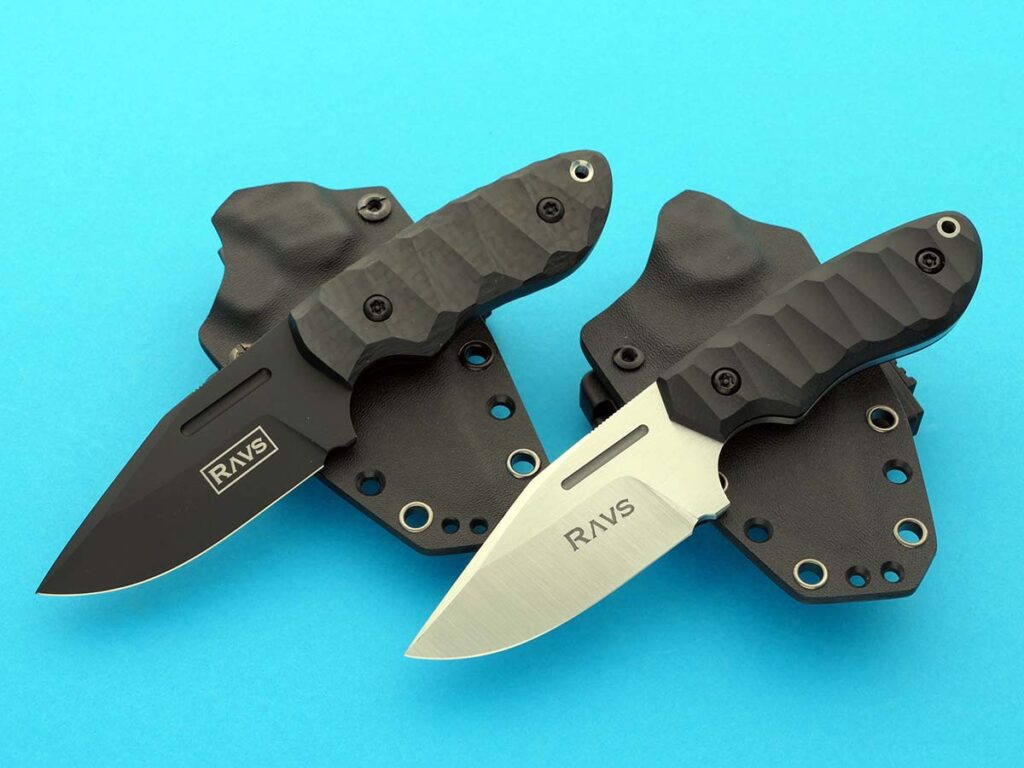
Rebel Specs Knife type: Small tactical EDC fixed blade Blade Length: 4.25” Blade Steel: Elmax stainless Blade Finish: Two-tone satin and bead blast Handle Material: Textured black Micarta® w/OD green Micarta liners Overall Length: 9” Sheath: Custom-built by the maker; Kydex® Author’s Comments: “Excellent all-around knife … the tip is ground to give the knife extra penetration … the texture of the black Micarta on the handle gives the user additional traction … primarily designed for belt wear, the clip can be configured for additional carry options … serrations along the top of the blade enhance the knife’s ability to handle small chores … a great knife that provides lots of user options.” Maker’s price: $430
Ridgeline Specs Knife type: Small tactical EDC fixed blade Blade Length: 4” Overall Length: 8.75” Blade Steel: Becut stainless Blade Finish: Satin Handle Material: Black G-10 Sheath: Custom-built by the maker; Kydex® Author’s Comments: “Double-hollow-ground blade with a fuller for added strength … full-tang construction … sculpted handle material for enhanced ergonomics … stainless-steel-tube-lined thong hole.” Maker’s Price: $350 each
Boot Fighter Specs Knife type: Small tactical EDC fixed blade Blade Length: 4” Blade Steel: 154CM stainless Blade Finish: Bead blast Handle Material: Black and green G-10 Overall Length: 8.25” Sheath: Custom-built by the maker; Kydex® Author’s Comments: “Great little back-up knife … it features a double-hollow-ground double edge with an extended tang that features a thong hole … quick and light in the hand.”
Trailhead Specs Knife type: Small tactical EDC fixed blade Blade Length: 3.5” Blade Steel: Sleipner stainless Blade Finish: Black Cerakote® Handle Material: OD green G-10 Overall Length: 8.25” Sheath: Custom-built by the maker; Kydex® Author’s Comments: “Flat-ground, upswept utility-style blade … full-tang construction, excellent handle ergonomics … small knife built for hard work … stainless-steel-tube-lined thong hole … perfect knife for camping, a hike and everyday carry.” Maker’s Price: $280 each
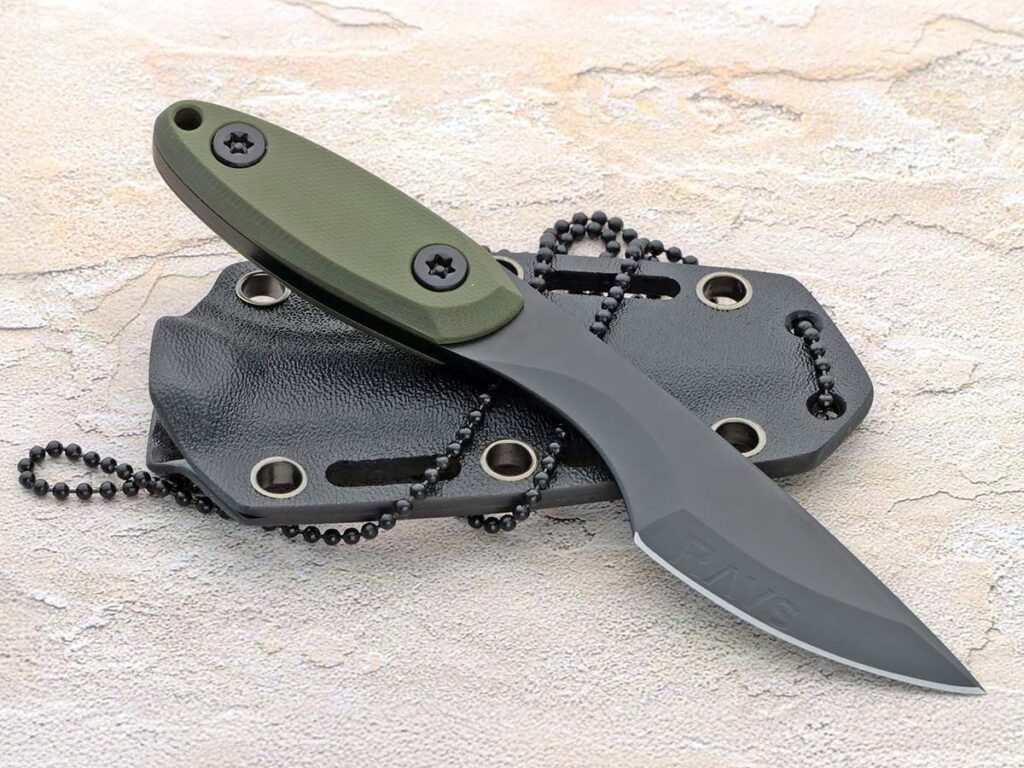
Street Scalpel Specs Pattern: Tactical fixed-blade neck knife Blade Length: 2” Blade Material: 80CrV2 carbon steel Blade Finish: Black Cerakote® Handle Material: OD green G-10 Overall Length: 5.9” Sheath: Custom-made, multi-position in Kydex® by the maker w/ball-bearing breakaway chain Author’s Comments: “Perfect for utility or self-defense … the attachment holes on the sheath allow the knife to be carried however you like.” Maker’s Price: $280
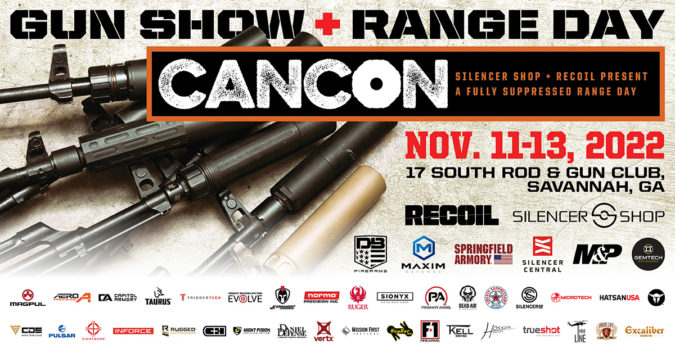
RECOIL magazine and Silencer Shop are excited to put on the first CANCON this Veteran’s Day weekend, November 11-13th, 2022, at the 17 South Rod and Gun Club near Savannah, in the great state of Georgia!
This is a big event with a lot to talk about, so we thought a guide to visiting might help some of you out.
WHAT, WHERE, AND WHEN IS CANCON?!
What:
CANCON is a gun show and fully suppressed range day brought to you by RECOIL and Gun Digest Magazines.
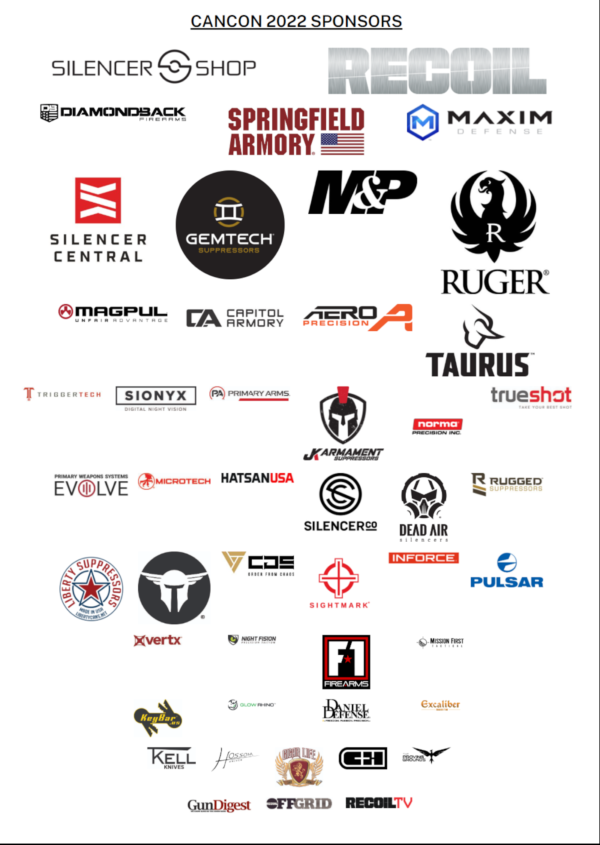
With over two dozen sponsors we’ll have hundreds of guns, suppressors, and optics for you to try out hands-on and on the range!
Ammo will be provided, all you need to bring is your shooting finger.
It’s not very often people get access to this many suppressors, guns, and accessories all in one place to actually try themselves. Don’t settle for just looking at them through glass, get yourself to CANCON and shoot them!
With over 50 lanes and acres of space, 17 South Rod & Gun Club is a wonderful venue for this event. If you’re not from the area, Fleming is about 30 miles south of Savannah, GA.
When:
November Friday the 11th, Saturday the 12th, and Sunday the 13th! Tickets are day specific, but you’re welcome to get multiple tickets for multiple days!
Veterans get in FREE on Friday!
THINGS TO DO!
The highlight of the range day will be guns. Lots of guns.
There will be a ton of sponsors with truckloads of guns and suppressors to try out!
From new releases like the Springfield Armory HELLION to classics like a Heckler & Koch MP5, there is going to be a lot of cool stuff to get your hands on.
CANCON 2022 Sponsors!
THINGS TO BRING!
Ammo is provided and refreshments are available for purchase. We recommend bringing some water and other supplies for a warm day in the sun. Hat, sunscreen, etc. Your own eye and ear protection are recommended but will be available on-site.
Personally, I like to bring a pair of shooting gloves to events like this just in case. Guns can get hot!
Entry tickets for a specific day include a certain amount of Lane Tickets together in a package.
Entry-Only Tickets
Provide entry into the event only. Visitors with Entry-Only tickets will need to purchase Lane Tickets at the event if they wish to shoot at one of the lanes.
Lane Tickets
One Lane Ticket can be exchanged at a shooting lane for one test shooting experience at a shooting lane. The amount of ammunition per experience is determined by the lane operator. Visitors must queue at each lane to get a turn for their experience and surrender a Lane Ticket to the lane operator. Lane tickets or turns cannot be combined to increase the amount of ammunition per experience.
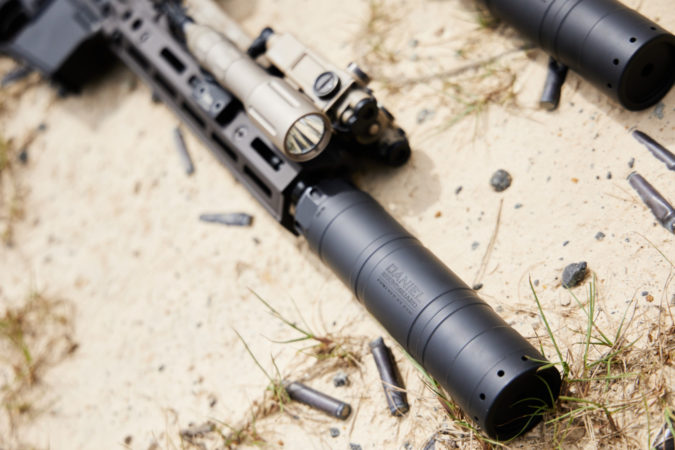
Daniel Defense will have their new SoundGuard line of suppressors at CANCON!
BRING THE FAMILY!
In addition to entry-only tickets for visiters who might not want to shoot, kids under age 12 get in FREE! Children are permitted to shoot with parental supervision, but tickets must be purchased for any children who would like to shoot. There will be kid activities available at the event!
COMING FROM OUT OF TOWN?
17 Rod & Gun Club is located in Flemming, GA but Richmond Hill is less than 10 miles away and a larger town with lots of accommodations. There are over 80 hotels with 20 miles of CANCON, so you have tons of options!
The collaborations of Gil Hibben and Paul Ehlers speak volumes without using words.
When the great design prowess of Paul Ehlers and the incomparable shop skills of BLADE Magazine Cutlery Hall-of-Fame® member Gil Hibben merged some 40 years ago, they produced a synergy seldom seen, elevating the knife industry to a new plane of creativity in the realm of the fantasy piece.
Following a trail blazed early by the likes of W.W. “Bud” Cronk, the pair brought vision and glimpses of other worlds from the realm of theory and the ephemeral to tangible, captivating and thoroughly gripping. During a custom knifemaking career that has spanned nearly seven decades, Hibben has been recognized as the author of extraordinary work, designing the first Browning hunting knives in 1968, earning a rightful place in the Cutlery Hall of Fame, and creating legendary knives for famed actor Sylvester Stallone in the Rambo film franchise, as well as the American Kenpo Knife for Gil’s martial arts sensei, Ed Parker.
Paul’s drawing of it and Gil wearing the gauntleted piece at an early ’90s Knifemakers’ Guild Show in Orlando. (Drawing courtesy of Paul Ehlers)
Ehlers is well known for his work in film, writing, voice, design and illustration. He was hired to produce a poster illustration for the 1981 cult classic film Madman and found himself cast as the title character, delivering an amazing performance. Versatility has been his hallmark through the years, expressing his artistic talent through a variety of media. His interests are literally boundless and his talents have been displayed across a broad spectrum of the arts.
It was Ehlers’ wide range of interests that led to a fortuitous conversation and brought about the most renowned collaboration in fantasy knife history—and one of the greatest industry wide in custom knives. “It arose from creativity on both parts,” attested Linda Hibben, Gil’s wife and a key individual through the years of the joint effort. “It was intended to create things that were never seen before in the knife industry, taking up the challenge to be true artists.”
Linda Hibben said Alien was the biggest Gil Hibben-Paul Ehlers showstopper and it’s easy to see why. (Image of Alien by Mike Carter)
Paul remembered, “Gil Hibben’s knives were featured in every martial arts magazine that I read. I was familiar with the Parker knife and wanted badly to buy one of Gil’s knives. So, by the mid-1980s I had saved enough money and placed an order with him.” Hibben produced a custom survival bowie with a 10-inch blade, characteristic sawteeth reminiscent of his Rambo knives, and a handle in the style of the Parker knife. Pleased with the finished product, Paul told Gil that he was a designer and illustrator with a particular love for fantasy characters. He commented that he had always wanted to see his characters with stylized knives and swords to complement their presentation.
Gil responded enthusiastically to Paul’s offer of sending an illustration for his review. “Love to see one!” was the reply. Game on.
Ehlers calls the initial brush with collaboration a “chance meeting of kindred souls.” The illustration led Gil to the shop with the goal of producing a knife named the Shark. A short time later, the designer asked about the maker’s progress. Hibben’s response was electrifying: “I already made it and sold it!”
Paul Ehlers conceived the Dragonfly, drew it on paper and mailed it to Gil Hibben, who took care of the rest. They exhibited the knife at the 1983 Knifemakers’ Guild Show, where it sold for $3,000—an unheard-of price in those days. (Eric Eggly/PointSeven image)
In a short time, the creative tandem gained momentum. Interestingly, their success may be linked to the fact that Paul does not make knives. “I admire, collect, use and draw them,” he commented. “But Gil Hibben makes knives.” By the time Gil and Paul brought their Dragonfly creation to the 1983 Knifemakers’ Guild Show, there was excitement but also some trepidation. “We were concerned about how to price it, whether it would sell and how it might be received,” Paul recalled. “Gil suggested that we put a price of $3,000 on it, and such a premium was almost unheard of in those days. But it sold!”
Ehlers had conceived the Dragonfly, drawn it on paper, rolled it up, and placed it in a mailing tube addressed to Hibben. When it reached him, Gil pursued the project with gusto even though the effort in itself was unprecedented. “Nothing like this had ever been made,” Paul advised. “But that didn’t stop him. He huffed and he puffed, he ground and he buffed and emerged from his shop holding the new Dragonfly.”
Unseen Realms
Gil Hibben made the Elf Dirk in 1984. The image for it sprang from Paul Ehlers’ fascination with gnomes, elves, giants and other mythical creatures. A spider dangles from its web, carefully crafted in a crevice of the handle. (Eric Eggly/PointSeven image)
Through the years the Hibben-Ehlers team flourished, one teammate with ideas and the other with the astonishing ability to grind steel and finish creations that brought visions of light, darkness, other worlds, and realms unseen as the tangible, real and dazzling works that are known the world over. Paul’s imagination effectively pushed Gil to new heights of creativity. The designer’s mind had remained fortuitously free to imagine the fantastic and the elements of the outer limits of innovation
“My mind was left open to create,” Paul explained. “If I knew then what I know now it is possible my concepts may have been restricted by the ‘impossible’ factor. I know now what other makers mean when they ask Gil, ‘How the hell did you make that?’”
Naja was completed in 1993. Norman Leigh’s sculpted bronze cast of a cobra rises above the grip, gazing with inset cat’s eye jewels for eyes and baring fangs. Paul Ehlers stated he considers Naja perhaps the finest art knife he and Gil Hibben have ever brought to life. (Eric Eggly/PointSeven image)
Hibben, on the other hand, has stood up to the challenge and then some, delivering time after time. As the collaboration aged like fine wine to more than 30 years, it had produced more than 40 pieces—knives that came to life, from the mist of imagination to the gleam of steel, sculpture and artistry. According to Linda, Gil once said, “I loved the challenges and making these pieces, each and every one of them. They made my creativity and skills set on fire! Paul’s dreams are my nightmares!”
Looking back, a turning point for the Hibben-Ehlers collaboration occurred in the 1990s when a representative of the Sultan of Brunei contacted Paul with the shocking pronouncement that his employer wished to purchase many knives produced by the pair, with the added kicker that “money is no object.” It was a compliment of the highest order and led to some remarkable achievements.
If it doesn’t have the signatures of both collaborators, it’s not a Hibben-Ehlers knife. Here’s how their signatures appear on Naja.
Throughout the collaborative years, Linda has been a tremendous contributor to the success of the enterprise. Gil is approaching his 90th birthday and suffered a stroke in the spring of 2016. However, he has been resilient and remains in touch with the custom knife community while Linda assists with his communications. Gil has stayed active in the shop and keeps up to date on the happenings in the knife community. “He still goes to his shop and even oversees knifemaking classes to this day,” Linda noted. “The only lingering effect from the stroke is he has trouble with words and numbers once in a while. He has no major lingering side effects other than that.” Ehlers, meanwhile, is quite busy with numerous endeavors, his creative energy as effervescent as ever.
St. George’s Axe is 22 inches long and features lost wax carvings by Richard Englers.
Linda captured the spirit of the great team’s aspirations, commenting, “They wanted knives to be taken to another level of art and imagination—to create and make sharpened shapes in steel that had not been done or seen before, and show that thinking ‘outside the box’ and making those creations into tangible works of edged art took a tremendous amount of skill. Just look at some of the grind lines Gil was able to accomplish.”
Showstoppers
Through the lens of knifemaking history and the gleaming facet of fantasy, those who see and admire the vision of Gil and Paul will continue to gaze with wide-eyed wonder at their works, including some of the most famous. The Alien, for example, was created in 1986 from a single piece of 440C stainless steel. “It burst from my mind in 1986,” Paul recalled. “There are a myriad of extra blades, spikes and projections Gil calls ‘long horns,’ plus hooks and a leather arm gauntlet.”
Gil Hibben and Paul Ehlers Exhibit their collaboration at the 1986 New York Custom Knife Show. (St. George’s Axe image by Eric Eggly/PointSeven; image of Hibben and Ehlers courtesy of Linda Hibben)
Linda noted, “The Alien was our biggest showstopper. This one got more attention at knife shows than any other. We allowed people to reach their arm into it and ‘wear’ the Alien, and in every instance the person’s entire demeanor changed. It was like they became powerful, and the smiles on their faces when posing for photos was and is priceless. Gil made a total of five of these Aliens, each one a bit different. Number five rests in our private collection, and to this day when people come over and actually hold or ‘wear’ it, the magic is still there. They become a ‘Master of the Universe’ for those few minutes.”
An early classic, the Elf Dirk was produced in 1984, and the image sprang from Ehlers’ fascination with gnomes, elves, giants and other mythical creatures. Hibben wrought its sleek lines in 440C with a reconstituted coral handle, 14-karat gold and garnets. A spider dangles from its web, carefully crafted in a crevice of the handle. Naja, completed in 1993, remains a favorite. The undulations of the cobra are almost physically felt as Norman Leigh’s sculpted bronze cast of the serpent rises above the grip, gazing with inset cat’s eye jewels for eyes and baring fangs. Gil’s expertise is on full display in this tour de force, and Paul considers Naja perhaps the finest art knife the two have ever brought to life.
Artists, innovators, visionaries and friends, Gil and Paul have created a body of work that speaks volumes without words, just towering interpretation and storytelling in thought and grind, idea and finish. Those who contemplate their many completed projects are often left speechless as well, awed by the intricacy, the timeless, tantalizing and touching renderings of their complementary experience.
Shop Dump: Top makers reveal the key equipment that helps them get the job done
“Shop Dump” is a new BLADE® feature showcasing the special knifemaking equipment of some of today’s leading knifemakers and bladesmiths. The new feature kicks off with ABS master smith Rick Dunkerley and knifemaker Jason Fry.
Rick Dunkerley
Rick Dunkerley
“I’ve been making knives for almost 40 years,” Rick Dunkerley observed, “and in that time I think I’ve developed a style that is recognizable as my own.” It’s specific equipment that plays a crucial role in him making knives in that style. There are many more tools that help along the way, but he uses seven in particular on every knife.
1. Propane Forge
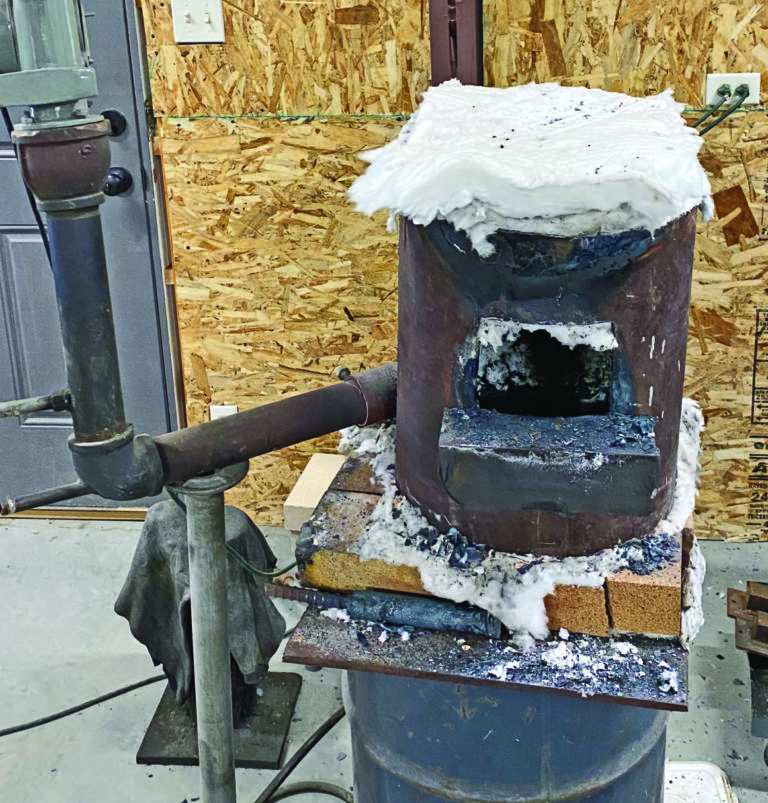
Dunkerley’s propane forge
His propane forge is homemade and the burner is over 20 years old. “It’s a vertical Don Fogg design,”he commented, “lined with ceramic wool lining. Since 99 percent of my knives are damascus steel, they begin in this forge.” Dunkerley began using his hydraulic press built by Billy Bob Sowell to forge damascus in the early 1990s. It’s Rick’s third hydraulic press, incorporating a larger cylinder, motor and hydraulic pump than his earlier models. The press helps him finish the damascus he forges.
2. eBay Bargain Surface Grinder
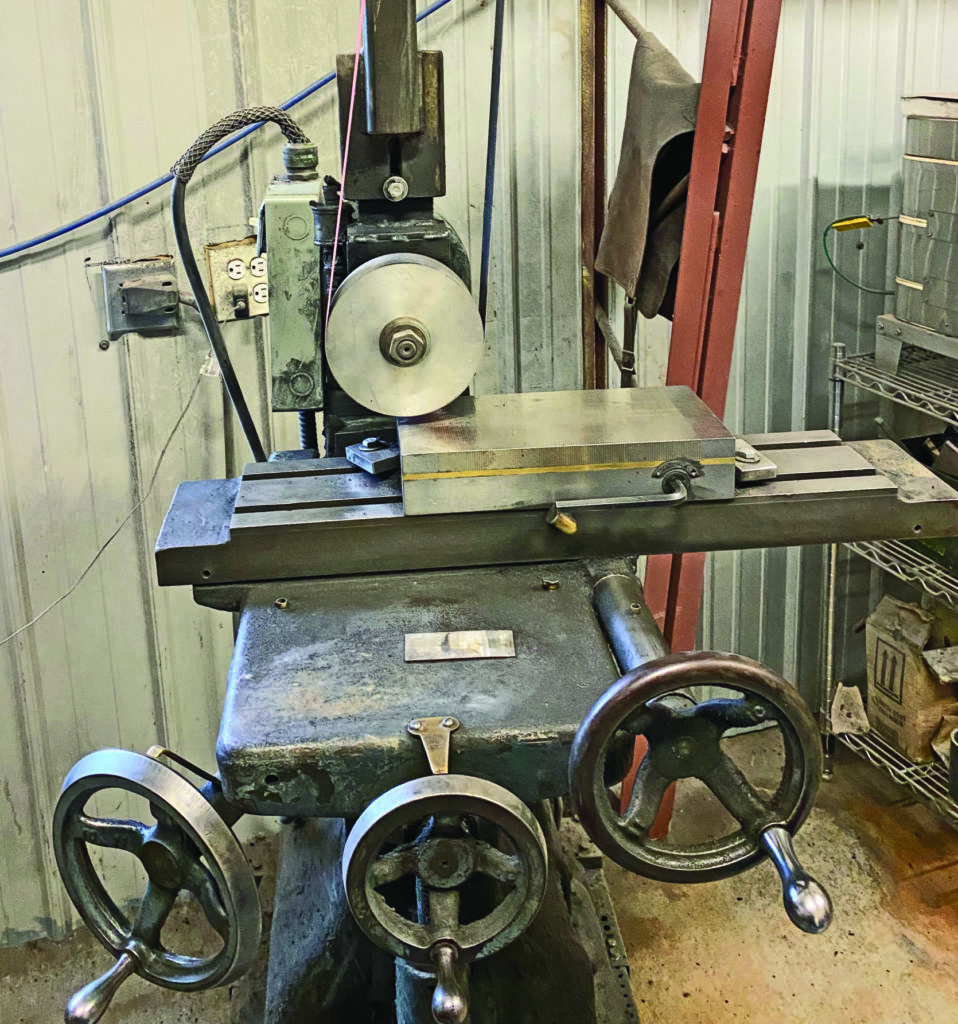
Surface grinder
An eBay-bargain ($300) surface grinder has served Rick well for 20 years. “I don’t know the make or the model,” he said, “and I changed it to a single-phase motor and converted it to run 2×72 belts with an aluminum contact wheel. It works on the damascus as it’s being made, and then precision grinds the blade and back bar material for my folders.”
3. Craftsman Drill Press
Dunkerley’s small Craftsman drill press “has drilled the holes on almost every folder to come from my shop,” he declared. “It’s very accurate and small, which is convenient as I can place it on my bench right next to my disc sanders. I added a keyless chuck to speed up the bit changes.”
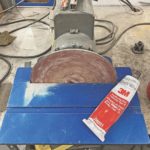
4. Tru-Grit Disc Sander
Tru-Grit Disc Sander
Rick’s 9-inch Tru-Grit disc sander is another machine he’s had for 20 years. “The disc is great for flattening material, dovetailing bolsters, shaping handles and grinding blades. It’s reversible and set up with a foot switch to allow me to place the material against the disc and then turn it on,” he explained. “I wouldn’t want to make knives without a disc sander. I actually have three in my shop and would like one more.”
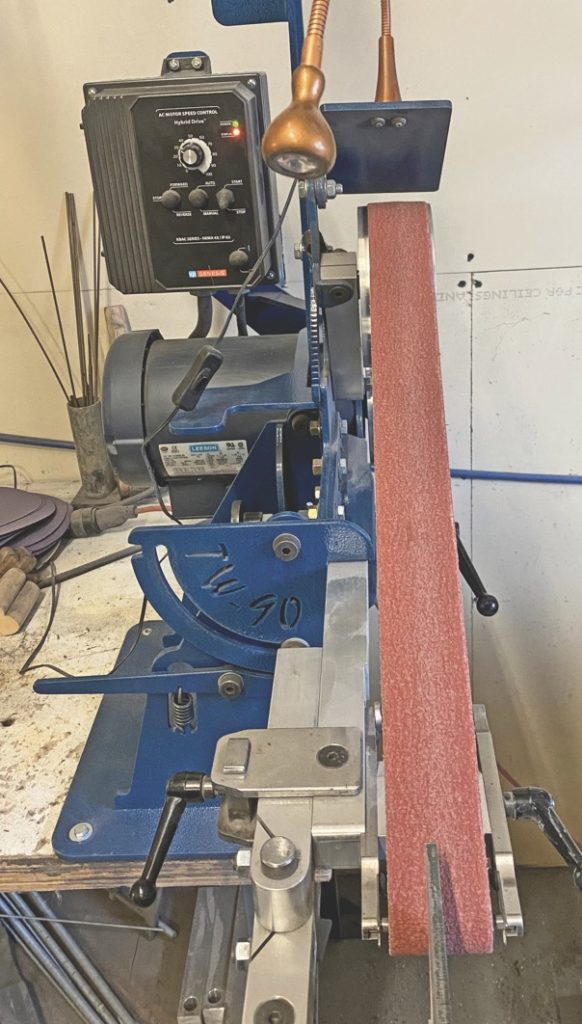
5. TW-90 Belt Sander
TW-90 Belt Sander
Dunkerley follows up with a TW-90 belt sander. “The versatility of this machine makes it one of the most used in my shop,” he remarked. “From rough grinding all types of material to fine finish work, this thing saves me huge amounts of time. The small wheel attachment and the fact that it turns into a horizontal grinder help me eliminate other machines that I would only use for specific jobs. The first time I saw one of these machines work, I knew it would make me a better knifemaker.
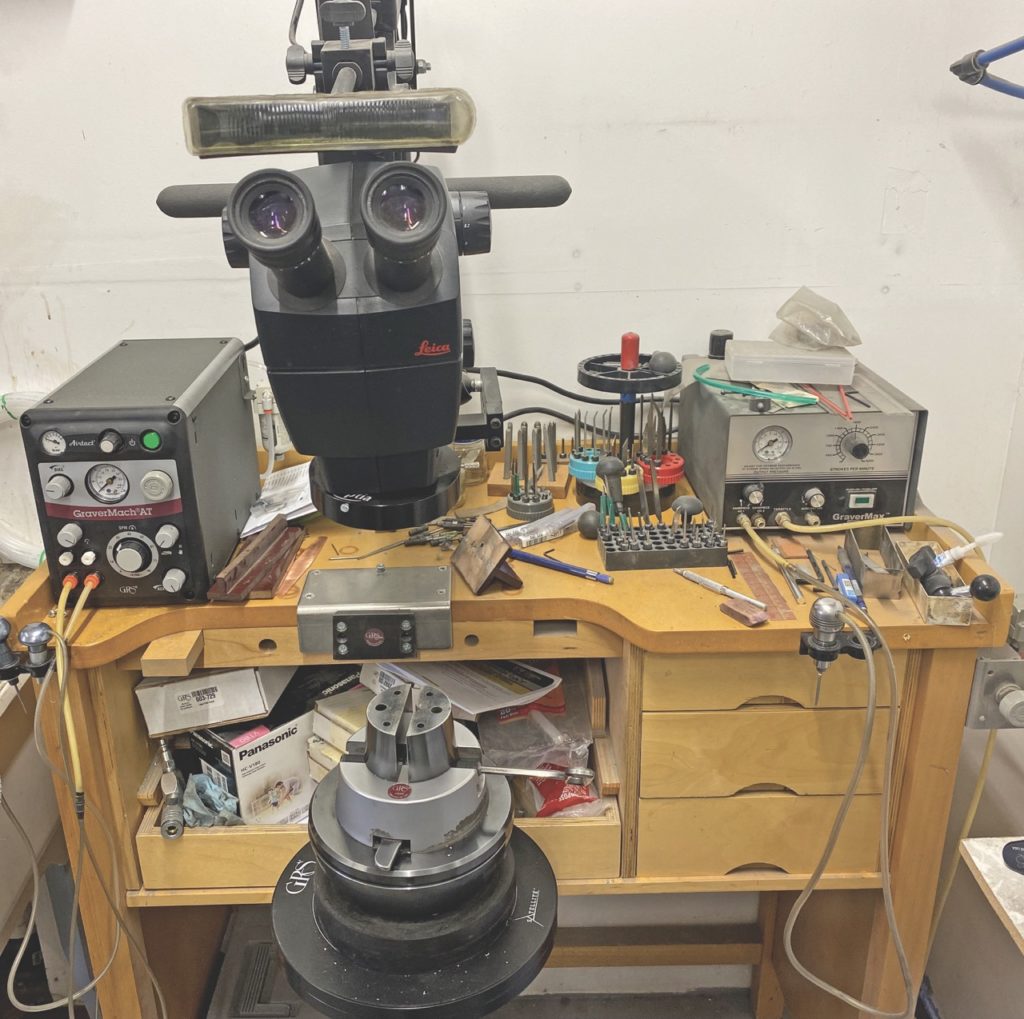
6. GRS Engraving Equipment
GRS Engraving Equipment
Rick uses his engraving equipment to give his knives an unmistakable quality and aesthetic. “Nearly every folder I make has engraving and some gold inlay,” he noted. “That happens here. My equipment was made by GRS and has served me very well. I continually think of new ways to use this equipment to add details to my knives.”
Jason Fry
Jason’s shop-proven equipment serves as a milestone along the way
Jason Fry
Jason Fry follows a direct route to excellence and each of his shop-proven pieces of equipment serve as a milestone along the way.
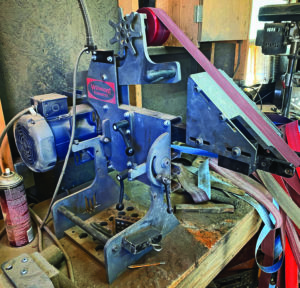
1. Wilmont Grinder
“My number one machine is my 2×72 Wilmont grinder,” he explained. “After 13 years on a homemade machine, I recently upgraded to the Wilmont Quattro.
Most of the recent high-end grinders will have variable speed, horizontal tilt, adjustable tool rests and specialty fixtures. This is the only ‘brand new’ machine I have ever purchased.”
Jason’s Wilmont Grinder
Fry adds a comparison of his heat-treat oven choice, relating, “You can argue Ford vs. Chevy or Evenheat vs. Paragon, but all the modern production ovens have digital temperature control. This gives the maker the ability to precisely dial in the heat treat of their chosen steels, and to heat treat stainless steels that require longer soaks at high temperatures.” Jason acknowledges that he bought a used Evenheat oven but he’s friends with all the folks at Paragon. “I got a good deal on the oven,” he smiled. “I had an old dental oven that I sold for three-fourths the price of my Evenheat, and it was a good upgrade.
2. File Guide
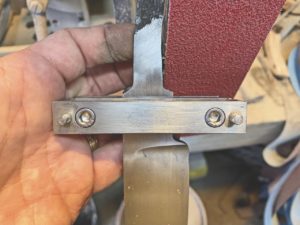
A file guide, such as this one by ABS master smith Bruce Bump, has carbide inserts that allow the maker to grind up against the guide and create a square shoulder on the blade.
“Another important tool is the file guide. I use a Bruce Bump file guide with carbide inserts. Bruce was an inspiration to me with his epic WIP threads in the forum days before Instagram, so I wanted one of his file guides when it came available.
3. Power Hammer
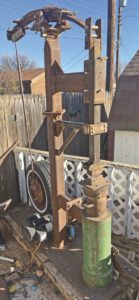
Jason’s power hammer
“My power hammer is a homemade ‘junkyard’ hammer in the ‘Appalachian’ or ‘Rusty’ basic design. It has a 40-pound head and hits at around 200 beats per minute. It makes the forging process faster and also allows me to efficiently make my own damascus. I chose the design because it was simpler to build from scrap than the tire hammer design.
“I competed on Forged in Fire back in May 2018 and my episode aired in September,” Jason added. “As I was preparing for the show, practicing forge welding and such, it came to mind to build a hammer. I prepared for Forged in Fire by building a hammer because even if I lost in the first round, I’d still have a hammer I could use for the rest of my career. This hammer took me about two months of intense weekends to build, and other than the initial test run, the first time I ran it was when I filmed the final [FIF episode] at my house. I still use it every forging session almost three years later, and having the hammer has made forging much more enjoyable and greatly expanded my capacity.”
Capitalizing on the right shop tools and equipment has made an enormous contribution in knifemaking, and listening to those who have been down the road gives others the opportunity to test, refine and choose what works best in their own shops. Meanwhile, the knife buyer can have an enriched ownership experience knowing more about the process and the pride that goes into each finished knife.