


New Knives May 2025
Have the yen to build our your collection? Just need a sharp new blade? Check out these new knives for May and build out your wish list.
Eyes always peeled, we’re on the look out for the latest and the greatest. We think we’ve found a bevvy of them this May. So, with out further adieu, here’s our latest round of new knives to add to your wish list.
Pearce Richardson Silver Swan
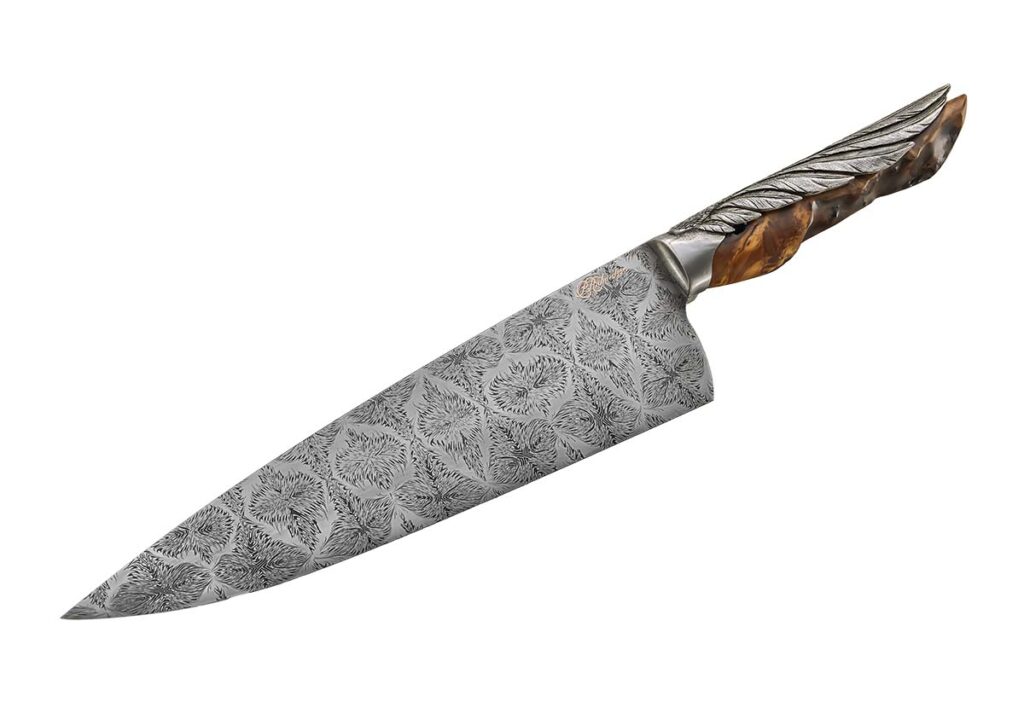
Model type: Chef’s knife
Blade length: 8”
Blade material: Mosaic damascus of 1084 carbon and 15N20 nickel alloy steels
Blade grind: Flat
Scales: Turkish olive wood root burl
Bolster: Mild steel
Overall length: 13.25”
Maker’s price for a similar knife: $6,500
Knife to know: The maker’s mark on the blade is brass inlaid; Pearce Richardson is an apprentice smith in the American Bladesmith Society
Maker: Pearce Richardson, icarusforge.com (SharpByCoop image)
Daniel Keown Big City Fighter
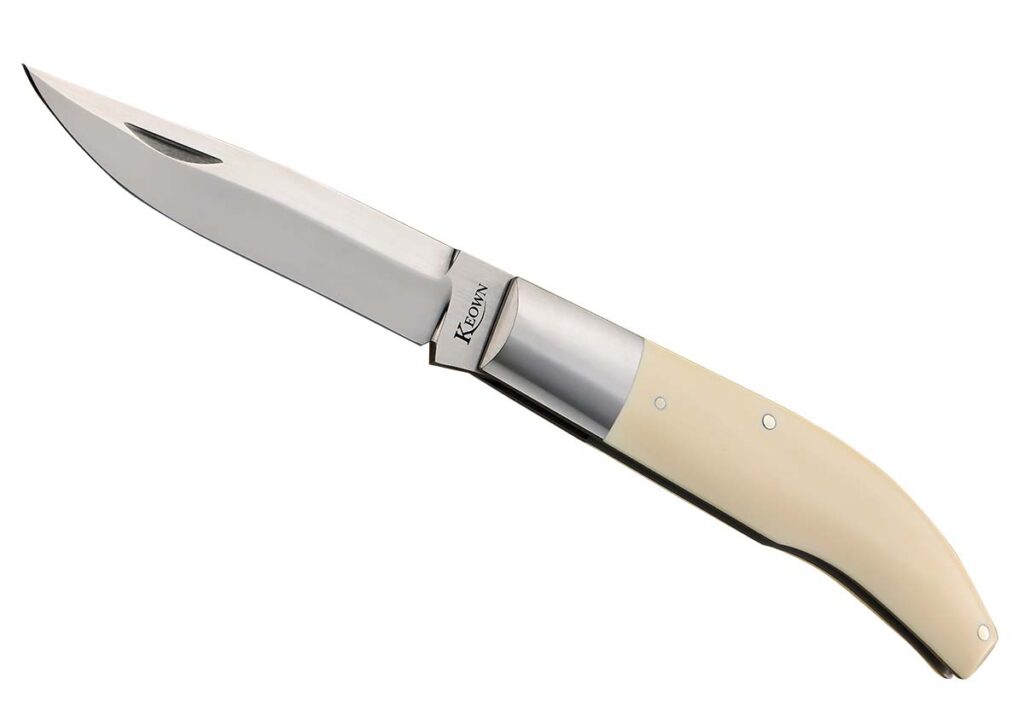
Knife type: Slipjoint
Blade length: 3.5”
Blade steel: AEB-L stainless
Blade grind: Hollow dagger
Handle frame: 416 stainless
Scales: Mammoth ivory
Bolsters: 416 stainless
Liners: Integral
Closed length: 3.5”
Maker’s price for a similar knife: $1,800
Maker: Daniel Keown, (SharpByCoop image)
Josh Hults Camp Knife
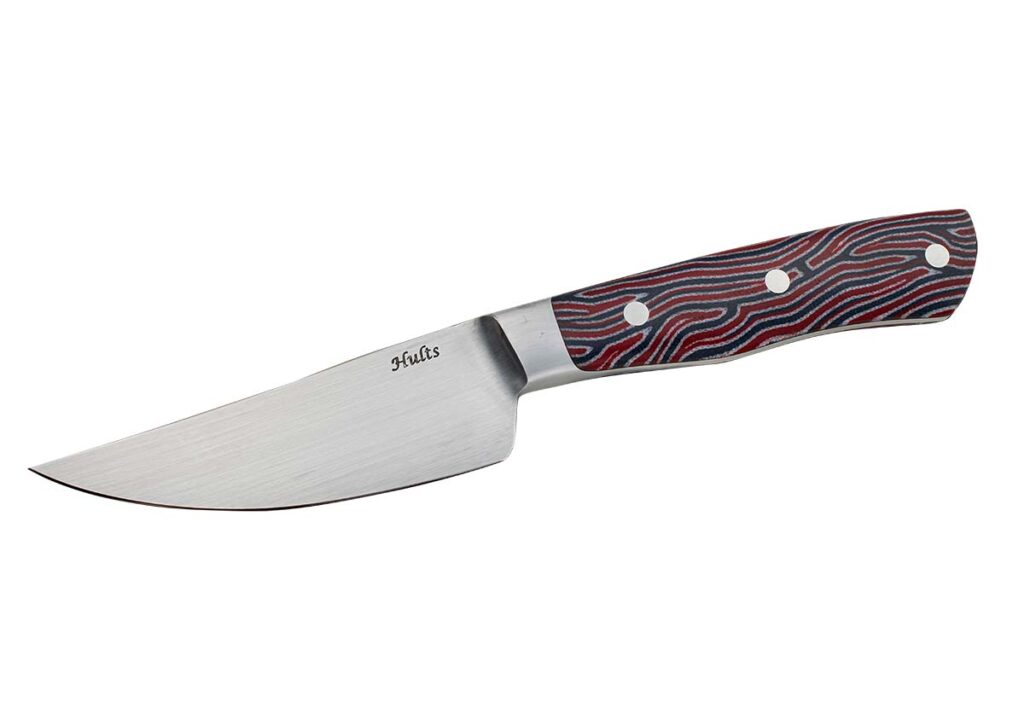
Blade length: 4.5”
Blade material: 1085H carbon steel
Blade grind: Flat-ground integral
Scales: G-carta
Bolster: Forged integral
Overall length: 9.5”
Maker’s price for a similar knife: $500
Knife to know: Josh Hults is a journeyman smith in the American Bladesmith Society
Maker: Josh Hults, southern-forge.com (Jocelyn Frasier image)
Josh Wisor Dress Slipjoint
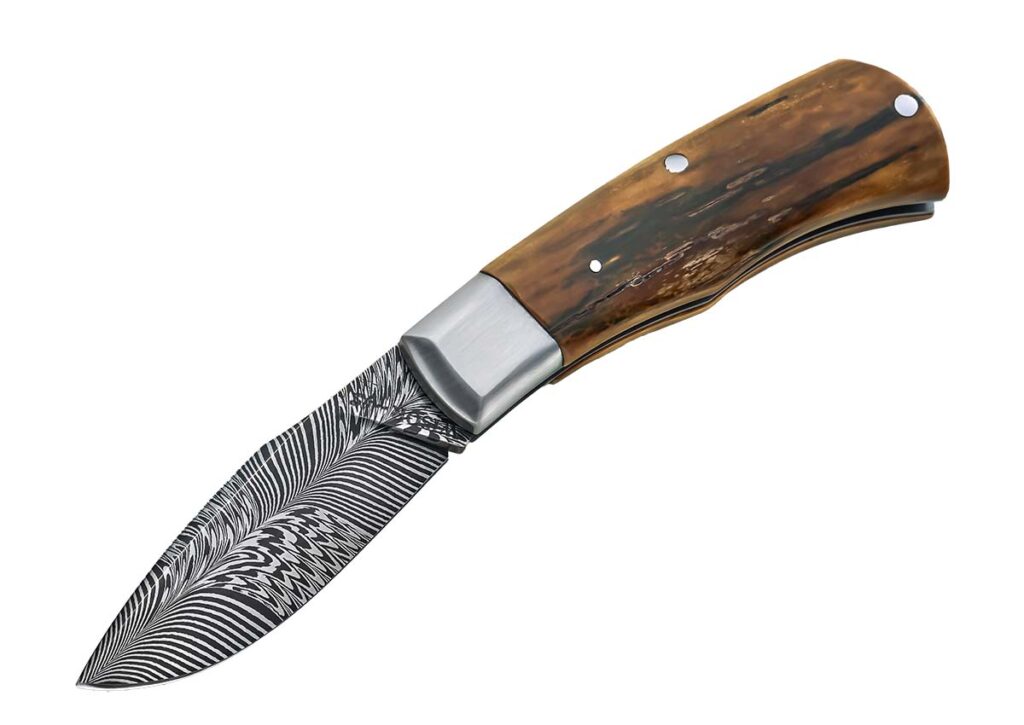
Blade length: 3”
Blade material: Feather damascus
Blade grind: Flat
Handle frame: Stainless steel
Scales: Mammoth ivory
Maker’s price for a similar knife: $1,300
Knife to know: Josh Wisor is a journeyman smith in the American Bladesmith Society
Maker: Josh Wisor, wisorforge.com (SharpByCoop image)
Erik Greiner Hunter
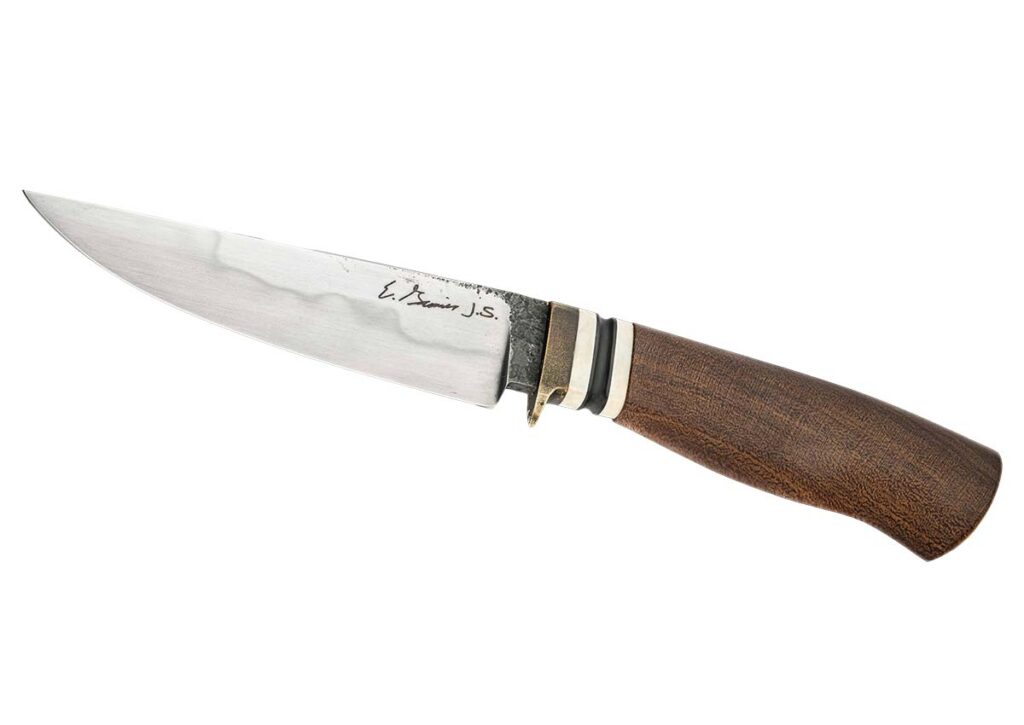
Blade length: 4.25”
Blade material: 80CrV2 carbon steel w/hamon
Blade grind: Flat w/secondary edge bevel
Scales: Dolf wood
Spacers: Oryx horn and warthog tusk liners
Guard: Antiqued brass
Overall length: 8.5”
Maker’s price for a similar knife: $450
Knife to know: Erik Greiner is a journeyman smith in the American Bladesmith Society
Maker: Erik Greiner, greinerblades.com (Jocelyn Frasier image)
Rudy Dean Fighter
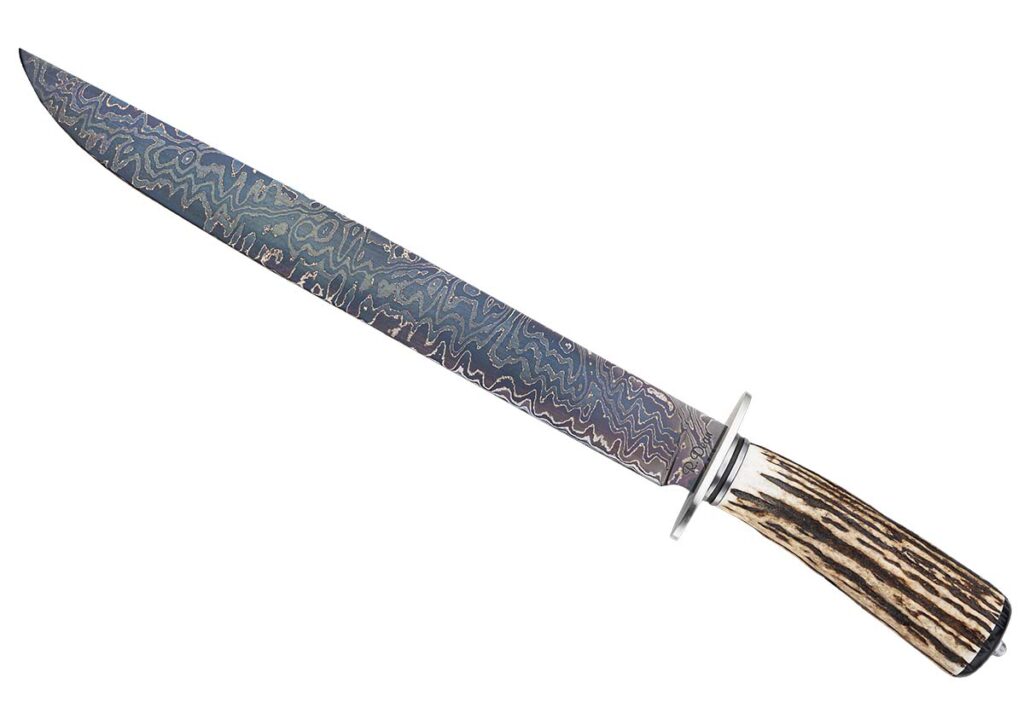
Blade length: 11.75”
Blade material: 136 layers of colored damascus
Blade grind: Full flat
Scales: Stag
Guard material: Nickel silver
Spacer: Nickel silver
Overall length: 17”
Maker’s price for a similar knife: $1,750
Knife to know: Rudy Dean is a journeyman smith in the American Bladesmith Society
Maker: Rudy Dean, rudydeancustomknives.com (Jocelyn Frasier image)
Honoré Vilain No. 7 Slipjoint
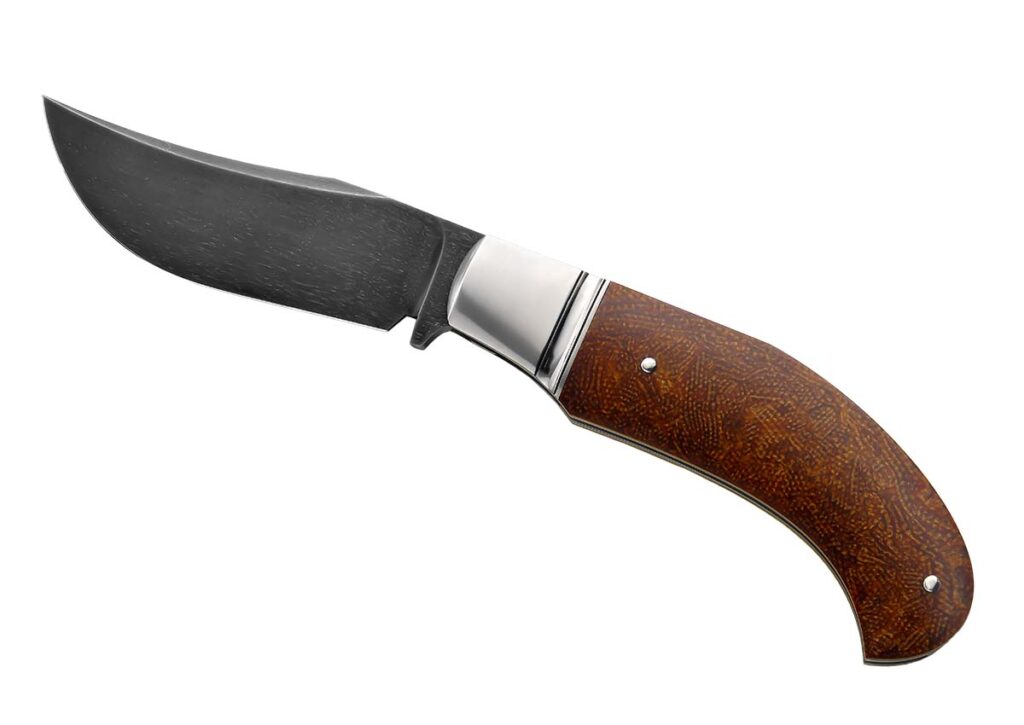
Blade length: 3”
Blade steel: RWL-34 stainless by Damasteel
Blade pattern: Clip point
Handle frame: Z40 stainless
Scales: Vintage rag Micarta®
Liners: G-10
Bolsters: Integral
Closed length: 4.5”
Maker’s price for a similar knife: Contact maker for pricing
Maker: Honoré Vilain (SharpByCoop image)
Jason Coy Clip-Point Hunter
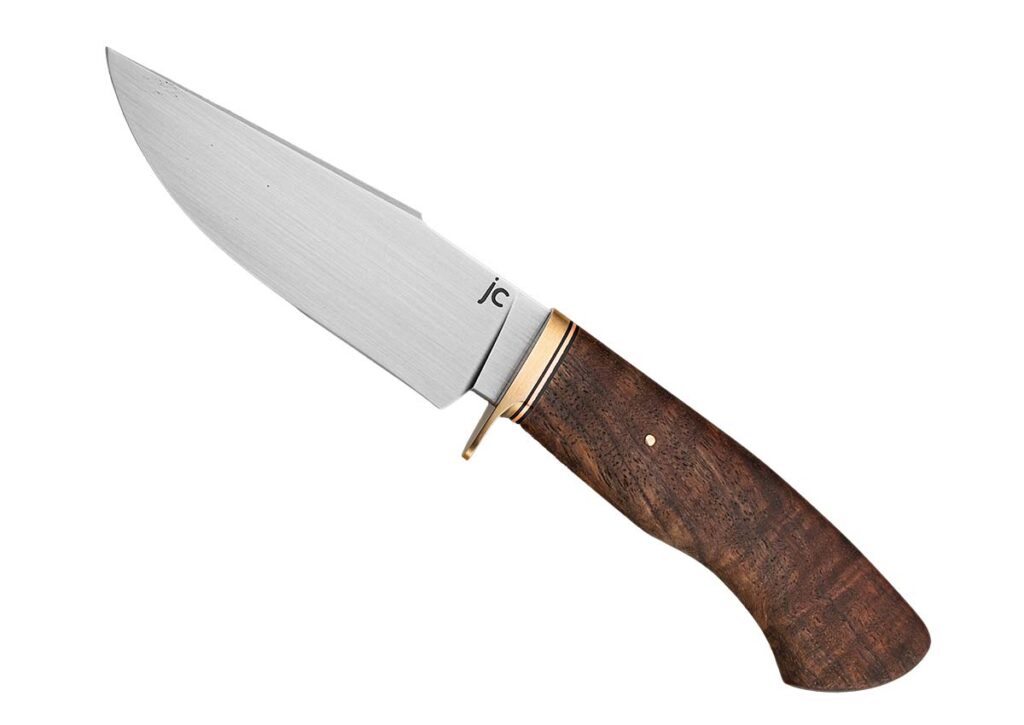
Blade length: 4.5”
Blade material: 80CrV2 carbon steel
Blade grind: Flat
Scales: Walnut
Handle pin: Bronze, domed
Guard material: Bronze
Spacers: Black fiber and copper
Overall length: 9.25”
Maker’s price for a similar knife: $500
Maker: Jason Coy, jasoncoyknives.com (Jocelyn Frasier image)
Gary Langley Subhilt Fighter
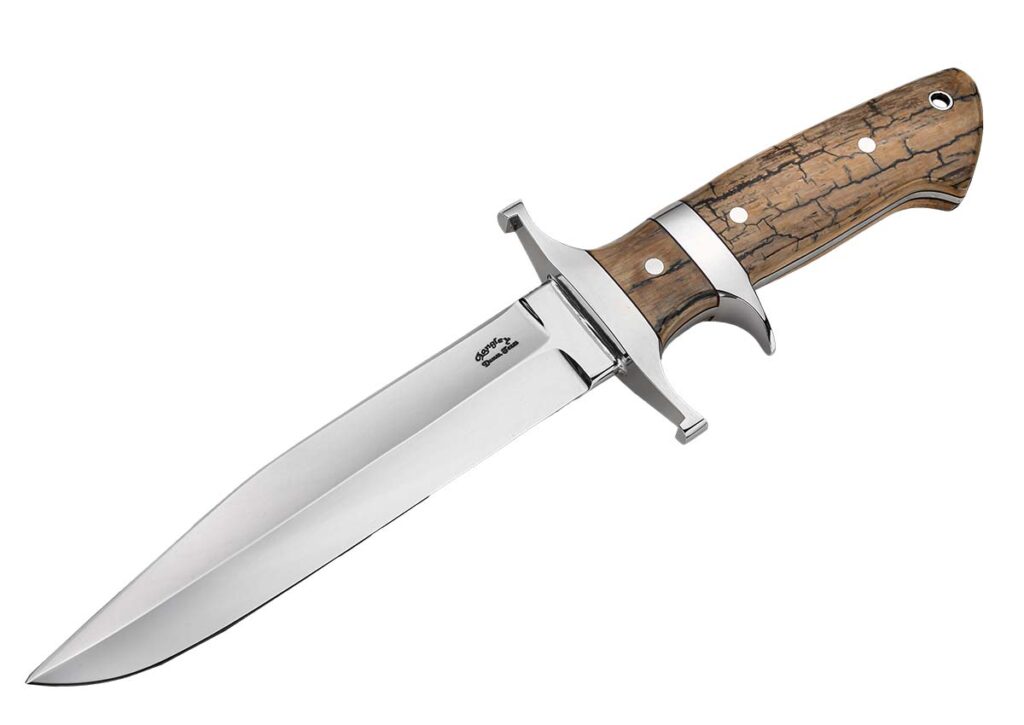
Blade length: 6.25”
Blade steel: CPM 154 stainless
Scales: Mammoth ivory
Guard & subhilt: 416 stainless
Overall length: 11.5”
Maker’s price for a similar knife: Contact maker for pricing
Knife to know: Gary Langley is a voting member of The Knifemakers’ Guild
Maker: Gary Langley, gllangley.com (Jocelyn Frasier image)
Bubba Crouch Trapper Skinner
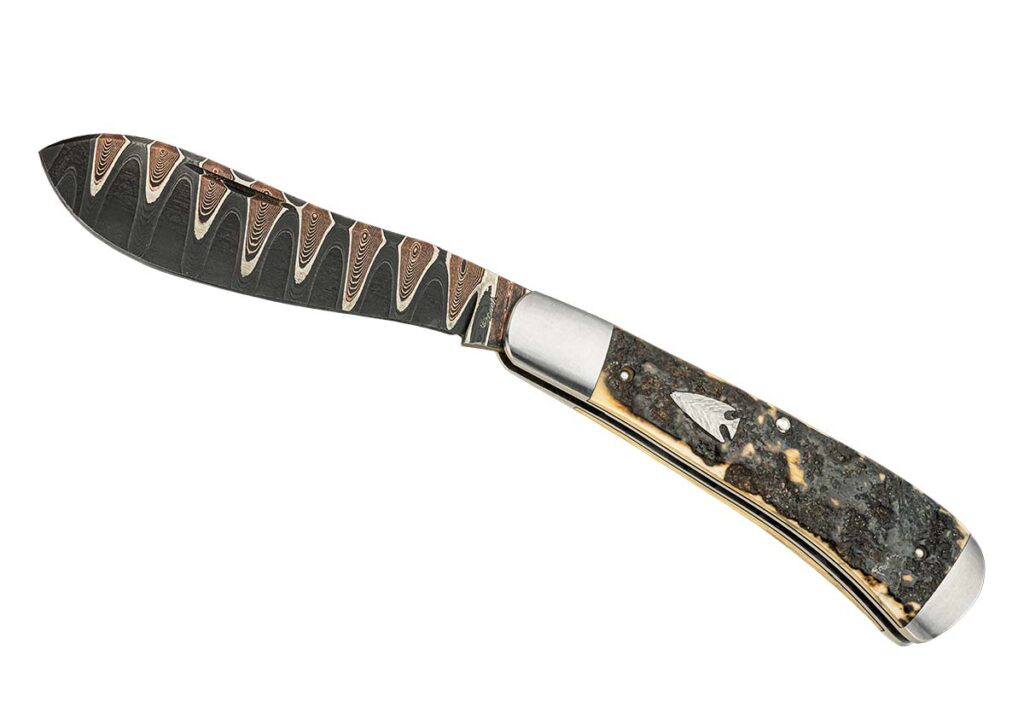
Knife pattern: Trapper skinner
Blade length: 3.5”
Blade material: Copper san-mai by Baker Forge
Blade grind: Hollow
Scales: Barky mammoth ivory
Bolster: Integral
Liners: 416 stainless steel
Backspring: Heat-colored CPM 154 stainless
Closed length: 4.25”
Maker’s price for a similar knife: $2,200
Maker: Bubba Crouch (Jocelyn Frasier image)
Eliot Maldonado Folding Fighter
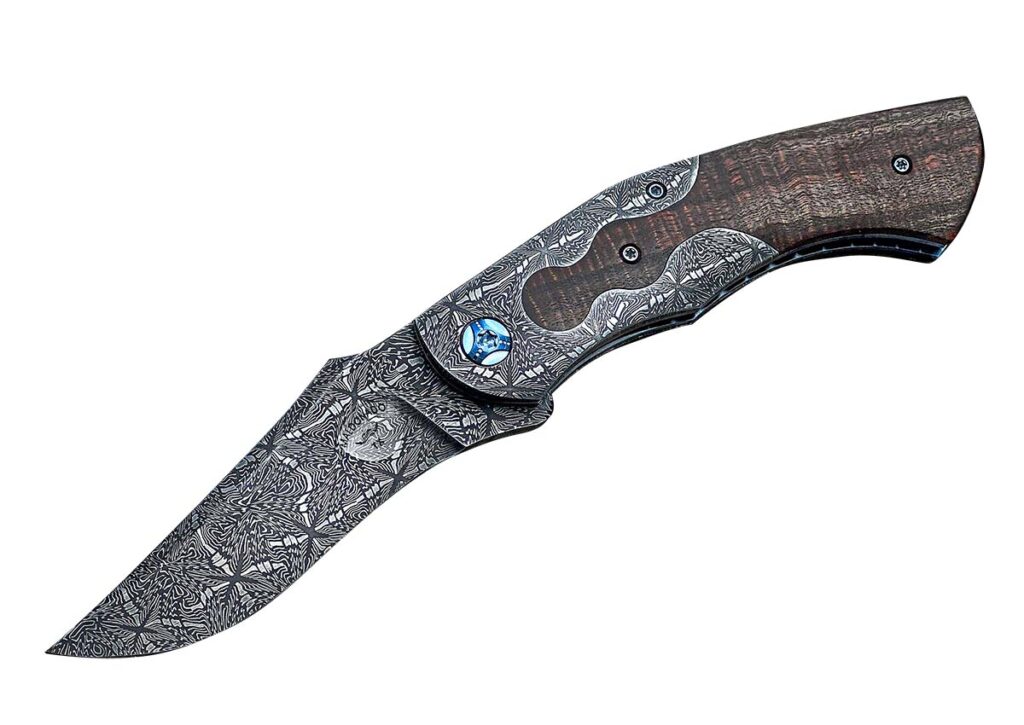
Blade length: 3”
Blade material: Mosaic damascus by Curt Zimmerman and Kelly Vermeer Vella
Blade grind: Hollow
Blade pattern: Clip point
Blade opener: Flipper
Bolster material: Same as blade
Bolster design: Double keyhole
Scales: Koa
Handle hardware: Titanium
Lock: Linerlock
Closed length: 4”
Maker’s price for a similar knife: $2,200
Maker: Eliot Maldonado (Jocelyn Frasier image)
William Zermeno Folder
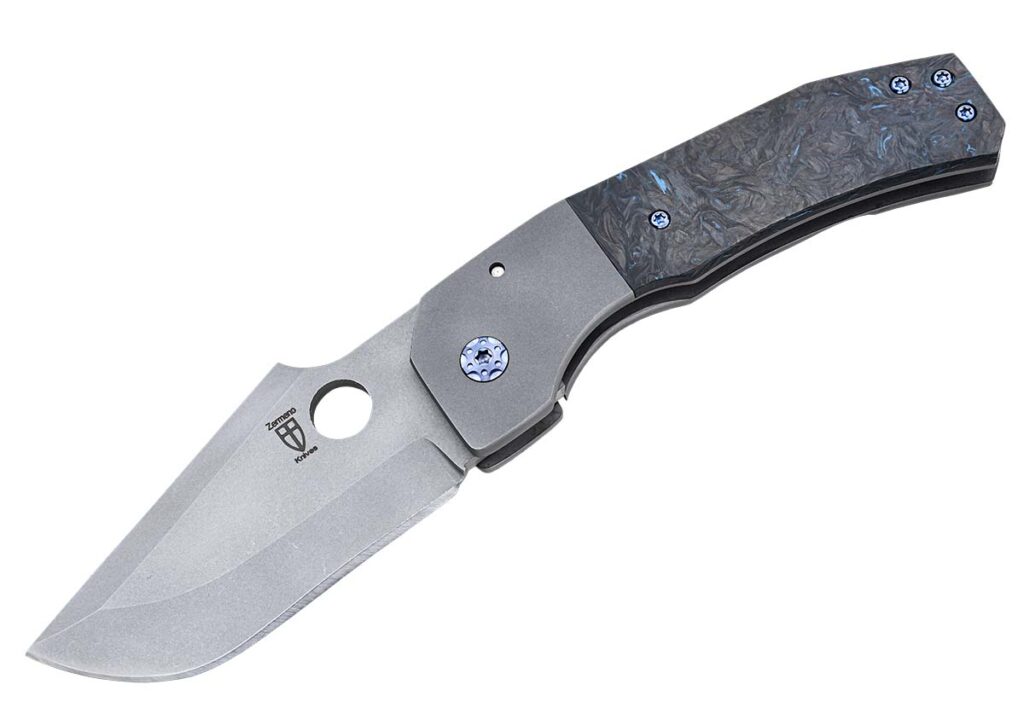
Blade length: 3.5”
Blade steel: CPM 154 stainless
Blade @thickest: 3/16”
Blade grind: Hollow
Handle frame: 160 titanium milled out
Scales: FatCarbon®
Handle screws: Titanium
Lock: Framelock
Lock stabilizer: Titanium
Pocket clip: Titanium
Closed length: 5.25”
Maker’s price for a similar knife: $550
Maker: William Zermeno, wdzknives.com (Jocelyn Frasier image)
Check Out Knife Drops:
Best Swiss Army Knife Tools
The Swiss Army Knife Is Iconic, And Over The Years It’s Featured Many Different Tools. Most Are Useful, But Some Are Just Plain Odd.
The Swiss Army Knife has become a utilitarian icon. Manufactured by Victorinox, and formerly Wegner, the knife got its name due to American GIs in World War 2 being unable to pronounce the proper German name of the name, the Offiziermesser, which translates to “officer’s knife.”
Traditionally clad in red, the color of the Swiss flag, the knife is a versatile multi-tool filled with different implements ranging from knives and screwdrivers to corkscrews and nail files. Below is a selection of some of the most useful tools in the Swiss Army Knife and some tools that are a bit more unique.
The Original Tools

The first Swiss Army Knife, simply called a Modell 1890, featured four tools. Those four are still a part of many SAK models today and immediately come to mind when you think of the tool.
Spear Point Blade
While a larger Swiss Army Knife may feature multiple blades, every model will feature a spear point. An icon in its own right, the SAK spear point will appear on the largest models all the way down to tiny ones meant for keychains.
Made of stainless steel, the spear point can cut thread just as well as it can cut meat. However, I wouldn’t want to butcher much with one that’s keychain size.
Reamer
The reamer is probably the least-known of the four original tools but is no less important. It is two functions. The first is to drill small holes into wood to give screws a head start. The second is to help with sewing. The hole in the middle of the tool is meant to be used to slide thread through to help give a stable anchor point while sewing materials together.
While this might not be the most necessary tool today at home, it’s incredibly important for a soldier on the march or on the battlefield.
Screwdriver.
Nowadays you can find some Swiss Army Knives with as many as four different screwdrivers inside. They all can tie their lineage to the screwdriver that made it onto the original model. Important for a soldier trying to fix a rifle in battle, important to a homeowner trying to reinstall an outlet cover in the kitchen, the screwdriver is one of the implements that sets the SAK, and other multi tools apart from other types of tools.
Can Opener.
Yet again, a great all-rounder tool with military use in mind. A can opener is a necessary tool for a soldier to have in the field to open rations. While most homes today have either a crank or an electric can opener, the original handheld version still remains in many Swiss Army Knives.
Other Necessary Tools

Some of the larger Swiss Army Knives today have as many as 15 layers and dozens of tools inside of them. As the knives have grown larger, so has the roster of tools within them. These may not be the originals, but they sure are just as useful.
Needle Nose Pliers
Great for prying and pulling things apart, the needle-nose pliers are a standard tool in the larger SAK models. As the knives became more and more associated with outdoorsmen and tradesmen, the tools evolved to meet those demands.
Made of stainless like so many of the other tools, it’s a great pair of pliers, and the fact that they fold away into the knives makes them invaluable when you’re outdoors.
Saws
Over the years the SAK has grown to include multiple types of saws. The main two are a wood saw and a metal saw. The wood saw is a smaller version of a classic handheld saw, great for cutting small pieces of wood or through small, thin brush.
The metal saw features files on both sides, which compare to a standard, flat file. The serrated edge is analogous to a hacksaw. It will cut through metal, but it’ll take a while to do it.
Scissors
What’s better than a pair of scissors? If you’re looking to cut paper or fabric, not much. That’s why scissors are included today on the largest Swiss Army Knife (38 tools) and the smallest (seven tools).
Like the majority of the other tools, it’s made of stainless steel. Of course, they are quite small so it’ll take a minute or two to finish cutting, but when you need scissors no other tool can match up.
Toothpick
Currently a standard tool on the smaller SAK models, the toothpick is great because no one likes having food stuck in their teeth. Unlike most of the other tools in the knives, this one is not made from metal. It’s made from hard plastic and slides out of the body of the knife. However, it is easy to clean and stow back away so while it may seem like a reusable toothpick might not be the most sanitary tool, Victorinox has engineered it in such a way that it is easy to disinfect.
The Outrageous Tools
Over the years there have been plenty of tools in the Swiss Army Knife that range from maybe being a bit overkill to being completely out of left field. Two of these are still available on some SAK models while the other tools are just relics of bygone knives.
Cigar Cutter

The cigar cutter is the most eye-catching tool from the past. Cigar smoking isn’t as popular as it was, but there were once five models of Swiss Army Knives that featured a cigar cutter. It was unique because it was not spring-loaded. It featured a lever that would slice the cigar with a blade like a guillotine.
Toilet Paper Holder Key

That’s not a joke. A limited number of Swiss Army Knives in Europe were made with this incredibly specific tool to open industrial paper towel holders in public/commercial bathrooms.
Pharmaceutical Spatula

You’re reading that right. Some knives feature a pharmaceutical spatula. This tool is meant to stir ointments and creams as well as safely move pills into bottles. It’s as specific as it gets when it comes to tools on a Swiss Army Knife. Well, there might be one tool more specific.
Hoof Cleaner

If you’re a farrier and need to clean out some horse hooves, there’s a tool for you. The small hook features no sharp edge so as to not hurt the horse as you clean out their hoof before putting on a new shoe.
Read More
- How To Create A Custom Swiss Army Knife
- The Victorinox Swiss Army Knife
Massachusetts Supreme Court Strikes Down Switchblade Ban
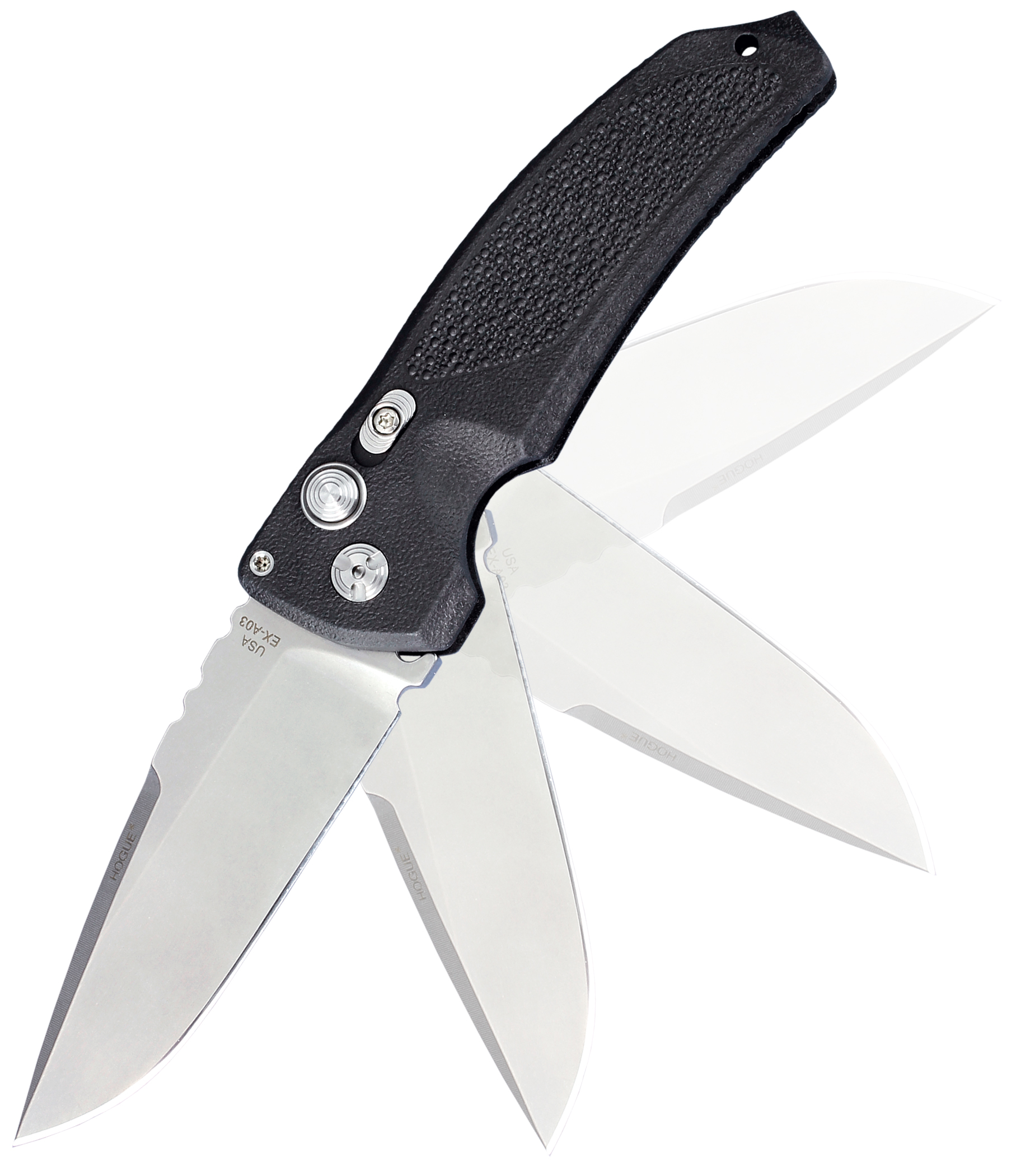
Nearly 70-year-old automatic-knife ban meets its demise in a 5-0 decision.
Massachusetts hasn’t been a haven for arms rights since the shot that was heard around the world, but things are changing in the Bay State.
In a rather shocking 5-0 decision on Aug. 27, the Massachusetts Supreme Court struck the state’s nearly 70-year-old prohibition of the carry of automatic knives with blades greater than 1.5 inches. This is an enormous win for knife rights, given the state is among the most hostile to the carry of any weapon. And, with other recent cases, the decision shows a softening toward the possession and carry of automatic knives.
Canjura Switchblade Case
The Massachusetts ruling stemmed from the arrest of David E. Canjura in 2020 in Boston, in response to an altercation between him and his girlfriend. Upon searching Canjura, police found what they described as an “orange firearm-shaped knife with a spring-assisted blade” or in popular parlance, a switchblade.
Canjura subsequently challenged the constitutionality of the charge, arguing the knife was an arm and was protected under the Second Amendment. The Massachusetts Supreme Court agreed.
Justice Serge Georges Jr. authored the court’s 24-page written decision, drawing heavily upon landmark U.S. Supreme Court decisions of Bruen and Heller. Despite both cases pertaining to the Constitutional rights of possessing and carrying firearms, the opinions have carried over to the lawful possession and carry of other arms.
Pertinent to the Massachusetts ruling was the historic test laid out in the Bruen ruling, which requires historical precedent from when the Constitution was ratified in 1791 to maintain a prohibition on arms. Georges found this sorely lacking in Massachusetts’ ban on carrying switchblades.
Georges wrote in the decision, “Given the long history of folding pocket knives generally and switchblade knives in particular, switchblades constitute “bearable arms” within the protection of the Second Amendment.”
Massachusetts Ban
Like so many switchblade bans, Massachusetts dates back to the time of patent leather jackets and witch-trial-like panic over the supposed corruption of the nation’s youth. The state law was passed in 1957, several years after the publication of the anti-automatic knife article, The Toy that Kills. Despite being cinema classics, Rebel Without A Cause and Blackboard Jungle didn’t help out the switchblade’s reputation.
Massachusetts was a year ahead of the curve in pushing autos to the fringes of society, with the federal government passing the Switchblade Act of 1958. Drawing upon the federal government’s interstate commerce power, it act prohibited the purchase, sale, and trade of automatic knives between all 50 states.
Yeah, But…
Despite a good outcome for knife rights and following other wins for automatic knives nationwide, there are points Massachusetts enthusiasts should be aware of before throwing an auto in their pocket.
The potential stands the case may be appealed and the decision stayed. Furthermore, as pointed out by Knife Rights, there are some wrinkles knife owners to keep in mind to state on the right side of the law still.
- Carry of any double-edged blade—including switchblades—is still prohibited.
- Knife law preemption does not exist in Massachusetts, so cities and counties may have or might pass auto bans (check your local laws).
- The state’s ban on the manufacture and sale of switchblades remains on the books.
Even with these prohibitions, Bay Staters should be pleased with the recent ruling.
More On Auto Knives:
- Buying An Automatic Knife Online
- Virginia Lifts Ban on Concealed Carry Switchblades
- Antique Switchblades
- Why Are Switchblades Illegal?
First Look: GiantMouse ACE REO—Black & Brass
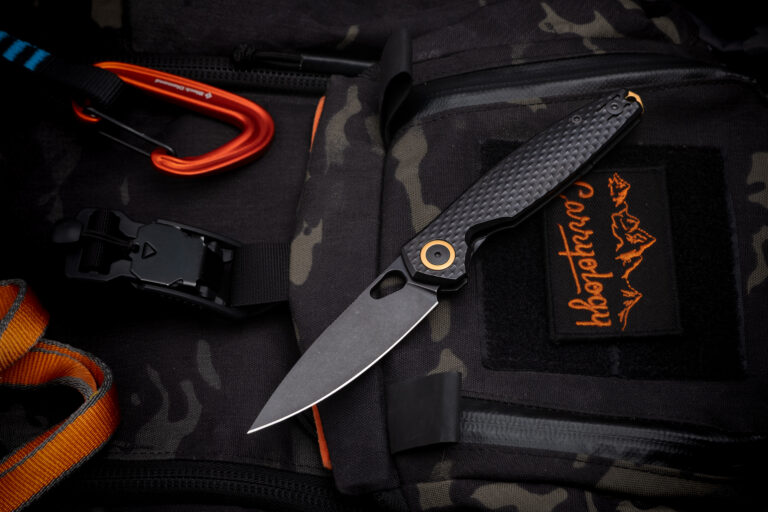
A stealthy reimagining of a GiantMouse icon featuring MagnaCut steel and brass accents.
GiantMouse is kicking off the new year by leaning into a darker, more sophisticated aesthetic. The company has announced the next evolution of one of its most popular designs: the ACE REO—Black & Brass. This isn’t just a simple color swap.
The ACE REO has always been a staple for those who appreciate clean, purposeful lines, but this version dials up the contrast. Set to release on January 13th the Black & Brass model is designed to feel solid and intentional from the moment you pick it up.
CPM MagnaCut and PVD Titanium
At the heart of the folder is a blade crafted from CPM MagnaCut. By now, most enthusiasts know MagnaCut is among the gold standards for balancing toughness and corrosion resistance. GiantMouse has finished the blade with a sleek PVD coating, adding an extra layer of durability and a stealthy, non-reflective look.

The handle matches that energy with a PVD-coated titanium frame lock. The result is a monochrome, “blacked-out” profile that serves as the perfect canvas for the knife’s standout hardware.
Brass and Patina
What really makes this version pop is the inclusion of a brass backspacer and pivot collar. The warm gold tones of the brass provide a sharp contrast against the dark PVD titanium. Perhaps more importantly for collectors, the brass is designed to age. Over time, it will develop a natural patina based on how you carry and use it, ensuring that every knife eventually becomes a one-of-a-kind reflection of its owner.
Versatility and Carry
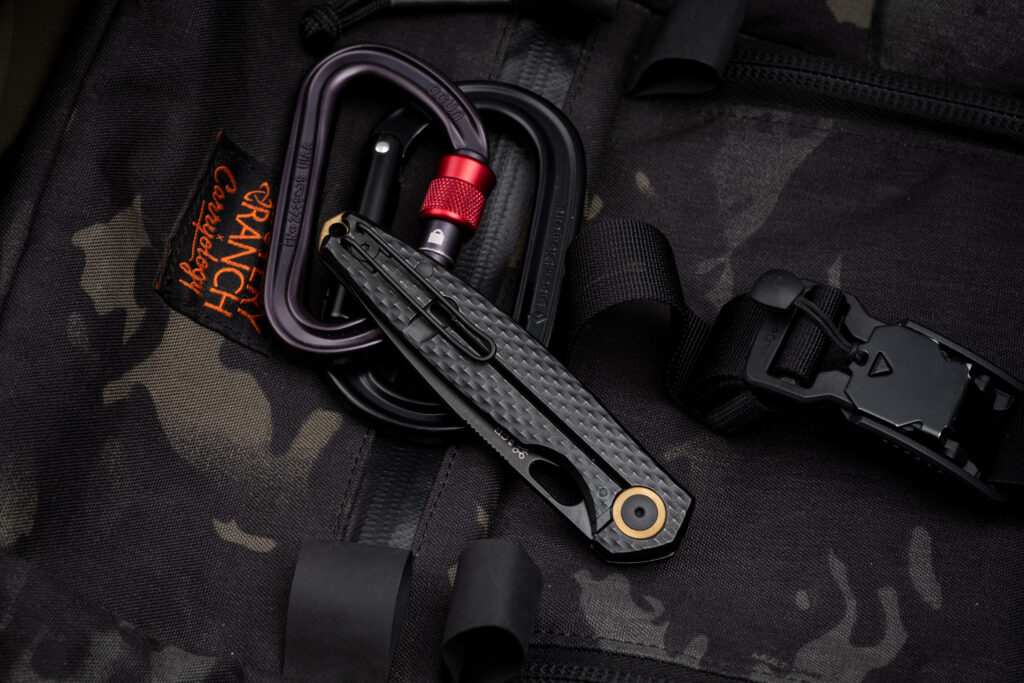
True to the GiantMouse ethos, the ACE REO is built for the pocket. It features a reversible steel wire clip for versatile carry and runs on a smooth bearing pivot for snappy deployment. Manufactured in Maniago, Italy, the craftsmanship is exactly what you’d expect from a collaboration involving Jesper Voxnaes and Ansø.
ACE REO—Black & Bras Specs
Blade Steel: CPM MagnaCut
Blade Finish: PVD
Handle Material: Titanium
Handle Finish: PVD
Lock Type: Frame Lock
Blade Length: 3.325″
Overall Length: 7.94″
Weight: 3.2 oz.
MSRP: $315
More Knife Reviews:
- Sharps Bros. Meanstreak Review: Keen, Mean Cutting Machine
- Relentless Knives Curved Fillet Knife Review
- Cold Steel Finn Bear Review: Light, Sharp And Up To Snuff
- Spartan Blades Clandestina Review: 2024 Blade Knife of the Year
A Dazzler For Kaz
A Father, With The Help Of His Uncle, Works To Make A One-Of-A-Kind Knife For His Son After Living The Life Of A Military Kid.
The hardest question for my son Zachary “Kaz” Kazmir to answer is “Where are you from?” His answer usually falls along the lines of, “Home is where the military takes your family.”
Zach’s answer is true for just about any token “military brat.” Military families often move every two to three years—that’s a rate of 10 times more than average civilian families. Living this kind of life for a child requires tremendous resilience, exceptional adaptability, and an uncommonly high maturity level. Zach would repeatedly get settled in a routine, a school, a friend group, and community activities, only to pick up, leave it all behind and start fresh again.
Oh, and the trials of life do not stop there. He persevered through my frequent deployments, earthquakes, accidents, and even a direct hit by one of the strongest tornadoes ever recorded while he was living in Moore, Oklahoma. Zach’s life led him on a journey spanning two countries, four states, and five schools.

I wanted to give the young man something special on the occasion of his 21st birthday. Even with all the places he’s lived and the experiences he’s had, Zach’s fondest memories always gravitate to his time in Okinawa, Japan. The first memories of his life were created there. Okinawa will forever hold a special place in his heart. With that, I set out to have a knife crafted in hopes of capturing and honoring these priceless memories for him.
Uncle Stanley
I could think of no better place to turn for such a task than my uncle, Stanley Buzek. Uncle Stanley is a knifemaker from Caldwell, Texas, and is most certainly the right man for the job. There’s no one I know who puts as much heart into his craft as Uncle Stanley. He guided me through the many options, and I closed in on what would become the most meaningful and elegant 4.5-inch, two-blade Texas trapper I’ve ever seen.
My uncle crafted the frame and liners from raw bars of integral 416 stainless steel. As with each of his knives, he added a personal touch to the spine. This was truly amazing to witness. I’ve seen many of his finished knives over the years, but I hadn’t realized the level of precise craftsmanship he put into the pieces that non-makers like myself often take for granted. Most of us just naturally look to the business end of a blade.
In thinking of the knife for this gift, I aimed to give Zach a glimpse into his resiliency through my eyes. He has been stretched so thin that at times his only choice to keep from breaking was to fold over in the fetal position to regain his strength. He’s been heated, hammered, pressed to the edge of his capabilities, put back in the fire, crushed, bent beyond his limits, beaten down even more, and subjected to unrelenting pressures in different directions.
Nonetheless, he emerged from the fire stronger than ever before, with a character that can only be described as beautiful—just like the banding and mottling of damascus. The beautiful steel forged by Bill Poor couldn’t be more fitting for this knife. Bill transformed raw 1084 carbon and 15N20 nickel-alloy steels into an extra-fine River of Fire pattern with elaborate feathering that perfectly captures how I view Zach’s coming-of-age: indicative of many intense moments, but not scarred. Instead, radiating with a unique, luxurious magnificence that exemplifies resilience.
Making The Knife Handle
The next essential element on my mind was the scale material. (I called it the “side of the knife” but you know how knifemakers are about educating the ignorant.) The scales had to be more than just the perfect material, they had to be uniquely sourced. I wanted my son to have a literal piece of his childhood that he could hold in his hands whenever he wanted.

I reached out to a military friend stationed in Okinawa to acquire a piece of one of the famed, colossal banyan trees from the island. With travel restrictions, import/export regulations on agricultural items, and COVID-related shipping delays, it proved much more difficult than we expected. However, my contact was able to come through! After nearly a year, a heavily worn, 5-by-10-inch piece of banyan tree finally arrived in the mail.
Uncle Stanley was reluctant to use banyan. He cautioned me not to get my hopes up because he knew how challenging it can be to properly stabilize such a soft wood. In addition, the sample was very weathered, extra-soft, and had several deep cracks inflicted in transit during shipping. In other words, there wasn’t a lot of room for error!
Uncle Stanley sent the wood to the very capable Terry Dunn of TNT Enterprises, and I was truly blown away by what he was able to do. Dunn not only stabilized the wood, he preserved its beautifully subtle grains and the small, intricate pitch pocket. The latter is a cavity in the wood where the tree suffered some sort of damage over its life, or a small knot of sorts if you will.
Stanley assembled the sleek trapper, affixed the scales, and presented me with a truly remarkable knife. Then he took it from my hands and said, “Now it’s time to go get it ‘scratched up.’”
Engraving The Knife
A slight fear came over me. I worried that an engraver could potentially damage this work of art. However, the worry left me as quick as it came when I learned the engraver was Alice B. Carter. I’ve seen her amazing work in the past. I knew she could add another layer of beauty to the piece.
To my surprise, Alice asked so much more than, “What would you like me to engrave?” She had an authentic interest in the story of the knife and its eventual recipient. I think she asked me more about Zach than she did about art that day. I shared with her the things Zach tends to reminisce about from his time in Okinawa, and we honed in on a few specifics.
One of the first memories of his life is enjoying the annual Cherry Blossom Festival in Okinawa’s capital city of Naha. The festival draws crowds of thousands each January to see the city streets completely encased in the vibrant blooms. Zach also speaks of how massive he remembers the banyan trees being there. If you’ve never seen a 200-year-old banyan, the behemoths appear to be as old as time and so wide they seem to fill the sky with a majestic, towering presence as if from a fantasy movie.
Alice’s smile grew wider and wider as we continued to talk through a few other details. She drew inspiration from our chat and created an absolute masterpiece. Engraving for more than 40 hours and inlaying more than six feet of 24k-gold wire, she created so much more than a scene or picture. Her art marvelously captured the emotions connected to the memories.
Reaching from corner to corner on the upper bolster of the facing side shines the island of Okinawa in pure, radiant gold. The shading effect seems to literally draw the island’s shape out from the knife. Carefully inlaid in the exact location of Kadena Air Base where Zach lived on the island, a one-millimeter copper marker memorializes his time there.

On the opposite side in exquisite detail is an ancient, powerful banyan tree spanning from edge to edge. In a beautiful complement to the gold inlay, the banyan’s leaves are adorned with Alice’s self-alloyed green gold. Zach can view the upper bolsters in remembrance of the land he once knew.
As is customary in the military, a servicemember’s last name becomes his or her first name. It’s the military way. Kazmir was shortened to “Kaz” almost immediately, and that nickname stuck for the entire two decades I served. As Zach approached adulthood, he began to go by this moniker as well. The knife’s oversized shield brilliantly gleams “KAZ” in Japanese-styled English letters—an embodiment of how I’ve passed on my name to my boy.
Finally, the lower bolsters hold a personal message from father to son: Ichi-go ichi-e. Emblazoned in bold Japanese Kanji, the message is an idiom roughly translating to “for this time only.” It means that Zach’s experience in Okinawa was truly a once-in-a-lifetime episode that can never be duplicated, and he should treasure it forever.
Alice brought all the components together by incorporating gorgeous cherry blossoms engraved with intricate detail resulting in what I see as the perfect gift. Zach received it as a Christmas present and shed some heavy tears as I explained each element. He and I are both still amazed at how everyone came together to help me make this one-of-a-kind knife happen.
Uncle Stanley once told me that nearly every knifemaker is an expert at something, but no knifemaker is an expert at everything. He described knifemaking as a network of experts who bring their talents together to make the impossible possible. In the military, we have a term for this—it’s called synergy. With this beautiful piece, I’m convinced the knifemaking community is synergy at its finest.
For more information about the knife, contact Stanley Buzek, Dept. BL8, P.O. Box 621, Caldwell, TX 77836 346-412-2532 [email protected], s.buzekknives.com.
Read More
Cool Custom: Matt Aaron’s Blacksmith’s Automatic Folder
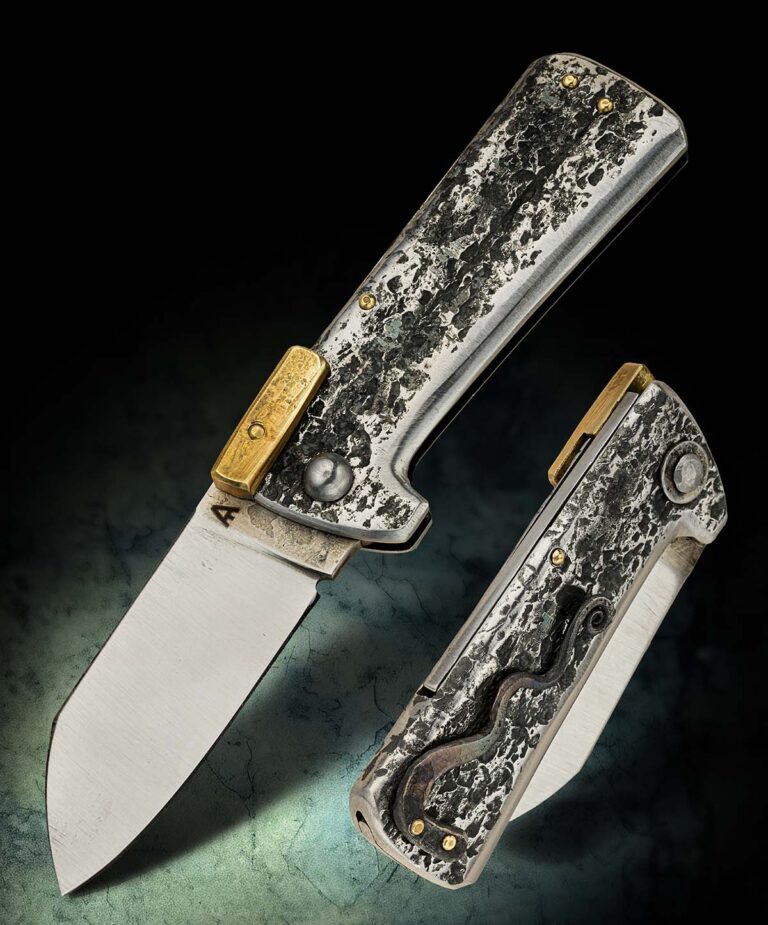
With a hybrid lock system and a unique aesthetic, Aaron’s Blacksmith Automatic Folder cuts a distinctive profile.
Matt Aaron got the idea for his Blacksmith’s Automatic Folder when he took a friction folder class taught by ABS master smith Nick Rossi.
Matt’s original intent was how to get a more complicated knife with a similar number of parts as a friction folder. He mulled it over with Rossi and others for two or three years and, inspired by Nick and his taco-style friction folder construction approach, arrived at the Blacksmith’s Auto.
The lock is a hybridization of a lockback auto mixed with a little bit of bolster release auto and some of Matt’s own design. The brass lever operates the opening, closing and locking mechanism. The knob at the pivot is not a push button but simply the pivot.

Matt forged, folded and cut the lock spring and launch spring out of the initial single, eighth-inch flat piece of mild steel that served as the base for the Rossi taco construction style. The latest batch Aaron’s doing is commercially pure titanium.
Blacksmith’s Automatic Folder Specs
Maker: Matt Aaron
Blade length: 3”
Blade material: 52100 carbon steel
Handle: Forged mild steel w/brass lever
Pocket clip: Tapered scroll in a blacksmithing ironwork style
Closed length: 4”
Maker’s price for a similar knife: $500
See More Custom Knives:
- COOL CUSTOM: BRIAN BROWN’S TAKA V2S
- COOL CUSTOMS: BARRET CHRISMAN TAKES THE OL’ BULLET HI-TECH
- COOL CUSTOMS: KEVIN CASEY’S LITTLE FEATHER KNIVES
- COOL CUSTOMS: BLOUNT’S WAR CLUB DUSTS OFF MOHICAN MEMORIES
Must Read Articles

Knifemaking 101 – Read This Before You Make a Knife
by Wayne Goddard
My experience has taught me that there's nothing like digging in and getting started. I've often said the hardest part of the...




