Modern Period Knife: A Link To The Past And Present

Blending old and new, the modern period knife brings history alive in masterpieces.

Historical perspective is a relevant component in just about any undertaking. In the realm of cut, incorporating an appreciation of the past into the work of today brings another dimension to the custom knifemaker’s statement.

Interest in the knifemaking of a bygone era offers a window into the true artistry required to reproduce the knives of yesteryear, particularly with the absence of modern conveniences in the shop. Along with the interest in the historical knife, several custom makers bring famous designs, styles and patterns to life once again in tribute to those who have gone before.

The idea of the period knife blends old and new. “I’ve been making knives seriously since about 2002 when I took a class with the American Bladesmith Society in Washington, Arkansas,” related ABS master smith Lin Rhea. “Joe Keeslar and Greg Neely lit a fire under me and got me on my way. Since then the town of Washington has been like a second home, and I’ve even added to the personal connection between me and the area by interest in one of the town’s historical residents who was also a knifemaker. His name was James Black.”

A resident of Prattsville, Arkansas, Lin gained an appreciation for Black’s distinctive body of work*, using contrasting materials and techniques to create a bold, attractive look. “I’m grateful to get to know Mr. Black by studying his work,” Lin continued. “This intense study led me to try to recreate one of his knives, the Carrigan Knife. The original knife, a guardless coffin-handled bowie, was made by Mr. Black in the early 1830s in Washington, Arkansas. I chose the Carrigan as my first attempt because of its less intimidating size; however, as is often the case I found it to be just as intimidating once I started into the project.”
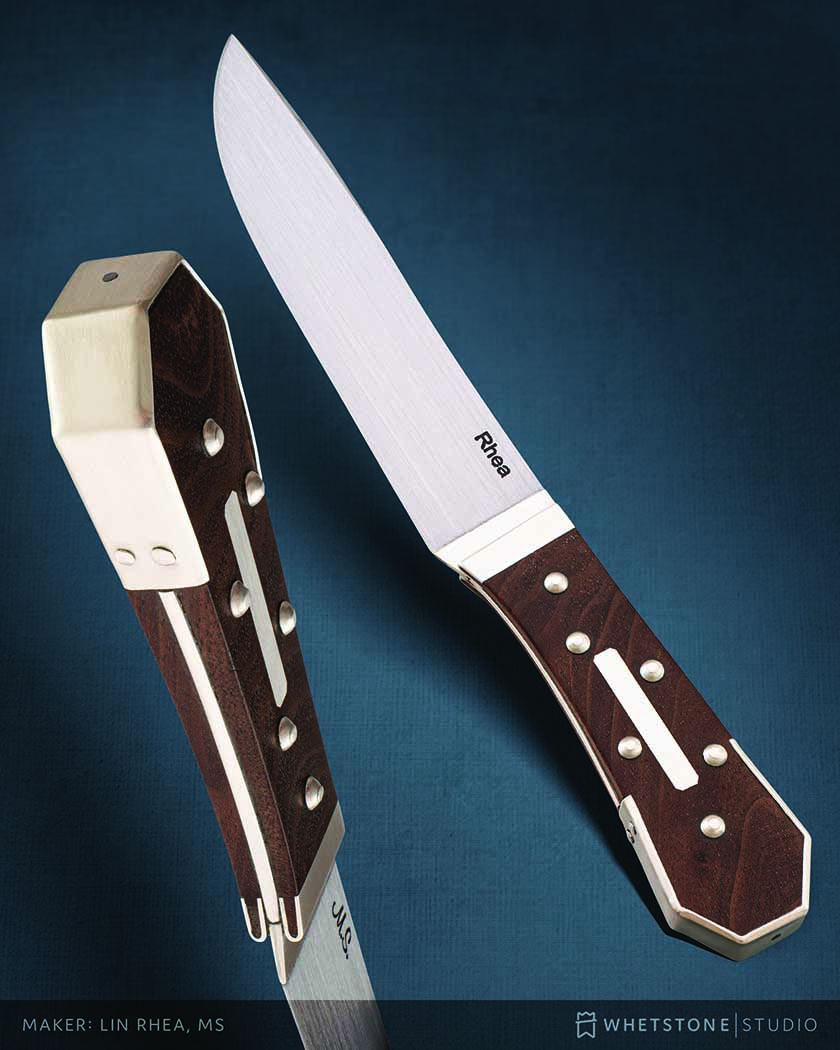
Lin Rhea’s period knife, a reproduction of the Carrigan Knife is based on a dress bowie James Black is thought to have made in the early 1830s in Washington, Arkansas. The original Carrigan includes a black walnut handle with coin silver pins and trim. The blade is about 6 inches long and the overall length is approximately 10.25 inches. (Whetstone Studio image)

The original Carrigan includes a black walnut handle providing a nice contrasting background to the coin silver pins and trim. The blade is about 6 inches long, and the overall length is approximately 10.25 inches. The full tang is virtually covered entirely by the walnut scales and the silver wrap.

When Rhea undertook his homage to Black and the Carrigan, he chose stabilized walnut, which he harvested himself several years ago, and trim in sterling silver. He forged the blade from 80CrV2 carbon steel and included at least 30 separate parts while attempting the same techniques used by Black nearly two centuries ago in fastening and assembling the finished knife.

“There is so much to be said about not only this knife but also Black’s work,” Lin concluded. “He was able to create a knife design utilizing only three materials yet impacting the knife world as few others could. His ability to arrange these materials into a functional, long lasting, beautiful tool is only enhanced by the knowledge that he also built in other qualities like moisture resistance, logical assemblage and ergonomics. All of this was done in a historic setting without modern equipment and epoxies. In my opinion, his design is ingenious.”

The Gold Rush Period Knife

Recently inducted into the BLADE Magazine Cutlery Hall of Fame® (September BLADE®, page 52), knifemaker Jim Sornberger has assimilated his gold and silversmith skill sets into custom knifemaking while helping introduce the modern world to the classic design, luster and embellishment of the Gold Rush era and boomtown San Francisco of the mid-19th century.
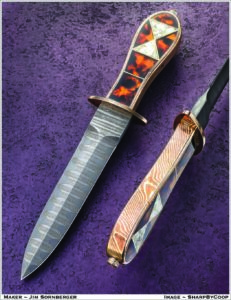
BLADE Magazine Cutlery Hall-Of-Fame® member Jim Sornberger’s interpretations of the Michael Price San Francisco/small dress bowie have won awards at various venues, including Best of Show at the 2019 International Custom Cutlery Exhibition in Fort Worth, Texas. This period knife features a blade in Vegas Forge stainless barstock AEBL and 412 stainless steels and san-mai damascus with a solid core. The guard and wrap handle are in Mike Sakmar mokumé barstock. Jim’s price for a similar knife: $3,500. (SharpByCoop image)

“I’ve been making knives since 1975 with the help of the late Les Berryman, an early Guild member, and with some guidance from Bob Loveless, Herman Schneider and Barry Wood,” Jim recalled. “The last three signed for me to join The Knifemakers’ Guild.”

For Sornberger, the style, embellishment and decoration of the canes, jewelry and knives of the Gold Rush era are most appealing. “San Francisco from 1850 to 1904, the Gold Rush period, was one of the wealthiest cities in the world, attracting some of the greatest artists, jewelers, carvers and engravers to ply their trade to a wealthy clientele. The work done in that period,” he opined, “rivals the best ever done.”

In the knifemaking genre, Michael Price and Will & Finck were among the most successful and prolific of the Gold Rush. Their work remains emblematic of the great migration to settle the American West, and the riches and ruin that were found with the experience.

“Price was Irish, and both cutlery firms hired workers who were English, German and possibly Scottish,” Sornberger explained. “Their dress knives are probably the most embellished American knives made in the 1800s-1900s. The dress knives had two common handles: an interesting, modified coffin shape and a more rounded, subtle taper shape. The blade shapes are spear-point dagger and San Francisco clip spear point.”

Sornberger is recognized as an authority on original San Francisco knives, as well as the magnificent gold quartz that was used so well by Gold Rush artisans. His modern interpretations of the Michael Price San Francisco/small dress bowie have won awards at various venues, including Best of Show at the 2019 International Custom Cutlery Exhibition in Fort Worth, Texas.

Jim’s dress fixed-blade bowie in the accompanying picture was made with Vegas Forge stainless barstock AEBL and 412 stainless steels, and san-mai damascus steel with a solid core. The guard and wrap handle are in Mike Sakmar mokumé barstock. Jim’s made such handles in gold and silver and nickel silver, also. The inlays are tortoise celluloid and California native gold/gold quartz.

According to Sornberger, the biggest challenge in his stunning creation was grinding the blade to show the distinctive pattern of the shell and the hardened core. The san-mai laminated blade was etched with ferric chloride, rinsed and color set with WD-40®.

Frog Knife

“The style of Michael Price’s work is a really good canvas with flowing lines, and there is a lot you can do with it,” observed ABS master smith Jon Christensen, who is in his 22nd year of making knives. “I wouldn’t call my San Francisco-style knives replicas. I do like to keep to the original form and honor the style of the maker, though.”
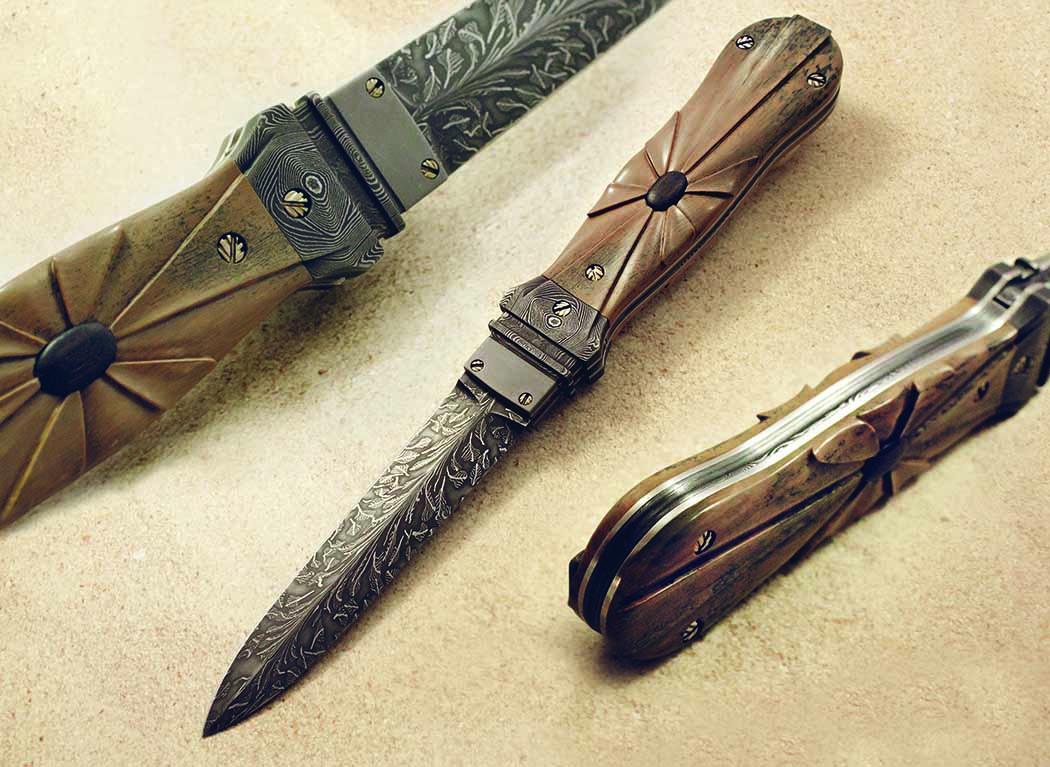
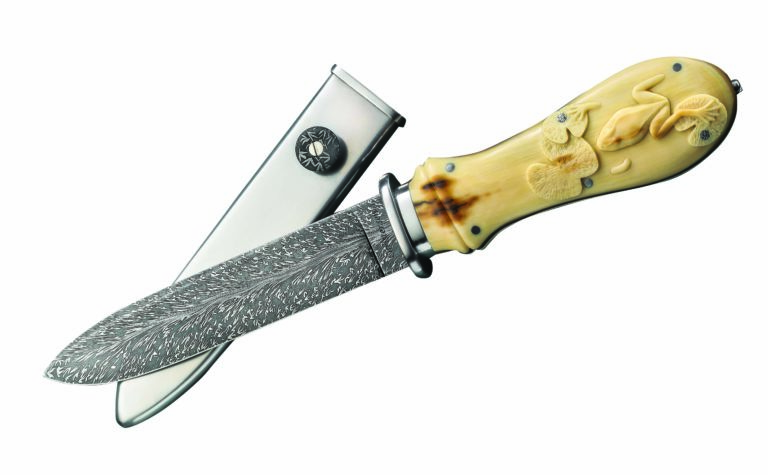
Jon Christensen’s San Francisco-style folder includes a blade of feathered leaf damascus steel and a handle of carved mammoth ivory with inlay of 4,500-year-old bog oak. Quite a period knife. (ChantryLeePhotography.com image)

One of Christensen’s most evocative pieces to date is referred to simply as the Frog Knife. However, the piece is far from simple, and Jon manages to convey the spirit of the Michael Price style while also imprinting some of his own personality.
“I built the feathered damascus for the blade with 1080 and 15N20,” he advised. “It’s a canister damascus. I forged the bamboo leaves and placed them in the can, welded it up, reduced it, and feather cut it so it would produce feather-cutting smears and leaves, and form branches to look like a little grove of bamboo leaves.”

The 10-inch knife has a 5.5-inch blade and a frame and sheath incorporating 410 stainless steel. Christensen utilized the “canvas” of the handle to the fullest, carving the mammoth ivory into a pleasing vignette of frogs and lily pads.

“The handle has something of a back story,” he smiled. “I had seen the Poppy Knife that Michael Price made and thought I would do my version. I took the knife to the BLADE Show and it didn’t find its owner. Then, the handle got ruined, and I just took the opportunity to rehandle it with the frogs and lily pads.”

Christensen got his start making stock removal knives after a career as a horticulturist. He learned to forge while working with ABS master smith Ed Caffrey and visited with knifemaker Rick Eaton and ABS master smiths Shane Taylor and Wade Colter. Jon also makes San Francisco folding knives and enjoys swordmaking. Plans for the future include more period knife examples.

Kimbll Style

ABS master smith Josh Smith owes his little league baseball coach, ABS master smith Rick Dunkerley, credit with getting him started making knives about 30 years ago. From the beginning, Josh has appreciated the thought process and craftsmanship of custom makers from a bygone era.
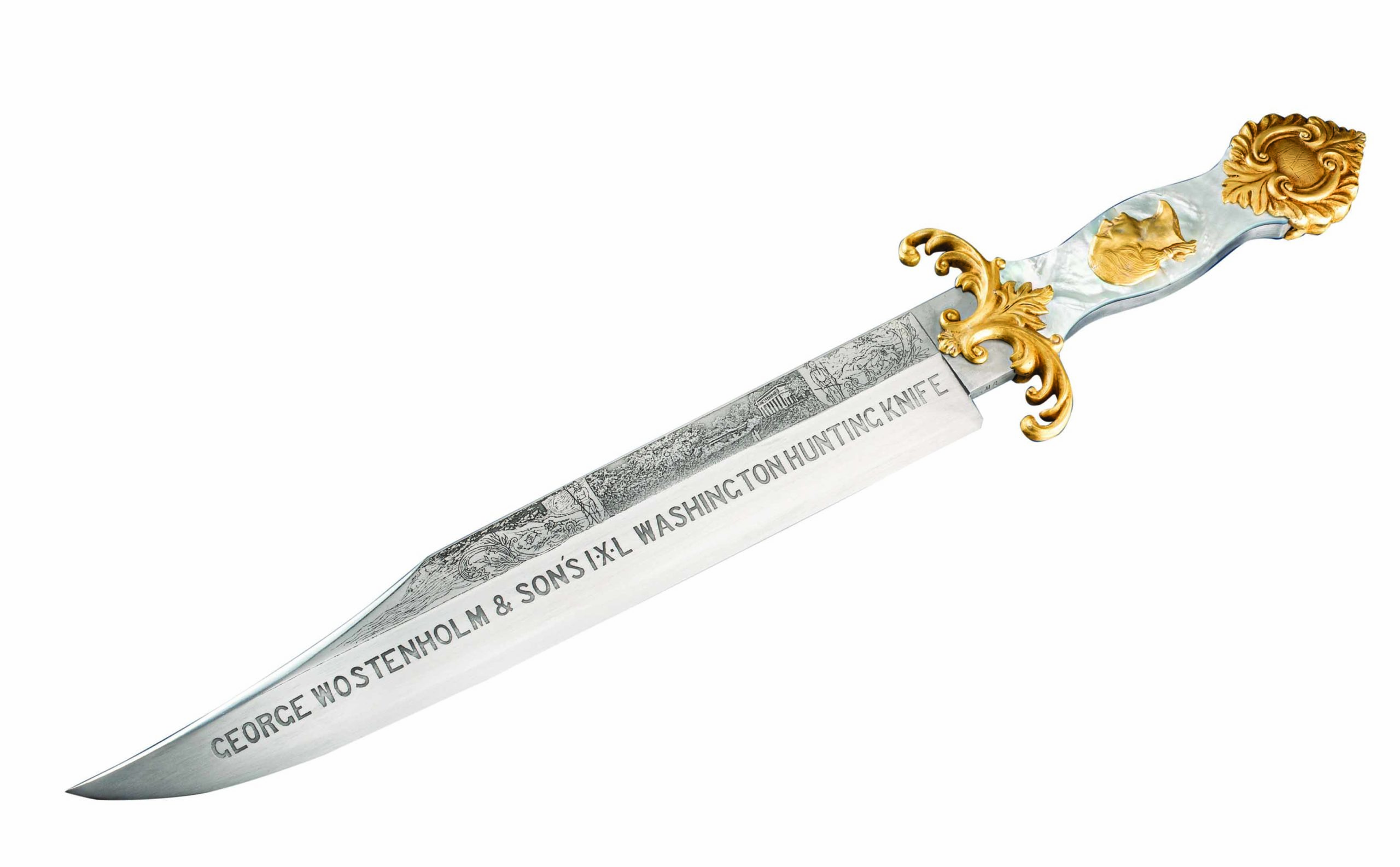
A period knife reproduction of the I*XL George Washington Hunting Knife by Doug Noren gets the full treatment in a 13.5-inch blade of 5160 carbon steel, a mother-of-pearl handle and 18k plated nickel silver. Overall length: 21.5 inches. (Whetstone Studio image)

“There’s something special about reproducing something that was built nearly 200 years ago,” he reasoned. “It’s easy to get lost in your thoughts while working on these knives, wondering what the makers were thinking about at the time. Was the knife going into battle? Was a rich man just wanting something unique? Was the maker just trying to be different and impress people? Were function and effectiveness of use the only factors that mattered? It’s really cool to think about.”

Josh has found the opportunity to consider historical context with a dagger in the distinctive dog-bone handle, recalling the mid-1800s when a gentleman named Loring Kimball of Vicksburg, Mississippi, owned several similar original pieces that were probably made by at least two different knifemakers in the New Orleans area. Knives in what many refer to as the Kimball style have been reproduced by a number of modern makers, mostly bladesmiths.

“The distinctive characteristic of the dog bone is clearly the shape of the handle,” Smith said, “but to me it’s more than that. The large domed pins and the flat facets on the handle provide such a neat look. One of the original Kimball daggers from the 1830s had silver wrapped around the butt of the handle and a small, thin silver guard. I never pretend to exactly reproduce these knives. I always put my own spin on the knife, trying to bring some of my style into it.”

Smith’s dog-bone dagger is fashioned from his own ladder pattern “W’s” damascus blade, African blackwood handle and 18k-gold pins and liners. The 9.5-inch blade is forged from 1080 carbon and 15N20 nickel-alloy steels, while a gold collar stretches over the back of the blade and bears the engraved name of the maker. Overall length: 14.25 inches.

“This particular knife was heavily influenced by Tim Hancock,” Josh said. “I feel Tim, Harvey Dean and James Batson are the three men who led the way in bringing these knives back to prominence, and Tim had the most influence on my construction of these knives. I love period knives and definitely plan on doing more. There are so many incredible weapons from the past that would be fun to recreate.”

*While a number of top industry authorities attribute such original 19th-century pieces as the Carrigan Knife, Bowie No. 1 and others to Black, no knives with Black’s mark are known to exist.
New Knives: Must-Have Production And Custom Blades

From kitchen to camp and beyond, these puppies will perform.

Christmas may have passed and all your presents have been unwrapped, but that doesn’t mean you can’t start building out your wish list for the coming year. We’re here to help with a slew of new knives—and non-knives—that are certain to tantalize and tempt. From production options full of pomp and customs cutting one-of-a-kind profiles, there’s something for knife lover.

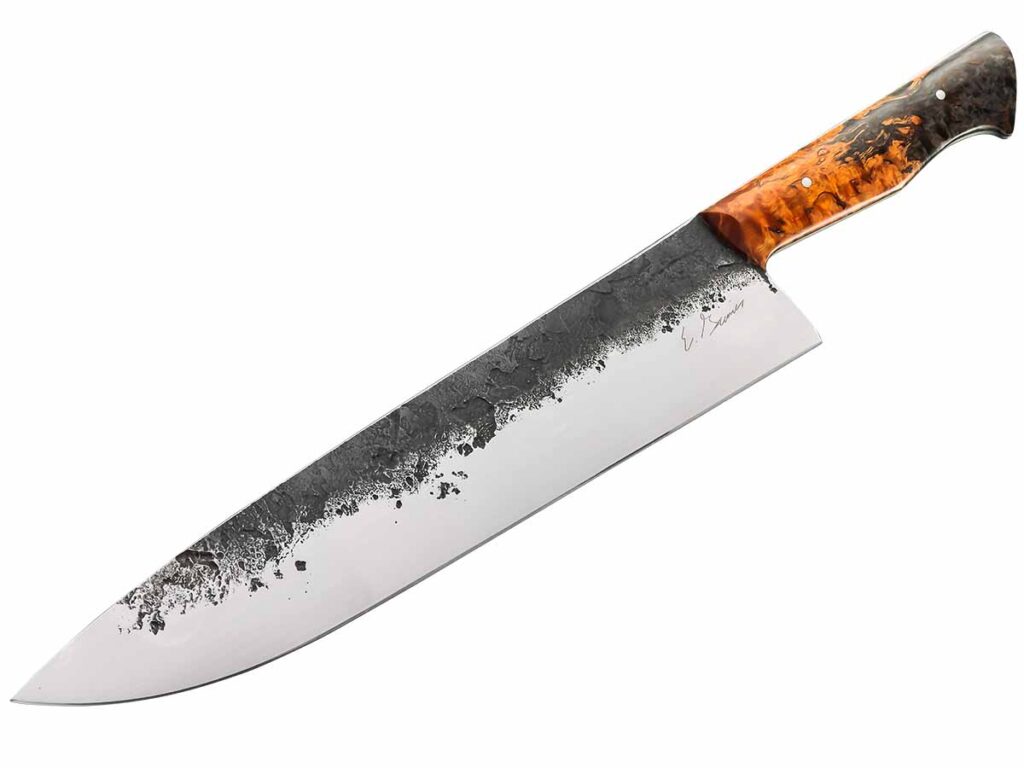
Greiner Chef’s Knife

Greiner Chef's Knife

Blade length: 10”
Blade material: 80CrV2 carbon steel w/forged finish
Blade grind: Flat
Handle material: Double-stabilized karelian birch
Overall length: 14.5”
Maker’s price for a similar knife: $600
Maker: Erik Greiner, greinerblades.com (SharpByCoop image)


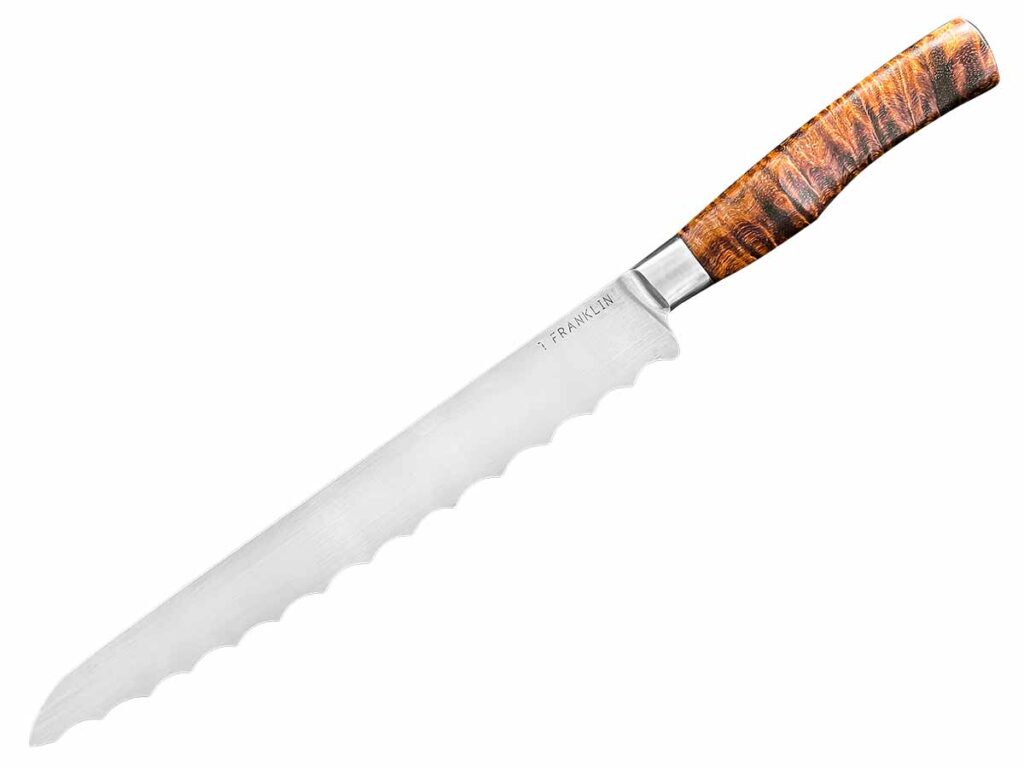
Franklin Bread Knife

Franklin Bread Knife

Blade length: 9.25”
Blade material: 52100 carbon steel
Handle material: Hawaiian koa
Overall length: 14”
Maker’s price for a similar knife: $575
Knife to know: Also comes in a set of three that includes chef’s and paring knives w/a price of $1,750 for the entire set; Thomas Franklin is an ABS apprentice smith
Maker: Thomas Franklin (Jfrasierphotography.com)


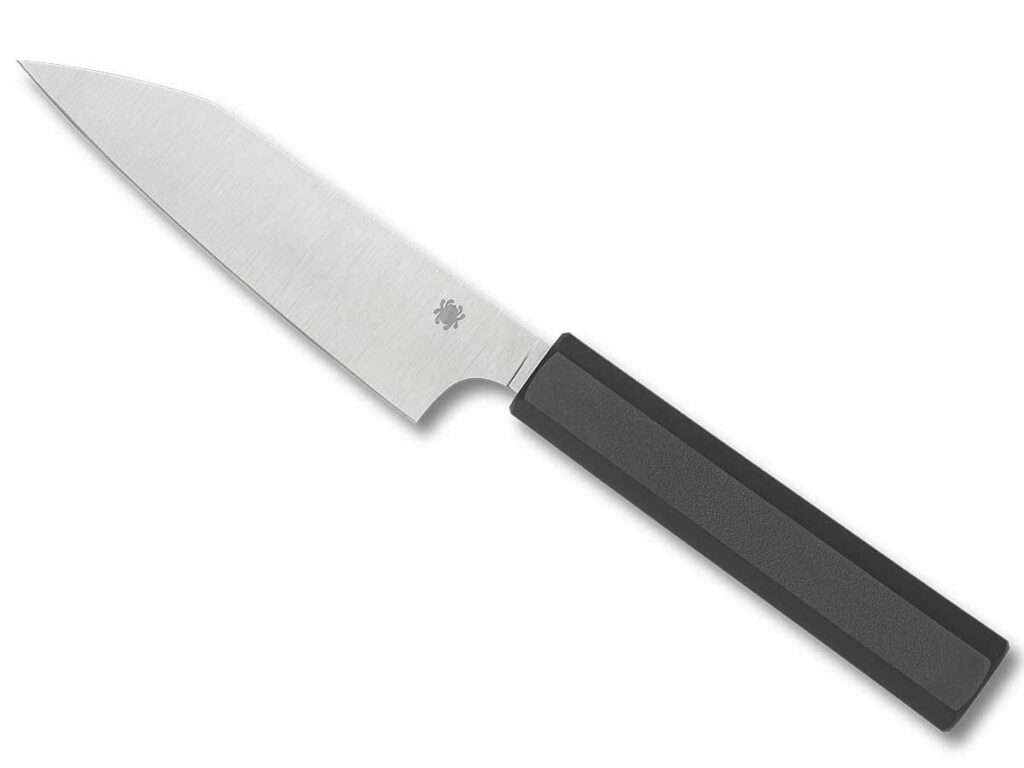
Spyderco Petty

Spyderco Petty

Designer: ABS master smith Murray Carter
Blade length: 4.64”
Blade steel: CTS BD1N stainless
Blade grind: Full-flat
Blade @ thickest: .068”
Handle design: Wa style (octagonal)
Handle material: Black polypropylene
Weight: 1.8 ozs.
Overall length: 8.87”
Knife to know: The Petty is part of Spyderco’s Minarai Series; meaning “to look and learn,” minarai is the Japanese way of describing the role of an apprentice
Country of origin: Japan
Company: Spyderco, spyderco.com


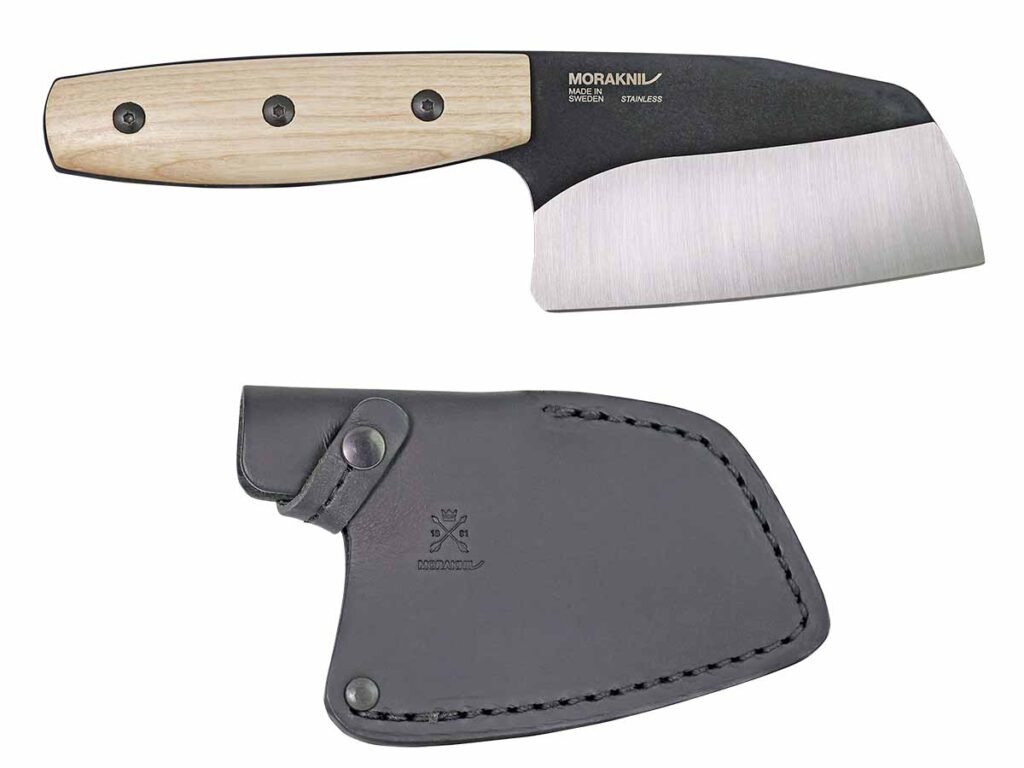
Morakniv Rombo

Morakniv Rombo

Model: Camp chef’s knife
Blade length: 3.86”
Blade steel: Swedish stainless
Blade grind: Flat
Blade @ thickest: .09”
Blade finish: Two-tone
Handle material: Wood
Weight: 5.5 ozs.
Overall length: 8”
Country of origin: Sweden
Knife to know: Designed for right-hand use
MSRP: $230 (at press time rate of exchange)
Company: Morakniv, industrialrev.com


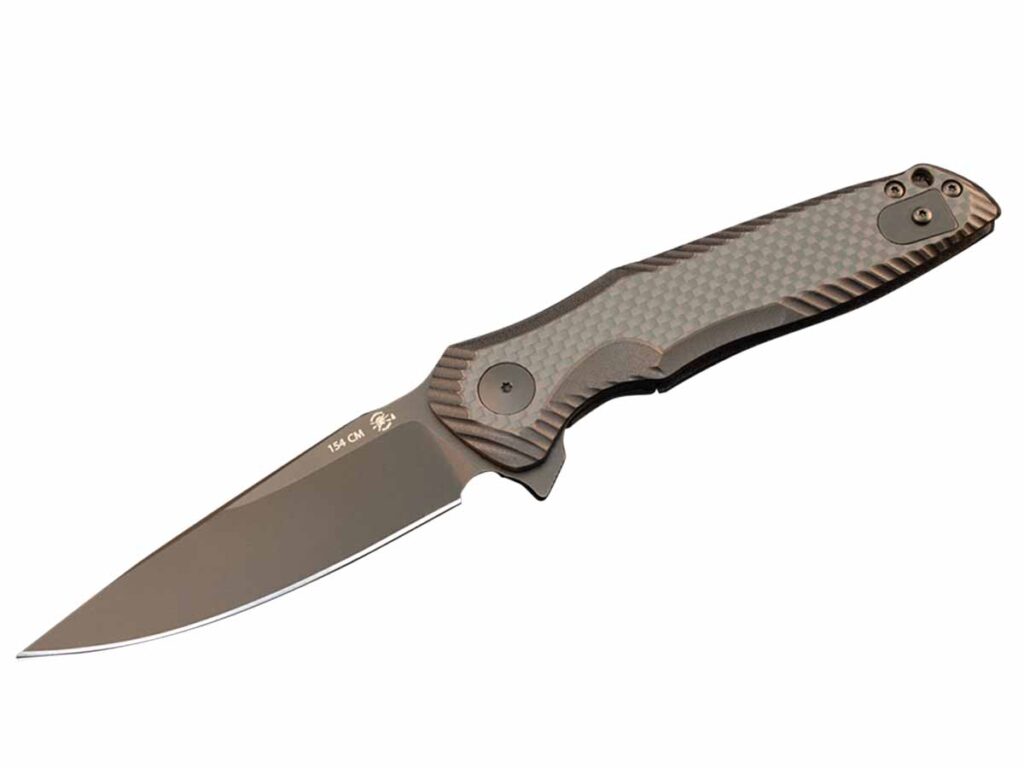
Spartan Blades Poros

Spartan Blades Poros

Designer: Curtis Iovito
Knife type: Flipper folder
Blade length: 3.75”
Blade steel: 154CM stainless
Rockwell hardness: 58-60 HRC
Blade grind: Flat
Blade @ thickest: .125”
Blade finish: Black titanium nitride coating
Blade pattern: Drop point
Pivot action: Ikoma Korth Bearing System (IKBS)
Handle material: Carbon fiber/G-10 composite
Lock: Linerlock
Pocket clip: Deep carry
Hardware & liner: Stainless steel w/black electro-deposit powder coating
Weight: 5.3 ozs.
Closed length: 4.25”
Country of origin: USA
MSRP: $190
Company: Spartan Blades, spartanbladesusa.com


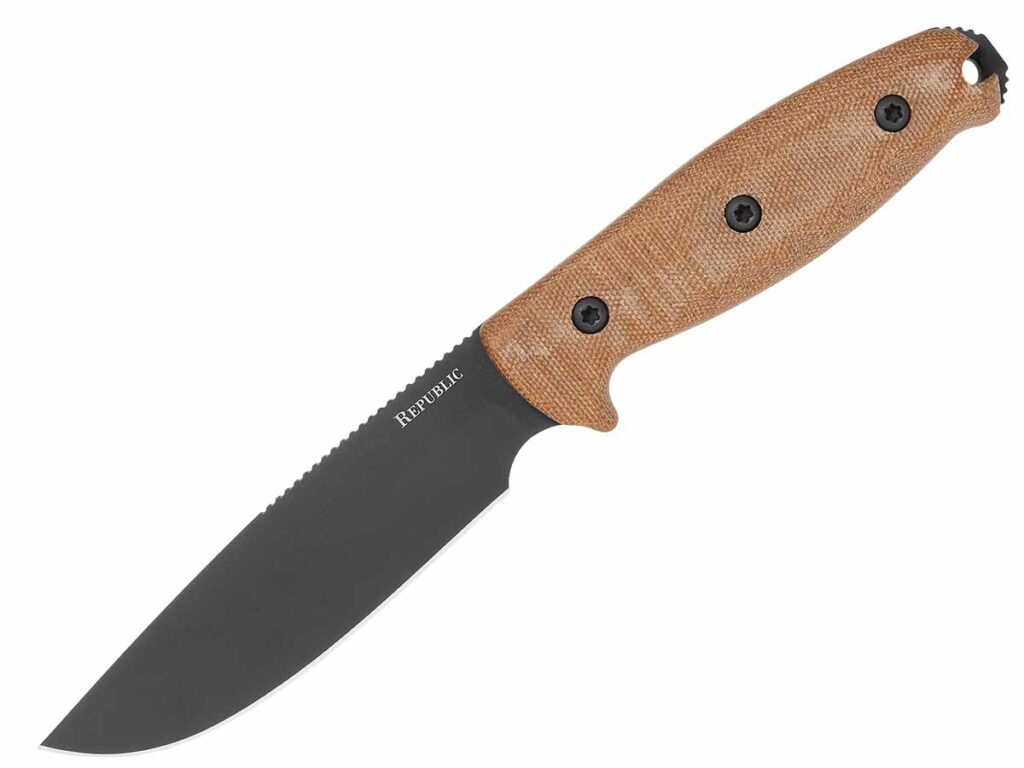
Cold Steel The Republic

Cold Steel The Republic

Knife type: Bushcraft fixed blade
Blade length: 5”
Blade steel: CPM S35VN stainless
Rockwell hardness: 58-60 HRC
Blade @ thickest: .1535”
Blade finish: Corrosion resistant/no-glare Ionbond
Blade pattern: Drop point
Handle material: Micarta® w/single integral guard and lanyard hole
Knife to know: Handle is removable for customization based on situation/undertaking; spine gimping for extra control
Weight: 8.4 ozs.
Overall length: 10”
Sheath: Leather pouch
MSRP: $269.99
Country of origin: USA
Company: Cold Steel, coldsteel.com


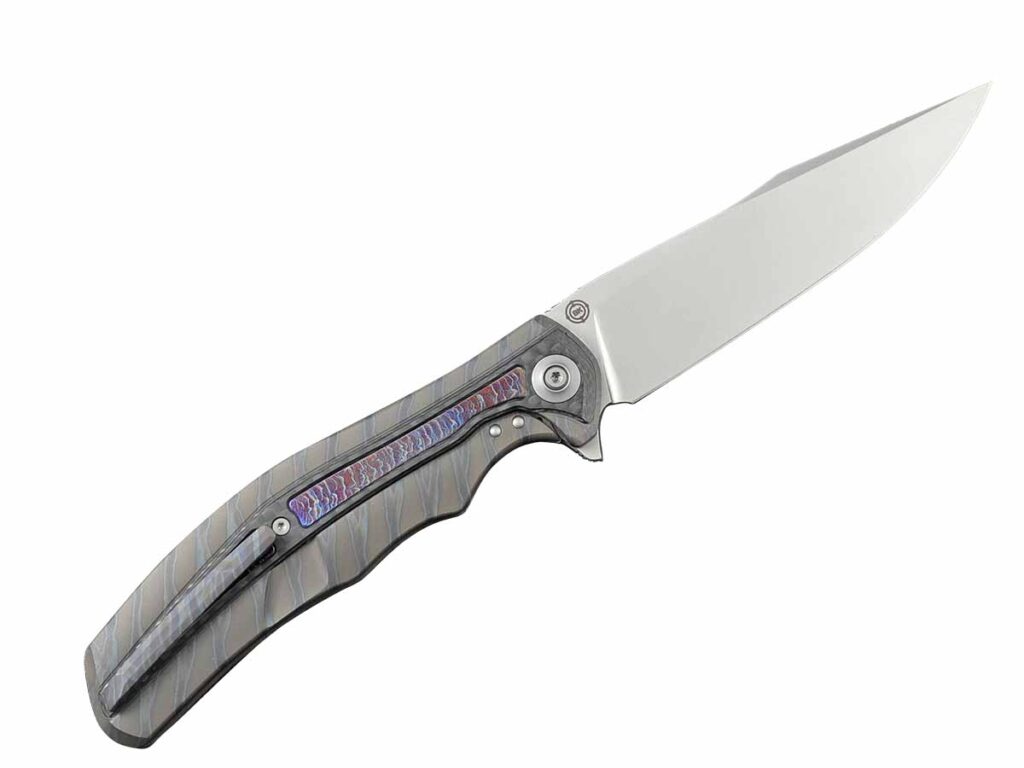
WE Knife Zonda

WE Knife Zonda

Pattern: Flipper folder
Blade length: 4.04”
Blade steel: CPM 20CV stainless
Blade finish: Stonewashed
Blade @ thickest: .13”
Handle material: Black titanium w/flamed titanium inlay
Pocket clip: Right-hand, blade-tip-up carry
Lock: Framelock
Closed length: 4.85”
Country of origin: China
MSRP: $480
Company: WE Knife, weknife.com


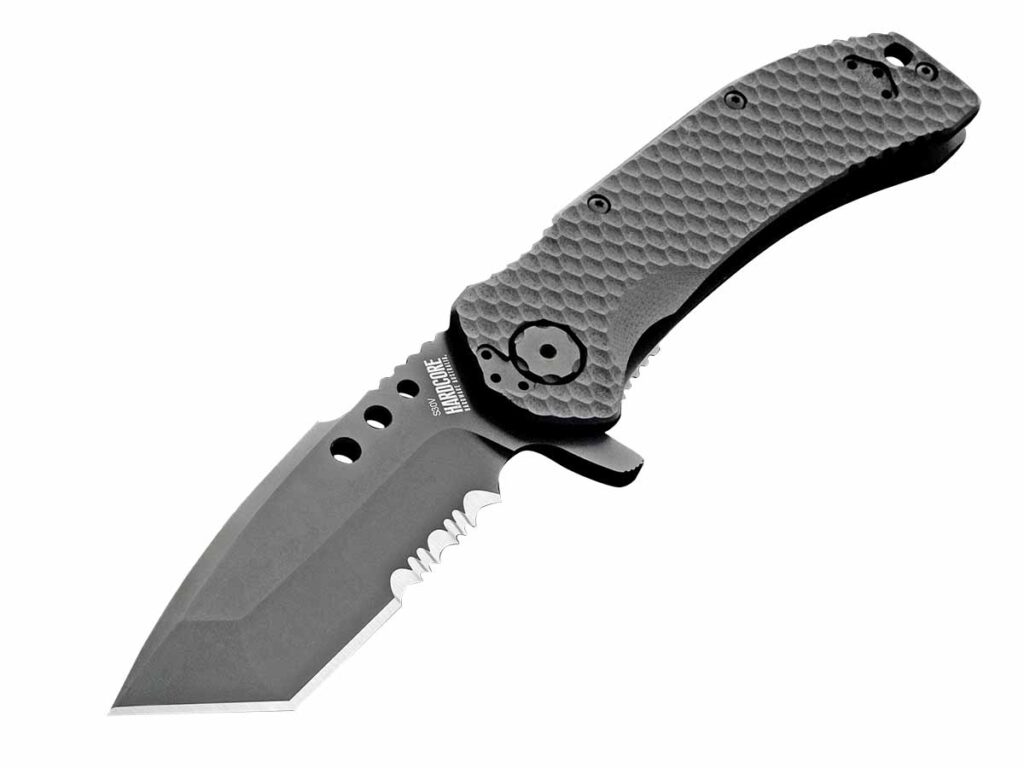
Halfbreed Blades MILF-03PS

HHA MILF

Blade length: 3.54”
Blade steel: CPM S30V stainless
Rockwell hardness: 59-60 HRC
Blade grind: Hollow
Blade @ thickest: .19”
Blade finish: PVD coat
Blade pattern: Tanto
Handle material: G-10
Washers: Phosphor bronze
Weight: 7.34 ozs.
Closed length: 5.51”
Handle @ thickest: .59”
Country of origin: Australian and Taiwanese make
MSRP: $280
Company: Halfbreed Blades, halfbreedblades.com.au


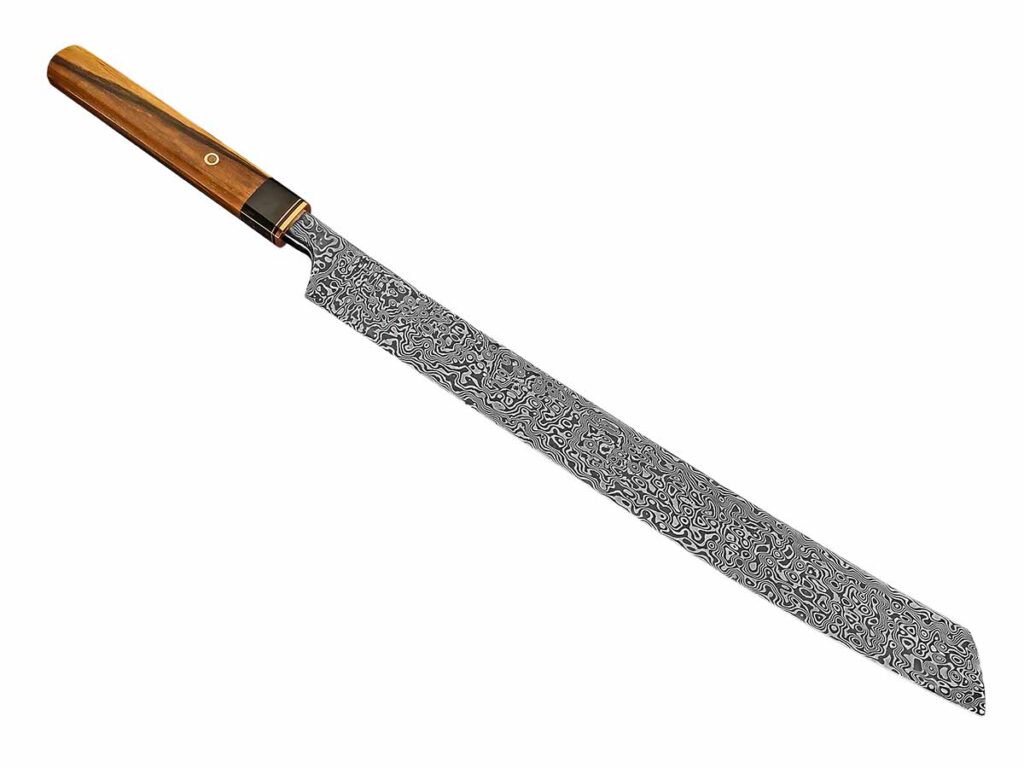
Schubert Knives Large Damascus Slicer

Schubert Knives Large Damascus Slicer

Blade length: 19.3”
Blade material: 90-layer raindrop-pattern damascus of 1084 carbon and 15N20 nickel-alloy steels
Blade grind: Flat
Blade @ widest: 1.77”
Bolster/guard material: Copper and buffalo horn w/soldered joint
Handle material: Stabilized blackheart sassafras
Handle pins: Turned whale tooth and bamboo
Overall length: 26.4”
Scabbard (not shown): Glass lacquered wood inlaid w/black heart sassafras, buffalo horn, copper and whale tooth
Maker: Bruce Schubert (Rod Hoare image)


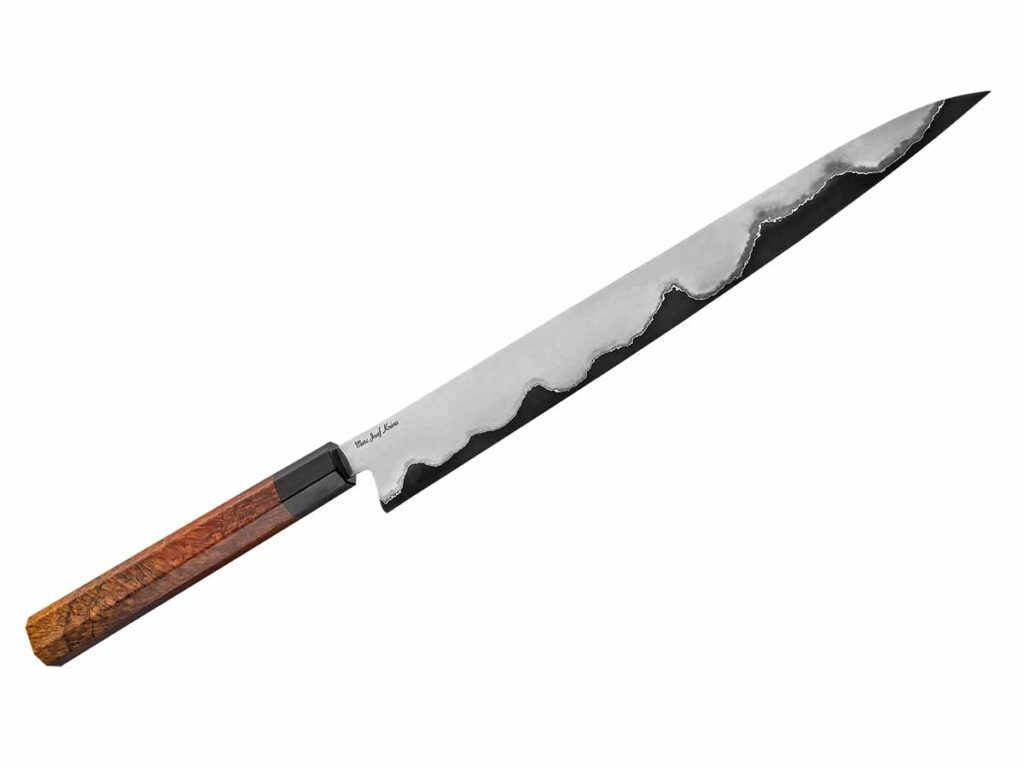
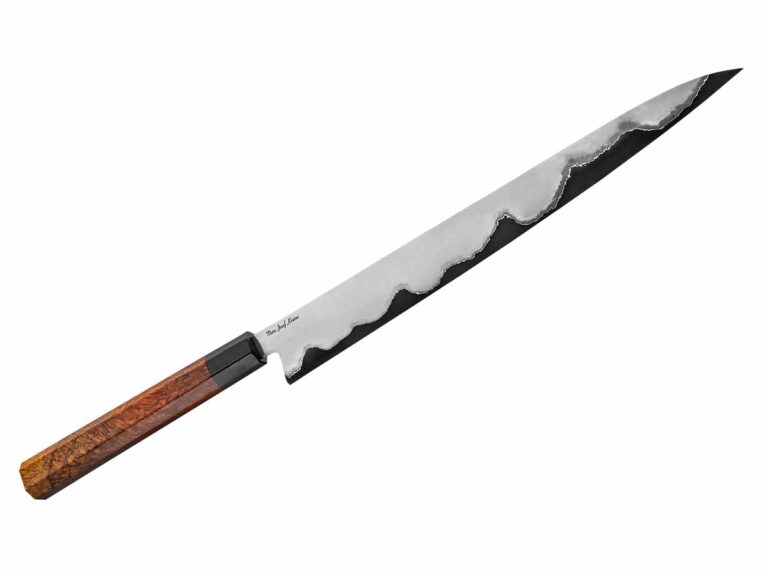
Mark Josef Knives Sujihiki

Mark Josef Knives Sujihiki

Pattern: Slicer
Blade length: 11.8”
Blade material: San-mai construction of 410 stainless steel, nickel and 52100 carbon steel forged by Brook Turner
Rockwell hardness: 62 HRC
Blade grind: Flat/convex
Blade thickness @ ricasso: .118”
Blade @ widest: 1.496”
Handle material: Coolabah burl
Bolster/guard: African blackwood
Overall length: 18.5”
Maker: Marc Stewart, Mark Josef Knives, marcjosefknives.com.au (Rod Hoare image)


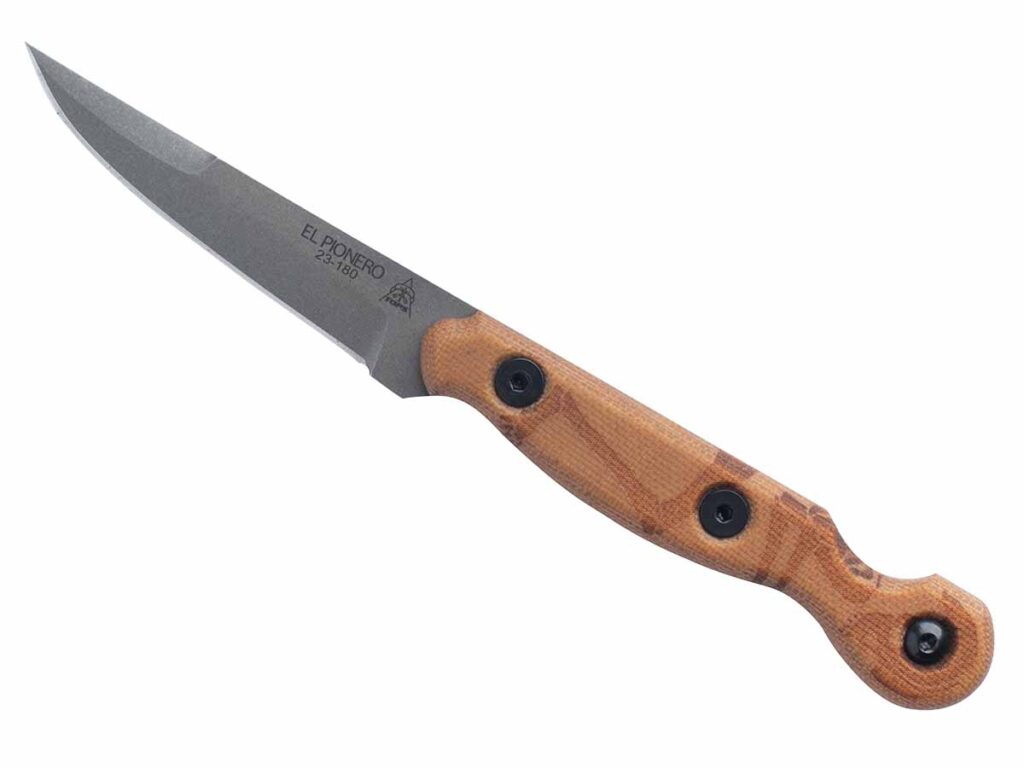
TOPS Knives El Pionero

TOPS Knives El Pionero

Designer: Ed Calderon
Blade length: 3.38”
Blade material: 1095 carbon steel
Blade @ thickest: .09”
Blade finish: Tumble
Handle material: Tan canvas Micarta® w/finger divot that aids in blade orientation, etc.
Weight: 2.9 ozs.
Overall length: 7.63”
Sheath: Black Kydex
Weight w/sheath: 4.1 ozs.
Knife to know: The El Pionero is a “paring knife-esque design”; Ed Calderon (edsmanifesto.com) worked as a counter-narcotics officer in Mexico and more recently as a trainer and “guru in the tactical space”
Country of origin: USA
MSRP: $220
Company: TOPS Knives, topsknives.com


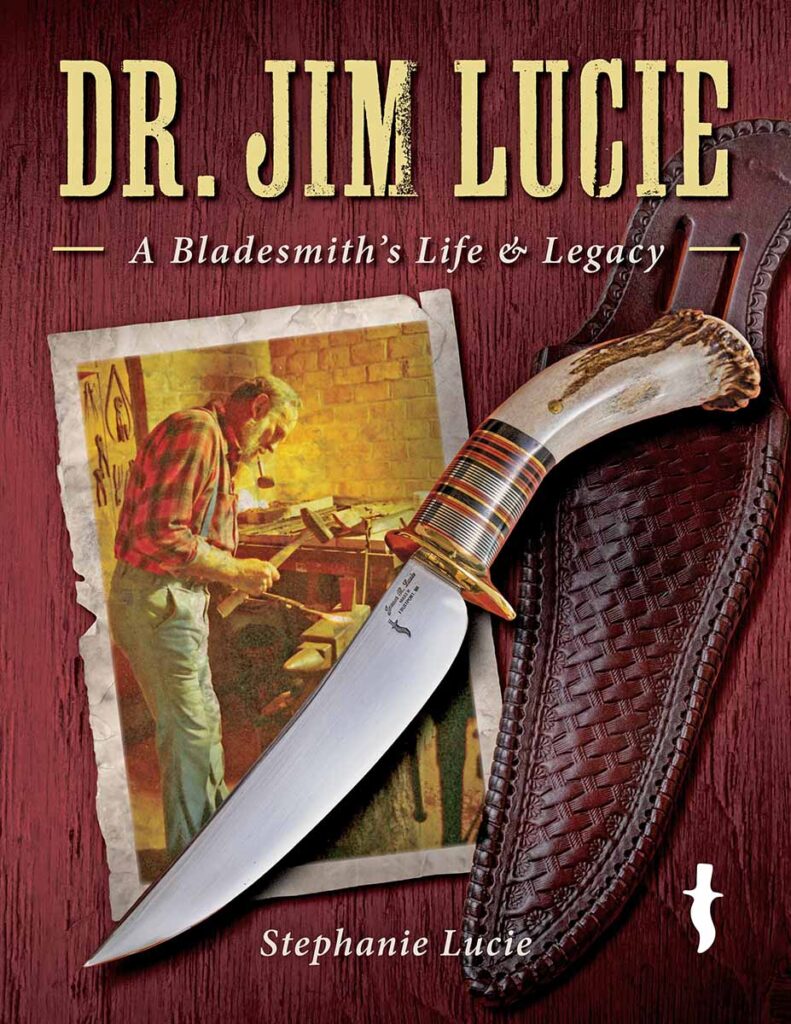
Dr. Jim Lucie: A Bladesmith’s Life & Legacy

Dr. Jim Lucie: A Bladesmith’s Life & Legacy

What it’s about: ABS journeyman smith Dr. Jim Lucie had a unique background: he served as the personal physician for, and learned about knifemaking from, the man recognized as the grandfather of custom knives—BLADE Magazine Cutlery Hall-Of-Fame® member William Scagel. The author, Stephanie Lucie, is Lucie’s youngest of four daughters. She paints a picture of her father like no other, from childhood to adulthood, his bladesmithing mentors and friends, the many stories written about him and much more.
Format: 9.25 x 12.5-inch hardback, limited to 1,500 copies in the first edition, over 300 color photos, including more than 200 knives Lucie made, and over 100 pictures of his life and accomplishments.
MSRP: $120
Contact: jimluciebook.com

Check Out More Knife Drops:

Fighter Jet Micarta and Brotherhood: The Surprise Slipjoint For A War Pilot

Rusty Preston gets an unforgettable slipjoint from good friends.

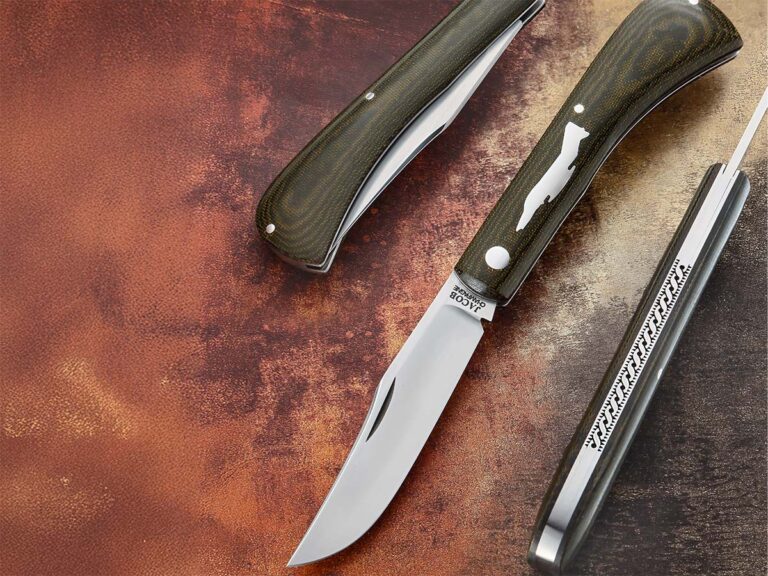
As a founding member of the South Texas Slipjoint Cartel, Rusty Preston made lots of traditional pocketknives over the years, but never did he have one made for him like the trapper recently built by fellow Cartel member Phil Jacob and Ben Champagne.

It all started when a friend sent Ben some green Micarta® bearing some unusual part and serial numbers. They traced it back to a Vietnam-era F4 Phantom fighter jet. The Micarta was part of a chafing block used on F4s as a support to keep hydraulic-activated metal rods used throughout the plane from rubbing or chafing against each other. Ben and Phil knew Rusty was an Air Force pilot during the Vietnam War and when they learned he flew an F4, they decided to use the Micarta in making a surprise knife for him.

The knife had to be a slipjoint, of course, and the two decided on a one-blade trapper pattern. Phil made the blade and springs and Ben made the handle. For a shield they figured a silhouette of an F4 would be appropriate. They got a photograph of an F4 to use as a guide and made the shield of 416 stainless steel to inlay into the Micarta. However, the shield was an inch-and-a-half long.

“It was so long it wouldn’t fit from the center pin to the pivot pin,” Phil said.

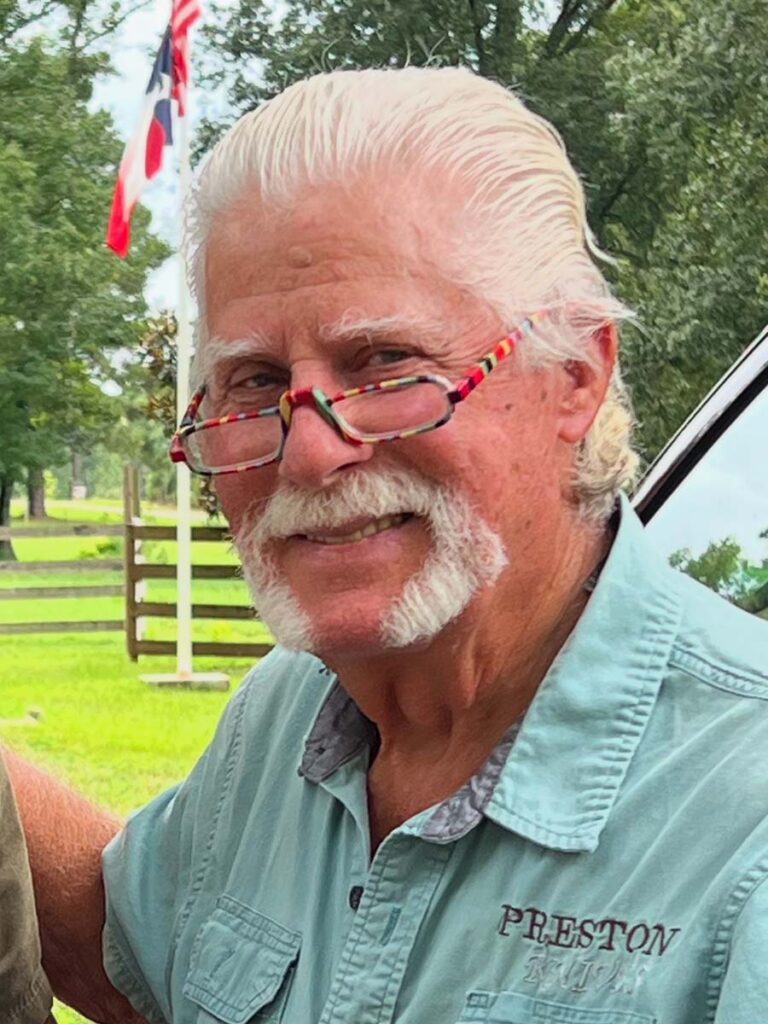
Rusty Preston
Rusty Preston

The solution? The knife would have to be a shadow pattern, which has no bolsters and provides a bigger canvas for a shield. Phil added some Roman knot filework—which Rusty taught him how to do—to the backspring, and the result is a really cool pocketknife.

Once the trapper was done, they had to settle on a place where they could all meet, including many members of the Cartel, and Rusty would be there, too. BLADE Show Texas would be the place and Rusty was about to get a surprise for the ages.

Parting Gift

Rusty and his wife Sally had visited with BLADE Magazine Cutlery Hall-of-Fame® member Bill Ruple and the rest of the Cartel members during the show at the Fort Worth Convention Center and were preparing to leave on show Saturday.

“We were just saying our goodbyes and somebody hollered at me—Bill, I think—‘Hey Rusty, come over here,’ and I realized he was at the end of the aisle and he had a group of guys there,” Rusty recalled “Everybody there was a friend of mine, and I thought, ‘Oh, what’s gonna happen here?,’ and sure enough Sally and I walked up—Sally knew about it but I had not a clue—and they started in on me.”

It was all Rusty could do to keep from breaking down—which is about what he did.

“I’ve had this birth defect I’ve had all my life,” he said. “I can squall like a baby at an ice-skating contest at something like that, so it was pretty hard on me but in a good way—you know how that is. So they told me they wanted to present me with something and I saw what it was and I couldn’t believe it. It came as a total, absolute surprise to me. I was dumfounded at what they had done, and why they saw fit to honor me in that fashion is a marvel to me.

“It was just an honor to look around and see the approval on every one of those guys’ faces for what was happening.”

Rusty called the work on the knife “stunning.”

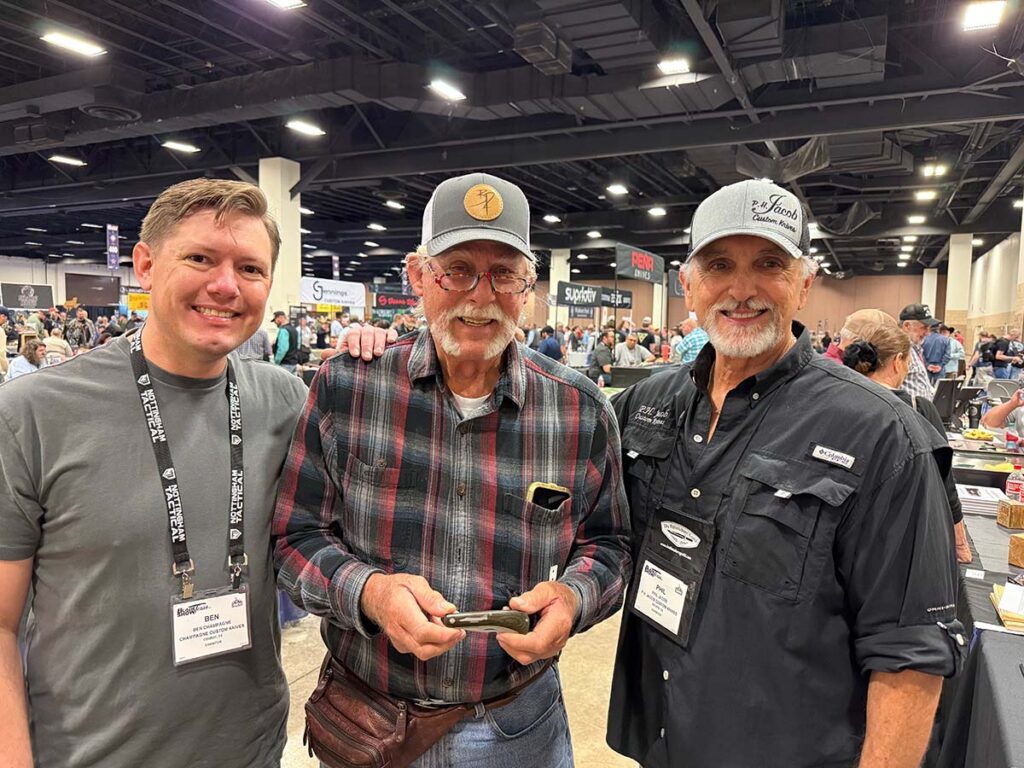
Ben Champagne (left) and Phil Jacob (right) present Rusty Preston (center) with his special surprise knife at BLADE Show Texas 2025 (page 56).

“It’s got both Ben and Phil’s names on the blade and it’s just absolutely outstanding detail work on the inlay and the silhouette of the F4,” he observed. “That took a lot of effort. I don’t know how they managed to get ahold of all that but they did. It’s beautiful, it’s perfect.”

But what about that Micarta? How in the heck was Ben able to obtain material meant for an F4 Phantom jet fighter? Some things are just better left unsaid.

“The fact that the handle material is what it is and where it came from, how in the world Ben ever got ahold of F4 parts I don’t know. And I’m scared to ask him,” Rusty grinned, “because he’d probably tell me.”

Read About Custom Knives:

The Soft-Backed Blade

For Maximum Toughness Without Sacrificing Edge Performance, Consider A Soft-Backed Blade.

For centuries, smiths from various cultures recognized the necessity of blades that do the job without critical failure. Some Eastern cultures specialized in differential hardening, particularly the Japanese. European cultures tended to forge weld a hardenable edge to a softer spine. In each case, the end result is an edge hard enough to cut well and a spine tough and resistant to breaking.

One of the measures of a modern knifemaker is the willingness and ability to successfully navigate the certifications processes of the world of knives, such as the American Bladesmith Society’s (ABS) journeyman and master smith certifications. Similarly, one measure of a knife blade is its ability to perform various tasks that put its edge geometry and heat treatment to the test. 

If you’ve been around the knife industry any time in the past 40 years or so, you’ve no doubt seen stories of blades that demonstrate edge holding ability that also have the strength and flexibility to bend without breaking. The key to this kind of performance is for the blade to have a hard edge and a soft back. Pardon the pun, but let’s break that down a bit.

First things first—a knife must cut. One key to premier cutting performance is a well-hardened edge. A properly hardened edge comes from the use of steel with adequate carbon, brought to the proper hardening temperature, quenched in the proper quench medium, and tempered to the proper hardness.

Each of these variables has an impact, but at the end of the day if the maker does things right, the edge of a well-performing blade will be hardened and tempered martensite in the 58 to 60 HRC Rockwell hardness range, plus or minus a point or two depending on geometry. If the edge is left too soft, the blade will not cut as it should.

Shawn Ellis originally learned the edge hardening process from ABS master smith Jim Crowell in the early 1990s when Jim—here at the grinder—demonstrated edge hardening using an acetylene torch. (Jay Morrissey image)

But what about the blade’s spine? Does it need to be as hard as the edge? The answer is “it depends.” Hardness as a metallurgical property is directly opposed to toughness, in that the harder the blade the more brittle it is. At the same time, an unhardened blade of annealed steel is very difficult to break but won’t hold an edge. If the maker hardens the blade fully from edge to spine, the knife will be more likely to break under chopping or bending loads.

Let me talk about “more likely” in this case. Are you more likely to be struck by lightning or bitten by a shark? As it turns out, you’re about 7.5 times more likely to be struck by lightning than bitten by a shark, but the odds of being struck are only 1 in 500,000. Either way, neither is very likely. I state that because while it is empirically true that a fully hardened blade is “more likely” to break than a blade with a soft back and hardened edge, if the maker does the heat treatment properly and the user uses the blade properly, either will perform very well with a very low risk of catastrophic failure.

Soft-Backed Bennies

Even if the overall risk of breaking in normal use is small, it still makes sense that some makers want to chase that last bit of performance by taking advantage of the strength of the soft-backed blade. So what does a soft-backed blade do? What are the benefits? By hardening the edge but intentionally softening the spine, the blade is more resistant to breaking when subjected to extreme force. This remains true whether the force comes to the blade parallel as in chopping or perpendicular as in bending.  

ABS journeyman smith and past Forged in Fire champion Shawn Ellis is a proponent of the soft-backed blade. He originally learned the edge hardening process from ABS master smith Jim Crowell in the early 1990s when Jim demonstrated edge hardening using an acetylene torch. 

He heated the edge only, quenched the blade, and then used the torch to draw the temper back. To temper, he started with the torch at the spine and used a wet rag to keep the edge cool. When he was finished, the edge was a light bronze and the spine was blue.

Even though that was quite a few years ago, the method Crowell taught Ellis remains viable. Heating only the edge  leaves the spine soft and annealed but transforms the edge into the tempered martensite required for cutting performance. Using the torch afterward to “blue back” the blade relieves any internal stresses that may result from heating only the edge to the critical temperature, that is, to a non-magnetic state. 

Ellis found that heating the blade at least a third of the way from edge to spine resulted in better performance. Subsequently, he switched to heat treating in a forge, and then later in an oven. 

While it’s possible to edge harden with a forge or an oven, the methodology changes. Edge hardening in this way results in a martensitic edge and a spine that retains the microstructure it previously had. If the blade was forged and normalized, the spine would be soft pearlite. If the blade was ground from bar stock, the spine would be spheroid carbides.

Another way to achieve a hard edge with a soft back is to quench the edge only. You can bring the whole blade up to temperature in a forge or oven, and then place only the edge of the blade in the oil for hardening. This is the method currently taught at the ABS schools. 

In this case, you need enough oil volume to cool the steel properly, so you can’t just fill your quench tank with oil to the half-inch level. Instead, use a limiter plate to keep the edge at the right depth while allowing the tank to have an increased volume of oil. You rock the blade in the oil in such a way that the edge is quenched properly while the spine cools slowly. 

The slow cooling of the spine results in a pearlite microstructure, while the quenching of the edge results in martensite. The result is again a hard edge and soft back, and a “blue back” draw is again recommended. Blades that are edge hardened are resistant to breaking, though the soft spine may bend and stay bent.

The final way to achieve a soft-backed knife is the most difficult but results in the highest performance. In this method, the blade is hardened completely, with the whole blade up to critical temperature and the whole blade quenched fully. After regular tempering in the oven, the blade is then torch tempered on the spine. 

In this scenario, the spine is pushed past blue all the way to gray, but not to the point where it starts to show heat color. Essentially in this case, you’re applying differential tempering rather than differential hardening, adding heat in the 650-800°F range to the spine only, resulting in highly tempered martensite. Since you’re working with higher temperatures, extra care must be taken to keep the edge cool by keeping it immersed in water or wet sand.

ABS master smith Scott McGhee’s Mamba damascus fighter features forge-finished flats with bronze fittings and a koa wood handle. He prefers 1075 carbon steel and uses two propane torches to draw the spine evenly, keeping the edge cool in wet sand.

ABS master smith Scott McGhee teaches the Introduction to Bladesmithing class at Haywood Community College in Haywood, North Carolina. Students learn from McGhee how to make a knife that will pass the ABS performance test using a full quench and a torch draw. He prefers 1075 carbon steel and uses two propane torches to draw the spine evenly, keeping the edge cool in wet sand.

STRUCTURAL RESULTS

I asked metallurgist Larrin Thomas for insight on the structural results of the different edge hardening approaches. According to Larrin, “When it comes to Rockwell hardness, torch tempering a fully hardened blade to 650-800°F results in hardness in the Rockwell hardness range of 45 to 55 HRC, depending on the steel and the time spent at the tempering temperature. Slow cooling the spine by quenching the edge will result in soft pearlite similar to air cooling during normalizing and grain refining. This puts the spine in the range of 20 to 40 HRC, depending on the steel. Some steels have such high hardenability that they will partially harden during air cooling, such as oil quenching steels O1 or L6, and may even reach 60 HRC if the cross section is thin enough.

“The softer the spine, the more resistant the blade is to breaking but the more likely it is to take a “set” during bending. In other words, less bending of a softer spine would be required for the blade to stay permanently bent. The ideal condition would be one where the steel has sufficient hardness to avoid staying bent but sufficient toughness where it will not fracture. This combination of properties is best achieved by a full quench and a spine torch temper.”

For many years now the certified smiths of the ABS have demonstrated competence at these processes. If you want to climb the ladder of knifemaking skills and certifications, or if you want to climb the ladder of high performance hard-use knives, the heat treatment of a soft-backed knife is a skill you’ll want to master. If you’re the kind of knifemaker or the kind of knife buyer who wants 100 percent of the toughness a blade can offer without sacrificing edge performance, consider a soft-backed blade.  

Read More

Spartan Blades Poros Review [Tested]

The Poros takes a beating and keeps on cutting.

The Poros by Spartan Blades is a great feeling folder. The flipper design is spot-on for hand placement.

Company co-founders Curtis Iovito and Mark Carey are excellent to work with and built Spartan from scratch. Both are retired from Special Forces and have a lot of pride in workmanship. The Poros is their field-grade-version linerlock. It might not have the fancy material and looks but the performance is top shelf.

Poros Light Cutting Duties

Initial slicing of 20-pound copy paper was excellent. The Poros was very smooth and aggressive. The blade shape really helped slicing paper, especially when I employed a roll cut. The flat-ground blade sliced straight with no curling of the paper.

Poros Cutting Leather
The 154CM stainless steel blade was exceptionally aggressive in the 8-ounce leather slice.

The Poros easily devoured single-walled cardboard. As with the copy paper, the blade sliced it both forcefully and effortlessly, resulting in nice, straight cuts. The slices were extremely quick with no resistance felt.

The folder was quite aggressive again in the 8-ounce leather slice. It was very easy to control the thickness of the skiving—I just needed to move my fingers faster. I had two fingernail nicks after the skiving. The edge remained sharp.

Poros Medium Cutting Duties

It was time to do a fire stick. The flat grind produced excellent curlicues. It sliced the wood incredibly fast and I had to slow down for more control to keep the curlicues on the stick. The handle was comfortable while making the deeper cuts. It was awfully simple to whittle with the knife.

Spartan Blades Poros cutting curlicues
The flat grind produced excellent curlicues. It sliced the wood awfully fast and the author had to slow down for more control to keep the curlicues on the stick.

For the next exercise I used 1-inch manila rope. The Poros crunched to 197 cuts before I ran out of rope. The edge was still good. The handle was very comfortable during heavy use. There were no issues with the blade lock. Nicely done, Spartan.

Poros Heavy Cutting Duties

I split kindling into smaller pieces to check lockup by doing baton work. There continued to be no issues with lockup or edge retention. The knife can handle a beating for sure. It’s not that I recommend baton work with a folder but if you have to it can be done with the Poros.

Poros splitting wood
The author split kindling into smaller pieces to check lockup via some baton work. There were no issues with lockup or edge retention.

To push the knife a bit further, I grabbed my trusty whitetail deer antler. After 30 hard whacks on it, the edge was still sharp with no rolling or chips, indicating spot-on heat treatment.

The last test was back to the copy paper slice. The Poros continued cutting smoothly and my arm was tired. Outstanding job, guys!

Final Cut

The Poros folder is worthy of riding in anyone’s pocket. It’s well designed, sharp and easy on—and comfortable in—the hand. I really don’t know what I’d change on this one, though I would love to see an A-2 tool steel version.

Poros Specs
Maker: Spartan Blades
Knife type: Flipper folder
Blade length: 3 7/8”
Blade steel: 154CM stainless
Rockwell hardness: 58-60 HRC
Blade finish: Black PVD
Handle: Carbon-fiber-patterned G-10
Lock: Linerlock
Closed length: 5 1/8”
Country of origin: USA
MSRP: $190

Check Out More Knife Reviews:

Mike “Whiskers” Allen: Award-Winning Custom Knifemaker/Designer Passes

Remembering Mike “Whiskers” Allen, known for his innovative hidden bolster automatics and collaborations with Pro-Tech Knives.

Mike “Whiskers” Allen, affable award-winning custom knifemaker and knife designer, passed away on November 8 after a short illness.

Nicknamed for his full bushy beard, the Malakoff, Texas, cutler started making knives in 1984. He made folders mostly, specializing in automatics. He suffered a stroke in 2015 that affected his right side and eyesight, so he had to retire from knifemaking.  He designed a full line of autos for Pro-Tech Knives, including the BR1.7 LTD “Whiskers” Design, which opens via a nifty hidden bolster release and debuted at BLADE Show 2025.

Whiskers also made miniatures as well as swords. He was known all over the country for his reasonably priced, one-of-a-kind knives. He was a member of The Knifemakers’ Guild and the Professional Knifemakers Association (PKA) and carried Knifemaker’s Emeritus status in the Guild. He also served as PKA president during his last few years of making knives. He won at least one custom knife judging award at the BLADE Show, which he and his wife Denise attended on a regular basis.

Remembering Others The Knife Industry Has Lost:

Henning Wilkinson: Magician Of South Africa Knifemaking

Acclaimed, Talented Knifemaker Henning Wilkinson Is Making Beautiful Knives And Living A Life Worth Emulating.

I’ve been in the blade-making business right at 50 years. I’ve met and befriended hundreds of bladesmiths and knifemakers. I have a long history of designing and making knives and other edged tools in carbon steel and mosaic damascus. I have pioneered many of the modern techniques used in the production of these blades. The techniques are now in their third generation.

The newer smiths and makers — especially in the damascus end of the business — do things with steel and design that border on magical. Some of these modern magicians have been in the business only a few years. I feel very privileged to have met some of them and spent shop time with a few more. One is Henning Wilkinson.

I started following his social media posts a few years ago. Even then, the level of his work was nothing short of astounding. His blade designs and mosaic patterning are all well thought out and extraordinary. He and I began corresponding on social media and developed a friendship through our mutual interest in damascus blades. 

His blade designs and fitting of all the design parts is in my opinion some of the best on the planet. As a result, I wanted to see his methods firsthand. Meanwhile, Henning also had great interest in my methods of forging and pattern development. So began the plan to spend time in the shop.

We agreed I should go to South Africa and teach a couple of classes. The trip coincided with the Knifemakers Guild of Southern Africa Show. It was great fun meeting new friends and visiting with many old ones half a world away. The classes were a great success and I learned much, including that braai* has no equal and biltong+ is better than jerky. (I had to throw that in for my South African friends).

Henning is a deeply religious man who lives his faith as best he can in all he does. His knifemaking skills are a showcase of that dedication. He is an advanced martial artist and very skilled with firearms. Some of his techniques and skills come from a trained gunsmith background, and are a lot of what drove me to fly halfway around the world to see those handwork skills with my own eyes. I was not disappointed. I asked Henning to send me his biography to help with this story.

Henning Wilkinson: In His Own Words

wilkinson sword
Damascus, ivory and gold engraving help highlight Henning’s dagger with a Renaissance flavor.

I was born Jan. 13, 1978, in the little town of Brakpan, South Africa. My dad was a blue-collar worker who started his working life at 16 doing an apprenticeship as a tool-and-die maker. He was always busy on weekends doing all sorts of jobs, from building concrete mixers to doing electrical work — pretty much anything you could think of. He now owns his own wood furnisher business. 

Growing up, using machines and tools for whatever reason was never a problem for me. My father believed that to work with your hands from an early age would give you a head start and an advantage in life.

My mother was always busy with something to generate extra cash. I remember from a very early age her making clothing as a seamstress, from wedding dresses to underwear. Even my wife had the privilege of having her wedding dress made by her mother-in-law. My mom was always carting all the kids around from one sports event to another. Both my parents supported us however they could, and still do.

My first recollection of Christ was growing up in a home where He was loved and honored. I can remember as a young child walking into my parents’ room in the early hours of the morning and finding them both on their knees praying. This has remained my foundation for every decision and my way of living.

I joined the family business in woodworking where I learned a great deal in all different fields, from electrical to mechanical, as we did all our own repairs and maintenance on the machines in the factory. I started my apprenticeship as a gunsmith in 1998. I learned a lot about the fine finishing and fittings of different materials to one another.

I started making knives in 2000 while doing my gunsmithing apprenticeship. I fell in love with a knife called the Commander made by Ernest Emerson, which at that stage I couldn’t afford (it would have been three months’ salary for me back then). Having a father who taught me whatever you cannot afford you can make yourself, I jumped to the task not knowing what I was getting myself into.

During the process I met a good friend, Carel Smith, who guided and still guides me in everything knifemaking related. Carel invited me to the Knifemakers Guild of Southern Africa Show and my eyes were opened to the possibility of real knifemaking. 

After I built a folder, Carel invited me to forge a blade and make some damascus. I was immediately hooked, captivated by the process of forging damascus, spending the first couple of years building and perfecting machines to make my own. In 2006 I was admitted into the Knifemakers Guild of Southern Africa, being only the second person to forge blades to be so honored.

Right from the start I attempted to make a better knife than the one before. I would not settle for anything other than my absolute best effort on every piece, from fit and finish to heat treatment and into the smallest detail, always trying to push my limit.

Then everything changed.

In 2012 I walked away from knifemaking as I believed I could not provide for my family the way the world told me to. I took on a job in the oil and petroleum trade as an underground utility surveyor. I thought I had it made. However, after a couple of years I was in a deeper hole than when I started—physically, emotionally and pretty much every way thinkable.

God slowly decided to drag me back into what I was made to do.

In late 2018 I decided to carry on as a full-time knifemaker. It was a leap of faith and the most rewarding decision of my life. Being able to do what you love can only be described as a massive blessing.

I am a Christian and I believe that God forms every piece through my hands, which is why I have a 9k-gold cross as a maker’s mark. My aim is to craft each piece in praise to God, and to make it so it will set itself apart and stand out as the best knife in any collection.

Picture In Steel

Wilkinson forging
Henning (left) and Schwarzer (second from left) hammer hot steel while interested observers observe in the two friends’ forging class in South Africa.

On June 15, 2018, I did a Facebook video on how to grind a false edge. I received a comment from a gentleman whose work changed the way I looked at knifemaking. I used to think that because I could make damascus and drill a couple of holes, my knives were good. However, a “picture painted in steel” of a bird hunter with his rifle and his dog# made me realize that this could be far more—it could be an art that would leave people in awe of what can be done. The gentleman is Steve Schwarzer, whom I am now lucky enough to have as a close friend.

In 2019 I was able to exhibit at the BLADE Show, and was immediately accepted into the family of worldwide knifemakers. This has left me inspired to inspire those whom I see as my peers.

Shortly after BLADE Show 2019, Steve visited me in South Africa. We had the privilege of spending time together and learning from each other. It was a massive honor to stand shoulder-to-shoulder with him during a damascus course we hosted together.

During the visit I learned the definition of what a true master is. It is not a stamp on a knife or an award certificate. It is someone who never stops in striving to learn every intricacy of his or her art, perfecting every part no matter how big or small it might be, staying humble in the process and never assuming his or her own greatness. 

Among a thousand lessons learned during Steve’s visit, for me this was the most important. The second lesson is that we will only have this journey called life once, and the decisions we make will be the determining outcome of that journey. I have never laughed as hard in my life during Steve’s two-week visit. His friendship and guidance are an invaluable blessing to me. It is an honor to call him my friend.

To me, knifemaking is a way of life, constantly trying to perfect and add new aspects to the knives I make. Through the fashioning of these pieces I continue to learn more about myself as God wants me to be. Knifemaking has given me the freedom to be a father to my two children and a husband to my four wives (my loving wife and the best three dogs ever).

One of the memories I will always cherish is one of my son as a small child standing on a tin in front of a lathe machining some steel. He has recently started making knives and this next journey together as father and son working in the shop together is another great blessing for me.

I specialize in art knives and high-end exclusive pieces, from folding knives to swords, using only the best end materials. Bringing 20 years of knifemaking experience and a lot of passion to each piece, I am proud to be a 100 % sole authorship maker. I am a member of the Knifemakers Guild of Southern Africa and the American Bladesmith Society. I hope you can see the passion in my work and will enjoy every moment you spend with it.

*Braai is South African barbecue

+Biltong is a form of dried, cured meat that originated in Southern African countries.

#The “picture painted in steel” was Steve Schwarzer’s groundbreaking scene of hunter with rifle and dog done in mosaic damascus in the early 1990s that set the world of knives on its ear.

Read More

Advertisement

Must Read Articles

Read this before you make a knife

Knifemaking 101 – Read This Before You Make a Knife

  by Wayne Goddard My experience has taught me that there's nothing like digging in and getting started. I've often said the hardest part of the...
how to forge damascus steel

How to Forge Damascus

Advertisement
Advertisement