Check out a few of the new blades that caught our eye in Las Vegas.
It was a busy week at the Sands Expo Center in Las Vegas for the outdoor and shooting extravaganza known as the SHOT Show. Of course, there were plenty of factory makers in attendance with plenty of new releases for the coming year.
Sadly, we were unable to make every cutler in the house for the big dance but we did stop by a good number and caught a glimpse of some of the new blades for 2025.
Kronos Knives Gung Ho! Line By Ken Onion
Kronos is a new kid on the block, one-year-old as of SHOT Show 2025. The upstart knifemaker had a heck of an anniversary surprise at the home of its launch. The South Carolina-based company unveiled four Ken Onion-designed Gung Ho! line of fixed blades. The four knives that make up the line are all outdoor/tactically angled with 1095 steel blades and G10 handles. The models include the Stiffneck (MSRP $220), Maxhunter ($228), Elitesurvival ($256), and Truedefender ($228, pictured above). Kronos will have them for sale at the end of February.
Case Sculped Ridgeback
Case gives a modern and rugged look to its Ridgeback Hunter line with the introduction of the Sculpted Ridgeback. The fixed blade still has the sexy sweeping stainless steel blade true to the line but is dressed out in a durable and attractive new handle. In this case, canvass Micarta with G10 liners. The texturing is aggressive, making a workhorse that’s not afraid of bad weather but just as attractive as its rosewood predecessor which it is pictured with above. Case has a $128 MSRP on the knife.
Vero Engineering/Pro-Tech Custom Synapse
The Custom Synapse Auto is a pretty sweet meeting between two of the knife industry’s heavy hitters. Given the fanbase of both companies, expect these to fly off the shelves with the $525-$700 price points. Jeez, who doesn’t want an auto Synapse? Especially one done up with Pro-Tech’s typical flare—pearl inlay button, an action that snaps like a wet gym towel, etc. Mouths will have to water for a while, the auto Synapse doesn’t go public for another six months or so.
CRKT Provoke X Axe
An axe in your pocket? You bet—thanks to the mad geniuses at CRKT. Unveiled at the show, the Provoke X Axe is the latest in the forward-thinking Provoke line. Designed by Joe Caswell, the axe’s head and spike fold flush against the handle, deploying with a flick of the wrist. Built from D2 steel, it’s too light for felling trees but perfect for its tactical role—and it looks like it means business. With an MSRP of $350, the Provoke X Axe is set to drop to the public later this year.
Bob & John Horrigan Made Knives Together. After The Former Died Defending The Country, John Kept Their Knifemaking Legacy Alive
It was a night mission, and it was dangerous—just like every mission, every moment in the deserts and villages of western Iraq or the mountains of Tora Bora in Afghanistan.
“You don’t have to come,” the others said matter-of-factly to Master Sergeant (MSG) Bob Horrigan. “You’ve only got two weeks left in the country.” The veteran Delta Force NCO, with 19½ years in the U.S. Army, three tours in Afghanistan, and a fifth in Iraq coming to an end, simply replied, “If you’re going, I’m going.”
True enough, Horrigan was just days away from returning to the USA, and he planned to retire from the Army in six months, then, in peace, to make custom knives in his shop and share that time with his twin brother, ABS master smith John Horrigan.
This night, however, there was dangerous work to be done. A raid was planned on a safehouse known to be frequented by terrorists, particularly Iraqi al Qaeda leader Abu Musab al-Zarqawi, a ruthless murderer pledged to support Osama bin Laden. Horrigan
A veteran Delta Force NCO, Bob Horrigan served 19½ years in the Army, including three tours in Afghanistan and five in Iraq. He was killed during a raid on a safehouse frequented by terrorists, including Iraqi al Qaeda leader Abu Musab al-Zarqawi. Bob was laid to rest with full military honors at Arlington National Cemetery.
When the call went out for someone to serve as a master breacher during the mission, blasting doors and first inside a building where hostiles might be hiding, Bob Horrigan said without hesitation, “I’ll breach.” In the town of al Qaim in western Iraq, the Delta Force team, accompanied by additional Special Forces personnel, moved toward the suspected Zarqawi safehouse. With MSG Michael McNulty at Bob’s side and the rest of the team close by, the two were first to enter the enemy compound.
Bob made it into a nearby room, and a machine gun opened up. McNulty was hit in the doorway. Bob was fatally wounded seconds later. Both died within a few hours.
“It was about 7 in the morning. I was at home, and Bob’s brother-in-law, Mark England, came to the house,” John Horrigan recalled. “Our sons were best friends, and I thought he was coming to tell me that my son had gotten into trouble. He said, ‘No, John. It’s Bob.’”
The news was devastating, and Bob Horrigan was laid to rest with full military honors at Arlington National Cemetery, following a funeral service in Austin, Texas. He left behind his wife, Denise; young daughter, Courtney; older sister, Lisa; younger brother, David; many friends and relatives; and, of course, twin brother John.
To say Bob and John shared a special bond, even as identical twins, would be an understatement. Their mannerisms and speech patterns were so alike, and they experienced the joy of growing up inseparable. They also shared their love of service to their country, and later came a great interest in custom knives.
First Drop Zone
The brothers were born in Limestone, Maine, on Jan. 13, 1965. “I came into the world seven minutes before Bob, so I cleared the drop zone. We always said he was a hung jumper,” John smiled. “We’re identical twins, so I got into fistfights for him, and he got into fistfights for me. It was like the Doublemint®-Spearmint commercial, and it was that way in school and in the Army. He continues to be half of me. He is still here, and I can feel his presence out in the shop now and then.”
John made his first knife in high school. Instead of making a planter as his shop project, he found a piece of O1 tool steel and went to work on the knife. His son carries the same fixed blade today, first with a cherry handle and later with one of maple. For 24 years now, John has worked as a firefighter with the Austin Fire Department, the family’s hometown after moving from Maine to Florida and then to Texas years ago.
John enlisted in the Army in 1984, six months ahead of Bob. The two became Rangers, elite soldiers engaging in demanding training programs and taking on the most hazardous combat operations. They served in the 3rd Ranger Battalion, 75th Ranger Regiment, and Captain Stanley McChrystal, who later reached the rank of general and commanded American forces in Afghanistan, led Company A.
John spent three years on active duty as an Army Ranger. Bob stayed in and spent about eight years with the 7th Special Forces Group and 9.5 years with Delta Force. Even among the elite of the 7th Special Forces and the clandestine Delta Force, Bob stood out. He attended just about every training school imaginable, including the Basic Airborne Course, Jungle Warfare Training Course, Special Forces Qualification Course, Military Freefall Jumpmaster Course, and several others. In 1987, he competed in the Best Ranger competition at Fort Benning, Georgia, and placed second.
He was a leader of hardened, highly trained military professionals, and among his numerous decorations were the Bronze Star, Purple Heart, Legion of Merit, Combat Infantryman Badge, and Expert Infantryman Badge. The full list of his accomplishments during a distinguished two-decade career is literally too long to include in this story.
Several well-known authors have written about his exploits, including Brad Thor, Pete Blaber, Sean Naylor, and George Hand IV. In writing of the funeral of a central character in one of his novels, Thor is actually describing Bob’s funeral, an all-too-real and somber event.
In his book The Mission, The Men, and Me, former Delta Squadron Commander Blaber remembered Bob and wrote, “After unshouldering his ruck, Bob H. scotched forward on his belly. He stopped behind a small pile of rubble. Canting his head slowly, he spied the valley below. His eyes and ears strained to detect any unnatural noise or movement; Bob was focused like a man whose finely tuned autonomic nervous system is programmed to maintain perfect equilibrium between the thrill of the hunt and the thrill of the chase. Bob understood his status as both the hunter and the hunted. He liked it that way … Courage has been called a contradiction in terms, meaning a strong desire to live manifesting as a readiness to die. It described Bob and his mates to a tee.”
During those long deployments to combat zones, Bob stayed in touch with John, mostly via email. “He would send one to me, and I would respond,” John said. “The next morning there was another one waiting for me. Robert downplayed a lot of what was going on. He’d say, ‘Not much happening here … I’m bored.’ But he was lying. They were in firefights every day; he just didn’t want people to worry about him.”
In his book The Mission, The Men, and Me, former Delta Squadron Commander Pete Blaber wrote of Bob Horrigan (above): “Bob understood his status as both the hunter and the hunted. He liked it that way … Courage has been called a contradiction in terms, meaning a strong desire to live manifest as a readiness to die. It described Bob and his mates to a tee.”
Meanwhile, there were those precious times that Bob came home, mostly during the Christmas season, and the twin brothers picked up where they had left off during a prior visit. One of their primary topics was—of course—knives.
$50 Sander
John was 21 when he left the military, and he visited a knife and gun show in Austin with a pair of his own custom knives and a couple of makeshift cardboard wheels under his arm that he used as sharpeners. He met Houston-based custom knifemaker Ed Thuesen, who also owned Texas Knifemakers Supply.
“Ed saw those under my arm and said, ‘Don’t use that crap!’” John recalled. “I told him I couldn’t afford a new sander, and he said that he had a used one in Houston that he would sell for $50, but I would have to drive there to pick it up, and he wanted cash. I said, ‘Deal!’” Later, John bought a brand-new Bader sander and sold the used one to Bob—
for $50.
“I got into knifemaking, and then I got Bob into it,” John smiled. “He mainly made military fighters for guys in his unit, for Navy SEALs or whoever. He had more business than I did.”
At Fort Bragg, North Carolina, home of the Army’s Airborne and Special Operations Forces, Bob set up a knife shop in a lawnmower shed. Power was supplied with an extension cord, running through a sliding glass door to the shop’s tools. He enjoyed working with 440C and 154CM stainless steels, but he couldn’t forge on the Army post. Hence, when he needed a piece of damascus, John gladly supplied it.
“He wrote me a letter once telling me how much he loved coming home, coming to the shop and learning new things,” John remarked. “He would tell me that copying someone else was the highest form of flattery, and if you look at Robert’s knives they were similar to the knives I made. But he’s my brother, and I don’t care. Later, he got into his own designs, and now my best-selling knife is one of Robert’s designs.”
That legacy design is the Robert “Bob” Horrigan Military Fighter, available from John today in the notable style that has become popular in the military as well as the general public. The fighter is 11.25 inches overall with a 6.375-inch blade of 440C stainless steel and a handle of black linen Micarta®. The knife weighs 8.7 ounces and is accompanied by a Kydex sheath.
“I actually didn’t make the Bob Horrigan,” John related. “I made my Model 1 and others, but there were some guys from the 160th Night Stalkers who were on the mission that night and asked if I would make the Bob Horrigan knife. Now I make the Bob Horrigan, and I make them the way he did.”
Through the years, John has established himself among the best bladesmiths and custom knifemakers around. His daggers, tomahawks, and fighters are acknowledged as fine work, and his dazzling inlay with precious metals is something to behold. “I tell everybody that is my Picasso work,” he laughed.
Tremendous Spirit
Living quietly in Burnett, Texas, about an hour outside Austin with Donna, his high school sweetheart and wife of 33 years, John works in a 30×40-foot shop on his farm, dotted with chickens, goats, and bees. Donna says the shop is as big as the couple’s first house. They have two grown children, Matthew and Krystal, and two grandchildren, whom they adore.
Reflecting quietly, John observes, “The greatest thing that has happened since Bob’s death is that he brought me back to God, and that is the best thing he could ever leave me. Being twins, it was pretty rough, and it felt like half of me was gone. Bob came to me at the BLADE Show* two years before he was killed and said, ‘I’m coming back to God. At the time I just said, ‘Great!’ but when he was killed, God was what got me through it.
Designed by Bob Horrigan, the Robert “Bob” Horrigan Military Fighter is ABS master smith John Horrigan’s best-selling model. “I make them the way he did,” John said, including a 6.375-inch blade of 440C stainless steel, a black linen Micarta® handle and a Kydex sheath.
“I started living for Robert, for my family and doing what God wanted me to do,” John continued. “I know where Robert is now, and I know where I’m going. Bob killed a lot of people and that worried him. So he went to the chaplain, who told him that the Bible said not to murder. It didn’t say not to kill in defense of your country. So, he was good with that. I don’t think my brother ever had PTSD because he had God.”
John received his ABS master smith rating shortly before Bob was killed, and as he continues to live his dedicated life, he takes comfort in the fact that his brother, who also wanted the ABS designation, knew that John had achieved it.
In recent years, John has made presentation knives depicting the American flag for Delta Force and for former President George W. Bush, whom he met at Fort Bragg during a visit after Bob’s death. He presented the knife to “W” sometime later in Dallas.
John is generous with Honor Flight Austin, donating knives that raised $19,000 at auction, paying for 19 veterans of World War II to visit their memorial in Washington, D.C. At one auction event, he presented a Bob Horrigan fighter to Admiral William H. McRaven, commander of U.S. Special Operations Command. At an auction the following year, he presented a Bob Horrigan fighter to Medal of Honor recipient Sergeant Salvatore Guinta of the 503rd Infantry Regiment, 173rd Airborne Brigade Combat Team.
During each of these events, John has felt his twin brother right there with him. In service to his country, Bob made men. In the shop, he made knives with lasting, honorable attributes like those who carry them today. Noted John, “The sacrifice of these young men and women is incredible.”
For the elder Horrigan, every day is a tribute to his brother. Their love of the custom knife is an unbreakable link, and to be sure, every knife that John will ever complete carries something of Bob’s tremendous spirit with it.
We put the Boker Plus Vigtig vs. Wild and Condor Tool & Knife head to head to see which come out on top in the backwoods.
A couple of decades ago, attention started turning to the category of bushcraft knives. As usual, custom knifemakers were the ones filling the demand and leading the way. I was proud to be among them, along with such makers as Scott Gossman and others. There were those* before us but the push back then seemed more on survival knives with a tactical leaning.
After the push started, many smelled the opportunity to make money and the genre was flooded with assorted marketing schemes and people seeking their 15 minutes of fame. In all the confusion of people wanting to become famous and cash in, the true meaning of bushcraft was lost.
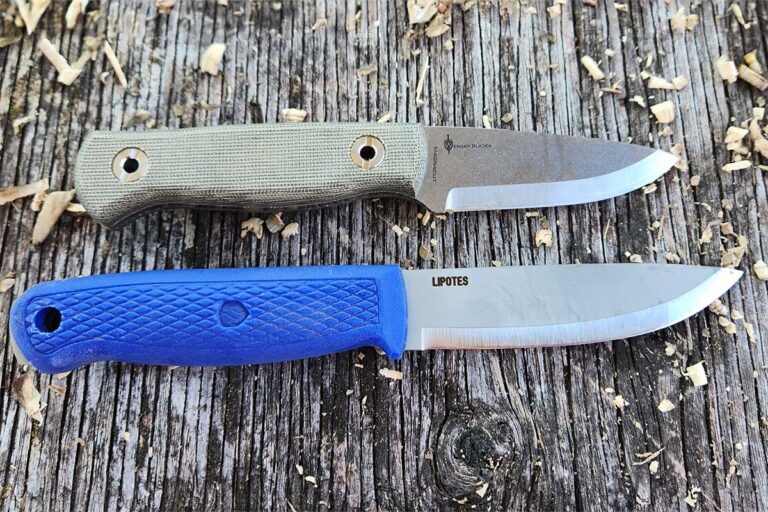
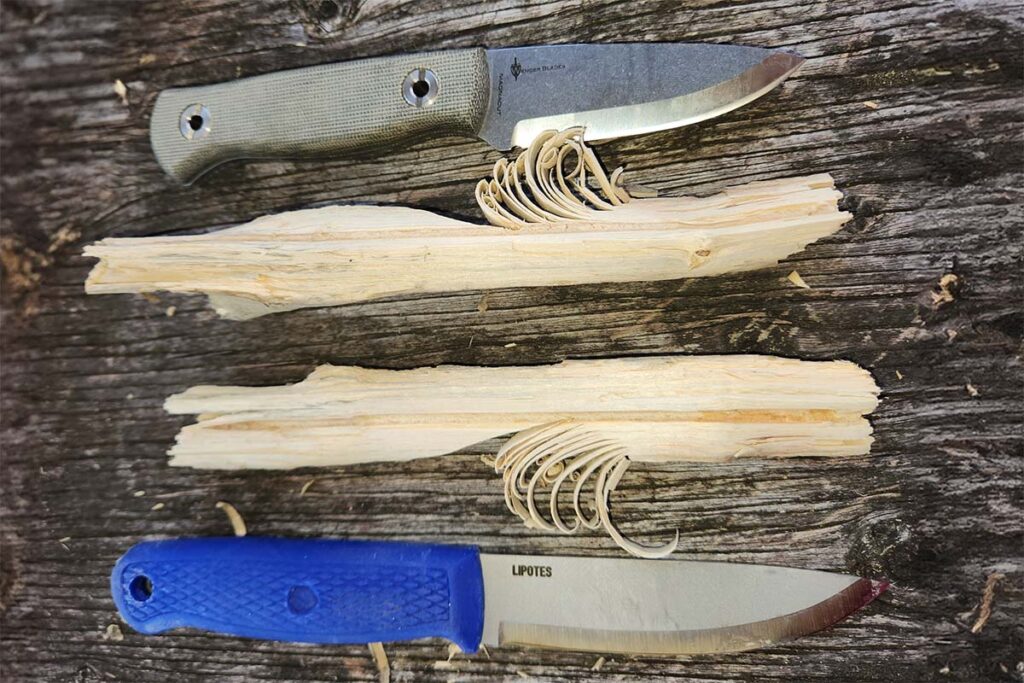
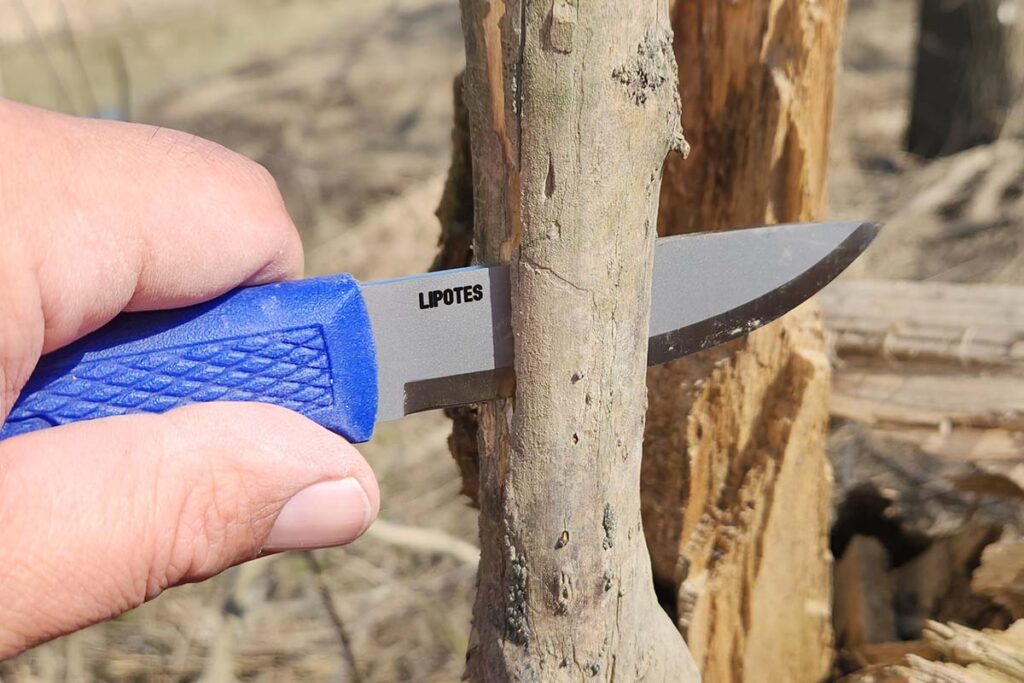
The thinner steel thickness on the Condor Tool & Knife Lipotes enables it to make finer curlicues than the Boker Vigtig vs. Wild. Designed by Dave Wenger and made in Germany, the Boker has an MSRP of $194.95. Joe Flowers designed the Lipotes, which is made in El Salvador. MSRP: $64.98.
A bushcraft knife is not something meant to be indestructible at all costs. It instead has always been a tool of creation. Now I see most marketing or testing related to whether the knife can be pounded through a log, a log that most likely would be unavailable if not for a chainsaw. No, the bushcraft knife started out as a tool, nimble in hand, keen in cutting and used to fabricate things in the bush, things not just to accommodate survival but to help a person thrive. In that reasonable light and practical expectation of the genre, let’s see how the Boker Plus Vigtig vs. Wild and Condor Tool & Knife Lipotes are suited to help you thrive in nature.
Boker Plus Vigtig
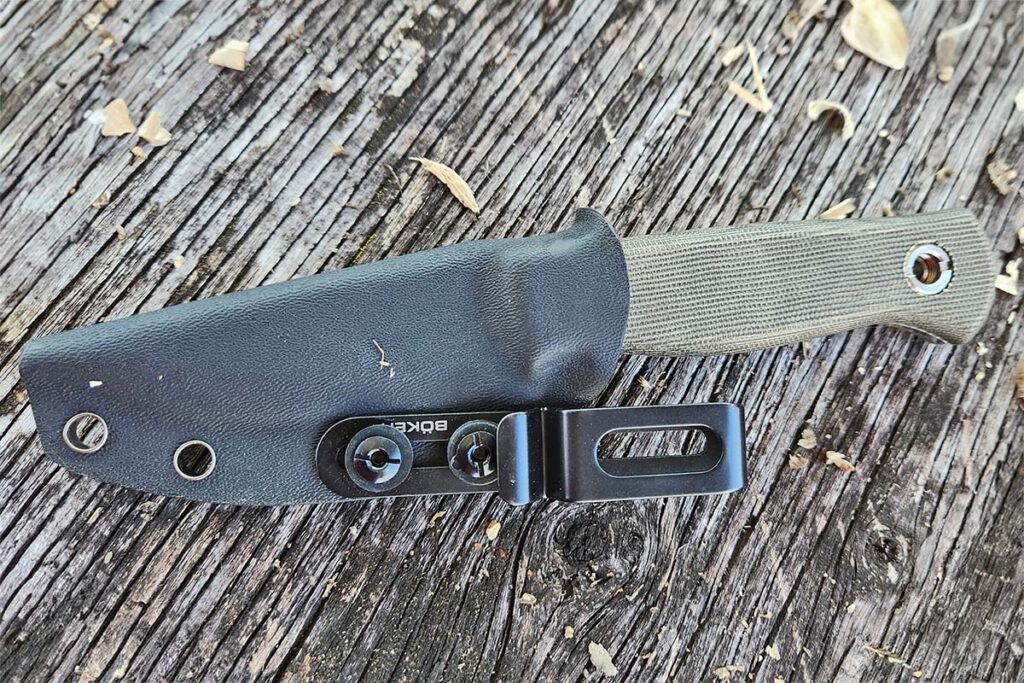
The Boker sports a molded Kydex sheath with an ambidextrous belt clip. The sheath holds the knife secure while still allowing for an easy draw when using a thumb push off.
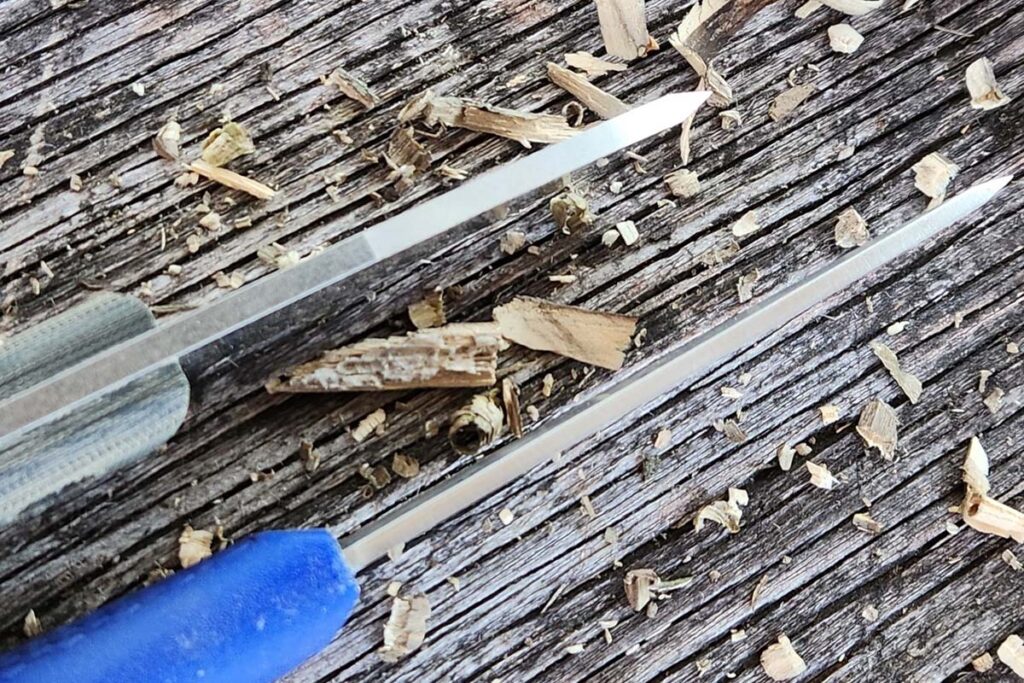
The Boker’s 3.35-inch blade features a Scandinavian, aka Scandi, grind, a grind in which the major bevel is the only bevel and goes straight to zero. Executed correctly, the grind should take up at least a third of the blade’s width. If the grind is any shallower it will be too steep. Some variation on the height of the grind is due to the thickness of material. Being too steep will decrease the effectiveness of the blade to cut because the angle of the edge will plow into the work material—and when I cut with the Boker, it did just that. It is not that it won’t cut with a steep angle, it just tries to take heavier cuts as it dives. Therefore, you don’t get the thin controlled cuts as easy as a properly executed grind.
Scandi grinds are popular in bushcraft because of their amazing effectiveness carving wood. In the game area they work fine but you will often find that bone wreaks havoc on a Scandi edge. In addition, the cross profile of the blade is not optimized for processing meat. Full flat grinds process soft, malleable materials such as meat best since there is no shoulder on the blade to bind as the meat flows along the cross-section profile. On flat grinds you also have a secondary bevel, or micro bevel as some call it, and it takes hitting bone better. The Boker is a full-tang knife with a blade .16 inch thick at the thickest, somewhat thick for a bushcraft knife. A clever feature is how the spine is finished. To strike a ferro rod off the blade spine you need a crisp edge. Sharp spines are more effective at generating sparks but are not very comfortable if you need to use a pinch grip or a thumb extension on a power grip. To address the issue, the Boker has a sharp spine toward the tip and a crisp spine section near the handle.
Note how much thicker (.16 inch at the thickest) the Boker blade is than that of the Lipotes (.13 inch at the thickest).
The handle is green linen Micarta® with beefy mechanical fasteners that double as lanyard holes. For those who prefer a full grip it has good profile contouring and leaves a blocky handle from side to side. There are no hot spots while still providing control. The blade is CPM MagnaCut stainless steel and is wide for its size. With its thicker blade it batons well through small branches to make small kindling. You trade some agility for durability with a beefier blade material.
The molded Kydex sheath rides high and boasts a metal belt clip that screws on for right- or left-hand carry. The knife locks securely into the sheath yet not so much you can’t easily withdraw it.
I think the Boker has its good points. I do prefer my bushcraft knife to be more of a nimble cutting tool. Overall, if the edge were ground higher this knife would up its game substantially.
Wild and Condor Tool & Knife Lipotes
For ease of baton work, the general rule is the cutting medium should be no wider than one-third the length of the blade. The Lipotes has a 4.15-inch blade of 14C28N stainless steel.
Let’s start with the handle on the Lipotes (among others, a lipotes is an endangered species of dolphin). It is an extended hidden tang and not a full tang—that’s right, not a full tang. Some time ago a well-known knife company introduced an extended-hidden-tang version of a knife and called it a full tang, and all the marketers and social media influencers decided to rename a feature so everyone could fall in line. If you can’t see the tang all around the knife’s handle, it isn’t a full tang.
Along with rat-tail tangs, hidden tangs have the distinct advantage of being some of the most comfortable knives in use. The steel element is totally encapsulated in the handle, allowing the maker to have full control in contouring the scales. In other words, you basically have a tang that will not interrupt how the material is shaped.
The Lipotes handle is very comfortable and the texture in the molded material provides a secure grip. As for the hidden tang extension, it can be used as a small hammering device or even a scraper.
Except for the grind, I like the overall proportions of the knife. As with the Boker, the grind doesn’t go high enough. It will still cut but the cutting would be greatly optimized if the grind were half its height taller. It performed well in its cutting tasks with power cuts, feathering and the like. However, it still missed the ease of cut and control of a higher grind. If I could, I would love to get my hands on a bunch of these blades and regrind them.
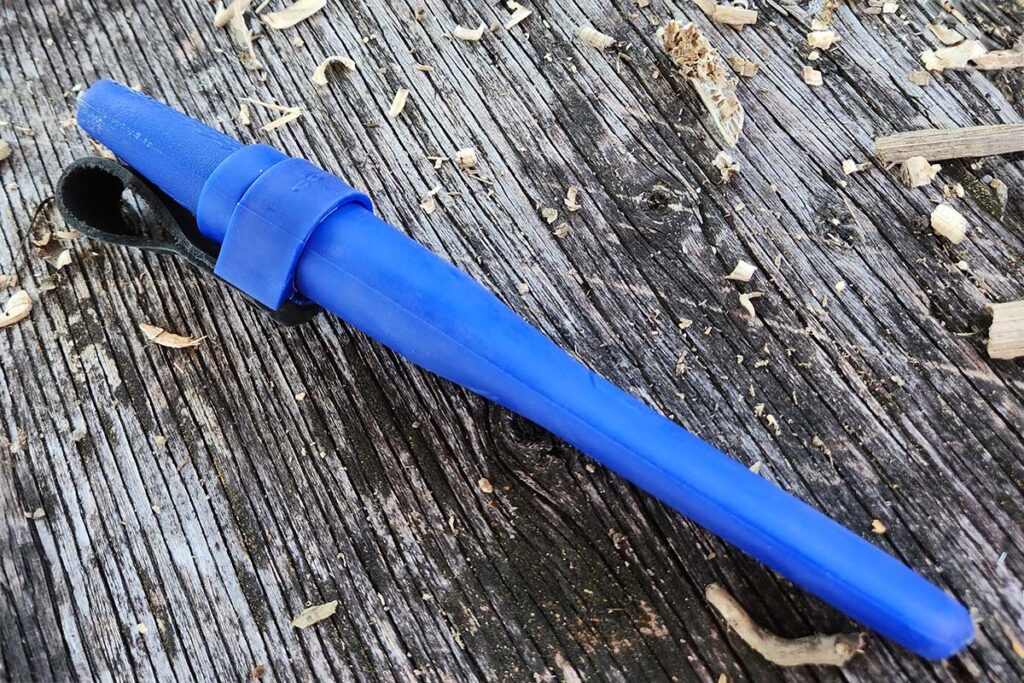
The Lipotes has a quality sheath that holds the knife nice and tight when you ramble through the woods. The leather belt loop riveted to the back won’t accommodate a wide belt.
I really like the sheath. It has a nice, deep carry. It is a molded plastic with a good friction fit. It is a bit mysterious to me as to why the belt loop is so small. Only a dress belt would fit through it. You could still run a cord through it for neck carry or a baldric. The Joe Flowers design checks off so many of the boxes for a good tool. I would have been singing its praises more with a higher grind. Instead, I am pretty much humming.
More Than Survival
To repeat, a bushcraft knife isn’t just for survival, it is a tool of creation. Often the real goal of an issue gets lost in the minutiae that results from personal gain and egos. Over the years, marketing and self-promotion have polluted bushcraft until we have lost it in a sea of books and an ocean of social media. A look at a simple tool such as a knife can really remind us of what bushcraft is about. It is about man’s will to do more than just survive. Man strives to prosper.
I will leave you with one of my favorite quotes about tools by Thomas Carlyle: “Man is a tool-using animal. Without tools he is nothing, with tools he is all.”
*Author’s note: The origins of the discussions of bushcraft can be attributed to such enthusiasts as Mors Kochanski, Larry Dean Olsen, Lofty Wiseman, Ray Mears and others.
Check Out More Outdoor Knives:
NESSMUK KNIFE: OPTIONS IN THE ALL-AMERICAN OUTDOOR KNIFE
BEST TOMAHAWKS: OUR TOP HAWKS FOR BACKWOODS TO BATTLEFIELDS
From a New England gentleman’s gift shop to a legendary—if not notorious—knife outlet on the Las Vegas Strip and online edge tool maven, PVK and PVK.com has carved a unique path in the knife world. We caught up with Jeremiah Burbank, the man behind the radical retail brand, and got a behind-the-scenes look at the company’s growth, cross-country moves and PVK starting a new chapter in its story. Buckle up as he surveys the ever-changing knife landscape, shares online sales insights and his enduring passion for knives.
BLADE:Give PVK’s origin story—how did the store come together and how did it end up in Vegas?
Jeremiah: My brother, Joshua, started with a storefront in 1994 in Amherst, Mass., with Pioneer Valley Knife & Tool. It focused on gentleman’s gifts—Maglites, Leatherman, a real eclectic mix. Over that first year, he shifted to pocketknives because he sold a ton of them. He eventually dropped “Tool” from the name and exclusively focused on knives.
By 1999, he had two storefronts in Amherst, and by 2000, he moved completely online with PVK. I came on in 2001 and joined the team, helping Josh with videos of knives, doing over-the-shoulder videos while Josh talked about the knives.
A lot changed in 2013, when some friends of ours went to the USN Gathering in Las Vegas and said we had to check it out. My brother went the next year and said that it was the future of knife sales. By the next year, we had a store by McCarran International Airport, and by 2017, we moved to the Strip—Las Vegas Boulevard—and became PVKVegas. We got to sell knives to the world.
All good things come to an end. Josh passed away unexpectedly in 2021, and shortly after, our landlord informed us they were tearing down our building for the Formula One race. Now PVK is back in New Hampshire—Hudson—and we just opened our showroom last year.
There’s never been a pause with the store.
BLADE:PVK started as a gentleman’s store but ended up a knife retailer—were you and your brother knife guys to begin with?
Jeremiah: Josh was a knife guy through and through—our mother would definitely tell you he had a knife on him throughout his life and took it where he probably shouldn’t have. Josh was into balisongs and read The Advanced Balisong Manual by Jeff Imada. And PVK carried knives we all know today—Benchmade, ProTech, Microtech (we were their second or third dealer)—way before it was cool.
I was always into knives, too. There was some age difference between Josh and me, so one of my earliest memories was hanging out at the store when I wasn’t in school. Also, I think I might have brought a Master of Defense Lady Hawk to school once—I was really into that knife.
BLADE:For those who never had the chance to visit, tell us about the Vegas store—how was it set up?
Jeremiah: Excellent question because it was notorious on the Strip.
Honestly, the frontage was very small—we had 10 cases, maybe 4 1/2 feet long each… call it a 60-square-foot showroom. We had a red carpet, so it really fit into Vegas. We replaced it each month; it got so dirty. Above the cases, we had TVs showing all kinds of knife videos.
As for what we had to sell, we sold everything from $5 knives to $5,000 knives—we couldn’t just cater to knife people. And we had a 10-watt laser to engrave a knife on the spot if someone wanted to put their name or their spouse’s name on the knife.
There was a center section to the store—the VIP room—you accessed from behind the register. We actually had to move the register to get back there. It was differently lit, had a beautiful coffee table and Eames lounge chairs and ottomans. It was a very private and nice experience.
Back there, everything in the cases were customs, short-run knives and one-offs. There was an exclusivity to it. If a guy showed up in a robe and slippers but had a Rolex on his wrist or he said the right things, we’d invite him back to the VIP room. It was a thing of legend.
In the very back was inventory; it was pretty tight because we had 25 safes.
Out front of the store, I’d hang out with the guys and flip knives to get people in the store. You’d see the world in tourists walk by.
BLADE: Vegas is crazy. I imagine you had everybody from celebrities to guys who hit big at roulette come through your doors. What’s your most memorable stories from your time there?
Jeremiah: First and foremost, since I get asked about this a lot, my favorite thing about selling knives is the people—it doesn’t matter if it’s a celebrity or Joe Schmo. Either way, I love to talk about knives.
But we had a number of well-known people who came to our store. Aerosmith had a residency in Las Vegas, and they’d come in. And Post Malone came in unexpectedly with his security detail, hung out in the VIP room and bought a bunch of knives. Tim Burton, Johnny Depp, a whole range of people.
The thing is celebrities are like anyone else when they came into PVKVegas—they’re just a bunch of kids in a knife store. Steven Tyler devolved when he came in, wanting to see each knife and just having a great time.
We were Post’s first stop in the knife world—he’s big into them now. When he came in, you know what the first knife he headed for? The Swiss Champ—the Swiss Army Knife with some 70 functions. He said, “Ah man, you’ve got this?” and had us box it up.
Celebrities are cool, but it’s cooler seeing them geek out on knives. We’re all collectors.
BLADE:You guys were legendary in Vegas, beyond the knife community—was it tough to say goodbye?
Jeremiah: It was heartbreaking, and it was a hard time for me as a person, knife dealer and brother. I had high stree through it all, especially having to break ties with people around the Vegas community who were close with me—with PVK. Honestly, it really didn’t hit me until USN ‘22. Everyone from USN had something to say about the shop. Being back was a strange ripple in reality. Did that all really happen [with the shop in Vegas]? Or did I just dream it?
Closing the shop on the Strip was a flashback for me—in reverse—of when we came out West. Then it was packing up a Penske truck and driving across the country, and I was doing the same but heading for New Hampshire. Life can be very strange, very cyclical.
BLADE:PVK is now back where it started or close to it, does it feel like coming home?
Jeremiah: I love being back. I’m from New England, and the region has always been near to my heart. I love the cold weather and the passing seasons. Plus, my family is an hour away. Plus, I’m offering something not offered anywhere else around here. I’ll also say, it’s great to sell to people face to face again.
BLADE:New Hampshire is a good place to set up shop, compared with some of the other New England states.
Jeremiah: It is the “Live Free or Die” state. New Hampshire was the first state to repeal its ban on switchblades back in 2010, and now we’re seeing it nationwide.
BLADE:You mentioned selling face to face again; that just came about recently. What’s your new shop like in Hudson?
Jeremiah: It’s very different than Vegas, but in a good way. There is no pressure, very calm atmosphere and no VIP room… yet. We’re a 10 a.m.-5 p.m., Monday through Friday operation, which is very different than Vegas, where we were open to 2 a.m.
We opened on Black Friday last year, and it was great to see the excitement it generated. We had folks drive up from Massachusetts when we opened our doors.
Part of what I did when I moved back was contact Nick Chuprin of NCC Knives, who was based in Brooklyn, N.Y., and offered him space. He moved his operation up here, and he has an entire machining cell in the back of the house.
It’s not a standard store; it’s multifaceted. It’s like a knife clubhouse. What other store can you come and get your knife sharpened by a custom knifemaker? And if you want to make, maintain or modify a knife, you bet your daisies I can get it done.
BLADE:Even with the new storefront, online knife sales remain PVK’s lifeblood. But it’s always been that way, correct?
Jeremiah: My brother was an early tech adopter; he had PVKnife.com online in 1997. Even before that, he was on list servers—Wreck.Knife—talking to people about knives. At first, online sales were a trickle, then in three or four years from going online, it became overwhelming. Josh went from having our parents help us ship to outgrowing their house.
He was clever. He used print media—we still do today with BLADE Magazine—to get the word out. And he mailed fliers letting customers know they could order online and have a knife delivered right to their door.
BLADE:Going from the 1990s, when there were a handful of online knife dealers, to today, when there seems to be a new store going online each week, how much more competitive is it now?
Jeremiah: I’ve been doing this a while and will say all competition is good competition. I am good with the free market; it makes us better.
The knife market has seen incredible growth and so have we. Around 2009 is when PVK saw the online market take off, and from then to 2015, our business doubled. By 2018, it tripled, and in 2019, it quadrupled. Then the pandemic hit, and everybody cared about knives.
The bad part about this is it brought a lot of part-time guys into the market who didn’t take it seriously. For better or worse, there aren’t a ton of regulations in the knife world, so there are some who take advantage of the community. That’s not good for anyone.
One of the things I always tell buyers is to make sure whoever they deal with online has a phone number on the website. If they don’t, don’t buy from them. We’ve always accepted all calls from customers and engaged with them.
BLADE:It seems, from your brother’s days on list servers and videos to your work on social media and your Bladeology podcast, PVK has also found it important to engage and build a community online. What motivates your focus on engaging with and building an online community?
Jeremiah: We’re in a disconnected world, and this is a way to make a connection with people. That’s why I find the online community so crucial. With the podcast, it’s friends talking about knives—me, Nick and Chuck Gedraitis—answering knife questions.
I also love recording history, especially with the knives we bring through the shop. You take the Marfione Dragon Slayer 1, it’s gone, it’s in someone’s collection, never to be seen again. So, I find it important to record knives so someday when someone wants to see them, there’s a video or a picture of the knife.
Same goes for the podcast but with the people in the industry. I had Mike Crenshaw of Knife Rights on six months ago, and he passed recently. But a little piece of him gets to live on.
BLADE:Let’s wrap up with something lighter. You have the choice of some pretty cherry knives to carry or fidget with. Do you have a go-to EDC choice?
Jeremy: That might be my biggest problem—my EDC tray overfloweth. But there are two knives that I go to usually. My first is a Microtech Scarab Executive. I was a huge early carrier of the Executive; there’s just something about it. The second, an exclusive Pro-Tech 3V Malibu. Love that button lock, and Dave Wattenberg makes it in an exclusive 3V. I’ve laughed with him about it before; he has been making autos for 25 years, and his best seller is a flipper. But those are my EDCs for real.
BLADE:Thank you for taking the time to speak with us.
From Forging And Picking The Right Materials To Putting Together The Fairest Return Policy And How To Run Your Business, There Are Many Questions Fledgling Knifemakers Should Ask Veterans.
This is the first of a multi-part series about knifemaking
When you consider buying a custom knife, certain questions come to mind. Some are easier asked and certainly more easily answered than others. However, anytime money is forked over in exchange for a handmade, well-built knife, an exchange of information takes place. Still, there may be a fine line between the ordinary, the somewhat sensitive and the downright invasive.
BLADE® asked some well-established custom knifemakers and purveyors what they thought about playing 20 questions with a prospective buyer. In this round of discussion, we’ll tackle those questions that should be asked and answered.
Testing And Heat Treating
I like the questions about testing and heat treating,” commented American Bladesmith Society (ABS) master smith Mike Quesenberry. “As for heat treating, it’s good to know what the maker does. Do they do the work themselves, and what type of heat treating do they do? Is it in a forge, heat-treating oven, do they use a salt pot? Then, on the performance aspect of the knife, is the maker doing any testing, taking it out and beating it or something else depending on the intended use of the knife?”
Veteran ABS master smith and mosaic damascus pioneer Steve Schwarzer agrees. The heat-treating query is near the top of his list. If the makers did the heat treating, did they do it themselves?
“If so, have each maker explain the method. It is perfectly acceptable to ask this question because it is the heart of the blade,” Steve reasoned. “If the maker did not heat treat the blade, ask who did and check the reliability of the heat treater.”
When buying a hunting knife, it’s fair to ask if the makers are hunters themselves or use their own knives in the field. J.C. Provost’s hunter features a 4-inch blade of CPM 154 stainless and scrim by Joanna Provost. (SharpByCoop image)
Authorship
The origin of the steel itself, the aspect of sole authorship, and even asking a bit about the maker’s background is perfectly reasonable, according to longtime purveyor Les Robertson.
“Did the maker do all of the work on the knife? If not, which part of the process is outsourced and why?” Les offered. “If certain aspects of the maker’s knife are being outsourced, this may not be a true custom knife. There can be a fine line between a custom knife and a mid-tech knife. Often, makers grind knives in batches. Consequently, it is more efficient time-wise and more economical to send the blades to a reputable heat treater.
“If the knife features a forged type of blade, especially when it comes to damascus, ask the maker if he forged the steel,” Robertson added. “This question is more germane to those makers not in the American Bladesmith Society. Several people specialize in making damascus for makers to use in their work. Most do an excellent job and offer patterns that will give your knife a unique look. Asking the makers if they belong to a particular knifemakers’ organization is a fair question. But you, as the buyer, should understand what requirements have to be met to belong to the organization and attain certain ratings in each.”
How They Do It
Methods, maker preferences, and perspectives are good areas to probe when discussing the makers’ work. How do they do their thing day in and day out?
“I think buyers should ask whether a knifemaker is a stock removal maker or forger,” said award-winning maker David Broadwell. “That will start to determine what kind of knives people will want. But then, it may not make any difference as long as they like the knife and the maker. Then, the knifemaker should be asked if he or she does all their own work, and if not, what is done outside their shop. This is to determine honesty on the knifemaker’s part. There are other things to ask as well to get to know the knifemaker—full or part-time, family. I like people to know who I am.”
Knifemaker Guarantees
Purchases are often made with the understanding of a guarantee, a buy-back to ensure customer satisfaction.
“You can ask, but I don’t fault anyone if they don’t offer a [buy-back] guarantee,” Broadwell noted. “You can’t buy most any product, say a Harley-Davidson motorcycle, and decide you don’t like cruiser bikes and expect your money back! A deal is a deal, as they say. Now, some makers specialize in multiples of given models, and they may be happy to take a return if they believe they’ll sell it right away.”
The components that make the knife sometimes have a bearing as well. After stressing the sole-authorship point, BLADE Magazine Cutlery Hall-Of-Fame® member Dan Delavan of plazacutlery.com finds a warranty to be reasonable in some circumstances, and then adds a question on components as important to the sales equation.
“Warranty? Just workmanship,” Delavan offered. “The maker cannot guarantee materials as they shrink and expand. The maker should be willing to repair for a charge. Then, does he or she do all the work, and if not, what is done by others? Does the maker bring in outside parts that he or she does not make on her own, examples being such as parts that are made in China or elsewhere, even in the USA? Is the maker able to make modifications?”
For Robertson, the concept of a guarantee is implicit in the trust that develops between maker and buyer. An understanding of care and use is necessary when the question of the guarantee is posed.
“A lifetime guarantee comes with certain responsibilities for both the maker and the buyer,” Les related. “The makers should guarantee the work with regards to their craftsmanship and materials used. Your responsibility as the buyer is to use the knife as it was intended to be used. During normal use, if the blade breaks, yes, the maker should build you a new knife. Now, if you are using a folder as a pry bar and the blade breaks, you are not using the knife for its intended purpose. Subsequently, that is your fault and the maker does not owe you a new knife.”
Genre Specific
Vince Evans
Some makers specialize in historical pieces, reproductions of knives and swords that reflect the times in which the originals were active. Such situations might influence the dialogue between maker and buyer, according to maker Vince Evans.
“My little corner of the field is very different from most other makers,” he explained. “My work is mostly ‘historical’ in nature, so questions to ask could be, ‘Can you tell me more about this piece?’ or ‘What culture is this piece based on?’ or ‘Is this sword based on a specific find?’ When I first met [Cutlery Hall-Of-Fame writer] Ken Warner years ago at the BLADE Show, he walked up and asked, ‘Am I looking at antiques or did you make these?’
“When it comes to period pieces, a telltale sign that a maker hasn’t seen or handled an antique knife or sword is that his rendition is oversized or overweight. Most antique swords, daggers and knives were much more petite and delicate than you would imagine. I encourage makers to study original pieces firsthand, even if it is through a glass case in a museum, before making a period piece. Photos in books and online do not give you a true feel for the original, although many resources do give you measurements and weight. There is no substitute to studying originals firsthand.”
The genre or style that a maker pursues is often the first indicator that a discussion is at hand. Catching the customer’s eye naturally leads to inquiries. When conversation surrounds a custom order, there must be clear understanding related to the finished knife.
“There has to be an exchange between the maker and the customer,” Quesenberry noted, “and that relates directly to how the knife will be used. If it’s a hunting knife, will the customer be skinning only, or will they be breaking bone with it? The customer has to ask what the maker’s knife is intended to do, or if the maker can produce the using knife the customer wants.”
Communication is the key for both parties to be satisfied with the outcome of the buy-sell arrangement. For example, when purchasing a hunting knife, it’s fair to ask if the makers are hunters themselves or use their own knives in the field.
“Sure,” Delavan smiled, “but in some cases the knives can be too expensive for the maker to use. Most knifemakers are not rich!”
Knifemaking Mentors
One of the most important questions to ask makers relates to their background, where they learned their craft—particularly who their mentor, or mentors, in the industry might be. Identification of those who introduced makers to their life’s work or helped bring their skill set along will provide an insight into philosophy, work ethic and mindset, and, ultimately, quality.
“Ask who their mentors are,” Schwarzer advocated. “This is especially important if the maker is forging blades.”
Several people specialize in making damascus for makers to use in their work. Most do an excellent job and offer patterns that will give your knife a unique look. Del Ealy forged the ladder-pattern damascus for the Angel’s Wing art dagger by Steve Vanderkolff. (Caleb Royer image)
Added Quesenberry, “It’s always good to know a guy’s background and the schools they went to and whether the makers continue to educate themselves on newer methods or techniques, or are they becoming stagnant? Do they want to up their game and experiment with different things?”
Chipped in Broadwell, “Of course, I’m proud of the men who shared information and helped me in my earlier years, and if I learn something new I’m happy to share that person’s help as well.”
Open Dialogue
The best approach to discussing the buying or selling of a knife is for both maker and potential purchaser to have mutual respect for one another. In the end, talk may be cheap. However, real, honest and open dialogue develops trust and assurance that the process is working for each party.
Ask questions. Consider responses. Come to informed conclusions, and remember that the entire experience revolves around the knife itself, its quality, materials, looks, and price tag. Most makers welcome questions and are willing to provide candid answers. In that alone, the level of assurance is elevated.
BLADE Show West hasn’t only grown to become one of the largest knife shows in the West, it’s also become a prime venue for late-season knife drops. With a bevy of new designs, CRKT has a bevy of new blades it plans to unveil to the public in Salt Lake City.
In all, the Oregon-based company will release five knives at the Salt Palace Convention Center, fittingly coming from a premiere Western knifemaker. Richard Roger’s prime gig New Mexico cattleman, but over the years has become a well-known custom maker whose designs perfectly combine clean lines, practicality, as well as eye-catching use of materials. The folder specialist’s knives are meant for use, but dang, if they aren’t pretty enough to show off.
Here’s a gander of what Rogers and CRKT have cooked up for BLADE Show West.
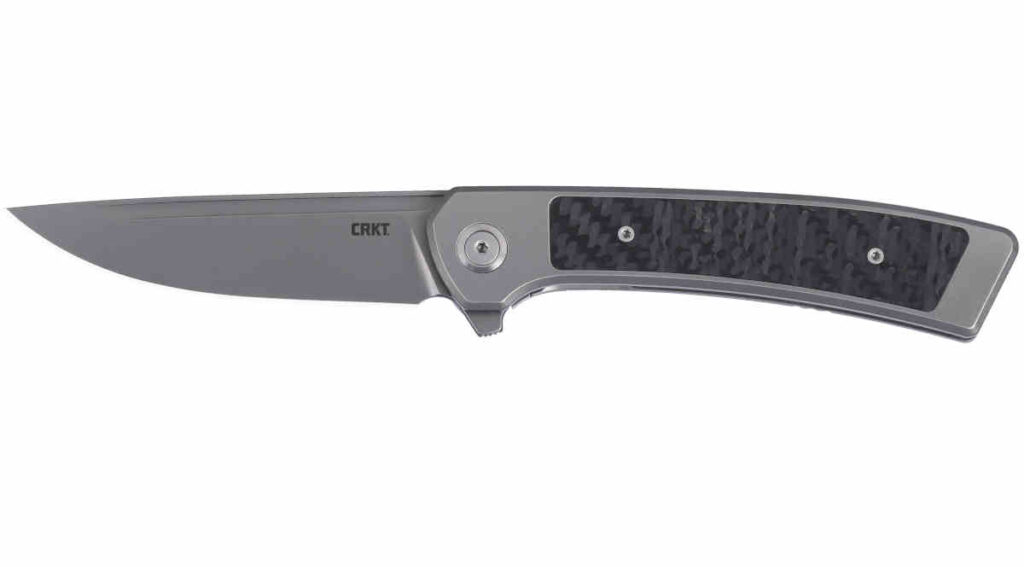
CRKT Q
The limited-edition Q—based on Roger’s custom knife of the same name—has everything you want in a small-batch knife—chief among them, top-notch materials. The frame lock marries a titanium handle with carbon fiber inlay with a 3.31-inch MagnaCut steel blade. The lines on the drop-point knife are positively dialed in, with the point of the blade directly aligning with the pocket clip when deployed. The blade is put into action via a kicker. Topping off the Q is a floating backspacer that adds a splash of detail and hints at the knife’s premium nature, but otherwise, the Q remains perfectly understated. MSRP: $225.
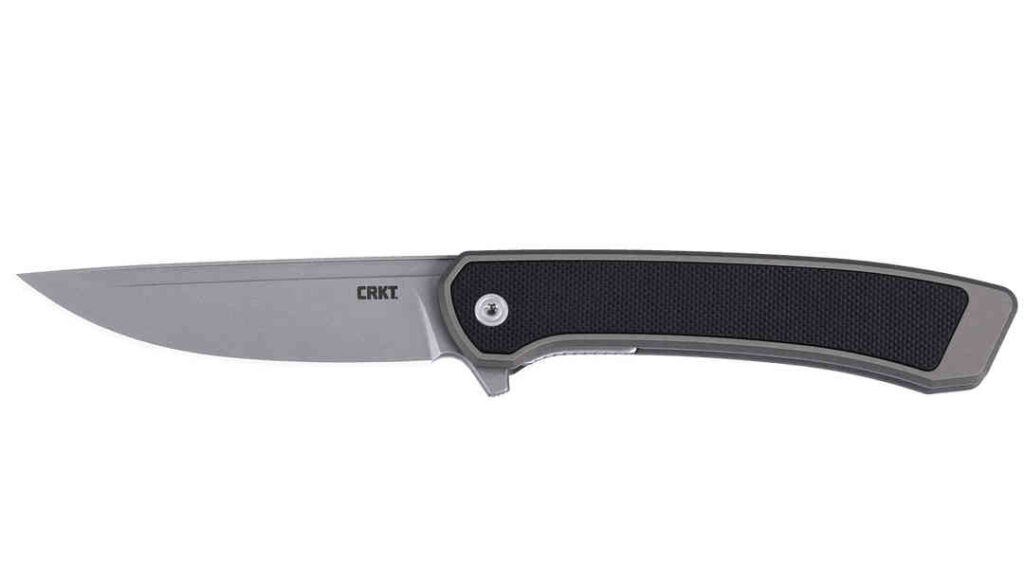
CRKT Q Compact
Dang near identical to the Q, the compact model is simply scaled down for easier EDC carry. At 4 inches closed and only 2 ounces in weight, it fits the bill as an easy-to-tote option. The materials are different from the full-sized model, with an S35VN blade and a lightweight aluminum handle with G10 inlay. As well as, the small fry is also a liner lock. MSRP: $195.
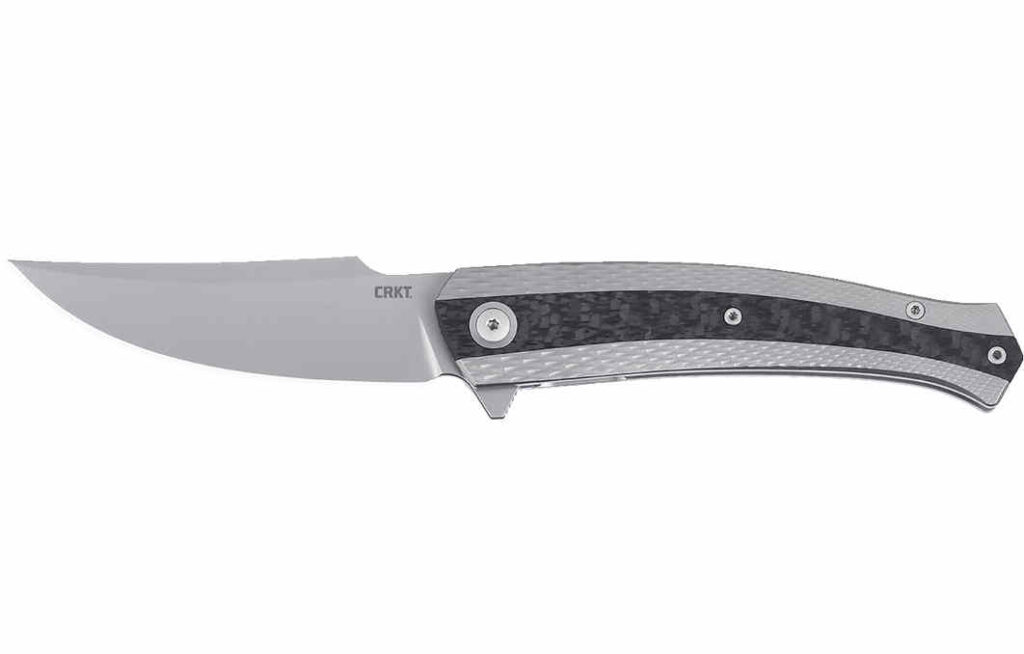
CRKT Persian
Building on a fan-favorite Rogers classic, the upgraded Persian takes all the great features of the original and cranks them up a notch. The blade’s new “harpoon Persian” shape is eye-catching, and it’s crafted from tough MagnaCut steel, known for its superior strength, wear resistance, and corrosion protection. The titanium handle is lightweight, with a cool milled pattern inspired by Richard’s custom design. Made in Italy by Lionsteel Knives, this limited-edition folding knife is a must-have for collectors. MSRP: $275.
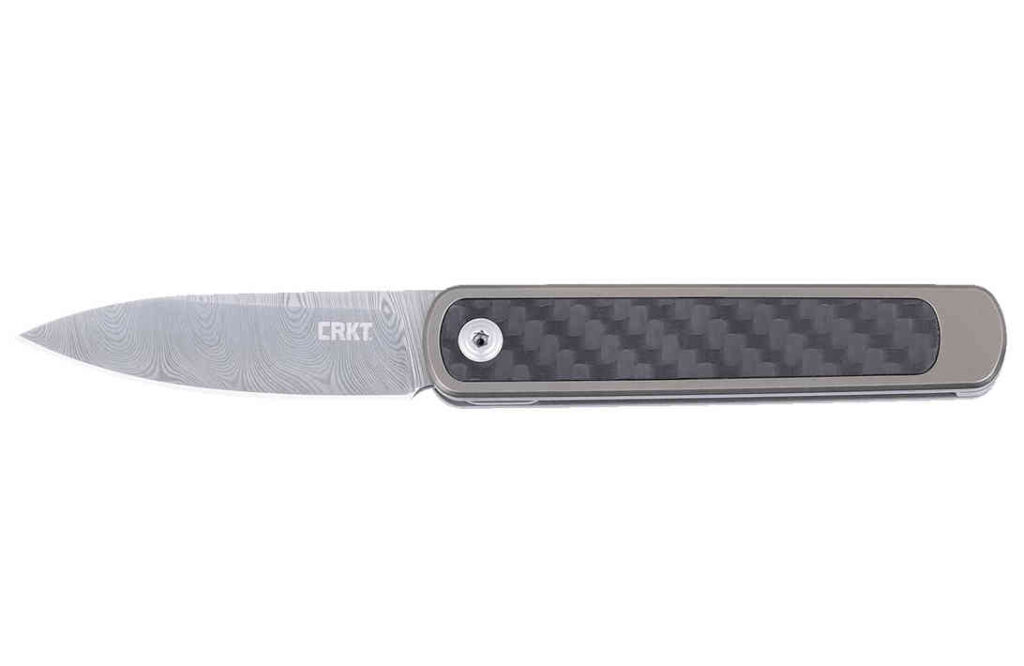
CRKT Pup
After the success of his CEO folding knife, Richard Rogers is back with the Pup, a compact everyday carry with smooth, rounded edges that slip easily into a pocket or purse. Built for modern life, it’s unobtrusive but ready to perform. The Pup comes in two models: a flipper with IKBS™ bearings, an AUS 10 steel blade, and a glass-reinforced nylon handle, or an Italian-made slip joint with a Super Dense Twist™ Damasteel® blade and a titanium handle with carbon fiber inlay for strength and style. MSRP: $70 and $275 respectively.
Robin Askew moves on, but her father remains there for her.
The constant, the heart and soul of BLADE Magazine Cutlery Hall-of-Fame® member Bob Loveless, was wrapped up in custom knives. There was little time for anything else and there were only rare occasions that he travelled. Bob and his wife, Yoshi, made a few trips to Japan or to Hawaii, on a rare occasion to Europe, but most often with some business purpose involved as well.
And over time, Robin Askew came to appreciate and understand the singular purpose, laser-like focus and personal intensity that drove her father. He was capable of kindness but often brutally frank. He was willing to entertain young knifemakers, share information and then criticize or dismiss flaws with stark, unvarnished perspective. With patience that was sometimes fleeting, he did not suffer fools gladly.
But then, his personality was a tapestry, like all of us, an amalgam of inherited traits and life experience. His mother and father had sent him to live on a farm with grandparents at a young age. According to Robin, he lived and worked with the hired hands, not as a grandchild. At just 15 years old, he joined the Merchant Marine when his mother told the white lie that he was of age.
In addition to the knife her dad made for her, Robin’s other favorite keepsake is a photo of him, a joyous grin radiating from his face, as a cluster of pigeons lands on his shoulders and arms during a visit to Rome many years ago. “It’s a beautiful picture,” Robin stated, “and I look at it every day.”
It wasn’t easy for Bob Loveless, right from the start. But he made something of his opportunities and his native talents, shared them in the way he knew how, paying the price along the way and leaving a body of work of insight into what is beauty and flow in a handmade knife, like no one else has. For the record, he never billed himself as the world’s best knifemaker. He wasn’t, and he freely acknowledged that others were much more deserving of applause for their skills. It was his eye, perspective and sense of beauty and design that thoroughly set him apart.
Four Careers
When Robin grew up, moved out and moved on, she carried the best and the most worrisome of life experiences with her. She made her own way and has come to understand and appreciate the journey.
“I’ve really had four careers,” she reflected. “I worked 11 years in the banking industry and 20 years as a correctional peace officer at Pelican Bay State Prison in Crescent City, California, with 12 years as a peace officer. Put that together with the work in Dad’s office and then when my husband, Jimmie Askew, and I had a restaurant in Crescent City, California.” When she worked in banking, Robin went to Crescent City on business for her employer. While there she met the most eligible bachelor in town. “It was a 400-mile, eight-hour drive to Crescent City, and I was supposed to be there for a month,” she said. “It became one of those wonderful love stories. Jimmie and I were meant to be together.”
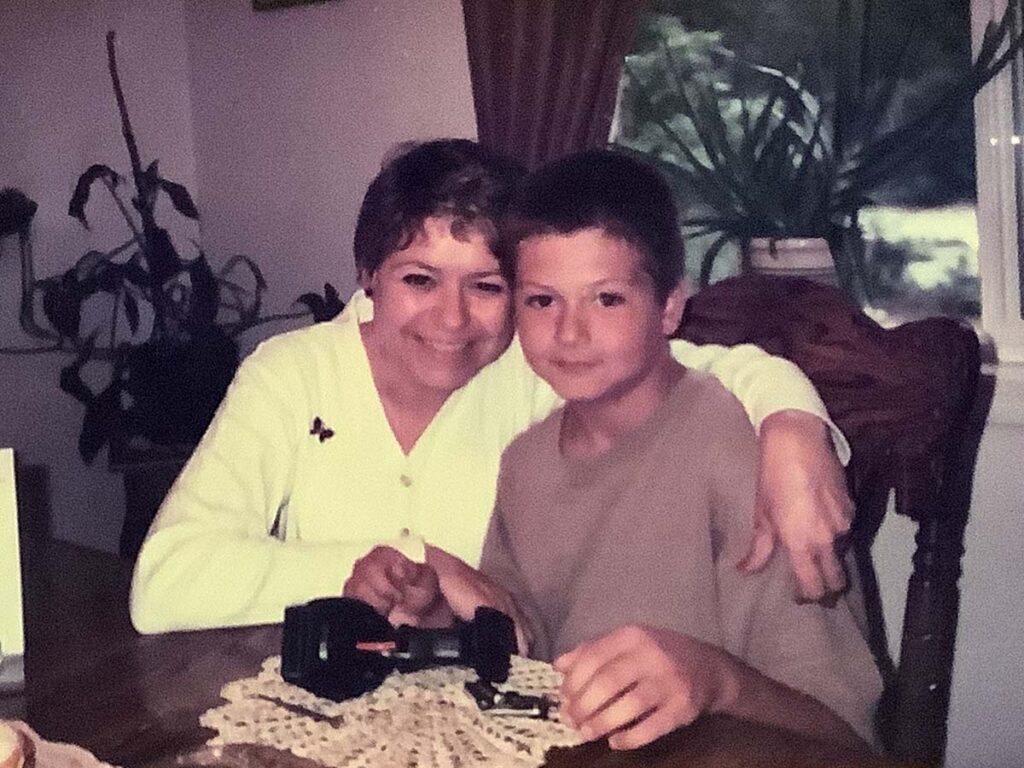
Bob Loveless photographed Robin’s son Nico during a regular visit while they were “out and about.” Nico was 9. The resemblance to his grandfather is striking. (Bob Loveless image)
Jimmie was an award-winning chef, and with Robin’s business background the couple put together a fine restaurant that served a variety of entrees.
“I met Jimmie in 1984,” she recalled wistfully. “We got married the next year, and he passed away 12 years later. He made prime rib, barbecue pork spareribs and fresh seafood. He would go out in the morning on his boat and catch 300 to 400 pounds of rock cod. He would clean the fish and then serve it that night. It was the best seafood in all of Crescent City—wonderful. We also had meat from our mesquite grill, chicken parmesan, grilled Italian sausage, vegetarian dishes and the deep-fried seafood platter.”
Nico
The couple had one son, Nico, who is now 36. When Robin speaks of those days, a tinge of heartache touches her words. But also during that time, she rediscovered the love and care that her father had always had for the family.
Nico and Robin
“Dad came up from Riverside to visit us a month before Jimmie died,” Robin recalled. He had been in touch by telephone continually and made himself the father figure that a 7-year-old boy needed during a tragic time.
“After Jimmie died, Dad would come up regularly,” Robin related. “He took Nico fishing four or five times a year. Grandpa was there for Nico. He taught him how to shoot a gun and would charter a boat on the Chetco River in Oregon and they would fish together. He came up to see Nico play soccer, baseball and football, and he stepped in to take care of my son.”
When Bob wasn’t physically present, he was always in touch with Robin and Nico. He worried that Robin worked in the toughest place at Pelican Bay State Prison. It was called the “shoe,” and he once told Robin how he worried for her safety. Her response was from deep inside, a manifestation of something she learned when her father made the introduction to that Japanese gentleman years earlier: “I told my dad, ‘I show them [the inmates] respect, and they show me respect. It’s really the safest place in the prison to work.’ I told him there were two officers for every inmate and that I really had no qualms about it.”
Bob took this picture when he visited Robin and Nico not long after Jimmie Askew passed away. Nico was 10.
That soft spot in Bob’s heart came through time and again as he cared for his daughter and grandson. “He would call us and say, ‘What’s Nico doing?’ He wrote a check to pay for Nico’s braces. He was there for both of us. Being a widow raising a young boy, I could call him anytime and we would talk. I also started to do that with my mother because I wanted to reach out and make sure that my contact with my family was really strong. Dad was so far away, but I talked to him at least once a week. He became the type of dad that my son needed.”
Traits & Quirks
All the while, the legend of Bob Loveless continued to grow. Tales were told. Knives were made and sold. Stories were swapped, and the maker slowly but surely grasped his own impact on the world of knives. At the same time, his various interests, personality traits and, yes, his quirks made him more than just a knifemaking phenomenon. They made him a marvel, a celebrity and an icon.
Bob always carried a gun. “Even when I was a little girl,” Robin laughed, “I remember that he would hang his gun on the towel rack in the bathroom.” For some time, he enjoyed rabbit hunting in the desert with friends. But then another fork in the road pointed a different direction when it came to outdoor activities.
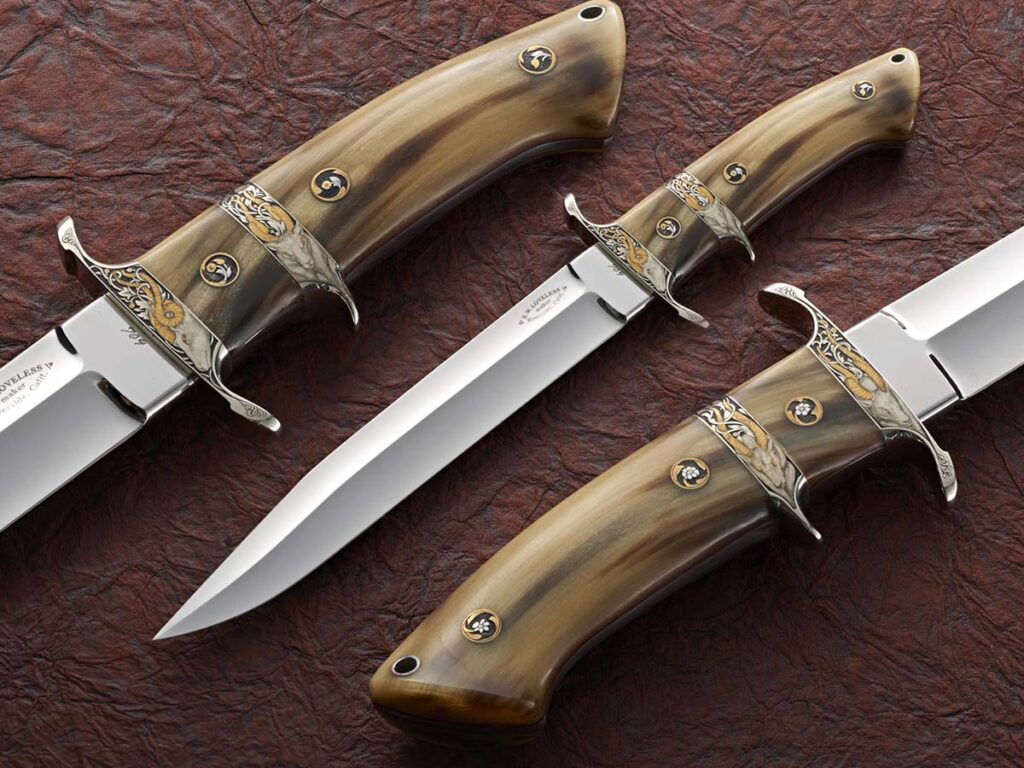
It was his eye, perspective and sense of beauty and design that set Bob Loveless apart. Few if any of his knives capture these traits better than his Big Bear fighter in sheep horn and gold engraving by Dan Wilkerson. (from the John Denton collection; Eric Eggly/PointSeven image)
Robin commented, “They took a lot of hunting trips, and one day Dad decided to stop shooting animals with a gun. He started shooting pictures with a camera. He loved photography, and I have no idea how all that started—but, gosh, I remember when I was a young kid he would take me and Allison on the weekends to camera stores. He would go in and talk for a couple of hours, and we were bored out of our minds. He would take pictures like you wouldn’t believe.”
Adding to Bob’s repertoire of activities, he was also an accomplished gunsmith. If these endeavors sound like a lot to pack into a lifetime, then there is no hesitation in labeling Loveless a true “Renaissance Man.”
Nonetheless, he had pursued his passions, probably without seeking the fame that came along with them. “I do know he never liked living in fancy houses,” Robin remarked. “But he had sports cars, and his favorite car depended on his age bracket. He would drive the back roads to the Chinese restaurant in Riverside and hit 100 miles per hour. At one time, he had three cars and two airplanes. He was a pilot with a lot of camera equipment. He probably got his pilot’s license before he moved to Riverside. I forget what year he got rid of his planes. He had crashed and it was no fault of his own. It happened when a bigger plane was landing and he got banged up. He had a limp after that.”
Keepsakes
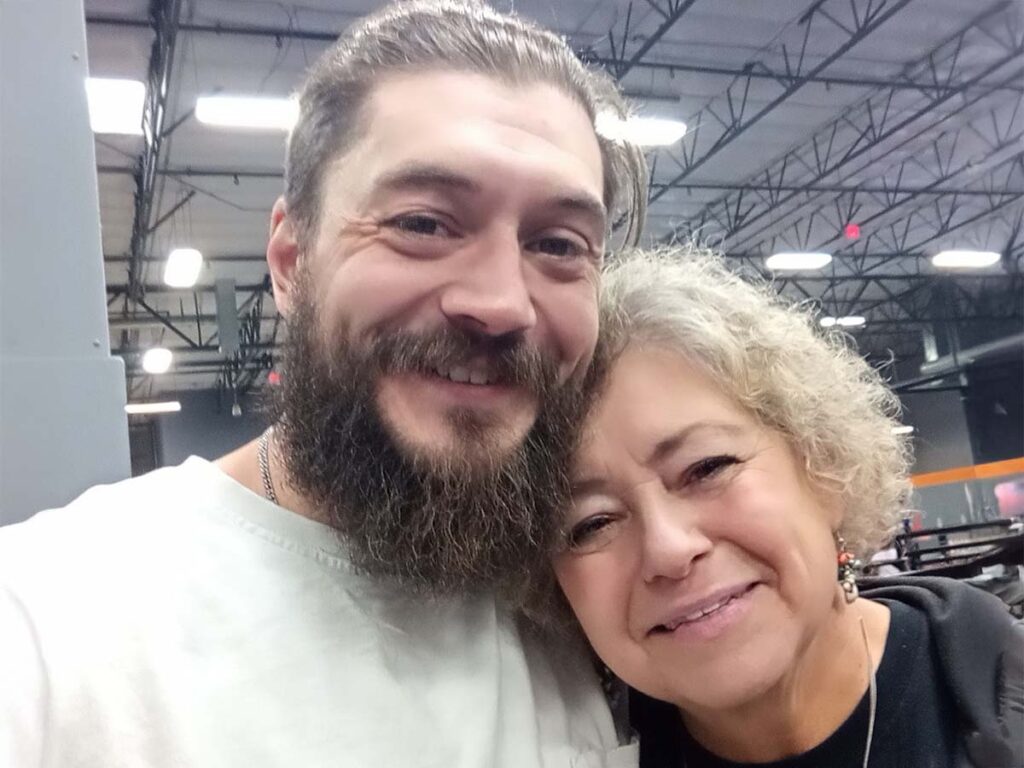
Writes Robin: “My handsome son Nico as he is today, shaggy beard and all. As a mother, I think his eyes and smile show what a kind and good man he is. I know his grandpa would agree with me and like this picture very much.”
Today, Robin’s heart is warmed by her memories, her strong Christian faith, and the knowledge that her dad truly became a father. His life was a mosaic of love and loss, turmoil and moments of calm, fiery and icy emotion, but always with a heart for the good and for his family. She clings to at least a couple of special items that symbolize the tie that binds.
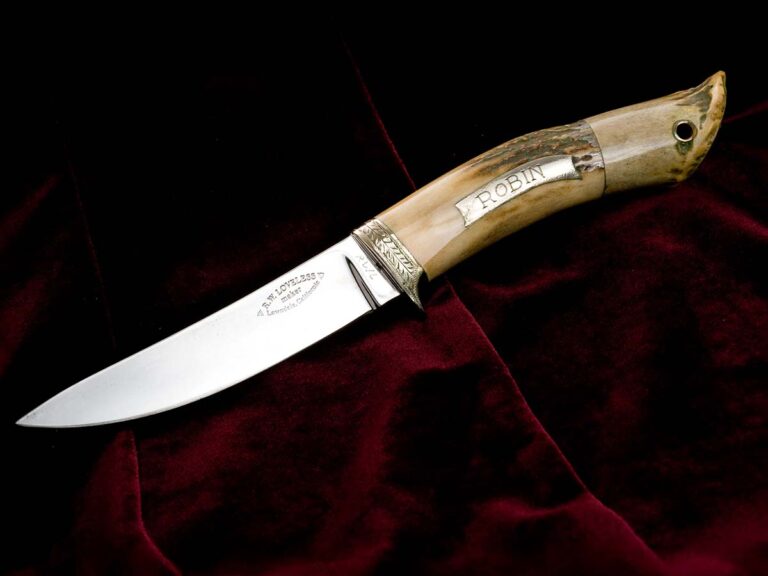
He made a banana skinner for her when she graduated from high school. “It has a stag handle with intricate engraving that he had done by a silversmith,” Robin said, “and I think the handle is at least 6 inches long with the blade about 7 inches. It is absolutely beautiful.”
A few years ago, Steve Johnson cleaned the knife up and put an edge on it. Dave Ellis took photographs of the one-of-a-kind piece, and John Denton, likely the foremost authority on Loveless knives in the world today, offered powerful words and urged her to treasure it always.
His various interests, personality traits and quirks made Bob Loveless more than just a knifemaking phenomenon—they made him a marvel, a celebrity and an icon.
The other keepsake is a photo of Bob, a joyous grin radiating from his face, as a cluster of pigeons lands on his shoulders and arms during a visit to Rome many years ago. It captures a sliver of his enjoyment of life, a glimpse into the heart and soul of just who he was. He was the gruff guy that gave generously to the local animal shelter, the edgy and matter-of-fact curmudgeon who handed substantial financial support to the UPS driver who had served faithfully in the area for years when Bob found out the guy had fallen on hard times. He was simply their quiet benefactor.
“It’s a beautiful picture and I look at it every day,” Robin offered. She ponders exactly where his genius came from and concludes that he inherited it from his mother. She admits that the spark of “genius” has not emerged from any other family member and concludes, “It was meant to be. That kind of genius is created before birth. My father was extremely gifted, and I always knew that.”
True enough, he was gifted, and in some ways that only a relative few others were even aware of.
Growing up Loveless and living within the sphere of influence her famous father created has been an adventure for Robin Askew, a thrill ride that began so many years ago, one that continues well after her dad’s departure from this Earth.
Read More On Bob Loveless:
Bob Loveless: The Icon’s Indelible Mark On The Knife Industry