New Limited Edition Swiss Army Knife Comes As A Result Of A Collaboration Between Off-White And Victorinox.
The Italian-based premium lifestyle brand Off-White has collaborated with venerable Swiss knifemaker Victorinox to make a Swiss Army knife for the brand’s Equipment project done with Korean brand Post Archive Faction.
The knife is gorgeous thanks to the white Corian scales with black silhouettes of the tools included in the knife. The Corian material is a composite of acrylic and a mix of natural materials, the majority of which are derived from bauxite. The piece is modeled after the story of Adam and Eve, and the silhouettes of the tools can be positioned to look like the collaboration’s design motif which is a fig leaf.
The knife itself is a gem, and only 3,000 are being made. There are both small and large blades, two sizes of screwdriver, and a bottle opener among many other tools you’d expect to see on a SAK of this size.
The whole construction is just 2.9 ounces in weight, and it is packed with features big and small. However, get ready to pay big for this knife due to its small production run.
Off-White ℅ Victorinox Knife Specs
Length: 3.7 inches
Height: .7 inches
Width: 1.6 inches
Weight: 2.9 ounces
Tools: Reamer, punch, and sewing awl, corkscrew, bottle opener, wood saw, large blade, 6mm screwdriver, can opener, wire stripper, 3mm screwdriver, small blade, key ring
They’re role is more than making a knife look groovy.
At first, it’s an item of curiosity. The fuller, the symmetrical groove that runs along the partial or full length of a knife or sword blade, might function simply as an aesthetic touch. It could have some utilitarian purpose. Or maybe it’s a bit of both.
Makers of knives and swords have included the fuller with their work for centuries, and today it remains a focal point in the process. Its presence is often prominent but its purpose is at best somewhat obscure. Why, then, is it common among the work of accomplished makers?
“The primary purpose of the fuller is to lighten a blade without compromising strength,” explained award-winning custom knifemaker and swordsmith Vince Evans. “Many cultures incorporate a decorative aspect into the fullers on their blades. Italians are well known for segmented fullers. You also see segmented fullers on Chinese swords, as well as some German hunting swords.”
Evans took home the custom awards of Best of Show for his Italian Cinquedea and Best Sword for his Italian Schiavona—the former at last year’s Solvang Custom Knife Show and the latter at BLADE Show 2024. He also won Best Sword for his Roman spatha and Best Fixed Blade for another of his cinquedeas at BLADE Show 2022. All four feature multiple fullers. Vince sees the fuller as operational on more than one level, from practical to pretty.
Thomas Taylor’s kukri sports a 12-inch fullered blade of W2 tool steel with a compound bevel grind and heart-shaped Spanish notch. Handle: buckeye burl. Overall length: 17 inches. The sheath is cowhide and water buffalo. Taylor’s price for a similar knife and sheath: $550. (SharpByCoop knife image)
“Even in the Bronze Age you see multiple fullers,” Evans continued. “Sometimes they are very narrow. Multiple fullers can give more rigidity to a blade but with reduced weight, and a wide blade lends itself to multiple fullers. Typically, fullers are on both sides of the blade, although not always. There are examples of 2nd-century Germanic swords that have fullers on only one side or have different numbers of fullers on each side. Their purpose may be partially aesthetic.”
Evans uses a fullering tool to press the groove into the hot steel when working with a larger blade. On smaller blades he usually grinds the fullers into the steel after the blade has been shaped and beveled. Other techniques involve the use of round or flat tools to scrape the groove in, depending on the blade style.
Much of Vince’s work is an homage to history, and the fuller finds its place there for sure.
“Since my work is primarily historical in nature, I use fullers where they were seen on originals,” he remarked. “A fuller may be used on any blade that you want to lighten without losing strength.”
Varied Methods Of Creating Fullers
Seth Lopez outfitted each side of the 9.38-inch recurve blade of his BLADE Show 2024 Best Fighter winner with a stylized fuller. The blade is a damascus of 1080 carbon and 15N20 nickel alloy steels and the grind is a combo convex/hollow clip. The handle is African blackwood with 416 stainless steel domed pins. Overall length: 14.5 inches. (SharpByCoop knife image)
Seth Lopez is an accomplished master of the fuller and took home the custom award for Best Fighter at BLADE Show 2024. His take on the fuller lies in function, helping the blade to perform as optimally as possible.
“In a sword, the fuller will provide rigidity through surface area while also taking out a lot of weight,” he remarked. “In smaller knives, I like the way they look, and they help take out some weight. Fullers can be on one or both sides of the blade. Many single fuller blades are ground only on one side, so the fuller on the opposing flat side relieves that area. Many culinary knives and sushi knives are made this way.”
According to Lopez, fullers can be achieved via several methods. Traditionally forged blades may have them scraped in, while they can be milled, ground or filed in as well. Seth’s method is dictated by the size and shape of the blade he intends to create. The application from a practical standpoint is seen easily in the sword or chef’s knife, while in smaller knives he says fullers add “some completeness and flow to the overall design.”
When custom maker Thomas Taylor includes a fuller, his methods are varied.
The 3.4-inch fullered blade of Eyal Landesman’s folding dagger is RWL-34 stainless steel with a hand-rubbed finish. The handle is zirconium with mosaic paua shell inlay. Closed length: 4.75 inches. (SharpByCoop image)
“There are dies available for a press, and a fuller can be pressed in or hammered in,” he related. “Most bladesmiths will grind the fuller in before grinding the bevels in. After the initial grinds are done, fullers and bevels, then the heat treating and tempering are done. Then the long, tedious process of hand sanding begins.”
Taylor agrees that strength and weight reduction are primary purposes for the fuller.
“I think when you get to smaller blades under five inches, that it’s really for looks at that point. Yes, it does take some weight off, but it’s very little and any added strength is not noticeable in use. However, a tapered fuller can really dress up a knife, and the shape of the blade can be very pleasing to the eye. I believe that fullers should be on both sides of the blade and of the same depth and length. This, in turn, gives an even balance and slice. In my opinion, if a knife has a fuller on one side of the blade it would cause more drag on one side versus the other and would cause an arc in the slice.”
When knifemaker Eyal Landesman uses the fuller, it expands the aesthetic appeal of his blades.
Robert Wayman goes the cleaver fuller route on the damascus go-mai/damascus nickel core/damascus clad blade of his Kitchen Chopper. The handle is crosscut carbon fiber, G-10, stainless steel, malachite, ancient brain coral and amboyna burl. Overall length: 14 inches. His price for a similar model: $1,850. (SharpByCoop image)
“My work is mainly making folding art knives,” he commented, “so my experience with fullers is always on the small scale. I mainly use them for aesthetic reasons as I love to mix traditional classic design with a modern touch.
“The fuller on a pocketknife has both utilitarian and aesthetic purposes,” Eyal continued. “From the practical standpoint, the fuller can help with weight reduction as it removes material from the blade without compromising strength. This can be a plus for making lighter-weight everyday-carry pocketknives and even enhances the knife’s rigidity under stress, like an I-beam. Aesthetically, my main reason for using them is that they add a distinct, sleek look to the blade, as well as for the historical appeal that I draw inspiration from.”
Landesman says that the single fuller is rather uncommon in blade construction, and when it is used the reasons are generally aesthetic or to facilitate a specialized design. Fullers on both sides help with balance, structural integrity, symmetry and reliable performance.
“Fullers are most appropriate for swords and larger knives, such as daggers where weight reduction and structural integrity are important to performance by making them easier to handle and therefore more maneuverable,” Eyal added. “While they can add aesthetic value, the functional benefits are mainly seen in blades used in combat or heavy-duty use. Fullers are less essential for smaller, precision-focused knives such as scalpels.”
There’s no machine work—including the tapered blade fuller—just all hand filing and sanding on the Hauteclere by Wolfgang Loerchner. Blade length and steel: 13 inches and 440C stainless. The handle is 440C, carved gold, black-lip mother-of-pearl and Bertie Rietveld damascus. Overall length: 19 inches. (SharpByCoop image)
His fuller process is straight forward.
“After I cut the blade profile, I then harden it,” he explained. “Once it has been through heat treatment, I then hard mill the fuller into the blade before grinding it.”
Blood Groove, I-Beam
Accompanying the positive elements of the fuller are a couple of interesting observations related to its function. The I-beam phenomenon as noted by Landesman is described by some as providing additional strength or rigidity, and by others as allowing flexibility while lightening the overall weight of the knife or sword. Its principle has long been utilized for steel beams in the construction industry.
“The I-beam effect does lighten the blade and can help in flexibility, but I don’t know that it will make the blade stronger,” Evans observed.
Ryan Breuer abbreviates the fuller on the clip-point/false-edged blade of 80CrV2 carbon steel for his recurve fighter. Guard and ferrule: blued damascus. Handle: ironwood. (SharpByCoop image)
Added Landesman, “I agree that the main job of the fuller is to lighten the blade and increase its strength through the ‘I-beam’ principle used in construction. However, its main job is to look good.”
Blood groove is often associated with the fuller, and while there is plenty of speculation as to the origin of the term, practical evaluation doesn’t lend itself to validating that purpose.
“I think the term came with the use of the fuller in bayonets,” Evans said. “I don’t believe this is an accurate name for the fuller or its purpose.”
Lopez commented, “With many aspects of weapon history there is a lot of speculation on why certain features existed on different blades. Many of these speculations are made up, and it’s my understanding that there is no ‘blood groove’ function to a fuller on any blade.”
Billy Salyers covered almost the complete blade length with the fuller of his Best Sword winner from the 2024 Texas Select Custom Cutlery Event. The blade is a Rohans Mane damascus of 1095 carbon and 15N20 nickel alloy steels and the handle is African blackwood. Overall length: 35 inches. Billy’s price for a similar sword and scabbard: $7,500. (SharpByCoop image)
Perhaps in the hunting application there is some remnant of actual usefulness in the role.
“Some call the fuller a ‘blood groove,’” Taylor said, “thinking that it gives the blood a way out of the entry point of the carcass and makes it easier to remove the blade. This may help in these areas some but it is not the intended reason for the fuller.”
The consensus is summed up well by Landesman, who related, “The ‘blood groove’ term stems from the theory that it was designed to allow blood to flow out of a wound, supposedly preventing a vacuum from forming and thus making it easier to withdraw the blade in battle. In my opinion this is probably not an accurate representation of the fuller’s purpose, which has much more to do with its utilitarian and structural benefits, unconnected to blood or wound dynamics.”
There it is. Practical, pretty and adding a touch of class, the fuller brings along a bit of historical conjecture, completing a package that delights in many ways.
TIP: The most important principle in this section is to overlap hammer blows. The right edge of your previous hammer blow becomes the center point of your next hammer blow.
Forge-beveling allows a consistent pushing of the hot steel in all directions at each blow. The physics are consistent, predictable, and reliable. At each strike, the force of the rounding hammerhead pushes the bottom half of the blade and the spine in opposite directions. The tip-to-choil forces are contained for the most part by the blade’s mass.
It’s much like when the smith makes breakfast sausage patties. Imagine pushing the center of that sausage patty down with the heel of your hand (hammer) against the counter (anvil). The patty spreads out in all directions with a dimple in the center, the same as the steel. With repeated overlapping blows the bevel thins and widens downward as the spine stretches upward. The resulting geometry is a thinning and reshaping of the blade between the cheek line and the cutting edge. A bevel is forged and formed with your rounding hammer, anvil and blacksmith’s eye.
Once forge-beveling is mastered you can actually form a hollow “grind” by hollow forging (another lesson, another book).
NOTE: Look at a knife with the pommel to the left and the point to the right, cutting edge down and spine up. For reference and description, this is the right side of the blade.
This is the right side (i.e. right-hand side) of the knife blade
Setting the Bevel
The forge-beveling procedure is advanced forging. Beveling with a hammer is a blacksmith secret used by few these days. Learn this method and you will certainly be connected to the smiths of old.
This forge-beveling procedure takes me six heats or more, at minimum; three on each side. Theoretically, one heat per line, three lines per side (explained below in Half, Fourth, Eighth). Make these passes down the bottom half of the blade traveling its full length. Because you might be a beginner it may take many more passes than six.
You may need more heats due to being hammer shy or because of rookie hesitation. You may start and stop frequently due to under-heating, overheating, dropped blades, re-positioning your piece or “Where’s my hammer?”. All of those are OK. We all do them.
Half, Fourth, Eighth
Let’s go through the forge-beveling principle. First think of cross-section geometry. Develop a visual in your brain of the relative distance from the center point of the hammer face to the bottom one-half of your blade as you travel along its length from ricasso to tip.
Do this by visualizing one-half, one-fourth, and one-eighth. If we were to saw a blade vertically in half and view its cross-section, we would see that its shape is thickest at the top, along its spine. It holds that dimension down to the cheek (about the halfway point) and then dramatically loses thickness as it approaches the cutting edge. This is the bevel. Your bevel. Think halfway from cheek line to cutting edge. This is the 1/2 line.
This traditional way to set this bevel can only be acquired with dozens of latitudinal hammer strikes passing from left to right at those three descending levels: 1/2, 1/4, 1/8. Remember one-half, one-fourth, one-eighth.
Note and maintain a mental image of the three all important forge lines.
NOTE: This 1/2, 1/4, 1/8 business does not mean fractional inches. The fractions refer to the position of your hammer’s center face on the horizontal bar (i.e. halfway, a quarter of the way, and an eighth of the way from the edge to the cheek).
Remember this is a theoretical thing becoming a real thing. The blade is 1-inch wide, and the face of a 2.5-pound rounding hammer is about 1.5 inches. Think exact center of a hammer face on those latitudinal forging lines.
TIP: See the author setting the bevel on YouTube. Search for: Paul White FORGED.
Try not to strike above the imaginary cheek line that runs about halfway between the spine and edge. Your hammer passes will form the cheek line. The final cheek line usually falls well above the halfway point because maintaining that line exactly in the center is almost impossible with a round hammer face, your billet bouncing around on the anvil, and you’re trying to hit on exact points. However, the primary objective is to maintain the original thickness in the spine (1/8-inch) as far down to that halfway line as possible.
Blade Tipping
Each pass will require a slight upward tipping of the spine to acquire about a 10° to 12° angle to be set in the bevel as you hammer. It takes a simple inward twisting of the wrist to keep the blade from resting flat on the anvil face. It must be done at each horizontal pass. This smartly places just the right amount of bevel angle. After a few passes, the blade will “find” that angle as you place it down.
After a complete pass from choil to tip on the right side of the blade, flip the piece over, tip to 10° to 12°, place at the top of the anvil, and do the left side. This is the place to use your indexing skills. It takes most smiths some time and practice to fully master this concept. I’ll go over this beveling thing a couple more times. Read this whole section and look at the drawings and photos several times before doing this.
TIP: Sometimes it takes fewer total passes than I indicate in this book. This is due to the individual smith’s power and/or heat control and/or blade position and/or hammer penetration and/or steel composition. There are lots of variables. If your blade is almost straight after fewer than the recommended strikes or passes, back off on the heat and/or reduce the power or reduce the passes. If you place blows beyond what is needed, the blade will curve upward. Usually, fewer strikes per pass will be necessary as the beveling chore proceeds. This happens because the smith usually increases his or her power and confidence as time at the anvil is increased. Also, the bevel becomes thinner with repeated heats requiring less steel to be moved.
The forging sequence is as follows. Take a heat. Place the blade at the bottom of the anvil. Tip to 12°. Place overlapping blows down the blade on the right side at the 1/2 line. Take a heat. Flip to the left side of the blade at the top of the anvil. Tip to 12°. Forge down the left side at the 1/2 line at the top of the anvil. Take a heat. Flip to bottom. Tip. Place blows down the right side of the blade at the 1/4 line. Heat. Flip. Tip, down the left side at the 1/4 line at the top. Take a heat. Flip. Tip and down the 1/8 line on the right side. Heat. Flip. Tip. Then down the left side at the 1/8 line. Your blade should be nearly straight after three or five passes and however many heats as needed.
By hammering in this 1/2, 1/4, 1/8 method you will “set the bevel” of your knife in the traditional way, FORGING! Ninety-three percent of all bladesmiths set their bevels at the grinder. I have met only a handful of smiths that do this the old way. You’ll be the only blacksmith in the surrounding ten counties that sets the bevel with your three-pound hammer!
Do not strike randomly up and down the blade or space-out (i.e. not overlap) your blows and expect anything good to happen.
BLACKSMITH SECRET: To gauge forging heat have a wooden box close by and away from any direct light. Hold your blade in the box to see the true forging heat. Even when hot the “red” is sometimes difficult to see in a lighted room. However, the red will show in the shade of your box. This means you are above forging heat and will thus avoid potential edge cracks. Remember this is high carbon steel and your working parameters are narrower. Iron can be worked over a greater temperature without damage. At the end of each forging and before you lose forging heat in your blade use the last few seconds to straighten and align your work. Make all lines right with the world.
The successful counter-bend is placed at the “bottom” of the anvil with the choil just at the anvil’s corner next to the table. Several hammer blows are placed at the halfway point/line and then the hammer travels down the blade to the smith’s right.
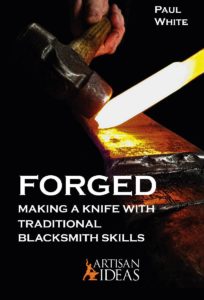
You can buy Forged: Making A Knife With Traditional Blacksmith Skills here
A sushi knife that developed a taste for Texas brisket.
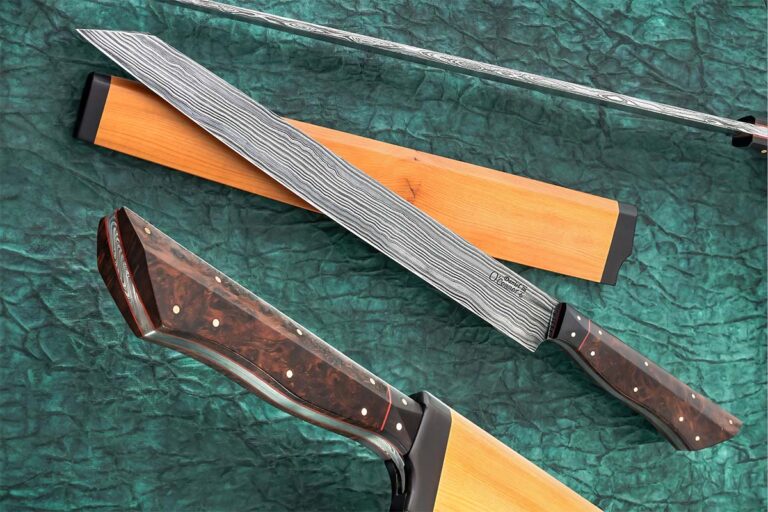
You might say Daniel O’Connor’s Black Widow leads a double life. It started as a sushi knife but when one of Daniel’s Texas pals said it looked like it would make a great brisket knife, O’Connor went with the flow, telling his friend, “It’s about whatever you want it to be.”
Based on a kiritsuke yanagi-ba sushi knife, Black Widow features a damascus of 150 layers of 1084 carbon and 15N20 nickel-alloy steels. Daniel forged the steels in a square and then forged them flat, perpendicular to the original stack. This resulted in the edges of the layers showing up in more or less straight lines, what Japanese swordsmiths call masame hada.
The accompanying image of the knife’s butt shows how the layers distorted when forged on edge. Daniel indicated he will use the pattern in the future.
Black Widow Specs Blade length: 12” Blade grind: A double urashi—double bevel w/a slight hollow on each side Handle: Bocote burl w/red fiber liners Bolster: Bog oak Overall length: 17” Sheath: Irish yew and bog oak Maker’s price for a similar knife and sheath: $1,500
Knife companies offer their own brands of hot Joe and perk up consumers in the process.
For Ernest Emerson, it’s as strong as… well, a cup of dark roast. He’s a firm believer in the expansion of his marquis knife manufacturing company into other lines of business. The idea behind that expansion is the diversity of different sources of revenue while complementing the Emerson core business.
“We’ve owned our own coffee company since 2019,” Ernest related. “I’m friends with Evan Hafer, the founder of Black Rifle Coffee, and our conversations probably go back to 2016 when we were first to co-brand with Black Rifle. Evan carried our CQC-7 on his military deployments, and he knew who we were. We worked it out with him to package coffee and do labeling. That worked for a while, and then my wife [Mary] and I talked it over and decided we wanted to have our own brand of coffee.”
For Emerson, taking the coffee plunge complemented the other activities that go hand in hand with offering top quality knives. Barriers to entry were few.
“I talked to Evan, and he said there was plenty of room,” Ernest explained. “We started Emerson Coffee Roasters Company, and I know we were first and started that trend, just like the trend in knife company whiskeys that is going on now.
“We get coffee from a source in South America and have it roasted and package everything under our own ownership,” he added. “Some other companies do collaborations and have their coffee packaged up, but we do everything from start to finish. The way I look at it, everything is a backup for a backup for a backup. What if somebody in Washington can make knives illegal with the stroke of a pen? All our other companies are there as a family-run group of businesses from coffee to apparel, whiskey, fighting systems and others. We’ve built those companies so the family will have support, and then we are at the helm and decide what roasts we want and everything.”
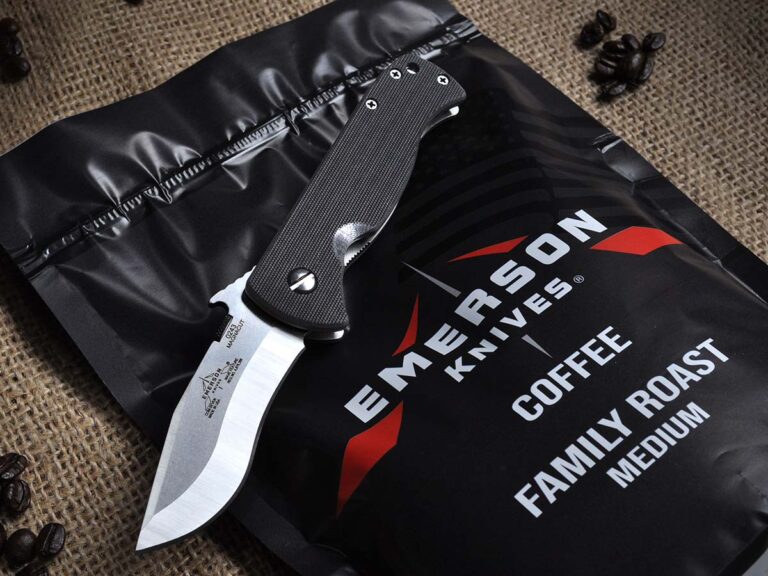
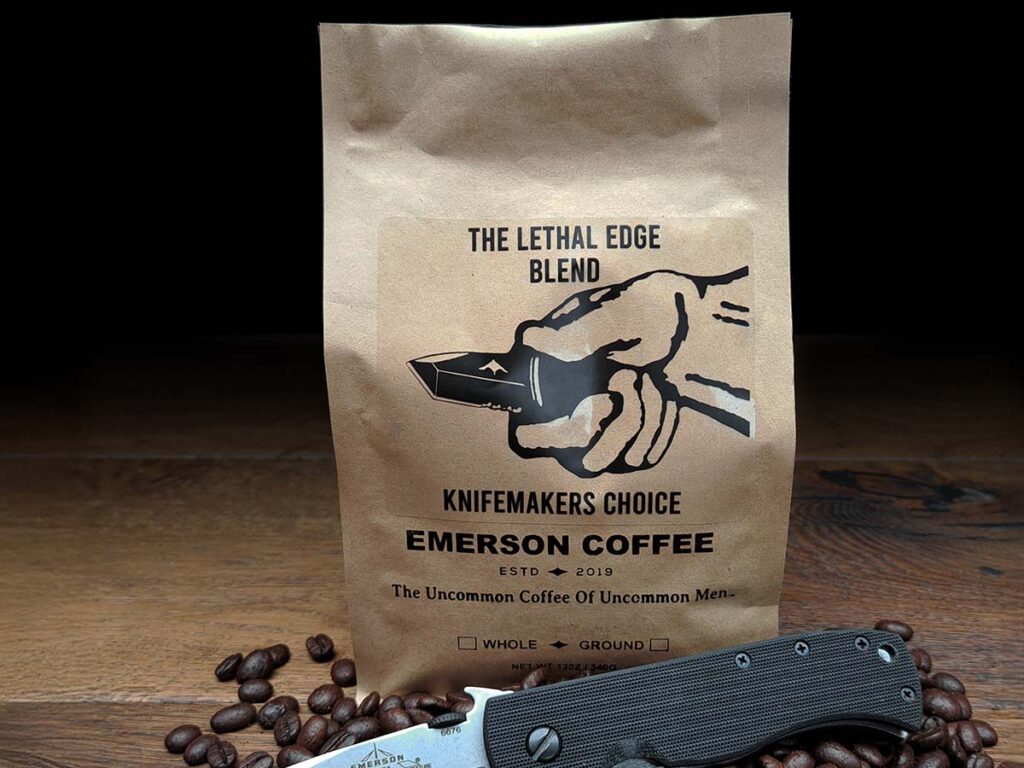
Emerson Coffee has three blends: Renegade Roast, which is the Emerson family’s favorite. Family Roast is the medium blend and Lethal Edge is the dark offering. The knife is the Emerson CQC-7BL-SF.
The future for Emerson and coffee may include some bundles of brew and whiskey or special flavorings for the coffee itself. Ernest sees flexibility and responsiveness always in the mix—a bourbon-flavored coffee when the time is right or a Christmas blend for the holiday season. Right now, the idea is simplicity with three blends: Renegade Roast is the Emerson family’s choice, Farmer’s Roast is the medium and Lethal Edge is the dark offering.
“It’s been a great thing to expand into coffee,” Ernest observed. “Our coffee is delicious, and people say they can’t drink any other coffee after trying it. Besides, we are a lifestyle brand and other than water more coffee is consumed around the world than any other beverage. I would bet that everybody who has ever bought a knife from us drinks coffee. So, if you buy or use knives, chances are you would drink our coffee and whiskey and wear our clothing.”
So, Ernest Emerson, the savvy businessman, finds another niche with coffee, one that complements the tried-and-true knife business and broadens the appeal of his entire spectrum of products. Seeing the big picture is expected to pay big dividends. Ernest points to recent history to back up his market perspective.
“No other knife entity on earth had a show in Las Vegas that revolved 100 percent around its brand like Emerson Knives,” Ernest concluded. “And the Usual Suspects Network was started for Emerson Knives. People tattoo our name on their body, and we say, ‘Show us your ink!’
Forbes Magazine said that there is only one other brand that loyal people tattoo on their bodies, and that is Harley-Davidson. The Forbes people actually told me that. We don’t know all the reasons for it, but again it is partly because people identify with who we are—American made by American workers with American grit and self-reliance. If people buy a $300 or $400 knife from us, then they buy other stuff that the company represents. Emerson truly is a lifestyle brand.”
And what says lifestyle better than a fine cup of brew?
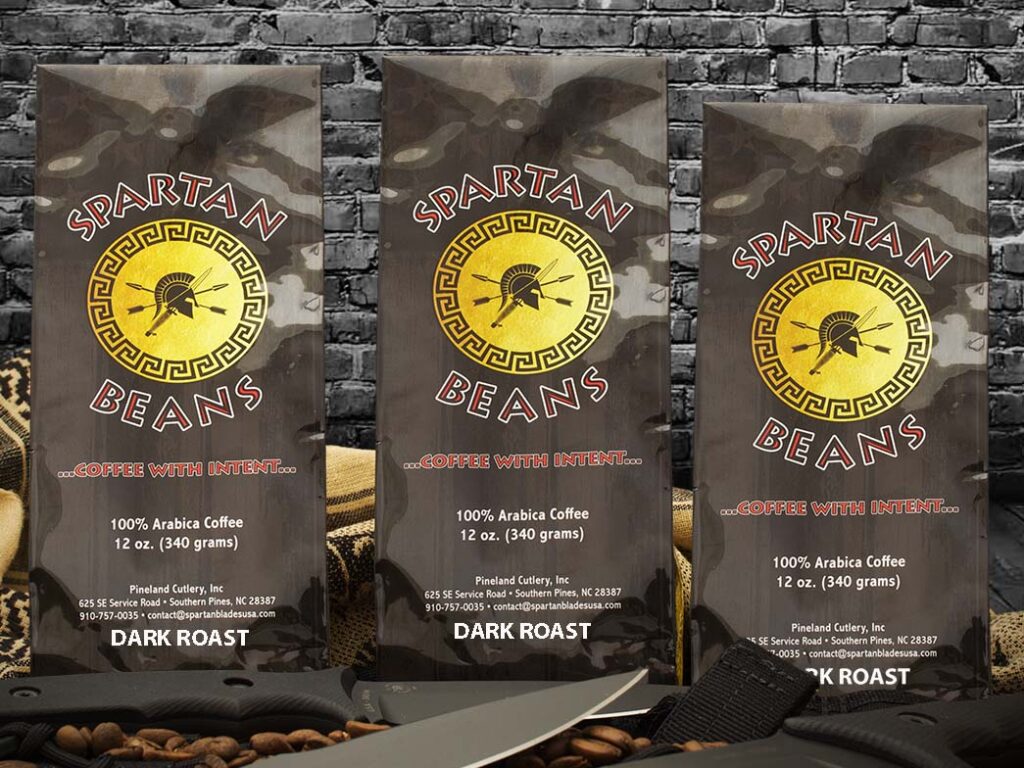
Spartan Blades Tactical Beans
Spartan Beans is sold in 100 percent Arabica regular roast and dark roast, single or three pack. There is also a sturdy mug available to top off the experience.
At Spartan Blades, company co-founder Curtis Iovito says offering a special coffee collaboration with Black Rifle is just fun. Fresh-roasted Spartan Beans fuels the consumption of a couple of gallons of brew per day around the office. The concept started when Curtis was chatting with a good friend who owns a roaster and has evolved into offerings consisting of 100 percent Arabica beans.
“Spartan Beans has been around for about three years now,” Curtis remarked, “and it has gone surprisingly well. Sometimes we will throw in some of our coffee when we ship a knife order to a dealer. The roaster is right up the street, so the coffee is about as fresh as you can get. We may look at doing an auto-ship program as demand increases, too!”
Spartan Beans is offered in 100 percent Arabica regular roast and dark roast, single or three pack, and there is also a sturdy mug available to top off the entire experience.
Spartan Blades co-founders Mark Carey (left) and Curtis Iovito (right) have traveled the globe for years, teaching counterterrorism and assisting with operations related to the use of knives in the field. When time permits, they search for the finest coffee from exotic locations for their Spartan Beans blends.
Through the years Curtis and fellow company co-founder Mark Carey have spent years traveling around the globe, teaching counter-terrorism and assisting with operations related to the use of knives in the field. And when time has permitted, they have searched for the finest cup of java available, whether in Malaysia or some other exotic location. The Spartan Beans blend includes the best from Colombia, Costa Rica, Africa and Sumatra.
“It’s like the United Nations of coffee, just more fun,” laughed Curtis.
Montana Knife Co. Backcountry Brew
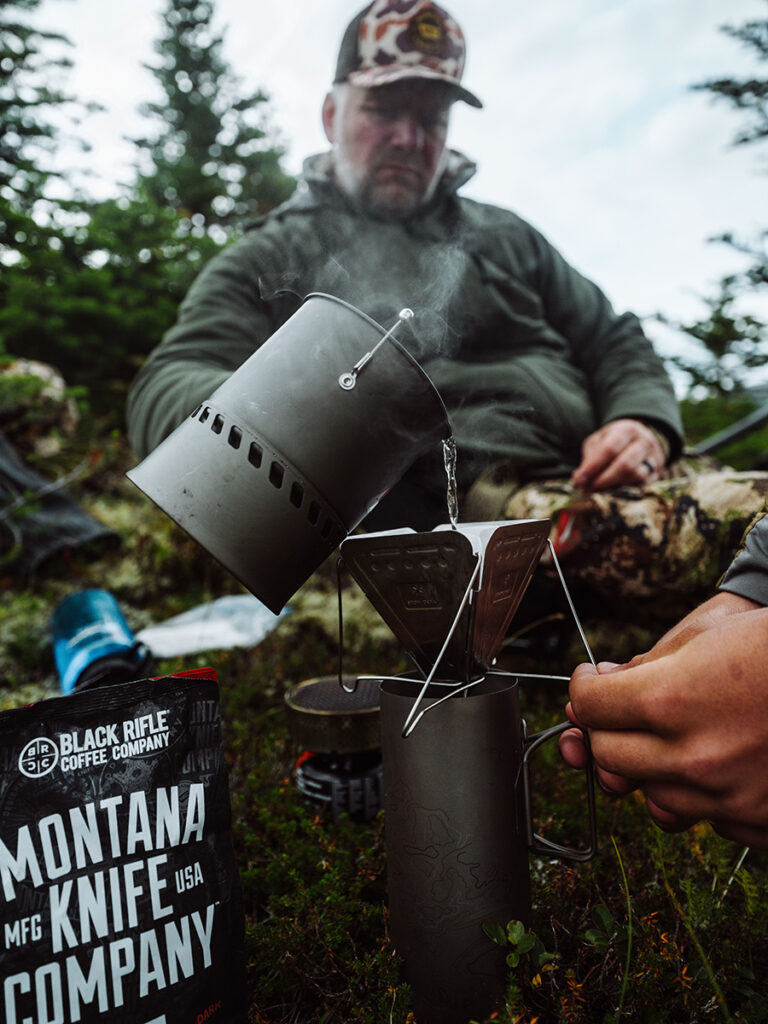
Noted Josh Smith of Montana Knife Co., “Hot, steaming coffee while freezing on a hunt tastes so good!” Montana offers its MKC X Black Rifle Coffee Signature Dark Roast in whole bean and ground 12-ounce bags.
A more recent entry into the coffee arena, Montana Knife Co. (MKC) entered into a partnership with Black Rifle in the fall of 2024. The packaging tells customers, “Fresh from the forge, this dark roast offers notes of dark chocolate with an aroma of spice topped off with a smoky finish. American brewed and crafted to perfection.”
Josh Smith, founder, president and ABS master smith at MKC, has found the kinship between knives and coffee to be compelling.
“Over the years, I became friendly with the owners of Black Rifle Coffee Co.,” he said. “We share many of the same beliefs around love of our country and support of our active-duty soldiers and veterans. For the past few years, we have worked with them on some marketing-related promotions, but this was our first launch of coffee with Black Rifle.
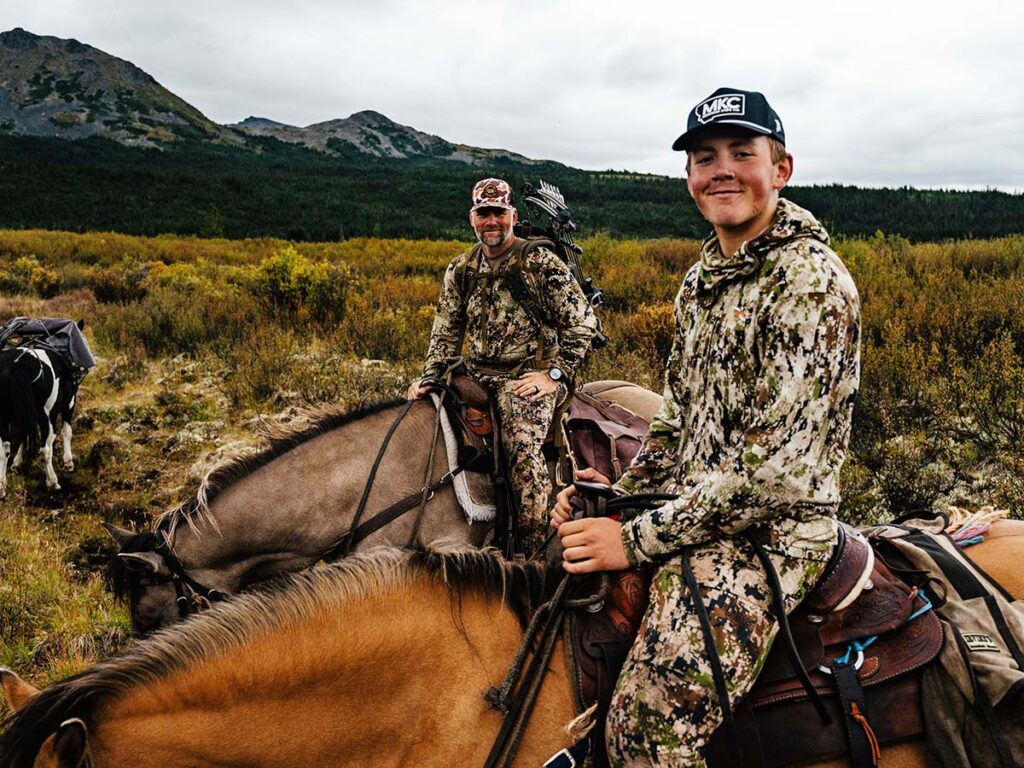
“Personally, I love coffee,” Josh emphasized. “For me, coffee and knives seem to be loved by so many blue-collar workers. Clearly, white-collar people drink coffee too. But I think back to my grandpa or my dad, and they always started the day with a cup of coffee before going off to work the ranch or in a backhoe. That same guy always had a knife in his pocket. The best place I’ve had Montana Knife Co. coffee is in northern British Columbia on a horseback moose hunt with my son [Hank]. For 10 days, it was rainy and cold. But each time we sat down to rest we made coffee with our jet boil. Hot, steaming coffee while freezing on a hunt tastes so good!”
Josh Smith (left) said the best place he’s had MKC coffee is in northern British Columbia on a horseback moose hunt with his son Hank (right). “For 10 days, it was rainy and cold,” he recalled. “But each time we sat down to rest we made coffee with our jet boil.”
Montana Knife Company offers its MKC X Black Rifle Coffee Signature Dark Roast in whole bean and ground 12-ounce bags.
For many consumers, the blend of the knife and the good cup of coffee just comes natural. Now, it’s easier than ever. Exploring the best in cutlery and coffee simply enriches the experience with both.
Knifemakers From Around North America Came To Auburn, Maine For The 2022 New England Bladesmithing Symposium
The 12th annual New England Bladesmithing Symposium brought nearly 100 knifemakers and enthusiasts together for the first hammer-in since 2019.
The event ran from July 15-17 in Auburn, Maine at the New England School of Metalwork and featured classes and workshops galore. Throughout the weekend there was something to scratch any itch you may have had about knives.
Master Smith Lin Rhea presented a tutorial on how to make his dynamic X-Rhea knife. There were workshops on everything from how to build out your knifemaking business to forging recurves.
It was a brutally hot Saturday in the Pine Tree State, yet it didn’t dampen spirits, particularly for the main event– the Battle of the Bladesmiths. The 2-hour competition to pushed four makers to their limits, and drew the largest crowds and interest.
Learning From The Best
The classroom at the NESM is covered wall to wall with tools and other metalwork made by past students just like this.
During the afternoon I was able to drop into a few of the classes. The one I got the most out of was led by Master Smith Christoph Deringer.
Derringer class about the anatomy of the knife was a joy, particularly the care he gave answering questions. His wry sense of humor even out, like when he called flux a crutch pertaining to forge welds. In that particular case, he suggested simply listening to the metal and letting it guide you when you forge weld, no flux is needed.
He taught everyone a neat trick for adding patina to a blade, as well. The crux, you hang the knife above a piece of heated copper. Heating the copper causes it to emit gasses that rise up and patina the blade to an almost bronze color.
A Successful Weekend
It was a big weekend for the school, gathering makers from the Northeast, Eastern Canada, and even as far west as California. For NESM director Dereck Glaser, it was a successful weekend, particularly given the COVID-related lapse in the symposium the past few years.
“The school, in general, draws from around New England,” Glaser said. “I’m excited to see more Canadians here, to be honest. We can’t forget we have a whole other country on our border. I can’t be pulling students out of the Atlantic Ocean so Canada’s a really good option.”
It’s important for anyone with even a passing interest in knifemaking to visit their local school and learn. Not only can you save yourself toil and trouble, but supporting the broader community of makers helps it survive and thrive even in the lean times.
Journeyman smith Mace Vitale runs a workshop on handle shaping.
“It saves exponentially the number of years,” Glaser said. “Indebting yourself to a week and about $600 could potentially save you 3-5 years of trial and error on your own. The amount of compressed skill and support you get in 4-5 days of a course, answering those questions that’ll take 3-5 years to figure out on your own.”
Glaser said that even with the uncertain economy, he believes the future of the school and knifemaking is bright because the passion is boundless.
“The fiscal issues we’re having is making it rough. It’s 90+ percent an enthusiast kind of hobby and craft for most people,” Glaser said. “Where inflation and cost of living’s gone, everyone’s seeing a toll in the crafts. We’re even seeing it in the welding, which is an employment-based skill. But on a whole, I think the energy is still there. The love for it is greater than ever. A lot of people did a lot of things to better themselves in it through the pandemic, so I think coming out on the other end I think people are kind of stronger.”
The Passion For Knives
A nice bit of camraderie. Two of the battle contestants Leo Potter (in the hat) and Jeremy Yelle share a fun moment ahead of the contest.
As informative and enlightening as the classes were the attendee’s conversations. Everyone was excited, whether it was to learn from a particular smith, show off a piece they made, or for the battle at night, everyone was open and welcoming.
A Previous winner of the Battle of the Bladesmiths, Emiliano Carrillo (owner of Sun and Stars Forge), was particularly poetic in what he said about the process of making his own steel.
“When I started the smelt earlier in the day the sand runs through my fingers, and by the time the day’s done it’s a lump of material that can be turned into something,” the owner of Massachusetts-based Sun and Stars Forge said. “It goes from being this throwaway material to something that’s actually useful. I think that’s crazy. It really is alchemy to me. It’s addictive. You do it and it works and you do it again and again and it breaks your heart, and then you have some successes.”
The day ended with the battle. Four young smiths were tasked with turning a one-foot bar of 1084 into a complete knife in just two hours. You can read all about the contest here.
In total, the symposium was absolutely worth the trip and should be on your checklist if you’re a serious maker in the Northeast U.S. or Eastern Canada.
To learn more about the New England School of Metalwork, click here.
Hinderer’s XM-18 out the side autos each pack a punch.
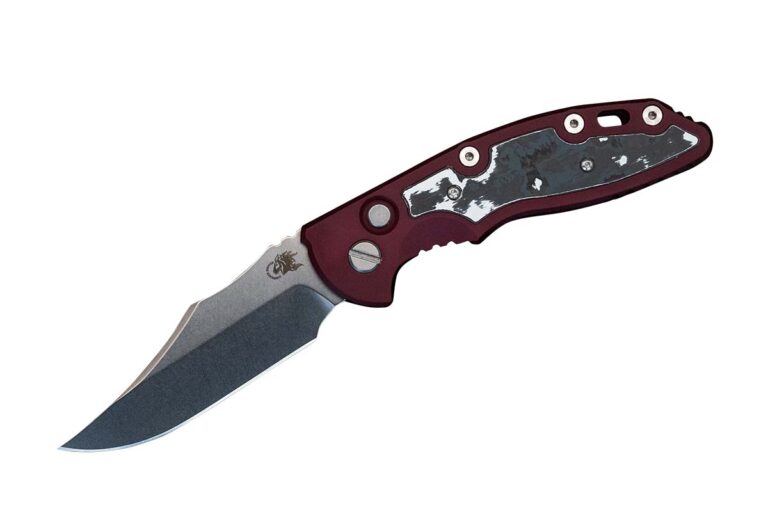
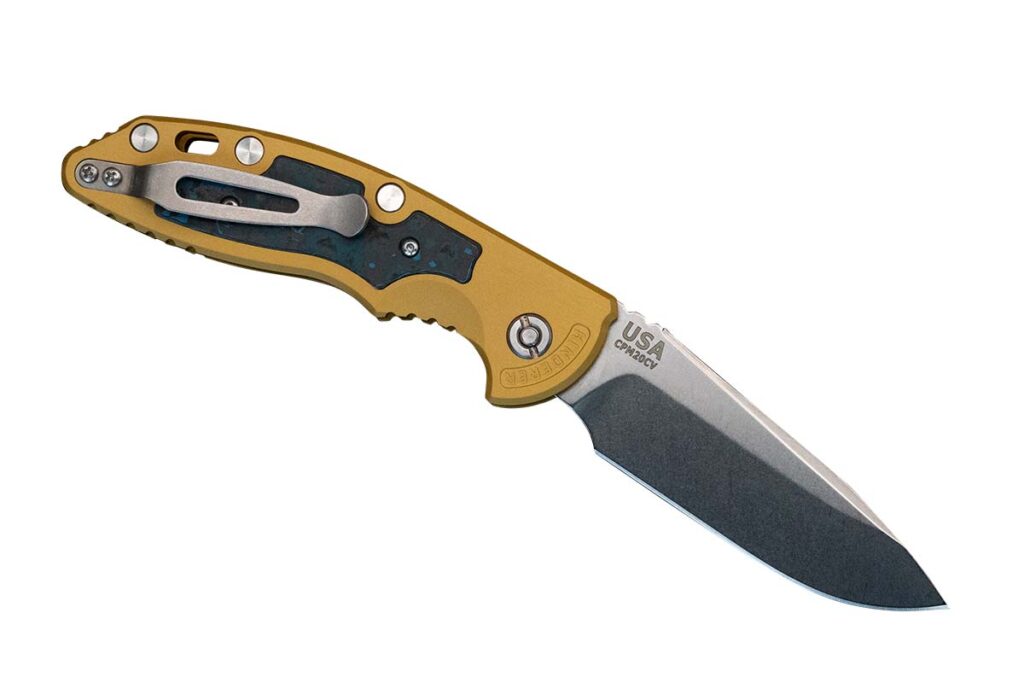
Rick Hinderer Knives offers two of its latest iterations of what industry observers say will continue to be a hot knife style for the foreseeable future—the automatic—in the XM-18 3.5 Bowie Auto and XM-18 3.5 Spearpoint Auto.
The knives come in different handle colors and inlays and are basically the same design with the same dependable out-the-side automatic opening mechanism, but each offers its own different blade pattern and material.
XM-18 3.5 Spearpoint Auto
The 3.5 Bowie has a clip-point bowie blade of CPM S45VN stainless steel, while the 3.5 Spearpoint sports a spear-point blade of CPM 20CV stainless. In addition to each knife being a style to continue to watch in 2025, the steels bear serious eyeballing in the coming year as well as each makes the list of steels that will thrive in 2025 (see page 74).
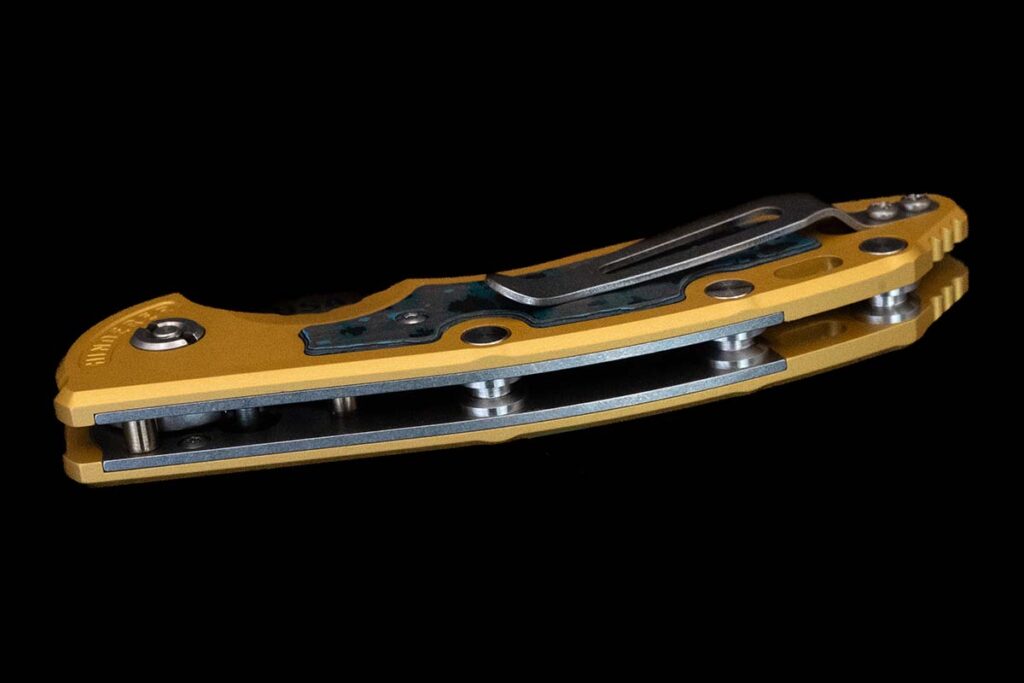
Each knife features Hinderer’s patent-pending titanium half liners, with the XM-18 3.5 Spearpoint Auto doing the honors here.
Each knife features traction ridges on the base of the blade spine and handles with single, traction-ridged finger grooves, ridges on the bottom of the handle toward the butt, an integral guard and a hole for a lanyard. Each also has Hinderer’s patent-pending titanium half liners reinforcing the aluminum handles.