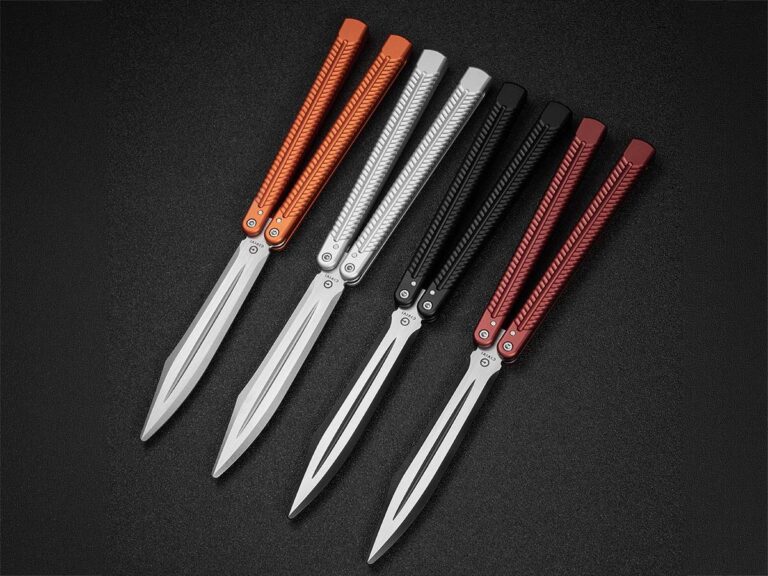
CIVIVI Dracolisk aims to help you master the balisong flip without the sting.
Balisong flipping has evolved from a niche martial art into a high-speed skill sport, where the fluid motion of the handles is just as important as the steel between them. For those looking to enter the world of butterfly knives, the barrier to entry is often the steep learning curve—and the inevitable nicks that come with it. CIVIVI is addressing this head-on with the Dracolisk, a dedicated trainer designed to offer a authentic flipping experience without the risk of a live edge.
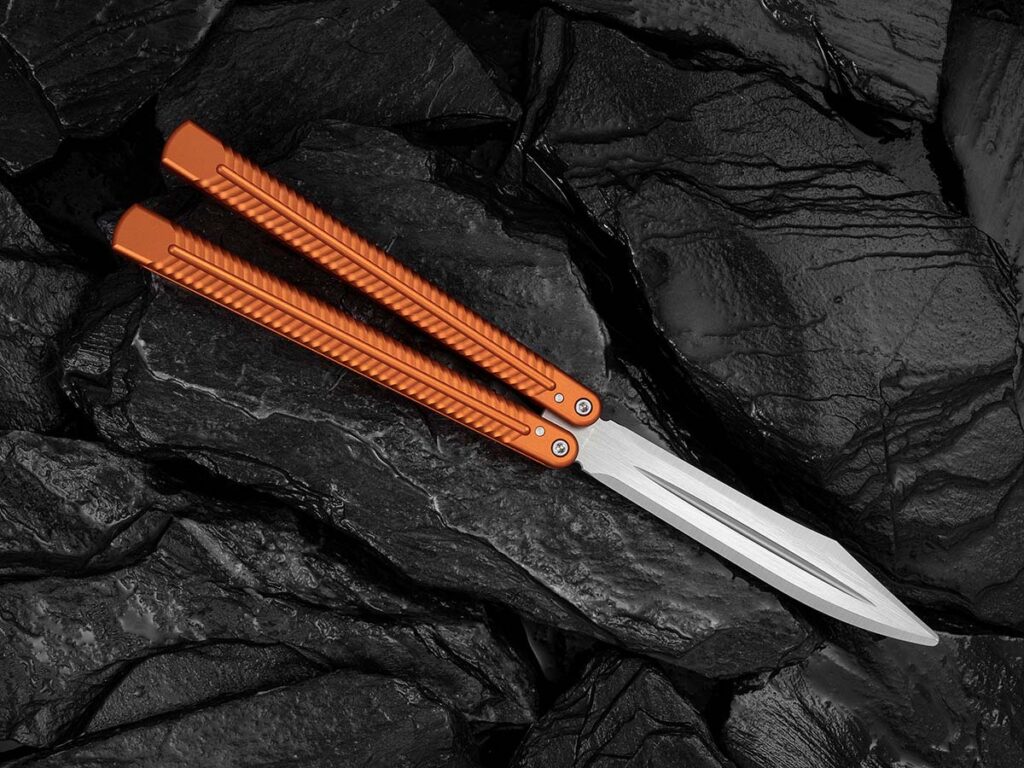
The Dracolisk represents CIVIVI’s first foray into the balisong market, and they have chosen to focus exclusively on the practice-friendly format. The 4.57-inch blade is crafted from 9Cr18MoV stainless steel, featuring a stonewashed finish and a dramatic clip point profile. While the “edge” is completely dull, the blade is ground and weighted to mimic the physics of a live blade, ensuring that the muscle memory developed during practice translates accurately to a real knife later on.
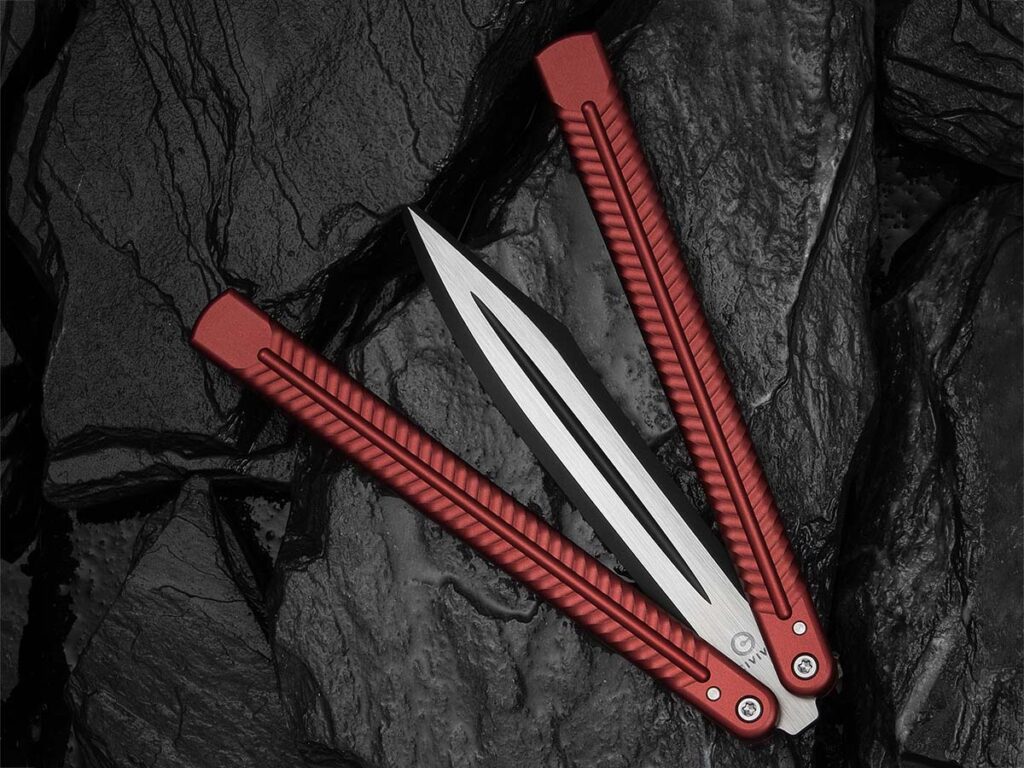
Mechanical simplicity is a hallmark of a good trainer, and the Dracolisk delivers with a latch-less construction. This design choice provides clean lines and eliminates the common annoyance of a latch interfering with handles during complex aerials or rollovers. The handles themselves are machined from lightweight aluminum with a 3D anti-slip texture, providing a secure grip even during high-intensity sessions.
Under the hood, CIVIVI opted for bronze washers at the pivots. While many modern folders utilize ball bearings, washers are often preferred in the balisong community for their predictable, smooth drag and long-term durability under the constant impact of flipping. At 4.18 ounces, the Dracolisk sits in the “sweet spot” for many flippers—heavy enough to carry momentum through transitions, but light enough to avoid fatigue.
Whether you are a seasoned flipper looking for a safe way to test new combos or a beginner starting from scratch, the Dracolisk provides a professional-grade platform to hone your skills.
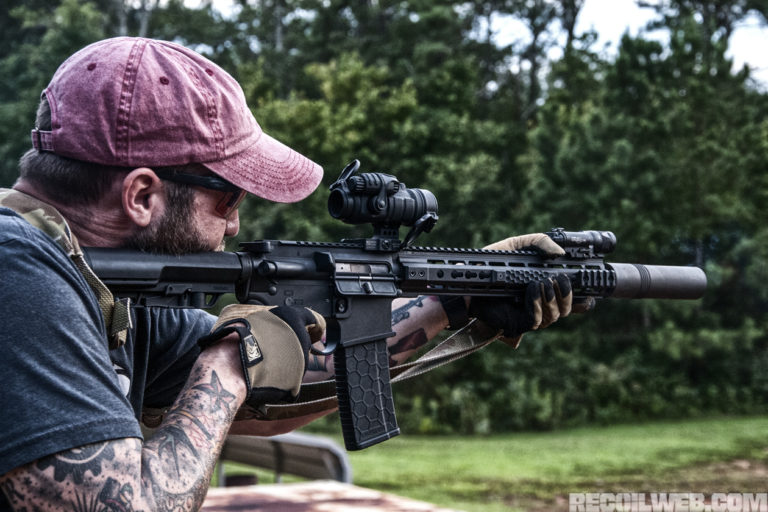
CANCON comes to the West! Join RECOIL at the Ben Avery Shooting Center in Phoenix, Arizona April 29th and 30th, with VIP access starting on the 28th!
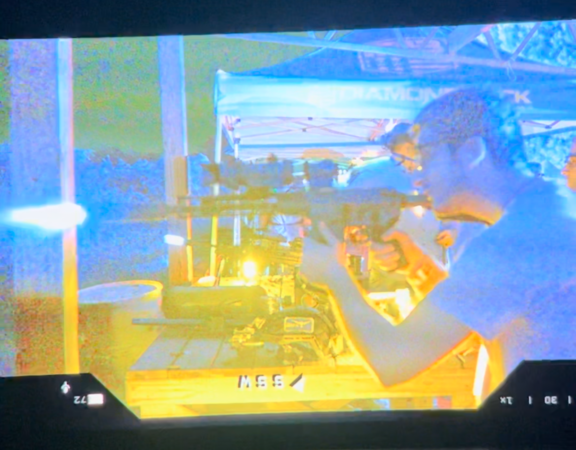
CANCON presented by Silencer Central, is a fully suppressed range day event with dozens of vendors, hundreds of guns and suppressors, and tons of fun.
Check out the CANCON 2022 Recap to see what you missed last year, and don’t miss out this year!
CANCON West will feature an even BIGGER range day with MORE suppressors, more guns, more vendors, and an even bigger night shoot. Over 100 firearms from over 25 manufacturers!
$50 single-day tickets get you in for ALL DAY plus ammo is provided!
Want the VIP experience? VIP tickets are $700 and allow access for Saturday and Sunday, plus early access on Friday, plus a catered dinner & the Night Vision Network’s Night Shoot on Friday night.
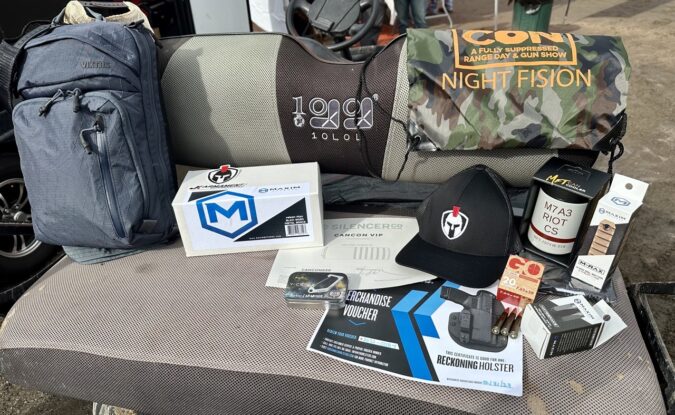
PLUS, VIPs get a VIP bag worth A Lot! Filled with awesome gear that you’ll actually use. We can’t spoil the surprise of what is in 2023’s VIP bag, but here is a look at what was in CANCON’s 2022 VIP bag!
CANCON 2022 VIP Bag Valued At Over $1475
Viktos XL Slingbag
Blue Force Gear Sling
Otis Ripcord Cleaning Cord
Caldwell DeadShot Shooting Bags
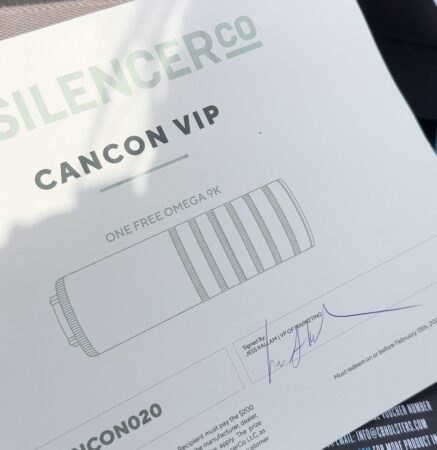
SilencerCo Silencer
Subscription to Recoil/Offgrid
Mission First Tactical Extreme Duty Magazines 556
Mission First Tactical Coozie
Maxim Defense Hate Brake
Maxim Defense Arm Brace Stock
Primary Weapon Systems Gift Certificate
JK Armamant Stickers and Hats
Coming to CANCON but not a VIP? Take a chance at winning a VIP bag! All CANCON attendees can enter to win a VIP Bag, all you have to do is:
Post a video or photo from the event tagging @CanconEvent and using the #CanconGiveaway.
BRING THE FAMILY!
CANCON is a family-friendly event with eye and ear protection for everyone.
All ammo is provided, you just bring the trigger finger!
Food and drink will be available for purchase on-site.
Expect to see DAILY giveaways at CANCON, walk with industry experts, shop for your favorite accessories and gear, and check out some special demonstrations and seminars!
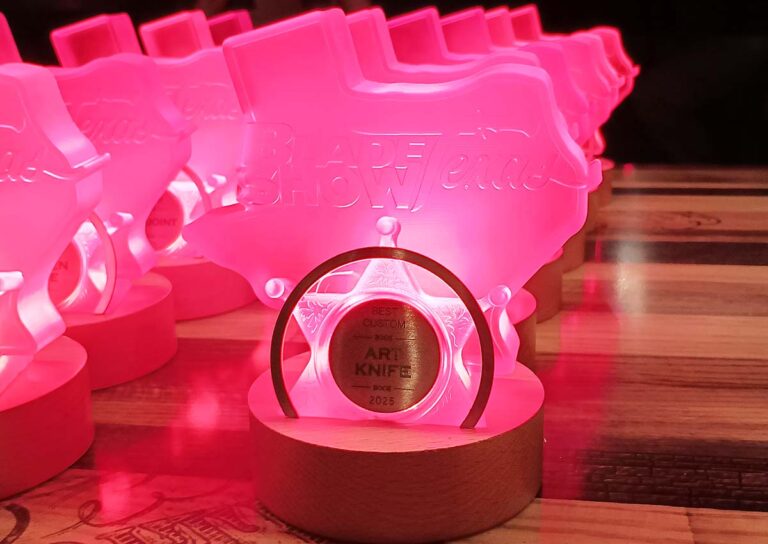
See which factory knives took home the coveted hardware from the BLADE Show Texas Factory Knife Awards.
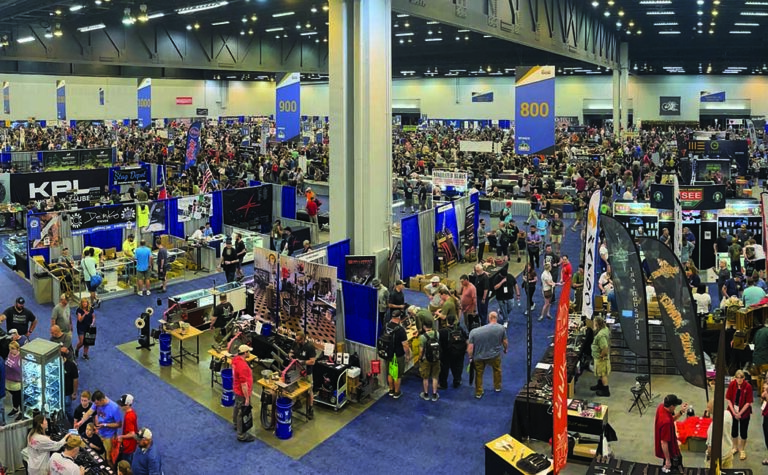
The BLADE Show Texas, held March 7-8 at the Fort Worth Convention Center, saw an intense factory knife competition. With an excellent turnout of competitors and a high-level of execution on the knives, it was most definitely a showcase of the top-tier production knives at the show.
With such an impressive lineup, the three-judge panel faced a tough challenge in determining which blade best represented each of the seven categories. In short, competition was hot. With the dust settled, here are the winners who claimed top honors, including Best in Show.
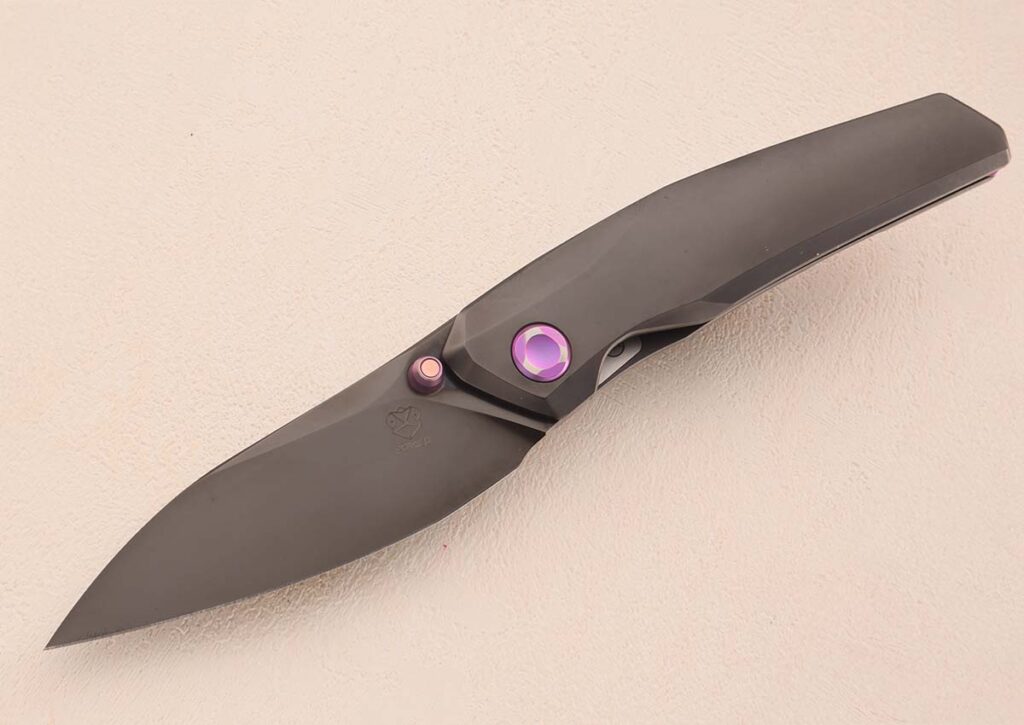
Best In Show & Best Imported Knife: Poikilo VK Zen
What The Judges Had To Say: “It’s a well thought out knife in both design and function.”
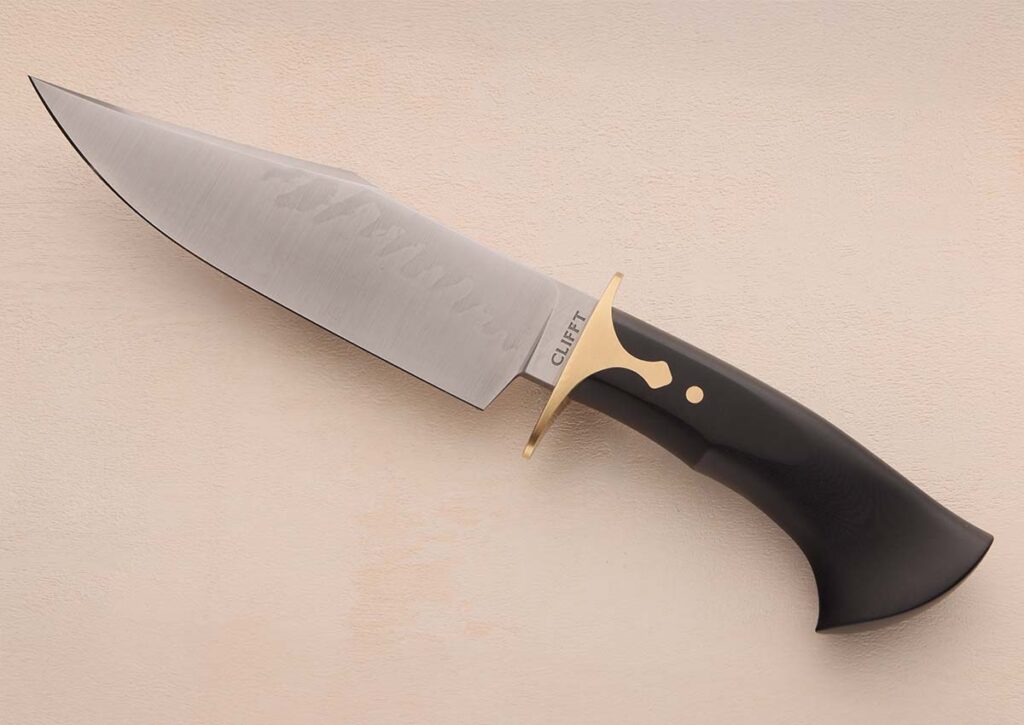
Best American Made Knife: Dauntless Manufacturing Clifft
What The Judges Had To Say: “The details and craftsmanship in [the Clifft], you don’t expect to see that in a factory knife.”
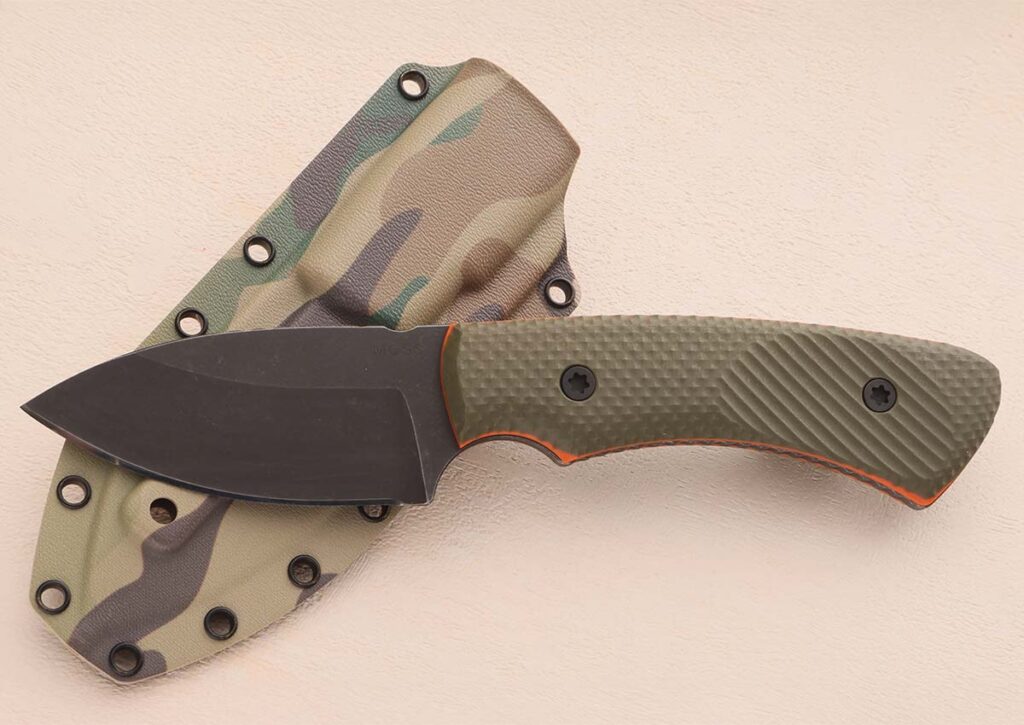
Best EDC Knife: Dauntless Manufacturing Moss
What The Judges Had To Say: “It’s the entire package. The company has an attention to detail and the knife has one of the best sheathes [we’ve] seen.”
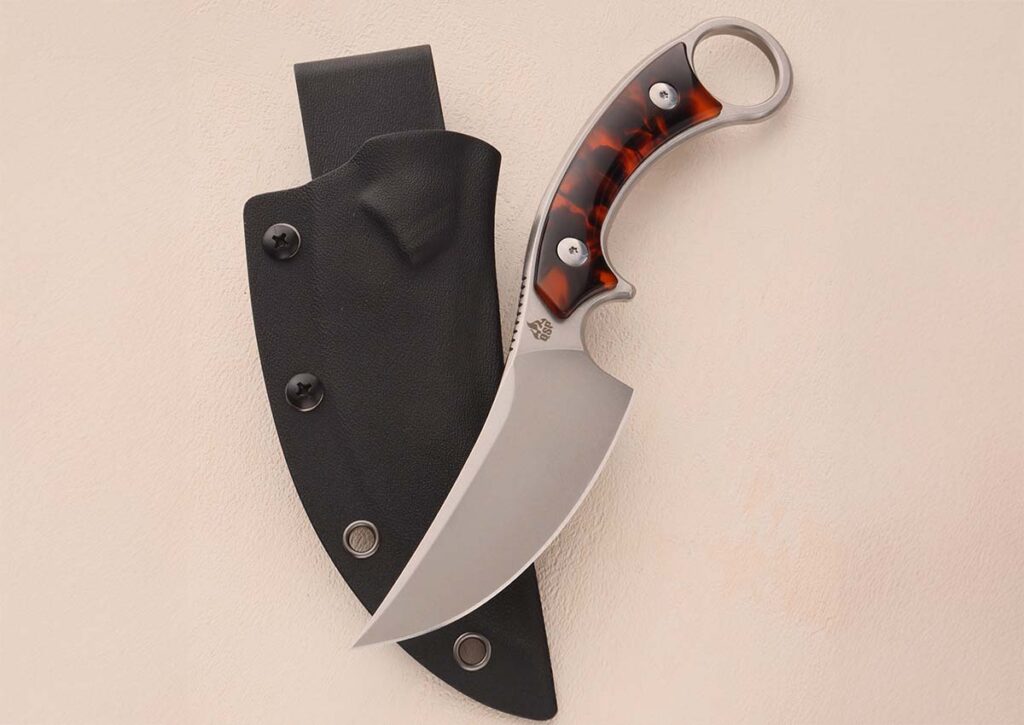
Best Fixed Blade: QSP Viper
What The Judges Had To Say: “It comes with an excellent and functional sheath. It’s ergonomics and carriablity come together to create a complete package.”
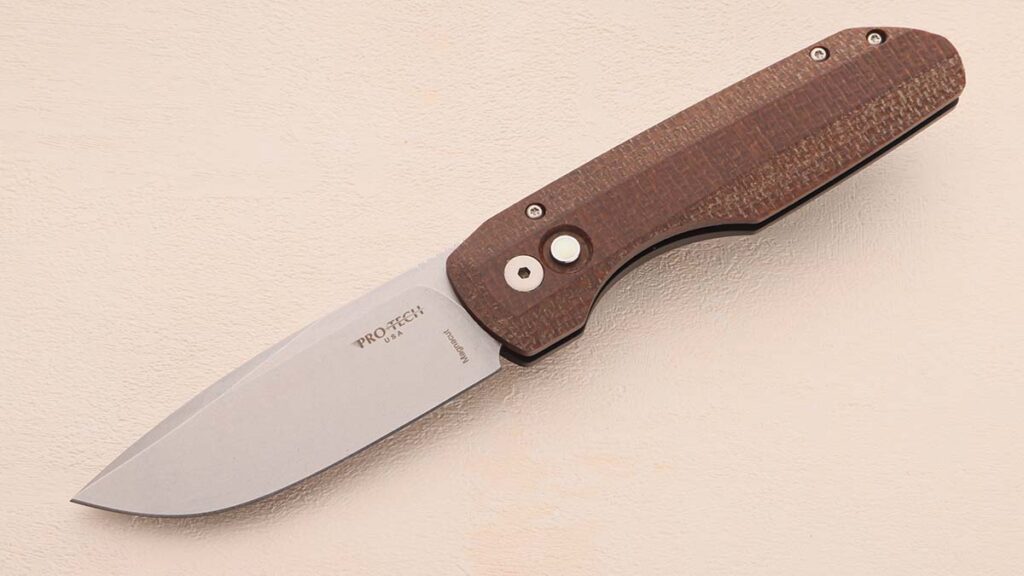
Best Folder Knife: Pro-Tech/Vero Engineering Synapse Auto
What The Judges Had To Say: It won, “Because it’s badass!”
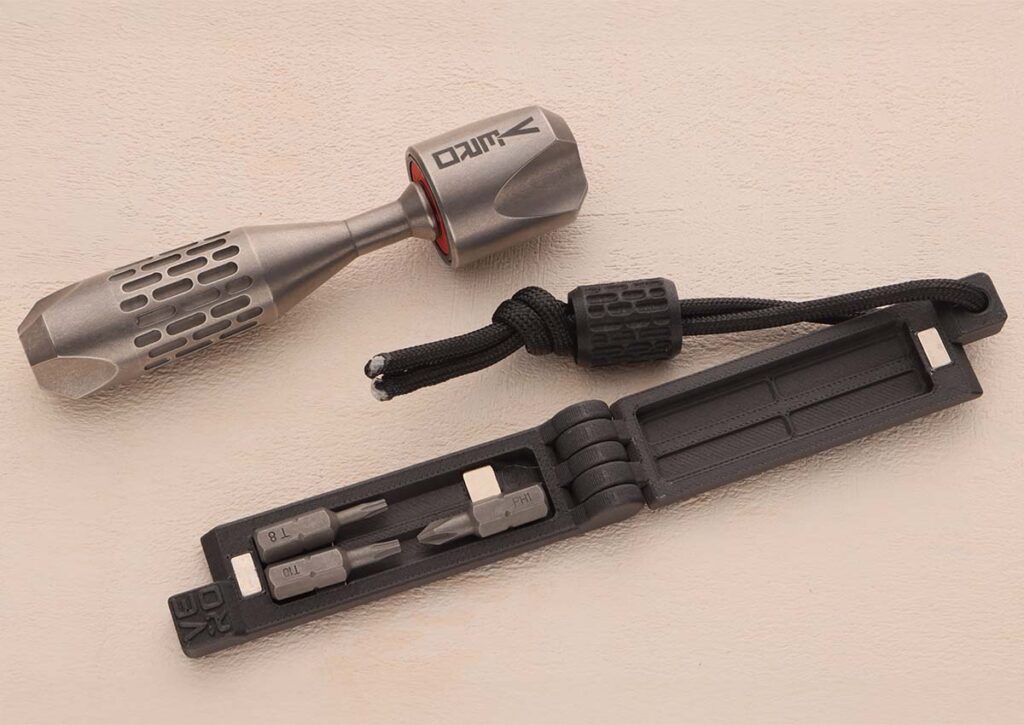
Best Of The Rest: Vero Engineering Vortex TI Maintenance Kit
What The Judges Had To Say: “Far too many bit drivers have thin handles. This one is made to fit the hand and torque down on.”
Knowing How To Use A Whetstone, Or Sharpening Stone, Can Restore A Dull Blade And Should Be Part Of Regular Upkeep For Your Knives.
There are many inexpensive ways to sharpen your knives at home, but nothing feels the same as sharpening your knives on a whetstone. Used for centuries around the world to keep an edge on everything from swords to kitchen knives, the whetstone is an intimate, precise way to maintain your knife’s edge and bring it back to life.
The “whet” in whetstone has nothing to do with being wet or any type of moisture. It comes from the Old English term “hwettan” which means “to whet or sharpen.” Coincidentally, most whetstones do need some type of moisture for top performance. In all cases, this means water or oil. However, a majority of stones you’ll find in stores or online–particularly for kitchen use–will be waterstones.
Oil Stone Vs Waterstone
Honestly, in some cases, there is no difference.
The preference of lubrication–water or oil–is left up to the user. Both will do the same job, swarfing the surface of the stone so it does a better job sharpening.
However, there are other cases where one or the other must be used with a particular stone. Natural sharpening stones, for instance, mostly use water. Rub them down with oil and you’ll render them useless.
Manufacturers will spell out whether your particular whetstone is water, oil or both.
The main difference between whetstones that use oil and whetstones that use water is that waterstones are softer so the old abrasive material breaks off faster than an oil stone. This means you’re sharpening on fresh stone material more consistently.
Waterstones are also less messy and easier to clean vs oil stones, which adds another point in the bucket for waterstones. Waterstones also come in more grit varieties than oil stones.
Oil stones, especially those made of novaculite, are a traditional sharpening stone, and many are quarried in America, specifically in Arkansas.
Differences In Grits
You’ll see stones of all types come in a variety of grits. The lower the number, the more coarse the grit. The more coarse the grit, the more material gets removed with each pass of the knife.
For at-home sharpening, grits in the range of 1,000-8,000 should be more than enough. However there are stones that come as coarse as 120 and as fine as 30,000. Consider these specialists and stick to the common grits for most jobs.
Whetstone Accessories
While there are many gizmos and accessories out there to help with your whetstone sharpening, there are two that stand above the rest. You can see them in the photo at the top of this article.
The first is the stand for your whetstone. This should come with the stone when you purchase it. You do not want to lay your stone directly onto your table or countertop. It can slide, and mixing sliding things with sharp knives is a recipe for losing a finger.
The second is that little thing to the right of the stone. It looks like a chip clip, but it’s actually an angle guide. Some will clip onto the top edge of your knife while others might need to be strapped to the stone itself. Either way, the angle guide will help set your sharpening angle and allow you to maximize each pass of the blade across the stone.
I’ve used a 1000/6000 waterstone for years to keep my kitchen knives sharp. You can find plenty of quality 1000/6000 whetstones online for under $40. But having the stone doesn’t account for much if you don’t know how to use it. I pulled out my sharpening set up to help give you a step-by-step breakdown of how to sharpen your knives with a whetstone.
Step 1: Get Your Equipment
Things I use to sharpen on a whetstone
Ready to start sharpening? Hold up a minute. You’ll need more than a whetstone and your knife.
In addition to the obvious tools for the task, I start with a whetstone stand, a container of water and a spoon (you heard right).
There are special notes on a couple of these items.
The water container is to prep the whetstone and should have some specific attributes. I want a deep container so the stone can sit in it and fully soak. These babies are thirsty, so you can’t just dab water on one and expect it to work.
Here I’m using a baking dish, but a plastic tub or kitchen sink work equally as well.
The spoon … no, you’re not taste testing your knife’s edge. It’s there to literally spoonfeed the stone more water during sharpening to clear off the shavings.
Step 2: Soak The Whetstone
Soaking the whetstone
Here’s the speedbump of the process.
As mentioned, whetstones require a good soaking before use. This isn’t a splash-and-go process.
Plan to let your stone sit fully submerged for a good 10 to 20 minutes before it’s primed for use. There’s a simple way to tell it’s good to go.
Plunge that baby into water and you’ll see it bubble like an aquarium aerator. Quite literally, this is the stone drinking up water in its microscopic pores and displacing air in the process.
As time goes on, fewer and fewer bubbles pop out of the whetstone (see the above picture). When it’s none or next to none, you’re good to go.
Step 3: Secure The Stone
OK, this sounds obvious. But it must be said–you must secure your wetstone before sharpening.
Not only does this stave off a tongue lashing from your significant other, ensuring you don’t scratch up the counter or dinner table. It also keeps your digits from getting cut up.
In most cases, you’ll have a holder that, well.. holds the stone. If you don’t, never fear, a towel or rag makes a dandy impromptu stone holder.
Whatever the case may be, make certain your stone isn’t going anywhere before you actually begin sharpening.
Step 4: Determining The Sharpening Angle
Rubber, you’re almost ready to meet the road!
Before you actually start scraping away precious material to create a fresh sharp edge, you need to determine exactly what angle to sharpen at.
Some knives require a somewhat uncommon angle to sharpen. This is spelled out in the owner’s instructions if this is the case. Lose those, check the company’s website, these vital specs are usually there.
However, in most cases–a vast majority–20 to 25 degrees is the best angle to achieve a good cutting edge. And you don’t even need a protractor to determine this pitch.
Think of it this way, the edge pointing straight down at the stone is at 90 degrees. Tilt the blade halfway down, now the blade is at roughly 45 degrees. Tilt the knife halfway again and, there you are about 22.5 degrees–a sweet spot for a good edge.
Or you can go the easy route and use an angle guide, mentioned earlier in the article.
Step 5: Course Sharpening
Start with the lower grit, which in this case is 1,000. It takes off more material and gets the edge almost all of the way back to razor sharpness.
Usually, I do 10 passes on each side of the blade, but I fully sharpened my knives a few weeks ago and just did two here as a demonstration.
Keep the blade angled between 20-25 degrees to get the best possible results.
Step 4: Turn The Stone Over & Sharpen With The Finer Grit
I finish with the fine grit, 6,000 on my whetstone.
You’ll notice each time I pass there’s some new metal shavings on the stone. That’s the swarf. It’s fine for your knives if you leave the swarf on the stone as you sharpen, but you can also wash it away with some extra water.
Again, like the coarse grit, I usually do 10 passes on each side of the knife.
Step 5: Wash Off Your Knives & Clean Up
Once you’re done sharpening you should rinse your blades and wipe them dry with a towel. Once your knives are accounted for, give your water container a thorough cleaning. I used a baking dish, and it’s important to fully clean it so you aren’t ingesting microscopic metal shavings.
For the stone itself, I double check that it’s secure in its holder and leave it out overnight to let the water evaporate out of it. Once it’s completely dry I put it back in its spot in the drawer.
And there you have it, a simple, straightforward guide showing you how to sharpen your knives using a whetstone.
Editor’s Note: This article was written by Mike Ableson.
Follow these simple rules and you’re sure to have a great show.
If you’re among the throng of thousands going to the BLADE Show June 7-9 at the Cobb Galleria Centre in Atlanta, here are a few tips on how to make the world’s largest, most important knife event work for you:
What To Wear
If in doubt “go dark”—any one or more of black shirt, blue jeans or black hat. While tactical doesn’t rule the way it once did, black remains the color of choice among many knife fans. Whatever color you choose, wear loose-fitting, comfortable clothes. If you want to overdo it, clip a knife to every pocket.
Comfortable shoes that provide full support against walking on concrete all weekend are an absolute must. Some bring two pair of such shoes. Bring a small backpack for snacks, a small plastic water bottle, etc. If you go outside for the BLADE University classes or free seminars, a ballcap helps protect against a June Georgia sun that has fried thousands of BLADE Show patron scalps over the years.
Party Proof Yourself
If you join the revelry and revel too much in The Pit (page 24), the lobby bar of the host Renaissance Atlanta Waverly Hotel, take some kind of headache relief before bedtime to reduce the dreaded post-Pit hangover. And, if you stay in the Waverly, bring some earplugs. The Pit can get raucous even into the wee hours and the noise can carry up to the hotel rooms, including the top floor.
Show Etiquette
Try to avoid walking fast and making sudden stops and U-turns in the exhibitor halls. Thousands of knife fans like you are moving, too, often closer to each other than they should. Any abrupt moves can result in collisions, so take it slow and easy. You’ll see more knives that way, too.
Never ask a maker how long it took him/her to make a specific knife. It’s natural to be amazed at some of the fabulous works of art and to be curious about how long it took to make one, but many makers bristle at the question. It’s not as important to know why they resent the query so much as the fact that they do, so don’t ask.
Don’t interrupt a maker/customer conversation. Patiently wait your turn or come back later when the maker is free to talk.
Ask the maker before you pick up a knife. If it’s a folder, it doesn’t hurt to ask permission to open it. The maker may want to open it for you. If a multi-blade folder, don’t open it so two or more blades are open at once. This puts undue pressure on one or more of the backsprings. It’s also a good way to cut yourself if you’re not careful. If you’re wanting to see what kind of clearance there is between opening/closing blades, ask the maker to demonstrate it for you. And when you finish examining the knife, return it the way it was handed to you—carefully, whether open or closed.
While it may seem courteous to wipe the blades off before returning knives to the makers, don’t. Let the makers do it instead. They are fully equipped to do so and are going to check the knife for any spots you may miss anyhow. That doesn’t mean you shouldn’t bring a chamois for your own purposes. However, if there’s any wiping down of their knives to be done, let the makers do it.
Don’t use a loupe/magnifying glass to examine a custom knife. It’s a good way to make the maker mad. There are going to be imperfections on custom knives—if not, they’re probably not custom—so some minute imperfections are to be expected.
After you finish talking to the maker and are ready to leave, even if you intend to return to his/her table, don’t say, “I’ll be back.” Chances are you won’t. It also implies you’ll be back to buy a knife when you may have no intention whatsoever of doing so. Don’t be an “I’ll Be Backer!”
One thing to be sure to do: have fun. If you’re going, see you there!
From copper-infused patterns to stainless steel sheets, discover the innovations driving the red-hot market for production damascus.
Are we seeing a bit of “global warming” in the knife industry, where red-hot damascus steel is getting even hotter? BLADE® spoke with some industry leaders, and 2025 and beyond looks good to them when it comes to production damascus in both carbon and stainless steels.
There are many individual makers who make high-quality damascus in simple and complex patterns in their home shops, backyards or shared maker spaces. This article focuses instead on production damascus forged by specialized outfits such as Baker Forge & Tool, Damasteel, Chad Nichols Damascus and Vegas Forge. At a level beyond “regular” damascus makers, these companies make steel for the masses, for production companies, and specialize in innovative new materials that are sure to delight the industry.
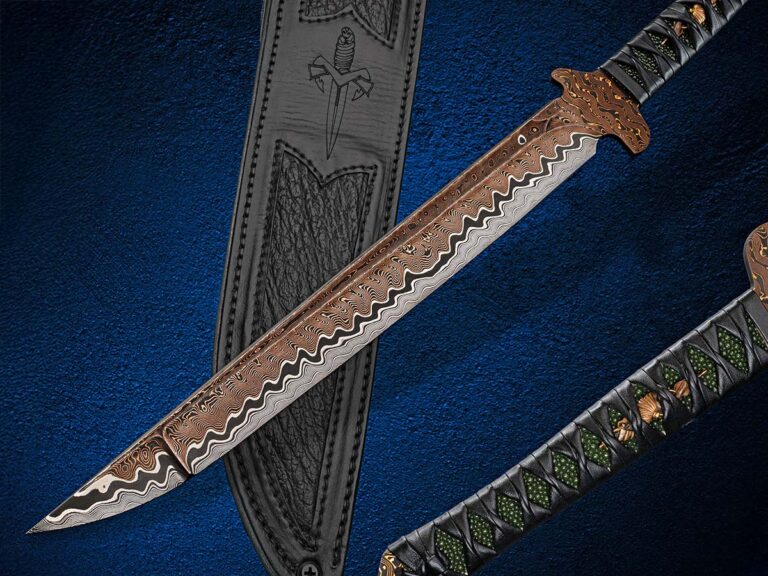
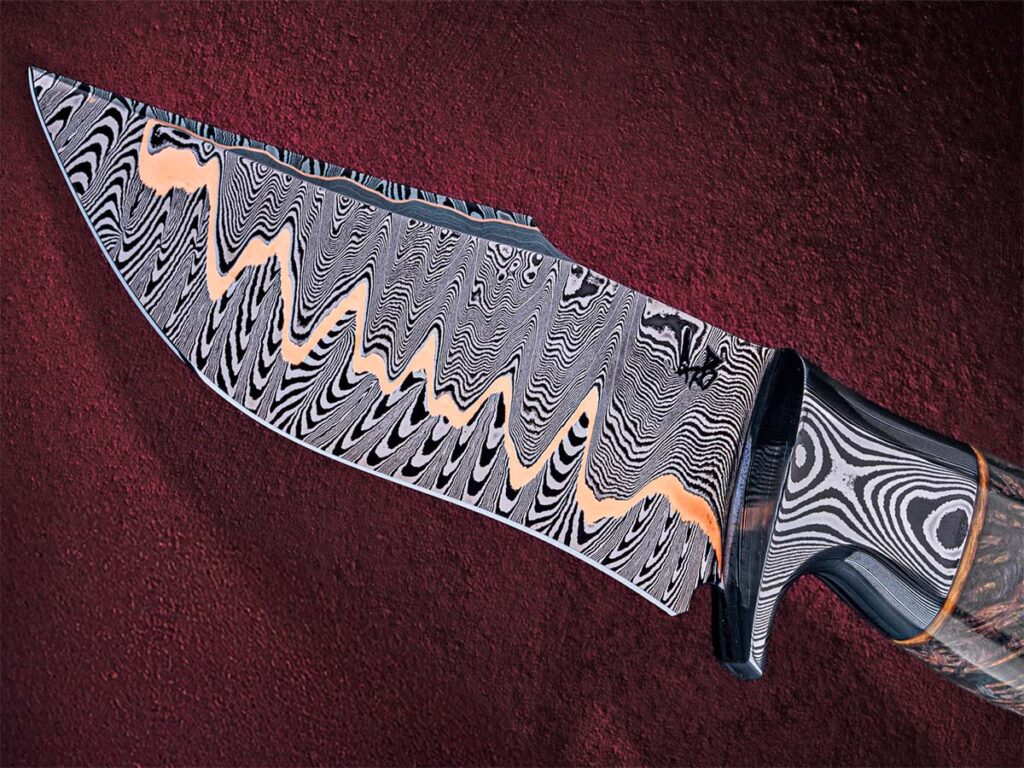
BLADE readers will be familiar with Baker Forge & Tool, a prolific producer of innovative damascus patterns that include copper, such as CopperMai, TigerMai, GoMai and others.
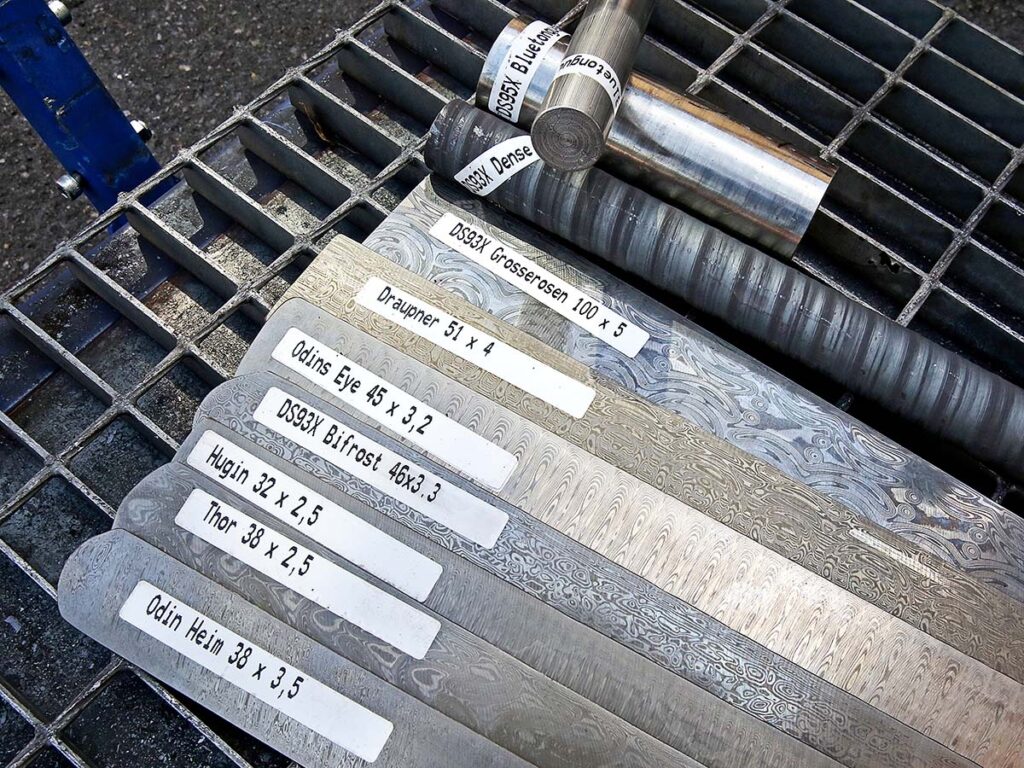
DS93X steel—fourth from bottom in bar form—is Damasteel’s standard mix, “combining good performance with good looks.” “For us it’s more about expanding the patterns than about trying new steel combos,” noted Per Jarbelius. The other patterns in bar form are representative examples of what you can expect from the Swedish steel maker.
“We make carbon steel damascus patterns with copper, and they’ve been hot. We expect them to stay hot through 2025,” Coy Baker said. When it comes to steel selection, the company most often sticks with the gold standard combination of 1084 carbon and 15N20 nickel-alloy steels.
Baker also has been experimenting with Apex Ultra as a core steel for its copper san-mai. For those unfamiliar, Apex Ultra is a tungsten steel alloy, kind of a super-52100 carbon steel. It’s made in small batches and is hard to get in the USA, but Baker has found that the material makes a great damascus core.
“Demand for our Apex core billets far outpaces supply,” Coy noted.
Baker has also been experimenting with stainless and copper damascus and san-mai, using 154CM and AEB-L stainless steels. This writer also makes knives and that combo sounds quite challenging to forge. Baker confirmed that it was very challenging and wouldn’t reveal any secrets, other than the 154CM etches light and the AEB-L etches darker.
Growth In The ‘Sip
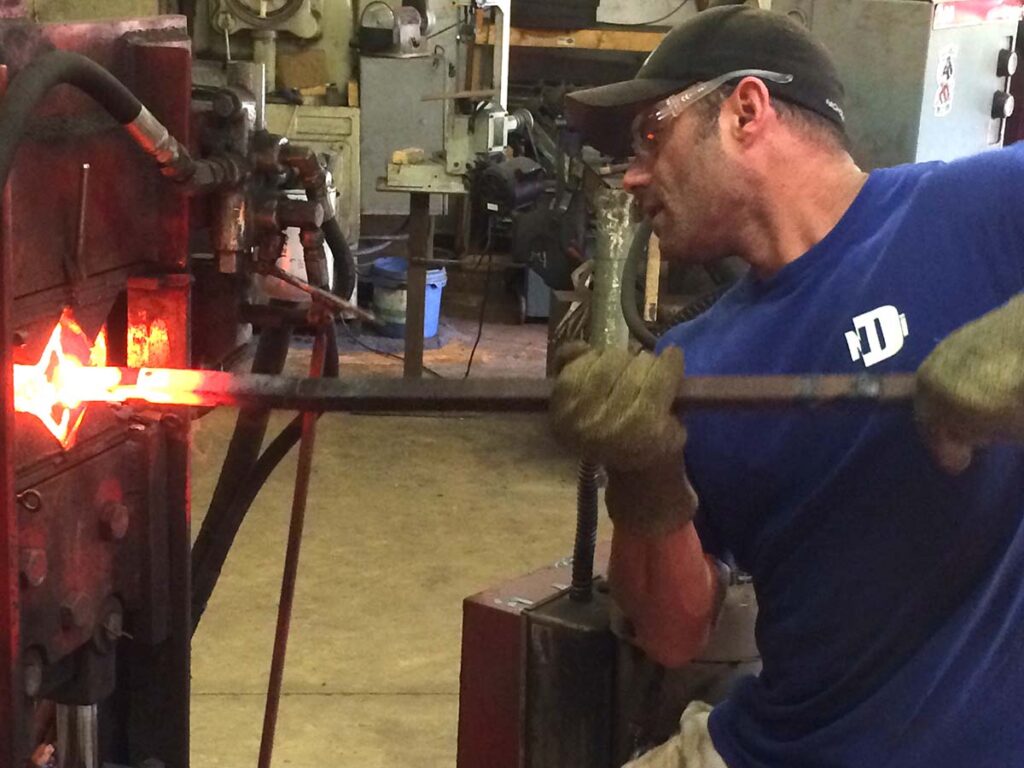
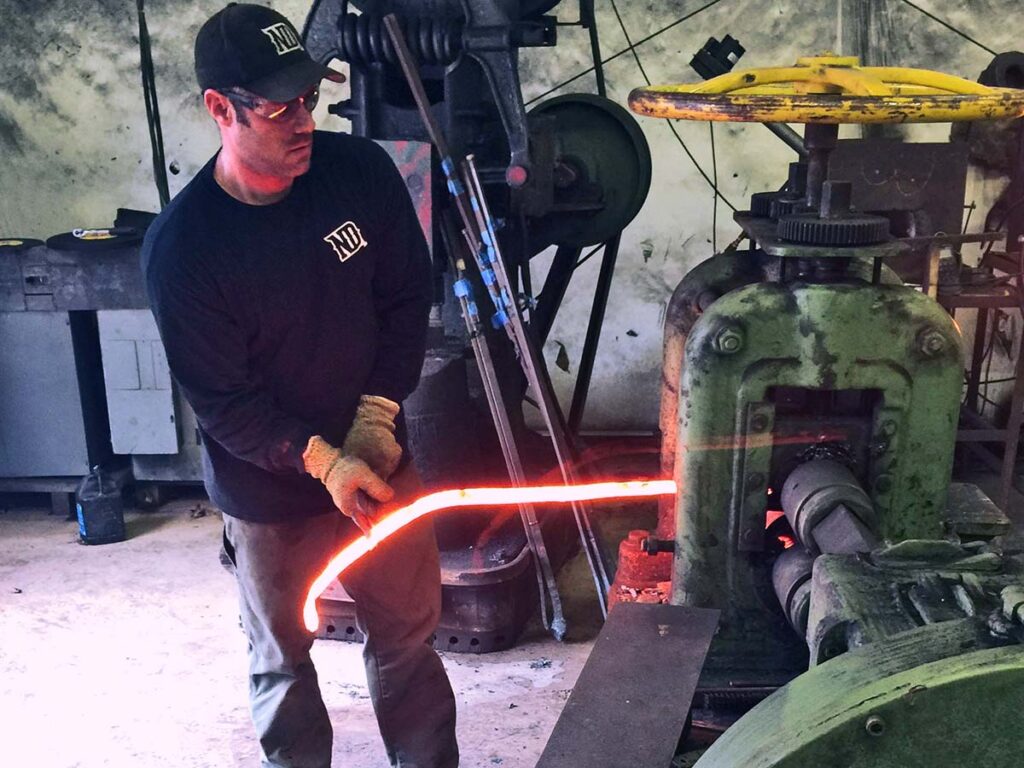
Down in beautiful Bush Springs, Mississippi, Chad Nichols makes traditional carbon steel damascus at a production level.
Vegas Forge has always been innovative and 2025 will be no exception. “We’ve figured out how to do copper in with the damascus pattern manipulation, not just as a line between san-mai,” Jesse Harber noted. (Vegasforge.com image)
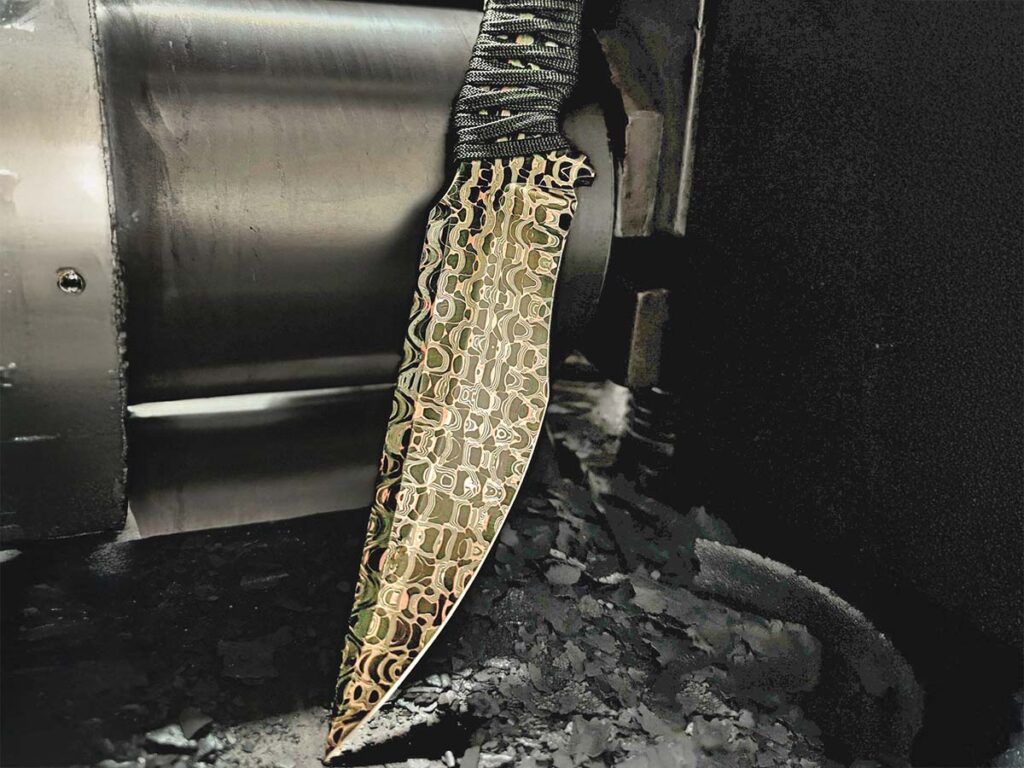
“I stick mostly to carbon steel 1075 or 1095 plus 15N20 with occasionally a little bit of 3V,” Nichols explained. “I’ve got my process down and these steels go together well.” He makes a variety of mosaic patterns, most of which go to a single manufacturer. “The carbon steels are so much more organic,” Nichols said. “You can do so much more with them in a cost-effective way.”
Nichols’ goal for 2025 is to increase his production of mosaic patterns.
“There just aren’t many people doing production mosaics,” he said. “It’s a great opportunity for growth.”
Another area he’d like to see grow in 2025 is the use of exotic and historical materials. He’s made a run of steel for Boker with steel from a German Tiger tank, and has a run coming for William Henry with some leaf springs sourced by WH.
Collab Designs
Damascus isn’t just a U.S. product. Damasteel produces high-quality stainless steel damascus in Sweden.
Chad Nichols (above) stated the goal at Chad Nichols Damascus for 2025 is to increase the production of mosaic patterns.
“Our DS93X steel is our standard mix, combining good performance with good looks,” Damasteel’s Per Jarbelius remarked. “For us it’s more about expanding the patterns than about trying new steel combos.”
DS93X is described as a “patented powder metallurgy product” that includes “two different hardenable steel grades.” “We use only stainless steel,” Jarbelius explained, ‘because it doesn’t rust and has the same or better performance.”
Damasteel historically produces a new pattern each year. For 2025 it also has begun a special project to collaboratively design patterns. Benchmade collaborated with Damasteel to make a steel pattern called “Monarch” exclusively for the Benchmade Gold Class Necron balisong. Jarbelius is excited for the potential to expand the collaborative effort with other companies who want proprietary patterns.
In another innovation, Damasteel has developed the capability to produce stainless damascus in sheets, not just bars. This will come in handy for small-batch and mid-tech production. The sheet steel pattern is called “Drakkar,” which is the old Norse word for the dragon-shaped Viking longboats.
Copper In The Pattern
What happens in Vegas may stay in Vegas, but that’s not the slogan for Vegas Forge, whose damascus is well known worldwide. It is a consistent producer of high-quality carbon and stainless damascus in complex patterns.
Baker Forge & Tool has been experimenting with Apex Ultra as a core steel for copper san-mai. This integral fighter by Greyson Weltyk features Baker copper damascus for its recurve harpoon blade. (Bakerforge.com image)
“One of our most popular patterns is ‘Reptilian,’ which has three alloys included: O1, 1075 and nickel,” observed the company’s Jesse Harber.
Vegas Forge has always been innovative and 2025 will be no exception.
“We’ve figured out how to do copper in with the damascus pattern manipulation, not just as a line between san-mai,” Jesse noted. “We can take our Reptilian pattern with copper in it, and then clad that billet over an O1 or 1095 core.”
As far as stainless goes, Vegas Forge continues to push the complexity of its patterns. Its most popular pattern, “Virus,” begins with a single stack of 1200 pieces! The company uses 154CM cores for most of its stainless san-mai, along with CTS XHP when available.
Ultimate Hotness
What kind of knives do the manufacturers predict for ultimate hotness in 2025?
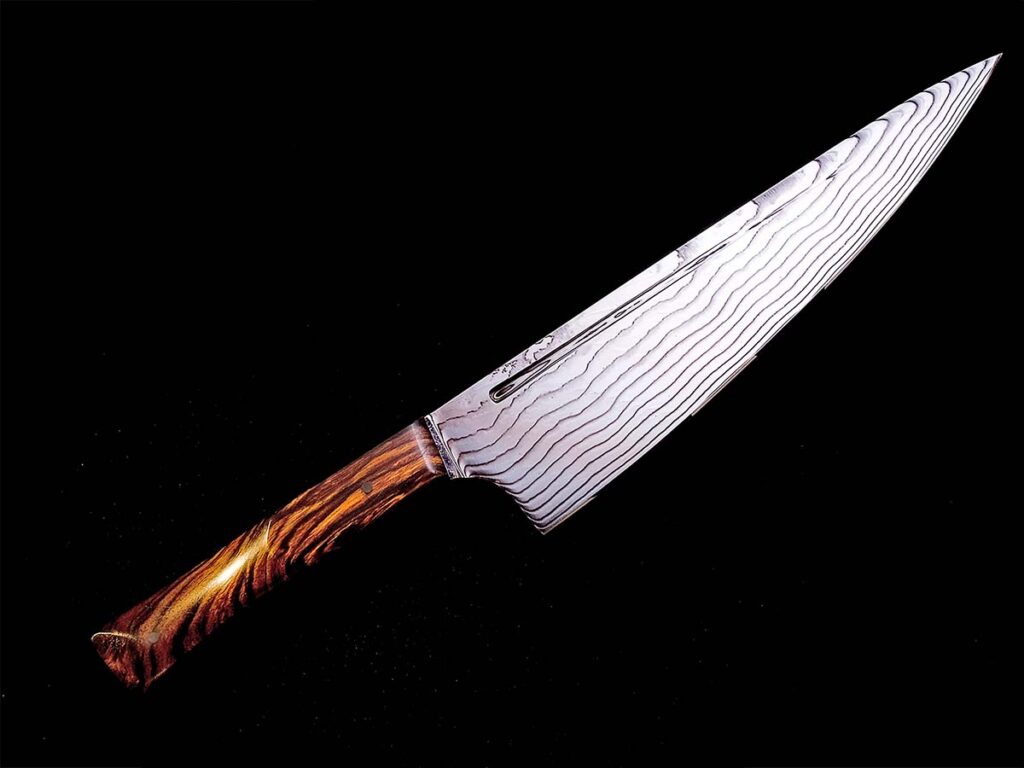
Damasteel has developed the capability to produce stainless damascus in sheets, not just bars. The sheet steel pattern is called “Drakkar,” the old Norse word for the dragon-shaped Viking longboats, and is used here on a chef’s knife by a local Swedish cutler.
Both Baker and Jarbelius indicated culinary knives will stay hot, especially in stainless. Baker pointed out that stainless steel handles kitchen abuse better, and this writer agrees. Per said Damasteel’s Damacore and DC18N nitrogen steels are top of the line, and the company has a culinary knife coming in partnership with BLADE Magazine Cutlery Hall-of-Fame® member Ken Onion and CRKT. Both Damasteel officials and Chad Nichols agree that complex patterns are expected to do well for the pocketknife and one-off makers.
Jarbelius “expects growth in the complex pattern market” even as Damasteel’s basic traditional rose, ladder and twist damascus patterns remain best sellers. Nichols states that the mosaic niche he addresses will continue to grow.
All four steel makers expect growth in the production side of the market. Even in a slower economy, the big knife manufacturing companies are still producing limited runs of high-quality damascus knives. Baker looks for growth in his damascus-core san-mai steels.
“They’re easier to get a consistent etch on than the mono-steel cores,” he explained.
Chad Nichols stated that he expects growth in the use of mosaic damascus steels by factory knife companies in 2025.
Manufacturing is all about consistency and efficient processes. Damasteel achieves consistency by using the same steel combo for all its patterns. Nichols gets there by batch building for specific manufacturers so that each run is internally consistent. Harber mentioned that he was approached at BLADE Show West* by multiple production companies looking to order steel for 100-to-200-piece runs. He indicated he expects the mid-range sub-$800 production folders to stay hot.
Gonna Be Intersting
The new year is going to be an interesting one for the economy and politics, both of which are inextricably entwined. Fortunately, thanks to the work of those in the damascus industry, it’ll also be an interesting year in the world of knives. If nothing else, knife enthusiasts will have plenty of beautiful damascus production knives coming off the assembly lines to keep them entertained.
Just As Important As Knowing What To Ask A Knifemaker When Looking To Buy A Knife, Is What To Not Ask A Knifemaker.
Editor’s note: Last time we outlined the questions you should ask the maker. This time, we cover some of the things that you either probably should not ask—or at least should think through thoroughly before doing so. You can read part 1 here.
Custom knifemakers are, for the most part, reasonable people. Actually, they’re a pretty likable lot. Engage one in conversation and it’s likely to be a pleasant experience.
Ask a maker about a knife and the discussion enters another dimension, particularly if it develops into one between a seller and potential buyer. Questions are part of the exchange of information, and just about any inquiry is fair. However, it pays to be courteous and respectful and to remember that courtesy and respect go both ways.
So, are there questions that are off limits when discussing the merits of a custom knifemaker’s work, their background, experience, or perspective? What are the potential hot buttons and how much is too much when it comes to probing a maker? Well, if you have to ask yourself whether a question is appropriate, then think twice about asking it. If it might not sit well with you on the receiving end, just remember those principles of kindness and respect.
How Long Did It Take?
“Asking a maker how long it took to make a knife is not polite etiquette,” offered veteran Vince Evans, “and it could also be misleading. An experienced maker may take 40 hours to make a really nice piece, whereas a beginner may spend 100-plus hours and come out with a poorly executed knife. On more complex knives and swords, the process may take months, or even years, to complete. So, a maker may not keep track of how many hours he has in a piece.”
David Broadwell has more than 40 years of experience making custom knives, and the time factor is always a bit contentious for him. “This is probably the most often asked question of me,” he said candidly. “I don’t know how long it takes! I don’t punch a time clock on each project. Most of my knives are fairly complex, and I do each step or operation until it’s right, regardless of the time. Simpler knives are easier to track with regard to the time involved.
“Another thing related to time,” David continued, “is that it’s easy for someone to start believing that because I, for example, with four decades of experience in grinding, can make a knife more quickly than another maker, so I should charge less per hour. But that’s not a fair comparison. I have all that experience, so some operations are quicker for me—but I should be paid for that experience.”
Before asking if a price on a knife is negotiable, take stock in the possible outcome of the query before making it. “In some cases, you will insult them,” said custom knife purveyor Dan Delavan (right), here with fellow purveyor Dave Ellis at the 2021 BLADE Show West. “But on the last day of a show, some makers may give a better deal.”
From a practical standpoint, BLADE Magazine Cutlery Hall-Of-Fame® member Dan Delavan of plazacutlery.com added, “It doesn’t hurt to ask, but most makers make knives in batches, so it’s hard to say.”
Even if the potential purchaser is bold enough to ask about the investment of time in a particular knife, the response may not be helpful. “It may not give you the answer you’re looking for,” commented longtime purveyor Les Robertson, “Why? Often the time to make a knife will depend on the maker’s experience level, the equipment in their shop, and the complexity of the knife. There is no set time for how long a particular knife should take to build.”
How Did You Make It?
Beyond the time element, looking at a particular knife may prompt questions of a sensitive nature, particularly about the process itself. When credibility is on the line, what should the potential buyer do?
“Hmm, I’d say watch his eyes and study his body language,” Broadwell advised, “and, of course, a buyer needs to educate himself to be able to spot fakery.”
It’s up to the buyer to educate himself in order to judge the truthfulness of answers concerning how a knife is made. One way to do that is to attend such knifemaking classes as those at BLADE University at the BLADE Show. Wally Hostetter shows students how to do the Japanese sword handle wrap at a past BLADE U.
Most often the knifemaker’s work speaks for itself and to an educated buyer the quality or lack of quality in a handmade knife is readily apparent, but there are telltale signs when the presenter is blowing smoke. “If he or she does not look you in the eye, it’s a good indication,” Delavan related. “Hesitancy in the voice is a tip-off as well.”
Developing rapport is a big part of any relationship, and becoming friendly with custom knifemakers is often part of the enjoyment of buying and collecting their work. Still, personalities vary. The outgoing, talkative individual and the introverted, quiet one may accept inquiries on a different level, and of course, there are the pressing factors of time commitment—particularly during shows. Monopolizing a maker’s table time is bad etiquette when he or she has other customers or prospects to interact with. So keep it polite and to the point with an awareness of the clock.
What Knife Do You Carry?
One of the more interesting questions for a custom knifemaker might revolve around the knife the maker carries. You may be going out on a limb, putting the maker on the spot, or even offending him if you want to know what’s in his pocket. Ask at your own risk!
“I’ve always been surprised to find out a custom folder maker was carrying a factory knife,” Robertson observed. “This made no sense to me. Carrying a folder made by them would allow the makers to field test their knives regularly. For makers who build larger fixed blades, it can be difficult to carry these knives regularly. However, if they hunt, camp or fish, they should be using their knife, again to field test it. I feel it gives the maker more legitimacy when they tell what their knives can and cannot do.”
Broadwell added, “This is very important to me. Personally, I believe if a maker carries on his person a knife from another knifemaker or a factory, he is saying, especially to the newer and less educated buyers, that knife is better than the one he makes. That is not good salesmanship and marketing of your own brand.”
Are Your Prices Negotiable?
If the makers hunt, camp or fish, they should be using their knife, again to field test it. “I feel it gives the maker more legitimacy when they tell what their knives can and cannot do,” Robertson stated. Ed Burke’s big fixed blade should be right at home in camp. (SharpByCoop image)
Possibly the biggest question of all relates to pricing. Is it OK, fair, chippy, or downright irritating to ask a custom knifemaker if a price for a certain piece is negotiable? Once more, depending on the depth of the existing relationship between maker and potential buyer, take stock of the possible outcome of the query before making it.
“In some cases, you will insult them,” Delavan said bluntly. “But on the last day of a show, some makers may give a better deal.”
Robertson sees a subjective exercise in the dollar dilemma. “Pricing is something each knifemaker must figure out for themselves,” he remarked. “As the buyer, you need to educate yourself as to what it takes to build a particular style of knife. This will help you determine what you feel the price of the knife should be. My advice to knifemakers is to price their knives according to their position in the marketplace they are competing in. By doing so, you are offering your work at a fair price, and you should not lower your price. As the buyer, you can ask the maker to lower their price, but don’t do so just because you think you should haggle on the price of a knife. You are not buying knives at a flea market.”
Tact and diplomacy work better than the “ready, fire, aim” approach. Knowing something about the knifemaker may indicate whether the door is open for negotiation. “This is a tricky question,” Broadwell said. “If the buyer is polite and respectful, it’s all right to ask. However, if the maker does not want to bargain, it should be dropped. What ticks makers off is a potential buyer who says he will just give such and such for a knife and that that’s all it’s worth. That’s arrogant and disrespectful!”
Concerning guarantees and 100-percent buybacks—the latter involving the maker buying the knife back from you if you buy it but then don’t want it—consider the accountability on both sides.
Choose Wisely
Like so many interactions between two people, the questions asked and answered relating to custom knives revolve around the delivery. Mutual understanding is essential. One individual is plowing his or her hard-earned money into the purchase of a knife, while the other is expected to accept payment for the time that is gone forever, and for the cost of materials, equipment, shop, and general overhead.
Choose words and ask questions wisely—always.
Editor’s note: In the final analysis, it’s your money that’s involved in a knife purchase, and the questions you ask a maker about their knife you are considering buying are up to you. One thing to remember: If it’s a knife you simply must have and you ask a question that is out of bounds and upsets the maker, the chances of you having that knife may be nil to none—not to mention the chances of you buying any knife directly from that maker in the future.