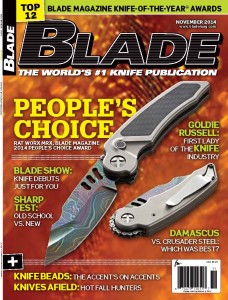
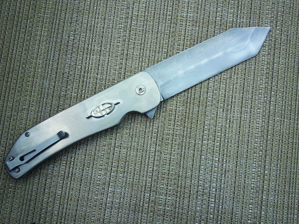
As popular as tactical folders are and have been in the knife industry and with the knife-buying public in general, flipper folders have taken that segment of the industry by storm. They fly off the store shelves and Web pages as fast as the blades are deployed.
If you’ve ever wondered how they’re made, how they work or what makes them so quick, the February 2016 issue of BLADE® Magazine includes a feature article by ABS master smith Wally Hayes on “How To Make A Flipper Folder.” Within the story, the author takes you through the main process of flipper folder making step-by-step. Now that’s as cool as flipping open a blade and hearing that proverbial click as it locks into place, ready for use!
Are you up to the challenge of frame handle construction?
Frame handle construction for knives has been around for centuries. Historical examples of many Eastern styles like the kard, khyber and yataghan often feature ornamented frame handles. Nineteenth-century knives attributed to James Black and some of the early American bowies also had frame handle construction. Though it’s been around a long time, the frame handle remains a viable modern construction method for today’s custom knifemakers.
There are many ways to crack the nut/skin the cat on frame handle construction. This article will walk through the frame handle process and point out particular problems and potential solutions for those who wish to pursue building a frame handled knife.
3 REASONS WHY
Frame handle construction is best defined as using a wrap-around “frame” to conceal the tang of a hidden tang knife. The first question many people ask regarding a frame handle construction is, “Why would you want to do it that way?”
My first thought goes back to the earlier days of the internet when forums were at their peak, and fine makers like ABS master smith Bruce Bump took the time to document “work in progress” (WIP) threads. Bruce had a fine frame handle WIP on the KnifeDogs.com forum in 2013, and the consensus at the time was that you build a frame handle for quite a few reasons, though the first one is “because you can!”
The author used frame handle construction for his hunter in a blade of 33-layer damascus, a wrought iron guard and scales taken from a fence post made in 1912 from bois d’arc wood, aka osage orange. The spacers are World War II practice bomb material. (Cory Martin knife image)
A frame handle is a much more complex build process than your standard full- or stick-tang knife. However, in addition to the show of skill by the maker, frame handle construction has a few distinct advantages that make the complexity worth the effort:
A frame handle allows for the look of a full tang, but with the guard-fitting techniques of a stick tang. For a forged stick-tang-knife design that needs a guard, a frame handle allows the use of full-tang-style handle construction;
A frame handle is a good way to use scales or slabs on a stick-tang knife. If you have a good set of stag or mammoth slabs, or if you have stabilized wood slabs that might be too fragile for through-tang construction, the frame handle allows you to use the materials on a stick-tang knife; and;
The use of a frame handle gives the maker another area to embellish the knife. Some frames are great for engraving, while others may highlight a damascus pattern. Either way, the frame makes the embellishment stand out in ways that are harder to accomplish on a full-tang knife.
HOW to DO IT
At a basic level, the frame of a frame handle is a piece of material, usually metal, that wraps around a stick tang and mimics the look of a full-tang knife. This presents some challenges that have resulted in a few different creative solutions.
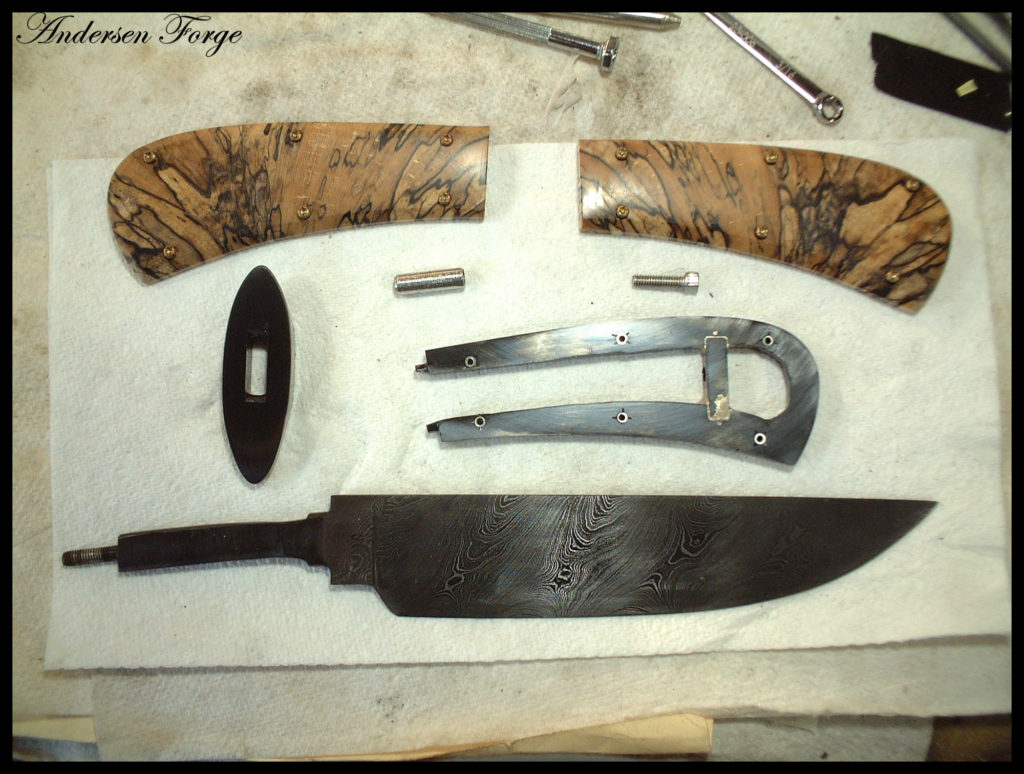
An exploded view shows an ABS journeyman smith Karl Andersen frame handle construction knife before assembly. (Karl Andersen image)
Challenge 1: The tang must fit inside the frame. Some makers insist on precision so there are no gaps and the fit is tight. Others concede that the handle will be held together with mechanical fasteners and sealed with epoxy, so a precise fit between the frame and the tang is not necessary.
Challenge 2: All parts of the handle must be securely fastened together. I sat through a class with ABS master smith Mike Williams in which he admonished the students, “Don’t trust in the magic of chemistry” by putting your faith only in the strength of glue. Likewise, veteran bladesmith Jerry Fisk challenges makers to think ahead to what their knives might be like in 100 or 1,000 years, and recommends a mechanical connection that won’t fail over time.
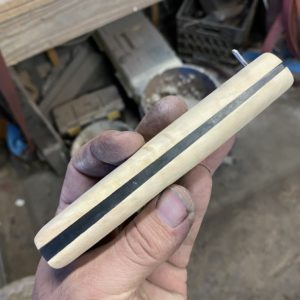
One way to address this challenge is to use pins. If you pin the scales to the frame, pin the completed handle assembly to the tang and follow up with glue, there’s no opportunity for failure. Some choose to make all the pins visible as an artistic element, while others take advantage of hidden pins for all but the one through the tang. Another way is to use a threaded fastener. Bladesmith Salem Straub recently illustrated the technique on a frame handle WIP on his Instagram feed. Salem used a threaded fastener in an internal slot in the frame to mechanically lock all the parts together tightly (Image 1). The handle material is relieved on the inside to accommodate the fastener.
Another way to use a threaded connection is to thread the end of the tang and use a fastener on the handle butt. An advantage of this approach is that the fastener itself can become part of the embellishment.
Challenge 3 is the complex fit-up between all of the knife’s elements. Frame handle construction naturally doesn’t excuse a poor guard fit, but it also provides other places for gaps and misalignment. Once again, there are several potential solutions to alignment problems.
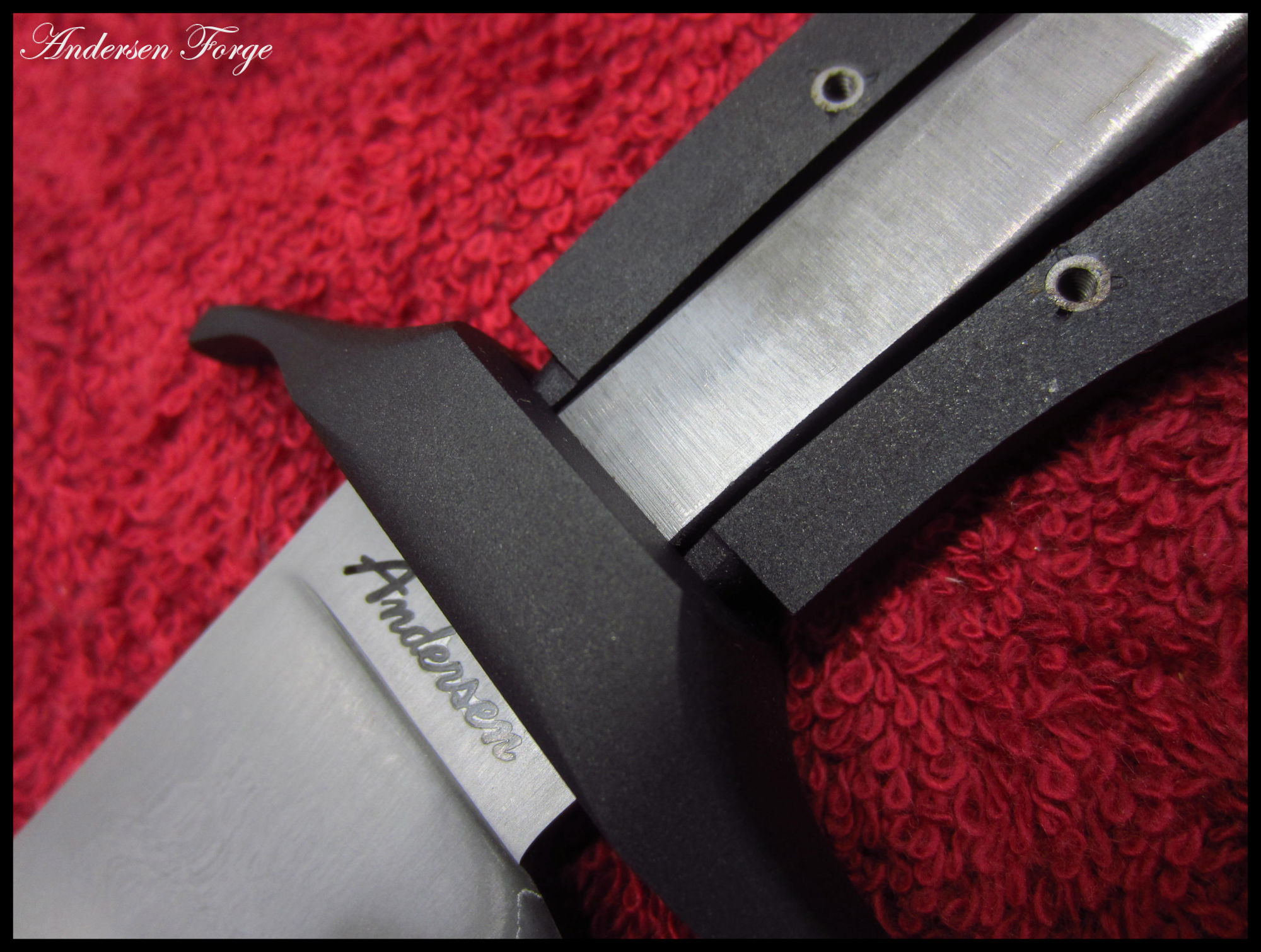
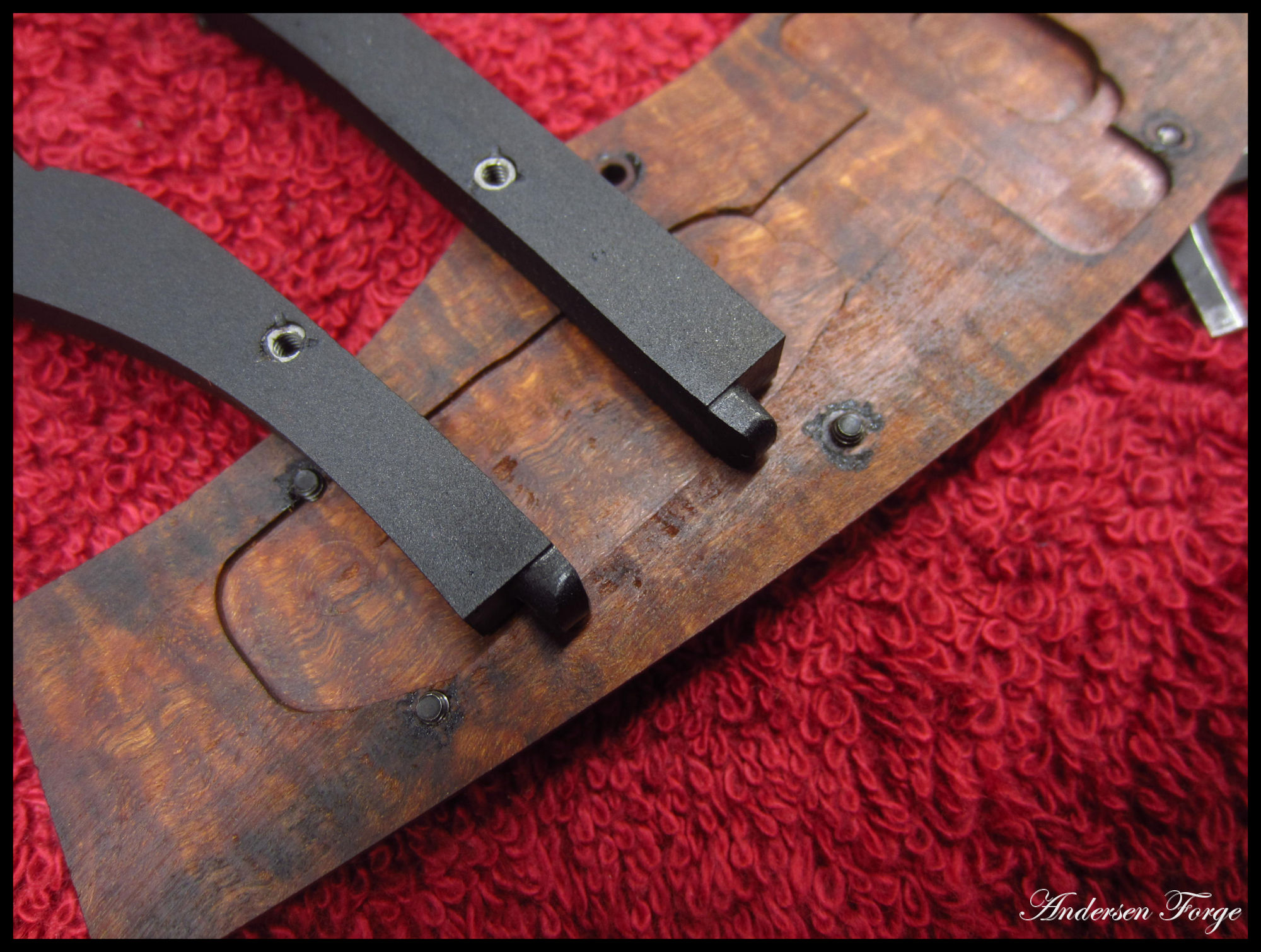
One is the use of alignment pins to make sure everything is secure. Pins on the end of the frame go through any spacers and into holes in the back of the guard so that each part indexes the same during assembly. Some makers, including Bruce Bump in the aforementioned epic WIP, advocate for leaving metal tabs on the end of the frame and fitting the tabs into similar holes on the back of the guard (Images 2 and 3). In both cases, there’s a mechanical connection that prevents the guard, spacers and frame from rotating out of alignment around the center axis of the handle. Either way, when you build a frame handle, the construction will require you to assemble and disassemble the knife repeatedly, so you’ll need some mechanical way to keep things lined up.
1 of 2
Above: Some makers advocate for leaving metal tabs on the end of the frame and fitting the tabs into similar holes on the back of the guard. In both cases, there’s a mechanical connection that prevents the guard, spacers and frame from rotating out of alignment around the center axis of the handle. (Karl Andersen images)
Another fit-up challenge is the overall requirement for clean-fitting joints with no gaps. It sounds simpler than it is, but two surfaces that are dead flat will join together without a gap. The challenge of a multi-piece frame handle with a guard and a few spacers is that you are creating a multitude of surface joints, and every single surface must be dead flat. At a minimum, you’ll have a joint between the guard and frame, and also between the frame sides and the handle material. Any bump or wiggle on any surface and you’ll have a gap in the final product. Flatness comes in degrees. You can get a fairly flat surface on a platen, flatter on a disk, and still flatter on a surface plate or surface grinder. You have to make the joints as flat as you can with the tools you have available if you want a gap-free fit.
I tend to prefer the look of a tapered tang on a full-tang knife, so I’ve started tapering the frame of my frame handles as well. Others stick with a full thickness frame, where the thickness closely matches that of the blade at the ricasso. Some add spacers between the tang and handle material, while others choose to go with the frame and handle slabs only.
Another fit challenge is presented by the frame itself. In order to adequately finish the visible surface of the frame, whether by simple polishing, bluing or etching, or by engraving, the frame must be 100 percent at final-grit finish prior to final glue up. Many makers learned to make a full-tang knife by finishing the front edge of the scales, gluing the knife together, shaping the scales down to the exposed tang, and then polishing the handle and the tang at the same time. That method will not work for a frame handle that needs to be blued or etched. Personally, I tend to use dummy pins to fit the entire handle assembly together, then grind the scales down to the frame. In his recent Instagram example, Salem Straub used small screws to hold the handle material to the frame.
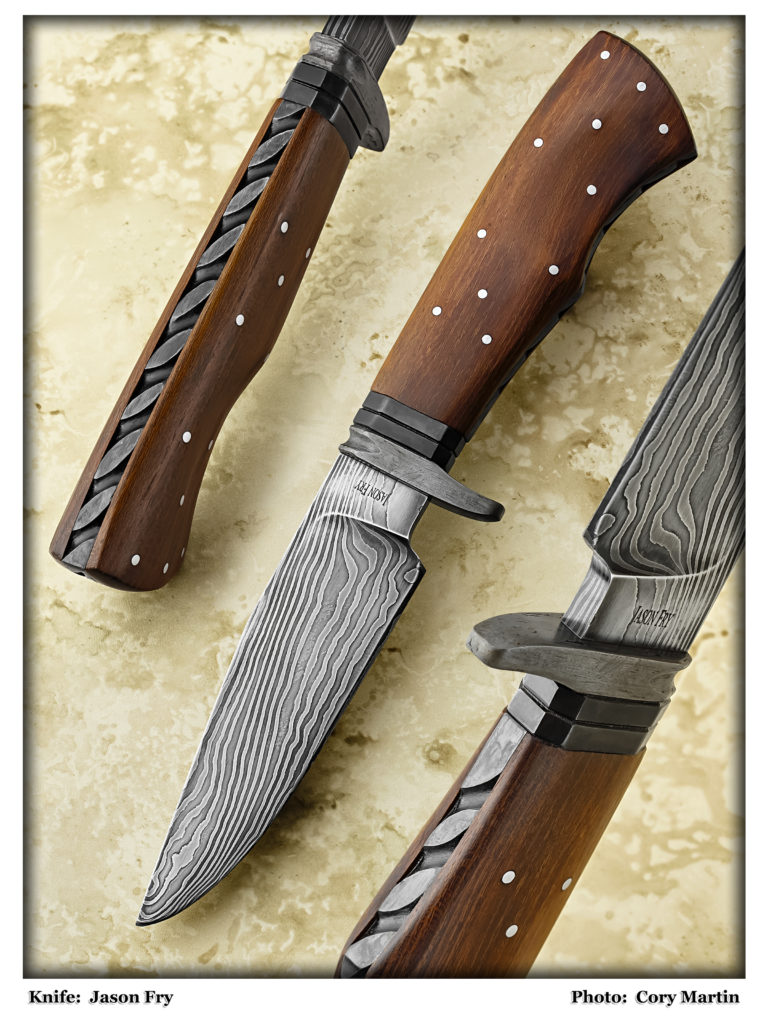
With regard to the relationship between the handle material and the frame itself, whichever method you choose, it is important that the fit be maintained consistently all the way around the frame. (Jason Fry image)
With regard to the relationship between the handle material and the frame itself, some choose to leave the material slightly proud of the frame for a “museum” or “heirloom” fit. Others prefer the material to fit flush to the tang. Less commonly, some makers round the frame and leave it slightly proud of the material. Whichever you choose, it is important that the fit be maintained consistently all the way around the frame, from the joint at the guard on the top all the way down to the joint at the guard on the bottom.
Once the profile is set, I polish the handle and the frame together down to final grit, and then apply any surface finish to the frame itself. Once all parts are 100 percent complete, they can be glued together as a final step.
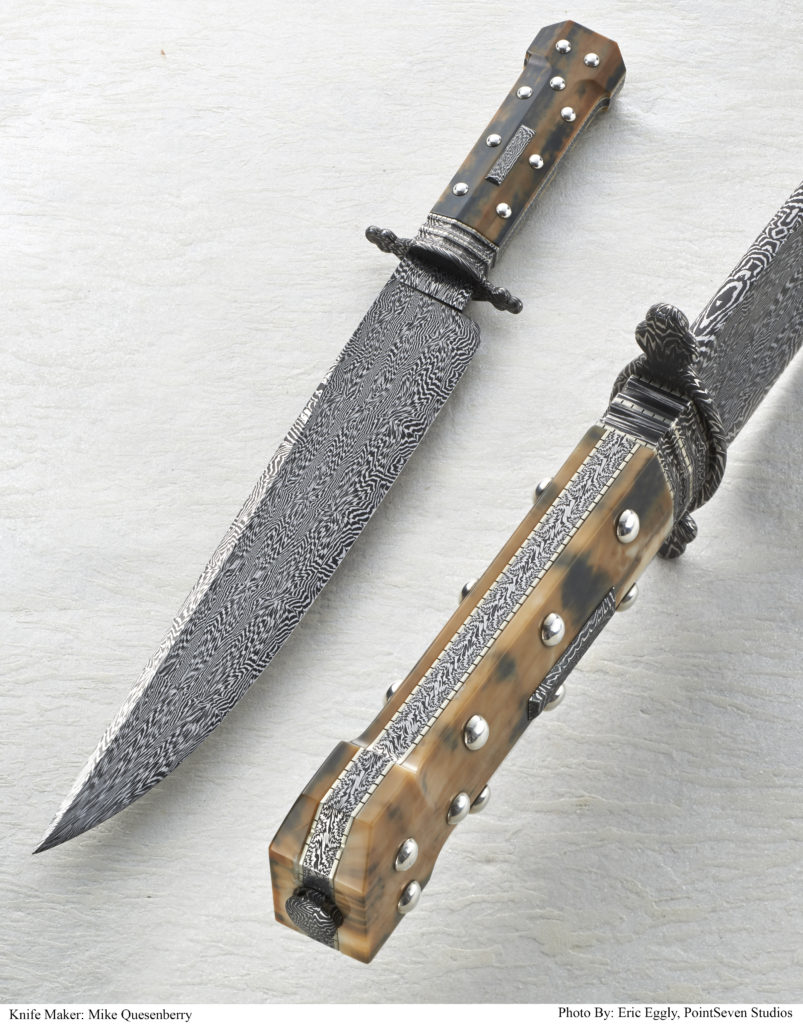
ABS master smith Mike Quesenberry used frame-handle construction on his dog-bone bowie. (Eric Eggly/PointSeven image)
WHEN to DO it
So when should you try making a frame handle? In my mind, if you can make clean full- and stick-tang knives, you could be up to the challenge. If you have slabs of exceptional handle material that deserve more than a simple full-tang knife, a frame handle is a way to step up and put the materials on full display. If you have a knife in mind where the frame and guard need to be blued, damascus or engraved, a frame handle is the way to go.
A frame handle knife has its advantages, but the complexity of the construction presents plenty of challenges. As a skilled maker, you may choose to rise to the challenge of a frame handle just to show that you can.
For more information on frame handle construction contact the author at [email protected].
The brand-new BLADE Showwebsite makes learning about the show, buying tickets, seeing exhibitor and sponsor lists and getting updates on the seminars schedule easier than ever!
As most knife enthusiasts have already discovered, if you like seeing new knives first-hand, and buying, collecting, selling or just talking everything knife related, then the BLADE Show is the place to be. Nearly every major knife manufacturer worldwide exhibits at the show, and more than 600 custom knifemakers display their handmade pieces. The BLADE Show truly is the world’s largest knife show, and the ultimate knife show experience.
Read news and information about the new Living Ready Expo held in conjunction with the BLADE Show. Be prepared. Relevant and timely, the Living Ready Expo is designed to educate those interested in preparing themselves and their families for all kinds of real-life survival scenarios. Get practical advice and tips on preparedness, debunk urban survival myths, learn from survivalist experts and network with other urban preppers. It is the best knife show and survival show, all for one ticket!
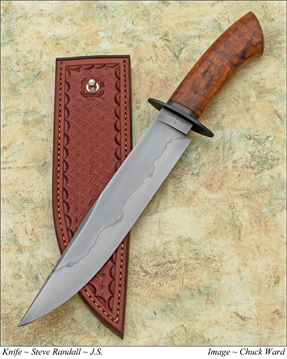
A December 2014 feature article by staff writer Phil Perry online and in the Lincoln Times-News of Lincolnton, N.C., mentions BLADE® Magazine and KNIVES 2015. A knifemaking feature on ABS journeyman smith and commercial pilot Steve Randall, it starts:
Often, when a craftsman pursues the road to independence through a business venture, they are inspired by a lifetime of collecting or being exposed directly to the craft. That wasn’t necessarily the case for Lincoln County’s Steve Randall, who has made an international name for himself crafting custom hand-forged knives from his workshop on the eastern end of the county.
“As an avid survivalist, I have used knives all my life,” he said. “I never collected them or thought a whole lot about it. Once I was bitten with the bug I have been obsessed with it ever since.”
Things changed in 2009 when Randall started “KSR Blades” and built an extension onto his garage to house the vast amount of forging equipment needed to facilitate his burning passion to produce high-quality hand-forged knives.
“I made my first sale on eBay and I was pretty excited,” Randall said. The ABS journeyman smith doesn’t sell his product on auction sites these days. Having been featured in national magazines like “Knives Illustrated,” “BLADE® Magazine” and four of his creations featured in “KNIVES 2015,” Randall has a one-year backlog on special orders and also ships to Germany, Sweden, Australia and Canada.
Among other things, the movie First Blood starring Sylvester Stallone as Rambo, revolutionized the knife industry through the sudden vast popularity of the Rambo knife.
Though the movie was more action flick than true survival doc, the premise was solid when you think about it—a Spec Ops soldier returns from war, highly trained, but suffering from post traumatic stress syndrome, has a hard time fitting into society, and hits the road, hitchhiking. He meets up with a sadistic cop who brings him in and mistreats him. The soldier reaches the boiling point and takes justice into his own hands.



 If you’ve ever wondered how they’re made, how they work or what makes them so quick, the February 2016 issue of BLADE® Magazine includes a feature article by ABS master smith Wally Hayes on “How To Make A Flipper Folder.” Within the story, the author takes you through the main process of flipper folder making step-by-step. Now that’s as cool as flipping open a blade and hearing that proverbial click as it locks into place, ready for use!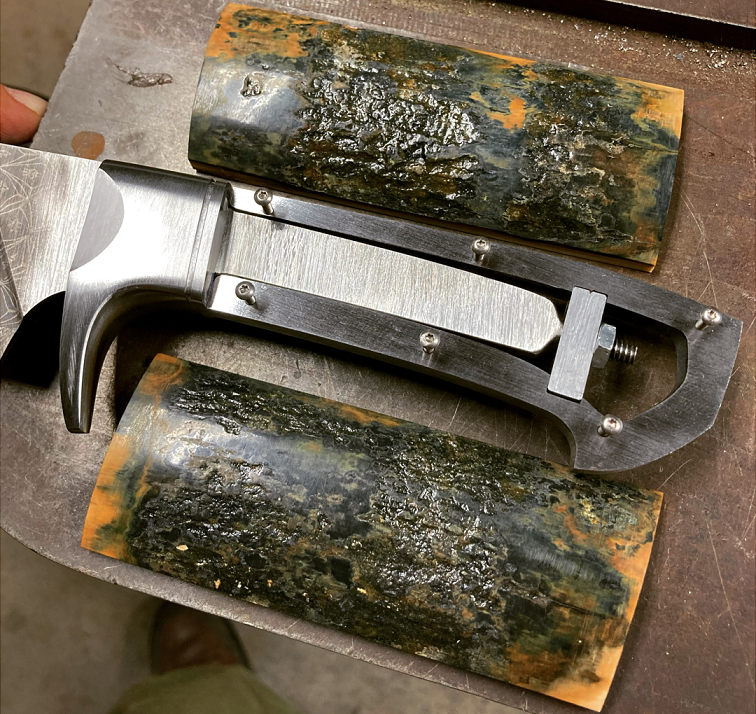



 A December 2014