Home Authors Posts by Steve Shackleford

Steve Shackleford

The Subtle Survival Knife of “The Edge” Movie

the edge survival knife
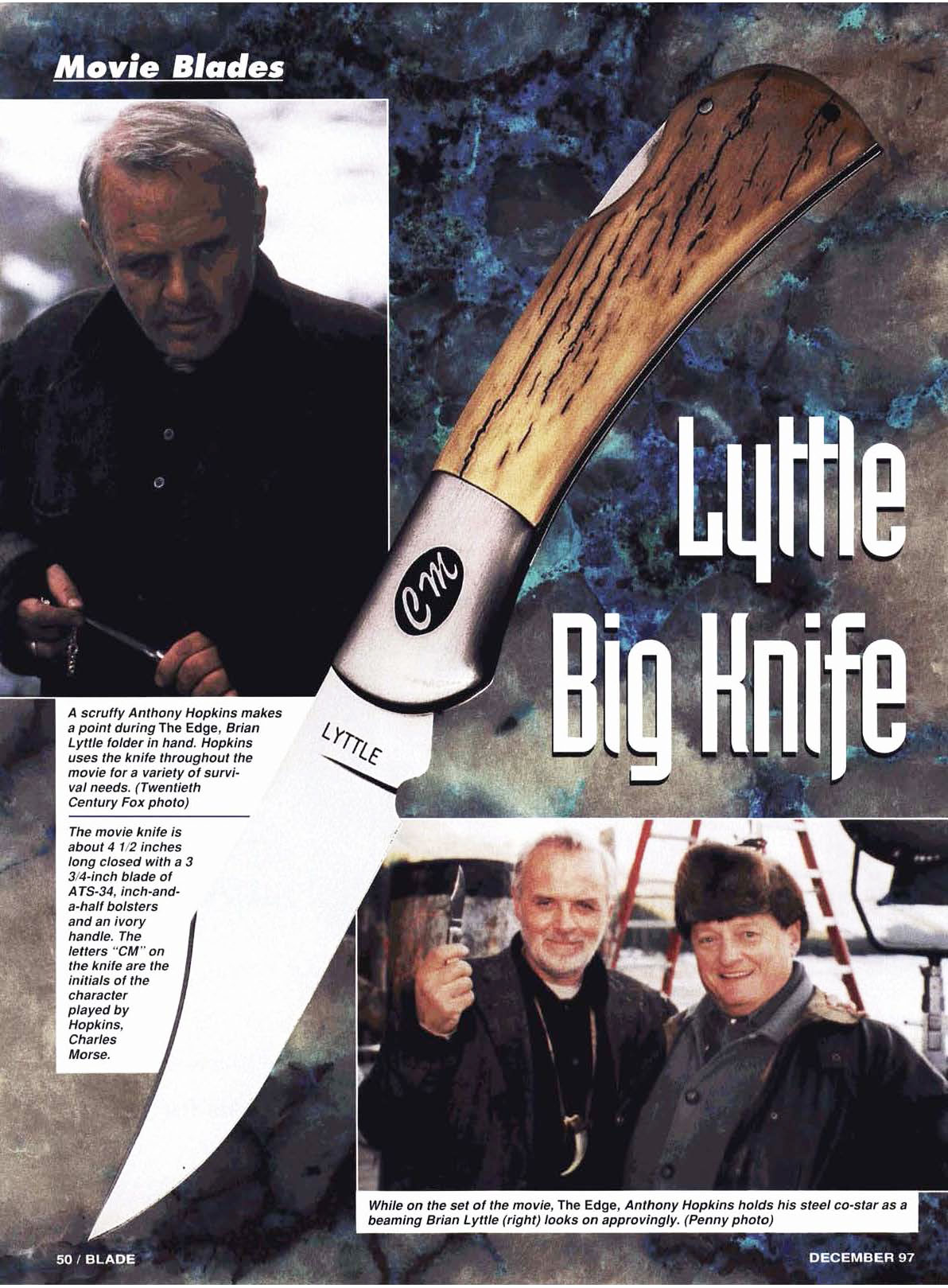
“The Edge” movie knife is about 4.5 inches long closed with a 3.75-inch blade of ATS-34, inch-and-a-half bolsters and an ivory handle. The letters “CM” on the knife are the initials of the character played by Anthony Hopkins, Charles Morse, in the 1997 movie, “The Edge.”

Editor’s note: The following originally appeared in the December 1997 issue of BLADE. Find more from BLADE‘s extensive archive in this download.

Brian Lyttle’s Blade Get Top Billing in Survival Epic, The Edge

custom knives action moviesCould this be THE movie where a knife will come across as what it truly is, an inanimate yet indispensable tool, instead of a living, breathing, killing demon that irrational crusaders and inept politicians constantly point to as the root of all evil? Let’s hope so.

Meanwhile, The Edge, starring award-winning actor Anthony Hopkins as a man trying to survive in harsh environs with the help of his knife and his ingenuity, may be a movie worth watching not only for the way he employs his blade but because it’s just fine entertainment.

One thing’s certain: Canadian knifemaker Brian Lyttle will be much more than just an interested observer because he made the “steel star” of the film and even appears in the flick as an extra.

The Design

The Edge movie survival folding knife
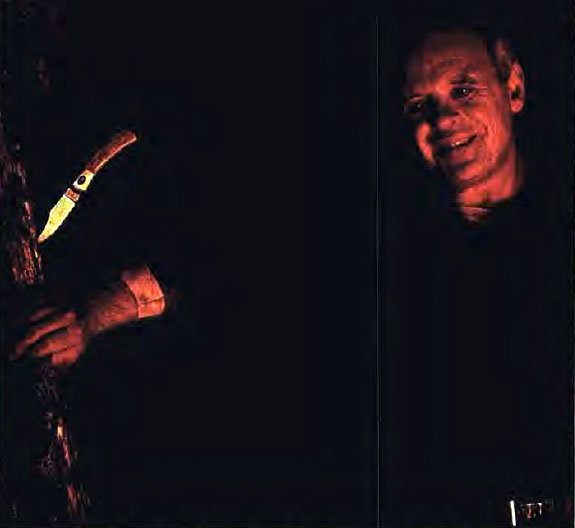
Anthony Hopkins, with Lyttle’s folder nearby, during a scene from “The Edge.” (Twentieth Century Fox photo)

The knife is a large folding hunter designed for the applications to which Hopkins puts it in the movie.

“It’s a gentleman’s piece in an old-time style but large enough for use as a tool to make traps and spears and for other survival needs,” Lyttle (pronounced LITTLE) observed. According to the maker, a voting member of The Knifemakers’ Guild who specializes in highly embellished folders and straight blades, film officials inspected similar knife patterns by assorted U.S. manufacturers to arrive at the piece they wanted.

“They liked big folders with clip-point blades,” he noted.

The result is a knife about 4 1/2 inches long closed with a 3 3/4-inch blade, inch-and-a-half bolsters and an ivory handle. Though Brian specializes in damascus, he used ATS-34 for the blade because movie officials said they wanted a material that wouldn’t stain. The letters “CM” on the knife are the initials of the character played by Hopkins, Charles Morse.

Multiple Models

the folding knife from the movie the edge
Lyttle died in 2016, but his knives live on. See his legacy at lyttleknives.com.

Lyttle did five knives in all for the movie-four lockbacks and one sliplock. Of the four lockbacks, one is sharp for scenes where cutting is required; one’s dull for scenes where the prevention of any “accidental cutting” is the main concern; one’s a standby; and one’s the presentation piece used in the film. The sliplock appears in an underwater scene where the knife is used to cut a seat belt.

“They didn’t want the performer to have to worry about unlocking the blade while underwater,” Lyttle explained the reason for the sliplock.

He sold four of the knives to movie officials and rented the fifth one to them so he could get it back after filming.

The Knifemaker Steps Into the Movie

hunting folder folding knife the edge survival movie
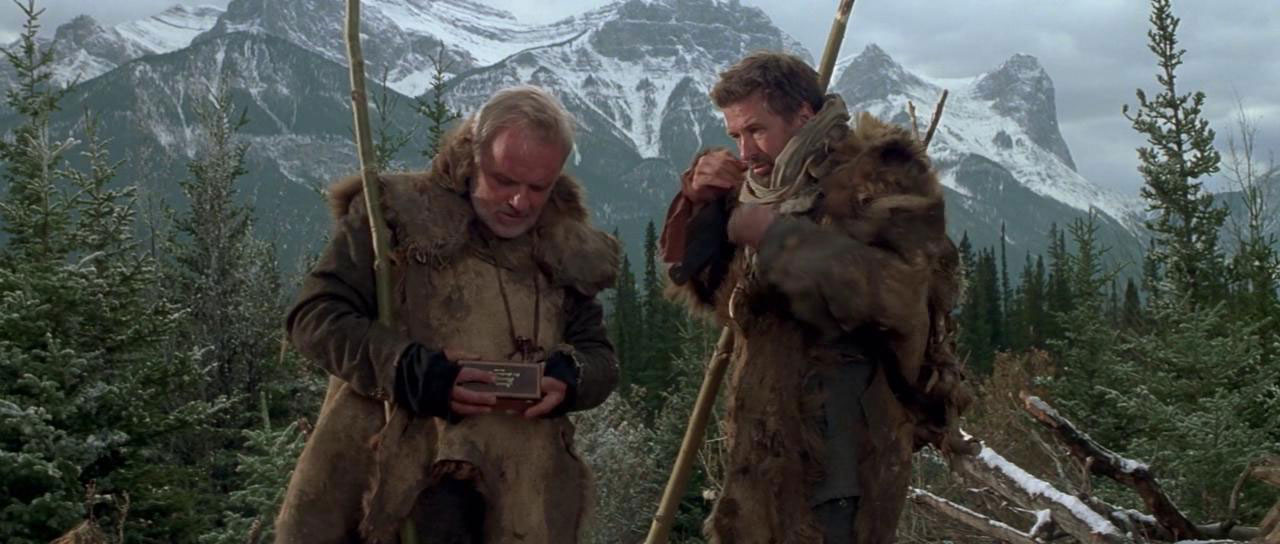
In this scene from “The Edge,” Hopkins (left) holds one of the presentation boxes Lyttle made. (image via imdb.com)

Don’t look for Lyttle’s name in the credits at the end of the movie. However, do look for a reference to the maker during the scene where the knife is presented to Hopkins. Inside the blade’s presentation box is a certificate that says, “Lyttle Knife Co.” By the way, that’s the blade Brian rented to the movie and is the one photographed with this story.

Knives are not the only examples of Brian’s work in the film. A skilled engraver, he engraved two watches (a gold one for Hopkins and a stainless steel Omega for co-star Alec Baldwin) and the presentation knife that appears early in the flick.

“The engraving will be easily visible and there’s a special reason for it to be seen,” he winked. “I read the script and it looks like one helluva movie. Hopkins doesn’t do duds.”

A Connection Through Brad Pitt and Legends of the Fall

read knife magazine
Read more articles from BLADE’s archives with this collection of 25 years of back issues.

How did the movie officials learn of Lyttle and his knifemaking? During the filming of Legends Of The Fall, an earlier flick also done in the High River area starring Hopkins and Brad Pitt, Lyttle’s work came to the attention of Pitt.

Pitt visited Lyttle’s home and bought some knives and gave them to some of the movie’s cast, including Hopkins. The same man who put Lyttle in touch with Pitt introduced Brian to an assistant props master.

When it came time to select the knives for The Edge, the assistant props master brought along Lyttle’s knives during a meeting of movie officials, a meeting attended by Hopkins. When Hopkins saw the blades he recognized the maker’s name on them.

Hopkins reportedly said, “They’re damn sharp!”

His reaction no doubt helped sway the movie officials’ decision and Brian had almost every knifemaker’s dream job: making movie blades.

“A Pain in the Neck”

As with most movie relationships, however, it was no picnic for Lyttle. He had to work long hours to get the pieces ready.

“I had three weeks to get the first knife done and I had a knife show to do in-between,” he recalled. “I had to work day and night to meet their deadlines. I had two days off one month and worked some days through midnight until four in the morning.”

And, of course, the movie officials could be a pain in the neck.

“They were very fussy over stuff,” Brian related. “Twelve presentation boxes (for the knife presentation scene) had to be made before they were satisfied with one.”

Worth the Trouble

Still, as almost any knifemaker will tell you, all the toil and trouble is worth it for the dividends such exposure does not only now but down the road, and specifically for Lyttle when people will come up to his table at a knife show and say, “Wasn’t that your knife in that movie with Anthony Hopkins?”

Who Knows the Knife from “The Shadow” Movie? The Shadow Knows

the dagger of the shadow movie alec baldwin
The December 1994 cover of BLADE magazine.

Editor’s note: This article originally appeared in the December 1994 issue of BLADE. Read more from BLADE‘s extensive archive here.

Again and again, when knives hit the silver screen, they become characters unto themselves. Some knives take that more literally than others. Here’s one example.

A Movie Knife with Tibetan Influences

custom knives action moviesThe Phurba, the knife from the 1994 motion picture, The Shadow, breaks new ground for movie blades because it’s the first to take advantage of new computer-generated special effects. For the dagger in The Shadow, that means the creation of a living, breathing character, so to speak.

“It growls a couple of times, flies through the air, sprouts legs and even bites Alec Baldwin’s hand,” United Cutlery’s Kit Rae said of the knife. “They used a lot of computer graphics so the face on the handle moves, and the handle twists around.”

Designed for the movie by Joe Nemec III, the Phurba – or “Phurbu” as it is also spelled – is based on an actual Tibetan exorcising knife or “ghost dagger” used by lamas (Buddhist monks) to drive out evil spirits. The Phurba dovetails with the theme of The Shadow since the movie begins in Tibet.

movie knife the shadow
The Phurba from “The Shadow” sports a three-sided blade.

A Three-Sided Blade

According to A Glossary of the Construction, Decoration and Use of Arms and Armor, by George Cameron Stone, the original Phurbas had, “a three-winged blade and a hilt made up of lamaistic symbols. The pommel is usually a head with three faces crowned, with an animal’s head and neck projecting from the top. Thunderbolts (vajras), dragons and dragon’s heads are frequently present. Usually the blades are made of iron and the hilts of brass; sometimes the entire knife is of brass, and occasionally of wood.”

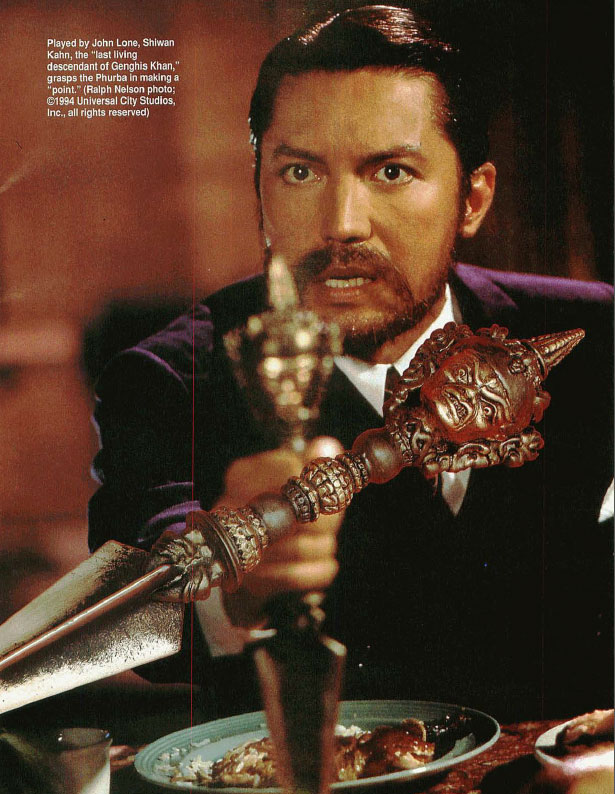
The knife from The Shadow movie
Played by John Lam, Shiwan Kahn, the “last living descendant of Genghis Khan,” grasps the Phurba in “The Shadow.” (Ralph Nelson photo; 1994 Universal City Studios, Inc., all rights reserved)
read knife magazine
Read more articles from BLADE’s archives with this collection of 25 years of back issues.

Nemec couldn’t get an authentic Phurba, so he based the movie knife on research, Rae said. The movie Phurba is true to the original knife in looks, right down to the three-sided blade. The main difference is in the number of faces on the handle, which was sculpted by Nemec. Where authentic Phurbas have three faces, the movie version has but one.

“[The movie’s officials] decided on a single face because it fit in with the idea that the knife was a living character,” Rae said.

Hidden Blood Bladders? The Knives of “The Last of the Mohicans”

tomahawks knives of the last of the mohicans
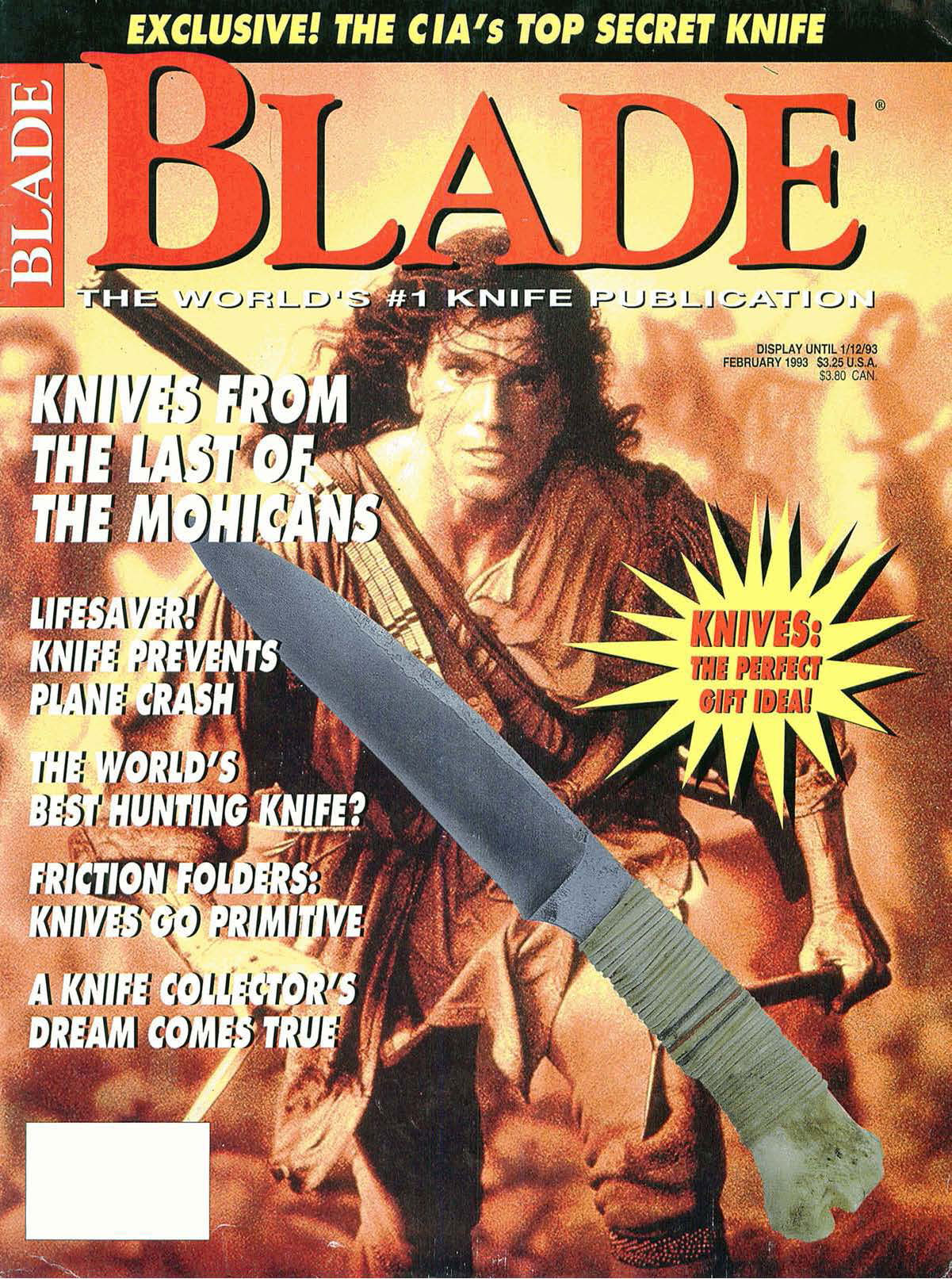
The February 1993 issue of BLADE magazine.

Editor’s note: The following appeared in the February 1993 issue of BLADE magazine. You can read more from BLADE‘s extensive archive here.

Knifemakers keep the candle lit for traditions going back generations. It’s no wonder Hollywood would turn to these keepers of history when making movies set in centuries past. 

Winkler: It Started with a Casting Call

custom knives action moviesKnifemakers Daniel Winkler and Randall King capitalized on being at the right place at the right time to make the knives for 1992’s box-office hit, The Last of the Mohicans.

Winkler, who lives in Boone, North Carolina, (the movie was filmed in the nearby North Carolina mountains) read about a casting call for the movie in a local newspaper. A maker of period pieces for and a participant in mountain man rendezvous, Winkler and his knives would seem a good match for the movie’s mid-18th century time frame, but not even he and his business associate, Karen Shook, could have foreseen the good fortune that would befall them when they met with movie prop master Ron Downing.

Movie knives of The Last of the Mohicans
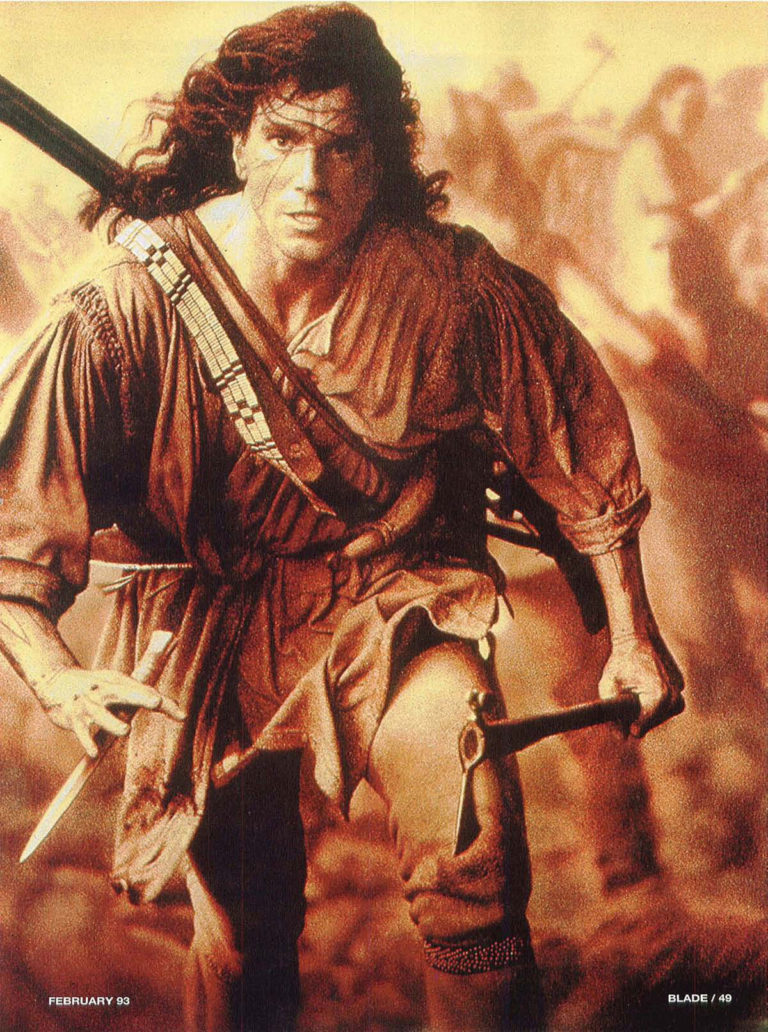
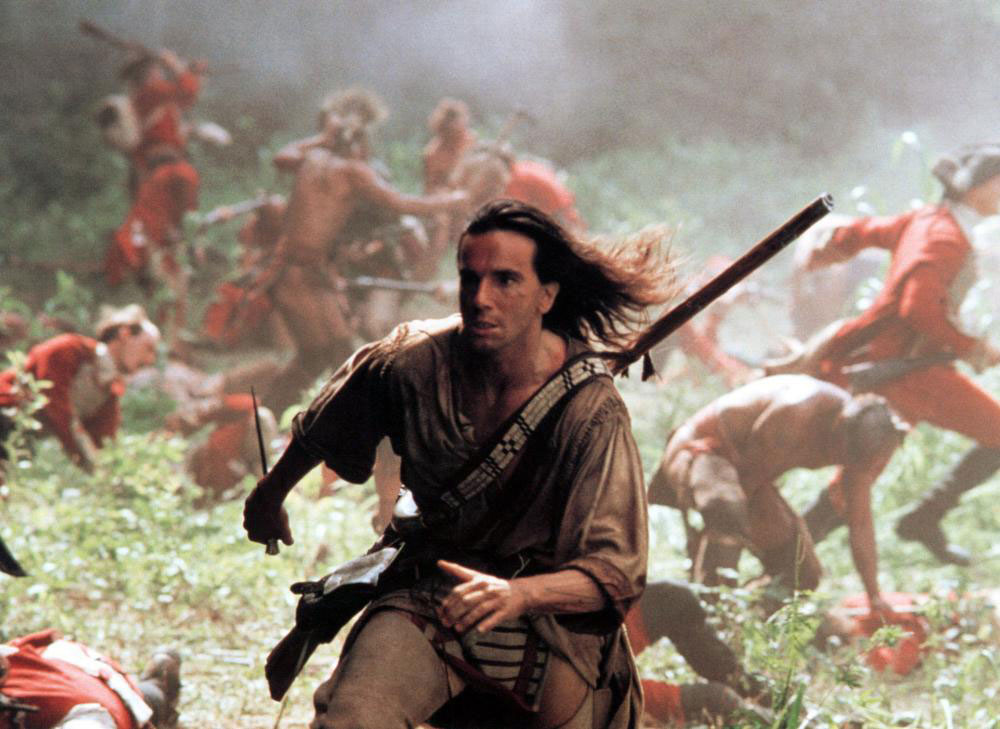
Hawkeye (Daniel Day-Lewis) carries the knife Winkler made in this scene from “The Last of the Mohicans.” (Image via imdb.com)

“Karen and I introduced ourselves to Downing’s secretary and got a map to his office,” Winkler recalled. “We spoke with Downing and he told us he had a meeting that night with the movie’s director, Michael Mann, at which time he was supposed to show Mann the knives that were to be used in the movie.

“But Downing didn’t have any knives! Karen and I ‘happened’ to have a suitcase full of knives and Downing asked if we would stay for the meeting with Mann. Though no specific knives were agreed upon at the meeting, they decided our knives were appropriate and gave them some idea of what they wanted.”

Designing, and Re-Designing, the Knives

Blades The Last of the Mohicans
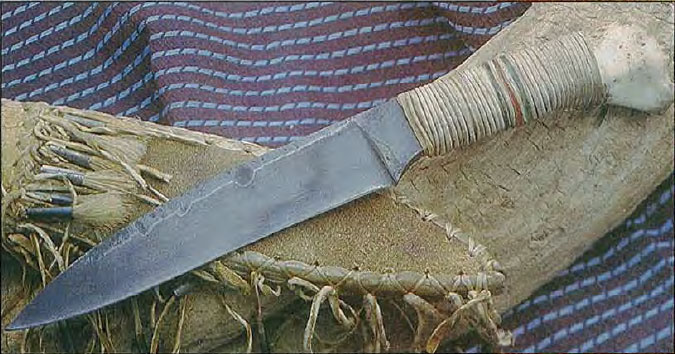
The knife Hawkeye (Daniel Day-Lewis) carries is shown above. Made by Daniel Winkler, the piece is 11 inches long overall. The blade is forged from L6, a steel Winkler said he chose to show “the right-age patina “for the French and Indian War time period. He said the blade design is not an exact straight edge because of its slight upswept tip. The handle is deer leg bone wrapped in rawhide and red and green bands, also inspired by handles from the mid-18th century.

From there, Winkler learned just how tough a job he had taken on. He met with production officials to decide on a specific knife design. From that design Winkler made a knife and brought it to the next production meeting, where movie officials suggested more changes.

“I went to six weeks of meetings and they’d change the knife at every meeting. They continually changed the design until the final knives were an evolution of changes,” Winkler said.
Once the final designs were agreed upon, he had to make three of each knife in case any one was damaged or lost, all of which had to look alike.

“It was difficult to get the same shape bone for each handle,” he noted.

The knife can be seen in the first few seconds of this video clip:

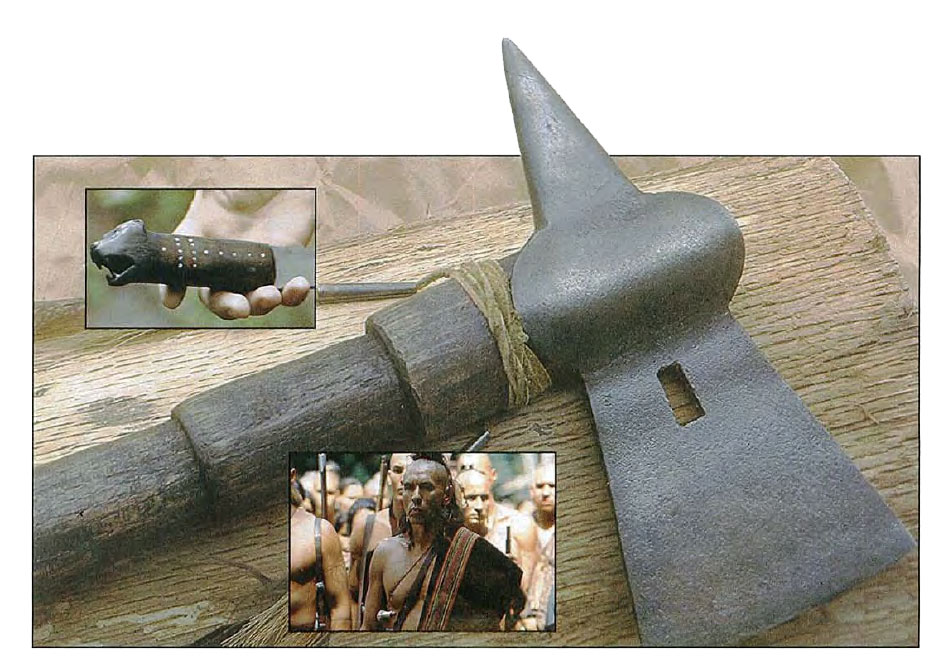
Winkler made the knives for Hawkeye (Daniel Day-Lewis) and his adopted brother, Uncas (Eric Schweig), and the tomahawk for the movie’s villain, Magua (Wes Studi). Magua’s tomahawk was one piece Winkler didn’t have to change. It gets the best close-up shot of any of the movie’s edged pieces early on when Magua attacks one of the English soldiers escorting Cora (Madeleine Stowe) and Alice (Jodhi May) Munro to see their father. Winkler said it was copied from a design on display in a French and Indian War museum in New York.

“(The movie officials) didn’t change the reproduction I made,” Winkler said. “When they got it, they liked it.”

King: It Started with Breakfast

King can thank his father for his opportunity to make the movie knives.

“Jim Morgan, the assistant prop master, ate breakfast where my Dad does every morning,” said King, who lives in Asheville, North Carolina, also near where the movie was filmed. “They got to talking and Dad said I made knives they could use in the movie. Jim said to send me down.”

The next thing King knew, he was making movie knives.

Hiding “Blood Bladders” Inside Knife Handles

bad guys knife the last of the mohicans
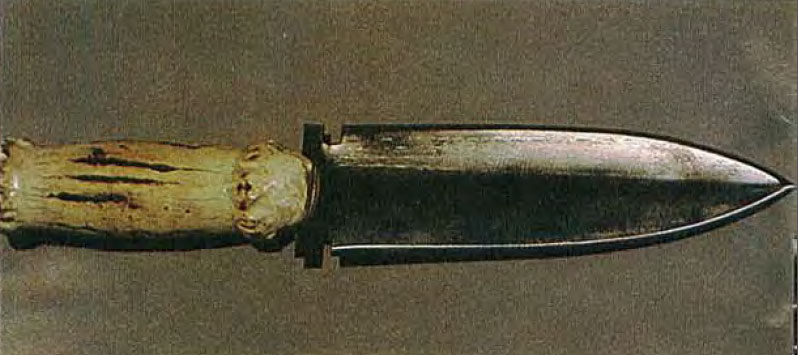
Randall King made Chingachgook’s English dagger from a design by movie prop master Ron Downing. Like all of the knives made for the movie’s stars, King had to make two duplicates in case any of the knives were damaged or lost. To duplicate the stag handle, King sawed a piece off a moose antler 2 inches in diameter, sanded it down to the same shape as the original, and cut the same “character lines” in the stag with a Dremel tool. Finally, he burned the slabs in places for the brownish stag effect.

The knife King made for Chingachgook (played by Russell Means) is a combination of two knives-an English dagger blade with a handle designed by Downing. Like Winkler, King had to make several copies of the knives.

“Do you know how hard it is to duplicate a piece of stag? I took a moose antler and sawed a piece from it about 2 inches in diameter,” he explained. “I sanded it down to the same shape as the original and took a Dremel tool to cut the lines in it and then burned it in places for the stag effect.”

King also had to duplicate the carved bear-head handle of Magua’s knife, and made two special effects knives for Magua with removable handles that hid “blood bladders,” which squirted fake blood when squeezed for the movie’s action scenes. King also made the knives and sheaths for the movie’s extras.

Winkler said the huge gunstock war club that Chingachgook cames in the movie, as well as the other tomahawks used by movie extras, were made by in-house prop people. A lot of the tomahawks were based on authentic designs illustrated in blackpowder catalogs, he noted.

tomahawks of the last of the mohicans
Magua’s tomahawk gets probably the best exposure of any edged piece in the movie early on (Magua is at bottom, played by Wes Studi). Daniel Winkler carved the handle from hickory and hand forged the head from L6 steel. He reproduced it from an authentic piece provided by Ft. Meigs, a restored fort from the French and Indian War period located in upstate New York. (Magua picture courtesy Twentieth Century Fox)

Working with the Stars

read knife magazine
Read more articles from BLADE’s archives with this collection of 25 years of back issues.

Both makers said they got to meet the stars and were impressed with how cordial they were, King even to the point of having his picture made with Studi and Day-Lewis.

Though neither maker “got rich” from the money they made-King used the proceeds to make himself a new knife shop-both viewed the experience as educational.

“Working on a movie production is not something I would want to do very often,” Winkler admitted. “It was fun but it took a tremendous amount of time. They wanted everything right away. I had to put off some of my custom orders and missed some knife shows to meet their deadlines, and a lot of what I did for them was put on the shelf. We (knifemakers) are suppliers, not actors.”

The makers may not be actors but, in a way, the knives and tomahawk were. And if the past is prologue-as with the Rambo knives that helped boost the knifemaking fortunes of Gil Hibben and the late Jimmy Lile-Winkler and King may reap even more benefit to their knifemaking careers from the pieces for The Last Of The Mohicans.

Queen Cutlery Co. Ceases Production, Reorganizes

Queen Cutlery Company bankrupt
The #3EXP Mountain Man Express lever-lock pocketknife is one of Queen’s most recent models. The 3.75-inch blade is 1095 carbon steel. MSRP: $350.

Queen Cutlery Co. has been forced to cease all production and close its facility in Titusville, Pennsylvania, as of today, Jan. 10, according to a Queen press release.

Kenneth Daniels, chief executive officer and president of Queen, cited issues with cash flow as the cause of the cessation of the company’s knife production. He added that all Queen employees will be furloughed while the company goes through a period of reorganization.

Queen Cutlery knife company
The announcement posted on Queen’s website.

According to Queen’s Ryan Daniels, more information concerning Queen’s future will be released in February.

Queen made knives under the Schatt & Morgan and Schatt & Morgan Express lines, as well as the private label lines of Queen Classics, Schatt & Morgan Premier, Tuna Valley Cutlery Co., Cougar Creek Knives and Trestle Pine Knives.

Queen traces its roots back to the old New York Cutlery Co. (Schatt & Morgan), which moved from Gowanda, New York, to Titusville in 1902. The company incorporated as Schatt & Morgan Cutlery Co., Inc., and began cutlery production in January 1903. The Schatt & Morgan knives were made until 1931.

Then known as Queen City, Queen had a number of contracts with the government during World War II and also supplied other cutlery companies in their war effort. Queen City supplied product to the Jersey City Depot from May 1944 through October 1954. In addition, Queen City furnished knives for Williams Brothers Cutlery in California from Nov. 18, 1942, to December 1945.

In 1991, Queen started re-issuing the Schatt & Morgan knives, a Robeson Series in 1995, and a “File & Wire” series in 1998.

Kenneth Daniels bought Queen in 2012 and Queen had been specializing in a wide range of traditional pocketknives since then.

Choppin’ the Charts: Collectible Cleavers

Luxury cleavers
Designed by Leo Espinoza, the El Chappo cleaver from TOPS Knives features a 6-inch blade of 1095 carbon steel in an acid-rain finish.

If you want a handy outdoor blade for camp chores, skinning or a compact tool with enhanced chopping power, check out today’s ever-growing cache of cleavers.

Designed by Leo Espinoza, the El Chappo cleaver from TOPS Knives (above) features a 6-inch blade of 1095 carbon steel in an acid-rain finish. Rockwell hardness: 56-58 HRC. Handle: black canvas Micarta. Weight: 16 ounces. Overall length: 10.9 inches. Sheath: black Kydex.

High end cleaver
White River Knife & Tool is the latest outfit to join the chop party with its new Clever Camp Cleaver.

White River Knife & Tool is the latest cutlery company to join the party with its new Clever Camp Cleaver. Featuring a 5.5-inch blade of premium CPM S35VN stainless steel, the camp tool comes with a Micarta handle and a heavy-duty leather sheath. Weight: 9.2 ounces. Overall length: 10.25 inches. MSRP: $230.

ESEE chopper
The CL1-Cleaver is one of the latest models in ESEE’s Expat Knives line. The 1095 carbon steel blade is 3.25 inches at its widest and 3/16 inch at its thickest.

The CL1-Cleaver is one of the latest models in ESEE’s Expat Knives line. The 1095 carbon steel blade is 3.25 inches at its widest and 3/16 inch at its thickest. Haft: black G-10. Finish: black oxide, tumbled. Weight: 25.5 ounces. Overall length: 11.5 inches. MSRP: $276.50 (includes a leather sheath).

Zombie butcher knife
The Reaver Cleaver from Zombie Tools is a full-tang chopping machine with an 18-inch blade of 5160 carbon steel in a Rockwell hardness of 55 HRC.

The Reaver Cleaver from Zombie Tools is a full-tang chopping machine with an 18-inch blade of 5160 carbon steel in a Rockwell hardness of 55 HRC. Weight: 3 pounds, 10 ounces. Overall length: 31 inches. MSRP: $374.95.

kutzu cleaver
The Quest Custom Knives Custom Kutzu 2.2 Flipper is a micro-cleaver flipper folder with a 2-inch blade of CPM 154 stainless steel.

The Quest Custom Knives Custom Kutzu 2.2 Flipper is a micro-cleaver flipper folder with a 2-inch blade of CPM 154 stainless steel and a sculpted titanium 6Al-4V frame and pocket clip. Closed length: 3 inches.

Trench knife butcher knife
Michael Zieba’s cleaver sports the iconic brass-knuckle-guard handle taken from an original example of one of the most famous blades of World War I—the Trench Knife. (SharpByCoop image)
book on how to make a knife
Learn how to make knives with Murray Carter with this terrific knifemaking book. Only $7!

Michael Zieba’s cleaver sports the iconic brass-knuckle-guard handle taken from an original example one of the most famous blades of World War I—the Trench Knife. Zieba custom made the cleaver for Chris Wallace, aka “Flavor God,” a maker of seasonings who is big on the Internet. Zieba met Wallace on Instagram. Wallace supplied him with the original U.S. Mark 1 Trench Knife from his knife collection.

Zieba modified the knife’s iconic handle and integrated it into the cleaver blade, which is 52100 ball-bearing steel forged in a san-mai construction. He achieved the blue and gold patina with water and vinegar. “Sometimes you get blue or you may get another color. It depends,” he said. “You never know how it will come out. It’s just a reaction to the metal.”

The cleaver is one solid piece with a skull-crusher pommel. The square holes in the blade are for aesthetics. Zieba has done the blades with egg-shaped and round holes as well.


8 Stone- and Fossil-Handled Knives for “Old Rock Day”

Stone handle knife photo
Brilliant red jasper caps off the grip of Bill Duff’s miniature dagger. (Caleb Royer image)

One of the better ways to celebrate Old Rock Day (you do celebrate, don’t you?) is with a custom knife sporting a handle of anything stony or fossilized.

What is Old Rock Day?

Celebrated on Jan. 7, Old Rock Day salutes rocks of all kinds. In some locales, children are encouraged to discover their first “pet rock,” and festivities may include painting and decorating the “faces” of rocks. Some gather attractive pebbles and stones to make original pieces of jewelry. Some build rock gardens, and some towns and villages hold competitions for the best-looking rock garden.

BLADE has You Covered on Old Rock Day

To avoid getting your Old Rock Day off to a rocky start, we recommend you check out some stone-cool knife handles made of rocks and fossilized materials. You may not get your rocks off, but, if you love knives like we do, you will most definitely rock on.

Rare gemstone handle knife
Jerry McClure outfits his Little Mama Folder with a handle of green nephrite jade. (Caleb Royer image)
Ivory handle knife photo
Mastodon ivory comprises the grip of a Tony Hughes bowie in a 9.5-inch blade of Turkish twist damascus. (Caleb Royer image)
Mammoth ivory handle knife
Bruce Bingenheimer’s BingaLor folders have handles of mammoth ivory. (Caleb Royer image)
Example of custom dagger photo
Sodalite stone caps off Bertie Rietveld’s Pinnacle dagger in nebula damascus. (SharpByCoop image)
Titanium knife photo
The Protégé by Johnny Stout boasts mammoth ivory scales and fileworked titanium liners. (Caleb Royer image)
Walrus ivory handle knife photo
Ancient walrus ivory in a forged integral frame rocks the Slim Bad Fighter by David Lisch. (Caleb Royer image)
Custom knife photo
Don Hanson opts for fossil ivory on his clip-point bowie with handsome hamon. (Caleb Royer image)

See More Beautiful Knife Photos

Knife books

Knives 2018 features full-color photos of the world’s best custom knives. It’s THE book for knife collectors, knifemakers and anyone interested in functional art.

Four Things You Didn’t Know About Rambo

“First Blood” is a Dueling Term

David Morrell, author of the novel First Blood, based the book’s title on an old dueling term.

“I thought of it as a kind of duel between the characters, and there’s a dueling term about drawing first blood,” he explained. “In some duels the person who drew first blood would be the victor, so there was a kind of irony here of who drew first blood and who was going to win in this harrowing conflict.”

Rambo is More Canadian than American

first-blood-forest-knife
Though set in Kentucky in the novel First Blood, the movie’s locale was supposedly in the American Pacific Northwest. Actual filming was done in British Columbia. (image via imdb.com)

Born in Kitchener, Ontario, Canada, Morrell today is an American citizen.

The setting he chose for the novel, First Blood, was a wilderness area in Kentucky called the Grand Canyon of the East. However, Carolco, the production company that made the First Blood movie, wanted to do the flick in British Columbia, partly for financial reasons.

Meanwhile, for the purposes of the film, the locale would be identified as the American Pacific Northwest.

“It’s ironic that a Canadian created one of the most recognizable American icons,” Morrell noted. “It’s doubly ironic that the movie adaptation of First Blood was filmed in Canada’s British Columbia, even though my novel is set in Kentucky.”

Uncle Sam Makes an Appearance

Rambo Uncle Sam
The First Blood character of Col. Sam Troutman, played by Richard Crenna in the movie, was inspired by an American icon. Can you guess which one? (image via imdb.com)

Morrell gave Col. Sam Troutman, played by Richard Crenna, the name Sam because he represents Uncle Sam. As Morrell noted, “I saw him as the system that had created Rambo.”

You Only Got Half the Story

cover of rambo book first blood
The original cover for “First Blood.”

Originally, First Blood was about 600 pages long. Morrell didn’t like it and so went back and started reading it again. He found a chapter he didn’t like and deleted it. He read the book again and found it moved faster as a result of the deletion.

“I had digressions for one of the deputies, and the man who flew the helicopter and so many different viewpoints in it that I began cutting this chapter and that chapter and found that all I had to do was have the alternating sections between Rambo and the police chief,” he said. “So I probably lost about 300 pages doing this. It was like sculpting, knocking bits of granite off to create a statue. I had written and written so much that I learned that by cutting back I got an intensity that I hadn’t expected. So it was a big lesson for me.”

Advertisement

Must Read Articles

Read this before you make a knife

Knifemaking 101 – Read This Before You Make a Knife

  by Wayne Goddard My experience has taught me that there's nothing like digging in and getting started. I've often said the hardest part of the...
how to forge damascus steel

How to Forge Damascus

Advertisement
Advertisement