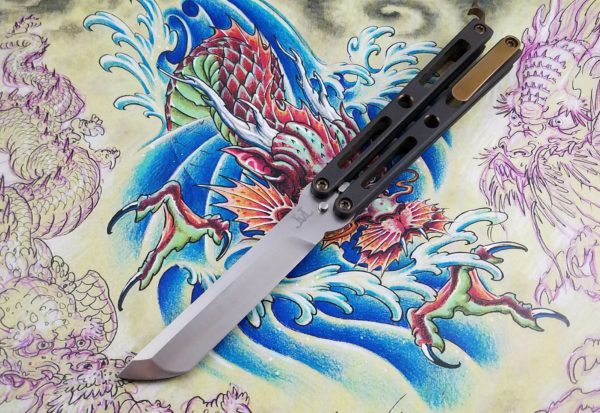
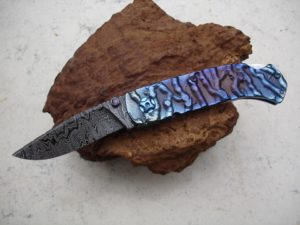
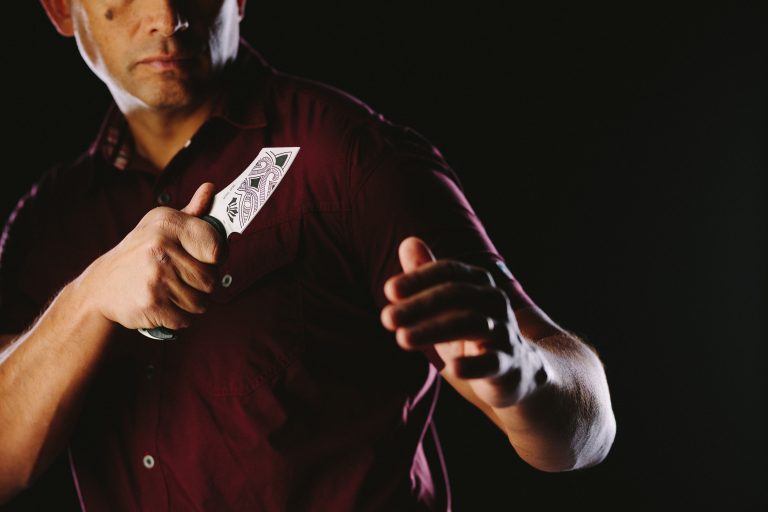
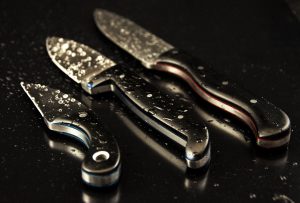
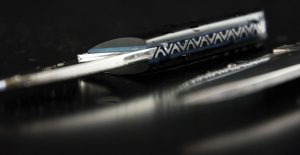
1. This everyday carry folding knife by Tim Lambkin is lightweight at 3.2 ounces. It measures 4 inches closed and is 3/8 inch thick. Tim welded the pattern, did the filework inside and out and flame-anodized the titanium scales to add the wow factor. The screws are the types used in hip replacements, anodized for color! The thumb stud is mother of pearl. Makers List Price: $900-$1000 Contact http://chopsknives.com, [email protected],903-926-7447. (Ericka Lambkin image)
Has a card, flowers and brunch become the routine for Mother’s Day? Maybe you’ve tried getting creative with gift-giving but it wasn’t well received, so you’re sticking with what works. Dull! Where’s your sense of adventure? What about giving the mothers in your life something sharp and pretty? Just like her! Let’s look at 20 custom knives moms want for Mother’s Day, or any day for that matter.
Isn’t that like giving a vacuum cleaner or an iron?
Yes and no. We’re not talking boxed sets of table cutlery or mass-produced blades, regardless of their quality and usefulness. We’re talking 100-percent hand-crafted custom knives. If you decide on a chef knife, for example, it could be construed as encouraging cooking, but the knife will be so beautiful, so smoothly made, so significant in her hand, she’ll overlook the “get cooking” aspect and start searching for things to julienne. You may find her looking for ways to display her knife not only as an easily accessible tool, but as a work of art. It’s not going to be tossed carelessly into a drawer, that’s for sure.
Hmmm. I’m not so sure.
Ok. What about knives for self-defense? Or engraved knives in pearlesence or vivid colors that mom will want to hold, admire and show off? Knives for shaving? The cowgirl in your life could use a custom livestock castration knife.
Excuse me!
Just look. These 20 custom knives will be well received by all types of mothers. Trust me. Now these knives take time to make, so if you see something you like, contact the maker and if he or she doesn’t have one ready, put in an order for a birthday or the holidays. It’ll be worth the wait. I promise.
Neck Knives
Neck knives are compact blades that are drawn in a downward motion from a sheath on a necklace-length lanyard or looped onto a bra like a gun holster. Moms can use this for self-defense or as an everyday carry knife. Various blade styles are frequently offered.
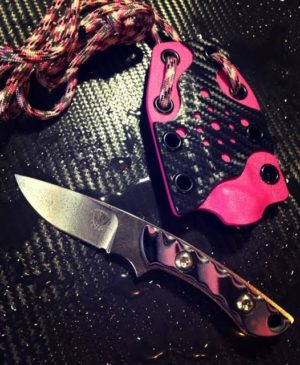
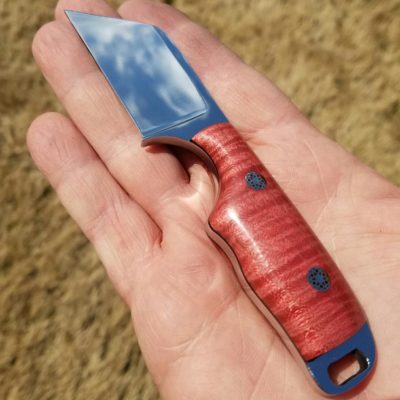
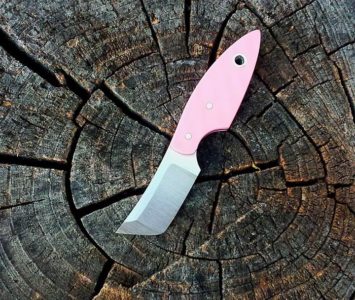
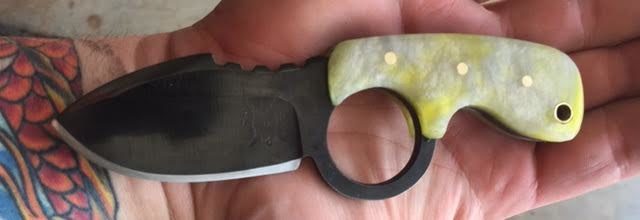
2. This necker by James Huse has a 2 1/8-inch drop-point-style blade made of A2 tool steel. Overall length is 5 1/8 inches. The handle is pink and black G10 with matching Kydex sheath. You release the knife with light thumb pressure and a downward draw. Maker’s List Price: $165. Contact www.huseknives.com, [email protected] or message to Huse Knives on Facebook, @huse_knives on Instagram.3. Pete Sloan’s neck knife is made from 440C stainless steel with a cleaver-Wharncliffe blade design. The handle was crafted using stabilized pink curly maple. Maker’s List Price: $150. Contact www.sloancustomknives.com, [email protected], 731-225-9209 or message on Facebook at Sloan Custom Knives.4. This neck knife by Travis Fleming has a trailing-point tanto blade design made from Nitro-V, an AEBL steel by New Jersey Steel Baron. A pink sheath completes the set. Makers List Price: $160. Contact [email protected] or message at Fleming’s Fabrications on Facebook.5. Denny Furey makes these three-finger Quick Defense Knives with an index finger ring for sure pistol-grip draw from under a top or from between buttons on a blouse. The 2.5-inch blade is made of high carbon 1095 with a blued and polished finish. The handle is made out of Voodoo Resins with brass pins and lanyard tube. Makers List Price: $160, includes sheath. Contact [email protected], 405-642-2198 or message on Facebook at Furey’s Urban Combat Knives.
Pretty Knives
Sometimes it’s all about the eye candy. Holding something pretty, showing it off, is a luxury mom is unlikely to allow herself either in time or cost. But, hey, beautiful knives can also cut a piece of string or open a box, and every time she studies the engraving, the jewel- and pearl-like finishes, the intricate designs in the pattern-welded steel, she’ll be reminded of how much she is treasured.
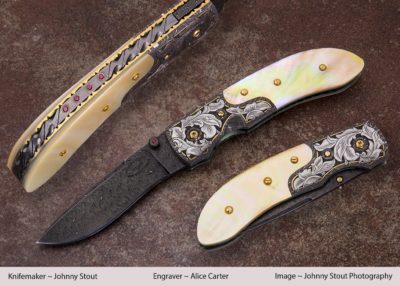
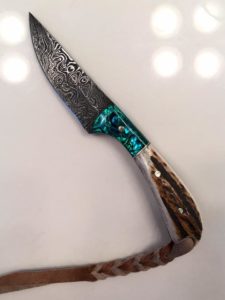
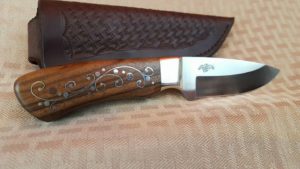
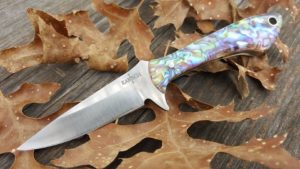
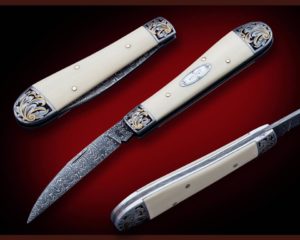
6. This Johnny Stout LeGrande Fine Folder has a 2 1/2-inch pattern-welded blade, gold lip mother of pearl handle scales, engraving by Alice Carter and a precious rubies inset in the backspacer and in the thumb stud. Closed, the knife measures 3 3/8 inches. Makers List Price: $3200. Contact http://stoutknives.com, [email protected] or 830-606-4067.7. Karen Jones made the 3-inch blade on this Work Pony out of raindrop-patterned steel. The bolsters are green abalone, the spacers are brass and the scales are elk antler. The 7-inch knife is “made to be used and abused in real life. Pretty is as pretty does,” Karen added. Makers List Price: $250-$275. Contact [email protected], 682-777-1193 or message at ThunderHorse Blades on Facebook.8. This Devin Bliss Bobcat has a 3.75-inch blade made of 1095 steel, walnut handle with mosaic pins and silver wire inlay and a nickel silver bolster. Its overall length is 8 inches. Makers List Price: $560. Contact [email protected], 903-736-3052 or message at DB Custom Knives on Facebook.9. Ben Kabisch made this for an emergency room nurse who works the night shift. She wanted something “cute, light and concealable.” The blade was made from 1084 carbon steel and the scales are an acrylic abalone. The blade is 3.5 inches and the overall length is 7.5 inches. Makers List Price: $175 Contact 940-733-6404 or message on Facebook at Ben Kabisch.10. This Raymon Earl Hunt Swayback Jack has a 2 3/4-inch Wharncliff-style blade, hand-finished and with a swedge. The handle scales are pre-ban elephant ivory with gold pins and stainless bolster. The inlaid engraving is by Bruce Christiansen. Maker’s list price: $1800 with sheath or purse pouch. Contact 214-507-0896, [email protected], or visit www.3hsknives.com.
Kitchen Knives
Whether the kitchen is in an urban apartment or at a campfire in the woods, chef knives that make food preparation more enjoyable, either by their ergonomics or their beauty, preferably both, are welcome gifts at Mother’s Day or on any holiday. This category also includes skinner/meat processing knives for the huntress in the family.
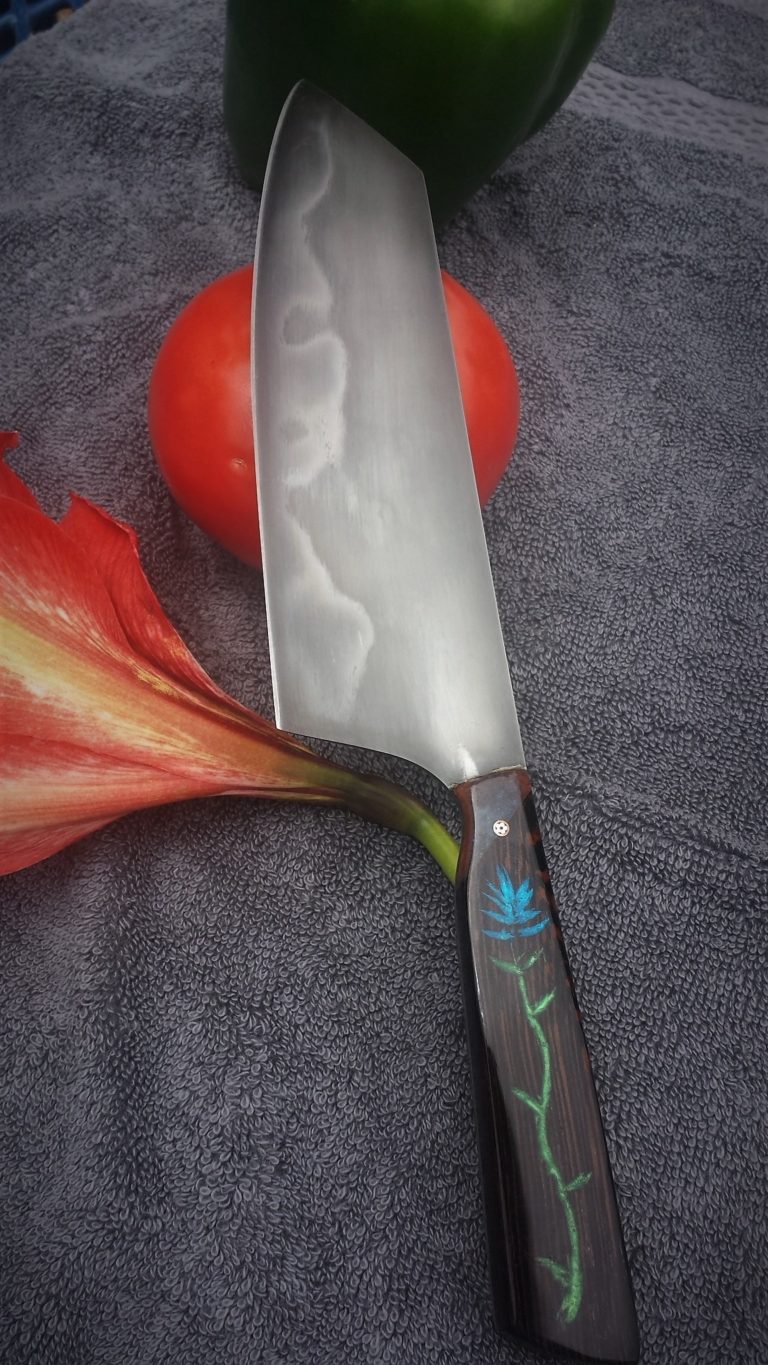
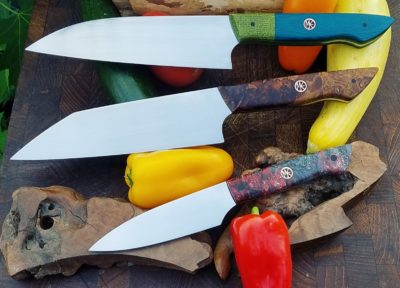
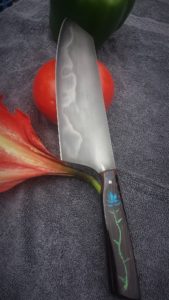
11. Mike Jeffries’ set of chefs knives includes two in AEB-L stainless steel, one in vintage Westinghouse Blue Micarta (rare stuff) with green Shadetree Burlap bolsters and the other in spalted maple burl. The paring knife is made of 52100 high carbon steel with dyed boxelder burl. Makers List Price: $900/set. Contact [email protected], 502-592-4240, on Facebook at 2Birds Metalworks and on Instagram @2birdsmetalworks.12. Nichole Lindstrand’s Modoc model knives are made from 15N20 steel with a drop-point blade, ideal for skinning and processing game. Overall they measure 7.25 inches with a cutting edge of just under 3.5 inches. The handles on these two are made of olivewood and Bone Micarta with blue G10 liners and carbon fiber pins. The makers list price is $165. Contact [email protected], 530-515-6082 or message on Facebook at Lindstrand Custom Knives.13. These 7 1/2-inch kitchen/camp knives by Carson Riley Marquis are made with 1095 steel with a differential heat treatment, acid etched/stonewashed finish and hammered-texture flats with flat grinds. The handles are dyed and stabilized zebra wood bolsters with Ivory Paper Micarta laid atop and divided by Natural Linen Micarta. Pins and lanyard tube are also Natural Linen Micarta. These are right-sized for meat processing and food prep. Makers List Price: $195 each with leather sheath. Contact http://crmarquisknives.bigcartel.com, 903-316-2824 or on Instagram @C.R.Marquis.Knives.14. This Thai-inspired kitchen knife by Todd Stracener is similar to a Japanese bunka. The 6 1/2-inch blade is made of 1095 steel and the handle is made of wenge wood with a resin inlay, The knife is 11 1/2 inches overall. $250. Contact on Instagram @thezeep or message on Facebook at Stracener Knives.
Everyday Carry Knives
Everyday carry, or EDC, knives are ones that you carry on your person or in your purse for both self-defense and general common use. They can be of the fixed-blade variety that you keep in a leather, Kydex or other molded-plastic sheath. Or they can be of the folding type and come with a clip that you can use on your pocket or inside a skirt or pant waistband. EDC makers strive for thin, small and light. They’re often tactical looking, but mom-friendly models come in everything from natural tones to bold and subtle colors.
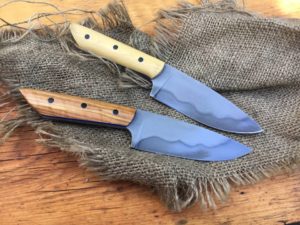
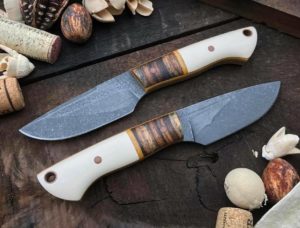
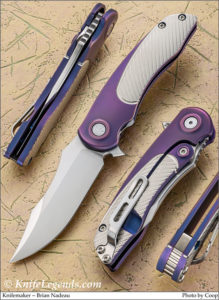
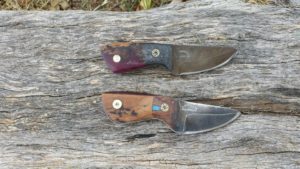
15. Brian Nadeau’s Cyclone Bowie Flipper has a 3.5-inch blade made of CPM S35VN steel. The pivot is constructed with a stainless ball thrust bearing with AEB-L lock. It has a textured, anodized-titanium frame and aggressive gimping for a secure grip in any weather. The pocket clip is 410 stainless steel. Makers list price: $995. Contact www.knifelegends.com, www.sharpbydesign.com or [email protected].16. Shane Hill made this knife for a woman who wanted to have a knife in her car with her. The 3-inch drop-point hollow-ground blade is 1095 steel; the handle is make of cocobolo wood. Overall length of just short of 8 inches. Makers list price: $165. Contact [email protected] or message Hill Knife Works on Facebook.17. These Mini Me knives by Charles Hawkins have 2-inch hollow-ground blades made of pattern-welded steel from Alabama Damascus Steel. The top one has an Alumilite resin and wood handle with carbon fiber bolsters. The bottom one has a terminate wood with box elder handle with Alumilite resin bolsters. Although these knives are technically skinners, at 4 1/2 inches overall and with a clip-on sheath, something tells me they’re more likely to be used as an everyday carry. Maker’s list price: $100-$125 each. Contact www.hawkcustomknives.com, 325-947-7875.
The Right Knife For The Job
To do the job right, you need the right tool. You wouldn’t use a router to mix cake batter, right? (I can tell you’ve thought about it though.) You wouldn’t use a flat brush to curl your bangs, right? OK, maybe. A girl’s gotta do what a girl’s gotta do. Well, it’s the same with knives. Aside from a survival situation, you wouldn’t bushcraft with a paring knife or filet a fish with a tomahawk. Here are just a few of many specialized knives that might be perfect for a mom in your life.
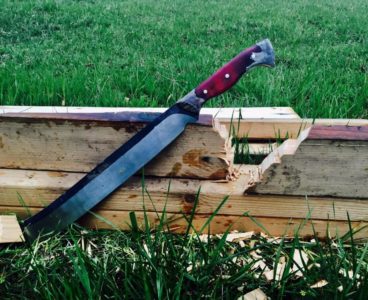
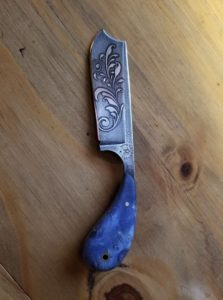
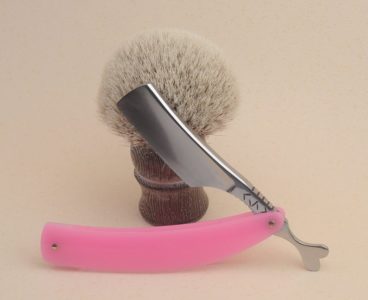
18. Eland Green made this GOLIATH chopper from 5160 tool steel and left the flats black after the heat treatment. The handle is a wood-resin combination. This is a worker for the gardening mom or for chores around a camp, farm or ranch. Makers list price: $600. Call [email protected], 940-736-8333 or message on Facebook at Lost Wood Knives.19. Becky McFall Rodriquez made this teardrop-handled livestock castration knife from a Travis Payne idea. Its 3-inch blade is acid-etched O1 tool steel. The handle is fashioned from blue-dyed box elder burl. The knife is 6-inches overall. When a lady’s doing dirty work, she should have a pretty tool. Makers list price $220-$250. Contact [email protected] or message on Facebook at Rafter M Custom Knives.20. Wet shaving is making a comeback, mainly for men, but also for women. Bruno van Dooren makes a 7/8-plus-inch wide round-point blade from O2 carbon steel with a half hollow grind. The length of the cutting edge is just under 2.5 inches. This shorter edge makes the razor more maneuverable for female shaving. The point is rounded to prevent accidentally poking through the skin. The scales are Kirinite Starlight Pink with Kirinite Glow in the Dark spacers. The pins and washer are brass. Makers list price is $325; pattern-welded or wootz steel versions are higher. Contact [email protected], www.snailforge.be or message on Facebook at Snailforge.
Bonus
Inside the heart of that special mom there lurks both a queen and a warrior princess, a diplomat and an avenger. She’s a lady with a hard edge and a soft inner core. She may be just the one to wield the Tactigal.
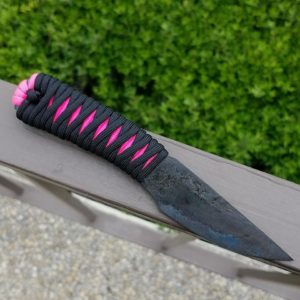
Bonus: Tobin Nieto forged his Tactigal out of 1084 steel to an overall length of 8.75 inches. The blade is a 3.25-inch drop-point style. The pink underlay is 550 paracord while the black cord has had the inner strands removed to allow for a flat Mongolian-style cross wrap. Maker’s list price: $175 with sheath. Contact Stonehaven Knife Works on Facebook or on Instagram @stonehavenknifeworks.
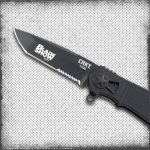
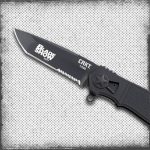
The CRKT Homefront is the Official Knife of the 2017 BLADE Show. This is a highly collectable item and the run is limited to 300. At $70 you can save $29.99 off the $99.99 price, if you order now. The field-strip technology allows you to disassemble without tools. The Ken Onion design won Most Innovative Imported Design award at the 2016 BLADE Show. Here’s where to order your Official 2017 BLADE Show CRKT Homefront Knife.
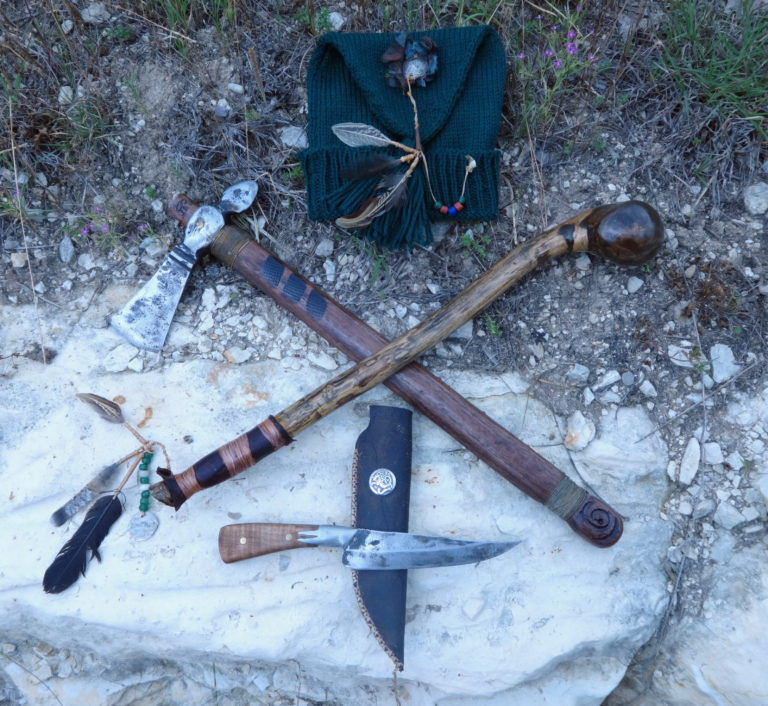
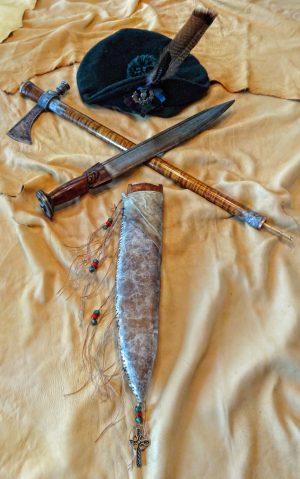
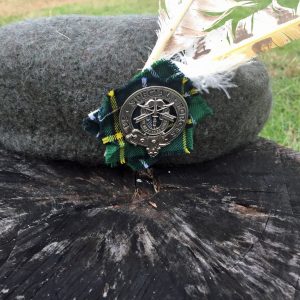
Custom knifemaker Don Shipman’s edged-weapon set is on auction until June 30, 2017 to benefit the Green Beret Foundation. In addition to a Rogers’ Rangers bonnet, a knife and sheath, and a tomahawk, the set also includes a war club. These are all items a Ranger during the French and Indian War might have carried.
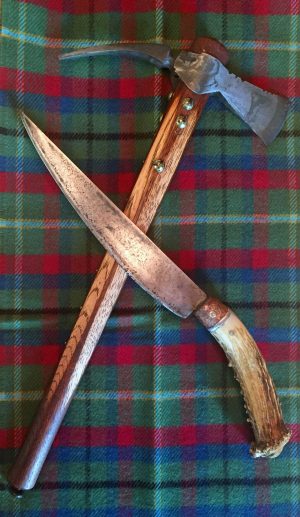
Don Shipman of Shipman Knife & Hawk and Longfear Forge in Waco, Texas, has made a Rogers’ Rangers III edged-weapon set for auction to benefit the Green Beret Foundation, which helps Special Forces members and their families. This new set includes items that the precursor to today’s U.S. Army Ranger would have carried with him in the eastern woodlands of North America during the French and Indian War, 1754-1763. The kit includes a knife and sheath, a tomahawk, a Rogers’ Ranger bonnet and an item stirring interest: a war club. If you would like to bid on this hand-crafted and meticulously researched collection, you only have until Jun 30 to do so. As of this writing, the highest bid is $1310. You can read about Don’s decision-making process for this set in detail in the October issue of BLADE magazine. Be sure to subscribe.
Don is nothing if not thorough. Whether in love, service to country or researching and assembling his edged-weapon Heritage Sets, he strives to honor the spirit of the warrior, the frontiersman and the gentleman.
This Rogers Rangers II set by Shipman Knife & Hawk included items a young Ranger serving under Major Robert Rogers might have carried in 1755 during the French and Indian War: a Scottish bonnet, pipe hawk and a dirk and sheath.
Take, for example, the name of his forge. In Irish Gaelic, “long” means “ship” and “fear” means “man.” But The Ship Man, as his Special Forces friends sometimes refer to him, doesn’t stop there. “I use the analogy that ‘long’ gets its meaning from the Norse ‘longships,’ which raided medieval Ireland,” Don explains. “‘Man,’ especially ‘strange men,’ is frequently associated with ‘danger’ in languages. So, ‘man’ equals ‘danger’ equals ‘fear.’ Thus, Longfear forge equals Shipman Forge. All of the above works especially well with my Norse and Irish ancestry,” he concludes.
So, on his blades, you will find the crossed-arrow Shipman logo, and if Don forged the item, you’ll also see the Longfear stamp. “The stamp is…wait for it…a Viking longship prow! Totally badass!” And that’s what it’s like talking with Don. You’re going to get an education, and you’re going to enjoy the lesson because he makes it entertaining.
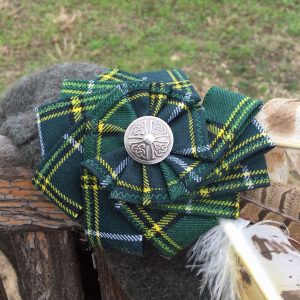
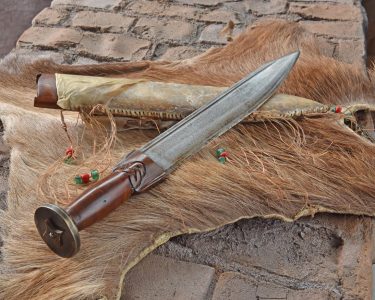
This kit included a pipe hawk, a Joe De La Ronde-designed spike hawk, a roach-belly blade with sheath, the family tartan, and an caubeen, or Irish beret, with three badges.
Don makes edged weapons that could have been used or made by the common man on the American frontier, no matter where that frontier may have been at that point in history. Sets can include a knife and a tomahawk, or more than one of each, along with usually a bonnet, blanket or piece of clothing. He’s working on one now that may include a gun. Each item in the set is researched thoroughly, from handle woods to clan tartans used in the headgear cockade—think rosette on a prize-winning ribbon.
First, if you don’t already know your family’s origins, Don will research your family’s heritage using Ancestry.com, the online genealogical site that assists in tracing your family tree. He establishes where your family came from and where your family settled or migrated to when they arrived in America. The frontier may have been upstate New York at the time, or Ohio, or Kentucky as westward expansion continued. If you’re of Irish or Scottish descent, for example, he’ll determine, to the best of present-day knowledge, to which clan your family belonged. Similarly, if you think you may descend from Vikings, he’ll investigate your Nordic heritage.
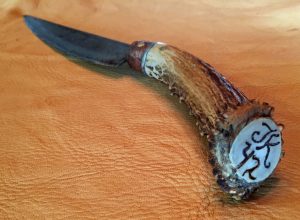
This roach-belly blade was forged out of 1095 steel by Longfear Forge. The ferrule is comprised of beaten copper and poured pewter. The handle is whitetail antler and “JK42” is engraved into the pommel using Colonial (Allegheny) font in recognition of the client’s service in Special Forces Operational Detachment (ODA) 542.
Next, he’ll research available materials in the region where your family lived once they arrived in the New World. Was that variety of maple tree growing in the area where and when your family settled? Yes. Then Don may use that wood to fashion a knife handle. What styles of knives or tomahawks were being used in that region and for what purpose? For instance, there’s the tomahawk that has a bowl in one end used for smoking tobacco and passing around, what we would think of as a peace pipe. There’s the ’hawk with the spike opposite the cutting edge, which our ancestors used in times of combat for striking their opponents. And, hawks with nubs on the back were often used as a mallet or hammer, making the weapon double as a utility tool.
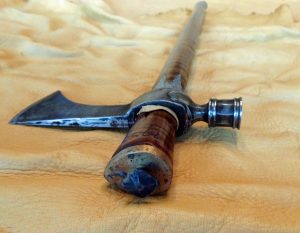
The tomahawk in the Rogers’ Rangers II set has a 22-inch curly maple shaft with a pewter inlay. The copper butt cap has a 2-inch brass mouthpiece. The head is an R.E. Davis blade in 4140 steel. Patina added to all metals.
Every facet of the collection is thus researched. If Don wants to use a turkey feather, for example, to adorn a bonnet, he first confirms if turkeys were plentiful where your family lived and at that time. The woolen bonnets are supplied by reenactment companies such as Jas. Townsend & Sons out of Pierceton, Indiana. In Scottish versions, the headgear is larger and of thicker material, but the Irish renditions are precursors to the berets used by U.S. Special Forces. And like our elite warriors wear what’s called a flash—think a shield-shaped patch adorned with symbols from their unit—on their berets, Colonial-era warriors would wear a cockade made with their clan’s tartan, say, or other emblem representative of their heritage.
A tattered Forrester tartan cockade was one of three cockades for this bonnet.This bonnet came with tattered, bow and rosette cockades in the client’s Forrester tartan. Due to the client’s service in elite forces the red-tailed hawk, wild turkey, ring-neck pheasant and mallard feathers are prominently displayed, his family hailing from an area where the species were prevalent.
Don will educate his clients on the proper time and place to wear certain emblems. For instance, your set may include one bonnet with multiple cockades or other adornments. There may be a tattered cockade appropriate for everyday wear, or one that should only be worn at formal occasions. The headgear may include a feather, which, Don explains, would only be appropriate for a chief of a Native American tribe to wear. However, he acknowledges that his clientele may correctly believe they have earned the honor and they will wear the feathers to military galas, for example.
Don knows more than a little something about warriors of many nations and their weaponry. He ended up serving 30 years in the U.S. Army. “All I wanted to do was not embarrass my father and be a good soldier,” Don said. His father was an Army sergeant major, and Don was born and raised in Wurzburg, West Germany (at the time) until he was 13 years old. His dad’s final duty station was at Ft. Hood, Texas, where his parents went through the process of naturalizing Don. At the time, Germany had compulsory military service. This entailed sacrificing his dual citizenship, but saved him from possible conscription into the German army.
When his father retired, the family moved back to the home state of both his parents: West Virginia. So, Don was a high-school kid in a very foreign world. How foreign? “This kid got on the school bus and he had a fat bottom lip. I’m thinking, ‘It isn’t even 9 o’clock yet and this kid’s already been in a fight.’” Thus was young Don’s introduction to chewing tobacco. On the very same day on the very same bus, a few stops along the route, three redheaded sisters get on the bus. “My eyes immediately go to the tallest one, ’cause that’s how I roll,” Don said. “She had wire-rimmed glasses, and I thought, I’m cool with that.”
The sheath for this 18-inch Scottish dirk has a 14-inch basswood shell wrapped in rawhide with a sinew running stitch. It is adorned with sinew fringe and green and red padre beads and a 2-inch Celtic cross.
Fortunately, through an old-timey bus driver who lined the students up by sex and height, eventually the tall girl and older boy ended up sitting beside each other. Don barely said a word. Unbeknownst to him, however, the future Mrs. Shipman, Diane, or Annie as Don calls her, took matters into her own hands, putting the word out that the seat beside her was always reserved for Don. She knew right from the get-go that he was “the one.”
Don was dating his best friend’s sister, and although he got to the point where he could talk to Diane—a lot—and wanted more than anything to be with her, he couldn’t figure out a way to break it off with his friend’s sister without hurting her. “Next thing I knew, I was in basic training,” Don says, laughing. The other attachment dissolved naturally during the separation. In another example of his thoughtfulness, when Diane wanted to skip the hassle of a wedding, he told her he understood and that she could scale the event back, but that a wedding was bigger than both of them. “I told her I couldn’t do that to my parents, and that if she thought about it, I didn’t think she could do it to her parents either.” The Shipmans have now been married 37 years. They have a son, Isaac, born when Don became a Green Beret, and a daughter, Samantha, whom Don delivered.
Don’s favorite picture of him and Annie was taken on Oahu in 2000 with Diamond Head in the background.
Following a long family tradition, Don joined the U.S. Army in 1977 as an armored reconnaissance specialist, completing basic and advanced training at Ft. Knox, Kentucky. Although he hadn’t intended to stay, he did well and acted on the guidance of superiors, continually accumulating the schooling and assignments that allowed him to advance. When he wanted to join Special Forces, he was advised to take drill sergeant school. He did, and soon got accepted to qualify for Special Forces. The only problem was, he would have to wait for a slot in his preferred specialty: engineer, “because, yeah, I wanted to blow things up.” Or, he could go in immediately as a physician’s assistant, and have a marketable skill when he transitioned back to civilian life.
Qualifying on both the physical level and being required to “drink from a fire hose” medically speaking, Don made it through. “I was never afraid of the academics.” Because medics are limited in number and a Special Forces unit cannot deploy without one, Don deployed frequently. Honduras, twice; Somalia, pre-involvement; Kenya, four times; Tanzania; Djibouti; Egypt; Pakistan and Afghanistan, pre-involvement; Bosnia-Kosovo; Saudi Arabia; Kuwait; Iraq…in other words, he was exposed to the warrior tradition of many cultures.
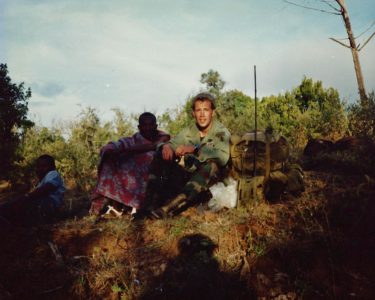
In November of 1989 Don Shipman was a sergeant first class with 5th Special Forces Group on guerilla operations in Kenya.
But it was when he was face-down in the sand during Desert Storm, yelling at the next closest man, who was yelling back because neither could hear the other that Don began bargaining with God to get him and his brothers out of this. “God, family, country. I’d done a lot for my country. It was time for more God and family.”
Stateside, Don accepted a research position with a special operations medic from the Vietnam era who would encourage him to accept the Army’s offer to get his doctorate. Don finished out his career teaching at Ft. Sam Houston in San Antonio, Texas. In the course of his medical training he was made an officer and retired as a major.
In all those years, aside from an occasional fishing trip, Don had never had a hobby. Now with time and resources he could indulge his creative side. About seven years ago he was on the Military Times Hall of Valor website where you enter your surname and up pops a database of recipients of the Silver Star up to and including the Medal of Honor. There were more Shipmans than Don could count. He’s a firm believer in the line that Rudyard Kipling made famous in his poem “Recessional”: “Lest we forget—lest we forget!” No soldier truly dies unless he is forgotten.
Don wasn’t even drawn to knifemaking, not right away anyway. But in feeding the home fires, it began to bother him that hardwoods like black walnut were being burned. “It’s practically a sin,” he said. So, he fashioned a hawk handle out of one piece and enjoyed the process. He gave it away. Then representatives from the Ranger Lead The Way Fund asked Don if he would make something for them to auction off at their 2013 gala. He made Rogers’ Rangers I, a set including a bonnet with a Roger’s Ranger badge, a 23-inch tomahawk and an 18-inch Scottish dirk with sheath. In 2016, he was asked to make Rogers’ Rangers II for a Green Beret Foundation auction. He had found the perfect outlet for his love of history, his brethren and the various streams of humanity that forged our country’s beginnings.
Don’s pieces look old and homespun, in keeping with both the available technology of the era and the skill level of the common men who fashioned them. If he doesn’t forge the blade himself, he uses The R.E. Davis Company in Woodville, Ohio, which specializes in weapon reproductions. Pieces from Shipman Hawk and Knife are pitted, worn and sometimes slightly warped, because that’s what a centuries-old edged weapon should look and feel like.
‘Knives of War’ Reveals Elite Forces Use of Knives in Combat
“Knives of War” is the “International Guide to Military Knives from World War I to the Present,” and costs $25.
Compiled by two British and one American author, “Knives of War” is a guide to edged-weapon use from World War I to the present. Of particular interest is behind-the-scenes information on the use of the Marine Raiders Gung Ho Knife, the Gerber Mark II Combat Knife as well as the most famous fighting knife of all time, the Fairbairn-Sykes. This is a must-have for any knife lover’s library.
Help us fill in our BLADE calendar. Send us the details and we’ll help spread the word.
We’ve added a calendar to BLADEmag.com. Now, we need your knife events to fill in the BLADE Calendar. We’ll take anything to do with knives: shows, seminars, workshops, hammer-ins, demonstrations, shop tours, classes, throwing competitions, open meetings at your knife club. You supply the details below. We’ll enter it onto the site and send you a link when it goes live so that you can use it on your Facebook Page, Instagram account, forum, blog or other social media outlet.
But wait, we want manufacturer and distributor events too: retail location grand openings, factory tours, celebrations. Anything the public is welcome to attend or sign up for is acceptable.
Be sure to include a photo: It can be of a past occurrence of your event; your company, show or club logo; or an image of the venue. Attach the photo to your email that provides all of the following information:
Complete name of event
Date or dates of event
Start time and end time on each day of the event
Event website or page
Event admission cost
Event organizer’s name
Event organizer’s phone number
Event organizer’s email
Description of event
Complete name of venue
Complete address of venue
Venue phone number
Venue website
Send your email to [email protected]. Be sure to submit your listing a minimum of two weeks prior to the event. We’ll do our best to help you get the word out, and we hope you refer people back to the BLADE Calendar.
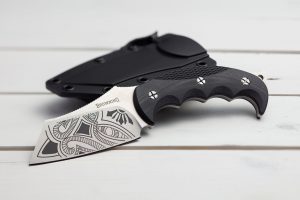
Browning’s line of Jared Wihongi Signature knives is as fierce as its SWAT operator namesake.
Jared Wihongi is a native New Zealander who began training in martial arts at an early age. As a young man he had the chance to live in the Philippines and study an edged-weapon style of fighting called Pekiti Tirsia Kali. Jared has spent 14 years as a law-enforcement special weapons and tactics operator. He also instructs other SWAT team members as well as elite military operatives in edge-weapon skills. He has advised Browning on its Black Label tactical family of knives and now has his own signature line, strikingly designed with Maori-inspired blade etchings. Be sure to subscribe to BLADE magazine to read about the Jared Wihongi Signature line of combat knives in the August issue, on sale May 16, 2017. To learn more about Jared Wihongi’s upbringing and training, read “Browning Launches Wihongi Line of Maori-Inspired Knives.”
The Jared Wihongi Signature Fixed has a canoe-shaped handle that is ergonomically correct in both a forward and overhand grip. The etchings are borrowed from Maori tattoo patterns.
To meet Jared Wihongi and hear him discuss his style and philosophy of knife fighting, here are some well-done videos by Funker Tactical. In the first, Jared discusses how the foot movements used in Filipino knife fighting can aid in an empty-hand or firearm scenario. In the second, Jared addresses how the skills developed through the practice of Pekiti Tirsia Kali are relevant to the reality on today’s street or battlefield. And in the last video, Jared talks about why you should train wearing what you wear in your work or your everyday life. Law enforcement and military especially need to practice wearing their equipment so they understand how their range of motion, breathing and other functions are affected by the added weight.
In “Fighting Folders” Michael D. Janich instructs viewers on the myths surrounding folding knives and how to employ them in a self-defense situation.
Micheal D. Janich covers how to use empty-hand skills, quick one-hand deployment techniques and knife-fighting tactics so you can lean on your folder as part of your self-defense kit. This DVD is well worth the $39.95 when you consider you can watch it repeatedly in the comfort of your home, practicing its demonstrated skills until you’re ready to take your training to the next level.
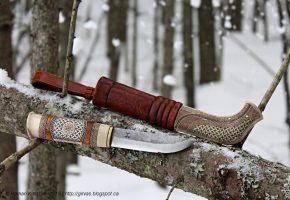
This Roman Kislitsyn sheath is made in North Sami style with a pronounced hook, which interferes less when sitting. The 4-inch blade is made by Pasi Hurttila in 80CrV2 steel. The handle is reindeer antler and birch root burl.
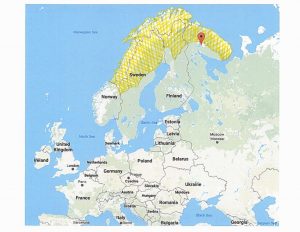
Roman Kislitsyn grew up in Apatity in the Murmansk region of northwestern Russia. Close to Norway, parts of the area also include the lands of the Sami people (in the past referred to as Lapps or Laplanders) which traverse the Kola Peninsula of Russia, and the northern and coastal regions of Finland, Sweden and Norway. Roman and others in his family are geologists so he spent much of his childhood with outdoorsmen, hunters, fishermen and those expert at surviving in the Russian wilderness. Always an admirer of Finnish and Swedish knives, Roman was most drawn to the beauty of the knives made by the Sami, the native reindeer herders of Scandinavia.
Roman Kislitsyn makes Sami-style knives.
Roman’s exposure to knives and survival equipment, combined with a love of crafting things with his hands, led to his first attempt at knifemaking when he was 15 or 16. “It had a blade made of high-speed steel from a piece of mechanical saw, wooden handle made of birch burl, and simple leather sheath, but I was very proud of myself,” Roman related. He made a few more knives, left to attend university and life intervened. A few years ago, he returned to knifemaking and cannot stop.
The traditional Sami lifestyle depends on reindeer herding, hunting and fishing. Roman explained that the design of their knives developed over the course of hundreds of years. They also mastered their own style of decorating things made of reindeer antler. “I like to use Sami-style decoration on my knives too. Even though I’m not Sami, but this makes me feel my connection to the land where I grew up,” Roman stated.
Sami lands, in yellow, historically reached farther south, encompassing Roman’s home region, marked in orange.
Roman makes two types of knives, either Sami style or Finnish puukkos with Sami-style carvings. He does not make his own blades. Some Sami blacksmiths existed, but using blades made by other makers was, and still is, a common practice.
Roman works with high-carbon steel blades made by his friend Alessio Salsi in Belgium. Lately, he’s also being trying laminated and pattern-welded steels. Since Roman makes Scandinavian knives, the grinds are all Scandi. He used to employ blades made by Pasi Hurttila from Finland before Pasi stopped making knives. Roman also used blades made by Randal Graham in Nova Scotia. Randal took a hiatus from knifemaking but has now returned, and Roman hopes to resume collaborating with him.
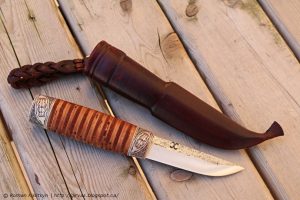
Roman Kislitsyn put a stacked birch bark handle on this 3.2-inch Pasi-Hurttila-made 80CrV2 blade. Carvings on the antler are in Sami-style. Bark handles are popular for Finnish puukkos; they never get slippery or cold, even below freezing.
Roman is self-taught, learning everything about knifemaking and carving through the Internet, forums and social media. With the exception of light use of a hand-drill and a Dremel, Roman uses only hand tools. “No grinders, sanders, band saws, nothing. Only files and rasps, only hardcore!” he explains. Roman’s goal is to make “functional art,” as one of his customers put it, and not a knife that just sits on a shelf. His favorite handle materials are reindeer antler in combination with birch burl and-or bark, which are all traditional materials in Sami-style knives. Maker’s list price starts at $450 US.
Roman left Russia in 2002 and now lives in Nova Scotia, but you can converse with him through forums like British Blades, Canadianknifemaker.ca and the Russian forum zadi.ru. His website and blog are at Girvas. “Girvas is a name of a lake in same region where I’m from,” Roman added. It is the Russian pronounciation of the Sami word hirvas, meaning “reindeer stag.” You can visit Roman on Facebook at Roman Kislitsyn or on Instagram @roman.kislitsyn. You can e-mail him at [email protected].
The CRKT Homefront is the 2017 BLADE Show knife, and won last year’s Most Innovated Imported Design.
The CRKT Homefront is a Ken Onion-designed knife that won Most Innovative Imported Design at last year’s BLADE Show. The field-strip technology allows for easy cleaning anywhere, without tools. Get yours now for $70 and you’ll save 30% off this true collector’s item.
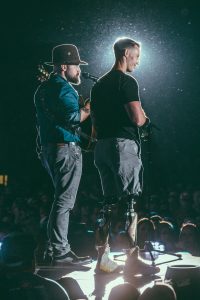
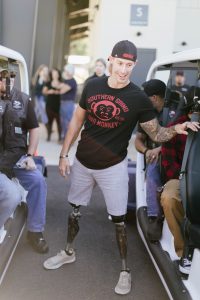
Zac Brown’s Southern Grind deploys formidable spokesman, Johnny Joey Jones, a double amputee Marine staff sergeant.
Johnny Joey Jones, Triple J to his friends and Explosive Ordnance Disposal technician to his Marine Corps brethren, wrote a poem about a particular day, a particular explosion, a particular knife, while on patrol in Afghanistan.
Jones, a double amputee and motivational speaker, is the spokesman and more for Zac Brown’s Southern Ground, which is an umbrella company that represents numerous 100-percent American-made and -sourced products, including the knife company, Southern Grind. Proceeds from the sale of these patriotic items benefit Camp Southern Ground, which strives to give kids of all races and religions, and especially those with neuro-developmental challenges, the positive influence of a camp experience. The camp also helps military families by offering the same experience to children who are dealing with a deployed, injured or deceased parent.
In May 2010, about three months before Staff Sergeant Jones would step on an IED and lose both legs above the knee, he was on patrol with a group of Marines. (In the Corps, EOD units go where they are needed, with whom they are needed.) They came to a small canal. “There is always lots of learning,” Jones said, and in this case, it was that you don’t want to use foot bridges to cross waterways. Such crossings would create bottlenecks, ideal spots for the enemy to booby-trap.
Prior to losing both legs above the knee Johnny Joey Jones was an Explosive Ordnance Disposal technician in Afghanistan.
To get across, first the sweeper, the Marine with the metal detector, went and then the mine-detecting dog and his handler went. “We think the dog stepped on the mine,” Jones said. “The Water So Cold” tells the story.
Joey Jones not only took the lead in combat, he became a mentor to recovering wounded veterans like himself.
The knife was a folder issued to Marines. “I was going to cut off his gear, but guys reached down to pull him out. Days later I realized I still had his knife in my cargo pocket,” Jones said. “I gave it to his first sergeant to give it back to him,” Jones said. That first sergeant is the man in the poem of whom the speaker asks about the Marine’s condition.
Jones has had a poetic streak most of his adult life. Since separating from the service, he has earned his Bachelor’s degree from Georgetown University in public policy. “I don’t go back and edit,” Jones said. He wants the poems to represent him authentically, as he was at the time.
Check back to read more about this inspirational wounded warrior.
To learn more about how Jones and Brown met and the knives made by Southern Grind, be sure to subscribe to BLADE® Magazine.
In “Fighting Folders” Michael D. Janich instructs viewers on the myths surrounding folding knives and how to employ them in a self-defense situation.
You don’t have to have been in combat to know that sometimes Plan B—the knife—can quickly become Plan A when it comes to self-defense. Often our everyday carry is a folder. This DVD can get you started on proper grip, one-handed openings and other tactics using folding knives. The $39.95 price is less expensive that a class and can be watched repeatedly in the comfort of your home.
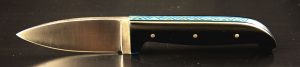
Smyth Knives’ Flat-Grind Utility Knife is made using O1 tool steel, black G10 scales, and blue liners. The blade is 3 inches, and the knife is 7.5 inches overall.
Irishman Paddy Smyth of Smyth Knives in County Roscommon, Ireland, sells 90 percent of his knives through his website to customers in the USA. The other 10 percent are purchased through The Quiet Cailin Studios in Cong, County Mayo, where “The Quiet Man,” starring John Wayne and Maureen O’Hara, was filmed. Some even incorporate ancient bog oak.
Irish Eyes Will Smile Over Smyth Knives
But it was another movie that sparked a love of knives in Paddy growing up. He watched wide-eyed as the work of Gil Hibben’s was deftly wielded in “Rambo III.” It is “my favorite knife of all time, so I have huge respect for [Hibben’s] work,” Paddy commented. He had a week-long visit last year from Jeff Knox, who trained with Hibben in the US. “He has been a great help to me also with advice and sourcing materials as its hugely difficult to get materials in Ireland,” Paddy added.
Paddy Smyth lives in County Roscommon in Ireland and undoubtedly with a name like Smyth has knifemaking in his blood.
He also mentioned that Walter Sorrells’ YouTube channel has been helpful and inspirational.
However, Paddy is a self-taught knifemaker and much of his learning has been by trial and error over the years. “I continue to learn,” he noted. He was trained as a chef and butcher and always had a keen interest in hunting, so he was intrigued by what made a high-quality knife. “So, I basically decided to have a go at knifemaking and caught the knifemaking bug,” he said.
Paddy concentrates on compact pocket and neck knives, bushcrafting and hunting/skinning knives. He makes specialty chef knives to order to client specifications. His favorite steels are O1 an Niolox stainless. He appreciates the consistent finish and heat treat he gets using these steels.
He likes three grinds: Scandi for his bushcrafting blades because it’s easy to maintain an edge; and flat and hollow, according to customer preference, because they both work well for his hunting and skinning blades. For bushcrafters, he chops and batons wood to test for toughness, and then fine-carves paper to verify sharpness. Cutting heavy cardboard with its abrasive quality helps him get a feel for how long his blades will stay sharp. He does ensure his flat- and hollow-ground blades can handle the detailed work of skinning and boning.
The Claw by Smyth Knives, left, is 5.25 inches long, with a 2.2-inch cutting blade. It’s perfect for close skinning/boning/gutting with complete one-finger control.
“My favorite handle material is ancient Irish bog oak, which can be up to 10,000 years old. It finishes really well and has beautiful character and history,” Paddy explained. “It’s very difficult to work with as it’s so hard it’s almost fossilized. And it’s becoming harder to find good pieces. It’s very hard on machinery and tools, but the work is worth the finished product.”
There are no knife shows currently in Ireland, so Paddy sells his work online at www.smythknives.com. Prices range from 90 to 500 Euros plus shipping with discounts for repeat customers. Also, check out the boutique artisan gallery in County Mayo where Smyth Knives are also sold on Facebook. Smyth Knives on Facebook and @smythknives on Instagram are chock full of additional photos and videos. You can call Paddy at 00353 87 6281252.
All Smyth Knives are completely handmade and heat-treated in house. Leatherwork is specific to each knife, so no two creations are the same. Paddy is a retail manager for an oil company based in the west of Ireland. He lives in Roscommontown with his wife, Edel, and their three boys, Shane, Darragh and Cian.
The ornate file work on the spine of this knife by Paddy Smyth in County Roscommon, Ireland, is reminiscent of a Celtic pattern.
“When I started making knives, I realized I had found something incredibly natural to me, as if I was meant to do this or was maybe in my blood, as my family name is Smyth,” Paddy noted. “I’m completely at peace when I’m in the workshop.”
The CRKT Homefront is the 2017 BLADE Show knife. Be sure to get yours now.
CRKT and Ken Onion took home the Most Innovative Imported Design award at the 2016 BLADE Show for the groundbreaking Homefront. Now the Homefront is the official knife of the 2017 BLADE Show. This is a limited run of 300, so hurry! And at $70 you’ll be saving almost 30 percent.