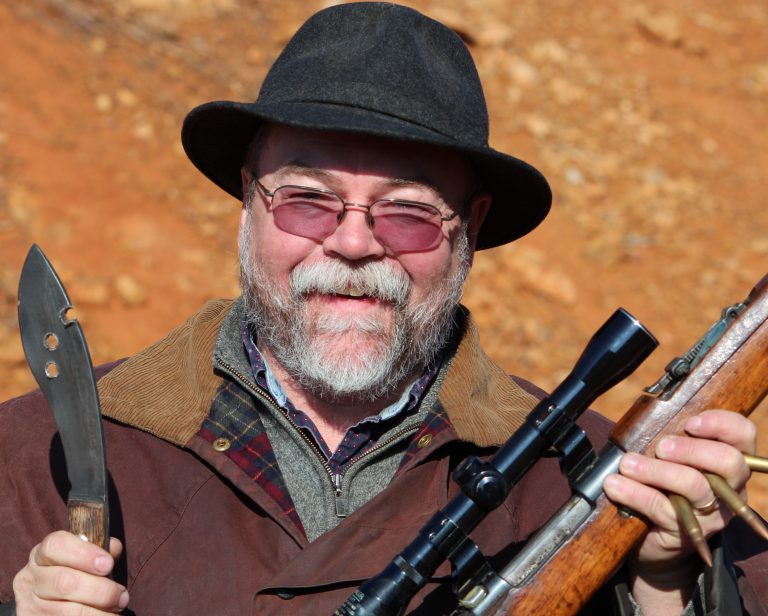
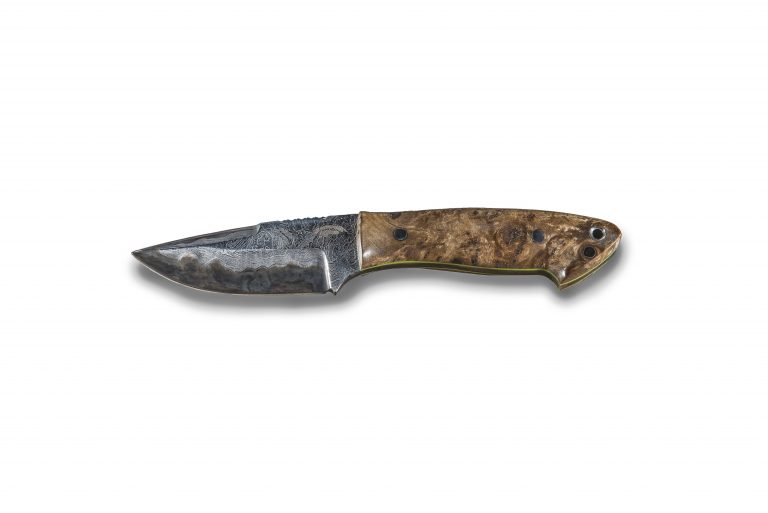
The June issue of BLADE® magazine features a story about wilderness survivalist Creek Stewart and his line of Whiskey Knives, made by Hank Gevedon and crew at Reptile Toolworks in Mt. Vernon, Kentucky. Whiskey Knives are carefully tested, but Hank likes to destroy a few from time to time to spot-check their quality. He starts by bending a Whiskey Corvid model to show that the hard outer layer of the A36 carbon steel will crack when bent in half, but that the knife will stay intact because of the tough inner core. Then he gets to shooting them. Besides, Hank’s just entertaining to listen to.
A Bent Whiskey Corvid Knife Still Chops and Slices
Hank Shoots A Whiskey Corvid with an 8mm Mauser FMJ
So what does all that mean to the knife owner? Well, you won’t want to bend your knife in a vise or shoot it at the range, but the following review of the destructive testing explains how the makuri method of construction can produce a sharp, yet tough knife, ideal for hard-use bushcrafting needs.
What Does Destructive Testing Reveal About Whiskey Knives?
Sure They’re Sharp, But How Sharp?
Know How to Sharpen Your Knives
A collection of knives is only as good as it is sharp. Understand how to sharpen all styles of grinds, along with other tips on caring for your collection.
The blades on Whiskey Knives are asymmetrical hollow-ground, meaning that you only need to sharpen one side, the one with the Creek logo on it. The other side just requires a touch-up. Reptile Toolworks puts instructions in the crate with each Whiskey Knife it sends out, but what about your other knives? “Sharpen A Knife, And Care For Your Collection” by BLADE editors covers all aspects of sharpening, demystifying the process and ensuring you have the knowledge to keep your knives sharp at home and in the field.
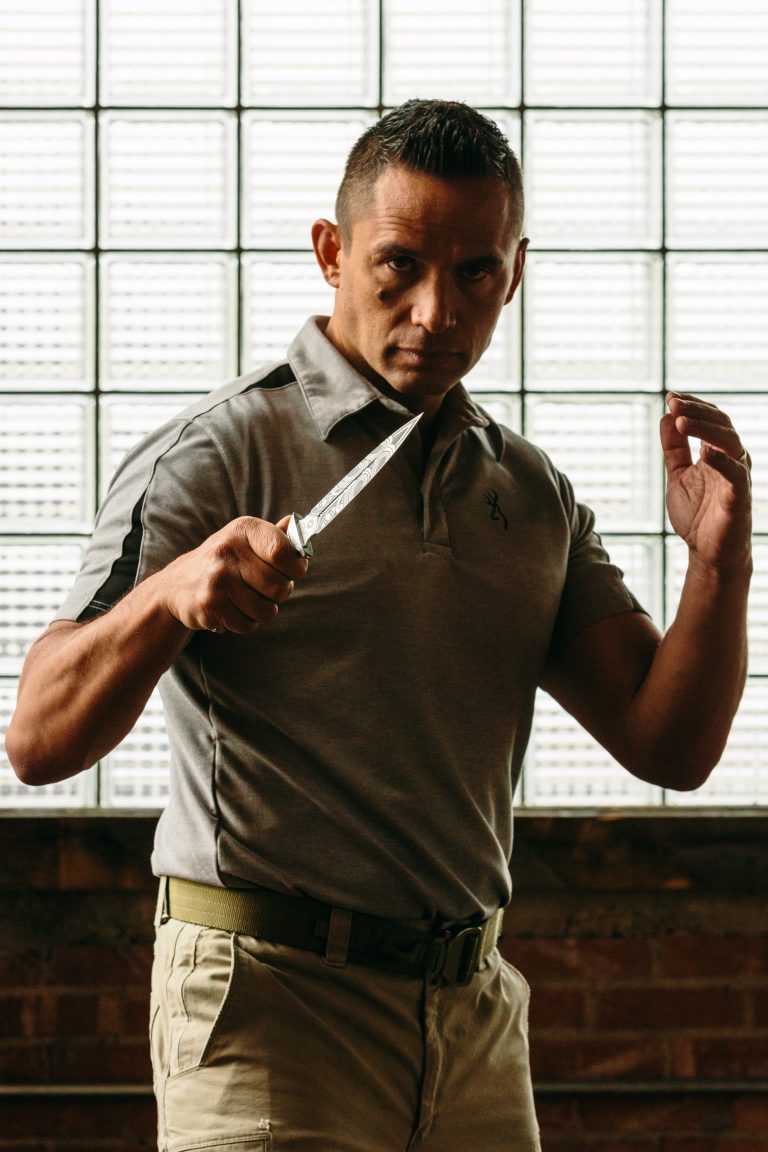
Together with Browning, tactical knife fighting instructor Jared Wihongi has released a signature knife line.
Jared Wihongi’s life and career is built on the warrior spirit of his Maori ancestors. He has practiced martial arts since he was a 10-year-old living in New Zealand, and the Filipino style of knife fighting, since he was 20, some 20-plus years ago. He also has his own signature line of edged weapons through Browning, knives that he hopes inspires “the warrior spirit that lives in each of us.”
Jared has reached the tuhon or master level of Pekiti Tirsia Kali and instructs police officers and elite military operatives in what he calls close quarter force integration tactics, or CQ-FIT. He applies the circular arm movements, the footwork, angling and distance control of Pekiti Tirsia Kali, using empty hands, sticks, knives and even guns, to reality-based training so that police officers are better able to subdue threats, or a special forces member is able to eliminate enemies in close-quarter combat.
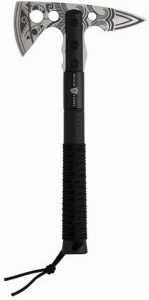
One of Jared’s most interesting-to-watch training sessions involves using a tomahawk in close-quarter fighting. Essentially, the circling motions, overhand and underhand, forward and backhand, are coordinated for attacking your opponent while simultaneously avoiding his advances. The tactical tomahawk in the Wihongi Signature Series is a true straight-handled tomahawk. The blade is made from ¼-inch 420 stainless steel, and the spike end includes a semi-sharpened blade. Three lightening holes are drilled into the blade, maintaining the integrity of the head while removing material to lighten the weapon, making it easier to wield in a fight—or to be fast as lightning.
The Jared Wihongi Signature Series Tomahawk includes acid-etched motifs from the Maori warrior culture.
The forked tang is secured with three flush-mounted screws but is also reinforced by a wide metal ring surrounding the handle. The Wihongi Signature Series Tomahawk carries Browning’s Black Label tactical line logo, along with the familiar Buckmark. The handle is wrapped in paracord, a lighter weight than 550 to eliminating bulkiness, Jared explained.
What is most notable about the weapon is the Maori tribal motif acid-etched into the steel. The warrior culture often carved facial features into woodentaiaha, or fighting staffs. These weapons would include eyes and ornate details that culminated in the familiar out-stuck tongue. Having these designs in a tattoo or engraved on a weapon meant that the warrior was carrying the strength and courage of his ancestors with him into battle.
Jared’s mother hailed from the Lone Star State, but being Mormon she decided to move to Utah. Jared’s father, living in New Zealand, attended a private school run by the Church of Jesus Christ of Latter-Day Saints. He excelled and was granted a scholarship to attend a university, also in Utah. The rest is history. By the time Jared was 1, the couple had returned to New Zealand, raising a brood of six.
Although native New Zealanders only make up 15 percent of the country’s population, the Wihongis lived in a small town that was predominantly Maori. Having grown up the late 1950s when there was little opportunity for Maori youths other than to become farmers, Jared’s father put great importance on education and became a school principal. Two of his sons followed in his footsteps, but Jared and another brother became police officers, with Jared going on to become a SWAT operator for 14 years and counting. He now teaches knife-fighting skills to SWAT teams and elite special forces in the U.S. and allied countries. “I’m an educator too,” Jared said, just in the warrior arts and lifestyle.
Jared Wihongi reviews his tomahawk fighting tactics.
Jared’s father died at a young age and when Jared was 17, the family moved back to the Salt Lake City area. Mormons are expected to go on a two-year mission before attending college. Jared served in the Philippines, which is where he began training in the Filipino knife-fighting arts. He attended college in Hawaii, where he worked as a bouncer, often having to apply his skills in a real-world application. He then returned to the Salt Lake City area and has advanced exponentially in his martial arts practice and his real-world curriculum, which incorporates both the warrior spirit of his Maori ancestors and the premier knife-fighting skills of the Filipinos.
He recommends that anyone who wants to be able to defend themselves against a knife attack seek out a Pekiti Tirsia Kali instructor who offers real-world-scenario training. “Take a sample class,” Jared suggested. “You’ll be able to tell.” Learning to defend yourself against a knife attack is part of learning how to wield a knife in close proximity. Amazingly, this can be done with a tomahawk by choking up on your grip to right under the head. Don’t worry, practice is conducted with training knives. “But you have to make contact to understand knife fighting,” Jared explained
“When I presented this line to the sales force, I asked Jared to lead a haka dance,” said Diane Carver, knife and light product manager at Browning. The feedback she received was intense. Some had never seen the Maori warrior dance that has now been made popular by the New Zealand rugby team and others on social media. Some were inspired to see it live. “I’m so excited about this line,” Diane said.
Jared Wihongi introduces his signature knife line−and leads a haka.
If you’d like to read more about Jared and the four styles of knives in the Jared Wihongi Signature Series by Browning, be sure to pick up the July issue of BLADE® magazine or subscribe.
If you’ve ever wanted to try making your own tomahawk, this digital download will provide answers to your questions.
This digital download is an economical way to learn how to select and forge your tomahawk billet, how to drill and fill the eye hole, how to fit the haft to the head and grind it to rough shape. At only $4.99 this volume by BLADE field editor and ABS master smith Joe Szilaski is a fun and needed addition to your weapon-making library.
Knifemaker Stefan Neil Palmer made a knife in memory of Dustin Chamberlain to be auctioned off. He never knew it would change his life.
While at his parents’ Siloam Springs, Arkansas, home for Christmas break 2011, 20-year-old Dustin Chamberlain was shot dead by an intruder. Nearly five years later, knifemaker and racecar driver Stefan Neil Palmer was asked by his racing mentor if he would make a knife to auction off to raise money for Dustin’s Dream, the charity foundation organized in Dustin’s memory. Stefan agreed, but when he laser-engraved Dustin’s favorite saying on the handle, everyone agreed that the knife could never be auctioned off.
On Dec. 15, 2011 Dustin, a biology-pre-med sophomore at Baylor University in Waco, Texas, was resting at home after a minor outpatient procedure. Both his parents left for work with Dustin’s reassurance that he didn’t need anyone to stay with him. His father, Don, had planned to have lunch with him. At approximately 10:45 a.m. Dustin’s mother, Deondra, called the house and Dustin’s cell phone repeatedly but got no answer. She called Don and asked him to check on their son.
Don walked into the Chamberlain home to find his son lying dead just inside the door with four gunshot wounds. In the family room, he found a stranger with what police subsequently said appeared to be a self-inflicted gunshot wound that later proved fatal. The investigation revealed that the stranger was a local man who had been reported missing, depressed and possibly suicidal. He had wandered onto the Chamberlain property, and evidence showed he’d been on the premises for two hours before the Chamberlains left for work.
It’s an understatement to say that the Chamberlain’s lives were changed forever, but as day followed day, God showed them how they could carry on Dustin’s name and spirit, Don explained. “It’s been therapeutic,” he said, referring to the charity they set up in remembrance of their son. In honor of Dustin’s dream to one-day become a doctor, Dustin’s Dream sets up medical clinics in third-world countries and funds teams to conduct medical mission trips to those countries. They also offer scholarships for aspiring medical students.
Knifemaker Stefan Neil Palmer made a knife to auction off in benefit of Dustin’s Dream.
In 2013, two years after Dustin’s murder, Chamberlain family friend Steve Butler decided to use his racing hobby to support Dustin’s Dream. Steve introduced Stefan to Dustin’s Dream Racing, which raises money for the foundation “while being a positive, Godly influence” in the sport of racing, according to their web page. In the summer of 2016 it was suggested that Stefan make a knife to auction off to benefit Dustin’s Dream.
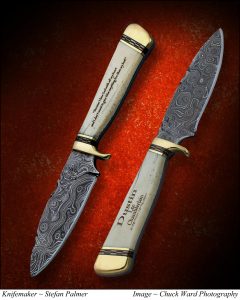
So Stefan set out to make the best knife he could to honor Dustin. The 3.112-inch hollow-ground drop-point hunter was constructed using buckshot-pattern steel forged by Brad Vice’s Alabama Damascus. “It’s my favorite pattern,” Stefan said. And buckshot- or raindrop-pattern damascus is his favorite steel. The handle was made from camel bone and brass with—fittingly—a checkerboard inlay front and rear of the handle. The shinbone of the camel is an economical choice, but it’s the ideal medium for laser engraving, explained Stefan. The rubbing compound left in the pores of the bone lend it that gray undertone. Signature filework runs from the tip to the butt of the spine. “It turned out great,” stated Stefan.
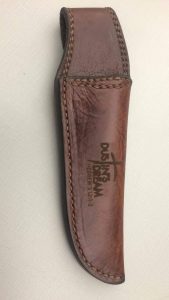
Stefan Neil Palmer’s accompanying sheath notes Hebrews 12:1-2, which includes in part “let us run with perseverance the race marked out for us.”
He went to Steve to see if there was anything that Dustin was known for saying. Steve showed Stefan what the Chamberlains had written about Dustin. “Whenever anyone asked Dustin how he could consistently make wise choices and live his faith, Dustin would say, ‘Because I love God with all my heart and I don’t want to give Him anything less than my best.’” Stefan explained, “I put that on the knife. When I looked at the finished product, I knew the knife was not for someone to buy. It was priceless and needed to go to Don.”
Stefan took his dilemma to Steve and it was agreed that a second knife would be made for the auction. The trick was to keep Don’s knife a secret, made harder by the fact that Don expressed great interest in the knife. Steve suggested to Don that he not bid on it because people would then back off their own bidding in an attempt to make sure that Dustin’s father ended up with Dustin’s knife. The racing team wanted the knife to bring in as much money for the foundation as possible.
In the end, at Dustin’s 5th Heavenly Birthday Chili Supper and Baked Goods Auction on Dec. 10, 2016, Stefan presented the original knife to Don, with both giver and receiver ending up in tears. “It changed my life,” Stefan said. “I’m not so likely to cut someone off on the race track with the Dustin’s Dream sticker on my car,” he added with easy laugh. (The T in the Dustin’s Dream logo is in the shape of a cross.) He relates how so many people have been affected for the better through Dustin’s example and the strength of the Chamberlains. “So much beauty has come out of it,” Stefan said.
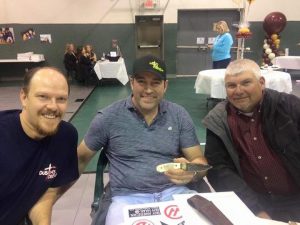
Dr. Carl Duncan, left, ended up with the knife Stefan Neil Palmer, center, made in honor of Dustin, the son of Don Chamberlain, right.
The Chamberlains never returned to their home. Don manages a beef cattle ranch and other properties for his boss, and the couple and their daughter stayed at the ranch the night of the murder. They found a place to rent, but the two payments nearly put them under financially. All the while, Don said he was thinking, “I wish I could afford to just give it away to a couple who could help foster children.” Two years later, a doctor—surprise, surprise—Carl Duncan and his wife, Carol, purchased the home, and—you guessed it—they had foster children.
It was Carol who ended up with the winning bid of $3000 on the second knife, and she presented it to her husband. According to the Dustin’s Dream website, the racing team has raised $45,000 for the foundation.
Stefan’s wife, Raquel, bringing the story full circle, is returning to school to become a doctor—in the same specialty as the doctor who purchased the house and the knife. She and Stefan hope one day to accompany a medical mission team through Dustin’s Dream. Don and Deondra, a nurse, are returning to Guatemala through Dustin’s Dream for his second trip and her third. If you want to know what you can do to get involved, visit www.DustinsDream.net/give.
When Don returned to the house that fateful day, he thought it was odd that the family’s Jack Russell-rat terrier cross was out in the yard. Cricket was trembling in fear, and, uncharacteristically, she would not come to Don. It is believed that she raised a ruckus when the intruder broke into the house near her bed. Dustin came to see what the fuss was about. In yet another connection, I breed Jack Russells.
According to what police revealed to Don, the shooter asked his wife what it meant if someone was very depressed. She answered that it meant the person needed professional help. The husband and father of four reportedly said that he felt he was too much of a coward to do that. He took a gun and left the home.
I asked Don if he knew how the family was doing now. He said he didn’t, but that it had been on his heart to find out, and that my asking had solidified that course of action for him. And “no,” he said quietly, “I could never use that knife.” He has it on a dresser, along with the sheath and some photos. He wants to put it in a shadow box. “I could never use that knife,” he repeated.
“Art of the Knife” doesn’t require anything more than being appreciated for its beauty.
If you want inspiration for your own knifemaking, here’s your eye candy. Over 500 knives are pictured, and they run the gamut from highly polished and bejeweled to hunters with artistic flair. Author and former BLADE managing editor Joe Kertzman covers scrimshaw and engraving, as well as the art of each style of knife. Normally, $35, this beautiful book is now on sale for $21, a 40-percent savings.
GiantMouse is pushing the boundaries of two renowned Danish designers, but together with an American businessman are building a better collaboration model.
By now knife industry followers know that renowned Danish knife designers Jesper Voxnaes and Jens Anso teamed up to create GiantMouse LLC. What you might not know is that a California businessman with a love of knives became the organizational drive behind the endeavor. Jim Wirth asked a simple question over beers with Voxnaes and Anso that solidified the venture, and bettered the collaboration model creatively and financially.
When Wirth turned 14, his older brother Chris gave him a small Gerber pocketknife with mother-of-pearl scales as a birthday present. He loved looking at that work of art, and yet, the knife got plenty of use too. From then on, Wirth began attending knife shows, like the former Bay Area Knife Collectors Association show in Santa Clara. He joined that organization so he could attend the meetings and learn more about the knife industry.
His love of knives—and watches—grew and he continued to attend shows, adding the New York Custom Knife Show and BLADE Show. Meanwhile, he developed a data warehouse-business intelligence firm that became an Inc. 500 Fastest-Growing Company. After a merger, Hewlett-Packard bought the company, and Wirth was set as far as his family and living expenses were concerned. He began consulting, advising owners of young businesses and angel-investing, or backing business that show promise.
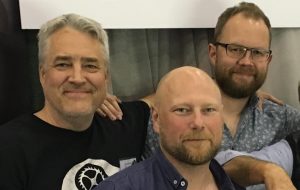
Jim Wirth, left, a businessman and angel investor, suggested that Danish designers Jesper Voxnaes, middle, and Jens Anso, right, start a new company to produce knives they collaborate on, sharing in profits rather than receiving a royalty percentage.
Wirth had always been a fan of the work of Voxnaes and Anso, so at a BLADE Show, although he’d met them before as a customer, he was more formally introduced to the men through a common friend. Over drinks, Wirth inquired about the royalties each knifemaker was making in their partnerships with well-known manufacturers. Although mum on details, designer royalties on any manufacturing collaboration range from 3 to 7 percent, sometimes as high as 10, of net sales. There are countless variables that determine the final cut, however, according to numerous sources in the knife and product development industries, 5 percent is thought to be fair for both the designer and the factory that takes the risk on whether the product will be a success or not.
Voxnaes and Anso revealed that they had indeed co-designed some knives together. They had even come up with a potential company name, GiantMouse, because Denmark is a tiny country in a giant world and they wanted GiantMouse to be a small knife brand in a giant knife industry. Wirth asked why they hadn’t produced these knives they’d worked on. And with that question, GiantMouse came into being.
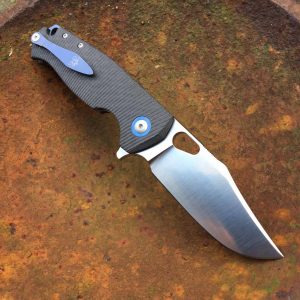
The P in the GMP2 version stands for pirate and if you look closely, the mouse logo is wearing an eyepatch.
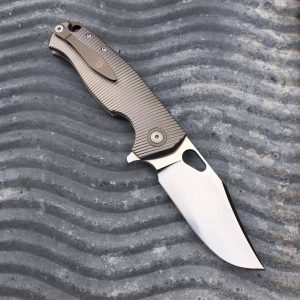
The three men determined that they would only do limited runs of folders four times a year, 300 in a standard finish and 100 in a special finish. These 100 “pirate” versions would include the GiantMouse logo with a patch over its eye. The GM2—GM for GiantMouse and 2 for sequential order—for example, is a full-size everyday carry folding bowie with carbon fiber handle scales. The backspacer, clip and pivot ring are a rich blue anodized titanium. The nested lockbar is also titanium. The 3.3-inch blade is made of Bohler M390 Microclean powder corrosion-resistant martensitic stainless steel with a satin finish and is ground to a 0.157-inch thickness. The handle length is 4.62 inches, and the knife weighs 4 ounces.
The GiantMouse team knew they always wanted to have some knives available for sale, so they do not limit sales of their fixed knives like the GMF2.
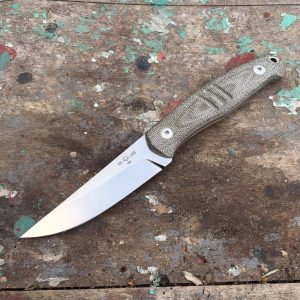
Although the folders are discontinued as soon as the 400 pieces sell out, the GiantMouse fixed-blade runs are unlimited. The GMF2—F for fixed—for example, with leather sheath, is a throwback to a Nordic work blade that can be used for everything from bushcrafting to everyday tasks. The 3.62-inch blade is made of Bohler N690 cobalt high-performance powder steel, ground to a 0.157-inch thickness and finished in a fine stonewash. The 4.43-inch Micarta handle brings the overall length to 8.12 inches. The knife weighs 4.1 ounces.
The way the designers look at it, according to Anso, is that by working very closely and combining their skills, each designer is forced out of his individual comfort zone. Integrating each maker’s ideas and style without compromising on design quality is “a difficult task but makes for a very strong design if done right.” It’s important to each man that the other is able to vouch for everything involved in the design. Both must be happy with the final result of each knife.
Anso and Voxnaes both started making knives in 1989, and they both lived in rural northern Jutland, only about 30 miles apart. They didn’t actually meet until 2005 at a small knife show. They instantly hit it off and have been close friends and colleagues ever since, explained Anso.
The two friends met Wirth at a BLADE Show when Wirth was collecting knives. “With Jim’s well-known talent for business, high ethics and passion for quality, combined with our skills and experience in the knife business, the idea of GiantMouse Knives started to take form,” Anso stated.
As chief executive officer, Wirth drew up the articles of incorporation and launched the website. He also set up the fulfillment center in Southern California. The knives are manufactured in Maniago, Italy, and Voxnaes and Anso handle all interactions with the manufacturer from approving prototypes, through test runs, to quality control of the finished knives. A final inspection is performed when the knives arrive in California. Out of a run of 400, perhaps a half-dozen will be returned because the blade is slightly off center or a flipper action isn’t as smooth as it should be. The knives are then sent to the fulfillment center where they are put in branded packaging and sent to customers.
One might figure that short runs of well-designed knives would be unaffordable because you don’t have a high number of pieces over which to spread the start-up costs. There can also be fees if runs don’t meet a minimum quantity. But the founding trio at GiantMouse committed themselves to this route because it incentivized the designers. “They’re challenged to create more designs. It’s exciting,” Wirth said. And as partners in the company, the designers share in the profits with Wirth. This both pushes the designers and rewards them for their efforts perhaps more than a percent-of-net-sales royalty would.
All along the goal has been to create exceptional knife designs, produce them at the highest quality possible and keep them affordable. For example, the maker’s list price for the GM2, in standard finish, is $325; the GMP2—the P standing for pirate—in special finish, is $375. Ten dollars from the sale of every folder, and currently $20 from every fixed blade, is donated to Save The Children. (The organization helps ensure children at home and abroad receive the heath care, nutrition, education and protection they need to grow up happy and secure.)
Wirth said that he got to go to Demark and see the operations of both designers. Then the trio drove to a knife show. “I sat in the back and listened to Jens and Jesper talking in Danish. Every once in a while, I’d hear ‘Jim,’ and I’d be like, ‘heeey.’ The only Danish I learned was something written on the radio, something like ‘the radio isn’t on.’ Now that’s what I say to them when I see them.” Wirth laughed telling the story. He seemed happy, like you might imagine a 14-year-old boy would be over receiving a beautifully designed knife.
Know What Great Knife Design Is
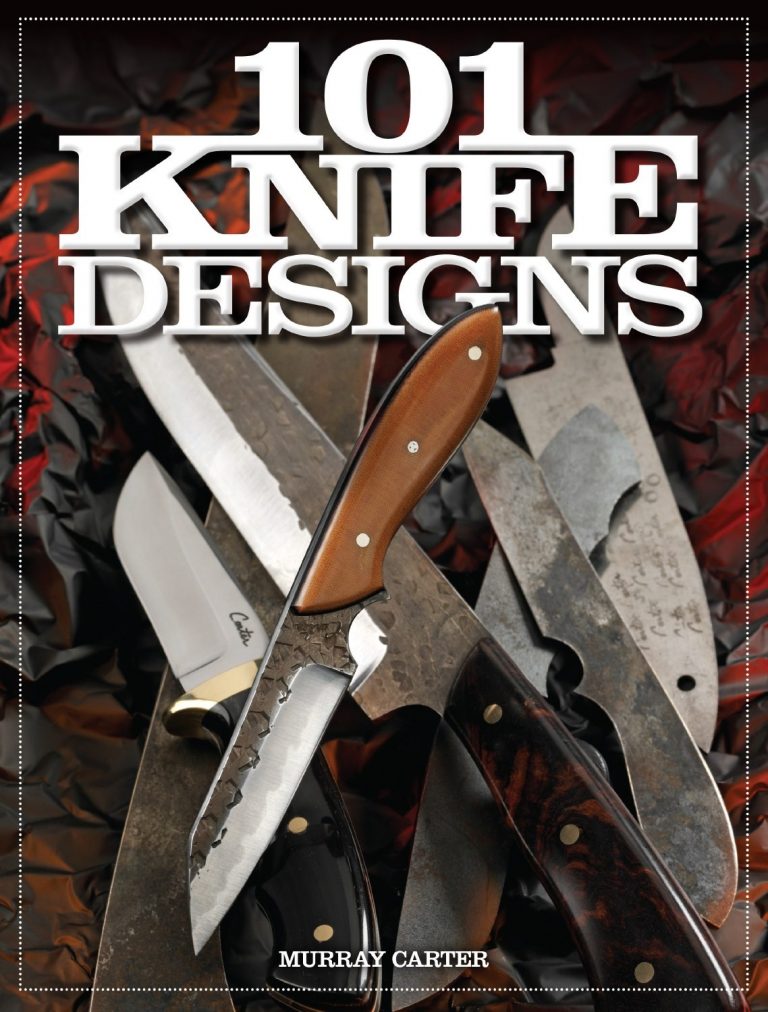
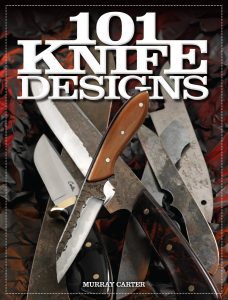
“101 Knife Designs”will give you both theory and beauty behind the great knife designs.
Understanding what makes a great design makes you a better collector and a better maker. “101 Knife Designs” by Murray Carter will not only inspire your work with detailed discussion of blade design, but will give you full-color images of exquisitely designed knives to ogle. At $19.53 you save $10.43 off the cover price.
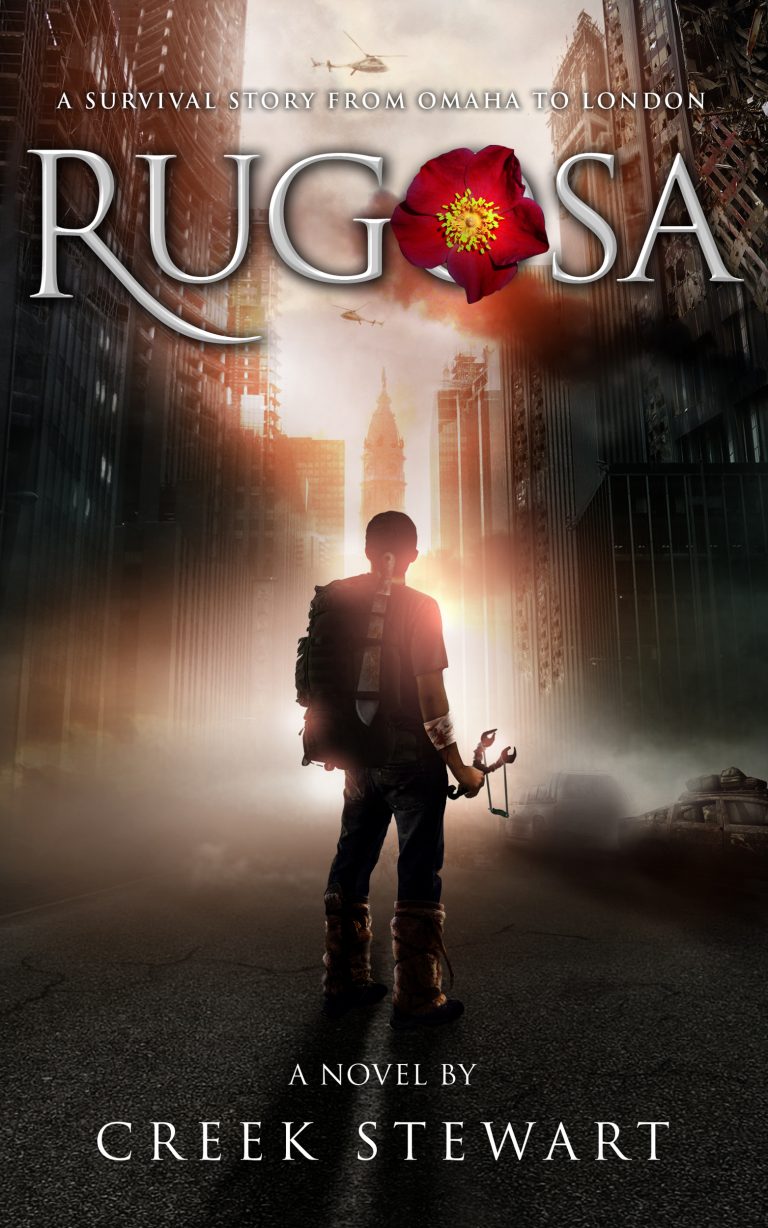
Creek Stewart uses his survival knowledge, and a few good knifes, to tell a rockling adventure story, with a good romance interwoven throughout.
Valentine’s Day saw the release of survivalist and Whiskey Knives co-collaborator Creek Stewart’s young-adult romance novel, “Rugosa.” What knife enthusiasts will appreciate about this adventure is that by page 4 a machete crafted from a lawn-mower blade has made an appearance, and many others follow.
In the dystopian world of post-globalization America, 17-year-old Omaha Hoyt must leave the farm and woods were he is most at ease and travel to the city to rescue his love. The plan is to stay on back roads and subsist off his trapping and foraging skills. Very quickly plans change and the lifelong Boy Scout is forced to help someone he meets along the way.
Omaha’s pocketknife gets lots of use, and his sister makes a survival girl’s dream barrette that is shaped like a butterfly with cutting edges, a fishing line wrap with hooks for antennae, and is apparently weighted for easy throwing as a weapon. In what one might consider the equivalent of a gun getting reloaded in a movie, in the book there is actually a knife-sharpening scene.
This is not to say that “Rugosa” is knife heavy. It’s first and foremost a survival story about a 17-year-old who uses his scout training to survive physical and emotional challenges. But knives are more than an essential tool in this book. They each have a story behind them. Even the knife used against the protagonist is rich in lore.
“Rugosa” is also equal part love story. An author must possess the emotional intelligence to remember what it was like to be 17 and be able to convey what’s going on in the heart of a young man before that youth necessarily understands his own emotions, never mind knows how to convey them. It’s hard not to come across as a mature adult when writing from the perspective of a teen, but Creek creates a believable character. You can read more about the wilderness survival instructor and knife co-collaborator at “Survivalist Creek’s Life Led Naturally to Whiskey Knives.”
The book’s opening is slightly choppy, but only because editors now demand action begin in the fist paragraph. The beginning describes the farm and woods where Omaha lives with his mother and sister and the secret storage bunker he keeps hidden by “Rugosa.” It’s relaxed reading and idyllic, but once Omaha departs on his mission, the excitement is ramped up and the pace is non-stop. It’s easily read in a day or two.
You can get the paperback edition of “Rugosa” for $14.99 and the Kindle version for $3.99 through Amazon. Young-adult novels are one of the healthiest segments of publishing, probably because they’re fun for adults to read as well.
If you’d like to learn more about how Creek collaborated with Hank Gevedon of Reptile Toolworks to create Whiskey Knives, the bushcrafters that look like they stepped out of a 1700s mountain man’s kit, be sure to pick up the June 2017 edition of BLADE Magazine.
And yes, Creek is working on a follow-up novel to “Rugosa.” It takes place during the same timeframe but is told from the perspective of Omaha’s love interest, London, while she struggles to survive during the hostile takeover of Philadelphia.
Build a bug-out bag for your next adventure
Follow Creek’s instructions for putting together your emergency kit and you’ll have least a fighting chance of surviving.
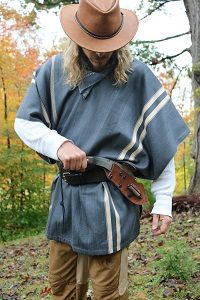
Survival instructor, author and TV star Creek Stewart cross-carries a Whiskey Knives Corvid.
When Matthew Stewart was 5, his grandfather gave him a nickname that would chart the course of his life. “I was always playing in the creek,” said Creek Stewart, survival instructor, author and star of The Weather Channel’s now-cancelled “Fat Guys In The Woods.” No matter the time or weather, the boy was at the creek—happy. Not much has changed, except the budding outdoorsman of yore has now built an empire on his comfortable, family-friendly style of survival instruction. All things Creek also includes the soundly crafted, old-timey line of Whiskey Knives, which in addition to being ideally designed for bushcraft and easy on the wallet, also offers some scaled-down versions of classic styles that hands of all sizes can control. You can read all about Whiskey Knives and how they are made in an upcoming issue of BLADE magazine. If you’re not a subscriber, sign up so you don’t miss it.
Creek is “everywhere” and there are good reasons for that, not least being that he is genuinely warm and friendly. “I like working with people,” he said. Creek was a Boy Scout and an Eagle Scout. The first E in the CRE///K logo is representative of a scratch from an eagle’s talons. He continues to be a devotee of the Boy Scouts of America and a counselor for the Wilderness Survival merit badge. He lives the Be Prepared Boy Scout motto, and opted for Not If But When as his own tagline. Yes, scouts are being taught all kinds of skills, explained Creek, “but they’re also building character and learning life lessons.” He listed perseverance, teamwork, manners, camaraderie—all things the Boy Scouts instilled in him.
At Butler University in Indianapolis, Creek first perused a pharmacy major, but the misdirection, the urban setting and a campus crow that thought it was an alarm clock brought him to an awakening. You can read about his adventures trying to snare the bird on his website at The Crow, but in summary, the crow reawakened Creek’s inner woodsman. He decided he wanted to teach wilderness survival skills and set about making it happen.
He settled on a business major, a plan that would serve him well. During his sophomore year, he wrote and illustrated a wilderness survival field manual that collected his knowledge at the time. He had the book printed and spiral-bound, and offered free classes at Boy Scout troops to peddle it. He sold books, but he longed for a way to bring his customers to him rather than traveling to them. He asked his parents if he could teach a class in the woods on the family farm. Although still unnerved by his switch in major, they agreed. He sent out press releases and 15 people showed up. He’s been teaching ever since, part-time for many years but never quitting on his dream.
Creek’s business schooling helped him hone his marketing strategy. His many brands include, in addition to Whiskey Knives, Willow Haven Outdoor Survival School where he teaches one-day and weekend getaway survival courses on his 20-acre property, complete with lodge, in Anderson, Indiana. He also is lead instructor for the Escape The Woods challenge, which takes place at various locales around the country. The Not If But When Survival Store, which his parents now run, offers a collection of widely available survival items. And, Apocabox is a bimonthly subscription; six times a year members receive a box of survival tools and gear, hand-picked by Creek. It also includes a challenge that you can practice in the calm and comfort of a non-crisis. For instance, the December box included instructions on making snowshoes from your Christmas tree.
Creek’s overview of Whiskey Knives includes a revelation: his first knife.
Creek also saw that writing was going to be essential to reaching the right people—namely men and women of all ages and abilities. (While other survival instructors might emphasize immersing you in a survival scenario while you’re still learning, Creek feels that people absorb more and retain it longer, if they’re warm, dry and fed.)
His best-selling book is “Build the Perfect Bug Out Bag,” but he offers one on putting together a bug-out vehicle, two on survival skills and an intriguing one on the survival skills used in “The Hunger Games.” But Creek has also written two fiction books. “Stuck” is a short story about a Boy Scout dropout who through a series of bad decisions finds himself in a crisis situation—quicksand!—that he can only survive by using what he learned in scouting. “Rugosa” is a young-adult romance, due out this month. The novel has been in the works for six years. “I’m really sticking my neck out on this one.” Creek is anxious to see if his fans “get” it. “I’m a survivalist, but I’m also a person,” Creek said. (Check back for an upcoming review.)
Some people learn about Creek via completely different avenues. They may read some of his guest posts on The Art of Manliness blog and other websites. “I’ve known Brett (McKay, founder of AoM) a long time. I’m so proud to be a part of that,” Creek said. The Art of Manliness celebrates men stepping boldly into their roles as men, husbands and fathers, and includes articles on everything from health and style to relationships and how to survive in the wild. Creek has also been a guest on television shows such as TODAY, Inside Edition and Fox & Friends. He’s been featured in magazines like Men’s Fitness, Backpacker and Outdoor Life. And he was the star of The Weather Channel’s hit show, “Fat Guys in the Woods.”
When IBM purchased the digital portion of The Weather Channel in 2015, many programs were slashed, and “Fat Guys in the Woods” was just one of them. The show provided Creek with the ideal outlet for his wildlife survival instructing and was an inspiration to viewers who wanted to spend more time in the outdoors or jumpstart a healthier lifestyle. Three sedentary buddies would spend a week with Creek, learning survival basics. The last 24 hours would be spent alone, each man building his own shelter and fire. Creek would award one of them with a knife-sheath set. One would stand out as needing encouragement, or being there for the right reasons or excelling in a certain skill. “He gave it everything he got—a job well done,” as Creek put it.
That kit was an Ontario Knife Company’s Black Bird SK-5 wilderness survival knife with a sheath designed by Paul Scheiter of Hedgehog Leatherworks. It was the sheath that had Creek thinking about how to fine-tune the products he offered going forward. “I love my parents, and every day I get to spend with them (at Not If But When) is a blessing,” Creek said. He’s also happy to provide a place where people can find all the products he recommends in one place. But what he really likes is working with small American businesses that reflect simple, well-made, traditional craftsmanship. “I like things that have a story.”
That quest for mom-and-pop entrepreneurship and throwback workmanship with a story behind it, is what led to one of Creeks proudest collaborations: Whiskey Knives made by Reptile Toolworks in Kentucky. To read more about this partnership and exactly how Whiskey Knives are constructed, be sure to subscribe to subscribe to BLADE magazine.
BLADE Magazine is all about the blade: what it’s made out of, how its made, to what specifications and even who makes it. Be sure to keep your issues coming as the months tick down to BLADE Show, June 2-4 in Atlanta, Georgia. At $21.98 you’ll save 70 percent off the newsstand rate. Other options include digital, Canadian print and International print subscriptions.
Shane Barefoot of Barefoot Custom Knives made this knife from a piece of angle iron from the World Trade Center.
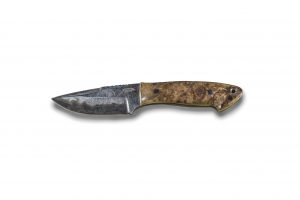
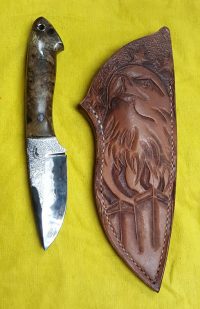
Shane Barefoot of Barefoot Custom Knives is always seeking out ways to craft something unique, something “100-percent Shane,” as he puts it. It was a simple Google search that lead him to a piece of angle iron from the World Trade Center. In the normal course of business trading, the scrap metal from the demolished buildings that was cleared of DNA was sold to China. Understandably, this upset family members of the victims and others. Shane wanted to honor the fallen of 911 by doing what he does best: making knives. He purchased from a company in China. The sacred piece of history arrived–with accompanying verification documentation–and with a bolt in it and two rivets. So, it didn’t take the knifemaker long to decide which direction to take with his creation: a san-mai-constructed blade—damascus steel jacket over a high-carbon core—in the Barefoot hunter pattern.
What took a while, was the actual making. Like many knifemakers, Shane always has something around that he’s working on, and the World Trade Center knife was one of those projects. The three steels forge-welded right together, creating a random pattern in the drop-point blade design. The knife is 7 ¾ inches overall, with a 3 ¼-inch blade, hollow-ground using a 12-inch contact wheel. Shane prefers a convex edge on his hunters so that a simple touch-up on a strop is all that is needed for maintenance. The gimping on the thumb rest is in a rope pattern, adding visual interest along with texture.
The scales on this knife are made from desert ironwood burl, and the liners are in “toxic green,” making a striking color contrast that fishermen and hunters can appreciate. Shane tests his knives by hunting, fishing and cooking with them; all of his knives are made to be purposeful, to carry out their intended tasks. The ¼-inch pins and the thong tubing are stainless steel.
Shane was careful to collect his shavings of the Twin Tower steel, and if anyone wants to buy the knife, he would give those shaving to the new owner. He received one set of documents on the angle steel, so he made copies of the paperwork to prove the legitimacy of the steel’s origin. There is enough left for two more knives.
Knifemaking is a journey. Each knife teaches the knifemaker something new. Overall, Shane is happy with how the knife came out, especially how the blued core nested in the damascus jacket is revealed. The only thing he’d like to experiment with is the blade shape.
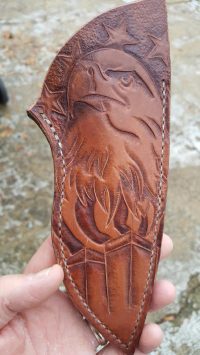
Craig Myles tooled the New York City skyline into the sheath that goes with the knife Shane Barefoot made from a piece of World Trade Center angle iron.Craig Myles tooled the New York City skyline on the leather sheath that accompanies this Barefoot knife.
Fittingly, Shane’s friend Craig Myles tooled the New York City skyline into the leather sheath that accompanies this knife. The maker’s list price for the combo is $1000. Although individuals may hold pieces of the World Trade Center buildings privately, there is no longer any left to purchase on the open market, Shane explained, so this is a noteworthy knife.
Barefoot Custom Knives specializes in custom pieces for fishermen, hunters and outdoorsmen. You can read more about Shane Barefoot, his dad and his work in the April 2017 edition of BLADE magazine, which is on newsstands now.
This knifemaking book includes a chapter on sheaths and what the knifemaker needs to consider when deciding on a particular sheath style.
Sure, it’s all about the knife, but knifemakers do well to pick the right sheath for their creation. As the above article on Barefoot Custom Knifes shows, the right sheath can bring excellence to a special knife-sheath combo. Normally, $21.99, “How to Make Knives” by Richard W. Barney and the father of custom knifemaking Robert W. Loveless is now on sale for $12.