Joe Kertzman's Blog

Knife news, people, top picks and patterns

Buck Lands Boy Scout Knife License

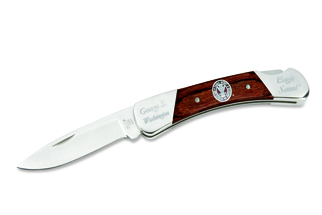
500_rev BSA new 2013 side 1I live in a small town, and there’s not a lot to offer besides a good school, nice people and relative safety. We do have a great Boy Scout program, though, and my son and I are heavily involved. We travel all over the country. So when I received this press release from Buck Knives, along with an image of a Boy Scout knife they’re licensed to build and sell, it took me back to my own Boy Scout knife as a kid, and the ones my son owns and uses.

After all, what tool is more essential to an Eagle Scout than a knife? Buck Knives announces a new product licensing partnership with the Boy Scouts of America (BSA), in which an American-made pocketknife model will serve as an officially licensed product for Eagle Scouts, parents and other individuals associated with the BSA.

The 500 Duke, one of Buck Knives’ more traditional pocketknives, is the current licensed knife and will be offered directly through Buck Knives. The Duke’s nickel silver bolsters can be personalized with each Eagle Scout’s name, troop number and Eagle date, along with the BSA logo.

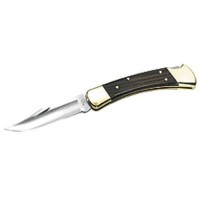
Buy Buck 110 Knife
If you don’t already have a Buck 110, ShopBlade.com has it at a great price. Click the image to order one.

“Boy Scouts and Eagle Scouts have been carrying our pocketknives for generations,” said Chuck Buck, chairman of Buck Knives. “Once upon a time, I was a Boy Scout and learned a lot from it. As for Buck Knives, tradition is extremely important to us. It only makes sense to partner with BSA and help create knives and memories that will last a lifetime.”

The Duke will be Buck Knives’ first licensed, commemorative knife for the BSA. “We hope to introduce several models to BSA through the years. This partnership will allow us to play an integral role in teaching knife use and safety to America’s youth,” said Buck.

The Duke can be ordered directly through Buck Knives. It is $50, which includes engraving and shipping. For ordering information call 800-326-2825, option 7, or send an email to [email protected].

For more Buck knives, click here.

Knives & Orchids Go Together

Congratulations to knifemaker Jim Elliott, who I saw featured today, April 30th, 2013, in Highlands Today, an Edition of the Tampa Tribune. Jim is featured in the publication’s “Agri Leader” section for growing hundreds of varieties of orchids, and of course, for being a spectacular knifemaker. orig

While Highlands Today focuses on his prize-winning orchids, they do give a shout-out to his knives, including an image of the first knife he ever made. BLADE and blademag.com salute his knifemaking, of course, with honorable mention for his apparent green thumb, the latter of which landed him several awards at the seventh annual Orchid Show in Lake Placid two weeks ago.

For the full story, click here.

To learn more about knifemaking resources, books and videos available at shopblade.com, click here.


Knives For Mother’s Day

When I think about my mom today, or reflect on growing up and remembering Mom back then, knives weren’t a big part of her or my culture. But the food, oh, the food! That I remember, and Mom always had plenty of kitchen knives from which to choose. What I really remember is her hands, red from hot dishwater, or dry from work and wear, and there was a certain cutlery set she and Dad saved for and eventually bought. I think Mom still uses those knives today.

As far as kitchen knives go, I asked some industry professionals which of the knives in their respective company lines would make nice gifts for Mom on Mother’s day, and here’s what a few of them had to say:

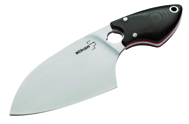
Boker 03BO050

“It just looks cool. On first impression, you just have to pick it up. The compact size of the Boker Sanyougo offers the function of the popular Santoku design in a very compact size. The handle material options—G-10, canvas Micarta® and white Micarta—make it a functional piece for rugged use or a touch of elegance. If Mom cooks a lot, it’s certainly something she would use and most likely does not have.”
—Dan Weidner, Boker USA

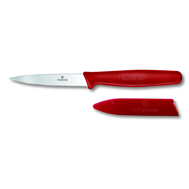
Victorinox paring knife“The $9 price tag on the Victorinox Paring Knife With Sheath is amazing for the quality. The lifetime warranty alone is worth more than that. Also, the peace of mind knowing that you are investing in a Swiss-made quality knife that will remain razor sharp well past when your kids are off to college is a benefit for any parent. The red color is also a market trend.”
—Rob Sterner, Swiss Army Knives

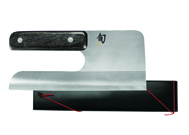
Shun Blue Menkiri“If mom makes homemade noodles or pasta, or has been itching to try it, the Kai USA Shun Blue Menkiri [the “Blue” refers to the blade steel, not the color] is the tool for her. The overall design of the knife is one few people in the U.S. have used, and Shun is happy to be able to offer a piece perfected in the noodle-loving culture of Japan for making noodles and other fresh pasta. The clean, precise feeling as it cuts through noodle dough is a real pleasure.” —Steve Grutbo, Kai USA

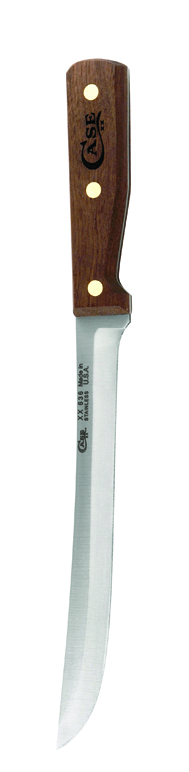
Case 07317_slicing“Very few of the products I write about do I actually use in my daily life after the review. But the handle of the W.R. Case & Sons 9″ Slicing Knife is sturdy and classy, and the blade always cuts whatever I want with precision and ease. All of Case’s knives in the Household Cutlery Set are superior. Rarely do I have to resharpen it, but when I do, the sharpening steel is intelligently included as part of the set.”
—Peachy Deegan, founder and editor-in-chief of www.whomyouknow.com

Well, Mom, and all moms, here’s to you. Happy Mother’s Day. You all deserve it. And if interested in similar knives for mom, or more choices, be sure to visit www.shopblade.com/kitchen-knives or www.shopblade.com. And get Mom a gift she’ll use, appreciate, and one that will last her for the rest of her days.

KA-BAR Knives Marks 115 Years In Business

One of America’s oldest and proudest knife manufacturers, KA-BAR Knives will celebrate its 115th birthday on April 29, 2013. The Olean, NY company will ring in the occasion by giving thanks to the KA-BAR community and reflecting on KA-BAR’s legendary legacy.  60499_640935762590653_298518607_n

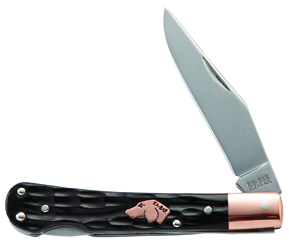
KA-BAR will be holding several giveaways featuring some of the company’s most popular models. Videos, historical images and products, and new product information will also be announced in the week leading up to KA-BAR’s birthday. Ka-Bar 6112CU

For more information and to enter the KA-BAR giveaways please visit KA-BAR’s social media channels: Facebook.com/KABARKNIVES and twitter.com/KA_BAR.  For additional information on KA-BAR or to purchase a KA-BAR knife, please visit KA-BAR.com.

Fish Knives Combine Form & Function

Here’s plenty of proof that a fillet knife can be put to extreme use, and still be a work of art.

The following is written by Tom Carpenter, and reprinted from the June 2013 issue of BLADE® Magazine.

Filleting fish under wet, sometimes salty conditions isn’t the kind of work or environment you want for your best knives. So you might suffer through with a mass-produced imitation of the real thing. But there’s no need to use an inferior tool. Consider the fish and fillet knives of Phil Wilson, Todd Kopp, Kevin D. Cross and John Cammenga of White River Knife & Tool. First, let’s get right down to the fish knife fundamentals.PhilWilson2
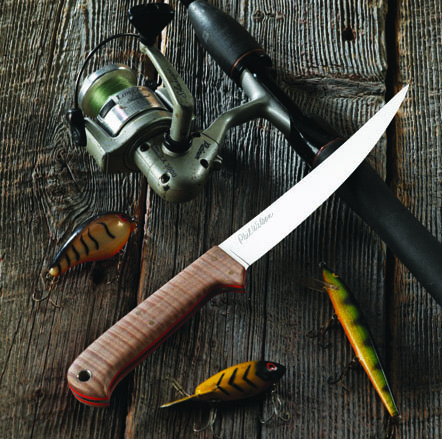
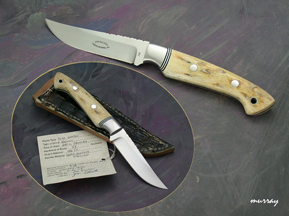
Knifemaker Phil Wilson’s “Shelter Cove” fillet knife (left) sports a 7-inch N690 blade, a fiddleback-maple handle and red spacers. He says a fillet knife should have some flexibility and be ground thin.


The basic features that make for a functional and efficient fillet knife are: a comfortable, secure grip that won’t slip and slide in your hand while doing wet, slimy chores; a sharp blade that is relatively thin and flexible for precision work, and holds an edge; and materials that can stand up to abuse like moisture, blood, and frequent washing and drying.

Wilson, Kopp, Cammenga and Cross craft fish and fillet knives that fit all these criteria and more. Here’s where they put their focus.

Working under the business name Seamount Knife Works, Wilson has been making fillet knives for almost 30 years. “A simple design is best,” he says, “clean and smooth without a lot of holes and crooks and crannies to get packed up with gunk. A good finger guard and a butt end on the handle prevent slippage under wet and slimy conditions.”kc3
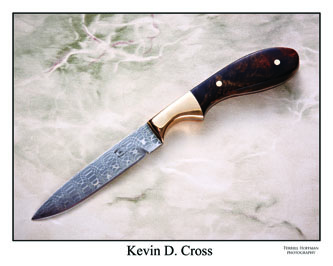
As far as the stainless-damascus blade Kevin D. Cross used for his bird and trout knife (left), the maker says there is a segment of sportsmen who appreciate a beautiful and functional knife. The piece also includes a desert-ironwood handle and bronze bolster. His list price: $400. (Hoffman photo)


As for blade material, “stainless steel is mandatory,” stresses Wilson. “I have used 440C, 154CM, AEBL, CPM-S90V, 12C27, CPM-S60V, CPM-S30V and CPM-154. Yes CPM-S90V—it still makes an awesome fillet knife, but now I feel it is overkill for the application. Given proper heat treatment, they all make a good fillet knife. These days I am using CPM-154, CPM-S30V and N690 mostly. These steels are in pretty much the same category for edge holding and ductility. A [reading] of 60 HRC seems to be the best target hardness for all of them.”

Blade characteristics are important, too. “A fillet knife should have some flexibility and be ground pretty thin,” says Wilson. “I like a springy feel in the first half of the blade from the tip back. Flex is a function of the blade geometry rather than hardness or steel grade.Mike Mooney Best Filet

Mike Mooney’s “Coho” model (left) won Best Fillet Knife at the 2011 Professional Knifemakers Association Show. It sports a 6-inch CPM-S30V blade, a dyed and stabilized redwood burl handle, and a 416 stainless steel bolster. (Buddy Thomason photo)

“Blade lengths from 6 to about 9 inches will handle most fillet work,” he adds, “and also double as boning, slicing and carving knives in the kitchen. Edge holding on a fillet knife is not quite as important as on a hunting/utility knife. A fillet knife can clean a box of fish and then get touched up at home or on the boat later. So a little lower hardness can be traded off for some added ductility on a thin, flexible blade.”


Non-Slip Grips

Handle material is critical. “I’m using mostly canvas Micarta® handles,” states Wilson. “An option is G-10. Both are naturally non-slip and do not soak up moisture.”

Kopp earned “Best Fillet Knife” honors at the 2010 Professional Knifemakers Association Show with his damascus fillet knife. He strayed from traditional stainless steel for his award-winning knife, opting instead for a damascus of 1084 and 15N20 carbon steels.StepUp_8_Maple_02
John Cammenga of White River Knife & Tool offers wood-handle fillet knives like this model (left) with a SM-100 blade and tiger-maple handle. Cammenga explains, “At the BLADE Show and SHOT Show, we introduced the world’s first fillet knife made with a blade of SM-100, a corrosion-proof alloy. This particular custom measures 63 HRC on the Rockwell hardness scale, features a 3/16-inch-thick spine and is still flexible! It is a ‘step-up design’ where the handle is notably higher than the cutting edge. The knife was designed by Steve Geelhoed, and while the original is not for sale, replicas sell at $750 each.”

“I used carbon steel on this because it holds an edge better than some of the stainless steels,” Kopp explains. “It does, however, require more care than stainless blades.”

The attractiveness of the damascus pattern is certainly inviting. “Yes, it’s kind of unique seeing a damascus blade on a fillet knife,” he admits. And what about function? “My brother used it on a fishing trip,” Kopp relates, “filleting 30 or so fish with it, and he was pleased with its performance. In fact, I think it outperformed an electric fillet knife!”Kopp Best Fillet orig
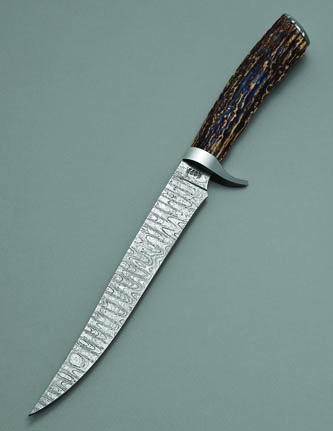
Maker of the Best Fillet Knife at the 2010 Professional Knifemakers Association Show, Todd Kopp chose a 7.5-inch damascus blade and sambar-stag handle for this particular model (left). Note the small details like how he carved the 416 stainless steel buttcap to match the natural grooves of the stag. The maker’s list price: $475. (Buddy Thomason photo)

Cammenga runs White River Knife & Tool, a family-owned business with a full array of fillet knives in its line. “A strong case can be made for many great alloys available today,” he says. “We chose 440C for our Limited Production and Custom Finished versions in 2013. This high-carbon, stain-resistant steel retains our hand-sharpened, leather-honed edge for a very long time. It also provides reasonable corrosion resistance.”

Cammenga uses wood handles on the fillet knives. “The wood is stabilized and will not shrink, swell, or absorb blood or oil,” he explains. “We also offer a cork handle with a wooden pommel. The cork handle with a 6- or 8-inch blade will float [if the knife is dropped in the water]. Also, our unique ‘step-up design’ helps to keep the handle [and knuckles] a little farther off the cutting area, a nice feature when filleting on less than ideal surfaces.”

Flexible On Flexibility

Cammenga says he thinks blade flexibility on fillet knives is largely a personal preference. “At the 2013 SHOT Show, we received some comments that our blades could be a little more flexible, and some that they could be less flexible,” he recalls. “Our current offering tends to be more rigid on the 11-inch blade, moderate on the 8- inch blade and more flexible on the 6-inch.

“That which makes a good knife makes a good fillet knife.”

Bird and trout knives certainly fit in the fillet knife family. Cross uses straight stainless steel on some of his knives, but adds a beautiful twist to others.

“Yes, actually I use both straight stainless and stainless damascus, depending on the customer,” Cross remarks. “With exposure to the water, the stainless aspect is important. As for stainless damascus, it looks a bit classier and there is a segment of sportsmen who appreciate a beautiful and functional knife to go with their Parker shotgun or Sage reel.”

Bird and trout knives have to pull double duty. How does damascus steel perform on the fishing half of that equation? “This knife works well for its appointed tasks,” he concludes. “But as with any short blade, there is not a great deal of flex. It is certainly possible to make the blade thin and flexible, though.”

Cross’s bird and trout knife employs bronze fittings. “Bronze is tough, and stain and corrosion resistant, especially to salt water. It is harder than brass, develops a nice, warm patina, and is easy to care for.” Function plus beauty: just the things knife lovers tend to value.

You make fillet knives do their work under tough conditions. But don’t suffer with low-quality knives. Craftsmen such as Wilson, Kopp, Cammenga and Cross have proven that you can combine function and form in beautiful fish knives.


Educating the Future Of Knives

The American Knife & Tool Institute (AKTI) recently announced it will present a series of informative articles on its website, www.akti.org, that address various aspects of the knife owner’s experience. The first of the series will relate tips and advice on introducing young people to knives.

2-Customer-son

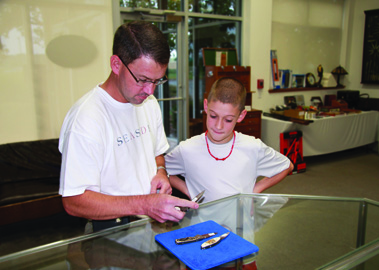
Among those giving insights in the new AKTI youth knife series will be A.G. Russell. Here a father demonstrates a knife for his son at A.G. Russell Knives retail store in Rogers, Arkansas. (A.G. Russell Knives photo)

“I was always taught that the age of reason was 7, which is also Cub Scout age when I got my first knife,” commented Dan Piergallini, president of the Gator Cutlery Club. “Safety was always stressed, and supervised use of a knife is a must. Also, one must insist that the knife never be taken to school no matter how much you want to show it off.”

Billeb-Jan-2012Along with Piergallini, AKTI Executive Director Jan Billeb, Becky Reid of Shepherd Hills Cutlery, and Blade Magazine Cutlery Hall-Of-Fame© member A.G. Russell will provide insights on their experiences in promoting safety, awareness, respect and proper knife use among young people.

AKTI Executive Director Jan Billeb (left).

Look for the story on kids and knives and subsequent offerings from AKTI to provide timely and relevant perspective on topics of interest to the cutlery community.

“We are excited to bring these informative articles to AKTI members and knife enthusiasts everywhere through our website,” Billeb said. “Introducing knives to the next generation is a key element in promoting their safe use and increasing the understanding of knives as valuable tools that are important in our everyday lives.”

To read the article on kids and knives visit www.akti.org/education/kids-and-knives.

For more information, call 307-587-8296 or visit www.AKTI.org. Follow AKTI at http://www.Facebook.com/SaveOurKnives and http://twitter.com/SaveOurKnives.

Kershaw Signs On for a Rough Ride

You can take that headline literally. Kershaw Knives has become a premier sponsor of the Professional Rough Stock (PRS) series. Most folks are aware that professional bull riding is among the fastest growing sports in the United States, yet some rodeo fans can’t get enough, and are looking for even more excitement. That’s where the Professional Rough Stock (PRS) Series comes in.ker horse KershawSponsorsPRS

In addition to bull riding, Professional Rough Stock incorporates bareback and saddle bronc riding—yes, you read that right, BAREBACK and saddle BRONC riding. The combination of events gives rodeo lovers more variety and more heart-pounding thrills.

Kershaw Knives, a brand of Kai USA Ltd., has recently signed on as a major sponsor of the 2013-2014 PRS season. Founded by Pete Kershaw in 1974, Kershaw Knives was born on the Officer Ranch in eastern Oregon and boasts a proud cowboy tradition.

“Sponsoring Professional Rough Stock is a natural for Kershaw,” said Thomas Welk, Director of Sales and Marketing, Sporting for Kai USA. “Every rider, every cowboy and cowgirl, and every PRS fan needs a good knife; they need a Kershaw.”

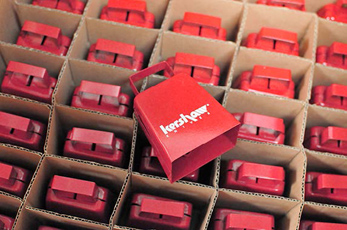
The Kershaw Kowbells (left), are ready for the next PRS event.

At each PRS event, a group of lucky PRS attendees will find themselves sitting in the “Kershaw Korner.” Everyone sitting in the randomly selected Kershaw Korner will receive either a Kershaw Kowbell or Kershaw BamBam Sticks to help them cheer on their favorite riders. Kershaw will also be giving away logo t-shirts and several Kershaw Zing SS knives at each event.

Presence like this at nationwide PRS events, along with television coverage, social media promotions, and more made the PRS sponsorship attractive to Kershaw. “The athleticism of these rough stock cowboys is outstanding,” said Welk. “We’re proud to help bring the excitement of Professional Rough Stock to rodeo fans and families all across the nation.”

Televised PRS events begin airing on RFD-TV on Friday, May 3rd at 10:00 p.m. EST time, with replays on Sundays at 2:30 p.m. eastern.

Advertisement

Must Read Articles

Read this before you make a knife

Knifemaking 101 – Read This Before You Make a Knife

  by Wayne Goddard My experience has taught me that there's nothing like digging in and getting started. I've often said the hardest part of the...
how to forge damascus steel

How to Forge Damascus

Advertisement
Advertisement