Joe Kertzman's Blog

Knife news, people, top picks and patterns

What Are The Hottest Custom Knives Today?

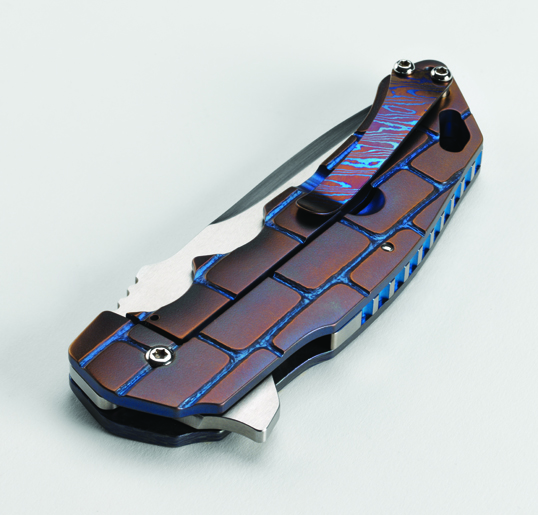
Identifying the hottest custom knifemakers’ hottest knives for you is something BLADE® takes pride in doing. And one of the best ways we have found of doing it is to tap the knowledge of those who must do it well because it is their livelihood—custom knife purveyors. So, in the April 2013 issue of BLADE (on newsstands as of Jan. 29), we tapped into that knowledge. CoverWhite01

CoverWhite02Here’s part of the story from the April 2013 issue:

At Knifeart.com in Little Rock, Arkansas, Larry Connelley has his eye on Maciej Szczerbiak and Crusader Forge. A custom knifemaker since 1996, Szczerbiak is based in St. George, Utah. “His FIFP [Fear Is For Prey] is an overbuilt tactical folder,” Connelley said, “and is stoutly made with a thick titanium handle and Integral lock. The blade is CPM S30V stainless and prices start at around $900.”

The purveyor indicated Brian Tighe is another favorite among Knifeart.com customers, and the Nirk Tighe, designed in collaboration with Glenn Klecker, features Klecker’s Nirk locking mechanism that allows the lockback to function as an integrated component of the handle. “These knives start at $525 with BG-42 steel blades and titanium handles, each of them 3-D machined,” Connelley observed. “Brian has several designs that involve collaborations, and each one of them is innovative. He can deliver them with precision.”

According to Connelley, the knife market is steady and recovering with the slow turnaround of a sluggish overall economy. To read the rest of the story, pick up the April 2013 issue of BLADE off the newsstand, or click here.

NEW BLADE Show Site Easy To Use/Navigate

The brand-new BLADE Show website makes learning about the show, buying tickets, seeing exhibitor and sponsor lists and getting updates on the seminars schedule easier than ever!

blade show.jpegAs most knife enthusiasts have already discovered, if you like seeing new knives first-hand, and buying, collecting, selling or just talking everything knife related, then the BLADE Show is the place to be. Nearly every major knife manufacturer worldwide exhibits at the show, and more than 600 custom knifemakers display their handmade pieces. The BLADE Show truly is the world’s largest knife show, and the ultimate knife show experience.

living readyRead news and information about the new Living Ready Expo held in conjunction with the BLADE Show. Be prepared. Relevant and timely, the Living Ready Expo is designed to educate those interested in preparing themselves and their families for all kinds of real-life survival scenarios. Get practical advice and tips on preparedness, debunk urban survival myths, learn from survivalist experts and network with other urban preppers. It is the best knife show and survival show, all for one ticket!

Knives A Bright Spot in American Economy

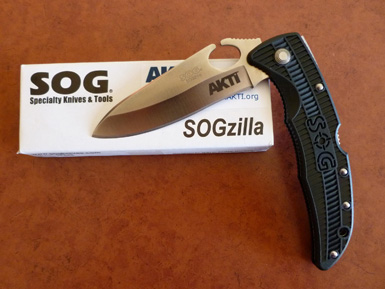
The American Knife & Tool Institute (AKTI) shared data during its annual SHOT Show meeting regarding the U.S. knife industry and the significant economic impact it has, including jobs creation and the nation’s economy. 178480_10151866287449119_1468026836_o

Acting as a representative of knife manufacturers, distributors and retailers, as well as U.S. knife users, AKTI president Bill Raczkowski of Gerber Legendary Blades said, “Every knife and tool manufacturing and import or distribution company is a valued contributor to jobs, taxes and the economic viability in its city, county, state and region.”

Citing 2010 data collected as part of a survey by the AKTI, Raczkowski said the sporting knife and tool industry has a $4.844 billion economic impact on the U.S. economy. And over 60 manufacturing, import and distribution companies generate more than $807.4 million in gross revenue. Such revenue, of course, as well as taxes and wages paid to employees, contributes dollars to help keep America’s economy in recovery mode.

According to Raczkowski and the AKTI, knife manufacturers, importers and distributors employ 3,566 U.S. workers who hold good, stable jobs in an economy where every job is important, and millions of people are trying to find work. The industry, the AKTI says, generates 17,830 support jobs in supplier and ancillary industries. “That’s enough people to populate the entire city of Hannibal, Missouri, and serve thousands of visitors each year to keep Mark Twain’s spirit alive,” said AKTI executive director Jan Billeb.

To read more, visit the Resources section of the AKTI website under Knife User Data.


Indiana Senate Passes Pro Knife Rights Bill

It’s unanimous! By a vote of 47-0, the Indiana Senate passed Senate Bill SB181, a Knife Rights-requested bill that would repeal Indiana’s outdated and unreasonable ban on the possession and sale of automatic knives.

The bill, sponsored by Rep. Jud McMillin and cosponsored by Reps. Sean Eberhart and Jim Baird, now moves to the House. Kudos to Senate sponsor Sen. Jim Tomes and co-authors Senators Taylor, Arnold, Steele, Nugent, Randolph and Hume for their winning efforts in passing SB181 in the Senate.

If you work, live or travel in Indiana, contact your Representative and ask them to support SB181. Click here to locate your Representative, or one who represents where you work or travel.

DMT Brings You: Two Ways to Sharpen Your Hunting Knife

As every hunter knows, a hunting knife needs proper care, and there are countless methods for sharpening a hunting blade, depending on how the knife is used in the field or on the trail. The experts at Diamond Machining Technology (DMT) have composed a “how to” article below to help knife users understand which sharpening techniques are best for different hunting-knife tasks. If you enjoy the below, you’re also certain to like: “Sharpen a Knife & Care For Your Collection.”

Two Ways to Sharpen Your Hunting Knife

By Stan Watson

The hunting knife, whether the folding or fixed-blade type, is an invaluable tool for hunters since its hard, strong steel blade is made for cleaning and butchering game. But, truth be told, many outdoorsmen like to carry a hunting knife as an all-purpose cutting tool. So, when you think about the best way to sharpen your hunting knife, first think about how it will be used.
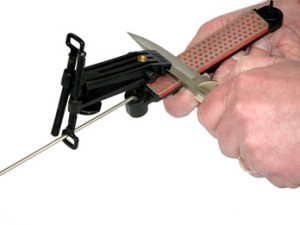
If you plan on using the blade for gutting and field dressing animals, you need a razor sharp blade. The hide of an animal is tough and you want your knife to make easy, smooth cuts through the skin and muscle. To get that result you want to sharpen at a shallower angle.

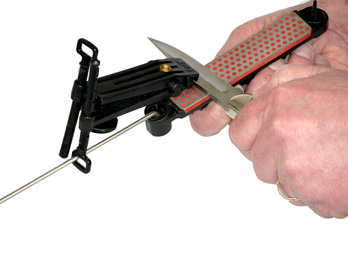
I always recommend manual sharpening on a diamond stone, because it removes only the necessary amount of metal—protecting your knife and prolonging its life. With diamond stones from DMT Diamond Machining Technology, you never need oil. If you want to moisten the stone, you can use water, but it’s not necessary. Start with a coarse grit diamond stone and, holding the knife so the blade meets the stone at a 20- to 22-degree angle, stroke the blade with modest pressure across the stone six or eight times; then change direction (if you began by stroking away from you, switch and carefully stroke the blade towards you using the same motion). Diamond stones sharpen blades quickly, so there’s no need to rush your strokes. Take the time to handle your blades and edges in a safe manner.

Once you’ve finished with the coarse grit, move on to a fine grit and repeat the process. Then, to get the razor edge you need, give the blade a few strokes along an extra-fine grit. Remember, the finer the grit, the lighter your strokes should be. The result will be a blade that has a straight, true sharp edge for cleaner cutting and dressing.

For those of you who like the feel and performance of a hunting knife, but want to use it as an all-purpose cutter, you don’t need the razor sharpness that comes with an extra-fine grit stone and a shallow sharpening angle. It’s better to have a micro-serration on the blade.

To get that result, use just a coarse grit diamond stone and hold the knife so the blade is at a steeper angle, about 24 to 28 degrees. This will give your blade greater strength to stand up to tough cutting tasks. A surface with tiny serrations allows the blade to work in a sawing motion—unlike the straight razor-sharp cuts you need when gutting a deer, for example.

Whether you’re a pro or novice hunter, it can be hard to maintain a precise and consistent angle throughout the sharpening process. One solution is DMT’s Aligner Blade Clamp, which provides for guided sharpening to help you set and keep the correct angle for the task at hand. The Aligner is easy to use, offers seven-angle adjustability and accommodates wider and thicker blades. Plus, the clamp won’t damage your blades.

A well-made hunting knife can last for years, especially if you keep it sharp. With diamond sharpening stones from DMT, you will be able to quickly, simply and safely get the edge that keeps your knife working to its fullest potential.

Stan Watson is the technical director for Diamond Machining Technology, manufacturer of a full line of Made in the USA diamond sharpening tools for use in woodworking, camping, fishing, hunting, outdoor and winter sports, culinary arts, gardening, police/security and industrial applications. He is the holder of 11 engineering patents in the sharpening industry. He can be reached at [email protected].

If you enjoyed the above, you’re also certain to appreciate: “Sharpen a Knife & Care For Your Collection.”


Introduce Young People To Knives

The American Knife & Tool Institute (AKTI) takes its job seriously of promoting understanding and cooperation within the knife industry, as well as among those who simply utilize mankind’s oldest tool. In acknowledgment of that role, the organization presents a series of informative articles appearing on its website, www.akti.org, detailing the knife owner’s experience.

The first of the series gives tips and advice on introducing young people to knives.  “I was always taught that the age of reason was seven, which is also Cub Scout age, when I got my first knife.  Safety was always stressed, and supervised use of a knife is a must.  Also, one must insist that the knife never be taken to school no matter how much you want to show it off,” commented Dan Piergallini, President of the Gator Cutlery Club.

Along with Piergallini, AKTI Executive Director Jan Billeb, Becky Reid of Shepherd Hills Cutlery, and legendary knife dealer A.G. Russell provide insights into their experiences in promoting knife safety, awareness, respect, and proper use among young people.   

Pictured at left, A.G. Russell shares with a friend.  Photo courtesy A.G. Russell Knives.

“We are excited to bring these informative articles to AKTI members and knife enthusiasts everywhere through our website,” remarked Billeb.  “Introducing knives to the next generation is a key element in promoting their safe use and increasing the understanding of knives as valuable tools that are important in our everyday lives.”

To read the article on Kids and Knives, visit www.akti.org/education/kids-and-knives.


Nat Geo’s Lords Of War Features Knifemaker Larry Harley

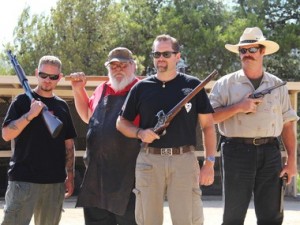
The National Geographic Channel’s Lords Of War program features knifemaker Larry Harley as an antique knife and edged weaponry expert. Lords Of War focuses on historic weaponry as depicted by a team of experts that travels across the country in search of the best in antique weapons and militaria. The experts allow you to relive history as they test, assess and auction the bounties of war. 

Larry “Hammer” Harley, as he’s called, second from left in the photo, is quoted by Nat Geo as saying, “I haven’t worked a day in my life.” A third-generation bladesmith, he began experimenting with steel, thanks to the influence of his grandfather, at a young age. During hunting season, he hunts wild hogs, and during the hunt, uses knives he has fashioned. In the summer, he teaches children about the craftsmanship of knifemaking. This is his passion, being more enthusiastic about making knives than most people are about anything. 

The all-new series, Lords Of War, debuts January 23rd at 9 p.m. and 9:30 EST on Nat Geo.

Advertisement

Must Read Articles

Read this before you make a knife

Knifemaking 101 – Read This Before You Make a Knife

  by Wayne Goddard My experience has taught me that there's nothing like digging in and getting started. I've often said the hardest part of the...
how to forge damascus steel

How to Forge Damascus

Advertisement
Advertisement