
The BLADE Blogs

The blogs of the BLADE editors, Steve Shackleford and Erin Healy.

Ron Lake’s Tab Lock: The Clever Lever

     When Blade Magazine Cutlery Hall-Of-Fame© member Ron Lake devised the interframe design and gave the world of knives another standard of innovation and excellence, he continued to look for ways to improve the operation of a standard lockback mechanism. He was not satisfied with pushing a bar to release the lock, particularly with one hand occupied or involved in some type of activity that demanded his full attention.

     The solution was fairly simple and came along in the early 1970s, just a few months after the historic debut of the interframe. Ron added a small steel tab at the end of the knife, offering the user a quicker and safer alternative to depressing a bar.

     “The tab lock is really not a lock mechanism,” Lake explained. “It is just a tab on the end of a lockback that offers a mechanical advantage. If it isn’t there, I just have a bar to release the lock, and depressing that bar can be hard to do when the hands are soft, cold or wet. The tab gives you a larger surface to push on.”

     Ron admits that the tab lock was something of an afterthought, trailing along behind the notion of the interframe. Sometimes the good idea can indeed be made better. As a young knifemaker, he continued to mull over the prospects for a better release.

     “I had only been making knives for six years,” he laughed. “I didn’t even know another knifemaker and didn’t know what knives were supposed to look like. I came up with the interframe design and then thought about where I could put a release mechanism. I still make interframes and that’s about all I do make, and they are with the tab.”

     While it may look like a simple endeavor, the fashioning of the tab lock is not for the knifemaker who wants to take a shortcut or go down the path of least resistance. Of course, the tab-lock style is not seen in great numbers among today’s knives, and Ron says there is a straightforward explanation for that. It just is not the easiest thing to do.

     “I can make them now with less effort than it took back then,” he advised, “but first of all I have to machine a piece of metal that goes on the end. Then I have to silver solder it on, and it’s a rough piece of metal with everything large on it. Then I remove the silver solder so you can see a nice radius, machine the sides to the right dimension and radius the corners.

    “From there, I hand sand the surfaces and polish them up. So, it takes several more hours of work than a standard knife, and about 15-to-20 percent of my time goes into that part of the knife. I also have to take the whole knife apart and put it together again two more times, which I don’t have to do on some other models. For a few years, A.G. Russell just thought I butted it up against the end of the lock and soldered it on, but that could get knocked off easily. Later, I explained the process to him, and I can tell you the tab is on there pretty tight, pressed on and silver soldered.”


Tab Release

Some years ago when Ron, along with Wayne Clay and Cutlery Hall-Of-Famer Frank Centofante, co-wrote How To Make Folding Knives, he discussed the geometry of the lockback knife. He remembers visiting Sakai Cutlery in Seki City, Japan, and sitting in the company’s offices, which incidentally included a log cabin from Montana that had been dismantled and reconstructed. The men from Sakai had eight lockback knives laid out in the office, and the geometry between the pivot and the lock was different on each one.

     “I asked them who had designed those knives,” Lake smiled, “and they said, ‘We did.’ I asked them why the geometry was different on every one of them, and they told me it was because the toolmaker had made them the way he wanted to do it. To my knowledge nobody had put the geometry of the lockback down on paper until I did. Innovation comes from one-man shops.”

     That innovation carried over to the construction of the tab lock, which Ron more aptly describes as a “tab release.” The tab lock actually does lock like any other lockback. The secret to its operation is in the release.

     Long-time friend and fellow knifemaking legend and Cutlery Hall-Of-Famer Michael Walker says he agrees that the idea seems simple enough and makes a great impact on the user when it comes to ease of release. “I can say that the tab lock addresses a big problem with the lockback design by adding length, which in turn adds leverage,” he explained, “and the tabs let you unlock without the problem of pushing on a narrow piece of metal. It also eliminates the cutout [in the handle spine], which could restrict use for someone with larger hands. It’s much more functional than the traditional construction, hence he was awarded a patent.”

     Lake says he believes his patent was awarded about 1973 and expired around 1994. It not only included the tab, but also extended to the interframe and the bushing inside the handle that spaced the blade away from the frame. Indeed, the tab was part of a larger patent and an afterthought that developed into a novel approach when his inventive mind pondered the question of an efficient and effective release.

     “I decided that having the tab at the back of the knife would have a mechanical advantage,” Ron reasoned. “You can close it not only with the thumb but anything else that could be used to press the release. It doesn’t make any difference how long the lever is. It could be in the middle of the handle with the tab on it.”

     As for the patent, Ron says he doesn’t worry too much about it. “Centofante put [the tab lock] on his knives, and we were friends,” he remembered. “Some other folks have used it, too. Centofante put his tab on one side of the lock, and the patent specified at the end of the lock lever.” Along with Clay’s lockback, Lake’s and Centofante’s versions of the tab lock both appear on the cover of How To Make Folding Knives.

     Over time, Ron says the patent has become even less meaningful to him. The drawings or blueprints are long forgotten—probably shoved into a drawer somewhere in his shop. The concept of trade dress is enough for him. A form of intellectual property, trade dress refers to the look or characteristics of an artist’s work that provide the work’s instant recognition to the consumer.

     “After you do something for so long, it does establish trade dress,” Lake commented. “For example, if you saw a lockback lying on a table with a tab on it, would you know who made it? Yes, you would know that knife is mine. That is trade dress.”

     Of course, the tab lock made an impression 40 years ago when a young Ron Lake showed it off to a who’s who from the golden age of custom knifemaking. Among those present when the tab lock debuted were Corbet Sigman, Chubby Hueske, Cutlery Hall-Of-Famers Frank Centofante, A.G. Russell, B.R. Hughes and Bob Loveless, and a number of others. Since then, the tab lock has been a quiet trademark of Lake’s knifemaking skill, standing the test of time.—By Mike Haskew


To read similar stories and all about the latest knives, knife news and much more subscribe to BLADE®. For more information, click on http://www.shopblade.com/product/blade-magazine-one-year-subscription-us/?r+ssfb21211#BL1SU


CAPTION

Blade Magazine Cutlery Hall-Of-Fame© member Ron Lake and one of his tab-lock interframe folders in a stag handle and leaf-and-hands engraving—some in gold—on the blade bolsters and even the tab itself by Barry Lee Hands. (SharpByCoop.com photo)
Can’t Stop Laughing: Cutlery’s Comic

Shelley's favorites
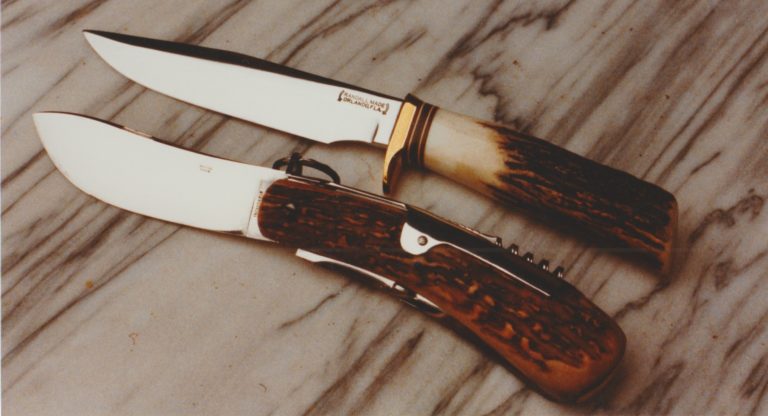
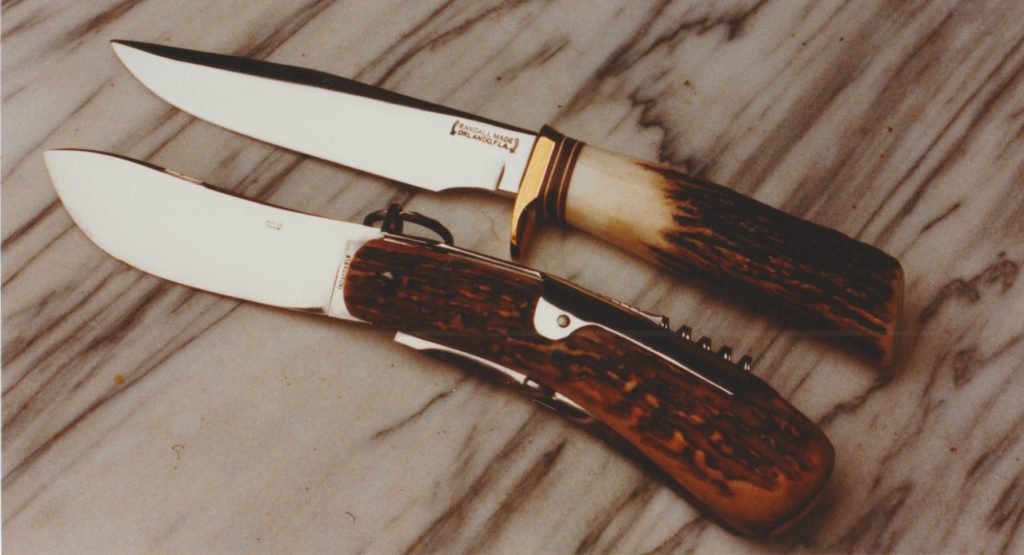
Two of Shelley’s early favorite knives: the Hermes folder (right) and a Randall.

While there have been many celebrities in and out of show business embraced by the custom knife community, none embraced it in return and then some as did cutlery’s comic, Shelley Berman. Actor, comedian, writer, poet, professor and knife collector, Berman passed away quietly on Sept. 1 at the age of 92, but not before decades of touching the custom knife community like no one else.

Known worldwide beginning in the late 1950s as a top comedian, Berman recorded six comedy albums, including 1959’s Inside

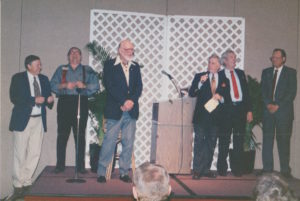
Shelley and Guild original members
Five of the Knifemakers’ Guild’s original members joined Shelley on stage during the Guild’s 25th anniversary banquet. From left: John Owens, BLADE Magazine Cutlery Hall-Of-Fame© members A.G. Russell and Dan Dennehy, Berman, Jim Pugh and Ted Dowell.

Shelley Berman, the first non-musical recording to win a Grammy Award. Three of his comedy albums went gold and he was the first non-musical comedian to appear in Carnegie Hall. According to an Associated Press story, Berman was “a pioneer of a new brand of comedy that could evoke laughter from such matters as air travel discomforts and small children who answer the telephone. He helped pave the way for Bob Newhart, Woody Allen, Jerry Seinfeld and other standup comedians who fashioned their routines around the follies and frustrations of modern living.”

Shelley also starred on stage and in musicals on Broadway, had several film roles and continued acting into his mid-80s, appearing as Larry David’s dad on TV’s Curb Your Enthusiasm, and also on Boston Legal and Grey’s Anatomy, among others. He retired in his 80s after 20 years of teaching humor writing in the Master of Professional Writing program at the University of Southern California.

In the 1960s he and his wife Sarah began collecting knives, and continued to build on that collection until recent years when Shelley’s declining health precluded it. The same decade Shelley was shopping for a Buck fishing knife but a salesman at an Abercrombie & Fitch store in New York showed him a Model 5 Camp & Trail Knife by BLADE Magazine Cutlery Hall-Of-Fame© member Bo Randall instead. Shelley wanted more. He liked Randalls and bought a number of them after that. However, he still did not know

Shelley smiling
Shelley Berman was known worldwide for his comedy in the 1950s and won the first ever Grammy Award for a non-musical album—of comedy, naturally enough—in 1959.

of custom knives. All that changed when he was working in Las Vegas in the late 1970s.

It was there he saw his first custom knife at a knife show in the old Sahara hotel and casino. He wasn’t sure custom knives were for him until he subscribed to the American Blade magazine—now BLADE® Magazine. “When I saw [the stories in the magazine] I realized, my God, I’m not crazy, I’m a collector!” he said in an interview with Dave Harvey in the December 2009 BLADE. “I had all these knives in my drawer, so I ‘came out of the drawer.'”

But it was more than just the knives that attracted both Shelley and Sarah—it was the makers themselves. The Bermans admired the work of such cutlers as Cutlery Hall-Of-Famer Buster Warenski, Warren Osborne and Larry Fuegen, to name a few. The Bermans also came to know the wives of the makers as well, such as Dorothy and Jim Ence, Betty and Ted Dowell and many more. The Bermans were regular visitors to the Art Knife Invitational, the California Custom Knife Show, the Solvang Custom Knife Show and other knife events. Each April during the Solvang Show there would be a barbecue, and for many years Shelley emceed the post-dinner awards ceremony. In 1996 he did a comedy routine to headline the banquet for the 25th anniversary Knifemakers’ Guild Show—now the International Custom Cutlery Convention (ICCE)—at the Marriott Hotel in Orlando, sparing no one from a comedic jab or two, including Cutlery Hall-Of-Famers Bob Loveless, A.G. Russell, Frank Centofante, D’ Holder and Dan Dennehy, Ted Dowell and others in the jam-packed ballroom.

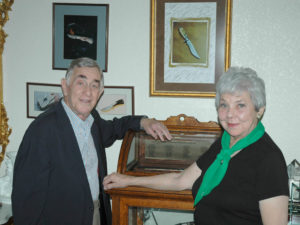
Virtue, Shelley and Sarah
Shelley and his wife for 70 years, Sarah, and their knives in the Berman home—including the photo of the Virtue knife signed by all the participating makers at top right.

During the 2000 Solvang Show, many of the show’s custom makers the Bermans had befriended over the years huddled and decided to make a special surprise knife that they would deliver unbeknownst to the Bermans at the following year’s Solvang Show. A work schedule was planned so the knife would spend the least amount of time possible in the mail between destinations. One of the biggest obstacles was getting the knife in and out of over 50 workshops in less than 10 months. Work began in July 2000 and the completed masterpiece arrived in Solvang just three weeks prior to the 2001 Solvang Show. The project began in Arizona and from there went to Nevada; Idaho; Washington; Oregon; California; Hawaii; back to Arizona; Utah; Colorado; New Mexico; Texas; Arkansas; Kentucky; Tennessee; South Carolina; North Carolina; Virginia; West Virginia; Maryland; Pennsylvania; New Hampshire; Quebec, Canada; Ohio; Minnesota; and Wisconsin.

The worry was that the knife, christened “Virtue: The 2-24-50 Knife,” would look as if 50 different makers had made it, which, of course, would not be the desired result. However, just the opposite occurred and the knife came out beautifully. Nothing quite like it has been attempted before or since.

As Dave Harvey, Solvang Show producer and owner of Nordic Knives, noted, one concern was that word of the knife would leak to Shelley before it was finished. However, the secret was kept and Shelley’s reaction made it abundantly clear that he was genuinely surprised and thrilled when the knife was presented to him and Sarah at the 2001 Solvang Show.

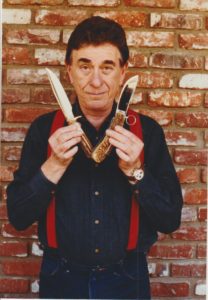
Shelley holds his two favorites
Shelley holds two of his favorite knives, the favorite being the Hermes folder. He was featured with it in the second installment of BLADE‘s “My Favorite Knife,” the forerunner to the magazine’s popular “The Knife I Carry” feature, in the October 1991 issue.

Shelley also wrote for BLADE on occasion, and even appeared in the second-ever installment of the magazine’s popular department, “The Knife I Carry,” which originally was known as “My Favorite Knife.” The knife was a Hermes folder and Shelley is pictured holding it on page 94 of the October 1991 BLADE.

With the permission of Cutlery Hall-Of-Famer Jim Weyer, the March 1996 BLADE reprinted Shelley’s story “Symbiosis” from Weyer’s Points Of Interest Book IV. In the story about knife collectors and what makes them tick, Shelley nailed it perfectly when he wrote, “Since only the Good Lord knows what makes a collector a collector, it follows that only the Good Lord knows why a collector is after only a certain kind of knife on a given day. Even then, if one should ask the collector what kind of knife he has in mind, the collector may answer, ‘I’ll know it when I see it.'”

Likewise, the members of the knife community know a great collector and friend when they see one, and along with his wife Sarah, Shelley will forever fit the mold.

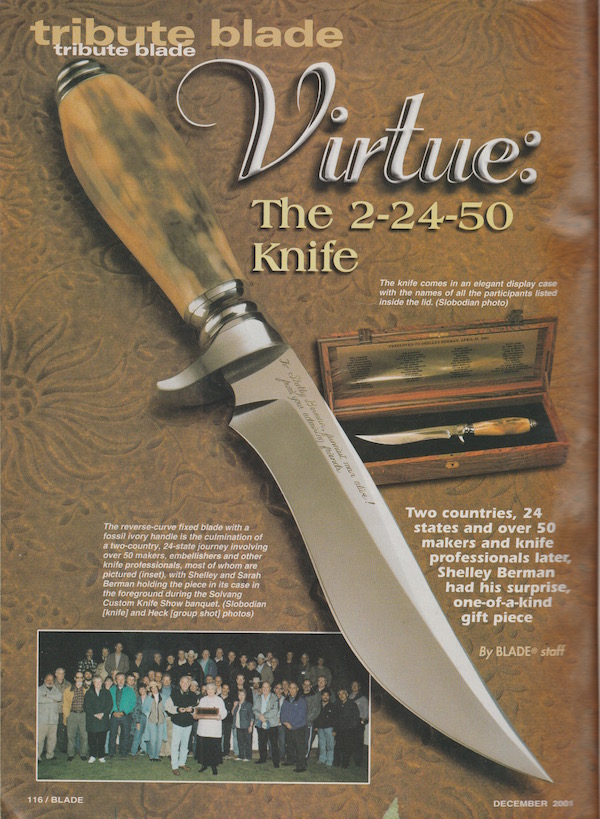
Virtue for Sarah and Shelley
Over 50 makers working on the knife in shops in 24 states resulted in the Virtue knife for Shelley and Sarah Berman.

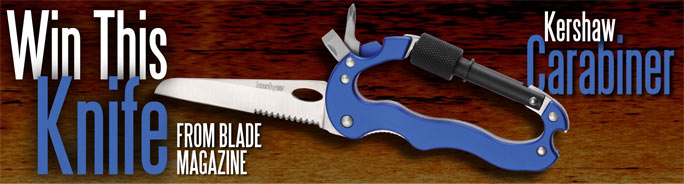
New Sweepstakes: Win a Kershaw Carabiner Tool

Enter to Win a Kershaw Carabiner Tool

– 5 tools in 1: Knife, flat-head screwdriver, Phillips-head screwdriver, bottle opener and carabiner clip
– 3 1/4-inch blade made of 7CR13MoV steel
– Locking liner
– Lightweight aluminum handle with durable Teflon coating
– Weighs 2.7 ounces

Sweepstakes Ends June 30, 2011

Click Here for Complete Rules

No purchase necessary to enter or win this sweepstakes. Open only to legal residents of the United States and the District of Columbia age 18 years or older. Online entries must be received by 11:59 PM June 30, 2011. Limit: One online entry per person.

 CLICK HERE TO ENTER FOR FREE.

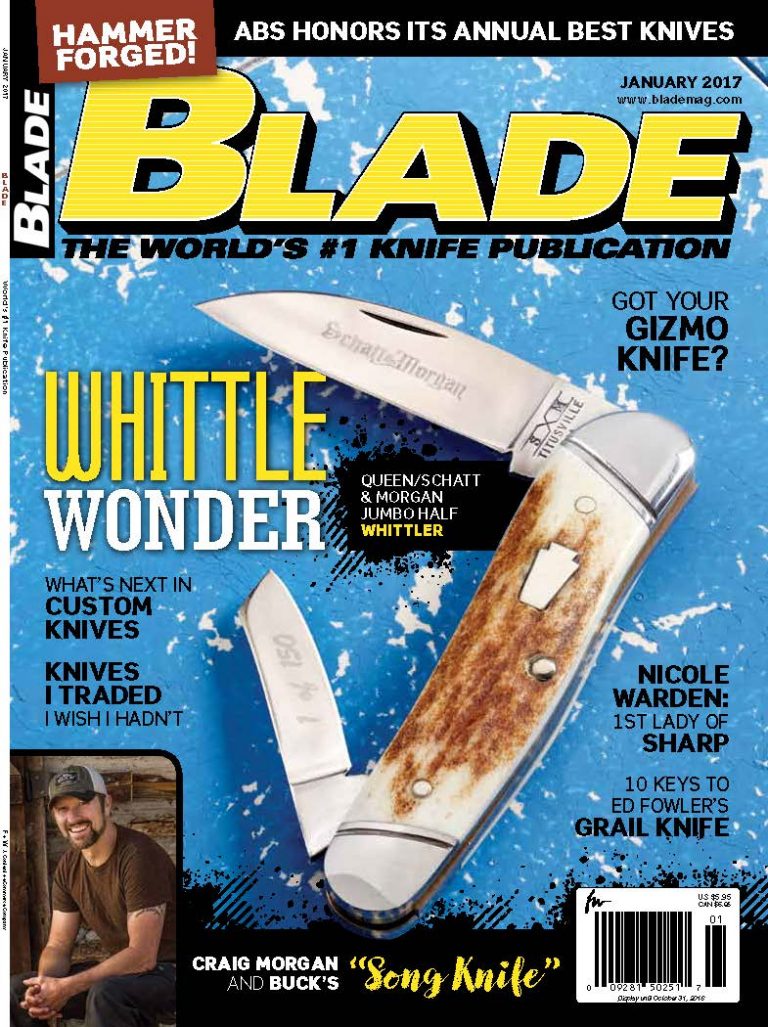
Song Knife Highlights New BLADE®

Song knife for BLADE.
Song Knife collaboration between Buck and country music star Craig Morgan highlights the new BLADE®, on newsstands now!

Country music star Craig Morgan’s “Song Knife” for Buck, what’s “next” in custom knives, “Blades of the Bog” and much more sharp stuff highlights the new BLADE®, on newsstands now!

Morgan, who also stars on the Outdoor Channel’s Craig Morgan All Access Outdoors, recently released his latest album, A Whole Lot More To Me. In collaboration with Buck, two songs from that album including the title track are downloaded on a card and paired with a special collector edition of the legendary Buck 110. Slated to go on sale in most every Walmart in America by the end of this month if not sooner, the “Song Knife” is reportedly the first promotion of its kind. Get the full story on page 28.

Tactical folders have been king of the knife hill for decades now but the question everyone wants answered is “what’s next” in terms of the knife that will replace those of the tactical kind at the top of the heap? Les Robertson has been buying and selling custom knives for over three decades and weighs in on what he thinks will be the next big thing on page 12.

Since knives are man’s oldest tool, the ways in which they have been made over the millennia are many. One was by retrieving iron ore from the bottoms of bogs and lakes and smelting it in furnaces to make blade steel. Daniel Jackson explores how today’s makers have revisited the old methods to make knives. Journey into the past on page 20.

Have you traded or sold a knife or knives you wish you had kept instead? Mike Haskew picks the brains and memories of three veteran collectors for such pieces in “Knives I Traded I Wish I Hadn’t” (page 44).

As with most things in today’s world, the more functions you can get out of an item the better. So it is with edged tools, especially today’s “gizmo knives.” Check out some of the leading examples of the genre that do more than cut  on page 78.

There’s much more in the latest BLADE—buy it on newsstands today, get the digital copy or subscribe to the digital or print editions—or both!

Save

Save

Save

Save

Save

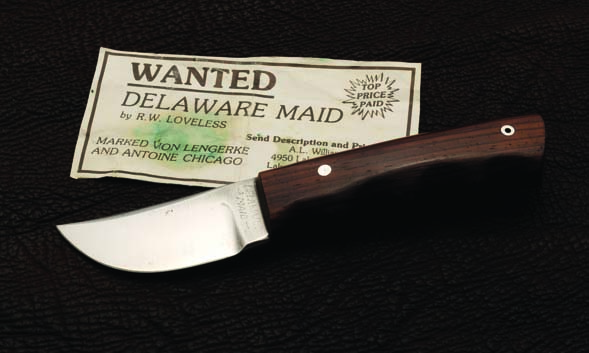
Get A Load Of That Delaware Maid!

If you’re a fan of Bob Loveless knife designs, you likely have a soft spot for at least one of the Delaware Maids … no, not the logo, although that etched “Delaware Maid” is part of it … but perhaps a hunter such as the below. From 1954 to 1960 Loveless made over one thousand knives called “Delaware Maids” and they became Abercrombie & Fitch’s best-selling handmade items, outselling the Randall blades.

An ultra-rare (only three of seven survive) Loveless “Delaware Maid” hunter with the VL&A (Von Lengerke and Antoine) logo, the knife has a trailing-point blade and a slender double-pinned hardwood handle. The photo is by Hiro Soga, and the knife comes from the John Denton collection. It appeared on pages 114 and 115 of the book Knifemaking With Bob Loveless

First Family of Swedish Steel

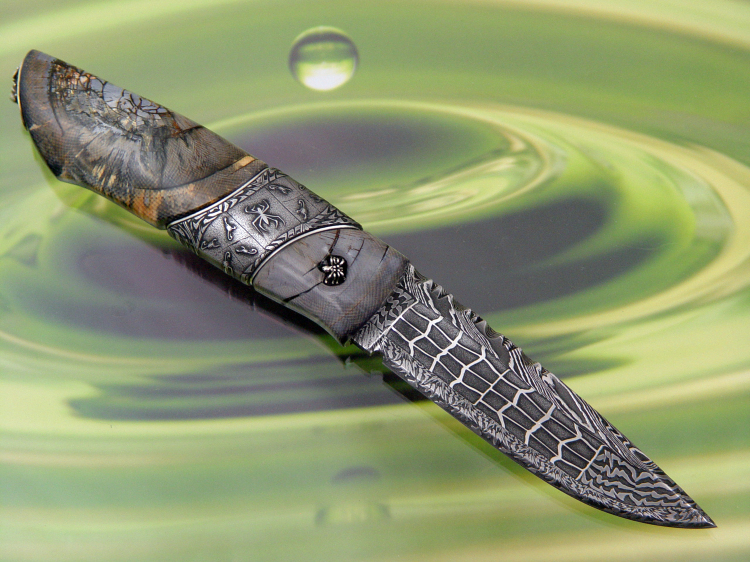
“Mammoth Spider” by Thomas Lofgren features a blade of a net-pattern mosaic damascus forged by Mattias Styrefors, a mammoth ivory and mosaic damascus handle, and sterling silver detail. (Lofgren photo)


Thomas and Claes Lofgren


Among the noteworthy Swedish knifemakers who have burst on the international cutlery scene in recent years, one of the names that stands out is Lofgren—father Thomas and son Claes.

    It is the family’s favorite sport, fishing, which brought Thomas to handmade cutlery. An annual family rite is to spend 10 days fishing—and fishing only—in the Lofoten Islands of Northern Norway. The waters are fish rich and it is not uncommon to pull out one in the 18-to-24 pound range. When you catch them you have to fillet them, which calls for a pretty good knife. Hence, Thomas began making such knives about 20 years ago. The first one cut reasonably well but was so ugly he felt obligated to make another one, and he has not quit making them since. He learned a few things from a book on knifemaking but the real trigger for improvement was an encounter with Roland Stromberg, an experienced maker. Roland taught him how to sew a nice sheath and from there showed him how to improve the general quality of his work.

    Having a technical background, Claes started getting interested in the craft in 2000, which made knifemaking just that much more important to Thomas. Since then there have been many elements of progress, emulation and sharing between father and son in the knife field. Now they are both part-time makers. Claes also works for an industrial company, and Thomas was instrumental in coordinating the 2005 and 2008 Sävsjö International Knife Expo. Thomas also found time recently to write the book, Making a Sheath for a Nordic Style Knife. It includes 150 of his own photos and sold 2,600 copies in its Swedish version, was translated into French and is now being published in German and Russian. Meanwhile, He exhibits at many shows in Sweden, other European cities (Paris, Helsinki, Solingen, Nontron), and in the USA. 

    His knife motto is “What stops growing will soon be dead.” Consequently, Thomas is always trying to improve, learning new techniques—Claes’s contributions are important in this regard—looking for new materials, and experimenting with fresh combinations of shapes and colors. “I like challenges, to walk on thin ice, even if I am not a very good swimmer,” he quipped.

    All his knives are distinctive. Even on models of similar design, he introduces many different decorations of handle and sheath, and combinations of colors and materials. In the past few years he turned toward even more high-quality materials. He is using less wood and more mammoth and walrus ivory, hippopotamus or warthog tooth, giraffe bone, etc. If he uses wood, it is often stabilized and colored. Once in a while he will embellish his knives with gold and silver, or a small precious or semi-precious stone. He prefers mosaic damascus for his blades, especially that of Conny Persson or Johan Gustafsson, or sophisticated damascus by Mattias Styrefors and André Andersson. His knives have won a number of awards in judging competitions at Swedish and American knife shows.


LIKE FATHER …

Claes’s background includes welding, most notably operating a robotic welding machine for three years. As the company he worked for expanded, a part-time position for supervising the planning of materials supply was created. Claes applied for the post and got it.

    For years he knew his father made knives, but Claes was not interested. However, in 2001 he watched his father and Johan Gustafsson board an airliner for the Knife Expo near Los Angeles (Pasadena), and “felt envious when Dad took off.” Wanting to experience the USA and California—and, of course, “California girls”—Claes saw making knives as one way to pay for the trip. His knowledge of metalworking and materials, plus the teaching of the basics by his father, resulted in very quick progress. Five months after making his first knife alone, he entered it in a judging competition at the Ludvika Show in Sweden and won in his chosen category. It was an enormous boost. By February 2002, he already had enough pieces ready to accompany his father to the Knife Expo. Since then it has become a sort of tradition for father and son to attend the Knife Expo and Ludvika Knife Week, as well as several other European shows.

    Claes’s knives share several points of similarity with his father’s. Both makers prefer mammoth bark ivory (the “bark” is the outside crust of the tusk), the same steel suppliers, quality sheaths in the Nordic style, and the same way of naming knife models. Nonetheless, not all the similarities are the result of Thomas’s influence. It is often Claes’s ideas and imagination that inspire his father.

    There are also some differences between the two. “Thomas’s knives are well made and imaginative, but with a more traditional approach. He has a feel for elegant and functional knives,” Samuel Karlsson stated. “Claes’s knives are more daring; his designs are more adventurous and extreme.”

    Being younger and with more of a technical background, Claes probably experiments more than Thomas. “The worst thing that can happen is that it goes wrong and I have to start all over again,” the younger Lofgren observed. “It can cost some material but I think it’s worth a try. I find it exciting to cross the line to find new approaches.”

    I would be remiss if I did not mention that Anna, Claes’s younger sister, also is a very good maker and has won prizes in judging competitions at Swedish knife shows. For the moment her knifemaking career is on hold as she works with her partner on restoring a farm they bought and caring for a 2-year-old boy. Meanwhile, Claes’s partner, Monika Bengtsson, also is making her first knives. “I think that I can retire now, before they all become too good for me!” Thomas laughed. “The only person not making knives in the family is my wife, Ann-Charlotte. But I can tell you that she bought two small blades …”

    Father and son makers are not uncommon, and father and daughter are less frequent. But if you add son, daughter, partner of the son and maybe one of these days the mother, a real first family of Swedish steel is in the making.—by Francis Anglade

Thomas and Claes Lofgren

+4670 834 9229 (Claes)

+46381 135 73 and +4670 69 77 405 (Thomas)

[email protected]

www.lofgrenknives.com

Specialties: Both make one-of-a-kind knives in similar styles and materials

Blade Steels: Mosaic damascus forged by Conny Persson, Johan Gustafsson, Joe Olson and Henry Hilden, and damascus forged by Mattias Styrefors and André Andersson

Handle Materials: Mammoth (including bark) and walrus ivory, hippo and warthog tusk, giraffe bone and woods (the latter often stabilized and colored)

Embellishment: Occasionally gold and silver, and precious and semi-precious stone inlays; some engraving by Jonny Walker Nilsson

Sheaths: Nordic style

Author! Author!: Thomas wrote the book, Making a Sheath for a Nordic Style Knife, which sold 2,600 copies in the Swedish version and has been translated into French, German and Russian

If you’re looking to make your own mosiac damascus, look no further than the Forging Mosaic Damascus Knives download from BLADE. You’ll learn the foundation of this fascinating process to be able to build your own great designs.


Click here to get the download for just $4.99.

W.R. Case & Sons Launches Redesigned Website

0

Bradford, PA (February 9, 2011) –W.R. Case & Sons Cutlery Company has just launched its new and improved website, WRCase.com. The 600-plus page site was completely rebuilt over a six-month period by Case’s own Web Marketing Coordinator, Michael Granger, and supporting marketing staff. The result offers an easily navigable resource and information center for Case fans to enjoy from wherever they can connect.
 
Tom Arrowsmith, Case President and Chief Executive Officer, says, “Case has always felt it had the most beautiful website in the industry. At the same time we recognized the former site’s layout sometimes compromised our ability to deliver all the information our consumers might be looking for at a given time. This redesign addresses these issues without sacrificing the ‘aura’ behind the brand; the images and stories of our knives that we all share.”

New features include an easy-to-follow content guide at the bottom of the home page, offering users one-click access to particular topics of interest. Specific knives can be found by typing in related keywords into a convenient search box displayed on many of the pages throughout the site.
 
The hundreds of Case knives now being offered by Case Authorized Dealers are grouped on the website according to type of manufacture: Standard products, promotional products, licensed products, and commemoratives and collectables. Users can also browse knives by the type of blade steel. Additionally, every knife on the Case site can now be viewed in larger sizes and at a higher resolution than was formerly offered. A new “Special Programs” section explains Case’s special merchandising programs in detail: XX Vault, Rare Finds, XX Limited Edition, Pocket Worn®, XX Select, Case and Tony Bose collaborations, and Case’s corporate gift programs. Finally, Case collectors will find production checklists for specially-featured patterns.
 
Consumers will find several self-service and support options available on-line, including an interactive “Frequently Asked Questions” section and a timeline-based slide show which chronicles the various tang stamps used on Case knives throughout the company’s 122 year-old history.
 
Fred Feightner, Consumer Marketing and Communications Manager, credits Michael Granger, the company’s Web Marketing Coordinator, with implementing the redesign’s look and feel. “Mike’s work in the redesign of W.R. Case’s website not only gives our web visitors a richer experience, it sets a new standard for our industry and lays the foundation for future integration of newer applications and technologies.”

Advertisement

Must Read Articles

Read this before you make a knife

Knifemaking 101 – Read This Before You Make a Knife

  by Wayne Goddard My experience has taught me that there's nothing like digging in and getting started. I've often said the hardest part of the...
how to forge damascus steel

How to Forge Damascus

Advertisement
Advertisement