The BLADE Blogs

The blogs of the BLADE editors, Steve Shackleford and Erin Healy.

A Cool Lady’s or Gent’s Knife

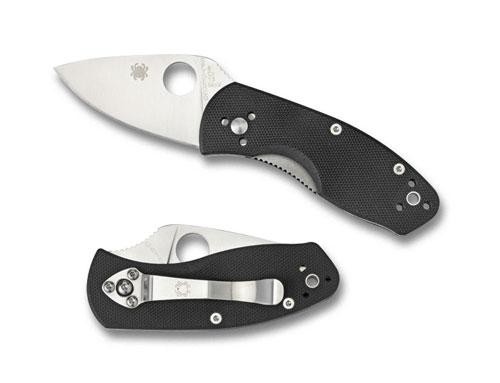
The Spyderco Ambitious is advertised as a small (3.5 inches closed) palm-sized workhorse offering big performance in a compact knife package. It definitely fits in my palm—in fact, with my hand being perhaps a tad larger than medium-sized for an adult male, it swallows the G-10 handle completely. Ergo, fully grasped, the butt is a good inch shy of the end of my palm. This is a tad small for my tastes, but then the Ambitious comes as advertised.

Looking for a cool lady's or gent's knife? The Spyderco Ambitious fills the bill.
The Spyderco Ambitious makes a cool lady’s or gent’s knife.

The edge of the 2.25-inch, flat-ground, 8Cr13MoV stainless blade is razor sharp out of the box, effortlessly slicing stationery, shaving hair and cutting cardboard with authority. It also digs into wood aggressively and makes a handy pencil sharpener if you’re in need of one, the small handle ideal for a three-finger grip that enables you to exert cutting pressure in the “little whittles” needed to sharpen something as small as a pencil. Though short, the blade is wide enough (1.25 inches at its widest) to handle larger cutting jobs, with a jimped area on the ramp to place your thumb for cuts that might take more bearing down.

The blade opens and closes off a Michael Walker LinerLock™ that, despite the knife’s small size, operates smoothly and securely after a little practice. A reversible clip runs about two-thirds the length of the small contoured handle. An integral guard offers some protection from the hand running onto the blade, though I would like to see a bit more downward lip on it to enhance that protection.

One of Spyderco’s models made in China, the Ambitious is yet another example of just how good the Chinese are getting at making quality knives that cut extremely well. Though compact, the Ambitious is solidly built and makes a great gent’s knife, backup piece or lady’s knife. ShopBlade’s price: $35.96—you save 35 percent! For more, visit http://www.shopblade.com/ambitious-black-g-10-plainedge-w8477?lid=ssfbbl082013.

Ron Lake’s Tab Lock: The Clever Lever

     When Blade Magazine Cutlery Hall-Of-Fame© member Ron Lake devised the interframe design and gave the world of knives another standard of innovation and excellence, he continued to look for ways to improve the operation of a standard lockback mechanism. He was not satisfied with pushing a bar to release the lock, particularly with one hand occupied or involved in some type of activity that demanded his full attention.

     The solution was fairly simple and came along in the early 1970s, just a few months after the historic debut of the interframe. Ron added a small steel tab at the end of the knife, offering the user a quicker and safer alternative to depressing a bar.

     “The tab lock is really not a lock mechanism,” Lake explained. “It is just a tab on the end of a lockback that offers a mechanical advantage. If it isn’t there, I just have a bar to release the lock, and depressing that bar can be hard to do when the hands are soft, cold or wet. The tab gives you a larger surface to push on.”

     Ron admits that the tab lock was something of an afterthought, trailing along behind the notion of the interframe. Sometimes the good idea can indeed be made better. As a young knifemaker, he continued to mull over the prospects for a better release.

     “I had only been making knives for six years,” he laughed. “I didn’t even know another knifemaker and didn’t know what knives were supposed to look like. I came up with the interframe design and then thought about where I could put a release mechanism. I still make interframes and that’s about all I do make, and they are with the tab.”

     While it may look like a simple endeavor, the fashioning of the tab lock is not for the knifemaker who wants to take a shortcut or go down the path of least resistance. Of course, the tab-lock style is not seen in great numbers among today’s knives, and Ron says there is a straightforward explanation for that. It just is not the easiest thing to do.

     “I can make them now with less effort than it took back then,” he advised, “but first of all I have to machine a piece of metal that goes on the end. Then I have to silver solder it on, and it’s a rough piece of metal with everything large on it. Then I remove the silver solder so you can see a nice radius, machine the sides to the right dimension and radius the corners.

    “From there, I hand sand the surfaces and polish them up. So, it takes several more hours of work than a standard knife, and about 15-to-20 percent of my time goes into that part of the knife. I also have to take the whole knife apart and put it together again two more times, which I don’t have to do on some other models. For a few years, A.G. Russell just thought I butted it up against the end of the lock and soldered it on, but that could get knocked off easily. Later, I explained the process to him, and I can tell you the tab is on there pretty tight, pressed on and silver soldered.”


Tab Release

Some years ago when Ron, along with Wayne Clay and Cutlery Hall-Of-Famer Frank Centofante, co-wrote How To Make Folding Knives, he discussed the geometry of the lockback knife. He remembers visiting Sakai Cutlery in Seki City, Japan, and sitting in the company’s offices, which incidentally included a log cabin from Montana that had been dismantled and reconstructed. The men from Sakai had eight lockback knives laid out in the office, and the geometry between the pivot and the lock was different on each one.

     “I asked them who had designed those knives,” Lake smiled, “and they said, ‘We did.’ I asked them why the geometry was different on every one of them, and they told me it was because the toolmaker had made them the way he wanted to do it. To my knowledge nobody had put the geometry of the lockback down on paper until I did. Innovation comes from one-man shops.”

     That innovation carried over to the construction of the tab lock, which Ron more aptly describes as a “tab release.” The tab lock actually does lock like any other lockback. The secret to its operation is in the release.

     Long-time friend and fellow knifemaking legend and Cutlery Hall-Of-Famer Michael Walker says he agrees that the idea seems simple enough and makes a great impact on the user when it comes to ease of release. “I can say that the tab lock addresses a big problem with the lockback design by adding length, which in turn adds leverage,” he explained, “and the tabs let you unlock without the problem of pushing on a narrow piece of metal. It also eliminates the cutout [in the handle spine], which could restrict use for someone with larger hands. It’s much more functional than the traditional construction, hence he was awarded a patent.”

     Lake says he believes his patent was awarded about 1973 and expired around 1994. It not only included the tab, but also extended to the interframe and the bushing inside the handle that spaced the blade away from the frame. Indeed, the tab was part of a larger patent and an afterthought that developed into a novel approach when his inventive mind pondered the question of an efficient and effective release.

     “I decided that having the tab at the back of the knife would have a mechanical advantage,” Ron reasoned. “You can close it not only with the thumb but anything else that could be used to press the release. It doesn’t make any difference how long the lever is. It could be in the middle of the handle with the tab on it.”

     As for the patent, Ron says he doesn’t worry too much about it. “Centofante put [the tab lock] on his knives, and we were friends,” he remembered. “Some other folks have used it, too. Centofante put his tab on one side of the lock, and the patent specified at the end of the lock lever.” Along with Clay’s lockback, Lake’s and Centofante’s versions of the tab lock both appear on the cover of How To Make Folding Knives.

     Over time, Ron says the patent has become even less meaningful to him. The drawings or blueprints are long forgotten—probably shoved into a drawer somewhere in his shop. The concept of trade dress is enough for him. A form of intellectual property, trade dress refers to the look or characteristics of an artist’s work that provide the work’s instant recognition to the consumer.

     “After you do something for so long, it does establish trade dress,” Lake commented. “For example, if you saw a lockback lying on a table with a tab on it, would you know who made it? Yes, you would know that knife is mine. That is trade dress.”

     Of course, the tab lock made an impression 40 years ago when a young Ron Lake showed it off to a who’s who from the golden age of custom knifemaking. Among those present when the tab lock debuted were Corbet Sigman, Chubby Hueske, Cutlery Hall-Of-Famers Frank Centofante, A.G. Russell, B.R. Hughes and Bob Loveless, and a number of others. Since then, the tab lock has been a quiet trademark of Lake’s knifemaking skill, standing the test of time.—By Mike Haskew


To read similar stories and all about the latest knives, knife news and much more subscribe to BLADE®. For more information, click on http://www.shopblade.com/product/blade-magazine-one-year-subscription-us/?r+ssfb21211#BL1SU


CAPTION

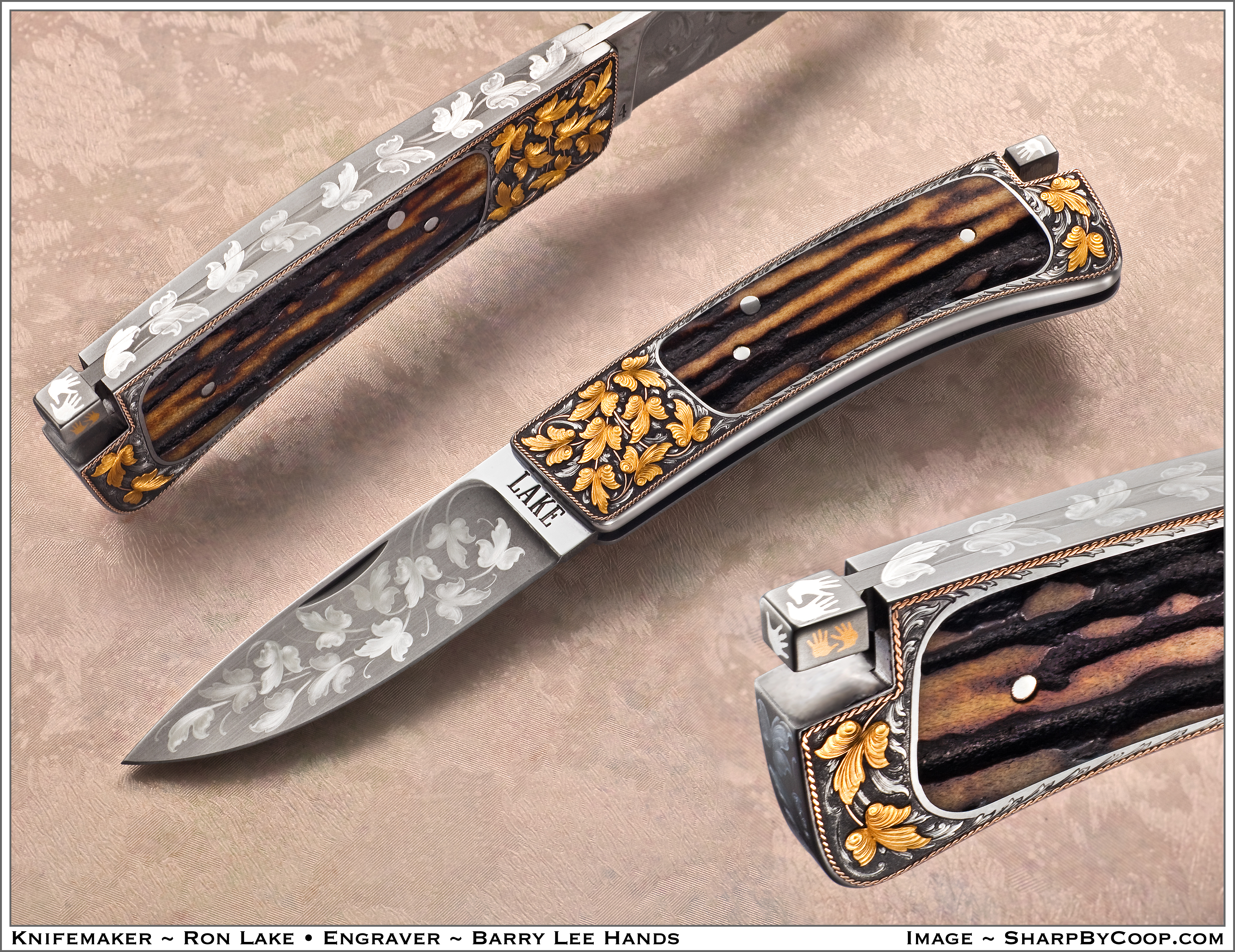
Blade Magazine Cutlery Hall-Of-Fame© member Ron Lake and one of his tab-lock interframe folders in a stag handle and leaf-and-hands engraving—some in gold—on the blade bolsters and even the tab itself by Barry Lee Hands. (SharpByCoop.com photo)


Southern Grind Spokesman Remembers The Fallen

Marine SSG Johnny Joey Jones is spokesman for Zac Brown's Camp Southern Ground, which is funded in part by proceeds of Southern Grind knife company.
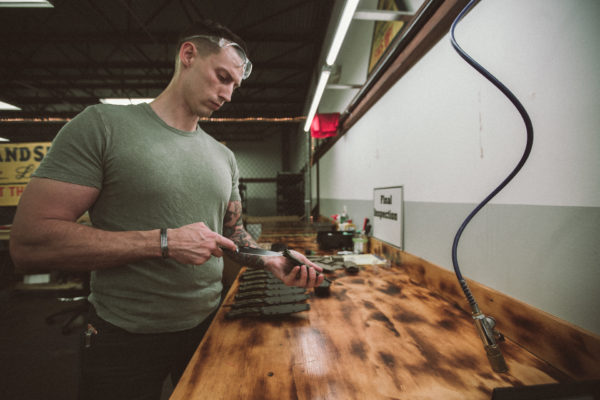
Marine Explosive Ordnance Disposal Technician Staff Sergeant Johnny Joey Jones inspects a knife at Zac Brown’s knife company. The Southern Grind spokesman remembers the fallen, especially the mine sweeper who died in the explosion that took Jones’ legs.

In 2010 ABC Nightline produced a three-part series on Marine Explosive Ordnance Disposal (EOD) Technician Staff Sergeant Johnny Joey Jones. During eight years of service, Jones deployed to both Iraq and Afghanistan. It was while in Helmand, Afghanistan, on August 6, 2010, that Jones stepped on an improvised explosive device, losing both his legs and severely injuring one arm. In the face of inordinate challenges, Jones not only maintained a positive outlook, but became a beacon of hope to his fellow amputees, his fellow veteran collegiates and the public who follow his charity work and appearances on Fox News. Triple J or Joey, as his friends call him, is now spokesman for Zac Brown’s Camp Southern Ground, a 400-acre camp and retreat for children and military families that is funded by the proceeds of numerous artisan shops, including Southern Grind, the musician’s knife company. You can read more about Jones and some of the substantial knives offered through knife-lover Zac Brown’s company in the September issue of BLADE Magazine. (If you can’t find BLADE near you, subscribe.) But no matter how far Jones progresses physically, no matter what business pinnacle he reaches, the Southern Grind spokesman remembers the fallen, one fallen in particular, the man who died in the explosion that took Jones’ limbs: Marine engineer and mine sweeper, Corporeal Daniel Greer.

Marine Staff Sergeant Johnny Joey Jones served in both Iraq and Afghanistan.
In the course of eight years of service in the Marine Corps, Staff Sergeant Johnny Joey Jones was deployed to both Iraq and Afghanistan as an Explosive Ordnance Disposal technician. In 2010 he lost both his legs in an explosion. No matter what he does: recovering from his wounds, inspiring fellow veterans as they recover, making motivational presentations, representing charity organizations, appearing on Fox News as a commentator, or as current spokesman for Zac Browns Camp Southern Ground and Southern Grind, the musician’s knife company, Jones is always positive and never fails to remember the Marines, soldiers, sailors and airmen who died in service to our country.

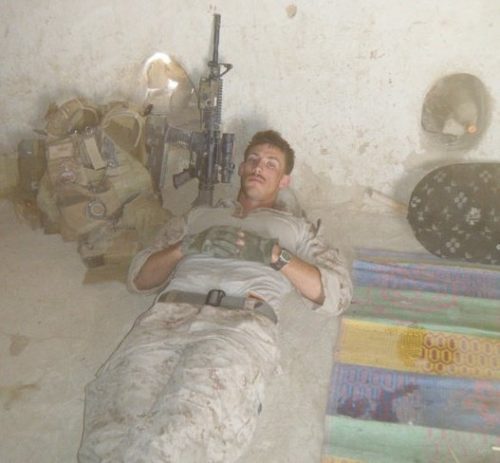
A TV Crew Interviews Jones in Afghanistan, Unaware Of The Fate To Befall Him

Jones’ Recovery Is Motivated By Fellow Wounded Brethren And The Fallen

Jones Remembers The Marine Who Died In The Explosion That Took His Legs

Jones’ Second Chance At Life Is In Honor Of Those Who Died In Combat

No Matter The Obstacle Jones Has Some Marine-Tough Encouragement

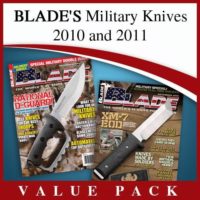
Get Two Military Knives Issues Of BLADE For The Price Of One

BLADE's Military Knives issues for 2010 and 2011 are on sale for $5.99 in downloadable .pdf format.
Read about the styles of knives most often carried into war and lots more in this two-pack of BLADE’s Military Knives issues for 2010 and 2011.

Boldly designed military knives, stories of knives that saved the lives of men in combat, soldiers who make knives for soldiers, and makers who support the troops, it’s all covered in these two special issues. Normally, $11.90, this download .pdf pack is on sale for $5.99.

Keeping Loveless Legacy Alive

Meet Brent Harp, one of the very few Bob Loveless protégés to be trained in Loveless’s shop alongside Jim Merritt. A detective in the Redlands, California, Police Department, Harp first met Loveless in 1986, when he was trying to learn how to heat-treat steel to make his knife blades harder and hold a better edge.


Last month, Harp was featured in Southern California’s The Press-Enterprise newspaper regarding his knifemaking and keeping the Loveless legacy alive.


To read the feature, go to: http://www.pe.com/local-news/local-news-headlines/20110918-perris-knife-maker-keeps-the-legacy-alive.ece

BLADE Magazine 2012 Knife-Of-The-Year® Awards


Named at this past weekend’s 2012 BLADE Show (www.bladeshow.com) at the Cobb Galleria Centre in Atlanta, Georgia, the Blade Magazine 2012 Knife-Of-The-Year® Awards went to the finest production knives the world has to offer.


KAI USA and its knife divisions of Kershaw, Zero Tolerance and Shun dominated the awards, taking home four of the honors: Overall, Best Buy, Knife Collaboration and Kitchen Knife. DPx Gear was a first-time winner, and Chris Reeve Knives and William Henry Studio continued their long-term dominance in the respective categories of Manufacturing Quality and Investor/Collector Knife. Other winners included Microtech, Columbia River Knife & Tool, Spyderco and Wicked Edge. Knife Rights and the American Knife & Tool Institute each won Industry Achievement Awards for their diligence in working to have pro-knife legislation passed in a number of states this year.


The winners by category:


Blade Magazine 2012 Overall Knife Of The Year®: ZT 0888 by Zero Tolerance/KAI USA (pictured at top)


Blade Magazine 2012 American-Made Knife Of The Year®: Socom Delta by Microtech


Blade Magazine 2012 Imported Knife Of The Year®: Onion Foresight by Columbia River Knife & Tool


Blade Magazine 2012 Most Innovative American Design®: Autonomy by Spyderco


Blade Magazine 2012 Most Innovative Imported Design®: DPx HEST T3


Blade Magazine 2012 Manufacturing Quality Award: Chris Reeve Knives


Blade Magazine 2012 Best Buy Of The Year®: Cryo by Kershaw/KAI USA


Blade Magazine 2012 Knife Collaboration Of The Year®: ZT 0600, a collaboration between Zero Tolerance/KAI USA and R.J. Martin


Blade Magazine 2012 Investor/Collector Knife Of The Year®: B12 Freedom by William Henry Studio


Blade Magazine 2012 Kitchen Knife Of The Year®: Taiyo by Shun/KAI USA


Blade Magazine 2012 Accessory Of The Year®: Precision Sharpener Pro-Dash II by Wicked Edge


Blade Magazine 2012 Industry Achievement Awards®: Knife Rights and American Knife & Tool Institute


For the complete story on the winners and the knives, see the November BLADE®.


Read About Previous Winners in BLADE Magazine Back Issue Bundle

Read all about previous Knife-Of-The-Year® winners in the History of BLADE Magazine bundle. It contains DVD-ROMs for your computer to read all BLADE issues from 1973 to 2008.

Click to order this digital BLADE back issue bundle for just $60 (normally $100).

Proposed Boston Ordinance would violate Equal Protection Clause

AKTI has submitted an official opposition position to the City of Boston on their proposed ordinance to license convenience stores that sell knives. You can check out background info & AKTI’s letter to the Boston City Council http://www.akti.org/news/akti-responds-to-boston-proposed-ordinance

One Knifemaker’s Quest to Obtain ABS Journeyman Certification -“The Road to San Antonio”


The Road to San Antonio
One Knifemaker’s Quest to Obtain ABS Journeyman Certification
by Lydia McGhee

Sunday, July 24, 2011

Powerful whacks resonate from the metal shop behind the house – repetitive machine-like poundings followed by a pause, then softer whacks, less consistent, more human. Suddenly, the hammering stops. Inside the shop a powerful man stands a few feet from a roaring gas forge. Flames flicker out of a small opening in the front, and one end of a long metal bar soaks in the fire. The man holds the cool end gently in his hand and watches intently as the far end, which looks like a knife, begins to glow. Completely indifferent to the bead of sweat that trickles down his nose and splashes on the concrete floor, E. Scott McGhee’s motionless posture contradicts the sweaty shirt and dirty mule-skin apron that hug his body. . . but he isn’t still for long. As the knife blazes orange, he pulls the bar from the fire and the pounding begins anew.

Attached Image
E. Scott McGhee is a bladesmith. He forges knives and other edged tools from high carbon steels. It is a primitive art born in antiquity and nearly lost in this country during the 20th century. Expert bladesmiths craft knives born of fire and artisan vision, beautiful beyond imagination, and functional beyond belief.

Attached Image

In the mid-1970’s, the art of the forged blade was dying. At that time, factory produced knives dominated the market and only a few bladesmiths and their loyal customers understood what was being lost. According to the American Bladesmith Society (ABS), only 12 American artisans publicly practiced traditional bladesmithing in 1976 when four devotees created the ABS to preserve the art. Bill Moran, one of the founding members, hoped to double the number of active bladesmiths, and he wasn’t disappointed. There are currently 1,100 ABS members, 160 ABS journeyman, and 115 ABS masters worldwide.

E. Scott McGhee is an ABS apprentice on a quest to become a journeyman. He played at a coal forge on and off for over 30 years making historic kitchen implements, but only recently built a gas forge, joined the ABS, and began bladesmithing. He would like to forge blades full-time.

But why forge when you can simply grind?

According to E. Scott McGhee, “I forge because it allows me to be creative. While those who grind are limited by the shape of the stock, those of us who forge are not. Forging allows me to craft designs that flow for beauty as well as function.”

Attached Image

The American Bladesmith Society sponsors classes, hammer-ins, and shows to promote the art of the forged blade, and they certify journeyman and master bladesmiths. The process is intense. Journeyman candidates must be ABS members for three years (two years if they take an ABS class), pass a rigorous performance test, and survive a brutal peer review.

Scott passed his JS Performance Test in January of this year, but it wasn’t easy. Bladesmithing is more than just pounding metal into the shape of a knife. ABS-certified smiths heat-treat in house to produce products far superior to mass produced blades.

Attached Image

According to Scott, “Proper heat treating allows me to turn a piece of art that looks like a knife into a high performance blade.”

JS Performance Test knives must 1) Cut through a free-hanging 1-inch manila rope in a single pass 2) Chop
through a 2×4 twice without dulling and 3) Bend to 90 degrees without breaking.Every Journeyman Performance knife is destroyed during testing, as are some dreams. Not everyone passes, but all who do say the performance test is the easy part.


The peer review is tougher. Twice a year at either the Blade Show in Atlanta or the Forged Knife Expo in San Antonio, journeyman candidates may present five knives to a panel of seven ABS masters. This year 17 candidates tested at Blade and 13 passed.

According to Haley DesRosiers, a new JS, “At 8am the door is locked and the judging begins. Then, after what feels like 6 or 7 years, they begin to call you in one by one. It’s like being on death row.”

If you fail, you can test again in a year. If you fail three times, the dream dies.

Masters are tough in the judging room but generous elsewhere. All ABS-certified smiths are expected to share knowledge and masters are expected to teach as preserving the art is the goal. Scott is apprenticing with ABS Master Jason Knight, but frequently communicates with other ABS-certified smiths and has been amazed by how generous all have been.

“I wouldn’t be where I am without them,” says Scott, “I stand on the shoulders of giants.”

At the Blade Show in June, ABS Master Adam DesRosiers said it best, “It’s a great time to be a bladesmith. If it were twenty years ago, we’d all be alone at our coal forges reinventing the wheel every time.”

Thanks to the American Bladesmith Society, that’s no longer  true.

They are an eccentric lot, the ABS bladesmiths. All love knives, most love guns, and many are good ole’ boys and gals, but all are metallurgists and artists at heart and shouldn’t be mistaken for anything else. They are kind, knowledgeable, and generous – a good group to have on your side.

Hot knives, cool people – this is the community E. Scott McGhee is quickly making his own. Watch for him. He is fiercely passionate about forging and his peers recently named him an up-and-coming bladesmith.

Scott will present five knives at the Forged Blade Expo in San Antonio in January of 2012 and hopefully come home with a JS stamp.

Stamp or no, the art of the forged blade will be preserved.


Lydia’s original article is posted at http://absbladesmith.blogspot.com


NOTE: Lydia McGhee produced this multimedia project for a Gonzaga University graduate class in communications. Lydia chose to focus the project on her husband E. Scott McGhee and his quest to become an ABS Journeyman Smith. As part of the project Lydia produced video clips that include interviews with Haley and Adam DesRosiers, Shelly and Jason Knight, Kevin and Cheryl Evans, and herself about the ABS Journeyman Smith testing process.  This multimedia project is very well done and I know that it will give some insight into the process from several different member perspectives.

Great job Lydia and all the best to Scott in San Antonio

Advertisement

Must Read Articles

Read this before you make a knife

Knifemaking 101 – Read This Before You Make a Knife

  by Wayne Goddard My experience has taught me that there's nothing like digging in and getting started. I've often said the hardest part of the...
how to forge damascus steel

How to Forge Damascus

Advertisement
Advertisement