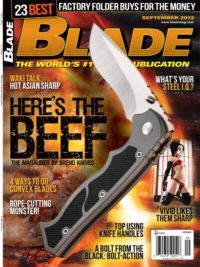
The BLADE Blogs

The blogs of the BLADE editors, Steve Shackleford and Erin Healy.

Twas The Knife Before Christmas

Twas the knife before Christmas, when all through the house
Not a creature was stirring, not even a Blade-Tech Mouse.
The scabbards were hung by the chimney with care,
In hopes that knives of nickel silver soon would be there.

The children were nestled all snug in their beds,
While visions of sugar-plums danced in their heads.
And mamma with her Kershaw, and I looking for my Loveless painter’s cap,
Had just settled our brains for a long winter’s knap.

When out near the forge there arose such a clatter,
I sprang from the workbench to see what was the matter.
Away to the window I flew like a SOG Flash,
Tore open the shutters and threw up the sash.

The moon on the breast of the new-fallen snow
Gave the lustre of mid-day to blades below.
When, what to my wondering eyes should appear,
But a miniature sleigh, and eight tiny sambar deer.

With a little old bit driver, so lively and slick,
I knew in a moment it must be St. Nail Nick.
More rapid than Al Mar Eagles his coursers they came,
And he whistled, and shouted, and called them by name!

“Now Trapper! now, Whittler! now, Lobster and Slim Jack!
On, Muskrat! On, Canoe! on Tickler and Swayback!
To the top of the porch! to the top of the wall!
Now cut away! cut away! cut away all!”

As wood chunks before the bowie fly,
When they meet with a sharp edge, pieces multiply.
So up to the knife shop they flew,
With the sleigh full of Toys, and St. Nail Nick too.

And then, in a stropping, I heard on the roof
The prancing and pawing of each little hoof.
As I turned on the grinder and listened for the sound,
It was obvious ol’ St. Nail Nick had come to ground.

He was dressed in overalls, from his head to his foot,
And his clothes were all tarnished with ashes and soot.
A bundle of knives he had flung on his back,
And he looked like a bladesmith, just opening his pack.

The bolsters how they twinkled! The quillons how merry!
The scrimshaw like roses, the pommel like a cherry!
The knife exhibited just the right amount of “flow,”
And the blade’s belly was full as the BLADE Show.

The body of the knife held tight in the sheath,
And the guard encircled the tang like a wreath.
It had a sharp edge and was a perfect cutter,
That whisked when it cut like a hot knife through butter!

It was keen and useful, a right sprightly tool,
And I laughed when I saw it, me being an ol’ fool!
A honing of its edge and a twist of my wrist,

Soon gave me to know it was on St. Nail Nick’s list.

He spoke not a word, but went straight to his work,
And filled all the scabbards, then turned with a jerk.
And laying his Sharpfinger aside of his nose,
And giving a nod, up the chimney he rose!

He sprang to his sleigh, to his team gave a whittle,
And away they all flew, not one blade brittle.
But I heard him exclaim, ‘ere he drove out of sight,
“Happy Christmas to all, and to all a good-knife!”

On behalf of the staff of BLADE® Magazine, the BLADE Show and F+W Media, it is my honor to wish you all a Merry Christmas and/or whichever holiday you are celebrating at this most special time of year.

For information on how to subscribe to BLADE, click on http://www.shopblade.com/product/blade-magazine-one-year-subscription-us/?r+ssfb241211#BL1SU
Do You Have Your Hunting Knife?

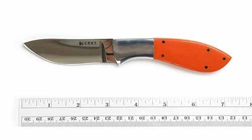
There is no single profile that fits all hunters, and there isn’t a specific hunting knife that fulfills all needs. That’s a good thing for the knife industry. Some guys like a standard fixed-blade, drop-point hunter that comes in a leather belt sheath, maybe even with a slight hump near the tip of the blade where they can rest their finger and choke up on the blade. One of custom knifemaker Russ Kommer’s favorite packages is the 2-Shot. He has used it daily in the field as a hunting guide in Alaska and around the world. X3351Russ says, “I’ve always preferred a smaller semi-skinner, even for the biggest of game. You just use the hump near the end of the blade to locate your index finger. And the blade is short enough that you can work inside the animal and feel where you are at all times.” The CRKT Kommer 2-Shot Skinner Knife has a 3.15-inch full-tang 12C27 Sandvik stainless steel blade, stainless bolsters, orange G10 handle scales and stainless steel pins.

Y3351

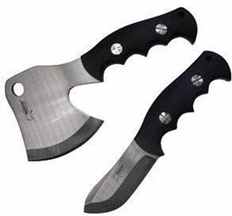
Some ever-prepared hunters aiming for big game opt for a hatchet/skinner combination pack such as the Timberline Hatchet/Bush Guide Skinner Combo. It includes Kommer’s Alaskan Bush Pilot Hatchet and Alaskan Skinner. Expertly crafted from polished 440 stainless steel, the Alaskan Bush Pilot Hatchet boasts a 4-inch, full-tang head, while the Alaskan Skinner sports a 3.625-inch 440A stainless steel skinner blade. Each handle is precision machined Zytel for a non-slip grip and ease of use. The Alaskan Combo includes a ballistic nylon sheath with belt loop, and weighs 2.28 lbs.

Y7735

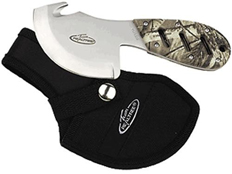
Gut hooks come in handy for skinning game animals, and a Realtree-pattern handle is a plus. The Kutmaster Team Realtree Guthook Knife dons a 420 stainless steel blade with sharp gut hook on the spine, a Realtree camo handle pattern, and a nylon belt-loop sheath. 

For many more quality options, visit ShopBlade.com, and stock up for the hunt!

Heft & Freestyle Form Define Hossom “Tanto”

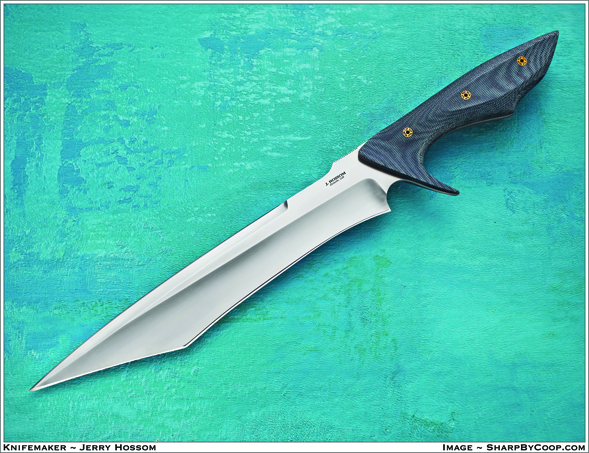
Unusual? Yes, it would be no stretch to say that Jerry Hossom’s “Vengeance Tanto” takes an unbeaten path from pointy tip to pointed pommel. But all along the way it’s so groovalicious! Check out the handle half, or third, in this case. Integrated into the design of the black-canvas-Micarta® grip there’s a place for the palm, all the fingers, and a sweet guard that angles just a little back toward the butt. The knife is featured in the “Fiery Fighters” chapter of the Knives 2013 book, but it is actually tough to categorize. 

And oh, yeah, the blade. Let’s see, the CPM-3V blade is high-hollow ground, ends in what could be the world’s most modified tanto tip, has a swedge along the spine, and a line stretching horizontally along he length of the blade where the hollow grind ends, the flat starts, and the swedge eventually meets. Don’t forget the finger notches just North of the handle, on the spine of the blade, for extra traction. Mosaic pins round off the piece.

It’s an “Editor’s Favorite from the Knives 2013 Book,” by the way. SharpByCoop.com is credited for the photo.

Thanksgiving Cutters, Japanese Style

Thanksgiving cutters times four
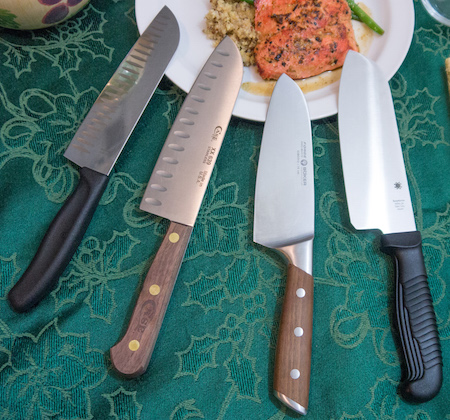
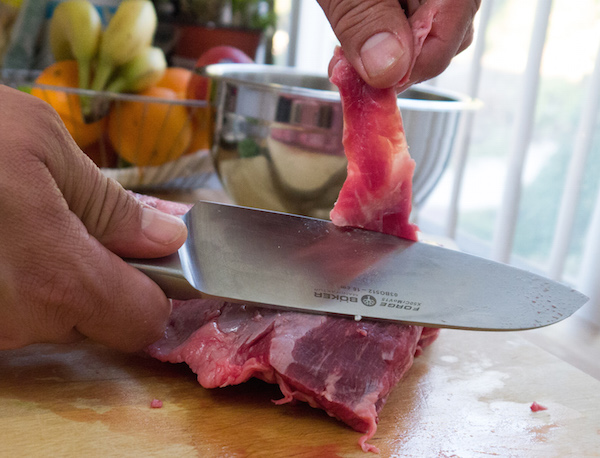
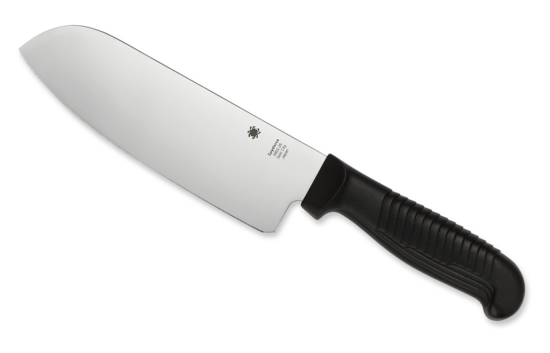
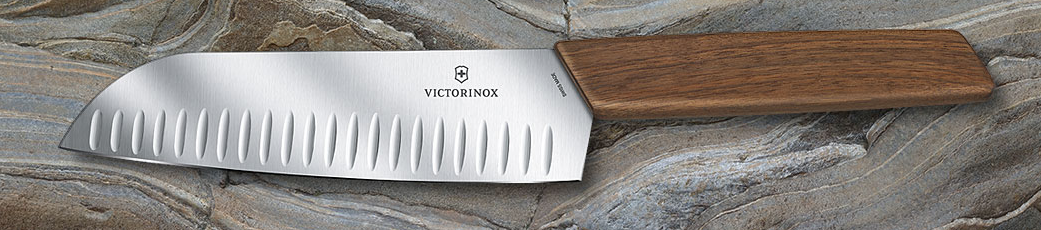
Thanksgiving cutters, Japanese style, from left: Victorinox SwissClassic Santoku, Case Santoku, Boker Forge Santoku Maple and Spyderco K08 Santoku.

Santokus are Thanksgiving cutters, Japanese style. A design that originated in the Land of the Rising Sun, the santoku is a specialized tool well suited to preparing holiday meals. From cutting meat to dicing veggies and cutting fruit for creative holiday salads and such, santokus are perfect for Gobbler Day.

Santokus have a wide blade sometimes with scallops, which are supposed to create less friction than a solid blade, a sheepfoot tip, and are lighter and thinner than a French or German chef’s knife. Their length runs between 5 and 8 inches. The Thanksgiving cutters do not have a bolster. They have a straight edge with no curve.

San-to-ku is Japanese for the three cutting tasks for which the knife is designed: slicing, dicing and mincing. It is a specialized knife that, in the Japanese view, is optimized for the three aforementioned tasks. The straight edge of a santoku does not allow for the rocking motion commonly used with a French or German chef’s knife.

Cuts are made straight down with little or no forward movement, almost a guillotine action, which, again in the Japanese view, allows slicing very thin pieces of whatever’s being cut with precision. The Thanksgiving cutters are not meant to be all-around kitchen knives. An all-around knife used to cut many things is not a Japanese concept. The Japanese chef will typically have a vast array of knives, each one designed for a specific function.

Japanese kitchen knives typically have a chisel grind, which also contributes to cutting very thin slices with precision, as you may have seen sushi chefs do. The chisel grind is optimal for slicing, say, very thin slices of turkey, with the caveat that there are left and right grinds. If you are right handed you’ll need a blade ground on the right side. The chisel grind doesn’t work well for cutting through thick media, such as roasts and ribs because the chisel grind—since the edge is off center—will cause the blade to cut off center, and to wander. Also, the thin edge of a Santoku should not be used to cut through joints or bones, or to disjoint, say, a chicken.

HAPPY MARRIAGE

Thanksgiving cutters, Boker
One reason santokus make such good Thanksgiving cutters is their ability to cut small meat slivers. The Boker Forge Santoku Maple is a classic example.

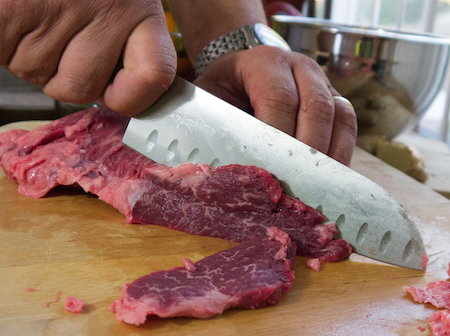
With its hefty blade, full tang, nicely sculpted bolsters and maple scales, the Boker Forge Santoku Maple is a happy marriage of a classic santoku and a German or French chef’s knife. While it lacks the acute point of a chef’s knife, the slight point is usable. The edge does have somewhat of a curve, which allows the rocking motion Western-trained chefs, and many domestic home cooks, are accustomed to using. It is the only one of the four knives reviewed that I would use to cut through pork rib joints, chicken backs, etc. The Boker is almost a mini cleaver as well as being an excellent slicer. It is a handsome knife and comfortable for long periods of work.

Thanksgiving cutters, Boker
Thanksgiving cutters must be adept at slicing veggies, and the Boker Forge Santoku Maple is that and more.

STURDY STUDY

With its walnut scales and full tang, the Case model is also a sturdy example of a Santoku. It has a barely perceptible curve to the edge and a scalloped blade. The Case looks more like a classic santoku than the Boker, but like the Boker has a thicker blade than a standard Japanese santoku. It felt solid in hand and while not as sculpted as the Boker, the traditional American handle was comfortable during extended use. The Case sliced, diced and minced as well as thin-bladed Santokus while giving the impression that it would be up for harder work if need be.

Thanksgiving cutters, Case
Thanksgiving cutters must be able to tackle meat slicing and the Case Santoku is a prime-cut cutter.

21st-CENTURY SHARP

spyderco chef's knife
Spyderco image

With its wide blade, classic Santoku profile, comfortable, molded grip and graceful overall appearance, the Spyderco K08 looks like a 21st-century interpretation of a classic—which is pretty much what it is. It is a very lightweight knife with an extremely thin blade, which is optimal for doing what a santoku is supposed to do. The Spyderco does have a slight curve toward the tip, which I think adds to its smooth lines. Since I am accustomed to using a French or German chef’s knife, the curve also made it easier for me to work my way through piles of squash and mushrooms, especially mushrooms, which I find hard to slice. The blade also made it easy to slice salmon smoothly and evenly.

ENTRY-LEVEL PRO

Victorinox chef's knife
Victorinox image

Victorinox makes the knives The American Culinary Institute gives to its students: chef’s knives, paring knives, bread knives and, yes, santokus. Pro chef Shawn Carlson’s first professional knife roll contained only Victorinox knives. So, he was familiar with the Victorinox characteristics: thin profile, very sharp, fairly soft steel that requires frequent steeling but which comes back to a fine edge quickly, and which does not chip if dropped on a kitchen floor. It has the standard santoku shape: flat edge and sheepfoot tip rather than a curved profile and pointy tip. I missed a curved edge and had trouble adjusting to the flat straight edge. Shawn did not—again, a pro is a pro. It is an entry-level professional knife.

FLAIR GAME

If you enjoy cooking and take pleasure in using specialized tools, you’ll find a santoku a welcome addition to your quiver of Thanksgiving cutters—keeping in mind that a santoku is a specialized tool. If you like to keep things simple, an 8-inch chef’s knife and a 4-inch paring knife will do most any kitchen job—if not with the flair of a santoku.

Mantis Knives to Host “The So-Cal Slice” in December

Mantis Knives will host an event at its headquarters in Anaheim, California.

The event is called “The So-Cal Slice.” A BladeSports school and competition will take place, Bram Frank and Ms. Sonia will teach a two-day seminar on Close Quarters Combat, and Mantis Knives will offer a warehouse sale and tours of its grand facility.

The BladeSports cutting competition will be covered by local press and television.

This event will take place on Dec. 11 and 12, 2010.

Details

Dates: December 11, 2010 to December 12, 2010
Location: Mantis Knives Headquarters, 1580 North Harmony Circle, Anaheim, CA 92807
Website: http://www.mantisknives.com
Phone: (714) 701-9136

Planning to attend? Click here to RSVP on the Knife Showcase event calendar.

Emerson Auction Ends Today

0

Ernest Emerson’s knife auction ends today, so if you’re interested in participating, you’d better act fast.


For more information visit www.emersonknives.com.


The auction culminates a whirlwind week for Emerson Knives, Inc. The company moved into a new, 12,500-square-foot facility in Harbor City, California. It is four times larger than Emerson’s previous facility. “We moved seven 18-wheelers full of equipment and started working on Monday,” he noted. The new facility will include a 3,000-square-foot knife/self-defense training area. A “meet and greet” at the new facility is being planned, Emerson said.


Meanwhile, on Wednesday, Emerson held what he said was the first worldwide on-line knife lottery, with participation from buyers on every continent but Antarctica. He said it lasted two hours and 33 knives were sold. He plans to do another one, possibly in the spring.


Midweek Maker Military-Style: Scooter Davis

When Jerry Davis was a baby he was scooting across the floor and his grandmother dubbed him Scooter. He is a third-generation welder and fabricator. His dad made knives as a hobby, and by the time Scooter was a teenager, he, too, was making knives.

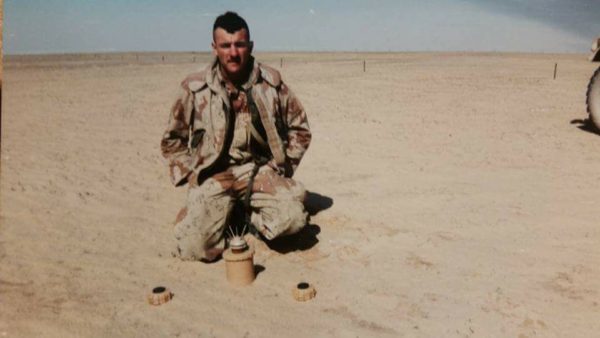
Scooter Davis is a welder and fabricator whose dad made knives, and now he does too.
Schooter Davis, a Desert Storm US Marine Corps veteran, specializes in small everyday carry knives, skinners and survival knives.

At 19 he entered the U.S. Marine Corps and served as a heavy equipment engineer during Desert Storm. The Gulf War veteran served four years then returned to West Virginia.

Knifemaker Scooter Davis is a Marine who served in the Gulf War.
Scooter Davis served in the U.S. Marine Corps during Desert Storm. The Gulf War vet then returned to his native West Virginia.

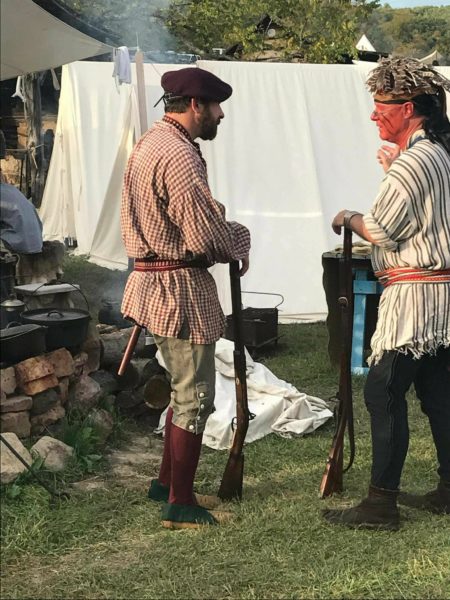
When he isn’t making knives, he’s attending rendezvous, living history gatherings that bring early American frontier days to life. He makes many items in his kit and, of course, period-appropriate knives.

Scooter Davis has been attending rendezvous living history events since he was a child and is enamored with the early American frontier period.
“A primitive rendezvous is a living history event,” Scooter Davis explained. “I have enjoyed them since I was a child. It’s like taking several steps back in time and I enjoy crafting knives and other items that represent that time period [early American frontier].”
He’s also a singer and musician, playing weddings, parties and other events, equally comfortable with Sinatra or Stevie Ray Vaughan.

Scooter Davis makes knives and plays music, too.
The quintessential Renaissance man, Scooter Davis of Rough Run Forge, can also perform anything from smooth jazz to country.

“I’ve always been an artistic feller, always making things. I can make just about anything,” Scooter said. But what really inspired him was the quality of the work he saw coming out of other knifemakers. John Savage has been a good friend along the way. “My goal is to create blades worthy of being used in the outdoors.”

  • Best-selling knife patterns: small everyday carry, skinning, survival
  • Favorite blade steels: 1095 for ease of forging, toughness; 52100 for toughness, edge retention
  • Blade grinds: flat for deep cutting and skinning, convex Scandi for durability in hard use
  • How he tests his knives: field use, chopping mountain laurel, slicing paper, cutting small bolts, shaving  
  • Favorite handle materials: Micarta for toughness and durability; wood and bone for beauty and value. “I am partial to rare and hard-to-find materials,” Scooter noted.
  • Price range: $150 and up
  • Online purveyors: Pendleton County Outdoors, www.pendletoncountyoutdoors.com
  • Knife shows he attends: Greater Shenandoah Valley Knife Show, Harrisonburg, Virginia
  • Member of: American Bladesmith Society
  • Forums he participate in: Facebook Groups, Knife Dogs, BladeForums.com
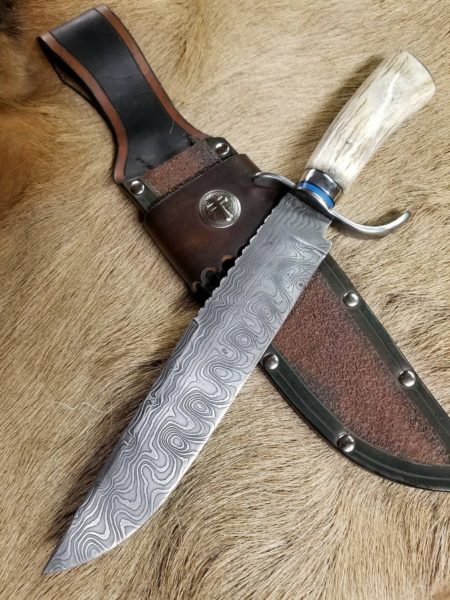
Scooter Davis' bowie is 17 inches overall.
This bowie has a 13 1/2-inch blade made of pattern-welded steel by Zoe Crist Knives. The handle is comprised of elk antler, stainless steel and G-10 spacers. The maker’s own pattern-welded steel was used on the guard. Maker’s list price: $800. Contacts listed at the bottom of this article.
Scooter Davis of West Virginia makes a seax with Mircata handle for $250.
Scooter Davis’ seax is 10 1/2 inches long with a 5 1/2-inch blade made from W2 steel with hamon. Avocado Micarta scales were used for the handle. Maker’s list price: $250. Contacts listed at the bottom of this article.
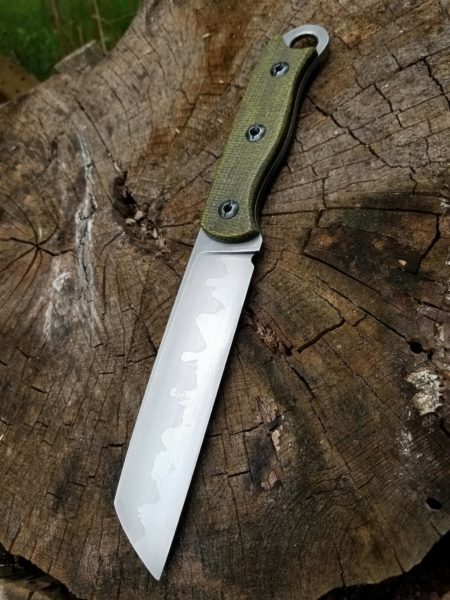
The W.A.C.K. is just one of many knives offered by Desert Storm Marine Corp vet, Scooter Davis.
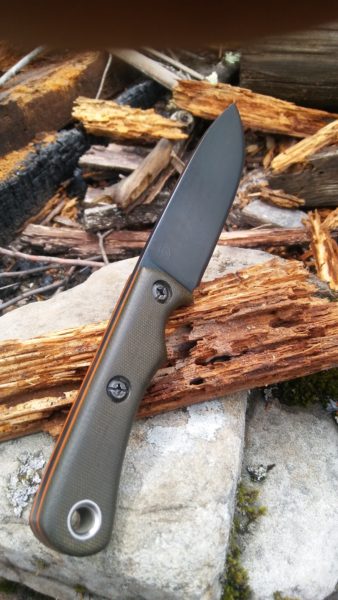
The W.A.C.K.-1 (Wilderness Area Camp Knife) has a 5-inch blade forced from 1095 high-carbon steel. The scales are fashioned from OD green canvas Micarta with hunter orange G10 liners and a ½-inch stainless steel lanyard tube. Contacts listed at the bottom of this article.

Contact Scooter Davis at 540-560-1672, [email protected], on Facebook at Rough Run Forge and Instagram @roughrunforge.

A Digital Subscription To BLADE is the Answer

Save $4 off the print price of a annual subscription to BLADE Magazine with a digital subscription.
You can read your digital issues of BLADE Magazine anywhere you have your phone, tablet or computer, and there’s no need to find storage for all your old issues.

If piling-up issues of magazines seems like a waste to you… If you feel like you don’t have time to read a magazine… If you like the stories we offer in BLADE, but want a more economical option, then a digital subscription is the answer. An annual subscription to BLADE is $17.98, $4 off the print price.

Advertisement

Must Read Articles

Read this before you make a knife

Knifemaking 101 – Read This Before You Make a Knife

  by Wayne Goddard My experience has taught me that there's nothing like digging in and getting started. I've often said the hardest part of the...
how to forge damascus steel

How to Forge Damascus

Advertisement
Advertisement