
The BLADE Blogs

The blogs of the BLADE editors, Steve Shackleford and Erin Healy.

Malaysian Men Of Steel

Lim Loong Hoi hammers steel in his old school knife shop in Selangor, Malaysia. (photo courtesy of Philip Lim Chin Guan)


     Every morning, Lim Loong Hoi is at his dirty workshop—it looks more like a shack from the front—at about 8 o’clock. Beyond the open door in the rear, the passage leads to a hallway and a few small rooms.

     The boneshaker of a wooden shop has been home to Lim and his family for decades. He said he has been making utility tools, including parangs, goloks, large fisherman’s blades and sickles, since his school days.

     His instructor and mentor was his grandfather. Back in the day, Lim found time after school to help his grandpa at the workshop. Picture a teenager’s delicate hands with a heavy hammer and a pair of tongs when, during morning hours, he was holding a pen or ruler in school. That was about 50 years ago.

     Called Sin Sam Hup Lee, Lim’s shop still stands firm against fluctuating economic conditions and the ravages of time. His back is slightly bent from the long, dreary years of standing before the furnace or hydraulic pump, pounding away at pieces of elongated steel.

     Pasir Penambang is a small village on the outskirts of Kuala Selangor in the state of Selangor, Malaysia. The locals, especially the Chinese, are mostly fishermen, shopkeepers or fish wholesalers.

     The Chinese fishermen are Lim’s regular customers. The edged tools he makes for them are larger than usual. The blades are similar to huge butcher knives, having a curvature that helps in slicing a big fish in two with one swift, downward stroke.

     The Malay farmers usually ask for long sickle blades used in dislodging oil palm fruits, a.k.a. kelapa sawit nuts. Each sickle is hollowed out at the handle to accept a long pole. The pole enables the user to extend the blade about 7 to 8 feet to harvest the nuts from the palm trees. Each sickle costs $2 to $2.60. The price depends on the quality of the steel and blade size.

     In Lim’s workshop, stacks of Jeep leaf springs used for blade steel rest in a corner. The four-wheel-drive springs are rusty and grimy. The haggard bladesmith likely sourced the spring steel pieces by the ton from an old junkyard. He probably got them cheap, too. Most of the time they are cut to required lengths. It is a low-tech, slightly primitive method of stock removal.

     Practicality and function rule the land. Almost nobody here has heard of CPM-S30V, VG-10 or ZDP-189. The most convincing line Lim uses is, “This is Jeep spring steel.” That alone gives his customers some assurance they are getting quality steel.

     Edged tools used by fishermen or farmers in the fields have no time to get rusty because they are used regularly and on a daily basis. After six to eight years, the parang, golok, fisherman’s blade or farmer’s sickle may be deemed unusable. The user simply buys another one from Lim. After all, it costs just a few bucks. Compared to its long-term usefulness and hardiness, the cost per blade is minuscule—which is why the agrarian folk in Pasir Penambang and nearby villages are Lim’s loyal customers.

     Lim’s assistant is taciturn, works like a well-oiled machine and knows the blade-making process intimately. Like his boss, the assistant relishes the feel of steel in his hands.

     Of course, the untidy workplace is not exactly ideal for a private conversation. Customers determine what they want, haggle over the price and depart with the edged tool they bought wrapped in a newspaper.

     Occasionally, some outsider brings a drawing of the piece he wants made. The bladesmith examines the drawing and then determines whether his outdated equipment and other machines are suitable for the order.

     The volume of edged tools he sells will not even make Lim a member of the middle class. He obviously is not making a fortune, as some people may suspect.


Ah Pee

     A couple of doors away along the same row of wooden shops is another knifemaker, Ah Pee. A sign at the front of his establishment says “Chuan Lee Chan.” Originally from China, he has aged before his time, though his eyes have a certain fire that belies his years.

     Pee said his children, especially his son, have absolutely no interest in knifemaking. “The young men today prefer air-conditioned offices and as little dirt on their hands as possible,” he told me.

     The long hours and intense heat from the furnace are enough to deter most from pursuing such a profession. It is backbreaking work with the added disadvantage of low and slow financial returns.

     After about five decades of using the hammer, tongs and grinder, Pee is long past set in his ways. He probably does not know how to do anything else. Perhaps he feels he is too old to learn and master another profession.

     Not all the edged tools sold at both shops are fashioned by the resident makers. They also stock production parangs and some made-in-China models, both more affordable than the handmade models. Lim’s and Pee’s knives cost more because they factor in labor, time and the type of spring steel used. The sharpness of the blade is guaranteed.

     Sometimes each bladesmith will ask the customers how the parangs or knives will be used. Then he might recommend another type of edged tool. The heavy-duty blades—those for chopping hardwood, the bones of livestock, etc.—are made to different specifications than those for skinning and other light work. The smiths’ skills with iron and steel are invaluable to those who need their tools to make a living.


Heat Treating and Sharpening

     Heat treatment consists of quenching the steel in a trough of water. There is no set formula for giving a hardened edge. Pee said it all comes down to “feel.” The long years of experimenting with quenching a red-hot blade in water have given him the intuition and the right recipe of crucial seconds of sinking a piece of hot steel into a trough, and then lifting it up at just the right moment. I have seen Pee do it on several occasions. He said without the special “water treatment” the blade would not hold an edge.

     Sharpening a parang or any kind of blade is done on a hand-held metal grinder. The way Pee does it looks easy—until you put the same grinder in your hands. A flat grind is apparently the way to go.

     First, he clamps the blade on a table vise, covers his mouth with a piece of cloth and dons plastic goggles. He moves the grinder side to side and applies just the right amount of pressure.

     A shower of bright orange sparks fly past his body but Pee pays them no heed. When he is fully satisfied the blade has the correct grind, he unclamps it and adds the finishing touches to the edge with a smooth stone.

     Again, it is all “touch and feel.” When a man has spent three-quarters of his life sharpening blades, you do not question his judgment. He said, “The blade can easily shave the hair on the arm.” I believe him totally.

     He then gives me a piece of invaluable advice. After the blade has been used, wash it in running water. Do not wipe the water off but put the knife out in the sun to dry. Allow the sun to dry the steel blade and it will remain sharp indefinitely.

     It took awhile before I realized the wisdom of his words. The tropical weather, coupled with the scorching Malaysian sun, acts as a form of heat treatment on the sharpened blade. Perhaps the sun’s rays strengthen the already hardened molecular structure of the blade’s edge? Who knows better—the bladesmiths of Pasir Penambang or me, the end user from the city?


Paying Homage

     There are only two bladesmiths along the main road in Pasir Penambang. Both are advancing in age. This is a dying trade. The youngsters are not interested. Those of us who appreciate all things steel and sharpened tools come to this tiny town, away from the hustle and bustle of the bigger cities, to pay homage to men of steel who live a life of quiet desperation.—By Philip Lim Chin Guan


To read similar stories and all about the latest knives, knifemakers, knife trends and much more, subscribe to BLADE®. For more information click on http://www.shopblade.com/product/blade-magazine-one-year-subscription-us/?r+ssfb141211#BL1SU
 

What REALLY Happened at BLADE Show 2017

BLADE Show 2017 Recap issue
Get the inside scoop on BLADE Show 2017 in the latest issue of BLADE®.

You’ve heard all about BLADE Show 2017 but you can get the inside scoop on the show’s hottest knives and knifemakers and what and who will be hot in the future as a result in BLADE®’s special 2017 BLADE Show Recap issue, on newsstands now! Or, if you prefer a digital copy, click here.

The world’s largest and most important knife event enjoyed its longest lines ever of patrons queuing up to get in, and the patrons packing aisles for much of the three-day event enjoyed the best knives and knifemakers the international cutlery industry has to offer.

Why was the show among the best if not the best ever? What were the demographics of the patrons who attended? What nationalities were represented most in

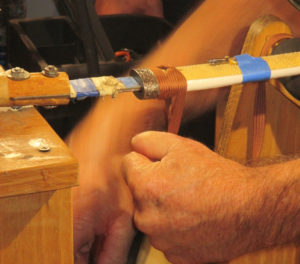
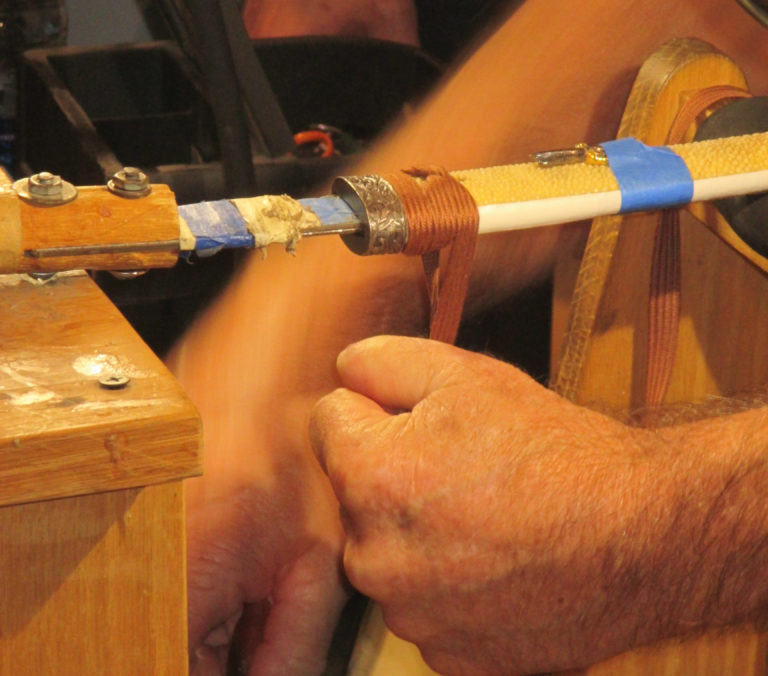
Japanese handle wrap during BLADE U. class at BLADE Show 2017.
Wally Hostetter showed students how to do the Japanese handle wrap in his BLADE U. class during BLADE Show 2017.
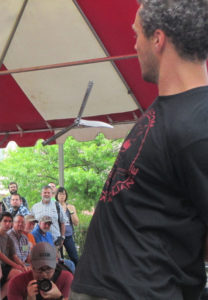
BLADE Show's first balisong competition
BLADE Show 2017 hosted its first-ever balisong competition coordinated by Blade HQ.

what has become a show teeming with knife enthusiasts from all corners of the globe? Did more women attend than ever before, marking a new, unprecedented wave of knife enthusiasts from the female side? How many patrons actually bought knives instead of kicked tires, and how much did they spend?

Speaking of knives, which patterns sold most? What sub-categories of exhibitors—knifemaking suppliers, acc-

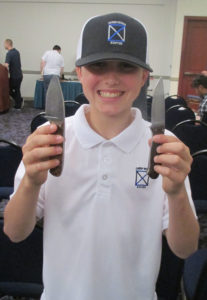
BLADE Show 2017's BLADE U.
BLADE Show 2017‘s BLADE University featured instruction for young and old, including Zander Nichols, 13, of Clovis, California.

essory makers and others—emerged in terms of high numbers of sales? And what does it portend for the future of the BLADE Show and the knife industry in general? These questions and others are addressed in “BLADE Show Stands Tall & Delivers” on page 12.

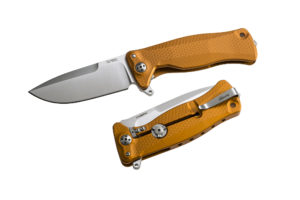
BLADE Show 2017 Overall Knife Of The Year®.
Lionsteel’s SR11 was named the BLADE Magazine Overall Knife Of The Year® at BLADE Show 2017.

Of course, the BLADE Show is much more, including the BLADE Magazine Knife-Of-The-Year® Awards, the BLADE Show Custom Knife Judging Competition and the BLADE Magazine Cutlery Hall-Of-Fame inductions. Get all the specs and fantastic images of the knives by new Official BLADE Show photographer Chuck Ward in the respective stories “Best Blades of Both Hemispheres” and “BLADE Show Custom Kingpins,” the latter including this issue’s cover knife, the CAS/Sam Lurquin Sub-Hilt that won the Hugh Bartrug Best In Show Award.

The announcement that Benchmade CEO Les de Asis and American Bladesmith Society master smith Jim Batson had been elected to the Cutlery Hall Of Fame was made earlier in the year, but why they were elected was revealed in detail during their official inductions during the BLADE Magazine Awards reception the Saturday night of the BLADE Show. Get the lowdown on their career accomplishments, their induction speeches during the reception and more in the special story on page 42.

The BLADE Show is also the place where factory knife companies introduce their latest knives, though this year’s show may have seen more new knife debuts than ever. Check out the fantastic array of production pieces in “All Blades Pointed to Atlanta.”

There’s more this issue, including a salute to Alfred Pendray, tests of locking folders and drop-point hunters, the new Case/Daniel Winkler collaboration, a retrospective of Cutlery Hall-Of-Famer Michael Walker’s landmark linerlock that changed knife history forever and much more, all in the latest issue of BLADE.

Metal Museum To Feature Work Of Virgil England

The National Ornamental Metal Museum announces a solo exhibition of knifemaker, sculptor and artist Virgil England’s work to run from June 8 to Sept. 2, 2012. England has dedicated his exhibition to Daryl Meier and Bob and Jenny Willis.

England, who lives in Anchorage, Alaska, is a visionary in several respects. As a talented artisan and smith he creates unique knives and edged weapons which, at the same time, are perfectly interwoven with figurative allusions and details. All his works are part of the environment of a fantastic place, which he calls “Het Lands,” at sometime in the universe where an archaic civilization is confronted with the apparition of the “Seth Daemon.” But also actual antique eras inspired him to these fantastic ideas and to exactly these pieces of work. In 2004, he designed the “Empire Sword,” a series of Yatagan swords with reference to the powerful ancient Iranian kingdom of the Achaemenidic kings Cyrus and Darius, approximately 2,600 years ago. Since the 1970s, England worked as a knifemaker and started to increase his interest in intricate, multipartite projects of art. However, he never abandoned the knife blade.

Founded in 1976, the National Ornamental Metal Museum is the only Museum in the Americas dedicated to the preservation and advancement of the art and craft of fine metalwork.  The Metal Museum is funded in part by ArtsMemphis and the Tennessee Arts Commission. Located at 374 Metal Museum Drive, the Museum is open Tuesday – Saturday 10 am – 5 pm, and Sunday noon – 5 pm.  For more information, call 901-774-6380 or visit www.metalmuseum.org.

Knives Of The Year in New BLADE

BLADE MAGAZINE 2014 OVERALL KNIFE OF THE YEAR@ went to the CRKT HI JINX. This flipper folder, designed by Ken Onion, sports a 3.320" blade made of Bohler-Uddeholm Sleipner. Made in a limited edition of 525 in Italy, the knife is already sold out and no more will be made. It had an MSRP of $500.
BLADE MAGAZINE 2014 OVERALL KNIFE OF THE YEAR@ went to the CRKT HI JINX. This flipper folder, designed by Ken Onion, sports a 3.320″ blade made of Bohler-Uddeholm Sleipner. Made in a limited edition of 525 in Italy, the knife is already sold out and no more will be made. It had an MSRP of $500.

The BLADE Magazine 2014 Knives Of The Year®, the top knives of the BLADE Show, the latest inductee into the BLADE Magazine Cutlery Hall Of Fame© and much more highlight the new BLADE®, on newsstands NOW!

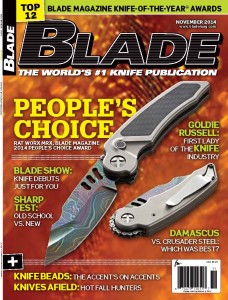
Gracing this issue’s cover is the Rat Worx MRX, winner of the first-ever BLADE Magazine People’s Choice Award, voted on by visitors to the BLADE website, blademag.com.

Other top Knife-Of-The-Year winners named at the 2014 BLADE Show include the CRKT/Ken Onion Hi Jinx, Kershaw’s Kershaw/Emerson CQC-7K, Shun Dual Core Kiritsuke and the Zero Tolerance/Rick Hinderer 0562, Spartan Blades’ Les George V1-14 Dagger and Les Halpern Nymph and others.

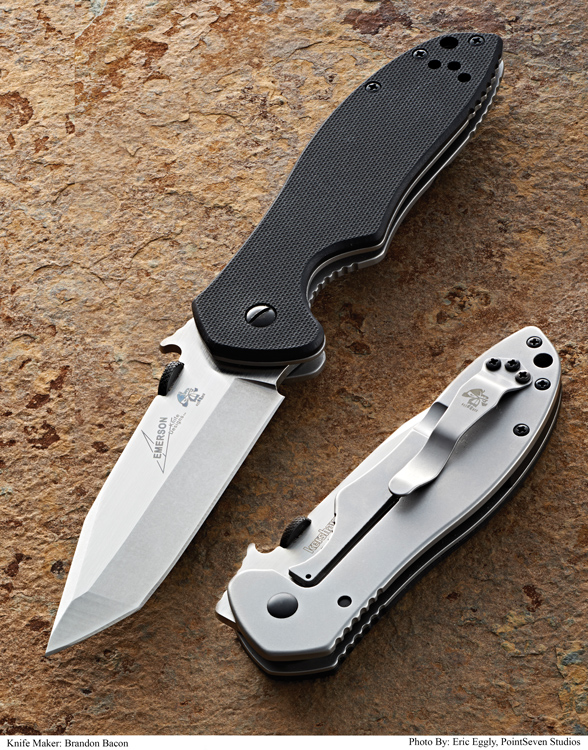
The BLADE MAGAZINE 2014 BEST BUY OF THE YEAR went to the KERSHAW-EMERSON CQC-7K. The tactical folder has a blade length of 3.25” made of 8Cr13MoV stainless. The wave-shaped feature can be made to catch on the pocket seam as the knife is removed from the pocket, thereby opening the blade. MSRP: $59.99
The BLADE MAGAZINE 2014 BEST BUY OF THE YEAR went to the KERSHAW-EMERSON CQC-7K. The tactical folder has a 3.25″ blade made of 8Cr13MoV stainless. The wave-shaped feature can be made to catch on the pocket seam as the knife is removed from the pocket, thereby opening the blade. MSRP: $59.99

The BLADE Show was one of the most successful in recent memory and, in addition to the Knives Of The Year, also featured the winners of the custom knife judging competition, the introductions of many new factory knives, the first-ever induction of a woman—Goldie Russell—into the Cutlery Hall Of Fame and much more.

In the custom knife judging, the Tembo Bowie by Russ Andrews, David Lisch, Mike Quesenberry, Steven Rapp, Jim Small and Jane Tukarski took home both Best Of Show and Best Collaboration, and was auctioned off to raise money for the Elephant Protection Association.

Other knifemaker winners included Mike Williams, Stephanie Lemelin, Brian Nadeau, John White, Joe Szilaski, RJ Martin and more.

And among the factory knives that debuted at the show were the “Battlechef” from Olamic Cutlery, the Emerson Knives, Inc. “Vindicator,” the Chris Reeve Knives “Impofu,” the Winkler Knives “Operator” and many more.

In one of the more popular inductions ever, Goldie Russell entered the Cutlery Hall Of Fame for her many contributions to the knife industry, including her pivotal role as president of the American Knife & Tool Institute when it helped defeat a U.S. Customs proposal that would have defined all one-hand knives as switchblades/autos, thus making them illegal nationwide.


The latest issue of BLADE is on newsstands now!
The BLADE Magazine 2014 Knives Of The Year® highlight the new BLADE®, on newsstands now!

These stories and many more are all awaiting your perusal in the latest issue of BLADE.

AKTI Member Edward Weeren Wins Ontario Marine Bayonet

As reported Jan. 24, a member of the American Knife & Tool Institute won a USMC Marine bayonet by Ontario in a special AKTI drawing at the Ontario booth during the 2012 SHOT Show. AKTI member Ed Weeren wasn’t in attendance at the show, but was recently notified of his big win.

     Ed is the proud new owner of one of the first 200 OKC3s Marine Corps Bayonets, which is specially displayed and engraved with the AKTI logo and a quote from President Ronald Reagan  Ed also wins a stay in Western New York and private tour of the Ontario Cutlery facility.

     When responding to news of his win, Ed explained what being an AKTI member meant to him:

     “ I joined AKTI because of the respect I have for those who set it up and for the work AKTI is doing to allow citizens like me to continue to enjoy knives and to carry my pocketknives without fear of being arrested. I am an NRA Life Member and understand that each of us has to accept some responsibility and do what we can to help all of us continue the freedoms given to citizens when this country was founded. While I was not a Marine, I hold Marines in the greatest respect. I attended Texas A&M and received a commission in the U.S. Army in 1958. Keep up the good work you and your group are doing.”

    As a nonprofit association, AKTI’s role is to be the reasonable and responsible advocate for the knife-making and knife-using community, providing the focal point for sensible evolution, development, and the consistent enforcement of knife legislation.

For more information about the American Knife & Tool Institute, visit www.akti.org.

For more on the latest knives, knife legislation, knifemaking instruction, knife trends, knifemakers, what knives to buy and where and much more, subscribe to BLADE® Magazine, the World’s No. 1 Knife Publication. For subscription information click on http://www.shopblade.com/product/blade-magazine-one-year-subscripti…?r+ssfb020912#BL1SU


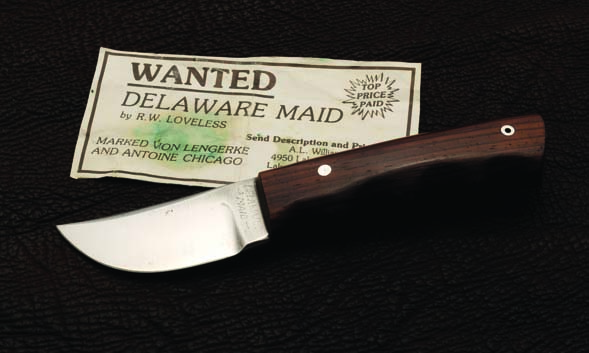
Get A Load Of That Delaware Maid!

If you’re a fan of Bob Loveless knife designs, you likely have a soft spot for at least one of the Delaware Maids … no, not the logo, although that etched “Delaware Maid” is part of it … but perhaps a hunter such as the below. From 1954 to 1960 Loveless made over one thousand knives called “Delaware Maids” and they became Abercrombie & Fitch’s best-selling handmade items, outselling the Randall blades.

An ultra-rare (only three of seven survive) Loveless “Delaware Maid” hunter with the VL&A (Von Lengerke and Antoine) logo, the knife has a trailing-point blade and a slender double-pinned hardwood handle. The photo is by Hiro Soga, and the knife comes from the John Denton collection. It appeared on pages 114 and 115 of the book Knifemaking With Bob Loveless

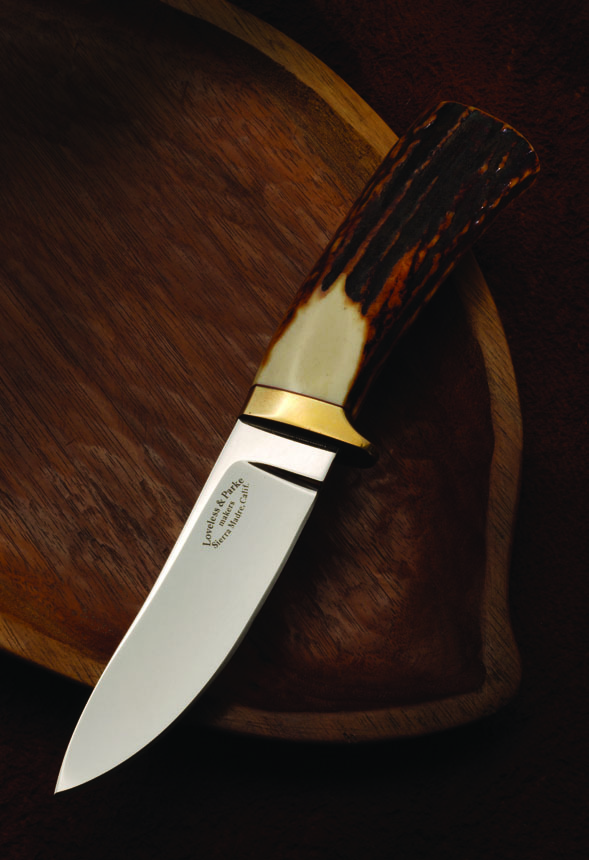
Loveless-Parke Is Part Drop Point, Part Skinner

Spending a day with the Loveless-Parke drop point would be like spending a day in the park. What I love about this knife is that it is a drop-point hunter, but it has that high grind and skinner-like hump along the blade spine toward the tip. 

Only 36 knives bearing the Loveless-Parke logo were ever produced (Parke was an investor in Loveless’s knifemaking business for a short period of time.) This knife, made in 1967, is an example of that effort. It features a brass singe guard and stag handle with a hidden tang. And because I was born in 1967, it’s all that more sweet to me.

The knife photo is by Hiro Soga, the knife is from the John Denton collection, and it was featured in the book Knifemaking With Bob Loveless.

Advertisement

Must Read Articles

Read this before you make a knife

Knifemaking 101 – Read This Before You Make a Knife

  by Wayne Goddard My experience has taught me that there's nothing like digging in and getting started. I've often said the hardest part of the...
how to forge damascus steel

How to Forge Damascus

Advertisement
Advertisement