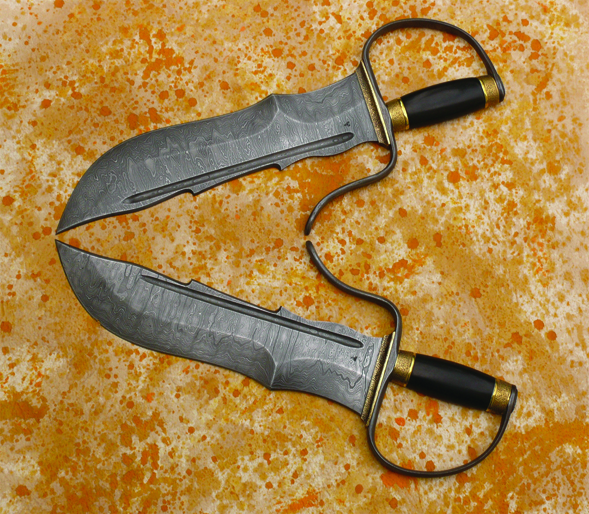
Featured in the “Foray Into the Far East” Trends section of the Knives 2013 book are a pair of Richard Van Dijk “Wing Chung” Chinese martial arts butterfly swords. Rarely do you see knifemakers tackle the pattern, and thus they catch your eye immediately, and then with the inclusion of 400-layer-damascus blades, ebony handles, brass fittings, iron guards and a side-by-side scabbard (not shown), they elevate themselves to one of the “Editor’s Favorites from the Knives 2013 book.”
I especially like how the brass fittings complement the ebony grips, and the D-guards trail down, extending into sword catchers for extra protection.
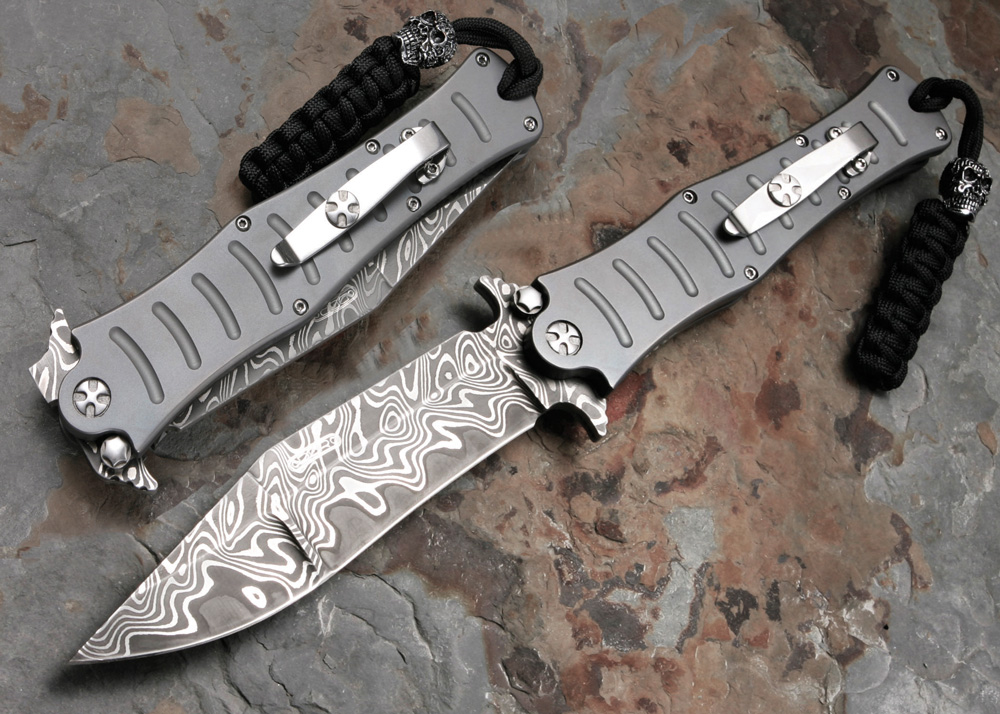
When it comes to big flippers, one of Darrel Ralph’s Madd Maxx 5.5-inch MGB bearing models fills the bill. In this instance, Ralph outfits his big flipper with a blade of PD1-core san-mai damascus forged by Chad Nichols. The knife comes in a run of 25 numbered pieces.
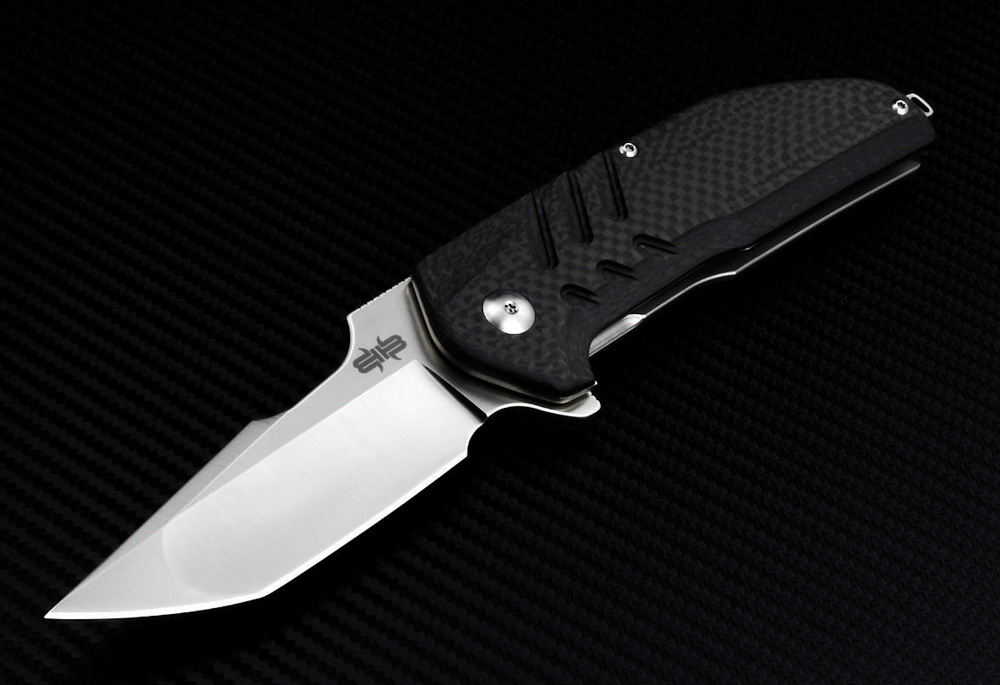
Flipper folders are wildly popular. Aside from adding an interesting visual element to any knife, the flipper serves a few key roles, including as a one-hand opening device, and as a guard.
Just like innovation and technology drive any industry, the same can be said for the knife industry. What’s neat about knives is that they’re often designed by handmade knifemakers, craftsmen, really, and innovations often take the form of folder locks, assisted opening devices, and in this case, flipper folders.
While the Strife, a collaboration between Brous Blades and Dustin Turpin, is a big flipper, Jason Brous said size is not so important as design execution.
There are some monster flipper folders today. As Dexter Ewing writes in the March issue of BLADE®, “Flipper folders, aka flippers, continue to be wildly popular. Aside from adding an interesting visual dimension to the knife, the flipper—a simple protruding lobe at the bottom of the blade’s tang—serves a few roles. One is as a quick and convenient one-hand opening device. Clutch the closed knife’s handle, give the flipper a swift tug with your index finger and the blade has enough inertia to propel itself to the open and locked position. The flipper also serves as an integral hand guard when the knife is open, providing a physical obstruction to prevent your hand from sliding forward onto the blade.”
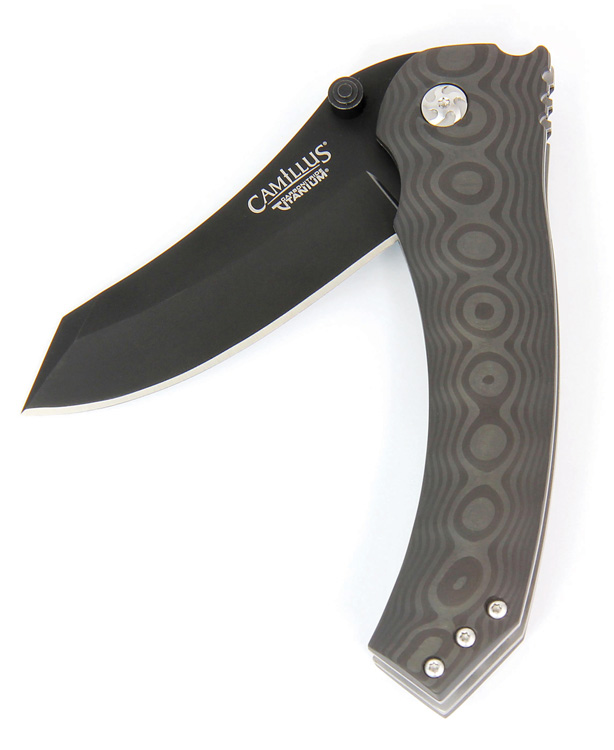
At 8.5 inches long open, the Camillus Jolt designed by Will Zermeno is a big flipper in every sense of the word. The 3.25-inch blade is hollow-ground D2 tool steel and the scales are a carbon fiber with a subtle pattern designed to enhance the frame’s curved shape.
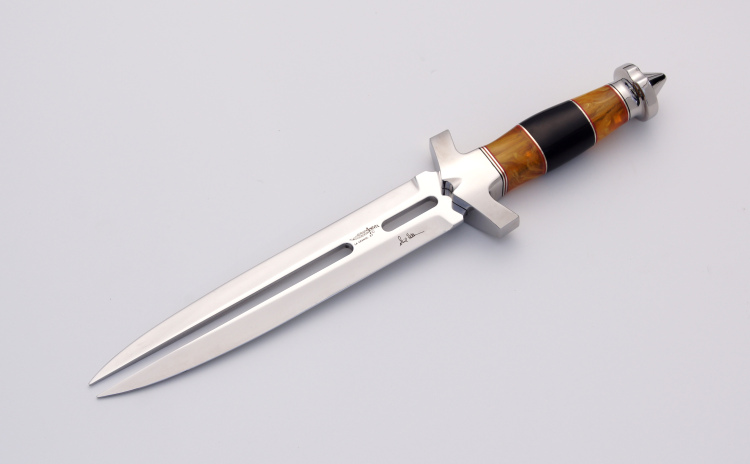
Learn both basic and advanced knife making techniques with expert instruction from Allen Alishewitz in Tactical Fixed Blades. Allen demonstrates how to craft a double-edged tactical fixed blade knife from start to finish, and creates two knives in order to fully illustrate the knife building process. You’ll learn:
– Profiling and Drilling the Knife
– Tang Tapering on a Grinder
– Tang Tapering on a Mill
– And more!
Congratulations to Michael Vagnino for winning the 2014 Wooden Sword award, given out to one custom knifemaker each year on page 7 of the KNIVES annual book. The yearly prize (no trophy, just recognition via top placement and imagery in the book) is awarded to a knifemaker for his or her work that stands out from the thousands of images that pour in annually for consideration.
As noted in the book where his innovative knives are pictured:
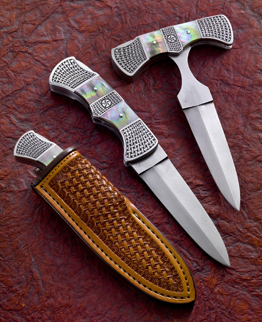
“Michael Vagnino has busied himself most recently with “Convertible Lock-Back Push Daggers.” Yes, that’s correct, he’s fashioning handmade knives that convert from a lock-back fixed-blade position to a locked push dagger and back again. The models shown here sport 3.875-inch blades, one in CPM-154 stainless steel and the other Wootz steel, the former combined with an antique tortoise shell handle, and the latter in black-lip mother-of-pearl. The maker engraved the 416 stainless steel bolsters, and since the push daggers covert to fixed blades, Paul Long sheaths were necessary as fashionable carry options.
For all he has brought to the knifemaking table the past few years, his innovation, talent, all-around good vibes, and for these particularly striking examples of his work, the Knives 2014 Wooden Sword Award goes to Michael Vagnino. Congratulations, Michael, and keep up the good work.”
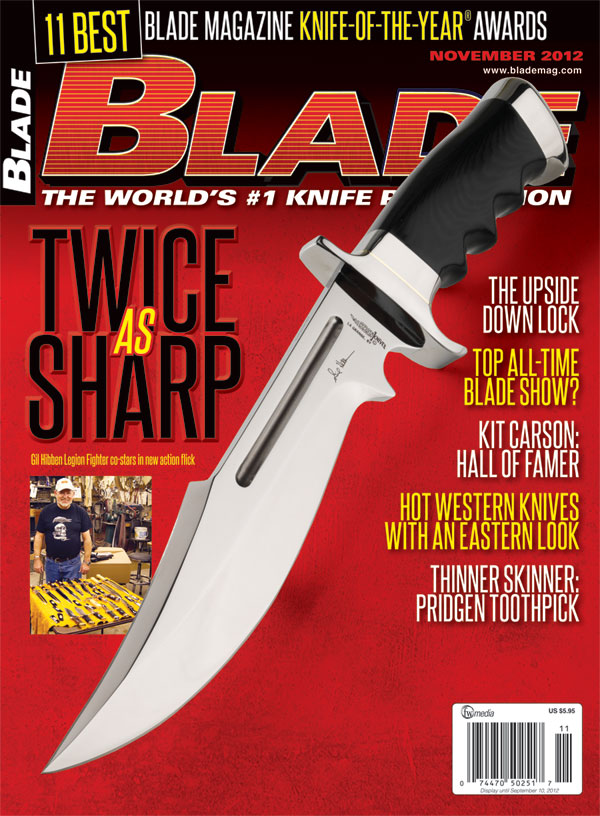
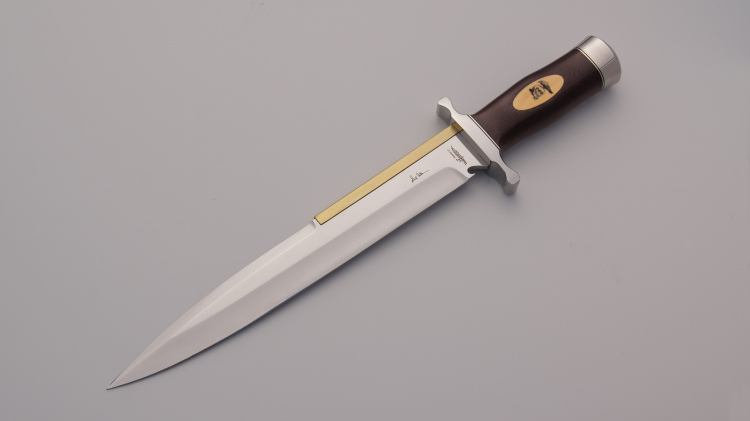
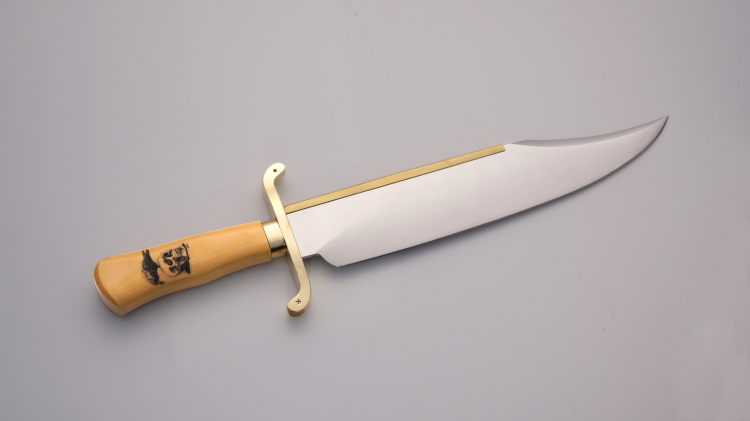
Which of Hibben’s knives in the movie is your favorite? Is it (starting from top above), the Legion Fighter on the cover of the November BLADE® (on newsstands NOW), the Toothpick, the Alamo Bowie or the Double Shadow?
Let us know via a post, e-mail or whatever electronic means you need to use in order to vote.
And please, only one vote per person!
All of the above pictures except for the cover are by Mike Carter.
For the latest knives, knife trends, knifemakers, what knives to buy and where, knife legislation, knifemaking instruction, and much more, subscribe to BLADE® Magazine, the World’s No. 1 Knife Publication. Click on http://www.shopblade.com/blade-magazine-one-year-subscription-us/?lid=blss082112
Here are 5 ways to get your knives featured in BLADE, either in print or online. Our goal is to include as many different types of knives and as many different knifemakers and manufactures as we can in each issue and online. We try not to double up on any individual or company, though sometimes it’s unavoidable. That means that we’re always looking for makers who haven’t been featured before. There are some restrictions, but those will be covered under each category.
Be sure to Like and Follow BLADE Magazine on Facebook. If you’re on Twitter, look for BLADE Magazine. We’re @blade_magazine on Instagram.
First, please Like and Follow BLADE Magazine on Facebook and Follow BLADE Magazine on Twitter and @blade_magazine on Instagram. That way you can see online stories when they’re posted, which may prompt other story ideas.
3 essentials for all 5 publishing options
Our Enthusiasm
We have to like your knife. But wait! We like ALL kinds of knives: cooking, everyday carry, bushcraft, hunting, tactical. We like fixed blades and folders of every deployment and locking mechanism. We like art knives that we’d be proud to put on our shelves. We like all shapes and sizes of knives, of every conceivable blade design and grind. We welcome smiths, stock-removal makers, manufacturers, collectors. Whether you’re just reaching your artistic stride or you’ve been involved in the knife industry for decades, you’re part of the BLADE community. So, don’t be shy. Chances are, we’ll thoroughly appreciate your knife or your perspective on the industry. The only way we’ll be able to see your knife, however, is if you show it to us in a well-done photograph.
Your Enthusiasm
How hard are you willing to work to make your knife look its best in a photo? Or, are you willing and able to hire a professional to take photos so that you can concentrate on knifemaking? The answer to either of those questions will be the measure of your enthusiasm. Other pieces of information will be required, but those details seem easier to acquire than photographs that do justice to your knife.
High-Quality Images
Poor-quality photos will definitely dampen our enthusiasm to publish them, no matter how beautiful your knife is. If the photo is out of focus, low resolution, poorly composed, lacking in contrast, flat or poorly lit, we’ll ask you to get better photos. As challenging as it will seem, it ensures that a poor image doesn’t run side by side with a stellar one, making your knife look lesser than it really is. You can read more about what we expect by reading “6 Things BLADE Looks For In a Knife Photo.”
Let’s say you have terrific photos, then what?
5 ways to get your knives featured in BLADE
‘What’s New’
The “What’s New” section of BLADE magazine features knives from six manufacturers and six custom knifemakers. Occasionally a tomahawk, tool or knife accessory will be included, but the focus, as always, is on knives.
The “What’s New” section of BLADE magazine highlights 12 new knives each issue, six from manufacturers, six from custom knifemakers. And, guess what? If you’ve never been in “What’s New” before, everything you’ve made is “new” in that not all of our readers have seen your work before. If you’ve already been in “What’s New,” perhaps there is something new you’ve been trying out: a different design or grind, or you usually make fixed knives and now you’re moving into folders, or you’re using a different engraver. After being in “What’s New,” you must wait at least 12 months before you can be eligible again, and makers who haven’t been in before will take precedence. Just to reiterate, our goal is to get as many different knives into BLADE as possible. We will occasionally include a tomahawk, sharpener or other knife accessory, but mostly the section features factory and custom knives.
Requirements: High-Resolution Image, Short Description
All that’s needed for “What’s New” is a high-resolution, print-quality image of your knife. Bottom line: 300 dpi or higher, 8-10 inches on the longest side, be that vertical or horizontal, and .jpg format. Now, for “What’s New” we use “cutaways,” or just the knife devoid of its background. This means that you don’t need to worry about creating an artistic vignette or still life with your knife. You do have to worry about getting the best picture you can get. For more on what makes an acceptable photo, read “6 Things BLADE Looks For In A Knife Photo.”
You will also need to supply a list of specs and a few sentences describing the item’s usage. Be sure to note if there’s anything new-to-you about it. They say there are no new stories, just different ways of telling them, and that could also be said of knives. True innovation does happen, and of course, we’re eager to hear about that. However, a maker might be working on new things all the time in his or her shop and that counts!
‘Knifemaker Showcase’
In BLADE magazine’s “Knifemaker Showcase,” six custom knifemakers are featured every month. A well-done knife image, a mugshot and an interview are required for inclusion in this section.
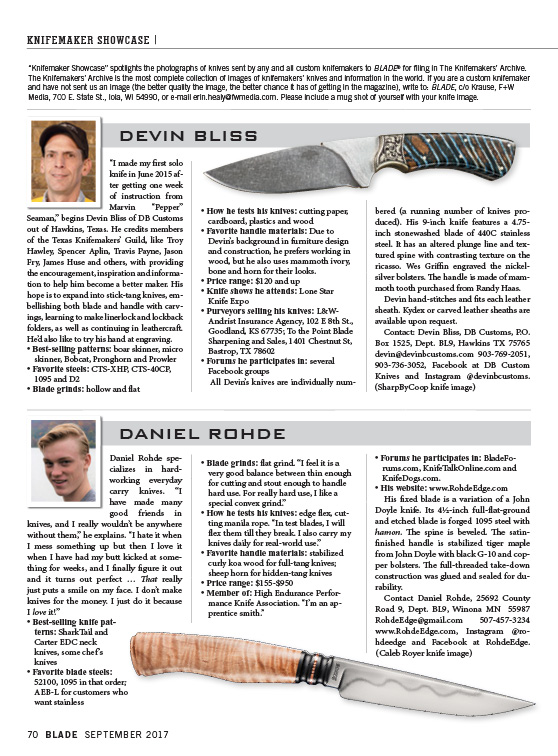
“Knifemaker Showcase” features six custom knifemakers each month all with a half-page layout that includes a mugshot, cutaway knife image and bulleted interview. The goal here is find out more about you, your start in knifemaking, your influences and your preferred materials, designs and ways of connecting with your customers. You’ll need to answer a questionnaire, explaining why you make the choices you do when crafting a knife. You can type out your answers, or if you’re not into typing, we can interview you over the phone once you’ve had a chance to think about your answers. After you’ve been in “Knifemaker Showcase,” you must wait at least 12 months before you’re eligible to be in it again, and makers who’ve never been featured before will take precedence. That way we can shine the spotlight on as many different makers as possible.
Again, our designers use cutaway images of knifes in this section, so a clean backdrop is best. You want to make sure your contrast is good and that nothing, including shadow, fabric, grass, encroaches on the edges of the knife. To learn more about the differences between a good photo and a bad one, read “6 Things BLADE Looks For In A Knife Photo.”
A mugshot is a portrait of you. It can be taken outside or in your shop, but the background will be mostly eliminated since we’ll be cropping in on your face. Don’t wear sunglasses. This is a chance for readers to meet you face-to-face, so to speak. If you’re wearing a hat, just make sure your face is not cast in shadow. Even though it will run small, your photo still needs to be print-quality. Keep in mind that if you submit a family portrait, for example, we will need to crop in on just you, so the size and resolution will need to be higher to account for that.
You’ll need to answer all the questions on the questionnaire unless something doesn’t apply to you. Too much information is better than too little.
BLADEmag.com
“Mightier Than The Sword with Erin Healy” is one BLADEmag.com blog where knifemakers and manufacturers can suggest story ideas of interest to everyone within the industry.
The blogs on our website allow us to take as much or as little space as is required to tell a story. Here is where we have the freedom to explore all kinds of stories related to the industry. BLADEmag.com stories can be about manufacturers, distributors, collectors or knifemakers; they can cover everything from how you made a cast spruce cone handle to how you’ve used knives in your family or on the job, whether it’s skinning deer, cross-chopping herbs in a restaurant kitchen or employing various grips in edged-weapon martial arts. The story can be about one particular knife or a collection. The source can be a multinational corporation with operations on more than one continent or a lone individual in his or her shop. BLADEmag.com strives to be a resource for all things knife, so histories and how-tos are of particular interest.
We welcome guest bloggers, provided the topic you’re writing about is not self-promotional. What this means is that you cannot write about your own knives or services. Pay is non-existent, but bragging rights are impressive. You will need to be able to write well, or be open to guidance and editing. You will need to provide a paragraph-long biography and a mugshot to run with your story, as well as illustrative images.
Requirements: A Good Story, Good Images
The thing about a story, whether it’s a topic you suggest for us to explore or one you’d like to try your hand at writing, is that it needs to have a story—a beginning, middle and end, an angle, a hook. If you as someone in the knife industry find it interesting then, chances are, others will as well. Even though BLADEmag.com will always focus on the knife, we also know that it is the people behind the knife that makes the story compelling to read. The whys are always interesting to include, as well as trying to describe how a material or process contributes to the feel or wow-factor of a knife.
Although knifemaker profiles are reserved for Knifemaker Showcase in print and BLADEmag.com stories online, other ideas for BLADE magazine are always welcome. The final decision for a feature article within the pages of BLADE rests with the editor. Oftentimes in the course of conducting an interview with a manufacturer or knifemaker for “What’s New,” “Knifemaker Showcase” or BLADEmag.com, we find other stories to write about in print.
To get a story into print, images must be top-notch. Focus, contrast, lighting, composition, depth of field all matter. Resolution must be high; size must be large. To fully understand what this means, read “6 Things BLADE Looks For In A Knife Photo.”
Social Media
Make sure to follow us on tag us in your social media photos so we see them and use #BladeMagazine
Requirements: Images, Specifications, Intended Usage, Contact Information
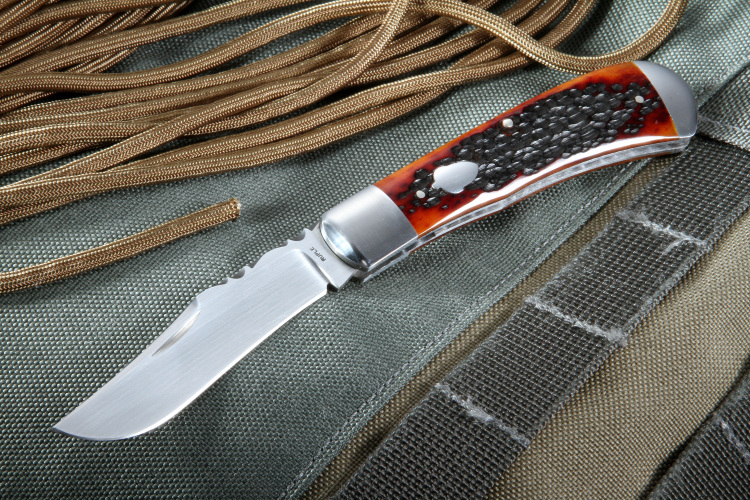
According to KnifeArt.com’s Larry Connelley, Bill Ruple ([email protected]) is one of the leading names in custom slip joints. Ruple’s “Acorn” single-blade trapper features a CPM-154 stainless blade and an amber-bone handle. Closed length: 4.25 inches. KnifeArt.com’s (www.knifeart.com) list price: $1,100. (KnifeArt.com photo)
One of cutlery’s oldest designs, the slip joint is also one of its hottest
By Pat Covert
Long ago, someone added a spring to the back of a pocketknife to prop the blade open and enable it to shut with a snap—and what is known by many knife enthusiasts today as the slip joint was born. While locking-liner tacticals dominate much of the folder arena, the relatively new genre has a lot of catching up to do if it plans on eclipsing slip-joint sales.
Like many sectors of the cutlery market, there are two basic customers for slip joints—users and collectors—with some overlap to be expected. So what would cause a knife user to carry a slip joint over the more modern fare? “Tradition,” KnifeArt.com’s Larry Connelley states simply. “Slip joints are built with traditional patterns or modifications of a traditional pattern from the early 1900s. Slip joints are easily carried and perceived as an American tradition. Many knife owners first owned a traditional slip joint.”
From a practical standpoint, slip joints make excellent pocketknives, playing the same role they have for generations. “Slip-joint folders are used for cutting almost everything imaginable, such as peeling apples, skinning game, opening boxes, opening letters, and a myriad of other uses,” observes Kenny Wilson of Sooner State Knives.
Josh Terryah of Knife Country USA says both tradition and everyday service play a role in the slip joint’s popularity. “Slip joints are great utility knives, and who doesn’t like to carry something around that reminds them of their granddaddy or father?” he opines. “Who would ever think a knife could bring back memories of being a kid on the family farm?”
Though hard to quantify, another likely reason for the slip joint’s surge in attractiveness and popularity among users is the oppressive anti-knife laws and/or improper labeling of legal one-hand-opening and other knives as illegal by law enforcement, district attorney’s offices and local governments in some areas. In other words, the DA’s success rate in prosecuting someone for carrying a traditional peanut or stockman pattern is lower than for a one-hand opener.
Selection Never Better
Selection has never been better for factory slip-joint fans. Companies such as Buck, Boker, Case, KA-BAR, Queen and others long have produced and/or offered traditional slip joints. Outfits like Canal Street Cutlery, Columbia River Knife & Tool, Fallkniven, Great Eastern, Spyderco and more have joined/rejoined the slip-joint sweepstakes, and brands such as Schatt & Morgan (Queen), Tidioute and such (Great Eastern) and others have been revived. Better yet, a plethora of classic patterns is available in the midst of such healthy competition. These range from common patterns such as trappers, barlows and sunfish to more specialized ones like the melon tester and cotton sampler.
On the other hand, some things never seem to change.
“Case remains the most collected knife in the world. One reason for this is the detailed dating system Case uses,” Wilson notes. “But, I believe Canal Street is currently building the highest-quality traditional slip-joint folders. They simply spend more time to get the details right during production and assembly to ensure that everything fits as it should.”
Terryah says not only has he seen an uptick in sales of traditional slip joints, but some of the more modern styles are selling as well. “I would have to say the Spyderco and Fallkniven slip joints are the hottest new models [for us] right now,” he offers. Wilson says Case’s traditional two-blade trapper (4 1/8 inches closed) is the best seller at Sooner State Knives. “Next would probably be the [Case] 3-inch tiny toothpick,” he advises.
Maker Explosion
The custom market long has had a clique of makers who keep the traditional patterns alive—Tony Bose, who also has designed some knives for Case, and Bill Ruple among them. In the past few years there has been an increase in custom makers joining the fray, adding even more fans to the slip-joint market.
“Slip-joint collectors tend to be men in the 40-to-60-year-old range. They’re the classic baby boomer demographic. These customers appreciate the high level of fit and finish,” he says. “There are many sub-groups of slip-joint collectors, from the patterns to the number of blades on a folder.”
According to Connelley, the best-selling slip-joint pattern at Knifeart is, once again, the trapper. He says some of the hot knifemakers (and their knives with Knifeart’s list prices in parentheses) are Don Morrow (two-blade stag trapper, $750), Bill Ruple (stag or bone two blade, $1,100), and Hiroaki Ohta (single-blade stag folders, $500). “Tony Bose is hands down the most popular,” Connelley opines. “His knives command a premium on the secondary market which, unless you are really lucky at his BLADE Show lottery, is the only place to buy one.”
Choice Materials
The materials offered in a knife are always a key consideration. “Most collectors seem to prefer stainless steel blades over carbon steel,” Wilson notes. “That said, many older buyers still prefer carbon steel in the knives they carry, and a few younger buyers prefer it because of their fathers and grandfathers.
“The misconception seems to be that if a blade doesn’t rust, it won’t hold an edge. They don’t realize cutlery companies have kept up with the times and that new blade steels are constantly being introduced.”
Among handle materials, Wilson indicates due to the variety of colors, jigged bone is his most popular but stag, mother-of-pearl and wood still move as well.
On the custom side, Connelly says stag is the most popular, followed by traditional jigged bone. “For blade materials they prefer high-quality stainless steels such as CPM-154, ATS-34 and CPM-S30V. We occasionally see high-quality damascus on an upscale slip joint,” he adds. It is interesting to note that damascus is wildly popular in other genres such as fixed blades and locking folders, but it does not seem to translate well into traditional fare.
Given the increase in custom makers joining the party and the extremely large number of factory pocketknives on the market, traditional slip-joint lovers will have fat pickings for a while. Whether you prefer production or custom knives, there are affordable options for everyone. Custom slip joints typically range from $250 up and factory pocketknives can be had for as little as $25 for models produced offshore—with stag handles, no less!—to $150-$200 for top-shelf limited editions.
In essence, with the exception of some of the more rarified custom artisans who can name their price, it is a buyers’ market that shows no sign of slipping.
For more on the latest knives, knife legislation, knifemaking instruction, knife trends, knifemakers, what knives to buy and where and much more, subscribe to BLADE® Magazine, the World’s No. 1 Knife Publication. For subscription information click on http://www.shopblade.com/product/blade-magazine-one-year-subscripti…?r+ssfb020212#BL1SU
Marine Explosive Ordnance Disposal Technician Staff Sergeant Johnny Joey Jones inspects a knife at Zac Brown’s knife company. The Southern Grind spokesman remembers the fallen, especially the mine sweeper who died in the explosion that took Jones’ legs.
In 2010 ABC Nightline produced a three-part series on Marine Explosive Ordnance Disposal (EOD) Technician Staff Sergeant Johnny Joey Jones. During eight years of service, Jones deployed to both Iraq and Afghanistan. It was while in Helmand, Afghanistan, on August 6, 2010, that Jones stepped on an improvised explosive device, losing both his legs and severely injuring one arm. In the face of inordinate challenges, Jones not only maintained a positive outlook, but became a beacon of hope to his fellow amputees, his fellow veteran collegiates and the public who follow his charity work and appearances on Fox News. Triple J or Joey, as his friends call him, is now spokesman for Zac Brown’s Camp Southern Ground, a 400-acre camp and retreat for children and military families that is funded by the proceeds of numerous artisan shops, including Southern Grind, the musician’s knife company. You can read more about Jones and some of the substantial knives offered through knife-lover Zac Brown’s company in the September issue of BLADE Magazine. (If you can’t find BLADE near you, subscribe.) But no matter how far Jones progresses physically, no matter what business pinnacle he reaches, the Southern Grind spokesman remembers the fallen, one fallen in particular, the man who died in the explosion that took Jones’ limbs: Marine engineer and mine sweeper, Corporeal Daniel Greer.
In the course of eight years of service in the Marine Corps, Staff Sergeant Johnny Joey Jones was deployed to both Iraq and Afghanistan as an Explosive Ordnance Disposal technician. In 2010 he lost both his legs in an explosion. No matter what he does: recovering from his wounds, inspiring fellow veterans as they recover, making motivational presentations, representing charity organizations, appearing on Fox News as a commentator, or as current spokesman for Zac Browns Camp Southern Ground and Southern Grind, the musician’s knife company, Jones is always positive and never fails to remember the Marines, soldiers, sailors and airmen who died in service to our country.
A TV Crew Interviews Jones in Afghanistan, Unaware Of The Fate To Befall Him
Jones’ Recovery Is Motivated By Fellow Wounded Brethren And The Fallen
Jones Remembers The Marine Who Died In The Explosion That Took His Legs
Jones’ Second Chance At Life Is In Honor Of Those Who Died In Combat
No Matter The Obstacle Jones Has Some Marine-Tough Encouragement
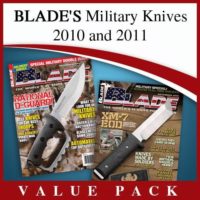
Read about the styles of knives most often carried into war and lots more in this two-pack of BLADE’s Military Knives issues for 2010 and 2011.
Boldly designed military knives, stories of knives that saved the lives of men in combat, soldiers who make knives for soldiers, and makers who support the troops, it’s all covered in these two special issues. Normally, $11.90, this download .pdf pack is on sale for $5.99.