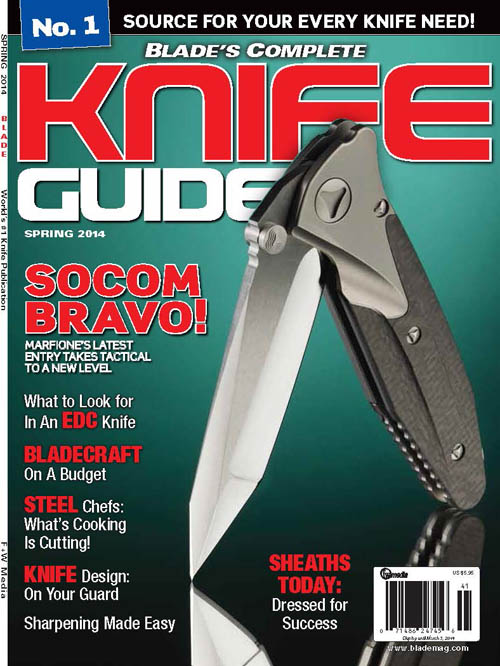
BLADE’s Complete Knife Guide—your ticket to everything knife—is on newsstands now!
BLADE’s Complete Knife Guide (BKG) is the only knife buyer’s guide in a magazine format that gives you all the contact information for all the major players in the custom and factory knife industries—all in an easy-to-access format that provides each knife source’s physical and web addresses, phone numbers, specialties and much more.
In addition to being your No. 1 source for accessing the knife, knifemaker, knife company, sheath, knifemaking materials, purveyor, accessory and everything cutlery related that you need, BKG also contains the stories that help you identify and obtain the perfect cutlery product for you. Included in this issue are:
•What To Look For in EDC—We went right to the professionals who work in the business for a living and asked them what they look for in an everyday carry (EDC) knife, including size, price point, blade steel, taste and intent, “the essentials,” and much more;
•Sheaths Today: Dressed For Success—Sheath styles, materials, the top makers and more, this story takes you inside the minds of some of the industry’s leading sheath makers for their take on the subject as only they can provide it;
•Out-Of-Site Knives—Buying knives on the internet is the way a lot of folks do it these days. But do you know what to look for in the best custom and factory sites? BKG takes you inside some of today’s hottest sites and details the services they provide, the knives they sell and much more;
There’s much more in this issue, including new knives for 2014; knife guards that both protect and adorn; what makes some of the latest factory tactical knives tactical; today’s top knife steels and who makes them; special deals on how to make a knife on a budget; some of today’s top custom knife purveyors; sharpening made easy and much more.
For the latest knife news, stay tuned to www.blademag.com.
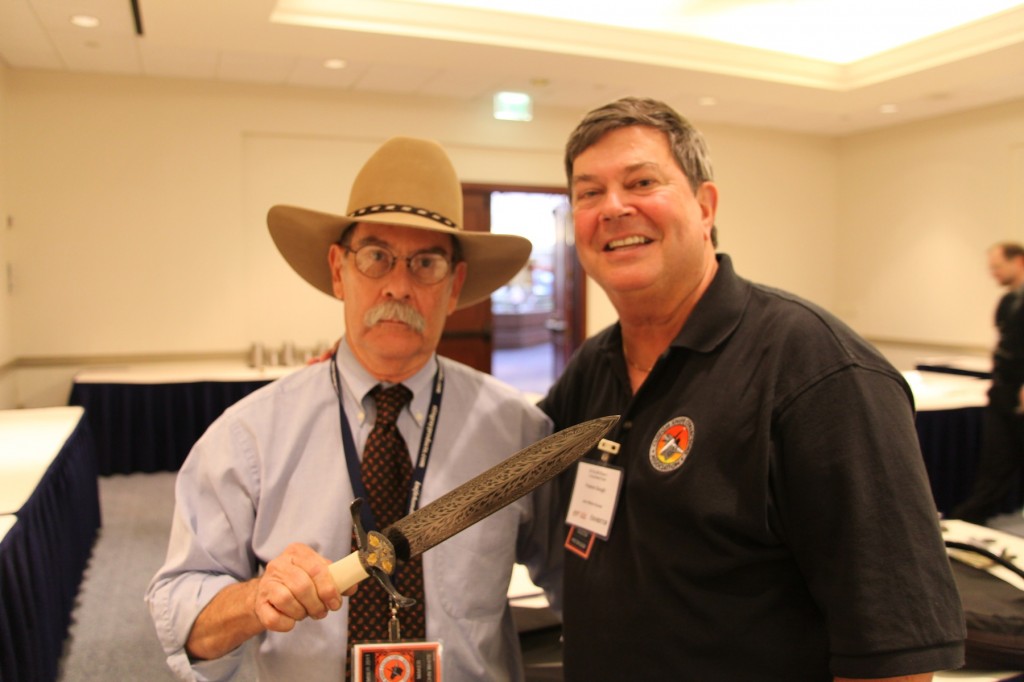
ABS master smith John White (left) holds his Best of Show and Best Damascus from the 2013 BLADE Show as the knife’s owner, Preston Gough, enjoys the moment.
Award-winning ABS master smith John White of Valparaiso, Florida, passed away Oct. 4 after a sudden illness. He was 71.
One of the most talented smiths in the ranks of the ABS, John was known for his elegant fixed blades in his beautiful damascus steel blades, natural handle materials and exquisite embellishment. He was also quite adept at such fixed blades in a take-down construction—that is, the knife was specially built to be easily disassembled and reassembled.
As John’s friend and fellow ABS master smith Terry Vandeventer noted in the American Bladesmith Society’s Express Email, “This is not only the greatest loss to Jill, [John’s] wife of 40 years, but to the knife community. Those who knew him saw a vivacious, smart, funny, and highly skilled artisan.” Vandeventer added that there would be no services and John’s ashes will be spread on the bayou near the Whites’ home.
The little man with the big smile enjoyed a meteoric rise in the fraternity of ABS smiths, winning a number of awards for his work, including several at the BLADE Show. Among them: Best Fixed Blade, 2014 BLADE Show; Best of Show and Best Damascus (see accompanying picture), 2013 BLADE Show; Best Bowie and Best Damascus Knife, 2011 BLADE Show; and Best Damascus, 2010 BLADE Show. Somehow it seemed fitting that John enjoyed so much success at the BLADE Show, as he was among the most vocal supporters of the event.
If you wish to make a comment on John’s passing and your memories of him, Click Here. A visit there will show you how many great makers and collectors thought the world of John. He will be missed.
The Lexington Patch has an article about the incident that killed Blackie Collins. It seems this particular stretch of road had a history of fatalities. Here’s an excerpt:
The driver, 71-year-old Walter Wells “Blackie” Collins of North, was pronounced dead at the scene by Lexington County Coroner Harry Harman. No other vehicles were involved and Collins was wearing his helmet. An autopsy will be performed to determine the cause of death, Jones said.
Collins, Patch has learned, was a world-renowned knife maker.
The accident is the latest in what has been a deadly week on Lexington County roads.
When I think about my mom today, or reflect on growing up and remembering Mom back then, knives weren’t a big part of her or my culture. But the food, oh, the food! That I remember, and Mom always had plenty of kitchen knives from which to choose. What I really remember is her hands, red from hot dishwater, or dry from work and wear, and there was a certain cutlery set she and Dad saved for and eventually bought. I think Mom still uses those knives today.
As far as kitchen knives go, I asked some industry professionals which of the knives in their respective company lines would make nice gifts for Mom on Mother’s day, and here’s what a few of them had to say:
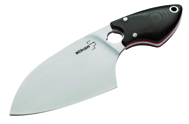
“It just looks cool. On first impression, you just have to pick it up. The compact size of the Boker Sanyougo offers the function of the popular Santoku design in a very compact size. The handle material options—G-10, canvas Micarta® and white Micarta—make it a functional piece for rugged use or a touch of elegance. If Mom cooks a lot, it’s certainly something she would use and most likely does not have.”
—Dan Weidner, Boker USA
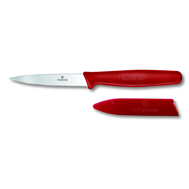
“The $9 price tag on the Victorinox Paring Knife With Sheath is amazing for the quality. The lifetime warranty alone is worth more than that. Also, the peace of mind knowing that you are investing in a Swiss-made quality knife that will remain razor sharp well past when your kids are off to college is a benefit for any parent. The red color is also a market trend.” —Rob Sterner, Swiss Army Knives
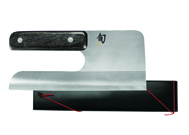
“If mom makes homemade noodles or pasta, or has been itching to try it, the Kai USA Shun Blue Menkiri [the “Blue” refers to the blade steel, not the color] is the tool for her. The overall design of the knife is one few people in the U.S. have used, and Shun is happy to be able to offer a piece perfected in the noodle-loving culture of Japan for making noodles and other fresh pasta. The clean, precise feeling as it cuts through noodle dough is a real pleasure.” —Steve Grutbo, Kai USA
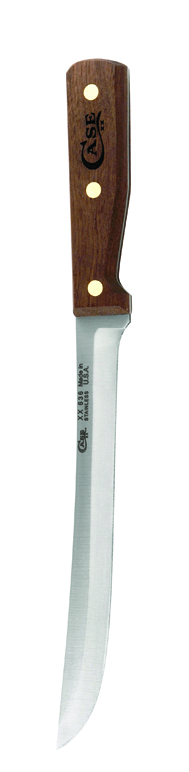
“Very few of the products I write about do I actually use in my daily life after the review. But the handle of the W.R. Case & Sons 9″ Slicing Knife is sturdy and classy, and the blade always cuts whatever I want with precision and ease. All of Case’s knives in the Household Cutlery Set are superior. Rarely do I have to resharpen it, but when I do, the sharpening steel is intelligently included as part of the set.” —Peachy Deegan, founder and editor-in-chief of www.whomyouknow.com
Well, Mom, and all moms, here’s to you. Happy Mother’s Day. You all deserve it. And if interested in similar knives for mom, or more choices, be sure to visit www.shopblade.com/kitchen-knives or www.shopblade.com. And get Mom a gift she’ll use, appreciate, and one that will last her for the rest of her days.
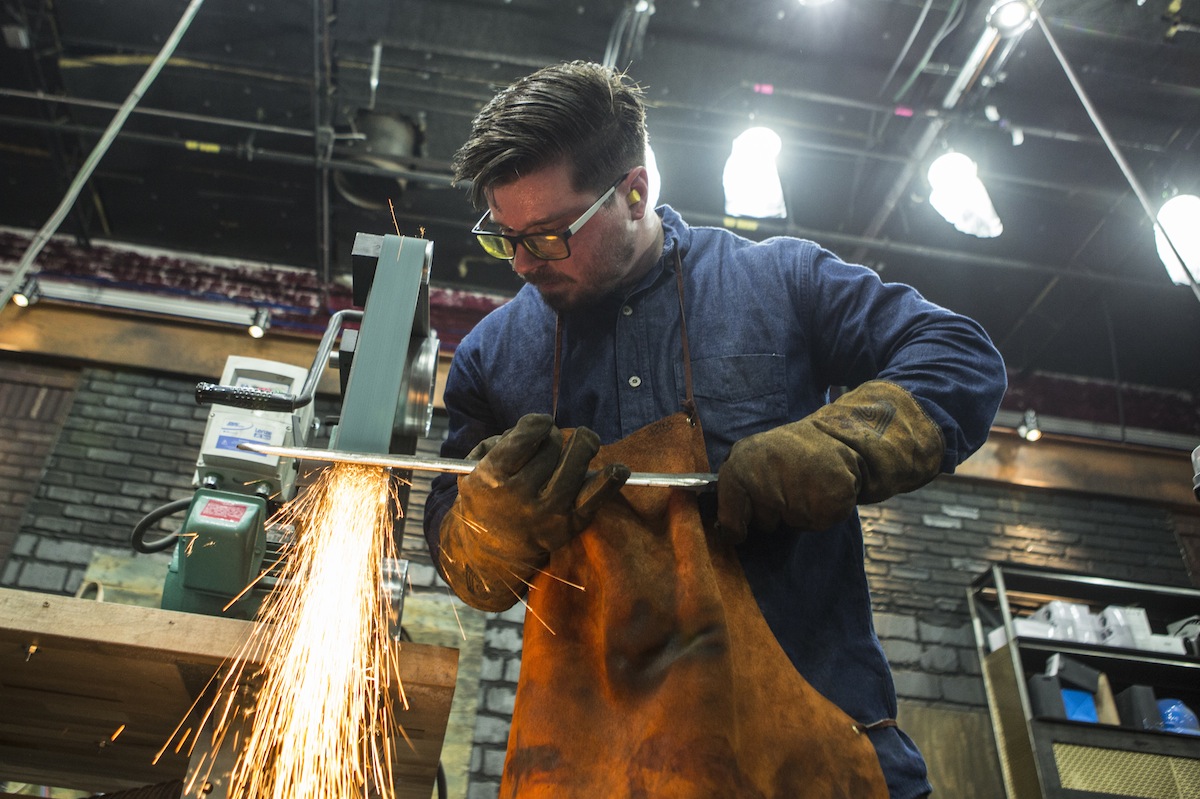
Forged In Fire is an original stand-alone competition show featuring bladesmiths competing against each other to create some of the most iconic edged weapons from history. (photo by David S. Holloway)
ABS master smith J.D. Smith will join three other bladesmiths on the latest installment of The History Channel’s Forged In Fire tonight at 10 p.m. Eastern.
Forged In Fire is a reality TV show in which the contestants are charged with designing and making a knife of their choice via various requirements imposed by the show’s judges—ABS master smith James Neilson, ancient weapons specialist David Baker and combat specialist Doug Marcaida. The smiths have three hours to complete the knife inside the studio’s well-equipped forge—and host Wil Willis is there to ensure the contestants know when time is almost up. In the end of the studio segment, two smiths emerge and are charged with building a special knife, sword or other edged tool of the judges’ choosing at the smiths’ home forges. The smiths have five days to complete the project and the piece deemed best in terms of performance, design, etc., by the judges results in the winner earning a $10,000 prize.
You never can tell what may happen—both in the studio forge and at the smiths’ home forges. Everything from the contestants catching the floor and even themselves on fire, unusual approaches to making knives, and the pressure and confusion that result from the time limits on making the knives can result in some high drama. It’s really entertaining TV and the ratings the show is receiving have been steadily climbing as a result.
After five weeks, Forged In Fire has gained double-digit growth across all key demographics compared to its live premiere: +74 percent in the 25-54 age group, +73 percent in the 18-49 age group and +32 percent in total viewers. In all, Forged In Fire is averaging 1.4 millions viewers—arguably the most people to see/watch a knife-related event in history.
In tonight’s episode, an Elizabethan rapier will be the ultimate blade project the finalists will make for the judges’ perusal. Be sure to check your local listings for when the program will air in your time zone.
Shane Barefoot of Barefoot Custom Knives made this knife from a piece of angle iron from the World Trade Center.
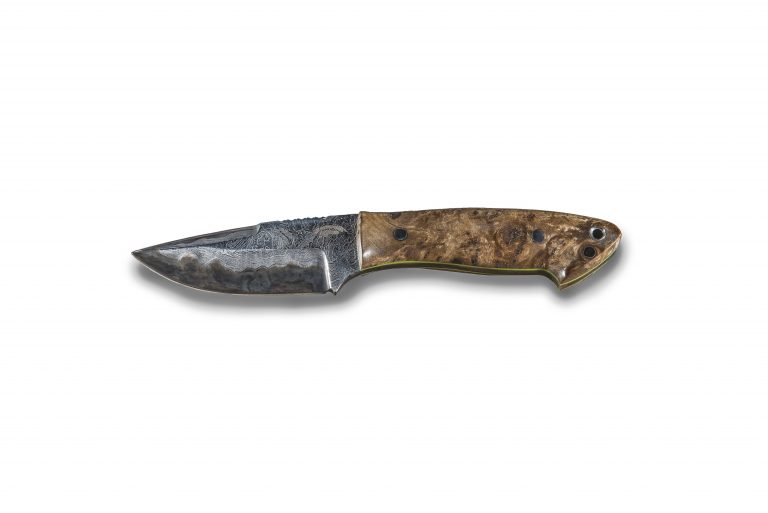
Shane Barefoot of Barefoot Custom Knives is always seeking out ways to craft something unique, something “100-percent Shane,” as he puts it. It was a simple Google search that lead him to a piece of angle iron from the World Trade Center. In the normal course of business trading, the scrap metal from the demolished buildings that was cleared of DNA was sold to China. Understandably, this upset family members of the victims and others. Shane wanted to honor the fallen of 911 by doing what he does best: making knives. He purchased from a company in China. The sacred piece of history arrived–with accompanying verification documentation–and with a bolt in it and two rivets. So, it didn’t take the knifemaker long to decide which direction to take with his creation: a san-mai-constructed blade—damascus steel jacket over a high-carbon core—in the Barefoot hunter pattern.
What took a while, was the actual making. Like many knifemakers, Shane always has something around that he’s working on, and the World Trade Center knife was one of those projects. The three steels forge-welded right together, creating a random pattern in the drop-point blade design. The knife is 7 ¾ inches overall, with a 3 ¼-inch blade, hollow-ground using a 12-inch contact wheel. Shane prefers a convex edge on his hunters so that a simple touch-up on a strop is all that is needed for maintenance. The gimping on the thumb rest is in a rope pattern, adding visual interest along with texture.
The scales on this knife are made from desert ironwood burl, and the liners are in “toxic green,” making a striking color contrast that fishermen and hunters can appreciate. Shane tests his knives by hunting, fishing and cooking with them; all of his knives are made to be purposeful, to carry out their intended tasks. The ¼-inch pins and the thong tubing are stainless steel.
Shane was careful to collect his shavings of the Twin Tower steel, and if anyone wants to buy the knife, he would give those shaving to the new owner. He received one set of documents on the angle steel, so he made copies of the paperwork to prove the legitimacy of the steel’s origin. There is enough left for two more knives.
Knifemaking is a journey. Each knife teaches the knifemaker something new. Overall, Shane is happy with how the knife came out, especially how the blued core nested in the damascus jacket is revealed. The only thing he’d like to experiment with is the blade shape.
Craig Myles tooled the New York City skyline into the sheath that goes with the knife Shane Barefoot made from a piece of World Trade Center angle iron.Craig Myles tooled the New York City skyline on the leather sheath that accompanies this Barefoot knife.
Fittingly, Shane’s friend Craig Myles tooled the New York City skyline into the leather sheath that accompanies this knife. The maker’s list price for the combo is $1000. Although individuals may hold pieces of the World Trade Center buildings privately, there is no longer any left to purchase on the open market, Shane explained, so this is a noteworthy knife.
Barefoot Custom Knives specializes in custom pieces for fishermen, hunters and outdoorsmen. You can read more about Shane Barefoot, his dad and his work in the April 2017 edition of BLADE magazine, which is on newsstands now.
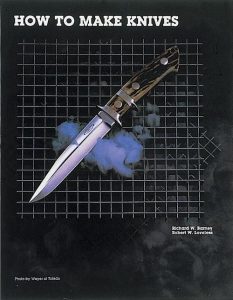
This knifemaking book includes a chapter on sheaths and what the knifemaker needs to consider when deciding on a particular sheath style.
Sure, it’s all about the knife, but knifemakers do well to pick the right sheath for their creation. As the above article on Barefoot Custom Knifes shows, the right sheath can bring excellence to a special knife-sheath combo. Normally, $21.99, “How to Make Knives” by Richard W. Barney and the father of custom knifemaking Robert W. Loveless is now on sale for $12.
For his journeyman smith applicant knives, Levi Miller used the carbon steels 52100 and 80CrV2 for blade material. (SharpByCoop image)
The annual BLADE Show hosts the awarding of both master and journeyman smith stamps by the American Bladesmith Society (ABS), and the 35th rendition of the world’s largest knife show will, too.
Set for Jan. 3-5 at the Cobb Galleria Centre in Atlanta, the BLADE Show hosts knifemaker and knife company exhibitors from every continent but Antarctica—and who knows, there may even be an Antarctic exhibitor this year, too.
Five master smiths and 12 journeyman smiths earned their stamps at last year’s show. The masters were Veronique Laurent, Jean-Louis Regel, Andrew Meers, Haley DesRosiers and David Lisch. The journeyman smiths were Wess Barnhill, Sandro Boeck, Dionatam Franco de Souza, Stephan Fowler, Kyle Gahagan, Micah Kamer, Levi Miller, Facundo Montenegro, Nick Rossi, Bobby Wetten, Russell White and Robert Wright. Adding to the international flavor is that of the masters, Laurent is from Brussels, Belgium, and Regel is from France. Meanwhile, of the journeyman smiths, Boeck and de Souza are from Brazil, and Montenegro is from Argentina.
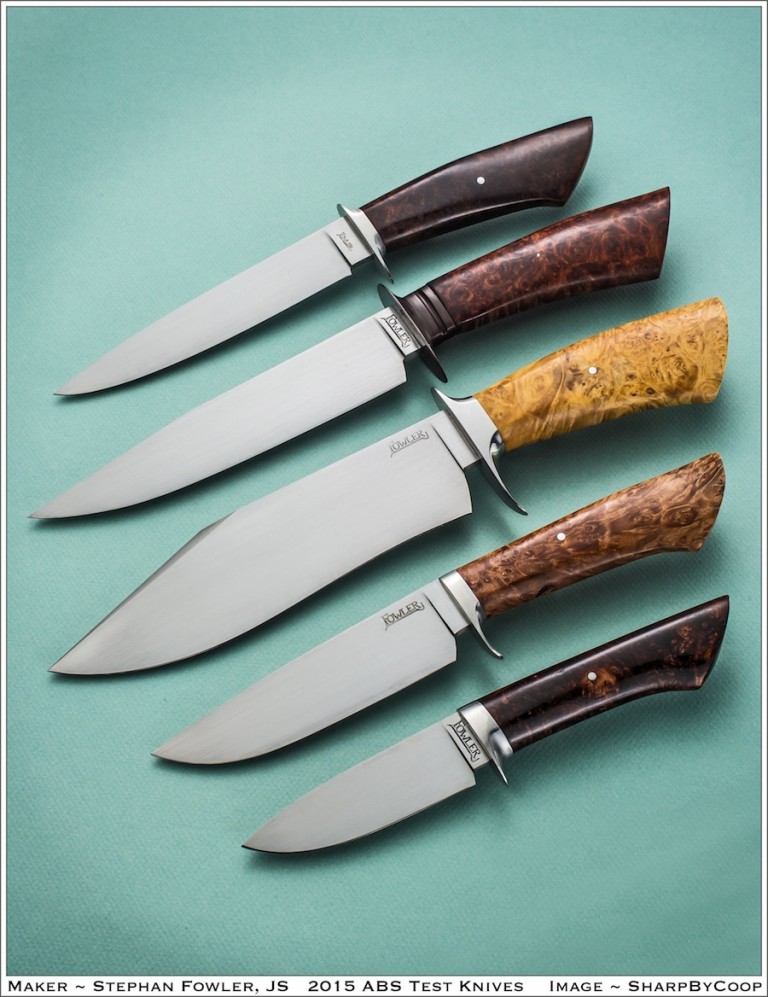
Though the requirements differ for both the master and journeyman smiths’ knives, all must submit five models that are judged by a panel of ABS officials on a number of traits. (For more on those traits, visit americanbladesmith.com.) Herein is a selection of some of the knife quintets submitted by the successful applicants last year. If you attend the 2016 BLADE Show, you can view the knives that are submitted for master and journeyman smith status this year. For more information at/during the show, visit the ABS at table 1P.