
The BLADE Blogs

The blogs of the BLADE editors, Steve Shackleford and Erin Healy.

Fish Knives Combine Form & Function

Here’s plenty of proof that a fillet knife can be put to extreme use, and still be a work of art.

The following is written by Tom Carpenter, and reprinted from the June 2013 issue of BLADE® Magazine.

Filleting fish under wet, sometimes salty conditions isn’t the kind of work or environment you want for your best knives. So you might suffer through with a mass-produced imitation of the real thing. But there’s no need to use an inferior tool. Consider the fish and fillet knives of Phil Wilson, Todd Kopp, Kevin D. Cross and John Cammenga of White River Knife & Tool. First, let’s get right down to the fish knife fundamentals.PhilWilson2
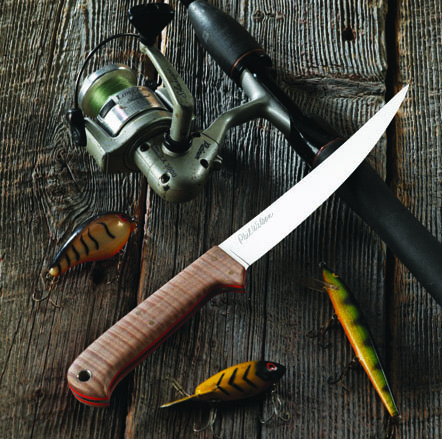
Knifemaker Phil Wilson’s “Shelter Cove” fillet knife (left) sports a 7-inch N690 blade, a fiddleback-maple handle and red spacers. He says a fillet knife should have some flexibility and be ground thin.


The basic features that make for a functional and efficient fillet knife are: a comfortable, secure grip that won’t slip and slide in your hand while doing wet, slimy chores; a sharp blade that is relatively thin and flexible for precision work, and holds an edge; and materials that can stand up to abuse like moisture, blood, and frequent washing and drying.

Wilson, Kopp, Cammenga and Cross craft fish and fillet knives that fit all these criteria and more. Here’s where they put their focus.

Working under the business name Seamount Knife Works, Wilson has been making fillet knives for almost 30 years. “A simple design is best,” he says, “clean and smooth without a lot of holes and crooks and crannies to get packed up with gunk. A good finger guard and a butt end on the handle prevent slippage under wet and slimy conditions.”kc3
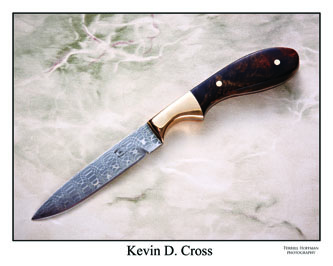
As far as the stainless-damascus blade Kevin D. Cross used for his bird and trout knife (left), the maker says there is a segment of sportsmen who appreciate a beautiful and functional knife. The piece also includes a desert-ironwood handle and bronze bolster. His list price: $400. (Hoffman photo)


As for blade material, “stainless steel is mandatory,” stresses Wilson. “I have used 440C, 154CM, AEBL, CPM-S90V, 12C27, CPM-S60V, CPM-S30V and CPM-154. Yes CPM-S90V—it still makes an awesome fillet knife, but now I feel it is overkill for the application. Given proper heat treatment, they all make a good fillet knife. These days I am using CPM-154, CPM-S30V and N690 mostly. These steels are in pretty much the same category for edge holding and ductility. A [reading] of 60 HRC seems to be the best target hardness for all of them.”

Blade characteristics are important, too. “A fillet knife should have some flexibility and be ground pretty thin,” says Wilson. “I like a springy feel in the first half of the blade from the tip back. Flex is a function of the blade geometry rather than hardness or steel grade.Mike Mooney Best Filet

Mike Mooney’s “Coho” model (left) won Best Fillet Knife at the 2011 Professional Knifemakers Association Show. It sports a 6-inch CPM-S30V blade, a dyed and stabilized redwood burl handle, and a 416 stainless steel bolster. (Buddy Thomason photo)

“Blade lengths from 6 to about 9 inches will handle most fillet work,” he adds, “and also double as boning, slicing and carving knives in the kitchen. Edge holding on a fillet knife is not quite as important as on a hunting/utility knife. A fillet knife can clean a box of fish and then get touched up at home or on the boat later. So a little lower hardness can be traded off for some added ductility on a thin, flexible blade.”


Non-Slip Grips

Handle material is critical. “I’m using mostly canvas Micarta® handles,” states Wilson. “An option is G-10. Both are naturally non-slip and do not soak up moisture.”

Kopp earned “Best Fillet Knife” honors at the 2010 Professional Knifemakers Association Show with his damascus fillet knife. He strayed from traditional stainless steel for his award-winning knife, opting instead for a damascus of 1084 and 15N20 carbon steels.StepUp_8_Maple_02
John Cammenga of White River Knife & Tool offers wood-handle fillet knives like this model (left) with a SM-100 blade and tiger-maple handle. Cammenga explains, “At the BLADE Show and SHOT Show, we introduced the world’s first fillet knife made with a blade of SM-100, a corrosion-proof alloy. This particular custom measures 63 HRC on the Rockwell hardness scale, features a 3/16-inch-thick spine and is still flexible! It is a ‘step-up design’ where the handle is notably higher than the cutting edge. The knife was designed by Steve Geelhoed, and while the original is not for sale, replicas sell at $750 each.”

“I used carbon steel on this because it holds an edge better than some of the stainless steels,” Kopp explains. “It does, however, require more care than stainless blades.”

The attractiveness of the damascus pattern is certainly inviting. “Yes, it’s kind of unique seeing a damascus blade on a fillet knife,” he admits. And what about function? “My brother used it on a fishing trip,” Kopp relates, “filleting 30 or so fish with it, and he was pleased with its performance. In fact, I think it outperformed an electric fillet knife!”Kopp Best Fillet orig
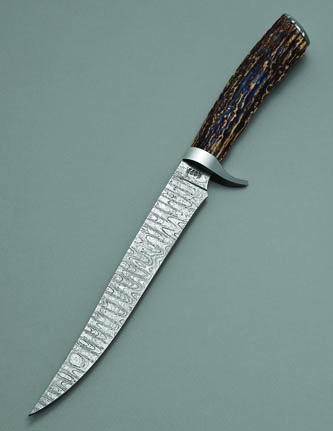
Maker of the Best Fillet Knife at the 2010 Professional Knifemakers Association Show, Todd Kopp chose a 7.5-inch damascus blade and sambar-stag handle for this particular model (left). Note the small details like how he carved the 416 stainless steel buttcap to match the natural grooves of the stag. The maker’s list price: $475. (Buddy Thomason photo)

Cammenga runs White River Knife & Tool, a family-owned business with a full array of fillet knives in its line. “A strong case can be made for many great alloys available today,” he says. “We chose 440C for our Limited Production and Custom Finished versions in 2013. This high-carbon, stain-resistant steel retains our hand-sharpened, leather-honed edge for a very long time. It also provides reasonable corrosion resistance.”

Cammenga uses wood handles on the fillet knives. “The wood is stabilized and will not shrink, swell, or absorb blood or oil,” he explains. “We also offer a cork handle with a wooden pommel. The cork handle with a 6- or 8-inch blade will float [if the knife is dropped in the water]. Also, our unique ‘step-up design’ helps to keep the handle [and knuckles] a little farther off the cutting area, a nice feature when filleting on less than ideal surfaces.”

Flexible On Flexibility

Cammenga says he thinks blade flexibility on fillet knives is largely a personal preference. “At the 2013 SHOT Show, we received some comments that our blades could be a little more flexible, and some that they could be less flexible,” he recalls. “Our current offering tends to be more rigid on the 11-inch blade, moderate on the 8- inch blade and more flexible on the 6-inch.

“That which makes a good knife makes a good fillet knife.”

Bird and trout knives certainly fit in the fillet knife family. Cross uses straight stainless steel on some of his knives, but adds a beautiful twist to others.

“Yes, actually I use both straight stainless and stainless damascus, depending on the customer,” Cross remarks. “With exposure to the water, the stainless aspect is important. As for stainless damascus, it looks a bit classier and there is a segment of sportsmen who appreciate a beautiful and functional knife to go with their Parker shotgun or Sage reel.”

Bird and trout knives have to pull double duty. How does damascus steel perform on the fishing half of that equation? “This knife works well for its appointed tasks,” he concludes. “But as with any short blade, there is not a great deal of flex. It is certainly possible to make the blade thin and flexible, though.”

Cross’s bird and trout knife employs bronze fittings. “Bronze is tough, and stain and corrosion resistant, especially to salt water. It is harder than brass, develops a nice, warm patina, and is easy to care for.” Function plus beauty: just the things knife lovers tend to value.

You make fillet knives do their work under tough conditions. But don’t suffer with low-quality knives. Craftsmen such as Wilson, Kopp, Cammenga and Cross have proven that you can combine function and form in beautiful fish knives.
World’s Most Important Knife Awards

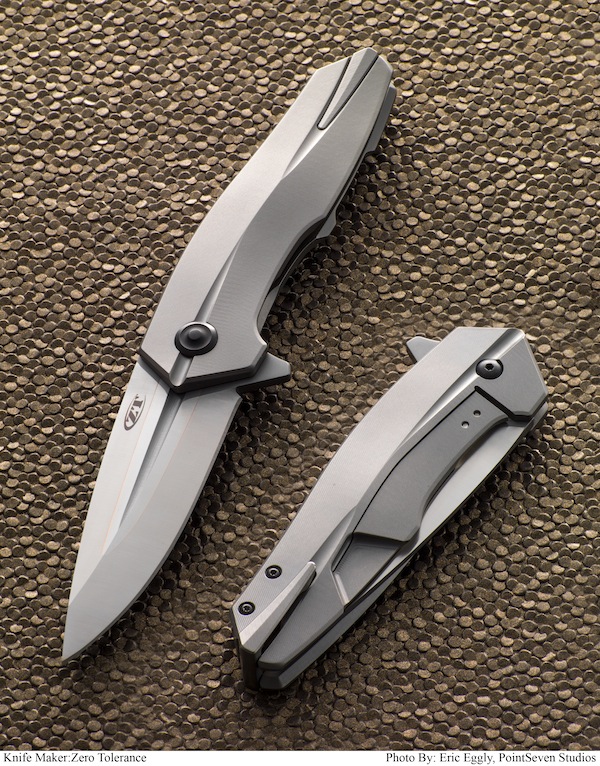
The BLADE Magazine 2013 Overall Knife Of The Year® was the Zero Tolerance 0888. (Point Seven photo)
The Zero Tolerance 0888 was the BLADE Magazine 2012 Overall Knife Of The Year®. (Point Seven photo)

The world’s most important knife awards—the BLADE Magazine 2013 Knife-Of-The-Year® Awards—will be named next week at the BLADE Show & Living Ready Expo (www.bladeshow.com).

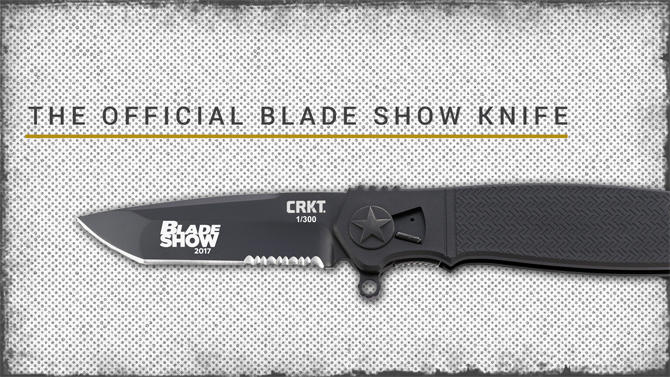
Set for May 31-June 2 at the Cobb Galleria Centre in Atlanta, the BLADE Show & Living Ready Expo attracts knife manufacturers and knifemakers from all over the world to display and sell their knives.

Companies that rent booths at the show are eligible to enter knives and/or accessories in the Knife-Of-The-Year Awards competition, which includes categories for 10 factory knives, one accessory and two individuals who have furthered the betterment of the knife industry.

The Knife-Of-The-Year categories are: Overall, American Made, Imported, Most Innovative American Design, Most Innovative Imported Design, Manufacturing Quality, Best Buy, Investor/Collector, Kitchen Knife, Knife Collaboration, Accessory, Publisher’s and Industry Achievement. The winners will be announced the Saturday night of the show during the BLADE Magazine Awards Banquet in the Cobb Galleria Centre (tickets required). The winners will be listed outside the BLADE Show office in the Galleria Centre the morning after.

There is a Knife-Of-The-Year Display Area in the BLADE Show hall for entrants to display their knives. New for this year, the display area will be in the back left of the show hall as opposed to the former location in the center of the hall. There, show patrons can look at all the individually displayed knives, many of which will include accompanying information on blade steel, handle materials and more. Entrants may also display their entered knives at their booths, though that is optional. Representatives of each company may stop by the display to examine and vote on the knives for the awards. Voting begins the Friday of the show and ends Saturday.

For more on the awards, stay tuned to www.blademag.com and/or see the November issue of BLADE®, on newsstands Aug. 13.

Greatest Loveless Knife Designs

Here’s a fun thread I’m starting today—regularly posting pictures of the greatest Bob Loveless knife patterns/designs. I plan to do this every other day or so until I have 15 or 20.

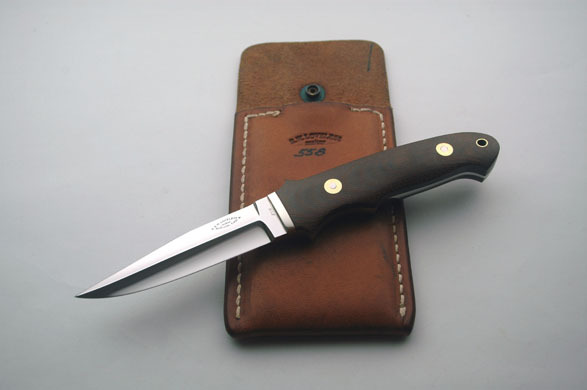
My first one? Well, how about a New York Special as only R.W. Loveless could fashion it?!
 

This is perhaps the rarest and hardest-to-find of Loveless pieces—the original New York Special with a snap in the sheath. According to Dave Ellis of Exquisite Knives, originally told, there were seven. This is the long-lost 8th!

A big shout out to Ellis, by the way, for supplying me with an image of a New York Special when I needed one (the image, that is, not the knife). You can visit his cool website at http://www.exquisiteknives.com.

Watch for more of the Greatest Loveless designs, and let me know what you think!


Get Two Bob Loveless Books in One Bundle

 
You’ll actually get three great books in one bundle at a great price:

The Wonder of Knifemaking
Knifemaking with Bob Loveless
How to Make Knives (CD version of the classic book co-written by Bob Loveless)

 
Click here to get these great knifemaking books for $34.99 (51% off retail).

How To Build a Survival Shelter

The following is excerpted from a feature article by James Morgan Ayres that ran in the April 2013 issue of BLADE® Magazine.

Over 90 percent of wilderness deaths by mischance are caused by hypothermia. Knowing how to build an emergency shelter quickly can mean the difference between freezing to death and surviving. You can build a survival shelter that offers protection from cold and snow or rain in no more than 30 minutes, and with only the tools at hand—which is where knives can make the difference in getting the shelter up before it is too late.

5 Keys to An Emergency Shelter

1) Evaluate your situation and decide if you need to spend the night out before it gets so dark you cannot see to build a shelter; Expanding the framework of the shelter.2) If available, select a level spot that provides natural shelter—a large tree or boulder, for example. Barring that, choose a place that has building materials such as saplings or brush nearby; 3) Build a framework using the natural shelter as a base; 4) Cover the framework with branches, leaves, brush and whatever materials are available. If possible make the covering 6 inches to a foot thick; the thicker the covering, the better the insulation. If you are in an area where there are limited building materials, having a reflective blanket in your pocket could be a lifesaver. It weighs only about 3 ounces, is no larger than a handkerchief and can make a difference of up to 20°F, and; Expanding the framework of the shelter.5) Cover the floor with six-to-12 inches of leaves, pine needles, duff (decaying leaves and branches), or whatever is available for insulation. Leave the area near the entrance clear of debris. After making the cleared area safe for burning small pieces of kindling, build a small fire in it. The fire should be no larger than a soup bowl.

If you are properly dressed for the climate, you can spend the night in such a shelter with a tiny fire not only safely but also comfortably. Having the know-how to build the shelter is critical. Having a good knife can make building the shelter quick and easy.—by James Morgan Ayres 

Shelter framework ready for thatching with available material.Author’s note: The shelter in the photos using pine boughs was built in a national park, not a true wilderness area. We were required to “leave no trace” and return everything as it was. Therefore, we did not thatch the roof nor build up the floor with boughs and leaves as described in the text, as you would in a survival situation.

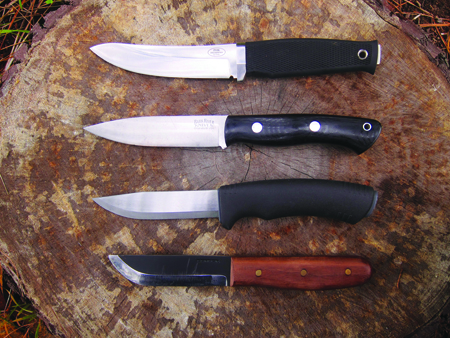
My associate and I used and evaluated four very different knives to construct two survival shelters. The review knives fall into two categories. The Mora and Condor both have ‘Scandi’ grinds and are economical. The Bark River and Fallkniven have convex grinds and are priced like the premium knives they are. Covering shelter framework with pine boughs.

CONDOR BUSHCRAFT

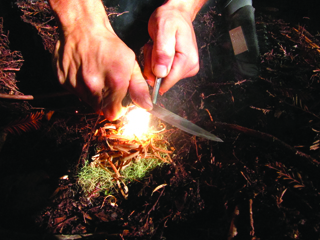
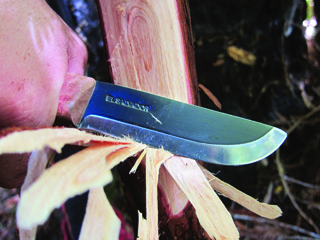
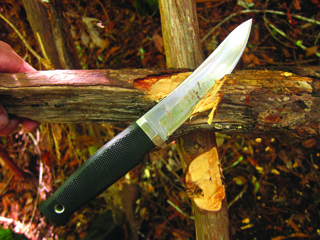
The Condor Tool & Knife Bushcraft Basic Camp Knife has a comfy wood handle, a 4-inch blade of 1075 carbon steel with a lot of belly, and a full tang. When driven into a tree it was strong enough for a 200-pound guy to do a pull-up on; we tried it, no problem. The belly of the black-epoxy-powder-coated blade proved its worth in general use, but a little more tip would have been welcome. In knife design everything is a compromise and this is a good one. The welted leather sheath holds the El Salvador-made knife securely and is unusually nice for a package in this price range ($34.98 MSRP).  Bark River Aurora illustrating an efficient push cut on a sapling.

IMG_0316BARK RIVER AURORA

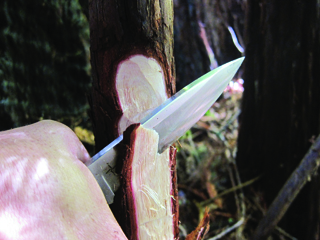
The Bark River Aurora ($239 MSRP) is Bark River honcho Mike Stewart’s personal design for an all-around bushcraft knife. The American-made fixed blade displays excellence in design and use. The convex blade of A2 tool steel provides easy, controllable push cuts, supports the edge for batoning, gets into a cut aggressively, and has a centerline point for precise control. The handle is ergonomically contoured, does not slip and is comfortable in hard use. The balance is so good and the 9.5-inch knife feels so lightweight and quick that it seems to weigh less than the specs (6 ounces) would indicate. The pouch-type leather sheath is handsome, secures the knife well, carries comfortably and has a loop for a firesteel.

I suspect the Aurora has a reserve of strength that we did not come close to tapping in our review. Though not billed as one, I think the Aurora is an excellent choice for a wilderness survival knife. IMG_0305Condor Bushcraft makings shavings for a fire.

MORA BUSHCRAFT

Made in Sweden, the Mora Bushcraft Survival Knife ($57.95 MSRP) comes with a firesteel and diamond sharpener—both valuable tools—in a composition sheath. The thick, 4.25-inch blade sacrifices nothing in slicing and wood-shaving ability. It has a good, usable point and is strong enough for batoning. The handle is very comfortable. The knife popped out of the sheath, which was worn on a belt, while we were jumping over a log. A cut or the loss of the knife could have resulted.

FALLKNIVEN PHK

Fallkniven markets its Professional Hunter (PHK) as “one of the best hunting knives in the world.” It is also a very good all-purpose bushcraft and survival knife. The convex grind and long, curved edge combine to make a strong 5-inch blade of 3G steel that just wants to cut. It batons well, makes good push cuts and snap cuts efficiently on small branches. It would even do a little light chopping, though no knife this size (9.4 inches overall) can be an efficient chopper. The PHK’s nonslip Thermorun™ thermoplastic handle is comfortable in any grip, even during hard use.IMG_0181

Made in Japan, the knife offers a choice of a leather or Zytel® sheath. I much prefer the leather one since the Zytel sheath must be snapped to secure the knife, as we learned when the knife fell from the unsnapped sheath while we were running. MSRP: $470.

HOW THEY FARED

In general, we found the knives with the Scandi grinds to be somewhat better for fine woodwork, such as making fuzz sticks, while the convex-ground blades cut more efficiently and with less drag in deep cuts. All the knives’ handles were comfortable and did the job. On the other hand, each knife had its own character and pros and cons.

The Bark River was everyone’s all-around favorite, and if there had been a prize for most handsome, it would have won. The Fallkniven displayed the high level of function for which the brand is known, and clearly had enough reserve strength to serve as an urban destruction tool. The standard Mora is a good all-around bushcraft blade at a very low price. It is a bit stronger than other Mora models we have seen, and the inclusion of a firesteel and diamond sharpener produces a very nice package. However, the sheath needs work—otherwise you had better use duct tape to secure the knife, as we did. The Condor brings a welcome alternative to the bargain-priced market and stands on its own merits as a strong, efficient choice for the bush.

The premium-priced Bark River and Fallkniven exhibit higher-quality construction and did almost everything better than the less expensive Mora and Condor. Nonetheless, the difference was a matter of degree. All would serve to build a shelter and produce firewood, and maybe save your life.

Buck Collectors Observe 25th Anniversary

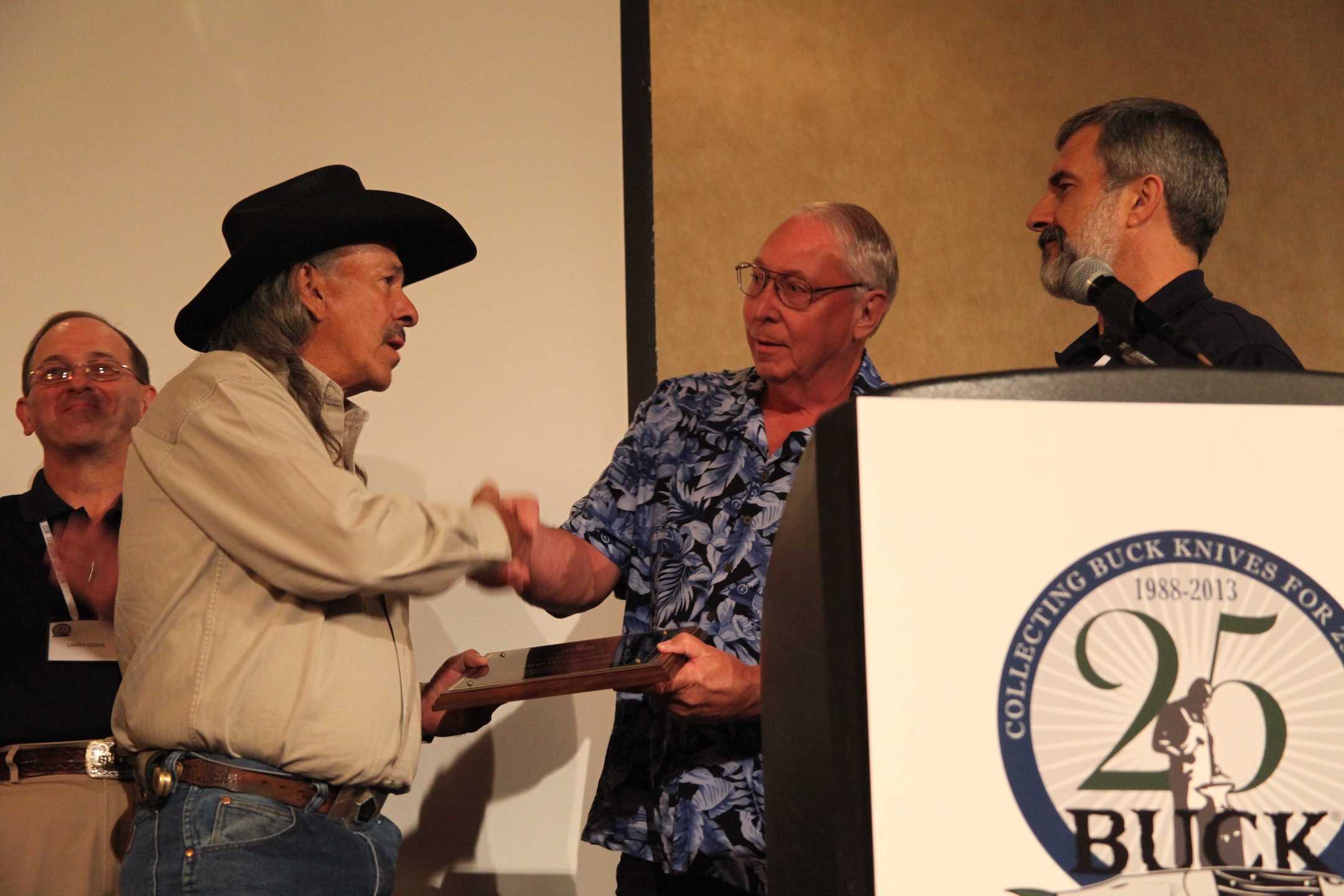
David Yellowhorse enters the Buck Collectors Club during the Buck Collectors Silver Anniversary gala. From left: Larry Oden, David Yellowhorse, Gene Merritt and John Foresman.
During the Buck Collectors Silver Anniversary, David Yellowhorse is inducted into the Buck Collectors Club Hall Of Fame. From left: Larry Oden, David Yellowhorse, Gene Merritt and John Foresman.


Hundreds of Buck knife collectors converged on Spokane, Washington, and Post Falls, Idaho, last week for the Buck Collectors Club International’s 25th Anniversary Gala.


A celebration of Buck knives, seminars on Buck knives, tours of the Buck manufacturing plant just across the border in Post Falls, and much more highlighted the event, which drew collectors from all over the country.


Such Buck VIPs as Blade Magazine Cutlery Hall-Of-Fame© member Chuck Buck, Lori Buck, CJ Buck, David Yellowhorse, Wilde Bill Cody, Leroy Remer, Mike Prater, Fred Wilson and many others mingled with Buck collectors throughout the festivities.


The event kicked off with a banquet Tuesday night, and included the induction of four into the BCCI Hall Of Fame: knifemaker Jerry Bodner, Jane Davie and the aforementioned Mssrs. Yellowhorse and Wilson. BLADE® (www.blademag.com) Magazine Editor Steve Shackleford served as the banquet keynote speaker and was presented with a special plaque in recognition of his work with the BLADE Show (www.bladeshow.com) and support of the BCCI over the years.


Wednesday included a complete slate of seminars and factory tours. The seminars included one on Buck Yellowhorse knives by award-winning Buck Yellowhorse collector Gene Merritt. The day was capped by a sunset dinner cruise on the nearby Lake Coeur d’Alene. Thursday featured seminars by CJ Buck on what’s on the horizon at Buck Knives and on Buck Customs by John Foresman, Leroy Remer and Wilde Bill Cody, among others. A “Knife Swap Plus” was held Thursday evening and included Russ Donoghue signing his new BCCI History Book, raffles, auctions, artist demos and more. The event concluded with more seminars Friday, including one on the Buckmaster/M-9 and Buck Tactical Knives by Rich Neyman, and a Buck Knife Survival Seminar by Karen Hood. A picnic at the home of Chuck and Lori Buck was a fitting end to the extravaganza.


For more information on the BCCI, visit www.buckcollectorsclub.org.


For the latest knife news, stay honed to www.blademag.com.


Knifemaker Claude Montjoy Passes Away

Knifemaker Claude Montjoy of Clinton, South Carolina, passed away Sept. 23. He was 74.

A member of the South Carolina Association of Knife Makers, Montjoy was a full-time maker who sold his first knife in 1982. He made knives by the stock removal method and built folders, including slip joints, locking liners and interframes, and also hunters, boot knives, fighters and some art knives.

Services were held Sept. 24. Condolences may be expressed online at www.grayfuneralhome.com.

In lieu of flowers, the family requests that memorials be made to the First Baptist Church of Joanna, 301 Magnolia St., Joanna, SC 29351.

Rhett Stidham Passes Away

Rhett Stidham, long-time knife collector and purveyor who probably will be best remembered for founding the Randall Knife Society, succumbed to a long illness Saturday, April 23.


Along with wife Janie owner of Meadows Edge retail knife store in Meadows of Dan, Virginia, Rhett was a familiar site at knife shows, selling and trading Randall knives and just about any knife, for that matter, that caught his fancy. A big man with a big smile and laugh to match, Rhett, along with Janie, was constantly on the road attending knife shows all over the country until failing health curtailed his busy travel schedule.


In the early years of his knife experience, Rhett specialized in selling and trading antique pocketknives, and later included custom knives and even knives by William Scagel among those he sold and traded before starting the Randall Knife Society. He also wrote and published the society’s newsletter and coordinated the RKS meetings at the BLADE Show. Early on, he wrote a book about the old (1900-1919 and 1931-1939) Napanoch Knife Co. of Napanoch, New York. As these words were written, this year’s RKS meeting was to be held as planned at the BLADE Show.


Funeral arrangements were pending.

Advertisement

Must Read Articles

Read this before you make a knife

Knifemaking 101 – Read This Before You Make a Knife

  by Wayne Goddard My experience has taught me that there's nothing like digging in and getting started. I've often said the hardest part of the...
how to forge damascus steel

How to Forge Damascus

Advertisement
Advertisement