The BLADE Blogs

The blogs of the BLADE editors, Steve Shackleford and Erin Healy.

Knifemaker Joe Kious Perishes In Accident

Veteran knifemaker Joe Kious, popularizer of the “Pocket Locket” style of high-end art folder and long-time Knifemakers’ Guild member, passed away Dec. 5 as a result of injuries suffered in a vehicle accident.

A resident of Kerrville, Texas, Kious was a full-time knifemaker who sold his first knife in 1969. He specialized in investment-quality interframes and bolstered folders, some bringing up to as high as $10,000 apiece.

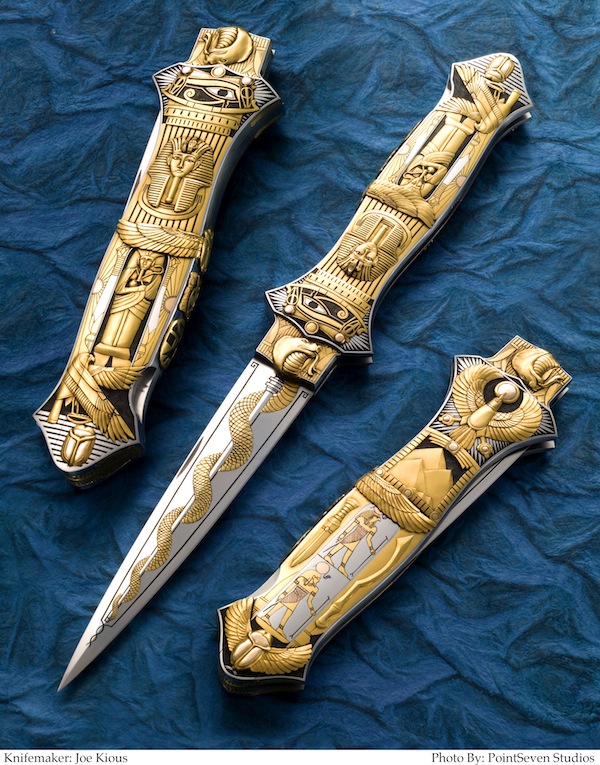
However, it is his Pocket-Locket models for which he may be best remembered. Featuring elaborate engraving, the folding knives include a small compartment in the handle with a sliding panel that slides back to reveal another engraved scene inside.

“Joe was a staunch supporter of the Knifemakers’ Guild and believed in handmade knives,” said knifemaker and fellow Guild member Edmund Davidson. “Joe had a wonderful personality, was very easy to speak with and would tell you anything you wanted to know. He held nothing back and had no secrets. His knives reflected a great deal of thought, craftsmanship and artistry. He was a true master and genuine person. He will be sorely missed. When we lose a man of his caliber, we are all diminished.”

“Joe was a gentleman who loved his family, friends, enjoyed shooting, fine scotch and making knives,” noted Michael Donato of KnifePurveyor.com. “Please keep his family in your thoughts and prayers.”

A member of a close-knit group of Texas-based Guild knifemakers that includes Warren Osborne, Tom Overeynder and others, the stately Kious was liked and respected by most everyone who knew him in the industry. A lean, handsome man with a full head of grey-white hair, he was soft-spoken but never at a loss for words or a well-thought-out opinion.

Though he did not make BLADE® Magazine’s 40th anniversary list of top knifemakers—he received enough votes to make honorable mention—his Pocket Locket was chosen No. 6 among the most important custom knives of the period from 2001-2012 in the magazine’s 40th anniversary list of top custom knives.

“Joe’s Pocket Locket is important because it is the most flexible engraving platform ever offered,” noted custom knife purveyor Paul Shindler of KnifeLegends. “It includes many models and styles but offers pretty much endless possibilities for the imagination of any collector. The Pocket Locket may be the most important engravable knife ever conceived.”

Added Donato, the Pocket Locket “has a very high ‘cool factor’ to it and has served as a canvas for many of the best engravers to work their magic. Joe’s Pocket Lockets are featured in many books, magazines and great collections worldwide.”

The world of knives lost knifemaker Joe Kious to a traffic accident Dec. 5.
Joe Kious, popularizer of the “Pocket Locket” art folder, was killed in a vehicle accident Dec. 5. His “two-door Pocket Locket” in a King Tut theme with Ron Skaggs engraving won Best Knife Collaboration at the 2007 BLADE Show and served as the cover knife for the December 2007 BLADE®.

Ron Hood Passes Away

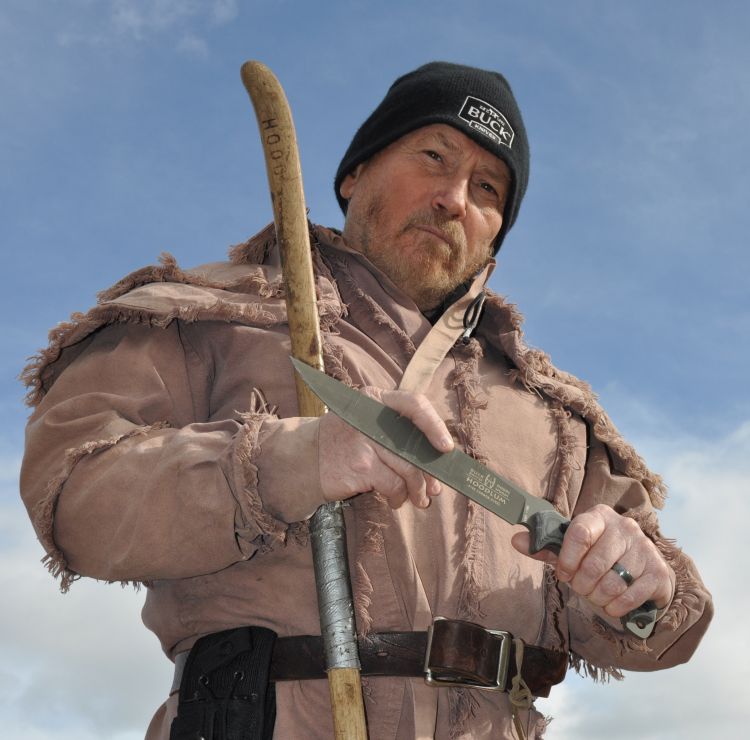
Ron Hood, survivalist, writer and knife designer, passed away June 21.

Earlier this year at the SHOT Show, Buck introduced its new Hood Hoodlum, a Ron Hood design with a rarity for Buck—a 5160 carbon steel blade. Hood also was seen at the 2011 BLADE Show.

According to a Buck news release, “It is with profound sadness and grief that Buck Knives, Inc. announces the passing of our friend and business associate, Ron Hood, of Hoods Woods. Ron passed on the evening of June 21 in his home in Coeur d’Alene, Idaho. Our prayers and our thoughts are with Ron’s wife, Karen, and his son, Jesse, who were the love of his life. Ron was not only a beloved husband and father, but was one of the most respected wilderness and survival experts in the world, as well as a Vietnam Veteran and an industry respected knife designer and developer. In our short working relationship with Ron, we found him to be the consummate professional. Ron and his family were, and always will be considered part of the Buck family. Ron will be truly missed not only here at Buck Knives, but throughout the outdoor industry.”

Knife Rights Launches Facebook Page

If you love your knives, and want to keep and carry them, help us make Knife Rights’ Facebook launch a success. Please go to Knife Rights’s facebook page and ‘Like’ their page. Knife Rights is making a difference. They have earned our support.


Click here to go “Like” the Knife Rights facebook page.

Paul Ehlers Sets Record Straight

Editor’s note: Long-time knife designer Paul Ehlers wrote the following letter to BLADE® concerning our oversight of Mr. Ehlers’ copious design contributions to the works of Paul Fox and Blade Magazine Cutlery Hall-Of-Fame© member Gil Hibben, one of which by the latter, the Alien, is reproduced above via the photography of Mike Carter. We reprint Mr. Ehlers’ letter here in its entirety.


      My name is Paul Ehlers. I am a knife designer; I believe you know my work. I have been a reader of BLADE® since 1983. It was that year I forged a creative alliance and friendship with Blade Magazine Cutlery Hall-Of-Fame© member Gil Hibben, and later with knifemaker Paul Fox. Our knife journeys have been both challenging and artistically rewarding, and we always have endeavored to push the envelope. Often the envelope would push back, but we never let that stop us!

      Looking back, the majority of Gil’s one-of-a-kind custom fantasy knives were of my design, from our beginnings in ’83 with our “Dragonfly” up until the present day. In fact, we have done over 50 collaborations. That is a lot of grinding! It is no wonder Gil has often said “Paul’s dreams are my nightmares!”

      The first fantasy knife I designed for Paul Fox we named the “Soulseeker.” It went on to win the coveted W.W. Cronk Award at the 1986 Knifemakers’ Guild Show. That was a great honor. Of the many knives I have designed over 25 years, it is one of our best achievements.

      But alas, my name is nowhere to be seen in “Raise A Glass To The W.W. Cronk Award” on page 78 of the April 2009 BLADE. The ’85 winners are listed as collaborators, so I am sure you will take this opportunity to correct this piece of our knife family history. I, and posterity, will be eternally grateful!

Paul W. Ehlers

P.S.: I can recall at the first shows I attended, the “Father of American Knife Photographers,” Cutlery Hall-Of-Famer Jim Weyer, would take me around to the tables and introduce me as “the next Bud Cronk.” This was 1983. The only thing was, I had never met Mr. Cronk and had not seen any  of his work until Jim published his first Knives: Points of Interest book. When I asked about Cronk, Jim said, “Don’t worry kid, you’re in good company!” I never forgot that. Of course, over time I came to know what a true genius Cronk was and is. This is one of many reasons why this award means so much to me.

To read more stories like the above, subscribe to BLADE. For more information on how to subscribe, click on http://www.shopblade.com/product/blade-magazine-one-year-subscription-us/?r+ssfb231111#BL1SU

Malaysian Men Of Steel

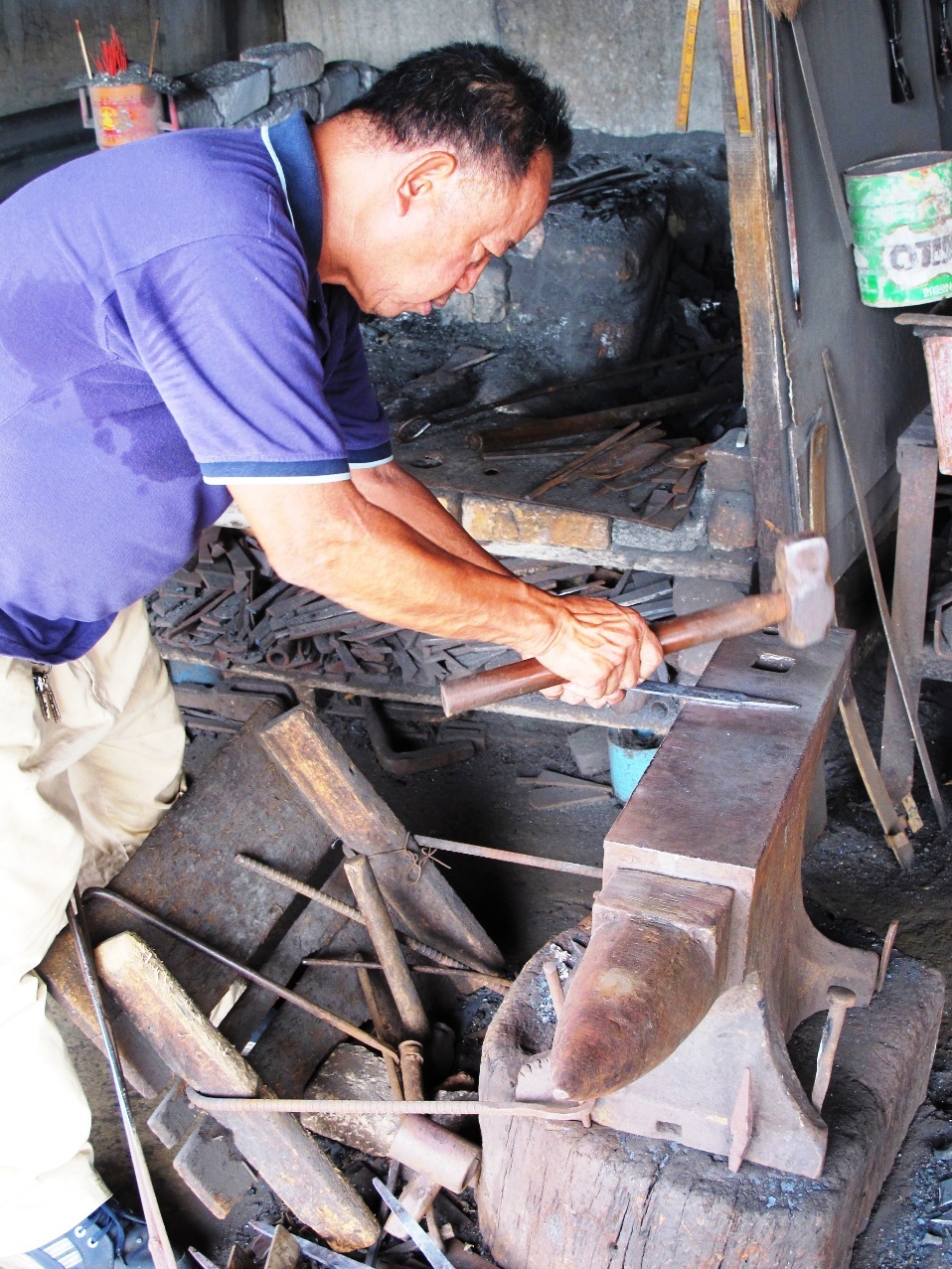
Lim Loong Hoi hammers steel in his old school knife shop in Selangor, Malaysia. (photo courtesy of Philip Lim Chin Guan)


     Every morning, Lim Loong Hoi is at his dirty workshop—it looks more like a shack from the front—at about 8 o’clock. Beyond the open door in the rear, the passage leads to a hallway and a few small rooms.

     The boneshaker of a wooden shop has been home to Lim and his family for decades. He said he has been making utility tools, including parangs, goloks, large fisherman’s blades and sickles, since his school days.

     His instructor and mentor was his grandfather. Back in the day, Lim found time after school to help his grandpa at the workshop. Picture a teenager’s delicate hands with a heavy hammer and a pair of tongs when, during morning hours, he was holding a pen or ruler in school. That was about 50 years ago.

     Called Sin Sam Hup Lee, Lim’s shop still stands firm against fluctuating economic conditions and the ravages of time. His back is slightly bent from the long, dreary years of standing before the furnace or hydraulic pump, pounding away at pieces of elongated steel.

     Pasir Penambang is a small village on the outskirts of Kuala Selangor in the state of Selangor, Malaysia. The locals, especially the Chinese, are mostly fishermen, shopkeepers or fish wholesalers.

     The Chinese fishermen are Lim’s regular customers. The edged tools he makes for them are larger than usual. The blades are similar to huge butcher knives, having a curvature that helps in slicing a big fish in two with one swift, downward stroke.

     The Malay farmers usually ask for long sickle blades used in dislodging oil palm fruits, a.k.a. kelapa sawit nuts. Each sickle is hollowed out at the handle to accept a long pole. The pole enables the user to extend the blade about 7 to 8 feet to harvest the nuts from the palm trees. Each sickle costs $2 to $2.60. The price depends on the quality of the steel and blade size.

     In Lim’s workshop, stacks of Jeep leaf springs used for blade steel rest in a corner. The four-wheel-drive springs are rusty and grimy. The haggard bladesmith likely sourced the spring steel pieces by the ton from an old junkyard. He probably got them cheap, too. Most of the time they are cut to required lengths. It is a low-tech, slightly primitive method of stock removal.

     Practicality and function rule the land. Almost nobody here has heard of CPM-S30V, VG-10 or ZDP-189. The most convincing line Lim uses is, “This is Jeep spring steel.” That alone gives his customers some assurance they are getting quality steel.

     Edged tools used by fishermen or farmers in the fields have no time to get rusty because they are used regularly and on a daily basis. After six to eight years, the parang, golok, fisherman’s blade or farmer’s sickle may be deemed unusable. The user simply buys another one from Lim. After all, it costs just a few bucks. Compared to its long-term usefulness and hardiness, the cost per blade is minuscule—which is why the agrarian folk in Pasir Penambang and nearby villages are Lim’s loyal customers.

     Lim’s assistant is taciturn, works like a well-oiled machine and knows the blade-making process intimately. Like his boss, the assistant relishes the feel of steel in his hands.

     Of course, the untidy workplace is not exactly ideal for a private conversation. Customers determine what they want, haggle over the price and depart with the edged tool they bought wrapped in a newspaper.

     Occasionally, some outsider brings a drawing of the piece he wants made. The bladesmith examines the drawing and then determines whether his outdated equipment and other machines are suitable for the order.

     The volume of edged tools he sells will not even make Lim a member of the middle class. He obviously is not making a fortune, as some people may suspect.


Ah Pee

     A couple of doors away along the same row of wooden shops is another knifemaker, Ah Pee. A sign at the front of his establishment says “Chuan Lee Chan.” Originally from China, he has aged before his time, though his eyes have a certain fire that belies his years.

     Pee said his children, especially his son, have absolutely no interest in knifemaking. “The young men today prefer air-conditioned offices and as little dirt on their hands as possible,” he told me.

     The long hours and intense heat from the furnace are enough to deter most from pursuing such a profession. It is backbreaking work with the added disadvantage of low and slow financial returns.

     After about five decades of using the hammer, tongs and grinder, Pee is long past set in his ways. He probably does not know how to do anything else. Perhaps he feels he is too old to learn and master another profession.

     Not all the edged tools sold at both shops are fashioned by the resident makers. They also stock production parangs and some made-in-China models, both more affordable than the handmade models. Lim’s and Pee’s knives cost more because they factor in labor, time and the type of spring steel used. The sharpness of the blade is guaranteed.

     Sometimes each bladesmith will ask the customers how the parangs or knives will be used. Then he might recommend another type of edged tool. The heavy-duty blades—those for chopping hardwood, the bones of livestock, etc.—are made to different specifications than those for skinning and other light work. The smiths’ skills with iron and steel are invaluable to those who need their tools to make a living.


Heat Treating and Sharpening

     Heat treatment consists of quenching the steel in a trough of water. There is no set formula for giving a hardened edge. Pee said it all comes down to “feel.” The long years of experimenting with quenching a red-hot blade in water have given him the intuition and the right recipe of crucial seconds of sinking a piece of hot steel into a trough, and then lifting it up at just the right moment. I have seen Pee do it on several occasions. He said without the special “water treatment” the blade would not hold an edge.

     Sharpening a parang or any kind of blade is done on a hand-held metal grinder. The way Pee does it looks easy—until you put the same grinder in your hands. A flat grind is apparently the way to go.

     First, he clamps the blade on a table vise, covers his mouth with a piece of cloth and dons plastic goggles. He moves the grinder side to side and applies just the right amount of pressure.

     A shower of bright orange sparks fly past his body but Pee pays them no heed. When he is fully satisfied the blade has the correct grind, he unclamps it and adds the finishing touches to the edge with a smooth stone.

     Again, it is all “touch and feel.” When a man has spent three-quarters of his life sharpening blades, you do not question his judgment. He said, “The blade can easily shave the hair on the arm.” I believe him totally.

     He then gives me a piece of invaluable advice. After the blade has been used, wash it in running water. Do not wipe the water off but put the knife out in the sun to dry. Allow the sun to dry the steel blade and it will remain sharp indefinitely.

     It took awhile before I realized the wisdom of his words. The tropical weather, coupled with the scorching Malaysian sun, acts as a form of heat treatment on the sharpened blade. Perhaps the sun’s rays strengthen the already hardened molecular structure of the blade’s edge? Who knows better—the bladesmiths of Pasir Penambang or me, the end user from the city?


Paying Homage

     There are only two bladesmiths along the main road in Pasir Penambang. Both are advancing in age. This is a dying trade. The youngsters are not interested. Those of us who appreciate all things steel and sharpened tools come to this tiny town, away from the hustle and bustle of the bigger cities, to pay homage to men of steel who live a life of quiet desperation.—By Philip Lim Chin Guan


To read similar stories and all about the latest knives, knifemakers, knife trends and much more, subscribe to BLADE®. For more information click on http://www.shopblade.com/product/blade-magazine-one-year-subscription-us/?r+ssfb141211#BL1SU


 

9 Tips for Buying a Custom Knife

Attend knife shows
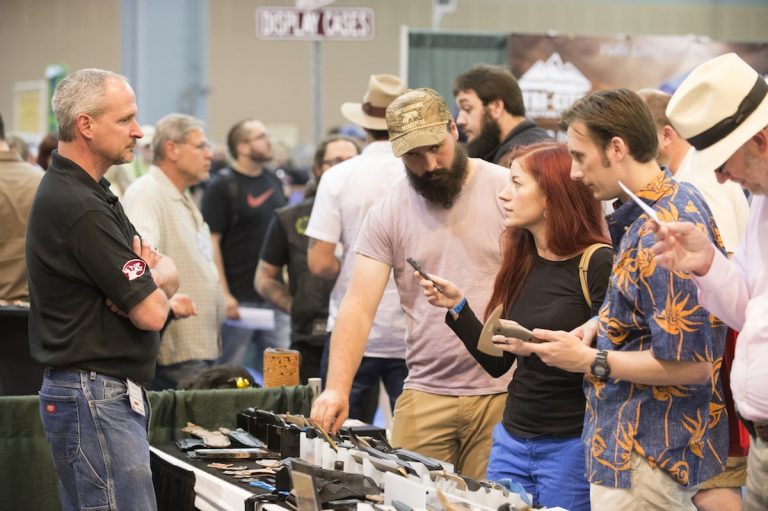
To get that special custom knife, attend knife shows—and if you see a knife you want, don’t put it down until you’re through haggling! (PointSeven image)

Is it realistic to say there’s a surefire way to get any custom knife you want? While there are always exceptions to the rule, if you practice the following nine steps, you might just find that beautiful custom knife you’ve dreamed about nestled warm and safe in the fleece lining of your favorite zippered knife pouch:

  1. Attend the knife show(s) where the maker and/or owner of your dream knife exhibits;
  2. Introduce yourself to the maker/owner at the show, talk about his/her work and designs and/or knives, ask questions, and express your interest about the knife inside the show and/or at the hotel bar after show hours;
  3. Ask to look at and hold the knife—and don’t be afraid to tell the maker/seller what you will pay for it;
  4. On a high-end knife especially, it it’s worth it, buy it! You won’t sleep if you pass on the knife for a small difference in the asking price;
  5. If you see the knife you really want and pick it up at the maker’s/seller’s table, do not put it down until you’re finished haggling for it;
  6. If it’s a custom order, supply the materials for the knife directly to the maker;
  7. Visit the maker’s shop or the seller at an agreed-upon place and pay cash for the knife;
  8. In the case of the maker especially, tell him or her you will give the knife a great home and how you will display it, or how good the knife feels in your hand and how you will use it, and;
  9. Plan a pricing strategy to go with all the travel, conversation and luck that surround the big purchase. Have a figure that you will pay for the knife in mind beforehand.

“If the price is way over your head, then walk,” advised custom knife collector Chris Nolen, stressing that even though it may seem unorthodox, it is good to tell the maker how much you are willing to pay. “If the price is in the ballpark, buy the knife,” he concluded. “You will know when it’s that ‘special’ piece.”


What Are The Best EDC Knives?

Lately I’ve been carrying a Gerber Bear Grylls clip-point, lockback folder. I love the feel of the rubber handle inserts, and I’ve gotta tell ya, the black and orange combo just looks cool. But this isn’t about me. It’s about what knife industry professionals say are selling, being carried, receiving positive feedback and working well as EDC’s.

Carajas duoI recently interviewed a few industry pros, and following is an excerpt from what they had to say. To read the entire article, see the September 2013 issue of BLADE® on newsstands now, or subscribe to BLADE by clicking here. For more EDC knife options, click here.

“You could poll 10 people and have 10 different opinions on what the ideal EDC knife is,” suggests Dan Weidner of Boker USA. “A construction worker is not going to select what an office worker or traveling salesperson carries, and a first responder won’t choose what an outdoorsman wants.Cover

“Most folks have a few EDC knives,” he adds. “I carry the Boker Plus Damascus Gent II to the office. It does everything I need during the day, feels good in my pocket, is easily accessible, and when a visitor arrives, I have a beauty that I can say, ‘Look what I have.’ After all, at the end of the day we like to show off what we carry.”

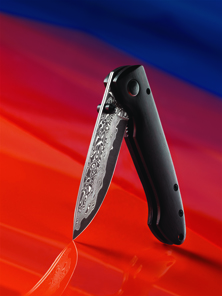
What the Damascus Gent II locking-liner folder (this issue’s cover knife) has to show off is a 2.75-inch, 67-layer-damascus, drop-point blade, ebony handle scales, dual thumb studs and a detachable pocket clip. Weighing 1.6 ounces, its manufacturer’s suggested retail price (MSRP) is $89.95.

“It’s just a classy looking knife, and the damascus blade and ebony handle blend into artistic cutlery,” Weidner comments. “When it comes to packing for a hike into the Rockies, it goes on top of the dresser and out comes a more formidable piece that can handle rugged duty. Yard work calls for good old-fashioned high carbon steel, sharp as can be, with a totally blackened blade. SAK_0_9410_3__S1

“It’s this chameleon EDC change-up that keeps the industry rolling!” Weidner concludes. “I think most will agree, there is no best EDC material that covers all bases.”

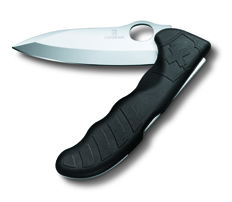
Rob Sterner, senior vice president of sales for Swiss Army Knives, says the Victorinox Hunter Pro Folding Blade has been designed to meet the needs of the serious hunter, as well as the general outdoors enthusiast, making it a versatile knife. “For the first time, we have incorporated the blade steel from our professional knives, which we’ve provided to the slaughterhouse and meat-packing industries since 1884,” he explains.Case 1 WHIT

To read the entire article, see the September 2013 issue of BLADE® on newsstands now, or subscribe to BLADE by clicking here.
Advertisement

Must Read Articles

Read this before you make a knife

Knifemaking 101 – Read This Before You Make a Knife

  by Wayne Goddard My experience has taught me that there's nothing like digging in and getting started. I've often said the hardest part of the...
how to forge damascus steel

How to Forge Damascus

Advertisement
Advertisement