
Sometimes it’s easy to denigrate the many black-handle tactical folders on the market, but Hogue Knives’ approach to the grip material for its EX-03 sheds new light on black.
The handle material for the EX-03 is a polymer known as Polyphenylene Sulfide. The trade name is PPS.
Hogue uses a polymer known as PPS for its EX-03 folder. (Hogue photo)
“This material was selected for its high-tensile strength—29,000 psi—along with many other strength categories which are superior to a more commonly used reinforced nylon such as Zytel®,” noted Jim Bruhns, president of Hogue. “PPS is also much more thermally resistant than nylon, which is more of a big deal that you would expect.
“In most applications reinforced nylon, also known as glass-filled nylon, works very well through a wide range of temperature. We have seen occasion where polymer products fail as a result of extreme temperature in some obvious places, such as the trunk of a car where extreme highs and lows can occur. Again, PPS wins in this category with a much higher deflection temperature than nylon.”
The internal components that make the EX-03’s mechanism are 17-4 stainless steel. The real trick, Bruhns stressed, was getting such a robust assembly staged into an injection-mold tool in a way that the blade could be added and adjusted as part of a final assembly after molding.
“This was something that was met with quite a bit of skepticism, as the problem is quite challenging,” Bruhns continued. “This really goes to the root competency of what we do here at Hogue.”
Bruhns was able to develop the needed tooling for the task and the results speak for themselves.
“We now have a single-piece polymer frame folder with all of the best-known materials available in a rock-solid assembly,” he stated. “This knife is the best bang for your buck available today.”
For more on the Hogue EX-03, see the May BLADE®, on newsstands Feb. 25.
Two of Shelley’s early favorite knives: the Hermes folder (right) and a Randall.
While there have been many celebrities in and out of show business embraced by the custom knife community, none embraced it in return and then some as did cutlery’s comic, Shelley Berman. Actor, comedian, writer, poet, professor and knife collector, Berman passed away quietly on Sept. 1 at the age of 92, but not before decades of touching the custom knife community like no one else.
Known worldwide beginning in the late 1950s as a top comedian, Berman recorded six comedy albums, including 1959’s Inside
Shelley Berman, the first non-musical recording to win a Grammy Award. Three of his comedy albums went gold and he was the first non-musical comedian to appear in Carnegie Hall. According to an Associated Press story, Berman was “a pioneer of a new brand of comedy that could evoke laughter from such matters as air travel discomforts and small children who answer the telephone. He helped pave the way for Bob Newhart, Woody Allen, Jerry Seinfeld and other standup comedians who fashioned their routines around the follies and frustrations of modern living.”
Shelley also starred on stage and in musicals on Broadway, had several film roles and continued acting into his mid-80s, appearing as Larry David’s dad on TV’s Curb Your Enthusiasm, and also on Boston Legal and Grey’s Anatomy, among others. He retired in his 80s after 20 years of teaching humor writing in the Master of Professional Writing program at the University of Southern California.
Shelley Berman was known worldwide for his comedy in the 1950s and won the first ever Grammy Award for a non-musical album—of comedy, naturally enough—in 1959.
of custom knives. All that changed when he was working in Las Vegas in the late 1970s.
It was there he saw his first custom knife at a knife show in the old Sahara hotel and casino. He wasn’t sure custom knives were for him until he subscribed to the American Blade magazine—now BLADE® Magazine. “When I saw [the stories in the magazine] I realized, my God, I’m not crazy, I’m a collector!” he said in an interview with Dave Harvey in the December 2009 BLADE. “I had all these knives in my drawer, so I ‘came out of the drawer.'”
But it was more than just the knives that attracted both Shelley and Sarah—it was the makers themselves. The Bermans admired the work of such cutlers as Cutlery Hall-Of-Famer Buster Warenski, Warren Osborne and Larry Fuegen, to name a few. The Bermans also came to know the wives of the makers as well, such as Dorothy and Jim Ence, Betty and Ted Dowell and many more. The Bermans were regular visitors to the Art Knife Invitational, the California Custom Knife Show, the Solvang Custom Knife Show and other knife events. Each April during the Solvang Show there would be a barbecue, and for many years Shelley emceed the post-dinner awards ceremony. In 1996 he did a comedy routine to headline the banquet for the 25th anniversary Knifemakers’ Guild Show—now the International Custom Cutlery Convention (ICCE)—at the Marriott Hotel in Orlando, sparing no one from a comedic jab or two, including Cutlery Hall-Of-Famers Bob Loveless, A.G. Russell, Frank Centofante, D’ Holder and Dan Dennehy, Ted Dowell and others in the jam-packed ballroom.
Shelley and his wife for 70 years, Sarah, and their knives in the Berman home—including the photo of the Virtue knife signed by all the participating makers at top right.
During the 2000 Solvang Show, many of the show’s custom makers the Bermans had befriended over the years huddled and decided to make a special surprise knife that they would deliver unbeknownst to the Bermans at the following year’s Solvang Show. A work schedule was planned so the knife would spend the least amount of time possible in the mail between destinations. One of the biggest obstacles was getting the knife in and out of over 50 workshops in less than 10 months. Work began in July 2000 and the completed masterpiece arrived in Solvang just three weeks prior to the 2001 Solvang Show. The project began in Arizona and from there went to Nevada; Idaho; Washington; Oregon; California; Hawaii; back to Arizona; Utah; Colorado; New Mexico; Texas; Arkansas; Kentucky; Tennessee; South Carolina; North Carolina; Virginia; West Virginia; Maryland; Pennsylvania; New Hampshire; Quebec, Canada; Ohio; Minnesota; and Wisconsin.
The worry was that the knife, christened “Virtue: The 2-24-50 Knife,” would look as if 50 different makers had made it, which, of course, would not be the desired result. However, just the opposite occurred and the knife came out beautifully. Nothing quite like it has been attempted before or since.
As Dave Harvey, Solvang Show producer and owner of Nordic Knives, noted, one concern was that word of the knife would leak to Shelley before it was finished. However, the secret was kept and Shelley’s reaction made it abundantly clear that he was genuinely surprised and thrilled when the knife was presented to him and Sarah at the 2001 Solvang Show.
Shelley holds two of his favorite knives, the favorite being the Hermes folder. He was featured with it in the second installment of BLADE‘s “My Favorite Knife,” the forerunner to the magazine’s popular “The Knife I Carry” feature, in the October 1991 issue.
Shelley also wrote for BLADE on occasion, and even appeared in the second-ever installment of the magazine’s popular department, “The Knife I Carry,” which originally was known as “My Favorite Knife.” The knife was a Hermes folder and Shelley is pictured holding it on page 94 of the October 1991 BLADE.
With the permission of Cutlery Hall-Of-Famer Jim Weyer, the March 1996 BLADE reprinted Shelley’s story “Symbiosis” from Weyer’s Points Of Interest Book IV. In the story about knife collectors and what makes them tick, Shelley nailed it perfectly when he wrote, “Since only the Good Lord knows what makes a collector a collector, it follows that only the Good Lord knows why a collector is after only a certain kind of knife on a given day. Even then, if one should ask the collector what kind of knife he has in mind, the collector may answer, ‘I’ll know it when I see it.'”
Likewise, the members of the knife community know a great collector and friend when they see one, and along with his wife Sarah, Shelley will forever fit the mold.
Over 50 makers working on the knife in shops in 24 states resulted in the Virtue knife for Shelley and Sarah Berman.
The Adventure Flipper by Lee Williams features a “pivot-less” build. Closed length: 5 inches. (Dave Stark image)The L46 flipper in Bohler N690 stainless steel and an earth-brown G-10 handle is hot from Andre Thorburn. (BladeGallery image)
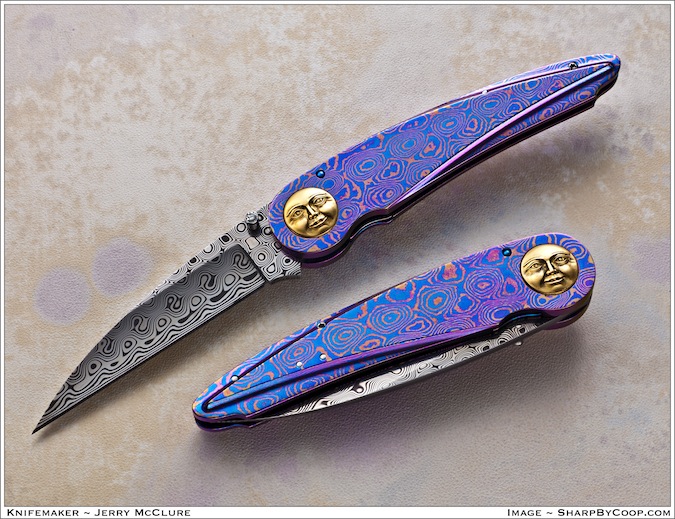
If you’re looking for what the knife trends are in custom blades or what the knife trends are going to be later on in the factory cutlery industry, some of today’s hottest custom folders is a great place to start.
Michael Walker is still going strong after all these years and his folders remain hotter than ever. (Dave Ellis image)Kirby Lambert named his flipper folder after his son, Augustus. (SharpByCoop image)Brian Nadeau’s “Cyclone” appears here in three different versions. (SharpByCoop image)Tashi Bharucha’s “Machine” features a 3 5/8-inch blade of CPM 154 stainless. (Dave Stark image)Johnathan McNees makes the Copper Baby Bolt Flipper. Closed length: 4 inches. (Andrew Delavan image)If you’re looking for what the knife trends are in custom blades or what the knife trends are going to be later on in the factory cutlery industry, some of today’s hottest custom folders is a great place to start.
These are but two examples. There are many more. There are also some really cool custom folders on today’s market, some of which no doubt will inspire other custom and, later, factory makers to emulate them in some form or fashion. A few of those sharp studies in standout steel would include:
The Tactical Front Flipper by John Arnold. Closed length: 5 inches. (BladeGallery image)
•John Arnold’s Tactical Front Flipper. “He creates some of the most elegant daily carry folders, yet with collector-grade quality, that I have come across,” noted Daniel O’Malley of BladeGallery;
•The Copper Baby Bolt Flipper in CPM 154 stainless by Johnathan McNees;
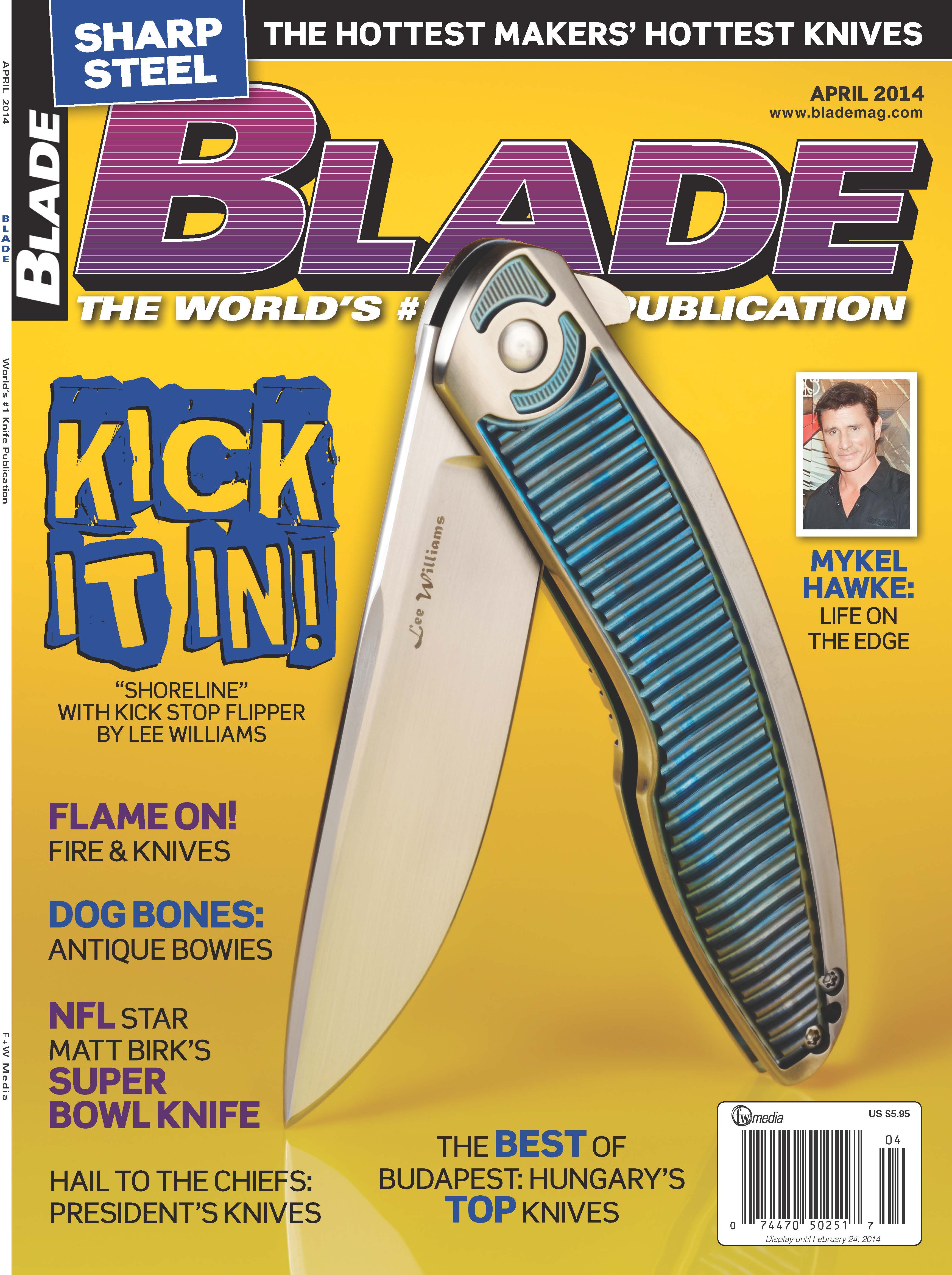
•The Adventure Flipper by Lee Williams with Lee’s “Kick Stop” flipper mechanism;
•Kirby Lambert’s “Augustus” flipper, named after the Lamberts’ newborn son;
•Brian Nadeau’s “Cyclone,” termed by custom knife purveyor Les Robertson as “a great EDC, compact and lightweight”;
•The aforementioned Michael Walker and his large folder in Damasteel damascus;
•Andre Thorburn’s L46 flipper. “Of all the knives that I open and close each day,” O’Malley noted, “Andre Thorburn’s have the most consistent, smooth action of any”;
•Tashi Bharucha’s “Machine” with frames of blasted titanium and a blade-tip-up pocket clip.
Also Check Out:
Knives 2016, 36th Edition
The trusted guide for knife collectors, enthusiasts, knifemakers, and dealers around the world, this knife book covers the latest and greatest from front to back. A collection of feature articles explores the latest developments, history, and transformation of knives, swords, and edges of various kinds. Get your copy
To get that special custom knife, attend knife shows—and if you see a knife you want, don’t put it down until you’re through haggling! (PointSeven image)
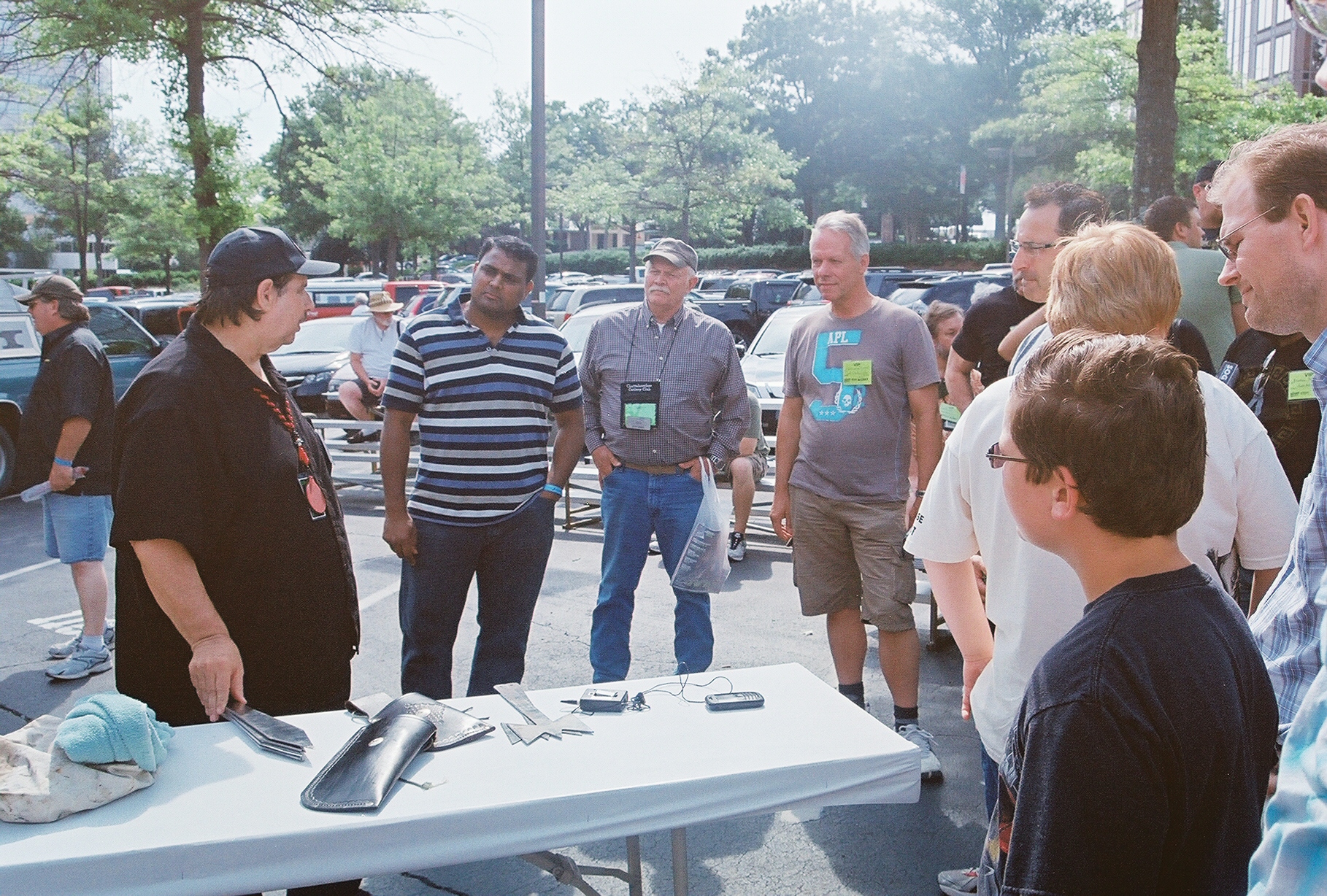
Is it realistic to say there’s a surefire way to get any custom knife you want? While there are always exceptions to the rule, if you practice the following nine steps, you might just find that beautiful custom knife you’ve dreamed about nestled warm and safe in the fleece lining of your favorite zippered knife pouch:
Attend the knife show(s) where the maker and/or owner of your dream knife exhibits;
Introduce yourself to the maker/owner at the show, talk about his/her work and designs and/or knives, ask questions, and express your interest about the knife inside the show and/or at the hotel bar after show hours;
Ask to look at and hold the knife—and don’t be afraid to tell the maker/seller what you will pay for it;
On a high-end knife especially, it it’s worth it, buy it! You won’t sleep if you pass on the knife for a small difference in the asking price;
If you see the knife you really want and pick it up at the maker’s/seller’s table, do not put it down until you’re finished haggling for it;
If it’s a custom order, supply the materials for the knife directly to the maker;
Visit the maker’s shop or the seller at an agreed-upon place and pay cash for the knife;
In the case of the maker especially, tell him or her you will give the knife a great home and how you will display it, or how good the knife feels in your hand and how you will use it, and;
Plan a pricing strategy to go with all the travel, conversation and luck that surround the big purchase. Have a figure that you will pay for the knife in mind beforehand.
“If the price is way over your head, then walk,” advised custom knife collector Chris Nolen, stressing that even though it may seem unorthodox, it is good to tell the maker how much you are willing to pay. “If the price is in the ballpark, buy the knife,” he concluded. “You will know when it’s that ‘special’ piece.”
After over 30 years of operation, the National Knife Museum (NKM) is “being dissolved.” However, the old museum’s knife inventory will carry on at three separate museums, according to Lisa Sebenick, president of the National Knife Collectors Association (NKCA) and secretary of the NKM.
The only museum of its kind in the USA, the NKM had been housed on the mezzanine of Smoky Mountain Knife Works in Sevierville, Tennessee, since late 2006. The original rent for the space was all of $1 per year. “The officers, directors and staff of the National Knife Museum sincerely thank Smoky Mountain Knife Works/Kevin Pipes for giving our collection of cutlery a home these past seven years,” an NKM release stated.
The National Knife Museum is being dissolved. Its knife inventory will be relocated to three new locations. (Mike Carter image)
According to Sebenick, the museum’s knife inventory will be donated to three different museums: the National Rifle Association Museum in Springfield, Missouri, the Berman Museum of World History in Anniston, Alabama, and the Janney Furnace Museum in Ohatchee, Alabama.
As for the 50 or so Bill Moran knives that were exhibited at the NKM, an official statement from the Moran Foundation was that no decision had been made for those knives at press time. At some future date, perhaps some of the Moran knives would be put on loan elsewhere, the statement concluded.
According to Pete Cohan in BLADE’s Guide to Knives & Their Values, 7th Edition, while many NKCA members were heavily involved in the original museum’s creation, it was the donation of three major individual knife collections—those of Cutlery Hall-Of-Famer Frank Forsyth, Dr. James Wilkison and Dr. William Rosenthal—that created the foundation for a comprehensive museum display collection.
During its run at Smoky and in addition to the many other knives it exhibited, the NKM also included the custom knife collection of Cutlery Hall-Of-Famer Joe Drouin, a number of club knives from knife clubs around the country, various knife ephemera and more.
For the latest knives, knife news, trends and more, stay tuned to blademag.com.
An example of one of Warren Osborne’s Benchmade collaborations is the Emissary.
Long-time knifemaker Warren Osborne passed away Jan. 4 after a long illness. His death comes almost 13 months to the day after his good friend and fellow maker Joe Kious was killed in a truck accident.
A native of Australia, Osborne moved to Texas, where he resided in Waxahachie for many years. He was a full-time knifemaker and sold his first custom knife in 1980. In his trademark cowboy hat and cowboy boots, Warren was a fixture at knife shows and BladeSports International (BSI) cutting competitions. Despite failing health, he exhibited at the recent International Custom Cutlery Exposition in Kansas City, the first-ever knife show coordinated by both the Knifemakers’ Guild and the American Bladesmith Society.
He was known for his high-end custom folding knives, many of them interframes ornately engraved by some of the industry’s leading embellishers. He joined the Knifemakers’ Guild as a probationary member in 1985. He later became a voting member and served on the Guild’s board of directors for a number of years. His knife designs may be best known among the largest number of people through his many collaborations with Benchmade Knife Co.
More recently he was instrumental in the founding of BSI, the world’s leading association of those who compete in knife-cutting competitions. He competed successfully on the BSI circuit for several years and designed and made his own competition knives. He was among the first to use CPM M4 carbon steel for the blades of his competition cutters, a steel that takes a great edge and is tough enough so that M4 blades can be ground very thin without damage to the edge or chipping while in use, great traits for competition cutters to have. He was also among the first to use horse-stall-mat rubber for the handle of a competition cutter. The material excels in enhanced purchase and non-slip qualities. His knives were recognized by many BSI observers for high performance in the competitions. The BSI coordinates the BLADE Show World Championship Cutting Competition at the BLADE Show each year. This year’s event will be held during the BLADE Show June 3-5 at the Cobb Galleria Centre in Atlanta, Georgia.
As he noted on his website, Warren was fascinated by “anything with a blade” from early childhood in his native Australia, and made knives from crosscut saws, chainsaw bars and anything else he found “laying around.” “Bladed weapons were a family thing, so between three brothers and myself, we had quite a collection,” he noted. Later on during his work as a ranch hand in Australia and as a horse trainer in the USA, sharpening and making knives became a spare-time endeavor.
In the March 2014 BLADE® he tied for No. 13 with Shane Taylor and Jason Knight among the top custom makers of the years 2001-2012. As Larry Connelley of KnifeArt.com noted in that issue of BLADE, “Warren’s knives exhibit extremely clean workmanship, combined with outstanding design and a solid business ethic.” The story went on to note, “From art knives to utility and higher-end designs to competition cutters, Osborne’s work has covered as many bases as just about any other maker.”
As good friend and fellow award-winning maker Tom Overeynder observed, “What a great friend and craftsman Warren was. He will be missed by all who ever met him.” Added BSI Executive Director Donavon Phillips, “Warren was a friend and mentor to so many. I feel like I should say more but the words won’t come to me right now.”
Funeral services were held Thursday, Jan. 7, at the Wayne Boze Funeral Home on 1826 W. Hwy. 287 in Waxahachie. Instead of flowers, please make any donations to The Wounded Warrior Project.
Kevin Casey uses ancient walrus tusk for the handle of his knife. (SharpByCoop image)
Your help is needed to derail bills designed to ban not only ivory but also mammoth ivory—the latter ivory from animals extinct for thousands of years—that are pending in several states. Meanwhile, your support is needed for a federal bill (HR 697) that would effectively end U.S. Fish and Wildlife’s draconian moratorium on the sale and trade of legal ivory and also assist anti-poaching efforts in countries with elephant populations. (For more on the latter, visit http://elephantprotection.org/app/write-a-letter)
Hawaii, Maryland (HB713), Iowa (SF 30), Oklahoma (HB1787) and California (AB96) are all considering legislation that would or could be used to ban both ivory and mammoth ivory, and four bills are pending in Connecticut that could do the same. The penalties for violating any of the state bans if they were to pass run anywhere from $10,000 to $50,000 in fines up to classifying as felonies.
Meanwhile, a house bill in Washington (HB1131) eliminated mammoth from the definition of ivory, though the bill (SB5241) has yet to pass the state’s senate.
For more on these laws and what you can do to protect your right to sell legal ivory and mammoth ivory, including your knives with handles of the materials, visit elephantprotection.org.
See the latest knives, swords, and edges of all types, and explore the latest trends in blades, steels, styles, and materials. Gaze upon a “State of the Art” section parading engraved, scrimshawed, jewel-inlaid, carved, etched, sculpted and forge-welded, and Damascus and mosaic-damascus knives. Click here.