The BLADE Blog w/Steve Shackleford

Knives, knife people, knife news, knife use, knife collecting, knifemakers, knife events, the BLADE Show, BLADE Magazine, and more.

Knifemaker Phil Boguszewski Passes Away

Long-time knifemaker Phil Boguszewski, one of the world’s leading crafters of cool, smooth-operating custom folders, has passed away.

A resident of Lakewood, Washington, Boguszewski was known for such folders as his “Spike” and, later, the “Cobra.” In the July 2013 BLADE® Magazine, a panel of veteran industry observers chose the Cobra as the top custom knife for the years 2001-2012.

A full-time knifemaker, Boguszewski sold his first knife in 1979. According to “Phil Boguszewski: Folding Knife Specialist” in the May/June 1988 issue of BLADE, the first 40 knives he made were all folders. He specialized in utility folding knives, including those in the latest materials, filework and slick mechanisms. He joined the Knifemakers’ Guild as a probationary member in 1984 and became a voting member in 1986.

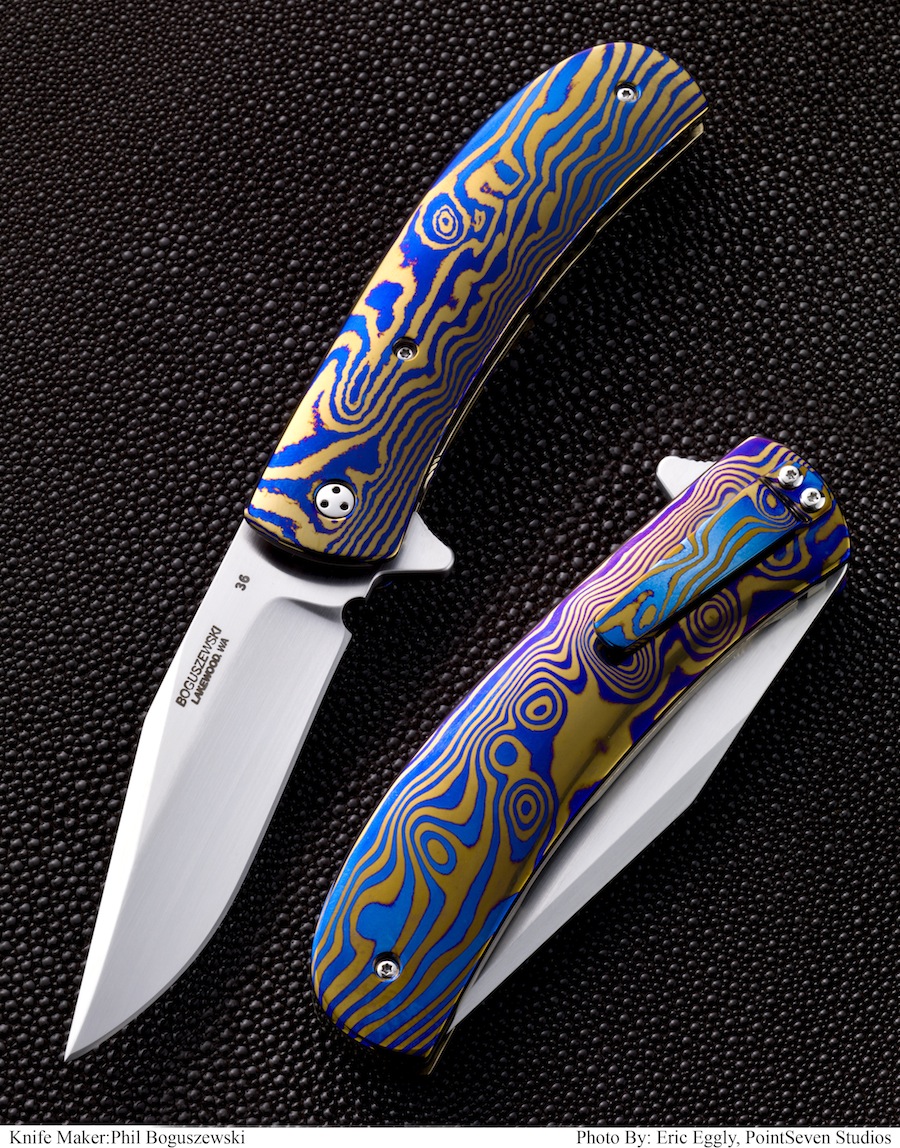
Author of some of the world's smoothest flipper folders, knifemaker Phil Boguszewski has passed away. (Point Seven photo)
Knifemaker Phil Boguszewski, crafter of the some of the world’s best flipper folders, has passed away. (Point Seven photo)

His folders were highly sought after and sold for anywhere from $550 to $3,000 each—and he rarely if ever had trouble selling them. He was a regular at such exclusive knife shows as the Tactical Invitational and others.

“Phil was an amazing, innovating man,” began Larry Brahms of BladeArt.com. “I guess he is best known for the incredible smoothness and fluidity of his flipper folders, specifically the Cobra, a smoothness that really set the standard for what has become a mainstay in a knifemaker’s stable.

“He really is a legend in his own right and our community will miss him.”

Of Boguszewski’s Cobra, purveyor Les Robertson of Robertson’s Custom Cutlery noted, “With its recurve blade, handle that fits like a glove and that signature smooth opening, it is always a sought-after knife. Phil set the standard for all other makers wanting to build a knife with a flipper opener.” Added Neil Ostroff of True North Knives, “The Cobra excels for its durability as Phil’s best-selling knife.”

For the latest on the hottest knives, knifemakers and more, stay tuned to www.blademag.com.


Twas The Knife Before Christmas

Twas the knife before Christmas, when all through the house
Not a creature was stirring, not even a Blade-Tech Mouse.
The scabbards were hung by the chimney with care,
In hopes that knives of nickel silver soon would be there.

The children were nestled all snug in their beds,
While visions of sugar-plums danced in their heads.
And mamma with her Kershaw, and I looking for my Loveless painter’s cap,
Had just settled our brains for a long winter’s knap.

When out near the forge there arose such a clatter,
I sprang from the workbench to see what was the matter.
Away to the window I flew like a SOG Flash,
Tore open the shutters and threw up the sash.

The moon on the breast of the new-fallen snow
Gave the lustre of mid-day to blades below.
When, what to my wondering eyes should appear,
But a miniature sleigh, and eight tiny sambar deer.

With a little old bit driver, so lively and slick,
I knew in a moment it must be St. Nail Nick.
More rapid than Al Mar Eagles his coursers they came,
And he whistled, and shouted, and called them by name!

“Now Trapper! now, Whittler! now, Lobster and Slim Jack!
On, Muskrat! On, Canoe! on Tickler and Swayback!
To the top of the porch! to the top of the wall!
Now cut away! cut away! cut away all!”

As wood chunks before the bowie fly,
When they meet with a sharp edge, pieces multiply.
So up to the knife shop they flew,
With the sleigh full of Toys, and St. Nail Nick too.

And then, in a stropping, I heard on the roof
The prancing and pawing of each little hoof.
As I turned on the grinder and listened for the sound,
It was obvious ol’ St. Nail Nick had come to ground.

He was dressed in overalls, from his head to his foot,
And his clothes were all tarnished with ashes and soot.
A bundle of knives he had flung on his back,
And he looked like a bladesmith, just opening his pack.

The bolsters how they twinkled! The quillons how merry!
The scrimshaw like roses, the pommel like a cherry!
The knife exhibited just the right amount of “flow,”
And the blade’s belly was full as the BLADE Show.

The body of the knife held tight in the sheath,
And the guard encircled the tang like a wreath.
It had a sharp edge and was a perfect cutter,
That whisked when it cut like a hot knife through butter!

It was keen and useful, a right sprightly tool,
And I laughed when I saw it, me being an ol’ fool!
A honing of its edge and a twist of my wrist,

Soon gave me to know it was on St. Nail Nick’s list.

He spoke not a word, but went straight to his work,
And filled all the scabbards, then turned with a jerk.
And laying his Sharpfinger aside of his nose,
And giving a nod, up the chimney he rose!

He sprang to his sleigh, to his team gave a whittle,
And away they all flew, not one blade brittle.
But I heard him exclaim, ‘ere he drove out of sight,
“Happy Christmas to all, and to all a good-knife!”

On behalf of the staff of BLADE® Magazine, the BLADE Show and F+W Media, it is my honor to wish you all a Merry Christmas and/or whichever holiday you are celebrating at this most special time of year.

For information on how to subscribe to BLADE, click on http://www.shopblade.com/product/blade-magazine-one-year-subscription-us/?r+ssfb241211#BL1SU

Cutlery Hall Of Fame: Buster Warenski

Any discussion of the greatest custom knifemakers of the modern era must include the late Buster Warenski, a member of the BLADE Magazine Cutlery Hall-Of-Fame.

While best known for his reproduction of the King Tut Dagger in the late 1980s, Warenski’s influence on custom knives, knifemakers and the Knifemakers’ Guild was immense and, in many ways, continues to this day. One of the early Guild voting members, he was considered among the best custom makers from the get-go. He excelled not only by the example of his workmanship but also by his leadership, serving on the Guild’s board of directors for a number of terms, including as president (1977-79).

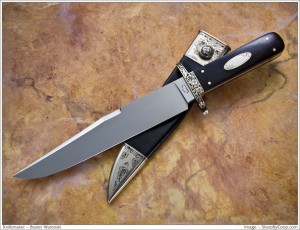
No mention of the greatest knifemakers is complete without mention of Buster Warenski. (SharpByCoop.com photo)
A member of the BLADE Magazine Cutlery Hall Of Fame, Buster Warenski was one of the greatest knifemakers ever. (SharpByCoop.com photo)

The workmanship of his knives pretty much spoke for itself. He could make just about any fixed blade, folder or sword, and make it extremely well, though it is his art daggers for which he is most remembered. He taught himself how to engrave and although he may not have been the best engraver, the early examples of his engraving held up among other knives of the time.

But then it always seemed that Buster found a way to make his knives the best—and one way was marrying Julie, who learned how to engrave and became one of the best, lending her talents to Buster’s knives and making them even more fabulous. (Julie Warenski-Erickson continues to engrave today and is married to knifemaker Curt Erickson.)

Perhaps the greatest tribute to any knifemaker is one from one of his peers who also happens to be one of the world’s best makers—in this instance, Steve Johnson. As Steve noted, “Putting myself in even the same sentence as a ‘fellow knifemaker’ with Buster makes me uncomfortable. No one will ever attain the skill and ability as a knifemaker as this great man did.”

For the latest knives, knife news and much more, stay tuned to www.blademag.com.


Knife Museum “Dissolved”; Collection to 3 New Venues

After over 30 years of operation, the National Knife Museum (NKM) is “being dissolved.” However, the old museum’s knife inventory will carry on at three separate museums, according to Lisa Sebenick, president of the National Knife Collectors Association (NKCA) and secretary of the NKM.

The only museum of its kind in the USA, the NKM had been housed on the mezzanine of Smoky Mountain Knife Works in Sevierville, Tennessee, since late 2006. The original rent for the space was all of $1 per year. “The officers, directors and staff of the National Knife Museum sincerely thank Smoky Mountain Knife Works/Kevin Pipes for giving our collection of cutlery a home these past seven years,” an NKM release stated.

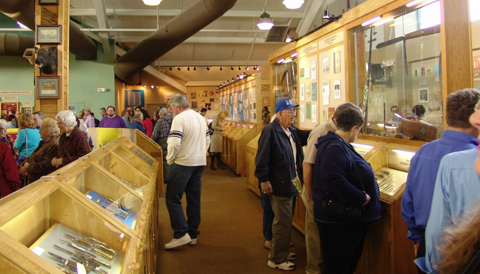
National Knife Museum is dissolved. (Mike Carter image)
The National Knife Museum is being dissolved. Its knife inventory will be relocated to three new locations. (Mike Carter image)

According to Sebenick, the museum’s knife inventory will be donated to three different museums: the National Rifle Association Museum in Springfield, Missouri, the Berman Museum of World History in Anniston, Alabama, and the Janney Furnace Museum in Ohatchee, Alabama.

As for the 50 or so Bill Moran knives that were exhibited at the NKM, an official statement from the Moran Foundation was that no decision had been made for those knives at press time. At some future date, perhaps some of the Moran knives would be put on loan elsewhere, the statement concluded.

The NKM was the vision of BLADE Magazine Cutlery Hall-Of-Fame© member Jim Parker. Located in Chattanooga, Tennessee, the original museum was built in 1981 and was the creation of the NKCA as a separate, educational, non-profit corporation. It opened its doors in 1982. It was moved to Sevierville in 2006.

According to Pete Cohan in BLADE’s Guide to Knives & Their Values, 7th Edition, while many NKCA members were heavily involved in the original museum’s creation, it was the donation of three major individual knife collections—those of Cutlery Hall-Of-Famer Frank Forsyth, Dr. James Wilkison and Dr. William Rosenthal—that created the foundation for a comprehensive museum display collection.

During its run at Smoky and in addition to the many other knives it exhibited, the NKM also included the custom knife collection of Cutlery Hall-Of-Famer Joe Drouin, a number of club knives from knife clubs around the country, various knife ephemera and more.

For the latest knives, knife news, trends and more, stay tuned to blademag.com.

Begg on Discovery Channel’s Blade Brothers Tonight

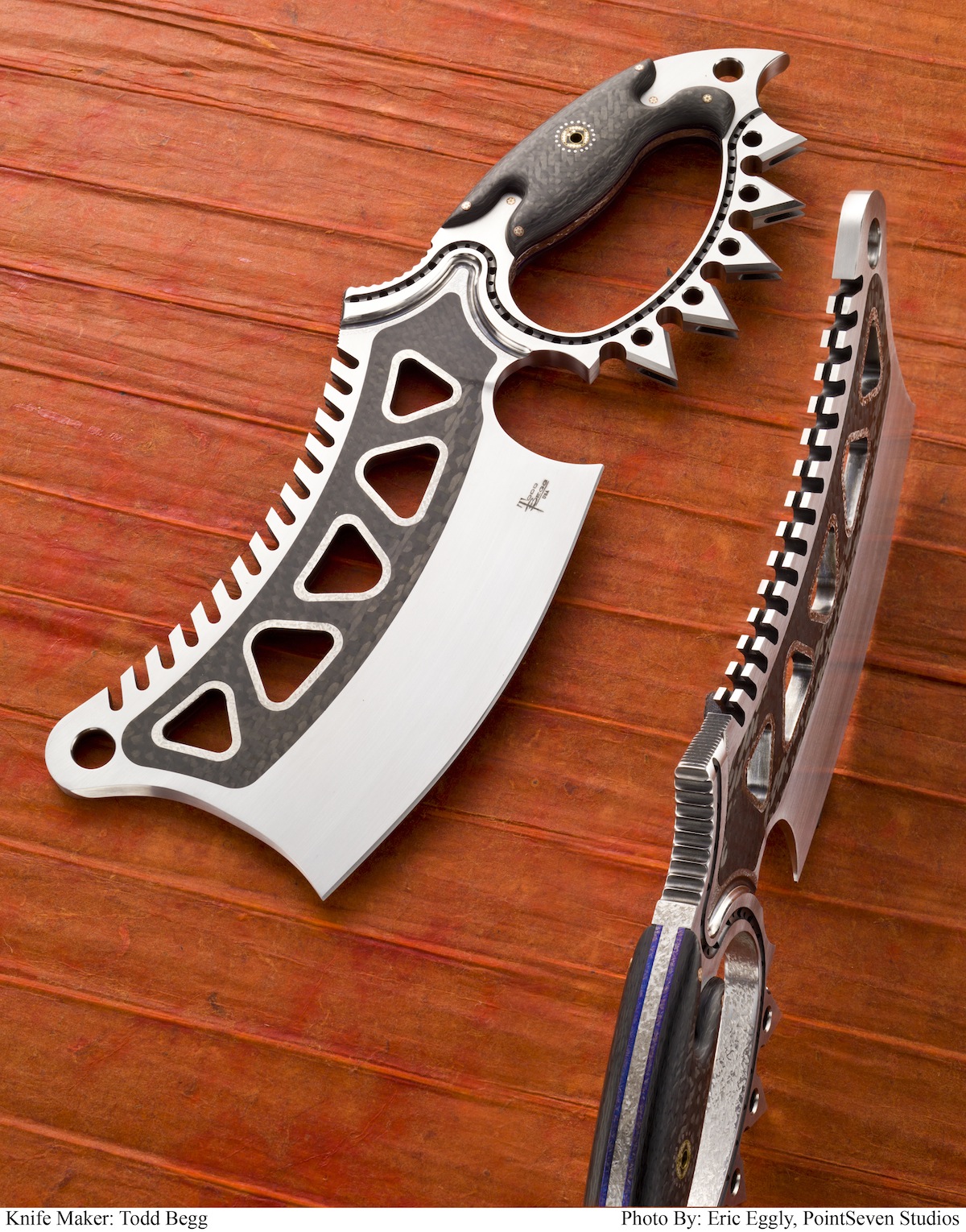
Todd Begg's Best Of The Rest fantasy cleaver from the 2010 BLADE Show. (Point Seven photo)
Todd Begg’s fantasy cleaver, winner of Best Of The Rest at the 2010 BLADE Show. (Point Seven photo)

Award-winning knifemaker Todd Begg will star in the premiere episodes of the Blade Brothers on Discovery Channel tonight at 10 p.m. and 10:30 p.m. EDT. (Check local listings for the times in your area.)

Todd becomes the latest knifemaker to join the ranks of television stars. Larry “The Hammer” Harley is the other, achieving newfound fame as one of the stars of National Geographic’s Lords of War. Both makers will exhibit knives at the 2013 BLADE Show (www.bladeshow.com) and Living Ready Expo May 31-June 2 at the Cobb Galleria Centre in Atlanta.

Winner of a number of awards for his custom knives—including Best Of The Rest at the 2010 BLADE Show for his fantasy cleaver—Begg will be joined by his brothers on the show as he tries to teach them how to help him run the knife business. Since none of Begg’s brothers have ever made a knife before, plenty of hijinks ensue as they learn the ropes in the always challenging business of custom knifemaking.

As he notes on his website, Todd’s interest in knives began at a young age while hunting and fishing with his brothers in the Great Northwest. He later used knives in the military as an NBC Recon team member, where he learned just how important and lifesaving they can be.

Based out of Petaluma, California, Todd specializes in high-grade tactical folders and fixed blades. His patterns include folders, integrals and fighters. He specialzies in flipper folders using the Ikoma Korth Bearing System (IKBS), and his list prices range from $400 to $15,000 per knife. He exhibits his knives at a wide range of knife shows, including the BLADE Show, and has appeared in BLADE Magazine (www.blademag.com) on any number of occasions.

For more information on Todd and makers like him, subscribe to BLADE at

www.shopblade.com/blade-magazine-one-year-subscription-us?icid=SHBLNCF2BL1SU-030613?lid=ssfbbl041913


Thanksgiving Cutters, Japanese Style

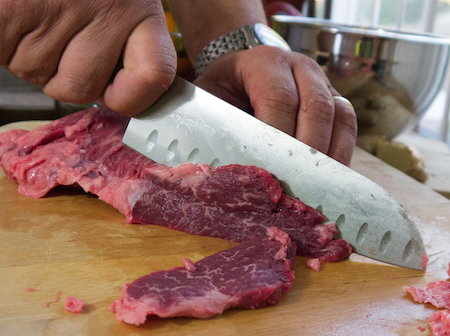
Thanksgiving cutters times four
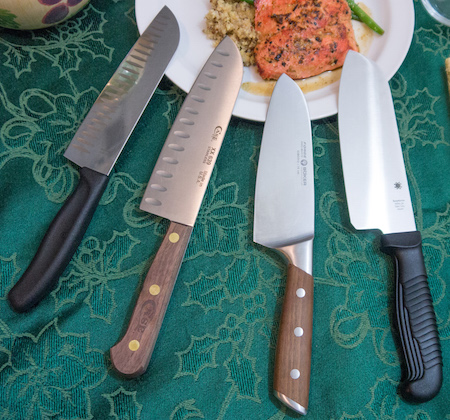
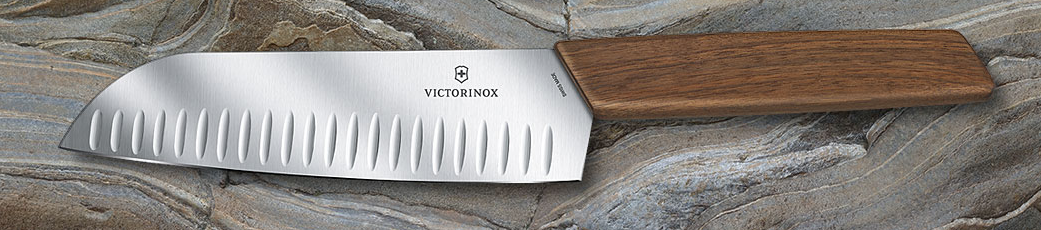
Thanksgiving cutters, Japanese style, from left: Victorinox SwissClassic Santoku, Case Santoku, Boker Forge Santoku Maple and Spyderco K08 Santoku.

Santokus are Thanksgiving cutters, Japanese style. A design that originated in the Land of the Rising Sun, the santoku is a specialized tool well suited to preparing holiday meals. From cutting meat to dicing veggies and cutting fruit for creative holiday salads and such, santokus are perfect for Gobbler Day.

Santokus have a wide blade sometimes with scallops, which are supposed to create less friction than a solid blade, a sheepfoot tip, and are lighter and thinner than a French or German chef’s knife. Their length runs between 5 and 8 inches. The Thanksgiving cutters do not have a bolster. They have a straight edge with no curve.

San-to-ku is Japanese for the three cutting tasks for which the knife is designed: slicing, dicing and mincing. It is a specialized knife that, in the Japanese view, is optimized for the three aforementioned tasks. The straight edge of a santoku does not allow for the rocking motion commonly used with a French or German chef’s knife.

Cuts are made straight down with little or no forward movement, almost a guillotine action, which, again in the Japanese view, allows slicing very thin pieces of whatever’s being cut with precision. The Thanksgiving cutters are not meant to be all-around kitchen knives. An all-around knife used to cut many things is not a Japanese concept. The Japanese chef will typically have a vast array of knives, each one designed for a specific function.

Japanese kitchen knives typically have a chisel grind, which also contributes to cutting very thin slices with precision, as you may have seen sushi chefs do. The chisel grind is optimal for slicing, say, very thin slices of turkey, with the caveat that there are left and right grinds. If you are right handed you’ll need a blade ground on the right side. The chisel grind doesn’t work well for cutting through thick media, such as roasts and ribs because the chisel grind—since the edge is off center—will cause the blade to cut off center, and to wander. Also, the thin edge of a Santoku should not be used to cut through joints or bones, or to disjoint, say, a chicken.

HAPPY MARRIAGE

Thanksgiving cutters, Boker
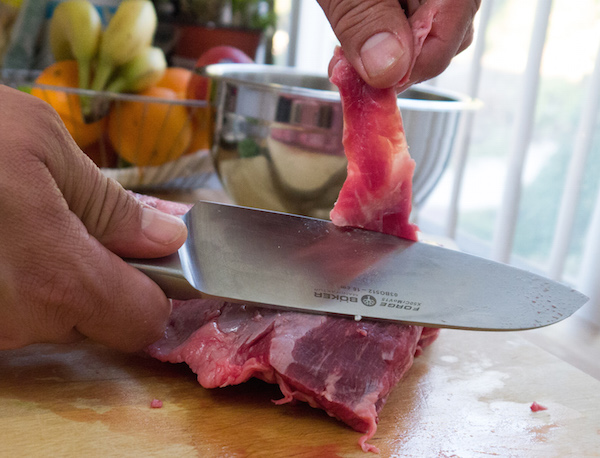
One reason santokus make such good Thanksgiving cutters is their ability to cut small meat slivers. The Boker Forge Santoku Maple is a classic example.

With its hefty blade, full tang, nicely sculpted bolsters and maple scales, the Boker Forge Santoku Maple is a happy marriage of a classic santoku and a German or French chef’s knife. While it lacks the acute point of a chef’s knife, the slight point is usable. The edge does have somewhat of a curve, which allows the rocking motion Western-trained chefs, and many domestic home cooks, are accustomed to using. It is the only one of the four knives reviewed that I would use to cut through pork rib joints, chicken backs, etc. The Boker is almost a mini cleaver as well as being an excellent slicer. It is a handsome knife and comfortable for long periods of work.

Thanksgiving cutters, Boker
Thanksgiving cutters must be adept at slicing veggies, and the Boker Forge Santoku Maple is that and more.

STURDY STUDY

With its walnut scales and full tang, the Case model is also a sturdy example of a Santoku. It has a barely perceptible curve to the edge and a scalloped blade. The Case looks more like a classic santoku than the Boker, but like the Boker has a thicker blade than a standard Japanese santoku. It felt solid in hand and while not as sculpted as the Boker, the traditional American handle was comfortable during extended use. The Case sliced, diced and minced as well as thin-bladed Santokus while giving the impression that it would be up for harder work if need be.

Thanksgiving cutters, Case
Thanksgiving cutters must be able to tackle meat slicing and the Case Santoku is a prime-cut cutter.

21st-CENTURY SHARP

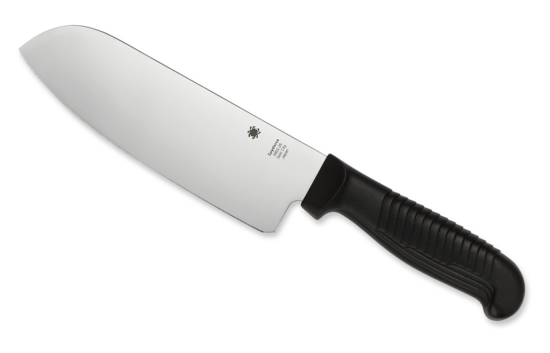
spyderco chef's knife
Spyderco image

With its wide blade, classic Santoku profile, comfortable, molded grip and graceful overall appearance, the Spyderco K08 looks like a 21st-century interpretation of a classic—which is pretty much what it is. It is a very lightweight knife with an extremely thin blade, which is optimal for doing what a santoku is supposed to do. The Spyderco does have a slight curve toward the tip, which I think adds to its smooth lines. Since I am accustomed to using a French or German chef’s knife, the curve also made it easier for me to work my way through piles of squash and mushrooms, especially mushrooms, which I find hard to slice. The blade also made it easy to slice salmon smoothly and evenly.

ENTRY-LEVEL PRO

Victorinox chef's knife
Victorinox image

Victorinox makes the knives The American Culinary Institute gives to its students: chef’s knives, paring knives, bread knives and, yes, santokus. Pro chef Shawn Carlson’s first professional knife roll contained only Victorinox knives. So, he was familiar with the Victorinox characteristics: thin profile, very sharp, fairly soft steel that requires frequent steeling but which comes back to a fine edge quickly, and which does not chip if dropped on a kitchen floor. It has the standard santoku shape: flat edge and sheepfoot tip rather than a curved profile and pointy tip. I missed a curved edge and had trouble adjusting to the flat straight edge. Shawn did not—again, a pro is a pro. It is an entry-level professional knife.

FLAIR GAME

If you enjoy cooking and take pleasure in using specialized tools, you’ll find a santoku a welcome addition to your quiver of Thanksgiving cutters—keeping in mind that a santoku is a specialized tool. If you like to keep things simple, an 8-inch chef’s knife and a 4-inch paring knife will do most any kitchen job—if not with the flair of a santoku.

High In The Necking Order

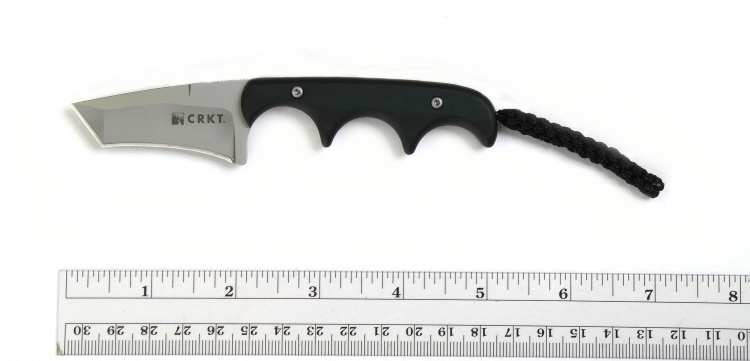
An Alan Folts design, the Columbia River Knife & Tool Minimalist Tanto features a 2.125-inch blade of 5Cr15MoV stainless with a Rockwell hardness of 55-57 HRC. Weight: 1.6 ounces. Overall length: 5.13 inches. MSRP: $34.99 (includes A glass-filled nylon sheath, neck paracord and braided fob). (CRKT photo)

The latest factory neck knives are a smorgasbord of designs and carry options

“When neck knives are designed and made properly, they will be minimal in size, yet easy and comfortable to use. They will be light enough around the neck to not be bothersome or noticeable [and] will be held safely and securely upside down in their sheath, but can be drawn and put into action with a minimum of effort.”

    The preceding words by ABS master smith Murray Carter accurately and succinctly capture the finer qualities of neck knives, a subject Carter knows a thing or two about since he forges nearly 40 varieties. Along with the growing popularity of knives specifically designed for this carry system, the offerings by knife manufacturers are also expanding to meet the demand, and like many factory-produced blades today, the quality of the finished product is increasingly excellent.

    If you happen to be in the market for a small, multi-use utility neck knife, then the Boker Plus Gnome fits the bill. The full-tang design is 4 inches overall, which is somewhat smaller than most neck knives, and the 2 1/8-inch blade of 12C27 stainless steel is relatively thin to enhance cutting ability. The Micarta® handle is equipped with a hole for a lanyard.

    “On a knife this small, weight is generally not an issue, and the lanyard hole does help the knife’s balance,” noted Terry Trahan, Boker USA product specialist. “The Micarta with the unique handle design’s deep choil-like area and lanyard all work together to provide a good grip.”

    The design is a collaboration between Boker Plus and Danish maker Jesper Voxnaes. The knife also is available in a stag handle, and comes with a leather belt sheath.

Female LEO Feedback

5.11 Tactical (see April 2011 BLADE®*) has introduced a new necker to its growing family of knives. Consistent with the company’s approach to knife designs, this one also grew out of feedback from customers.

    “We had a meeting of all female law enforcement officers, which was the first time we had women only at one of these meetings,” said Mike McCourt, business leader for 5.11’s knife program.  “The female officers requested a personal defense, last-ditch knife that could be worn around the neck or behind a belt.”

    The resulting effort is the “SidePick Spearpoint,” which has a 2-inch blade of AUS-8 stainless steel and choices of a plain or 50-50 plain/serrated edge. The textured FRN scales are removable. The back edge can be sharpened (though be sure to check the laws in your area for double-edged knives). MSRP: $59.99.

    “The composite sheath comes with an adjustable boot/belt clip and adapter that allow for a total of 12 carry angles,” McCourt noted. “There’s also an ankle strap for extra security during boot carry, and for neck carry it has a black beaded breakaway chain.” A breakaway chain prevents injury and even strangulation should it be grasped in a struggle or catch on something.

“A Pure Necker”

Nemesis Knives offers four different neck knives, including the new “Afterburner.”

    “The Afterburner’s 2.25-inch blade fills a gap between our 1 5/8- and 2-inch models and, unlike our other neck knives which can be carried numerous ways, the Afterburner is a pure necker in the sense that there are no other carry options,” noted Nemesis headman and the knife’s designer, Jeff Hall. “I’ve been thinking about the design for a long time, so it has been two or three years in the making.”

    The knife is 5.25 inches overall with a blade of 9Cr13 stainless in a satin or black finish. A bead chain and Kydex® sheath are included.

    “Our customers wanted a beefier small fixed blade, so unlike many other neck knives, which are only 1/8 inch thick, the Afterburner is 3/16 inch thick,” Hall said. “It’s also full machined inside and out, and all the holes and corners are CNC-machine countersunk and chamfered.” The knife features skeleton construction to reduce weight, and thumb ramp ridges for added traction in various grips. Tentative MSRP: $49.95. 

Church-Key Design

To hear Mike Manrose of Meyerco tell it, the company’s “Besh Wedge Bottle Rocket” designed by Brent Beshara seems to be a multi-collaboration of sorts.

    “It started off as Dirk Pinkerton’s Variable Broadhead neck knife and Brent added the BESH Wedge geometry, while also lengthening the knife out,” Manrose said. (Author’s note: The BESH Wedge is two diagonally opposed bevels converging to create a third edge [see October 2010 BLADE*]). In other words, what you have is a bottle opener and a handy box cutter. “The knife is a great utility piece as well as a very usable backup weapon,” Manrose said. “It is based on an age-old church key design.”

    The origin of church key is unknown to me, but the term brings to mind various bottle/can openers worn around the neck on youthful trips to the beach with a hoard of guys toting coolers full of beer. Apparently that memory is not far off the mark, as I discovered when I asked Beshara what the knife is designed to do.

    “It is a beer-drinking tool which opens bottles and cans,” he grinned. “The handle is the bottle opener, and the front has a BESH Wedge, which is unsharpened due to the nature of the tool, and the reinforced tip easily opens can tabs.”

    The Bottle Rocket’s 2.5-inch blade is 7Cr17 stainless (according to Manrose, an equivalent of 440A). Overall length: 5 inches. It comes with a sheath and neck chain. “The sheath is glass-filled nylon, which is tough as nails,” Manrose said. “We put a detent ball in it so you can spin it on a smooth surface for who buys the next round. It will serve you well for a long time as a utility piece, bottle opener, backup—and it’s just cool!”

    While nodding my head in mute admiration, I asked Manrose to expand on the “spin” feature.

    “Another age-old tool from the Roman era,” he chuckled.  “An old sailor’s game I picked up along the way,” added Beshara. The MSRP is $29.99 and the piece comes with the words “Cheers! Besh” aptly engraved on the reverse side.

Added Considerations

Given today’s available neck knife choices, opting to wear one involves making decisions that include purpose, size, materials, design, or just about anything else you would consider when choosing a fixed blade, with the provision that the overall length will be naturally limited.

    I have worn a necker regularly for some time in perhaps the most common form—handle down in a Kydex sheath. It is easy enough to access under a shirt with the button closest to the handle open, though I exercise great care returning the blade to the sheath for reasons equally divided between my intense dislike of pain and a deep fear of embarrassment were I to stab myself in the chest.  Along with using caution in re-sheathing, it is also important to remember a general rule of thumb: Any fixed blade may be considered “concealed” for legal purposes, so it is good to be familiar with pertinent state and local regulations.—by Stephen Garger

For information on how to get a wharncliffe-blade version of CRKT’s Alan Folts Minimalist, click on http://www.shopblade.com/folts-minimalist-2385?r+ssfb062112


For a profile of 5.11 Tactical, the BESH Wedge story and other articles, nearly 300 past issues of BLADE® are available in two separate DVDs. Visit http://www.shopblade.com/category/cds-dvds-videos?r+ssfb062112 or call 855-278-0406 and mention the First 25 Years Of BLADE DVD collection (1973-1997), or the BLADE 1997-2007 DVD.


For more on the latest knives, knife legislation, knifemaking instruction, knife trends, knifemakers, what knives to buy and where and much more, subscribe to BLADE® Magazine, the World’s No. 1 Knife Publication. Click on http://www.shopblade.com/blade-magazine-one-year-subscription-us/?r+ssfb062112 for more information.


Advertisement

Must Read Articles

Read this before you make a knife

Knifemaking 101 – Read This Before You Make a Knife

  by Wayne Goddard My experience has taught me that there's nothing like digging in and getting started. I've often said the hardest part of the...
how to forge damascus steel

How to Forge Damascus

Advertisement
Advertisement