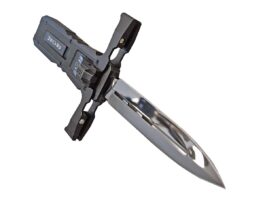
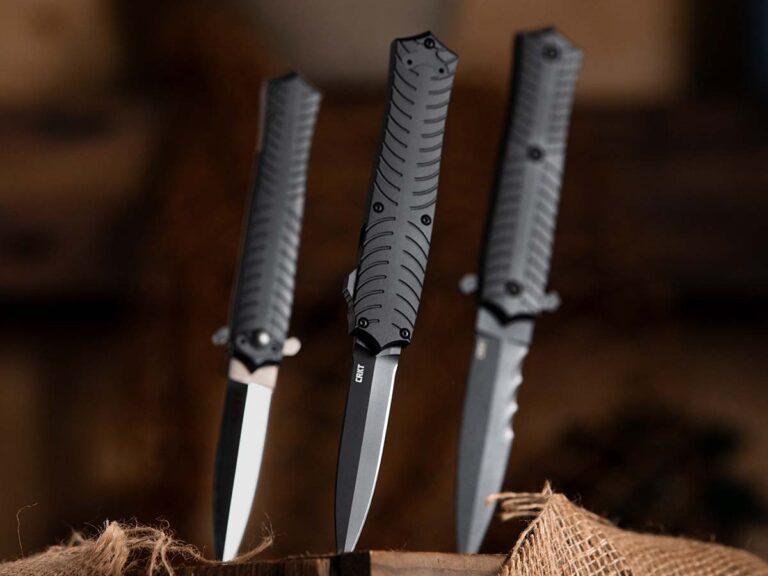
The CRKT Xolotl OTF take the original fixed-blade design a step further.
The CRKT Xolotl OTF automatic knife is the latest evolution of a design that shoots to blend ancient mythological inspiration with modern, high-performance tactical engineering. Named after the Aztec deity of fire, lightning and the guide of souls to the afterlife, the Xolotl is the creation of veteran and former Green Beret Michael Rodriguez.
Rodriguez’s accomplished background—which includes graduating at the top of the Irish Army Ranger Wing Sniper Course and serving as an advisor to President George W. Bush—lends a specific, mission-driven philosophy to his knife designs. This experience is the foundation of his participation in CRKT’s Forged by War program, which enlists real-life combat veterans to apply their knowledge to a line of specialty, mission-ready knives and tools.
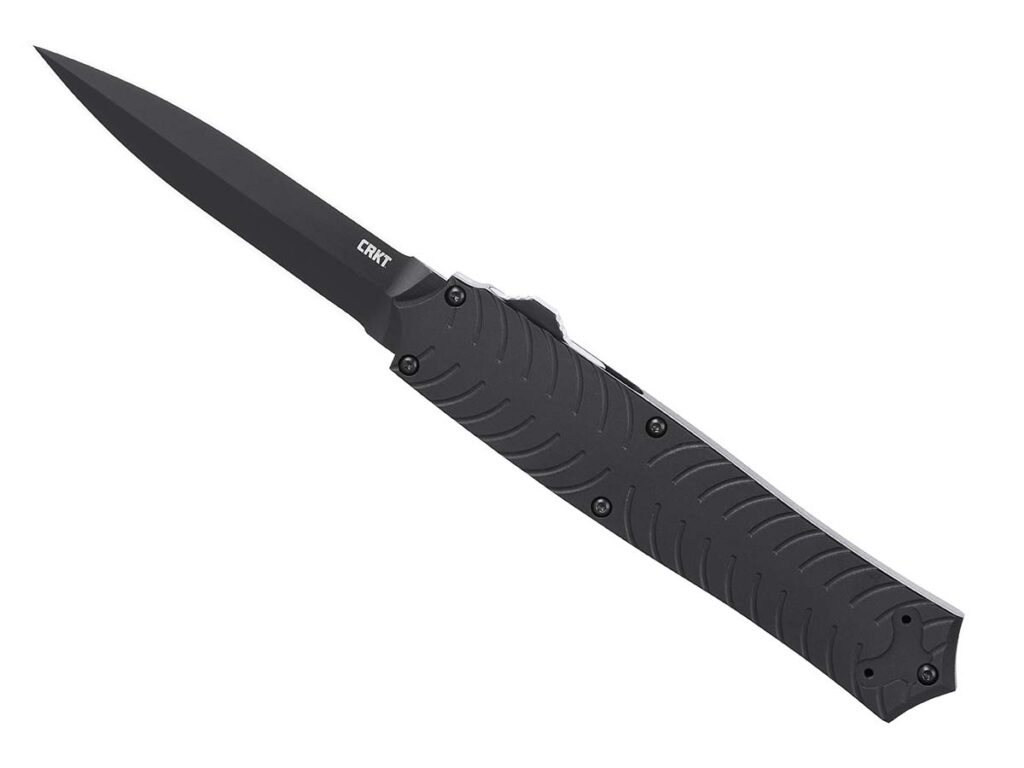
CRKT Xolotl OTF is a slick and functional auto that fits into the line well.
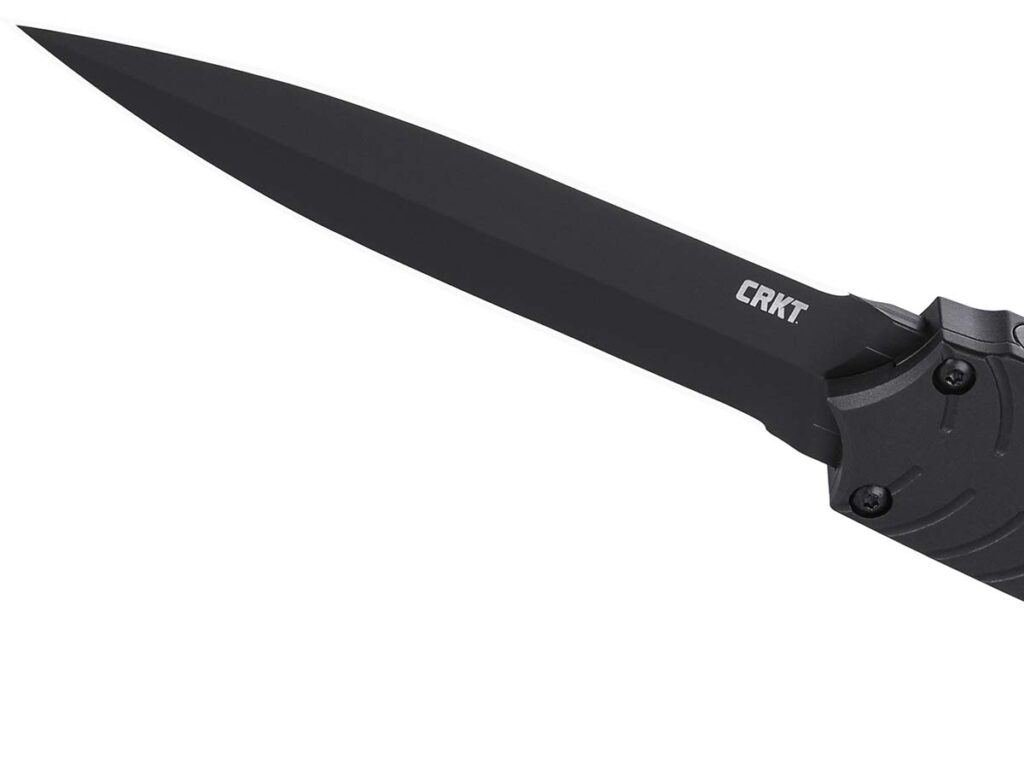
The Xolotl design originated as a fixed-blade knife, which established the pattern’s key features: a clean, stunning aesthetic featuring a spear-point blade with a double-edged dagger grind. The fixed-blade version was designed for durability and high-performance, featuring specialized Veff Serrations for powerful rope-cutting capability, and came with a versatile sheath that allowed for multiple mounting options.
This fixed-blade concept has now been translated into an out-the-front (OTF) automatic. The new Xolotl OTF maintains the high standard for materials and capability, engineered for the demands of today’s operator.
The knife is manufactured in the USA and utilizes a smooth, dual-action OTF mechanism for crisp, decisive deployment and retraction. It features a 3.5-inch spear-point blade ground on both edges for maximum cutting efficiency. The blade steel is MagnaCut, which was selected for its superior combination of edge retention, toughness, and corrosion resistance—qualities essential for a reliable modern tactical tool.
Made from Magnacut steel, the Xolotl blade keeps a good edge.
While the engineering is purely modern, the aesthetics carry the historical weight of the Xolotl deity. The aluminum handle is sculpted with skeletal details that reference the Aztec namesake. A deeply personal feature of the design is the 21 sculpted ribs along the grip, which were incorporated by Rodriguez to symbolize each of his years of military service. The handle’s ergonomics and theme are completed by a unique, sternum-shaped reversible pocket clip, ensuring the knife carries securely for both left- and right-handed users.
The Xolotl OTF, with an MSRP of $325, contributes to the larger mission of the Forged by War program. A portion of the profits from the knife is directed toward Michael Rodriguez’s charity of choice: the Global War on Terrorism Memorial Foundation. The final product—an 8.88-inch overall knife weighing just 3.2 ounces—is a successful fusion of myth, military experience, and high-quality construction.
Xolotl OTF Specs
BLADE LENGTH: 3.5” OVERALL LENGTH: 8.88” BLADE MATERIAL: MagnaCut HANDLE MATERIAL: Aluminum LOCK and/or OPERATING MECHANISM: Dual action out-the-front WEIGHT: 3.2 oz. SPECIAL FEATURES: Made in the USA; MagnaCut spear point blade with two sharpened edges; Double action OTF blade deploys and retracts quickly; Adjustable clip for left or righthand carry. MSRP: $325
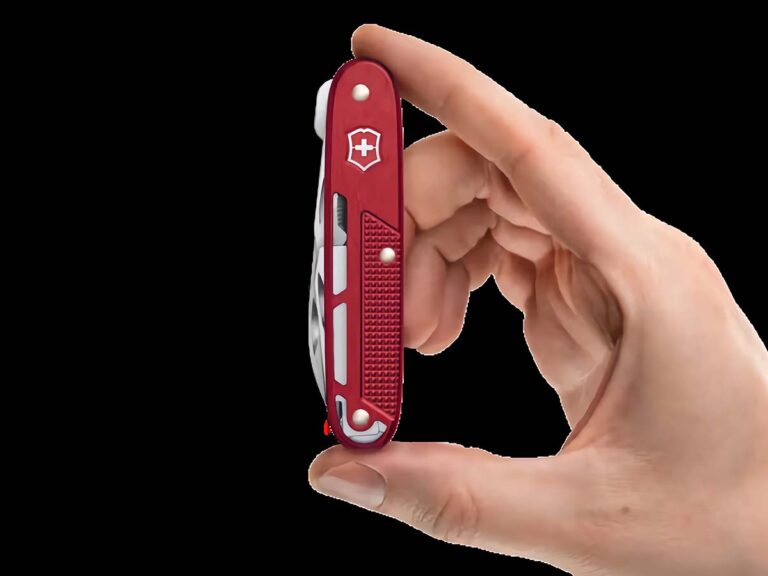
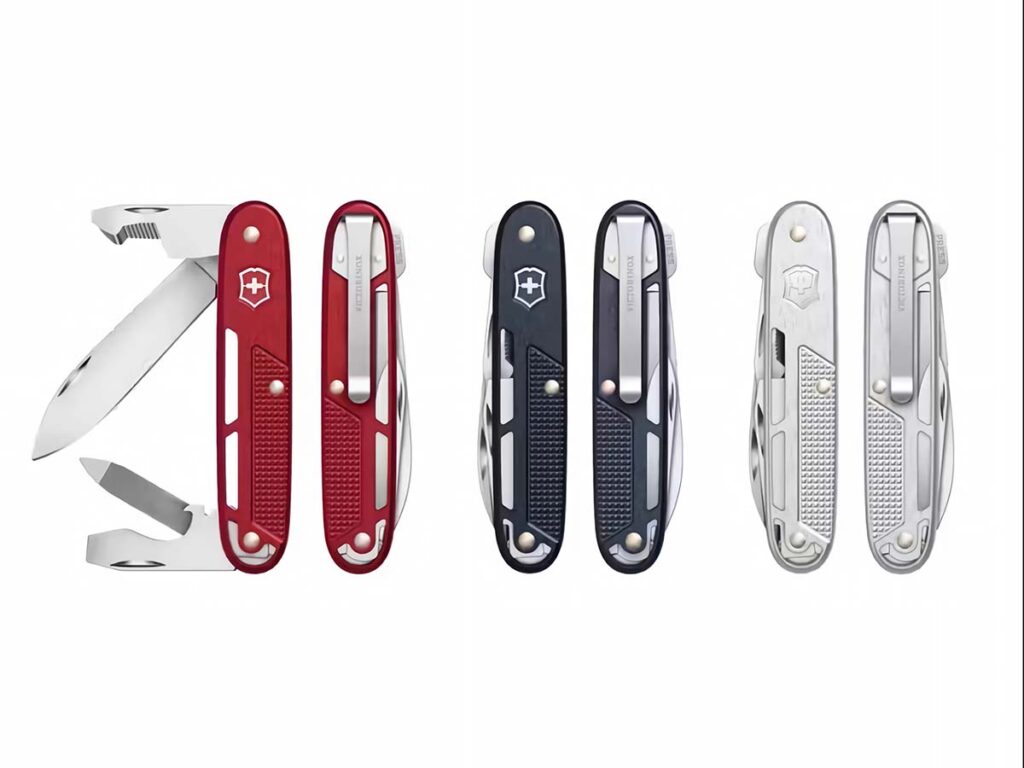
The Alox Refined Collection gives Victorinox’s classic design a modern twist.
As steady as the flow of an Alps glacier, Victorinox doesn’t veer far from its design fundamentals. It’s served the Swiss company well, given the Swiss Army Knife might be among the most recognizable tools in the world. In turn, when the iconic company tweaks its legendary pocketknives, it’s worth taking note.
Hence, the Alox Refined Collection deserves consideration—even if you aren’t a diehard collector of Victorinox.
More than anything, it appears Victorinox is modernizing the aesthetics of its knives with the three-knife line. Alox—aluminum scale—has been around for some time, but never quite in the guise it appears in the Refined Collection. The knifemaker has also attempted to improve the function of the series with the addition of a feature that has become almost a must-have on modern pocketknives—a pocket clip.
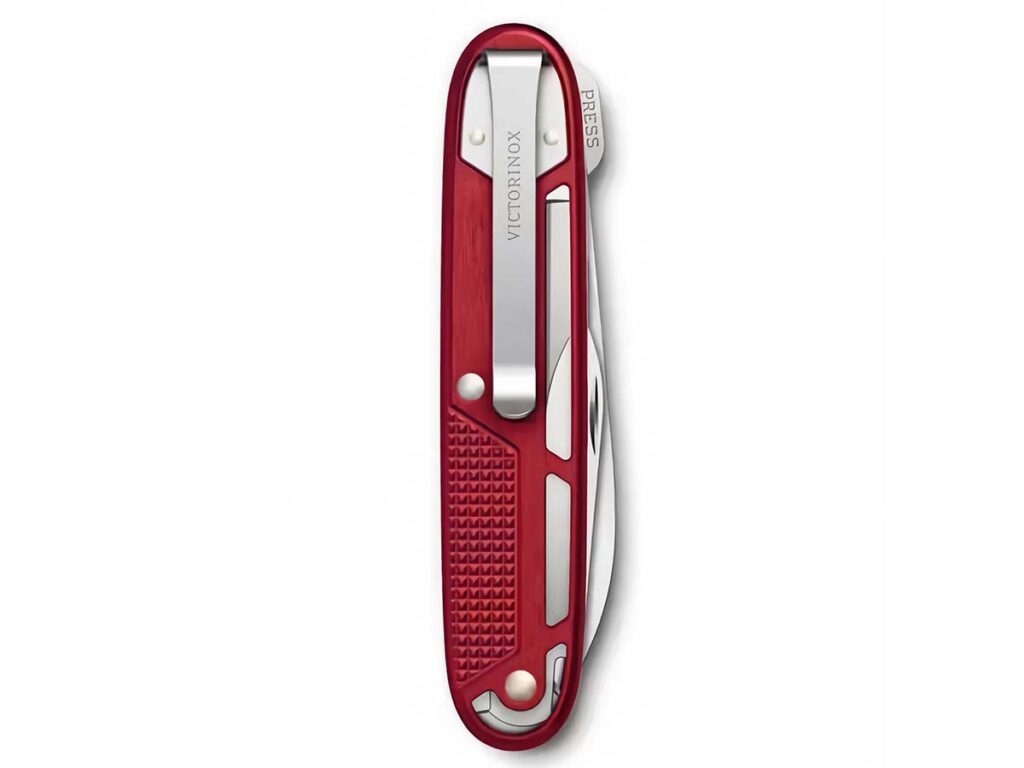
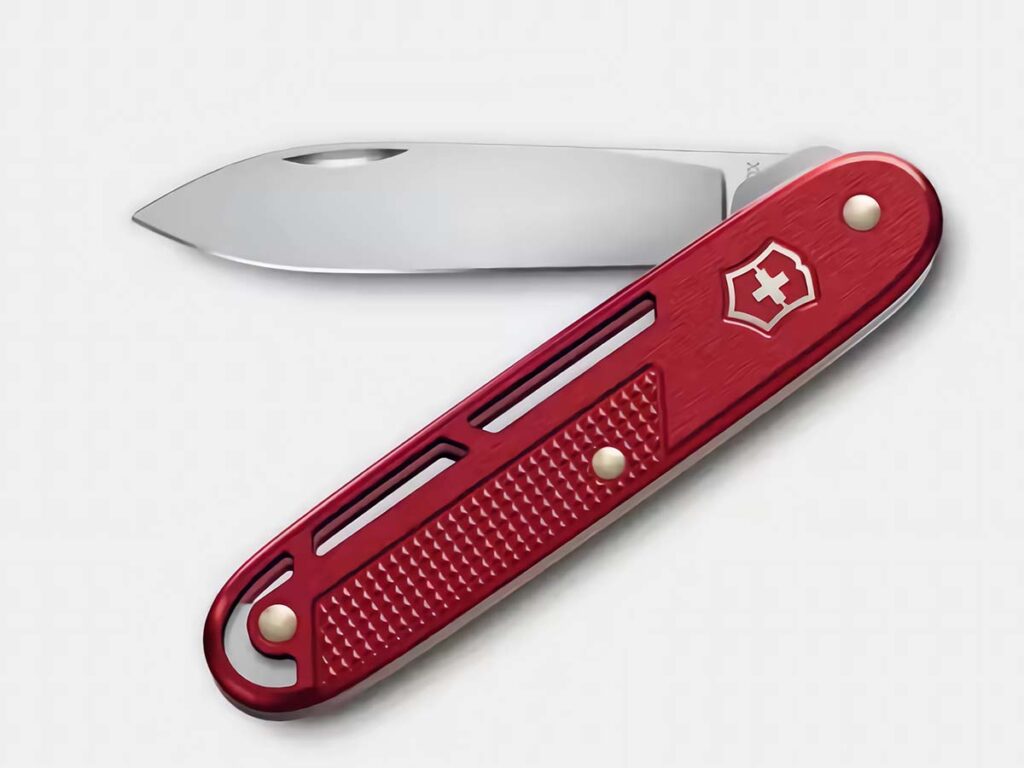
As to the looks of the Refined Collection, it’s solid, catching the classic SAK up to current sensibilities without veering from Victorinox’s winning formula. The scale has a sleek brushed finish, the texturing runs in a saddle near the spine and it features multiple cutouts. The last feature I like, given it gives a peek into the knives’ locking mechanisms and adds character. On the flip side, I get a bit clutchy on exposing these to the environment and fouling.
On the topic of lockup, the main blade has a locking leaf on all three models, potentially making it fit for more robust duty—at least fit for duties that could potentially close a slipjoint lock. As for the clip, it blends in with the curve of the knives’ end and is riveted onto the scale, so there’s no playing with how it’s carried. This shouldn’t be an issue, given blade deployment is still via a nail nick. The three models of the Refined Collection offer different tiers of tools, with the OneFold Alox offering a single blade, the Synergy Alox four tools and the Synergy X Alox five tools. The price tag on the series runs from $56 for the OneFold to $96 for the Synergy X.
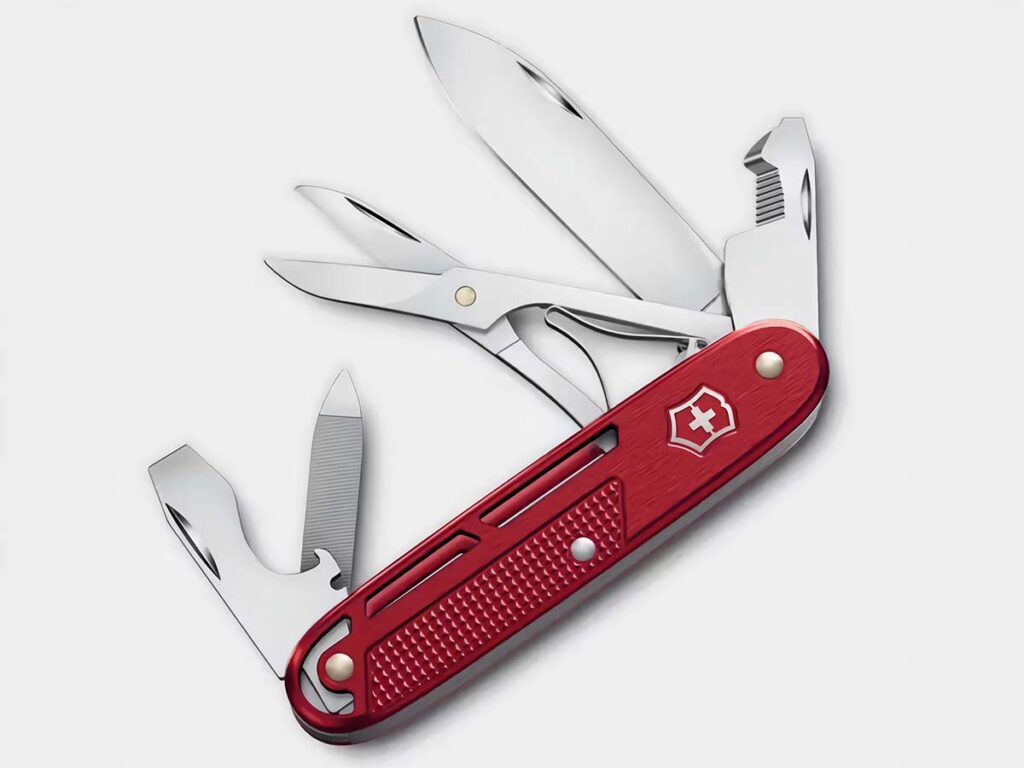
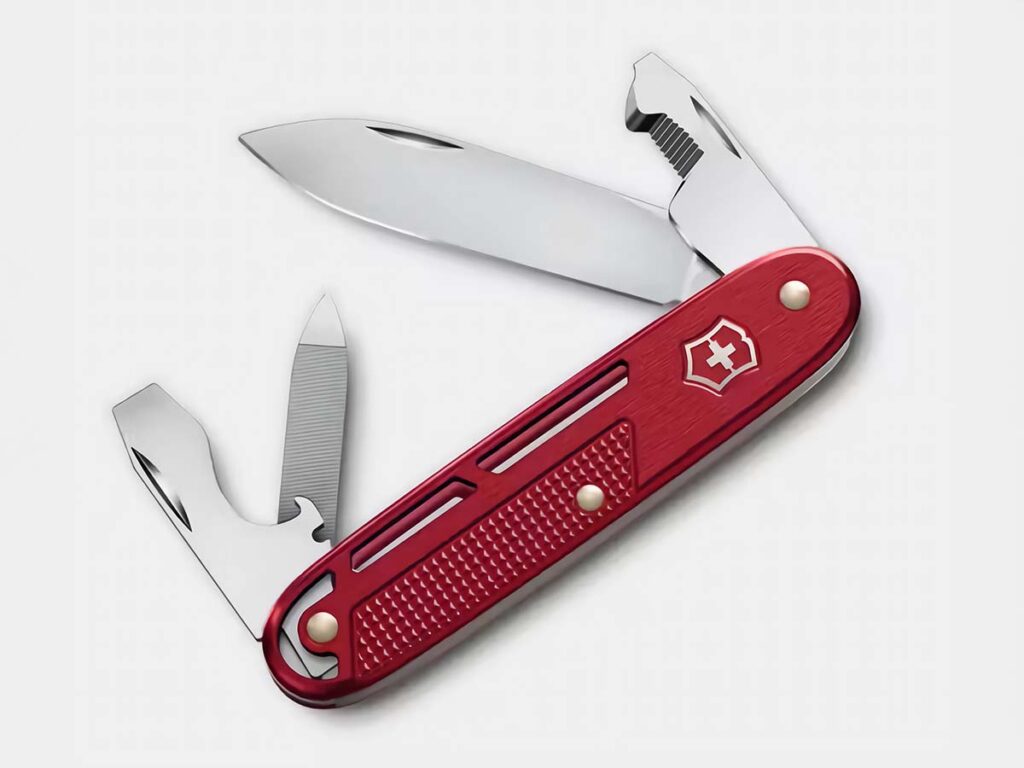
Onto the differences in the models themselves. The OneFold is super simple, with the blade being the only tool present. The Synergy is the middle-tier model, with a considerable expansion to its toolbelt: in addition to the blade, it has the nail file/narrow driver, bottle opener/flat head driver and a new box opener tool that appears to be exclusive to the Refined Collection. Finally, we have the Synergy X which, if you know your Victorinox nomenclature, you will understand to have a pair of spring-loaded scissors in addition to the standard Synergy tool suite.
Synergy X Alox Specs
Tools: Blade, large / Scissors / Box Opener / Screwdriver 3 mm / Nail file / Nail cleaner / Bottle opener / Screwdriver 7 mm / Wire stripper / Carry clip Height: 0.8 in Length: 3.7 in Width: 0.9 in Weight: 3.5 oz Country of origin: Switzerland Blade lockable: Yes One hand blade: No No. of features: 10 MSRP: $96
Synergy Alox Specs
Tools: Blade, large / Box Opener / Screwdriver 3 mm / Nail file / Nail cleaner / Bottle opener / Screwdriver 7 mm / Wire stripper / Carry clip Height: 0.7 in Length: 3.7 in Width: 0.9 in Weight: 2.7 oz Country of origin: Switzerland Blade lockable: Yes One hand blade: No No. of features: 9 MSRP: $78
Onefold Alox Specs
Tools: Blade, large / Carry clip Height: 0.6 in Length: 3.7 in Width: 0.9 in Weight: 1.9 oz Country of origin: Switzerland Blade lockable: Yes One hand blade: No No. of features: 2 MSRP: $56
Explore the world of custom kitchen knives! See award-winning Chef’s Knives, Gyutos, and more, forged with exotic Damascus and unique handle materials.
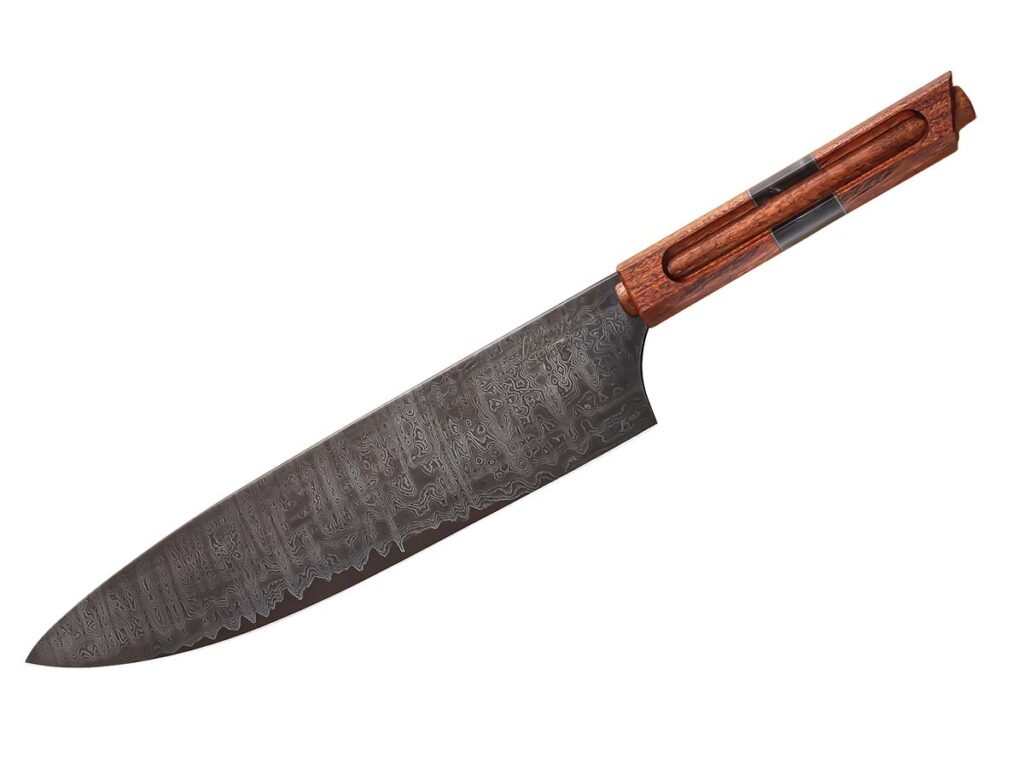
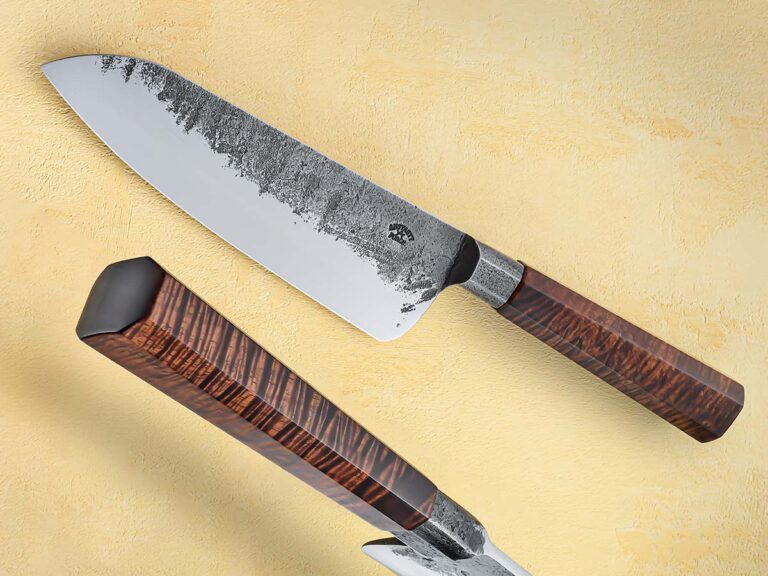
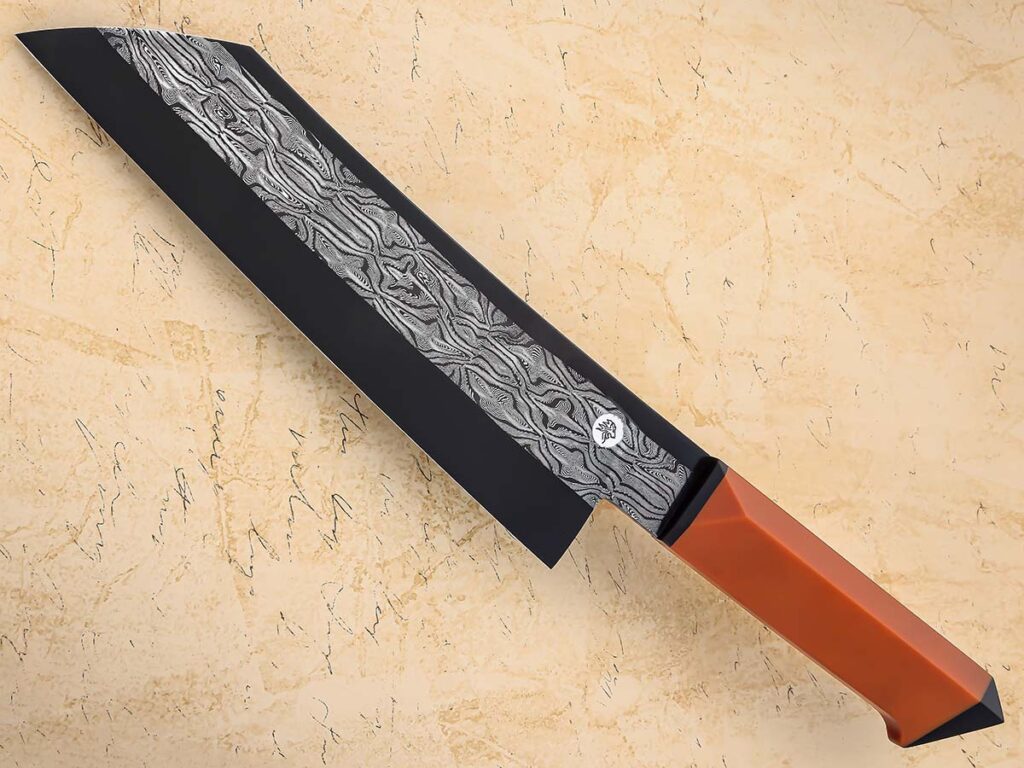
The art of knifemaking has officially stepped into the culinary arena, elevating daily prep into a true performance. This collection features some of the world’s most refined kitchen cutlery—from award-winning Gyutos and Nakiris to specialized Chef’s and Paring knives—each forged by today’s top custom makers. We’re showcasing a stunning array of blades that blend high-performance steel, such as Copper-clad 1084 and Aogami Super cores, with breathtaking handle materials like stabilized exotic burls, copper mesh resin, and mosaic damascus. These tools are built for precision and designed for prestige.
Joel Eckford Kitchen Knife
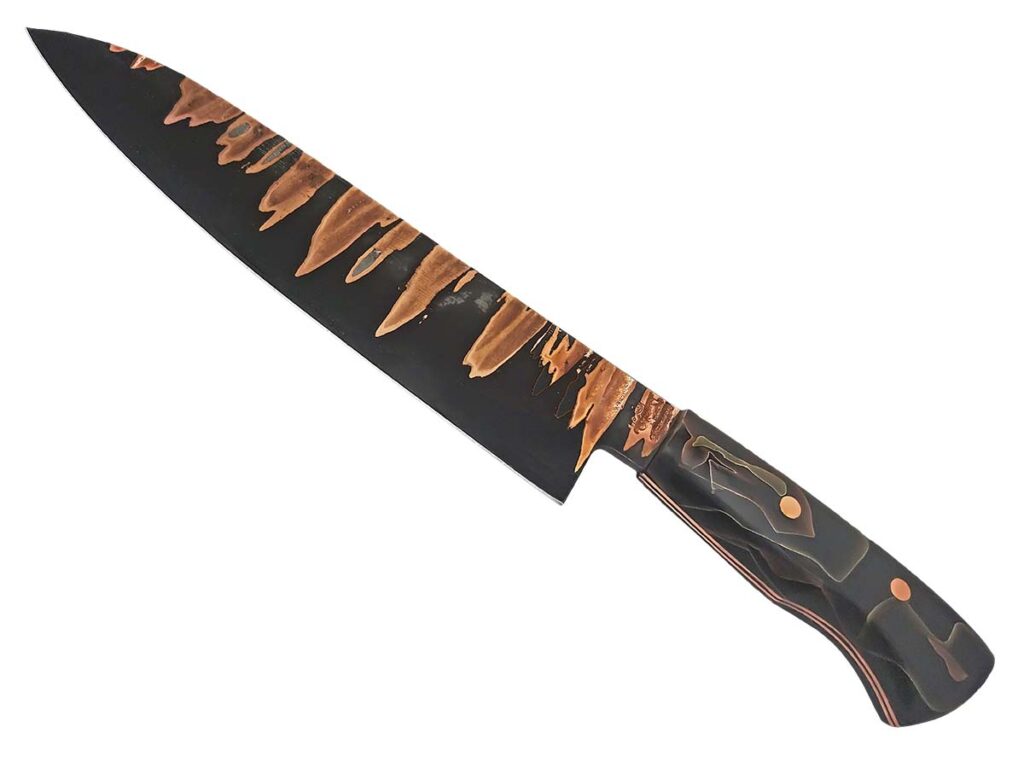
Blade length: 8.3” Blade material: Copper-clad 1084 carbon steel forged by Dane Standen Knives Blade grind: Flat BLADE COAT: Dane Standen brutalist copper clad 1084 finish Scales: Copper mesh in resin w/copper spacers Overall length: 12.8” Knife to know: The maker is a probationary member of the Australian Knifemakers Guild Maker’s price for a similar knife: Contact maker for pricing Maker: Signal One Forge, Joel Eckford (Rod Hoare image)
Evan Davis K-Tip Petty Chef’s Knife
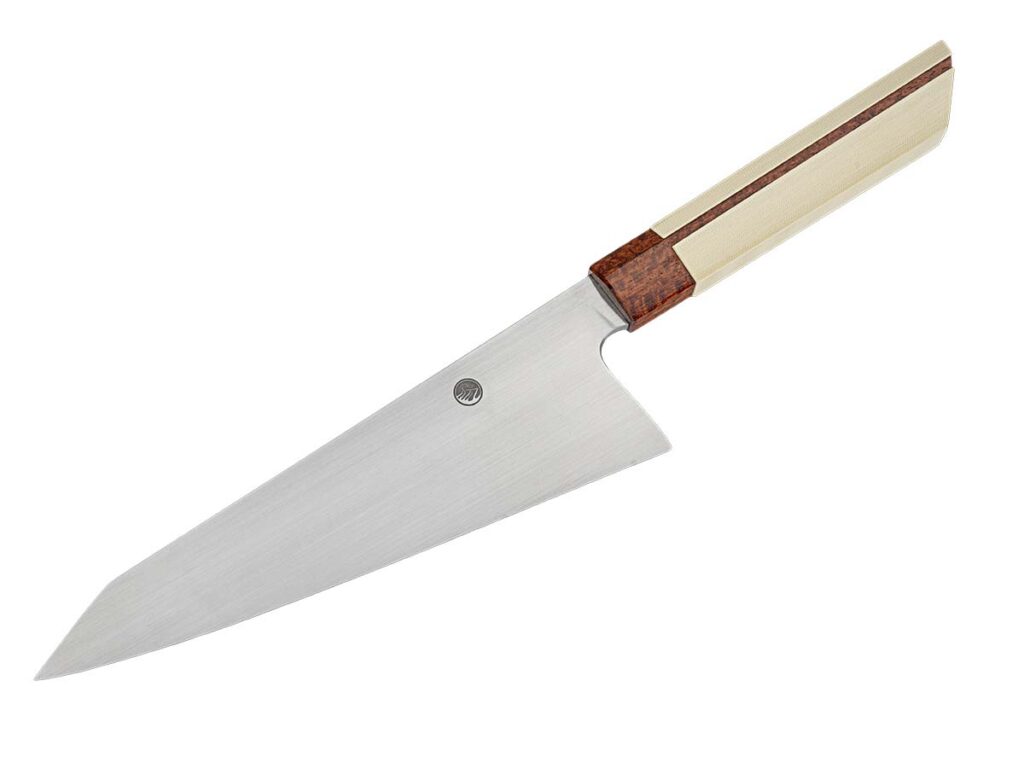
Blade length: 7.5” Overall length: 12.5” Blade material: 52100 carbon steel Blade grind: Convex Scales: Curly narra and ivory G-10 Maker’s price for a similar knife: $700 Maker: Evan Davis (Jocelyn Frasier image)
Kevin Korenek Chef’s Knife
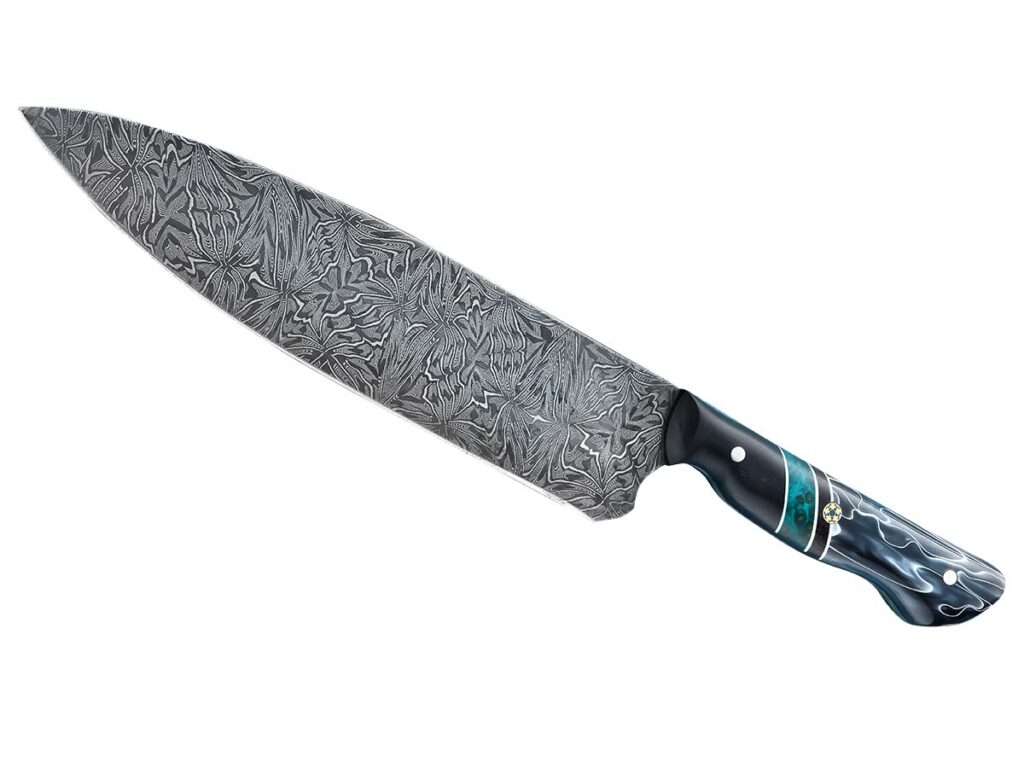
Blade length: 8.75” Blade material: 80CrV2 carbon and 15N20 nickel-alloy steels forged by Jeff Waggenar Damascus: Flower pattern Blade grind: Flat Scales: Blackwood amboyna/acrylic composite by Randy McBurrney Overall length: 14.75” Maker’s price for a similar knife: $1,175 Maker: Kevin Korenek (SharpByCoop image)
Paul Elkins Chef’s Knife
Blade length: 9.25” Blade material: 1080 carbon and 15N20 nickel alloy steels Blade grind: Convex Scales: Dyed curly mango Overall length: 14.5” Knife to know: Integral bolster construction; the knife won the Texas Select 2025 Custom Cutlery Event’s Best Culinary Award Maker’s price for a similar knife: $2,000 Maker: Paul Elkins (SharpByCoop image)
Cordina Customs Signature Series Gyuto
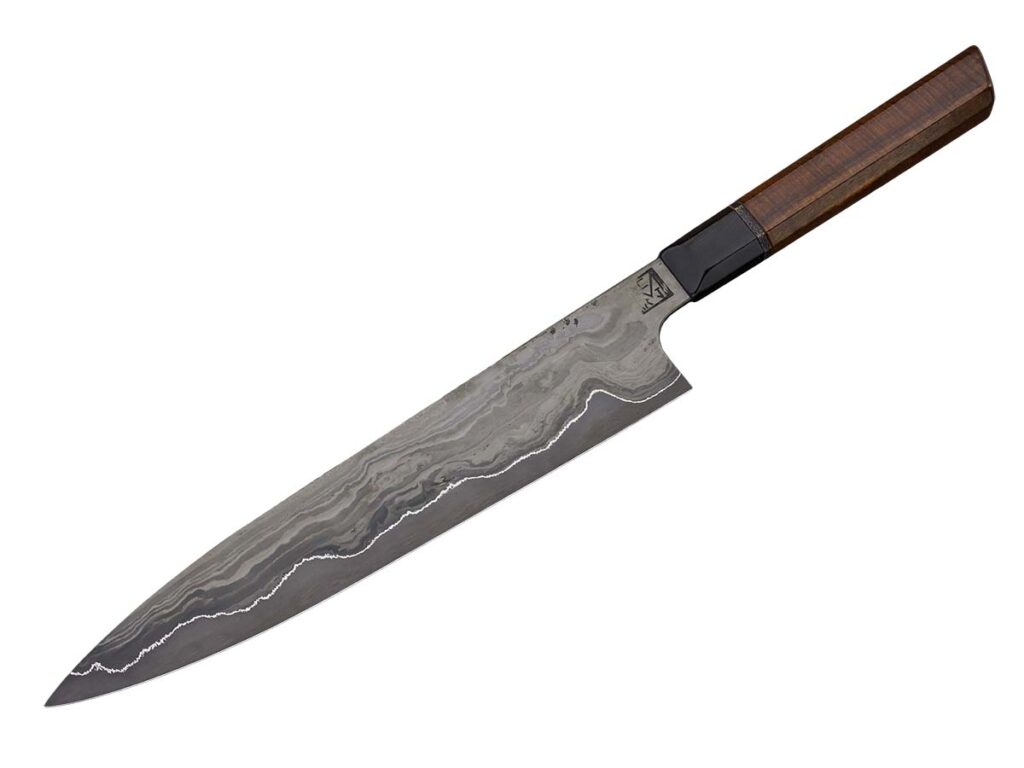
Blade length: 9.3” Blade material: Aogami Super core, nickel and wrought iron forged by Oblivion Blades Blade thickness @ricasso: .14” Blade @widest: 1.9” Blade grind: Compound bevel Scales: Western myall wood Spacer: Hand-stippled bronze w/heirloom fit Bolster: Stabilized ebony Overall length: 15.4” Knife to know: Cordina’s Signature Series Gyuto won Best Kitchen Knife at the 2025 Australian Knifemakers Guild Melbourne Knife Show Maker’s price for a similar knife: $700 at press-time exchange rate Maker: Cordina Customs (Rod Hoare image)
Mazieres FrancoisParing knife
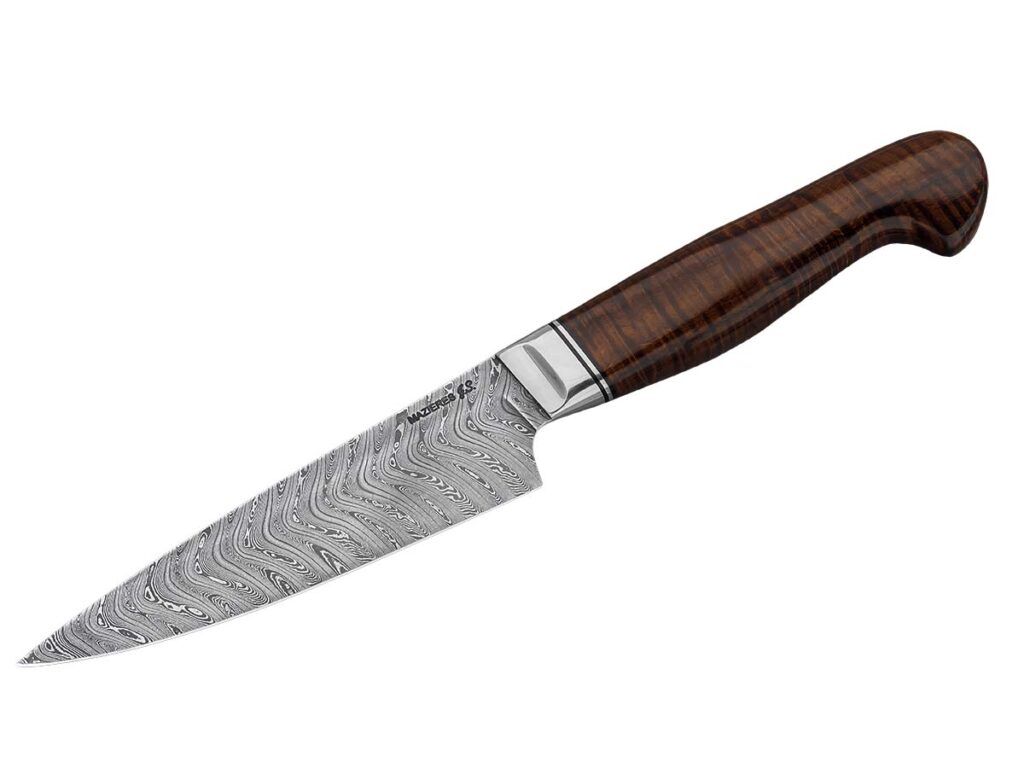
Blade length: 5” Blade material: 150 pattern-welded layers of 1084 and 1075 carbon and 15N20 nickel-alloy steels embossed using chevron dies for the final pattern Blade grind: Flat Construction: Hidden tang Scales: Stabilized South Australian ringed Western myall wood shaped as a composite Western/cowboy style handle; G-10 and 410 stainless spacers Bolsters: Scalloped, pinned and soldered 416 stainless steel Overall length: 10” Knife to know: The maker’s paring knife won for Best Chef’s Knife at the 2025 Perth Knife Show; the maker is a member of the Australian Knifemakers Guild and a journeyman smith in the American Bladesmith Society Maker’s price for a similar knife: $325 at press-time exchange rate Maker: YANDIWA, Mazieres Francois https://www.Yandiwa.com.au (Rod Hoare image)
Jon McQuillanKitchen Knife
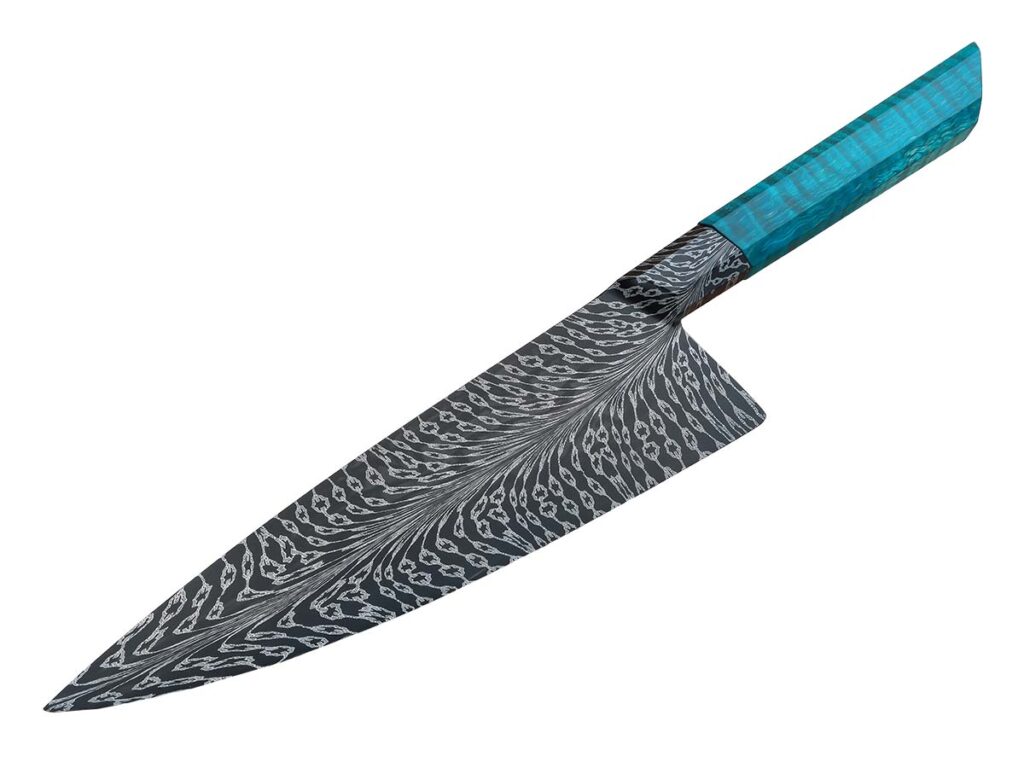
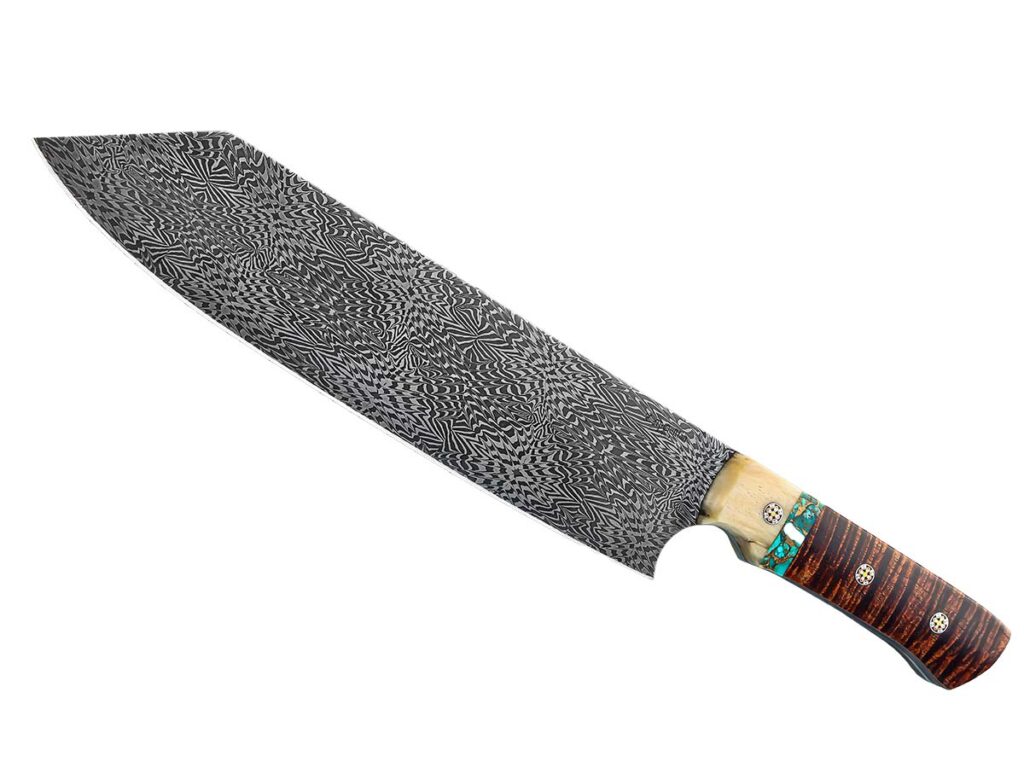
Blade length: 9” Blade material: 1084 carbon and 15N20 nickel alloy steels Damascus pattern: Mosaic Explosion Scales: Tasmanian blackwood and turquoise cast w/bronze Bolster: Muskox horn Overall length: 13.5” Maker’s price for a similar knife: $2,000 Maker: McQuillan Custom Works, Jon McQuillan j.mcquillan.com (SharpByCoop image)
Dan TompkinsCoppermascus Nakiri
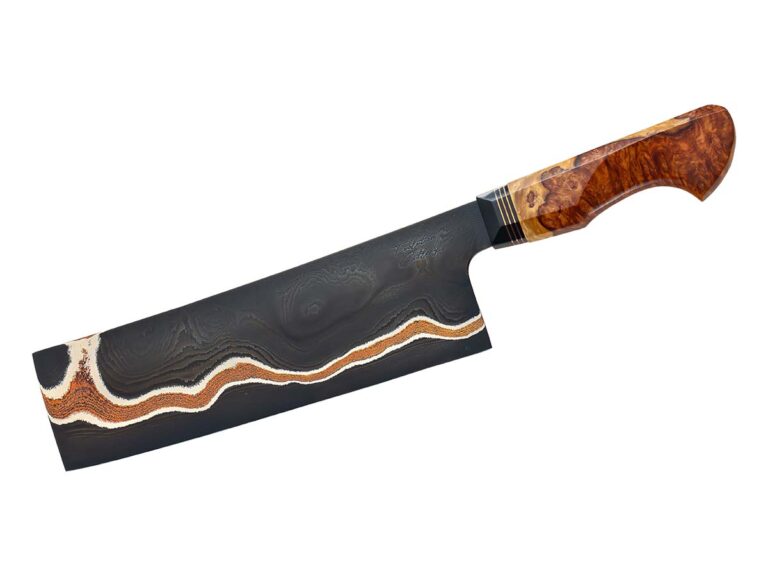
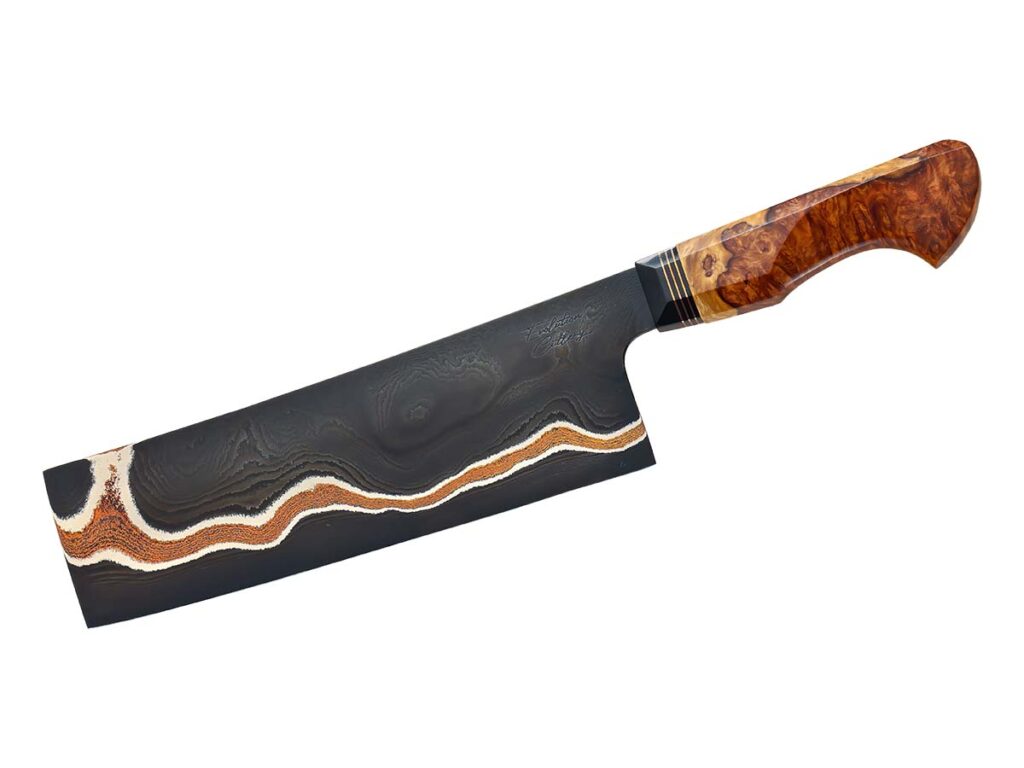
Blade length: 8.5” Blade material: Baker Forge & Tool coppermascus Blade grind: Slight convex Scales: Amboyna burl Bolster: G-10/copper Overall length: 13” Knife to know: Heirloom fit; patinaed copper Maker’s price for a similar piece: $1,700 Maker: Evolution Cutlery, Dan Tompkins, evolutioncutleryllc.com (SharpByCoop image)
Joey Dello Russo Santoku
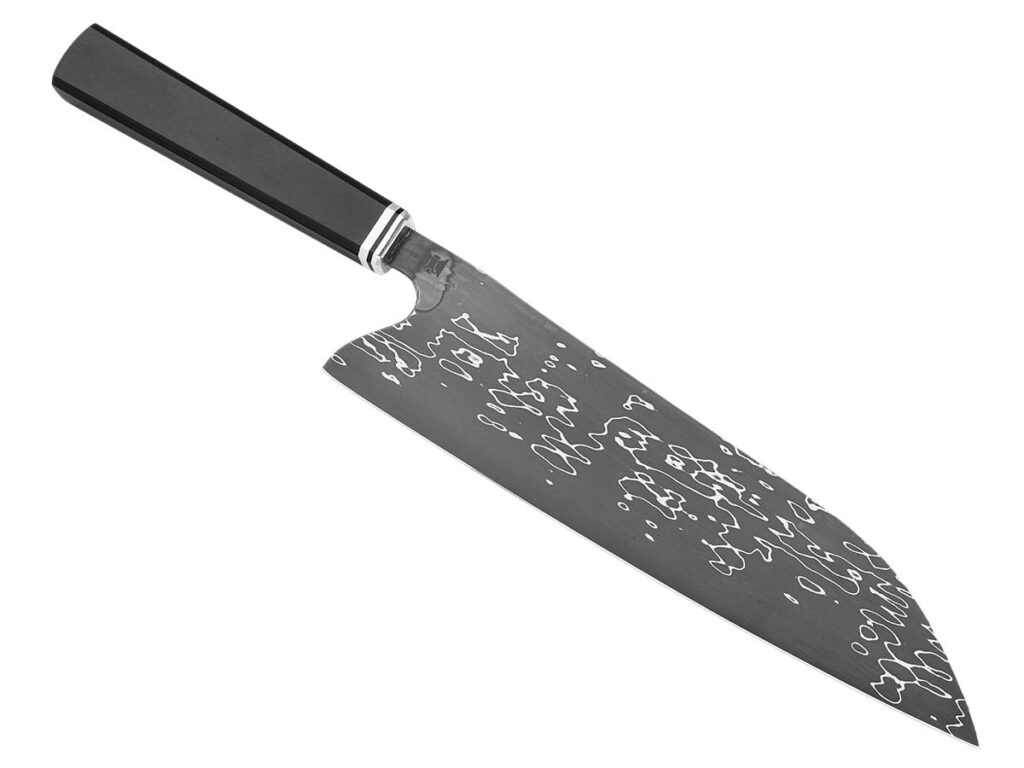
Blade length: 9” Blade material: 80CrV2 carbon steel and pure nickel Blade grind: Flat convex Handle: Richlite Bolster: Nickel silver Overall length: 13.5” Maker’s price for a similar knife: $600 Knife to know: The maker is an ABS apprentice smith Maker: Joey Dello Russo, imperialcustomworks.com (Jocelyn Frasier image)
BCK Knives Chef’s Knife
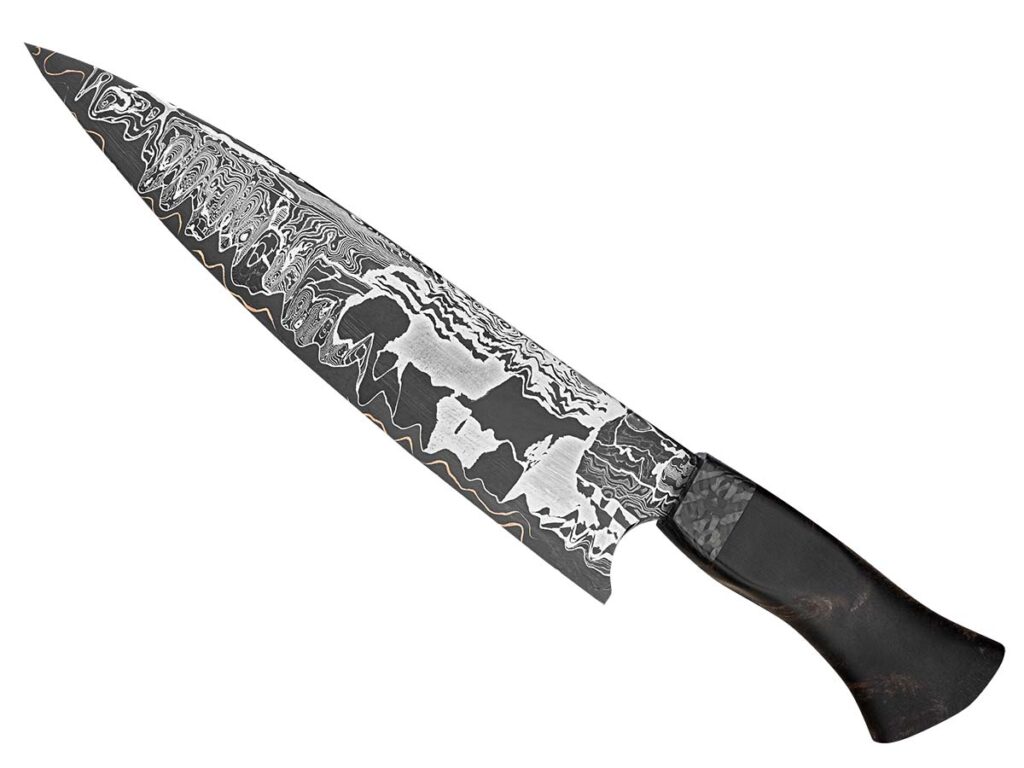
Blade length: 8” Blade material: A multi-layered X-mai damascus of 8670 and 80CrV2 carbon and 15N20 nickel-alloy steels, nickel silver and copper Blade grind: Flat Handle: Stabilized box elder burl dyed black Spacer/bolster: McLaren carbon fiber Overall length: 12.5” Maker’s price for a similar knife: $1,200 Maker: BCK Knives (Jocelyn Frasier image)
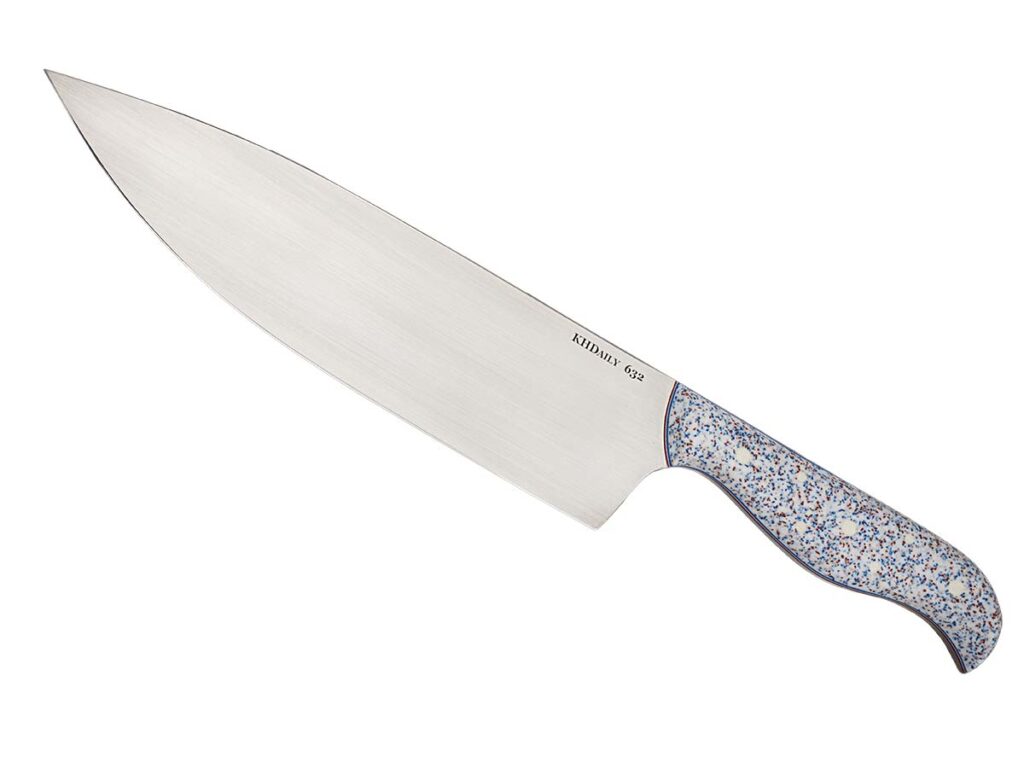
Kyle Daily Chef’s Knife
Blade length: 8” Blade steel: CPM 154 stainless Blade grind: Flat Handle: Old Glory Limitless Grip-Tec w/red/white/blue G-10 Overall length: 13” Maker’s price for a similar knife: $500 Maker: Kyle Daily khdailyknives.com (Jocelyn Frasier image)
Matt Williams Chef’s Knife
Blade length: 9.5” Blade material: 400-layer Lace-pattern damascus san-mai w/a 1084 carbon steel core Blade grind: Flat Scales: Mesquite and silver and black acrylic Overall length: 14.5” Maker’s price for a similar knife: $800 Maker: Matt Williams, lasterdaywoodworks.com (SharpByCoop image)
User-friendly custom takes on the classic Japanese knife handle abound.
The Japanese influence in kitchen knives is more or less a given. Those who work in food preparation, an art form unto itself, appreciate the style and utilitarian feel that the Japanese culture exerts on their vocation.
The kitchen knife has seen a wave of custom makers taking that context a step further. The knife is an extension of the hand and that extension starts with the handle. So, here again the ergonomics of Japanese influence emerge. The wa handle brings comfort and confidence to the kitchen user while also providing a sense of form, function and artistic expression for the custom maker.
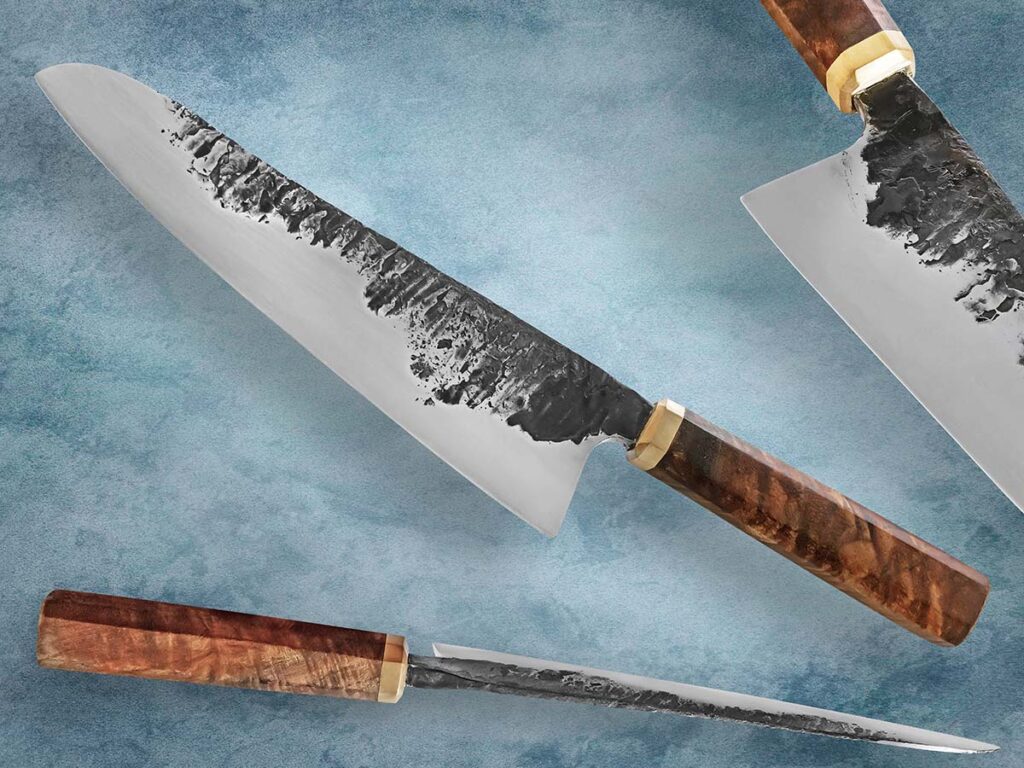
The wa handle of Aidan Garrity’s santoku has largely parallel sides to the width of the ricasso with a small ‘beak’ at the bottom for hand retention and aesthetics. Blade steel: mosaic damascus. Vintage butterscotch Micarta® scales boast flat-shield cross-sections and G-10 spacers. Overall length: 14 inches. His list price for a similar knife: $2,300. Its sister piece is a Garrity nakiri that was featured on the March 2024 BLADE® cover. (SharpByCoop image)
According to maker Jacob Anstaett, the name itself is rooted in the Japanese language.
“Wa comes from the Japanese language and broadly translates as ‘harmony’ or ‘balance,’” he explained. “In knifemaking, it refers to the traditional Japanese handle style, which emphasizes simplicity, lightness and an ergonomic connection between the handle and the blade.”
Anstaett further defines the wa handle as “lightweight with forward-balanced design. Typically, it is either octagonal, oval or D-shaped in cross-section. The handle is crafted as a separate piece that fits onto a hidden tang rather than a full tang. The construction is what gives the blade its distinct balance, where the cutting edge feels alive in your hand instead of weighed down.”
A resident of Plano, Texas and a custom knifemaker for eight years, Jacob says his wa handle is an interpretation of the Japanese style.
Alex Töpfer described his wa-handled piece as “a general-purpose kitchen knife based on various santoku. The blade is 80CrV2 as it’s a good general steel I can forge and heat treat. The handle is Tasmanian blackwood to add some fanciness, and the same is true for the bronze bolster. It’s functional art you can appreciate as you use it to cook.” His price for a similar knife: $325. (Rod Hoare image)
“It’s best described as a variation of the traditional wa,” he explained. “I keep the core geometry usually as an octagon cross-section, but I adapt the dimensions slightly for comfort. Western chefs often prefer a little more thickness and resilience, so I adjust proportions while preserving the forward balance that makes wa handles so effective.”
Jacob devoted extensive time to the study of traditional Japanese wa handles and then embarked on his road to interpretation.
“Over time I developed my own hybrid approach,” he commented. “My reasoning was simple: I wanted to honor tradition while building something that stands up to modern kitchens. For instance, I blend traditional shapes with stabilized woods or composites, ensuring they can handle daily use in a busy Western kitchen without losing the essence of the Japanese design.”
What Makes A Wa Handle?
Elaborating on the spirit and style of the wa, Aidan Garrity of Iron Lion Blades in Madison, Connecticut remarked, “There are two schools of thought for what exactly categorizes as a wa handle. One is that the handle’s construction involves a hole the width of the knife’s tang being drilled into the handle, and the tang being enclosed in a slotted dowel to tightly fit into that round cavity. The other is that it is simply the style of the handle, usually slimline and often having angular geometries. For questions like these, I always answer with the understanding that it is just the style of the handle, but I personally consider the true wa handle to be one utilizing the dowel bedding construction.”
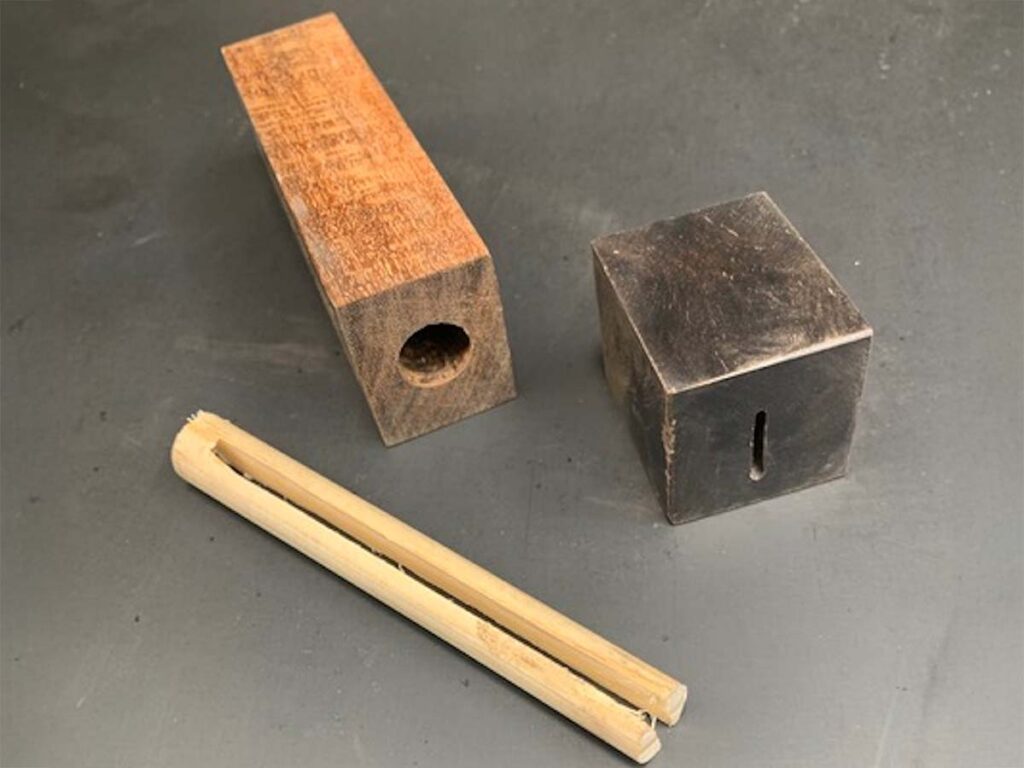
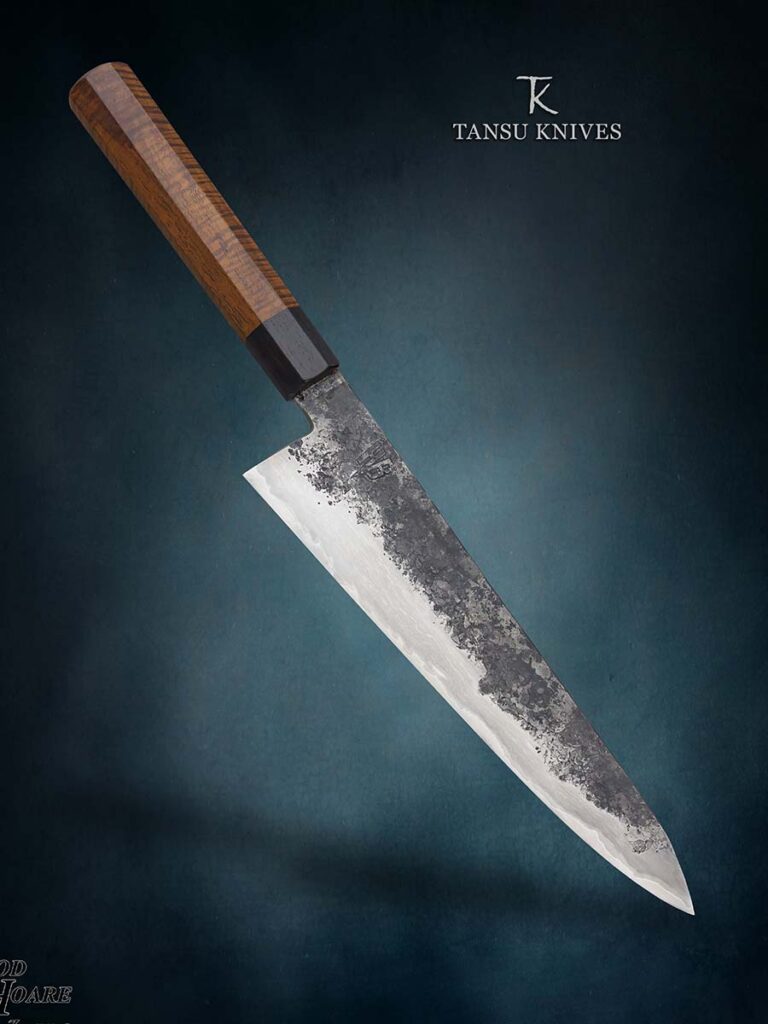
The wa handle of Mert Tansu’s gyuto has a half-inch-wide, 4-inch dowel (above) with a tang slot cut into it. “It is a traditional-shaped wa except for the internal structure,” Mert wrote. “While most Japanese blades are mounted to the handle with burning the tangs in, this is not possible with a hard timber-like ringed gidgee, and I glued mine in.”
Australian custom knifemaker Mert Tansu follows the wa tradition with his own interpretation. His perspective includes a geometric aspect that broadens the possibilities with the style.
“Wa handles come in a few different geometries,” he related, “from round to oval, to semi-octagonal to full octagonal and D-shape. Compared to their Western counterparts they are not sculpted and flat. Most of the traditional wa handles will have a horn ferrule and magnolia wood body.”
The wa handle of Mert Tansu’s gyuto has a half-inch-wide, 4-inch dowel (above) with a tang slot cut into it. “It is a traditional-shaped wa except for the internal structure,” Mert wrote. “While most Japanese blades are mounted to the handle with burning the tangs in, this is not possible with a hard timber-like ringed gidgee, and I glued mine in.”
Mert’s featured knife is a gyuto from his Hunter Valley Blades series of traditional Japanese chef’s knives with forged finishes and usually san-mai construction. He employed a dowel-bedding construction for the wa handle (page 16). He characterizes his chef’s knives as affordable and less time consuming to make than other custom types.
Specific features of the wa handle style translate into precision and control in the kitchen. He says that the flats allow the user to index the knife with ease. Despite the “stop sign” shape, the octagonal handle is quite comfortable and fashioned with precision on his disc grinder. Optimal length is a subjective question, but Mert likes paring knives with wa handles no longer than 4.7 inches, while handles of 5.3 to 5.5 inches work best in larger chef’s knives with overall lengths of 9.5 inches. For long slicing knives of overall lengths of 10.5 inches, he indicated he prefers a handle between 5.7 and 5.9 inches.
Wa Handle Interpretations
A custom knifemaker for seven years at his home near Melbourne, Australia, Alex Töpfer appreciates the employment of the hidden tang in his knife construction, and he says the wa-inspired handle works in both the active and aesthetic aspects of kitchen use.
“Obviously, I’m inspired by various styles of wa handles, specifically octagonal ones,” he commented, “and also the use of brass bolsters and guards in the Western context. The flats here are more to provide context with the organic, curved aspects of the wood grain and forged texture.
“I do think it’s important to have a flat [handle] surface that aligns with the blade, but the upper parts are more for looks. There is also the question of what an individual user likes. Personally, I prefer to use oval hidden-tang handles, but I do the occasional faceted one for practice and a change. I’ve only had problems when the tang is not long enough. So, I tend to go 2.75 to 3.15 inches of tang. That will support the handle during use. I have had issues with burl where the grain didn’t provide any strength, but a longer tang on that knife would have avoided the problem. Also, fancier materials might be easier to sell even if they’re not ideal. I like recycled ironbark but it doesn’t have that bling factor.”
The traditional handle of Dew Hara’s suigetsu has stabilized burl scales and a copper bolster. The 7-inch blade is tamahagane steel with a hamaguri grind. Overall length: 12.4 inches. (SharpByCoop image)
Garrity demonstrates his skill with the wa in his mosaic damascus santoku blade that combines 1095 and 52100 carbon and 15N20 nickel-alloy steels. He used the Ferry Flip method* and then placed the multi-bar construction to be framed by a monosteel edge and spine bars. Aidan’s santoku has a sister blade, a nakiri featured on the cover of the March 2024 BLADE® (page 13). He made the nakiri with the same bar of mosaic damascus as his santoku.
“This handle is of my own design. It has largely parallel sides to the width of the ricasso with a small ‘beak’ at the bottom for hand retention, as well as aesthetics. It wasn’t based on any particular style,” he noted, “but it does categorize as a shield-shaped wa handle. The flats lend themselves to helping the user maintain proper edge alignment while cutting, as an overly round grip doesn’t offer much [user feedback]. In addition, the flats are somewhat easier to bring to a high finish.”
In constructing a wa handle, Aidan leans heavily on the length of the blade.
“Typically, 4½ to 5½ inches is seen as a natural range to balance average length and weighted blades,” he remarked. “Thicker and wider blades like nakiri and bunka will often be more forward weighted compared to the more generalist shapes like santoku. The handle is often too slim with poor retention for any large chopping blades or fighters. It’s best to stick to kitchen knives for this type of handle design.”
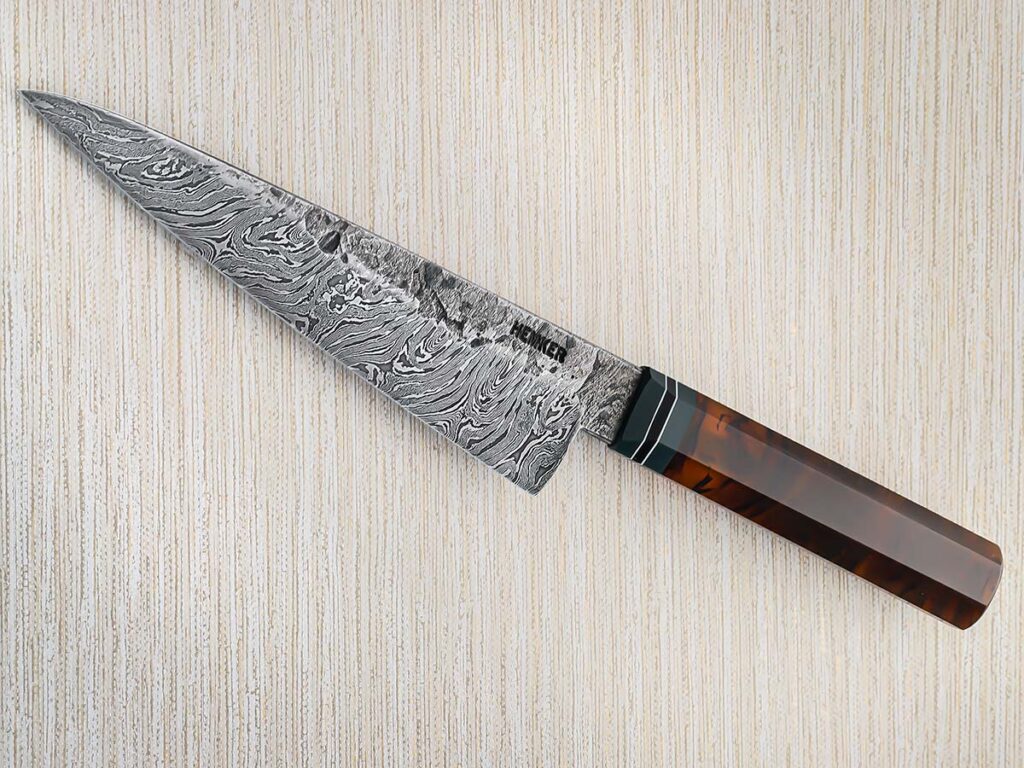
Eric Hemker uses synthetic tortoise shell for the wa handle of his chef’s knife. The flat-ground 7.785-inch blade is a damascus of 1084 carbon and 15N20 nickel-alloy steels. The spacers are green, black and white G-10. Overall length: 14 inches. (SharpByCoop image)
The where, why and how of the wa are revealed in various interpretations, put to work with enthusiasm in the kitchen, and exhibit style and beauty whether in the midst of meal preparation or displayed for all to see. Their aesthetic is timeless, but so is their capacity to make the work of the chef an adventure in creativity.
*Editor’s Note: Named in honor of its creator, award-winning bladesmith Tom Ferry, the Ferry Flip is a variation on the canned steel technique. It basically consists of cutting slices at a 35-degree angle off the end of a damascus billet. The resulting tiles are rotated and forge welded together to form a new billet. As a result, instead of the pattern showing on the end of the new billet, the pattern repeats itself along the new billet’s face.
Cool collaborations offer the best of both blade worlds.
Custom/factory collaboration knives have long been popular sellers. A custom knifemaker designs the knife and the company either makes or has it made, providing cutlery consumers with a knife at a lower price point and readier availability than almost always is the case when ordering a custom version directly from a custom maker.
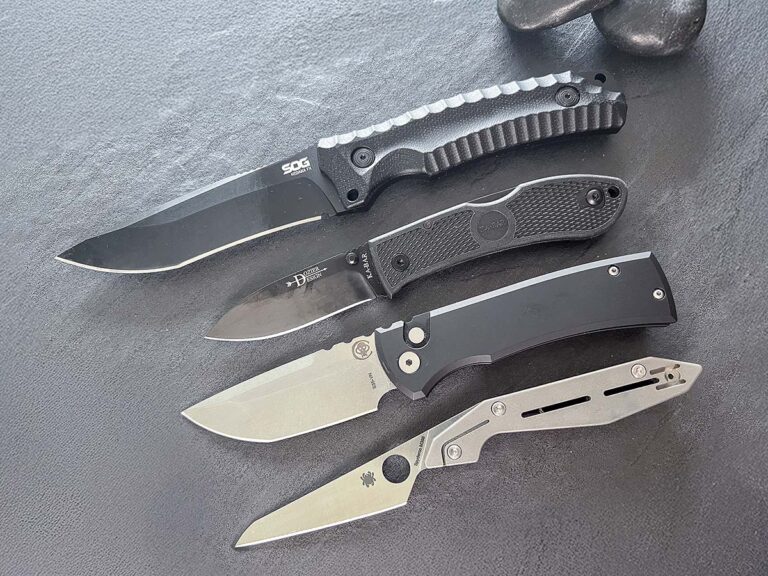
KA-BAR Dozier Folding Hunter
Thicker materials like cardboard and hose are no match for the blade of the SOG Hidaka FX 3V, a Kiku Matsuda design. A slight hint of a recurve to the main cutting edge no doubt helps cutting power. Overall length: 10 inches.
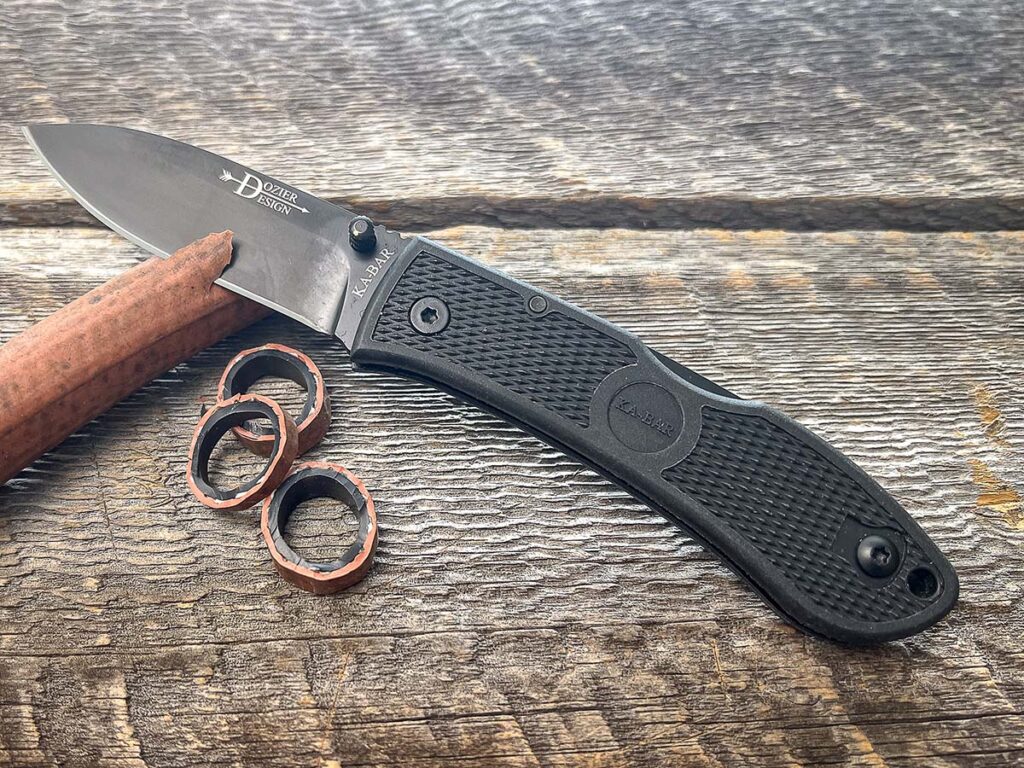
A long-time example of the genre is the collaborations between KA-BAR Knives and veteran knifemaker Bob Dozier. The original Dozier Folding Hunter series consists of mid-sized lockbacks with manufacturers’ suggested retail prices south of $50, offering plenty of bang for the buck. The knives provide ease of portability combined with the high utility of a drop-point blade.
The series proved such an excellent seller for KA-BAR that the company decided to also market it in a higher-grade steel to enhance performance and edge holding: CPM S35VN stainless. The standard KA-BAR Dozier Folding Hunter has D2, a very respectable, hard-wearing blade steel that’s tried and true in the industry. MSRP: $47.58. The S35VN iteration has an MSRP of $97.01 and like the D2 version is made in Taiwan.
While somewhat of a significant price increase, remember, you’re getting a high-end blade steel in return. S35VN behaves a lot like its predecessor, S30V, with a bit more edge-holding power. It’s also easier to resharpen than S30V. S35VN will go the distance, drastically increasing your intervals of sharpening over standard D2. This is especially important if you field dress game on a regular basis. Even though S35VN is stainless, the knife comes with a DLC-coated blade for low glare as well as added corrosion resistance.
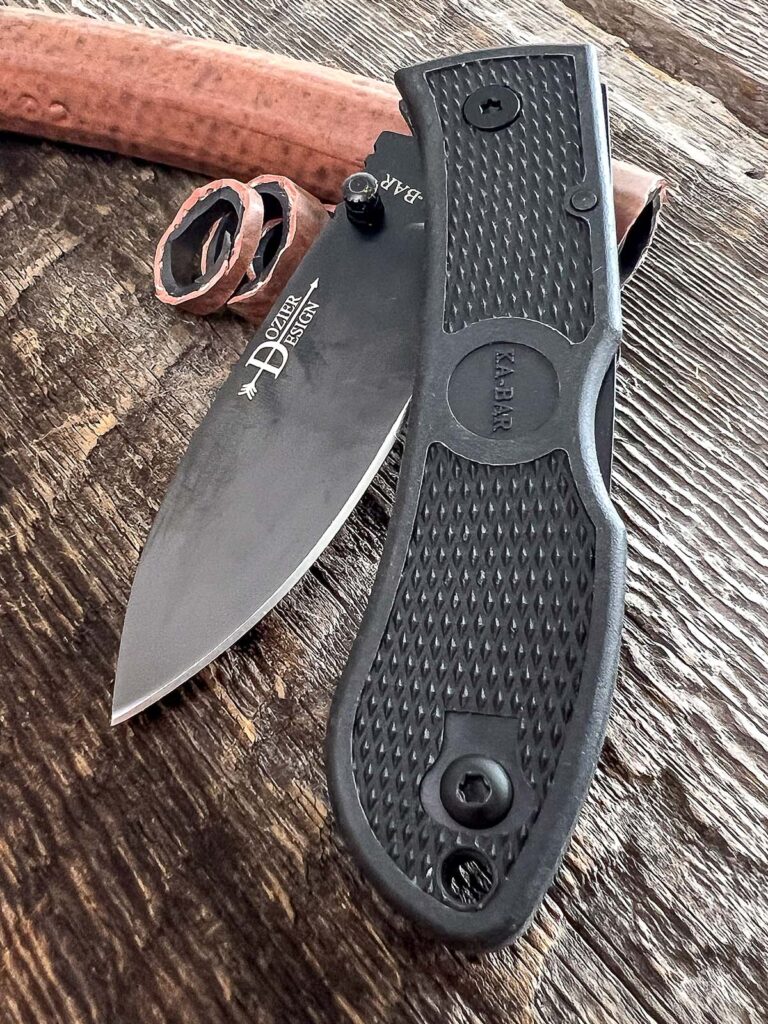
Even though S35VN is stainless, the Dozier comes with a DLC-coated blade for low glare as well as added corrosion resistance. Raised diamond texturing molded into the handle does a great job at keeping your hand in place even when wet. Country of origin: Taiwan. Closed length: 4.25 inches.
Out of the box the edge on the sample was good, but not quite there for my tastes. So, with a bit of work I got the blade hair-popping sharp. The 3-inch blade is a sweet spot length for EDC—big enough to tackle most cutting chores and small enough to carry comfortably without added bulk or length.
The handle’s slender nature also enhances EDC ability. It’s flat and doesn’t “print” in the pocket. Raised diamond texturing molded into the black, lightweight Zytel scales does a great job keeping your hand in place even when wet. It might not be the best-looking grip but it’s definitely geared for function, and that’s very important in a working folder. The pocket clip carries the knife blade tip up and is reversible to accommodate lefties.
The single thumb stud deploys the blade easily and the action is smooth. The knife is very controllable at all times, a testament to both its overall size and handle design/ergonomics. The lockback mechanism is swift and secure. I had no problems with it at all. For a nice, sturdy, compact lockback folder, the Dozier in S35VN is hard to beat.
Spyderco/Paul Alexander SLIPIT
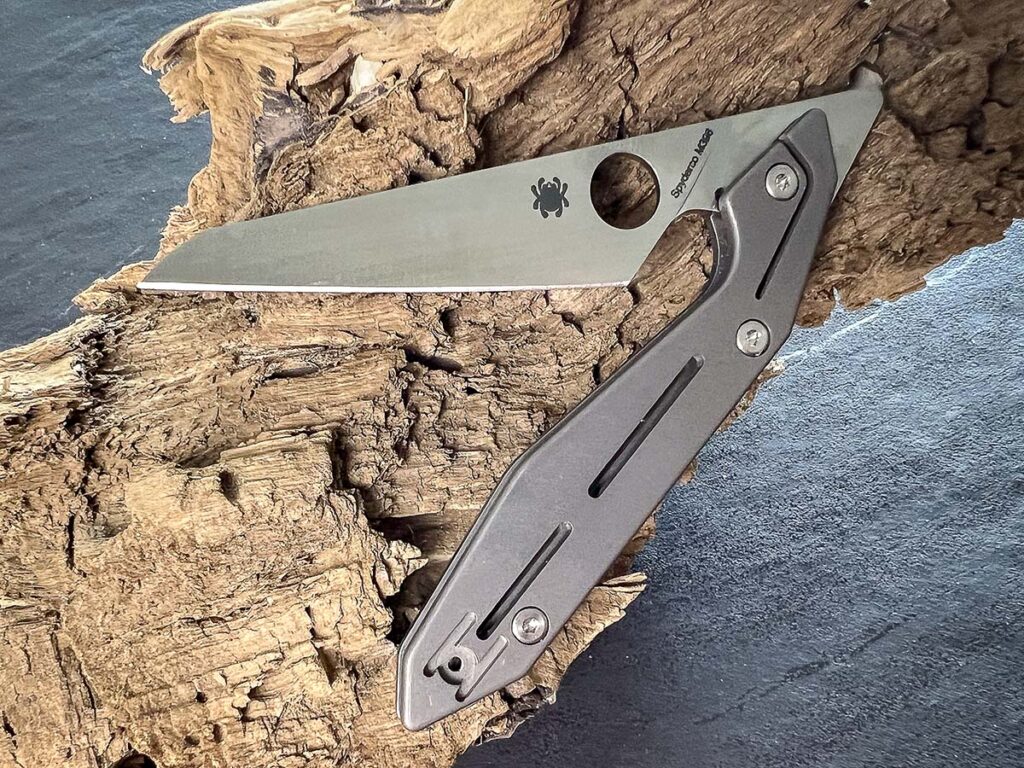
Designed by Paul Alexander, the Spyderco Nand and its angular handle theme carries over into the ergonomics, with finger recesses and a choil as well. Despite its angular appearance, the handle is quite comfortable. Closed length: 4.66 inches.
When it comes to collaborations, Spyderco has always been in the forefront of the genre. It also has some interesting folders in its SLIPIT family of non-locking folders. The Nand is an unusual, exciting example of both. Designed by Paul Alexander, an accomplished automotive mechanical engineer and a seasoned knife enthusiast, the Nand combines an angular approach to folding knife design with high-tech materials, all with the precise execution that Italian manufacturing offers. The result is sort of the Cybertruck of folders.
The 3.19-inch reverse tanto blade is fully flat ground from a new super stainless steel from Bohler called M398. Basically, Bohler took its M390 and increased the carbon and vanadium content for even more edge holding.
There are two methods of deploying the blade. The trademark Spyderco round hole is present as well as the extended blade spine that allows the Nand to be thumbed open similarly to a straight razor. The correct terminology for it is a front flipper.
Machined of titanium, the handle translates into an extremely lightweight knife and is where things get a bit interesting. The integral double-ball-bearing detent system not only holds the blade closed but also provides a positive detent when the blade is open. The “spring arms” for the detents are cut out of each handle half and, to create pressure, are bent in a similar manner to a framelock. Ceramic balls implanted on the ends of the spring arms create the open and close detents.
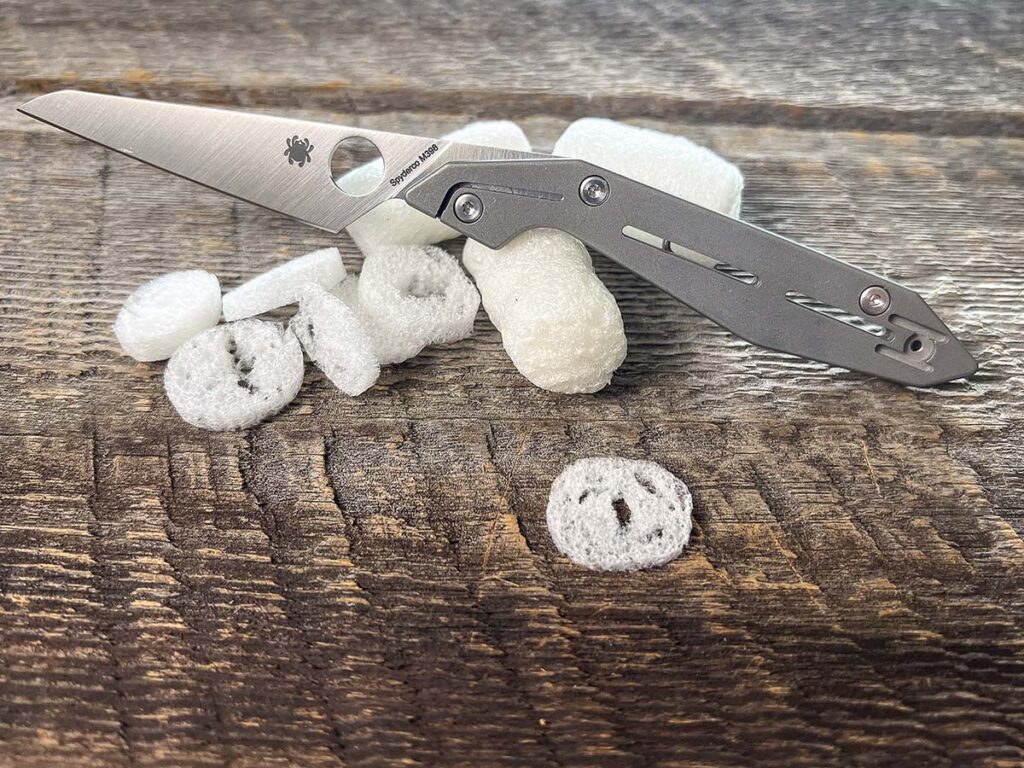
The wharncliffe blade has a full flat grind, which makes the Nand an excellent slicer. Out of the box, the knife cut plastic foam peanuts easily.
The handle’s angular features might make the knife look a bit awkward but don’t dismiss it until you put the Nand in your hand (see what I did there?). With the knife open, a kind of choil forms so you can choke up on the blade for an extra measure of control. Barring that, you can hold the knife a bit further back with your index finger resting inside the handle’s finger recess. Either grip brings your hand over the blade spine of the opened knife and helps secures the blade open as an added measure to prevent accidental closure. The minimalist wire clip is reversible to accommodate ambidextrous carry.
While the Nand may look a bit different, it’s easy to use and holds its own as an EDC folder. The reverse tanto blade has a highly effective tip that pierces easily. The straight-line cutting edge is simple to resharpen, has a lot of bite and slices through tough materials effortlessly. The knife feels very secure despite its slender nature. Choking up around the choil feels good and secure in-hand, rendering the Nand easily controllable.
SOG KNIVES Kiku Matsuda Hidaka FX 3V
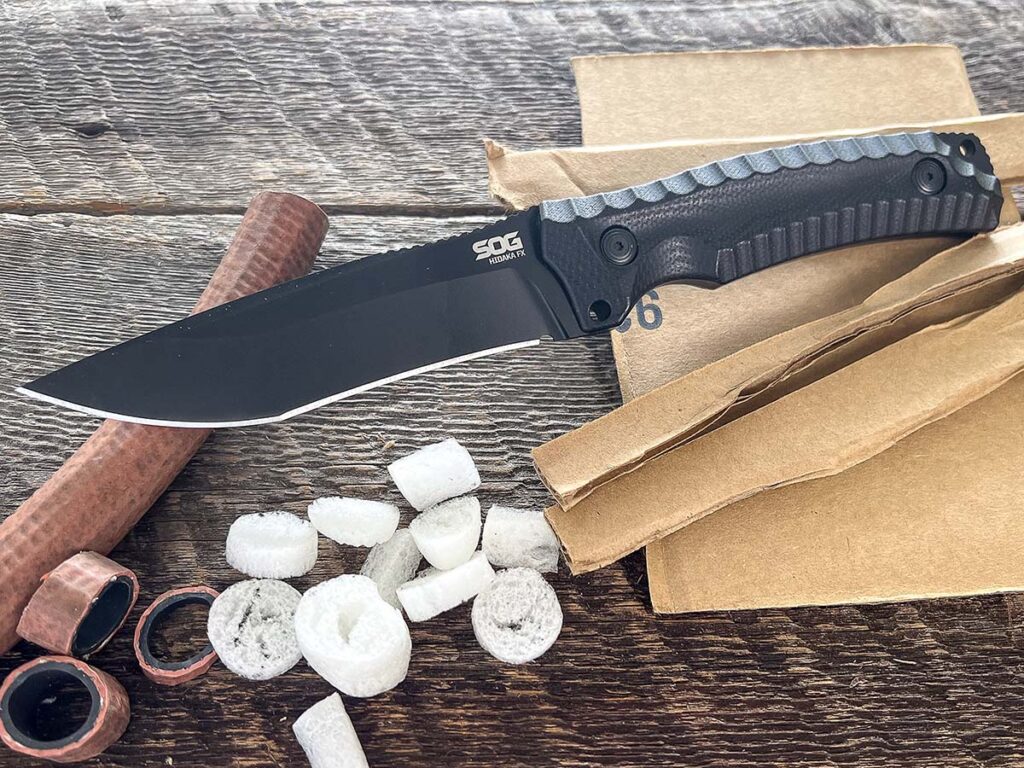
Thicker materials like cardboard and hose are no match for the blade of the SOG Hidaka FX 3V, a Kiku Matsuda design. A slight hint of a recurve to the main cutting edge no doubt helps cutting power. Overall length: 10 inches.
The Hidaka FX 3V is a continuation of the exciting collaboration between SOG Knives and legendary Japanese knifemaker Kiku Matsuda. Known for their distinctive, flowing design style, intricately sculpted handles and hollow-to-flat compound-ground blades, Matsuda’s designs stand out.
His new SOG entry is an exciting tactical/outdoor fixed blade with a 4.8-inch tanto blade ground from ultra-tough CPM 3V carbon steel paired with a multi-faceted sculpted handle of black Micarta®. The blade’s angled tanto tip has a flat grind and the primary cutting edge is hollow ground. When you look at the blade in the light, you can see the grinds transition. Very cool—not too many factory knives have this feature and no doubt it’s much trickier to pull off than a standard tanto blade.
The flat-ground tip has a thicker cross section for greater penetration strength and general tip durability during hard use. The hollow-ground main bevel allows the blade to slice easily. Notches on the thumb-rest portion enhance control and a non-slip grip when bearing down on the blade. A black PVD coating helps with corrosion resistance and low-profile visibility.
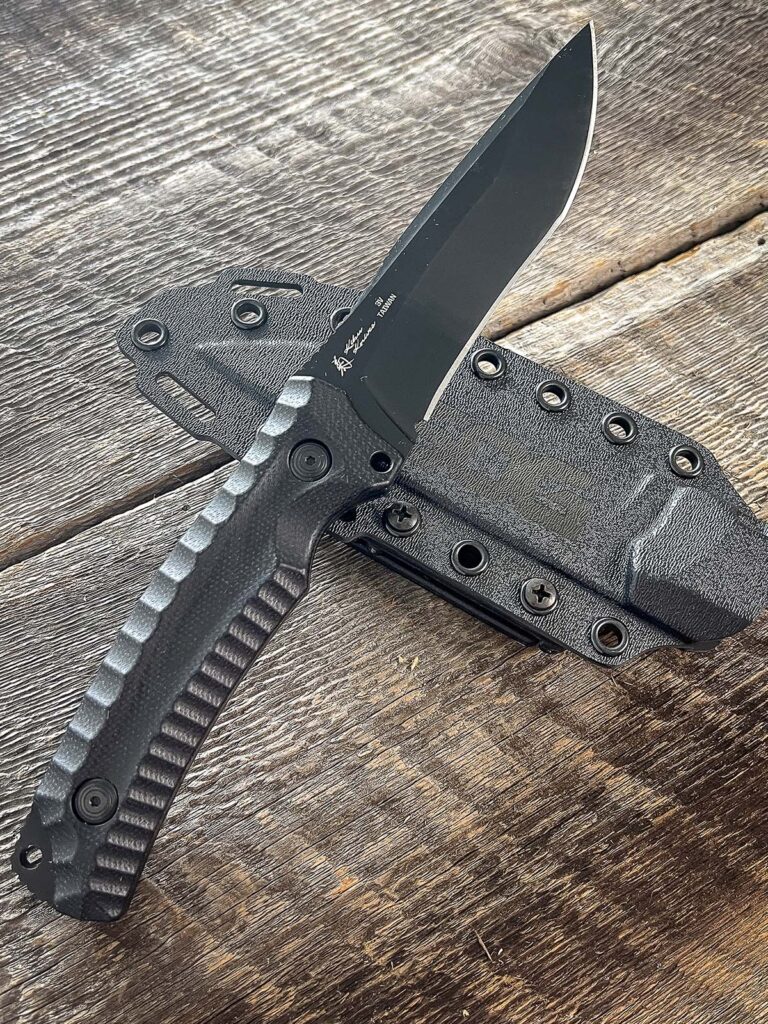
The handle is as interesting as the blade. The distinct, intricately sculpted grip features are a Matsuda trademark. The sculpting is not purely for looks but where form follows function. The middle of the handle is hollowed out on each side like one long groove. The handle edges sport a heavy chamfer and a series of scallops all the way around, the latter to enhance grip. A prominent groove helps seat the index finger and provide an anchor point. The total blacked-out look—handle screws included—gives a somewhat sinister tactical appearance. The exposed pommel also sports traction notches for a better thumb purchase.
The SOG’S handle edges sport a heavy chamfer and a series of scallops all the way around, the latter to enhance grip. A sturdy molded Kydex sheath holds the blade securely and an audible snap lets you know when the knife is fully seated.
Overall, the Hidaka FX 3V is just an interesting fixed blade. Not only does the compound-ground blade look cool but it is also very practical. Thicker materials like cardboard and hose are no match for it. A slight hint of a recurve to the main cutting edge no doubt helps cutting power.
The knife comes with a sturdy molded Kydex sheath. It holds the blade securely and an audible snap lets you know when the knife is seated. A hinged fastener affixes the sheath to your belt. The device is similar to the Blade-Tech Tek-Lok and operates similarly. The knife rides comfortably on a belt and the handle is easily accessible. Country of origin: Taiwan. MSRP: $309.95.
Pro-Tech Knives Ramon Chavez Redencion 229
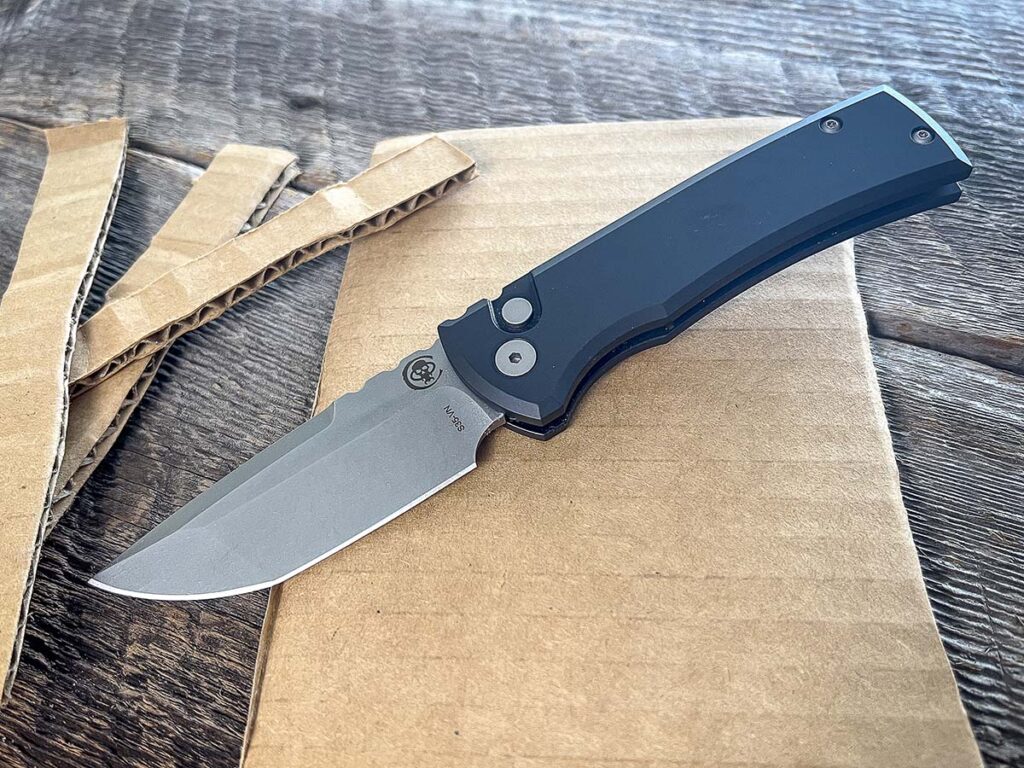
The Redencion 229 is a workhorse folder. The aluminum handle and S35VN steel blade denote that it’s in it for the long haul. Cardboard is no match.
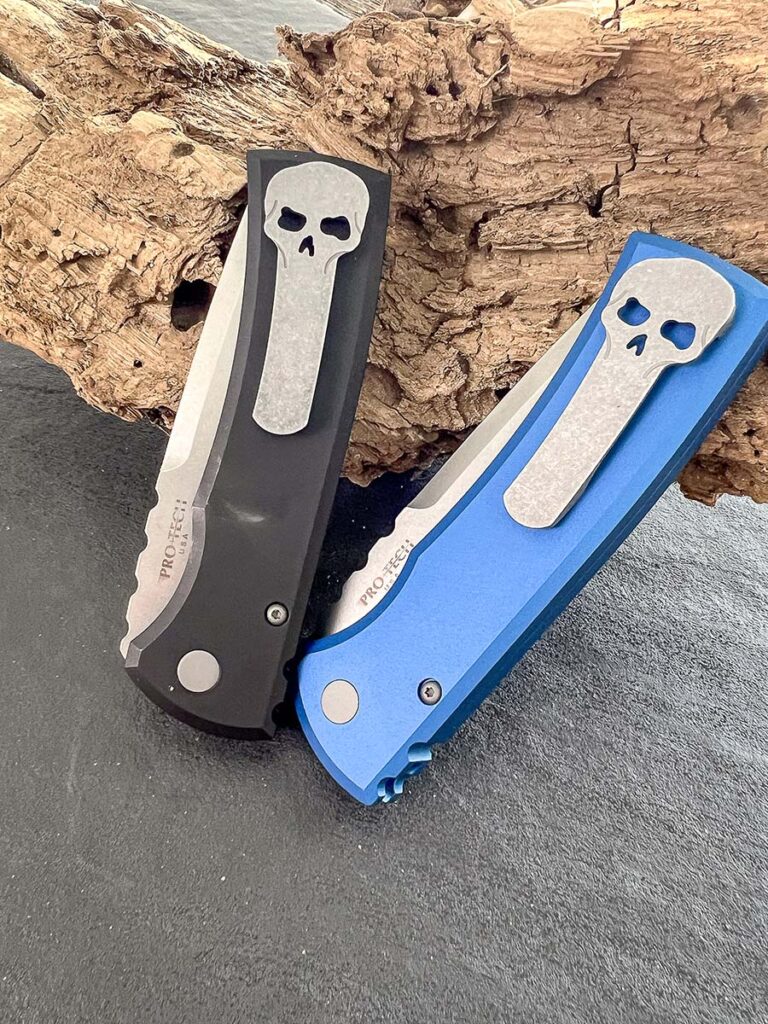
One of the most exciting factory automatics going is the Chaves Redencion 229 by Pro-Tech Knives. Designed by knifemaker Ramon Chavez, the auto combines his bold design style with Pro-Tech’s excellent manufacturing capabilities and automatic action. The 3.3-inch tanto blade is high-performance CPM S35VN. The handle is T6-6061 hard-anodized aluminum for light weight and strength. The Chavez signature skull pocket clip adds attitude to the hard-firing automatic. At 4.5 inches closed, the folder carries well and works hard.
With the press of a button, the blade flies with authority and hits hard when it locks. If you’ve played with Pro-Techs you know what I’m talking about. The blade is flat ground and comes with a very sharp cutting edge out of the box. It will easily handle most tough cutting chores. It goes through cardboard and hose easily.
Designed by Ramon Chavez, the Pro-Tech Redencion 229 and its skull pocket clip stand out. Given the clip’s width, it’s also highly functional and durable. You are not going to spring this clip from your pocket accidentally. Note that the clip screws are inserted from inside the handle for a cleaner look.
The blocky handle allows for a secure grip. I noticed no hotspots or any hand discomfort. The aluminum scales are solid and generally hold up to hard use. Some might be apprehensive about the pocket clip as I was at first. Its size and width makes it hard to feel in-hand. Another good thing is the width means it won’t accidentally disengage if caught on anything. It’s stout! It provides the right amount of tension when the knife is clipped to the pocket. Another neat thing is you see no clip mounting screws because the clip is screwed to the handle from the inside—a very cool extra touch.
The Redencion 229 is a great EDC automatic that has attitude and high utility all in one interesting folder. Made in the USA, the model with a stonewashed blade and black anodized handle has an MSRP of $300. Black blade iterations are also available, as well as a recently released drop-point version.
Utility knives are among the most essential of kitchen cutters.
Food is life, and cooking is a vital part of your daily routine. Having the right tools can transform your kitchen experience, and kitchen utility knives are among the most essential. With the right one, even the toughest tasks can become a breeze.
Kitchen Utility Knives Defined
A kitchen utility knife is a versatile tool designed for a variety of food preparation tasks. Typically, it features a blade ranging from 4 to 7 inches, making it larger than a paring knife but smaller than a chef’s knife. It’s ideal for slicing, dicing and chopping a wide range of foods, such as vegetables, fruits and meats. The utility strikes a balance between precision and strength, allowing it to handle chores that require both detail and some heft. It’s a great all-around option for anyone looking to tackle everyday kitchen jobs efficiently.
Vero Engineering Utility 5
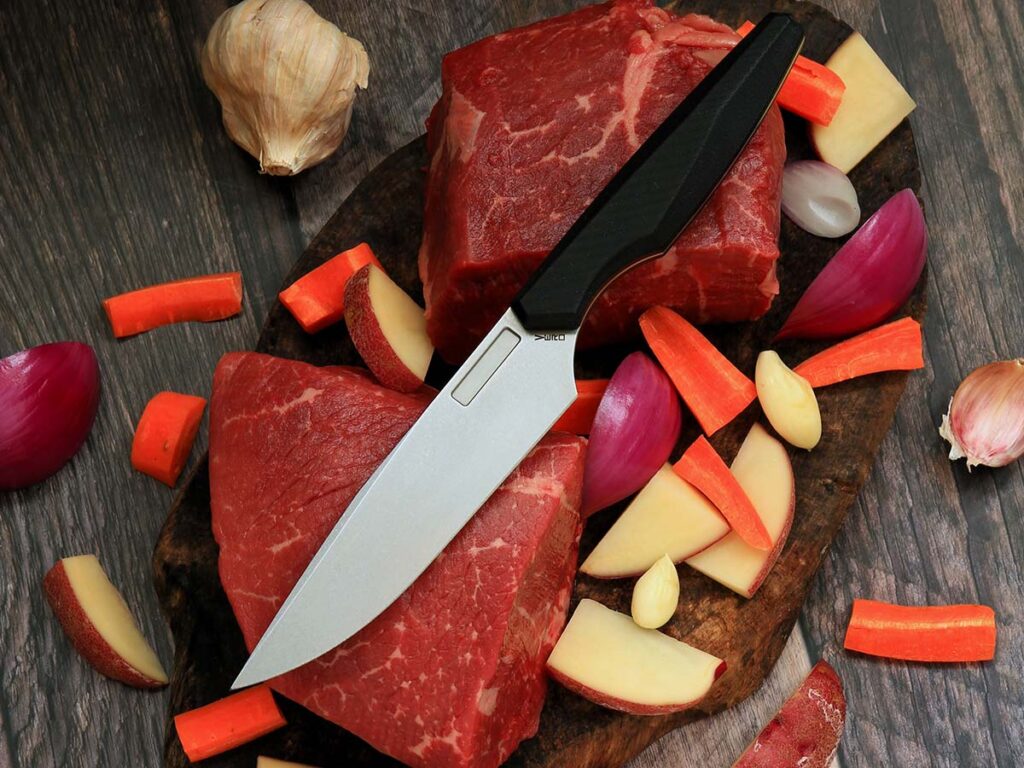
The author prepped a hearty meal of beef pot roast and veggies using the Vero Utility 5. The knife was equally effective cutting meat, root vegetables and herbs, all with finesse.
Utility 5 Specs Blade Length: 5.27” Blade Steel: Nitro-V stainless Blade Grind: Full flat Blade @ Thickest: .138” Blade Finish: Stonewashed Handle Material: G-10 black Overall Length: 10.08” Knife to know: Multiple options in blade finishes and handle materials Country of Origin: China MSRP: $174
The Vero Engineering Utility 5 doesn’t just show up—it sharpens your kitchen game with precision and style. The fixed-blade slicer offers excellent corrosion resistance and edge retention, making it a reliable workhorse for a wide range of tasks, from citrus to sirloin. The drop-point pattern and full flat grind give it slicing versatility, while a milled pocket on the blade adds grip and control for those who favor the pinch-grip life. At just 4.75 ounces it’s light in the hand but heavy on performance.
The handle options—black G-10, ebony or marbled carbon fiber—aren’t just aesthetic choices, they are also ergonomic, moisture resistant and designed for comfort across various grip styles. Blade finishes include stonewashed, belt satin and hand satin, allowing you to match your knife to your mood or your cutting board. Whether for preppers or perfectionists, the Utility 5 slices with purpose and looks good doing it.
At first, the Vero resembles a combat knife. And if you call slicing roast beef, potatoes, onions, garlic and carrots combat, then this blade is your trusty weapon of choice. It is designed to transform simple ingredients into a champion-worthy feast with accuracy and panache.
I sliced a hefty cut of beef roast and all the fixings. Root veggies are hard, so sharpness is key. The test knife had an excellent grind and an ultra-sharp blade, which puts less stress on the hand when cutting. It truly was a meat-and-potatoes meal, with carrots, onions and garlic. The handle remained slip-proof despite exposure to blood and vegetable juices. The steel never stained and at press time I had yet needed to sharpen this culinary champion.
Bradford 6-inch Utility Knife
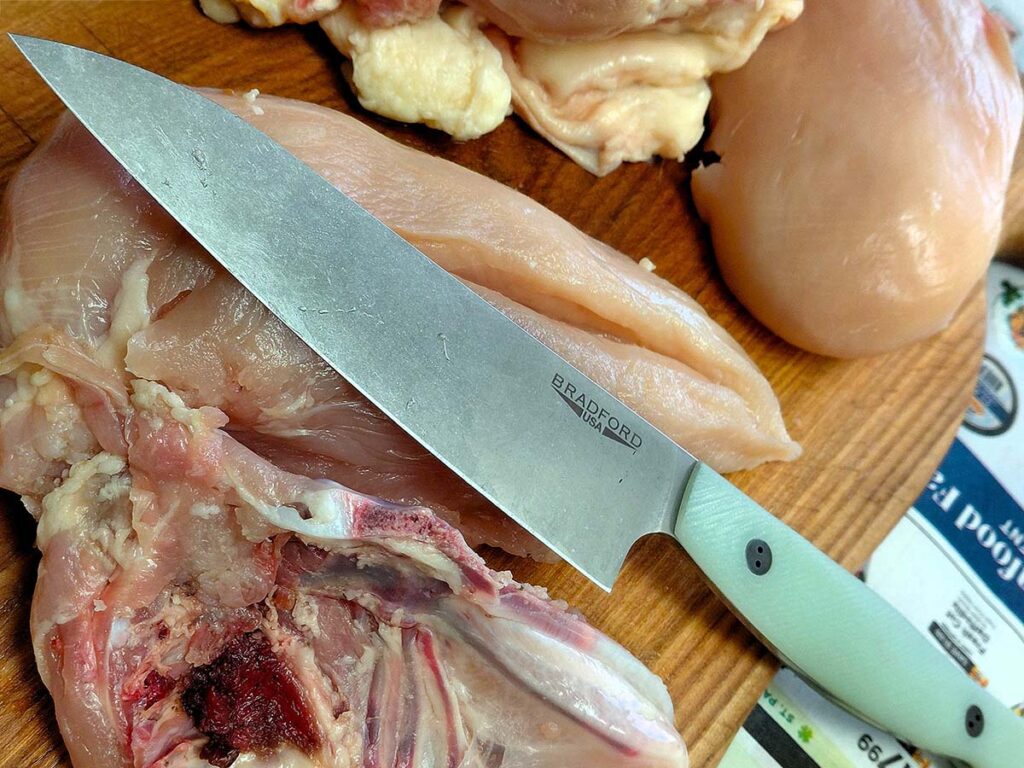
The Bradford deboned chicken and cut a variety of veggies with ease.
6” Utility Knife Specs Blade Length: 6” Blade Steel: MagnaCut stainless Blade Grind: Full flat Blade @ Thickest: .10”; distal tapered Blade Finish: Satin stonewash Handle Material: 3D microtextured Overall Length: 11” Country of Origin: USA MSRP: $209
Bradford’s 6-inch Utility Knife slices through kitchen monotony with surgical precision and unapologetic style. Its CPM MagnaCut stainless steel blade has a Rockwell hardness of 61-to-63 HRC and delivers top-tier edge retention, corrosion resistance and toughness—ideal for everything from delicate herbs to dense proteins. The blade features a stonewash finish that hides scuffs like a pro, keeping your knife looking fresh even after a week of hard prep. Weighing just 5 ounces, it strikes the perfect balance between nimble and substantial and will fit in most kitchen blocks.
The ghost (light blue) handle is ergonomic, moisture-resistant and built to withstand heat, wear and long prep sessions without losing grip or comfort. Thin, full-tang construction keeps the profile sleek and strength solid. Meanwhile, the design makes it a welcome tool for lefties and righties alike.
This fixed-blade kitchen essential is proudly made in the USA and designed to feel like an extension of your hand—whether you’re dicing vegetables or breaking down wild game. It’s not just a knife, it’s a daily driver for the serious slicer.
I spend a lot of time in the kitchen, a big part of it prepping and freezing foodstuffs for later dates. Chicken and veggies get the most attention. I received the Bradford 6-inch Utility Knife at the right time. I had a large quantity of split bone-in chicken breasts that needed deboning and freezing. The idea of a utility knife is to be versatile. I stick to the rule of whatever’s on the cutting board gets used for everything. Hence, the Bradford was now a deboning knife.
The blade was nimble and the low 5-ounce weight glided through the protein with ease. I felt what the handle was all about and liked it. I trimmed the fat and extra unsavory bits using a variety of grips, mostly modified chef’s pinch grips. The wharncliffe-style blade was a huge help when drawing back for pinpoint slices.
The Bradford definitely fits the bill for a kitchen utility knife. From handle comfort, grind and overall design, this is your utility cutter for several occasions.
White River Knife & Tool Liong Mah
Garnish requires precision, and the White River/Liong Mah Utility Knife excelled at it.
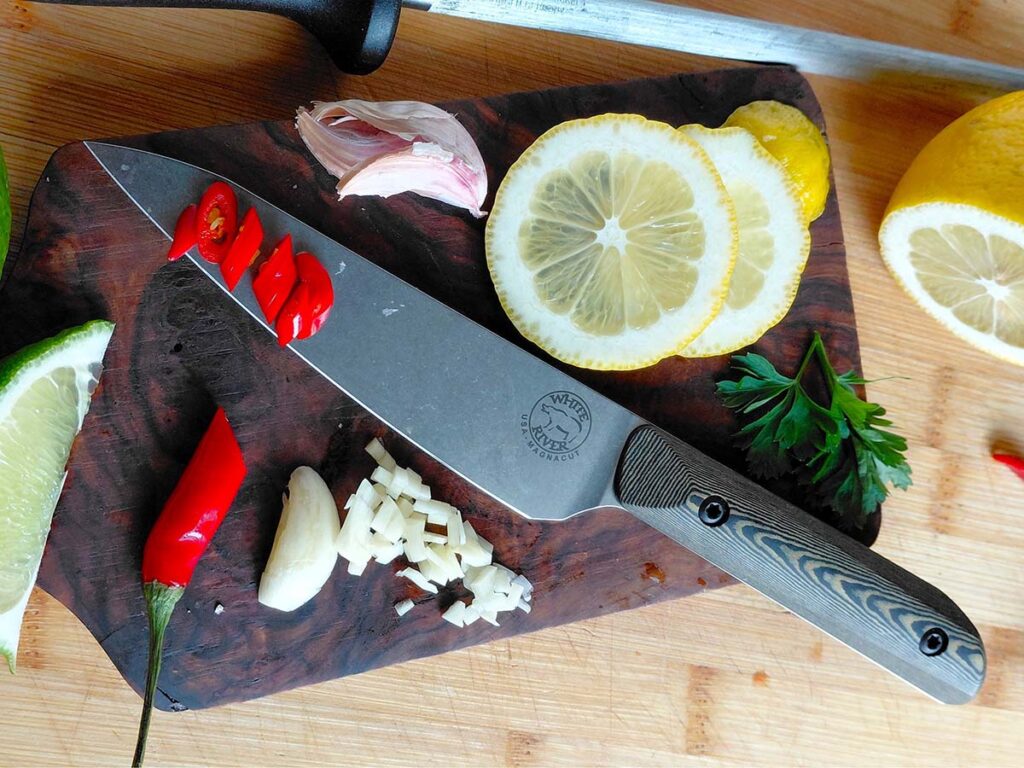
Liong Mah Utility Specs Designer: Liong Mah Blade Length: 4.75” Blade Steel: MagnaCut stainless Blade Grind: Full flat Blade @ Thickest: .095” Blade Finish: Satin Handle Material: Maple Richlite Overall Length: 9.12” Country of Origin: USA MSRP: $200 ($475 for it and the Liong Mah Chef Knife in a set)
The White River Knife & Tool Liong Mah series isn’t just household cutlery—it’s a chef’s dream set in MagnaCut. Designed by Liong Mah, a former New York City chef turned knife architect, these blades blend culinary intuition with precision engineering.
The smaller 3.8-ounce Utility Knife offers nimble control while the larger 6.2-ounce Chef Knife addresses the bigger stuff. Both blades feature MagnaCut at a Rockwell hardness of 62-to-63 HRC, delivering elite edge retention, corrosion resistance and toughness that scoffs at daily abuse. The modern handle tapers toward the blade for a natural, comfortable grip—ideal for vertical chopping and pivoting like a pro. Whether dicing shallots or tackling a brisket, these USA-made tools feel like an extension of your hand, packed in a custom wooden box that says, “Yes, I take prep seriously.” No sheath, no nonsense—just pure slicing satisfaction.
For small tasks like slicing cheese, limes and herbs, it doesn’t get any better than the Liong Mah Utility Knife. Brie cheese is soft, while garlic mincing takes precision and sharpness. However, fret not using the White River entry. For small kitchen tasks and the ability to share a cutting board with other food and garnish, it’s excellent. Hors d’oeuvres, anyone?
The Liong Mah Chef Knife was my pick for long sweeping slices for butterflying chicken breasts. I wanted the full length of a chef’s knife and was delighted with my pick for the task. It sliced with authority and made clean cuts.
CRKT Onion Utility Kitchen Knife
Root vegetables such as potatoes and carrots were no match for the CRKT Onion Utility Knife.
Onion Utility Kitchen Knife Specs Designer: BLADE Magazine Cutlery Hall-of-Fame® member Ken Onion Blade Length: 5.5” Blade Steel: Damasteel damascus Blade Grind: Full flat Blade @ Thickest: .10” Blade Finish: Acid etch Handle Material: FatCarbon Dark Matter carbon fiber Bolster: Titanium Overall Length: 10.19” Country of Origin: Italy MSRP: $850
The CRKT Onion Utility Kitchen Knife in Damasteel® damascus isn’t just a kitchen tool, it’s a precision instrument dressed for a gala. Built in Italy, the fixed-blade beauty features a Damacore® Hugin-pattern blade with a finish that highlights the layered steel like a fingerprint of craftsmanship. It’s slim enough for finesse work but long enough to handle serious slicing. The synthetic handle and bolster help keep the weight featherlight at 3.3 ounces so it won’t tire your hand during marathon prep sessions. The construction resists thermal stress, meaning it won’t warp when the kitchen heats up.
Packaged in a laser-engraved walnut box because even your kitchen drawer deserves a little class, it’s a limited-edition blend of performance and polish that says, “Yes, I julienne with style.” The knife isn’t just a pretty face, it’s a high-performance hybrid that bridges the gap between a chef’s knife and a paring knife, ideal for tasks that demand both precision and power.
I make a lot of soups and braised meat dishes, especially when it’s cold outside. Carrots are a no-brainer for such meals. Beef roasts and chicken soup all require onions, celery and carrots. The Onion Utility looks too classy to use. However, it’s purpose-built for hard kitchen work. BLADE Magazine Cutlery Hall-of-Fame® member Ken Onion designed the handle to be stable in the hand when the kitchen heats up, and the grip withstood the heat and then some.
Slicing carrots was a breeze with the super thin blade, and not one piece split or wedged apart as can happen with thick-beveled knives. I sectioned long carrots for freezing and julienned them for stir fry and noodle dishes. The handle comfort and edge retention are stellar. There’s a lot going on in Ken’s design. The best thing I can say is, pick one up and try it.
Consider four large kitchen knives, all under $80 each.
As you get older and entertain bigger gatherings, do you find yourself wanting to improve your culinary chops?
A little more blade may be just what you need to sharpen your prep time so you can spend more time enjoying your food than getting it to the table. Larger and more focused kitchen tools can indeed improve your efficiency and your proficiency as a gourmet chef as well.
The focus here is on large and/or specialized kitchen knives, specifically the different types and what they can do to make your job easier and your cooking better, each for under $80. Large cooking knives vary widely and we’re going to show you four variations. Keep in mind, most kitchen knives aren’t just for cutting meat but are for preparing fruit, vegetables and other items such as breading or crusts, too.
Utica Meat Dad Chef’s Knife
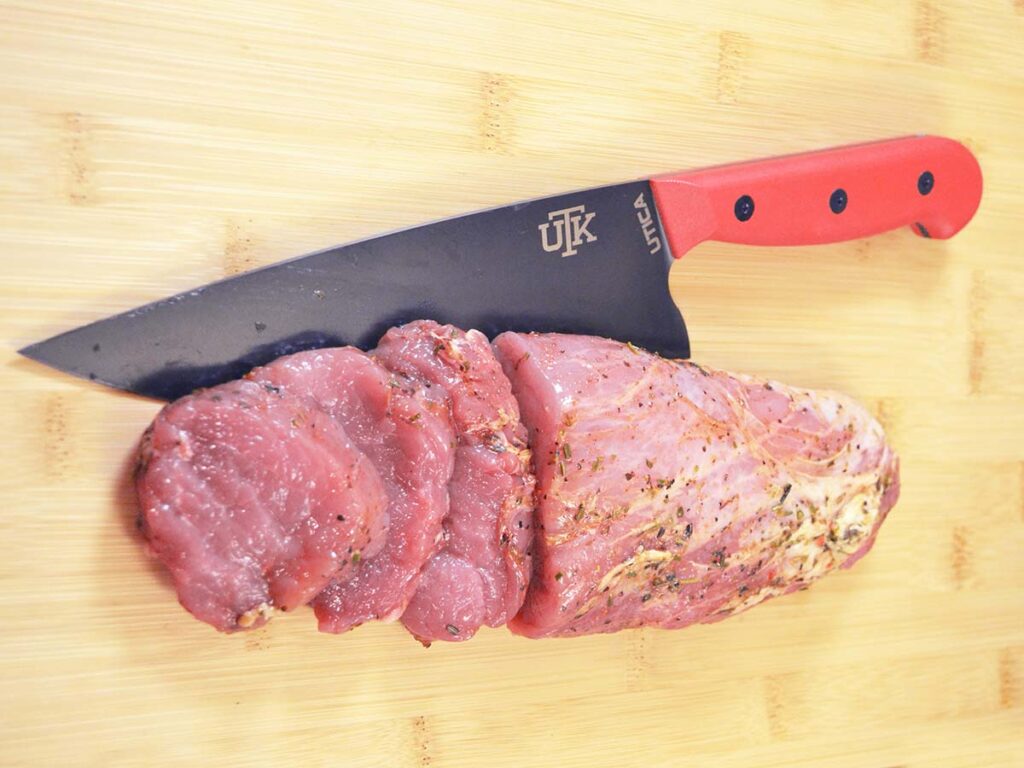
The Utica Meat Dad Chef’s Knife is for large cuts of meat, fruits and vegetables. It took half-inch medallions off a plump pork tenderloin for the sauté pan.
Meat Dad Chef’s Knife Specs Blade length: 7.54” Blade steel: 440C stainless Blade finish: Food Safe Black PVD Handle material: Orange G-10 Weight: 17” Overall length: 12.5” Country of origin: USA MSRP: $74.99
The Utica Meat Dad Chef’s Knife is a whopper with a blade belly 2.25 inches deep for carving the big stuff when needed and everyday slicing and dicing as well. The beefy orange G-10 handle helps maintain control on the wieldy blade for it all.
Though the test’s two chef’s knives—the Fox Knives Meat Slicer being the other—have meat in their names, they facilitate a much wider variety of meal prep tasks, including the slicing, dicing and mincing of a wide range of vegetables and other fare.
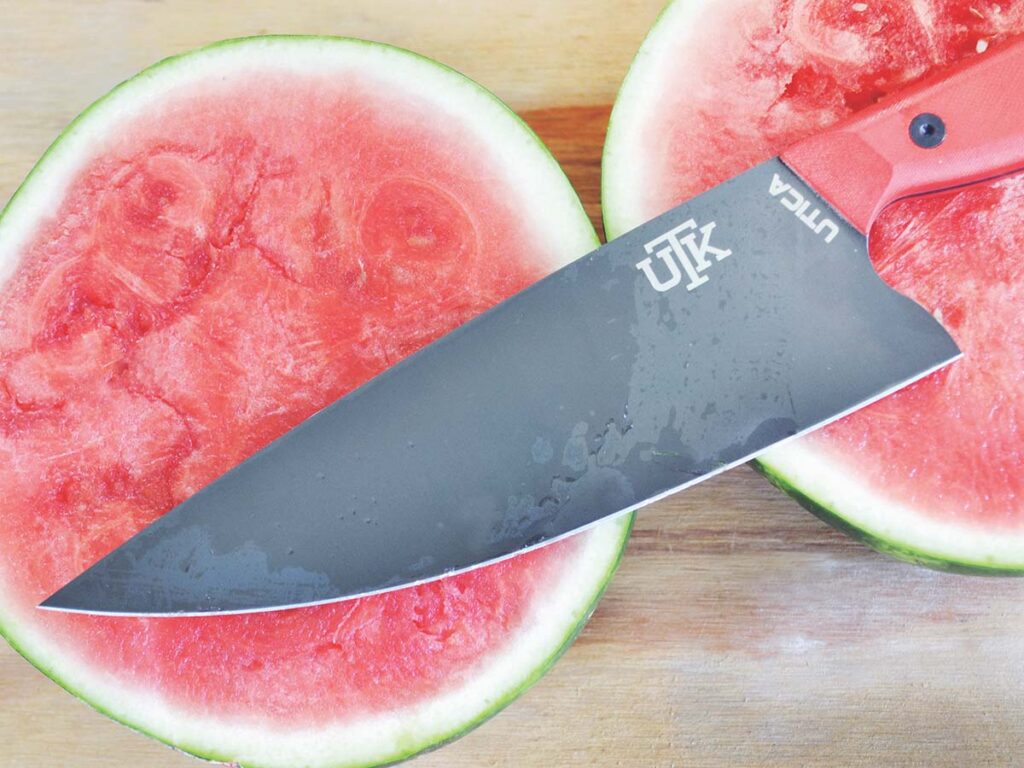
The Meat Dad is large enough to tackle a watermelon in a straight cut.
The Utica is large for a chef’s knife so we tested it on some heathy chores, such as cutting a nice, plump pork tenderloin into fat medallions for a tasty sauté. We also tried the Meat Dad out on a watermelon and, thanks to the stout blade, sliced it straight as an arrow from top to bottom. Sometimes you just need a large knife and the Utica tackles those requirements quite well.
Fox Meat Slicer Knife
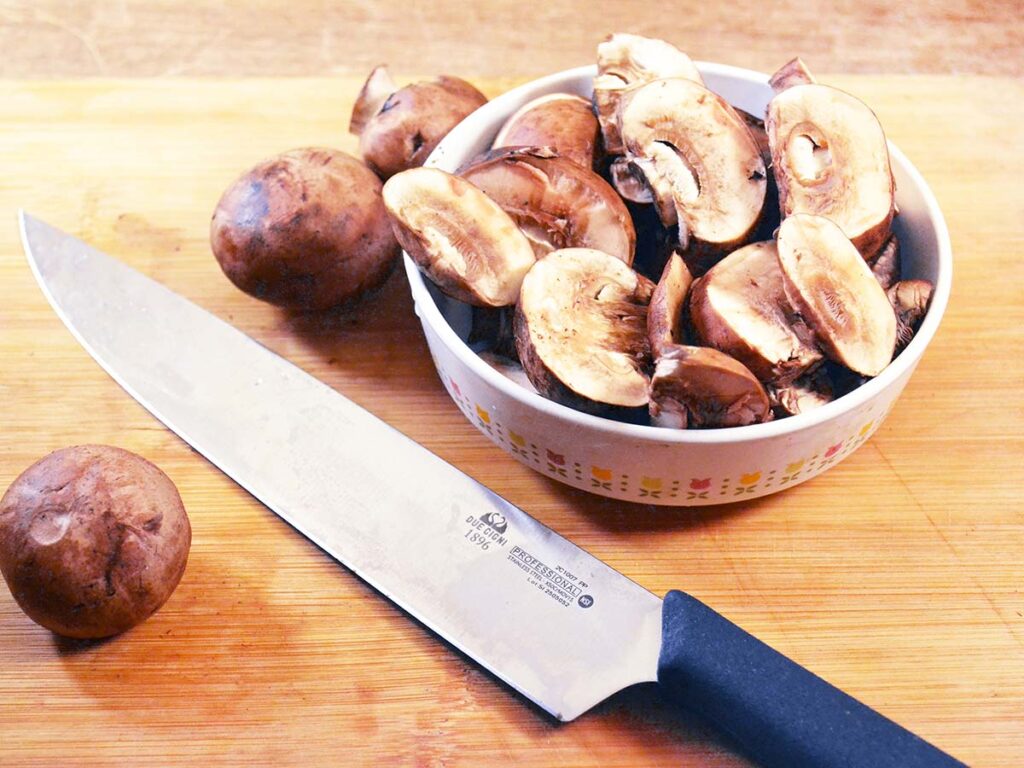
Like many typical chef’s knives, the Fox Meat Slicer is capable of many functions. Wrote the author: “I used the knife for slicing small brown portobello mushrooms to add to an omelet. Note the sharp, crisp cuts—a sign the mushrooms were not prepared by an ordinary kitchen knife.”
Meat Slicer Specs Blade length: 7.8” Blade steel: UNI X59CrMoV15 stainless Blade finish: Fine satin Handle material: Black PP synthetic Weight: 3.75 ozs. Overall length: 12.4” Country of origin: Italy MSRP: $36.94
All chef’s knives are relatively long but not all have blades that can be tiring to use. The Fox Meat Slicer Knife is a much trimmer, more svelte example. A large Italian cutlery company with an impressive presence in the USA, Fox offers a strong group of knives in its Due Cigni Coltellerie line.
One of the group is the Meat Slicer, a long chef’s knife with a slim profile sporting an extended, slender drop-point blade only .12-inch thick. It comes with a gently curved handle that has just enough drop at the base to protect your fingers during use.
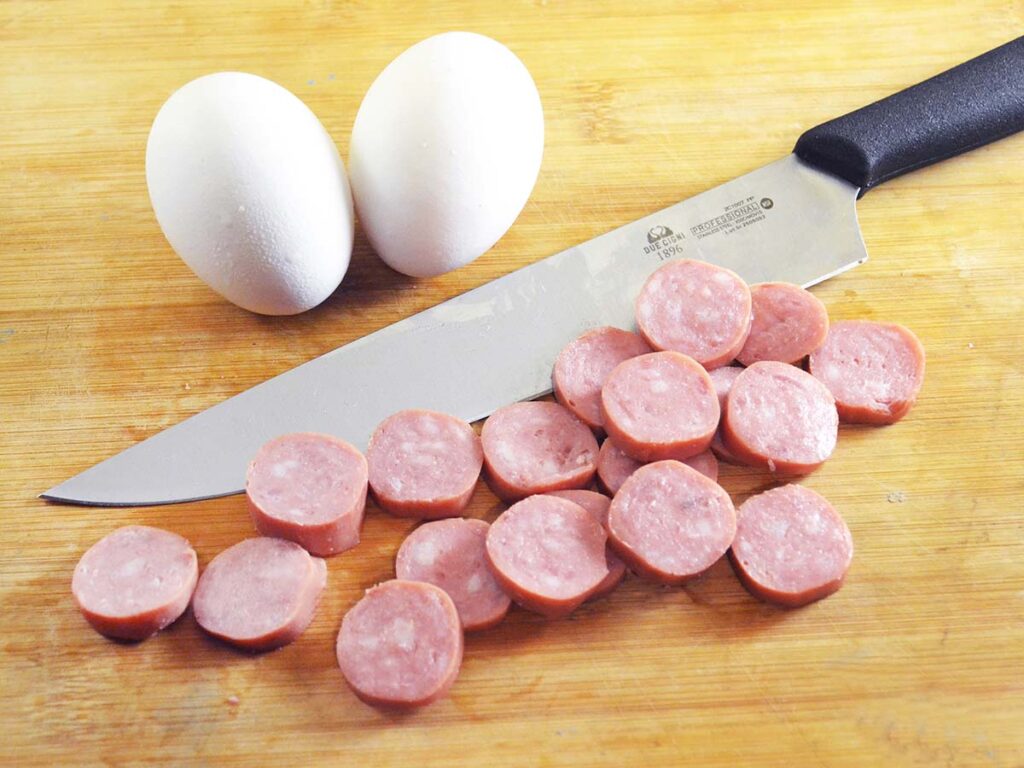
The Meat Slicer is more adept at less cumbersome tasks of both the meat and vegetable variety. We first used it on a couple of smoked sausage links, cutting roughly 3/16-inch slices down the length of each for an omelet. The knife performed quickly and with ease.
The Fox Meat Slicer is excellent for most meals that don’t require cutting thick slabs of meat or large fruit and vegetables. It made quick work prepping smoked sausage.
To add a little flavor, we turned to some portobello mushrooms. Taking a handful, I trimmed the stems off and sliced them up one by one in a jiffy. The German steel performed very well and the handle was the most comfortable of the test lot.
A.G. Russell 6-inch Boning Knife
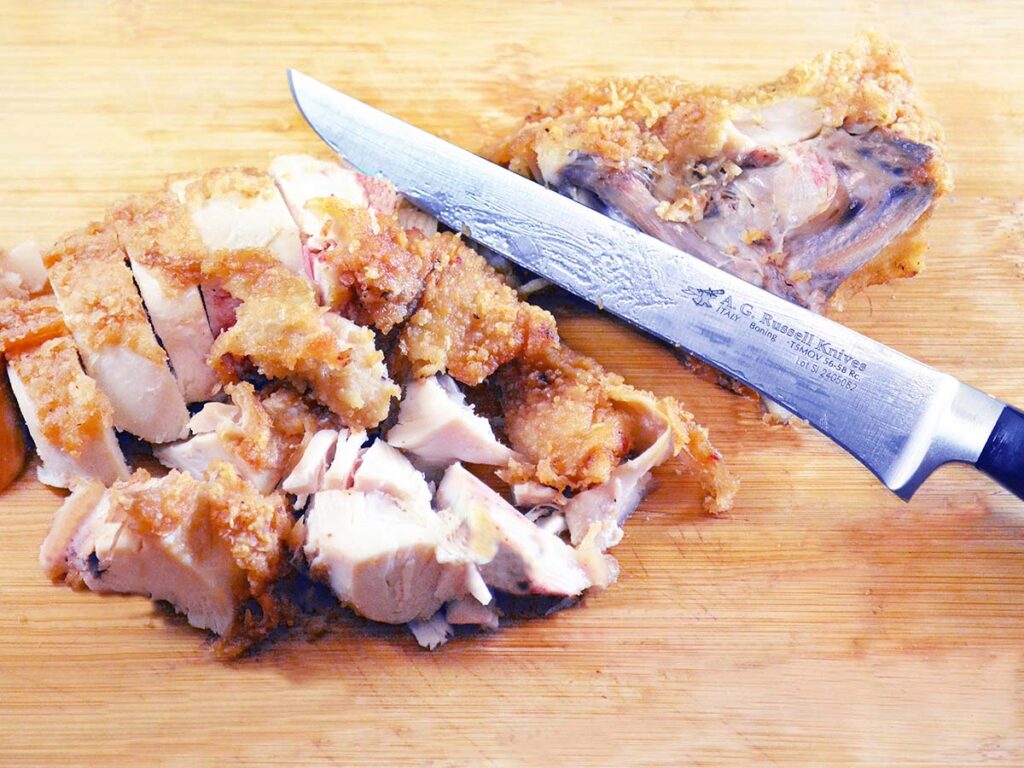
The A.G. Russell relieved the chicken breast of its hard-shell-bone understructure pronto. “Fowl such as chickens retain their juices and flavor much better when cooked on the bone,” the author noted. “Here the chicken breast is removed, sliced and ready to eat.”
The A.G. Russell 6-inch Boning Knife just might be your go-to counter slicer for a myriad of kitchen duties. While its name is designated for separating meat from bones, the A.G. Russell can perform a myriad of duties such as trimming, slicing and dicing both meat and veggies. Some even clean their afternoon catch with it as it is closely related to a fish knife. The blade is super thin and the piece is very lightweight.
The A.G. Russell got the most tedious work out of the foursome due to the nature of the beast. Fortunately, chickens go through extensive steps of processing before average folk ever set eyes on them. Whether fried, barbecued or roasted, the best way to keep a chicken breast moist is with the skin, breast meat and bone structure cooked together.
After cooking the bird, use the sharp cutting tip to cut the area around the breast skin so it can be removed with the meat. Next, peel the skin back and slowly work the blade between meat and bone structure and slowly use the fingers of your other hand to peel the entire breast off with the skin on. Slice and eat!
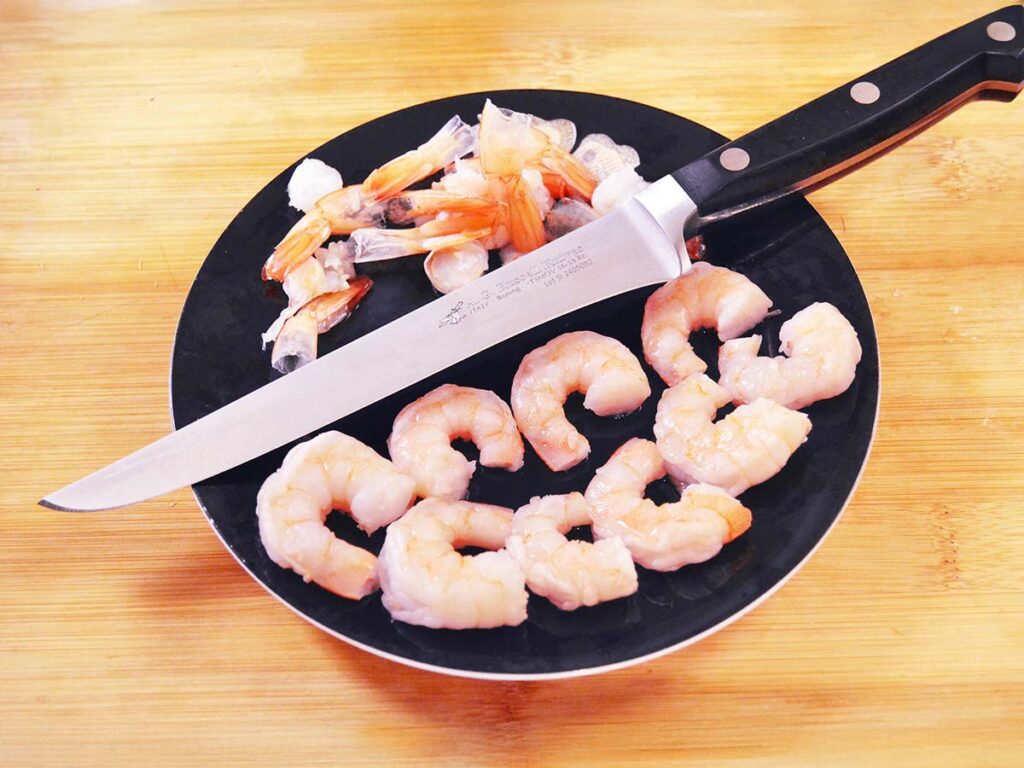
The A.G. Russell Boning Knife has a thin, sharp blade very much akin to a fish knife and can be used for other types of work around the kitchen. The author used the razor-sharp blade to cut off the tails of shrimp for a cocktail.
The Boning Knife, like the others, is handy in other ways as well. You can slice small veggies and fruits, trim fat and do all sorts of clean-up chores to make food more presentable.
Ontario Old Hickory 76 7-inch Cleaver
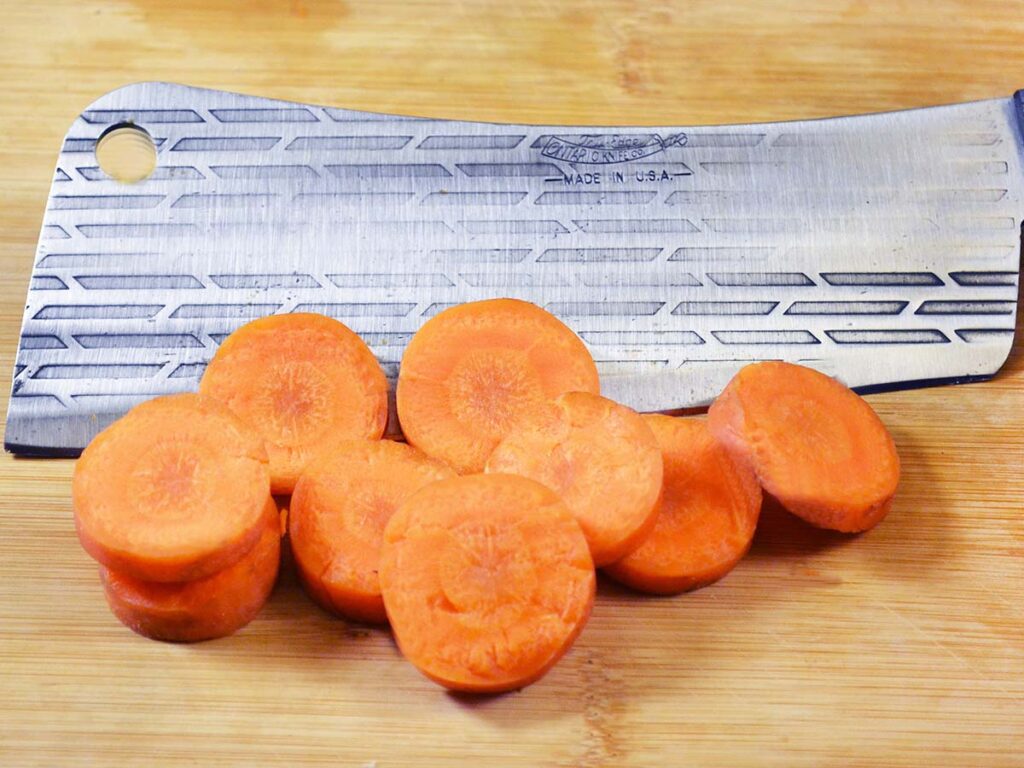
Cutting thick carrots across the grain can be tough on many kitchen knives but was easy for the Ontario Old Hickory 76 Cleaver.
Old Hickory 76 Cleaver Specs Blade length: 7.5” Blade material: 1075 carbon steel Blade grind: Flat bevel Blade finish: Brushed Handle material: Wood Weight: 10 ozs. Overall length: 12” Country of origin: USA MSRP: $30.50
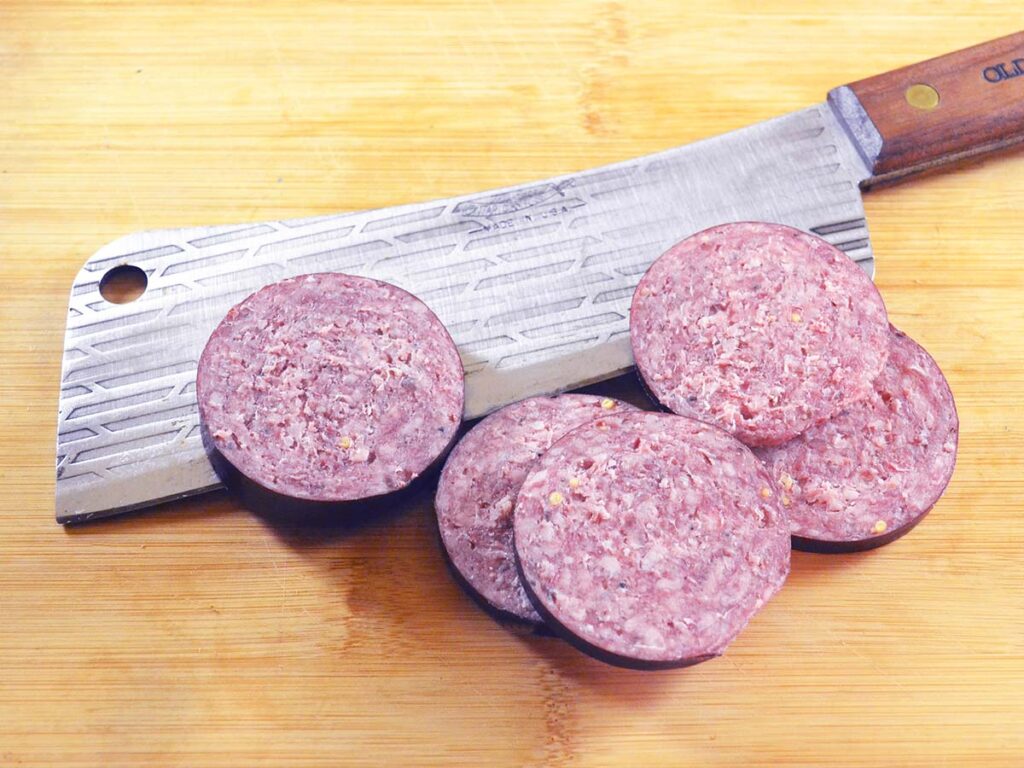
We’ve saved the big gun for last: the Ontario Old Hickory 76 7-inch Cleaver. There’s something to be said for the simple, matter-of-fact Old Hickory edged tools. Maybe it’s the “If it ain’t broke, don’t fix it” attitude—and I like it! The blade has a horizontal pattern pressed into it, a hole for hanging in the upper lead edge, and an Ontario Knife Co., Tru Edge, Made In U.S.A., sword logo stamp in the top center. The blade climbs upward toward the tip at its spine and the cutting edge has a gentle curve to it.
When you need a heavy hand and finesse is no object, the cleaver will get the job done. We used it for cutting some tough-as-nails carrots with no problem. The same went for hard sausage. There’s no sense in dulling a sharp knife blade on hard, tough foods when a cleaver can cut them with haste and look for its next challenge.
Chubs of hard summer sausage are what the Old Hickory 76 lives for.
Old Hickory blades are the kind of “git ’er done” kitchen knives and tools that take your tough challenges on their back and never cry uncle. My family grew up with Old Hickory blades and I recommend keeping them around the kitchen when tough times call for tough tools.
Final Cut
There you have it—four different ways to make your kitchen more useful without breaking the bank. If you’re ready to expand your culinary universe, look no further than these useful, able kitchen helpers.