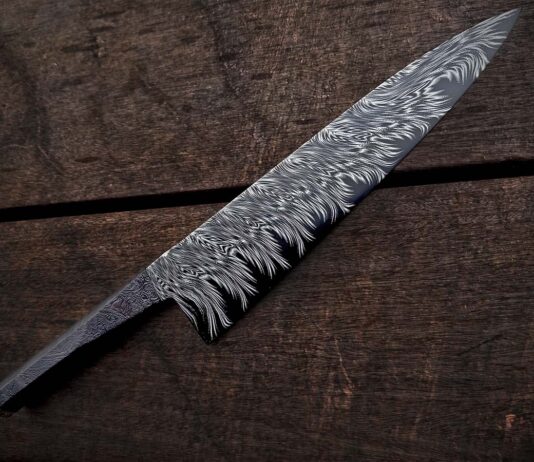
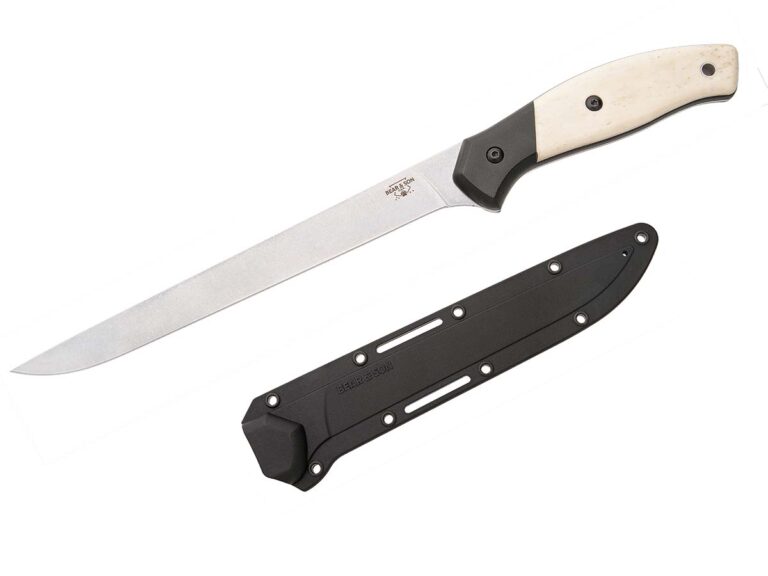
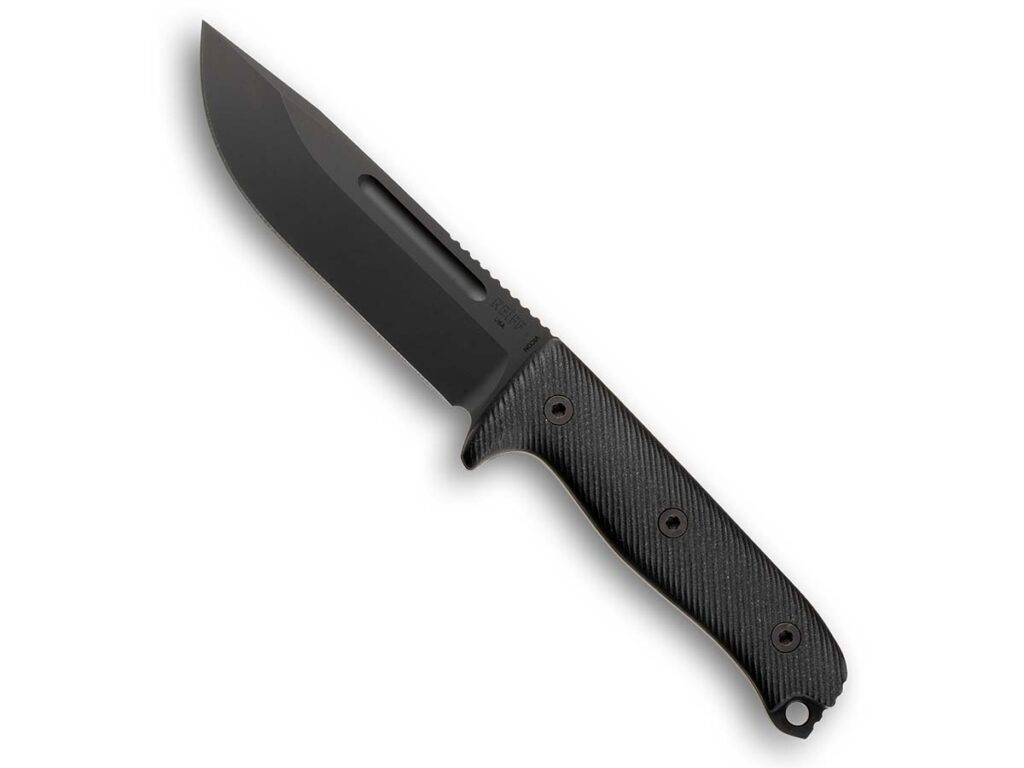
Bear & Son Cutlery’s new White Smooth Bone Professional Fillet Knife delivers precision, durability and American craftsmanship for serious anglers.
Summer fishing season just got a serious upgrade. Bear & Son Cutlery has introduced the new 11 7/8-inch White Smooth Bone Professional Fillet Knife, a purpose-built tool for anglers who demand precision from dock to dinner table.
Crafted in Alabama by a company known for keeping every step of production in-house, the WSB66 combines classic styling with modern steel performance. Bear & Son Cutlery’s fully self-contained factory handles everything—from blanking dies and heat treating to grinding, assembly, and hand-finishing—ensuring consistent quality and genuine American craftsmanship in every knife.
At the core of the Professional Fillet Knife is a 7-inch Sandvik 14C28N stainless steel blade, engineered for razor-sharp cuts, long-lasting edge retention and resistance to corrosion, even in saltwater environments. Whether trimming trout in the mountains or breaking down snapper on the coast, the blade delivers clean, efficient slices with ease.
Weighing just 4.9 ounces, the knife offers balance and control that make quick work of everything from panfish to redfish. Its White Smooth Bone handle provides a secure, comfortable grip while adding a touch of traditional character. A protective plastic blade guard ensures safe transport and storage, whether stowed in a tackle box or kitchen drawer.
True to Bear & Son’s mission of building affordable, American-made knives, the Professional Fillet Knife is designed for anglers of all levels—weekend fishermen, seasoned guides and anyone who values a dependable blade at camp or on the water.
White Smooth Bone Professional Fillet Knife Specs Blade Material: Sandvik 14C28N Stainless Steel Handle Material: White Smooth Bone Overall Length: 11 7/8″ Blade Length: 7″ Features: Protective Plastic Blade Guard Weight: 4.9 oz. Origin: Jacksonville, Alabama MSRP: $140
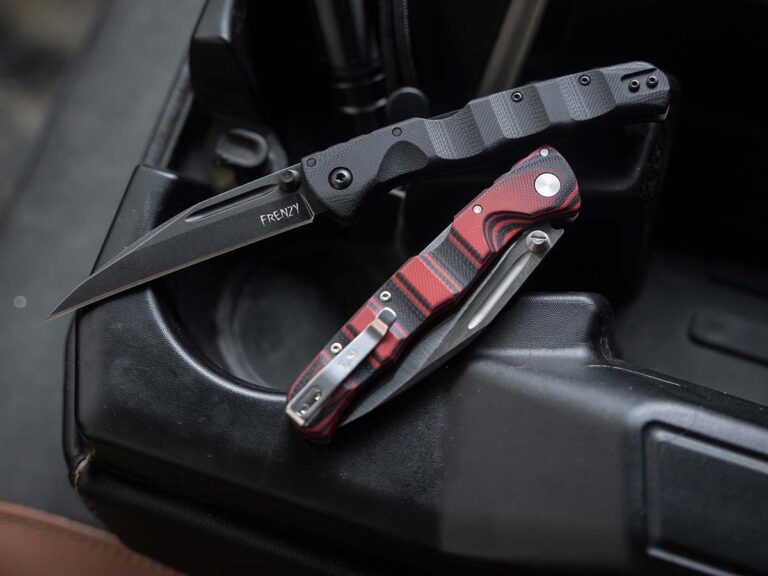
Discover the new Cold Steel Frenzy II folding knife, designed by Andrew Demko and inspired by the Japanese Kabutowari.
Cold Steel has never been shy about bold designs, and the new Frenzy II folding knife is no exception. Designed by custom knifemaker Andrew Demko, the Frenzy II takes its cues from the ancient Japanese Kabutowari and morphs those warrior-worthy aesthetics into a mega-folder ready for today’s EDC crowd.
Let’s start with the blade. At 5.5 inches, it’s not subtle—but it is refined. Forged from premium S35VN powdered steel, the long, flat edge and needle-sharp point make it as functional as it is fearsome. You get top-tier edge retention, durability and slicing performance, all dressed up with a satin line-grain polish and a deep fuller that plays with light like a katana in the sun.
But Cold Steel didn’t stop there. The Frenzy II is all about balance—of power and precision, size and slimness. Despite its impressive blade length, the handle is slim, flat and built for pocket comfort. Crafted from dual-tone, 3D CNC-machined G-10 scales, it’s grippy, eye-catching, and disappears under a shirt tail. This knife may look large, but it carries light and lean.
And yes, the Frenzy II comes equipped with Cold Steel’s bombproof Tri-Ad lock, so when that blade is deployed, it’s staying put. That kind of confidence is why Cold Steel has earned the trust of law enforcement, military and serious knife users for decades.
So, who’s the Frenzy II for? Anyone who appreciates a fusion of heritage-inspired design and modern performance. Whether you’re a collector, a gear geek, or someone who just wants a folding knife that can go toe-to-toe with fixed blades, this one’s worth a serious look.
Frenzi II Specs Weight: 5.7oz Blade Thickness: .14″ Blade Length: 5-1/2″ Blade Steel: American S35VN Handle Length/Material: 6 3/4″ Long Duo Tone G10 Overall Length: 12-14″ Additional Features: Pocket / Belt Clip Knife Type: Folder Blade Length Range: 5+ in Steel Family: CPM Blade Shape: Sheepsfoot Locking Mechanism: Tri-Ad Lock
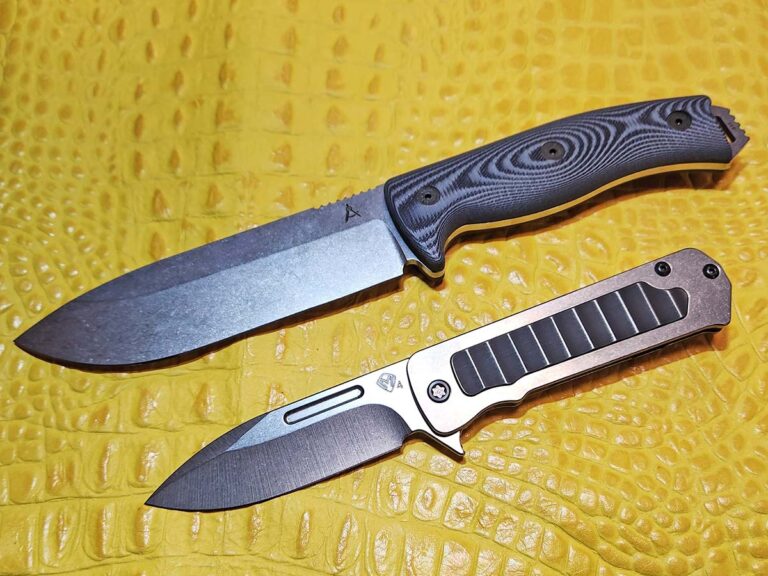
Explore the world of build-your-own knives with firsthand reviews of Medford’s TFF-4 folder and Architect’s AK 5.5 fixed blade.
In my early days of being a knifemaker, the internet played a factor in my business, largely in getting me exposure on various knife forums. As the years passed, it helped grow my enterprise, making international sales possible. These days, you can hardly imagine a knife business without the ’net.
One of the greatest challenges was helping customers decide on their orders. I had a “record” exchange with one customer of 51 emails to nail down the order. Needless to say, I later deleted the customer’s email from my files.
One way for knife enthusiasts and makers to avoid such kerfuffles is for the customer to “build” his or her knife on the company’s site and get the price, all in real time. Enter two of the outfits that provide that service today: Medford Knife & Tool and Architect Knives (there are others as well).
I went to both sites, followed their processes and “assembled” my knives. Following are the results.
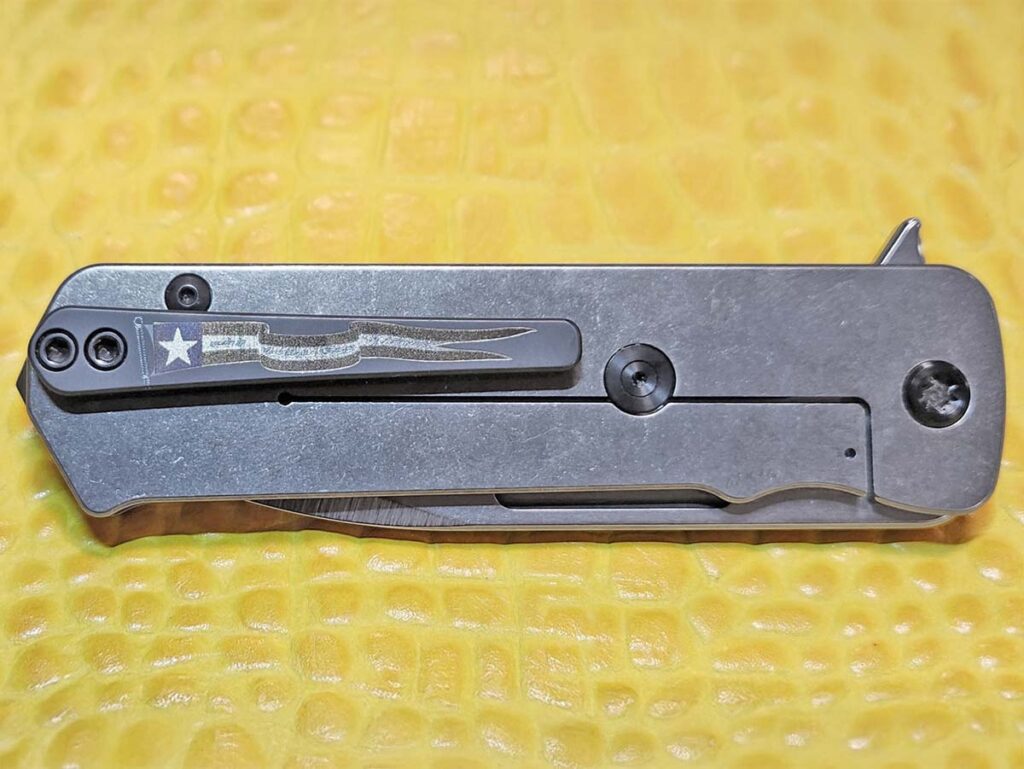
MEDFORD TFF-4 Build
If you’ve read my articles over time, you know I have a thing for knife names. While TFF-4 (starting MSRP $550) doesn’t stand out, I must start cutting companies some slack as the sheer number of manufacturers makes giving a model a name that’s not already taken nearly impossible.
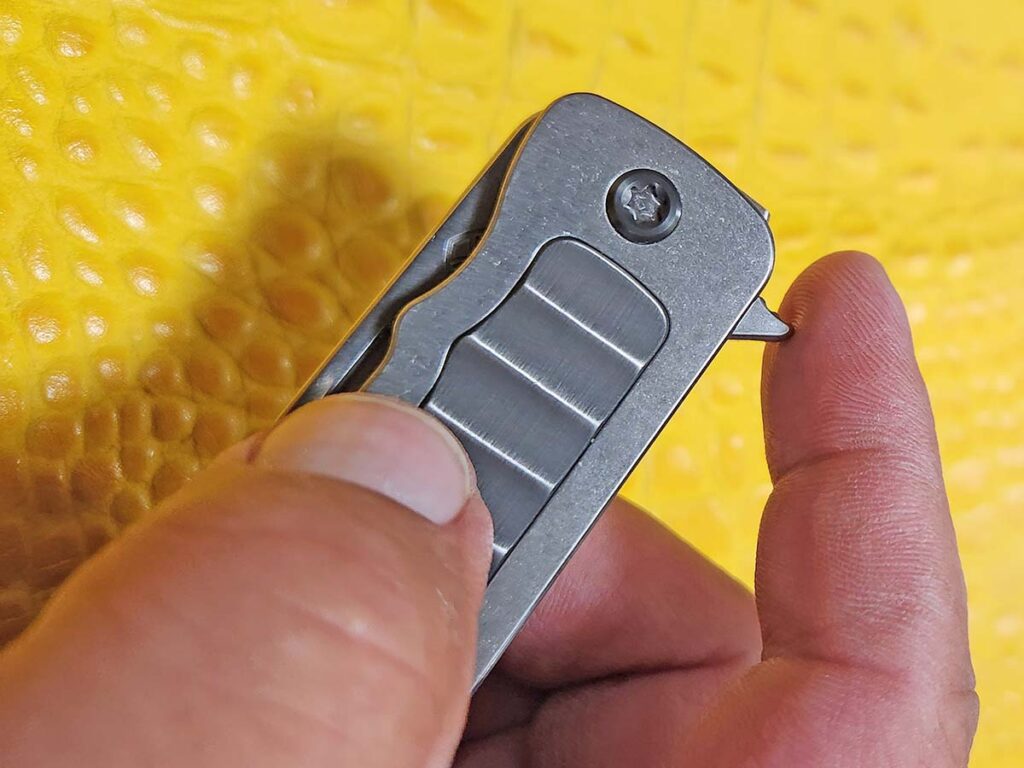
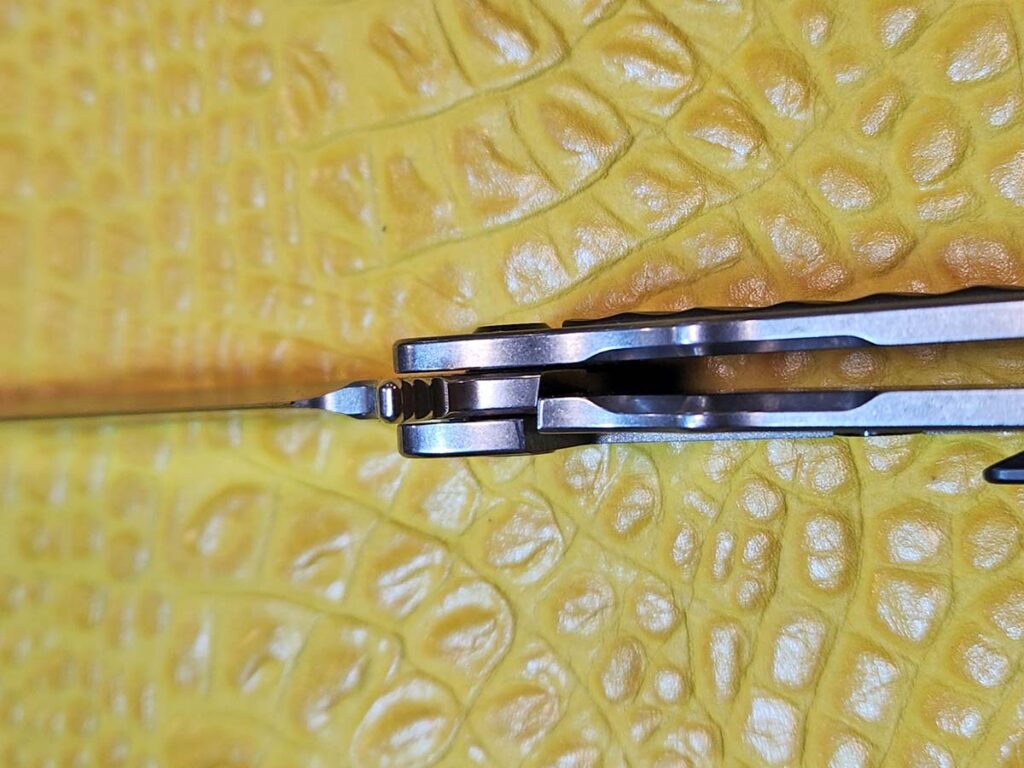
The flipper action is crisp and quick on the TFF-4. Medford provides a pronounced flip so you can quickly deploy the blade.
Anyway, back to the build.
Go to the Medford site and make your way to the “build your own knife now” button. You have three choices: folder, fixed blade or auto. Each of the applicable website pages gives you an overview of the models available. I chose folders and the TFF-4.
It couldn’t be much simpler. Follow the process starting with blade type. As you make each choice, the knife evolves and you start to see it develop. For instance, if you choose the bronze finish the color changes to match your choice. Keep in mind the devil is in the details, so play around a little bit. Either you can have everything match or you can play with contrast.
“I decided to go with a contrasting presentation by making the pivot point, screws and handle inlay black along with the spacer,” the author wrote of the TFF-4. “I could have just made the inlay black and matched the rest to the body. Options are the beauty of a build-your-own knife. I ordered the clip in black as well.”
There were only a couple of cons with the build. Granted, this is my opinion. The example knife was at the top of the page, so as I scrolled down to make my selections, I was constantly scrolling back up to see the result. Secondly, there is no visual representation of the inlay until you choose it. You select your inlay from a pull-down menu and then color options for the inlay from a second pull down. Small things, I know, but they aren’t hard knocks for me. The process still went slick as goose droppings on ice. Part of the fun is going through a number of variations. I just wish I had the money to order all the ones I like.
Medford Results
Tank best describes the resulting TFF-4. If Gucci made a tank, this would be it. I mean this in a nice way. It has style and is built solidly—think a Chris Reeve Sebenza on steroids. It’s clean and the finish is impeccable. It is a framelock design built to point. Lock up is solid and it releases smoothly with no sticking.
As the author noted, it is a lot trickier at times to get a quality lock up on a linerlock or framelock. “On the TFF-4’s framelock Medford has matched the balance between solid lock up and ease of use,” he assessed.
The blade is hollow ground from S45VN stainless. Keep in mind, you don’t have a choice of steels. Medford leaves grind lines on the hollow grind and a false grind to contrast the flat. I enjoy a hollow grind on my folders, as they are easy to get razor sharp due to the fine edge. The TFF-4 is a flipper design and opens lightning fast.
For carry, it has a robust designer clip. A downside to a sturdy clip can be that it’s difficult to attach to some pockets. The TFF-4 clip being so tight with a small opening angle makes it a bit difficult to capture some pocket rims.
Medford provides a solid user with its build-it-yourself folder. I like the clean presentation and have enjoyed carrying it. My experience with its one-handed operation has guaranteed it’s going to be riding in my pocket regularly.
ARCHITECT AK 5.5 Build
In the AK 5.5 (MSRP $285), Architect Knives offers a build-it-yourself EDC fixed blade. The blade lengths range from 3 to 8 inches in half-inch increments. At first, I saw what I thought would make an excellent bushcraft camp knife. I chose the AK 5.5 for the aesthetics and larger outdoor chores. Had I wanted an urban EDC, I would have gone with the 3-inch blade; in fact, I might still do that.
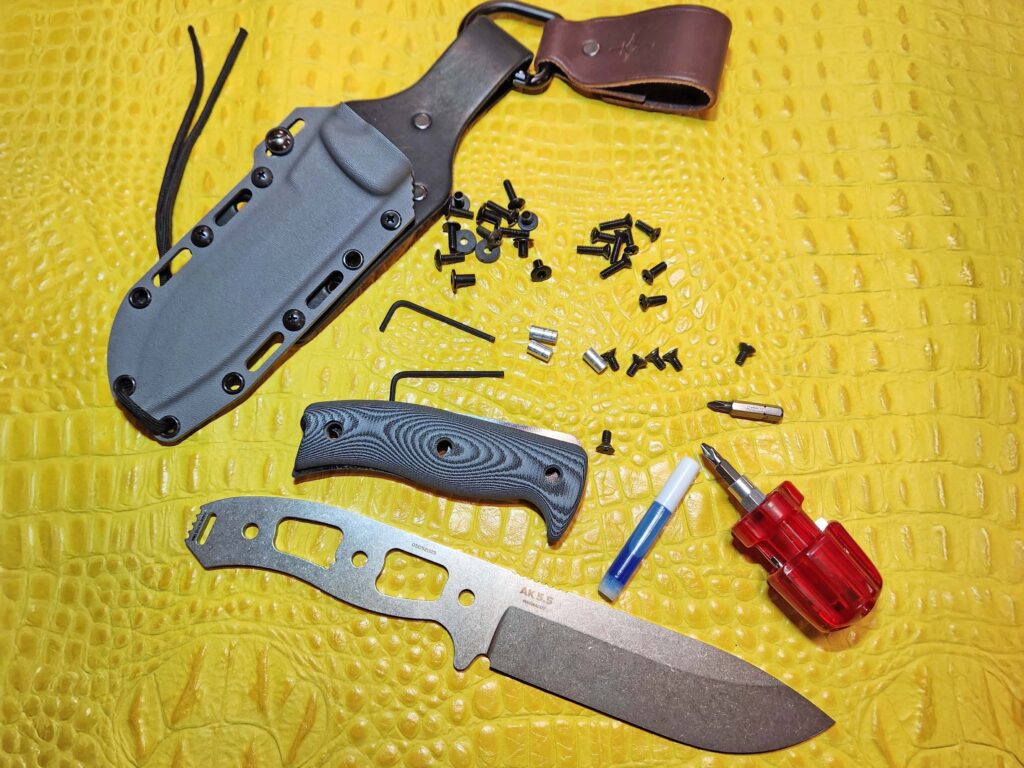
When the author pulled everything out of the bags for the Architect AK 5.5, this is what he got. The sheath was assembled. A threaded post system attaches the scales, and there were plenty of extra screws for the sheath and handle. All the bags are quality and of the Ziploc® type. Tool users will appreciate them.
To start the build process, Architect provides an icon-driven selection menu to the left and you get to see your knife develop to the right. From mine, I chose MagnaCut stainless steel, Midnite 1×1 layer G-10, and a gun-metal grey Kydex sheath with leather backer and a dangler attachment.
Operating the site was a breeze. Navigating the plethora of choices was what took time. There are too many to list here. Let’s just say if you can’t find a carry style you like with all the options Architect provides, a paper bag is your only choice. It truly was a breeze to design my AK 5.5. Each icon activates a pull-down menu of options you can choose from while still viewing your example.
ARCHITECT Results
Architect sends you a knife but it is more like you receive a kit. The knife shows up with some assembly required. You get your blade, all the hardware (plus extras) and all your options. The company provides some thread-lock epoxy and two Allen keys for the handle hardware. You will need a slotted screwdriver and a Phillips to assemble the sheath. It wasn’t much work and everything went together in a matter of minutes. I assembled mine in the front seat of my truck in the parking lot. Yes, I carry tools with me.
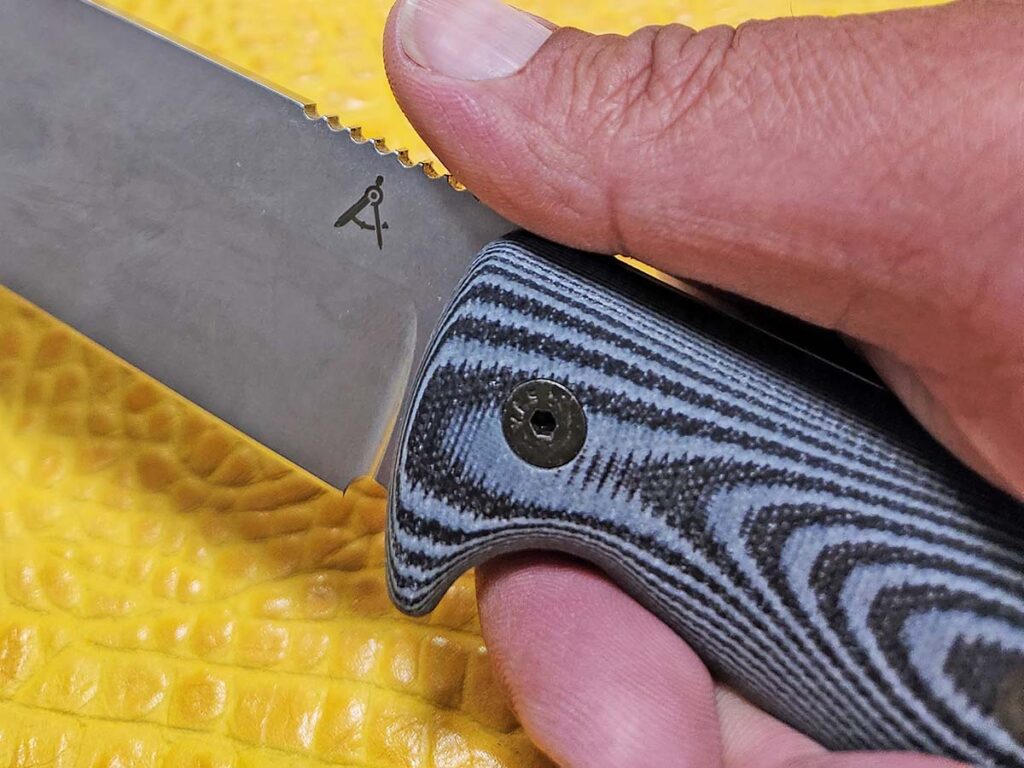
“I like thumb gimping,” the author stated of the feature on the AK 5.5, “but I will probably knock it down a bit.”
My AK 5.5 came shaving sharp out of the box. I was immediately impressed with the ergonomics of the handle. It has an extended tang with gimping and the extension has a lanyard hole. There are a number of carry options, as mentioned. I chose the Kydex with leather belt loop. The Kydex has a tension-adjustment screw and I customized the tension to my liking. As an extra I got the dangler option, which Architect gets from Casstrom with the “D” carabiner.
The blade sports a high saber grind and the spine has gimping for a thumb rest. I found the gimping a tad crisp on my thumb. It’s a sturdy knife and definitely a cutter. At the rear of the edge is a micro choil. I often find micro choils get caught up on things. The blade carves well but, as to be expected with its 1.5-inch width, it doesn’t excel at detail work. Overall, I am very pleased with the knife and would have no issue taking it on an adventure.
No Downsides
As a maker, I see no downside to building a knife online. As a customer, I see no downside, either. For both parties it streamlines the design processes and allows instant generation of information. Best of all, for the customer it eliminates a lot of the guesswork and stress associated with ordering.
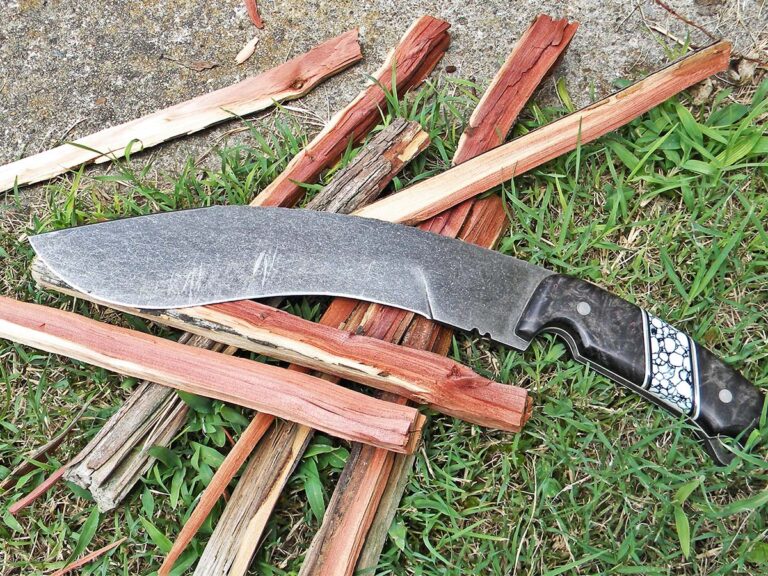
Blades and Bands Kukri is a forward-cutting knife design.
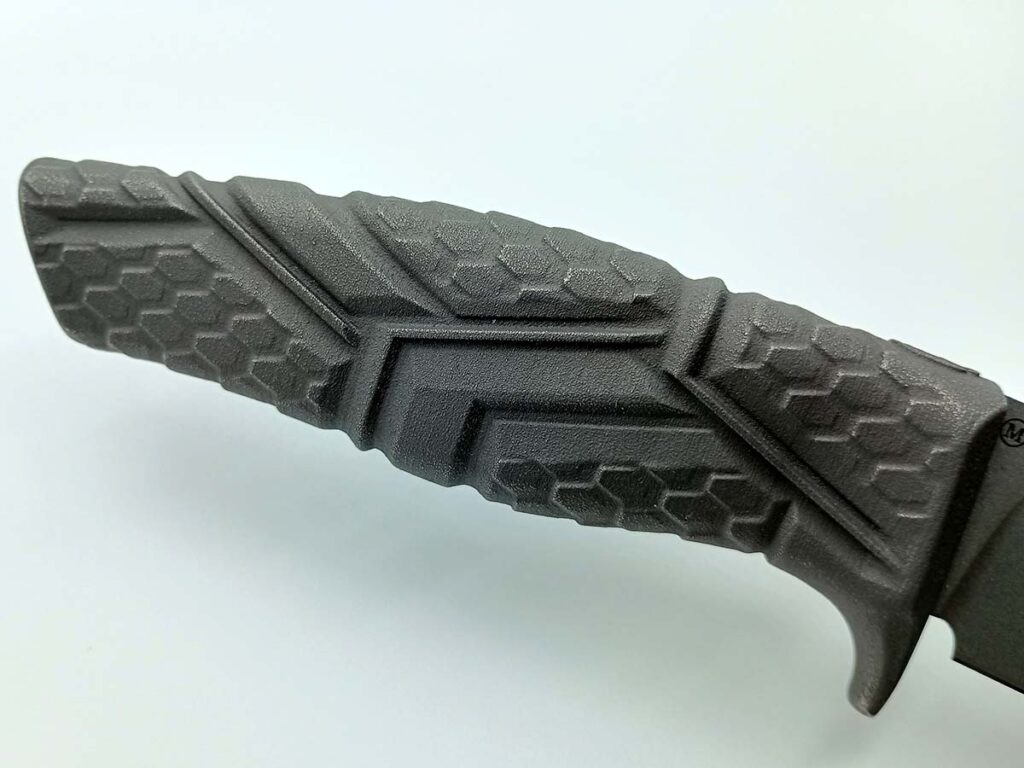
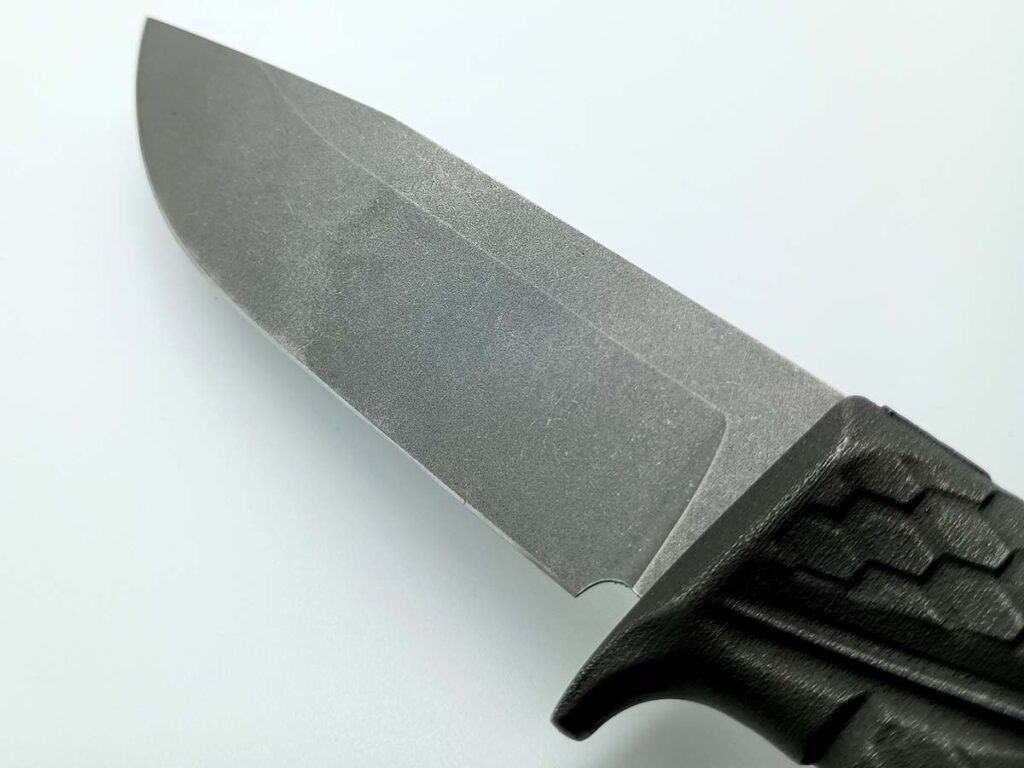
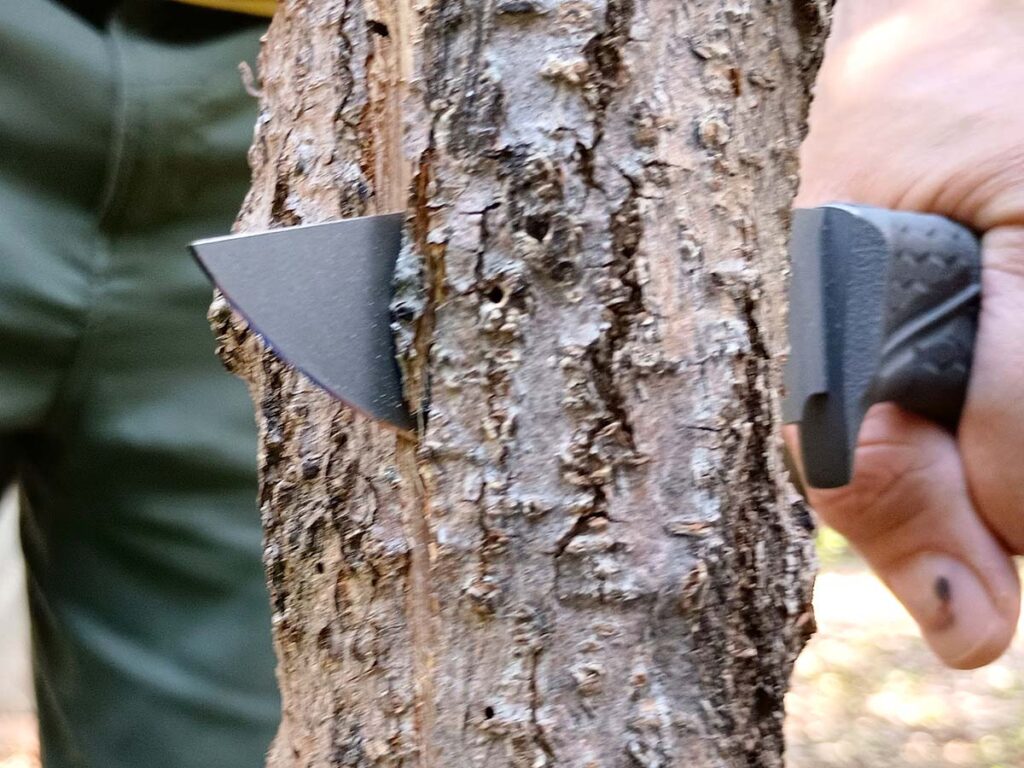
In the search for knives to test for “Spec Sheet,” I get referrals. Tracy Price is one. He’s a fairly new knifemaker but does quality work. The Kukri is a knife he made for himself to push his skills, something most makers do.
It’s always good to learn a different way to do things or a new shape. The more skills, the wider variety of knives the maker can build. No matter how pretty they look, form and function must be there. Let’s see how the Kukri functions.
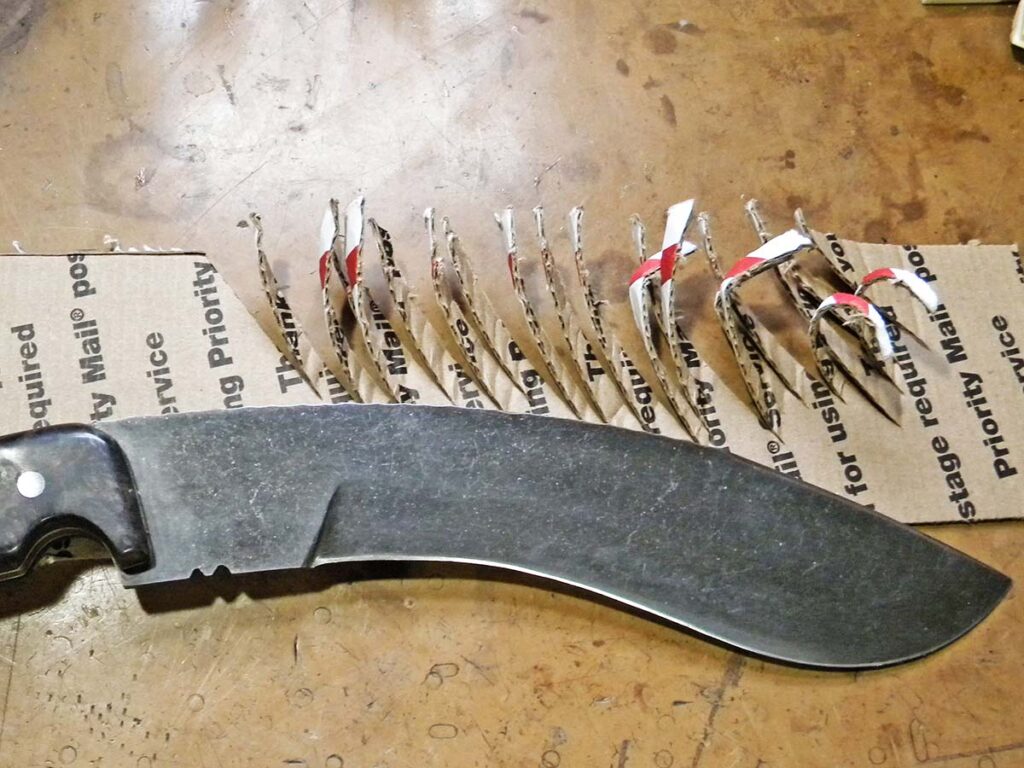
The cardboard slices curled from the edge geometry but resulted in no slowing down of the edge.
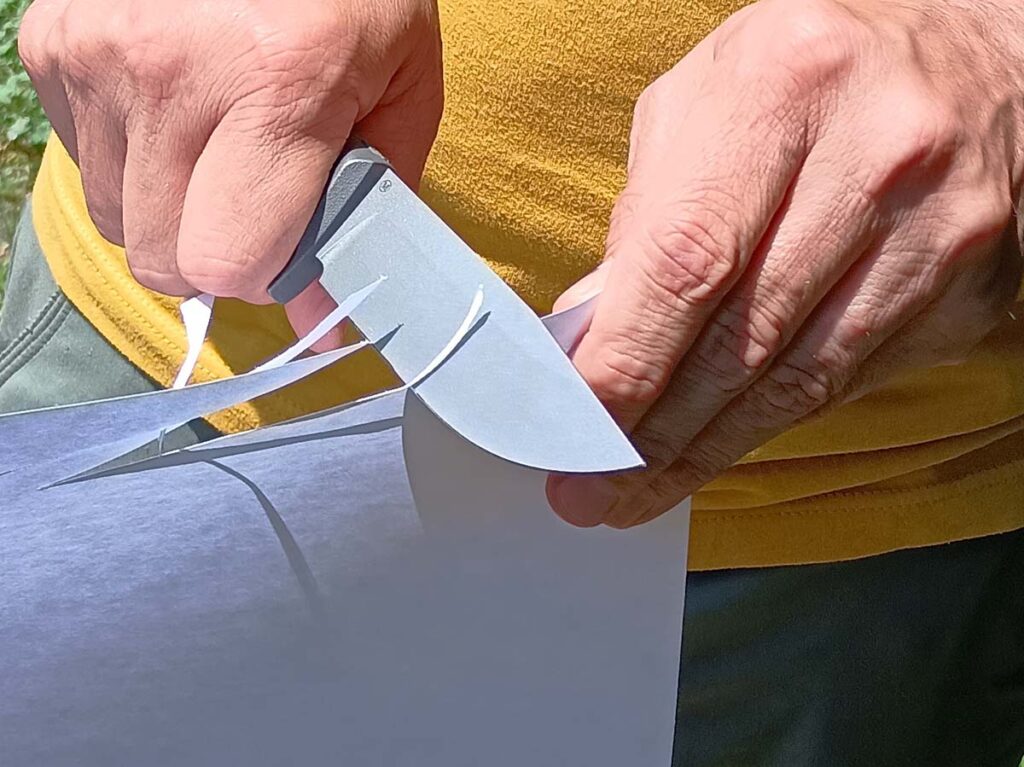
For a quick edge check, I use the paper slice. The knife cut smoothly and fast. The blade shape pulled the edge through the paper. I had to control the knife’s forward weight, but after a few slices, it was no issue. It’s a sharp blade for sure.
I cut up an old postage box and used a side of it for a single-walled cardboard cut. The knife sliced aggressively and was easy to control. The slices curled from the edge geometry but resulted in no slowing down of the edge.
Kukri Medium-Duty Cutting
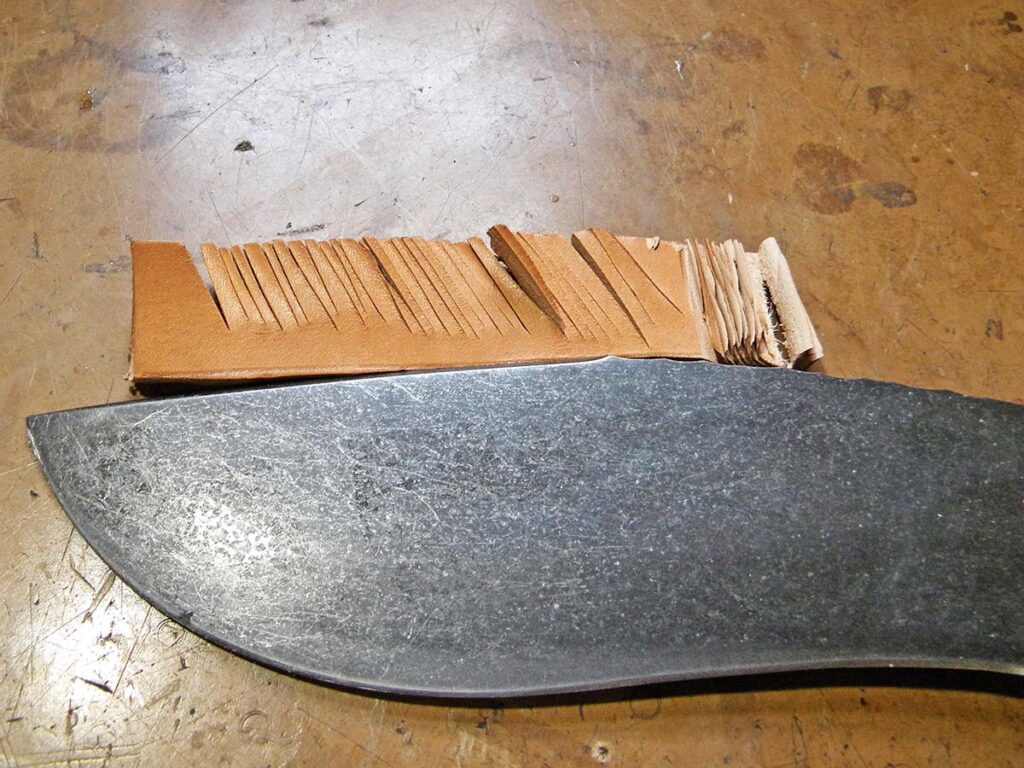
The Kukri smoked the leather cut.
Next up: 8-ounce leather for skiving. I shaved a thin slice of leather to remove the squared-off cut during sheath construction to get the leather to flow together. It was fairly easy to skive the leather; I just had to be careful of the excess part of the blade I was not using. In other words, I was both skiving leather and shaving wood off my workbench at the same time.
Cutting leather was one push and the edge hit bottom. The Kukri smoked the leather cut. I moved up and down the blade and couldn’t find a dull spot. The blade belly was the smoothest. Again, I forgot to check the clearance on the first cut and carved into my benchtop. I’m blaming it on the heat.
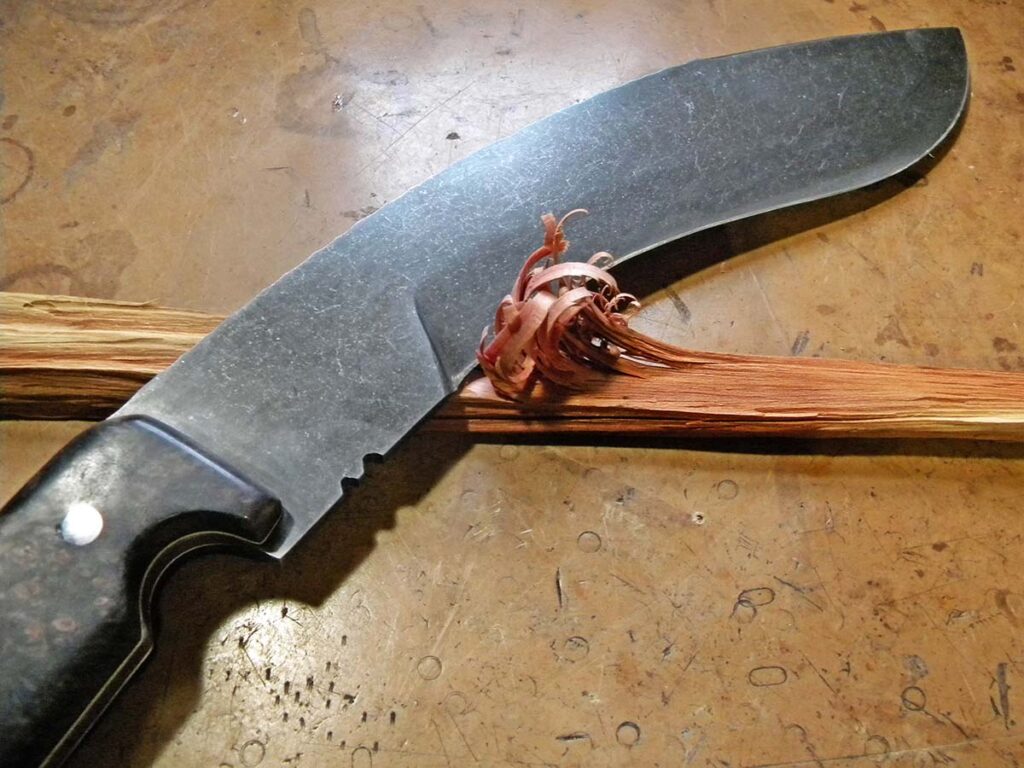
It was time to whittle some fire sticks. I easily controlled the depth of the curlicues by choking up on the handle. The knife curlicued the cedar very quickly. Yes, the Kukri can be used for finer chores, too.
Kukri Heavy-Duty Cutting
The author easily controlled the depth of the curlicues by choking up on the handle.
Chopping was next on the test menu. Finally, I got to use the Kukri and put some whacking into it. Using some red cedar firewood as a base, I started chopping kindling. One whack and I was halfway through the piece. The forward balance worked perfectly for splitting—and man, does it whack! The choil does have a sharp spot but that was easily fixed.
I went back to slicing the original piece of paper to check for dulling and/or chips. The Kukri sliced the now-damp paper very well (97° F and 90 percent humidity make paper kind of soggy). It was simply too hot to stay in the shop—test over!
Final Cut
The Kukri is an excellent field/camp knife. It’s made to chop and whack in the outdoors. However, I soften the edge of the steel at the choil.
The TiNy packs hefty performance into a light package.
Despite hailing from Germany, Philipp Utsch and Jan Gierse are fluent in the basest American vernacular—Twinkies and violence.
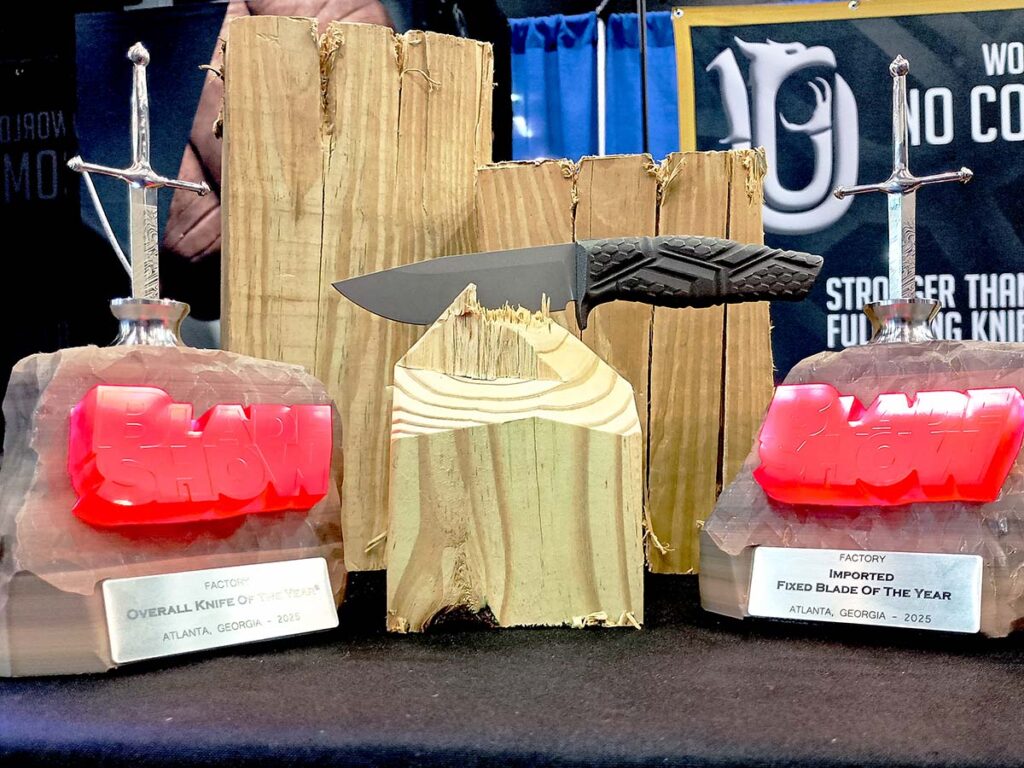
To say smashing a knife weighing all of two of the spongy confections through an 8-by-8 pine post was heard loud and clear at BLADE Show 2025 is an understatement. Aside from wowing some of the most discerning knife collectors, makers and users in the world, the tandem of Teutonic toolmakers also took home the event’s most coveted hardware.
It’s rare for fixed-blade knives to reach the pinnacle of edged tool accolades—BLADE Magazine’s Knife of the Year®. Yet, the German-made gem proved to have the edge over nearly 400 other knives clamoring for the singular honor. How?
Quite simple. Utsch and Gierse’s burgeoning knifemaking concern—UG Tools—and its award-winning knife—the TiNy—took the world’s oldest tool and firmly planted it in the 21st century.
One of the more interesting aspects of the TiNy’s meteoric rise is that this was UG Tools’ first official appearance at the BLADE Show. Utsch and Gierse were in attendance at the 2024 edge-stravaganze, but as attendees, not exhibitors.
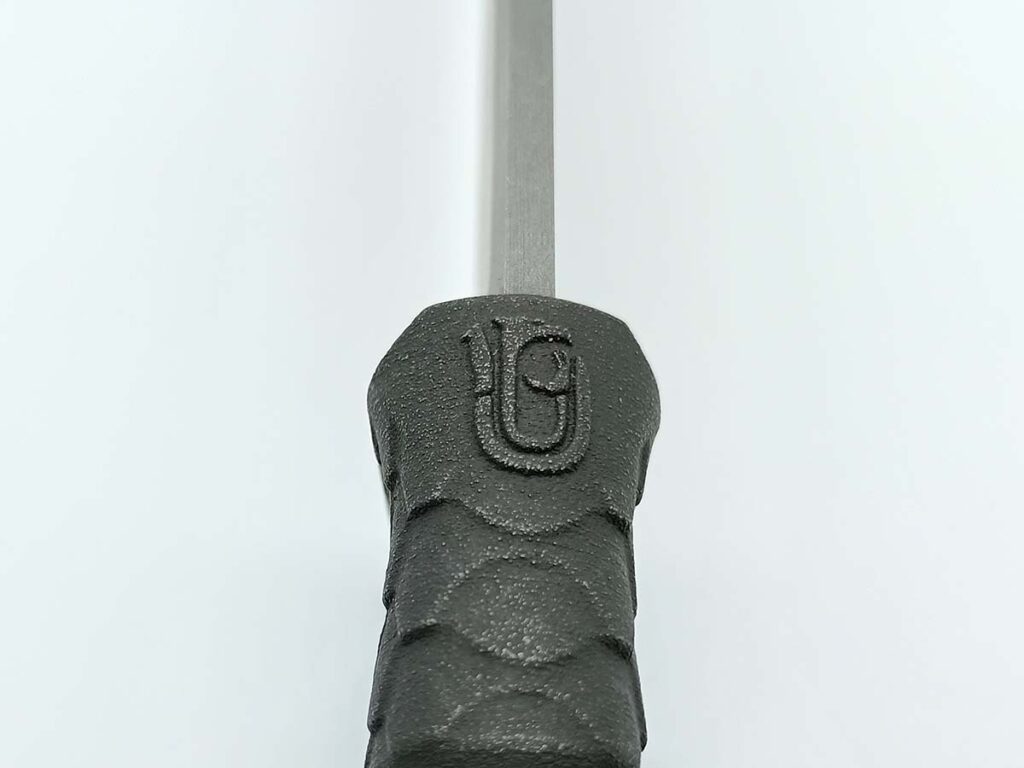
UG Tool’s mark is a combination of the founder’s last initials and some Teutonic ferocity.
The duo’s concern is also relatively new, founded in 2021. Not that knifemaking, fabrication and manufacturing were mysteries to UG’s founders.
Utsch has 20 years of knifemaking under his belt, but his daytime gig was a maintenance manager* in the founders’ hometown of Sundern. And Gierse’s career aspirations were focused on manufacturing, as he was pursuing his PhD in mechanical engineering.
It turns out, there was a lot of serendipity in those backgrounds.
Gierse’s topic focus is 3D printing—in particular, Selective Laser Melting (SLM). When he first moved into this field academically and got access to an SLM machine, a titanium knife handle was among his initial projects.
Down the line, that handle ate at him. He saw its potential, something revolutionary. He was acquainted with Utsch and approached him with the idea of teaming up to create a complete knife.
Thanks to its innovation and performance, the TiNy won both Imported Fixed Blade Knife of the Year and Knife of the Year® honors. It’s also stuck into some of its handy work, as the guys from UG Tools hacked through fence posts to demonstrate the knife’s resilience.
The bladesmith was instantly intrigued.
“[W]hen Jan suddenly sent me a photo of the first titanium handle out of the blue in 2021, I knew immediately what I was looking at. The potential was immediately clear to me,” Utsch said.
Getting A Handle On The TiNy
Funny as it might sound, the handle is the belle of the ball on the tiny. It’s where much of the innovation lies.
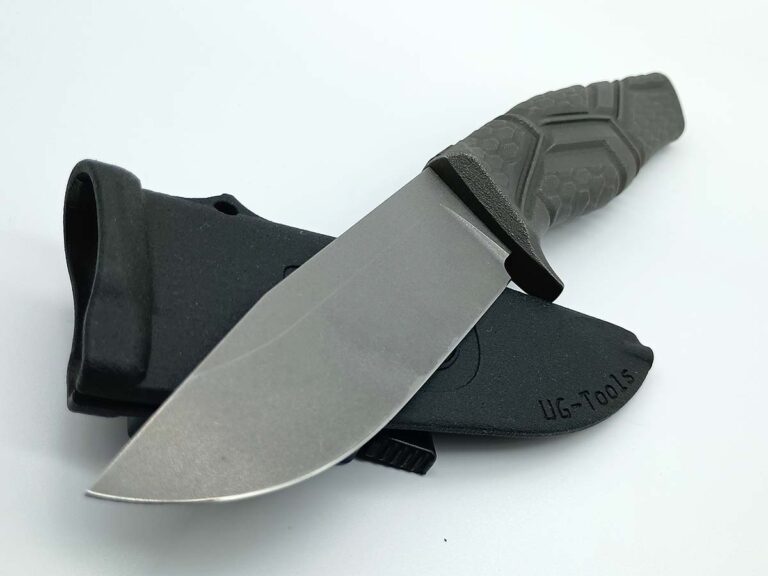
Additive manufactured, and hollow, the human-tool interface cuts the knife down to a scant 2.82 ounces—or two Twinkies. For a practical-tactical knife, this opens up a wealth of potential.
The old saying for backcountry hunting, military campaigns or just plain hiking is “Ounces make pounds, and pounds make pain.” At 8.27 inches in overall length, weight savings are substantial for a full-sized hunting, camping or military knife (the TiNy could fill all three roles).
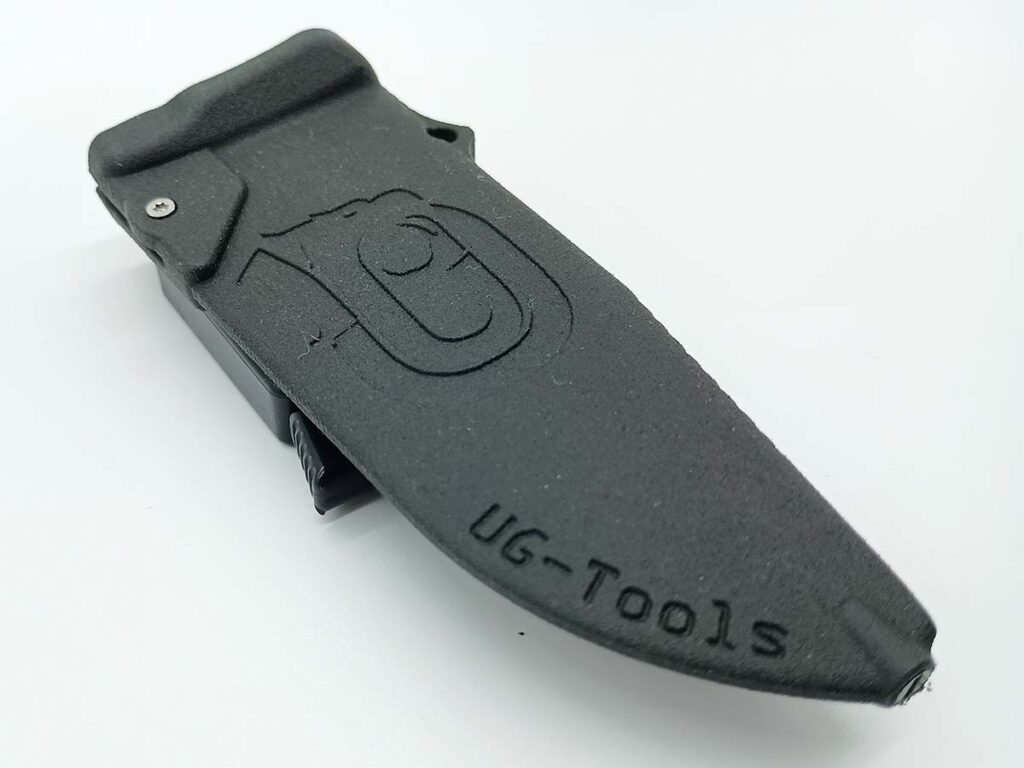
UG’s design prowess overflows to the TiNy’s sheath, a sturdy Kydex unit with a retention-adjustment screw and UltiClip UltiLink for unlimited attachment/carry options. An aside, given the hollow handle, it makes a very satisfying ping when clipped all the way into its sheath.
However, keeping things light isn’t the only advantage of the 3D printed handle.
TiNy’s Big Ergonomics
The sky is nearly the limit when it comes to SLM manufacturing, allowing for the TiNy’s advanced—if not nuanced—ergonomics. From the Pango model, I spentd time testing, which isit’s the most enjoyable aspect of the knife.
Plain and simple, in my medium-sized mitts, it feels good to hold.
Well thought out, the handle swells and recesses at the right spots to form-fit my medium-sized hands. Yet, but for my money, the integral grip texturing gets the most accolades. A mixture of dragon scale and linear elements—with a fine pebble finish—the handle stays in place no matter what axis force is applied.
The TiNy’s 3D-printed handle isn’t only lightweight, but also as comfortable as the day is long. In testing, the Pango pattern stuck firmly to the hand without firing up a hot spot.
A final point, the knife is extremely well-balanced. Using my finger as a fulcrum, it’s right behind the guard, making the blade very agile and easy to manipulate.
TiNy Blade
The 4-inch drop-point blade is very clean and understated, but well-formed for a general outdoor knife. Given UG pulled out all the stops and used MagnaCut steel, it’s also more than ready for hard use.
I appreciated the long, straight cutting surface just behind the belly. It is ample enough to facilitate larger push cuts and gives it plenty of edge on pull cuts.
Turning to Magnacut steel, UG produced a high-functioning cutting tool that requires little maintenance. Through general testing, the knife retained the same edge with which it came out of the box.
The drop on the point was just right for me to index when choking up on a pinch grip, like you might use field dressing a buck or the like. And the blade’s stonewashed finish gives it a level of tackiness, as well as hiding inevitable abuse.
TiNy Ruggedness
Interestingly, the TiNy is neither a full nor a classic tang knife, a fact that might get some traditionalists to clutch their pearls. Utsch and Gierse whacking it through an 8-inch by 8-inch post should put to rest any concerns about durability. But what’s going on to keep the blade and handle happily married?
“The extreme load-bearing capacity is achieved by the very precise press fit, in which the oversized blade is pressed into the undersized handle,” Gierse said. “This type of connection has been proven in industry for well over 100 years and transfers forces through a permanently elastic, form-fitting connection.”
UG’s knife made quick work battoning through a nearly 3-inch diameter elm log.
UG has done its testing on the knife, as well as sold several thousand and has yet to encounter a blade-handle separation.
“So far, we have not been able to damage the connection between the handle and the blade, even under extreme stress tests,” Gierse said. “This makes the knife behave like an ultra-light, fully integrated knife. Of course, the blade can break under excessive overload, just like any other knife. Despite the best heat treatment and steel, there are natural physical limits that even we cannot overcome.”
Testing The TiNny
I would have liked to have tested the TiNy during hunting season, to really put the knife through its paces. However, I received my test model during the summer and deadlines call.
In turn, I put it through a small, very unscientific laboratory evaluation that included:
Initial sharpness test on 20-pound bond paper: The tiny passed my initial sharpness test with flying colors.
Push-cut test on 1/8-inch thick1/8-inch-thick leather: It snapped straight through the leather with an audible pop.
Pull-cut test on ¼-inch double-wall cardboard: The knife made quick work of the cardboard, through 100 some cuts.
Durability Test Battoning Siberian Elm Log: Had no problem passing through a seasoned 3-inch diameter log, splitting it roughly a third of the way through. Will note, this did mar the blade finish some.
Follow-up sharpness test on 20-pound bond paper: No edge loss from the initial test.
Overall Impression
I was impressed with the cutting performance of the TiNy; however, I wasn’t too surprised given the blade material. There’s a reason why MagnaCut continues to demand respect in the marketplace and this was proven out by the blade maintaining its edge after moderate use.
I walked away most impressed with the comfort and controllability of the knife, thanks to a well-thought-out handle. I did wonder if the linear aspects of the texturing would prove hot with extended work. This wasn’t the case. I could have worked all day with the TiNy and not thought twice.
Before and after testing, the TiNy’s blade was razor sharp, able to shave through 20 bond with ease.
I’m not the only one.
James Rodebaugh met Utsch and Gierse in 2024, when they attended the BLADE Show as attendees. The duo gave the ABS Master Bladesmith and custom knifemaker a TiNy for field testing, with Rodebaugh taking it on hunting trips in both Alaska and Wyoming.
Dressing game and spatchcocking fowl, the knife proved resilient. He also tested a concern I have with any metal-handled knife—performance in cold weather.
“The printed titanium handle surprised me,” he said. “I thought it would be cold to the hand but warmed to body temp from approximately 20 degrees Fahrenheit in a heartbeat.”
Good to know you won’t take off palm flesh if you’re gutting a deer in the bowels of winter.
Final Cut
Rarely do knives—even ones deemed top-of-class—vastly change the manufacturing landscape. Is the UG TiNy one of those sea-change pieces of cutlery? Only time—and likely mimicry—will tell.
What can be said is that Utsch and Gierse have concocted a version of the age-old fixed blade that firmly plants its feet in modern manufacturing. And they’ve done so at a level that should make the TiNy a useful and trustworthy piece of kit, be it in the backwoods or battlefield.
For two Twinkies’ worth of knife that’s pretty sweet.
See what’s soon to be cutting up the scene with the new knives debuted at the 2025 BLADE Show.
As the world’s largest knife show, BLADE Show is a prime venue for the introduction of new knives. Every year, manufacturers unveil fresh creations at the Cobb Galleria, hoping to get the hottest new blades in front of the most motivated buyers and collectors.
The 2025 BLADE Show was highlighted with a ton of factory knife drops—some of them available as of the show, others trickling out later this year. Here is a look at some of the soon-to-be most coveted blades hitting the scene at your local cutlery.
Dauntless Surgeon-R
Knife type: Fixed EDC scalpel Designer: Chris Moss Blade length: 2.5” Blade material options: AEB-L and MagnaCut stainless and CPM 3V carbon steel Rockwell hardness: 60 HRC for AEB-L and 3V; 63 HRC for MagnaCut Blade grind: Flat Blade at the thickest: 1/8” Blade pattern: Scalpel Blade finish options: Tumbled, black oxide, and nitride Construction: One piece Handle material: Steel Pocket clip: Deep carry Overall length: 7” Sheath: Polymer, deep carry Country of origin: USA MSRP: Starts at $245 Available for sale: NOW
TOPS Knives Tick
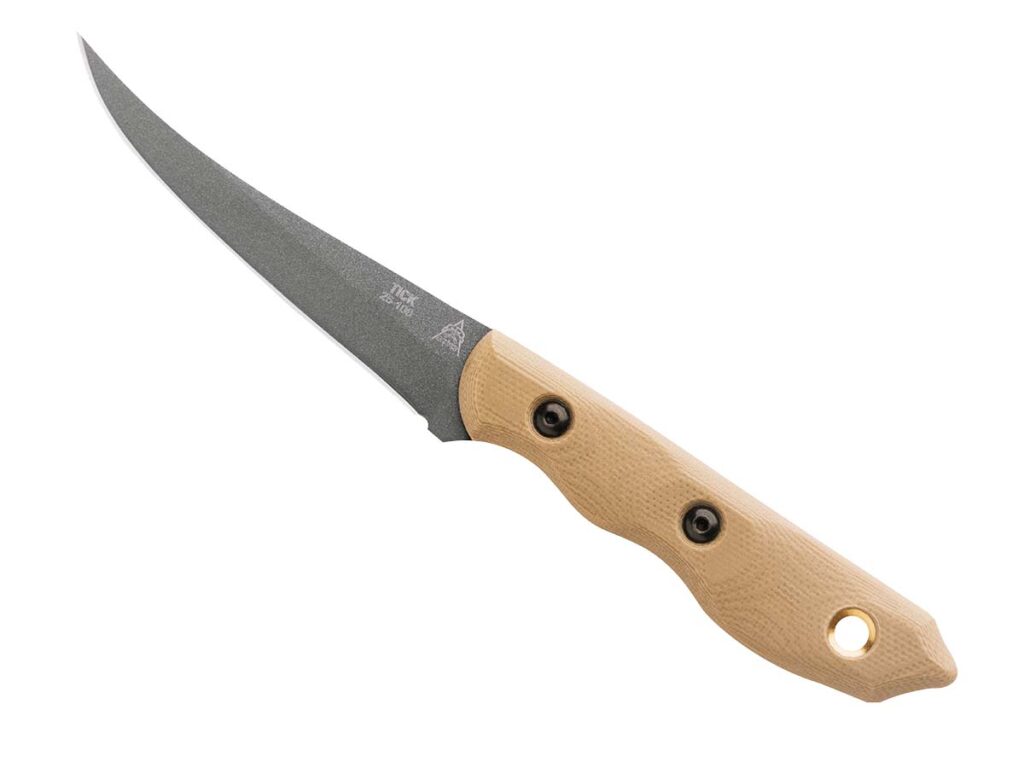
Knife type: Fixed blade Designer: Leo Espinoza Blade length: 3” Blade material: 1095 carbon steel Rockwell hardness: 56-58 HRC Blade grind: Flat Blade at the thickest: 3/32” Blade finish: Tungsten Cerakote® Construction: Full tang Handle material: Tan G-10 w/black liner Weight: 2.2 ozs. (3.4 ozs. w/sheath) Overall length: 6.38” Sheath: Black Kydex w/UltiClip for pocket carry Knife to know: The Tick is the first TOPS knife with a sheath specifically set up for pocket carry. Country of origin: USA MSRP: $220 Available for sale: NOW
Spyderco Shaman(SMKW Exclusive)
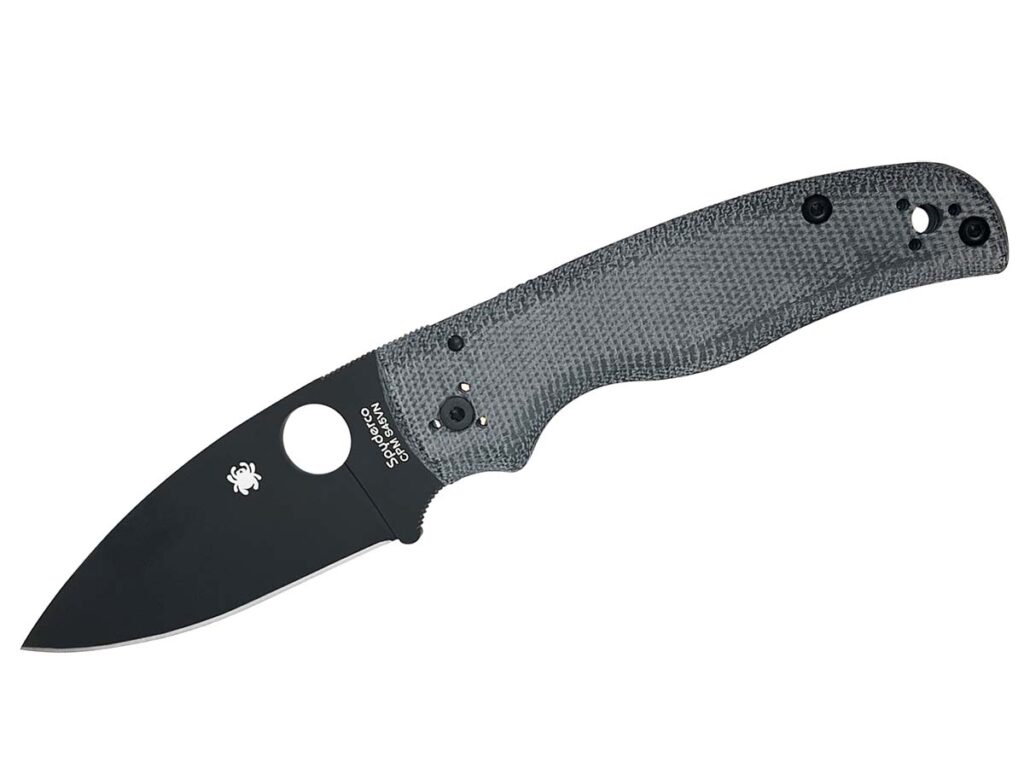
Knife type: Folder Designer: BLADE Magazine Cutlery Hall-of-Fame® member Sal Glesser Blade length: 3.58” Blade steel: CPM S45VN stainless Blade at the thickest: .145” Blade pattern: Drop point Blade finish: Black DLC Blade opener: Spyderco round thumb hole Handle material: Grey canvas Micarta® Lock: Compression Closed length: 4.67” Country of origin: USA MSRP: $279.95 Knife to know: Made by Spyderco, the Smoky Grey Shaman is sold exclusively through Smoky Mountain Knife Works Available for sale: NOW
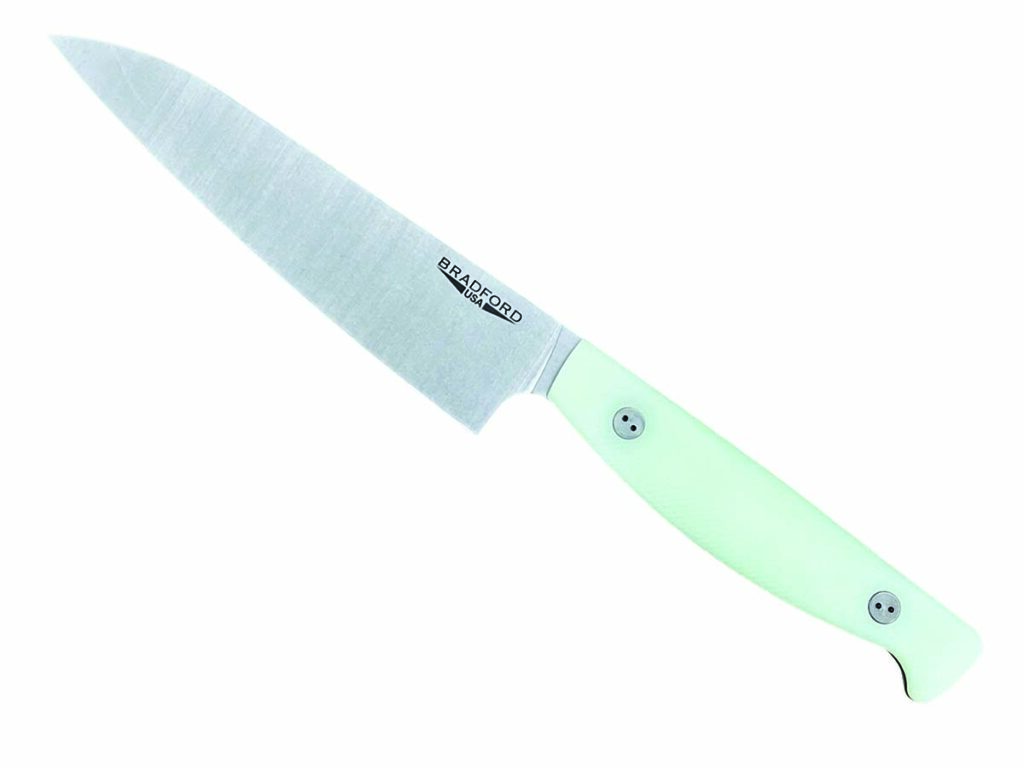
Bradford USA 6” Utility Kitchen Tool
Knife type: Culinary Designer: Bradford USA Blade length: 6” Blade steel options: AEB-L and MagnaCut stainless Rockwell hardness: 61-62 HRC Blade grind: Full-height flat Blade at the thickest: Thin .1” distal taper Blade finish: Satin stonewash Handle material options: G-10, carbon fiber, G-Wood G-10 Weight: 5 ozs. Overall length: 11” Sheath: Flat black leather sleeve Country of origin: USA MSRPs: AEB-L $169 and MagnaCut $209 Available for sale: NOW
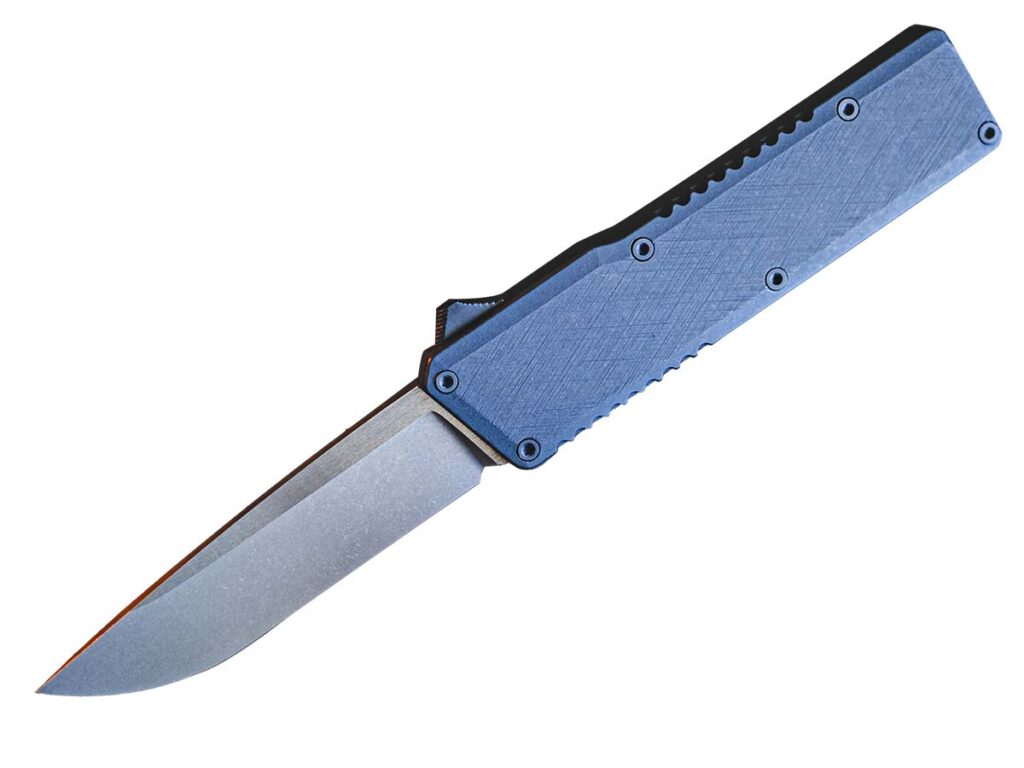
Chaves Knives Dissident
Knife type: Double-action out-the-front Designer: Ramon Chavez Blade length: 3.7” Blade steel: S35VN stainless Rockwell hardness: 58-60 HRC Blade grind: Flat Blade at the thickest: .15” Blade finish: Stonewash Construction: Screw Handle material: Aluminum Lock: Trigger Opening mechanism: Auto Pocket clip: Titanium skull model, tip down, right-handed Weight: 4.73 ozs. Closed length: 5” Knife to know: The Dissident has the new Petrified blade finish. Country of origin: Utah, USA MSRP: $400 Available for sale: Summer 2025
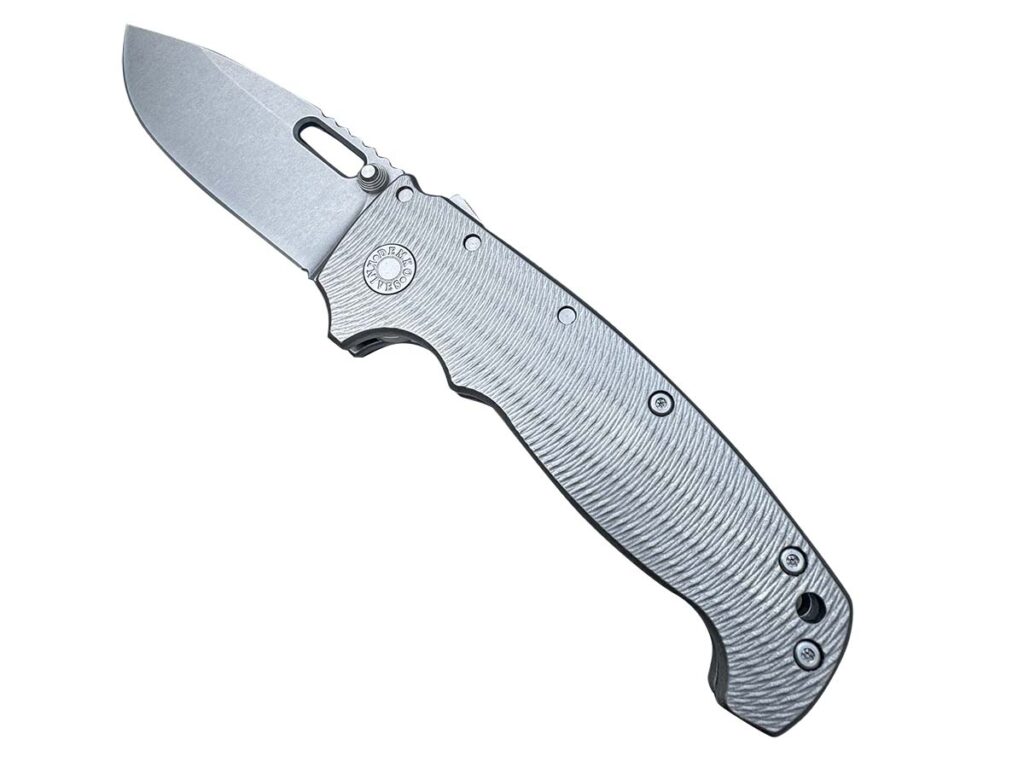
Demko Knives AD20XL Double-Wide
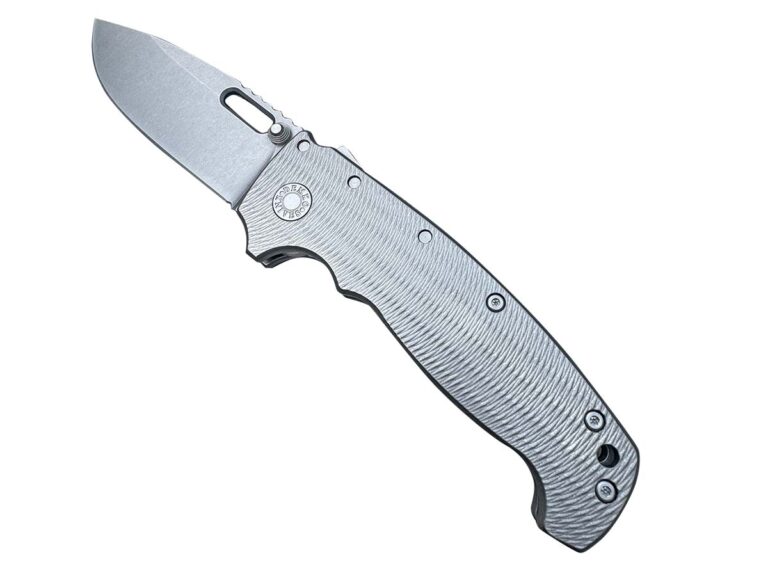
Knife type: Manual folder Designer: Andrew Demko Blade length: 4” Blade steel: MagnaCut stainless Rockwell hardness: 60-62 HRC Blade grind: Flat Blade at the thickest: .18” Blade pattern: Drop point Blade finish: Stonewash Handle material: Titanium Lock: Shark-Lock® Pivot materials: Ball bearings Pocket clip: Stainless steel /standard carry Weight: 9.6 ozs. Closed length: 5.5” Country of origin: USA MSRP: $850 Available for sale: NOW
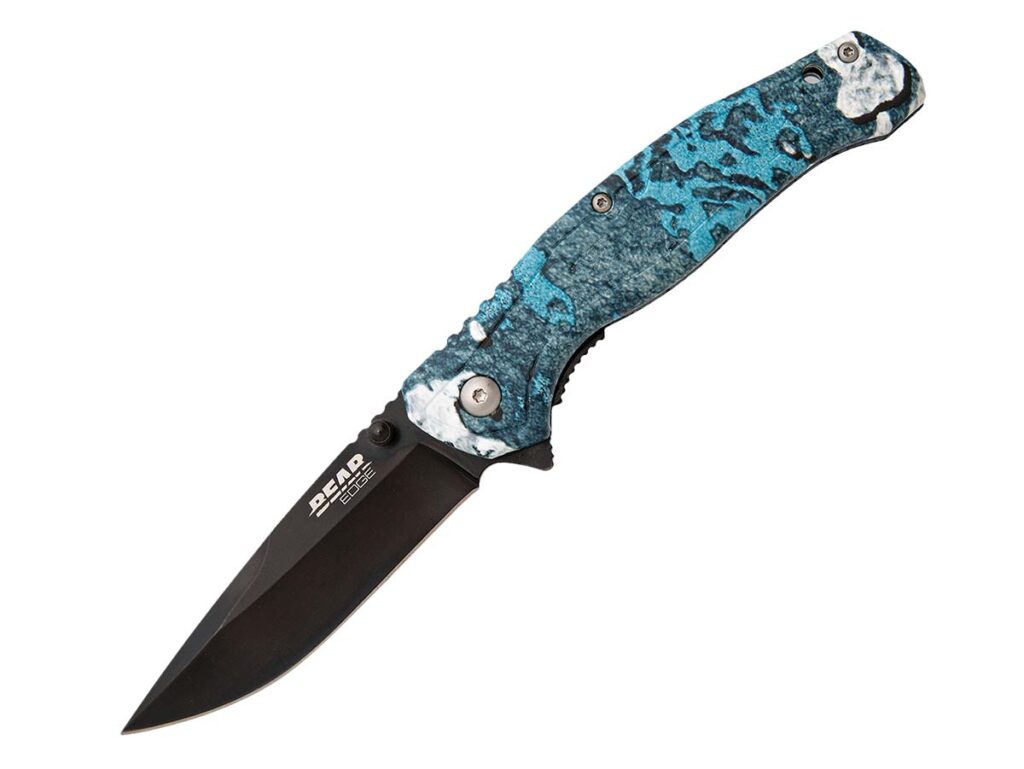
Bear Edge Brisk 2.0 Zytel Assisted Sideliner
Blade length: 3 1/8” Blade steel: 440 stainless Blade finish: Black Blade pattern: Drop point Blade opener: Ambidextrous thumb studs Handle material: Rift Blue stainless Lock: Sideliner Pocket clip: Reversible Knife to know: The handle has gimping for enhanced control Weight: 3.4 ozs. Closed length: 4 5/8” Country of origin: Alabama, USA MSRP: $40.99 Available: NOW
Reiff Knives The Vicon
Knife type: Tactical fixed-blade field knife Designer: Stu Shank in collaboration with a group of active U.S. Special Forces members Blade length: 5.19” Blade steel: CPM MagnaCut stainless Rockwell hardness: 60-62 HRC Blade grind: Flat saber Blade at the thickest: .188” Blade pattern: Clip point Blade finish options: Black DLC, FDE PVD and stonewash Construction: Full tang Handle material options: Black or OD green G-10 and black or green canvas Micarta® Weight: 9.8 ozs. Overall length: 10.22” Sheath: Modular ambidextrous Kydex w/removable drop plate and removable Kydex belt clip Special features: False edge clip point, fuller, gimping; partially exposed pommel w/gimped thumb ramp for reverse grip use Country of origin: USA MSRP: $420-$435 Available for sale: NOW
Maserin 632 CB-1
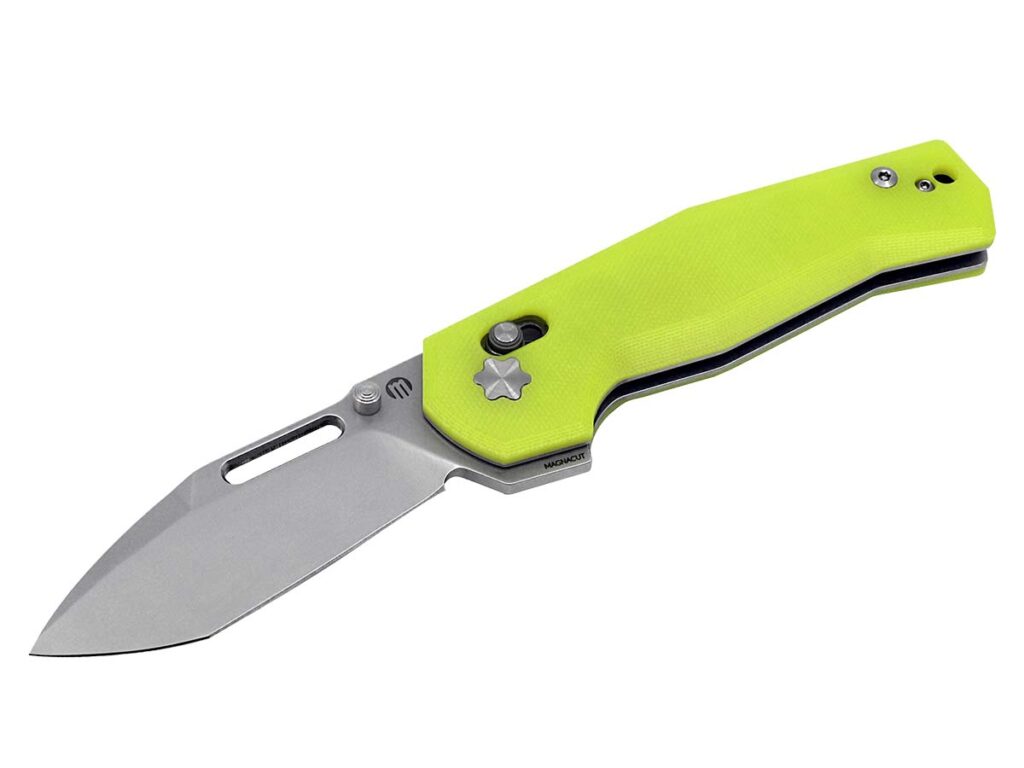
Knife type: Folder Designer: Coltellerie Maserin Blade length: 3.15” Blade steel: MagnaCut stainless Rockwell hardness: 62 HRC Blade grind: Compound Blade at the thickest: .13” Blade pattern: Drop point Blade finish: Stonewashed Construction: Screw Handle material: Neon yellow G-10; other options include Micarta and FatCarbon® Glass Lock: Crossbar Pivot materials: Steel ball bearings Pocket clip: Deep carry, tip up, reversible, stainless steel Weight: 4.23 ozs. Closed length: 4.48” Special features: 632 CB-1 is Maserin’s first knife featuring a crossbar mechanism; drop point blade w/a sporty, futuristic design; four blade opening options enhance ambidextrous deployment: dual thumb stud, thumb hole, crossbar and flipper Country of origin: Italy MSRP: $199 (Micarta and G-10) and $215 (FatCarbon Glass) Available for sale: Mid-September
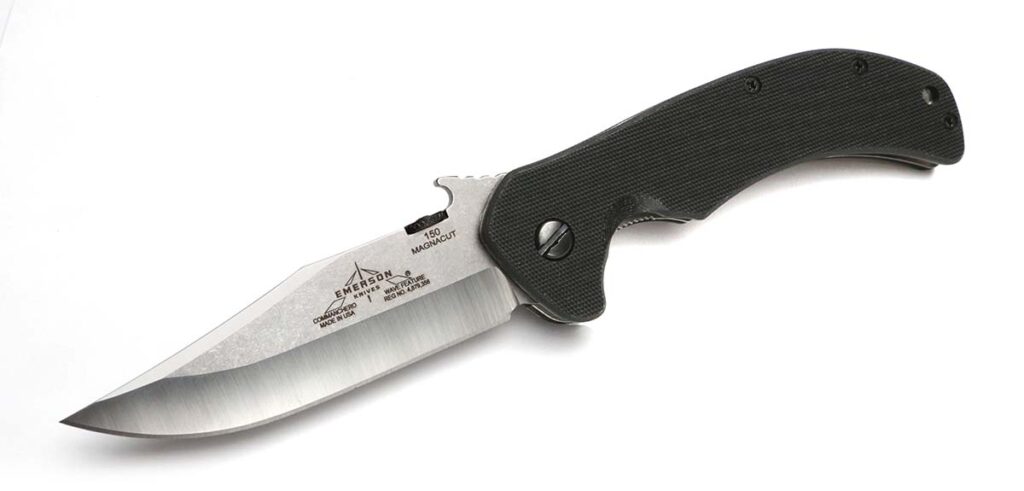
Emerson Knives COMANCHERO
Emerson Knives COMANCHERO
Designer: Ernest Emerson Blade length: 3.8” Blade steel: MagnaCut stainless Rockwell hardness: 62-64 HRC Blade grind: Conventional “V” Blade at the thickest: .125” Blade pattern: Bowie Blade finish options: Stonewash and Thunderstorm Blade opener: Thumb button Pivot materials: Teflon washers Handle material: G-10 Lock: Titanium linerlock Pocket clip: Hardened stainless steel, tip up Weight: 5 ozs. Closed length: 5.1” Special feature: Emerson Wave opening Country of origin: USA MSRP: $319 Available for sale: NOW
Utica Critical Hit II
Knife type: Necker Designer: Utica Blade length: 2.5” Blade steel: MagnaCut stainless Rockwell hardness: 55-57 HRC Blade grind: Taper Blade at the thickest: .12” Blade pattern: Spear Blade finish: Powder coat Construction: Full tang Handle material: G-10 Pocket clip: Stainless steel, tip down Weight: 2.45 ozs. (4.2 ozs. w/sheath) Overall length: 6.75” Sheath: ABS synthetic w/paracord Country of origin: USA MSRP: $170.71 Available for sale: NOW
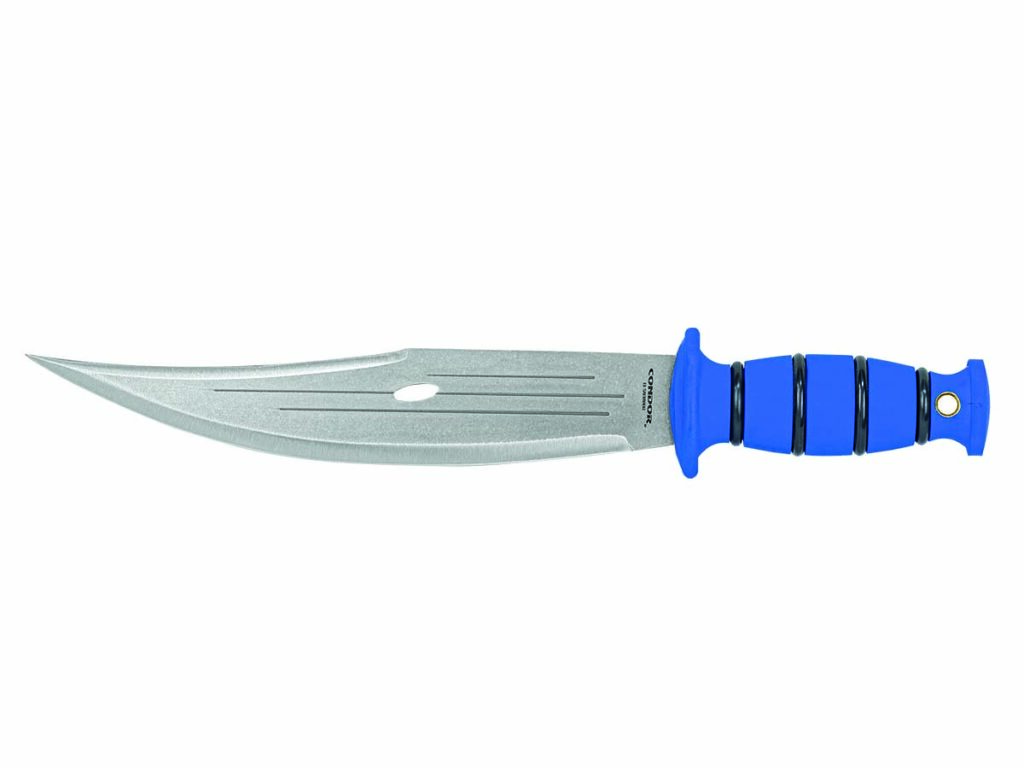
Condor Tool & Knife Jungle Bowie
Knife type: Fixed blade Designer: Arlan D. Lothe Blade length: 11.2” Blade material: 1075 carbon steel Rockwell hardness: 50-55 HRC Blade grind: Convex Blade at the thickest: .12” Blade finish: Natural stonewash Construction: Stick tang Handle material: Thermoplastic elastomer Weight: 16.93 ozs. Sheath: Handmade welted leather Country of origin: El Salvador MSRP: $89.98 Available for sale: NOW
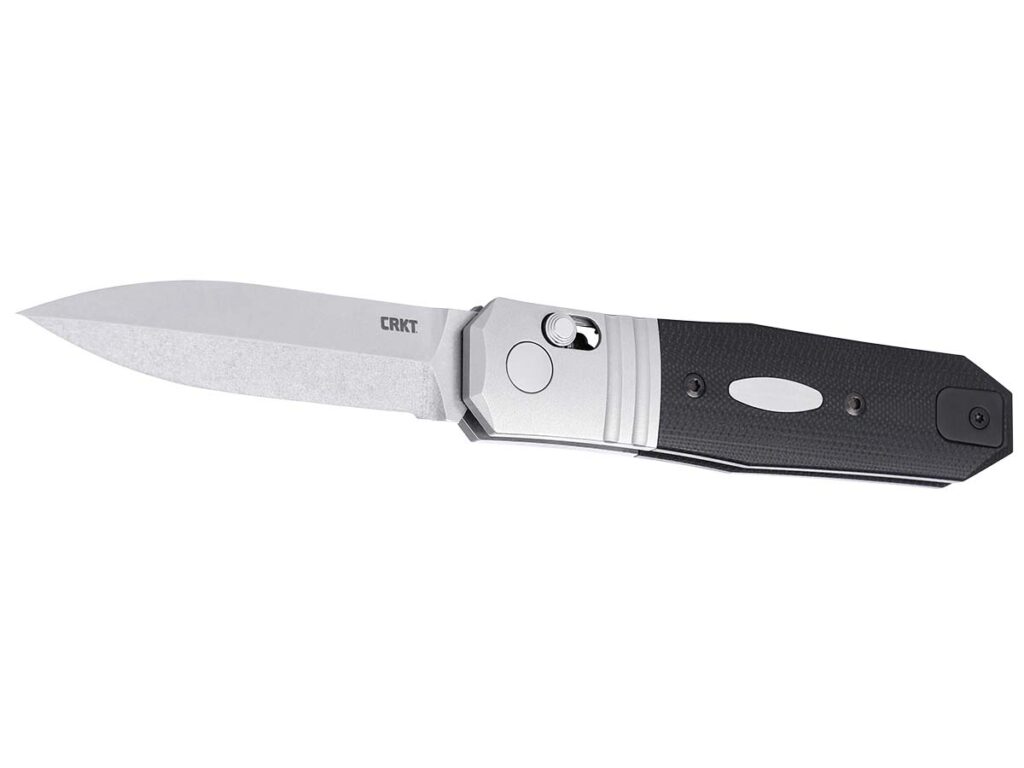
CRKT Redemption Compact
KNIFE TYPE: EDC folder Designer: BLADE Magazine Cutlery Hall-of-Fame® member Ken Onion Blade length: 3.28” Blade steel: MagnaCut stainless Rockwell hardness: 61-63 HRC Blade grind: Flat Blade at the thickest: .13” Blade pattern: Spear point Blade finish options: Stonewash and black Cerakote® Construction: Screw Handle material: G-10 w/stainless steel bolster Lock: Crossbar Pivot materials: IKBS ball bearing Pocket clip: Reversible, deep carry, tip up Weight: 4.1 ozs Closed length: 4.31” Country of origin: USA MSRP: $225-$250 Available for sale: NOW
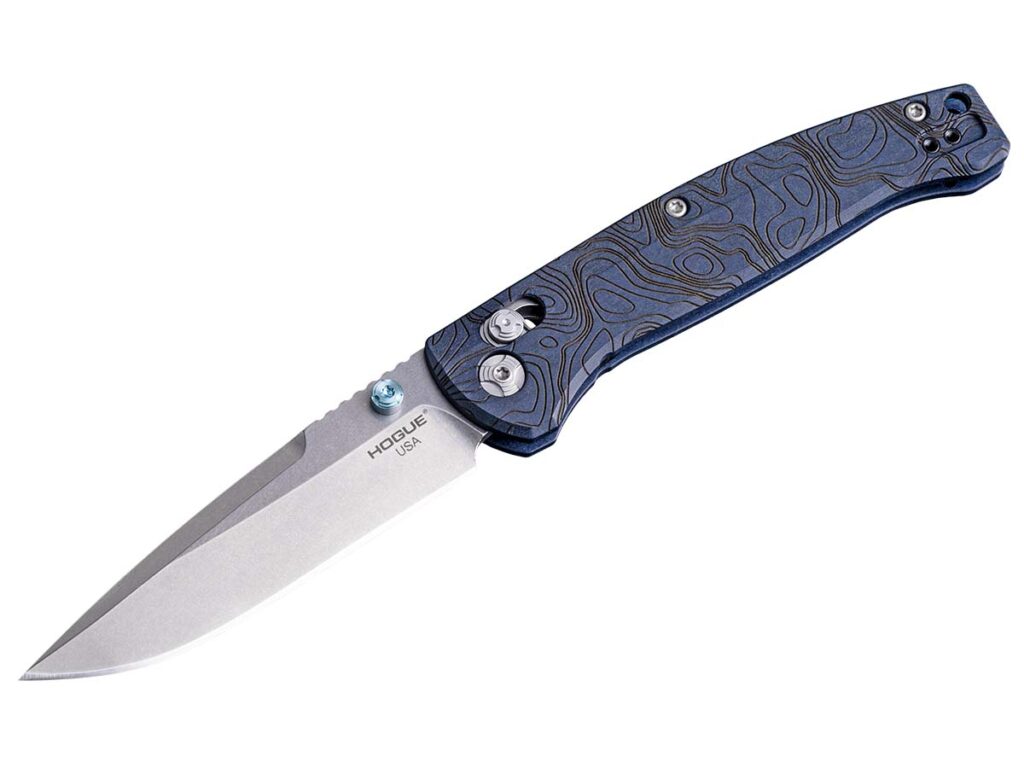
Hogue Knives Mysto Water
Knife type: EDC folder Designer: Scott Bruhns Blade length: 3.4” Blade steel: CPM MagnaCut stainless Rockwell hardness: 62-64 HRC Blade grind: Flat Blade at the thickest: .115” Blade pattern: Clip point Blade finish: Stone tumbled Construction: Screw Handle material: Blue Canyon Richlite Lock: ABLE Lock® Pocket clip: Deep carry, tip up, ambidextrous Weight: 2.5 ozs. Closed length: 4.4” Special features: Titanium backspacers anodized a light blue Country of origin: USA MSRP: $179.95 Available for sale: NOW
Keep your knife cutting ready with today’s top sharpeners.
It’s not much of a knife if it’s dull. Getting a blade sharp and keeping it that way is what the top sharpeners are all about. Pull throughs, V sharpeners, adjustable angle models and more, contemporary sharpeners not only will keep your knives keen, some are multi-tools with Torx tools and bits, screwdrivers, fire starters and window breakers. From those for use in the kitchen, camp or workshop to portable use and more, make way for today’s sharp makers.
Lansky Master’s Edge Sharpener
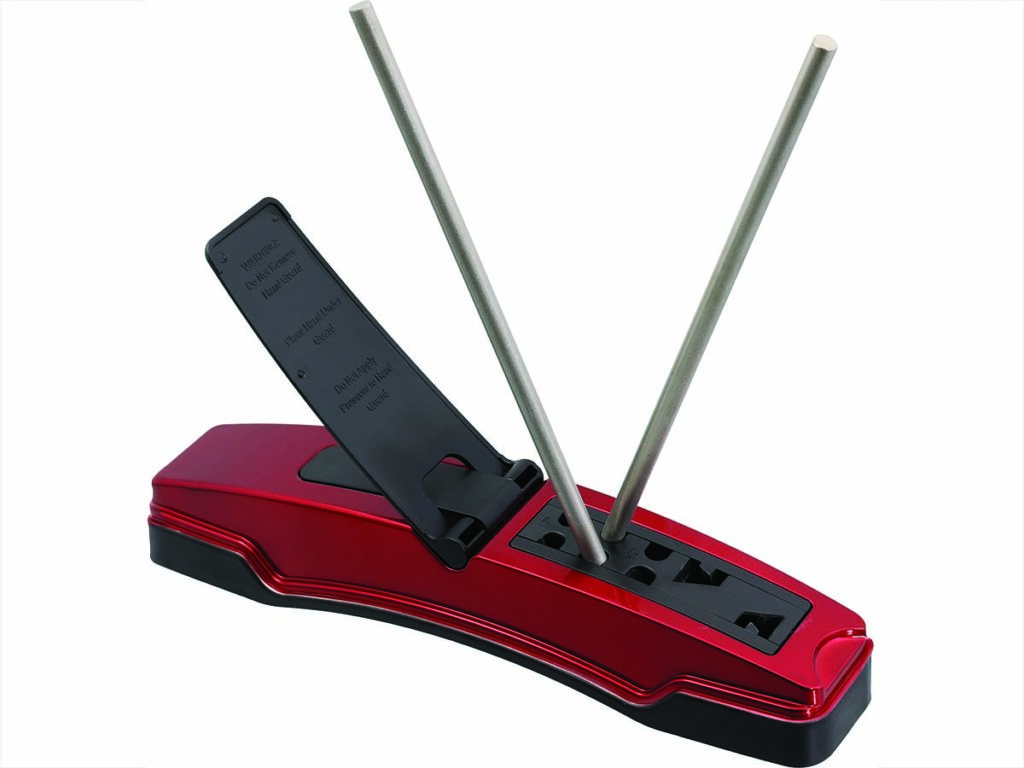
The Lansky Master’s Edge All Diamond Sharpener has a rubberized non-slip base with integrated hand guard for safe use.
Master’s Edge All Diamond Sharpener Model type: V sharpener Type of abrasive: Diamond coated Grit: 400 & 600 grit round rods; triangular rod for serrations Types of knives sharpened: Fillet/slicing, butcher, paring, skinning/kitchen/hunting, camping, utility and chef’s Types of edges sharpened: Plain and serrated Weight: 1.4 lbs. Country of origin: China MSRP: $139.95
Inspired by the design of Lansky’s top-selling Master’s Edge Sharpener, the Master’s Edge All Diamond Sharpener and its diamond-coated abrasives put a factory edge on hunting, utility, kitchen and other knives with just a few strokes. The unit includes a pair of medium (400 grit) and fine (600 grit) diamond-coated-abrasive rods for sharpening and polishing at your choice of preset angles: 17, 20 and 25 degrees. The 17-degree setting is for fillet and fine slicing knives, while the 20-degree angle is for slicing, butcher, paring and skinning knives. The 25-degree setting sharpens hunting, camping, utility and chef’s knives. A diamond-coated triangular rod sharpens serrated blades and also awls and fishhooks. A rubberized non-slip base with integrated hand guard ensures safe use and features easy snap-in storage in its underside. The unit can be kept on a counter or stores easily in a drawer.
Work Sharp Folding Field Sharpener
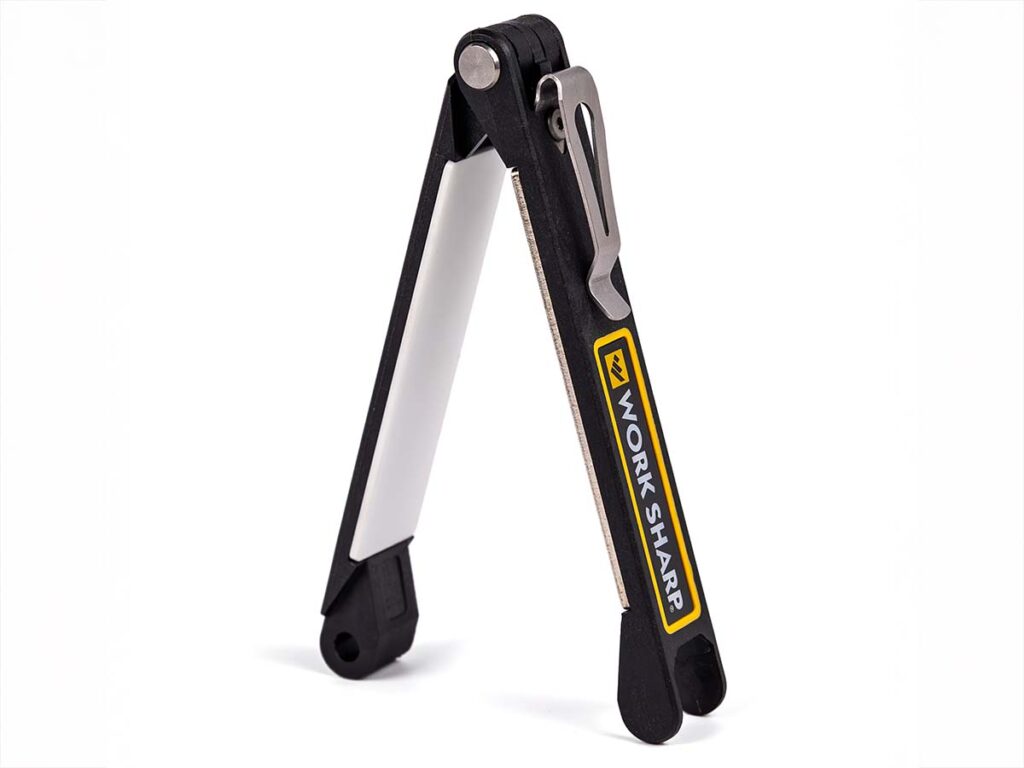
Especially effective on EDC knives, the new Work Sharp Folding Field Sharpener is one whiz-bang of a portable unit.
Folding Field Sharpener Model type: Compact field sharpener Type of abrasive: Diamond grit plate and fine grit ceramic plate Grit: Coarse 400-grit for each plate Unit dimensions: 4.75 x .75 x .5” Unit materials: Sharpening plates, plastic, aluminum Types of knives sharpened: Pocketknives, hunting knives, EDC Types of edges sharpened: Plain Special features: Folding design; edge angle guides (20 & 25 degrees) help maintain a consistent angle when sharpening and honing; pocket clip Weight: 4.6 ozs. Country of origin: Designed, calibrated and quality checked in Ashland, Oregon, using foreign components MSRP: $29.95
The Work Sharp Folding Field Sharpener is a compact, lightweight model designed for on-the-go sharpening. It features a 400-grit diamond plate with 20-degree sharpening guides and a fine-grit ceramic plate with 25-degree honing guides, ensuring consistent, reliable edges wherever you are. The folding design and integrated pocket clip make it easy to carry almost everywhere. A big package in a small platform, it’s designed to bring back an edge after a hard day’s use or simply for touchups. Especially effective on EDC knives, it is one whiz bang of a portable-type sharpener.
CRKT Knife Maintenance Tool
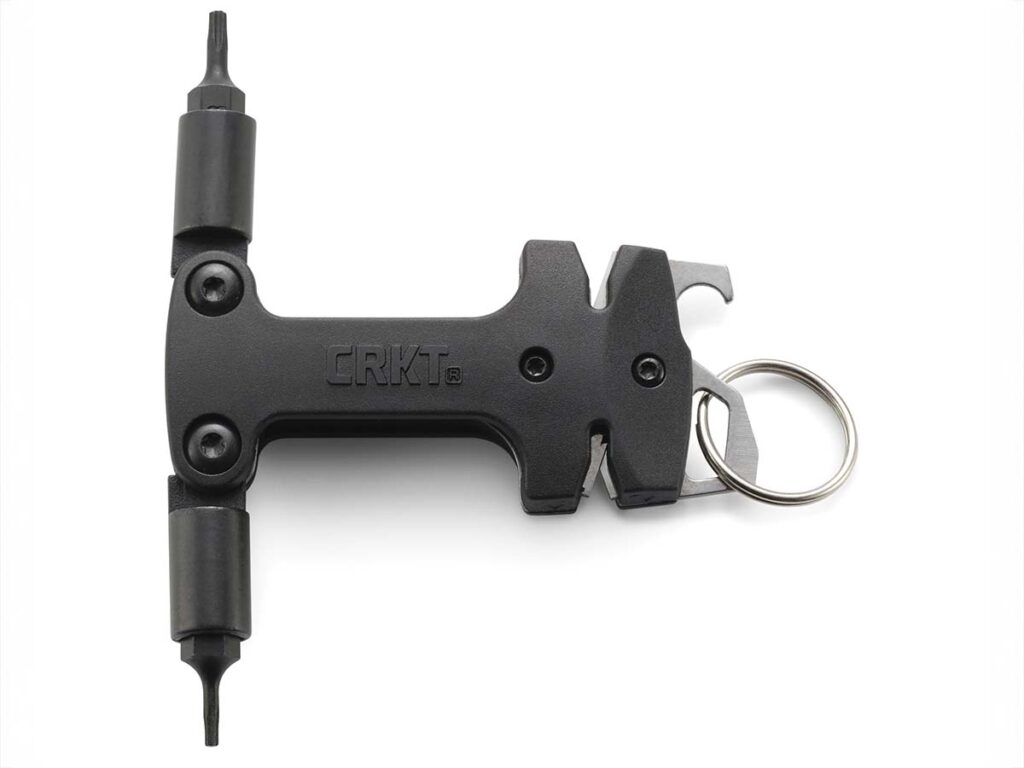
Designed by Tom Stokes, the CRKT Knife Maintenance Tool is two sharpeners and a multi-tool all rolled into one.
Knife Maintenance Tool Model type: Keychain/pocket field sharpener and multi-tool Type of abrasive: Tungsten carbide sharpener with ceramic honing edge Unit dimensions: 2.7 x 1.18 x .47” Handle: Glass-reinforced nylon Types of knives sharpened: Pocketknives, EDC Types of edges sharpened: Plain Special features: T6 and T8 Torx tools/bits, flathead screwdriver, bottle opener, keychain compatible Weight: 2.2 ozs. Country of origin: China MSRP: $30
Designed by mechanical engineer Tom Stokes, the CRKT Knife Maintenance Tool is a multi-tool sharpener that reflects Tom’s more than 25 years of experience in the aerospace industry, including his work with CAD software and rapid prototyping technology. He designed the Knife Maintenance Tool to prepare you for life’s various exigencies, everything from emergency repairs, popping a top on your favorite beverage—and, yes, sharpening your knives.
The Tool includes two pull-through sharpeners—one a tungsten carbide abrasive to establish a sharp edge, the other a ceramic abrasive to fine tune it—and two sizes of Torx tools/bits: T6 and T8. The sharpeners are on either side of the front of the handle, which is topped off with a bottle opener and flat-head screwdriver/lanyard hole for a keychain loop. The Torx tools are also on either side of the handle and fold out independently of one another for torquing screws pistol-grip style.
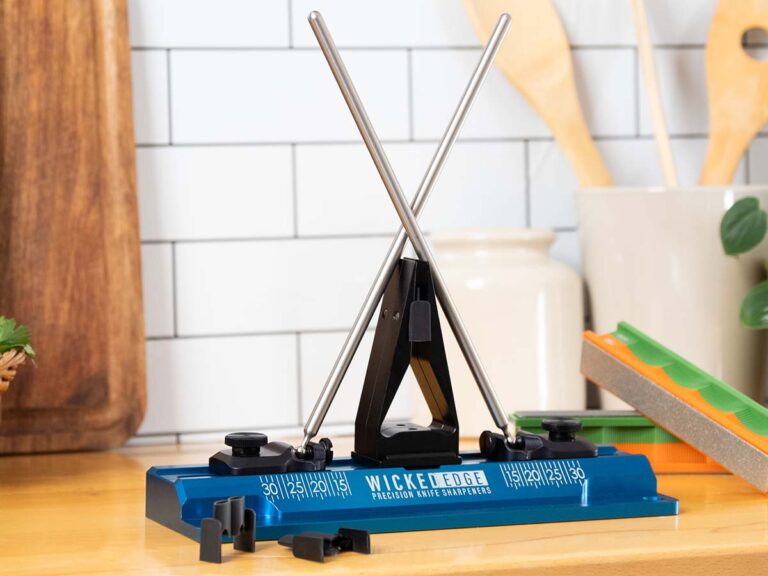
Wicked Edge GO-WE60 Precision Knife Sharpener
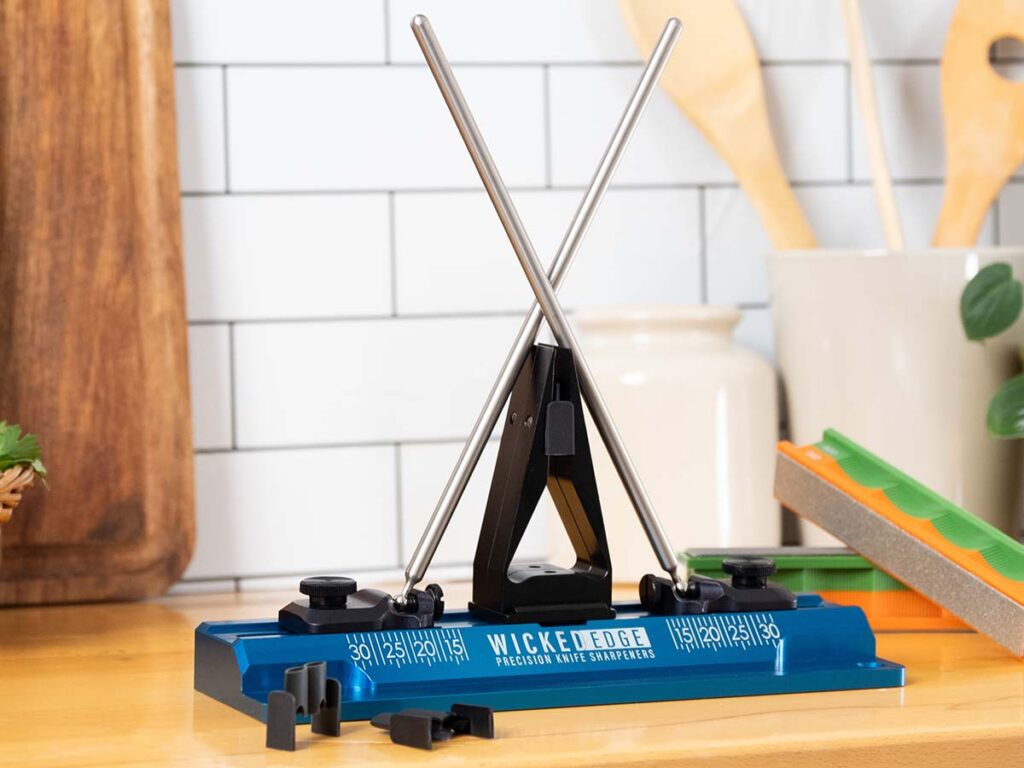
Premium abrasives on the Wicked Edge GO-WE60 are 200/600 grit monocrystalline diamond-coated stones.
GO-WE60 Precision Knife Sharpener Blade Length Capacity: Up to 15” Blade Thickness Capacity: Up to .25” (longer screws available for thicker blades) Angle Markings: Calibrated for the blade’s edge to sit at 5/8” above the top of the vise Guide Rod Length: 8.75” Unit Weight: 3.6 lbs. Country of origin: USA MSRP: $299
The Wicked Edge GO-WE60 Precision Knife Sharpener is designed for novices and seasoned old pros alike, whether at home, in the field or on the road. A redesigned standard vise clamps fully flat-ground and distally tapered blades such as on pocketknives and household cutlery. Sharpening angles are adjustable from 13 to 31 degrees per side (26-62 degrees inclusive) in 1-degree increments for precise edge maintenance. Premium abrasives are 200/600 grit monocrystalline diamond-coated stones. Mounting options include securing to any flat surface with the included C-clamp or attaching directly using predrilled holes.
Bear & Son GATCO Scepter 2.0 Diamond
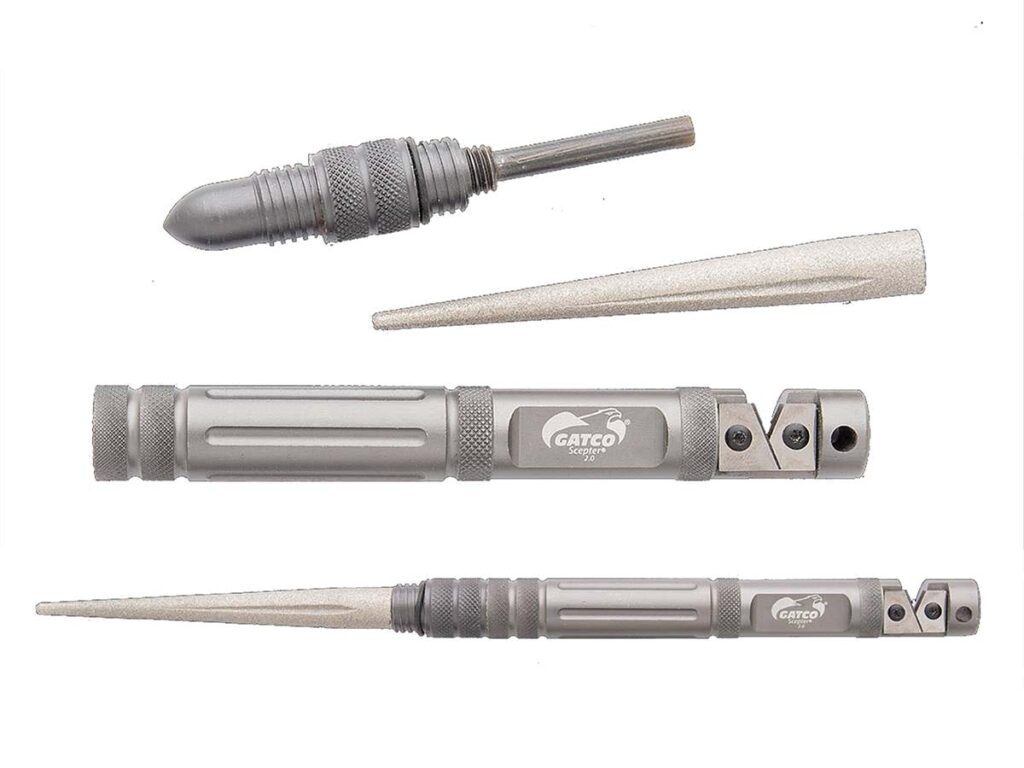
The multi-purpose GATCO Scepter 2.0 sharpens plain and serrated edges and has a magnesium rod for starting fires.
GATCO Scepter 2.0 Model type: Pull through and tapered diamond rod Type of abrasive: Diamond coated and tungsten carbide Unit dimensions: 6.125″ Unit material: 6061-T6 aluminum housing Types of knives sharpened: Hunting, EDC, kitchen Types of edges sharpened: Plain and serrated Special features: Tapered diamond rod, magnesium fire starter rod, window breaker Weight: 3.2 ozs. Country of origin: China MSRP: $49.99
The compact GATCO Scepter 2.0 Diamond Take Down Sharpener & Fire Survival Tool from Bear & Son is a multi-purpose implement for everyday pocket carry, the toolbox, to take camping and/or makes an ideal necessity for your bug-out bag. A magnesium rod for fire starting stows inside the tapered diamond sharpener, the latter which includes a groove for sharpening fishhooks. The rod and tapered sharpener are contained inside the CNC-machined, 6061-T6 aluminum carbide body, which has a pull-through tungsten carbide sharpener on the end. Each component features precision-machined threads and an outer “O” ring.