B. Goode H.U.T. 4 high steps its way through the author’s test drills
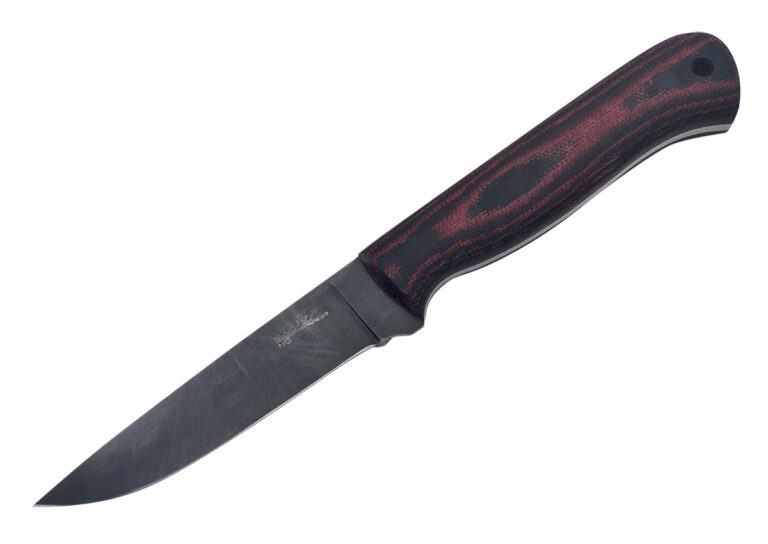
The H.U.T. 4 by Brian Goode of B. Goode Knives reminds me of my military days—it just needs the “2, 3” before the “4.” The acronym and number stand for Hunter, Utility, Trail, 4 inch. An all-around edged tool that can be used for multiple tasks, it’s the one knife you always grab for when cutting needs to be done. How well it cut I’ll let you know.
Light Duty Cutting
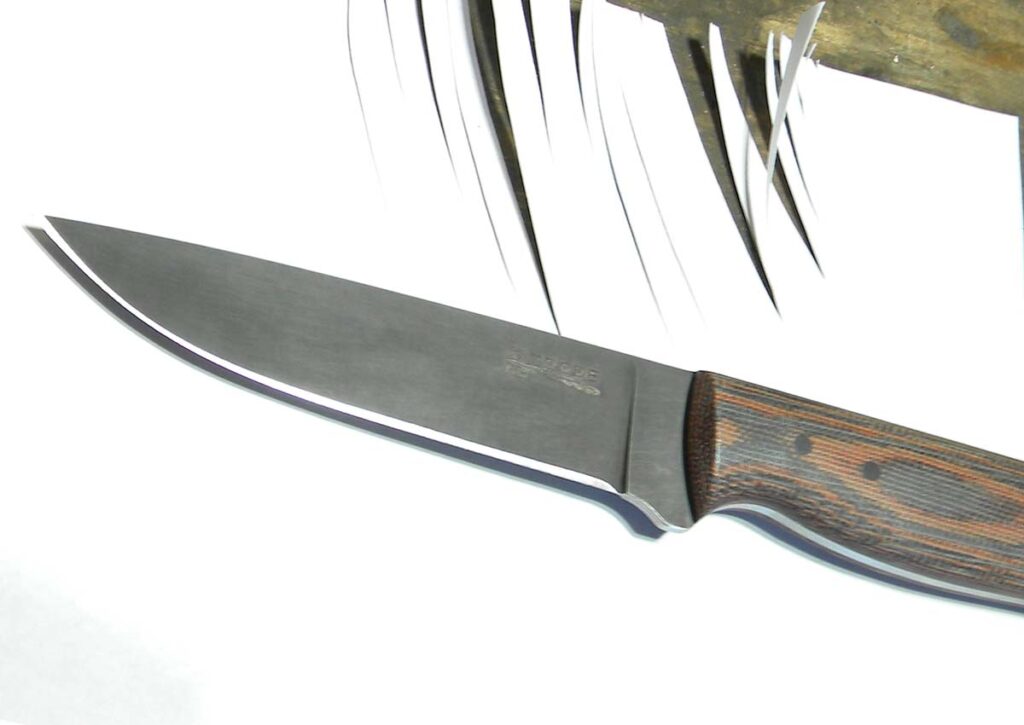
There was no difference between the first paper cut test and the last one. The H.U.T. 4 stayed sharp.
I began with a simple yet effective test—the paper slice. I grabbed the H.U.T. 4 with my thumb and index finger and slid the edge into the paper. It kept slicing for the entire blade length. I could hear each slice, so it’s very aggressive in the 20-pound bond paper. You really have to watch closely so you don’t skin a flap from your finger.
Single-walled cardboard was next. I used a push cut and the knife didn’t fail. I felt no resistance while cutting. The H.U.T. 4 zipped through quickly. The blade did get some wipe marks on the acid finish.
Medium Duty Cutting
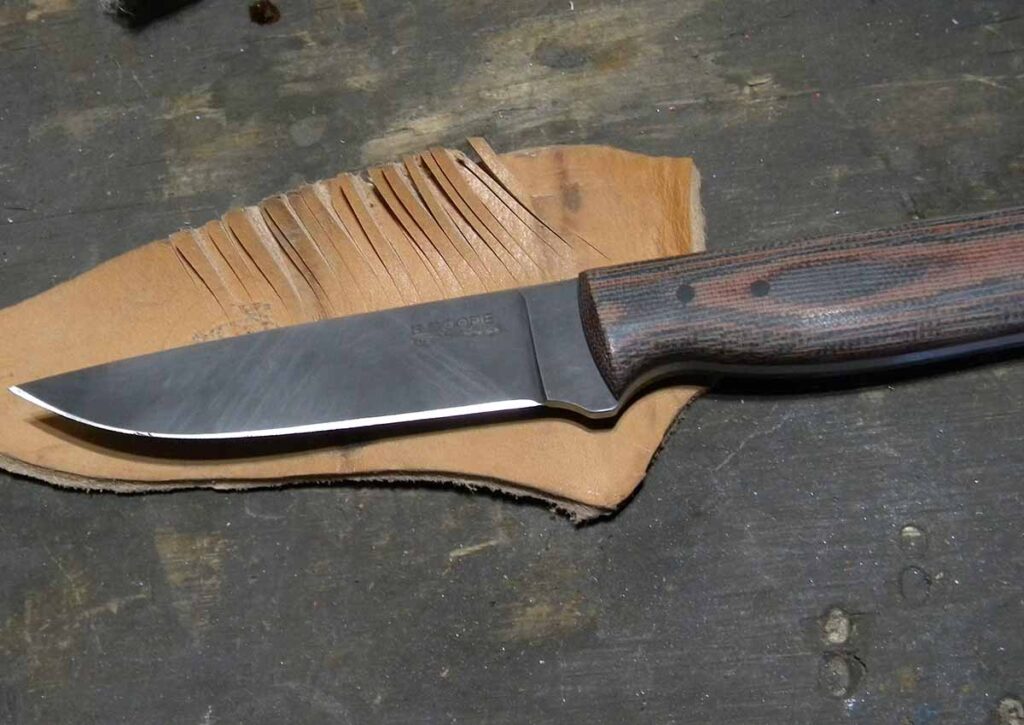
The knife sliced the 8-ounce leather quite forcefully. Each time the edge hit leather, the author heard it slice.
Grabbing some scrap 8-ounce leather, I did some skiving and slicing. The knife sliced quite forcefully once more. Each time the edge hit the leather, you could hear it cut. This is a very cool test to do. Brian’s knife is light and fast, so you must be quick and get your fingers out of harm’s way.
Heavy Duty Cutting
The H.U.T. 4 was a whittling beast on a ¾-inch dowel rod, providing extremely smooth cuts with nice curlicues at the end. The handle is very comfortable with no hot spots. I went from fine cuts to deep cuts with a slight movement of my wrist. The knife is easy to control.
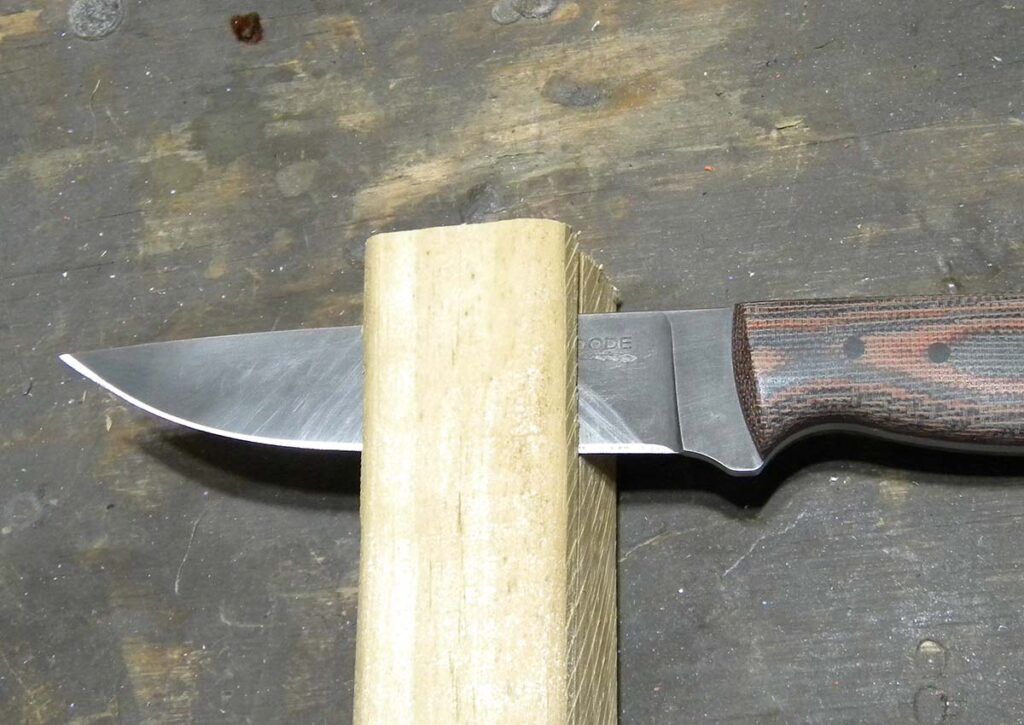
Using a chunk of wood railing as a baton, the author beat the H.U.T. 4 into another piece of railing. The wood split very fast and no shock carried up the author’s arm.
Even though the knife has only a 4-inch blade, it can handle larger trail chores like splitting wood. Using a chunk of wood railing as a baton, I beat the H.U.T. 4 into another piece of railing. The wood split very fast and no shock carried up my arm. I split both with the grain and across the grain with no difference. The edge was still perfect and I gave it some wood smears for character. It is a fun knife to use.
It was on to my favorite medium: sisal rope using push cuts. The H.U.T. 4 didn’t let me down. Two-hundred sweet crunching cuts happened very quickly. This is one smooth slicing, sharp knife. As fast as I could move the knife it was cutting. The handle is contoured for control and comfort.
In what could be construed as abuse, I gave the fixed blade 30 whacks into a deer antler. After scattering antler chips all over the workbench, the knife passed with flying colors—no damage and still very sharp. Excellent heat treat!
It was back to the 20-pound bond paper for the final cut. There was no difference between the first paper cut and the last one. The H.U.T. 4 stayed sharp.
Bottom Line
This is a great knife to have on you all the time—not too big, not too small and extremely sharp. Any changes? Maybe some thumb notches.
H.U.T. 4 Specs Maker: Brian Goode, B. Goode Knives Blade length: 4” Blade material: 8670 carbon steel on the test knife; other steels available Blade grind: Full flat Blade @thickest: .125” Blade finish: Acid dipped Scales: Red and black canvas Micarta® Handle pins: G-10 Weight: 4.5 ozs. Overall length: 8.5” Sheath: Leather pouch/belt model Weight w/sheath: 6 ozs. Maker’s price for a similar knife and sheath: $350
Today’s pocketknives come in assorted locks, no locks, blades, handles and more.
Eyes always peeled, we’re on the look out for the latest and the greatest. We think we’ve found a bevvy of them this March. So, with out further adieu, here’s our latest round of new knives.
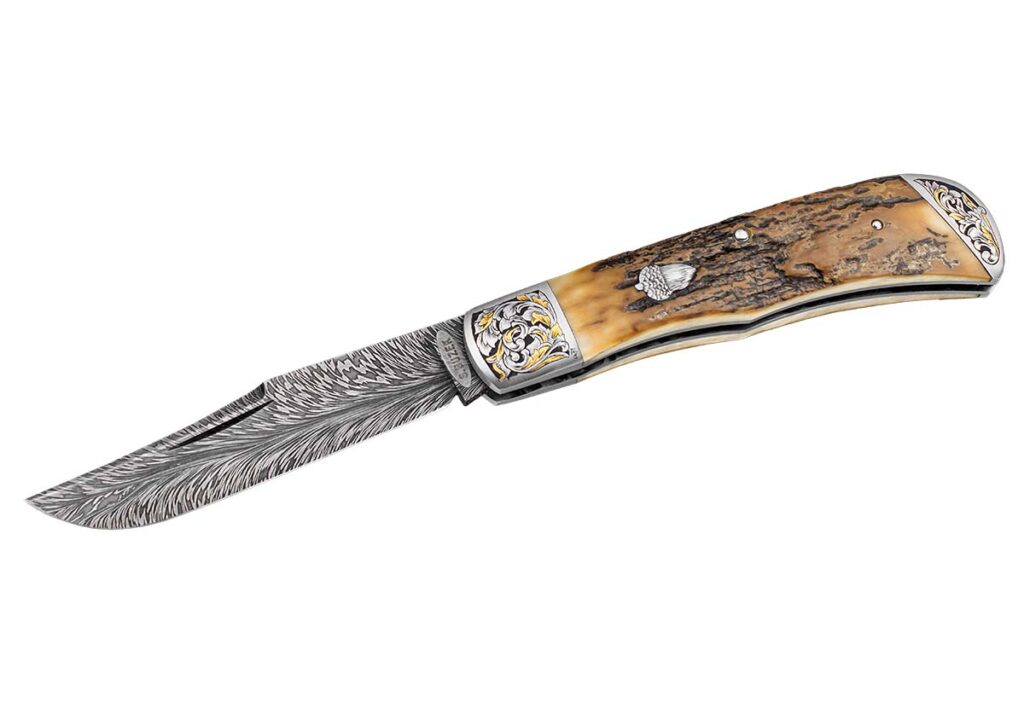
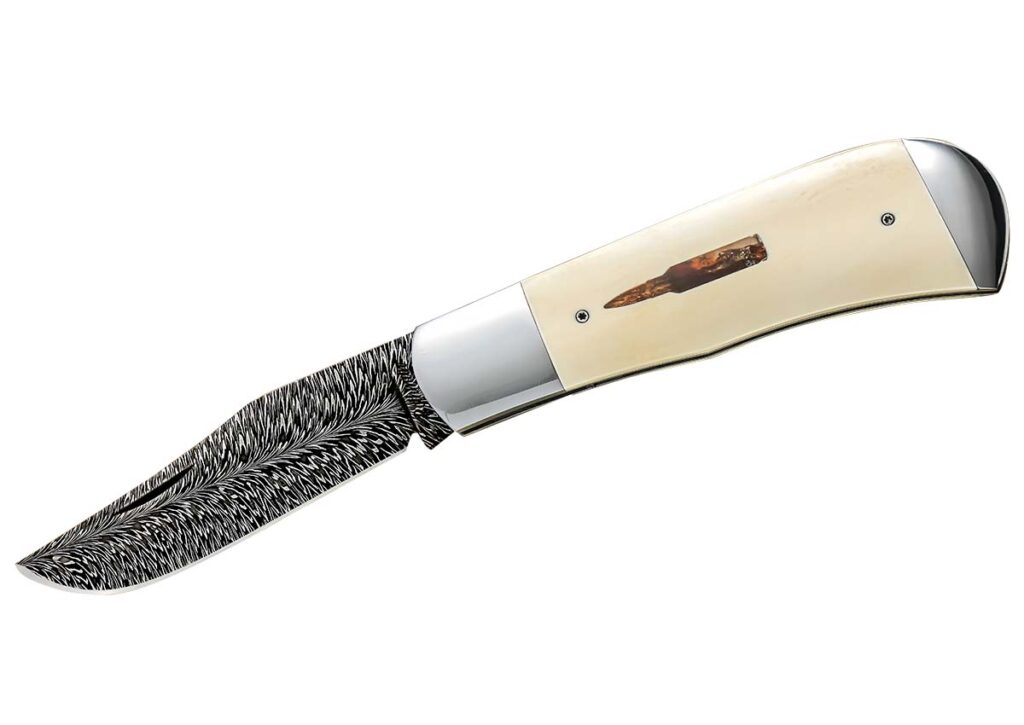
Stanley Buzek Single-Blade Slipjoint
Blade length: 3 3/8” Blade steel: Feather damascus forged by ABS journeyman smith Mike Tyre Blade grind: Hollow Blade pattern: Clip point Blade opener: Nail pull Scales: Mammoth ivory Liners/bolsters: 416 stainless in an integral construction Engraving: Alice Carter, including 24k-gold inlay Knife to know: Fileworked liners and acorn shield Closed length: 4.25” Maker’s price for a similar knife: $2,800 Maker: Stanley Buzek, sbuzekknives.com (Jocelyn Frasier image)
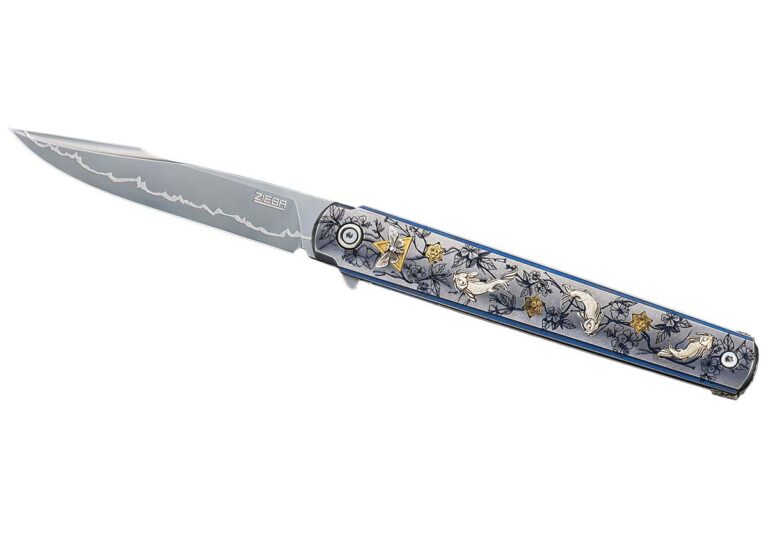
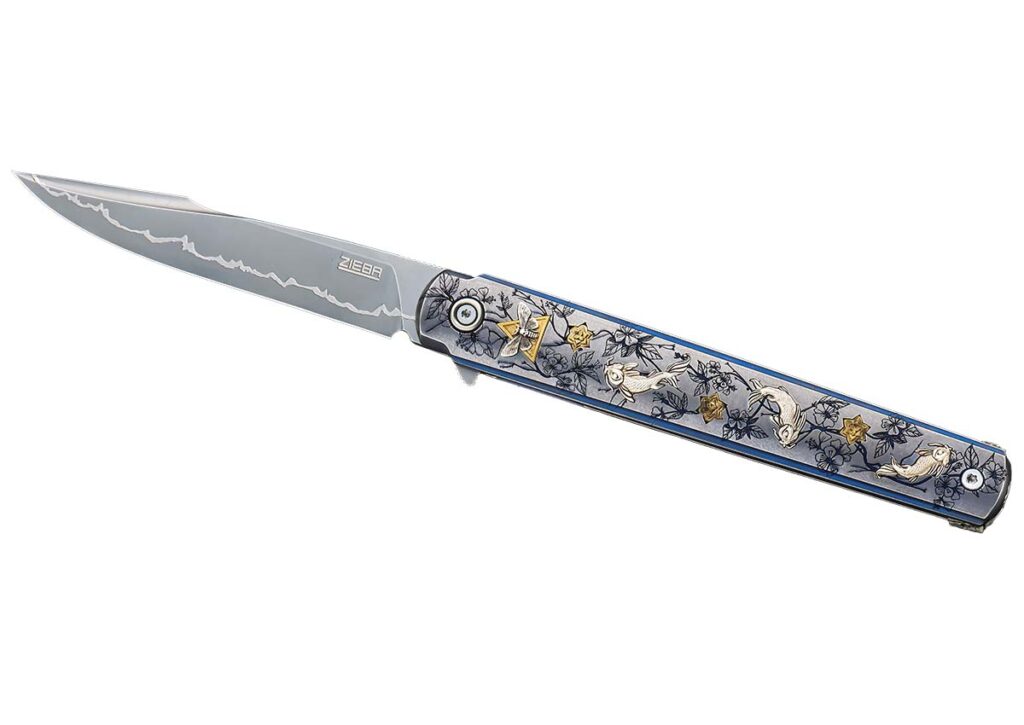
Michael Zieba Nine Silver Kois
Knife type: Side flipper Blade length: 4.126” Blade steel: CPM MagnaCut stainless Rockwell hardness: 62-63 HRC Blade grind: Flat Blade @thickest: .159” Pivot: Ceramic ball bearing washers Handle & pocket clip: Titanium w/24k-gold koi, lotus and moth inlay Weight: 5.07 ozs. Closed length: 5.5” Knife to know: Air pockets for weight reduction; ceramic detent; white brass skull spacer Maker’s price for a similar knife: $3,300 Maker: Michael Zieba, (SharpByCoop image)
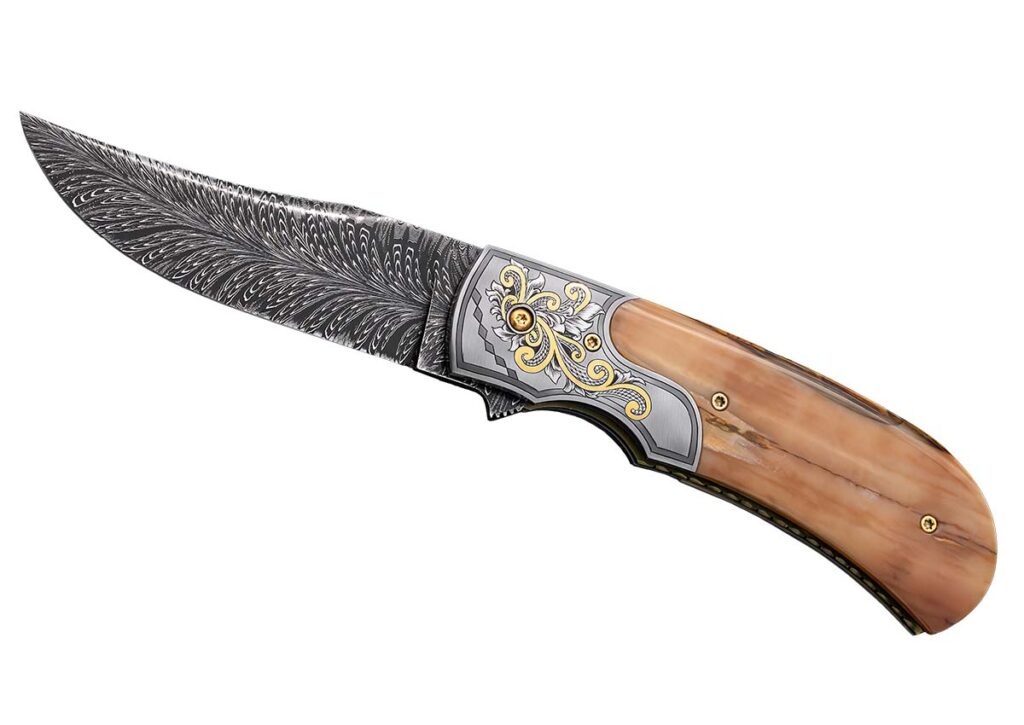
Curt Zimmerman Flipper Folder
Blade length: 3” Blade steel: Feather damascus Blade grind: Flat Blade pattern: Clip point Lock: Linerlock Scales: Ancient walrus ivory Bolster: Stainless steel engraved by Alice Carter w/24k-gold inlay Liners: Titanium; fileworked and anodized Screws: 24k-gold plated Closed length: 3 15/16” Maker’s price for a similar knife: $2,500 Maker: Curt Zimmerman (Jocelyn Frasier image)
Rothman Knives Backpocket
Knife type: Dress slipjoint Blade length: 3.25” Blade steel: Feather damascus forged by Adam Deville Blade grind: 14” hollow Blade pattern: Clip point Scales: Interior mammoth Bullet shield: Dark mammoth Frame: 416 stainless in an integral construction Closed length: 4.75” Knife to know: Fileworked liners and embellished backspring; Michael Rothman is a member of the Knifemakers’ Guild Maker’s price for a similar knife: $1,500 Maker: Rothman Knives, rothmanknives.com (SharpByCoop image)
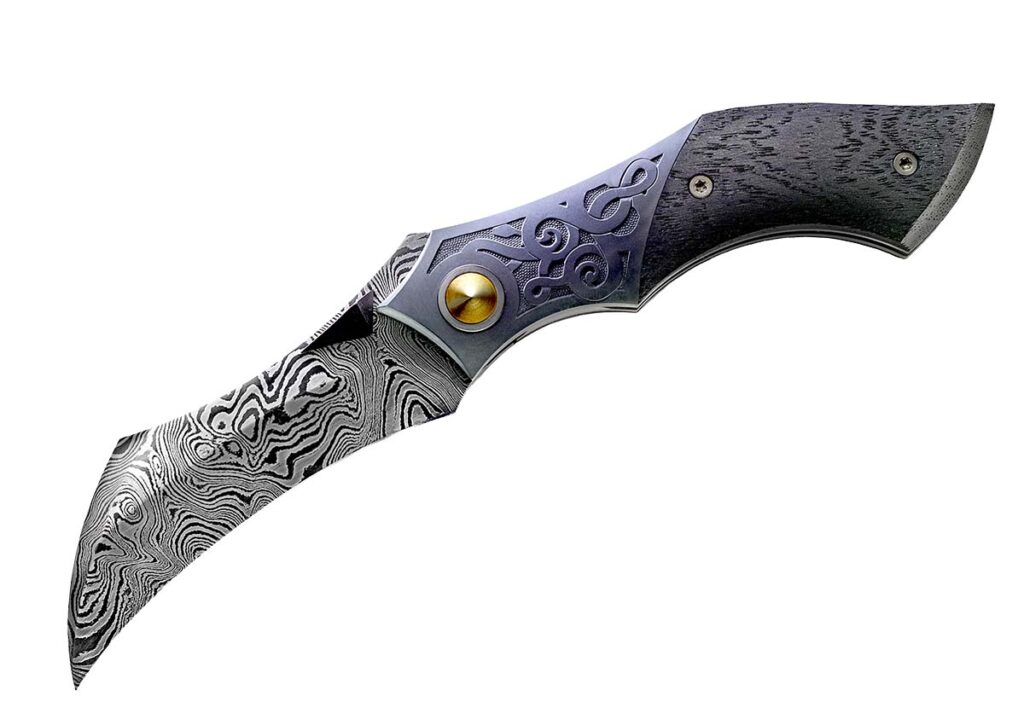
Jeremy Marsh Mini Assassin
Knife to know: A collaboration between Jeremy Marsh and Jonathan Quill Blade length: 3.5” Blade steel: Damascus of 1084 carbon and 15N20 nickel-alloy steels forged by Quill and finished by Marsh w/a dark, deep etch and “a great deal of hand finishing” Scales: 10,000-year-old bog oak from Ireland w/a coarse-grained, oily look Liners: Feature a distressed rock finish along the edges applied by Marsh and traditional vine filework applied by Quill Bolsters, thumbstuds and hardware: Zirconium toned lightly bronze and burnished for highlights Embellishment: Quill engraved the bolsters and pocket clip in a Celtic/Norse theme Closed length: 4.5” Make’s price for a similar knife: $8,000 Maker: Jeremy Marsh (Mitchell Cohen image)
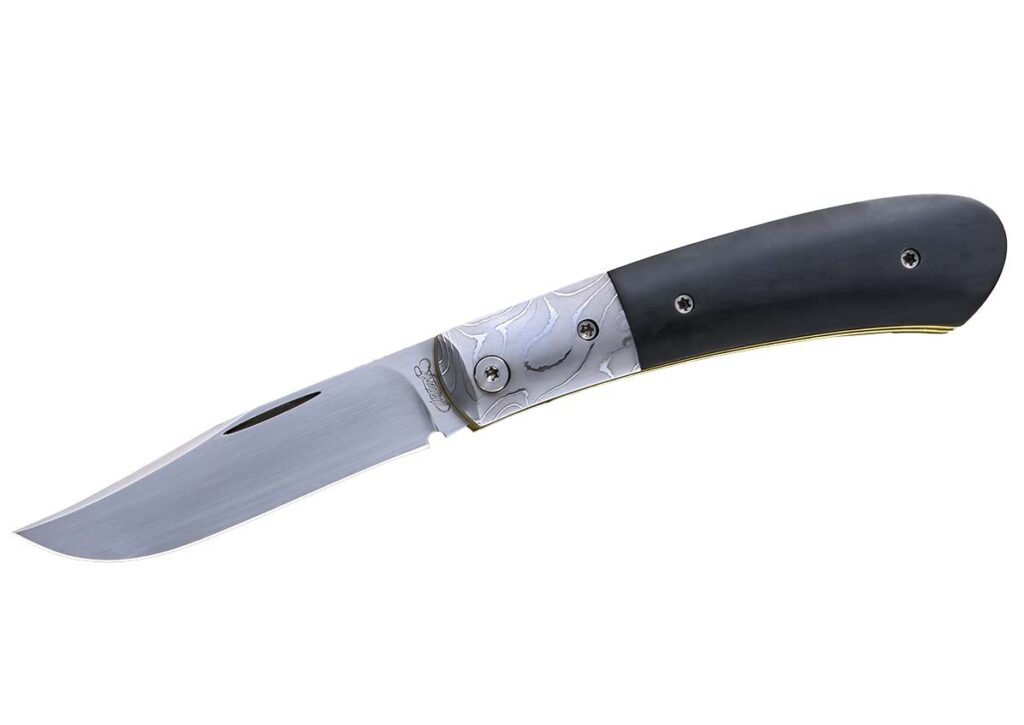
Maverik Knives Dress Slipjoint
Blade length: 3” Blade steel: CPM 154 stainless Blade grind: High flat Blade pattern: Clip point Scales: Black paper Micarta® Frame: Brass Bolster: Straight twist damascus Hardware: Titanium Closed length: 4” Knife to know: Maverik Murdock is an ABS apprentice smith Maker’s price for a similar knife: $750 Maker: Maverik Knives, maverikknives.com (SharpByCoop image)
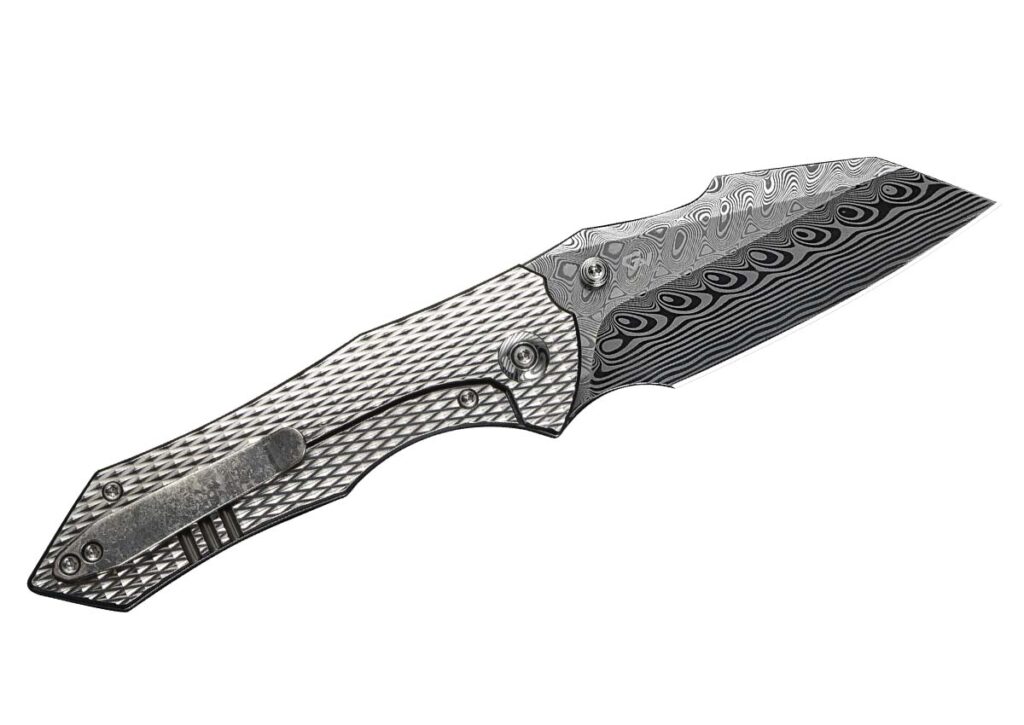
WE Knife High-Fin XL
Designer: Gavko Knives Blade length: 3.48” Blade steel: Hakkapella damascus by Damasteel Rockwell hardness: 59-61 HRC Blade grind: Hollow Blade pattern: Reverse tanto Pivot: Caged ceramic ball bearings Handle: Satin-polished 6Al4V titanium in a diamond-pattern texture Pocket clip: Crystallized gray 6Al4V titanium; blade tip up, right-handed Lock: Framelock Weight: 4.03 ozs. Closed length: 4.67” Country of origin: China MSRP: $740 Company: WE Knife, weknife.com
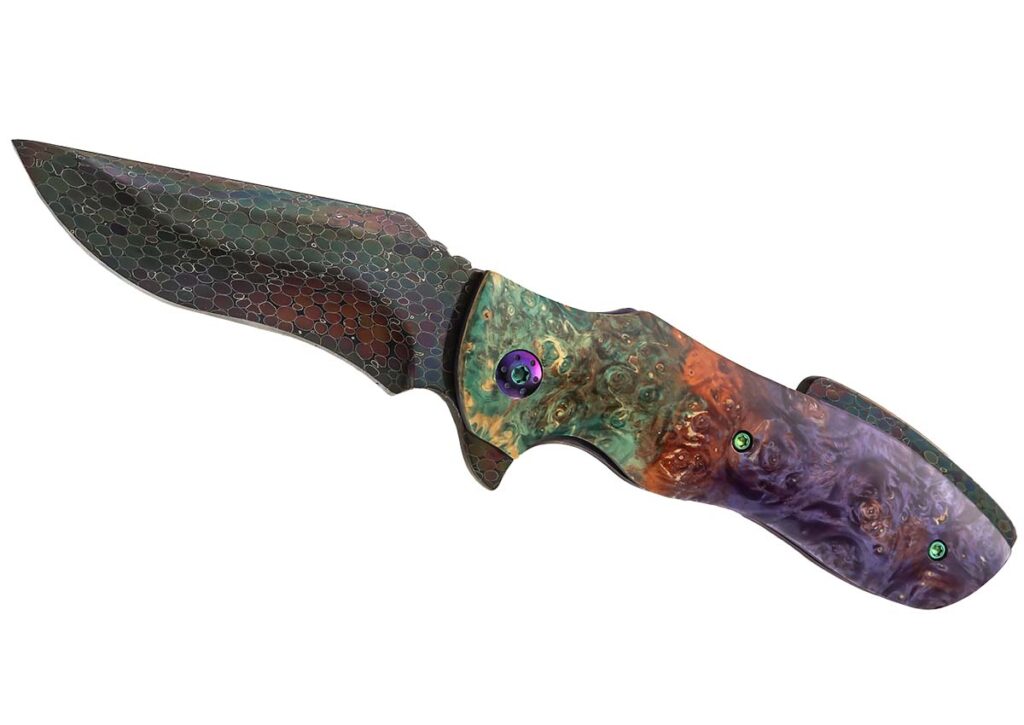
David Kulis Spectre XL
Knife type: Dress tactical flipper folder Blade length: 3.5” Blade steel: Dragonskin damascus forged by Bertie Rietveld Blade grind: 8” hollow Blade shape: Recurve Handle: Purple/orange/green burl Liners: Titanium Knife to know: All titanium hardware anodized to match the Timascus pocket clip Closed length: 5.25” Maker’s price for a similar knife: $1,500 Maker: David Kulis (SharpByCoop image)
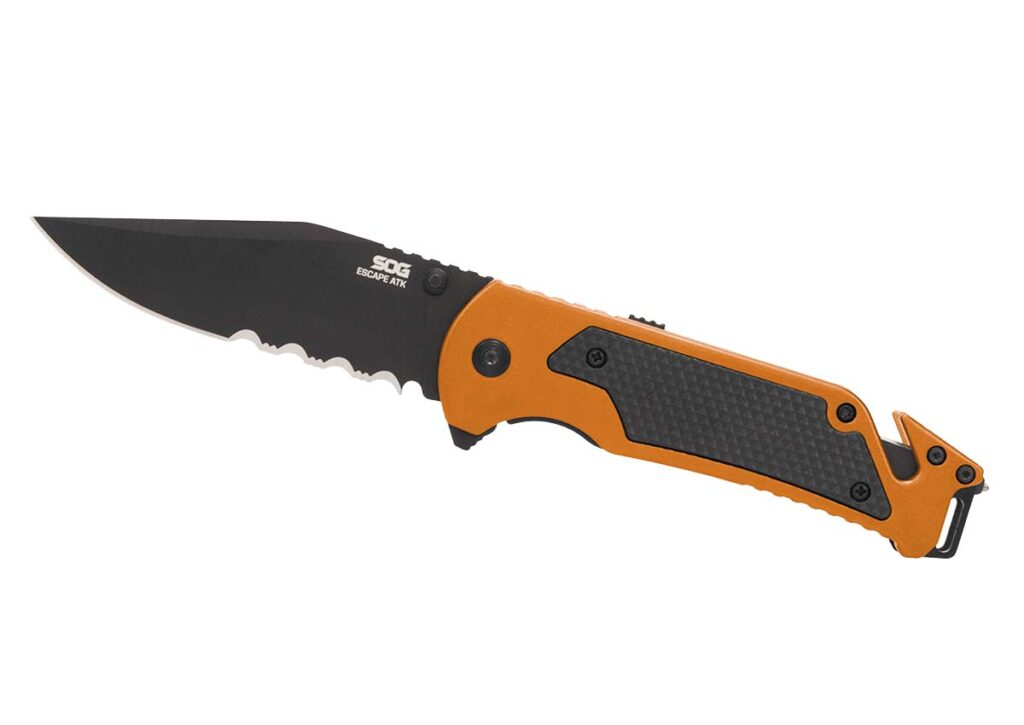
Knife type: Rescue folder Blade length: 3.4” Blade steel: AUS-8 stainless Blade mechanism: Assisted opening Handle: 6061 aluminum Lock: Linerlock Pocket clip: Low carry Weight: 4.4 ozs. Closed length: 4.6” Knife to know: Belt cutter and glassbreaker in the butt; spare blade for the belt cutter stores in the handle Country of origin: China MSRP: $54.95 Company: SOG Knives, www.sogknives.com
Jerry Fisk Saddlehorn-Style Slipjoint
Blade length: 3.33” Blade material: Damascus Blade pattern: Clip point Blade opener: Nail pull Scales: Wood from one of the last walnut trees planted by President George Washington Bolster: Spring steel engraved by Jerry Fisk Maker’s price for a similar knife: $5,900 (includes a bottle of whiskey from George Washington’s Distillery) Knife to know: In 1999, Jerry Fisk was named a National Living Treasure by the Museum of World Cultures at the University of North Carolina at Wilmington Maker: Jerry Fisk (Jocelyn Frasier image)
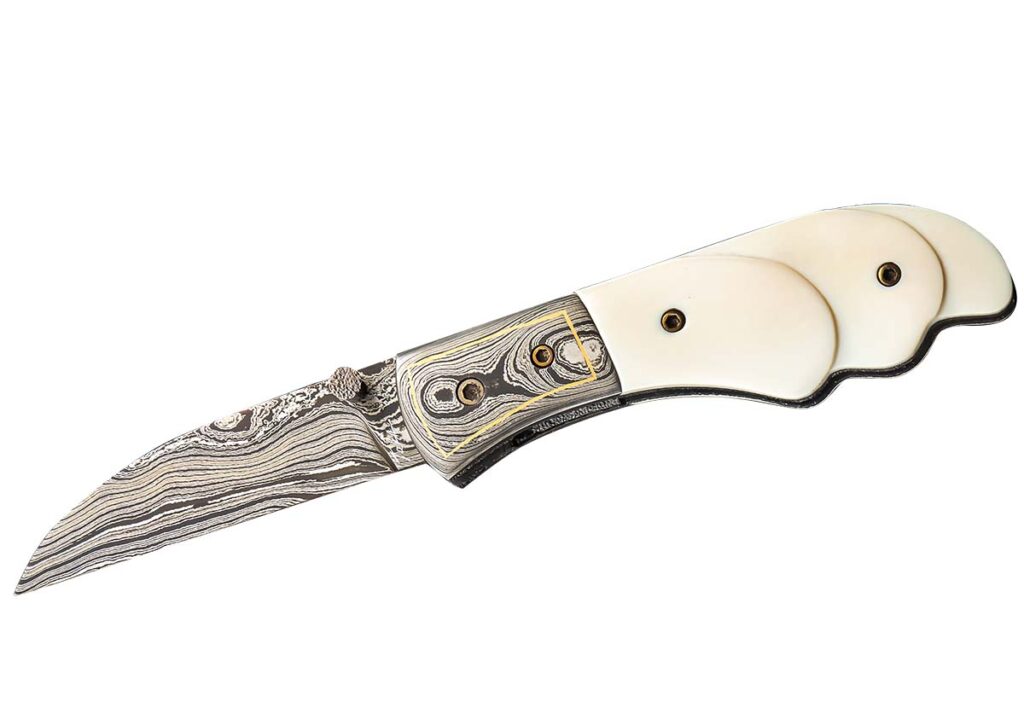
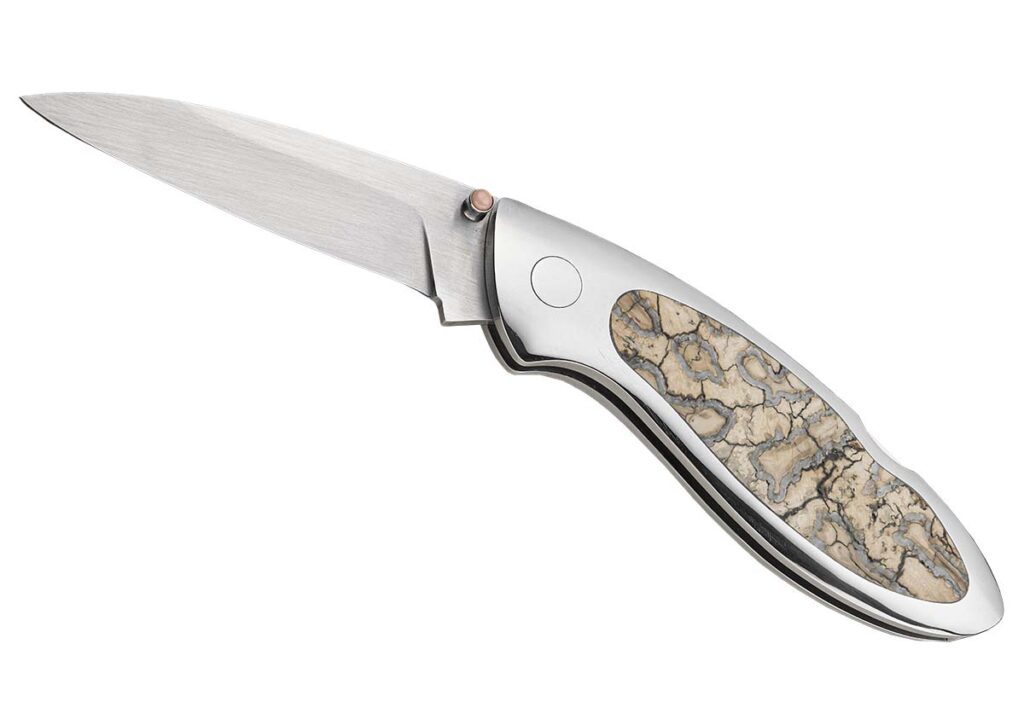
Chris Richardson Lockback Folder
Blade length: 3.25” Blade steel: CPM 154 stainless Blade grind: Flat Blade pattern: Modified wharncliffe Handle inlay: Mammoth ivory Thumbstud inlay: Angelskin coral Bolster: 416 stainless in an integral construction Closed length: 4.75” Maker’s price for a similar knife: $850 Maker: Chris Richardson (Jocelyn Frasier image)
Recognition, catchiness and marketability are but three keys to knife names.
What’s in a name? A knife by any other name will still cut, hopefully. Many people don’t realize what hangs on a name. Is it good enough to be memorable, catchy as it were? A catchy name will make a knife more or less marketable.
If you’ve read my stories long enough, you’ve seen me comment on a knife’s name, especially if it is a long, drawn-out one. To me, it is important for the name to have a short form. For example, salespeople can’t sell a knife by word of mouth if they have to say the company name followed by Omega Kilroy Uber Cutter, Men In Black Forever Ever Sharp Cutting Commando, etc. When I was having knives licensed, the licensing companies would check to see if there were other knives on the market with the same name to avoid any copyright or other legal problems. They no doubt still do that.
I think now more than ever naming a knife would be even more difficult than designing one. After all, you can have numerous drop points but when you go to name your knife you don’t want it drowning in a sea of cutlery. With so many new knife companies out there, knife production is at an all-time high. How on earth do they make their knives stand out from the rest? One way is with the name. Following are some lighthearted ones.
RMJ Tactical Stabby Guy
The large finger loop in the handle butt of the Stabby Guy provides a great platform to support the knife in your hand and keep it from slipping during thrusting motions. The fuller helps maintain blade strength and reduces weight.
Stabby Guy Specs Overall Length: 7.25″ Handle length: 3.5″ Blade Length: 3.75″ Blade Steel: CPM 3V carbon Handle material: Black G-10, Dirty Olive Hyena Brown Sheath: Kydex MSRP: $240 Country Of Origin: U.S.A.
RMJ Tactical chose a name short and sweet for its Stabby Guy. I prefer—no, actually love—names like this. If you find yourself wandering off into multi-syllable diatribes for a name, you’ve lost me. Not only is Stabby Guy brief, it’s to the point, pun totally intended. It is what it says it is. I would call it a self-defense blade. It is slender in design and has an American-style-tanto tip. It is built solid, with the body of the knife having no primary edge.
A fuller runs full length on one side of the blade. The fuller allows the knife to keep its strength and still not weigh a ton. After all, this knife technically is equivalent to a tactical sewing needle. Save the fancy moves for Hollywood and put the machine on surge with the Stabby Guy. It has a simple, ergonomic, basically straight handle. A finger loop at the butt serves to anchor your grip and substitutes for the lack of a guard. A guard stops your hand from slipping forward while thrusting with the knife; the finger loop serves the same purpose.
Though there’s not a lot of edge, the knife need not be dead weight all day while you’re waiting for a prison riot to break out. The small but sharp edge can do a ton of minor chores. However, don’t expect to carve a chess set with it. It has a Kydex sheath equipped with a belt loop. I carried mine in my back pocket and forgot it was there. It’s a cool concept of a knife with a name that doesn’t leave you guessing.
Condor Tool & Knife Rude Boy Machete
The overall profile of the Rude Boy shows the sweet spot of the blade is a few inches back from the tip. The farther out the sweet spot, the more force it has during a swing.
Stabby Guy Specs Overall Length: 7.25″ Handle length: 3.5″ Blade Length: 3.75″ Blade Steel: CPM 3V carbon Handle material: Black G-10, Dirty Olive Hyena Brown Sheath: Kydex MSRP: $240 Country Of Origin: U.S.A.
Condor Tool & Knife’s aptly named Rude Boy Machete is made for light vegetation like that in a rain forest. Some machetes, on the other hand, are geared toward North American vegetation, such as hardwood or softer trees.
People often view a machete as a survival or bushcraft tool. Actually, it is more of a hiking tool with such primary uses as clearing walking trails through the jungle. For these endeavors the knives are often not razor sharp like many in North America believe. Maintaining a high level of sharpness would be next to impossible in such conditions and at best too time consuming. For that reason, a powerful swing with a thin, dull machete works well in dispatching vegetation. The Rude Boy is not only thin but lightweight, making it possible to swing for long periods. The well-constructed leather sheath has a pivoting belt loop to help avoid hanging up easily on vegetation.
The only thing I take issue with is the blade profile. The blade’s lengthy defined tip leaves the belly swell farther back from the end. My preference would be to have the widest part of the blade farthest out to get the most out of the swing. Don’t get me wrong, the Rude Boy worked well, but a long day of swinging makes you want to optimize a blade’s performance. Then again, you do want some variety in appearance.
The best feature is the handle. In profile it is pretty much the American military style, though there are some excellent ergonomics added to the design. The plastic handle is overmolded to create a hidden tang. Instead of being blocky the contours are smoothed out for a comfortable grip you can use for long periods. I like the Rude Boy and I can see me beating the snot out of it once yardwork season arrives.
Toor Knives Jank Shank S
The sharp point and clean grind lines of the Jank Shank S make it easy to see how the author was able to use it to clean 50 muskrats with minimal effort.
Jank Shank S Specs Overall Length: 7″ Handle length: 3″ Blade Length: 4″ Blade Steel: CPM M4 carbon Handle material: G-10 Sheath: Kydex MSRP: $250 Country Of Origin: U.S.A.
Out of the creatively named test models, I probably gave the Jank Shank S from Toor Knives the longest going over. I used it as an EDC but the bigger workout was when I took it to my sportsman’s club. Many in the tactical crowd promote rings in the handle butt for changing positions during combat, but I like them for the advantage they give while cleaning game. That’s right, cleaning game.
When cleaning animals I often find I want to free my hands to work with the carcass. Instead of putting the knife down, I let it dangle from my pinky. I do what needs to be done and then just move the knife into my grip. There’s no fiddling around; it’s quick, simple and no searching for where I put it down.
My club has an annual muskrat dinner, and depending on ticket sales we clean up to 400 muskrats. I cleaned 50 of the varmints with the Jank Shank S, including splitting open the chest and neckbone. Not once did I sharpen it. When done I cleaned it off, gave it a touch up and bam!—it was crazy sharp again. The textured G-10 scales made it easy to grip despite my hands being covered in blood. It worked so well the muskrats didn’t even complain. I liked it so much you won’t hear me grumble about the blade’s fur-catcher choil. Oh, and did those muskrats ever look good with fries and a side of deluxe baked beans! The sheath fits well with no break-in, period. I will add an UltiClip to the sheath and it will be an instant EDC. The Jank Shank S will make it into my game kit any time. Muskrats beware!
Name-Gamers
A name can add to the appeal of a knife by being entertaining. It is also important to have a good name to make the design stand out and be memorable. In the end you don’t want the name associated with a piece of junk, so it is always best to put the most effort into a great design. Our three name-gamers fill that bill.
Four new entries help show why locking folders rule the pocketknife world.
Locking folders are the most popular pocketknives—perhaps even the most popular sporting knives of all. Slipjoints have the romance and tradition, vintage style, natural materials and many other things that make knives coveted by so many users and collectors, but locking folders are a lock in terms of being the king of pocketknife sales.
For one thing, while slipjoints can have anywhere from one to multiple blades, they are basically limited to one non-locking mechanism, that being the slipjoint mechanism itself. Locking folders, on the other hand, come in a wealth of locks, including the lockback, linerlock, Integral Lock/framelock, Benchmade AXIS Lock/crosslock, ring lock, button lock, Spyderco Compression Lock and others. Not only that but since they lock they’re much less likely to close accidentally than slipjoints.
Meanwhile, since the explosion in lockbacks after the introduction of the Buck 110 folding hunter in 1964 and the introduction of the linerlock by BLADE Magazine Cutlery Hall-of-Fame® member Michael Walker in 1981—that by the end of the decade was catching on with custom and factory makers far and wide—locking folders have experienced booms in types and runaway sales that continue to this day.
As Matt Salazar, general manager of House of Blades retail knife store in Fort Worth, Texas, noted in “2025 Trends and Takeaways” of the Spring 2025 BLADE Complete Knife Guide, “While slipjoint collectors are diehards, they’re a drop in the bucket compared to those into locking folders.”
All of which brings us to the subject at hand: a sampling of a few of today’s top factory pocketknives that lock.
KA-BAR State & Union F01OD
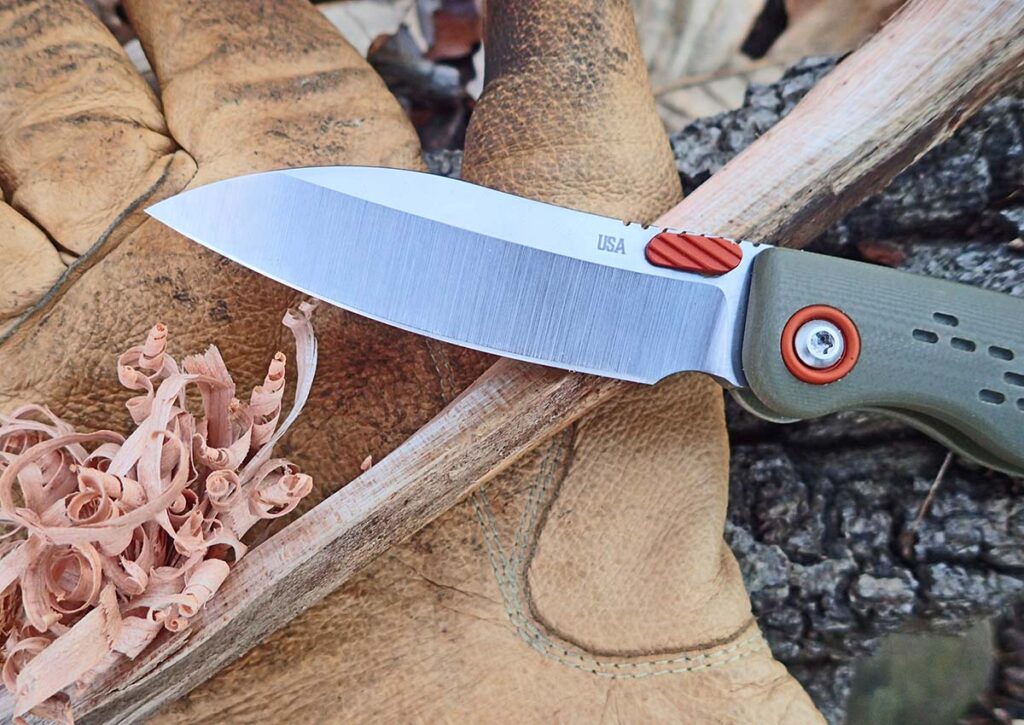
The KA-BAR State & Union F01OD was with the author in the woods and carved a beautiful feather stick able to take a spark.
State & Union F01OD Specs Lock Type: Lockback Blade Length: 3.25” Blade Steel: CPM S35VN stainless Blade Grind: Hollow Blade @Thickest: .16” Blade Finish: Satin Handle Material: Olive drab G-10 Closed Length: 4.1” Country of Origin: USA MSRP: $175
The KA-BAR State & Union F01OD is the first all-USA-made folding knife by KA-BAR in over 50 years. The sleek, reliable edged tool features a sharp drop-point blade. The handle provides a solid grip and is complemented by eye-catching anodized orange hardware.
Designed for everyday carry, the F01OD has a reversible wire clip, ensuring it stays securely in your pocket. Checking in at a lightweight 3.2 ounces, the knife is suited for most any cutting adventure—whether in the field or around the house. Available in several colors, it also looks good while doing it.
Spyderco Alcyone
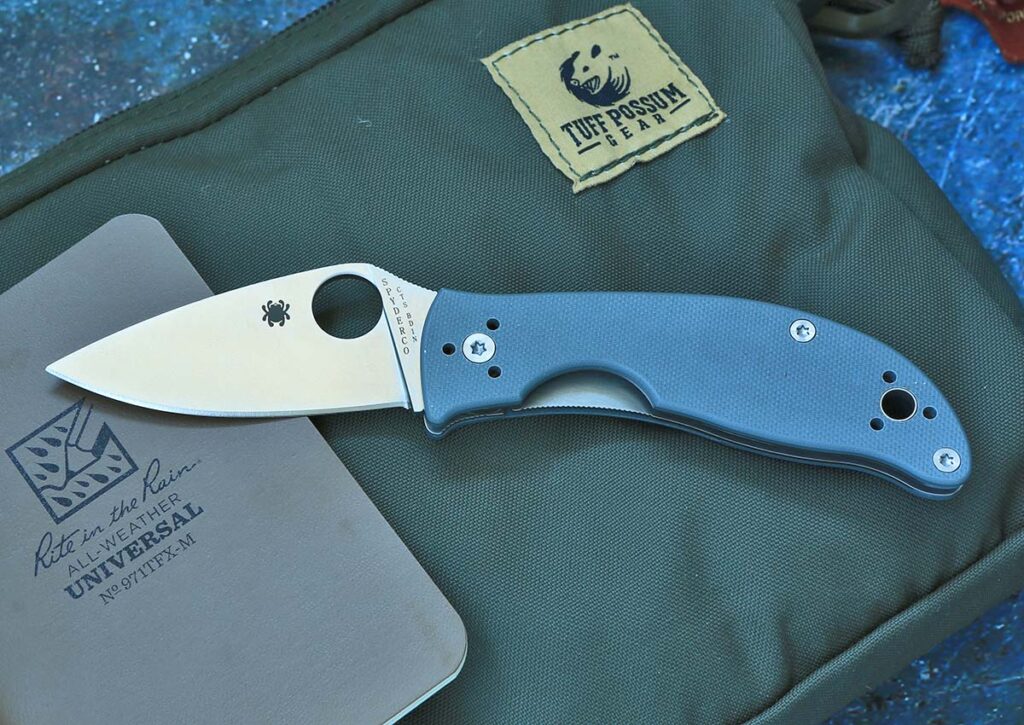
The leaf-shaped blade of the Alcyone has a sharp PlainEdge and the familiar Spyderco hole for ambidextrous opening.
The Spyderco Alcyone is named after a multi-star system in the constellation Taurus. The locking folder combines high performance with classic Spyderco design at an affordable price, featuring premium U.S.-made blade steel. The leaf-shaped blade has a sharp PlainEdge and a Spyderco trademark round hole for ambidextrous opening.
Thanks to its open-backed construction and full skeletonized stainless steel liners, the ergonomic handle is lightweight and easy to clean. The rugged gray scales provide a secure grip with a non-slip peel-ply texture for sure handling. The four-position pocket clip provides left/right side, tip-up/tip-down carry. A generous-sized lined lanyard hole completes the handle package.
CobraTec Olympian
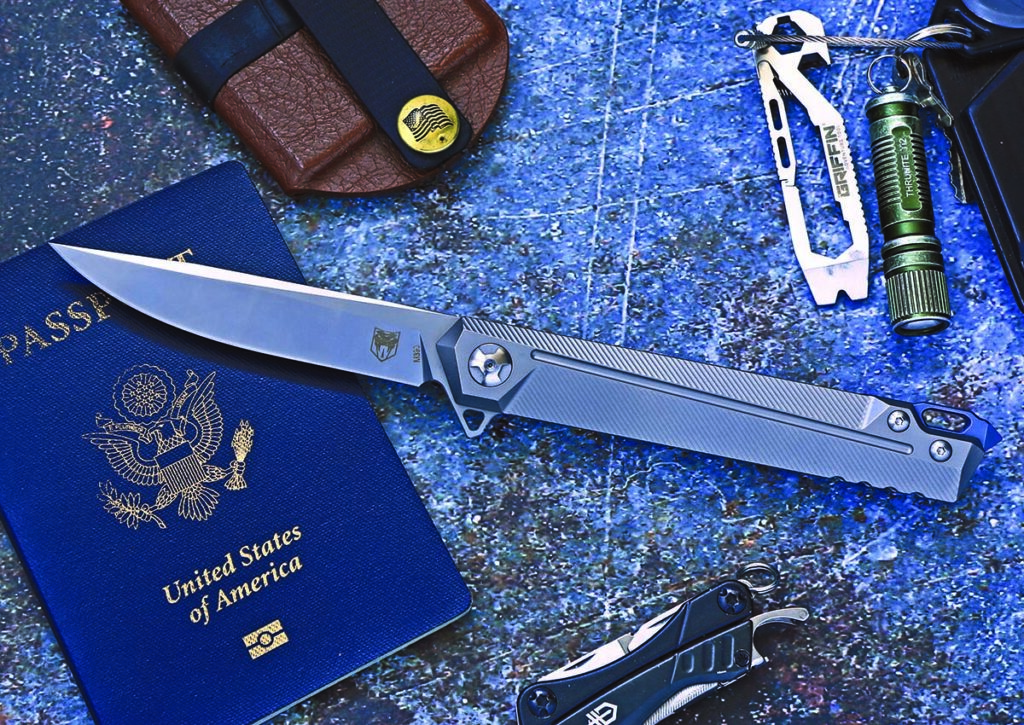
The modified drop-point blade of the Olympian flipper folder is tailored for precision cutting and slicing. The ball-bearing pivot system provides smooth, swift deployment. A robust glass breaker and lanyard loop enhance versatility.
The CobraTec Olympian flipper folder is a marvel of precision engineering, seamlessly blending high-quality materials with an elegant, ergonomic design. A lightweight yet exceptionally durable titanium grip ensures effortless handling and superior strength. The right-hand carry clip provides convenient accessibility.
The modified drop-point blade is tailored for precision cutting and slicing. The ball-bearing pivot system provides smooth, swift deployment. A robust glass breaker and lanyard loop enhance versatility.
CRKT Ibis
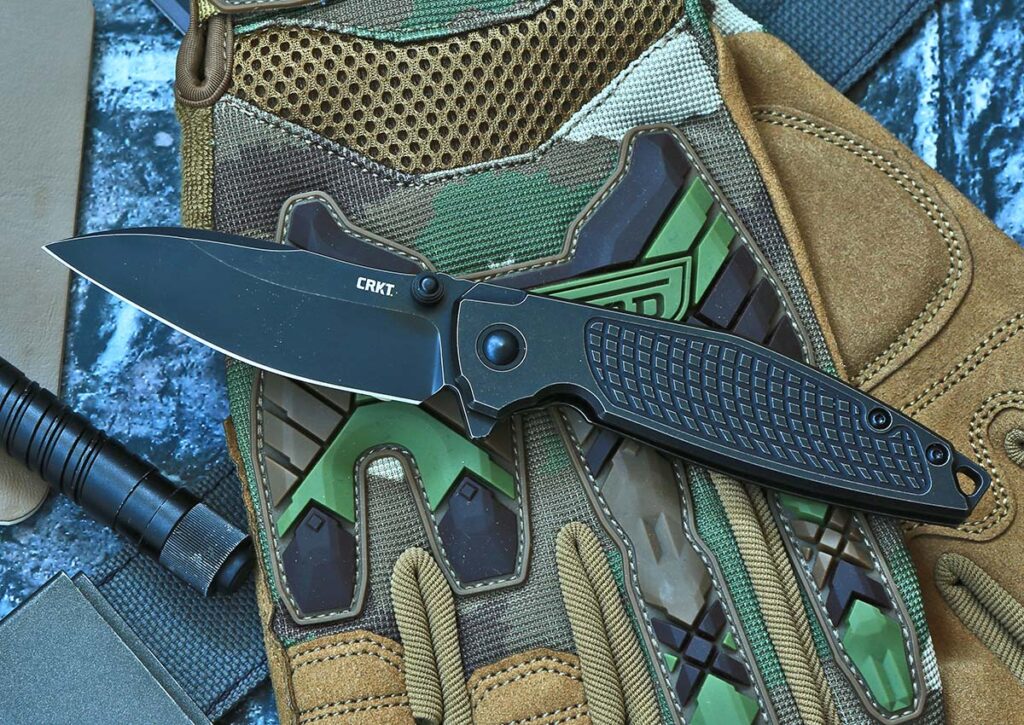
Designed by Lucas Burnley, the CRKT Ibis features a drop-point blade with a prominent belly great for slicing, while the black finish complements the titanium handle.
Designed by Lucas Burnley, the CRKT Ibis is named after a graceful wading bird. For a distinctive look, the blade features a sleek curve along the spine. The drop-point blade boasts a prominent belly great for slicing, while the black finish complements the titanium handle. As Burnley notes, “It just looks good.”
With fast flipper deployment, the Ibis opens smoothly thanks to the Ikoma Korth Bearing System (IKBS)/ball bearing pivot. A low-profile pocket clip keeps the 2.9-ounce knife securely by your side.
Carrying
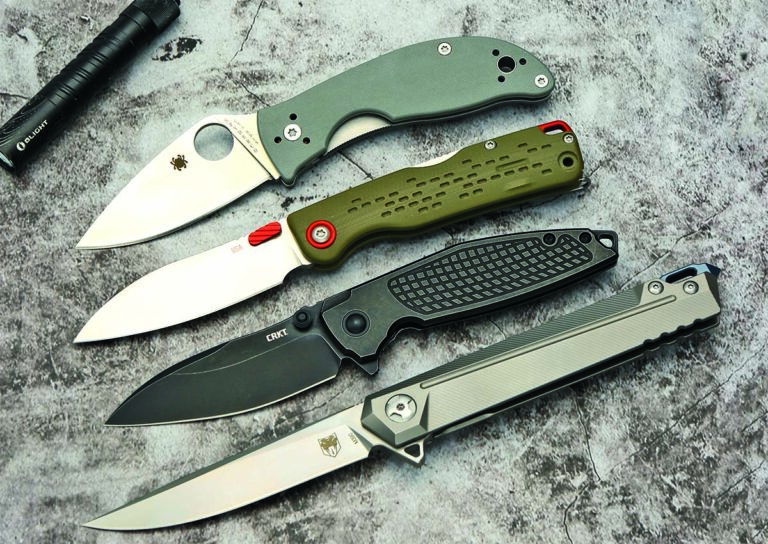
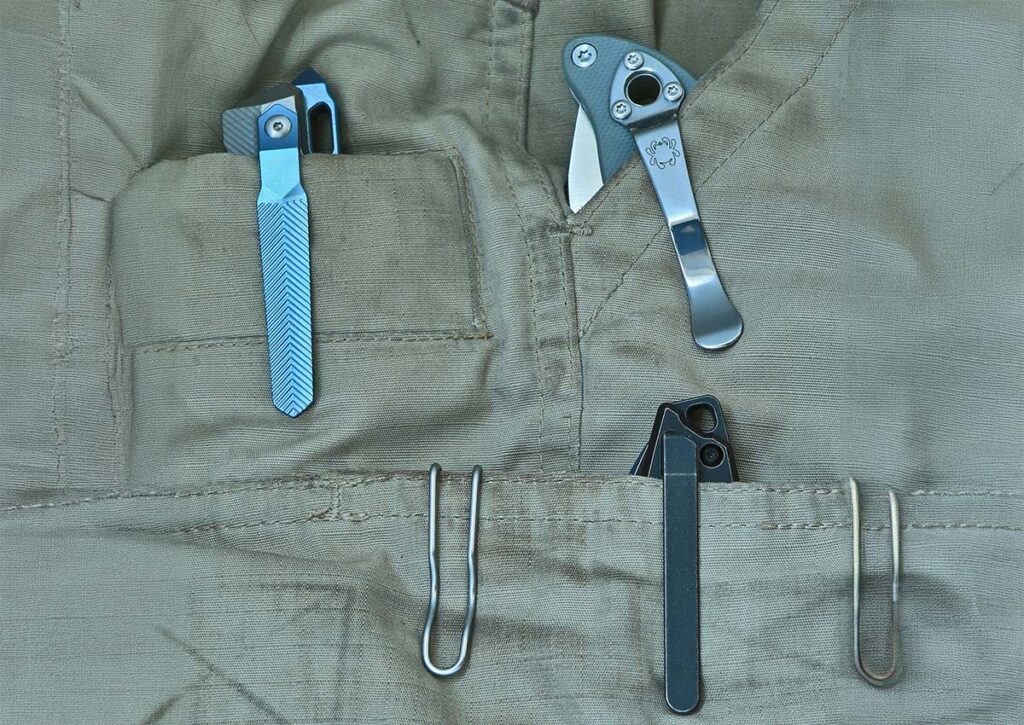
The way a knife is carried is essential. The sleek Olympian (top left) and discreet Ibis (bottom right) are great gentleman’s knives, while the bulkier Alcyone (top right) is more noticeable. The State & Union (bottom left) is the least noticeable of all.
How a knife rides in your pocket is essential. The Olympian carried deep with enough handle to grab onto. The sleek diameter, closed and open, never felt bulky.
The Ibis also carried deep and was easy to retrieve. It came in second to the Olympian for sleekness. The black color also made it the most subdued of the gang, attracting less attention.
The Alcyone carried bulky and a lot more exposed. The protrusion makes it easier to get at but screams, “I have a knife!” If that bugs you, you can always opt for a different folder.
The State & Union carried exactly how I like—deep and almost invisible. It has the right amount of pocket capacity to let me know it was still there. It and the Olympian were my favorite pocket carry folders of the test bunch.
All the knives come with a lanyard hole.
Opening
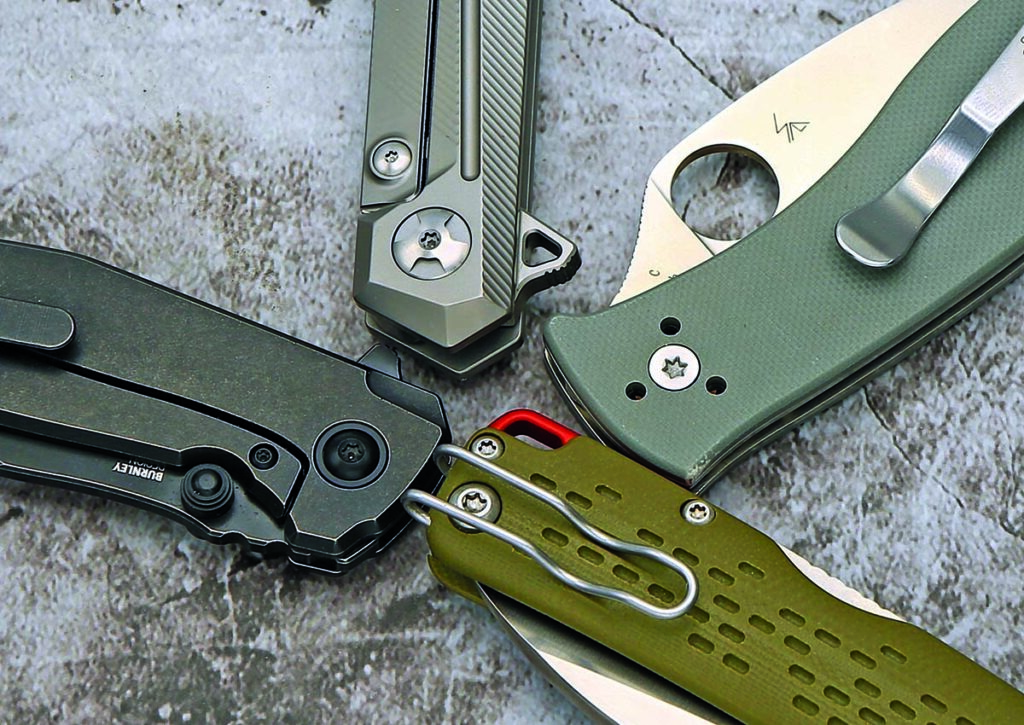
The test knives are studies in differing approaches to colors, locks, blade openers, pocket clips, lanyard holes, bulk, dimensions and more.
The Olympian has a flipper-style opener—and it was smooth and sleek. The Ibis has two ways of opening. Despite how smoothly the flipper operated, the thumb studs were another animal. CRKT should remove the thumb studs altogether. I’ve handled hundreds of one-handed openers. I could not open this one, no matter how hard I tried. All the king’s horses couldn’t open it using the thumb studs.
The Alcyone, on the other hand, has the eternally trusty large opening hole. I could open the blade in an inverted position, using my middle finger to lightly disengage the blade and let a wrist flick do the rest. That’s a Spyderco. It doesn’t vary in quality from any other Spyderco. The State & Union has an undeniable thumb stud for easy access. It opened smoothly, and the sound of the lockback engaging gave a sense of confidence. Solid as can be—it’s a KA-BAR!
Ergonomics
An easy winner in hand comfort was the State & Union. I had it the longest and exposed it to more use than every other test model. Second was the Olympian, though it was close. After all, I spent more time with the S&U. The Alcyone earned a third place yet was very solid. The Ibis wasn’t uncomfortable but would show hot spots as a long-cutting task knife.
Final Cut
Packaging peanuts, leather, light phone cords, 550 paracord, cardboard and nylon webbing are all part of my test gauntlet for folding knives.
The State & Union made feather sticks in the forest for a winter fire with ease. I found some stray nylon rope in the woods and tried slicing it with the S&U. It did not slice through. The task may have dulled the edge. During the gauntlet test, the knife faltered on packaging peanuts, nylon webbing, leather and 550 paracord. It made it through phone cord and cardboard but was a step behind the others.
The Olympian deploys with a fierce snap and displays a ready-to-go attitude—and means it. It slices well and can easily fit the role of a gentleman’s carry knife. The Ibis deployed almost as smoothly as the Olympian. It sliced all materials with authority. It ranked second among the review bunch in knife tasks. However, the Alcyone absolutely smashed it—maybe I should say slashed it. It was the best slicer across the board. Winner, winner, chicken dinner!
The technological advancements that have redefined the pocketknife as we know it.
When I stumbled onto the knife scene in 1985, the only pocketknives I had carried up to that point were slipjoints and lockbacks. Of course, slipjoints weren’t called slipjoints back then but simply pocketknives. Today, as far as BLADE® is concerned—not that it’s any major newsflash or anything—any knife you can carry in your pocket is a pocketknife.
All of which brings me to the subject at hand: my picks of the five most important pocketknife developments of the modern sporting knife era. In rough chronological order they are:
•The pocket clip:BLADE Magazine Cutlery Hall-of-Fame® member Sal Glesser’s introduction in 1981 of the Spyderco pocketknives with the hole in the blade and the pocket clip would turn the genre on its head. While the hole in the blade was a masterstroke in and of itself, it was the pocket clip that forever changed the way people would carry their pocketknives. Rather than rattling around in the bottom of a pocket with change, car keys and what have you, the closed knife was held on the pocket lip by the clip, free from pocket-bottom scratches and poised at the ready to be deployed to cut whatever needed cutting.
•The linerlock: Cutlery Hall-of-Famer Michael Walker invented the linerlock in 1981, but it would take a few more years before custom knifemakers—and shortly thereafter, factory makers—began readily adopting the lock that made one-hand manual opening and closing of the pocketknife an easy reality rather than an exercise in hand contortions. Today, the argument can be made that the linerlock is used on more sporting folders than any other lock.
•The flipper: While exactly who made the first folder with the flipper tab that manually deploys a folding blade with the tap of a finger may be up for debate, there is no debating that the person who popularized it was Cutlery Hall-of-Fame knifemaker Kit Carson. A simple addition to the pocketknife on its face, the flipper tab opens a blade as fast and easy as any other manual method—probably faster.
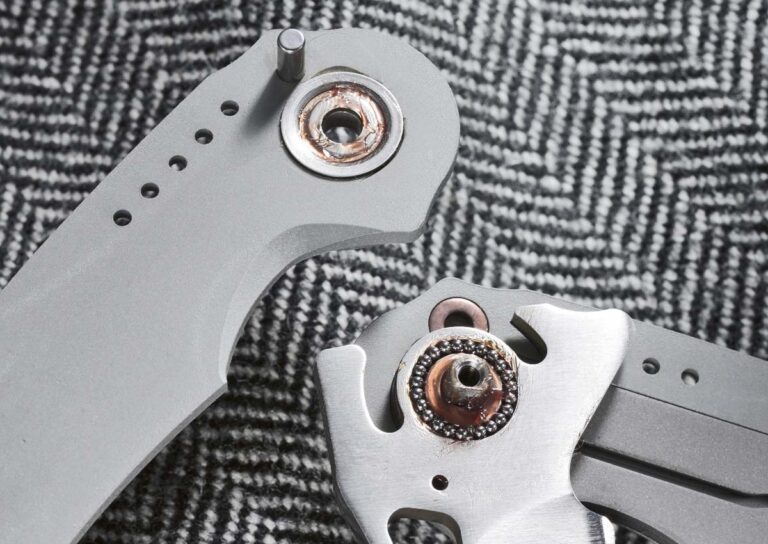
•The Ikoma Korth Bearing System (IKBS): Pivot systems that helped open folding blades quickly and smoothly had been around before, but it was the IKBS conceived in 2002 that took blade opening to a new level of quick and smooth. In conjunction with the flipper especially, the IKBS transformed one-hand pocketknife opening from fast to just this side of automatic. Developed by Brazilian custom knifemakers Flavio Ikoma and Ricardo “Rick” and Paulo Lala (the latter two collectively known as Korth), the IKBS is another masterstroke of design and invention.
•Material upgrades: These cover a number of materials and years, from Walker’s switch to titanium for his linerlock spring in 1983, to a wide array of other hi-tech substances in subsequent years for pocketknife handles, including titanium, thermoplastics, Micarta®, G-10, carbon fiber and other state-of-the-art materials that not only were super strong and tough but also were lightweight, reducing the weight of pocketknives to the point that they were basically unnoticeable in a pocket. Meanwhile, the advances in blade steels over that same stretch are too many to mention.
How about you? What are the most important pocketknife developments? Tell us in the comments.
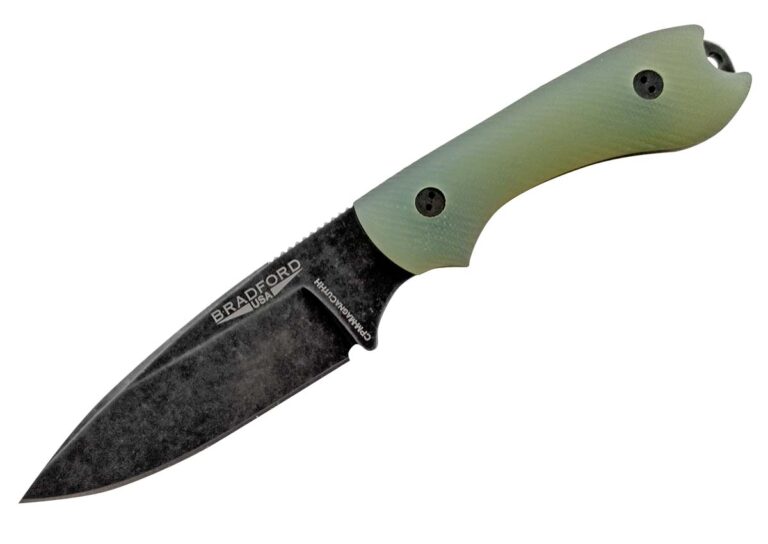
Bradford Guardian 3.2 in MagnaCut is a rope-eating animal.
EDC fixed blades are very popular, small enough to avoid unwanted attention yet able to do most jobs. They often range from 2-to-4-inch blade lengths and 3-to-4-inch handles. Usually carried in a cross draw or pocket sheath, in a pinch they can be used for self-protection (if you have training).
In general, it is a very useful tool that is always on you. I carry one constantly. The Guardian 3.2 in CPM MagnaCut stainless blade steel from Bradford USA definitely fits the bill. As to how well it works, let’s see if it holds up to everyday carry uses.
Guardian Light-Duty Cutting
I started with a 20-pound bond paper slice to check the fresh edge. The Guardian 3.2 was scary sharp. I nicked my fingernail three times by being slow. The blade made smooth, forceful slices with very little pressure. I did all push cuts with nary a snag or rolling of the paper.
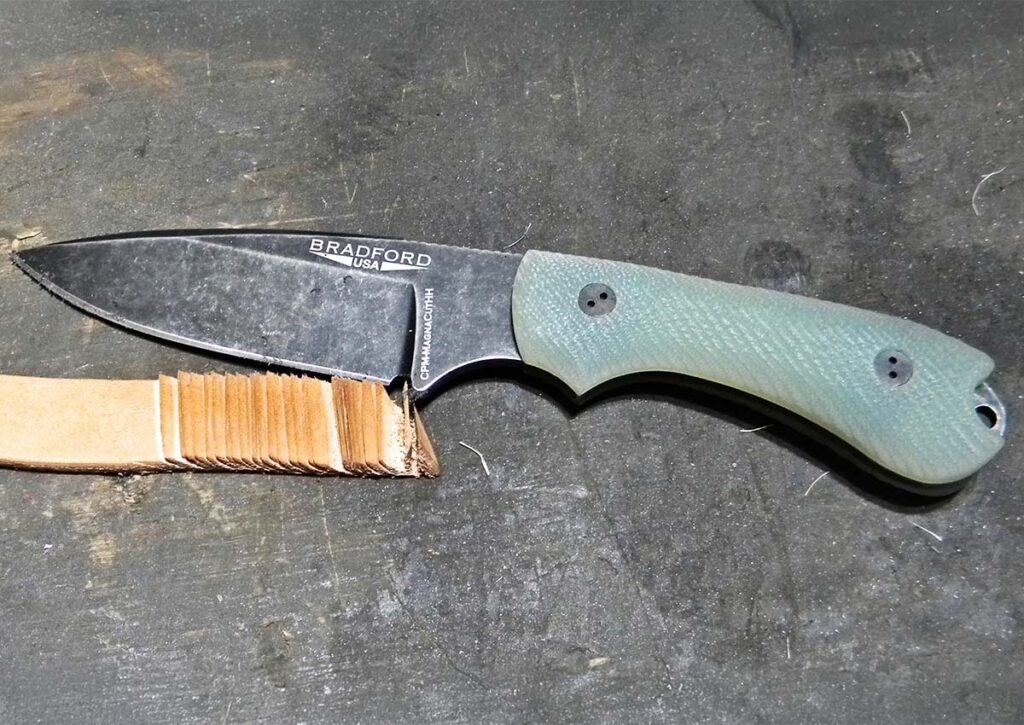
Very aggressive slicing into the 8-ounce leather resulted in nice crunching noises.
Single-walled cardboard was next on the menu. The results weren’t much different from the bond paper, though there was a slight drag when the thicker part of the blade encountered the cardboard. That didn’t stop the Guardian 3.2 from doing its job. It sliced the cardboard as fast as I could move my fingers out of the way.
Guardian Medium-Duty Cutting
It was time to skive 8-ounce leather. Very aggressive slicing into the leather resulted in nice crunching noises. The handle provided positive control of blade depth and angle during the skiving. I even did some end-grain slicing to keep the crunching going. This is a very sharp knife indeed.
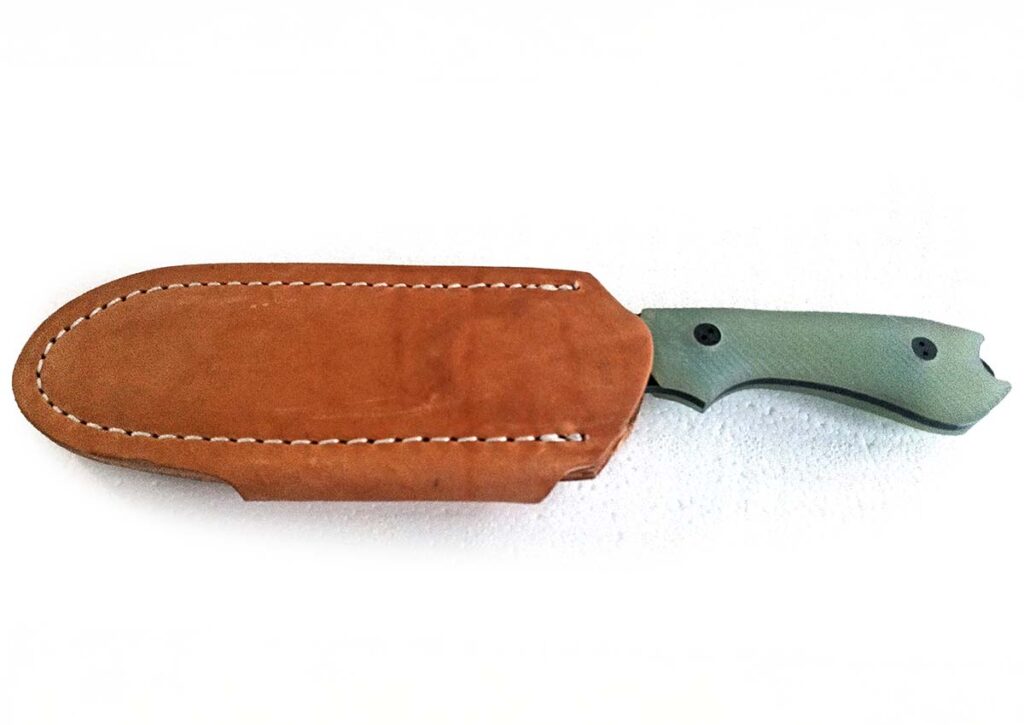
The pouch sheath of 6-to-7-ounce leather holds the knife securely. (BLADE® staff image)
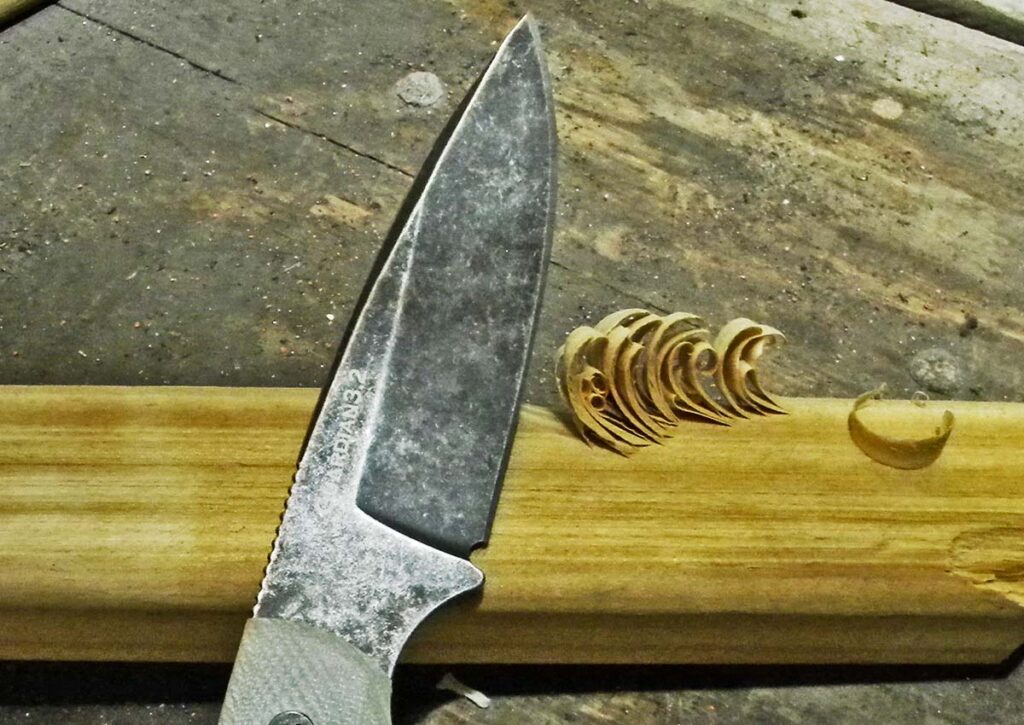
Springtime means camping so I needed to whittle lots of fire sticks. Using leftover pine, I whittled a bunch of excellent curlicues. The Guardian cut very smoothly. The thumb notches on the spine aided in control of cutting depth. Deep cuts or fine cuts, it can do both.
I used the Guardian to baton cut and it split the pine nicely, providing a nice pile of kindling. The handle felt comfortable. There was just one small point by the lanyard hole that was sharp when I rotated my grip. The knife does excellent wood work.
Guardian Heavy-Duty Cutting
As expected, after 30 hard whacks, the MagnaCut blade had a couple of very small nicks along the edge. It would be no big deal to work out the nicks with a very fine diamond hone.
Using leftover pine, the author whittled a bunch of excellent curlicues. The Guardian cut quite smoothly.
To show that the small nicks are not that big of a deal, I went back to the 20-pound bond paper slice. There was only one snag when I tried to start a cut on the edge nick. Otherwise, the edge sailed through the paper without tearing. I was impressed the edge didn’t have more issues.
Final Cut
The thumb notches on the spine aided in control of cutting depth. (BLADE® staff image)
Some softening at the back of the handle is in order. This knife is designed for slicing every day. The Guardian 3.2 is an impressive fixed-blade EDC.
Guardian 3.2 Specs Company: Bradford USA Blade length: 3 1/8” Blade steel: CPM MagnaCut stainless Rockwell hardness: 63-64 HRC Blade finish: Stonewashed black Blade grind: Saber Blade pattern: Drop point Scales: Jade-green G-10 Construction: Full tang Weight: 4.5 ozs. Overall length: 7 1/8” Sheath: Pouch type in 6-to-7-oz. leather Country of origin: USA MSRP: $229
A whole passel of knew knives that will set you wish list to overflow.
Eyes always peeled, we’re on the look out for the latest and the greatest. We think we’ve found a bevvy of them this February. So, with out further adieu, here’s our latest round of new knives.
Cowboy Szymanski M4 bayonet
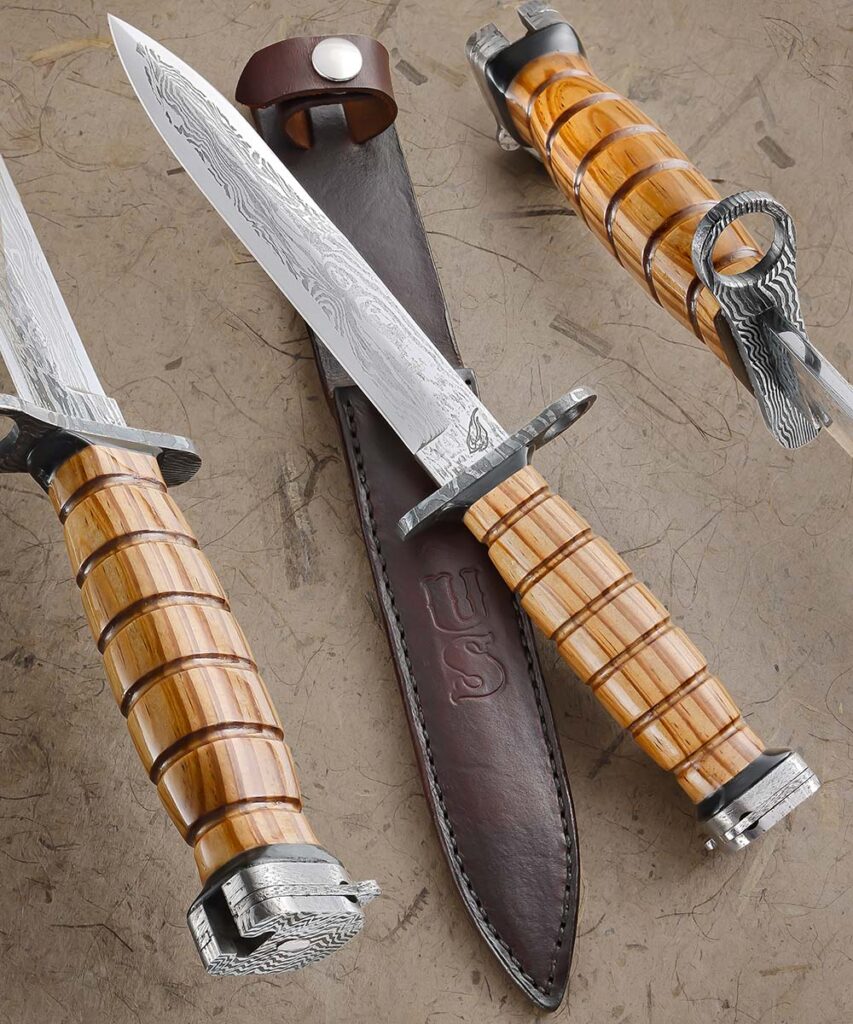
Blade length: 6.75” Blade material: Battleship blister-plated 15N20 nickel alloy steel Blade grind: Flat double edge Scales: Turned deck wood (long leaf pine) from the USS Texas BB-35 World War I dreadnought class battleship Bolster: Same material as blade Overall length: 11.75” Sheath: Standard leather Knife to know: Cowboy Szymanski donated the knife to the Battleship Texas Foundation through the Battleship Texas Artisans project to raise funds to refurbish the USS Texas. Maker’s price for a similar knife and sheath: $1,997 Maker: Cowboy Szymanski (SharpByCoop image)
Robert Appleby Tillotson-Inspired Sheffield Bowie
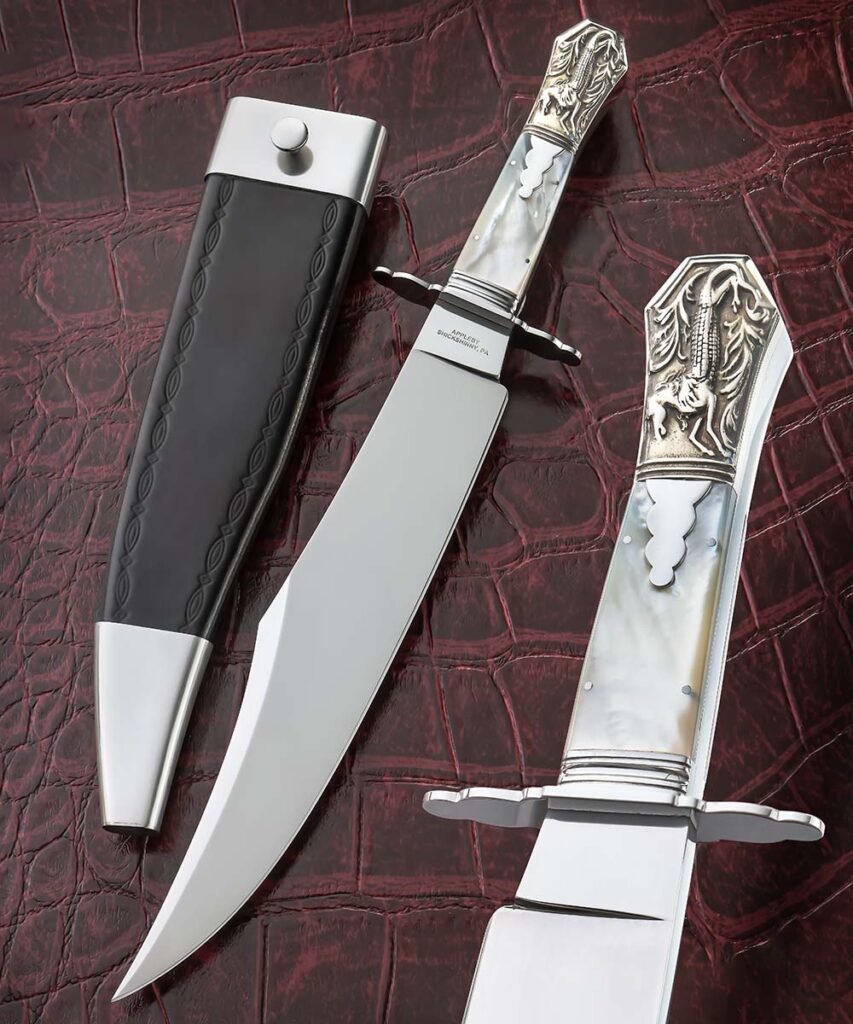
Blade length: 10” Blade steel: CPM 154 stainless Blade grind: Hollow (36” radius) Blade finish: 2,000-grit satin Blade pattern: Clip point Scales: Mother-of-pearl Handle frame, guard & front bolster: 410 stainless Overall length: 14.5” Sheath (not shown): Wet-molded leather w/410 stainless throat and tip Knife to know: The half-horse/half-alligator rear bolster cast in white bronze is in a style made famous on classic 19th-century bowies; Robert Appleby is no longer accepting custom orders Maker’s price for a similar knife and sheath: $3,200 Maker: Robert Appleby, applebyknives.com (SharpByCoop image)
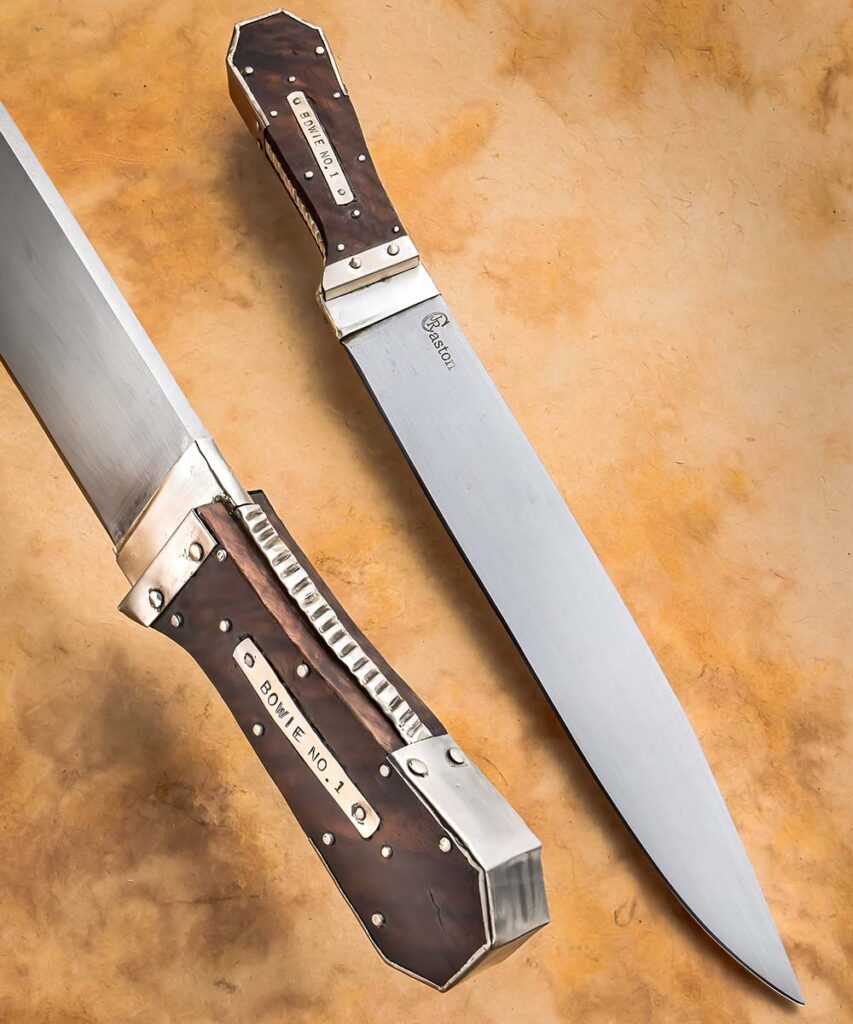
Randy Caston Bowie No. 1
Blade length: 13.5” Blade material: 1075 carbon steel Scales: Walnut burl Furniture: Sterling silver Overall length: 19” Knife to know: Randy Caston’s Bowie No. 1 is a reproduction of a 19th-century bowie some believe was made by James Black; Randy is a past Forged in Fire champ (season six, episode 16) Maker’s price for a similar knife: $1,750 Maker: Randy Caston (SharpByCoop image)
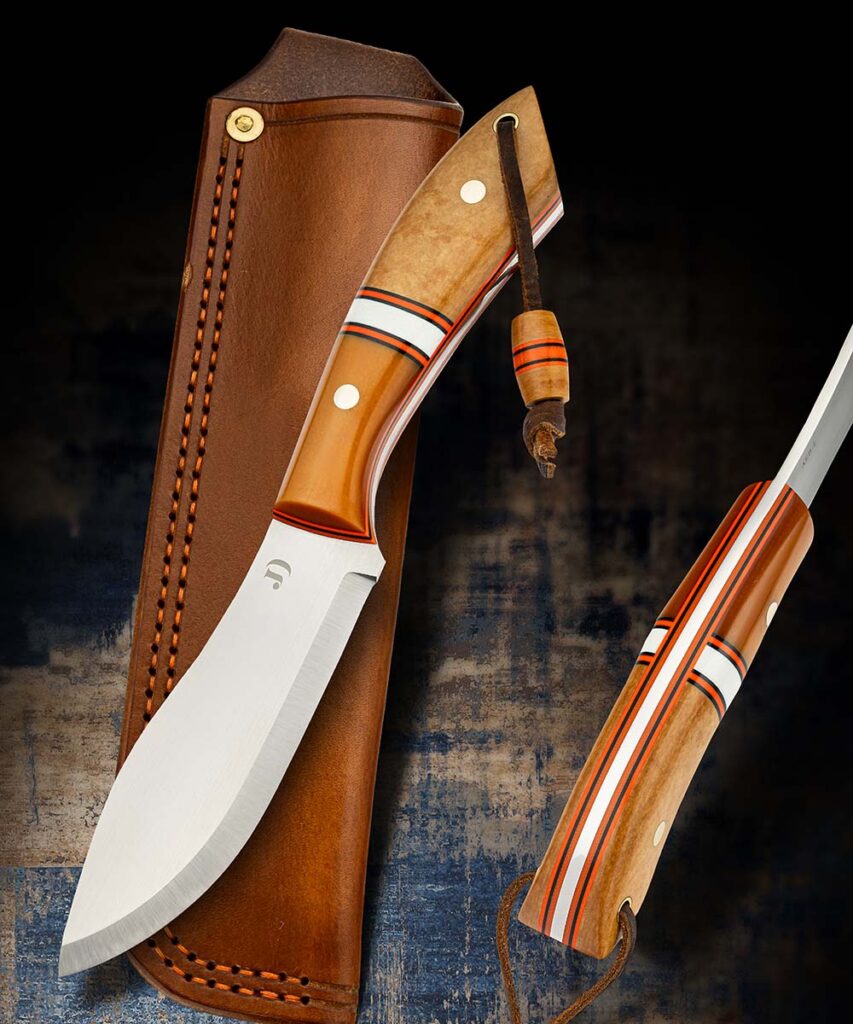
Jordan Danz Nessmuk
Blade length: 4.5” Blade steel: AEB-L stainless Blade grind: Scandi Scales: Butterscotch Micarta® w/Maple Valley Richlite Spacers: G-10 Lanyard: Leather w/bead of butterscotch maple and G-10 spacer Overall length: 9.75” Sheath: Leather w/belt loop Maker’s price for a similar knife and sheath: $400 Maker: Jordan Danz, jdcustomknives.com (Jocelyn Frasier image)
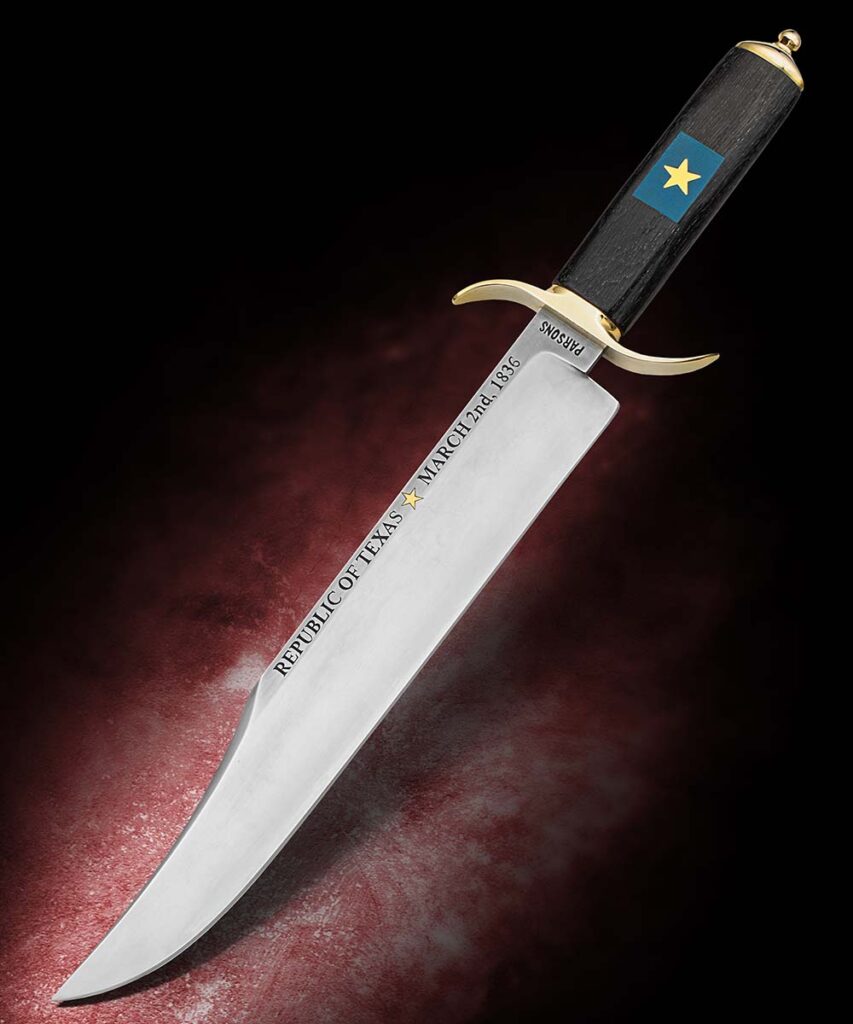
Lee Parsons Texas Republic Bowie
Blade length: 12” Blade material: 1095 carbon steel w/hamon made via the clay method Blade grind: Flat Blade finish: Hand sanded to mirror polish Blade pattern: Clip point Scales: Bog oak w/blue and yellow Micarta® Fittings: Brass Overall length: 17.5” Maker’s price for a similar knife: $2,500 Knife to know: The knife was made for a collector who is a huge fan of Texas; lettering is hand engraved and the hand-inlaid Republic star is 24k gold; March 2, 1836, is the date Texas formally declared its independence from Mexico; Lee Parsons is an ABS apprentice smith Maker: Lee Parsons, skmoknives.com (Jocelyn Frasier image)
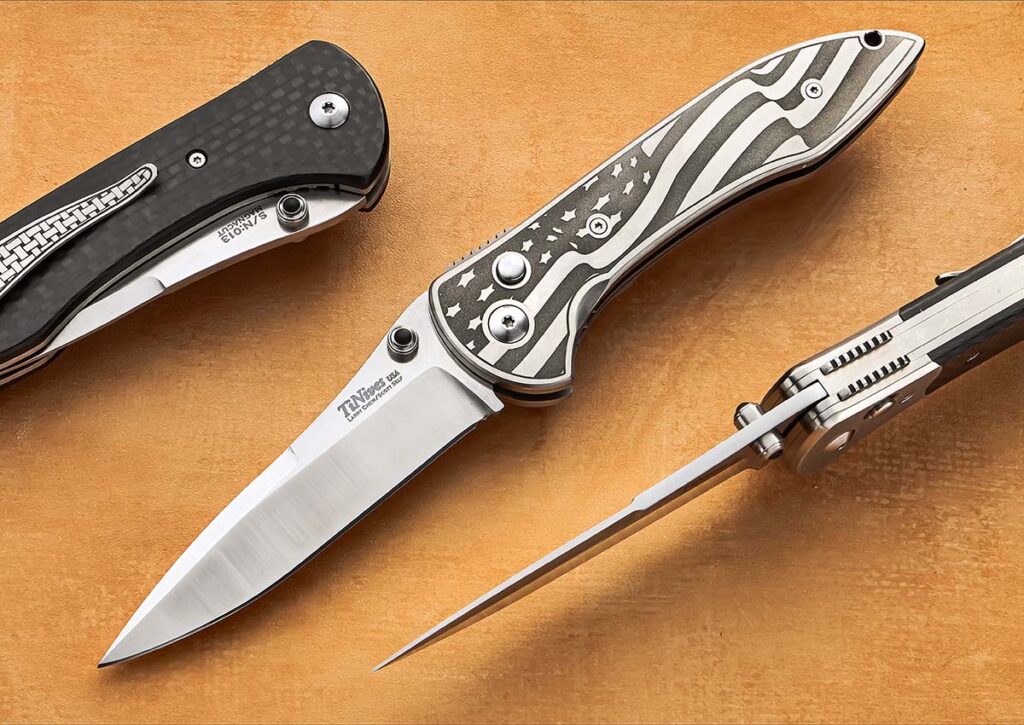
Larry Chew/TiKnives Covert Dual Action
Blade length: 3.5” Blade steel: CPM MagnaCut stainless Blade grind: Hollow on first run Blade finish: Satin or bead blasted Scales: Laser-engraved titanium & carbon fiber Handle frame: Titanium Pocket clip: Laser-engraved titanium & carbon fiber Closed length: 4.5” Makers’ price for a similar knife: $975 and up Knife to know: Features the Covert Lockout mechanism in which the upper left-hand gimping slides forward to release the spring-loaded release button; dual thumb studs; options include Chad Nichols damascus blade steel and titanium, Timascus™ and ironwood scales, and a 3D-machined damascus clip (check w/makers for pricing on options); a collaboration between Larry Chew and Scott Self of TiKnives Makers: Larry Chew/TiKnives, tinivesoriginal.com (SharpByCoop image)
Levi Graham Ancient Woolly Frontier Field Knife
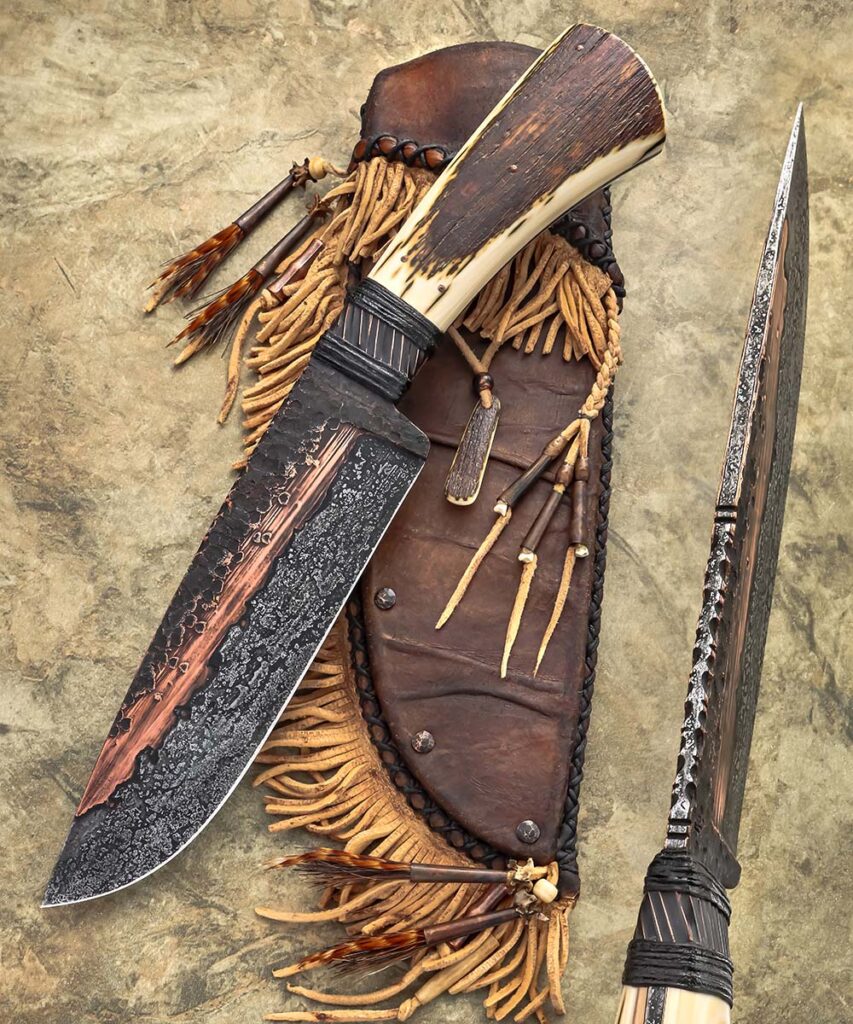
Pattern: Camp knife Blade length: 6” Blade material: 1084 carbon steel w/copper cladding forged by Adam Deville Blade grind: High flat Scales: Mammoth ivory Construction: Full-tapered tang Bolster: Copper textured wrap and rawhide Overall length: 11.25” Sheath: Deer rawhide w/braintan fringe, mammoth bark center dangler w/copper tacks, cones, beads, rattlesnake vertebrae and horsehair Maker: Levi Graham, levigrahamknives.com (SharpByCoop image)
Tanner Couch Saddlehorn Trapper
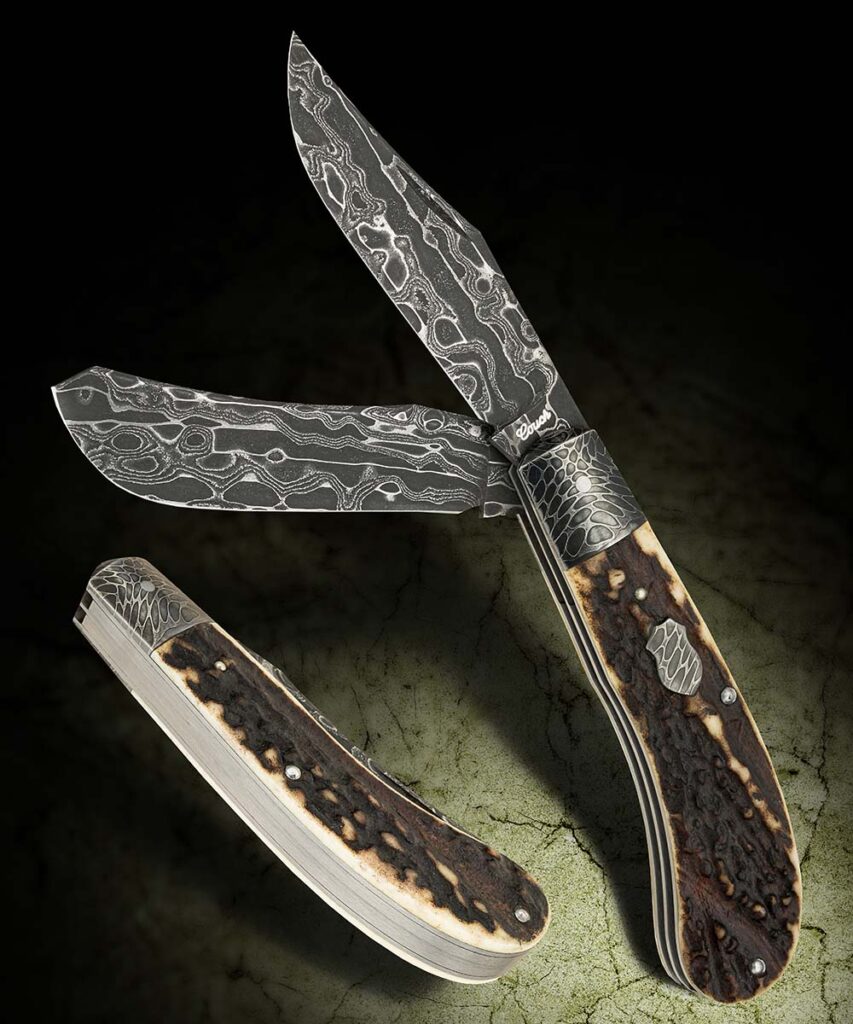
Blade length: 2 7/8” Blade material: Vegas Forge stainless steel Virus damascus Blade grind: Hollow Scales: Stag Bolster: Chad Nichols Wasp Nest damascus Maker’s price for a similar knife: $3,000 Knife to know: The saddlehorn trapper was one of the favorite patterns of BLADE Magazine Cutlery Hall-of-Fame® member Tony Bose, iconic American custom knifemaker Maker: Tanner Couch, Tilden, (Jocelyn Frasier image)
Marc Josef Knives Pizza Cutter
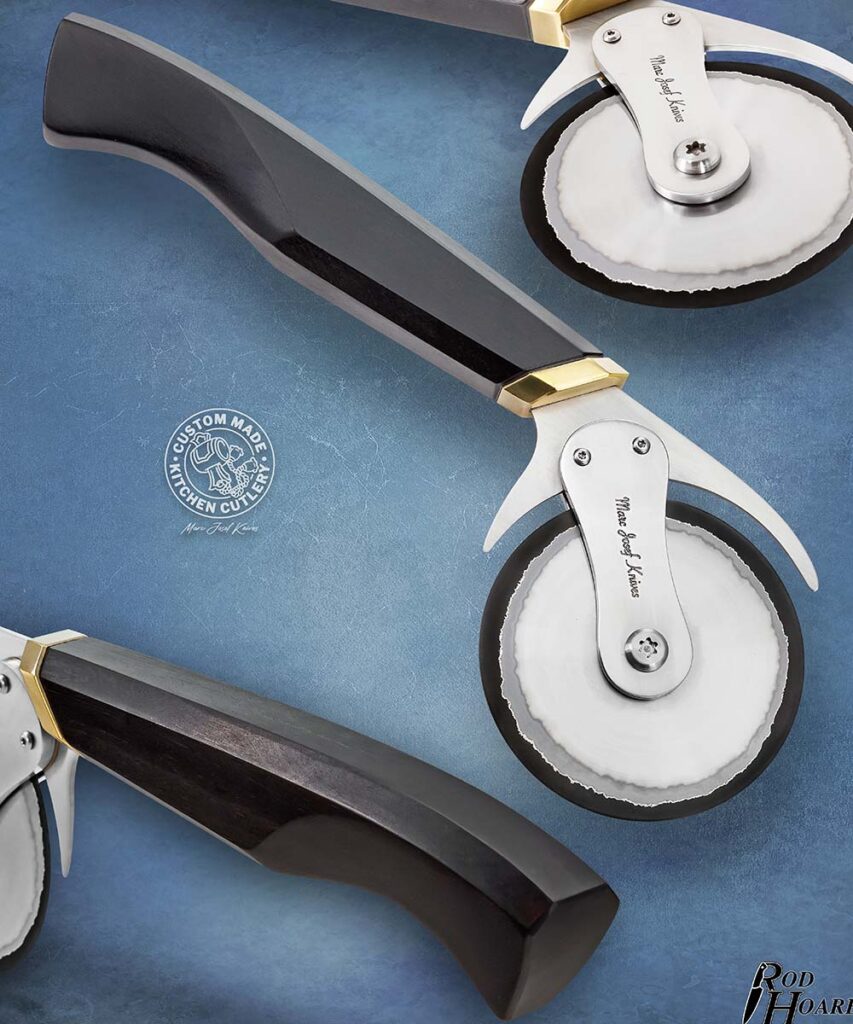
Blade diameter: 2.76” Blade material: 52100 carbon and 410 stainless nickel alloy steels forged in a san-mai construction by Brook Turner Scales: Ebony Overall length: 9.1” Maker’s price for a similar piece: $750 at press-time exchange rate Maker: Marc Josef Knives, marcjosefknives.com.au (Rod Hoare image)
Nicholas Orr Coffin-Handle Bowie
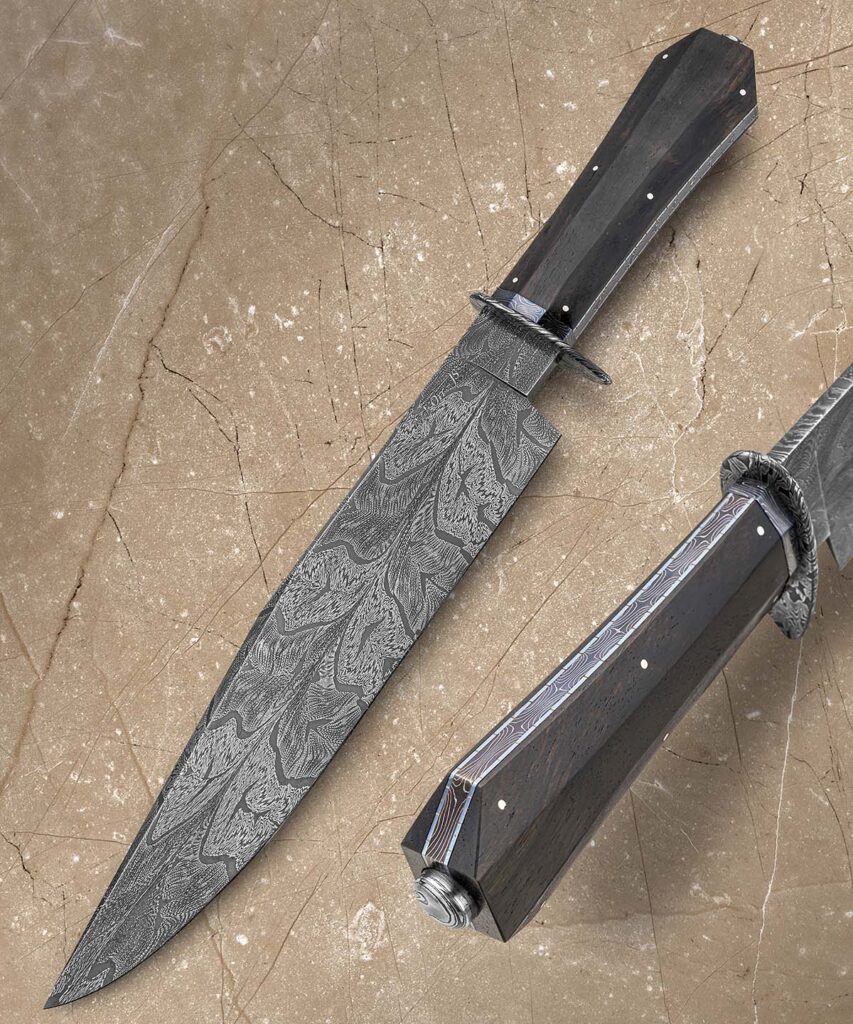
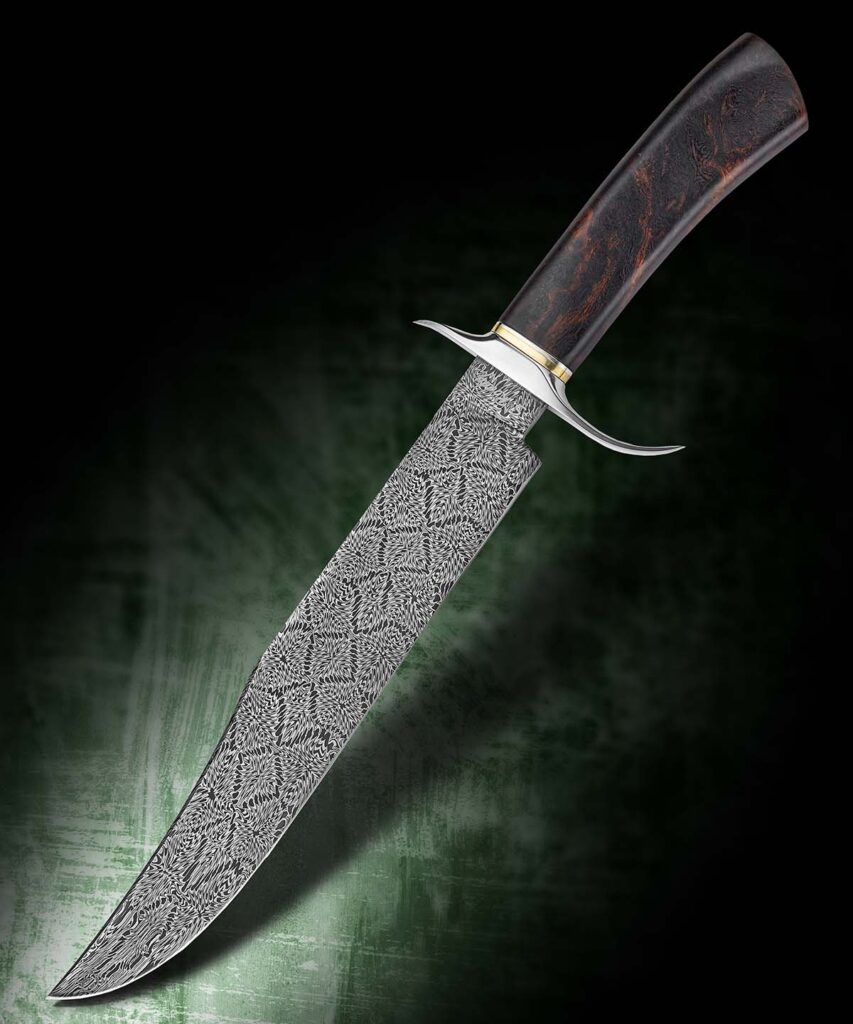
Blade length: 8.5” Blade material: Feather-pattern mosaic damascus Blade grind: Full flat w/a double clip Blade pattern: Clip point Scales: African blackwood Handle frame & spacer: Twisted & blued mosaic damascus Guard & pommel: Mosaic damascus Construction: Full tang Overall length: 13.5” Maker’s price for a similar knife: $4,000 Knife to know: Nicholas Orr is an ABS journeyman smith Maker: Nicholas Orr, (Jocelyn Frasier image)
Sam Roddy Bowie
Blade length: 10” Blade material: Mosaic damascus of 1084 carbon and 15N20 nickel-alloy steels Blade grind: Flat Blade pattern: Clip point Scales: Ironwood w/nickel silver and brass spacers Guard: Stainless steel Overall length: 15.5” Maker’s price for a similar knife: $2,400 Knife to know: Sam Roddy is an ABS apprentice smith Maker: Sam Roddy (Jocelyn Frasier image)
Jacco VandeBruinhorst San Francisco Gentleman’s Knife
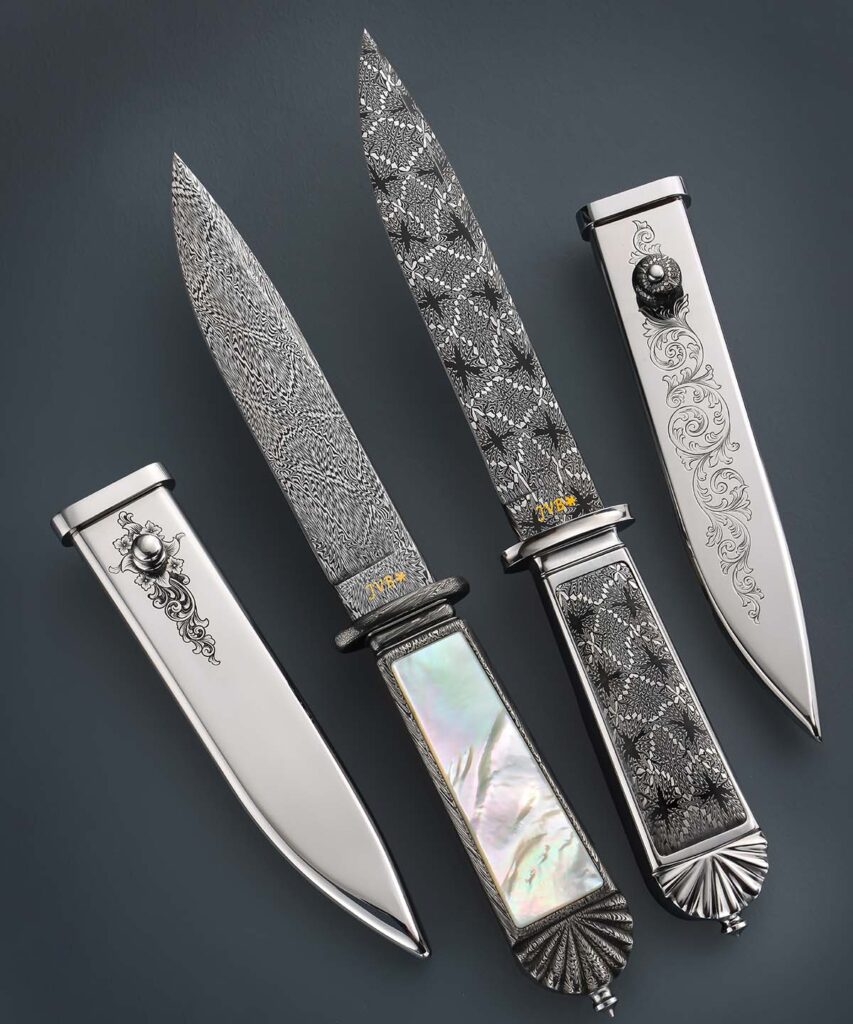
Knife type: 19th-century dress bowie Blade length: 5.5” Blade material: Mosaic damascus Blade grind: Flat Scales: Mother-of-pearl Handle frame: Mosaic damascus Overall length: 12” Knife to know: Full takedown construction; engraving by Wolfgang Loerchner Maker: Jacco VandeBruinhorst, jvbknives.ca (SharpByCoop image)