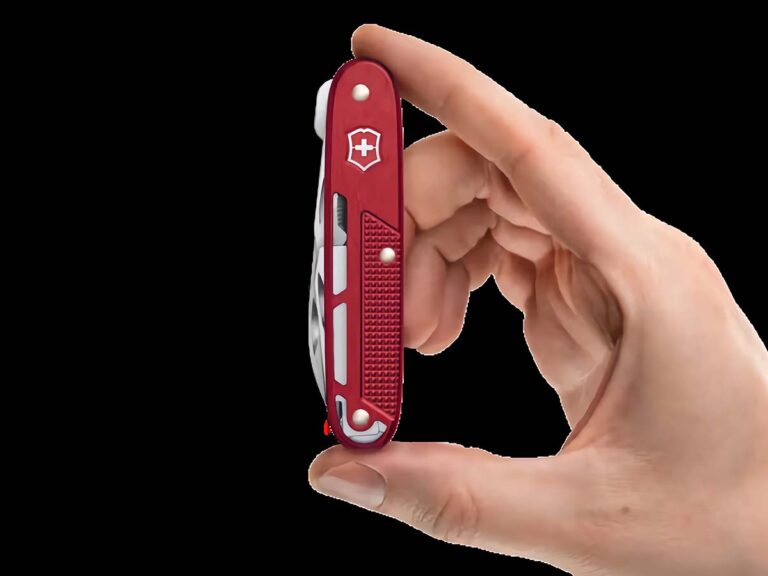
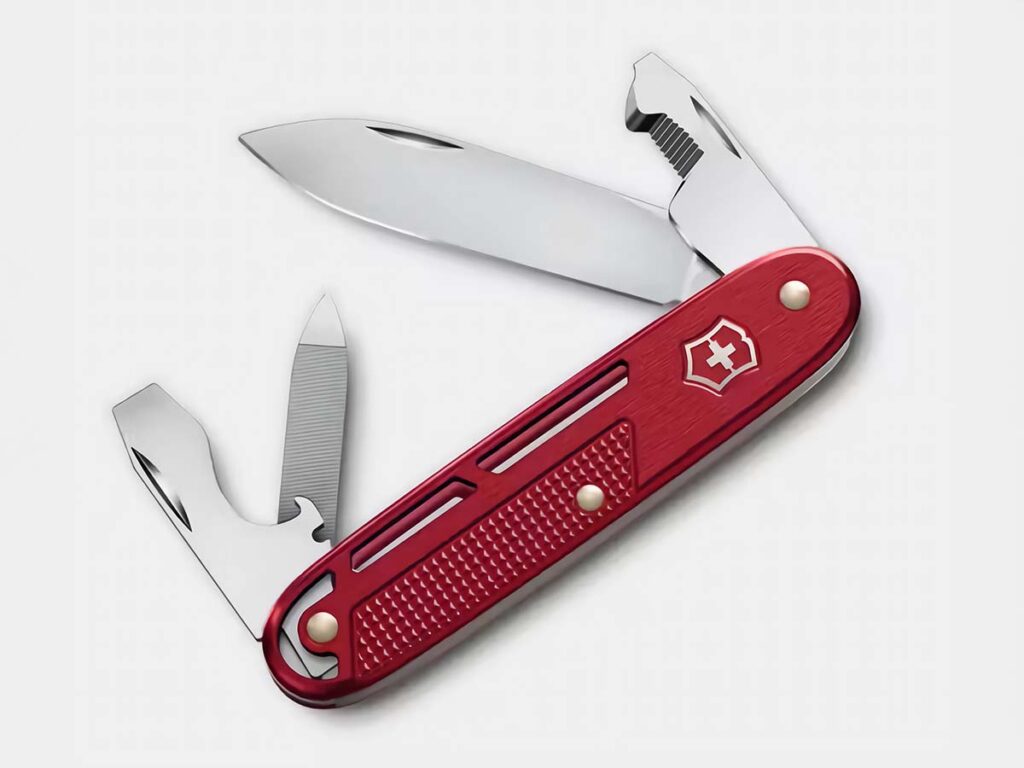
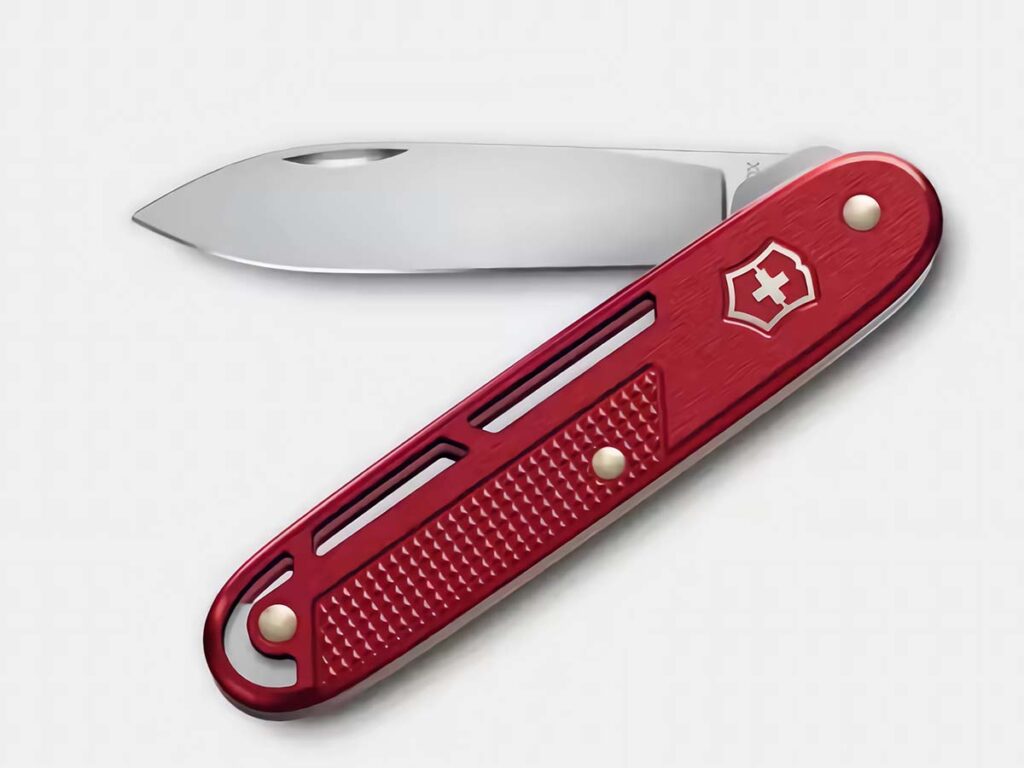
The Alox Refined Collection gives Victorinox’s classic design a modern twist.
As steady as the flow of an Alps glacier, Victorinox doesn’t veer far from its design fundamentals. It’s served the Swiss company well, given the Swiss Army Knife might be among the most recognizable tools in the world. In turn, when the iconic company tweaks its legendary pocketknives, it’s worth taking note.
Hence, the Alox Refined Collection deserves consideration—even if you aren’t a diehard collector of Victorinox.
More than anything, it appears Victorinox is modernizing the aesthetics of its knives with the three-knife line. Alox—aluminum scale—has been around for some time, but never quite in the guise it appears in the Refined Collection. The knifemaker has also attempted to improve the function of the series with the addition of a feature that has become almost a must-have on modern pocketknives—a pocket clip.
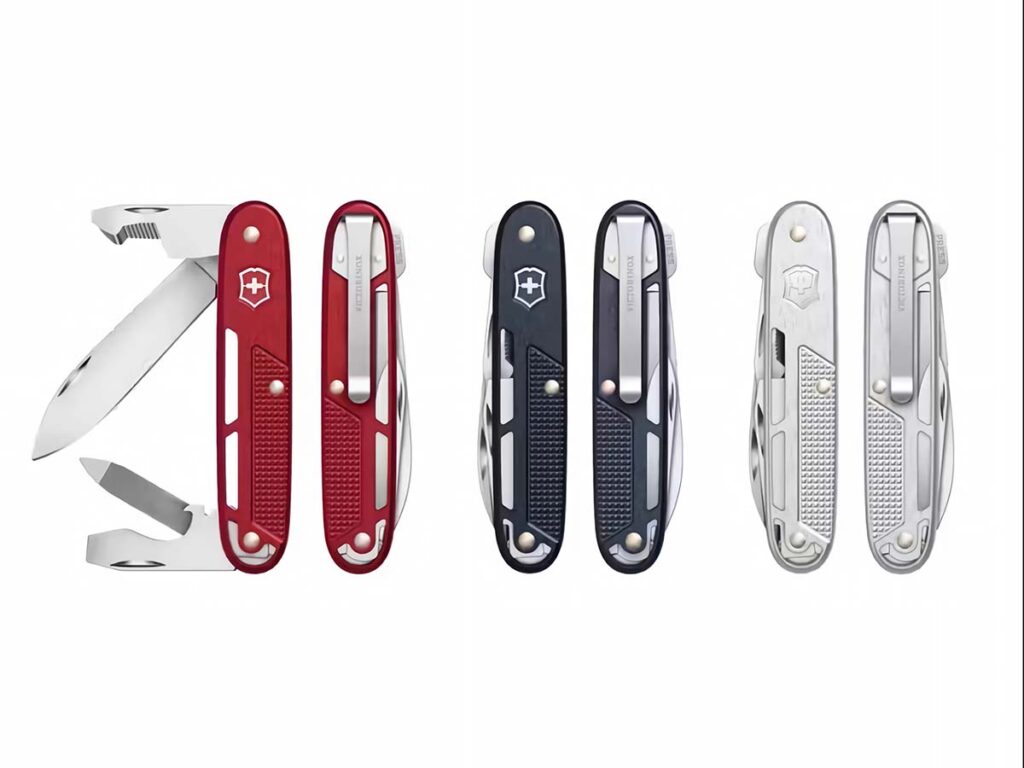
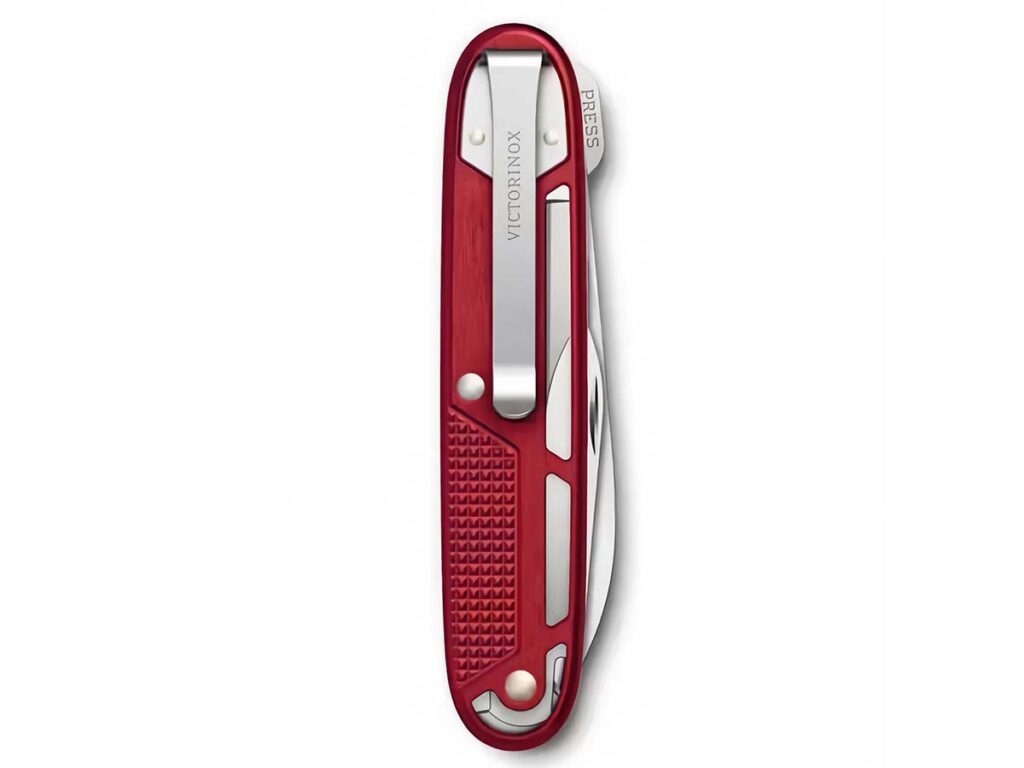
As to the looks of the Refined Collection, it’s solid, catching the classic SAK up to current sensibilities without veering from Victorinox’s winning formula. The scale has a sleek brushed finish, the texturing runs in a saddle near the spine and it features multiple cutouts. The last feature I like, given it gives a peek into the knives’ locking mechanisms and adds character. On the flip side, I get a bit clutchy on exposing these to the environment and fouling.
On the topic of lockup, the main blade has a locking leaf on all three models, potentially making it fit for more robust duty—at least fit for duties that could potentially close a slipjoint lock. As for the clip, it blends in with the curve of the knives’ end and is riveted onto the scale, so there’s no playing with how it’s carried. This shouldn’t be an issue, given blade deployment is still via a nail nick. The three models of the Refined Collection offer different tiers of tools, with the OneFold Alox offering a single blade, the Synergy Alox four tools and the Synergy X Alox five tools. The price tag on the series runs from $56 for the OneFold to $96 for the Synergy X.
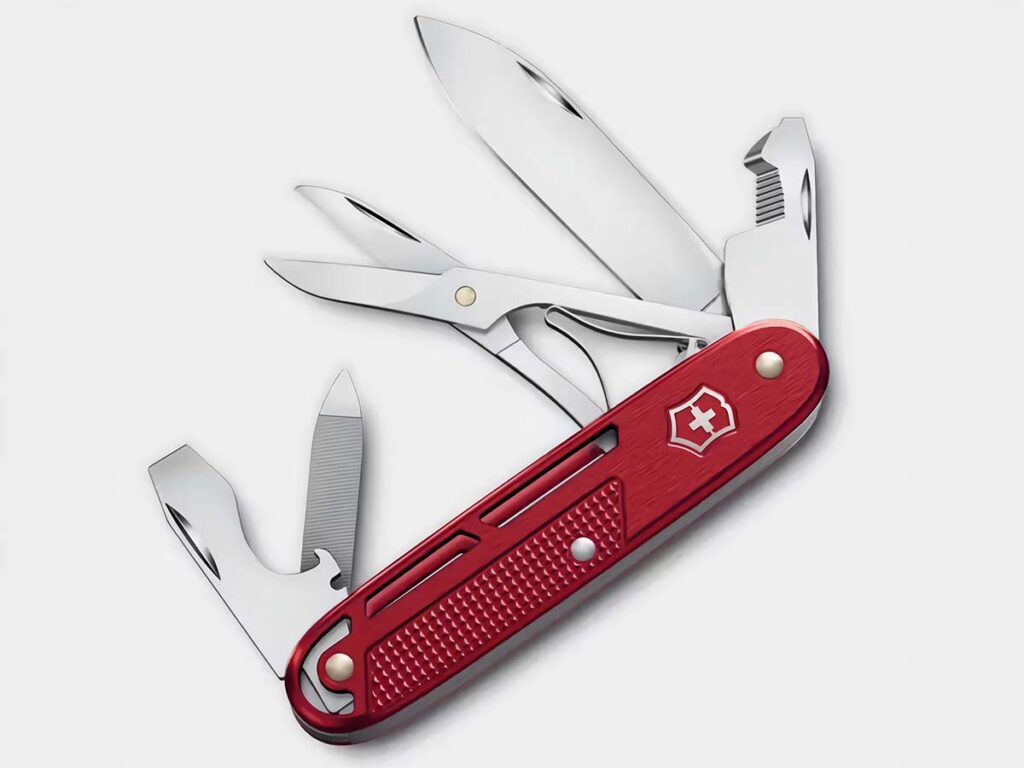
Onto the differences in the models themselves. The OneFold is super simple, with the blade being the only tool present. The Synergy is the middle-tier model, with a considerable expansion to its toolbelt: in addition to the blade, it has the nail file/narrow driver, bottle opener/flat head driver and a new box opener tool that appears to be exclusive to the Refined Collection. Finally, we have the Synergy X which, if you know your Victorinox nomenclature, you will understand to have a pair of spring-loaded scissors in addition to the standard Synergy tool suite.
Synergy X Alox Specs
Tools: Blade, large / Scissors / Box Opener / Screwdriver 3 mm / Nail file / Nail cleaner / Bottle opener / Screwdriver 7 mm / Wire stripper / Carry clip Height: 0.8 in Length: 3.7 in Width: 0.9 in Weight: 3.5 oz Country of origin: Switzerland Blade lockable: Yes One hand blade: No No. of features: 10 MSRP: $96
Synergy Alox Specs
Tools: Blade, large / Box Opener / Screwdriver 3 mm / Nail file / Nail cleaner / Bottle opener / Screwdriver 7 mm / Wire stripper / Carry clip Height: 0.7 in Length: 3.7 in Width: 0.9 in Weight: 2.7 oz Country of origin: Switzerland Blade lockable: Yes One hand blade: No No. of features: 9 MSRP: $78
Onefold Alox Specs
Tools: Blade, large / Carry clip Height: 0.6 in Length: 3.7 in Width: 0.9 in Weight: 1.9 oz Country of origin: Switzerland Blade lockable: Yes One hand blade: No No. of features: 2 MSRP: $56
Stuart Kerr just can’t help meddling in the affairs of dragons with his custom straight razors.
Priced out of the custom straight razor market, Stuart Kerr figured he’d make his own. A lucky plunge for anyone who appreciates quirky and unique takes on the ol’ cut throat.
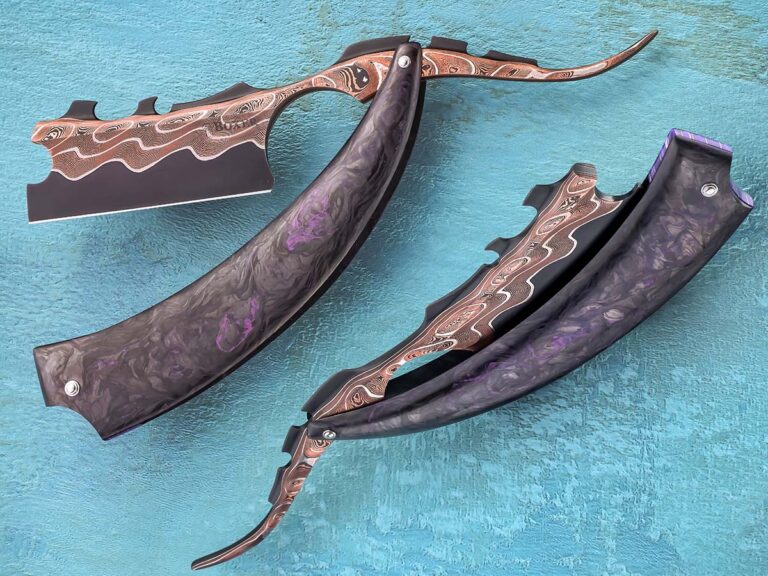
The Australian Knifemakers Guild member’s Cu Mai Dragon is a grand example of his deft and distinctive style. Kerr crafted a 2.56-inch blade from Baker Forge & Tool Tsunami Chevron Copper San Mai and offset it with a FatCarbon Dark Matter Purple Marble carbon-fiber handle. Striking enough as it is, but memorable thanks to the dragon scale on the spine and tang.
However, the proprietor of Boxer Custom Razors is darkly playful in much of his work.
“The concept of the dragon motif evolved from a couple of non-folding razors I made years back that were based on human bones. I was asked to design a razor with a handle that looked like a human spine,” the Queensland, Australia, resident said. “This inspired me to push the artistic envelope further and eventually evolved into the Dragon Tail and Dragon Spine razors.”
Kerr got his start restoring vintage straights, and when he made the jump to crafting them in 2011—aside from know-how—he started somewhat from scratch.
“I had a background in metal fabrication prior to studying to be a mechanical engineer, so I had the tools required to make my first belt grinder out of some plywood and an old pump motor,” he said.
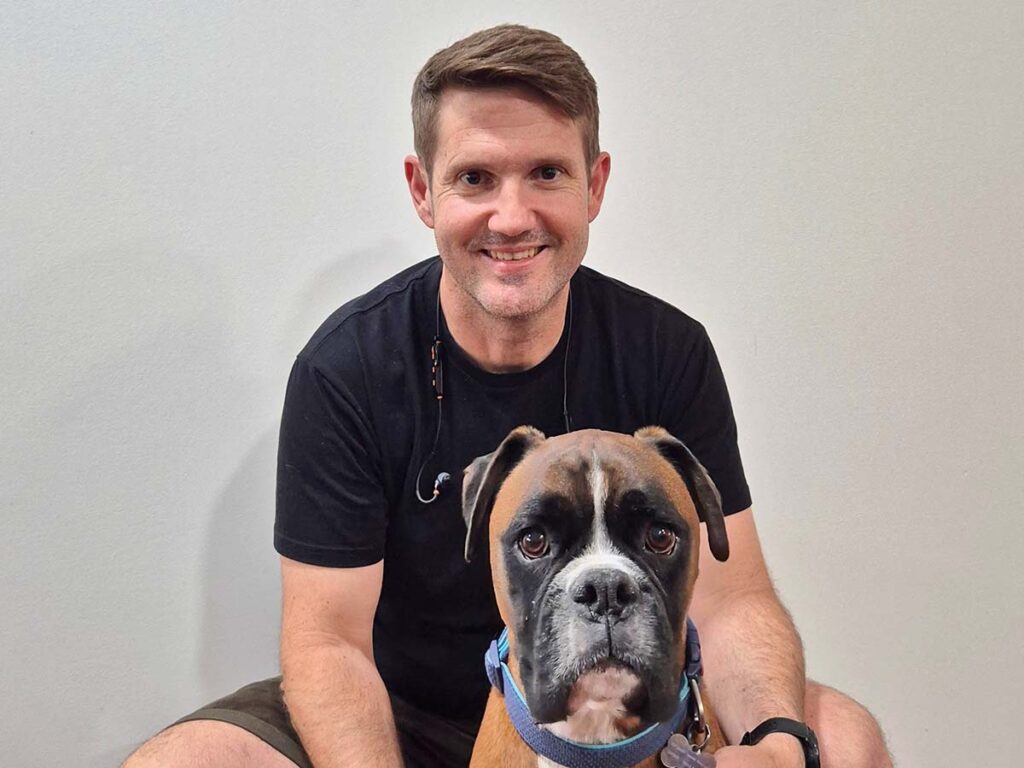
Stuart Kerr and Zeus the boxer.
Requiring an edge meant to split hairs, Kerr’s honing process on his razors is meticulous, to say the least. After the grinding is done, he works his way through whetstones with grits from 1,000 to 16,000. Then it’s a few laps on balsa loaded with chromium oxide.
“Final step is stropping on a kangaroo hide strop,” he said.
A very Australian finish, indeed.
Check Out More Cool Customs:
Cool Custom: Tony Lewis’ Tribute Knife To Steve Dunn
Cool Customs: Rocco Nawrocki’s Knife For Sergeant Bunker
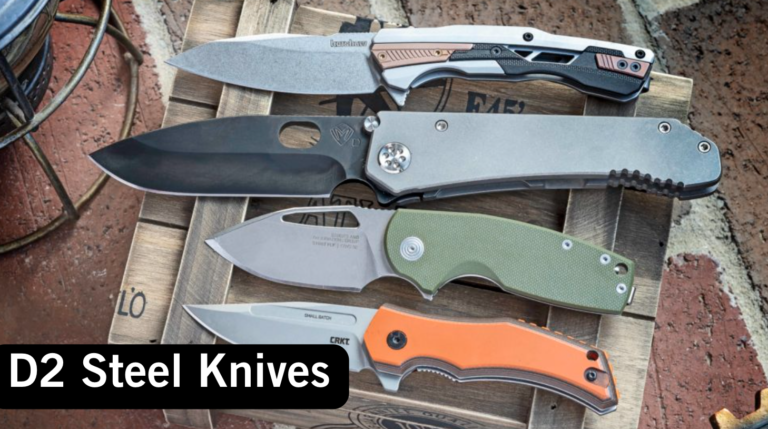
D2 Delivers In Edge Holding, Overall Performance, And Affordability. These Four D2 Knives Are Emblematic Of The Toughness Of The Material
Even if you haven’t used a knife of D2 tool steel, you’re no stranger to it if you have been into knives for any length of time. Many knife manufacturers use D2, as have numerous custom knifemakers.
Why is D2 so popular? Two reasons are it offers the best bang for the buck in terms of edge holding and overall performance. D2 is regarded as a step up from basic, low-grade stainless steel and is often found in entry-level to mid-grade production knives. One drawback: D2 is not a stainless steel so it will require a bit more care. Still, the performance advantages outweigh that drawback and you get a knife with enhanced edge-holding power that handles tough cutting chores.
D2 comes from the metalworking industry. There it is primarily used to make steel cutting dies, so that tells you all you need to know: It basically is a steel used to cut steel. Think about that for a minute. D2’s chemistry in percentages is 1.4 to 1.6 carbon, .7 to 1.2 molybdenum, 11 to 13 chromium, and 1.1 vanadium. It can be hardened past 60-61 HRC on the Rockwell scale without being brittle. BLADE Magazine Cutlery Hall-Of-Fame® members Jimmy Lile and Wayne Goddard used D2 a lot in their knives, as does Bob “Dr. D2” Dozier extensively in his outdoor models. Top production knife companies such as CRKT, Kershaw, SOG, A.G. Russell Knives, Ontario and KA-BAR are but a few that have multiple offerings using D2.
CRKT Fawkes
The CRKT Fawkes is an excellent choice for a stylish EDC folder, featuring flipper operation and IKBS pivot bearings for smooth opening and closing.
Maker Alan Folts designed the CRKT Fawkes to be a stylish, colorful EDC linerlock folder. The knife’s name is derived from the Harry Potter movie franchise, specifically the phoenix that appears in the series.
With a closed length of just 3.76 inches the Fawkes carries comfortably, and the blade deploys fast and easy thanks to the IKBS-ball-bearing pivot and assisted-opening spring. The two work in conjunction to provide swift, smooth deployment, and the assist helps detent the blade in the closed position.
The multi-layer orange G-10 handle generates visual excitement and a splash of color. The ergonomic design provides a comfy grip for cutting tasks. The 2.74-inch, clip-point blade is flat ground and sports a swedge as well as a milled-in fuller, which creates a bit of attitude. A flipper tab helps initiate blade deployment. The knife carries securely thanks to a deep carry, fold-over-style clip that holds the closed Fawkes blade tip up and as low as possible in a pocket.
The handle shape is striking. A pronounced finger groove near the pivot helps index your grip, while chamfering eliminates harsh edges and hot spots. The matching orange G-10 handle spacer sports a series of large notches that help seat the knife in your grip. Blade action is quick and authoritative. The linerlock engages the tang with zero movement. CRKT will make the Fawkes a regular production knife model this year, with the only change being a switch to 1.4116 stainless for blade steel.
Made in Taiwan, the MSRP for the Fawkes is $89.99.
Kershaw Endgame
The high flat grind of the Kershaw Endgame makes it a great choice for a working utility knife.
Kershaw‘s Endgame flipper folder features a highly usable modified drop-point blade, along with an ergonomic handle featuring modern design elements, all translating into a classy EDC that opens easily via the flipper tab.
The 3.25-inch flat-ground blade incorporates a distinctive humpbacked swedge for an aggressive look. A notched rest on the spine allows comfortable thumb placement for greater blade control. A stonewashed finish seals the tiny pores of the steel’s surface to fight corrosion as well as give the blade an industrial look. It also hides scratches from use pretty well and reduces glare.
A stainless steel framelock ensures solid lockup. The large finger recess at the pivot end helps index your grip. The handle curves aid in secure purchase every time.
The handle’s aesthetics are interesting. There’s bronze PVD (physical-vapor-deposition)-coated steel accents, textured FRN (fiberglass-reinforced-nylon) scales and a window cutout. The multi-layered visual adds more subtle color to the otherwise gray blade and handle. I do not care for it—it seems too busy. I don’t mind one type of overlay or even some machined-in grooves on the handle surface—both achieve function along with a sensible appearance. A deep carry pocket clip positions the closed Endgame nice and low in the pocket away from probing eyes.
While ergonomic and comfortable, the handle is a bit lacking in the midsection. For extended use, I would not recommend this knife. My hand grips the handle tighter to make up for the lack of bulk in the midsection. The answer is to redesign the handle and give it more mass. However, for tasks requiring choking up on the blade and handle for extra control, such as wire stripping, the Endgame is ideal. I felt in full control of the blade and was able to make precise cuts easily. If you do a lot of detail cutting, this might be the knife for you, or even if you need a folder for mundane slicing tasks. It’s got a great blade shape that is stylish.
Made in China, the Endgame has an MSRP of $107.99.
Medford Knife & Tool 187DP
At 5 5/8 inches closed, the biggest knife of the test bunch is the Medford Knife & Tool 187DP. Its hollow-ground drop-point blade makes short work of most any cutting task. The half-titanium/half-G-10 handle is equipped with a framelock.
Medford Knife & Tool specializes in manufacturing hard-use knives in the USA. These are not safe queens—they are engineered to hold up in real-world survival situations. The 187DP heavy-duty framelock folder is a representative example. The hollow-ground blade is 3.75 inches and comes in a utilitarian drop-point pattern. Closed length: 55/8 inches. An oblong hole facilitates easy one-hand opening. Dual thumb studs function as the blade stop in the fully open and closed positions.
The blade is 3/16-inch thick. Make no mistake, the 187DP is quite a chunk! The grip is ⅝-inch thick, and you will know when it’s in your pocket. A milled titanium clip carries the closed knife blade tip up but is not reversible. Any company using milled clips gets bonus points in my book. Regular stamped steel clips do a very good job at holding your knife at the top of the pocket for easy access, but, in my opinion, are not much on style points. Milled clips look more stylish and also hold the knife securely to the pocket lip.
If you are a rough user and use your knives outdoors or just plain beat them up, the 187DP is for you. Its rock solid build and bulk stand up to the heaviest use. I like the way the handle tapers toward the butt end, enabling you to get a secure hold. A series of traction notches machined close to the butt further assist in obtaining a solid no-slip handhold. It feels fixed in your hand and instills confidence in controlling the large blade. The steady grip allows you to bear down on the blade to power it through cuts.
Many who favor tactical folders will tell you a framelock is best for hard use. The 187DP’s framelock engages quite securely and disengages with a firm push. A milled-out section on the lockbar accommodates a thumb to disengage the lock—nice touch by the Medford crew. The blade cuts aggressively and dispatches most any material and food with aplomb.
Out of the box I really liked the factory edge. The ultra-strong lockup makes the knife feel like a fixed blade. Consequently, user confidence is high and you don’t have any reservations about putting it through the toughest jobs. While a large tactical folder, it can easily be tamed for precise cutting by making use of the choil to choke up on the blade and handle.
There’s also about an inch-and-a-half-long run of traction notches on the spine just above the blade hole. Your thumb rests comfortably there and you can execute controlled cuts easily—a very nice touch and positive attribute.
The only complaint I have about the 187DP is the size and, therefore, the weight, both of which exceed the limit for what I consider an EDC folder. You can feel its bulk and presence in the pocket, especially when you bend over.
MSRP: $475.
SOG Stout FLK
The SOG Stout FLK is definitely stout! Don’t let this compact folder fool you—it’s built for heavy work. It can get down to precise work as well, such as stripping wire.
The SOG Stout FLK is configured in collaboration with Danish maker Mikkel Willumsen. In appearance, the framelock folder lives up to its name and has a 2.62-inch drop-point blade. Closed length: 3.38 inches.
If you’re looking for an inexpensive work knife, the Stout FLK is it. It’s big enough to handle most cutting chores but not too big to be in the way or too cumbersome to carry. With its flat grind and short swedge, the blade shape is utility friendly. An oblong hole permits you to thumb the blade open as you would any one-hand folder, or you can use the flipper tab instead.
A pronounced choil enables choking up on the blade for more exact control and works with the large finger recess in the handle as well. Spyderco does this sort of thing, too. It’s a way to make smaller knives feel large in the hand and provide more blade control.
The handle is in the familiar half-and-half framelock construction, using textured G-10 on the presentation side. This saves weight as opposed to having an all-metal handle and also adds traction for sure handling. A matching steel spacer provides balance as well as structural rigidity.
The deep-carry pocket clip is ambidextrous and holds the Stout FLK low in the pocket while keeping it easily accessible. The clip is attached to the butt end and comes over the side. SOG calls it a bayonet-style clip, a style used quite a bit in the company’s line.
Made in China, the MSRP for the Stout FLK is $54.95. Finally, SOG will release the knife as a slip joint this year.
The Assisted-Opening Knife Is A Powerful Type Of Pocketknife Beloved By Blade Lovers Around The World. These 12 Stand Out From The Pack.
There are quite a few minor differences that separate various types of knives that are otherwise visually or externally indistinguishable. In the same vein as a sword is a sword or an axe is an axe, many people treat knives simply as a variation on a basic theme. In the case of assisted-opening knives, this has led to a great deal of confusion, and for the most part, a large amount of legal misunderstanding.
ORIGINS OF THE ASSISTED-OPENING KNIFE
The foundational designers of the assisted-opening knife modeled their mechanisms along very similar lines—mostly based on motorcycle kickstands. BLADE Magazine Cutlery Hall-Of-Fame® member Ken Onion is a well-known knife designer and was among the first to arrive at a mass-produced design.
While Onion was not the first, his basic design set the stage for what we have today. Before him, Cutlery Hall-Of-Famer Blackie Collins arrived at a design that was successful. There is a distinction at this point. Some assisted openers are described as “gravity knives” or “flick knives” and this is both true and false.
Some of the first successful gravity knife designs required the user to open the mechanism and the blade would slide down without spring assistance. Flick knives are generally undefined, but in general, require a flick of the wrist to deploy the blade either out the front or from the frame.
One of the most widely issued versions of this is from the Nazi German Air Force, where most aircrews in the Luftwaffe were given a type of out-the-front gravity knife. These became popular bring-back trophies and were oftentimes miscategorized as automatic or switchblade-style knives, and as flick knives.
The original German models never had a spring inside the mechanism. If they had, they would have qualified under modern law as an out-the-front automatic. This knife does deploy extremely quickly, often as fast as a spring-loaded variant.
These incorrect terms are bundled and grouped into the broad ‘bad knife’ generalization. The mechanical function of the assisted-opening knife is to finish opening the blade, not to deploy the blade on its own. This may seem like a minor thing but it is very important legally.
IS AN ASSISTED-OPENING KNIFE REALLY A SWITCHBLADE?
A relatively confusing aspect of this topic is what exactly constitutes a knife that falls into the dubious “switchblade” category, and what is an assisted-opening mechanism. The casual observer may not notice any difference in terms of function. In most cases, it appears that the blade simply pops out on its own from the handle.
The primary difference in this is that an automatic knife is self-actuated, usually with the push of a button. A knife that operates via an assisted-opening mechanism requires a person to start the opening process before the blade actuates and finishes opening itself.
This may seem like a trivial difference, but when it comes to skirting or working around restrictive laws, there is a great deal of importance that is occupied in that slight separation. We tend to see this in many cases where even cosmetic details can determine legality.
In 2009, there was a federal effort to clearly define and limit the number of restrictions that could be placed on knives that were determined to be of the open-assist and one-hand-opening variety, as opposed to those categorized directly as switchblades. 15 US Code 1224 Exemption 5 states that:
“A knife that contains a spring, detent, or other mechanism designed to create a bias toward closure of the blade and that requires exertion applied to the blade by hand, wrist, or arm to overcome the bias toward closure to assist in opening the knife.”
In other words, this defines an assisted opener as a knife that is designed to remain closed until acted upon, whereas a switchblade could thus be assumed to be a knife that is biased to remain open unless retained. These small variations in legalese are all we have that draw a line between what constitutes a legal assisted-opening knife and something reputedly “more inherently dangerous.”
HOW DO ASSISTED-OPENING KNIVES WORK?
As mentioned above in the legal definition of an assisted opener, the preeminent design feature is that the blade remains closed under a given mechanism until a force is applied to it. The mechanism necessary for a knife to accomplish this is quite complicated.
Not only must the blade be able to interact with an internal spring, but that spring also needs to generate enough pressure on a very small rotational axis to extend it to its final position and provide the energy to bypass the locking feature. This could be a linerlock or any number of locking mechanisms.
Because there are a tremendous number of functions being asked of this mechanism, they tend to become quite intricate, and for the most part, should not be disassembled by the owner. If something goes wrong with any type of assisted-opening knife, the owner should contact the manufacturer and get it repaired at the factory. Many of these mechanisms share more in common with watches and other fine pieces of machinery than they do with other knives.
There is a wide range of variation in terms of design from company to company. As a result, you will tend to see that, while assisted-opening knives are a general category, most manufacturers prefer to put their own spin on the terminology used to describe their product.
There isn’t a functional difference between what a company calls its design and what it accomplishes. What matters at the end of the day with assisted-opening knives is that they produce the same end result preceded by meeting the legal requirement of being an assisted opener. It doesn’t really matter if the mechanism is actuated by a thumb peg, flipper tab or wrist flick, the end result is the activation of the spring override forcing the blade to lock into the open position.
The basic design of most assisted-opening knives requires the blade to be manually opened at least 1/4-1/3 of its total travel before the spring takes over and opens it the rest of the way. This can be accomplished through numerous designs. The most common relies on an internal spring in the mechanism that resides on a cam, the latter interacting with the geometry of the rear of the blade surrounding the hinge pin.
Past a certain point, the shape of the parts allows the spring-loaded cam to interact with the gradual, declining angle of the back of the blade, thus forcing it open against the tension. Of course, this is just one way to describe how this works, and individual designers and companies will work around existing patents and models to create new ways to get the job done.
ARE ASSISTED-OPENING KNIVES LEGAL ACROSS THE BOARD?
The short answer to this is, yes, and no. In some states, it matters more how you carry the knife than what type of knife you were actually carrying. Michigan, for instance, allows the open carry of most knife types, regardless of features.
When it comes to carrying concealed, there are some murky definitions. In general, if a knife is visible, at least partially, such as in a front pocket, it is considered open carry. The vast majority of states allow everyday carry for assisted-opening knives. In fact, many states also allow the carrying of automatic knives as well.
Best Assisted-Opening Knives For The Money
While assisted-opening knives may not be for everyone, they are incredibly popular and made by manufacturers around the world. These dozen show off the breadth of models available on the market today.
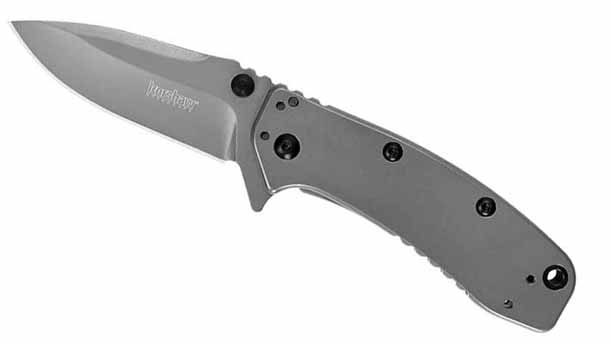
Kershaw Cryo II
The Cryo II is a very clean, basic carry knife that features a smooth, curved edge without separation. The knife is slab-sided without texture; it can be slippery in the hands if wet or sweaty. The framelock mechanism is very strong and should provide years of reliable service for a very modest price.
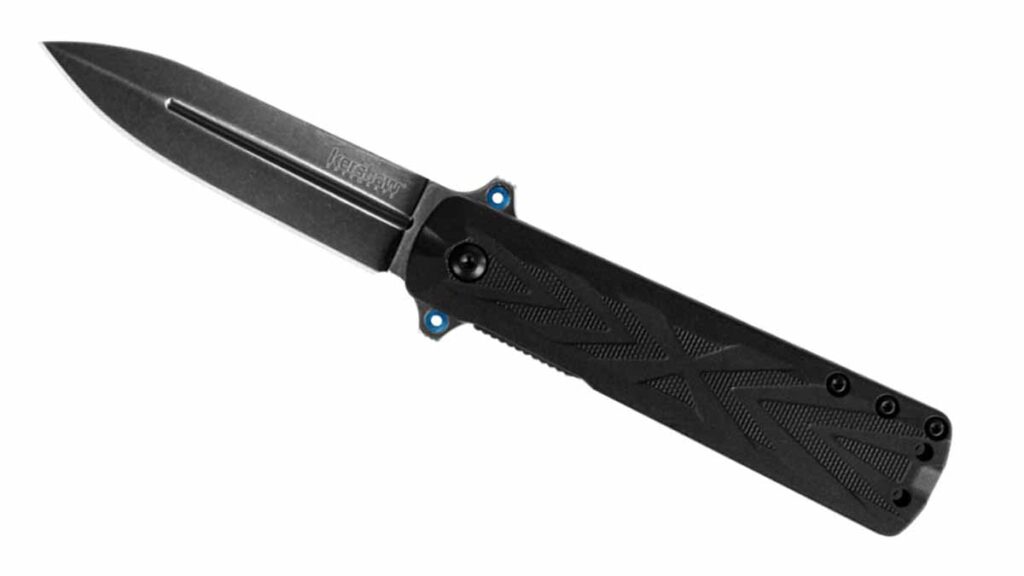
The Kershaw Barstow is a very affordable knife at a suggested retail price of under $40. It features a spearpoint blade and a black-washed finish. For being as inexpensive as it is, it is a true assisted-opening knife and affords the owner a great deal of function at a very low price. While not the highest-end model out there, this low-profile knife will be sure to please.
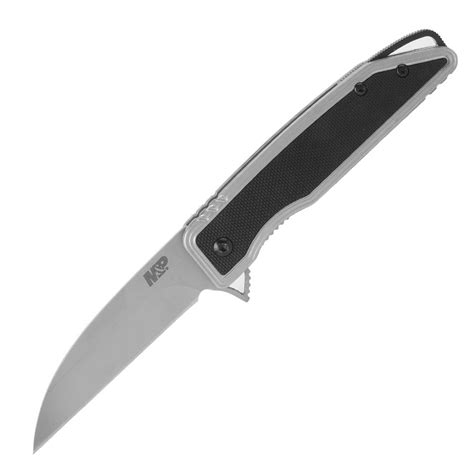
This attractive and very affordable knife bears the Smith & Wesson logo. Its sheepsfoot blade has a clean, straight edge. Despite its low price, this knife has a great degree of utility and is a welcome companion in the pocket or work bag. The blade profile lends itself to general work, and it shouldn’t draw attention when out in public.
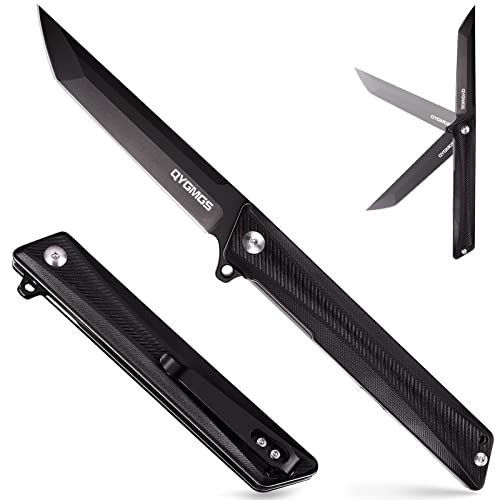
The ‘Amazon Special’ is fashionable and quite affordable. The tanto-style blade comes in serrated and plain-edged varieties. For being as inexpensive as it is, it has an impressive number of features that are extremely well thought out. The handle has an anti-slip texture and is machined from durable G10. The blade pivots on ceramic ball bearings. For being a Chinese import, it punches above its class.
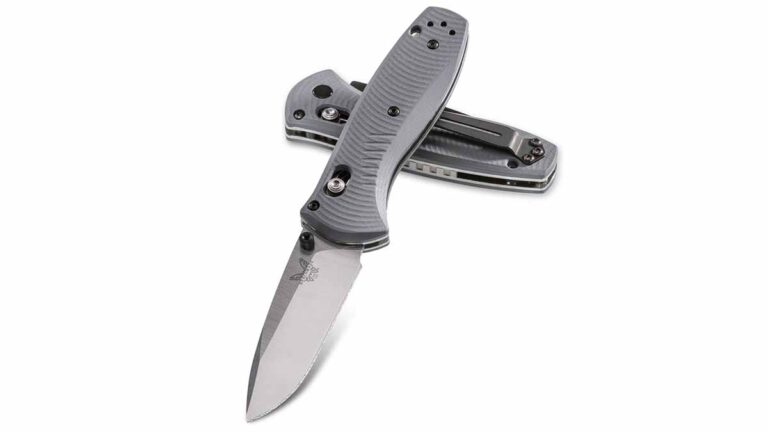
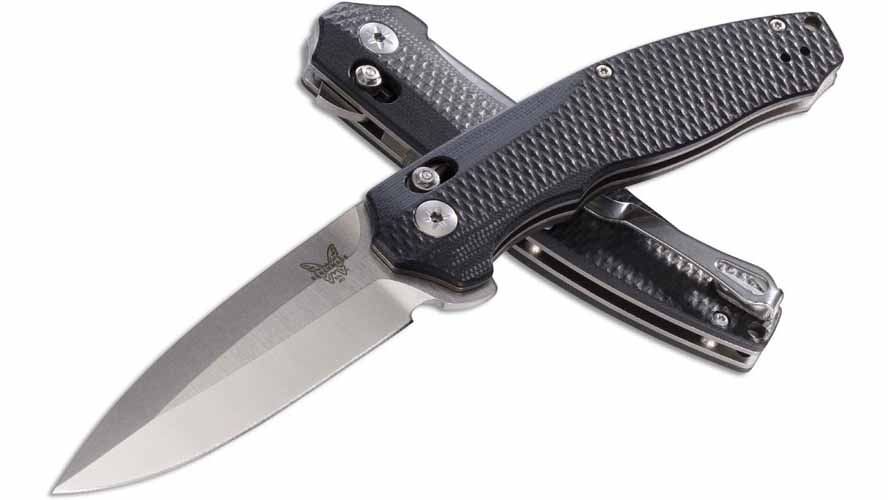
Moving up quite substantially in price is Benchmade’s 495 Vector. This is a symmetrical pocketknife that simply bleeds quality while being fairly low profile at the same time. If you prefer to carry a top-of-the-line design without drawing unwanted attention to yourself, this is going to be a top choice.
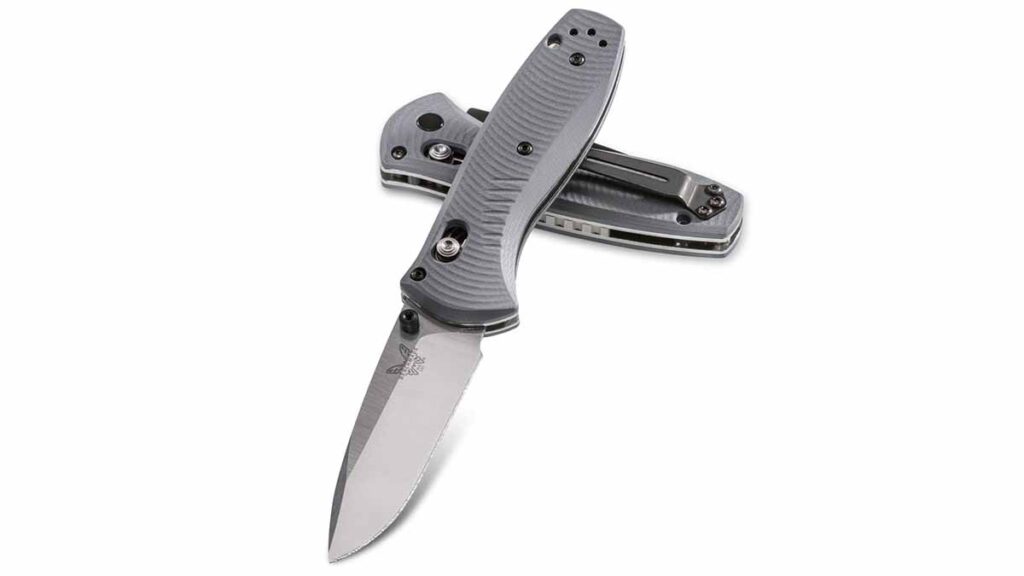
Another top-shelf choice from Benchmade, the Barrage has an aggressive, tactical look that features a plain-edge blade. While it certainly has that bad boy look, it is quite functional in terms of features and utility for cutting tasks at a relatively high cost compared to other assisted-opening folders. If you want top quality and want to look good doing it, this one is hard to beat.
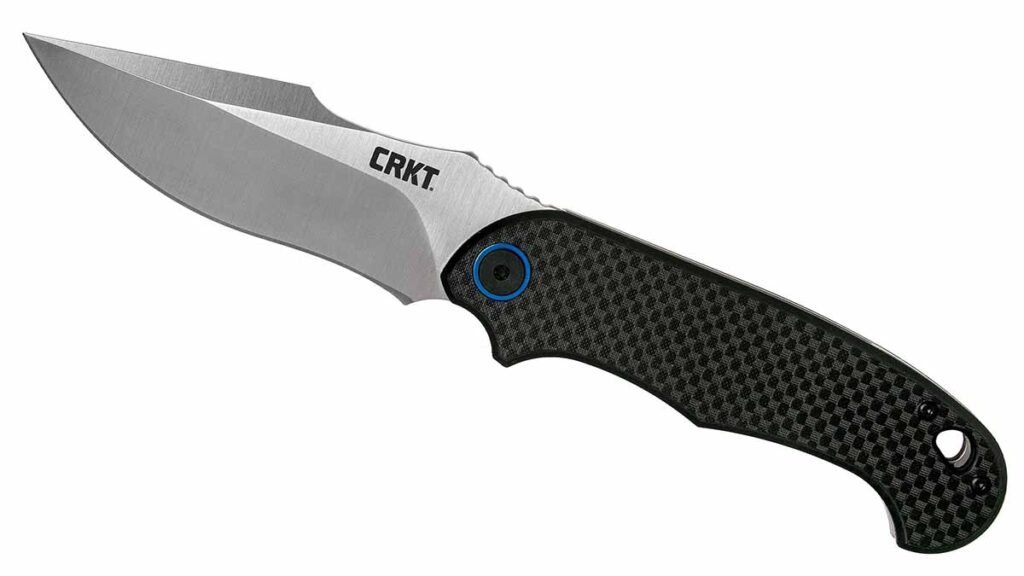
P.S.D. stands for Particle Separation Device, and CRKT’s folder certainly lives up to the futuristic nomenclature. While the materials used in the construction of this knife are becoming more commonplace, it is hard to find them for this price point, and the PSD delivers a very nice, clean appearance for a relatively low cost. CRKT is well known for the quality and affordability of its edged tools, and the PSD is sure to be a favorite come the holidays.
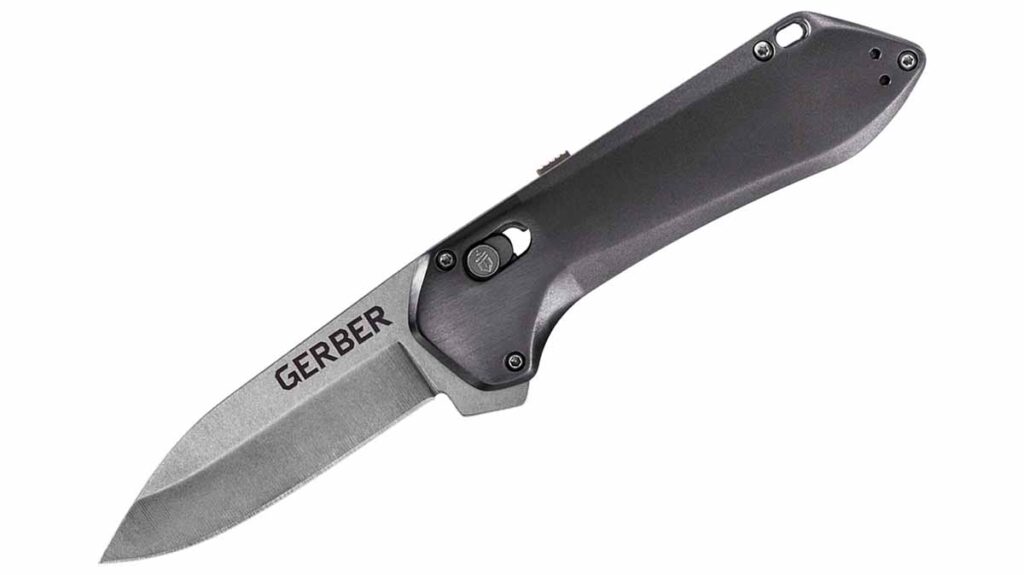
The Gerber Highbrow is ambidextrous and features an easy-to-use sliding lock just under the spine next to the pivot. The edge is plain with a distinct, drop-point profile. At a price of around $50, it is affordable and makes for a good gift for that someone who is worth the extra few dollars around the holidays.
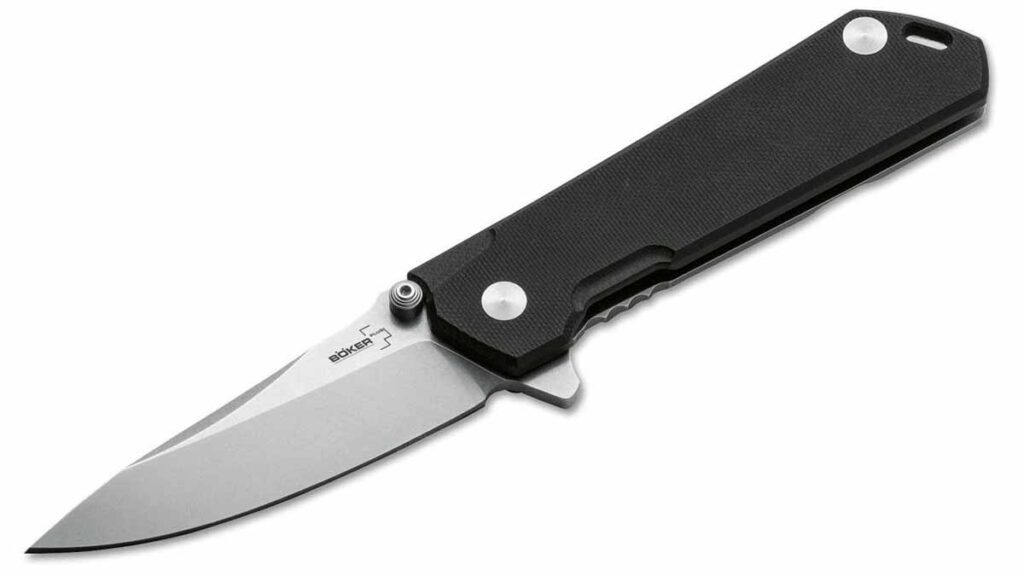
Boker Plus offers the Kihon designed in conjunction with custom knifemaker Lucas Burnley. Lucas is a hot tactical maker whose Japanese-inspired designs have garnered him worldwide acclaim.
The Kihon’s modified clip-point blade is a little over 3 inches long and made from D2 tool steel, long known for toughness and impact resistance. The blade is flat ground for exceptional cutting through a variety of media. A machined recess on the spine serves as a thumb rest to apply pressure and more control. Ambidextrous thumb studs double as the blade’s positive stop when open. A flipper tab offers quick, easy one-hand opening. Caged bearings in the pivot ensure smooth blade rotation.
The handle is a hybrid construction of a stainless steel framelock side mated with a textured OD green G-10 scale for weight reduction and grip enhancement. Gold-colored collars provide a classy visual touch to the pivot and handle screws. A large standoff is also anodized gold to match the other accents.
The lock side features a lockbar stabilizer disc to prevent blade overtravel. A neat wire pocket clip carries the closed knife blade tip up. The blade and steel lock side have a black stonewash finish for low glare and added corrosion resistance. However, the clip is not reversible for lefties. Milled-out oblong cavities in the handle’s lock side reduce weight.
The Kihon is a great EDC. The thumb rest relief helps control the blade, which provides enough length and belly to do most cutting chores. The action is smooth and predictable. Press the flipper, feel the tension load up and the blade propels to the open and locked position.
The assist mechanism performs like the Kershaw SpeedSafe originally designed by BLADE Magazine Cutlery Hall-Of-Fame® member Ken Onion. If you own any SpeedSafe knives then you know how the action is, and the Kihon is very similar in feel. There are no problems with handle comfort, either. The knife is easy to hold and there are no hot spots.
MSRP: $119.95
CRKT Oxcart
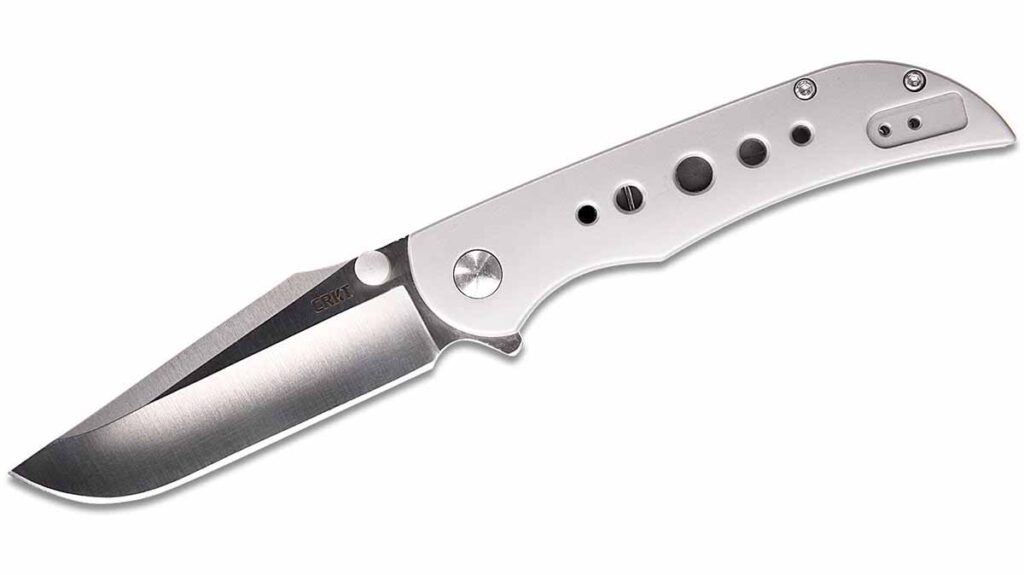
You may snicker at the Oxcart moniker but once you see the knife, you will clearly understand the name. The new entry from CRKT is somewhat of a dichotomy—the handle slab and blade stock thicknesses are what you would normally find on a large, heavy-duty folder, while the Oxcart is compact and slender.
Knifemaker Robert Carter is the designer. He is the son of maker Joe Pardue and grandson of Cutlery Hall-Of-Famer Mel Pardue, so the pedigree is impeccable. The modified clip-point blade is hollow ground from .16-inch-thick AUS-8 stainless steel. The blade is 3 inches, ideal for an EDC work knife. Large dual thumb studs provide purchase for rapid opening, and an extended flipper tab quickly deploys the blade. The blade rides on the Ikoma Korth Bearing System (IKBS) for ultra-smooth action.
The stainless-steel handle is .15 inches thick—about as thick as the blade. Drilled holes reduce weight and enhance aesthetics. A sturdy framelock secures the blade open with bank-vault lockup and zero play. A stabilizer prevents blade overtravel.
A large finger recess enables you to index your grip. The butt tapers to fit the heel of your palm. All handle edges are rounded for further comfort. The deep carry pocket clip positions the closed Oxcart blade tip up and is reversible for lefties. While the heavy-duty build gives the knife impressive heft at 4.7 ounces, it doesn’t weigh you down in the pocket.
As a work knife, the Oxcart shines. The hollow-ground blade bites hard and deep. It is a very efficient cutter. It’s so sharp we had to guard against nicking the wires inside the casing when stripping electrical wire. Due to the extra width of blade and handle, the Oxcart can be used hard without worry that the blade will break or the tip will snap.
One minor complaint with the compact grip: I found myself wanting a bit more to grasp when bearing down to cut through tough materials. However, it being a “compact big knife,” that would ruin the design philosophy. The assist mechanism is CRKT’s multi-wave torsion bar design that provides firm, fast action, with excellent detent closure. A semi-solid push on the flipper overcomes the detent, sending the blade to the locked position in one swift motion.
AUS-8 steel is well known in more moderately-priced knives as having a good balance of edge holding and ease of maintenance. No problems with the steel—it’s a solid performer. I also like how positive the framelock engages, so there are no worries about accidental unlocking. It’s very tight but easy to unlock when needed.
MSRP: $99.99.
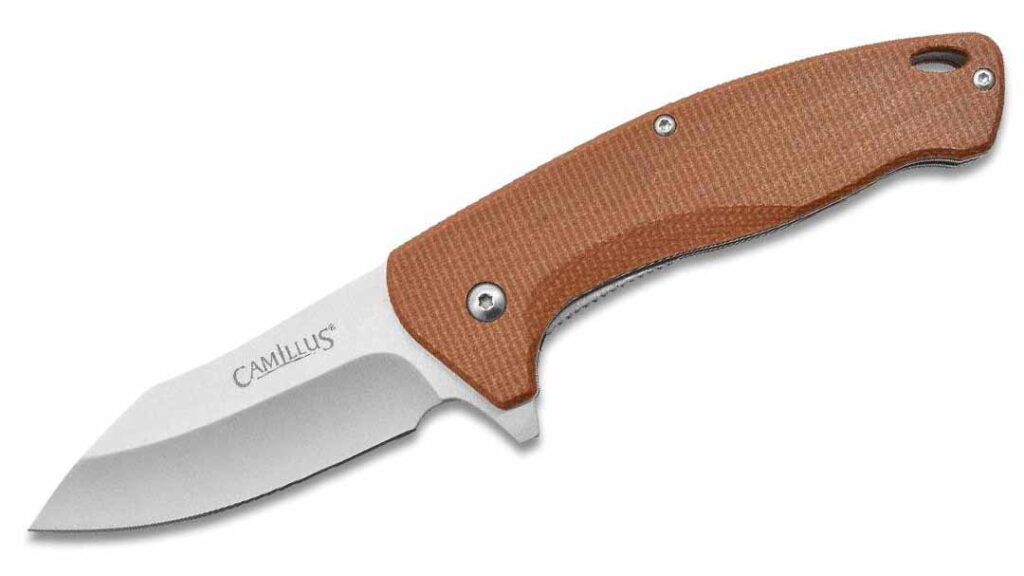
Camillus Arvo
The Camillus Arvo is the most value-conscious of the test group. The 3-inch drop-point blade is made from 420 stainless in a nice satin finish. The blade is utility friendly, with a defined tip for scoring tasks and a belly for most general cutting chores.
The flipper tab extends far enough to function equally as well as a single guard. The sole method of deployment is the flipper; the blade is devoid of thumb studs or discs for a streamlined appearance.
The handle features a typical construction method for tactical folders with dual stainless liners and scales of brown linen Micarta® for strength, high rigidity and dimensional stability, regardless of the elements. The linerlock release has a series of notches for purchase with your thumb when the blade is unlocked. A heavy-duty steel clip provides deep pocket carry of the closed knife in the blade-tip-up position.
The Arvo’s price point is very affordable, which appears to have resulted in a few “oversights.” First, the scales were not finished as smooth as I would have liked. The surface had a texture like peach fuzz from the linen in the Micarta. Don’t get me wrong—having a rougher finish on Micarta isn’t necessarily a bad thing, as the rougher texture aids in grip traction. Nonetheless, the surface finish could be improved.
Second, the edges of the blade spine and flipper tab are crisp. If you are into bushcraft knives, you know that a 90-degree spine is good for striking with a ferro rod to make sparks for fire. However, a 90-degree spine in an EDC folder creates unnecessary sharp corners. Luckily, these can be easily remedied with a metal file and gently rubbing the corners to soften them.
Finally, most flipper folders have the tab with traction notches on it for purchase. The Arvo has no such notches. Otherwise, the knife is a great size for EDC and the handle design is good and comfortable. I love the integral guard formed by the front of the handle at the pivot.
The assist mechanism works very well. Again, judging by the action, I’d say it’s similar to the SpeedSafe torsion-bar type. Deploying the blade is fast and easy. The action is smooth and swift, with the blade riding on Teflon washers. There are no bearings.
The low-end 420 stainless blade steel doesn’t hold an edge nearly as long as even the mid-grade stainless steels such as AUS-8, 8Cr13MoV and VG-10. However, the tradeoff is it’s easier to resharpen. Out-of-the-box sharpness is just OK. I’ve seen better on budget knives and I’ve seen worse. When I put my own edge on it, that’s when performance improved.
At its price point, the Arvo serves well as a work knife. It’s a great alternative to Zytel-handle locking folders and you get upgraded handle material with the Micarta. The hollow grind allows the blade to slice effectively and bite into materials easier. The edge dulls quickly depending on what you’re cutting, so you might benefit from carrying some sort of compact sharpener. And if you end up losing the Arvo, you can buy another one without breaking the bank.
The only thing I found as a slight issue with this particular sample is the blade was off-center a bit when closed. Given the low price, I am more forgiving of such things. However, it has no bearing on the action or cutting performance. The lockup is firm and sure.
There’s a lot of features going for this knife for the price: Micarta handle, deep carry pocket clip, flipper tab, assisted opening and open handle spine. Many of these features are found in knives priced way higher.
MSRP: $27.99
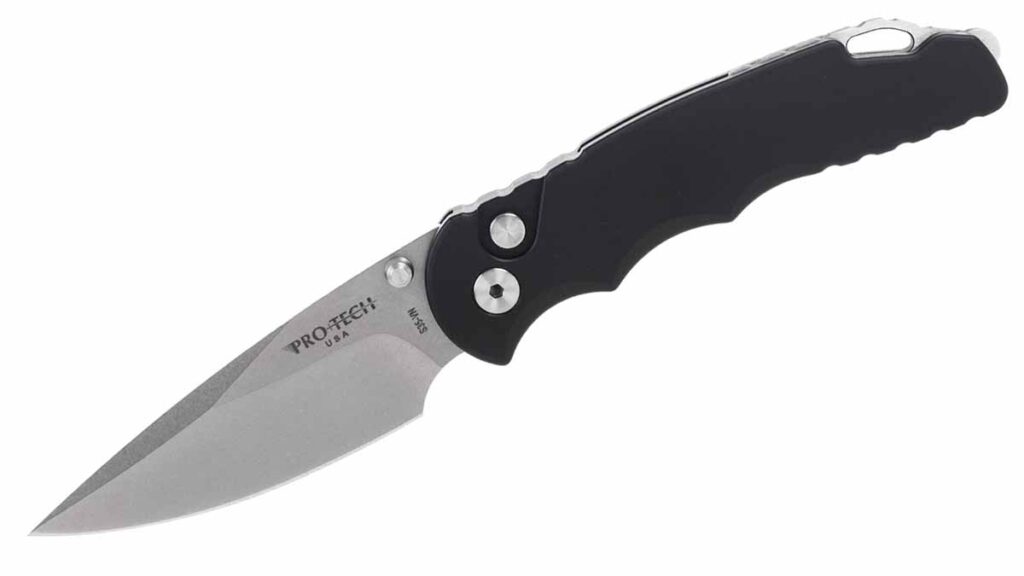
Pro-Tech TR-5 SA
Known widely for autos, Pro-Tech offers an assisted opener with the TR-5 SA. Essentially a scaled-down version of the company’s TR-4, it has tactical styling, superior materials and a distinctive spring-assist mechanism.
The 3.25-inch blade is CPM S35VN high-performance stainless. The modified drop-point pattern has flat-ground main bevels with a swedge added for a bit of attitude. A single thumb stud helps open the knife. The blade comes in a nice stonewash finish that hides scratches and helps resist corrosion.
The handle features rounded ends and a tapered design from pivot to butt. Several large finger grooves help seat your hand securely, along with a series of traction notches following the three finger grooves.
On the handle spine, traction notches are milled into the thumb rest for a non-slip grip. The handle spacer is milled from 416 stainless and also has traction notches to enhance grip. The end of the spacer protrudes a bit at the butt, forming a skull crusher pommel.
The handle slabs are T6-6061 aluminum given a Type III hard anodized black coat for scratch resistance and aesthetics. A deep carry pocket clip presents the closed knife blade tip up. When clipped in the pocket, none of the knife protrudes above the seam.
The handle feels very comfortable and instills user confidence, with no hot spots. Pro-Tech’s high standards for manufacturing excellence carry over into its base models with plain aluminum handles such as this one. The pivot screw and lock button sport spun finishes that reflect light in a refined manner. It’s such nice little touches that set Pro-Tech apart.
The assist mechanism is different from other assisted openers. For starters, it uses the same coil-spring design that drives the company’s automatics. If you’ve handled a Pro-Tech auto, you know it has a strong spring and a nice recoil. The same goes for the TR-5 SA.
There’s an additional component to the mechanism designed by award-winning maker Matthew Lerch: an unusual spring-loaded detent that holds the blade closed. The result is a strong detent that requires a firm push of the thumb stud to overcome; from there the coil spring takes over and drives the blade open. As a result, you get the legendary Pro-Tech action for those who cannot legally buy autos. The action is indeed the fastest of the featured assisted openers and, I believe, the fastest on the market.
The Hardcore Hardware MILF-02 Is A Heavy-Duty Folder That’s Designed For Any Challenge Users Can Throw At It.
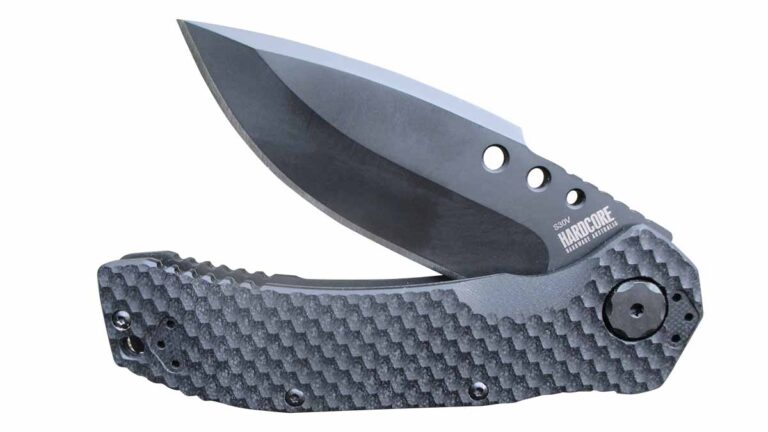
The MILF-02 folder from Hardcore Hardware is made for hardcore users. It’s big and beefy all the way around, has a dimple-textured handle and frame for an excellent non-slip grip, and a classic drop-point-blade shape.
The hollow grind extends halfway up the blade. Blade steel is CPM S30V stainless with a PVD (Physical Vapor Deposition) coating. It offers a classic black color on a framelock design with a flipper tab on the blade. It’s built heavy duty but it still has to cut.
Testing The MILF-02
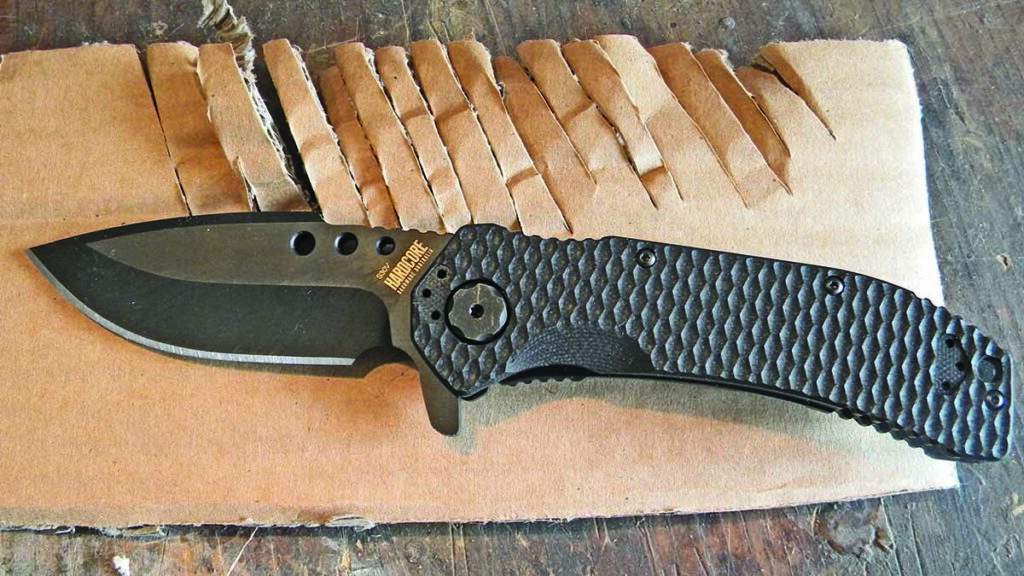
The first inch of the cuts of the double-walled cardboard went well until the author had to use more pressure to push the cardboard over the thickness of the blade where the hollow grind stops. Once he got used to that, it was easy to overcome the twisting.
Right off the bat, the MILF sliced 20-pound-bond copy paper smoothly. The knife’s weight made the push cuts very easy. There were no snags or hang ups and it was simple to control the width of the slices.
Next: double-walled cardboard. The first inch of the cuts went well, then I had to use more pressure to push the cardboard over the thickness of the blade where the hollow grind stops. Once I got used to hitting this spot, it was easy to overcome the twisting. There were no edge hang ups at all.
I grabbed some 8-ounce leather for some skiving. The MILF was aggressive on every cut and emitted a crunching sound each time. Control was excellent in making fine slices and the handle filled my hand.
Cutting The Hard Stuff
The author gave the 2×4 chunk 20 hard chops and the MILF bit deep on every whack. The edges of each chop were smooth.
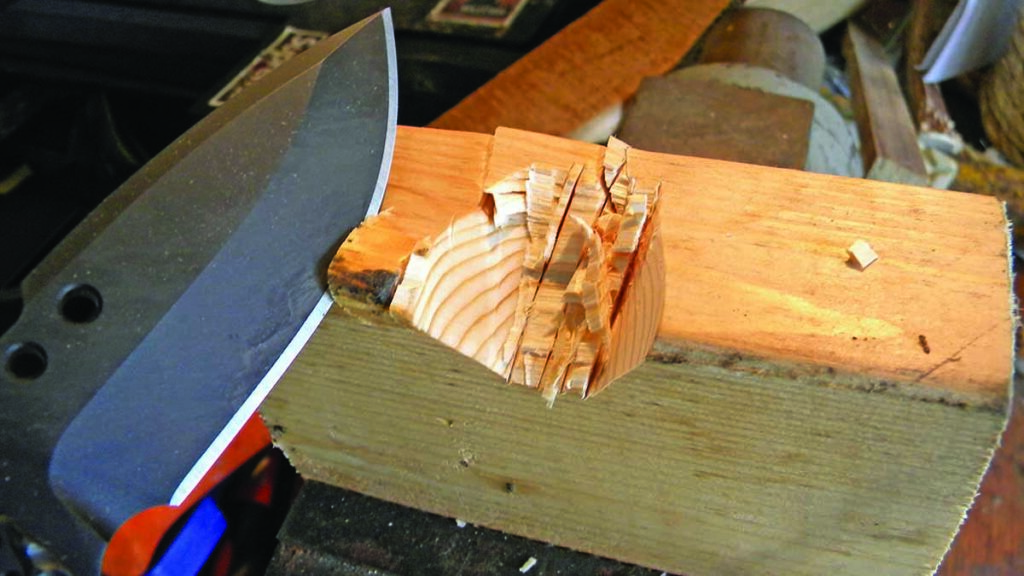
It was time for some whittling. The folder seemed to want to bite deep into the wood. I started off with a fine curly-cue and by the end of the cut the edge was well into the wood. The MILF didn’t hesitate at all on the deeper cuts; it just kept curling the wood. It is a heavy cutter for sure.
I put a 2×4 chunk in my vise and gave the wood 20 hard chops. The MILF bit deep on every whack. The edges of each chop were smooth. Lockup was still at 100 percent. The knife is a great chopper with the bigger handle and all, but the inside edges of the handle need softening. They’re a tad on the sharp side
I took the same 2×4 and used the folder to split it into smaller pieces. All it took was a light tap from a dead blow hammer and the wood split with a pop. The thicker blade worked great for this phase of the testing. Lockup was still at 100 percent.
Half-inch sisal rope was next on the slicing block. The MILF crunched through 200 clean cuts very quickly, showing no signs of slowing down. I stopped cutting to save on rope. Edge holding was excellent and the heat treatment was great.
To take the testing further, I grabbed a deer antler for some more whacking. I gave the antler 20 hard wallops and the blade edge suffered no rolling or chipping. I did manage to remove a very thin wire edge on the blade. However, the main edge was still very sharp.
I returned to the paper slice to recheck the edge. I noticed a few hang ups and found more of the wire edge still intact. Two strops on some leather and the edge was back to original sharpness. Excellent job on the heat treat!
Final Thoughts
I would soften the inside edges of the handle for a smoother grip. Beyond that, the MILF is a heavy-duty using folder that holds a great edge. It’s too big for my tastes but a cutter it is.
Bowie knives are as legendary as the man their named after.
When it comes to iconic blades, few can match the legendary status of the Bowie knife. This distinctive and formidable knife has a storied history that spans centuries, and its enduring popularity is a testament to its imperishable design and utility.
In this comprehensive guide to the Bowie knife, we’ll take a deep dive into the world of the iconic knife. We’ll look at its history, design, modern uses, and legality. Then we’ll finish up with an extensive selection of the best Bowie knives currently on the market.
History of the Bowie
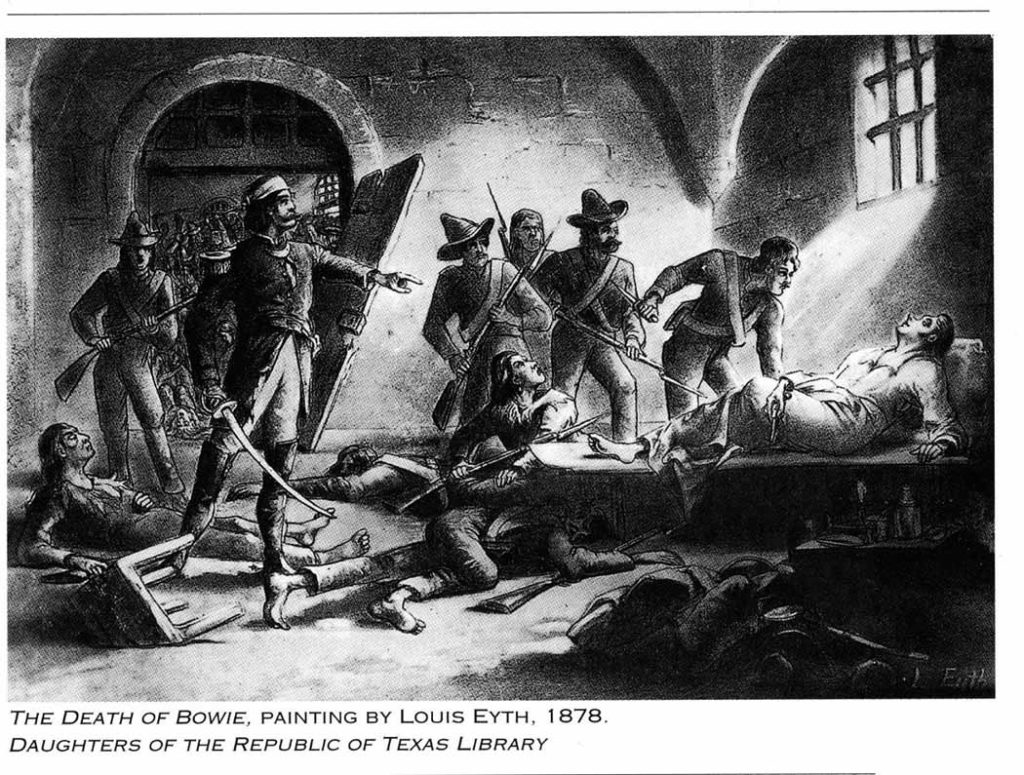
The debate about who made the first Bowie knife rages on to this day, adding to the mystique of this legendary blade. Some credit the knife’s creation to Jim Bowie himself, while others argue that it was the work of various blacksmiths and bladesmiths in the early 19th century. What is certain is that Jim Bowie’s association with the knife’s name and his prominent role in a violent sandbar fight in 1827 contributed significantly to its fame.
In addition to his participating in the famous Sandbar Fight after which his knife became a sensation on both sides of the Atlantic, Jim Bowie also fought and died in the Battle of the Alamo.
One of the most pivotal moments in the knife’s history was the infamous sandbar fight that took place in Mississippi in 1827. During this brutal encounter, Jim Bowie and a group of men defended themselves against an opposing faction. Jim Bowie’s remarkable fighting skills and his knife’s performance in the fight led to the weapon being forever associated with his name. This event catapulted the Bowie knife into the realm of legend, ensuring its enduring fame.
Bowie Knife Design: Choosing a Good Knife
The Bowie knife is known and loved for its distinctive design. While variations exist, several key features define this iconic blade:
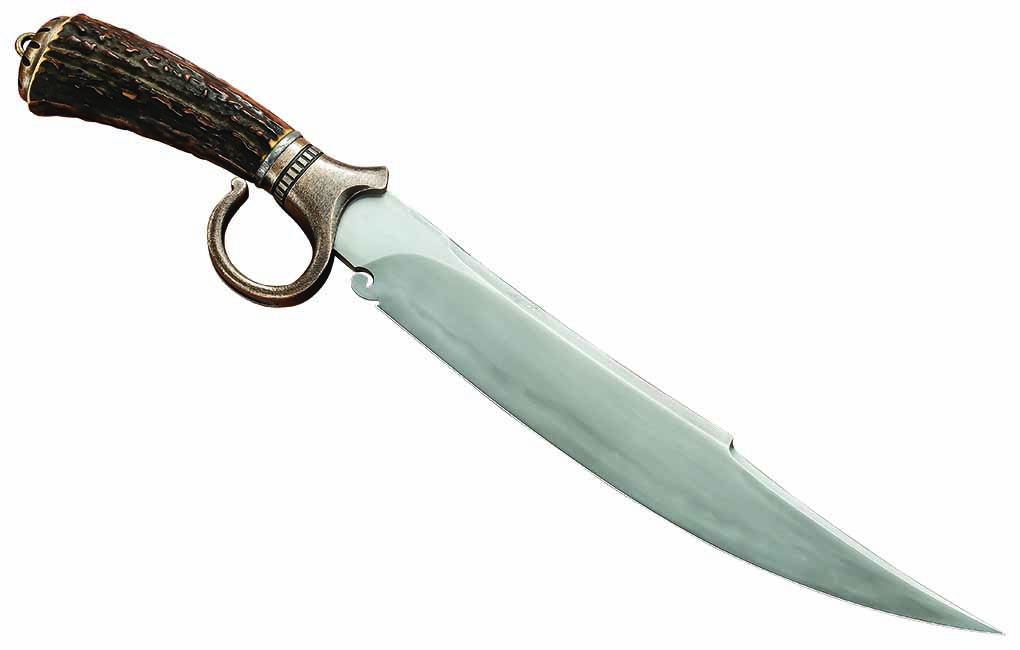
Blade Style: The knives typically have a clip point blade, which is characterized by a concave curve on the top edge and a fine, sharp point. This design allows for both slicing and piercing, making it a versatile tool for a wide range of tasks.
Blade Length: Bowie knives come in various blade lengths, with the most common falling between 6 and 12 inches. The length of the blade influences its utility, with longer blades being suitable for chopping and combat, while shorter ones excel at precise cutting.
Crossguard: Most Bowie knives feature a crossguard, a metal piece positioned between the blade and the handle. This crossguard serves to protect the user’s hand during combat and can also be used for utility purposes.
Full-Tang Construction: Bowie knives are typically constructed with a full tang, meaning the blade extends through the handle, providing stability and strength. This design ensures the knife can withstand heavy use and remain a reliable companion in various situations.
Handle Material: Bowie knife handles come in a range of materials, from classic hardwoods to modern synthetics like Kraton. The choice of handle material impacts the knife’s aesthetics and grip comfort, catering to the user’s preferences.
Modern Uses for Bowie Knives
While the Bowie knife was originally designed for self-defense and survival in the wilderness, its uses have evolved over the years. Today, Bowie knives are valued for their versatility and can serve a variety of purposes:
Camping and Outdoor Activities: Bowie knives are popular among outdoor enthusiasts for tasks such as chopping wood, preparing food, and building shelters. Their sturdy design makes them reliable tools in the wilderness, where dependability is crucial.
Hunting: Many hunters rely on Bowie knives for field dressing and skinning game. The sharp blade and clip point make these knives well-suited for precision work, ensuring a clean and efficient process.
Collection and Display: Bowie knives have transcended their practical utility to become sought-after collectibles. Enthusiasts appreciate their historical significance and craftsmanship, often displaying them as works of art in custom cases or on stands.
Self-Defense: While not as commonly carried for self-defense as smaller knives or firearms, Bowie knives can still serve as formidable weapons in a close-quarters encounter. Their imposing presence and sharp blade can deter potential threats.
Survival: Bowie knives remain a popular choice for survivalists due to their robust construction and multi-purpose design. Whether it’s building a shelter, cutting through rope, or processing wood for fire, a Bowie knife is up to the challenge.
Cooking: In the kitchen, Bowie knives with shorter blades can be used as versatile chef’s knives. Their sharp edges and comfortable handles make them suitable for slicing, dicing, and other food preparation tasks.
Legality of Bowie Knives
The legality of owning and carrying Bowie knives varies from place to place and can be subject to specific regulations. It’s crucial to understand your local laws and regulations regarding these knives. In some areas, Bowie knives may be considered illegal if carried in public, while in others, they are legal for both open and concealed carry.
It’s important to note that while Bowie knives have a rich history and practical uses, they can be seen as intimidating weapons by law enforcement and the public. Therefore, it’s essential to use them responsibly and within the bounds of the law.
Best Bowie Knife Specs
Model
Type
Blade Lenght (inches)
Overall Length (inches)
Weight (ounces)
Blade Material
Handle Material
Other Features
MSRP
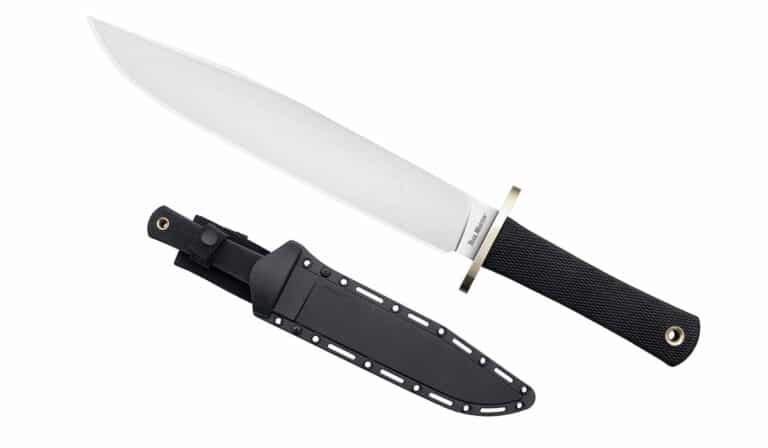
Cold Steel Trail Master
Fixed
9.5
14.63
18
VG1 San Mai III®
Kray-Ex™
Secure-Ex® Sheath
$500
Buck Knives 124 Frontiersman
Fixed
6.25
11.75
13.3
420HC
Micarta
Leather Sheath
$200
Gerber StrongArm
Fixed
4.8
9.8
7.2
420HC
Rubber
MOLLE-compatible multi-mount sheath
$90
SOG Super Bowie
Fixed
7.5
12.88
17.4
AUS-8
Leather Washers
Leather Sheath
$250
Ontario Knife Company OKC 498
Fixed
7
12
16
1095
Kraton
Nylon Sheath
$98
KA-BAR USMC Fighting Knife
Fixed
7
11.875
11.2
1095 Cro-Van
Leather
Leather Sheath
$140
Emerson CQC-7BW
Folder
3.3
9
6.3
154CM
G-10
Wave Opener Blade
$275
TOPS Knives Tom Brown Tracker
Fixed
6.38
11.88
21
1095
Micarta
Kydex Sheath
$365
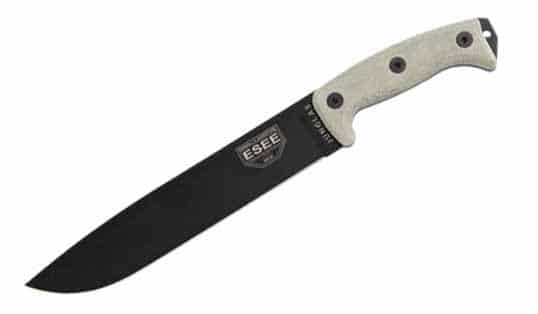
ESEE Junglas
Fixed
10.38
16.5
23
1095
Micarta
N/A
$310
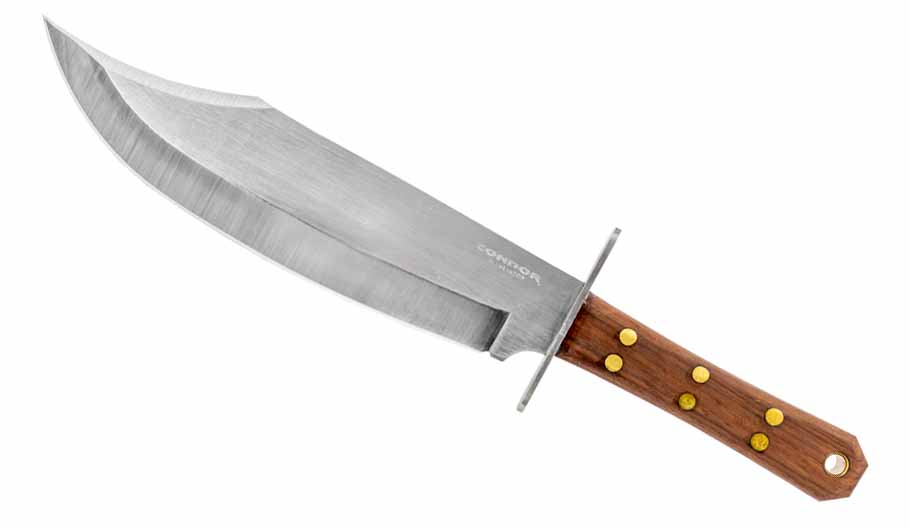
Condor Tool & Knife Undertaker Bowie
Fixed
10.2
15.6
24
1075
Walnut
Welted Leather Sheath
$118
Best Bowie Knives And Bowie-Inspired Knives For Any Budget
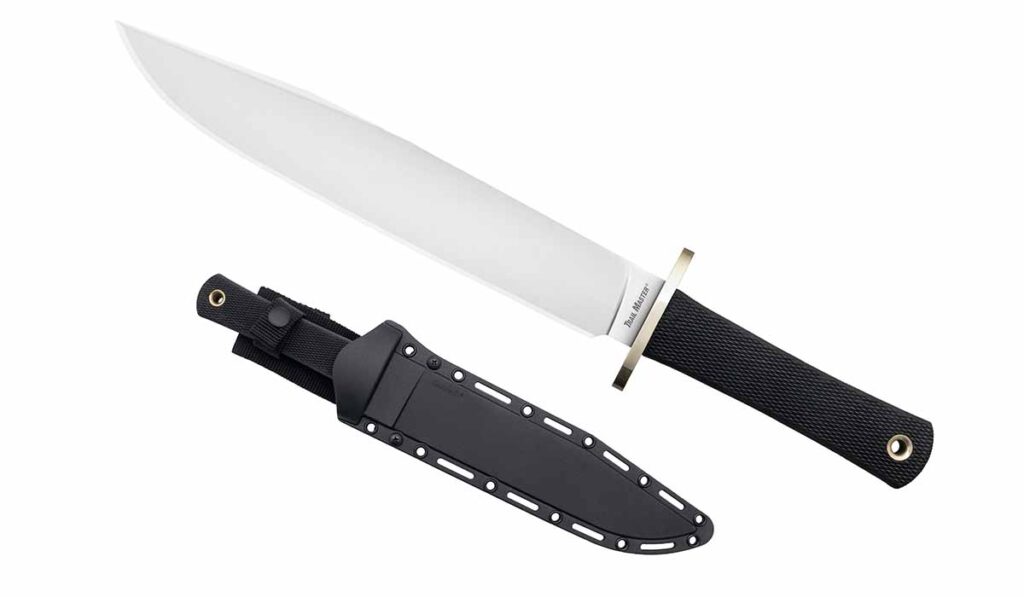
The Cold Steel Trail Master is a rugged Bowie knife designed for heavy-duty tasks. Its 9.5-inch blade is made from VG-1 stainless steel, known for its exceptional sharpness and resistance to corrosion. This knife’s clip-point blade design, with a concave curve on the top edge, allows for precise slicing and piercing.
The Kraton handle provides a comfortable and secure grip even in wet conditions, making it an excellent choice for outdoor enthusiasts. The full tang construction ensures durability and stability, making it capable of withstanding substantial abuse. The Trail Master is the go-to option when you need a reliable, high-performance Bowie knife for demanding tasks in the field.
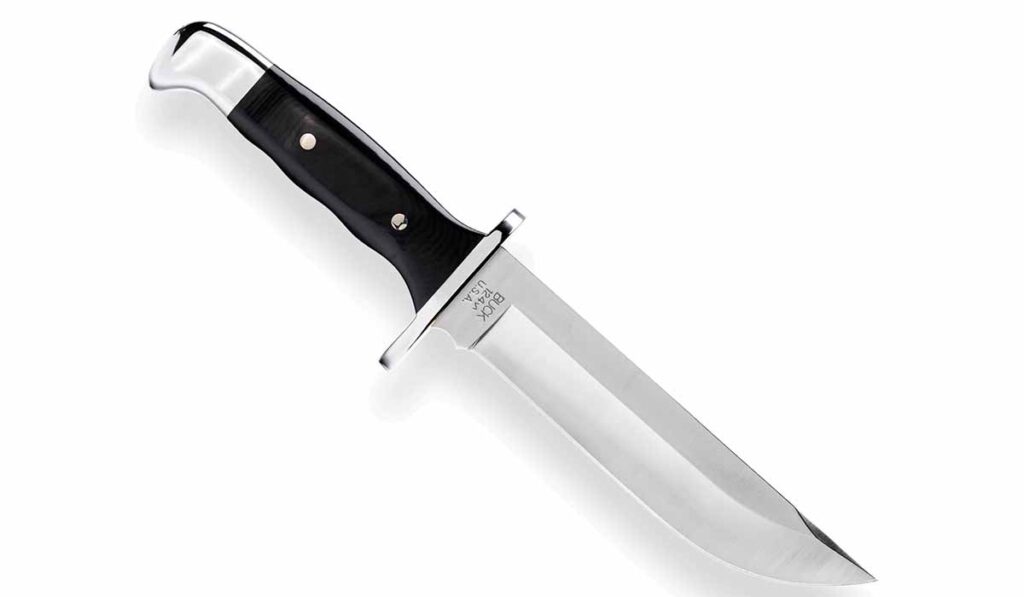
Buck Knives’ 124 Frontiersman is a classic Bowie knife that pays homage to the heritage of American bladesmithing. Its 6.25-inch 420HC stainless steel blade is known for its edge retention and ease of maintenance. This Bowie knife boasts a timeless design with a sweeping clip-point blade and a polished brass guard.
The handle is made of rich and dark micarta, which not only adds to the knife’s aesthetics but also provides an excellent grip. This knife’s combination of traditional craftsmanship and modern materials makes it an excellent choice for those who appreciate the artistry of a well-made Bowie knife.
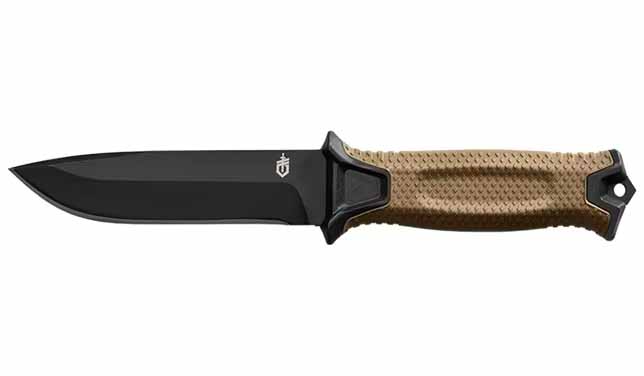
The Gerber StrongArm offers a modern take on the classic Bowie design. Its 4.8-inch stainless steel blade is versatile, featuring a fine edge and serrations on the spine for additional cutting options. The blade’s black ceramic coating enhances durability and corrosion resistance.
What sets the StrongArm apart is its diamond-textured rubber handle. This design ensures a secure grip in various weather conditions, making it an ideal choice for those who value a reliable grip during outdoor activities. The knife also features a striking pommel at the base of the handle, which can be used for various tasks, including glass breaking.
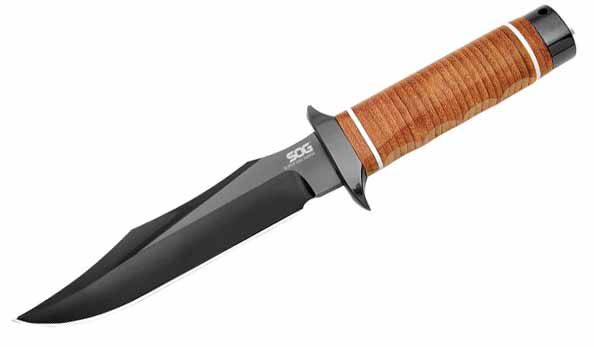
For those seeking a premium Bowie knife, the SOG Super Bowie delivers both style and substance. Its 7.5-inch AUS-8 stainless steel blade offers excellent edge retention and corrosion resistance. The stacked leather handle adds a touch of elegance while providing a comfortable grip.
This Bowie knife combines the best of classic design with modern materials and craftsmanship. It features a brass handguard and pommel, enhancing its overall aesthetics. The Super Bowie is an excellent choice for collectors and enthusiasts who appreciate the fusion of tradition and innovation in a high-quality knife.
The OKC 498 is a straightforward and dependable Bowie knife designed for practicality. Its 8-inch carbon steel blade is rugged and easy to sharpen, making it an excellent choice for outdoor enthusiasts who value simplicity and reliability.
The Kraton handle offers a secure and comfortable grip, even in wet conditions. This knife’s utilitarian design makes it a versatile tool for a wide range of tasks, from campsite chores to survival situations. If you’re looking for a no-nonsense Bowie knife that gets the job done, the OKC 498 is an excellent choice.
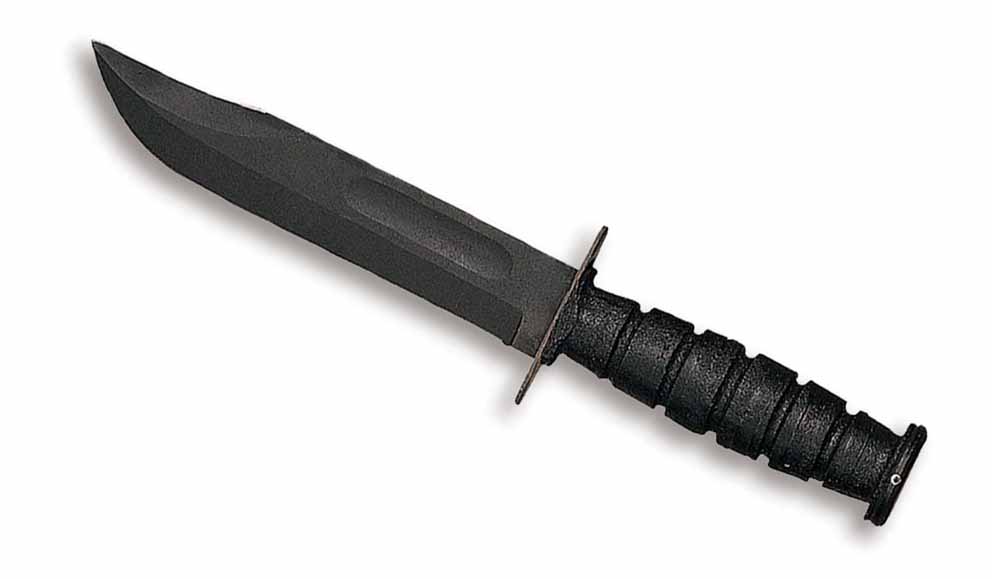
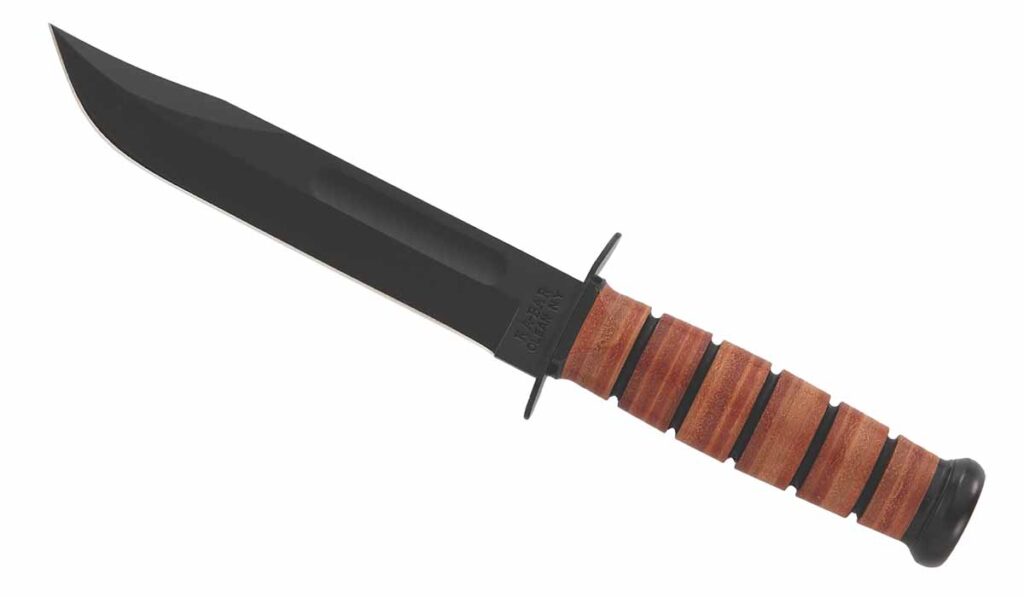
While not a traditional Bowie knife, the KA-BAR USMC Fighting Knife has earned its place among classic American blades. With a 7-inch 1095 Cro-Van steel blade, it’s renowned for its durability and edge retention. This knife has a rich military history, having served the U.S. Marine Corps during World War II.
The leather handle provides a comfortable and secure grip, while the double guard protects the hand during combat or utility tasks. The USMC Fighting Knife is a versatile and iconic choice for those who appreciate a knife with a storied history, and one that is of course tied to the Bowie that inspired it.
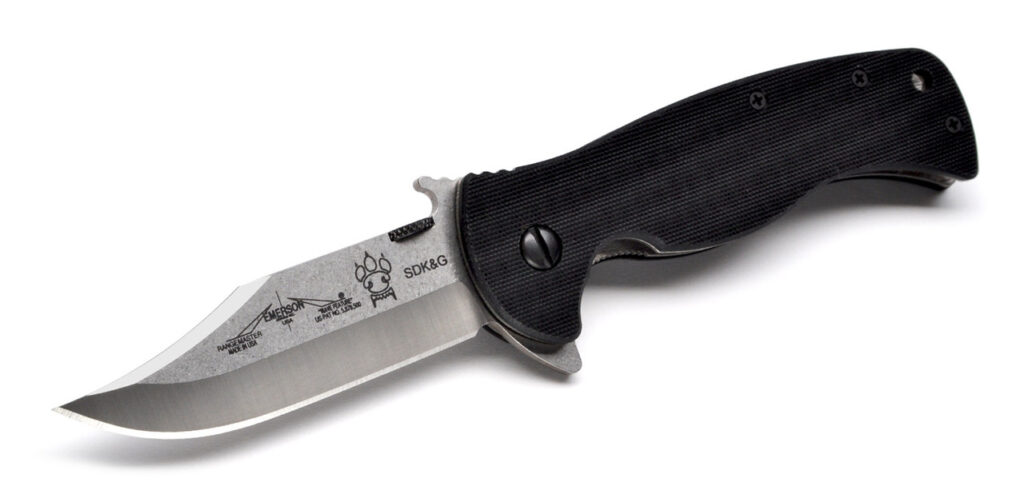
The Emerson CQC-7BW is a modern take on the Bowie design, featuring a folding blade for everyday carry (EDC) convenience. With a 3.3-inch stainless steel blade, this knife is compact and versatile, making it suitable for a wide range of daily tasks. The clip-point blade design provides excellent piercing capability, and the thumb disk allows for easy one-handed opening.
The G-10 handle scales offer durability and a secure grip. Emerson Knives are known for their tactical functionality, and the CQC-7BW lives up to this reputation. If you’re looking for a compact and reliable EDC option inspired by the Bowie style, this knife is an excellent choice.
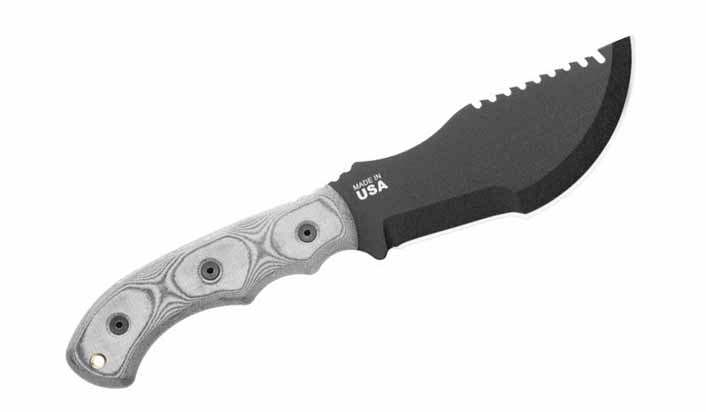
The TOPS Knives Tom Brown Tracker is a unique Bowie-inspired knife with a distinctive multi-purpose design. Its 6.38-inch 1095 high carbon steel blade features a variety of edges and angles, making it suitable for a wide range of tasks, from chopping to carving. This versatility has made it a favorite among survivalists and outdoor enthusiasts.
The handle is made of Micarta, providing a comfortable and secure grip. The Tracker is designed to handle tough wilderness challenges, making it an excellent choice for those who want a dependable tool for camping, bushcraft, and survival scenarios.
The ESEE Junglas is a heavy-duty Bowie knife built to withstand the most demanding survival situations. With a massive 10.38-inch 1095 carbon steel blade and full tang construction, it’s a powerhouse of a knife. The blade’s black powder coating enhances durability and corrosion resistance.
The Micarta handle scales offer a comfortable and secure grip, even during extended use. The Junglas is designed for heavy chopping, batoning, and other rugged tasks that might arise in the wilderness. If you need a Bowie knife that can handle the toughest challenges, this is a top choice.
Condor’s Undertaker Bowie combines traditional craftsmanship with affordability. Its 10-inch 1075 high carbon steel blade is known for its toughness and ease of sharpening. This knife is designed for practicality, making it an ideal choice for outdoor enthusiasts and those who appreciate a robust tool.
The hardwood handle not only adds to the knife’s aesthetics but also provides a comfortable and secure grip. The Undertaker Bowie excels in tasks such as wood processing and campsite chores, making it a dependable companion in the great outdoors.
CRKT is releasing three Alan Folts designs–all folders–in anticipation of the Ft. Worth Knife Show.
CRKT, never one to rest on its laurels, has three new knife drops in anticipation of the Feb. 23-24, 2024 Blade Show Texas in Fort Worth. Alan Folts takes centerstage with this release, with all three of the designs emanating from the Florida-based custom knife maker. Interestingly, Folts made his mark as a fixed-blade man, but the two versions of the Ritual and brand-new Obverse mark somewhat of a new calling in the realm of folders.
“Alan Folts is a master craftsman and an acclaimed designer with over two dozen CRKT models to his credit in his time working with us,” said Doug Flagg, CRKT VP of Marketing and Innovation. “This latest collection represents Alan’s wide-ranging inspirations, innovative approach to knifemaking and the commitment to excellence that we both share.”
As a side note, the new premium knives from CRKT are listed as “coming soon” on CRKT.com but will be available for sale as BLADE Show Texas kicks off on Friday, February 23rd. For consumers in the Fort Worth area, the company also extends an invitation to its booth at the event, where they can meet the Folts in person.
CRKT Ritual Compact
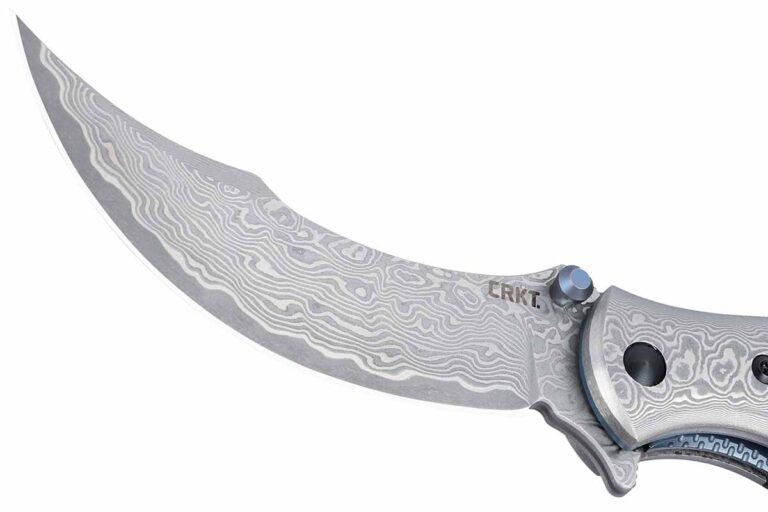
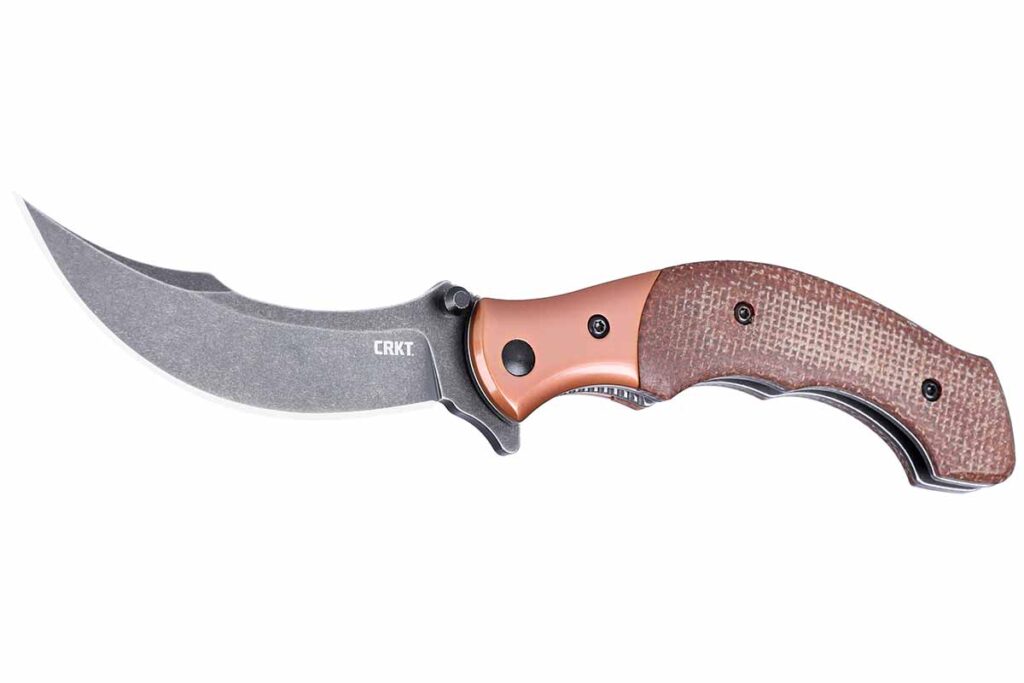
Designed for daily use, the Ritual Compact is an assisted folding knife inspired by old-world Persian fixed blades. The knife features a just over-three-inch 12C27 steel blade, ensuring excellent edge retention. With Assisted Opening technology and IKBS bearings, the knife guarantees quick and easy deployment and closure. The micarta handle with a stainless-steel bolster adds strength and striking aesthetics. The Ritual™ Compact is priced at an MSRP of $125.
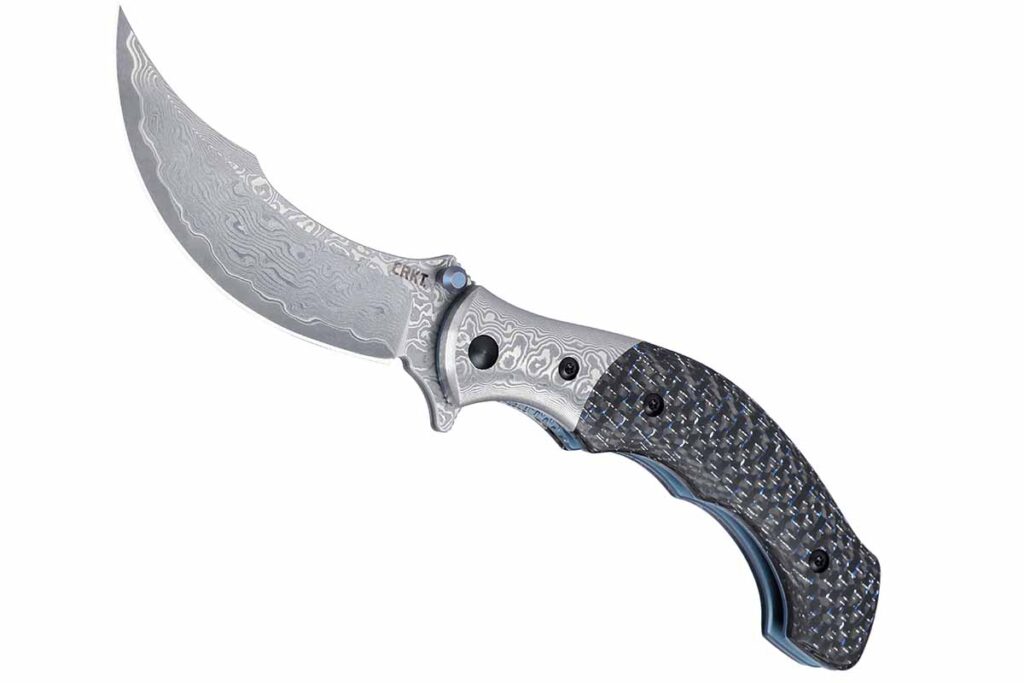
The high-end addition to the family, this Ritual Compact boasts a Damascus steel blade for superior cutting performance. The knife is adorned with a carbon fiber handle, an acid-etched Damascus bolster, a blue anodized titanium back spacer, and a pocket clip, making it a stunning addition to any collection. The Ritual™ Compact is priced at an MSRP of $275.
CRKT Obverse
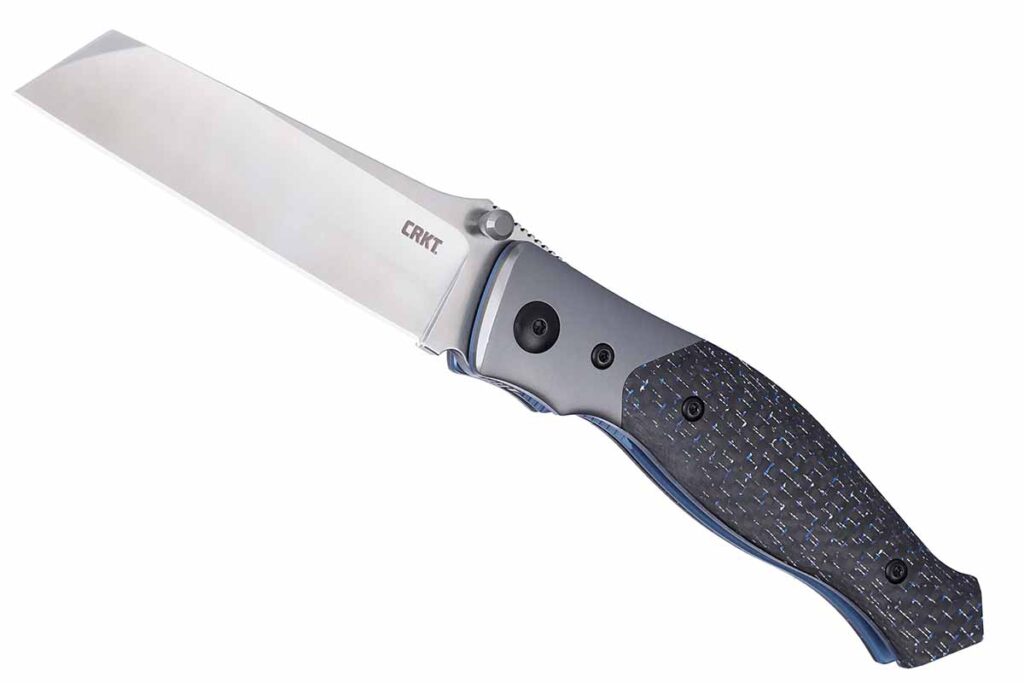
The Obverse is a distinguished folding knife made with premium M390 steel. The satin-finish, sheepsfoot blade is both sleek and durable, complemented by a carbon fiber handle with blue anodized titanium detailing. The silky smooth IKBS™ ball bearing pivot system ensures effortless deployment, while the secure liner lock allows for easy one-handed closing. The Obverse is priced at an MSRP of $275.