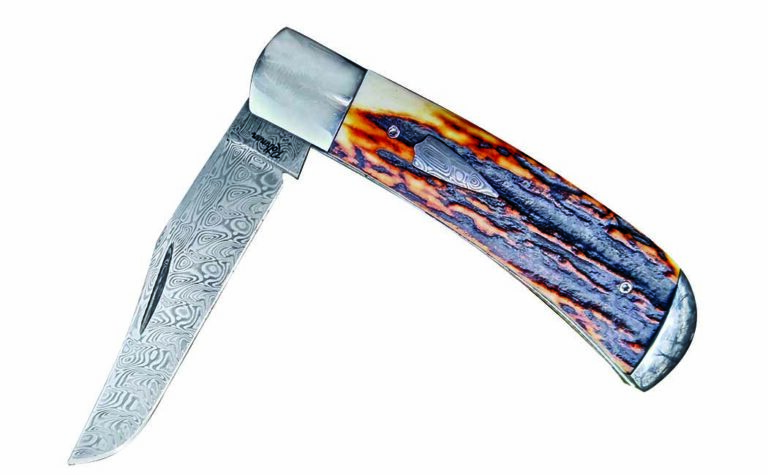
Don’t let its throwback good looks fool you, Rothman’s Gentleman’s Trapper has serious EDC chops.
The original EDC knife is a pocketknife. It used to be a right of passage when you were allowed to have a hand-me-down knife in your front pocket. I received mine at the ripe old age of 5. I used it to sharpen pencils and crayons and for whittling.
After a few years and a few cuts on my fingers, I progressed to skinning and cleaning fish. The knife never left my front pocket. I carried it to school for daily uses. It also made quite a few trips in the washing machine and dryer. My mom would have a fit every time she heard it thumping in the dryer. Of course, the laws have changed now and the younger generation has found other things to entertain themselves. For me, my old pocketknife is retired.
Mike Rothman’s Gentleman’s Trapper would make a great pocket filler. It walks and talks perfectly. But how well does it cut? Let’s see.
Gentleman’s Trapper Sharpness Test
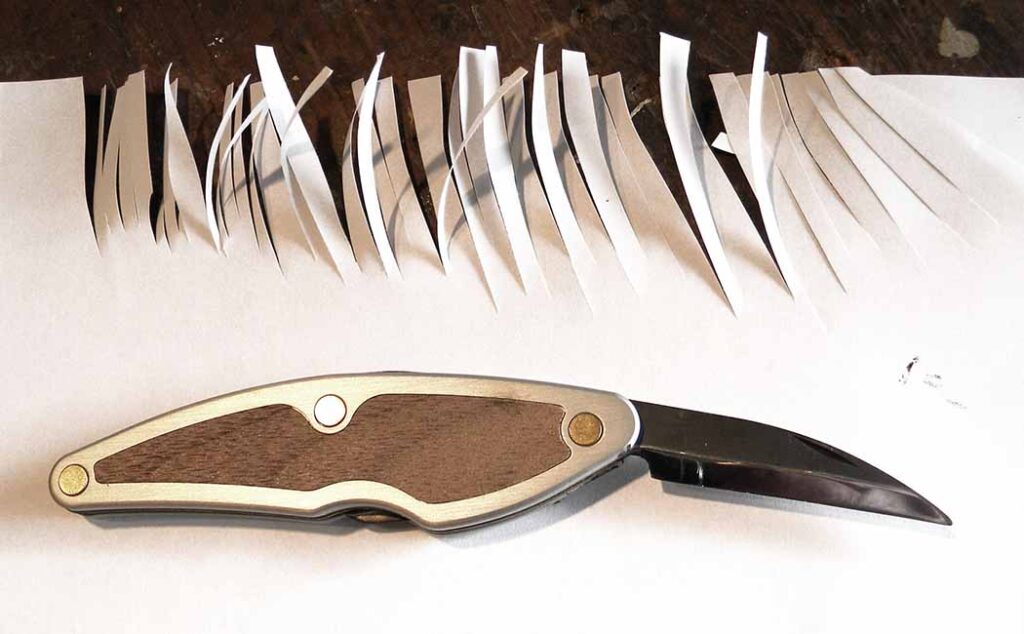
Twenty-pound bond copy paper provided the first test. The slip joint sliced it cleanly and effortlessly. The edge is very fine, so control was easy. It’s a nasty-sharp knife for sure—I could hear the blade slicing aggressively.
Light Duty Cutting With The Gentleman’s Trapper
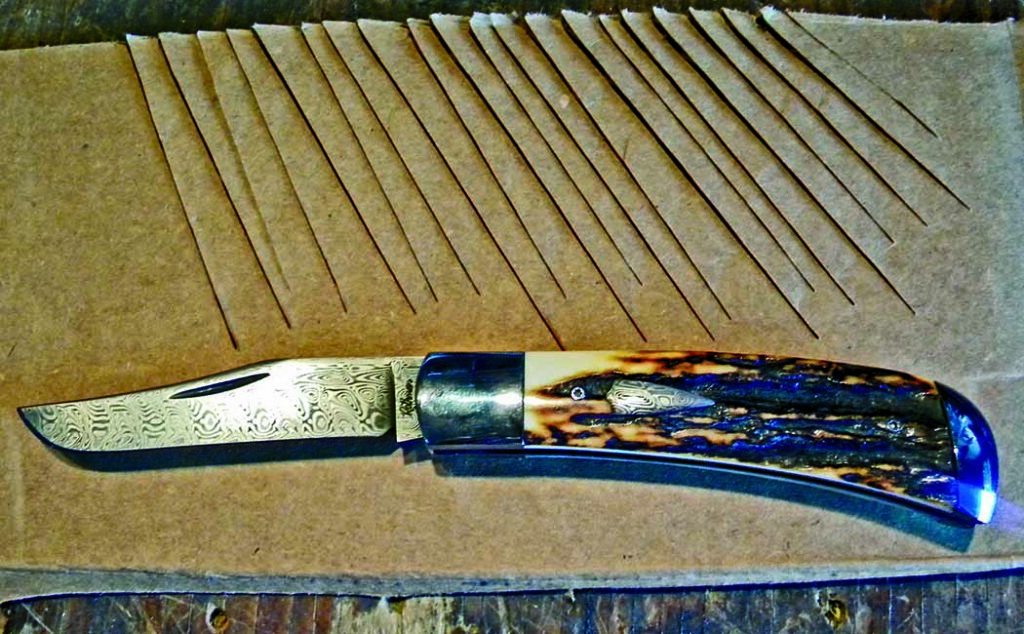
After dispatching single-walled cardboard with the Rothman knife, the author only had to use a tad more pressure on the push cut to zip through double-walled cardboard.
On to single-walled cardboard. The Gentleman’s Trapper made short work of it. In fact, it was very addictive slicing the cardboard. The blade made smooth, straight cuts with no deflection of the material. Very sharp indeed!
Next I found a piece of double-walled cardboard to try. I only had to use a tad more pressure on the push cut to zip through it. I could hear every cut again. The knife is a very forceful cardboard cutter.
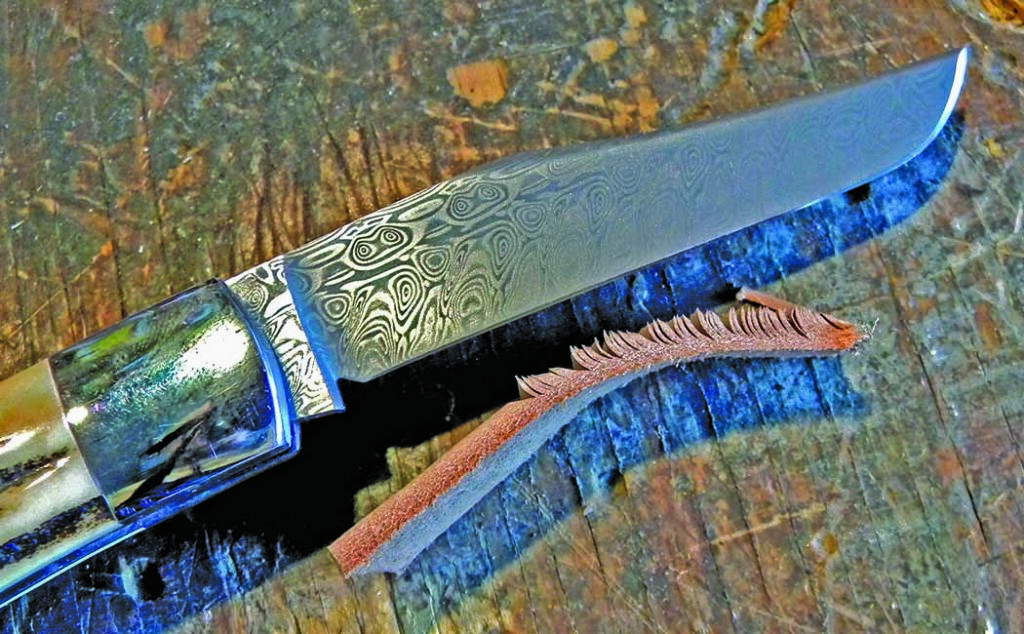
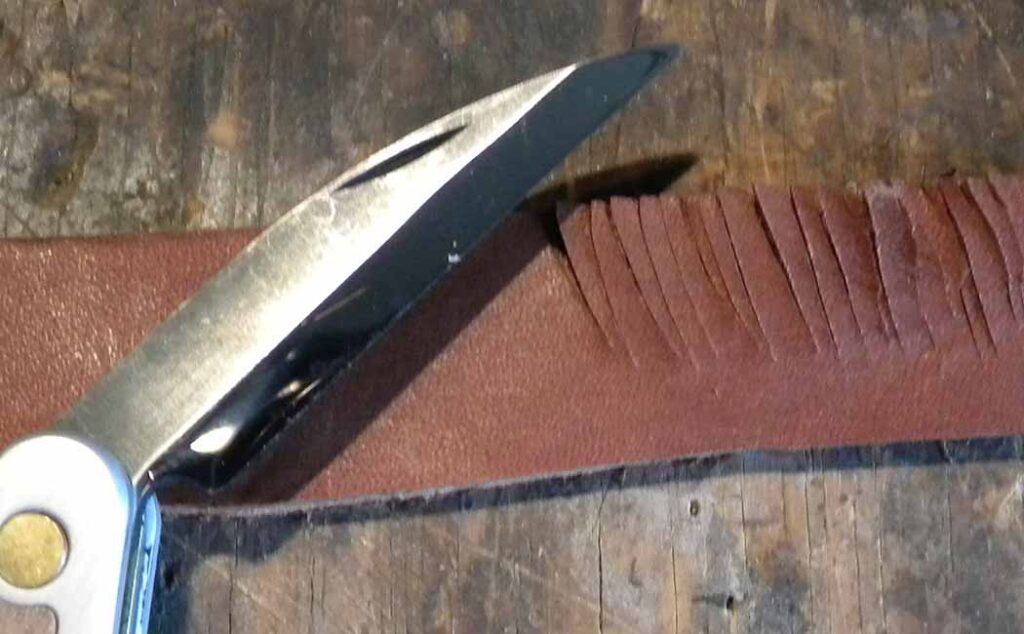
The thin blade made skiving leather simple, producing super thin slices repeatedly.
It was time for the leather slice and skiving. The trapper zipped through the leather quickly, so I had to use my knuckles as a stop to keep the piece together so it wouldn’t turn into a pile of pieces. The thin blade made skiving simple, producing super thin slices repeatedly. The stag handle worked perfectly providing a positive grip cutting the leather.
Heavy-Duty Cutting Duty
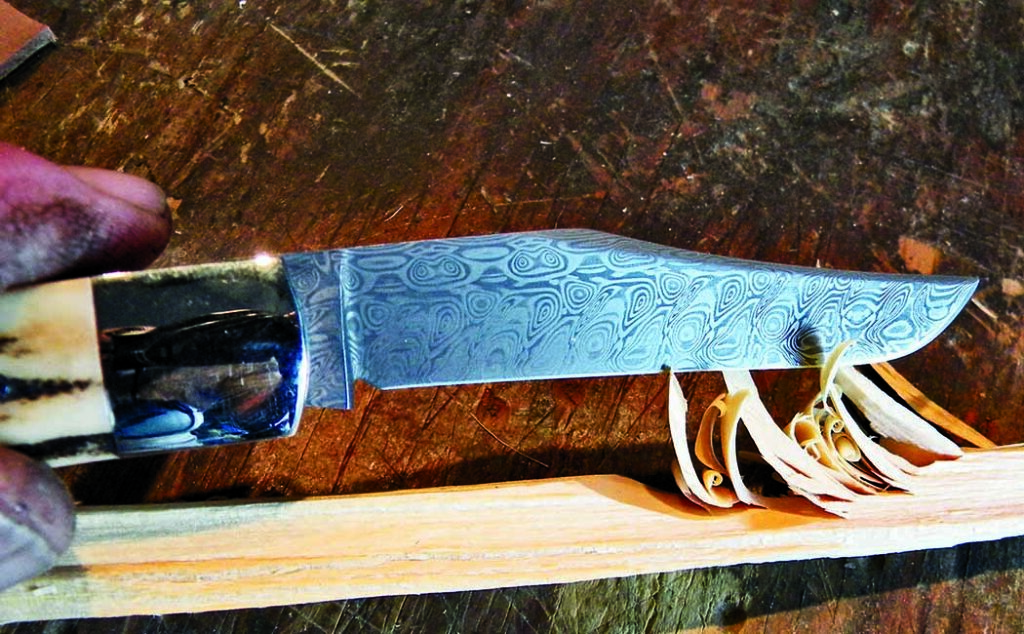
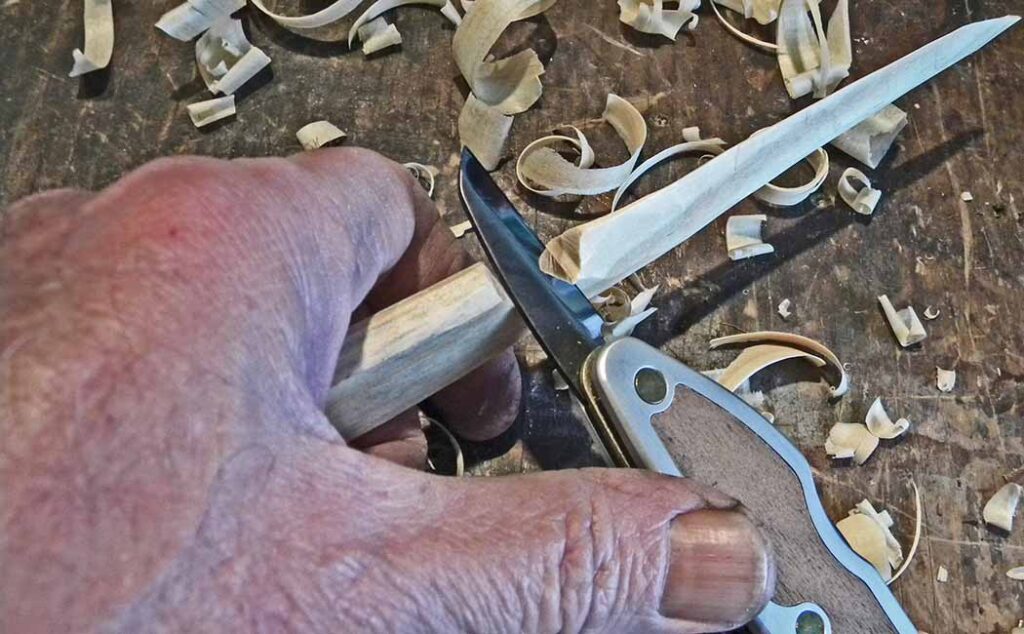
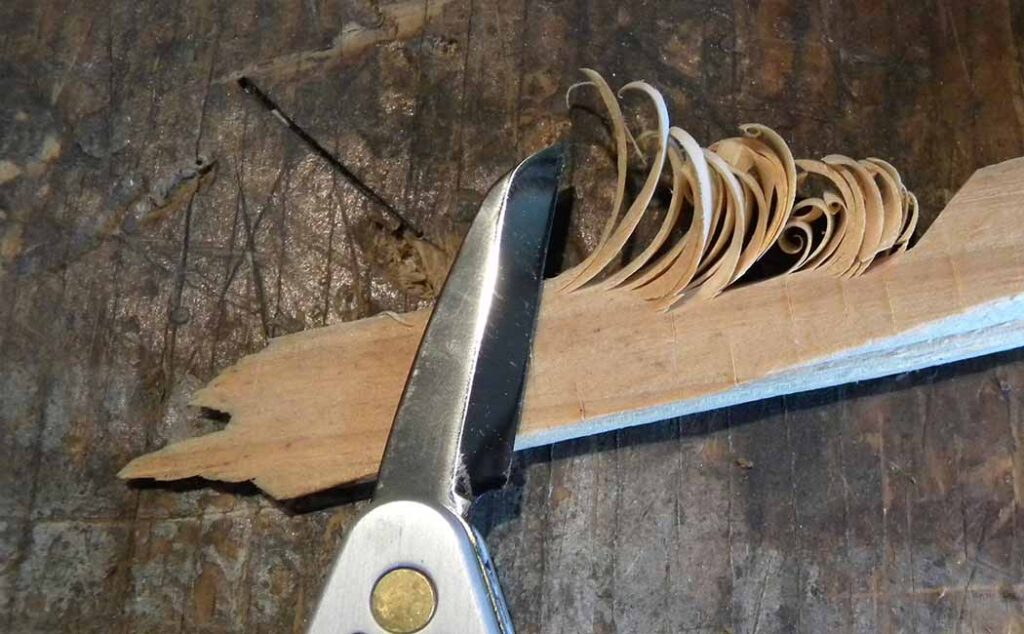
Whittling was up next. The thin blade produced some of the finest curly-cues I’ve seen. I changed the angle of cut for a deeper bite. I could see and feel the blade flex as deeper bites ensued. It was a very weird sensation, to say the least. I just moved the contact surface closer to the bolsters.
In the whittling test, the author changed the angle of cut for a deeper bite. He could see and feel the edge flex as deeper bites ensued.
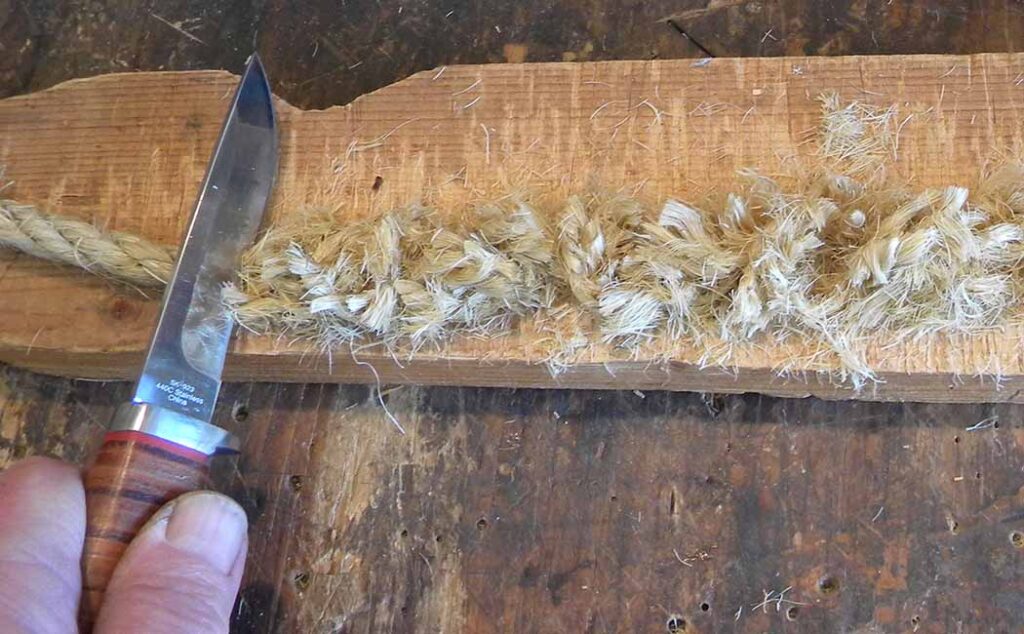
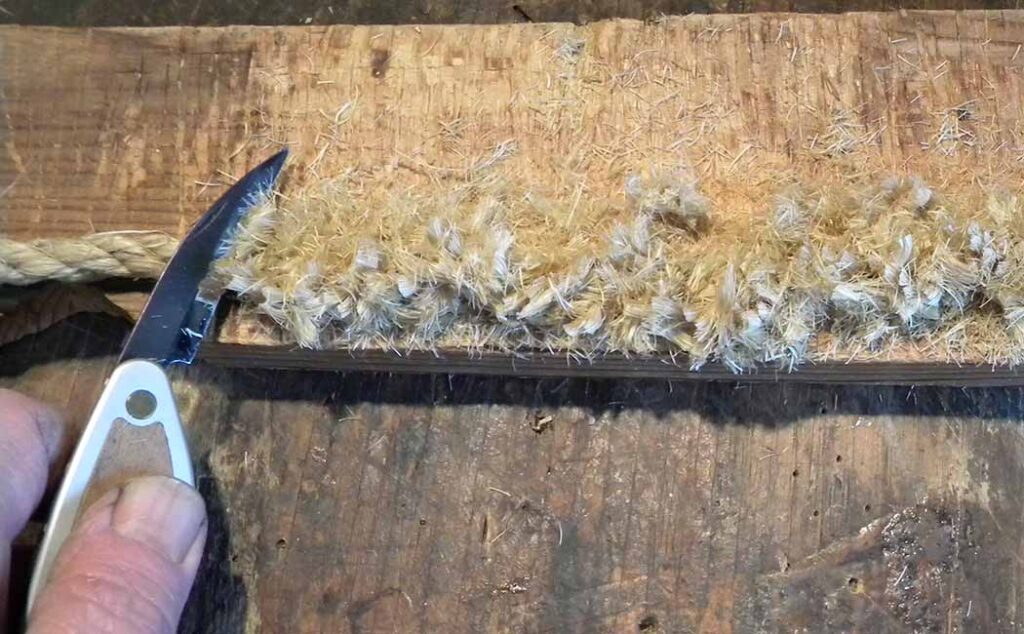
Half-inch sisal rope beckoned. I was looking forward to this one. Dang, this trapper performs—273 crunching cuts and the edge was barely sliding! It was easy to cut with and the handle was comfortable with a tight grip. The insides of the liners are a bit sharp but there were no hot spots. Wow!
I returned to the 20-pound bond paper to see if the edge was affected by all the testing. Nope—same clean slices in the material, a sign of great heat treatment.
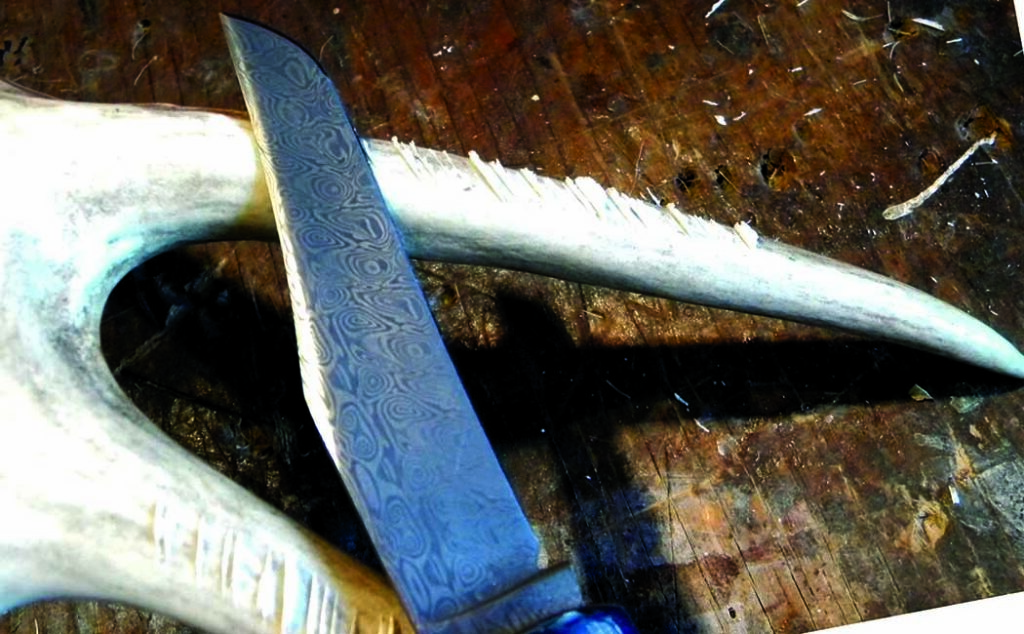
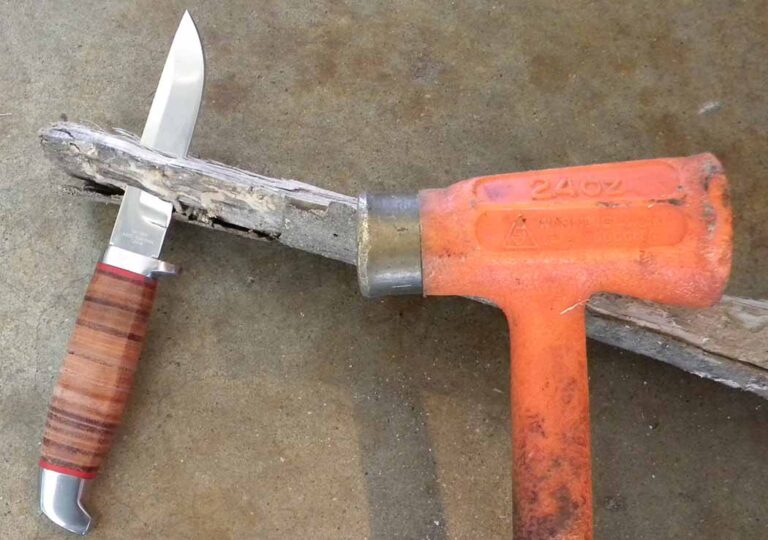
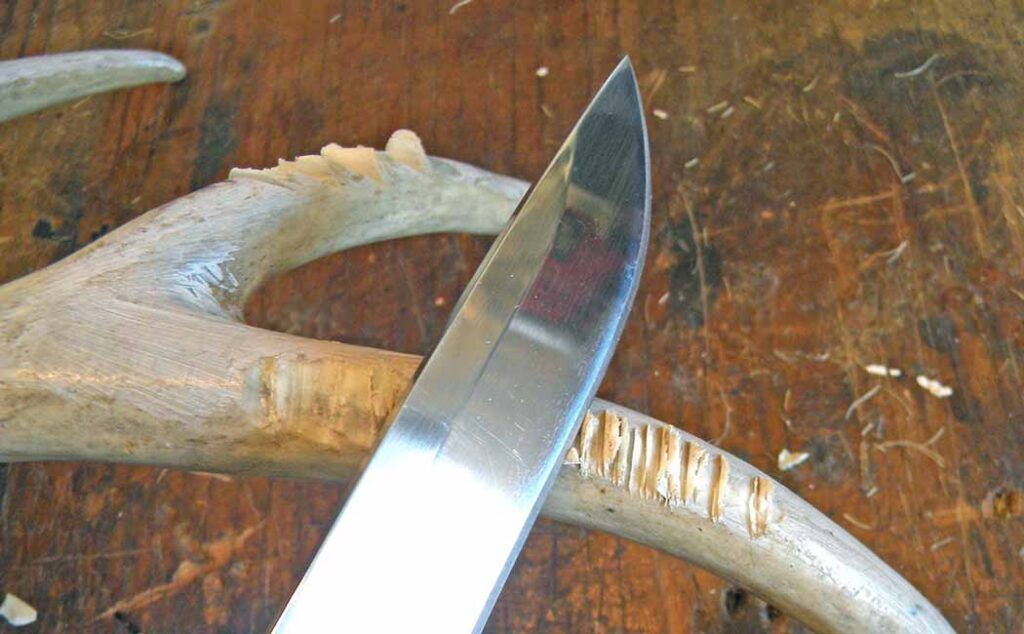
The author whacked the blade 30 times into the antler with no edge damage at all. The edge would still pull hair and the knife was as tight as when the author started, still walking and talking.
I was compelled to do a warranty-breaking test just to see how tough the Gentleman’s Trapper is. Where was the deer antler? I whacked the blade 30 times into the antler expecting to see some minor edge damage. There was no damage at all! The edge would still pull hair and the knife was as tight as when I started, still walking and talking.
Overall Impression Of Rothman’s Work
I was impressed with the performance of the blade considering how thin it is. Excellent workmanship!
Does Anything Need To Change?
Soften the exposed inside edges of the liners. That’s all, folks!
Gentleman’s Trapper Specs: Knife Type: Slip joint/pocketknife Maker: Mike Rothman Blade Length: 3” Blade Steel: Damasteel damascus in an Ægir pattern Blade Grind: Hollow Blade Pattern: Clip point Blade Thickness: Tapers on the spine from 1/8” above the ricasso to .039” at the tip; the edge is even thinner than the latter Handle: Sambar stag w/shield of same material as the blade Handle at the Thickest: .5” Liners: Fileworked of 410 stainless steel Bolsters: 416 stainless steel Backspring: CPM 154 stainless steel Weight: 3.5 ozs. Closed Length: 4” Knife to know: There is a seamless fit of blade to backspring in the open position Extras: Comes in black zippered pouch w/Rothman’s company name over shape of the state of New York Maker’s price: $750
Today’s gent’s knives are what they are instead of what they used to be.
In years past, there was a genre of knife small, fancy and unobtrusive. It went by gent’s knife or Sunday-go-to-meeting knife, the latter where the hard-working sodbuster was laid down on the day of rest for something to better match the formal Sunday duds. Loosely defined, that knife consisted of fancier materials and a blade less than 3 inches long
However, the argument can be made that today’s gent’s knives are exclusively gent’s knives no more. According to officials of the knife companies that make them, all kinds of people spring for the knives popularly known as gent’s knives. There are sub genres, and their popularity is growing.
Take, for instance, A.G. Russell Knives, whose customers tend to gravitate not toward EDCs or tactical knives but smaller gent’s-type knives.
“In the past year or so, we are seeing an increase in interest in these smaller knives that can be carried unobtrusively, both with pocket clips and without,” the team at A.G. Russell wrote in an e-mail. The knives worn with the Sunday best tend to be more traditional, according to the company’s spokespeople. It’s a subcategory of small knives that sport a sharp appearance that includes premium handle materials. Added the Russell team, “A great gent’s knife is not too large, has an elegance about it, but still performs well.”
A.G. Russell Knives Vest Pocket Semi-Skinner
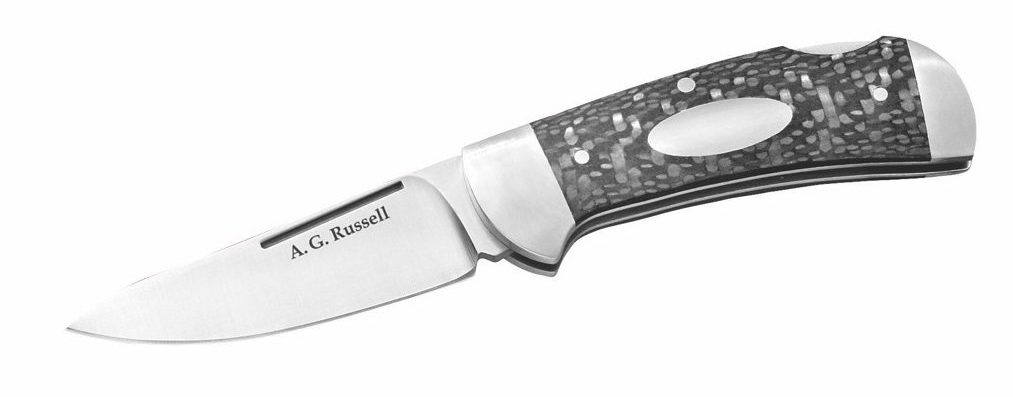
Bob Loveless introduced A.G. Russell to the semi-skinner blade shape and Russell fell in love with it, pairing it with a sparkling carbon-fiber handle in the Vest Pocket Semi-Skinner.
For an example of a piece that represents the new generation of gent’s knife, look no further than the A.G. Russell Vest PocketSemi-Skinner. Designed by the late company founder and BLADE Magazine Cutlery Hall-Of-Fame member® A.G. Russell, the knife is a mix between classic design and contemporary materials—the latter being a carbon-fiber handle and premium CPM S35VN stainless blade steel.
The heart of the knife is the bigger-than-it-should-be semi-skinner blade. As the company website noted, A.G. loved the semi-skinner blade, a pattern he credited Cutlery Hall-Of-Famer Bob Loveless for introducing to him. “A.G. saw the need for a small, lightweight pocket knife that would sit comfortable in any pocket, especially vest pockets, and the opportunity to create one with the blade he liked so much,” the site explains.
It is a blade shape that excels with work done at the tip, which is critical for a smaller knife.
“A good gent’s knife is really good at detail work,” the site notes,“in which blade and tip control are very important.” As a result, the Vest Pocket’s blade is at ground and boasts a thin edge geometry ideal for slicing cuts.
The stainless steel bolster is also critical to the design, as it covers the squared-off heel of the blade that connects with the lockbar. Unprotected, the heel could wear away at the fine fabrics of a vest pocket, for instance.
A.G.’s sketch of the knife (pictured below) was scanned into a CAD program in March 2018. Un-fortunately, he didn’t get to see the knife in production, as the iconic knife entrepreneur passed away in October of the same year before the design could be fully realized.
A.G. Russell Knives Vest Pocket Semi-Skinner Specs: Designer: A.G. Russell Blade Length: 2.53” Blade Steel: CPM S35VN stainless Blade Grind: Flat Handle Material: Carbon fiber Pocket Clip: None Bolsters: Stainless steel Lock: Lockback Weight: 2.5 ozs. Closed Length: 3.125” Country Of Origin: China MSRP: $100
Maserin Knives Turtle
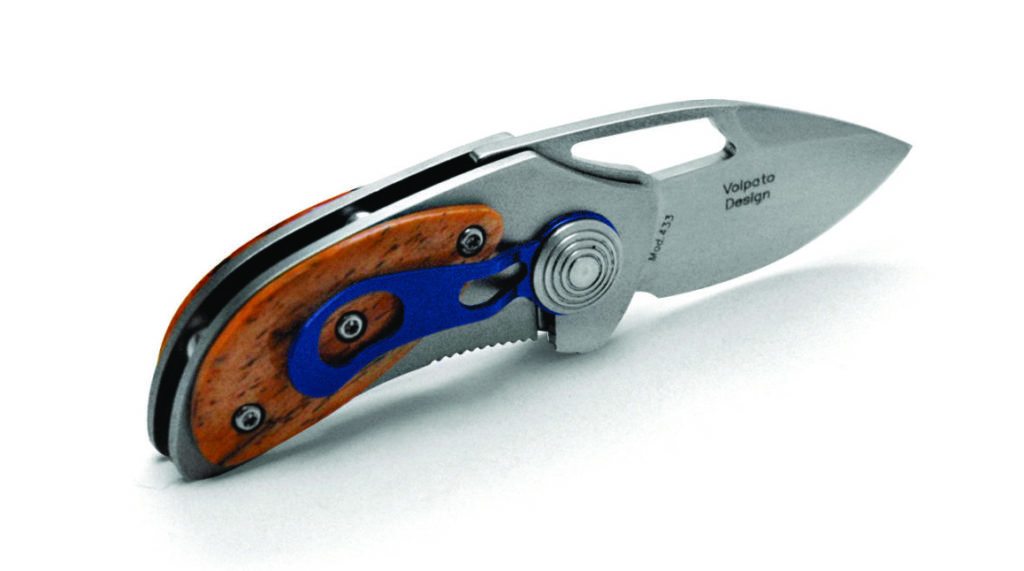
Some of the more notable features of the Turtle by Maserin Knives are the pivot pin with its concentric lines and the skeletonized titanium clip anodized blue.
No discussion of gent’s knives would be complete without mentioning the classic designs that hail from all over the globe. Take for example the Turtle, a timeless design Maserin injected with traditional materials and refinement throughout.
In 2006, Italian knifemaker Claudio Volpato designed a small knife with a blade under 2 inches and sent the prototype to Maserin. “We industrialized it,” recalled Claudia Maserin, along with her two brothers owner of Maserin, and the Turtle was born. “ The knife is still popular considering we first showed it long ago. The best handles are ebony and briarwood, and the damascus blade version is still very appreciated.”
Some of the small knife’s more notable features are the pivot pin with its concentric lines, and the skeletonized titanium clip anodized blue. Part of the goal was to take classic materials and transform them “We looked for elegant and traditional materials,” Claudia explained, “wooden handles like ebony and olive.”
Realizing that some women were gravitating to the Turtle because of its small size, Maserin officials handled the knife in pink giraffe bone several years ago. “We don’t design a knife thinking of final users in terms of gender but in projecting elegant knives,” Claudia stated. “We know they can be perfect both for women and men.”
Early versions of the blade were at ground of 440C stainless steel. Now, they are N690 stainless. The result is a knifes mall enough to slip into the small pocket of a pair of jeans and that opens easily one-handed.
“Our gent’s knife is good for everyday carry,” Claudia maintained. “You can open an envelope, a parcel, cut a fruit. It is the knife you need when you find yourself saying ‘If I had a knife …’
Maserin Knives Turtle Specs: Designer: Claudio Volpato Blade Length: 1.56” Blade Steel: N690 stainless or stainless damascus Blade Grind: Flat Handle Material: Woods of bocote, briar, ebony, olive or walnut Pocket Clip: Skeletonized titanium anodized blue Lock: Linerlock Weight: 2.05 ozs. Closed Length: 2.5” Country Of Origin: Italy MSRP: Depending on options, from about $77 to $19
Spyderco Pochi
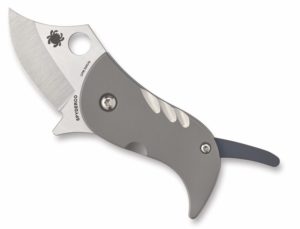
Like many small Spyderco knives, the Pochi is designed to offer large cutting power in a small package. “The dog tail rotates out to create a pinky shelf,” Joyce Laituri noted of the extension on the butt, “adding length to the handle for a better grip.”
Rigid definitions of a gent’s knife don’t quite cut it in Joyce Laituri’s book. The Spyderco spokesperson met a knife enthusiast at a knife show out to acquire some knives. The man towered well over 6 feet and was “built like an NFL linebacker, with paws like a bear,” she recounted. Though he appeared gentle-manly, a blade under 3 inches would be too small for him.
“In today’s industry,” Laituri began,“there is a broader view of what constitutes a dress knife. Is it its size, cost, function, materials, appearance? That definition is unique to each knife carrier.”
For some, a gent’s knife may be a small, elegant knife. Others, Laituri points out, decide that the most gentlemanly knife they can carry on their wedding day is a 5-inch folder or even a Spyderco Military model. The company eschews the term gent’s knives for prestige knives, Laituri said, in order to better describe the breadth of people who carry such edged tools. Meanwhile, a Spyderco knife that has attracted knife carriers for a whole slew of reasons is the Pochi, a flipper-folder collaboration with Japanese custom knifemaker Kazuyuki Sakurai.
“There is a market for anyone look-ing for the non-traditional,” Laituri said,“and the Pochi has been well received—surprisingly so—because it is so different from traditional pocketknives.
Some Pochi users, she added, like the design because they find it both charming and functional. Others are attracted to its upswept blade hollow ground from high-end CPM S45VN stainless steel. Some, attracted to the zoomorphism of the design, carry it because they like dogs, Laituri said.
Pochi, which roughly translates to the most common name for a dog in Japanese, has all the essential canine elements, resembling something like a pug on the go. Like many small Spyderco knives, Laituri said the Pochi is designed to bring large cutting power in a small package. “ The dog tail rotates out to create a pinky shelf,” Laituri noted, “adding length to the handle for a better grip.”
Spyderco Pochi Specs: Designer: Kazuyuki Sakurai Blade Length: 1.58” Blade Steel: CPM S45VN stainless Blade Grind: Hollow Handle Material: Titanium Pocket Clip: Titanium anodized blue;closed knife carries blade tip up Lock: R.I.L. (Reeve Integral Lock)WEIGHT:1.7 ozs. Closed Length: 2.6” Country Of Origin: Taiwan MSRP: $270
Bear & Son’s Bold Action
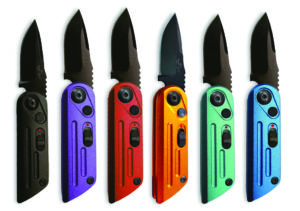
The Bear OPS Bold Action 14 comes in a wealth of different colors thanks to the anodization of its aluminum handle.
According to Matt Griffey of Bear &Son Cutlery, the world of gent’s knives has been changing and part of that has been due to the evolving nature of the workplace.
“We see less manufacturing professionals and more office setting careers,” he said. “Gentleman’s knives t the workforce movement and the lifestyles that come with it—accounting, computer techs, engineers and so on—with the knife having a small or slim physique and constructed from higher quality materials.”
At the same time, Griffey notes some of the slim knives are growing in size, and in the forefront of that change has been the increase in autos.
“Automatic knives have always intrigued both the traditional and modern knife enthusiast,” Griffey wrote, “and to-day more states are approving the daily carry and ownership of these types of knives.”
Trying to comply with many of the new auto laws, Bear & Son introduced the BearOPS Bold Action 14. The result is a knife available in a selection of color choices with its anodized aluminum handles and also the Sandvik 14C28N stainless steel blade, all made at Bear’s plant in Alabama.
Aluminum is a lightweight, low-maintenance material and 14C28 has a reputation of being corrosion resistant, durable and “an awesome performance steel”—essential features on a knife with a smaller blade and plenty of tasks to do.
“The Bold Action 14’s typical use would be common cutting chores around the office/home like opening small packages, cutting cordage and opening envelopes,”Griffey said, noting the knife can handle bigger tasks, too.
Meanwhile, expect more gent’s knives—or whatever you want to call the small fancy folders—in the future
“There is a market space for gentleman’s knives,” Griffey said. “Today, there are a lot of different choices and we’re lucky to and so many knife designers pushing the limits with materials, sizes and overall de-sign in the category.
Bear & Son’s Bold Action Specs: Designer: N/A Blade Length: 1.75″ Blade Steel: 14C28N Sandvik Blade Grind: Hollow Handle Material: Stainless Steel Pocket Clip: Reversable Bolsters: N/A Lock: Auto Weight: .14 oz Closed Length: 2.50″ Country Of Origin: USA MSRP: $140
CRKT Pilar
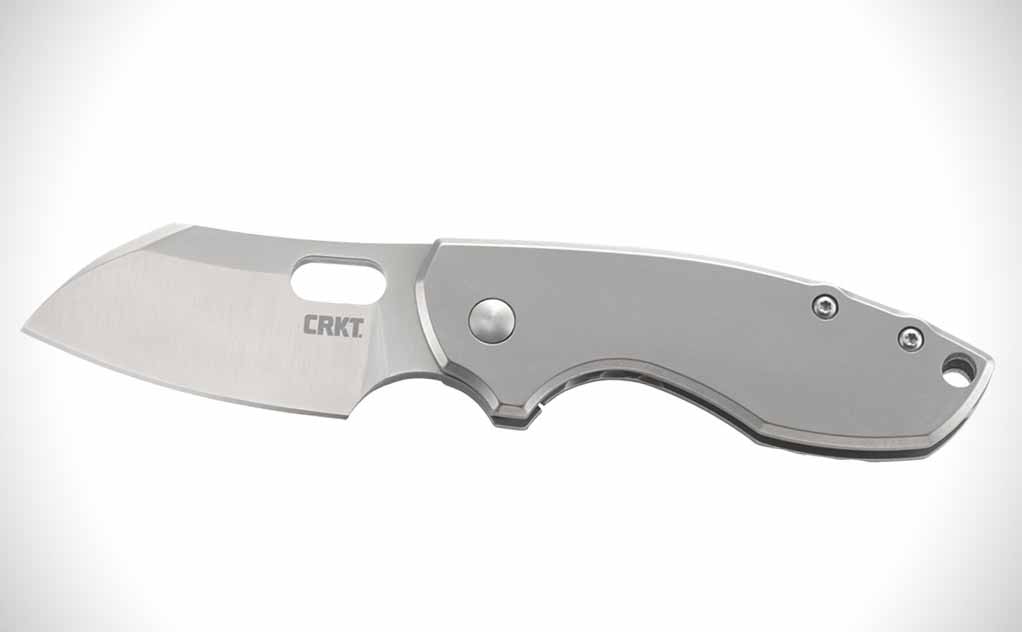
Designed by Danish knifemaker Jesper Voxnaes of Vox Knives, the size and blade shape of the CRKT Pilar are well matched for heavy cutting jobs. The handle is very comfortable and secure in the hand.
How could CRKT and Voxnaes make the knife even better? The answer is to offer a new larger version for 2019. The Pilar II offers the same performance and ergonomic advantages as the original, including robust framelock construction with an all-steel handle. The 2.6-inch blade is 8Cr13MoV stainless steel and offers a great balance of edge holding and maintenance ease. It is the Chinese equivalent of the Japanese-made AUS- 8. Due to the increase in size and blade mass, the Pilar II features a flipper, something the Pilar lacks.
Voxnaes is known internationally for his straightforward designs with a nod to utility and outdoor applications. Originally he made prototypes of the Pilar in two versions: one with a flipper tab and one without. “With lots of people asking for a flipper version, it was an easy fix,” Jesper notes. The blade rides on Teflon washers and flips open nicely without the use of pivot bearings. It also sports an oblong hole for ambidextrous opening.
The stainless steel handle supplies heft and a solid backbone. The grip’s edges are chamfered, offering comfort and eliminating hot spots or general discomfort. A solid steel spacer adds handle strength. A steel pocket clip carries the knife tip up or down for right-hand carry only. If you prefer half-and-half-type handle construction with your framelock folder—that is, each handle side comes in a different material, in this case stainless steel and lightweight G-10—the Pilar II is so equipped. The G-10 offers a bit more weight savings plus a nice grippy texture. The all-steel-handle version has weight-saving pocket reliefs milled into the inside of the scale.
“At first it may seem we simply upscaled the original Pilar design, but the knife was actually redesigned from scratch to make the ergonomics feel perfect,” Jesper concludes.
Don’t let the gent’s knife label for the large Pilar fool you. It’s a knife that isn’t afraid to get down and dirty with its rugged build and utility-friendly blade shape. Like its little brother, the large Pilar is easy to carry and rides securely in a pocket. The choil indexes your grip and the rest of your fingers fall naturally around the handle. Due to the handle shape and size, those with larger hands may find the knife too small.
However, for those whose hands are filled nicely by the grip, the large Pilar is very comfortable to hold.
CRKT Pilar Specs: Designer: Jesper Voxnaes Blade Length: 2.40″ Blade Steel: 8Cr13MoV Blade Grind: Plain Handle Material: Stainless Steel Pocket Clip: Stainless Steel Bolsters: N/A Lock: Frame Lock Weight: 4.20 oz. Closed Length: 3.53″ Country Of Origin: China MSRP: $39
Fallkniven FH9 MOP
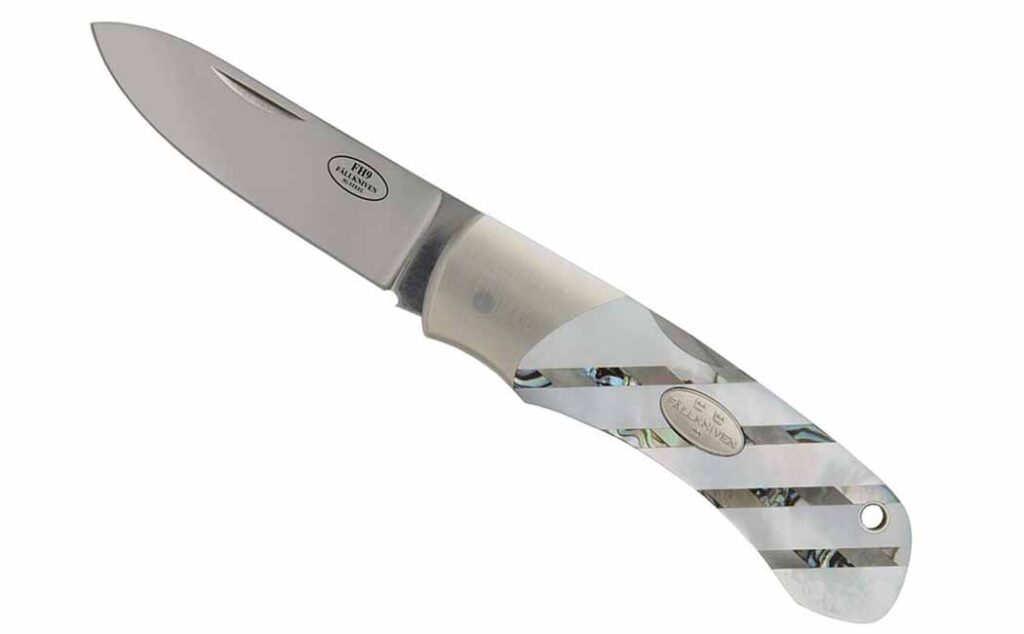
The Fallkniven FH9MOP is dressed to the nines with a mother-of-pearl handle accented by abalone and a mirror-polished blade. This is the knife you want to carry to dressy social functions, as the handle treatment sets the tone for an upscale outing or maybe even church on Sundays. According to Peter Hjortberger, Fallkniven president, the design is based on a folding hunter and a traditional lockback system.
Employing Fallkniven’s best blade material, a laminated 3G powder steel with a Super Gold steel core with a Rockwell hardness of 62 HRC, the FH9MOP is built for use. The 2.5-inch drop-point blade is neither too small nor too large. The knife is by far the best looking of the test bunch. The pearl handle and abalone accents create a stunning visual effect.
Structurally, the FH9MOP is built quite solid with dual stainless steel liners, steel bolsters and a steel handle spacer. Inlaid Fallkniven logo shields in the handle cap things off, and the blade sports a nail nick on each side for easy ambidextrous opening. A nice suede slip sheath protects the knife from rubbing up against keys, coins, etc., in your pocket.
The blade came out of the box razor sharp. I had no problem using it to open mail, cut stray threads, or any other similar gent’s knife duty. It is too beautiful a knife for the same jobs as a tactical folder, so use would be limited.
It sure is an eye-catcher, though. For a model more suited for general utility needs, step down to the standard FH9, which gives you the same blade steel but with the more work-friendly Micarta® handle material. Either way, the knives are sharpened pocket jewelry at its best.
Fallkniven FH9 MOP Specs: Designer: N/A Blade Length: 2.6″ Blade Steel: 3G Blade Grind: Plain Handle Material: Mother Of Pearl Pocket Clip: None Bolsters: Steel Lock: Lockback Weight: 3.35 oz. Closed Length: 3.625″ Country Of Origin: Sweden MSRP: $540
GiantMouse ACE Nibbler
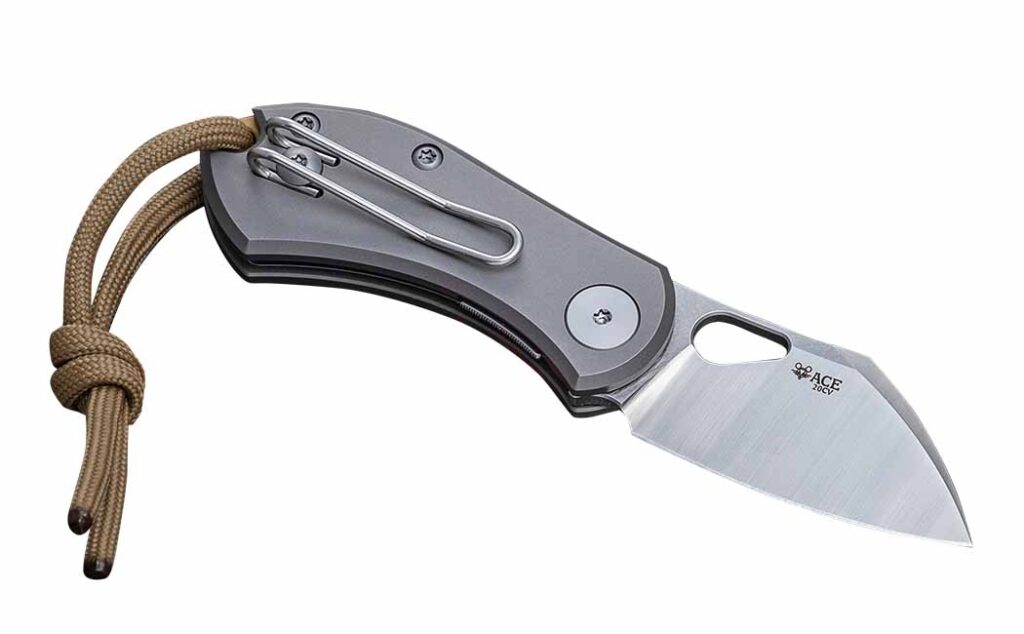
Designed by custom knifemakers Jesper Vox and Jens Anso, the Nibbler holds fast via a reversible wire clip.
“A great gent’s knife is a fully functioning tool that stands strong in the ‘looks and class’ department,” explained Jim Wirth of GiantMouse. “It’s a knife that is capable of cutting tasks but also for social events, Sunday church or a Thursday evening cocktail.”
GiantMouse makes a bold statement among gent’s knives with the Nibbler, a compact, efficient folder that Wirth says works as a great EDC in areas and situations where size matters. “Although the Nibbler is small, it packs a serious punch,” he pointed out. “Our definition of a gentleman’s knife is a knife that you can EDC in almost any environment, from the church to the office so to speak, a knife that does not raise eyebrows but will be welcomed when put to use. This could very well be the modern definition of this type of knife.”
The Nibbler is bound to fill the bill for that light-cutting job and to exude a positive image. “It’s inspired by the fictional character Nibbles ‘Tuffy’ Mouse from the hit cartoon series Tom and Jerry,” Jim explained. “Nibbles may be small but he sure is mighty, just like our new ACE Nibbler, a petite folder that packs a serious punch and doesn’t lack in the fun department, either.”
Wirth concludes that both men and women will find the Nibbler a great choice for EDC. “We don’t think that making a pink handle on a knife will make it more suitable for women,” he reasoned. “We don’t believe in designing specifically for a gender; all our knives are equally suited for men or women.”
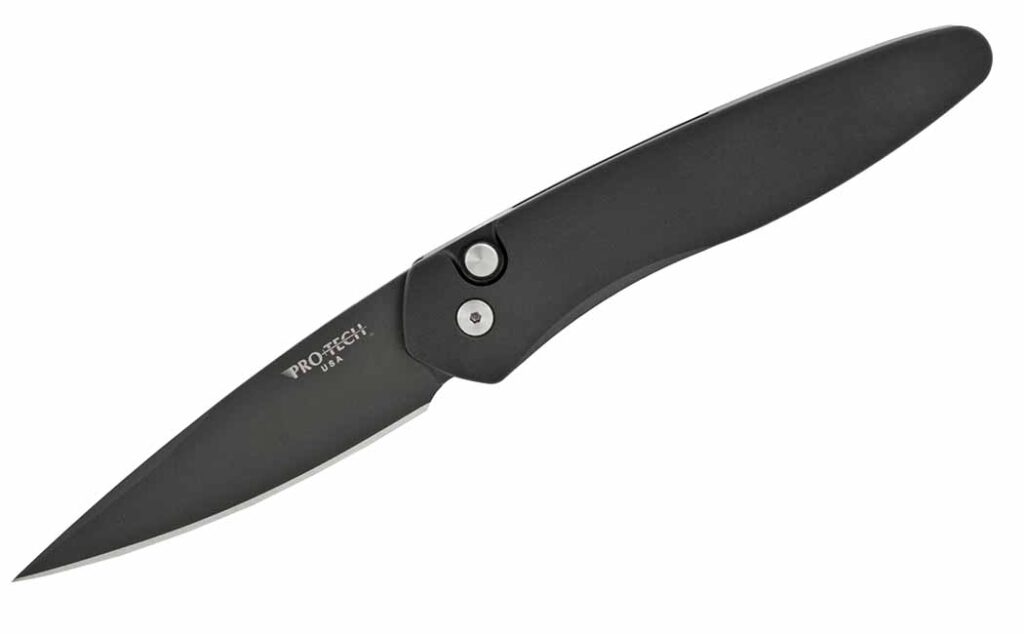
The thoughtfully designed deep carry clip and the thin, lightweight nature of the Pro-Tech Newport 3405 make it a good choice for wearing dress slacks, as it won’t tear up the pocket or be heavy enough to make it sag.
At Pro-Tech, Dave Wattenberg takes pride in the Newport, a gent’s knife that exudes personality. “It’s our thinnest and lightest full-size auto,” he commented. “It packs three inches of S35VN steel for all your EDC tasks into a precision-machined aircraft-aluminum frame that is only .38 inch thick.
The thoughtfully designed deep carry clip and the thin, light carry of the Newport make it a great choice for someone wearing a nice trouser or dress slacks, as it won’t tear up the pocket or be heavy enough to make it sag.”
Dave is excited about the versatility of the Newport, its swift deployment, unobtrusive profile, and variety when it comes to materials while running the gamut from EDC to investor/collector-grade presentations.
“From solid aluminum handle/stonewash base models all the way to investor customs, there’s a Newport model to suit just about any taste and budget,” he remarked. “Pro-Tech is well known, of course, for superior coil-spring-action auto knives, and while the Newport is no exception to this, users will find the action controlled, smooth and satisfying—not the huge snap of one of the tactical response series, but a more gentlemanly switchblade action.”
Pro-Tech Newport Specs: Designer: N/A Blade Length: 3″ Blade Steel: S35-VN Blade Grind: Plain Handle Material: Aluminum Pocket Clip: Tip-Up Bolsters: N/A Lock: Auto Weight: 2 oz. Closed Length: 4.125″ Country Of Origin: USA MSRP: $240
Sandrin Torino
The polyhedral tungsten carbide blade of the Sandrin Torino is designed to retain its razor-sharp edge far beyond that of steel blades in Sandrin’s “StaySharp Technology.”
The Sandrin Torino exemplifies the ideals of the gent’s knife, and Sandrin’s Rob Bianchin says he knows why. “The Torino is exceptionally lightweight at only 2.29 ounces,” he remarked. “It’s pretty easy to forget that you have it in your pocket. The lightweight characteristics are deceiving as the blade performance exceeds that of a steel knife for edge retention. For anyone who can appreciate metallurgy, the polyhedral tungsten carbide blade is a state-of-the-art super metal and was not thought possible just a few years ago.”
According to Rob, the entire Sandrin knife experience is centered around the blade material. Polyhedral tungsten carbide is not steel. Instead, according to Sandrin, it is an engineered “super metal” invented and patented for blades by Sandrin director Alessandro Colombatto. “Tungsten carbide can be used for cutting steel or for wear parts that undergo extraordinary stress and corrosion,” Bianchin added. “Polyhedral tungsten carbide has advantages over steel, such as consistent molecular structure. It cannot rust and typically is in the 71 [HRC] Rockwell hardness range* or higher.”
The polyhedral tungsten carbide blade lends itself nicely to the Torino gent’s knife presentation, and Rob sees a natural fit. “In my view, the definition of a gent’s knife has evolved with the times and includes knives of quality that are also effective cutting instruments and not just for show. The Torino can be carried and used daily but is also a point of conversation as it is still exceedingly rare to own a knife made from new metal.”
The appeal of the Torino once again embraces the spectrum of potential users—both men and women, factory or office workers. “Gender is not a design consideration,” Rob said. “The Torino is suited for men or women. Men are the predominant consumers of pocketknives, but I suppose in today’s world the industry should call such knives a ladies’ or gentlemen’s folder.”
Sandrin Torino Specs: Designer: N/A Blade Length: 2.95″ Blade Steel: HRC71 Blade Grind: Plain Handle Material: G-10 Pocket Clip: Titanium Bolsters: N/A Lock: Recoil Weight: 2.29 oz Closed Length: 4″ Country Of Origin: Italy MSRP: $260
Case Black Sea Dichrolam Tear Drop
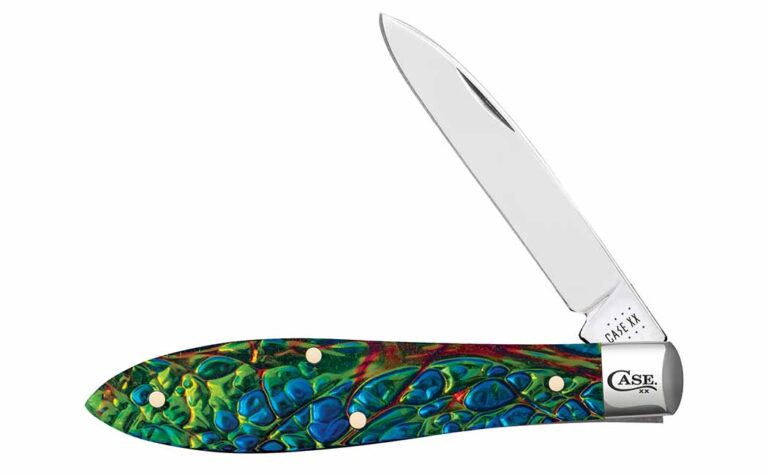
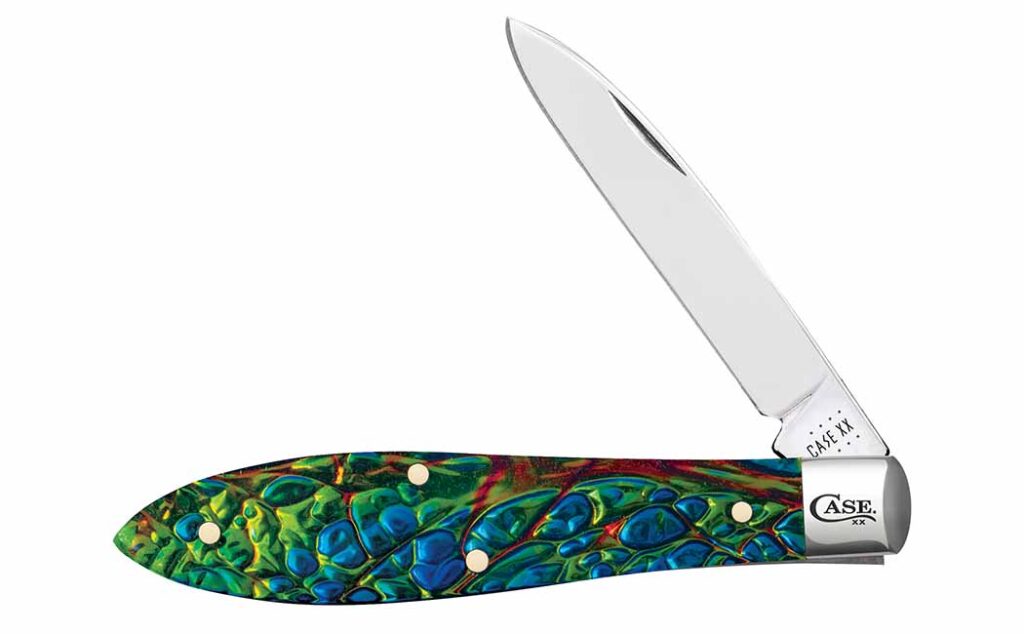
The Case Tear Drop Black Sea Dichrolam spear-point blade is designed with a strong tip for piercing, which comes in handy for such gent’s knife jobs as opening mail, packages and the like.
Case has long been a star performer in the manufacture and presentation of gent’s knives, and the company continues the tradition with the Black Sea Dichrolam Tear Drop, a beauty with a composite handle material that mimics the luster of an opal gemstone. Fitting nicely within the spectrum of gent’s knives, the Black Sea Dichrolam Tear Drop brings excitement to the Case fan base.
“Based on our interactions with knife enthusiasts at consumer events, our Classic Case folding patterns like the tear drop are considered by many as a ‘Sunday-go-to-meeting knife,’” commented Fred Feightner, Case director of marketing communications. “But more modern knives are more and more often carried and considered to be a ‘gentleman’s knife.’ The definition lies in the eye of the beholder.”
With the new tear drop entry, Case has bridged any perceived gap between men and women as far as carrying a dressy, functional knife. “We’ve definitely seen an uptick in people carrying Case pocketknives over recent years,” Fred continued, “and they realize that a good, sharp knife is handy to have on your person for all kinds of reasons, from hiking and camping to doing detail work that’s done by hand. Whether kept in a pocket, purse or hanging on a carabiner, a pocketknife is a must have for most any person.”
For occasions when an unobtrusive EDC knife is in the mix, Case fashioned the Black Sea Dichrolam Tear Drop. “Our tear drop pattern has a single spear-shaped blade,” Fred related. “The long, sharp edge can cover everything from cutting threads on clothing to gathering fruit or nuts outdoors. The tip adds functionality for tasks like piercing through a clam shell package or scoring leather to fashion a sheath.”
Case’s tear drops, particularly the Black Sea Dichrolam, perform as excellent light-duty tools, according to Fred. The slim design and small “form factor” make them great for close-up and close-in work, handy little EDC knives that are not only up to the tasks a gent’s knife is meant to perform, but easy on the eyes as well.
Case Black Sea Dichrolam Tear Drop Specs: Designer: John Blazy Blade Length: 2.44″ Blade Steel: Trusharp Surgical Steel Blade Grind: Plain Handle Material: Dichrolam Composite Laminate Pocket Clip: None Bolsters: N/A Lock: Slip Joint Weight: 1.4 oz. Closed Length: 3.63″ Country Of Origin: USA MSRP: $106
Editor’s Note: Dainel Jackson, Dexture and Mike Haskew contributed to this post.
Sarge Knives TK Retro has throwback looks, but modern performance.
The TK Retro from Sarge Knives reminds me of my first fixed blade.
The blade was pitted and the leather handle was cracking. Still, the knife field dressed many squirrel, rabbit and game birds throughout my childhood. It was an excellent camper’s or outdoorsman’s knife.
As for the TK Retro, like my first fixed blade, the stacked-leather handle still gives my hand a warm feel. It has a 440C stainless steel blade to make its good looks last even longer. However, how does it cut?
TK Retro Sharpness Test
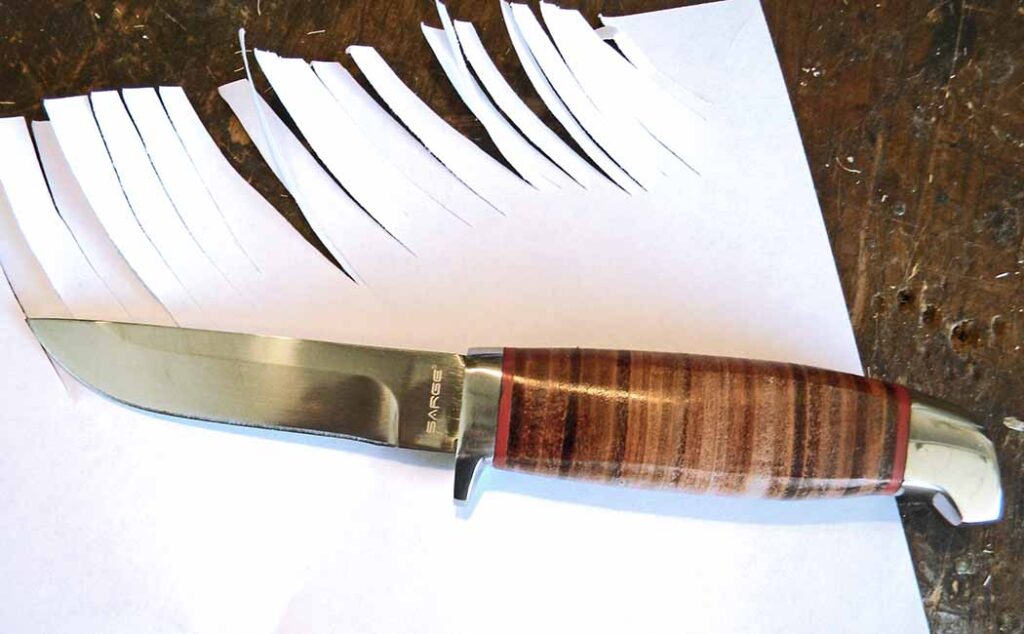
Using the knife’s weight, the author employed push cuts in the stationery. There were no “bad starts,” just smooth slicing.
The first test medium was 20-pound bond copy paper. The TK Retro started slicing and made nice, clean cuts in the stationery. Using the knife’s weight, I employed push cuts. There were no “bad starts,” just smooth slicing.
TK Retro Light-Duty Cuting
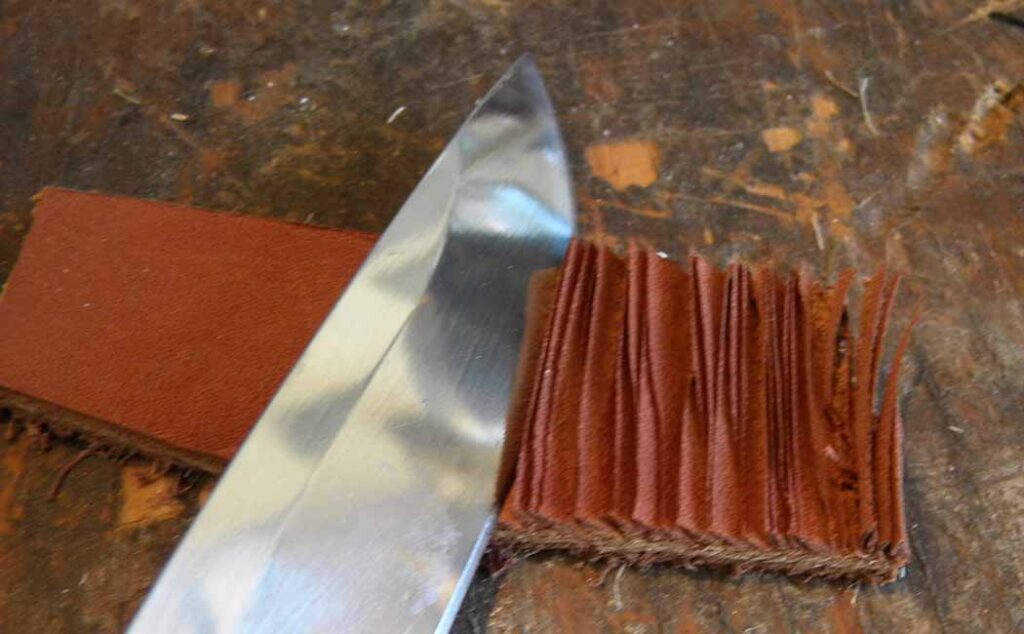
The blade audibly crunched the leather with each skive and made it easy to control the width of slices.
The TK Retro bit deep and smooth [into drywall], with minimal bending of the cut pieces. I could feel the cardboard’s layers with each cut. Edge performance was nice and aggressive. The handle provides a very secure grip.
Leather skiving followed. The blade audibly crunched the leather with each cut and made it easy to control the width of slices.
Heavy-Duty Cutting With Sarge’s Fixed Blade
Firesticks
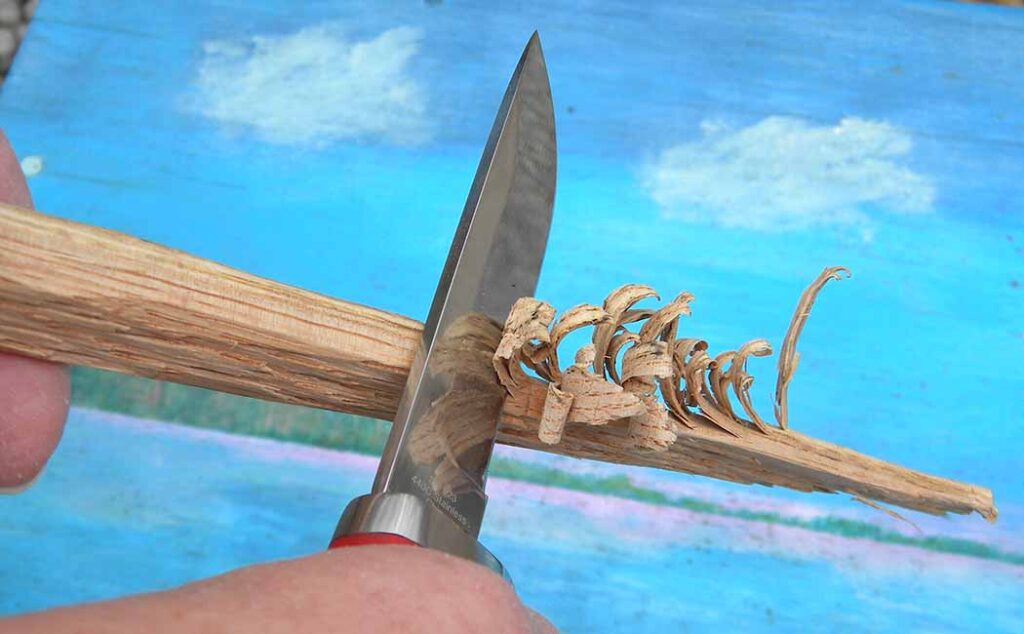
Melissa did a great job whittling a fuzz stick with the TK Retro over her painted bench.
While camping, I was splitting firewood for the weekend. My wife, Melissa, wanted to start the fire so I showed her how to make fire sticks. She took to whittling very quickly and did four of the sticks to aid in her fire starting. She used the TK Retro to make some very nice curlicues. Before I knew it she had a beautiful fire going—excellent job on her part! I was surprised to see her whittling over her bench that she had painted. She seemed to feel very confident using the little fixed blade.
Splitting Wood
I had some dry hackberry wood to split for kindling. A dead blow hammer and the TK Retro made short work of the task. I didn’t see or feel any edge/knife damage while batonning the edge through the wood. The guard acted like a guide for my hold hand, keeping the wood away from my knuckles. The leather handle absorbed the vibrations perfectly.
Vs Rope
The fixed blade made 82 crunching cuts in the half-inch sisal rope before the edge started to slide.
On the half-inch sisal rope, the TK Retro crunched its way to 82 clean cuts before the edge started to slide. I did find that the guard had a sharp edge that needed softening a bit. It would create a hot spot on your hand after a while. It was an easy fix with some sandpaper.
Chopping Antlers
After 20 hard whacks on the antler the edge showed nary a chip, a sign of outstanding heat treating.
The last test for the edge consisted of a series of chops into a whitetail deer antler. After 20 hard whacks, I expected to see some minor edge chipping but there was none. The edge was as sharp as when I started. Sarge Knives nailed the heat treating.
Changes
The guard and buttcap need to be softened a tad. They will bite you after a period of hard use.
Final Cut
The TK Retro is a very nice medium-use knife great for game or camping.
A kitchen do-all, the Santoku is a must-have for foodie pros and novices alike. Here’s what to look for to get the best, plus our top picks.
Santoku knives are becoming increasingly popular in the West, especially among foodies, passionate home chefs, and anyone who brings a knife roll to work in a kitchen. If you’ve been dying to learn more about this great Japanese knife, you’re in luck.
We’re going to go over everything you need to know about the Santoku, from its origins and design, to how to buy and use one in your own kitchen. We’re also going to go over the top Santoku knives on the market right now, in case you’re looking to pick one up for yourself (or as a gift).
Origin of the Santoku
Traditionally, in Japanese cooking, knives have different roles based on what you’re preparing, more than how it’s being prepared. Around 100 years ago, you would commonly see a Gyuto (basically what Westerners call a chef’s knife) used to cut beef, pork, and chicken, a Nakiri to cut vegetables, and a Deba to cut fish.
Each of these is designed for its specific task, and so they are specialized. Of course, they can be used differently, but the idea is to have a knife for every task, rather than a knife for any task.
Around the 1940s, as steel started to come at a bit of a premium due to some noted historical world conflicts, the desire for multi-purpose kitchen cutlery rose, and out of that desire came the Santoku, or “three virtues” knife.
The purpose of the Santoku, also translated as “three uses”, was to be able to handle most food prep duties with just one knife. To that end, it is designed to be able to handle chopping, slicing, and cutting tasks, which is another interpretation of the meaning of the name.
Santoku Design
A Santoku typically uses a sheep’s foot blade and tip, which gives you a long, relatively flat blade edge and a tip that sweeps back up in a large radius towards the spine.
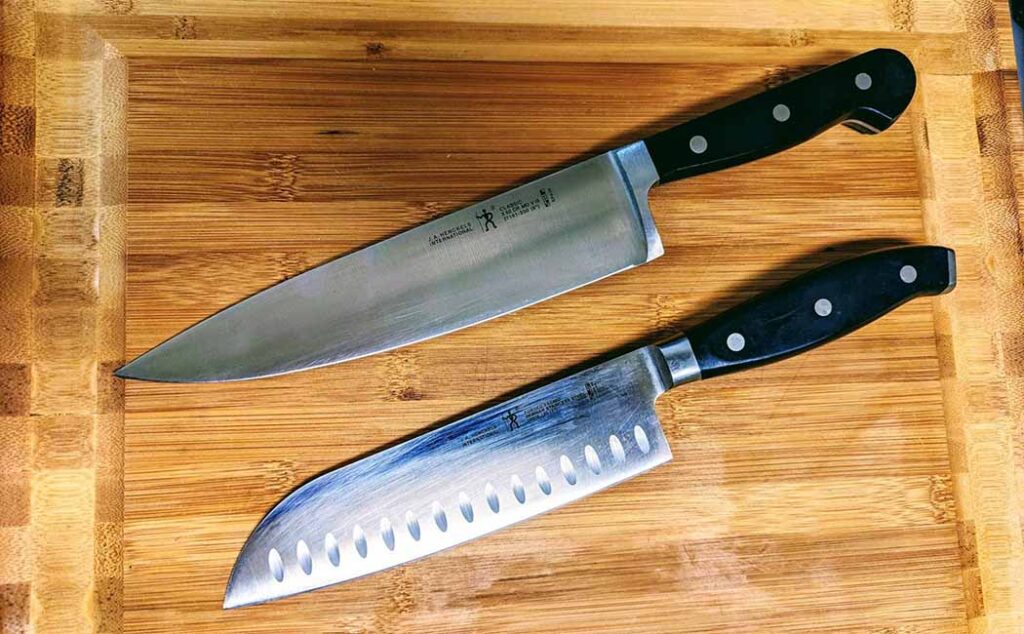
A mid-range Santoku from my personal kitchen.
Edge
Most are between 5 and 7 inches and have an edge with a very Western-style bilaterally cutting edge with a 12 to 15-degree shoulder. Many Japanese knives are ground to a chisel edge, which is only sharpened on one side, but a classic Santoku has a more familiar Western-style edge geometry.
This does mean that, for those of us in the West, sharpening isn’t too much different than with any other kitchen knife, just with a different angle. It also means that Santokus are typically made of very hard steel to prevent damage to that thin wedge.
This makes them an absolute dream for slicing and chopping tasks. If you’ve ever wanted to reliably get those paper-thin tomato slices, you’ll have every advantage with a Santoku.
Handle
Most Santokus have no bolster, which may also take a bit of getting used to depending on your grip. However, many have a handle that tapers down towards the blade, making it very comfortable for the classic pinch grip most of us home cooks are probably used to.
Granton Edge
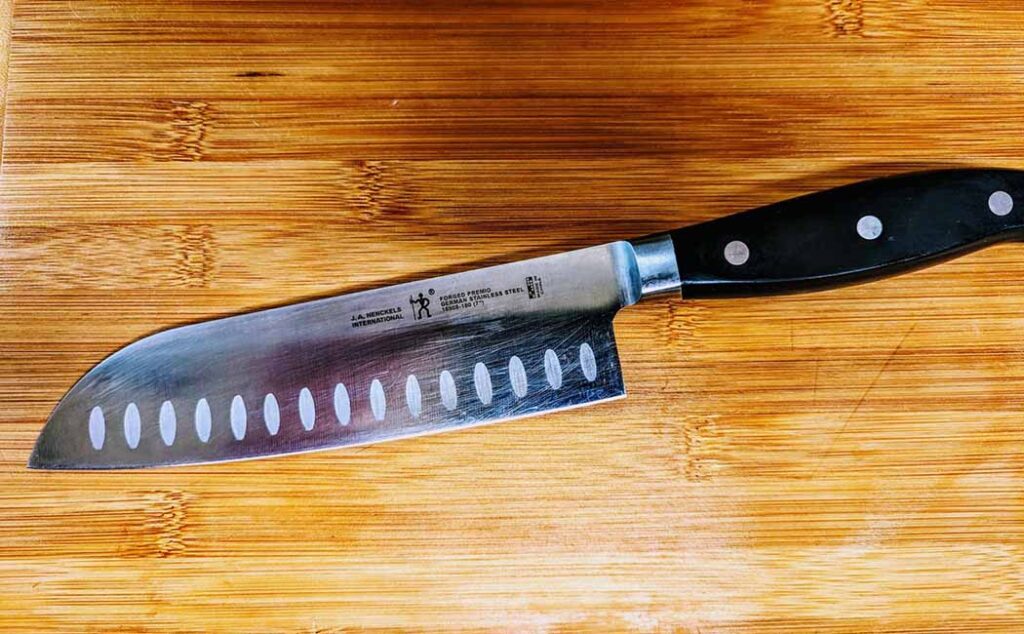
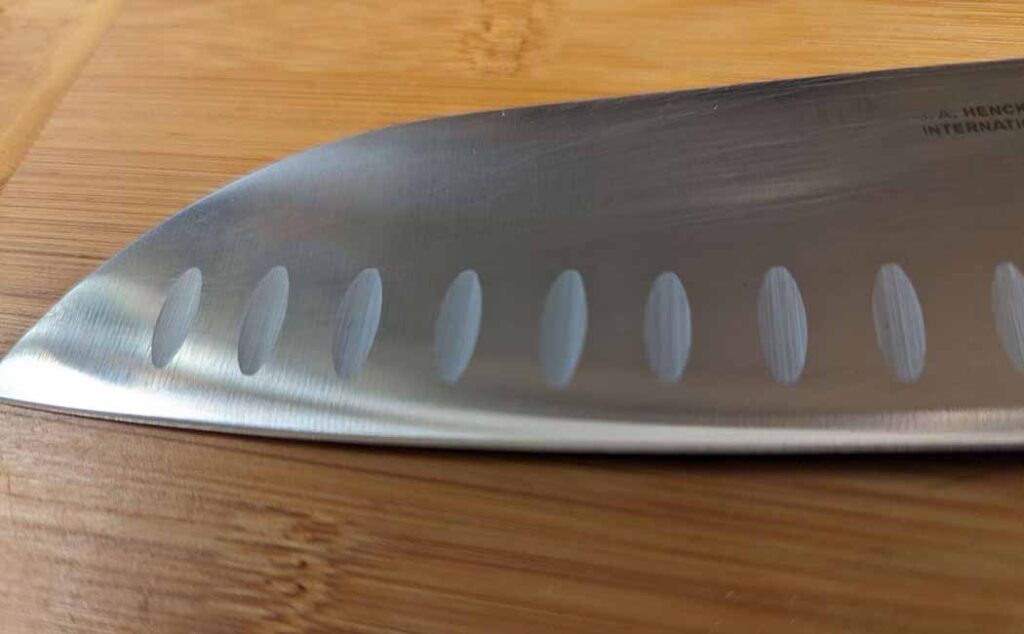
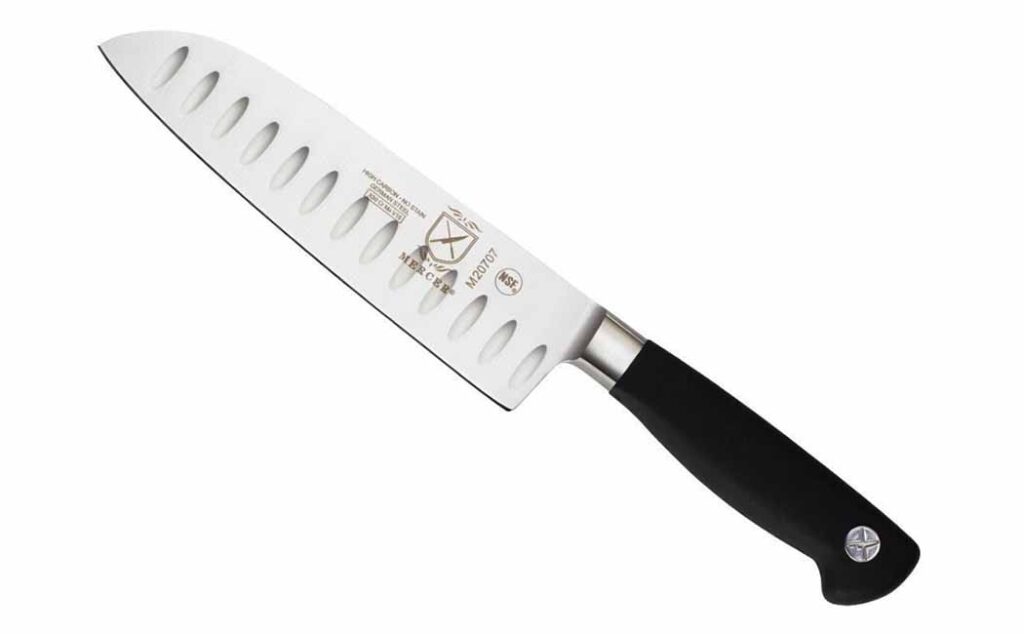
Lastly, many Santokus feature a “Granton edge”, which you can recognize by the slightly scalloped sides of the blade that look like someone took an ice cream scoop to the steel and removed little bits of the blade.
These little scallops help sticky, wet foods like meats and certain vegetables from sticking to the side of the blade as you’re chopping. If you’ve ever tried to slice tomatoes quickly or dice something like a chicken thigh, you’ll know how helpful this feature can be.
What To Look For In A Santoku
Here’s a fun fact I don’t get to bring up in my writing career a lot: I’ve worked as a chef in kitchens all over the South for a good portion of my 30ish years on this planet. In that time I’ve held a lot of knives.
Cooking may not be my main gig anymore, but it is something I’m still passionate about. I cook most meals for my family, and I still help out with the occasional catering gig when my chef friends need an extra hand.
All of which is to say, I’ve got some battle-tested, dinner-rush-proven opinions about what to look for in a kitchen knife, and we’re going to apply those to our Santoku shopping.
Blade Length
While Santokus come in a range of lengths, for your first one I definitely recommend sticking to a 5 to 7-inch blade. This is a good range for all the common tasks you’d likely want a Santoku for and makes for a very handy blade.
This gives you a blade that’s most likely shorter than your standard Western-style chef’s knife (or Gyuto), but still more than sufficient for chopping large, hearty vegetables when needed. It’s also not too big to quickly filet a fish, or other delicate tasks.
Steel
Blade steel is an important consideration with any knife, but especially the Santoku. As we discussed above, a Santoku has a very thin edge and narrow blade geometry.
While the thin edge gives you immense slicing and chopping performance when we’re dealing with vegetables, it’s potentially a liability. Specifically, the edge is more prone to rolling if you’re doing something like hacking through a chicken carcass.
To protect against such occurrences, a typical Santoku—and Japanese knives in general—are treated to a higher hardness than Western-style knives. Japanese knives like the Santoku are also typically high-carbon steel.
Practically, this means that you’ll have to put in more work to sharpen a high-quality Santoku than a Western-style knife. On the flip side, the edge will likely last you a good bit longer. This makes the Santoku a good everyday kitchen knife, especially if you don’t love sharpening.
Stay away from stainless steel, unless you’re really on a budget and want to try the Santoku out on the cheap before committing to a more expensive model. (We’ll have some very good budget-friendly options below if you want to go that route.)
Stick to a high-carbon steel of Japanese or German origin if possible, and look for something with a Rockwell hardness of 57 or higher at a minimum. I like 60 plus but that starts to get expensive quickly.
When in doubt, when it comes to any kitchen knife really, buy from one of the countries that lost WWII and you’ll probably do alright (I have similar opinions about cars).
Blade Height
Blade length and width are familiar decision points when buying a knife, but for something like a Santoku blade height (the distance from the blade edge to the spine) is also important.
Because these knives are designed for slicing and chopping against a cutting board, you want to make sure the blade is tall enough to keep your knuckles comfortably off the cutting board when using the knife.
This tall blade also makes it easier to create nice, even slices. The edge is less likely to wander to the left or right as you slice, and you have a nice large flat surface to index whatever you’re cutting against as you’re slicing.
A Note on Scalloped Edges, or Granton Edge
You will probably notice in your Santoku shopping many of these knives, and Japanese knives in general, tend to have a Granton edge. You’ll see dimples on the side of the blade.
The dimples on my personal general-use Santoku.
The idea behind these dimples is to relieve the suction effect when slicing through thick vegetables or meats and keep things from sticking to the blade. How much does that help? I’ll be honest, I don’t know.
A lot of it depends on the geometry of the dimples, what exactly you’re cutting through, and its moisture content. In other words, you may not see a huge difference, so don’t get too hung up on the dimples.
Done right, they can definitely help though, so don’t completely discount them either.
Using a Santoku
Actually using a Santoku is a bit different from a Western-style chef’s knife, but don’t let that keep you from buying one!
With a Santoku, the chief difference from the knives you’re probably used to for general food prep is the thickness and the angle of the cutting edge.
A Santoku has an edge that is ground to a much more extreme angle than most Western-style knives, and the edge of the blade is fairly linear compared to your average chef’s knife here in the US or Europe.
Why does that matter?
Where a knife with a pronounced belly, like a Western-style chef knife, will slice downward and then you rock the blade forward just a bit to complete your cut. With a Santoku, the motion is more of a flat downward chop, with very little rocking.
I promise, it’s not actually all that different in practice, but you will have to adjust a little bit when you’re first learning to use the knife.
The other thing to keep in mind is that a Santoku is more prone to chipping if you really hammer it into something hard like bone. This is not what you should be using to hack through carcass joints. Use a cleaver for that and leave the Santoku for slicing and cutting meats, fruits, and vegetables.
Santoku vs Western-style Chef’s Knives
The Santoku is a multi-purpose knife with a similar role to the Western-style knives you’re probably familiar with, but with a very different design.
Compared to a Western chef knife, it is typically shorter, thinner, and consequently lighter. The lack of a pronounced “belly” to the edge also means you will have to adjust your technique if you’re used to cutting with a Western-style chef
A Western-style knife, or Gyuto, is going to have an easier time with fine tip work, and will typically have more of a “belly” to the blade to make it easier to rock back and forth on a cutting board.
In my kitchen, I have both and use them regularly. Like most cooks, I find that a Santoku excels in slicing tasks, particularly if you’re trying to get thin, even slices. If you’re caramelizing onions, slicing tomatoes for a BLT, or dicing up chicken into bite-sized pieces, a Santoku is excellent.
If you’re doing something that requires more of a rough chop, such as dealing with a large number of fresh herbs, a Western-style chef’s knife is probably going to be a better option as you can simply rock the knife back and forth through the herbs and be good to go.
A Western-style knife is also much better for preparing heavier proteins, such as breaking down a chicken carcass or carving up a roast. For one, the blade is longer which makes long drag cuts and slices through thick pieces of meat much easier.
The edge profile of the chef’s knife also handles hacking through bones whereas you’re basically asking to chip or roll your edge if you do that with a Santoku.
For things like fish where you’re typically working with much smaller portions, and you have lighter, thinner bones to deal with, a Santoku excels. Its shorter length is a boon instead of a hindrance here, and the thin edge and blade profile keeps those thin slices of fish from sticking.
As a general rule, for something like fish, garlic, or very wet vegetables and fruits that like to stick to your knife, a Santoku is better. For heavier tasks that require a beefier edge, or a longer cutting surface, your Western-style knife is better.
The type of work you’re doing also matters, with a Santoku being much better for a straight up-and-down chop or slice, and a Western-style knife being better for a rocking slice.
Best Santoku Knives for Any Budget
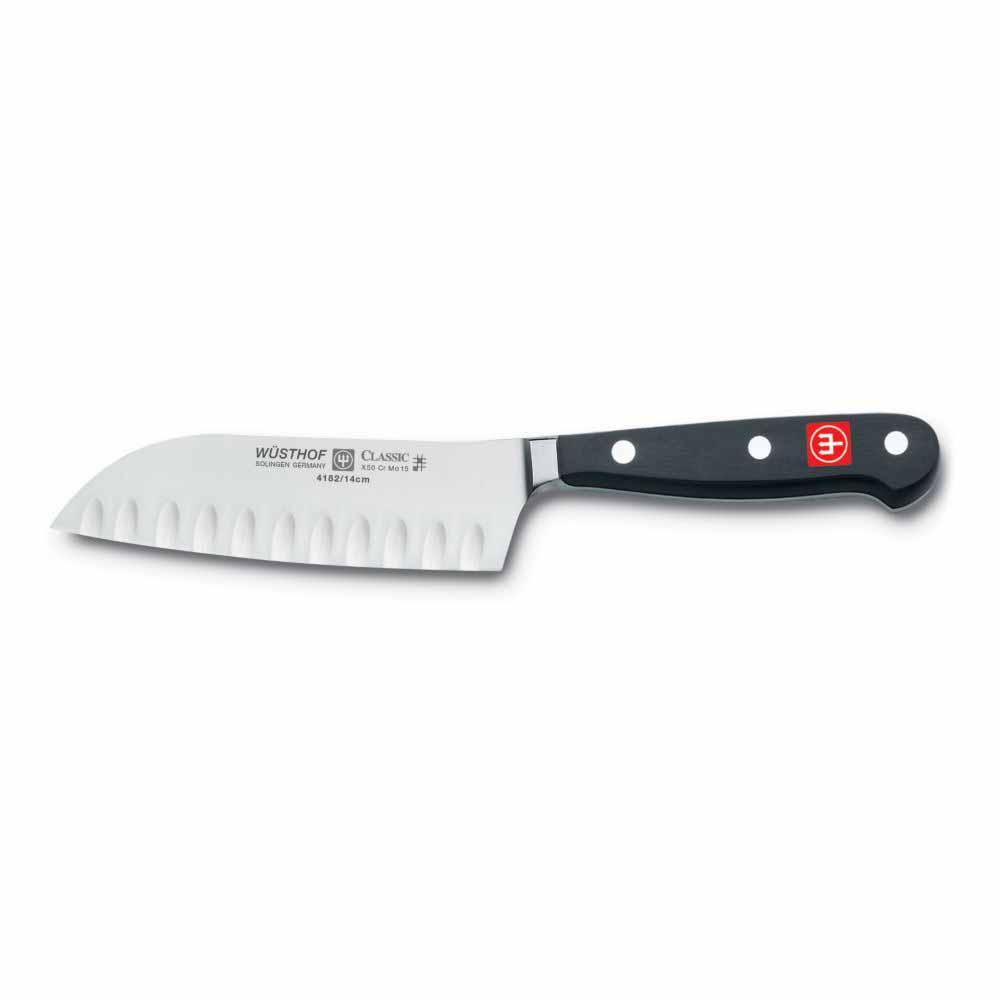
Wusthof Classic Hollow Edge Santoku Knife
First up, we have a favorite of professional kitchens, the Wusthof Classic series Santoku. Wusthof, as you can probably tell from the name, is a German company, and they’re known for making outstanding cutlery. This Santoku is no exception.
This is getting into the upper end of the Santoku market (there will be cheaper options below, never fear) but it is still an excellent value if you’re looking for a durable, well-designed option that’s going to see some heavy use.
I’ve personally used this knife for years, and have one in my personal kitchen at home. In my experience, this is the best-slicing knife out there for vegetables and fish, and I use mine several times a week.
It has a 5-inch hollow-edge blade made of X50CRMOV15 high-carbon stainless steel, making it perfect for home cooks and pros alike.
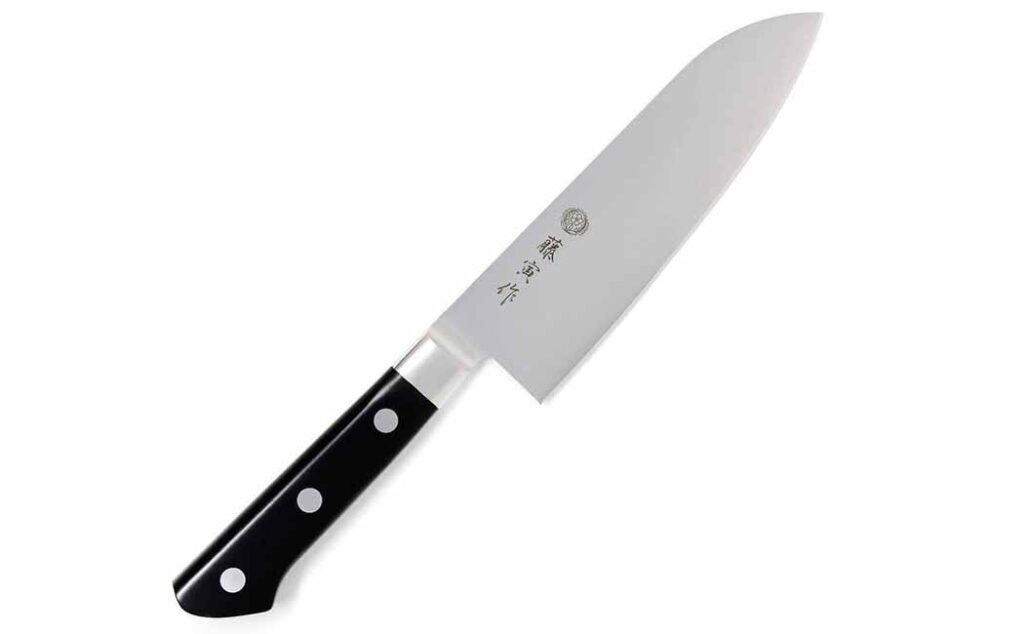
Tojiro 6.7-Inch Santoku
If the thought of paying more than $100 for a kitchen knife makes you a little itchy in the wallet area, don’t worry. Tojiro has you covered.
This Santoku is a bit on the longer side, making it a great choice for almost any kitchen task. I’ve personally used these knives for a number of years now, and I find them to be a bit chunky, but then I’ve got short sausage fingers. Your results may vary.
Even with my diminutive digits though, this knife absolutely sails through fish, chicken, and other light proteins, and slices fruit and veg like a dream. It has a bolster, and an evenly ground edge so it’s perfect for those used to more Western-style knives.
This knife has a 6.7-inch blade made of cobalt alloy steel clad in VG10, which is high-end Japanese steel with high chromium content. This makes it a great budget option for those who don’t want to spend a lot of time sharpening.
Mercer Culinary Genesis Forged Santoku Knife
For the even more budget conscious, the Mercer Culinary Genesis Forged series is a great place to start. Yes, you can absolutely get an entire knife block for $40, but they’re going to be less than stellar.
You don’t need to spend a fortune on cooking gear, but there are some places where you definitely get what you pay for. With this knife from Mercer Culinary, you’re getting a solid knife that will last for years, without breaking the bank. This is about as cheap as I’d go, personally, but it’s no less effective for that.
The Genesis Forged Santoku has a 7-inch blade made of X50CRMOV15 high-carbon stainless.
MAC Professional Santoku Knife
This is another staple of professional kitchens and a great option for passionate home cooks, as well. MAC’s Professional line is a great option for foodies and pros, and their Santoku is no exception.
I actually think I like the handle on this knife the most of any on this list, but that’s down mostly to personal preference. The blade has a 15-degree edge that slices like a dream. The high-carbon alloy is sub-zero tempered to increase hardness and wear resistance.
The handle is made of a very lightweight wood laminate that is very tough and grippy in the hand. The blade is 6.5 inches long and is made from MAC’s Sub-Zero alloy steel.
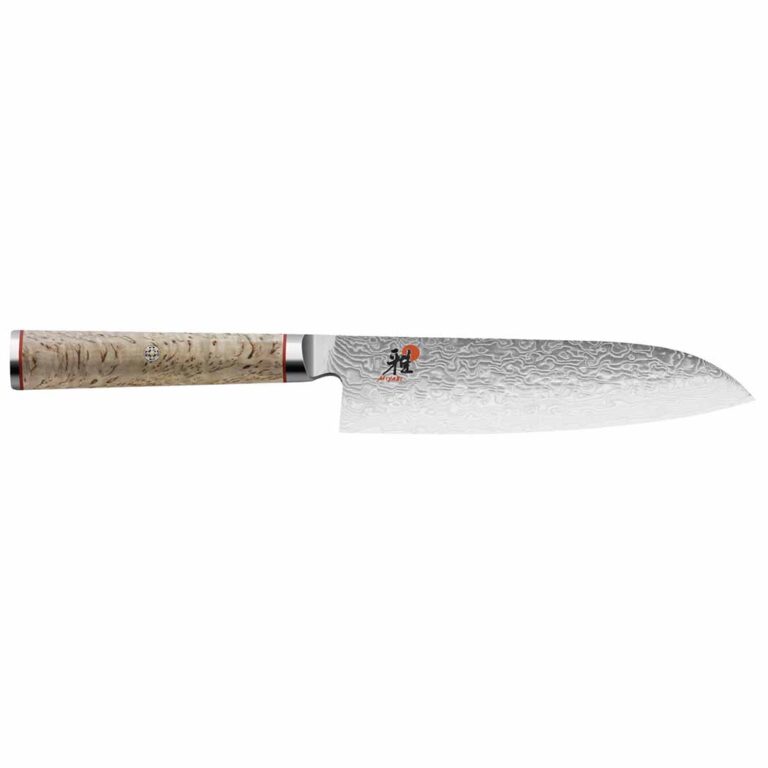
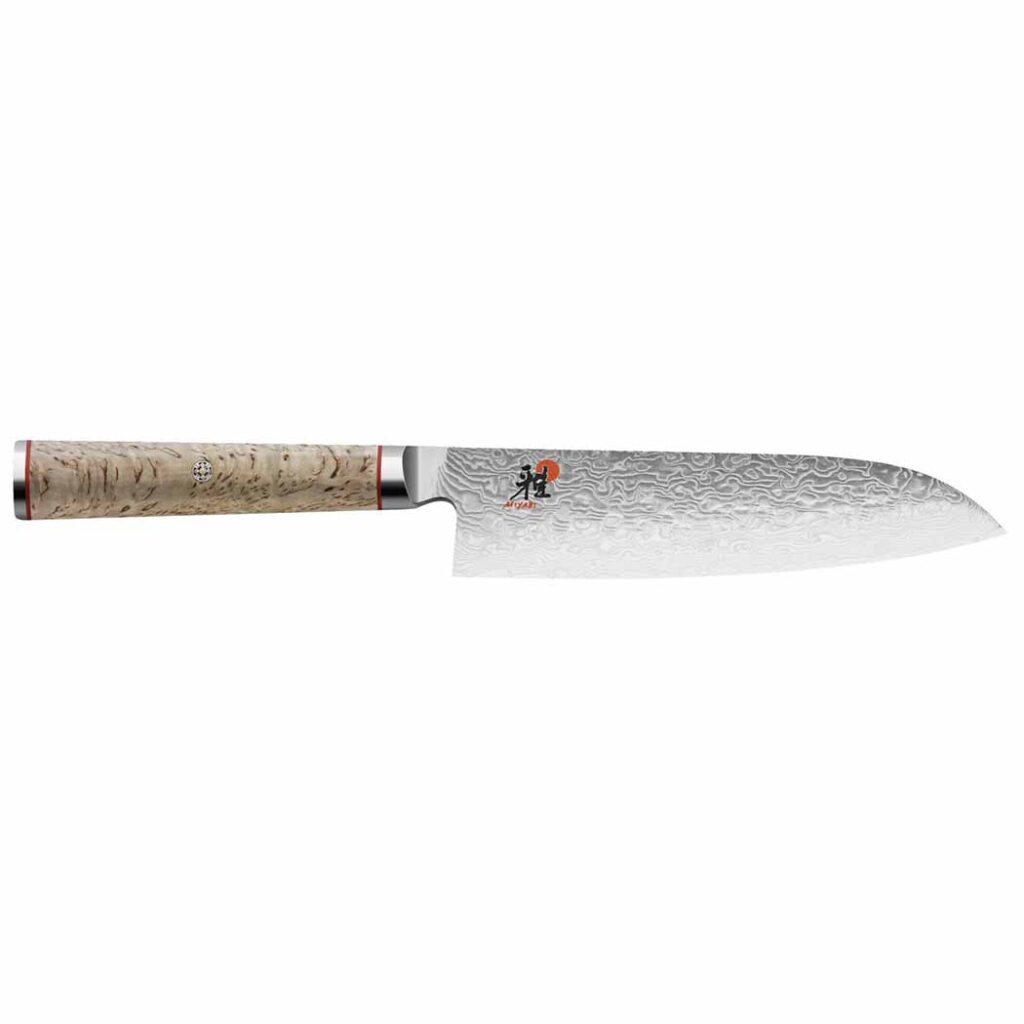
Miyabi Birchwood Santoku
If you’re looking for something that really reflects the Japanese heritage of the Santoku, a knife that has an aesthetic as nice as its cutting performance, this Santoku from Miyabi’s Birchwood line is a great option.
With a blade made from powdered high-carbon steel that’s been folded over a hundred times and a handle made of a beautiful Karelian birch (the only wood to ever be used in a Fabergé egg), this knife is a serious showpiece that you’ll want on display somewhere.
It also cuts like Wolverine’s claws.
Seriously, if you want a beautiful gift to give that special chef in your life, or you just want a super high-end knife that looks great and slices even better, this is a great option.
The Miyabi Birchwood Santoku has a 7-inch hand-honed blade made of G2 micro-carbide powdered steel in a folded, flower pattern Damascus.
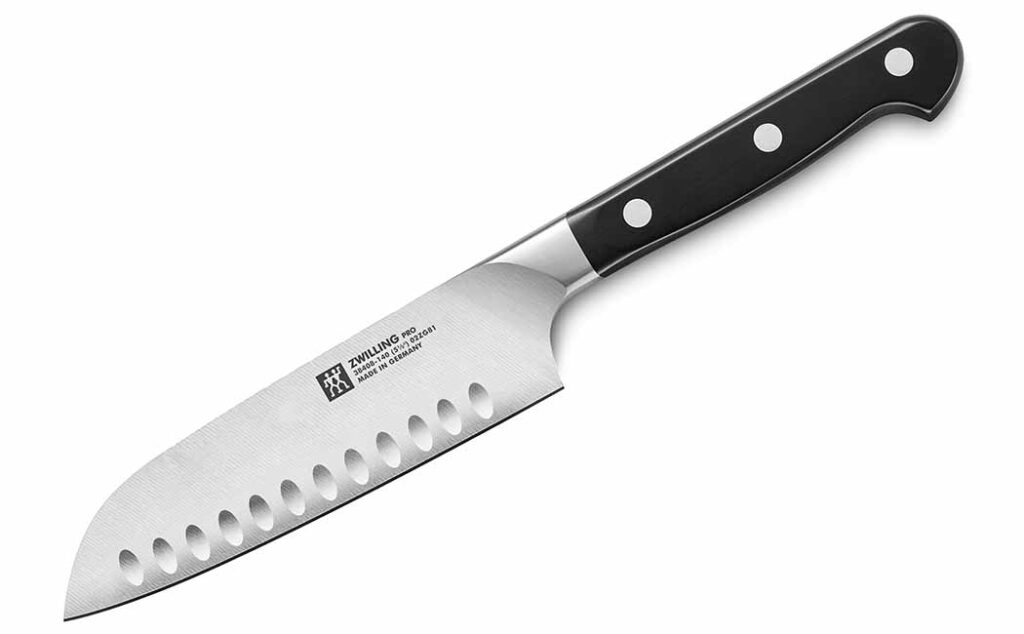
J.A. Henckels Zwilling Hollow Edge Santoku Knife at Amazon
Our last two knives are from the same manufacturer, J.A. Henckels, possibly the biggest name in kitchen knives (with good reason).
The Zwilling Signature series is one of its higher-end options, featuring a hollow-ground edge and a very comfortable handle with a very minimal bolster. This is a good cross between a traditional Santoku handle and a more modern Santoku handle design.
The 7-inch blade is made of an ice-hardened (Friodur) steel that is proprietary to J.A. Henckels that lasts for a very, very long time in between sharpenings. For a bonus, you can get it custom-engraved for basically nothing since J.A. Henckels does everything in-house.
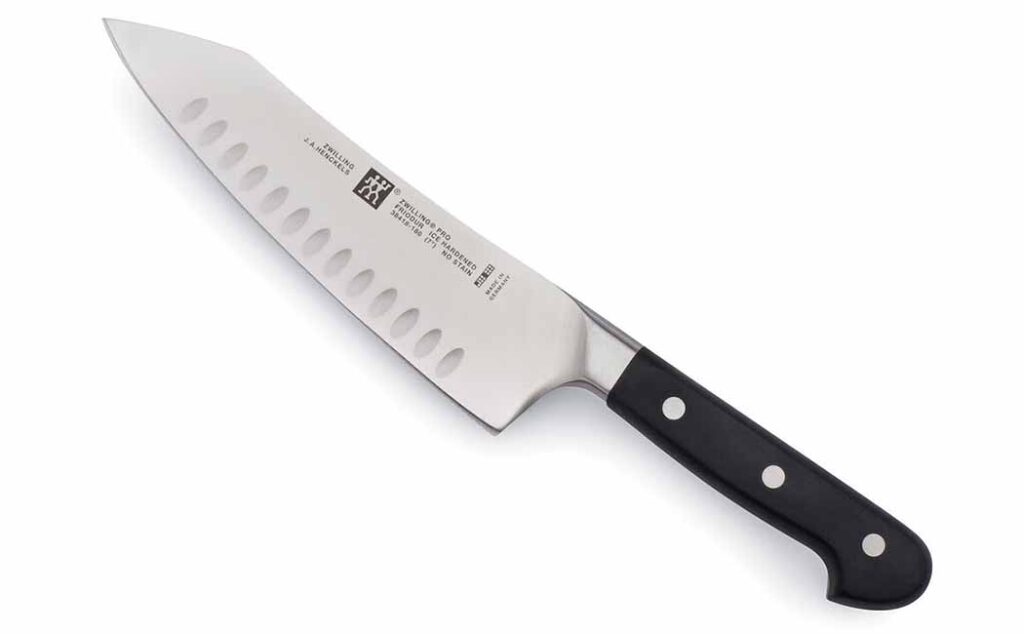
J.A. Henckels Zwilling Pro 7 Hollow Edge Rocking Santoku Knife
Lastly, we have a very similar knife to the one above, but with a more Western-style edge profile geared more towards the familiar rocking motion most of us know already. It still has a relatively flat edge, so you do get all of that Santoku performance, but with a little more versatility when it comes to a rocking chop.
Like the model above, it features a very comfortable handle, but the Pro series features a more pronounced, Western-style bolster, ideal for the pinch grip that we use here in the West.
It has a 7-inch blade made of proprietary high-carbon SIGMAFORGE steel (I don’t know what SIGMAFORGE means either, you’ll have to ask Henckels about it).
The Ulu knife has grown in popularity in recent times. We cover the origin of this traditional knife of the north, how it’s used and some of the best modern options.
The Ulu knife has become increasingly popular in recent years among chefs, ardent home cooks, homesteaders and more. Traditionally a food preparation knife, this unique blade has come to be used for various household, hunting, cooking, and survival tasks.
Today we’re going to take a close look at this incredibly versatile tool, including its fascinating history among the native peoples of Alaska, how it is used, and how it stacks up against other similar knives. Then we’ll take a deep dive into the top 8 best Ulu knives currently on the market.
Let’s get started.
History of the Ulu Knife
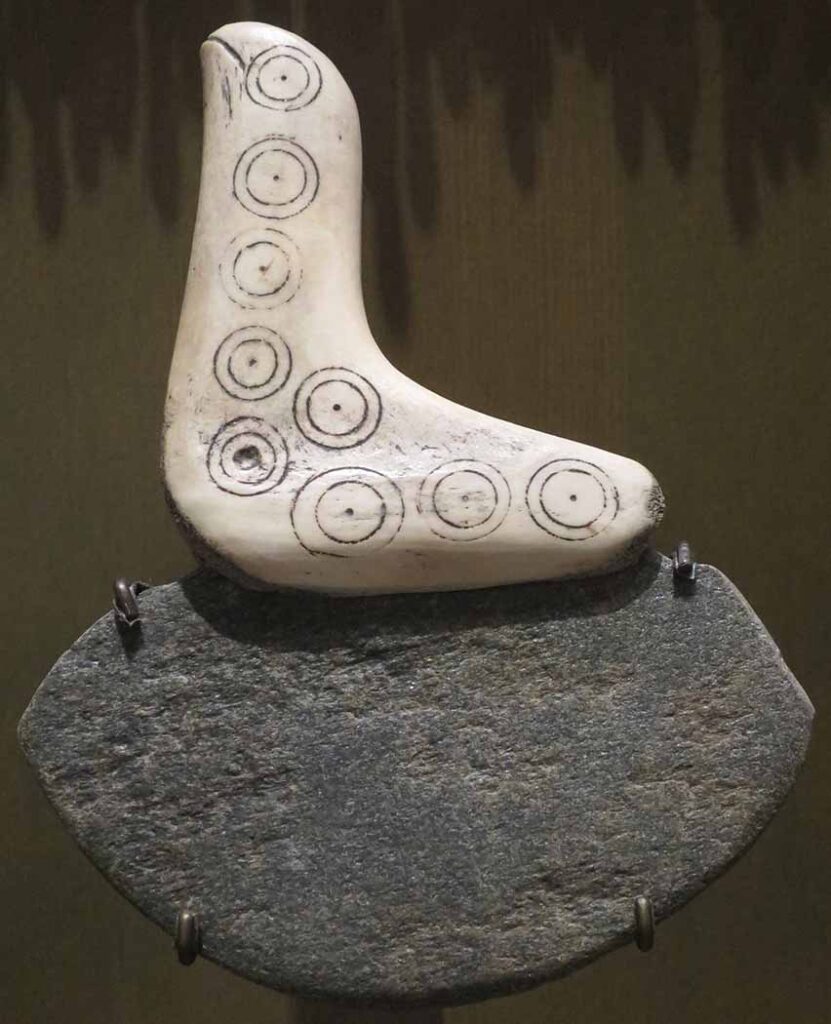
The Ulu knife has its origins as a traditional tool used by the Inuit, Iñupiat, Yupik, and Aleut people of Alaska, Canada, Greenland and far Western Russia. Throughout history, these knives were used primarily as tools around the home, including for sewing, food preparation, and butchery—depending on the size of the knife.
Originally made with a walrus ivory, muskox horn, or caribou antler handle with a slate blade, modern Ulu is typically made with a wooden handle and steel blade, often reforged from a bartered saw or spade blade in traditional communities.
While materials have changed, the design has remained much the same, with a wide, curved-edge blade mounted in front of where your knuckles when gripping the handle. It’s almost like a push dagger but with a wide, single-edged blade on the same axis as the handle.
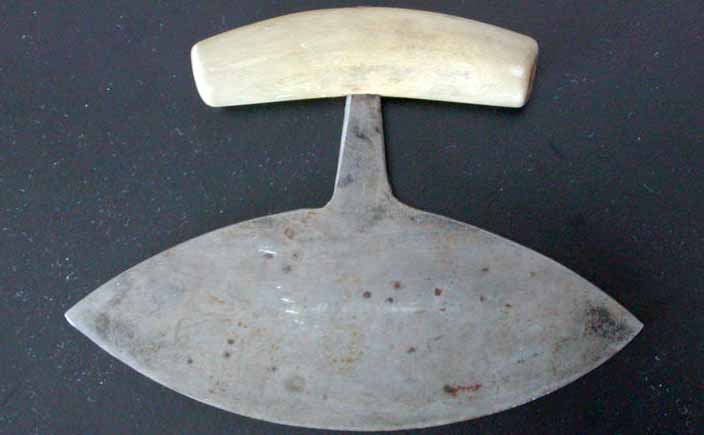
There are a few regional variations where the blade is attached by a central stem to the handle, but in most versions, the handle is attached at each end of a curved blade.
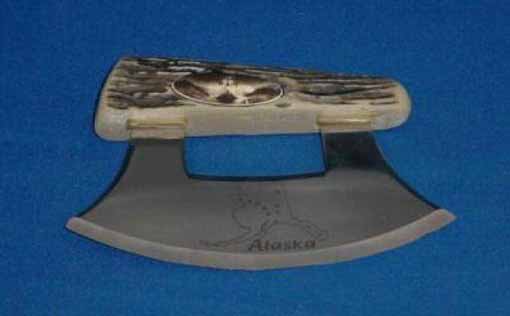
Today, the knife is growing in popularity all over the world for food preparation, while still being used every day in the indigenous communities where it was first brought into the world. The Alaskan style is most prevalent, with a wide, crescent-shaped blade attached at one or both ends to the handle, but there are definitely other versions out there as well.
Using the Ulu Knife
The Ulu knife has a curved blade designed primarily for either a scraping or in a rocking motion, but it can also effectively chop and slice much like a Western-style chef’s knife.
It is very similar to a sharpened bench scraper in some ways, and can easily be used to gather up chopped ingredients. It can also be used to break down a carcass and is very efficient at chopping through bones, much like a heavy cleaver.
Smaller versions are also traditionally used for household tasks like sewing, working with hides or leather and even wood carving. Larger versions with blades up to 12 inches are also sometimes used as everything from a cleaver to a draw knife.
For most people though, the Ulu is a kitchen tool, something to make prepping meats, fruits, vegetables, and herbs easier when getting lunch or dinner ready. It has a variety of uses beyond that, but for most, it has earned its reputation as a stellar kitchen tool.
Pros and Cons of the Ulu Knife
The Ulu knife is an extremely useful knife, and very versatile, but it can’t quite do everything. Here are some pros and cons of this awesome traditional tool.
Ulu Pros
Kitchen Prep: First and foremost, it’s great for most kitchen prep tasks. Fileting a fish or carefully deboning a chicken might be a struggle, but for everything else, it is a very fast and effective way of taking big chunks of ingredients and making them smaller.
I personally love using one to chop herbs and leafy vegetables where the wide blade and curved profile make long rocking and slicing motions feel very nice. If you frequently find yourself chopping up fresh herbs from the garden, this is a great tool to have on hand.
Game/Meat Processing: It also does a great job of breaking down animal carcasses, as well as dealing with large chunks of meat like a rack of ribs or a whole chicken. That wide cleaver-like blade may not be ideal for chopping through something like beef neck, but for smaller bones you can easily press the blade against, you’ll have no trouble at all.
It’s also very good for scraping meat off of a bone, quickly chopping up root vegetables, halving large fruits or vegetables like navel oranges when you’re making juice and things of this nature. It also makes a phenomenal pizza cutter (which is one of the primary uses mine sees).
Bushcraft: Outside of the kitchen, it is of course still a sharp piece of metal with a handle, so its use is limited only by your own creativity. They work great for a variety of camp tasks, so if you’re looking for one knife that can really do it all in the backcountry, you could certainly do worse.
Splitting small pieces of wood, making feathersticks, carving a quick replacement tent stake, cutting cordage, and other similar tasks are all well within the Ulu’s abilities.
Cutting-Style Adjustment: The biggest problem with the Ulu knife is that using it requires a bit of a different motion than your typical Western-style chef knife, or even something like a Santoku because of the handle’s placement.
The chopping or slicing motions you’re used to are going to take some adjusting if you want to use an Ulu effectively. It’s not a huge change for most people, but if you have a lot of muscle memory and knife skill with more common kitchen knives, it is definitely an adjustment.
Somewhat Limited Scope: The other big issue is that the size and shape of the knife make it unsuited for some tasks, but you can say the same thing about any knife really. Still, you’re going to have a rough time filleting a small fish with this knife.
Other than that, the handle design of the Ulu makes things like slicing through very thick material or produce difficult if not impossible, so reach for something else when carving through something like a large watermelon or what have you.
Buyers Guide: 7 Best Ulu Knives on the Market Today
Now, let’s take a look at the best Ulu knives on the market today. These are the knives that offer something beyond the competition in terms of value, features, design, or workmanship.
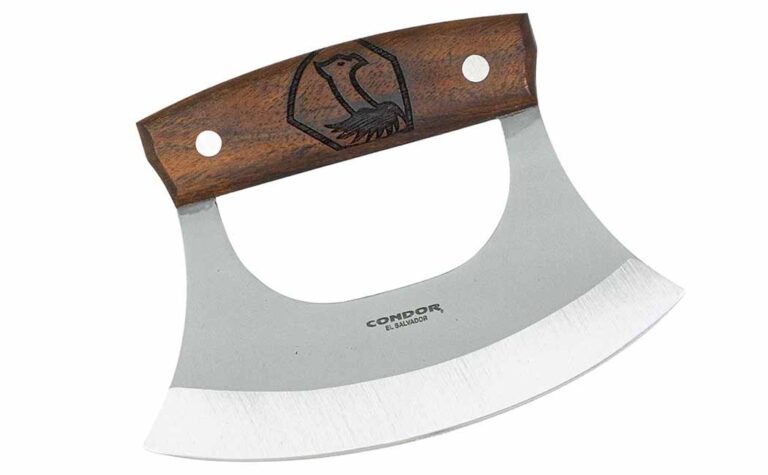
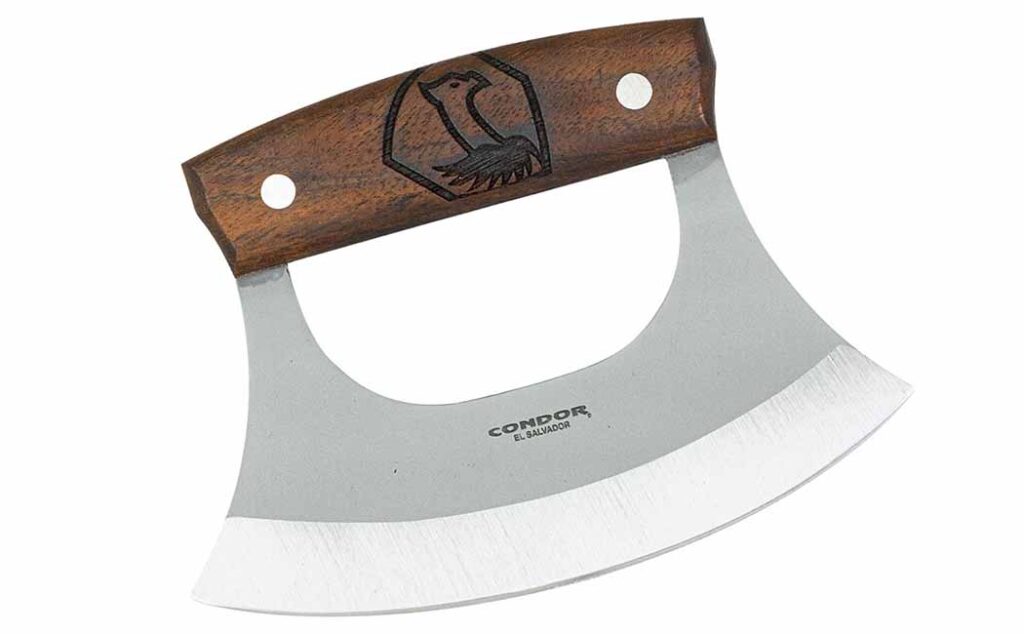
Condor Ulu Fixed Blade Knife Walnut Wood
Condor Tool & Knife has made a name for itself across the knife world by providing high-quality knives to meet a variety of needs (and budgets). Their take on the Ulu is made in a very traditionally-Alaskan way, with a curved blade attached to a handle at both ends.
The beautiful walnut handle is engraved with Condor’s logo and features stainless pins attaching it to the blade. The handle is very comfortable and shaped well for most hand sizes. This may not be the knife to hand your kid when teaching them to chop veggies for the first time, but beyond that, it should work well for just about everyone.
The blade itself is 6-inches long and is made of high-carbon 1075 steel, and is hollow ground with a thin edge to facilitate chopping, slicing, dicing, and other kitchen tasks. The knife also comes with a welted leather pouch that is made by hand.
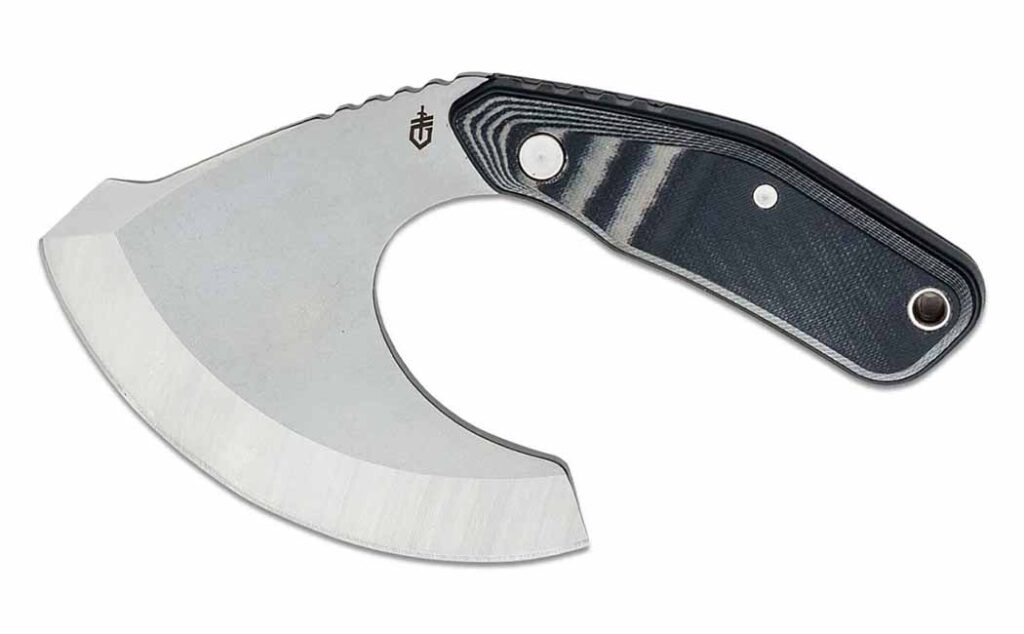
Gerber Downwind Ulu
Gerber’s budget-friendly knives often offer great value for the money, and their Downwind Ulu is a great example of this.
Made of high-chromium stainless steel like many mid-range survival knives, the Downwind Ulu is a great camp knife for folks who like cooking more involved meals in the backwoods, and it can still be used for other camp tasks.
It uses a more modern design, with a handle that is more like a cleaver or a small hatchet really, but the overall ergonomics are still very much in line with the traditional Ulu. If you’re looking for a hybrid between your typical chef’s knife and an Ulu, this is a great option.
The handle is a very grippy G10 that is comfortable in the hand, even if you have wet hands, and there is considerable jimping on the spine of the blade to give you extra grip when doing detailed work like skinning game or gutting a fish.
The blade is 3.5 inches long and made of 7Cr17MoV steel.
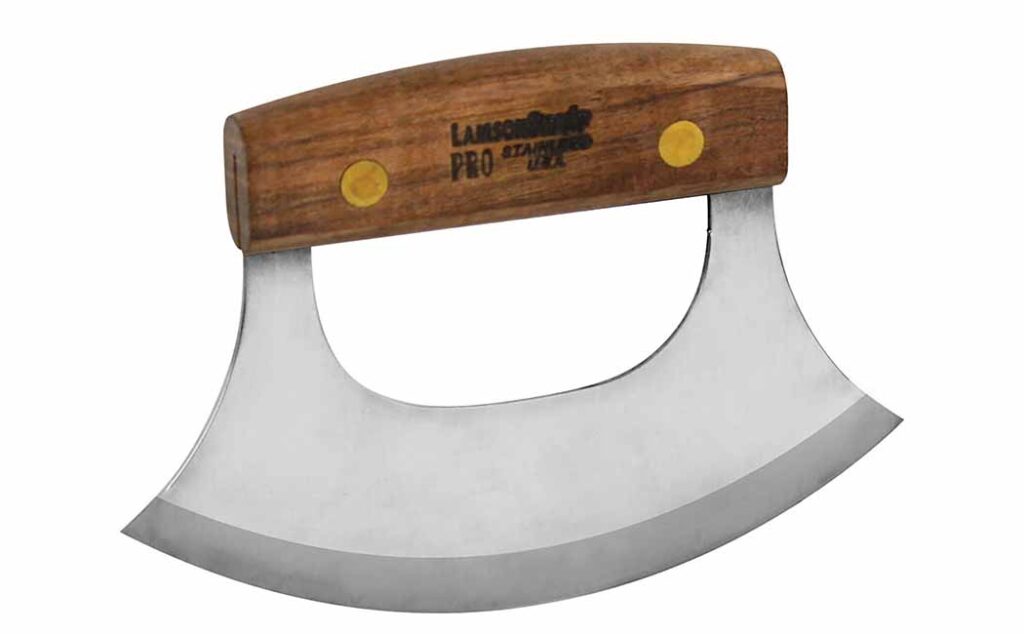
Lamson Ulu Knife
The Lamson Ulu knife is another take on the classic Alaskan Ulu and is made in America. It features a natural walnut handle that is affixed with brass rivets and uses a half-tang construction.
This particular Ulu is made in Massachusetts and is hand finished and sharpened to give it that extra bit of polish. The blade is a high-carbon stainless tempered to a 58 Rockwell hardness so it holds an edge well without being brittle or prone to rolling when cutting something tough.
It also comes with Lamson’s lifetime warranty, which covers any manufacturing defects in perpetuity, and also includes a lifetime of professional sharpening so when you do need to give the edge a touchup, you can send it to them if you don’t feel like doing it yourself.
If you’re looking for a budget-friendly Ulu to use for processing vegetables, slicing pizza, and dealing with other food-prep tasks, this is a great option that will look sharp (pun intended) in any kitchen.
The blade is 3 inches wide (on this version, there are several) and made of 420-HC LAM S/S steel.
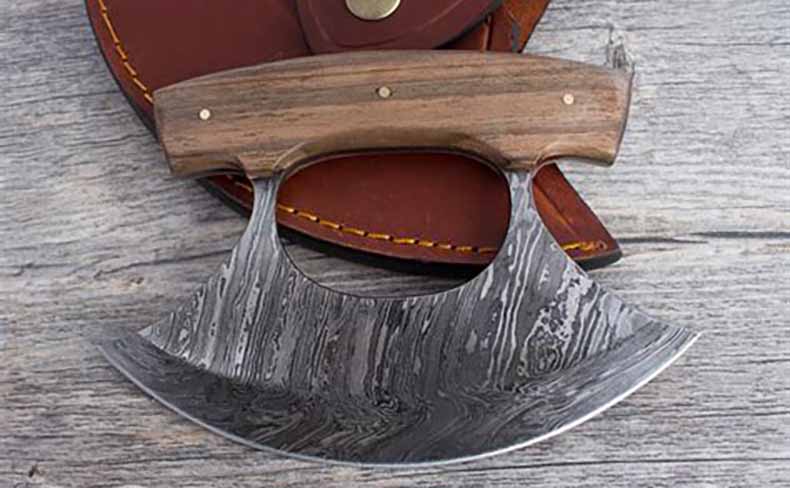
Ezina Designs Walnut Inupiak
This knife by Ezina Designs is made by North Star Knife & Ulu Company and is handcrafted to be rugged and durable in real-world use. This knife is made in Alaska, and the beautiful damascus blade is made of 1074 and 15N20 carbon steel and features a high nickel content.
This high nickel percentage contracts the grain of the metal and helps it resist corrosion so it can stand up to some heavy use and abuse in the field. The gorgeous walnut scales hide a full-tang construction, and the whole handle is set together with three brass through-pins.
It also comes with a handmade leather pouch sheath that Ezina Designs will custom engrave for you with three characters of your choosing, making this a phenomenal gift for the chef or foodie in your life, especially if they also love the outdoors.
Ezina Designs Antler Mini Ulu
Another North Star Knife & Ulu product, this smaller Ulu has a 4” blade that makes it a bit more portable, or perfect for storing out of sight and out of mind with a small cutting board in something like a camper or boat.
It features a gorgeous antler handle, and the same awesome damascus steel featured in the above offering. Because it has such a small blade (relatively speaking at least) it utilizes the more Western style of Ulu more common in Greenland with a thick singular stem connecting the blade to the handle, as opposed to the handle being connected to both ends of the blade.
Overall, if you like the traditional aesthetic and want a small vegetable chopper or camp knife, this is a great option.
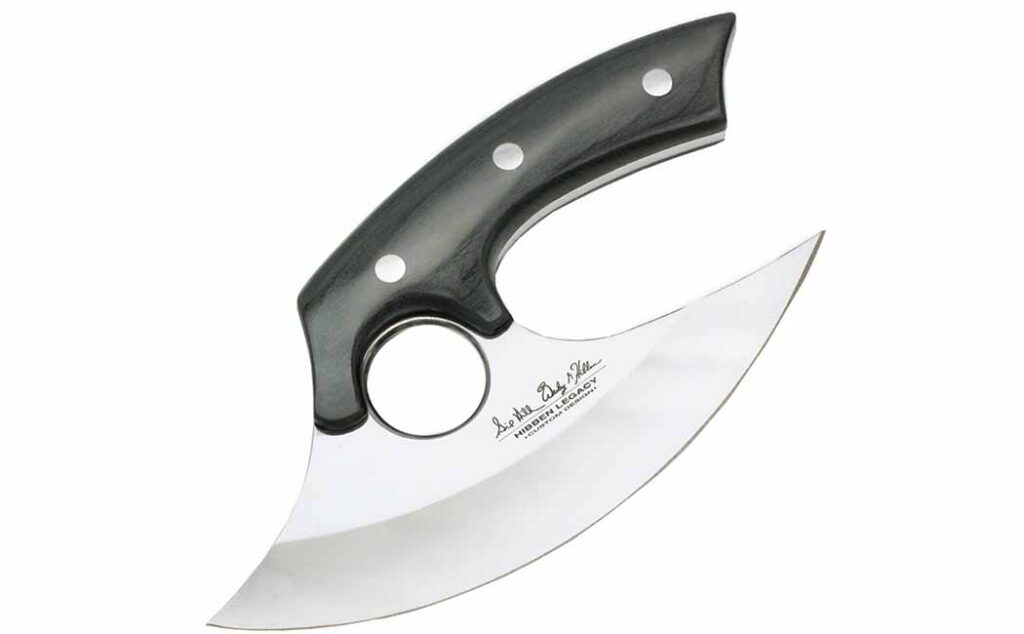
Hibben Legacy Ulu Knife
Gil and Wes Hibben are both legends in the knife world, so it’s probably no surprise that they’ve turned their attention to the Ulu. Their take on this traditional knife has a modern design, which you probably expect if you’re familiar with their work.
The stainless steel blade is attached to one end of the handle in the updated hatchet-like fashion we see with some modern Ulus and is 6.5” in length so it’s perfect for kitchen and camp tasks. The stainless doesn’t hold an edge as well as some of the carbon steel options on this list, but of course, will be more resistant to corrosion and rust.
The blade on this thing is beefy so if you’re looking for something to really hack into thick pieces of meat or chop through bones, this is a great option. It’s also durable enough for some tasks around camp, making this a great one for the backcountry cooks out there.
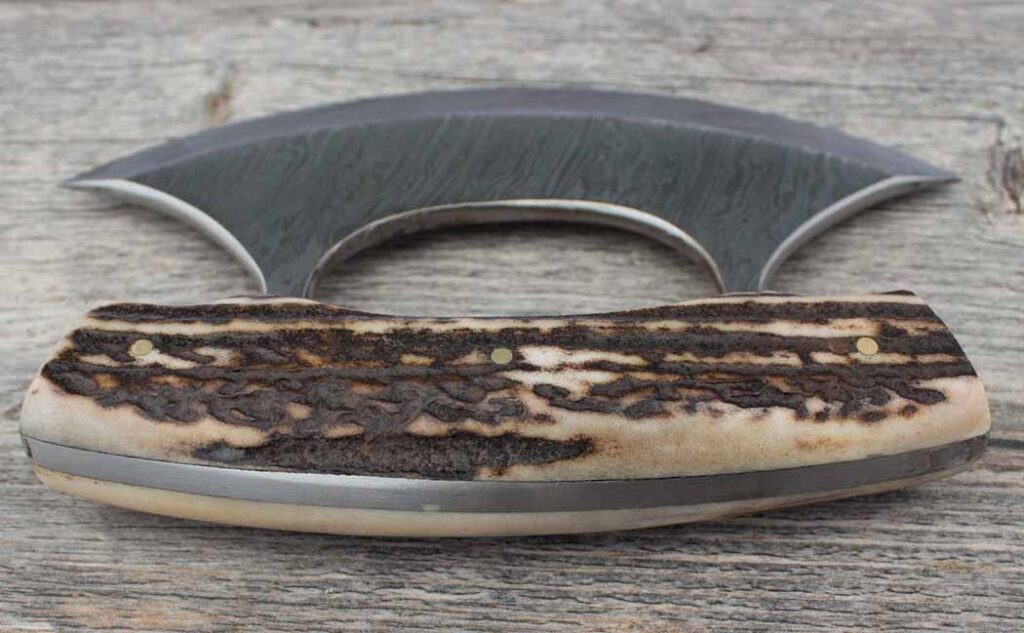
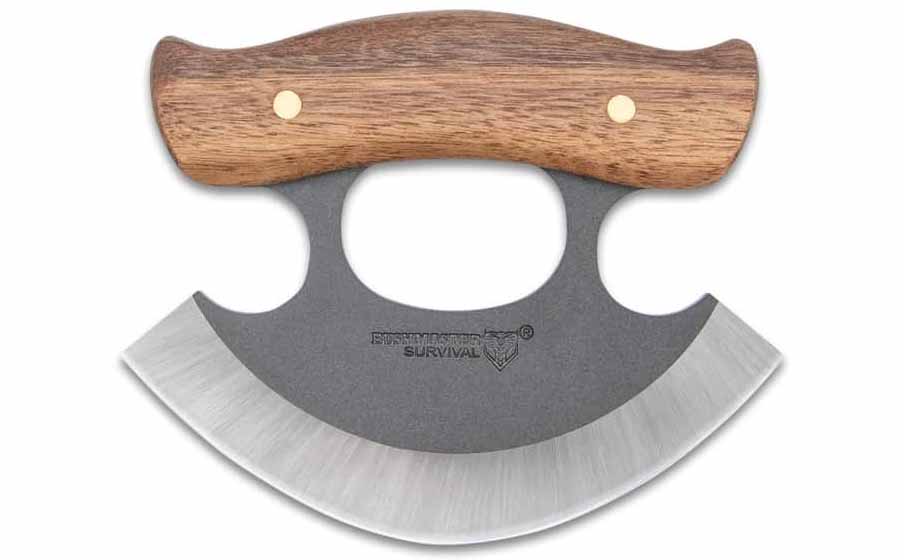
Bushmaster Survival Ulu
Lastly, we have the Bushmaster Survival Wilderness Ulu, which moves away from the kitchen knife style and more into a true survival or camp knife. It has a very beefy blade made of 1095 high-carbon steel.
If you’re looking to process large game, hack up a rack of ribs, or split some decent-sized logs for the fire, this is the option for you. The hardwood handles are curved to fit most hand sizes, and secured with brass pins.
This Ulu is just under 4.5-inches overall, which makes it a great choice for a variety of camp chores as it’s not too big or too small for most of what you’re likely to have to do out in the woods. At home, it still chops vegetables just as well as any other option we’ve got.
Final Thoughts on the Ulu Knife
The Ulu knife is a great example of traditional wisdom and design that still very much has a place in our modern world. The old saying “If it ain’t broke, don’t fix it” very much applies here, with this knife that is just as at home in our modern world of hustle and bustle as it was in the native communities it originated in thousands of years ago.
When it comes to wood cutting, the Flexcut Whittlin’ Jack takes no prisoners.
The Whittlin’ Jack by Flexcut Carving Tools is the knife I wish I had when I was growing up. It would have made my outdoor life so much easier, not to mention much less painful. Granted, the blade edges are very fine and made for wood, so they tend to chip if you cut hard stuff.
Growing up a commercial fisherman on the Great Lakes, I was always cutting twine. The Whittlin’ Jack’s sharp blades would have saved me plenty of time resharpening and in doing such outdoor chores as marking sticks on a trapline. However, the best things about the knife are the sharpness of the edges during whittling, including for super fine cuts, and a very comfortable handle shape. The backspring holds the blade open tightly enough to stop accidental foldup while cutting, yet slowly closes the blade.
Flexcut Whittlin’ Jack Edge Test
For the first edge-check medium, the author used his standard 20-pound bond copy paper. Both the roughing and detail blades zipped through the stationery way too fast. He just used the weight of the blade and pushed down.
For the first edge-check medium I used my standard 20-pound bond copy paper. Both the roughing and detail blades zipped through the stationery way too fast. I just used the weight of the blade and pushed down. I’m glad I had fingernails! Now I have four nicks in one. The knife was scary sharp from the get-go.
Whittlin’ Jack Vs Light-Duty Material
Next up was single-walled cardboard. The Whittlin’ Jack did not slow down one bit, though I did learn to move my finger faster. I could feel the blades cutting through the pockets in the cardboard. I made the longer cuts with the roughing blade.
I made some straight cuts in 8-ounce leather to see how thin I could get the slices without the leather folding over. These blades are so scary sharp that I really had to watch how much pressure I was using so I didn’t cut the leather in half. Both blades were very controllable.
Cutting the end of the leftover leather at an angle, I did some skiving. I could hear a very aggressive crunching sound as the Whittlin’ Jack bit into the material. The slices were so thin I could actually see the polished bevel cutting through. Very sharp indeed!
Whittlin’ Jack Whittling
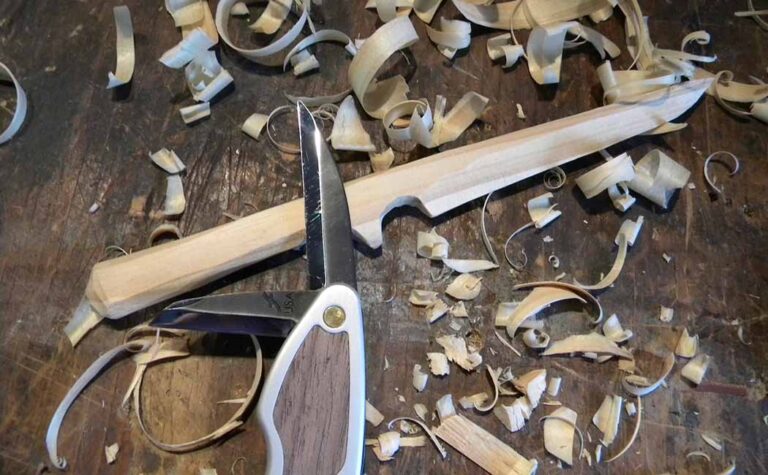
The curls were curlin’ as the author whittled a wooden tanto with the Whittlin’ Jack. Here he cuts the tanto’s choil with the detail blade.
The Whittlin’ Jack is the first knife to ever give me curly curly-cues. It was amazingly simple and easy to do. Fine cuts or deeper cuts, it didn’t matter. The whittling was so smooth the blades just slid through the wood. I liked the detail blade better for making curly curly-cues. The handle shape really excels as it fills your palm, making the blades an extension of your hand. This is an outstanding design to say the least.
For some extra whittling fun, I carved a thin tanto-style knife in less than 5 minutes. The roughing blade did its job very quickly, thinning the wood and getting the overall shape. The detail blade made short work of cutting in the bevels and choil. It was amazing how smooth every cut was. Controlling the blades was easy with the handle design. The Whittlin’ Jack is the perfect knife for the job.
Whittlin’ Jack Vs Sisal Rope
The knife crunched to 150 cuts in half-inch sisal rope in record time without any sliding. According to the author, it is the best overall Spec Sheet sisal rope cutter to date—that includes for both edge sharpness and handle comfort.
I used the roughing blade so my knuckles would clear the workbench. The knife crunched to 150 cuts in record time without any sliding. Since it would be a waste of sisal rope, I stopped cutting. The blade was still nasty sharp. This is the best overall Spec Sheet sisal rope cutter to date—that includes for both edge sharpness and handle comfort. Wow!
Recomendations
I might put a finer finish on the walnut handle inserts.
Bottom Line
The author indicated the Whittlin’ Jack was the first knife to ever give him curly-cues that were actually curly. He preferred the smaller detail blade for the purpose.
The Whittlin’ Jack really impressed me in both sharpness and handle comfort. I’ll place it in the top 1 percent of knives I’ve tested. I will be carrying one.
Flexcut Carving Tools warrants its knives against defects as long as the knife is not abused. Remember, this knife is made for wood use only and the blades do not lock in place.
Flexcut Carving Tools Whittlin’ Jack Specs Blade Patterns: Roughing and detail Blade Lengths: Roughing 2” and detail 1.5” Blade Material: In-house tool steel Blade Grinds: Flat Handle: Aluminum frame, walnut insert Non-Lock Mechanism: Slip joint Weight: 3 ozs. Closed Length: 4.125” Country Of Origin: USA MSRP: $63.95 Flexcut Tools
Be it chopping wood or prepping a meal, a solid bushcraft knife is an essential piece of backwoods kit.
Bushcraft is a specialized skill set that ensures survival in the wilderness using foraging, hunting, fishing, shelter construction, and firecraft, all accomplished with minimal tools. The primary bushcraft implement is a fixed blade employed not only for food prep but the other mentioned skills, too.
As a result, such a fixed blade must be a tough tool capable of more than just standard cutting tasks, including whittling, carving, splitting wood or, in conjunction with a ferrocerium rod, starting a campfire.
What Defines A Bushcraft Knife?
Five basic chores of outdoor survival can be performed with a bushcraft knife. The tasks are elemental and a must-learn if you want to use a bushcraft knife to maximum effect.
Chopping
Batoning
Carving
Fire Starting
Food Prep
Chopping
Whereas a small hatchet, ax, or even a machete are better suited for the task, a bushcraft knife can turn the trick. Grip the handle as far back and as securely as you can, and chop as you would with a larger knife, ax, hatchet or machete.
Batoning
Basically, to baton a piece of kindling is to split it. Take a rather large/thick piece of wood to act as a baton/hammer in one hand, lay the blade edge on the end of the secured piece of kindling with the other, and, using firm, deliberate blows, pound the blade lengthwise through the kindling, effectively splitting it.
Again, an ax, hatchet or even a folding saw would be better, but if you lack any of these, your bushcraft knife is capable of handling such a task.
Carving
One of the most important bushcraft skills is to carve bowls, spoons, or even whittling sticks to roast hot dogs. Chopping and batoning are tasks using brute force; carving is more finesse and control.
This can be accomplished by using the knife and a ferrocerium (aka ferro) rod. The job is best done by using a knife that has a blade with a 90-degree spine as opposed to a chamfered or radiused one.
Grasp the knife firmly, cutting edge up. Lay the corner of the blade spine on the ferro rod and with one swift, downward motion, as if you are whittling o a piece of the rod, move the blade down it. Doing so will result in a white hot shower of sparks. The sparks can ignite tinder to start a fire.
The key to fire starting is always select a bushcraft knife with a 90-degree spine. If it lacks such a spine, you can always use the edge but this will dull the one spot on the edge faster than standard cutting will.
Food Prep
And, obviously, a bushcraft blade can also adeptly handle any cutting task related to food or campsite prep. Bushcraft knives prove a knife need not have sheer size and weight to be effective. It’s all in smart design of the blade and handle.
Our Picks For Best Bushcraft Knife
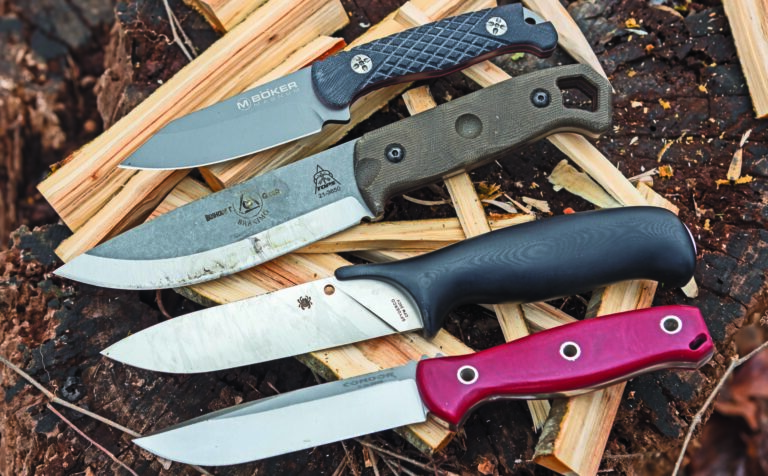
Boker Magnum Life Knife
Boker Magnum Life Knife
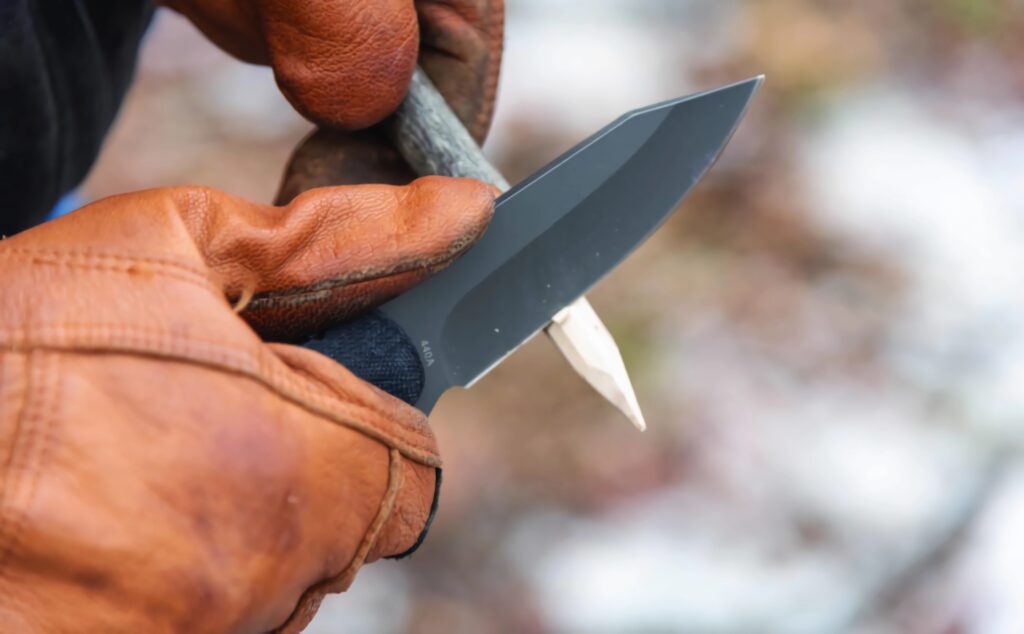
The most affordable bushcraft model of the test bunch, the Boker Magnum Life Knife has a 3.9-inch blade of 440A stainless steel in a modified clip-point pattern. Built rugged for the outdoors, the knife comes with a sturdy Kydex sheath for safe carry.
At 7.87 inches overall, the Life Knife sports a handle of machined black G-10 in a coarse crosshatched checkering pattern for enhanced hand traction regardless of conditions. The grooves in the crosshatching work are similar to those of a radial car tire by displacing moisture. Red fiber liners under the G-10 add a nice pop of color to an otherwise dark knife.
The handle includes integral forward and rear guards to prevent your hand from sliding in either direction. The three large traction notches in the thumb rest area of the blade spine also help improve grip. The handle felt a bit skinny in my hand, so I would prefer a slightly wider one.
Conversely, the Life Knife might be a great choice for those with smaller paws. The 3.9-inch blade is a great size for belt carry. The rather compact nature allows it to carry comfortably, with the length neither too long nor too short. The short blade tip accomplishes precise cutting chores easily.
The sheath is a simple fold-over design of Kydex with a Boker Plus clip for belt carry. The sheath features quality construction, retains the knife well, and is simple yet effective.
MSRP: $59.95
Condor Tool & Knife Bushcraft Bliss
Condor Tool & Knife Bushcraft Bliss
Composed of high-quality materials, the Bushcraft Bliss from Condor Tool & Knife boasts a 5-inch blade with a flat grind. The 1075 carbon steel can be rather easy to sharpen in the field and still retains an edge well. The modified clip point shape offers a generous belly for slicing and a defined point. A swedge gives the blade a bit of attitude, and bead-blasted flats and satin-finished bevels provide a two-tone finish that’s very eye-catching.
The ergonomic handle of red linen Micarta® is an excellent choice thanks to its being largely impervious to temperature and humidity changes. Three thong tubes fasten the scales to the full tang. Three large notches at the spine permit non-slip thumb placement so you can bear down on the blade. With its rounded edges, choil, and scale contouring, the handle felt as if it were molded to my hand.
The sheath is Condor’s hybrid molded Kydex and leather rig, an unusual material combo. The belt loop and securement strap are leather. The leather belt loop allows the sheath to move somewhat, unlike the more rigid molded clamshell fastener—which doesn’t—and makes it easier to sit down while wearing it. A thumb break molded into the top of the sheath assists in extracting the blade, which is a nice extra touch.
I found the handle to be very comfortable. A distinctive trait is the prominently elevated traction notches. They almost look like part of a gear. The feature ensures your thumb isn’t going anywhere.
The 5-inch blade makes baton work easy, as well as food prep tasks. Out of the box, the 1075 carbon steel was plenty sharp and ready for use. The Bushcraft Bliss is a consistent performer.
MSRP: $118
TOPS Knives Brakimo
TOPS Knives Brakimo
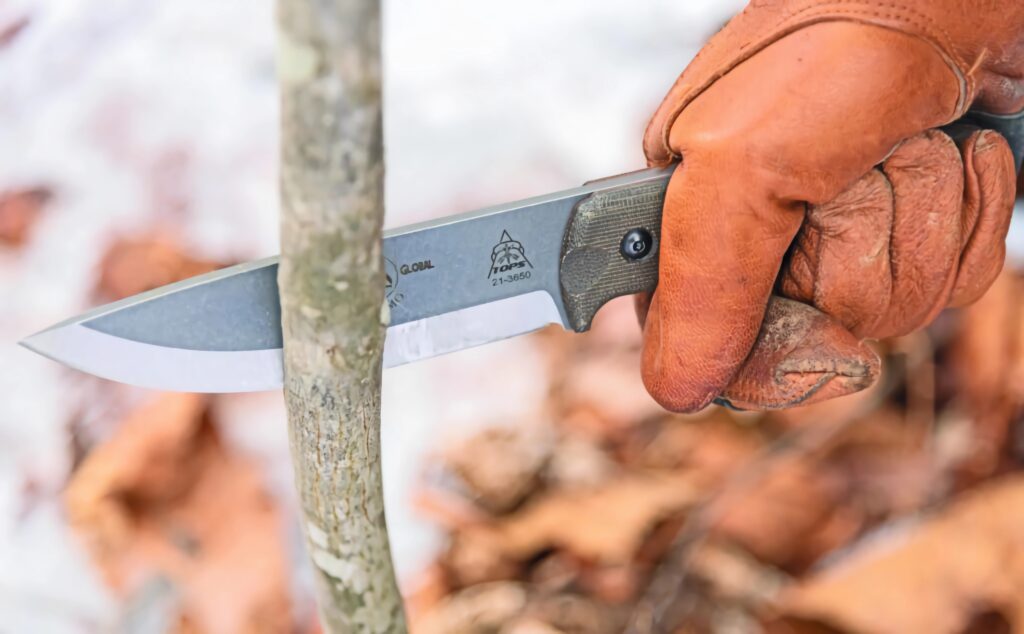
Joe Flowers runs Bushcraft Global, where he instructs students on basic and advanced survival skills while in the Amazon jungle. A notable authority in the field, he also designs knives, including the Brakimo from TOPS Knives, a tool that can carve, cut, split, and perform just about any task involving outdoor survival.
The 5.25-inch blade of 1095 carbon steel is a drop-point pattern with a Scandi grind. It has a generous belly for easy slicing and a defined point for delicate work.
The green Micarta handle is ideal for bushcraft given its stability and minimal weight. It is matte-finished for a nice grip quality without being overly aggressive. The integral front and rear guards provide a measure of safety that locks the knife in the hand. The divot in the handle is for use with a bow drill for making fire.
If there is a solid all-around performer of the test bunch, it’s the Brakimo. I like how it easily handles heavy work like chopping and baton work, as well as such lighter work as whittling and food prep. You can choke up on the handle for tasks requiring more control where a slicing or rocking motion is used. Grip the handle more toward the rear and feel how the balance point shifts to a blade-heavy profile for easy, effective chopping.
The Scandi grind acts as a wedge and splits the wood in a snap, almost as if no effort were invested—very impressive performance! For one knife that does it all, the Brakimo is it. In-hand it feels substantial and capable of taking on serious work.
MSRP: $225
Spyderco FB42G Zoomer
Spyderco FB42G Zoomer
Designed by Tony Zoomer, an outdoor enthusiast and survival skills instructor from the Netherlands comes the Spyderco FB42G Zoomer. Made of high-end materials, the knife is expertly configured and has a list of features that quite possibly makes it the most comfortable bushcraft knife you’ll use.
The 5-inch blade in a drop-point pattern is premium CPM 20CV stainless steel for enhanced edge retention. The blade has an ample belly for slicing and whittling/carving tasks and a defined point for close-up detail work. The full flat grind transitions to a convex edge, which is durable and extremely sharp.
The black G-10 scales are machined where they join the tang, so the handle is completely rounded in profile. This translates into a super comfortable grip that eliminates hot spots. An integrated rest at the blade spine permits placement of your thumb for additional pressure on cuts and for added control. The full tang extends a little beyond the end of the handle for use as a light-duty hammer.
The sheath is a custom-designed, well made leather drop-leg-style rig with a free-floating belt loop. It has an exterior storage pouch with a snap closure. The pouch can carry your choice of survival supplies, a large folding knife, a multi-tool, etc.
The free-floating belt loop allows the knife to swing freely as you move or pivot out of the way when you are seated. It also can temporarily break away in the event the sheath gets snagged by brush in the woods.
The Zoomer is a solid performer. The heavily contoured G-10 handle feels mighty good in the hand. The full flat grind allows the blade to sail through whatever you cut.
While the handle is comfortable, it felt big in my hand. Those with smaller hands might not take to it easily. While using high-performance CPM 20CV stainless steel is not typically a bushcraft thing, with some regular stropping and honing, you can prolong the edge and skip sharpening during your trip.
MSRP: $600
Fallkniven S1 Pro Forest Knife
The Fallkniven S1 Pro Forest did fine work—as on this fish spear—with full control. (All images by Ash Ayres and Mary Lou Ayres)
Fallkniven’s S1 Pro Forest Knife is the evolutionary descendant of the company’s S1, which has been in production for over 20 years. The Pro version is made with better steel than the original S1, is more sophisticated and a better performer.
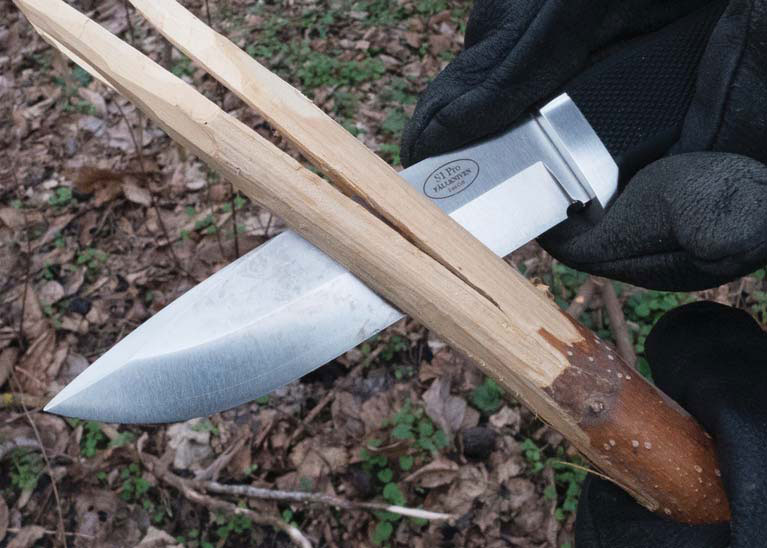
The S1 Pro simply does everything well and with no fuss. Its convex grind does not bind in deep cuts, goes through tough, knotty wood with little effort, peels bark, makes feather sticks, does fine work as on fish spear points with full control, and slices duck through skin, meat and bone like Luke Skywalker’s lightsaber. It cut through 2-inch-thick saplings in about a minute with little effort. The non-slip grip is comfortable and does not, in fact, slip.
Compact enough to always have on—or with a custom sheath, inside—your belt, the S1 Pro is as close as I’ve seen to the mythical “one knife to do it all.”
MSRP: $466
Ontario Bushcraft Woodsman
Bushcrafting chopping
The geometry of the Bushcraft Woodsman’s blade, combined with the overall design, good steel and heat treat, make for an exceptional big knife.
Veteran bladesmith Dan Maragni designed this issue’s cover knife, the Ontario Bushcraft Woodsman. The big blade shows his expertise and lineage as an accomplished smith, and is far more sophisticated than a first glance might suggest.
The distal taper gives it excellent balance, and, combined with the taper from spine to edge, great chopping ability.
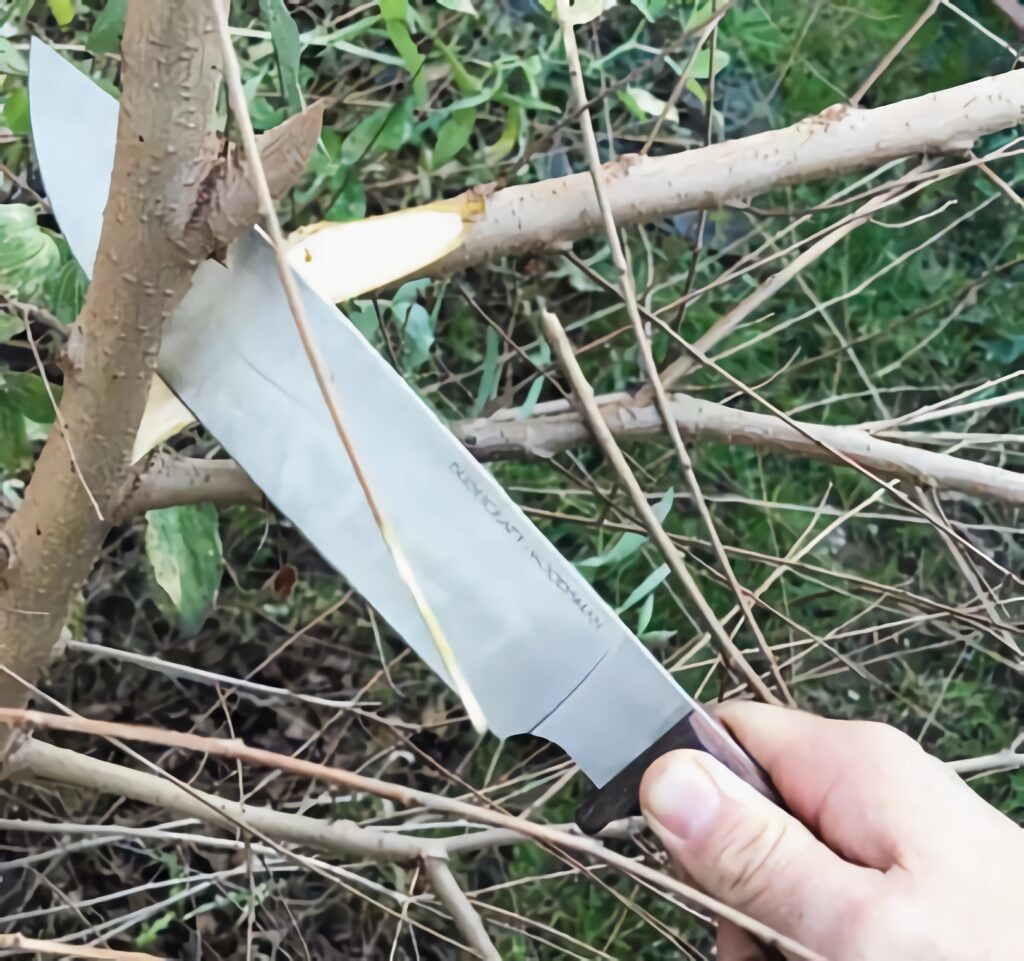
We slashed through 2-inch-thick saplings with a single swipe, an important point in the calories-expended-vs.-results-achieved equation, and when night is falling and you need to get a fire going.
The blade’s geometry, combined with the overall design, good steel and heat treat, make for an exceptional big knife. Again referencing Tolkien, Ash called it the “Goblin Cleaver.”
Not as handy for fine work as the smaller knives, Dan’s design is a reassuring blade to have by your side in deep woods when the jackals are howling—or the Orcs.
MSRP: $137
Larry Roberts Signature Edition Gen6 Scandi (L.T. Wright Handcrafted Knife Co.)
Due to its scandi grind, which tends to hang up in deep cuts, an average of three minutes was required to get through 2-inch-thick saplings with the Gen6 Scandi.
The Larry Roberts Signature Edition Gen6 Scandi from L.T. Wright Handcrafted Knife Co. performs like a “Mora on steroids,” according to Ash. I agree.
If you’re familiar with the scandi grind, the only surprise with the LRSEG6S is that it takes scandi-ground blades to a higher level of performance. It excels at controlled shallow cuts, holds an edge well, and is strong enough that when batonning you can twist the blade with no worries and quickly pop the batonned material apart.
I like the longer 6-inch blade much better than the popular 4-inch pattern because you can get more stuff done faster and at no penalty to doing fine work. Due to the scandi grind, which tends to hang up in deep cuts, an average of three minutes was required to get through 2-inch-thick saplings.
Comfortable in the hand, it is also beautifully made and finished. A good all-around performer, it is a classic belt knife for the woods.
MSRP: $253
Editor’s Note: Dexter Ewing and James Ayres contributed to this post.