Here are BLADE Magazine’s Featured Knives of the Week. Browse through these articles to find the best knives available from both custom knifemakers and factory knives.
Jordon Berthelot marries two electric materials in one knife.
Jordon Berthelot achieves a hypnotic union of blade and handle materials in his integral hunter.
The blade is his HHH lightning damascus and the handle is cottonwood from Robswildwood.
“I used a wide variety of different bits and burrs with Foredom and Dremel tools to freehand carve the blade and handle,” he wrote.
“As my teacher Spencer Aplin always says, the most difficult part is deciding what to carve and how to give it the flow I want, which is so true,” Berthelot said. “I decided to incorporate the blade carving into the handle so it gave the whole piece a complete look, and also added some great purchase of the handle in multiple different grips.”
Berthelot Integral Hunter Specs Blade length: 4.5” Blade material: HHH lightning damascus forged from W1 tool steel/nickel rods w/4800 powder Handle material: Cottonwood from Robswildwood Overall length: 9” Maker’s price for a similar knife: $3,500
There Is A Robust Market Of Japanese Pocketknife Makers. These Blades Stand Out As Some Of The Best.
Japanese knifemakers are among some of the best on the planet. With traditions dating back to the days of the samurai, makers in Japan have long known what it takes to make high-quality blades.
As the tastes of blade lovers have changed throughout the years, so too have the pieces made in Japan. Today, with pocketknives being one of the dominant styles, makers are creating EDC knives that wow.
What Sets Japanese Pocketknives Apart From Western Blades?
There is a traditional style of Japanese pocketknife that many modern models are still based on. The higonokami was first developed in the city of Miki in Hyogo prefecture in 1896. These knives operate as friction folders with no lock that open by the friction of the swivel or by using the thumb lever, known as the chikiri.
The blades of the knives set themselves apart from many Western-style knives due to their flat grind without a secondary bevel.
The name higonokami was trademarked by a guild in Miki so now only one maker, Nagao KameKoma, can officially use the name when marketing their knives. But many makers throughout the country still make knives in the style but simply call them “higo” knives or “made in the higonokami style.”
Best Five Japanese Pocketknives
As you’ll see, not all Japanese pocketknives are higonokami. But many high-quality blades are as they blend traditional design with modern construction.
KATSU Damascus Steel Higonokami Japanese Razor Knife
First up is this knife from Katsu. A contemporary take on the higonokami, the Razor Knife is a beautiful piece that shows why the higonokami style endures and the skill of the makers at Katsu.
The three-inch damascus reverse tanto blade is married to a damascus bolster and snakewood handle. The chikiri is damascus as well. Fully closed, the knife is 7.5 inches long and weighs just under four ounces. It’s a lovely piece to look at and use.
MSRP: $73.99
Moki Kronos Lockback
This folder from Moki looks like it wouldn’t be out of place in the catalog of many American companies and is an excellent representation of how the Japanese pocketknife market has evolved over the years.
The Kronos has a handle made of amber stag horn and a polished satin VG-10 blade. The drop point features a flat grind and is 2.75 inches in length. The knife opens with a nail nick and comes with an included leather-lined sheath. The Kronos has an august, regal look to it.
Moki has been making knives for over a century in Seki, the epicenter of Japanese knifemaking. The Kronos blends the old with the new in an elegant yet rugged construction.
MSRP: $189.95
Mcusta Tsuchi Large Pocket Knife
A stunning, modern knife, Mcusta’s large pocket knife is an eye-catcher. The hammered-patterned steel gives the handle a wonderful textured feel and the damascus stainless blade looks as good as it cuts.
Made with a VG-10 core, the drop point blade is laser cut so there are no mistakes in construction. Each Mcusta knife is assembled and finished by hand which means you’re getting what you pay for with this blade in the best possible way.
The pivot pin washer system allows the blade to move like a hot knife through butter, which this knife could cut through with ease even when ice cold. When it comes to factory Japanese pocketknives on the, please forgive the pun, cutting edge of style and tech, this piece from Mcusta is high on that list.
MSRP: $176.40
Albatross EDC Mini
Albatross EDC Mini
Sometimes you want a small knife that packs a big punch. Look no further than the mini from Albatross. This 2-inch damascus blade is composed of 71 layers of steel around a VG10 core and hardened to a 58-60 HRC. The ergonomic ebony handle sits well in the hand and allows for easy, flowing movement with the blade.
Great for camping and the home, the Mini has a lanyard for easy carry and arrives in a lovely box, making it great to give as a gift. Yes, it’s a small blade, but when you’re camping you’ll probably be cutting mainly in tight quarters, making this knife the perfect choice for the job.
Oh, and it’s under $50, and you can never go wrong with a good knife at that price.
MSRP: $45.50
Nagao-Kanekoma MN-20B Original Higonokami
Our list concludes with an official higonokami from Nagao-Kanekoma. This small knife is incredibly strong. The Aogami damascus is hardened to a 60-61 HRC which gives the blade a rugged, durable edge that can handle far tougher use than you might expect from a knife weighing just under 2.5 ounces. The blade is connected to a sleek black-coated brass handle.
This feels like a time machine to some of the first Japanese pocketknives. You can see the craftsmanship in every inch of the knife and can feel the maker’s skill when you hold it. It’s smack in the middle of our list in terms of price so you won’t have to break the bank to have a piece of living history.
The TILI Ultralight By Origin Handcrafted Goods Might Be Small But It Packs One Heck Of A Bite.
The TILI Ultralight by Origin Handcrafted Goods is a small fixed blade that can fit in your pocket like a pocketknife with no need to figure out how to open the blade or disengage a safety. Pull it clear of the pocket sheath and you’re ready to cut. Among the things I love about smaller fixed blades is that people don’t give you the evil stink eye when you use the knives in public.
Testing The Ultralight
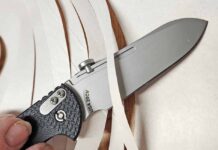
The TILI Ultralight handled slicing copy paper with ease.
I started with a simple paper slice using 20-pound bond copy paper. The TILI sliced very smoothly using both a draw cut and a push cut. The knife was controllable in making the width of the slices—I just had to move my fingers out of the way fast.
Next up: single-walled cardboard. The handle shape of the TILI Ultralight made for extremely controllable slices in the cardboard as well. I could hear the aggressive edge as it sliced. The edge is very fine and ideal for such a job.
Plastic board was next. There was a little more blade grab in this medium as the TILI’s blade bevel is short—around 3/8 of an inch. The full thickness of the blade engaged the plastic board quickly. It still made quick, clean cuts as fast as I could move my fingers.
The little fixed blade produced beautiful curly-cues in half-inch pine, producing nice, clean cuts. It was easy to control the depth and thickness of the curly-cues. The TILI Ultralight is great for making fire sticks and a handy little knife to put in a pack. It would be excellent at cleaning small game.
Slicing Through Challenges
The author drove the edge through a pine knot twice. He felt some micro chipping on the edge but it still cut great.
Skiving leather strips was next on the menu. The blade made a forceful crunching sound as it parted the 8-ounce leather. The small blade was controllable in making the slices thin. It favored skiving with the tip more than with the blade’s belly. This is a very sharp knife!
To push the fine edge more, I switched to 3/8-inch sisal rope. The TILI crunched to 125 cuts before my hand said “enough!” It’s hard to keep the pressure on a thin knife without your hand getting sore somewhere. The edge was still sharp and ready for more.
I switched to half-inch pine for some baton practice. The knife was easy to hold onto and it split the wood great. I even drove the edge through a knot twice. I felt some micro chipping on the edge but it still cut great. The steel might be a point too hard on the Rockwell hardness scale for heavy work. Keep the use to slicing and you won’t have any issues.
The TILI comes with a leather pouch sheath to protect the blade. I would put stainless steel pins in the holes at the end of the sheath to prevent accidental penetration as this knife is very pointy and razor sharp.
Bottom line: The TILI Ultralight is a handy knife that’s a perfect little backup blade for all-around use.
Changes I’d Make To The TILI Ultralight
I would add a couple of thumb notches on the blade and extra protection on the tip of the sheath to prevent blade penetration. (EDITOR’S NOTE: The latter is especially crucial if you carry the knife sheathed in your pocket.)
TILI Ultralight Specs
Blade Length: 2.38 inches Blade Material: 1095 carbon steel Blade Grind: Hollow Heat Treat: Differentially Hardened with Hamon Handle: Skeletonized Steel with hole for included leather lanyard Weight: 2 ounces Overall Length: 2.75 inches Sheath: Black Veggie Tanned Leather Weight with Sheath: 3 ounces MSRP: $125
One thing that humble knifemakers find difficult to do at times is to express pride in their work. It’s the same thing with we knife editors and publishers. But when you look at these eight knife books that F&W Media has put out over the past few years, they’re not only impressive as a whole, but each individual title is clearly an example of quality work.
If you were interested in knifemaking and started with the two books Bladesmithing With Murray Carter and Knifemaking With Bob Loveless, you’d be well ahead of the game and your peers. Add in BLADE’s Guide To Making Knives, 2nd Edition, and suddenly you’re learning the craft from such knifemakers as Don Fogg, John Lewis Jensen, Tim Zowada, Allen Elishewitz, Vince Evans, Rick Dunkerley and Kevin Hoffman. Are you kidding me?! And how many of you have NOT heard of Wayne Goddard? His book The Wonder Of Knifemaking, 2nd Edition is a must-have for any knife book library.
If custom or handmade knives are your thing, the 33rd Edition of the Knives annual book, Knives 2013, will blow you away with full-color photography, feature articles written by the world’s best knife writers and a complete directory of custom knifemakers. Another sweet, full-color, gorgeous coffee-table book is Spirit Of The Sword by Steve Shackleford. It takes you on a trip from historic to modern swords and back again.
For knife collectors, you can’t go wrong with a book devoted entirely to Case Knives, the most collected brand in the world. Check out Collecting Case Knives by long-time collector, expert, accumulator and investor in everything Case, Steve Pfeiffer. And if after all that, you’re ready to design your own knives, or just need inspiration from over 100 classic knife designs, be sure to put in your pre-order for the brand-new, soon to hit bookshelves and stores everywhere 101 Knife Designs by none other than Murray Carter.
Admittedly, that’s one impressive knife book lineup, and would make any knife enthusiast’s library complete!
The New Ace Nibbler From GiantMouse Comes In Five Different Colors. This Nimble Little Folder Is Perfect For A Keychain.
The newest folder from GiantMouse is a treat. The Ace Nibbler, named for the old Tom and Jerry character Nibbles, is a small, versatile piece that is excellent as an EDC and easily fits on a lanyard, in your pocket, or on a keychain. Best of all, rather than a single version, there are numerous ways you can personalize the knife.
It starts with the handle. There are three aluminum varieties (blue, green, or red), a green canvas micarta, and a titanium version. Each style of handle is married to a different type of steel.
The aluminum knives have a satin-finished N690 blade while the green canvas micarta is married to a stonewashed 20CV blade. The titanium construction is completed by a satin-finished 20CV steel.
All versions of the Ace Nibbler come in at 2.5 ounces or less. The features continue with a liner lock on all models as well as a reversible wire clip. The wide nail nick makes it easy to open.
The price does differ based on handle type with the aluminum varieties being the least expensive and the titanium version being the most expensive. No matter what type you purchase, this diminutive knife is more than worth it and can be a loyal EDC for years to come.
MSRP: $95-185
Editor’s Note: This article was written by Mike Ableson.
The offset handle may just save your skin during meal prep
Most will agree that offset handles on kitchen knives look just a bit funky, but have you ever pondered why the unusual “stepped design” is what it is? Actually, there’s a method to the madness and it’s really quite simple. It’s to save your knuckles from getting banged up while slicing. Little has been written about this unusual handle, so we thought it would be both fun and informative to give a handful of o set-handle kitchen knives a spin around the cutting board.
It should be noted that such cutters often are referred to as bread* or sandwich knives which, when you think about it, makes sense, since loaves of bread typically have largish,at bottoms that require getting the digits down low when cutting. Plus, like the majority of bread knives, most are serrated.
What’s an offset worth? In this case a half inch. At top is a Boker chef’s knife the author has used for years. The drop from handle to blade edge is .75 inch. On the Boker Black Damascus Bread Knife at bottom, the drop is 1.25 inches.
The test knives have full serrations and, interestingly, there is a slight bow to the blades as well.The slight curve enables you to rock the blade back and forth on all cutting to make sure the cut is complete, a trait common to most cleavers as well. Serrations are a double-edged sword, so to speak, in that they make it easy to saw through most media.The other edge of the sword is that they can be a nightmare to sharpen, a feat some prefer to job out to the factory or professionals. However, serrations work particularly well at food prep for many breads, meats and vegetables, which is why so many kitchen knives of all types have them. Note that the featured models are hidden-tang knives—all the better to keep unwanted fluids out of the nooks and crannies found on their full-tang counterparts.
KITCHEN CUTTERS
The Boker blade is all business as there is no effort to etch the damascus, though the pattern is faintly visible.
The Boker Black Damascus Bread Knife is the high-priced spread, pun intended. It is a large bread knife but is extremely lightweight due to its very thin blade. The blunt-tipped pattern has full serrations, each approximately .25 inch long. According to a Boker spokesperson, the blade’s core is VG-10 stainless. The damascus pattern is forged of various stainless steels by Japan’s Takefu Special Steel, Ltd. The blade is all business as there is no effort to etch the damascus, though the pattern is faintly visible. The ovate handle is topped with a stainless steel bolster.
The Spyderco Blunt-Tip Z-Cut is the smallest of the test slicers. Billed as a “go-to knife for all food preparation chores,” its blade has fine .125-inch serrations along the edge. The CTS BD1N stainless blade steel is made by Carpenter Technology, a leader in the industry, and is considered much better than common culinary alloys. The handle is yellow polypropylene, a common synthetic found on many kitchen knives because it is dense and repels water. The Blunt-Tip Z-Cut is super lightweight.
The Blunt-Tip Z Cut is a smaller, handier version of the other two test knives.
The Victorinox 9-inch Offset Sandwich Knife is the largest and heaviest of the test bunch, edging out its Boker counterpart by a half inch and a half ounce. Victorinox has always been hush-hush about its proprietary steels but does indicate that the blade is stainless steel with a carbon content of .5 percent^. e blade has .25-inch serrations and the ample handle is a black synthetic. After its acclaimed Swiss Army knives, Victorinox is well known for the Forschner brand kitchen knives, which it has owned controlling stock in since 1981.
The Victorinox 9-inch O set Sandwich Knife is the largest and heaviest of the test bunch, edging out its Boker counterpart by a half inch and a half ounce.
TASTY TESTING
I tested the two large o set knives sideby-side as their specs were so similar, starting with a 4×7-inch loaf of Publix Tuscan Boule bread. Unlike run-of-the-mill white bread, Tuscan Boule has a very tough rind. Using the knives in sawing strokes, I took off quarter- to half-inch slices. Both knives performed admirably, giving me any grief only on the at base of the loaf due to its full 7-inch rind. Once I got used to rocking the blade on the final cut, this, too, made for quick business. My biggest takeaway, however, was that offset handles do indeed work! In fact, I didn’t come anywhere close to busting a knuckle. My knuckles tapped the cutting board top a few times, but nowhere near as badly had I been using a handle without the offset. Both the Boker and Victorinox were comfortable in the hand, with the latter having an edge due to its fat, curvaceous—not to mention slightly longer—handle, though you’d be fine with either knife.
The Boker Black Damascus Bread Knife takes off nice, clean slices of Tuscan Boule bread. The bread has a tough rind but the serrated blade made quick work of it.
Next I took the knives outside the Bread Zone, testing them on other foodstuffs such as corned beef and Cajun sausage. Both knives sliced extremely well. Indeed, you could make an entire sandwich using these knives—but would you want to? By doing so you’d dull your serrations faster, even if minutely. It may be better to stick to bread and let your other kitchen knives share the cutting chores.
The author took the Victorinox 9-inch Sandwich Knife out of the “Bread Zone” and used it to cut neat slices of corned beef. You may or may not wish to use your bread knife in this manner, but the option is there.
The Spyderco Blunt-Tip Z-Cut is a smaller, handier version of the two bigger models, mainly because you need not drag out a large cutting board to use it. It’s not going to slice its way through a large loaf like the Tuscan Boule, but it will whip its way through a smaller sub-style sandwich or your standard white bread lunch quickie. I also gave it a spin slicing tomatoes, portobello mushrooms and a 3-inch chub of summer sausage. The knife performed very well and is limited only by its size. The Blunt-Tip Z-Cut’s blade is scary sharp—not surprising since serrations have been in Spyderco’s wheelhouse for quite a while. Where’s also a plain-edge version of the knife available—the Pointed Z-Cut. These two make for good companion knives and the plain-edge version will cut down your use of the serrated one.
The Z-Cut proved to be a little powerhouse, taking slices off a chub of summer sausage with aplomb. The CTS BD1N stainless steel takes a sharp serrated factory edge—a Spyderco specialty.
The Spyderco Blunt-Tip Z-Cut is billed as a versatile knife for all sorts of food prep. The author sliced up some tomato and worked on a portobello mushroom cap. Note the precise slices.
CHOICES ABOUND
All of the test knives were wicked sharp. You might ask yourself, if the two large bread knives cut equally well, why pay such a higher price for the Boker? For the same reason some carry affordable Kershaw folders as their EDC and others spend much more on a Chris Reeve: choices abound in the culinary world, just as they do in the EDC realm.
*Editor’s note: Standard bread knives have conventional, straight handles.
^Medium carbon steel has a carbon content of approximately .3 to .59 percent. High carbon steel has a carbon content of approximately .6 to .99 percent.
I got some good-natured ribbing at the 2014 BLADE Show because of my EDC folder. Being part of the show staff, I’m constantly taking my knife out to open boxes of magazines or books, or to cut tape for the book booth, etc.
When one guy saw me unclip the Gerber Bear Grylls lockback folder and extract it from my front pocket, he said, “Geez, Joe. Here you are, managing editor of BLADE Magazine, at the largest knife show in the world, surrounded by high-end, superbly crafted knives, and you’ve got an inexpensive Gerber in your pocket?!”
Well, yeah, I like the way the rubber handle feels in my hand, it’s slim, I like the black and orange color combination, it’s got a modified drop-point blade, it’s utilitarian, easy to sharpen, I like the wide paddle-style pocket clip, it doesn’t weigh much, and I don’t mind using it to open boxes and cut tape. So what if it’s only $33?
Get the latest knife information with features on the latest developments, history, and transformation of knives, swords, and edges of all types, and explore the latest trends in blades, steels, styles, and materials. Gaze upon a “State of the Art” section parading engraved, scrimshawed, jewel-inlaid, carved, etched, sculpted and forge-welded, and Damascus and mosaic-damascus knives. Learn more