Featured Knives

Here are BLADE Magazine’s Featured Knives of the Week. Browse through these articles to find the best knives available from both custom knifemakers and factory knives.

Click here to browse through our list of Featured Knifemakers.

Knifemaking – – Knife Collecting – – Tactical Knives – – Survival Knives

Best Barlow: 4 Of The Sharpest Factory Offerings

0

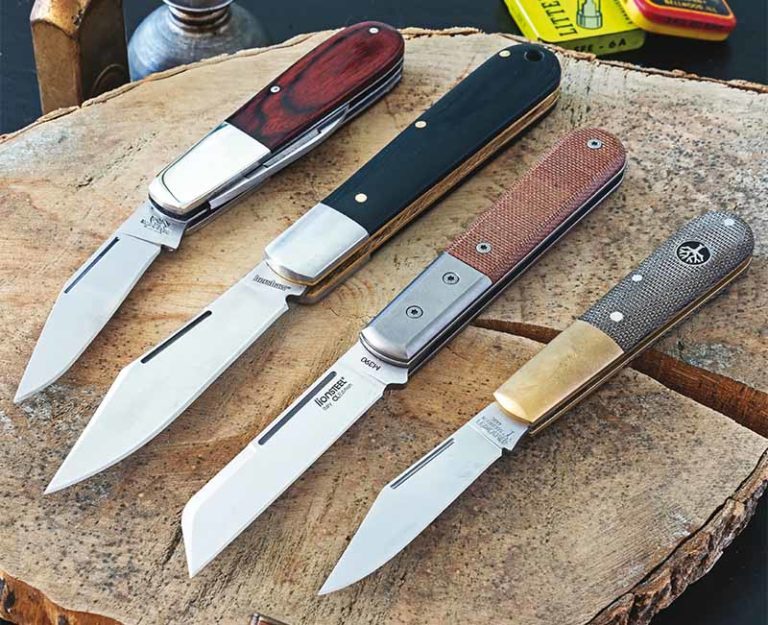
Four of the latest factory barlows that are sharp in more ways than one.

What Are The Top Barlows:

Probably no pocketknife pattern has as rich of an American history as the barlow. It is perhaps one of the most well-known patterns even among non-knife people, because their fathers or grandfathers carried and used one.

What exactly is a barlow? It’s a simple pocketknife comprised of either one or two blades, a lengthened steel bolster, and a teardrop-shaped handle, usually of bone. There’s nothing fancy about the barlow. It was and still is a workhorse knife that gets the job done.

If you trace the barlow’s U.S. lineage, it goes back at least as far as John Rus sell, an American entrepreneur who established Green River Works in 1834 in Greenfield, Massachusetts. One of the knives his company was famous for is the barlow. Green River Works manufactured barlows in mass quantities, and even today vintage Green River Works barlows are highly sought after by collectors. The bolsters are distinctly marked with an “R” pierced horizontally by an arrow.
The Lionsteel CK01 and Böker Barlow Expedition have half stops (page 28), meaning the blades pause midway through the blade rotation cycle. Half stops allow safer closing of the blade and provide good tactile reference of where the blade is even if you can’t see it when opening or closing the knife.
The Lionsteel CK01 and Böker Barlow Expedition have half stops (page 28), meaning the blades pause
midway through the blade rotation cycle. Half stops allow safer closing of the blade and provide good tactile
reference of where the blade is even if you can’t see it when opening or closing the knife.

Aside from manufacturing excellence, the barlow was immortalized with appearances in literature (Mark Twain’s Tom Sawyer and Huckleberry Finn and James Fenimore Cooper’s The Pioneers); in music (bluegrass legend Doc Watson); and even Abraham Lincoln was said to have recounted a story from his past that included a barlow. Few patterns have as rich a history. Even in today’s knife market where aerospace-grade materials and advanced blade steels rule the day, slip joints remain popular, including the bar low. They simply are great working tools stripped down to the bare essentials.

BÖker Dalichow

“Traditional patterns like the camp knife or barlow have been a part of our product line from the very beginning onward, and they always will be,” says Carsten Felix-Dalichow, CEO of BÖker Germany. “In the last couple years, those patterns enjoyed a renaissance in the international knife markets.” Dalichow adds that both modern interpretations and classic versions sell well—including the BÖker Barlow Expedition (manufacturer’s suggested retail price [MSRP]: $199.95).
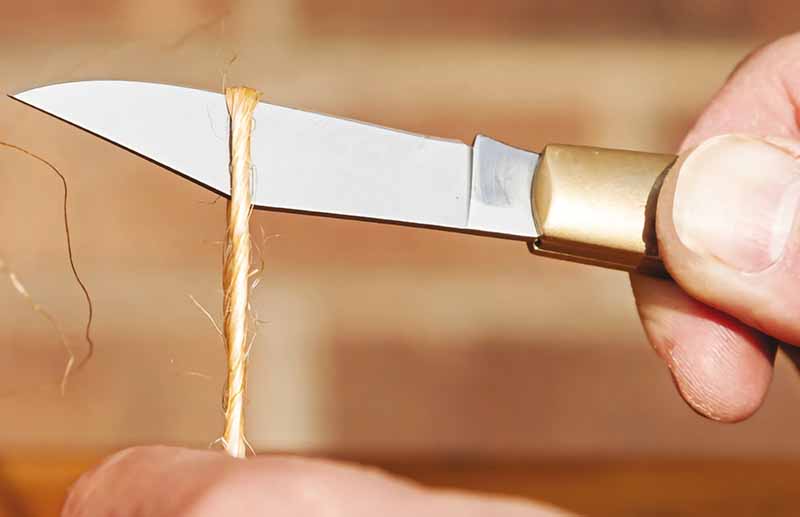
Böker’s Barlow Expedition is a smaller barlow that rides in the pocket easily and is ready for general tasks like cutting a length of twine.

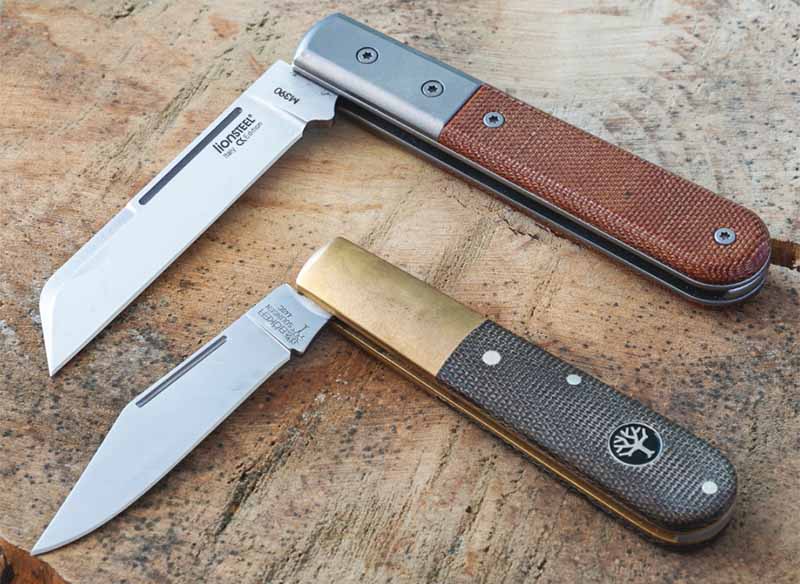
The 2.5-inch clip point blade is 440C stainless, which at one time was aboutthe best knife steel money could buy. It remains a great blade material even by today’s standards. It exhibits superb edge retention and enhanced corrosion resistance, and is fairly easy to resharpen. The blade opens via a long-pull nail nick. The action is nice and stiff. The extended-length bolster is brass, and the scales are green canvas Micarta®, the left one inlaid with the BÖker Tree logo shield. Brass liners complete the overall color combination, which looks marvelous. The blade is bead blasted, not satin finished, which rounds out the subdued appearance.

Size-wise, the Expedition is pretty much average for barlows. It’s a great balance of utility and pocket-friendliness. The thin profile carries well and is not heavy at all. The Micarta is lightweight, weather/impact resistant and an excellent choice for any working folder. I did note during heavy cutting when a tighter grip is required that the thin handle left me wanting a handle thicker and perhaps longer as well. However, for large or extensive-use cutting tasks, select a knife with a more appropriate handle size.

“The response of the international knife markets on this new product line of modern traditionals is tremendous,” Dalichow says, and BÖker will continue to develop new iterations of classic favorites using both up-to-date materials and modern knifemaking techniques. “The trend will be long term. We at BÖker are happy to be a part of it.”

Kershaw Culpepper

The Kershaw Culpepper ushers the barlow into the modern-day knife market in contemporary materials and economy pricing. “Opening mechanisms, blade steels, handle designs—a lot has changed since the peak in popularity of barlows,” says Dominic Aiello, marketing manager at KAI-USA, manufacturer of Kershaw and Zero Tolerance knives. “I don’t believe that barlow-style knives will see the popularity they once had. However, they are still enjoyed by many users, and we want to provide them with a quality, affordable option.”
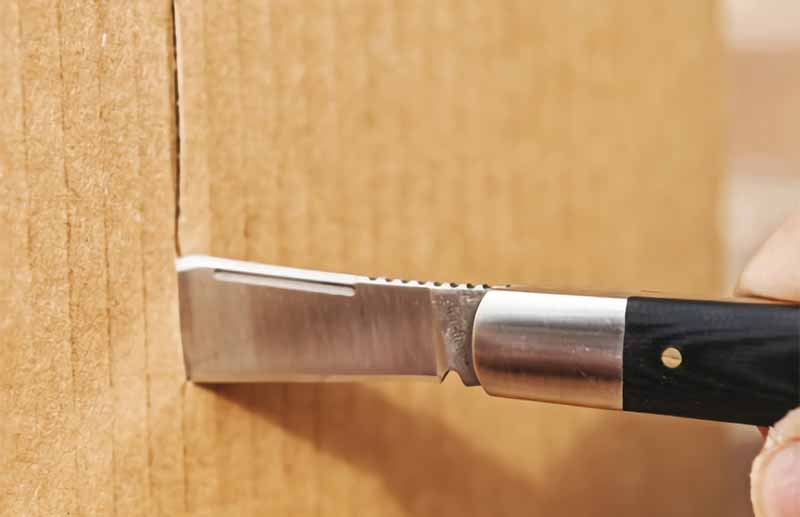
The Kershaw Culpepper has a 3.25-inch clip-point blade suitable for larger and tougher cutting tasks. The 7Cr17MoV stainless steel provides good edge holding abilities. The long, large handle offers a good grip.

The 3.25-inch clip point blade is 7Cr17MoV stainless steel for increased strength, toughness, and wear resistance. The Culpepper is a larger modern barlow suited to heavier cutting tasks. The blade spine boasts gimping for a non-slip rest and extra control when cutting, a feature often found on tactical folders. The satin-finished blade has long-pull nail nicks milled into each side. This offers ease of opening with either hand, but also the convenience of using a pinch grip to pull the blade open as opposed to digging your fingernail into the nail nick and pulling up as you would with a traditional slip joint.

The handle is black G-10, a lightweight, strong synthetic associated with tactical and outdoor knives. It’s a stable material and resistant to fluids, impact, and weathering. The finish is polished, giving an ultra-smooth look and feel. The black and silver appearance is timeless and never gets old. In my opinion, the 4.15-inch closed length pushes the limit of how big a pocketknife should be to carry comfortably in the bottom of a pocket. When you carry it, you’ll know it’s there. The trade-off is the extra blade length to tackle tough, tradesman-like cutting jobs. My only complaint lies with the back spring. Ideally, I would like to have a stiff spring action and a half stop (page 28). The half stop provides great tactile reference as to where the blade is during opening and closing. If not a half stop, then a stiff er spring would suffice.

The Culpepper’s spring tension needs to be increased. I found that if the blade hangs up on what you’re cutting, and you lift up a bit on the handle trying to free it, sometimes the blade will close slightly. Normally you apply downward pressure, so during most use this isn’t an issue. Otherwise, it seems to make a great work knife for tasks unsuitable for a higher-end slip joint. And, in case you lose the Culpepper, the price is such that you can procure another one easily due to the low MSRP ($39.99). One of three traditional slip joints Kershaw offers, the new barlow is made in China.

Bear and Son’s 2281R Rosewood

Bear and Son’s 2281R Rosewood Barlow is the only two-blade of the test bunch, sporting a small pen pattern (21∕16 inch es) in addition to the larger clip point (2.75 inches). The pen gives the option of a shorter blade for smaller cutting tasks or to get into tighter areas. It is also good for scraping, thus saving the main blade’s edge for traditional cutting jobs. Ground from 440A stainless steel, both feature matching long-pull nail nicks for ease of opening. Nice satin finishes round out the overall look and hide scratches.
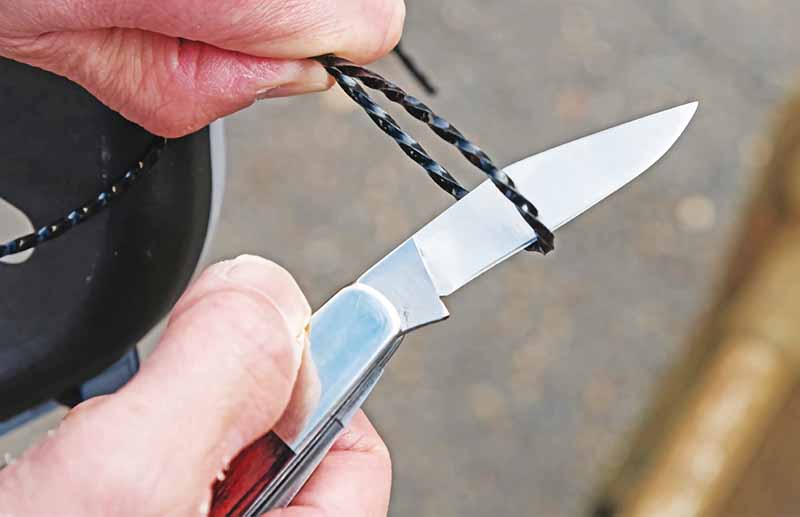
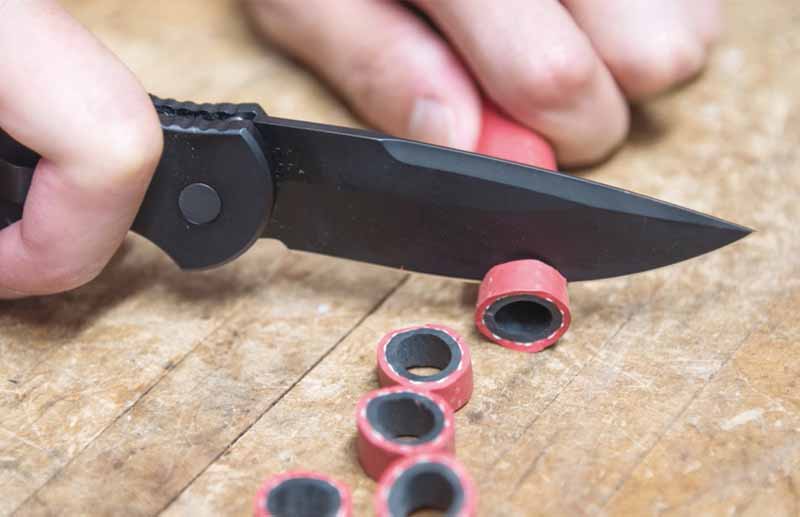
Trimming string is one of the general utility tasks performed by working knives like the Bear & Son 2281R Rosewood Barlow.

The handle features nickel silver bolsters paired with rosewood scales, adding a touch of class. Some prefer the look and feel of a wood handle as opposed to bone or a synthetic. Moreover, rosewood has a reddish-brown hue some find quite attractive, kind of like finely crafted upscale furniture. Granted, the two-blade barlow has a wider handle but the trade-off is the extra width makes the knife easier to grip and bear down on to apply pressure to the cut. The knife’s pocket presence is more noticeable due to the added weight and width, though no more noticeable than some other popular multi-blade slip joints.

The 2281R Barlow balances value with function in a good ol’ USA-made pocketknife. It adapts well to a variety of tasks, from wire stripping to cutting cardboard. It might not be as fancy in appearance as some of the others in this article, but it works well. The blades are easy to resharpen as well. MSRP: $53.75.

Lionsteel CK01

Offering four different blade shapes, the Lionsteel CK01 series is about as high end as you can get for a production barlow. Built from Bohler M390 super steel, titanium liners, and bolsters, and a variety of higher-end natural and synthetic handle materials, the CK01 barlows are show stoppers.
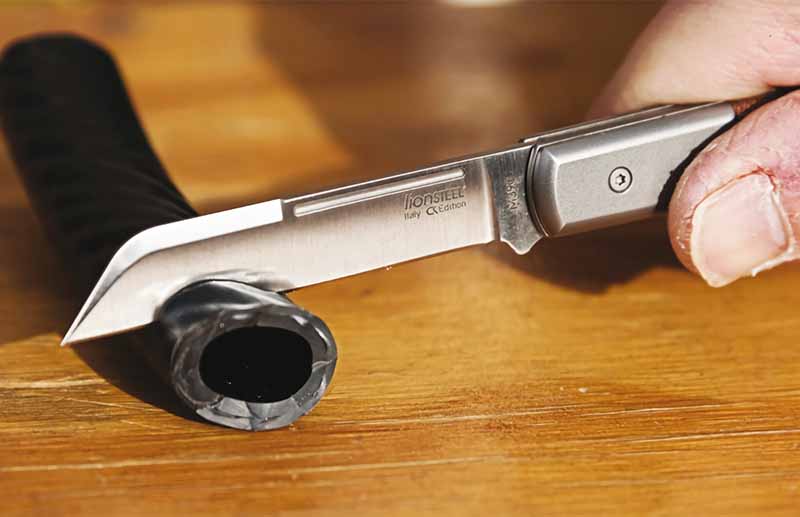
The M390 blade of the Lionsteel CK01 Don model was super sharp right out of the box. It provided plenty of bite for tough tasks such as cutting thick rubber hose.

The Don model has a 2⅞ -inch sheeps-foot blade. The 3.75-inch closed length makes the knife large enough to tackle tough cuts while small enough to be carried comfortably in a pocket. The light brown Micarta® scales are handsome.

The bead-blasted titanium bolsters sport a subdued appearance. Torx-screw construction and a half stop augment the mix—and so do the crowned liners and titanium handle spacer. The knife’s overall slightly rounded/not flat appearance lends an interesting visual appeal. I really dig the crowning—any manufacturer who does this on its knives definitely pays special attention to detail.

The sheepsfoot blade is less common in barlows but is a highly effective pattern for a variety of cutting and slicing chores. The straight-line edge severs cardboard, tape, and plastic sheeting quickly. It also strips electrical wire easily. The pattern is rather easy to resharpen due to the straight-line edge—that is, there is no blade belly with which to hassle. Since the sheepsfoot lacks a defined blade point, there is enough tip left for effective scoring. The Don’s sheepsfoot incorporates a couple of visual features that stand out. First is the long pull on each side of the blade for easy ambidextrous opening. A swedge on the blade spine is a refreshing look. The knife slices like a dream and the M390 steel really holds an edge well. MSRP: $122, plus shipping, and is available exclusively through CollectorKnives (collectorknives.net).

This about as high end as you can get for a production slip joint, integrating titanium, a high-end super steel, and a lightweight, high-tech handle material. For an additional $9.95, you can order the optional leather slip sheath available in multiple color options

Also Read:

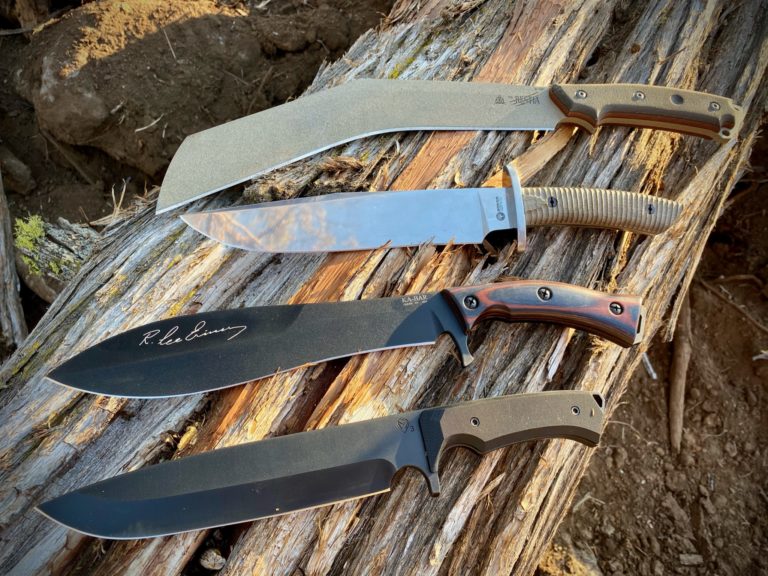
BIG Blades: 4 Monster Choppers for the Bush

BY JAMES MORGAN AYRES

Wherever folks live close to the earth, they use big knives

Little knives are convenient to carry but, if you have a lot of work to do, big knives are it. I’ve lived and worked with indigenous peoples in Latin America and Southeast Asia and found that wherever folks live close to the earth, they use big knives—machetes, parangs, goloks, bolos and the like. They use them for everything from rough work such as cutting poles and opening coconuts, to dressing out pigs and game, to delicate work such as slicing mangoes.

The advantage of the big blade was illustrated to me one day when I was working alongside a villager who, with his bolo and its 14-inch blade, cut wood for a fire, bamboo poles for a cooking rack, lopped off a banana leaf on which he filleted two large fish and sliced them thin as a sushi chef—all in the time it took me to bring down a few stalks of bamboo with my hair-shaving-sharp Randall Model 1.

We reviewed the test knives with that standard in mind. We chopped and split wood and sliced meat and tomatoes. We also, just because, cut hanging rubber hose and slashed through water-filled plastic bottles.


LONG, TALL & HANDSOME: Boker Arbolito El Gigante


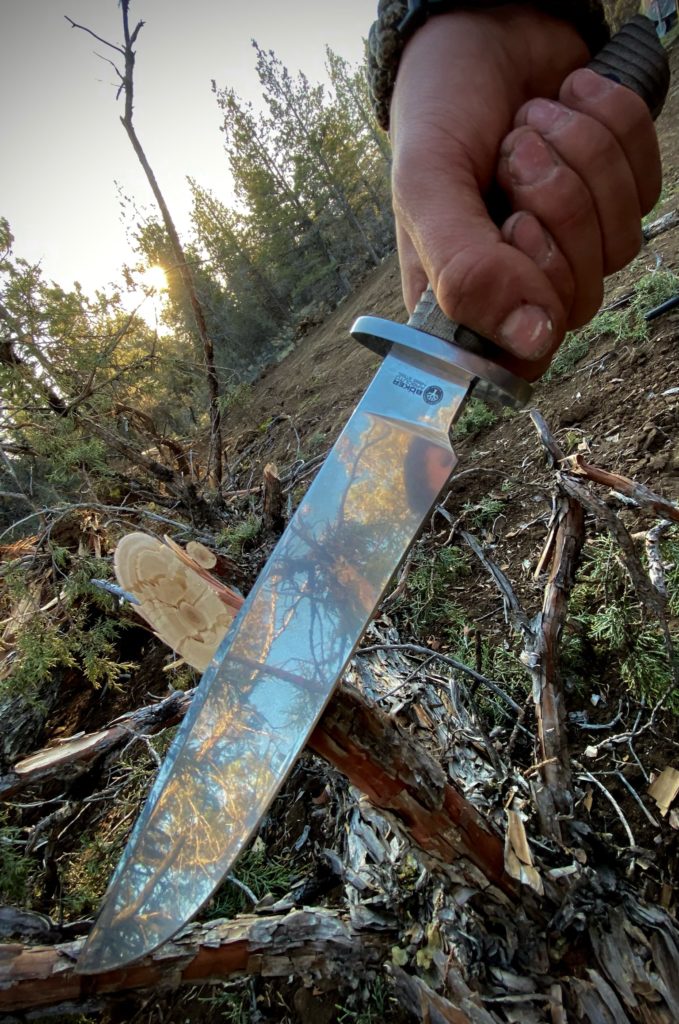
The Boker Arbolito El Gigante is a handsome classic bowie with a stonewashed blade, comfortable handle and nice leather sheath. Balance is excellent, all very much in the bowie tradition. Construction is top quality; so is performance. It cleaved 2-inch pine saplings with one stroke. The quarter-inch-thick spine was brought down to a well-supported edge fine enough to slice tomatoes, and slice meat thin enough to see light through the slices. We slashed rubber hose and the water bottles with ease.
Like all well-designed and crafted bowies, this is a versatile all-around knife.

A tree branch succumbs to the reflective blade of the Boker Arbolito El Gigante. It cleaved 2-inch pine saplings in one stroke.

BOKER ARBOLITO EL GIGANTE
Blade Length: 9.25”
Blade Steel: Bohler N695 stainless
Blade Thickness: .24”
Blade Grind: Flat
Blade Finish: Stonewash
Handle Thickness: .94”
Handle Material: Green Micarta®
Weight: 15.75 ozs.|
Overall Length: 14.75”
Sheath: Leather
Country of Origin: Argentina
MSRP: $229

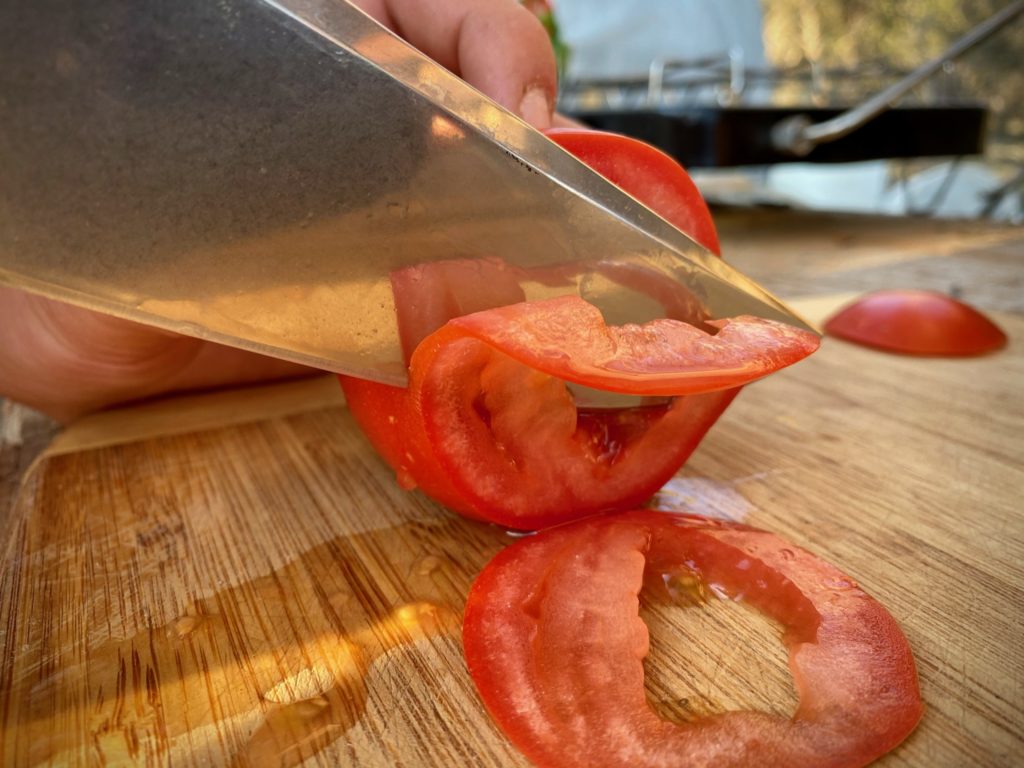
The El Gigante also proved its mettle after chopping wood by slicing a tomato nice and thin.


SEMPER FI! The KA-BAR Gunny


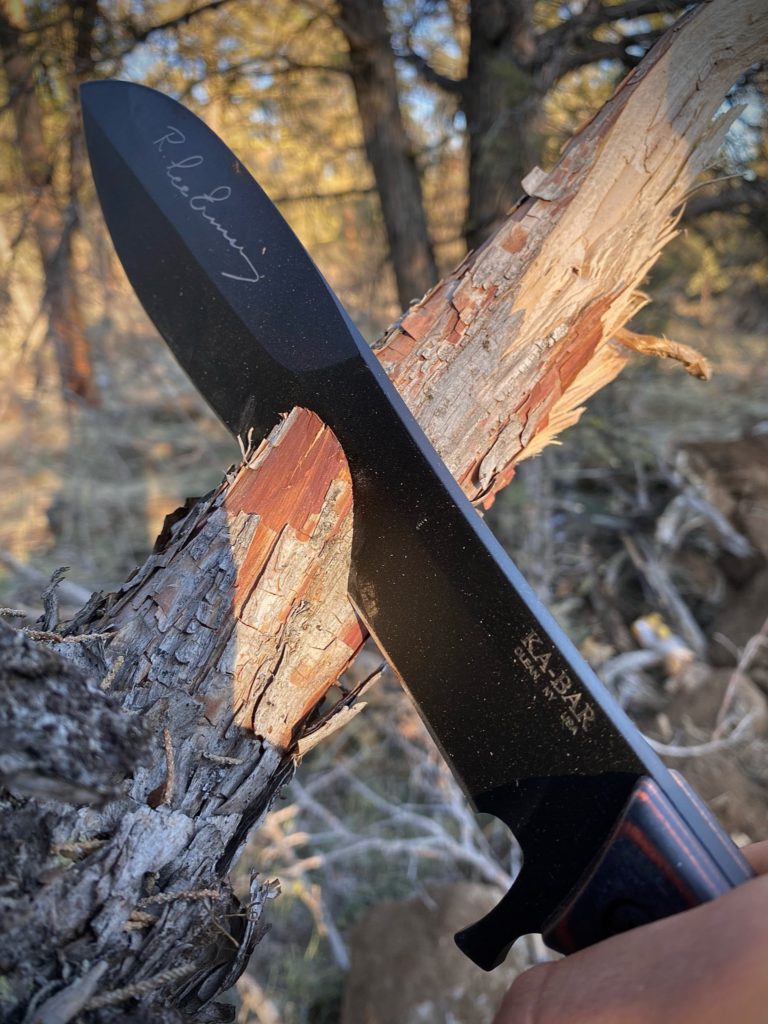
The KA-BAR Gunny is a hybrid design that resembles a bolo. I suspect R. Lee Ermey, the unforgettable Gunny who serves as the knife’s namesake, spent some time in jungles because this combination chopper/slicer’s performance is on par with village-forged bolos I’ve used in Southeast Asia, and that’s a high compliment. Its forward weight and terrific blade design promote efficient chopping.
The KA-BAR Gunny chomps into dry pine. Its forward weight and blade design promote efficient chopping.

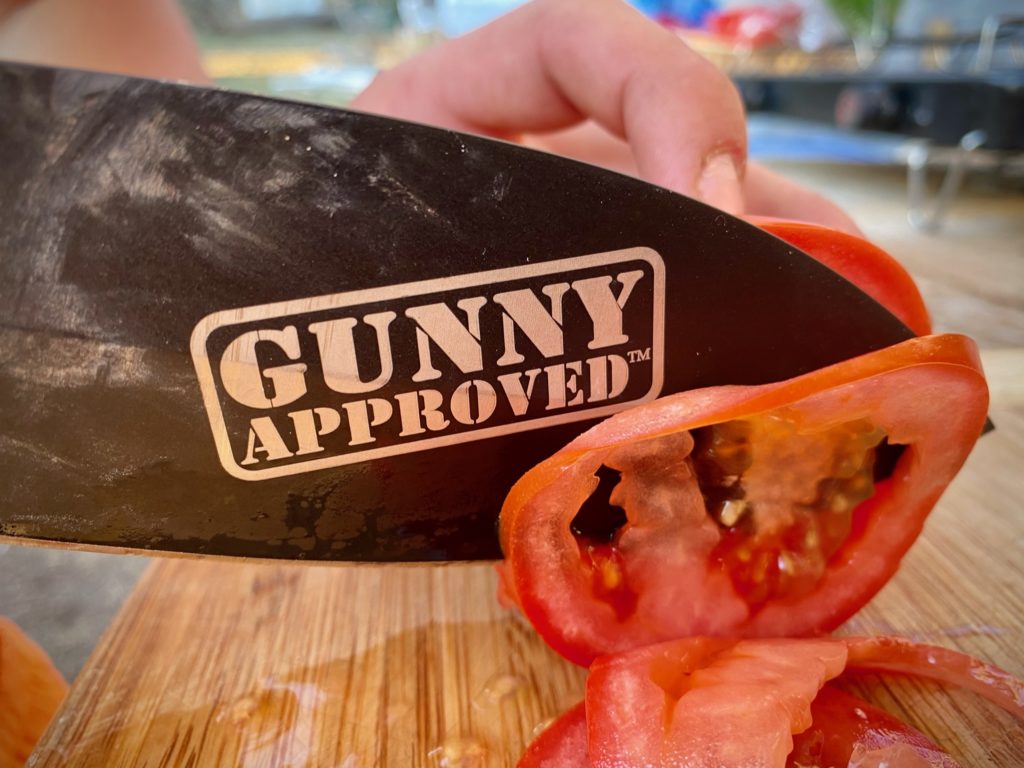
We cut through 3-to-4-inch-thick saplings with two strokes. We took down a tree with a 6-inch-thick truck just because we could. After the chopping the blade was still sharp enough for camp kitchen work. The belly, good balance and fine edge combined to make slicing meat and vegetables a pleasure. Slashing hanging rubber hose and the water bottle were a piece of cake. The comfortable handle lends itself both to heavy chopping and fine meat cutting, which is unusual.

The Gunny is an excellent all-around bush knife. The sheath has a pocket for a sharpening stone, which was not included with the review model.

After chopping wood, the Gunny sliced tomatoes like a chef’s knife.

KA-BAR GUNNY
Designer: R. Lee “Gunny” Ermey
Blade Length: 9.75”
Blade Material: 1095 Cro-Van carbon steel
Blade Width: 2”
Blade Thickness: .2”
Blade Grind: Flat
Handle Width: 1.5”
Handle Thickness: .94”
Handle Material: Wood
Weight: 15.29 ozs.
Overall Length: 15.5”
Sheath: Leather
Country of Origin: USA
MSRP: $292


RAZOR SHARP: Medford Knife & Tool Bonfire


The Medford Knife & Tool Bonfire came from the maker absolutely razor sharp! The blade design is interesting in that we do not often see a contemporary styled drop point and hollow grind on such a big blade. I don’t know the Rockwell, but the steel is hard and tough. It was just as razor sharp after we put it through its paces as when we started.

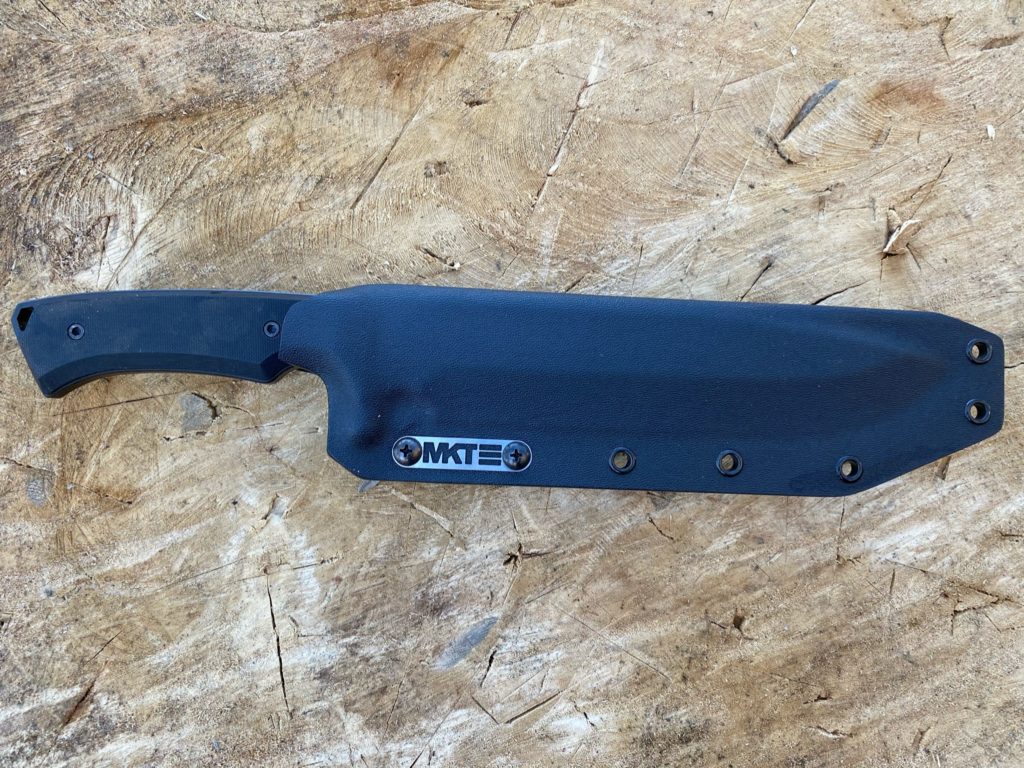
The Bonfire comes with a well-fitted Kydex sheath.

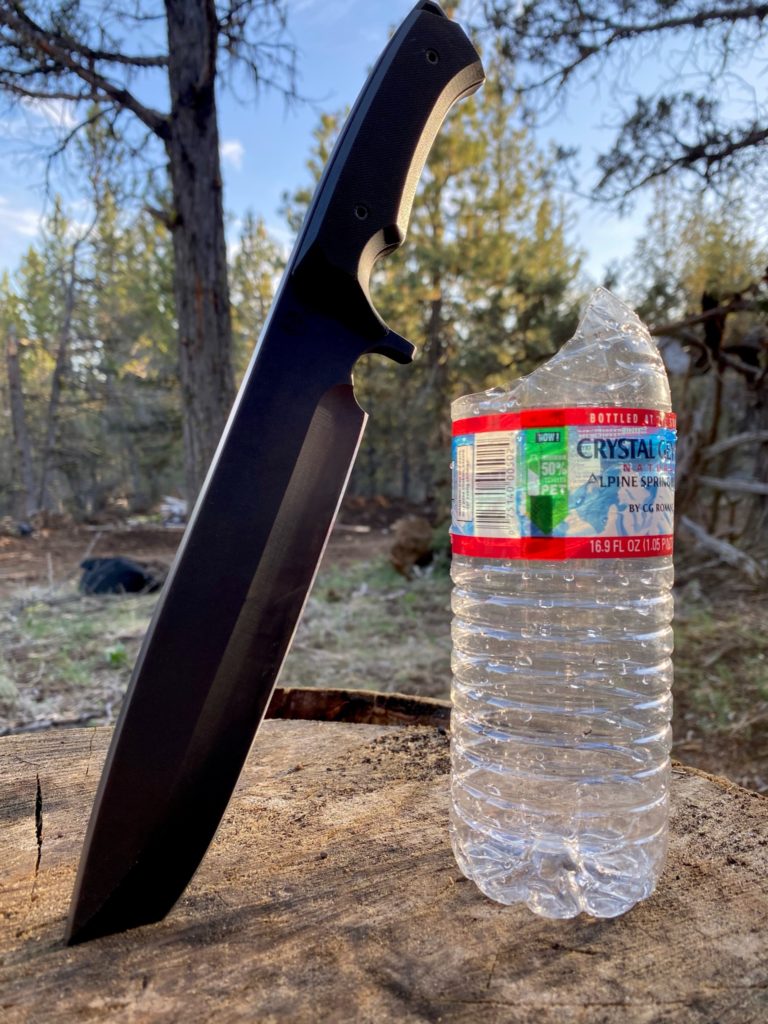
The fine edge made for a very good slicer and slasher and lopped off thin branches with one cut. The hollow grind tended to bind when chopping wood, though that’s to be expected—hollow grinds aren’t chopping designs. It’s better to think of this knife as a well-designed and crafted big knife rather than a bush tool such as a panga or kukri. It sliced rubber hose with a snap of the wrist and slashed through water bottles with more consistency than the other review blades and cut meat just fine. You probably could dress out a bear with it.

Use it as a big knife on soft materials and you won’t be disappointed. It comes with a well-fitted Kydex sheath.


The Medford Knife & Tool Bonfire slashed through water-filled plastic bottles with more consistency than the other review blades.

MEDFORD KNIFE & TOOL BONFIRE
Blade Length: 8.25”
Blade Material: CPM 3V carbon steel
Blade Thickness: .24”
Blade Grind: Hollow
Handle Thickness: .64”
Handle Material: G-10
Weight: 19.16 ozs.
Overall Length: 13”
Sheath: Nylon
Country of Origin: USA
MSRP: $450


CHEF’S CHOPPER: The TOPS Bestia


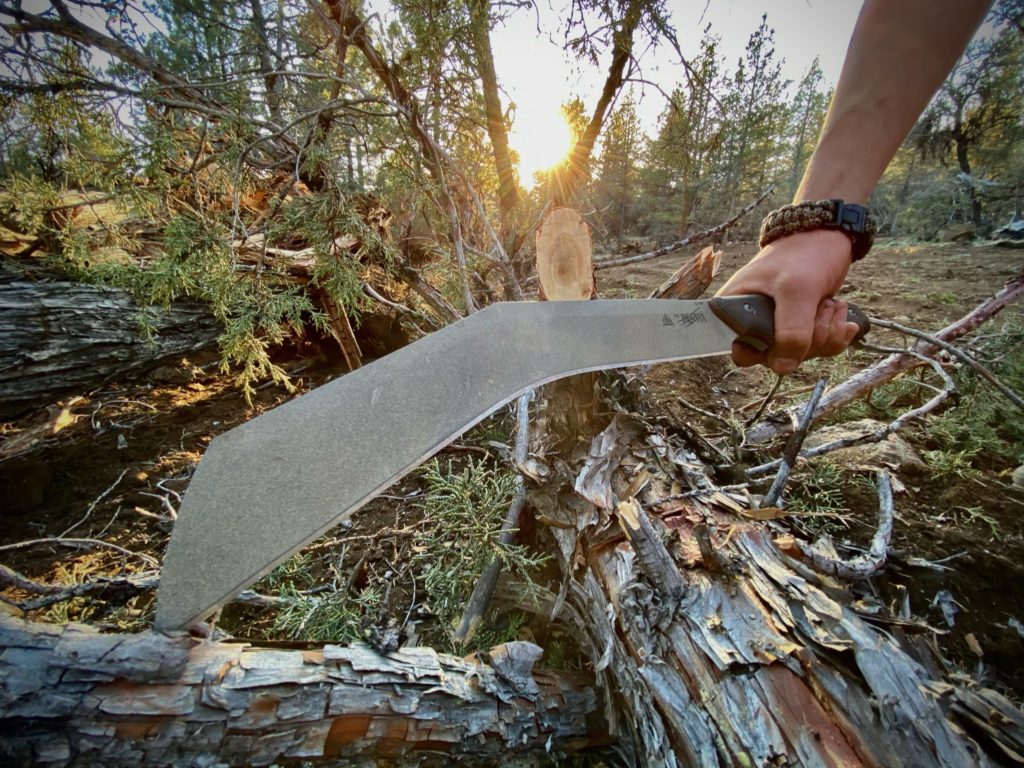
The TOPS Bestia is just a beast. A kukri-styled 13-inch blade and hefty weight make it the blade of choice for serious chopping or zombie cleaving. We hacked though a 3-inch sapling with one stroke, and used it to clear a stand of saplings and brush. The handle remained comfortable during an hour or so of work. Heavy as a small hatchet, it is more versatile and safer in use, especially in thick brush. During many survival classes, I’ve seen more injuries from hatchets than from big blades with their longer cutting edges.

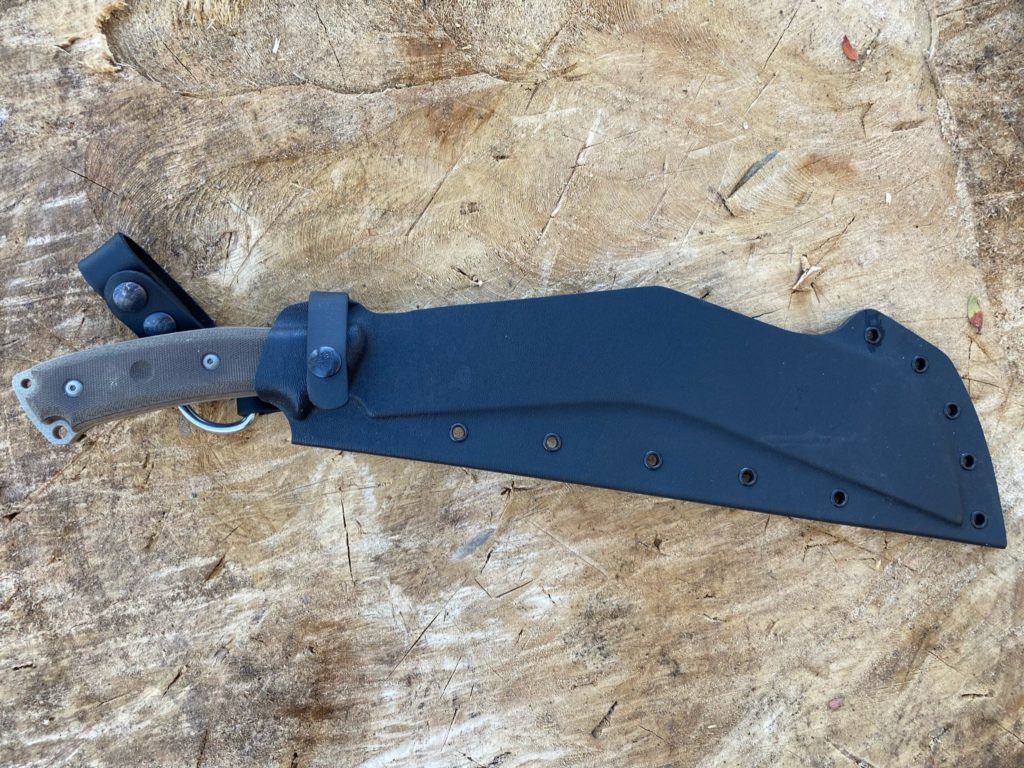
The Kydex sheath is formed to fit the unmistakable kukri-style blade of the Bestia.

Given its heft, blade design and chopping ability, the Bestia is surprisingly usable in the camp kitchen. We found it could slice meat quite well, allowing for adjustments in maneuverability due to its blade length.

The TOPS Knives Bestia’s kukri-styled 13-inch blade and hefty weight made it the blade of choice for serious chopping or, as the author puts it, “zombie cleaving.”

TOPS KNIVES BESTIA
Designer: Leo Espinoza
Blade Length: 13”
Blade Material: 1095 carbon steel
Rockwell Hardness: 56-58 HRC
Blade Width: 2.25”
Blade Thickness: .25”
Blade Grind: Flat
Handle Width: 2.125”
Handle Thickness: .97”
Handle Material: Green Micarta®
Frame/Liner: Micarta
Weight: 1 lb., 13.18 ozs.
Overall Length: 19.5”
Sheath: Kydex
Country of Origin: USA
MSRP: $300


VERSATILE BUSH TOOLS
If you haven’t spent much time with a big blade, try one. Work with it for a while. Direct close attention to your work and you’ll find a good big blade to be a terrific, versatile bush tool.

4 Cool Cleavers in all Different Sizes

0

Latest cleavers are a hot ticket on the camp scene

By Pat Covert

The cleaver has been sneaking up on the cutlery market for several years now. However ironic it may seem, along with the razor, it was in demand on the tactical market before it became popular for culinary attire on the camping/survival scene.

Not anymore. Cleavers are now making their case as viable tools for outdoor use.

An interesting FYI here: Why do most cleavers have a curved blade edge? The curve allows the butcher to rock the blade back and forth to make sure he or she cuts the ends of the meat cleanly.


SMALL ’n SLICEY: CRKT Folts Minimalist Cleaver Blackout

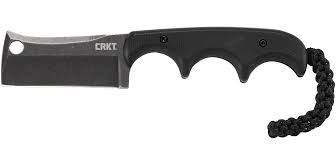
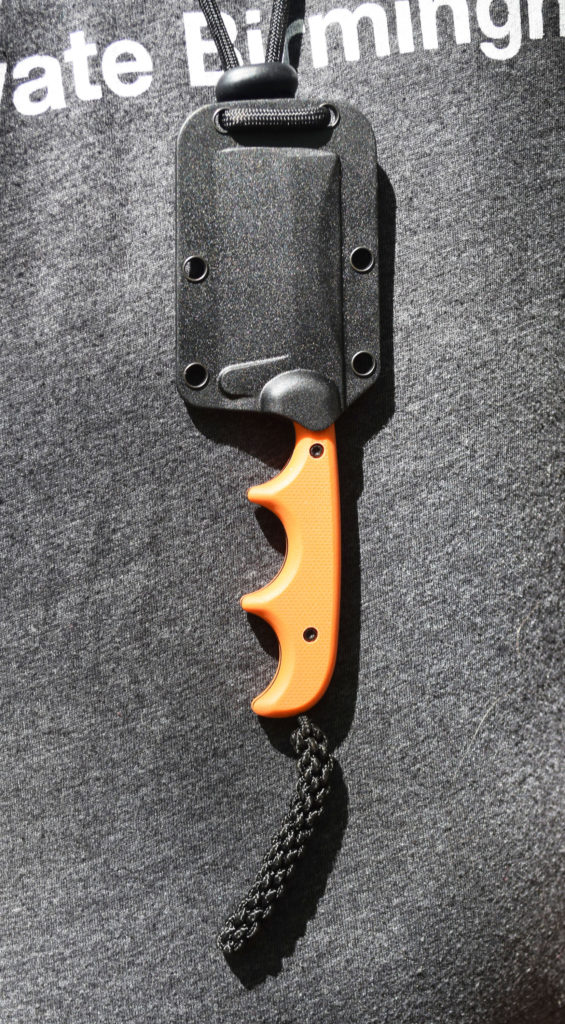
The Columbia River Knife & Tool Folts Minimalist Cleaver Blackout is the most diminutive of the test bunch. It’s billed as a neck knife and aptly so. The blade features a hollow grind for enhanced slicing, and the deeply finger-grooved—three grooves total—handle has orange G-10 scales. All black is also available.

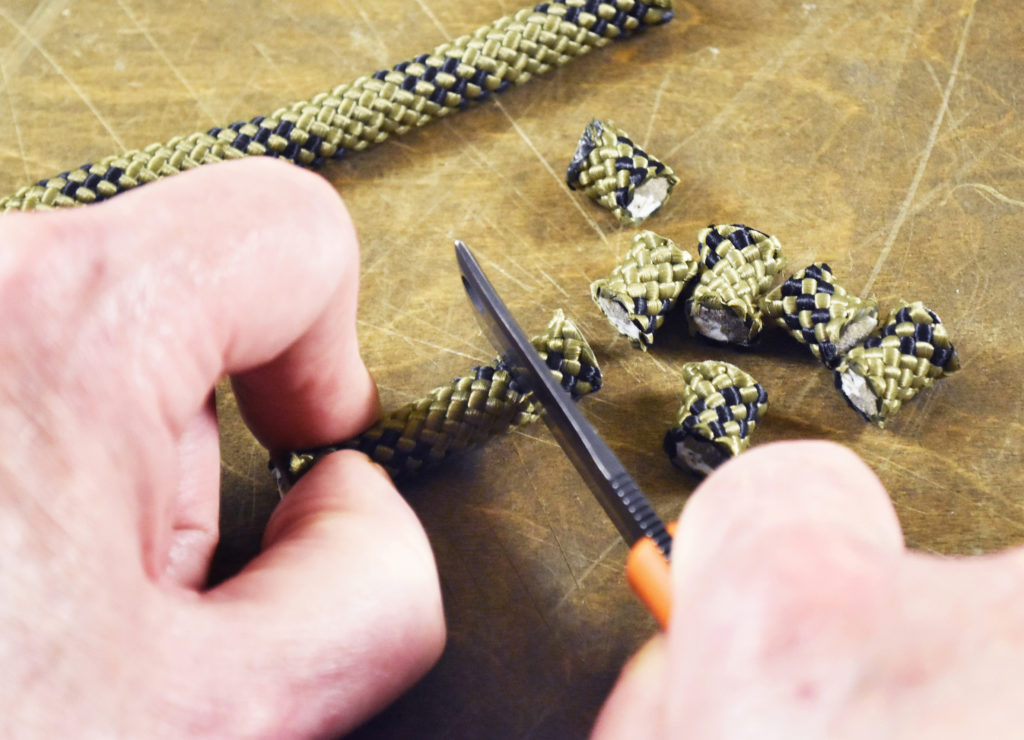
The diminutive CRKT Minimalist Blackout is more suited for small tasks than food prep. The blade was wicked sharp and whipped through 3/8-inch rappelling rope with verve.

A cleaver this light is not made for chopping—there’s simply not enough weight behind the blade. That said, the Minimalist Cleaver is not without utility. The old rope knives had deep, flat-edged blades preferred by many sailors, so I decided to try the small cleaver out on some 3/8-inch rappelling stock. The blade is wicked sharp and proved plenty long enough to slice through the rope in clean, one-stroke pulls. It even handled upper-guided pull-throughs with ease. All in all, the Minimalist Cleaver is a handy little neck knife—as long as you use it for slicing.

At 1.7 ounces, the CRKT Minimalist Blackout is hardly noticeable when carried about the neck. The small necker is handy around camp. Those who cut rope, such as rock climbers, will find it handy on the inclines.

SPECS: CRKT FOLTS MINIMALIST CLEAVER BLACKOUT
Blade length: 2.125”
Blade steel: 5Cr15MoV stainless
Handle material: G-10
Special features: Deep finger grooves 
Weight: 1.7 ozs.
Overall length: 5”
Sheath: Black thermoplastic w/neck cord
Country of origin: China
MSRP: $39.99


SLICK ’n WICKED: RMJ Tactical Jackdaw

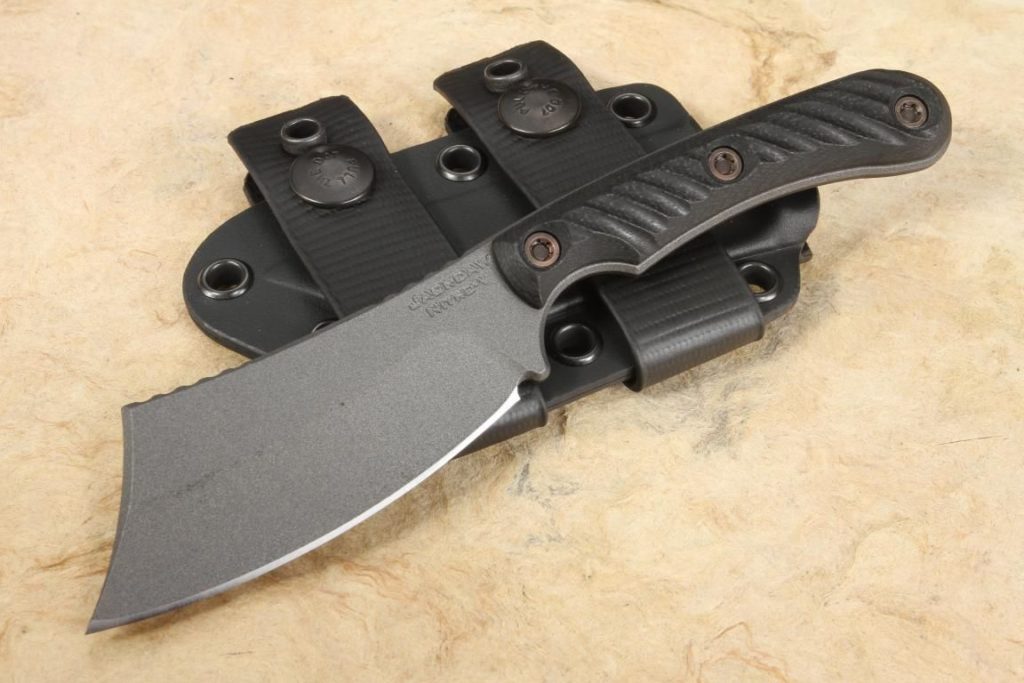
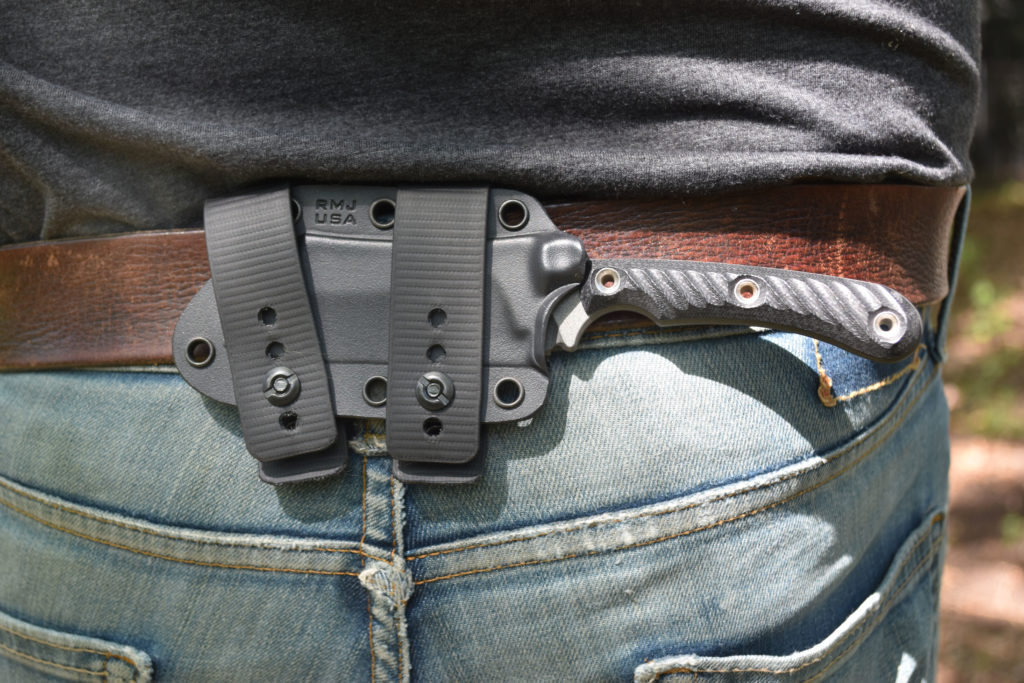
The RMJ Tactical Jackdaw is a small cleaver with a blade not unlike a miniature dao, a type of Chinese sword. In true RMJ fashion, the Jackdaw’s hollow-ground blade has upscale steel with a tungsten Cerakote® finish. The handle includes a nice index finger groove. The scales are machined blaze olive G-10 over orange liners, with diagonal grooves for enhanced purchase. The sheath can be worn for horizontal outside carry or reconfigured vertically inside the waistband.

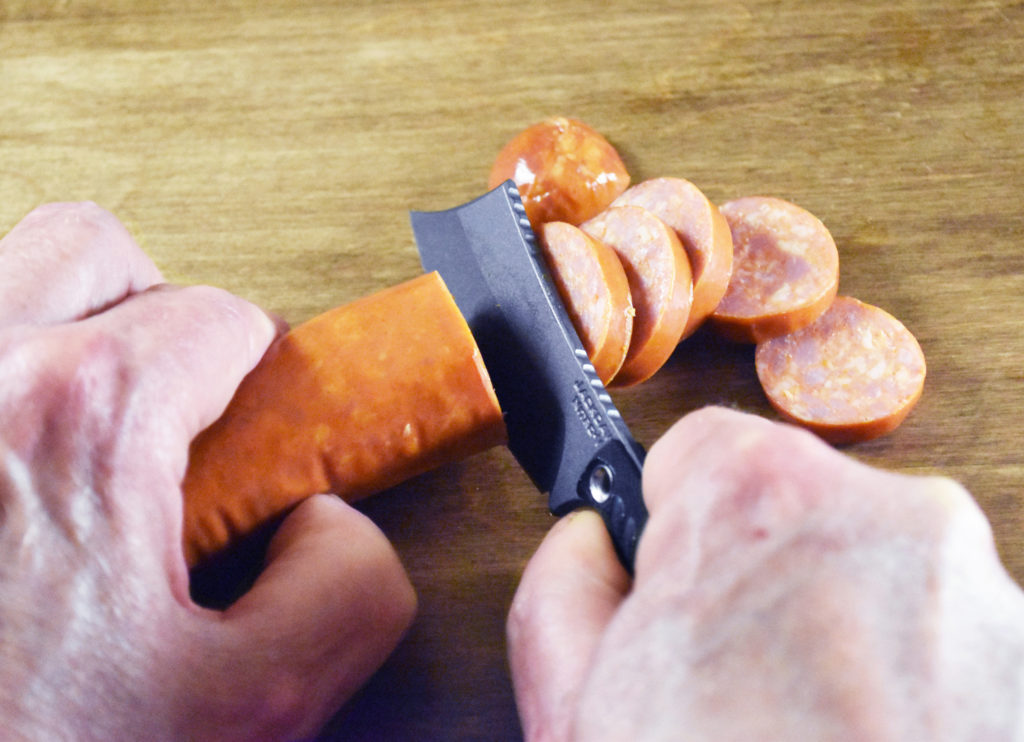
RMJ Tactical’s Jackdaw is more of a slicer than a chopper, and excelled at taking off super clean slices of Boudin Cajun sausage. Self-defense may be the Jackdaw’s primary purpose but it’s at home in the camp as well.

The Jackdaw is another small cleaver that lends itself to slicing more than chopping. The blade rivals that found on many tactical knives but since the focus here is on camping, I needed to keeping it in its lane. I gave it a go slicing some Louisiana-made 1.25-inch Boudin sausage—Asian meets Cajun, if you will. It made quick work of taking off nice, clean slices. There’s no doubt the Jackdaw would excel in other chores such as cutting rope and paracord, skinning bark, cutting notches in wood and the like. While its looks may not scream camp knife, it’s more than willing to prove you wrong.

The RMJ Jackdaw definitely had the most versatile sheath of the group, here in Scout carry mode on a belt behind the back. It also configures for a vertical tote inside a waistband.

SPECS: RMJ JACKDAW
Blade length: 3.25”
Blade steel: Nitro-V stainless
Handle material: G-10
Special features: Chinese dao-style blade
Weight: 2.9 ozs.
Overall length: 6.625”
Sheath: Molded black Kydex, Scout carry
Country of origin: USA
MSRP: $200


PRIMORDIAL CHOP: Condor Tool & Knife Primal Cleaver

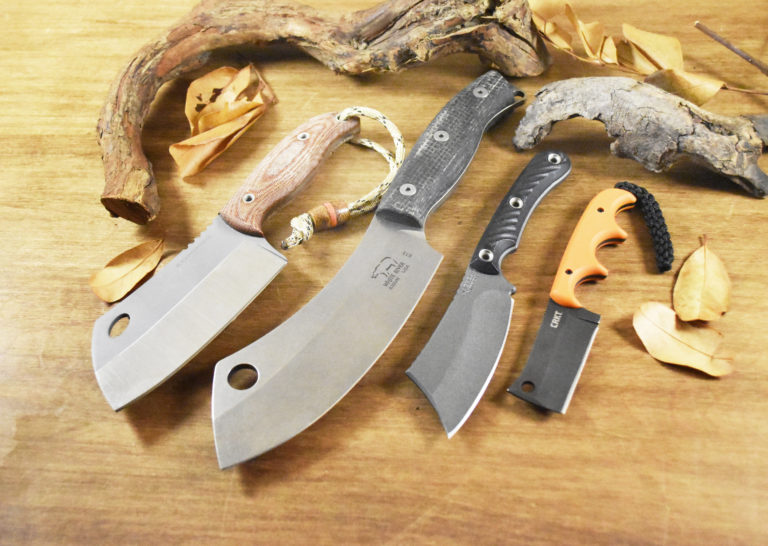
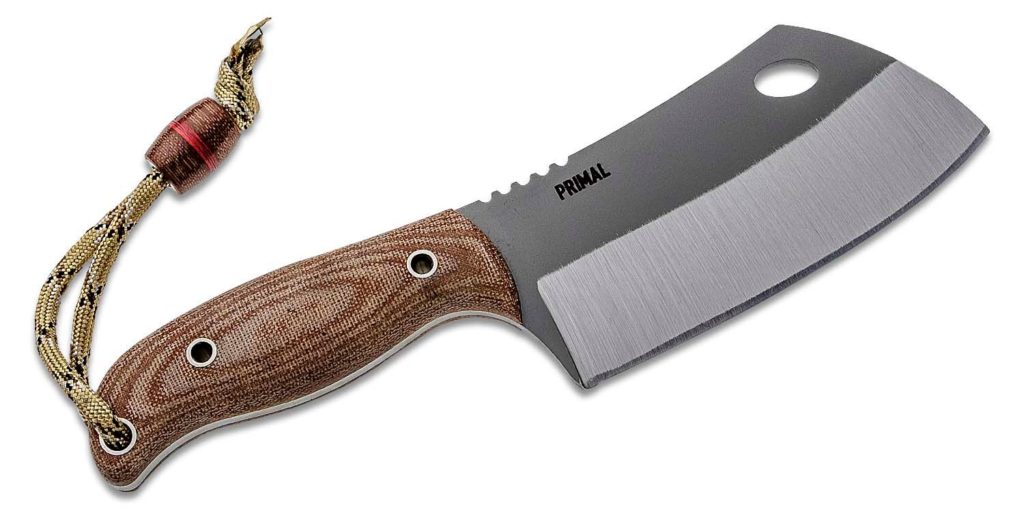
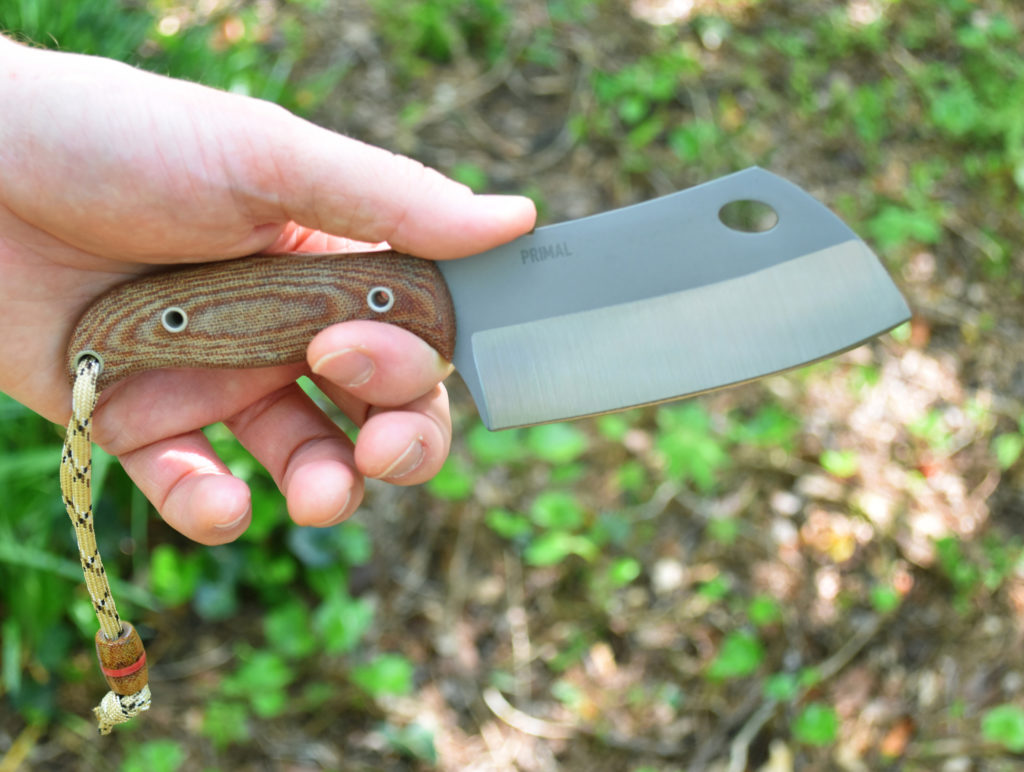
Of the test bunch, the mid-sized Condor Tool & Knife Primal Cleaver most resembles the shape of the archetypical cleaver. It has a decent amount of heft, the bead-blasted, flat-ground blade does the heavy lifting and there’s an ovate hole in the blade for hanging. The curvaceous handle sports layered scales and there’s a tube lanyard hole in the base replete with a paracord lanyard ready for duty.

Note the scale of the Condor Primal Cleaver in relationship to a medium-sized hand. The cleaver more than excels as an efficient chopper/slicer when weight savings on the trail are at a premium (which they usually are).

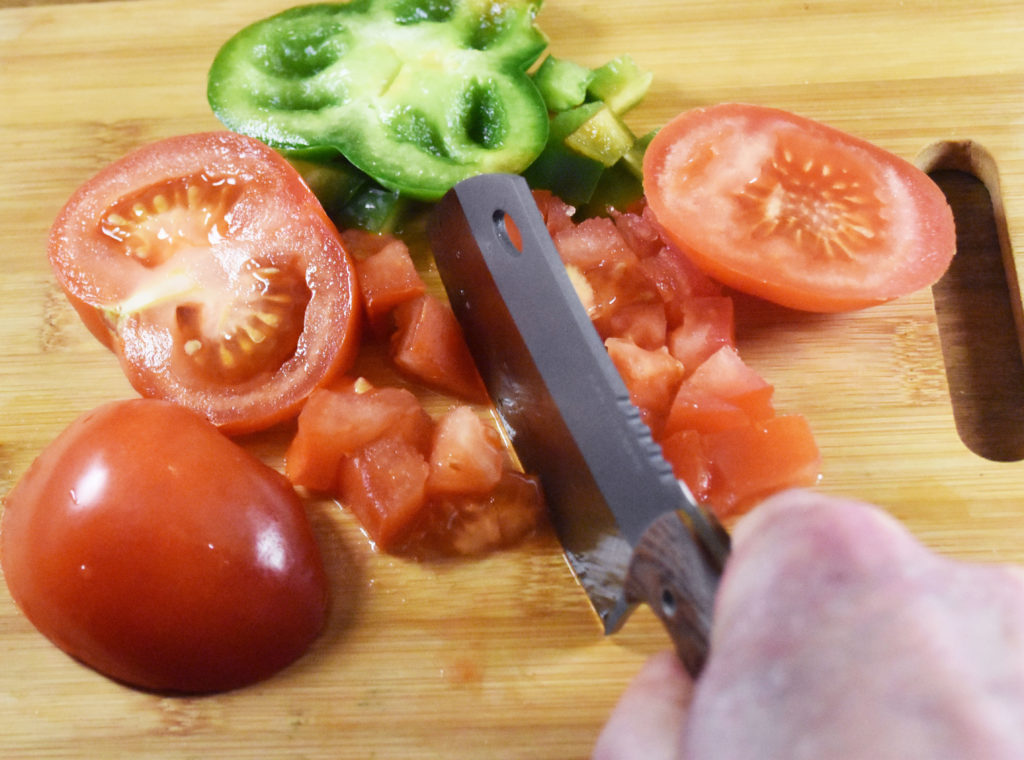
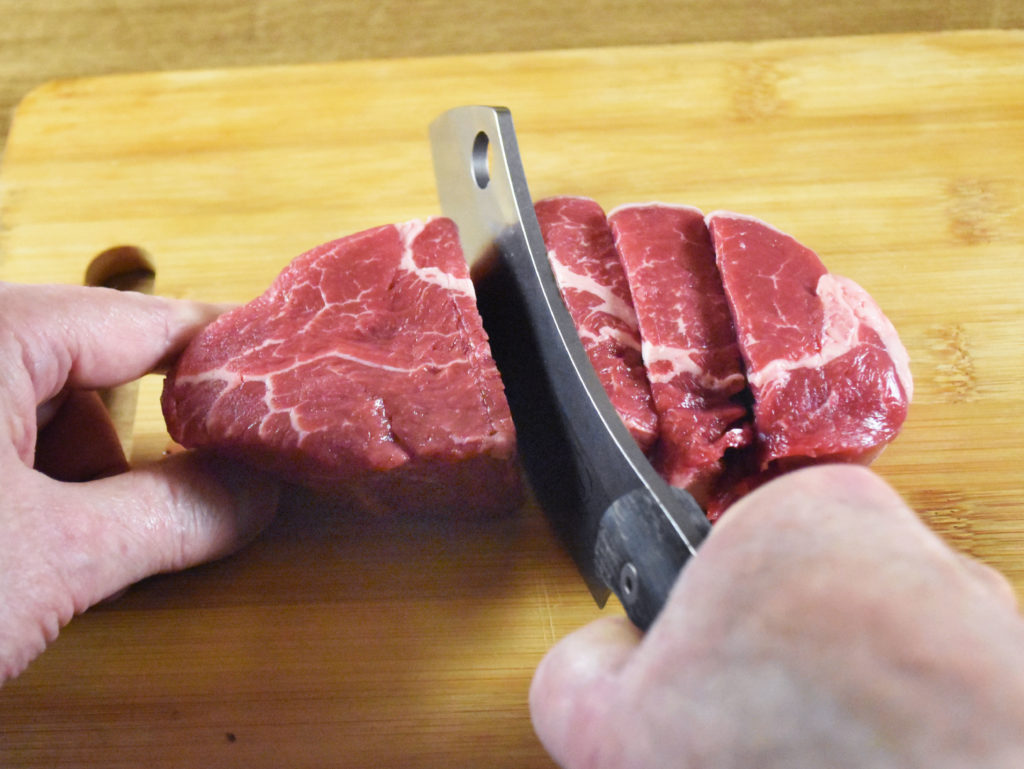
I first tested the Primal Cleaver on a variety of veggies. The blade easily chopped through tomatoes and bell peppers in clean, single whacks. Then I tried it at dicing both and the blade performed like a champ. I also tried it on 2-inch-thick beef tenderloin and it chopped out slices admirably. The handle is very comfortable and, though it didn’t fill my medium-size palm, what you give up in length you gain in lighter weight and portability over a full-sized cleaver. I rate this as a very competent bulldog with enough heft to perform a myriad of cooking chores.

The Condor Primal Cleaver is a mid-sized chopper/slicer with the tenacity of a bulldog. It chopped and diced tomatoes and bell peppers with gusto, and did an admirable job on beef tenderloin as well.

SPECS: CONDOR TOOL & KNIFE PRIMAL CLEAVER
Blade length: 4.09”
Blade material: 1095 carbon steel
Handle material: Orange Micarta®
Weight: 5.75 ozs.
Overall length: 7.89”
Sheath: Brown leather belt model
Country of origin: El Salvador
MSRP: $84.98


DUAL PURSUIT: White River Knife & Tool Camp Cleaver 

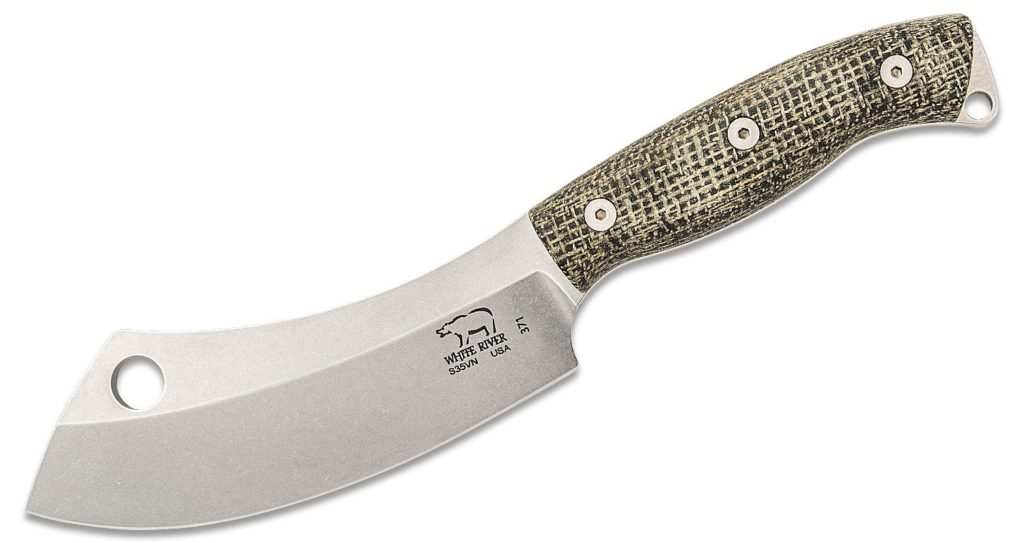
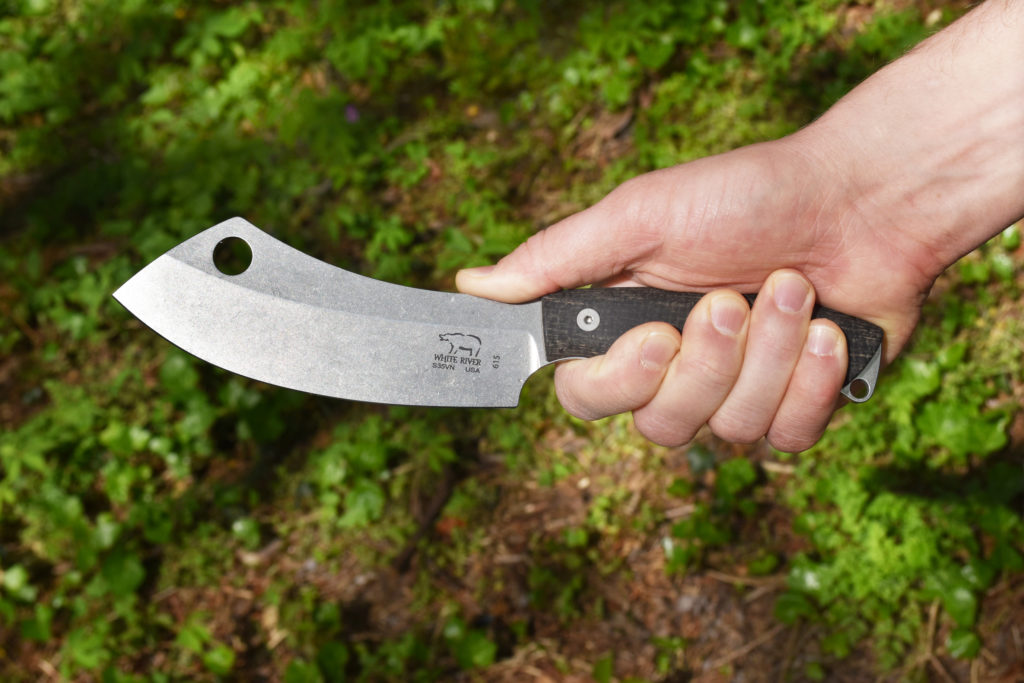
The White River Knife & Tool Camp Cleaver somewhat resembles a shortened Malaysian parang, which is ideally suited for chopping. This is the beast among the test group. The stonewashed blade sports a durable flat grind. A hole in the blade allows for hanging around the campfire for ready access. The handle is nicely sculpted with an ample palm swell and there’s a lanyard hole in the base. White River provides a well-crafted square-based belt sheath.

The White River Camp Cleaver is the beast of the test bunch. It chopped slices off like a house afire on a 2-inch-thick beef tenderloin en route to making a hearty stew. Other veggies like potatoes and mushrooms were a breeze as well.

Anything but typical, the full-size Camp Cleaver’s blade design struck me as one useful for both chopping and slicing, so I gave it a go both ways. I tested the blade on a couple of 2-inch-thick beef tenderloins for a stew. I know, extravagant, I love a good stew. The Camp Cleaver’s heft and sharp edge took off slices of the tenderloin effortlessly, and performed equally as well cubing the meat into squared chunks. Potatoes fared likewise. If you don’t mind packing a full-size cleaver, the White River offering will return the favor by prepping meals for a horde of campers.


The White River Camp Cleaver is 10.125 inches of chopping and slicing heaven. At 8.2 ounces it’s a cleaver with plenty of heft for group food prep, and its CPM S35VN stainless steel blade provides superb cutting ability.

SPECS: WHITE RIVER KNIFE & TOOL CAMP CLEAVER
Blade length: 5.625”
Blade steel: CPM S35VN stainless
Handle material: Black Micarta®
Special features: Traditional hole in the blade for hanging
Weight: 8.2 ozs.
Overall length: 10.125”
Sheath: Brown leather belt model
Country of origin: USA
MSRP: $250


CLEAVER CORNUCOPIA

As you have no doubt deduced, cleavers come in all shapes and sizes. The CRKT Minimalist necker is a nifty companion for a variety of small chores. The RMJ Jackdaw will slice with the best of them, and its versatile sheath is a nice bonus. Condor’s Primal Cleaver is a great blend of chop-ability and portability. The beastly White River Camp Cleaver is a full-size workhorse at preparing food for a cadre of campers. Next time you’re getting your gear together for an outing, consider the cleaver as part of the package!

4 Must-Have Automatic Knives (2022)

0

When it comes to blades that are practical, stylish and bring the THWACK!, you can’t go wrong with these four automatic knives.

What Are The Outstanding Autos:

There’s something irresistible about pressing the button of folding automatic knife and having the blade spring out with a resounding “THWACK!” as it locks open.

Types Of Automatic Knives

Automatic knives or autos come in two basic styles: the traditional side—or radial—openers and out the fronts (OTFs). There’s a great selection of both in today’s factory market. The majority center around the tactical trend in which the spring-powered opening action enjoys viability in high-stress situations where you need instantaneous blade deployment with little effort in action and thinking.

Side-Opening Auto Knives

Pro-Tech TR-3 1X Operator

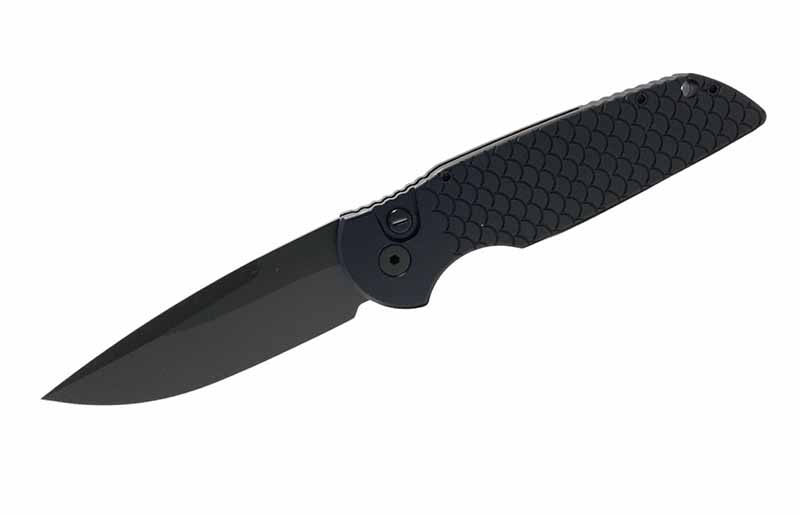
When it comes to tactical automatic knives, Pro-Tech is a leader in the field. Its designs are highly refined and manufactured with the utmost attention to detail. The Tactical Response folder series is a company best-seller, the TR-3 being one of the most sought-after designs. Eight inches open, it is a great working knife featuring an ergonomic handle of T6-6061 aluminum paired with a drop-point blade of 154CM stainless steel. While the company manufactures different variations of the TR-3, the most eye-catching is the TR-3 X1 Operator Series model.

Pro-tech TR-3

Something you will notice first is the knife is sterile—in other words, there are no markings denoting brand, blade steel or country of origin. It is all black, including the clip and hardware. Topping it off, the lock button is inlaid with a tiny vial of tritium, allowing the button to “light up” in total darkness. The handle has ProTech’s fish-scale machining pattern to aid in grip retention and cool looks. The clip is mounted toward the handle butt to carry the closed folder blade tip up and as low in a pocket as possible.

All black and stealthy, the Pro Tech TR-3 X1 Operator Series folder gets the job done with little fuss and effort.

The TR-3 is how you properly execute an all-black-finished knife. The modified drop-point blade tackles a variety of tasks with ease. American-made 154CM is an industry standard for heavy-use knives, holds a decent edge, and is not as difficult to resharpen as CPM high-performance steels. The handle shape is very appealing with its two large finger recesses to help index your grip, and the slightly tapered profile rests in your hand comfortably with no hot spots. Blade action is very snappy. Pro-Tech officials like strong springs in their automatic knives, so have a firm hold on the handle before you deploy the blade. The manufacturer’s suggested retail price (MSRP): $320. The knife is made in Pro Tech’s Placentia, California, factory.

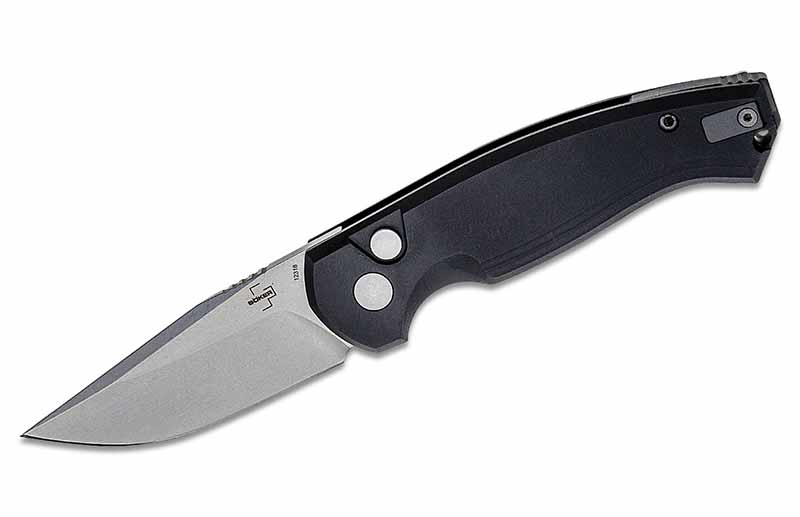
Boker Plus Karakurt

Danish knifemaker Jesper Voxnaes is one of the hottest knife designers going, and Boker Plus has tapped him for several designs, the Karakurt auto being one of them. Starting with a modified clip-point blade a hair over 3 inches, the material of choice is 154CM stainless steel. The flat grind allows the edge to be thin and exert a great bite, much like the knife’s namesake. (Karakurt is the Eurasian equivalent of the black widow spider.) The handle is T6-6061 aluminum. A large finger recess permits easy indexing of your grip, and the handle curves accommodate the rest of your fingers nicely for a nonslip purchase. A deep-carry pocket clip totes the closed Karakurt blade tip up and low in the pocket for maximum concealment.

Boker Switchblade

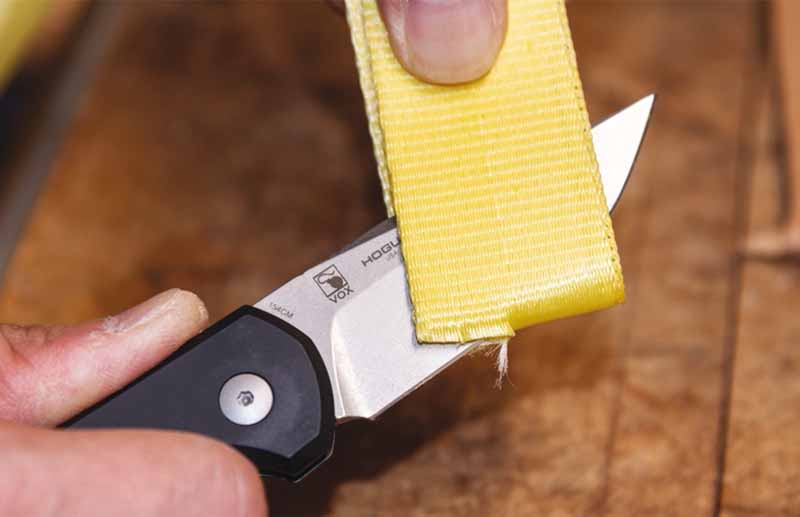
Action-wise, the knife is very quick. Press the firing button and the blade opens instantaneously. The overall design isn’t really tactical, though it does share some tactical traits. The Karakurt is designed more for everyday carry, and is excellent at opening mail, packages, breaking down cardboard boxes, stripping electrical wire, cutting corrugated plastic, etc. It carries very well, the slim profile allowing it to blend right into the pocket and have a lightweight footprint. It carries just as easily in casual dress as formal. The blade is available in a stonewash finish or black PVD coat. With an MSRP of $199.99, the Karakurt is priced very competitively to other knives of its class. It is made in the USA by Hogue Knives.

The flat grind of the Boker Plus Karakurt blade helps give it a nice bite. The Karakurt is made in the USA for Boker by Hogue Knives.

OTF Auto Knives

OTFs fall under one of two categories. One is single-action, where the blade deploys automatically and you must pull out the charging bar to retract it. A double-action OTF has automatic deployment and retraction of the blade, all by respectively pushing and pulling a slide button on the handle spine. The latter is the most popular, as most every OTF manufacturer makes one.

Heretic Knives Hydra

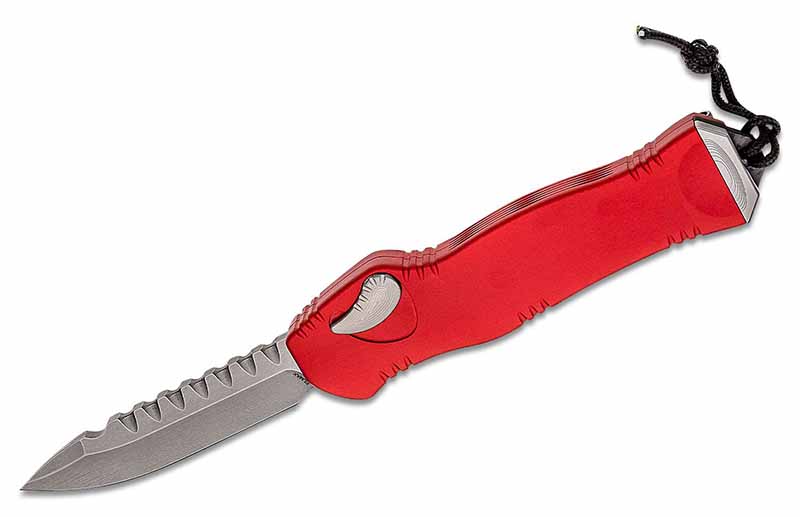
The Heretic Knives Hydra is a single-action OTF. It offers a choice of 3.6-inch drop-point or tanto pattern blades in CPM S35VN stainless steel. Handles are aluminum alloy machined with traction notches in strategic locations. The pocket clip is a distinctive “H”-shaped fold-over deep carry design and uses four screws as opposed to the standard two. It is anchored to the handle ultra-securely.

Heritic Hydra

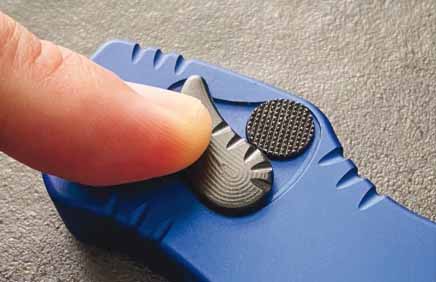
The firing button incorporates an unusual safety. It’s a teardrop-shaped cover that pivots downward to allow button access. When released, it covers the firing button to prevent accidental blade deployment. Very ingenious! The bad thing about single-action OTFs is that retracting it requires using both hands: one to hold the handle and press the firing button to unlock the blade, the other to pull back on the charging bar until the blade is fully retracted and locked closed. (Pull a paracord lanyard tied to the charging bar or grab the end of the bar and pull.) The Hydra is well made, and the ergonomic handle is comfortable and offers multiple-grip positioning.

Most OTFs have a boxy profile and maybe two grip positions at most, depending on the size. Admittedly, I am not a fan of the humongous clip but it does a great job at holding the knife to the pocket, and is a deep carry design that positions the Hydra low in the pocket.

The Hydra also has a safety (inset) by the fi ring button to guard against inadvertent opening of the blade.

When you fire the blade, it hits hard! Out of the box the blade was plenty sharp and the hollow-ground tanto offered great slicing ability. Heretic provides the knife in multiple handle colors and two blade finishes—we received the black-coated blade with a nice handle anodized blue (MSRP: $435).

Single-action OTFs are probably better suited for occasional use since the two-handed blade retraction can get cumbersome, especially if you have the use of only one hand at a time. Double-action OTF’s are what you need for more frequent use. However, if you collect OTF automatic knives, you need a single action in your collection. In this case, the Hydra is a perfect choice to fill the slot.

Microtech Scarab II

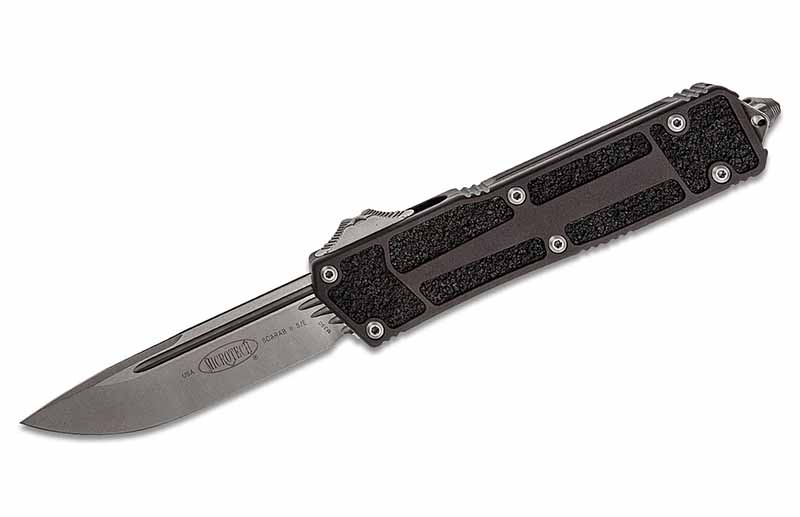
Easily the largest OTF in the Microtech line, the double-action Scarab II is a nice handful. The base steel of choice for the 3.9-inch drop-point blade is M390 stainless, though Microtech also uses other high-end steels depending on what’s on hand in quantity. The 5.25-inch handle is T6-6061 aluminum for lightweight and strength. Inlays of textured rubber tape are integrated to enhance grip in most all conditions.

Microtech OTF Automatic Knife

A hefty push moves the textured actuation button forward to deploy the blade and a backward pull retracts it. The robust push is also a safety feature to avoid inadvertent blade actuation. The action is very quick given the blade’s size and
thickness.

Microtech added three fullers—two in the standard style on the blade’s side, as well as one on the blade spine. They look pretty cool but don’t add to performance. A few mini fullers are close to the blade’s base, where they are partially visible when the blade is deployed.

Given the knife’s size, it works quite well, and blade deployment is very easy even if you’re wearing work gloves. If you wear gloves frequently, this is the OTF for you. The handle is blocky and therefore fits the hand well with or without
gloves.

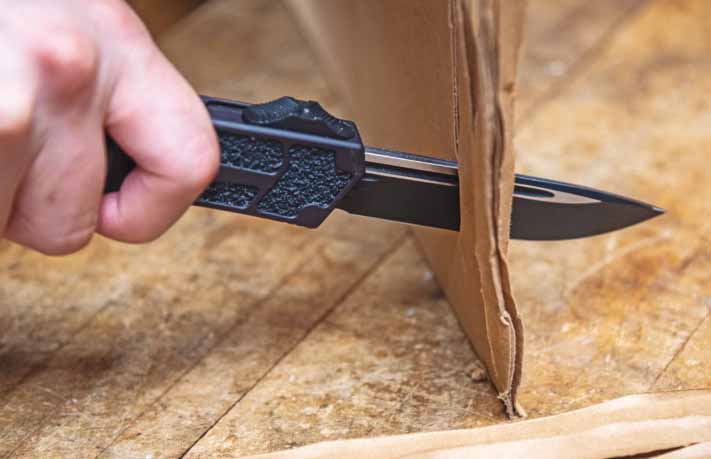
The Microtech Scarab II is the latest auto Microtech manufactures and the largest of the test group. This formidable-sized OTF is ready to tackle the toughest cutting jobs you may have and does so with aplomb.

The Scarab II is adept at handling bigger cutting tasks, and has excellent slicing capabilities given the blade’s length. It could easily be used as a food prep knife, as it does great in the kitchen. The flat ground blade sails through a variety of media and is easy to resharpen. M390 holds an excellent edge and, unlike S30V, is relatively simple to resharpen. Carry is a snap thanks to the heavy-duty steel pocket clip. It’s secured to the handle butt with a special conical glass breaker screw that has an inlaid steel ball bearing for transmitting impact energy to the glass.

If you’re looking for an EDC-able Microtech OTF, the Scarab II may not be your choice due to its larger size. You’ll need to look at the company’s smaller Ultratech series instead. However, for tactical or extended-period hard use, the Scarab II fits the bill perfectly. The MSRP is $551, making it one of the most expensive production OTFs—but it’s worth it!


Get More Automatic Knives:

African Blackwood is on the Rise as a Custom Handle Material

Maybe it’s a bit of a contradiction, but both elegance and simplicity are elements of African blackwood, a handle material with a rapidly rising profile in the custom knife industry.

The color of the material combined with properties that make it a pleasure to work with has resulted in an explosion of interest. Ranging in luster from a reddish to a deep black hue, the wood is the product of a flowering tree also known as granadilla or mpingo. A relatively small tree, it grows primarily in the forests of Senegal east to the horn of Africa and in some parts of South Africa. Long used in musical instruments and high-end furniture, African blackwood is protected in order to prevent overharvesting.

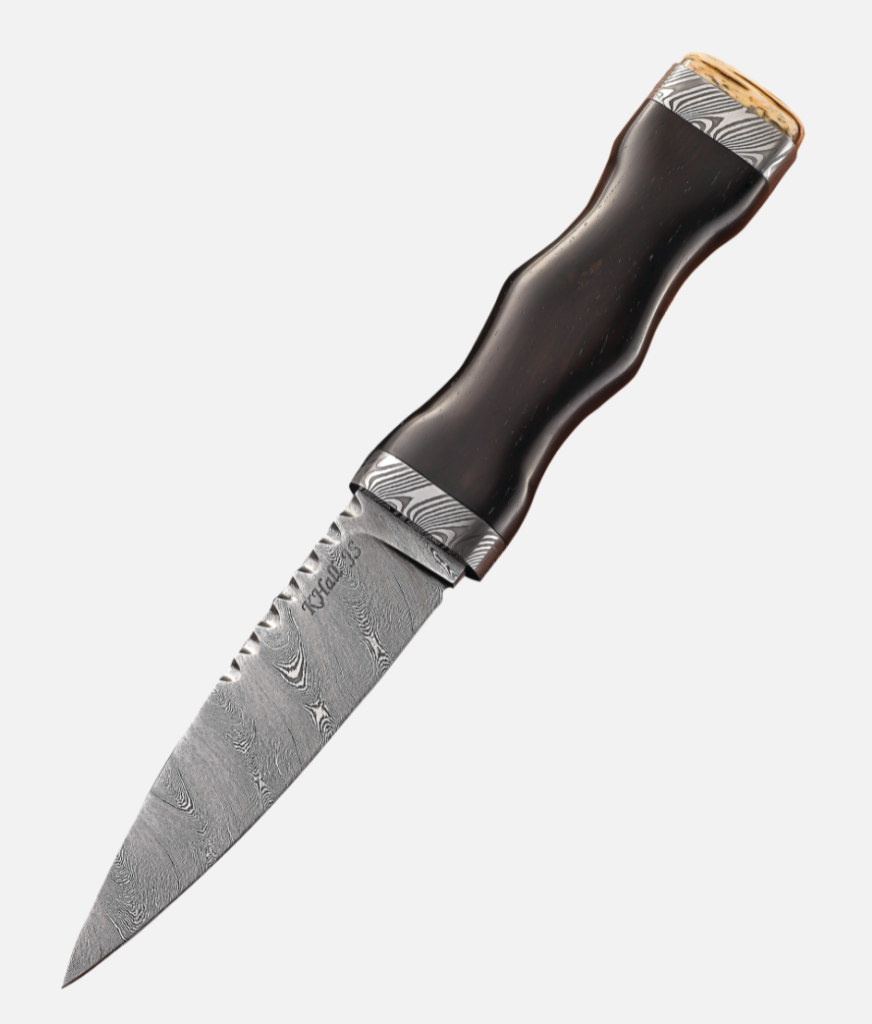
Ken Hall’s sgian dubh features a 4.25-inch blade of twist damascus in a blend of 1075 spring and 15N20 nickel alloy steels. The pommel is formed from stone and giraffe bone. The African blackwood handle not only is ideal for its carvability but also in keeping with the sgian dubh’s name, which is Scottish for black knife.

When the material finds its way to a knife handle, something dazzling happens, and the makers who use it sing its praises. “I’ve always loved black-handled knives, especially with brass,” related Abel Price of Fayetteville, Arkansas, a part-time maker who is completely self-taught. “The black and gold combo just pops and gives it a beautifully elegant Art Deco feel.”

In the mountains of western North Carolina, ABS master smith Andrew Meers finds African blackwood a pleasure to work with. “It’s a dense and stable wood with a consistent grain structure that is excellent for handle material. It is workable and carves well,” he noted. “It has a rich, dark color and finishes out beautifully when sanded, and I haven’t noticed any cracking, shrinking or expanding, especially compared to the cracking I’ve noticed at times in similar looking wood such as ebony. I think these qualities contribute to its growing popularity among makers.”

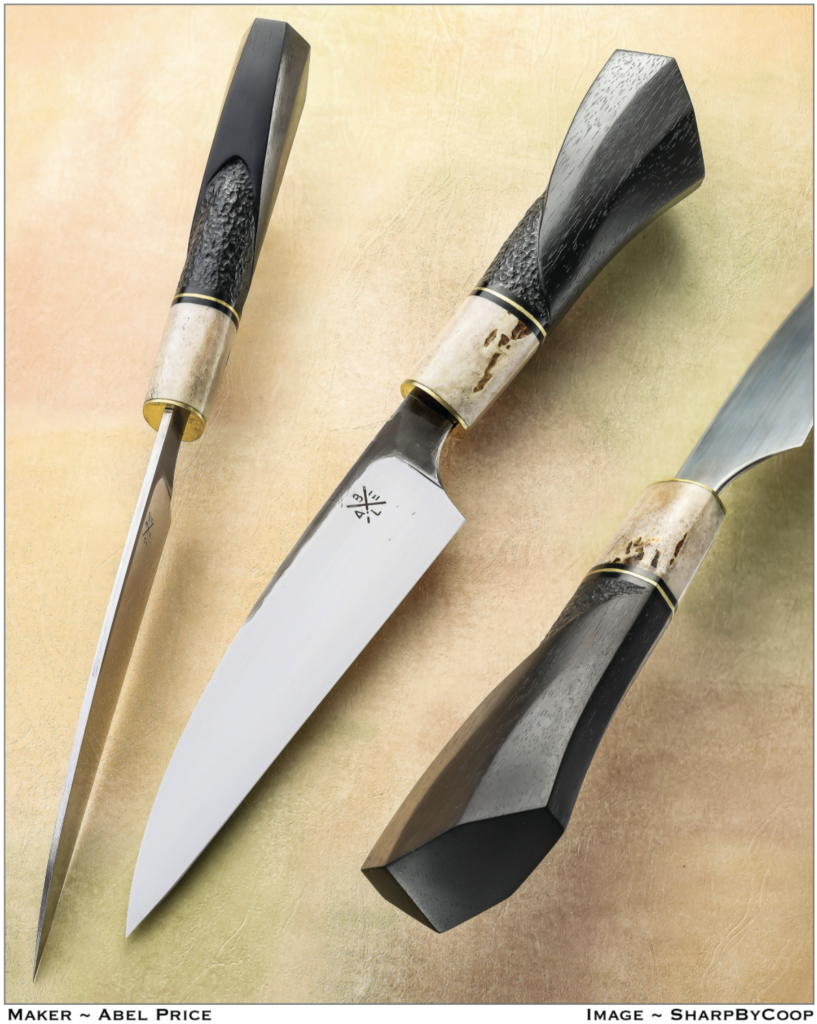
Abel Price used African blackwood for the handle of his Deco Petty kitchen knife. He said the handle “was sculpted to contain design elements of the Art Deco era while hitting several notes of contrast: smooth and stippled, round and flat, black and white, and straight and sweeping lines.”

Andrew uses rasps and files for shaping, a flex shaft for carving, and prefers to sand and buff to finish his handles of the material. Last of all, he applies a coat of Danish oil. So, the finished product is just what the maker wants, and getting there is most often a pleasurable journey rather than an arduous trek. African blackwood exhibits excellent stability and takes a shine quite well. Custom makers agree that the material is ideal for carving, though whether it carves easily or not is open to the interpretation of the individual maker.

“I think the main reason for its carving ability is that it is hard,” commented Pekka Tuominen, a 17-year maker from Keitele, Finland. “Wood has to be hard if you wish to carve it with sharp and tight curves, and also polish those curves. Let’s say it’s not easy to carve, but when wood is hard you can get a good finish. Of course, it’s popular, too,” he observed. “Everybody knows that if some famous knifemaker uses a material, then the rest of the makers at least want to test it.”

MORE ATTRIBUTES

Waynesville, North Carolina-based ABS journeyman smith Ken Hall appreciates additional attributes of African blackwood. “I like using it because it’s a very dense wood, doesn’t require stabilizing, is hard and does not crack easily,” he stated. “It has a tight grain structure, so you don’t have to fill voids, and it can be carved or shaped without difficulty and provides a dark contrast to a steel blade.”

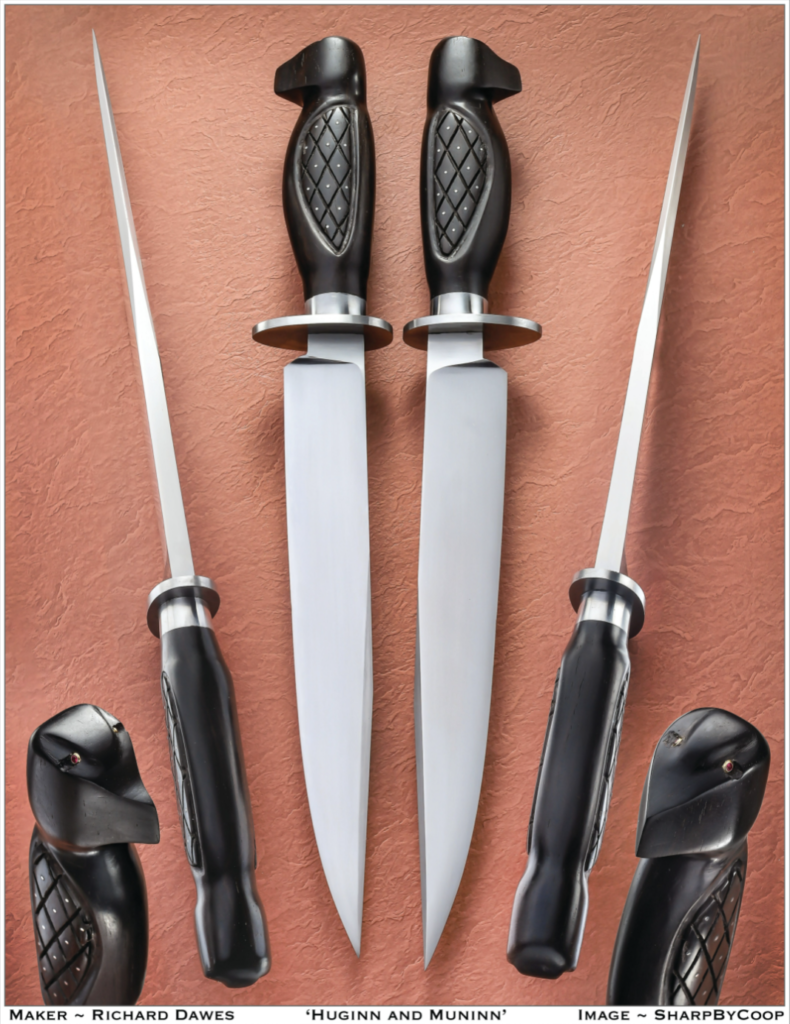
Huginn and Muninn are the names for two bowies by Richard Dawes. Huginn and Muninn are two mythical ravens that attend Odin. Dawes carved the African blackwood handles in a bird’s-head motif based on the style of bladesmith Bill Bagwell, one of the founders of the American Bladesmith Society.

Securing the handle to the blade most often involves a quality epoxy and a combination of pins, depending on the type of knife under construction. “I use rivets, pins and epoxy,” Pekka said, “but I don’t use African blackwood for full tangs. With hidden tangs sometimes just epoxy will keep the tang solid inside the handle.”

When Price went to work on his Deco Petty, a kitchen knife creation with a 6.5-inch blade of AEB-L stainless steel, overall length of 12 inches, and a handle of African blackwood, deer antler and a copper spacer, he knew just what he wanted to achieve. “The goal was to hit form and function,” he commented. “The ultra-thin cutting edge flexes with lateral pressure, and a Rockwell hardness of 61 [HRC] makes for a laser sharp tool in the kitchen. The handle was sculpted to contain design elements of the Art Deco era while hitting several notes of contrast: smooth and stippled, round and flat, black and white, and straight and sweeping lines. African blackwood does everything you want it to do with a perfect finish.”

Hall fashioned his sgian dubh as an interpretation of a historical Scottish knife. “African blackwood is the ideal wood for the sgian dubh because it can be carved and shaped to the hourglass design of the traditional sgian dubh handle,” he noted, “and provide an eye-catching contrast to the stainless steel bolster and pommel.” He added that blackwood is his preferred wood for a handle with a keyhole design because it can take the force applied to pressing the wood into the keyhole.

AESTHETICS & FUNCTION

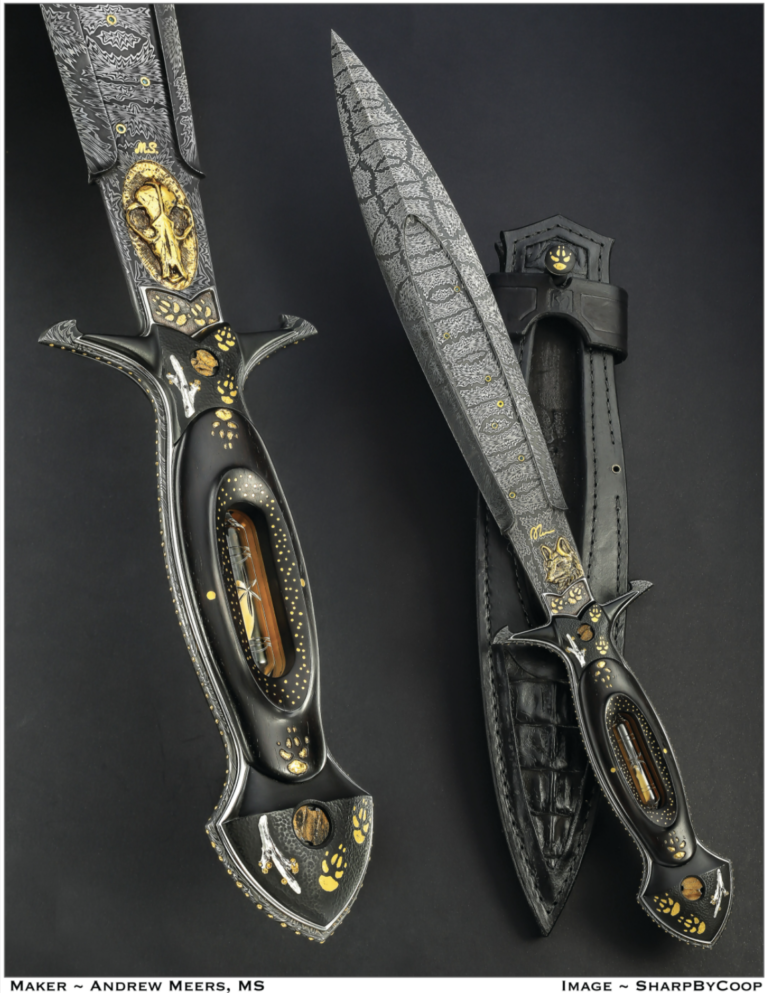
Meers made the striking Vulpecula with a 12-inch damascus blade of 1084 carbon and 15N20 nickel alloy steels. Meanwhile, something of a surprise is embedded in the African blackwood handle.

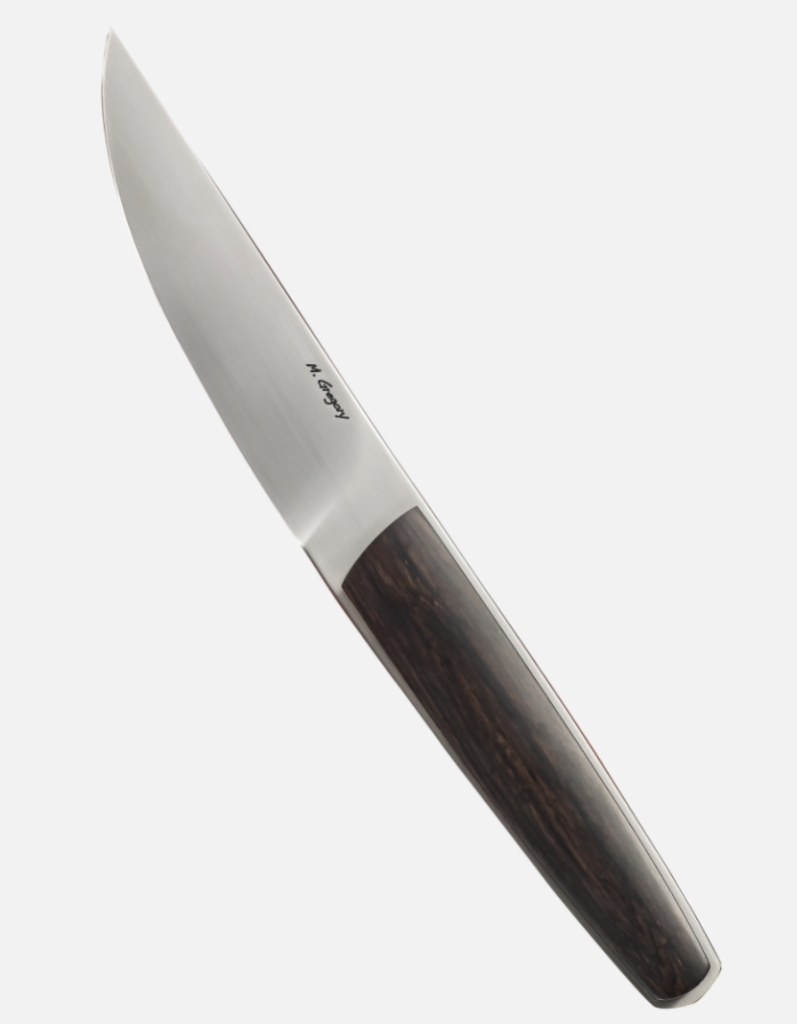
Matt Gregory’s LWT (Lum-Walton Tanto) is based on a design by Mike Walton inspired by the late Bob Lum. The African blackwood handle is polished to a mirror shine and tapers slightly in reverse of the tang, and has a delicate bulge in the center to provide for a subtle yet improved grip. The sheath (not shown) is by Jill Gregory.

“Vulpecula is a reliquary dagger,” Andrew explained. “It is inspired by the tradition of keeping objects, often hair or remains, in an embellished vessel. I found a fox tooth and had it sealed in a glass vial by a friend. I then built this dagger to house the vial as a reliquary.

“The blade fittings and handle are adorned with 24-karat gold inlay depicting a large fox, its skull and paw prints. The hardware is torch-cut steel plated with gold that is brushed back. Vulpecula, the ‘Little Fox’ constellation, is set into the blade with blue diamonds.

“It was a combination of aesthetic and functional choices that made me choose blackwood for this piece,” he concluded. “The wood machines and carves well, so for this handle it was the ideal choice. The blackwood’s depth serves as a rich contrast to the bright gold used in small inlays to represent a starry sky and the fox prints as well.”

Tuominen built his Protector, or Suojaleijee, dagger with a 5-inch welded damascus blade of 1080 and 80CrV2 carbon and 15N20 nickel-alloy steels, a guard of Nicorros (a copper/nickel alloy), African blackwood handle, and a handmade leather sheath with stainless clip. The blade is 7 inches and overall length is 12 inches. “It’s a custom order for an American collector,” he noted. “I used African blackwood because it’s black and more stable than other black-colored woods.”

SOURCES

While African blackwood remains protected, it can be found through various sources. However, Abel has a warning.

“I stocked up at a Rockler store a few years ago,” he remarked. “I’m not looking forward to finding another supplier. I believe the demand is outpacing the supply, and as conservation efforts increase, as they should, so will the price.”

Kelly Vermeer Vella em-
ploys African blackwood
and sterling silver for the
handle of her dagger. The
blade is a damascus of
1075 spring and 15N20
nickel-alloy steel.

Hall searches eBay for African blackwood and makes his selection based on what is available. Pricing, he says, runs $20 to $30 for a handle block or set of scales. While Pekka often sources his African blackwood from European knife shows, he also checks the internet for block-size pieces. Meers has had success with retail suppliers and finds a broad range of dimensions.

The custom knifemaker and the consumer alike have taken a new interest in African blackwood, and that fascination is not likely to fade in the near future.

What is a Drawknife? Three Examples

Whether for bushcraft, carving, or just straight woodworking, drawknives are handy tools that range quite a bit in size, function, and style. There are large drawknives to peel bark or hew small logs, as well as models for specialty purposes such as coopering or making chair seats. There even used to be specialty drawknives for shaping round handles small in diameter for brooms, rakes, and other implements.

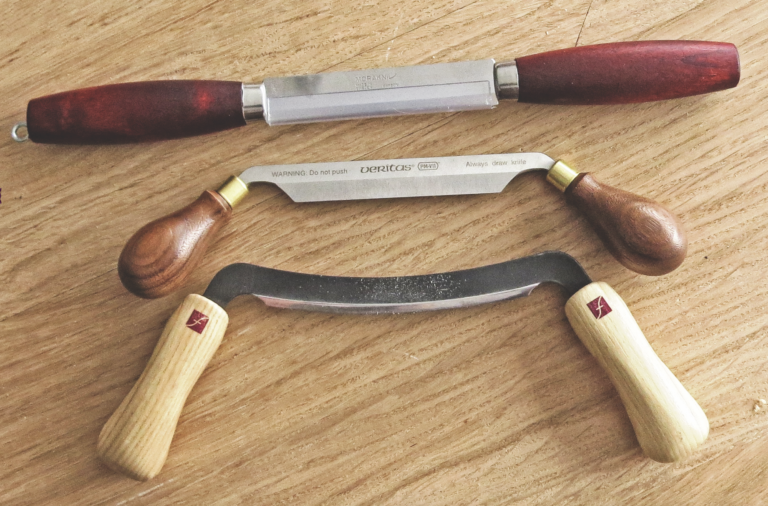
Three small drawknives for carving and crafting are the focus this time: the MoraKniv Classic wood splitting knife, Flexcut Drawknife, and Veritas Drawknife. They are great because they are relatively compact and portable, and help comprise part of what you could call a portable rustic tool kit.

DUAL BEVEL

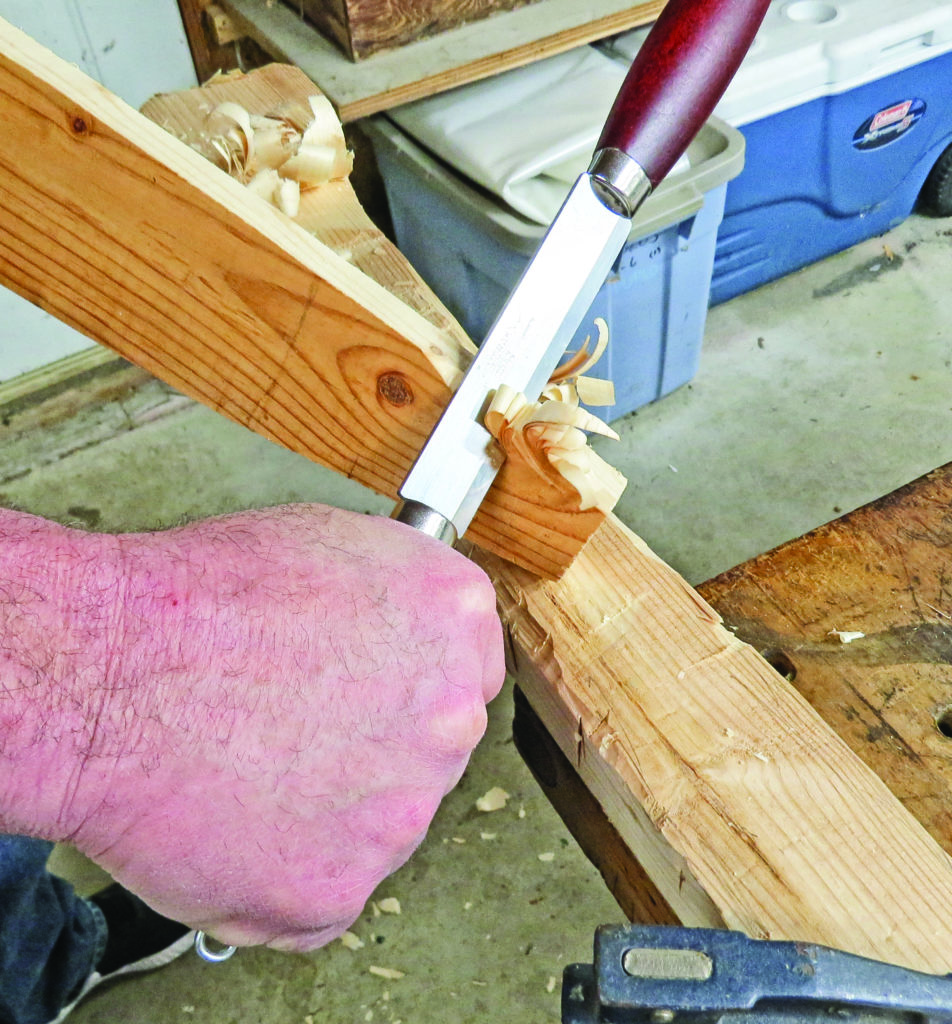
I know, right off the bat the MoraKniv Classic is called a wood splitting knife and not a drawknife. I thought this model would be interesting to test because it departs from the regular one-bevel blade geometry. The handle positioning is straight, giving the tool a compact configuration for transporting. It also comes with a sheath.

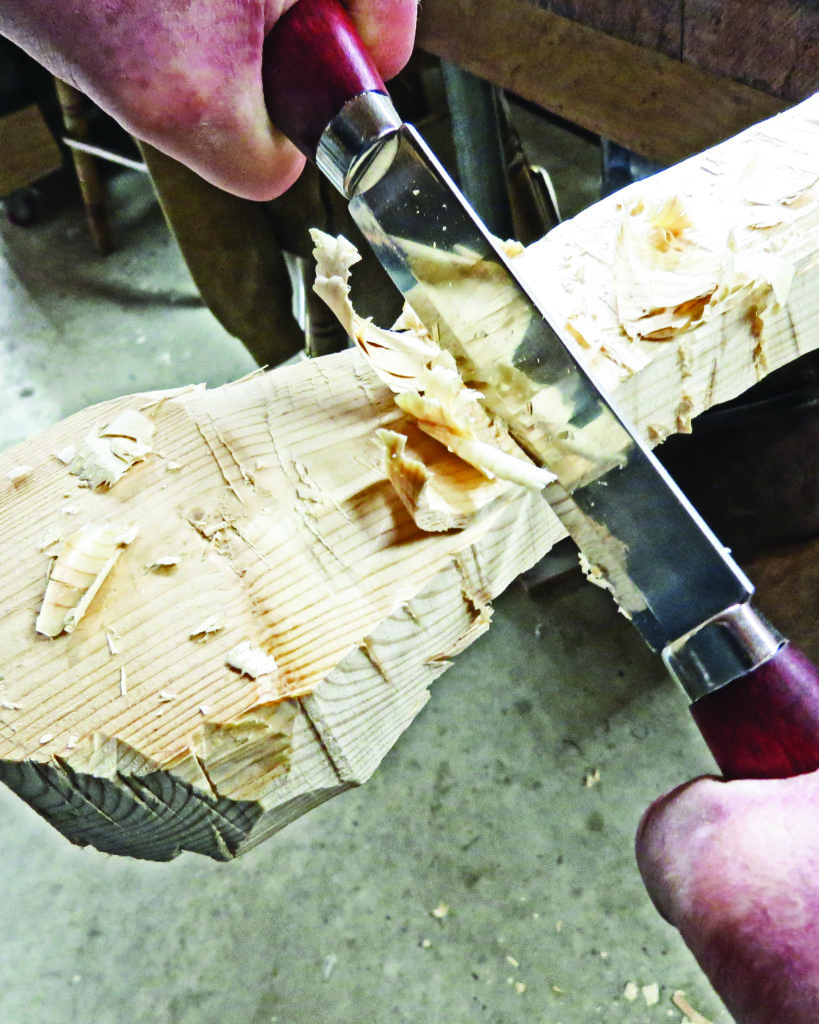
The author uses the MoraKniv Classic wood splitting knife in a push-cut motion to perform a stop cut while contouring the grip on a paddle.

Over the years, I’ve seen many a bushcrafter try and find a way for a standard knife to act as a drawknife. You can do many bushcraft chores with the MoraKniv Classic, from spoon work to shaping a tenon on a stool leg. You can do some of the same things with a regular knife, but with a drawknife it can be easier.

The 4.5-inch carbon steel blade has a dual bevel. An advantage of such a bevel is it makes the knife more versatile. A disadvantage is you don’t have depth control on a cut like you do with a single bevel. Single-bevel blades provide control similar to using a woodworking plane or a chisel. You shear through the levels you need to and, once you establish your depth of cut, you can remove material without bogging down by using a bit of depth control. Given that the dual bevel is a Scandi grind, it makes control easier than, say, a grind with a micro and major bevels on both sides. Control is most certainly easier than, for instance, with a convex grind. In the end, it is no big deal. Having to control a blade only becomes a problem when its design is not conducive to the job at hand.

Having in-line handles and a dual bevel, the Mora allows use like a sheath knife. It adds to the tool’s versatility and saves time, as you don’t have to put one knife down and pick up the other.

For the most part, control affects how much energy you put into making the blade do exactly what you want. In the case of a convex-ground blade, if you want to make a long, straight cut at the same depth, you will expend more energy than you should trying to keep the blade from “porpoising” (that is, front to rear bouncing of the blade). The alternative is simply getting used to making shorter controlled cuts more frequently.

The Classic cuts extremely well. Due to the straight handles and dual-bevel blade, you can switch and use it like a sheath knife in a split second.


WESTERN TRADITIONAL

Flexcut has a variety of tools covering chip, relief, and decoy carving, just to name three. The company also has a couple of drawknife styles. The Flexcut Drawknife is more of a traditional Western version. The 5-inch blade is 1095 carbon steel with the bevel brought to a mirror shine.

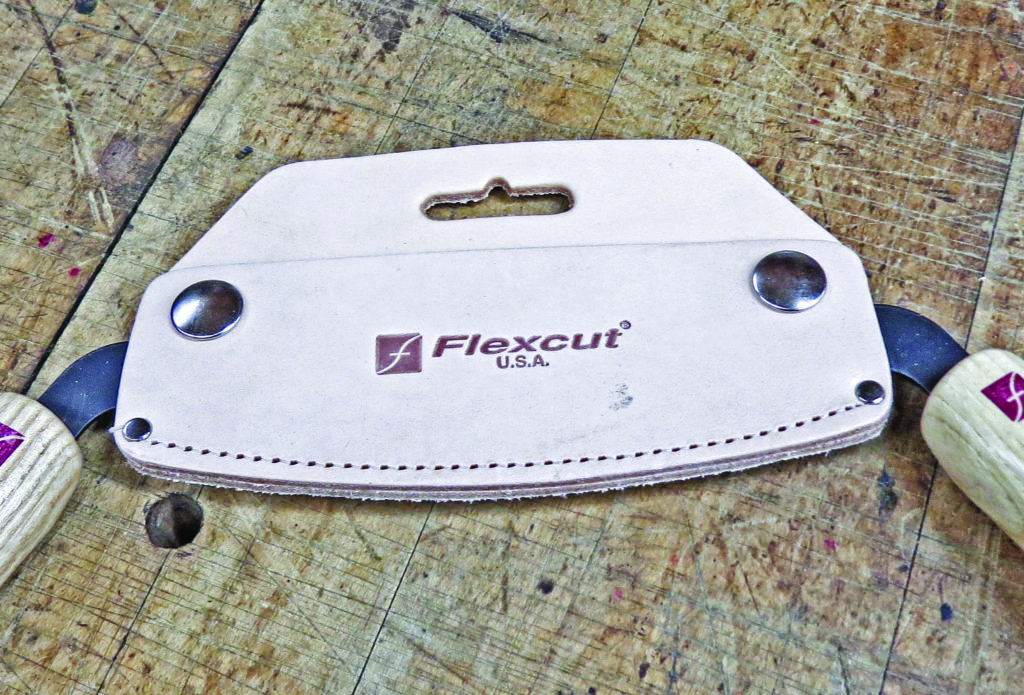
The Flexcut comes with a well-made sheath. It is always nice to have something protecting the edge—if not for safety’s sake, for that of preserving the edge from accidental harm.

Right out of the box, this thing is wicked sharp. It comes in a leather case with a peg-hole loop. It has a curved blade, which gives it a natural tendency to skew in a leading edge cut. If you haul the spine up a bit on your cuts, it will make more of a scraping action for a hollowing effect. It is a thin blade and not suited for hogging off large amounts of wood at one time. It is great for detailed jobs like the subtle contours you might find in a canoe yoke.

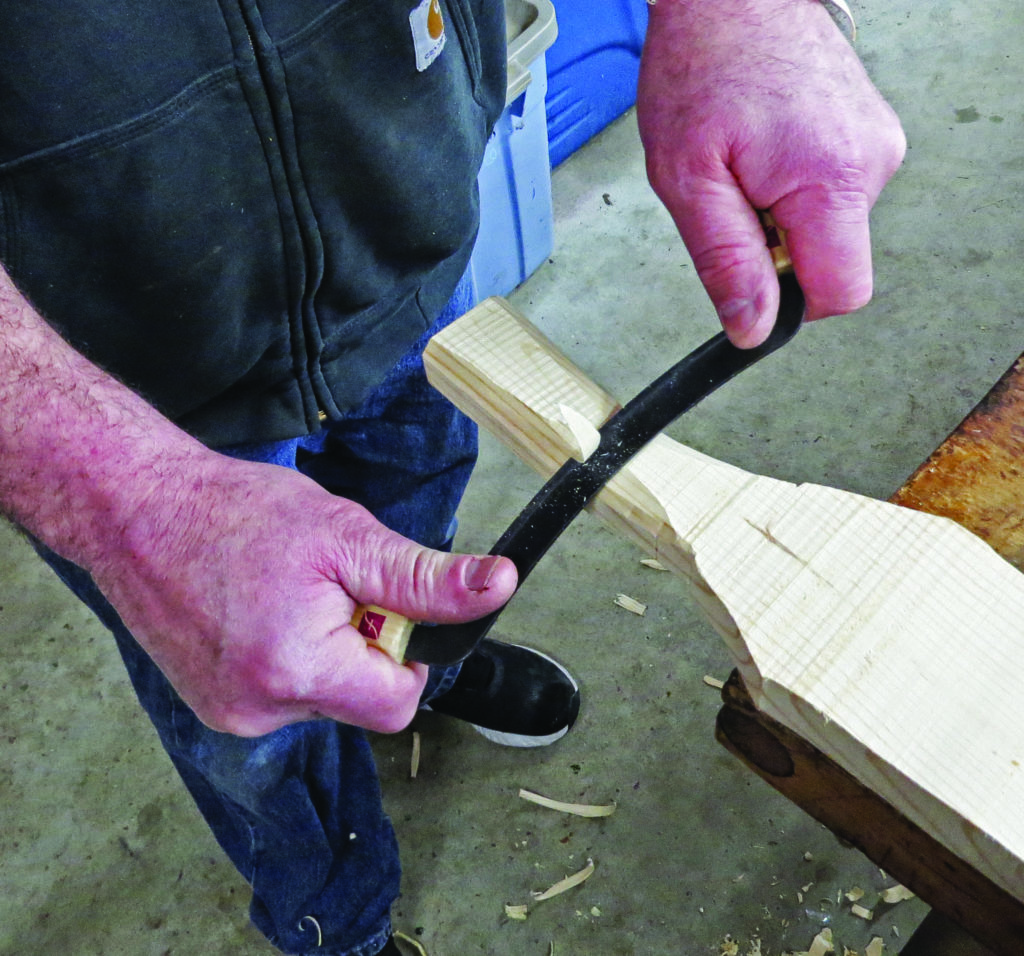
Using the Flexcut Drawknife, the author shapes the handle for a flat-board atlatl. The efficiency you gain using a drawknife is hard to beat for control and energy.

Such a small drawknife is a good tool not only to create art but to make utilitarian items. Given its Western-style handles, it doesn’t make a streamlined package for carrying in a pack like the Mora does, but it still has very little bulk and weight. The arched blade can be sharpened with a flat stone, though I find sharpening it with a small handheld stone and using a dynamic sharpening method easier. The Flexcut Drawknife is the kind of tool that suits the creative mind.

HOB-KNOBBER

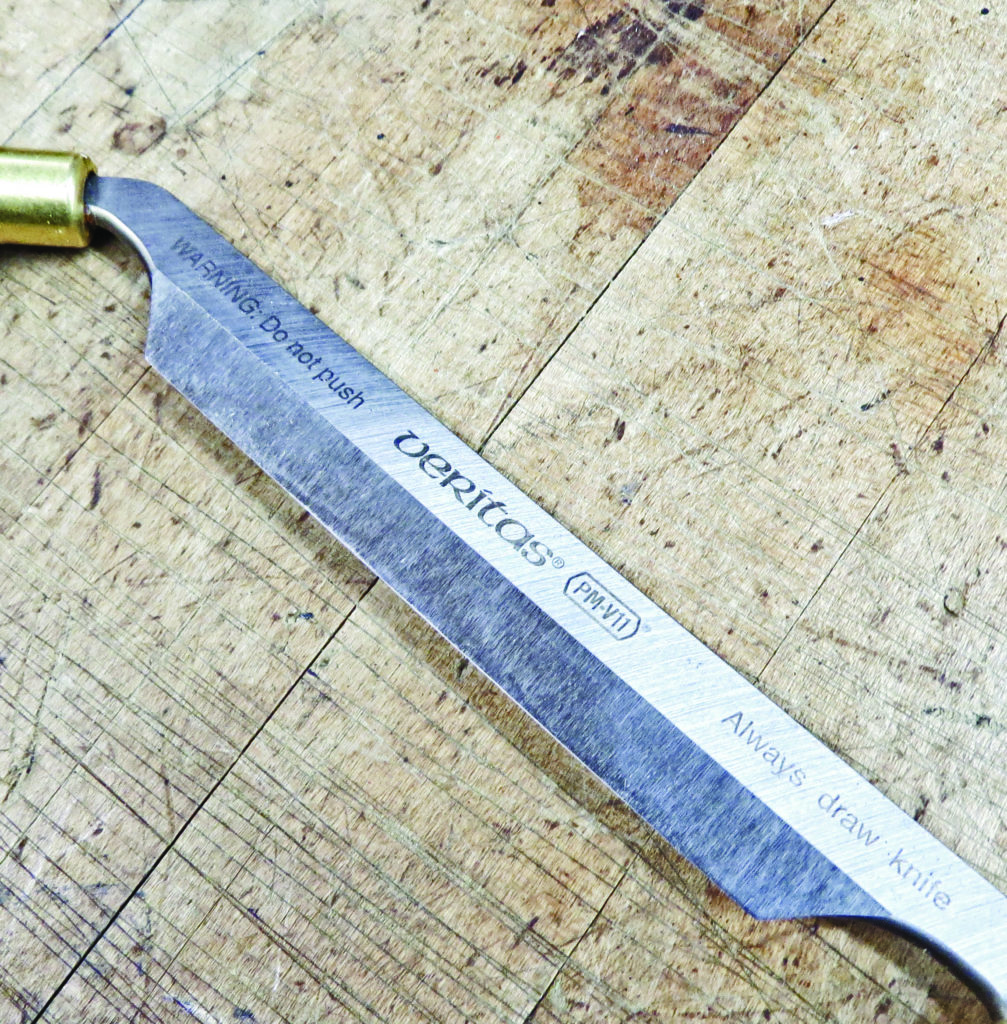
The Veritas tool company manufactures the last of the test drawknives in Ottawa, Canada. Sporting a 4-inch blade, it is a small carving-style model. Steel is PMV-11, a stainless with a Rockwell hardness of 61-63 HRC. Veritas made the switch from traditional tool steels like O1 and A2 to up cutting performance and edge retention. A case for the knife sells separately.

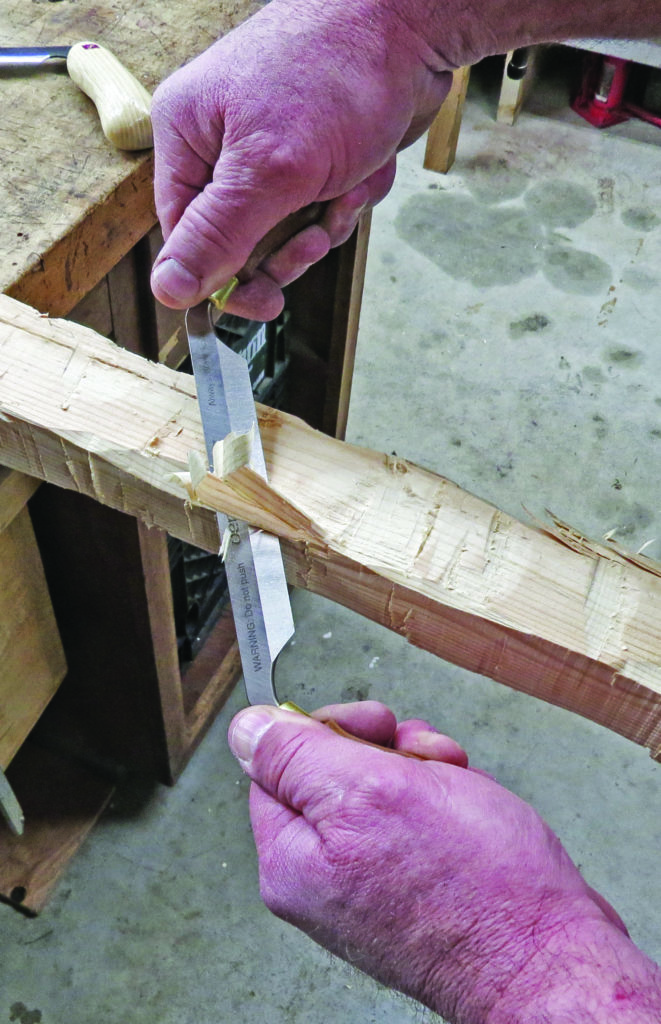
The Veritas Drawknife’s 20-degree angle cuts aggressively and you have complete control with the well-shaped handles. Here the knife is skewed compared to its cutting path. Skewing the knife provides a leading edge to the cut, reducing resistance

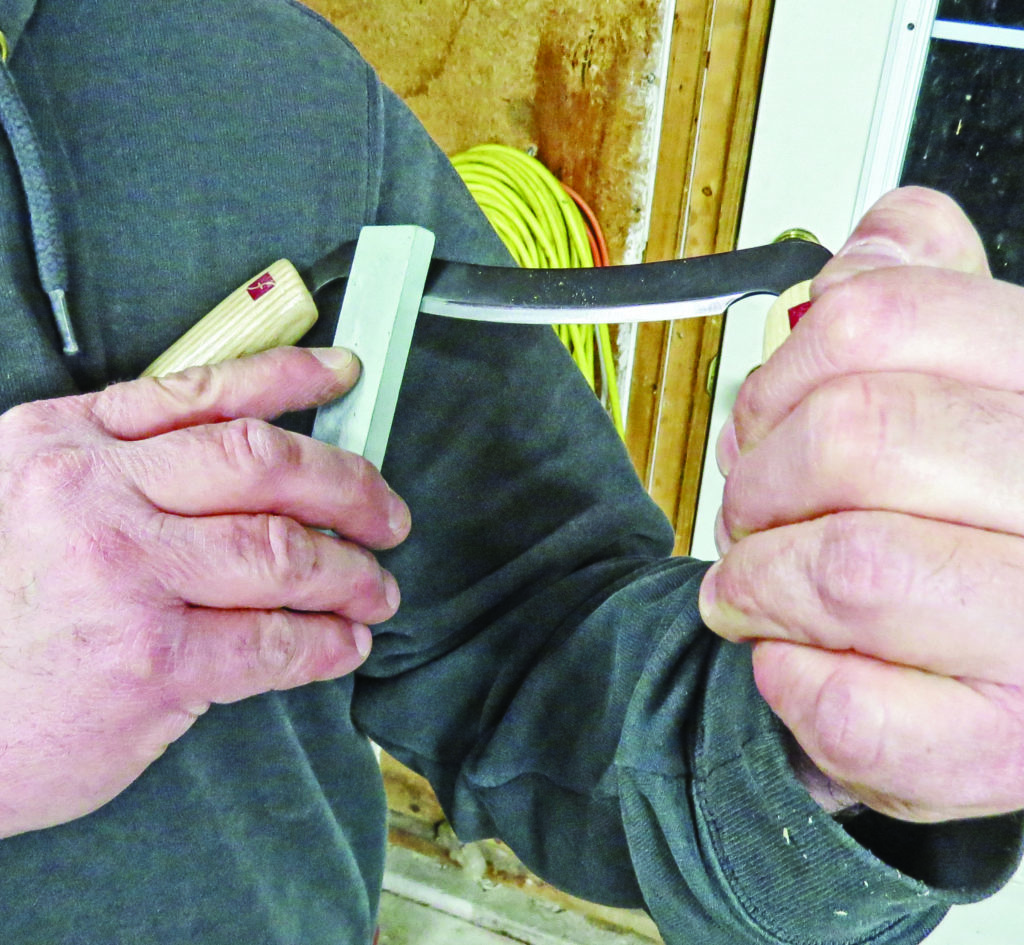
The company’s technical information says the bevel is ground at 20 degrees. To sharpen the Veritas, be sure the sharpener is of a flat design. Given the knife’s size, you can sharpen it in either a dynamic or a static style*. To cover/sharpen the entire bevel, you will need a flat surface. There is no micro bevel on the Veritas, though that’s not to say you can’t apply one. However, if you want to keep it original, you will need to cover the bevel.

The angling of the handles is a traditional Western style, though they have more of an elongated knob shape to them. The shape helps reduce fatigue. Because of the handle angling the Veritas does not offer as compact of a carry as the Mora, but the .125-inch-thick blade makes it a bit sturdier user than the
Flexcut. Handle material is torrefied maple. Due to the kilning process, the material has a greater stability to it without the use of chemicals. At the top of each handle is a brass ferrule.

The author stated he has been known to push a drawknife to make a quick cut. The Veritas Drawknife clearly warns not to do that. At a 20-degree bevel, you take a chance of damaging the edge if you were to catch and roll it.

It is a good-looking product and out of the box is ready to work. It is the most expensive of the review knives, yet is not so much more that you wind up scratching your head. A drawknife like this can be put to work doing a number of things limited only by your imagination. Veritas promotes it more as a carving tool and actually shows it making a decoy in the company’s marketing media.

Staying within the bounds of this tool, I can’t think why you couldn’t get chores done or entertain yourself by making pieces of art with it. Keeping you busy in the woods and not necessarily only during a survival situation promotes better mental health. It is a great little package and a good tool—I just think the company could include the sheath. When you hold the knife you see where the extra cost is as the precision work shows in the fit and finish.

EXPLORING OPTIONS

Once you leave the big city behind, in order to thrive you must know how to make what you need. Many of the tools you carry will depend on what you plan on doing. If you’re building up a getaway spot, you might need to build items for the camp. When planning to build a more substantial base, you will need more tools. Again, it all depends on what you plan on doing. A good drawknife can greatly increase your cutting and carving options—not to mention that being able to use two hands greatly reduces fatigue. If you haven’t tried a drawknife yet, I highly recommend doing so.

*Static sharpening is when the stone is stationary, and dynamic is when the stone is moving.

A trick to sharpening drawknives both in the shop and field is to brace one handle against your armpit or chest. After bracing the knife, simply use a dynamic sharpening method with a small stone running parallel to the edge.

The Latest EDC Multitools

People Who Like to be Prepared Will Love the latest EDC Tools

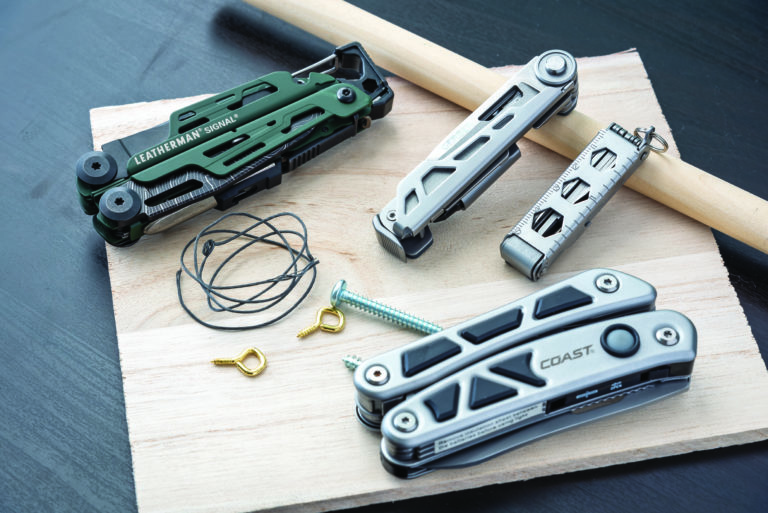
Knife guys love gadgets, fix-it people love gadgets and DIY-ers love gadgets, so it’s easy to see why multi-tools do so well in the knife market. Though not knives per se, they off er more versatility than just cutting ability by offering on-board tools. With broader appeal than knives, multi-tools have a further reach and encompass more markets, too. They appeal to folks who like to be prepared.In addition to DIY-ers, campers, hunters, fishermen, hikers, mountain bikers and anyone who enjoys outdoor activities benefits from owning and using a multi-tool. It performs in-fi eld repairs on equipment when you do not have access to regular tools.  It can mean the difference between bowing out of a camping trip because of equipment failure, or performing an expedient in-field repair or adjustment and carrying on with your adventure. As with knives, advances in multi-tools have made them stronger and more user friendly and versatile.


FLASH in the HAND: Coast’s LED150 multi-tool 

When you think of multi-tools, what immediately comes to mind is a pliers-based tool with little fold-out implements nestled inside the handle. Truth is, multi-tools can take on any form as long as they incorporate the implements necessary for field-expedient repairs and adjustments.

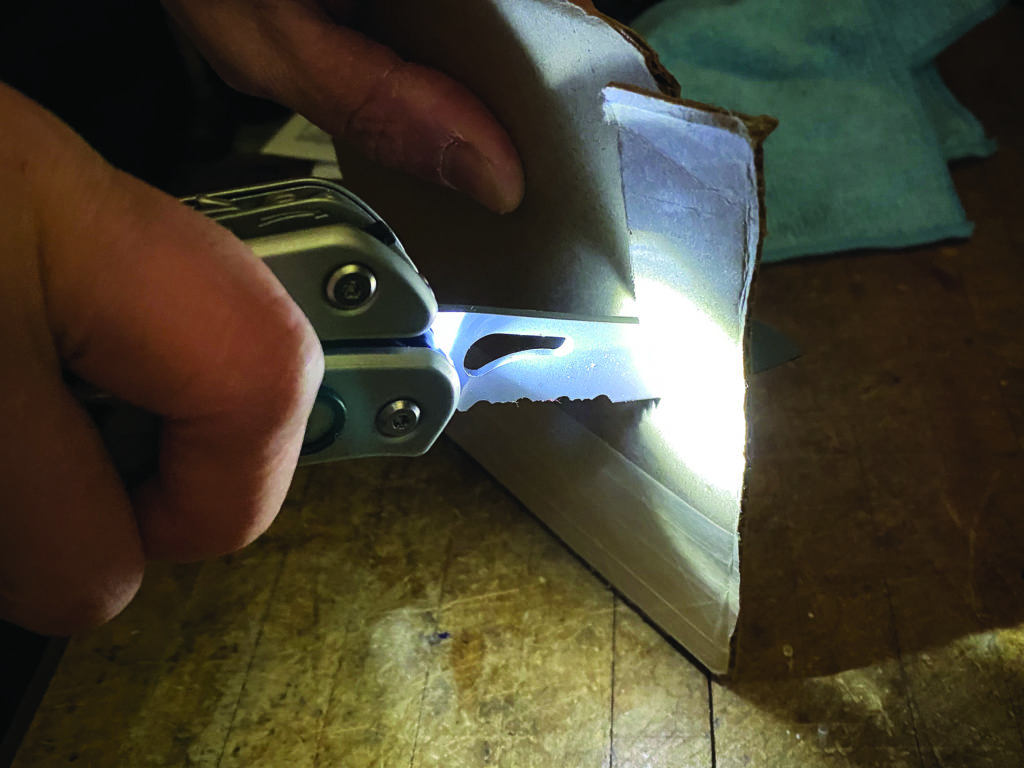
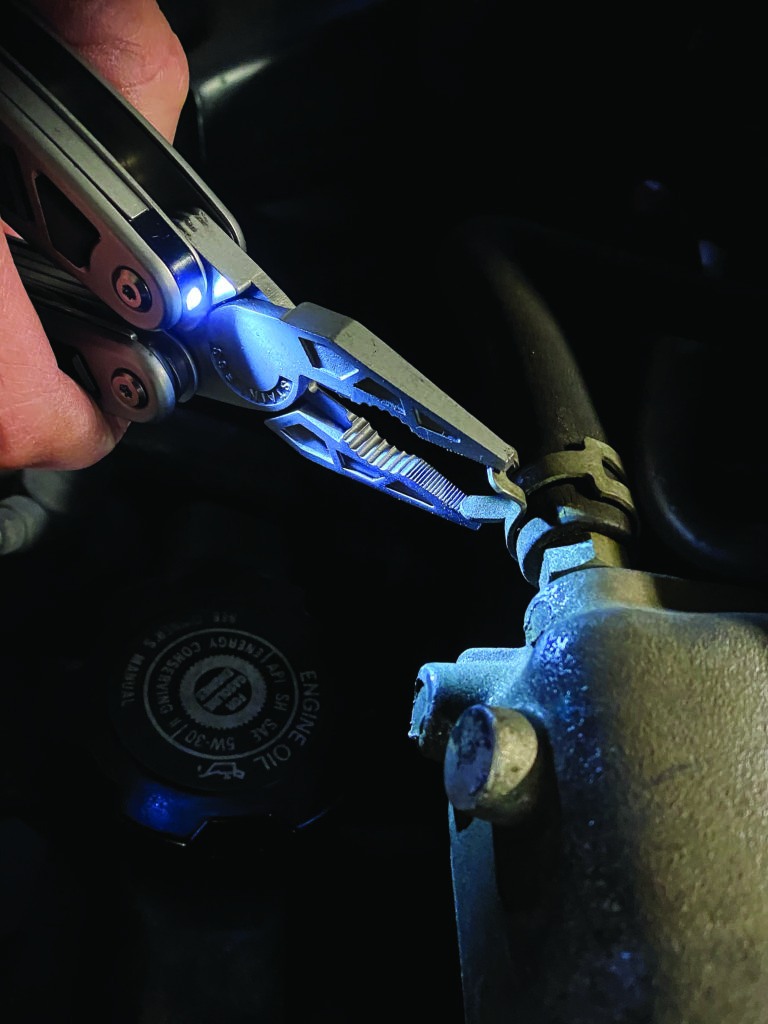
At first glance, Coast’s LED150 multi-tool might appear like any other pliers-based multi-tool, except for one thing: it incorporates not one but two LED lights. One LED is on the pliers jaw end and the other is on the partially serrated end of the knife blade. This way, you can confidently work in tight and dark spaces with confidence thanks to the illumination. The lights are activated by a recessed push button located on one side of the handle. Press once to activate the light by the main blade. Press again and the light turns off and, at the same time, the light on the pliers jaws end turns on. Press again and the jaws light turns off. With the multi-tool closed, you can use either light as a stand-alone flashlight, further expanding the multi-tool’s versatility. The lights are powered by two CR1616 lithium button batteries. The batteries replace easily.

The light on the end of the Coast LED150’s handle illuminates what you’re cutting.

The pliers jaws have different gripping surfaces for smaller objects and larger nuts/round objects. The jaws themselves are spring loaded, which helps to open them by spring tension, reducing hand fatigue. When closed, all the fold-out tools are easily accessible: a partially serrated main blade that works on a linerlock, spring-loaded scissors, large and small flat-head screwdrivers, can opener, Phillips head screwdriver and the pliers jaws—most all the common implements necessary for field repairs and adjustments.

The handles are aluminum and feature raised hard rubber for a non-slip grip. The LED150 has a good heft and the heavy-duty build will withstand normal use. The sturdy ballistic nylon belt pouch has a fabric-fastener flap closure. Manufacturer’s suggested retail price (MSRP): $49.  

One of the LED lights on Coast’s LED150 multi-tool shines on the pliers jaws end so you can effectively work in dark areas easily without the need for a separate flashlight.


AFFORDABLE SOLUTION: Gerber’s Armbar

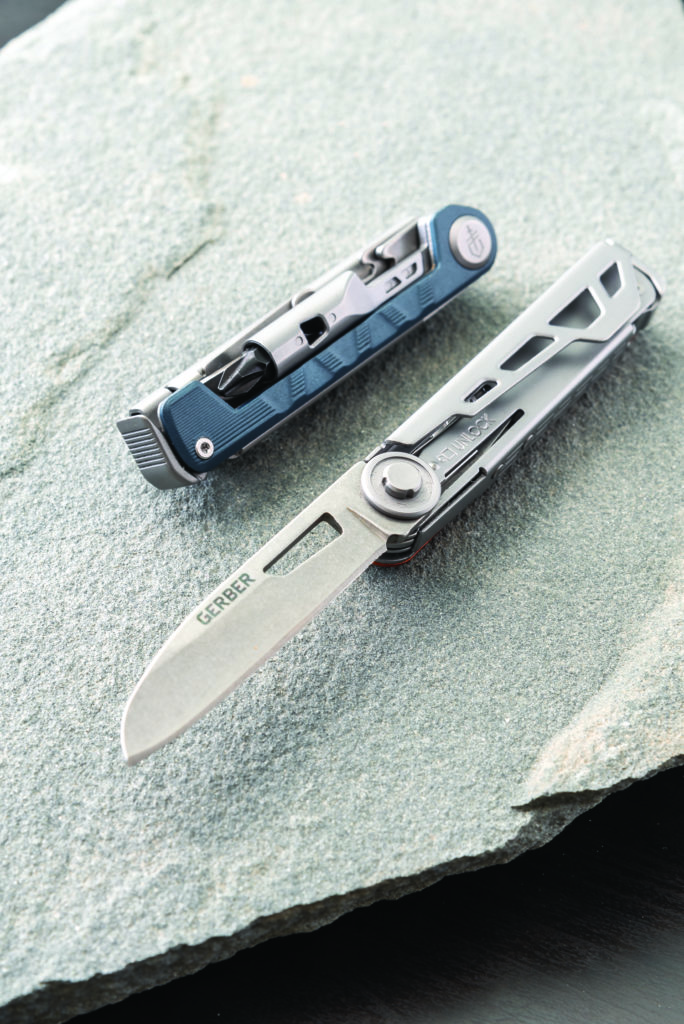
Gerber’s Armbar series incorporates the fold-out implements of pliers-based multi-tools like the Coast LED150—minus the pliers. Sometimes, you just need the versatility of screwdrivers, a knife blade and scissors. About the same size as a large multi-blade pocketknife, the Armbar Drive features seven on-board fold-out tools: 2.5-inch plain edge sheepsfoot blade with opening hole and framelock, 2.5-inch extension driver with a double-sided bit of Phillips and flat-head screwdrivers, a prybar, bottle opener, hammer, scissors and awl.

The Gerber Armbar Drive features a sturdy main blade. The entire package has about the same dimensions as a medium-sized traditional pocketknife.

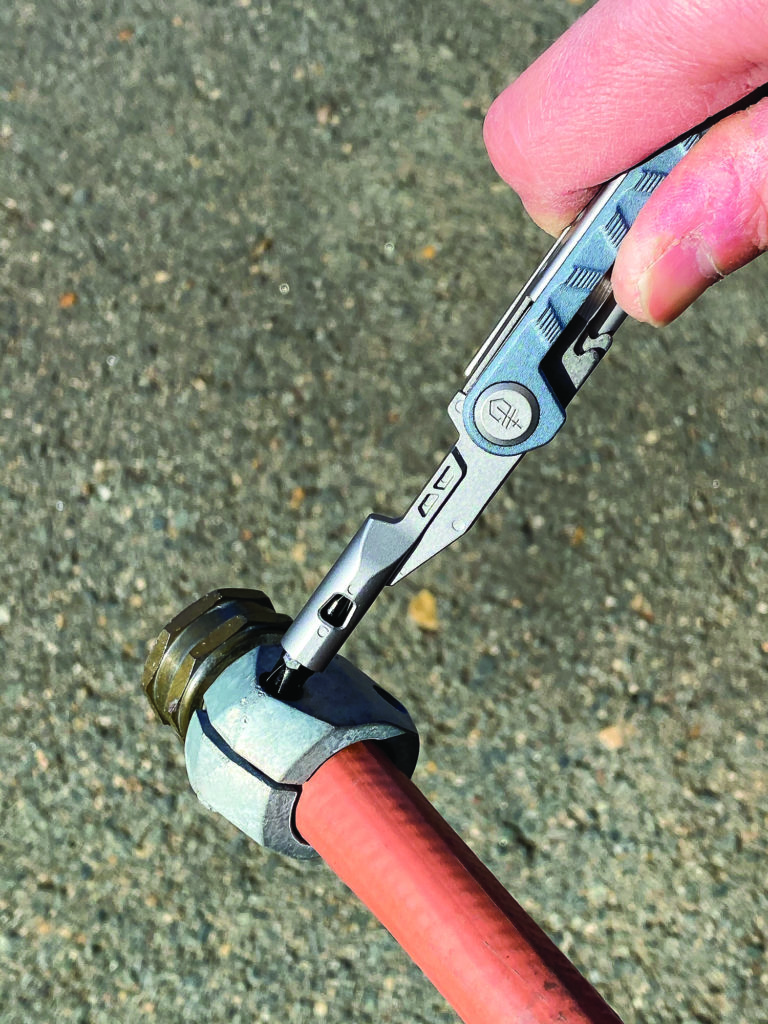
The extension driver has a magnet that holds the double-sided bit and allows for fast flip-over when transitioning to different screws. The driver socket can accept aftermarket quarter-inch drive bits, too. Hence, you can customize your Armbar Drive just about any way to fit your tasks. The spring-loaded scissors provide enough blade length for cutting coupons, stray threads and duct tape. The plain edge sheepsfoot blade thumbs open easily like any lock blade. The blade is mostly exposed even when closed, but the metal channel protects it from damage and you from accidental cuts.

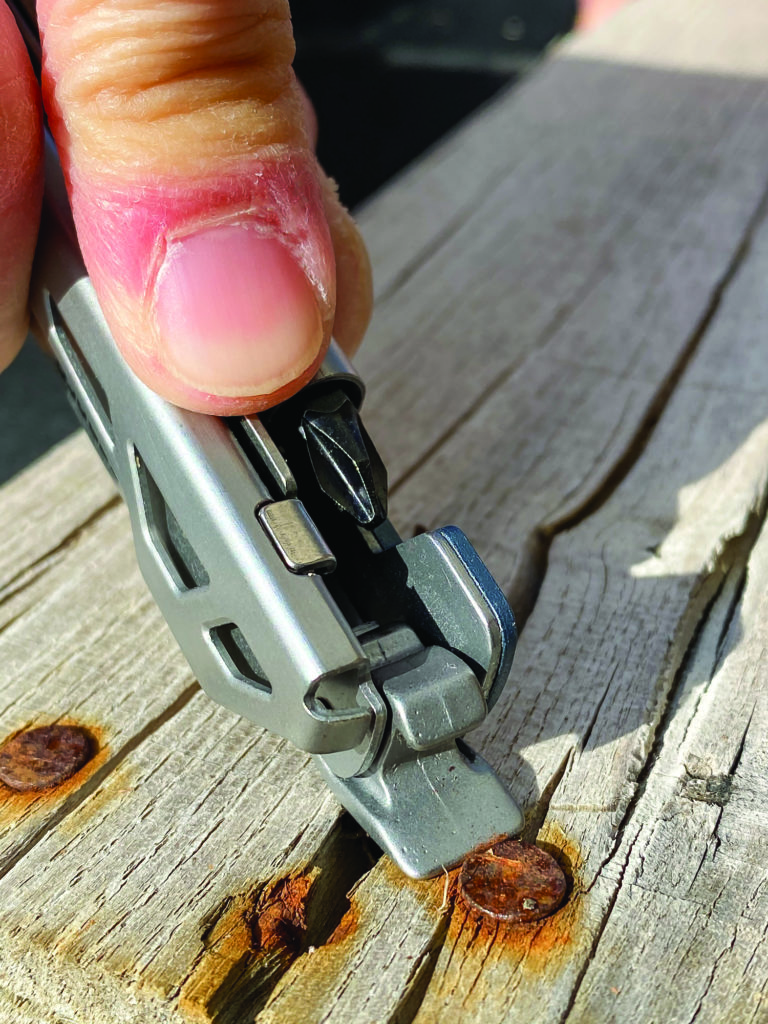
Perhaps the neatest implement is the combination hammer/prybar/bottle open-

er, which in the closed position is in the hammer mode by default. The squared-off back end takes care of light hammering. The prybar function is rather limited as you’re not going to get a ton of leverage. However, if you need staples removed or to pry open a casing and such, it does the job. 

A fold-out prybar/bottle opener on the Gerber Armbar Drive performs light-duty prying when needed, saving the blade tips on your standard knives.

One thing I wish Gerber would have included is the ability to lock the screwdriver in the fully open as well as the 90-degree position. When you torque down with the driver, your hand may move and this will cause the screwdriver to fold a bit. Also, when you use the tool in the 90-degree position, you apply more torque. Having it lock in the 90-degree position would make it easier to use—if not lock in both positions, then a strong detent and a half stop, like a slip joint, would be better than nothing. The form factor permits easy carry in your pocket, toolbox, glove box or a backpack.

At 3.1 ounces the smallest multi-tool in the Armbar line, it comes in an aluminum handle anodized in a choice of urban blue, orange or onyx. With an MSRP of $39, it presents an affordable solution to a typical pliers-based multi-tool by reducing bulk and weight—that is, if you don’t need pliers.

The screwdriver tool on the Gerber Armbar Drive is easy to manipulate. The magnetic socket allows you to flip the double-end bit over, as well as use most any aftermarket quarter-inch driver bit.


TINY TOOLBOX: Utica Minimaster

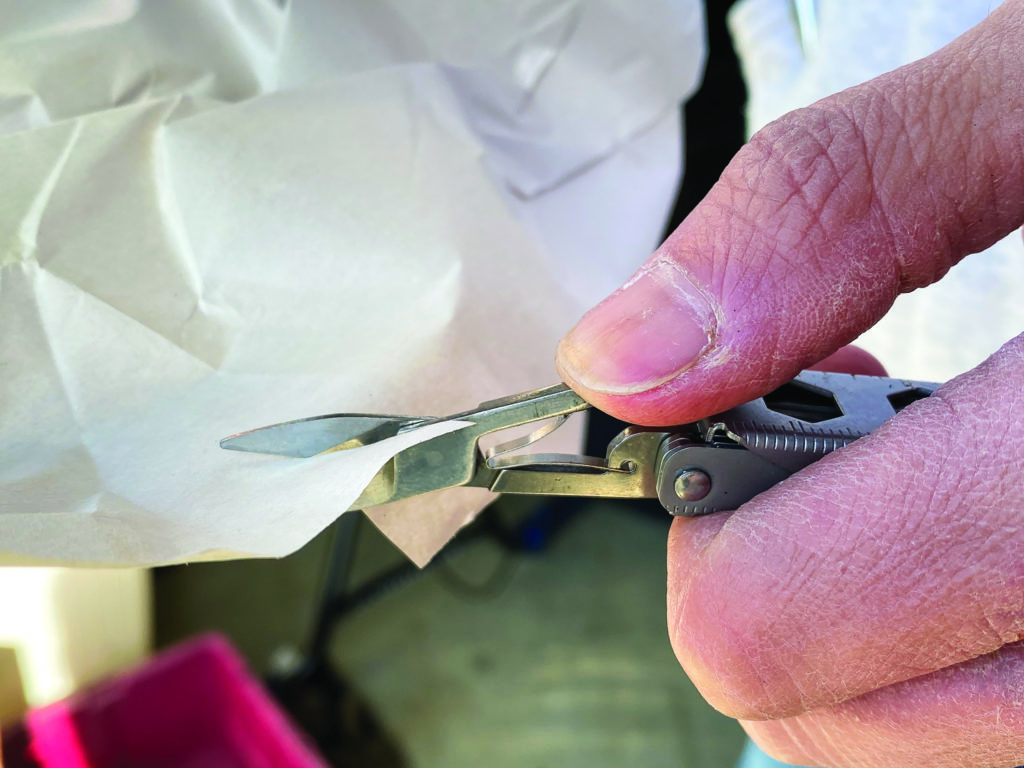
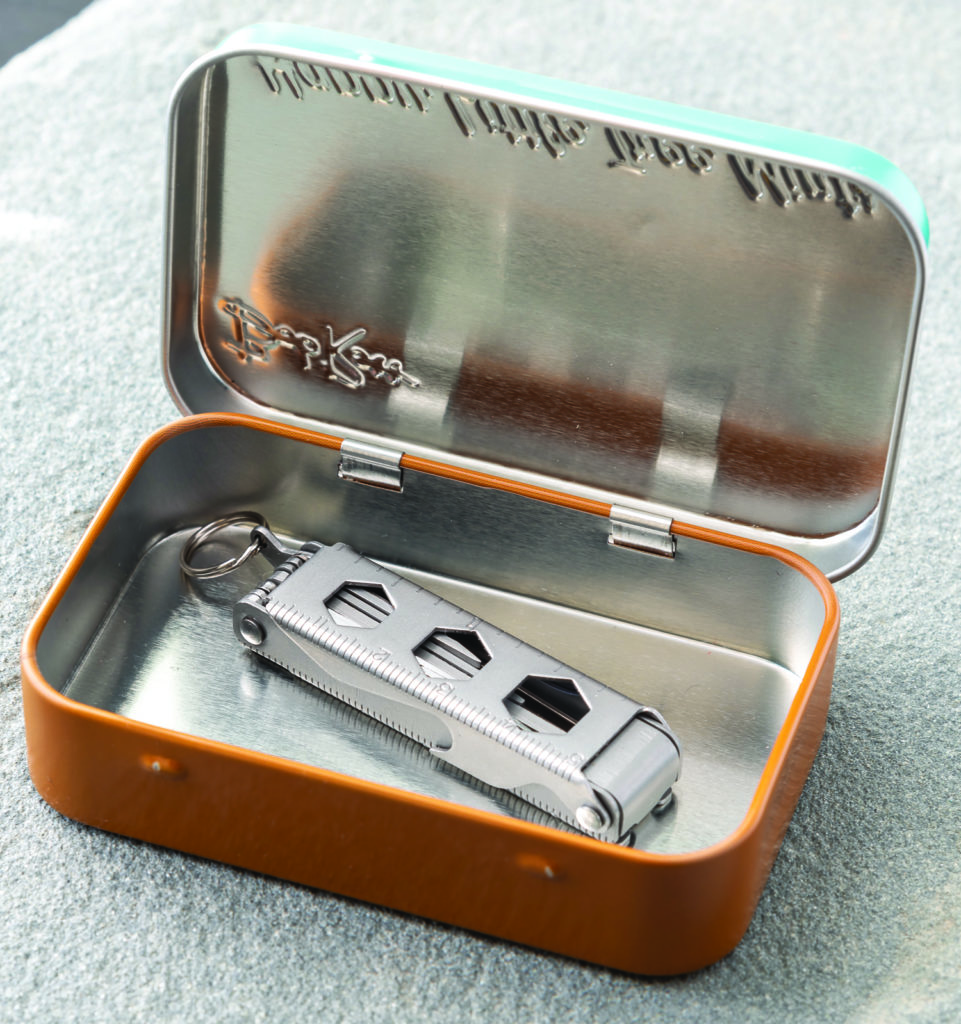
Utica primarily manufactures knives for hunting and tactical but also makes multi-tools. The Minimaster is the smallest multi-tool of the test bunch. It’s loaded with many small fold-out implements: a pair of tweezers, large and small flat-head screwdrivers, a Phillips screwdriver, scissors, fingernail file/cleaner, knife blade, bottle opener, and ⅜-, 11/32- and ⅝-inch wrenches integrated into the folding cover. Made in the USA, it’s roughly the size of a Victorinox Classic, so it fits well on a keyring, its preferred method of carry.

The scissors may be tiny on the Utica Minimaster but it is effective.

None of the tools lock in the open position. You pull one out and then close the cover; the cover held closed by your grip acts as the lock so the tools won’t fold on you. The tweezers are pretty neat—this is the only compact multi-tool I know of that integrates one. The tips are not textured or ground precise like regular tweezers, so grasping some things with it can be a bit difficult, though having one is better than not. As for the rest of the tools, they are handy to have and definitely will work in a pinch when you need them.

The ultra-compact size of the Utica Minimaster makes it a great candidate for improvised tin-based survival kits.

The only down side to the Minimaster is the hinged cover. It needs to detent tighter in the closed position, as the sample sent to us for review had a tendency to open partway easily. This could present a safety issue, especially if the tools open inadvertently. MSRP: $60. There’s also an imported version that retails for $9.95. Same construction and implement selection, except the multi-tool is made overseas.

MAPPED MULTI-TOOL: Leatherman Signal

When it comes to an article about multi-tools, I would be remiss to not include Leatherman Tool Group, the brand that pioneered the concept. It is the originator of the pliers-based format, and still among the best of them after all these years.

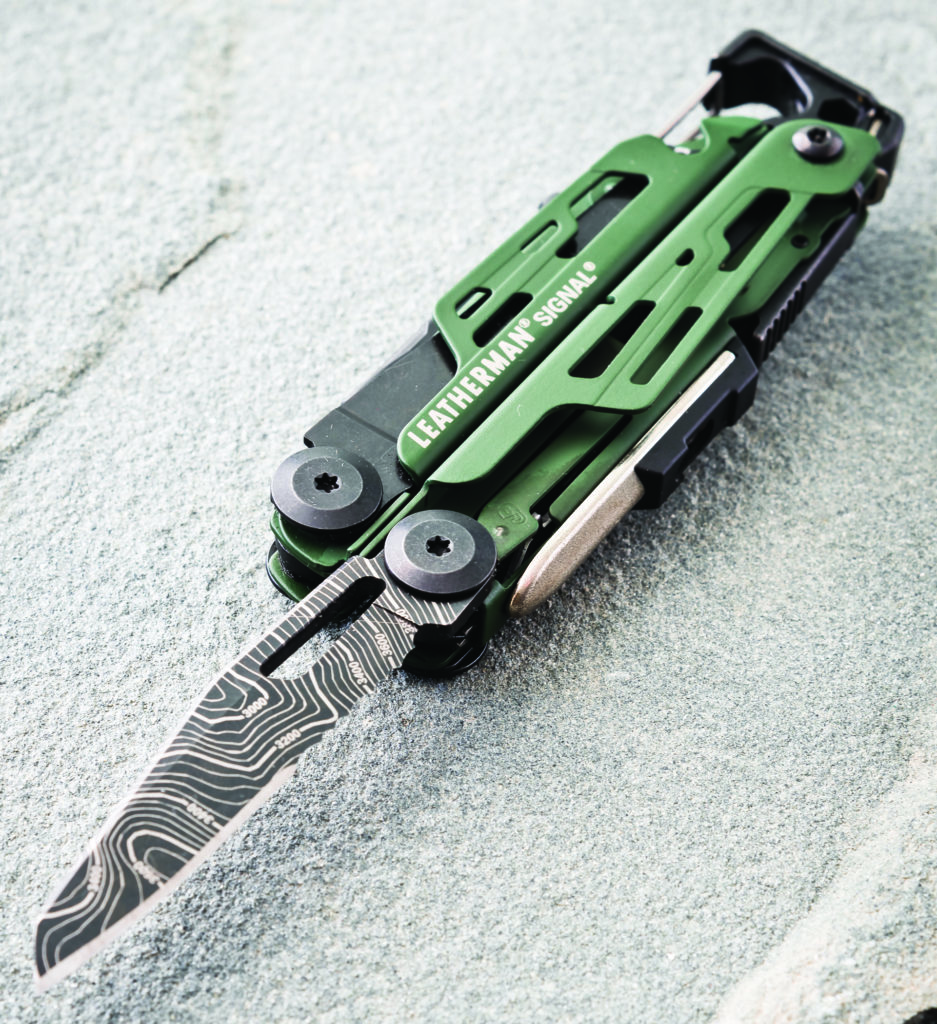
The main blade of the Leatherman Topo Signal features a map-topography laser etching, hence the multi-tool’s name.

The limited-edition Topo Signal is a variant of Leatherman’s Signal multi-tool. The Signal was developed specifically for the outdoor enthusiast, integrating features like a ferrocerium fire starter rod, saw, survival whistle, diamond sharpener and hammer, along with standard Leatherman features such as pliers jaws with replaceable cutting inserts, fold-out driver with reversible bit, awl and can opener. There’s also an integrated quarter-inch-bit socket built into the hammer portion of the handle, which will accept any standard quarter-inch bit driver.

The main blade is a partially serrated 420HC stainless sheepsfoot pattern that locks open via a linerlock. The blade features an oblong opening hole, while the partial serrations eat through tough and fibrous materials with ease. The blade has a map-topography-style laser etch, hence the name. The distinctive appearance is pretty neat and fits in perfectly with the outdoor theme. Speaking of outdoor theme, the Topo Signal comes in a nice dark green Cerakote coating for the aluminum handles and pliers jaws, fold-out implements, and all-black hardware.

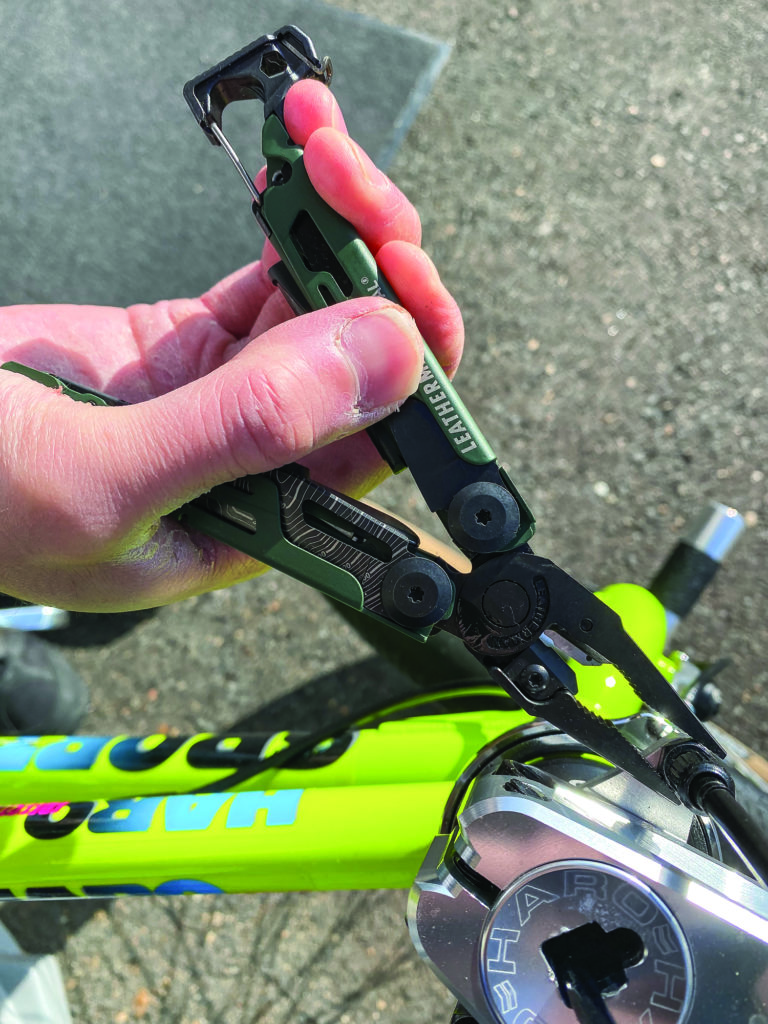
Making on-the-spot repairs and adjustments are a multi-tool specialty. The needle-nose pliers of the Leatherman Topo Signal works great at accessing small nuts in cramped places.

Each one comes with a nice ballistic nylon belt sheath with  button snap closure. It has a steel pocket clip. There’s also an integrated carabiner in the hammer portion so the tool can be clipped on a D-ring, etc.

Comparatively speaking, a Leatherman multi-tool is engineered better than most on the market. MSRP: $119.95. Country of origin: USA. It is the most expensive of the test group, but the quality of the manufacture and fit and finish justifies the price.

Advertisement

Must Read Articles

Read this before you make a knife

Knifemaking 101 – Read This Before You Make a Knife

  by Wayne Goddard My experience has taught me that there's nothing like digging in and getting started. I've often said the hardest part of the...
how to forge damascus steel

How to Forge Damascus

Advertisement
Advertisement