



Return Of The Tactical Fixed Blade

0

It Never Disappeared, But The Tactical Fixed Blade Has Long Been Overshadowed By Other Knives. Now It’s Back In A Big Way.

When developing a new product or their version to enter an established market, most industry professionals rely on product lifecycle management. The basic version has four steps—development and introduction, growth, maturity/stability, and decline—and applies to most all products that are sold, including custom knives. 

However, trends must be accounted for in the cycle with the added step of saturation, a step that is particularly applicable to custom knives. As a result, the lifecycle for custom knives has five steps: development and introduction, growth, maturity/stability, saturation, and decline.

The most recent example of saturation in the tactical folder was seen over the past 10 years, even though the knife began to take off in the early 1990s. Tactical folders featuring new openers, stabilizers, bolsters, and handle materials were all the rage. The growth was spurred when both makers and collectors who had been respectively making and collecting other types of folders came into the market. 

Prices spiraled upward and it seemed the good times would never end. In the case of tactical folders, market maturity and saturation occurred almost simultaneously. The decline began when those who overpaid for a tactical folder hoped there would be the next collector to sell or “flip” the knife to. They found out that the next collector wasn’t there and they were now the owner of a knife on which they would never recoup their investment.

Custom Knife Copies

When a collectible or a market gets hot within custom knives, makers want to join that market sector, as the path has already been made. I have always been struck by the dichotomy of many of the custom knifemakers I have dealt with over the past 30 years. Many perceive themselves as artists, yet are quick to embrace a trend or flat-out copy other makers’ work.

A case in point: those who make their versions of knives created by BLADE Magazine Cutlery Hall-Of-Fame® member Bob Loveless. Without a doubt, his custom knife designs are the most copied in the world. Why don’t those who reproduce Loveless designs build their own designs instead? The answer is simple: the path has already been made.

Without a doubt, the custom knife designs of BLADE Magazine Cutlery Hall-Of-Fame® member Bob Loveless are the most copied in the world. Why don’t those who reproduce Loveless designs build their own? The answer is simple: the path has already been made. (SharpByCoop image)

It is much easier to copy someone else’s work and then compete in that very saturated market. With few exceptions, most such makers get lost in that market as more and more enter it every year.

The idea of a custom knife is that it is made by a craftsman who can incorporate your ideas into a piece that will meet your needs, and not just create a copy of a knife others made famous.

Rising Tides

The aphorism “a rising tide lifts all boats” is associated with the idea that an improved economy will benefit all participants. This is exactly what has happened to the custom knife market over the past decade. In other words, the high prices many tactical folders received over the past 10 years made other market sectors seem like a bargain. Meanwhile, the prices realized for every other sector of the custom knife market also rose.

Currently, this is obvious in three sectors: slip joint/multi-blade folders, chef’s knives, and forged blades. As the realized prices for these knives continue to increase, the market is becoming saturated. 

The commonality with the three markets is that all are seeing booms in numbers of makers. Conversely, they are not bringing enough additional collectors to support the makers in the increasingly saturated markets. Makers are quicker to pivot to new markets than collectors, primarily due to the makers’ ability to potentially increase their sales.

Cyclical Nature Of Knife Trends

The custom knife market is a circle. The top half is folders and the bottom half is fixed blades. We knife enthusiasts have all witnessed the circle moving from folders to fixed blades. Almost without exception the reason it moves is because of pricing. Most custom makers do not know their position in the market. Subsequently, they do not price their knives commensurate with the market. The custom knife buyers will sort that out. 

Bob Terzuola made this tactical fixed blade for a U.S. Army Ranger before the Ranger’s deployment in the Gulf War in 1991. One of Bob T’s modified M18 Combatmaster models, it features D2 blade steel.

Demand and value for the money will separate those makers who continue down the market sector path and those who do not.

One of the trends I noticed at BLADE Show 2021 was the reemergence of tactical fixed blades. Like most custom categories, tactical fixed blades never went away completely. Instead, they were just overshadowed by the more popular market sectors.

The Meaning Of Tactical

Sometime around 1995, the marketing term tactical was created to identify the look of a particular knife market sector. The concept was a simple one: it was primarily the look of the knife. The blade had a non-reflective finish that could be bead blasted, tumbled, coated, etc. 

Unlike the latest iteration of tactical folders, if a tactical fixed blade had a damascus blade, it was a damascus bowie, fighter, hunter, etc. If the blade had a mirror finish, it was a presentation or art knife. The tactical definition indicated that if the knife had a guard, it also should feature a non-reflective finish. The handle material would be synthetic, that is, Micarta®, G-10, carbon fiber, etc. A natural handle material on a tactical knife would move the knife into another category.

Tactical fixed blades can range from practical to fantasy, neck knives to huge choppers. I bought my first custom tactical fixed blade in 1984, so I’m a fan! I am also a user and collector of knives from this market sector.

Today the advantage of the tactical fixed blade market sector is it offers knives for all budgets. The knives also offer the biggest steel selection of any market sector. Stainless, powdered, and carbon steels are all on the menu.

It will be on you to do your homework about what different steels will and won’t do for your tactical fixed blade. Rockwell hardness and heat treating will also come into play, as these knives are designed and built to be used. Hype is very pervasive in this market sector. This is why homework is necessary for the user/collector. Do not rely on the thousands of internet commandos and “experts” for your information. 

Experienced and entry-level makers alike in the market build tactical fixed blades that feature a blade and two pieces of handle material combined in a utilitarian design featuring a cool look that catches the buyer’s eye. With such knives be sure to check for unwanted sharp edges usually found in squared-off integral guards, etc., and also price. These knives should generally sell for $500 or less.

Options For Collectors

One of the trends the author noticed at BLADE Show 2021 was the reemergence of tactical fixed blades. A maker whose tactical fixed blades have always been in demand exhibiting at the show was Walter Brend (left). (Whetstone Studio image)

For custom collectors, numerous options are available dating back to the 1930s. To not step on anyone’s toes, I will say these are the tactical fixed blade makers I have or have had in my collection: RJ Martin, Rod Chappel, Bill Luckett, Bob Terzuola, GW Stone and Ralph Bone, and Cutlery Hall-Of-Famers Jimmy Lile, Dan Dennehy and Gil Hibben. There are plenty to choose from.

Before you start writing to the editor complaining about my glaring omission, I intentionally left Walter Brend off the list above. While I do have Walter’s work in my collection, it is not a collectible per se. The knife is in far from mint condition. It is the knife I have had with me since 1986. 

For high-end users, I can assure you it is the finest tactical fixed blade in the world. I do not make this statement lightly. Having handled more than my fair share of custom knives, I feel very confident in my statement. While I understand that most who buy Walter’s work put the knife in a collection, for those of you who own one of his knives and have never used it, more the pity.  

Buy The Knife For You

Whether you are looking for a good, solid budget-conscious user, a collectible, or the best the category has to offer, I recommend you check the emerging knives in the tactical fixed blade market. Do your homework to help with hype and enjoy using your knives. After all, that’s what they’re meant for!

Read More

Best Kitchen Knife Set To Upgrade Your Galley

Whether Three Pieces Or More Than A Dozen, A Great Kitchen Knife Set Can Completely Change How Work With Food.

Kitchen knife sets are extremely popular, and it’s easy to see why. They keep all your knives safe, easily accessible, and add a touch of style to your kitchen counter. It’s important to keep a few things in mind when shopping for a knife set, whether for the home or a professional kitchen.

The Block Is A Piece

When you see that a set is three, six, or 15 pieces, it’s important to remember the knife block itself will count as one of the pieces. So don’t fret if you think there’s a missing knife because there isn’t.

Get A Set That Fits

If you’re a parent looking for a good set of knives that will last and help cook the family’s meals for years to come, don’t feel like you need to spend hundreds or thousands of dollars on a set with dozens of specialty pieces. Sometimes less is more and that six-piece set might be the perfect one for you.

Follow The Maintenance Directions

Just because your butter knives go into the dishwasher doesn’t mean that your kitchen knives will necessarily need to as well. Follow the care instructions of your set carefully so you get the most out of your knives and don’t see rust spots start appearing on your blades.

Best Kitchen Knife Sets

Japanese, German, forged, and stamped. These are descriptors of our five best kitchen knife sets. Large sets, small sets. We made sure to select something for everyone with our list.

Calphalon 321

Calphalon 321

What’s better than an affordably-priced knife set? How about one with a sharpener built into the block itself. That’s what you’ll get with the Calphalon 321. This set includes half a dozen steak knives to go with an eight-inch chef’s knife, serrated utility knife, paring knife, shears, and santoku knife.

Made from forged high-carbon steel, the blades prove tough and are able to maintain an edge. And their full-tang construction adds balance to the knives. 

The wooden block features a built-in ceramic sharpener in the slots for the chef’s knife, santoku, and paring blade. This means that every time you pull one out of the block, it passes through the sharpener to maintain its edge. Another handy feature is the printed label on the end of each knife so you’ll know what you’re grabbing at a glance.

In totality, this is an excellent budget knife block. MSRP: $169.99

Buck 13-Piece Cutlery Set

Buck 13-Piece Cutlery Set w/Rosewood DymaLux Handles

Buck? On a list of kitchen knives? Oh yes, and the set is just as high quality as the company’s famous folders. By far, this is the largest set on the list.

The set features an 8-inch chef’s knife, slicer, two different paring knives, a spreader, serving/grilling fork, and six steak knives. Buck constructs the blades from 420HC stainless, except for the spreader, which is 410HC. Triple-rivited, the handles are durable and attractive.

There are two styles of handles. The Slate PaperStone is dishwasher safe while the Rosewood DymaLux is hand-wash only. And everything safely stores away in the wooden knife block.

This set is lovely and meets the lofty expectations you would expect from any other Buck product. MSRP: $599.99 for the Slate Paperstone, $749.99 for the Rosewood DymaLux.

Henckels Statement 12-Piece Kitchen Knife Set With Block

Henckels Statement 12-Piece Kitchen Knife Set With Block

A leader in kitchen cutlery, Henkels‘ set hits home run. 

The set features single-piece stamped stainless steel blades that are full tang and precision-honed to give them a perfect edge right out of the box. The polymer handle also provides an excellent grip and is easy to clean. The wood block fits all the pieces which include an eight-inch chef’s knife, santoku knife, paring knife, bread knife, sharpening steel, and a set of six steak knives.

This set covers nearly every scenario you’ll encounter in a home kitchen, and it’s also the most affordable set on our list. MSRP: $119.95.

Mercer Culinary Genesis Six-Piece Knife Block Set

Mercer Culinary Genesis Six-Piece Knife Block Set

This kitchen knife set from Mercer Culinary has the most unique appearance of the items on our list, but it is so much more than just looks. 

The glass block allows for a 360-degree display of the knives. The windows are attached on either side of the beechwood block which holds five knives.

This set of forged knives includes an 8-inch chef’s knife, paring knife, bread knife, boning knife, and utility knife. All of them are made from high-carbon German steel ground to a 15-degree edge and outfitted with a Santoprene handle for comfort and grip. 

It’s a conversation piece. It’s a quality knife set. It’s an absolute bargain for the quality of the product. MSRP: $156.

Shun Classic 5-Piece Starter Block Set

Shun Classic 5-Piece Starter Block Set

Shun makes professional-caliber knives, and its Classic Five-Piece set maintains that standard. 

There are only three knives included in the set, but they are of the highest quality. The 8-inch chef’s knife, paring knife, and utility knife are all made from 68 layers of stainless damascus cladding around a VG-Max core. They all tuck away in the Slimline Bamboo Black knife block, along with a honing rod. The trio of Japanese-style knives has ebony-finished Pakkawood handles with a full tang. 

A unique aspect of this set is there are more slots than knives. The block comes with two extra slots, one of which is designed for shears. This gives you to tailor your tools to your needs in the kitchen. 

Even though this is the smallest set on our list, it is the priciest due to the time and craftsmanship that went into every element of it. MSRP: $593.

Read More
First Look: Gerber Dual-Force

0

Gerber Has Reinvented The Multi-Tool With The Dual-Force. Incredibly Strong And Versatile, The Dual-Force Is As Rugged As It Gets

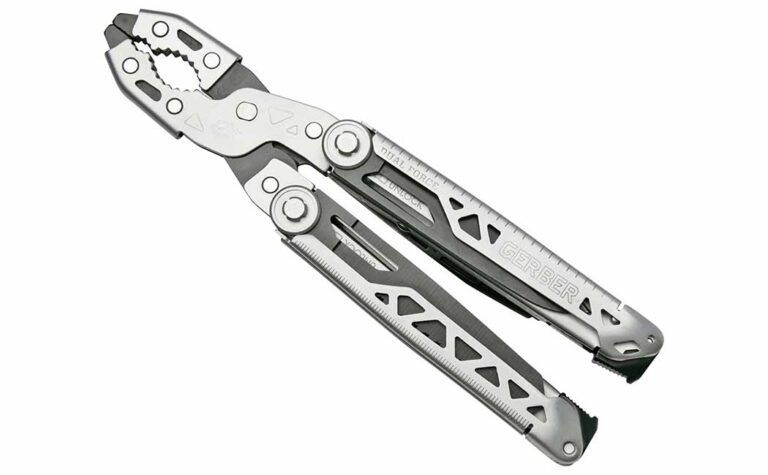
The multi-tool is beloved by many for its flexibility and ability to be useful in many situations. Gerber Gear has ripped up the book on the multi-tool and reinvented the genre with the 12-tool Dual-Force. 

It is a monster. The Dual-Force is similar to other multi-tools in terms of the implements within it, but the strength level has been ratcheted up. The screwdriver and saw are beefier than in a Swiss Army knife. The driver is 3.25 inches and features Center-Drive tech so it feels and operates like a standard driver.

The Dual-Force has a dozen different tools.

The tool also includes a 3.25-inch plain-edge blade, which rivals that of many standard pocketknives. 

But the star of the show is the pliers. There are so needle-nose pliers here. The Dual-Force features a robust set of jaws with a twin-position dual-lock design and large teeth for more control. The jaws dwarf the pliers offered on most other multi-tools. 

The Dual-Force brings the quality you expect from Gerber Gear and an innovative design that makes it stand apart from all the other choices on the market today. MSRP: $110.

Editor’s Note: This post was written by Mike Ableson.

Read More
 

10 All-American Knives

On This Independence Day We Here At Blade Want To Celebrate All-American Knives

America is celebrating its 246th birthday today. In all those years the knife has been an integral tool to the growth of the United States, and, as such, we here at Blade want to celebrate it on this beautiful Independence Day.

These are 10 beautiful All-American knives to get you in the holiday spirit.

MTech USA 440 Steel USA Design Pocket Knife

MTech USA 440 Steel USA Design Pocket Knife

The name may be a mouthful, but the knife is a beaut. MTech has made a spring-assisted folder out of 440 stainless with an aluminum handle. The handle is decorated with an American flag design and the opening text of the Constitution. This drop point has an MSRP of $15.95.

Berg American Flag Themed Bowie Knife

Berg American Flag Themed Bowie Knife

Custom-made to order by knifemaker Dan Berg, this Bowie is 11 inches long and can be made out of 1095 carbon steel or AEBL stainless. The metal is etched with a patriotic star pattern and the handle has a flag pattern made out of Micarta or cast resin. This beautiful knife has an MSRP of $300.

Mega Knife American USA Flag Spring-Assisted Folding Open Pocket Knife 

Mega Knife American USA Flag Spring-Assisted Folding Open Pocket Knife 

A bright, bold American flag on the handle shines bright on this piece from Mega Knife. The stainless steel blade features a blackwash finish, and the pocket clip lets you bring this knife everywhere. This folder has an MSRP of $19.95

CobraTec Knives Small  CTK-1 Cerakote American Flag

CobraTec Knives Small  CTK-1 Cerakote American Flag

This CobraTec double-action OTF knife featured a striking American flag handle made of aluminum alloy married to a 2.75-inch D2 steel blade. You can pick between four different blade styles (drop point, tanto, dagger, Wharncliffe), and all but the Wharncliffe have serrated options as well. It features a nylon sheath, pocket clip, and a glass breaker at the end of the handle. This comes with an MSRP of $149.99.

Modern Artisans 3-Inch Pocket Knife With American Flag Stonework

Modern Artisans 3-Inch Pocket Knife With American Flag Stonework

This 3-inch folder from Modern Artisans has a stunning damascus blade made of a core of VG-10 wrapped in 32 layers of stainless. The brilliant American flag handle is made from lapis lazuli, red coral, and mother of pearl. This knife has an MSRP of $132.99.

Victorinox Super Tinker

Victorinox Super Tinker

From the makers of the famous Swiss Army Knife, Victorinox has made an All-American medium pocket knife that has the option of an American flag design and not just the classic red. It features 14 tools including two blades, three screwdrivers, and scissors. It has an MSRP of just $43.99.

Orklo Knife Custom Handmade Damascus Folding Pocket Knife

Orklo Knife Custom Handmade Damascus Folding Pocket Knife

The twist damascus pattern steals the show for this model from Orklo Knife. The three-inch, HRC 55-58 blade is connected to a four-inch red, white, and blue handle made of dollar sheet and inlaid with a star mosaic pin. This piece has an MSRP of $69.99

Cabela’s Flag Tanto Blade Folding Knife Two-Pack

Cabela’s Flag Tanto Blade Folding Knife Two-Pack

Two knives are always better than one, and Cabela’s has an affordable patriotic combo pack. Both knives have blades made of 8Cr13MoV steel. The larger blade is three inches long and partially serrated. The shorter of the two is 2.75-inches long and features a flat edge. The combo has an MSRP of $19.97.

KCCEdge 8-Inch Two-Piece Large American Flag Throwing Knife Set

KCCEdge 8-Inch Two-Piece Large American Flag Throwing Knife Set

For something fun, you can go wrong with these throwing knives. These KCCEdge knives feature a top-to-bottom flag design that was embossed printed on the blades. What could be more fun than watching Old Glory fly through the air? These could be yours for the MSRP of $14.

Red Dot Laser Engineering “The Patriot” Folding Knife

Red Dot Laser Engineering “The Patriot” Folding Knife

Red Dot Laser Engraving, a veteran-owned business, has made a stainless steel folding knife with an American flag engraved on both sides of the blade and an aluminum body. The design won’t wear off so you’ll be able to proudly show it off for decades. The MSRP is $17.76.

ASR Outdoor Patriotic Locking Pocket Knife

ASR Outdoor Patriotic Locking Pocket Knife

Adorned with the head of a bald eagle on the handle and atop the the American flag on the handle, this knife from ASR Outdoor screams American pride. The steel alloy clip point opens with a nail nick, and the whole piece is eight inches in length. It also comes with a collectible display box. The MSRP is $14.99

First Look: Kershaw Parley

0

Kershaw’s New Parley Is A Unique EDC Knife That Is Fun To Use And Built To Last. The Cleaver Blade Makes It Stand Out From The Crowd.

Kershaw has once again made a fantastic folding knife that is beautiful, functional, and exciting. The new Parley features Kershaw’s non-locking, slipjoint design and a cleaver-style blade made of 7Cr17MoV stainless with a satin polish. It opens with a nail nick and features a lanyard hole for excellent portability.

Kershaw Parley in the closed position

While the polished black Micarta handle is smooth to hold and feels good in the hand, the star of the show is the blade. The 3.1-inch cleaver is inspired by the hulking kitchen meat cleaver. It can handle kitchen tasks but is far more nimble than its bigger brothers.

As a folder, the cleaver blade works great handling small tasks outside and anything in and around the house. The plain edge cuts true and gracefully and is easy to sharpen and maintain. With an MSRP of just $39.99, it’s a bargain that should absolutely be snatched up.

Editor’s Note: This article was written by Mike Ableson.

Read More
5 Best Knife Sharpeners [2022]

0

Whether A Stone, A Rod, Or An Electronic Device, There Are Many Quality Knife Sharpeners Out There. Here are five of the best.

There are all sorts of knife sharpeners out there. Some can fit in your pocket. Some are full-on appliances. Some are literal stones. No matter the type of sharpener you use, it’s important to make sure you get the best bang for your buck.

That’s why we’ve scoured the world of sharpeners to show you a variety of the five best out there today. Whether you’re looking for something quick and easy to give your knives a once over or a sharpener the pros use, there’s a knife sharpener out there for you.

Chef’s Choice Model Trizor 15XV 3-Stage Professional Electric Knife Sharpener, Platinum

Chef’s Choice Model Trizor 15XV 3-Stage Professional Electric Knife Sharpener, Platinum

The first one on this list could be called the Cadillac of home knife sharpeners. Named the best knife sharpener by numerous organizations including America’s Test Kitchen, the Trizor 15XV by Chef’s Choice is a beast of an electric knife sharpener.

It utilizes three separate stages to sharpen, hone, and polish your knives. It sharpens using proprietary diamond abrasives and then stropping discs to polish. It even adjusts between 15 and 20 degrees so you can sharpen multiple types of knives.

Yes, this is made for chefs and their kitchen knives but it’ll sharpen your EDC knives just as well. It’ll even sharpen serrated knives too! While it can’t sharpen ceramic knives or larger outdoor blades like axes, it does pretty much handles any other edge in your home or workshop.

It is pricey with an MSRP of $179.99, but if you want to sharpen like the pros you won’t find a better option on the market today.

Sharp Pebble Premium Whetstone 2 Side 1000/6000 Waterstone

1000/6000 whetstone
Sharp Pebble 1000/6000 waterstone

I love sharpening my knives freehand. I find it meditative, fun, and refreshing. As more and more people look to whetstones as a way to sharpen their knives, there’s a glut of products on the market. 

This is the type of stone I’ve used for the last several years, and it’s an excellent entry point into whetstones. Sharp Pebble has made a quality stone out of aluminum oxide that can sharpen and polish your straight-edge knives.

Starting with the coarse 1000-grit side, and finishing with the fine 6000-grit side, you can give your knives the love and care they need to stay sharp and cut at their best.

Another reason I like this stone is its accessories. It comes with a bamboo base to keep the stone secure as you sharpen. And it comes with an angle guide if you’re not confident in being able to keep the angle steady as you grind away.

While I love using my whetstone, it can be a bit confusing to jump into at first. Luckily, popular Youtube Ethan Chlebowski goes over the most common mistakes people make while using a stone and how to avoid them.

At an MSRP of $40.99, Sharp Pebble has made an affordable stone and a great entry point for those interested.

WorkSharp Guided Field Sharpener

WorkSharp Guided Field Sharpener

Need a sharpener while hunting or camping? The team at WorkSharp has you covered with their Guided Field Sharpener (GFS). Smaller than your cell phone, the GFS is packed with features any outdoorsman can appreciate.

The sharpener comes with two stones of 320 and 600-grit diamond and a 20-degree angle guide so each pass counts. It also comes with two finishing options, a ceramic honing rod and a leather strop, to polish your blade. You can even remove the diamond sharpening plates to reveal a small storage compartment with a built-in broadhead wrench.

And did we mention it can sharpen straight-edge blades, serrated knives, and even fish hooks? It really can do it all outside for you. It even has a lanyard hole so you can carry it without worry about losing it on the trail.

At an MSRP of $34.95, you get so much for the price and the peace of mind that comes with buying something sturdy from WorkSharp.

KitchenIQ Edge Grip 2-Stage Knife Sharpener

KitchenIQ Edge Grip 2-Stage Knife Sharpener

If you’re looking for a sharpener on a budget, this little countertop sharpener packs a big punch. 

Available at numerous retailers, this sharpener from KitchenIQ is priced between $10-12 and will get your knives back to a sharp edge.

It uses two angled slots, one coarse (carbide) and one fine (ceramic), for you to pull your knife through. You hold it down with one hand and pull your knife through with the other. Pulling it through 5-10 times a side should be enough to reset the edge and polish it back to new.

Your sharpening time is seconds. If you’re looking for a sharpener that’s easy to use, doesn’t take much time, and gets your knives back to fighting fit, this is the sharpener for you.

Wusthof 9-Inch Honing Steel

Wusthof 9-Inch Honing Steel

The last piece on this list isn’t a sharpener, per se. Honing steels, or honing rods, are used to fix the small, microscopic imperfections that affect a knife over time. Using a honing steel will help get the edge back to where it was before but without removing material, as occurrences when sharpening.

A good honing steel should be used a few times a week while sharpening should be done a few times a year, and you can’t go wrong with this steel from Wusthof. From a company with more than two centuries of experience making knives, the honing steel is made from stainless and will help restore the edge of your kitchen knives. 

With a low MSRP of just $25, you can’t go wrong with a steel from one of the most trusted knife brands in the world.

Read More

Hunting Knife Sheaths: The Constant Companion

The Correct Sheath Is Pivotal To The Complete Hunting Knife Package. A Good Sheath Can Keep Your Knives Safe And Sharp For Decades.

The Correct Sheath Is Pivotal To The Complete Hunting Knife Package. A Good Sheath Can Keep Your Knives Safe And Sharp For Decades.

For the hunter in the field, a dependable and durable hunting knife is indispensable equipment, and it follows that the sheath that holds the knife must be equally up to the task.

Secure carry, protection for the blade and handle, easy access, and the ability to stand up to the elements and hard use are essential. While there is a variety of sheaths available and each one contributes something to the equation, the sheathmakers themselves have come to eye-opening conclusions as to the making and deployment of the correct sheath for the hunting knife. Personal preference is still a prime mover, but the basics make the difference between cooperation and catastrophe in the field.

“The best style for a hunting knife sheath is whatever the hunter wants,” explained veteran sheathmaker Paul Long. “Personal preference is very important. However, the knife that would best be described as a hunter would be best suited in a deep seat pouch with a loop that would carry relatively high on the belt. In most cases the deep pouch would preclude the need for a retention strap. For a double-guard hunter, a drop-loop belt sheath would probably be best with a snap strap for secure retention.”

Depending on the style of the knife, the guard often dictates the best pouch configuration. “I favor the pouch-type sheath, and the hunting knife generally has a single guard as opposed to a double guard,” related sheathmaker Paul Lebatard, who also has found success with his custom knives through the years. “I make a lot of doubles, too. You would have to make a snap-type sheath with a keeper strap, but on hunting knives with single guards the pouch type is always best.”

Three different styles of pouch sheaths by Kenny Rowe, from left: regular pouch, plain leather; strap pouch, floral hand carved; and full flap pouch, full coverage gator. (Kenny Rowe image)

A sheathmaker for over 50 years, Chris Kravitt zeroes in on the personal preference perspective. “First and foremost, it’s a matter of the configuration of the knife, and then if more than one style will work it becomes a matter of personal preference,” he observed. “My preference is to go with the pouch because it is easier to draw and resheathe the knife without worrying about straps.”

At the same time, Kravitt acknowledges varying hunting knife construction and its influence in sheath form and function. “If a knife has a double guard, it isn’t going to work on a pouch sheath, and if you have a knife with an integral handle, possibly,” he said. “Certain things don’t lend themselves to the traditional style, like when the blade is the widest part of the knife or there is no bolster or ricasso extending beyond the edge.”

Kenny Rowe, owner of Rowe’s Leather in Hope, Arkansas, adds another option on the hunting knife sheath. “Ninety percent of these sheaths would be the pouch type because they cover most of the knife, and with the guard you can make a welt where the knife has some resistance coming in and out,” he noted. “Some sheaths will have a lid that has a snap on it, and that is as secure as you can get with the flap snapping over the front of the sheath.”

The consensus with the pouch sheath makes sense for all the reasons that the hunter encounters in the field. For its toughness and the ability to shape and mold the sheath as desired during the construction process, cowhide reigns supreme among sheath materials. Most sheathmakers use 7-to-9-ounce* vegetable-tanned cowhide.

Style Of Sheaths

The use of exotics such as ostrich, stingray, alligator, crocodile or other hides is a continuing option, though for the most part they are used as accents, often in the form of inlays, rather than adding any performance-related component to the sheath.

“Exotics are very useful in sheathmaking but primarily for aesthetics,” Long explained. “Elephant and shark are two that are tough enough to withstand very hard use and are usually built as an overlay on a vegetable-tanned base sheath. I work with various snakes, lizards, ostrich and many others.”

Ultimately, Chris Kravitt—here working on a sheath in his shop—stands by the individual perspective. “First and foremost,” he begins, “it’s a matter of the configuration of the knife, and then if more than one style will work it becomes a matter of personal preference.” (Chris Kravitt image)

As Kravitt noted, “The basic sheath is going to be cowhide 99 percent of the time, but for overlays and inlays my favorite is stingray, which is near bulletproof but more expensive and harder to work with—but great stuff. Ostrich leg or shin is very nice, and Malaysian horned frog has a very nice texture to it. Snakeskin is not very durable, but it’s fine when the knife and sheath are for show since it won’t hold up with regular use.”

Tooling and carving also provide style points and may be pleasing to the eye. However, neither actually contributes to the performance of the sheath in field use. “I occasionally do some tooling with stamps, but carving is a talent I don’t have,” Lebatard remarked. “Still, on almost every sheath I’ll put something in keeping with the theme of the knife, like a small deer. Someone might place an order and specify that they just want a bare, plain sheath, or they may want just their initials on it. That’s a good thing about leather. When it is wet it can be molded and stamped, and when it dries it will hold that impression.”

Tanning And Steel

Vegetable tanning is essential when the blade meets the sheath leather for an extended period. In contrast to chrome-tanned leather, a vegetable-tanned leather is not known to corrode or stain a blade left in the sheath for any length of time. That old admonition to store the knife itself separately from the sheath will then get a longer look.

“A lot of people say not to store knives in the sheaths, but as long as the sheath is made of good vegetable-tanned leather, I’ve never had a problem,” Lebatard noted. “I made a knife for a friend a few years ago and he didn’t want a sheath. He was going to get someone else to make the sheath for him. Several years later, he brought the knife to me and he had had it in a chrome-tanned leather sheath. It was nearly rusted through. The chrome-tanned leather is very corrosive.”

Kravitt has had similar experiences. “I hear so many people say not to store knives in leather sheaths, but I have kept knives in sheaths for years and never had a problem,” he recalled. “My sheaths are all vegetable tanned as opposed to chrome tanned. Chrome-tanned leather may have salts and other things in it.”

Drainage And Inserts

Waterproofing is another essential element, and in the construction itself there are questions surrounding drainage holes and inserts as well.

Most sheathmakers shy away from inserts since contact with the blade may dull the edge. After all, the welt and/or strap should suffice for a snug fit. Inserts in and of themselves may be judged to provide some measure of redundancy, but contribute little to the overall stability of the lockup or in protecting the knife itself. Long says, “Even the best inserts, being rigid, will do more harm to a blade than top grain leather.”

The different decorations Kenny Rowe offers with his sheaths include, from left: smooth; border tooled; basket weave; acorn and oak leaf hand carving; exotic skin overlay (gator); exotic skin inlay (beaver tail); and exotic skin full coverage (ostrich leg). (Kenny Rowe image)

At first glance it might appear that a drainage hole is a good idea to help maintain cleanliness and prevent the buildup of moisture or debris within the sheath. Not so fast!

“I do not ordinarily put a drain hole in my sheaths,” Long asserted. “Nor do I do any waterproofing of the interior of the sheath. Rather, I depend on the normal intelligence of my client to not go swimming with their sheath, and to at least try to clean the blood and guts off the blade before reinsertion.” 

Rowe agrees. “I don’t see any sense in it,” he commented. “I can count on one hand the number of sheaths I’ve made with drain holes in them, and I’ve been making sheaths for 35 years at least. The only time I would expect someone to have their sheath in really wet conditions would be if they accidentally rolled into a deep river or their boat sank. I wouldn’t expect someone to haul off into neck deep water with their hunting gear on. For debris, it’s easy enough to take a wire with a little hook in the end and just rake the sheath out, or blow it out with air, or stand it upside down and shake it or tap it on a table.”

Kravitt, on the other hand, will utilize a drain hole and an insert from time to time. Often, the insert itself is fashioned from leather to avoid additional friction against the knife edge. The employment of the drain hole is in direct response to the future use of the gear in the field.

“If I know the sheath will be used in harsher conditions, I think it should have a drain hole,” he remarked, “not just for draining moisture, but also removing debris—especially when the user has spent a lot of time in the woods.”

Sheathmakers do tend to rely on the owner of the product and of the hunting knife to exercise responsibility in the field. “Explain to the client, if they are a novice, about the ‘care and feeding of a leather sheath,’” Long smiled.

How To Care For A Hunting Sheath

The well-crafted sheath is the constant companion of the hunting knife, either in the field or a collector’s cabinet, and the best measure of the sheath’s contribution is its role in that partnership. For the sheath to function properly, owners must remember the fundamentals of hunting knife care. Keep both the knife and sheath clean. Wipe away moisture and other fluids. Maintain the surfaces as needed. Don’t put the knife away wet and expect the sheath to do more than expected.

Adhering to best practices will ensure long life for both the hunting knife and its all-important sheath.

*According to the Montana Leather Co. website (montanaleather.com), leather thickness is typically measured in ounces. For instance, an ounce of leather is equal to 1/64 inch. As a result, 7-to-9 ounce leather will be in the 1/8 inch range, give or take a few millimeters.

Read More

Advertisement

Must Read Articles

Read this before you make a knife

Knifemaking 101 – Read This Before You Make a Knife

  by Wayne Goddard My experience has taught me that there's nothing like digging in and getting started. I've often said the hardest part of the...
how to forge damascus steel

How to Forge Damascus

Advertisement
Advertisement