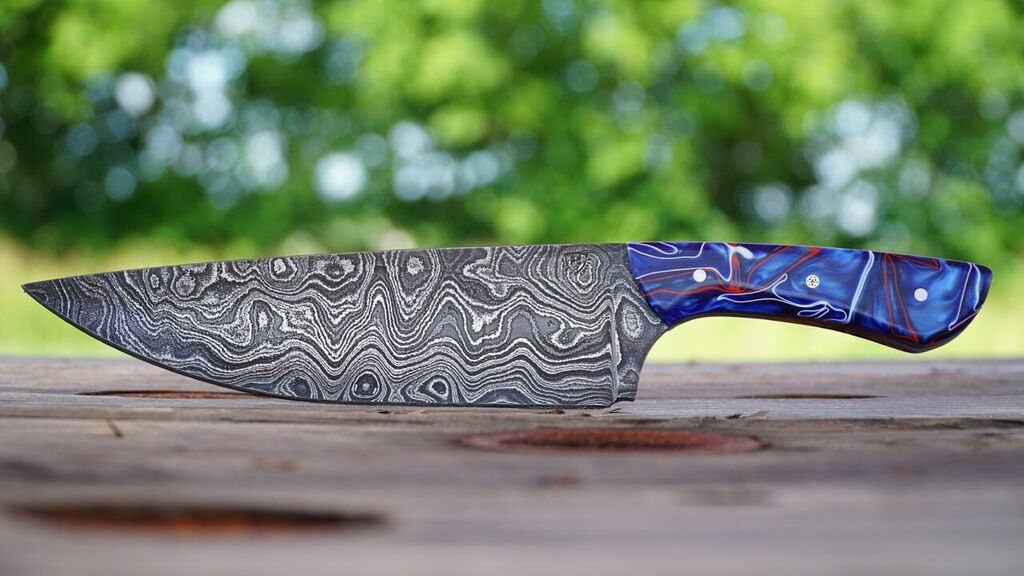
Bob Dozier’s Bare Bones Buffalo Skinner is sharp—and comfy, too!
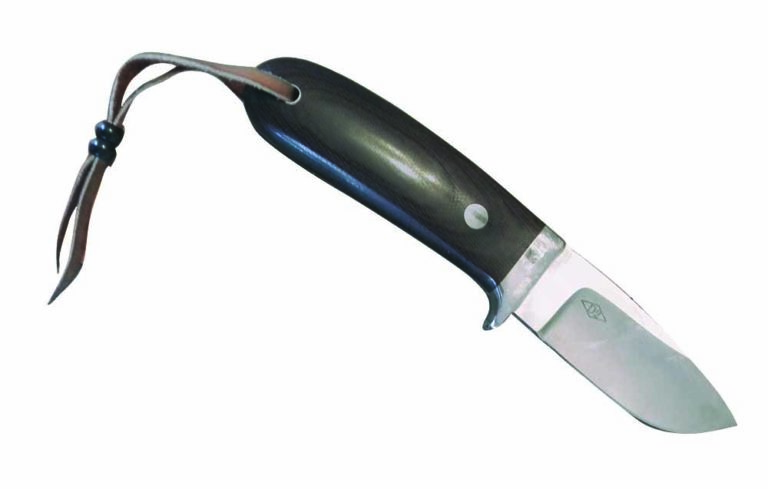
There’s nothing quite like holding a great-feeling knife that makes you want to cut something. Bob Dozier has been making custom knives to be used for over half a century and understands the importance of two major things: comfortable handles and sharp blades. They still have to cut and perform to be carried daily.
Let’s start cutting with the Bare Bones Buffalo Skinner.
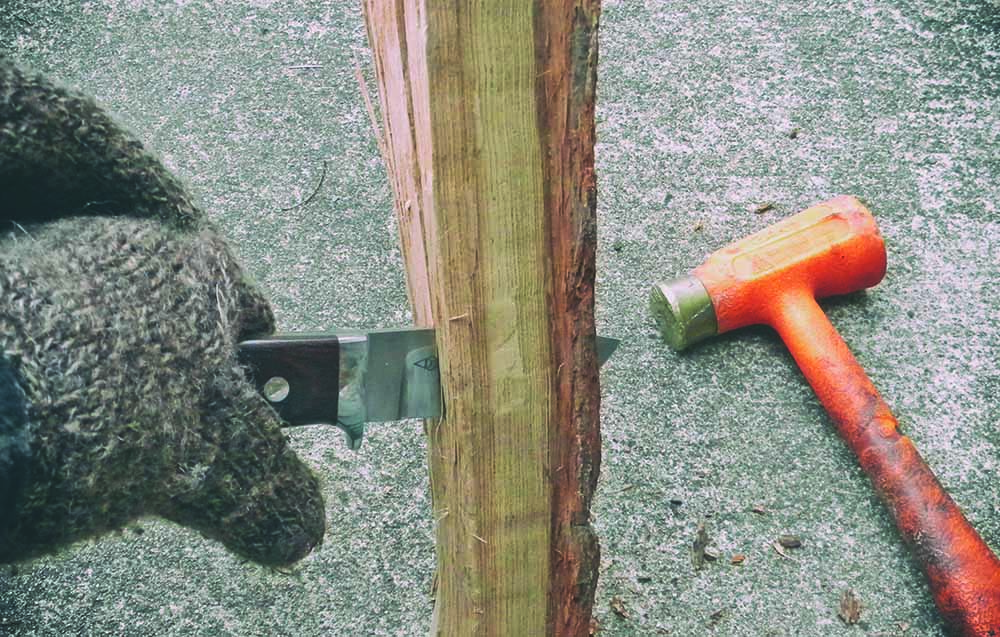
Using a dead-blow hammer, the author batonned the skinner into and through thin kindling. The knife proved a solid splitter. No damage occurred to the edge.
The quickest check to see if the knife has a sharp edge is to slice paper. You probably know by now that I use 20-pound bond copy paper for the job. The Bare Bones aggressively sliced into the paper using the knife’s own weight. The skinner is very controllable in use. The high hollow grind slid through the paper.
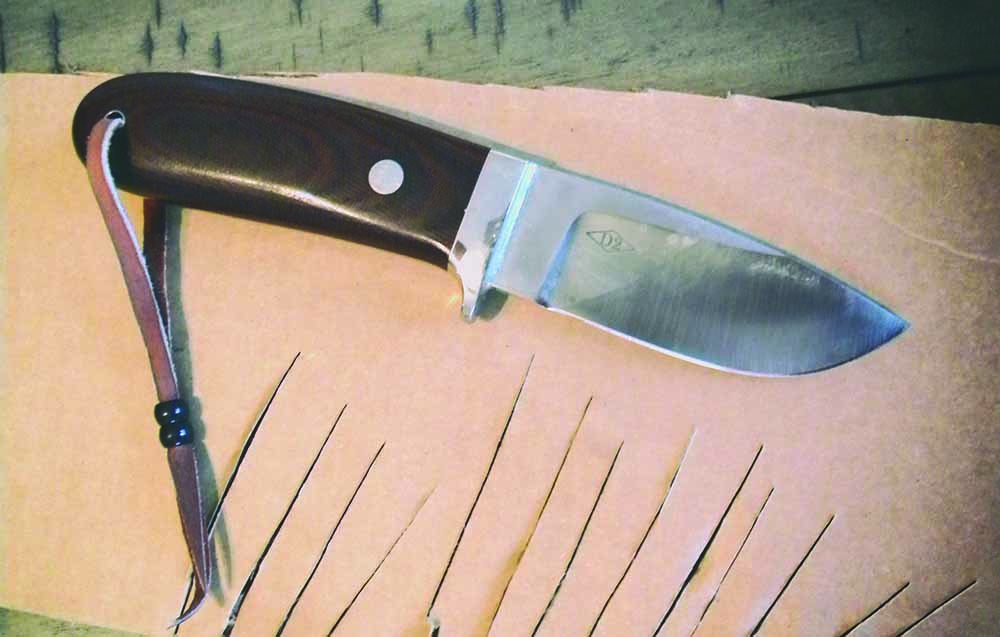
Moving on to single-walled cardboard for slicing, the aggressiveness continued. You could hear every cut made—the Bare Bones is a very loud slicer. I didn’t have any hang-ups during the test, just full, noisy cuts. The handle shape made controlling the cuts easy.
The knife performed aggressively in slicing single-walled cardboard. The handle shape made controlling cuts easy.
Next up: 8-ounce leather. This is where the Bare Bones was sweet. It zipped through the leather like it was cutting the 20-pound bond paper—just louder. It was super aggressive in slicing the medium, with hardly any resistance. I would love trying the Bare Bones on field dressing whitetail deer. Maybe come fall …
OLD-SCHOOL KINDLE
On to harder material. It was February, and I like to keep a supply of kindling and fire sticks to light a blaze faster. The Bare Bones made tight curlicues in the old pine. The wide blade and high grind worked out great for curling the wood. The handle shape excelled at controlling depth of cut. The single guard protected my fingers from getting splinters. Dozier’s knife embodies top-notch work.
The Bare Bones crunched to 225 cuts. The author stopped at 225, as he didn’t want to risk slicing a finger.
It was time to make some thin kindling. Using a dead-blow hammer, I batonned the skinner into and through the wood. The knife’s solid overall construction prevented vibrations to my hand. The skinner proved a solid splitter. No damage occurred to the edge.
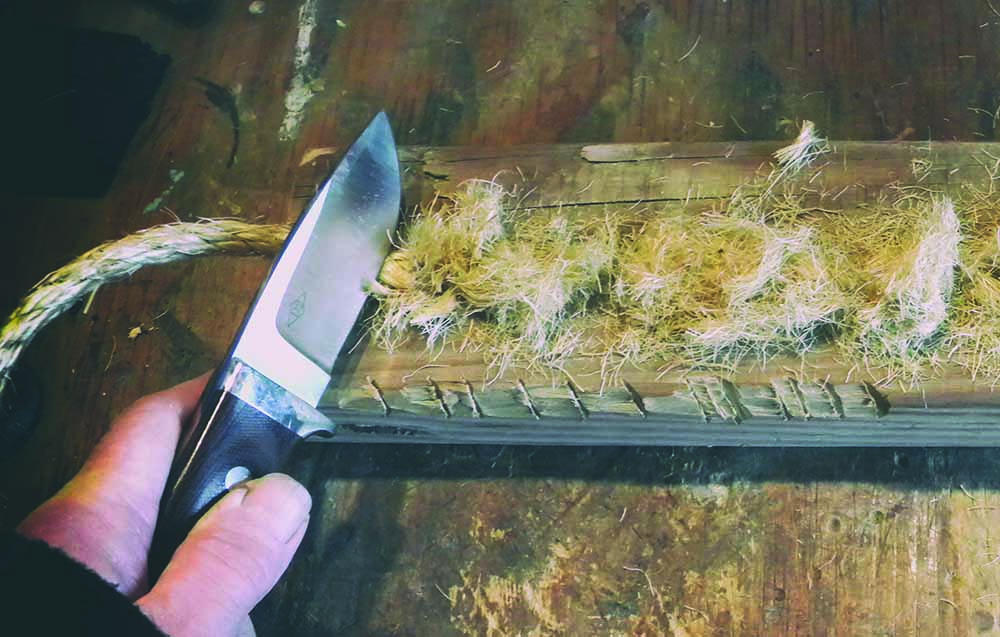
I had to warm up my fingers for the rope cutting. With no heat in my garage and the temperature at 17 degrees, I separated the test into 25 cuts per warm up. The Bare Bones crunched to 225 cuts. As I used the push method, it kept cutting. I stopped at 225, as I didn’t want to risk slicing a finger.
CHANGES
I might add some grooves to enhance grip.
OVERALL
This knife is a beast in the cutting arena. The comfortable handle made control easy. This knife is excellently made and perfect for the outdoors or hunting.
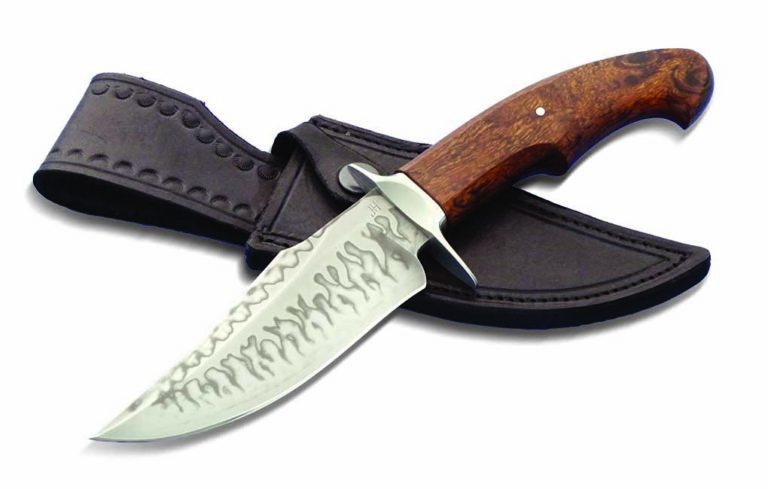
Bare bones Buffalo Skinner Maker: Bob Dozier Cutting edge length: 3.25” Blade material: D2 tool steel Blade grind: High hollow Blade thickness (at the thickest): .25″ Scales: Brown canvas Micarta® Guard: 416 stainless steel Extras: Tapered tang; thong Weight: 8 ozs. (123/8 ozs. w/sheath) Overall length: 8” Sheath: 8-ounce leather, pouch style Maker’s list price: $477
Four U.S.-based companies embrace making military knives stateside.
Make no mistake—manufacturing knives in the USA comes with challenges, including regulations, taxes, high costs of doing business and much more. While imported knives often beat American-mades on price, companies that choose to produce knives domestically carry a long tradition of equipping the U.S. military with the best American design and manufacturing has to offer.
Spartan Blades
For Curtis Iovito, with Mark Carey co-founder of Spartan Blades, the tension between creating high-quality knives and keeping costs down has been one of the primary challenges in running Spartan for the past 13 years.
The Silver Line, also known as Pineland Cutlery, is a collaboration between Spartan Blades and KA-BAR to create a more affordable line made in the USA. The Alala is the first collaboration between the two. It has a 3.75-inch blade and a canvas Micarta handle. MSRP: $159.
“We did everything we could to keep our costs down, from buying in bulk, streamlining production and reducing shipping costs,” Curtis observed. “Even with that, we were lambasted by our customers for being ‘too expensive.’ It was our No. 1 complaint. We even received hate mail for it!”
For Iovito—who said those who staff Spartan Blades consider themselves soldiers first and knifemakers second—patriotism was among the top reasons to make knives in Southern Pines, North Carolina, despite the challenges of starting a manufacturing venture there. Another reason is the ability to have fine control over the deadlines and the manufacturing process, he added. That control and the pursuit of quality it allows has enabled Spartan Blades to make knives for special operations forces, the FBI, U.S. Marshals Service and “every other three-lettered group out there,” Iovito said.
Located on the backside of Fort Bragg, Spartan Blades has plenty of soldiers stopping by to shop, though there are many who do not have enough money to take home one of the company’s top-tier Gold Line knives. “Every single packing list I have ever seen for a soldier has ‘fixed blade knife’ listed on it,” Iovito said, “and most of the time the soldiers are required to acquire it themselves.”
Consequently, Spartan began offering two other grades of knives. The Bronze Line is manufactured in Taiwan and the Silver Line, also known as Pineland Cutlery, is a collaboration between Spartan and KA-BAR to create a more affordable line in the latter’s facility in Olean, New York. The Alala is the first result of that collaboration.
“We wanted to make a knife that was lightweight, easy to carry and that could be carried on airborne operations,” Iovito said. The Alala is made suitable for airborne operations by focusing a good deal of effort on developing a hard sheath with double retention. It’s been out for about a year now. It has a flat-ground 3.75-inch blade and a canvas Micarta® handle. It weighs just shy of a third of a pound and is ground from 1095 Cro-Van steel, where additional elements such as molybdenum and nitrogen make it tougher than standard 1095 spring steel. As Iovito noted, “KA-BAR has been using this steel for years and has the heat treatment down to a science.”
TOPS Knives
A couple of years ago, TOPS Knives of Ucon, Idaho, figured it hadn’t released any big combat knives in a while, so company president and knife designer Leo Espinoza developed the Operator 7.
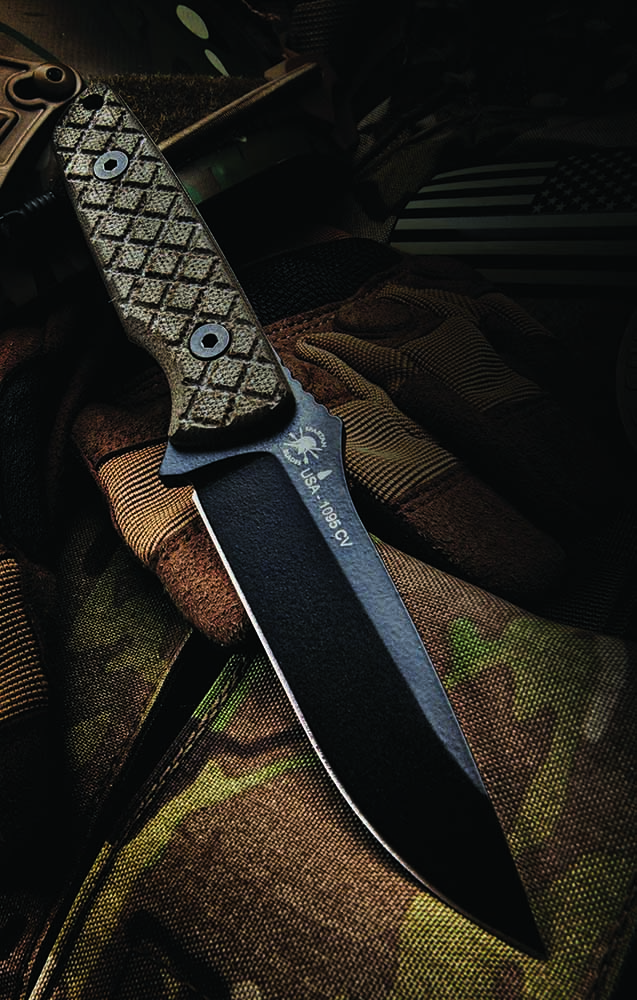
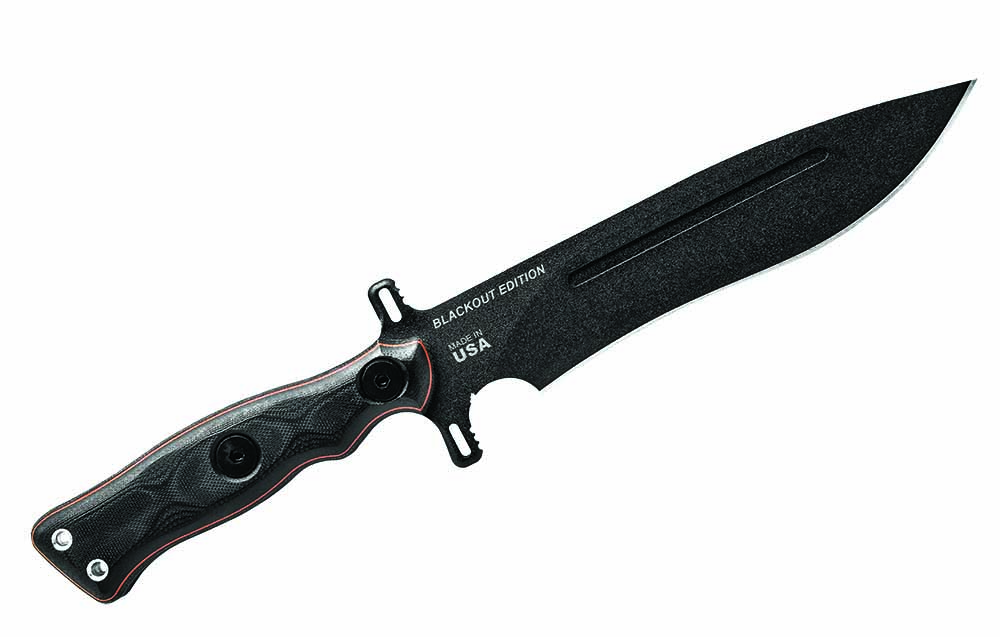
Every TOPS knife save one design is manufactured at the company’s shop in eastern Idaho. An example is the Blackout Edition of the Operator 7 in a 7.25-inch blade of 5/16-inch-thick 1075 carbon steel with a Black Traction Coating. MSRP: $240.
“Like most of our knives, we have a tendency to over-build them, so we made the Operator 7 out of 5/16-inch-thick, 1075 carbon steel to ensure that the knife could literally handle anything you need it to do,” wrote Dylan Waters, dealer liaison for TOPS. The Operator 7 and its 7.25-inch blade hit the market in 2018. In October of the same year, the company released the Blackout variation of the knife: Black Traction Coating on the blade and a black synthetic handle with a red border.
There are few cutting tasks that are too large for a big combat knife, a necessity when another knife isn’t an arm’s reach away.
“In a community where a lot of the time the only gear you have is what you carried in, the choice comes down to the individual’s personal preference,” Waters said, explaining why the knife is a good carry for members of the military. “The Operator 7 Blackout Edition is a very capable blade and it definitely has its place in the field.”
For the company known for its use of 1095, TOPS reached for 1075 steel for this project because it better resists impact and sharpens easily. Even the Micarta/G-10 combo handle helps aid in big cutting jobs. “The G-10 is on the bottom layer to help with impact because it is harder than Micarta,” Waters explained, “and the Micarta is on the top layer to help with grip.”
Every TOPS knife save one design is manufactured at its Idaho shop, and the company brain trust sees little advantage to manufacturing anywhere else. “We are a U.S. company supporting other U.S. companies by sourcing materials from them,” Waters pointed out. “Sure, sometimes prices are higher compared to sourcing overseas but when it is all said and done, the end user has peace of mind that they are getting quality product that they can trust.”
Though the U.S. military announced it is working toward leaving Afghanistan after about 20 years fighting terrorism there, the need for a good quality knife will continue, as the military is constantly training and preparing just in case, Waters said. And if things do go south, TOPS will “rest assured that these soldiers will have tools that are purpose-built and won’t fail when they need them the most.”
Bear & Son Cutlery
From the shipyards near Mobile to missile and rocket development in Huntsville, Alabama plays a big role in the nation’s space and military programs. Sitting amidst the state home to Fort Rucker and Maxwell Air Force Base is Bear & Son Cutlery, which takes pride in creating knives for customers that include troops and government contractors.
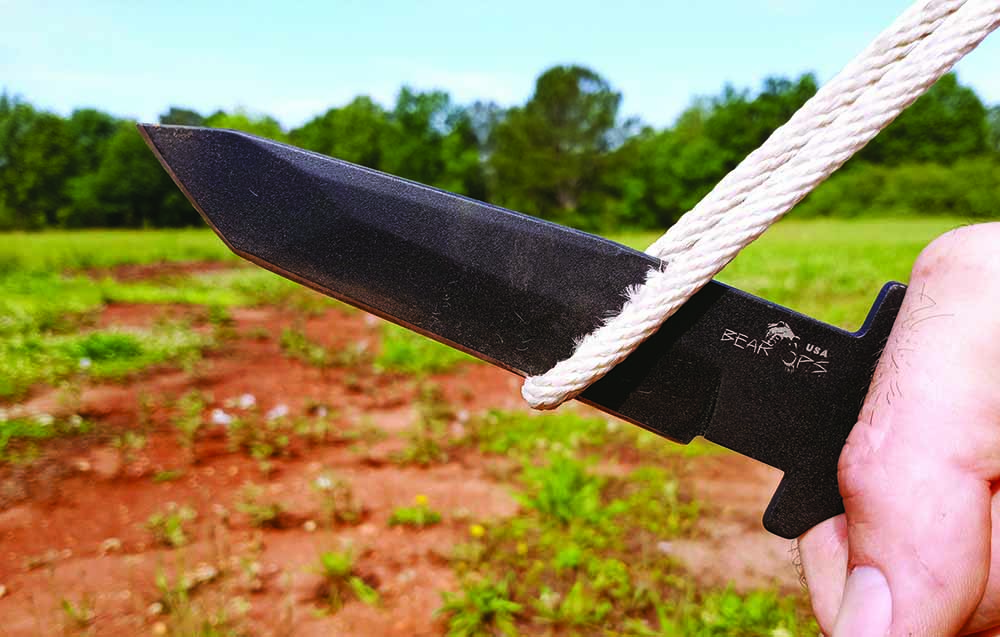
Bear & Son first released a version of the Bear Tac CC-110-B4-B in 1999. When the company launched its Bear Ops line in 2011, it brought the knife back because it liked the design with its “strong tip, full tang, solid handle material, non-reflective, easy to sharpen steel, and adaptable sheath,” company vice president Matt Griffey observed.
“We are one of only a handful of knife manufacturers in the United States, and the largest in the Southeast,” said Matt Griffey, company vice president. “Also, we’re a family-owned and operated business, something less common nowadays.”
Bear & Son has long manufactured knives with an eye toward people in uniform. For instance, the company first released a version of the Bear Tac CC-110-B4-B design using D2 tool steel and a Micarta handle back in 1999, a couple of years before 9/11 shifted the nation’s perception of what threats stood against it.
When Bear & Son launched its Bear Ops line in 2011, it brought the knife back because it liked the design with its “strong tip, full tang, solid handle material, non-reflective, easy to sharpen steel, and adaptable sheath,” Griffey observed. In a 1095 spring steel blade with an epoxy powder coat and a G-10 handle, the knife is 10.375 inches overall. The accompanying Kydex sheath is jump ready, meaning not only does the sheath hug the knife in place, it also has a snap for extra security.
Bear & Son makes the knife at its shop in Jacksonville, Alabama, a place where Griffey says members of the community quickly produce knife designs with pride and quality they can control. “A major advantage of keeping our Alabama factory in operation is providing families a career or skill they can be proud of,” Griffey said. “Understanding our products and services positively impact the lives of our friends, family and neighbors is worth the regulations and taxes of operating in the United States.”
For instance, students at a nearby state university gain real-world experiences at Bear & Son. Meanwhile, some Bear craftspeople and designers have 20-plus years of experience working with numerous types of steels and can develop client orders in a timely manner, Griffey noted.
While the mission of the nation’s military may change, the mission at Bear & Son continues to “provide quality made products that service personnel can depend on,” Griffey said. “The market for strong, reliable blades will be steady, though we will see some trends in sizes, shapes and materials move around.”
Winkler Knives
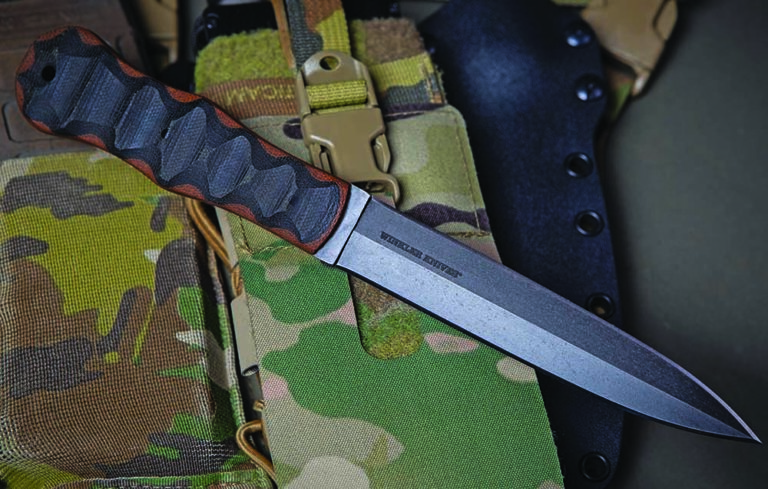
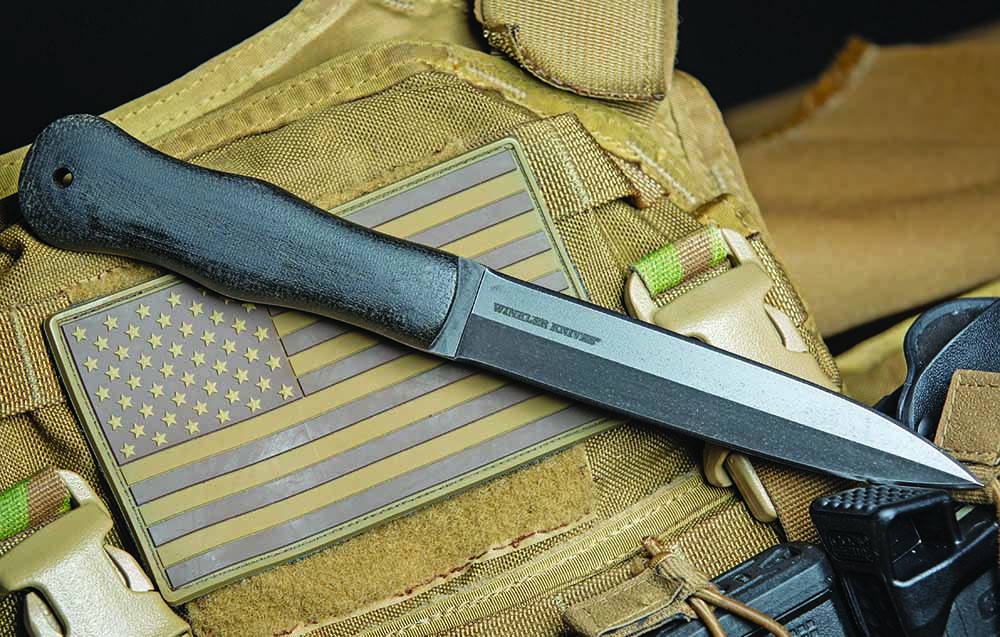
Daniel Winkler of Winkler Knives in Boone, North Carolina, readily admits that if you’re looking for a knife to take camping, his WK Tactical Dagger is not for you. With a 5.5-inch blade and short bevels the dagger has little utility use, he noted, beyond the thing knives can do when the enemy is close. “The design was a collaboration between me and one of the Army special operations team leaders,” he said. “It was a design they needed for their specialized type of fieldwork.”
Made in Boone, North Carolina, the Winkler Knives Tactical Dagger in a black Micarta® handle has the same specs as the WASP-pattern model pictured elsewhere herein. “The handle shape does not hang on clothing as a lot of cross-guard knives do,” Daniel Winkler noted. MSRP: $400.
The 80CrV2 carbon steel offers “the best consistent performance” of any steel Winkler works with, and the blade sits nestled in a lined, Boltaron sheath. “The handle shape does not hang on clothing as a lot of cross-guard knives do,” he noted. “The handle shape also gives good indexing and a flair to assist in removal leverage after use.”
The primary goal of Winkler Knives is to provide tools to first responders, law enforcement and the military, Daniel said, and most of its knives and other edged tools go to people working in those fields. He added that running a company in the USA allows Winkler Knives complete control over the tools it makes, thus ensuring consistency and quality.
Despite the taxes and other challenges of manufacturing domestically, Winkler said, “The advantage is we live in the greatest country on Earth. Taxes and regulations are sometimes tough but still better than any alternative I can see. We have been very fortunate to find great staff.”
When hiring people, Winkler usually passes over knifemakers as he wants to train workers to make the edged tools his way. Some of the folks working there have backgrounds in foodservice and construction fields. Staff must work well in the team and have integrity, he added.
Most design work is kept in-shop too, as most Winkler Knives customers are seeking out Winkler designs. In the end, Daniel does all his manufacturing for his military customers in the USA. As he concluded, “I wouldn’t have it any other way.”
When it comes to custom knives, the best utility hunters have many of the features outlined herein.
Countless articles have been written about hunting knives. Primarily, the stories discussed which knife is best for which game.
The two main features that get the most coverage are the blade-style/shape and the length. The knife referred to commonly as the hunter is more than likely a utility hunting knife.
No matter where you are, if you are using a guide—hunting or fishing—more than likely your guide is the one doing the dressing of the game. Chances are, he is using a utility hunting knife with some of the following features.
Blade Steel
If you ask 100 people what the best steel is for a hard-use field knife, you probably will get at least 50 different answers. Why? End users are very loyal to a steel that has proved itself in the field.
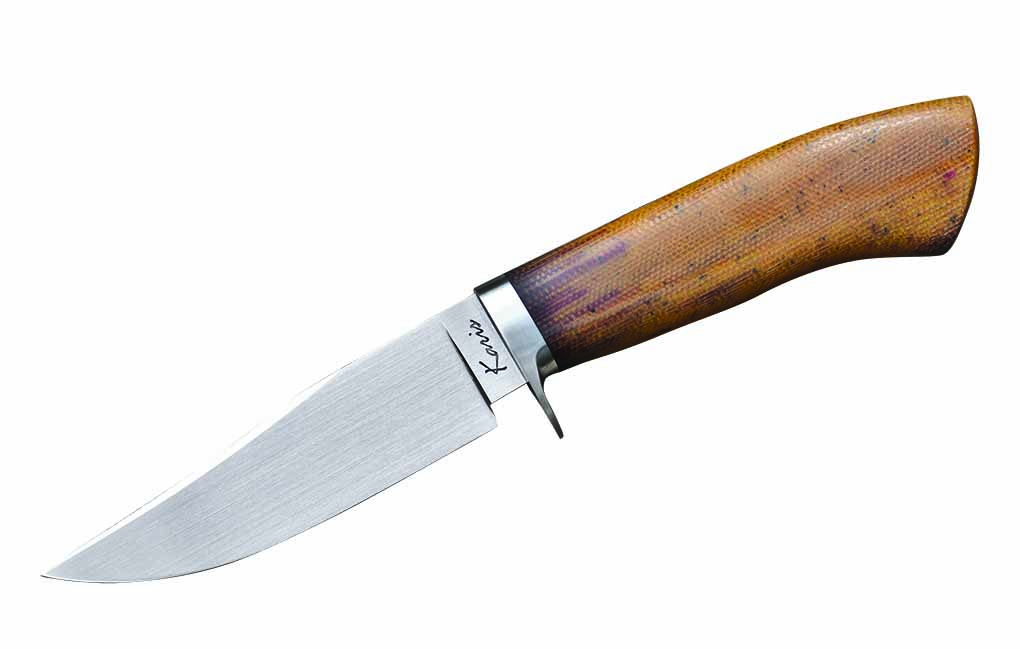
Karis Fisher (inset) is the daughter of ABS master smith Josh Fisher (see adjoining image). Karis not only earned her ABS journeyman smith (JS) stamp in March, she also won the Joe Keeslar Award for the best knife submitted by a JS applicant. The 4-inch blade is 1084 carbon steel and the handle is vintage Micarta®. Guard: 416 stainless steel. Overall length: 8.5 inches. Sheath: custom-made of leather. Fisher’s price for a similar knife: $375.
Steels are made primarily for commercial applications—very few are made specifically for knives. Knife blades have been made from saw blades, files and even railroad spikes. If the steel has enough carbon and can be hardened to hold an edge, somewhere in the past several hundred years someone made a blade of it.
The two primary choices for blade steel are carbon and stainless. Each has its pros and cons. Stainless steel’s biggest advantage is that it is rust resistant, meaning it will require less maintenance. Stainless is not code for “no maintenance.” Yes, stainless steel will rust.
Carbon steel requires maintenance. Many things will make carbon steel rust, several examples being the blood from the game that is being processed and some types of vegetation, including vegetables. However, the rust can be held to a minimum or eliminated simply by cleaning and oiling the knife after use. Keep in mind that storing your carbon steel knife in a leather sheath can also cause rust, especially a wet blade, as the tannic acid used to process the leather can cause rust spots.
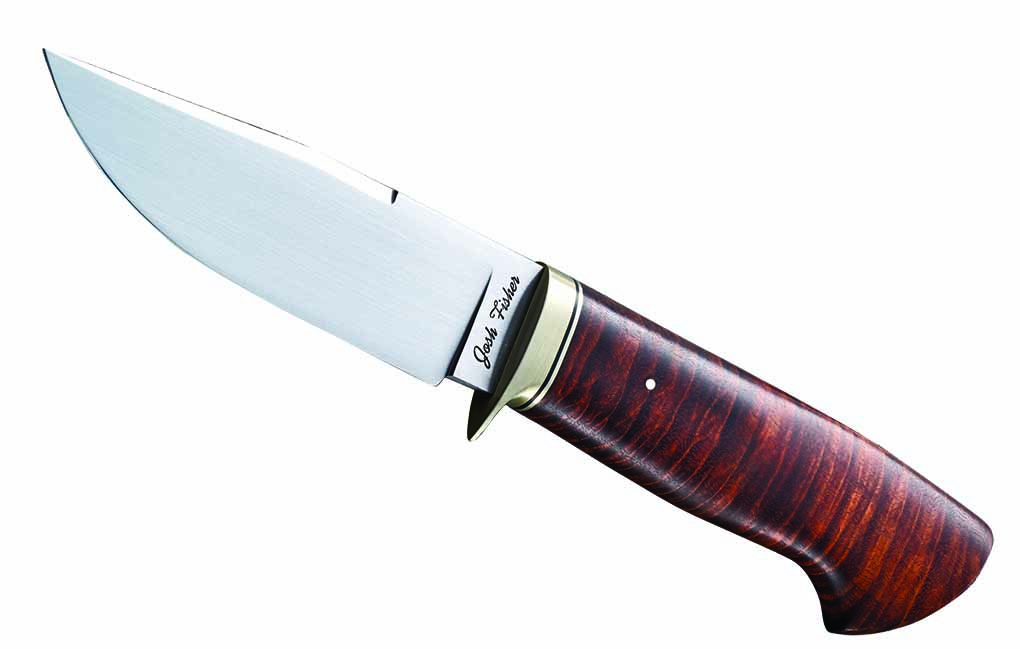
Winner of Best Utility Hunter at BLADE Show 2018, ABS master smith Josh Fisher’s model has a 4.25-inch blade of 1084 carbon steel, a ringed gidgee handle and a guard of brushed stainless steel. Overall length: 8.75 inches. The knife comes with a custom-made leather sheath. Maker’s price for a similar knife: $685. Josh (inset) earned both his ABS master smith (MS) stamp and the B.R. Hughes Award for the best knife submitted by an MS applicant at the same time his daughter Karis earned her JS stamp and the Joe Keeslar Award (see adjoining image). (Eric Eggly/PointSeven knife image)
While carbon steel can rust, it does have advantages over stainless steel, including two if the blade is forged. First, a number of bladesmiths forge distal taper into their carbon steel blades. The taper removes weight from the blade, thereby making the knife lighter in weight and thus easier to carry and manipulate. Second, carbon steel blades can be differentially heat treated to give them a hard edge for sharpness and a softer back for malleability, the latter resulting in a blade with greater flexibility that is much more likely to bend rather than break under high stress.
The steel you choose for your utility hunting knife should be one that can be sharpened in the field and fit the requirements for what you want your knife to accomplish. Remember—it is always best to resharpen your knife before it gets dull!
Handle Material
If you are looking for a group of custom knives that have diverse handle materials, utility hunting knives lead the way. Synthetics, wood, ivory, bone, antler, mother-of-pearl and others—you name it, utility hunters have it.
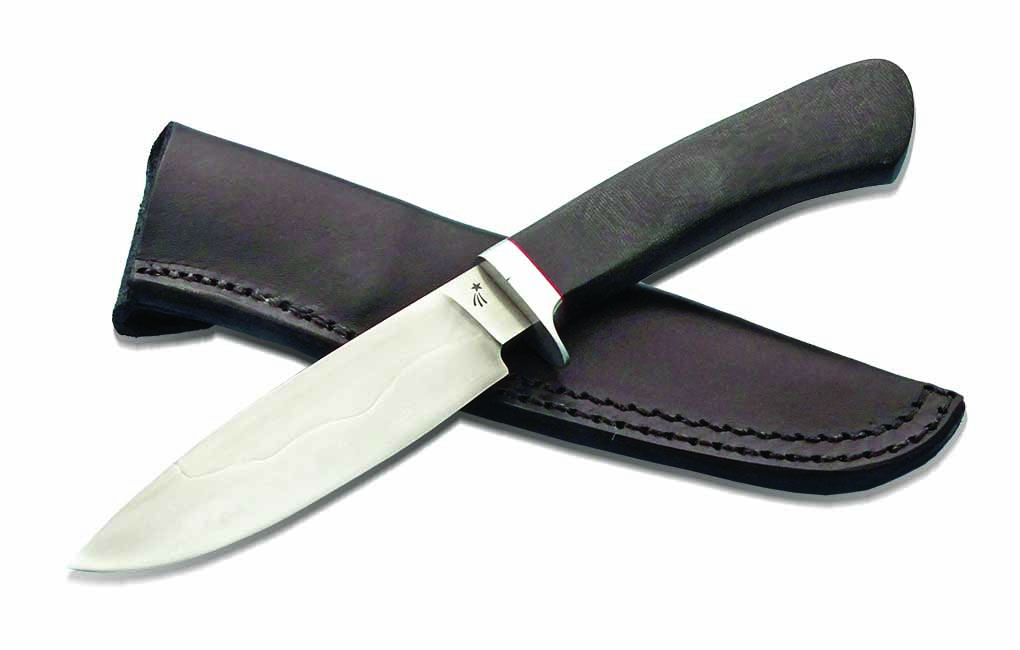
The 5-inch blade of W2 tool steel with hamon headlines a utility hunter by Jim Crowell (inset). The handle is black canvas Micarta® and the guard is stainless steel. Jim made the leather sheath. Overall length: 10 inches. Knife to know: this knife belongs to the author. Current price: $850. (Impress By Design image)
When many outdoorsmen dress their knives to impress, they want stag. Unfortunately, stag is experiencing two things simultaneously, and neither is good. Because of lack of supply, the quality is going down and the price is going up to the point that the ancient ivories are now becoming an alternative. After talking with knifemaker Mike Malosh at BLADE Show 2021, I have started to order some hunting knives with elk. While not as popular as stag, it is a great handle material and has a nice look.
My experience in the field has made me a true believer in synthetic handle materials. The two most popular are Micarta® and G-10. Canvas Micarta is my personal favorite. As the name implies, there are bits of canvas included when the Micarta is made. This gives the handle a little more grip when wet. Westinghouse Micarta is gaining in popularity. Often it’s referred to as vintage or antique due to the fact most of it was made before 1960.
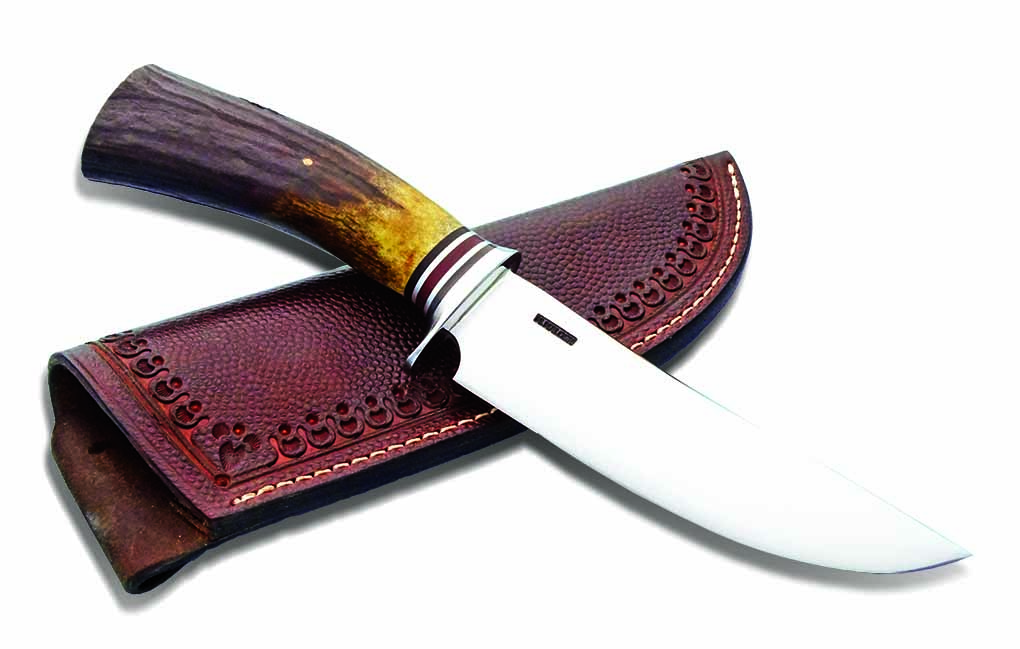
Mike Malosh opts for elk antler with black and maroon Micarta® and stainless steel spacers for the handle of his utility hunter. The 6-inch blade is W2 tool steel and the guard is stainless steel. Overall length: 10.75 inches. The knife comes with a leather sheath by Malosh. The maker’s price: $390. (Impress By Design image)
Carbon fiber is five times stronger than steel, twice as stiff and lighter in weight. This gave rise to numerous commercial applications, eventually finding its way into the custom knife market. Initially used by custom makers for scales on folders, you can now find them using it for fixed-blade handles, too.
The advantage of synthetics over natural handle materials is synthetics don’t shrink and, for the most part, are impervious to the elements. That said, natural handle materials can dress up a knife.
Guards
For the most part, integral guards are utilized as a quicker, less expensive way to make knives. Most are simply squared off to give the illusion that they are somehow protecting your index finger/hand. I learned the hard way that such a guard is not meant for hard work. If you are going to use a knife with this type of guard, wear a glove.
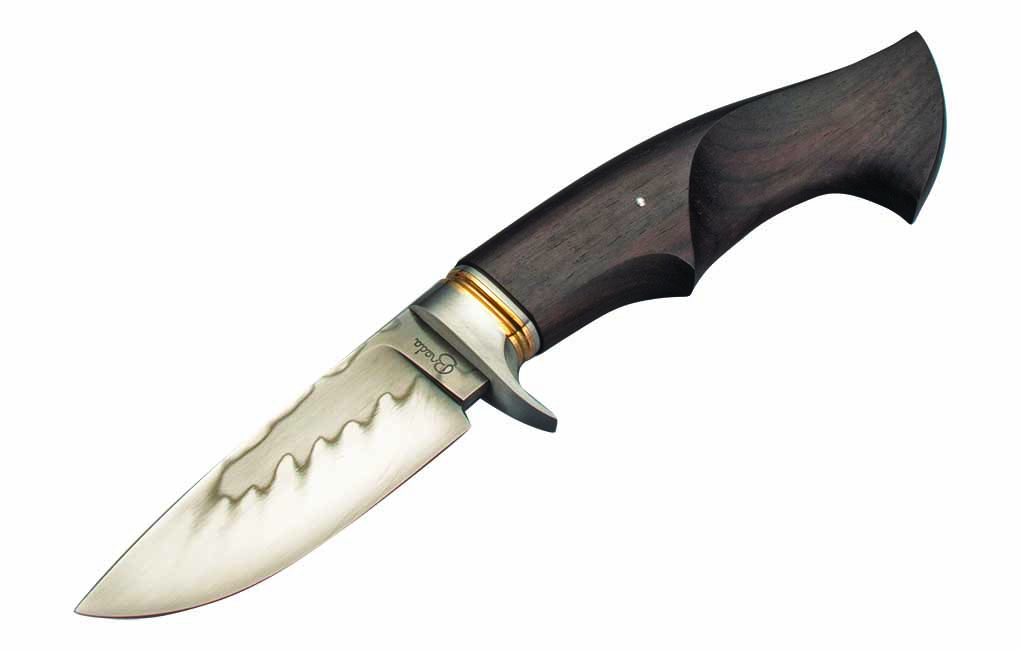
Ben Breda won Best Utility Hunter at BLADE Show 2019 for his model in a 4-inch blade of W2 tool steel with hamon. The handle is sculpted African blackwood with a bronze “S” collar and the blade is stainless steel. The knife comes with a leather sheath by Breda. Overall length: 8.75 inches. Current price: $575. (SharpByCoop knife image)
Most custom utility hunters have a single guard with some amount of curve built in to give you a better handle ergonomic. Additionally, it will provide some protection for your index finger/hand. The primary metals used for such guards are brass, nickel silver and stainless steel. While brass is a favorite among factories and new custom makers, the biggest problem is it is soft and can be easily nicked or cut, giving the guard a sharp edge or corner which can dig into your bare hand. Stainless steel guards provide the best protection and least amount of maintenance for your knife.
Ideal Sizes
Having judged custom utility hunters at the BLADE Show for over two decades (page 42), I can tell you there is no one ideal size. That said, most of the judging competition winners feature a blade between 3 7/8 and 5 inches long. (For the makers reading this, please do not submit your 10-inch bowie or 2-inch miniature in this category for judging.) Among the accompanying images for this story are three past winners of the category at the BLADE Show. Note the differences and similarities. In addition to dimensions, the importance of handle ergonomics cannot be overstated. Most handles will feature some kind of contouring and generally will be between 4.5 and 5 inches long.
Sage Advice
The custom utility hunting knife will be a workhorse in the field. Consider the factors I have outlined before you buy one. What will you use it for primarily? What size handle is best for your hand? Will you be able to do the maintenance required for the blade steel? Can you sharpen the knife in the field and, if not, will you be able to practice how to do so before you get there?
I prefer a 5-inch blade as my experience has taught me that a big blade can do little knife chores, but not the other way around. As my 7th-grade shop teacher always said, “Use the right tool for the job.” Sage advice!
Robert Appleby nails a Loveless dropped hunter in crown stag.
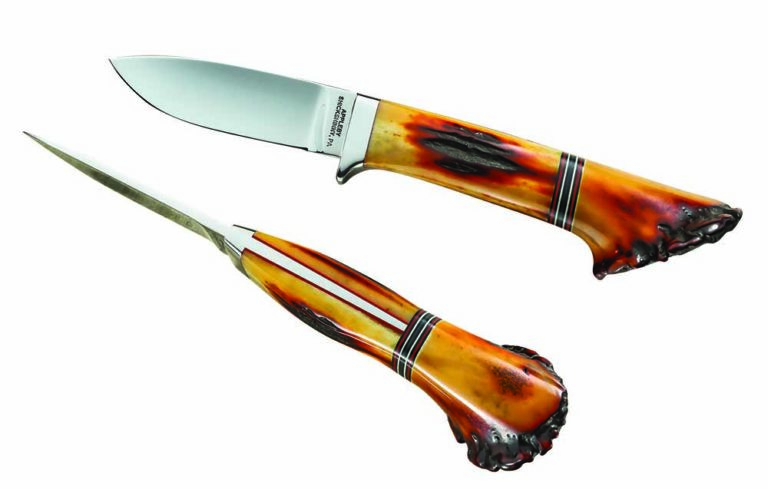
Robert Appleby’s custom-order reproduction of a dropped hunter by BLADE Magazine Cutlery Hall-Of-Fame® member Bob Loveless in amber crown Sambar stag is Loveless in all the right places.
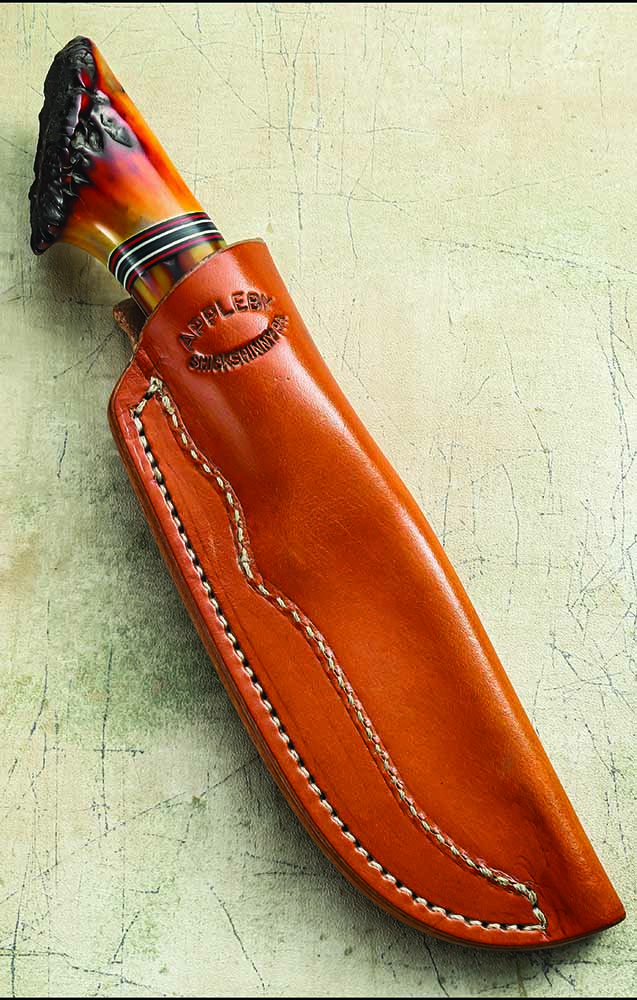
The pouch belt sheath of 8- to 9-ounce leather from Wicket & Craig is also in the Loveless style. Robert is celebrating 25 years of knifemaking.
A customer sent Robert an image of an original Loveless knife and Appleby went to town, reproducing the tapered full tang faithfully to the original.
“It’s still a full tang, not a frame,” he explained, “one solid piece from the point to the back.” He tapered the tang, left the stub at the end and mortised it into the stag crown handle butt. He glued the spacers like a block, which fit over the stub. The stag is from Culpepper & Co., which amber dyed it as well.
“I really enjoyed that knife,” Robert noted. He said the satisfaction he felt after he had finished it was similar to the same sort of happiness he has when experiencing “the old muscle cars.”
Loveless Repro Dropped Hunter Specs Maker: Robert Appleby Blade length: 35/8” Blade material: AEB-L stainless steel Blade finish: Mirror polish Handle: Amber-dyed crown Sambar stag Bolster: 416 stainless steel Overall length: 9” Maker’s list price for a similar knife and sheath: $625
The Paring knife is there when you need it most, from big tasks to small. Here are options for every type of user.
Paring knives may often get overlooked in the kitchen for their flashy big brothers—chef’s knives—but like EDCs, they’re there when you need them most and there’s one for every type of user.
TOPS Knives embraces the paring knife market in conjunction with its Dicer line of kitchen knives. “We noticed, in the process of wanting to design a kitchen knife, that there were some amazing U.S.-made custom kitchen knives, but there weren’t many high-quality domestically made production kitchen knives,” TOPS spokesperson Jeremiah Heffelfinger observed. “This was a void that we were more than happy to fill, especially with the plan for a full line of kitchen knives in the near future.”
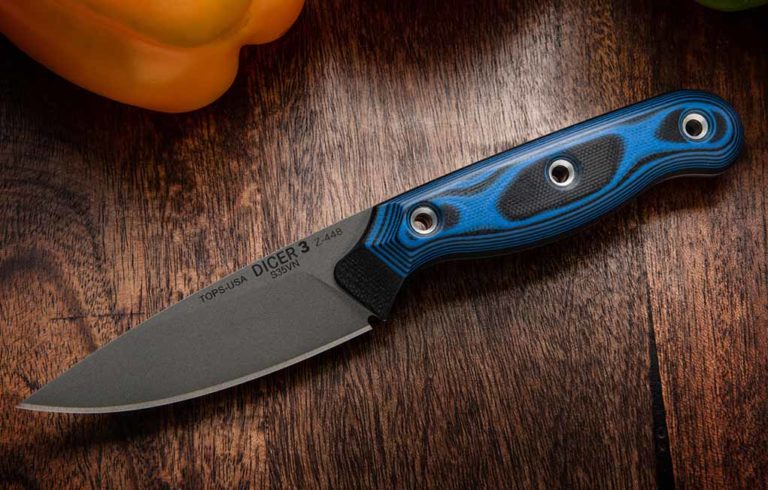
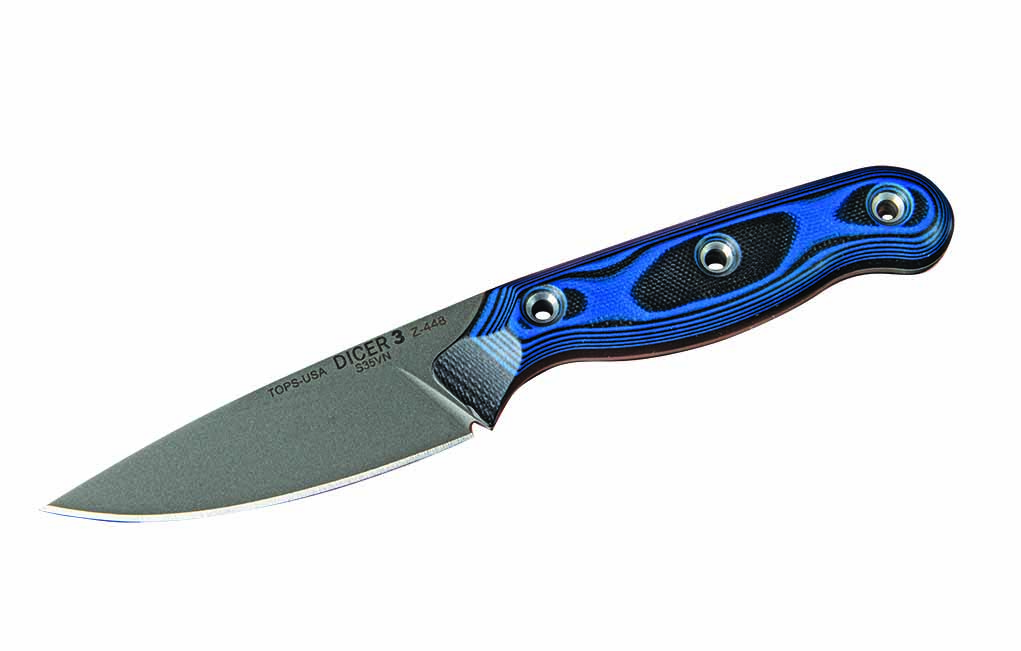
The Dicer 3 has balance, a great blade steel—CPM S35VN stainless—ergonomics and looks.
A design contest between the staff of TOPS Knives in 2017 yielded the Dicer, an 8-inch chef’s knife. TOPS President Leo Espinoza designed a companion paring knife. The Dicer 3, released with the chef’s knife in 2019, that sports the same steel and handle material. The paring knife has become a popular offering as the company has filled out its culinary lineup, including bread and steak knives.
“The chef’s knife typically gets the majority of the attention, but for fine and detail tasks the paring knife can’t be beat,” the TOPS spokesperson advised. “It affords more control for tasks like peeling and trimming meat, fruit or vegetables.”
Heffelfinger said the Dicer 3 is a package that sports balance, a great steel, ergonomics and looks. When company officials designed the chef’s knife, they wanted it ground from CPM S35VN stainless steel, a material they carried over to the diminutive blade.
“We hadn’t seen many kitchen knives using S35VN and, having used the steel before on our Camp Creek hunting knife, we knew it would perform very well with great edge retention and durability,” he said. “Being a stainless steel, it is much less prone to corrosion and rust, making user maintenance just a little bit easier.”
The blade is flat ground to reduce friction in cuts, a .09-inch-thick steel that tapers to .032 inch near the tip, and sharpened to about 20 degrees to balance clean slices and durability when chopping, Heffelfinger added. It’s a blade described as a medium-to-heavy weight for a paring knife.
“We have a reputation for overbuilt hard-use tools that are able to hold up under extreme-use scenarios. We brought this philosophy with the full-tang design on every one of our Dicer line of knives,” he explained, “but we also wanted a classic feel and look for them, with a TOPS flair.”
He indicated knife enthusiasts have noticed that overbuilding and some have taken the blade far from the kitchen knife drawer.
“We have had a number of customers purchase the Dicer 3 to use as an EDC knife,” Heffelfinger said. “Due to the size of the blade, the S35VN stainless steel and smooth, contoured handles, they have attached a clip to the sheath and roll with it on their belt every day.”
Dicer 3 Specs Designer: Leo Espinoza Blade length: 3.5” Blade steel: CPM S35VN stainless Blade grind: Flat Blade thickness at its thickest: .09” Handle material: Black canvas Micarta® and Blue-black G-10 Handle thickness range: .1875 to .75” Weight: 4.7 ozs. Overall length: 7.88” Sheath: Black Kydex Country of origin: USA MSRP: $200
Case Household Cutlery 3-Inch Clip Point
Sometimes it is best not to change the paring knife beloved by cooks through the decades, designs that have seen food crazes come and go: Jell-O salads, fondue pots, casseroles and avocado toast. Enter Case Knives’ Case Household Cutlery 3-inch clip point paring knife.
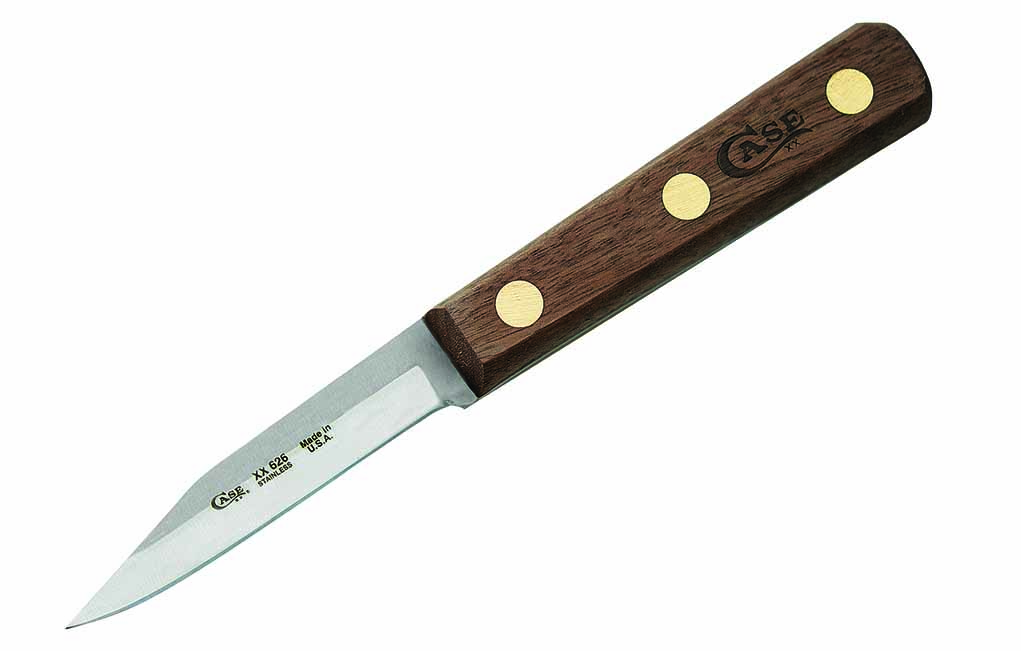
Case has two paring knife blade styles: a spear and a clip point (shown here). “The clip-point version excels at chopping smaller food items because of its blade design and the blade edge, which mirrors the flat cutting surface when used correctly,” Case spokesperson Fred Feightner noted.
“We use classic walnut wooden handles that have been used in millions of kitchens over time,” said Fred Feightner, Case senior marketing communications manager. “We purposely wanted these new kitchen knives to look, feel and perform like the Case household knives of old, and we feel our current offerings do just that very well.”
Case debuted the knife in 2012 while reintroducing its household line—in part by demand from its fans and also as a way to expand its brand and possibly place the knives with retailers who emphasized kitchen supplies.
Consumer advocates insisted on a simple handle design: a straight .5-inch-thick wooden handle, Feightner said. For the blade, the company turned to its Tru-Sharp™ surgical steel—the Case version of 420HC stainless—sabre ground and polished to a satin finish to resist the corrosion that can occur working around food.
The company has two paring knife blade styles. While the spear point slices and dices with ease, Feightner confided, “The clip-point version excels at chopping smaller food items because of its blade design and the blade edge, which mirrors the flat cutting surface when used correctly.”
It’s a knife Feightner says, despite its size, can hold up to kitchen tasks most anywhere. As he noted, “We think our paring knives are perfectly weighted so that intricate work is as easy as tougher jobs around the kitchen and at the barbecue pit.”
Household Cutlery 3-inch Clip Point Paring Knife Specs Blade length: 3” Blade steel: Tru-Sharp™ Stainless Blade grind: Sabre Handle material: Walnut Handle thickness at its thickest: .5” Overall length: 6.75” Weight: 1.7 ozs. Country of origin: USA MSRP: $27.99
V Nives Emerald Paring Knife
Mike Vellekamp, owner and founder of V Nives, indicated his company has recently entered the world of kitchen knives, too. At his house, the 8-inch chef’s knife is most often used to prep food thrown in a wok or barbecued.
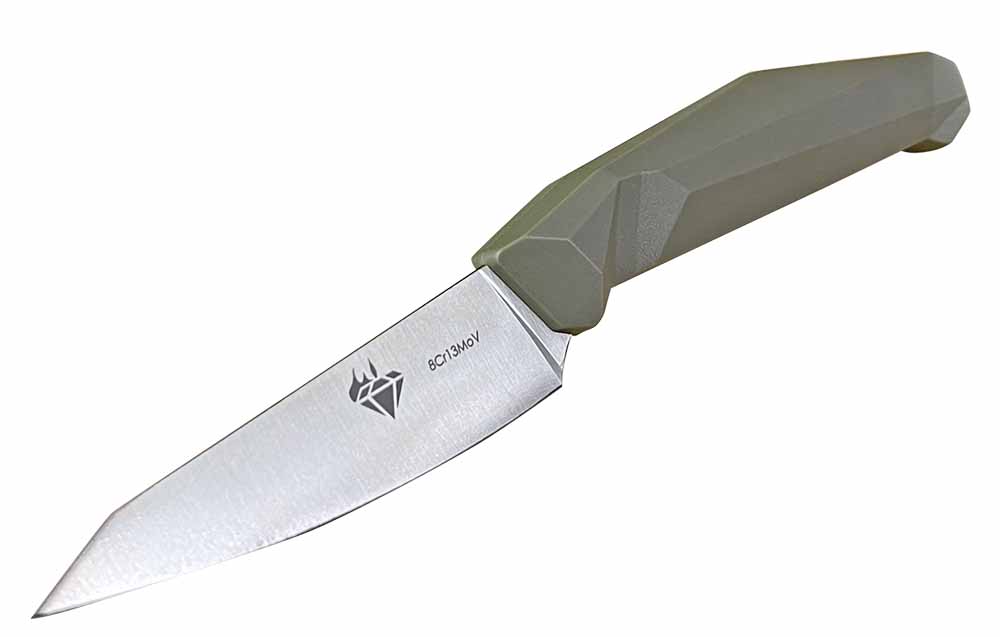
The green handle—an exclusive color for V Nives—of the Emerald Paring Knife is injection molded around the blade tang.
“However, for day-to-day utility in the kitchen, the paring knife is definitely a must have,” Vellekamp said, adding the genre of blade is “optimal for intricate cutting, mincing, slicing and dicing fruits and veggies, deveining prawns/shrimp, and cutting herbs.”
And what V Nives offers won’t be the type of model found moldering in grandma’s cutlery drawer: the angular and green-hued Emerald Paring Knife. Vellekamp said it’s an example of a modern, innovative kitchen implement.
“DiaFire actually developed the knife,” Vellekamp said. “We have a close relationship with the brand, and we are the exclusive distributor for the Americas. We chose their kitchen products because of their dedication to innovation and quality.”
The Taiwan-made blade is 1/16-inch thick and flat ground from 8Cr13MoV stainless steel. “This is a great blade steel because it holds an edge very well for its intended uses, it’s highly corrosion resistant and it’s very easy to resharpen,” Vellekamp noted.
The green handle—an exclusive color for V Nives—is injection molded around the blade tang, making an ergonomic handle that runs between .417 to .645 inch thick. It’s a grip Vellekamp calls tough and light. And while he and other knife enthusiasts will tell you it’s a terrible way to treat your most important tool in the kitchen, the handle can survive a trip through the dishwasher if the, er, less knife enlightened put it there.
“These knives are a perfect example of high value at an affordable price,” Mike said, “and I believe it is a perfect complement to the modern kitchen.”
Emerald Paring Knife Specs Blade length: 3.5” Blade steel: 8Cr13MoV stainless Blade grind: Flat Blade thickness at its thickest: .059” Handle material: Nylon and fiberglass injection molded Handle thickness range: .417 to .647” Weight: 4.25 ozs. Overall length: 8.15” Country of origin: Taiwan MSRP: $42
Bradford Knives Blue G-Wood Paring Knife
Brad Larkin of Bradford Knives said a wise knife collector once told him that any good chef’s knife needs a paring knife sidekick. As a result, he’s happy with the Washington state-based shop’s flagship paring knife.
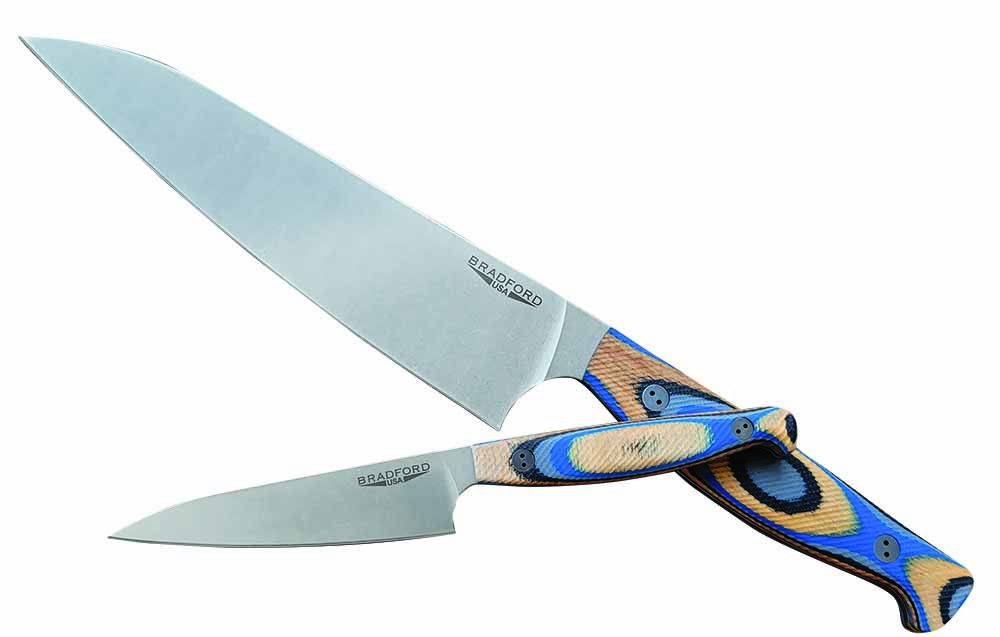
Brad Larkin of Bradford Knives said the handle of the company’s Blue G-Wood Paring Knife is designed to be held in a surgical-like pinch grip. He indicated the result is a lightweight knife focused on fine cutting.
“It complements our chef’s knife so well and we do find that customers seem to enjoy a ‘set’ of kitchen knives as opposed to our EDC knives, which are very carefully built around specific daily uses,” Larkin explained. “In the kitchen you need to be ready for a quickly changing, dynamic environment, and our hope is that the paring and chef’s knives can accomplish these mission-critical chores.”
Over the years, Bradford has released different versions of its paring knife. Recently, the company issued a limited run of handles made from blue G-wood, a composite of G-10 and wood veneer. Stainless blade steel choices are edge-holding, corrosion-resistant AEB-L or tough M390.
Bradford, which is known more for its tactical and EDC models, returned to its culinary roots with the paring knife. The first edged tool it made was the Gatsby, a steak knife.
The company’s paring knife features thin blade geometry—just the way Bradford Knives prefers it. The .09-inch-thick blade has a distal taper. “Our process allows for a full flat grind. It does produce a very mild hollow-grind effect,” Larkin qualified, “but it is hardly worth mentioning.”
The handle is designed to be held in a surgical-like pinch grip. Larkin said the result is a lightweight knife focused on fine cutting, such as making fruit twists for cocktails, for instance, though it could be considered a medium-weight model compared to most paring knives.
“A paring knife can be the best for overall utility, especially considering our blade size is larger than the typical paring blade and it shares design elements with our chef’s knife,” he opined. “It’s a real slicer!”
Blue G-Wood Paring Knife Specs Blade length: 3.8” Blade steel: Choice of M390 or AEB-L stainless Blade grind: Full-height flat Blade thickness at its thickest: .09” Handle material: Blue G-wood Handle thickness range: .2 to .55” Weight: 1.8 ozs. Overall length: 7.5” Country of origin: USA MSRP: $129
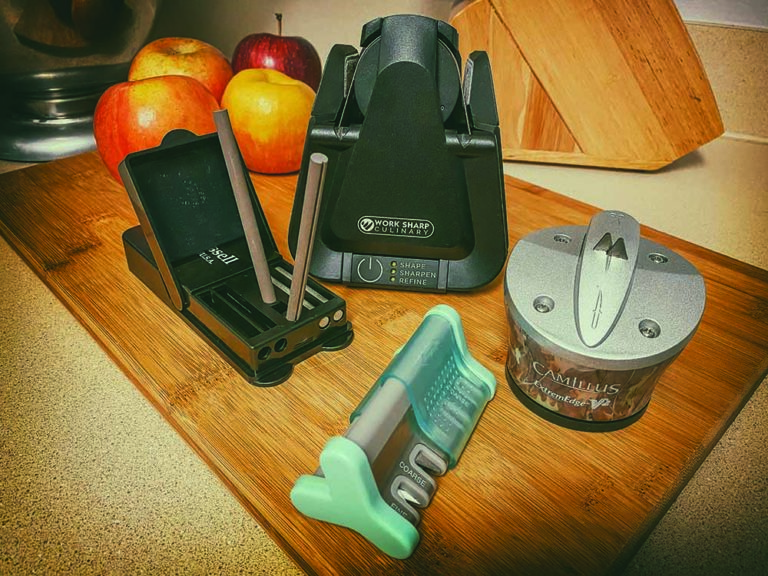
Correct sharpener selection is imperative for keen household cutlery. With that, here are four kitchen knife sharpeners that make the cut.
Dull kitchen knives not only make meal preparation more difficult, they also can slip and cut you when you least expect it. As a result, it’s imperative to keep them sharp. If you sharpen them yourself, correct sharpener selection is key.
A kitchen knife sharpeners can be as simple or complicated as you want. No matter your skill level, there is a sharpener for you. For those with little-to-no sharpening experience are the cost-effective pull-through sharpeners. These are as simple as simple can get. Often they are plastic-bodied devices with one or two slots. Inside the slots are the sharpening media. The media are permanently affixed at pre-set angles The most common media for the two-slotters are carbide and a fine-grit ceramic. The carbide quickly restores damaged and worn edges, while the fine-grit ceramic polishes and hones the edge to razor sharpness. Anyone can achieve a sharp edge with a pull-through.
Smith’s Products Slide Sharp Edge Grip
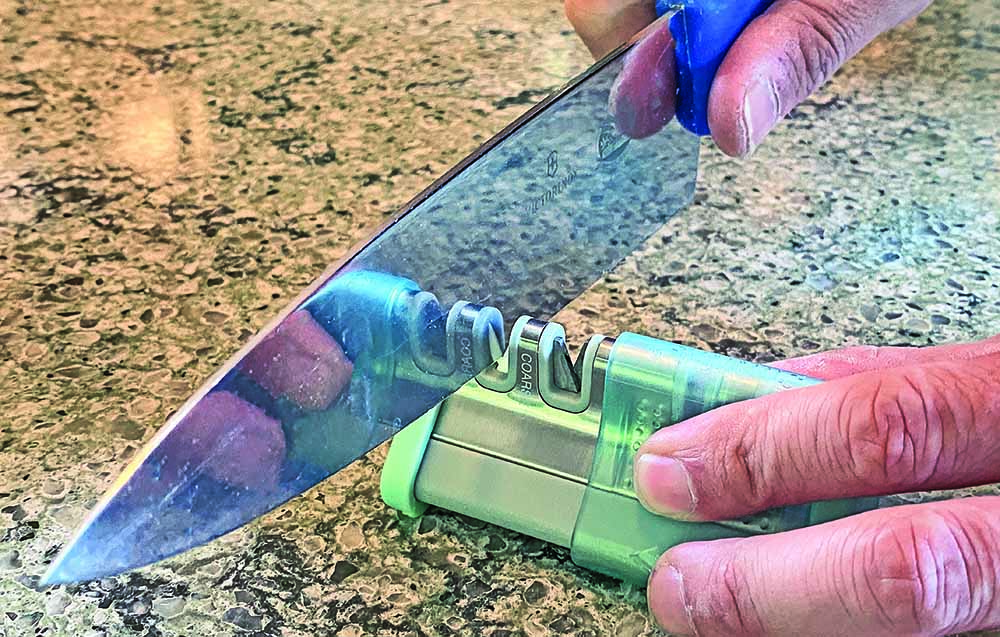
Smith’s Slide Sharp has two pairs of pull-through slots to address both standard and Asian-style kitchen knives.
One such kitchen knife sharpener is the Smith’s Products Slide Sharp Edge Grip. It has two sets of slots. One pair addresses standard kitchen knives at a pre-set 20-degree angle, and the other addresses Asian-style knives at a 15-degree angle. The standard slots have carbide for a coarse grit abrasive and ceramic for fine grit. The Asian-style slots have diamond rods for coarse grit and ceramic for fine.
The Slide Sharp’s indexed sliding grip is textured for a non-slip purchase to allow for secure sharpening. Depending on which slot set you use, the other set is covered by a sliding cover, which is how the sharpener is stabilized—by placing your hand over the sliding cover.
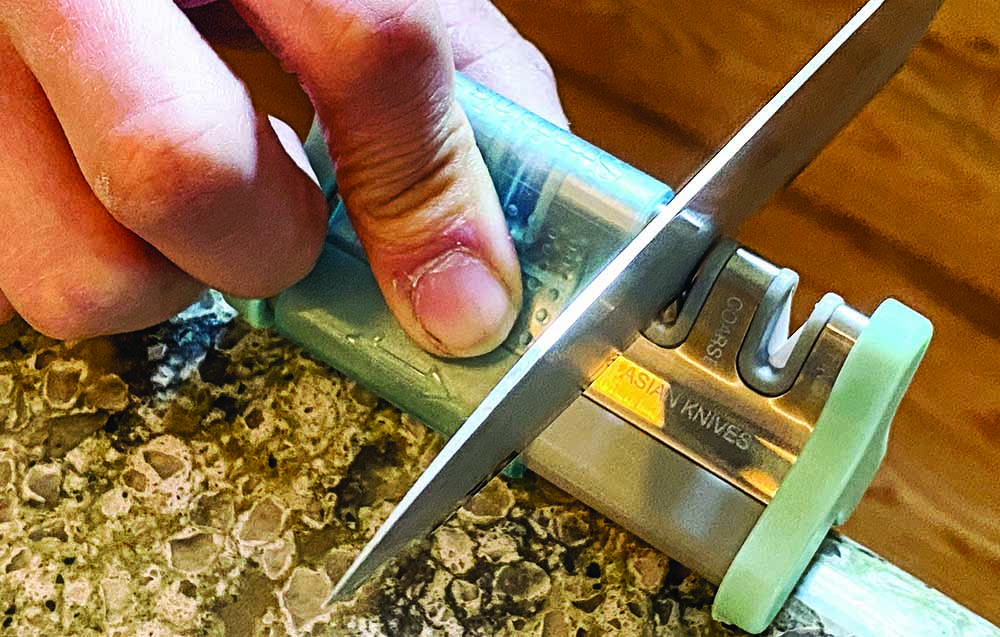
The cross-section of the sharpener resembles an upside-down “Y,” with the arched base held in place on the edge of a table or counter. This gives you another option for stable sharpener operation. Consequently, you have two ways to secure the sharpener during use. Few pull throughs provide such an option.
The Slide Sharp is effective and works as advertised. To use it on a countertop or tabletop, take one hand and stabilize it on the flat work surface. To use it on the edge of a kitchen counter, sit it on the counter edge via the “Y” legs and, while holding it with one hand, pull the blade through and down with the other. You have a better line of sight
to the sharpener this way and it’s very safe, too.
Designed with an upside down “Y” frame, the Smith’s Slide Sharp sits securely while held to the edge of a countertop. This puts the sharpening slots at an angle for better viewing while in use.
If you must use a pull-through, I highly recommend the Slide Sharp. I also recommend using the lightest pressure as possible to sharpen, as pull-throughs can remove too much metal, more so than ceramic, diamond or powered abrasive belt sharpeners. Removing too much metal can prematurely deform the cutting edge.
The Slide Sharp is a little over 1.5 inches tall and a bit under 3.5 inches long. Its compact nature enables convenient drawer storage. The manufacturer’s suggested retail price (MSRP) of $11.99 makes it incredibly affordable and provides no excuse for anyone to have dull kitchen knives. MSRP: $11.99
Camillus Extreme Edge V2 Knife & Shear Sharpener
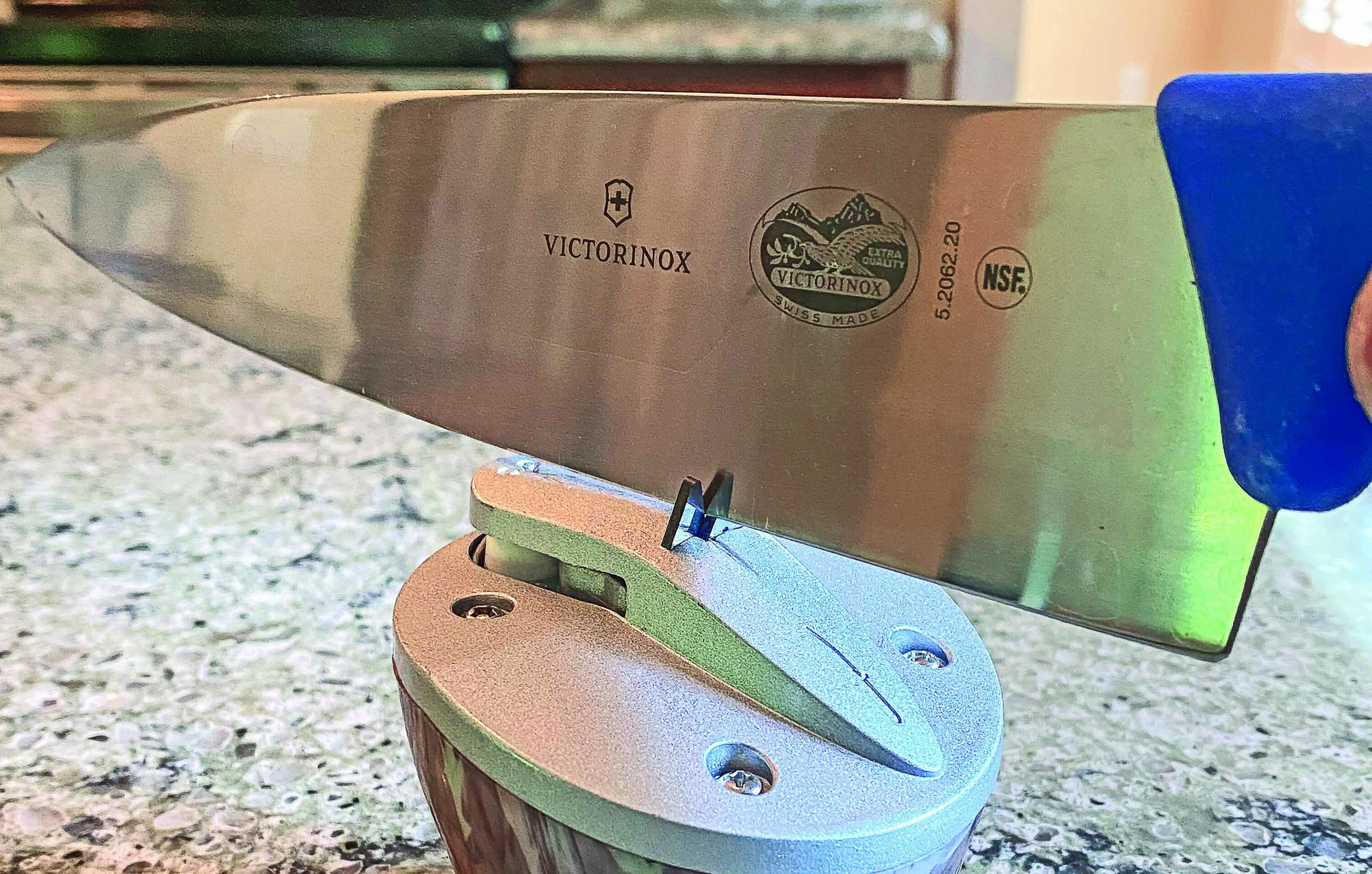
The Camillus Extreme Edge V2 Knife & Shear Sharpener features a pull-through design with carbide media for kitchen knives and fine ceramic for shears to establish edges in quick fashion.
The Extreme Edge V2 Knife & Tool pull-through from Camillus is a two-for-one deal. A set of carbide abrasives addresses plain edge and kitchen knives. It also features a built-in shears sharpener.
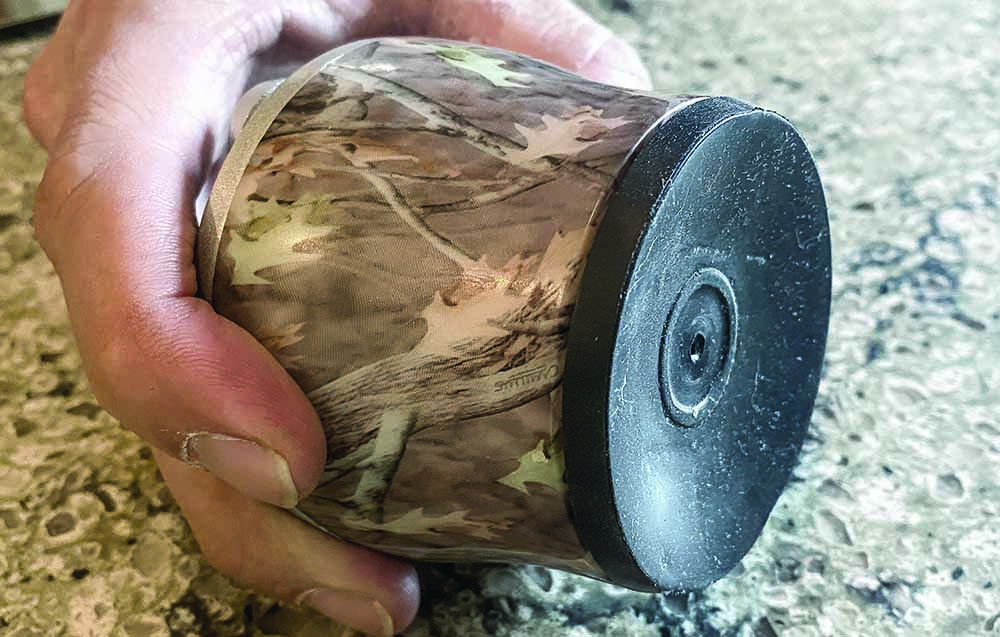
The cylindrical body is around 3 inches in diameter. The top is cast metal and houses the carbides, while the fine-grit-ceramic shears sharpener is in the unit’s rear. The plastic body has an outdoorsy camo theme appearance. For safe operation, a suction cup at the base activates by pressing down and rotating the unit to firmly grip the tabletop surface. For scenarios where the suction cup feature isn’t feasible, it acts as a standard non-skid base.
The sharpener works OK, though I didn’t feel the carbides to be as aggressive as with other pull-throughs I’ve used. The edge it produced was sharp though not surgical sharp. At least the V2 provides a functional sharp edge, which is better than having no sharpener and a dull edge.
The suction cup base of the Camillus Extreme Edge V2 is designed to stick to a slick surface for stable sharpening.
The suction cup base was a disappointment. I could not get it to cling to the slick worktop of my toolbox most of the time. You must really press down on the sharpener and twist it to get it to stick, but it kept loosening repeatedly. However, you can still use the sharpener safely and effectively by employing the suction cup as a non-skid rubber base. Oh, and one of the carbide teeth loosened up after the first few uses, which is unacceptable. MSRP: $19.98.
A.G. Russell Knives Field Sharpener
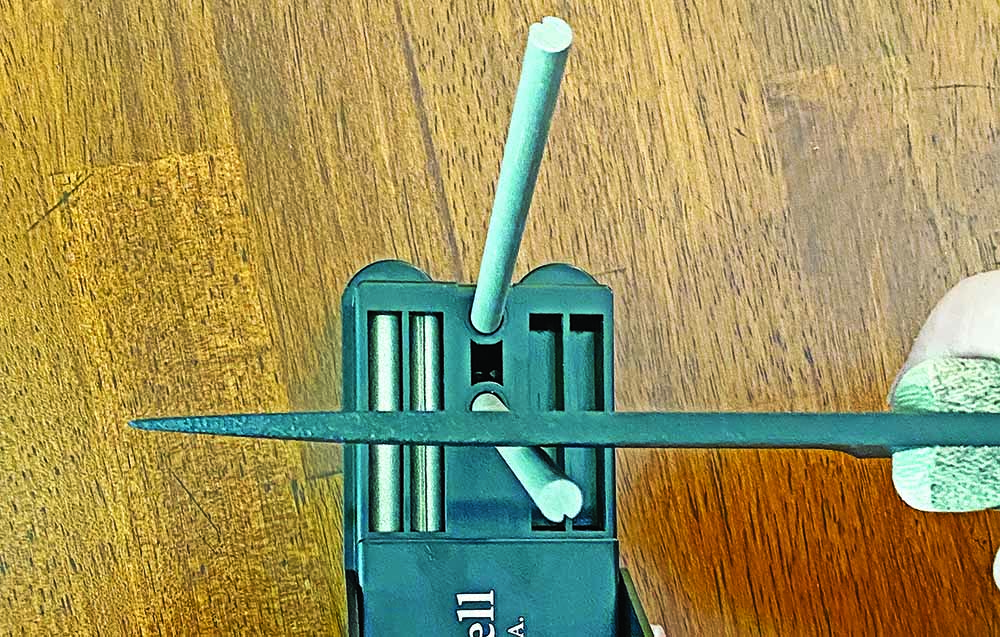
You can see the diamond-grit hones stored in slots in the base of the A.G. Russell Field Sharpener. This is a completely functional, self-contained guided sharpening system that goes anywhere you do.
The A.G. Russell Knives Field Sharpener is probably the most versatile of the test bunch of kitchen knife sharpeners. Not only does it sharpen kitchen knives but also pocket knives, hunting knives and tactical knives. Such value and versatility is a hard combo to top no matter how you slice it.
The Field Sharpener has a molded plastic base and hinged cover. You insert a pair of included 4-inch sharpening rods into two holes at a preset angle of 15 degrees. There’s a set of coarse diamond-grit rods to quickly repair a worn edge or rehab a damaged one. A set of medium-grit ceramic rods further sharpens and dials in edges to razor sharpness. The unit measures 5-by-2 inches and is compact enough for stowing in a toolbox, tacklebox, backpack or even a jacket pocket.
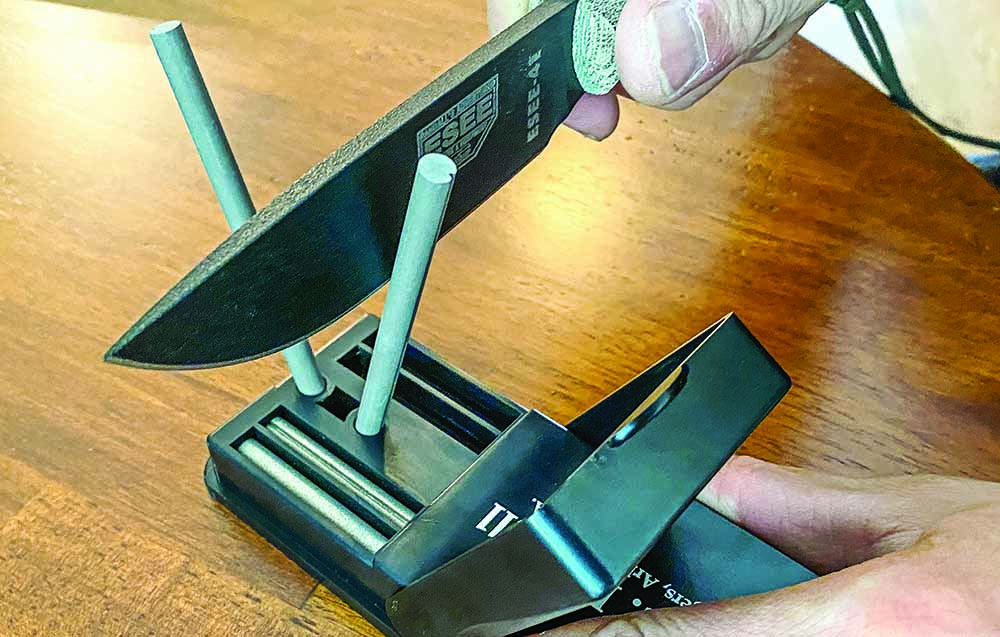
Place the sharpener on a flat work surface. Select the set of rods you wish to use and insert into the holes in the base. The flip-up cover secures the rods when they are tucked inside the base; when open, the cover forms a convenient guard to prevent the blade from coming down on your hand. Place one hand on the base to secure the sharpener. With your other hand, take the knife and move the blade down the rods, while pulling it across from tang to tip—two motions at once. Don’t use a lot of pressure; allow the weight of the blade to rest on the rods and move it down. Keep the blade positioned perpendicular to the tabletop surface; holding it straight up and down allows you to sharpen at the proper angle of 30 degrees inclusive.
The Field Sharpener’s flip-up cover secures the rods when they are tucked inside the base. When open, the cover forms a guard to prevent the blade from coming down on your hand.
The Field Sharpener is very effective. If you’ve used Crock Sticks or a Spyderco Tri-Angle Sharpmaker, you will take to this one easily. It requires the same motions. Unlike the Sharpmaker or Crock Sticks, it’s portable enough to take on outdoor adventures. It’s great for camping, especially if you use a variety of knives.
Given the longer length of many kitchen knives and the 4-inch rods, you must pull the blade across the rods with a bit of expediency to be able to capture the entire blade length in one downward pass. Just be mindful that this technique is more pronounced with longer blades. With shorter blades you won’t notice it as much. The round profile means the contact area of the rod to the blade is smaller and more effective at removing steel. It’s easy to use and highly effective. MSRP: $39.95.
Work Sharp E5 Kitchen Knife Sharpener
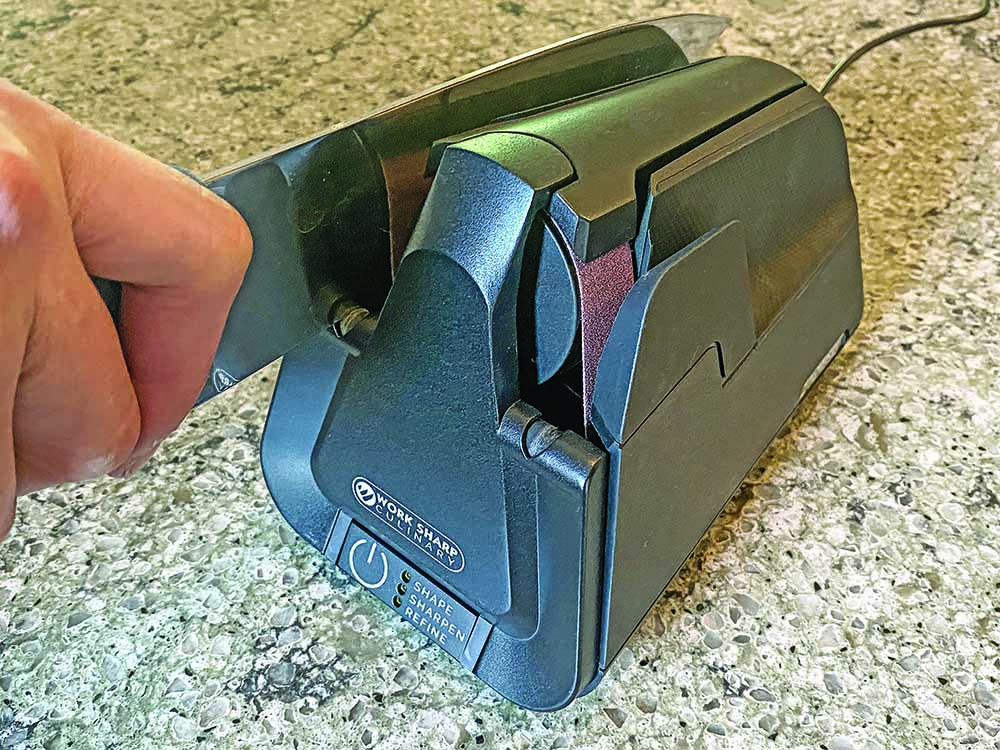
The Work Sharp Culinary E5 uses the same flexible abrasive belt technology as used on the company’s Ken Onion Edition sharpener. Three pre-programmed sharpening modes eliminate the guesswork of obtaining a professional edge.
The Work Sharp E5 Kitchen Knife Sharpener is a top-of-the-line powered kitchen knife sharpener, offering multiple modes, speeds, and the latest technology in providing consistent high-quality sharpening knife after knife. The E5 was designed from the ground up as a powered sharpener that can sit on a counter full time, blending in with other appliances with a minimal footprint. Like Work Sharp’s other powered knife sharpeners, the E5 uses flexible, long-wearing abrasive belts to create an ultra-durable convex edge.
Place the blade inside each slot and the abrasives do the work. Select from one of three sharpening modes via the one-touch programming feature. The Shape mode—three rapid clicks on the power button—starts at a high speed for fast cutting and repair of worn edges, then drops down to the Refine mode—one click—at low speed for the final touch up. The Sharpen mode—two rapid clicks—runs the belt at medium speed for routine edge maintenance, followed by the Refine mode for fast touch-ups.
Select the desired mode then alternate placing the blade in each of the slots. Watch the lights on the power panel. Whichever mode you select, a light shines next to it. Ten seconds before the machine changes modes, the light will begin flashing to warn of the upcoming transition to the next mode, or, depending on the mode, stop completely. Simply draw the blade through. The machine does all the work.
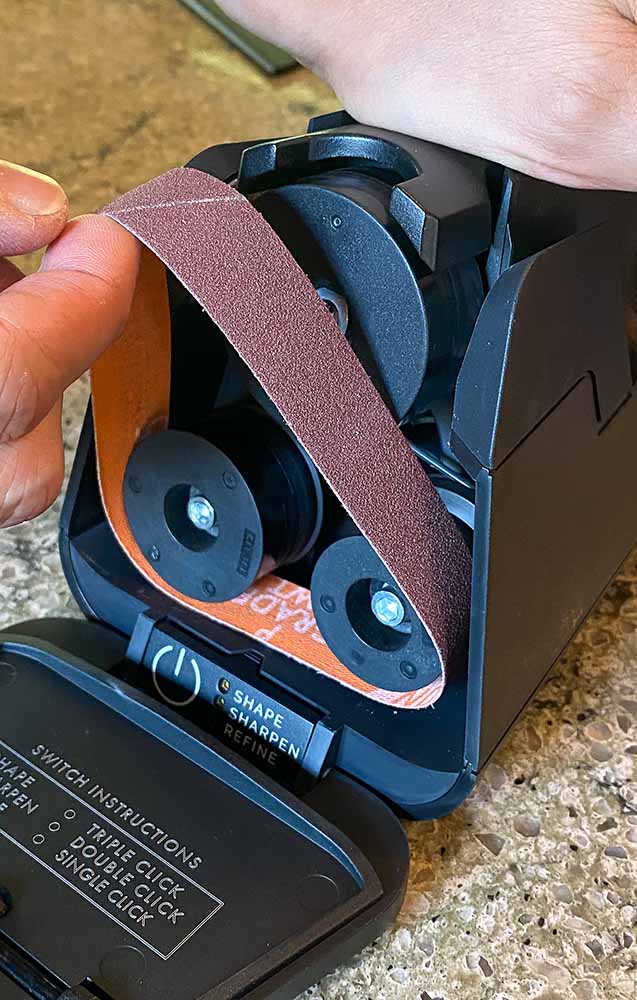
Changing belts on the Work Sharp Culinary E5 is easy. Flip down the faceplate. Press down on top of the machine with one hand to release belt tension, and, with the other hand, remove the belt. The new belt goes on in reverse order.
The first time you use the E5, you will be reprofiling your blades to the set 17-degree angle, which can take some time. At extra cost is an upgrade kit that includes more coarse belts, and 15- and 20-degree angle guides for enhanced versatility and quicker sharpening. MSRP: $59.95.
The E5 works well and produces the convex edge, which is very sharp and durable. The sharpener is quiet and easy to operate, something novices appreciate. If you are serious about cooking, it is essential to have not only high-quality knives but also a high-quality sharpener. The E5 is it. MSRP: $149.95.
Other Kitchen Sharpener Options
Shenzen Knives Electric Diamond Knife Sharpener
Shenzen Knives Electric Diamond Knife Sharpener
Diamonds aren’t just a girl’s best friend. This sharpener from Shenzen Knives features an electric diamond grinding wheel with two settings designed to sharpen both steel and ceramic knives.
Its powerful motor can remove chips as large as 1mm off of ceramic knives, and it easily comes apart for cleaning. An added plus is the universal knife guide slot, which is designed to keep your knives at the perfect angle for the best possible edge on both the fine and coarse settings. Specifically for kitchen knives, this machine is not meant to sharpen scissors, hunting knives, or any other types of blades.
MSRP: $49.99
Sharp Pebble Premium 1000/6000 Whetstone
Sharp Pebble Premium Whetstone Knife Sharpening Stone 2 Side Grit 1000/6000 Waterstone- Whetstone Knife Sharpener
The whetstone, and other sharpening stones, are a much more finite and meditative way to sharpen your knives. Coming in a variety of grit sizes, whetstones work by being submerged in a liquid, usually water, which enhances the stone’s ability to sharpen a blade while also allowing the chips and scrapes to wash away. Sharp Pebble offers a variety of whetstones in different grits and at different price points. (The 1000/6000 stone is a perfect stone for home sharpeners, and is the method I’ve used to sharpen my kitchen knives for the last several years. I enjoy the process of using the stone and feel it provides a quality edge whether it’s my chef knife or my paring knife.)
The majority of the stones come with an angle guide to help you get the best sharpening angle for your knife. These stones can also be used to sharpen other implements from razors to scissors to chisels.
MSRP: $40.99
Messermeister Fine Grit Honing Steel
Messermeister Fine Grit Honing Steel
Sometimes your knife needs honing rather than sharpening. That’s where honing steel, or a honing rod, comes to the rescue. Over time and normal use, the edge of your knives will bend and warp at a microscopic level. Honing steel works to massage the edge back into the proper position without removing as much material as sharpening would. (I hone my knives daily while sharpening them 2-4 times a year. By honing I’m able to maintain a sharp edge longer and maintain better control over my knives while I cook.)
Messermeister offers a variety of honing rods ranging from steel and ceramic to diamond. Their fine-grit rod is made of high-carbon tool steel and can be used to hone knives made from any material. It’s designed to never wear over its lifespan and should be able to hone your knives’ edges for decades.
For a fair price, you can’t go wrong with this rod, and your knives will thank you for it.
MSRP: $24.95 (10-inch), $29.95 (12-inch)
Worksharp Electric Kitchen Knife Sharpener
Worksharp Electric Kitchen Knife Sharpener
For a quality all-rounder, look no further than Worksharp’s newest electric sharpener. Roughly the size of a softball, the sharpener effortlessly sharpens anything you can throw at it in the kitchen including scissors and serrated knives.
Its sharpening slots feature built-in 20-degree angle guides so each edge comes out at a perfect angle. Beyond just sharpening, the device features a ceramic honing wheel as well that allows you to maintain your edge every day.
MSRP: $59.95
Editor’s Note:Mike Abelson contributed to this story
A fine example of a tool and weapon of war, the chute knife more than rose to fulfill the roles for which it was intended.
Harry Archer was a somewhat shadowy figure. At the height of the Vietnam War, he was engaged in nasty business—fighting a stealthy enemy in a steaming jungle, sometimes up close and all too personal.
Those who knew Archer acknowledged that some of his exploits were “larger than life.” They considered him an early non-movie version of author David Morrell’s fictional character of John Rambo*. Still, Archer was real, flesh and blood. And it seems altogether fitting that responding to his need for knives that “deliver” in a tight spot—survival, seconds along the fine line between life and death—he would come to know and rely on another legend.
According to John Denton, perhaps the world’s foremost authority on the knives of BLADE Magazine Cutlery Hall-Of-Fame® member Bob Loveless, Loveless and the man he came to describe as the “head of CIA operations in Vietnam” were introduced to one another by knife writer/Cutlery Hall-Of-Famer Ken Warner. It followed that Loveless made several knives for Archer’s use in the field, among them a fine sub-hilt and stag-handle example of his well-known Big Bear, along with several other Big Bears. Loveless’s close friend and fellow maker Steve Johnson was working in Bob’s shop at the time and participated in crafting these. A fighter in a tulip wood handle is another cold beauty.
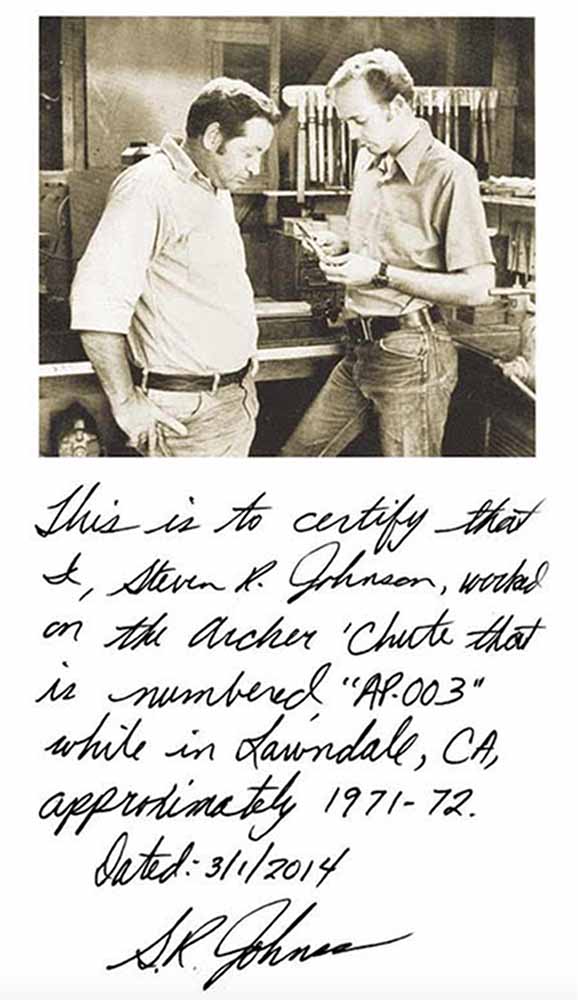
Johnson worked with Loveless from June 1971-October 1974 in the Lawndale and Riverside, California, shops. Steve had a hand in the production of the prototype chute knife in the earliest days, and 23 years later signed a photograph for John Denton attesting to his work on that piece of history. Steve’s inscription reads in part: “This is to certify that I, Steven R. Johnson, worked on the Archer ’chute that is numbered ‘AP-003’ while in Lawndale, CA, approximately 1971-72.” (images courtesy of John Denton)
Then there is the well-known Harry Archer chute knife, a versatile fixed blade with good looks and the ability to travel light but cut paracord for a quick exit from a tangled parachute shroud, and with a stout spine for prying loose from the wreckage of a helicopter. The chute knife was made for the jungle. It was made for Harry Archer.
“It seems that Loveless had been left out of a book by Warner, and Loveless sent Ken some knives to review,” Denton recalled. “It just so happened that Archer was there with Warner. Harry saw the knives and bought them all.”
Johnson worked with Loveless from June 1971 to October 1974 in both the Lawndale and Riverside, California, shops. He had a hand in the production of the prototype chute knife in the earliest days and 23 years later signed a photograph for Denton attesting to his work on that piece of history. Steve’s inscription reads in part: “This is to certify that I, Steven R. Johnson, worked on the Archer ’chute that is numbered ‘AP-003’ while in Lawndale, CA, approximately 1971-72.”
Johnson explains that the chute knife is a fairly small, compact fighter and survival knife, short, light, double-edged and strong, but not made in stock thicker than 3/16 inch. Holes for thongs are placed in the rear of the handle and the guard for lashing the knife to a pole or limb to make an improvised spear. It rides into action atop a chest pack or secondary parachute for quick, easy access. Claims that Warner had a hand in the design are unconfirmed, but “the chute” simply looks the part of the warrior’s dependable asset.
“You’re able to cut both ways with the knife via the swipe of an arm or hand,” Johnson related. “Specifically, it’s for cutting parachute cord should it be tangled or caught in a tree. It’s a knife that a pilot, paratrooper or soldier should carry, and it would not be a burden but useful and available in every situation.”
HARRY ARCHER LORE
Stories of Archer’s combat prowess have been told and retold, but to raise awareness of the immediacy of a close-in fight, nothing is better than the harrowing tale that Denton remembers Loveless repeating. John points to a photo of a vintage Big Bear, identifies it as a knife that Archer took into combat, and says, “Harry and his men got into a hand-to-hand fight, and the tip of the blade was broken off inside the enemy. Harry took the knife back to Bob to fix, and Loveless said, ‘Where’s the tip?’ Harry replied, ‘It’s still in the rib cage of the Viet Cong soldier.’ So, Loveless fixed the blade.’”
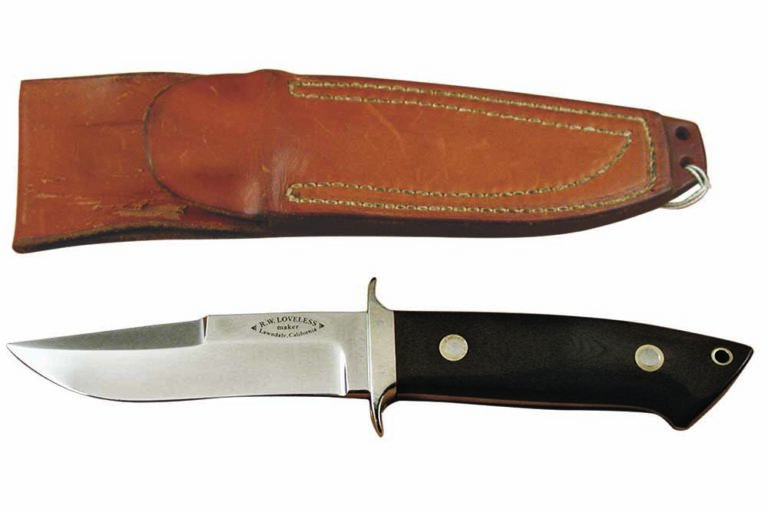
Made in Bob Loveless’s Lawndale, California, shop about 1973-74, this chute knife in ivory Micarta® is stamped BR-003. It was made for the Brass Rail, a famous gun shop in Hollywood, California, where all the celebrity types hung out to see guns and knives. Note the holes in the guard for lashing the knife to a pole to make a spear. (images courtesy of John Denton)
Like the Big Bear and other Loveless creations, the chute knife has its place in the lore of Harry Archer. After he collaborated to produce the prototype, Johnson continued to work with Loveless on more of the chute knives. He remembers meeting Archer in the California shops.
“Loveless really admired Archer and his adventures in the Vietnam War era, working with USAID**, the CIA and different assignments in various parts of the world,” Steve commented. “[Harry and I] discussed life in camp in Vietnam, interactions with Vietnamese soldiers and personnel with whom he was serving. That was quite interesting.”
Steve calls the chute “one great knife” and remembers conversations in Lawndale when the veteran operative praised it as light and small enough to carry so that it could always come along on a mission. Johnson also made a chute knife for Archer and continues to produce his own model today.
“We worked together on Archer’s order for a ‘Johnson’ version of a chute knife on a bench in the rear of Bob Loveless’s shop, in his garage in the back of his house in Lawndale,” Steve smiled. “Archer asked me to make my version, which we—mostly he—designed in the early 1970s. He did a drawing for me. The 154CM blade was about 4.5 inches long, the handle slim and a bit longer than normal, and it had a large thong tube, three handle screws, a stag handle, and checkering on the top and bottom of the tang just behind the guard.”
Bob Loveless (left) and John Denton (right)
For Johnson, working with Archer was a pleasure and a defining moment in his illustrious knifemaking career, which, after recovery from a serious accident, took him from Loveless’s shop to his own space in Manti, Utah, more than 40 years ago. “Harry Archer was a great guy who appreciated my work, as well as Bob’s,” Steve added, “and I made him a few knives after California. He was very easy to talk to, respected others, and he really was a man of intrigue and adventure. And Bob Loveless treated me like a son.
“I’m making a chute knife for Atlanta [Steve was interviewed prior to BLADE Show 2021] as we speak, with the blade polished so far, instead of the top grind being just the length of the clip,” Johnson concluded. “I use the pattern that Loveless gave me when I left his shop in Riverside in 1974 or 1975. This particular knife is going to have a stag handle and stainless steel fittings. I’ll make more when asked, and I still have a few on order in my books.”
Long-time maker and designer Bob Dozier was a friend of Loveless and went on to design a chute knife for Cutlery Hall-Of-Famer A.G. Russell. Though his only acquaintance with Harry Archer is through the recollections of A.G., who knew him, Bob says his version of the chute knife remains in demand for one simple reason: “It sells.”
Dozier turns out his chute knife with a 4.75-inch D2 tool steel blade and overall length of 9.75 inches. The handle is green canvas Micarta® “because Goldie [Russell] won’t let me put anything else on them. I’ve got some blades hanging right now, getting ready.”
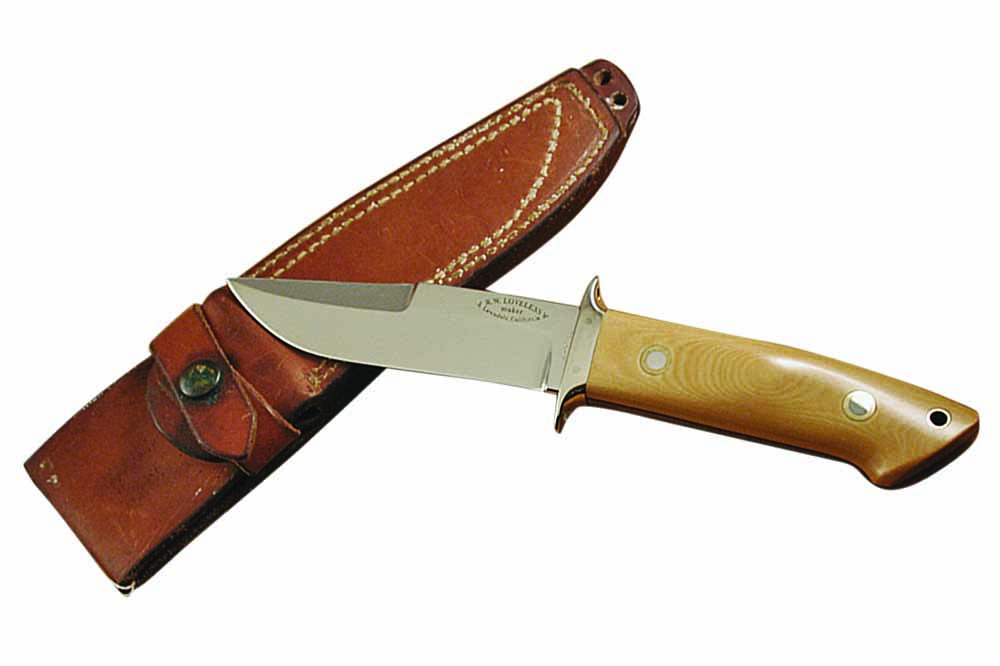
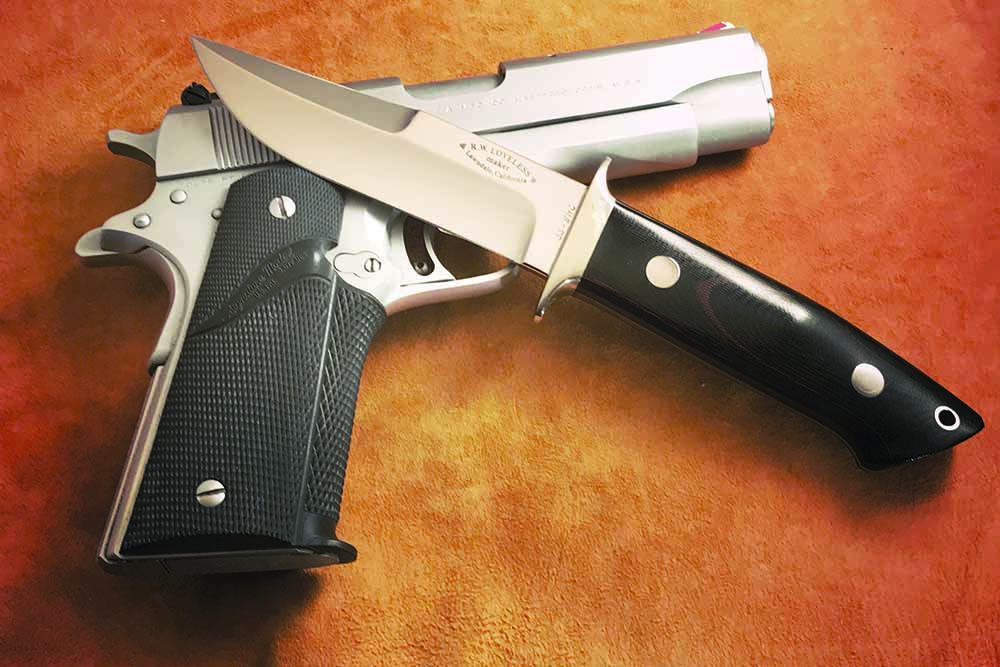
The “RR” on the guard of this Loveless chute indicates it was for the Ram Rod gun store in New Castle, Indiana. Early on Ram Rod sold knives by Loveless, Bill Moran, Ron Lake, W.W. Cronk and others. It appears here with a Smith & Wesson Model 41 modified by Loveless.
Dozier is familiar with the Loveless chute knife configuration but never had the Loveless pattern. He looked at the earlier chute knife profile and made some tweaks. “My handles are like the Loveless, but I don’t cut the butt off as square as he did. I leave more of a point on it than he did. Mine is still mostly like Bob’s, and he was one of the first to make a really good slab-handled knife. That’s one reason why most of us have copied him.” Dozier’s chute knife, designed and built for A.G. Russell Knives, has a manufacturer’s suggested retail price of $895.
SAGA of The CHUTE
The saga of the chute knife certainly has a human side. While Denton estimates that early Lawndale chute knives might fetch as much as $14,000 if found for sale today, and chute knives made in Riverside command up to $12,000 each, they are desirable on the collector market. Nonetheless, the greatest value of the chute knife lies in its lifesaving and protective capability in the hands of a dedicated professional such as Harry Archer.
Through those years of association, Loveless and Archer became friends, sharing a common bond of respect and admiration for the best in fighting and utilitarian knives.
“Loveless said that Harry would come by his shop after periods of being in the jungle for months at a time,” Denton remembered. “He used Bob’s place to unwind and try to become civilized again before heading home to Virginia. But Loveless also said, ‘Harry was like a wild animal when he came to the shop, trying to keep his head straight before he saw his family.’”
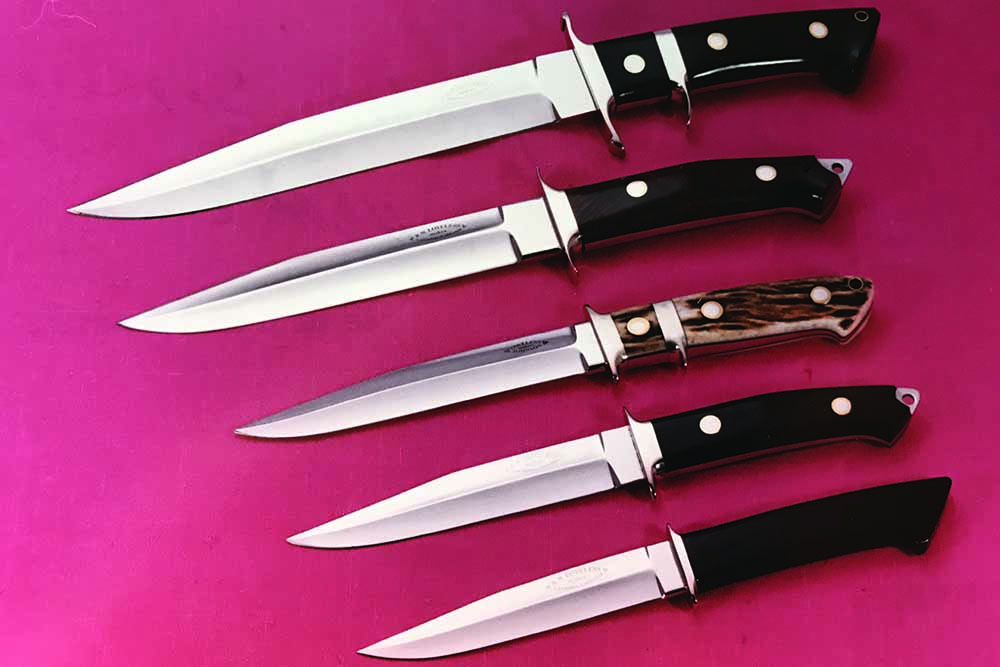
Whenever Harry Archer ordered several Big Bear fighters from Bob Loveless, Loveless said Archer told him to “send the bill to the Pentagon.” From top: the Big Bear Harry broke the tip off inside a Viet Cong soldier during the Vietnam War; tulipwood fighter with skull cracker; Loveless/Johnson sub-hilt with the initials HJA for Harry J. Archer; boot knife with skull cracker; and one Loveless called the Pig Sticker. (image courtesy of John Denton)
The chute knife is indeed a fine example of a tool and weapon of war rising to fulfill the roles for which it was intended. It remains a popular pattern because of its looks, quality and versatility. And for one other reason in particular: It helped men like Harry Archer survive the most desperate of situations and make it home.
*In actuality, Morrell based the Rambo character on Medal-Of-Honor recipient Audie Murphy.
**USAID is the acronym for United States Agency for International Development, with the inference here being that in this instance it functioned as a cover for the CIA.