Welcome to CANCON A Fully Suppressed Range Day! The World’s Favorite Suppressed Shooting Festival moves to the Carolinas!
We can’t wait to welcome you to the new home of CANCON on the East Coast: Clinton, South Carolina. Join us on November 8th & 9th, 2024 for an action-packed weekend of fully suppressed shooting!
With a new BIGGER venue to host CANCON there will be MORE sponsors, more bays, more guns, more suppressors, and more fun!
The Clinton House Plantation Shooting Complex is a massive venue and gives CANCON the room we need to expand! Located just 45 minutes south of Greenville, South Carolina, 1 hour north of Columbia, and 2 hours south-west of Charlotte, NC.
More space means more shooting lanes and more sponsors! Find more guns to shoot, more suppressors to test, all for the same low price of $50 per day.
New this year will be a 1,000-yard AND 1-mile shooting range! Get to test high-performance rifles AND high-performance suppressors and see how far you can reach out.
Friday only stop by the Blade Magazine Tactical area and shop custom tactical knives!
Clinton House has tons of FREE onsite parking! Shooting all that free ammo will make you hungry so stop by the concessions to refuel!
General admission is available Friday and Saturday, Nov 8 & 9th, $50 per day, or save money and get the entire weekend at a discount!
More information and ticket pre-sales are now available at the CANCON WEBSITE!
Returning to CANCON is PROS Vs. JOES! We select a random participant from the crowd to go head-to-head against a seasoned pro shooter. Can an everyday Joe outshoot a Recoil Pro in a high-stakes shooting competition? If they do, they win BIG!
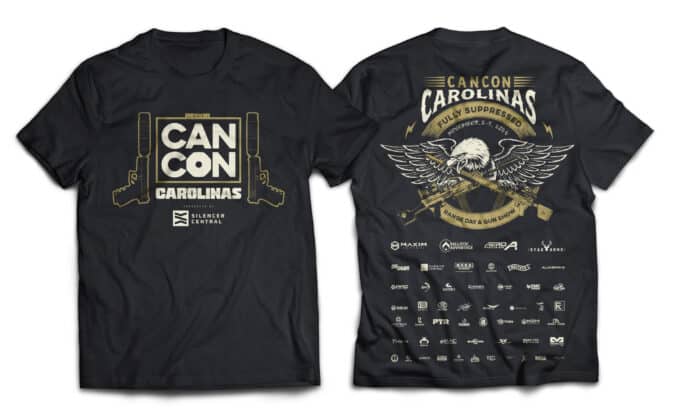
CANCON T-shirts will be available for pre-order and at CANCON! These are high-quality shirts that feel great and look awesome.
Filmed on location is a RECOILtv original, Run N Gun! Watch your favorite Sponsor as they run through our Run N Gun course of fire.
Subscribe to the CANCON Event Newsletter
Give us your email below and click the button to be the first to learn about updates and developments!
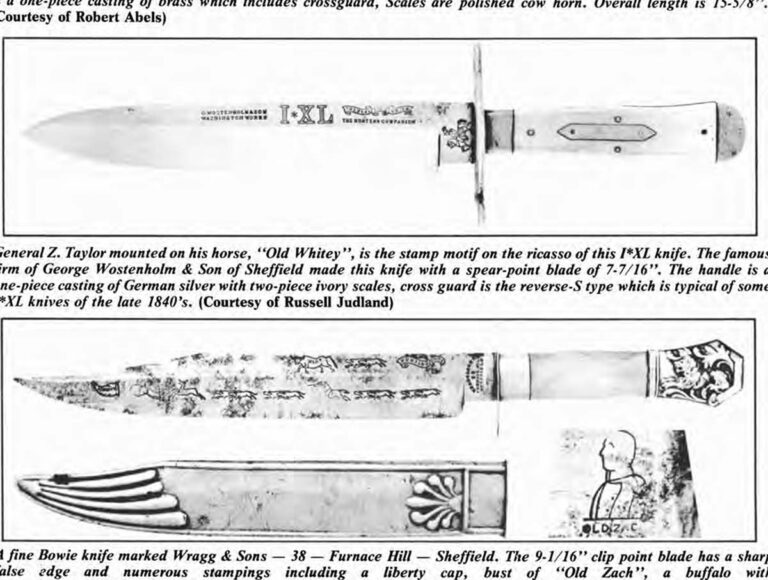
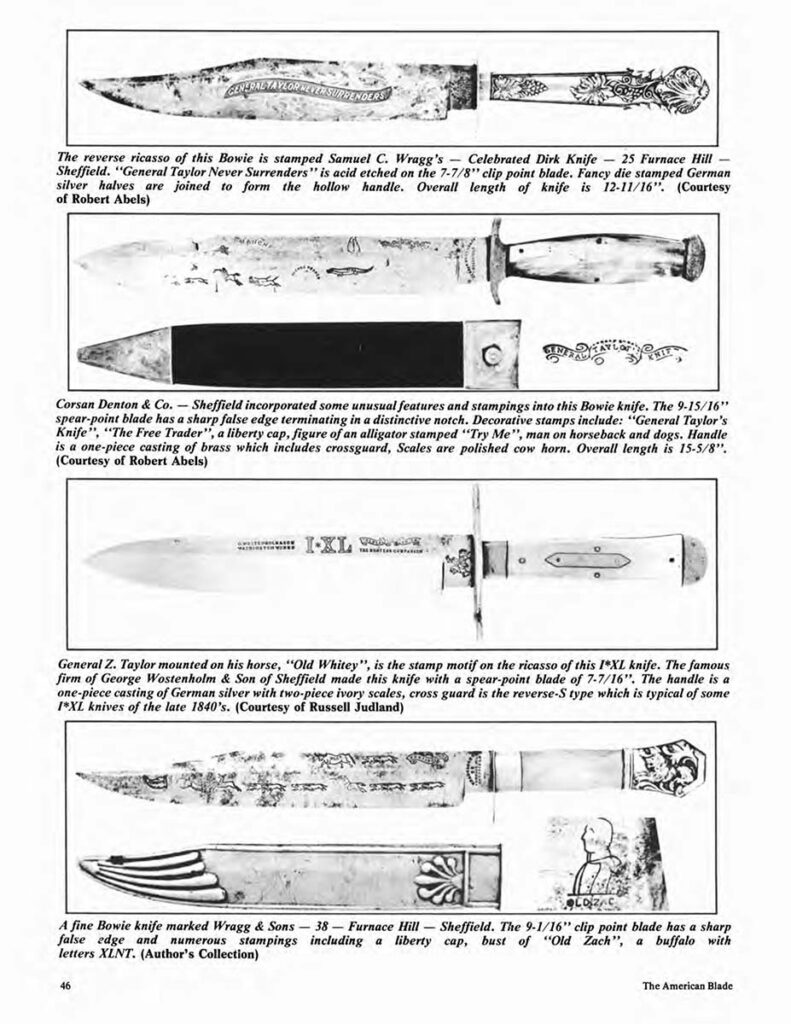
The 12th president was and is a hot knife commodity.
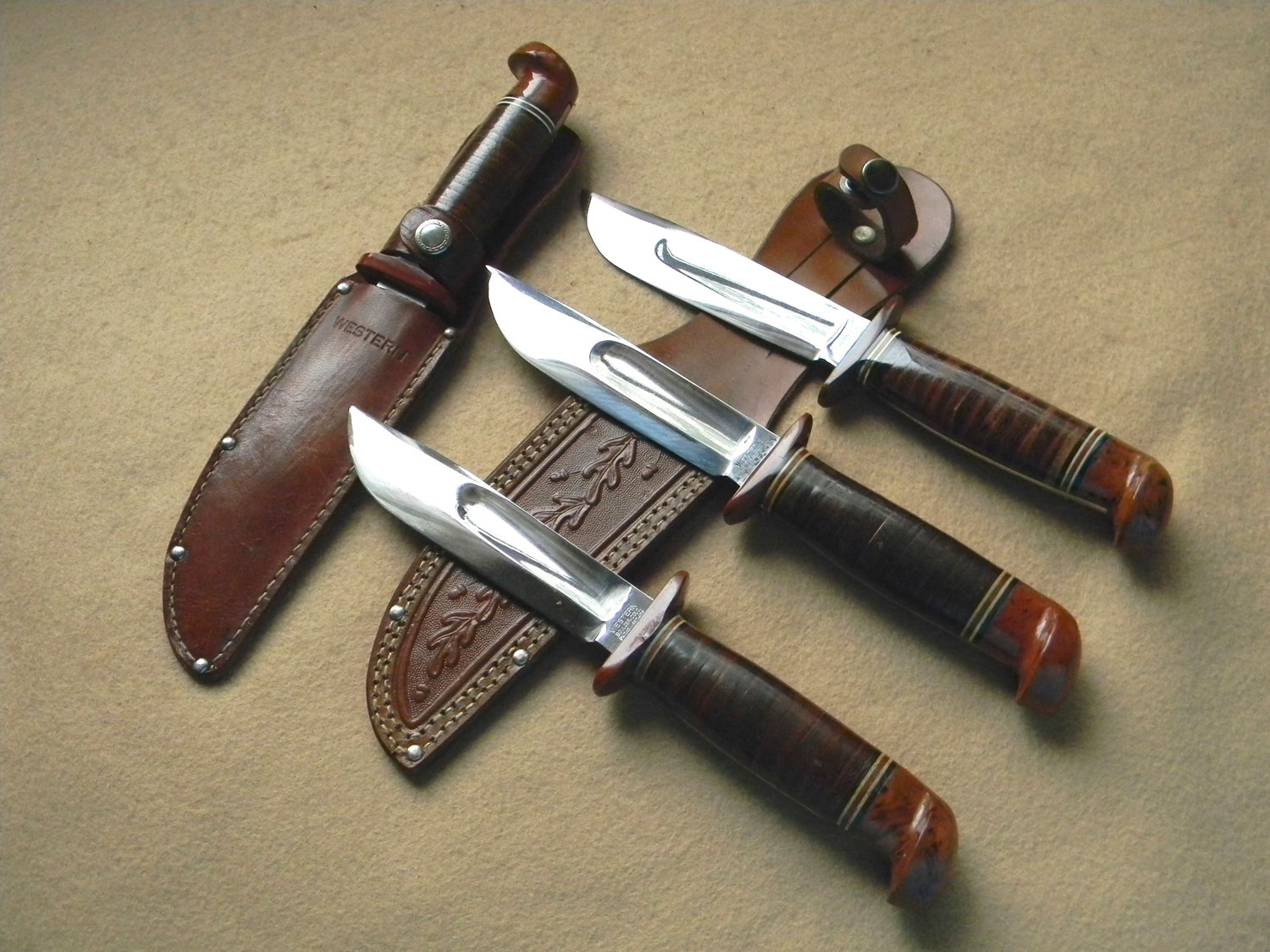
Some examples from the article of “Old Zach” bowies that included the American general and president’s name, slogans or likeness. The lower bowies have his visage, the second from bottom a stamp motif on the ricasso of Taylor on horseback, the bottom a bust of the celebrated general.
Ever in tune with what’s popular at the moment, knifemakers have never been afraid to cash in on a hot trend. William R. Williamson documented one of the more peculiar vogues of the middle 19th century when Zachary Taylor and bowie knives were all the rage.
Fresh off his triumphs in the Mexican-American War, Taylor was the 1850’s version of a rock star—Americans just couldn’t get enough of him. And while not known to carry a bowie nor affiliate with the hero of the Alamo—Jim Bowie—the general and president’s likeness began to pop up on the most American of knives.
Funny thing is, as William’s points out in his article “Old Zach and the Bowie Knife,” from the March-April issue of The American Blade®, it wasn’t the Yanks cashing in. Instead, England Sheffield’s makers had the pulse of the USA and stamped Taylor’s visages on blades and bolsters.
Unfortunately, Old Rough and Ready’s short-lived presidency didn’t inspire the same outpouring of effigies. But modern collectors did and do find these unusual and patriotic blades desirable, as Williamson points out in his article.
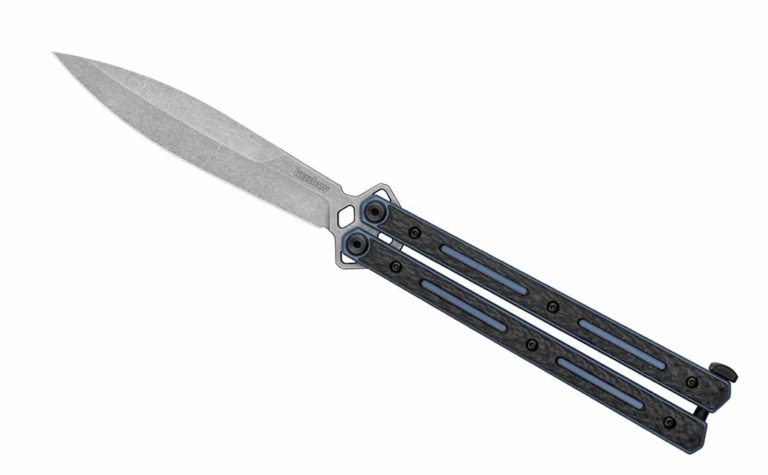
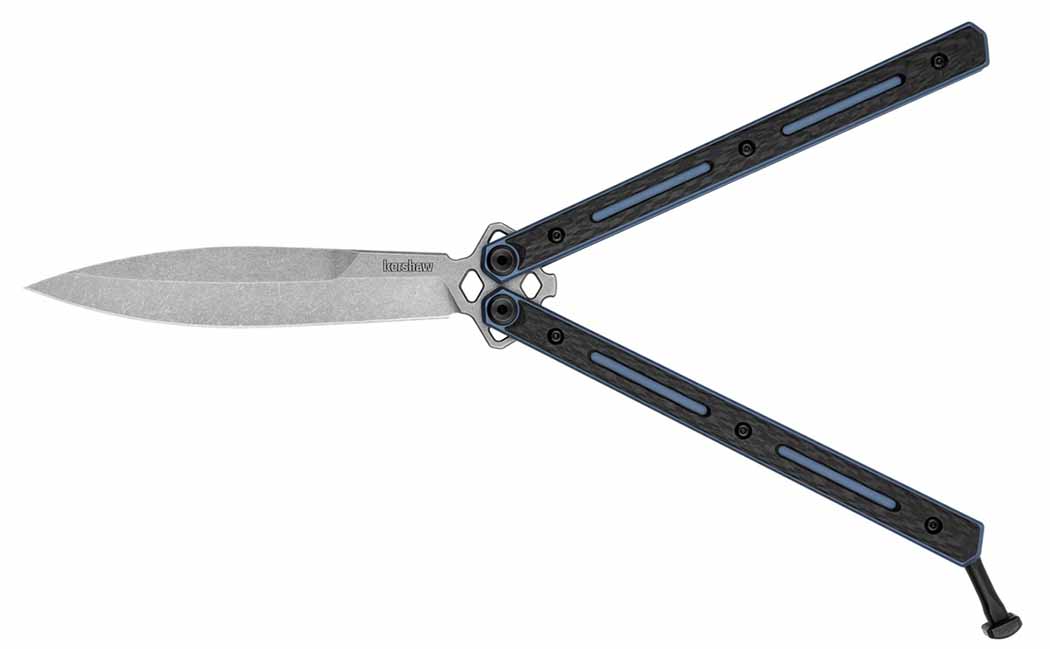
Kershaw steps up its balisong game with the introduction of the lightweight Lucha Carbon Fiber.
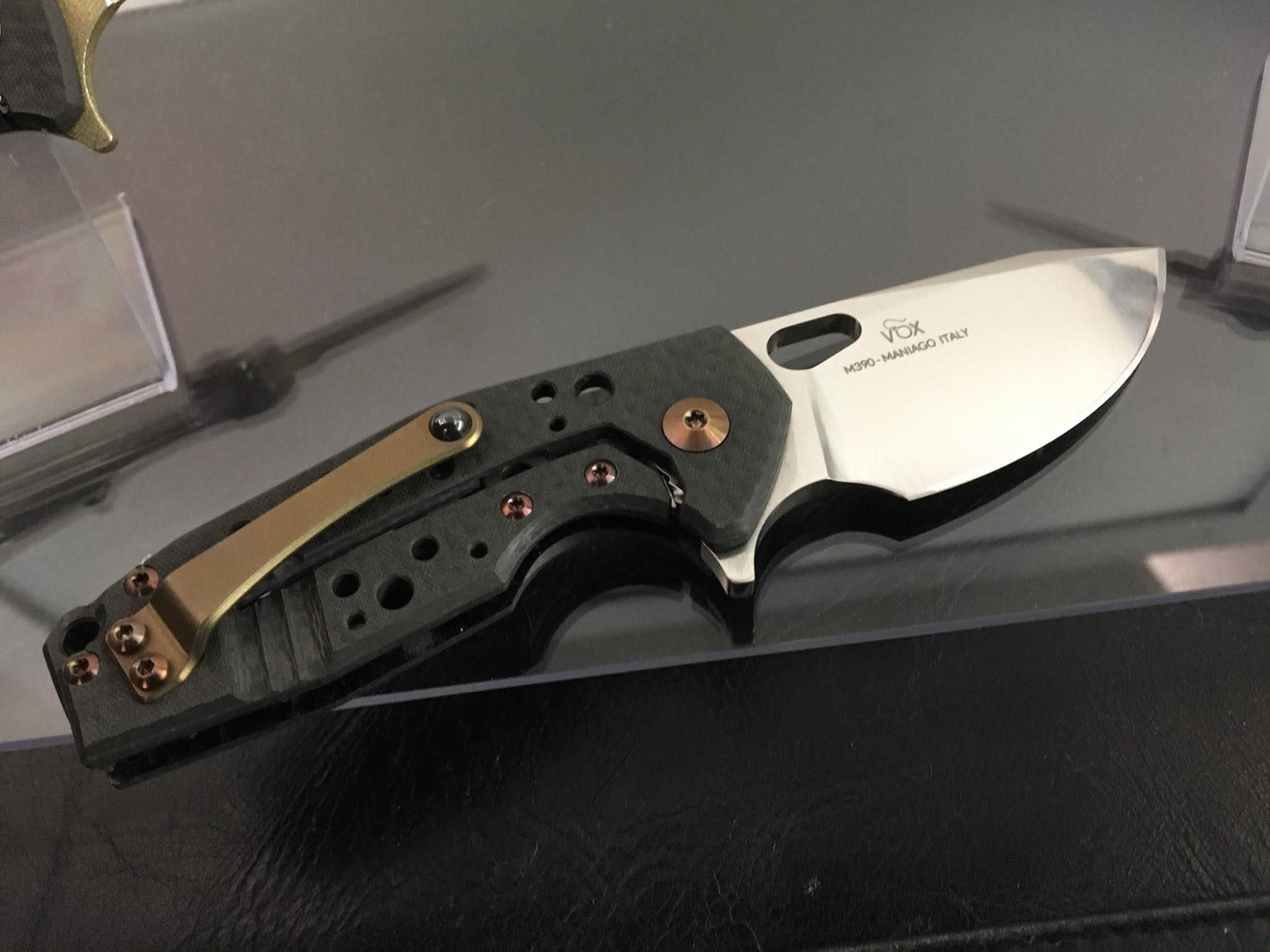
The original Kershaw Lucha made waves when it was released 2 years ago, and it’s only gotten better with a new twist on the design. Shake hands with the Kershaw Lucha – Carbon Fiber. Embracing cutting-edge materials, the Oregan company has cooked up a more nimble variation, one perfect in the role of a unique EDC option or a top-end balisong competition blade.
As its name suggests, Carbon Fiber is the belle of the ball in next-generation Lucha, with Kershaw applying it to the handle. Adding rigidity to the system, the company opted for a titanium skeleton, but offset the use of metal with weight-saving cutouts in the carbon-fiber exterior. The efforts paid off, the knife is a full ounce lighter than the original Lucha at a very svelt 4.9 ounces. Worth mentioning, the mix of carbon fiber and blue finished titanium gives the knife a dynamic look.
Kershaw didn’t skimp on the other aspects of the Lucha Carbon Fiber. Dual KVT ball bearings make the knife’s action silk smooth and quick as lightning, making opening and manipulating the knife effortless and smooth. A wicked spear-point blade, constructed of corrosion-resistant CPM 20CV stainless steel, facilities faster opening and proves useful for both cutting and perforating tasks. And a Kershaw’s “Working” finish maintains the aesthetic integrity of the blade, hiding scratches and gulls better other finishes.
While not the most expensive option on the market, the Lucha Carbon Fiber tilts to the expensive end of the balisong spectrum—$500 (expect around $300 retail). Yet, it’s difficult to argue the USA-made knife certainly offers plenty for the price.
Initial Impression
Describing the Lucha Carbon Fiber in one word is simple: streamlined. Building on the successful original, the new Carbon Fiber appears a more refined version in every way. From its single-edge spear point to its almost lighter-than-air titanium and carbon fiber handle, it should bring everything balisong fans appreciate to the next level.
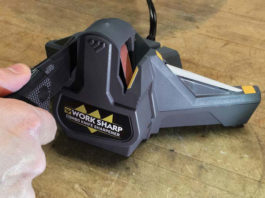
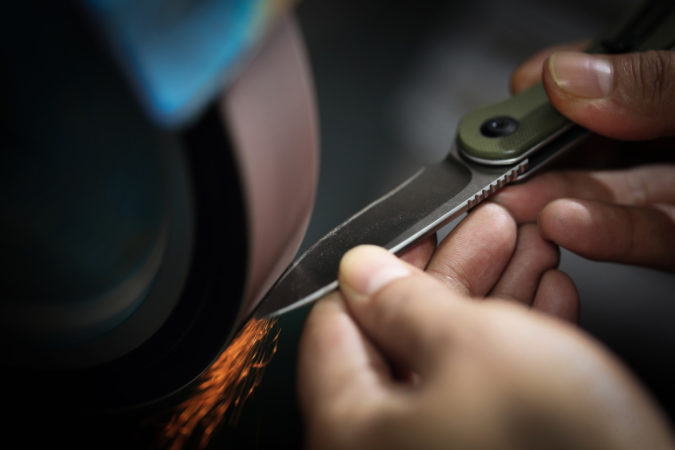
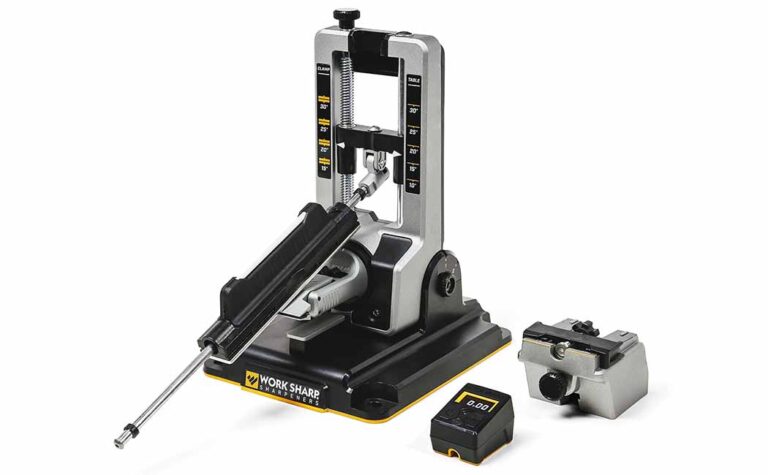
The Work Sharp Professional Precision Adjust Knife Sharpener is upgraded to ensure the utmost consistancy and sharpness.
No doubt, if you take keeping your knives sharp you’ve caught wind of Work Sharp. The purveyors of precision sharping systems, the company has opened razor-sharp edges to the everyman—not just those who’ve mastered the whetstone. Recently, the company has taken its honing system a step further.
Shake hands with the Professional Precision Adjust Knife Sharpener.
The sharpener takes what most are familiar with in a Work Sharp system and enhances it in nearly every conceivable way to live up to its ‘professional’ moniker. Its design is very reminiscent of the Work Sharp Precision Adjust Knife Sharpener, however, the upgrades of the Profession command a much steeper price than the earlier iteration. At present, the company list’s an MSRP of $299.95—not cheap, for sure. But Work Sharp gives serious knife aficionados plenty of reasons to pony up the cash.
First and foremost is the Professional Precision Adjust Knife Sharpener’s all-metal construction. While perhaps one of the less flashy aspects of the adjustable sharpener, it forms a solid foundation to ensure the utmost precision and repeatability in applying an edge to a knife. And honestly, compared to other metal-frame sharpening systems, the Professional Precision Adjust Knife Sharpener actually comes in as a deal. To this, Work Sharp adds a V-Block Clamp that quickly, securely and repeatably secures your knife during the sharpening process. Furthermore, a weighted base provides a safe and stable platform that allows rotating the knife without removing the knife or clamp.
From there, Work Sharp has included a digital angle indicator, which many DIYers will heave a sigh of relief. Not that the old manually adjustable scales on the frame aren’t usable, but bringing angle adjustment into the digital age makes for much quicker corrections and more consistent blade to blade. The system allows for adjustments from 15 to 30 degrees, which covers a major swath of steel most knife owners are likely to encounter. Adding to this, the system comes with a full assortment of honing plats, including 220, 320, 400, 600 and 800 grit diamond, a ceramic honing plate and a leather strop. Essentially, it’s equipped to go from reapplying an edge to taking it to a mirrored polish. A note, if you sharpen a lot and often, don’t worry about if you wear the grit down on the plates. These are user-replaceable, so the integrity of the system itself is safeguarded for a lifetime of use.
Of other notables of the Professional Precision Adjust Knife Sharpener, it comes with a small knife attachment and includes a 3-year warranty. The device is certainly angled at knife pros—sharpening services, makers and shops. But for a serious knife owner who never wants to lose his edge, the system might be a dream come true.
There are times gloves make all the sense in the world to use when using a knife and times they don’t.
The old saying goes that two things might “fit like a glove” or “go hand in glove.” But just maybe another question involves exactly when the “glove fits.”
Since mankind began working with tools, stone, bronze, steel and even in conditions that might be less than ideal, such as clearing trees and brush, dressing an animal, building a structure, or handling heat and cold temperatures, the idea of protection has been second nature. At first glance, the glove has its place and always will. But there are, in fact, other considerations in using hand protection, especially when it involves using a knife.
The time and place for gloved hands is the choice of the user, and thoughts on the topic vary.
“As you might expect, the answer ‘yes or no’ to gloves is ‘it depends,’” declared Craig Powell, general manager of TOPS Knives. “There are a lot of different reasons to wear gloves or not, depending on the use case. In cold weather, the gloves are more to keep your hands warm than they are necessarily for safety or grip. I wear gloves if I have them on me whenever I’m doing heavy-duty cutting like chopping firewood or other tasks that have a lot of impact involved.
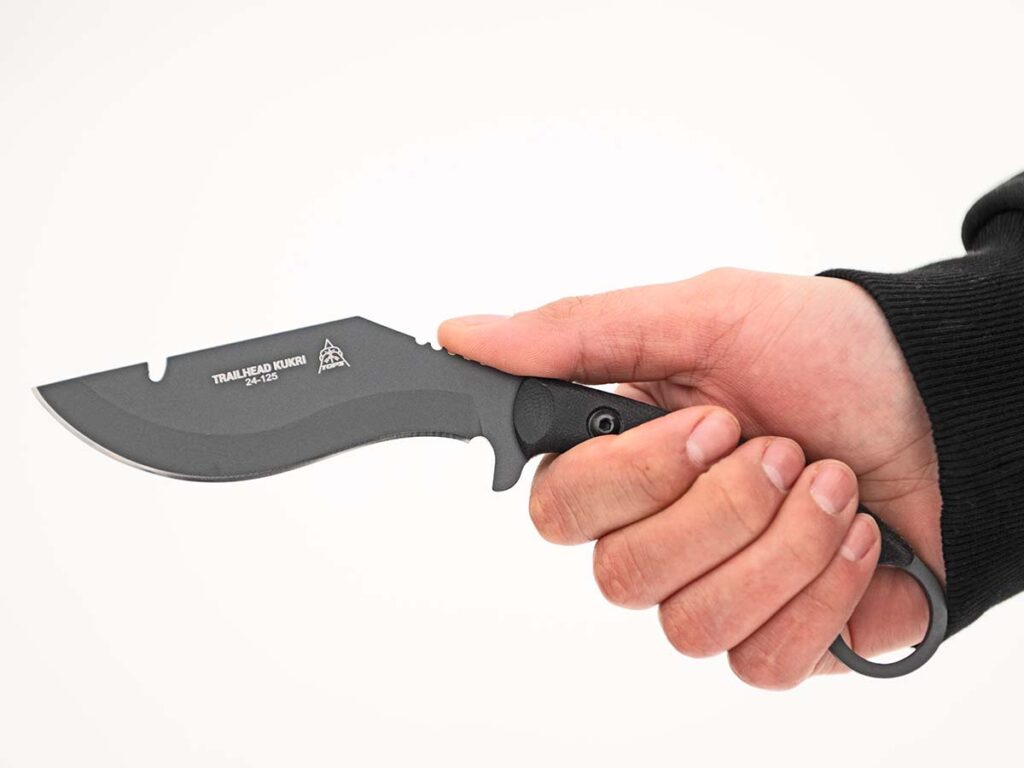
Craig Powell said one of the specific reasons for Micarta® or G-10 handles on TOPS knives is to provide a good grip when you need it. “Micarta is one of the best for grip even when wet and whether you have gloves or not,” he observed. The TOPS Trailhead Kukri has black canvas Micarta scales. (TOPS image)
“I also usually have a few pairs of latex or nitrile gloves handy when hunting just to keep things a little cleaner when gutting or skinning an animal,” Craig added. “If I’m doing tasks that require fine control of cutting, I don’t usually wear gloves. One of the reasons I use Micarta® or G-10 on TOPS knives is specifically to provide a good grip for when you need it. Micarta is one of the best for grip even when wet and whether you have gloves or not.”
Situational awareness, then, drives most decisions to use gloves or go barehanded when using a knife. There are times when working with steel in the shop or making camp in the field that gloves are indispensable, and then there are other tasks that require the most intricate feel and finesse that can only be achieved with the bare hand.
Reuben Bolieu, BLADE® correspondent, outdoor adventurer and designer for ESEE Knives, recognizes when and where the glove provides that necessary advantage.
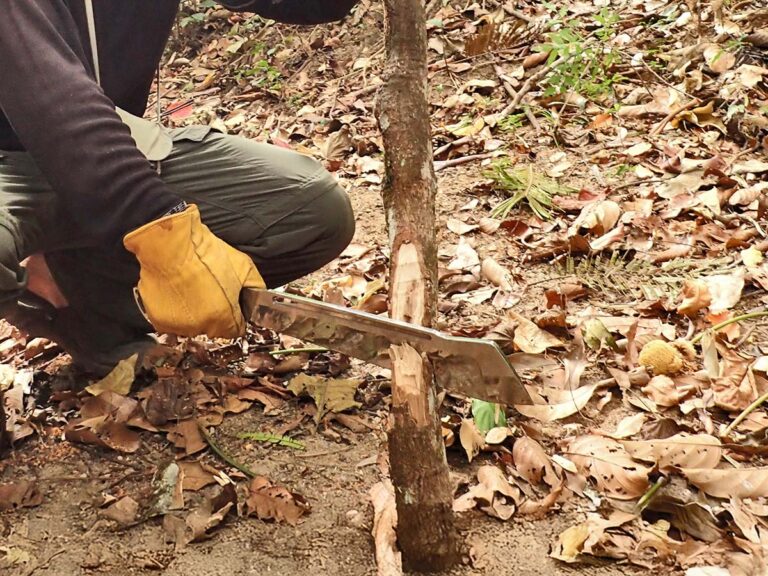
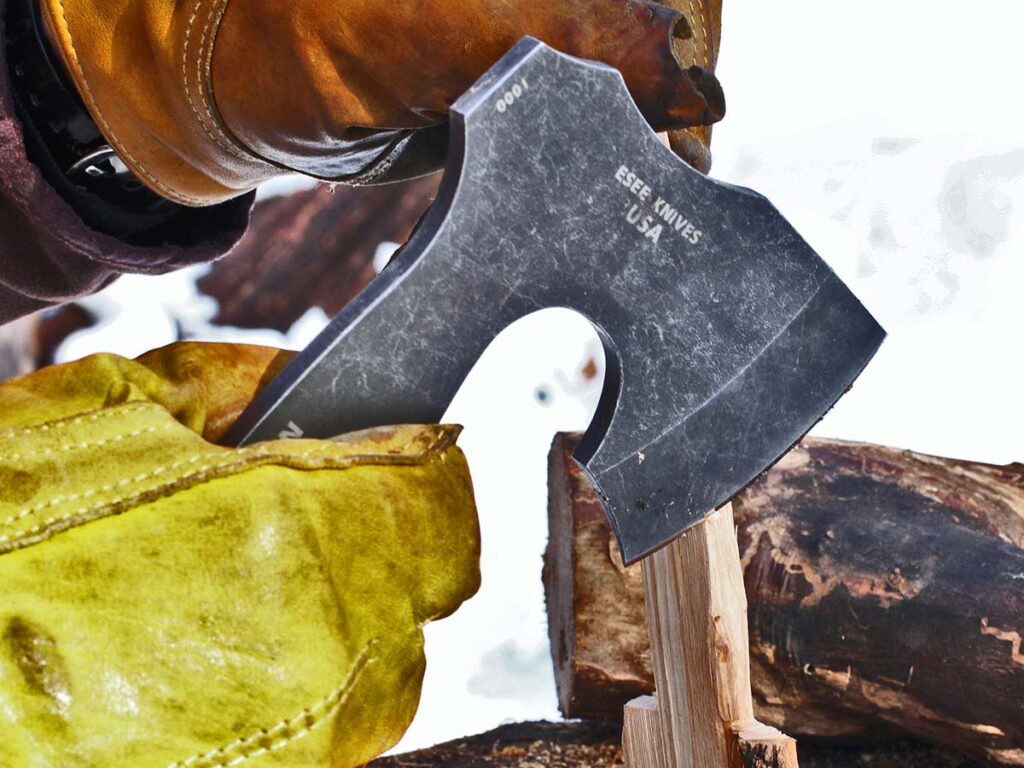
Reuben Bolieu wears cowhide gloves—nothing fancy—while chopping with his ESEE Gibson Carving Axe. As he noted, “These gloves are excellent general-purpose gloves when handling wood, bamboo, hot cookware and dirty work.” (Bolieu image)
“Gloves are the unsung hero of my camping trips,” he remarked. “They provide a momentary boost of superpower when handling hot pots or skillets taken directly from the campfire. Gloves also give you a second chance if you accidentally nick yourself while retrieving a big blade or axe from its sheath.”
Joe Flowers, designer for TOPS Knives and Condor Knife & Tool, answers emphatically regarding whether he uses gloves.
“Most of the time I do not, unless I am doing a highly repetitive motion or am working a particularly scaly or dangerous animal or material. This is general, as I can feel the blade and manipulate the tool more for the tasks at hand. The pro of wearing gloves, especially if you are not used to working tools, is the absence of concentrated friction that can lead to blisters. Even if you work a farm all day, you can get blisters doing a repetitive motion.
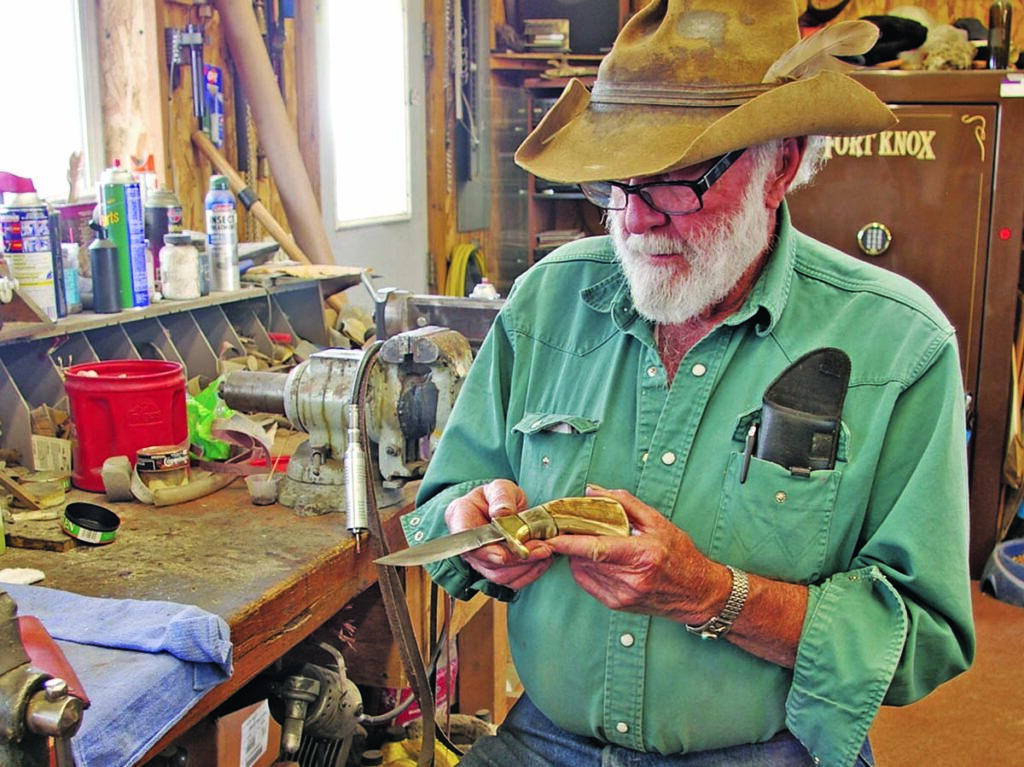
Feeling the handle of a knife against bare skin in the user or maker’s hand is considered the acid test for utility. Ed Fowler cradles one of his trademark sheep-horn handle knives at his shop bench.
“After hanging out with Anders Haglund, formerly of Helle Knives, I appreciated the idea of a larger handle for mitten manipulation,” Joe added. “The legacy of Sami reindeer herders who use large gloves helped him convince me. I don’t always design large handles, but if it is a design that could work with a Nordic culture I pay attention and put a larger handle on the blade. Sami culture sometimes calls their survival kit ‘a big knife, a small knife, and a reindeer.’ That’s all they need to survive.”
Gloves, Knives And Safety
Safety is always a factor in wearing gloves to use knives. Removing a knife from a sheath or deploying a folder blade always has a bit of hazardous duty involved. The same is true in the shop or the field, though the gloves themselves can sometimes present a hazard.
“Gloves get wet. This is wasteful,” explained longtime BLADE field editor and High Endurance Performance Knife master smith Ed Fowler. “They may be too loose and can get you caught up in machinery. The skin on our hands is very sensitive, and this sensitivity can help improve the quality of our knives, as well as our health. When buffing or grinding a hardened blade, our hand can communicate the temperature, where your heat treat might not remain just as you planned it to be. Friction is the enemy of our heat treats.”
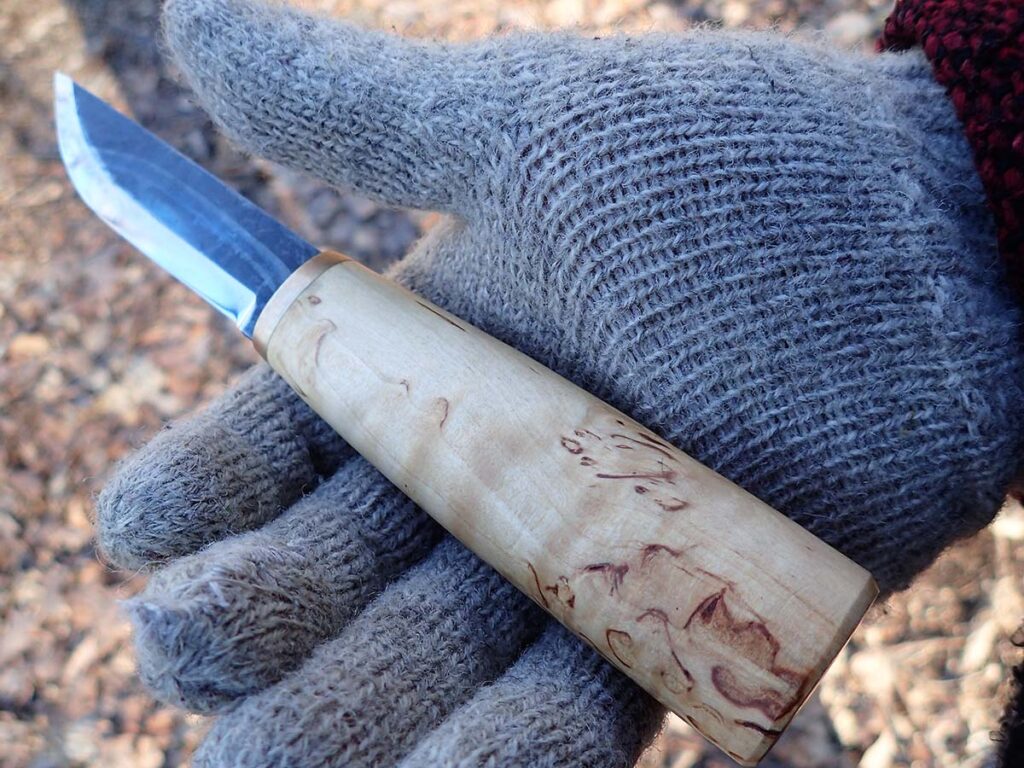
“After hanging out with Anders Haglund, formerly of Helle Knives, I appreciated the idea of a larger handle for mitten manipulation,” Joe Flowers stated. “The legacy of Sami reindeer herders who use large gloves helped him convince me.” The Nordic-style fixed blade is a Marttiini Arctic Carving Knife. (Bolieu image)
At the risk of stating something readily apparent, the positive aspects of wearing gloves when using knives include minimizing a cut or slice that could require stitches or worse, managing heat and cold, reducing the build-up of friction that can create painful blisters, and possibly even improving grip and purchase in the hand.
“The obvious pros of gloves are safety from materials and the tools you use,” Bolieu related. “However, gloves are fumbly! This brings us to the cons: clumsy dexterity. Fiddling in the dark or cold is the worst when working with sharp tools or lacking time. Gloves can slow you down big time! Sometimes you need to take a stand and say, ‘The gloves are coming off!’”
When Powell is at work, he takes stock of the task at hand, and gloves may or may not be part of the equation.
“Fiddling in the dark or cold is the worst when working with sharp tools or lacking time. Gloves can slow you down big time,” Reuben Bolieu opined. “Sometimes you need to take a stand and say, ‘The gloves are coming off!’” (Bolieu image)
“Gloves can keep your hands from getting torn up when you’re doing a lot of heavy-duty cutting. They can also keep your hands clean when they need to be. Then, of course, there are gloves that will help prevent or at least lessen the cut you might receive if there is an accident. The cons are mainly the loss of dexterity and fine control. Depending on the type of glove, your ‘feel’ of the knife just won’t be as good as with a bare hand.”
Feeling the handle of a knife against bare skin in the user or maker’s hand is considered the acid test for utility. The glove is sometimes a barrier to truly getting the feel of the knife and developing an intuitive awareness of its capabilities.
“A good way to see if a handle is going to be comfortable for you to use is to give it a good, hard squeeze and hold it for a few seconds,” Powell commented. “Once you release it, if you feel some uncomfortable spots on your hand, that is a good sign that it will have some hot spots. Everyone’s hand is different, so while some knives might feel great for some, that same handle might feel terrible to others. A knife that looks great aesthetically doesn’t always do the job when it comes time to start cutting. So, a bare hand on the handle is a must whenever you can.”
Habit And Repetition
For those who wear gloves regularly when using knives, personal preference weighs in. The influence of habit and repetition contributes, too.
“Here’s a good analogy for this,” said Craig. “Most people wear shoes every day to keep their feet from getting cut or injured in some way. People that spend lots of time barefoot, especially outside, tend to have tougher feet. Basically, the same rocks that would cause some people a lot of pain don’t do anything to those who walk barefoot often. The same will be true for gloves. If you wear gloves every time you use knives or other hand tools, your hands don’t build up some of the toughness to be able to handle using knives often. A good handle will absolutely make a difference, but so will using tools often in general.”
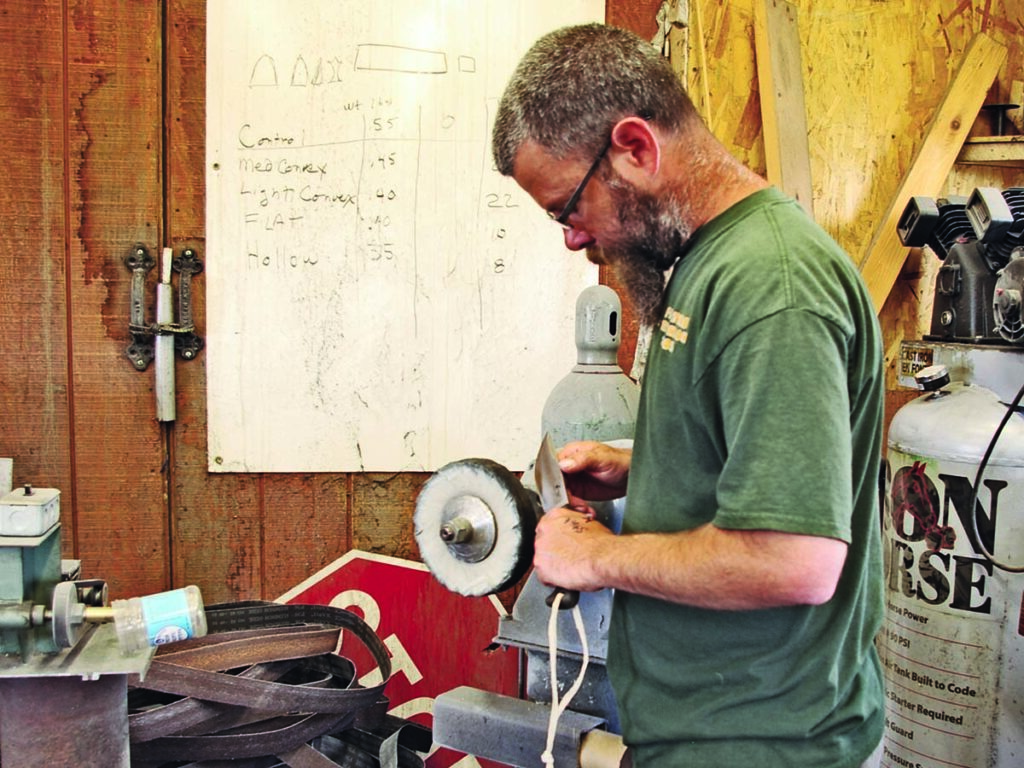
As Ed Fowler noted, when buffing or grinding a hardened blade, the hand can communicate the temperature. Chris Amos buffs a blade in Ed’s shop in this file photo. (Fowler image)
Choosing whether to wear gloves or not shouldn’t be a difficult decision. The best advice available involves balancing risk versus return, hazards in relation to control and manageability.
“If gloves are the remedy, crack on!” Reuben offered. “Gear is terrain and weather-specific. I use leather gloves made of cowhide, the type you would see a ranch hand or cowboy use—nothing fancy. These gloves are excellent general-purpose gloves when handling wood, bamboo, hot cookware and dirty work.
“In winter, I add a thin fleece glove under them,” he noted. “This adds warmth but makes things extra fumbly. If I need more dexterity for making feather sticks or carving, I remove the leather glove and work the best I can with the fleece glove. It’s always a tradeoff. Safety first! More than anything, try with and without, see what works for you and have a blast!”
Flowers is strong in his opinion on the gloves themselves, but acknowledges there is a time and place for them when working with knives.
Pulling a knife from a sheath or deploying a folder blade always has a bit of hazardous duty involved. (TOPS image)
“Gloves do not determine how hardcore you are,” he advised. “I hate gloves but I wear them sometimes when the environment dictates it. I like to work beehives without gloves and I applaud anyone who does. Dexterity is very important when you manipulate and use a tool with a fine edge. Find gloves that you can move in … Gloves can help, but ultimately it is your time with a knife that is important, and, honestly, part of our human story.”
Experience is a great teacher, and familiarity with knives, their utility and hazards should drive the decision whether to use gloves.
“To each his own,” Powell concluded. “If you prefer to wear gloves when using knives, do it. If you don’t like wearing gloves don’t unless you’re doing something where there is a really good reason to have gloves on. For just regular daily use, I feel gloves are totally unnecessary, but I’ve also been in the knife world for over 25 years now.”
The use of gloves while working with knives does, then, involve the nature of the task, its brawn and repetition versus its intricacy and detail, control versus power. Having a pair of gloves handy is probably a best practice. Using them when and where appropriate enhances the knife experience.
Master smiths explore the symmetry, skill and survivalist roots of a classic.
It’s part adventure with a bit of notoriety and a dash of creativity. For the modern custom knifemaker, several styles are brought to life with history in mind. And the push dagger is one of them.
Maybe seldom seen, but always intriguing, push daggers trace their lineage to a bygone era when self-defense at the card table or on the street meant quick deployment from a vest pocket. For sure, that perspective spurs some custom makers to insert the push dagger into their repertoire while the stylized and subtle blend of blade and handle combine for a unique test of shop skill.
“They’re a backup tool,” explained ABS master smith and BLADE Magazine Cutlery Hall-of-Fame® member Steve Schwarzer. “They were typically carried in the 1700s and 1800s along with a one-shot pistol. After that shot, the push dagger was the next position. It’s been around for a long time as an extension of your arm with a blade, and it is hard to take away from somebody that is skilled in its use.”
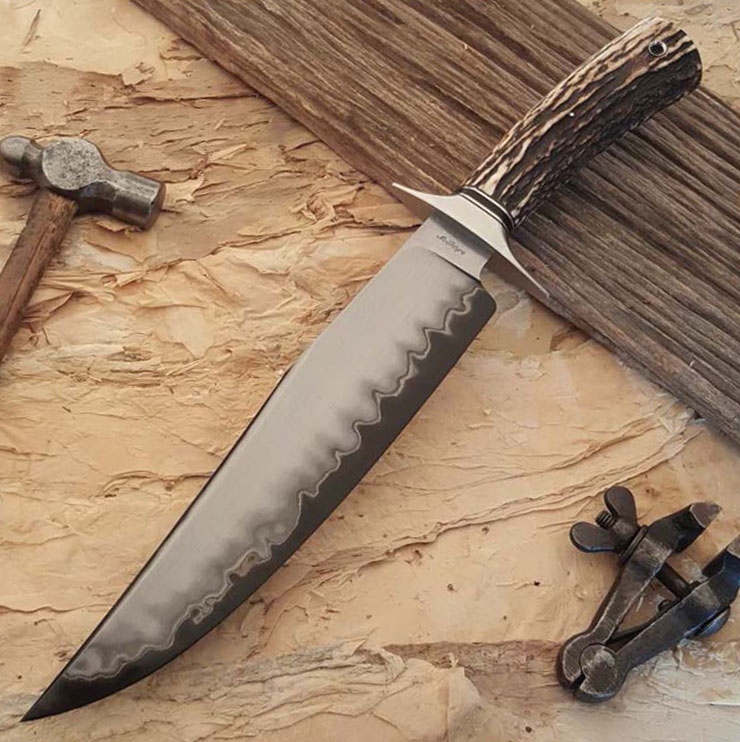
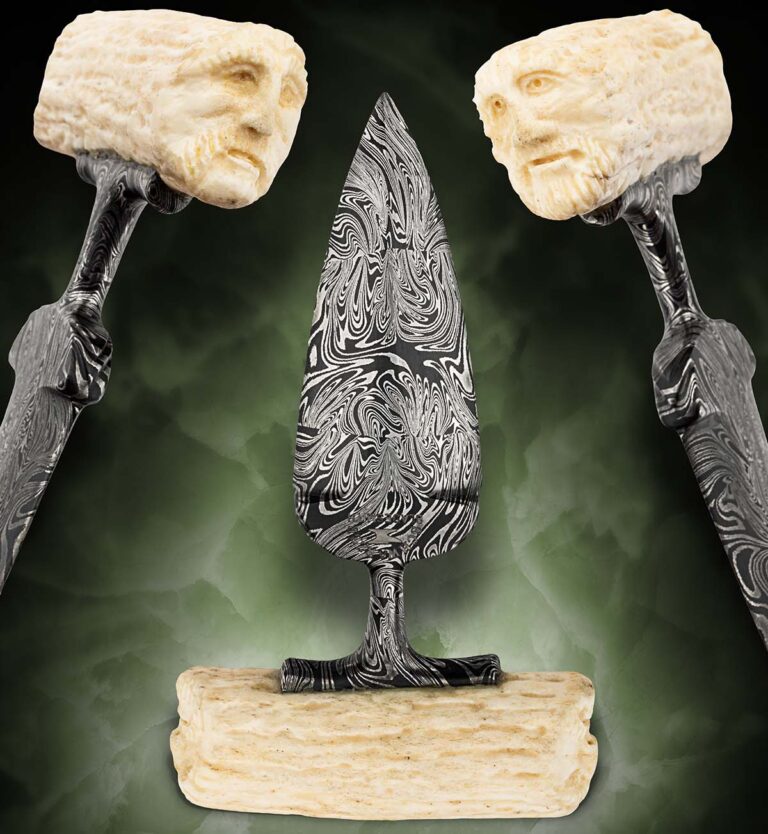
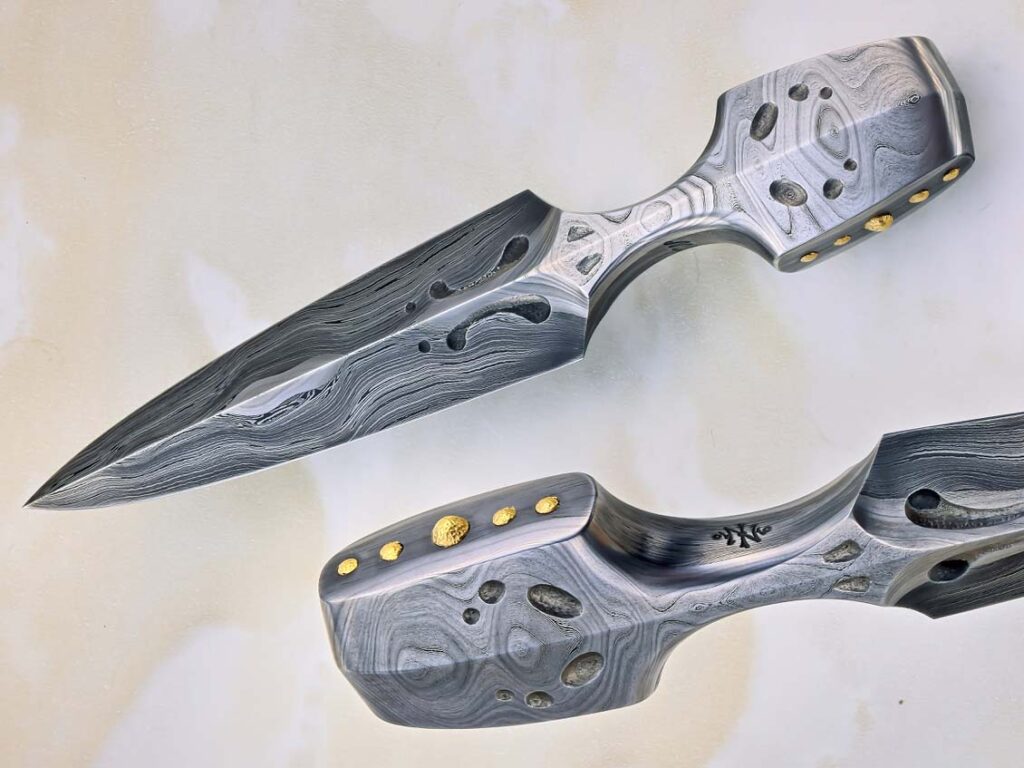
Schwarzer’s featured push dagger with stag handle and evocative faces carved on both ends is 5¾ inches long with a 3¾-inch blade of mosaic damascus steel. He has actually made two push daggers in this style and designed another for Benchmade about 20 years ago. “For me, they’re fun, and that’s why I like to make them,” he commented. “I’ve always had a fascination about them and adapted my martial arts background to training with them. The design traditionally is with a very short blade, and in martial arts, it has to do with the alignment of the hand and arm bones, along with the shape of the blade, which is double-edged traditionally. Everything in nature is curved for an effective cutting surface.”
Harvey Dean Tejas
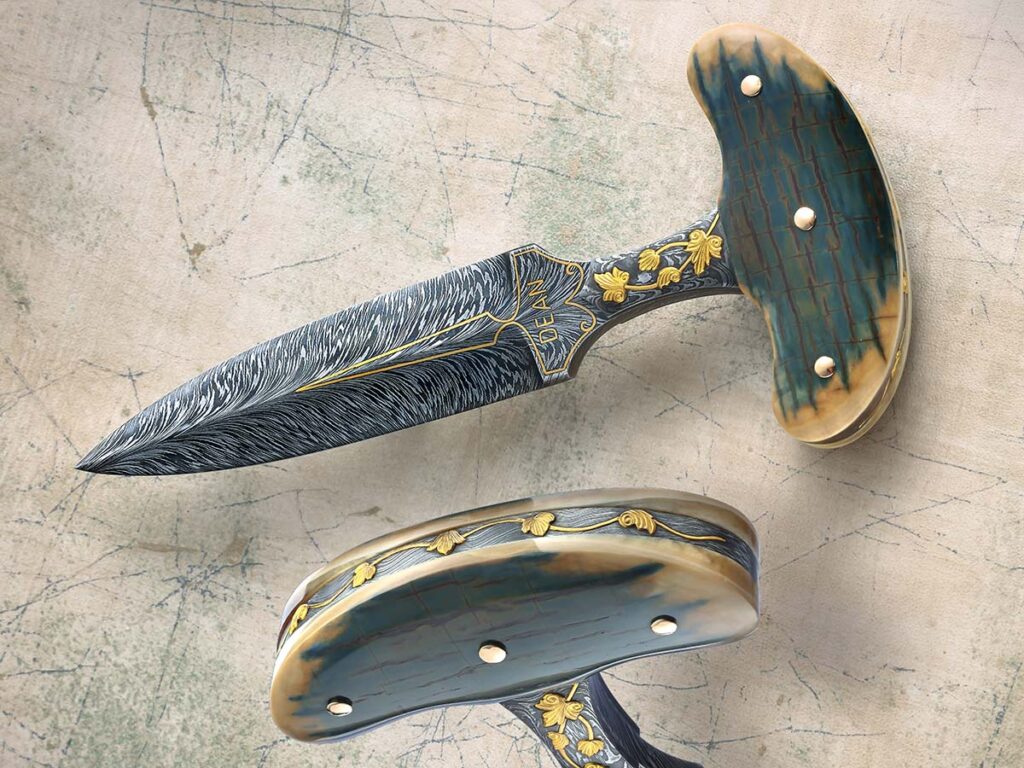
Why a push dagger? Harvy Dean (inset) puts it succinctly, “They’re just cool.” That certainly holds true for his Tajas push dagger, with an elegant feather damascus blade, 24k gold raised vine work and a fossilized walrus tusk handle. At 16 1/2 inchces in length, Dean gave himself plenty of knife to decorate. (SharpByCoop image)
Legendary master smith and Hall of Famer Harvey Dean enjoys the historical aspect as well. “They’re just cool,” he offered. “A lot of people made them back years ago, and there was the idea of concealing them in the vest. Some were made with nickel-silver scabbards and called lapel knives because they were pinned under the vest or coat lapel.”
Dean’s pictured Tejas push dagger is a departure from standard sizing, with an overall length of 16¼ inches, with an 11-inch ladder pattern damascus blade and handle of fossilized walrus ivory. But then, everything is bigger in Texas.
“I’ve always liked [master smith] Larry Fuegen’s push daggers, and his work has had a lot of influence on mine,” Harvey said. “You really make them like any other knife, and I usually do around two or three a year. I like to use ivory and damascus and a stag handle is next up. I don’t do many plain ones, and most of mine are with two-piece handles. As far as marketing is concerned, you’ve got to have that special person who likes them–but they do usually sell quick.”
Hawks Nest Custom Push Talon
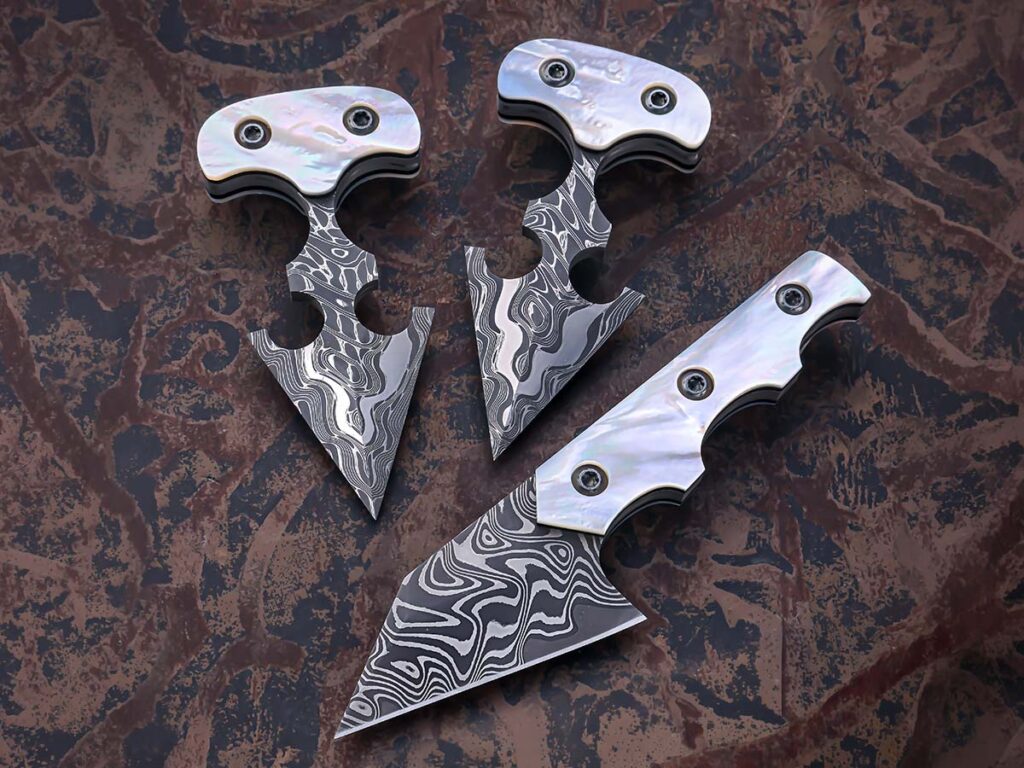
Matt Hunter (inset) has always had a thing for concealed carry knives, but admits his mother-of-pearl handled push daggers were his first crack at the style of knife. Angular and wickedly attractive, the Nichols Slither Armor Core stainless damascus daggers were designed as a matching set with his HawkWing knife, also pictured. (SharpByCoop image)
Damascus blade, mother-of-pearl handle and variations on the push dagger theme highlight Matt Hunter’s work at Hawks Nest Customs. He is a huge fan of concealed carry knives and started down the road with a boot dagger, neck knife and then his Push Talon.
“I think any dagger is challenging due to the symmetrical grinds that are required,” he noted. “You’ve really got to nail each and every one of them or the entire build needs to be scrapped. These push daggers are made with Nichols Slither Armor Core stainless damascus and mother-of-pearl on Westinghouse black canvas Micarta liners. “Believe it or not, these were my first push daggers,” Matt added. “These were originally made for a customer to match the HawkWing, which is also in this photo. I told him I was planning on doing a pair of matching push daggers, and he asked if we could do the mother of pearl to match his knife. So, I obliged.”
Zack Jonas Totem
A study in starkness, Zack Jonas’ Totem push dagger grabs the eye with its clean lines and depth of damascus. That’s a san mai steel with laddered W’s and faces in a 1,000-layer laminate with pure nickel. Adding to its Spartan charm are its gold handle accents. (SharpByCoop image)
The Zack Jonas push dagger featured is his Totem model with a blade length of 4 inches and an overall length of 6½ inches. Its gold handle accents complement a san mai steel with laddered W’s and faces in a 1,000-layer laminate with pure nickel.
“The push dagger is one of the few knives that is actually designed to be folded into a tightly closed fist,” the master smith explained. “That means you have to make sure the handle comfortably conforms to the shape of the human hand in that unusual position. A push dagger is not a particularly functional tool outside the very limited frame of hand-to-hand combat; if you don’t have a secure grip when you need it, you’ve got a real problem.
“There are few makers that come to mind as design influences,” Jonas concluded. “[Master smith] J.D. Smith’s early influence on my career is never far from my hand or eye. I also think of Peter Johnsson’s work as I’m designing. He has never done a push dagger that I’m aware of, but I like to try and channel the way he conducts tension through his lines. Peter and [master smith] Kevin Cashen both come to mind when I think of the functionality in any dagger.”
Andrew Meers Rose Of Sharon
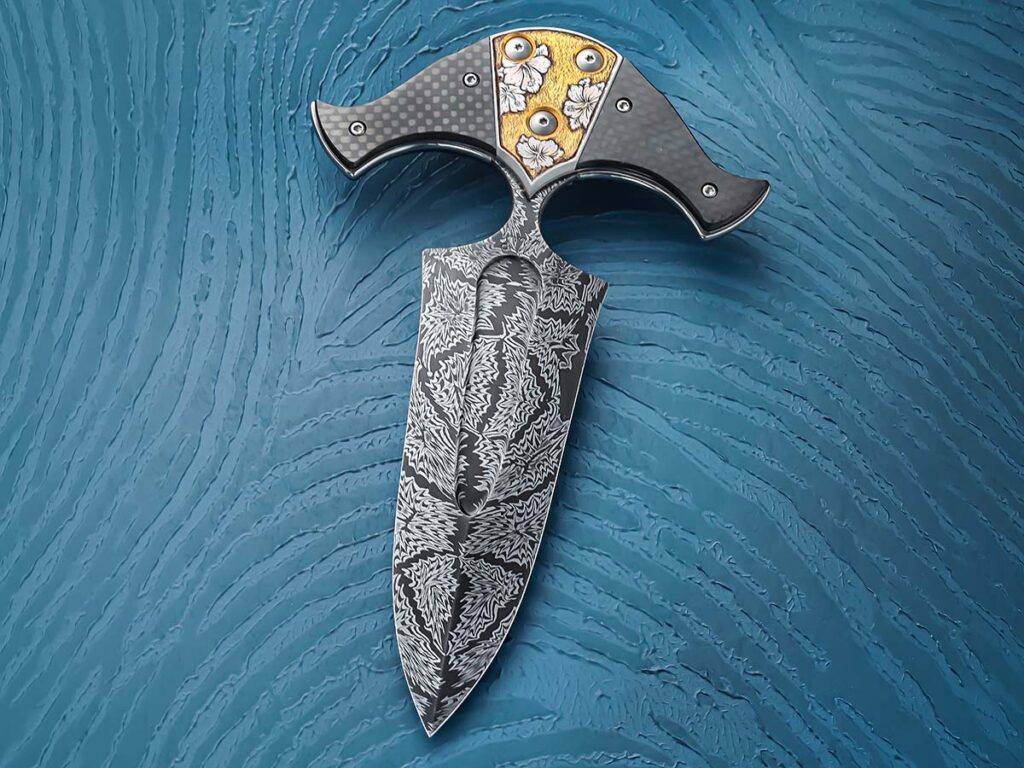
A bold mix of materials, Andrew Meers utilizes carbon fiber, stainless steel, gold and a splintered mosaic damascus to bring-together this 9-inch push dagger. The centerpiece of the knife is its elegant Rose of Sharron engraving with the gold backing. (SharpByCoop image)
Andrew Meers included a push dagger in his ABS master smith set, which was complete with forged trout iron texture engraved with pangolins. “Push daggers have a place in my childhood memory,” he related. “I remember seeing one at a museum and being fascinated. In retrospect, I think having mostly seen conventionally handled pieces in media and collections, the manner in which the hand engages the handle is what is attractive to me.”
Meers’ featured push dagger is his first with a carbon fiber handle and a groove in the blade. Its 7-inch damascus blade is framed in stainless steel, and the engraving depicts the Rose of Sharon with a gold-plated relief background. The entire push dagger is 9 inches long. Andrew produced his first push dagger in 2014 and has made several since. His longest measured between 23 and 24 inches.
Jean Potvin Romanesque
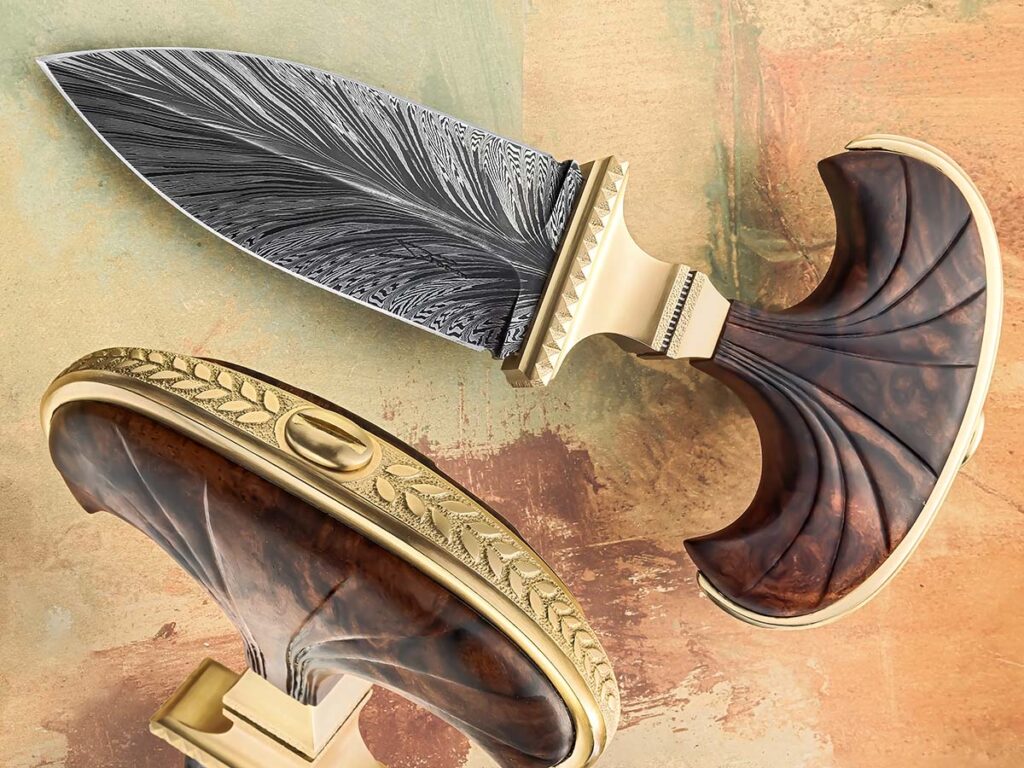
Since push daggers are illegal in Jean Pierre Potvin’s homeland of Canada, he had to come up with a clever trick to get his his Romanesque push dagger past airport security and to a buyer at a show in Las Vegas. His solution, remove the illicit handle and replace it with a toilet plunger handle. (SharpbyCoop image)
“This push dagger is Roman in style,” remarked Jean Pierre Potvin. “It came about quite by chance. I rarely design in advance when I create. I prefer to let my imagination run free and follow new ideas that present themselves during the making process. During the making, I saw that it had a somewhat Roman style, and I continued in that direction with this result.”
Potvin’s push dagger measures 8 inches overall with a 4½-inch blade of damascus in 15N20 and 1084 carbon steel. The handle is fashioned from stabilized walnut burl and brass furniture. He had previously made only one push dagger. That was in 2022, and it was much smaller. “I had a buyer at the Nashville knife show,” he remembered, “and I had packed it in my luggage to take there. But when I got to the Montreal airport, it was confiscated by airport security.”
Since push daggers are illegal in Canada, that experience inspired Jean Pierre to remove the actual handle and replace it with a toilet plunger handle the next time he traveled with a push dagger. He made it to Las Vegas that second time and reattached the original handle after arrival. “It’s really funny because it’s the same dagger, but having a cross handle makes it illegal,” he smiled. “Sometimes you have to use tricks to get what you want.”
Somehow, the push dagger and its adventurous history seem to fit right in with Potvin’s novel experience.
Check Out More Cool Customs:
Cool Custom: Tony Lewis’ Tribute Knife To Steve Dunn
Cool Customs: Rocco Nawrocki’s Knife For Sergeant Bunker
Gerber Has Reinvented The Multi-Tool With The Dual-Force. Incredibly Strong And Versatile, The Dual-Force Is As Rugged As It Gets
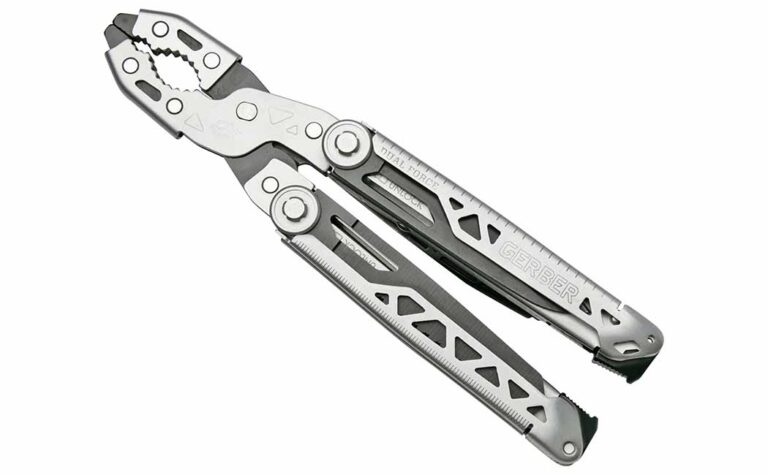
The multi-tool is beloved by many for its flexibility and ability to be useful in many situations. Gerber Gear has ripped up the book on the multi-tool and reinvented the genre with the 12-tool Dual-Force.
It is a monster. The Dual-Force is similar to other multi-tools in terms of the implements within it, but the strength level has been ratcheted up. The screwdriver and saw are beefier than in a Swiss Army knife. The driver is 3.25 inches and features Center-Drive tech so it feels and operates like a standard driver.
The Dual-Force has a dozen different tools.
The tool also includes a 3.25-inch plain-edge blade, which rivals that of many standard pocketknives.
But the star of the show is the pliers. There are so needle-nose pliers here. The Dual-Force features a robust set of jaws with a twin-position dual-lock design and large teeth for more control. The jaws dwarf the pliers offered on most other multi-tools.
The Dual-Force brings the quality you expect from Gerber Gear and an innovative design that makes it stand apart from all the other choices on the market today. MSRP: $110.
Editor’s Note: This post was written by Mike Ableson.