Knife Sharpeners: Top Options Available Now

0

Need to keep your edge? These top knife sharpeners are sure to keep your blades sharp and in good working order in no time at all.

It’s not much of a knife if it doesn’t have a sharp edge. To that end, 2024’s hottest sharpeners will make your favorite tool cut like it ought to. Plain to serrated, short blades to long, kitchen to deer camp and just about any blade worth using can get keen quick with one or more of this year’s fresh edge makers.

Spyderco Golden Stone and Webfoot Set
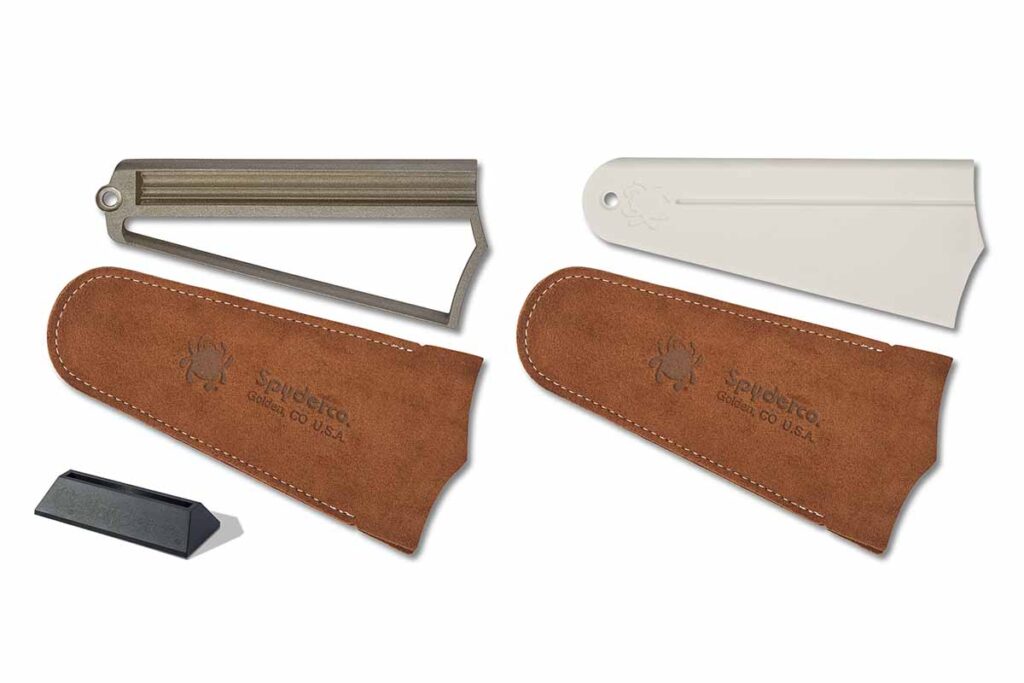
pyderco Golden Stone and Webfoot Set includes a Golden Stone, Webfoot
The Spyderco Golden Stone and Webfoot Set includes a Golden Stone (right), Webfoot (left), two suede pouches, one plastic base (lower left), and an illustrated instruction book that explains how to use the sharpeners to put an edge on practically any home cutting tool.

One of the coolest studies in sharp is the Spyderco Golden Stone and Webfoot Set. “The set offers a uniquely different approach to knife and tool sharpening,” began Michael Janich, Spyderco special projects coordinator. “Of similar design, they can be used anywhere, set up in seconds, and do not require oil, water, electricity or any complicated clamps or fixtures.”

Both sharpeners feature a distinctive “duck foot” design tapered on one end and that has twin scallops on the other. To use either sharpener, hold the narrow end in one hand and rest the wide end on a flat surface. The center point of the wide end, between the scallops, acts as a fulcrum.

“Rocking the sharpener from side to side until the outer points contact the surface aligns its outer edges to create a perfect 40-degree included angle,” Michael noted. “Simply keep the plane of your blade vertical and draw it from heel to tip down the outer edge. Then, rock the sharpener in the other direction and repeat the process on the other side of the stone. Alternating from side to side quickly creates a sharp, utilitarian 40-degree edge.”

For a thinner edge, the Webfoot and Golden Stone can also be used with the included ABS plastic base. Steps in the cavity of the base limit the rock from side to side, reducing the sharpening angle to 30 degrees. Laid on their sides, the sharpeners also offer a 12.5-degree angle for easily sharpening scissors and shears.

“The long edges of both sharpeners are tapered, so they naturally follow the contours of all blade shapes—even hawkbills and recurves—and can be used to easily sharpen serrated edges using the same sharpening technique,” Michael explained. “Their innovative designs also include rounded edges, grooves, and flat areas that provide multiple abrasive surfaces to sharpen tools of all shapes and sizes.”

The Webfoot is coated in an aggressive 600-mesh cubic boron nitride (CBN) abrasive. A form of synthetic diamond, CBN removes steel quickly and is ideal for reprofiling edges or sharpening very dull knives to a utility edge. For touch ups or to achieve a more refined edge after using the Webfoot, the Golden Stone features a fine-grit ceramic abrasive that is the equivalent of a 1,200 grit. Both sharpeners are supplied with suede pouches that protect them when not in use and do double duty as non-slip mats during the sharpening process.

The set includes one Golden Stone, one Webfoot, two suede pouches, one plastic base, and an illustrated instruction book that explains how to use the sharpeners to put an edge on practically any home cutting tool.

Spyderco Webfoot Specs
Sharpener Type:
Proprietary “rocking” design
Blades sharpened: All, including scissors, pointed tools, gouges and serrated edges
Abrasive Type: Cubic boron nitride
Grit: 600 mesh
Dimensions: 7” x 3” x 0.25”
Construction Materials: One-piece carbon steel embryo
Weight: 6.05 ozs.
SPECIAL FEATURES: Includes multiple abrasive surfaces and shapes
Country of origin: China
MSRP: $89 ($270 in a set w/Golden Stone)
Available: Now

Spyderco Golden Stone Specs 
Sharpener Type: Proprietary “rocking” design
Blades sharpened: All, including scissors, pointed tools and serrated edges
Abrasive type: High-alumina ceramic
Grit: 1,200 grit equivalent
Dimensions: 7.2” x 3” x 0.25”
Construction materials: One-piece fine-grit ceramic
Weight: 7.6 ozs.
SPECIAL FEATURES: Includes multiple abrasive surfaces and shapes
Country of Origin: USA
MSRP: $210 ($270 in a set w/Webfoot)
Available: Now

Work Sharp Ken Onion MK.2
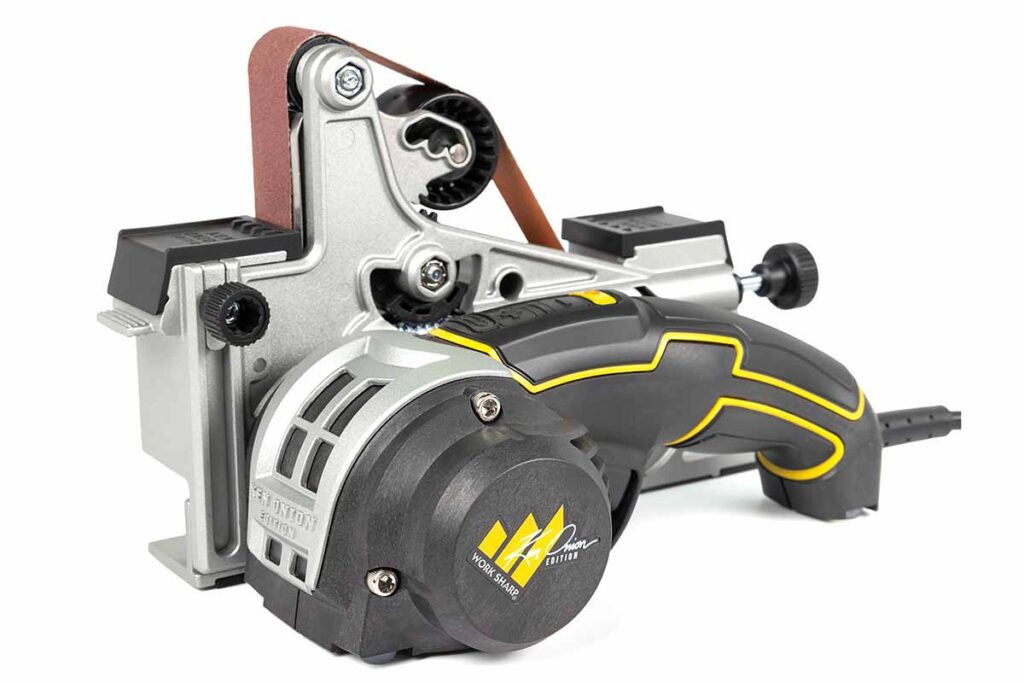
Ken Onion MK.2
The Ken Onion MK.2 comes as a stand-alone sharpener or as one of the company’s Elite packages that includes the base sharpener along with a fully featured blade grinding attachment.

The new Ken Onion MK.2 from Work Sharp comes as a stand-alone sharpener or as one of the company’s Elite packages that include the base sharpener along with a fully featured blade grinding attachment.

The sharpener sports a fresh new look and improved ergonomics to make it feel better in the hand during use. A new motor speed control offers seven pre-set settings to provide a consistent and repeatable sharpening experience, while the new torque control delivers consistent power, even under load. Positioned prominently atop the unit, amber LED indicator lights make selecting belt speed fast and easy.

A sharpening guide has a scope click adjustment knob. Detent clicks in half degree increments from 15 to 30 degrees along the dial allow for improved precision, consistency and repeatability, meaning you get the exact same edge angle every time you sharpen.

New leather-lined angle guides offer protection for knives during sharpening, while the sharpener’s improved guide design allows for knives with thumb studs. A lock-out belt tensioner on the sharpening cassette helps make changing abrasive belts fast and simple. Five grits accommodate the full spectrum of sharpening, from repair to ultra-fine polishing.

The system includes the standard triangle cassette sharpener along with a complementary blade grinding attachment for those who want to elevate their sharpening game. It’s built on a rigid metal chassis designed to offer a stable platform and features metal components engineered to last.

An adjustable, three-position convex pulley system enables you to customize grind profiles depending on personal preference or the type of knives being sharpened. Grind profiles can be set to low, medium or high convex quick and easy, again without tools. An angle adjustment knob, now located in a more visible position, makes setting grind angles faster and easier than ever. At the turn of the knob, you can rotate the dial anywhere from 10 to 30 degrees to set your preferred angle and can even make precise adjustments while the machine is running.

Work Sharp Ken Onion MK.2 Specs
Sharpener Type: Electric benchtop w/grinding attachment
Blades sharpened: Pocketknife, kitchen knife, hunting knife, serrated, axe and scissors
Grit Selection: ¾” x 12” Belt Kit: (1 ea.) P120 (extra coarse), X65 (coarse), X22 (medium), X4 (fine), 6000 (extra fine); also 1” x 18” Belt Kit (for grinder): P120, X65, X22, X4, 12000 and cloth belt for stropping.
Dimensions: Stand-alone sharpener: 9 ¾” long x 5 ¾” wide x 5 ½” tall; w/blade grinding attachment: 10” long x 6 ¼” wide x 6 ½” tall
Construction materials: Metal, plastic and tactile rubber; grinding attachment is built on a rigid metal chassis designed to offer a stable platform and features metal components throughout that are engineered to last.
Weight: 7 lbs.
SPECIAL FEATURES
7-speed motor control with LED display;
Sharpening guide w/scope click adjustment knob. Detent clicks in half degree increments from 15 to 30 degrees along the dial;
Leather-lined angle guides offer protection for knives during sharpening;
Tool sharpening cassette with 65-degree angle scissor guide;
Blade grinding attachment quickly and easily mounts to the MK.2 power base without tools or calibration.
Once attached, the grinder boasts on-the-fly motor speed control and continuous run time with LED indicator lights that make selecting belt speed fast and easy;
An adjustable, three-position convex pulley system enables you to customize the grind profile depending on personal preference or the type of knives being sharpened;
Graphic user guide along with a quick start guide helps you understand and operate the sharpener successfully, and;
Flexible abrasive belts and angle guides provide precision results on just about anything that needs sharpening.
Country of origin: Made of foreign parts; designed, calibrated and quality checked in Ashland, Oregon
MSRP: $300
Available: Now

Wicked Edge Cobalt WE64
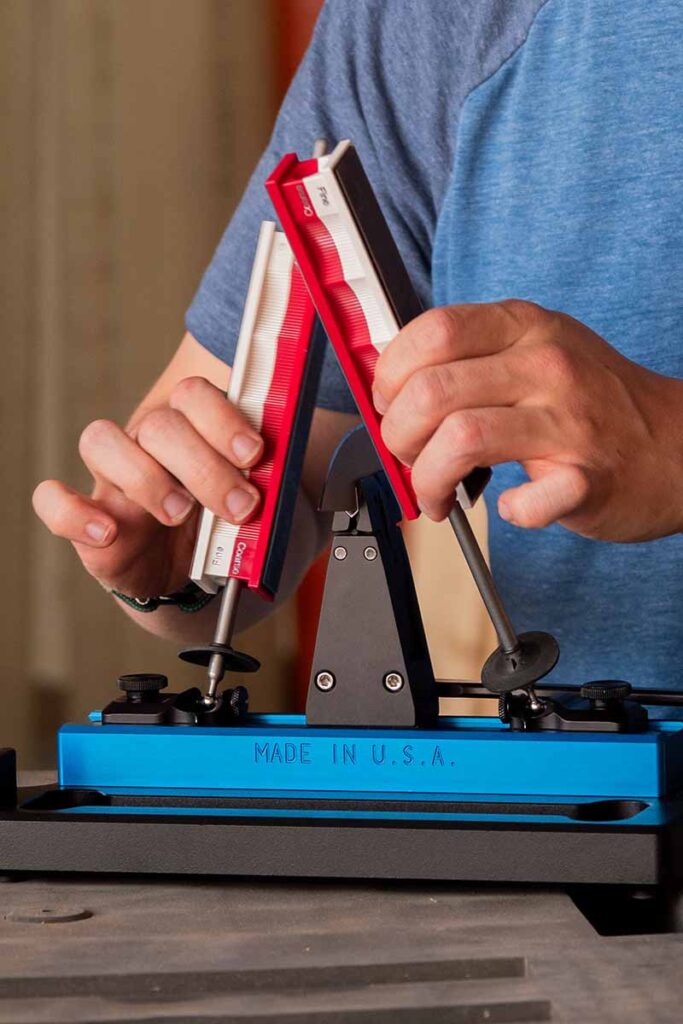
Wicked Edge’s patented Dual-Sided Sharpening Technology
Wicked Edge’s patented Dual-Sided Sharpening Technology, DualCam Vise and more highlight the new Cobalt WE64.

The Wicked Edge Cobalt WE64 features easy clamping ability with the company’s DualCam Vise to the portable form factor of the company’s GO-WE60 sharpening unit.

According to Wicked Edge, the result is the fastest sharpening experience in the 60 Series line, including both standard edge maintenance and touchups.

The WE64 is lightweight and compact for storage and travel and can be secured to a hard, flat surface with the included C-clamp, or directly mounted to a work surface through the predrilled holes in the base. It is compatible with all Wicked Edge sharpening stones and strops and assorted other of the company’s sharpening accessories.

Wicked Edge Cobalt WE64 Specs
Sharpener Type: Precision guided manual
Edges sharpened: All but serrated
Abrasive Type: Monocrystalline diamond stones
Grit Selection: 200/600 diamond stones (2 each)
Dimensions: 11.5” x 4” x 4.75”
Construction Materials: Type 2 anodized aluminum, stainless steel and Delrin
Weight: 3.5 lbs.
SPECIAL FEATURES
Patented Dual-Sided Sharpening Technology;
DualCam Vise, included repeatability tools, lightweight, portable design, C-Clamp, standard alignment guide, guide rod shields, practice knife, limited lifetime warranty
Sharpens blades up to 15” long
Angle range: 13-31 degrees per side (26-62 degrees inclusive)
Angle markings in 1-degree increments
Able to clamp blades up to 3/16” thick and able to clamp thicker blades with the unit’s .25-inch jaws
Country of Origin: USA
MSRP: $499
Available: Now

AccuSharp Explorer Knife & Tool Sharpener and Outdoor Survival Tool
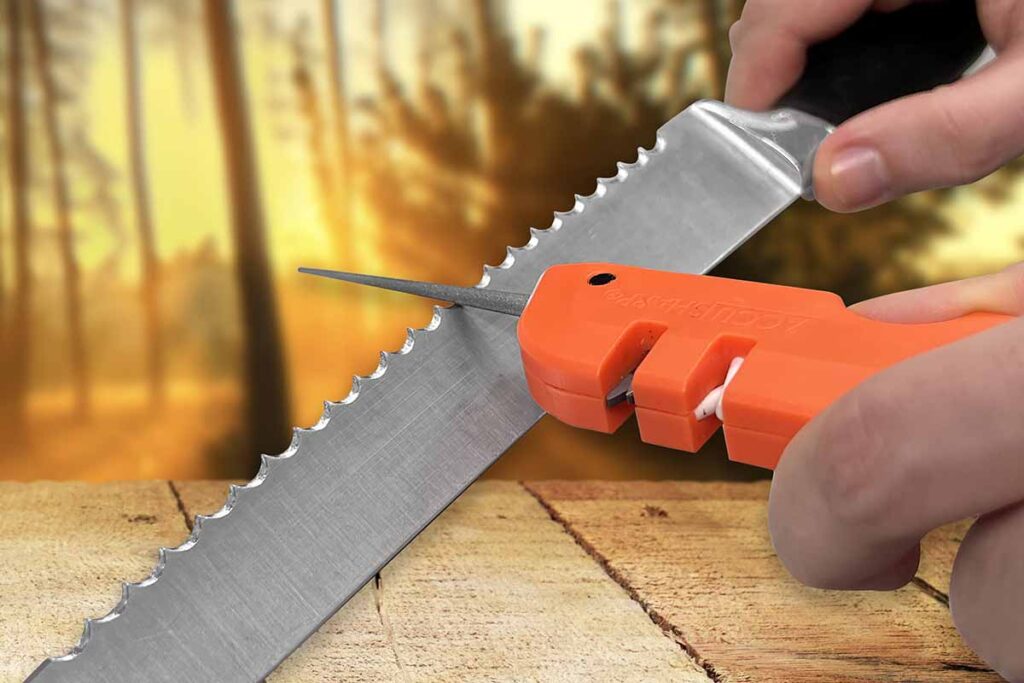
AccuSharp Explorer Knife & Tool Sharpener and Outdoor Survival Tool
The AccuSharp Explorer Knife & Tool Sharpener and Outdoor Survival Tool not only sharpens serrated and plain edge blades, it also boasts a selection of survival/emergency tools

The AccuSharp Explorer Knife & Tool Sharpener and Outdoor Survival Tool has a wealth of sharpening and survival tools for outdoor enthusiasts. Diamond-honed tungsten carbide blades and fine ceramic rods address plain edges. The diamond-tapered rod sharpens serrations and gut hooks, while a center groove sharpens fishhooks and various pointed objects. The multifunctional tool also features a fire starter, compass, emergency whistle and SOS mirror for survival situations.

AccuSharp Explorer Knife & Tool Sharpener and Outdoor Survival Tool Specs
Sharpener Type: Knife and tool w/survival tools
Edges sharpened: Plain and serrated
Sharpening Angle: Preset at 21 degrees
Abrasives/Grits: Tungsten carbide and fine ceramic/1500; diamond coated rod/400
SPECIAL FEATURES:
2 V-notched sharpening slots;
Reversible tungsten carbide blades preset at 21-degree angle;
Fine ceramic finishing rods preset at 21-degree angle;
Compact design;
Retractable diamond tapered rod to sharpen serrations and gut-hook blades;
A groove to sharpen fishhooks;
SOS mirror;
Compass;
Fire-Starter;
Emergency whistle;
Sharpener Dimensions: 5” wide x 1.25” long x .5” deep
Construction Materials: Hard plastic body, diamond-coated steel rod, fine ceramic rods, and tungsten carbide and metal screws­
Carry: A lanyard hole for easy attachment
Weight: 1.6 ozs.
Country of Origin: China
MSRP: $16.99
Available: Now

AccuSharp 4-in-1 Knife and Tool Sharpener
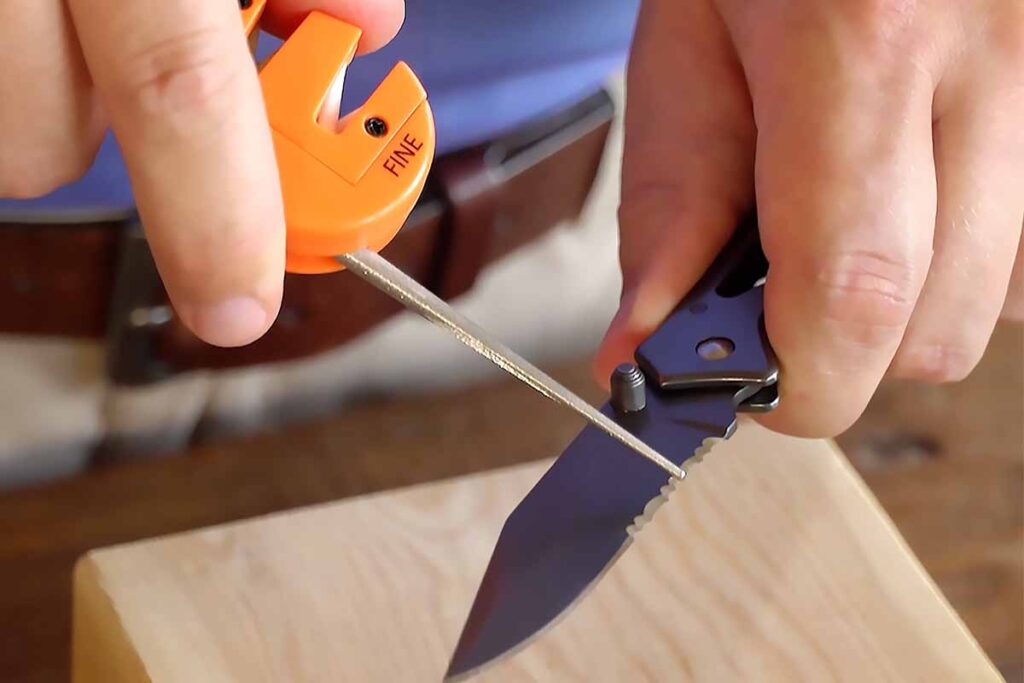
AccuSharp 4-in-1 Knife & Tool Sharpener
The AccuSharp 4-in-1 Knife & Tool Sharpener’s retractable diamond-tapered rod handles deep serrations.

The AccuSharp 4-in-1 Knife and Tool Sharpener is a keen companion for outdoor enthusiasts. The pocket-sized edge maintenance tool features pre-angled coarse tungsten carbide blades for initial sharpening and fine ceramic rods for refining the edge. A retractable diamond-tapered rod sharpens serrations and also features a groove for hooks and darts. If you prefer working on a flat surface, flip out the retractable diamond file for continuous sharpening. The unit’s rubber-molded feet ensure stability during use. Color options are black and blaze orange.

AccuSharp 4-in-1 Knife & Tool Sharpener Specs
Edges sharpened: Plain and serrated
Abrasive Type: Tungsten carbide, fine ceramic and diamond coated
Grit Selection: Diamond rod: 400; diamond file: 400; ceramic fine: 1500
Dimensions: 1.5” wide x 4” long x 0.75” deep (closed) and 1.5” wide x 8.75“ long x 0.75” deep (open)
Construction Materials: Hard plastic body, diamond-coated steel rod & file, fine ceramic rods, and tungsten carbide
Weight: 1.6 ozs.
SPECIAL FEATURES
2 V-notched sharpening slots;
Reversible tungsten carbide blades preset at 21-degree angle;
Fine ceramic finishing rods preset at 21-degree angle;
Rubber-molded feet for stability;
Compact design;
Retractable diamond tapered rod;
Groove to sharpen hooks and darts;
Retractable diamond flat file
Country of origin: China
MSRP: $16.99
Available: Now

Cold Steel Benchtop Sharpener
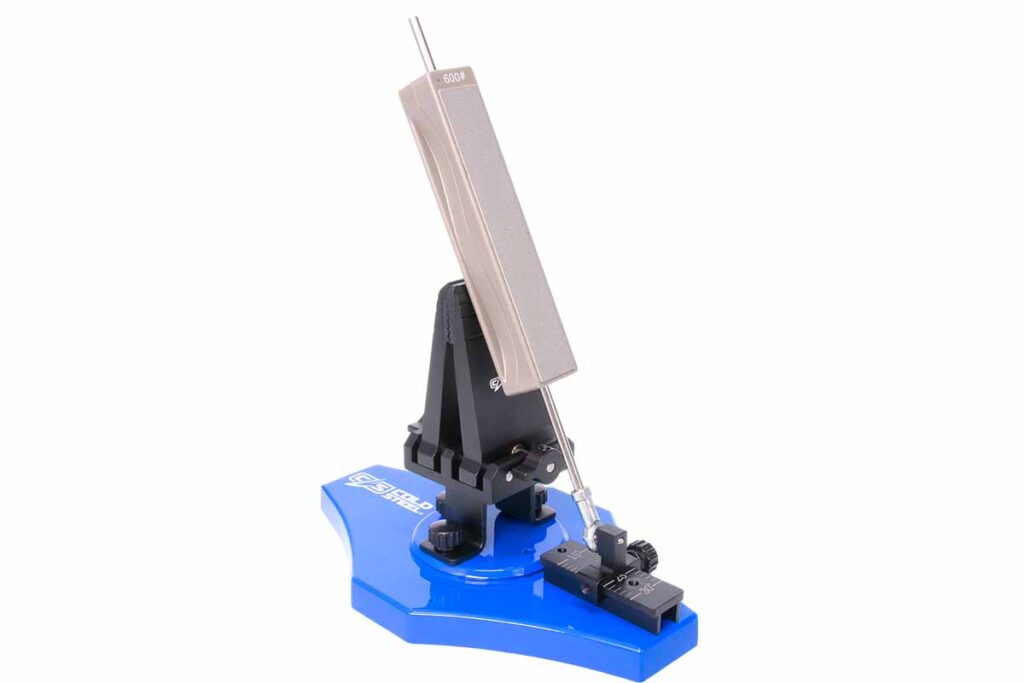
 Cold Steel Benchtop Sharpener
The Cold Steel Benchtop Sharpener has an ambidextrous clamp with a non-marring grip, and 180-degree rotation for sharpening two edges without removing the knife from the clamp.

The Cold Steel Benchtop Sharpener is angle adjustable from 15 to 30 degrees, and comes with four diamond sharpening grits.  It has an ambidextrous clamp with a non-marring grip and 180-degree rotation for sharpening two edges without removing the knife from the clamp. The base is weighted with non-slip feet providing a stable pedestal for benchtop sharpening. The unit includes a hardshell carrying case.

Cold Steel Benchtop Knife Sharpener Specs
Sharpener type: Adjustable benchtop stone
Edges sharpened: Plain
Abrasive Type: Diamond
Grit Selection: 300, 600, 800 and 1000
Dimensions: 5” long x .95” wide x .82” thick
Construction materials: Metal
SPECIAL FEATURES:
Adjustable sharpening stone;
15-30 degree angle;
Ambidextrous clamp with even clamping force;
180-degree rotation for sharpening two edges without removing knife from clamp, and;
Hard shell carry case
Country of Origin: China
MSRP: $149.99
Available: Now

More Sharpening Articles:
UltiClip’s Ryan Thompson Passes Suddenly

UltiClip’s sales and marketing specialist provided a friendly face to the cutting-edge brand.

Ryan Allen Thompson of UltiClip passed away suddenly from a heart attack on July 7. He was 46.

Thompson’s specialty was sales and marketing at UltiClip, a maker, distributor and retailer of an award-winning range of assorted synthetic clips and accessories for sheaths and holsters based in Chicago. UltiClip makes items in the USA that focus “on providing ease of carry, concealment, retention and versatility in one product.”

In June the company’s APH spring steel clip was named the BLADE Magazine 2025 Accessory of the Year. UltiClip also won the Accessory of the Year in 2021 for the UltiLink rapid-attachment, modular linking system.

Ryan made many friends in the knife industry, and his death came as a shock to those who knew him. He is survived by Chastity, his wife of 21 years, and their three children: Isaiah River, Anna Rose and Joshua Rainn.

Remembering Others The Knife Industry Has Lost:

What To Know To Get The Best Dive Knife

A vital safety tool for underwater adventure, a solid dive knife is a must-have for your dive kit. Here’s what you need to know to get the best one.

Dive knives are specialized edged tool that is made for people who spend time in the water. This seems like a wide definition, but water sports are a huge series of pastimes as well as a profession for millions of people across the world.

Diving, be it scuba or free diving, is inherently dangerous and rife with hazards, including the gear you may have on your person. The dive knife varies in profile and material, but in the end, it is a tool that can be relied on to remove yourself or another from a tangle of floating netting, a strap caught on an underwater branch, or to evacuate a struggling diver from their tank.

The dive knife is more than a rescue tool, though. In the alien environment that exists underwater it is a lifeline to the surface and a last resort in the worst situations.

Dive Knife Construction

In the course of use, most real-world knives are going to get wet, however, but are not meant to stay wet for extended periods. Getting caught in a rainstorm or left outside by the fire are things that happen, but being submerged in saltwater for weeks on end would destroy most knives as well as erode and damage handles and sheaths. Leather is not found on serious dive knives, nor is wood or carbon steel. These materials are simply eaten away by salt water and are also easily damaged in fresh water.

A safety tool, a dive knife is a worthy addition to many adventurer's underwater kit.

Dive knives are typically constructed using corrosion-resistant materials and have handles molded directly to them. The idea is to reduce the number of areas where water can enter, making the knives last longer. Very few materials are absolutely corrosion-proof, but they can be made resistant to the point where they won’t degrade for years or decades, sometimes even the lifetime of the owner.

Dive knives are also less rugged for on-land work. Most of the blades of dive knives are thin, sitting in the .12- to .16-inch range, making them unsuitable for heavy use on wood or for camp work. In the water, you’re likely not going to baton logs, so the thickness of the stock is unimportant except for its ability to cut through materials.

Nylon and plastic are the main prey of dive knives, it is the main material for everything from rope to fishing nets and is the basis of most straps on a diver’s gear. It is not that there is only one used in this sense, rather it is that the vast majority of materials a dive knife needs to cut are man-made and are of a relatively normative quality.

Dive Knife Features

When looking at the must-have features on dive knives, one finds that there is no specific answer.

As noted above, the general concept of a dive knife is to cut through maritime-related cordage. The secondary functions are almost irrelevant to this, self-defense isn’t even a tertiary topic considering that shark attacks are exceedingly rare. Natural obstacles like kelp can hang a diver up, and this is perhaps the only naturally occurring material dive knives are commonly used on.

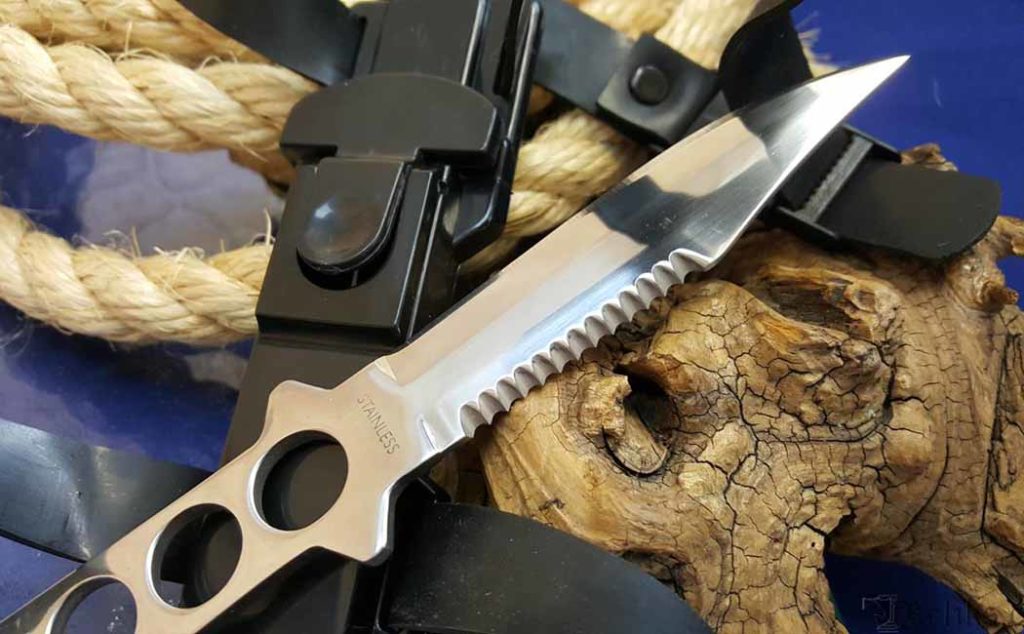
A Sharp edge is the knife’s the main feature and is simply a must—no questions asked. Serration is very ideal on a whole edge and is truly better for cutting rope or nets over a plain edge. A plain edge is great as well, but for cuts that don’t necessitate a sawing motion. Glass breakers in the pommel, paracord wraps, and other features aren’t necessary and may even get in the way. Simplicity is paramount in a dive knife, you should never have to guess where your edges are when working in poor lighting conditions with limited oxygen.

Dive Knife Designs

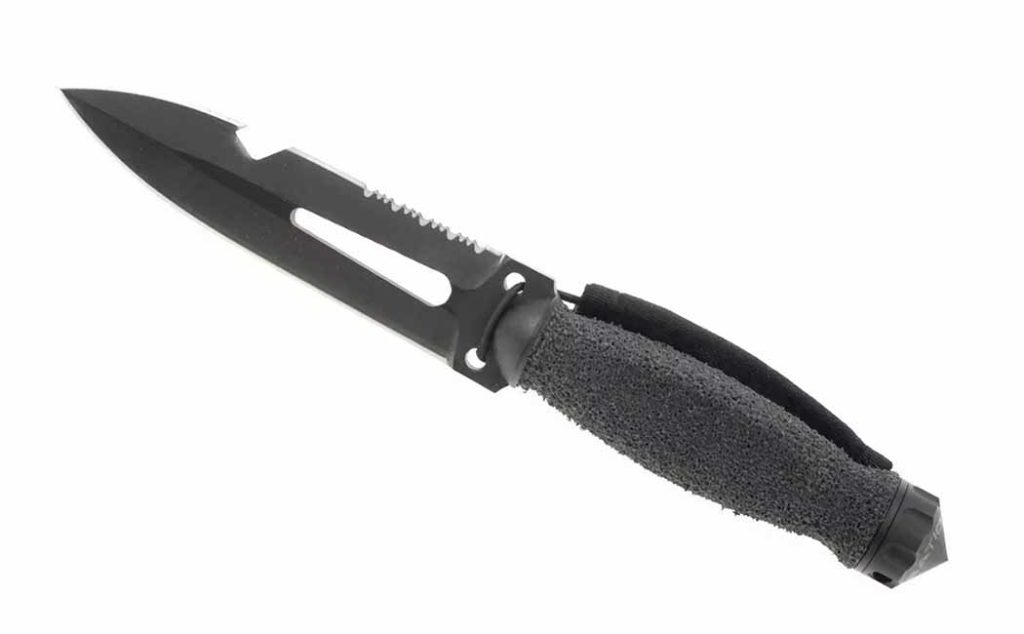
Popular profiles vary, usually by tip profile. Some divers prefer a Bowie style with a sharp, aggressive tip. This is nice for fine work, especially on primary knives that may be used for harvesting oysters and other such tasks.

A flat tip can prove a safety feature for some on dive knives.

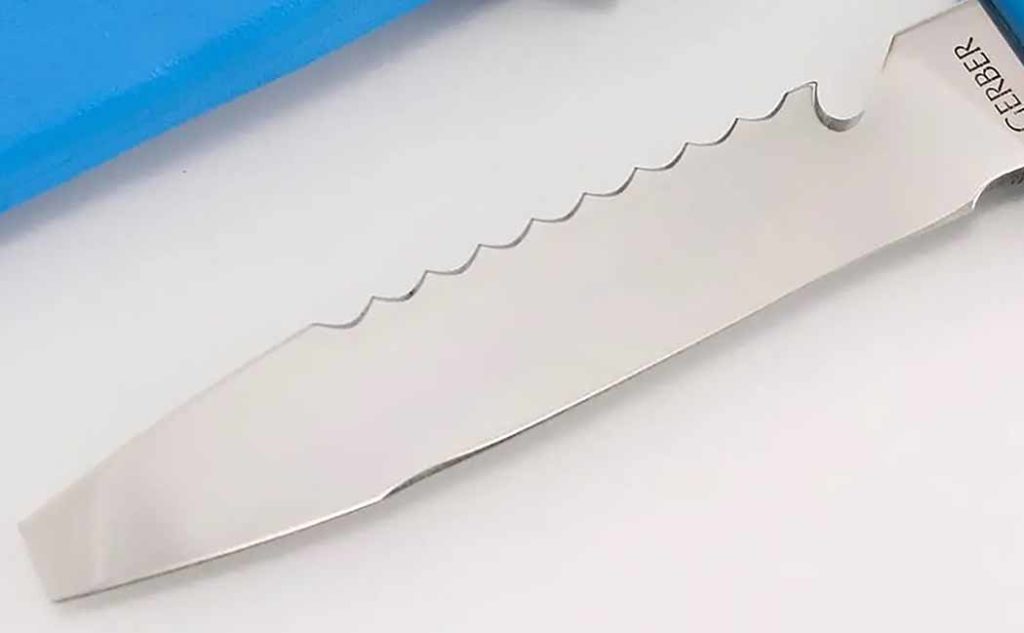
The other main category is blunted or flat-tip knives. These have a tip similar to pry knives in that they have an abbreviated, square-edged tip. They can also be used for various purposes, but their main advantage is that they can be slipped under straps on a diver’s body safely without risking stabbing or lacerating them. Injuries can still occur, but the serious risk is reduced.

Best Dive Knife Size

There is a general limit to the effectiveness of a knife used underwater. Thrusts and slashes are slowed down by the resistance of the water itself, and you tire much easier than on land. As a result, there is certainly too big of a knife, with the lower limit being around 3 inches, or just enough to get under most straps and tie-downs.

The handle should not be too small, however. Many of these designs have a dagger-like overall profile, though, a good scuba or dive knife should not have a dagger handle. You need to know where the edge is by indexing the handle. As a result, a beefy handle and 3- to 5-inch blade are what you want to look for a dive knife.

Steel Vs Titanium Dive Knives

Titanium is hands-down the better material for use on dive knives from a corrosion perspective. Titanium, however, doesn’t hold an edge as well as steel, but when sharp it cuts maritime materials just as well. Sharpness is a main benefit of steel, though even the best steel can experience corrosion over extended saltwater exposure.

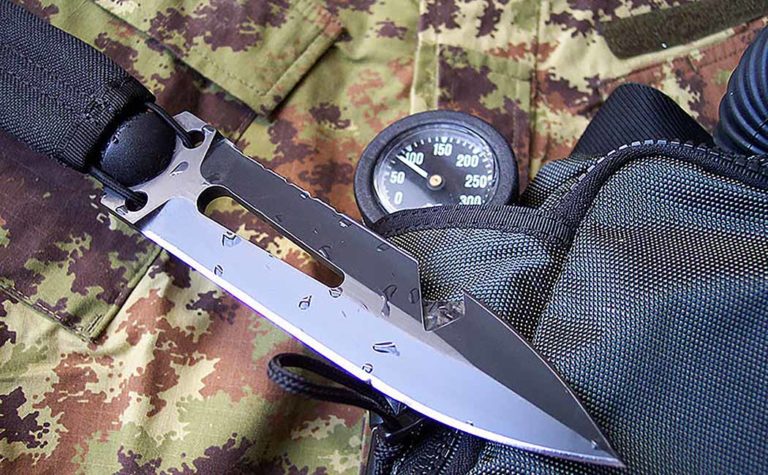
Steel or titanium (such as the one pictured), is an eternal debate over dive knife blade material.

Some divers swear by steel, others by titanium, and this seems to be an ongoing debate. Steel coatings are better and better these days, and some steel knives are available with a titanium coating. Again, the benefits are largely subjective, most users won’t notice a difference with regular maintenance. Like all hobbies, the vast majority of conjecture takes place in the 1-percent of professional or constant participants.

Best Dive Knives At All Price Points

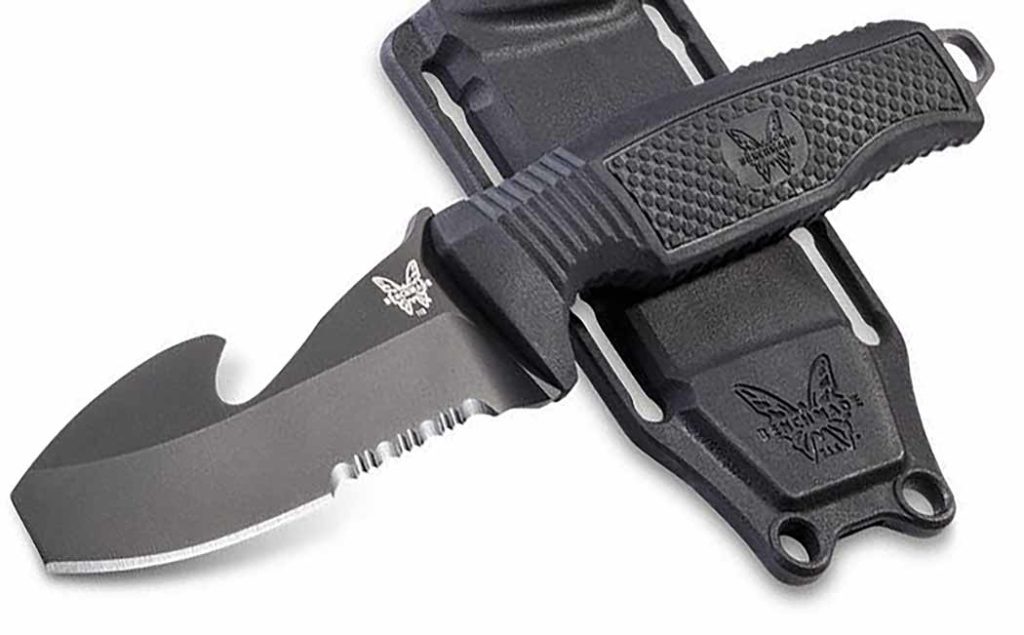
Benchmade H20 Fixed Dive Knife

Benchmade H20 Fixed Dive Knife

Benchmade is well known for some incredible and durable products. The H2O fixed dive knife is an example of this.

Designed for military use, the knife carries a national stocking number (NSN) and is exceptionally well laid out for its purpose. Interestingly, this knife has features that are not necessarily in line with what many of the experts say are best.

For starters, it has a relatively simple grip that lacks the excessive texturing found on many other dive knives. The blade is also made of steel, which stands in the face of those that say titanium is a must-have for saltwater exposure. This is not to say that it is the end-all, be-all knife for use in the water.

While the military has picked some good products in the past, it can’t be said that they are correct every time. This knife is a great starting point at a medium price, you get a blunted tip, strap cutter and serration, as well as a generous lanyard loop. The sheath, while relatively basic, can be adapted to many types of carry depending on what you’re doing in the water.

MSRP: $170

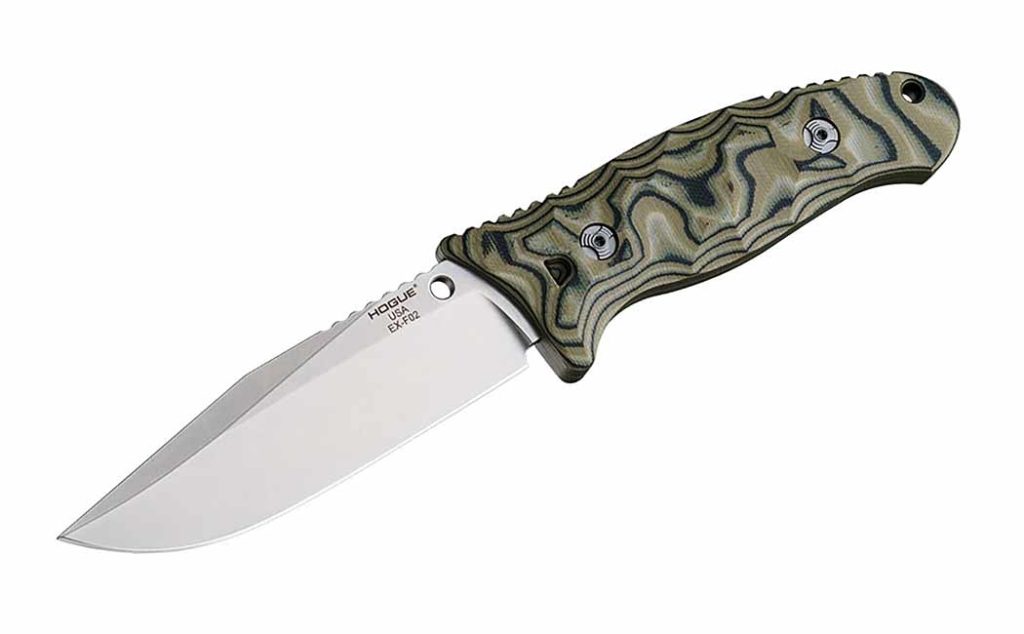
Hogue Knives EX-FO2 Dive Knife

Hogue Knives EX-FO2 Dive Knife

As a general purpose outdoor knife, Hogue has a winner in the EX-FO2. This knife is right in the “perfect size” range for a dive knife, however, it has some features that make it both spot-on and a bit questionable at the same time.

Looking at the positive angle first, this knife is very well laid out and has a nicely shaped handle that has positive reviews for water use. The sheath setup is also excellent, it comes ready for attachment to your arm or leg with a padded backer. This is a knife that has multiple end uses. It is sort of a hybrid of a fishing knife and bushcrafter in that it has a stout blade that can be great for filleting but strong enough for general use.

This knife is available as listed with only a tanto point or clip point. For general use this is fine, however, it can be a liability diving. A completely sharp tip is a negative to some, the risk of puncture or personal injury is potentially much higher as opposed to a blunted point.

MSRP: $159

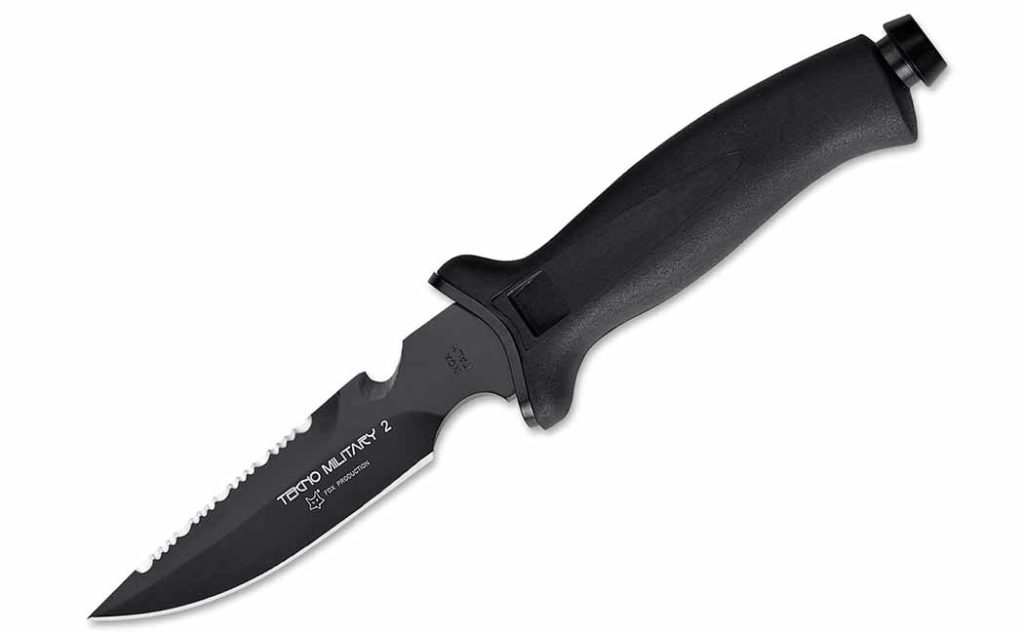
Fox Knives Tenko Military II Dive Knife

Fox Knives Tenko Military II Dive Knife

Fox Knives is an Italian company that makes high-quality products at reasonable prices. The author has used Fox products for quite some time, and all of them have held up very well.

Their dive knife is feature-rich, almost to a fault. The knife is double-edged, one serrated and the other clean. The rear part of the spine has a cord hook directly behind the separation. Unlike the others on this list, the Fox knife has a full cross guard that allows you to choke up on the blade for high-impact puncturing or slashing. This knife has a very fine tip, and while it is military-themed, this tip is a bit too aggressive for rescue work or freeing even yourself from a tangle. A bonus of this knife is that it has a full rubber handle as opposed to textured plastic.

MSRP: $117

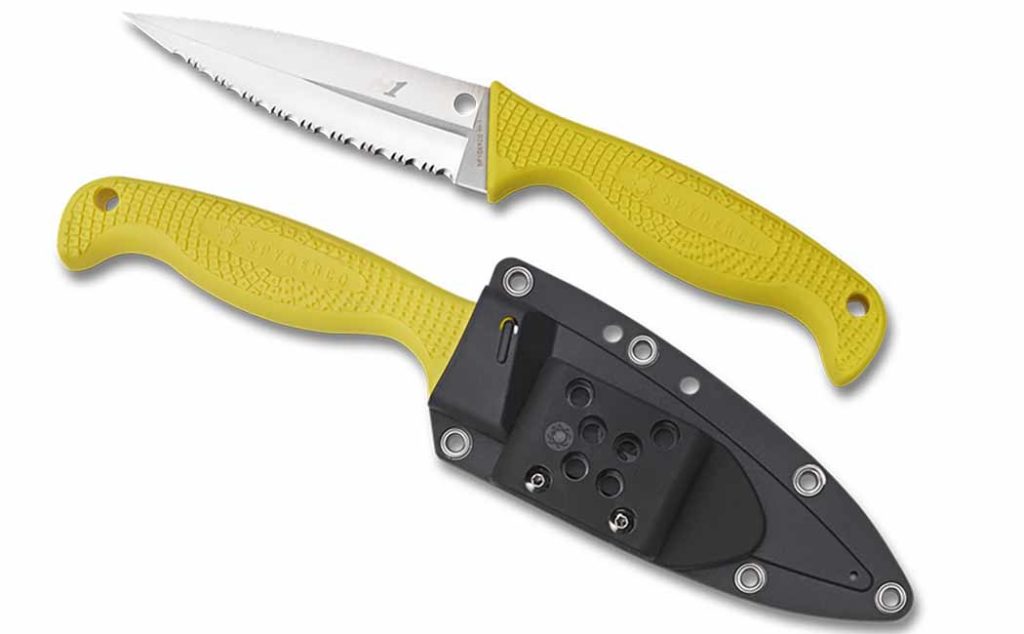
Spyderco Salt Fish Hunter

Spyderco Salt Fish Hunter

Unlike the rest of the names on this list, the Fish Hunter is exactly that, a hunting knife. While many of these knives can be used for fishing in general, Spyderco’s product here is expressly made with the intent to be used as a companion for spearfishing and adventurous free divers. This is a specially designed product, and shouldn’t be confused with other dive knives or dedicated scuba knives.

The blade is hollow ground and comes to a very aggressive tip. Serration starts just after the tip and continues to the handle. Many fish are surprisingly thick-skinned and are quite difficult to kill, this knife makes it relatively effortless and the serration allows for quick cuts through even the thickest scales.

While this knife of course can be used to aid in an emergency, it would likely be best to bring a dedicated, blunted rescue tool as well. Spyderco designed their Salt line to fit this bill, and you can find products that are geared towards rescue and escape as well in their lineup.

MSRP: $196

Extrema Ratio Ultramarine

Extrema Ratio Ultramarine

By far the most expensive dive knife on this list, and perhaps the production market, the Italian-made Extrema Ratio Ultramarine is a purpose-built, do-all dive knife. Curiously, for being so costly, it is not made of titanium or another material less subject to corrosion.

Much like the Benchmade H2O, it is a steel knife. The Ultramarine is double-edged, one clean, and one serrated, and it includes a strap cutter and wrapped handle for a very sure grip underwater. The covering is removable. The knife comes with a functional sheath and case.

You may ask yourself just what you get in terms of the extra hundreds of dollars and, well, that is something only you can know. The possibility of losing such an investment in the deep is not something many people want to stomach considering that many dedicated dive knives are less than $100. This is one serious knife for perhaps the most serious users.

MSRP: $792

Aqua Lung Argonaut Blunt-Tip Titanium

Aqua Lung Argonaut Blunt-Tip Titanium

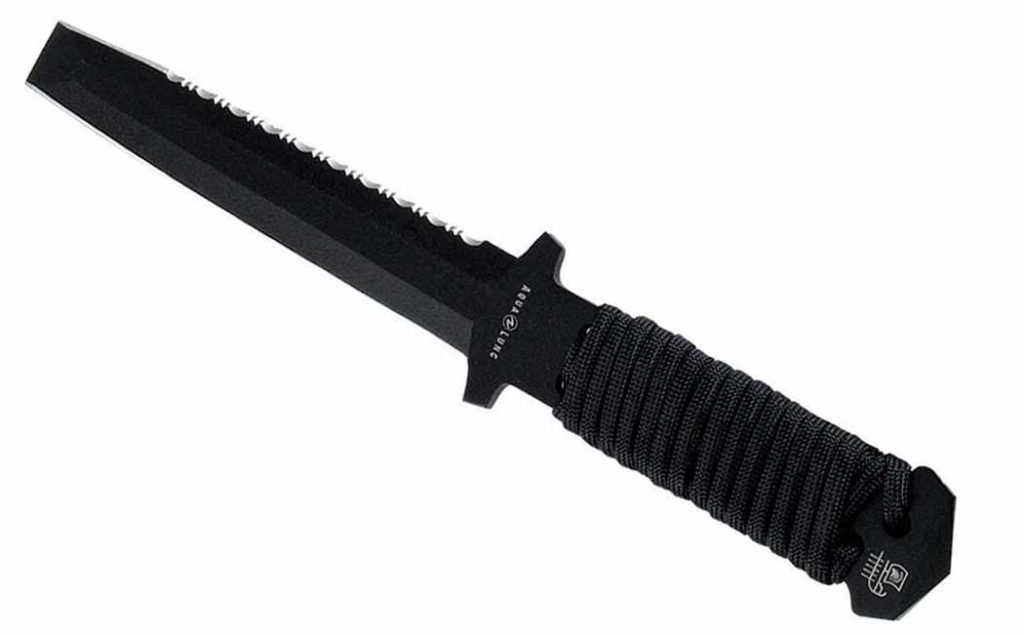
Aqua Lung has a real winner here with the Argonaut. This knife is available as a blunt tip, as well as what they call a Spartan tip, which has a leaf-shaped, pointed profile. For our purposes, here, the blunt-tip version is the knife that we are going to be looking at.

As a scuba knife, it is perfectly suited for the task. The squared, blunt tip profile allows it to easily get underneath any strap, and, depending on what you need to cut, it has a sharp plain edge and a serrated edge. The knife is made of titanium, which is a choice for many people that spend time in the water. This material is far less vulnerable to corrosion and is also quite light. It is relatively thin for its end use at .15 inch, so prying is not on the menu.

This knife comes with a dedicated leg or arm sheath and is moderately affordable at around $200 retail. The handle is simply wrapped in cord, which somebody finds to be a detriment over a high texture Nylon handle.

MSRP: $195

Promate Snorkel SCUBA Knife Titanium

Promate Snorkel SCUBA Knife Titanium

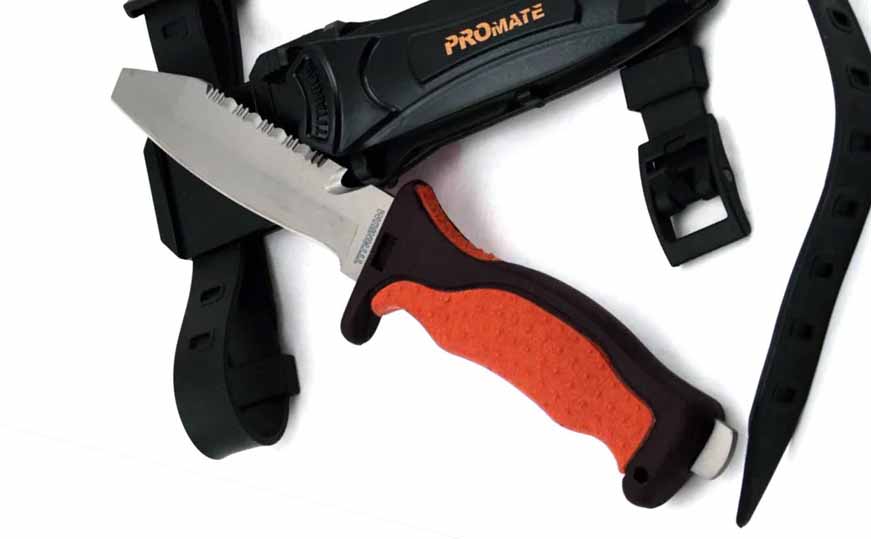
The Snorkel is an affordable, multi-function, titanium knife that is very well thought out. It has a plain main edge and a serrated spine with a cord cutter. While it is substantially less expensive than the others on this list, it boasts very high reviews across the board and is by all accounts the standard, by which all scuba knives are judged. If it does not perform as well as this affordable model, it probably is not going to perform at all.

The Snorkel is available as a blunt tip, as well as a very aggressive Bowie profile. Depending on what you’re going to do with it, the former is more functional for general use, while the latter is going to give you an advantage if you are spearfishing or free diving. Because they are half the price or less than almost everything on this list, you can get one of each and still have cash in hand. These knives are available in different colors to suit your interest and come with a functional sheath setup for use in the water.

MSRP: $75

Check Out More Buyer’s Guides:

BLADE Tactical Recap: A Peek At What You Missed In South Carolina

We take a gander at some of the knives that showed up at the first BLADE Tactical at CANCON Carolina.

Sun, guns and a whole bunch of knives—BLADE Tactical was a whole new twist on BLADE Show. And a heck of a marriage between it and one of our sister events, CANCON Carolina.

Held Nov. 7-8 at South Carolina’s Clinton House Plantation range, the inaugural BLADE Tactical brought together some 25 knifemakers to show and sell their wares, all of the blades with a definite tactical bent. The knife show ran the first day, on the periphery of the shooting events. It had a different feel than any of our legacy shows, given it was outdoors and had the constant report of suppressed gunfire as background noise. But it wasn’t too far off our big three with some knife enthusiasts spending the night in the parking lot so they could be the first to the BLADE Tactical pavilion.

With that sort of enthusiasm, we’ll chalk the event down as a success.

For those who were unable to make the BLADE Tactical show or have their interest piqued, we’ve put together a recap of some of the knives that made their way to central South Carolina. Take a gander at what was up for sale and start planning now for next year’s B-Tact extravaganza. For anyone looking to pick up a hot new knife and burn some powder at the range—consider the gathering your Valhalla!

Krein Knives

Krein Knives

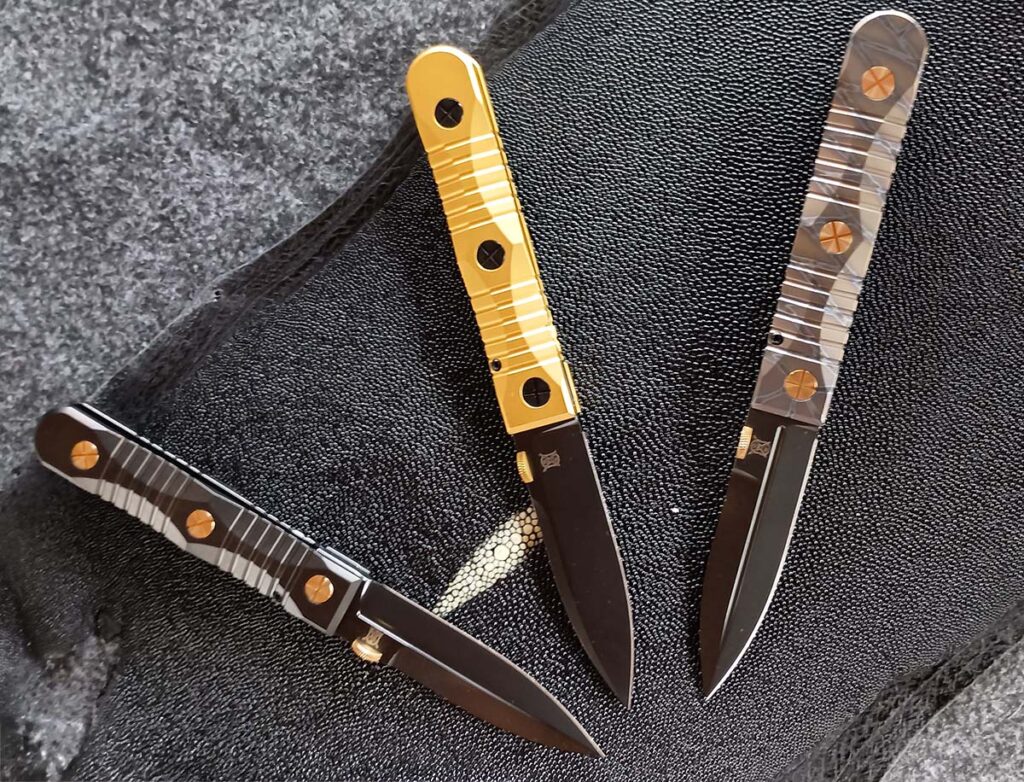
Tactical doesn’t preclude good looks, which is certainly the case with this Krein Knives Alpha. The blue thumb studs add a nice flare to this top-end framelock.

Carver Knives

Carver Waif and brass knuckles

Carver Knives‘ Waif has it going on. Up front is a titanium handled-model, in the back a dark Ti handle. Both are thin as a minute, particularly when measured up the knucks in the middle.

Pro Tech Knives

Pro-Tech Godfather

Pro-Tech came to BLADE Tactical with an offer you couldn’t refuse, like a number of these thin and wicked Godfather autos.

Pro-Tech Blaze Orange Inset

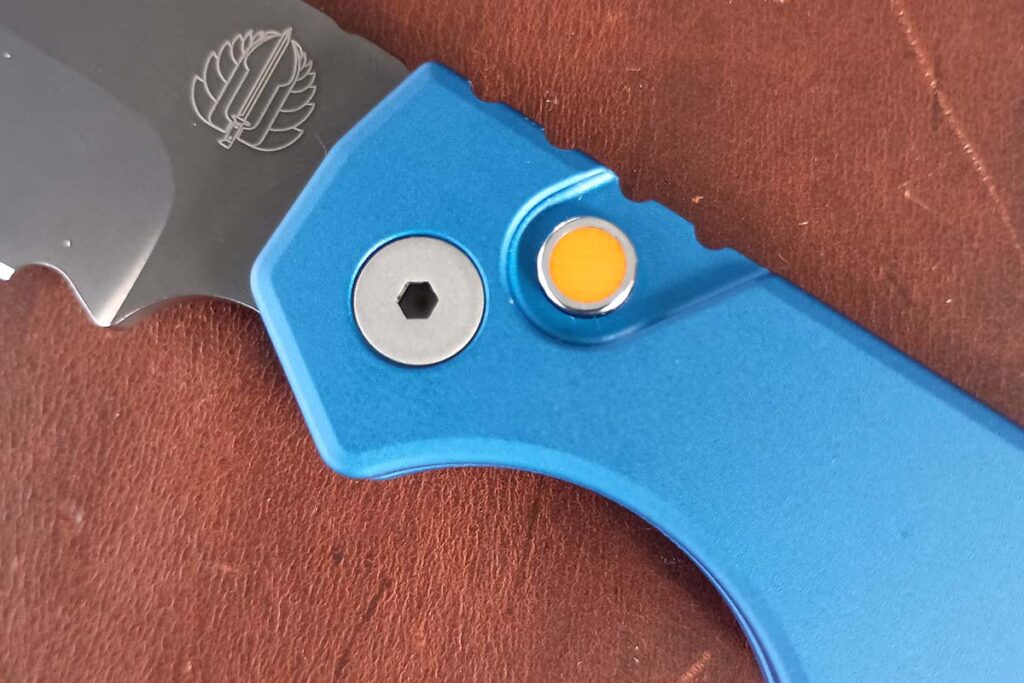
The company also offered a nice bit of custom bling for the show, a CANCON blaze orange G-10 insert on several of it’s knives buttons.

Elishewitz Custom Creations

Elishewitz Custom Creations Ek Intergral

With the Ek Integral, Elishewitz Custom Creations combined class and performance in a light and functional package. A nice dagger-style blade deploys in the wink of an eye via a thumb stud.

McNees Knives

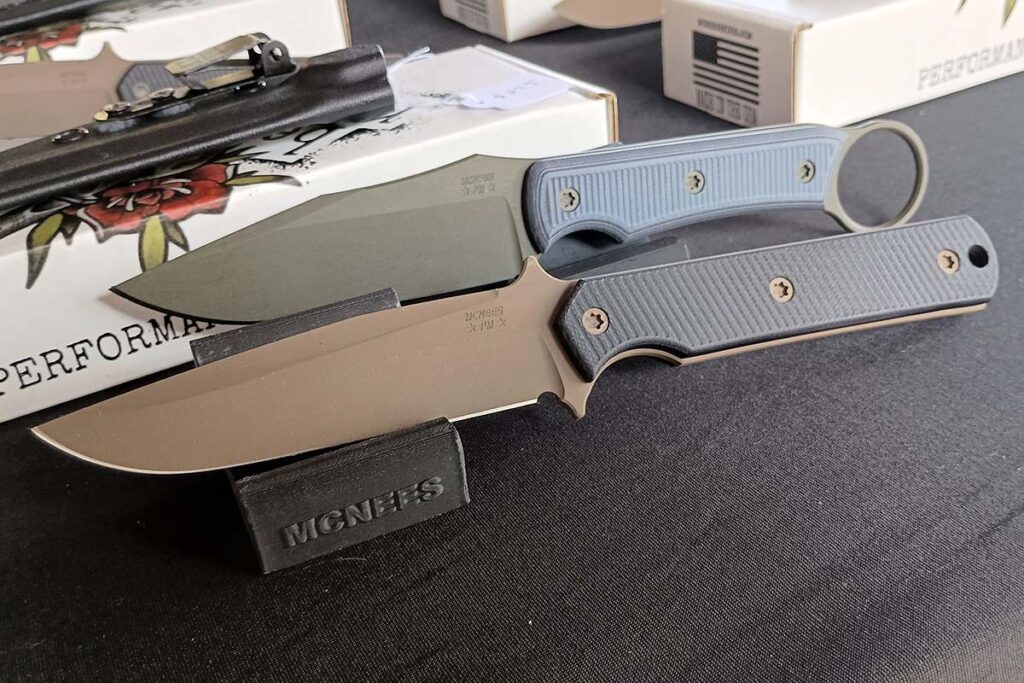
Agent and Stalker

Some hefty debuts from McNees Knives at BLADE Tactical. In the rear, is the Ringed Agent and up front the Stalker. Par usual for McNees, both feel like their built to beat the world.

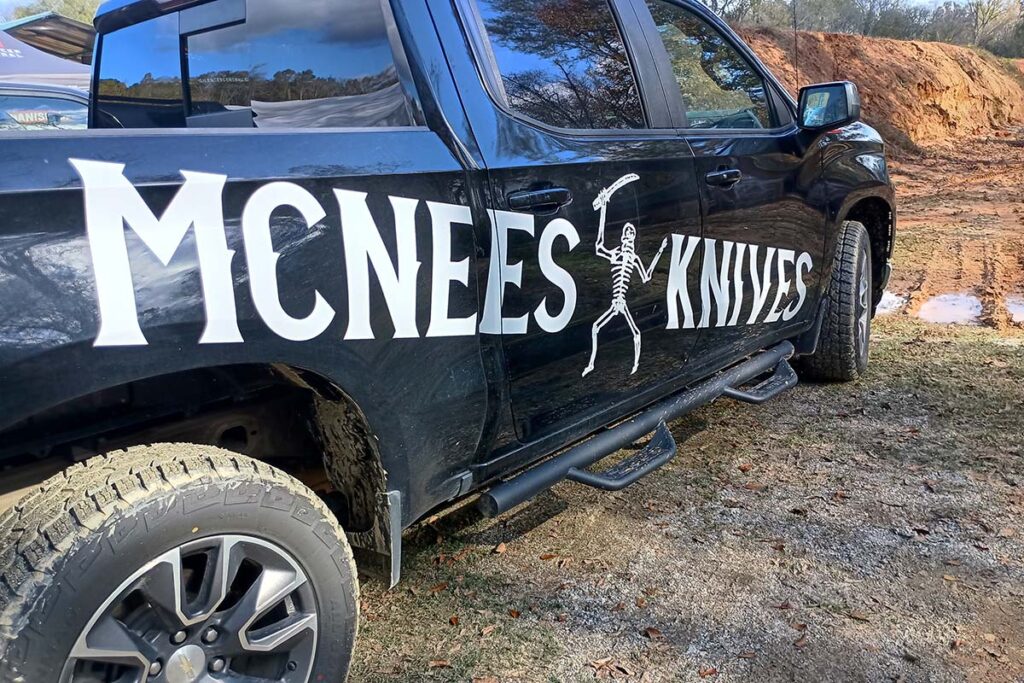
McNees Truck

Somewhat from the neighborhood (Alabama), the McNees crew drove to BLADE Tactical. Needless to say, they did so in style… nice wheels.

Nicholas Nichols Knives

Certainly, the Guppy is no small fry. Nichols Knives drop point has plenty of size to get nearly any job done, but stays light in the pocket thanks to a titanium handle.

Spartan Blades

Spartan Blades was right at home at BLADE Tactical—no surprise there. But the belle of the ball was the company’s Ronin-Torii, a traditional tanto, which few would want to find themselves on the wrong end of.

Nottingham Tactical

Notingham Tactical Carbon-Fiber Pen

Believe it or not, you’re looking at six-years of development. Nottingham Tactical was game for a carbon-fiber model, but it took a ton of work to get it to come together, from finding the carbon-fiber up to the abuse to getting the right adhesives to get the metal parts to stay.

Vero Engineering

Joseph Vero

It wasn’t all fixed blades and folders for the knife side of the show. After BLADE Tactical closed, the knifemakers hit the range at CANCON for some therapeutic trigger time. Here’s Joseph Vero of Vero Engineering getting on one of Maxim Defense’s shorties.

CANCON Video Recap

If your interest has been piqued, check out upcoming BLADE Tactical and CANCON events.

Check Out More BLADE Shows:

MagnaMax and Pop’s ProCut: The Next Super Steels?

Specially engineered for knife blades, the two alloys are at the cutting edge of metallurgy.

Editor’s note: The genius behind MagnaCut—arguably today’s most popular blade steel for both custom and factory knives—the author has helped create two new blade materials that he fully expects to meet with wide-ranging acceptance as well. Following is his story on his latest voyage into his favorite subject.

I pitched the idea of MagnaCut steel to Crucible Steel and Niagara Specialty Metals in 2019. I said I had an idea for a steel that would match the best of the non-stainless powder-metallurgy steels in terms of wear resistance and toughness. This would be a big deal because there has been a longstanding gulf between the performance of carbon steels and stainless steels. My team and I successfully turned the idea into MagnaCut, released in 2021, which had a microstructure like a non-stainless steel while being stainless—offering the best properties of both.

I intentionally sought balanced properties with MagnaCut so it was both tough and wear-resistant, similar to non-stainless grades such as CPM 4V, CPM CruWear and Vanadis 4 Extra. Knife enthusiasts, especially those into folders, often seek higher-wear-resistance steels for maximum edge retention. Instead, I tried to push for a more balanced set of properties so knife buyers could see the benefits of having high toughness in addition to good wear resistance. This can allow knives to be made with thinner edges for better cutting ability, because toughness helps thinner edges resist chipping. In my edge retention tests with the CATRA (Cutlery Allied Trades Research Association) edge testing machine, thinner edges with smaller angles lead to larger differences in edge retention than the steel choice, or even the heat treatment! It seems many knife buyers have seen the light as MagnaCut has gained quite a bit of popularity since its release.

MagnaMax Steel

Nonetheless, I also knew knife enthusiasts would ask for something more wear-resistant. The folder crowd is not as worried about toughness and are seemingly always asking for greater wear resistance and edge retention. However, when the wear resistance gets too high, the steel becomes “unbalanced,” and the toughness becomes a significant issue. I see images of broken folders semi-regularly from the most extreme wear-resistance grades.

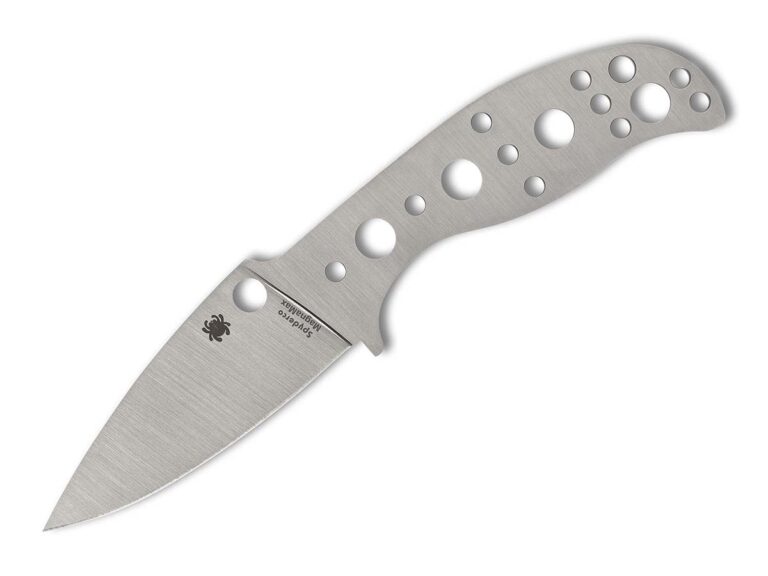
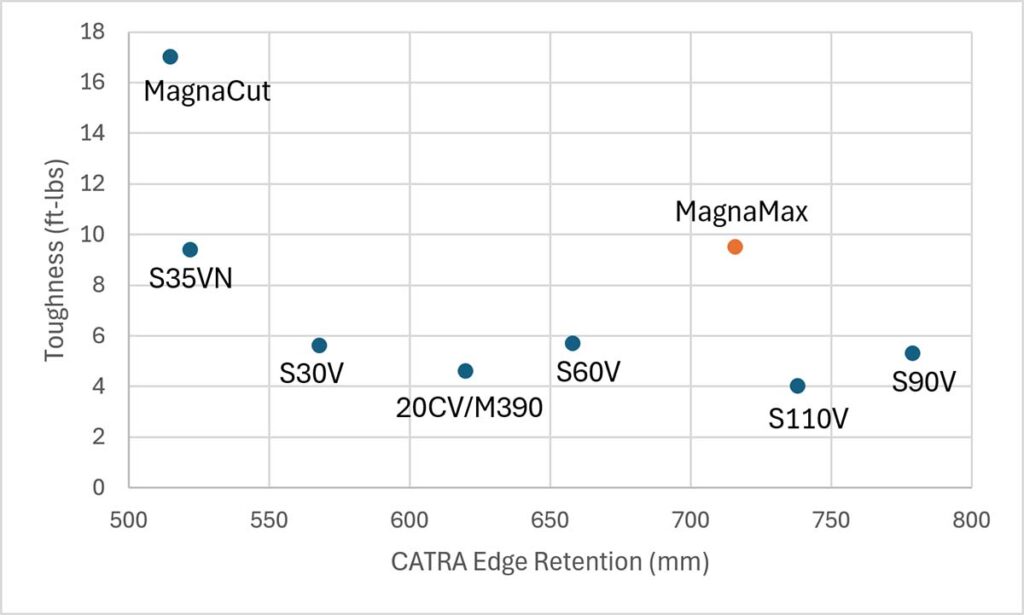
MagnaMax shares the same high corrosion resistance and good hardness potential as MagnaCut, but has higher wear resistance at the cost of some toughness. Because MagnaMax shares a similar microstructure to non-stainless steels, its toughness level for that high wear resistance is excellent.

The “sweet spot” for higher-wear-resistance products seems to be in the family of non-stainless alloys such as CPM 10V, Vanadis 8 and K390. In particular, K390 has been building in popularity through Spyderco knives in recent years for its excellent combination of properties. I had actually proposed to Crucible and Niagara way back in 2019 that, after we were successful with MagnaCut, I had another idea I was calling stainless 10V at the time.

This led to a new product called MagnaMax, a higher-wear-resistance steel in the same family as MagnaCut. It shares the same high corrosion resistance and good hardness potential as MagnaCut, but has higher wear resistance at the cost of some toughness. Because it shares a similar microstructure to non-stainless steels, its toughness level for that high wear resistance is excellent.

Two of the highest-toughness stainless powder-metallurgy steels before MagnaCut were CPM S35VN and CPM 154. MagnaMax matches the toughness of those grades while being much more wear-resistant. In recent years, one of the more popular folding knife steels has been M390, and MagnaMax has over twice the toughness and substantially higher slicing edge retention. Spyderco used the second prototype heat of MagnaMax in a series of its Mule series knives intended for enthusiasts to try out different steels. A Spyderco Forum member known as vivi said he cut 325 gallons worth of cardboard strips with one of these knives. He reported, “Even without adding the numbers up, I can say this steel has the best edge retention of any steel I’ve tried.”

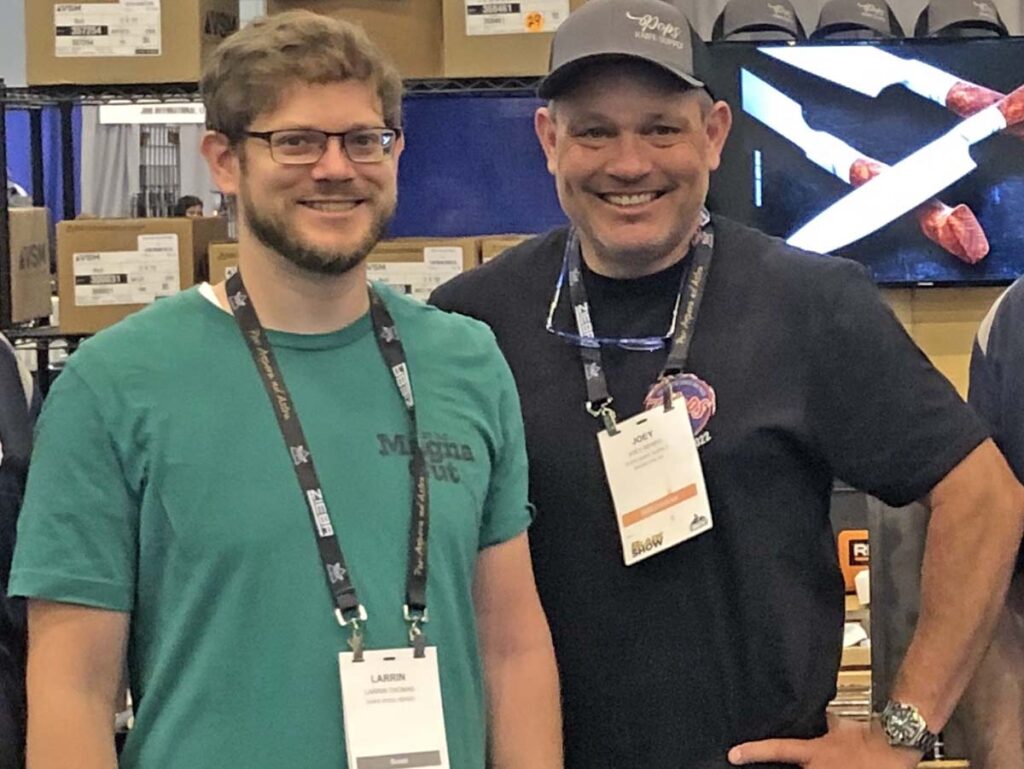
The author (left) and his father, BLADE Magazine Cutlery Hall-of-Fame® member Devin “Hoss” Thomas.

The development of MagnaMax was not without its issues, however. The first two test heats of the steel were made by Crucible, a longstanding U.S.-based steel company that unfortunately went out of business in 2025. Crucible is the company behind many of the industry’s leading knife steels like 154CM, S30V, S35VN and 3V. Crucible is the company that invented powder metallurgy itself, a significant innovation providing the excellent properties of all the “CPM” (Crucible Particle Metallurgy) grades. Crucible went under basically right while it was making the second test heat of MagnaMax. A couple of slabs were even recovered from a pile of scrap after the company was dismantled so my team could test it. We made the first test heat of MagnaMax back in March 2023, and we are just now approaching the product’s wide release.

Niagara Specialty Metals (NSM), the company that hot rolls, anneals and distributes the majority of the leading steel grades, has played a key role in keeping these steels alive. Crucible relied on NSM for hot rolling the high-end, complex grades, as it is the only facility in the United States capable of processing them.

Niagara had already assumed an active role in the knife industry many years before, taking over the distribution of blade steels over a decade ago after Crucible’s first bankruptcy in 2009. It pushed for new grades like CPM S45VN, and without NSM, I’m not sure MagnaCut would ever have been made. Niagara is working with other suppliers of powder-metallurgy steel, including Carpenter and Erasteel, to ensure these grades remain available. My team has been working closely with these partners on the development of MagnaMax, but that also means we almost had to start over after Crucible’s unfortunate demise. The good news is I have been testing MagnaMax made by Erasteel, and the properties look excellent, at least as good as the Crucible-made material. And it’s actually looking a little better.

Pop’s ProCut Steel

Perhaps sometimes I get carried away working on new knife steels that push the boundaries for wear resistance. Some knifemakers are looking for simpler grades that are easy to forge, grind and finish.

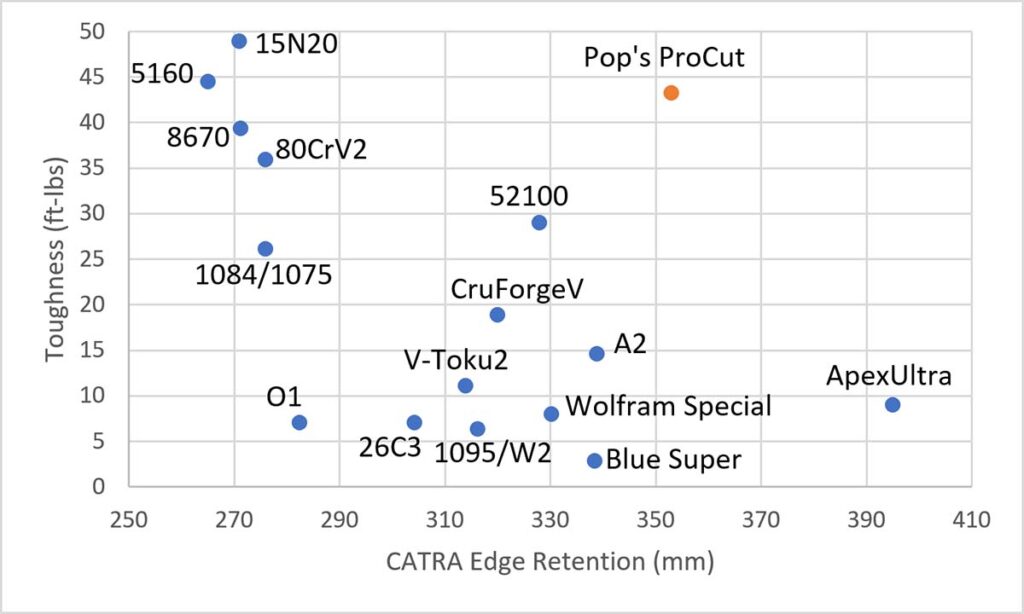
Pop’s ProCut’s toughness matched that of steels like 8670 and 5160, known for their excellent toughness. The edge retention was better than the majority of forgeable grades outside of ApexUltra, a high-performance forging grade.

Joey Berry of Pop’s Knife Supply contacted me in March 2024 asking for an improved version of Pop’s most popular grade, 80CrV2, which is known for being very easy to work, high in toughness and low in cost. I told Joey I would need to think about it because I had no idea off the top of my head what version of 80CrV2 would fill the niche of bladesmiths who want something inexpensive and easy to work. However, I have always enjoyed working with Pop’s Knife Supply, so I gave some serious thought to what kind of steel would be ideal for Joey’s request.

Pop’s is growing rapidly and has been a big supporter of mine, selling copies of my books—Knife Engineering and The Story of Knife Steel. It has been expanding its steel offerings and its steel education base to better serve customers, and I knew a steel along these lines would be a good fit for it. One of the trade-offs with knife steel design is when you add some elements like vanadium in significant amounts, things like forgeability and finishability go down. How could I make something new and exciting without pushing so much it becomes difficult for knifemakers to work with?

I thought about how high-nickel steels like 15N20, L6 and 8670 are known for their excellent toughness—at the top of my charts—but also have very limited wear resistance. I also knew some relatively rare steels like Blue #1, V-Toku2 and Wolfram Special have small additions of tungsten and vanadium for wear resistance. In grades with higher amounts of those elements, I start to see complaints from makers about the difficulty of working with them, though they seem to be at a place where they hit the right balance before forging and hand sanding become issues. These tungsten-vanadium steels are relatively challenging to find, often expensive when you do, and their toughness is much lower than the high nickel grades. As a result, the idea was to combine the high nickel approach for toughness with the controlled additions of tungsten and vanadium for wear resistance.

The author (left) and Joey Berry of Pop’s Knife Supply.

Another major factor for this development was the ease of heat treating. Often, steels like 1084 are recommended to novice makers for heat treating in a forge because it is dead simple to harden—just heat it to nonmagnetic and dunk it in oil. However, these grades are also very easy to overheat; they come out hard, but the toughness is greatly reduced. Only a few seconds in a forge past nonmagnetic can lead to a reduction in toughness.

On the flip side are grades like 80CrV2 that have chromium and vanadium additions to limit grain growth, so overheating isn’t as much of an issue. But the chromium also means you must heat past nonmagnetic and hold it there to ensure the carbides dissolve. The chromium slows everything down. However, I thought if we kept the chromium content very low the new steel could still be quenched from nonmagnetic and achieve full hardness, while the tungsten and vanadium additions would create tiny carbides that “pin” the grain boundaries so overheating and grain growth are not issues. This would make the easiest-to-heat-treat knife steel ever. Just heat it past nonmagnetic and quench it, and you will get high hardness and toughness every time.

My team and I got a steel company to agree to try the composition I proposed and waited (im)patiently for the steel to arrive. This was a major investment for Pop’s Knife Supply, and there was no guarantee the new steel would work just because it sounded good on paper. Fortunately, however, when we tested the steel, its toughness matched steels like 8670 and 5160, known for their excellent toughness. The edge retention was better than the majority of forgeable grades outside of ApexUltra, a high-performance forging grade I developed with makers Marco Guldimann and Tobias Hangler. And in testing the heat-treating range, we found it could be quenched anywhere from 1400°F up to 1750°F—over 300°F! This met our target of making a steel that is easy to heat treat.

Reports from makers have been very positive for Pop’s ProCut. They have praised the ease of working as well as the tested performance. Dawson Knives related: “We found it to be an excellent steel that 1) Offers a razor-sharp edge on par or better than other modern steels; 2) Holds that edge cut after cut; 3) Displays excellent lateral strength (it flexed close to 20 degrees in either direction and returned to true); and 4) Extreme impact resistance (edge resisted chipping, cracking or rolling when driven into a piece of steel Unistrut with a sledge hammer). We are able to get our edge hardness to Rockwell C of 62-63 and still retain superb flexibility.”

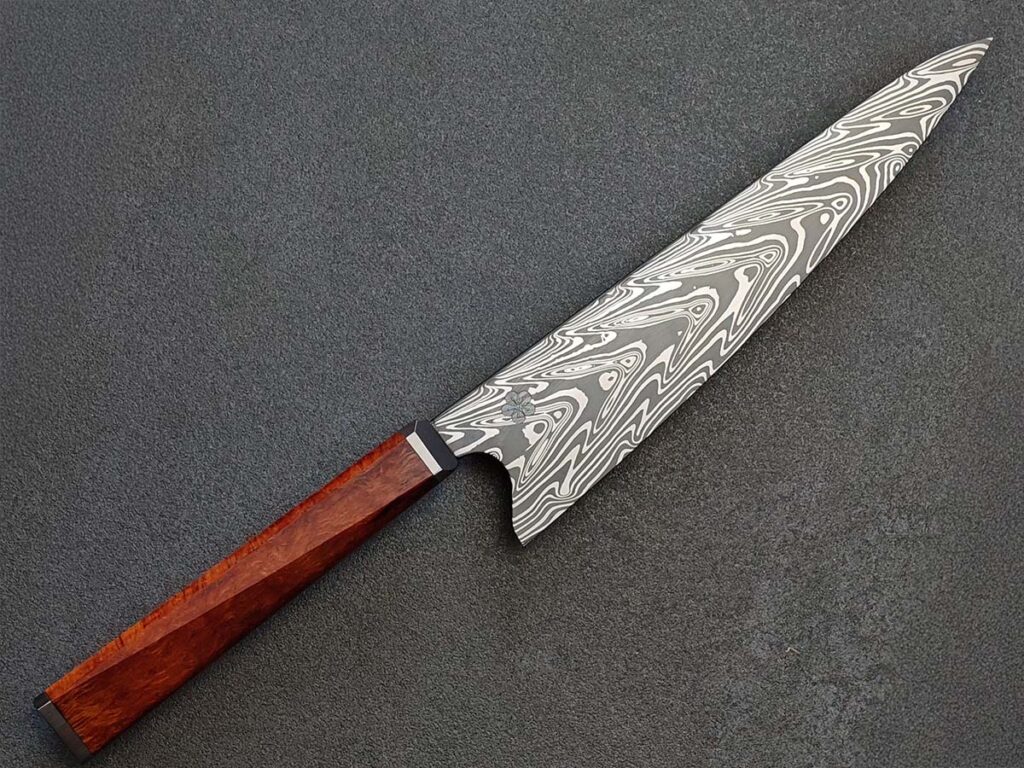
Kurt Glatt forged Pop’s ProCut and ApexUltra steels for the damascus blade of his chef’s knife.

Another exciting aspect of ProCut is the high nickel content (2 percent like 15N20) allows it to be used in pattern-welded damascus as a “bright” layer. This gives a new, higher-edge retention steel for use in damascus. As noted, previous high nickel grades have very low wear resistance. It can even be used in combination with other high-wear-resistance grades to make superior edge-retention damascus. I have seen a couple of knives using both ProCut and ApexUltra for some excellent-looking and performing damascus.

More To Come?

I’m constantly working on new ideas, though it’s hard to predict which projects will pan out or when they’ll be released. It’s been incredibly rewarding to see the steels I’ve developed used by top knifemakers and major knife companies, and to hear from end users who genuinely love them. When my dad, BLADE Magazine Cutlery Hall-of-Fame® member Devin “Hoss” Thomas, took me to my first knife show as a teenager, I never would have thought I would be working on such cool stuff.

More On Knife Steel:

A Labor of Love: Lorenzi Foundation And Museum

The Lorenzi Foundation and Museum showcases one of the finest collections of rare and historical knives in the world.

One of the most extensive collections of ultra-rare modern custom and historical knives, cutting implements and many other items connected with the cutler’s art is displayed magnificently in a new museum in Milan, Italy.

A labor of love by Aldo and Edda Lorenzi, the museum is under the auspices of the aptly named Aldo and Edda Lorenzi Foundation (established July, 2020). The museum showcases the Lorenzi Collection consisting of about 2,000 pieces in all, catalogued and accompanied by specific information: era, origin, artisan (if known), function, material, construction and more.

Aldo & Edda Lorenzi
Aldo & Edda Lorenzi

It gathers cutting utensils and related items dating from the Etruscan period (approximately 900-27 B.C.) to today. It is complemented by a series of specialized publications, testimony to the incessant research that was necessary to bring the operation  of the Lorenzis’ internationally recognized G. Lorenzi retail knife store in Milan to exceptional levels, and to which Mr. and Mrs. Lorenzi devoted their efforts and creativity for many years. It is all housed in a state-of-the-art edifice containing many of the displays and other historical examples of the cutler’s art from the original G. Lorenzi shop and elsewhere.

The Foundation’s premises include a library where visitors and specialists may view the bibliographic materials. A special fit-out of the space enables visitors to relive the shop’s atmosphere. Thanks to an attentive recovery, a number of the original furnishings have been reinstalled on site. This includes an exterior window from G. Lorenzi, one of six “eyes” that communicated with window shoppers in one of Milan’s most exclusive retail store districts, and the display counters on which, over the years, over 18,000 types of sales items were placed. The space also features oak display cases in which the items were shown, as well as the copper-paneled room that featured the small entrance door opening onto the larger shop.
Historic Excellence

The collected items demonstrate, by starting from an artisanal craft as ancient and humble as that of the knife grinder, how it is possible to evolve and then achieve historic excellence. As further informational support, there are over 700 books, about 1,000 magazines and 150 prints, which for the most part depict traveling knife grinders. In fact, Aldo’s father, Giovanni Lorenzi, started his career as a professional knife grinder. Giovanni

Edda Lorenzi examines and arranges some of the many cutlery items from the Lorenzi Collection. (Lorenzi image)

founded  Coltelleria G. Lorenzi—a small shop at the time—at the address of via Montenapoleone 9, Milan, a shop later operated by his sons Aldo, the sole administrator, and Franco. (Regrettably, Franco passed away a few years ago.)

In the course of over 60 years, the Lorenzis collected and kept the pieces which best represented their profession until the closure of G. Lorenzi in 2014. Their selection of the most recent items from their collection was made possible thanks to the close, precious relationship with the artisans—many Europeans, a number of Americans and Japanese—whom Aldo and Edda visited periodically at their shops. It was in such shops that the artisans created their unique pieces, full-fledged artworks that stand the test of time and which enabled G. Lorenzi to become renowned and appreciated at the international level.

Custom Gems

Included in the collection are 150 custom knives by American makers, knives that are particularly near and dear to Mr. and Mrs. Lorenzi. Having collected such knives since the mid-1970s, the Lorenzis traveled the USA, not only visiting the makers in their shops but also attending most every major knife show, meeting just about every maker worth his or her steel along the way.

Among the Lorenzis’ honors are The Knifemakers’ Guild’s Nate Posner Award (1995); the BLADE Magazine Industry Achievement Award (2014); the American Bladesmith Society Special Achievement Award (2014); and the Gold Star Award of Recognition from the William Moran Jr. Museum and Foundation (2014). Three of the Lorenzis’ favorites among their favorite custom knives in their collection are:

  • The number one of an art piece by W.W. “Bud” Cronk, the maker some consider the father of the modern art knife. Aldo ordered a copy of the knife for one of the Lorenzis’ best customers, but Cronk passed away before he could finish it. It would’ve been a coup for the Lorenzis if they could have gotten the copy too, as Cronk never made duplicates of his work. The copy was used later as the model for the logo of the W.W. Cronk Award, a private honor Don Henderson sponsored for 25 years for the Guild Show’s best art knife
  • A Bob Loveless/Barry Wood folder Loveless gave to Aldo when the Lorenzis visited the Loveless shop in 1977. Unaware at the time that U.S. knifemakers’ shops were not retail knife stores, the Lorenzis knocked on the Loveless shop door unannounced. Loveless answered the door and, unsure at first what to make of the couple from Italy, soon hit it

    Loveless/Wood Folder
    Loveless/Wood Folder

    off with Aldo—so much so that he gave the Lorenzis the Loveless/Wood folder. Before the Lorenzis left, they asked Loveless why he had trusted them so much at first sight that he gave them a knife (at the time, Aldo and Edda had no idea what Loveless knives were worth). “He replied that we ‘had our history written on our foreheads,’ a phrase that we have never forgotten!” Edda wrote. “These are the kinds of bonds that have made us love American knives and knifemakers even more!” 

  • A Multilock folder by Ray Appleton. Edda recounted a memorable trip the Lorenzis shared with Appleton from Georgia to Chicago, including visits to an Atlanta racing museum and Kentucky’s Mammoth Cave in the process, the latter where the 6-foot-8-inch Appleton bumped his noggin on a cave overhead. Recounted Edda: “Since Aldo wanted to stop at every cutler shop he knew along the way, Ray generously offered to make the phone calls for him to warn the shops of our arrival. ‘I’m Aldo Lorenzi’s secretary, Hot Pants,’ he announced himself on the telephone, making us laugh a lot!”

These are but three of the many American custom knives and their stories among the scads of other custom and assorted knives and cutting implements in the museum. Meanwhile, a 300-to-400 page catalog of museum items is due for completion by early 2022 at the latest.

If you ever get Milan way, a visit to the Aldo and Edda Lorenzi Foundation and Museum is a bucket-list must. 


Read more about the Lorenzis

Sarge Knives TK Retro Review: Throwback Bushcraft

Sarge Knives TK Retro has throwback looks, but modern performance.

The TK Retro from Sarge Knives reminds me of my first fixed blade.

The blade was pitted and the leather handle was cracking. Still, the knife field dressed many squirrel, rabbit and game birds throughout my childhood. It was an excellent camper’s or outdoorsman’s knife.

As for the TK Retro, like my first fixed blade, the stacked-leather handle still gives my hand a warm feel. It has a 440C stainless steel blade to make its good looks last even longer. However, how does it cut?

TK Retro Sharpness Test

Retro cutting paper
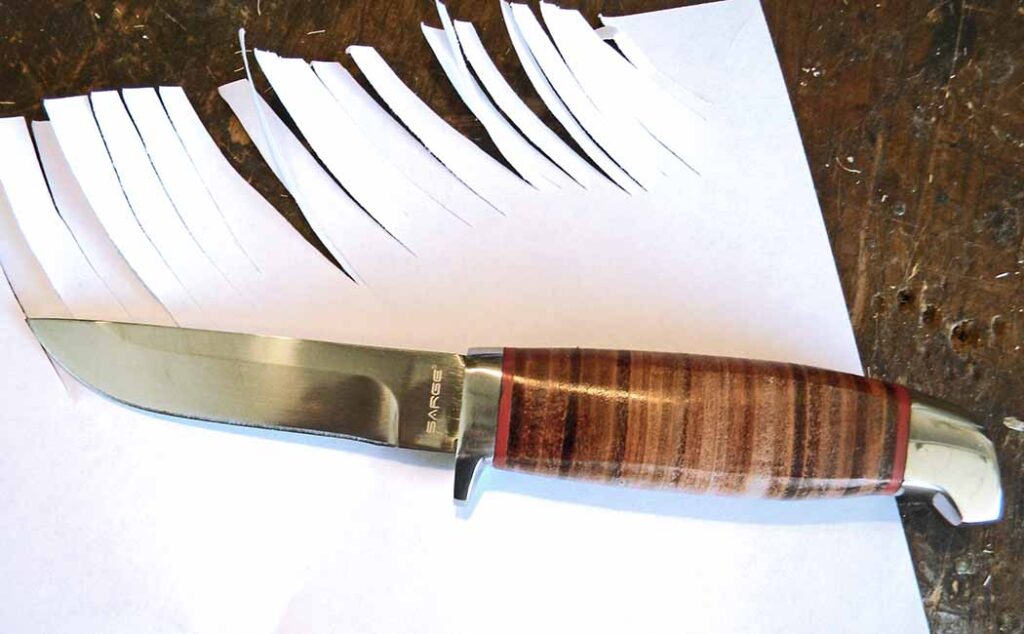
Using the knife’s weight, the author employed push cuts in the stationery. There were no “bad starts,” just smooth slicing.

The first test medium was 20-pound bond copy paper. The TK Retro started slicing and made nice, clean cuts in the stationery. Using the knife’s weight, I employed push cuts. There were no “bad starts,” just smooth slicing.

TK Retro Light-Duty Cuting

TK Retro vs leather
The blade audibly crunched the leather with each skive and made it easy to control the width of slices.

The TK Retro bit deep and smooth [into drywall], with minimal bending of the cut pieces. I could feel the cardboard’s layers with each cut. Edge performance was nice and aggressive. The handle provides a very secure grip.

Leather skiving followed. The blade audibly crunched the leather with each cut and made it easy to control the width of slices.

Heavy-Duty Cutting With Sarge’s Fixed Blade

Firesticks

TK Retro firesticks
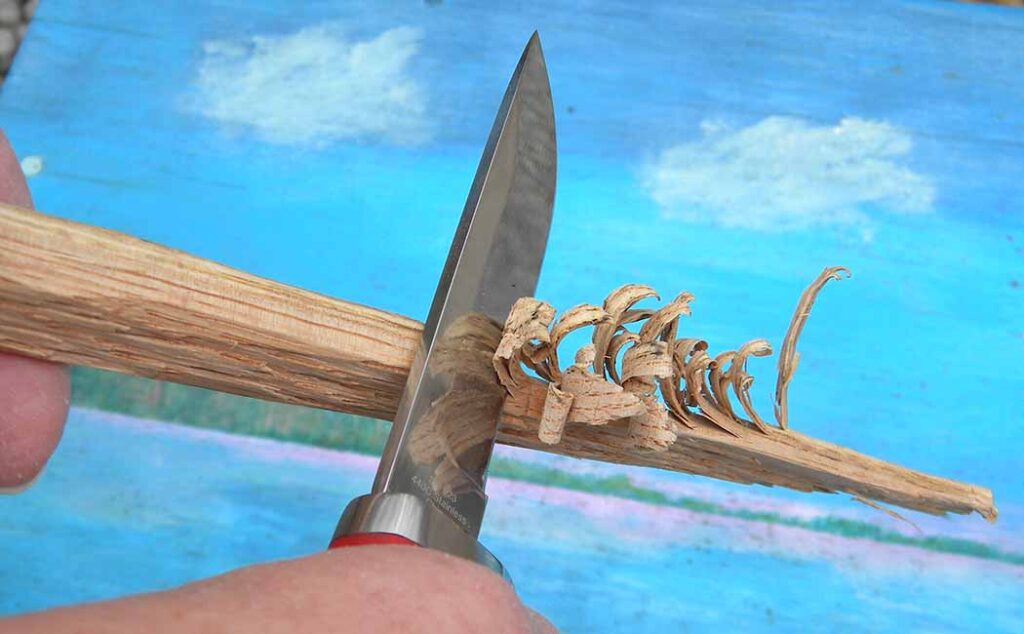
Melissa did a great job whittling a fuzz stick with the TK Retro over her painted bench.

While camping, I was splitting firewood for the weekend. My wife, Melissa, wanted to start the fire so I showed her how to make fire sticks. She took to whittling very quickly and did four of the sticks to aid in her fire starting. She used the TK Retro to make some very nice curlicues. Before I knew it she had a beautiful fire going—excellent job on her part! I was surprised to see her whittling over her bench that she had painted. She seemed to feel very confident using the little fixed blade.

Splitting Wood

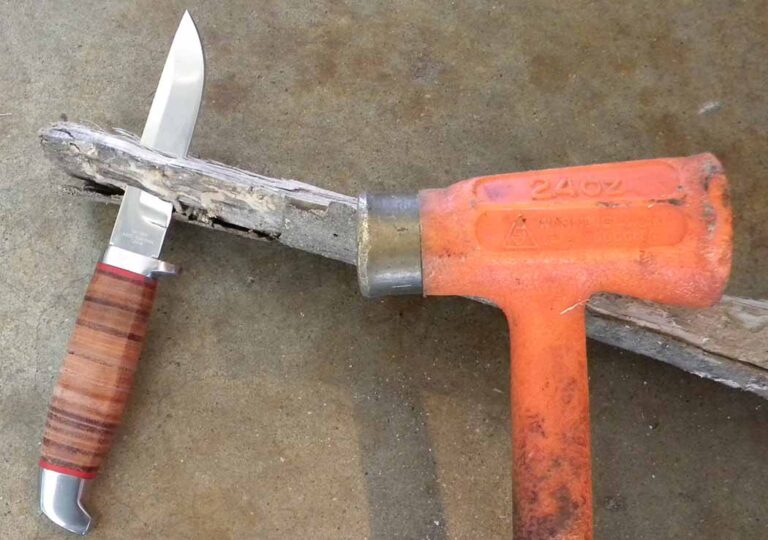
I had some dry hackberry wood to split for kindling. A dead blow hammer and the TK Retro made short work of the task. I didn’t see or feel any edge/knife damage while batonning the edge through the wood. The guard acted like a guide for my hold hand, keeping the wood away from my knuckles. The leather handle absorbed the vibrations perfectly.

Vs Rope

TK Retro cuts rope
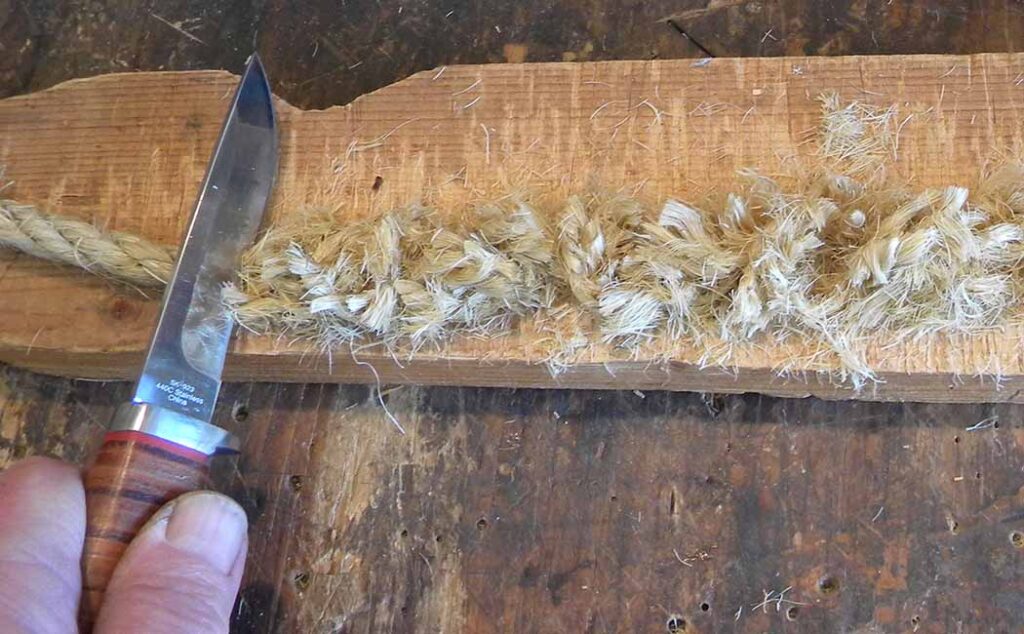
The fixed blade made 82 crunching cuts in the half-inch sisal rope before the edge started to slide.

On the half-inch sisal rope, the TK Retro crunched its way to 82 clean cuts before the edge started to slide. I did find that the guard had a sharp edge that needed softening a bit. It would create a hot spot on your hand after a while. It was an easy fix with some sandpaper.
Chopping Antlers
Chopping antler
After 20 hard whacks on the antler the edge showed nary a chip, a sign of outstanding heat treating.
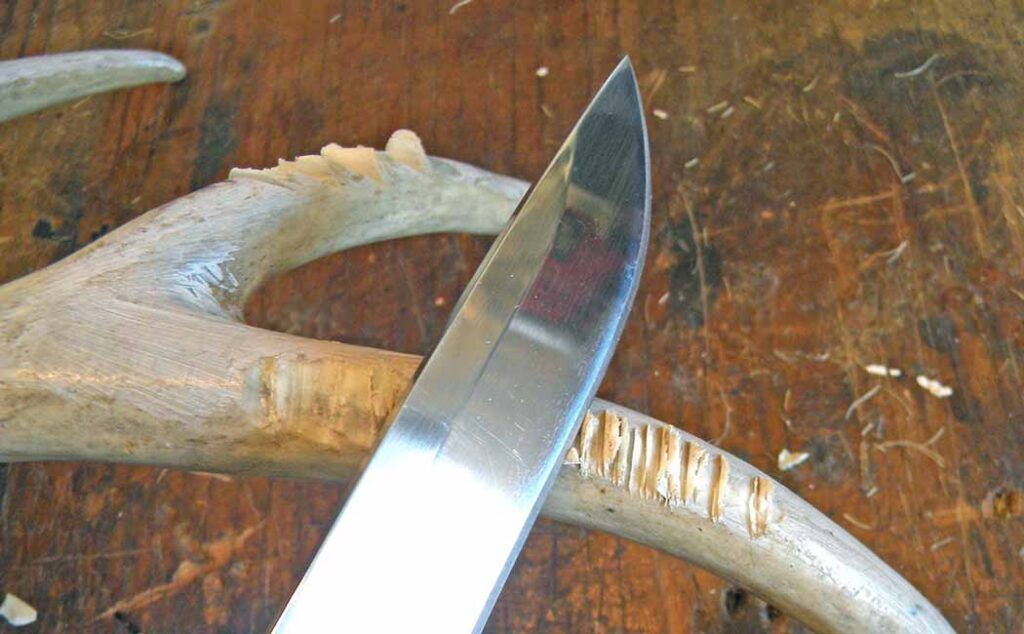
The last test for the edge consisted of a series of chops into a whitetail deer antler. After 20 hard whacks, I expected to see some minor edge chipping but there was none. The edge was as sharp as when I started. Sarge Knives nailed the heat treating.

Changes

The guard and buttcap need to be softened a tad. They will bite you after a period of hard use.

Final Cut

The TK Retro is a very nice medium-use knife great for game or camping.

Sarge Knives TK Retro Specs
Blade length: 3.5 inches
Blade steel: 440C stainless
Blade finish: Mirror polish
Handle: Stacked leather
Fittings: Stainless steel
Construction: Full tang
Weight: 4 ounces
Overall length: 7 3/8 inches
Sheath: Brown leather pouch w/snap and belt loop
Weight w/sheath: 5 ounces
MSRP: $53.95

Read More Knife Reviews:

Advertisement

Must Read Articles

Read this before you make a knife

Knifemaking 101 – Read This Before You Make a Knife

  by Wayne Goddard My experience has taught me that there's nothing like digging in and getting started. I've often said the hardest part of the...
how to forge damascus steel

How to Forge Damascus

Advertisement
Advertisement