Best Scissor Sharpeners: Where To Find Your Edge

Consider three cool tools to keep your scissors shearing sharp.

I sharpen knives frequently but must admit I’m a loathsome scissors sharpener. It’s not like I’ve never sharpened scissors but only when I had to and never in an organized way.

However, when my editor gave me an assignment on scissors sharpeners, I took it as a personal challenge to mend my ways—and off I went. What follows is a primer on scissors sharpening using three different systems.

Before starting, there are a few obvious things to point out.

The most obvious is the fact that there are two blades to sharpen instead of one. Second, the two blade edges are sharpened to oppose each other. Third, most scissors are made for righthanders and can give lefthanders fits, especially models with asymmetrical handles. Some southpaws have more trouble than others, and if you are among them you might seek out companies that either offer lefthanded models, such as Fiskars, or those that specialize in such products, like Lefty’s Left Hand Store. My brother’s lefthanded and he’s never bought any lefty scissors. Instead, he simply buys and uses symmetrical right-hand-only models.

Simple handheld or desktop scissors sharpeners are the way to go if you want to keep a decent edge with very little hassle and time consumption.

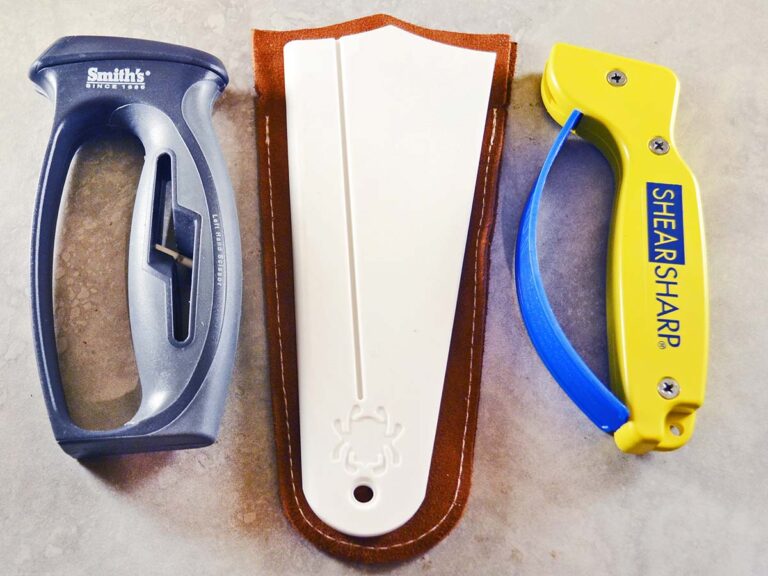
I tested two affordable versions: the AccuSharp ShearSharp Scissors Sharpener and the Smith’s V-Slot Knife & Scissors Sharpener. The pistol-grip-looking units appear similar at first but are actually quite different. The text and graphics on the back side of the cards the sharpeners are mounted on is very helpful, though if you’re like me you will need reading glasses to decipher them.

AccuSharp ShearSharp Scissors Sharpener
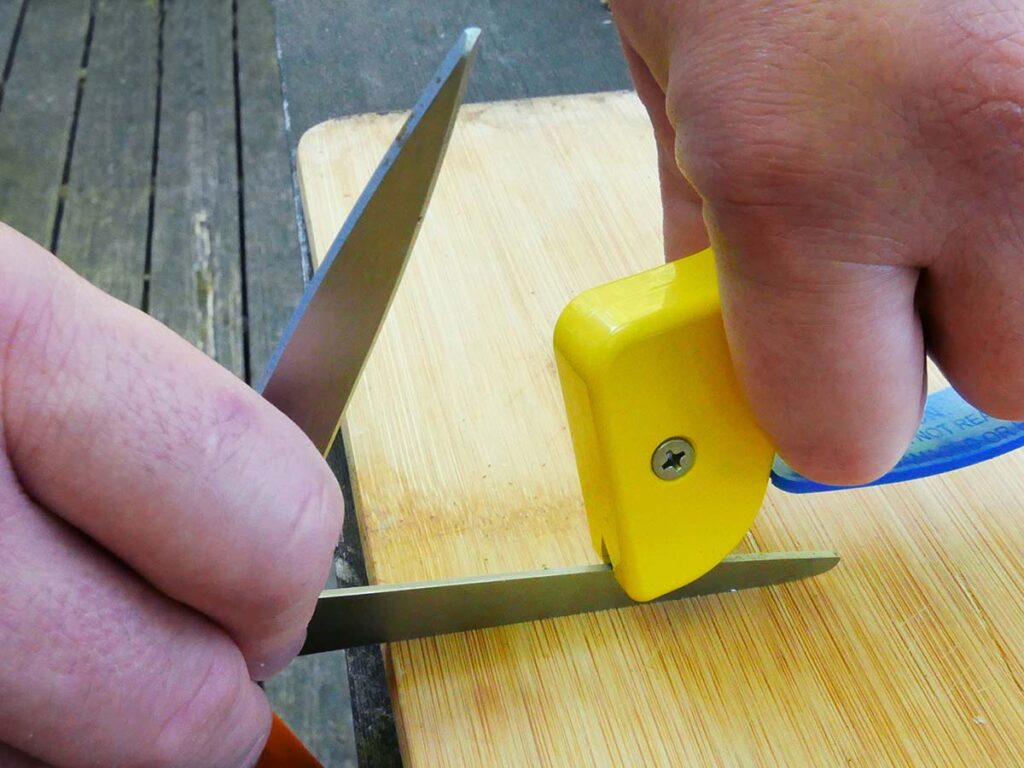
The AccuSharp ShearSharp Scissors Sharpener puts an edge on the blade bevels one side at a time. Here the blades are opened with one side resting on the flat work surface having the blade bevel sharpened. Note the other blade is off the surface. Once the first blade is done, the scissors are flipped and the second blade is sharpened in the same manner. (Covert image)

AccuSharp ShearSharp Scissors Sharpener
Size: 5.5 x 2.4 inches
Type: Hand-held, single sharpening blade
Abrasive: Tungsten carbide
Handle length: 5.6 inches
Handle material: Plastic
Country of origin: USA
MSRP: $9.59

The AccuSharp ShearSharp has a grip with a guard for knuckle protection and there’s a slot on the fore-end with a tungsten-carbide-metal sharpener for running down the blade bevel, sharpening it in the process. Open the scissors and lay the blades, one at a time, face-up to the sharpening medium. The rear blade—the one not being sharpened—hangs off the table or you can put it on a raised platform such as a wood block or book.
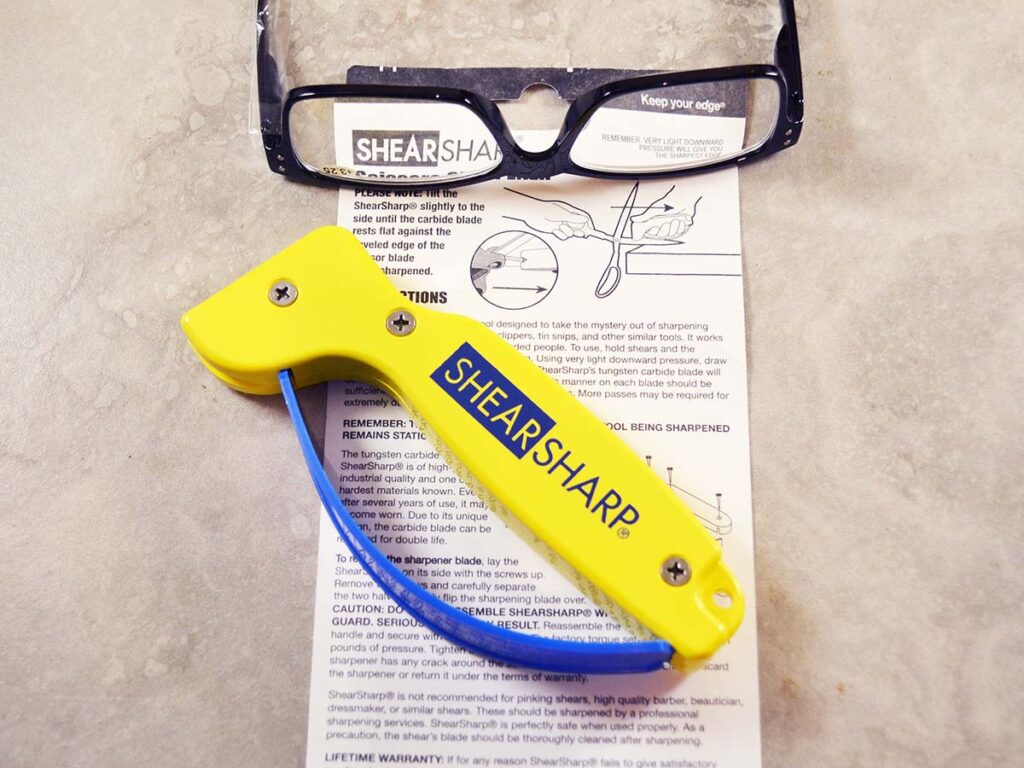
A hand-held design, the AccuSharp ShearSharp Scissors Sharpener addresses the blade bevels one at a time. You’ll need your reading glasses for these instructions, too!

The ShearSharp metal sharpener is canted to the angle of the bevel and runs down the blade from base to tip, rear to front. Accusharp recommends two to three passes of the sharpener, then flip the scissors over and do the same to the second blade. As with all three test units, keep an eye on your progress as scissors come in all phases of disrepair.

Smith’s V-Slot Knife & Scissors Sharpener
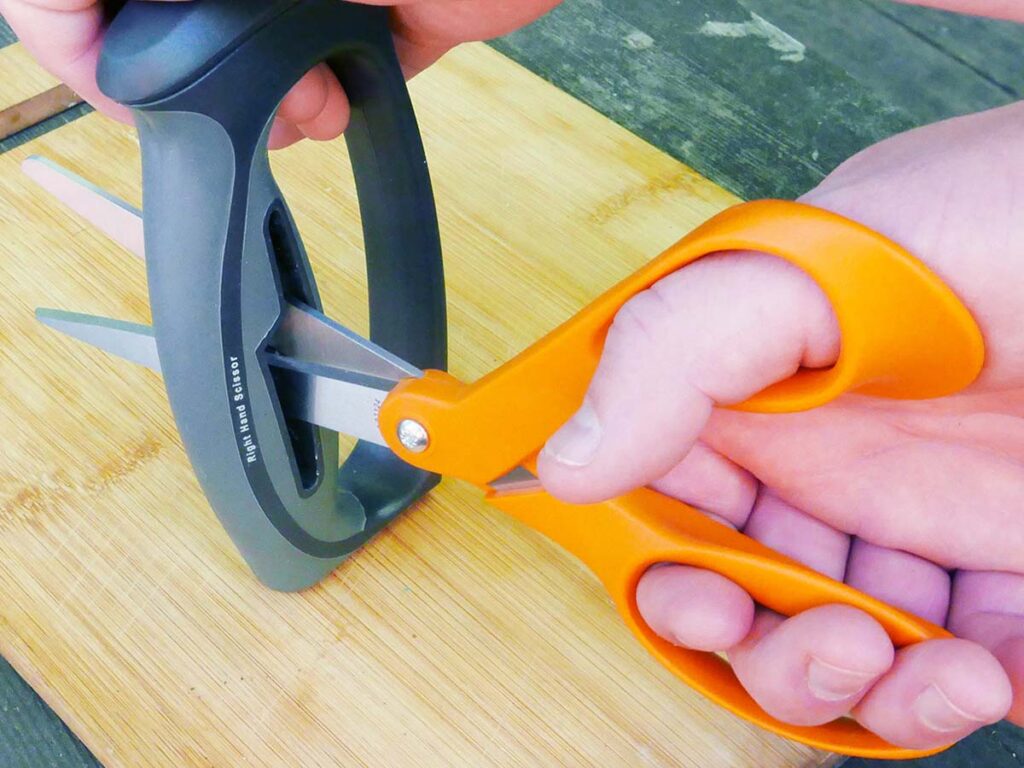
The bevels are sharpened when pushing the scissors blade tips simultaneously into the respective V-slots of the Smith’s unit. The diagonally mounted ceramic rod sharpens both blades at the same time. (Covert image)

Smith’s V-Slot Knife & Scissors Sharpener
Size: 6.75 x 2.74 inches
Type: Hand-held, two sharpening blades
Abrasive: Ceramic
Handle length: 6.75 inches
Handle material: Plastic
Country of origin: USA
MSRP: $9.99

Smith’s V-Slot Knife & Scissors Sharpener is a bit more sophisticated with great finger protection, and is easier to use. Inside the handle is a slot that holds a 1,000-grit ceramic rod angled to sharpen the two scissors bevels at the same time. The bevels are sharpened when pushing the scissors blade tips into the respective V-slots simultaneously. (Smith’s recommends not sharpening by pulling the blades out.)
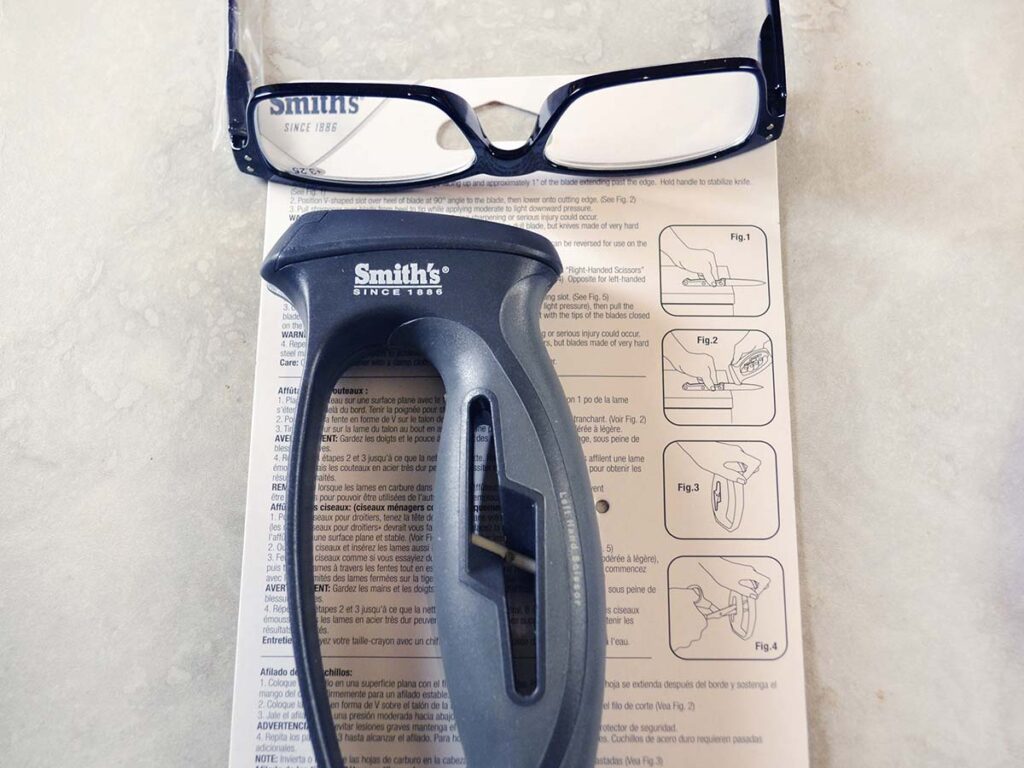
You may need your reading glasses to decipher the instructions for the Smith’s V-Slot Knife & Scissors Sharpener.

Two to three passes is usually enough for blades of average dullness, more if needed. Once again, stopping to gauge your progress is your friend. An added benefit with the Smith’s sharpener is you can sharpen both right- and left-handed scissors depending on which side of the handle slot you use, and it’s conveniently noted on the sides of the unit itself.

Spyderco Golden Stone
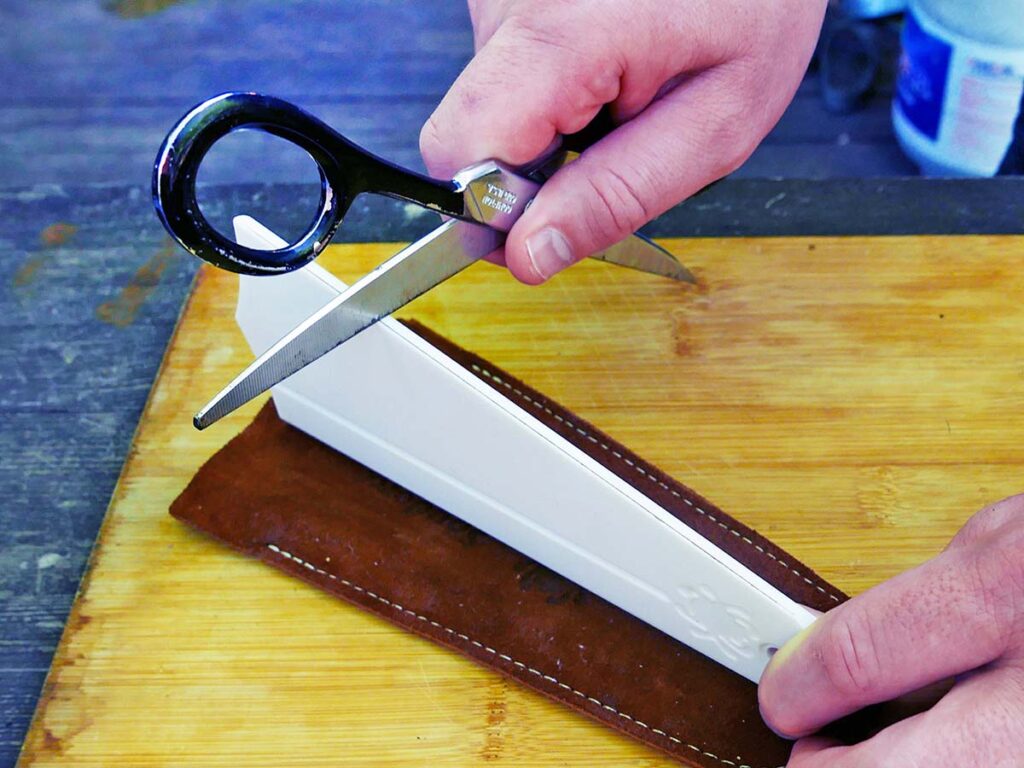
Starting at the top, slide the blade’s beveled edge down the length of the Golden Stone, gradually working the edge toward the tip. Once the edge is sharp, give the opposite blade the same treatment.

Spyderco Golden Stone Sharpener
Size: 7.2 x 3 inches
Type: Desktop sharpener
Abrasive: Alumina
Handle: None
Carry: Suede leather pouch
Country of origin: USA
MSRP: $210

I have become very familiar with the Spyderco Golden Stone sharpener over the years and have included it in several articles, though not for sharpening scissors. Spyderco knives are well known for their premier out-of-the-box sharpness, and company founder and BLADE Magazine Cutlery Hall-of-Fame® member Sal Glesser is a long-time guru on the topic, including today on YouTube.

The Golden Stone is a Glesser design that enables you to sharpen knives in many ways and at different angles, and even serrated blades. Spyderco uses alumina (aluminum oxide) for the Golden Stone’s material and other of its sharpeners, and claims the resulting models do not require oil or water for surface sharpening. Check out Spyderco’s YouTube sharpening videos for a myriad of ways to sharpen the company’s knives.
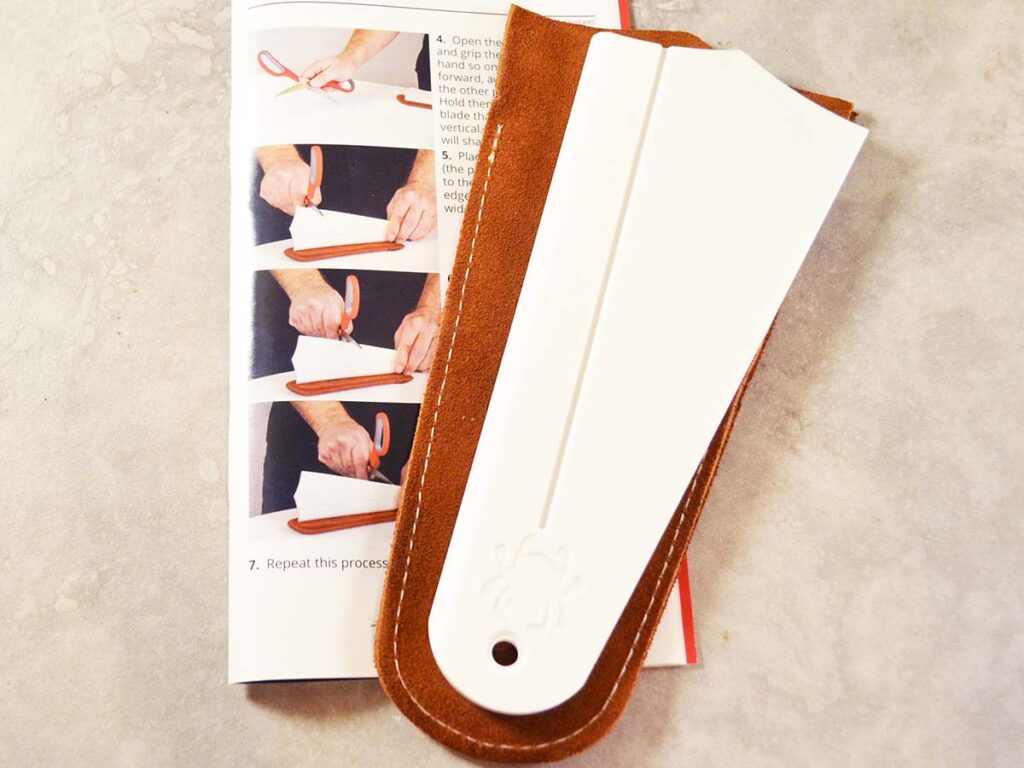
Designed by Spyderco founder Sal Glesser, the Spyderco Golden Stone is an odd triangular ceramic sharpener fit for many uses—one of which is sharpening scissors. For sharpening, position the suede pouch that carries the Golden Stone on a flat base to provide a non-slip surface. (Covert image)

To start with the Golden Stone, use the accompanying suede pouch as a non-slip surface on a flat base. Employ the stone’s rough triangular shape with the long side sideways and vertically. Grip the short side of the triangle with the long vertical side to your right, forming the sharpening platform. Now you’re ready to sharpen the first blade bevel.

Open the scissors wide and position the top of the base of the bevel grind over the high point of the sharpener, and slide it toward the low end as you slowly pull toward you.

It’s like sharpening a knife where you start at one end and slowly slide the tip toward the opposite end as you go—you’re just putting an edge on the bevel instead. Spyderco recommends eight to 10 passes but, once again, use your judgment depending on the condition of the scissors. Once you’re pleased with the bevel on the first blade, flip the scissors over and repeat the process on the second blade. When done you can remove any burr on the edges of the two blades by opening and closing the scissors a few times.

Conclusion

Both handheld units did a good job of sharpening the bevels, and though I prefer a ceramic sharpening rod just because you can better “feel” it rubbing against the bevel, there was no noticeable difference in the results. These two sharpeners are capable of putting a very decent edge on your scissors.
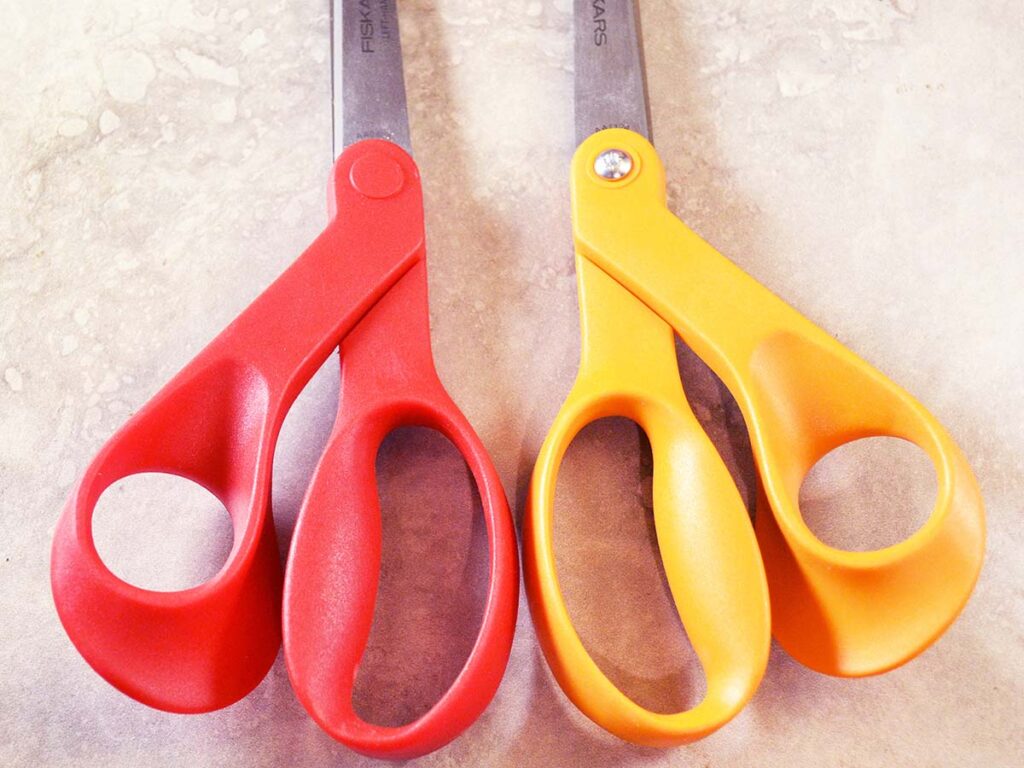
Fiskars is one of the few major companies that manufactures scissors specifically for lefthanders, and is known for such radically asymmetrical designs as these two. The red pair is for lefties.

The end result of my efforts with the Golden Stone paid off with two razor-sharp beveled edges on the scissors blades. Spyderco doesn’t assign numbers to the grits on its sharpening media, but the best I can tell the white alumina like that used on the Golden Stone is in the fine, 2,000-grit range.

Where To Find Your Edge

Is all the cost, time and increased degree of skill required by the Spyderco Golden Stone worth it? That’s up to you and what your expectations of your scissors are. There are folks whose livelihoods depend on scissors, others that just want to get the mail out the door and scads of people in-between. Choose your sharpener!

More Sharpening Articles:

2026 BLADE Show Preview: New Wrapper, Same Steel

BLADE Show’s home sharpens up for the event’s 45th Anniversary.

Longtime BLADE Show patrons, get ready for a brand-new venue. Calm your heart palpitations. The world’s largest knife show isn’t picking up stakes from Atlanta when it unsheathes its 45th iteration June 5-7. Simply put, the longtime home of our favorite edgy shindig is undergoing a massive $190 million facelift.

The Cobb Galleria Centre—now officially the Cobb Convention Center—is in the midst of a multi-year renovation to upgrade its facilities and amenities. While the project stretches into early 2027, it will be at its midway point when the BLADE Show doors open this June.

Diehard knifeaholics needn’t worry, the upgrade project won’t derail the aspects of the show you love. Factory knife debuts, the educational instruction of BLADE University (see sidebar) and action-packed demos still await show patrons. The BLADE Magazine 2025 Knife-Of-The-Year® Awards and the custom knife judging competition remain center stage. Furthermore, the American Bladesmith Society (ABS) will still name its latest master and journeyman smiths, and some of the best knives from the ABS, The Knifemakers’ Guild and unaffiliated makers will be on display in all their sharpest glory.

John Horrigan’s majestic fixed blade turned more than a few heads during the 2025 show. (Jocelyn Frasier image)

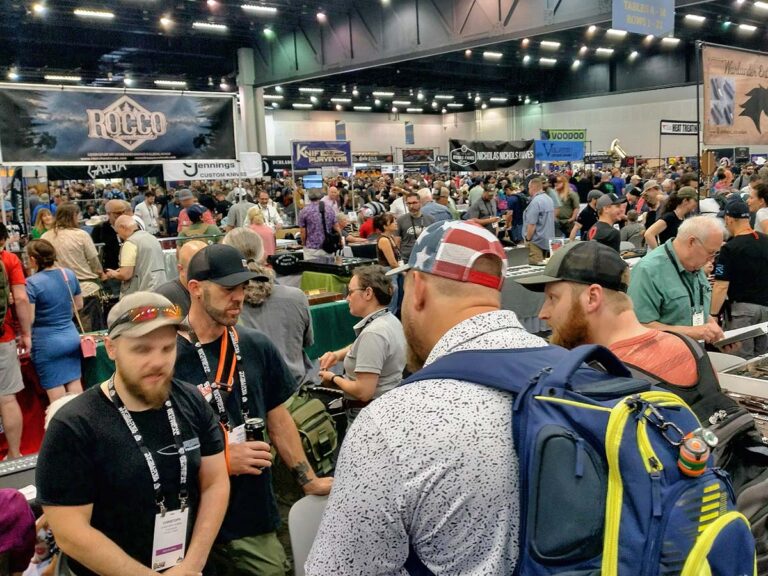
Additionally, the show floor welcomes more than 900 exhibitors from 35 countries, offering a global masterclass in modern cutlery. From the latest production folders and custom fixed blades to rare handle materials and high-tech shop equipment, the sheer volume of gear is staggering. All of this comes in the brand-new wrapper of the convention center, honing the BLADE Show to a razor’s edge.

The main exhibit hall and the ballroom—better known to the faithful as the Baller Room—are already complete. These renovations will immediately improve the show with new LED lighting, fixed concession outlets, renovated restrooms and an improved PA system. The Baller Room and lobby area also sport new wall coverings, chandeliers and carpet, while the rotunda has an entirely new look.
While the show floor is unaffected, attendees will feel some impact. The renovation of the specialty shops and meeting rooms below and across from the main hall will run congruent to the show. This means BLADE University has a new campus. Look for classes in the newly constructed ballrooms just off the Renaissance Atlanta Waverly.

And for those who love the food, libation (lots of that), knife boasting and lie swapping of “The Pit”, that is slated to proceed unchecked. The sunken bar of the Waverly is untouched by hammers, saws or fresh sheetrock. Get your sleep so you can haunt it until cock’s crow.

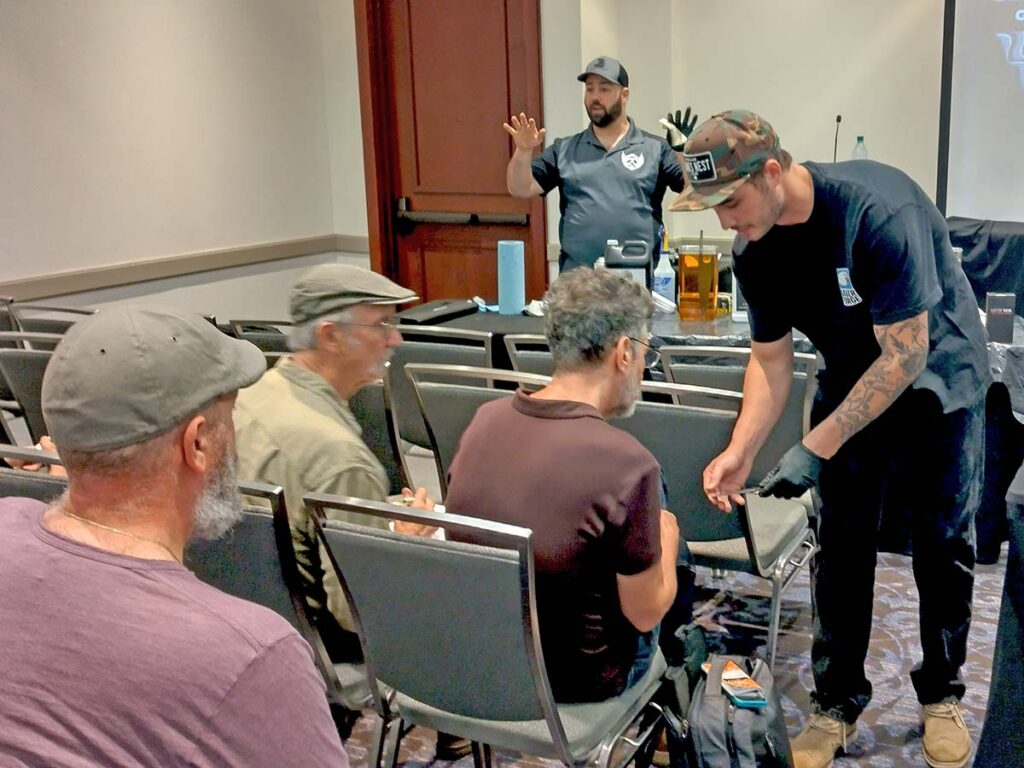
Jordan Berthelot discusses next-level damascus etching while Greyson Weltyk shows a student a result of the process during one of many BLADE University classes.

When the dust finally settles, the Cobb Convention Center will be a major boon. By 2027, showgoers can look forward to more than 50,000 square feet of new meeting rooms, event courtyards and indoor space. As the BLADE Show grows in global reach, its longtime home has the room to grow along with its marquee event.

Edge Of The World

Perhaps the most intriguing aspect of the BLADE Show in recent years is the global reach of the brothers and sisters of sharps. No one knife-specific event gathers more makers and companies from around the world—including the good ol’ U.S. of A—into one venue.

The outstanding international makers include: the CAS Brothers, Mauricio Daletzky and Javier Vogt (Argentina); Bertie Rietveld, Theuns Prinsloo, Henning Wilkinson and Neels van den Berg (South Africa); Franco de Souza, Rodrigo Sfreddo, Fabio Barros and Gus Cecchini (Brazil); Bruce Barnett (Australia); Kizer Cutlery, Reate and Ketuo (China); Koji Hara (Japan); Lionsteel, Alfredo Faccipieri, Fox Cutlery, Maniago Knife Makers (MKM) and Maserin (Italy); Damasteel (Sweden); Jens Anso (Denmark); Helle Knives (Norway); Jean-Louis Regel and Veronique Laurent (Belgium); Carlos Queiros (Portugal); Sergey Shirogorov (Russia); and Grace Horne (United Kingdom).

The Baller Room buzzed all three days of the show. The room comes with some notable improvements this year, including new carpet and wall coverings.

Some of the leading American exhibiting makers will be BLADE Magazine Cutlery Hall-Of-Fame® members Bill Ruple, Steve Schwarzer and Harvey Dean; ABS master smiths Mike Quesenberry, Shane Taylor, David Lisch, Jordan LaMothe, Josh and Karis Fisher, and Andrew Meers; slipjoint makers Stanley Buzek, Tom Ploppert, Luke Swenson and Tim Robertson; Allen Elishewitz; Les George; Walter Brend; Strider Knives; Hawk Knives; Vince Evans; factory companies Spyderco, Case, TOPS Knives, Chris Reeve Knives, Spartan Blades, Pro-Tech, Microtech, Kershaw, Squid Industries, KA-BAR and Heretic Knives; and many more.

Knives Of The Year

BLADE Magazine Knife-Of-The-Year® Awards is the factory knife industry’s highest honors, pitting the companies’ sharpest designs again each other. In an effort to keep the awards’ distinguished position and recognize the changing landscape of the industry, BLADE Show added a new category for this year.

New for the 2026 competition is the Best Slip Joint category, breaking off the traditional design from the Best Imported Folder and Best American Made Folder categories. This is the third new category added in as many years, with Best Of The Rest created in 2025 and the Automatic Knife Of The Year sponsored by PVK.com that debuted in 2024.

 New knives aren’t the only draw in Atlanta. Antique Randall knives and their collectors were in abundance at the show.
New knives aren’t the only draw in Atlanta. Antique Randall knives and their collectors were in abundance at the show.

As in the past, the entries are limited to BLADE Show factory booth exhibitors, all of whom received the rules well before the show outlining the new changes. Like last year, the winners will be announced and presented during the BLADE Magazine Awards Reception on Saturday at 8 p.m. in the room on the floor above The Pit. The winners will be listed on BLADE’s blademag.com website after the awards reception, and a list will be posted outside the show entrance Sunday morning.

BLADE University

Get current on the latest knifemaking techniques and other trending sharp subjects during the 13th Annual BLADE University on Thursday, Friday and Saturday. See the sidebar for a complete rundown of classes, days, times and instructors.

Sponsored by Work Sharp, BLADE University has the most extensive schedule of knife, knifemaking and other instruction held at any knife show. For enrollment and other information, visit https://bladeshow.com/show-info/classes.

Custom Knife Awards

Among the most testing custom knife competitions in the nation, the BLADE Show Custom Knife Awards is one of the most coveted honors in knifemaking. In a continuing effort to keep it the premier award in the handmade knives, the competition’s categories have been expanded. Best Slip Joint has been split into Best Single-Blade Slip Joint and Best Multi-Blade Slip Joint categories, allowing more subtlety in judging the nuanced class of knives.

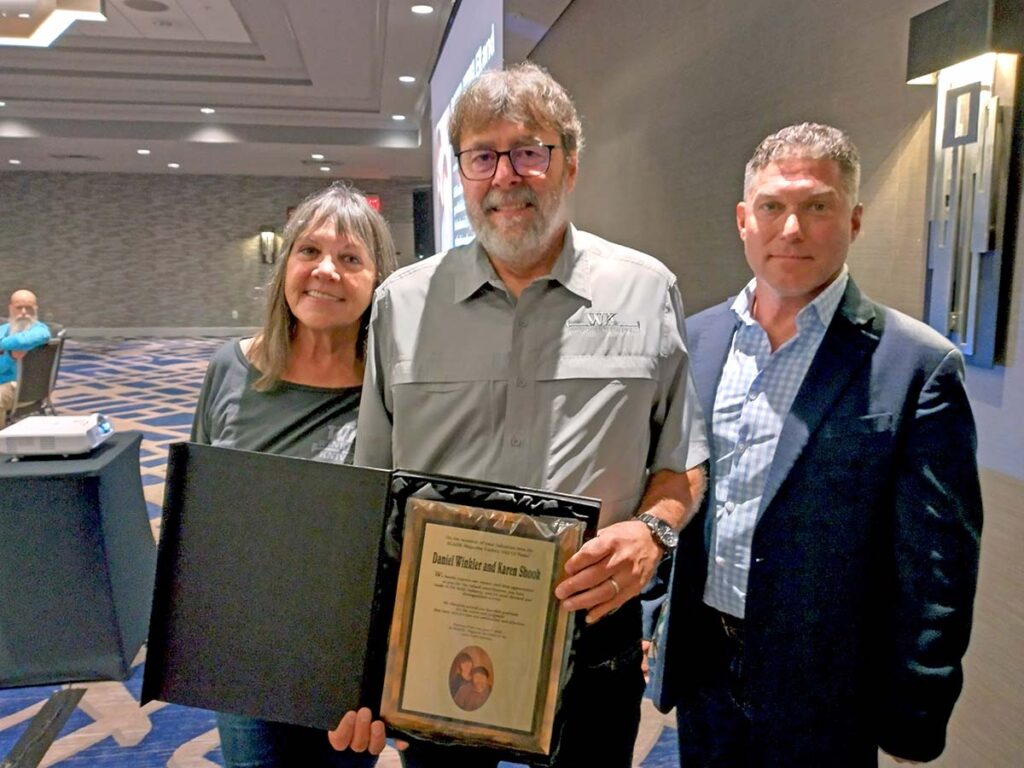
From left, Karen Shook and Daniel Winkler accept their Hall of Fame plaque after Kevin Holland (right) delivered their induction speech.

Leading industry authorities will pick the best custom knives by BLADE Show exhibitors in the annual knife judging competition, with the winners announced during the BLADE Magazine Awards Reception Saturday at 8 p.m.

The categories are: Best of Show; Best Art Knife; Best Bowie; Best Collaboration; Best Collaboration; Best Damascus; Best Fighter; Best Fixed Blade; Best Folder; Best Handle Design; Most Innovative Design; Best Kitchen Knife; Best M.A.C.K.; Best Miniature; Best New Maker; Best Single-Blade Slip Joint; Best Multi-Blade Slip Joint; Best Sword; Best Tactical Folder; Best Utility Hunter; Best of the Rest.

The competition is open to the show’s custom knife exhibitors only. The winners will be announced on BLADE’s blademag.com website after the awards ceremony, and a list will be posted outside the show entrance Sunday morning.

World Championship

The BLADE Show World Championship Cutting Competition will be conducted by BladeSports International (BSI) and held in The Courtyard, the parking lot of the host hotel, the Renaissance Atlanta Waverly, Saturday at 4:30 p.m. Attendance is free to BLADE Show ticketholders.

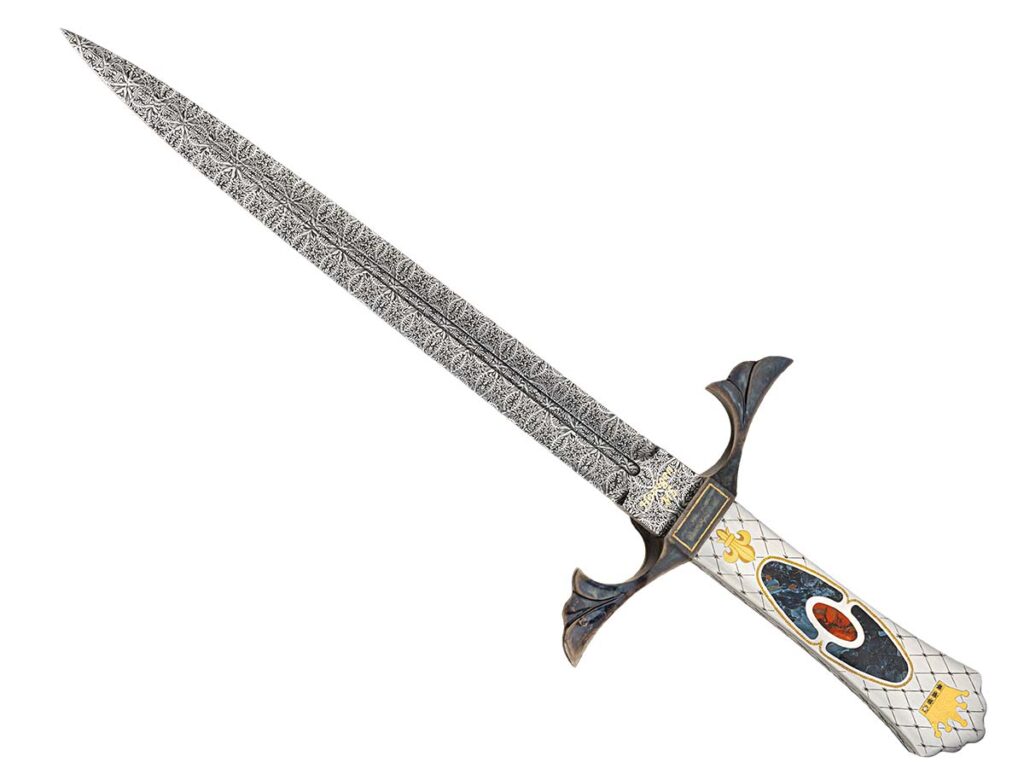
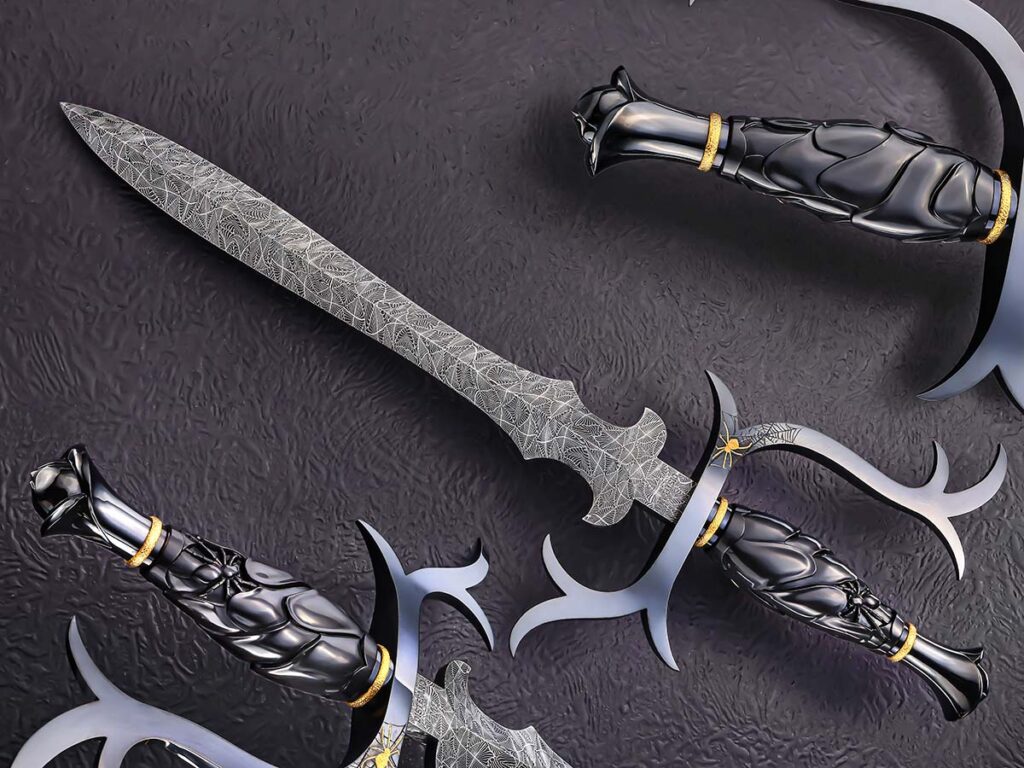
Paul DiStefano always produces stunning work, which certainly goes for his 14-inch spiderweb mosaic damascus-bladed dagger, which he brought to the BLADE Show. That’s a carved buffalo horn handle, by the way. (SharpByCoop image)

For a second year in a row the men’s and women’s divisions were won by a husband and wife: Mr. and Mrs. Ben and Sue Ann Propst. The championship results were as follows: Men’s Division: Ben Propst (Niagara Specialty Metals), world champion; 2nd: Donavon Phillips (Spyderco); 3rd: David Moore (Pops Knife Supplies); and 4th: James Clifton (Spyderco). Women’s Division: Sue Ann Propst (Niagara Specialty Metals), world champion; 2nd: Lauren Kalns; 3rd: Sara Maly (Pops Knife Supplies); and 4th: Jo Carothers (Carothers Performance Knives).

Bali Grand Master

Top balisong flippers will vie for the title of “Grand Master” in the 10th Annual Battle for Bali Champion sponsored and conducted by Blade HQ.

BLADE Show ticketholders are invited to watch the competition on the second floor above The Pit of the Renaissance Atlanta Waverly Hotel on show Saturday from 12:45 p.m. to 2 p.m. Competitors will start flipping knives at 1 p.m.

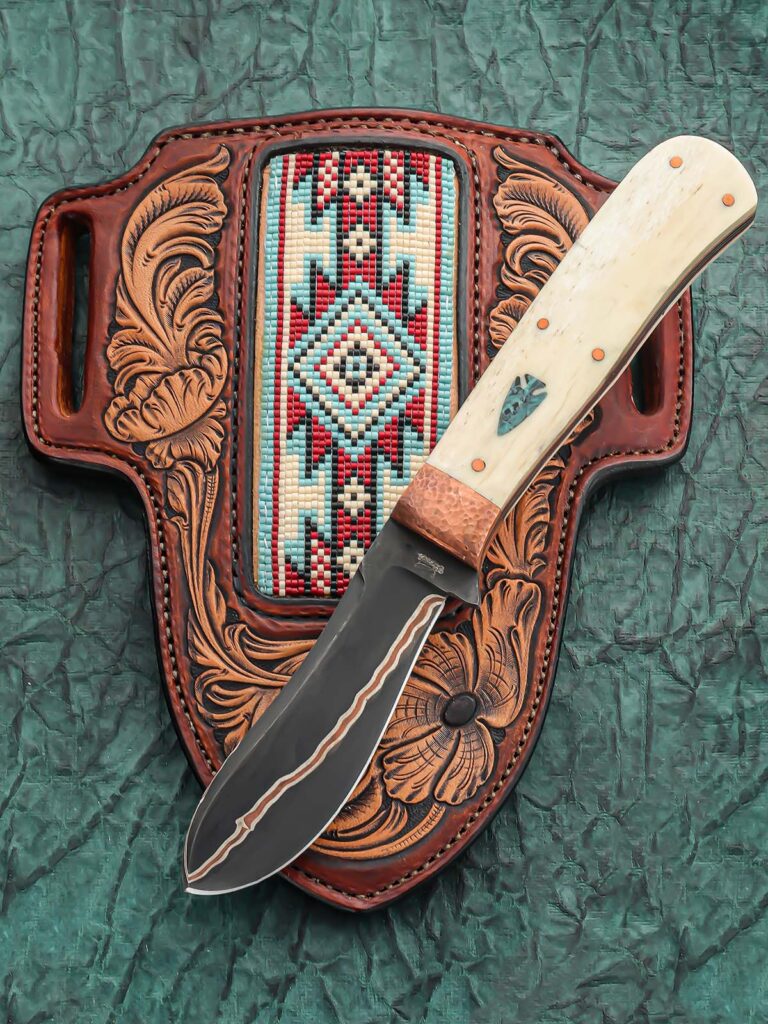
When it comes to slip joints, Bubba Crouch is a must-stop at BLADE Show. His skinner, with a 3 1/2-inch copper san mai blade, came complete with a sheath by Will Anderson, with beadwork done by Kelly Faulcorer. (SharpByCoop image)

The top three finishers will receive prizes and all participants will get swag bags. Brycen Nelson flipped his way to the top of the podium in the competition, Steve Ash placed second and Landon Morrison third.

Cutlery Hall Of Fame

The BLADE Magazine Cutlery Hall Of Fame® will formally induct its new members at 8 a.m. show Saturday in the Kennesaw Room of the Renaissance Atlanta Waverly Hotel. (At press time, the new members had not been determined. For updates, visit blademag.com.) Tickets are required ahead of time for the ceremony, which includes breakfast. Seating is limited. For ticket information, email [email protected].

What’s Next

The final BLADE Show-sponsored event for 2026 will be BLADE Show West, Oct. 9-10 at the Salt Palace Convention Center in Salt Lake City, Utah. For details, visit bladeshowwest.com. BLADE Show Texas 2027 will be March 12-13 at the Fort Worth Convention Center. Visit bladeshowtexas.com for more on it. And, of course, it’s never too late to start thinking about BLADE Show 2027 June 4-6 at the Cobb Convention Center in Atlanta. For details, visit bladeshow.com.

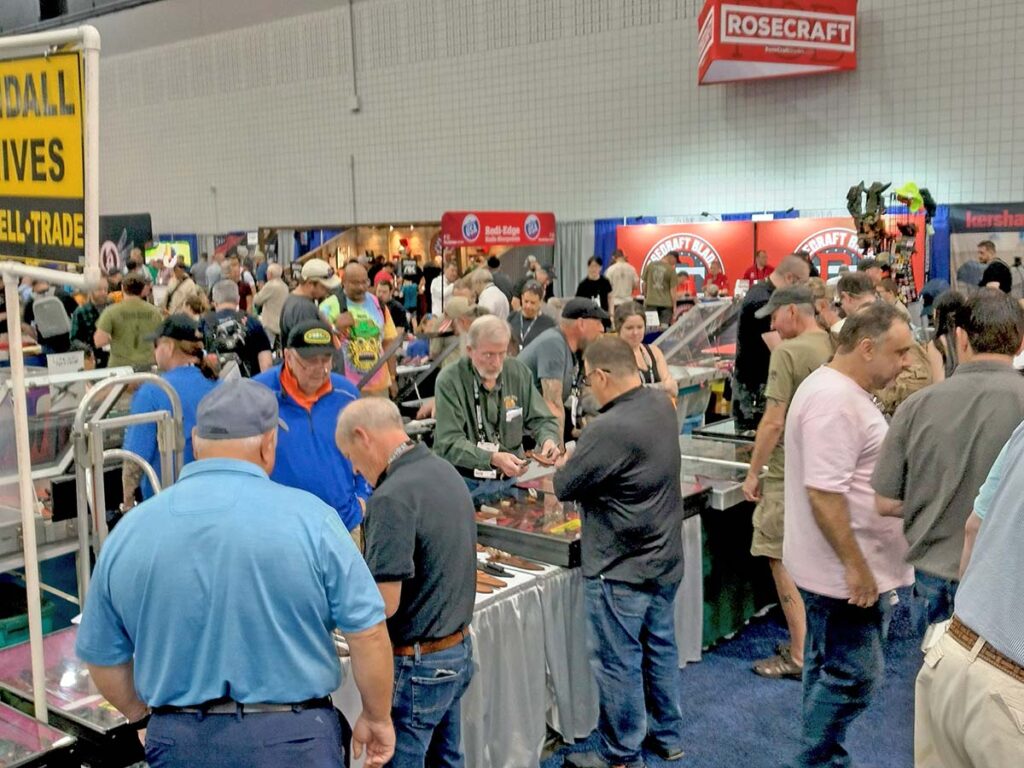
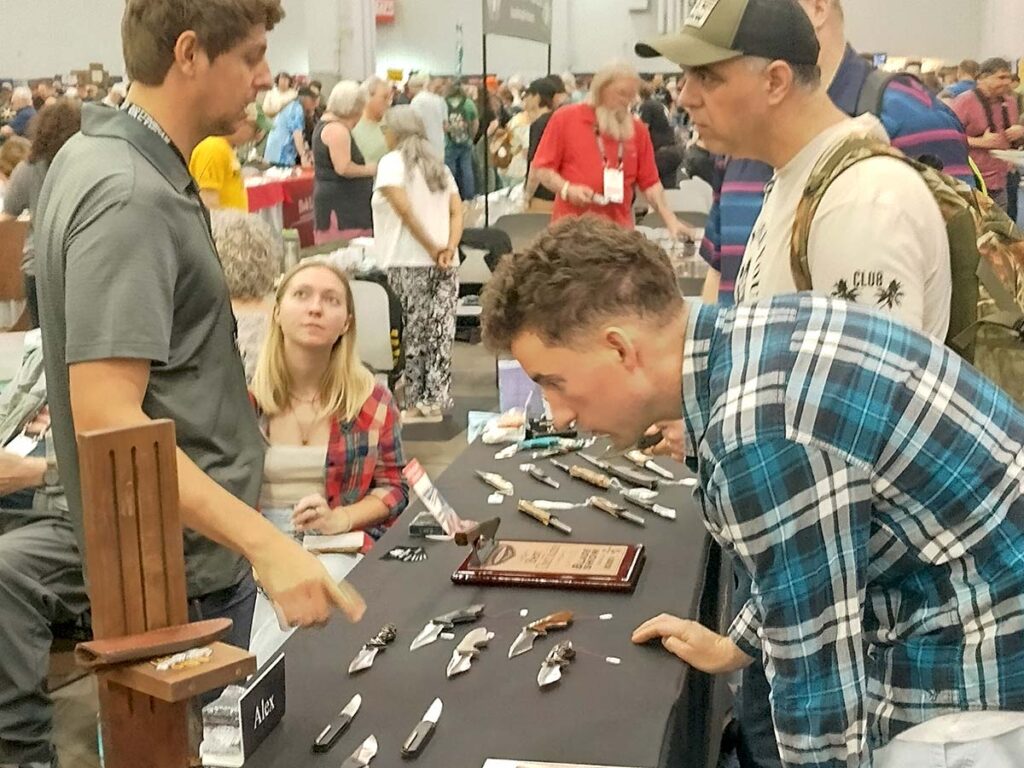
It’s easy to get mesmerized by knives at the BLADE Show, here at the table of Alex Hossom (left).

Editor’s note: Kizer Cutlery is The Pit sponsor. Work Sharp sponsors BLADE University. Nottingham Tactical is the lanyard sponsor. Hogue Knives is the housing sponsor. EKnives is the concessions sponsor. Vosteed is the Wi-Fi sponsor. The other sponsors are Heretic Knives, Reate Knives, Poikilo Blade, McNees Knives, Ketuo/Rike Knife, Artisan Cutlery/CJRB, Reate Knives and HORL Corporation.

More On BLADE Show:

Best Kitchen Knife Set To Upgrade Your Galley

Whether Three Pieces Or More Than A Dozen, A Great Kitchen Knife Set Can Completely Change How Work With Food.

Kitchen knife sets are extremely popular, and it’s easy to see why. They keep all your knives safe, easily accessible, and add a touch of style to your kitchen counter. It’s important to keep a few things in mind when shopping for a knife set, whether for the home or a professional kitchen.

The Block Is A Piece

When you see that a set is three, six, or 15 pieces, it’s important to remember the knife block itself will count as one of the pieces. So don’t fret if you think there’s a missing knife because there isn’t.

Get A Set That Fits

If you’re a parent looking for a good set of knives that will last and help cook the family’s meals for years to come, don’t feel like you need to spend hundreds or thousands of dollars on a set with dozens of specialty pieces. Sometimes less is more and that six-piece set might be the perfect one for you.

Follow The Maintenance Directions

Just because your butter knives go into the dishwasher doesn’t mean that your kitchen knives will necessarily need to as well. Follow the care instructions of your set carefully so you get the most out of your knives and don’t see rust spots start appearing on your blades.

Best Kitchen Knife Sets

Japanese, German, forged, and stamped. These are descriptors of our five best kitchen knife sets. Large sets, small sets. We made sure to select something for everyone with our list.

Calphalon 321

Calphalon 321

What’s better than an affordably-priced knife set? How about one with a sharpener built into the block itself. That’s what you’ll get with the Calphalon 321. This set includes half a dozen steak knives to go with an eight-inch chef’s knife, serrated utility knife, paring knife, shears, and santoku knife.

Made from forged high-carbon steel, the blades prove tough and are able to maintain an edge. And their full-tang construction adds balance to the knives. 

The wooden block features a built-in ceramic sharpener in the slots for the chef’s knife, santoku, and paring blade. This means that every time you pull one out of the block, it passes through the sharpener to maintain its edge. Another handy feature is the printed label on the end of each knife so you’ll know what you’re grabbing at a glance.

In totality, this is an excellent budget knife block. MSRP: $169.99

Buck 13-Piece Cutlery Set

Buck 13-Piece Cutlery Set w/Rosewood DymaLux Handles

Buck? On a list of kitchen knives? Oh yes, and the set is just as high quality as the company’s famous folders. By far, this is the largest set on the list.

The set features an 8-inch chef’s knife, slicer, two different paring knives, a spreader, serving/grilling fork, and six steak knives. Buck constructs the blades from 420HC stainless, except for the spreader, which is 410HC. Triple-rivited, the handles are durable and attractive.

There are two styles of handles. The Slate PaperStone is dishwasher safe while the Rosewood DymaLux is hand-wash only. And everything safely stores away in the wooden knife block.

This set is lovely and meets the lofty expectations you would expect from any other Buck product. MSRP: $599.99 for the Slate Paperstone, $749.99 for the Rosewood DymaLux.

Henckels Statement 12-Piece Kitchen Knife Set With Block

Henckels Statement 12-Piece Kitchen Knife Set With Block

A leader in kitchen cutlery, Henkels‘ set hits home run. 

The set features single-piece stamped stainless steel blades that are full tang and precision-honed to give them a perfect edge right out of the box. The polymer handle also provides an excellent grip and is easy to clean. The wood block fits all the pieces which include an eight-inch chef’s knife, santoku knife, paring knife, bread knife, sharpening steel, and a set of six steak knives.

This set covers nearly every scenario you’ll encounter in a home kitchen, and it’s also the most affordable set on our list. MSRP: $119.95.

Mercer Culinary Genesis Six-Piece Knife Block Set

Mercer Culinary Genesis Six-Piece Knife Block Set

This kitchen knife set from Mercer Culinary has the most unique appearance of the items on our list, but it is so much more than just looks. 

The glass block allows for a 360-degree display of the knives. The windows are attached on either side of the beechwood block which holds five knives.

This set of forged knives includes an 8-inch chef’s knife, paring knife, bread knife, boning knife, and utility knife. All of them are made from high-carbon German steel ground to a 15-degree edge and outfitted with a Santoprene handle for comfort and grip. 

It’s a conversation piece. It’s a quality knife set. It’s an absolute bargain for the quality of the product. MSRP: $156.

Shun Classic 5-Piece Starter Block Set

Shun Classic 5-Piece Starter Block Set

Shun makes professional-caliber knives, and its Classic Five-Piece set maintains that standard. 

There are only three knives included in the set, but they are of the highest quality. The 8-inch chef’s knife, paring knife, and utility knife are all made from 68 layers of stainless damascus cladding around a VG-Max core. They all tuck away in the Slimline Bamboo Black knife block, along with a honing rod. The trio of Japanese-style knives has ebony-finished Pakkawood handles with a full tang. 

A unique aspect of this set is there are more slots than knives. The block comes with two extra slots, one of which is designed for shears. This gives you to tailor your tools to your needs in the kitchen. 

Even though this is the smallest set on our list, it is the priciest due to the time and craftsmanship that went into every element of it. MSRP: $593.

Read More

How To Sharpen Recurve Knives

0

We outline how to put an edge back on a recurve knife, both by manual and automated systems.

Editor’s note: In addition to holding down a full-time job, being a BLADE® field editor for many years and conducting several sharpening seminars and BLADE University classes on the subject, the author also runs a sharpening service. All the sharpeners illustrated in the story are in his collection.

Face it—recurve blades are just plain sexy. The way the cutting edge adopts a sinewy figure is unlike most any other blade pattern and definitely catches the eye. 

A fun fact about recurve blades: the cutting edge is always longer than a standard blade of the exact same size. How? If you were to take the recurve edge and straighten it out and compare it with a more conventional blade of the same length, the recurve cutting edge would always be longer. Why? The curves pack in more steel real estate in the same overall blade length. Recurves are practical as well, as the curved part presents itself at an angle to whatever is being cut and therefore slices it more efficiently.
  
While recurves are attractive and functional, some folks tend to steer clear of them because they assume the edges must be difficult to sharpen. It’s the curvature that throws them off. I’m here to tell you that recurves are not hard to sharpen at all if you have the right sharpener. Once you have the right sharpener, the steps you follow are exactly the same as if you were sharpening a standard blade.   

Type Of Recurve Sharpeners

Sharpeners with rounded profiles
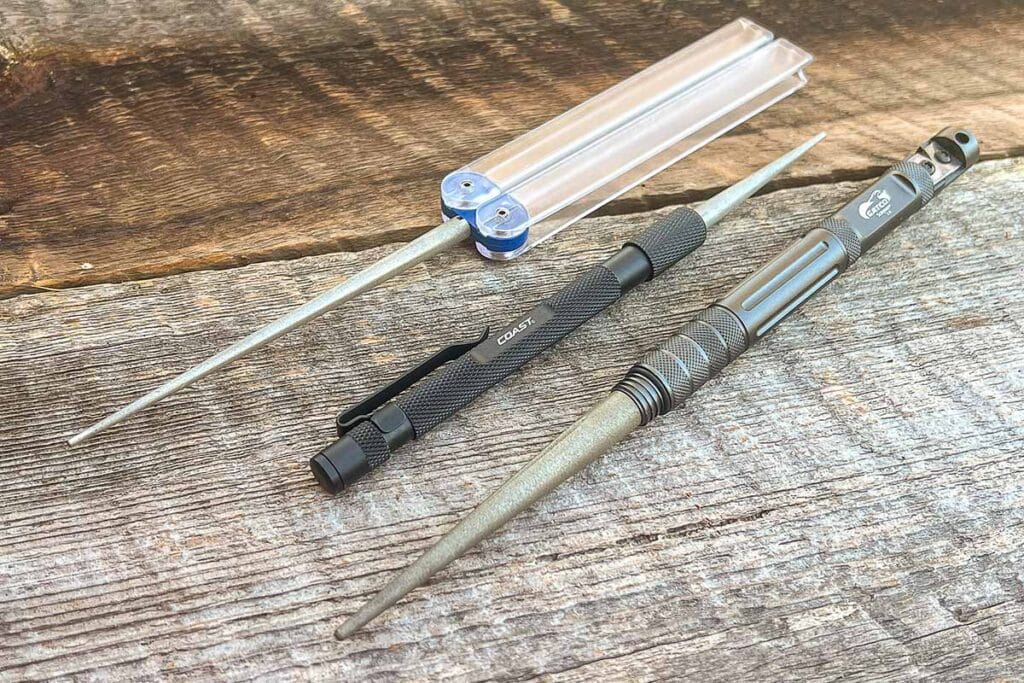
These manual sharpeners with rounded profiles not only are good for serrations but are for recurve blades as well. From top: DMT FSKC Diafold Serrations Sharpener Coarse Grit, Coast SP245 and GATCO Scepter 2.0.

What sharpener do you use for recurve blades? There are actually quite a few sharpeners that are best suited. Some you may already have and didn’t know they would do the job. The appropriate sharpener has a round profile, as the round part always makes contact with the cutting edge regardless of how recurved the blade gets. I recommend that the sharpener be diamond coated since diamond works exceptionally well with the harder, more wear-resistant steels popular today such as—though not limited to—the CPMs of S30V, 20CV, S35VN, S45VN and MagnaCut.

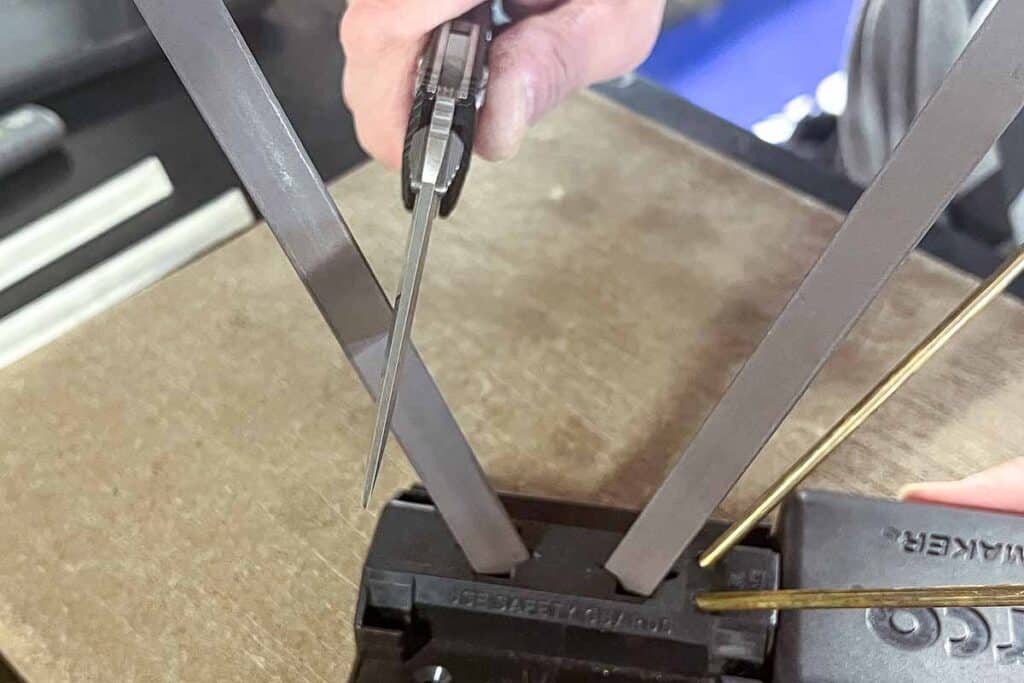
The “V” approach of the Spyderco Tri-Angle Sharpmaker is another effective way to sharpen recurves manually.

In this article, I first show you how to properly sharpen recurve knives using a manual sharpener. The technique is the same regardless of which sharpener you use. Then I demonstrate how I sharpen recurve blades using a powered method. As the editor was so kind to point out, I run a sharpening service on the side as well, and I have years of experience sharpening all sorts of blades. My way is reserved for more advanced and more accomplished sharpening skills only.

How To Sharpen Recurve Knives

Manual Sharpening

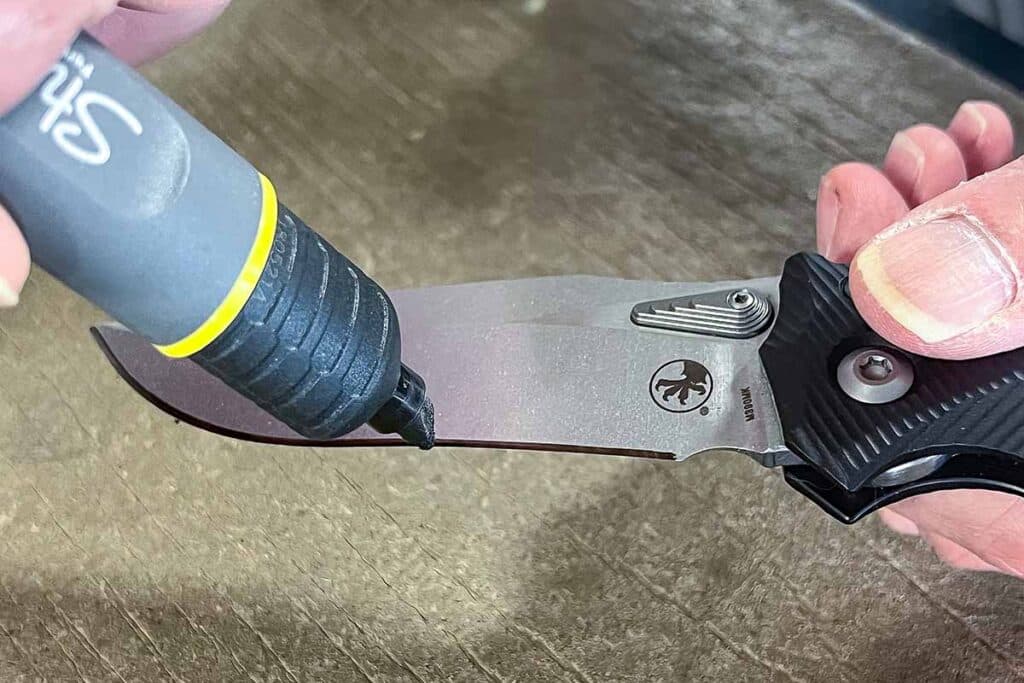
Using a black permanent marker, preferably with a chisel tip, color in the entire length of the cutting edge on both sides of the blade.

Manual Step 1: Using a black permanent marker, preferably with a chisel tip, color in the entire length of the cutting edge on both sides of the blade.

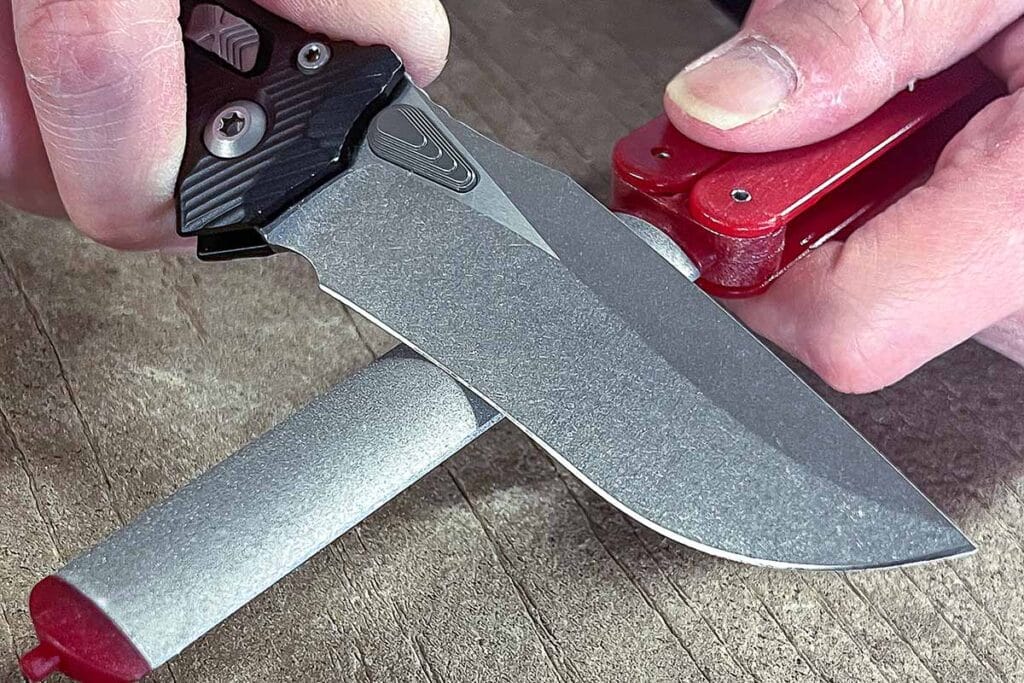
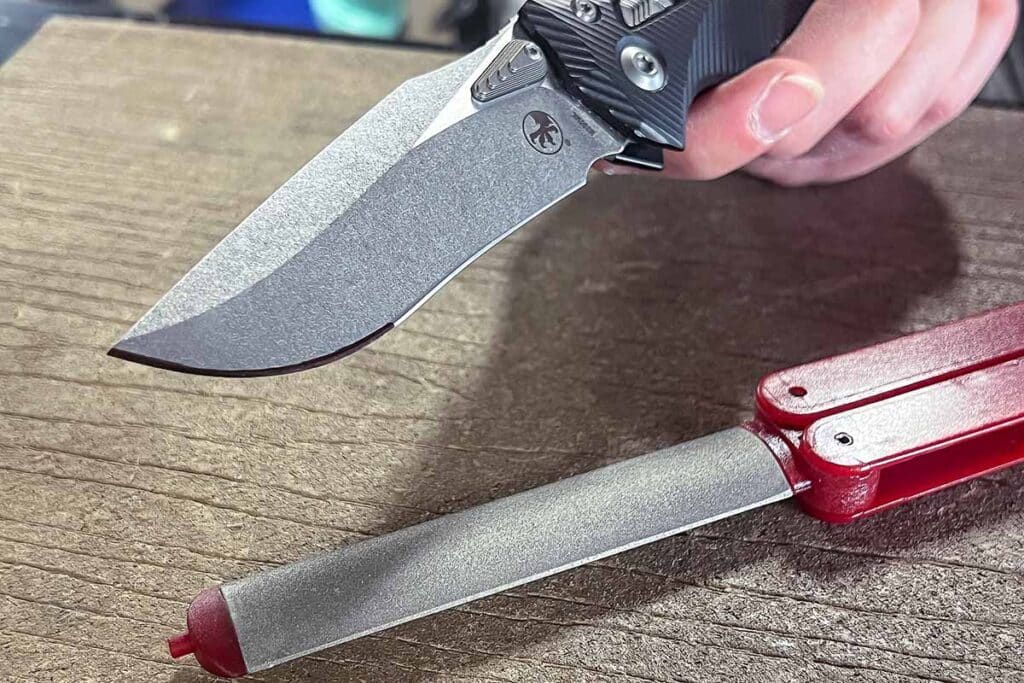
Manual Step 2: Take a round profile sharpener—the author uses the EZE-Lap folding diamond sharpener—and, holding the blade to it at approximately a 20-degree angle, start at the tang and move your way down to the tip in one fluid motion.

A round profile sharpener
Evaluating the blade

Manual Step 3: Stop after a few strokes and look to see where the marker ink remains. This is an indicator of the need to adjust your angle more or adjust it less. And that, my friends, is pretty much how to sharpen recurves. Simple, safe and effective. This is a failproof method.

Automated Sharpening
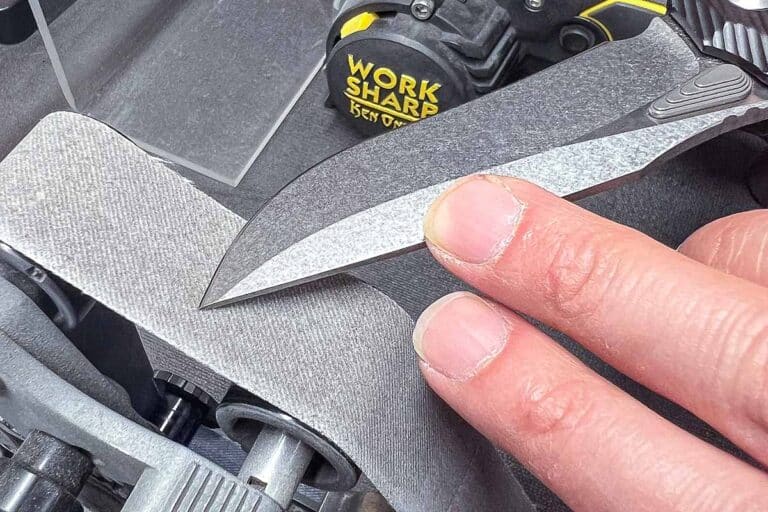
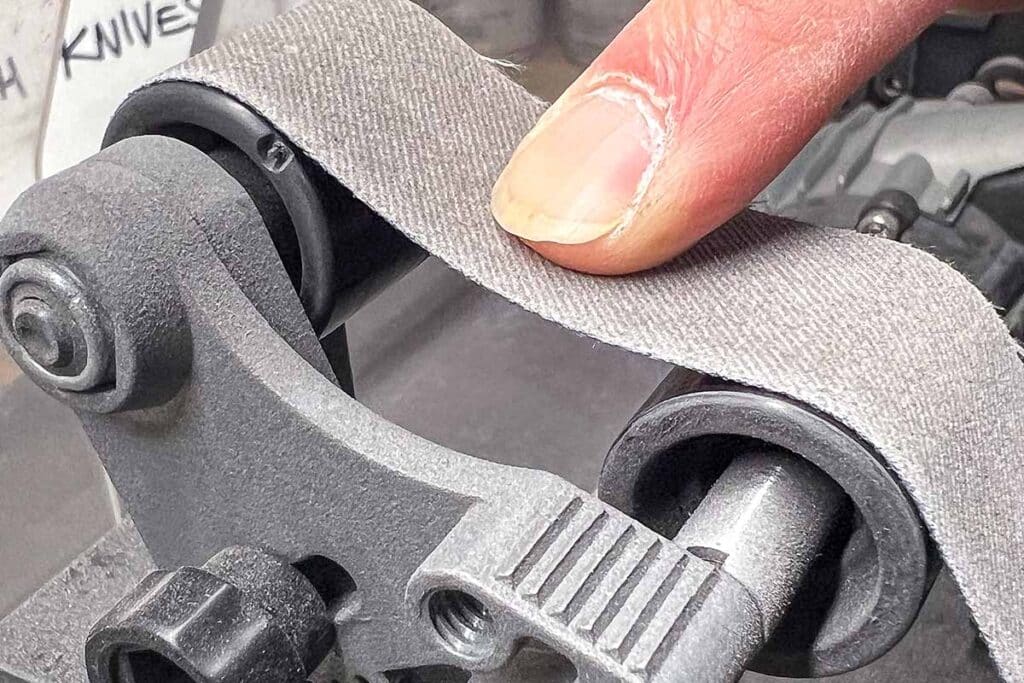
Automated Step 1: The author uses his Ken Onion Elite Sharpener from Work Sharp with the blade grinding attachment to sharpen recurves. The illustrated belt deflection helps the belt to conform to the cutting edge as it curves.

The author uses his Ken Onion Elite Sharpener from Work Sharp
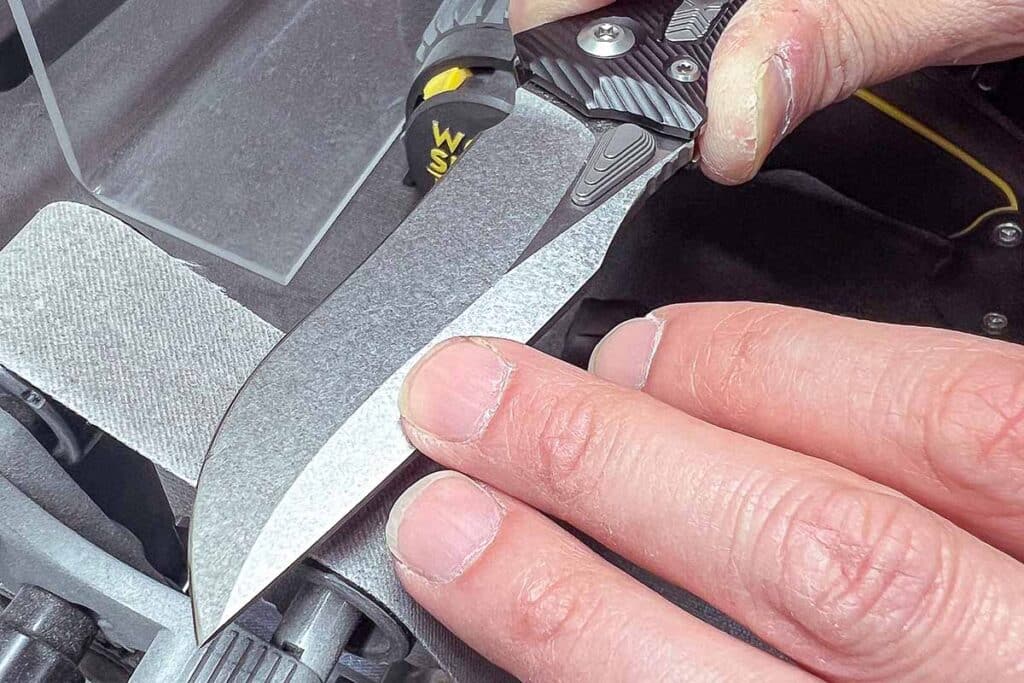
Sharpening the recurve knife on a machine

Automated Step 2: The author sharpens the recurve blade as he would any standard blade by pulling it across the belt from choil to tip on both sides. Use the same motion when sharpening a recurve on a manual sharpener.

Automated Step 3: After sharpening, the author strops the edge using a leather strop to wipe off any micro burrs that form.

stroping the edge
Giving the recurve a few swipes on knife steel

Automated Step 4: After stropping, the author gives the recurve a few swipes on a hanging kitchen knife steel to give the edge extra bite.  

More Sharpening Articles:
Vermont Becomes 21st State To Repeal Switchblade Ban

As a result of Vermont Gov. Phil Scott signing the state’s switchblade ban repeal bill in June, Vermont not only becomes the latest state to legalize automatics but also expunges prior ban-related convictions, the Knife Rights website reported.

At press time, the effective date of the repeal was July 2.

Known as S.109, the bill removes “switchblade knives” from the existing Vermont statute that had banned a “switchblade knife, the blade of which is three inches or more in length.” The new bill also requires that “the Court” order the expungement of any related convictions handed down prior to July 1, 2025.

“This is the first time one of our bills has incorporated an expungement clause,” the site reported.

The American Knife & Tool Institute (AKTI), along with Knife Rights comprising the two major pro-knife legislative organizations serving the cutlery industry, credited the passage of the bill to “the longtime bipartisan work of two Vermont lawmakers—Patrick Brennan, a Vermont state senator, and Dan Noyes, a Vermont state representative.” According to the AKTI website, the Republican Brennan and the Democrat Noyes teamed up about five years ago to provide a unified approach that “eventually came to fruition.”


As the Knife Rights site indicated, Vermont has Constitutional (Permitless) Carry, so prior to S.109 you could carry any legal firearm open or concealed there, and you could carry any knife open or concealed except an automatic with a blade 3 inches or longer. Until the new bill, that was the only knife you were not allowed to possess in the state.

With the signing of S.109, Vermont becomes the 21st state to repeal switchblade bans or restrictions, the Knife Rights site stated. Beginning with New Hampshire in 2010, those states also include Alaska; Colorado; Hawaii; Illinois; Indiana; Kansas; Louisiana; Maine; Michigan; Missouri; Montana; Nevada; Ohio; Oklahoma; Pennsylvania; Tennessee; Texas; Virginia; and Wisconsin.

More On Knife Bans:

Chute Knife: Full-Spectrum Warrior

A fine example of a tool and weapon of war, the chute knife more than rose to fulfill the roles for which it was intended.

Harry Archer was a somewhat shadowy figure. At the height of the Vietnam War, he was engaged in nasty business—fighting a stealthy enemy in a steaming jungle, sometimes up close and all too personal.

Those who knew Archer acknowledged that some of his exploits were “larger than life.” They considered him an early non-movie version of author David Morrell’s fictional character of John Rambo*. Still, Archer was real, flesh and blood. And it seems altogether fitting that responding to his need for knives that “deliver” in a tight spot—survival, seconds along the fine line between life and death—he would come to know and rely on another legend.

According to John Denton, perhaps the world’s foremost authority on the knives of BLADE Magazine Cutlery Hall-Of-Fame® member Bob Loveless, Loveless and the man he came to describe as the “head of CIA operations in Vietnam” were introduced to one another by knife writer/Cutlery Hall-Of-Famer Ken Warner. It followed that Loveless made several knives for Archer’s use in the field, among them a fine sub-hilt and stag-handle example of his well-known Big Bear, along with several other  Big Bears. Loveless’s close friend and fellow maker Steve Johnson was working in Bob’s shop at the time and participated in crafting these. A fighter in a tulip wood handle is another cold beauty.

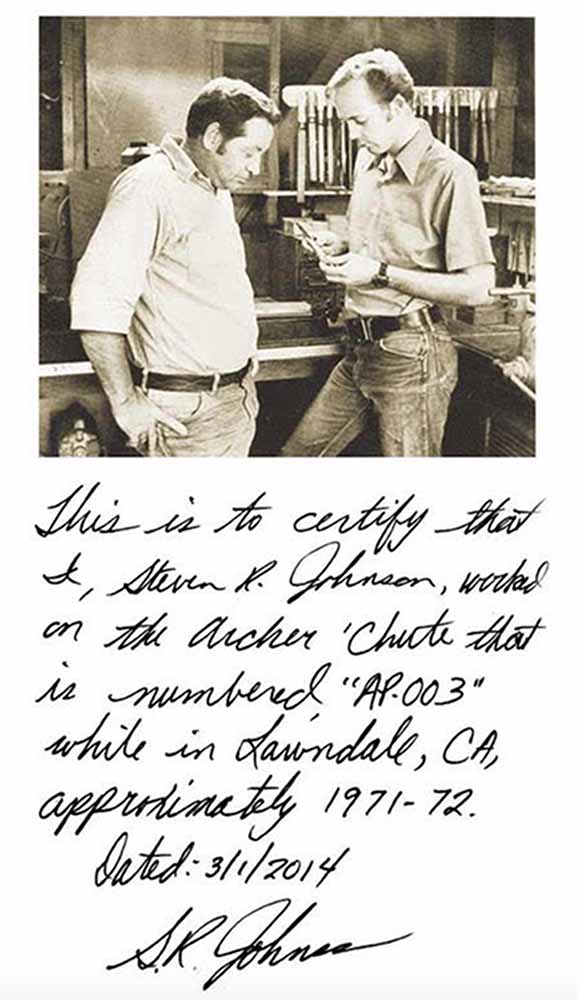
Johnson worked with Loveless from June 1971-October 1974 in the Lawndale and Riverside, California, shops. Steve had a hand in the production of the prototype chute knife in the earliest days, and 23 years later signed a photograph for John Denton attesting to his work on that piece of history. Steve’s inscription reads in part: “This is to certify that I, Steven R. Johnson, worked on the Archer ’chute that is numbered ‘AP-003’ while in Lawndale, CA, approximately 1971-72.”
Johnson worked with Loveless from June 1971-October 1974 in the Lawndale and Riverside, California, shops. Steve had a hand in the production of the prototype chute knife in the earliest days, and 23 years later signed a photograph for John Denton attesting to his work on that piece of history. Steve’s inscription reads in part: “This is to certify that I, Steven R. Johnson, worked on the Archer ’chute that is numbered ‘AP-003’ while in Lawndale, CA, approximately 1971-72.” (images courtesy of John Denton)

Then there is the well-known Harry Archer chute knife, a versatile fixed blade with good looks and the ability to travel light but cut paracord for a quick exit from a tangled parachute shroud, and with a stout spine for prying loose from the wreckage of a helicopter. The chute knife was made for the jungle. It was made for Harry Archer.

“It seems that Loveless had been left out of a book by Warner, and Loveless sent Ken some knives to review,” Denton recalled. “It just so happened that Archer was there with Warner. Harry saw the knives and bought them all.”

Johnson worked with Loveless from June 1971 to October 1974 in both the Lawndale and Riverside, California, shops. He had a hand in the production of the prototype chute knife in the earliest days and 23 years later signed a photograph for Denton attesting to his work on that piece of history. Steve’s inscription reads in part: “This is to certify that I, Steven R. Johnson, worked on the Archer ’chute that is numbered ‘AP-003’ while in Lawndale, CA, approximately 1971-72.”

Johnson explains that the chute knife is a fairly small, compact fighter and survival knife, short, light, double-edged and strong, but not made in stock thicker than 3/16 inch. Holes for thongs are placed in the rear of the handle and the guard for lashing the knife to a pole or limb to make an improvised spear. It rides into action atop a chest pack or secondary parachute for quick, easy access. Claims that Warner had a hand in the design are unconfirmed, but “the chute” simply looks the part of the warrior’s dependable asset.

“You’re able to cut both ways with the knife via the swipe of an arm or hand,” Johnson related. “Specifically, it’s for cutting parachute cord should it be tangled or caught in a tree. It’s a knife that a pilot, paratrooper or soldier should carry, and it would not be a burden but useful and available in every situation.”

HARRY ARCHER LORE
Stories of Archer’s combat prowess have been told and retold, but to raise awareness of the immediacy of a close-in fight, nothing is better than the harrowing tale that Denton remembers Loveless repeating. John points to a photo of a vintage Big Bear, identifies it as a knife that Archer took into combat, and says, “Harry and his men got into a hand-to-hand fight, and the tip of the blade was broken off inside the enemy. Harry took the knife back to Bob to fix, and Loveless said, ‘Where’s the tip?’ Harry replied, ‘It’s still in the rib cage of the Viet Cong soldier.’ So, Loveless fixed the blade.’”

Made in Bob Loveless’s Lawndale, California, shop about 1973-74, this chute knife in ivory Micarta® is stamped BR-003. It was made for the Brass Rail, a famous gun shop in Hollywood, California, where all the celebrity types hung out to see guns and knives. Note the holes in the guard for lashing the knife to a pole to make a spear.
Made in Bob Loveless’s Lawndale, California, shop about 1973-74, this chute knife in ivory Micarta® is stamped BR-003. It was made for the Brass Rail, a famous gun shop in Hollywood, California, where all the celebrity types hung out to see guns and knives. Note the holes in the guard for lashing the knife to a pole to make a spear. (images courtesy of John Denton)

Like the Big Bear and other Loveless creations, the chute knife has its place in the lore of Harry Archer. After he collaborated to produce the prototype, Johnson continued to work with Loveless on more of the chute knives. He remembers meeting Archer in the California shops.

“Loveless really admired Archer and his adventures in the Vietnam War era, working with USAID**, the CIA and different assignments in various parts of the world,” Steve commented. “[Harry and I] discussed life in camp in Vietnam, interactions with Vietnamese soldiers and personnel with whom he was serving. That was quite interesting.”

Steve calls the chute “one great knife” and remembers conversations in Lawndale when the veteran operative praised it as light and small enough to carry so that it could always come along on a mission. Johnson also made a chute knife for Archer and continues to produce his own model today.

“We worked together on Archer’s order for a ‘Johnson’ version of a chute knife on a bench in the rear of Bob Loveless’s shop, in his garage in the back of his house in Lawndale,” Steve smiled. “Archer asked me to make my version, which we—mostly he—designed in the early 1970s. He did a drawing for me. The 154CM blade was about 4.5 inches long, the handle slim and a bit longer than normal, and it had a large thong tube, three handle screws, a stag handle, and checkering on the top and bottom of the tang just behind the guard.”

Bob Loveless (left) and John Denton (right)

For Johnson, working with Archer was a pleasure and a defining moment in his illustrious knifemaking career, which, after recovery from a serious accident, took him from Loveless’s shop to his own space in Manti, Utah, more than 40 years ago. “Harry Archer was a great guy who appreciated my work, as well as Bob’s,” Steve added, “and I made him a few knives after California. He was very easy to talk to, respected others, and he really was a man of intrigue and adventure. And Bob Loveless treated me like a son.

“I’m making a chute knife for Atlanta [Steve was interviewed prior to BLADE Show 2021] as we speak, with the blade polished so far, instead of the top grind being just the length of the clip,” Johnson concluded. “I use the pattern that Loveless gave me when I left his shop in Riverside in 1974 or 1975. This particular knife is going to have a stag handle and stainless steel fittings. I’ll make more when asked, and I still have a few on order in my books.”

Long-time maker and designer Bob Dozier was a friend of Loveless and went on to design a chute knife for Cutlery Hall-Of-Famer A.G. Russell. Though his only acquaintance with Harry Archer is through the recollections of A.G., who knew him, Bob says his version of the chute knife remains in demand for one simple reason: “It sells.”

Dozier turns out his chute knife with a 4.75-inch D2 tool steel blade and overall length of 9.75 inches. The handle is green canvas Micarta® “because Goldie [Russell] won’t let me put anything else on them. I’ve got some blades hanging right now, getting ready.”

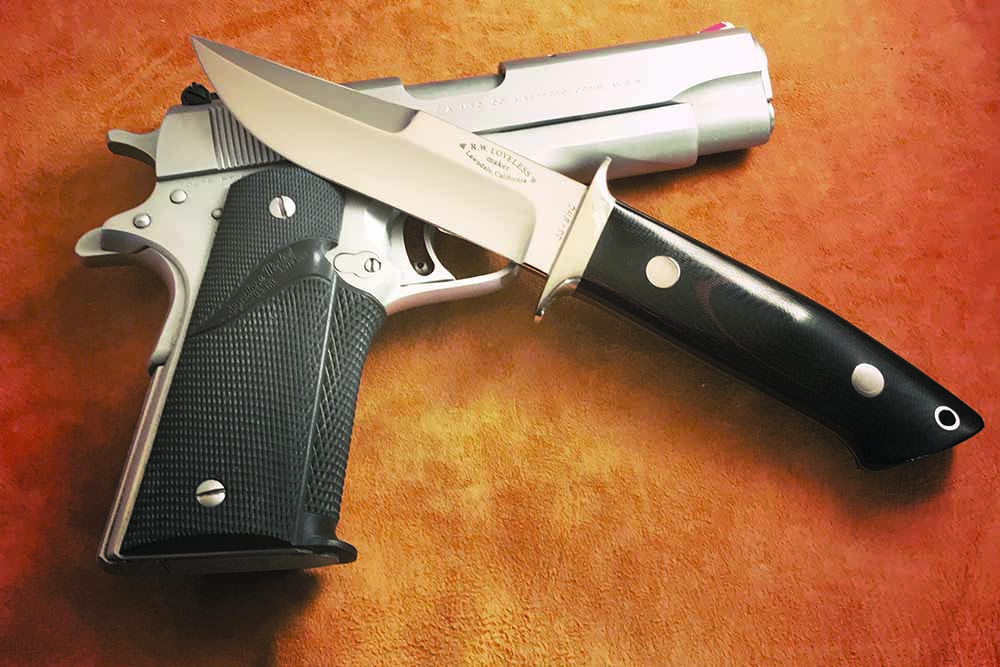
The “RR” on the guard of this Loveless chute indicates it was for the Ram Rod gun store in New Castle, Indiana. Early on Ram Rod sold knives by Loveless, Bill Moran, Ron Lake, W.W. Cronk and others. It appears here with a Smith & Wesson Model 41 modified by Loveless.

Dozier is familiar with the Loveless chute knife configuration but never had the Loveless pattern. He looked at the earlier chute knife profile and made some tweaks. “My handles are like the Loveless, but I don’t cut the butt off as square as he did. I leave more of a point on it than he did. Mine is still mostly like Bob’s, and he was one of the first to make a really good slab-handled knife. That’s one reason why most of us have copied him.” Dozier’s chute knife, designed and built for A.G. Russell Knives, has a manufacturer’s suggested retail price of $895.

SAGA of The CHUTE
The saga of the chute knife certainly has a human side. While Denton estimates that early Lawndale chute knives might fetch as much as $14,000 if found for sale today, and chute knives made in Riverside command up to $12,000 each, they are desirable on the collector market. Nonetheless, the greatest value of the chute knife lies in its lifesaving and protective capability in the hands of a dedicated professional such as Harry Archer.

Through those years of association, Loveless and Archer became friends, sharing a common bond of respect and admiration for the best in fighting and utilitarian knives.

“Loveless said that Harry would come by his shop after periods of being in the jungle for months at a time,” Denton remembered. “He used Bob’s place to unwind and try to become civilized again before heading home to Virginia. But Loveless also said, ‘Harry was like a wild animal when he came to the shop, trying to keep his head straight before he saw his family.’”

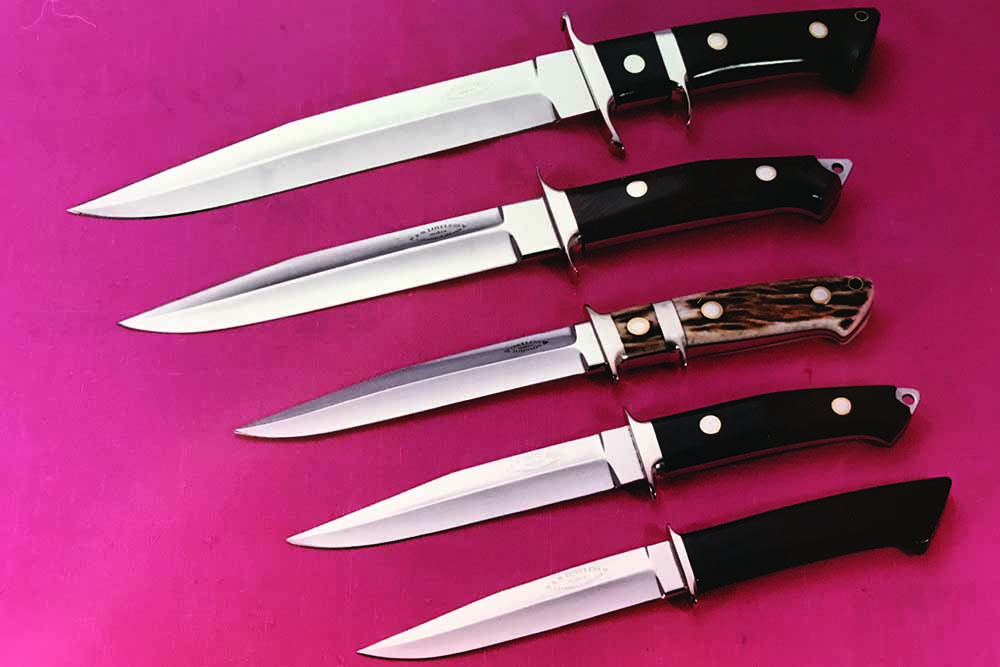
Whenever Harry Archer ordered several Big Bear fighters from Bob Loveless, Loveless said Archer told him to “send the bill to the Pentagon.” From top: the Big Bear Harry broke the tip off inside a Viet Cong soldier during the Vietnam War; tulipwood fighter with skull cracker; Loveless/Johnson sub-hilt with the initials HJA for Harry J. Archer; boot knife with skull cracker; and one Loveless called the Pig Sticker.
Whenever Harry Archer ordered several Big Bear fighters from Bob Loveless, Loveless said Archer told him to “send the bill to the Pentagon.” From top: the Big Bear Harry broke the tip off inside a Viet Cong soldier during the Vietnam War; tulipwood fighter with skull cracker; Loveless/Johnson sub-hilt with the initials HJA for Harry J. Archer; boot knife with skull cracker; and one Loveless called the Pig Sticker. (image courtesy of John Denton)

The chute knife is indeed a fine example of a tool and weapon of war rising to fulfill the roles for which it was intended. It remains a popular pattern because of its looks, quality and versatility. And for one other reason in particular: It helped men like Harry Archer survive the most desperate of situations and make it home.

*In actuality, Morrell based the Rambo character on Medal-Of-Honor recipient Audie Murphy.

**USAID is the acronym for United States Agency for International Development, with the inference here being that in this instance it functioned as a cover for the CIA.


More On Bob Loveless Knives:

  • 15 Best Bob Loveless Knives of All-Time
  • The Legacy of the Bob Loveless Dropped Hunter
  • Merritt-Loveless Knives Do Indeed Hold Merit
  • Fourth In Greatest Loveless Knife Designs Series
  • Bachtel’s Bowie With A Pedigreed Background

    A study of Michael Price’s work, Nick Bachtel’s reproduction gentleman bowie has the looks to wow.

    Bladesmith Nick Bachtel has parlayed his fascination with the knives of 19th-century great Michael Price into a faithful reproduction of a Price-style gentleman’s bowie.

    Nick studied every Price knife and other like ones of the genre he could find online and elsewhere to help arrive at the way the 19th-century cutler constructed the gentleman’s bowie. However, it was when he saw a picture of a Price knife in BLADE Magazine Cutlery Hall-Of-Fame® member Bernard Levine’s book, Knifemakers Of Old San Francisco, that “a light went off.”

    Nick noticed that the handle had three pins so the knife had to have a full tang, not a hidden tang as he had previously thought, so he forged the knife, heat treated it, fit up the guard and forged the tang wider.

    “I call it a captured-guard full tang,” the 24-year-old said of the method that apparently originated among bladesmiths in Ireland, Price’s native country. “It’s such a weird, unique, almost comical way of making a knife—and difficult to do as well,” Nick observed, “but boy, did Price make it!”

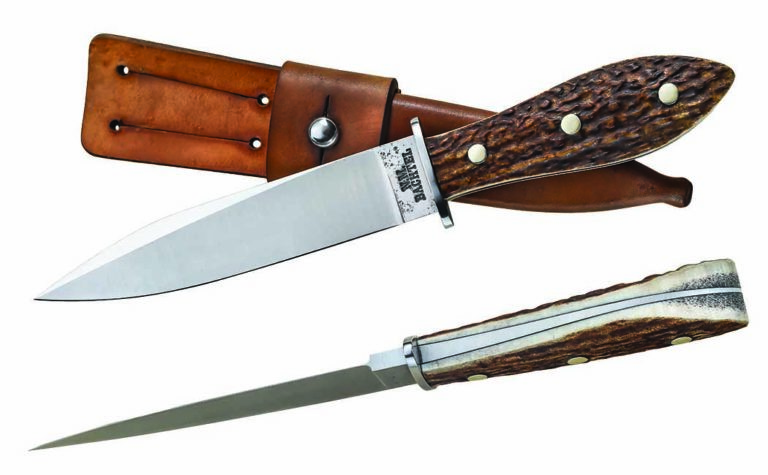
    Nick Bachtel calls the construction he used to make his reproduction of a Michael Price Gentleman’s Bowie “captured-guard full tang.” For the style to work, it must be forged, Nick stressed. He said another way to do it would be in a frame handle construction and a tapered tang, though a Price aficionado would be able to tell the difference. (SharpByCoop knife images)
    Nick Bachtel (inset) calls the construction he used to make his reproduction of a Michael Price Gentleman’s Bowie “captured-guard full tang.” For the style to work, it must be forged, Nick stressed. He said another way to do it would be in a frame handle construction and a tapered tang, though a Price aficionado would be able to tell the difference. (SharpByCoop knife images)

    The icing on the cake for Nick was ABS journeyman smith Jordan LaMothe’s story, “How to Make the Price Guard” in the December 2019 BLADE®. As Nick noted, “The Price style is the pinnacle of the traditional forged blade.” What better style is there for a young, up-and-coming bladesmith to explore?

    For more information contact N.M. Bachtel Forging Co., attn: Bachtelforgingcompany.com.

    Gentleman Bowie Spec Check
    Knife name: Michael Price
    Style: Gentleman’s Bowie
    Maker: Nick Bachtel
    Blade length: 5 7/8 inch
    Blade material: 52100 carbon steel
    Handle: Elk antler and nickel silver
    Overall length: 10¾ inch
    Sheath: Traditional center-seam vegetable-tanned cowhide w/frog stud
    Maker’s List Price For A Similar Knife: $1,100(includes sheath)

    More Knife Collecting And Custom Knives

    Advertisement

    Must Read Articles

    Read this before you make a knife

    Knifemaking 101 – Read This Before You Make a Knife

      by Wayne Goddard My experience has taught me that there's nothing like digging in and getting started. I've often said the hardest part of the...
    how to forge damascus steel

    How to Forge Damascus

    Advertisement
    Advertisement