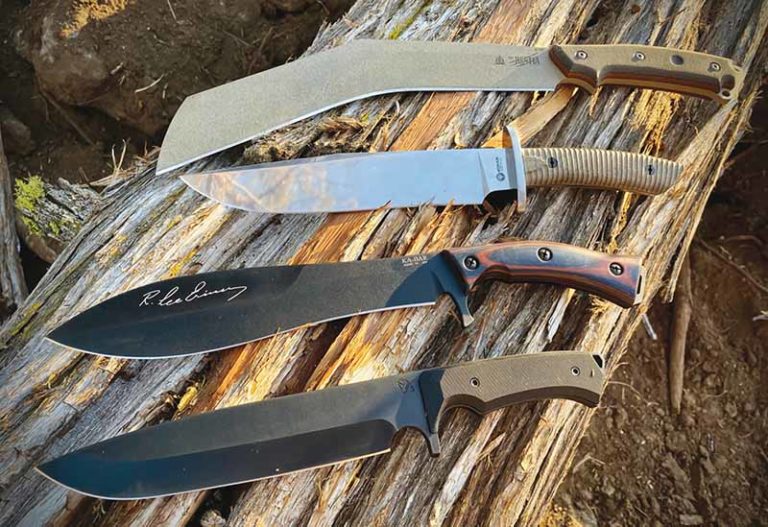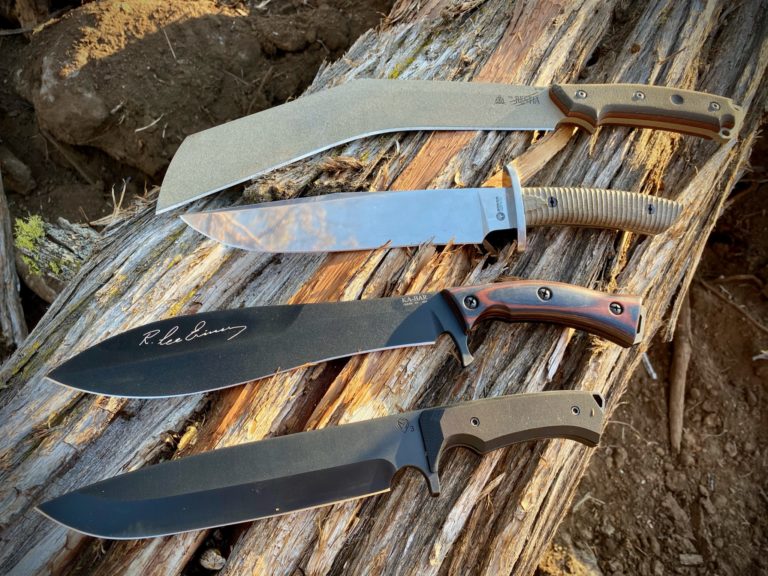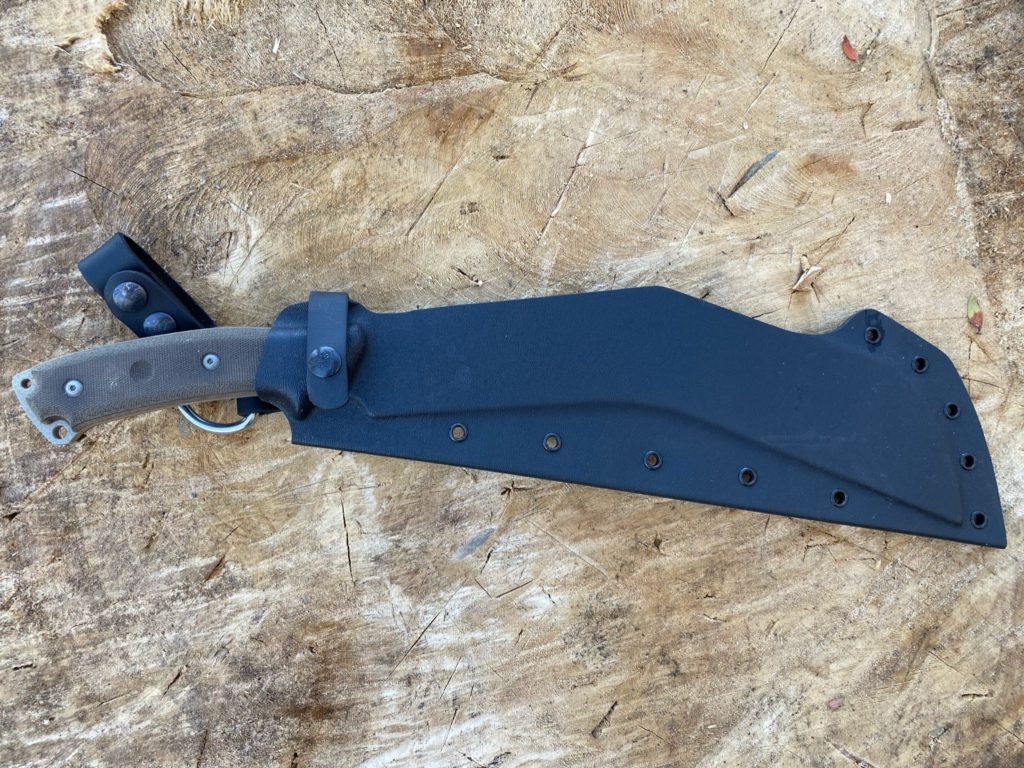




Four Battle Tough Military-Style Fixed Blade Knives

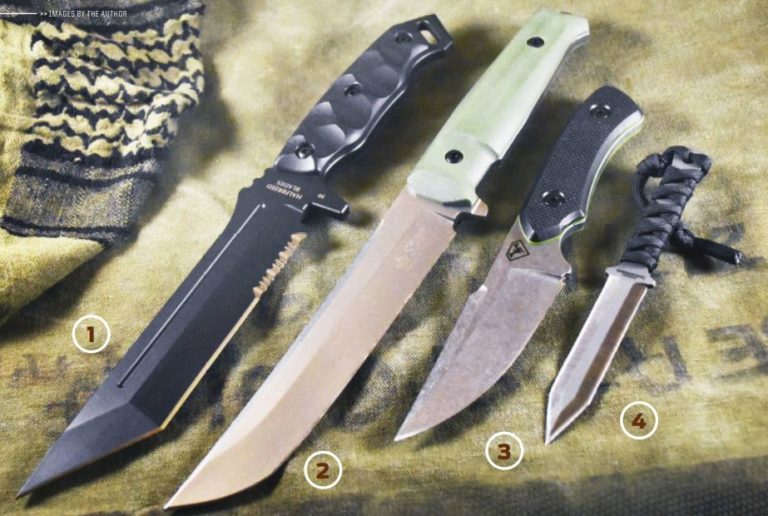
Today’s military-style fixed blades are ready for duty. These four are certainly ready to earn their stripes.

What Are The Top Military-Style Fixed Blade Knives:

The history of cutlery has many different facets but none any more glorified than the fixed-blade knives that have seen battle for centuries. Fixed blades are still a major part of our fighting forces’ need for strong steel and they’ve become more diverse since the modern tactical age began in the early-to-mid 1990s.

Condor Tool & Knife’s Neck Gladius

One thing hasn’t changed: such knives must perform duties outside of combat. An example is Condor Tool & Knife’s Neck Gladius, a diminutive version of the classic Roman combat sword. Designed by writer/outdoorsman and BLADE University instructor Joe Flowers, its double-edged blade is handsomely ground in Condor’s favorite blade material: 1075 high carbon steel. The black-paracord-wrapped handle has a tail at the base. A black Kydex neck sheath includes a nice length of paracord for neckwear.
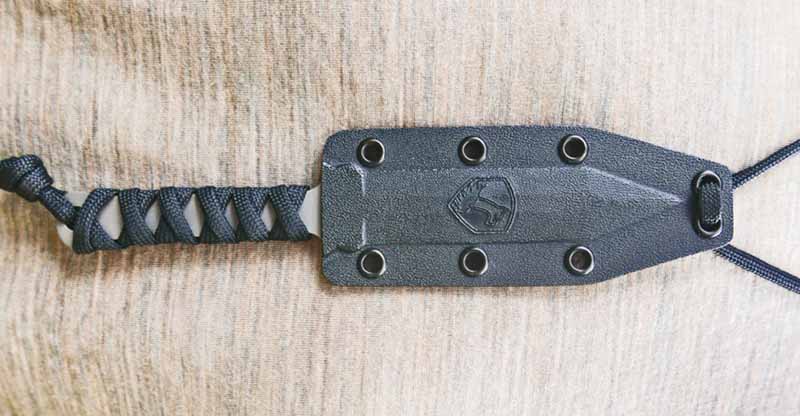
The black Kydex sheath of the Neck Gladius includes a suitable length of paracord for neck wear.

One of the best uses I’ve found for small neck knives is preparing tinder as a firestarter. The neck knife makes for an excellent companion to a larger knife for doing detail work, so I put the Neck Gladius to work doing just that.

Hitting my sweet spot, a pine forest north of town, I used the small blade to dig out some nice chunks of pine resin, which burns nice and long as tinder. I complimented the pine resin with some fine pine shavings to complete the kit. The little Condor will handle other small tasks as well, such as cutting paracord to length. “Handy” is its middle name!

Condor Tool & Knife Neck Gladius
Designer: Joe Flowers
Blade Length: 3.14″
Blade Material: 1075 high-carbon steel
Handle Material: Baracord wrap
Weight: 2.12 ozs.
Overall Length: 6.06″
Sheath: Kydex with paracord lanyard
Country Of Origin: El Salvador
MSRP: $54.98

DoubleStar Blades Chico Diablo X

Designed by BLADE® field editor Kim Breed, the Chico Diablo X from DoubleStar Blades is, as you might expect, tough as nails. It is a medium-sized sheath knife with a harpoon-pattern blade. A deep index finger groove extending from the bottom/front of the checkered scales into the tang adds grip when getting down to business. The black Boltaron sheath has a real-deal Tek-Lok for carry options. Weight is a manageable
6.24 ounces.
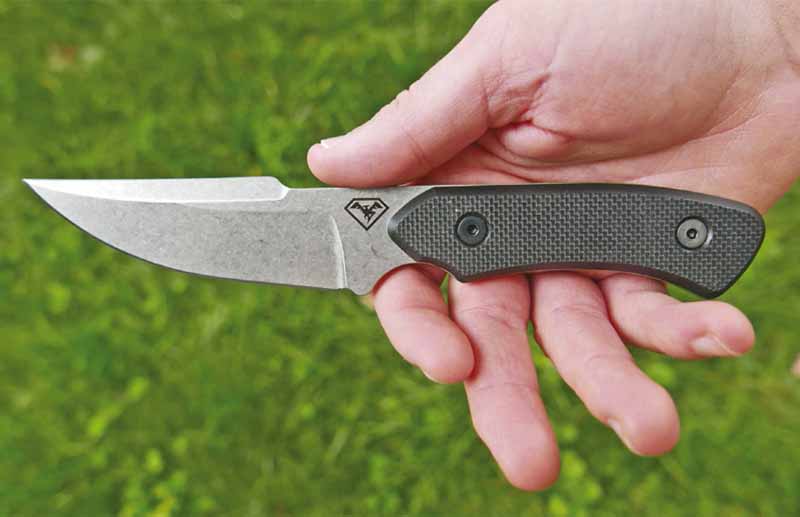
A deep index finger groove extending from the bottom/front of the checkered scales into the tang of the DoubleStar Chico Diablo X adds grip when getting down to business.

The knife’s size is perfect for medium-duty field tasks such as dressing game, prepping meals, cutting rope and working wood. It’s not heavy enough for chopping but is a serious slicer. I tested the blade across the grain on a 4.5×2.25-inch slab of cold corned beef brisket. Despite the blade being shorter than the chunk of beef, the Nitro-V stainless steel glided through the brisket, taking off one clean quarter-inch slice after another. The Chico Diablo X is a well-built multi-tasker worth every penny of its surprisingly affordable price tag.

Doublestar Blades Chico Diablo X
Designer: Kim Breed
Blade Length: 3.75″
Blade Material: Nitro-V Stainless
Handle Material: Black G-10 with green G-10 liners
Weight: 6.24 ozs.
Overall Length: 8″
Sheath: Black Boltaron with Tek-Lok attachment
Country Of Origin: USA
MSRP: $149.99

Kizlyar Supreme Senpai

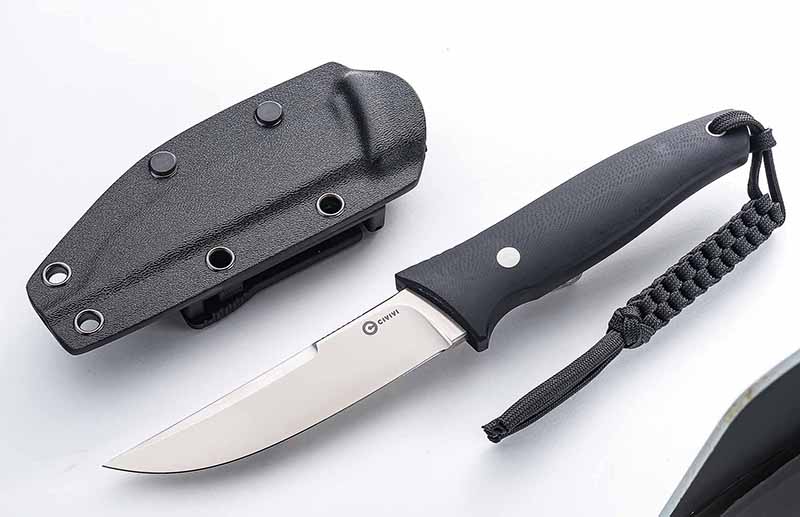
The Kizlyar Supreme Senpai is the longest knife of the test group, including a tanto blade in more of a traditional Japanese curved-tip style. The handle is spare of curves save for a slight finger groove and short guard. The scales are nicely rounded and Kizlyar provides a sandwiched matching green synthetic belt sheath for carry.
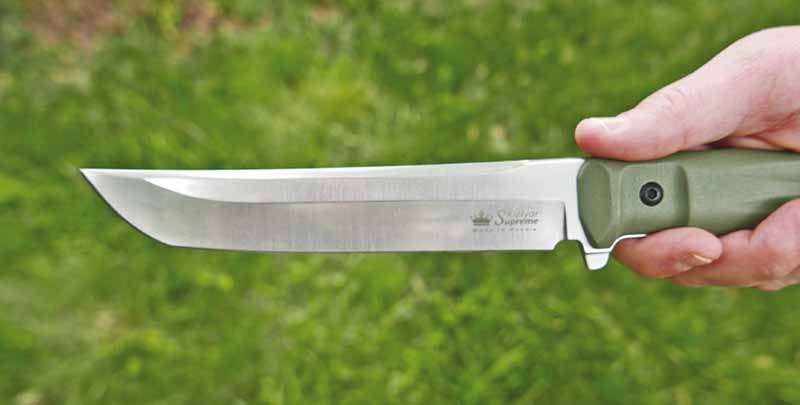
The Senpai includes a traditional Japanese tanto blade. The handle has nicely rounded scales spare of curves save for a slight finger groove and a short guard. The knife comes with a matching green synthetic belt sheath.
The Senpai includes a traditional Japanese tanto blade. The handle has nicely rounded scales spare of curves save for a slight fi nger groove and a short guard. The knife comes with a matching green synthetic belt sheath.

Given its weight and slim blade profile, I liked the Supreme Senpai for slicing and shaving from a utility standpoint. I roughed out a seasoned hardwood tent peg using a small hatchet, and tested the blade at finetuning the pointed tip and shaving the sides. The long blade came in handy as I could pull it through while slicing and shaving rather than simply pushing it downward against the tough hardwood—my reasoning being, if it could handle stout wood, simpler chores like meal prep and cutting rope would be a snap. The Supreme Senpai blade performed well shaping the challenging wood, leaving no doubt it could be handy around camp.

Kizlyar Supreme Senpai
Blade Length: 6.75″
Blade Material: AUS-8 stainless
Handle Material: OD green Kraton/ABS plastic
Weight: 10.3″
Overall Length: 12″
Sheath: Polyamide Nylon
Country Of Origin: Russia
MSRP: $150

Halfbreed Blades Medium Infantry Knife

How brutish is the Aussie-made Halfbreed Blades Medium Infantry Knife? Consider this—it’s around just one ounce shy of the other three test knives combined in weight! The blade is a whopping .23-inch thick at its thickest, features 1.5 inches of serrations from the tang forward, and has a black, rust-resistant Tefl on coating. The ample handle scales are “chunked” black G-10 and there’s a wicked skull crusher. The sheath has rear attachments for MOLLE (Modular Lightweight Load-carrying
Equipment) or belt carry.
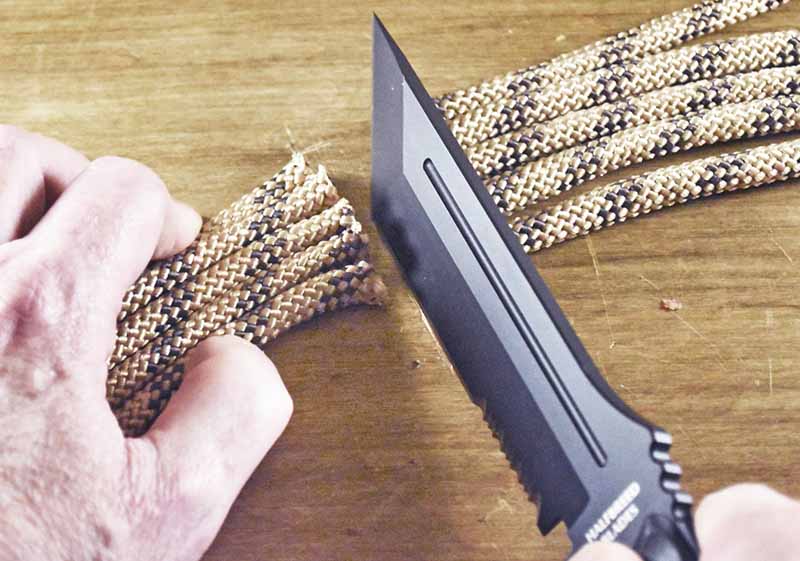
The Halfbreed Medium Infantry Knife incorporates brutish .23-inch blade steel. The author pulled it through five lengths of 3/8-inch rappelling rope in one clean slice using the forward plain edge portion of the blade.

This overbuilt brute is a handful capable of chopping, slicing and shaving. Given its near three-quarter-pound weight it will no doubt chop, but the serrations somewhat limit the chopping ability of the blade’s plain edge portion. (Serrated edges will chop but it’s hard on them, and resharpening the teeth is a royal pain.)

I tested the knife at slicing and started with lengths of ⅜ -inch synthetic rappelling rope. Working my way up, I was able to slice cleanly through five lengths of the rope side-by-side before I ran out of rope. The handle offered superb grip throughout the testing process. The Halfbreed entry has the ability to perform heavy-duty camp chores like
shelter building, chopping branches for firewood and shaving wood.

Halfbreed Blades Medium Infantry Knife
Blade Length: 6.69″
Blade Material: Bohler K110 D2
Handle Material: Black G-10
Weight: 17.08 ozs.
Overall Length: 11.77″
Sheath: Black Kydex
Country Of Origin: Australia
MSRP: $335


Also Read:

Best Big Knives: Four Behemoths That Are A Cut Above The Rest

Looking for a blade that can handle jobs and and small? These four giants are some of the best big knives out there.
What Are The Big Knives:

Little knives are convenient to carry but, if you have a lot of work to do, big knives are it. I’ve lived and worked with indigenous peoples in Latin America and Southeast Asia and found that wherever folks live close to the earth, they use big knives—machetes, parangs, goloks, bolos and the like. They use them for everything from rough work such as cutting poles and opening coconuts, to dressing out pigs and game, to delicate work such as slicing mangoes.

The advantage of the big blade was illustrated to me one day when I was working alongside a villager who, with his bolo and its 14-inch blade, cut wood for a fire, bamboo poles for a cooking rack, and lopped off a banana leaf on which he filleted two large fish and sliced them thin as a sushi chef—all in the time it took me to bring down a few stalks of bamboo with my hair-shaving-sharp Randall Model 1.
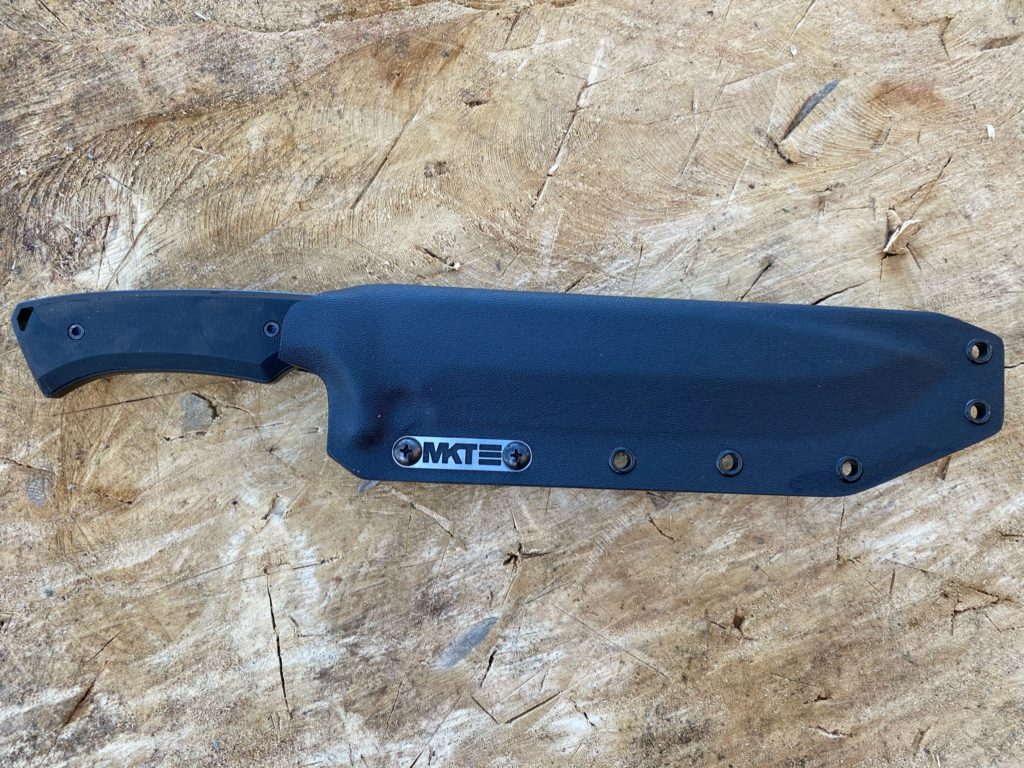
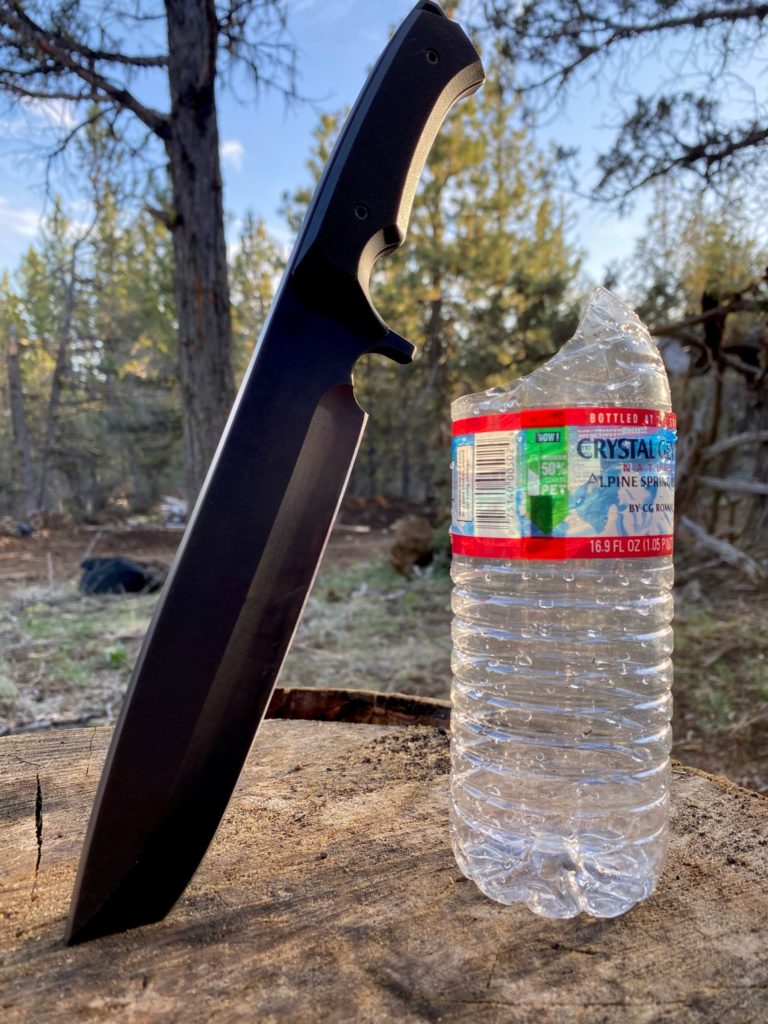
We reviewed the test knives with that standard in mind. We chopped and split wood and sliced meat and tomatoes. We also, just because, cut hanging rubber hose and slashed through water-filled plastic bottles.

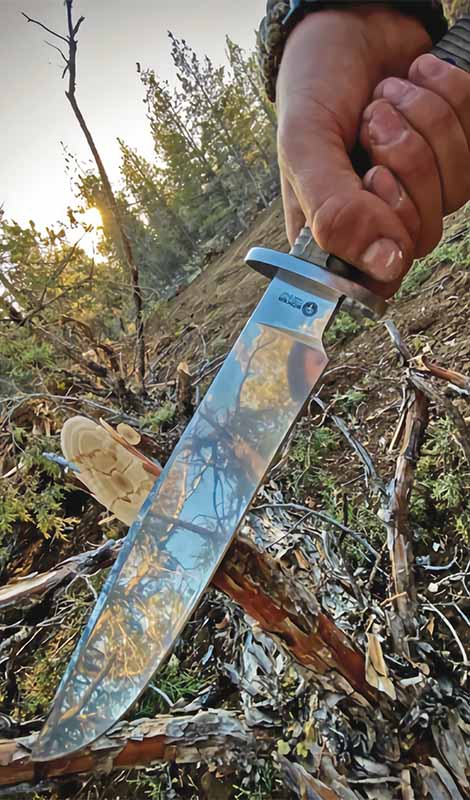
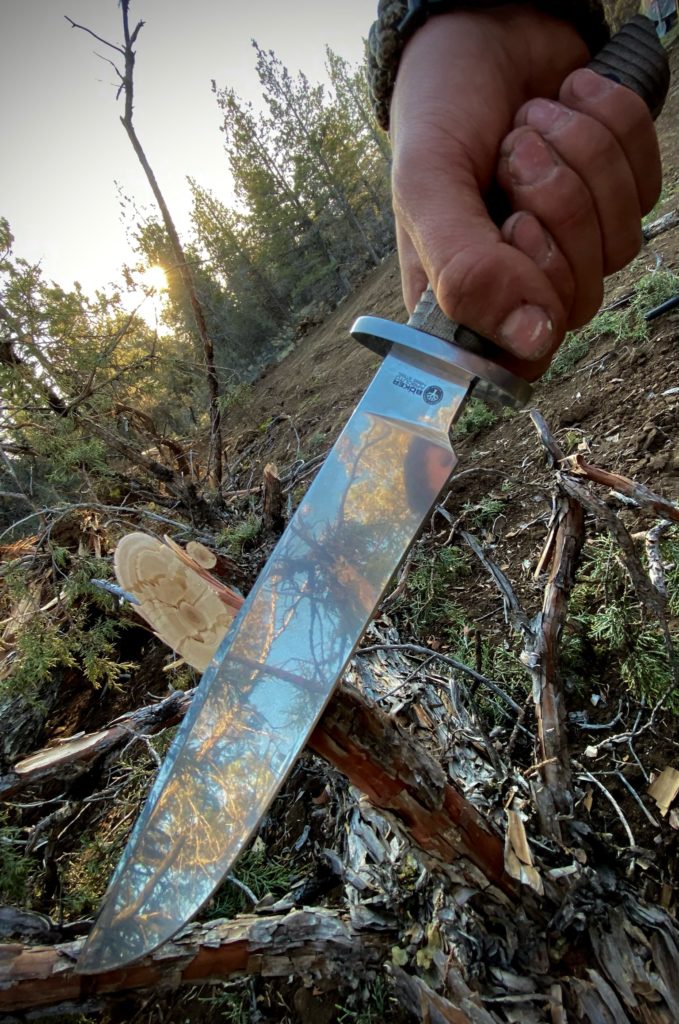
A tree branch succumbs to the reflective blade of the Boker Arbolito El Gigante. It cleaved 2-inch pine saplings in one stroke

Boker Arbolito El Gigante

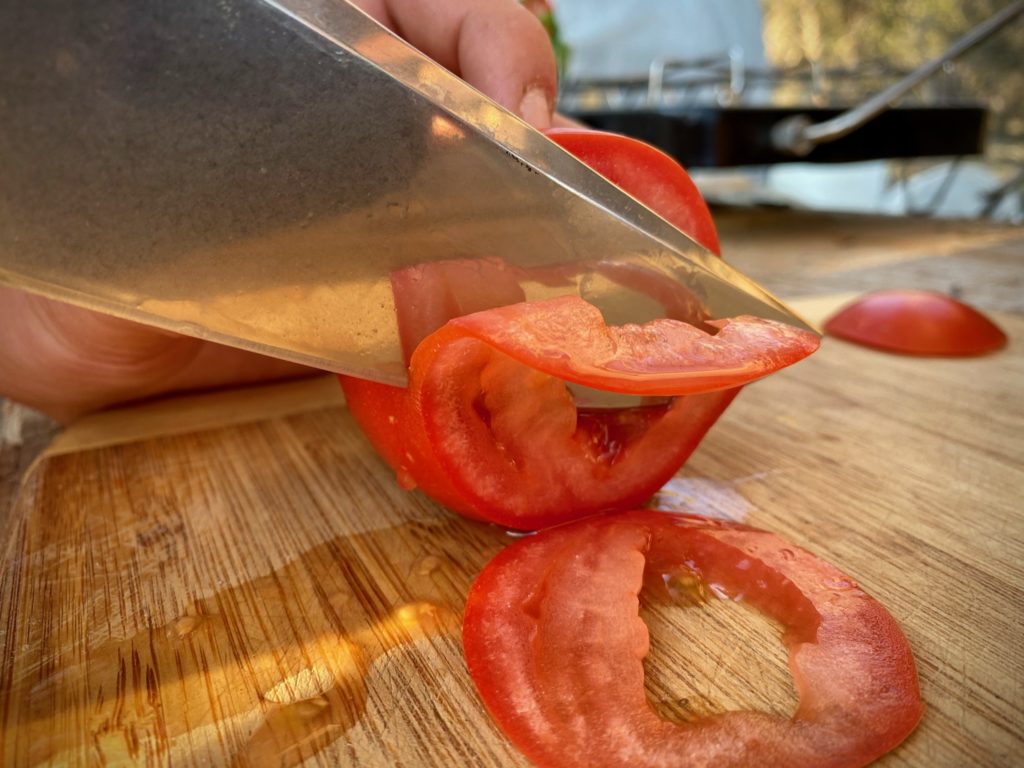
The Boker Arbolito El Gigante is a handsome classic bowie with a stonewashed blade, comfortable handle and nice leather sheath. Balance is excellent, all very much in the bowie tradition. Construction is top quality; so is performance. It cleaved 2-inch pine saplings with one stroke. The quarter-inch-thick spine was brought down to a well-supported edge fine enough to slice tomatoes thin enough to see light through the slices. We slashed rubber hose and the water bottles with ease.

Like all well-designed and crafted bowies, this is a versatile all-around knife.

BOKER ARBOLITO EL GIGANTE
BLADE LENGTH: 9.25”
BLADE STEEL: Bohler N695 stainless
BLADE THICKNESS: .24”
BLADE GRIND: Flat
BLADE FINISH: Stonewash
HANDLE THICKNESS: .94”
HANDLE MATERIAL: Green Micarta®
WEIGHT: 15.75 ozs.
OVERALL LENGTH: 14.75”
SHEATH: Leather
COUNTRY OF ORIGIN: Argentina
MSRP: $229


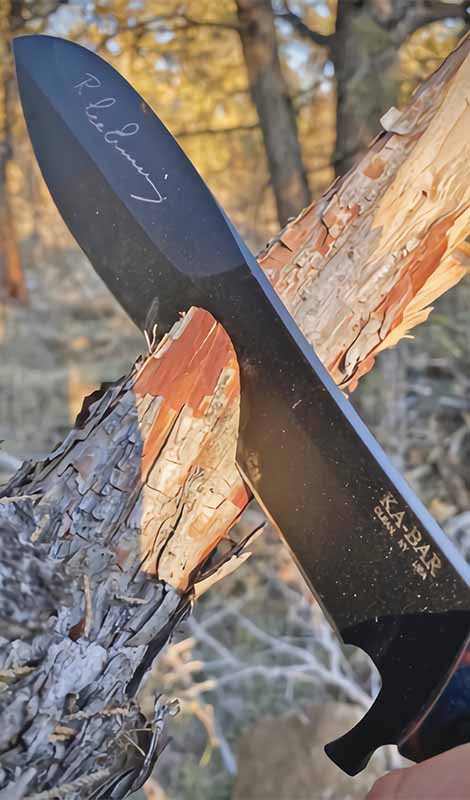
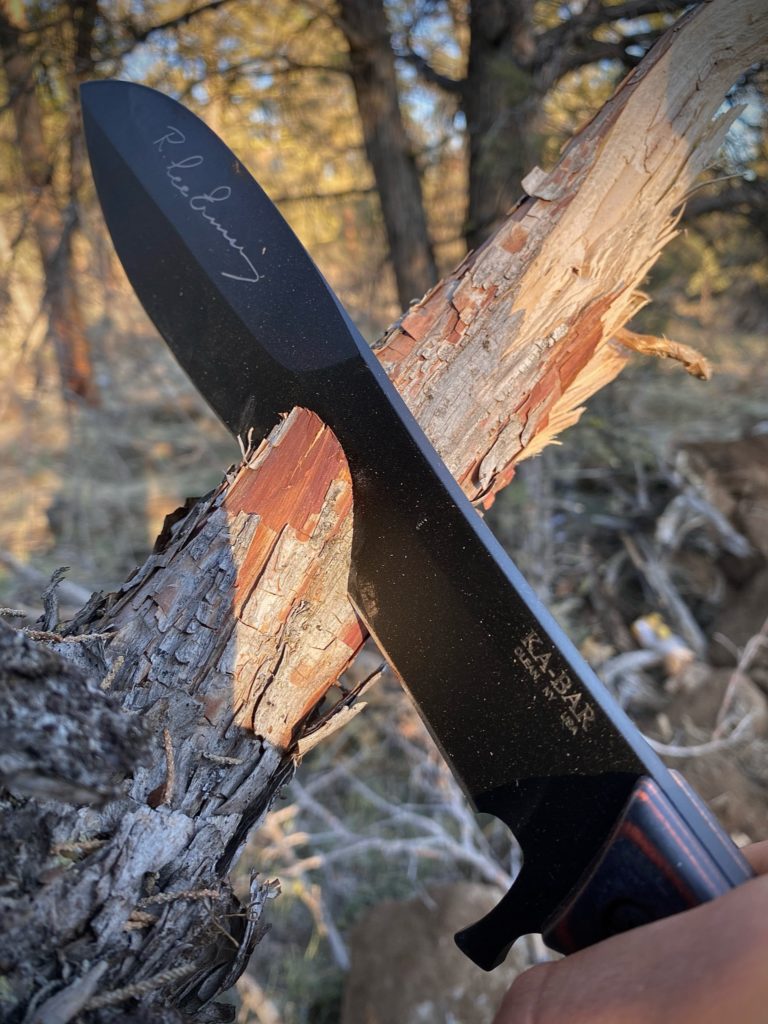
The KA-BAR Gunny chomps into dry pine. Its forward weight and blade design promote effi cient chopping

KA-BAR Gunny

The KA-BAR Gunny is a hybrid design that resembles a bolo. I suspect R. Lee Ermey, the unforgettable Gunny who serves as the knife’s namesake, spent some time in jungles because this combination chopper/slicer’s performance is on par with village-forged bolos I’ve used in Southeast Asia, and that’s a high compliment. Its forward weight and terrific blade design promote efficient chopping. We cut through 3-to-4-inch-thick saplings with two strokes. We took down a tree with a 6-inch-thick truck just because we could. After the chopping, the blade was still sharp enough for camp kitchen work. The belly, good balance and fine edge combined to make slicing meat and vegetables a pleasure. Slashing hanging rubber hose and the water bottle were a piece of cake. The comfortable handle lends itself both to heavy chopping and fine meat cutting, which is unusual.

The Gunny is an excellent all-around bush knife. The sheath has a pocket for a sharpening stone, which was not included with the review model.

KA-BAR GUNNY
DESIGNER: R. Lee “Gunny” Ermey
BLADE LENGTH: 9.75”
BLADE MATERIAL: 1095 Cro-Van carbon steel
BLADE WIDTH: 2”
BLADE THICKNESS: .2”
BLADE GRIND: Flat
HANDLE WIDTH: 1.5”
HANDLE THICKNESS: .94”
HANDLE MATERIAL: Wood
WEIGHT: 15.29 ozs.
OVERALL LENGTH: 15.5”
SHEATH: Leather
COUNTRY OF ORIGIN: USA
MSRP: $292


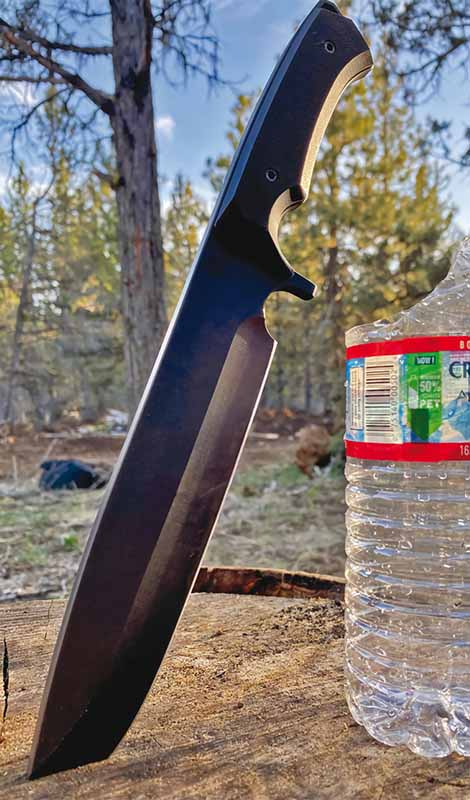
The Medford Knife & Tool Bonfire slashed through water-filled plastic bottles with more consistency than the other review blades

Medford Knife & Tool Bonfire

The Medford Knife & Tool Bonfire came from the maker absolutely razor sharp! The blade design is interesting in that we do not often see a contemporary styled drop point and hollow grind on such a big blade. I don’t know its Rockwell hardness, but the steel is hard and tough.

It was just as razor sharp after we put it through its paces as when we started. The fine edge made for a very good slicer and slasher and lopped off thin branches with one cut. The hollow grind tended to bind when chopping wood, though that’s to be expected—hollow grinds aren’t chopping designs. It’s better to think of this knife as a well-designed and crafted big knife rather than a bush tool such as a panga or kukri. It sliced rubber hose with a snap of the wrist and slashed through water bottles with more consistency than the other review blades, and cut meat just fine. You probably could dress out a bear with it. Use it as a big knife on soft materials and you won’t be disappointed. It comes

MEDFORD KNIFE & TOOL BONFIRE
BLADE LENGTH: 8.25”
BLADE MATERIAL: CPM 3V carbon steel
BLADE THICKNESS: .24”
BLADE GRIND: Hollow
HANDLE THICKNESS: .64”
HANDLE MATERIAL: G-10
WEIGHT: 19.16 ozs.
OVERALL LENGTH: 13”
SHEATH: Nylon
COUNTRY OF ORIGIN: USA
MSRP: $450


TOPS Bestia

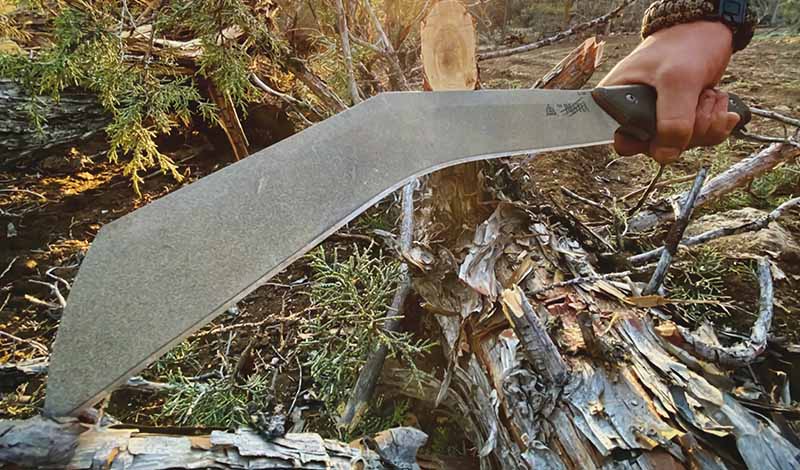
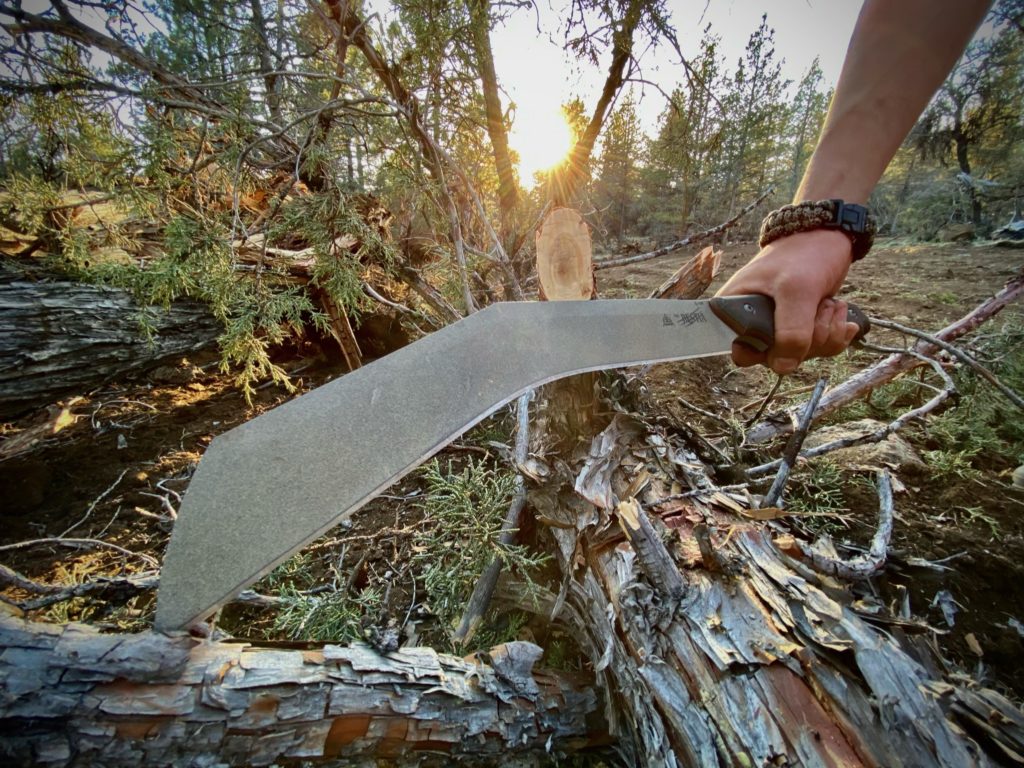
The TOPS Knives Bestia’s kukri-styled 13-inch blade and hefty weight made it the blade of choice for serious chopping or, as the author puts it, “zombie cleaving.”

The TOPS Bestia is just a beast. A kukri-styled 13-inch blade and hefty weight make it the blade of choice for serious chopping or zombie cleaving. We hacked through a 3-inch sapling with one stroke, and used it to clear a stand of saplings and brush. The handle remained comfortable during an hour or so of work. Heavy as a small hatchet, it is more versatile and safer in use, especially in thick brush.

During many survival classes, I’ve seen more injuries from hatchets than from big blades with their longer cutting edges. Given its heft, blade design and chopping ability, the Bestia is surprisingly usable in the camp kitchen. We found it could slice meat quite well, allowing for adjustments in maneuverability due to its blade length.

TOPS KNIVES BESTIA
DESIGNER: Leo Espinoza
BLADE LENGTH: 13”
BLADE MATERIAL: 1095 carbon steel
ROCKWELL HARDNESS: 56-58 HRC
BLADE WIDTH: 2.25”
BLADE THICKNESS: .25”
BLADE GRIND: Flat
HANDLE WIDTH: 2.125”
HANDLE THICKNESS: .97”
HANDLE MATERIAL: Green Micarta®
FRAME/LINER: Micarta
WEIGHT: 1 lb., 13.18 ozs.
OVERALL LENGTH: 19.5”
SHEATH: Kydex
COUNTRY OF ORIGIN: USA
MSRP: $300

VERSATILE BUSH TOOLS

If you haven’t spent much time with a big blade, try one. Work with it for a while. Direct close attention to your work and you’ll find a good big blade to be a terrific, versatile bush tool.

Also Read:

2021 BLADE Show West Factory And Custom Knife Award Winners

0

See who took top honors in Long Beach for the 2021 Blade Show West Awards.

BLADE Show West took place Oct. 8-9, 2021, at the Long Beach Convention Center in Long Beach, Calf. It was the show’s inaugural year in California and drew custom makers, manufacturers and collectors from around the county.

It also drew an impressive cadre of entrants for the BLADE Show West Factory and Custom Knife Awards. For Factory Knives, awards were given in five categories, while the Custom Knives awarded six categories.

The Factory section was evaluated by a panel of undisclosed industry experts who judged the blades on a number of factors, including utility, design, creativity, materials and other traits. The Custom section was judged by a number of expert knifemakers along similar lines.

Factory Knife Award Winners

Best Tactical and Best In Show


Civivi Tamashii designed by Bob Terzuola, SharpByCoop Image

Purchase it here:

Best Hunter


Bradford Knives M390 Guardian 4, SharpByCoop Image

Purchase it here:

Best Big Knife


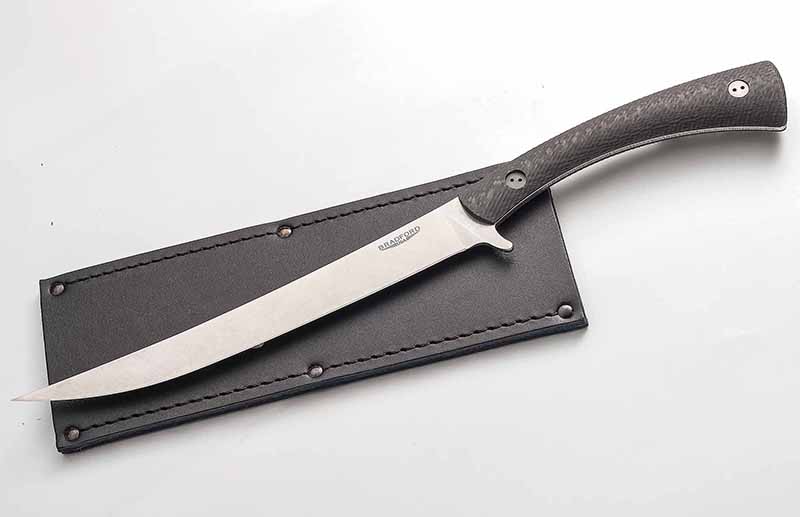
Bradford Knives REX 45 Fillet, SharpByCoop Image

Best Folder


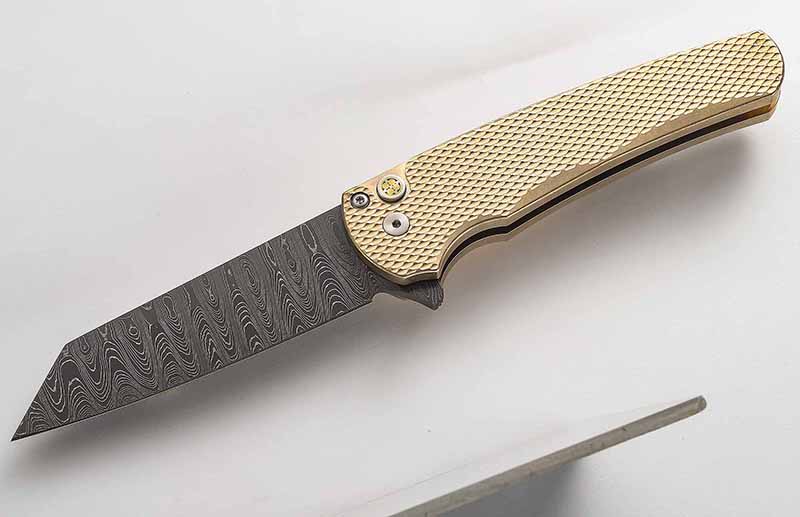
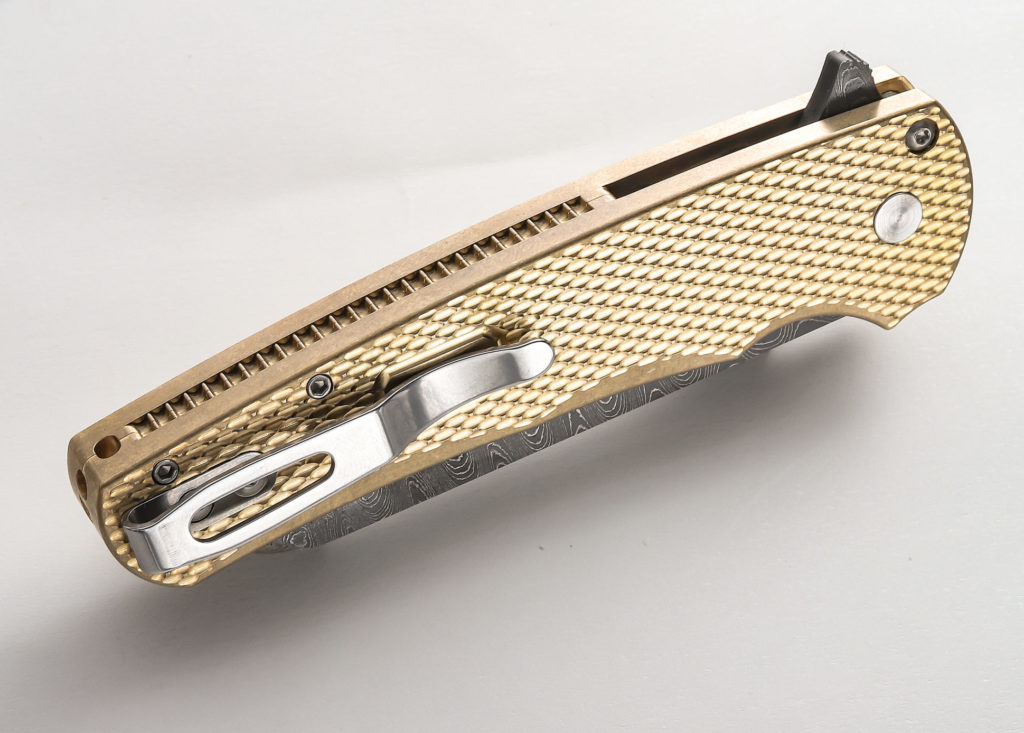
Pro-Tech Malibu Custom Limited Edition w/textured bronze aluminum handle, SharpByCoop Image

Best EDC


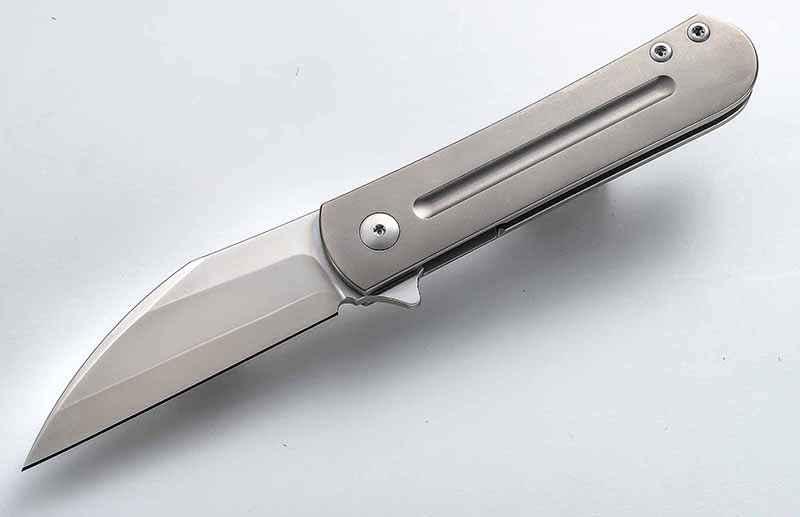
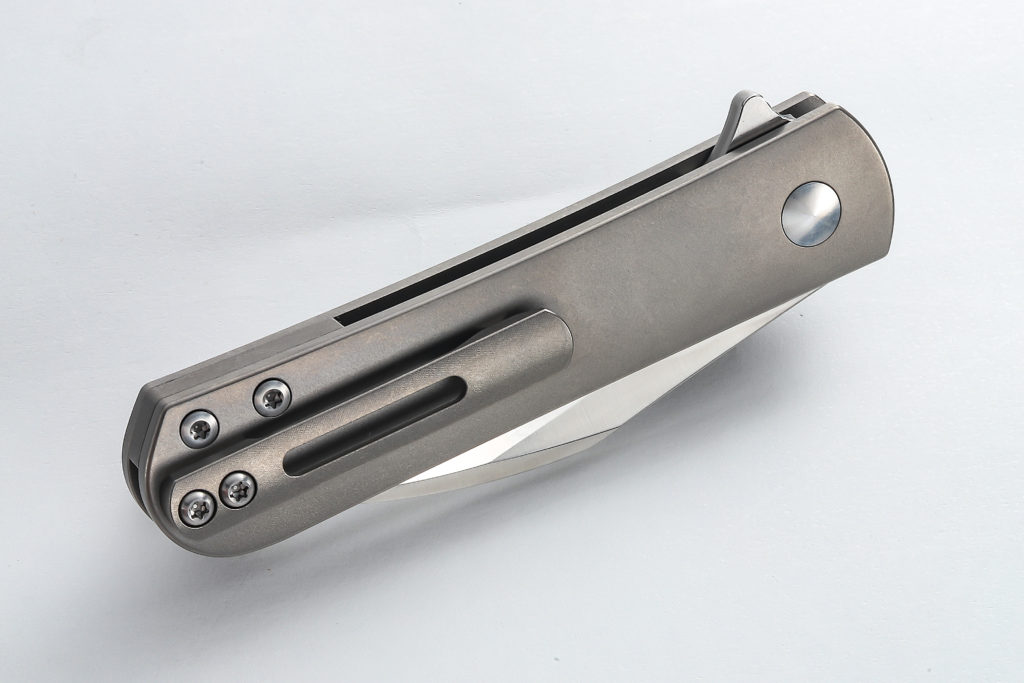
Monterey Bay Knives wharncliffe flipper folder, SharpByCoop Image

Custom Knife Award Winners

Best Folder and Best In Show


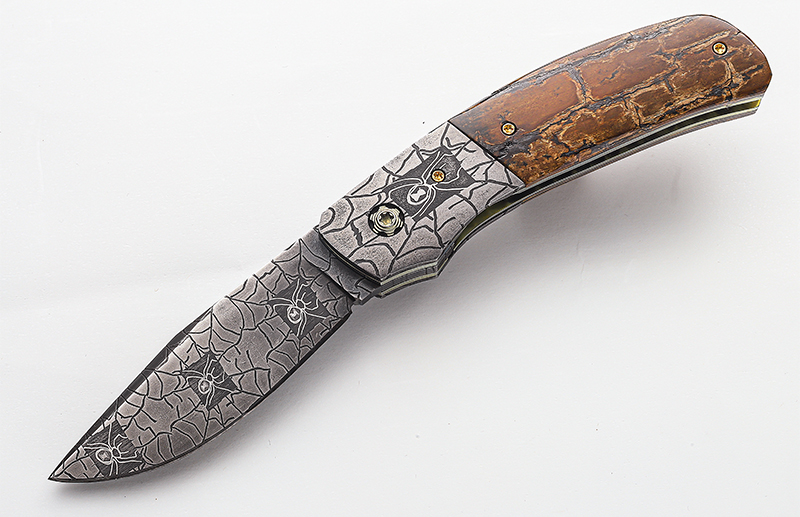
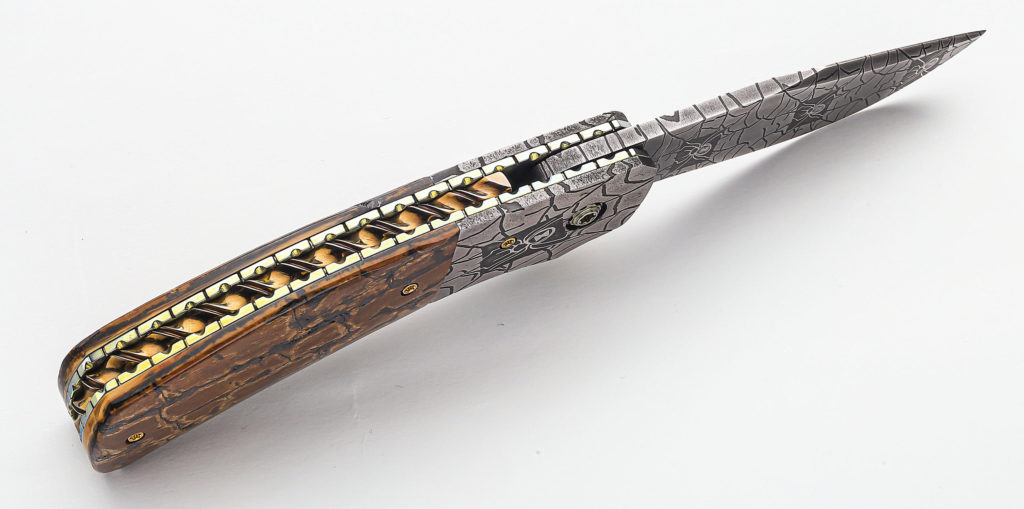
Mike Tyre mosaic damascus folder, SharpByCoop Image

Best Damascus

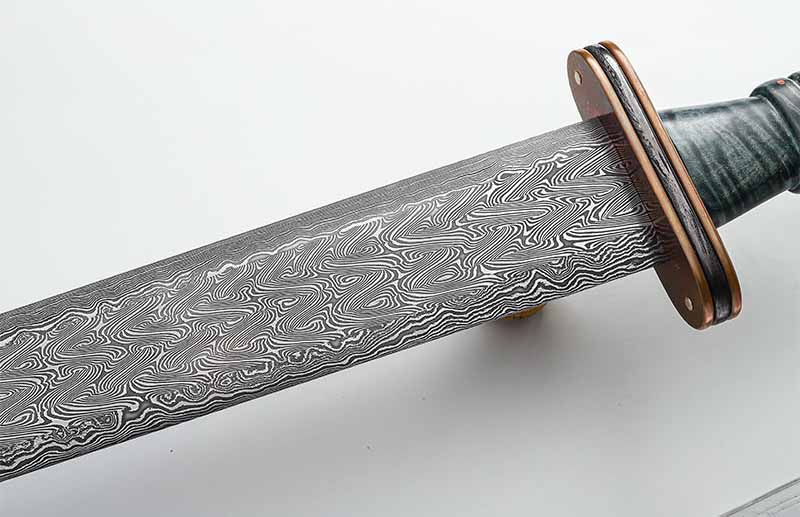
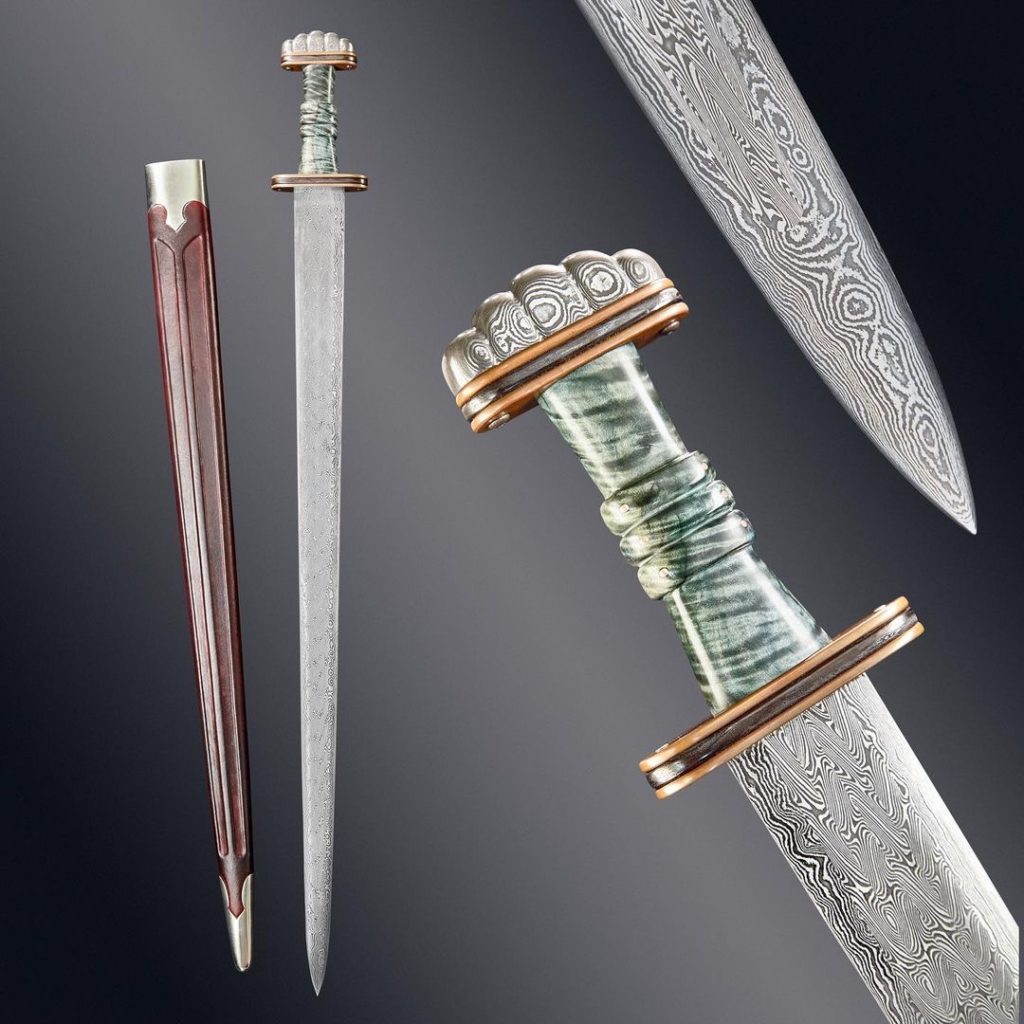
Mike Shindel Merovingian Sword in a 4-bar Turkish twist, and a random-pattern wrap-around edge of 1084 and 15N20 carbon and nickel-alloy steels, SharpByCoop Image

Best Slip Joint


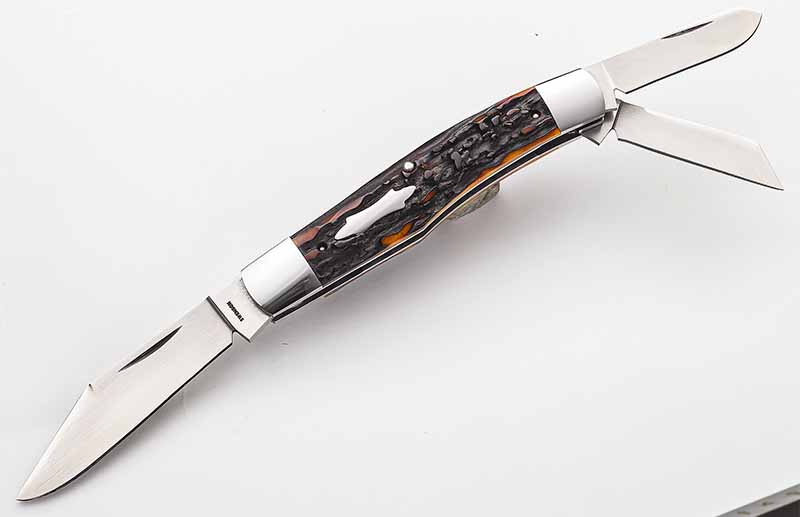
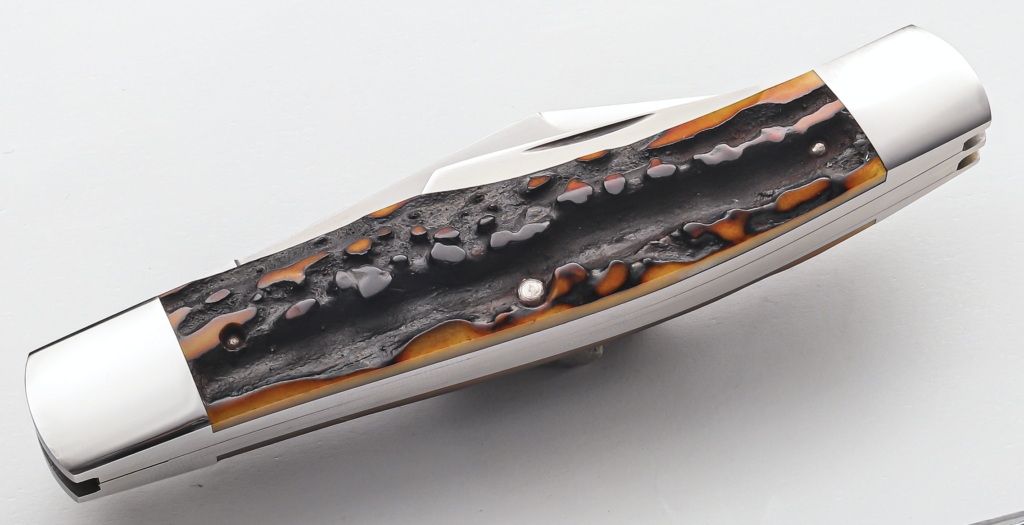
Luke Swenson split-backspring whittler, SharpByCoop Image

Best EDC


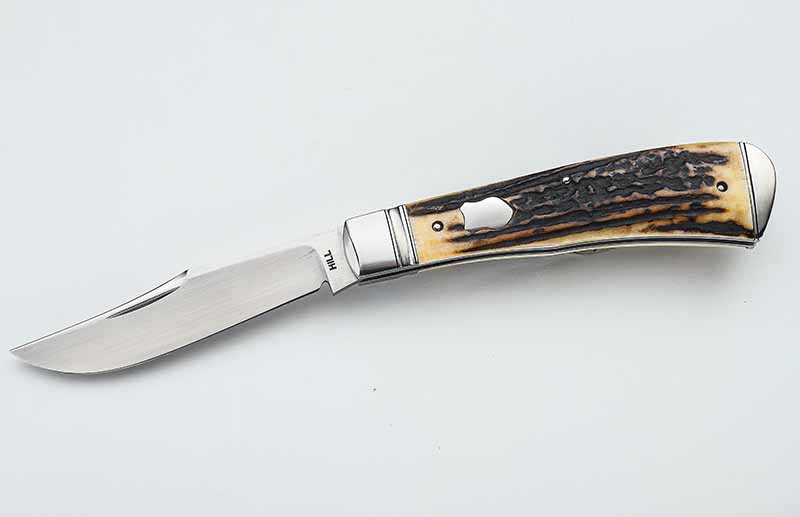
Tobin Hill one-blade trapper, SharpByCoop Image

Best Chef’s Knife


Nicholas Berkofsky/Fell Knives 7.5-inch Protein Petty, SharpByCoop Image

Best Hunter


Mike Shindel integral bolster hunter, SharpByCoop Image

Stay up-to-date on Blade Show Events by signing up for the Blade Show Newsletter Here.


Also Read:

Spyderco Yojimbo 2: Fantastic Straightedge Folder

0

Now in its second iterations, the Yojimbo 2 nails exactly what a straightedge folder should be.

It isn’t hard to review a Spyderco knife.

Anyone who has ever used one can tell you the company has an uncanny ability to nail the making of folders as well as fixed blades. What is even more uncanny is how the company can do it so consistently while being so prolific. Hence, if you want to talk about good straight-edge knives and also the features of folding EDCs in comparison to fixed-blade EDCs, you might as well include one of the best folding knifemakers in the business. If you’ve ever talked to BLADE Magazine Cutlery Hall-Of-Fame® member Sal Glesser, you quickly realize the thing that drives Spyderco’s outstanding record of knife offerings is Sal’s passion for the trade.

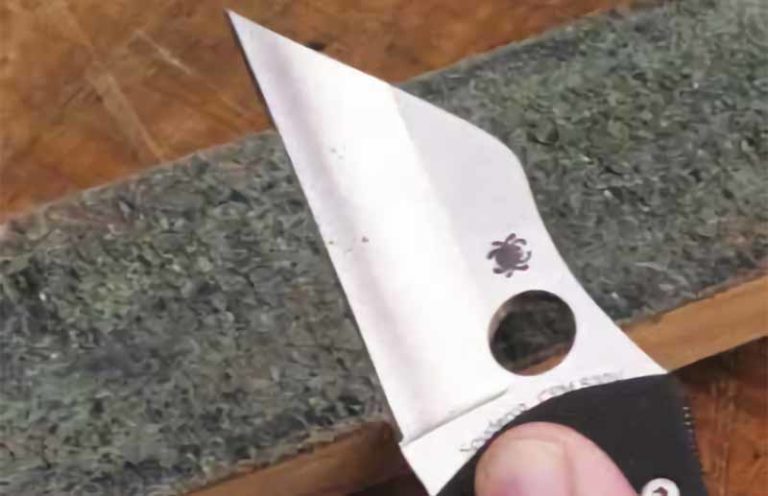
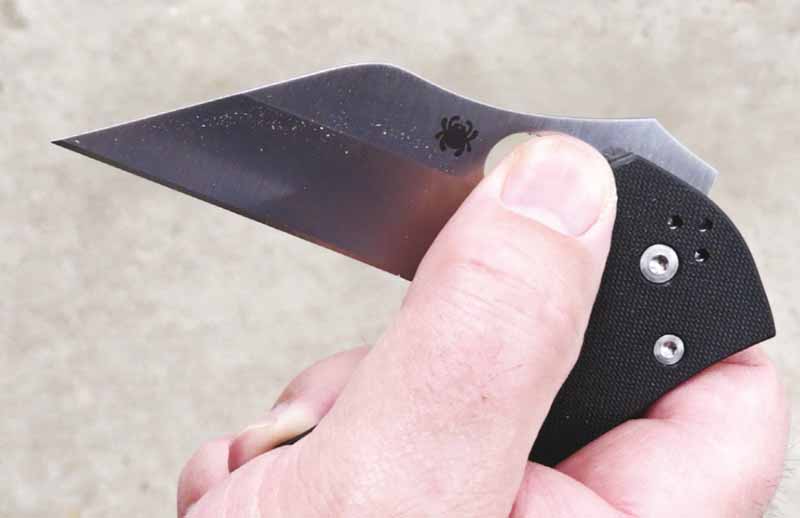
The wide blade on the Spyderco Yojimbo 2 gives plenty of real estate for your thumb to clear the scale and fi nd its way into the hole so you can open the knife easily.

Yojimbo 2 Rundown

The Yojimbo design has been out for years, but to be truthful I am just getting around to reviewing it now in the Yojimbo 2 iteration. At 7.55 inches open, it’s in the midsized folder range. I prefer a small-to-midsized folder because once I get into the large folders, I start asking myself why I didn’t just choose a fixed blade. The blade has a sharp-angle execution of a wharncliffe style, resulting in a very articulated tip. With a blade width starting at 1.5 inches, the steep angle still provides a sturdy tip. Spyderco uses a hollow grind that results in a thin geometry.

The handle is subtly textured G-10. The texturing for me has that Goldilocks feel to it—just right. Sometimes because of new machining technology companies do things they can do and don’t think about whether they should. One of the things I most often find is over texturing of handles to the point the knife is uncomfortable to use. This isn’t the case with the Yojimbo 2. The texturing is very slight but undoubtedly present.

Straightedge’s Performance

Opening and closing the folder is smooth. It features Spyderco’s compression lock system, which has a crisp lock up. There’s no doubt your blade is locked thanks to a crisp snap as the lock engages. A handle profile with a number of broad finger grooves provides a secure grip. The broad grooves allow the knife to remain nimble in your grasp.

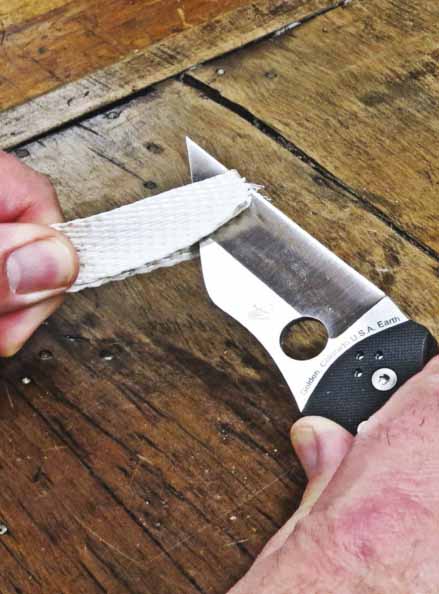
Out of the box, the Yojimbo 2 was razor sharp. It made eff ortless cuts through this packing crate strapping like the medium wasn’t even there.

If I were to mention only one issue I have with the knife it would be something particular to me and people who suffer the same affliction: fat hands. My hands are beefy. On occasion, the compression lock, because it is located on the spine, catches me ever so slightly between the lock and the liner. Would this version of Spyderco’s would be No.
1 every time. The overall profile makes it easy to capture the rim on tight and loose pockets alike. Not every knife I have reviewed over the years comes back around to be a personal carry. I can tell you, though, the Yojimbo 2 will be making it into my EDC rotation.

Spyderco supplies one of its full-metal pocket clips for the Yojimbo 2. I can’t say this enough: If you had to make a list of the top-five-designed pocket clips, this version of Spyderco’s would be No. 1 every time. The overall profile makes it easy to capture the rim on tight and loose pockets alike. Not every knife I have reviewed over the years comes back around to be a personal carry. I can tell you, though, the Yojimbo 2 will be making it into my EDC rotation.

For more information on the Yojimbo 2, please visit spyderco.com.

Also Read:

5 Angle-Guide Knife Sharpeners That Make The Cut

1

The proper angle is key to a sharp blade. Here are the angle-guide sharpeners that ensure you’ll always get it right.

A big part of sharpening, aside from proper sharpener selection, is how to select and maintain the proper angle of the blade to the sharpener. In fact, the key to successfully sharpening any blade regardless of the grade of steel is being able to maintain that angle. Ever try sharpening freehand on a bench stone with little experience doing so? The reason folks get frustrated with learning to sharpen is they don’t keep the angles consistent. It’s all about the angles. You must take into account what use your knife will see and sometimes that determines the specific angle to use.

You probably know of the angle guide kits with a metal clamp that affixes to the blade and has uprights on either end with a series of holes that correspond to various degrees of angles. Such kits all help instill confidence and the ability to subtract guesswork at maintaining the desired angle.

SHARPENER TYPES
There are plenty of sharpeners capable of reproducing keen edges. Avoid the pull-through types that require you to drag the blade through. Those are set at one angle and use carbide to get the job done. These will ruin a blade in time, and I don’t recommend them. You need a sharpening kit that’ll help establish and hold a consistent angle. All you need to be concerned with is making the motions to get the edge sharp.

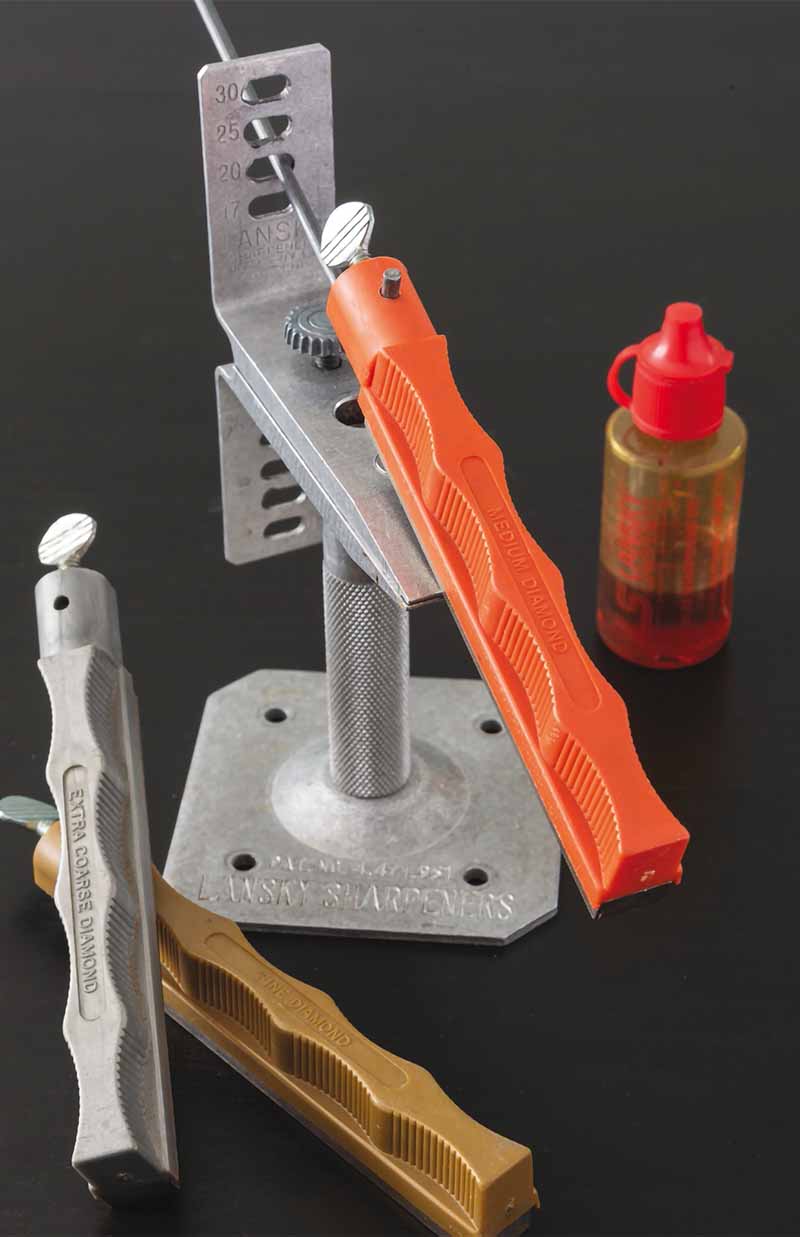
The Lansky Deluxe Diamond Knife Sharpening System is one of the oldest angle guide kits on the market. Four various grits of diamond-coated hones are featured, including extra-coarse for fast work of reviving dull blades. The sturdy aluminum clamp holds the knife securely.

Lansky’s four-stone Deluxe Diamond System Precision Knife Sharpening Kit is the best the company offers in angle guide clamp units. It includes an extra coarse hone great for reprofiling edge angles. It also has coarse-, medium-, and fine-grit diamond-coated hones for fine-tuning the edge once it’s been established. The aluminum clamp is sturdy and offers four edge angles: 17, 20, 25, and 30 degrees. The kit stores in a sturdy plastic storage case. MSRP: $114.99.

GATCO offers the Ultimate Diamond Hone Sharpening System, which is similar to the Lansky. Featuring coarse-, medium-, and fine-grit diamond-coated abrasives, the kit includes Ultimate Finishing and triangular-shaped serration hones, too. It works on plain, serrated, and partially serrated edges. The hones are wider and longer for more effective use and have molded-in integral handguards for safety. There’s also a plastic storage case. MSRP: $119.99. 


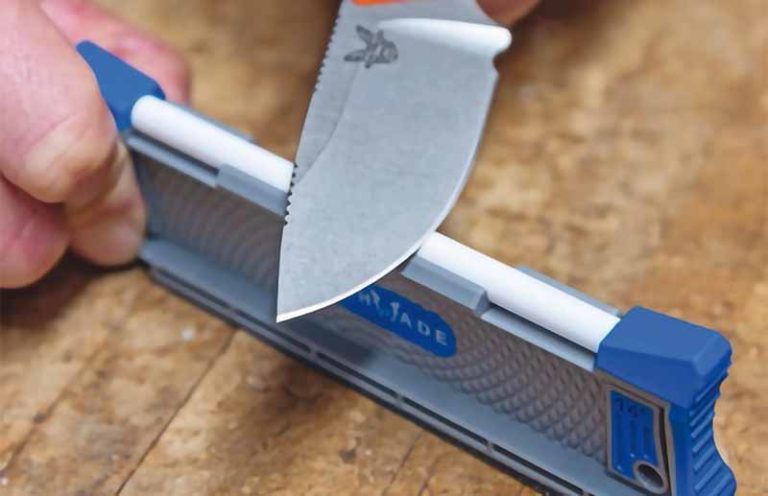
To sharpen the CPM S90V blades with the SelectEdge 14 degree angle of its Hidden Canyon Hunter and Saddle Mountain Skinner, Benchmade offers the model 50082 14 Degree SelectEdge Guided Hone Tool. Designed in conjunction with and manufactured by Work Sharp, this compact sharpener incorporates a fine grit ceramic rod and a leather strap on the backside. Built-in guides set the blade at the correct 14-degree angle. The idea with this one is to apply frequent edge touchups. A premium steel, S90V is notoriously difficult to resharpen, a difficulty negated via frequent edge maintenance sessions with the 50082. MSRP: $25.

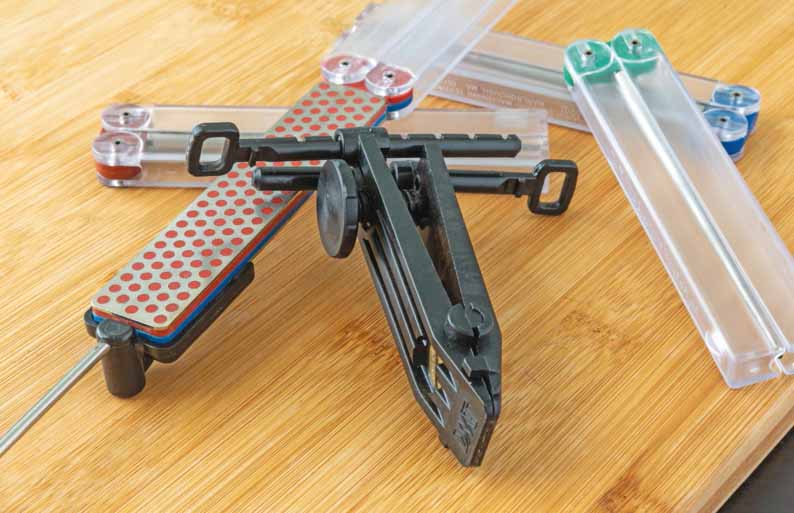
DMT’s Magna-Guide angle kit includes a magnetic guide rod and sturdy blade clamp with adjustable angles. Use  any model DMT Double Sided Diafold folding fi le and you have two sharpeners in one—a freehand fi le and an  angle guide kit.
DMT’s Magna-Guide angle kit includes a magnetic guide rod and sturdy blade clamp with adjustable angles. Use
any model DMT Double Sided Diafold folding fi le and you have two sharpeners in one—a freehand fi le and an
angle guide kit.

For knives without the SelectEdge technology, Benchmade offers the Edge Maintenance Tool, also designed with and manufactured by Work Sharp. It uses a fine-grit ceramic rod and a leather strop but in a more compact folding format with a pocket clip for easy carry. As with the 14 Degree SelectEdge Guided Hone Tool, built-in guides assist in achieving the optimal angle for edge restoration. The Edge Maintenance Tool works well with pocketknives, fixed blades, and tactical folders—pretty much any knife. MSRP: $50.

DOWNSIZED 2X72
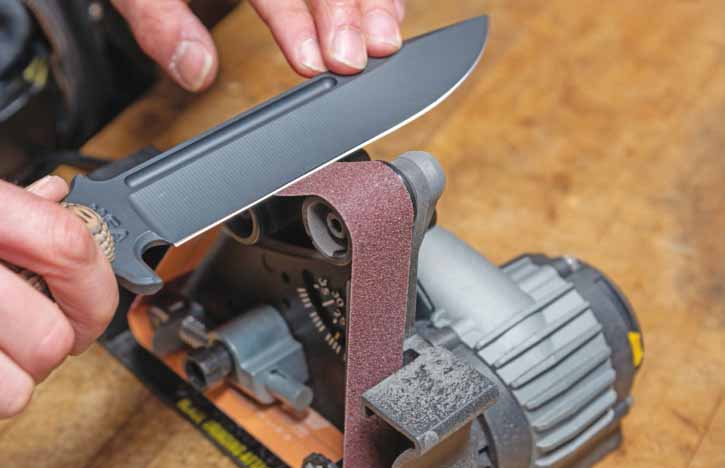
For the more advanced sharpeners among you, Work Sharp offers the Ken Onion Elite Sharpening System, a variable speed motorized unit employing long-lasting flexible abrasive belts made by Norton Abrasives. It’s pretty much a downsized version of a larger and much more expensive 2×72 slack belt grinder used by many knifemakers.

The Work Sharp Ken Onion Elite sharpener is pretty much a downsized version of a larger and much more  expensive 2x72 slack belt grinder used by many knifemakers.
The Work Sharp Ken Onion Elite sharpener is pretty much a downsized version of a larger and much more expensive 2×72 slack belt grinder used by many knifemakers.

Designed by BLADE Magazine Cutlery Hall-Of-Fame® member Ken Onion, the Elite makes quick work of bringing completely dull and/or damaged knife edges back to life and is fully adjustable for applying edges between 10 and 35 degrees. The abrasive belts measure 1 by 18 inches and make quick work of any sharpening task. Once you become comfortable with how the sharpener operates, you can consistently grind an even edge on your blades. (Author’s note: Motorized sharpening is best left to those with sharpening experience.) MSRP: $199.95.

Diamond Machining Technology (DMT) offers the Double Sided Diafold Magna-Guide Sharpening System centered around the company’s Double Sided Diafold folding diamond files. The Magna-Guide System features the Aligner Blade Guide clamp with integrated, adjustable angle guides. A metal guide rod affixes securely to the Double Sided Diafold file via a large rare earth magnet. Attached to an FWCX Extra Coarse/Coarse Double Sided Diafold, the manual system can easily reprofile an edge to any one of seven pre-set angles.

DMT’s Double Sided Diafold diamond files are built well, highly effective, and among the best compact sharpeners on the market. One of the best things about the Magna-Guide is you can use the Double Sided Diafold files as stand-alone sharpeners without the guide rod and angle guide clamp. Consequently, you get a guided sharpening system and a standalone sharpener for the price of one. The Magna-Guide Kit’s MSRP: $27.49 (works with any Double Sided Diafold file).

Get More Knife Sharpening Info:

BIG Blades: 4 Monster Choppers for the Bush

BY JAMES MORGAN AYRES

Wherever folks live close to the earth, they use big knives

Little knives are convenient to carry but, if you have a lot of work to do, big knives are it. I’ve lived and worked with indigenous peoples in Latin America and Southeast Asia and found that wherever folks live close to the earth, they use big knives—machetes, parangs, goloks, bolos and the like. They use them for everything from rough work such as cutting poles and opening coconuts, to dressing out pigs and game, to delicate work such as slicing mangoes.

The advantage of the big blade was illustrated to me one day when I was working alongside a villager who, with his bolo and its 14-inch blade, cut wood for a fire, bamboo poles for a cooking rack, lopped off a banana leaf on which he filleted two large fish and sliced them thin as a sushi chef—all in the time it took me to bring down a few stalks of bamboo with my hair-shaving-sharp Randall Model 1.

We reviewed the test knives with that standard in mind. We chopped and split wood and sliced meat and tomatoes. We also, just because, cut hanging rubber hose and slashed through water-filled plastic bottles.


LONG, TALL & HANDSOME: Boker Arbolito El Gigante


The Boker Arbolito El Gigante is a handsome classic bowie with a stonewashed blade, comfortable handle and nice leather sheath. Balance is excellent, all very much in the bowie tradition. Construction is top quality; so is performance. It cleaved 2-inch pine saplings with one stroke. The quarter-inch-thick spine was brought down to a well-supported edge fine enough to slice tomatoes, and slice meat thin enough to see light through the slices. We slashed rubber hose and the water bottles with ease.

Like all well-designed and crafted bowies, this is a versatile all-around knife.

A tree branch succumbs to the reflective blade of the Boker Arbolito El Gigante. It cleaved 2-inch pine saplings in one stroke.

BOKER ARBOLITO EL GIGANTE
Blade Length: 9.25”
Blade Steel: Bohler N695 stainless
Blade Thickness: .24”
Blade Grind: Flat
Blade Finish: Stonewash
Handle Thickness: .94”
Handle Material: Green Micarta®
Weight: 15.75 ozs.|
Overall Length: 14.75”
Sheath: Leather
Country of Origin: Argentina
MSRP: $229

The El Gigante also proved its mettle after chopping wood by slicing a tomato nice and thin.


SEMPER FI! The KA-BAR Gunny


The KA-BAR Gunny is a hybrid design that resembles a bolo. I suspect R. Lee Ermey, the unforgettable Gunny who serves as the knife’s namesake, spent some time in jungles because this combination chopper/slicer’s performance is on par with village-forged bolos I’ve used in Southeast Asia, and that’s a high compliment. Its forward weight and terrific blade design promote efficient chopping.

The KA-BAR Gunny chomps into dry pine. Its forward weight and blade design promote efficient chopping.

We cut through 3-to-4-inch-thick saplings with two strokes. We took down a tree with a 6-inch-thick truck just because we could. After the chopping the blade was still sharp enough for camp kitchen work. The belly, good balance and fine edge combined to make slicing meat and vegetables a pleasure. Slashing hanging rubber hose and the water bottle were a piece of cake. The comfortable handle lends itself both to heavy chopping and fine meat cutting, which is unusual.

The Gunny is an excellent all-around bush knife. The sheath has a pocket for a sharpening stone, which was not included with the review model.

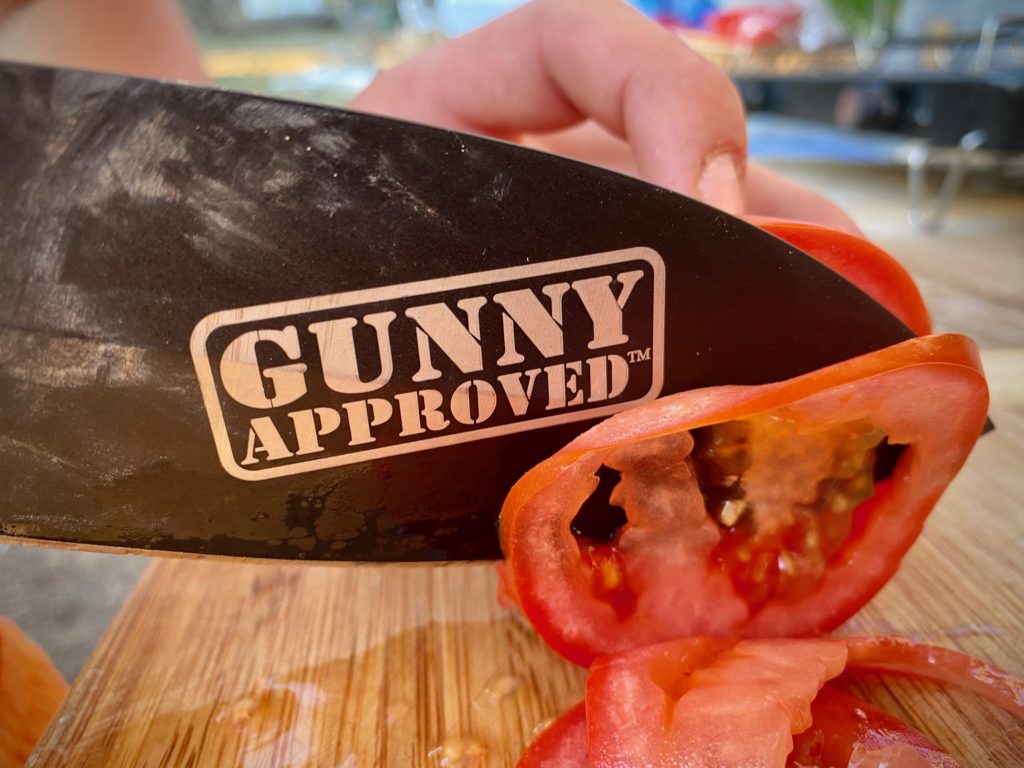
After chopping wood, the Gunny sliced tomatoes like a chef’s knife.

KA-BAR GUNNY
Designer: R. Lee “Gunny” Ermey
Blade Length: 9.75”
Blade Material: 1095 Cro-Van carbon steel
Blade Width: 2”
Blade Thickness: .2”
Blade Grind: Flat
Handle Width: 1.5”
Handle Thickness: .94”
Handle Material: Wood
Weight: 15.29 ozs.
Overall Length: 15.5”
Sheath: Leather
Country of Origin: USA
MSRP: $292


RAZOR SHARP: Medford Knife & Tool Bonfire


The Medford Knife & Tool Bonfire came from the maker absolutely razor sharp! The blade design is interesting in that we do not often see a contemporary styled drop point and hollow grind on such a big blade. I don’t know the Rockwell, but the steel is hard and tough. It was just as razor sharp after we put it through its paces as when we started.

The Bonfire comes with a well-fitted Kydex sheath.

The fine edge made for a very good slicer and slasher and lopped off thin branches with one cut. The hollow grind tended to bind when chopping wood, though that’s to be expected—hollow grinds aren’t chopping designs. It’s better to think of this knife as a well-designed and crafted big knife rather than a bush tool such as a panga or kukri. It sliced rubber hose with a snap of the wrist and slashed through water bottles with more consistency than the other review blades and cut meat just fine. You probably could dress out a bear with it.

Use it as a big knife on soft materials and you won’t be disappointed. It comes with a well-fitted Kydex sheath.


The Medford Knife & Tool Bonfire slashed through water-filled plastic bottles with more consistency than the other review blades.

MEDFORD KNIFE & TOOL BONFIRE
Blade Length: 8.25”
Blade Material: CPM 3V carbon steel
Blade Thickness: .24”
Blade Grind: Hollow
Handle Thickness: .64”
Handle Material: G-10
Weight: 19.16 ozs.
Overall Length: 13”
Sheath: Nylon
Country of Origin: USA
MSRP: $450


CHEF’S CHOPPER: The TOPS Bestia


The TOPS Bestia is just a beast. A kukri-styled 13-inch blade and hefty weight make it the blade of choice for serious chopping or zombie cleaving. We hacked though a 3-inch sapling with one stroke, and used it to clear a stand of saplings and brush. The handle remained comfortable during an hour or so of work. Heavy as a small hatchet, it is more versatile and safer in use, especially in thick brush. During many survival classes, I’ve seen more injuries from hatchets than from big blades with their longer cutting edges.

The Kydex sheath is formed to fit the unmistakable kukri-style blade of the Bestia.

Given its heft, blade design and chopping ability, the Bestia is surprisingly usable in the camp kitchen. We found it could slice meat quite well, allowing for adjustments in maneuverability due to its blade length.

The TOPS Knives Bestia’s kukri-styled 13-inch blade and hefty weight made it the blade of choice for serious chopping or, as the author puts it, “zombie cleaving.”

TOPS KNIVES BESTIA
Designer: Leo Espinoza
Blade Length: 13”
Blade Material: 1095 carbon steel
Rockwell Hardness: 56-58 HRC
Blade Width: 2.25”
Blade Thickness: .25”
Blade Grind: Flat
Handle Width: 2.125”
Handle Thickness: .97”
Handle Material: Green Micarta®
Frame/Liner: Micarta
Weight: 1 lb., 13.18 ozs.
Overall Length: 19.5”
Sheath: Kydex
Country of Origin: USA
MSRP: $300


VERSATILE BUSH TOOLS
If you haven’t spent much time with a big blade, try one. Work with it for a while. Direct close attention to your work and you’ll find a good big blade to be a terrific, versatile bush tool.

African Blackwood is on the Rise as a Custom Handle Material

Maybe it’s a bit of a contradiction, but both elegance and simplicity are elements of African blackwood, a handle material with a rapidly rising profile in the custom knife industry.

The color of the material combined with properties that make it a pleasure to work with has resulted in an explosion of interest. Ranging in luster from a reddish to a deep black hue, the wood is the product of a flowering tree also known as granadilla or mpingo. A relatively small tree, it grows primarily in the forests of Senegal east to the horn of Africa and in some parts of South Africa. Long used in musical instruments and high-end furniture, African blackwood is protected in order to prevent overharvesting.

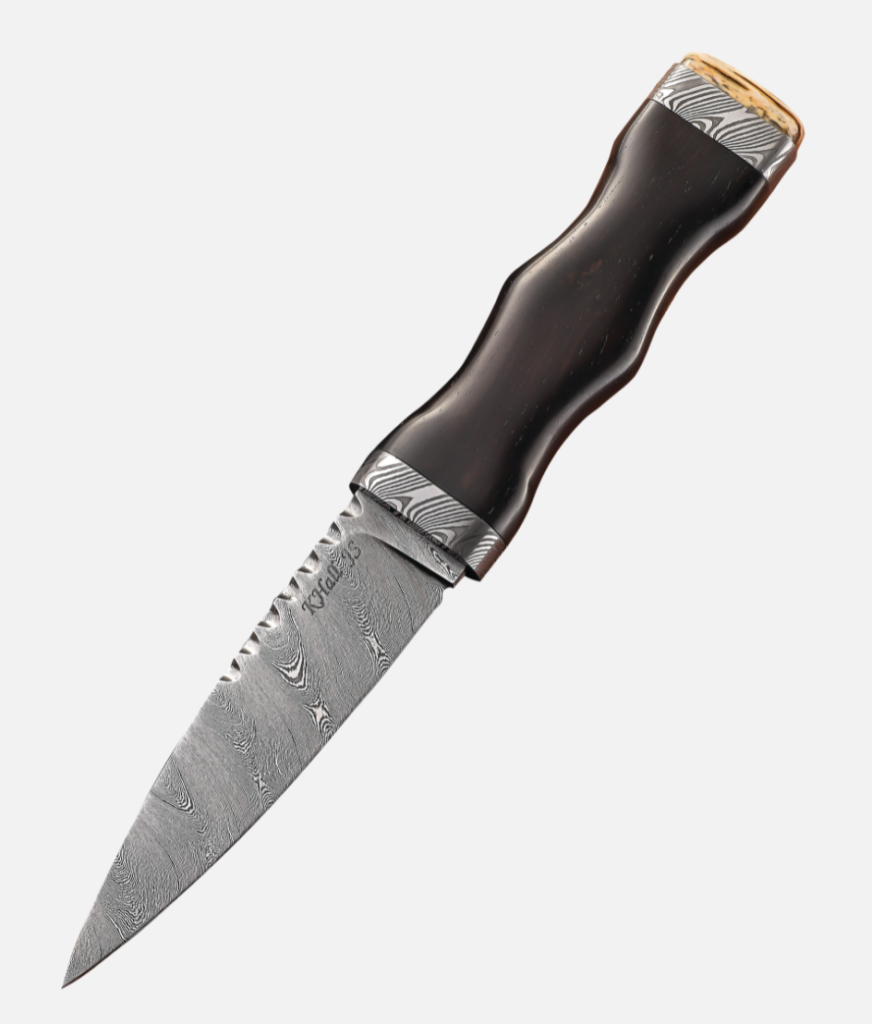
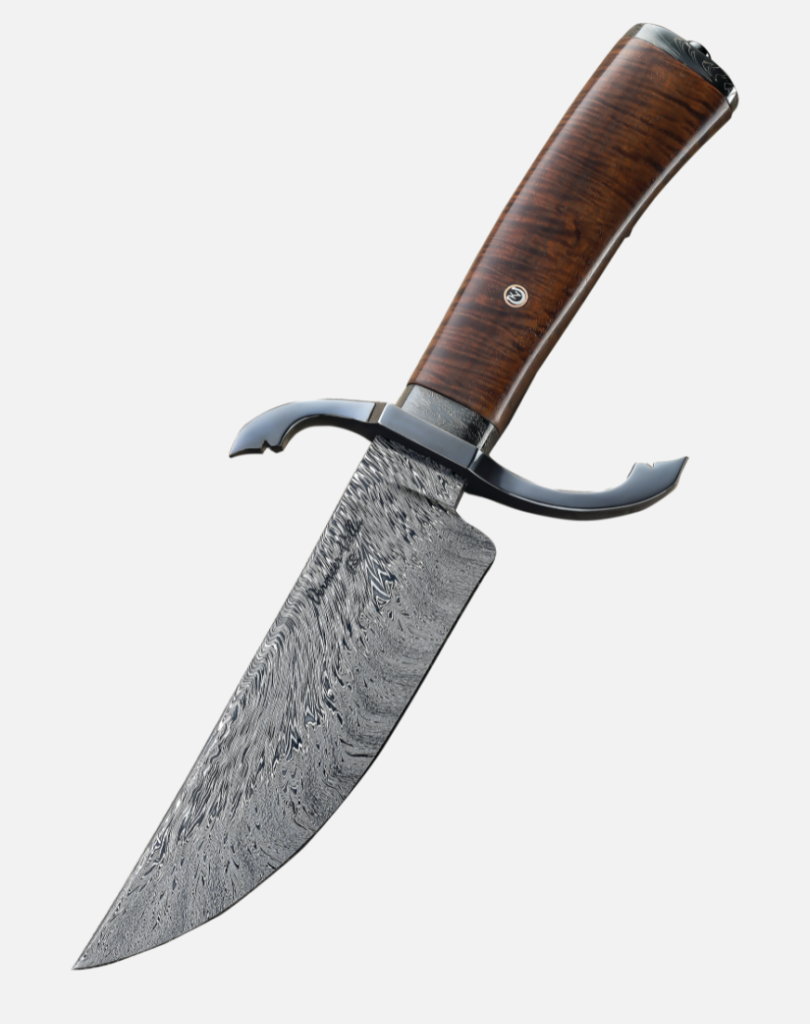
Ken Hall’s sgian dubh features a 4.25-inch blade of twist damascus in a blend of 1075 spring and 15N20 nickel alloy steels. The pommel is formed from stone and giraffe bone. The African blackwood handle not only is ideal for its carvability but also in keeping with the sgian dubh’s name, which is Scottish for black knife.

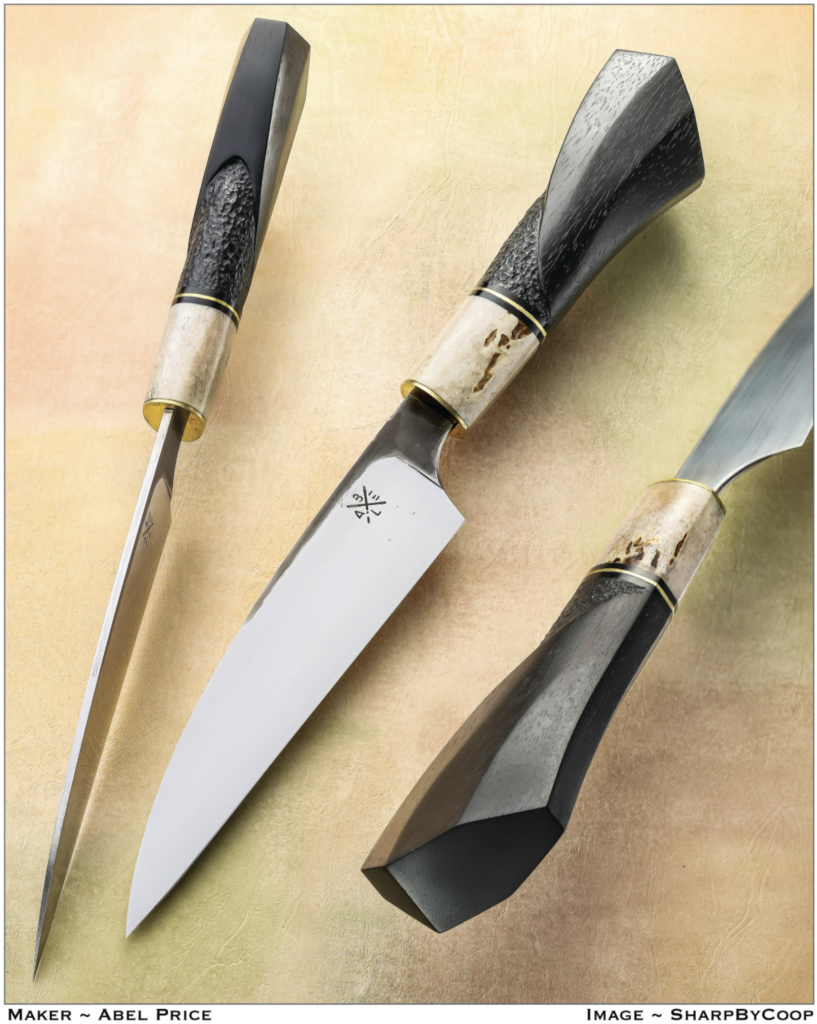
When the material finds its way to a knife handle, something dazzling happens, and the makers who use it sing its praises. “I’ve always loved black-handled knives, especially with brass,” related Abel Price of Fayetteville, Arkansas, a part-time maker who is completely self-taught. “The black and gold combo just pops and gives it a beautifully elegant Art Deco feel.”

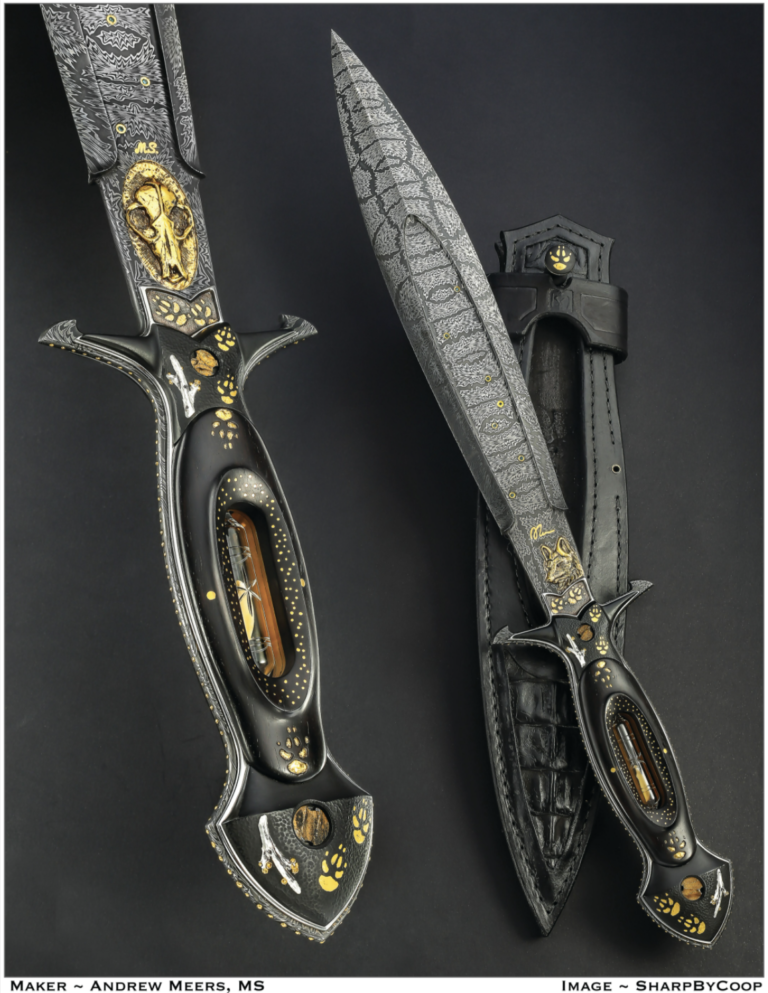
In the mountains of western North Carolina, ABS master smith Andrew Meers finds African blackwood a pleasure to work with. “It’s a dense and stable wood with a consistent grain structure that is excellent for handle material. It is workable and carves well,” he noted. “It has a rich, dark color and finishes out beautifully when sanded, and I haven’t noticed any cracking, shrinking or expanding, especially compared to the cracking I’ve noticed at times in similar looking wood such as ebony. I think these qualities contribute to its growing popularity among makers.”

Abel Price used African blackwood for the handle of his Deco Petty kitchen knife. He said the handle “was sculpted to contain design elements of the Art Deco era while hitting several notes of contrast: smooth and stippled, round and flat, black and white, and straight and sweeping lines.”

Andrew uses rasps and files for shaping, a flex shaft for carving, and prefers to sand and buff to finish his handles of the material. Last of all, he applies a coat of Danish oil. So, the finished product is just what the maker wants, and getting there is most often a pleasurable journey rather than an arduous trek. African blackwood exhibits excellent stability and takes a shine quite well. Custom makers agree that the material is ideal for carving, though whether it carves easily or not is open to the interpretation of the individual maker.

“I think the main reason for its carving ability is that it is hard,” commented Pekka Tuominen, a 17-year maker from Keitele, Finland. “Wood has to be hard if you wish to carve it with sharp and tight curves, and also polish those curves. Let’s say it’s not easy to carve, but when wood is hard you can get a good finish. Of course, it’s popular, too,” he observed. “Everybody knows that if some famous knifemaker uses a material, then the rest of the makers at least want to test it.”

MORE ATTRIBUTES

Waynesville, North Carolina-based ABS journeyman smith Ken Hall appreciates additional attributes of African blackwood. “I like using it because it’s a very dense wood, doesn’t require stabilizing, is hard and does not crack easily,” he stated. “It has a tight grain structure, so you don’t have to fill voids, and it can be carved or shaped without difficulty and provides a dark contrast to a steel blade.”

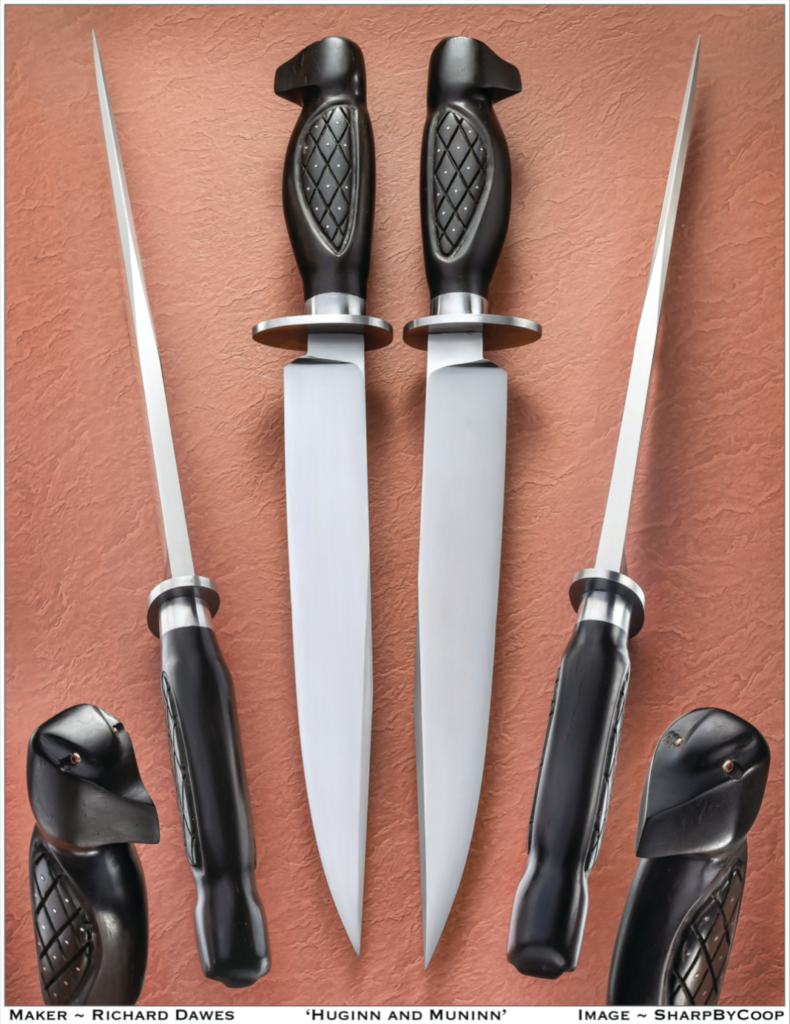
Huginn and Muninn are the names for two bowies by Richard Dawes. Huginn and Muninn are two mythical ravens that attend Odin. Dawes carved the African blackwood handles in a bird’s-head motif based on the style of bladesmith Bill Bagwell, one of the founders of the American Bladesmith Society.

Securing the handle to the blade most often involves a quality epoxy and a combination of pins, depending on the type of knife under construction. “I use rivets, pins and epoxy,” Pekka said, “but I don’t use African blackwood for full tangs. With hidden tangs sometimes just epoxy will keep the tang solid inside the handle.”

When Price went to work on his Deco Petty, a kitchen knife creation with a 6.5-inch blade of AEB-L stainless steel, overall length of 12 inches, and a handle of African blackwood, deer antler and a copper spacer, he knew just what he wanted to achieve. “The goal was to hit form and function,” he commented. “The ultra-thin cutting edge flexes with lateral pressure, and a Rockwell hardness of 61 [HRC] makes for a laser sharp tool in the kitchen. The handle was sculpted to contain design elements of the Art Deco era while hitting several notes of contrast: smooth and stippled, round and flat, black and white, and straight and sweeping lines. African blackwood does everything you want it to do with a perfect finish.”

Hall fashioned his sgian dubh as an interpretation of a historical Scottish knife. “African blackwood is the ideal wood for the sgian dubh because it can be carved and shaped to the hourglass design of the traditional sgian dubh handle,” he noted, “and provide an eye-catching contrast to the stainless steel bolster and pommel.” He added that blackwood is his preferred wood for a handle with a keyhole design because it can take the force applied to pressing the wood into the keyhole.

AESTHETICS & FUNCTION

Meers made the striking Vulpecula with a 12-inch damascus blade of 1084 carbon and 15N20 nickel alloy steels. Meanwhile, something of a surprise is embedded in the African blackwood handle.

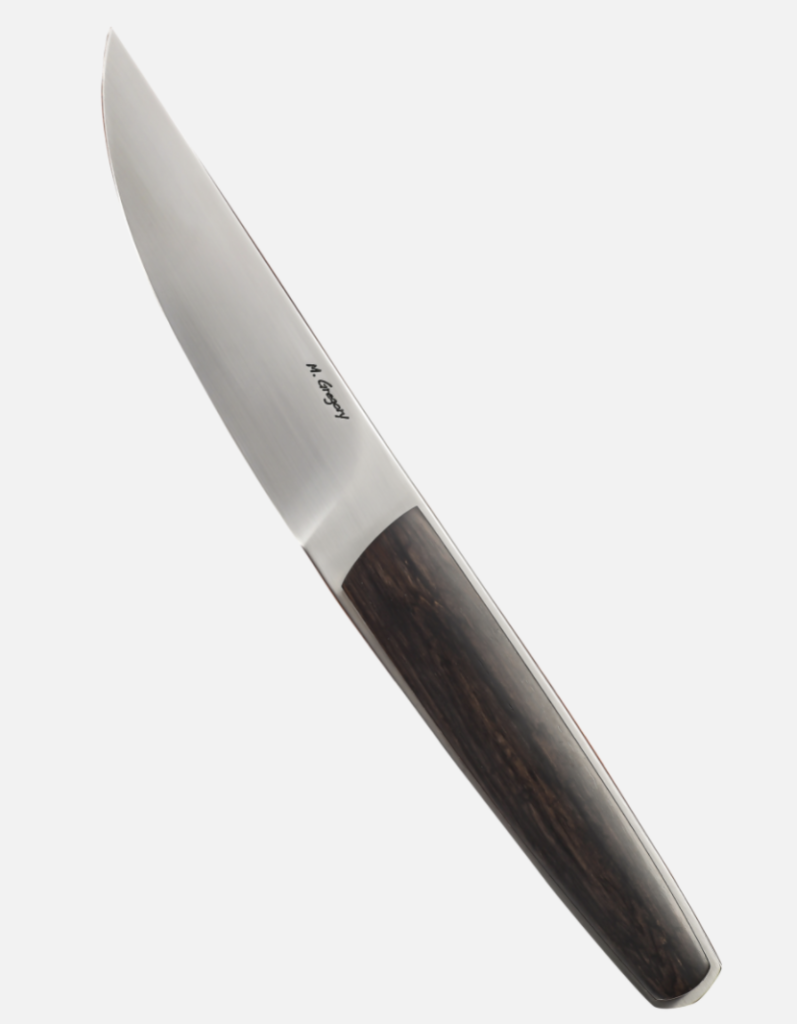
Matt Gregory’s LWT (Lum-Walton Tanto) is based on a design by Mike Walton inspired by the late Bob Lum. The African blackwood handle is polished to a mirror shine and tapers slightly in reverse of the tang, and has a delicate bulge in the center to provide for a subtle yet improved grip. The sheath (not shown) is by Jill Gregory.

“Vulpecula is a reliquary dagger,” Andrew explained. “It is inspired by the tradition of keeping objects, often hair or remains, in an embellished vessel. I found a fox tooth and had it sealed in a glass vial by a friend. I then built this dagger to house the vial as a reliquary.

“The blade fittings and handle are adorned with 24-karat gold inlay depicting a large fox, its skull and paw prints. The hardware is torch-cut steel plated with gold that is brushed back. Vulpecula, the ‘Little Fox’ constellation, is set into the blade with blue diamonds.

“It was a combination of aesthetic and functional choices that made me choose blackwood for this piece,” he concluded. “The wood machines and carves well, so for this handle it was the ideal choice. The blackwood’s depth serves as a rich contrast to the bright gold used in small inlays to represent a starry sky and the fox prints as well.”

Tuominen built his Protector, or Suojaleijee, dagger with a 5-inch welded damascus blade of 1080 and 80CrV2 carbon and 15N20 nickel-alloy steels, a guard of Nicorros (a copper/nickel alloy), African blackwood handle, and a handmade leather sheath with stainless clip. The blade is 7 inches and overall length is 12 inches. “It’s a custom order for an American collector,” he noted. “I used African blackwood because it’s black and more stable than other black-colored woods.”

SOURCES

While African blackwood remains protected, it can be found through various sources. However, Abel has a warning.

“I stocked up at a Rockler store a few years ago,” he remarked. “I’m not looking forward to finding another supplier. I believe the demand is outpacing the supply, and as conservation efforts increase, as they should, so will the price.”

Kelly Vermeer Vella em-
ploys African blackwood
and sterling silver for the
handle of her dagger. The
blade is a damascus of
1075 spring and 15N20
nickel-alloy steel.

Hall searches eBay for African blackwood and makes his selection based on what is available. Pricing, he says, runs $20 to $30 for a handle block or set of scales. While Pekka often sources his African blackwood from European knife shows, he also checks the internet for block-size pieces. Meers has had success with retail suppliers and finds a broad range of dimensions.

The custom knifemaker and the consumer alike have taken a new interest in African blackwood, and that fascination is not likely to fade in the near future.

Advertisement

Must Read Articles

Read this before you make a knife

Knifemaking 101 – Read This Before You Make a Knife

  by Wayne Goddard My experience has taught me that there's nothing like digging in and getting started. I've often said the hardest part of the...
how to forge damascus steel

How to Forge Damascus

Advertisement
Advertisement