First Look: Legendary CRKT M16 Gets Affordable Makeover

Celebrating its 30th birthday, the Kit Carson-designed M16 has an economical crossbar lock option.

It might seem surprising, but CRKT produced one of the most popular military knives of modern times. Here, we aren’t talking about issued blades, but working EDC options, typically purchased at a soldier’s local PX.

Aptly named, the M16 was the wire stripper, rope cutter, lid prier and snack slicer of choice for many a military man and woman from Kandahar to Kubal and Baghdad to Balad, and everywhere in between. And the unexpected warhorse is celebrating its 30th birthday this year.

CRKT isn’t allowing this momentous occasion to slip by, with the Kit Carson-designed folder having a pair of new models added to the series. The black M16-10XK and tan M16-10XD hues aren’t the eye-catching aspect of the new knives, nor are the models’ crossbar lock—it’s available on a few other models. Instead, the M16 model’s price tag should get fans of the folder excited.

Both models come in with a very affordable $48 MSRP, making them among the most reasonably priced options in the family of knives. This is particularly true of the crossbar lock models, which start at $75.

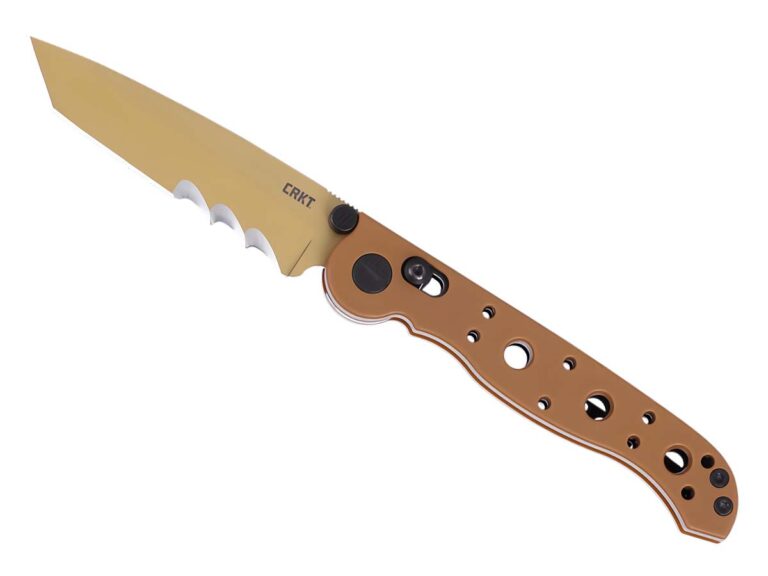
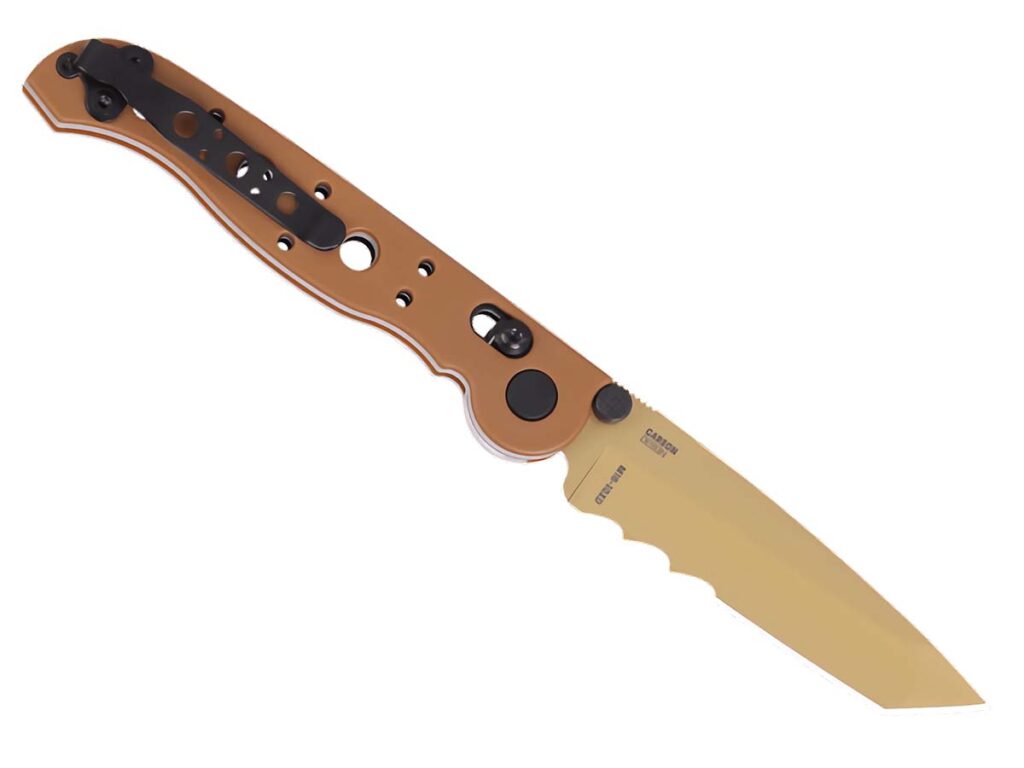
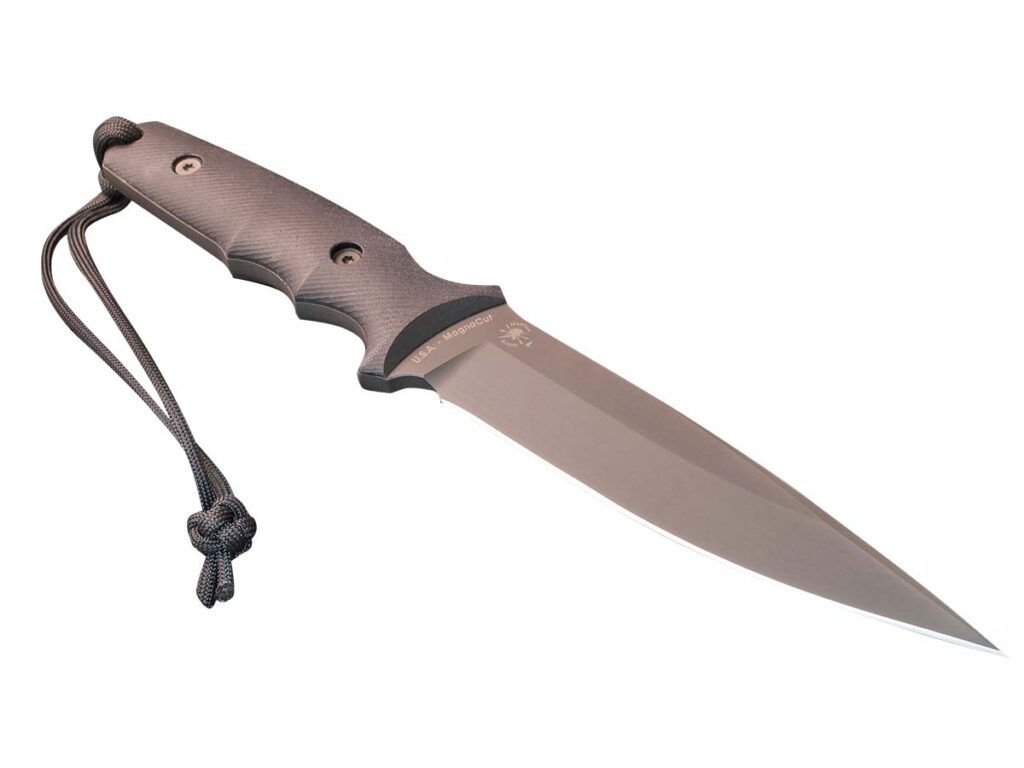
CRKT M16 10XD profile, clip side.

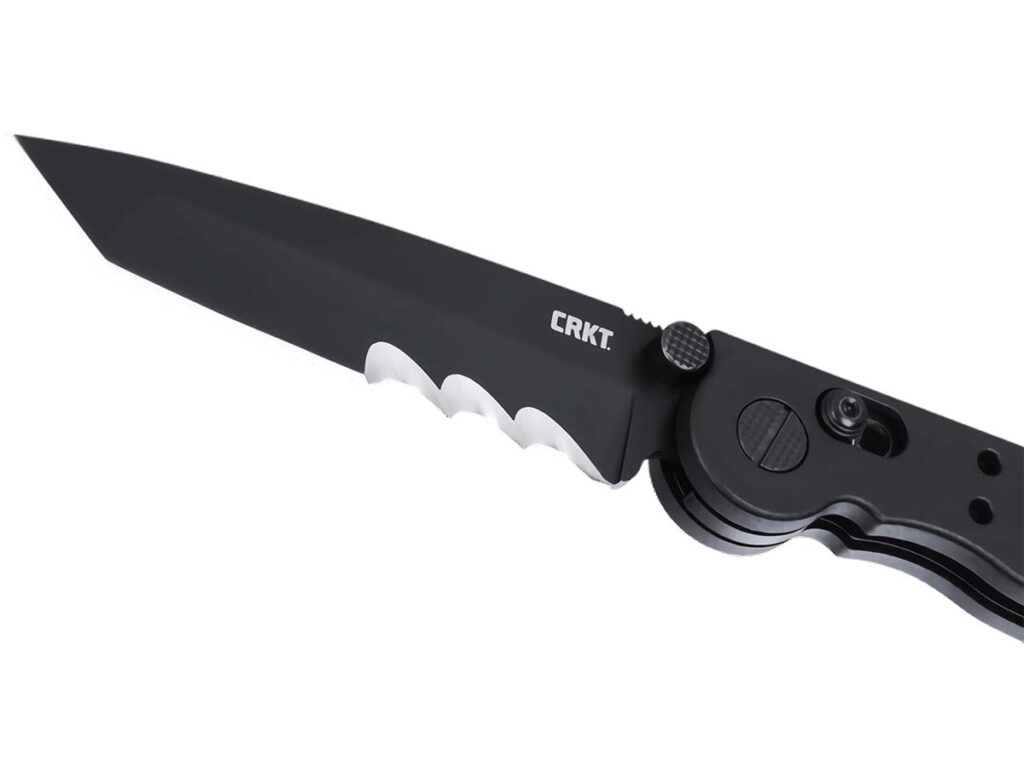
Enthusiasts or veterans looking to replace the blade they lost in the “sandbox” get a solid build out of the new M16s. Both models are outfitted with 3.03-inch 8Cr14MoV modified tanto blades, with titanium nitride finishes and sporting Veff serrations near the heel. The final aspect is wicked, giving the blade a highly aggressive cutting ability.

The blade deploys quickly, thanks to IKBS ball bearings and opens via thumbstuds or with a flick of the wrist, with the crossbar lock actuated. Note, the locking system is ambidextrous, rock solid and allows for single-handed manipulation. The handle is fiber-glass reinforced nylon, keeping the knife’s weight a very manageable 2.1 ounces.  

CRKT has shown plenty of dedication to the M16 design and evolving it over the years. Early this year, the company dropped a balisong version of the knife, possibly the most unique riff of the time-tested design. In all, there are now 36 variations of the storied M16.

A couple of notes on the knife and its legacy. It was included on BLADE® Magazine’s top 10 tactical knives of the past decade in the early 2000s. Further, CRKT has created a video series on the knife’s design and military pedigree, with veterans and experts looking back on their time with the knife.

CRKT M16 10XK blade profile.

M16 10XK & 10 XD Specs
Blade Length: 3.03”
Blade Thickness: .10”
Overall Length: 7.06”
Closed Length: 4.01”
Weight: 2.1 oz.
Blade Material: 8Cr14MoV
Blade Profile: Tanto
Blade Edge: Plain & Veff Serrations
Handle Material: Fiber-Glass Reinforce Polymer
MSRP: $48

Knife Reviews:

BLADE Show 2026: Thriving At 45

Forty-five shows in, the edge-travaganz’s remains the beating heart of the knife world.

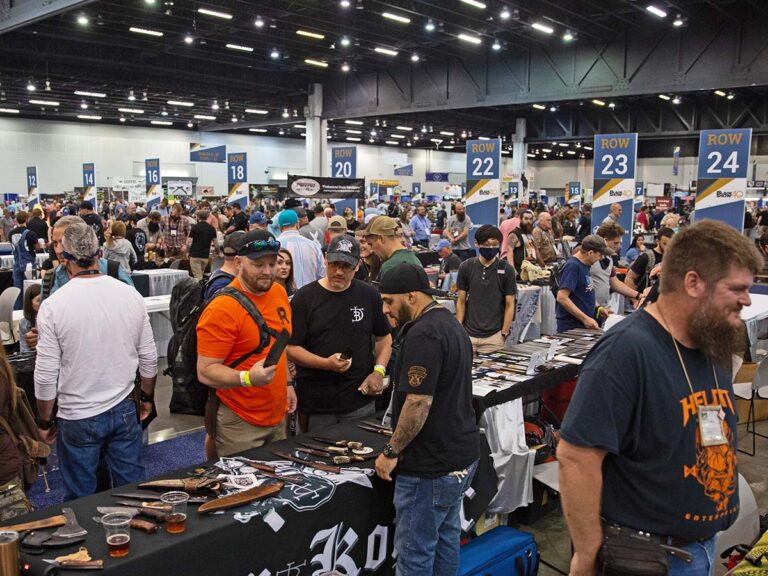
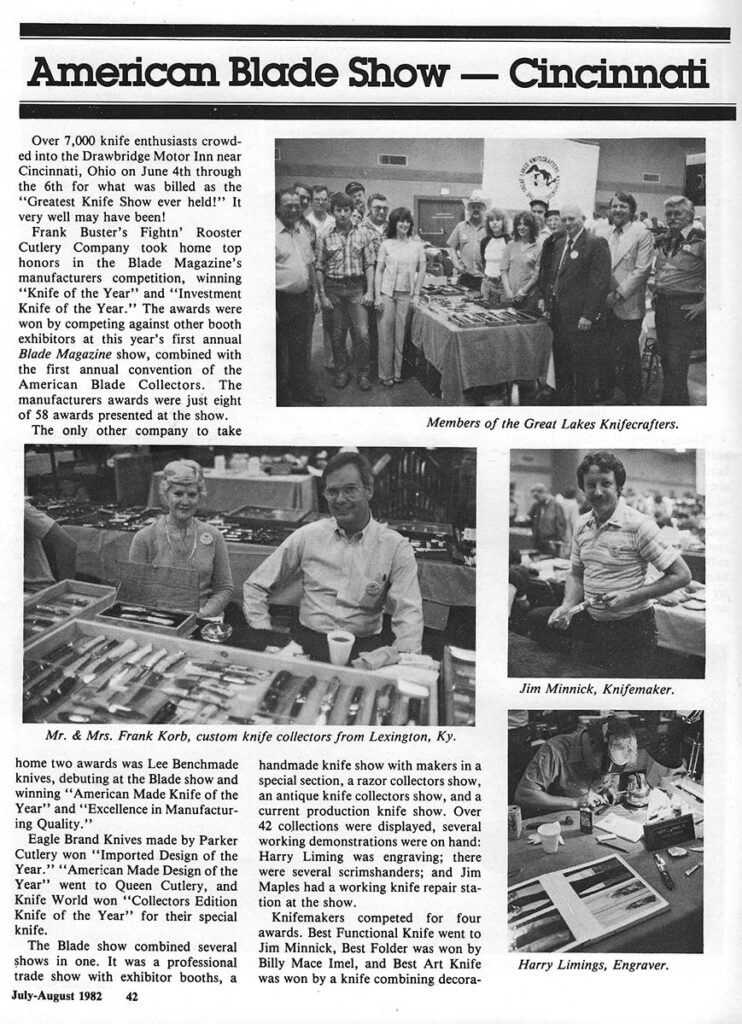
Each year, the BLADE Show draws thousands as the knife industry’s perennially premier event. Now celebrating its 45th anniversary, BLADE Show has grown from humble beginnings at the Drawbridge Motor Inn in Fort Mitchell, Kentucky, in 1982 to a hub that stirs enthusiasm, sparks lively discourse, facilitates buying and selling and energizes the world of cutlery like no other.

Knife enthusiasts and aficionados of all types, makers, purveyors, factory representatives and collectors have crowded the floor of the show regularly, from the greater Cincinnati, Ohio, area to the World Trade Center in Knoxville, Tennessee, to its present home in Atlanta. Memories have been made, deals struck and a rising tide has lifted all.

“We originally said we were going to do one show a year,” remembered Bruce Voyles, BLADE Magazine Cutlery Hall of Fame® member and longtime publisher of BLADE® Magazine. “The goal was to make it more than a show. We loved the original venue in the Cincinnati area, but we outgrew it in two years, moving to 70,000 square feet in Knoxville by 1985 or so, with 700 tables, and then to Atlanta, where there is an airline hub and more international people were able to attend.

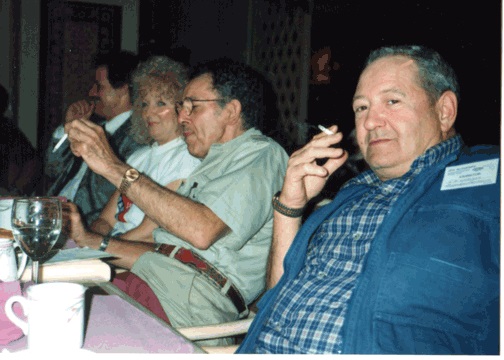
From the right, Bob Loveless, J.W. Denton and Myra and Durvyn Howard enjoy a dinner after a day on the BLADE Show floor. The show is as much a social gathering as it is an industry event. (John Denton image)

“Nobody had gotten such an incredible group of people together in one room before, and from it some amazing things happened,” Voyles reflected. “Sal Glesser of Spyderco came up with the idea for collaborations, and that really began at the BLADE Show as manufacturing people wandered into the handmade area–and it happened! We built the show on borrowing ideas from others and adapted it for all we could, trying to minimize mistakes we had seen in other shows.”

Through the years, the BLADE Show has been characterized by its exchange of ideas, vigorous commerce, displays of remarkable collections, professional demonstrations, honors for the industry greats and much more. Voyles smiled, “It just went gangbusters!”

And so, while the BLADE Show is in its 45th year, many have made the annual pilgrimage time and again. They acknowledge the impact the event has had on the knife industry and reflect on their memories and its true significance. The show has evolved, experienced growing pains and reached new heights of influence–but its dynamic energy has never waned, even in these days of the internet and instant access to information.

Knife Family Reunion

From the start, BLADE Show was red hot. Documenting the first show at the Drawdridge Motor Inn near Cincinnati, Ohio, the article from the July/August 1982 American BLADE estimates more than 7,000 knife enthusiasts showed up.

“The early BLADE Shows were run by Bruce,” commented ABS master smith and custom purveyor Dave Ellis. “Over the years, ownership has changed and the crowds have grown. Now there are two rooms to hold all of the table holders. The lines to attend start days in advance and eager folks flood in to be first to their tables of choice. The seminars have grown, and celebrities, musicians and folks from all walks of life attend with the expectation of purchasing that special piece they have saved all year for.”

During his active days as a bladesmith, Ellis attended shows with greats like Hall of Fame legend Bill Moran and master smith Jerry Fisk. He remembers sitting in “the Pit” at Atlanta’s Waverly Hotel, where friendships were forged and discussion flourished.

Hall of Famers Daniel Winkler and Karen Shook were attendees in the 1980s, and their first impressions were lasting. “It was overwhelming to know there were that many people making knives and to see the diversity,” Karen recalled. “The most striking memory is the sense of community and camaraderie. We did not know who the legends were at the time, but when we got to know them, we learned of a group of great talents with great passion for knives and the knife community.”

Among the aspects that set BLADE Show apart from other knife shows is the inclusion of factory knives. This has become an important part of the industry, as companies vie for the coveted Knife Of The Year award. Spartan Blade nabbed the honor in 2024 with its wicked Clandestina.

Karen fondly remembers sitting in the Pit. “It was like a family reunion. Almost every face became familiar. The show and the promotion of the same have attracted interested parties and given makers the opportunity to meet people and educate attendees as to why custom knives cost more than your typical hardware store hunting knife.”

Magic Of Knives In Person

When UK-based custom scissor maker Grace Horn attended her first BLADE Show in 2003, she was expecting her second child. “That child was conceived with the knowledge that I had to attend and not be too pregnant to do the transatlantic flight,” she laughed. “I have been attending every year since, and the changes have been fascinating. The fluxes of the industry are so much easier to see in a microcosm at a show … a snapshot of the industry at a point in time. Even in this world of increased social media engagement, nothing replaces the actual interaction between people. I love the sense of community that comes with the BLADE Show.”

Collector Chris Schluter agrees. “These days, so much of knife collecting takes place via social media,” he said. “It’s been great for sure–online sales, frequent interaction with makers and collectors. There’s still not a substitute, though, for meeting people in person and handling knives in person. For collectors, this is seeing your favorite makers in person and also walking by that table with a maker you’ve never heard of and stopping because something caught your eye. It’s not just meeting people during the show. It’s also after hours in “The Pit” and nearby restaurants and bars where people have time to chat. The BLADE Show is always something I look forward to, and I think many makers and collectors see the show as a sort of annual ritual that they really try to go to each year.”

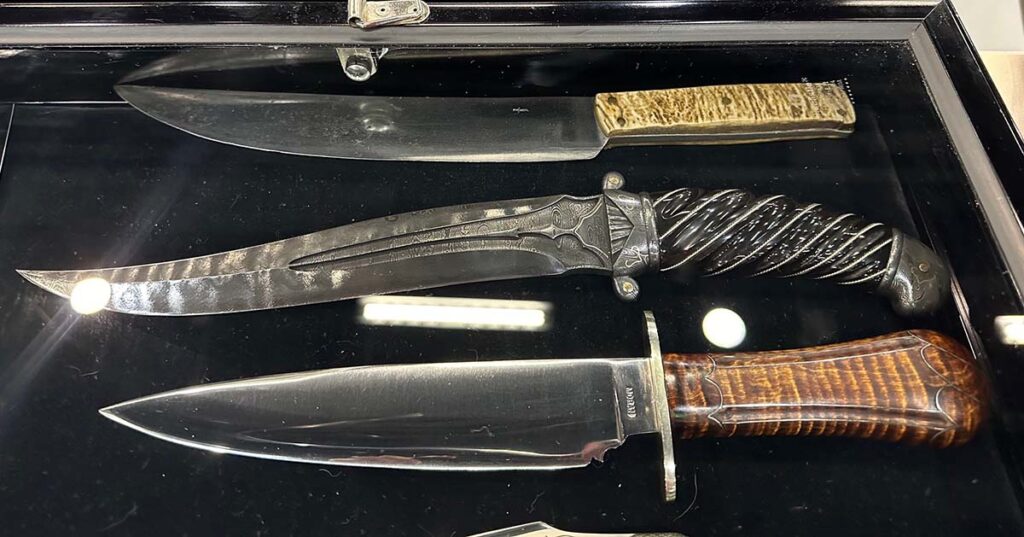
From top, knives from Hall of Famer Bill Scagel, CAS and Hall memeber Bill Moran. Imagine seeing so many great creations in one case. Through the years, it's become commonplace at BLADE Show. (Dave Ellis image)
From top, knives from Hall of Famer Bill Scagel, CAS and Hall memeber Bill Moran. Imagine seeing so many great creations in one case. Through the years, it’s become commonplace at BLADE Show. (Dave Ellis image)

That pervasive energy, the smiles and the renewal of each acquaintance team up with the latest across the knife world to make the BLADE Show even more relevant in today’s environment. “The BLADE Show has made the careers of custom makers,” declared renowned knife innovator Ernest Emerson. “Before the internet, how could you find out about custom makers and their knives? BLADE Magazine was it, and the readers of BLADE Magazine would go to that show. Still, there is no motivation like seeing what the other guys are making.”

Emerson’s following is proof positive that the BLADE Show complements a career. The throng that gathers at each show to purchase his knives and those of other makers gave rise to the lotteries that are commonplace these days.

“The BLADE Show has pushed the knife world to outer space,” assessed Loveless knives expert and purveyor John Denton. “People keep coming back because it has something to do with the love of custom knives—one on one with makers, dealers, collectors—we all love the same thing. So, it is so much fun to see everyone. It feels like family. We all come back because we have all we need at the BLADE Show. The future is here, and now, so I just hope the magic stays.”

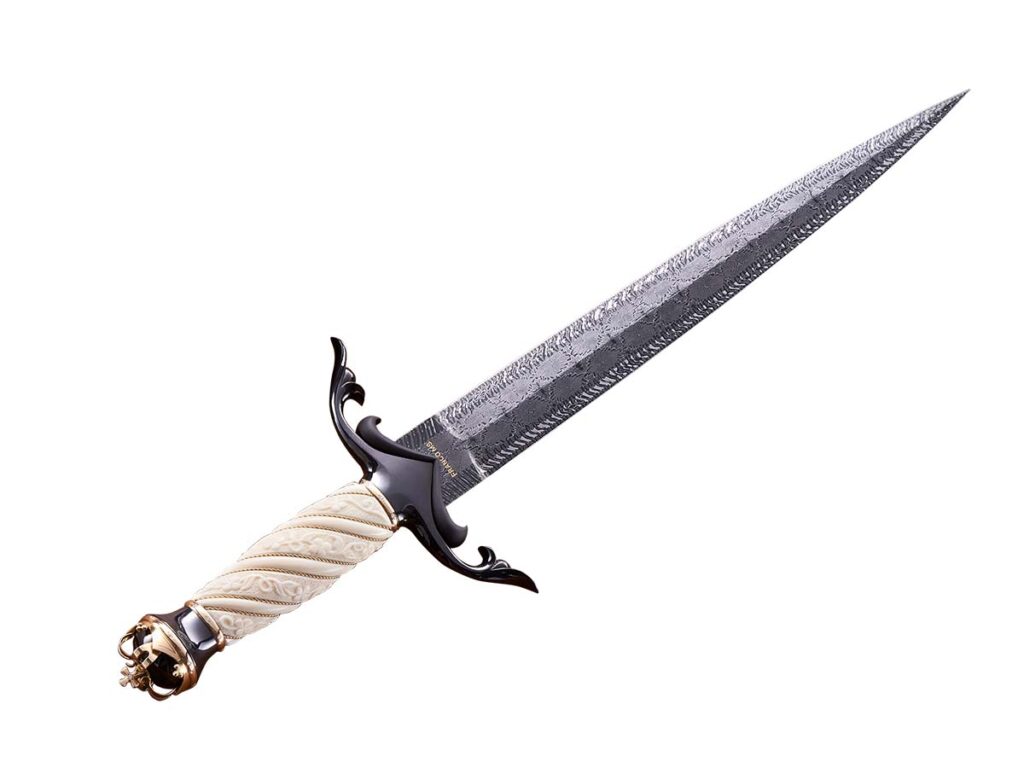
BLADE Show launched during the golden years of custom knives in the 1980s. But don't think the best years are behind. Contemporary makers, such as Brazilian Dionatam Franco, continue to wow with creations like his 2023 Best of Show dagger.
BLADE Show launched during the golden years of custom knives in the 1980s. But don’t think the best years are behind. Contemporary makers, such as Brazilian Dionatam Franco, continue to wow with creations like his 2023 Best of Show dagger.

That magic was indeed, at times, like catching lightning in a bottle. “It was things like [Hall of Famer] Bob Loveless staying with Wayne Clay, and once the show ended for the day, we all went out to eat,” Denton commented. “Then, at the hotel, you just looked around the room, and the knifemakers of the world were all pretty much in the same place. You could listen to Loveless and [Hall of Famer] A.G. Russell discussing things. Over on the couch was [Hall member] George Herron. Then you saw Bill Moran relaxed next to him. It was all bigger than life.”

From Show To Spectacle

Les George was a young knifemaker when he attended his first BLADE Show at age 25. “I don’t know if I can say it’s better now because it’s been amazing from the very first time,” he remarked. “On top of being a trade show for knives, it’s the number one social event for this business. I see some friends only at the BLADE Show, even though I’m in touch with them all the time. The BLADE Show is a huge fixture in my life, and the whole year pivots around the June trip to Atlanta.”

Of course, many others would say the same thing. Like the proverbial sun, the BLADE Show is the center of the knife community’s solar system. Its atmosphere sheds radiant light on the industry. Its gravitational pull is virtually irresistible. Its intensity is nothing short of “white hot”.

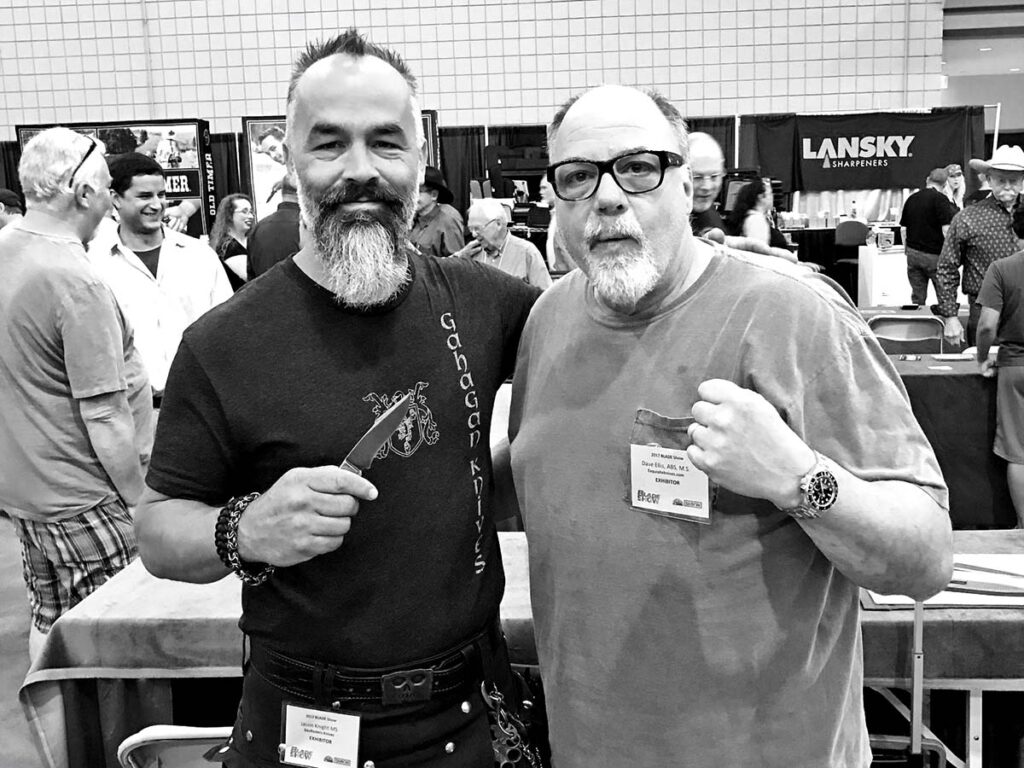
A couple of master smiths—Jason Knight (left) and Dave Ellis (right)—rub elbows at the BLADE Show. (Dave Ellis image)

Through change and reinvention, the BLADE Show remains a driving force in its 45th year. And even though the computer screen and cell phone add to the communication milieu, those who know what the BLADE Show is will accept no substitute. Here’s to 45 more years.

More On BLADE Show:

Competitive Knife Throwing: Girl Power On The Fly

0

Women are leading the rise of knife throwing across the country and the world.

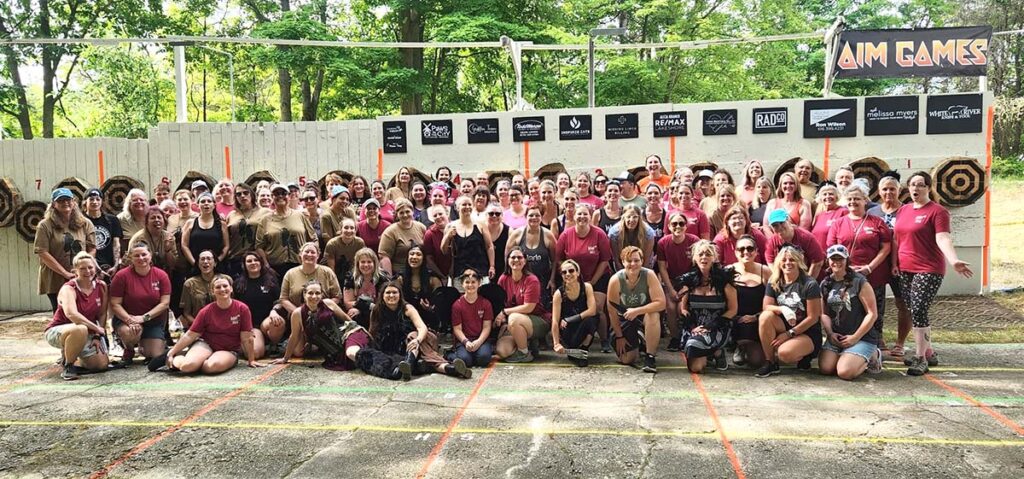
As an accessible and affordable hobby, knife throwing is seeing a surge in development and an astounding cultural impact. Since my first knife-throwing tournament over 30 years ago, the sport has steadily grown. One of the largest gatherings of knife throwers began in Berwyn, Pennsylvania, guided by knife designer and champion thrower Joseph “Brokenfeather” Darrah. Now known as Brokenfeatherpallooza, it has evolved into a top national event.

The Quaker State event isn’t alone in rallying throwers in the spirit of camaraderie and friendly competition. The Columbia City, Indiana-based Dangerfest—led by online knife-throwing sensation Brandon “Danger” Dillon—has become a mainstay on the throwing circuit.

It’s unsurprising these major events have taken root where they have, given throwing’s deep roots in the region. Michigan is among knife throwing’s historic epicenters, thanks in large part to BLADE Magazine Cutlery Hall of Fame® member Harry K. McEvoy. As a result, the state has long been home to devoted McEvoy and Tru Balance knife enthusiasts.
During my time at the helm of the Tru Balance Knife Company, I met countless throwers—many of them members of a group known as the Michigan Blade Throwers. This group held frequent tournaments and became a driving force in the regional throwing community. From this large and passionate collective emerged a group of women who would soon redefine knife throwing in Michigan and beyond.

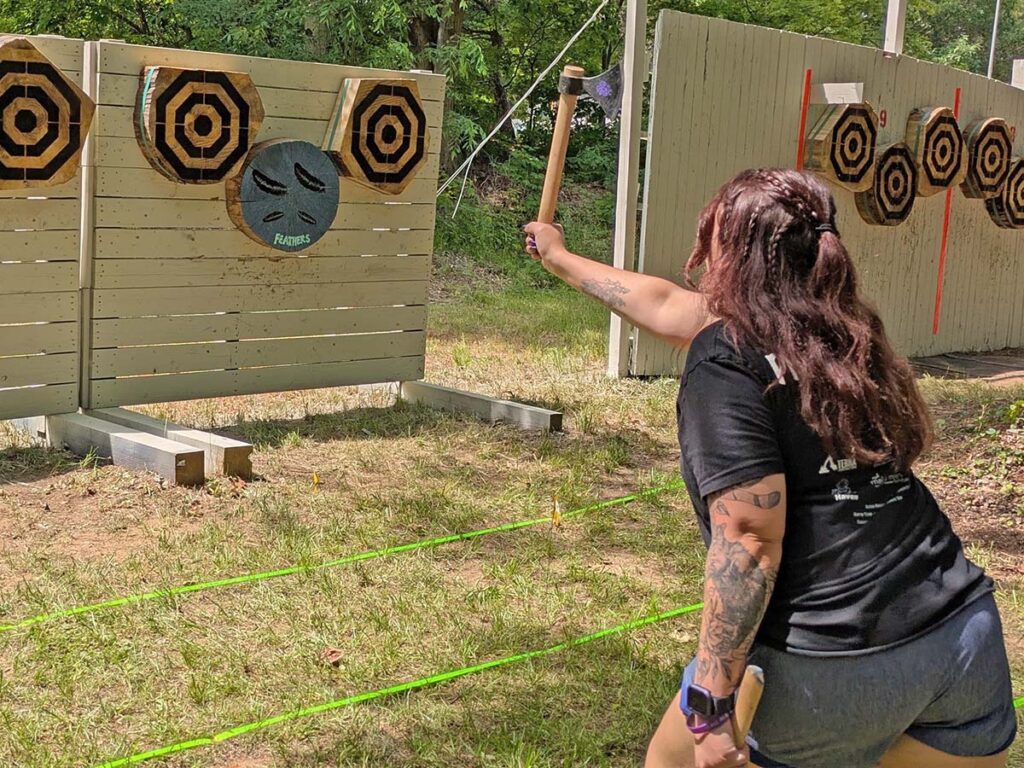
Among the attractions women have found in knife throwing is empowerment, stress relief and camaraderie, according to the author.

Birth Of A Movement

In 2015, Kelly Grove launched Women With Knives (WWK), igniting the world’s largest women-only knife-throwing league. What began as informal backyard sessions with her husband, Jeff, quickly evolved into a grassroots movement. Long before entering the competitive circuit in 2019, Kelly was already building the sport. In 2018, she organized her first league event, the Gung-Throw, which later became the now-iconic Battle of the Blade Maidens. Kelly’s influence extends even further. A founding member of the Michigan Blade Throwers, she helped establish the state’s first Throwstorm Tournament in 2020. Recognizing the importance of preserving and growing the community she had created, she converted WWK into a 501(c)(4) nonprofit organization in 2021.

Kelly officially retired from competitive throwing and league leadership in 2023 but continues to guide WWK as a member of its Board of Directors. Upon stepping down, Kelly appointed Dawn Solomon as Chair and Executive Director of WWK. Under Dawn’s leadership, WWK continues to set record-breaking benchmarks for women’s participation in competitive knife throwing.

Dawn, who entered the sport in 2019, is a dedicated competitor and a member of the Michigan Blade Throwers. Together with her husband, Tim, she operates MBT Range, the largest outdoor throwing range in Michigan. MBT has grown into a hub for seasoned athletes and newcomers alike.

Most women’s knife throwing organizations began as grassroots endeavors. The inspiration of WWK, for instance, came in founder Kelly Grove’s backyard in informal throwing sessions with her husband.

Membership in the WWK is diverse. Teachers, nurses, small business owners, corporate executives, stay-at-home moms, retirees and more fill its ranks. This includes throwers of all ages, ethnicities, fitness levels, abilities and disabilities. All find a place within the league.

The attraction of knife throwing is as distinct as WWK’s members. For some, it’s a release of daily stress; for others, a confidence booster. For practically all, slinging steel is a way to forge lasting friendships. Adding to the escapism knife throwing allows, each member adopts a unique alias. These are proudly displayed on league T-shirts—adding an element of fun, freedom and identity to the experience.

At its core, WWK empowers women by teaching the art of knife throwing while fostering strength, confidence and community. Whether members aspire to compete in sanctioned events or simply want to unleash their inner warrior in a supportive environment, the organization offers a place to belong.

More than holding their own, women have become among the top competitors in all ranks of knife throwing competitions.

Today, WWK continues to thrive under the guidance of a dedicated Board of Directors and leadership team who share Kelly and Dawn’s mission. Together, they travel the country competing, coaching and championing the sport—ensuring knife throwing continues to grow and welcomes new women into the community.

Live Nationwide

Women have also stepped forward to lead major tournaments across the country. One such event is Blades Out Or Bust (BOOBS), founded by Jessica Gold McClain. A longtime supporter and advocate of the sport, Jessica—also known as “Goldi Lox”—sponsors at least two tournaments annually near her home in Bastrop, Texas.

For Jessica, the passion for knife throwing began in her teenage years. She spent countless hours honing her skills in a friend’s backyard before eventually setting up her own target at home. When she began competing, she was often the only or part of a handful of women at most events.

After a five-year hiatus from the sport, the seed was planted for what would become a powerful new community. In 2019, Jessica founded the Bladed Sisterhood with a bold vision: to unite women around the globe who share a passion for blades. This small idea has grown into a thriving international network where women connect, learn and
celebrate knife, tomahawk and axe throwing.

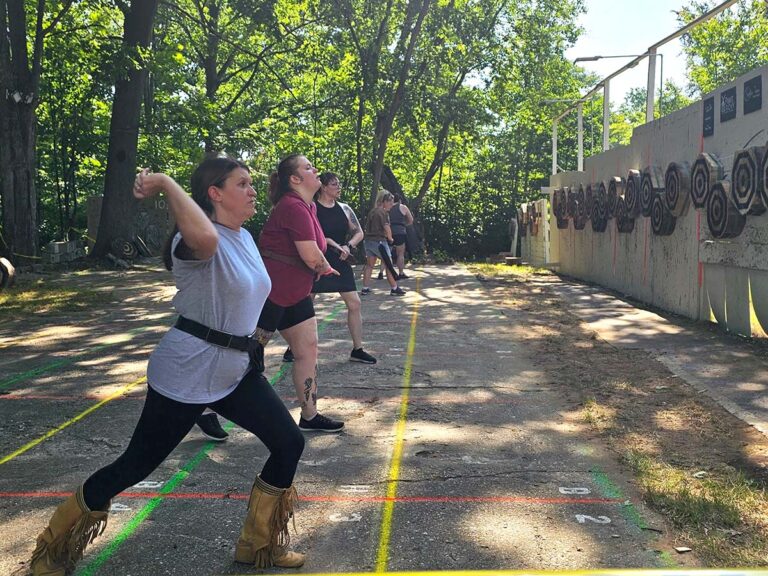
Michigan is among the knife throwing epicenters and, as the author points out, is the home to WWK and other women-focused knife throwing organizations. (Felicia Mulder image)

The organization’s dream is ambitious—to see these disciplines recognized worldwide, including as Olympic events. Until then, the Bladed Sisterhood continues building a community that inspires women, celebrates skill and honors tradition.

While women like Kelly and Jessica built strong foundations at home, others were already taking knife throwing onto the world stage.

Throwing Goes Global

One of those women is Melody Emel, a multi-award-winning champion with more than two decades of experience in the sport. After attending stunt school, Melody developed a deep interest in Western arts, which naturally led her to knife throwing.

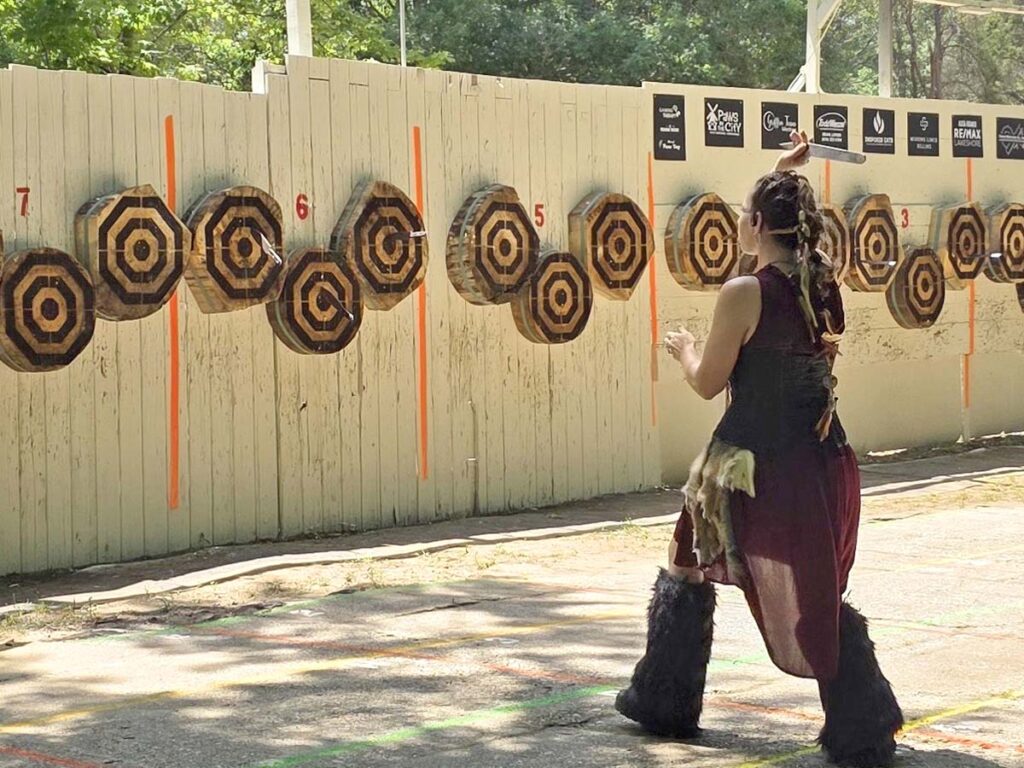
Far from an American endeavor, knife throwing has become a global phenomenon and has seen a large influx of women throwers worldwide. (Dawn Soloman image)

Following multiple first- and second-place finishes in major tournaments, Melody founded Blade Aces in Las Vegas to serve and grow the local throwing community. In 2015, she traveled to Europe to compete in the Eurothrowers World Championships for the first time, marking a significant milestone in her international career.

Melody’s passion for both throwing and teaching continues to drive her involvement in events around the world. She actively supports competitions that empower women and raise funds for breast cancer awareness and other causes dedicated to uplifting women.

From backyard grassroots to the global stage of professional competition, women have redefined the sport. With a growing international network and a dedicated leadership, the future of female knife throwing is certain.

More Knife Throwing:

Remembering Hawaiian Knifemaker Keith Derrick Ouye

Remembering a dedicated craftsman of the Fujisaka lineage known for his tactical precision and collaborative artistry.

Keith Derrick Ouye, award-winning knifemaker of Honolulu, Hawaii, passed away on October 5. He was 80.

A stocky, happy guy well-liked by both knife enthusiasts and his knifemaking peers, Keith primarily made tactical knives, though he also built hunting knives to sell at local gun shows. In addition, he made fancy folders, often with fine engraving by Bruce Shaw, C.J. Cai or Lisa Tomlin. Keith exhibited his work at the BLADE Show and other top knife events over the years. Like many Hawaiian knifemakers, he was a student of BLADE Magazine Cutlery Hall-of-Fame® member Stanley Fujisaka.

Born in South Hilo, Hawaii, Keith lived in Hawaii Kai on the island of Oahu. “I spend most of my day working on my knives,” he wrote in his mini-bio on the Arizona Custom Knives website. “With assistance and guidance from Stan Fujisaka, I started to make fixed blades in early 2004. By the end of 2004, I also started making folders. I began making knives full-time in 2005.”

Keith was a big believer in sole authorship, noting “except for the screws, dowels, standoffs and pivots, I fabricate the rest of the knife myself.”

Remembering Others The Knife Industry Has Lost:

7 Join BLADE Magazine Cutlery Hall of Fame®

New inductees span the world of custom and factory knives.

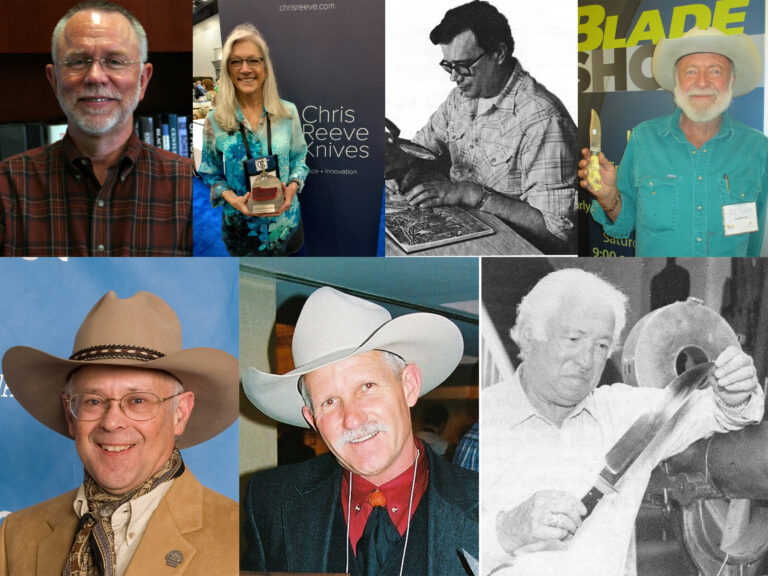
A notable assortment of those who for many years enhanced or continue to enhance the overall improvement of the knife industry highlights the 2026 class of inductees into the BLADE Magazine Cutlery Hall of Fame®.

The new honorees include three living and four deceased members. Among the former are CRKT co-founder Rod Bremer and Anne Reeve, owner/president of Chris Reeve Knives, on the factory side, and American Bladesmith Society master smith Larry Fuegen from the custom realm.

The posthumous inductees are bladesmith/writer Ed Fowler, custom knife purveyor Nate Posner, knifemaker/knifemaking supplier Bob Engnath and ABS master smith Tim Hancock.

All will be formally inducted in a special ceremony during the BLADE Magazine Cutlery Hall-of-Fame Breakfast the Saturday morning of the BLADE Show, June 6, in the Renaissance Waverly, the host hotel adjoining the Cobb Convention Center in Atlanta. For ticket information email [email protected].

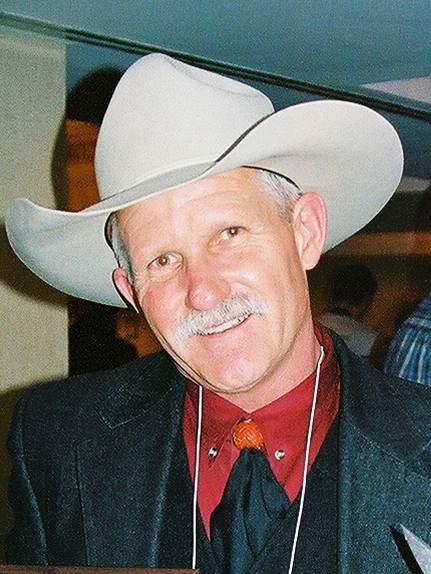
Rod Bremer

Rod Bremer

Along with partner Paul Gillespie, Rod Bremer started Columbia River Knife & Tool (CRKT) in 1994. The concept was to bring world-class-quality knives to the U.S. market in the designs of custom knifemakers—as of today, CRKT has used the designs of over 50 such makers—and innovation at a price that virtually all consumers can afford.

According to a nominator, Rod’s integrity qualifies him for the Hall of Fame, a good example being that “CRKT pays the makers/designers royalties for as long as the knife sells. To this day, Rod is still paying royalties to the estates of Ed Halligan, Jon Graham, Cutlery Hall-of-Famer Kit Carson and several others.” Added the nominator, “CRKT started the Forged by War program to help veterans and their charities. So far the program has donated over $500,000 to the charities of the veteran’s choice.”

Under Rod’s leadership, CRKT has won a number of BLADE Magazine Knife-of-The-Year® Awards. In the process, he helped enhance Southeast Asia knife manufacturing by teaching and demanding that the Taiwanese factories produce the highest-quality knives possible.
He has bolstered pro-knife initiatives through his work as an American Knife & Tool (AKTI) Board of Regents member, working on issues that benefit the knife industry. His resume includes: 1) Election to the AKTI Board of Regents (2009); 2) Playing an active role in the monumental defeat of U.S. Customs’ attempt to classify all one-hand knives as switchblades (2009); 3) Recipient of Knife Rights’ inaugural Freedom’s Guardian Award for his role in upholding knife rights industry wide (2011); 4) Elected AKTI vice president (2011); 5) Organized and hosted AKTI anti-counterfeiting round table and presented related seminars for BLADE University at BLADE Show 2013; and 6) Elected (2014) AKTI president, a position he held through 2016.

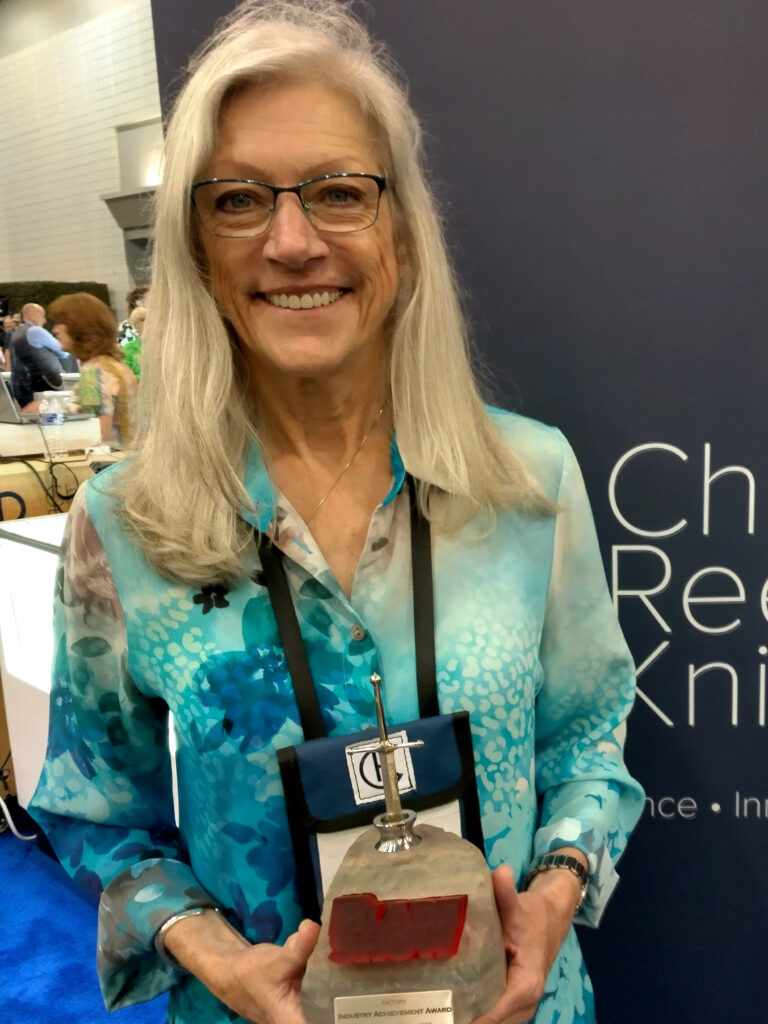
Anne Reeve

Anne Reeve

According to a nominator, in 1986 Anne Reeve joined the then-fledgling Chris Reeve Knives and quickly became an integral part of the company. Her partner, both in life and business, Cutlery Hall-Of-Famer Chris Reeve, was the craftsman, and a great one at that. While Chris’s forte was knife design, Anne’s strengths were administration and bookkeeping. Anne spent many of the following years lending a hand where she could, helping to build a company known for quality and excellence.

For most of the early years, Chris Reeve Knives was just Anne and Chris plus a handful of employees, which meant Anne wore many hats. As the company grew, Anne stepped more into working behind the scenes in administration and customer service. Her years of answering the phone and meeting customers, partnered with her determination to ‘do the right thing,’ laid the groundwork for the knife manufacturer’s international reputation for excellence. Today, the company has around 150 dealers worldwide.

On the knife legislation front, Anne showed support for both the American Knife & Tool Institute and Knife Rights with encouragement, donations of knives and cash, and attending and sponsoring related functions. She has been treasurer of the Idaho Knife Association since 2018 and is an active member of the organizing committee for the IKA’s annual show.

After a nearly 30-year partnership, Chris retired, and Anne took a massive leap of faith and bought Chris’s share of the company. With the help of their son, Tim, and a team of young, talented and enthusiastic leaders, Anne has trailblazed Chris Reeve Knives into new territory. As the nominator concluded, “Investment in equipment and employees has resulted in revenue more than doubling under her leadership, the quantity of knives produced each month continues to increase, the quality of those knives is better than ever, and demand continues to significantly outpace production. Her determination to keep the integrity of Chris Reeve Knives, coupled with the highest quality products and customer service, has set a standard in the knife industry.” Helping cap it off, Anne won the BLADE Magazine 2025 Industry Achievement Award for her many contributions to the craft and cutlery community.

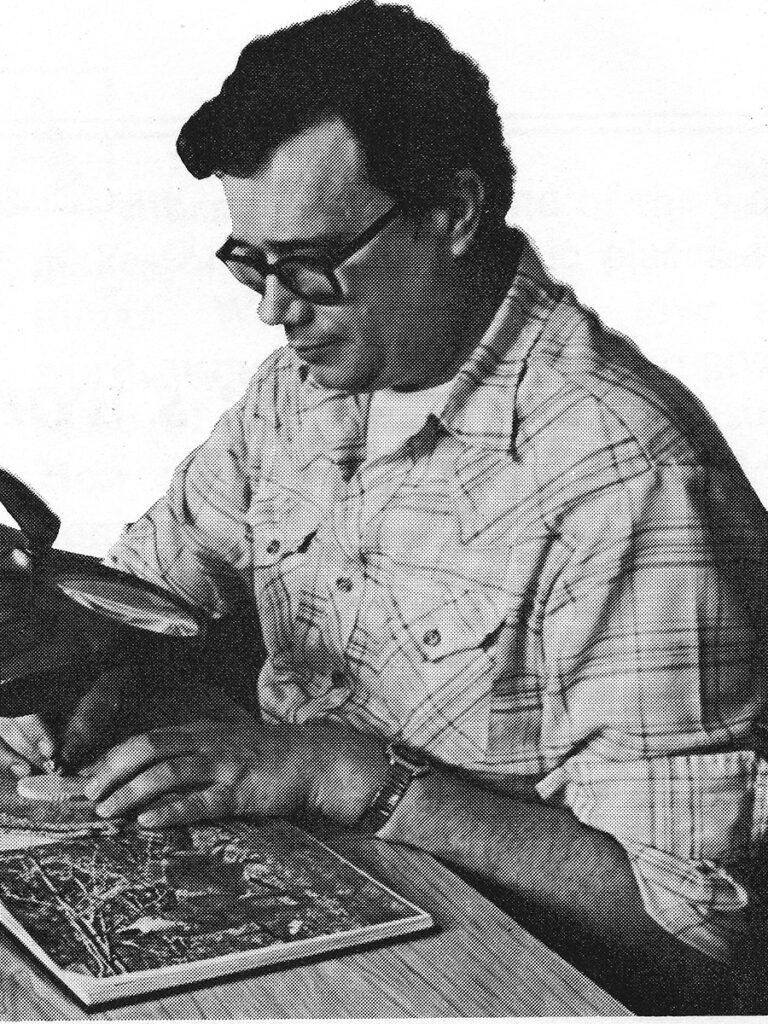
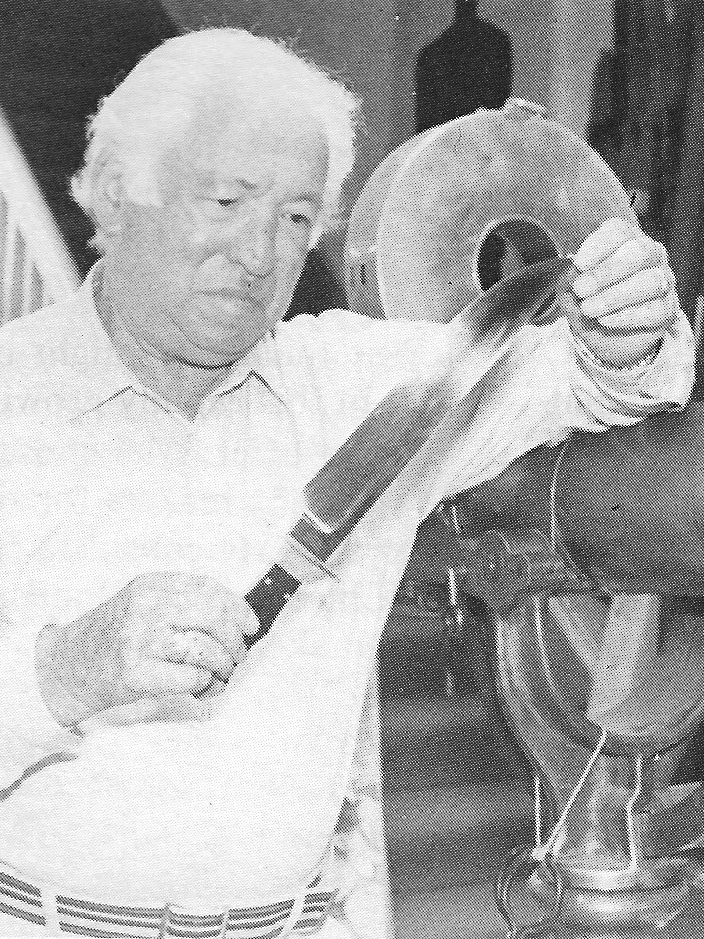
Bob Engnath

Bob Engnath

Bob Engnath built his first knife in 1972 and went full-time in ’79, making kit blades, tantos, swords and assorted knives in carbon steel. His base of operations was Blades ‘N’ Stuff, a retail shop he ran in Glendale, California, that offered tools, supplies and materials for knifemakers, bladesmiths and swordsmiths.

He produced several editions of a comprehensive publication he also called Blades ‘n’ Stuff, a 70-or-so-page 8-by-11-inch “Catalog and Instruction Manual featuring Handcrafted Blades by Bob Engnath and Knifemakers’ Supplies.” Sold for $5, it contained copious amounts of knowledge and instruction for anyone who wanted to make a knife or sword, including line art of his many patterns, knifemaking how-to’s with diagrams, tips and do’s and don’ts, and tons of sage advice on various steels, heat treating, knifemaking machines and materials, finishing, how to forge damascus, shop safety and other invaluable information. In addition to his catalogs, Bob also wrote the books The Scrimshaw Connection and The Second Scrimshaw Connection.

Engnath was a dedicated blade grinder and considered by many the best grinder of the time, providing blanks his customers could finish on their own. He gave many makers their start and dispensed an untold amount of knifemaking knowledge to anyone interested enough to listen, usually free of charge. According to one source, “Bob was a mentor to countless new makers through his knife kits, leaving a lasting legacy in the knife community.”

Summed up another source, Bob “was an excellent role model for any man in the knife business. He never said a bad word about anyone, took the knife business where it had not been before, his ethics were outstanding, his word was ironclad. I’d rather have had a handshake with Bob Engnath than a lawyered-up contract with any other knife name you care to mention. He was a hero and an example to a lot of people.”

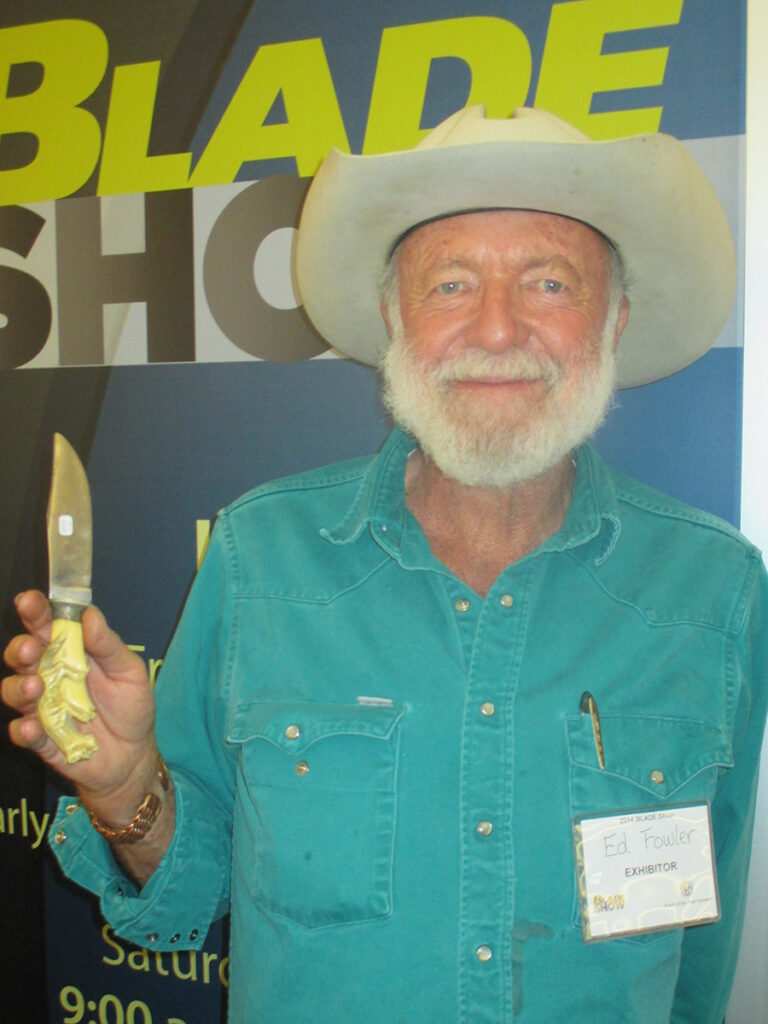
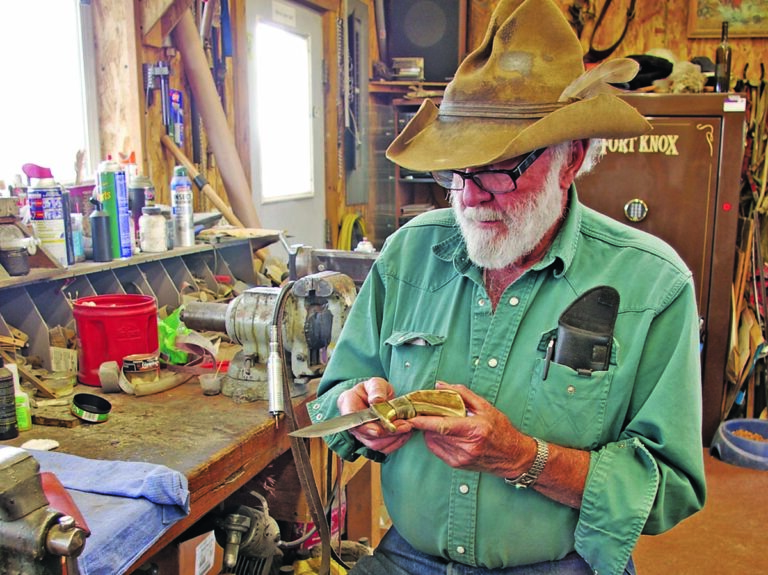
Ed Fowler

Ed Fowler

Selling his first knife in 1962, Ed Fowler epitomized “the philosophy of the cutlery fabricator,” noted one nominator. Though not the first to use 52100 carbon steel for knife blades, Ed helped popularize it as it became a go-to material among today’s bladesmiths. He long performed and encouraged the multiple quenching of blades during heat treatment.

He wrote the monthly column “Knife Talk” for BLADE® for well over a quarter century. In BLADE’s reader surveys, along with Cutlery Hall-of-Famer Wayne Goddard, Ed completed the top one-two team of most popular BLADE writers year-in and year-out. Ed compiled his “Knife Talk” columns into two books: Knife Talk I: The Art & Science of Knife Making and Knife Talk II: The High Performance Blade. He conducted demos for many years on a variety of subjects at the BLADE Show, plus a class at BLADE University.

Formerly an ABS master smith, he went on to create the High Endurance Performance Knife Association, an organization dedicated to a greater understanding of the knives its members make, the steels they use, the process necessary for the knives to reach their maximum performance potential, and to share this understanding with any and all who seek it. He taught knifemaking to many, including more than a few who have gone on to become ABS journeyman and master smiths, including Audra Draper, Wade Colter, Shane Taylor, Bill Burke and Cutlery Hall-of-Famer Rick Dunkerley among the latter.

Wrote one nominator, Ed was “very passionate about what a knife should do. He indulged anyone who wanted to share time or debate ‘the concept of cut,’ as he called it.” Ed would pit his high-performance 52100 knives against all comers in what he called “real world tests,” cutting and doing things with the knives many consider abusive, until the knives failed. Ed continued using this testing regimen, observing that though you may never have to use a knife in such a manner, “What if you had to and the only tool you had at your disposal was your knife? Wouldn’t you take comfort in knowing that if ever push came to shove, you had a knife you could stake your life on?”

Larry Fuegen

Larry Fuegen

Larry Fuegen started forging knives in 1975. According to a sitting Hall of Famer, from that time on all of Larry’s knives were sole authorship. He became a full-time knifemaker in 1987 and earned his American Bladesmith Society master smith rating in 1989.

“Since I’ve known Larry he has been a unique person who made unique knives,” the Hall of Famer wrote. “He started making friction folders after meeting Cutlery Hall-of-Famer Jim Schmidt at an ABS hammer-in. Years later Larry took those folders to a whole new level. For years he did gargoyle-type carvings on them and later started doing other renditions, like his folder featuring the Spanish explorer Hernan Cortes wearing a gold helmet and Larry’s carved face of his idea of what Cortes looked like. Besides these great folders he made many ornate bowies, daggers and hunters that had carving, texturing and engraving done in a way to set his work apart from anyone else.

“For me what stood out most were his push daggers. I believe if you Googled push daggers a picture of Larry Fuegen would come up. He not only crafted knives, he also did his own leatherwork, which was top quality. He also made some of the best bits and spurs anywhere. In addition to his quality work he designed and built the tools he needed to produce his knives, leatherwork, and bits and spurs.”

He was voted into the Art Knife Invitational in 1999 and every year thereafter until 2022. Circa 2008 another of his ornately done friction folders, entitled Alaric, King of the Visigoths, went on permanent display at the Smithsonian American Art Museum’s Luce Foundation. He has been featured in many magazine articles and books, among the latter including Greatest Living Knifemakers by Cutlery Hall-of-Famer Steve Shackleford.

Larry passed his knowledge on, teaching at numerous hammer-ins and seminars around the country. He is very knowledgeable and is willing to share with anyone. He is the personification of the traits required for induction into the Cutlery Hall of Fame.

Tim Hancock

Tim Hancock

Teaching others how to make “the total knife” played a huge role in defining Tim Hancock. “He taught and demonstrated at many hammer-ins in the areas of embellishment, design, blade forging, grinding, heat treating and sheath making,” ABS master smith Larry Fuegen observed. “He wanted to share his methods and thoughts with others. He also gave private lessons in his shop to many aspiring makers. The influence of his recognizable style can be seen in the work of many makers. Just as [Cutlery Hall-of-Famers] Bill Moran and Bob Loveless influenced many with their designs, so did Tim with his work.”

Added knifemaker Michael Vagnino, “I suppose the most important thing I learned from Tim was integrity. The knife you make is in fact a part of you. How it turns out is more about how honest you were when making it. When Tim told me that, it really made me pause. From that moment on, I viewed making knives in a new light.”

Tim earned his ABS master smith rating in 1993 and won an impressive number of honors for his knives, including the 2010 W.F. Moran Award. He was known for his award-winning period bowies, including though not limited to dog-bone bowies. Dr. David Darom dedicated an entire hardback book, Tim Hancock: The Western Bladesmith, to highlighting Tim’s knives and knifemaking career, even his penchant for forging silver-mounted bits and spurs and other Western gear. From 2001-2015 Tim was a member of the Art Knife Invitational, an organization of the world’s 25 greatest knifemakers spearheaded by Cutlery Hall-of-Famer Phil Lobred.

Nate Posner

Nate Posner

Nate Posner started the San Francisco Gun Exchange in 1948 and built it into what he called the “Firearms Center of the West.” It had most everything firearm related but it was his displays of custom and factory knives that pertain here.

Along with Cutlery Hall-of-Famers A.G. Russell and Dan Delavan and also Bob Gaddis and Dave Harvey of Nordic Knives, Posner was among the first custom knife purveyors. He was known for telling his customers that to get the best price, instead of buying custom knives from middlemen such as him they should buy directly from the maker. Of course, if the customers wanted the handmade knife in question immediately, they often had to buy it from one of the few purveyors such as Nate to avoid spending what might be years on a waiting list. However, it was being up front that put Nate in good stead not only with his knife customers but the Guild, too—for both buying/selling the makers’ knives and treating what often were the makers’ customers/prospective customers in a professional manner.

At one time he had over 350 custom knives on display, with at least that many others in stock. Circa 1975 he ordered knives from dozens of makers, most active or past Guild members. Eventually he culled his list to about 25 or 30, including one of his favorites, D. E. Henry. Others included Tommy Lee, Jess Horn, Herman Schneider, Corbet Sigman, the-then-team of Scott Sawby and Steve Mullin, and future Cutlery Hall-of-Famers Frank Centofante, Jimmy Lile, Bob Loveless, George Herron, Bo Randall and more.

Thanks to the high store profile he gave custom knives and their makers to knife and gun buyers alike, Nate was one of the most important custom knife promoters of his or any era. As a result, the honor the Guild gives annually to an individual who provides “Outstanding Service in the Promotion of Handcrafted Cutlery” is called the Nate Posner Award.

See More Award Winners:

Ed’s Quest For Excalibur

0

Remembering Ed Fowler’s 80 Years of Knifemaking.

Editor’s Note: Chris Amos is a kifemaker, writer and close compatriot with the late Ed Fowler. He perhaps knew the knifemaker better than anyone in his golden years and has an interesting perspective in the life of the memorable craftsman.

On January 17, 2026, Ed Fowler left the world of mortal men to take his place with the legends of bladesmithing. The High Endurance Performance Knife master smith’s passion for true working men’s knives of history was insatiable. It was the one true love of his life, second only to a good Labrador.

The flyer for his school when I met him 30 years ago, and to this very day, still reads, “Ed Fowler, Author, Cowboy, Friend to All.” This is how Ed approached the world of knives. If we are being honest, it wasn’t necessarily everyone’s experience with him; but it was his intention. No matter what your personal Ed Fowler experience was, I think we can all agree his love of lady knife, his undeniable passion for performance and total commitment to his craft were both impressive and contagious.

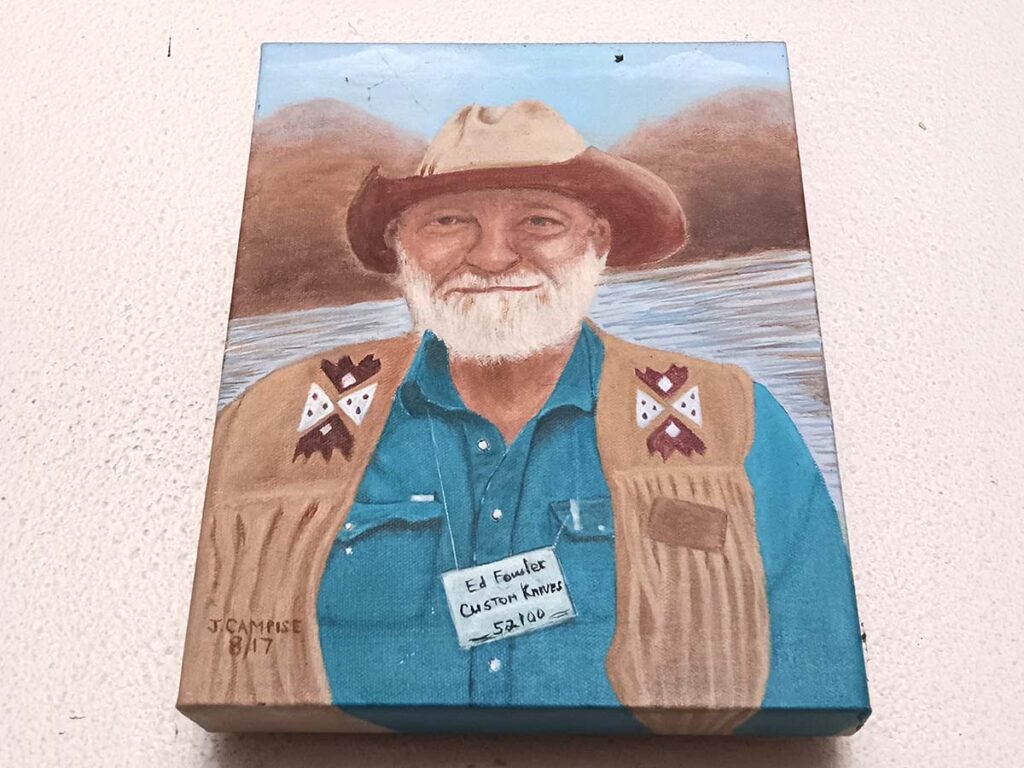
A portrait of Ed by his good friend and knife collector Joe Campiese. The knifemaker built a dedicated following among many collectors.

The quest for his own personal Excalibur—the High Endurance Performance Knife—was a lifelong adventure that led him to cross paths with many on a similar journey. That’s how I came to know him so many years ago. I didn’t see his vision at first; I only knew knives as things, not an ideal. But he saw lady knife as so much more.

From his first meeting with ABS founder Bill Moran and BLADE® Magazine legend Wayne Goddard—who would become his lifelong friend and co-conspirator—his path to a 52100 ball bearing steel obsession was sealed. He and Wayne collaborated on the first 52100 knife, and the rest is history. Another longtime friend and BLADE writer, the legendary smith Joe Sizlaski, led him down the road to true skill with a hammer. They collaborated for decades through countless letters and phone calls. Most are still in the filing cabinet waiting to become a book. Over the years in his column Knife Talk, BLADE readers across the world waited patiently for the next nugget of wisdom or anecdote from these great representatives of the world of knives.

As fate would have it, he soon crossed paths with some men who would bring his dreams to life.

Testing His Metal

When Ed first shared his ideas with the conventional world of knives, they met with less than thunderous applause. This changed when metallurgist Rex Walther stumbled on one of Ed’s articles about his multiple-quench method. Intrigued, he contacted Ed, asked a few questions, proposed a few experiments and offered true scientific analysis. As Ed said of this collaboration, “We went from 0 to 100 overnight.” Rex’s feedback became the foundation for all of Ed’s advancements and achievements to come.

At the time, the industry considered a steel grain size as fine as 10* to be possible. Ed reported achieving 15 and finer through his methods, the limit of measurement possible with Rex’s equipment. Later, Kevin Grey, a student at the South Dakota School of Mines, would again not only test Ed’s methods but also write his graduate paper on them, getting them both invited to speak at the Artist-Blacksmith’s Association of North America conference in South Dakota.

One of his happiest moments in recent years was finding out, to his surprise, that he was mentioned in Dr. Larrin Thomas’ book The Story of Knife Steel: Innovators Behind Modern Damascus and Super Steels. Another was his amazement at receiving the 2022 BLADE Magazine Publisher’s Award at BLADE Show.

Ed’s Classroom

I met Ed in the mid 1990s at a knife show in California. I took his class on his ranch near Riverton, Wyoming, around 2007. After that, I traveled several times a year to help him teach, only missing three since that first one. About 15 years ago, I moved to the ranch to apprentice full-time, and the rest is history.

I hope to be here teaching and sharing his legacy and dream of 52100 steel and Excalibur for another 15 years.

Of the countless students who came to learn Ed’s mysterious ways with metal, a few stand out in my mind. The first is a very early student, Jeff Davidson. Jeff is currently an ABS journeyman smith and a passionate forging instructor.

The second is a knife collector and great future maker, whom we will just call “Stan.” He made his way to Wyoming from Taiwan after years of reading Ed’s articles. He is a great ambassador for Ed’s vision of the HEPK around the world.

Ringing The Anvil

I have written many articles for BLADE over the years. As I sit here in Ed’s silent shop, with his last good dog and write the final Knife Talk article from his computer, it’s important you know this isn’t the end.

Ed made his first knife, a small wooden knife, at about six years old. He still had that knife. His last completed knife, a light camp in what has become his iconic and signature style, was finished this fall at the age of 86. He didn’t even bother to take a picture of it, just sent it on its way to have its own adventures, never thinking it would be his last. As Willie Nelson said, “The road goes on forever, and the party never ends …”  I think that’s the way he saw it.

For the moment, out of respect and because it could use a little rest, his hammer sits in silence. But soon enough, his forge will be lit again, his anvil will ring and the knife talk will go on. Ed would have wanted it this way—as it should be.

*ASTM grain size quantifies the average grain size of metallic materials using a number, where higher values indicate finer, smaller grains.

Remembering Others The Knife Industry Has Lost:

Bark River Knives Shuts Down Amid Steel Controversy

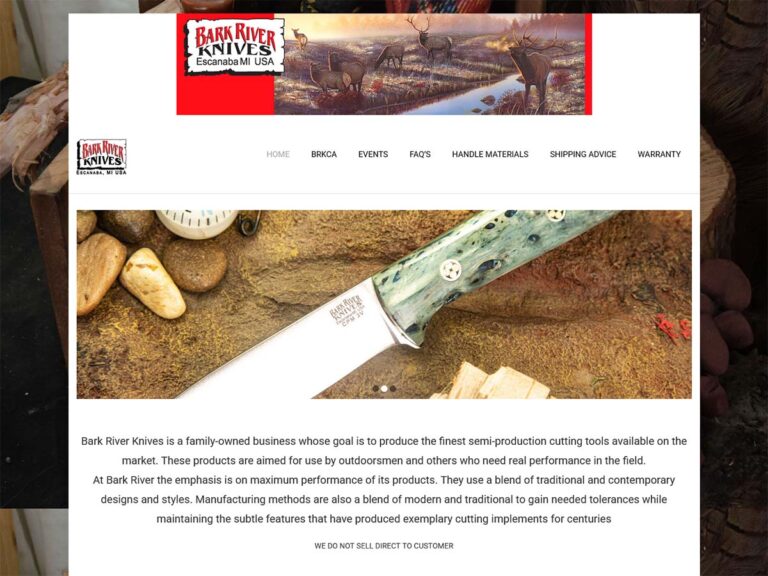
Bark River Knives owner Mike Stewart took to Facebook to admit to closure and the use of Chinese steel in Made-in-U.S.A. labeled knives.

Bark River Knives of Escanaba, Mich., has officially ceased operations following a public admission by owner Mike Stewart that the company utilized Chinese steel in blades marketed as American-made CPM 154. The announcement, made via Facebook on March 23, confirmed that the long-standing fixed-blade manufacturer concluded all business as of March 20.

In his statement, Stewart took full responsibility for the deceptive labeling, characterizing the use of imported steel as a measure intended to keep the company afloat. Stewart argued the alternative steel met his internal testing for toughness and stain resistance, with edge retention nearly matching that of Crucible Industries’ CPM 154. He further claimed that because the knife blanks underwent more than five distinct operations in the Michigan shop—including grinding, reshaping and etching—they technically met his interpretation of “Made in the U.S.A.” criteria.

It should be noted, the Federal Trade Commission (FTC) standards mandate a product must consist of “all or virtually all” domestic components to carry the label. Stewart admitted the steel was definitely mis-marked on the following models:
  • Camp Bolo
  • Fox River Trailing Point
  • Highwayman 4
  • Mini-Manitou
  • Gladstone Hunter
  • Bitterroot Caper
  • Select recent Club Knives

The closure follows a period of increasing pressure from collectors and dealers, alongside significant financial litigation, Outdoorlife.com reported. Stewart noted in his post that the shutdown was “long overdue” and should have occurred two years prior.

Stewart announced that his son, Jim Stewart, will open a new, 100 percent independent knife company. Notably, Jim Stewart has agreed to take over the warranties that would have normally been serviced by Bark River. Mike Stewart clarified that he will have no hand in the new entity and intends to exit the industry entirely after 50 years. Mike Stewart emphasized that his dealers, his wife Lesley and Jim Stewart were entirely blameless in the decision to substitute the blade steel.

More On Knife Steel:
Advertisement

Must Read Articles

Read this before you make a knife

Knifemaking 101 – Read This Before You Make a Knife

  by Wayne Goddard My experience has taught me that there's nothing like digging in and getting started. I've often said the hardest part of the...
how to forge damascus steel

How to Forge Damascus

Advertisement
Advertisement