


Bushcraft Tips and Tricks

0

Elevate your survival skills with these bushcraft tips!

A good bushcraft knife is characterized by its manageable size and weight, allowing for comfortable handling and easy resharpening.

Typically, a knife designed for bushcraft and carving tasks lacks spine gimping for the thumb. The cutting edge should have a continuous curvature that extends the entire length of the blade. A general-purpose bushcraft knife should have a blade that matches the width of your palm, with the tip aligned closely to the handle’s centerline. The handle and blade spines should remain on the same line.

The handle should feature an oval cross-section made from such materials as wood, Micarta® or plastic. It should not include finger cutouts that limit your grip, as such restrictions can lead to blisters. The handle length should fit comfortably in your palm. While Scandinavian blade grinds are standard for bushcraft knives, other blade grinds are also acceptable.
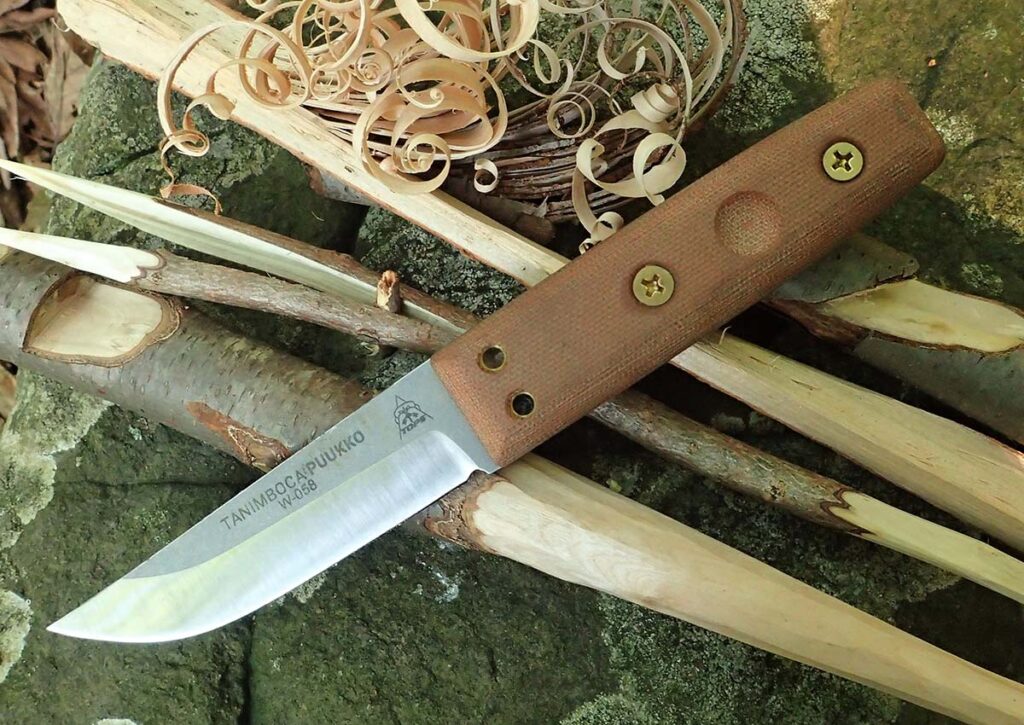
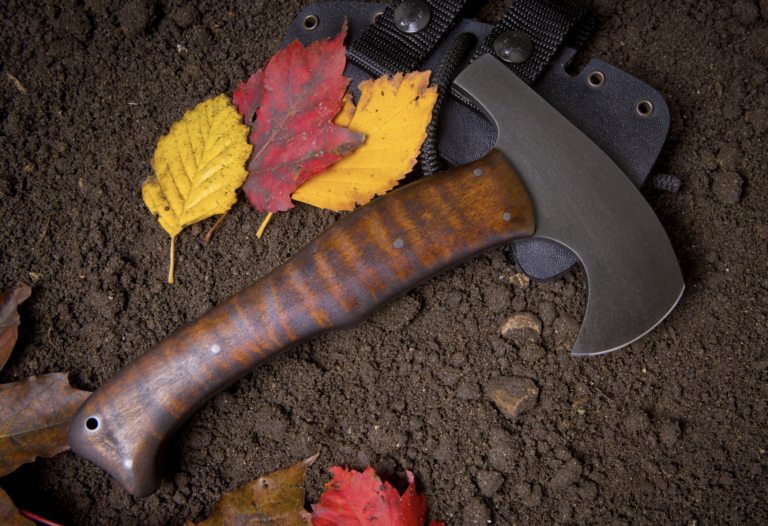
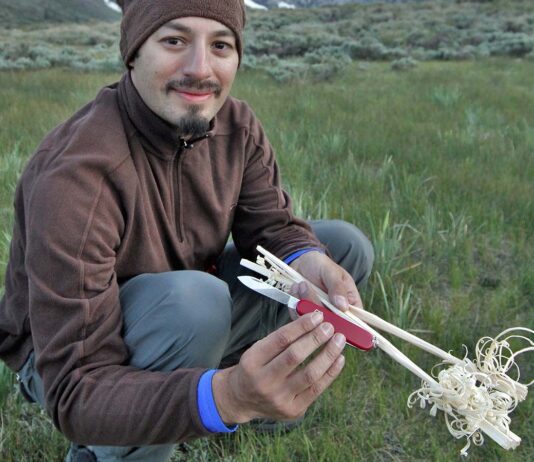
The Tanimboca Puukko from TOPS Knives made stakes, pot holders, fuzz sticks, bush forks, skewers, roasting sticks and traps. According to the author, it’s the perfect size for a bushcraft knife. Note the bow drill divot/socket on the handle for fire starting.

To quote Mors Kochanski, Canadian bushcraft and wilderness survival instructor and author of Bushcraft: Outdoor Skills and Wilderness Survival, “The knife is the smallest and most portable of all the cutting tools. Light and unobtrusive, the knife is readily available for hundreds of everyday tasks in bush living.”

Knife Safety

Always start with a safety briefing when working with tools, especially those that can cause serious injury. Books and teachings have provided several tips and procedures for knife use and safety. One key concept is the blood circle.

Stretch out your arm with the knife in hand and ensure you can make a complete circle without hitting anyone or anything, including tarps, backpacks, tents and water containers. The blood or death triangle is crucial when sitting and carving. Never use your leg as a backstop or cutting board. When removing large amounts of wood, cut to the side of your body on your dominant knife-hand side or lean forward, resting your forearms and elbows on your knees, keeping your work project and knife out of your blood triangle. Remember the blood circle. Some cuts, like a pull-cut, allow you to cut toward yourself in a controlled, slow manner, but generally cut away from yourself.

Bushcraft Grips And Cuts
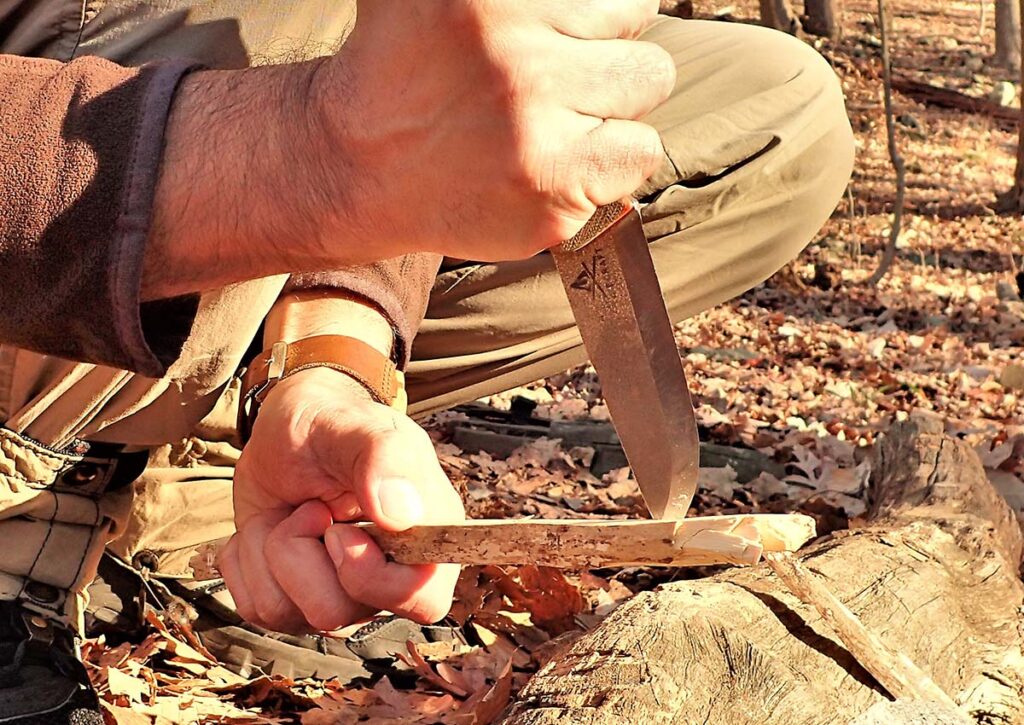
Use an icepick grip to split small pieces of wood for a one-stick fire. Strike the knife and wood against a hard surface together, then twist slightly to split the wood.
  • Forehand (Fist) Grip: The forehand grip is the most basic and natural way to hold objects securely. This grip is ideal for power cutting, allowing you to roughly remove a significant amount of material to shape the wood. To use this grip, curl all your fingers around the handle, creating a fist. Avoid placing your thumb on the knife’s spine, an everyday habit. Hold the wood off to the side, with the blade tip pointing slightly upward, and slice from the base of the blade to the tip. Lock your wrist and elbow and use your shoulder to push down as if punching through the floor. The motion resembles shrugging your shoulder. Alternatively, you can adapt this technique by pulling the wood back against the knife using your work hand.
    Pro Tip: This is not a jarring-of-the-elbow motion.
  • Thumb-Assisted Push Cut: This is commonly called a scissor grip cut. When viewed from above, the arrangement of the wood and the knife resembles the operation of scissors. It involves a thumb-assisted push cut, where the non-dominant hand’s thumb helps cut. The blade and wood pivot together like scissors, while the thumb on the non-knife hand presses the back of the knife into the wood. This technique features a short-cutting reach, applies soft-to-medium force, and offers a high degree of control. It is a more refined and detailed version of the chest-lever grip with a thumb-assisted push cut.
  • Chest-Lever Grip: The chest-lever grip is a powerful and controlled cutting technique commonly used in bushcrafting, characterized by a typical palm-up grip. To execute this cut, engage your lat muscles and leverage your body for power. Start by turning the knife blade outward to your right (if you’re right-handed) with your palm facing up. Grip the knife firmly, placing your thumb on the handle or side of the blade while your other hand holds the workpiece. Once the blade contacts the area you want to cut, rotate your shoulders forward and pull your hands apart as your shoulders open up, leveraging against your torso. Keep your hands connected to your ribs throughout the process. This technique and the forehand grip allow you to make powerful cuts for removing significant amounts of wood.
  • Peel Grip: Also known as a draw grip, apple peeling grip or paring grip, the peel grip facilitates more detailed, finishing cuts rather than powerful ones. Use it to finish the ends of a spoon handle, shape the top of the spoon bowl, chamfer a tent stake or trim wood to achieve a flat surface. To execute the peel grip, hold the knife in a reverse position with the blade facing you. Place your fingers on the back of the knife handle, positioning your thumb on the back end of the workpiece while your other hand clasps the work. Keep your knife-hand thumb out of the blade’s path as you close your hand into a loose fist, allowing for a slow, controlled cut. Author’s note: This grip is helpful for precise carving and finishing the edges of items.

Bushcraft Techniques
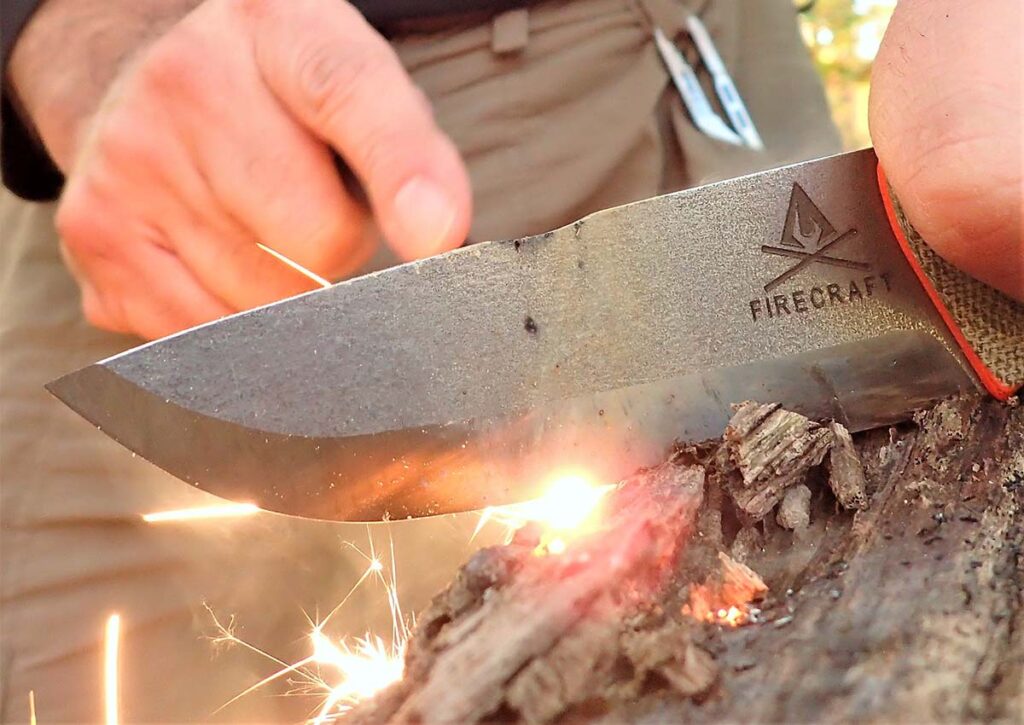
The author strikes the supplied ferro rod against the fire notch to ignite the tinder.

After addressing the basic grips, it’s time to learn a few helpful knife techniques commonly employed in bushcraft. Practice them at a comfortable pace and avoid rushing.

  • Bushcraft Batonning: A knife alone often lacks the weight needed for effective chopping. However, striking the blade’s spine with a heavy object can produce strong cuts. A sturdy, comfortably held stick serves as a baton to help cut down and limb small trees, making various cutting tasks much more straightforward. You can quickly cut through branches and small saplings using a knife and a baton. Bushcraft batonning describes using a baton for controlled cross-grain cuts, creating V-notches and splitting wood no wider than your wrist. Using a baton for limbing branches generally proves faster and safer than using an axe.
  • Beaver Chew: To cut a green or dry branch to the desired size, use the beaver chew technique, which leaves a somewhat rounded end for pounding into the ground. Make a series of cuts (nicks) around the stick. Thicker sticks require more time, so repeat this process several times, cutting deeper with each pass. Once the cut is halfway or two-thirds through the stick, you can break it off and trim the end.
  • Tension Cutting Saplings: To take down small green trees up to wrist size in thickness, first apply tension by bending the tree while holding it firmly with one hand. Start your cut at a 45-degree angle at the bend point, where the stress is most significant. There’s no need for a sawing motion; instead, use a gentle rocking back and forth with the blade to slice through the fibers under tension. Be careful during the crucial last part of the cut, as you need to restrain the tree from falling prematurely, which would require extra work to finish the cut. If done correctly, this process should take no more than 10 seconds.

To section long saplings, step on the top to hold it and bend it over your thigh or hip. Cut the bend to ensure avoid cutting yourself during the follow-through.

Pro Feather Sticks

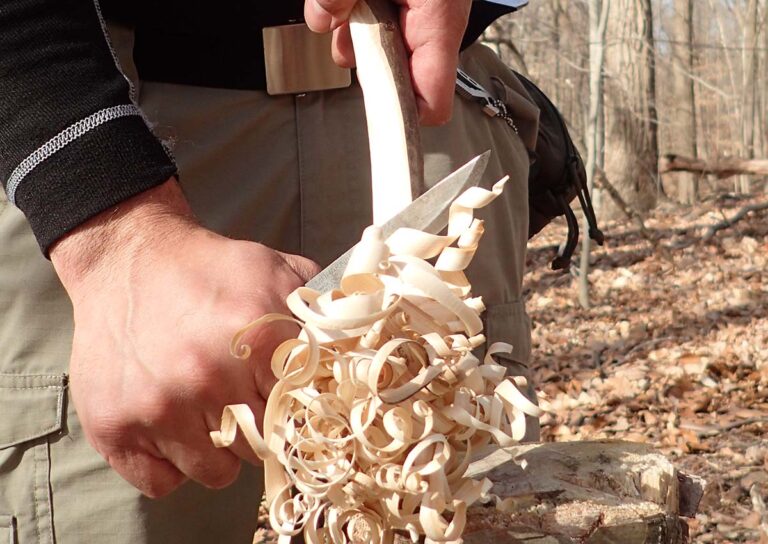
Creating tinder by shaving very thin pieces and kindling from deadwood is known as making a feather or fuzz stick. You can use various techniques but here’s the most basic approach.

Start with a forehand grip and resist the urge to place your thumb on the spine of your knife. Using gimping or a gimping grip applies uneven pressure, which often causes feathers to detach from the stick. When you reduce green wood for carving projects, think ahead and keep the shavings for fire making, regardless of their thickness. Thinly shaved greenwood dries quickly. Try to make them as thin as possible or save larger shavings to use as kindling. Emphasizing multi-use and maximizing the utility of everything you work on and cut truly embodies bushcrafting!

Try Stick It!
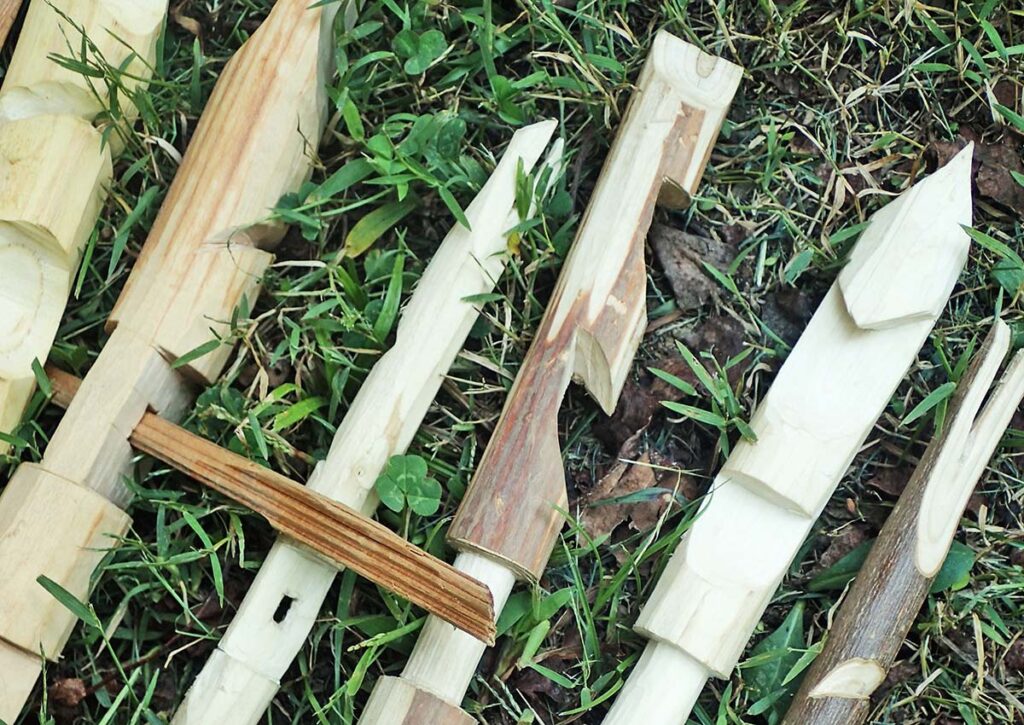
The author carved various try sticks with essential notches and additional features.

The Try Stick, made famous by wilderness educator, survival instructor and author Mors Kochanski, is a tool designed for practicing and showcasing knife skills in wood carving. While some notches are functional and often used to create items such as tent pegs, pot hangers and digging sticks, many notches on a Try Stick are more decorative and less commonly utilized. You can incorporate around 17 different types of notches on a Try Stick, but including as many as possible is typical. There’s no required number of notches to create; a Try Stick focuses on knife handling and safe practice.

Try Stick Notch types include:

  1. Round Notch
  2. Pot Hook
  3. Saddle Notch
  4. Square Notch
  5. Mitred Lapped Notch
  6. Jogged and Wedge Splice
  7. Dovetail Pin and Socket
  8. Dovetail Notch
  9. “V” Notch
  10. Spear Notch
  11. Knife Tip Mortice
  12. Diameter Reduction
  13. Knife Edge
  14. Split
  15. Bow Notch
  16. Latch Notch
  17. Bark Stripping
  18. Whistle Project

Check Out More Outdoor Knives:

Hawaii Knife Ban Stopped In Its Tracks

Vagueness of bill could have potentially banned the carry of all but a few knives.

Hawaii Knife Ban bill SB 433, which would have banned all carry of most knives and all knives in many public places in Hawaii, has been stopped. The stoppage occurred because the bill failed to receive a hearing by the stated deadline.

According to Knife Rights, one of the worst aspects of the bill was its vagueness. The bill added “bladed weapons” to the state’s sweeping firearms bans, which would have been expanded in SB 433.

“As written, nobody, not a resident, not a police officer, not a prosecutor, could possibly look at the proposed statute and know for sure what a ‘bladed weapon’ is that is being banned,” KR reported. “This is fundamentally unconstitutional and leaves the law open for law enforcement and prosecutorial abuse. Terms that capture everyday tools carried daily by the public for perfectly lawful uses should be defined crisply and clearly to provide fair notice as required by longstanding law.”

The bill banned all undefined “bladed weapons” everywhere in Hawaii except for switchblades and butterfly knives.

“So,” KR noted, “a not at all unreasonable interpretation of [‘bladed weapons’] would have banned carry of a common pocketknife in Hawaii, except for [switchblades and butterfly knives]! Who decides whether it’s a ‘bladed weapon’? Certainly not the average resident or visitor.” 

In other examples, fillet knives used for recreational, subsistence and commercial fishing and hunting knives used for boar hunting—a popular means of reducing feral hog populations on the islands and a popular tourist business—could have been banned, as could a box cutter carried to work by a warehouse worker.

More On Auto Knives:

Blunted Blades And Knife Bans: England Has Gone Over The Edge

England has had an uptick in knife crime in recent years, including the horrible incident costing three young girls their lives in Southport. Certainly, crime of any kind deserves scrutiny and solutions so that society can conduct its daily affairs in a safe and secure environment. Unfortunately, it’s never the calmer heads that prevail when dark winds blow.

Case in point, the utterly asinine suggestions emanating from the host of a BBC documentary on UK knife crime.

From the New York Post:

“Actor Idris Elba announced amid his forthcoming knife crime documentary that the United Kingdom must consider “innovative” prevention methods such as blunting or banning knives.”

Let that sink in… blunting or banning knives. And he’s not talking about neutering simply what might be considered “scary” knives—tactical fixed blades, karambits and the like. No, it’s the whole megillah.

He said in the Post article:

“The truth is that kitchen knives are perhaps 25% of the knives used in most terrible crimes. That’s one of the stats in the film. And those kitchen knives are usually a domestic situation,” Elba warned. “So kitchen knives… of course, it’s very difficult. They’re a domestic knife.”

This walks hand in hand with other extreme actions that have taken place in England regarding knife sales. One of the more atrocious, ID requirements and live video sales to purchase knives online. Why, the next thing you know there’ll be a proposal for licensing knives.

Well, you don’t have to wait long for that either.

Elba thinks this might be the panacea for his country’s woes, banning nearly everything, and licensing those scant few deemed worthies to own their family’s cherished sword or knife.

“So let’s ban them all, and if you have one of those knives, get a license for it,” he suggested of people wanting to keep family heirloom swords. “Simple as that.””

And if you think this sentiment is contained to one crackpot actor, well you’d be wrong.

According to The Telegraph:

“A ban on the sale of pointed kitchen knives has been backed by the Church of England, judges, top trauma doctors and psychiatrists, the police and victims as they argue that it would make life-threatening injuries far less likely.”

It’s unfortunate England has endured an uptick in knife crime, yet this isn’t the license for it or certain segments of it to go off the deep end. I know it might sound crazy, but perhaps the English should address the root of the problem—the perpetrators.

The harsh truth is this: no amount of blunted blades, banned kitchen knives, or bureaucratic licensing schemes will stop individuals hell-bent on violence. You can’t legislate evil out of existence by targeting inanimate objects. England doesn’t have a knife problem—it has a people problem. A system problem. A failure-to-act-when-it-matters problem.

Axel Rudakubana—the perpetrator of the Southport killings—wasn’t some shadowy figure hiding in the margins; he was a neon warning sign flashing in plain sight. Reported repeatedly, known to authorities, radiating red flags—and yet, nothing substantial was done. But instead of holding systems accountable for their glaring incompetence, the knee-jerk reaction is to demonize cutlery.

Blaming knives for violent crime is as absurd as blaming spoons for obesity. The issue isn’t the tool; it’s the hands that wield it—and the institutions that refuse to act until it’s too late. England doesn’t need another ban. It needs accountability, courage, and the will to confront the real problem: violent individuals, not the utensils in their kitchens.

More on Knife Laws:

2024 Knife World In Review

See what the highlights, low lights and everything in between were for the knife world in the past year.

Like most years, 2024 had more than its share of ups, downs and continuations of the same. From the promising developments in American-made factory knives to the harmful effects of Hurricanes Milton and Helene on knifemakers and at least one knife show, there were the goods, the bads, gains, losses, victories, debuts, swan songs and more. Among them:

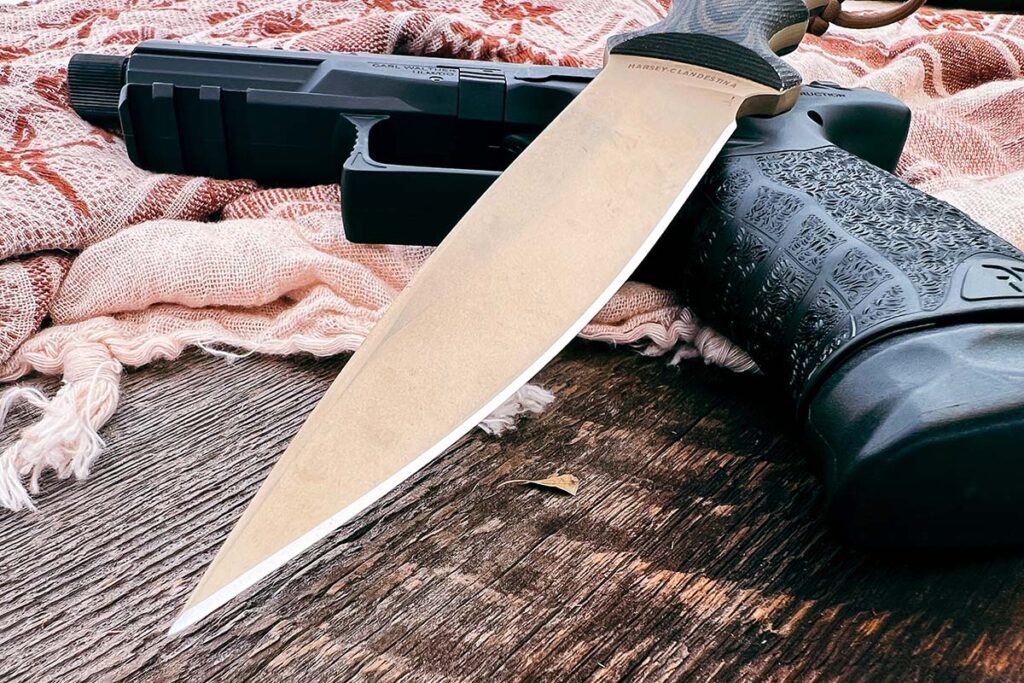
Spartan Blades Clandestina blade
Spartan Blades Clandestina
  • Newer and older knife companies alike, such as Montana Knife Co., Emerson Knives, Inc., Hawk Knife Design, Tactile Knife Co., White River Knife & Tool and others, lead a surge in quality American-made knives;
  • Original portions of the hull, deck and other parts of The Battleship Texas are distributed to artisans around the country, including bladesmiths and knifemakers such as Harvey Dean, Jason Fry, J. Neilsen, Jack Stottlemire, Greg Coker and many others, to make items they specialize in and donate them to raise money to restore the pre-World War I dreadnought (https://battleshiptxartisans.com/catalog/);
  • A boom in the number of international countries (35) with exhibitors at the BLADE Show, led by France (21 exhibitors), South Africa (18), Italy (14) and Brazil (13), reflect the continuing recovery from the devastating effect of the worldwide pandemic;
  • Spartan Blades headlines the BLADE Magazine Knife-of-the-Year® awards at the BLADE Show with the company’s first Overall Knife of the Year, the Bill Harsey designed Clandestina. It was company’s first ever win in the prestigious category;
  • Speaking of Harsey, he, along with Ted Dowell and Don Fogg, become the 72nd, 73rd and 74th members of the BLADE Magazine Cutlery Hall of Fame®;
  • In what promises to be the first of several, Cutlery Hall-of-Famer Bill Ruple and Case debut their inaugural collaboration, the Bill Ruple X Case Axe Handle;
  • CPM MagnaCut stainless continues its run as the No. 1 blade steel among factory knives;
  • After almost 30 years with Spyderco, including stints in customer service and as marketing manager and coordinator of all things public relations, past BLADE Magazine Publisher’s Award winner Joyce Laituri calls it a career;
  • ABS master smith Kevin Cashen is named new chairman of the American Bladesmith Society, succeeding ABS master smith Steve Dunn, who passed away unexpectedly May 21;
  • After its original lawsuit was dismissed in June on “absurd standing grounds,” Knife Rights files a new federal lawsuit in September challenging the constitutionality of portions of the Federal Switchblade Act;
  • Hurricanes play havoc not only with the Southeast USA but knife industry members in the affected areas, with Milton postponing the Louisiana Knife Show and Helene flooding and/or temporarily shutting down at least two North Carolina knifemaking operations, including Winkler Knives and Dogwood Custom Knives, and no doubt others elsewhere;
  • Companies/knives celebrating anniversaries include: Boker (155th); Tru-Bal Knives, aka Tru-Balance Knife Co., (75th); Kershaw (50th); Fallkniven (40th); and the Emerson Knives, Inc. CQC-7 (25th);
  • Finally, a number of friends of the knife community pass away, including: scrimshander Gary “Garbo” Williams; bladesmith/mokume gane guru Phillip “Phil” Baldwin; knifemaker/past National Knife Collectors Association president Bob Cargill; ABS master smiths Steve Dunn and Hanford Miller; long-time custom knife collector Walter Hoffman; veteran knifemaker Dave Ricke; Mrs. Lori Buck (wife of Cutlery Hall-of-Famer Chuck Buck); Mrs. Sallie Bos (wife of Cutlery Hall-of-Famer Paul Bos ); Mrs. Betty Dowell (wife of Cutlery Hall-of-Famer Ted Dowell); Cutlery Hall-of-Famer B. R. Hughes; and past BLADE art director Jim Sasse. God rest their souls—and please forgive me if I’ve omitted anyone.

Buying Custom Knives: Four Lessons To Get A Deal

We give you the tips to avoid mistakes when buying a custom knives.

Of course, every rule or principle has its exceptions and counter-principles. You do get what you pay for, but only when you have an honest and informed assessment. Is that micarta real Westinghouse Micarta? Is the fit and finish and reputation of the maker in line with the price? Did the maker grind the knife themselves, or is this a production knife?

You’ll have to do some homework if you want to get “good deals.” One of the oldest tricks in the book is for the seller to exaggerate demand and conceal supply. “This is the last one, and they’ve been buying them fast all day!” may be true or may be a dishonest sales pitch.

The warning is “buyer beware” more often than “seller beware” after all. Many a “bad deal” comes not from mutual disagreement, but from one side taking advantage or being dishonest.

Economic generalities aside, let’s look specifically at the knife market.

Lesson 1: Don’t Buy The Hype

Some people want the latest and greatest thing. They get great enjoyment out of buying what is the ultimate “grail” knife of a given season, often hyped up on social media, on online forums, by word of mouth, in magazines and at events. For these buyers, the thrill is in the hunt and in the showing of the trophy.

If you want to be that kind of buyer, buy what you want and enjoy the heck out of it! Keep in mind that demand will be lower for last year’s hot thing, and so will the resale price. I won’t go so far as to say don’t buy the hot knife. Many of us spend money on experiences (what do you gain long term from a concert or a trip to the movies?) or on depreciating possessions like cars or boats. In some ways, if you enjoy it, it doesn’t matter if you lose some money on a knife or it’s not a good “investment.”

Many of us “regular” folks have to be a little more careful with our funds. If you chase what’s hot, you’ll end up buying at times of peak demand, which means you’ll pay a higher price. By the time you get tired of that knife or want to sell, everyone else just might be tired of it as well, as the knife world will have moved on to the next hot thing. If you’re one of the folks for whom a sour ending ruins the whole experience, don’t buy hot. If you have an eye toward appreciation of values and want to “make money” on your knife collecting hobby, don’t buy hot.

For some people, the thrill is in finding the next hot one, before it gets hot. Wouldn’t we all have loved to have purchased a bunch of Microsoft stock in 1993? If we were better at predicting the future, we’d make better knife picks for our collection, just like we’d make better choices in our stock portfolio. Still, if you “hit” one once in a while—buy the maker’s work right before he hits the big time and make lots of money—it can be quite a thrill and keep you buying knives on a regular basis.

Another point of caution when it comes to hype has to do with the “flash in the pan” types who grow smoking hot quickly, beyond their market position or ability to produce. It has happened in the knife world before and will happen again. Someone may be better at marketing than knifemaking, or better at Instagram videos than filling knife orders. If the hype of a particular maker turns you off or looks suspicious, trust your gut and hold off on purchasing. Sometimes makers flame out as spectacularly as they rose to fame.

Lesson 2: Don’t Overspend At The Beginning

“Walk before you run” is good advice. Knife collecting is about finding joy in knives, and at the beginning, small mistakes hurt less. If you start with $500 and buy five quality production knives at $100 each, you may enjoy them a long time. If you start with the same $500 and buy a custom at a show from an overhyped maker who quickly fades away, you may sour to collecting altogether. When you gamble more, the losses cost more.

The opposite is somewhat true as well, however. If you spend your $500 on 50 $10 gas station knives, you’ll have a great big pile of crappy knives when you’re done. The trick is finding a good balance between price and quality. Finding that balance takes time to learn.

As you learn more about the market segment you’re interested in, don’t be afraid to invest more as you grow. You may reach a point where you don’t want the Chinese ones, but rather the American ones. Or maybe you don’t want production, you want midtech. Or maybe you won’t want the midtech one with the maker’s name on it, you may want the custom one made by the maker himself.

Hopefully, your budget will grow to accommodate your growing expertise and preferences.

Lesson 3: It’s Not Just The Knife You’re Buying

When you invest in Amazon stock, you are making a rich man richer. You’re buying a piece of paper or an electronic data point that says you “own” a tiny piece of the company, and you expect a mathematically increasing return for your investment.

When you buy a knife, odds are good your money won’t go to that knifemaker’s yacht payment or summer home fund. When you buy a knife from an individual knifemaker, you’re more likely sending his kids to daycare or piano lessons, paying for his electricity and buying his wife new shoes. If you buy at a knife show, you probably bought the maker’s dinner. When you invest in a knife, you support a specific person, not “the man behind the curtain.”

Even if you find joy by investing in a person by buying their product, you still owe it to yourself to invest wisely. Of course, you should buy a knife you like, that you find useful or that may make you a decent return on your money. At the same time, you should be looking for people to help, individual makers whose lives you will improve by your relationship and the purchases you make over time. You may be making friends, not just money, which can add another degree of magnitude to your enjoyment of knife collecting.

Lesson 4: Buy What You Know

The more you know, the fewer expensive mistakes you’re likely to make and the more deals you’re likely to find. The less you know, the more likely it is that you’ll get a bad deal, purchase a knife you’ll be dissatisfied with or a knife you later regret. The more you know, the better. This seems to be a universal principle of life and economics, and it applies to knives as well.

First off, buy knives from brands or people you know have a good market position. Many times, a well-known brand is successful for good reasons. A classic brand like Case or Spyderco may be a great place to start, or a well-known Knifemakers’ Guild member or somebody from the “Slipjoint Cartel.” When you have the chance to know the maker or seller personally, that knowledge makes your purchases more likely to bring you joy or a good return on your investment.

Second, buy knives from reputable dealers or purveyors. While you may get a “great deal” from a pawn shop or somebody’s cousin who is a knife collector, there is some measure of protection in buying from well-known retailers such as Blade HQ, AG Russell, Arizona Custom Knives and others. Until you become familiar enough with the market to know exactly what you’re looking at, it’s wise to stick with the major dealers.

As another example, consider buying from the folks who advertise in the knife magazines, such as BLADE. If their business is legitimate enough to afford the expense of advertising in print, they’re more likely to be honest and stick around.

Third, buy the knives you’re familiar with. You may get joy out of buying a knife the first time you’ve ever seen or heard of it. On the other hand, you’re even likelier to enjoy a knife that you know in your heart is a great one, because you’ve studied it, chased it, pursued it, and finally purchased after careful consideration. Sometimes the journey is as fun as the destination, and the pursuit of the grail is worth as much as the grail itself.

You may get in a rut and feel like you’re buying the same knife over and over. That’s no good either. Balance your knowledge with both width and depth. You may dive deep into one model, one maker or one brand, or you may spread your collection broadly by buying one knife from as many different people and places as possible. Either way, you’ll get familiar with the knives that you like, and you’ll end up going as deep or as broad in your collection as you like.

Check Out More Cool Custom Knives:

Winkler Knives Special Sale To Rebound From Hurricane Helene

1

The company’s shop was extensively damaged in the natural disaster.

Hurricane Helene affected a vast swath of the country and the knife community was not immune. Several knifemakers call North Carolina home, the state that took the brunt of the devastating hurricane that tore across Appalachia in September. One of the harder hit was Winkler Knives, based out of Boone.

The tactical- and outdoor-focused maker thankfully did not lose any of its employees in what turned out to be among the worst natural disasters in recent history. The company’s shop, however, incurred substantial damage from the torrential downpours flooding much of North Carolina’s countryside. In a brief estimate on a YouTube video, Winkler’s founder and owner Daniel Winkler when he returned to his shop there was 15 inches of standing water throughout. Even more troublesome, the workspace was swamped with hundreds, if not thousands of pounds of mud.

Needless to say, this halted the company’s production and put many orders on hold, with much of its machinery reportedly damaged or destroyed. In finished products, Winkler estimates it lost two weeks of work.

Living up to the rugged persona of its knives and axes, Winkler is attempting to make the best out of a rough situation. The company is staging a special sales day on Nov. 30, to raise funds to—as the company puts it—build back. The company will stage a meet-and-greet before the actual sale, then offer those who register, early-bird entry before its store opens proper to the public. And Winkler has quite a selection of special knives up for sale at the event.

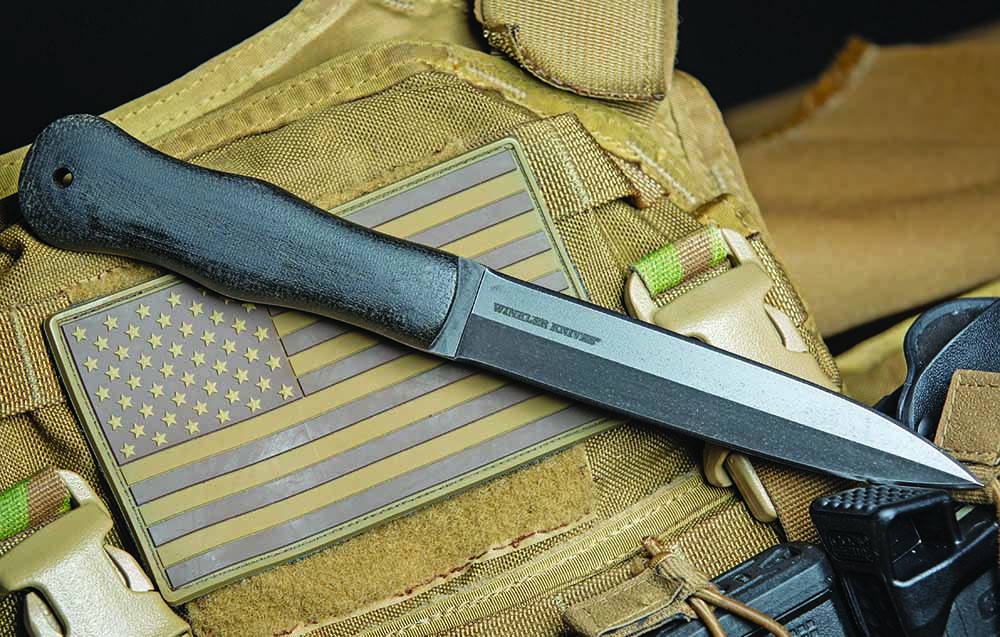
Made in Boone, North Carolina, the Winkler Knives Tactical Dagger in a black Micarta® handle has the same specs as the WASP-pattern model pictured elsewhere herein. “The handle shape does not hang on clothing as a lot of cross-guard knives do,” Daniel Winkler noted. MSRP: $400.
Made in Boone, North Carolina, the Winkler Knives Tactical Dagger in a black Micarta® handle has the same specs as the WASP-pattern model.

Among the many special offerings will be Winkler Knives standard models made by Daniel Winkler (DW Made), Winkler Knives Traditions by Daniel Winkler and Karen Shook, and even a couple of one-of-a-kind hand Forged knives by Master Bladesmith Daniel Winkler, accompanied by the leather craft of Karen Shook. There will also be special editions produced by Winkler Knives Artisans.

This is a special affair and only registered customers will be allowed in during the early-bird portion of the event. The company will not conduct phone sales for the event, only in-person sales. However, Winkler will set aside special editions from the sales event for those unable to travel to Boone. Those products will become available on Winkler Knives’ website on December 2, under the “Currently Available” tab.

If you are interested in attending the Winkler sales event, time is of the essence. The deadline to register is Nov. 18. To register, email [email protected] with the subject Register. The company will email an invitation or a notification the event is full in response.

Winkler Knives Sales Event

Nov. 30, 2024
520 Church Road
Boone, NC 28607

Sales Event Schedule

8 am Meet-And-Greet The Winkler Team
9 am Product Preview
9:30 Early-Bird Sales

More On Winkler Knives:

BLADE Tactical Recap: A Peek At What You Missed In South Carolina

We take a gander at some of the knives that showed up at the first BLADE Tactical at CANCON Carolina.

Sun, guns and a whole bunch of knives—BLADE Tactical was a whole new twist on BLADE Show. And a heck of a marriage between it and one of our sister events, CANCON Carolina.

Held Nov. 7-8 at South Carolina’s Clinton House Plantation range, the inaugural BLADE Tactical brought together some 25 knifemakers to show and sell their wares, all of the blades with a definite tactical bent. The knife show ran the first day, on the periphery of the shooting events. It had a different feel than any of our legacy shows, given it was outdoors and had the constant report of suppressed gunfire as background noise. But it wasn’t too far off our big three with some knife enthusiasts spending the night in the parking lot so they could be the first to the BLADE Tactical pavilion.

With that sort of enthusiasm, we’ll chalk the event down as a success.

For those who were unable to make the BLADE Tactical show or have their interest piqued, we’ve put together a recap of some of the knives that made their way to central South Carolina. Take a gander at what was up for sale and start planning now for next year’s B-Tact extravaganza. For anyone looking to pick up a hot new knife and burn some powder at the range—consider the gathering your Valhalla!

Krein Knives

Krein Knives

Tactical doesn’t preclude good looks, which is certainly the case with this Krein Knives Alpha. The blue thumb studs add a nice flare to this top-end framelock.

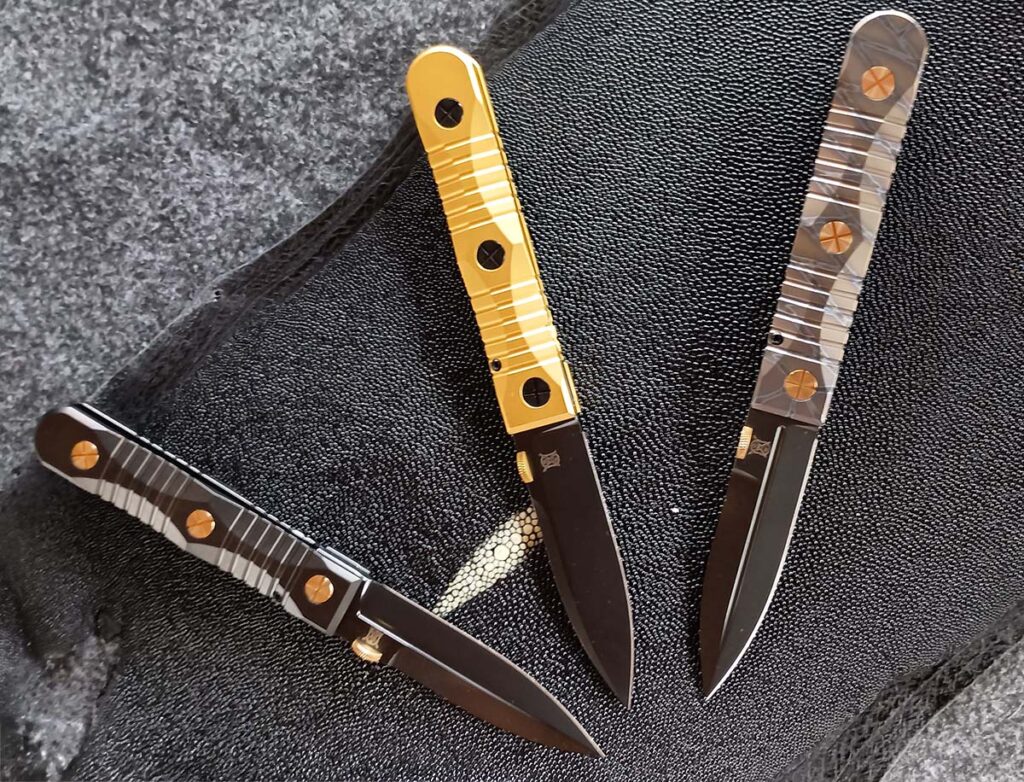
Carver Knives

Carver Waif and brass knuckles

Carver Knives‘ Waif has it going on. Up front is a titanium handled-model, in the back a dark Ti handle. Both are thin as a minute, particularly when measured up the knucks in the middle.

Pro Tech Knives

Pro-Tech Godfather

Pro-Tech came to BLADE Tactical with an offer you couldn’t refuse, like a number of these thin and wicked Godfather autos.

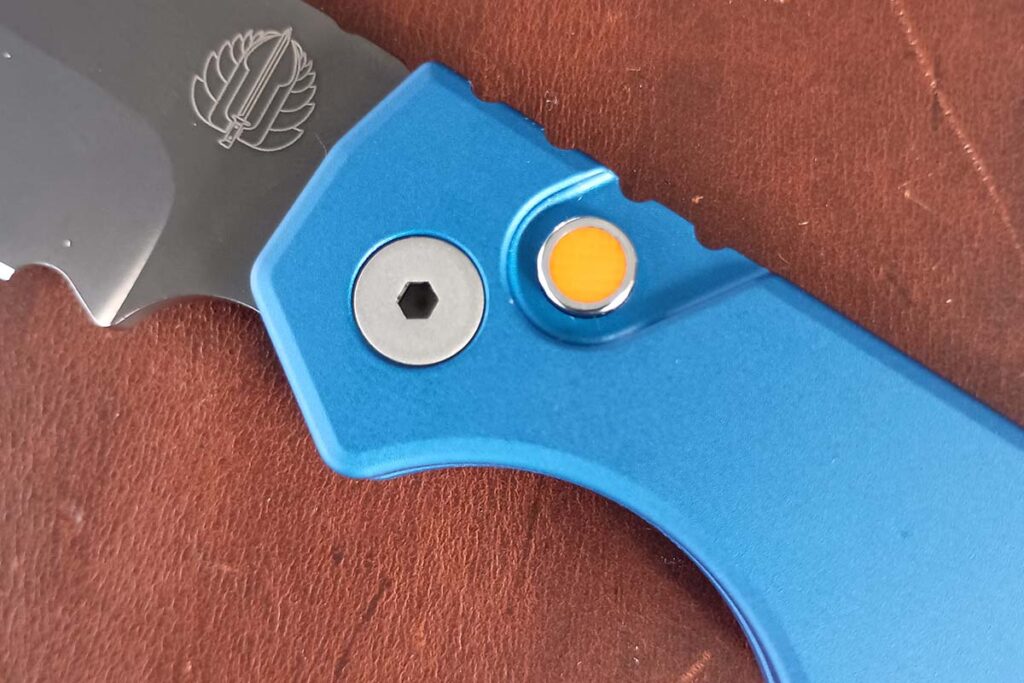
Pro-Tech Blaze Orange Inset

The company also offered a nice bit of custom bling for the show, a CANCON blaze orange G-10 insert on several of it’s knives buttons.

Elishewitz Custom Creations

Elishewitz Custom Creations Ek Intergral

With the Ek Integral, Elishewitz Custom Creations combined class and performance in a light and functional package. A nice dagger-style blade deploys in the wink of an eye via a thumb stud.

McNees Knives

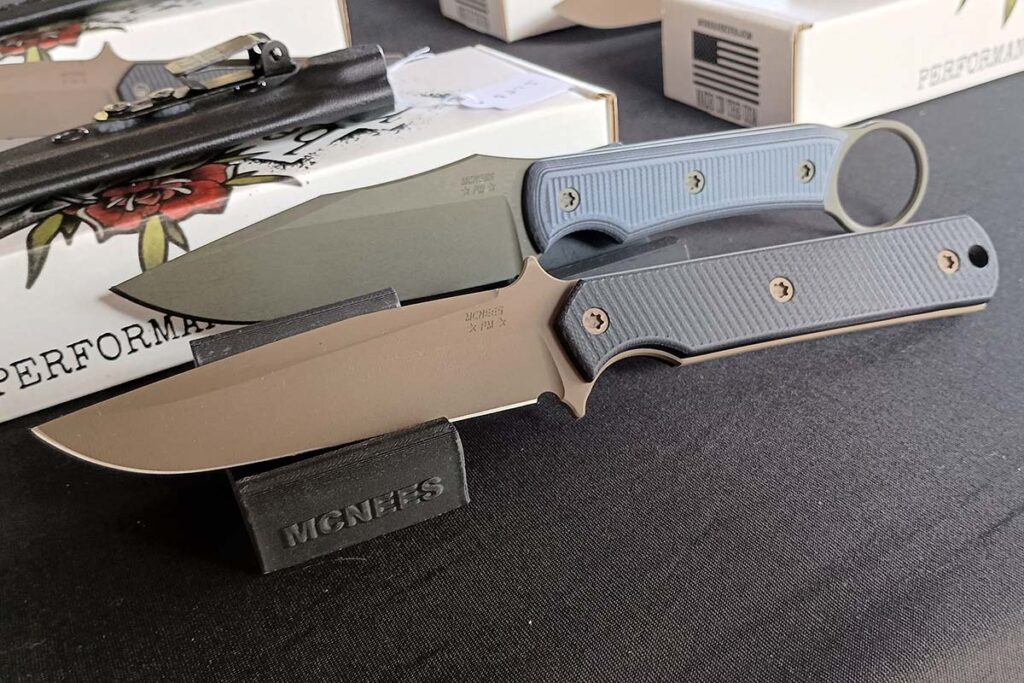
Agent and Stalker

Some hefty debuts from McNees Knives at BLADE Tactical. In the rear, is the Ringed Agent and up front the Stalker. Par usual for McNees, both feel like their built to beat the world.

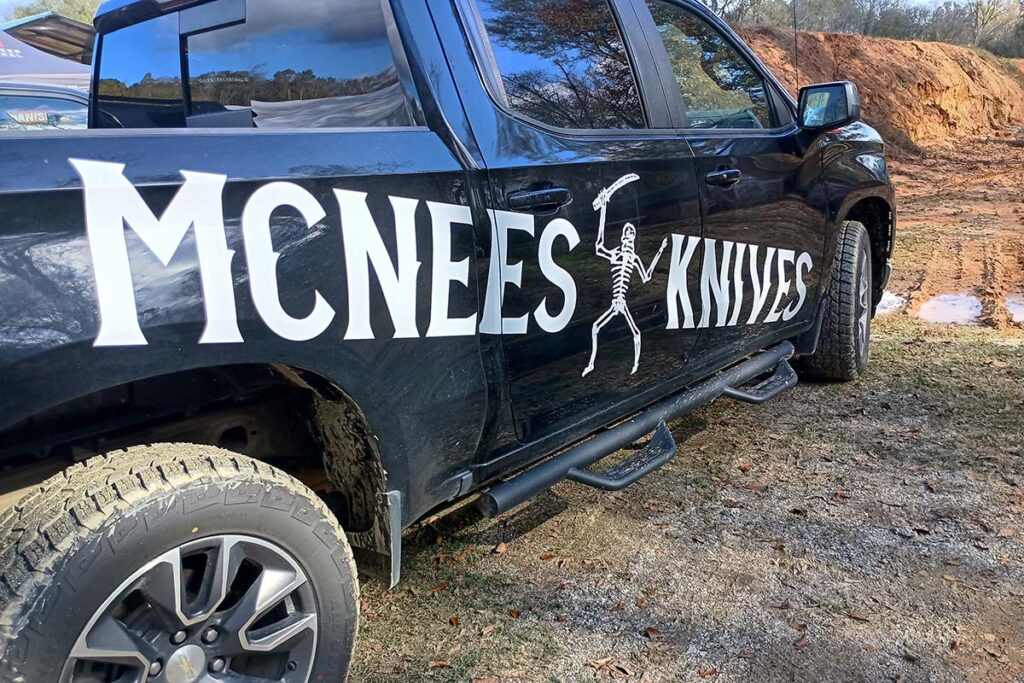
McNees Truck

Somewhat from the neighborhood (Alabama), the McNees crew drove to BLADE Tactical. Needless to say, they did so in style… nice wheels.

Nicholas Nichols Knives

Certainly, the Guppy is no small fry. Nichols Knives drop point has plenty of size to get nearly any job done, but stays light in the pocket thanks to a titanium handle.

Spartan Blades

Spartan Blades was right at home at BLADE Tactical—no surprise there. But the belle of the ball was the company’s Ronin-Torii, a traditional tanto, which few would want to find themselves on the wrong end of.

Nottingham Tactical

Notingham Tactical Carbon-Fiber Pen

Believe it or not, you’re looking at six-years of development. Nottingham Tactical was game for a carbon-fiber model, but it took a ton of work to get it to come together, from finding the carbon-fiber up to the abuse to getting the right adhesives to get the metal parts to stay.

Vero Engineering

Joseph Vero

It wasn’t all fixed blades and folders for the knife side of the show. After BLADE Tactical closed, the knifemakers hit the range at CANCON for some therapeutic trigger time. Here’s Joseph Vero of Vero Engineering getting on one of Maxim Defense’s shorties.

CANCON Video Recap

If your interest has been piqued, check out upcoming BLADE Tactical and CANCON events.

Check Out More BLADE Shows:

Advertisement

Must Read Articles

Read this before you make a knife

Knifemaking 101 – Read This Before You Make a Knife

  by Wayne Goddard My experience has taught me that there's nothing like digging in and getting started. I've often said the hardest part of the...
how to forge damascus steel

How to Forge Damascus

Advertisement
Advertisement