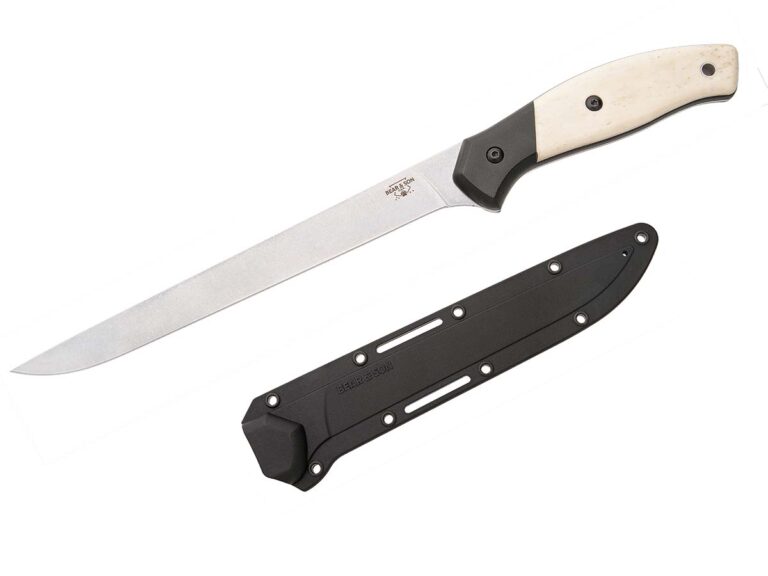
Bear & Son Cutlery’s new White Smooth Bone Professional Fillet Knife delivers precision, durability and American craftsmanship for serious anglers.
Summer fishing season just got a serious upgrade. Bear & Son Cutlery has introduced the new 11 7/8-inch White Smooth Bone Professional Fillet Knife, a purpose-built tool for anglers who demand precision from dock to dinner table.
Crafted in Alabama by a company known for keeping every step of production in-house, the WSB66 combines classic styling with modern steel performance. Bear & Son Cutlery’s fully self-contained factory handles everything—from blanking dies and heat treating to grinding, assembly, and hand-finishing—ensuring consistent quality and genuine American craftsmanship in every knife.
At the core of the Professional Fillet Knife is a 7-inch Sandvik 14C28N stainless steel blade, engineered for razor-sharp cuts, long-lasting edge retention and resistance to corrosion, even in saltwater environments. Whether trimming trout in the mountains or breaking down snapper on the coast, the blade delivers clean, efficient slices with ease.
Weighing just 4.9 ounces, the knife offers balance and control that make quick work of everything from panfish to redfish. Its White Smooth Bone handle provides a secure, comfortable grip while adding a touch of traditional character. A protective plastic blade guard ensures safe transport and storage, whether stowed in a tackle box or kitchen drawer.
True to Bear & Son’s mission of building affordable, American-made knives, the Professional Fillet Knife is designed for anglers of all levels—weekend fishermen, seasoned guides and anyone who values a dependable blade at camp or on the water.
White Smooth Bone Professional Fillet Knife Specs Blade Material: Sandvik 14C28N Stainless Steel Handle Material: White Smooth Bone Overall Length: 11 7/8″ Blade Length: 7″ Features: Protective Plastic Blade Guard Weight: 4.9 oz. Origin: Jacksonville, Alabama MSRP: $140
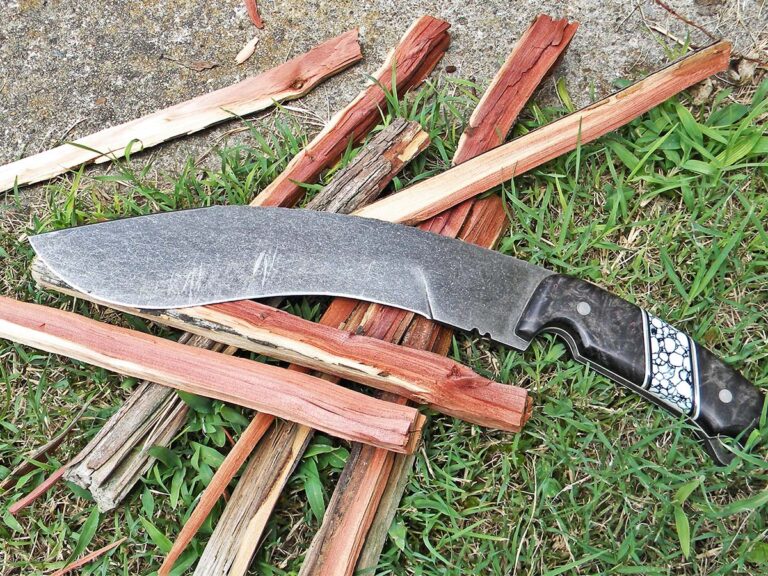
Blades and Bands Kukri is a forward-cutting knife design.
In the search for knives to test for “Spec Sheet,” I get referrals. Tracy Price is one. He’s a fairly new knifemaker but does quality work. The Kukri is a knife he made for himself to push his skills, something most makers do.
It’s always good to learn a different way to do things or a new shape. The more skills, the wider variety of knives the maker can build. No matter how pretty they look, form and function must be there. Let’s see how the Kukri functions.
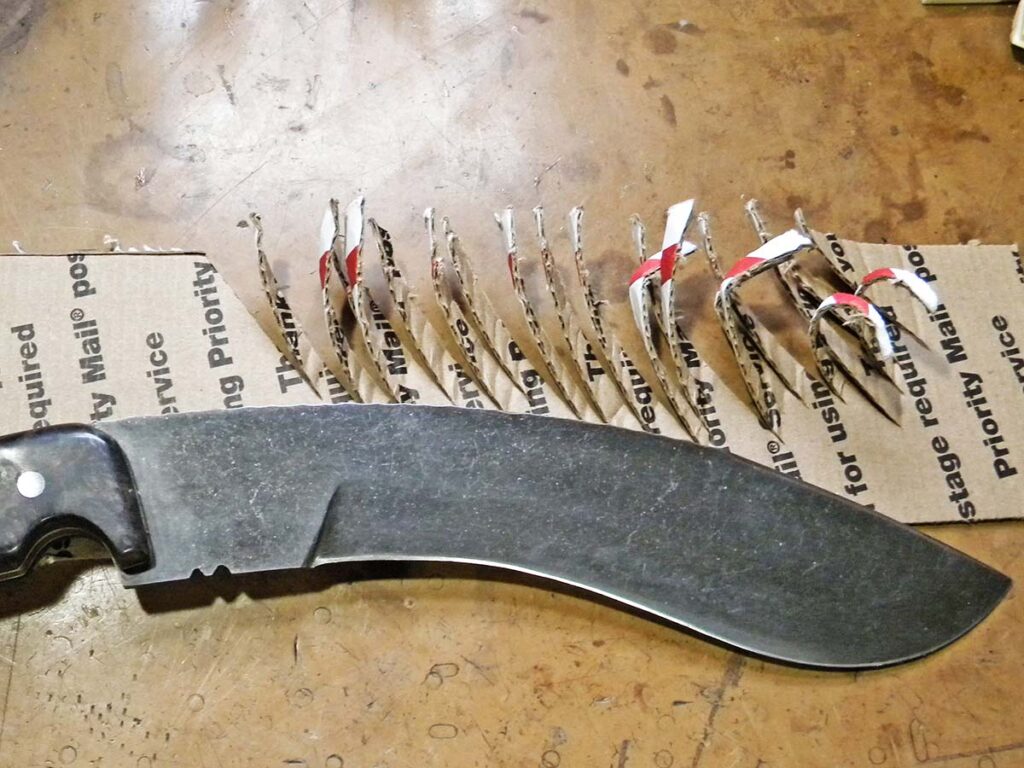
The cardboard slices curled from the edge geometry but resulted in no slowing down of the edge.
For a quick edge check, I use the paper slice. The knife cut smoothly and fast. The blade shape pulled the edge through the paper. I had to control the knife’s forward weight, but after a few slices, it was no issue. It’s a sharp blade for sure.
I cut up an old postage box and used a side of it for a single-walled cardboard cut. The knife sliced aggressively and was easy to control. The slices curled from the edge geometry but resulted in no slowing down of the edge.
Kukri Medium-Duty Cutting
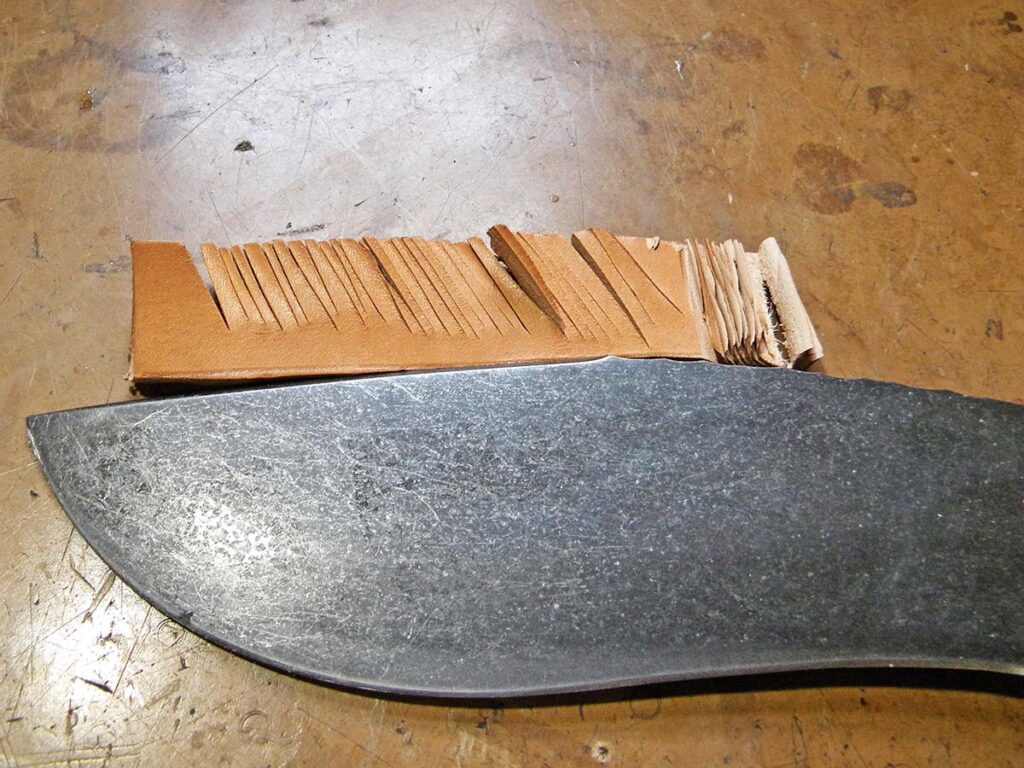
The Kukri smoked the leather cut.
Next up: 8-ounce leather for skiving. I shaved a thin slice of leather to remove the squared-off cut during sheath construction to get the leather to flow together. It was fairly easy to skive the leather; I just had to be careful of the excess part of the blade I was not using. In other words, I was both skiving leather and shaving wood off my workbench at the same time.
Cutting leather was one push and the edge hit bottom. The Kukri smoked the leather cut. I moved up and down the blade and couldn’t find a dull spot. The blade belly was the smoothest. Again, I forgot to check the clearance on the first cut and carved into my benchtop. I’m blaming it on the heat.
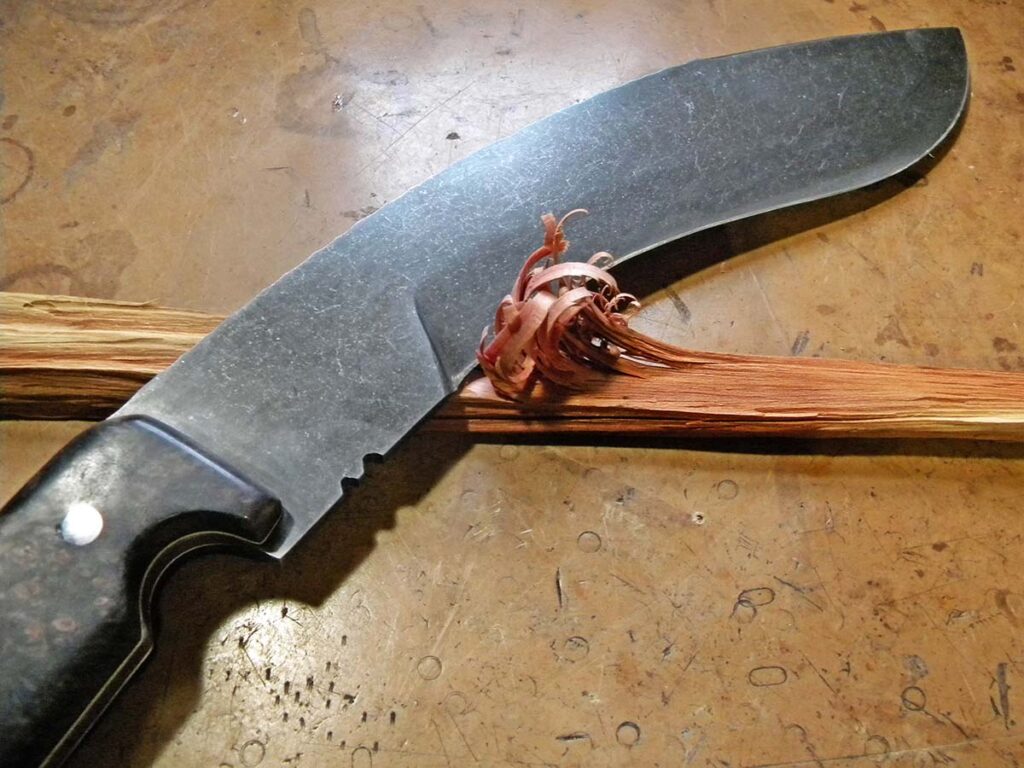
It was time to whittle some fire sticks. I easily controlled the depth of the curlicues by choking up on the handle. The knife curlicued the cedar very quickly. Yes, the Kukri can be used for finer chores, too.
Kukri Heavy-Duty Cutting
The author easily controlled the depth of the curlicues by choking up on the handle.
Chopping was next on the test menu. Finally, I got to use the Kukri and put some whacking into it. Using some red cedar firewood as a base, I started chopping kindling. One whack and I was halfway through the piece. The forward balance worked perfectly for splitting—and man, does it whack! The choil does have a sharp spot but that was easily fixed.
I went back to slicing the original piece of paper to check for dulling and/or chips. The Kukri sliced the now-damp paper very well (97° F and 90 percent humidity make paper kind of soggy). It was simply too hot to stay in the shop—test over!
Final Cut
The Kukri is an excellent field/camp knife. It’s made to chop and whack in the outdoors. However, I soften the edge of the steel at the choil.
Summer Steel: June’s Hottest Custom and Production Knives You Need to Know.
From mosaic fighters to modern flippers, this month’s standout blades bring a mix of artistic craftsmanship and everyday utility. Whether you’re in the market for a hand-forged Damascus showpiece or a no-nonsense EDC, June’s lineup has something sharp for every collector and user. Here’s a closer look at what’s turning heads in the knife world this month.
Miguel Navarro Fixed Blade
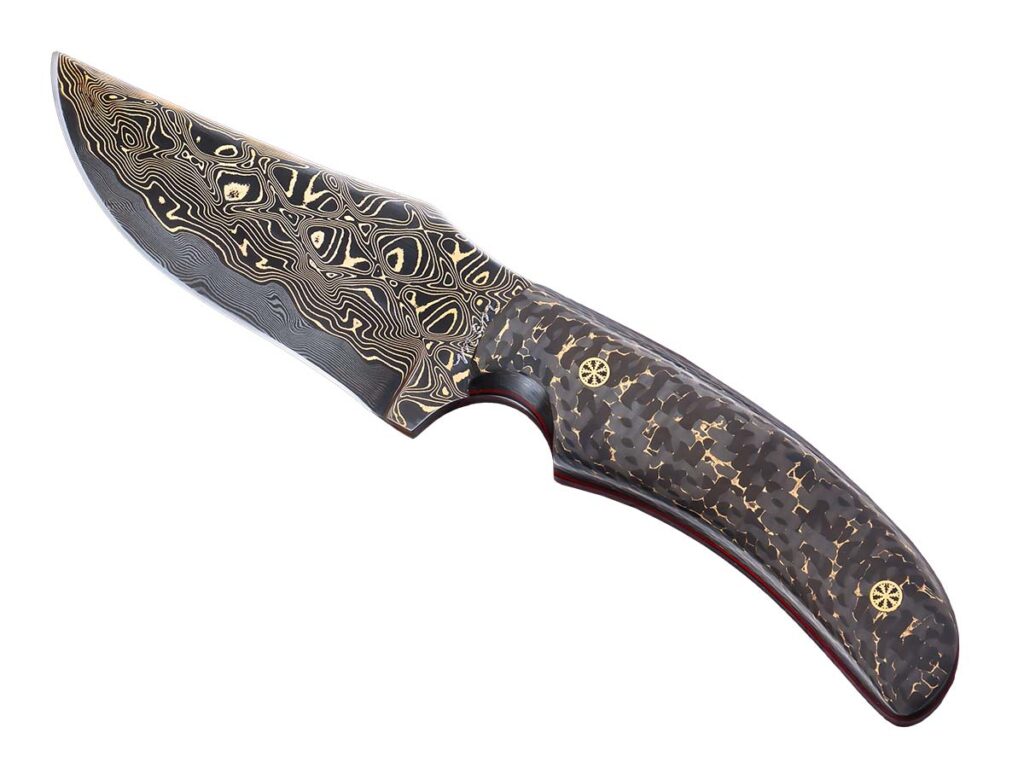
Blade length: 4.25” Blade material: Diamond Damascus by Baker Forge & Tool Blade grind: Hollow Scales: Fat Carbon Gold Snake w/black and red G-10 liners Weight: 7.4 ozs. Overall length: 9” Maker’s price for a similar knife (includes custom sheath): $550-$600 Maker: Miguel Navarro (SharpByCoop image)
Dale Holt Mosaic Fighter
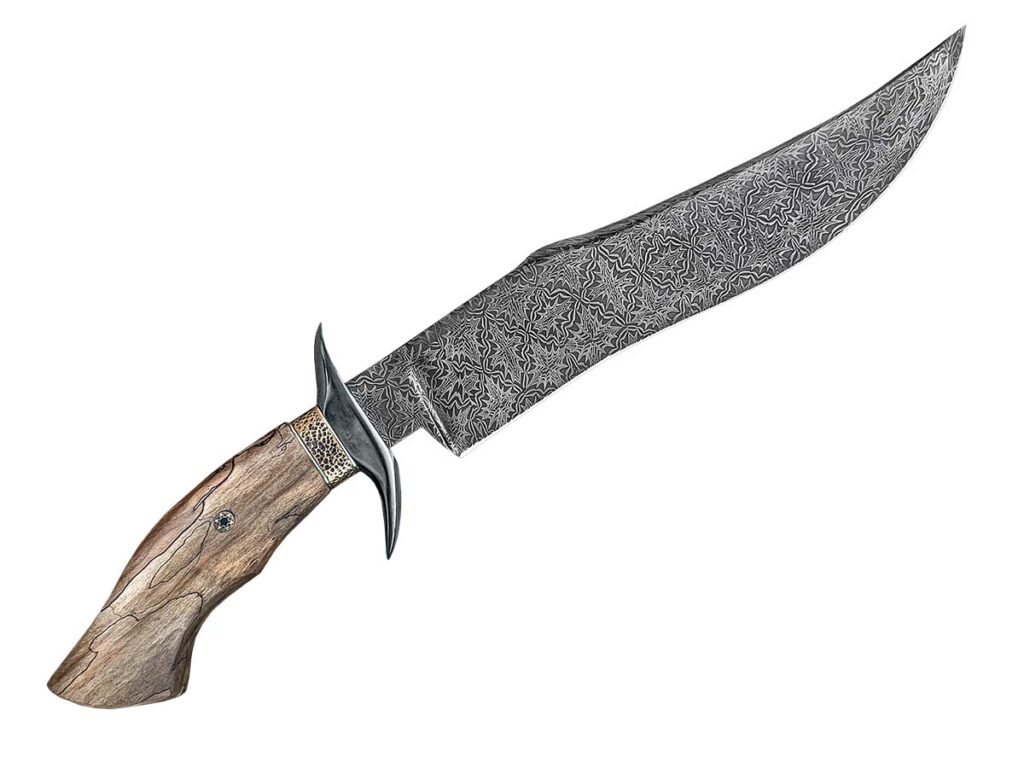
Blade length: 10” Blade materials: 1084 carbon and 15N20 nickel alloy steels Blade grind: Flat Blade pattern: Clip-point recurve Handle material: Spalted sassafrass Spacers: Textured brass and nickel silver Guard: Blued mild steel Knife to know: Design features include an S-guard and dropped handle; Dale Holt is an ABS journeyman smith Overall length: 15” Maker’s price for a similar model: Contact maker for details Maker: Dale Holt (Jocelyn Frasier image)
Kelly Frasier Paring Knife
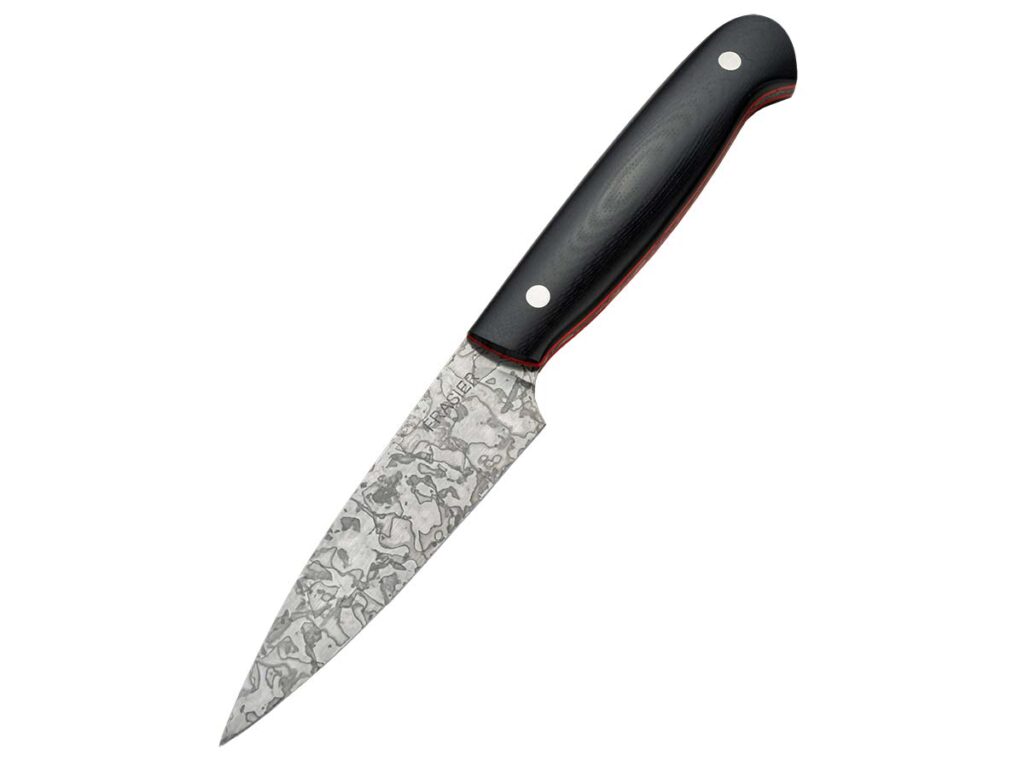
Kelly Frasier Paring Knife Blade length: 3.5” Blade material: 26C3 carbon steel Blade grind: Flat Blade finish: Mustard patina Scales: G-10 w/red liners Overall length: 7.5” Maker’s price for a similar model: Contact maker for details Maker: Kelly Frasier (Jocelyn Frasier image)
Sam Renwick Farmer’s Lockback
Knife type: Folder Blade length: 2.78” Blade steel: Nitro-V stainless Blade grind: Flat Blade @thickest: .98” Scales: Spalted maple Frame & bolsters: 416 stainless Knife to know: The bolsters are dovetailed Weight: 5.3 ozs. Closed length: 3.38” Maker’s price for a similar knife: $291 at press-time rate of exchange Maker: Sam Renwick (Rod Hoare image)
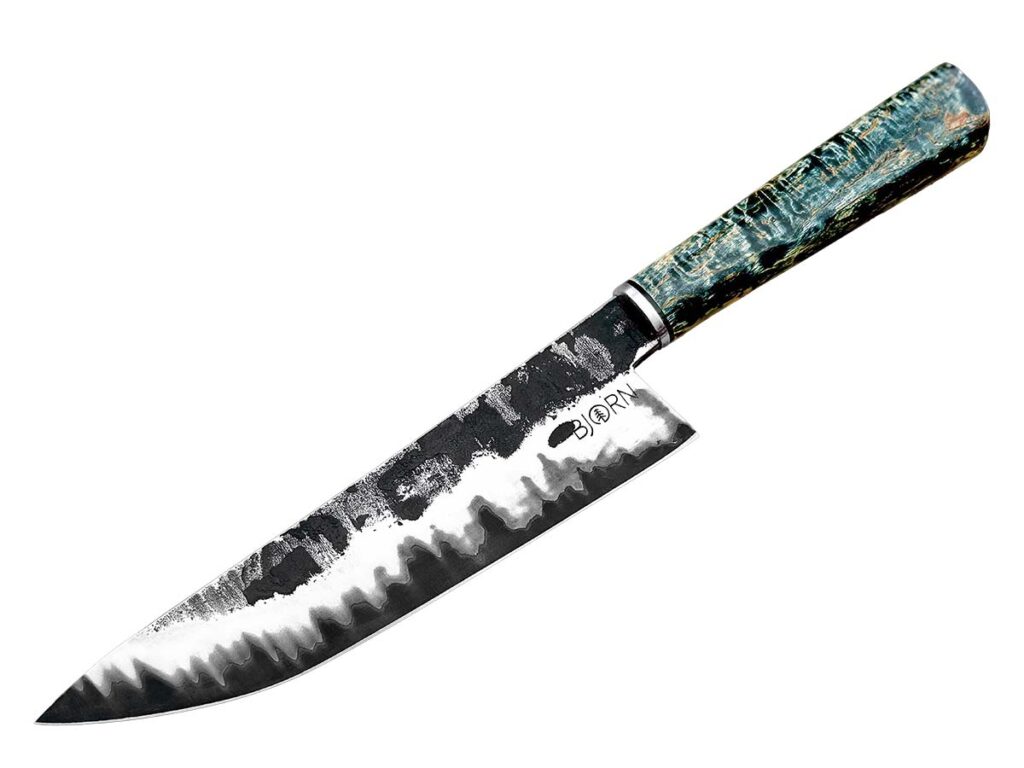
Bjorn Jacobsen Ghost Recon Chef
Blade length: 7.87” Blade material: 1084 (the black core) laminated w/stainless steel etched Blade grind: Flat w/forged texture on top half Blade @thickest: .118” Blade @widest: 1.97” Handle: Curly birch dyed w/black leather dye and sanded w/600 grit paper, then sanded mostly off again at 1500 grit, blue leather dyed and sanded w/1500 grit yet again; finished w/Uncle Bjorn’s Handle Finish Fittings: Stainless Weight: 6 ozs. Overall length: 12.6” Knife to know: Blade etched in ferric chloride to make the carbon migration “pop,” then left in instant coffee overnight to make the 1084 core black Maker’s price for a similar knife: $320 at press-time exchange rate Maker: Bjorn Jacobsen (Rod Hoare image)
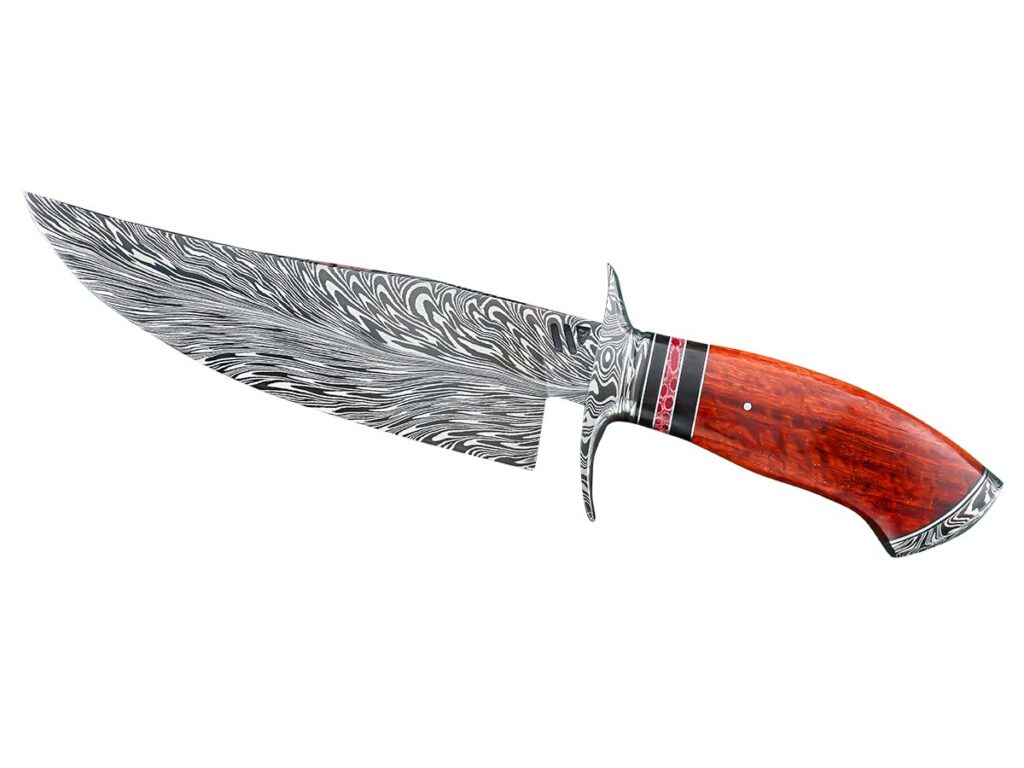
Rob Wayman Knives Feather Damascus Fighter
Blade length: 8” Blade material: Feather damascus of 1084 carbon and 15N20 nickel-alloy steels Blade grind: Full flat Handle materials: Stabilized bog oak, black G-10 and stainless steel spacers, dyed/stabilized fossilized brain coral, and stabilized curly narra Guard & pommel: Feather damascus Overall length: 13.75” Sheath: By Rob Wayman; belt model of vegetable-tanned leather w/stingray inlay Maker’s price for a similar knife and sheath: $2,400 Maker’s remark: “I’m all about sole authorship, so I make all my own steel and keep everything in house.” Maker: Rob Wayman Knives (SharpByCoop image)
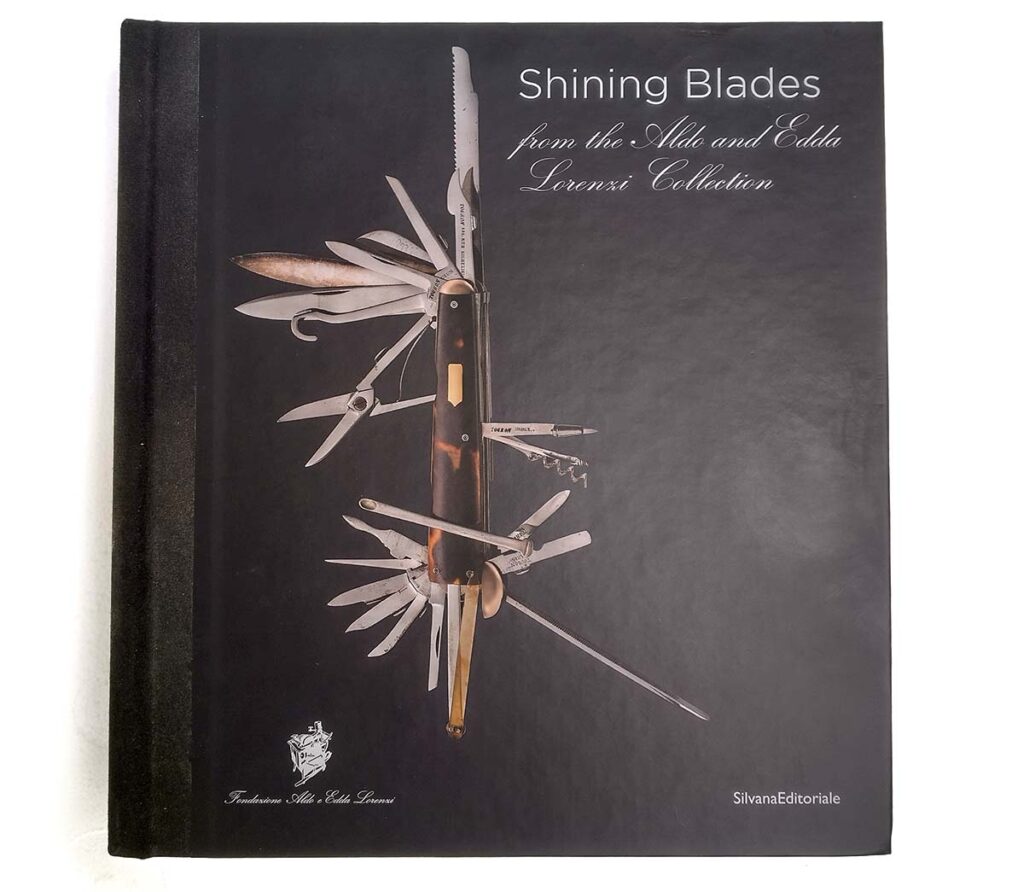
Shining Blades: From the Aldo and Edda Lorenzi Collection
Authors: Aldo and Edda Lorenzi Format: Hardcover, 9 x 9.75 inches Pages: 344, including 280 in color Publication date: May 27, 2025 Publisher: Silvana Editoriale Content: BLADE Magazine Cutlery Hall-of-Fame® members, the authors operated the G. Lorenzi retail knife shop in Milan, Italy, from 1959 to 2014. To stock their store and to add to their collection, they traveled far and wide in search of all manner of knives, scissors, razors, corkscrews and other edged tools. They acquired over 2,000 pieces from the Etruscan period to the present, many incredible specimens of which are illustrated in their book—including those by some of the most famous custom knifemakers of all time—along with the stories of how the Lorenzis obtained the pieces, met the makers and much more. A must read for true knife and edged tool aficionados, both present and future alike. List price: $50 Order: artbooks.com
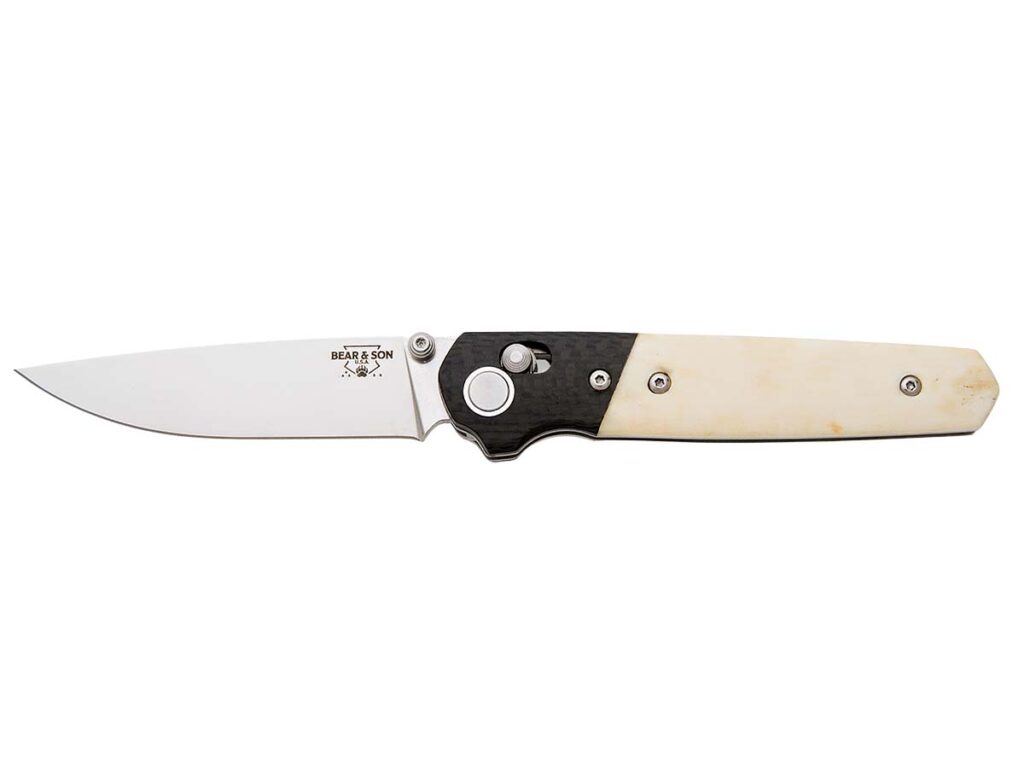
Bear & Son Cutlery Lawman
Bear & Son Cutlery Lawman Knife type: EDC folder Blade length: 3.25” Blade material: D2 tool steel Rockwell hardness: 59-61 HRC Blade grind: Taper Blade finish: Polished Blade opener: Thumb stud Pivot: Ball-bearing washers Scales: White smooth bone Bolsters: Carbon fiber Lock: Slidelock Pocket clip: Blade tip up Weight: 3.5 ozs. Closed length: 4 3/8” City & state of origin: Jacksonville, Alabama MSRP: $119.99 Company: Bear & Son Cutlery
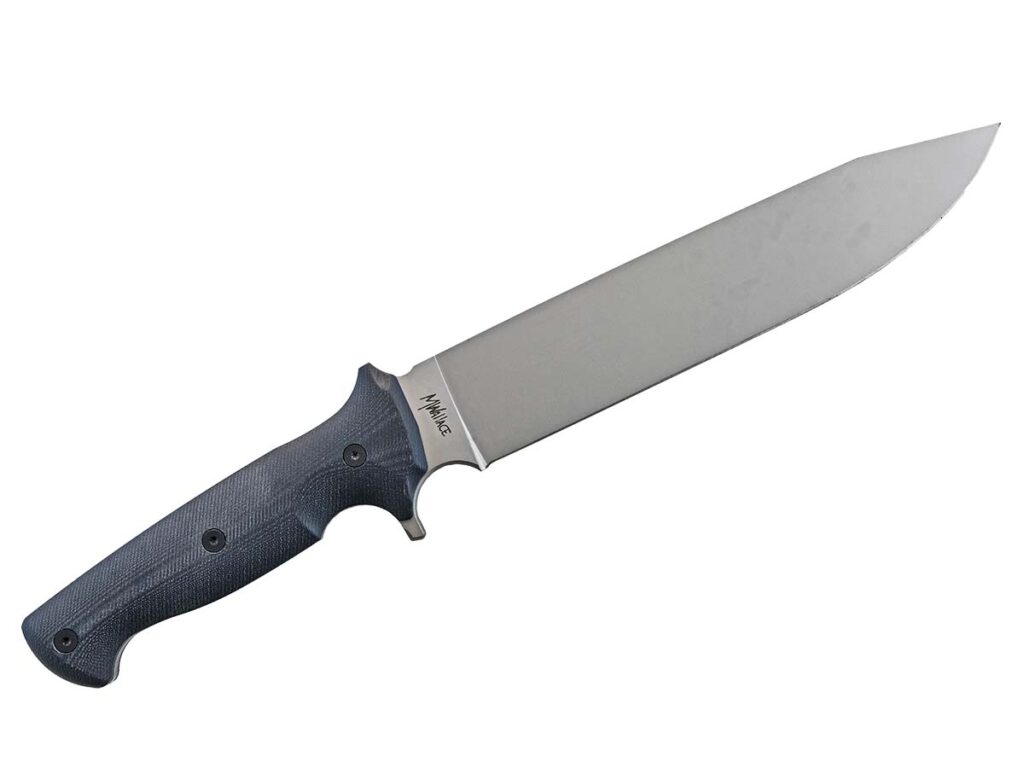
APOC Wallace Bowie
Designer: Mike Wallace Blade length: 9 5/8” Blade material: D2 tool steel Blade thickness @guard & tip: .256” & .039” Blade finish: Titanium coat Slabs: G-10 Knife to know: Handle screws accept a size T9 Torx or star bit; any other bit used may strip the screws Weight: 1 lb., 5 ozs. Overall length: 15 1/8” Sheath: Kydex, vertical or horizontal carry, MOLLE compatible Country of origin: China MSRP: $117 Company: APOC
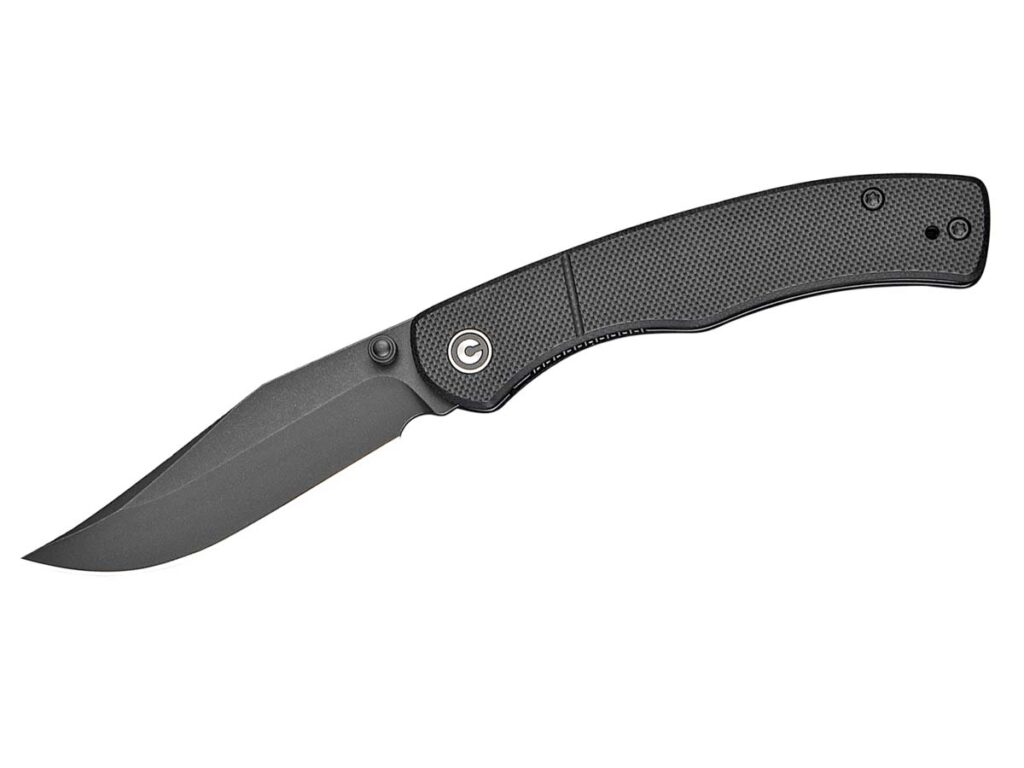
CIVIVI Clingman
Designer: Taylor Martin Knife type: Flipper folder Blade length: 2.99” Blade steel: Nitro-V stainless Rockwell hardness: 58-60 HRC Blade grind: Hollow Blade @thickest: .12” Blade finish: Black stonewashed Pivot: Caged ceramic ball bearings Lock: Linerlock Scales: Black G-10 Handle @thickest: .47” Liners: Stainless steel Pocket clip: 6Al4V titanium; ambidextrous, tip up Weight: 2.8 ozs. Country of origin: China MSRP: $71.70 Company: CIVIVI
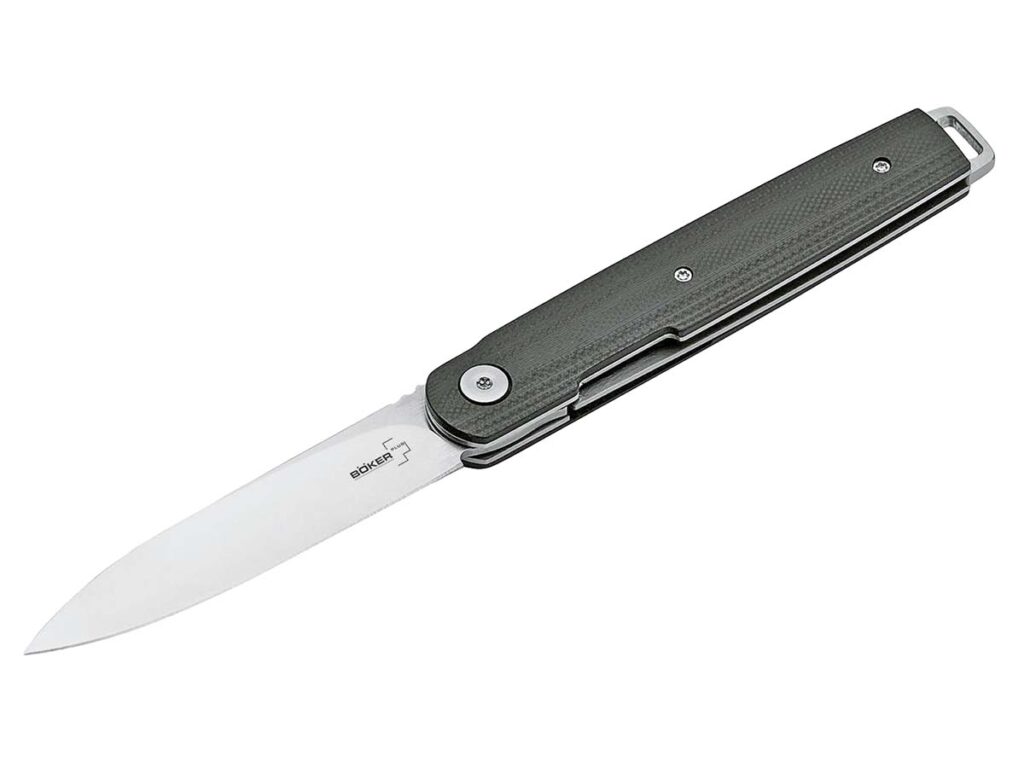
Boker Plus LRF G10
Knife type: Flipper folder Designer: Japanese knifemaker Kansei Matsuno Blade length: 3.07” Blade steel: VG-10 stainless Blade @thickest: .075” Pivot: Ball bearings Scales: G-10 Lock: Linerlock Weight: 1.94 ozs. Closed length: 4” Continent of origin: Asia MSRP: $108.69 at press-time exchange rate Company: Boker Plus
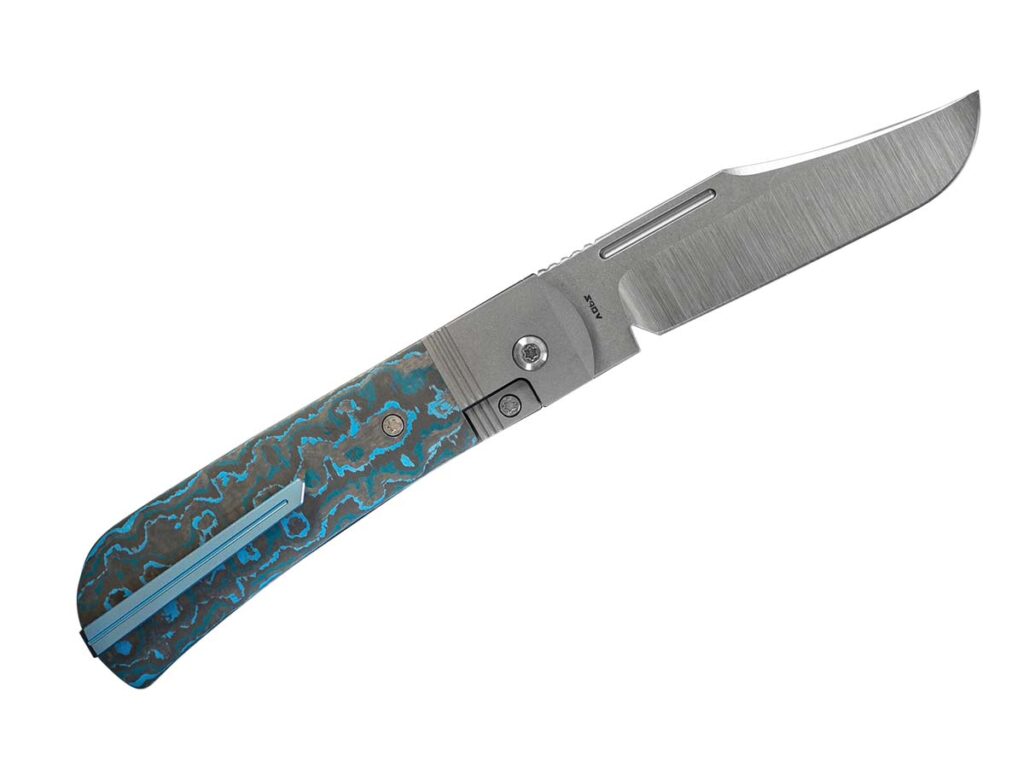
Jack Wolf Knives The Benny Fat Carbon Arctic Storm
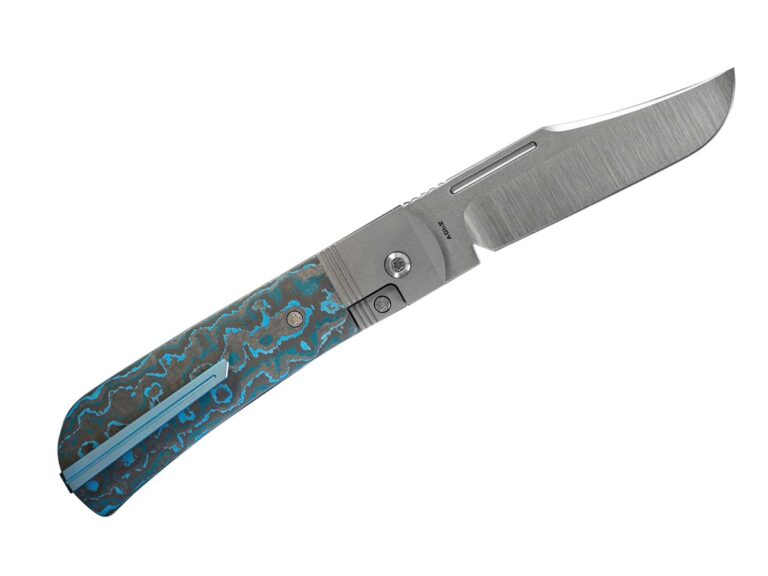
Knife type: Slipjoint Pattern: Lanny’s Clip Blade length: 3.25” Blade steel: CPM S90V stainless Rockwell hardness: 60-61 HRC Blade grind: Hollow Blade finish: Belt satin Blade @thickest: .12” Lock: Framelock/bolster lock Pivot: Ceramic bearings Scales: Fat Carbon Arctic Storm Bolsters: 6Al/4V dark-blasted titanium Pocket clip: Titanium anodized a light blue Knife to know: A pocket-clip recess plug provides clipless carry option Weight: 3.5 ozs. Country of origin: China MSRP: $279.99 Company: Jack Wolf Knives
No need to go big to make a large impact, as these small fixed blades more than prove.
Few knives capture the spirit of cut as well as small fixed blades. The ideal size for makers of all skill levels to recreate, they never cease to amaze in their various blade and handle shapes, materials and other differences in design features so slight as to be almost imperceptible to all but the most discerning eye.
Neal Green and Christopher Adelhardt: Kwaiken
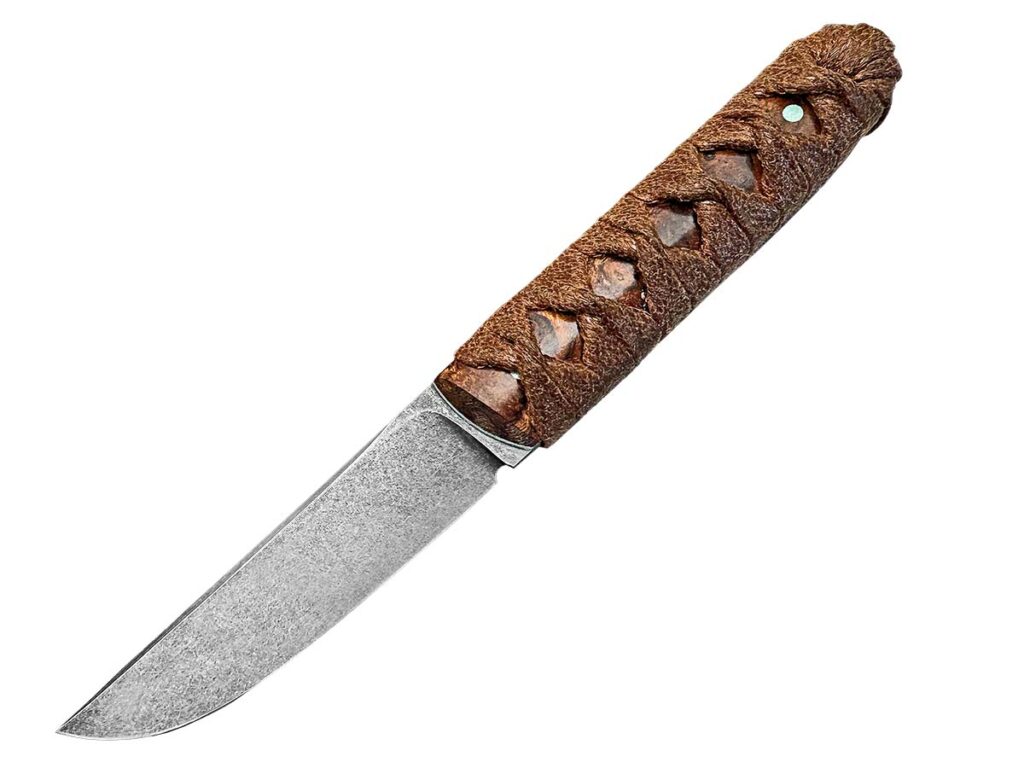
The Kwaiken by Neal Green and Christopher Adelhardt comes in a 3.5-inch blade of CPM 154 stainless, and an ironwood handle with G-10 liners and a brown tsukamaki (handle wrap). Overall length: 7.25 inches. It comes with a leather sheath (not shown) by Adelhardt. (Jocelyn Frasier image)
Peter Cocks: Hunter
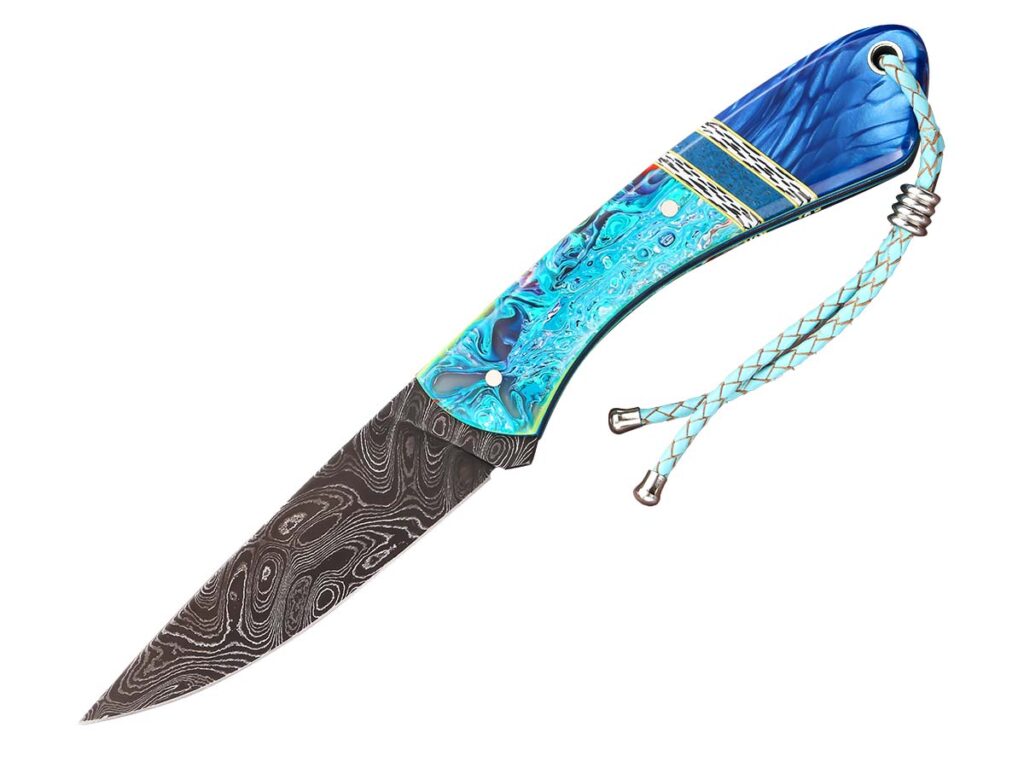
Australian Knifemakers Guild member Peter Cocks won Best Hunter at the 2025 Perth Knife Show for Slug Life in a 3.55-inch blade of a flat-ground mosaic damascus of 1084 carbon and 15N20 nickel alloy steels. Scales: ringed gidgee. (Rod Hoare image)
Tracy Jones: Cowgirl
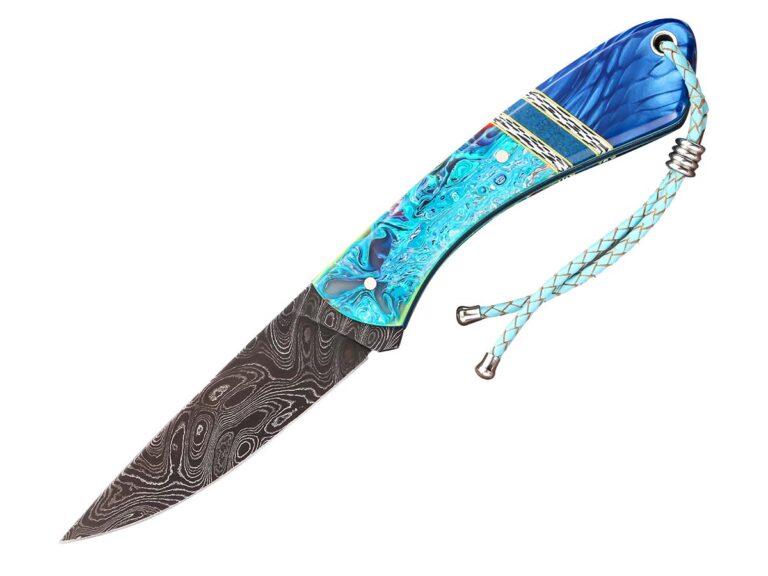
Cowgirl by Tracy Jones earned the maker the Best General Member award at the 2025 Texas Select Custom Cutlery Event. The 4-inch blade is flat-ground damascus and the scales are by Sara. Overall length: 8 inches. (SharpByCoop image)
Daniel M. Gutierrez: Utility Fixed Blade
Daniel M. Gutierrez: Utility Fixed Blade
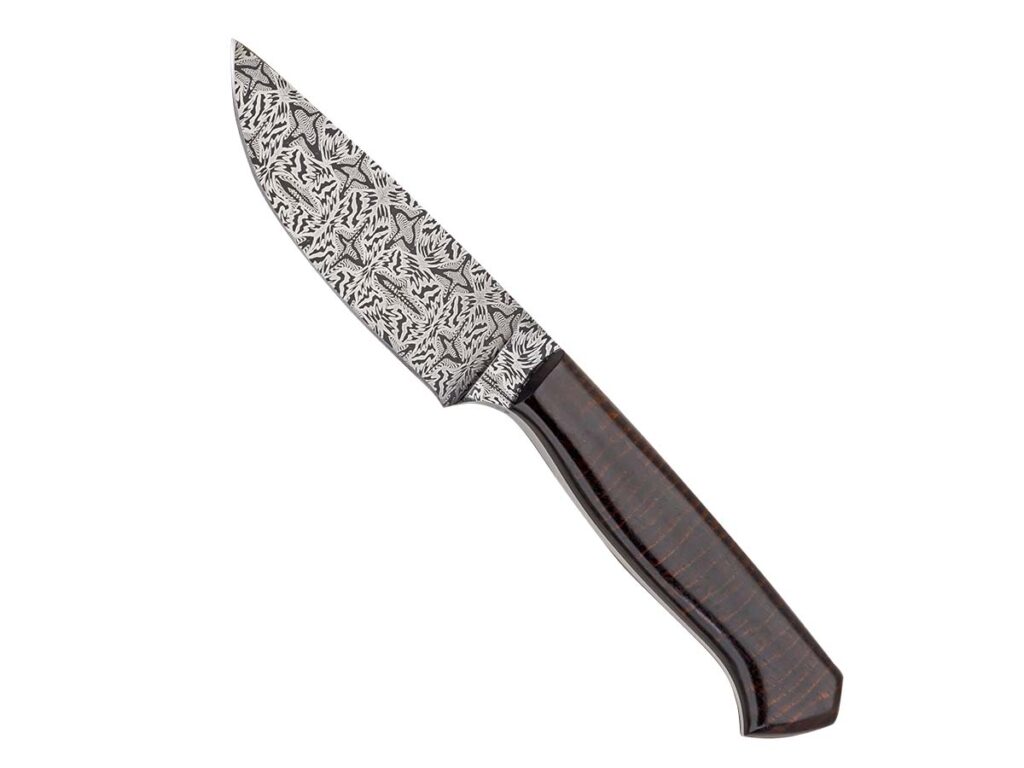
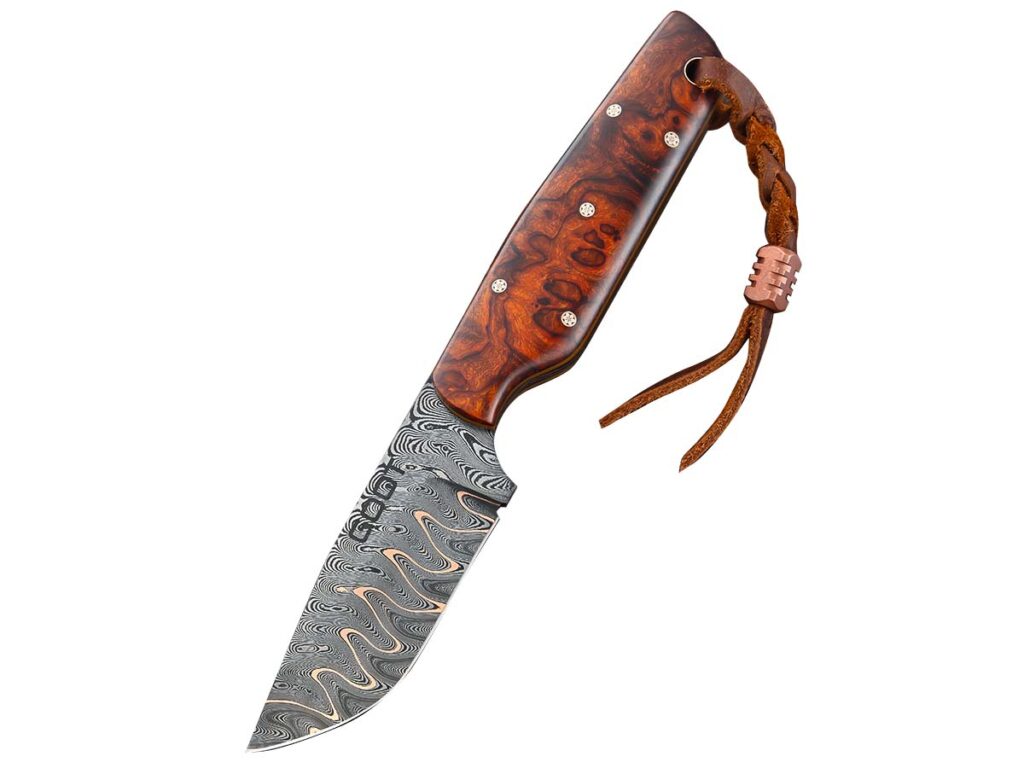
A 3-inch blade of a damascus of 1084 carbon and 15N20 nickel alloy steels and copper shim forged by Baker Forge & Tool, and a handle of ironwood burl help complete a utility fixed blade by Daniel M. Gutierrez. Blade grind: flat. Overall length: 7 inches. (SharpByCoop image)
Chad Jones: Panther Fixed Blade
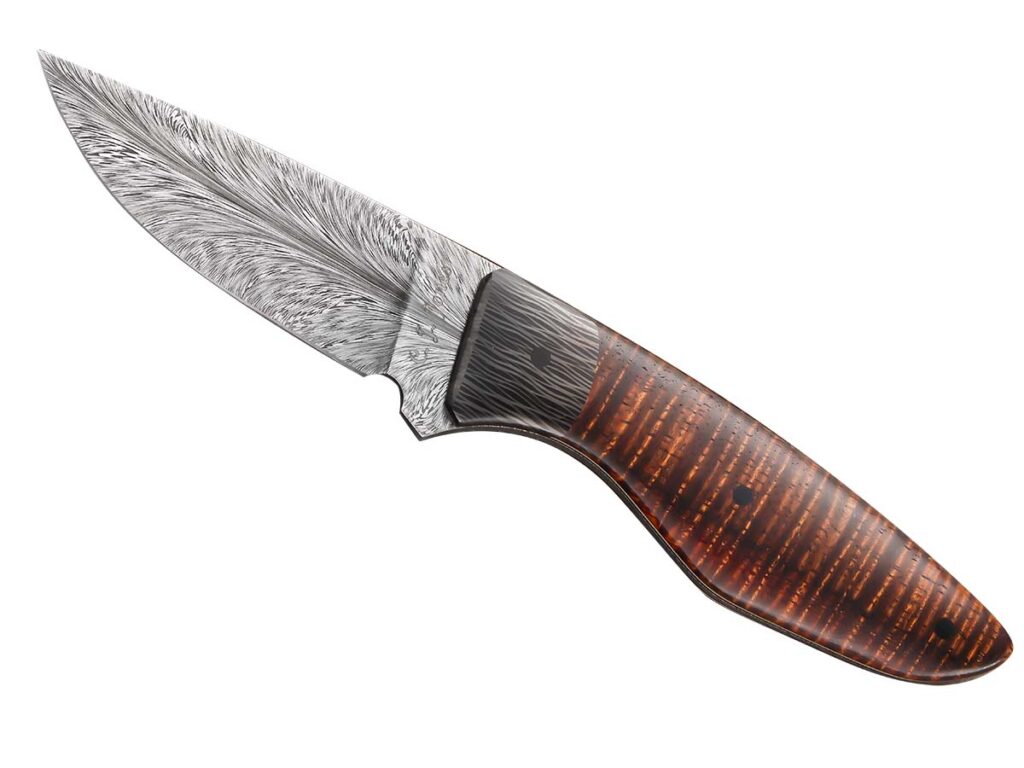
Chad Jones captured the title of Best Ranger Member at the 2025 Texas Select Custom Cutlery Event for his Panther fixed blade. The 3.25-inch blade is feather damascus and the scales are zebra carbon fiber and curly koa. Overall length: 7.25 inches. (SharpByCoop image)
Jason Howell: EDC Fixed Blade
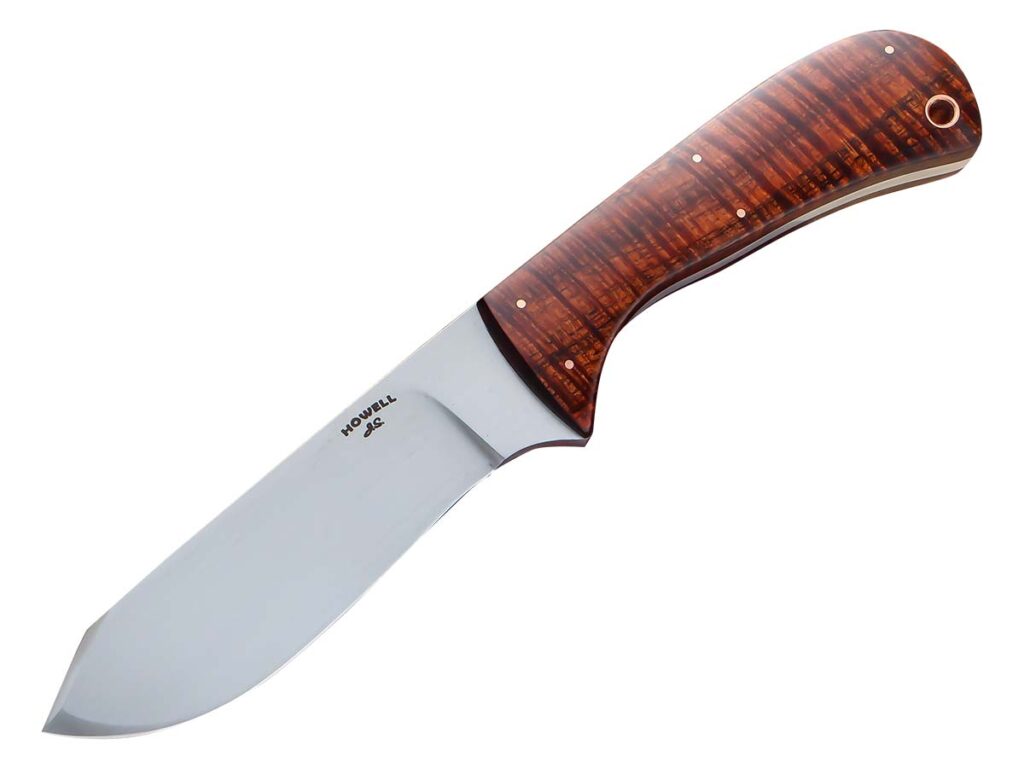
Jason Howell won the award for Troop 36 Scout Favorite at the 2025 Texas Select Custom Cutlery Event for his EDC fixed blade. The 3.75-inch spey blade is flat-ground 52100 carbon steel and the scales are French walnut. Overall length: 8.75 inches. The pouch sheath (not shown) is by Richard Epting. (SharpByCoop image)
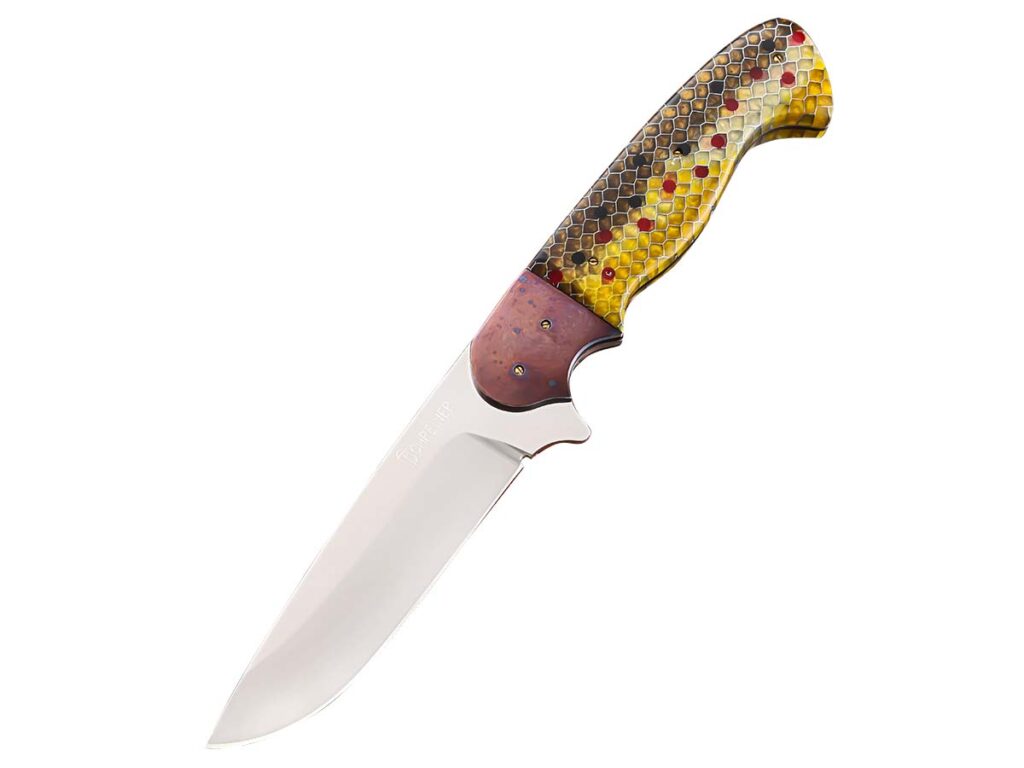
Dr. Terry Schreiner: Brown Trout Bird & Trout Knife
The brown trout/bird & trout knife by Dr. Terry Schreiner has a 4 1/16-inch blade of flat-ground CPM 154 stainless. The scales are a brown trout acrylic and the bolster is O1 tool steel. Overall length: 8 7/8 inches. (SharpByCoop image)
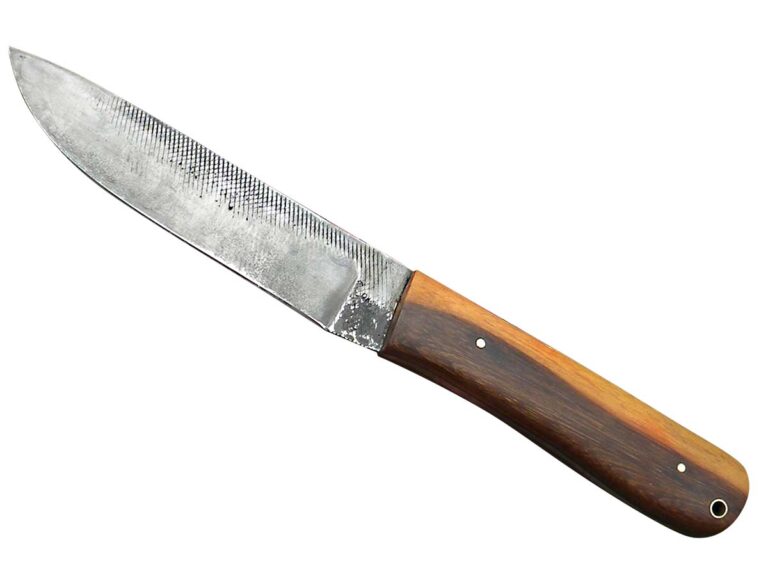
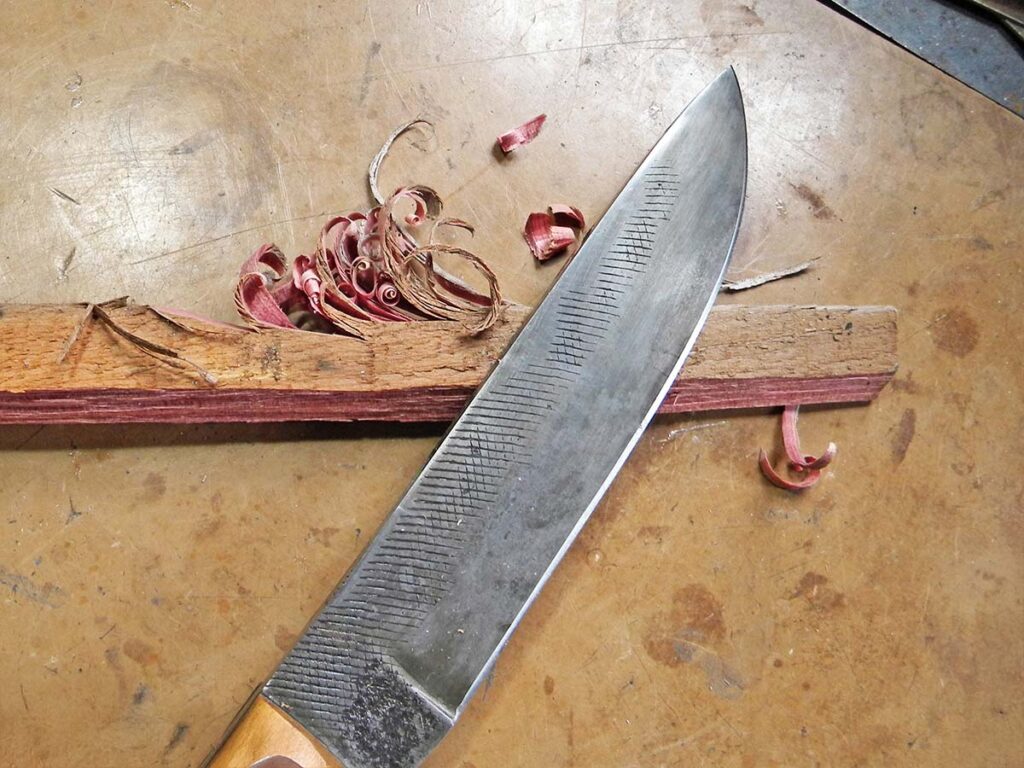
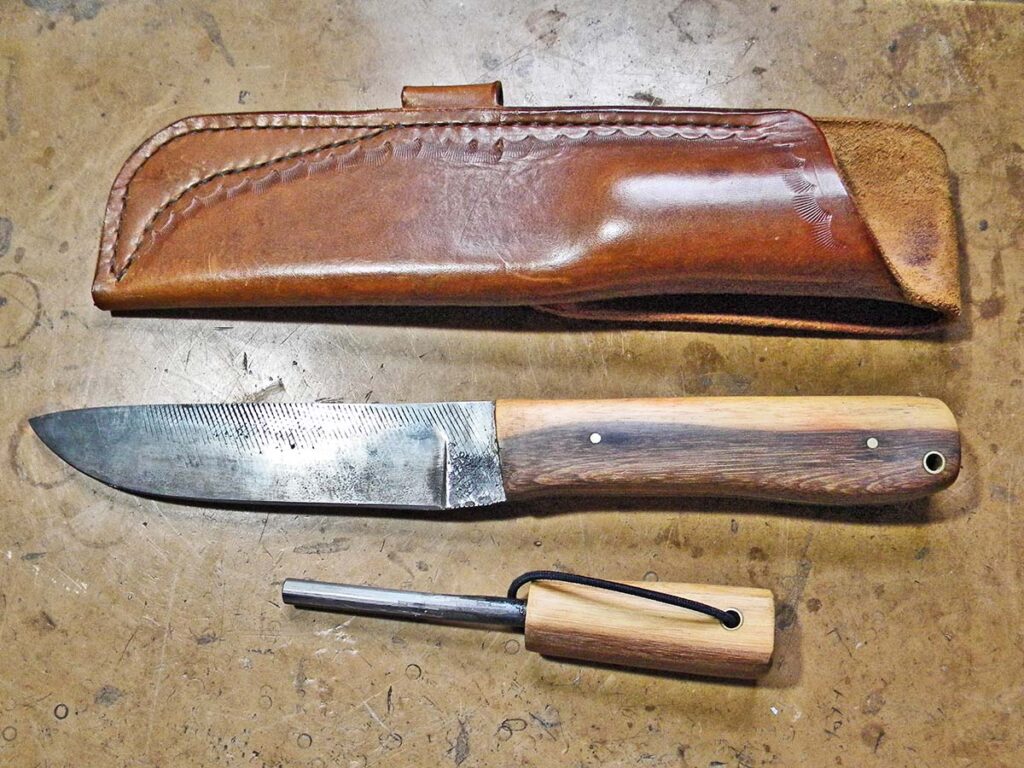
The Bushcrafter by Kris Waddington of KSW Custom Knives is a great example of what bladesmiths can do with recycled carbon steel. Got a worn-out file? No problem. They can convert it into another useful tool—a knife.
With a hot-enough fire, a smith can manipulate the steel into a wide variety of shapes and sizes. High carbon steels are made into cutting instruments, mild steels into ornamental fittings. It’s a great skill to possess and practice. Kris has the skill.
At the end of testing, the author returned to slicing the copy paper to check for edge snags or chips. The Bushcrafter sliced for the win. There was no edge damage. Heat treatment: spot on.
Enough talk about the cool stuff he can make. Let’s get into how well he performed the conversion.
Light-Duty Cutting
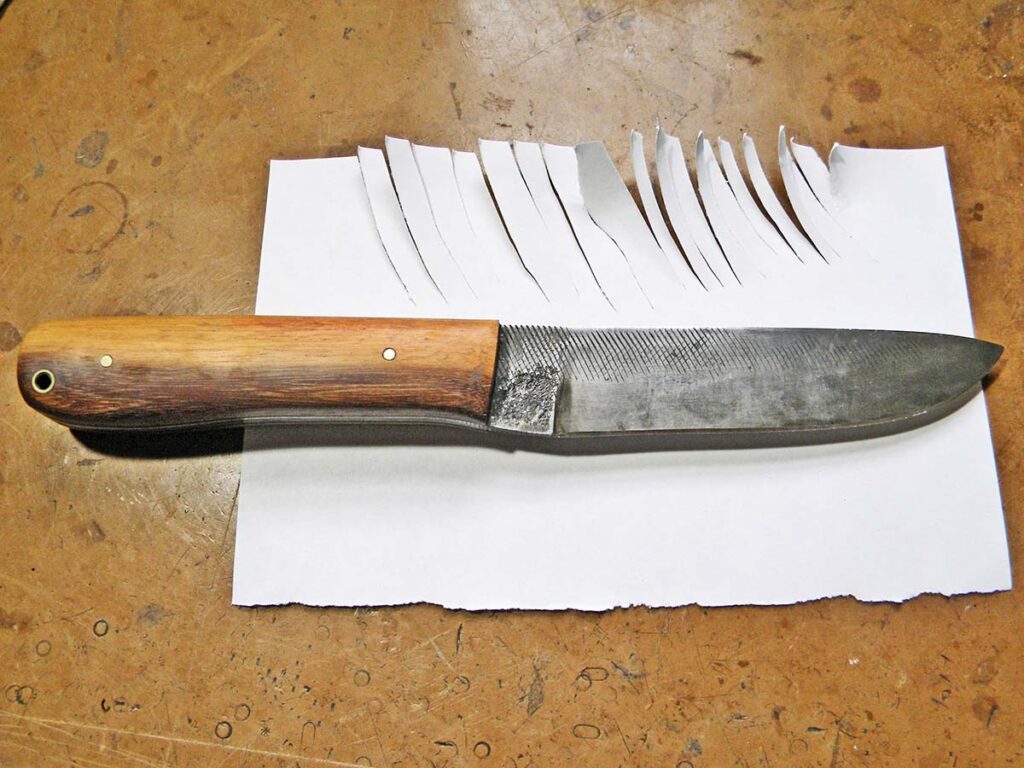
I always slice 20-pound bond copy paper at the start to see how fine the knife’s edge is. The Bushcrafter did not disappoint. The upcycled Nicholson file slid through the paper with ease. It made clean, crisp slices again and again. The knife is very sharp indeed.
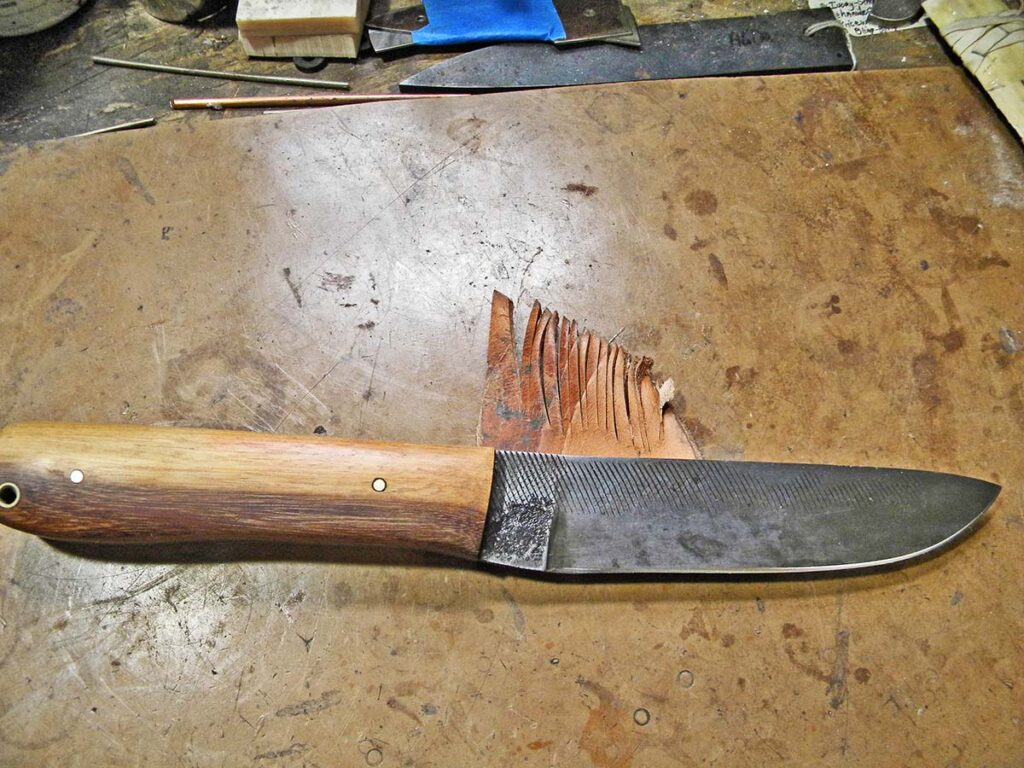
The Bushcrafter cruised through the 8-ounce leather very quickly with straight cuts.
From there it was on to severing single-walled cardboard. The Bushcrafter sliced through the medium quickly and aggressively. I could hear every slice. It was easy to control the spacing of the cuts with the larger handle.
Cutting 8-ounce leather to represent the skin of a harvested big game animal was next. The Bushcrafter crunched through it very quickly with straight cuts. Skiving the material was even louder as the knife aggressively sliced it into thin layers. The leather was no challenge whatsoever.
Heavy-Duty Cutting
Cutting sisal rope always tells if the edge will hold up. The Bushcrafter crunched through 200 cuts very quickly and wanted more. There was a small hot spot where the handle meets the blade. A quick hit with 220-grit sandpaper removed the spot. The blade held an edge while slicing and cutting. It was time for a tougher medium.
The Bushcrafter turned out some excellent red-cedar curlicues ready for the fire.
For bushcrafting, I chopped a slab of red cedar. The blade buried deeper than expected and cracked the slab. It was comfortable using the knife.
I worked the cedar to make a fire stick. The Bushcrafter turned out some excellent curlicues ready for the fire. Batonning was next in line. The knife averaged 3 1/2 baton hits to split the slab into small kindling. That was some short slab work! To raise the bar, Kris added a ferrocerium rod with a matching handle. The result is a complete outdoor package.
A leather sheath and a ferrocerium rod with a matching handle complete the outdoor package.
I returned to slicing the copy paper to test for edge snags or chips. The Bushcrafter sliced for the win. There was no edge damage. Heat treatment is spot on. Great job, Kris.
Final Cut
I would prefer more of a finger notch and maybe some thumb notches for added control. The Bushcrafter lives up to its name. Made to perform in the woods, it is the total package for your backpack outing.
Contemporary armed forces styles are chips off the old block.
While U.S. troops have long had a choice of carrying alternative knives as opposed to military issued ones, nothing prepared them for the explosion of choices that came with the modern tactical boom of the early-to-mid 1990s.
While the newly minted cutters were mostly of the folding knife variety, fixed blades also benefitted from the vast improvements in tactical designs and materials that shook the cutlery industry. That boom continues almost 35 years later as the tactical segment and its many spinoffs are still the largest chunk of the sporting knife market.
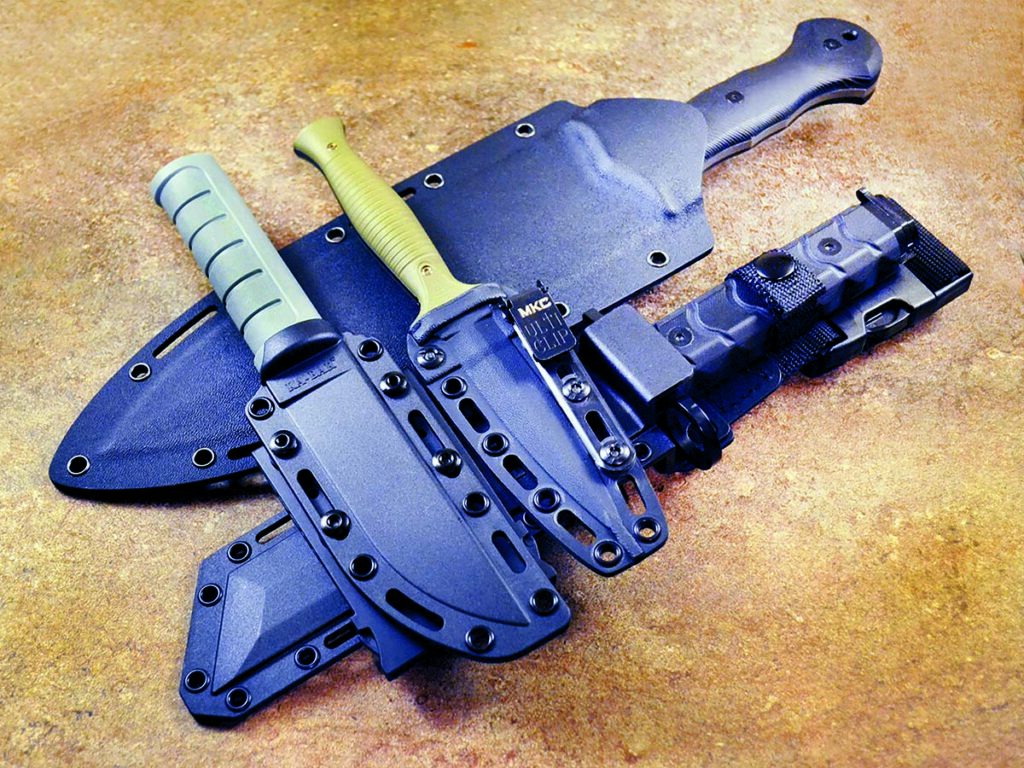
Many military knives have been issued over the years as the various branches, both main and special, selected their own. Large fixed blades and bayonets were common and outsourced to manufacturers along the way. Even though they may differ in size and modifications, the four review knives all have roots in military history.
SOG BAR15T Tanto Bayonet
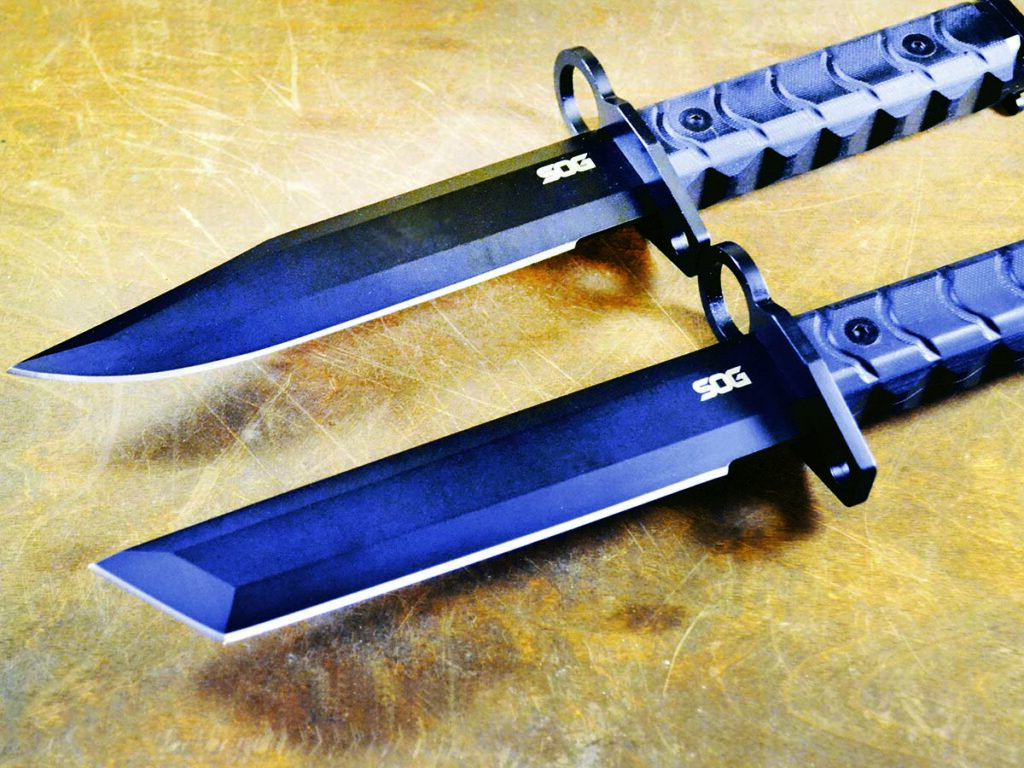
Two SOG bayonet offerings: the BAR15T Tanto and BAR15C Clip Point. The test tanto has a more than serviceable 5 inches of cutting edge.
Pros
Powerful Chopper
Strong Tip Design
Ergonomic Handle
Cons
Heavy And Bulky
Not Ideal For Finesse Tasks
BAR15T Tanto Bayonet Specs Blade Length: 7.1” Blade Steel: AUS-8 stainless Handle Length: 5.1” Handle Material: Black G-10 Overall Length: 12.2” Sheath: Black Kydex Country of origin: China MSRP: $79.95
The SOG BAR15T is a big boy. True to modern tanto form, the blade is clipped from the frontal blade grind to the upper tip. The black-traction-coated blade’s main edge is flat ground and 5.2 inches long, with a quarter-inch grind to enhance penetration along the spine. The 4.8-inch handle includes a straight guard and pommel with hardware for mounting as a bayonet, with a hidden-tang main grip of black G-10 done up in a series of curved grooves on its top surface and angled pyramids along the sides. The BAR15T checks in at 19.2 ounces and is delivered with a MOLLE adaptable drop sheath, which includes black nylon and leather belt fittings.
CAS Iberia/APOC Smatchet
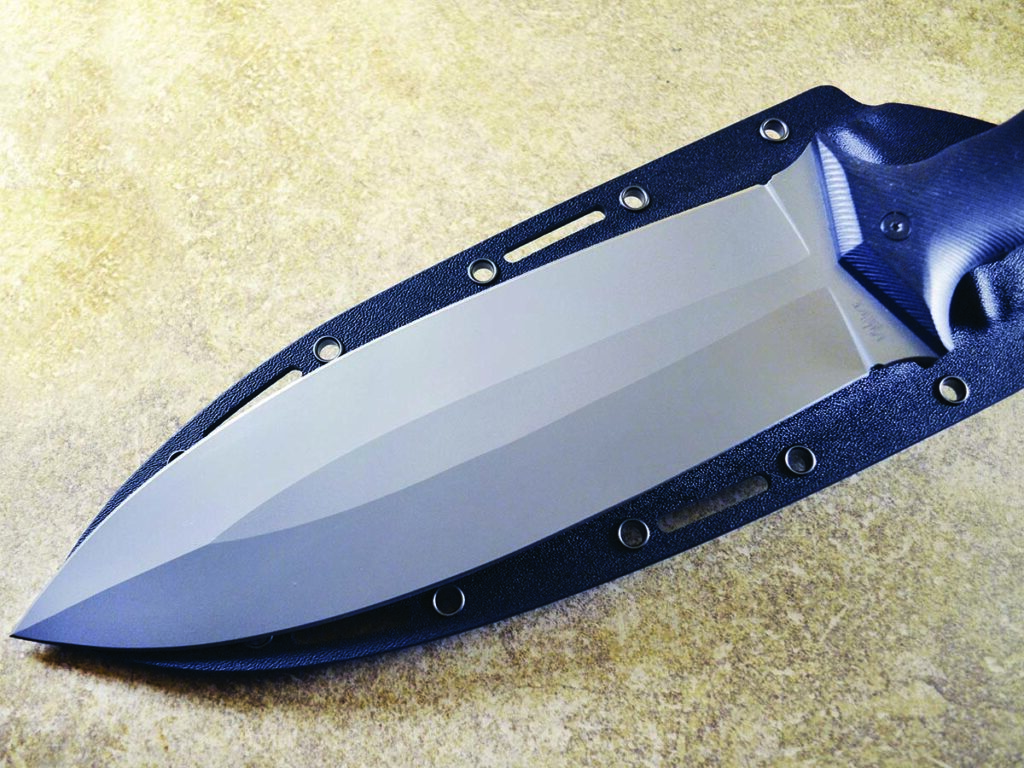
With its wicked 9.7-inch blade, the CAS Iberia/APOC Wallace Smatchet is loaded for bear. British and American forces used the original version of the knife to maximum effect during World War II.
Pros
Exceptional Chopping Power
Comfortable Handle
Battle-Ready Design
Cons
Overkill For Light Tasks
Difficult To Carry
Smatchet Specs Blade Length: 9.7” Blade Material: D2 tool steel Blade Finish: Titanium coated Handle Length: 6” Handle Material: Black G-10 Overall Length: 15.5” Sheath: Black Kydex belt mount Country of origin: China MSRP: $175
Designed by Mike Wallace, the CAS Iberia/APOC Smatchet is by far the largest, and most ususual, of the review bunch. The smatchet is not new and is best known for seeing action in World War II as a close combat fixed blade for British and American special forces. The Wallace Smatchet’s abbreviated, double-ground blade has a matte titanium coating. An ample finger-grooved handle can easily accommodate large and/or gloved mitts and is flared at the base for excellent purchase. Weight is a hefty 1 pound, 10 ounces. The knife is delivered with a MOLLE compatible drop sheath with steel and black nylon fittings.
The KA-BAR Dust II
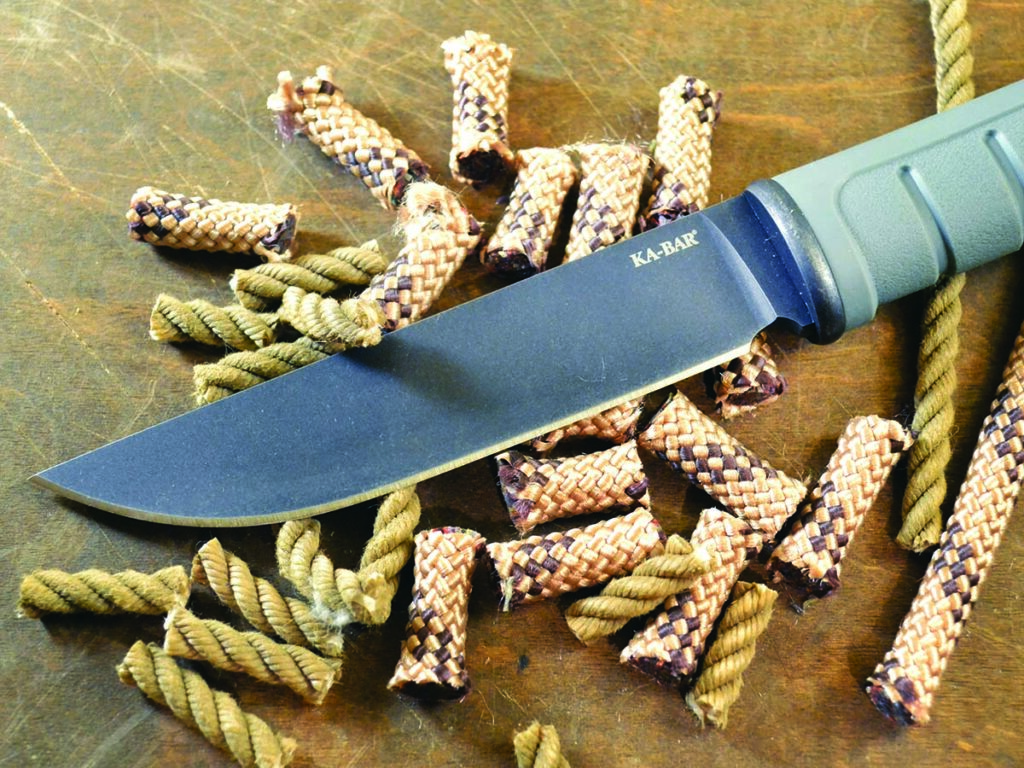
The KA-BAR Dust II tackled synthetic rappelling rope and stiff waxed cotton lariat rope. The full-ground D2 tool steel blade was no worse for wear and ready for more.
Pros
Compact And Lightweight
Good Edge Retention
Versatile Utility
Cons
Light-Duty Only
Basic Construction
Dust II Specs Blade Length: 5.2” Blade Material: D2 tool steel Handle Length: 4.79” Handle Material: Green glass-filled nylon Overall Length: 9.58” Sheath: Black, molded hard plastic Country of origin: Taiwan MSRP: $138.49
The KA-BAR Dust II, a down-sized version of its larger brother the Dust I, is better configured for light utility. It has a very staid, flat-ground, gently clipped, black-coated blade. The hidden-tang handle hasn’t a sumptous curve to its name and is arrow straight with wraparound grooving on three quarters of its surface. The handle has a hint of a guard top and bottom, the epitomy of understated good taste. It comes with a black, MOLLE-adaptable, hard-plastic belt sheath.
Montana Knife Co. Model V24
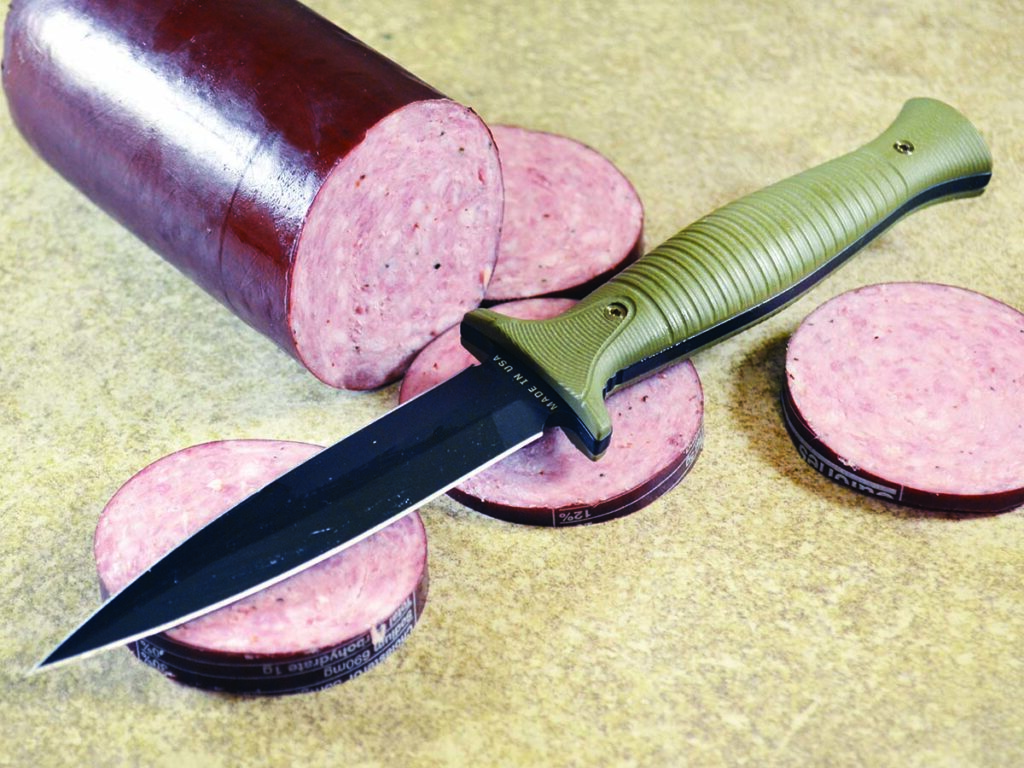
The Montana Knife Co. V24 stiletto turned out to be a little carnivore during testing. After doing stab tests on a chub of summer sausage proved a walk in the park, the author turned the slim 4-inch CPM MagnaCut blade to taking off slices of the meat. Note the clean edge work on the sausage casings.
Pros
Exceptional Penetration
Smooth Slicing
Near-Custom Quality
Cons
Purpose-Built Design
Less Robust For Batoning Or Chopping
V24 Specs Blade Length: 4.25” Blade Steel: CPM MagnaCut stainless Blade Finish: Black Cerakote® Handle Length: 5” Handle Material: OD green G-10 Overall Length: 9.25” Sheath: Black Kydex w/UltiClip Country of origin: USA MSRP: $475
Complete with thumbprint ricasso, the Montana Knife Co. Model V24 is a tribute to the V-42 stiletto used during World War II by the First Special Service Force, father of today’s U.S. Special Forces. This exqusite send-up was designed by MKC President/CEO Josh Smith, who, when he was all of 11 years old, began studying bladesmithing under ABS master smith Rick Dunkerley. The dagger-style blade is double ground and the hourglass handle boasts horizontal machined striations and guard art. The steel is gimped along the sides of the guard and curved base. The knife weighs 4.47 ounces and carries in a black belt sheath with an UltiClip 3.3 mounted on the front.
Testing Modern Military Knives
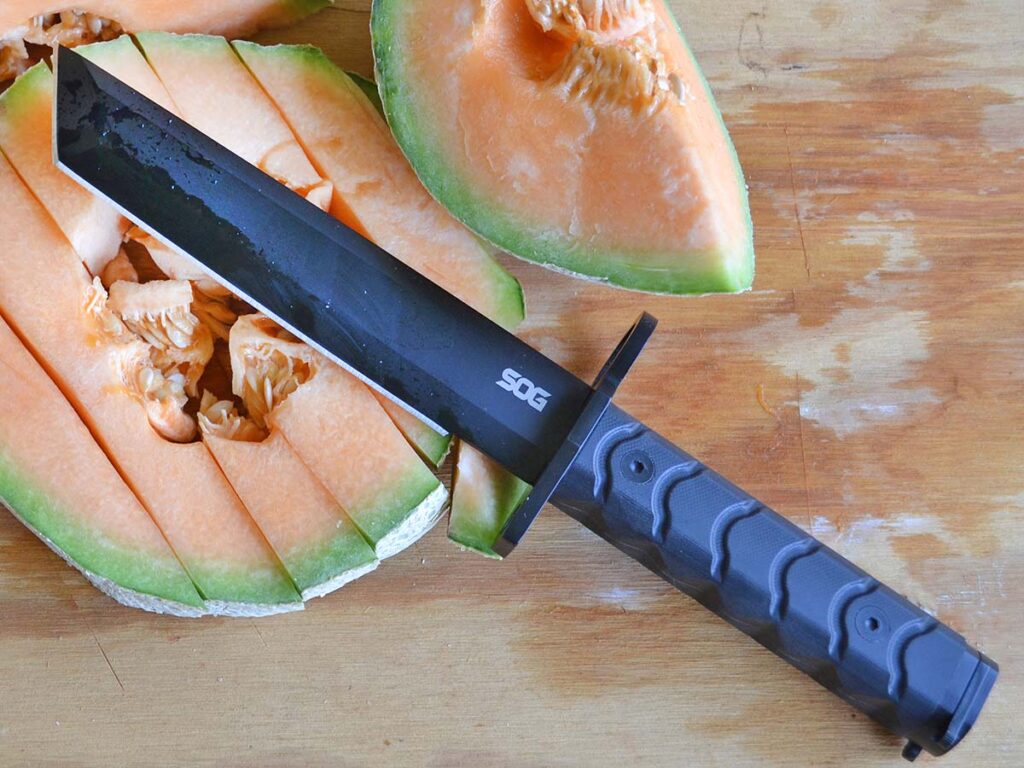
The review knives are very diverse and the two largest, the Smatchet and BAR15T, are definitely in the same playing field. I took their blades to task with a large, mature cantaloupe. The heavy Smatchet—all 26 ounces—had no probem hacking and slicing, and the fat handle made it easy to guide the big blade with no twisting or wobbling. On the battlefield this would be a formidable knife—as if its appearance alone weren’t enough to send the enemy heading for the hills.
The BAR15T is a load at just over a foot long with well over a pound of heft, and while not an easy tote it overshadows the EDC factor with sheer power. The beauty of the knife lies in its almost half-foot-long cutting edge and all that weight behind it. Tantos as a rule give up cutting edge to accommodate the wicked, pointy tip, and the shorter the blade the less edge there is for work.
It’s a black synthetic sheath party with the review knives. All are Kydex except the hard molded plastic of the KA-BAR.
I tested the knife by cleaving the cantaloupe in large chunks and taking off 1-inch strips in push cuts, pull cuts and vertical slices. The blade length proved a real benefit when making cuts evenly and the weight added to making strokes effortless, not to mention plenty of handle for gripping and guiding the knife. If you want a tad smoother cutting edge, I suggest checking out the SOG BAR15C Clip Point without the tanto’s notched tip.
The KA-BAR Dust II is sized for light duty around the camp or trail where a large fixed blade would tend to drag you down. Not to demean it, but this would be an ideal first fixed blade for a youngster to learn the ropes with—it’s a serious knife without being too bulky and is comfortable in the hand.
The BAR15T is well suited for heavier chores as well as lighter cantaloupe assignments. The ample handle helps as well.
I used it to cut two types of rope that can be tougher on a blade than standard fare—3/8-inch synthetic rappelling rope and 1/4-inch stiff, twisted and waxed lariat cable—both of which can dull an edge pronto. I started with the rappelling rope, quickly taking off approximate inch lengths and then switching to the tough lariat cable. After slicing a couple of feet of each rope, the cuts were clean and the blade steel was ready for more.
The MKC V24 is about as tactical as a knife gets and about as close to being a custom as a factory model can be. In fact, I’ve owned customs that weren’t as well made. I started by stabbing the blade into a fat, 2-inch chub of summer sausage to check for penetration. The exercise was way too easy. Since stilettos primarily do two things—stab and slice—I did a slicing exercise on the sausage. Taking off roughly quarter-inch slices, the blade performed effortlessly, needing only a modicum of pressure to cleave off several clean lengths. The handle offered plenty of length and a level of comfort even a surgeon would love.
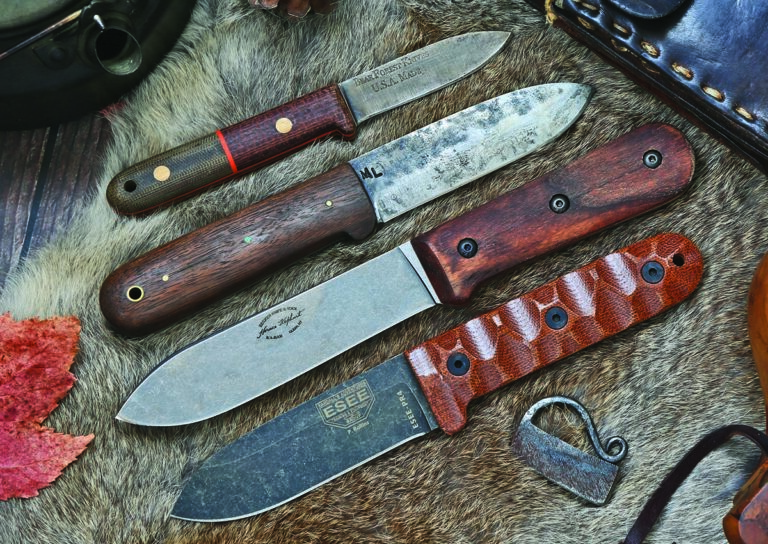
Four repros emulate the knife Horace Kephart made famous.
Before Rambo provoked people to rush to their local sporting goods stores searching for a hollow-handle, saw-back survival knife and long before Ray Mears popularized the quest for the perfect Scandi-ground knife, a timeless classic woods knife endured the test of time—the Kephart.
Who Was Horace Kephart
Horace Kephart (1862-1931) was a prominent figure known for his contributions as an author, librarian and outdoorsman. His extensive exploration of the Southern mountains led him to conduct valuable research on the region and its inhabitants.
Among his many books, he is best known for Our Southern Highlanders and Camping and Woodcraft, with the latter serving as an enduring guide for outdoor living. Both works are still widely available and highly regarded. In the 1920s, Kephart was pivotal in advocating for establishing the Great Smoky Mountains National Park.
What Is a Kephart Knife?
The Kephart-style knife features a spear-point blade and an oval cross-section handle. The blade is typically 4-to-5 inches long, 1095 carbon steel, and forged using techniques reminiscent of 18th-to-19th-century bladesmithing. The blade is typically an eighth inch at the thickest, supporting a sturdy and durable structure. A distinctive feature is the asymmetrical spear point with a full-length edge enhancing its utility in various cutting tasks. The scales are often walnut or maple. The overall design aims for simplicity, with attention to detail to ensure comfort and usability.
In the words of Horace Kephart, “A camper has use for a common-sense sheath-knife, sometimes for dressing big game, but oftener for such homely work as cutting sticks, slicing bacon, and frying ‘spuds.’ For such purpose, a rather thin, broad-pointed blade is required … It is tempered hard enough to cut green hardwood sticks, but soft enough so that when it strikes a knot or bone it will, if anything, turn rather than nick.”
ML Knives Kephart
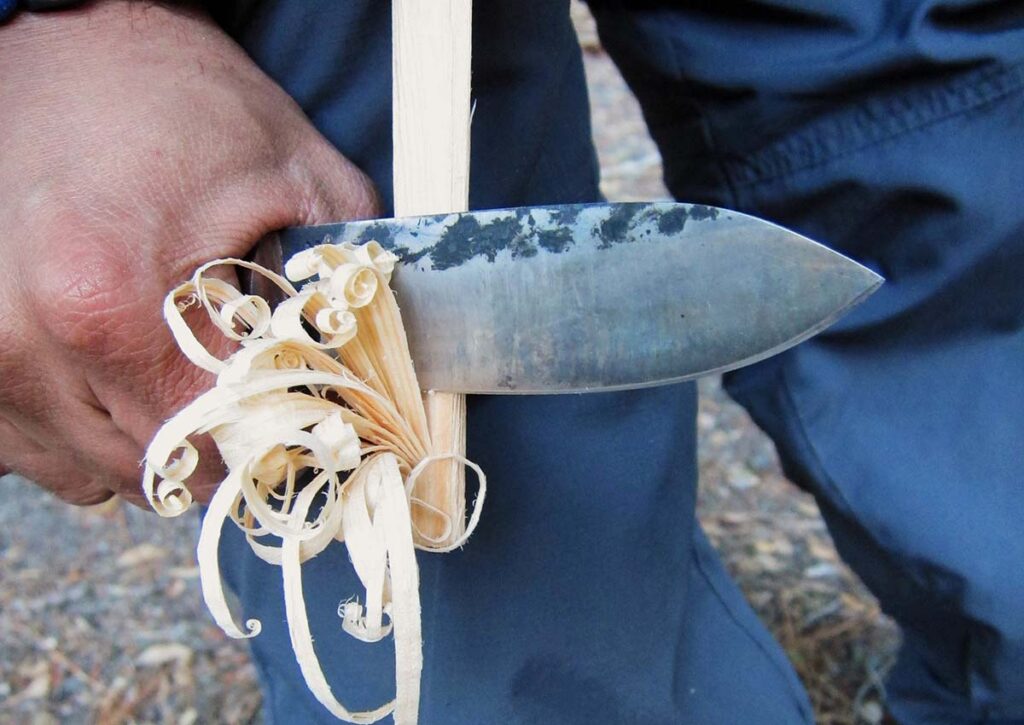
The author stated he prefers to make feather sticks freehand, without a solid base, to feel the edge better and have more control. The technique is best practiced before it’s needed and the ML Kephart convex edge excelled at the task.
Kephart Specs Blade Length: 4” Blade Material: 1095 carbon steel Blade Grind: Convex Blade @Thickest: .125” Blade Finish: Forged Handle Material: Tiger maple Overall Length: 8.25” Sheath: Leather Country of Origin: USA MSRP: $295
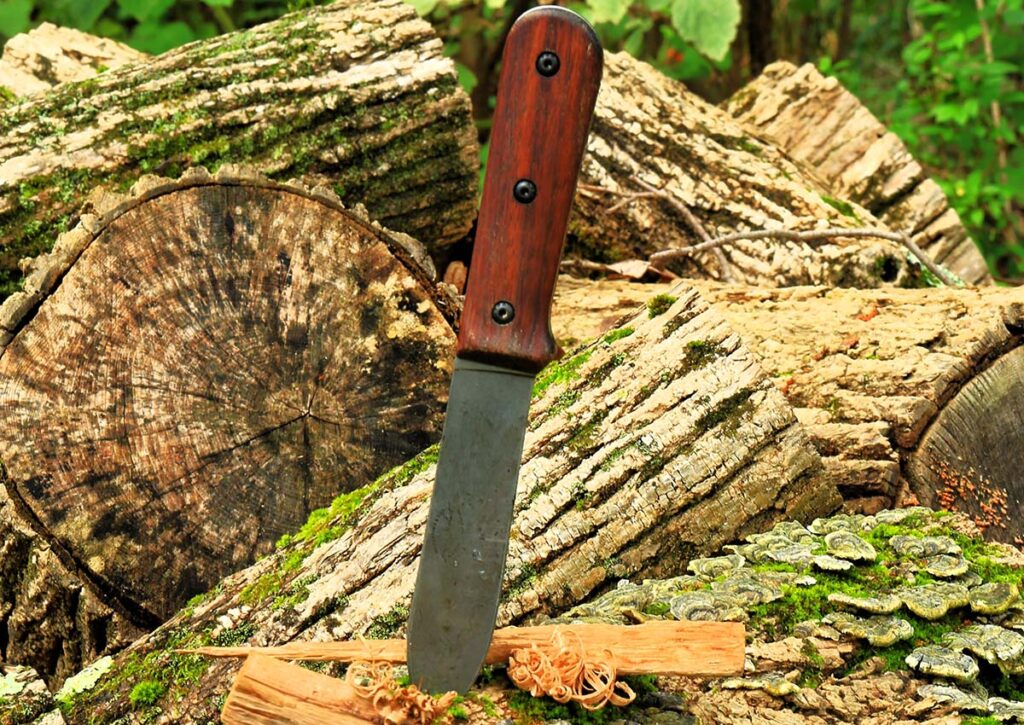
I received my first Kephart-style knife from Matt Lesniewski of ML Knives back in 2007, and it instantly became my favorite. The craftsmanship of the piece is truly remarkable, as Matt employed early 18th-to-19th-century bladesmithing techniques, using 1095 carbon steel and handforging each blade. The handcrafted sheaths are also stunning works of art that truly stand out.
My ML Kephart features a 4-inch blade and a 4.25-inch handle, with scales of beautiful tiger maple. The handle’s oval cross-section provides a comfortable grip, with just the right amount of rounding to prevent discomfort during use. The spear-point blade and eighth-inch thickness, along with the full convex edge and visible forge marks, give the knife a rustic yet simple charm.
A spear point is a versatile blade pattern and tough as woodpecker lips. The ML Kephart drilled with authority and split/pried wood for kindling.
Naturally, after reading Horace Kephart and Nessmuk, I made many backcountry trips and always had a stout, reliable fixed blade. When traveling afoot, as the old timey adventurers would say, I had minimal kit and seldom took a large axe or saw. I used a light tomahawk, as Kephart spoke of, and a jackknife in the form of a Swiss Army knife. I had to do more with the fixed blade, and I did. The ML Kephart excelled at woodcraft as the convex edge was ultrasharp and robust.
I always test every cutting tool by shaving arm hair*, whether it’s an axe, long blade or anything with an edge. The next task is always shaving wood, as a fire is ultra important when camping or woodcrafting. The ML excelled at the task—but could it drill? I broke a few old seasoned planks apart by drilling through and twisting them for kindling. The handle seemed comfy, and the natural maple gave me enough traction to keep a solid grip during any task. The flat primary grind with a convex edge is the best of both worlds. And no camp food or sandwich was safe from the ML Kephart.
KA-BAR/Becker Knife & Tool BK62 Kephart
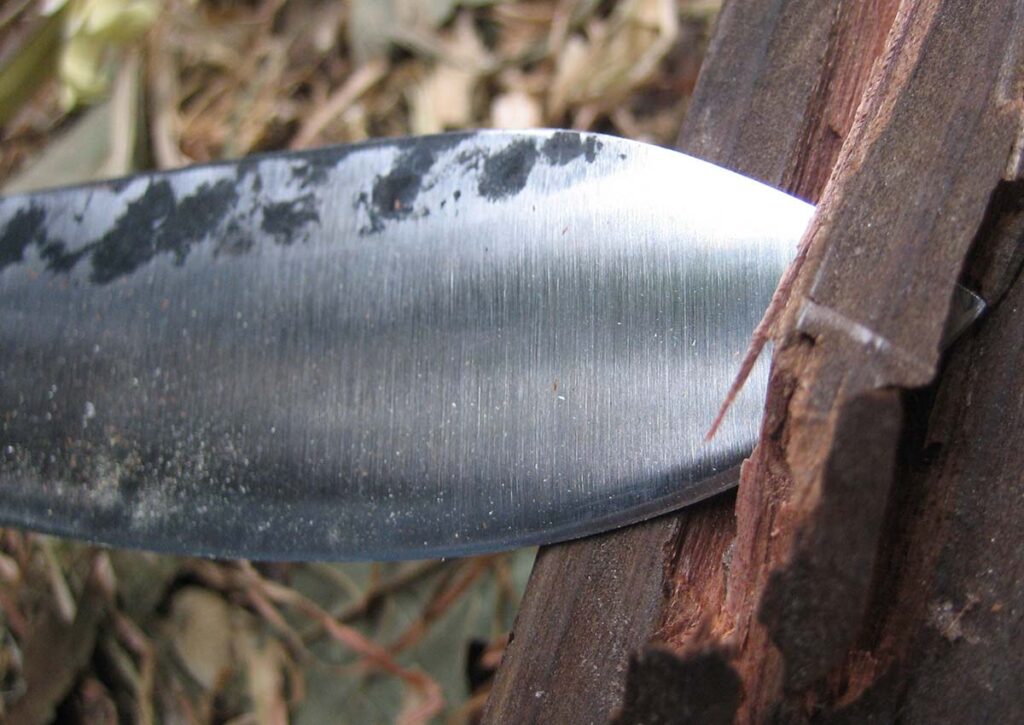
The Becker Kephart held its own in both carving and piercing work.
The KA-BAR/Becker Knife & Tool BK62 Kephart is a modern tribute to the classic American bushcraft knife based on the version of renowned author, outdoorsman and gear designer Ethan Becker. “Many copies of the Kephart are based on the one at Western North Carolina University because it was the only one anybody knew about,” Ethan said. He added that his design is based on the only known example, which was virtually pristine, outside a museum. That’s why Ethan said the BK62 is the closest anyone can get to the original Kephart.
Precision crafted, the BK62 features a 5.125-inch blade of 1095 Cro-Van carbon steel, known for its durability and edge retention. Overall length: 9.62 inches. The blade’s full flat grind and spear-point design make it versatile for wood carving and food preparation. The handle is walnut, providing a comfortable grip and a timeless aesthetic. The BK62 is a functional tool and a piece of history, as it closely replicates the original Kephart knife, which played a significant role in the early 1900s wilderness culture. Each Becker Kephart comes with a leather sheath.
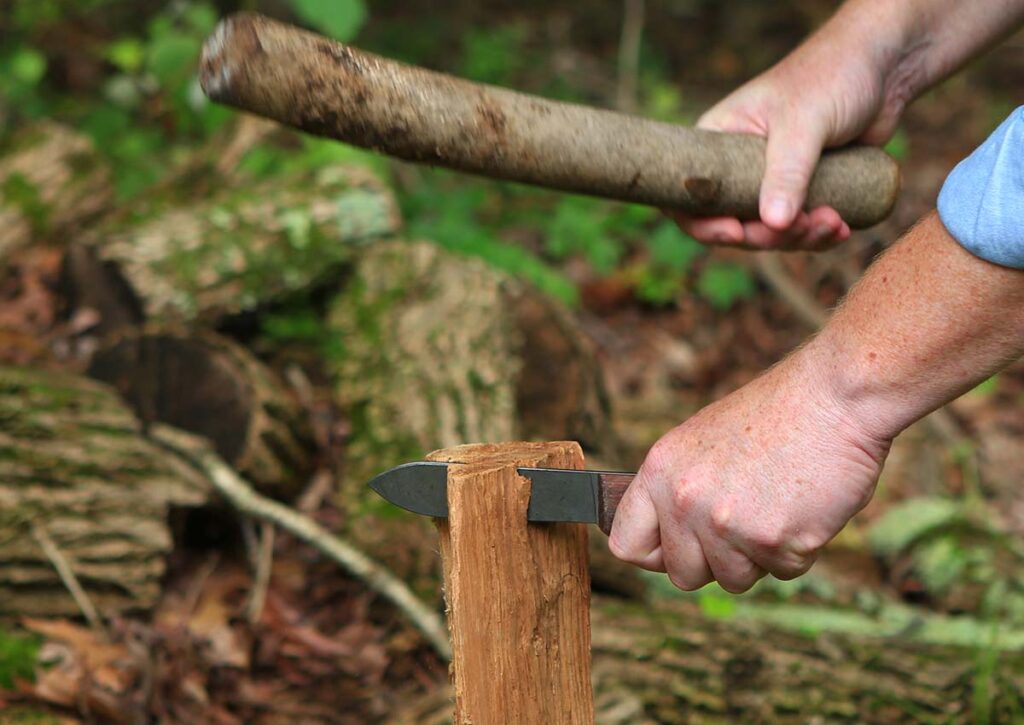
The KA-BAR/Becker BK62 split the seasoned oak. Completing the task simply yet effectively says a lot about a woods knife.
The BK62 arrived when I was about to do a little cooking, so I quickly put it into service cutting roast and chicken breast. The flat-ground blade sliced meat like a champ. It performed like a kitchen knife and felt natural in the hand. The BK62 did its share of slicing potatoes, carrots and beef for a pot roast. Thoroughly convinced of its ability to handle food, I moved on to the woods test.
I performed two tasks with the BK62. The first was batonning practical pieces of wood approximately the width of a pencil. The blade’s .158-inch thickness allowed it to glide into the wood, and a twist of the wrist made the seasoned oak split. However, it didn’t perform as well as a saber grind for the latter chore. The next task was feathering hard oak, and this is where the blade’s thinness shone. The feathers were thin and curly, perfect for tinder with a ferro rod or coarse kindling.
ESEE Knives PR4
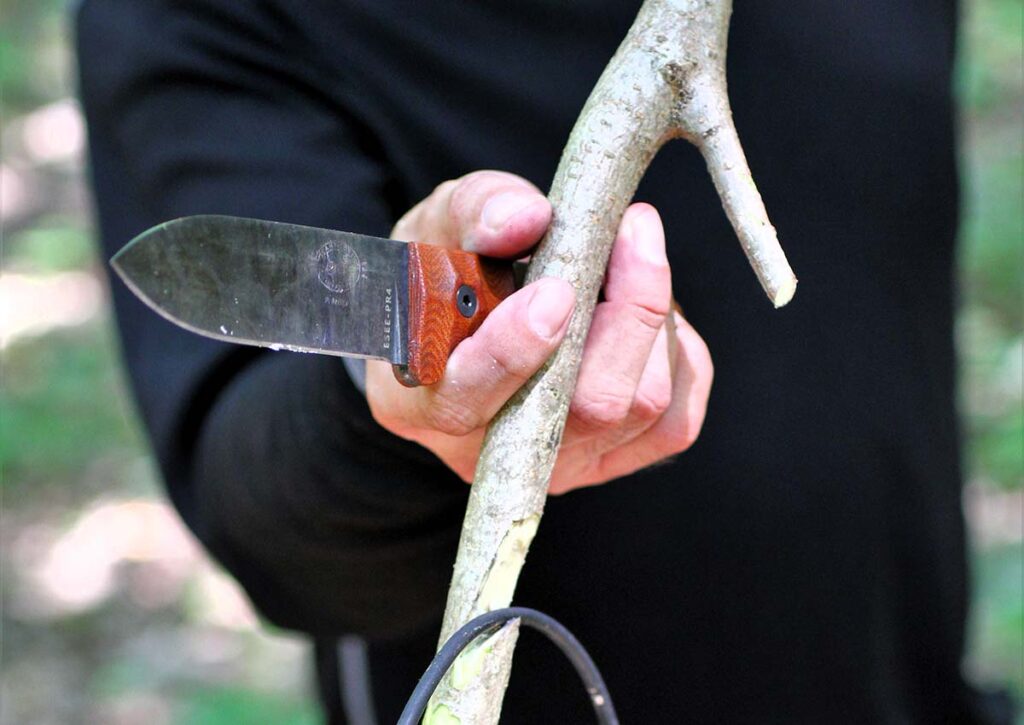
One of the ESEE PR4’s earliest tests was to create a pot hanger for boiling water. The task involved cross-grain batonning and carving, and the knife did very well at both.
PR4 Specs Designer: Patrick Rollins Blade Length: 4.19” Blade Material: 1095 carbon steel Blade Grind: Saber Blade @Thickest: .125” Blade Finish: Tumbled black oxide Handle Material: Sculpted Micarta® Overall Length: 8.9” Sheath: Leather Country of Origin: USA MSRP: $190.64
The PR4 is part of the Camp-Lore series from ESEE Knives and is named after the initials of its designer, Patrick Rollins, lead instructor for Randall’s Adventure & Training.** The knife features a 4-inch 1095 carbon steel blade with a high saber grind. It pays homage to the timeless Kephart design while incorporating Patrick’s modifications. The approximately 4.5-inch handle is suitable for large hands or use with work or winter gloves. The knife has a black oxide tumble finish resembling a patina but not a coating. The handle is fitted with textured brown Micarta® scales for a distinct look and comfortable grip. The knife comes with a plain tan leather sheath made by Wickett and Craig, one of the oldest tanneries in the USA.
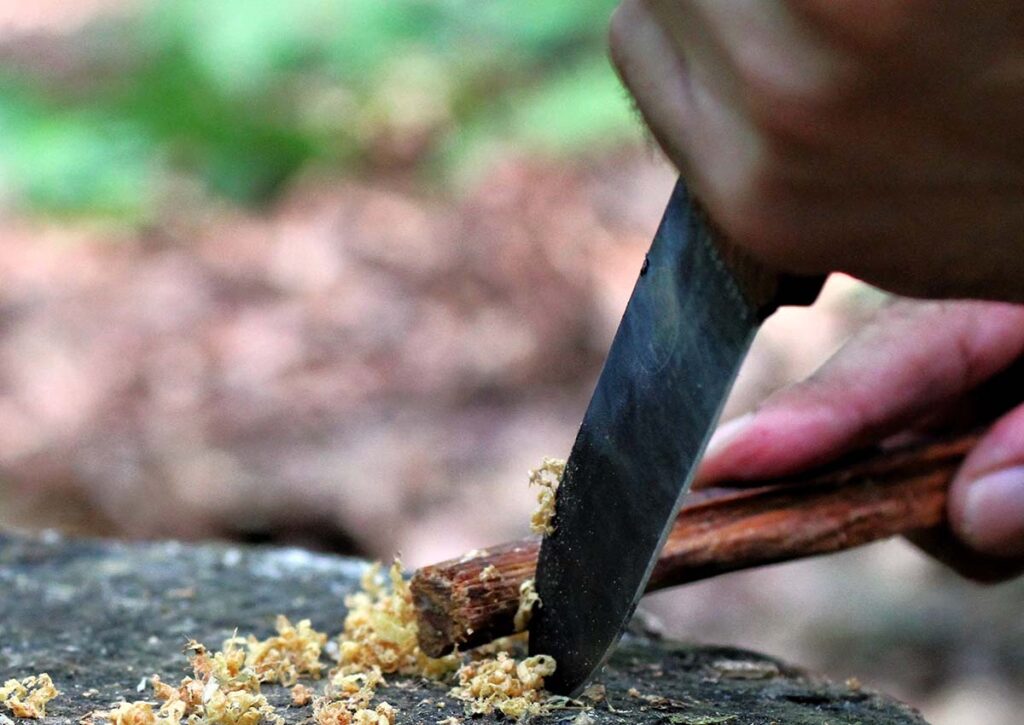
I used the PR4 extensively in the Eastern Woodlands for various camp tasks. The knife proved versatile and was particularly effective for making camp implements and starting fires. It excelled in splitting small sticks and igniting the ferro rod to create a fire. Its sharp spine was practical without being overly flashy.
Scraping fatwood with the blade spine was easy using the PR4. It boasts the sharpest spine in ESEE’s Camp-Lore series and rapidly created a pile of fatwood.
While I don’t typically baton wood when a chopper is available, I found the PR4 excellent for cross-grain baton work, making precise stop cuts on trap parts, stakes and pot hooks. I also used the PR4 to carve a chisel point on a thick piece of maple for a digging stick and found that it easily sliced dry maple. The knife remained effective despite exposure to various weather conditions.
After establishing a fire, the PR4 proved equally adept at culinary tasks, precisely slicing onions, peppers, potatoes, mushrooms, garlic and sausages for a stew. The thin grind made kitchen tasks a breeze, especially achieving paper-thin garlic slices. The knife performed exceptionally well in all tasks, including prepping tinder from fatwood and dry, split poplar. The high saber grind and sharp spine made the PR4 ideal for camp and woodcraft chores.
Bear Forest Knives GT-3
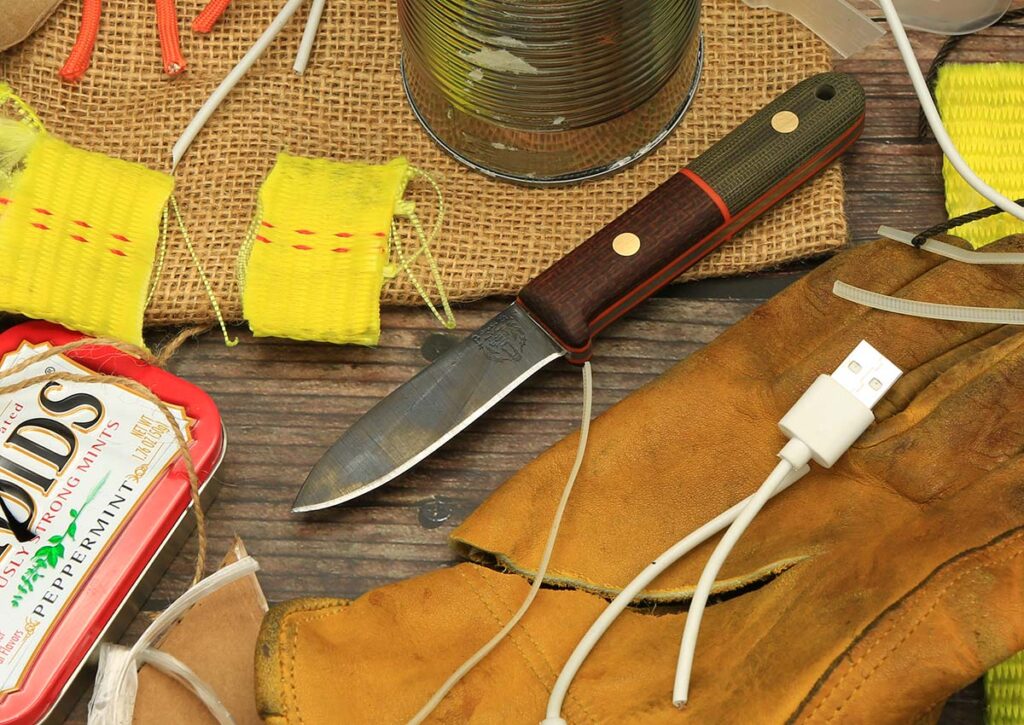
As an EDC/utility knife, the GT-3 cut assorted materials, including tin cans, leather, cordage, zip ties, toe strapping and more.
GT-3 Specs Blade Length: 3” Blade Material: 80CrV2 carbon steel Blade Grind: Flat Blade @Thickest: .125” Blade Finish: Rock tumbled acid wash Handle Material: Micarta®/G-10 Overall Length: 7.25” Sheath: Black kydex (.08”) w/nylon cross-draw/Scout belt loop Country of Origin: USA MSRP: $149.99
Garrett Tremblay of Bear Forest Knives based the company’s GT-3 on his favorite bushcraft knife, the ESEE PR4. After discussing it with the knife’s designer, Patrick Rollins, and receiving approval, Garrett developed the Bear Forest entry.
The knife boasts a striking design, featuring a full-flat-ground, 80CrV2 carbon steel blade with a black oxide finish. The handle showcases an exceptional blend of burgundy and green burlap Micarta scales complemented by vibrant orange G-10 liners, all held together by Corby bolts. The difference in cutting performance between the full-flat-ground edge and the PR4’s saber grind was instantly noticeable. The GT-3 is equally at home as an everyday carry tool, a useful household companion or a reliable camping partner.
The knife is perfect for making notches for tarp stakes and trimming the ends to a chisel point to pound into the ground. The 90-degree spine is ideal for scraping poplar tinder and striking ferro rods. The 3-inch blade is just the right complement for a campsite that includes a bow saw and tomahawk/hatchet.
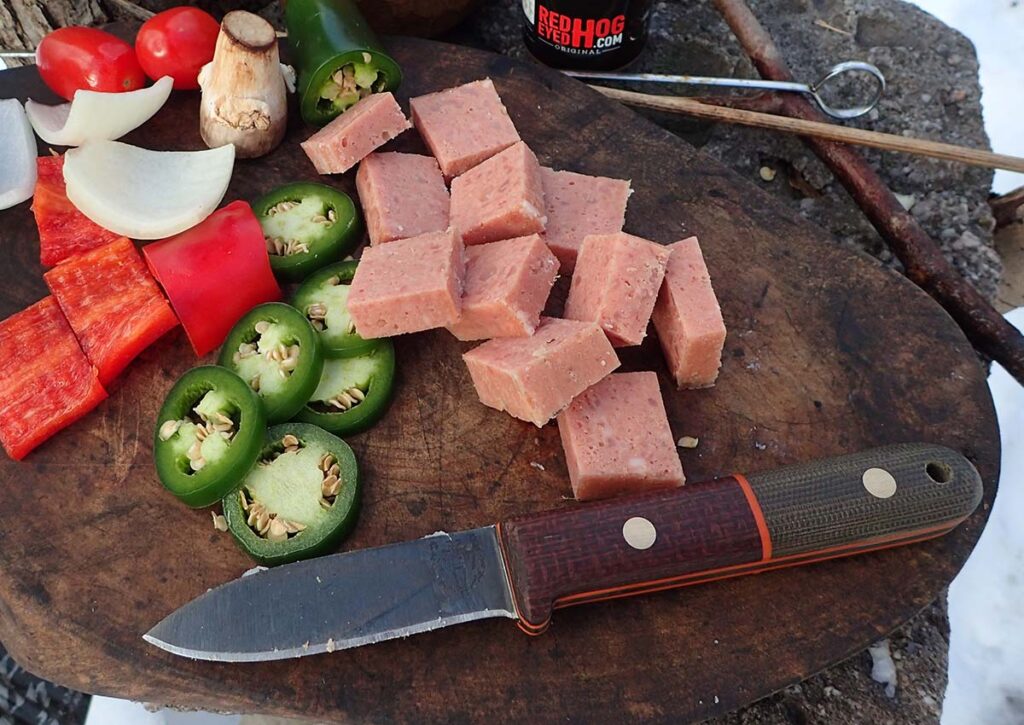
While camping, the author relied on kabobs for meals. The Bear Forest Knives GT-3 handled all the prep work, including slicing vegetables and starting the fire.
As Horace Kephart mentioned, a sheath knife is always “get-at-able” for quick tasks, which saves the jackknife from the messier work. This perfectly describes the GT-3. The handle is consistently comfortable. I keep a charred coffee can full of wood shavings—tinder and kindling—in camp. I whittle poplar and maple until the can is full. This is the last but most important task of the night, as it prepares for the next morning’s fire. The GT-3 is always up for the task.
*BLADE does not recommend shaving arm hair as a test of edge sharpness as it can cause injury.
**Both ESEE Knives and Randall’s Adventure Training (RAT) are owned by Jeff Randall and Mike Perrin under the parent corporation of TransEquatorial Solutions, Inc.
Check Out More Outdoor Knives:
NESSMUK KNIFE: OPTIONS IN THE ALL-AMERICAN OUTDOOR KNIFE
BEST TOMAHAWKS: OUR TOP HAWKS FOR BACKWOODS TO BATTLEFIELDS



![Combat Legacy: Modern Military Knives [Field-Tested]](https://blademag.com/wp-content/uploads/Mil-Knives-9-768x576.jpg "Combat Legacy: Modern Military Knives [Field-Tested]")