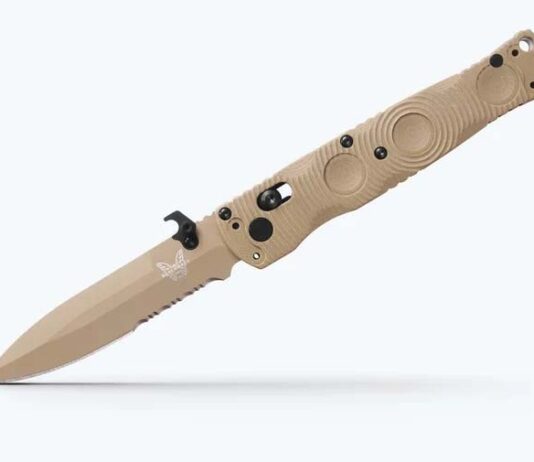
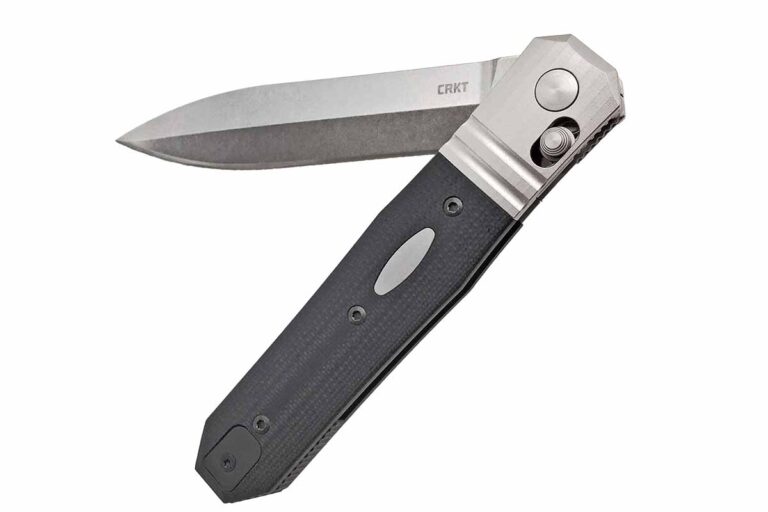
Have a hankering to extend your wish list with a little something new? Look no further as we’ve gathered up a slew of new custom and factory blades fresh on the market and ready to please. This collection has a definite tactical and outdoor tilt to it, with plenty of fixed blades. But, we’ve snuck a few worthy folders in just to keep the balance.
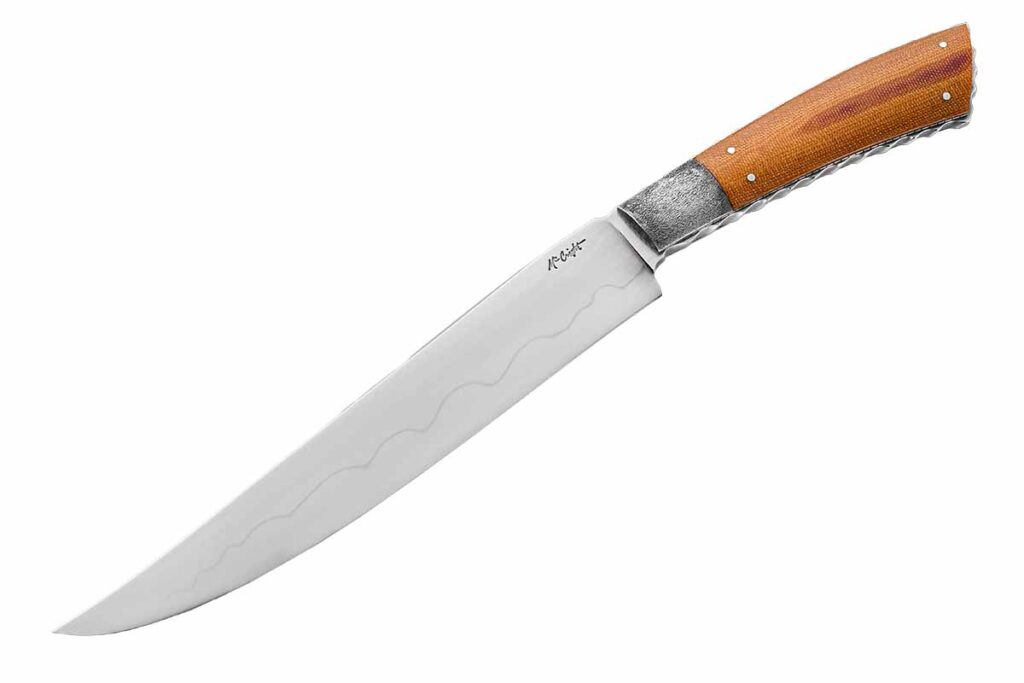
Erik McCright Fighter
Fighter Specs Blade length: 7.5” Blade material: Old W2 tool steel w/hamon Handle material: Vintage Micarta® w/a fileworked frame Bolster: Textured mild steel Overall length: 12” Knife to know: Erik McCright is an ABS journeyman smith Maker: Erik McCright (Jocelyn Frasier image)
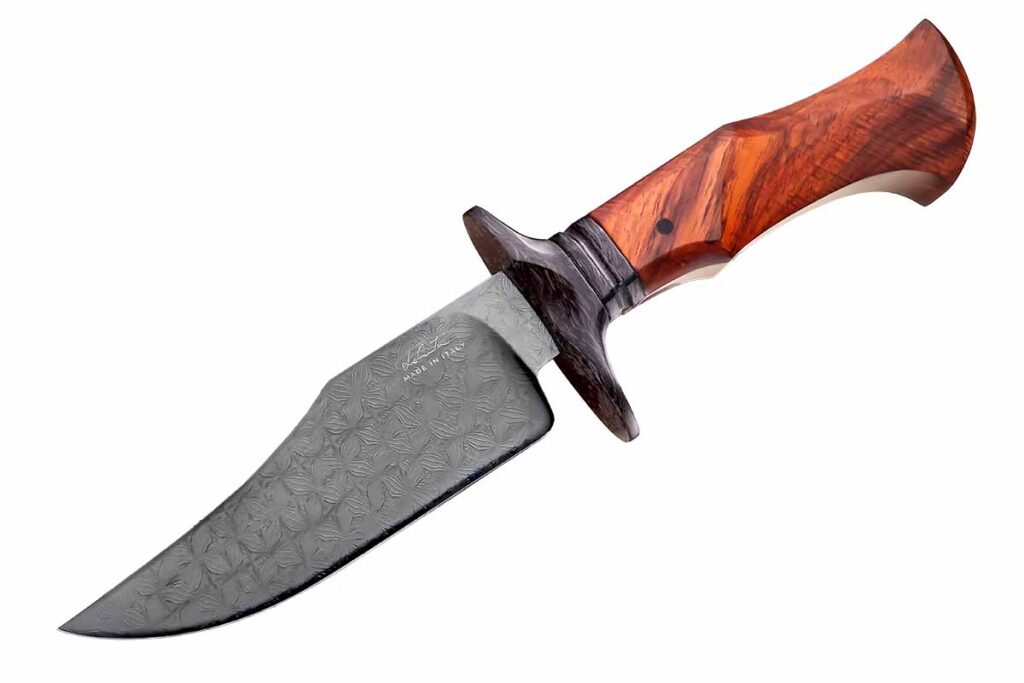
Simone Milanesi Lacantina Indy
Indy Specs Pattern: Bowie Blade length: 6.29” Blade material: Mosaic damascus of K720 tool and 15n20 nickel-alloy steels forged by Spina Gianluca Blade grind: Full flat Blade finish: DLC (diamond-like carbon) Handle material: Rosewood w/carbon pin Guard & fittings: Fat Carbon Overall length: 11.6” Maker’s price for a similar knife: $2,000 Knife to know: Simone Milanesi Lacantina’s Indy won The Knifemakers’ Guild Best Bowie Award at BLADE Show 2023 Maker: Simone Milanesi Lacantin (SharpByCoop image)
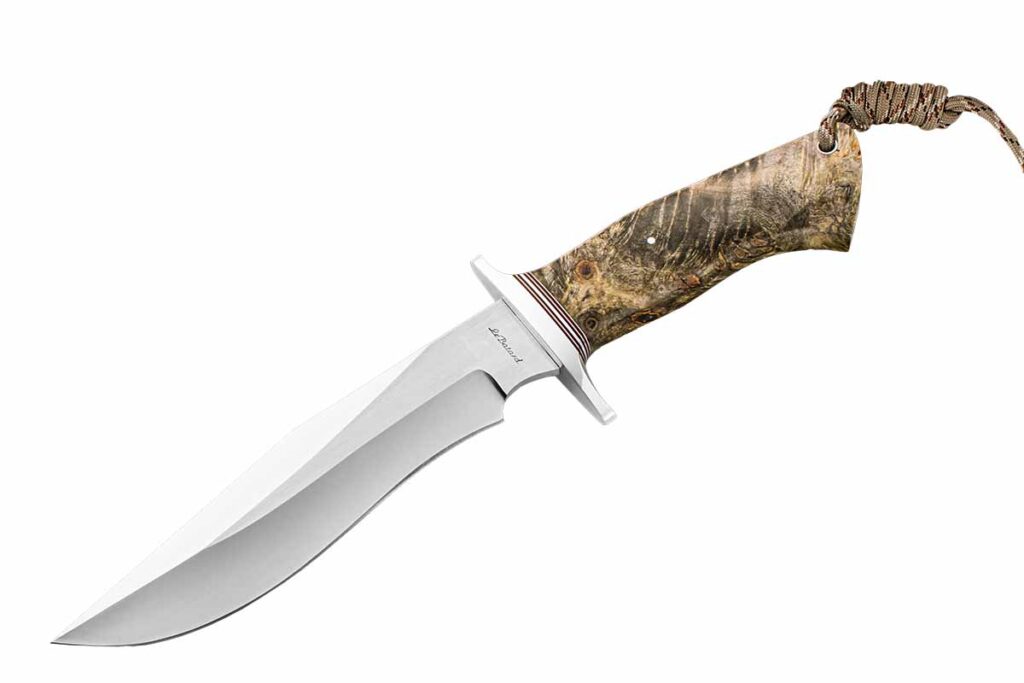
Paul LeBatard Recurve Bowie
Recurve Bowie Specs Blade length: 7” Blade steel: CPM 154 stainless Rockwell hardness: 61 HRC Blade grind: The top false edge and primary bevels are hollow ground on a 10” contact wheel and satin polished; the flats are hand finished to 800 grit Blade @ thickest: 3/16” Handle material: California buckeye burl Lanyard material: Desert camo 550 paracord Double guard: 7075-T6 aluminum Overall length: 12” Maker’s price for a similar knife: $750 Maker: Paul LeBatard (Jocelyn Frasier image)
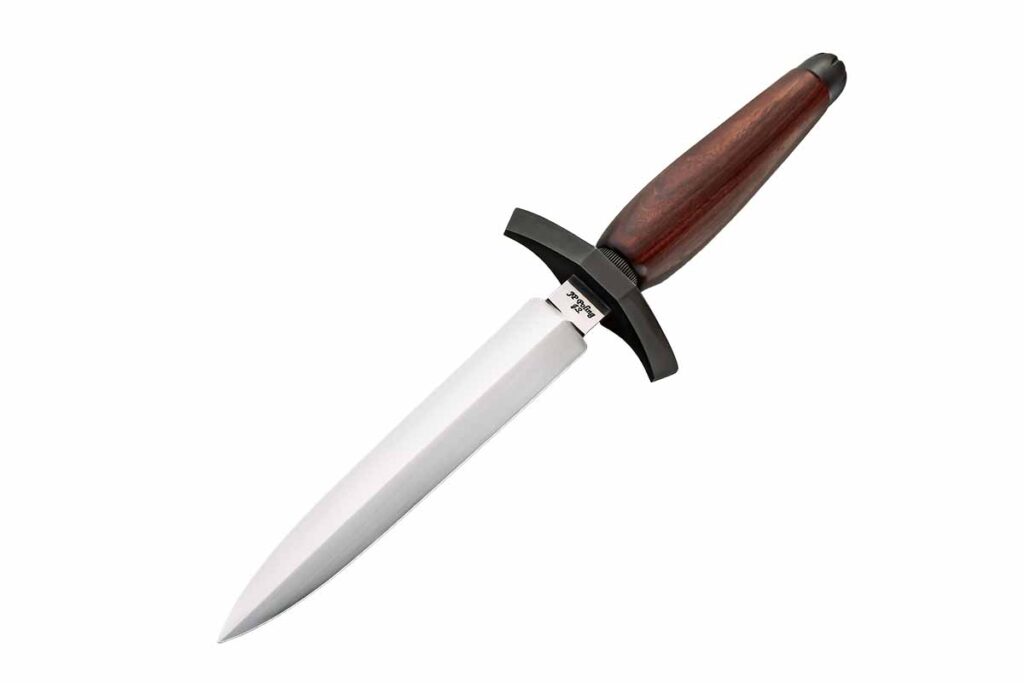
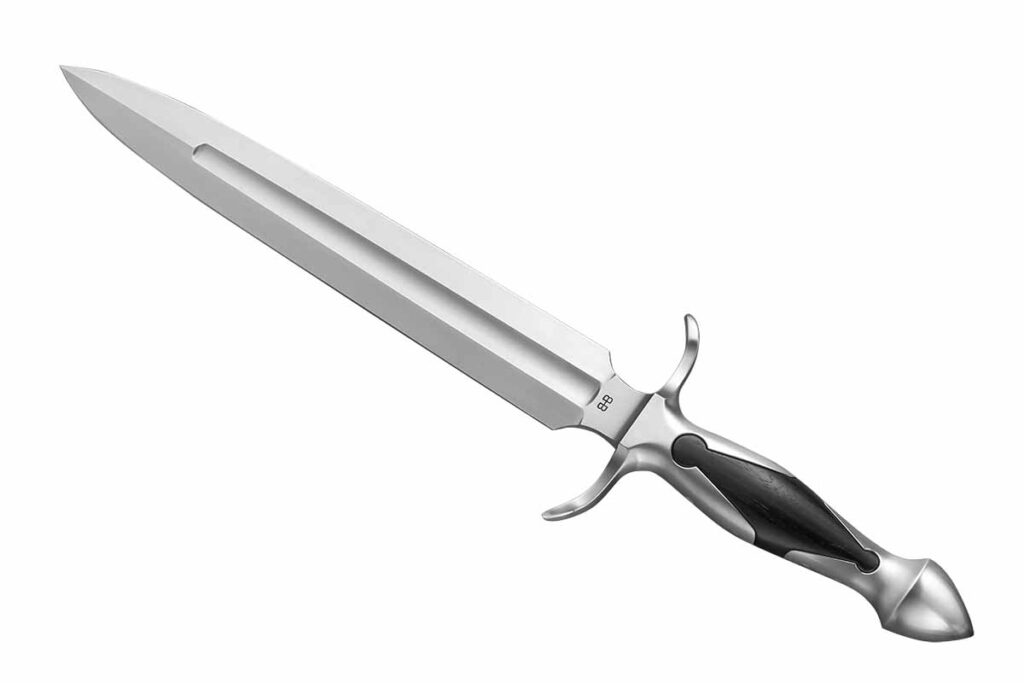
Jim Poling Dagger
Dagger Specs Blade length: 6.5” Blade material: 5160 carbon steel Blade grind: Flat/convex Handle material: Rosewood Fittings: Mild steel Overall length: 12” Maker’s price for a similar knife: $600 Maker: Jim Poling (SharpByCoop image)
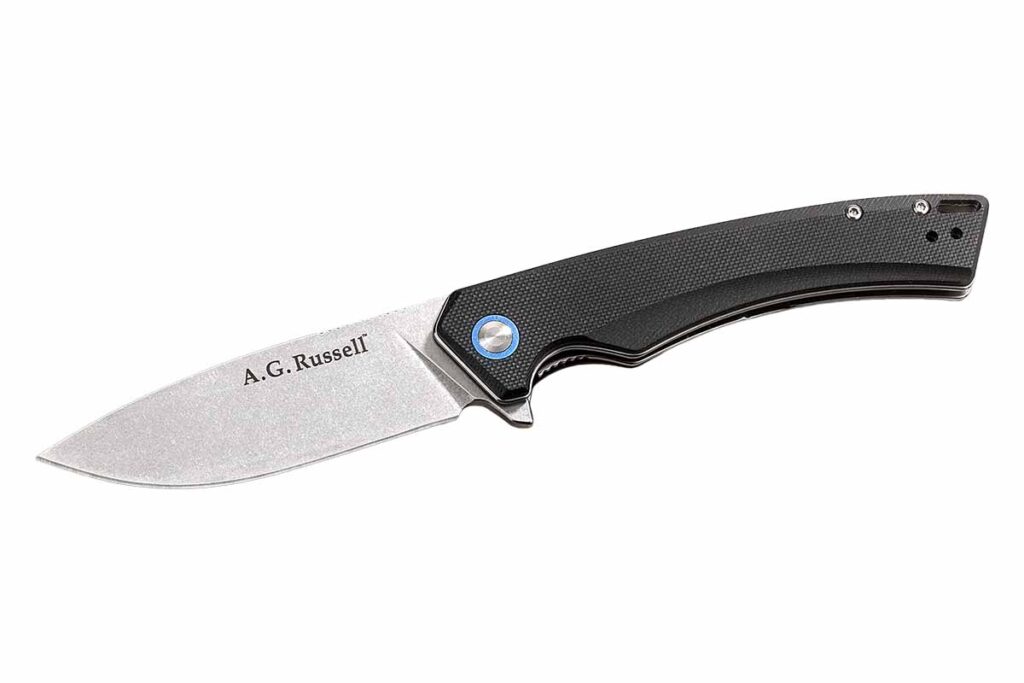
A.G. Russell Knives Power Ball C2
Power Ball C2 Specs Knife type: EDC Blade length: 33/8” Blade material: D2 tool steel Rockwell hardness: 59-60 HRC Blade finish: Stonewash Blade pattern: Drop point Handle: Black G-10 w/blue pivot accent ring Pocket clip: Reversible, deep carry Lock: Linerlock Weight: 3.7 ozs. Closed length: 4.75” Knife to know: Also available in a green handle w/orange pivot accent ring Country of origin: China MSRP: $67.95 Company: A.G. Russell Knives
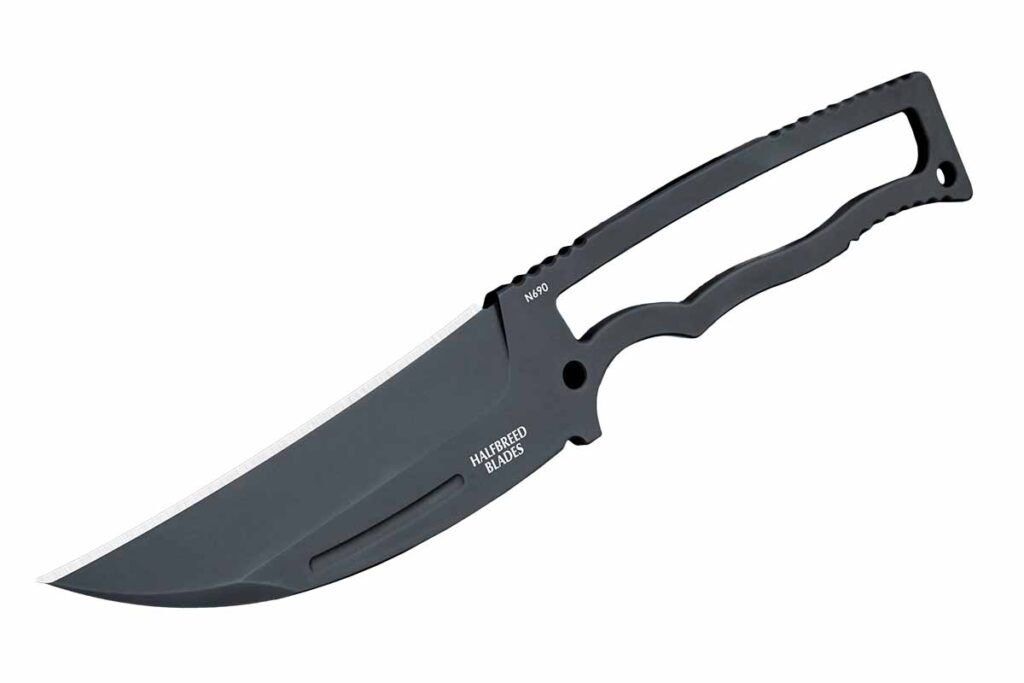
Halfbreed Blades CFK-02 (Compact Field Knife)
CFK-02 (Compact Field Knife) Specs Knife type: Fixed blade Blade length: 4.01” Blade steel: N690 stainless Rockwell hardness: 59-60 HRC Blade @ thickest: .16” Blade finish: PVD coated and stonewash options Blade pattern: Pikal Handle steel: VG-10 stainless Weight: 4.87 ozs. Overall length: 8.07” Sheath: Injection-molded plastic Mounting: Ulticlip and DOTS Belt Countries of origin: Australia and Taiwan MSRP: $275 Company: Halfbreed Blades
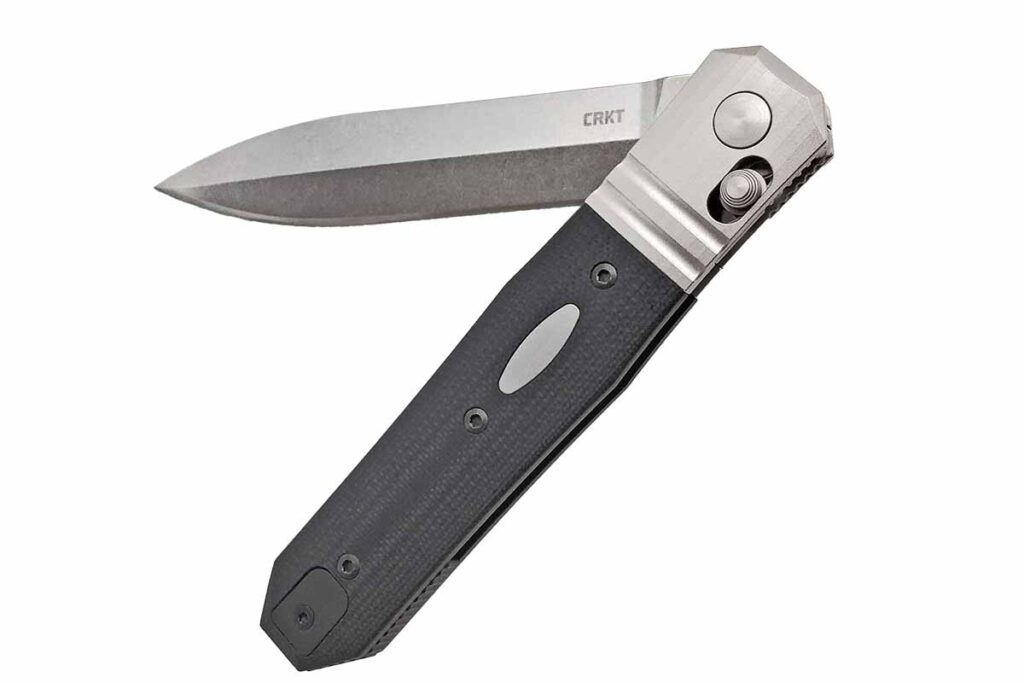
CRKT Redemption
Redemption Specs Designer: BLADE Magazine Cutlery Hall-Of-Fame® member Ken Onion Blade length: 4.06” Blade steel: MagnaCut stainless Blade @ thickest: .15” Blade finish: Stonewash Handle material: G-10 Bolster: Stainless steel Lock: Crossbar Weight: 4.9 ozs. Closed length: 5.1” Knife to know: The Redemption is based on Onion’s Deadman’s Hand custom knife named after the aces-and-eights hand Wild Bill Hickok purportedly held at the time of his death Country of origin: Made in the USA in collaboration w/Hogue Knives MSRP: $225 Company: CRKT
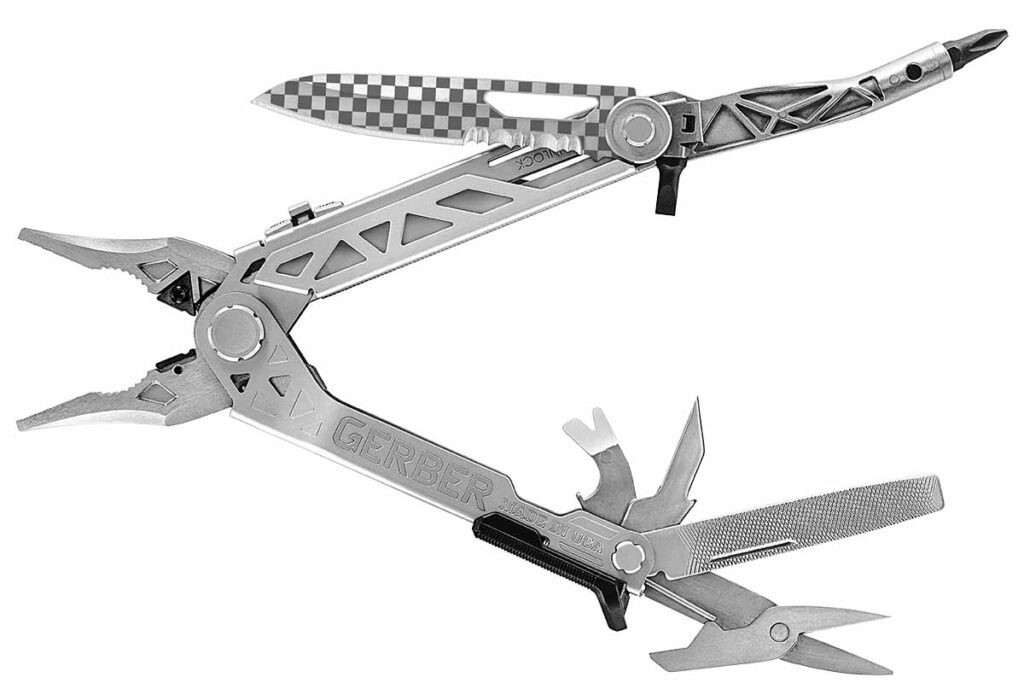
Gerber Center Drive
Center Drive Specs Knife type: Multi-tool Blade length: 3.25” Blade steel: 420HC stainless Implements: Serrated blade, file, awl, pry tool w/nail puller & bottle opener, scissors, fine- & coarse-sided file, pliers, rotatable carbide wire cutters & strippers; magnetic flathead and Phillips bits; in/cm ruler Weight: 9.5 ozs. Closed length: 4.7” Sheath: Fabric Knife to know: One-thumb opening system; the pliers are spring-loaded; magnetic 3.2” Center-Axis bit driver; tool lock Country of origin: USA (sheath made in China) MSRP: $130-$145 Company: Gerber
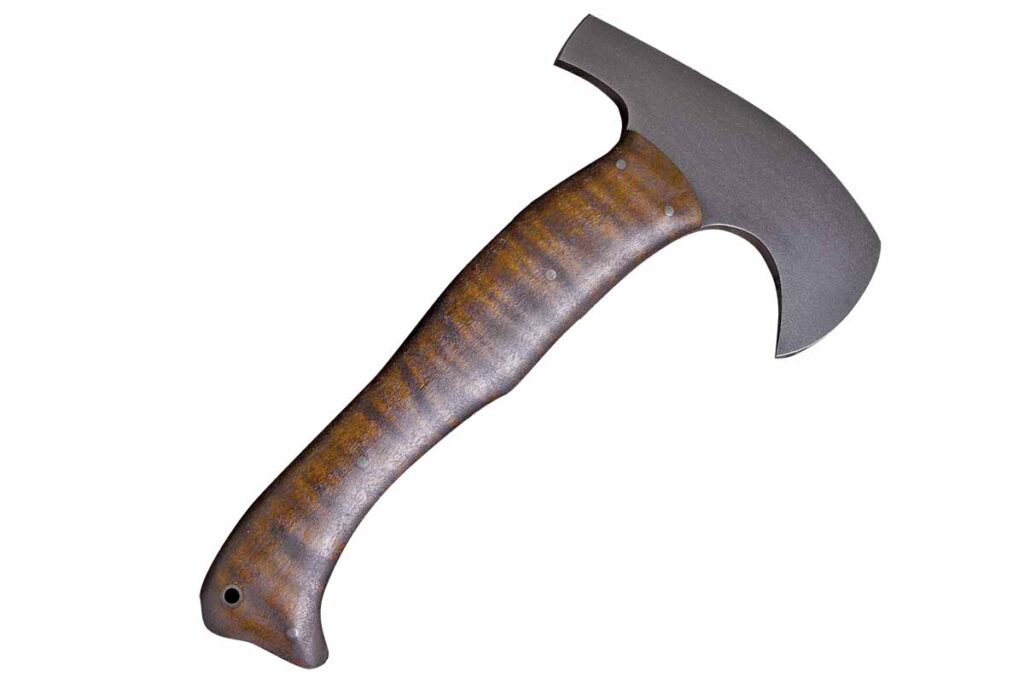
Winkler Knives WK Hunter Axe LT
New LeBatard Head length: 4.75” Axe material: 80CrV2 carbon steel Blade @ thickest: .25” Blade finish: No-glare black oxide Handle: A wide variety of natural and synthetic options; contact maker for info Construction: Skeletonized full tang Overall length: 9” Sheath: Fast-draw carrier, lined Boltaron®, HD shockcord quick-release retention system, nylon belt straps, multi-carry options Country of origin: USA MSRP: $450 Company: Winkler Knives
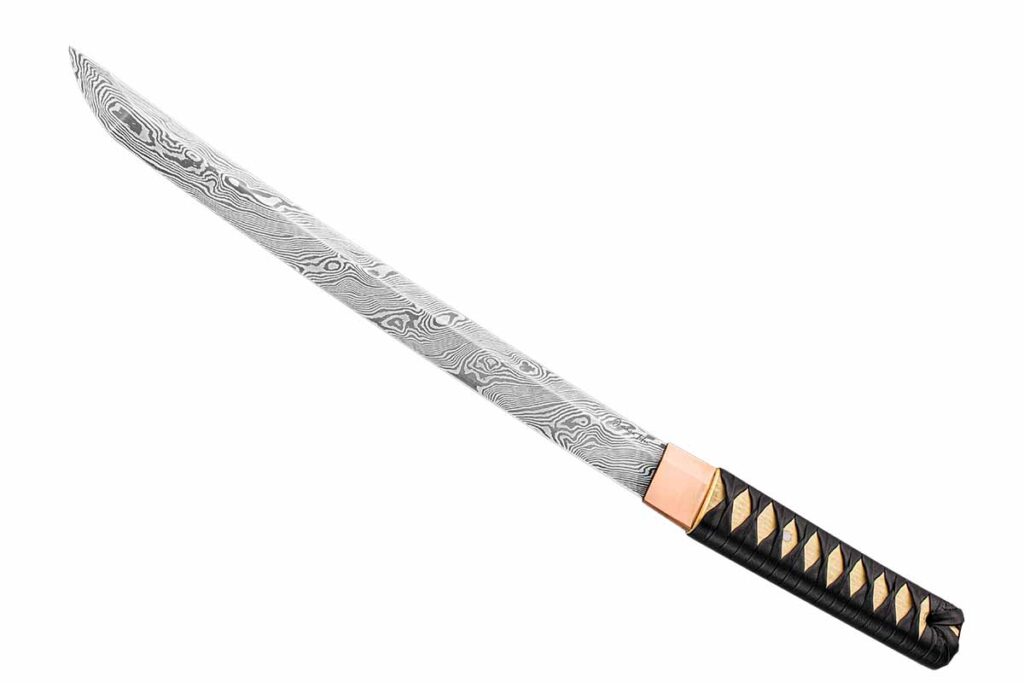
Jesse Hu Tanto
Tanto Specs Blade length: 12” Blade material: Twist Damascus of 1084 carbon and 15N20 nickel-alloy steels Blade grind: Traditionally ground w/a shinogi-zukuri geometry Handle material: Poplar and leather w/brass spacer Habaki (collar): Copper Overall length: 17.5” Maker’s price for a similar knife: $3,000-$4,000 Knife to know: The maker is an ABS apprentice smith Maker: Jesse Hu (Jocelyn Frasier image)
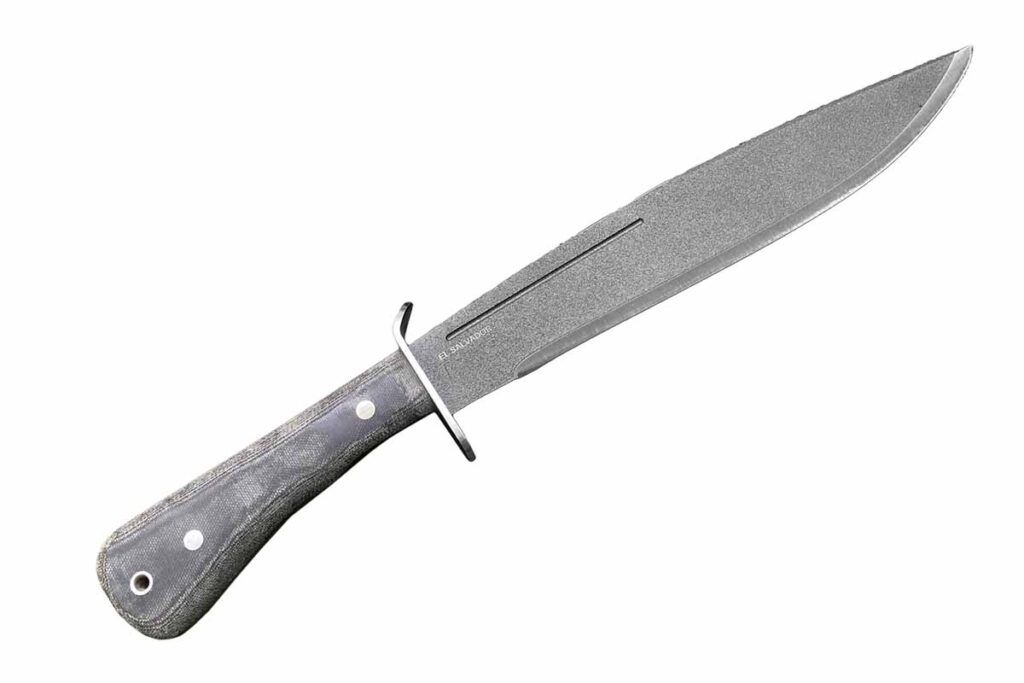
Pearson Industries MOST
MOST Specs Knife type: Fixed blade Blade length: 11.375” Blade material: 1075 carbon steel Blade finish: Black Traction powder coat Blade @ thickest: .196” Handle material: Black canvas Micarta® Construction: Full tang Weight: 24 ozs. Overall length: 17.125” Sheath: Kydex Country of origin: El Salvador MSRP: $279.95 Company: Pearson Industries
CRKT is releasing three Alan Folts designs–all folders–in anticipation of the Ft. Worth Knife Show.
CRKT, never one to rest on its laurels, has three new knife drops in anticipation of the Feb. 23-24, 2024 Blade Show Texas in Fort Worth. Alan Folts takes centerstage with this release, with all three of the designs emanating from the Florida-based custom knife maker. Interestingly, Folts made his mark as a fixed-blade man, but the two versions of the Ritual and brand-new Obverse mark somewhat of a new calling in the realm of folders.
“Alan Folts is a master craftsman and an acclaimed designer with over two dozen CRKT models to his credit in his time working with us,” said Doug Flagg, CRKT VP of Marketing and Innovation. “This latest collection represents Alan’s wide-ranging inspirations, innovative approach to knifemaking and the commitment to excellence that we both share.”
As a side note, the new premium knives from CRKT are listed as “coming soon” on CRKT.com but will be available for sale as BLADE Show Texas kicks off on Friday, February 23rd. For consumers in the Fort Worth area, the company also extends an invitation to its booth at the event, where they can meet the Folts in person.
CRKT Ritual Compact
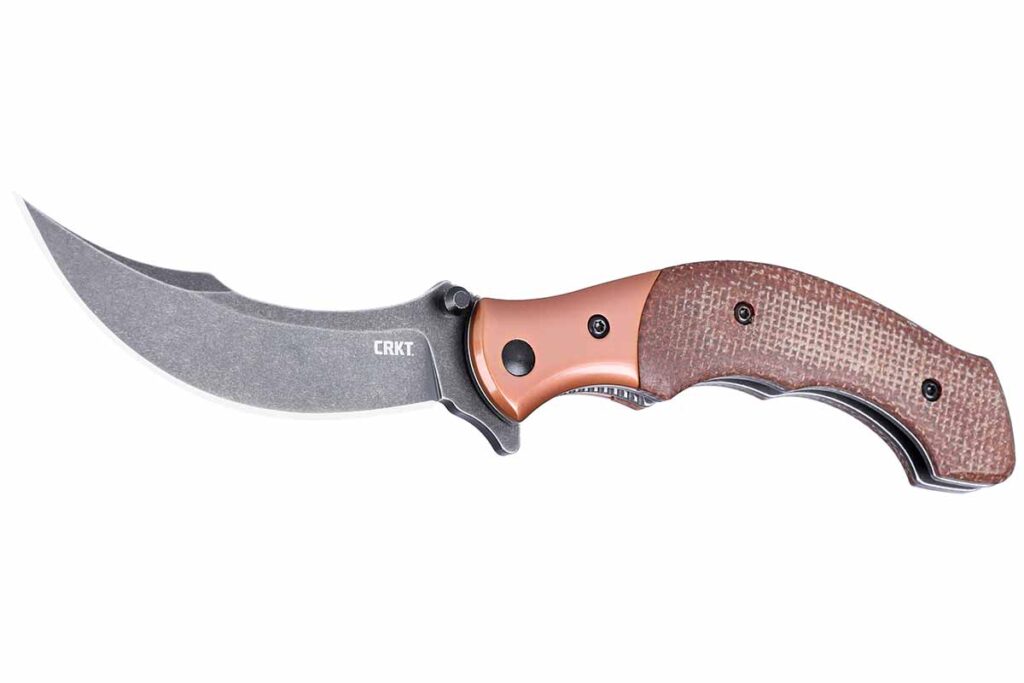
Designed for daily use, the Ritual Compact is an assisted folding knife inspired by old-world Persian fixed blades. The knife features a just over-three-inch 12C27 steel blade, ensuring excellent edge retention. With Assisted Opening technology and IKBS bearings, the knife guarantees quick and easy deployment and closure. The micarta handle with a stainless-steel bolster adds strength and striking aesthetics. The Ritual™ Compact is priced at an MSRP of $125.
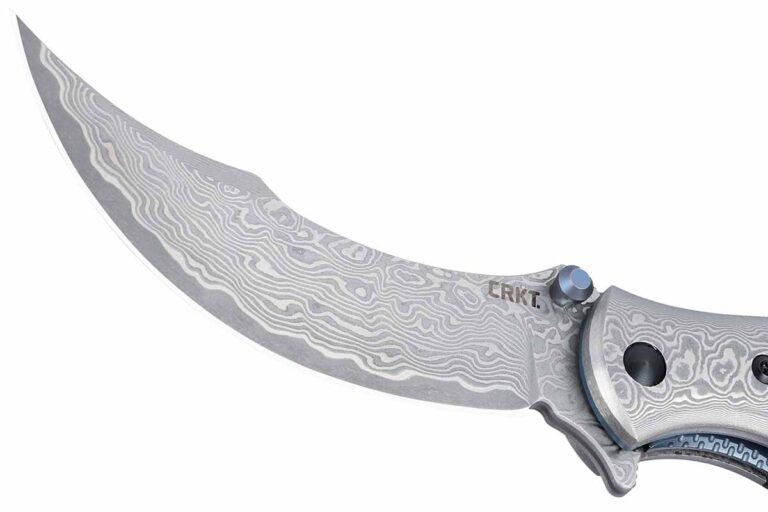
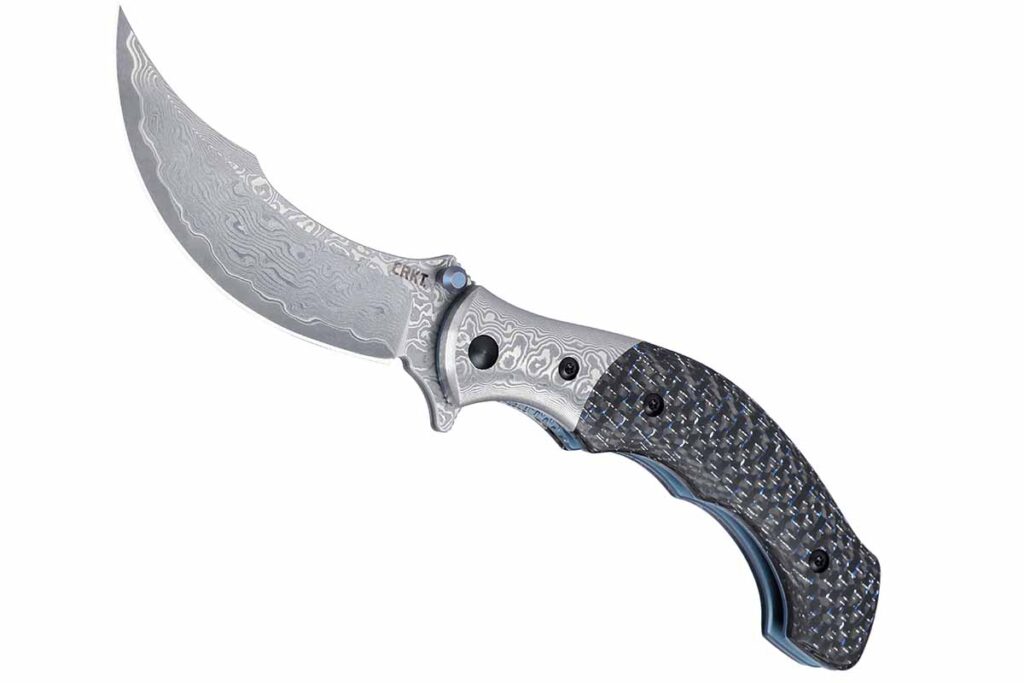
The high-end addition to the family, this Ritual Compact boasts a Damascus steel blade for superior cutting performance. The knife is adorned with a carbon fiber handle, an acid-etched Damascus bolster, a blue anodized titanium back spacer, and a pocket clip, making it a stunning addition to any collection. The Ritual™ Compact is priced at an MSRP of $275.
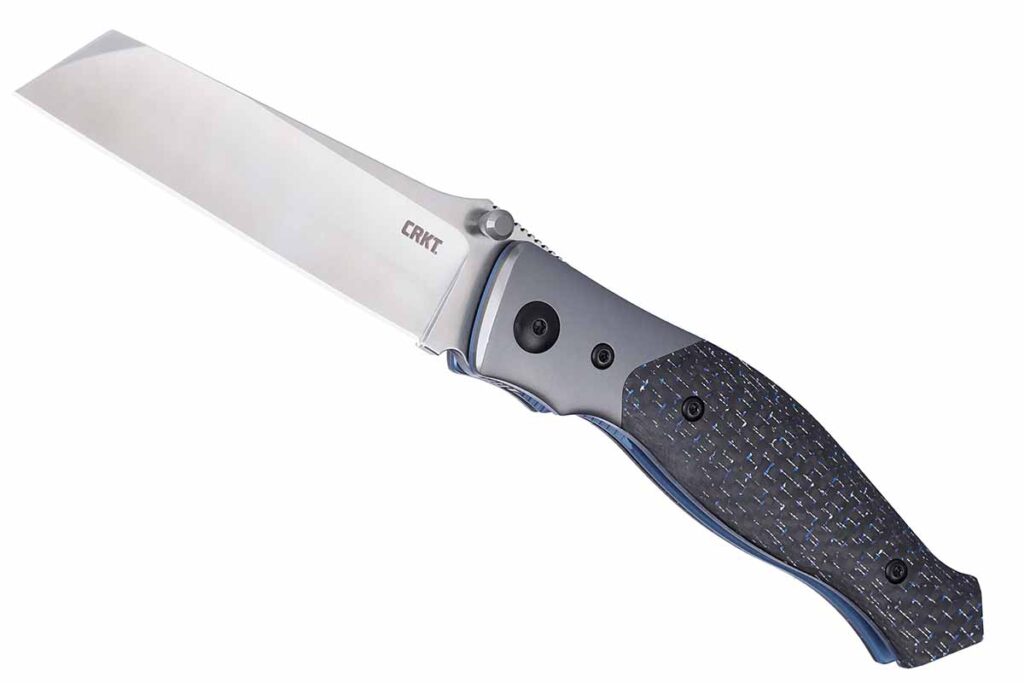
CRKT Obverse
The Obverse is a distinguished folding knife made with premium M390 steel. The satin-finish, sheepsfoot blade is both sleek and durable, complemented by a carbon fiber handle with blue anodized titanium detailing. The silky smooth IKBS™ ball bearing pivot system ensures effortless deployment, while the secure liner lock allows for easy one-handed closing. The Obverse is priced at an MSRP of $275.
To be competitive, today’s balisongs must excel at flipping as well as cutting.
It’s a focus of versatility. From the style of opening to the enthusiasts who perform a variety of maneuvers with it, blade exposed, the balisong/butterfly knife is an object of curiosity and fascination.
The original term for the subject knife, balisong, is a favorite of Lucas Cao, founder and president of Squid Industries, which produces the popular Tsunami balisong. “Butterfly is a great slang name that describes the mechanism,” he remarked, “but the word balisong has a rich cultural history behind it.”
Flipping competitions have played a key role in the resurgence of the popularity of balisongs, especially among young enthusiasts. James Hill is an example of the latter. He won first prize of $1,000 at the West Coast Flipping Championship during BLADE Show West in Salt Lake City this past October.
With that observation in mind, the Tsunami is true to the Squid concepts of user accommodation. “Each knife we’ve created is on the basis of more variety while still offering a premium flipper experience no matter the price point,” Cao explained. “At the top of our ladder is the Tsunami, which we designed to embody peak performance and build quality.”
Squid Industries Tsunami
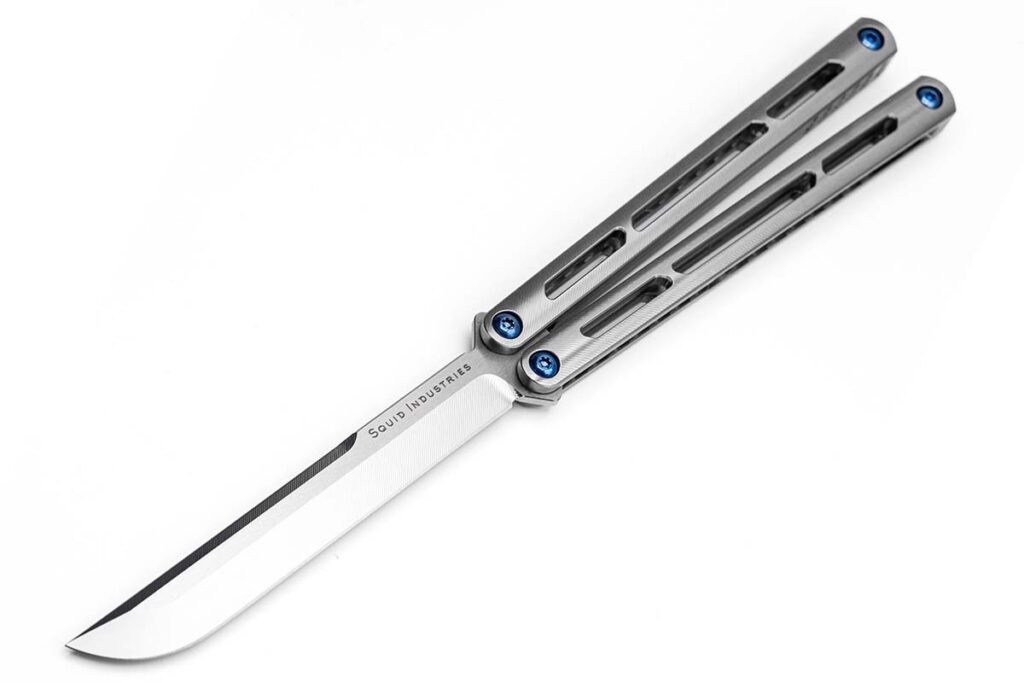
The Tsunami features a traditional Japanese-style tanto blade in a straight-back clip point and flat-ground CPM S35VN stainless steel.
The Tsunami features a traditional Japanese-style tanto blade in a straight-back clip point and flat ground CPM S35VN stainless steel intended to perform well across the spectrum of cutting requirements. However, the knife’s main constituency is the flipper community. “We serve a variety of customers with different requirements,” Lucas said, “but a majority of our customers are focused on the flipping aspect. If I had to estimate the customer desirability, I would say approximately 99 percent flipping and 1 percent cutting.”
The Tsunami employs a combination of bushings and phosphorous bronze washers in its mechanism, ensuring smooth deployment. “This is critical to flipping because it allows the user to consistently and reliably manipulate the knife,” he added. “Bearings aren’t used in our products and many other competitive balisongs from other brands because they produce a flipping experience that’s usually too smooth. Bushings are the preferred style because they offer a specific amount of smoothness and speed.”
The Tsunami reflects Squid Industries’ goal of offering balisongs that exhibit both variety and flipping fun, no matter the price. “At the top of our ladder is the Tsunami,” Squid’s Lucas Cao noted, “which we designed to embody peak performance and build quality.”
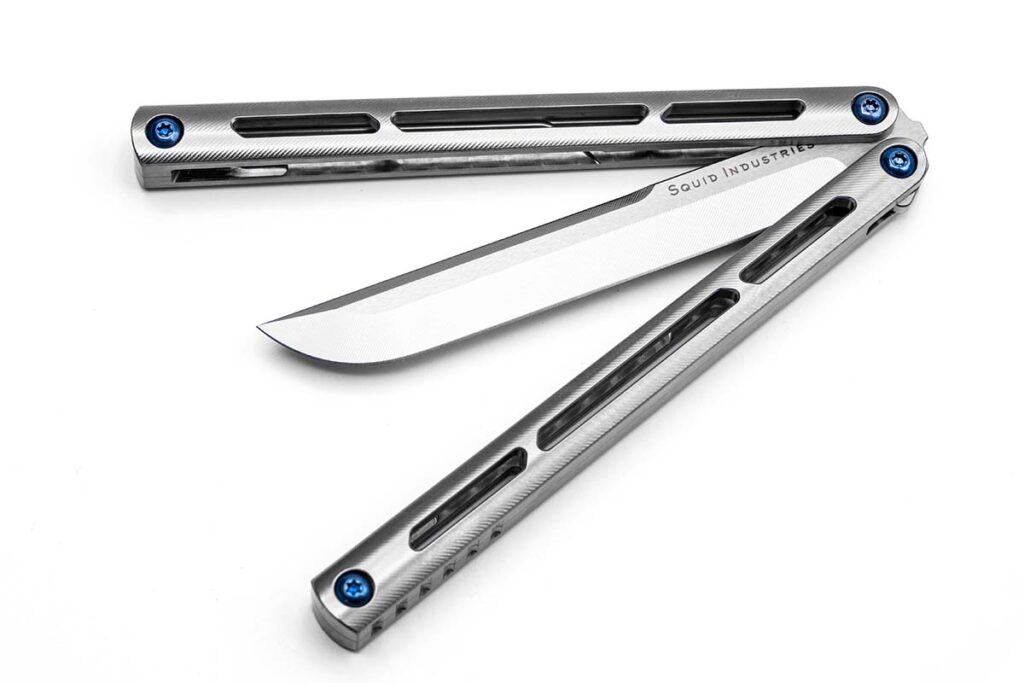
The Tsunami design is referred to as a “chainwich,” as its 6Al-4V titanium handles come together to mimic an integral grip. The handles themselves are designed with two specific tapers, one along the width and the other along the thickness. This dual taper design in combination with the rounding on the top create a comfortable and controllable feel in the hand, according to Cao.
Squid Industries Tsunami Specs Blade Length: 4.5” Blade Steel: CPM S35VN stainless Blade Grind: Flat Handle Material: 6Al-4V titanium Latch: N/A Pivot: Bushings and phosphorous bronze washers Weight: 4 ozs. Closed Length: 5.6” Country of Origin: USA MSRP: $775
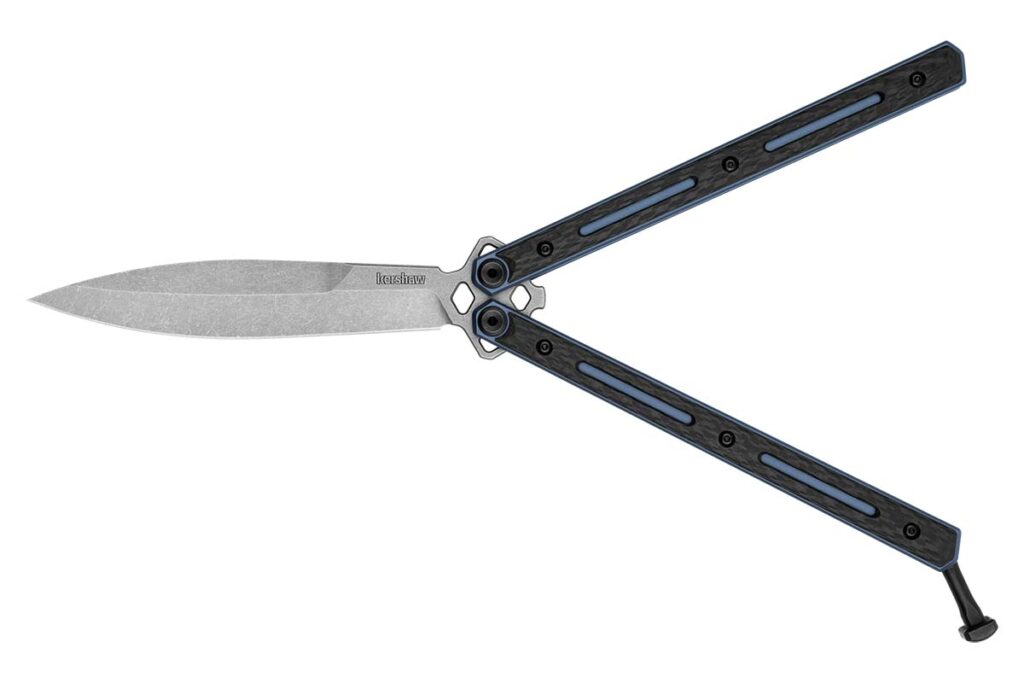
Kershaw Lucha Carbon Fiber
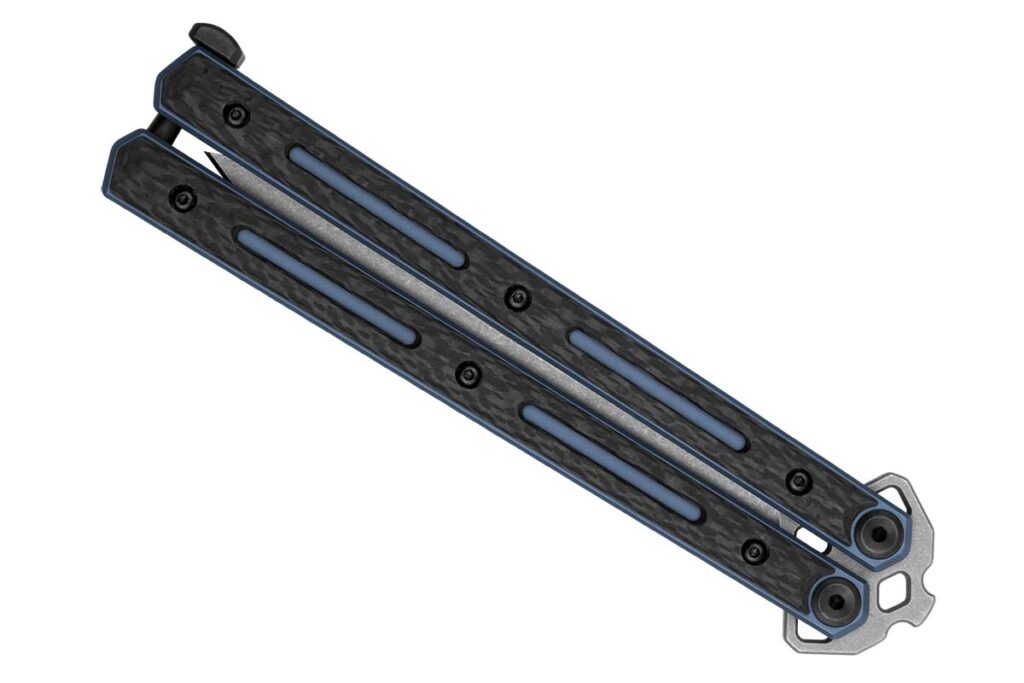
Kershaw’s Lucha Carbon Fiber is a premium edition of the company’s standard Lucha, including such high-end materials as CPM 20CV stainless blade steel and titanium handles with carbon fiber overlays.
The Kershaw Lucha Carbon Fiber’s spear-point blade of premium CPM 20CV stainless blade steel is ideal for piercing and slicing, while the “working” finish hides scratches from hard use. Company spokesperson Dominic Aiello related, “Our goal at Kershaw is to offer something for everyone, whether that be a budget-friendly knife you can abuse and lose all the way to a premium USA-made automatic. With that said, when we brought the original Lucha to the market, our goal was to offer a value packed, affordable, high-quality butterfly knife. It has been a huge hit and as a result we decided to release a premium version.”
Though the original emphasis on the practical use of the Lucha remains with cutting ability front and center, the knife illustrates the versatility inherent in the balisong style. “Of course, cutting is a critical component for any knife,” Aiello reasoned, “but with butterfly knives the flip ability, balance, and comfort are equally as important, if not more important. A lot of customers enjoy the Lucha for the fun and challenge of flipping, but there is also a segment of users that carry it as an EDC.”
The handles of the Lucha Carbon Fiber are titanium anodized blue overlaid with machined carbon fiber. The handles and carbon fiber are contoured for a rounded profile and ease of use.
The Lucha combines good looks with smooth mechanics and easy maintenance. “Each pivot uses two KVT ball bearings, four total,” Dominic commented. “The ball bearings provide an extremely fast and smooth action for easy flipping. The handles are blue anodized titanium with machined carbon fiber overlays. The handles and carbon fiber have been contoured for a rounded profile and ease of use.”
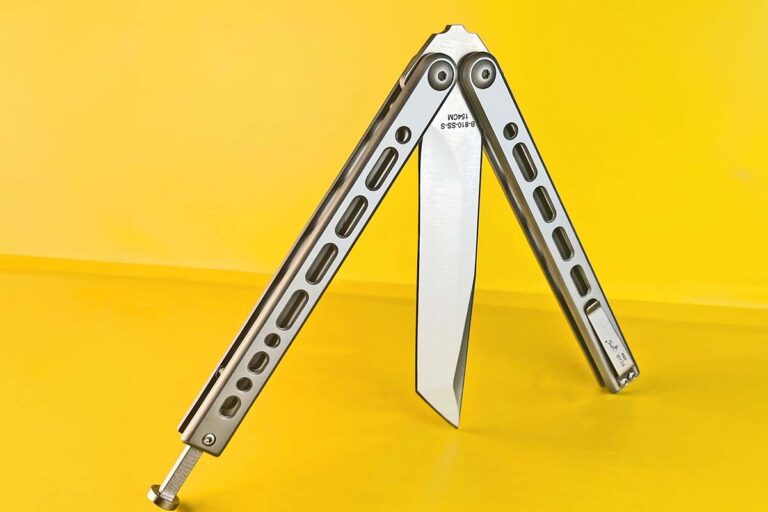
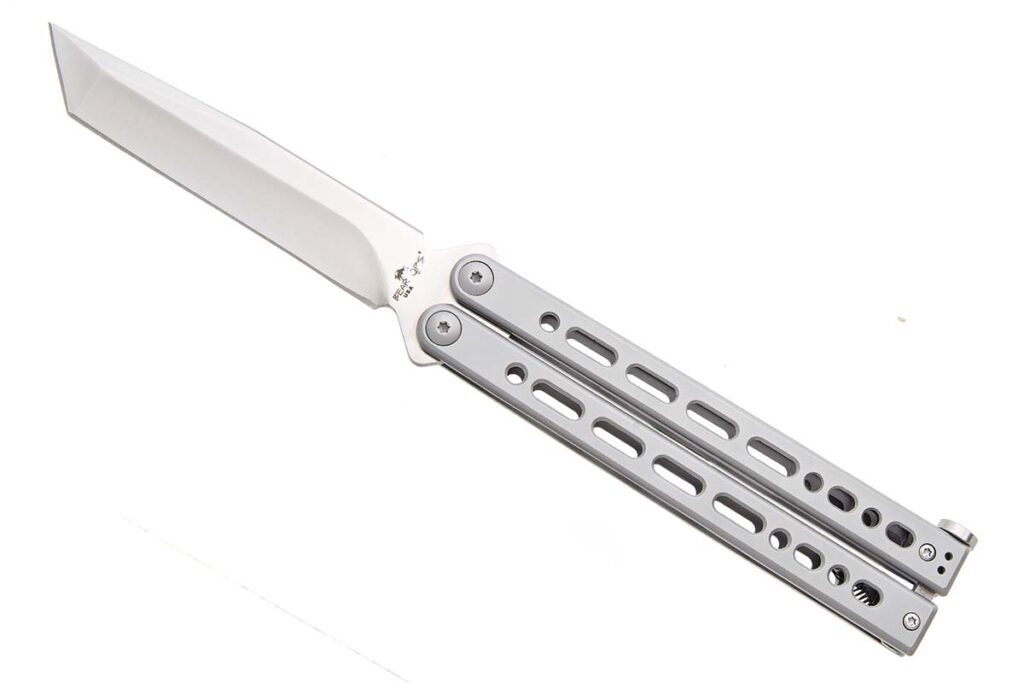
The Bear Song VIII includes a tanto-style blade in flat-ground 154CM stainless steel ideal for detailed cutting and general use.
Matt Griffey of Bear & Son Cutlery says the company has referred to the balisong as the “butterfly knife” since 1986. To that end, the company has continued to develop the famed flippers. With the release of the Bear Song VIII, the company’s design eye was fixed on a knife “being symmetrical and balanced, the most important design elements to start,” Griffey explained.
The Bear Song VIII includes a tanto-style blade in 154CM stainless steel, flat ground and ideal for fine cutting and general use. According to Griffey, the knife’s aptitude is 80 percent flipping and 20 percent cutting.
“A butterfly knife is the strongest folding knife, and as long as you are holding both handles it is as close to a fixed blade as possible for a folding knife,” Matt reasoned. “If the knife is maintained and tight there is almost no chance of lock failure. Maintenance should be just keeping it clean and oiled and checking it periodically to make sure it is not getting loose anywhere on the knife. If you find anything loose, remove the screw, and use Loctite® to replace the screw to the correct tension and let it set for at least twice as long as the thread locker recommends. We find they always give a time that is the bare minimum for the thread lock to work.”
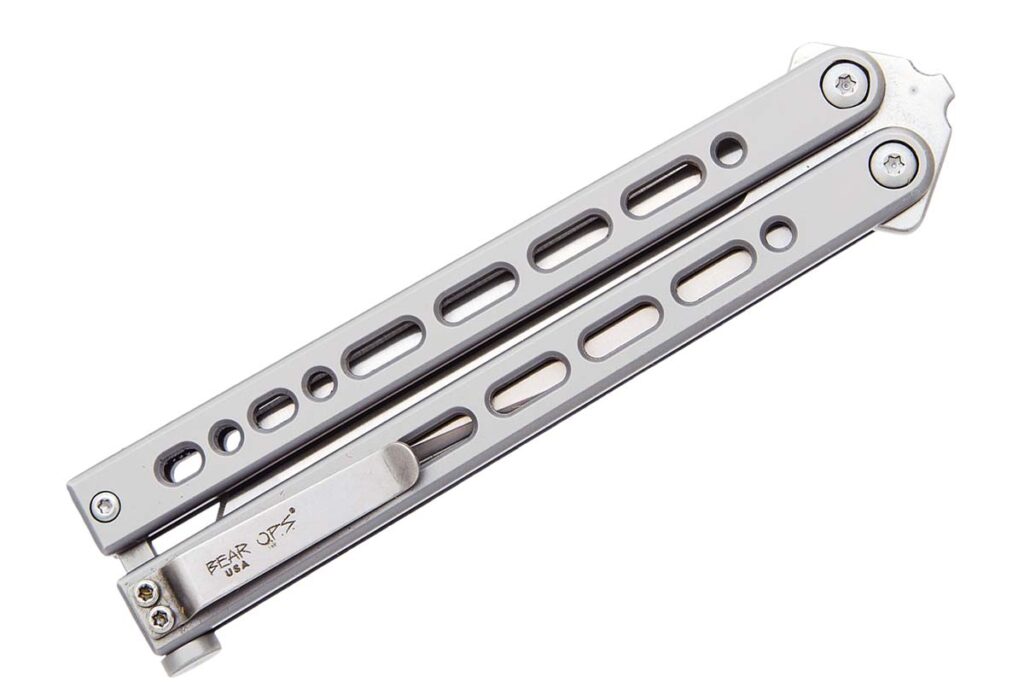
The Bear Song VIII sports stainless steel handles, rounded edges, and milled stepped holes and slots for user comfort. A spring-loaded locking latch and a stainless-steel pocket clip in a short design for easy carry and that can be removed if the user chooses completes the package.
In light of simple maintenance, the Bear Song VIII features an encased bearing design that is easily lubricated, while stainless steel handles, rounded edges, and milled stepped holes and slots provide user comfort. A spring-loaded locking latch makes operation a pleasure. A stainless-steel clip is in a short design for easy carry and can be removed if the user chooses.
“The Bear Song VIII has all the modern features with the timeless classic look,” noted Griffey, who sees the recent legislation regarding butterfly knives as positive (see sidebar). “Butterflies are far slower to open than a modern knife with a flipper on the blade that doesn’t have any spring mechanism. So anyone wasting time in their legislation to target this is just trying to fill time so they don’t have to do any work that might help the people they were elected to serve.”
Bear & Son Bear Song VIII Specs Blade Length: 4” Blade Steel: 154CM stainless Blade Grind: Flat Handle Material: Stainless steel w/Cerakote® finish Latch: Spring loaded Pivot: Ball-bearing washers Weight: 5.1 ozs. Closed Length: 5.25” Country of Origin: USA MSRP: $182.99
Butterfly Knife History
Butterfly knives, also known as balisongs, are one of the most popular knife styles today. They consist of a blade with two handles that rotate around a pivot and wrap around the blade in the closed position. That much is agreed upon. The origin of butterfly knives is still up for debate.
Where Were Butterfly Knives Invented?
Butterfly knives have a rich history, though much of it has been left up to speculation. Walk up to a knife enthusiast and ask, “Where did butterfly knives originate?” and you may get two very different answers.
Fuzzy historical records and well worn legends are to blame. The two main countries of focus are France and the Philippines. Each has evidence and supporters.
One Version: Butterfly Knives Came from the Philippines
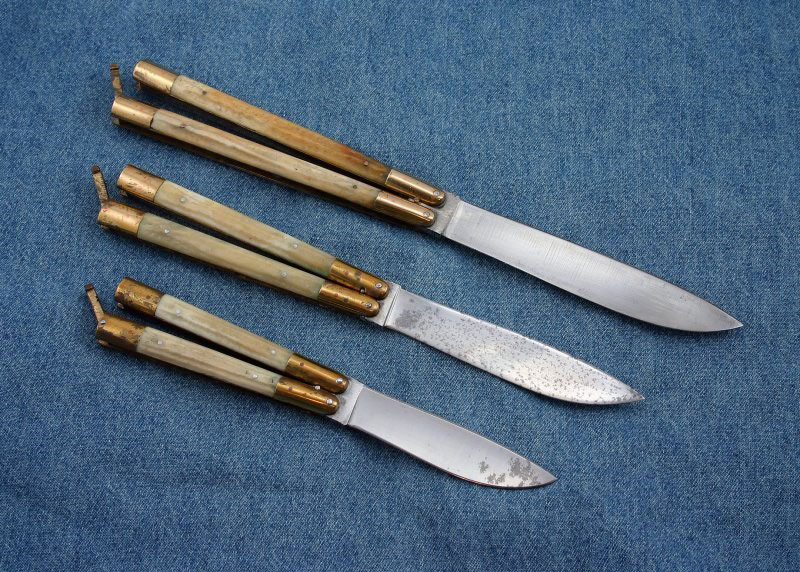
Authentic Filipino balisongs (Image from Balislinger on bladeforums.com)
The Philippines is often cited as the birthplace of butterfly knives, where “balisong” is a more appropriate term. Legend has it that the balisong knife has roots that go back to around 800 AD. This style of knife could be opened quickly with one hand and easily used as a weapon. It proved a common choice for self-defense and utility uses.
A rich balisong tradition has been present in the Philippines for more than a century. Countless stands and stores sell handmade butterfly knives today, and Filipino province of Batangas and the area of Balisong in Taal are known for the blades.
At the very least, the word “balisong” is widely recognized to have come from there. That said, the lack of physical evidence to support a Filipino origin fuels the argument.
Another Version: Butterfly Knives Came from France
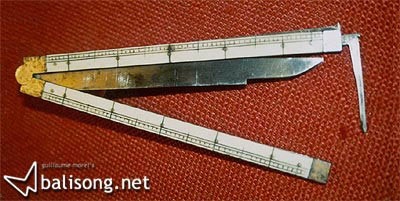
A vintage example of the Pied Du Roi. (Image from balisong.net)
Another claim is that the butterfly knife was invented in France between 1500 and 1700. The reason for this is the “Pied Du Roi,” which means “foot of the king” and is a French measurement tool that dates to the 1700s. The “Pied Du Roi” greatly resembles a butterfly knife. This tool has been pictured with measurement handles and a blade that folds out on one end. It looks like a butterfly knife, but could it be considered the first one ever made?
Proponents of the French origin argue that Spain, allied with France at the time, adopted the butterfly knife in their tasks and eventually took it to the Philippines as sailors sailed to different countries. Sounds reasonable, but hasn’t been proven.
Another supporting argument for the French is that these knives comes from Germany and England, where some butterflies can trace back to prior to 1900. I recently came across a collector’s piece online made in England with markings dating to 1873. This rules out the butterfly knife originating in the early 1900s in the Philippines, but like I said earlier, it has also been claimed to be influenced from similar Filipino knife models as early as 800 AD.
So Where Did Butterfly Knives Actually Come From?
Due to the popularity of balisongs in the Philippines, it isn’t surprising to suspect it started there. The lore passed down from generation to generation also support this idea.
On the other hand, France has pictures and documentation of a measurement device that resembles a butterfly knife and dates back hundreds of years. However, that measurement device likely wasn’t used for self-defense, flipping, or other tasks common to butterfly knives today. Could it be considered the same thing? Hard to tell.
Both sides have great arguments. More information is needed to finally determine this unsolved piece of butterfly knife history.
Butterfly Knives Today
Regardless of history, butterfly knives are rising in popularity due to the fun of “flipping.” Flipping involves tossing butterfly knives open to perform all kinds of tricks. Whether it’s the danger of it, the community, the collectible appeal, or anything else, there’s no doubt flippers are mesmerizing to watch.
Editor’s Note: Mike Haskew and Trevor Brown contributed to this article.
Case Knives is celebrating its 135th year with some top-notch new knives.
Creeping up on a century and a half of knifemaking, Case seems to feel its oats still. Or, that’s the way it seemed from the prolific 135-year-old Pennsylvania manufacturer’s recent releases at the 2024 SHOT Show, held in January in Las Vegas. The company had a full-court press of drops at the gun and outdoor gear hoedown, with a bevy of new lines, releases, collabs and model iterations. This should prove sweet music to the army of the brand’s collectors.
There isn’t space enough to cover every whipstitch of what Case is bringing to the table in 2024, but we’ll take a gander at some of the company’s weightier introductions for the coming year. There’s a little bit of everything for case fans out there, from classic patterns with new twists to brand-new knives that strike original ground.
Bridgeline Series
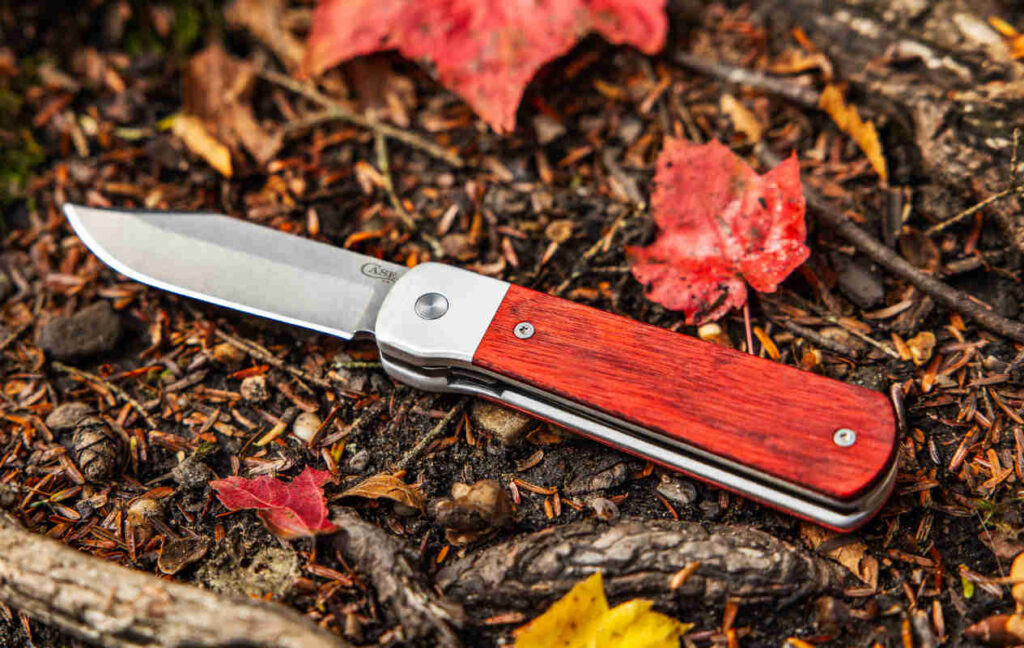
Not wandering too far off the beaten path, Case’s newest series of knives offers some nice updates for users seeking a modern knife. At the vanguard of the line are the Highbanks and Longhouse, both of which should prove excellent everyday carry options with the chops to handle most tasks thrown in front of them. Each features aluminum frames and bolsters, screw construction, ball bearing pivots, deep-carry pocket clips and CPM-20CV steel blades.
Case isn’t shying from the use of powdered steel for its blades, and the choice in these knives offers up a premium option used in a number of higher-end production knives. It’s similar to D2 and other tool steels—respectable toughnesss and edge retention—but with the added benefit of improved corrosion resistance.
Highbanks
Certainly a break from the tried and true, the Highbanks veers to the more traditional in the Bridgeline Series. Namely, because the knife is a non-locking folder bosting a nail nick and a Wharncliffe blade. Still, with the high-performance blade steel and the choice of Micartia or hardwood grips, this certainly isn’t your granddad’s jackknife. I particularly like the handle ergonomics of the Highbanks, tapering nicely to the blade and fitting the hand just right. Spoiler… so does the Longhouse.
Longhouse
Here we see Case move its design a bit more forward with the flipper Longhouse. The liner lock boasts plenty of blade, a clip-point profile with a beef spine that should help the knife stand up to any job put in front of it. However, the hand mimics the Highbanks, giving the knife a timeless look I’d wager many Case fans will appreciate.
Chris Taylor Hunters
Teaming up with renowned custom knifemaker Chris Taylor, Case has cooked up an intriguing hunting-knife collection. This year, the partnership unveils three unique fixed blades, each a fairly unique take on the must-have outdoor implement.
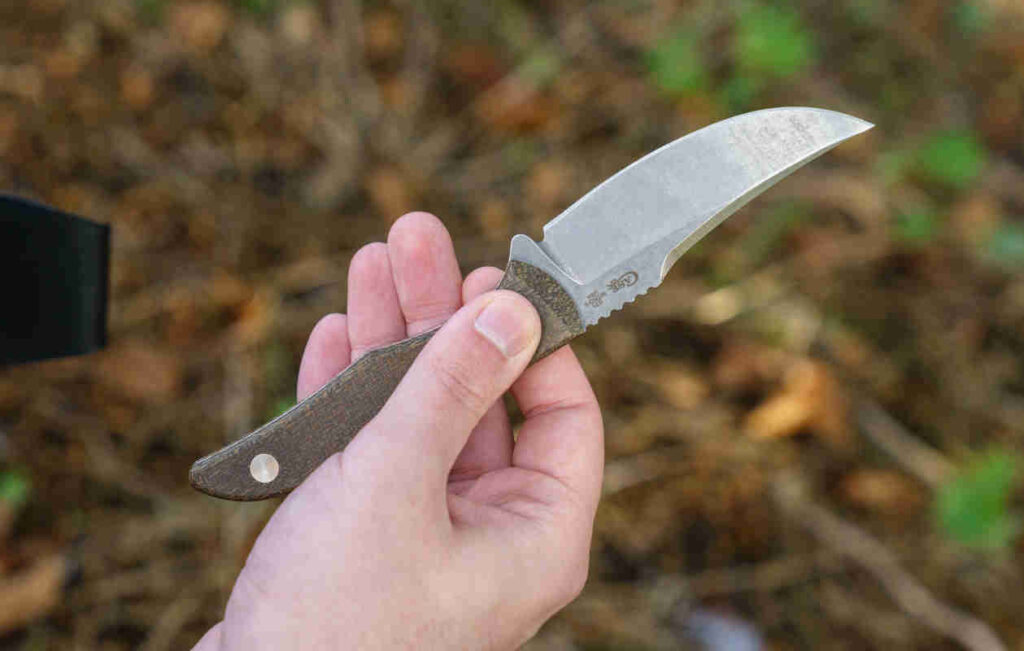
CT1
Crafted to exude rugged dependability, the CT1 showcases a top-tier Nitro V steel Clip-point blade. Known for its outstanding edge retention, corrosion resistance, and easy maintenance, Nitro V steel ensures that your knife remains ready and reliable whenever and wherever you require it. Case gives the knife an OD green burlap Micara handle, a plus for a hard-use knife that will likely be used in inclement weather. The CT1 also boasts aggressive jimping on its spine, so you have a solid contact point on more forceful cuts.
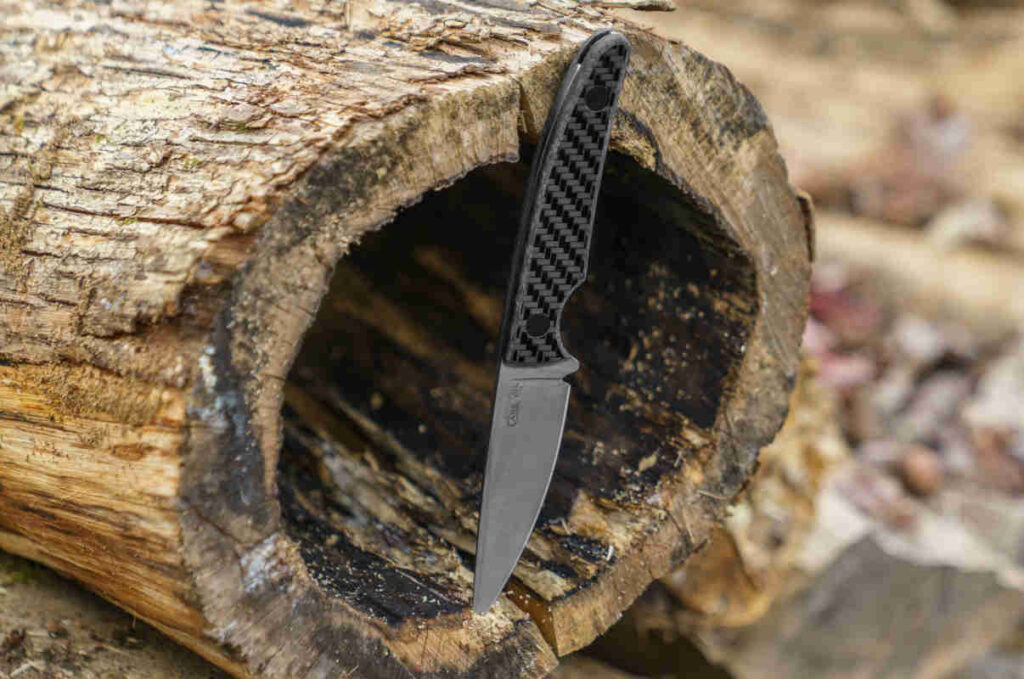
CT2
Cutting a much sleeker profile, the CT2 has the most modern feel among the CT hunters. Built around a resilient S35VN steel drop point blade, the knife doesn’t offer as much belly as the others in the line. But with a defined point, should prove at pro at perforation. The carbon-fiber handle is a nice touch, adding to the CT2’s modern looks, and proves very ergonomic and nimble in the hand.
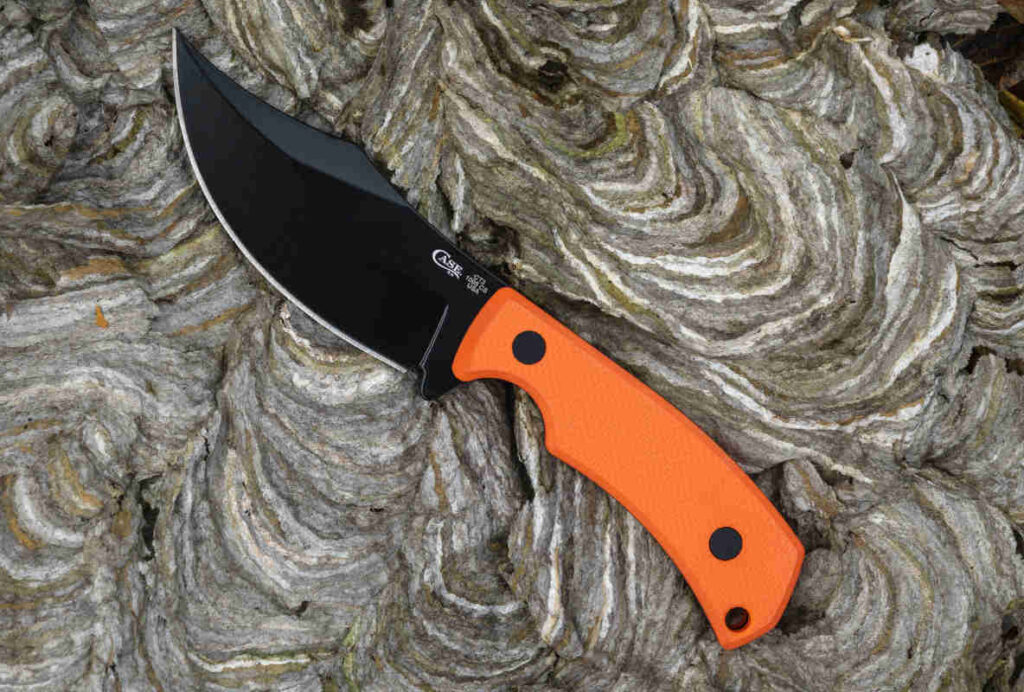
CT3
Tailored for the wilderness, the CT3 has more of a traditional hunter profile. Constructed from premium 1095 carbon steel, its specialized coated skinner blade boasts razor-sharpness, facilitating precision cuts and providing a sharpening advantage compared to many other steels. Outfitted with a hunter orange handle, the nice part about the CT3 is it will be difficult to lose in the woods.
Razor
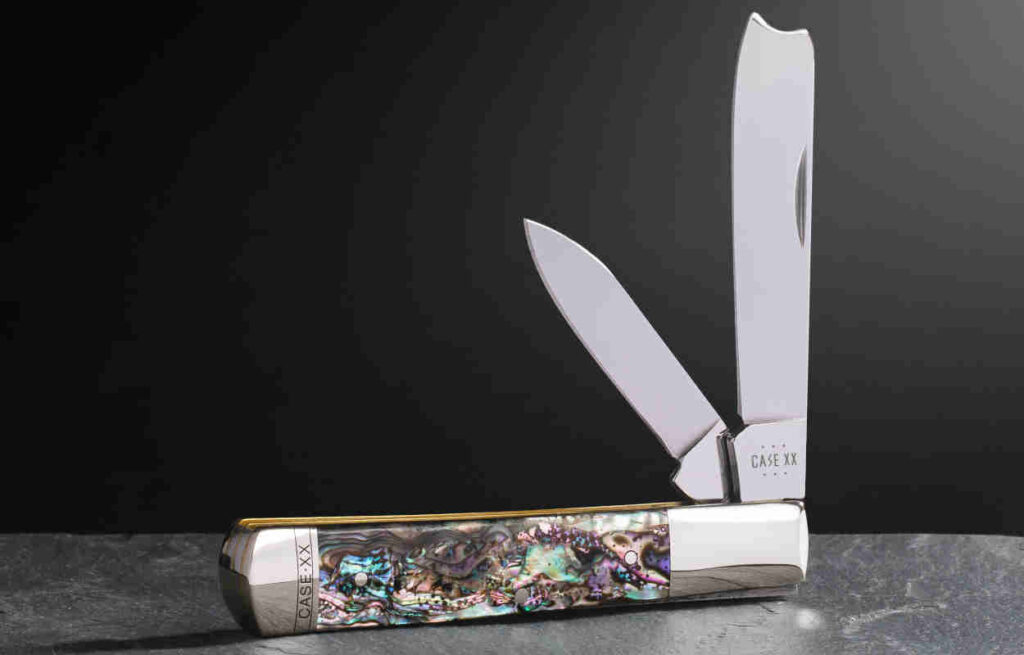
Case is commemorating its 135-year legacy by dusting off a real classic eye-catcher—the Razor. Reintroduced from the Case XX Vault, the knife is available in two patterns: a single-bladed version featuring a broad Clip blade with a distinctively curved tip, and a two-bladed variant with an additional Pen blade. Available in over a dozen handle styles, such as Smooth Abalone, Micarta, Smooth Brown Maple Burl Wood, and Sawcut Jig Caribbean Blue Bone, the Razor is a great Case throwback and a fantastic knife for the company to pay homage to its rich history.
Hunting and outdoor endeavors, these blades are a cut above the rest.
Looking to kit up for the next hunting season? Need to start thinking about filleting this summer’s catch? Or maybe you just require a little summer to make camp life a little easier. We’ve got you covered! From stunning custom creations to workhorse production models, we’ve gathered up top-not hunting knives, camp knives and about every other blade to tackle your outdoor adventures.
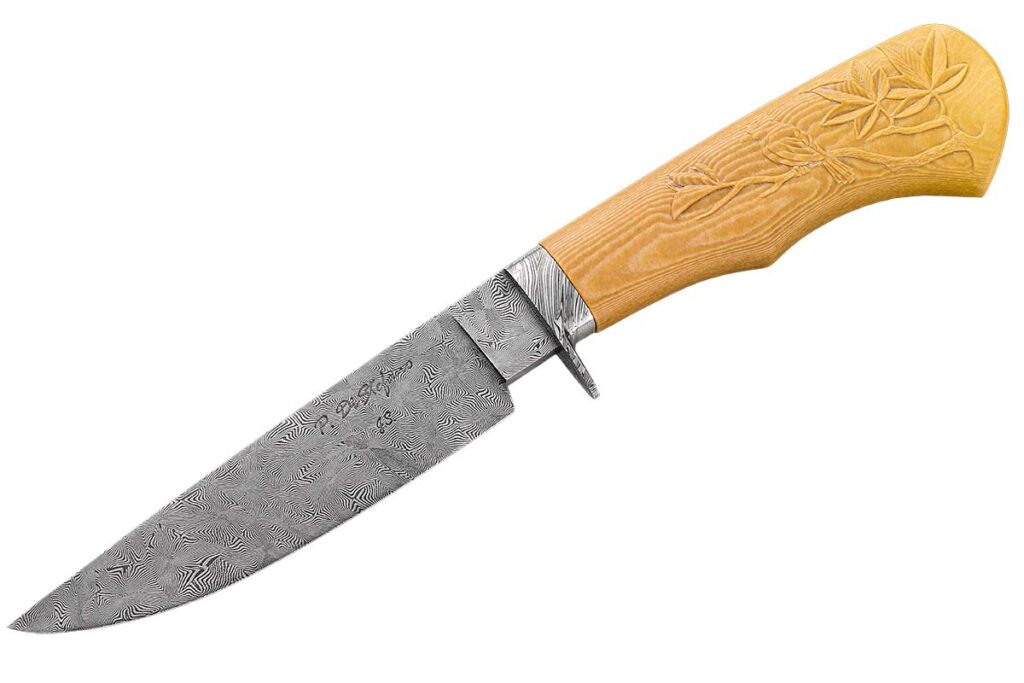
Paul DiStefano: Hunter
BLADE LENGTH: 5” BLADE STEEL: Mosaic damascus BLADE GRIND: Flat HANDLE: Ivory Micarta® carved w/Japanese maple leaves and birds native to Japan; bird’s-beak butt design HANDLE CARVED BY: Paul DiStefano GUARD: Mosaic damascus OVERALL LENGTH: 9.5” MAKER’S PRICE FOR A SIMILAR KNIFE: $2,200 KNIFE TO KNOW: Paul DiStefano is an American Bladesmith Society journeyman smith MAKER: Paul DiStefano
Jacob Gaetz: Hunter
BLADE LENGTH: 4.5” BLADE MATERIAL: Mosaic damascus of 1084 carbon and 15N20 nickel-alloy steels ROCKWELL HARDNESS: 61 HRC BLADE GRIND: Full flat, .01”-thick BTE (behind the edge) HANDLE: Stabilized redwood burl HANDLE PIN: Argentium silver SPACER: Heat-colored damascus GUARD STEEL: Heat-colored 416 stainless OVERALL LENGTH: 9 5/8” MAKER’S PRICE FOR A SIMILAR KNIFE: $2,000 KNIFE TO KNOW: Jacob Gaetz is an American Bladesmith Society journeyman smith MAKER: Jacob Gaetz (Jocelyn Frasier image)
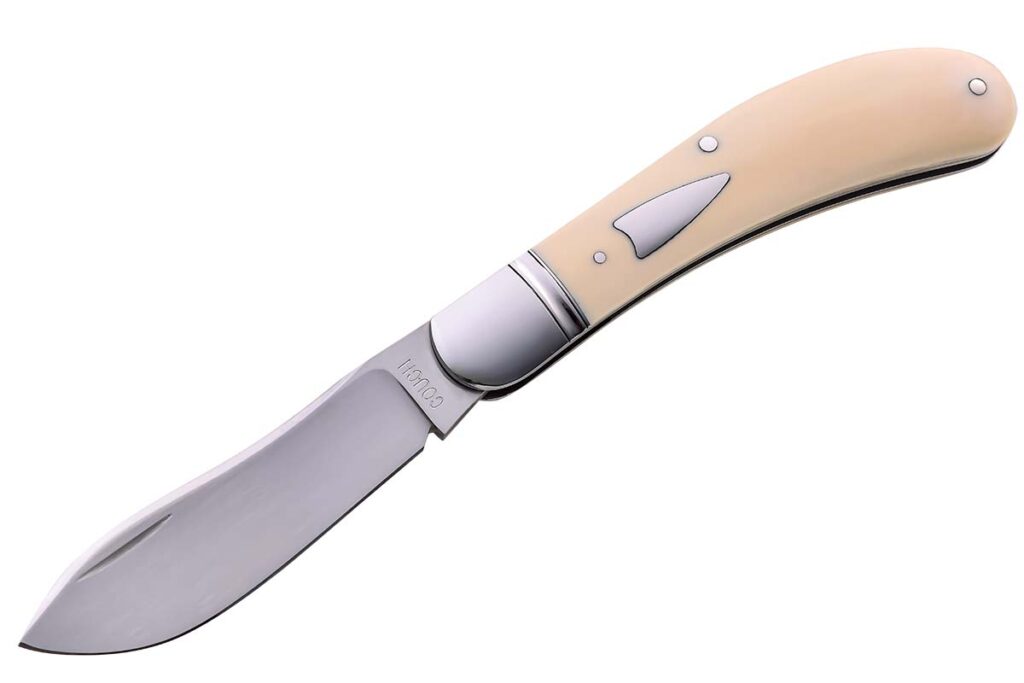
Tanner Couch: Rabbit Skinner
BLADE LENGTH: 3” BLADE STEEL: CPM 154 stainless BLADE GRIND: Hollow HANDLE FRAME: 410 stainless steel HANDLE MATERIAL: Ivory BOLSTER: 416 stainless CLOSED LENGTH: 37/8” MAKER’S PRICE FOR A SIMILAR KNIFE: $1,600 KNIFE TO KNOW: Tanner Couch is a card-carrying member of the South Texas Slipjoint Cartel MAKER: Tanner Couch (SharpByCoop image)
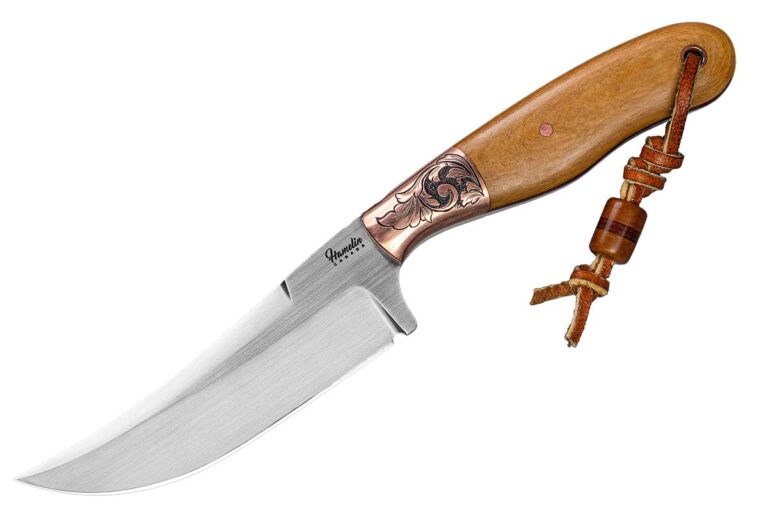
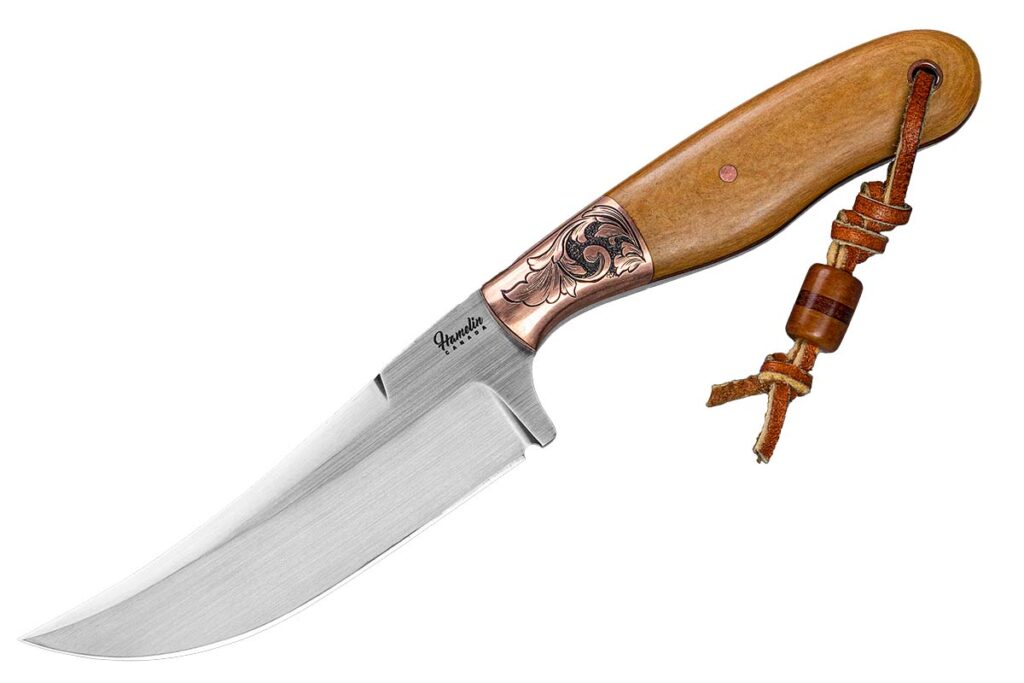
Chris Hamelin: Saratoga Hunter
BLADE LENGTH: 4” BLADE STEEL: 440C stainless BLADE GRIND: Flat HANDLE: Maple Valley Richlite w/copper pin and lanyard tube, natural Micarta® BOLSTER: Copper; engraved by Wolfgang Loerchner OVERALL LENGTH: 8.5” SHEATH (not shown): Belt model w/snap closure of leather and alligator skin inlay by Buffalo Bones MAKER’S PRICE FOR A SIMILAR KNIFE: $1,300 MAKER: Chris Hamelin (Jocelyn Frasier image edit)
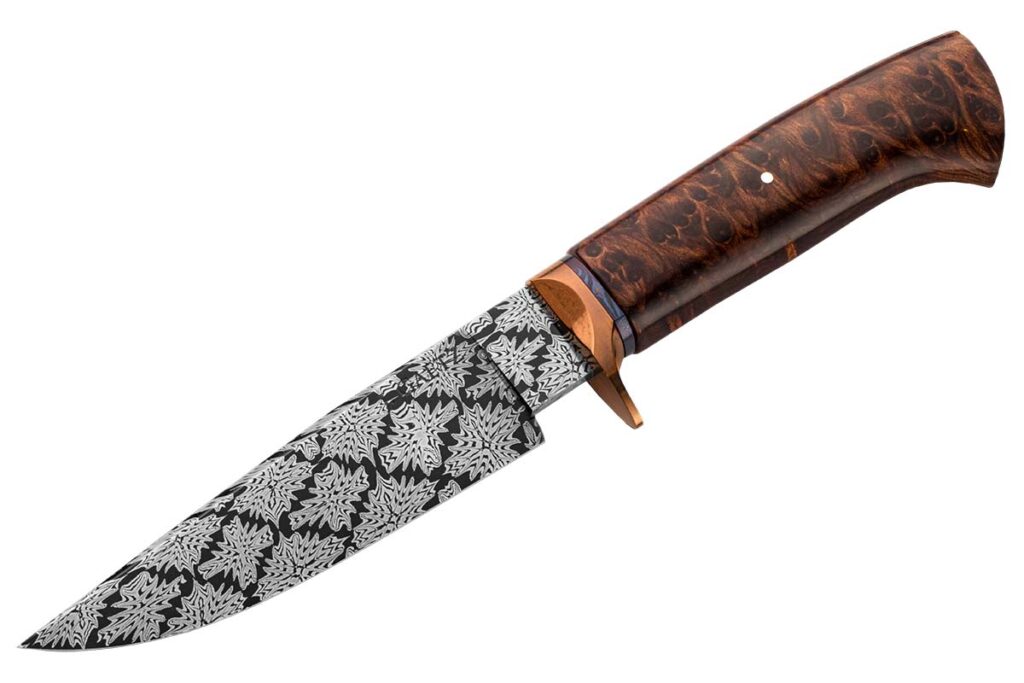
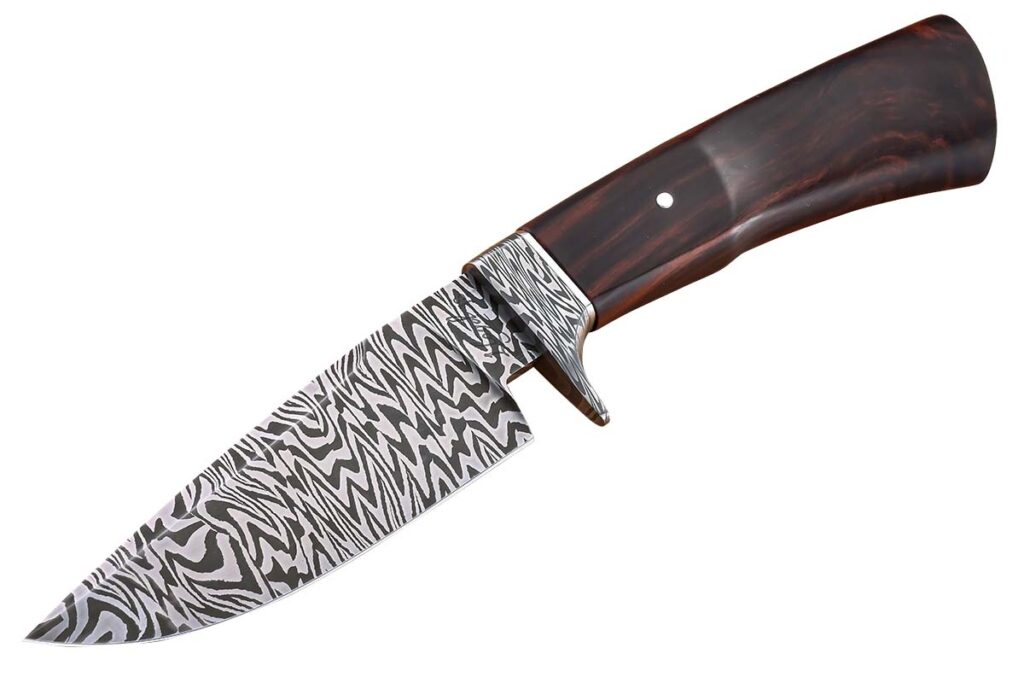
Charlie Lloyd: Crushed W’s hunter
BLADE LENGTH: 5” BLADE MATERIAL: Crushed W’s damascus of 1080 carbon and 15N20 nickel-alloy steels BLADE GRIND: Flat GUARD: Damascus OVERALL LENGTH: 10” MAKER’S PRICE FOR A SIMILAR KNIFE: $1,200 KNIFE TO KNOW: Charlie Lloyd is a journeyman smith in the American Bladesmith Society MAKER: Charlie Lloyd (SharpByCoop image)
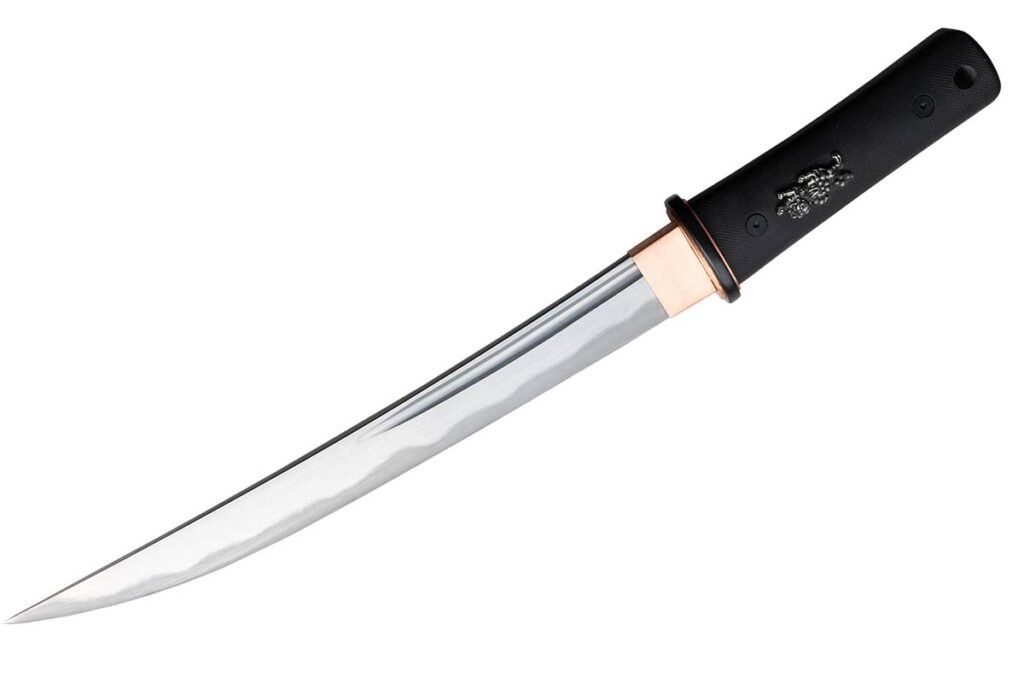
CAS Iberia: Modern Tanto
BLADE LENGTH: 10.5” BLADE MATERIAL: 1566 carbon steel w/hamon BLADE THICKNESS @ GUARD: .21” BLADE THICKNESS @ TIP: .157” TSUKA (handle): G-10 HABAKI (collar): Copper MENUKI (handle ornaments): Silver shi shi (lion dogs) SAYA (scabbard; not shown): Textured black WEIGHT: 15 ozs. OVERALL LENGTH: 16” MSRP: $259 COUNTRY OF ORIGIN: China COMPANY: CAS Iberia
Russell Roosevelt: Hunter
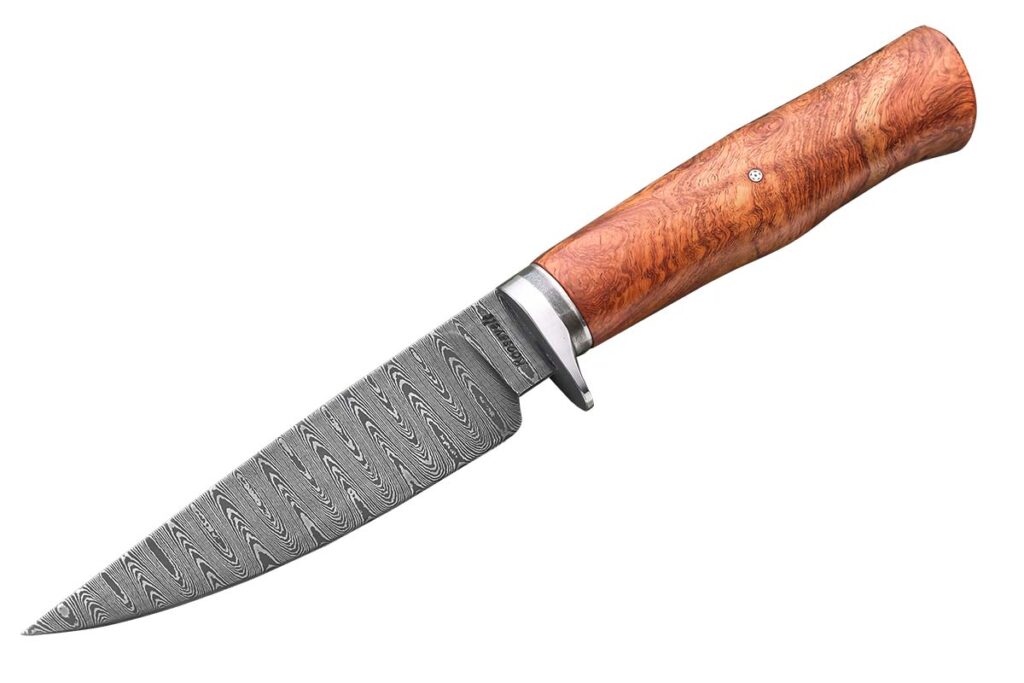
BLADE LENGTH: 5.5” BLADE MATERIAL: Ladder-pattern damascus of 1084 carbon and 15N20 nickel-alloy steels BLADE GRIND: Flat HANDLE: Amboyna burl GUARD: 416 stainless steel w/spacers OVERALL LENGTH: 10.75” KNIFE TO KNOW: Russell Roosevelt is a journeyman smith in the American Bladesmith Society MAKER: Russell Roosevelt (SharpByCoop image)
Josh Hults: Skinner/camp knife
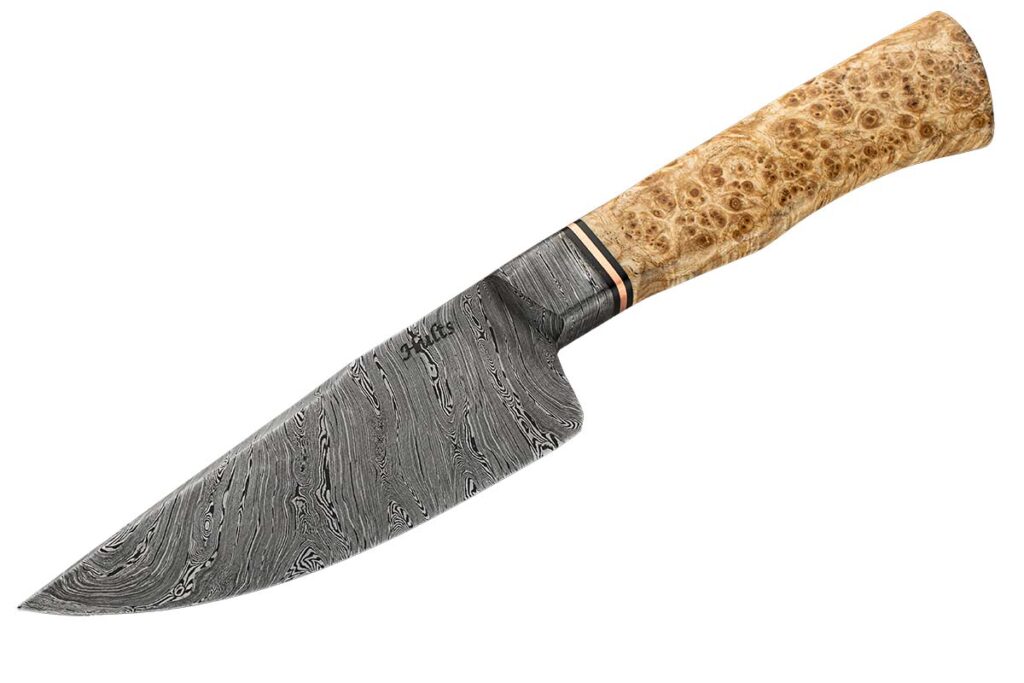
BLADE LENGTH: 3.5” BLADE MATERIAL: Twisted ‘W’s’ damascus of 1084 carbon and 15N20 nickel-alloy steels BLADE GRIND: Flat HANDLE: Stabilized black ash HANDLE SPACERS: Copper and G-10 OVERALL LENGTH: 9.5” MAKER’S PRICE FOR A SIMILAR KNIFE: $800 KNIFE TO KNOW: Josh Hults is a journeyman smith in the American Bladesmith Society MAKER: Josh Hults (Jocelyn Frasier image edit)
Outdoor Edge: Razor VX 4
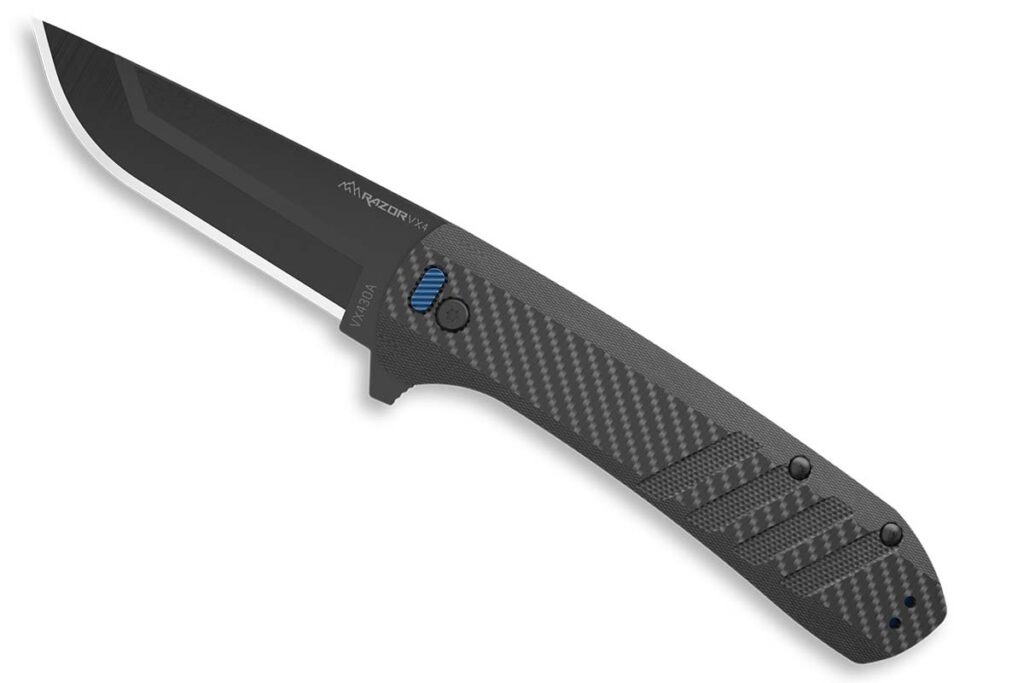
BLADE LENGTH: 3” BLADE STEEL: 420J2 stainless BLADE FINISH: Black oxide coated HANDLE MATERIAL: Forged carbon fiber LOCK: Linerlock LINERS: Vented stainless steel PIVOT: Ceramic ball bearing CLOSED LENGTH: 4.25” KNIFE TO KNOW: The Razor VX 4 is a replaceable-blade model; also available in handle materials of green Micarta® ($54.99) and Black G-10 w/spring assist $44.95) COUNTRY OF ORIGIN: China MSRP: $69.99 COMPANY: Outdoor Edge
Spyderco: Spyder Thrower, Small
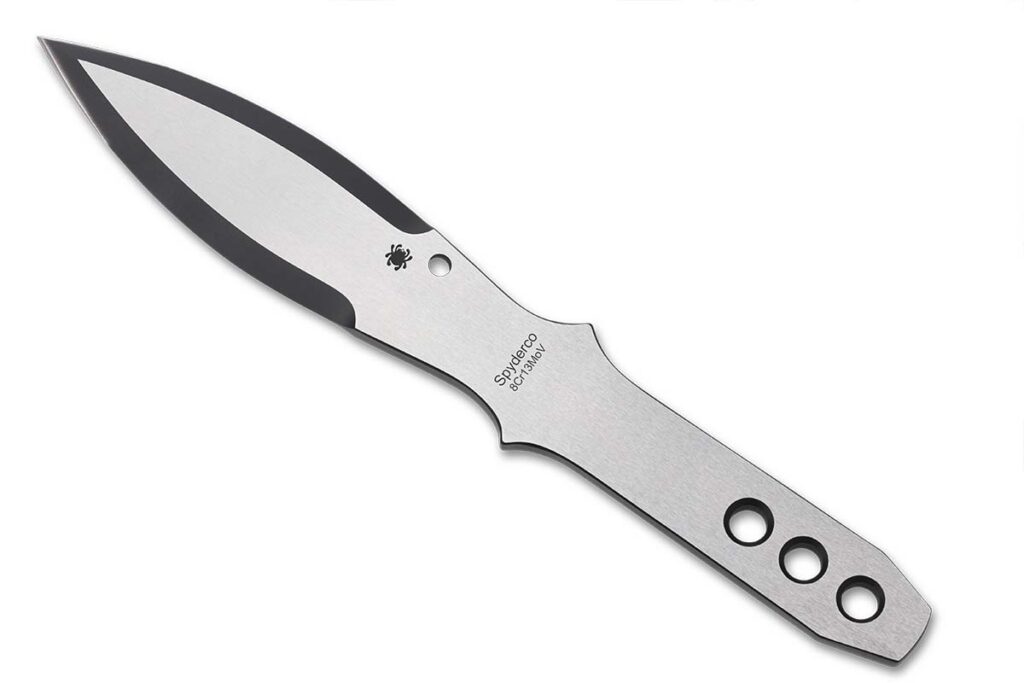
DESIGNER: Harald Moeller BLADE LENGTH: 5.3” BLADE STEEL: 8Cr13MoV stainless BLADE GRIND: Dagger BLADE @ THICKEST: .217” BLADE FINISH: Two-tone black oxide and satin finish WEIGHT: 7 ozs. OVERALL LENGTH: 9” SHEATH: Leather KNIFE TO KNOW: Comes in a set of three w/three-tiered leather sheath and a copy of the instructional booklet, Knife Throwing: The Knives and Throwing Technique of Harald Moeller; designed to be thrown by either the blade tip or handle butt COUNTRY OF ORIGIN: China MSRP: $144 for the set Company: Spyderco
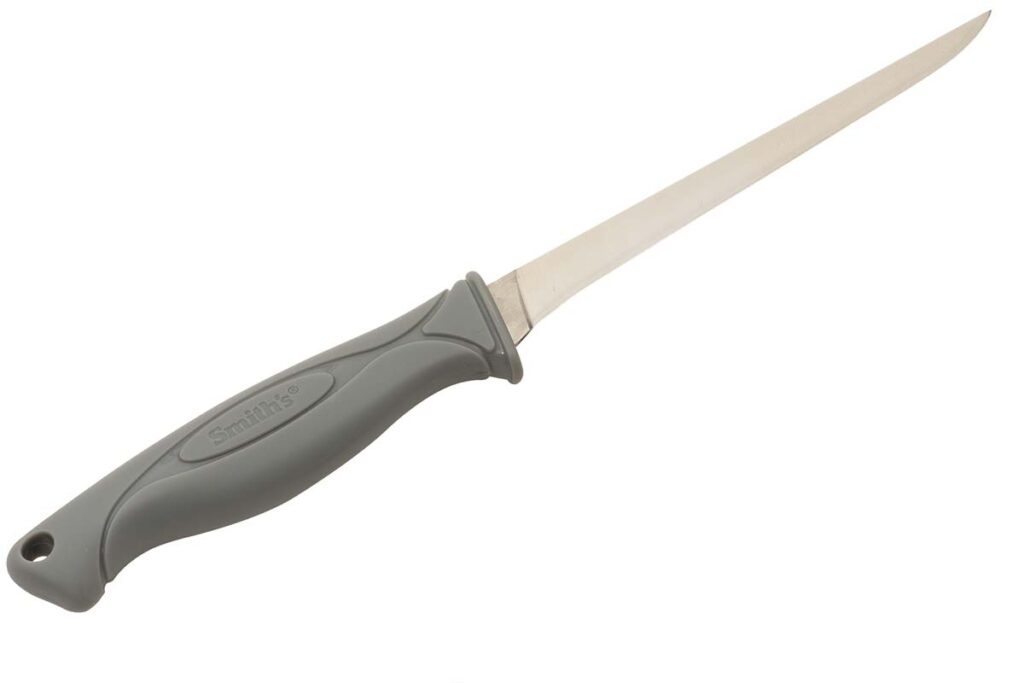
BLADE LENGTH: 7” BLADE STEEL: 400 series stainless BLADE FINISH: Corrosion-resistant coating HANDLE: Thermoplastic elastomer (TPE) w/non-slip soft grips and hole for a lanyard SHEATH (not shown): Breathable TPE KNIFE TO KNOW: Designed for cleaning small-to-medium-size fish like speckled trout or yellowtail snapper COUNTRY OF ORIGIN: China MSRP: $12.99 COMPANY: Smith’s Consumer Products Inc.
GiantMouse: ACE Iona V2
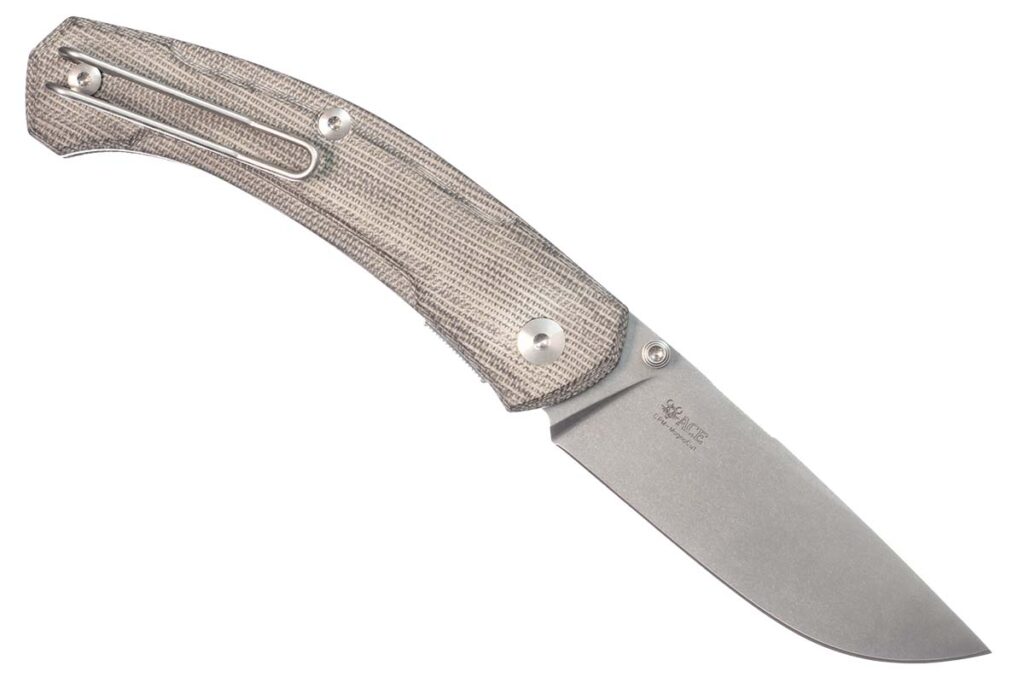
BLADE LENGTH: 3” BLADE STEEL: CPM MagnaCut stainless BLADE @ THICKEST: .115” BLADE FINISH: Stonewash HANDLE MATERIAL: Green canvas Micarta® POCKET CLIP: Wire, reversible PIVOT: Washer LOCK: Linerlock WEIGHT: 3.4 ozs. CLOSED LENGTH: 4.34” COUNTRY OF ORIGIN: Italy MSRP: $195 KNIFE TO KNOW: The knife is named after the Iona Bar, “a beloved establishment” in the Williamsburg neighborhood of Brooklyn, New York COMPANY: GiantMouse
Buck Knives is among the most historic manufacturers in the county. We attempt to pick the best knives it has ever created.
The famous 110 Folding Hunter was introduced to the market in 1964. This was a significant point for Buck Knives, and a significant point for the knife industry as a whole.
Buck did not start in spirit in 1964, it began much earlier at the turn of the century, and was the culmination of over half a century of Hoyt Buck’s knifemaking experience. Several generations of the Buck family worked to build the company, and the result was nothing short of extraordinary. Buck Knives are one of the most recognizable brands in the country, and they have a well-earned reputation for quality. It is currently in its fourth generation of family ownership, an amazing feat in today’s fast-paced corporate environment.
Buck knives are exceptionally well-made and will hold up for a lifetime if properly maintained. The knives also carry one of the best warranties in the industry which guarantees their products against any defects for life. This whole segment has nothing from him about how Hoyt formally started and built the company.
History Of Buck Knives
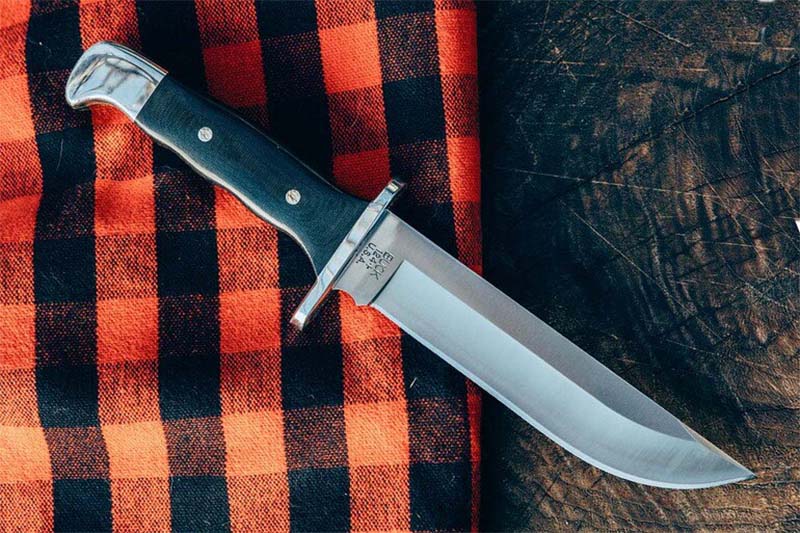
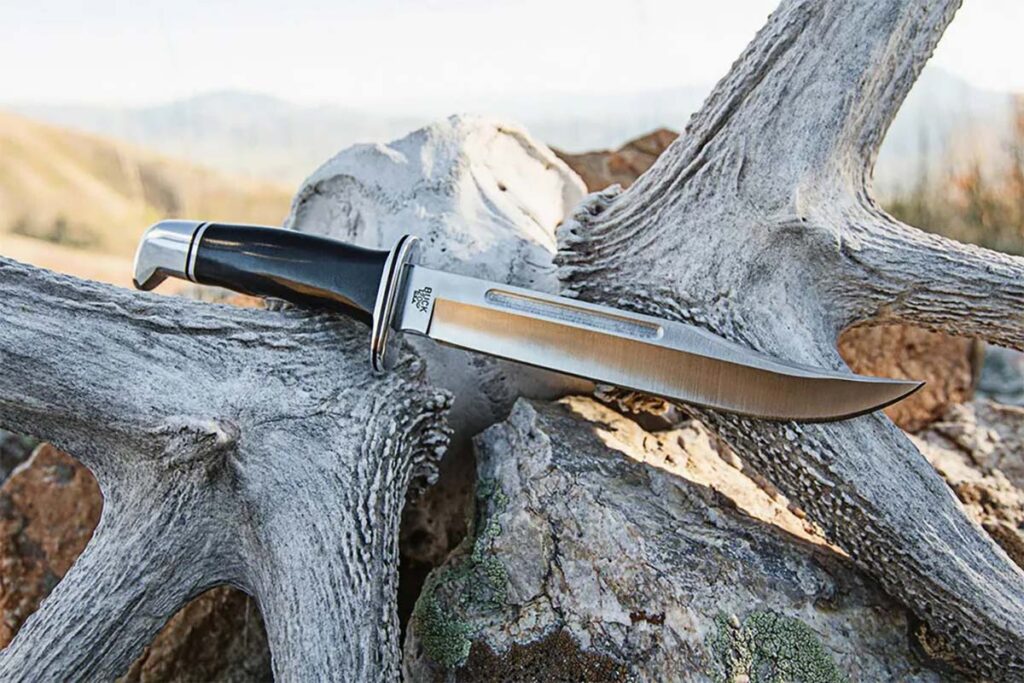
The Buck 119 Special is one of the company’s many fixed blades.
While it was not technically a company, Hoyt buck began making knives around 1900 and developed a way to temper steel that he deemed to be superior to what was being done at the time. It may seem a bit uppity of an apprentice blacksmith to take on something that had not been done in all of the history of man’s knife-making, but Hoyt Buck was not to be deterred.
Sure enough, his methods became well-known and he made knives one at a time for decades afterward. His knives had superior edge retention as a result of his tempering process and to this day Buck knives are well-known for their ability to hold an edge.
While the seeds of Buck Knives were planted thanks to Hoyt and his skill on the anvil, the company’s journey is so much more than that. Hoyt had six children, and his oldest son Al would eventually play a key role in the company’s growth.
By 1941 Hoyt and his wife were now living in Idaho, and he was a church pastor. However, the attack on Pearl Harbor roused his patriotism. As a way to help the war effort, he opened a small blacksmith shop in the basement of his church and began making knives once again. His knives became extremely popular on the military bases on the Pacific Coast and soldiers would come from all over to get one of his blades.
By the time the war ended in 1945 Hoyt and his wife Daisy decided to move south to San Diego and live near Al. In 1946 Hoyt opened his first manufacturing plant, really just a small lean-to attached to Al’s house, with his son. It was then that Buck Knives was officially born.
Al took over the company when his father passed, and today the company remains in the family as CJ Buck is the fourth-generation CEO and Chairman of Buck Knives.
Hoyt’s Tempering Process
Hoyt Buck was 13 years old and an apprentice blacksmith in 1902. According to the company’s own history, Hoyt was dissatisfied with the edge hardness on common farming implements. Farmers seemed to be bringing in their tools far more often than he liked to see and thought of some solutions to make the edges stronger and able to hold their sharpness longer. He began experimenting with these tools and eventually figured out a quenching method to achieve his desired result.
Essentially, the secret Buck discovered was quenching the entire blade when it was all precisely the same temperature. Not an easy task, especially in the day and age he came up with the process. However, overcoming the technological challenges reaped impressive benefits. The uniformity of the tempering process ensured the metal had no soft spots–weakness that could eventually lead to damage. Furthermore, the even tempering–when applied to knives–resulted in blades that were extremely hard and were capable of retaining an edge.
How To Date A Buck Knife
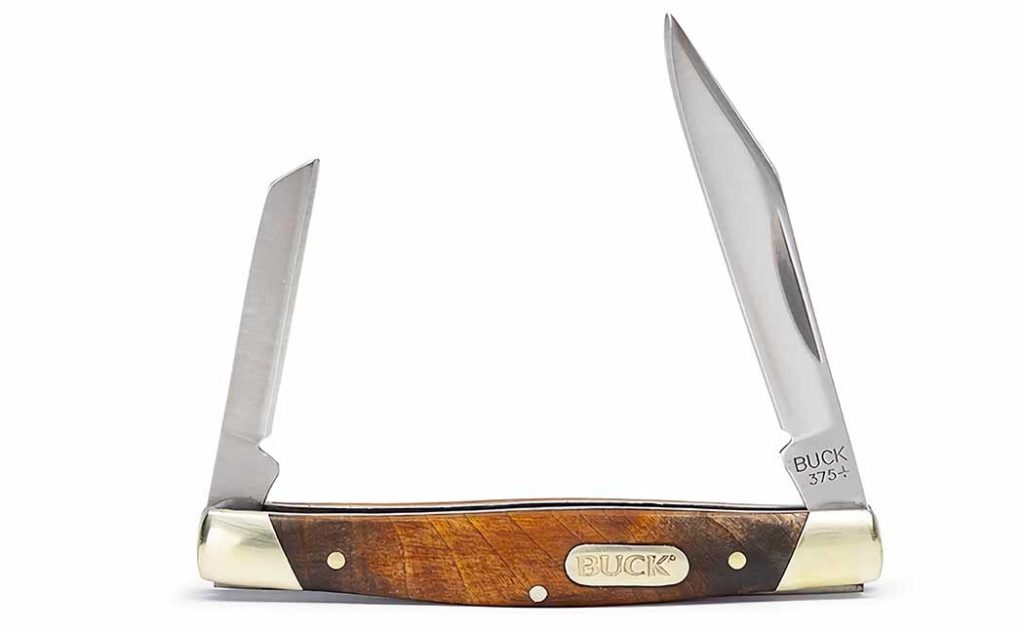
The Buck 375 shows off the company’s continued commitment to detail.
Unlike many knives across the industry, Buck knives are marked in certain ways to identify them based on the year they were made. The original Buck knives from 1961 to 1967 or simply stamped with ‘BUCK’.
From 1967 to 1972, the knives featured the mark ‘BUCK, USA’. The 1972 to 1986 period had the knives labeled with ‘BUCK 110, USA’ with additional model information. From 1986 onwards, each year of manufacture has a unique symbol that is added to the blade. You can very quickly and easily identify this and match it to the model year on the Buck website.
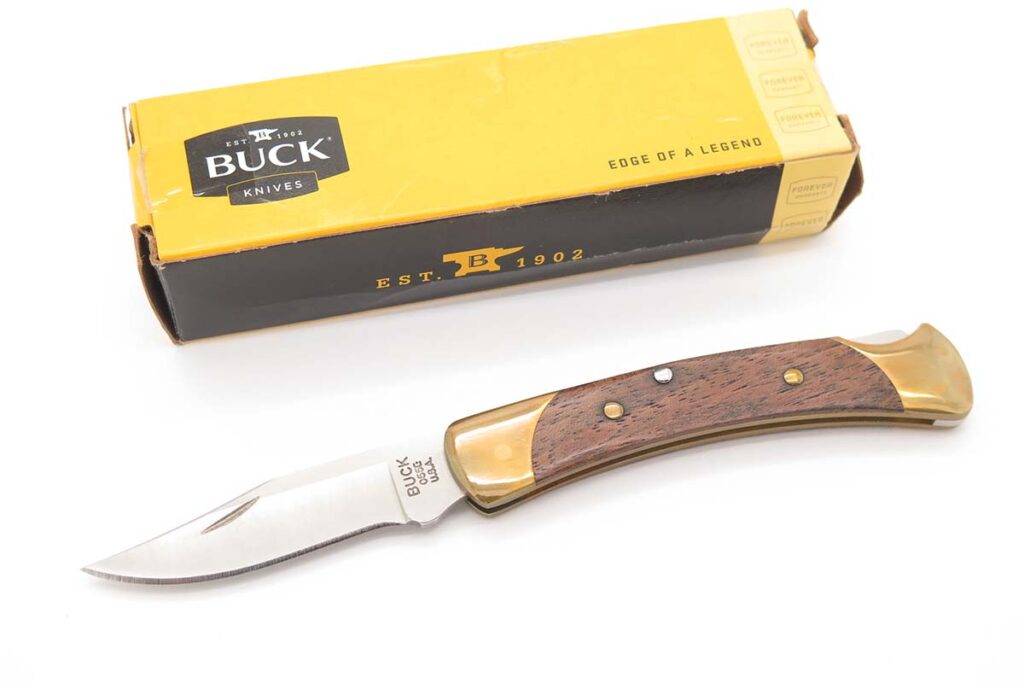
Buck knife collectors tend to have some of their own methods for identifying early knives. While it comes down to a degree of pseudoscience, there is demand for Buck knives that retain their original packaging, and even original receipts that can prove the age of the knife. Typically, the older the knife, the more it is worth.
Vintage Buck knives do not tend to sell for all that much by comparison to other knives, but there is a healthy following all across the country. Most people do not sell their Buck knives at all, and they are passed down generationally.
Best Buck Knives
Whether it’s a contemporary knife or a classic, these 10 knives from Buck continue to be top sellers and beloved by knife aficionados around the world.
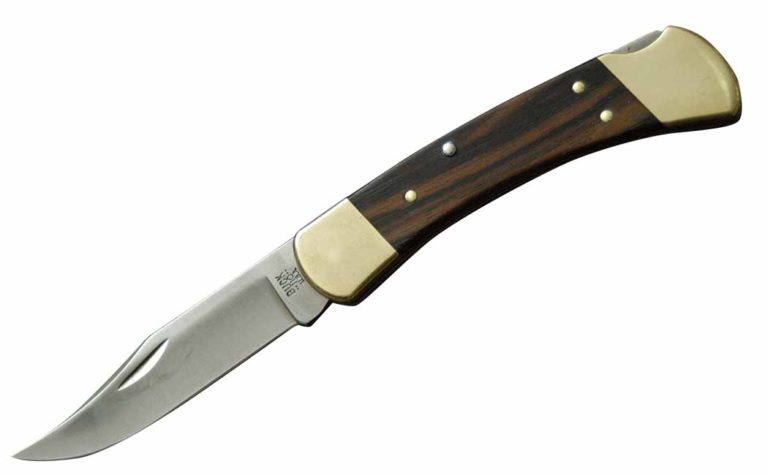
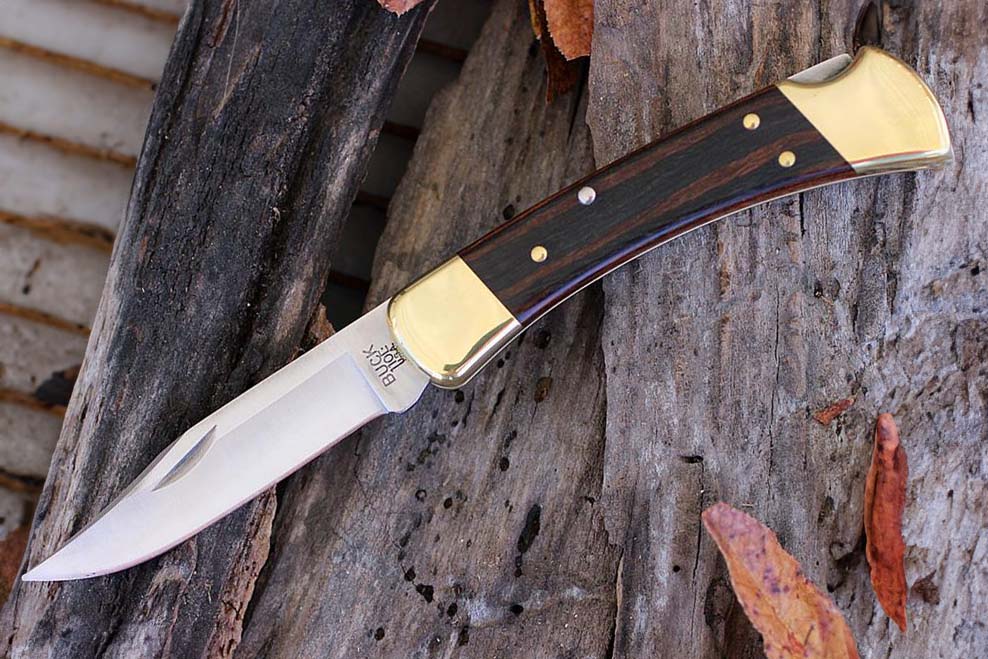
110 FOLDING HUNTER KNIFE
This is the one that started it all. The 110 Folding Hunter needs no introduction here. It is one of the most storied and respected knives in American history. What is remarkable is that the price is relatively low, even for Buck’s lineup. The price of this knife sets it apart because it is well-known for its durability and sharpness. At under $70, you can easily buy this knife without breaking the bank.
MSRP: $65
124 FRONTIERSMAN KNIFE
This knife harkens back to the old days in appearance but is all modern in terms of execution. The Frontiersmen knife is just about the perfect size if you prefer to carry a fixed blade. The design of the knife is completely functional and you should be able to accomplish just about anything you need to accomplish out in the woods or around the farm.
MSRP: $185
055 ‘THE 55’ KNIFE
The 55 gets its name for being half the size of the famous 110. It is a popular and common pocket knife that is just as strong as its big brother. While it lacks many of the features of modern assisted-open knives or other types of more complicated designs, it makes up for it by being exceptionally durable and easy to use. Much like the larger 110, this is a knife that you will keep for life and pass down to your kids.
MSRP: $70
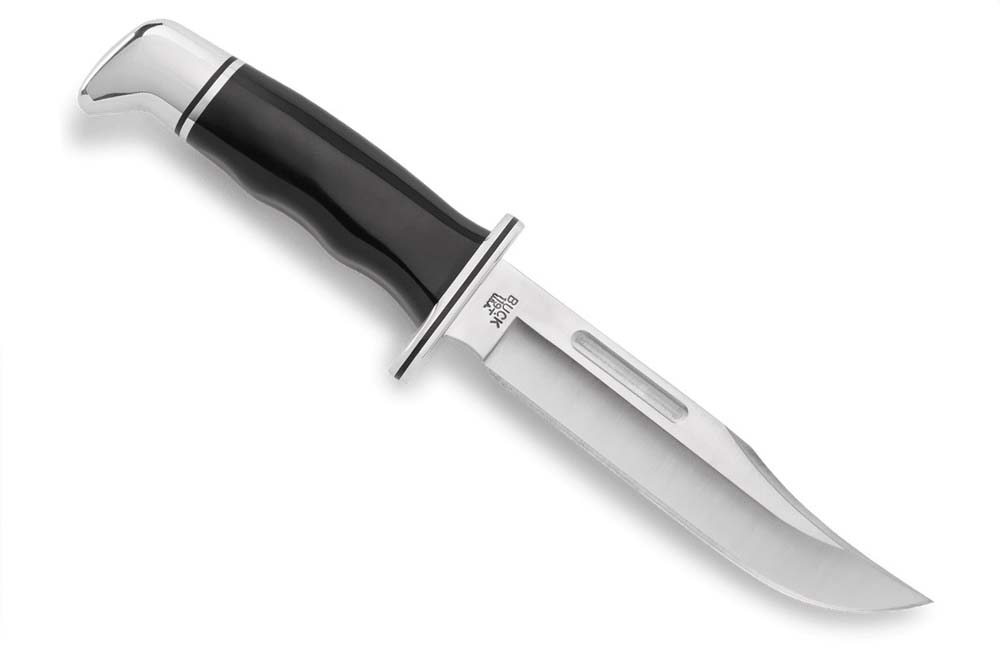
120 GENERAL KNIFE
There are very few knives that are as recognizable as the 120 General Knife. This Buck design is a classic, reminiscent of the military Ka-Bar. It is a bigger knife than what most people use for their everyday chores. The General Knife will be a companion for hunting, skinning, and preparing wood near the campfire.
MSRP: $130
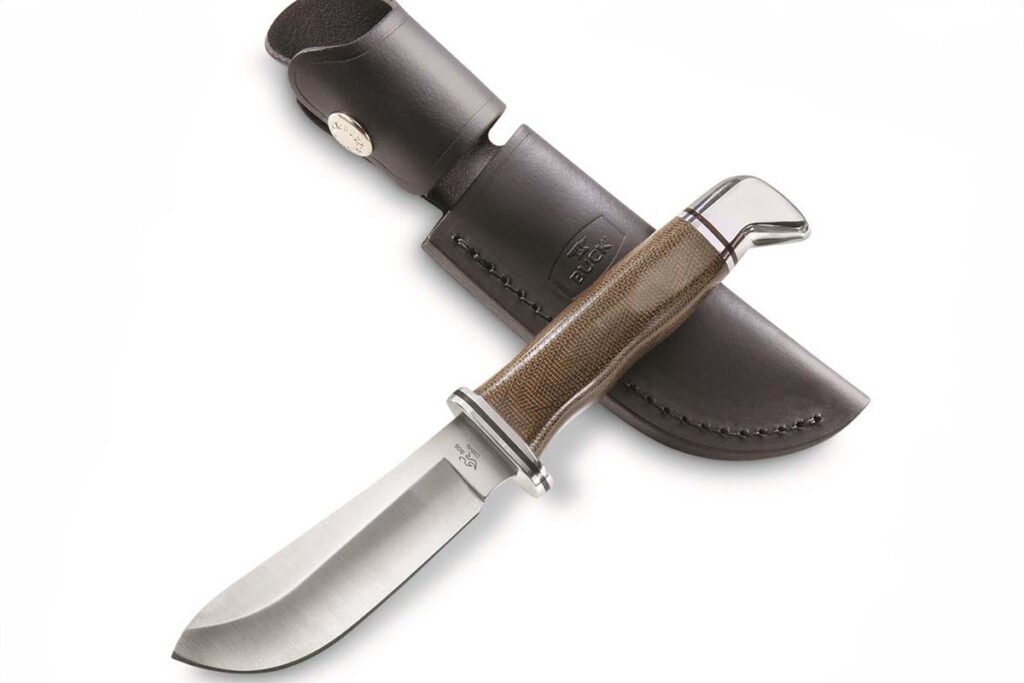
103 SKINNER PRO KNIFE
Back in the old days, a skinning knife was part of a larger set that you would take into the field. This knife profile saw its heyday during the decimation of the buffalo herds. Buck has an excellent skinning knife in the form of the 103 Skinner Pro. It is a fine tool and is exceptionally attractive in appearance. If you like to have separate tools for your various hunting chores, you would do yourself well to equip this knife alongside the larger 120 General Knife.
MSRP: $170
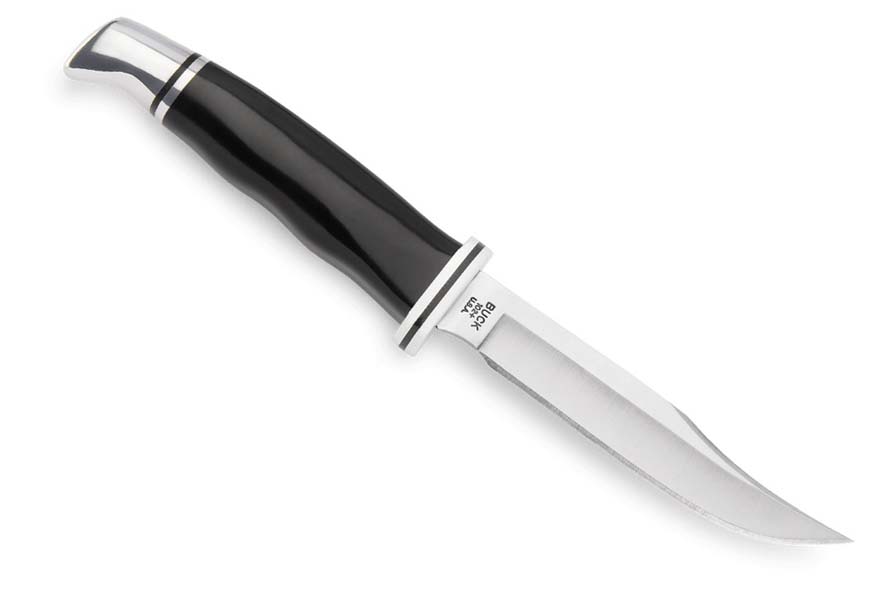
102 BUCK WOODSMAN KNIFE
For many young men, the Woodsman was the first serious knife they ever received. This is a classic design and is among the most popular and well-recognized American fixed-blade knives ever made. It is not the largest knife Buck has made, but this medium-sized Bowie profile blade has seen more use than most knife models could ever hope to achieve.
This is an excellent knife for the aspiring outdoorsman. It can be used in just about any setting that requires medium lifting. It is a bit too thin to be used for wood splitting but can be used easily for making kindling by scraping. It is also an excellent small game knife and can be used for all sorts of camp chores. If you think about the knife that you would have in the Scouts, this would likely be as close to that knife as you can get.
MSRP: $75
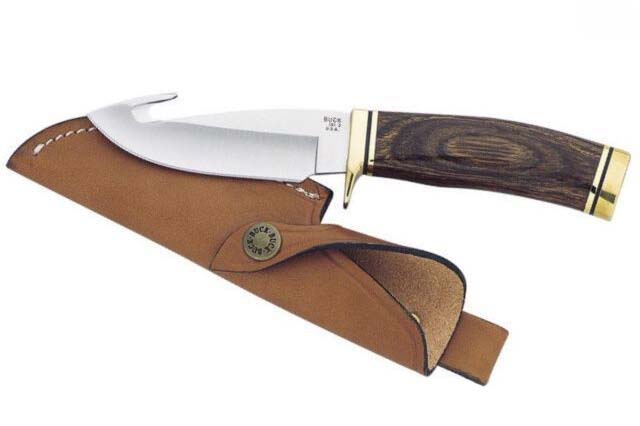
BUCK ZIPPER KNIFE
The Buck Zipper is one of the many knives sold by the company today.
The Buck Zipper knife is arguably one of the most popular gut hook knives in the country, and it is fair to say that it is in more deer hunters’ hands than it’s not. As far as traditional designs go, the Zipper knife is not just well-made, it is also a symbol of the trade for many hunters that take to the field every fall. Gut hook knives do have other utility, they can be used in fishing settings for cutting line and for gutting as well. For a general-use hunting knife, you really can’t go wrong here.
MSRP: $129.99
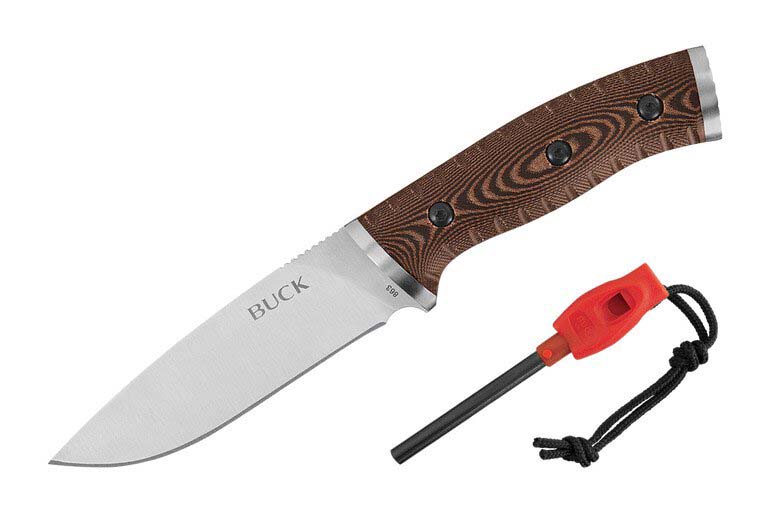
863 SELKIRK KNIFE w. FIRE STARTER
Bushcraft knives are all the rage these days. There are a plethora of TV shows dedicated to the topic, and it seems that every knife company out there is making something that fits the bill. The Selkirk knife is a nicely priced addition to the Buckline. The knife is well equipped and comes with a durable micarta handle and a sheath-mounted fire steel. The kit you get is able to function right out of the box. You can pretty easily get started with practicing right in your yard. MSRP $80
The knife does have a couple of downsides, though, from a Bushcraft perspective, it is relatively thin. A blade really needs to have some meat to it to be able to make it through the tanning for kindling You’ll never really get much life out of a thin blade if you snap it off in use. Even though Buck has a good warranty, you should take care to not treat a thin blade like this as a dedicated tool for splitting. The knife can, however, be used for making tinder out of smaller pieces of wood, and it should have no problem getting them to light.
MSRP: $80
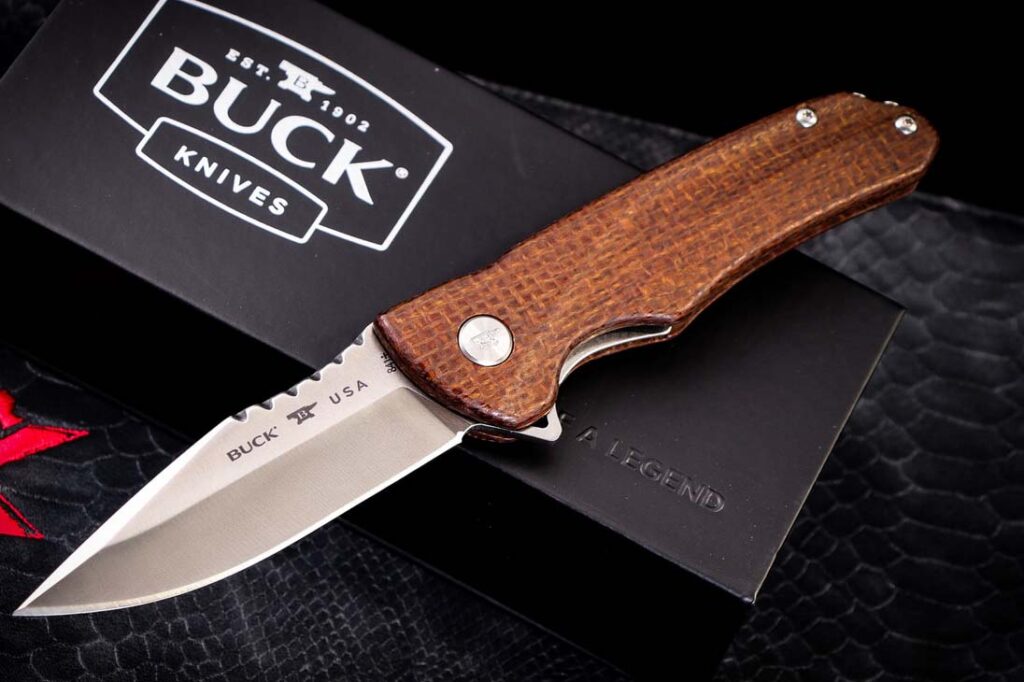
841 SPRINT PRO KNIFE BURLAP MICARTA
Another modern design, the Sprint Pro is a sleek looking folder that also has some classic lines. The knife is available in a couple of forms, most interesting is the burlap micarta model. Burlap micarta is made through an interesting process that suspends fabric in a resin base material. The result is a unique, very durable, and highly functional grip material that looks as good as it performs. This is a flipper-style knife and can be operated easily with one hand. The locking mechanism is a standard liner lock. Overall, it is a well-reviewed and well-designed knife that, while not the most visually striking, will give years of use.
MSRP: $155
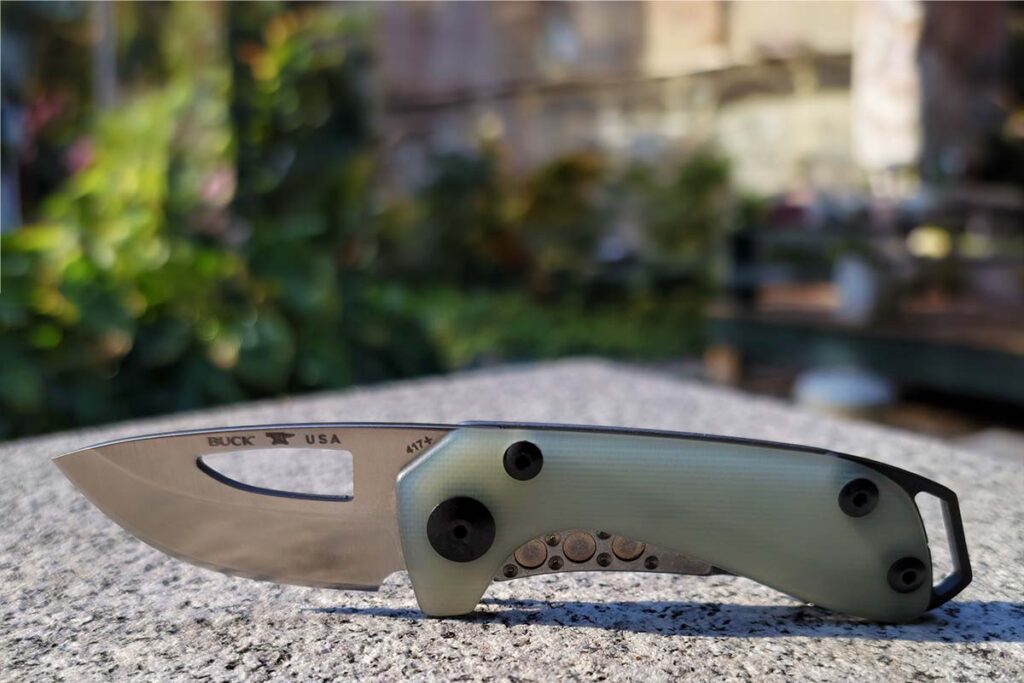
417 BUDGIE KNIFE
The Budgie is a very compact EDC knife that can go just about anywhere. The tiny design is minimalistic yet functional. It is a frame-like design that is available in a couple of colors, most notably natural green G10. This is a new design that does not necessarily have much in common cosmetically with the classic Buck lineup. That said, it is just about all the knife the average person needs for their daily life, and it can be kept on the person quite easily. While it is a bit more costly than the average mini pocket knife, the Budgie is backed by the same warranty extended to all Buck products and is going to last you for quite some time performing light and medium-duty tasks.
A mechanical wonder with practical functionality, the CRKT Provoke incites wonder.
Karambits are unique knives, originating in southeast Asia as an agricultural tool and later adapted as a weapon. Its signature claw-shaped blade allows effective slashing, and given its cutting edge is always oriented to the target at an angle, it also delivers wicked slices from point to hilt.
Just think about how a cat grabs, holds, punctures and cuts its prey and you have a pretty solid idea about how a karambit operates. The age-old design still inspires and intimidates, and some manufacturers have even figured out how to put a new spin on the longstanding design.
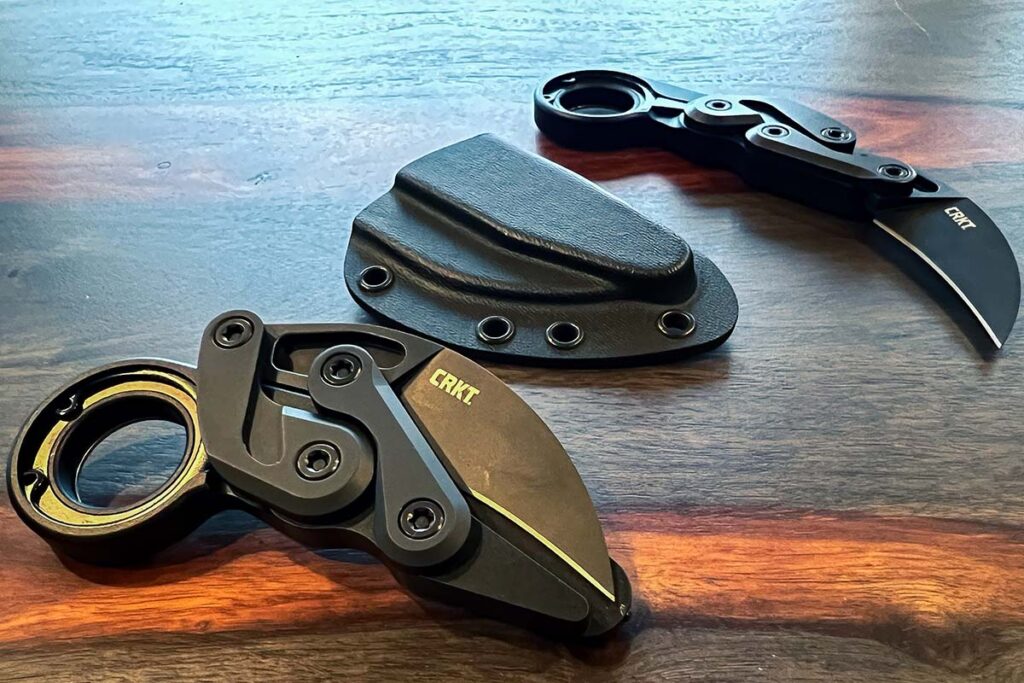
The Provoke offers a wicked chisle grind for maximum slicing, cutting and punturing ability.
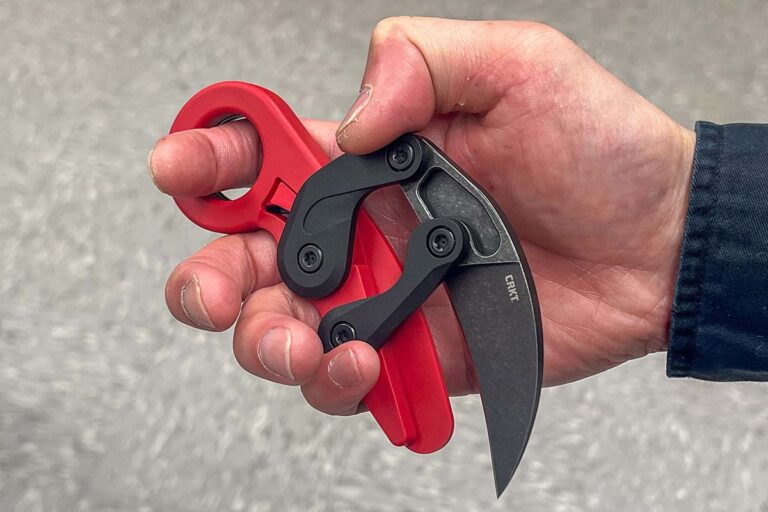
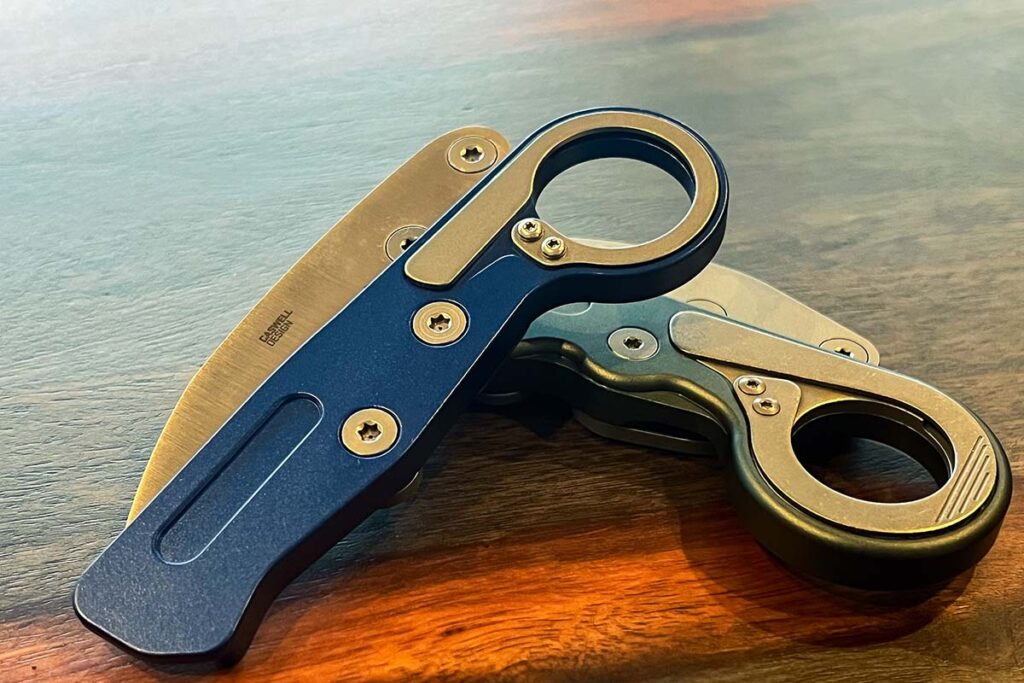
Knifemaker Joe Caswell took the concept of a folding karambit and made it a bit different. Instead of the blade simply folding into the handle, the Provoke’s steel lunges out and back in with a simple flick of the thumb. In the ancient art of knifemaking it’s difficult to come up with something unique, but Caswell did.
The Provoke not only incites wonder in collectors but also elicits excitement in serious users.
Provoke Blade
The blade of the Provoke (MSRP $200) is 2.4-inches long and is made from D2 steel for superior edge retention. To work properly with the deployment mechanism, the blade is chisel ground. The flat side is faces in toward the handle, laying flush against the frame when closed. This is mainly a safety precaution, protecting the user from cuts or torn clothing when the blade isn’t in use.
Provoke Action
The mechanical action of the Provoke is one of a kind.
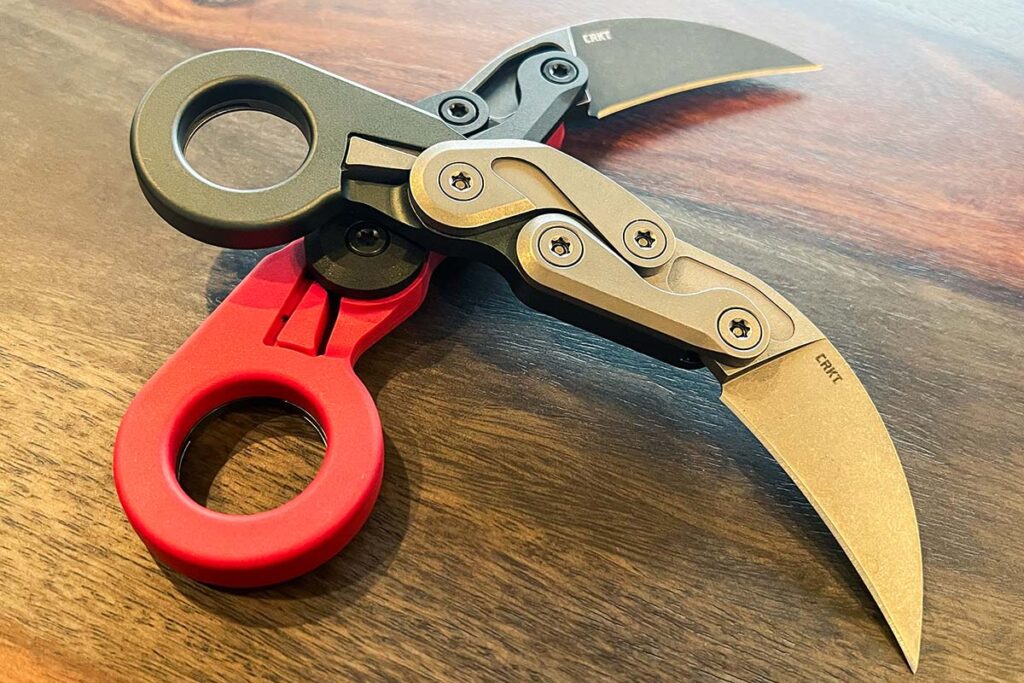
The Provoke’s signature action is what Caswell dubbed “kinematic”. It works thusly, the blade is attached to a pair of movable arms anchored into the handle. To deploy the blade, it is held in reverse grip and the thumb presses on the exposed end of the blade. The arms pivot and the blade leaps forward. Closing is equally as effortless. Just press down on the exposed locking tab just below the finger ring, then the blade is retracted backward until it rests fully against the handle frame.
Nicely, given it doesn’t take much force to open or close, the blade locks in the open position. Honestly, it’s a really neat, mechanical motion. Fairly self-evident, the movement of the Provoke is unlike anything else available on the market today and has the ability to capture even a jaded knife aficionado’s attention.
Getting Clipped
As unique as the action is the Provoke’s pocket clip, which lays flat until needed.
Another intriguing aspect of the CRKT offering is its pocket clip. Often used, rarely discussed and poured over, the clip is one of those unsung if not massively simple aspects of the knife. Even here the Provoke takes a different twist in design.
The clip is spring-loaded and rests against the finger ring completely. To open, you simply push down on a notched portion of the clip and it rises up. Some might complain it’s overly complex, but it does fit nicely in a knife defined by its mechanical ingenuity. Not to mention, in hand, you do not feel the clip at all—a break from nearly every other option with in a standard configuration.
Provoke Variations
Provoke Compact
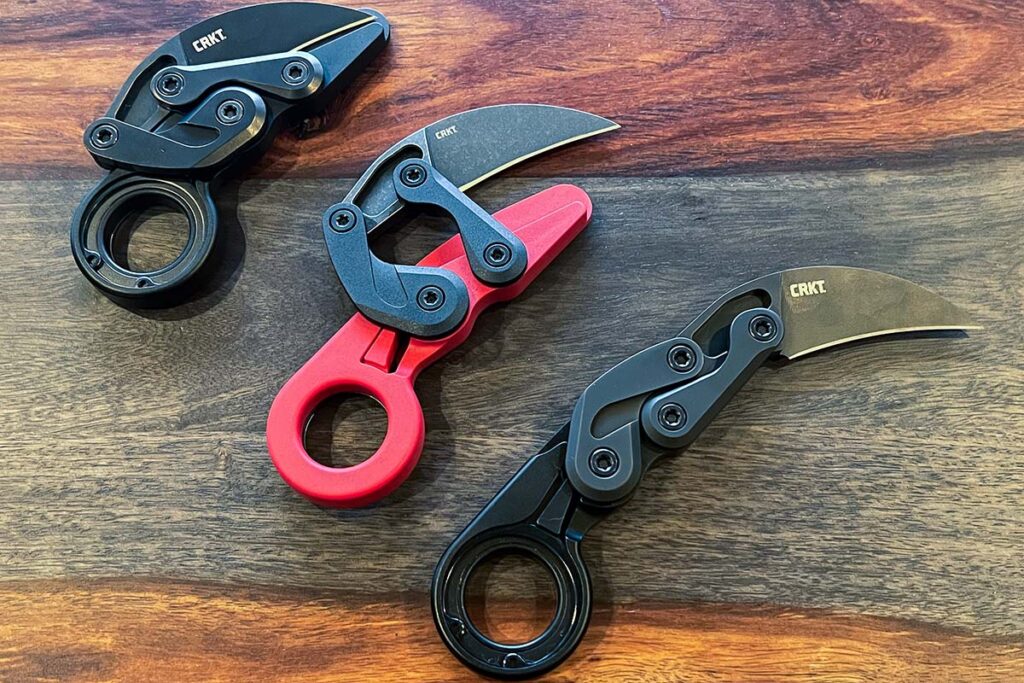
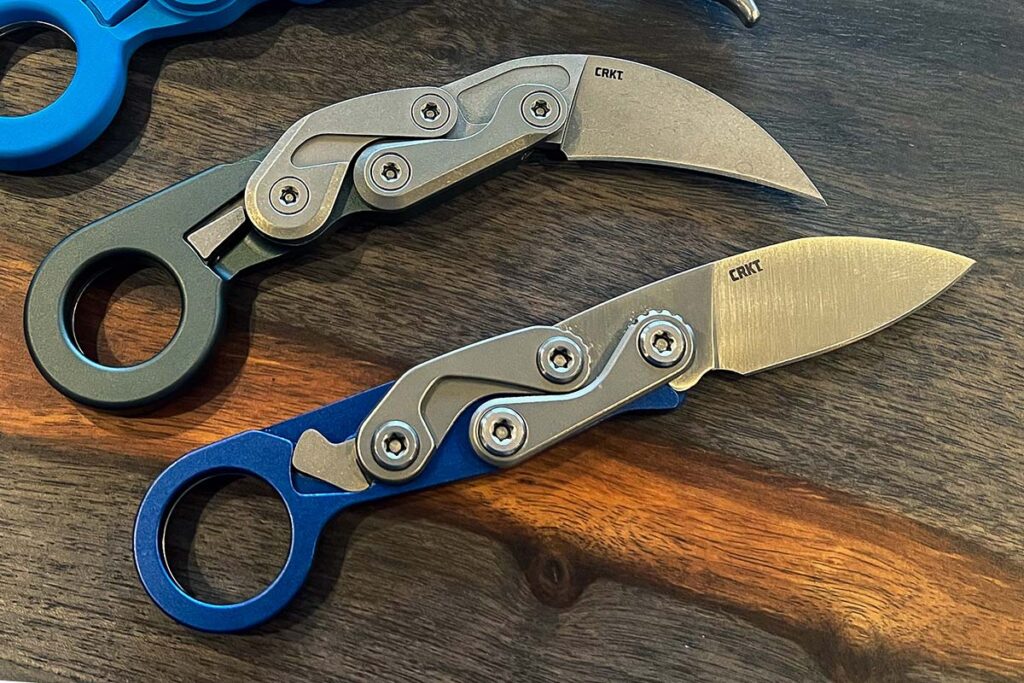
Provoke Compact (top) and Provoke Grivory (bottom) offer two lightweight EDC options.
In addition to the full-size Provoke, there is a scaled-down version in the form of the Provoke Compact (MSRP $150). Essentially, it’s the same knife but with a blade length of 2.2 inches. Where this petite Provoke earns its stripes is ease of carry, as it is much less cumbersome in the pocket than its big brother. And, from my perspective, this smaller version’s action is a bit crisper than the full-sized, perhaps due to the smaller blade.
Provoke Grivory
Again, aiming at EDC, CRKT also offers the lightweight Provoke Grivory (MSRP $100). You guessed it, the handle is made from injection-molded Grivory—a very stiff but lightweight glass-reinforced thermoplastic. Here you have a host of choices in handle colors, including fluorescent green, red, blue, and orange—adding some pop to an already exciting knife. Regardless of the color, the blade’s arms are always black Grivory, providing a nice contrast to the frame and matching the blade’s black stonewash finish.
It’s also worth noting that the Grivory arms are reinforced with steel to provide strength and rigidity to the material for superb blade action. The lightweight version weighs 4.7 ounces; for comparison, the full-size Provoke weighs 6.1 ounces. So there is considerable weight savings.
As for the action on the Grivory, it feels a bit different than the aluminum handle versions—in a good way. For me, it felt a bit lighter and faster in deployment.
Provoke First Responder
For the save and serve professionals, CRKT offers the Provoke First Responder (MSRP $225)—the full-size knife with a 2.4-inch blade. However, it does have some value adds life-saving professionals should appreciate, such as a ceramic glass breaker point inserted into the end of the handle frame.
The Provoke’s curved blade is especially suited for rescue work, particularly cleaving through seatbelts with a single, swift pulling motion. In addition to the standard integrated pocket clip that all Provoke models feature, the First Responder also includes a molded sheath with multiple carry options to offer carry flexibility if desired.
Provoke EDC
The EDC (bottom) next to the Compact (top). The EDC may prove more practical for some users.
The Provoke EDC (MSRP $175) features a 2.5-inch long drop point blade of D2. This iteration replaces the knife’s standard talon-shaped blade with a blade shape that is more friendly to daily cutting tasks. Honestly, it’s perhaps my favorite out of the entire Provoke family.
The action is very quick on this one, though once open you have to reorient your grip from a reverse to a forward grip. The blade’s lock release on the EDC version has been reoriented from the position of the other Provoke models, to make one-handed closing of the blade possible. You can deploy the Provoke EDC one-handed as well as close it one-handed. It does require some practice to close one-handed but once you get it down, you will be able to do that easily.
Provoke Trainer
No need to upgrade your health insurance when practicing with the Provoke Trainer.
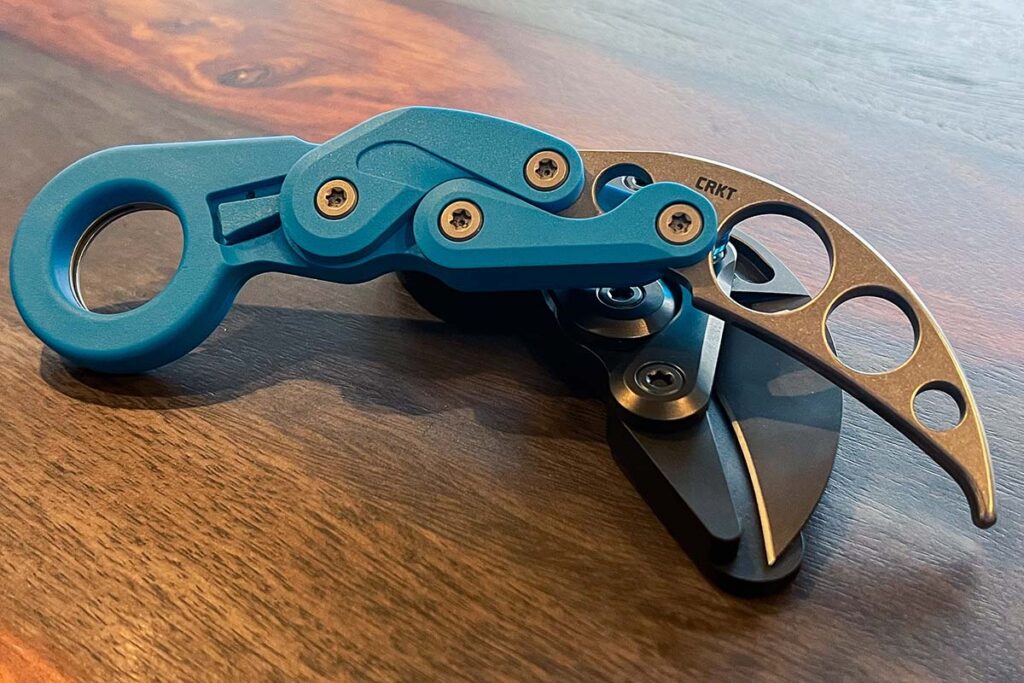
For those who might be serious about employing the Provoke for self-defense, or simply like to fiddle with the knife’s action as a fidget toy, CRKT offers a trainer model (MSRP $100). Built exactly like the live-bladed lightweight Provoke, it sports a dulled and blunted blade. In short, there’s no danger of accidental cuts or stabs while working with the knife.
Furthermore, a series of holes drilled into the blade blank subtracts weight so it is the same as the live-bladed version. The trainer is only available in an all-blue handle, signifying its purpose.
Using The Provoke
When using the regular Provoke, you’re limited to a pulling motion for cutting, though it has a defined blade tip for precise cutting and scoring. If you intend to carry one on an EDC basis then the Provoke EDC is a better candidate because of its double ground drop point blade, which is more conducive to general utility use.
Due to the more common blade shape along with the short length, this model allows you to get into places where a larger knife blade cannot. This means using the Provoke EDC to open mail, packages, strip wire, cut cardboard, and other general working tasks that a knife of this size would be called upon to do. The D2 steel does an excellent job at holding an edge yet when it comes time to resharpen, it’s still a great steel.
Final Cut
If you like knives that are a step away from ordinary—not to mention are conversation starters—the Provoke series is for you. If you like mechanical things…the Provoke has your name on it. However, I would pick the Provoke EDC as the best of this bunch if you are just going to carry one for daily cutting purposes.
Each model is made with excellent fit, finish, and sharp ess right out of the box, however. I think this design is perhaps one of the most inimitable knives out there right now. It may not be for everybody, though. But if your knife tastes venture into the unique and different, then the CRKT Provoke series has your name on it.