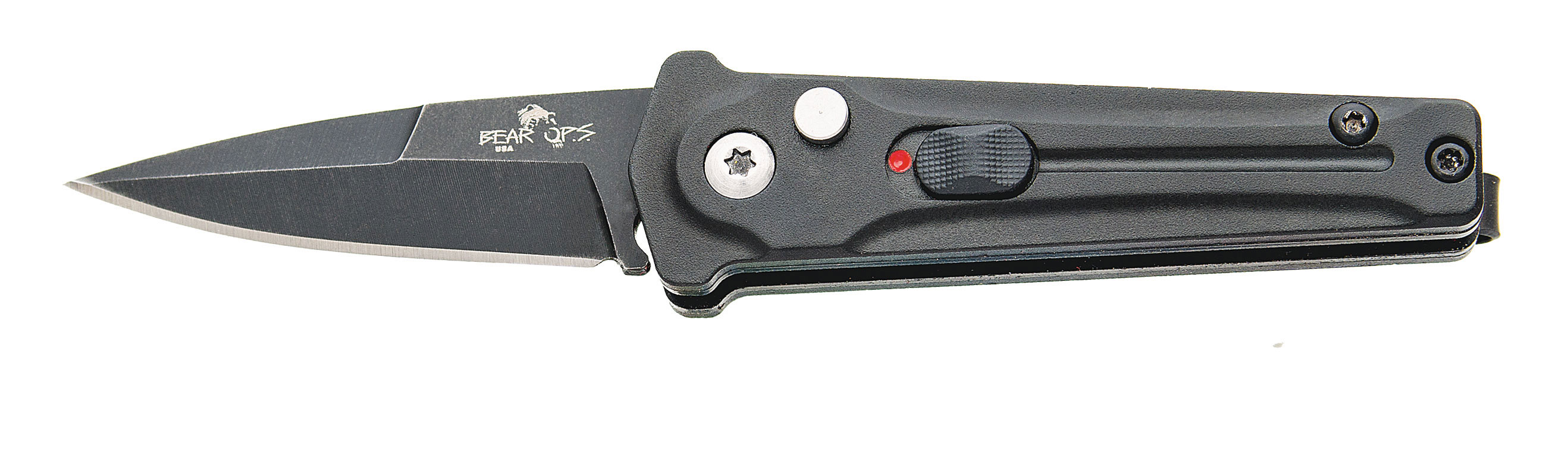
Knife collecting is an extremely rewarding experience for knife enthusiasts. There truly is a knife for everyone. Many increase or hold their value throughout the years, making collecting knives something to pass on to the next generation of knife collectors.
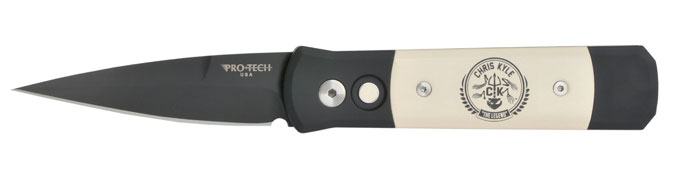
Pro-Tech’s new Chris Kyle Frog Collection is anchored by the Model 752, a spin on the Godson Tuxedo. The Chris Kyle “Legend” logo is lasered into the ivory Micarta inlays. Proceeds benefit the Chris Kyle Frog Foundation.
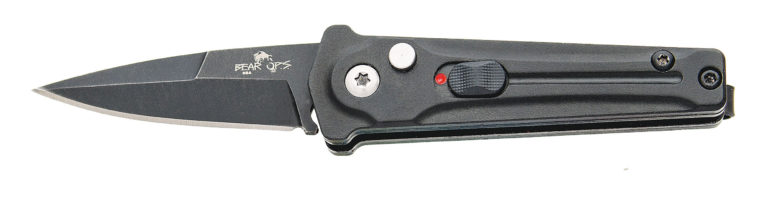
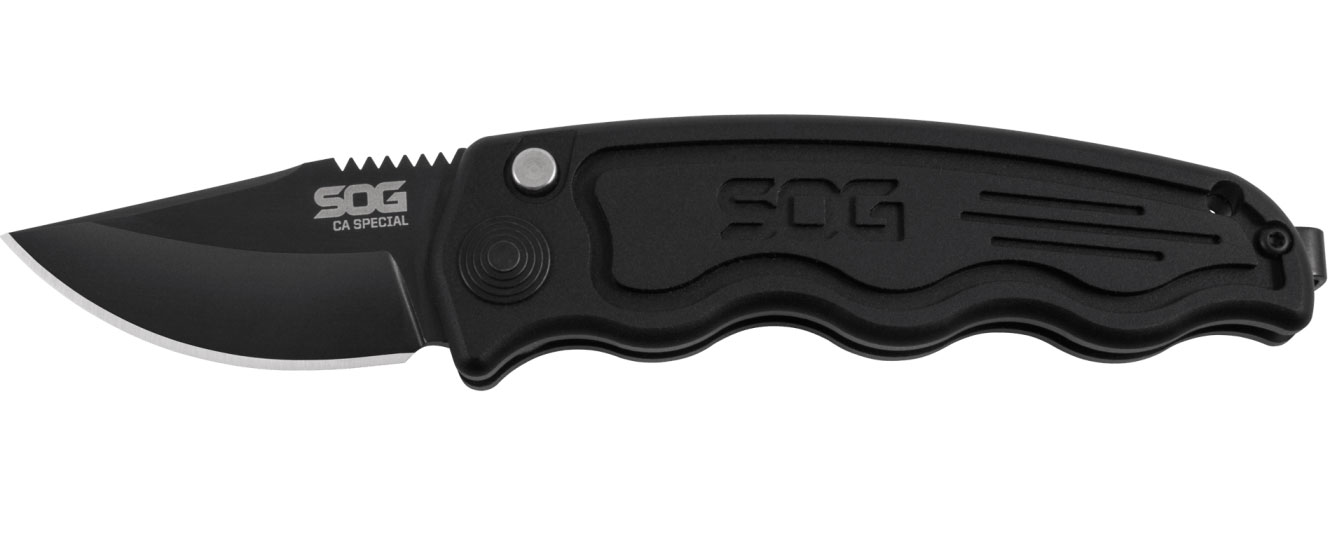
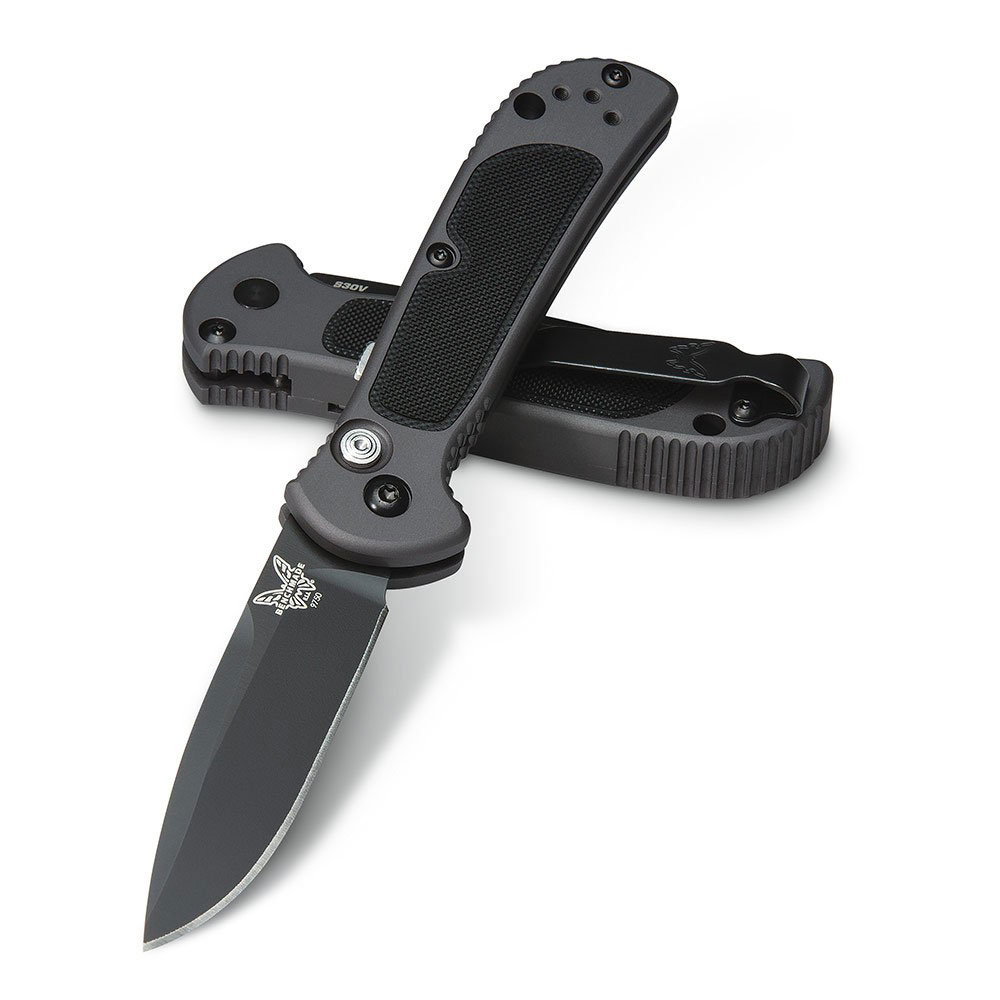
Stubby blades designed for the Golden State may also hold appeal for those elsewhere. That seems to be the thinking behind SOG’s discreet California Special, which could be described as an entry model for new collectors.
This series won’t hit shelves until May 1, but it’s worth keeping an eye out. This USA-made auto is slated to retail for $125.
Final specs aren’t available yet, but the series will offer S30V blades and four style options.
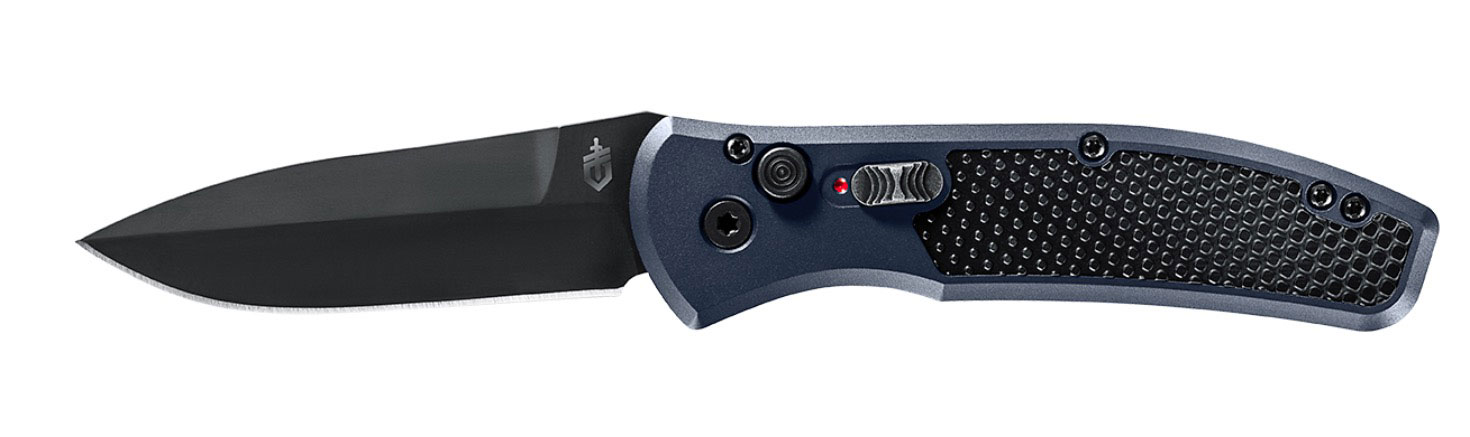
Benchmade Coalition® Family
The models in this series (or family) aren’t necessarily distinct variants. Instead, buyers can choose from plain or serrated edges, and satin or coated finishes. That makes for four possible combinations for this EDC auto.
A sushi knife that developed a taste for Texas brisket.
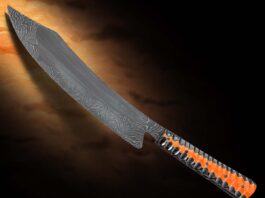
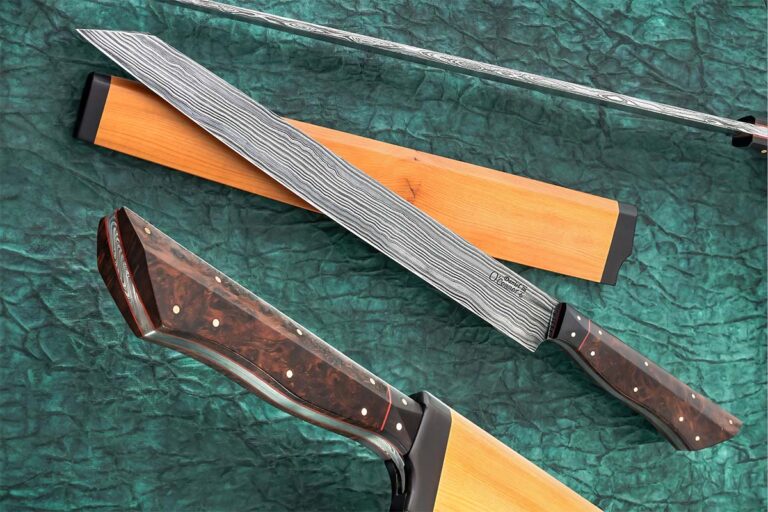
You might say Daniel O’Connor’s Black Widow leads a double life. It started as a sushi knife but when one of Daniel’s Texas pals said it looked like it would make a great brisket knife, O’Connor went with the flow, telling his friend, “It’s about whatever you want it to be.”
Based on a kiritsuke yanagi-ba sushi knife, Black Widow features a damascus of 150 layers of 1084 carbon and 15N20 nickel-alloy steels. Daniel forged the steels in a square and then forged them flat, perpendicular to the original stack. This resulted in the edges of the layers showing up in more or less straight lines, what Japanese swordsmiths call masame hada.
The accompanying image of the knife’s butt shows how the layers distorted when forged on edge. Daniel indicated he will use the pattern in the future.
Black Widow Specs Blade length: 12” Blade grind: A double urashi—double bevel w/a slight hollow on each side Handle: Bocote burl w/red fiber liners Bolster: Bog oak Overall length: 17” Sheath: Irish yew and bog oak Maker’s price for a similar knife and sheath: $1,500
Drawknives Are A Woodworker’s Best Friend And One Of Many Unique Knives Craftsmen Use Regularly
Knives take on many shapes and sizes. As tools, their designs sometimes focus on specific tasks. In the case of the drawknife, it is designed for woodworking. Drawknives have been found to date back to the Viking era more than a millennium ago.
The design itself takes many different shapes for a variety of purposes. At times, it is not referred to as a drawknife but, at first glance, you can see the relationship and how a number of tools can be considered part of the same family. As with any tool, different cultures have different interpretations of how the tool should be designed.
What Is A Drawknife?
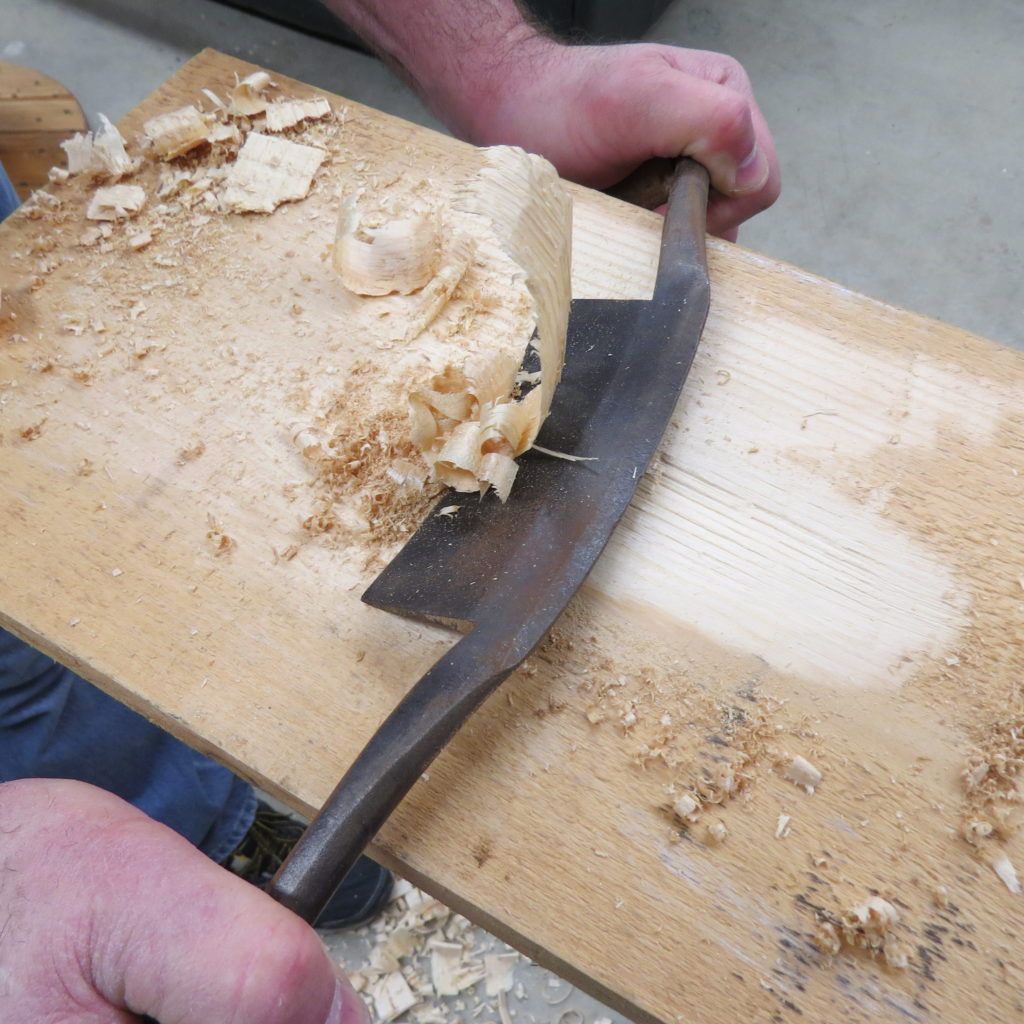
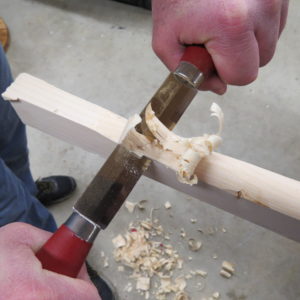
A drawknife is a single-beveled blade placed between two handles. The tool gets its name from how it is used. You simply grab both handles and draw the knife towards you bevel up. Controlling the angle that the blade enters the wood will control the depth of cut. A steep angle will get you a deeper, more aggressive cut but will also require more effort.
Lowering the angle makes for a shallower cut and also gives you a finer finish as the material is removed less aggressively. Some designs have long handles on plane with the blade. Other designs have the handle tight in and below the plane of the blade. No matter where the handles are, the action is the same but the point of control changes.
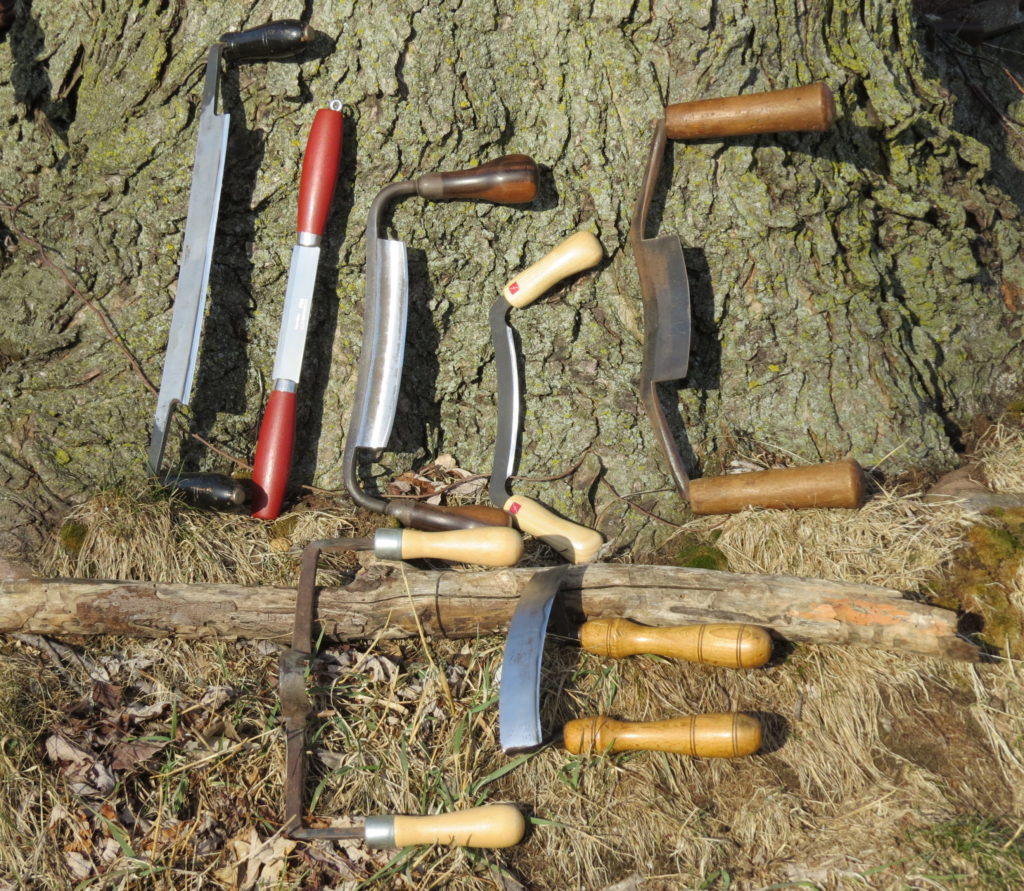
Top row, from left: a German-style drawknife made in Western Germany, Mora push knife, English-style drawknife, Flexcut 5-inch drawknife and a cooper’s knife. Bottom row, same order: Round drawknife and a chair maker’s scorp.
How To Use A Drawknife
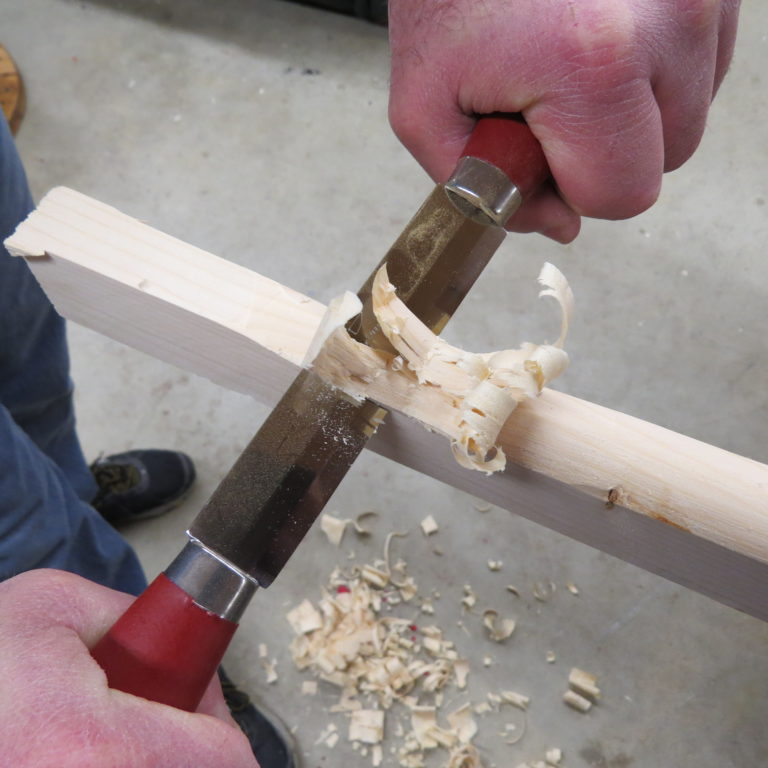
When working with a narrow stock up to two inches wide, it’s easy enough to draw the knife straight back toward you. On wider stock, it is better to skew the knife. Skewing the knife provides a leading edge and causes less resistance during the cut. When working with hardwoods you want to keep the cut light, as the dense grain provides more resistance and bogs the knife down.
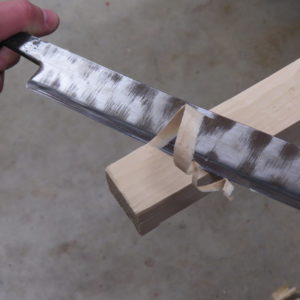
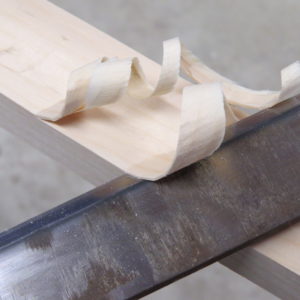
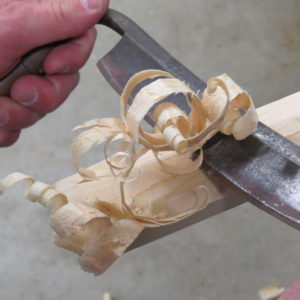
If you skew the knife and work the corners it is easy to remove long curls.
Even when working a flat when skewing the drawknife blade you can get some beautiful shavings.
Learning to use a drawknife properly is a bit like working a puzzle. The easiest way to make a cut is to work the facets of the material. For instance, say we are working on a piece that is square. To shape the piece to the required size it is easier to work the corners down, creating more corners until you get to your desired shape. By working the flats, you must use more energy and struggle to make a cut.
When first using a drawknife, the tendency is to use your arms to power the tool. Instead, use your back muscles, which are larger and less likely to fatigue quickly. Draw the knife back as if you were using the same muscle for rowing. If done right, it should feel like your shoulder blades are trying to meet in the middle of your back. For safety’s sake, keep your elbows in tight. As you draw the knife back your elbows will hit your core acting as a safety stop, preventing you from slipping and cutting yourself.
Types Of Drawknifes
A debarking knife is usually a larger style of drawknife used for extracting bark from logs. They are larger and heavier than their woodworking counterparts so that you can blast through the bark.
It has been my experience that when working green wood, the knife doesn’t need to be kept as sharp. In fact, it is somewhat more helpful to keep the knife a bit dull when cutting green wood so as to avoid diving too deep into the wood itself. On seasoned logs, because of the lack of sap between the bark and sapwood, I find it better to have the knife a bit sharper.
Woodworking drawknives come in a variety of shapes and sizes. The two main types I have used: English and German. The English style has a blade that bares a slight arch and the handles are on the same plane as the blade. German-style knives have handles that sit lower than the blade and the blade tends to be straight. The knives’ handles can vary. Most of mine have a pear-like shape. There are other styles like a round knob style, which is a ball shape.
The English style drawknife has a small but thin bevel that makes for some beautiful curls.
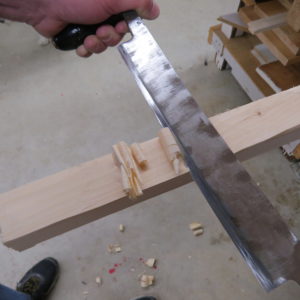
The German knife has a steep angle to the bevel. If used straight across a narrow piece wood, it can remove large amounts of material. At the time of the photo, the author had not finished cleaning up the blade, ergo the hammer marks in it.
Specialty styles of knives include any drawknife that is shaped to obtain a specific result. A cooper’s knife is shaped to accommodate the making of barrel staves. I also have a handle-making knife. The handle-making knife is a tight arch designed to make handles for things like brooms or garden implements. The basic shape is a half circle, so instead of trying to round a piece off by angling a number of cuts, you get a piece of wood close to size and simply let the knife shape it.
The cooper’s shave is designed to hollow out the staves of a barrel.
Push Knife
The model uses the Mora push knife to clean up curls left at the bottom of a curve. With the push knife, you can work the wood in an opposite direction without repositioning the piece.
A Scandinavian invention, the push knife is similar to a drawknife in that it has a blade attached by two handles on either side. Using a push knife is different in the way that you are expected to force the edge away from your body instead of pulling it toward you. Unlike a drawknife, the handles come straight out from the sides, which allows you to either push or pull the knife. I normally use the knife in the manner that gets the job done—meaning on occasion I will draw the knife toward me rather than push.
What Is A Scorp?
Technically, scorps are not drawknives. However, in terms of looks and use you can’t help but lump them in the same family. I have a chair maker’s scorp that is designed to hollow out the seats of chairs. On older chairs is a slight depression where the person sits. A chair maker’s scorp was used to produce the shape. The tool operates just like a drawknife except it has a shorter blade with a more pronounced arch.
How To Sharpen A Drawknife
Like any other cutting tool, a drawknife must be sharpened. Perhaps the trickiest part of sharpening a drawknife is finding a way to brace it. I find dynamic sharpening the easiest way to sharpen a drawknife. I brace the knife and move the sharpening medium instead of the other way around. One way to brace the knife for sharpening is to put one handle in your armpit and hold the other handle in your off hand. Once the knife is braced this way, take a stone to it. Another way is to brace one handle on the bench, lean your chest on the other handle, and then begin sharpening. Keep in mind a drawknife must be sharp (except where noted previously) but since it is not necessarily a fine woodworking tool, don’t get carried away.
YouTuber James Wright shows you how to sharpen a drawknife using a set of sharpening stones in his shop.
Lastly, keep it oiled. Even the newer ones are not made from new high-tech steels. Most are from simple carbon stock and a light coat of oil goes a long way. Among others, Flexcut offers a contemporary drawknife.
Other Wood Carving Tools
Beyond drawknives and planes, there are many other types of wood carving knives out there that can help with some of the finer points of woodworker. Small, nimble wood carving knives like a sloyd knife or a spoon knife.
A sloyd knife is a short, sturdy blade good for small, finite carving tasks. A spoon knife, as the name suggests, is meant to carve out the concave scoop of a spoon but can be used for any other situation where you are trying to create a concave dip in the material.
There are certainly more than just these few tools to being a successful woodworker, but knowing how to use wood carving tools big or small can get you on the path to success.
Why To Use A Drawknife
Long before there was solar power, fossil fuel power, steam power, etc., there was muscle power. Humans developed the world using tools with muscle and sweat. There is something satisfying about making something by hand. The feel of a good day’s work is sometimes what the soul needs. A drawknife not only gets the job done but also gives you an accomplishment to savor.
It doesn’t matter if you’re a hunter, outdoorsman, knife enthusiast, collector or even an experienced survivalist or do-it-yourselfer, learning the basics of knife sharpening often takes a backseat to more pressing matters. It’s a question on everyone’s mind—What’s the fastest, easiest way for me to sharpen a knife, and what’s the best sharpener on the market? Unfortunately, there’s no one right answer, but through researched and developed, step-by-step articles on knife sharpening, we’ve made it easy for anyone to learn the basics, and even some of the more involved methods of honing blades.
The “Sharpen A Knife & Care For A Collection” digital download is an easy-to-navigate, read and enjoy eBook. This digital guide is a PDF file you download and access with any home computer, lap top or digital device with the Adobe Reader program installed. In this guide you’ll find 11 chapters covering various facets of knife care and sharpening, written by noted knife industry experts, including Dexter Ewing, Durwood Hollis and James Morgan Ayres.
It’s one of the oldest methods of honing a blade bevel, the most traditional, conjuring up images of ancestors, grandparents, even Japanese bladesmiths working edges on whetstones or oilstones, fingers blackened from the grit. Stone remains a popular sharpening medium. It might not be the Stone Age, but you would hardly know it by perusing the rock-hard offerings of knife or knife sharpener and accessory companies.
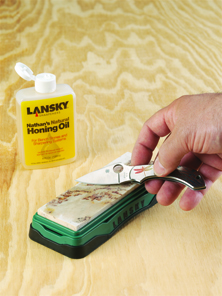
Unlike traditional stones bought for pennies apiece at the old hardware store, the Smith’s 2-Stone Sharpening Kit (www.smithsproducts.com) comes with a 5-inch, medium-grit stone, a 4-inch fine Arkansas stone, honing solution and a sharpening guide. The medium-grit stone, meant for quickly setting an edge, comes mounted on a molded-plastic base that features a built-in storage area at the bottom for holding the fine Arkansas stone, the latter of which is ideal for finishing or polishing an edge. The manufacturer’s suggested retail price (MSRP): $15.99.
“It is everything you need to put a razor-sharp edge on your large or small knives and tools,” Richard Smith says. “The neat thing about this kit is that, although you get two stones, they only take up the space of one bench-mounted stone. I never lose the fine stone because it’s always stored in the base, and it allows me to take the fine stone into the field with me if needed.”
Knife to Know: Blade has a forged distal taper; handle butt flared to enhance purchase
Weight: 12 ozs.
Overall Length: 20″
Sheath: Wood with handcarved details
Sheath Weight: 3 ozs.
I received a bolo made in the Philippines from my friend, Mike Key, as a gift a couple of years ago. He went on a three-day search for good bolos made from carbon steel in villages, not the souvenir type. He was successful in his quest.
I ran a triangle file down the edge and it skated off, an indication the blade is hardened steel for sure. The forged blade has a smooth distal taper, starting around 3/16-inch thick down to 0 inches at the tip. The knife sports hidden-tang construction. The wood for the sheath and handle are from a local shop in the Philippines. Of course, a blade must cut no matter where it’s made.
Cutting Tests
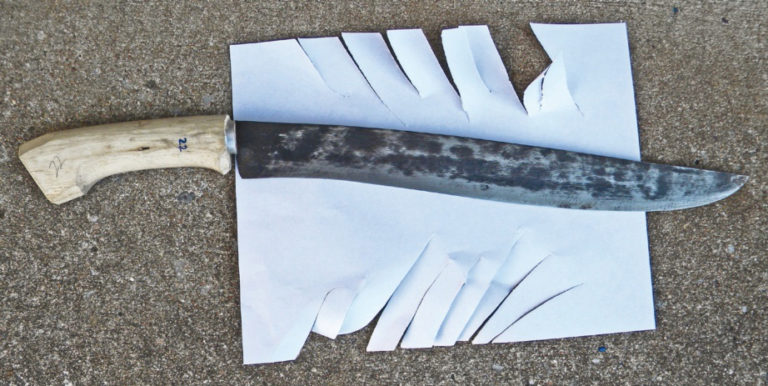
Up first: the paper slice. Despite a coarse edge, the bolo still managed to give clean slices in 20-pound bond paper. Normally, a bigger blade is cumbersome slicing paper, but the bolo has a perfect balance due to its distal taper.
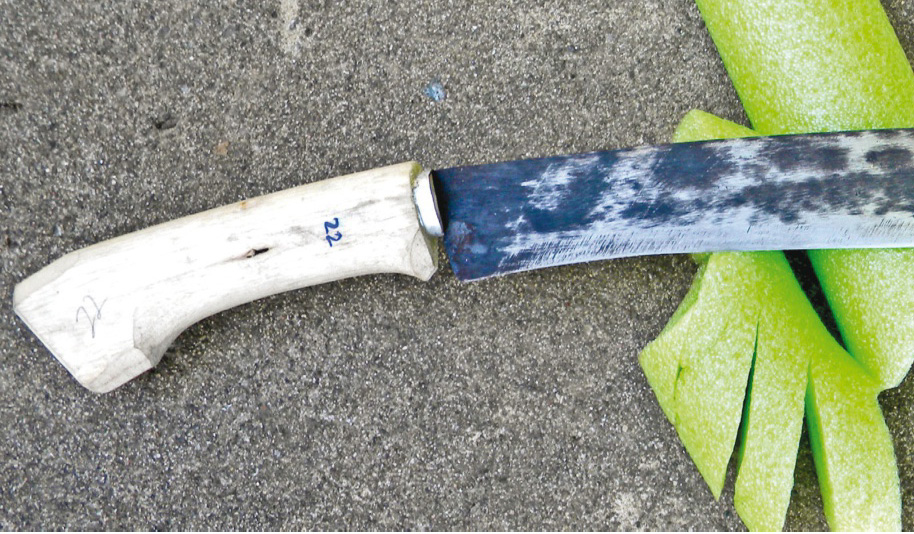
The bolo was very aggressive on the plastic foam. The author held the pool noodle suspended in air with one hand and sliced it. He indicated the knife is very controllable and the handle is indexed perfectly.
A pool noodle was next on the test menu. The bolo was very aggressive on the plastic foam. I held the pool noodle suspended in air with one hand and sliced it. The knife is very controllable and the handle is indexed perfectly.
Next up: chopping into a hard cardboard tube with the noodle inserted to prevent wall collapse. It worked on the first two chops, but then I hit too close to the previous pair of chops and the tube crushed under the force of the blows. Still, the blade made it halfway through the tube.
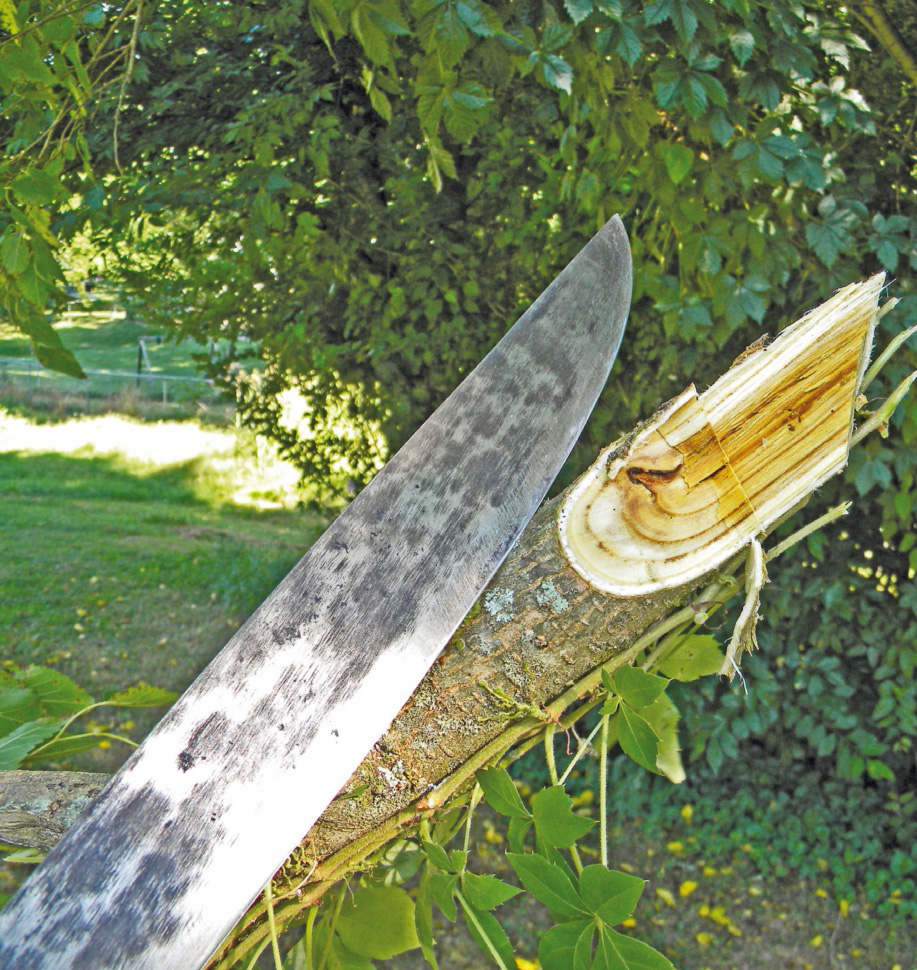
When you have trees encroaching on your property, you have to take steps to keep your yard clear. One such branch had scraped me for the last time while I was mowing the lawn. Its 2.5-inch diameter was a breeze for the bolo. Five whacks and the branch was down.
Five whacks and the 2.5-inch-diameter branch was down.
I dragged it away from the fence to whack it into smaller pieces. This is what the bolo was designed to do. One chop per branch and it was in pieces quickly. Just a wrist snap carried the blade halfway through a 1.5-inch-diameter branch. The bolo is a very fast chopper.
A note on the wooden sheath: It’s flat on one side for resting against your body and slightly rounded on the other. The maker even added some hand-carved detail into the wood. Excellent workmanship!
A big thank you goes out to Mike Key for finding this gem of a bolo for me.
Changes
On a blade this long, I would like to see a pin in the handle for a mechanical connection.
Final Results
The bolo is a very balanced working model. You can use it all day without wearing your hand or arm out. It exhibits great workmanship in the forging and the woodwork!
A chance phone call out of the blue leads to the author’s opportunity to see and hold the iconic Warenski King Tut Dagger.
While in San Diego in summer 2015 for a work conference, I saw a flyer advertising a King Tut exhibit at the San Diego Museum of Natural History. The exhibit focused on recreating the experience of Howard Carter, the British archaeologist who found the lost tomb of Egyptian King Tutankhamun in 1922.
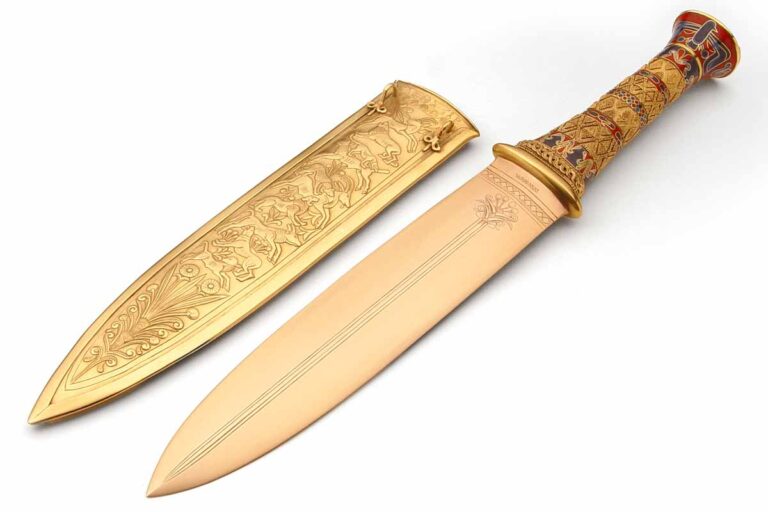
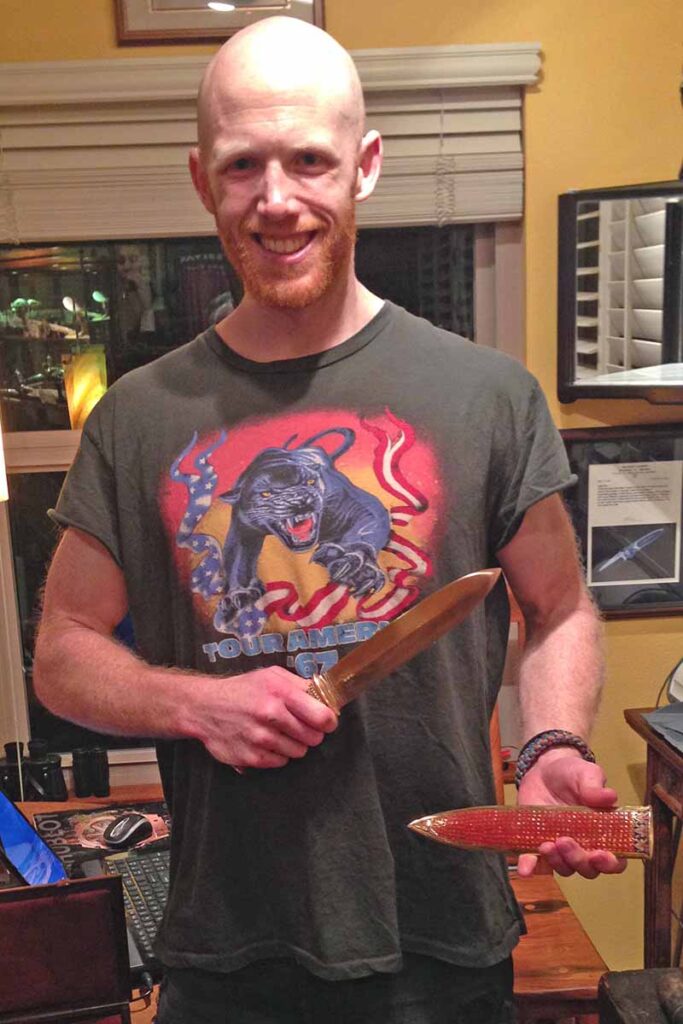
The author holds Buster Warenski’s reproduction of the King Tut Dagger and sheath in the home of Phil and Judy Lobred. (image of Warenski’s Tut Dagger by SharpByCoop; image of the author by Phil Lobred)
The promotional materials advertising the exhibit indicated it would feature recreations of many of the artifacts found in the original tomb. Having been exposed to custom knives all my life through my father, Rick Royster, and being familiar with BLADE Magazine Cutlery Hall-Of-Fame® member Buster Warenski’s work, I wondered if Buster’s famous reproduction of the King Tut Dagger would be part of the exhibit.
I called the museum and asked the young lady who answered if Buster’s reproduction was in the exhibit. She said it was not, but my inquiry grabbed her attention. She didn’t go into much detail but alluded to the fact that the owner of the reproduction lived in the area. We hung up and I went about my trip not thinking anything else of it.
Later that day while visiting the San Diego Zoo I got a call from a strange number, and it was Cutlery Hall-Of-Famer Phil Lobred, owner of the King Tut Dagger reproduction. Apparently, the young lady from the zoo knew Phil and had reached out to him. Phil and I talked on the phone and I told him how my father had worked closely with Buster through the years on several custom pieces, and Phil invited me over to look at the knife. I told my girlfriend we had to hurry up at the zoo because I had somewhere more important to go.
Visiting The King Tut Dagger
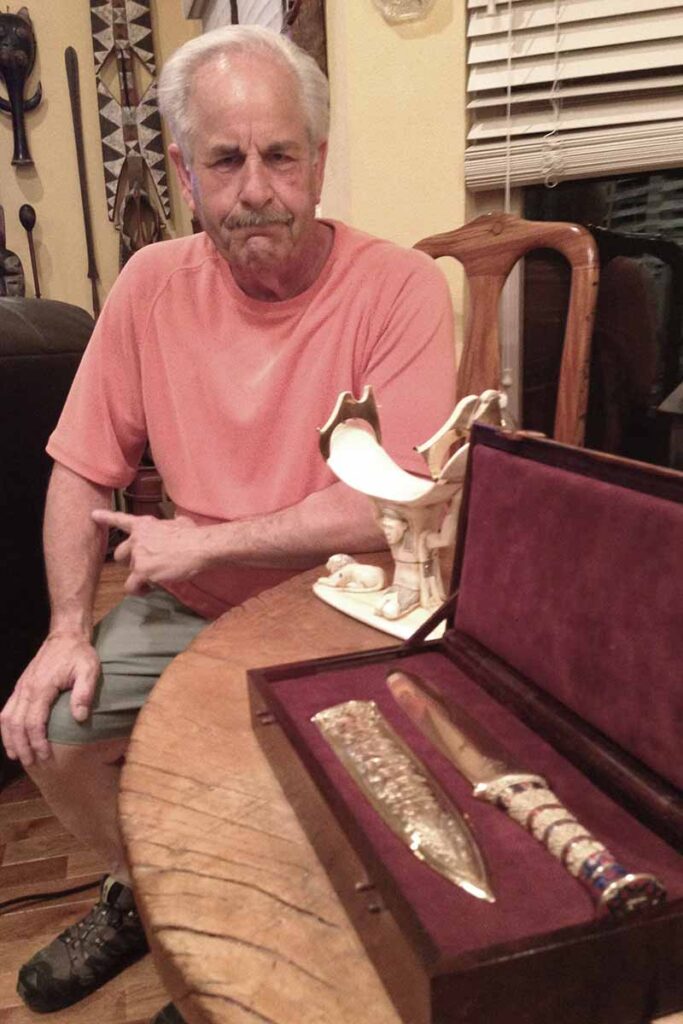
I went to Phil’s house that evening. His wife, Judy, let me in and took me to him. We went upstairs to what must have been Phil’s corner of the house. Not only did he have dozens of knives, he also had tons of collectibles. What I remember most were the Eskimo artifacts. He knew what everything he had was and had a story to tell about how he got each one and what it was used for.
Phil Lobred sits by the King Tut Dagger reproduction and sheath in the presentation case, as well as the knife’s display cradle. On the wall at left are examples of the African art in his collection.
Then we got to the knives and finally the most extravagant of them all—the Warenski Tut Dagger. I couldn’t believe what I was seeing. It was a marvel to behold, a true masterpiece, something not many people in the world would ever have the opportunity to see up close. I was shocked when Phil asked if I wanted to hold it. He even photographed me holding it, the image of which appears with this story.
I must have been at Phil’s house several hours with him showing me all of his collectibles and talking about them. It was easy to lose track of time. He was a very nice man. It was very gracious of him to invite a total stranger to his house, and let me see and hold a one-of-a-kind piece of art.
Knife Collecting Is Different For Everyone. Some Folks Like To Stick With A Theme And Collect Everything They Can.
It’s all about perspective.
Everyone agrees that knife collecting is one of the greatest enterprises around. However, there are variations on a theme—if the collection even has one. Probably the biggest variation on the common thread of knife collecting is the existence or absence of a theme, a focus on the collection that revolves around a specific aspect such as an individual custom knifemaker, group of makers, handle material, style of knife, period of time—well, you get the idea.
Theme collecting has its followers and its detractors, and gaining insight into these points of view enriches the collecting experience. First, however, there is a single universally accepted piece of advice regarding the knife collecting adventure: collect the knives that you admire, enjoy, and make you feel good!
“When it comes to collecting, and I mean collecting anything, I think the first rule is to collect what you like,” related long-time knife enthusiast and collector Chris Schluter. “At the end of the day, whatever it is you’ve been collecting might not be worth anything except to you. The collection may go down in value, be obsolete, your kids may not care about it, etc., etc. Collect what you like and can afford. Having fun while doing it is a plus, too!”
Collector J.T. Oldham agrees. “My short answer is to collect what you like,” he said. “I’ve been to enough knife shows and have spoken with many collectors, purveyors, and dealers over the years, and that has been a prevailing sentiment. Collect what you like, with a focus on an element that is interesting or unique.”
Embracing Theme Collecting
If Chris Schluter’s collection of Bob Terzuola tactical folders isn’t comprehensive, it’s the next best thing.
Beyond the “like,” there are those collectors who find a theme and enjoy it for decades, buying, selling, trading, and thoroughly embracing a style or feature. Then it’s always possible to change course, switch ideas around, and find another path.
“I started out collecting hunting knives,” recalled collector Chris Nolen. “This was due to my love of hunting. Later, I learned at gun shows as well as from informative magazines like BLADE® that there were many styles, as well as usages of the knife. I was drawn to bowie knives. I had been introduced to a professional maker, Jerry Berry of Natchitoches, Louisiana, and he was making my hunters because I had switched from commercially made to custom. I drew out a large bowie and sent the plan to Jerry. He built the knife and my theme changed from hunters to bowies. So, I must say, I recommend theme collecting.”
Nolen’s experience is compelling because his investment in that course-changing bowie began with the basics: a drawing. Therefore, the full experience of owning the knife involved an added depth. Nonetheless, other collectors are drawn to aspects of theme collecting that center on different attributes.
“While I do not necessarily collect thematically, upon reflection I realized that my wife, Marlene, does,” advised longtime collector Larry Marton. “Just to clarify the state of affairs in our home with regard to knife collecting, we have two collections—‘ours’ and ‘hers.’ Her collection consists of small knives, predominantly folders, that are about 3.5 inches open. This collection has been accumulated over the past 35-plus years. The knives were crafted by some of the finest knifemakers of our time, both living and unfortunately passed. Marlene convinced each one of them to make her a unique knife, even though most had never made a knife that size before and most would never make one of that size again.”
Oldham takes a long look at trends and depends on the assessments of those close to the industry. “Typically, I have always learned of what is trending in the knife community by reading BLADE Magazine. I’m certain most others do as well. Joe Kertzman has been instrumental in keeping collectors tuned into knife trends for years by editing the annual KNIVES publication. I mostly rely on my network of trusted purveyors. They attend most, if not all, knife shows, do the legwork, speak with makers, and have substantially greater buying power than I do. They tend to focus on particular makers, but due to the large volume of knives they come in contact with, might be able to identify a theme before it exists.”
While Oldham doesn’t consider himself positioned to recommend a theme, he readily admits that he enjoys damascus steel and knives that incorporate embellishments in the shapes/look of human skulls.
His acknowledgment of the variety of theme options presents the general collector population’s point of view well. There is no right or wrong answer when it comes to collecting with or without a theme, but an eye for certain aspects or commonalities among knives can enhance the effort to grow a collection.
Meeting Other Knife Collectors
This reproduction of a Daniel Searles bowie by Mark Banfield is representative of the period bowie repros in Chris Nolen’s collection. (image courtesy of Chris Nolen)
Among the best features of theme collecting is the opportunity to build relationships as collectors and custom knifemakers interact with one another.
“Within custom knives, I’ve always gravitated toward tactical folders, so I would say that’s my overall theme,” Schluter explained. “Within that theme, most are from Bob Terzuola, then there are a lot of custom Emersons and at least a dozen knives each from Kirby Lambert and Peter Rassenti, and then numerous knives from Sal Manaro, Mark Roe, Shane Sibert, Chad Nell, and others.
“In any business, if a producer and customer have enough interaction they often become friends, and that may be even more so in the knife hobby. It’s often said that you buy the maker not the knife, and this is absolutely true if you really know the maker. Having the theme I do collecting-wise has certainly produced some lifelong friendships.”
For Larry and Marlene, that premise has held true. “Not only is it exciting to craft a special collection,” Larry commented, “but it is a way to get to know the knifemakers very well and to share the ups and downs of technical and artistic challenges with them. Firm friendships have been molded by this endeavor. Accumulating the collection requires patience, as every knife is made to order. Collecting unique knives that are not today’s momentary trend as an investment is risky, although with patience it can turn into reality.”
According to Nolen, the theme approach applies to whatever the collector’s motivation may be: pure enjoyment, investment, or both. Finding the right balance is a part of the journey, and building a collection that leads to personal satisfaction and lasting value is a powerful combination.
“There are some collectors that look at knife collecting as an investment,” he said, “and I would still recommend choosing a theme and devoting your collection to that theme. Just remember to get the best possible price. One day you may want to sell, and what you thought may have been a good deal may not have been so swell.”
Stick With The Knives You Like
Another example of one of Oldham’s knives with a skull theme is this Brian Tighe folder. “This was a very popular knife and was published in one of Dr. David Darom’s books,” Oldham wrote.
At the same time, beware of the trend that may glow white-hot and then fade quickly. Experience and a good sense of direction help prevent a misstep.
Concentrating on a specific theme will help insulate a collection from a haphazard mishmash of “stuff.” However, a collector may choose to purchase on more of a freestyle basis.
“If one were to follow hot themes exclusively,” Oldham said, “then one’s collection would be all over the place. I feel that it’s best to acknowledge the arrival of the hot themes, and then follow them to see if they become trends. A good example of this is the tactical theme or style. We can all safely attribute that style to Bob Terzuola and Ernest Emerson. As soon as that was considered a thing, makers like Brian Tighe, [the late] Darrell Ralph, and Allen Elishewitz were all over it, and at that point, I enthusiastically embraced it and they have become a major focus of my collection. They have all taken that theme to the next level, again and again, to the point that they’re now what I consider ‘rock star makers’ and have created their own genre, which I call ‘tacti-cool.’”
“I believe collecting bowies is very popular right now due to the Forged in Fire series on the History Channel,” Nolen observed. “This is not always the best path to take due to costs. A custom forged bowie can be very expensive. Collectors must first make sure they can afford the elected theme they choose. Small custom hunters and even fighters will most likely be less expensive. I made sure that I could cover the expense, but I suggest that any theme collector set a ceiling on the funds devoted to their collection.”
While expense is always a consideration and at times a downright barrier to entry in collecting higher-end or theme-related knives, the collectors are forever in charge. They may scale their collection toward the right value range and gradually, perhaps, increase funds devoted to the theme. A word of caution does address a fear factor—the fear of missing out.
“One thing I will say is that if you focus too much on one maker or type of knife you may miss out on others,” Schluter cautioned. “However, if you keep an open mind, go to shows, are active on social media, read BLADE, etc., you will still be exposed to plenty of other work. That said, the big plus, at least for me, of having a significant focus on a few particular makers is that you can really get to know their work and can also get to know them personally.”
Knife collectors, whether or not they are theme enthusiasts, are continually looking for enjoyment and satisfaction. Choosing the collecting path is part of the fun, so remembering the basics of trust, quality craftsmanship, and collecting what you like will always make the love of custom knives worthwhile.